
Article

Frailty and Mortality in Historic Americans: The Relationship Between Sex, Social Race, Health, and Survival

1
Department of Anthropology, California State University Sacramento, Sacramento, CA 95819, USA
2
College of HESBS, Moreno Valley College, Moreno Valley, CA 92551, USA
3
Department of Anthropology, Smithsonian Institution, Washington, DC 20560, USA
4
Institute for Historical Biology, College of William and Mary, Williamsburg, VA 23187, USA
*
Author to whom correspondence should be addressed.
Heritage 2026, 9(2), 50; https://doi.org/10.3390/heritage9020050
Submission received: 8 December 2025 / Revised: 19 January 2026 / Accepted: 28 January 2026 / Published: 30 January 2026

Abstract

The study of human skeletal remains from historic contexts is uniquely positioned to explore inequality over time by linking the underlying sociocultural factors that enforce marginalization with lived experiences and health outcomes. We analyzed mortality rates among historic individuals of low socioeconomic status from a documented human skeletal collection, to examine how culture and identity become biologically embodied. Because pre-existing health conditions affect mortality risk, we examined whether individuals with short stature experienced earlier mortality. Kaplan–Meier analyses and log rank tests indicated significant differences in survivorship over time and among social race groups, indicating that African American individuals showed significantly higher mortality, but no sex differences were observed within population groups. Logistic regressions tested for the effects of age-at-death, combined sex and population group, and birthdate on the outcome of bone length. Age and birthdate were not significant, suggesting no relationship between short stature and age-at-death, which also did not change over time. However, odds ratios indicated fewer African Americans were surviving up to adulthood. While many individuals in the collection likely suffered some poverty and marginalization, survivorship was significantly worse for African Americans. The likely effects of systematic racism resulting in further socioeconomic marginalization significantly affected the health of the African American community.

1. Introduction

Bioarchaeology, the study of human remains from past populations, is uniquely positioned to significantly contribute to our understanding of the way that the sociocultural experience impacts biology, i.e., how the individual physically embodies their sociocultural background [1]. Both acute insults and chronic conditions during the lifetime are well known to affect human morbidity and mortality (i.e., age-at-death). Long-term perspectives gained through historical data and skeletal analyses inspire thinking about the intergenerational effects of marginalization and inequality on human biology in general, but especially in historically marginalized populations; and such research can affect change at social and clinical levels [2]. Studies of inequality may reveal how cultural and sociopolitical influences shaped lived experiences and health outcomes across various sex-, social race-, and status-based groups suffering from various maladies [3,4,5,6,7,8,9,10,11,12]. Many recent works highlight the effects of urbanization and industrialization on health and mortality [13,14,15,16,17,18].
In addition to overall mortality rates, the complex relationship between adult stature and health is well documented in the literature. Adult stature is the result of hundreds of genes [19], and twin studies in modern affluent populations report high heritability, especially for males [20]. However, this heritability is tempered by nutritional and health disturbances during development [21,22]. Short stature has been linked to numerous underlying causes including malnutrition, disease, and parasitic infections [22,23,24]. Stature is also related to clinical health outcomes in modern populations. It is inversely related to musculoskeletal disease [25], serum cholesterol, blood pressure, diabetes, coronary heart disease, and stroke [26,27,28,29]. Additionally, pregnant women with shorter stature experience higher rates of cesarean section, increased medical interventions, obstetrical complications, and a higher risk of perinatal death than mothers of average height [30,31,32,33,34]. The Dutch famine study illustrates the impact of even short-term insult, by showing altered biological and health consequences on the offspring of pregnant women who experienced calorie restriction, due to Nazi blockades during the second world war [35]. Elo and Preston [36] found stature is the best indicator of childhood nutrition and exposure to disease, with shorter individuals having higher risks of mortality. Similar conclusions were reached across various worldwide populations linking shorter long bone length and/or stunted stature with worse mortality outcomes (i.e., earlier age-at-death), particularly for men and those from a lower socioeconomic status (SES) [37,38,39,40,41,42]. Within industrialized countries, taller stature is associated with higher socioeconomic class, improved dietary quality, reduced physical labor, better access to healthcare, and higher income levels [42,43,44]. Thus, shortened stature may be used as a sign of frailty within populations, i.e., an individual’s increased risk of earlier death and poor health compared to the rest of their cohort [45,46], and has been used in bioarchaeological studies as an indicator of stress during development [37,47,48,49,50,51].
The use of stature to infer health is complicated by the potential for later catch-up growth, which is dependent on the timing of disruptive events during development [52,53,54]. While short stature may be considered a sign of poor health, the possibility of catch-up growth complicates interpretations of short stature in past populations. However, it is also paradoxical that short stature may also be an adaptive mechanism that allows individuals to buffer the effects of a poor environment. If short stature is a sign of poor health, then selection should eliminate these individuals from the population; however, when the stress in the environment decreases, selection should lessen and stature should increase [55]. Some authors [55,56] warn that stressed populations may exhibit taller stature, which may be counter-intuitive on the surface; but it is a result of selection eliminating shorter individuals; thus leaving a taller population as survivors.
In the United States, territorial expansion and technological advances during the 19th century opened land and created jobs, resulting in a shift away from an agricultural, credit-based economy to one dependent on industrial manufacturing and wage-based labor [57] with massive increases in urbanization between 1800 and 1850 [58] and large-scale immigration from Europe. Some studies examined stress experienced by recent migrants and report a link to mental illness attributed to post-migration stress and discrimination [59]. Asylum seekers in Bulgaria reported fair-to-poor health and negative health outcomes while also experiencing language difficulties and unsupportive medical professionals [60].
Several studies documented structural inequality in the 19th–20th century United States [61,62,63,64], often focusing on poor and marginalized populations that ended up in almshouses and on dissection tables across the country, especially women. Nystrom [65] concluded the political economy of the 19th century meant that the potential for increased morbidity and mortality crosscuts socioeconomic groups. Individuals from diverse ethnic, ancestral, and economic backgrounds became vulnerable to social inequities. Similar conclusions were drawn for populations outside of the United States [8,66,67]. In a study centered on British women, Mathena-Allen and Zuckerman [8] argued that expanding industrialization and urbanization and the abolishment of slave trade required new sources of exports for the global trade market—especially manufactured goods—requiring an able-bodied workforce and increasing numbers of women entering the workforce, who were paid less than men. They concluded that, despite public health initiatives, women were extremely vulnerable to power dynamics within the industrializing nation.
Between 1910 and 1970, in the United States, African Americans seeking better opportunities left the South in the “Great Migration” and moved into Northern, Midwestern, and Western locales, escaping Jim Crow laws, segregation, and White violence [68,69]. Several comparative studies of African American health before and after emancipation reported higher mortality in urban environments, women dying younger than men, increased morbidity compared to European Americans, and poor health for all children in any context [62,63,70,71,72,73,74].
These large-scale political economic processes occurring during the 19th–20th centuries (i.e., slavery, European immigration, Civil War, Reconstruction, and African American migration) created a context in which specific groups (e.g., women, African Americans, recent immigrants) were vulnerable to social inequalities that likely impacted their health and longevity, creating a unique opportunity to examine how marginalization and inequality are embodied by the individual.
The Hamann-Todd Osteological Collection in Cleveland, Ohio, contains the remains of adult males and females identified as European American (U.S. and foreign-born) and African American descent and primarily of low SES, born between 1828 and 1943, who died in the Cleveland, Ohio, region. The collection is documented, and secondary data from birthdates, death dates, sex, assigned social race, age-at-death, and long bone length are available through the Cleveland Museum of Natural History. The collection represents a critical time of rising urbanization and changing political economy in the United States. Many of the African American individuals were born enslaved and later immigrated into the American Midwest after emancipation [75,76,77]. The foreign-born European American individuals in the sample represent recent immigrants and their immediate descendants born in the United States [75,76].
Although the collection contains substantially more European American individuals than African Americans, there is a larger percentage of African Americans in the Hamann-Todd collection than European Americans, as compared to Cleveland’s greater population proportions [78]. Cobb [78] attributes this to the increased immigration of African Americans to Cleveland who were of lower SES, further explaining that the earlier years of the collection saw the inclusion of mainly low SES European Americans with the years nearer the writing of his dissertation shifting to more African Americans than European Americans, following population trends in Cleveland. Indeed, Cobb [76] reported the African American population of Cleveland underwent a booming population surge between 1910 and 1930 increasing from about 8500 to over 72,000 individuals.
Much of the collection is derived from unclaimed remains [78], which are not tracked by a federal agency [79], so nationwide statistics to frame the number of unclaimed outside of Cleveland are not readily available at this time. However, since 2000, approximately 2–4% of persons who died remain unclaimed in the U.S. and that number is increasing [79]. Comparatively, the Hamann-Todd collection received approximately 1% of the city’s unclaimed remains, which was estimated as a third of Cleveland’s dead [78], p. 56, and therefore, it aligns the overall unclaimed remains in Cleveland with the modern estimates of unclaimed remains in the U.S.
While other scholars have critiqued anatomical laws as being biased against individuals from low SES, persons of color, and European immigrants to satisfy the needs of medical schools, and pointing out, for example, the narrow timeframe of 36 h for families to claim their loved ones as being too quick [80], which would in turn cause a bias in who was left unclaimed, it is important to contextualize this timeframe with the current practices to ensure that all biases are accounted. Even with a 30-day period to claim family members’ remains today, an increasing number of people still go unclaimed, and a large number remain unclaimed after an additional 3-year wait period [79]. Today’s unclaimed are not just persons of low SES; rather, the unclaimed comprise people whose relatives do not claim them due to a variety of reasons, including many unrelated to cost [79]. Wealthy deceased can also end up unclaimed, making the process of who becomes unclaimed more of an issue surrounding who is legally responsible for the remains (i.e., the family) than one of SES [79]. Connecting this to the greater funerary environment in Cleveland shows that, after 1890, there was a shift from White funeral homes with Black funeral directors to Black funeral homes positioned in Black neighborhoods with prominent Black funeral directors, which was a model preceded by groups of European immigrants [81]. Thus, there were community-based funerary services available. Pricket and Timmermans [79] suggest the underlying driver of whether someone is unclaimed is “social isolation caused by eroding family ties” (p. 231), which crosscuts identities. This is potentially also reflected in Cleveland where African American immigrants, for example, went to escape the conditions of the South and may not have had family join them [77], a phenomenon that may be reflected in European immigrants to the area as well [82]. For African Americans who immigrated to Cleveland, their family structure shifted to practices such as keeping in touch remotely, encouraging immigration of Southern family members to Northern areas, and to expanding their family in the North to include non-relatives and extended social networks [77], although this would have applied to European immigrants too. Then, as today, the government relied on the family unit to be responsible for unclaimed persons [79]. Thus, the extended family structure would have been limiting for non-relative family members to claim their deceased non-relative family members’ remains for African Americans and foreign-born European Americans who immigrated without family. Prickett and Timmermans [79] advocate to change these longstanding laws to reflect the actual social ties individuals have as they are too narrowly defined for American families.
As we are examining long bone lengths as proxies for stature, we focus on the growth and development environment of these individuals, rather than their environment as adults. Those that immigrated to Cleveland did so primarily as adults [78], which means their growth and development period would have occurred in their native country or state. While numerous studies demonstrated the effects of slavery, structural racism, and socioeconomic marginalization on health and mortality in African Americans, fewer studies addressed health and mortality among recent immigrants to the United States, or compared health and mortality between groups. We are presented with an opportunity to compare health and mortality outcomes across these contemporary groups allowing for an exploration into potential disparities between various sex and socially ascribed “race”-based groups (i.e., intersectional identities) in a large sample from the Hamann-Todd Osteological Collection (N = 2805). Museum curators are in ongoing dialog with descendants of those curated in the collections as part of their Biography Project (https://www.cmnh.org/science-conservation/areas-of-study/anthropological-sciences/projects/hamann-todd-biography-project) (accessed on 27 January 2026) and have found some support for further study of the individuals in the collection, while others prefer reburial. This issue is ongoing and dynamic.
In this paper, the term African American refer to legacy African Americans, a term coined by the third author to represent the bioethnic group that includes descendants of trafficked Africans who were enslaved and their descendants in the United States, acknowledging potential influences from other populations, i.e., those that are both African descendants and those who identify as African descendants [83]. It is unknown how many, if any, of the individuals in the collection may have underlying mixed ancestral affiliations.
As all individuals represent low SES and were subject to poverty and marginalization at the time of their death, we test three hypotheses: (1) sex- and socially ascribed race-based groups will show similar mortality levels (i.e., age-at-death) overall and over time, (2) using femur and fibula lengths as proxies for stature, individuals with shorter than average stature (a representative of stress during development) will also experience earlier mortality, and (3) sex- and socially ascribed race-based groups will show similar prevalence of shorter than average stature. Both femora and fibulae were used to test if proximal versus distal limb segments provided similar results. Descriptive statistics, odds ratios, and logistic regression were employed to examine these data. The models also tested for the effects of age-at-death and time period of birth: Antebellum (<1865), Reconstruction and Early Post Reconstruction (REPR) (1865–1909), and the Great Migration (1910+). Potential disparities in health and mortality among various sex, age, and racial groups and time periods (i.e., intersectional identities) allow us to better understand how inequality and marginalization are embodied.

2. Materials and Methods

The Cleveland Museum of Natural History, which curates the Hamann-Todd collection, provided information on sex, assigned social “race” (which should capture lived experience), age, birthdate, death date, and long bone length, which is used as a proxy for stature. All data are owned by the museum and were provided by the collections manager. Only adults were used in this research. Most of the assemblage came from unclaimed bodies at the Cuyahoga County morgue, city and state hospitals, and the Cleveland Workhouse [84], although some were self and family donations [78]. To contextualize this workhouse environment from later workhouse conditions across the nation, the Cleveland Workhouse was a series of four institutions where persons could benefit from social services, including medical, religious, educational, and vocational support [85]. This suggests that not all individuals were necessarily marginalized or impoverished and some may represent average working-class individuals of the time. There was a penal institution on site, along with a city infirmary/poorhouse, a tuberculosis sanatorium, and a municipal cemetery [85]. This was recognized as “one of the finest and most progressive penal institutions of its kind. It became a model for similar institutions around the world” [85].
Survivorship and mortality were modeled with a Kaplan–Meier survivorship analysis in two ways: first, on age-at-death and intersectional identities, and, second, on intersectional identities broken down by time period. Intersectional identity was modeled by categorizing individuals by sex and social race, e.g., identifying as male or female and African American or European American. Age-at-death was captured roughly by subtracting the birth year from the death year. The differences between survival curves were tested for significance with log rank tests.
For the second hypothesis testing stature and mortality, the frailty indicators were the outcome variables of interest: short femur and short fibula. The left-side maximum length measurements were used and the right side was substituted if the left was missing. Both were created by assigning individuals with maximum lengths one standard deviation or less than the mean as having a short bone; otherwise, individuals were classified as average-statured. This definition of short stature does not correspond to the standard definition of growth stunting, which is typically more than two standard deviations from the group mean. However, it is consistent with other studies in bioarchaeology [37,39,47]. We calculated this for each intersectional identity. The predictor variables consisted of demographic variables that should capture social experiences, i.e., intersectionality and age-at-death. Finally, we created a variable to capture major time periods represented by these data using the individuals’ birthdates to control for heterogeneity from secular trends: Antebellum (<1865), Reconstruction and Early Post Reconstruction (1865–1909), and the Great Migration (1910+). A binomial logistic regression modeled the demographic characteristics of individuals with the outcomes of short or non-short length femora (Model 1) and fibulae (Model 2). The statistics produce odds ratios (OR) that measure how likely each predictor (i.e., sex, age, birthdate, time) will lead to a short femur or fibula, depending on the model. Box–Tidwell tests examined the assumption of linearity of age-at-death with the logit and the variance inflation factor (VIF) tested for multicollinearity. We examined model performance with a McFadden’s pseudo R2 and the C statistic. All analyses were conducted in R [86].

3. Results

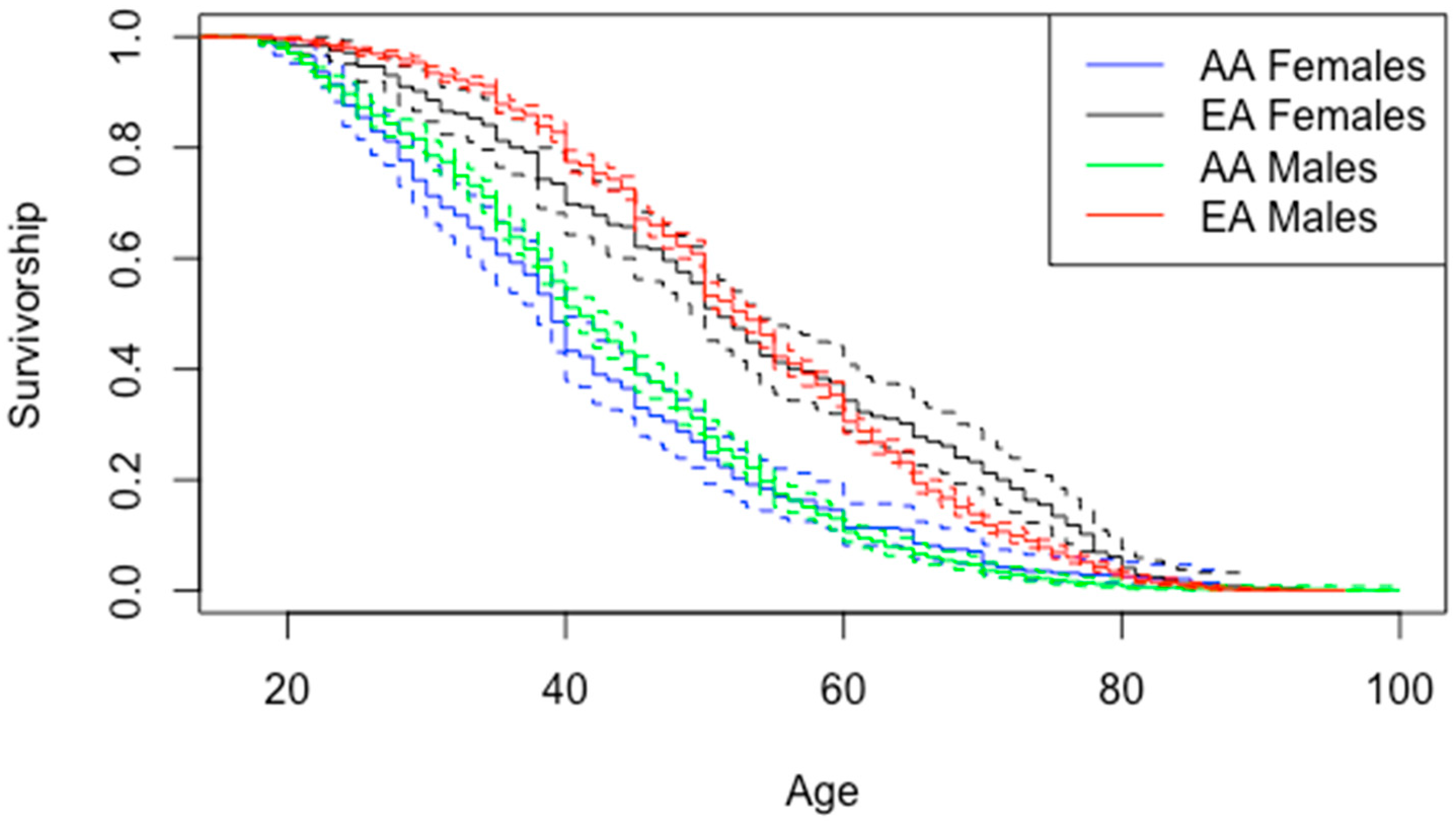
Table 1 provides the breakdown for sample sizes by intersectional identity for the survivorship analysis. The Kaplan–Meier survivorship for all individuals (N = 2805) in the sample is depicted in Figure 1. The log rank tests detected significant differences between African American and European American females (χ2 = 45.3, p ≤ 0.0001) and African American and European American males (χ2 = 247, p ≤ 0.0001). But there were no significant differences between African American females and males (χ2 = 0.2, p = 0.7), nor European American females and males (χ2 = 2.8, p = 0.1). African American individuals died at a significantly younger age compared to European Americans.
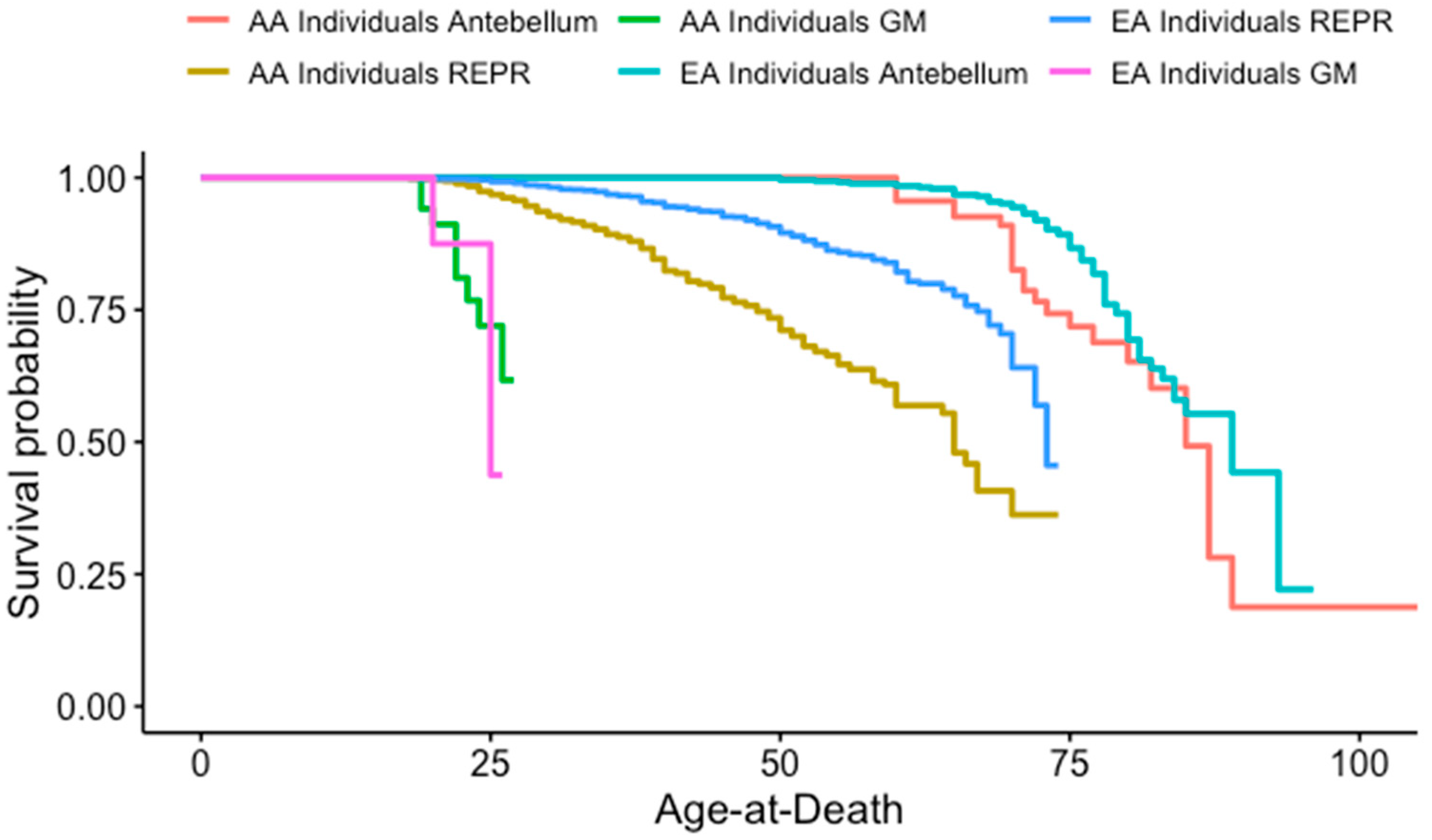
Additionally, Figure 2 depicts the Kaplan–Meier curves for each social race group broken down by time period: Antebellum, REPR, and GM. The log ranks tests detected significant differences between the time periods for all groups (χ2 = 2355, p ≤ 0.0001). This figure shows that European American individuals survive longer than African American individuals for each time period and that survivorship increases drastically throughout time. The Antebellum period is characterized by an earlier mean age-at-death for all individuals compared to later time periods, with subsequent improvements in survivorship for everyone during the REPR and later GM periods.
Table 2 shows the sample sizes for the stature analyses based on femur and fibula broken down by sex and social race. Descriptive statistics for all intersectional categories by bone length are presented in Table 3 and Table 4. Notably, when time periods are combined, African Americans showed longer mean bone lengths than their European counterparts (Table 3). The Box–Tidwell tests did not detect violations of the linearity assumption for the fibula model but did for the femur model. Thus, we transformed the age-at-death variable with a log base 2 in the femur model (Model 1). The variance inflation factors (VIFs) were all less than 4, indicating there was no issue with multicollinearity.
The logistic regression model for femur (Model 1) had a McFadden’s pseudo R2 of 0.098, which indicates the model is good at describing the data [87], and the C statistic was 0.629, which is a fair discrimination of the data by the model. In Model 1 (reference group: African American females), the intersectional identities of European American females and European American males had 6.3-fold and 4.8-fold higher odds of having a short femur than African American females, respectively (Table 5). Using African American males as the reference group (Table 5), odds of having a short femur were significant and increased for European American females (4.25-fold) and males (3.24-fold). The age-at-death and time period variables were not significant.
Model 2 for the fibula (Table 5) had a McFadden’s pseudo adjusted R2 of 0.108 and a C statistic of 0.685, which are better than those of Model 1 (femur); Model 2 is also good at describing the data and has fair discrimination. In Table 5, significant odds ratios are produced for European American females and males who had 7.2-fold and 4-fold higher odds of having a short fibula, respectively, compared to African American females (reference group). When the reference group was changed to people identified as African American males, again European American females and males were 10.4 and 5.7 times more likely to have a short fibula (Table 5), respectively. Neither age-at-death nor the time period variable was significant.

4. Discussion

We analyzed disparities in mortality rates among adults of low socioeconomic status from the Hamann-Todd Osteological Collection in Cleveland, Ohio, to examine the influences of racism, poverty, sex-based bias, and change over time among various intersectional groups. We were especially interested in exploring potential differences between the sexes (within social race categories) to evaluate whether males or females suffered increased stress and earlier mortality. We also wanted to test the effects of recent immigration status (e.g., European American) compared to the experience of African Americans, especially in the light of the stress, discrimination, and negative health outcomes reported for some immigrant communities [59,60]. As mentioned earlier, several studies focused on African American health over the last 200 years. However, fewer studies compared African American health and mortality to their European American contemporaries, and some studies were based on very small samples (e.g., [88]). The Global History of Health Project examined various populations and reported that European Americans were healthier than their African American counterparts; however, free Antebellum Blacks from Philadelphia were the healthiest group, suggesting socioeconomic status likely affects health, stress, and infectious disease susceptibility [89,90].
Our analyses indicated that, while the individuals in the collection were likely from the lower socioeconomic and/or working classes at the time of their death and suffered poverty and economic marginalization, African Americans suffered significantly higher mortality and an earlier age-at-death than their European American counterparts, even considering their recent immigrant status. Additionally, our analysis of survival over time showed stark differences, with dramatically increasing survival for all groups as they moved into the 20th century. The extreme mortality for African Americans during slavery declined significantly after emancipation as did the mortality for the European immigrants and their descendants, although signatures of increased mortality from slavery remain. Mortality at the population level in many ways is a true measure of population health. These results support the work by Simon and Hubbe [51], who also reported lower survivorship for African Americans using a smaller subsample from the Hamman-Todd collection. However, our results contrast with those of de la Cova [63] who reported no significant differences between African American and European American survivorship and found that Antebellum populations lived longer than other groups during the later reconstruction—although her samples included males only from the Hamman-Todd and Terry and Cobb collections. Nystrom [65] was correct in concluding that the social inequities inherent in the political economy for historic Americans affected individuals from diverse social, economic, and ethnic groups.
Socioeconomic status is known to show an inverse relationship with significant chronic disease risk factors like obesity and hypertension in the United States [91]. Between 1920 and 1926, Cleveland experienced an 80% rise mortality rates among African Americans [92]. Similarly, census data from 1880 to 1900 indicates higher disease rates among African American individuals [93], suggesting that those African Americans experienced significantly increased stressors compared to their European American counterparts, despite the latter’s recent immigration status and potential language barriers. The results for this sample from Cleveland parallel those reported for the broader American population. Ewbank [94] reports that, between 1880 and 1910, life expectancy was approximately equal for males and females of African American descent. However, between 1910 and 1940, African American female mortality exceeded their male counterparts, especially during the childbearing years. At the same time, European Americans were expected to live 10–15 years longer. Structural racism resulted in significant health disparities between African Americans and European Americans in the United States, and addressing these disparities requires comprehensive efforts to eliminate structural racism in various sectors, including healthcare, wealth, and employment [95].
Short stature is often used as an indicator of stress or illness during childhood and adolescence and is sometimes related to earlier age-at-death. It is important to understand that this paper does not compare stature between African Americans and European Americans—which would be expected to differ due to inherent genetic/evolutionary and individual history. Instead, we are examining whether the number of individuals with shorter than average stature (compared to within-group means) differs between the groups, i.e., do African Americans and European Americans suffer the same amount of shortened stature? In our sample, stature (as proxied through lower limb bone lengths) was not associated with age-at-death or time period of birth for adults. Thus, short stature was not associated with an earlier mean age-at-death (i.e., no selective mortality), and the number of individuals suffering short stature did not change over time. However, significant differences were identified between socially defined “racial” groups and between male and female European Americans, but not between the sexes for African Americans. Interestingly, odds ratios indicated European American individuals suffered more incidences of shorter-than-average stature than African Americans (we are not testing whether European Americans were shorter than African Americans). This may seem counter-intuitive to the mortality results, i.e., one might expect that because African Americans experienced higher mortality rates, they should also exhibit more incidences of short stature. However, this was not the case. The lack of association between short stature and age-at-death might be attributed to the timing of the stress event(s) as well as the potential for catch-up growth [52,53,54]. An examination of childhood stature trends may illuminate the timing of these events and shed light on this as a possible explanation. It is also possible that short stature was adaptive for African American groups as a response to limited resources [96]. Vercellotti et al. [55] argued that, if short stature is related to poor health, then these shorter individuals should be removed from the population through natural selection, and when the stressful environment improves, individuals should get taller. However, time period was not significant in our sample, suggesting we needed additional information for our model to find significance (e.g., location of birth). When stressed populations exhibit taller stature, it could be because shorter individuals were already eliminated, leaving a taller population of survivors [39,55,56]. The potential for catch-up growth is certainly a possible explanation here, but it cannot be directly tested without data from children. However, this has been demonstrated in numerous publications (see below). We suggest that, in addition to the well-documented phenomenon of catch-up growth experienced by African Americans (but not European Americans), the higher mortality rates among African American children led to fewer short individuals surviving into adulthood; those that survived were of average height, supporting previous work by Vercellotti et al. [55] and Godde et al. [56]. This also aligns with census data, for example, in 1900 and 1910 from Southern counties where African American children born to married mothers had around double the mortality of European American children in urban areas and about 9% higher in rural counties [64], although the percentage of foreign-born European Americans was lower (3.6%) in the South as opposed to the East–North–Central region (17.14%) [97]. Additionally, younger slave children had height in the lowest centiles for pediatric growth, but experienced catch-up growth in later adolescence due to improving nutrition from a shift in roles (i.e., child to slave) that led to them being the same height or taller than Europeans and U.S.-born European Americans in adolescence [98,99], which is reflected here with the data from Hamann-Todd. This further resulted in adult heights measured in African American slaves, Union Army, free Blacks, and ex-slaves to surpass those of foreign-born European Americans [99,100,101,102], and they were only slightly shorter than U.S.-born Northern European Americans [101]. But this does not indicate slavery was an improvement over the conditions in Europe or that slavery was better for African American descendants in the U.S.
U.S.-born and foreign-born European American National Guardsmen in Ohio from 1870 to 1930 were 0.84 inches apart in height, demonstrating a better nutritional environment in the United States [103]. The lower stature in foreign-born European Americans is due to the large number of individuals of low SES in Europe who were short, as well as Europeans overall being shorter than Americans regardless of class [103]. The environment of Europe that contributed to shorter stature included “economic, cultural, demographic, technological, and political factors” [103], p. 126, that certainly would have affected the European Americans in this sample during their growth and developmental period, which was also prior to immigrating to the U.S. All of this is to say that our European American sample, due to its pooled nature of U.S.- and foreign-born individuals, reflects a lower average stature over U.S.-born European Americans and likewise an increased average stature over foreign-born European Americans.
Steckel [42] reported that insufficient prenatal care, low birth weights, inadequate nourishment, and infections contributed to high rates of fatalities during neonatal and post-neonatal periods among African American women. Steckel [42] describes the living conditions for some enslaved women who were required to return to work within weeks of giving birth and placed their neonates in a nursery. In the first three months, mothers returned frequently to breastfeed their infants, but beyond that time, they were required to return to the fields and infant diets were poorly subsidized with fat and hominy. Slave owners and medical professionals at the time attributed the high fatality rate to poor nutrition. After emancipation and the Great Migration to the North, African Americans were continuously subject to poverty, unemployment, and residential segregation, intertwined with institutionalized racism (e.g., Jim Crow laws), creating a web of influences that elevated the risk of negative reproductive health outcomes for African American women [104] and survival of their offspring. Karbeah and Hacker [64] found the experience of being African American and low SES was strongly and positively correlated with mortality for African American children and attributed these results to the effects of racial segregation. Owens and Fett [105] similarly attribute the overbearing number of newborn fatalities among African American women to systemic racism. In an analysis of health and mortality in African Americans in the Southern United States post-slavery, Franklin and Wilson [71] report higher mortality for African Americans from urban environments and reduced survivorship for women and children in any context. They attribute this to the working and reproductive lives of Black women in the context of racial inequality.
We did not explore the mechanisms or pathways through which “racial” and/or class oppression work to affect biology. It is well known that the neuroendocrine system and its effects on the immune and other systems play a role in health and biological variation in general. Geronimus [106] found that both poor and nonpoor modern Black women had higher allostatic loads compared to male or White counterparts—differences that are not satisfactorily explained by poverty alone. In her weathering hypothesis, she attributes the poor health experienced by Blacks as a consequence of socioeconomic adversity and political marginalization and that, on a physiological level, coping with persistent acute and chronic stressors profoundly affect health. How much of our findings can be attributed to direct insult versus epigenetics is outside of the scope of this paper. The third author posits that there is a biology of oppression that has multiple terms of insult, e.g., racism, classism, environmental effects, etc., but notably social “race” and class in the context of the work presented here [biology of oppression ~ biology of classism + biology of racism]. At the time of this report, it cannot be shown that negative biological responses at the population level to pathological environmental or social insult are rooted in ancestral inheritance. Racism can affect people regardless of social class or income level, leading to multidimensional stress with poor health outcomes. Class can affect biology and health due to poor access to good nutrition, healthcare, and educational opportunities. While there is overlap, this concept is heuristically useful. However, removing racism or classism from the terms of the expression lays bare the distinctions. We also were unable to tease apart the data to look at persons from rural and urban areas for which there are differences in the timeframe represented [99], as well as detecting national trends in height across the time periods [107,108], which is associated with not knowing the birthplace and childhood/adolescent environment at the individual level for inclusion in our models.
The rich historical context of the Hamman-Todd collection is especially well suited to understanding the changing health experiences of socially marginalized populations, who are otherwise absent, and too often ignored, in the historical record. Long-term perspectives gained through historic data and skeletal analyses inspire thinking about marginalization and inequality over time. Bioarchaeology offers the opportunity to shed light on these factors and how they continue to affect marginalized (and other) bodies, and such research offers a deeper appreciation of our historical past in relation to the present day.
While we cannot speak for entire communities, we advocate for the approach outlined by Agarwal [109] that calls for consultation where feasible with domestic and international descendant communities and other provisions when examining the histories and futures of skeletal collections. So far, this conversation in the United States has been primarily driven by academics of higher SES as compared to the individuals in the samples they reviewed (see, for example, the workshop described in de la Cova [110]). These conversations should continue, but with descendant community representation across all demographic identities represented (e.g., low SES), which is also a form of public/science communication. We further echo the sentiments of Palamenghi et al. [111] of the value of studying human remains in appropriate contexts and the caution that should be applied in assuming all individuals were marginalized or of low SES in historic skeletal collections. Already, the Hamann-Todd collection has identified individuals who were not necessarily marginalized [112], and we also do not know whether the self or family donors were marginalized.
While amassing large numbers of skeletal remains for a scientific study, Cobb [76] argued that social circumstances and unequal access to resources affected health and mortality. The work here underscores Cobb’s arguments, showing that while many individuals in this collection were considered of low SES and likely suffered discrimination (whether racial or as recent immigrants), the likely effects of systematic racism, resulting in further socioeconomic marginalization, significantly affected mortality in the African American community. These disparities exist today, with inequalities in health due to unknown transgenerational epigenetic and developmental effects with origins in past sociopolitical and environmental contexts, and structural racism that continues to affect socioeconomic status [113].

Author Contributions

Conceptualization, S.M.H.; methodology, S.M.H. and K.G.; software, K.G.; validation, K.G.; formal analysis, S.M.H. and K.G.; investigation, S.M.H. and K.G.; resources, S.M.H. and K.G.; data curation, K.G.; writing—original draft preparation, S.M.H., K.G. and S.O.Y.K.; writing—review and editing, S.M.H., K.G. and S.O.Y.K.; visualization, K.G.; supervision, S.M.H.; project administration, S.M.H. All authors have read and agreed to the published version of the manuscript.

Funding

This research received no external funding.

Data Availability Statement

Due to the ethical situation around historically documented human skeletal collections, restrictions apply to the availability of these data. All data used in this research were obtained from the Cleveland Museum of Natural History and may only be accessed with permission of the collections manager.

Acknowledgments

We would like to thank the former collections manager of the Hamann-Todd Osteological Collection at the Cleveland Museum of Natural History, for providing data from museum records. We also thank Marcus Peterson for assistance with compiling references.

Conflicts of Interest

The authors declare no conflicts of interest.

References

  1. Gravlee, C.C. How Race Becomes Biology: Embodiment of Social Inequality. Am. J. Phys. Anthropol. 2009, 139, 47–57. [Google Scholar] [CrossRef] [PubMed]
  2. Buikstra, J.E.; DeWitte, S.N.; Agarwal, S.C.; Baker, B.J.; Bartelink, E.J.; Berger, E.; Blevins, K.E.; Bolhofner, K.; Boutin, A.T.; Brickley, M.B.; et al. Twenty-first Century Bioarchaeology: Taking Stock and Moving Forward. Am. J. Biol. Anthropol. 2022, 178, 54–114. [Google Scholar] [CrossRef] [PubMed]
  3. DeWitte, S.N. The Effect of Sex on Risk of Mortality during the Black Death in London, A.D. 1349–1350. Am. J. Phys. Anthropol. 2009, 139, 222–234. [Google Scholar] [CrossRef]
  4. DeWitte, S.N. Sex Differentials in Frailty in Medieval England. Am. J. Phys. Anthropol. 2010, 143, 285–297. [Google Scholar] [CrossRef]
  5. DeWitte, S.N.; Boulware, J.C.; Redfern, R.C. Medieval Monastic Mortality: Hazard Analysis of Mortality Differences between Monastic and Nonmonastic Cemeteries in England. Am. J. Phys. Anthropol. 2013, 152, 322–332. [Google Scholar] [CrossRef]
  6. Hawks, S.M.; Godde, K.; Hens, S.M. The Impact of Early Childhood Stressors on Later Growth in Medieval and Postmedieval London. Int. J. Osteoarchaeol. 2022, 32, 804–812. [Google Scholar] [CrossRef]
  7. Godde, K.; Hens, S.M. An Epidemiological Approach to the Analysis of Cribra Orbitalia as an Indicator of Health Status and Mortality in Medieval and Post-Medieval London under a Model of Parasitic Infection. Am. J. Biol. Anthropol. 2021, 174, 631–645. [Google Scholar] [CrossRef]
  8. Mathena-Allen, S.; Zuckerman, M.K. Embodying Industrialization: Inequality, Structural Violence, Disease, and Stress in Working-Class and Poor British Women. In The Bioarchaeology of Structural Violence: A Theoretical Framework for Industrial Era Inequality; Tremblay, L.A., Reedy, S., Eds.; Springer International Publishing: Cham, Switzerland, 2020; pp. 53–79. [Google Scholar] [CrossRef]
  9. Roberts, C.A. Words, Stigma and the Coronavirus: Implications of COVID-19 for Holistic Approaches to Infectious Disease. J. Br. Acad. 2020, 8, 240–244. [Google Scholar]
  10. Roberts, C.A.; Buikstra, J.E. The Bioarchaeology of Tuberculosis: A Global Perspective on a Re-Emerging Disease; University Press of Florida: Gainesville, FL, USA, 2003. [Google Scholar]
  11. Tiesler, V.; Chi-Keb, J.R.; Ortega Muñoz, A. Crossing the Threshold of Modern Life: Comparing Disease Patterns Between Two Documented Urban Cemetery Series from the City of Mérida, Yucatán, Mexico. In Culture, Environment and Health in the Yucatan Peninsula: A Human Ecology Perspective; Azcorra, H., Dickinson, F., Eds.; Springer International Publishing: Cham, Switzerland, 2020; pp. 243–256. [Google Scholar] [CrossRef]
  12. Zarulli, V. Unobserved Heterogeneity of Frailty in the Analysis of Socioeconomic Differences in Health and Mortality. Eur. J. Popul. 2016, 32, 55–72. [Google Scholar] [CrossRef] [PubMed]
  13. Betsinger, T.K.; DeWitte, S.N. Toward a Bioarchaeology of Urbanization: Demography, Health, and Behavior in Cities in the Past. Am. J. Phys. Anthropol. 2021, 175, 79–118. [Google Scholar] [CrossRef]
  14. DeWitte, S.N.; Hughes-Morey, G.; Bekvalac, J.; Karsten, J. Wealth, Health and Frailty in Industrial-Era London. Ann. Hum. Biol. 2016, 43, 241–254. [Google Scholar] [CrossRef] [PubMed]
  15. Hens, S.M.; Godde, K.; Macak, K.M. Iron Deficiency Anemia, Population Health and Frailty in a Modern Portuguese Skeletal Sample. PLoS ONE 2019, 14, e0213369. [Google Scholar] [CrossRef]
  16. Kelmelis, K.S.; Dangvard Pedersen, D. Impact of Urbanization on Tuberculosis and Leprosy Prevalence in Medieval Denmark. Anthropol. Anz. 2019, 76, 149–166. [Google Scholar] [CrossRef]
  17. Walter, B.S.; DeWitte, S.N. Urban and Rural Mortality and Survival in Medieval England. Ann. Hum. Biol. 2017, 44, 338–348. [Google Scholar] [CrossRef]
  18. Yaussy, S.L.; DeWitte, S.N.; Hughes-Morey, G. Survivorship and the Second Epidemiological Transition in Industrial-Era London. Am. J. Biol. Anthropol. 2023, 181, 646–652. [Google Scholar] [CrossRef]
  19. Lettre, G. Genetic Regulation of Adult Stature. Curr. Opin. Pediatr. 2009, 21, 515. [Google Scholar] [CrossRef] [PubMed]
  20. Silventoinen, K.; Sammalisto, S.; Perola, M.; Boomsma, D.I.; Cornes, B.K.; Davis, C.; Dunkel, L.; Lange, M.d.; Harris, J.R.; Hjelmborg, J.V.B.; et al. Heritability of Adult Body Height: A Comparative Study of Twin Cohorts in Eight Countries. Twin Res. 2003, 6, 399–408. [Google Scholar] [CrossRef]
  21. King, S.E.; Ulijaszek, S.J. Invisible Insults During Growth and Development: Contemporary Theories and Past Populations. In Human Growth in the Past: Studies from Bones and Teeth; Hoppa, R.D., FitzGerald, C.M., Eds.; Cambridge University Press: Cambridge, UK, 1999; pp. 161–182. [Google Scholar]
  22. Martorell, R.; Yarbrough, C.; Lechtig, A.; Habicht, J.-P.; Klein, R.E. Diarrheal Diseases and Growth Retardation in Preschool Guatemalan Children. Am. J. Phys. Anthropol. 1975, 43, 341–346. [Google Scholar] [CrossRef]
  23. Allen, L.H. Nutritional Influences on Linear Growth: A General Review. Eur. J. Clin. Nutr. 1994, 48, S75–S89. [Google Scholar]
  24. Black, R.E.; Allen, L.H.; Bhutta, Z.A.; Caulfield, L.E.; Onis, M.d.; Ezzati, M.; Mathers, C.; Rivera, J. Maternal and Child Undernutrition: Global and Regional Exposures and Health Consequences. Lancet 2008, 371, 243–260. [Google Scholar] [CrossRef] [PubMed]
  25. Silventoinen, K.; Lahelma, E.; Rahkonen, O. Social Background, Adult Body-Height and Health. Int. J. Epidemiol. 1999, 28, 911–918. [Google Scholar] [CrossRef] [PubMed]
  26. Jousilahti, P.; Tuomilehto, J.; Vartiainen, E.; Eriksson, J.; Puska, P. Relation of Adult Height to Cause-Specific and Total Mortality: A Prospective Follow-up Study of 31, 199 Middle-Aged Men and Women in Finland. Am. J. Epidemiol. 2000, 151, 1112–1120. [Google Scholar] [CrossRef] [PubMed]
  27. Parker, D.; Lapane, K.; Lasater, T.; Carleton, R. Short Stature and Cardiovascular Disease among Men and Women from Two Southeastern New England Communities. Int. J. Epidemiol. 1998, 27, 970–975. [Google Scholar] [CrossRef]
  28. Song, Y.-M.; Smith, G.D.; Sung, J. Adult Height and Cause-Specific Mortality: A Large Prospective Study of South Korean Men. Am. J. Epidemiol. 2003, 158, 479–485. [Google Scholar] [CrossRef] [PubMed]
  29. Wannamethee, S.; Shaper, A.; Whincup, P.; Walker, M. Adult Height, Stroke, and Coronary Heart Disease. Am. J. Epidemiol. 1998, 148, 1069–1076. [Google Scholar] [CrossRef]
  30. Camilleri, A.P. The Obstetric Significance of Short Stature. Eur. J. Obstet. Gyn. Reprod. Biol. 1981, 12, 347–356. [Google Scholar] [CrossRef]
  31. Kappel, B.; Eriksen, G.; Hansen, K.B.; Hvidman, L.; Krag-Olsen, B.; Nielsen, J.; Videbech, P.; Wohlert, M. Short Stature in Scandinavian Women: An Obstetrical Risk Factor. Acta Obstet. Gyn. Scan. 1987, 66, 153–158. [Google Scholar] [CrossRef]
  32. Knutzen, V.; Davey, D. The Relationship between Maternal Height and Weight at Booking and Perinatal Mortality. S. Afr. Med. J. 1977, 51, 672–675. [Google Scholar]
  33. Martorell, R.; Delgado, H.L.; Delgado, H.; Valverde, V.; Klein, R.E. Maternal Stature, Fertility and Infant Mortality. Hum. Biol. 1981, 53, 303–312. [Google Scholar]
  34. Molloy, W.B. Pathology of Labor and Puerperium. Labor in Short Women. Obstet. Gynecol. Surv. 1970, 25, 133. [Google Scholar] [CrossRef]
  35. Portrait, F.R.M.; van Wingerden, T.F.; Deeg, D.J.H. Early Life Undernutrition and Adult Height: The Dutch Famine of 1944–45. Econ. Hum. Biol. 2017, 27, 339–348. [Google Scholar] [CrossRef]
  36. Elo, I.T.; Preston, S.H. Effects of Early-Life Conditions on Adult Mortality: A Review. Popul. Index 1992, 58, 186–212. [Google Scholar] [CrossRef]
  37. DeWitte, S.N.; Hughes-Morey, G. Stature and Frailty during the Black Death: The Effect of Stature on Risks of Epidemic Mortality in London, AD 1348–1350. J. Archaeol. Sci. 2012, 39, 1412–1419. [Google Scholar] [CrossRef]
  38. Gunnell, D.; Rogers, J.; Dieppe, P. Height and Health: Predicting Longevity from Bone Length in Archaeological Remains. J. Epidemiol. Commun. H. 2001, 55, 505–507. [Google Scholar] [CrossRef][Green Version]
  39. Kemkes-Grottenthaler, A. The Short Die Young: The Interrelationship between Stature and Longevity—Evidence from Skeletal Remains. Am. J. Phys. Anthropol. 2005, 128, 340–347. [Google Scholar] [CrossRef] [PubMed]
  40. Nicolas, S.; Steckel, R.H. Tall but Poor: Nutrition, Health, and Living Standards in Pre-Famine Ireland; National Bureau of Economic Research: Cambridge, MA, USA, 1992. [Google Scholar] [CrossRef]
  41. Peck, A.; Vågerö, D. Adult Body Height, Self Perceived Health and Mortality in the Swedish Population. J. Epidemiol. Commun. H. 1989, 43, 380–384. [Google Scholar] [CrossRef] [PubMed]
  42. Steckel, R.H. Stature and the Standard of Living. J. Econ. Lit. 1995, 33, 1903–1940. [Google Scholar]
  43. Castro-Porras, L.V.; Rojas-Russell, M.E.; Aedo-Santos, Á.; Wynne-Bannister, E.G.; López-Cervantes, M. Stature in Adults as an Indicator of Socioeconomic Inequalities in Mexico. Rev. Panam. Salud Publica 2018, 42, e29. [Google Scholar] [CrossRef]
  44. Fuchs, V.R. The Contribution of Health Services to the American Economy. Milbank Q. 1966, 44, 65–103. [Google Scholar] [CrossRef]
  45. DeWitte, S.N.; Wood, J.W. Selectivity of Black Death Mortality with Respect to Preexisting Health. Proc. Natl. Acad. Sci. USA 2008, 105, 1436–1441. [Google Scholar] [CrossRef]
  46. Saunders, S.R.; Hoppa, R.D. Growth Deficit in Survivors and Non-Survivors: Biological Mortality Bias in Subadult Skeletal Samples. Yrbk. J. Phys. Anthropol. 1993, 36, 127–151. [Google Scholar] [CrossRef]
  47. DeWitte, S.N.; Yaussy, S.L. Femur Length and Famine Mortality in Medieval London. Bioarch Int. 2017, 1, 171–182. [Google Scholar] [CrossRef]
  48. Dittmar, J.M.; Inskip, S.A.; Rose, A.K.; Cessford, C.; Mitchell, P.D.; O’Connell, T.C.; Robb, J.E. Health Inequality in Medieval Cambridge, 1200–1500 CE. Am. J. Biol. Anthropol. 2024, 185, e24993. [Google Scholar] [CrossRef] [PubMed]
  49. Papathanasiou, A.; Panagiotopoulou, E.; Beltsios, K.; Papakonstantinou, M.-F.; Sipsi, M. Inferences from the Human Skeletal Material of the Early Iron Age Cemetery at Agios Dimitrios, Fthiotis, Central Greece. J. Archae Sci. 2013, 40, 2924–2933. [Google Scholar] [CrossRef]
  50. Simon, A.M.; Mellendorf, T.D.; Cheverko, C.M.; Clark, M.A.; Hubbe, M. The Relationship between Cause of Death and Skeletal Markers of Physiological Stress in the Hamann-Todd Collection. Am. J. Biol. Anthropol. 2025, 186, e25041. [Google Scholar] [CrossRef] [PubMed]
  51. Simon, A.M.; Hubbe, M. Early Life Stress and Long-Term Survival in the Hamann-Todd Collection. Am. J. Biol. Anthropol. 2025, 186, e70041. [Google Scholar] [CrossRef]
  52. Gafni, R.I.; Baron, J. Catch-up Growth: Possible Mechanisms. Pediatr. Nephrol. 2000, 14, 616–619. [Google Scholar] [CrossRef]
  53. Golden, J.S.R. Is Complete Catch-up Possible for Stunted Malnourished Children? Eur. J. Clin. Nutr. 1994, 48, S58–S70. [Google Scholar]
  54. Martorell, R.; Khan, L.K.; Schroeder, D.G. Reversibility of Stunting: Epidemiological Findings in Children from Developing Countries. Eur. J. Clin. Nutr. 1994, 48, S45–S57. [Google Scholar]
  55. Vercellotti, G.; Piperata, B.A.; Agnew, A.M.; Wilson, W.M.; Dufour, D.L.; Reina, J.C.; Boano, R.; Justus, H.M.; Larsen, C.S.; Stout, S.D.; et al. Exploring the Multidimensionality of Stature Variation in the Past through Comparisons of Archaeological and Living Populations. Am. J. Phys. Anthropol. 2014, 155, 229–242. [Google Scholar] [CrossRef]
  56. Godde, K.; Pasillas, V.; Sanchez, A. Survival Analysis of the Black Death: Social Inequality of Women and the Perils of Life and Death in Medieval London. Am. J. Phys. Anthropol. 2020, 173, 168–178. [Google Scholar] [CrossRef]
  57. Prude, J. The Coming of Industrial Order: Town and Factory Life in Rural Massachusetts, 1810–1860; University of Massachusetts Press: Cambridge, MA, USA, 1999. [Google Scholar]
  58. Curry, L. The Free Black in Urban America, 1800–1850: The Shadow of the Dream; University of Chicago Press: Chicago, IL, USA, 1981. [Google Scholar]
  59. Jannesari, S.; Hatch, S.; Prina, M.; Oram, S. Post-Migration Social–Environmental Factors Associated with Mental Health Problems Among Asylum Seekers: A Systematic Review. J. Immigr. Minor. Health 2020, 22, 1055–1064. [Google Scholar] [CrossRef]
  60. Velkova, A.; Baev, M. Self-Reported Health and Utilisation of Health Services by Asylum Seekers in Bulgaria. Eur. J. Public. Health 2018, 28, cky214.282. [Google Scholar] [CrossRef]
  61. Austin, R.M.; Zuckerman, M.; Honap, T.P.; Lee, H.; Ward, G.K.; Warinner, C.; Sankaranarayanan, K.; Hofman, C.A. Remembering St. Louis Individual—Structural Violence and Acute Bacterial Infections in a Historical Anatomical Collection. Commun. Biol. 2022, 5, 1050. [Google Scholar] [CrossRef]
  62. de La Cova, C. Cultural Patterns of Trauma among 19th-Century-Born Males in Cadaver Collections. Amer. Anthropol. 2010, 112, 589–606. [Google Scholar] [CrossRef]
  63. de la Cova, C. Race, Health, and Disease in 19th-Century-Born Males. Am. J. Phys. Anthropol. 2011, 144, 526–537. [Google Scholar] [CrossRef] [PubMed]
  64. Karbeah, J.; Hacker, J. Racial Residential Segregation and Child Mortality in the Southern United States at the Turn of the 20th Century. Popul. Space Place 2023, 29, e2678. [Google Scholar] [CrossRef]
  65. Nystrom, K.C. The Bioarchaeology of Structural Violence and Dissection in the 19th-Century United States. Am. Anthropol. 2014, 116, 765–779. [Google Scholar] [CrossRef]
  66. Cooper, C.; Heinzle, B.; Reitmaier, T. Evidence of Infectious Disease, Trauma, Disability and Deficiency in Skeletons from the 19th/20th Century Correctional Facility and Asylum «Realta» in Cazis, Switzerland. PLoS ONE 2019, 14, e0216483. [Google Scholar] [CrossRef]
  67. Shuler, K.A. Life and Death on a Barbadian Sugar Plantation: Historic and Bioarchaeological Views of Infection and Mortality at Newton Plantation. Int. J. Osteoarchaeol. 2011, 21, 66–81. [Google Scholar] [CrossRef]
  68. Arnesen, E. Black Protest and the Great Migration: A Brief History with Documents; Bedford/St. Martin’s: Boston, MA, USA, 2003. [Google Scholar]
  69. Black, D.A.; Sanders, S.G.; Taylor, E.J.; Taylor, L.J. The Impact of the Great Migration on Mortality of African Americans: Evidence from the Deep South. Am. Econ. Rev. 2015, 105, 477–503. [Google Scholar] [CrossRef]
  70. Davidson, J.; Rose, J.; Gutmann, M.; Haines, M.; Condon, K.; Condon, C. The Quality of African-American Life in the Old Southwest near the Turn of the Twentieth Century. Backbone Hist. Health Nutr. West. Hemisph. 2002, 2, 26–277. [Google Scholar]
  71. Franklin, M.; Wilson, S.M. A Bioarchaeological Study of African American Health and Mortality in the Post-Emancipation U.S. South. Am. Antiq. 2020, 85, 652–675. [Google Scholar] [CrossRef]
  72. Rankin-Hill, L. A Biohistory of 19th-Century Afro-Americans: The Burial Remains of a Philadelphia Cemetery; Bergin & Garvey: Westport, CT, USA, 1997. [Google Scholar]
  73. Rose, J. Biological Consequences of Segregation and Economic Deprivation: A Post-Slavery Population from Southwest Arkansas. J. Econ. Hist. 1989, 49, 351–360. [Google Scholar] [CrossRef] [PubMed][Green Version]
  74. Watkins, R. Variation in Health and Socioeconomic Status within the W. Montague Cobb Skeletal Collection: Degenerative Joint Disease, Trauma and Cause of Death. Int. J. Osteoarchaeol. 2012, 22, 22–44. [Google Scholar] [CrossRef]
  75. Alioto, A.P. A New Division of Labor? Understanding Structural Violence Through Occupational Stress: An Examination of Entheseal Patterns and Osteoarthritis in the Hamann–Todd Collection. In The Bioarchaeology of Structural Violence: A Theoretical Framework for Industrial Era Inequality; Tremblay, L.A., Reedy, S., Eds.; Springer International Publishing: Cham, Switzerland, 2020; pp. 169–201. [Google Scholar]
  76. Cobb, W.M. Municipal History from Anatomical Records. Sci. Mon. 1935, 40, 157–162. [Google Scholar]
  77. Phillips, K.L. “But It Is a Fine Place to Make Money”: Migration and African-American Families in Cleveland, 1915–1929. J. Soc. Hist. 1996, 30, 393–413. [Google Scholar] [CrossRef]
  78. Cobb, H. Human Archives. Dissertation Thesis, Case Western Reserve University, Cleveland, OH, USA, 1932. [Google Scholar]
  79. Prickett, P.; Timmermans, S. The Unclaimed: Abandonment and Hope in the City of Angels; Crown: New Bremen, OH, USA, 2024. [Google Scholar]
  80. de La Cova, C.; Mant, M.; Brickley, M.B. Structural Violence and Institutionalized Individuals: A Paleopathological Perspective on a Continuing Issue. PLoS ONE 2023, 18, e0290014. [Google Scholar] [CrossRef] [PubMed]
  81. Beal, E. Funeral Homes and Funeral Practices. Available online: https://case.edu/ech/articles/f/funeral-homes-and-funeral-practices (accessed on 2 July 2024).
  82. Hopkins, A. Stories from the Hamann-Todd Human Osteological Collection. Available online: https://www.cmnh.org/exhibits/g4-5-350-b (accessed on 12 January 2026).
  83. Jackson, F.; Clinton, C.; Caldwell, J. Core Issues, Case Studies, and the Need for Expanded Legacy African American Genomics. Front. Genet. 2023, 14, 843209. [Google Scholar] [CrossRef] [PubMed]
  84. Kern, K.F.T. Wingate Todd: Pioneer of Modern American Physical Anthropology. Kirtlandia Clevel. Mus. Nat. Hist. 2006, 55, 1–42. [Google Scholar]
  85. Encyclopedia of Cleveland History. Cleveland Workhouse. Available online: https://case.edu/ech/articles/c/cleveland-workhouse (accessed on 13 January 2026).
  86. R Core Team. R: A Language and Environment for Statistical Computing; R Foundation for Statistical Computing: Vienna, Austria, 2020. [Google Scholar]
  87. McFadden, D. Quantitative Methods for Analysing Travel Behaviour of Individuals: Some Recent Developments. In Behavioural Travel Modelling; Hensher, D.A., Stopher, P.R., Eds.; Routledge: London, UK, 2021; pp. 279–318. [Google Scholar]
  88. Rathbun, T.A.; Scurry, J. Status and Health in Colonial South Carolina: Belleview Plantation, 1738–1756. In What Mean These Bones? Studies in Southeastern Bioarchaeology; Powell, M., Bridges, P., Mires, A., Eds.; University of Alabama Press: Tuscaloosa, AL, USA, 1991; pp. 148–164. [Google Scholar]
  89. Rathbun, T.A.; Steckel, R.H. The Health of Slaves and Free Blacks in the East. In The Backbone of History: Health and Nutrition in the Western Hemisphere; Steckel, R.H., Rose, J.C., Eds.; Cambridge University Press: Cambridge, UK, 2002; pp. 208–225. [Google Scholar]
  90. Steckel, R.H.; Rose, J.C. The Backbone of History: Health and Nutrition in the Western Hemisphere; Cambridge University Press: New York, NY, USA, 2002. [Google Scholar]
  91. Kaplan, G.A.; Keil, J.E. Socioeconomic Factors and Cardiovascular Disease: A Review of the Literature. Circulation 1993, 88, 1973–1998. [Google Scholar] [CrossRef]
  92. Giffin, W. African Americans and the Color Line in Ohio, 1915–1930; Ohio State University Press: Columbus, OH, USA, 2005. [Google Scholar]
  93. Billings, J.S. Report on the Mortality and Vital Statistics of the United States as Returned at the Tenth Census; Norman Ross Publishing Inc.: New York, NY, USA, 1991; Volume 34. [Google Scholar]
  94. Ewbank, D.C. History of Black Mortality and Health before 1940. Milbank Q. 1987, 65, 100–128. [Google Scholar] [CrossRef]
  95. Yearby, R. Racial Disparities in Health Status and Access to Healthcare: The Continuation of Inequality in the United States Due to Structural Racism. Am. J. Econ. Sociol. 2018, 77, 1113–1152. [Google Scholar] [CrossRef]
  96. Seckler, D. “Malnutrition”: An Intellectual Odyssey. Western J. Agric. Econ. 1980, 5, 219–227. [Google Scholar]
  97. Durand, E.D.; Harris, W.J. Thirteenth Census of the United States Taken in the Year 1910; US Government Printing Office: Washington, DC, USA, 1914; Volume 1.
  98. Steckel, R.H. A Dreadful Childhood: The Excess Mortality of American Slaves. Soc. Sci. Hist. 1986, 10, 427–465. [Google Scholar] [CrossRef] [PubMed]
  99. Komlos, J. Toward an Anthropometric History of African-Americans: The Case of the Free Blacks in Antebellum Maryland. In Strategic Factors in Nineteenth Century American Economic History: A Volume to Honor Robert W. Fogel; University of Chicago Press: Chicago, IL, USA, 1992; pp. 297–329. [Google Scholar]
  100. Bodenhorn, H. A Troublesome Caste: Height and Nutrition of Antebellum Virginia’s Rural Free Blacks. J. Econ. Hist. 1999, 59, 972–996. [Google Scholar] [CrossRef]
  101. Margo, R.A.; Steckel, R.H. The Heights of American Slaves: New Evidence on Slave Nutrition and Health. Soc. Sci. Hist. 1982, 6, 516–538. [Google Scholar] [CrossRef] [PubMed]
  102. Steckel, R.H. Slave Height Profiles from Coastwise Manifests. Explor. Econ. Hist. 1979, 16, 363. [Google Scholar] [CrossRef]
  103. Steckel, R.H.; Haurin, D. Health and Nutrition in the American Midwest: Evidence from the Height of Ohio National Guardsman 1850–1910. In Stature, Living Standards and Economic Development; University Press of Chicago: Chicago, IL, USA, 1994; pp. 117–128. [Google Scholar]
  104. Prather, C.; Fuller, T.; Jeffries, W., IV; Marshall, K.; Howell, A.; Belyue-Umole, A.; King, W. Racism, African American Women, and Their Sexual and Reproductive Health: A Review of Historical and Contemporary Evidence and Implications for Health Equity. Health Equity 2018, 21, 249–259. [Google Scholar] [CrossRef]
  105. Owens, D.; Fett, S. Black Maternal and Infant Health: Historical Legacies of Slavery. Am. J. Public. Health 2019, 109, 1342–1345. [Google Scholar] [CrossRef]
  106. Geronimus, A.T. Weathering: The Extraordinary Stress of Ordinary Life in an Unjust Society; Little, Brown Spark: New York, NY, USA, 2023. [Google Scholar]
  107. Komlos, J. The Height and Weight of West Point Cadets: Dietary Change in Antebellum America. J. Econ. Hist. 1987, 47, 897–927. [Google Scholar] [CrossRef]
  108. Komlos, J.; A’Hearn, B. The Decline in the Nutritional Status of the US Antebellum Population at the Onset of Modern Economic Growth; National Bureau of Economic Research: Cambridge, MA, USA, 2016; Available online: https://www.nber.org/papers/w21845 (accessed on 8 January 2026).
  109. Agarwal, S.C. The Disposability and Inclusion of Brown Bodies. Am. J. Biol. Anthropol. 2024, 186, e25003. [Google Scholar] [CrossRef] [PubMed]
  110. de la Cova, C.; Hofman, C.A.; Marklein, K.E.; Sholts, S.B.; Watkins, R.; Magrogan, P.; Zuckerman, M.K. Ethical Futures in Biological Anthropology: Research, Teaching, Community Engagement, and Curation Involving Deceased Individuals. Am. J. Biol. Anthropol. 2024, 185, e24980. [Google Scholar] [CrossRef] [PubMed]
  111. Palamenghi, A.; Biehler-Gomez, L.; Mattia, M.; Cattaneo, C. Commentary on “Incorporating a Structural Vulnerability Framework into the Forensic Anthropology Curriculum”. Forensic Sci. Int. Synerg. 2023, 7, 100343. [Google Scholar] [CrossRef]
  112. Sawchuck, E. Hamann-Todd Biography Project Recovers Forgotten Stories. 2024. Available online: https://www.cmnh.org/learn/science-blog/2024/01/09/hamann-todd-biography-project-recovers-forgotten-stories (accessed on 12 January 2026).
  113. Phelan, J.; Link, B. Is Racism a Fundamental Cause of Inequalities in Health? Annu. Rev. Sociol. 2015, 41, 311–330. [Google Scholar] [CrossRef]
Figure 1. Kaplan–Meier survivorship for each intersectional group. AA = African American; EA = European American.
Heritage 09 00050 g001
Figure 2. Kaplan–Meier survivorship for social race groups over the three different time periods in the sample. AA = African American; EA = European American; REPR = Reconstruction and Early Post-Reconstruction; GM = Great Migration.
Heritage 09 00050 g002
Table 1. Sample sizes by sex and social race for survivorship analyses.
MalesFemales Total
African Americans 9853541339
European Americans11722941466
Total21576482805
Table 2. Sample sizes by sex, social race, and long bone for the stature analyses.
FemurFibula
African Americans Males323313
African American Females106104
European American Males636612
European American Females8783
Table 3. Sample sizes and descriptive statistics for maximum bone lengths (in millimeters) by sex, social race, age-at-death, and time period. Model 1 N = 1152 and Model 2 N = 1112. Prevalence of shorter femur and fibula also provided. SD = standard deviation.
VariableModel 1: Femur (mm) Mean (SD) or PercentModel 2: Fibula (mm) Mean (SD) or Percent
Bone Length by Identity
African American Males472.4 (26.6)388.1 (23.3)
African American Females438.9 (24.1)355.8 (20.4)
European American Males454.1 (24.7)364.2 (21.2)
European American Females416.3 (23.3)328.8 (19.8)
Age-at-Death47.9 (15.3)47.8 (15.3)
Time Period
Antebellum18.7%18.1%
Reconstruction79.7%80.2%
Great Migration1.6%1.7%
Table 4. Prevalence of short femur and short fibula by identity.
% Short Femur% Short Fibula
African Americans Males6.97.1
African American Females4.64.7
European American Males19.920.4
European American Females24.725.9
Table 5. Logistic regression models for age-at-death, sex, social race, and time period on bone length.
Model 1 (Femur)Model 2 (Fibula)
OR (95% CI)p-Value(OR 95% CI)p-Value
Reference Group: African American Females
Intercept0.128 (0.007, 2.030)0.15030.070 (0.020, 0.234)<0.0001
African American Males1.492 (0.592, 4.555)0.43280.701 (0.286, 1.887)0.4541
European American Females6.341 (2.410, 19.949)0.00047.262 (3.076, 19.315)<0.0001
European American Males4.833 (2.090, 14.070)0.00094.028 (1.923, 9.869)0.0007
Age-at-death *0.870 (0.553, 1.377)0.54730.999 (0.985, 1.014)0.9564
Time period: Reconstruction0.808 (0.498, 1.319)0.391.018 (0.608, 1.716)0.9469
Time period: Great Migration0.332 (0.017, 2.090)0.32411.543 (0.292, 6.404)0.5723
Reference Group: African American Males
Intercept0.127 (0.041, 0.379)<0.00010.0494 (0.016, 0.152)<0.0001
African American Females0.667 (0.219, 1.682)0.42721.426 (0.530, 3.495)0.454
European American Females4.291 (2.194, 8.391)<0.000110.353 (5.205, 21.335)<0.0001
European American Males3.260 (2.037, 5.437)<0.00015.742 (3.371, 10.474)<0.0001
Age-at-death *0.993 (0.979, 1.008)0.39020.999 (0.985, 1.014)0.956
Time period: Reconstruction0.760 (0.453, 1.282)0.30071.018 (0.608, 1.716)0.947
Time period: Great Migration 0.309 (0.016, 1.903)0.29031.544 (0.292, 6.404)0.572
* The Model 1 transforms this variable with log base 2. Bold indicates a significant value at 0.05.
Disclaimer/Publisher’s Note: The statements, opinions and data contained in all publications are solely those of the individual author(s) and contributor(s) and not of MDPI and/or the editor(s). MDPI and/or the editor(s) disclaim responsibility for any injury to people or property resulting from any ideas, methods, instructions or products referred to in the content.