Article

Monstrous Figurines, of BMAC, and the Dragon Myth: From a Meteoritic Headband to Rig Veda Mythology


1
Sorbonne Université, 75005 Paris, France
2
Université de la Côte d’Azur, 06905 Sophia Antipolis Cedex, France
Heritage 2025, 8(12), 539; https://doi.org/10.3390/heritage8120539
Submission received: 5 November 2025 / Revised: 8 December 2025 / Accepted: 9 December 2025 / Published: 17 December 2025

Abstract

Oxus “Scarface”, a small statuette from the Bactria–Margiana Archaeological Complex culture (Middle Bronze Age of Central Asia) preserved at the Metropolitan Museum (New York), wears a meteoritic iron headband like a comparable specimen preserved in Le Louvre Museum (Paris), as shown by XRF analyses of the headband. This implement could be crucial for the interpretation of these elusive figures. It could be the symbolic material for the retention of water by these monstrous creatures of the underworld, retainers of spring water, as is recorded in the Rig Veda, a myth in agreement with the problematics of agriculture in a semi-arid context. Accordingly, the scars across their faces are the deadly “split across the head” through which the water was released. The convergence of this culture of elamitic affinity with an Indo-Aryan myth suggests some hybridization between the two cultures.

1. Introduction

Archaeological data on Central Asia were for a long time limited to periods after the conquest of Alexander the Great, partly because of the lack of textual documentation, unlike the entire vast region located further southwest, the cradle of the writing. It is only in the last fifty years that we have begun to glimpse the contours of a particularly brilliant culture extant between approximately 2300 and 1700 BC.
It is remarkable to note that the first witnesses were a few composite statuettes appearing in auction rooms in the 1960s, when it was unclear to whom these masterpieces should be attributed [1]. Among those are two remarkable statuettes of dragons with a monstrous, male-like appearance with the nickname of “Scarface”, which are on display at the Metropolitan Museum (New York) and the Louvre (Paris). Following excavations carried out by the Soviets in Central Asia, first in Uzbekistan and Afghanistan at the end of the 1960s and then in Turkmenistan from the 1970s onwards, several clues argue for a connection of the “Scarface Monsters” to a Bronze Age culture, variously named according to scholars. Francfort [2] who is the French specialist, spoke of the Oxus Civilization, while Sarianidi [3], who is the main discoverer, proposed BMAC for Bactria–Margiana Archaeological Complex.
These two statuettes have been acquired by prestigious museums, one by the Metropolitan Museum in New York and his alter ego by Le Louvre Museum in Paris. These two specimens wear a unique accessory on their heads, namely an iron headband. Such convergence, which can only be authentic, can in no way be trivial.
I have recently been able to argue that iron metallurgy appeared in the Near East at the beginning of the 12th century BC and that every older Bronze Age iron is made of meteoritic iron [4]. To date, very few analyses exist to validate this argument, even though not a single reliable analysis supports the opposite view. I will not repeat this argument here, but it is quite obvious that the analysis of more Bronze Age iron objects would be extremely useful to support this paradigm. If the headband of the specimen kept at the Louvre is announced as meteoritic (on-line inventory and [5]), no analysis confirming this evidence has been published to date.
Several authors have attempted a review of iron objects from this period [6,7,8,9]. More than a hundred objects are thus mentioned, but few have been analyzed. Old analyses are often poorly documented: they lack information on sampling, their analytical techniques not described, and their precision is not given. The results are often presented in a qualitative, even laconic way. Finally, successive analyses have sometimes provided contradictory results. I have shown that corrosion has a significant effect on the analytical results, and this must be taken into account for such as sensitive material. Therefore, the quantity of nickel contained in the objects is not in itself a sufficient criterion to decide on the meteoritic origin (or not), of corroded archaeological iron [4].
Unfortunately, some of the objects cited in ancient literature are now lost or inaccessible. The Bronze Age iron objects that have given rise to a reliable and documented analysis being less than twenty, any new analysis is currently welcome. Preliminary analyses in New York and Paris have shown that the metal bands on the heads of the Scarfaces are indeed made of iron, in keeping with their rusty appearances. The significance of these statuettes is enigmatic and subject to speculation without factual evidence. The objective of this work is therefore to clarify whether the iron’s nature is indeed meteoritic, and more importantly to discuss its significance. Unexpectedly, some of the oldest Indo-European texts, namely the Rig Veda, document the myth of a dragon slain by Indra with some strong convergence which cannot be fortuitous.

2. Materials and Methods

2.1. A Short Presentation of the Two Specimens

The Met specimen (2010.166) is 10.4 × 5.2 × 3.5 cm, in the range of standard sizes for comparable statuettes. The composite construction used to create the figures (Figure 1), achieved by using tangs to join together several sections of differing materials and colors, is typical of the BMAC culture. However, most representations of the kind are women, and the materials used for the monsters, the rare male figures, can be viewed as negatives: calcite is used for the gown instead of for the skinny parts (as it is used in female figurines) with traces of gold. The scaled skinned body is made of chlorite/serpentine; this same material is used for the dresses of female figurines. The scales are arranged in a horizontally lined pattern. The Met specimen carries a jar under his right arm. Most noticeable is a deep cut across his face, whence the nickname of “Scarface”. Two holes above and below the lips suggest the emplacement of some sort of a padlock.
Le Louvre specimen (AO 21104) is topologically similar (13 × 5 × 3 cm) [10]. The scales are arranged in a random pattern. He carries a jar under his left arm. The fore front is slightly damaged, and the headband is henceforth interrupted. Notice that the feet are missing on both specimens.

2.2. Analytical Methods

After optical observations, XRF (X-Ray Fluorescence) analyses of the headband were performed at the Met Museum in New York. An ARTAX 400 micro XRF equipment from Bruker (Ettlingen, Germany) was used, equipped with an Rh X-ray tube operated at 50 kV and 700 µA, with an unfiltered beam focused at 0.65 mm. The spectra were acquired for 180 s. To precisely calibrate the results, meteorite references (Cape York, Coahuila, and Hoba, on loan from the American Museum of National History, New York), and another iron meteorite (JFP used routinely for calibration of XRF data [4]) were analyzed under the same conditions. In addition, two synthetic Fe:Ni alloys with 30 and 17% Ni (ROC17 and ROC30) were used with low Co concentrations. For each specimen, three replicate measurements were performed. The PyMCA software (version 3.9.4) of the European Synchrotron Radiation Facility (ESRF) was used to obtain concentrations from the spectra [11].
According to the very good agreement with the published values for the references, the results for Fe and Ni did not require corrections. The results for Co, however, were not completely satisfactory, partly (but not only) because of an inappropriate background correction at low Co levels, resulting in a non-zero intercept of the calibration with the reference specimens.
The good quality of the correlation, however, permitted us to calibrate the results to obtain concentrations in agreement with the reference values. To check the reliability of this procedure, we calculated the Co concentration after spectral calibration of the peak intensity (Co Kalpha) to the Fe Kbeta peak, taking proper care of the background. The concentrations using either method are consistent within errors which we estimate to ±20% (see OSM Appendix A).
The reproducibility for Fe and Ni in the meteorites was about ±0.4% (2 sigma values), this being due mostly to specimen heterogeneity. For the synthetic specimens, the reproducibility for both Fe and Ni was 0.2 and 0.06% in ROC30 and ROC17, respectively. For Co, the reproducibility was good on the natural specimens e.g., JFP 0.02% for concentrations of about 0.5% (Table 1) the accuracy being about ±20%.
The measured overall compositions contain light elements which do not belong to the metal headband and might originate from adventitious soil particulate trapped within corrosion products of the iron or the underlying substrate. In the absence of an appropriate reference for the particular analytical conditions, we did not try to calibrate the results for the rock substrate accurately, and the results for the light elements should be considered as qualitative.

3. Results

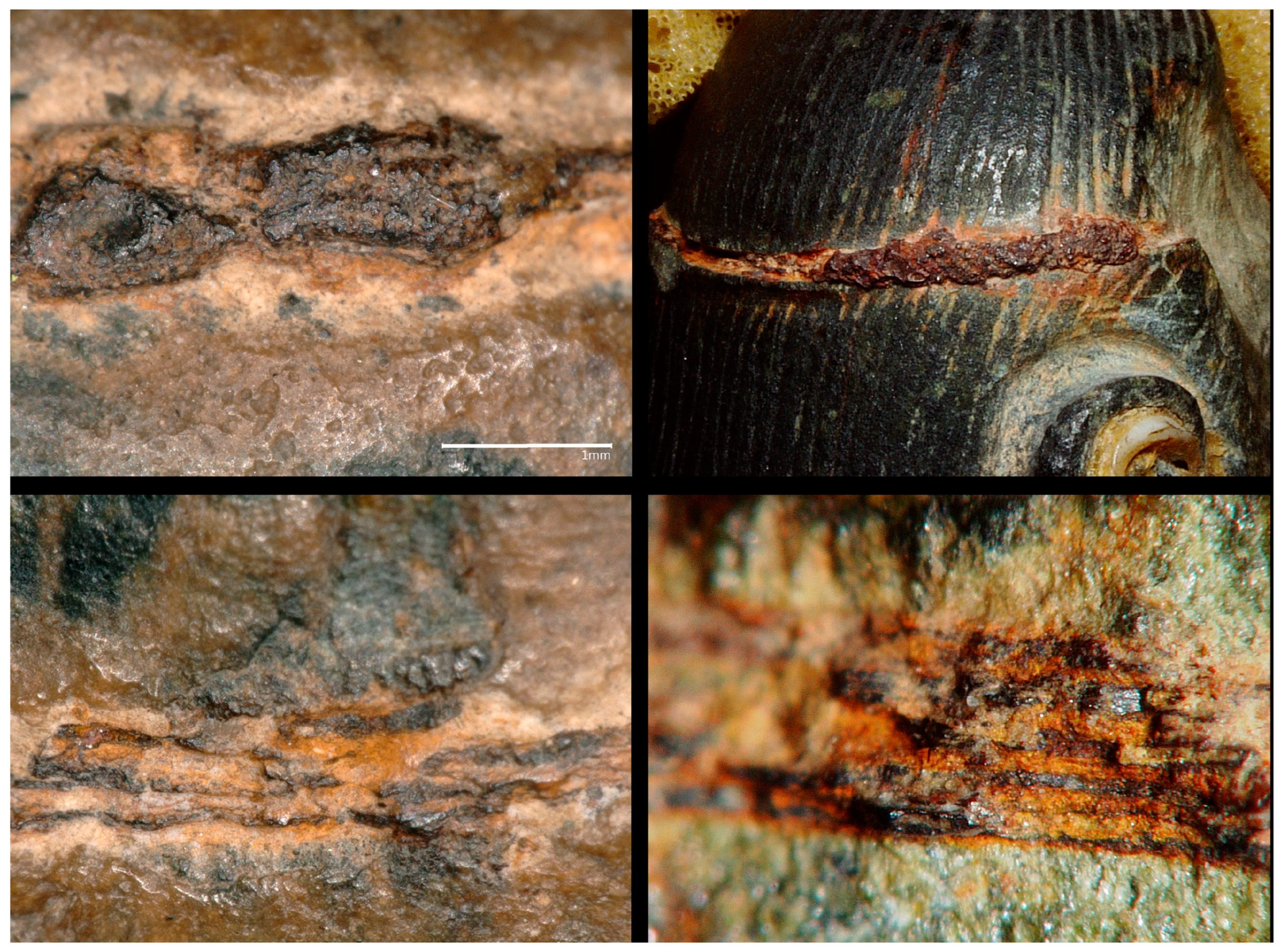
Observation of the headband of the Met specimen shows an oxidized band which overlaps the surrounding rock material. High magnification pictures of the band show, where it is nearly intact, a regular and oxidized surface which overflowed significantly on either side of the band, as evidenced by traces of rust. At the places where the oxidized superficial layer was scratched off (probably following a recent cleaning when it was put up for sale), we can see that a gutter was carved out to insert a meteoritic wire. Wherever the superficial oxide is missing, the underlying oxidized metal cropping out displays some banding along a strike of about 0.1–0.2 mm in width. This banded structure approximately evokes the Widmanstätten pattern encountered in most iron meteorites, the particular orientation resulting probably from the deformation by elongation upon the smithing of the headband.
Le Louvre’s specimen shows a very similar aspect, but the underlying rock seems to have been slightly more damaged. (Figure 2).
Results of the chemical analyses of five spots (A–E) of the Met specimen are presented in Table 1. Part of the obtained composition is from the silicate substrate.
If the headband is indeed iron (more or less oxidized) it is more interesting to consider the results recalculated as metal (substrate, oxygen and trivial contaminations subtracted), as seen in Table 2.
The iron content is then 92.8% (±0.9), the remainder being essentially nickel 5.03 ± 0.81% and cobalt 0.38 ± 0.08%. This composition is typical of a meteoric iron, even though the corrosion has certainly altered the initial composition. It is worth noticing the high concentration of copper and zinc in the matrix. This could be the contribution of a Cu:Zn alloy used to incorporate the iron band tightly.
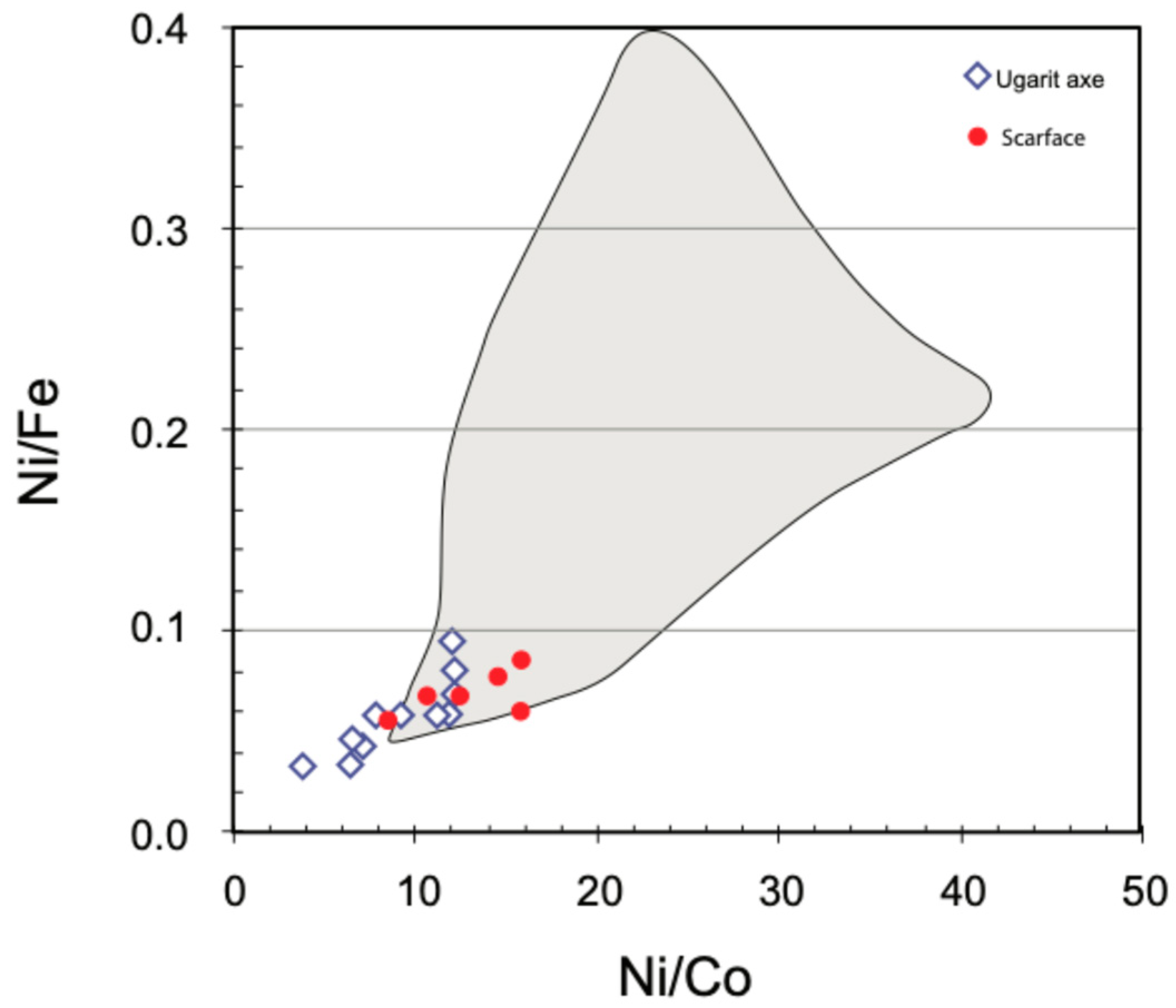
As such, it is interesting to report these results in a Ni/Fe vs. Ni/Co diagram (Figure 3), which makes it possible to see the effect of corrosion [4]. A positive correlation between these two ratios is conspicuous, as has previously been observed for other meteoritic iron artifacts, highlighting the simultaneous decrease in the Ni/Fe and Ni/Co ratios, and therefore the loss of Ni during corrosion, the Fe/Co being meteoritic [4,12,13].
In the present case, trace elements, like gallium, germanium, etc., cannot be considered to characterize more precisely the type of meteorite used because of the contribution of the substrate to the analytical results.

4. Discussion

4.1. The Metal

According to the analytical results, it appears undisputable that the headband is made of meteoritic iron. As shown by Goldstein, there is a relationship between the characteristic dimension of Widmanstätten bands and the nickel content of kamacite (Ni-poor iron crystals) in meteorites [14]. This relationship, however cannot be applied in the case of archaeological objects for two reasons: (1) the shaping of the objects (hammering) deforms the Widmanstätten pattern, the bands becoming thinner without changing the composition. (2) Corrosion decreases the nickel content of the iron alloy. A width of the bands on the order of 0.1 mm, as observed, should correspond to an initial Ni content of the kamacite of about 7% (>6.8%) in a fresh meteorite, and therefore a value higher than that for the average composition of the metal (kamacite + taenite) before corrosion, with a larger bandwidth before hammering. This indicates that the highest nickel content of 5.64% is certainly lower than the initial content. For a nickel content of 6% in the kamacite, the initial dimension of the Widmanstätten bands should be less than 10 μm and would remain unnoticeable after hot deformation. This hot working is mandatory for a headband whose aspect ratio is greater than 20, indicating that at that time iron working was already fairly well mastered, unlike the case at the beginning of the Bronze Age (as illustrated by the Gerzeh beads [15,16]).
There is obviously the question of the similarity with the specimen of Le Louvre, which also wears an iron headband. The unpublished analyses carried out at the C2RMF (Paris), indicate a much higher Ni content (approximately 10%) but an observed banding width of the same scale as on the Met specimen (Figure 2) [5]. For a 10% Ni content, the bandwidth before deformation should exceed one mm. This suggests that the specimen from Le Louvre is less corroded and that the composition of the Met specimen was originally probably quite comparable, in agreement with the composition/structure relationship [14]. Still, the significant effect of corrosion does not allow us to say with certainty that the two headbands were made from the same meteorite, though this is entirely possible.

4.2. The Significance of the Iron Headband

As will be seen below (also Appendix B OSM) the dragon can be related to Vritra of the Rig Veda, the retainer of the water in the underworld. In many cultures, meteoritic iron materializes in the sky, which contains rainwater, as opposed to the Earth, which contains groundwater. Iron is therefore the material of the reservoir which contains this celestial water and the one which retains the water underground, symbolically of a comparable nature. It is therefore possible that this meteoritic iron is an essential attribute of the dragon who holds water captive in the underworld.

4.3. The Relationship with the Indo-European Myth of the Dragon (See Appendix B OSM)

Watkins argued convincingly in favor of a specific Indo-European (IE) myth of the dragon, based on purely linguistic arguments [17,18]. The oldest written record of this myth is found in the Rig Veda. More recent versions of the myth in other IE groups, however, differ significantly, possibly after a long evolution.
The chthonic character of the Oxus statuettes, their demonic allure, their snakeskin, the jar held under the arm and the split across the face are all characteristics shared with the Indo-Aryan myth. The culture of the Oxus is one of a sedentary population based on agriculture, and therefore crucially dependent on water resources in a region where it can be problematic in certain years. The myth of a dragon having captured the waters to hide them underground fits perfectly with this cultural type. Despite the early proposals of Sarianidi [3], this culture does not seem to be Indo-European [19], as is further supported by more recent genomic studies [20]. It rather exhibits some Elamite affinity (e.g., [21]). The accordance of the Oxus dragons with an Indo-European myth and more specifically the one described in the Rig Veda suggests some reciprocal cultural hybridization, since the Vedic myth contains elements relating to the Oxus culture as well [21,22]. I claim that cultural hybridization, which is a more general and better-defined concept, should be preferred to the Kulturkugel concept of Mallory [19]. This likely occurred during the migration of Indo-Iranian people from Central Asia (Andronovo culture) to Northwest India and Iran [19]. Specificities of the Oxus dragons, however, such as the pierced lips and the iron headband, remain unsupported by the Vedic version of the myth.
Interestingly, the analyses of Francfort [2] and Vidale [23] reach comparable conclusions. They underscore the seasonal role of the water-concealing dragon. Other features of the statuette have not been mentioned as yet since they are partly hypothetical and based on comparisons with other artifacts. There are two holes, one in front and one in the back, which were supposedly fitted with horns and wings. Deer antlers, which fall at the end of autumn, are a symbol of the rebirth of vegetation in spring, when they grow again. On the statuette, the horns could have been removable, giving rise to a possible cult ceremony in autumn and another one in spring. Wings introduce a connection with the sky, the source of the rain in spring. In addition, Francfort notices the relationship of the Bactrian dragon myth with a more general third millennium shamanic culture reaching from Mesopotamia to China, the Indo-Aryan interpretation of the myth being secondary and borrowed from the previous one.

5. Conclusions

In the ancient world, representations that combined human and animal qualities conveyed supernatural powers. These small figures, with a human face and scaled body, probably represent such a creature, enlivened and charged with magical efficacy. The negative construction of the figurines as opposed to the female figurines can be understood as the opposition of terrestrial beings and underworld monsters, the latter being tamed by the former as described in the dragon-slaying myth.
The monstrous figure’s enigmatic and distinctive features are the prominent split across its face, the two holes pierced into its upper and lower lips and the meteoritic iron headband.
According to the recent works of PIE linguists, the “scar” should be interpreted as the split from which the water was liberated as in the Vedic myth [24]. The meteoritic iron headband could be a reminder of a heavenly material used to conceal the water. As for the lips, in the absence of any mention in the available versions of the myth, we are left with interpreting this feature as a specific signature of the BMAC culture to be elucidated. Our interpretation suggests that the Indo-European dragon myth was not specific to this culture and possibly of very ancient origin.

Funding

This research received no external funding.

Data Availability Statement

The original contributions presented in this study are included in the article. Further inquiries can be directed to the corresponding author.

Acknowledgments

Kim Benzel, Department of Ancient West Asian Art, The Metropolitan Museum of Art is thanked for the permission to conduct this research. Jean-François de Lapérouse, Department of Objects Conservation of the Metropolitan Museum of Art is acknowledged for supporting this project and taking the pictures. Federico Carò from the Department of Scientific Research skillfully performed the XRF analyses. We are indebted to Denton S. Ebel, Department of Earth and Planetary Sciences, Division of Physical Sciences, American Museum of Natural History, for kindly providing the reference samples of Cape York, Coahuila and Hoba meteorites. A. Benoit former Curator of Antiquités Orientales at Le Louvre Museum in Paris is thanked for her impetus when starting this research. I am particularly grateful to Olivier Buchsenschutz, Benjamin Fortson, Vincent Pigott and Georges-Jean Pinault who spent some time answering a number of naive questions. Stephane Guillot kindly interceded to obtain the required permission from C2RMF. We are indebted to T. Calligaro and A. Bouquillon of C2RMF, Paris, for the pictures and sharing of information about Le Louvre specimen. P. Rochette (CEREGE) provided the synthetic reference specimens.

Conflicts of Interest

The authors declare no conflicts of interest.

Appendix A. Co Analysis

We used the freeware PyMCA to derive quantitative values from the registered spectra [11]. We first calibrated the spectrometer with reference specimens: 4 iron meteorites (Cape York, Coahuila, Hoba and JFP) and two synthetic specimens high in Ni and low in Co.
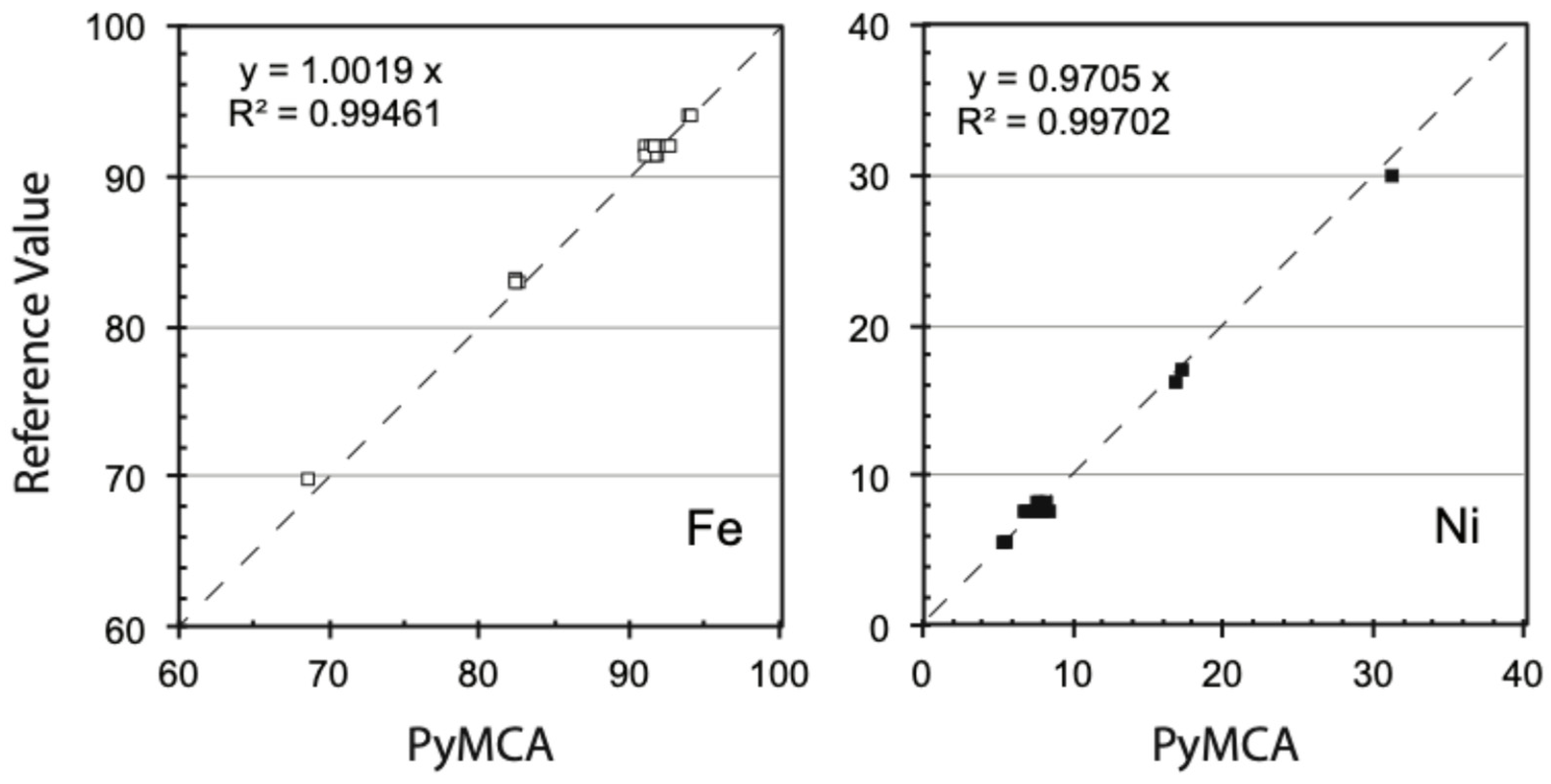
When the calculated values for Fe and Ni are compared to the reference values from the literature, we obtain a satisfactory agreement within the error bars, as can be seen in Figure A1, where we plotted the reference values against the calculated ones.
The results are listed in Table A1. The values for Si, K, Ca, Ti for the reference specimens are due to contamination of the surface.
Table A1. Analytical results for the reference specimens. wt. % normalized. All data derived using PyMCA freeware, oxygen free, normalized to 100%. Co values uncalibrated.
SiSKCaTiVCrMnFeCoNiCuZnAsCd
Cape York1.410.080.090.020.020.000.000.0290.380.807.110.040.000.010.03
0.880.140.110.030.030.000.010.0191.430.826.500.030.000.000.02
1.160.220.050.020.030.000.000.0091.180.786.510.020.000.000.02
1.150.150.080.020.030.000.010.0191.000.806.700.030.000.010.02
Coahuila1.240.160.020.030.020.000.020.0192.330.815.300.040.010.010.01
0.760.160.010.020.030.000.020.0193.100.765.080.020.000.000.02
0.760.080.030.020.030.000.020.0093.050.655.290.020.000.010.04
0.920.130.020.020.030.000.020.0192.830.745.220.030.000.010.02
Hoba0.890.020.060.010.020.000.020.0181.720.9716.210.030.000.020.02
0.560.130.040.000.020.000.030.0381.970.9616.200.030.000.010.02
0.780.080.040.010.030.000.020.0581.760.9816.180.030.000.020.03
0.740.070.040.010.020.000.020.0381.810.9716.200.030.000.020.03
JFP0.800.220.040.010.020.000.050.1090.550.887.220.030.000.050.02
1.820.090.060.010.030.000.010.0589.860.757.260.030.000.000.03
0.480.040.040.010.020.000.010.2090.360.777.950.030.000.040.03
1.030.120.050.010.020.000.020.1290.250.807.480.030.000.030.03
ROC171.390.130.080.010.030.020.000.0081.380.2916.610.010.000.010.03
1.880.080.060.010.020.030.000.0080.960.2816.620.030.000.000.03
0.960.060.010.010.040.000.000.0481.950.1616.660.030.000.040.03
1.410.090.050.010.030.020.000.0181.430.2416.630.030.000.020.03
ROC300.610.080.020.010.020.000.000.0068.500.1830.470.070.000.010.03
0.660.190.040.010.020.000.000.0068.180.2530.560.070.000.010.02
1.340.040.040.030.030.010.010.1268.250.2029.790.130.000.010.00
0.870.100.030.020.020.000.000.0468.310.2130.270.090.000.010.02
Table A2. Metal compositions of the reference specimens normalized to 100%. Fe, Co and Ni using PYMCA; Co PyMCA calibrated to references, and Co using Spectral decomposition. Reference are values from the literature [4,25] (Buchwald, 1975; Jambon, 2017).
FeCoNi
JFPA91.850.557.59
B91.780.517.71
C91.140.528.34
Mean91.590.537.88
sigma0.390.020.40
Ref91.270.548.19
ROC17182.490.1917.32
282.500.1417.36
382.580.1117.32
Mean82.520.1417.33
sigma0.050.040.02
Ref82.910.1116.98
ROC30168.760.0931.16
268.640.1031.26
368.730.1031.17
Mean68.710.0931.20
sigma0.060.010.05
Ref69.900.1529.96
Hoba182.460.7216.82
282.460.7116.82
382.500.7116.80
Mean82.470.7116.81
sigma0.020.010.01
Ref83.070.7916.14
Coahuila194.030.445.53
294.190.465.35
393.890.485.63
493.990.465.55
593.980.465.57
693.900.445.66
Mean93.990.465.55
sigma0.110.020.11
Ref93.980.465.56
Cape York192.000.537.48
292.610.566.83
392.760.476.77
491.650.457.90
591.490.488.03
691.030.478.50
792.490.526.99
sigma0.670.040.69
Mean92.000.507.50
Ref91.900.497.61
Figure A1. Comparison of Fe and Ni values derived using PyMCA and literature values. The straight line is not a fit and corresponds to a perfect correspondence of the two sets of values.
Heritage 08 00539 g0a1
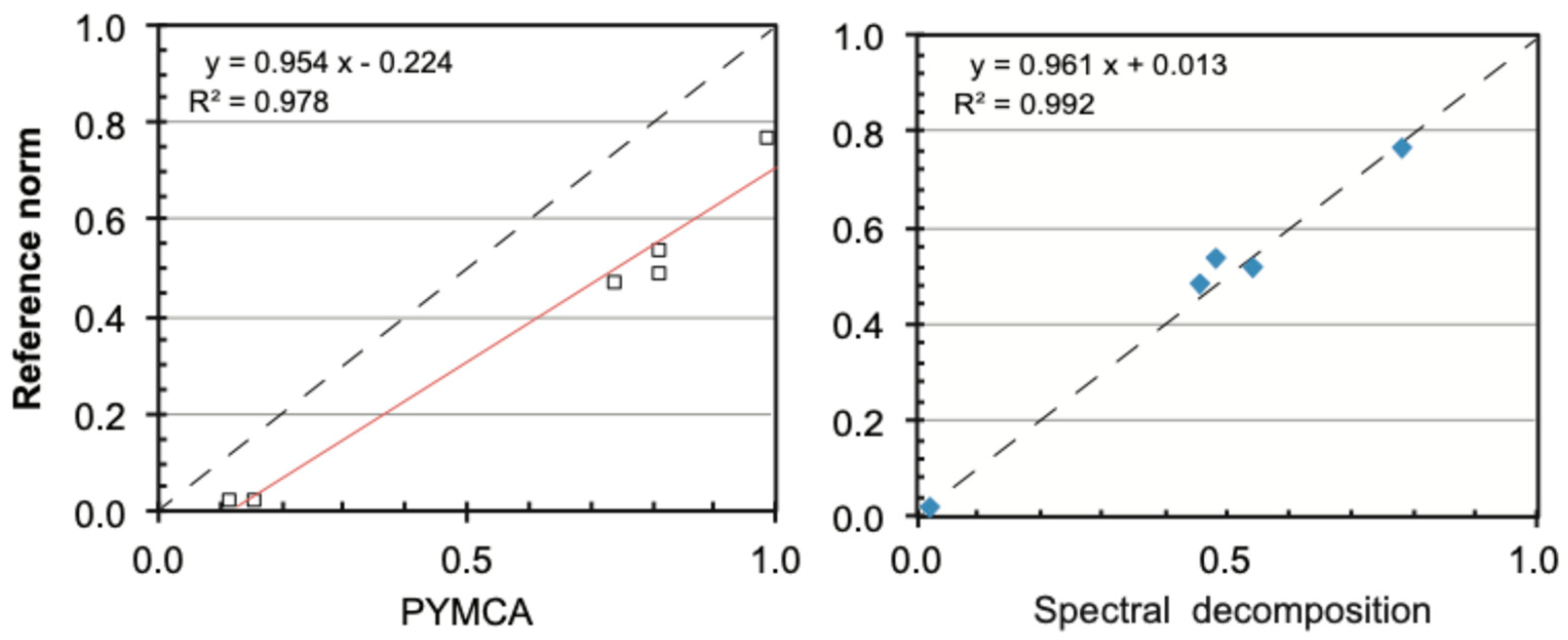
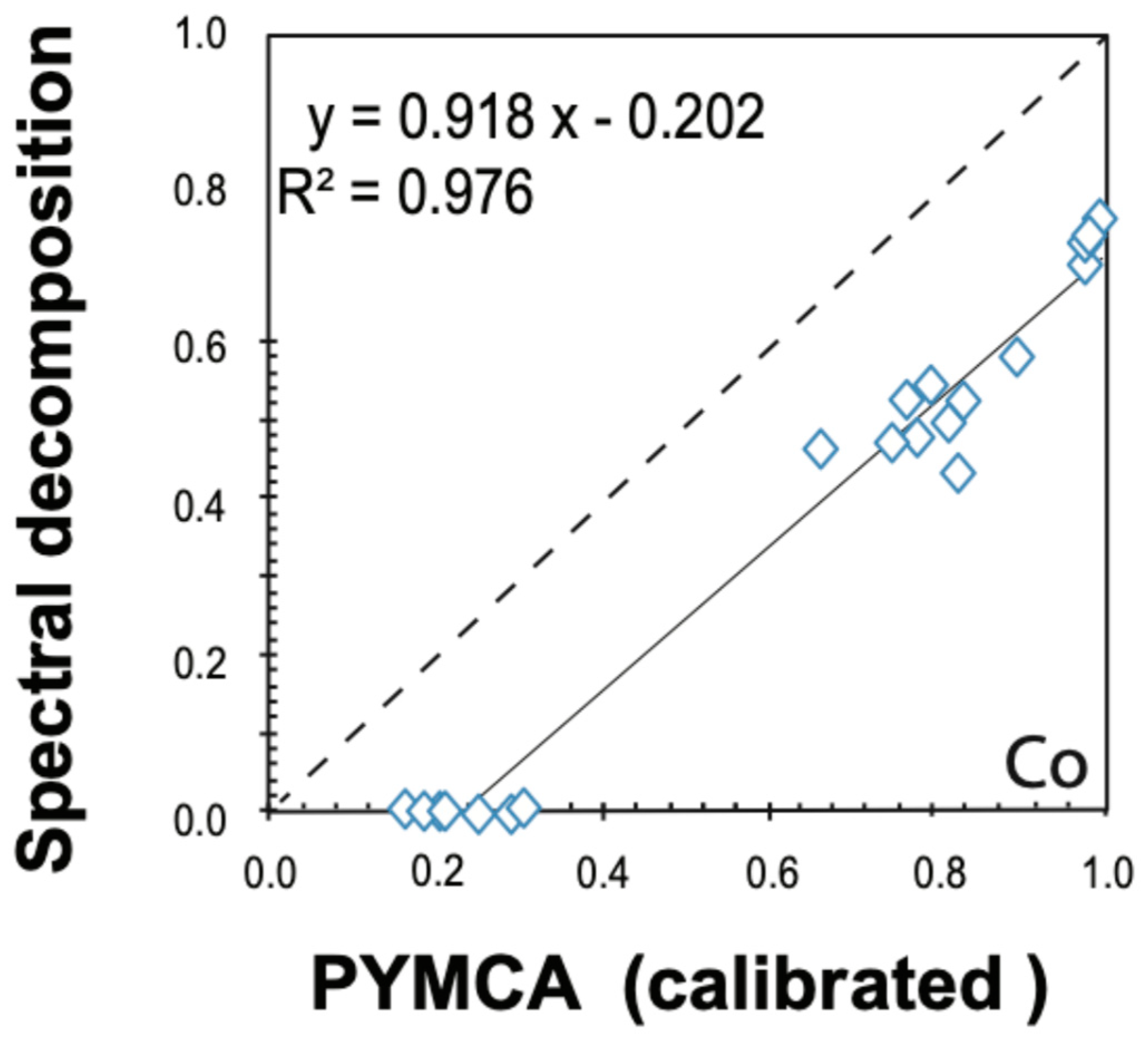
When Co values are considered, the same is not true. In Figure A2, we report the comparison between values found in the literature and those obtained using PyMCA. The correlation between the reference values and those derived by PyMCA is strong, but the slope is far from unity, and the intercept is not zero. We therefore devised two possibilities: one is to calibrate the PYMCA values to the reference specimen values according to the best fit line. The other is to derive the concentrations directly from the spectra by spectral decomposition and calibration to the same set of reference specimens (Table A2). The spectral decomposition uses standard procedures of synthetic spectrum calculation in the range 6.7 to 8 keV where Fe Kbeta, Co Kalpha and Ni Kalpha are found. The ratio of peak intensities is used to calculate the concentrations, which is valid because the measured (unknown) values fall in the same range as the references. The results for Ni were used to validate the procedures but are not presented here. The results for Co yield a fair correlation with a best fit line of slope of 0.96 and an intercept of 0.01% (Figure A2). If we force the correlation line through the origin, we obtain a slope of 1.030.
Figure A2. Comparison of Co concentrations calculated by either PYMCA freeware or spectral decomposition, to the set of reference specimen concentrations. Notice that the value of Hoba using PyMCA is an outlier which was not considered to fitting the data. In the case of spectral decomposition, the slope is indistinguishable from unity, and the intercept is nearly zero. The dashed line corresponds to a hypothetical perfect correlation.
Heritage 08 00539 g0a2
In this second case, the fit is satisfactory, as the slope is equal to unity (within uncertainties) as it should be. We calculated the Co concentrations using both methods, and the results were not significantly different, as can be seen on Figure A3.
Figure A3. Comparison of the two sets of results using on one hand the calibrated PYMCA results and direct spectral decomposition. The good correlation shows that either set can be used to calculate Co concentrations. The dashed line corresponds to a hypothetical perfect correlation. The plain line is a fit to the data.
Heritage 08 00539 g0a3

Appendix B

Appendix B.1. The Dragon Myth

The dragon figure is present in many cultures, from western Europe to China. Its changing shapes, attributes and functions with place and time makes the deciphering of the myths quite difficult, and clearly any relationship with the Oxus dragon must be firmly established in time and space. For instance, the dragon in ancient Mesopotamia is a clear illustration of the eclectic representation and divine context [26]. He sometimes wears wings or horns with a figure of a serpent, or a lion or an eagle. For the specimen of Le Louvre, the presence of wings and horns has been suggested because of holes in front and back, but these are the only evasive relationship with the Oxus figurines. His mentions in textual fragments, however, does not make any clear connection with the Oxus version depicted in the figurines.

Appendix B.2. The Indo-European Myth and the Relationship with the Oxus Culture

To understand the meaning of the iron headband, it is necessary to examine more precisely the myth to which these monsters must be attached [27]. For Sarianidi, these populations of Central Asia, judging by their geographical location between the steppes further west and the Indian continent further southeast and the supposed date of their migration, were possibly of Indo-European affinity [28]. Still, more recently, it was shown that none of the arguments presented by Sarianidi are tenable, and instead some affinity with Elam was proposed [21]. In particular, the Indo-Irano Aryans were pastoralists who lived in temporary settlements, while the Oxus group were sedentary farmers living in mud brick houses. Recent genomics studies completely discarded any significant Indo-Aryan relationship [20].
The Oxus culture, although it presents, notably in the representations of myths, the specific heritage of an old Eurasian background, reveals an Elamite orientation proven by multiple elements of material and artistic culture [29].
With this view, the BMAC country becomes little more than a passageway for Indo-Aryan populations coming from the Northwest en route to India and Iran [30,31,32]. Mallory defends the hypothesis that the steppe culture of Andronovo, of Indo-Iranian or Indo-Aryan language, was transformed during its passage through the BMAC country, from which it adopted certain religious, mythological, and material traits before giving rise to the cultures known later in India [23]. If the theory of the passage of the Indo-Aryans through the BMAC cannot be considered as demonstrated on the linguistic level, Pinault nevertheless provides a few linguistic observations suggesting some exchanges [21].
In particular he explains that the warrior god Indra is the murderer of the serpent Vritra, who blocked the passage of the waters: in V.32.5, this demon, eager to fight, is placed “in the darkness of the harm(i)yâ-” by Indra, a poetic expression to signify killing. He then argues how the word harm(i)yâ- initially designated a house whose structure is typical of the BMAC and absolutely not that of the Vedic world. We find here a characteristic of the language used in the myth, as argued previously by Watkins [17] and which is revealing of the very origin of the myth, in this case the culture of the Oxus.
More convergence permits us to invoke for these monsters the dragon-slaying myth of Indo-European culture as defined by Watkins [17,18], noticing that this is the oldest written record of the myth. As far as the figurines are concerned, the scaly skin obviously evokes the underworld, where the snakes (one of the dragon’s appearances) hide, and the jar held under the arm is intended to contain water. In the economies of cultures based on agriculture in Central Asia, the supply of water is vital to the point that it has even been suggested that the end of this culture could be linked to climatic hazards. The myth of a monster who concealed this water and kept it hidden underground is therefore not surprising in this context, and it is quite possible that the defaced monsters are the version specific to the BMAC culture. If this is the case, the deep cut across the face can be interpreted in accordance with the analysis of Slade, as we will see below [24].

Appendix B.3. The Slaying/Splitting of the Dragon

If the myth of the dragon is almost universal, its association with the capture of water in Indo-European mythology is less so. The dragon/snake presents an important relationship with the earth. If the Indo-European character of these myths is signed by the linguistic formulation [17,24], the absence of a comparable myth in other cultures, presently disappeared and which did not leave a written record, as is the case of the BMAC culture, is an open question and obviously a difficulty for any demonstration. The oldest texts we have about the Indo-European myth are those of the Rig Veda. It is assumed that the oral tradition of the first sūktas of the Rig Veda, in the Vedic language (an archaic Sanskrit), developed at a time when the Aryans were still on the plateaus of Central Asia, in the region of the Oxus. One should notice that the myths in other IE cultures differ significantly, even though the arguments presented by Watkins are indisputable [17].
If the dating of the hymns of the Rig Veda is disputed, these texts are written in a very archaic Sanskrit, which the philological comparison with the other Indo-European languages suggests placing at the beginning of the 2nd millennium BC. However, some sequences may have been composed much earlier, while many others may date from the 1st millennium BC. Historians therefore do not agree on a precise dating, but on a period which would extend from approximately 1700 to 1000 BC [33,34,35]. Still, the myth must have older roots, since traces of it can be found in the various Indo-European cultures which split off at a much earlier time.
Vritra (the Obstructor) is in the Vedic religion the demon of dryness, resistance and inertia. He would have hindered the waters from flowing. He had the form of a snake or a dragon. Vritra was killed by Indra, which earned the latter the name of Vṛtráhan. Indra is the King of the Gods and Lord of Heaven. He is originally the Indo-European god of war and storms. Indra appears as one of the main deities in the Rig Veda. He is qualified with many epithets, notably Vṛtráhan, murderer of Vritra, the retainer of the (heavenly) waters. The name of Indra’s serpentine adversary, Vritra, derives from a root meaning ‘to enclose, cover, obstruct’ and, indeed, the obstruction of the flowing of the waters is the primary action of Vritra. These waters most likely, at least originally, referred to rivers which are released from the mountains during the late spring/early summer snowmelt [36,37,38].
We can therefore conclude that at this stage that the texts in question have penecontemporary roots with the Oxus culture and that their geographical origin also brings us back to this region. Referring to it is therefore totally relevant.
Slade, following Watkins, showed that mastery of the dragon is achieved by its “slaying” but more so by the way it is killed [24]. We know that a translation from an archaic text is hazardous, and some of the words require comments.
The prototypical Vedic dragon-slaying formula is .hann .him, found in this form eleven times in the RV, which Watkins [18] suggests reflects an inherited PIE formula and according to Slade can be found in Vedic, Iranian (Avestan), Greek, Hittite and old Irish [24]. If these conclusions are correct, then the myth should predate the separation of these language groups.
The dragon-slaying formula being a key expression in the (written) myths, it is a signature of their kinship. Thus, the basic Indo-European dragon-slaying formula may be reconstructed. Interestingly, Indra’s slaying of the dragon is described six times using forms meaning ‘split, cleave, cut’ (cf. [39]). The ‘splitting’ of the dragon is a rather more specific event than the ‘slaying’ of the dragon, denoting an opening-up of the dragon.
- RV 1.52, 10d: ‘In the intoxication of Soma, (Indra) with strength, split the head (of Vritra).’
- RV 8.6,6: ‘(Indra) split apart Vritra’s … head with his bullish hundred-jointed vajra.’
- RV 8.76, 2: ‘This Indra, with Marut companions, split apart Vritra’s head.’
Notice that the head is split apart, not the belly.
- RV 10.89,7: ‘He (=Indra) slew Vritra as an axe the tree, broke the forts, cleared a path as it were for the rivers. He split the mountain like a new water-jug,’
- (RV 2.19,2b): ‘Indra split apart the flood-enclosing serpent.’
- (RV 10.113,6cd): ‘…as the powerful one (=Indra) with strength split open the darkness-enclosed Vritra, who abducted the waters.’
(translations after Slade, [24].)
Therefore, the killing of a dragon by ‘splitting his head’ is semantically more specific than simply ‘slaying a dragon’. In some versions of the myth, the dragon actually hoarded these precious commodities by swallowing them, thus necessitating the splitting of the dragon’s head by the hero to recover the elements vital to his society.
However, there remains a major difficulty that we may not ignore: Vedic culture is that of a nomadic population of breeders from Central Asia and not of sedentary farmers. The myth of a dragon having captured the waters is therefore foreign by nature to this culture. Note, however, that in certain passages of the Rig Veda the waters are replaced by herds, which can be understood as an adaptation of the myth to a culture of breeders. We can then assume that the myth of the dragon as presented in the Rig Veda is a borrowing from a culture of farmers exposed to climatic hazards.
According to Francfort [2].
The Oxus Civilization scheme, representing the cycles of nature and life, is notably different from the usual and well-known interpretive schemes of the Mesopotamian, Indus or Avestan mythologies, but certainly related to the Iranian Elamite artistic language (forms and style) if not beliefs, and deeply rooted in Bactria–Margiana. In this respect, the symbolic system of the Oxus Civilization is an original expression of a more general Eurasian mythological universe of very ancient origin.”
This hierarchical system is faithfully repeated in the mythological iconography. One can observe that the female deity, a great goddess, is always at the first rank; she is also known by several composite statuettes of marble and steatite found in burials in Bactria and Margiana [3,40]. Her image is very similar to the figures of the Elamite vegetation goddess [41].
The form of the snake dragon may have originated in the Elamite pantheon [41]. The dragon, in most ancient Oriental mythologies from Mesopotamia and Elam to China, keeps the waters underground in winter and releases them in spring [25,42,43].
To conclude, if we follow the independent analyses of all these authors, we understand that the myth of the dragon having concealed the water is well in accordance with the Oxus culture, one of sedentary farmers. The oldest written version we have is from the Rig Veda, but we noticed that the capture of the water is not consistent with a myth of a nomadic culture, suggesting that the early version of the IE myth was borrowed from a culture of farmers.

References

  1. Ghirshman, R. Statuettes Archaïques du Fars (Iran). Artibus Asiae 1963, 26, 151–160. [Google Scholar] [CrossRef]
  2. Francfort, H.P. The Central Asian Dimension of the Symbolic System in Bactria and Margiana. Antiquity 1994, 68, 406–418. [Google Scholar] [CrossRef]
  3. Sarianidi, V.I. Togolok 21, an Indo-Iranian Temple in the Karakum. Bull. Asia Inst. 1990, 4, 159–165. [Google Scholar]
  4. Jambon, A. Bronze Age Iron: Meteoritic or not? A Chemical Strategy. J. Archaeol. Sci. 2017, 88C, 47–53. [Google Scholar] [CrossRef]
  5. Calligaro, T. (Centre de Recherche et de Restauration des Musées de France, Paris, France). Personal communication, 2025.
  6. Waldbaum, J. The first archaeological appearance of lron and the transition to the iron age. In The Coming of the Age of Iron; Wertime, T.A., Muhly, D., Eds.; Yale University Press: New Haven, CT, USA; London, UK, 1980; pp. 69–98. [Google Scholar]
  7. Waldbaum, J.C. The coming of iron in the eastern Mediterranean: Thirty years of archaeological and technological research in the archaeometallurgy of the Asian World. In MASCA Research Papers in Science and Archaeology; Pigott, V.C., Ed.; Museum Applied Science Center for Archaeology: Philadelphia, PA, USA, 1999; Volume 16, pp. 27–57. [Google Scholar]
  8. Jean, E. Le fer chez les Hittites: Un Bilan des Données Archéologiques. Mediterr. Archaeol. 2001, 14, 163–188. [Google Scholar]
  9. Yalçın, Ü. Early iron metallurgy in Anatolia. Anatol. Stud. 1999, 49, 177–187. [Google Scholar] [CrossRef]
  10. Benoit, A. Le Balafré, un dragon-serpent de la civilisation de l’Oxus. In Actualité du Département des Antiquités Orientales; Le Louvre: Paris, France, 2006; Volume 7. [Google Scholar]
  11. Sole, V.A.; Papillon, E.; Cotte, M.; Walter, P.; Susini, J. A multiplatform code for the analysis of energy-dispersive X-ray fluorescence spectra. Spectrochim. Acta B 2007, 62, 63–68. [Google Scholar] [CrossRef]
  12. Jambon, A.; Bielińska, G.; Kosiński, M.; Wieczorek-Szmal, M.; Miśta-Jakubowska, E.; Tarasiuk, J.; Dzięgielewski, K. Heavenly Metal for the Commoners: Meteoritic Irons from the Early Iron Age Cemeteries in Częstochowa (Poland). J. Archeol. Sci. Rep. 2025, 62, 104982. [Google Scholar] [CrossRef]
  13. Almansa Vilatoro, V.; Newman, R.; Jambon, A. An Ancient Egyptian Meteoritic Iron on Khufu’s Magic Knife from Giza (c. 2550 BCE). Meteorit. Planet. Sci. 2025; submitted. [Google Scholar]
  14. Goldstein, J.I. The Formation of the Kamacite Phase in Metallic Meteorites. J. Geophys. Res. 1965, 70, 6223–6232. [Google Scholar] [CrossRef]
  15. Johnson, D.; Tyldesley, J.; Lowe, T.; Withers, P.J.; Grady, M.M. Analysis of a prehistoric Egyptian iron bead with implications for the use and perception of meteorite iron in ancient Egypt. Meteorit. Planet. Sci. 2013, 48, 997–1006. [Google Scholar] [CrossRef]
  16. Rehren, T.; Belgya, T.; Jambon, A.; Káli, G.; Kasztovszky, Z.; Kis, Z.; Kovács, I.; Maróti, B.; Martinón-Torres, M.; Miniaci, G.; et al. 5000 years old Egyptian iron beads made from hammered meteoritic iron. J. Archaeol. Sci. 2013, 40, 4785–4792. [Google Scholar] [CrossRef]
  17. Watkins, C. How to kill a dragon in Indo-European. In Studies in Memory of Warren Cowgill (1929–1985); Watkins, C., Ed.; De Gruyter: Berlin, Germany, 1987; pp. 270–299. [Google Scholar]
  18. Watkins, C. How to Kill a Dragon: Aspects of Indo-European Poetics; Oxford University Press: New York, NY, USA, 1995. [Google Scholar]
  19. Mallory, J.P. A European perspective on Indo-Europeans in Asia. In The Bronze Age and Early Iron Age Peoples of Eastern Central Asia; Mair, V.H., Ed.; The Institute for the Study of Man: Washington, DC, USA, 1998; Volume I, pp. 175–201. [Google Scholar]
  20. Narasimhan, V.M.; Patterson, N.; Moorjani, P.; Rohland, N.; Bernardos, R.; Mallick, S.; Lazaridis, I.; Nakatsuka, N.; Olalde, I.; Lipson, M.; et al. The Genomic Formation of South and Central Asia. Science 2019, 365, eaat7487. [Google Scholar] [CrossRef] [PubMed]
  21. Pinault, G.-J. Contacts religieux et culturels des Indo-Iraniens avec la Civilisation de l’Oxus. In Comptes Rendus de l’Académie des Inscriptions et Belles-Lettres; Persée: Lyon, France, 2005; pp. 213–257. [Google Scholar]
  22. Lubotsky, A. The Indo-Iranian Substratum. In Early Contacts Between Uralic and Indo-European: Linguistic and Archaeological Considérations, Proceedings of the International Symposium, Helsinki, Finland, 8–10 January 1999; Carpelan, C., Parpola, A., Koskikallio, P., Eds.; Mémoires De La Société Finno-Ougrienne: Helsinki, Finland, 2001; Volume 422, pp. 301–317. [Google Scholar]
  23. Vidale, M. Treasures from the Oxus: The Art and Civilization of Central Asia; Tauris, I.B., Ed.; Bloomsbury: London, UK; New York, NY, USA, 2017. [Google Scholar]
  24. Slade, B. How (exactly) to slay a dragon in Indo-European? Hist. Sprachforsch. 2010, 121, 3–53. [Google Scholar]
  25. Buchwald, V.F. Handbook of Iron Meteorites. Their History, Distribution, Composition and Structure 1–3; State University, Center for Meteorite Studies: Tempe, AZ, USA; University of California Press: Berkeley, CA, USA, 1975; Available online: https://evols.library.manoa.hawaii.edu/handle/10524/33750 (accessed on 4 May 2018).
  26. Van Buren, E.D. The Dragon in Ancient Mesopotamia. Orientalia 1946, 15, 1–45. [Google Scholar]
  27. Caubet, A. Myths and Gods in the Oxus Civilization. In The World of the Oxus Civilization; Lyonnet, B., Dubova, N.A., Eds.; Routledge: London, UK, 2021; pp. 195–214. [Google Scholar]
  28. Sarianidi, V.I. Die Kunst des Alten Afghanistan; VEB EA Seemann Verlag: Leipzig, Germany, 1986; pp. 50–72. [Google Scholar]
  29. Francfort, H.P. La civilisation de l’Asie Centrale à l’Âge du Bronze et à l’Âge du Fer. In Catalogue De l’Indus à l’Oxus. Archéologie de l’Asie Centrale; Association IMAGO-Musée De Lattes: Montpellier, France, 2003; pp. 29–59. [Google Scholar]
  30. Hiebert, F.T. South Asia from a Central Asian perspective. In The lndo-Aryans of Ancient South Asia; Edosy, G., Ed.; Walter de Gruyter: Berlin, Germany; New York, NY, USA, 1995; pp. 192–205. [Google Scholar]
  31. Parpola, A. Formation of the Aryan branch of Indo-European. In Archaeology and Language 1: Theoretical and Methodological Orientations; Blench, R., Spriggs, M., Eds.; Routledge: London, UK, 1996. [Google Scholar]
  32. Cerasetti, B. Who interacted with whom? Redefining the interaction between BMAC people and mobile pastoralists in Bronze Age southern Turkmenistan. In The World of the Oxus Civilization; Lyonnet, B., Dubova, N.A., Eds.; Routledge: London, UK, 2021; pp. 487–495. [Google Scholar]
  33. Flood, G.D. An Introduction to Hinduism; Cambridge University Press: Cambridge, UK, 1996; 341p. [Google Scholar]
  34. Witzel, M. Linguistic Evidence for Cultural Exchange in Prehistoric Central Asia; Sino-Platonic Papers 129; University of Pennsylvania: Philadelphia, PA, USA, 2003; pp. 1–70. [Google Scholar]
  35. Anthony, D. The Horse, the Wheel, and Language: How Bronze-Age Riders from the Eurasian Steppes Shaped the Modern World; Princeton University Press: Princeton, NJ, USA, 2007. [Google Scholar]
  36. Schmidt, H.-P. Bṛhaspati und Indra; Harassowitz: Wiesbaden, Germany, 1968. [Google Scholar]
  37. Falk, H. The purpose of Rgvedic ritual. In Inside the Texts, Beyond the Texts: New Approaches to the Study of the Vedas; Witzel, M., Ed.; Harvard University Press: Cambridge, MA, USA, 1997; pp. 69–88. [Google Scholar]
  38. Witzel, M. The Ṛgvedic religious system and its Central Asian and Hindukush antecedents. In The Vedas: Texts, Language and Ritual; Griffiths, A., Houben, J.E.M., Eds.; Forsten: Groningen, The Netherlands, 2004; pp. 581–636. [Google Scholar]
  39. Benveniste, E.; Renou, L. Vrtra et Vroragna/Etude de Mythologie Indo-Iranienne; Imprimerie Nationale: Paris, France, 1934. [Google Scholar]
  40. Ligabue, G.; Salvatori, S. Bactria: An Ancient Oasis Civilisation from the Sands of Afghanistan; Ligabue, G., Salvatori, S., Eds.; Erizzo: Venice, Italy, 1989; 187p. [Google Scholar]
  41. Amiet, P. L’âge des échanges inter-iraniens 3500–1700 avant J.-C. In Notes et Documents des Musées de France 11; Éditions de la Réunion des Musées Nationaux: Paris, France, 1986; 332p. [Google Scholar]
  42. Miroschedji, P.D. Le dieu Elamite au serpent et aux eaux jaillissantes. Iran. Antiq. 1981, 16, 1–25. [Google Scholar]
  43. Dieny, J.-P. Le Symbolisme du dragon dans la Chine antique. In Archives de Sciences Sociales des Religions; College de France, Institut des Hautes Etudes Chinoises: Paris, France, 1989; Volume 67/2, p. 259. [Google Scholar]
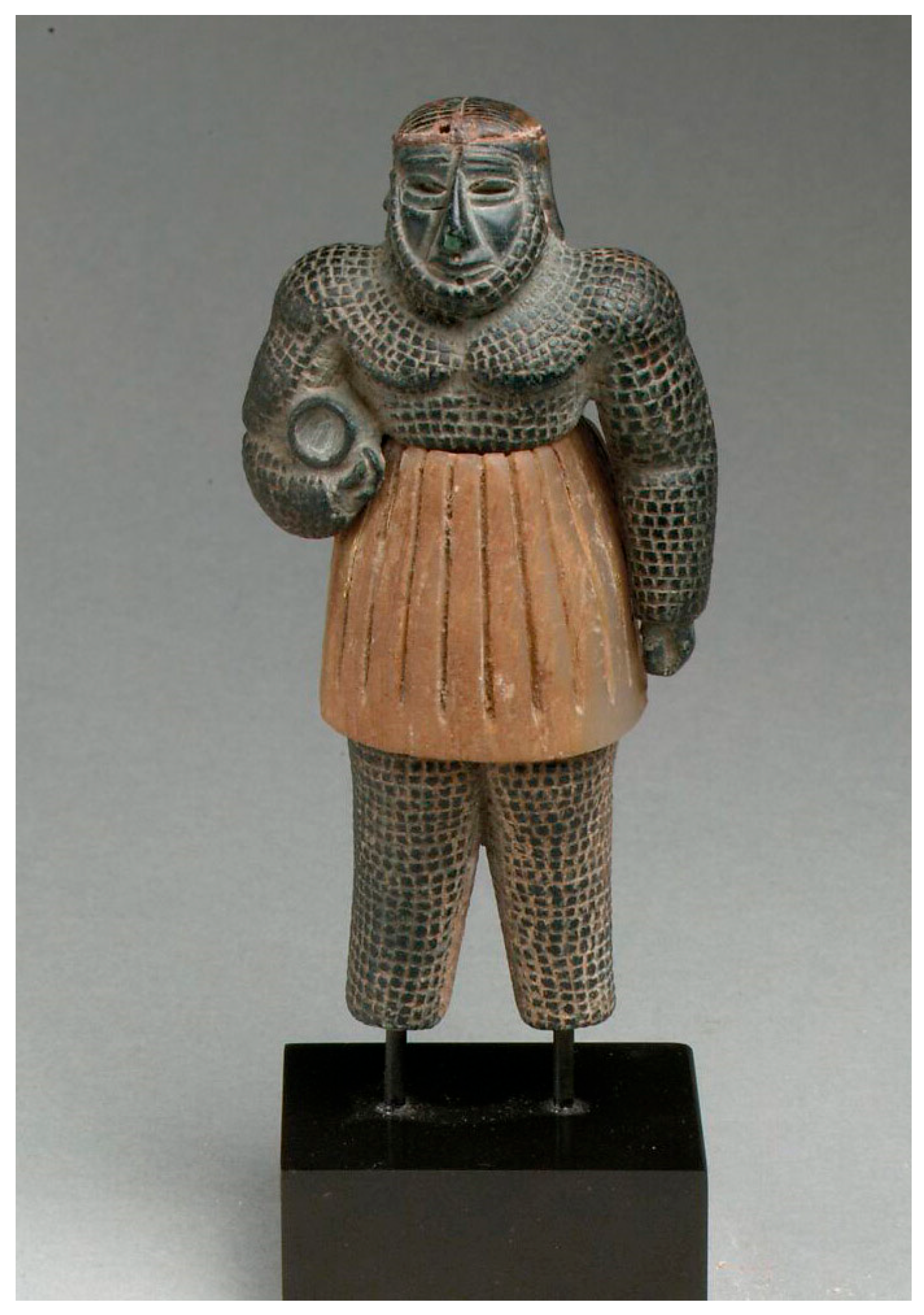
Figure 1. The Met specimen. Notice the scaly skin, the split across the face, the jar under the arm, and the iron headband (© Metropolitan Museum).
Heritage 08 00539 g001
Figure 2. Detail of the headbands of the two specimens: (Left) Met Museum specimen (credit Metropolitan Museum/J-F. de Laperouse,); (Right) Le Louvre specimen (credit: C2RMF/T. Calligaro). (Top) headband with rusty crust. (Bottom) Headband without rusty crust showing the internal layering.
Heritage 08 00539 g002
Figure 3. Ni/Fe vs. Ni/Co plot shows a fair correlation resulting from corrosion, very similar to that observed for the Ugarit Axe [4]. The gray field corresponds to the composition of fresh iron meteorites.
Heritage 08 00539 g003
Table 1. Analytical results of five spots on the headband (wt. %). Light elements belong to the substrate or represent minor contamination at the surface. All results calculated using PYMCA software without calibration. Normalized to 100% oxygen free.
ABCDE
Si7.725.5911.4311.4912.13
S0.741.120.870.920.75
K0.490.541.431.391.30
Ca2.929.181.772.052.33
Ti0.130.130.250.250.21
V0.250.280.250.310.32
Cr0.060.060.070.070.06
Mn0.080.100.160.120.12
Fe81.8276.4878.8578.0078.17
Co0.290.280.280.380.37
Ni4.875.153.774.113.46
Cu0.300.650.400.450.36
Zn0.160.210.270.250.22
As0.130.150.150.160.14
Total99.9599.9399.9599.9599.95
Table 2. Analytical results. To enable a comparison with meteoritic specimens, the compositions are calculated after removal of elements not contained in the metal initially and oxygen as well. The results are normalized to 100 wt. %. The only element showing a significant discrepancy is Ca possibly contained in secondary carbonate.
MatrixABCDEAverage
Si52.590.000.000.000.000.000.00
S4.720.050.69−0.20−0.14−0.43−0.01
K6.18−0.49−0.130.110.05−0.16−0.13
Ca9.221.839.18−0.300.050.262.20
Ti1.08−0.030.020.020.02−0.050.00
V1.330.070.16−0.050.020.020.05
Cr0.290.020.040.000.000.000.01
Mn0.61−0.010.040.04−0.01−0.020.01
Fe16.8293.0083.5796.0895.1196.5792.87
Co0.000.340.310.350.480.480.39
Ni0.005.705.774.825.264.495.21
Cu2.31−0.050.45−0.13−0.07−0.23−0.01
Zn1.110.000.110.040.01−0.050.02
As0.670.040.090.000.02−0.020.03
Cd0.220.020.060.010.00−0.010.02
SUM97.14100.49100.34100.79100.80100.86100.66
Disclaimer/Publisher’s Note: The statements, opinions and data contained in all publications are solely those of the individual author(s) and contributor(s) and not of MDPI and/or the editor(s). MDPI and/or the editor(s) disclaim responsibility for any injury to people or property resulting from any ideas, methods, instructions or products referred to in the content.