Holistic–Relational Approach to the Analysis, Evaluation, and Protection Strategies of Historic Urban Eight Views: A Case Study of ‘Longmen Haoyue’ in Chongqing, China


Abstract
1. Introduction
2. Literature Review
3. Materials and Methods
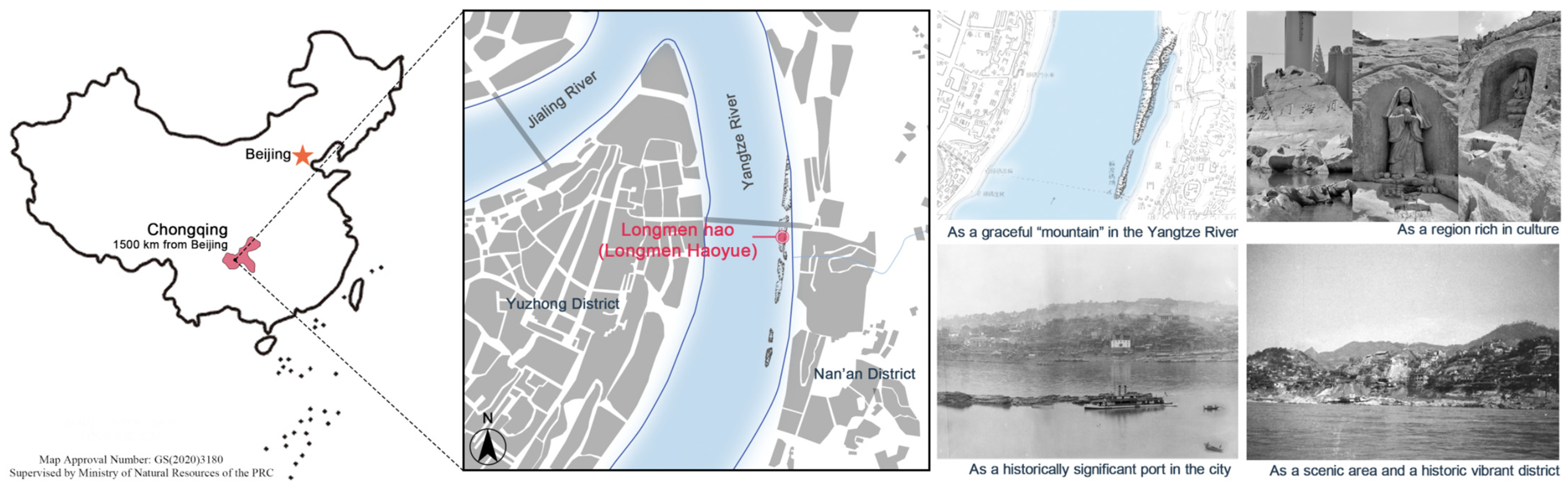
3.1. Study Area
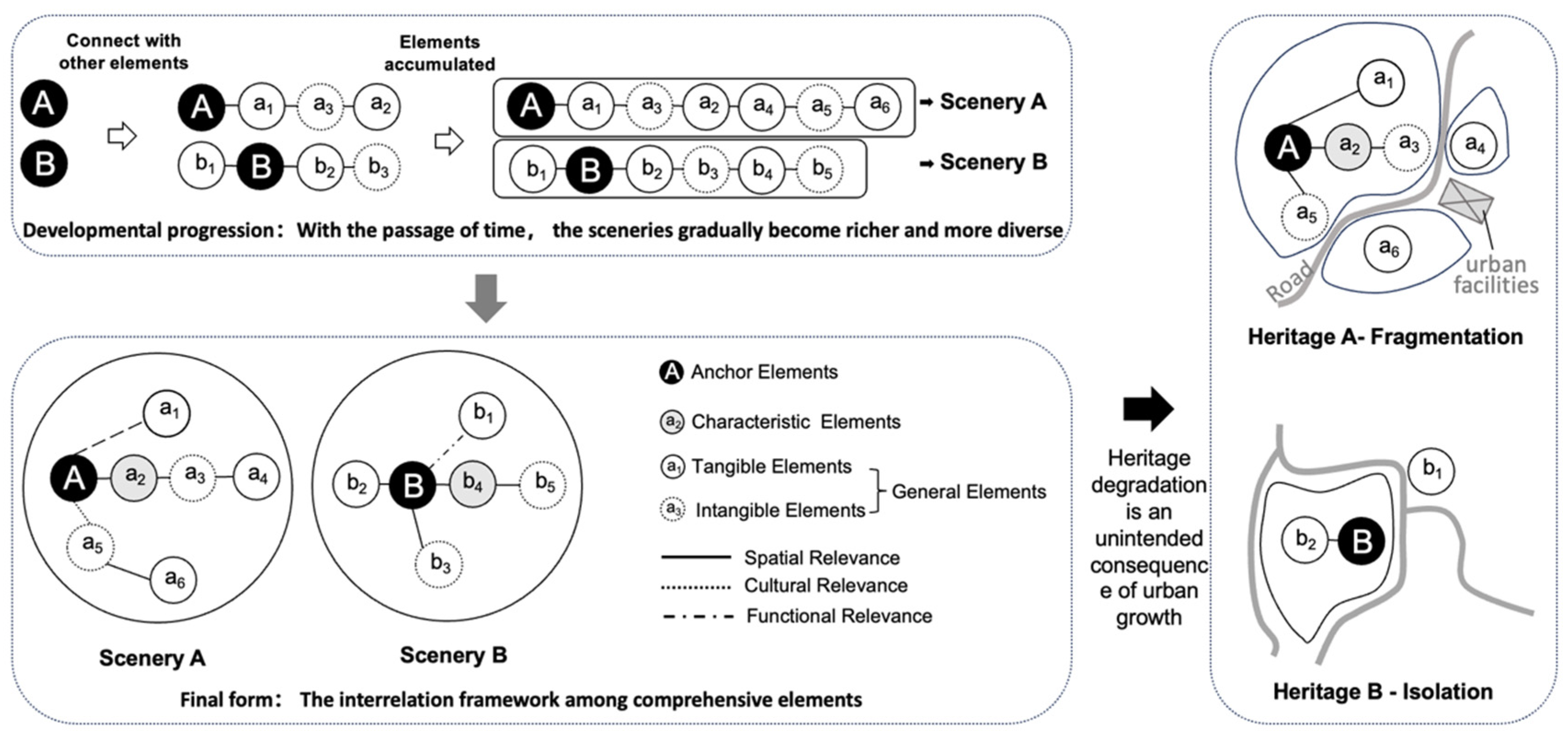
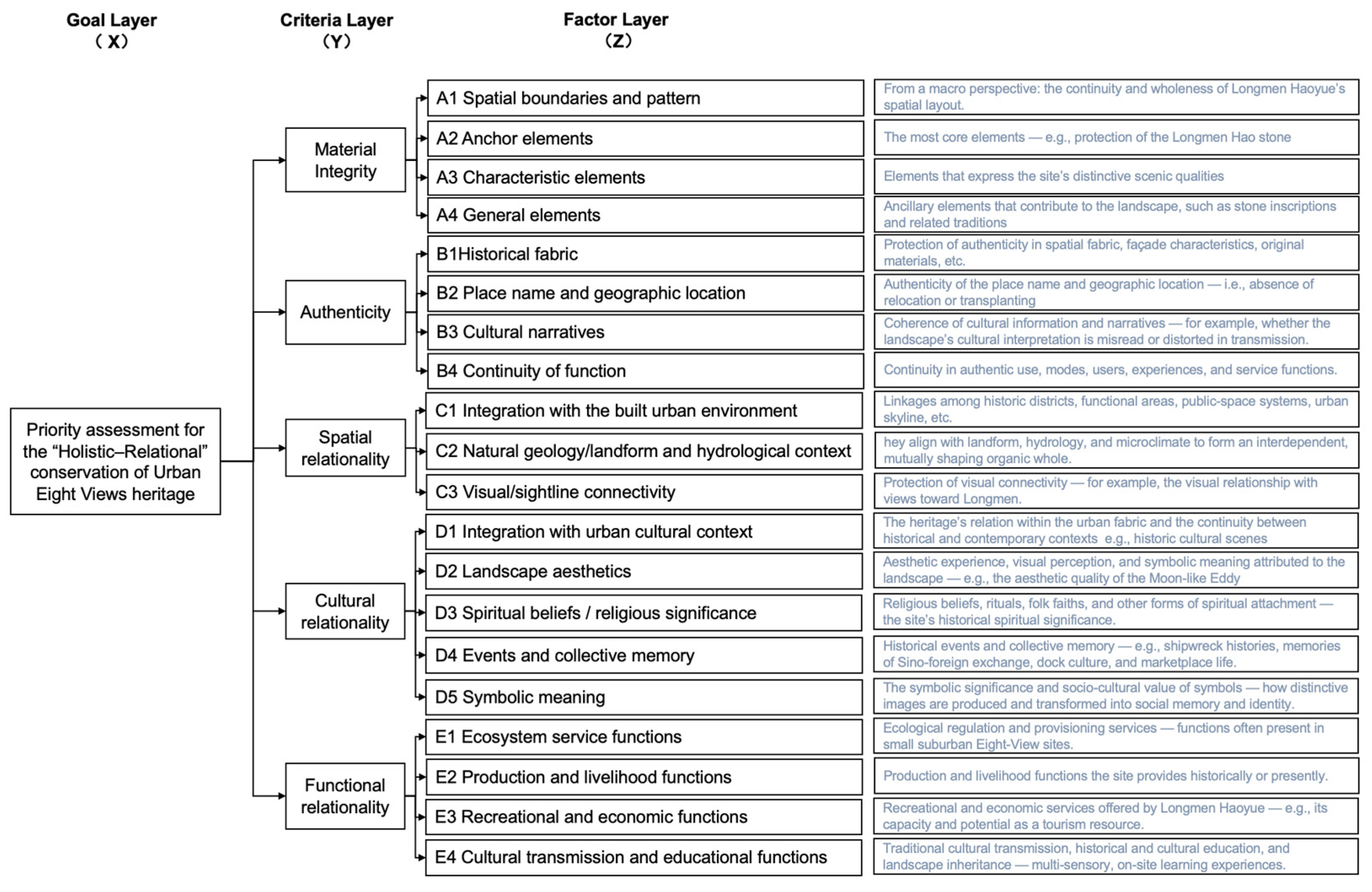
3.2. Constructing the Holistic–Relational Framework
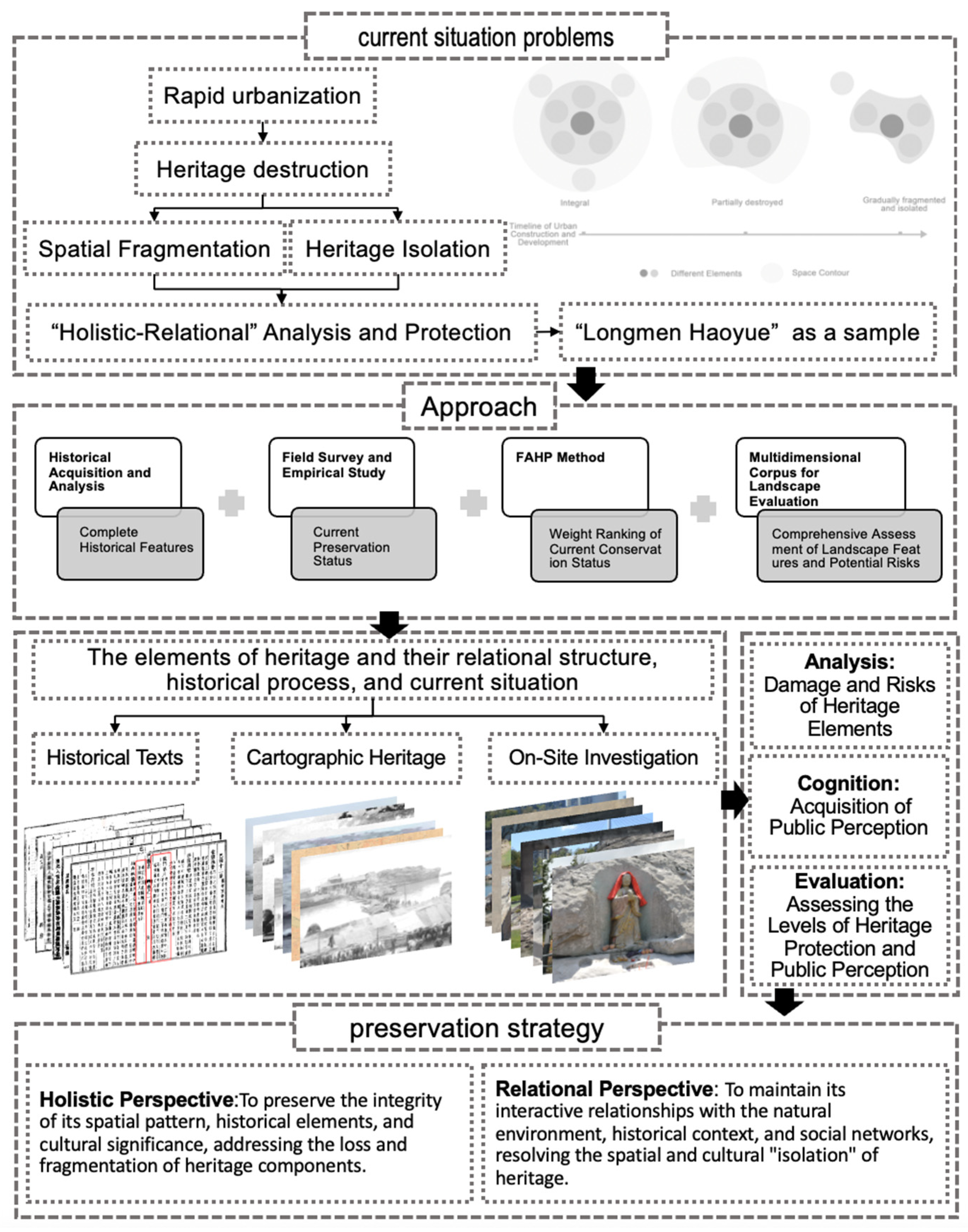
3.3. Overall Research Framework
3.4. Research Methods
3.4.1. Historical Retrieval and Spatial Decomposition, with Field Survey and Empirical Validation
3.4.2. Evaluation Methodology Construction
3.4.3. Multidimensional Corpus for Overall Landscape Appraisal
4. Results
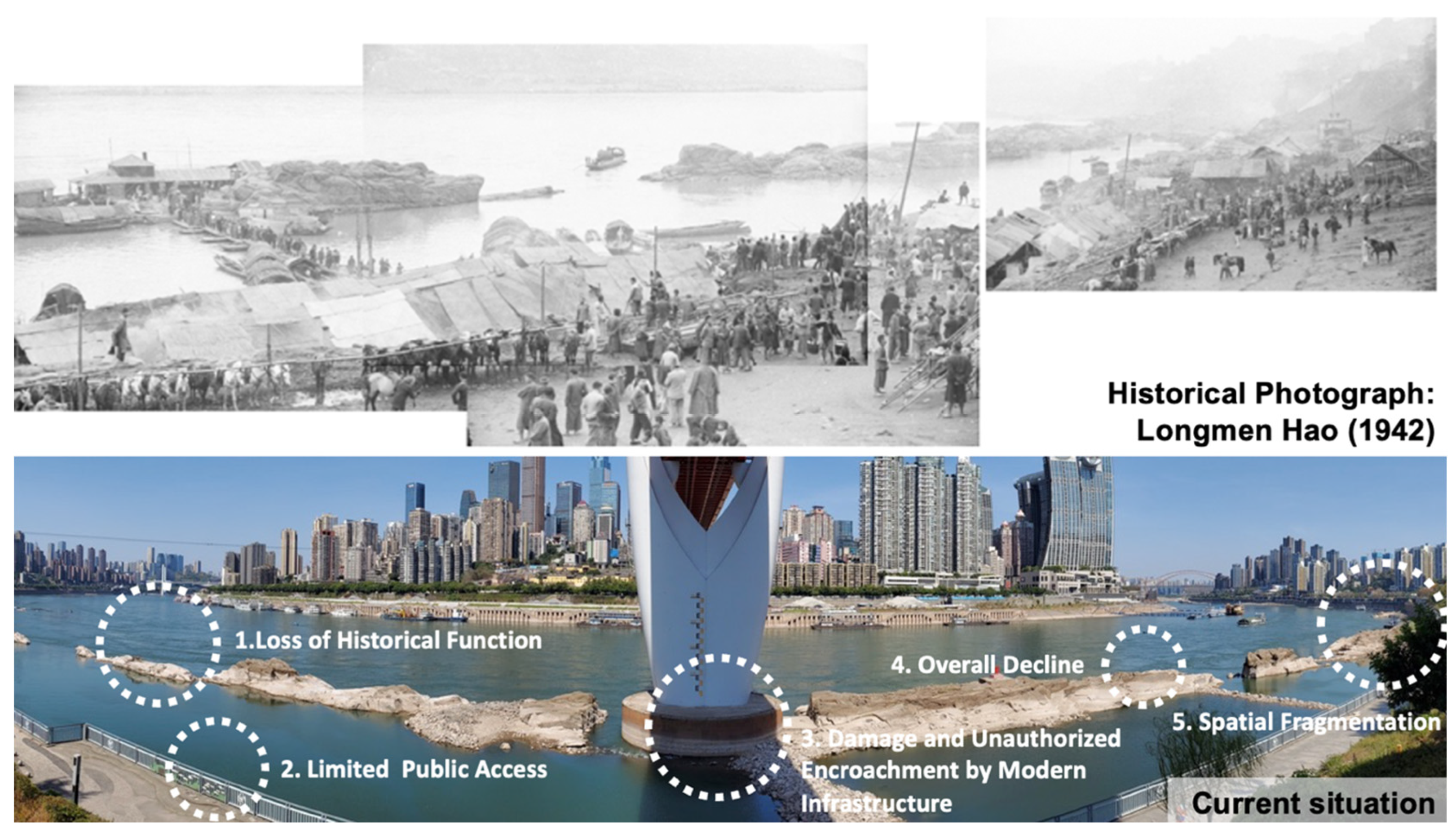
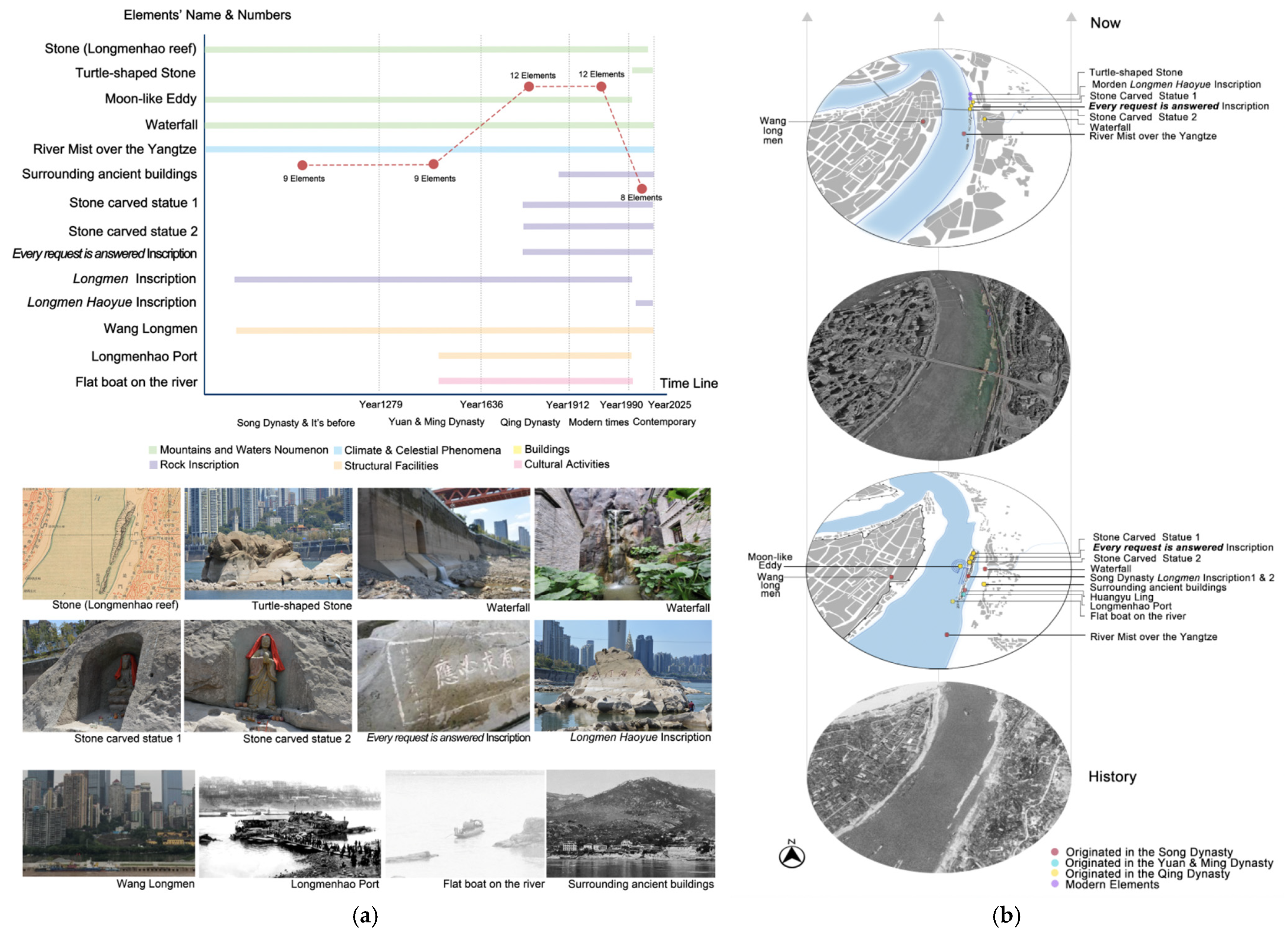
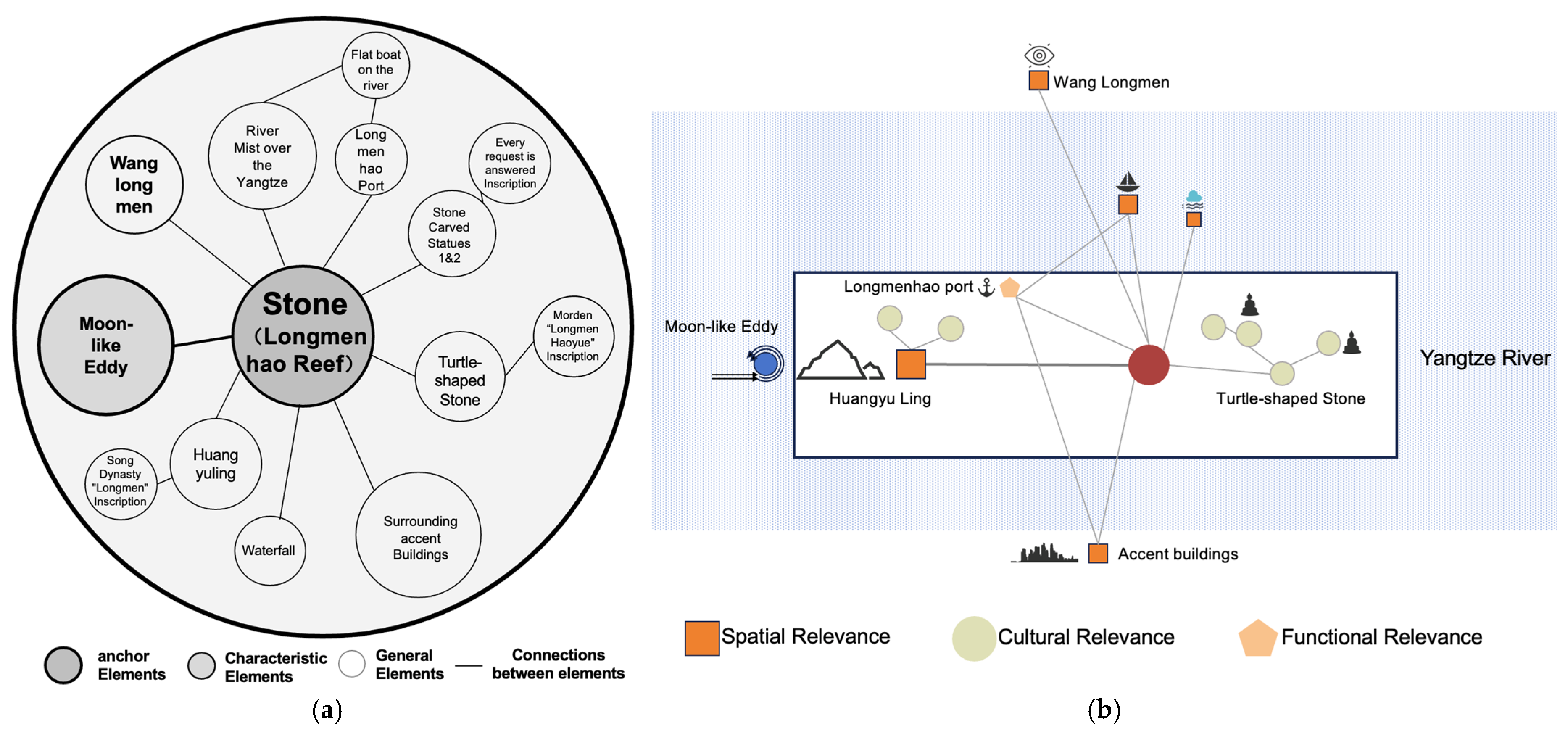
4.1. Identification Results: Historical Trajectory and Present Status of Heritage Elements and Their Relational Structure
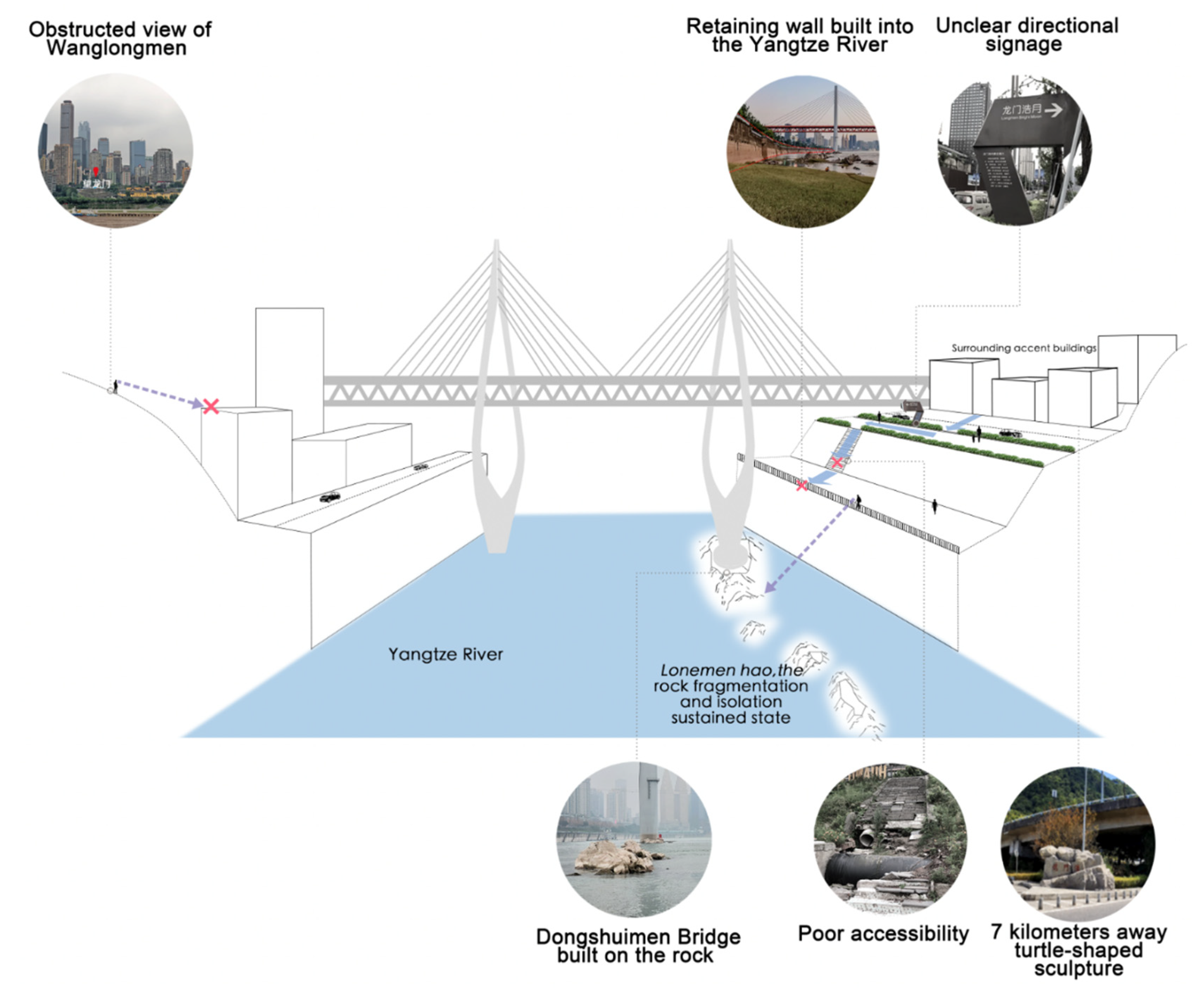
4.2. Analytical Findings: Field-Surveyed Damage and Risk to Landscape Elements
4.3. Evaluation Results: Value Assessment of Longmen Haoyue’s Landscape Elements
- Even weight distribution. The narrow spread (0.0122) indicates no dominant single factor; the system reflects comprehensiveness and nuance.
- Spatial armature and anchor element as physical foundations. A2 (anchor element, i.e., the reef) holds the highest weight (0.0563), underscoring the primacy of material conservation for maintaining historical memory and spatial identity. A1 (spatial boundaries and pattern, 0.0540) highlights the importance of overall spatial form, scale, and structure. Preserving the historic spatial fabric is foundational, because without it, other cultural and spiritual values cannot be effectively expressed.
- Historical–cultural value as the core ‘soul.’ Elevated weights for B2 (0.0537) and B1 (0.0526) emphasize the criticality of place name, geographic location, and historical fabric. The D-class (cultural relationality) factors occupy mid-to-upper ranks with comparable weights, indicating that Longmenhao bears deep spiritual and cultural connotations, cultural lineage, aesthetics, belief, and historical events beyond its material shell. Hence, conservation must safeguard cultural memory and symbolic meaning, not merely buildings.
- Environmental integration matters. C3 (0.0535) and C1 (0.0510) show that visual connectivity, e.g., with Longmenhao’s surrounding accent buildings and Nanshan, and integration with the contemporary built environment are pivotal. Maintaining open-view corridors and avoiding blocking structures (e.g., high revetments along the Yangtze River) are key. Integration with the urban fabric argues for enhanced accessibility and active presence, not an isolated ‘museum piece.’ Conservation thus requires a macro-scale perspective harmonizing historic districts with natural settings and modern cityscapes.
- Lower E-class weights do not imply irrelevance. While functional relationality (E-class) ranks the lowest, this reflects expert judgment that Longmenhao’s core value lies in its historical, cultural, spiritual, and spatial qualities rather than present-day functions. Function serves as a vehicle for conservation, not its ultimate goal. Any new functions (e.g., commerce, tourism, cultural creativity, etc.) must be contingent upon and reinforcing of historical and cultural integrity.
4.4. Overall Cognition: Online Evaluations and Public Perception of Longmen Haoyue
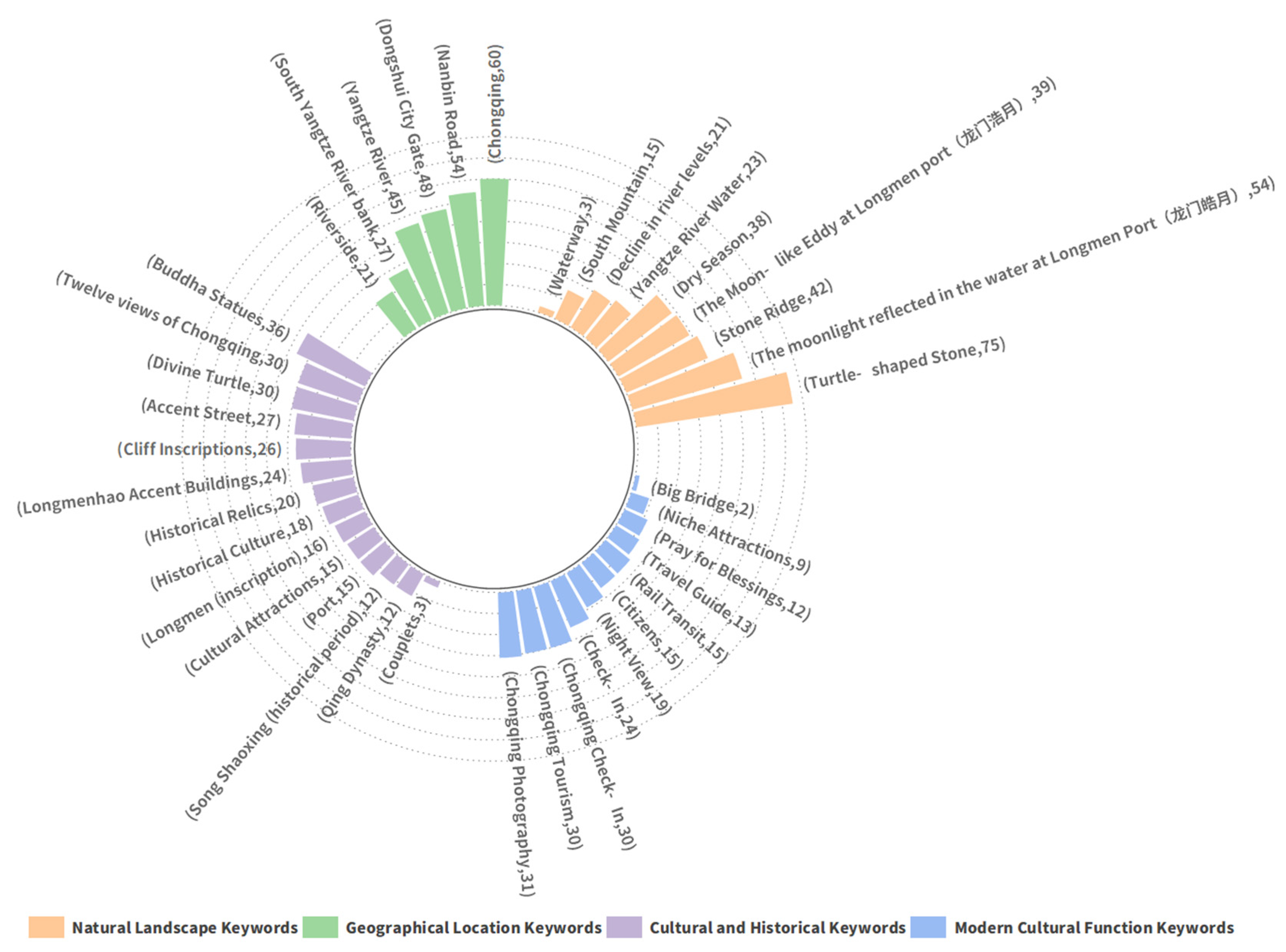
- Surface symptoms in word frequencies: loss of core characteristics and landscape homogenization. The symbolic substitution now prevalent online signals a two-way cognitive dislocation between the natural and cultural dimensions. Historically, the Moon-like Eddy provided a distinct identity, and its disappearance promotes a generic ‘check-in landscape.’ The clearest expression of this is the shift toward ‘Shenguishi’ (Divine Turtle Rock), appearing 75 times, crowding out the historical toponym. The parallel confusion between ‘Longmen Hao yue’ (浩) and ‘Longmen Hao yue’ (皓) is telling: the drift from hydrologically grounded ‘hao’ (浩, 39 mentions) to moon-whiteness ‘hao’ (浩, 54 mentions) charts a slide from a place-specific hydrological image to a placeless scenic cliché, suspending the cultural core.
- From holistic understanding to fragmentation under a touristic-commercial narrative. High-frequency tokens like ‘check-in’ and ‘tourism’ outnumber ‘historical culture’ and ‘historic site,’ indicating domination by a consumptive, fast-food tourism discourse, a process of decontextualization that strips aesthetic and symbolic depth. The composite landscape once comprising 12 elements is reduced to isolated items (e.g., ‘Shenguishi’ and ‘Old Street’) lacking an overarching narrative.
- Hegemony of new urban spectacles over heritage. Modern mega-infrastructure, emblematically the Dongshuimen Bridge, asserts functional and visual dominance, re-ranking the landscape. The pre-existing historical thread and cultural carriers (e.g., cliff inscriptions) are spatially and perceptually marginalized, becoming mere backdrops to engineering works. This is a textbook case of cultural-landscape overwriting, whereby a new, forceful urban text overlays an older, fragile heritage. Longmen Haoyue thus faces not only symbolic cognitive challenges but also the loss of status as a visual and cultural focal point in physical space.
5. Conclusions and Recommendations
5.1. Theoretical Contribution to Conservation
5.2. Case Validation: Applicability and Effectiveness of the Framework
5.3. Conservation Strategies and Toolkit
6. Discussion
6.1. A Theoretical Turn in Heritage: From Object Protection to Relational Networks
6.2. Material Skeleton, Relational Network, and Semantic Authenticity: An Empirical Basis for Reconstructing Urban-Heritage Wholeness
6.3. From ‘Repairing Objects’ to ‘Repairing Networks’: A Relation-Oriented Governance Framework and Implementation Pathways
6.4. Limitations and Future Directions
Author Contributions
Funding
Data Availability Statement
Conflicts of Interest
References
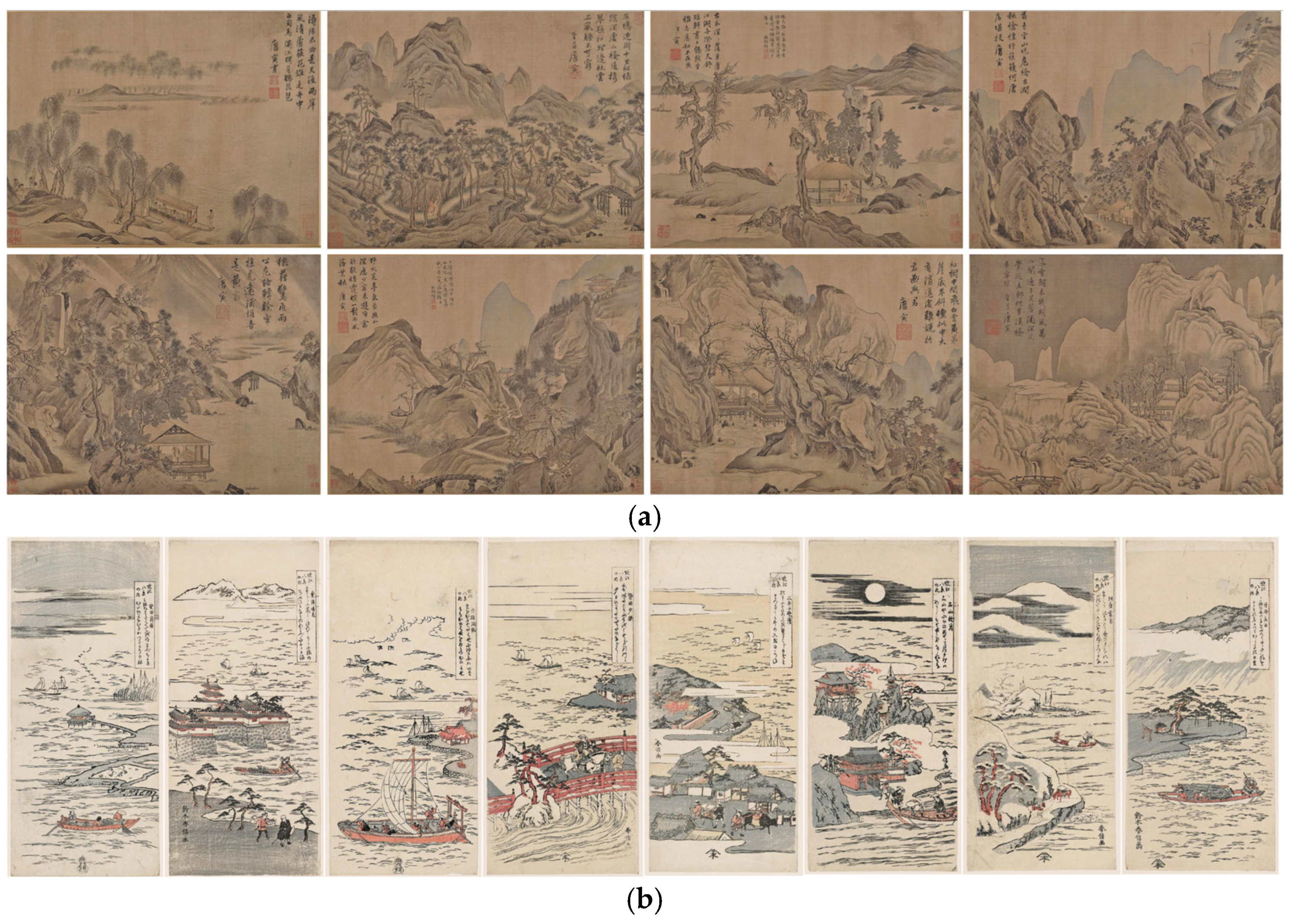
- Shiga. Eight Views of Omi: Overview. 2020. Available online: https://www.mlit.go.jp/tagengo-db/zhTW/R2-01402.html (accessed on 10 October 2025).
- Tang, Y. Xunyang Eight Views Handscroll (Silk). 1515. Available online: http://xn--vcsu3i05le6a3dq38n.com/digital/1027.htm (accessed on 10 October 2025).
- Harunobu, S. Eight Views of Omi. 1760. Available online: https://www.benricho.org/Unchiku/Ukiyoe_NIshikie/Harunobu_Omihakkei/ (accessed on 10 October 2025).
- United Nations. UN Transforming Our World: The 2030 Agenda for Sustainable Development; United Nations: New York, NY, USA, 2015. [Google Scholar]
- Mendes Zancheti, S.; Piccolo Loretto, R. Dynamic integrity: A concept to historic urban landscape. J. Cult. Herit. Manag. Sustain. Dev. 2015, 5, 82–94. [Google Scholar] [CrossRef]
- Wen-zhuo, Z.; Feng, H. A review of the theoretical and practical research on historic urban landscape. Landsc. Archit. 2017, 24, 22–28. [Google Scholar]
- Immonen, V. Urban heritage, and the theory of fragmentation: The development of archaeology in the City of Turku, Finland. Herit. Soc. 2024, 17, 346–366. [Google Scholar] [CrossRef]
- An, D. On phenomena of urban heritage being Islanded in west historic cities. Urban Plan. Forum. 2005, 4, 56–59. [Google Scholar]
- Zhu, Y.; Martínez, P.G. Heritage, values and gentrification: The redevelopment of historic areas in China. Int. J. Herit. Stud. 2022, 28, 476–494. [Google Scholar] [CrossRef]
- Yutian, L.; Xu, S.; Liu, S.; Wu, J. An approach to urban landscape character assessment: Linking urban big data and machine learning. Sustain. Cities Soc. 2022, 83, 103983. [Google Scholar] [CrossRef]
- Antrop, M. Why landscapes of the past are important for the future. Landsc. Urban Plan. 2005, 70, 21–34. [Google Scholar] [CrossRef]
- Martínez Pino, J. The new holistic paradigm and the sustainability of historic cities in Spain: An approach based on the world heritage cities. Sustainability 2018, 10, 2301. [Google Scholar] [CrossRef]
- Ripp, M.; Rodwell, D. The governance of urban heritage. Hist. Environ. Policy Pract. 2016, 7, 81–108. [Google Scholar] [CrossRef]
- Ragheb, A.; Aly, R.; Ahmed, G. Toward sustainable urban development of historical cities: Case study of Fouh City, Egypt. Ain Shams Eng. J. 2022, 13, 101520. [Google Scholar] [CrossRef]
- Höftberger, K. Conservation and development: Implementation of the historic urban landscape approach in Khiva, Uzbekistan. Int. J. Herit. Stud. 2023, 29, 314–328. [Google Scholar] [CrossRef]
- Muminović, E.; Radosavljević, U.; Beganović, D. Strategic planning and management model for the regeneration of historic urban landscapes: The case of historic center of Novi Pazar in Serbia. Sustainability 2020, 12, 1323. [Google Scholar] [CrossRef]
- Olegovich Anisimov, I.; Evgenyevna Gulyaeva, E. The common heritage of mankind and the world heritage: Correlation of concepts. Novos Estudos Juridicos. 2022, 27, 282–297. [Google Scholar] [CrossRef]
- El-Bastawissi Raslan, R.; Mohsen, H.; Zeayter, H. Conservation of Beirut’s Urban Heritage Values Through the Historic Urban Landscape Approach. Urban Planing. 2022, 7, 101–115. [Google Scholar] [CrossRef]
- García-Esparza, J.A. Are World Heritage concepts of integrity and authenticity lacking in dynamism? A critical approach to Mediterranean autotopic landscapes. Landsc. Res. 2018, 43, 817–830. [Google Scholar] [CrossRef]
- Guzman, P. Assessing the sustainable development of the historic urban landscape through local indicators. Lessons A Mex. World Herit. City. J. Cult. Herit. 2020, 46, 320–327. [Google Scholar]
- Cai, R.; Nasu, S. Adopting the ‘historic layering’concept from the Historic Urban Landscape approach as a methodological framework for urban heritage conservation. Int. J. Herit. Stud. 2025, 31, 1–19. [Google Scholar] [CrossRef]
- Ginzarly, M.; Houbart, C.; Teller, J. The Historic Urban Landscape approach to urban management: A systematic review. Int. J. Herit. Stud. 2019, 25, 999–1019. [Google Scholar] [CrossRef]
- Zhang, X.; Ren, Y.; Lv, J.; Geng, Y.; Su, C.; Ma, R. Morphological Evolution and Socio-Cultural Transformation in Historic Urban Areas: A Historic Urban Landscape Approach from Luoyang, China. Buildings 2025, 15, 1373. [Google Scholar] [CrossRef]
- Pintossi, N.; Kaya, D.I.; Roders, A.P. Identifying challenges and solutions in cultural heritage adaptive reuse through the historic urban landscape approach in Amsterdam. Sustainability 2021, 13, 5547. [Google Scholar] [CrossRef]
- Janssen, J.; Luiten, E.; Renes, H.; Stegmeijer, E. Heritage as sector, factor and vector: Conceptualizing the shifting relationship between heritage management and spatial planning. Eur. Plan. Stud. 2017, 25, 1654–1672. [Google Scholar] [CrossRef]
- Jokilehto, J. A History of Architectural Conservation, Butterworth Heinemann. In European Journal of Archaeology; Cambridge University Press: Oxford, UK, 1999; p. 292. [Google Scholar]
- Smith, L. Uses of Heritage; Routledge: Oxfordshire, UK, 2006. [Google Scholar]
- Page, S. A Geography of Heritage: Power, Culture and Economy; Brian Graham, G.J., Ashworth, J.E., Eds.; Wiley Online Library: Tunbridge, UK, 2000. [Google Scholar]
- Harrison, R. Heritage: Critical Approaches; Routledge: Oxfordshire, UK, 2012. [Google Scholar]
- Daniel, T.C.; Muhar, A.; Arnberger, A.; Aznar, O.; Boyd, J.W.; Chan, K.M.A.; Costanza, R.; Elmqvist, T.; Flint, C.G.; Gobster, P.H.; et al. Contributions of cultural services to the ecosystem services agenda. Proc. Natl. Acad. Sci. USA 2012, 109, 8812–8819. [Google Scholar] [CrossRef]
- Tudor, C. An approach to landscape character assessment. Nat. Engl. 2014, 65, 101716. [Google Scholar]
- Martín, B.; Ortega, E.; Otero, I.; Arce, R.M. Landscape character assessment with GIS using map-based indicators and photographs in the relationship between landscape and roads. J. Environ. Manag. 2016, 180, 324–334. [Google Scholar] [CrossRef]
- Butler, A.; Åkerskog, A. Awareness-raising of landscape in practice. An analysis of Landscape Character Assessments in England. Land Use Policy 2014, 36, 441–449. [Google Scholar] [CrossRef]
- Bandarin, F.; Van Oers, R. Reconnecting the City: The Historic Urban Landscape Approach and the Future of Urban Heritage; John Wiley & Sons: Hoboken, NJ, USA, 2014. [Google Scholar]
- UNESCO. Recommendation on the Historic Urban Landscape. 2011. Available online: https://unterm.un.org/unterm2/en/view/unesco/c6cb9aaf-d73e-4c91-9824-d6b5b8373606 (accessed on 10 October 2025).
- Yang, X.; Shen, J. Integrating historic landscape characterization for historic district assessment through multi-source data: A case study from Hangzhou, China. npj Herit. Sci. 2025, 13, 33. [Google Scholar] [CrossRef]
- Rey-Perez, J.; Siguencia Ávila, M.E. Historic urban landscape: An approach for sustainable management in Cuenca (Ecuador). J. Cult. Herit. Manag. Sustain. Dev. 2017, 7, 308–327. [Google Scholar] [CrossRef]
- Bonfantini, G.B. Historic urbanscapes for tomorrow, two Italian cases: Genoa and Bologna. Eur. Spat. Res. Policy 2015, 22, 57–71. [Google Scholar] [CrossRef]
- Veldpaus, L.; Pereira Roders, A.R.; Colenbrander, B.J. Urban heritage: Putting the past into the future. Hist. Environ. Policy Pract. 2013, 4, 3–18. [Google Scholar] [CrossRef]
- Turner, S. Historic Landscape Characterisation: A landscape archaeology for research, management and planning. Landsc. Res. 2006, 31, 385–398. [Google Scholar] [CrossRef]
- Turner, S. Historic landscape characterisation: An archaeological approach to landscape heritage. In Routledge Handbook of Landscape Character Assessment; Routledge: Oxfordshire, UK, 2018; pp. 37–50. [Google Scholar]
- Fairclough, G.; Lambrick, G.; Hopkins, D. Historic landscape characterisation in England and a Hampshire case study. In Europe’s Cultural Landscape: Archaeologists and the Management of Change; European Association of Archaeologists: Oxford, UK, 2002; pp. 69–83. [Google Scholar]
- Aldred, O.; Fairclough, G. Historic Landscape Characterisation: Taking Stock of the Method; English Heritage/Somerset County Council: London, UK, 2003.
- Conzen, M.R.G. Alnwick, Northumberland: A Study in Town-Plan Analysis; Transactions and Papers (Institute of British Geographers): London, UK, 1960; pp. iii–122. [Google Scholar]
- Lynch, K. The Image of the City; MIT Press: Cambridge, MA, USA, 1964. [Google Scholar]
- Bandarin, F.; Van Oers, R. The Historic Urban Landscape: Managing Heritage in an Urban Century; John Wiley & Sons: Hoboken, NJ, USA, 2012. [Google Scholar]
- Graham, B.; Ashworth, G.; Tunbridge, J. A Geography of Heritage; Routledge: Oxfordshire, UK, 2016. [Google Scholar]
- Bill, H.; Julienne, H. The Social Logic of Space; Cambridge University Press: Cambridge, UK, 1984. [Google Scholar]
- Benedikt, M.L. To take hold of space: Isovists and isovist fields. Environ. Plan. B Plan. Des. 1979, 6, 47–65. [Google Scholar] [CrossRef]
- Swanwick, C.; Heritage, S.N. Landscape Character Assessment: Guidance for England and Scotland. Making Sense of Place; Countryside Agency: Cheltenham, UK, 2002. [Google Scholar]
- Dell’Ovo, M.; Dell’anna, F.; Simonelli, R.; Sdino, L. Enhancing the cultural heritage through adaptive reuse. A Multicriteria Approach Eval. Castello Visconteo Cusago (Italy). Sustainability 2021, 13, 4440. [Google Scholar] [CrossRef]
- Li, Y.; Zhao, L.; Huang, J.; Law, A. Research frameworks, methodologies, and assessment methods concerning the adaptive reuse of architectural heritage: A review. Built Herit. 2021, 5, 6. [Google Scholar] [CrossRef]
- Enfield, N. Legibility in culture. Anthropol. Theory 2025, 14634996251338486. [Google Scholar] [CrossRef]
- Wagner, A.; Matulewska, A.; Le, C. Protection, regulation and identity of cultural heritage: From sign-meaning to cultural mediation. Int. J. Semiot. Law-Rev. Int. De Sémiotique Jurid. 2021, 34, 601–609. [Google Scholar] [CrossRef]
- Labadi, S.; Giliberto, F.; Rosetti, I.; Shetabi, L.; Yildirim, E. Heritage and the sustainable development goals: Policy guidance for heritage and development actors. ICOMOS 2021, OAI ID: oai:eprints.whiterose.ac.uk:185242. [Google Scholar]
- Jiang, J.; Zhou, T.; Han, Y.; Ikebe, K. Urban heritage conservation and modern urban development from the perspective of the historic urban landscape approach: A case study of Suzhou. Land 2022, 11, 1251. [Google Scholar] [CrossRef]
- Wang, S.; Gu, K. Pingyao: The historic urban landscape and planning for heritage-led urban changes. Cities 2020, 97, 102489. [Google Scholar] [CrossRef]
- Buckley, K.; Cooke, S.; Fayad, S. Using the historic urban landscape to re-imagine ballarat: The local context. In Urban Heritage, Development and Sustainability; Routledge: Oxfordshire, UK, 2015; pp. 93–113. [Google Scholar]
- Cunha Ferreira, T.; Rey-Pérez, J.; Roders, A.P.; Silva, A.T.; Coimbra, I.; Vazquez, I.B. The historic urban landscape approach and the governance of world heritage in urban contexts: Reflections from three European cities. Land 2023, 12, 1020. [Google Scholar] [CrossRef]
- Wang, E. The County Gazetteer of Baxian (Qianlong Period); The Office of the County Magistrate of Ba County: Chongqing, China, 1761; Volume 1, pp. 1–142. [Google Scholar]
- Military Affairs Commission, G.S.H.; Fourth Department. Street Map of Chongqing Urban District; Chongqing, China, 1946. Available online: https://www.ditu114.com/ditu/750.html (accessed on 10 October 2025).
- Swire, G.W. Chungking c.1920. Available online: https://www.hpcbristol.sjtu.edu.cn/visual/Sw19-062 (accessed on 10 October 2025).
- Forman, H. Harrison Forman’s China Photographic Collection. 1940–1943 (Chongqing). Available online: https://www.shuge.org/view/harrison_forman_collection/ (accessed on 10 October 2025).
- Fangcan, Y. General Gazetteer of Sichuan; The Office for Compiling the Collected Statutes: Chengdu, China, 1816; Volume 11, pp. 10–11. [Google Scholar]
- Yaojian, Y. Chronicles of Chongqing’s Trade Wharves. In Chongqing Daily; Chongqing Daily Newspaper Group: Chongqing, China, 2025; Available online: https://wap.cqrb.cn/xcq/NewsDetail?classId=1968&newsId=2139575. (accessed on 10 October 2025).
- Website, C.M.P.s.G. [Chongqing Toponyms] Bridges—Dongshuimen Yangtze River Bridge. 2024. Available online: https://dfz.cq.gov.cn/zqlswh/rwby_417819/202406/t20240605_13267997.html (accessed on 10 October 2025).
- Yi, H. Chongqing: Telling the “Yangtze River Culture” Story Well in the New Era; Chongqing Daily: Chongqing, China, 2022; Available online: https://www.cqrb.cn/content/2022-01/10/content_359472.htm (accessed on 10 October 2025).
- Mısırlısoy, D.; Günçe, K. Adaptive reuse strategies for heritage buildings: A holistic approach. Sustain. Cities Soc. 2016, 26, 91–98. [Google Scholar] [CrossRef]
- Donovan, C. A Holistic Approach to Valuing Our Culture; Department for Culture Media and Sport: London, UK, 2013.
- Rudolff, B. Intangible and Tangible Heritage; UNESCO Intangible Cultural Heritage: Paris, France, 2009. [Google Scholar]
- Vecco, M. A definition of cultural heritage: From the tangible to the intangible. J. Cult. Herit. 2010, 11, 321–324. [Google Scholar] [CrossRef]
- Rogers, A.P. Values and relationships between tangible and intangible dimensions of heritage places. In Values in Heritage Management: Emerging Approaches And Research Directions; Getty Publications: Los Angeles, CA, USA, 2019; Volume 12, pp. 172–185. [Google Scholar]
- Pocock, C.; Collett, D.; Baulch, L. Assessing stories before sites: Identifying the tangible from the intangible. Int. J. Herit. Stud. 2015, 21, 962–982. [Google Scholar] [CrossRef]
- Stilling, S.; Braae, E. Relational heritage: ‘relational character’ in national cultural heritage characterisation tools. Landsc. Res. 2023, 48, 917–934. [Google Scholar] [CrossRef]
- Harvey, D.C. Heritage and scale: Settings, boundaries and relations. Int. J. Herit. Stud. 2015, 21, 577–593. [Google Scholar] [CrossRef]
- Burger, M.; Meijers, E. Form follows function? Linking morphological and functional polycentricity. Urban Stud. 2012, 49, 1127–1149. [Google Scholar] [CrossRef]
- Zirena-Bejarano, P.P.; Choquecahuana-Valverde, L.G. Determinants of perceived benefits: Cultural recognition, traditions and cultural linkages. J. Cult. Herit. Manag. Sustain. Dev. 2024. [Google Scholar] [CrossRef]
- Zhang, B. Correlativity and systematic approach in integral conservation of historic city: Understanding historic urban landscape in China’s context. City Plan. Rev. 2014, 38, 42–48+113. [Google Scholar]
- Plumwood, V. The concept of a cultural landscape: Nature, culture and agency in the land. Ethics Environ. 2006, 11, 115–150. [Google Scholar] [CrossRef]
- Baligh, H.H. Components of culture: Nature, interconnections, and relevance to the decisions on the organization structure. Manag. Sci. 1994, 40, 14–27. [Google Scholar] [CrossRef]
- Castriota, B.; Marçal, H. Always already fragment: Integrity, deferral, and possibility in the conservation of cultural heritage. In Das Fragment im Digitalen Zeitalter: Möglichkeiten und Grenzen Neuer Techniken in der Restaurierung; Hendrik Baßler Verlag: Berlin, Germany, 2021; pp. 63–78. [Google Scholar]
- Hartmann, K.M. Fragmentation and forgetting: Sarajevo’s Vijećnica. Int. J. Herit. Stud. 2016, 22, 312–324. [Google Scholar] [CrossRef]
- Stendardi, D.; Pérez, E.; Castillo, A.; García, J.I. Isolated identity, tourism and heritage: Social perception and participation in cultural heritage management for the transformation of tourism governance in Buenavista del Norte (Tenerife, Canary Islands, Spain). Rev. Espac. 2020, 41, 24. [Google Scholar]
- Xiao, H.L.J. Analysis on the Types and Composing of Cultural Landscapes of China. Chin. Landsc. Archit. 2009, 25, 90–94. [Google Scholar]
- Zhang, W.; Wang, Y.; Fu, L.; Hu, Y. Scenery deconstruction: A new approach to understanding the historical characteristics of Nanjing cultural landscape. Herit. Sci. 2024, 12, 62. [Google Scholar] [CrossRef]
- Shizhen, W. Shu Dao Yi Cheng Ji; Qi Lu Shu She: Zibo, China, 1672. [Google Scholar]
- Huo Weifen, X.J. The County Gazetteer of Baxian (Tongzhi Period). The Office of the County Magistrate of Ba County: Chongqing, China, 1867. [Google Scholar]
- Peide, L. Chongqing Place Names Gazetteer; Chongqing Municipal Office of Toponymy: Chongqing, China, 1997. [Google Scholar]
- Literature and History Materials Committee, C.N.a.D.C.C. Cultural and Historical Materials of Nan’an, Chongqing; Committee of Literature and History Materials, CPPCC Nan’an District Committee: Chongqing, China, 1997. [Google Scholar]
- Bingsheng, L. Longmenhao Ferry Wharf. 1970. Available online: https://www.cqcb.com/zhuiguangzhe/2022-10-04/5046641_pc.html (accessed on 10 October 2025).
- Wenlan, Z.; Hong, R. Longmenhao in the Early 1950s. Available online: https://www.163.com/dy/article/HU17RSDD0514CURD.html (accessed on 10 October 2025).
- EROS. Declassified Data—Declassified Satellite Imagery. 1960–1972. Available online: https://earthexplorer.usgs.gov/ (accessed on 10 October 2025).
- Baidu Map. 2025. Available online: https://map.baidu.com/@11866633.37026371,3426280.3786904537,16.84z/maptype%3DB_EARTH_MAP (accessed on 10 October 2025).
- Kirdsiri, K. Recommendation On The Historic Urban Landscape; UNESCO World Heritage Centre: Paris, France, 2013. [Google Scholar]



| Scale | Definition | Explanation |
|---|---|---|
| 0.5 | Equal importance | When two factors are compared, they are equally important |
| 0.6 | Slightly more important | When two factors are compared, one factor is slightly more important than the other. |
| 0.7 | Clearly more important | When two factors are compared, one factor is clearly more important than the other. |
| 0.8 | Much more important | When two factors are compared, one factor is considerably more important than the other. |
| 0.9 | Extremely important | When two factors are compared, one factor is extremely more important than the other. |
| 0.1, 0.2, 0.3, 0.4 | Reverse comparison | If comparing factor ai with factor aj yields the judgment rij, then comparing aj with ai yields the judgment rji = 1-rij |
| Factor | Weight |
|---|---|
| A2 Anchor element | 0.0563 |
| A4 General elements | 0.0551 |
| A1 Spatial boundaries and pattern | 0.0540 |
| B2 Place name and geographic location | 0.0537 |
| C3 Visual/sightline connectivity | 0.0535 |
| B1 Historical fabric | 0.0526 |
| D1 Integration with urban cultural context | 0.0518 |
| C1 Integration with the built urban environment | 0.0510 |
| B3 Cultural narratives | 0.0510 |
| D2 Landscape aesthetics | 0.0508 |
| C2 Natural geology/landform and hydrological context | 0.0489 |
| D3 Spiritual beliefs/religious significance | 0.0489 |
| D5 Symbolic meaning | 0.0488 |
| D4 Events and collective memory | 0.0486 |
| B4 Continuity of function | 0.0478 |
| E3 Recreational and economic functions | 0.0470 |
| E1 Ecosystem service functions | 0.0460 |
| E2 Production and livelihood functions | 0.0453 |
| E4 Cultural transmission and educational functions | 0.0449 |
| A3 Characteristic element | 0.0441 |
| A1 | A2 | A3 | A4 | B1 | B2 | B3 | B4 | C1 | C2 | C3 | D1 | D2 | D3 | D4 | D5 | E1 | E2 | E3 | E4 | |
|---|---|---|---|---|---|---|---|---|---|---|---|---|---|---|---|---|---|---|---|---|
| A1 | 0.500 | 0.489 | 0.550 | 0.495 | 0.507 | 0.501 | 0.514 | 0.530 | 0.514 | 0.524 | 0.502 | 0.510 | 0.515 | 0.524 | 0.526 | 0.525 | 0.540 | 0.543 | 0.534 | 0.546 |
| A2 | 0.511 | 0.500 | 0.561 | 0.505 | 0.517 | 0.512 | 0.525 | 0.541 | 0.524 | 0.535 | 0.513 | 0.521 | 0.526 | 0.535 | 0.537 | 0.535 | 0.550 | 0.554 | 0.545 | 0.556 |
| A3 | 0.450 | 0.439 | 0.500 | 0.445 | 0.456 | 0.451 | 0.416 | 0.480 | 0.464 | 0.474 | 0.452 | 0.460 | 0.465 | 0.474 | 0.476 | 0.474 | 0.490 | 0.493 | 0.484 | 0.496 |
| A4 | 0.505 | 0.495 | 0.555 | 0.500 | 0.512 | 0.507 | 0.519 | 0.535 | 0.519 | 0.530 | 0.507 | 0.516 | 0.520 | 0.530 | 0.531 | 0.530 | 0.545 | 0.549 | 0.540 | 0.551 |
| B1 | 0.493 | 0.483 | 0.544 | 0.488 | 0.500 | 0.495 | 0.507 | 0.524 | 0.507 | 0.518 | 0.496 | 0.504 | 0.509 | 0.518 | 0.520 | 0.518 | 0.533 | 0.537 | 0.528 | 0.540 |
| B2 | 0.499 | 0.488 | 0.549 | 0.493 | 0.505 | 0.500 | 0.513 | 0.529 | 0.513 | 0.523 | 0.501 | 0.509 | 0.514 | 0.523 | 0.525 | 0.523 | 0.538 | 0.542 | 0.533 | 0.545 |
| B3 | 0.486 | 0.475 | 0.536 | 0.481 | 0.493 | 0.487 | 0.500 | 0.516 | 0.500 | 0.510 | 0.488 | 0.496 | 0.501 | 0.510 | 0.512 | 0.511 | 0.526 | 0.530 | 0.520 | 0.532 |
| B4 | 0.470 | 0.459 | 0.520 | 0.465 | 0.476 | 0.471 | 0.484 | 0.500 | 0.484 | 0.494 | 0.472 | 0.480 | 0.485 | 0.494 | 0.496 | 0.495 | 0.510 | 0.513 | 0.504 | 0.516 |
| C1 | 0.486 | 0.476 | 0.536 | 0.481 | 0.493 | 0.487 | 0.500 | 0.516 | 0.500 | 0.510 | 0.488 | 0.496 | 0.501 | 0.511 | 0.512 | 0.511 | 0.526 | 0.530 | 0.520 | 0.532 |
| C2 | 0.476 | 0.465 | 0.526 | 0.470 | 0.482 | 0.477 | 0.490 | 0.506 | 0.490 | 0.500 | 0.478 | 0.486 | 0.491 | 0.500 | 0.502 | 0.500 | 0.516 | 0.519 | 0.510 | 0.522 |
| C3 | 0.498 | 0.487 | 0.548 | 0.493 | 0.504 | 0.499 | 0.512 | 0.528 | 0.512 | 0.522 | 0.500 | 0.508 | 0.513 | 0.522 | 0.524 | 0.523 | 0.538 | 0.541 | 0.532 | 0.544 |
| D1 | 0.490 | 0.479 | 0.540 | 0.484 | 0.496 | 0.491 | 0.504 | 0.520 | 0.504 | 0.514 | 0.492 | 0.500 | 0.505 | 0.514 | 0.516 | 0.514 | 0.530 | 0.533 | 0.524 | 0.536 |
| D2 | 0.485 | 0.474 | 0.535 | 0.480 | 0.491 | 0.486 | 0.499 | 0.515 | 0.499 | 0.509 | 0.487 | 0.495 | 0.500 | 0.509 | 0.511 | 0.510 | 0.525 | 0.528 | 0.519 | 0.531 |
| D3 | 0.476 | 0.465 | 0.526 | 0.470 | 0.482 | 0.477 | 0.490 | 0.506 | 0.489 | 0.500 | 0.478 | 0.486 | 0.491 | 0.500 | 0.502 | 0.500 | 0.515 | 0.519 | 0.510 | 0.522 |
| D4 | 0.474 | 0.463 | 0.524 | 0.469 | 0.480 | 0.475 | 0.488 | 0.504 | 0.488 | 0.498 | 0.476 | 0.484 | 0.489 | 0.498 | 0.500 | 0.499 | 0.514 | 0.518 | 0.508 | 0.520 |
| D5 | 0.475 | 0.465 | 0.526 | 0.470 | 0.482 | 0.477 | 0.489 | 0.505 | 0.489 | 0.500 | 0.477 | 0.486 | 0.490 | 0.500 | 0.501 | 0.500 | 0.515 | 0.519 | 0.509 | 0.521 |
| E1 | 0.460 | 0.450 | 0.510 | 0.455 | 0.467 | 0.462 | 0.474 | 0.490 | 0.474 | 0.484 | 0.462 | 0.470 | 0.475 | 0.485 | 0.486 | 0.485 | 0.500 | 0.504 | 0.494 | 0.506 |
| E2 | 0.457 | 0.446 | 0.507 | 0.451 | 0.463 | 0.458 | 0.470 | 0.487 | 0.470 | 0.481 | 0.459 | 0.467 | 0.472 | 0.481 | 0.482 | 0.481 | 0.496 | 0.500 | 0.491 | 0.503 |
| E3 | 0.466 | 0.455 | 0.516 | 0.460 | 0.472 | 0.467 | 0.480 | 0.496 | 0.480 | 0.490 | 0.468 | 0.476 | 0.481 | 0.490 | 0.492 | 0.491 | 0.506 | 0.509 | 0.500 | 0.512 |
| E4 | 0.454 | 0.444 | 0.504 | 0.449 | 0.460 | 0.455 | 0.468 | 0.484 | 0.468 | 0.478 | 0.456 | 0.464 | 0.469 | 0.478 | 0.480 | 0.479 | 0.494 | 0.497 | 0.488 | 0.500 |
Disclaimer/Publisher’s Note: The statements, opinions and data contained in all publications are solely those of the individual author(s) and contributor(s) and not of MDPI and/or the editor(s). MDPI and/or the editor(s) disclaim responsibility for any injury to people or property resulting from any ideas, methods, instructions or products referred to in the content. |
© 2025 by the authors. Licensee MDPI, Basel, Switzerland. This article is an open access article distributed under the terms and conditions of the Creative Commons Attribution (CC BY) license (https://creativecommons.org/licenses/by/4.0/).
Share and Cite
Xie, W.; Fu, J.; Chen, R.; Mao, H. Holistic–Relational Approach to the Analysis, Evaluation, and Protection Strategies of Historic Urban Eight Views: A Case Study of ‘Longmen Haoyue’ in Chongqing, China. Heritage 2025, 8, 465. https://doi.org/10.3390/heritage8110465
Xie W, Fu J, Chen R, Mao H. Holistic–Relational Approach to the Analysis, Evaluation, and Protection Strategies of Historic Urban Eight Views: A Case Study of ‘Longmen Haoyue’ in Chongqing, China. Heritage. 2025; 8(11):465. https://doi.org/10.3390/heritage8110465
Chicago/Turabian StyleXie, Weishuai, Junjie Fu, Ruolin Chen, and Huasong Mao. 2025. "Holistic–Relational Approach to the Analysis, Evaluation, and Protection Strategies of Historic Urban Eight Views: A Case Study of ‘Longmen Haoyue’ in Chongqing, China" Heritage 8, no. 11: 465. https://doi.org/10.3390/heritage8110465
APA StyleXie, W., Fu, J., Chen, R., & Mao, H. (2025). Holistic–Relational Approach to the Analysis, Evaluation, and Protection Strategies of Historic Urban Eight Views: A Case Study of ‘Longmen Haoyue’ in Chongqing, China. Heritage, 8(11), 465. https://doi.org/10.3390/heritage8110465