1. Introduction
The Nepal Living Standard Survey (NLSS) II (see [
1]) is a two-stage stratified sampling. A random sample of wards (areas) were selected from six strata and 12 households (sub-areas) were selected from each sampled ward. All individuals in each sampled household were interviewed. One interest is on health status, a binary variable. To make smooth estimates of the finite population proportion of the individuals with good health in each household, we focus on hierarchical Bayesian (HB) models with sub-area random effects to obtain reliable “indirect” estimates for numerous small areas or sub-areas. Most of the sample surveys are designed to provide reliable “direct” estimates of interests for large areas or domains (e.g., state level, national level). However, direct estimates are not reliable for areas or domains for which only small samples or no samples are available—see [
2].
In many applications, some areas, e.g., states and wards, are sampled; in each sampled area, a sample of sub-areas, e.g., counties and households, is further selected. Ref. [
3] proposed a one-fold hierarchical Bayesian logistic regression model and applied the model to NLSS II data. The main objective is to make an inference for the finite population proportion of individuals with a specific character for each area. However, the one-fold model ignores the sub-area level structure in the data. As an extension of [
3], we are particularly interested in small area models that can capture the hierarchical structure of the NLSS II data in this paper. Although the one-fold basic models are very popular and in common use in producing reliable estimates, the hierarchical structure of the data and the consistency between the estimates for different levels may not hold. In particular, the sampling designs of many population-based surveys were two-stage stratified sampling as NLSS II. But if we use a one-fold unit level model to fit the data, the sub-area level effects will have been ignored. Ref. [
4] studied the case that the data follow a normal model with a two-stage (three-stage) hierarchical structure, while the fitted model has a one-stage (two-stage) hierarchical structure using posterior predictive
p-values. Ref. [
5] discussed the ability to detect a three-stage model when a two-stage model is actually fitted.
Two-fold models are an important extension of basic small area models. Many authors have considered the problems and proposed these kinds of models. Much of the literature focuses on continuous data. Ref. [
6] proposed a sub-area level model which provides model-based estimates that account for the hierarchical structure of data. Two-fold sub-area level models were studied by [
2,
7,
8,
9], and many others. This type of model is an area-level model which extends the Fay-Harriot model (see [
10]) to the sub-area level. Two-fold nested error regression models were considered by [
11,
12]. On the other hand, some literature focus on the categorical data. Ref. [
13] described a HB model to make an inference about the finite population proportion under two-stage clustering sampling. Ref. [
14] extended the Beta-Binomial model to the two-fold model and used Gibbs sampling to obtain the posterior estimates. Ref. [
15] showed that the two-fold Beta-Binomial model is preferable over the one-fold one if the data have a hierarchical structure. Ref. [
16] extended [
15] to accommodate heterogeneous correlations. They used a HB model to make a posterior inference about the finite population proportion of each area, accounting for intracluster correlations. Ref. [
17] discussed the sub-area Beta-Binomial model and applied the model to estimate the finite population proportion of healthy individuals in each household covered by the NLSS II, assuming no covariate was available.
Bayesian logistic regression models with random effects are suitable for handling binary data with covariates. Ref. [
18] discussed discrimination between the logit and the complementary log-log link functions by using the logistic regression model. Roberts, Ref. [
19], discussed logistic regression for the sample survey data (not small area estimation). Ref. [
20] showed how to accelerate the Gibbs sampler for a model with latent variables introduced earlier by [
21] for Bayesian probit analysis. Ref. [
22], discussed the logistic regression model by using the empirical Bayesian approach. Ref. [
23] showed how to analyze binary data with covariates to maintain conjugacy for both the logistic and Poisson regression models. The analysis of binary data with covariates under nonignorable nonresponse was discussed by [
24]. Ref. [
3] proposed a hierarchical Bayesian logistic regression model for binary data in a small area estimation. This model is a unit level model without a sub-area effect. Our two-fold sub-area model is an extension of this logistic regression model. We add the sub-area level random effect into the model which can capture the hierarchical structure of the sampled data. At the same time, we add more hyper-parameters into the model, which make the inference more complicated. However, we propose an approximation method called the integrated nested normal approximation (INNA), which solves the difficulties.
The other side of our application is that there are numerous small areas (households and individuals) and MCMC methods, which involve complicated integrals, and cannot handle them efficiently. “Big data” are defined as data that are too big to comfortably process on a single machine [
25]. The researchers considered consensus Monte Carlo methods that split the data across several machines. They proposed algorithms that perform distributed approximate Bayesian analyses in order to minimize the communication between computers. The parallel MCMC methods for non-Gaussian posterior distributions were discussed by [
26]. Fortunately, in survey sampling, the design generally uses a stratification which is not artificial, and, in this case, consensus Monte Carlo may not be needed; it will be a good idea for a large stratum.
The integration involved in Bayesian inference is usually intractable, which is true for our logistic regression model. The approximation techniques are desired. The procedure we used to approximate the posterior density of the parameters of the logistic regression sub-area model, INNA, is similar to the integrated nested Laplace approximation (INLA) originally proposed by [
27], but they are actually different. INLA is a quite popular algorithm and an alternative to MCMC for big data analysis if the joint posterior density is very complicated. It requires posterior modes, and, for numerous small areas, the computation of modes becomes time-consuming and challenging for the logistic regression model or any generalized linear mixed models. Yet, INLA has found many useful applications, such as in Poisson regression by [
28], and in spatial point pattern data by [
29]. We note that INLA can be problematic, especially for logistic and Poisson hierarchical regression models, even if the modes can be computed. Ref. [
30], attempted to improve INLA using a copula-based correction, which adds complexity to INLA. Our approximation method, INNA, which does not require finding posterior modes, uses a sampling-based procedure accommodated by the multiplication rule of probability. Instead of finding the posterior modes, INNA finds the approximate modes in closed form, facilitated by the empirical logistic transform ([
31]) and the second-order Taylor series approximation.
On the other hand, two-fold models can capture the heterogeneity between samples within not only areas but also sub-areas. Many model-based estimation techniques for the sampling variances have been considered in the literature, but most of them for the area-level model: see [
32,
33,
34].
In
Section 2, a full description of a sub-area HB logistic regression model is given. In
Section 3, we describe the integrated nested normal approximation (INNA) computation method and some theoretical results are provided. The exact MCMC method is presented in
Appendix A. The exact method refers to MCMC methods without further approximation. In
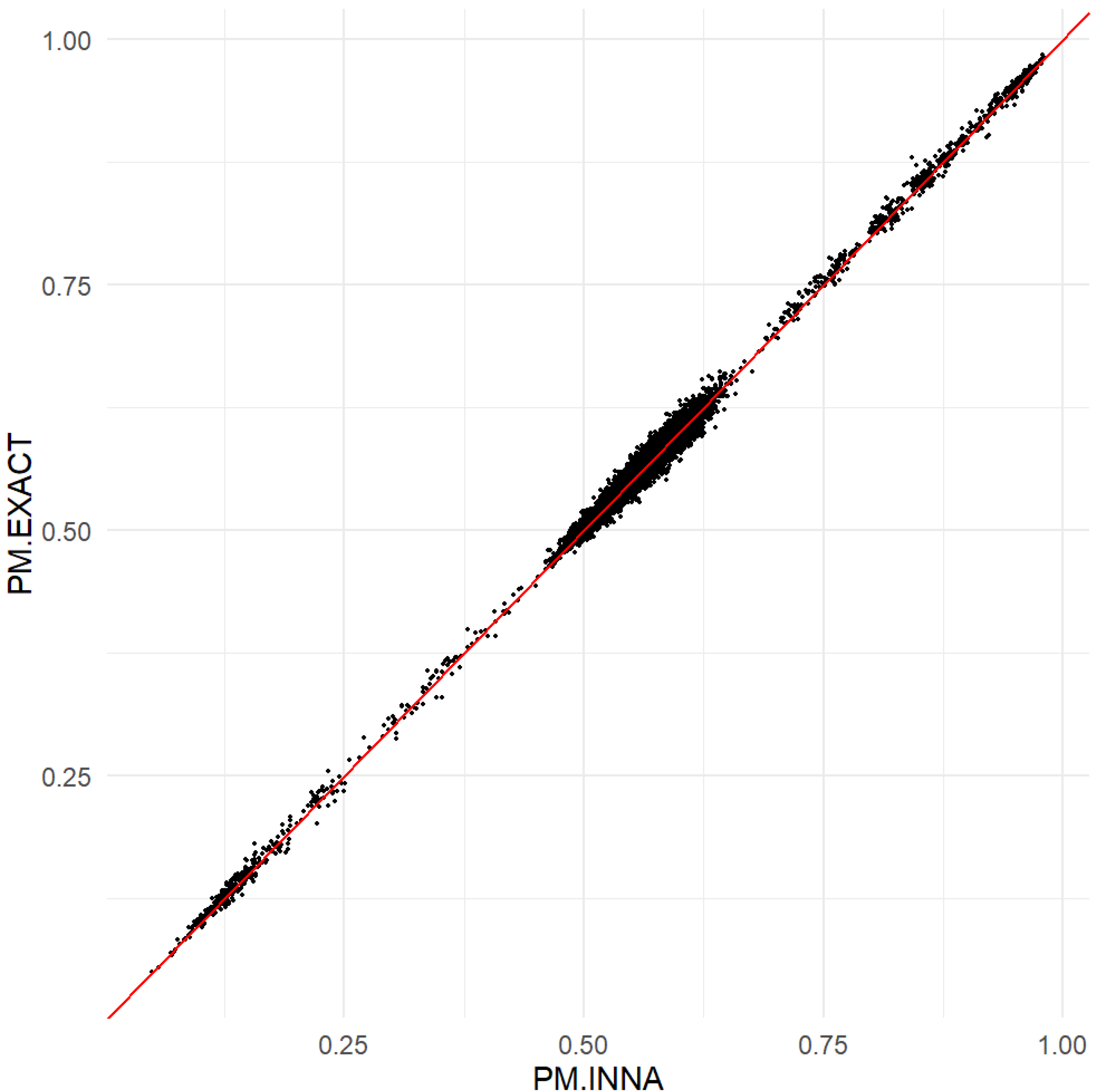
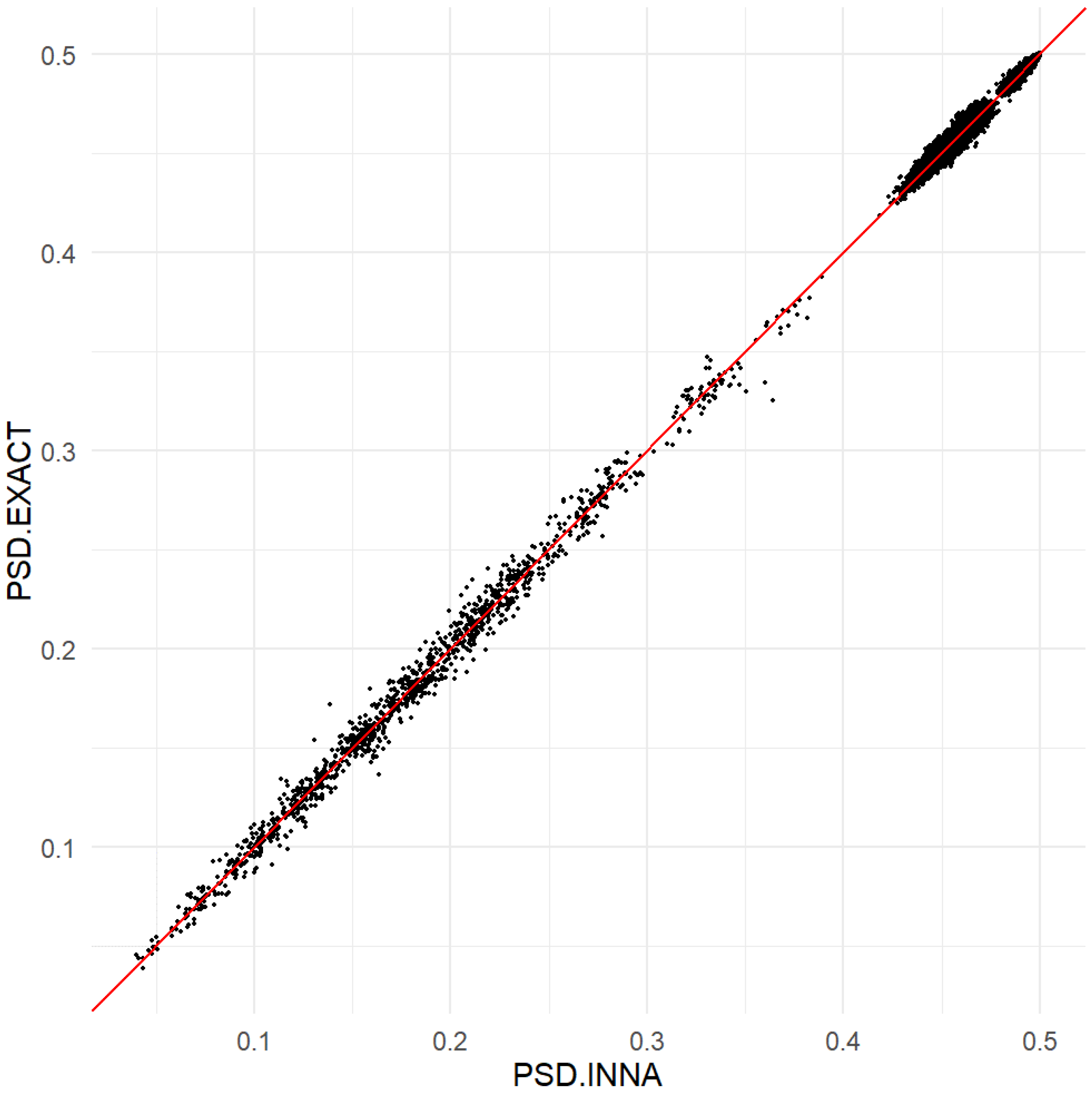
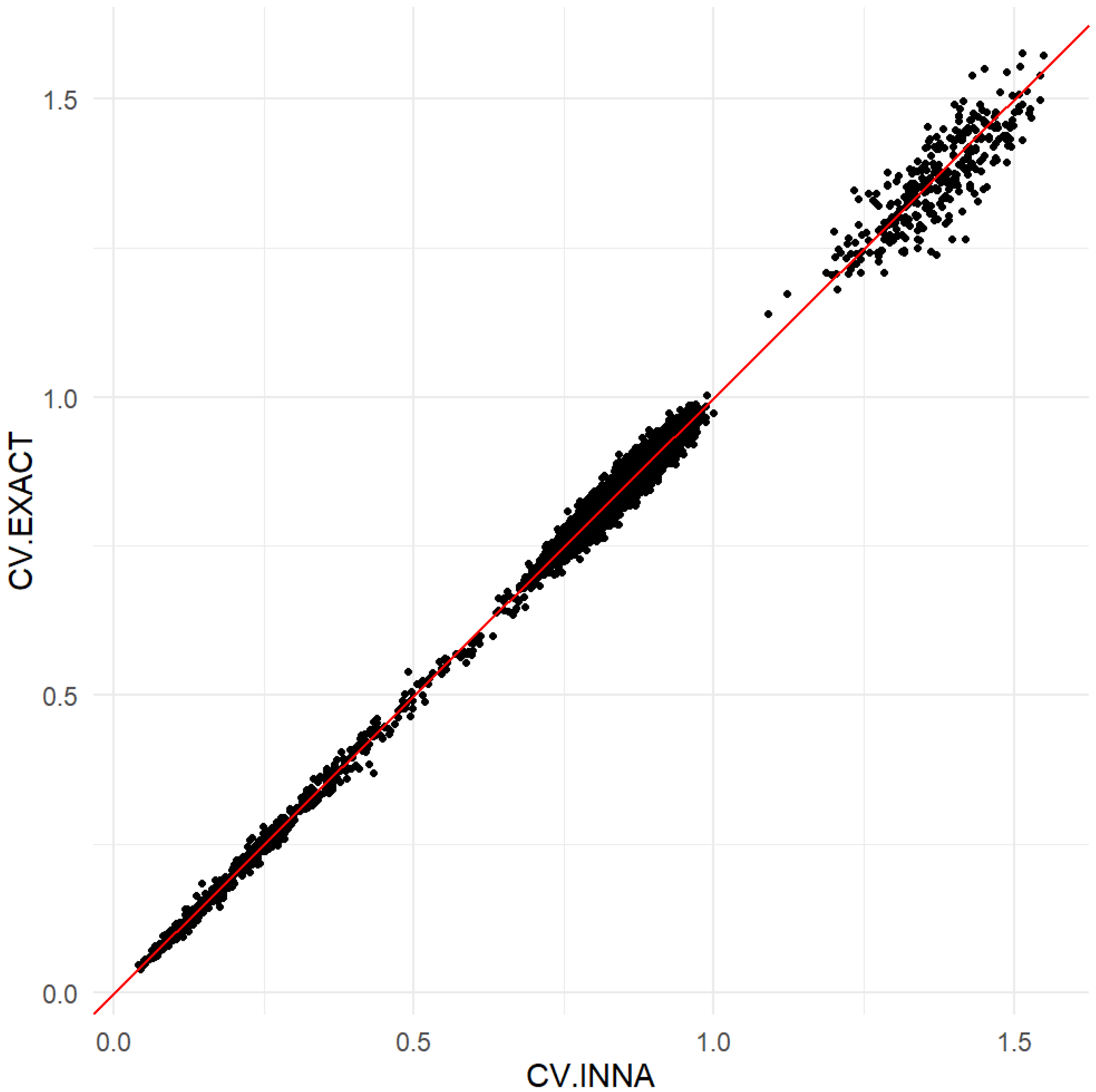
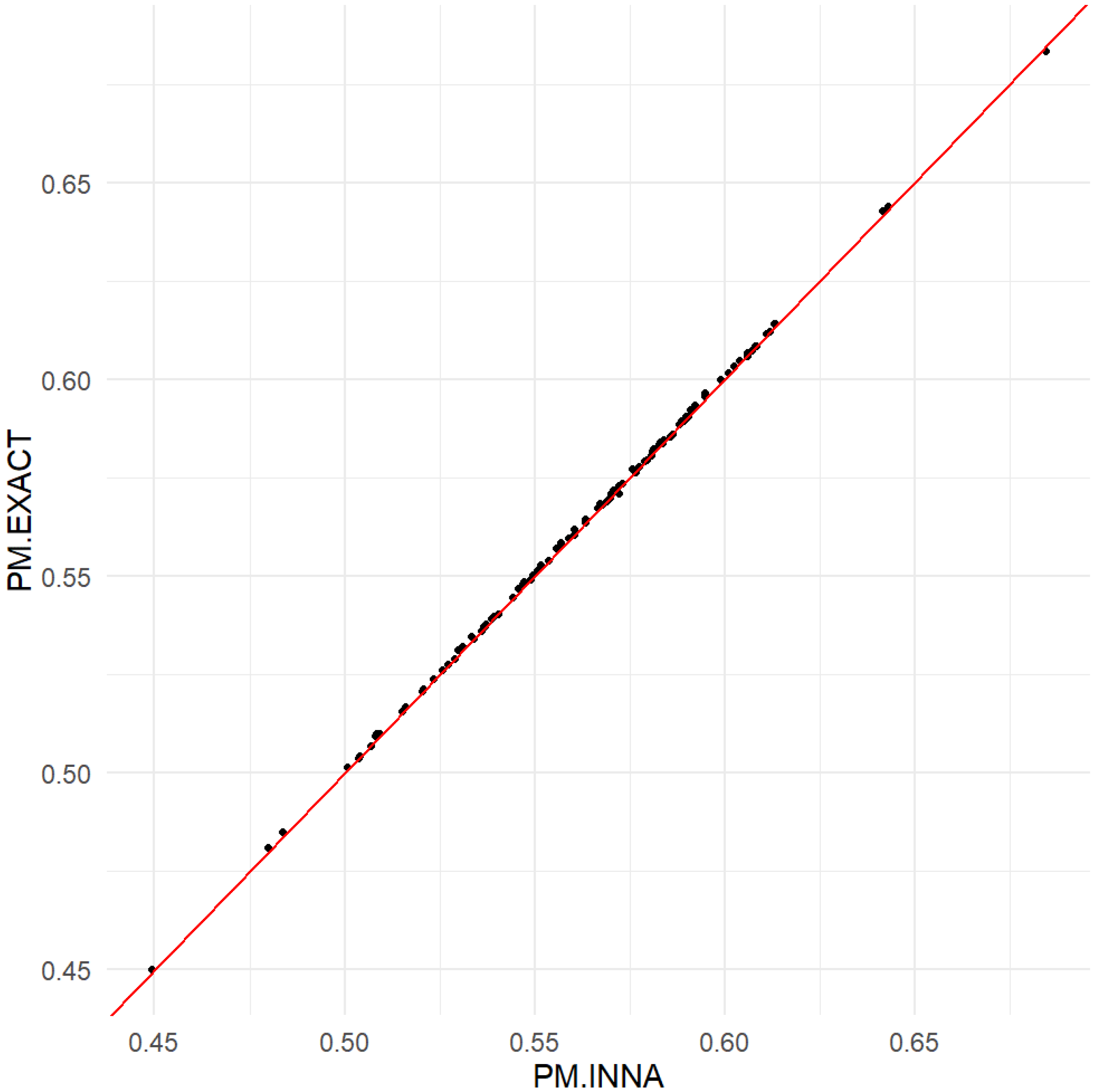
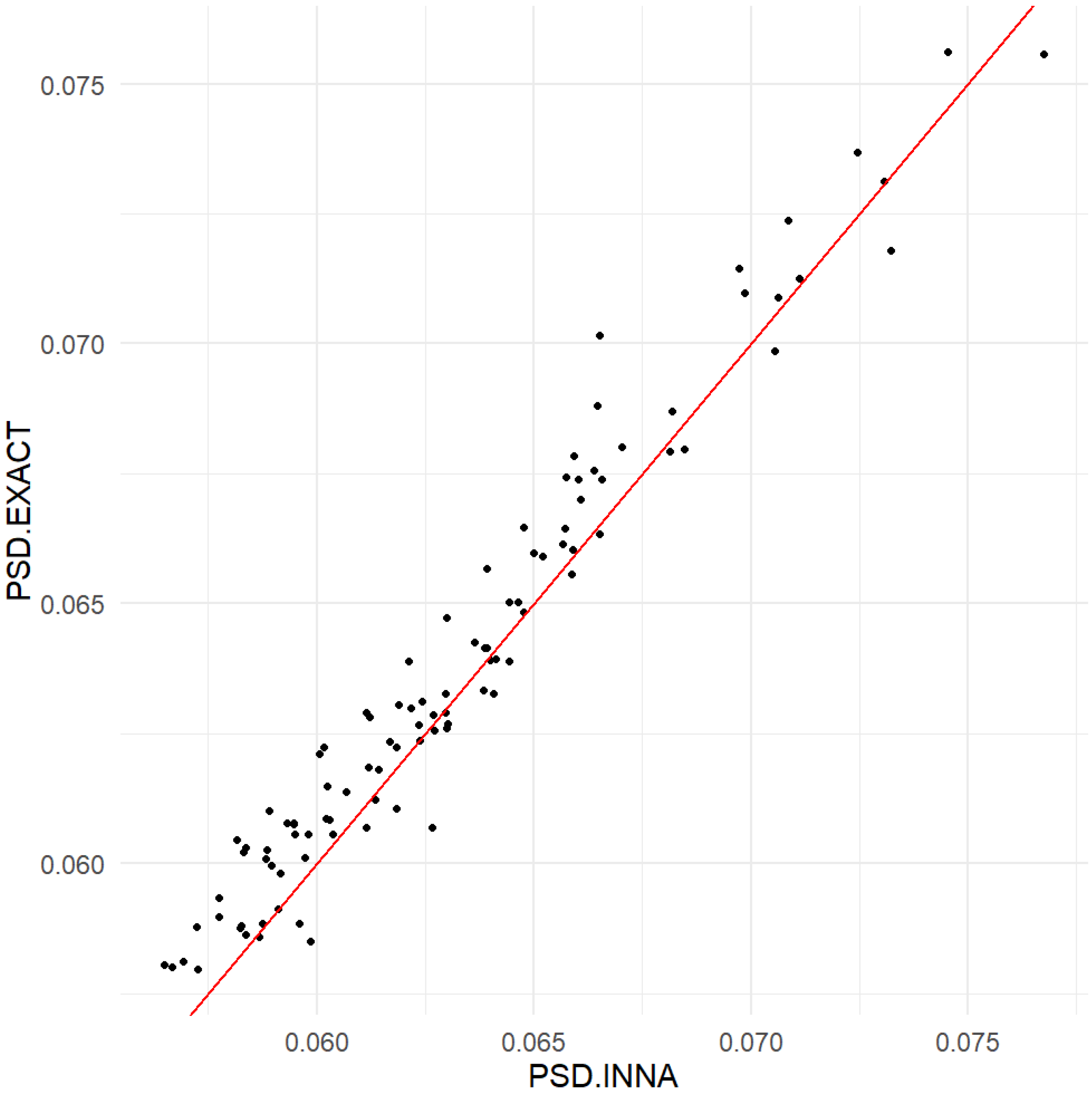
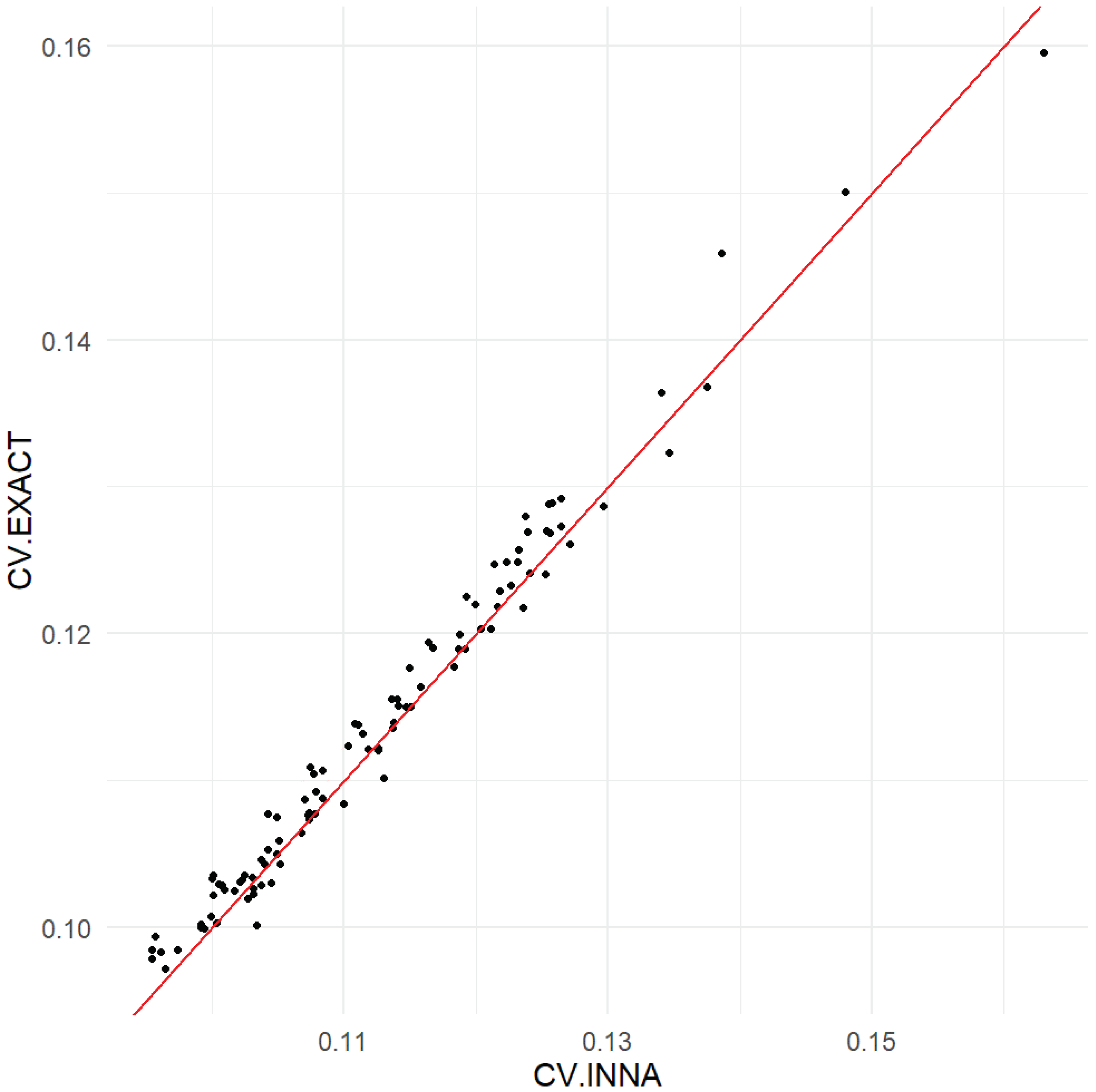
Section 4, we apply the model to the NLSS II data to provide smoothed estimates of the household proportions of members in good health for both sampled and nonsampled households. Some comparisons between INNA and the exact method are presented. Finally, in
Section 5, we make concluding remarks and discuss the future work.
2. Sub-Area Logistic Regression Model
In this section, we discuss the sub-area HB logistic regression model at the unit level. In the NLSS II data, we have binary data (good health versus poor health) for each individual within a household, and these households are within wards. The observations are available at the unit level and so is the reliable auxiliary information. However, the model and method we proposed for small areas and sub-areas is not only for this application on NLSS II data. It can be also applied to other population-based surveys with binary responses which contain small areas or/and sub-areas.
Suppose that there are L small areas (wards) in the finite population and that, within the area, there are sub-areas (households). Within the sub-area, there are individuals. We assume that areas are sampled and a simple random sample of households is taken from the area. All individuals in the sampled households are sampled. Here, we assume the survey weights are the same within all households in each area. Actually, the design is almost self-weighting.
Let denote the binary responses. Let . Let be the number with response 1 and be the total number of people who responded. Let be the vector with p covariates for individuals and an intercept.
We use P to represent the population proportion and p as the sample proportion. Let be the corresponding sample probability of , .
The primary interests are the finite population proportions of the households, which are and the finite population proportions of the areas, which are
In the content of the logistic regression model, the two-fold hierarchical Bayesian logistic regression model for the sub-area means,
, is
Here,
are the sub-area level random effects, which are not in the area-level model in [
3].
are the area random effects and
are the regression coefficients, with
as the variance of the random effects, respectively.
In order to apply our approximation method and make an inference for posterior distribution, we use an equivalent model.
First, we separate
into
and
, where
. We set
as the mean of
, and then we can omit the intercept term from the covariate
. Second, we introduce a new parameter,
, in order to set
and
independently and make it easy to make an inference for both of them. We have
The joint posterior density for the parameters is
The posterior density is a non-standard multivariate density, and there are difficulties in fitting it using MCMC methods, more so when are large. This motivates our approximate methods.
3. Integrated Nested Normal Approximation Method
In this section, we discuss the INNA method for the sub-area HB logistic regression model. It is an extension of the INNA method in [
3]. INNA method is not required to find the posterior modes. Due to the large amount of sub-areas, it would be time-consuming to find all posterior modes, which is why we did not choose the popular INLA method. In detail, we discuss the approximation of the joint posterior density (
3).
Notice that the joint posterior density (
3) is very complicated and it is the expit part,
, that causes the difficulties. In the following, we discuss how to approximate this term to normal density functions by using Laplace approximation, the second-order multivariate Taylor-series approximation and the empirical logistic transform (ELT). This is the key contribution in the paper. Then we use the multiplication rule to approximate the joint posterior density,
where the first three densities on the right-hand side are all multivariate normal densities. Therefore, we can draw samples and make inference through the approximate joint posterior density.
Let denote the density of a vector of parameters . Let denote the gradient vector and H the Hessian matrix at some point .
Lemma 1. Let be a logconcave density function with the parameter . Then, approximately has a multivariate normal distribution, Proof. Simply applying the second-order multivariate Taylor series of
at
gives
Due to the logconcavity of , its Hessian Matrix is posit-definite, which can be the covariance matrix. Notice that we are not required to use the mode of . We do not need to find the solution of the gradient vector . Therefore, does not have to be the solution but some other point. It is worth noticing that the term, , is a correction to . □
To illustrate the approximation steps, we start with a simpler model with flat priors for
and the
, according to model (
2). That is,
The joint posterior density is
The logarithm of the joint posterior density (or log likelihood) is
Let . In our method, we find a convenient point to expand the log-likelihood in a second-order multivariate Taylor-series expansion.
To begin with, let
. We use the empirical logistic transform
to get an estimate of
, where
First, we discuss how to find the quasi mode of
. We plug
into the log likelihood function
and consider it as a function of
only as
, and we get
The first derivative of
is
Usually we should set equal to zero and find the modes as the maximum likelihood estimator (MLE) of . But here, it is not easy to solve the equation due to the complexity of . We use the first-order Taylor series to approximate it and then simplify so that we can get quasi-modes of .
The first-order Taylor expansion of
equals
. Notice that by Taylor series,
. Then we can get
We can get the quasi-modes of
by solving the equation
. That is,
Second, we obtain quasi-modes for the
, a refinement of the
. Plug
into the likelihood function
and consider it as function
only:
Similarly, after applying Taylor expansion, we get the approximate first derivative of
We can obtain the approximate posterior mode of
by solving the equation
.
Notice that the term
in denominator may cause trouble if
for some
is and
js. Here, we borrow the idea from ELT and make a small adjustment in order to avoid a zero denominator. That is,
Let
. Next, we evaluate
and H at the quasi-modes
can also be obtained as
The partial derivatives can be expressed in terms of response
and covariates
as
where
.
For the convenience of computation, denote
and
where
Let
, where
Lemma 2. Assuming that the design matrix is full-rank and , the posterior density, in (5), is logconcave. Proof. If , there are solutions to the gradient vector set to zero.
Let
. Then,
A,
B and
C of the negative Hessian matrix can be written as,
where
It is obvious that
D is positive-definite. Thus, to show that
is positive-definite, we need to show that its Schur complement of
D,
, is positive-definite (e.g., see [
35]). Let
. The Schur complement is
It is now easy to show that
Therefore, is positive-definite, and is logconcave. □
Finally, according to the Lemmas 1 and 2, we can establish the approximation Theorem.
Theorem 1. Assuming that the design matrix is full-rank and , the posterior density, in (5) is approximately a multivariate normal density, and the conditional posterior density of and can also be approximated by multivariate normal distributions. Therefore, we can approximate that logit expit term into two multivariate densities by Theorem 1. And then we can get our approximate two-fold Bayesian logistic regression model.
Recall the posterior density of our two-fold logistic model is
The likelihood function
can be approximated by the multivariate normal distribution by Theorem 1. Combining the prior values of
and
given by our Bayesian Logistic model and the results in Theroem 1, we can obtain our INNA model
where
and
is a vector of ones.
Using Bayes’ Theorem and the multiplication rule, the posterior density
can be approximated as
Therefore, we can get the following key result.
Theorem 2. Using the multiplication rule, the joint posterior density, in (6), can be approximated bywhere the first three densities on the right-hand side are all multivariate normal densities. The INNA is actually a random sampler. First, we draw samples for
from
. The posterior distribution of
does not have standardized form. Here, we use the grid method and numerical integration to sample
and
. Since
and
, we make a transformation to
and
so that we get
and
. Then, the posterior density of
is
We need to draw
together. The joint density can be rewritten as
We plug each grid of into and then use numerical integration to get the density of . After we plug all the 100 grids, we can get 100 value of and then draw from them, i.e. . Next, we plug into and use grid method to draw . We repeat those steps 10,000 times to get the sample of Once we get samples for , we transform them back to and respectively. Second, given , we can simply draw samples of from the approximate multivariate normal distribution . Third, we can draw samples of independently given and data from the approximate normal distribution . Finally, samples of independently given can be obtained from the approximate normal distribution . Notice that the last three steps are very simple, just drawing samples from normal densities. In addition, and are all independent so that we can draw them simultaneously. Therefore, those latter steps permit fast computing.
In order to check if INNA method can provide resonal results, we apply the MCMC logistic regression exact method to the sub-area model. The idea of exact method is to get full conditional posterior distributions for all of the parameters in the model, and then get a large number of independent samples of each parameter with its full conditional posterior density. Details are given in
Appendix A.
There are two differences between these two methods. First, both methods are sampling-based. The approximate method implements random samples and the exact method uses numerical integration method and Markov chains. Second, is used for the INNA method. In the exact method, a Metroplis step is used for the . This is very time-consuming in the exact method. On the other hand, the exact method actually uses the INNA method. We use M-H sampler draw samples for and , respectively. Proposal functions are and , respectively, from the INNA method.
5. Conclusions and Future Work
The sub-area HB logistic regression model can be applied to analyze the binary response variable. This model is an extension of the HB logistic regression area-level model, which ignores the actual hierarchical structure of the data. We propose an approximation method, INNA, to fit the model. For large datasets, it is very unrealistic to use the MCMC method to fit the model. We propose the approximation method, INNA, which saves time significantly because there is no need to compute numerous modes. In the numerical example, we can show that INNA can provide reliable estimates as well. An illustrative example of the NLSS II is presented in order to compare the approximation method and the exact method. It shows that, when there are a large number of areas and sub-areas, the approximation method can be efficient and it can also provide reasonable estimates.
INNA is a method for approximate Bayesian inference based on Laplace’s method, the second-order multivariate Taylor-series approximation and the empirical logistic transform (ELT). It can be applied to all HB logistic regression models, for which it can be a fast and accurate alternative to the Markov chain Monte Carlo methods. The comparison and model results illustrate the performance of the INNA methods based on the sub-area model.
There will be many future works on the two-fold small areas model. First, in this paper, we assume equal survey weights since the NLSS II is a self-weighted sampling. However, after the data are collected, the sampling weights are usually adjusted for various characteristics or based on nonresponse as well. Incorporating those survey weights into the model is also very important. Generally, we need to consider these weights in the model. The NLSS II is a national population-based survey. We should rescale the sample weights to sum to an equivalent sample size. That is, we consider the adjusted weight as , where as an equivalent sample. Introducing the sampling weights, we can obtain an updated normalized likelihood function. Based on the updated likelihood function and the same prior in the two-fold model, we can have a full Bayesian analysis on the updated model and then project the finite population proportion of the family members with good health in each household.
Second, we focus on the binary data. Actually, there are four options in the health status questionnaire. The Multinomial-Dirichlet model can be an extension of the polychotomous data. Third, the two-fold sub-area level models can also be extended to three-fold models if the data have an additional hierarchical structure; actually, the NLSS II has this structure (households within wards, wards within districts). Fourth, in our models, we consider parametric priors. Introducing the Dirichlet process as a prior might make our method more robust to its specifications.