
Robust Passive Mechanical Filter for Sub-Hertz Seismic Detection on Venus



Abstract
1. Introduction
2. Methods
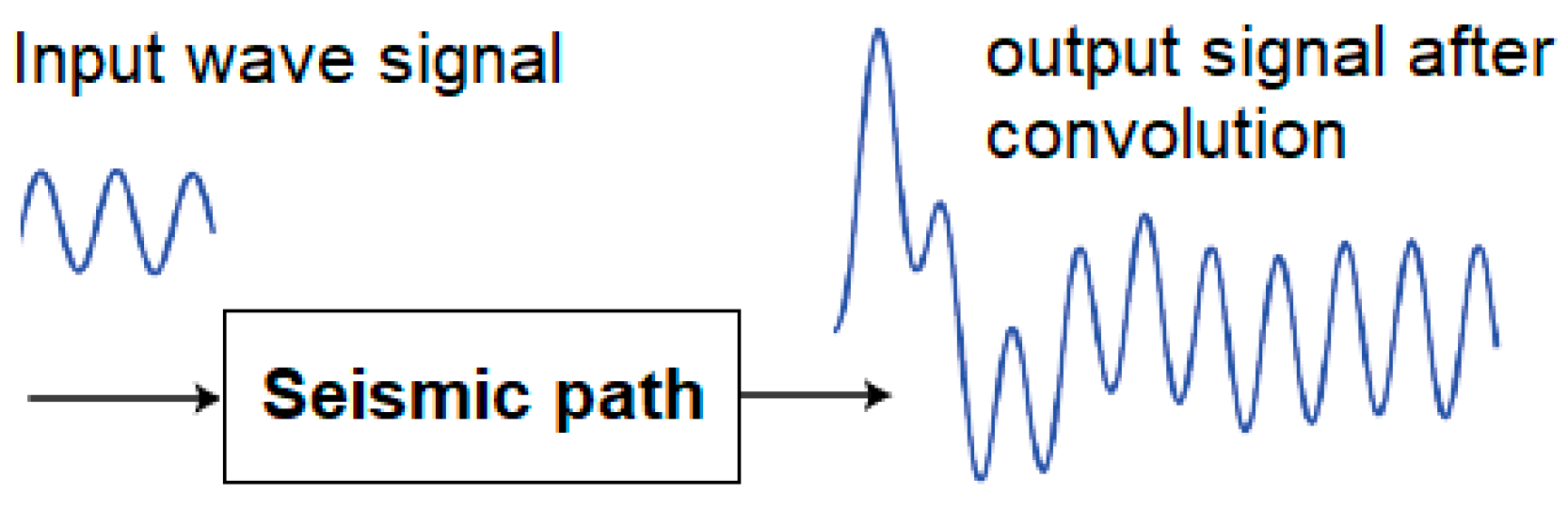
2.1. Motivation and Conceptual Framework
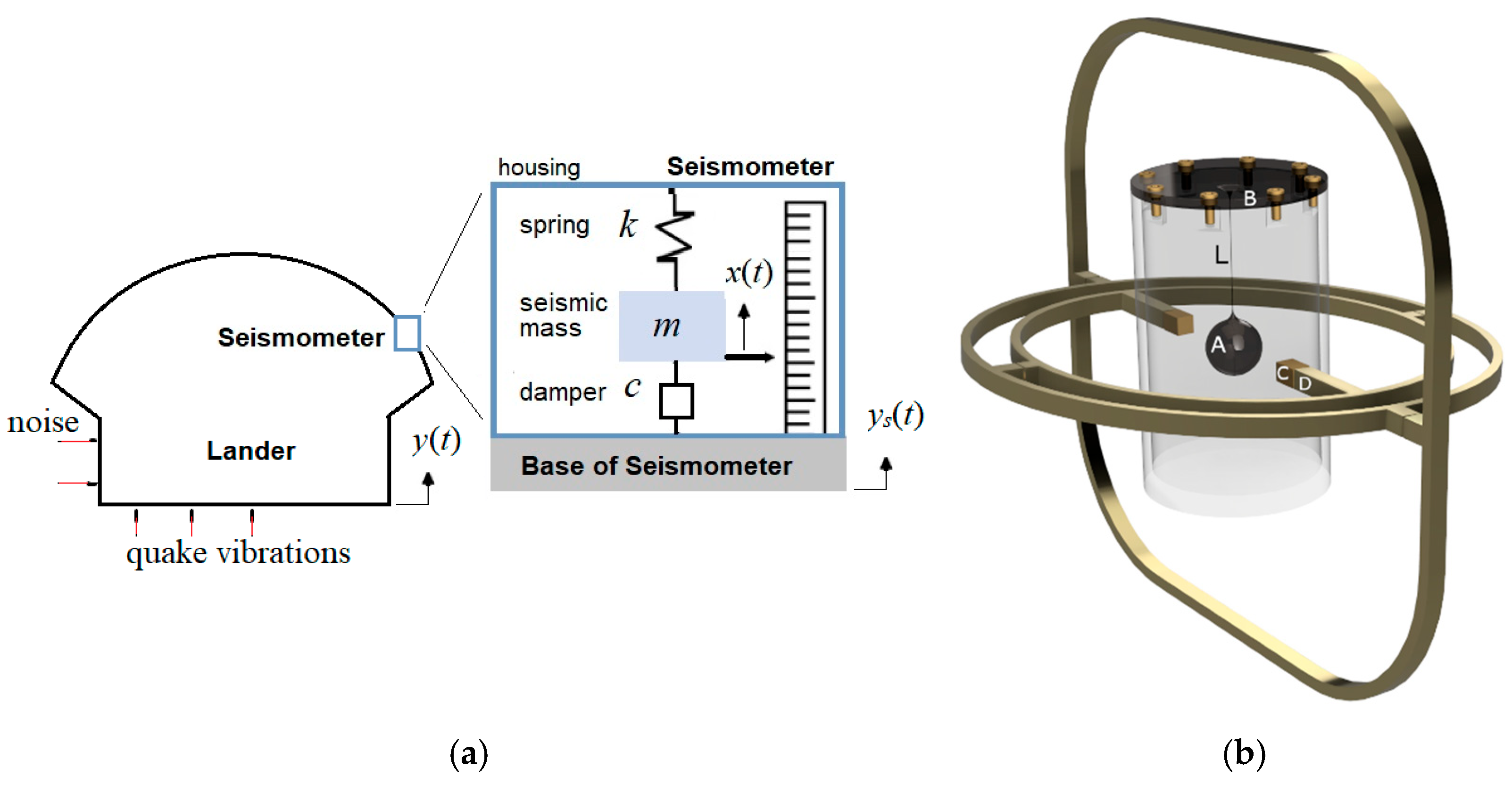
2.2. Pendulum–Gimbal Mechanism for Seismic Path Tuning
3. Results
3.1. Spectral Response of Pendulum-Based Passive Mounting Mechanism
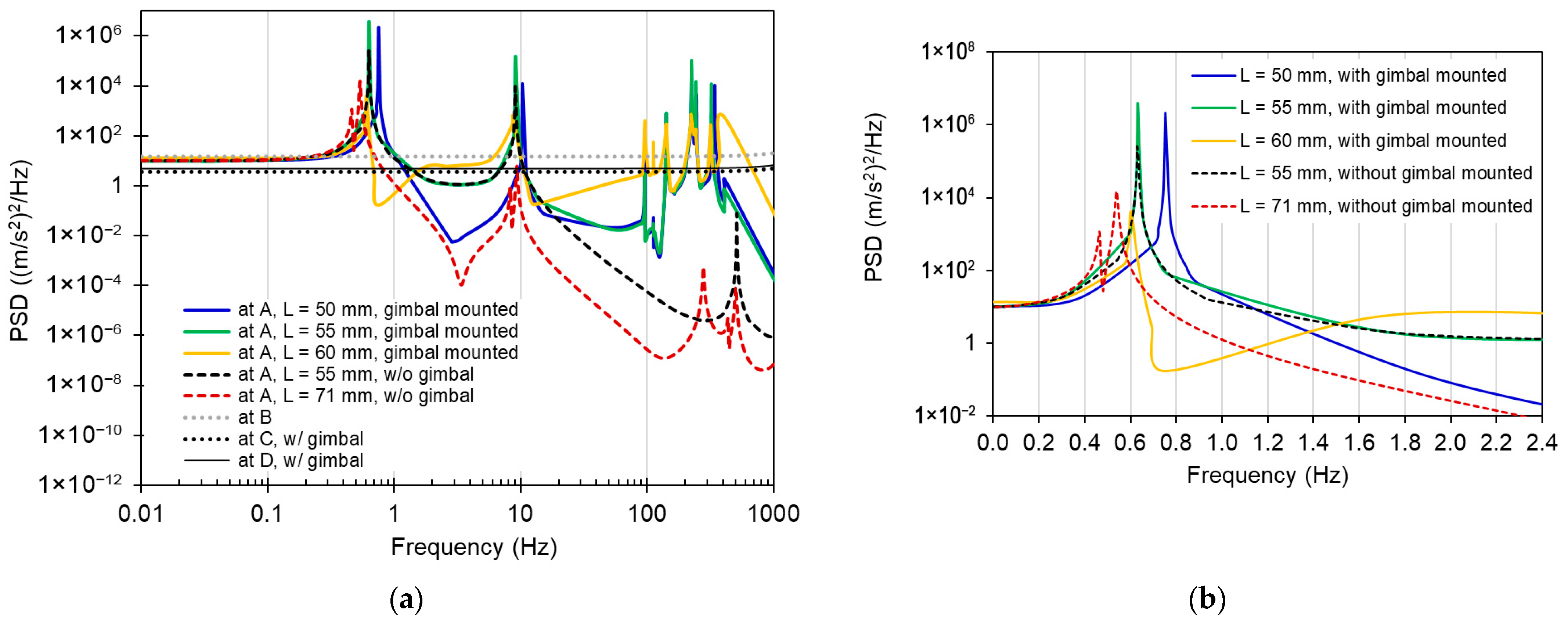
3.1.1. PSD at Pendulum Bob
3.1.2. PSD Response at the Mounting Structures (Locations B, C, and D)
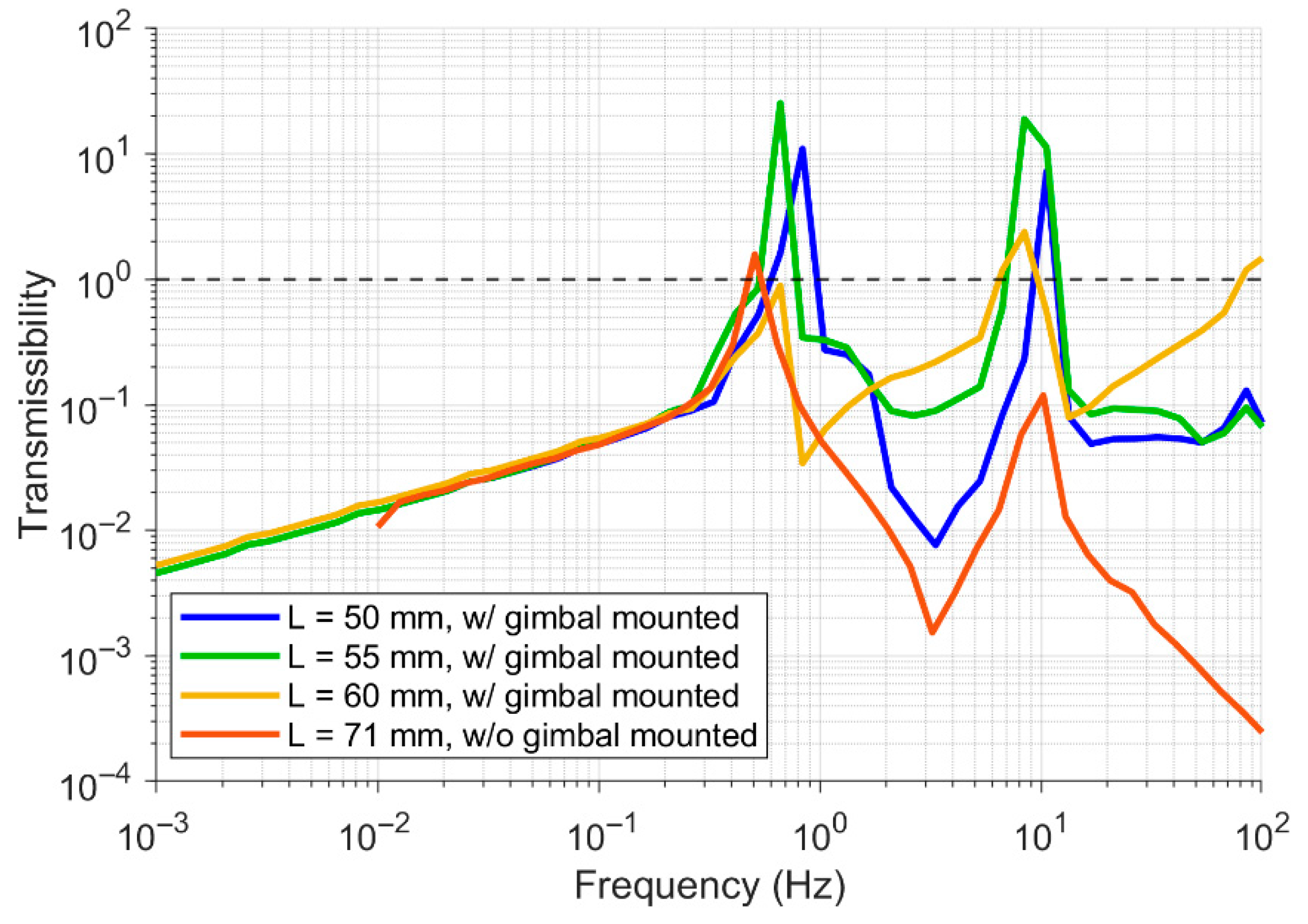
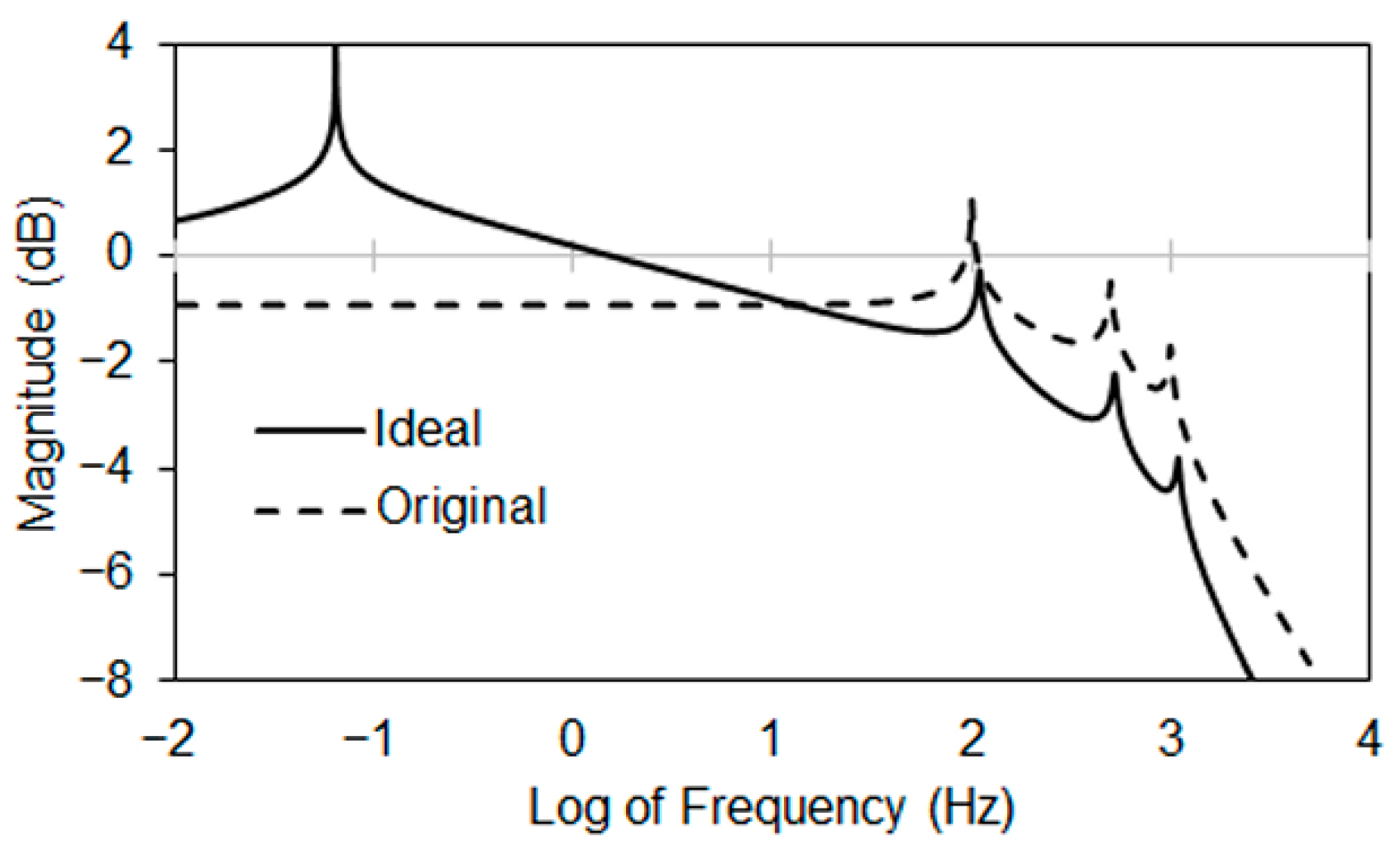
3.1.3. Transmissibility (Transfer Function)
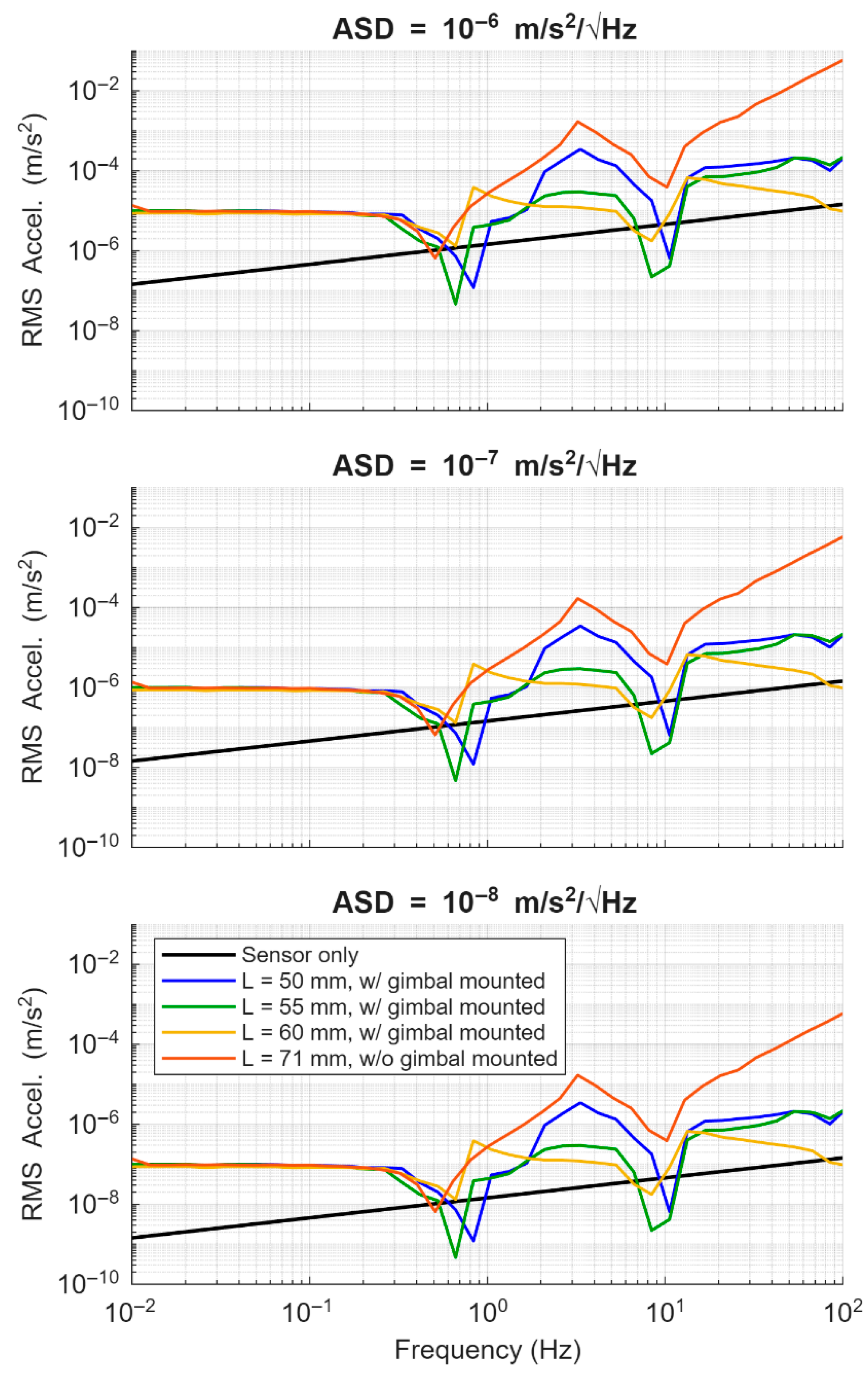
3.2. Minimum Level of Detection
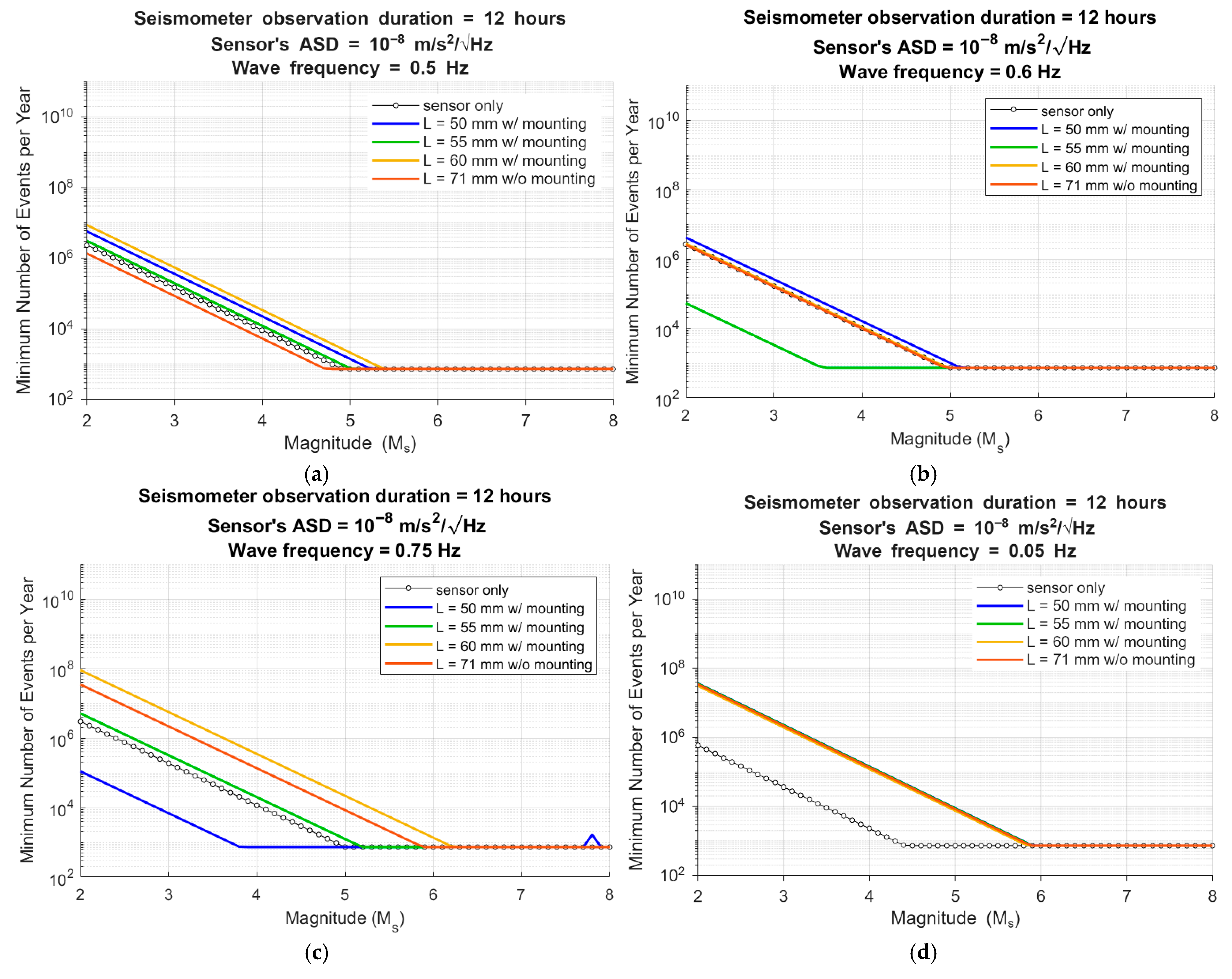
3.3. Maximum Number of Annual Surface Quake Detectable
4. Discussions
5. Conclusions
- A desired transfer function (transmissibility) is formulated as a system-level criterion for spectral amplification and noise attenuation.
- A pendulum-based sensor-mounting mechanism is developed to realize the formulated transmissibility, enabling two high-Q peaks in the 0.5–0.8 Hz range that can amplify weak seismic signals in the sub-Hertz range.
- A self-leveling mechanism ensures adaptive vertical alignment and attenuates signals above 1 Hz, adding robustness of the system to lander orientation and structure-environment induced noises.
- The effects of damping are comprehensively justified through order-of-magnitude and sensitivity analyses, showing that realistic dissipation modifies amplification magnitude without altering the fundamental transmissibility trends.
- Narrowband peak sensitivity is analyzed to assess detectability under spectral uncertainty, establishing the criteria with which high-Q amplification remains effective and motivating architectural extensions for broader detectability.
- Compared with existing approaches that rely on broadband sensors combined with electronic filtering, active leveling, or complex deployment systems, the proposed design achieves spectral selectivity, orientation robustness, and noise attenuation entirely through passive mechanical means, without additional power consumption or active control.
Supplementary Materials
Author Contributions
Funding
Institutional Review Board Statement
Informed Consent Statement
Data Availability Statement
Acknowledgments
Conflicts of Interest
Abbreviations
| ADC | Analog-to-digital conversion |
| ASD | Amplitude spectrum density |
| GSN | Global seismographic network |
| PSD | Power spectrum density |
| RMS | Root-mean-squared |
| SNR | Signal-to-noise ratio |
| NASA Missions: | |
| DAVINCI | Deep Atmosphere Venus Investigation of Noble gases, Chemistry, and Imaging |
| InSAR | Interferometric Synthetic Aperture Radar |
| LLISSE | Long Lived In situ Solar System Explorer |
| SEIS | Seismic Experiment for Interior Structure |
| SAEVe | Seismic and Atmospheric Exploration of Venus |
| VERITAS | Venus Emissivity, Radio Science, InSAR, Topography, and Spectroscopy |
References
- Kremic, T.; Ghail, R.; Gilmore, M.; Hunter, G.; Kiefer, W.; Limaye, S.; Pauken, M.; Tolbert, C.; Wilson, C. Long-duration Venus lander for seismic and atmospheric science. Planet Space Sci. 2020, 190, 104961. [Google Scholar] [CrossRef]
- Rolf, T.; Weller, M.; Gülcher, A.; Byrne, P.; O’rourke, J.G.; Herrick, R.; Bjonnes, E.; Davaille, A.; Ghail, R.; Gillmann, C.; et al. Dynamics and Evolution of Venus’ Mantle Through Time. Space Sci. Rev. 2022, 218, 70. [Google Scholar] [CrossRef]
- Herrick, R.R.; Hensley, S. Surface changes observed on a Venusian volcano during the Magellan mission. Science (1979) 2023, 379, 1205–1208. [Google Scholar] [CrossRef]
- Lognonné, P.; Johnson, C.L. Planetary Seismology. In Treatise on Geophysics, 2nd ed.; Elsevier: Oxford, UK, 2015; Volume 10, pp. 65–120. [Google Scholar]
- Garcia, R.F.; van Zelst, I.; Kawamura, T.; Näsholm, S.P.; Horleston, A.; Klaasen, S.; Lefèvre, M.; Solberg, C.M.; Smolinski, K.T.; Plesa, A.-C.; et al. Seismic Wave Detectability on Venus Using Ground Deformation Sensors, Infrasound Sensors on Balloons and Airglow Imagers. Earth Space Sci. 2024, 11, e2024EA003670. [Google Scholar] [CrossRef]
- van Zelst, I.; De Toffoli, B.; Garcia, R.F.; Ghail, R.; Gülcher, A.J.P.; Horleston, A.; Kawamura, T.; Klaasen, S.; Lefevre, M.; Lognonné, P.; et al. Seismicity on Venus: Optimal Detection Methods and Target Regions; European Geosciences Union General Assembly (EGUGA): Vienna, Austria, 2024; p. 12790. Available online: https://ui.adsabs.harvard.edu/abs/2024EGUGA..2612790V/abstract?bbbRedirect=1 (accessed on 2 October 2025).
- Butler, R.; Lay, T.; Creager, K.; Earl, P.; Fischer, K.; Gaherty, J.; Laske, G.; Leith, B.; Park, J.; Ritzwolle, M.; et al. The Global Seismographic Network Surpasses Its Design Goal. EOS Trans. AGU 2004, 85, 225–229. [Google Scholar] [CrossRef]
- Froment, M.; Brissaud, Q.; Näsholm, S.P.; Schweitzer, J. Balloon seismology enables subsurface inversion without ground stations. Commun. Earth Environ. 2025, 6, 949. [Google Scholar] [CrossRef]
- Tanimoto, T.; Anderson, A. Seismic noise between 0.003 Hz and 1.0 Hz and its classification. Prog. Earth Planet. Sci. 2023, 10, 56. [Google Scholar] [CrossRef]
- Nishida, K. Ambient seismic wave field. Proc. Jpn. Acad. Ser. B Phys. Biol. Sci. 2017, 93, 423. [Google Scholar] [CrossRef]
- Smrekar, S.; Dyar, D.; Helbert, J.; Hensley, S.; Nunes, D.; Whitten, J. VERITAS (Venus Emissivity, Radio Science, InSAR, Topography and Spectroscopy): A Proposed Discovery Mission; Europlanet Science Congress (EPSC): Brussels, Belgium, 2020; p. EPSC2020. Available online: https://ui.adsabs.harvard.edu/abs/2020EPSC...14..447S/abstract (accessed on 2 October 2025).
- Garvin, J.B.; Getty, S.A.; Arney, G.N.; Johnson, N.M.; Kohler, E.; Schwer, K.O.; Sekerak, M.; Bartels, A.; Saylor, R.S.; Elliott, V.E.; et al. Revealing the Mysteries of Venus: The DAVINCI Mission. Planet Sci. J. 2022, 3, 117. [Google Scholar] [CrossRef]
- Krishnamoorthy, S.; Komjathy, A.; Pauken, M.T.; Cutts, J.A.; Garcia, R.F.; Mimoun, D.; Cadu, A.; Sournac, A.; Jackson, J.M.; Lai, V.H.; et al. Detection of Artificially Generated Seismic Signals Using Balloon-Borne Infrasound Sensors. Geophys. Res. Lett. 2018, 45, 3393–3403. [Google Scholar] [CrossRef]
- Panning, M.P.; Pike, W.T.; Lognonné, P.; Banerdt, W.B.; Murdoch, N.; Banfield, D.; Charalambous, C.; Kedar, S.; Lorenz, R.D.; Marusiak, A.G.; et al. On-Deck Seismology: Lessons from InSight for Future Planetary Seismology. J. Geophys. Res. Planets 2020, 125, e2019JE006353. [Google Scholar] [CrossRef]
- Sun, W.; Tkalčić, H.; Chen, J.; Wang, S. Spectral characteristics and implications of located low-frequency marsquakes and impact events from InSight SEIS observations. Phys. Earth Planet. Inter. 2025, 361, 107334. [Google Scholar] [CrossRef]
- Banerdt, B. EPSC Abstracts: InSight’s Contributions to Planetary Seismology and Geophysics. Eur. Sci. Congr. 2022, 16, 773. [Google Scholar]
- Ksanfomaliti, L.V.; Zubkova, V.M.; Morozov, N.A.; Petrova, E.V. Microseisms at the VENERA-13 and VENERA-14 Landing Sites. Sov. Astron. Lett. 1982, 8, 241–242. [Google Scholar]
- Kremic, T.; Hunter, G.W. Long-Lived In-Situ Solar System Explorer (LLISSE) Potential Contributions to Solar System Exploration. Bull. Am. Astron. Soc. 2021, 53, 151. [Google Scholar]
- Lognonné, P.; Banerdt, W.B.; Giardini, D.; Pike, W.T.; Christensen, U.; Laudet, P.; De Raucourt, S.; Zweifel, P.; Calcutt, S.; Bierwirth, M.; et al. SEIS: Insight’s Seismic Experiment for Internal Structure of Mars. Space Sci. Rev. 2019, 215, 12. [Google Scholar] [CrossRef] [PubMed]
- Schon, K. Transfer behavior of linear systems, convolution and deconvolution. In High Voltage Measurement Techniques: Fundamentals, Measuring Instruments, and Measuring Methods; Springer International Publishing: Cham, Switzerland, 2019; pp. 269–306. [Google Scholar]
- Murdoch, N.; Mimoun, D.; Garcia, R.F.; Rapin, W.; Kawamura, T.; Lognonné, P.; Banfield, D.; Banerdt, W.B. Evaluating the Wind-Induced Mechanical Noise on the InSight Seismometers. Space Sci. Rev. 2017, 211, 429–455. [Google Scholar] [CrossRef]
- Murdoch, N.; Alazard, D.; Knapmeyer-Endrun, B.; Teanby, N.A.; Myhill, R. Flexible Mode Modelling of the InSight Lander and Consequences for the SEIS Instrument. Space Sci. Rev. 2018, 214, 117. [Google Scholar] [CrossRef]
- Stott, A.E.; Charalambous, C.; Warren, T.J.; Pike, W.T.; Myhill, R.; Murdoch, N.; McClean, J.B.; Trebi-Ollennu, A.; Lim, G.; Garcia, R.F.; et al. The Site Tilt and Lander Transfer Function from the Short-Period Seismometer of InSight on Mars. Bull. Seismol. Soc. Am. 2021, 111, 2889–2908. [Google Scholar] [CrossRef]
- Lavelle, F.; Bergman, L.; Spanos, P. Seismic response spectra of a combined system by Green’s functions. Soil Dyn. Earthq. Eng. 1991, 10, 93–100. [Google Scholar] [CrossRef]
- Ackerley, N. Principles of Broadband Seismometry. In Encyclopedia of Earthquake Engineering; Springer: Berlin/Heidelberg, Germany, 2015; pp. 1941–1970. [Google Scholar] [CrossRef]
- Spanos, P.; Lutes, L. A Primer of Random Vibration Techniques in Structural Engineering. Shock. Vib. Dig. 1986, 18, 3–9. [Google Scholar] [CrossRef]
- Fayon, L.; Knapmeyer-Endrun, B.; Lognonné, P.; Bierwirth, M.; Kramer, A.; Delage, P.; Karakostas, F.; Kedar, S.; Murdoch, N.; Garcia, R.F.; et al. A Numerical Model of the SEIS Leveling System Transfer Matrix and Resonances: Application to SEIS Rotational Seismology and Dynamic Ground Interaction. Space Sci. Rev. 2018, 214, 119. [Google Scholar] [CrossRef]
- Panning, M.P.; Kedar, S. Seismic response of the Mars Curiosity Rover: Implications for future planetary seismology. Icarus 2019, 317, 373–378. [Google Scholar] [CrossRef]
- Lorenz, R.D.; Shiraishi, H.; Panning, M.; Sotzen, K. Wind and surface roughness considerations for seismic instrumentation on a relocatable lander for Titan. Planet. Space Sci. 2021, 206. [Google Scholar] [CrossRef]
- Kwiatek, G.; Ben-Zion, Y. Theoretical limits on detection and analysis of small earthquakes. J. Geophys. Res. Solid Earth 2016, 121, 5898–5916. [Google Scholar] [CrossRef]
- Lee, Y.; Welsch, G. Young’s modulus and damping of Ti-6Al-4V alloy as a function of heat treatment and oxygen concentration. Mater. Sci. Eng. A 1990, 128, 77–89. [Google Scholar] [CrossRef]
- Brennen, C.E. A Review of Added Mass and Fluid Inertial Forces; Naval Civil Engineering Laboratory: Port Hueneme, CA, USA, 1981. [Google Scholar]
- Bai, R.; Zhang, H.; Yang, N.; Yu, Z.; Li, B.; Xu, Q.; Chen, G. Optimization of a near-zero-center-shift compliant pivot for large motion range and high bearing stiffness. Mech. Mach. Theory 2025, 216, 106218. [Google Scholar] [CrossRef]
- Blad, T.; van Ostayen, R.A.; Herder, J.L.; Tolou, N. A Statically Balanced Compliant Ortho-Planar Mechanism for Low-Frequency Energy Harvesting. J. Mech. Des. 2022, 144, 073302. [Google Scholar] [CrossRef]




| Feature | Earth (Standard) | Venus (Emergent) |
|---|---|---|
| Primary Platform | Global land-based stations (e.g., GSN [7]). | Aerial (balloons) and orbital (InSAR/Airglow) [5,8]. |
| Observation Medium | Direct ground coupling. | Acoustic coupling in dense CO2 atmosphere (60–100× Earth) [5]. |
| Station | Controlled leveling; pre-selected, stable vault conditions. | Uncontrolled landing orientation; lacking regional stability information. |
| Instrument Type | 3-axis broadband seismometers (bulky, stable power supply). | Infrasound barometers, airglow imagers [5], ground-stationed MEMS seismometers [1]. |
| Wave Capture | Body waves (P/S) and surface waves. | Infrasonic pressure waves (acoustic conversion) [5]. |
| Major Constraints | Site accessibility. | High thermal/pressure load, limited S-wave data; stringent power constraints. |
| Primary Noise | Instrument noise [9], oceanic microseism noise [10]. | Lander-wind resonance and thermal-mechanical drift [5]. |
| Current Mission Focus | Continuous global monitoring [7]. | VERITAS (InSAR) [11] and DAVINCI [12]. |
| Pendulum | |
|---|---|
| Arm length L (mm) | 50–71 |
| Arm diameter (mm) | 0.4 |
| Bob diameter (mm) | 30 |
| Cylindrical housing | |
| Diameter (mm) | 100 |
| Height (mm) | 130 |
| Wall thickness (mm) | 5 |
| Gimbal ring | |
| Ring’s cross-sectional area (mm2) | 10 × 10 |
| Diameter | |
| Outer ring (mm) | 320 |
| Middle ring (mm) | 260 |
| Inner ring (mm) | 200 |
| Ring connector length | |
| Outer-middle (mm) | 20 |
| Middle-inner (mm) | 20 |
| Inner cylinder (mm) | 40 |
| Material | Ti6Al4V |
| Young’s modulus (GPa) | 110 |
| Poisson’s ratio | 0.30 |
| Density (g/cm3) | 4.45 |
Disclaimer/Publisher’s Note: The statements, opinions and data contained in all publications are solely those of the individual author(s) and contributor(s) and not of MDPI and/or the editor(s). MDPI and/or the editor(s) disclaim responsibility for any injury to people or property resulting from any ideas, methods, instructions or products referred to in the content. |
© 2026 by the authors. Licensee MDPI, Basel, Switzerland. This article is an open access article distributed under the terms and conditions of the Creative Commons Attribution (CC BY) license.
Share and Cite
Chen, C.-f.; Ophoff, M.; Samuel, N. Robust Passive Mechanical Filter for Sub-Hertz Seismic Detection on Venus. J 2026, 9, 6. https://doi.org/10.3390/j9010006
Chen C-f, Ophoff M, Samuel N. Robust Passive Mechanical Filter for Sub-Hertz Seismic Detection on Venus. J. 2026; 9(1):6. https://doi.org/10.3390/j9010006
Chicago/Turabian StyleChen, Cheng-fu, Mike Ophoff, and Nick Samuel. 2026. "Robust Passive Mechanical Filter for Sub-Hertz Seismic Detection on Venus" J 9, no. 1: 6. https://doi.org/10.3390/j9010006
APA StyleChen, C.-f., Ophoff, M., & Samuel, N. (2026). Robust Passive Mechanical Filter for Sub-Hertz Seismic Detection on Venus. J, 9(1), 6. https://doi.org/10.3390/j9010006