Article

Optimization of Chestnut Shell Extract as a Natural Coagulant for Color Removal in Synthetic Wastewater


by
Juliana Vieira
1,
Juliana Martins Teixeira de Abreu Pietrobelli
2 and
Ramiro Martins
1,3,*
1
Department of Chemical and Biological Technology, Bragança Polytechnic University, Campus Santa Apolónia, 5300-253 Bragança, Portugal
2
Department of Chemical Engineering, Universidade Tecnológica Federal do Paraná, R. Doutor Washington Subtil Chueire, Ponta Grossa 84014-220, Brazil
3
Centre for Mountain Research (CIMO), Associate Laboratory SusTEC, Bragança Polytechnic University, 5300-252 Bragança, Portugal
*
Author to whom correspondence should be addressed.
Clean Technol. 2026, 8(5), 156; https://doi.org/10.3390/cleantechnol8050156 (registering DOI)
Submission received: 2 July 2026 / Revised: 15 August 2026 / Accepted: 14 September 2026 / Published: 17 September 2026

Abstract

The growing pressure on water resources and the demand for sustainable wastewater treatment have driven interest in low-cost, renewable coagulants for industrial effluent remediation. In this context, chestnut shells (Castanea sativa) were explored as a potential source of natural coagulants through tannin extraction, followed by cationic modification using the Mannich reaction. A Box–Behnken Design was employed to assess the effects of chestnut shell mass, extraction pH, and extraction time on methylene blue decolorization in synthetic wastewater. The quadratic response surface model was not statistically significant, indicating that the tested variables did not collectively explain the observed variation within the investigated range. Consequently, the results were interpreted as exploratory observations within the investigated experimental domain rather than as evidence of optimized or predictive operating conditions. Under the tested conditions, methylene blue removal efficiencies ranged from 20 to 26%, and increasing the coagulant dosage improved decolorization, likely through polymeric bridging. Furthermore, this study demonstrated practical regional industrial integration in Northern Portugal by upcycling agricultural waste to mitigate the impact of textile effluents. This engineering approach aligns with the United Nations Sustainable Development Goals (SDG 6, 9, and 12), suggesting a promising pathway for sustainable industrial scale-up.

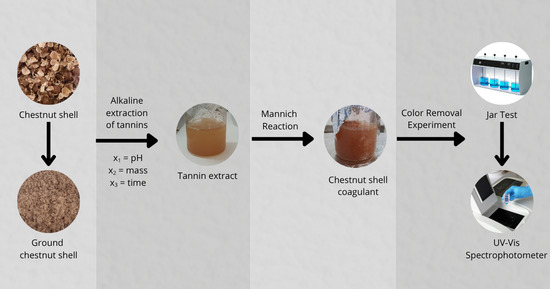
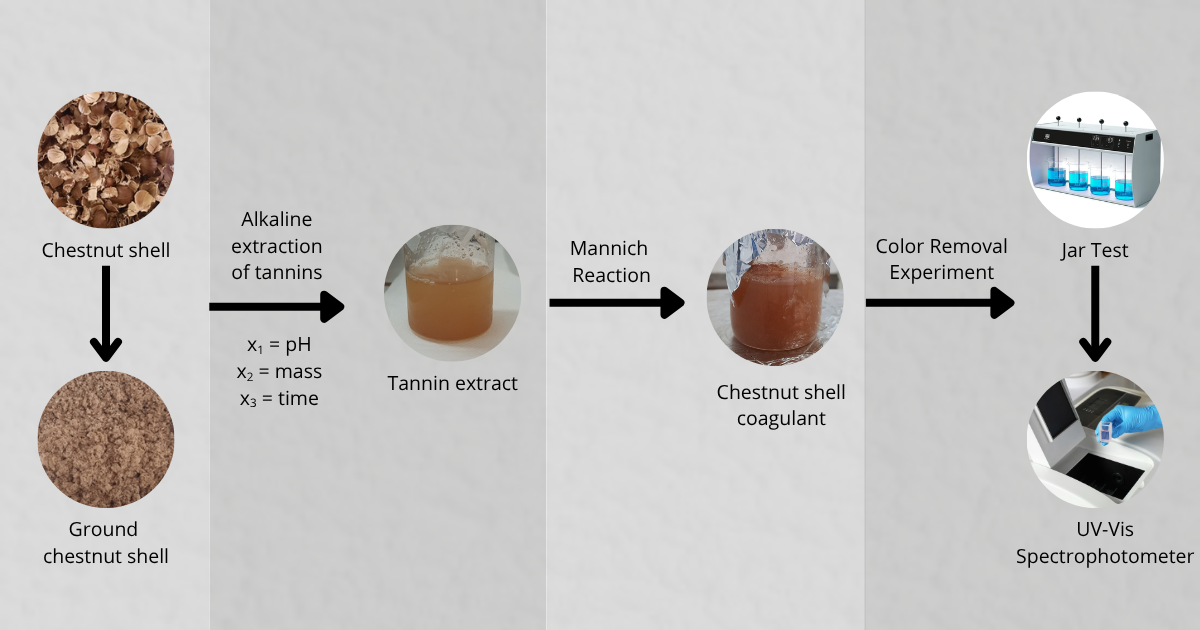
Graphical Abstract

1. Introduction

The human rights to safe drinking water and sanitation are indispensable conditions for a life of dignity, stability, and good health [1]. In alignment with this premise, the United Nations 2030 Agenda establishes, through Sustainable Development Goal (SDG) 6, the urgent need to ensure sustainable management and universal access to water [2]. However, global water demand has steadily increased since the 1980s, increasing by approximately 1% per year. This increase is driven by demographic growth, socioeconomic development, and evolving consumption patterns [3].
Globally, an estimated 380 billion cubic meters of wastewater are generated annually. However, approximately 80% of this total remains inadequately treated before disposal, posing a serious threat to both human and environmental health [4,5]. Although its precise composition varies considerably depending on the origin, wastewater is composed of up to 99% water. The remaining fraction contains solids, dissolved and particulate matter, microorganisms, nutrients, heavy metals, and micropollutants [5].
Industry and municipalities together consume approximately 10% of the world’s accessible runoff. They produce wastewater containing a wide range of chemical compounds at varying concentrations. These compounds subsequently flow or leach into rivers, lakes, groundwater, and coastal seas [6]. Pollution from industry and urban centers not only degrades water bodies and land, diminishing their ecological value, but also increases the risk of direct or indirect human exposure to toxic chemicals and pathogens [7].
Among the various industrial wastewater streams, those containing complex mixtures of synthetic dyes represent a particularly challenging category [8]. Currently, over 100,000 commercial dyes exist. Their estimated global annual production is 700,000 to 1,000,000 tons, of which approximately 10–15% is released into the environment as waste [9,10].
The textile industry accounts for the largest share (54%) of global dye effluent discharge. It is followed by the dyeing industry (21%), the pulp and paper sector (10%), the tannery and paint industries (8%), and the dye manufacturing industry (7%). Together, these sectors represent the primary sources of colored wastewater released into the environment worldwide [11]. Additionally, other sectors also contribute to dye discharge. For example, the food industry employs food-grade dyes to enhance product visual appeal, while the pharmaceutical sector incorporates colorants into drug formulations to differentiate medications and ensure accurate identification and proper dosage [12,13].
With an estimated annual dyestuff consumption of approximately 10,000 tons and dye effluent generation of approximately 100 tons per year, the textile industry is the largest contributor among all dye-utilizing sectors worldwide [11].
The textile dyeing industry is of fundamental importance to the Portuguese national economy. It is primarily concentrated in the northern region, specifically in the municipalities of Guimarães, Vizela, Santo Tirso, Famalicão, and Barcelos. These municipalities are located in the Ave and Cávado valleys, where several large companies operate [14]. According to the Associação do Têxtil e Vestuário de Portugal (ATP) [15], the sector represents 8% of total Portuguese exports, 17% of manufacturing employment, 7% of manufacturing turnover, and 7% of manufacturing output.
Despite the economic relevance of the sector, wastewater treatment remains a pressing challenge. Textile effluents typically contain high levels of biochemical oxygen demand (BOD) and chemical oxygen demand (COD). Particular concern is attributed to the substantial load of non-biodegradable organic compounds, especially textile dyes [16]. These characteristics render textile wastewater particularly challenging to treat.
For each textile dyeing process, a specific mixture of water, dyestuff, and chemicals is prepared. After the process is completed, the leftover mixture, of which approximately 85% originates from the dyeing stage, is discharged as a dye effluent into the environment [11]. The existence of textile dye effluents is attributed to the incomplete attachment of the dye mixture to the fabric. Typically, only up to 80% of the dye and chemical molecules are adsorbed onto the materials being colored [11,17].
The color of textile dyehouse effluent is the primary factor necessitating treatment. It not only causes aesthetic damage to water bodies but also prevents light penetration through water. This reduces photosynthesis rates and dissolved oxygen levels, which ultimately affects the viability of aquatic plants and animals [16].
Additionally, dye effluents are known to exhibit toxic, mutagenic, and carcinogenic effects [8,11,16]. Direct exposure to these dyes can cause immediate health problems, including skin irritation, respiratory difficulties, and acute toxic reactions [12].
Dyes persist as environmental pollutants, contaminating water, soil, and food chains, and undergo biomagnification as they cross ecosystems [12]. Indirect human exposure occurs through the consumption of contaminated water or food and through the agricultural use of water bodies containing untreated dye effluents. This leads to bioaccumulation and long-term health effects such as endocrine disruption and carcinogenesis [12,16,18].
Among the various dyes employed in wastewater treatment studies, methylene blue is widely used as a model colorant due to its well-characterized properties and environmental relevance [19]. Owing to its high toxicity, methylene blue is an environmental and public health concern. Exposure may result in adverse effects, including gastrointestinal disturbances, ocular damage, and methemoglobinemia [19].
Given these significant environmental and health risks, the effective treatment of dye effluents is essential. This search for eco-efficient solutions supports SDG 9 (Industry, Innovation, and Infrastructure), which promotes the use of cleaner and more sustainable technologies in the industry [2].
Physical methods, such as adsorption and membrane filtration, are commonly used because of their simplicity and efficiency [10,12]. However, they can be expensive and generate large volumes of sludge [20]. Chemical methods, such as advanced oxidation processes, ozonation, and ultraviolet irradiation, are effective for dye removal. However, their high costs and energy requirements often render them economically unattractive [10,12]. Biological treatment methods, which utilize bacteria, enzymes, and fungi for dye removal, present an alternative. Nevertheless, their main drawback is system instability, since it is difficult to predict microbial growth rates and reactions [12].
To address these limitations and align with the principles of the Circular Economy and SDG 12 (Sustainable Production and Consumption) [2], natural coagulants derived from plants or animals have been studied as sustainable alternatives for dye removal from industrial effluents [10,21]. These natural coagulants are characterized by their lack of toxicity to humans and their renewable origin. The sludge produced can be valorized as fertilizer additives or animal feed, or subjected to biological treatment, depending on the composition of the treated effluent [22,23].
Among the various agricultural wastes investigated, chestnut shells have recently gained attention because of their high tannin content and wide availability as an agro-industrial residue [24,25]. Tannins are water-soluble phenolic compounds abundantly found in vegetable cells, primarily concentrated in the soft tissues of plants [23]. These compounds vary widely in molecular weight and are characterized by their ability to precipitate proteins from aqueous solutions [26].
In the Portuguese context, the potential for developing natural coagulants is particularly promising. Portugal is among the world’s top ten chestnut producers, generating approximately 1.1 thousand tons of chestnut shells annually. These shells are generally discarded as underutilized agricultural byproducts [24]. Given the geographic overlap between chestnut production regions and the textile dyeing industry, these shells represent a locally available, low-cost, and sustainable feedstock for treating textile effluents from the same region.
Previous studies have demonstrated the feasibility of producing tannin-based coagulants from chestnut shell biomass and have investigated different aspects of their extraction, chemical modification, life cycle assessment, and application in wastewater treatment [21,24,27,28,29]. However, these studies mainly focused on extraction procedures or applications involving anionic dyes and different treatment objectives. In particular, the combined effect of chestnut shell mass, extraction pH, and extraction time on the performance of a Mannich-modified chestnut shell tannin coagulant for methylene blue removal has not been specifically investigated within a Box–Behnken experimental framework. The present study therefore examines these three extraction variables simultaneously and assesses their relationship with methylene blue removal after chemical cationization of the extracted tannins. Methylene blue was selected as the model dye because of its widespread use in wastewater treatment studies [19]. However, its cationic nature may create an unfavorable charge interaction with the cationized tannin coagulant. Therefore, the present experiments provide an exploratory assessment of the coagulant under a challenging dye–coagulant combination and should not be interpreted as a measure of its maximum color-removal potential. Evaluation with anionic dyes would be necessary to more comprehensively assess the coagulation performance of the cationized tannin.
To address this research gap, this study investigated the use of chestnut shells as a natural coagulant precursor. A Box–Behnken Design (BBD) was employed to systematically examine the effects of key extraction parameters (chestnut shell mass, pH, and extraction time) on the performance of the modified coagulant. The resulting coagulants were evaluated for methylene blue removal from synthetic wastewater, allowing the performance of the selected extraction domain to be assessed and its limitations to be identified.

2. Materials and Methods

2.1. Preparation and Cationization of Chestnut Shell Extract

Chestnut shells (Castanea sativa) were obtained from a local market in Bragança, Portugal, in October 2025. To prepare the samples, the outer shell layer was manually peeled away. The material was then oven-dried at 60 °C for 24 h to remove moisture. Subsequently, the dried shells were ground into a fine powder and returned to the oven for an additional 24 h at 60 °C.
Tannin extraction was performed using an alkaline sodium hydroxide (NaOH) solution. Ground chestnut shells were added to 100 mL of 0.05 M NaOH at different biomass loads [30], and the initial pH of the suspension was adjusted accordingly. The mixture was agitated constantly at room temperature. According to the experimental design described in the Experimental Design (Box–Behnken) section, the chestnut shell mass, extraction pH, and extraction time were simultaneously varied to investigate the influence of the extraction conditions. The resulting mixture was then subjected to gravimetric filtration to separate the solid residue. The recovered liquid extract was stored under refrigeration until further use.
Given their anionic nature, the extracted tannins were chemically modified using the Mannich reaction. This method is widely recognized for introducing cationic functional groups into organic molecules [21]. This cationization method involves the initial formation of a reactive iminium species from an aldehyde (formaldehyde) and an amine source (ammonium chloride), which subsequently reacts with an enol group on the tannin molecule [21,31]. Consequently, the presence of cationic amines and anionic phenols imparts ampholytic properties to the tannin Mannich polymer [32].
To prepare the Mannich reagent, ammonium chloride (NH4Cl) and formaldehyde (37%) were mixed at a tannin:NH4Cl:formaldehyde molar ratio of 1:1.25:3.75 [28]. This solution was heated at 120 °C in a closed vessel for 2 h under continuous stirring to generate the iminium ion required for tannin cationization [33].
Concurrently, the tannin extract was adjusted to pH 6.0 and heated at 55 °C under agitation. The Mannich solution was then added gradually, and the temperature was increased to 85 °C. The reaction was maintained until a noticeable increase in viscosity was observed. This behavior has been reported as an indication of polymer formation during the Mannich reaction [28]. In the present study, it was observed after 4 h of reaction, a duration consistent with the 3–8 h range typically reported in the literature [28,31]. Subsequently, distilled water was added to the reaction mixture.

Experimental Design (Box–Behnken)

A three-factor, three-level Box–Behnken Design (BBD) was used to evaluate the effects of extraction conditions on the performance of the chestnut-shell-based coagulant. BBD is a Response Surface Methodology (RSM) design widely used to evaluate the effects of multiple process variables and their interactions on a response. It enables the development of predictive models within the investigated experimental domain while requiring fewer experimental runs than full factorial designs [34]. Unlike full factorial designs, the BBD operates at three levels (low, medium, and high) for each factor and avoids extreme combinations. This makes it suitable for complex processes and ensures that experimental conditions remain within practical and stable ranges [34,35].
The investigated ranges were established based on preliminary exploratory experiments, practical considerations regarding the alkaline extraction process, and previous studies on tannin-rich materials under alkaline conditions [21,30,31]. These preliminary experiments were conducted to verify the feasibility of the selected operating conditions prior to the experimental design.
The evaluated factors were chestnut shell mass (x1), tested at 5, 6, and 7 g; extraction pH (x2), examined at 9, 10, and 11; and extraction time (x3), assessed at 12, 24, and 36 h. Table 1 shows the three levels (low, central, and high) of each factor, which were converted into coded values of –1, 0, and +1, respectively.
The experimental design consisted of 17 runs, including five center-point replicates, with color removal efficiency as the response variable. Response surface methodology (RSM) and analysis of variance (ANOVA) were employed to assess the effects of the studied variables on the response.

2.2. Methylene Blue Decolorization Experiments

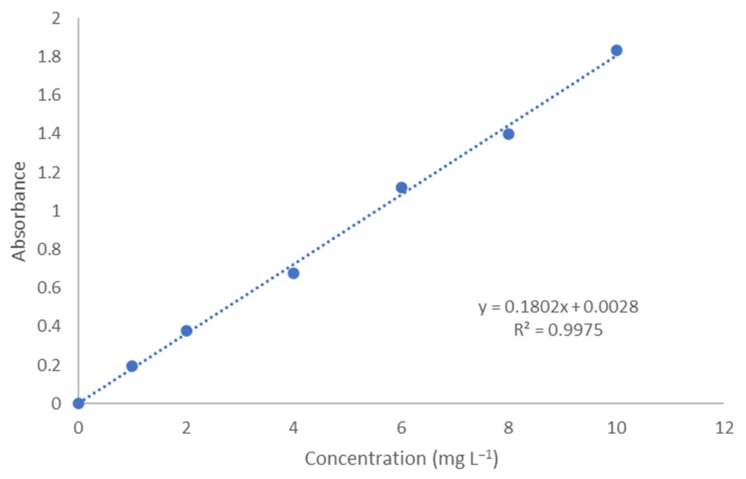
To assess the color removal performance, a methylene blue (MB) solution was selected as a model dye compound. A stock solution of MB (50 mg L−1) was first prepared. Standard dilutions (0, 1, 2, 4, 6, 8, and 10 mg L−1) were then used to construct a calibration curve [19]. The absorbance of each standard was measured using UV-Vis spectrophotometry at 664 nm. The resulting calibration curve (R2 = 0.9975), shown in Figure 1, was used to determine the residual dye concentrations after treatment.
Coagulation–flocculation experiments were conducted using a standardized Jar Test apparatus. For each assay, 50 mL of a 10 mg L−1 MB solution was transferred into a jar. The natural coagulant was added at dosages of 0.5, 1.0, and 1.5 mL. The samples were rapidly stirred at 300 rpm for 3 min to ensure homogeneous coagulant dispersion. This was followed by slow stirring at 60 rpm for 20 min to promote floc formation. Finally, a 1 h settling period was allowed for floc sedimentation [19]. After settling, the supernatant samples were collected, and the residual MB concentration was quantified using UV–Vis spectrophotometry at 664 nm.
The color removal efficiency (%) was calculated using Equation (1), based on absorbance measurements before and after treatment [19].
C o l o r   R e m o v a l   ( % ) = C i C f C i × 100
where C i and C f correspond to the initial and final color values, respectively.

3. Results

3.1. Statistical Analysis and Model Significance

To determine whether the extraction parameters significantly influenced methylene blue removal, the data were subjected to an analysis of variance (ANOVA). Table 2 summarizes the ANOVA results, including the coefficient of determination (R2), the adjusted R2, and the lack of fit.
The model exhibited an R2 of 67.10%, indicating that approximately two-thirds of the variability in methylene blue removal can be explained by the quadratic model. However, the adjusted R2 was substantially lower (7.88%), indicating limited predictive power. The overall quadratic model was not statistically significant (F = 1.13, p = 0.470). This indicates that the statistical model could not properly explain how the variables affected color removal.
The lack-of-fit test, calculated from the five center-point replicates, was not significant (p = 0.856), indicating no significant evidence of lack of fit within the experimental data. However, the non-significant overall model (p = 0.470) indicates that the investigated variables did not exert measurable effects within the tested ranges. This suggests process tolerance to operational variations rather than a failure of the experimental design.
The non-significant quadratic model indicates that no statistically significant relationship was identified between the investigated extraction variables and color removal efficiency within the evaluated experimental domain. This result suggests that, under the selected operating conditions, variations in chestnut shell mass, extraction pH, and extraction time did not substantially affect the performance of the modified coagulant. This may be attributed either to the relatively narrow factor ranges investigated or to the influence of additional variables, such as NaOH concentration, extraction temperature, solid-to-liquid ratio, or cationization conditions, which were not included in the present experimental design. Therefore, the Box–Behnken Design should be regarded as a preliminary evaluation of the investigated operating window rather than as a successful optimization of the extraction process.

3.2. Effects of Extraction Variables on Color Removal

A Box–Behnken Design comprising 17 experimental runs was employed to evaluate the influence of three extraction parameters on the color removal efficiency of the chestnut shell coagulant. The response variable was the percentage of methylene blue (MB) removed after coagulation–flocculation, as described in Section 2.
The relationship between MB removal and chestnut shell mass (x1), pH (x2), and extraction time (x3) was investigated by fitting a quadratic response surface model to the experimental data. The estimated coefficients and significance levels of the model terms are listed in Table 3.
Because the quadratic model was not statistically significant, the regression coefficients were not used to infer directional effects or favorable extraction conditions. The observed experimental data are therefore presented descriptively, without treating the apparent differences among factor levels as statistically established effects.
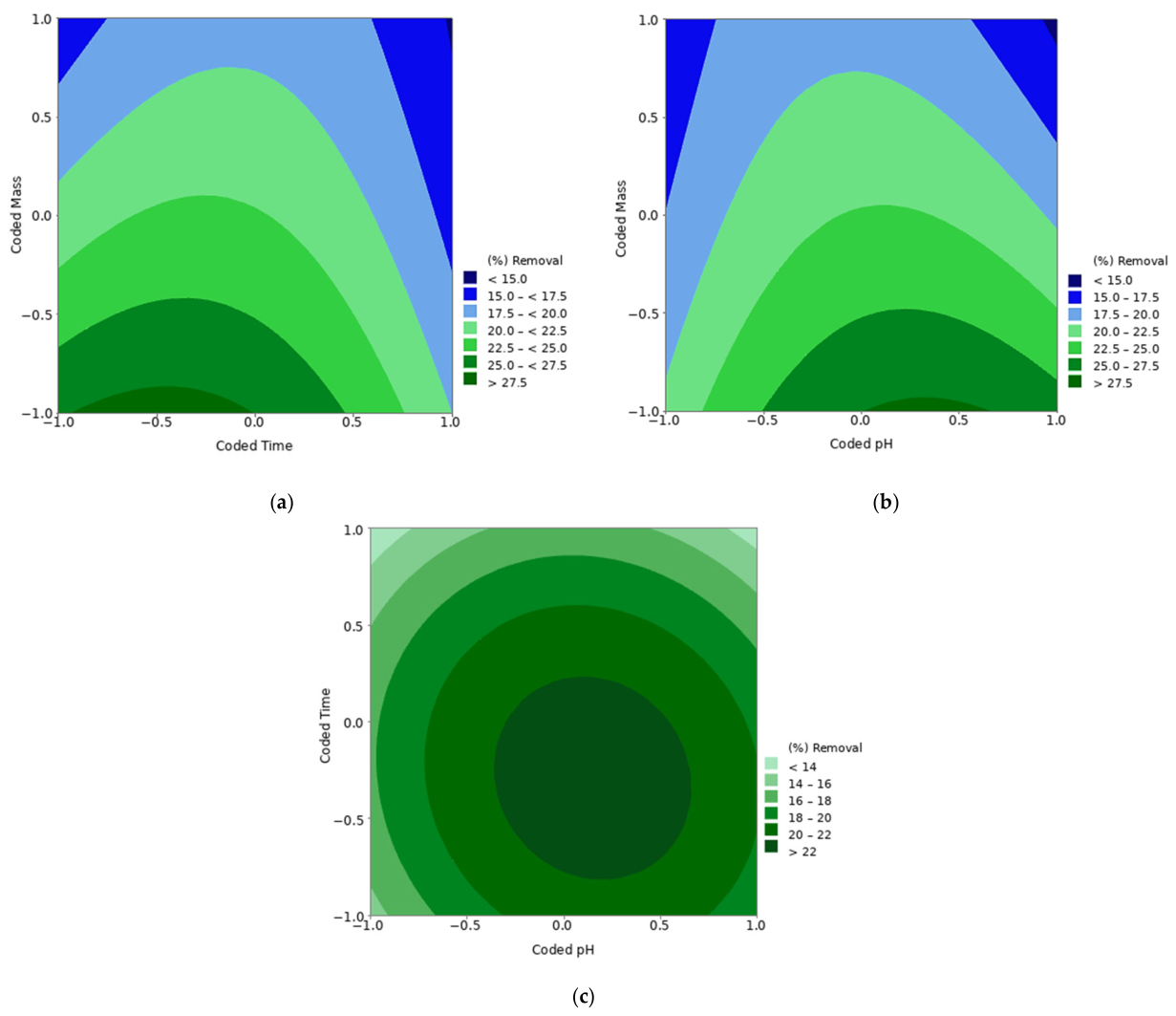
To visually explore the effect of the extraction parameters on MB removal, contour plots were generated based on the experimental data trends. Figure 2a illustrates the empirical distribution of chestnut shell mass and extraction time. Figure 2b presents the interaction between mass and pH. Figure 2c displays the trend profile for extraction pH and time.
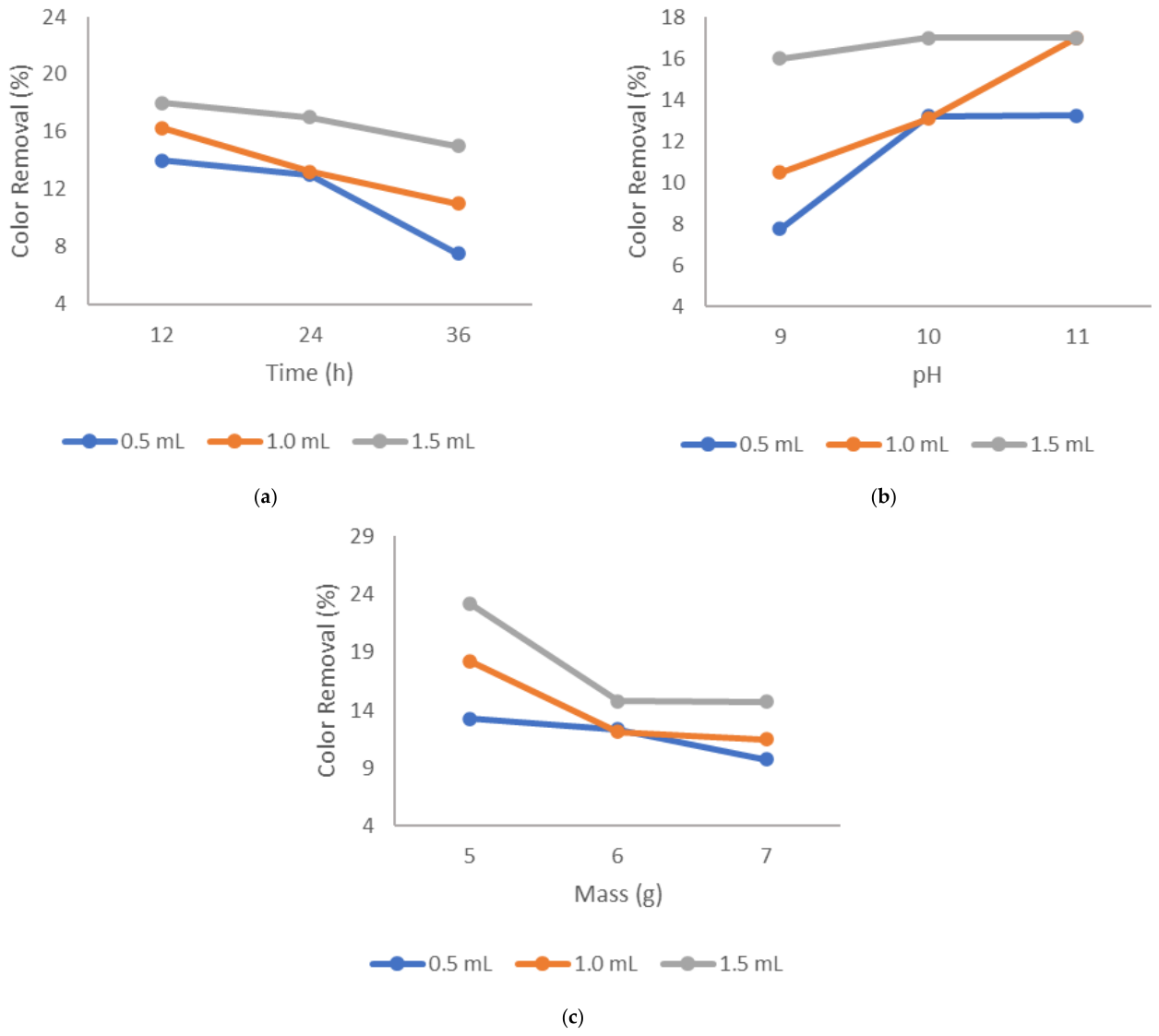
To further explore the effects of the individual extraction parameters, experimental trend plots were constructed directly from the observed data. This approach was adopted because the quadratic model was not statistically significant. Figure 3a–c present the mean color removal obtained at the different levels of extraction time, pH and shell mass for each coagulant dosage. The mean values were calculated from the experimental measurements corresponding to each level of the respective variable. The associated standard deviations and sample sizes (n) are provided in Table A2.
These graphical representations support the trends observed in the contour plots. The experimental data showed lower color removal values at 36 h than at 12 h across the tested coagulant dosages. Regarding extraction pH, higher color removal values were observed at pH 11 compared with pH 9 across the tested coagulant dosages. For chestnut shell mass, at a coagulant dosage of 1.5 mL, color removal was 23.3% at 5 g and 14.7% at 7 g. However, these observed differences were not statistically confirmed by the quadratic model (p = 0.470).

3.3. Coagulant Performance for Color Removal

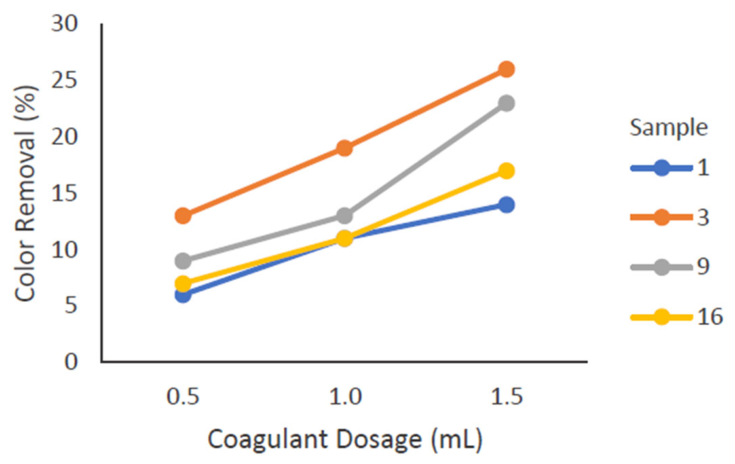
The experimental conditions and corresponding color-removal results for the 17 Box–Behnken Design runs are provided in Table A1. The efficiency of the chestnut shell coagulant in removing color was assessed using methylene blue (MB) as a model dye. As shown in Figure 4, increasing the coagulant dosage from 0.5 to 1.5 mL consistently improved color removal, with the highest efficiency ranging from 20% to 26%.
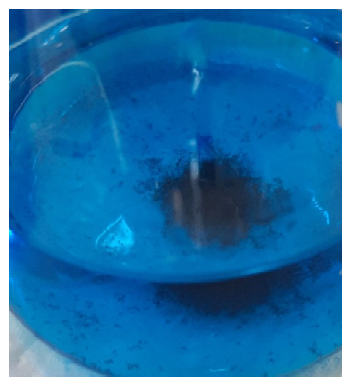
A visible precipitate was formed upon the addition of the chestnut shell coagulant to the methylene blue solution (Figure 5).
These findings are further interpreted in the following discussion, where the removal mechanisms, comparison with the literature, and implications for wastewater treatment are addressed.

4. Discussion

4.1. Interpretation of Statistical Limitations

The lack of statistical significance (p = 0.470) indicates that the studied variables did not collectively exert a measurable influence on MB removal within the tested range. The low adjusted R2 (7.88%) suggests that a substantial fraction of the variability is attributable either to experimental noise or to external variables not captured by the experimental design. The lack-of-fit test was not significant (p = 0.856), indicating that no statistically significant lack of fit was detected; however, this does not establish that the model or its individual coefficients adequately explain the response.
Accordingly, the present BBD should be regarded as a preliminary evaluation of the selected experimental domain rather than as a successful optimization. The apparent differences observed among the tested factor levels are therefore considered descriptive experimental trends and cannot be interpreted as statistically validated effects.
This lack of statistical significance suggests that the selected experimental ranges (5–7 g, pH 9–11, and 12–36 h) are within a region where changes in these parameters do not produce significant differences in coagulant performance. Another possibility is that other substances extracted from the chestnut shells interfered with the process, making it difficult to determine the true effect of each variable. Furthermore, other process variables not included in the present experimental design, such as NaOH concentration, extraction temperature, solid-to-liquid ratio, or cationization conditions, may exert a greater influence on the properties of the modified coagulant. These variables should be considered in future optimization studies.
Finally, a structural limitation inherent to the Box–Behnken Design must be considered. Although efficient in reducing the number of runs, this design offers few degrees of freedom for estimating the experimental error. Therefore, if the true variable effects were weak or the data show high variability, the model may not have had enough statistical power to reach significance.

4.2. Methylene Blue Removal Mechanism

The moderate color removal observed in this study (20–26%) can be explained by the distinct interaction mechanism between the cationic coagulant and the MB dye. Because both the modified tannin and methylene blue are predominantly positively charged, electrostatic repulsion limits direct charge neutralization between the coagulant and dye molecules. Consequently, lower color removal efficiencies are expected than in systems involving anionic dyes, for which favorable electrostatic attraction enhances coagulation. Under these conditions, as proposed by Beltrán-Heredia et al. [36], polymeric bridging may be the predominant removal mechanism. The high molecular weight of the tannin chains can physically entrap MB molecules, promoting the formation of aggregates that settle over time [36].
In this process, only a part of the polymer chain attaches to a particle. The remaining free portions form loops and tails that allow attachment to other particles, thereby promoting the formation of larger flocs [37]. This process continues as free tails bind to other colloids, increasing aggregate size and facilitating sedimentation, which requires an adequate coagulant dosage to provide sufficient free surface for effective bridging [37].
Although the exact composition of the precipitate observed during the experiments (Figure 5) was not determined, its formation may provide indirect evidence of polymeric bridging through the formation of dye–coagulant aggregates.

4.3. Comparison with the Literature

The performance of the chestnut shell coagulant was compared with that of previously reported tannin-based coagulants for color removal (Table 4). Although direct comparisons are challenging because of variations in dye type, coagulant dosage, and experimental conditions, some trends can be identified.
The observed MB removal (20–26%) is comparable to or higher than that of some unmodified natural coagulants (e.g., 10% for Moringa oleifera water extract). However, it is lower than that of modified tannins applied to anionic dyes (e.g., ~40–70% for Sirius Blue).
The higher removal rates reported for Sirius Blue K-CFN (10–70%) [29] compared to methylene blue (20–26%) in this study may be attributed to the different ionic nature of the dyes. Sirius Blue K-CFN is an anionic dye, whereas methylene blue is a cationic dye. The cationized chestnut shell coagulant, which is predominantly positively charged, is expected to attract and neutralize anionic dyes, leading to higher removal efficiencies. In contrast, the removal of cationic methylene blue is hindered by electrostatic repulsion, suggesting that polymeric bridging may be the predominant mechanism, as discussed in Section 4.2. Therefore, the lower removal efficiency observed in the present study should be interpreted in light of the different interaction mechanisms between the cationized coagulant and the dye molecules rather than as an intrinsic limitation of the chestnut-shell-derived coagulant itself. The higher removal reported for anionic dyes highlights the need for future studies evaluating chestnut shell-derived coagulants against anionic dyes under comparable experimental conditions.
Sánchez-Martín and Beltrán-Heredia [32] reported that no methylene blue removal was achieved using Moringa oleifera seed extract. They attributed this behavior to the cationic nature of the dye, which limits destabilization by cationic biopolymers and protein-based flocculants. However, Azura et al. [38] achieved MB removal (70%) using Moringa oleifera extracted with 1 M NaCl. This suggests that dye removal efficiency depends on the experimental conditions, extraction procedures, and coagulant characteristics.
Furthermore, Grenda et al. [43] reported that a tannin-based coagulant from Acacia mearnsii was ineffective for color removal in some cases, achieving satisfactory results only when combined with bentonite and a flocculant. This indicates that synergistic systems may be required for challenging dyes such as MB.
Although the color removal efficiency obtained in this study was lower than that reported for some natural coagulants, these comparisons should be interpreted with caution because coagulation performance depends on several factors, including dye chemistry, extraction procedure, coagulant modification, dosage, and operating conditions. Moreover, the present study provides an exploratory assessment of the behavior of a chestnut shell-derived coagulant toward a challenging cationic dye and identifies opportunities for further optimization of the extraction and cationization processes. In addition, the use of an abundant agro-industrial residue as the coagulant precursor supports waste valorization and contributes to circular economy strategies.

4.4. Contrast with Turbidity Removal Performance

The performance of the chestnut shell coagulants for turbidity removal was also evaluated using the same chestnut shell coagulant, produced under identical extraction and modification procedures. The turbidity results showed substantially higher removal efficiencies under selected experimental conditions, reaching up to 96% (Table A3).
These results provide a useful contrast with the moderate methylene blue removal observed in the present study. Turbidity removal can involve charge neutralization and floc formation, whereas methylene blue removal may be affected by the electrostatic characteristics of the dye and the coagulant, as discussed in Section 4.2.
Therefore, the moderate performance observed for methylene blue should not necessarily be interpreted as a general limitation of the proposed coagulant, but rather as a consequence of the physicochemical characteristics of the target pollutant. For applications requiring color removal, additional optimization strategies may be necessary. These could include adjusting the extraction conditions or employing synergistic systems to enhance color removal performance and broaden its applicability in wastewater treatment. Although the present study demonstrates the feasibility of producing a natural coagulant from chestnut shell residues, additional studies are required to improve its color removal efficiency, validate its performance using real industrial effluents, and further elucidate its coagulation mechanisms through comprehensive physicochemical characterization, including spectroscopic analyses, zeta potential measurements, and charge density determinations. Such investigations will contribute to assessing its practical applicability as a sustainable alternative to conventional coagulants.

5. Conclusions

This study demonstrated the technical feasibility of converting chestnut shells (Castanea sativa), an underutilized agro-industrial byproduct, into a functional biocoagulant for dye removal from textile effluents. From a methodological perspective, the Box–Behnken Design (BBD) provided fundamental insights into the alkaline extraction of active polyphenolic compounds. Although the quadratic model did not achieve statistical significance, relatively consistent decolorization efficiencies were observed within the investigated experimental ranges. These findings suggest that small variations in biomass loading, extraction time (12–36 h), and pH (9–11) did not markedly affect coagulant performance under the evaluated conditions.
In terms of separation performance, the modified biopolymer achieved methylene blue removal efficiencies ranging from 20 to 26%. This result should be interpreted as an exploratory assessment under an unfavorable dye–coagulant charge combination, rather than as an indication of the maximum color-removal potential of the material. Further studies using anionic dyes and real industrial effluents are required to comprehensively evaluate its coagulation performance. Despite the modest color removal obtained under the investigated conditions, the use of chestnut shells as a coagulant precursor contributes to agro-industrial waste valorization and circular economy principles. Additionally, this study exemplifies the potential for regional industrial integration in Northern Portugal by valorizing an abundant agricultural residue for potential application in wastewater treatment. These aspects are aligned with the United Nations Sustainable Development Goals and directly respond to the targets of SDG 6 (Clean Water and Sanitation), SDG 9 (Industry, Innovation and Infrastructure), and SDG 12 (Responsible Consumption and Production). This study reinforces the potential of chestnut shell residues as a sustainable source of natural coagulants, in alignment with circular economy principles.
To overcome the thermodynamic stability of highly soluble pollutants such as methylene blue, future studies should explore synergistic multi-component systems. These could include combining chestnut extract with bentonite clay or other mineral flocculants. Furthermore, given that tannin-derived polymers are historically recognized for their effectiveness in destabilizing colloidal matter, the transition of these assays to real and complex textile matrices is encouraged for future studies. This will allow the main focus to be redirected to reducing total suspended solids and eliminating turbidity. These are scenarios where the environmental and economic potential of this natural agent may be more fully realized.

Author Contributions

Conceptualization: R.M.; Methodology: J.V. and R.M.; Software: J.V.; Validation: J.M.T.d.A.P. and R.M.; Formal Analysis: J.V.; Investigation: J.V.; Resources: R.M.; Data Curation: J.V.; Writing—Original Draft Preparation: J.V.; Writing—Review and Editing: J.M.T.d.A.P. and R.M.; Visualization: J.V.; Supervision: J.M.T.d.A.P. and R.M.; Project Administration: R.M.; Funding Acquisition: R.M. All authors have read and agreed to the published version of the manuscript.

Funding

The Base Funding UIDB/00690/2020 of the Centro de Investigação de Montanha (CIMO), funded by national funds through FCT/MCTES (PIDDAC).

Data Availability Statement

The original contributions presented in this study are included in the article. Further inquiries can be directed to the corresponding author.

Acknowledgments

The authors thank the Base Funding UIDB/00690/2020 of the Centro de Investigação de Montanha (CIMO), funded by national funds through FCT/MCTES (PIDDAC). The authors thank the Superior School of Technology and Management, Bragança Polytechnic University, Portugal, for their support.

Conflicts of Interest

The authors declare no conflicts of interest.

Abbreviations

The following abbreviations are used in this manuscript:
ANOVAAnalysis of Variance
ATPAssociação Têxtil e Vestuário de Portugal
BBDBox–Behnken Design
BODBiochemical Oxygen Demand
CODChemical Oxygen Demand
MBMethylene Blue
MSMannich Solution
RSMResponse Surface Methodology
UV-VisUltraviolet–Visible

Appendix A

Table A1. Experimental conditions and color-removal results for the 17 runs of the Box–Behnken Design.
RunTimeMasspHColor Removal (%)
1126914
21261118
31251026
41271019
5245923
62451128
7247914
82471112
92461023
102461015
112461013
122461013
132461013
14366913
153661114
163651017
173671016
Table A2. Mean color removal, standard deviation and sample size for the data presented in Figure 3.
VariableLevelCoagulant Dosage (mL)MeanSDn
Time12 h0.5145.944
Time12 h1163.594
Time12 h1.5185.474
Time24 h0.5137.919
Time24 h1136.079
Time24 h1.5175.679
Time36 h0.580.574
Time36 h1110.814
Time36 h1.5151.824
Mass5 g0.5136.344
Mass5 g1187.274
Mass5 g1.5234.54
Mass6 g0.5127.59
Mass6 g1122.149
Mass6 g1.5153.199
Mass7 g0.5106.234
Mass7 g1124.934
Mass7 g1.5152.214
pH90.582.364
pH91113.694
pH91.5164.694
pH100.5137.209
pH101133.219
pH101.5174.609
pH110.5137.974
pH111177.784
pH111.5176.784
Table A3. Selected turbidity-removal results obtained with chestnut shell coagulants.
RunInitial Turbidity
(NTU)
Settling Time (min)Final Turbidity (NTU)Removal (%)
42429018.592
142809012.296
15243909.696

References

  1. UN-Water. The United Nations World Water Development Report 2024: Water for Prosperity and Peace; UNESCO: Paris, France, 2024; Available online: https://www.unwater.org/publications/un-world-water-development-report-2024 (accessed on 11 June 2026).
  2. United Nations. Transforming Our World: The 2030 Agenda for Sustainable Development; United Nations: New York, NY, USA, 2015; A/RES/70/1; Available online: https://sdgs.un.org/2030agenda (accessed on 25 June 2026).
  3. UN-Water. The United Nations World Water Development Report 2019: Leaving No One Behind; UNESCO: Paris, France, 2019; Available online: https://www.unwater.org/publications/un-world-water-development-report-2019 (accessed on 11 June 2026).
  4. Tortajada, C.; Radcliffe, J.C.; van Rensburg, P. Sustainable water reuse for water security. Environ. Res. Lett. 2025, 20, 021003. [Google Scholar] [CrossRef] [Scilit]
  5. European Investment Bank. Wastewater as a Resource; EIB: Luxembourg, 2022; Available online: www.eib.org/attachments/publications/wastewater_as_a_resource_en.pdf (accessed on 11 June 2026).
  6. Schwarzenbach, R.P.; Escher, B.I.; Fenner, K.; Hierl, B.; Ankley, G.T. The challenge of micropollutants in aquatic systems. Science 2006, 313, 1072–1077. [Google Scholar] [CrossRef] [Scilit]
  7. OECD. Improving Water Management: Achieving the Millennium Development Goals; OECD Publishing: Paris, France, 2003; Available online: https://www.oecd.org/content/dam/oecd/en/publications/reports/2003/02/improving-water-management_g1gh2f36/9789264099500-en.pdf (accessed on 11 June 2026).
  8. Nabwey, H.A.; Tony, M.A. Reimagining textile effluent treatment using metal–organic framework-based hybrid catalysts: A critical review. Catalysts 2026, 16, 355. [Google Scholar] [CrossRef] [Scilit]
  9. Islam, M.M.; Aidid, A.R.; Mohshin, J.N.; Mondal, H.; Ganguli, S.; Chakraborty, A.K. A critical review on textile dye-containing wastewater: Ecotoxicity, health risks, and remediation strategies for environmental safety. Clean. Chem. Eng. 2025, 11, 100165. [Google Scholar] [CrossRef] [Scilit]
  10. Verma, A.K.; Dash, R.R.; Bhunia, P. A review on chemical coagulation/flocculation technologies for removal of colour from textile wastewaters. J. Environ. Manag. 2011, 93, 154–168. [Google Scholar] [CrossRef] [Scilit]
  11. Katheresan, V.; Kansedo, J.; Lau, S.Y. Efficiency of various recent wastewater dye removal methods: A review. J. Environ. Chem. Eng. 2018, 6, 4676–4697. [Google Scholar] [CrossRef] [Scilit]
  12. Khandelwal, S. Unveiling the impact of dyes on aquatic ecosystems through zebrafish—A comprehensive review. Environ. Sci. Pollut. Res. 2024, 31, 14500–14515. [Google Scholar] [CrossRef] [Scilit]
  13. Wainwright, M. Dyes in the development of drugs and pharmaceuticals. Dye. Pigm 2008, 76, 582–589. [Google Scholar] [CrossRef] [Scilit]
  14. Nunes, L.J.R.; Matias, J.C.O.; Catalão, J.P.S. Analysis of the use of biomass as an energy alternative for the Portuguese textile dyeing industry. Energy 2015, 84, 134–143. [Google Scholar] [CrossRef] [Scilit]
  15. Associação Têxtil e Vestuário de Portugal (ATP). Homepage. Available online: https://atp.pt/pt-pt/ (accessed on 11 June 2026).
  16. Lellis, B.; Fávaro-Polello, C.Z.; Pamphile, J.A.; Polello, J.C. Effects of textile dyes on health and the environment and bioremediation potential of living organisms. Biocatal. Agric. Biotechnol. 2019, 22, 101375. [Google Scholar] [CrossRef] [Scilit]
  17. Nguyen, T.A.; Juang, R.S. Treatment of waters and wastewaters containing sulfur dyes: A review. Chem. Eng. J. 2013, 219, 109–117. [Google Scholar] [CrossRef] [Scilit]
  18. Dutta, S.; Bhattacharya, A.; Bhattacharya, S. Contamination of textile dyes in aquatic environment: Adverse impacts on aquatic ecosystem and human health, and its management using bioremediation. J. Environ. Manag. 2024, 353, 120103. [Google Scholar] [CrossRef] [Scilit]
  19. Zourif, A.; Benbiyi, A.; Kouniba, S.; El Bouchti, M.; Tahiri, S. Valorization of walnut husks as a natural coagulant for optimized water decolorization. Arab. J. Chem. 2023, 17, 105399. [Google Scholar] [CrossRef] [Scilit]
  20. Adegoke, K.A.; Bello, O.S. Dye sequestration using agricultural wastes as adsorbents. Water Resour. Ind. 2015, 12, 8–24. [Google Scholar] [CrossRef] [Scilit]
  21. Tomasi, I.T.; Ferreira, R.M.; Boaventura, R.A.R.; Botelho, C.M.S. Natural coagulants from chestnut shells: A sustainable approach for textile wastewater treatment. Chemosphere 2025, 376, 144286. [Google Scholar] [CrossRef] [Scilit]
  22. Prodanović, J.M.; Nastić, N.M.; Šćiban, M.B.; Lukić, D.V.; Vasić, V.M.; Blagojev, N.T. An Investigation into the Factors Influencing the Effectiveness of a Biodegradable Natural Coagulant Derived from Phaseolus vulgaris Seeds and Coagulation Mechanism. Sustainability 2025, 17, 1372. [Google Scholar] [CrossRef] [Scilit]
  23. Ibrahim, A.; Yaser, A.Z.; Lamaming, J. Synthesising tannin-based coagulants for water and wastewater application: A review. J. Environ. Chem. Eng. 2020, 9, 105007. [Google Scholar] [CrossRef] [Scilit]
  24. Tomasi, I.T.; Boaventura, R.A.R.; Botelho, C.M.S. Environmental impact assessment of tannin-based coagulants production from chestnut shells. J. Environ. Manag. 2025, 382, 125346. [Google Scholar] [CrossRef] [Scilit]
  25. Kim, H.; Kim, J.; Cho, J.A.; Han, I. Effect of boiling and extraction methods using water or 80% ethanol on the physiological activities of the inner shell of chestnut (Castanea crenata). Food Chem. X 2025, 31, 103017. [Google Scholar] [CrossRef] [Scilit]
  26. Aguilar, C.N.; Rodríguez, R.; Gutiérrez-Sánchez, G.; Augur, C.; Favela-Torres, E.; Prado-Barragan, L.A.; Ramírez-Coronel, A.; Contreras-Esquivel, J.C. Microbial tannases: Advances and perspectives. Appl. Microbiol. Biotechnol. 2007, 76, 47–59. [Google Scholar] [CrossRef] [Scilit]
  27. Tomasi, I.T.; Santos, S.C.R.; Boaventura, R.A.R.; Botelho, C.M.S. Optimization of microwave-assisted extraction of phenolic compounds from chestnut processing waste using response surface methodology. J. Clean. Prod. 2023, 395, 136452. [Google Scholar] [CrossRef] [Scilit]
  28. Tomasi, I.T.; Boaventura, R.A.R.; Botelho, C.M.S. Comparative study of natural and chemical coagulants for continuous-flow treatment of textile wastewater. Chem. Eng. Sci. 2025, 320, 122476. [Google Scholar] [CrossRef] [Scilit]
  29. Tomasi, I.T.; Moreira, I.S.; Boaventura, R.A.R.; Botelho, C.M.S. Glyoxal-modified chestnut tannins as sustainable coagulants for textile wastewater treatment. J. Water Process Eng. 2026, 82, 109523. [Google Scholar] [CrossRef] [Scilit]
  30. Banwan Hasan, M.; Benwan Hassan, A.; Al-Tameemi, I.M.; Banwan Hassan, N. Performance of Natural Coagulant Extracted from Castanea Sativa Tree Leaves in Water Purification processes. Pollution 2024, 10, 299–312. [Google Scholar] [CrossRef]
  31. Carlqvist, K.; Arshadi, M.; Mossing, T.; Shchukarev, A.; Järnström, R.; Budarin, V.L.; Clark, J.H.; de la Motte, H. Life-cycle assessment of the production of cationized tannins from Norway spruce bark as flocculants in wastewater treatment. Biofuels Bioprod. Biorefin. 2020, 14, 1270–1285. [Google Scholar] [CrossRef] [Scilit]
  32. Sánchez-Martín, J.; Beltrán-Heredia, J. Nature is the answer: Water and wastewater treatment by new natural-based agents. In Advances in Water Treatment and Pollution Prevention; Sharma, S., Sanghi, R., Eds.; Springer: Dordrecht, The Netherlands, 2012; pp. 346–350. [Google Scholar] [CrossRef] [Scilit]
  33. Bello, A.; Leiviskä, T. Sustainable tannin-based coagulants synthesized through Mannich reaction using melamine as an amine source for water treatment applications. Ind. Crops Prod. 2021, 176, 114336. [Google Scholar] [CrossRef] [Scilit]
  34. Slimani, C.; Fadil, M.; Rais, C.; El-hanafi, L.; Benjelloun, M.; Shin, H.-M.; Giesy, J.P.; Lazraq, A.; Abulmeaty, M.M.A.; Almutairi, K.M.; et al. Extraction of natural antioxidants from Moroccan saffron (Crocus sativus L.) using ultrasound-assisted extraction: An optimization approach with box-behnken design. Ultrason. Sonochem. 2025, 120, 107448. [Google Scholar] [CrossRef] [Scilit]
  35. Alam, P.; Siddiqui, N.A.; Rehman, M.T.; Hussain, A.; Akhtar, A.; Mir, S.R.; Alajmi, M.F. Box–Behnken Design (BBD)-Based Optimization of Microwave-Assisted Extraction of Parthenolide from the Stems of Tarconanthus camphoratus and Cytotoxic Analysis. Molecules 2021, 26, 1876. [Google Scholar] [CrossRef] [Scilit]
  36. Beltrán-Heredia, J.; Sánchez-Martín, J.; Martín-Sánchez, C. Remediation of Dye-Polluted solutions by a new Tannin-Based coagulant. Ind. Eng. Chem. Res. 2010, 50, 686–693. [Google Scholar] [CrossRef] [Scilit]
  37. Kurniawan, S.B.; Abdullah, S.R.S.; Imron, M.F.; Said, N.S.M.; Ismail, N.’I.; Hasan, H.A.; Othman, A.R.; Purwanti, I.F. Challenges and Opportunities of Biocoagulant/Bioflocculant Application for Drinking Water and Wastewater Treatment and Its Potential for Sludge Recovery. Int. J. Environ. Res. Public Health 2020, 17, 9312. [Google Scholar] [CrossRef] [Scilit]
  38. Azura, Z.N.N.W.; Fahmi, M.R.; Afiza, M.S.; Lim, S.L. Study of Methylene Blue Color Removal Effectiveness by Moringa oleifera and Alum. In Proceedings of the 2nd International Malaysia-Ireland Joint Symposium on Engineering, Science and Business, Kuala Lumpur, Malaysia, 18–20 June 2012. [Google Scholar]
  39. Ayat, A.; Arris, S.; Abbaz, A.; Aissaoui, H. The removal of methylene blue and COD by coagulation using cactus. Alger. J. Eng. Res. 2022, 5, 1–6. [Google Scholar]
  40. Shamsnejati, S.; Chaibakhsh, N.; Pendashteh, A.R.; Hayeripour, S. Mucilaginous seed of Ocimum basilicum as a natural coagulant for textile wastewater treatment. Ind. Crops Prod. 2015, 69, 40–47. [Google Scholar] [CrossRef] [Scilit]
  41. Vijayaraghavan, G.; Shanthakumar, S. Performance study on algal alginate as natural coagulant for the removal of Congo red dye. Desalin. Water Treat. 2015, 57, 6384–6392. [Google Scholar] [CrossRef] [Scilit]
  42. Kristianto, H.; Kurniawan, M.A.; Soetedjo, J.N.M. Utilization of Papaya Seeds as Natural Coagulant for Synthetic Textile Coloring Agent Wastewater Treatment. Int. J. Adv. Sci. Eng. Inf. Technol. 2018, 8, 2071–2077. [Google Scholar] [CrossRef] [Scilit]
  43. Grenda, K.; Arnold, J.; Hunkeler, D.; Gamelas, J.A.F.; Rasteiro, M.G. Tannin-based Coagulants from Laboratory to Pilot Plant Scales for Coloured Wastewater Treatment. BioResources 2018, 13, 2727–2747. [Google Scholar] [CrossRef] [Scilit]
Figure 1. Calibration curve for methylene blue at 664 nm.
Cleantechnol 08 00156 g001
Figure 2. Contour plots showing the combined effects of: (a) chestnut shell mass and extraction time; (b) chestnut shell mass and extraction pH; (c) extraction pH and time on methylene blue removal (%).
Cleantechnol 08 00156 g002
Figure 3. Experimental trend plots showing the effect of individual extraction parameters on color removal at different coagulant dosages (0.5, 1.0, and 1.5 mL): (a) extraction time; (b) extraction pH; (c) chestnut shell mass.
Cleantechnol 08 00156 g003
Figure 4. Color removal efficiency of selected chestnut shell extracts (samples 1, 3, 9, and 16) at different coagulant dosages. Each point represents an individual experimental measurement.
Cleantechnol 08 00156 g004
Figure 5. Visual appearance of precipitate formation during MB removal using the chestnut shell coagulant.
Cleantechnol 08 00156 g005
Table 1. Extraction parameters and corresponding variable codes used in the experimental design.
FactorCodeLow (−1)Central (0)High (+1)
Chestnut mass (g)x1567
Extraction pHx291011
Extraction time (h)x3122436
Table 2. Statistical indicators and ANOVA results for the quadratic model of methylene blue removal.
R2
[%]
R2 (adj.)
[%]
SourceDegrees of FreedomSum of Squares (adj.)Mean Square (adj.)F-Valuep-Value
67.107.88Model9316.98335.221.130.47
Lack-of-fit342.7514.250.250.856
Table 3. Regression coefficients and statistical significance of the quadratic model for methylene blue removal.
TermCoded Coefficientp-Value
x1 (mass)−4.130.091
x2 (pH)10.634
x3 (time)−2.130.33
x120.670.827
x22−4.080.218
x32−3.830.244
x1x2−1.750.558
x1x31.50.614
x2x3−0.750.799
Table 4. Comparison of color removal efficiencies reported in the literature for tannin-based coagulants.
Tannin SourcePreparationDyeRemoval (%)Reference
Castanea sativaNaOH extract + Mannich reaction (formaldehyde + NH4Cl)Methylene blue20–26This study
Castanea sativaWater extract + Mannich reaction (glyoxal + NH4Cl)Sirius Blue K-CFN10–70[29]
Moringa oleiferaWater extractMethylene blue10[38]
Moringa oleiferaNaCl extractMethylene blue70[38]
Moringa oleiferaWater extractMethylene blue0[32]
Cactus (Opuntia ficus indica)PowderMethylene blue57[39]
Ocimum basilicumMucilage (water extract)Congo red68.5[40]
Algae (Sargassum sp.)Alginate extraction (acidification, alkaline extraction, precipitation with ethanol)Congo red96[41]
Papaya seedsPowderDrimarene dark red84.7[42]
Disclaimer/Publisher’s Note: The statements, opinions and data contained in all publications are solely those of the individual author(s) and contributor(s) and not of MDPI and/or the editor(s). MDPI and/or the editor(s) disclaim responsibility for any injury to people or property resulting from any ideas, methods, instructions or products referred to in the content.