This is an early access version, the complete PDF, HTML, and XML versions will be available soon.
Article

Solid Pellet Biofuel Made from Coffee Grounds: Experimental and Environmental Analysis

by
Ana Cecilia Revelo-Rodríguez
1,*,
Fabiana Altimari
2,
María Teresa Cotes-Palomino
1,
Carmen Martínez-García
1 and
Ana B. López
1
1
Department of Chemical, Environmental and Materials Engineering, Higher Polytechnic School of Linares, University of Jaen, Scientific and Technological Campus of Linares, 23700 Linares, Spain
2
Department of Engineering “Enzo Ferrari”, University of Modena and Reggio Emilia, via Vivarelli, 10, 41125 Modena, Italy
*
Author to whom correspondence should be addressed.
Clean Technol. 2026, 8(5), 154; https://doi.org/10.3390/cleantechnol8050154

Submission received: 26 June 2026 / Revised: 13 August 2026 / Accepted: 14 September 2026 / Published: 16 September 2026

Abstract

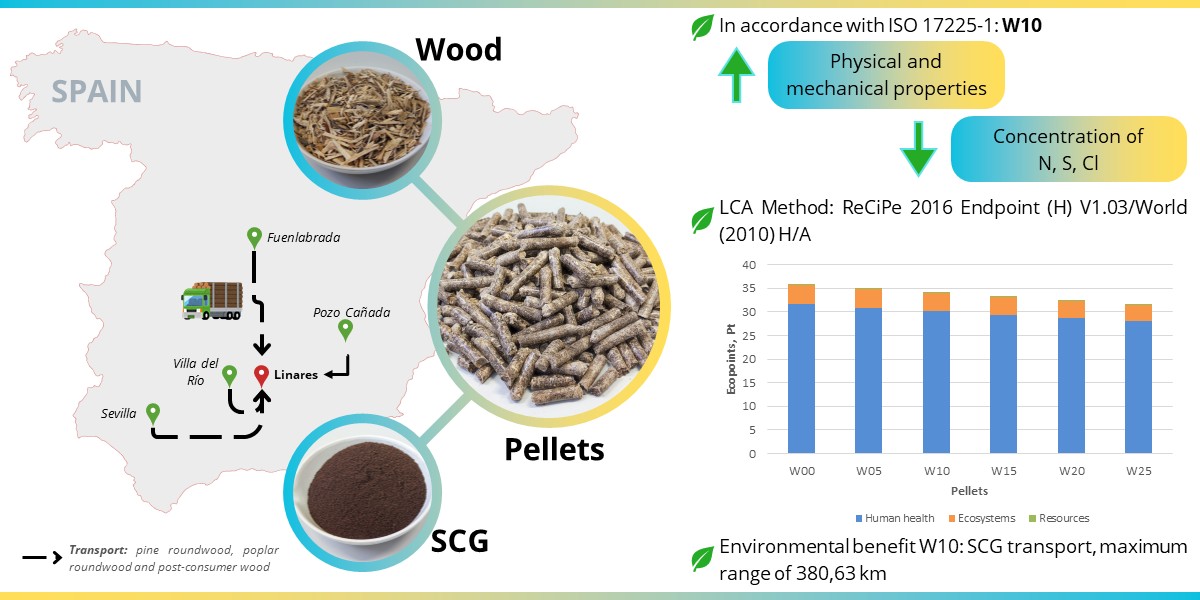
Spent coffee grounds (SCGs) are a waste product generated in large volumes worldwide, given that coffee is the second most consumed beverage on the planet. Although it typically ends up in landfills, this biomass contains a high amount of nutrients, organic compounds, and other physical properties that can be harnessed. It is possible to recover energy from coffee grounds through pellet production because this biomass has a calorific value ranging from 19.6 to 21.1 MJ/kg—values comparable to, and even higher than, those of traditional fuel biomasses, such as pine sawdust (18.64 MJ/kg) or eucalyptus wood (17.38 MJ/kg). To produce the pellets, different formulations were prepared by incorporating up to 25% SCGs and up to 80% recycled woody material, depending on the specific formulation, followed by the addition of the 5% additive. All proportions were expressed as percentages of the total biomass mixture mass. The resulting pellets were characterized in accordance with ISO 17225-1 and have been classified as Type B non-woody pellets. Given that bioenergy derived from waste plays a fundamental role in climate change mitigation and the circular economy, a cradle-to-gate life cycle assessment was conducted using the ReCiPe 2016 Endpoint method. The results revealed that the pellets containing SCGs were more environmentally friendly.
Keywords: spent coffee grounds; solid pellet biofuel; biomass pellets; life cycle assessment; cradle-to-gate; waste valorization spent coffee grounds; solid pellet biofuel; biomass pellets; life cycle assessment; cradle-to-gate; waste valorization
Graphical Abstract