Review

Infrasound and Low-Frequency Noise in Data Center Environments: A Narrative Review Toward Health-Protective Acoustic Design Standards


by
Megan Rand Wheeler
1,
Brandi Everett
1,
Steven M. Williamson
1 and
Victor Prybutok
2,*
1
Information Science Department, University of North Texas, Denton, TX 76203, USA
2
G. Brint Ryan College of Business, University of North Texas, Denton, TX 76203, USA
*
Author to whom correspondence should be addressed.
Clean Technol. 2026, 8(4), 126; https://doi.org/10.3390/cleantechnol8040126
Submission received: 18 June 2026 / Revised: 27 July 2026 / Accepted: 31 July 2026 / Published: 7 August 2026

Abstract

The rapid global expansion of data center infrastructure has prompted substantial clean technology research on energy, water, and carbon impacts, while the acoustic health dimension of these facilities remains virtually unstudied. Existing occupational and environmental noise assessments rely on A-weighted (dBA) metrics, which apply more than 26 decibels (dB) of attenuation at 63 hertz (Hz) and exceed 50 dB at infrasound frequencies, sharply discounting their sensitivity to infrasound and low-frequency noise (ILFN) generated by data center cooling fans, heating, ventilation, and air conditioning (HVAC) systems, backup generators, and power transformers. This narrative review synthesizes evidence from established ILFN health research alongside the emerging data center acoustics literature, identifying a consequential gap: no published study has measured the ILFN spectrum of an operational data center, nor examined health outcomes in workers or surrounding communities with respect to sub-audible acoustic exposure. Evidence from wind turbine, industrial, and laboratory contexts documents non-auditory ILFN pathways, including sleep disturbance, cardiovascular stress responses, cognitive impairment, and audiovestibular symptoms—effects that operate below the auditory threshold and are substantially undercounted by standard dBA monitoring. A prioritized research agenda is proposed, beginning with G-weighted and flat-response ILFN characterization of operational data centers across at least 1–200 Hz—a prerequisite for evidence-based acoustic design standards and health-protective infrastructure development consistent with clean technology principles.

1. Introduction

Artificial intelligence has emerged as a defining technological driver of the early twenty-first century, with data centers serving as its physical substrate. The global demand for cloud computing, artificial intelligence model training and inference, and digital services has driven exponential growth in data center construction and operational scale. According to the International Energy Agency (IEA), data centers consumed approximately 415 TWh in 2024, around 1.5% of global electricity consumption [1,2]. The IEA’s Electricity 2026 report projects that data center demand will continue to grow substantially through 2030, driven by artificial intelligence (AI) model training and inference, cloud services, and digital infrastructure expansion, with data centers expected to account for approximately 50% of total US electricity demand growth over the 2026–2030 forecast period [3]. Globally, the IEA’s Energy and AI analysis projects data center electricity consumption will nearly double to approximately 945 TWh by 2030 in its base case [1]. Masanet et al. [4] have documented the efficiency trends that have moderated but not reversed this growth trajectory. Gour et al.—citing a 2024 Goldman Sachs Research financial sector analysis—have estimated that global data center power demand could grow by 160% by 2030 [5]. Air-cooled systems currently represent more than 95% of data center facilities worldwide [6], and large concentrations of these facilities (such as Northern Virginia’s Data Center Alley, which handles an estimated 70% of global internet traffic) have transformed the entire regional landscape [5].
This rapid growth has appropriately prompted scientific inquiry into the environmental and public health implications of data center operations. Research has examined energy efficiency and renewable energy integration, water consumption from evaporative cooling systems, carbon and greenhouse gas emissions, land use transformation, and associated economic externalities [4,5]. Wheeler et al. [7] framed this body of concerns as an environmental paradox of AI: the technology that may simultaneously accelerate clean energy solutions generates substantial resource demands and environmental impacts that must be understood and addressed.
One dimension has received little systematic attention: the acoustic environment generated by data centers, and the sub-audible acoustic frequencies produced continuously by data center mechanical infrastructure. Data center cooling fans, heating, ventilation, and air conditioning (HVAC) equipment, uninterruptible power supplies, backup diesel generators, and power transformers collectively produce acoustic output that extends into the infrasound (<20 Hz) and low-frequency noise (LFN, 20–200 Hz) range, referred to collectively here as ILFN. In other industrial, occupational, and community contexts, ILFN exposure has been associated with documented non-auditory health effects, including sleep disturbance, cardiovascular stress responses, cognitive impairment, and audiovestibular symptoms [8,9,10]. However, the ILFN characteristics of data center environments have not been measured, and the health implications of ILFN exposure for data center workers or neighboring communities have not been studied.
This gap is partly a consequence of the measurement conventions that govern occupational and environmental noise assessments. A-weighted (dBA) noise monitoring, which forms the basis of occupational noise standards in the United States and internationally, applies a frequency-response filter that substantially attenuates acoustic energy below 200 hertz (Hz)—the frequency range in which ILFN health effects have been documented [9]. As a result, existing data center noise assessments, which are conducted in dBA, systematically exclude the sub-audible components of data center acoustic output from regulatory visibility. While clean technology research has increasingly addressed the energy and carbon footprint of data centers, the acoustic engineering implications of ILFN exposure for facility design and worker protection standards remain unexamined.
This narrative review has three aims: (1) to synthesize existing evidence on the acoustic characteristics of data center environments and the known ILFN-generating properties of their mechanical infrastructure; (2) to review the established evidence base on non-auditory health effects of ILFN from other occupational and community contexts; and (3) to characterize the research gap at the intersection of these two bodies of knowledge and propose a prioritized agenda for research, engineering practice, and acoustic design standards development that would support healthy, responsible data center growth.

Literature Search Strategy

In March 2026, a targeted literature search was conducted across PubMed and Scopus using clusters of search terms covering infrasound, low-frequency noise, and non-auditory health effects; data center and server room acoustic environments; wind turbine and industrial ILFN exposure; and occupational noise standards. Searches were conducted without date restriction.
The formal search was preceded by an iterative preliminary scoping exercise across PubMed, Scopus, and Web of Science, comprising approximately twenty exploratory searches designed to map the literature landscape, identify key terminology, assess database coverage, and refine the final search strategy. The preliminary searches confirmed that the most productive database-term combinations for this topic were those targeting data center acoustic environments and server facility noise within PubMed and Scopus; Web of Science returned predominantly engineering and IT infrastructure records with minimal health content for data center queries. Accordingly, the formal search was executed using three refined strings across two databases, as detailed in Table 1.
A total of 329 records were imported into Rayyan web systematic review software [11]. Automated duplicate detection within Rayyan identified 11 duplicate records; seven were deleted and four were resolved, yielding 322 unique records for title and abstract screening. Screening was conducted against predetermined inclusion and exclusion criteria. Records were included if they met all of the following: (IC1) the study involves infrasound (below 20 Hz) or low-frequency noise (20–500 Hz) as a primary or secondary variable; (IC2) the study measures or discusses any health outcome in human or animal subjects, or provides acoustic characterization data explicitly linked to human health; (IC3) the study involves human subjects, animal models, or acoustic measurement data from occupational or community exposure settings relevant to human health; (IC4) the source is a peer-reviewed journal article or formally reviewed conference proceedings; and (IC5) the source was published in 1990 or later, with a small number of pre-1990 foundational papers retained as exceptions where no direct later equivalent exists. Records were excluded if any of the following applied: (EC1) auditory or hearing outcomes only, with no non-auditory component; (EC2) noise exposure exclusively above 500 Hz; (EC3) therapeutic application of infrasound or vibration; (EC4) geophysical, atmospheric, or military weapons context with no human occupational or community health dimension; (EC5) data center or IT facility context with no health outcomes or health-related discussion; (EC6) source is not peer-reviewed; or (EC7) published before 1990 without confirmed exception status.
Screening yielded six primary papers, stratified into two evidence tiers as detailed in Table 2: four papers directly characterizing the acoustic environment of data center or server room facilities, and two analog mechanistic and health studies conducted outside the data center context that established mechanistic plausibility. These were supplemented by a curated set of foundational background studies comprising broader contextual syntheses, epidemiological reviews, and international energy and environmental reports. The database results were supplemented by manual reference tracing from the identified primary papers. Formal quality appraisal was not applied, consistent with narrative review methodology; this represents a limitation acknowledged in Section 6.6. Given the nascent state of ILFN research in the data center context, narrative synthesis was selected as the appropriate methodology to map the available evidence and define the research gap, rather than conducting a formal meta-analysis.
This review proceeds in two logical parts: Section 2, Section 3 and Section 4 synthesize what is established about ILFN and its health effects from analog contexts, and Section 5, Section 6 and Section 7 apply that evidence base to characterize the data center gap and propose a research agenda.

2. Background: Infrasound, Low-Frequency Noise, and Non-Auditory Pathways

2.1. Definitions and Frequency Ranges

Acoustic energy spans a broad spectrum of frequencies, and health effects vary substantially across that spectrum in ways that standard occupational monitoring does not fully capture. In this review, infrasound refers to acoustic frequencies below 20 Hz, which is the generally accepted lower boundary of human auditory perception under typical conditions. Low-frequency noise (LFN) refers to the frequency range from approximately 20 Hz to 200 Hz—the lower end of the audible spectrum, where standard audiometric assessment methods progressively underperform [9]. The combined designation ILFN encompasses both and is appropriate here because the two frequency ranges share important characteristics: both are generated by large rotating mechanical systems, both are poorly attenuated by standard building envelopes relative to higher frequencies, and both are systematically underweighted by A-weighted measurement [9,10].

2.2. Non-Auditory Health Pathways

A crucial distinction separates ILFN health effects from the noise-induced hearing loss that dominates occupational noise regulation and research. Hearing loss arises from mechanical and biochemical damage to cochlear hair cells from sustained exposure to high-intensity audible-range sound. In contrast, ILFN health effects operate through non-auditory pathways that do not require the noise to be consciously perceived or to reach the intensity levels associated with auditory damage [8,10].
These non-auditory pathways include autonomic nervous system arousal, which can be triggered by noise exposure without conscious awareness and produces measurable changes in heart rate, blood pressure, and circulating stress hormones; sleep architecture disruption, through noise-induced arousals that fragment restorative sleep without necessarily waking the sleeper; vestibular and proprioceptive stimulation through ILFN-specific mechanisms in cochlear and labyrinthine structures; and chronic psychophysiological stress from sustained background acoustic exposure that progressively depletes coping resources [8,9,10]. Each pathway has been documented in established research contexts, as reviewed in Section 4.

2.3. Measurement Inadequacy for ILFN

Occupational noise standards in the United States and Europe—including the Occupational Safety and Health Administration (OSHA) regulation 1910.95, the National Institute for Occupational Safety and Health (NIOSH) recommended exposure limits, and European Directive 2003/10/EC—all rely on the A-weighting filter as their measurement foundation. This filter was designed to approximate the frequency sensitivity of the human auditory system, which responds most strongly to mid-range frequencies and is considerably less sensitive to low and very low frequencies. Consequently, A-weighting applies large negative corrections to low-frequency acoustic energy: at 63 Hz, approximately 26 decibels (dB) of attenuation is applied; at 31.5 Hz, attenuation exceeds 39 dB. At infrasound frequencies, the attenuation exceeds 50 dB.
Leventhall [9] summarized the practical consequence: dBA measurements applied to noise with substantial low-frequency content underestimate both the actual exposure level and the resulting annoyance and physiological response by 3 to 6 dB compared to measures that do not apply low-frequency attenuation. The World Health Organization (WHO)’s community noise guidance acknowledges this directly, noting that when low-frequency components are prominent, the difference between A-weighted and C-weighted levels is used as an indicator of low-frequency content in a noise, and that C-weighting should inform assessment [12]. Standard dBA monitoring substantially undercounts ILFN from data center sources, not because the acoustic energy is absent, but because the measurement tool applies heavy attenuation to a frequency range it was never designed to characterize.
When measuring noise, different filters and analysis methods capture different aspects of the sound. A-weighting (dBA) mimics human hearing by reducing low-pitch frequencies, while C-weighting (dBC) applies much less reduction and retains more low-frequency energy; the difference between the two is commonly used as a flag for low-frequency-dominant noise [13]. Z-weighting (dBZ, or flat response) applies no filter at all, capturing the raw sound spectrum as recorded [13]. A separate scale, G-weighting, was built specifically for infrasound (roughly 1–20 Hz) and is calibrated to how the ear responds at those very low frequencies rather than to audible sound [14]. To see how sound energy is spread across frequencies, one-third-octave-band analysis sorts levels into broad, standardized ranges, while narrowband analysis (such as power spectral density) resolves individual tones with much finer detail; Killeen et al. used both approaches to characterize data center fan noise, identifying a distinct tone at the fan blade-passing frequency [6]. Because sound levels fluctuate, time averaging (i.e., calculating a single representative level ‘Leq’ over a defined period rather than relying on a brief spot reading) is recommended for continuous sources such as industrial noise [12]. When a tone is strong and steady rather than blended into general noise, several regulatory frameworks add a penalty of up to several decibels to the reported level, since tonal sound has been shown to be more annoying or cause hearing loss than non-tonal noise at the same level [15]. Low-frequency sound can also travel into buildings as structure-borne vibration through floors, walls, and equipment mounts rather than through the air, and this pathway is missed by a standard microphone so instead requires vibration-sensing instruments such as accelerometers [16]. Building occupants near a low-frequency source have reported vibrating windows and a sensation that the building itself was shaking [13]. Indoor–outdoor transfer also matters for community exposure field measurements, as Chiu et al. found that indoor low-frequency levels rose by 12–17 dB when an external low-frequency source was turned on, showing that building facades do not reliably block such sound [13].

3. Acoustic Characteristics of the Data Center Environment

Data centers are acoustically complex environments whose operational noise is derived from several concurrent source categories. Server cooling fans represent the most significant contributor: greater fan speeds and densities are required as chip thermal output increases with computational demand, producing broadband acoustic output that scales with rotational velocity [6]. Additional noise-generating infrastructure includes HVAC and cooling systems, uninterruptible power supplies (UPSs), backup diesel generators, and power distribution transformers—each operating continuously at high output. Air-cooled systems currently represent more than 95% of data center facilities globally [6], meaning these acoustic source categories are present in most installations.
Empirical measurement studies rely on A-weighted metrics as their primary measurement tool to characterize this acoustic environment almost exclusively within the audible frequency range. Alnuaimy et al. [17] conducted in-situ noise measurements at 12 locations across an operational server room and found sound pressure levels ranging from 65.3 to 82.7 dBA, with peak values recorded between the server racks. The study employed dBA measurements throughout the study and did not characterize the frequency spectrum below the audible range. The authors noted that the frequency of the sound, rather than its overall sound pressure level, represented the primary concern for worker exposure, pointing toward sub-audible components without investigating them. The occupational exposure standards against which the measurements were assessed date from 1970, making them, in the authors’ words, “therefore dated based upon what we understand today” [17].
Cho et al. [18] conducted a broader assessment of a large, air-cooled data center using the International Organization for Standardization (ISO) 9612 guidelines. They found that the average occupational noise frequently exceeded 85 dBA, with peak levels exceeding 100 dB in cold aisle containment zones. Their frequency analysis identified dominant acoustic energy between 500 Hz and 4 kHz—a range entirely within the audible domain. No sub-200 Hz characterization was reported, and the authors explicitly called for expanded measurement across diverse facilities to support policy development.
In the noise engineering domain, Killeen et al. [6] noted explicitly that “very little research has been published on noise reduction technologies applied to server racks” and developed and tested an acoustic metamaterial liner for data center fan noise attenuation. Their experimental work targeted a blade-passing frequency of 720 Hz and characterized performance across 315 Hz to 20 kHz (again, the audible range). This study demonstrated that data center fan noise at audible frequencies creates acoustic environments that qualify as unsafe working environments under applicable occupational exposure limits and that engineering interventions can significantly reduce occupational exposure. These findings underscore the value of acoustic engineering for data center health and lay a methodological groundwork that could be extended to sub-audible frequencies.
At the community level, Gour et al. [5] documented operational data center noise as a persistent low-pitched drone likened to amplified residential air conditioning, with measured levels of 40 to 59 dBA at nearby residential locations in Northern Virginia. A mitigation case cited in that review (in which an operational data center reduced its low-frequency tonal noise by 20% through fan-mount re-engineering) demonstrates that acoustically significant low-frequency emissions are present in at least some data center facilities and that targeted mitigation is technically achievable; however, Gour et al. [5] did not characterize the frequency content of these emissions using G-weighted, C-weighted, or spectral measurements methods, and the descriptor “low-frequency tonal noise” should not be equated with confirmed ILFN characterization. The community noise profile described (persistent, low-pitched, perceived more intensely indoors than outdoors, generating sustained annoyance) is consistent with the documented phenomenology of LFN from building-services equipment such as fans, ventilation systems, and pumps (precisely the equipment classes that comprise data center mechanical infrastructure) [9].
Data center studies use A-weighted metrics because applicable regulatory frameworks require them, not as a deliberate methodological choice. The practical consequence is that a data center environment generating substantial infrasound or LFN could satisfy all applicable occupational noise compliance requirements while presenting worker and community acoustic exposures in frequency ranges with documented non-auditory health effects. No study has characterized the ILFN frequency spectrum of an operational data center using flat-response, G-weighted, or C-weighted measurement instrumentation. Measuring the ILFN spectrum of an operational data center is a prerequisite that this review identifies as missing. Table 2 summarizes the six primary papers identified through this review’s literature search, stratified by evidence type: Panel A reports studies that directly measured or characterized the acoustic environment of an operational data center or server facility; Panel B reports analog mechanistic and health studies conducted outside the data center context (i.e., a live-music venue and a systematic review of audiovestibular symptoms) that establish mechanistic plausibility but do not themselves characterize data center acoustic exposure.
Table 2. Summary of primary papers reviewed, stratified by evidence type.
Study
(Author, Year)
Facility TypeMeasurement StandardFrequency Range StudiedKey Acoustic FindingsHealth Outcomes ExaminedStated Research Gaps
Panel A: Direct Data-Center Acoustic Studies 1
Alnuaimy et al. (2022) [17]Operational server room (12 locations)dBA (conventional)Audible range only65.3–82.7 dBA; peak between server racksNone examined‘Frequency of sound is the primary concern’; 1970 standards ‘dated based upon what we understand today’
Cho et al. (2026) [18]Large air-cooled data centerISO 9612 (dBA)500 Hz–4 kHz onlyAverage > 85 dBA; peaks > 100 dB in cold aisle zonesNone examinedExplicitly calls for expanded measurement; no sub-200 Hz characterization
Killeen et al. (2023) [6]Server rack (laboratory)dBA315 Hz–20 kHz (audible only)Units are ‘failing the maximum permissible sound power limits’; fan noise qualifies as ‘unsafe working environment’; blade passing at 720 HzNone examined (engineering mitigation focus)‘Very little research’ published on noise reduction for server racks; sub-audible not addressed
Gour et al. (2026) [5]Large data center facilities (Northern Virginia community)dBA (community)Audible only (low-pitched tonal noted)40–59 dBA at residential locations; 20% reduction in low-frequency tonal noise reportedGeneral health concerns noted; no ILFN health outcomesCalls for transdisciplinary research integrating physical sciences, engineering, and public health
Panel B: Analog Mechanistic and Health Studies 1
Cameron et al. (2022) [19]Live music venue (experimental, VLF speakers)Custom (sub-audible speakers 8–37 Hz)8–37 Hz (infrasound range)Undetectable VLF increased movement by 11.8%; detection experiment confirmed sub-thresholdBehavioral/motor (not health outcomes per se)Non-auditory pathways confirmed
Lubner et al. (2020) [10]N/A (systematic review of acoustic/electromagnetic AHI exposure)Review methodologyBelow conventional hearing (includes infrasound range)Reviews symptom profiles; does not measure data center environmentsVestibular, cognitive, autonomic, auditory symptom profilesRecommends prospective studies; ILFN in occupational tech settings not examined
1 Panel A: direct data-center acoustic studies. Panel B: analog mechanistic and health studies conducted outside the data center context. dBA = A-weighted decibels; ILFN = infrasound and low-frequency noise; VLF = very low frequency; AHI = anomalous health incident; N/A = not applicable. No study in Panel A characterized the sub-200 Hz acoustic spectrum of a data center using G-weighted, C-weighted, or flat-response instrumentation.

4. Non-Auditory Health Effects of ILFN: Evidence from Established Research Contexts

4.1. Non-Auditory Health Effects of Environmental Noise

The health consequences of noise exposure extend substantially beyond hearing loss and tinnitus. In a landmark review published in The Lancet, Basner et al. [8] documented the breadth of non-auditory health effects attributable to environmental noise, estimating that more than one million disability-adjusted life years (DALYs) are lost annually in Europe from environmental noise exposure alone. Non-auditory effects operate through at least two primary mechanisms: direct physiological stress responses via arousal of the autonomic and endocrine systems, and indirect pathways through cognitive disruption and sleep interference. These mechanisms function largely independently of conscious acoustic perception.
Cardiovascular consequences are among the most robustly documented non-auditory health outcomes. Basner et al. [8] synthesized exposure–response data from multiple epidemiological studies and found increases in cardiovascular risk of between 7% and 17% per 10 dB increase in equivalent noise level, after adjusting for confounders including age, sex, socioeconomic status, and smoking. Acute noise exposure is associated with elevated systolic and diastolic blood pressure, altered heart rate, and elevated circulating catecholamines and glucocorticoids, both of which indicate stress system activation. Long-term research links chronic environmental noise exposure to elevated incidence of hypertension, ischemic heart disease, and stroke, with nocturnal exposure appearing particularly consequential because autonomic arousals during sleep habituate to a lesser degree than cortical arousals, generating repeated physiological stress across years of chronic nightly exposure [8].
Cognitive impairment represents a further established non-auditory pathway. Basner et al. [8] estimated that approximately 45,000 DALYs are lost annually in children aged 7 to 19 in high-income European countries from noise-related cognitive impairment. Studies conducted in the vicinity of major airports found that a 5 dB increase in aircraft noise at school was associated with approximately a two-month delay in reading age, with linear exposure–response relationships suggesting no detectable threshold below which cognitive impacts are absent.
The most extensively studied mediating pathway between environmental noise exposure and long-term health outcomes is sleep disturbance. Repeated noise-induced arousal disrupts sleep architecture by reducing slow-wave and rapid-eye-movement sleep, increasing time in superficial stages, and increasing arousal frequency. The short-term consequences include impaired mood, increased daytime sleepiness, and reduced cognitive performance. The longer-term consequences include accelerated cardiovascular risk mediated by cumulative autonomic activation during sleep [8].
The evidence reviewed by Basner et al. [8] derives from research on audible-range noise sources (e.g., road traffic, aircraft, and railways) monitored using A-weighted methods. The following subsections present evidence that sub-audible acoustic frequencies engage comparable or overlapping biological pathways through mechanisms activated below the auditory threshold.

4.2. Health Effects of Low-Frequency Noise

Low-frequency noise, spanning approximately 10 to 200 Hz, presents health challenges that standard audiometric and regulatory frameworks do not adequately capture. In a review commissioned by the United Kingdom Department for Environment, Food and Rural Affairs (DEFRA), Leventhall [9] synthesized the published literature on LFN annoyance and health effects, noting that the WHO community noise guidance characterizes the evidence on LFN health effects as “sufficiently strong to warrant immediate concern.”
A core problem in LFN assessment is the mismatch between standard measurement tools and the physiological reality of low-frequency exposure. Research reviewed by Leventhall [9] found that broadband noise dominated by energy in the 15–50 Hz range was rated as 4–7 dB louder and 5–8 dB more annoying than a comparator noise adjusted to the same A-weighted level, yet the two exposures would be assigned identical regulatory standing under standard occupational monitoring. The 3–6 dB underestimate is not a calibration error. It reflects a regulatory tool that measures the wrong thing.
Individual sensitivity to LFN is substantially more variable than sensitivity to mid-range frequencies. Leventhall [9] estimated that approximately 2.5% of the population may have a low-frequency hearing threshold at least 12 dB more sensitive than the population average, corresponding to approximately one million individuals in the 50–59 age group within the EU-15 countries alone. This subpopulation generates a disproportionate share of LFN complaints and may experience meaningful physiological effects at levels that are inaudible to and dismissed by the general population. The onset of LFN sensitivity tends to occur in middle age, creating a progressive vulnerability among experienced workers and established community residents.
Chronic exposure to LFN has been linked to health effects through direct physiological and psychophysiological pathways: the autonomic and vegetative responses are demonstrated biological effects, while the longer-term cardiovascular and endocrine sequelae remain an association rather than an established causal outcome. At the physiological level, LFN produces vegetative responses, including changes in blood pressure and activation of the autonomic nervous system; sustained chronically, these responses may contribute to cardiovascular and endocrine sequelae [9]. At the psychophysiological level, LFN functions as a “background stressor”—a persistent, low-level environmental demand that depletes coping resources without attracting the social recognition or institutional response that acute stressors receive [9]. Unlike acute stressors, which typically resolve and elicit social support, chronic LFN requires indefinite coping effort with no recognized justification, potentially producing chronic stress-related illness, behavioral changes, and social withdrawal over extended exposure periods.
The symptom cluster associated with what LFN researchers term “the Hum” (persistent low-frequency noise documented across multiple geographic and demographic contexts) includes pressure or pain in the ear or head, body vibration, loss of concentration, nausea, and sleep disturbance [9]. These symptoms arise through non-auditory mechanisms, are not captured by conventional audiometric testing, and are frequently dismissed by regulatory authorities employing A-weighted assessment methods that substantially discount the responsible exposure. HVAC systems, fans, and pumps—the same equipment categories comprising data center mechanical infrastructure—are explicitly identified by Leventhall [9] as frequent sources of these complaints in residential and occupational settings.

4.3. Infrasound-Specific Effects: Mechanistic Evidence and Wind Turbine Analog

Infrasound presents physiological mechanisms that are distinct from those of audible-range LFN and are particularly relevant to data center health assessment. Two properties of infrasound matter most for occupational exposure assessment. First, infrasound penetrates structural barriers with substantially less attenuation than higher frequencies, meaning that communities near infrasound-generating facilities may experience meaningful indoor exposure despite building envelopes that attenuate audible noise [10]. Second, standard earmuff hearing protectors (i.e., the default occupational protection for noise-exposed workers) do not attenuate infrasound [10]. Taken together, these properties indicate that conventional protection and mitigation strategies may not transfer directly to the infrasound domain.
The most important mechanistic finding for health assessment purposes was identified by Salt et al. and reviewed by Lubner et al. [10]. Infrasound stimulates cochlear outer hair cells (which participate in active cochlear mechanics) without producing inner hair cell responses and without generating any auditory percept. This is significant for two reasons. First, it demonstrates that the biological effects of infrasound can occur without any subjective awareness of noise exposure: individuals may experience the physiological consequences of infrasound without hearing, feeling, or reporting anything. Second, and critically for monitoring adequacy, the A-weighting filter is calibrated to inner hair cell response characteristics. Therefore, A-weighted measurements substantially discount the very frequency range that drives outer hair cell stimulation, the primary sensory engagement of infrasound, even though some infrasonic energy may still register in the weighted signal at high exposure levels. Workers in data center environments could experience ongoing physiological stimulation from infrasound components while remaining unaware of the exposure, and standard dBA monitoring would confirm no detectable noise issue.
Direct human experimental evidence that infrasound-range frequencies can affect physiology and behavior without conscious awareness was provided by Cameron and colleagues [19]. Activating and deactivating very-low-frequency speakers producing 8–37 Hz acoustic energy at intervals during live music performances, the investigators found that, when the sub-audible speakers were active, audience movement increased by an average of 11.8%. A follow-up detection experiment demonstrated that participants could not consciously identify whether the VLF (very-low-frequency) speakers were on or off, providing strong evidence that the behavioral effect was mediated through non-auditory pathways—most likely via vestibular and somatosensory mechanisms. This finding applies directly to chronic data center exposure scenarios in which workers and community members may be physiologically affected by ILFN components they cannot perceive and do not report.
The literature on wind turbine syndrome represents the most directly applicable epidemiological analog for the data center context. Before drawing on the wind turbine literature as a mechanistic analog, it is important to acknowledge key differences between wind turbine acoustic exposures and those anticipated in data center environments. Wind turbine noise is characterized by amplitude modulation at blade passage frequency, producing a distinctive rhythmic, pulsatile character [20,21], while data center fan noise is expected to produce more continuous broadband output with tonal peaks [6]. This is a meaningfully different acoustic signature. Wind turbine community exposures are primarily residential and occur in rural settings with low ambient background levels, whereas data center exposures involve both occupational settings and peri-urban or suburban communities with higher and more varied backgrounds [5,21]. Systematic reviews and regulatory health assessments of wind turbine effects find consistent evidence for annoyance and some evidence for sleep disturbance as health outcomes [21,22,23], while causal evidence for direct physiological disease specifically attributable to the ILFN component of wind turbine noise remains scientifically contested [20,21]. The wind turbine literature is therefore used here to establish mechanistic plausibility, demonstrating that rotating mechanical systems producing ILFN can engage non-auditory pathways, rather than as a direct exposure–response analog applicable without qualification to data center environments.
Lubner et al. [10] reviewed evidence documenting a symptom profile associated with residential proximity to wind turbines, including sleep disturbance, headaches, difficulty concentrating, irritability, fatigue, dizziness, tinnitus, and aural pain, attributed to the ILFN output of rotating turbine components. The mechanistic parallel to data center infrastructure is substantial: both wind turbines and data center cooling fans are rotating mechanical systems that produce periodic low-frequency acoustic energy as a byproduct of their primary function, and both are increasingly located in proximity to residential communities. The wind turbine symptom profile reflects community exposures at outdoor sound pressure levels typically in the range of 35 to 55 dB, levels consistent with the community noise data reported by Gour et al. [5].
Laboratory studies of infrasound exposure have documented vestibular effects including dizziness, nausea, and nystagmus in experimental subjects, with effects reported at sound pressure levels of 95 dB and above in controlled laboratory conditions [10]. These experimental thresholds substantially exceed the likely ILFN levels in most data center environments, and they should not be interpreted as implying that data center infrasound reaches intensities sufficient to cause equivalent vestibular effects. Their value for the present review is mechanistic rather than epidemiological: they confirm that infrasound can engage the vestibular system through non-auditory pathways and establish that such engagement does not require auditory-range sound pressure levels. Whether data center ILFN reaches levels sufficient to activate any of these mechanisms cannot be determined without measurement data, which, as documented in Section 3, does not exist. This measurement gap is the central argument for the research agenda proposed in Section 6.

5. Mapping the Research Gap: ILFN in the Health Assessment of Data Centers

5.1. Two Parallel Bodies of Evidence

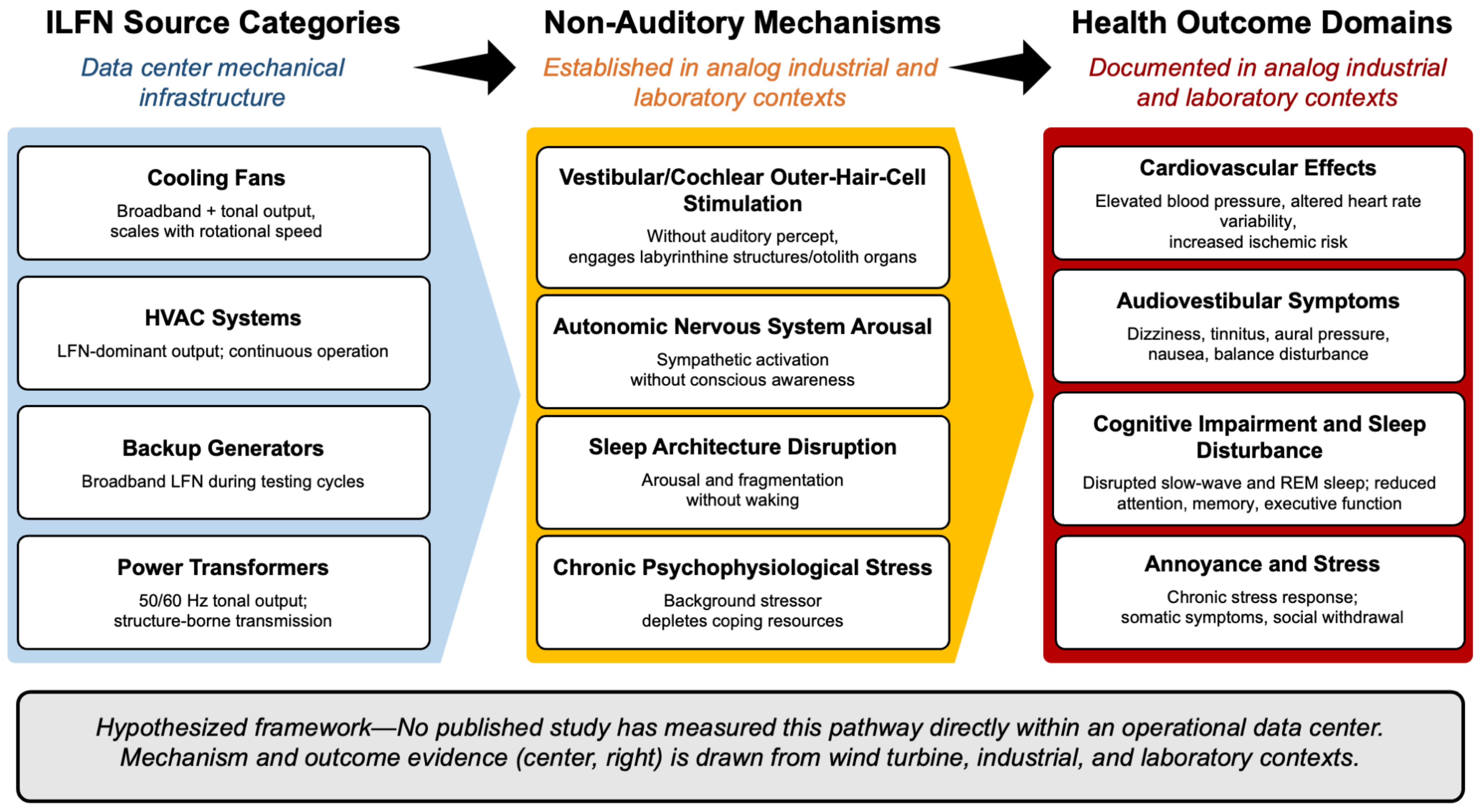
Figure 1 presents a hypothesized conceptual framework, synthesizing the evidence reviewed in Section 2, Section 3 and Section 4 that maps plausible non-auditory pathways through which ILFN exposure from the rotating mechanical systems characteristic of data center infrastructure could produce physiological effects in the absence of auditory perception, pending direct empirical confirmation in an operational data center. Section 3 and Section 4 establish two independent bodies of evidence. The first is a substantial research base, spanning multiple decades and multiple disciplinary communities, documenting that ILFN is associated with non-auditory health effects and, for several pathways, demonstrated biological responses—including physiological, audiovestibular, cognitive, and psychophysiological effects—at exposure levels below auditory perception [8,9,10]. The second is the emerging literature characterizing data center acoustic environments, conducted exclusively in the audible frequency range using measurement conventions that apply heavy attenuation to ILFN and place it outside the scope of routine assessment [5,6,17,18]. These two bodies of knowledge have not been integrated. No published study has measured the ILFN spectrum in an operational data center; no occupational health investigation has examined health outcomes in data center workers with respect to sub-audible acoustic exposure; and no epidemiological study has characterized ILFN exposure in communities surrounding data center facilities.
In the first published health-focused assessment of data center impacts, Gour et al. [5] identified this as a component of the broader gap in data center health research, calling explicitly for transdisciplinary investigation integrating physical sciences, engineering, and public health to quantify health outcomes linked to data center operations. The acoustic dimension of that call has not yet been answered in the peer-reviewed literature.

5.2. Structural Factors Sustaining the Gap

The absence of ILFN research in data center health assessment is not incidental. It reflects convergent structural factors in regulatory frameworks, measurement conventions, and research priorities.
The dominance of A-weighting in occupational noise regulation constitutes the most fundamental barrier. OSHA regulation 1910.95, NIOSH recommended exposure limits, and European Directive 2003/10/EC all specify A-weighted exposure metrics and A-weighted measurement procedures for occupational compliance. Because compliance is assessed in dBA, ILFN components are substantially discounted in the regulatory compliance calculation, even when physically present at meaningful levels. As the lower panel of Figure 1 indicates, this measurement exclusion means that the entire left-to-right pathway depicted—from source to mechanism to health outcome—remains empirically uncharacterized in the data center context. A data center generating substantial infrasound or LFN could satisfy all applicable occupational noise compliance requirements while exposing workers to frequencies with documented non-auditory health effects. This is not a hypothetical failure mode. Leventhall [9] documented it repeatedly in other industrial contexts, observing that the regulatory dominance of A-weighted levels leads to the dismissal of valid LFN health complaints.
The acoustic research literature on data centers reflects this regulatory framework. Published measurement studies have assessed compliance with the OSHA and NIOSH standards designed for auditory risk [17,18], and noise engineering research has targeted audible frequencies because they are subject to regulatory limits [6]. Alnuaimy et al. [17] explicitly acknowledged that the standard against which they measured server room exposures dates from 1970 (a recognition that the regulatory framework may not reflect the current state of acoustic health knowledge). The ILFN spectrum has not been characterized because existing standards do not require it.
The relative novelty of large-scale data centers as ILFN-generating built environments is another contributing factor. Industrial ILFN research has historically focused on established source categories: power generation turbines, industrial compressors, heavy manufacturing equipment, and, more recently, wind turbines. Data centers as a facility type are more recent and have not yet attracted the systematic ILFN characterization applied to legacy industrial sources. The general scarcity of noise research in data centers, as noted by Killeen et al. [6], applies with particular force to sub-audible frequencies.

5.3. Affected Populations

The populations that are potentially affected by this gap are substantial and growing. Occupationally, data center workers, including systems engineers, maintenance technicians, and operations staff who spend extended periods within facilities, face potential chronic ILFN exposure in environments where no applicable standard assesses sub-audible frequencies. The continuous 24-h operational cycle of data centers, combined with the uninterrupted mechanical output of cooling and power infrastructure, means that occupational ILFN exposure in these settings is effectively constant throughout every working shift.
At the community level, large-scale data center facilities increasingly adjoin residential, peri-urban, and rural areas. Documented community complaints about persistent low-pitched humming from data centers [5] are consistent with LFN phenomenology, and the populations generating these complaints, including middle-aged and older adults, who Leventhall [9] identified as disproportionately sensitive to LFN, may be experiencing genuine physiological effects from ILFN exposure that current assessment tools are not designed to detect or validate.
The regulatory consequence is direct. If data center noise complaints are assessed using A-weighted measurements and the responsible acoustic components are predominantly below 200 Hz, the regulatory instrument and the relevant exposure are mismatched. The result is the systematic dismissal of legitimate health concerns—outcomes that are inconsistent with both occupational health protection obligations and the broader goal of responsible, community-conscious data center development.

6. Toward Evidence-Based Acoustic Engineering Standards

The research gap identified in this review is not permanent. It is a consequential but addressable absence of data, the filling of which would enable both health-protective action and better-informed engineering practice. The mechanistic convergence across vestibular, autonomic, and cognitive pathways (Section 4.2 and Section 4.3) suggests these may not be independent effects but components of a broader exposure–response phenotype.
The following prioritized recommendations are oriented toward enabling the continued responsible growth of data center infrastructure while establishing the acoustic health evidence base required by responsible governance.

6.1. Priority 1: ILFN Characterization of Operational Data Centers

The foundational requirement is measurement. Future studies should characterize the ILFN frequency spectrum of operational data centers using instrumentation capable of capturing the full low-frequency range, specifically, microphones and sound level meters that can accurately detect and record acoustic energy from 1 Hz to 200 Hz without filtering out low-frequency content. Standard workplace noise dosimeters are not suitable for this purpose because they are designed to measure only the frequencies most relevant to hearing damage. Researchers would instead need to use specialized low-frequency microphones and measurement devices capable of operating in unweighted or G-weighted mode. Alongside airborne sound measurements, structure-borne pathways (i.e., vibrations that travel through floors, walls, and ceilings rather than through the air) should also be assessed using motion sensors mounted directly on building surfaces, since low-frequency energy often reaches workers and residents through the building structure rather than through the air alone. Measurement protocols should be adapted from established standards for industrial ILFN characterization, with attention to spatial variation within facilities, temporal variation with facility load cycles, and the contribution of specific source categories, including cooling fans, HVAC systems, generators, and UPS infrastructure.
Characterization studies should be conducted across diverse facility types, including hyperscale, colocation, and edge data centers, and across both air-cooled and liquid-cooled configurations. The emerging transition to liquid cooling in AI-intensive facilities may substantially alter the ILFN signature, and both legacy and next-generation cooling architectures require characterization. This research would provide the empirical foundation on which health assessment and engineering mitigation can be built.

6.2. Priority 2: Occupational Health Assessment of Data Center Workers

Following the ILFN characterization, prospective cross-sectional and longitudinal health assessments should be conducted in data center worker populations. Priority health endpoints include sleep quality, cardiovascular indicators such as blood pressure and heart rate variability, balance and spatial orientation (which can be assessed through standardized tests that measure how well the inner ear’s balance system responds to sound, without requiring exposure to additional noise during testing), and cognitive performance measures such as attention, concentration, and working memory. These cognitive domains can be assessed using standardized computerized test batteries that are sensitive enough to detect subtle changes in performance (i.e., the kind of changes that a person might not notice themselves but that can be measured reliably in a research setting). Self-reported symptom surveys would enable direct comparison with documented exposure–effect relationships from analogous contexts such as wind turbine communities. These surveys should use questionnaire instruments that have already been tested and validated in populations exposed to noise, including sleep problems, annoyance, headaches, and concentration difficulties, rather than relying on general health questionnaires not designed with acoustic exposure in mind.
Worker health assessments should be designed with appropriate exposure assessment—not merely documenting whether workers are employed at data centers but characterizing the ILFN levels at their specific work locations and the duration of daily exposure. A unified conceptual framework integrating symptom domains across analogous studies examining non-auditory sensory and autonomic responses to sub-perceptible stimuli represents an important theoretical contribution that could guide the design of future assessment instruments. Shift patterns, the frequency of entry into high-noise server hall environments versus office spaces, and the use of hearing protection should be captured as exposure modifiers.

6.3. Priority 3: Community Exposure Mapping

Community exposure studies should complement occupational research by characterizing ILFN levels at residential locations in proximity to operating data centers, particularly large hyperscale facilities. Community surveys in affected areas should collect structured health and symptom data from residents, with particular attention to sleep disturbance, annoyance, and other symptom profiles associated with LFN exposure. Longitudinal tracking of complaint patterns relative to operational changes at nearby facilities would provide natural opportunities to strengthen causal inference.

6.4. Priority 4: Engineering Solutions and Acoustic Design Standards

Research on ILFN exposure levels in data centers should be paired with engineering research to develop practical mitigation solutions. ILFN mitigation presents distinct engineering challenges relative to audible-range noise control: conventional sound-absorbing materials are ineffective at very low frequencies, and passive damping approaches require impractically large material depths. However, several engineering approaches have been demonstrated in other industrial settings and are worth investigating for data center applications. Active noise control, in which electronic systems generate sound waves that cancel out unwanted low-frequency noise, has been demonstrated in HVAC air-handling ductwork and around large industrial fans and ventilation systems [24]. Acoustic metamaterials (i.e., specialized engineered materials that can absorb sound at frequencies that ordinary foam or insulation cannot) have already been tested in data center server racks for audible noise by Killeen et al. [6]. Vibration-isolation mounting of rotating equipment and structural approaches such as floating floors are standard tools in general industrial noise control and are plausible candidates for adaptation to data center fan, generator, and UPS installations, though their effectiveness for the specific ILFN signatures characteristic of data center equipment has not yet been evaluated and is itself part of the research agenda proposed here. These solutions already exist in principle; what is needed first is measurement data to identify exactly which frequencies are present and at what levels, so that mitigation efforts can be correctly targeted.
Killeen et al.’s work [6] on acoustic metamaterial absorbers for data center fan noise, while focused on the audible range, established both the methodological framework and the engineering will to address acoustic health in data center design. Extending this work to sub-audible frequencies would be a natural next step and represents a tractable engineering research program: characterizing ILFN source signatures by equipment category, identifying frequency-specific attenuation targets, and evaluating active and passive mitigation approaches across the 1–200 Hz range.
The longer-term output of this engineering research program should be the development of ILFN-specific design criteria for data center facilities. Analogous to European Telecommunications Standards Institute’s (ETSI) 300 753, which establishes acoustic noise emission limits for telecommunications equipment in audible frequency ranges, ILFN design criteria would specify measurement protocols, equipment-level emission thresholds, and facility-level compliance procedures for sub-audible frequencies. Such standards would provide the regulatory architecture for the systematic deployment of acoustic engineering solutions across the data center industry, enabling facility designers, equipment manufacturers, and operators to build ILFN health protection into new construction and retrofit programs from the outset, rather than addressing complaints reactively after deployment.

6.5. Priority 5: Regulatory and Monitoring Frameworks

Occupational noise standards should be assessed for their adequacy in ILFN-generating environments. NIOSH and OSHA noise standards developed in 1970 and 1998 were not designed with data center acoustic environments in mind and rely on A-weighted metrics that substantially discount the relevant exposure range. Regulatory bodies should consider whether G-weighted or flat-response measurement requirements should accompany dBA monitoring in environments where ILFN-generating equipment constitutes a primary acoustic source.
At the community level, local and state environmental noise ordinances governing data center siting and operations should similarly assess whether dBA-based noise limits are adequate for characterizing the acoustic emissions of these facilities. The documented inadequacy of A-weighted metrics for LFN assessment [9] has regulatory implications that extend from the occupational to the environmental governance domain.

6.6. Limitations

Several limitations of this review warrant explicit acknowledgment. First, the evidence base directly characterizing data center acoustic environments is confined to four primary studies (Table 2, Panel A), none of which characterized the ILFN spectrum using G-weighted, C-weighted, or flat-response instrumentation (the additional two analog mechanistic and health studies in Table 2, Panel B, establish mechanistic plausibility but were not conducted in data center settings). This limitation constitutes the central research gap that motivates this review. Second, this review does not include formal quality appraisal of included studies, consistent with the narrative review methodology selected for this early-stage mapping exercise. The available data center acoustic studies vary in methodological rigor and generalizability. Third, the mechanistic and epidemiological evidence drawn from wind turbine, industrial, and laboratory contexts involves exposure profiles that differ from the anticipated data center context in acoustic signature, temporal characteristics, and exposure setting. These differences have been characterized in Section 4.3. Fourth, the absence of primary ILFN measurement data from operational data centers means that the health assessment in this review is necessarily precautionary and inferential rather than empirical. No claim is made that data center ILFN currently causes documented health effects, only that the measurement and assessment framework required to determine whether it does is absent.

7. Conclusions

This narrative review has identified and characterized a specific research gap at the intersection of two independently developed bodies of literature: the established science of ILFN health effects and the emerging science of data center acoustic environments. The central finding of this study is that no published study has characterized the infrasound and low-frequency noise spectrum of an operational data center, and no health assessment has examined ILFN-related outcomes in data center workers or surrounding communities. This gap persists despite growing evidence—spanning demonstrated biological responses (e.g., sleep architecture disruption and chronic psychophysiological stress)—that ILFN affects the body through mechanisms that operate below the auditory threshold.
Data centers represent transformative and beneficial infrastructure whose continued growth is essential to the digital economy and to AI development. The goal of the research agenda proposed here is not to constrain that growth, but to inform it. Characterizing the ILFN environment of operational data centers, including the sub-audible components that have not been studied, is the essential first step toward technology standards that protect both workers and communities while supporting the continued responsible growth of AI infrastructure. Relevant engineering solutions have been validated in analogous industrial contexts and are candidates for adaptation to data center sub-audible frequencies pending dedicated evaluation. Active noise control systems generating anti-phase acoustic signals have been applied to industrial HVAC and compressor ILFN [24]; acoustic metamaterial liners have been effective for audible noise [6]; and structural design approaches (e.g., sound barriers, vibration isolation mounting, and floating floor systems) are standard tools in general industrial noise control. The missing element is not engineering capability, but the frequency-characterized measurement data needed to define target exposure spectra and evaluate solution effectiveness at 1–200 Hz in operational data center environments.
The literature on wind turbines demonstrates that ILFN health research can, once initiated, generate actionable findings that inform regulatory frameworks and engineering practice. Data centers warrant comparable attention. As these facilities expand in scale, density, and geographic reach, establishing their acoustic health profile (including ILFN) is both a scientific obligation and a practical prerequisite for the responsible, sustainable infrastructure development that clean technology principles require.

Author Contributions

Conceptualization, S.M.W.; methodology, M.R.W., B.E. and S.M.W.; investigation, M.R.W., B.E. and S.M.W.; writing—original draft preparation, M.R.W. and S.M.W.; writing—review and editing, all authors; supervision, V.P. All authors have read and agreed to the published version of the manuscript.

Funding

This research received no external funding.

Institutional Review Board Statement

Not applicable.

Data Availability Statement

No new data were created or analyzed in this study. Data sharing is not applicable to this article.

Acknowledgments

During the preparation of this manuscript, the authors used the Rayyan web platform (rayyan.ai) for deduplication and facilitating the collaborative screening of titles and abstracts, Claude (claude.ai, Anthropic, Sonnet 4.6) for literature synthesis support, and Trinka Confidential (trinka.ai) for grammar and style editing. The authors have reviewed and edited the output and take full responsibility for the content of this publication.

Conflicts of Interest

The authors declare no conflicts of interest.

Abbreviations

The following abbreviations are used in this manuscript:
AIArtificial Intelligence
DALYsDisability-Adjusted Life Years
dBDecibel
dBAA-weighted decibels
dBCC-weighted decibels
dBZZ-weighted decibels, or “flat response”
DEFRADepartment for Environment, Food and Rural Affairs (UK)
ETSIEuropean Telecommunications Standards Institute
EUEuropean Union
HVACHeating, ventilation, and air conditioning
HzHertz
IEAInternational Energy Agency
ILFNInfrasound and Low-Frequency Noise
ISOInternational Organization for Standardization
LFNLow-frequency noise
NIOSHNational Institute for Occupational Safety and Health
OSHAOccupational Safety and Health Administration
UPSUninterruptible power supply
VLFVery low frequency
WHOWorld Health Organization

References

  1. International Energy Agency. Energy and AI; IEA: Paris, France, 2025; Available online: https://www.iea.org/reports/energy-and-ai (accessed on 19 July 2026).
  2. International Energy Agency. Electricity 2024: Analysis and Forecast to 2026; IEA: Paris, France, 2024; Available online: https://www.iea.org/reports/electricity-2024 (accessed on 19 July 2026).
  3. International Energy Agency. Electricity 2026: Analysis and Forecast to 2030; IEA: Paris, France, 2026; Available online: https://www.iea.org/reports/electricity-2026 (accessed on 19 July 2026).
  4. Masanet, E.; Shehabi, A.; Lei, N.; Smith, S.; Koomey, J. Recalibrating Global Data Center Energy-Use Estimates. Science 2020, 367, 984–986. [Google Scholar] [CrossRef] [Scilit]
  5. Gour, N.; Ortiz, L.; Maibach, E. Health Implications of the Rapid Rise of Data Centers in Virginia: An Exploratory Assessment. Front. Clim. 2026, 8, 1648912. [Google Scholar] [CrossRef] [Scilit]
  6. Killeen, J.; Davis, I.; Wang, J.; Bennett, G.J. Fan-Noise Reduction of Data Centre Telecommunications’ Server Racks, with an Acoustic Metamaterial Broadband, Low-Frequency Sound-Absorbing Liner. Appl. Acoust. 2023, 203, 109229. [Google Scholar] [CrossRef] [Scilit]
  7. Wheeler, M.R.; Everett, B.; Prybutok, V. Navigating the Environmental Paradox of AI: A Decision Framework for Clean Technology Practitioners. Clean Technol. 2026, 8, 51. [Google Scholar] [CrossRef] [Scilit]
  8. Basner, M.; Babisch, W.; Davis, A.; Brink, M.; Clark, C.; Janssen, S.; Stansfeld, S. Auditory and Non-Auditory Effects of Noise on Health. Lancet 2014, 383, 1325–1332. [Google Scholar] [CrossRef] [Scilit] [PubMed]
  9. Leventhall, H.G. Low Frequency Noise and Annoyance. Noise Health 2004, 6, 59–72. [Google Scholar]
  10. Lubner, R.J.; Kondamuri, N.S.; Knoll, R.M.; Ward, B.K.; Littlefield, P.D.; Rodgers, D.; Abdullah, K.G.; Remenschneider, A.K.; Kozin, E.D. Review of Audiovestibular Symptoms Following Exposure to Acoustic and Electromagnetic Energy Outside Conventional Human Hearing. Front. Neurol. 2020, 11, 234. [Google Scholar] [CrossRef] [Scilit]
  11. Ouzzani, M.; Hammady, H.; Fedorowicz, Z.; Elmagarmid, A. Rayyan—A Web and Mobile App for Systematic Reviews. Syst. Rev. 2016, 5, 210. [Google Scholar] [CrossRef] [Scilit] [PubMed]
  12. Berglund, B.; Lindvall, T.; Schwela, D.H. (Eds.) Guidelines for Community Noise; World Health Organization: Geneva, Switzerland, 1999; Available online: https://docs.wind-watch.org/WHO-Communitynoise.pdf (accessed on 19 July 2026).
  13. Chiu, S.K.; Brueck, S.E.; Wiegand, D.M.; Free, H.L.; Echt, H. Evaluation of Low-Frequency Noise, Infrasound, and Health Symptoms at an Administrative Building and Men’s Shelter: A Case Study. Semin. Hear. 2023, 44, 503–520. [Google Scholar] [CrossRef] [Scilit] [PubMed]
  14. Pawlaczyk-Łuszczyńska, M.; Wszołek, T.; Dudarewicz, A.; Małecki, P. Should Limit Values Be Set for Infrasound Caused by Wind Turbines? Int. J. Occup. Med. Environ. Health 2025, 38, 3–17. [Google Scholar] [CrossRef] [Scilit] [PubMed]
  15. Yonemura, M.; Lee, H.; Sakamoto, S. Subjective Evaluation on the Annoyance of Environmental Noise Containing Low-Frequency Tonal Components. Int. J. Environ. Res. Public Health 2021, 18, 7127. [Google Scholar] [CrossRef] [Scilit] [PubMed]
  16. Gibbs, B.M.; Villot, M. Structure-Borne Sound in Buildings: Advances in Measurement and Prediction Methods. Noise Control Eng. J. 2020, 68, 1–20. [Google Scholar] [CrossRef] [Scilit]
  17. Alnuaimy, A.; Shushura, O.; Zhyrov, G. Impact of Noise inside Server Room. In CEUR Workshop Proceedings; CEUR-WS: Aachen, Germany, 2022; Volume 3149, pp. 9–16. [Google Scholar]
  18. Cho, J.; Lim, H.; Byeon, S.; Kim, H. Noise Exposure Assessment in the Occupational Environment of Air-Cooled Data Centers. J. Archit. Inst. Korea 2026, 42, 273–281. [Google Scholar] [CrossRef]
  19. Cameron, D.J.; Dotov, D.; Flaten, E.; Bosnyak, D.; Hove, M.J.; Trainor, L.J. Undetectable Very-Low Frequency Sound Increases Dancing at a Live Concert. Curr. Biol. 2022, 32, R1222–R1223. [Google Scholar] [CrossRef] [Scilit] [PubMed]
  20. Farboud, A.; Crunkhorn, R.; Trinidade, A. ‘Wind Turbine Syndrome’: Fact or Fiction? J. Laryngol. Otol. 2013, 127, 222–226. [Google Scholar] [CrossRef] [Scilit] [PubMed]
  21. Knopper, L.D.; Ollson, C.A.; McCallum, L.C.; Whitfield Aslund, M.L.; Berger, R.G.; Souweine, K.; McDaniel, M. Wind Turbines and Human Health. Front. Public Health 2014, 2, 63. [Google Scholar] [CrossRef] [Scilit] [PubMed]
  22. Michaud, D.S.; Feder, K.; Keith, S.E.; Voicescu, S.A.; Marro, L.; Than, J.; Guay, M.; Denning, A.; McGuire, D.; Bower, T.; et al. Exposure to Wind Turbine Noise: Perceptual Responses and Reported Health Effects. J. Acoust. Soc. Am. 2016, 139, 1443–1454. [Google Scholar] [CrossRef] [Scilit] [PubMed]
  23. Van Kamp, I.; Van Den Berg, F. Health Effects Related to Wind Turbine Sound: An Update. Int. J. Environ. Res. Public Health 2021, 18, 9133. [Google Scholar] [CrossRef] [Scilit] [PubMed]
  24. Wise, S.; Leventhall, G. Active Noise Control as a Solution to Low Frequency Noise Problems. J. Low Freq. Noise Vib. Act. Control 2010, 29, 129–137. [Google Scholar] [CrossRef] [Scilit]
Figure 1. Hypothesized conceptual framework of ILFN exposure pathways in data center environments. Hypothesized pathways from data center ILFN source categories ((left), documented in the data center acoustic literature) through non-auditory mechanisms (center) to health outcome domains (right); the mechanism and outcome linkages are drawn from wind turbine, industrial, and laboratory analog contexts. No published study has yet characterized the ILFN spectrum of an operational data center using G-weighted, C-weighted, or flat-response instrumentation, nor examined non-auditory health outcomes in workers or surrounding communities—the research gap this review addresses.
Cleantechnol 08 00126 g001
Table 1. Formal database search strings and record counts, March 2026.
DatabaseSearch StringRecords Retrieved
PubMed(“server room” OR “computer room” OR “machine room”) AND (noise OR health OR occupational)32
ScopusTITLE-ABS-KEY(“data center” OR “data centre”) AND TITLE-ABS-KEY(“noise” OR “acoustic” OR “infrasound”) AND TITLE-ABS-KEY(“health” OR “occupational” OR “worker”)50
ScopusTITLE-ABS-KEY(“data center” OR “data centre”) AND TITLE-ABS-KEY(“environmental health” OR “community health” OR “public health”)247
Total 329
Disclaimer/Publisher’s Note: The statements, opinions and data contained in all publications are solely those of the individual author(s) and contributor(s) and not of MDPI and/or the editor(s). MDPI and/or the editor(s) disclaim responsibility for any injury to people or property resulting from any ideas, methods, instructions or products referred to in the content.