
Quantitative Indicators of the Circular Economy for Covered Pond-Type Bioreactors in Tropical Regions: Application to a Large-Scale Pig Farming System

 ,
,  ,
,  , , ,
, , ,  , and
, and 
Highlights
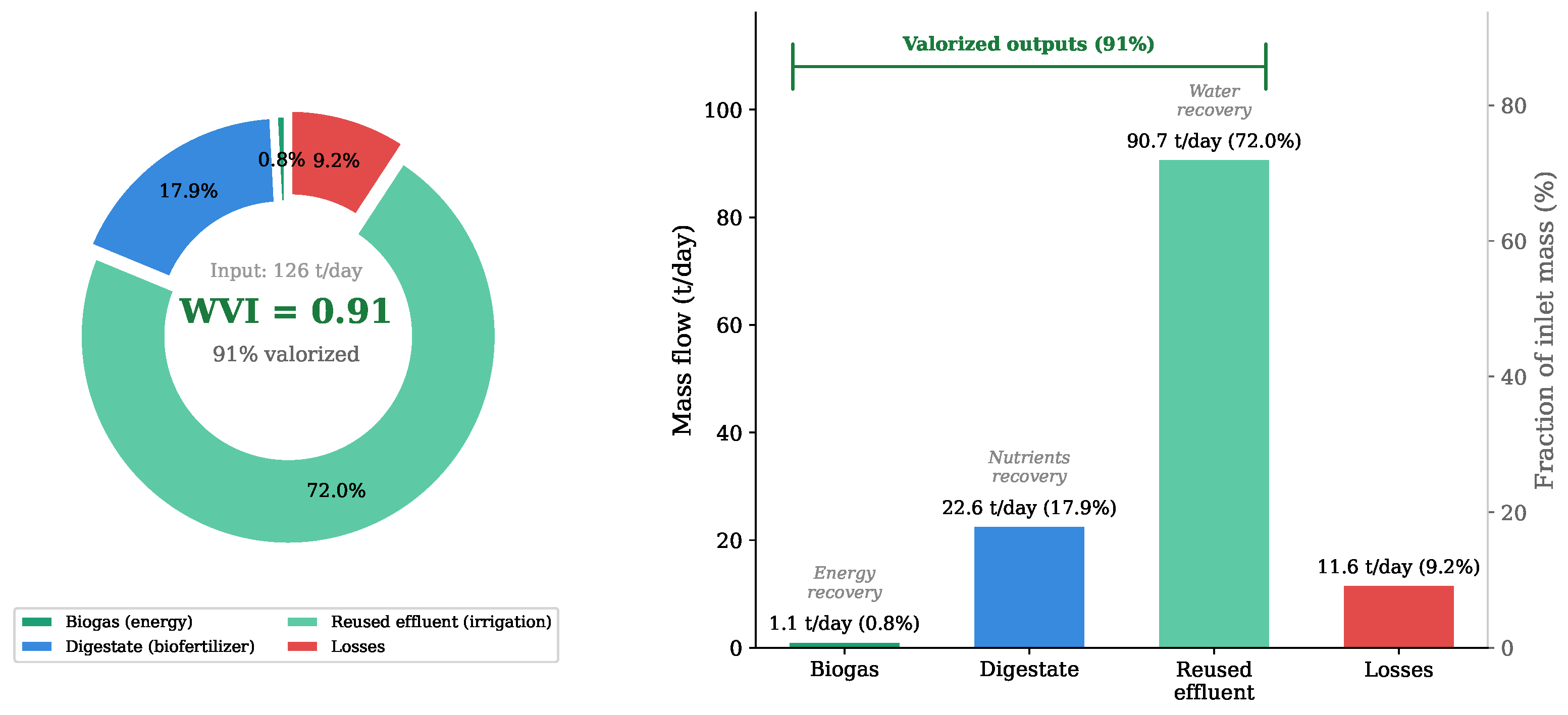
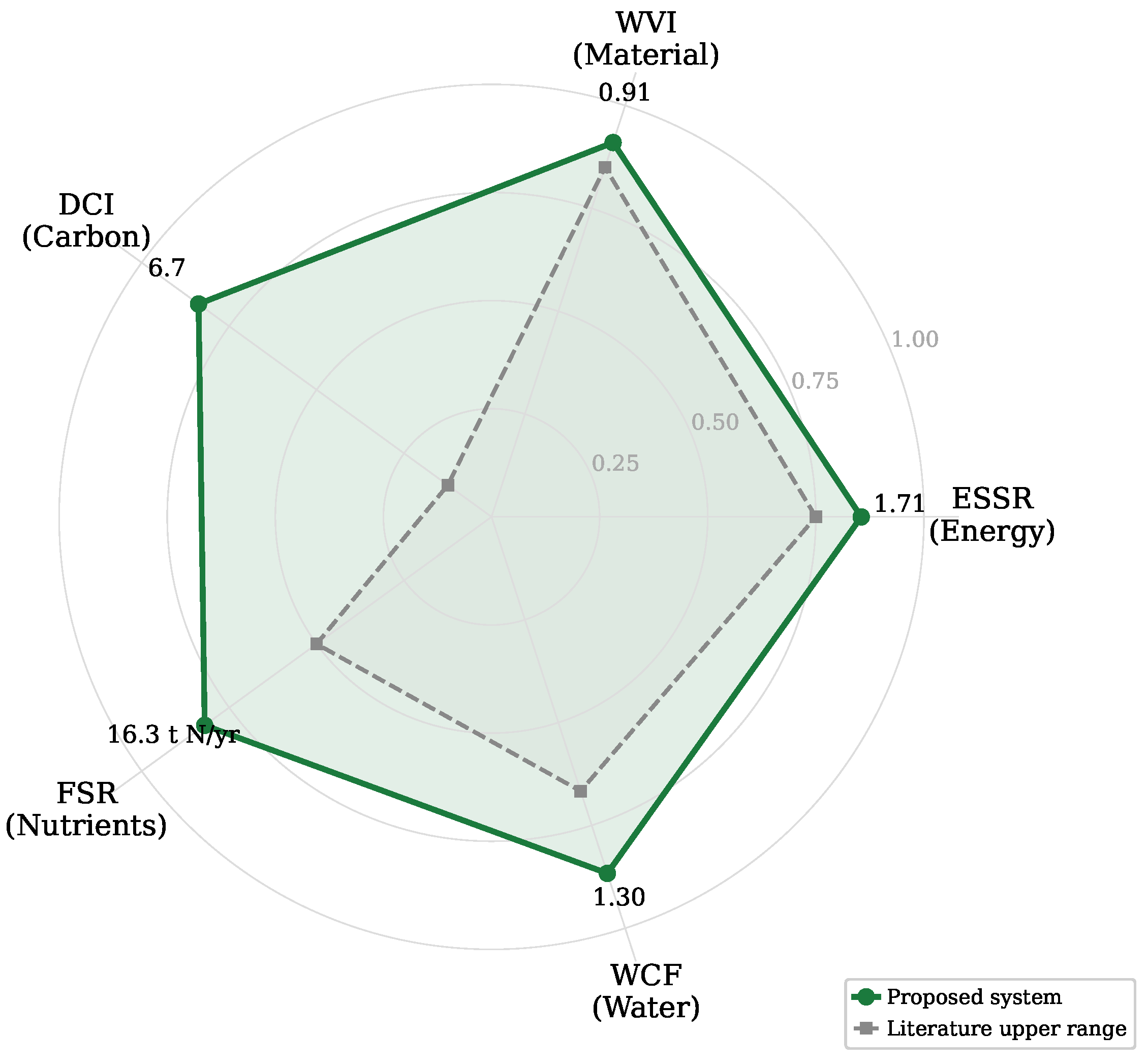
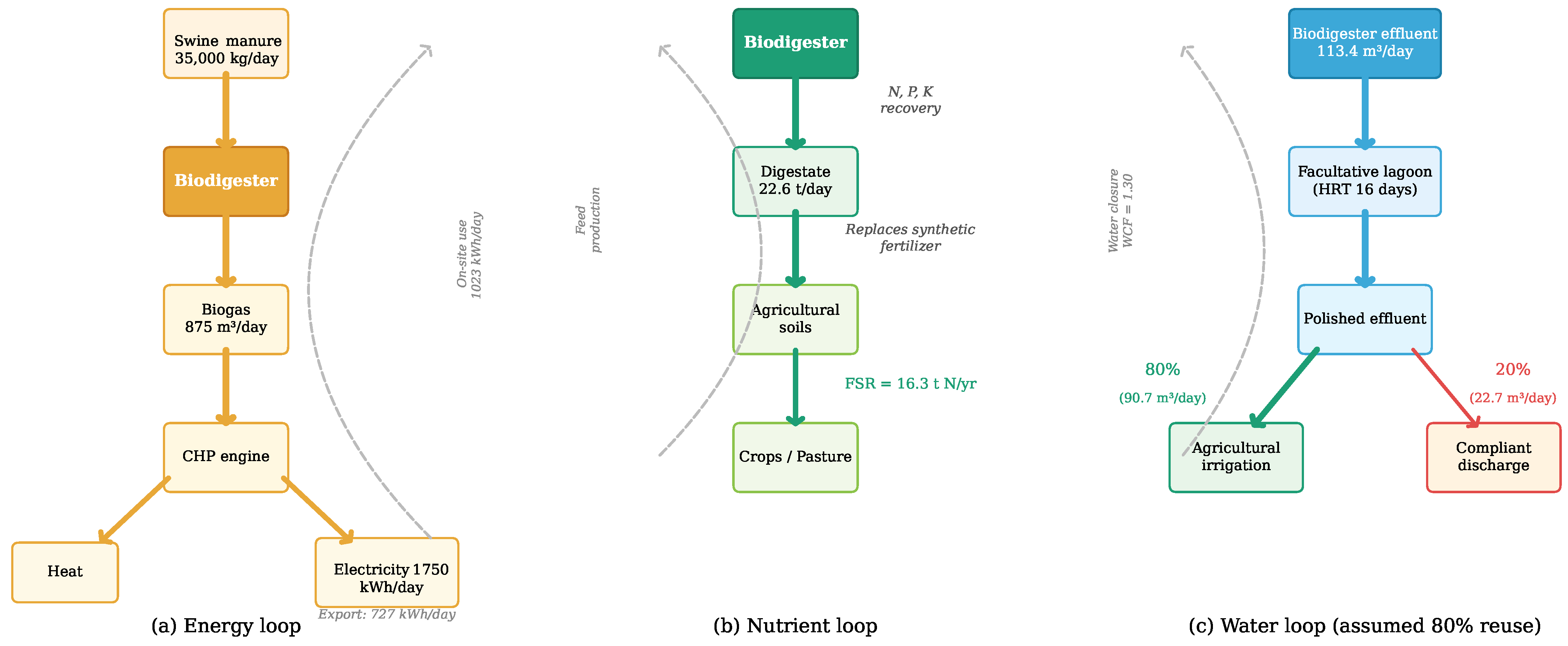
- A set of five quantitative circular economy indicators (ESSR, WVI, DCI, FSR, WCF), aligned with the ISO 59020:2024 standard, simultaneously measures the closure of energy, material, carbon, nutrient, and water cycles at the farm level. When applied to a covered lagoon biodigester for a 10,000-head pig module in the Cuban tropics, it achieves ESSR = 1.71, WVI = 0.91, DCI = 6.7, FSR = 16.3 t N year⁻¹ and WCF = 1.30, exceeding the reference values for temperate climates in all dimensions.
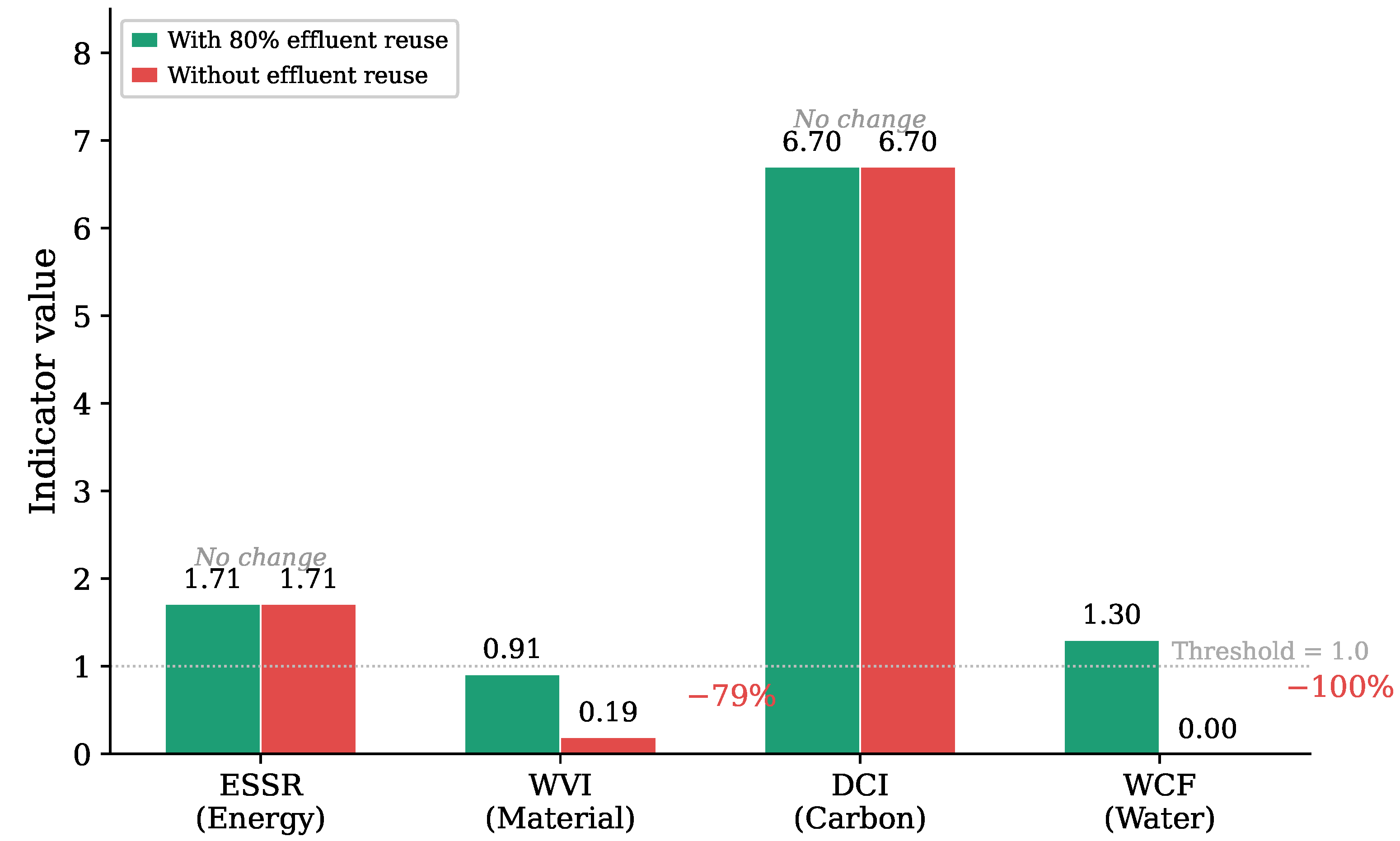
- Energy and carbon circularity (ESSR, DCI) is intrinsic to biogas capture and remains unchanged, while material and water circularity (WVI, WCF) collapses without the agricultural reuse of treated effluent (WVI drops from 0.91 to 0.19 and WCF from 1.30 to 0).
- The circular economy of a biogas digester consists of two distinct closed-loop systems: the energy and carbon cycles are ensured by biogas capture, but the material and water cycles depend entirely on the agricultural reuse of the effluent and digestate. Consequently, what determines true circularity is not the reactor technology, but site selection: without guaranteed adjacent agricultural land and controlled nutrient management, the plant is energetically circular but materially linear, and improperly applied digestate shifts the environmental burden to eutrophication.
- By quantifying the five dimensions separately under ISO 59020:2024, the framework provides a diagnosis that an aggregate index would obscure and that the literature on anaerobic digestion previously lacked: it allows for identifying which specific cycle requires intervention and for comparing systems across reactor types, climates, and scales, thereby making circularity a verifiable criterion for design and policy, rather than a qualitative assertion.
Abstract
Share and Cite
Carrera, L.A.I.; Navarro, D.F.; Alvarez, Y.C.; Reséndiz-Jaramillo, A.Y.; Constantino-Robles, C.D.; Díaz-Tato, L.; Cruz-Pérez, M.A.; Rodríguez-Reséndiz, J. Quantitative Indicators of the Circular Economy for Covered Pond-Type Bioreactors in Tropical Regions: Application to a Large-Scale Pig Farming System. Clean Technol. 2026, 8, 88. https://doi.org/10.3390/cleantechnol8030088
Carrera LAI, Navarro DF, Alvarez YC, Reséndiz-Jaramillo AY, Constantino-Robles CD, Díaz-Tato L, Cruz-Pérez MA, Rodríguez-Reséndiz J. Quantitative Indicators of the Circular Economy for Covered Pond-Type Bioreactors in Tropical Regions: Application to a Large-Scale Pig Farming System. Clean Technologies. 2026; 8(3):88. https://doi.org/10.3390/cleantechnol8030088
Chicago/Turabian StyleCarrera, Luis Angel Iturralde, Daniel Fernández Navarro, Yoisdel Castillo Alvarez, Ariadna Yaneli Reséndiz-Jaramillo, Carlos D. Constantino-Robles, Leonel Díaz-Tato, Miguel Angel Cruz-Pérez, and Juvenal Rodríguez-Reséndiz. 2026. "Quantitative Indicators of the Circular Economy for Covered Pond-Type Bioreactors in Tropical Regions: Application to a Large-Scale Pig Farming System" Clean Technologies 8, no. 3: 88. https://doi.org/10.3390/cleantechnol8030088
APA StyleCarrera, L. A. I., Navarro, D. F., Alvarez, Y. C., Reséndiz-Jaramillo, A. Y., Constantino-Robles, C. D., Díaz-Tato, L., Cruz-Pérez, M. A., & Rodríguez-Reséndiz, J. (2026). Quantitative Indicators of the Circular Economy for Covered Pond-Type Bioreactors in Tropical Regions: Application to a Large-Scale Pig Farming System. Clean Technologies, 8(3), 88. https://doi.org/10.3390/cleantechnol8030088