
Integrated Machine Learning-Based Material Quantity Estimation and Carbon Footprint Assessment for Circular Construction

 ,
,  , , and
 Highlights
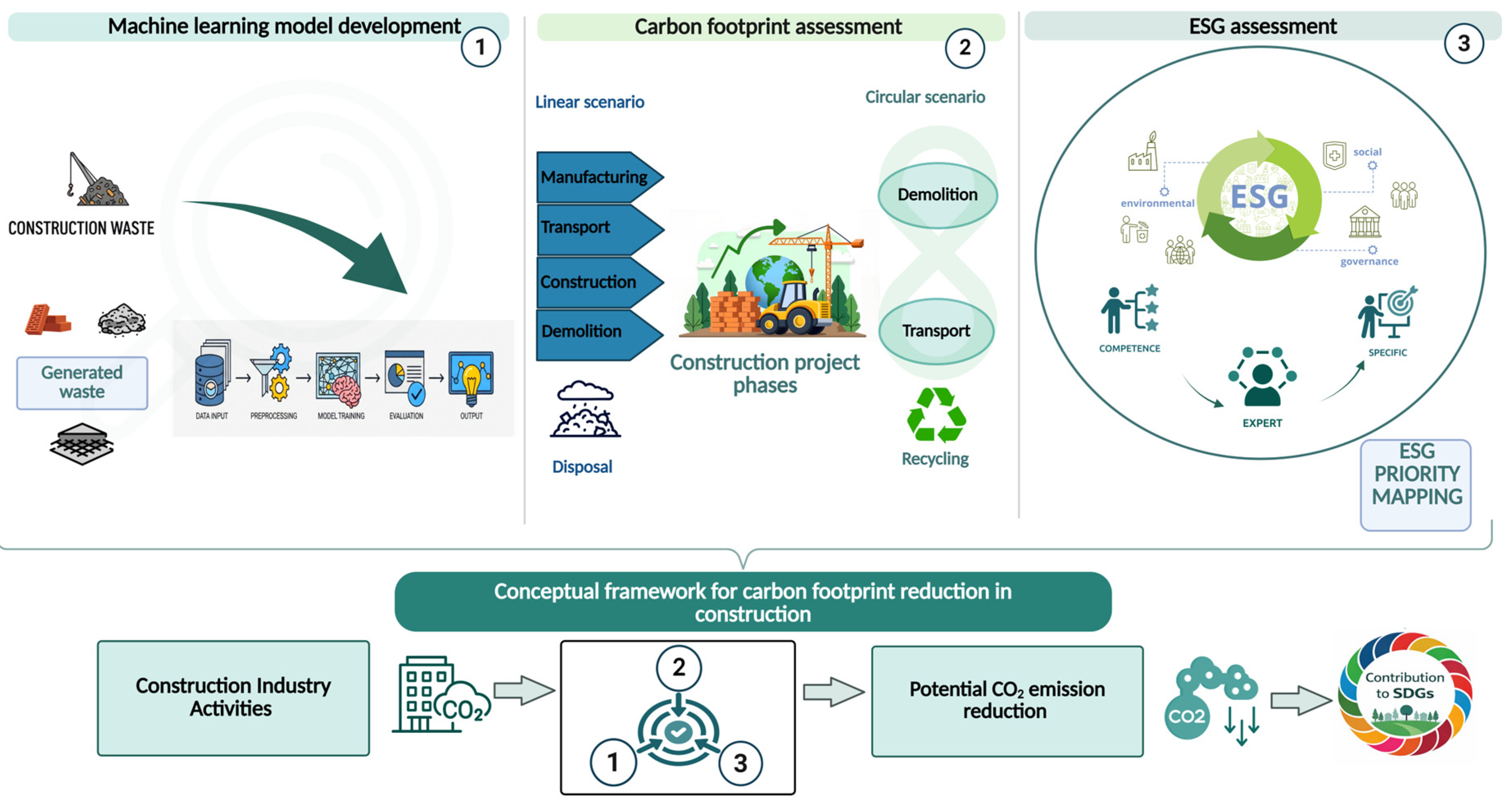
- An integrated ML–LCA–ESG framework is developed that explicitly links material-level predictions, phase-based carbon footprint assessments, and expert-driven ESG prioritization, in order to address the limited integration of these approaches in construction research.
- The results identify materials’ production as the dominant lifecycle carbon hotspot, while circular scenarios show substantial mitigation potential, highlighting the sensitivity of emission reductions to material-specific characteristics and substitution assumptions.
- The framework enables the early-stage identification of emission hotspots and translates quantitative carbon results into prioritized ESG indicators, directly linking material-level decisions with sustainability performance.
- The approach enables structured ESG evaluation based on quantitative modelling, supporting transparent, risk-informed decision-making and alignment with sustainability reporting and regulatory frameworks.
Abstract
1. Introduction
2. Materials and Methods
2.1. Research Framework
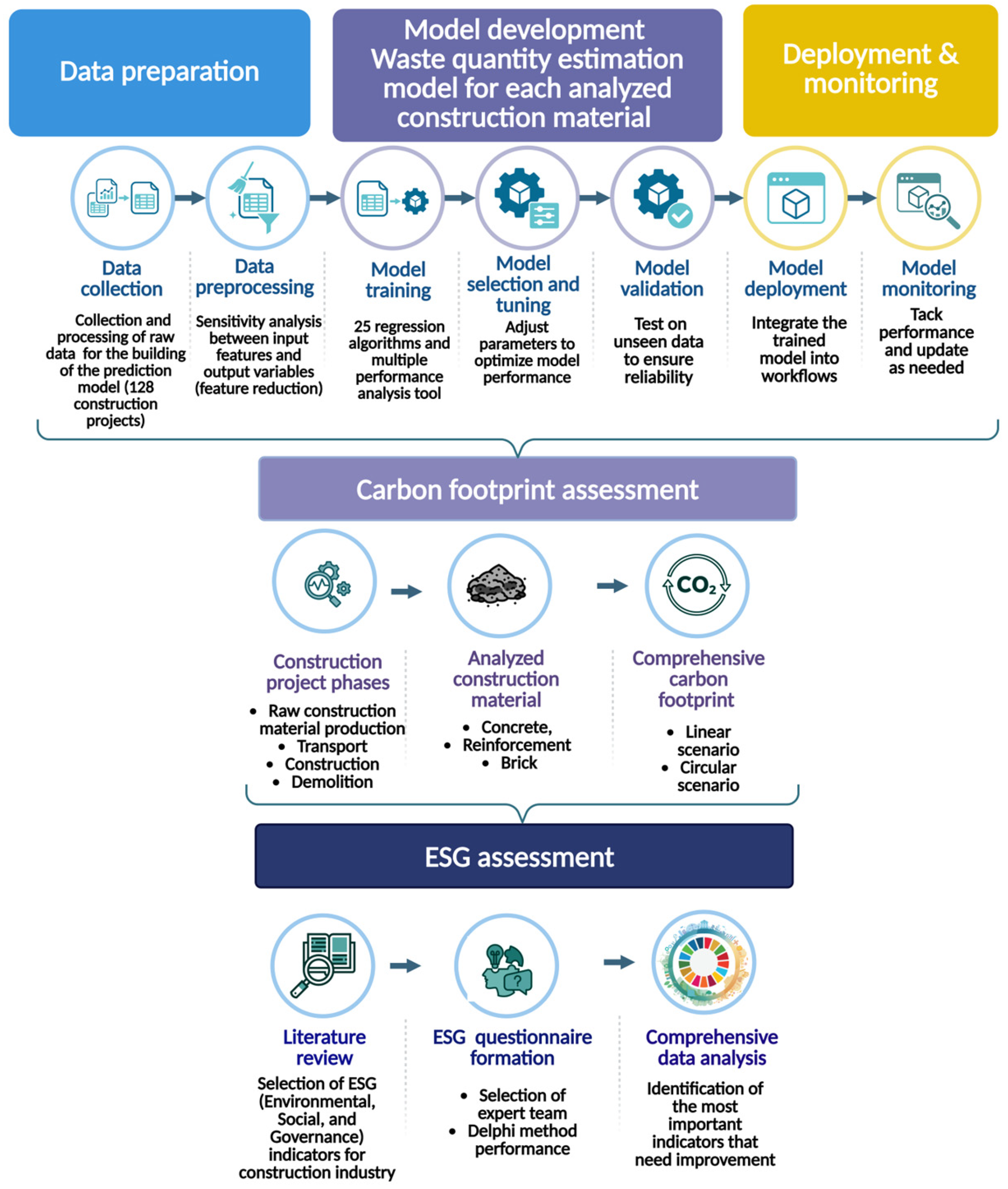
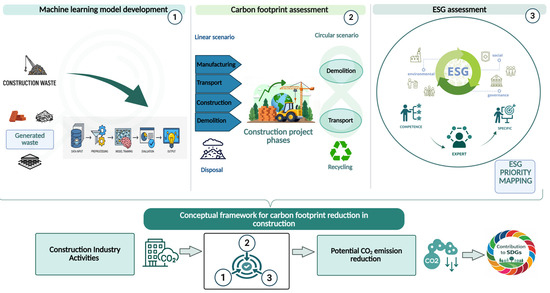
- Collection and processing of raw data for the formation of the database necessary for the development of the prediction model, using data from 128 projects for the use permit of built objects.
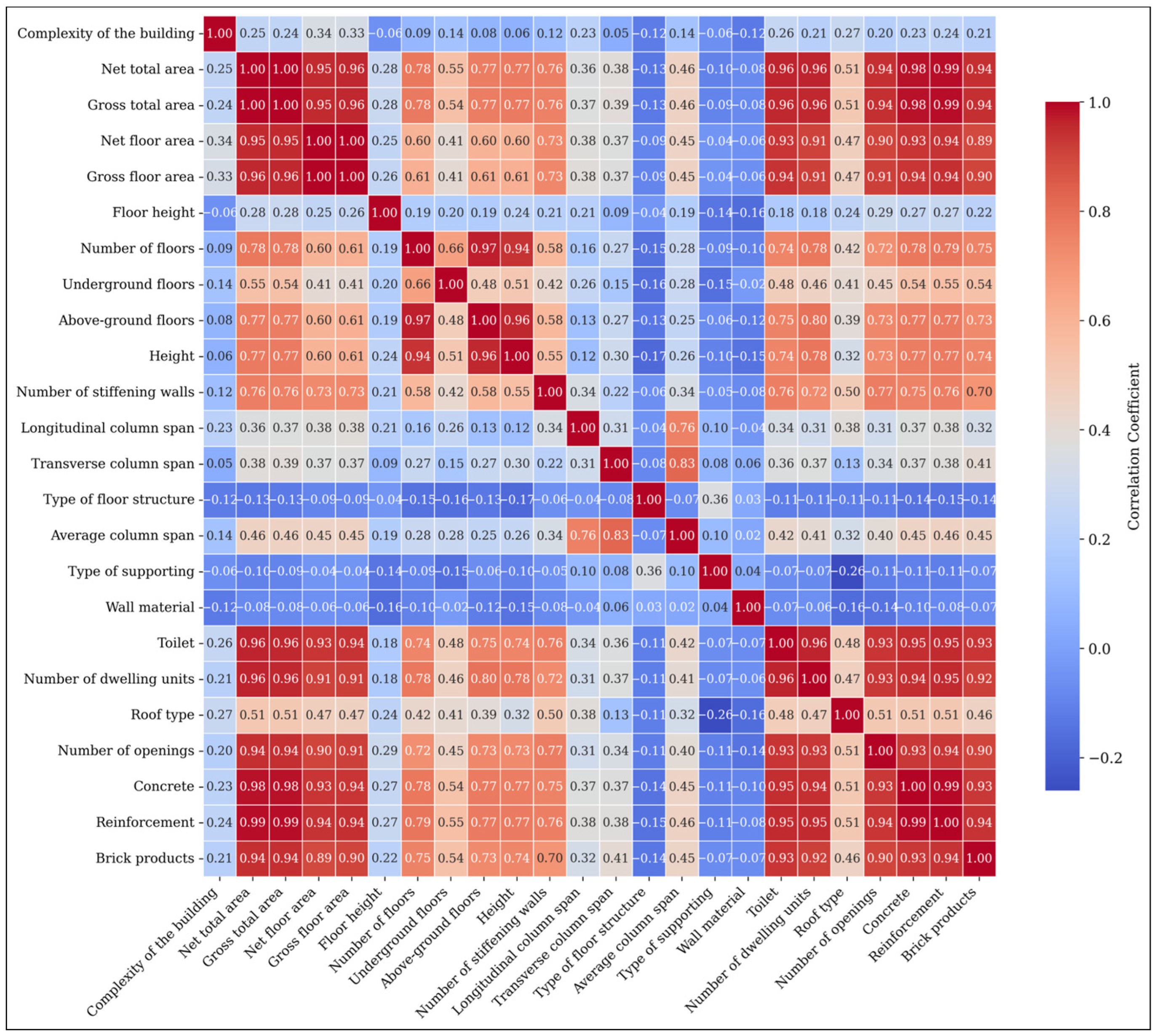
- Analysis of the sensitivity between input features and output variables, as well as the possibility of dimensionality reduction.
- Development of a quantity estimation model for each material separately.
- Evaluation of model performance and hyperparameter tuning.
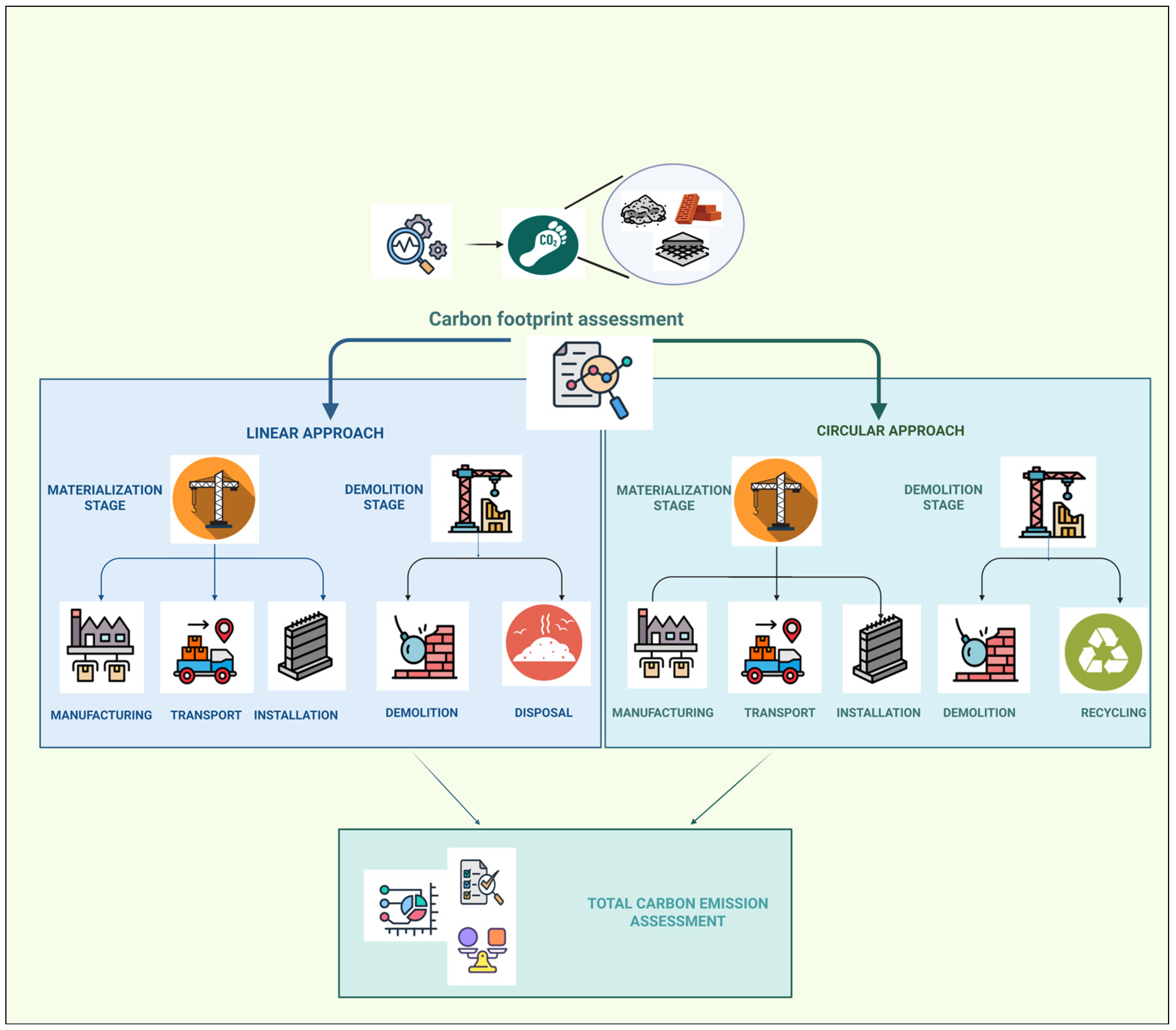
- Calculation of CO2 based on the obtained quantities of materials.
- ESG assessment methodology.
2.2. Machine Learning Prediction Model
2.2.1. Data Collection
2.2.2. Dimensionality Reduction Protocol
2.2.3. Machine Learning Model Development
2.3. Carbon Emission Assessment
2.3.1. Impact of Carbon Emission During Materialization Stage
2.3.2. Impact of Carbon Emission During Demolition Stage
2.3.3. Total Carbon Emission Assessment
2.4. ESG Assessment of Construction Project
3. Results and Discussion
3.1. Calculation of Correlation Factors
3.2. Estimation of the Quantity of Construction Materials
3.2.1. Estimation of the Quantity of Concrete
3.2.2. Estimation of the Quantity of Reinforcement
3.2.3. Estimation of the Quantity of Brick Products
3.3. Carbon Emissions Calculations
3.4. ESG Strategy Assessment
4. Limitations and Future Research
5. Conclusions
Supplementary Materials
Author Contributions
Funding
Institutional Review Board Statement
Data Availability Statement
Conflicts of Interest
Abbreviations
| ML | Machine Learning |
| ANN | Artificial Neural Network |
| LCA | Life Cycle Assessment |
| AI | Artificial Intelligence |
| SDG | Sustainable Development Goals |
| CE | Circular economy |
References
- United Nations Environment Programme (UNEP); International Energy Agency (IEA). Global Status Report for Buildings and Construction 2019: Towards a Zero-Emissions, Efficient and Resilient Buildings and Construction Sector; UNEP: Paris, France, 2019; Available online: https://www.iea.org/reports/global-status-report-for-buildings-and-construction-2019 (accessed on 25 November 2025).
- Debacker, W.; Manshoven, S. D1 Synthesis of the State-of-the-Art: Key Barriers and Opportunities for Materials Passports and Reversible Building Design in the Current System; BAMB2020: Brussels, Belgium, 2016; Available online: https://www.bamb2020.eu/wp-content/uploads/2016/03/D1_Synthesis-report-on-State-of-the-art_20161129_FINAL.pdf (accessed on 25 November 2025).
- European Commission. The European Green Deal; COM(2019) 640 Final; European Commission: Brussels, Belgium, 2019; Available online: https://eur-lex.europa.eu/legal-content/EN/TXT/?uri=CELEX:52019DC0640 (accessed on 4 March 2026).
- European Parliament; Council of the European Union. Regulation (EU) 2021/1119 establishing the framework for achieving climate neutrality (European Climate Law). Off. J. Eur. Union 2021, L 243, 1–17. [Google Scholar]
- European Parliament; Council of the European Union. Regulation (EU) 2020/852 establishing a framework to facilitate sustainable investment (EU Taxonomy Regulation). Off. J. Eur. Union 2020, L 198, 13–43. [Google Scholar]
- Nasir, I.; Aziz Al-Talib, G.A. Waste classification using artificial intelligence techniques: Literature review. Technium Rom. J. Appl. Sci. Technol. 2023, 5, 49–59. [Google Scholar] [CrossRef] [Scilit]
- Hopkinson, P.; Chen, H.M.; Zhou, K.; Wang, Y.; Lam, D. Recovery and reuse of structural products from end-of-life buildings. Proc. Inst. Civ. Eng. Eng. Sustain. 2019, 172, 119–128. [Google Scholar] [CrossRef] [Scilit]
- Moshood, T.D.; Rotimi, J.O.B.; Shahzad, W.; Bamgbade, J.A. Infrastructure digital twin technology: A new paradigm for the future construction industry. Technol. Soc. 2024, 77, 102519. [Google Scholar] [CrossRef] [Scilit]
- Bacheva, T.S.; Raposo Grau, J.F. Embodied impacts in buildings: A systematic review of life cycle gaps and sectoral integration strategies. Buildings 2025, 15, 1661. [Google Scholar] [CrossRef] [Scilit]
- Liang, Y.; Li, C.; Liu, Z.; Wang, X.; Zeng, F.; Yuan, X.; Pan, Y. Decarbonization potentials of embodied energy use and operational processes in buildings: A review from the life-cycle perspective. Heliyon 2023, 9, e20190. [Google Scholar] [CrossRef] [Scilit] [PubMed]
- Kyrö, R.; Jylhä, T.; Peltokorpi, A. Embodying circularity through usable relocatable modular buildings. Facilities 2019, 37, 75–90. [Google Scholar] [CrossRef] [Scilit]
- Mangialardo, A.; Micelli, E. Rethinking the construction industry under the circular economy: Principles and case studies. In Smart and Sustainable Planning for Cities and Regions; Bisello, A., Vettorato, D., Laconte, P., Costa, S., Eds.; Springer: Cham, Switzerland, 2018; pp. 333–344. [Google Scholar] [CrossRef] [Scilit]
- Maerckx, A.L.; D’Otrppe, Y.; Scherrier, N. Building circular in Brussels: An overview through 14 inspiring projects. IOP Conf. Ser. Earth Environ. Sci. 2019, 225, 012059. [Google Scholar] [CrossRef] [Scilit]
- Geldermans, R.J. Design for change and circularity—Accommodating circular material and product flows in construction. Energy Procedia 2016, 96, 301–311. [Google Scholar] [CrossRef] [Scilit]
- Sanchez, B.; Haas, C. A novel selective disassembly sequence planning method for adaptive reuse of buildings. J. Clean. Prod. 2018, 183, 998–1010. [Google Scholar] [CrossRef] [Scilit]
- Leising, E.; Quist, J.; Bocken, N. Circular economy in the building sector: Three cases and a collaboration tool. J. Clean. Prod. 2018, 176, 976–989. [Google Scholar] [CrossRef] [Scilit]
- O’Grady, T.; Minunno, R.; Chong, H.-Y.; Morrison, G.M. Design for disassembly, deconstruction and resilience: A circular economy index for the built environment. Resour. Conserv. Recycl. 2021, 175, 105847. [Google Scholar] [CrossRef] [Scilit]
- Akanbi, L.A.; Oyedele, L.O.; Akinade, O.O.; Ajayi, A.O.; Davila Delgado, M.; Bilal, M.; Bello, S.A. Salvaging building materials in a circular economy: A BIM-based whole-life performance estimator. Resour. Conserv. Recycl. 2018, 129, 175–186. [Google Scholar] [CrossRef] [Scilit]
- Oezdemir, O.; Krause, K.; Hafner, A. Creating a resource cadaster—A case study of a district in the Rhine–Ruhr metropolitan area. Buildings 2017, 7, 45. [Google Scholar] [CrossRef] [Scilit]
- Heinrich, M.A.; Lang, W. Capture and control of material flows and stocks in urban residential buildings. IOP Conf. Ser. Earth Environ. Sci. 2019, 225, 012001. [Google Scholar] [CrossRef] [Scilit]
- Nußholz, J.L.K.; Nygaard, F.; Milios, L. Circular building materials: Carbon saving potential and the role of business model innovation and public policy. Resour. Conserv. Recycl. 2019, 141, 308–316. [Google Scholar] [CrossRef] [Scilit]
- Contreras, M.; Teixeira, S.R.; Lucas, M.C.; Lima, L.C.N.; Cardoso, D.S.L.; Silva, G.A.C.; Gregorio, G.C.; de Souza, A.E.; dos Santos, A. Recycling of construction and demolition waste for producing new construction material: Brazil case study. Constr. Build. Mater. 2016, 123, 594–600. [Google Scholar] [CrossRef] [Scilit]
- Song, Y.; Wang, Y.; Liu, F.; Zhang, Y. Development of a hybrid model to predict construction and demolition waste: China as a case study. Waste Manag. 2017, 59, 350–361. [Google Scholar] [CrossRef] [Scilit]
- Akanbi, L.A.; Oyedele, A.O.; Salami, R.O. Deep learning model for demolition waste prediction in a circular economy. J. Clean. Prod. 2020, 274, 122997. [Google Scholar] [CrossRef] [Scilit]
- Ivanica, R.; Risse, M.; Weber-Blaschke, G.; Richter, K. Development of a life cycle inventory database and life cycle impact assessment of the building demolition stage: A case study in Germany. J. Clean. Prod. 2022, 338, 130631. [Google Scholar] [CrossRef] [Scilit]
- Gepts, B.; Meex, E.; Nuyts, E.; Knapen, E.; Verbeeck, G. Existing databases as means to explore the potential of the building stock as material bank. IOP Conf. Ser. Earth Environ. Sci. 2019, 225, 012035. [Google Scholar] [CrossRef] [Scilit]
- Ferriz-Papi, J.A.; Weekes, E.; Whitehead, N.; Lee, A. A cost-effective recycled aggregates classification procedure for construction and demolition waste evaluation. Constr. Build. Mater. 2022, 324, 126642. [Google Scholar] [CrossRef] [Scilit]
- Lu, W.; Long, W.; Yuan, L. A machine learning regression approach for pre-renovation construction waste auditing. J. Clean. Prod. 2023, 397, 136596. [Google Scholar] [CrossRef] [Scilit]
- Cha, G.-W.; Park, C.-W.; Kim, Y.-C.; Moon, H.J. Predicting generation of different demolition waste types using simple artificial neural networks. Sustainability 2023, 15, 16245. [Google Scholar] [CrossRef] [Scilit]
- Friede, G.; Busch, T.; Bassen, A. ESG and financial performance: Aggregated evidence from more than 2000 empirical studies. J. Sustain. Financ. Investig. 2015, 5, 210–233. [Google Scholar] [CrossRef] [Scilit]
- Amel-Zadeh, A.; Serafeim, G. Why and how investors use ESG information: Evidence from a global survey. Financ. Anal. J. 2018, 74, 87–103. [Google Scholar] [CrossRef] [Scilit]
- European Environment Agency. Waste Management in Serbia—Country Profile 2023; EEA: Copenhagen, Denmark, 2023; Available online: https://www.eea.europa.eu (accessed on 27 January 2026).
- United Nations Development Programme. Solid Waste Management in Serbia—Policy and Infrastructure Assessment; UNDP Serbia: Belgrade, Serbia, 2022. [Google Scholar]
- Radosavljević, J.; Vukadinović, A. Construction, demolition and renovation waste. Facta Univ. Ser. Work. Living Environ. Prot. 2024, 21, 133–141. [Google Scholar] [CrossRef] [Scilit]
- EN 15978:2011; Sustainability of Construction Works—Assessment of Environmental Performance of Buildings—Calculation Method. CEN: Brussels, Belgium, 2011.
- Liu, H.; Guo, R.; Tian, J.; Sun, H.; Wang, Y.; Li, H.; Yao, L. Quantifying the carbon reduction potential of recycling construction waste based on life cycle assessment: A case of Jiangsu Province. Int. J. Environ. Res. Public Health 2022, 19, 12628. [Google Scholar] [CrossRef] [Scilit]
- Lei, B.; Yang, W.; Yan, Y.; Tang, Z.; Dong, W. Carbon emission reduction evaluation of end-of-life buildings based on multiple recycling strategies. Sustainability 2023, 15, 15711. [Google Scholar] [CrossRef] [Scilit]
- Xiao, C.; Ye, J.; Esteves, R.M.; Rong, C. Using Spearman’s correlation coefficients for exploratory data analysis on big dataset. Concurr. Comput. Pract. Exp. 2016, 28, 3866–3878. [Google Scholar] [CrossRef] [Scilit]
- World Resources Institute; World Business Council for Sustainable Development. The Greenhouse Gas Protocol: A Corporate Accounting and Reporting Standard, Revised Edition; WRI: Washington, DC, USA; WBCSD: Geneva, Switzerland, 2004. [Google Scholar]
- Caro, D.; Lodato, C.; Damgaard, A.; Cristóbal, J.; Foster, G.; Flachenecker, F.; Tonini, D. Environmental and socio-economic effects of construction and demolition waste recycling in the European Union. Sci. Total Environ. 2024, 908, 168295. [Google Scholar] [CrossRef] [Scilit] [PubMed]
- Linstone, H.A.; Turoff, M. The Delphi Method: Techniques and Applications; Addison-Wesley: Reading, MA, USA, 1975. [Google Scholar]
- Hsu, C.-C.; Sandford, B.A. The Delphi technique: Making sense of consensus. Pract. Assess. Res. Eval. 2007, 12, 10. [Google Scholar]
- Okoli, C.; Pawlowski, S.D. The Delphi method as a research tool: An example, design considerations and applications. Inf. Manag. 2004, 42, 15–29. [Google Scholar] [CrossRef] [Scilit]
- Johnson, R.A.; Wichern, D.W. Applied Multivariate Statistical Analysis, 6th ed.; Pearson: Upper Saddle River, NJ, USA, 2007. [Google Scholar]
- Department for Business, Energy & Industrial Strategy. Greenhouse Gas Reporting: Conversion Factors 2023; UK Government: London, UK, 2023. Available online: https://www.gov.uk/government/publications/greenhouse-gas-reporting-conversion-factors-2023 (accessed on 3 June 2024).
- Wang, T.; Li, K.; Liu, D.; Yang, Y.; Wu, D. Estimating the Carbon Emission of Construction Waste Recycling Using Grey Model and Life Cycle Assessment: A Case Study of Shanghai. Int. J. Environ. Res. Public Health 2022, 19, 8507. [Google Scholar] [CrossRef] [Scilit]
- Cheng, B.; Li, J.; Tam, V.W.Y.; Yang, M.; Chen, D. A BIM-LCA Approach for Estimating the Greenhouse Gas Emissions of Large-Scale Public Buildings: A Case Study. Sustainability 2020, 12, 685. [Google Scholar] [CrossRef] [Scilit]
- Peng, C. Calculation of a Building’s Life Cycle Carbon Emissions Based on Ecological Network Analysis. Energy Build. 2016, 112, 453–465. [Google Scholar] [CrossRef] [Scilit]
- Association of Issuing Bodies (AIB). European Residual Mixes 2022; AIB: Brussels, Belgium, 2022. [Google Scholar]
- ISO 45001:2018; Occupational Health and Safety Management Systems—Requirements with Guidance for Use. International Organization for Standardization: Geneva, Switzerland, 2018.



| Input Feature | Description |
| Building complexity | Categorised into three levels (simple, moderately complex, complex) based on building footprint shape and vertical variations. |
| Total net floor area [m2] | Sum of internal areas of all floors. |
| Total gross floor area [m2] | Area including walls of all floors. |
| Net floor area of a typical story [m2] | Sum of the internal room areas of a single story. |
| Gross floor area of a typical story [m2] | Total floor area of a single story, including walls. |
| Story height [m] | Total vertical distance between two finished floor levels. |
| Total number of stories [number] | Total count of both above-ground and underground stories. |
| Number of underground stories [number] | Count of stories below the reference level (±0.00). |
| Number of above-ground stories [number] | Count of stories above the reference level (±0.00). |
| Total building height [m] | Overall height measured from reference level (±0.00) to the highest point of the roof ridge. |
| Number of shear walls [number] | Count of reinforced concrete shear walls per story. |
| Average longitudinal span between columns [m] | Average center-to-center spacing of columns in the longitudinal direction of the building. |
| Average transverse span between columns [m] | Average center-to-center spacing of columns in the transverse direction of the building. |
| Average column span [m] | Average value of both transverse and longitudinal center-to-center spacing between columns. |
| Type of floor structure | Two types in the dataset: reinforced concrete slab and “Fert” slab system. |
| Floor structure support system | Indicates whether the floor structure is supported by beams or directly by columns. |
| Wall material | Type of material used for infill and partition walls (block, brick, concrete, etc.). |
| Number of toilets per dwelling unit [number] | Number of sanitary rooms within a single residential unit. |
| Number of dwelling units [number] | Total number of separate residential units in the building. |
| Roof type | Three types occur in the dataset: flat, pitched, and arched. |
| Number of openings | Total number of openings (windows and doors) in the building, regardless of size. |
| Output Feature | Description |
| Total concrete quantity [m3] | Total volume of concrete installed into the building. |
| Total reinforcement quantity [kg] | Total weight of reinforcement installed in the building. |
| Total masonry products quantity [m3] | Total volume of masonry products used in the building (brick, block, roof tiles). |
| Original Feature | Transformed/Hybrid Feature | Status in Reduced Dataset |
|---|---|---|
| Building complexity | – | Removed (constant value) |
| Type of floor structure | – | Removed (very few variations) |
| Infill wall material | Wall material | Aggregated |
| Partition wall material | Wall material | Aggregated |
| Transverse column span | Average column span | Transformed |
| Longitudinal column span | Average column span | Transformed |
| Other low-correlation features | – | Removed |
| Features with significant correlation | Unchanged | Retained |
| Algorithm | Tuning Method | Hyperparameters Tuned | Search Space/Iterations |
|---|---|---|---|
| K-Nearest Neighbor Regressor | Custom grid search | n_neighbors | [5, 10, 15, 20] |
| Extra Trees Regressor | Custom grid search | max_depth | [2, 3, 4] |
| min_samples_leaf | [10, 20] | ||
| min_samples_split | [20, 50] | ||
| max_features | [‘sqrt’] | ||
| n_estimators | [50, 100] | ||
| Extreme Gradient Boosting | Custom grid search | n_estimators | [200, 300, 400] |
| max_depth | [2, 3, 4] | ||
| learning_rate | [0.01, 0.05] | ||
| subsample | [0.6, 0.7, 0.8] | ||
| colsample_bytree | [0.6, 0.7, 0.8] | ||
| min_child_weight | [3, 5, 7] | ||
| reg_alpha | [0, 0.1, 1] | ||
| reg_lambda | [1, 2, 5] | ||
| Decision Tree | Random search | Default | 10 iterations |
| Gradient Boosting Regressor | Random search | Default | 10 iterations |
| Random Forest | Random search | Default | 10 iterations |
| Category | Subcategory | Number | Percentage (%) |
|---|---|---|---|
| Professional expertise | Construction experts | 8 | 53.3 |
| Environmental experts | 4 | 26.7 | |
| EHS experts | 1 | 6.7 | |
| ESG experts | 2 | 13.3 | |
| Years of experience | 0–5 years | 3 | 20.0 |
| 6–10 years | 6 | 40.0 | |
| 11–15 years | 2 | 13.3 | |
| >15 years | 4 | 26.7 | |
| Institutional affiliation | Academia | 2 | 13.3 |
| Construction companies | 5 | 33.3 | |
| Engineering/design firms | 6 | 40.0 | |
| Industry | 2 | 13.3 |
| Pillar | Indicator | Expression | Method |
|---|---|---|---|
| Environmental (E) | Carbon emission | Quantitative | GHG protocol [36] |
| Waste management | Qualitative | Expert opinion | |
| Water consumption | Qualitative | Expert opinion | |
| Energy efficiency | Qualitative | Expert opinion | |
| Renewable energy consumption | Qualitative | Expert opinion | |
| Social indicators (S) | Work safety and health | Qualitative | Expert opinion |
| Labor practice and decent work | Qualitative | Expert opinion | |
| Diversity and equal opportunity | Qualitative | Expert opinion | |
| Severe injuries & fatalities | Qualitative | Expert opinion | |
| Impact on society | Qualitative | Expert opinion | |
| Stakeholder Engagement | Qualitative | Expert opinion | |
| Governance indicators (G) | Supply Chain Management | Qualitative | Expert opinion |
| Ethics | Qualitative | Expert opinion | |
| Board diversity (structure) | Qualitative | Expert opinion | |
| Roles and Responsibilities | Qualitative | Expert opinion | |
| Risk assessment system | Qualitative | Expert opinion | |
| Regulation and compliance requirements | Qualitative | Expert opinion |
| Model | MAPE [%] | Input Feature Combination |
|---|---|---|
| K-Nearest Neighbor Regressor | 11.5 | FC_1 |
| K-Nearest Neighbor Regressor | 11.48 | FC_2 |
| K-Nearest Neighbor Regressor | 11.1 | FC_3 |
| K-Nearest Neighbor Regressor | 10.64 | FC_4 |
| K-Nearest Neighbor Regressor | 10.99 | FC_5 |
| K-Nearest Neighbor Regressor | 12.08 | FC_6 |
| Model | MAE | MSE | RMSE | R2 | RMSLE | MAPE |
|---|---|---|---|---|---|---|
| K-Nearest Neighbor Regressor | 183.74 | 125,248 | 307.94 | 0.803 | 0.162 | 0.137 |
| Light Gradient Boosting Machine | 243.83 | 145,783 | 343.32 | 0.811 | 0.257 | 0.229 |
| Random Forest Regressor | 204.38 | 152,182 | 337.00 | 0.787 | 0.180 | 0.147 |
| Extra Trees Regressor | 198.44 | 183,670 | 337.43 | 0.752 | 0.197 | 0.157 |
| Extreme Gradient Boosting | 220.93 | 186,099 | 379.25 | 0.732 | 0.193 | 0.150 |
| CatBoost Regressor | 232.48 | 205,876 | 376.01 | 0.733 | 0.249 | 0.204 |
| Model | MAPE [%] | Input Feature Combination |
|---|---|---|
| Extreme Gradient Boosting | 17.37 | FC_1 |
| K-Nearest Neighbor Regressor | 10.24 | FC_1 |
| K-Nearest Neighbor Regressor | 10.24 | FC_2 |
| Extreme Gradient Boosting | 17.45 | FC_3 |
| K-Nearest Neighbor Regressor | 10.23 | FC_3 |
| K-Nearest Neighbor Regressor | 10.54 | FC_4 |
| K-Nearest Neighbor Regressor | 10.29 | FC_5 |
| Extreme Gradient Boosting | 19.53 | FC_6 |
| K-Nearest Neighbor Regressor | 11.17 | FC_6 |
| K-Nearest Neighbor Regressor | 11.48 | FC_7 |
| K-Nearest Neighbor Regressor | 11.48 | FC_8 |
| K-Nearest Neighbor Regressor | 10.26 | FC_9 |
| Model | MAE | MSE | RMSE | R2 | RMSLE | MAPE |
|---|---|---|---|---|---|---|
| Extra Trees Regressor | 14,342.05 | 533,871,977 | 20,983.76 | 0.935 | 0.152 | 0.125 |
| Extreme Gradient Boosting | 14,943.14 | 597,589,806 | 21,724.16 | 0.931 | 0.159 | 0.125 |
| Random Forest Regressor | 16,644.51 | 626,567,523 | 23,326.7141 | 0.927 | 0.160 | 0.138 |
| Gradient Boosting Regressor | 14,732.63 | 618,510,589 | 21,862.5431 | 0.926 | 0.151 | 0.126 |
| CatBoost Regressor | 16,661.45 | 704,084,181 | 24,294.74 | 0.918 | 0.192 | 0.158 |
| K-Nearest Neighbor Regressor | 17,147.25 | 755,627,599 | 25,280.78 | 0.908 | 0.153 | 0.129 |
| Model | MAPE [%] | Input Feature Combination |
|---|---|---|
| Random Forest Regressor | 16.77 | FC_1 |
| Random Forest Regressor | 16.43 | FC_2 |
| Random Forest Regressor | 14.64 | FC_3 |
| K-Nearest Neighbor Regressor | 16.31 | FC_4 |
| Random Forest Regressor | 15.83 | FC_5 |
| Random Forest Regressor | 16.03 | FC_6 |
| Random Forest Regressor | 16.33 | FC_7 |
| Random Forest Regressor | 16.24 | FC_8 |
| K-Nearest Neighbor Regressor | 16.05 | FC_9 |
| Model | MAE | MSE | RMSE | R2 | RMSLE | MAPE |
|---|---|---|---|---|---|---|
| Huber Regressor | 100.19 | 23,890 | 146.55 | 0.850 | 0.232 | 0.177 |
| Extra Trees Regressor | 100.19 | 25,077 | 146.22 | 0.841 | 0.209 | 0.174 |
| Orthogonal Matching Pursuit | 105.05 | 26,501 | 151.01 | 0.834 | 0.198 | 0.166 |
| Random Forest Regressor | 114.70 | 31,735 | 169.56 | 0.826 | 0.216 | 0.182 |
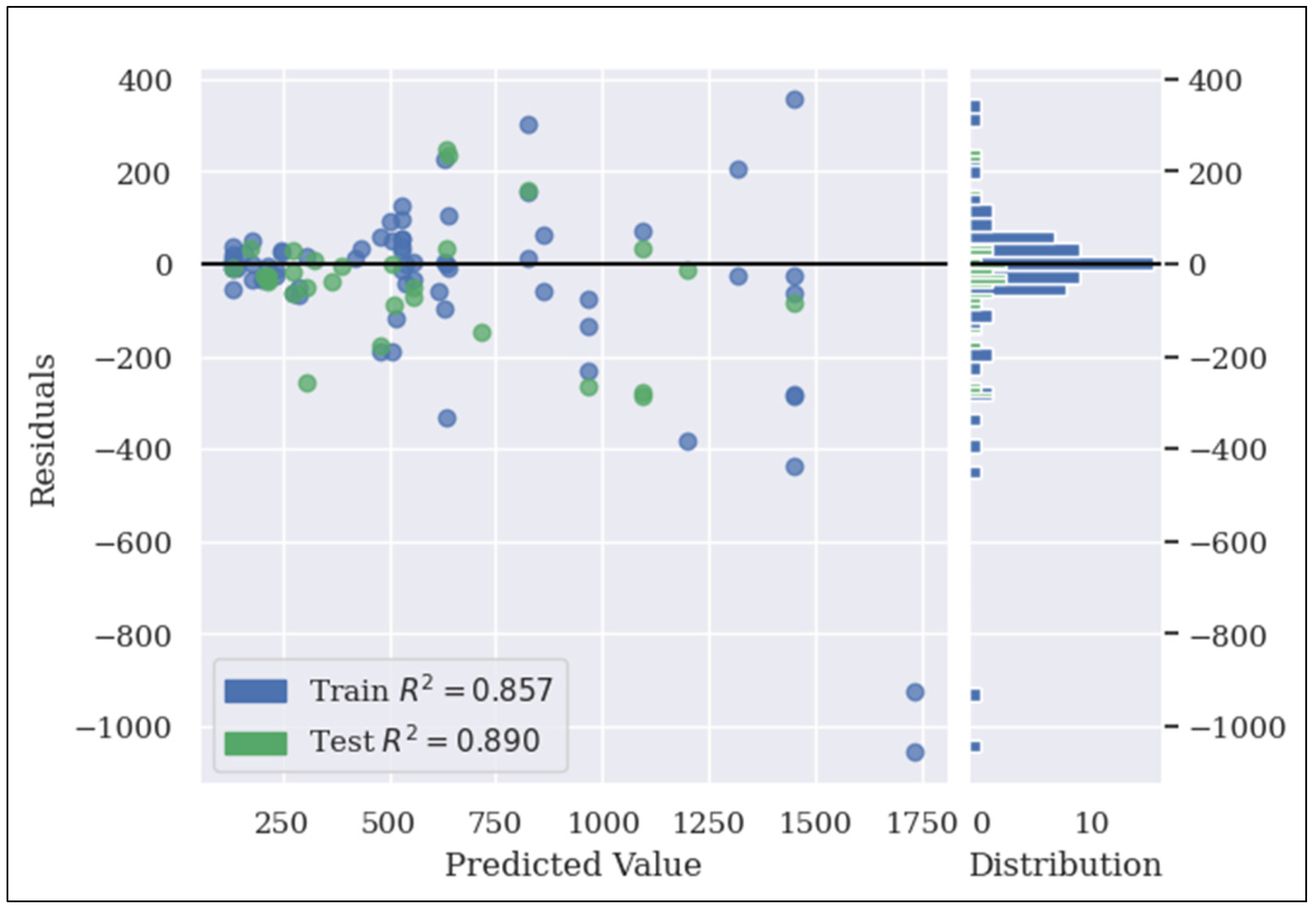
| K-Nearest Neighbor Regressor | 126.06 | 51,732 | 198.47 | 0.814 | 0.215 | 0.179 |
| Gradient Boosting Regressor | 109.05 | 33,474 | 169.20 | 0.773 | 0.212 | 0.171 |
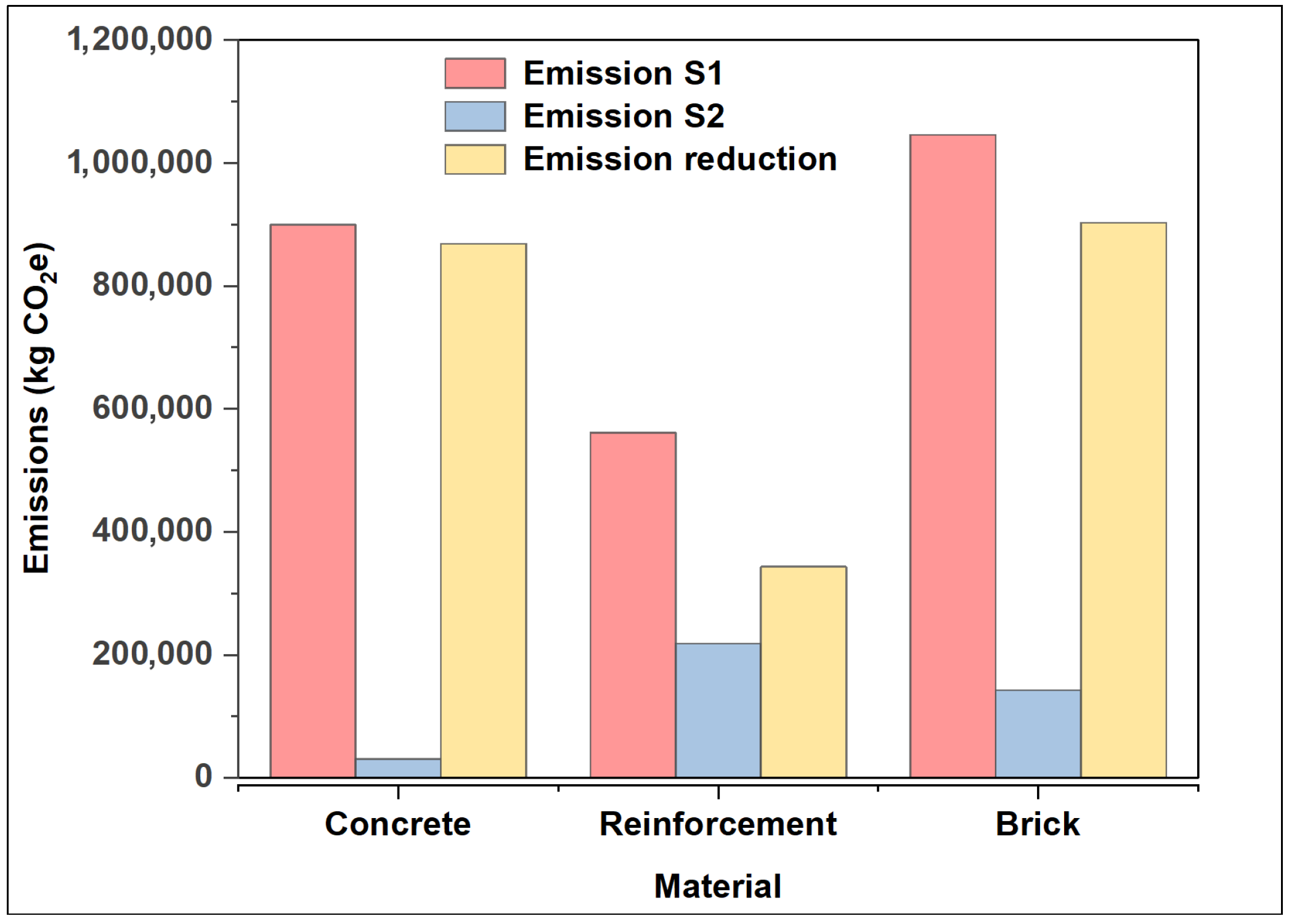
| Material | Building Size | Linear (kg CO2e) | SR = 1.0 (kg CO2e) | Reduction (%) | SR = 0.8 (kg CO2e) | Reduction (%) | SR = 0.6 (kg CO2e) | Reduction (%) |
|---|---|---|---|---|---|---|---|---|
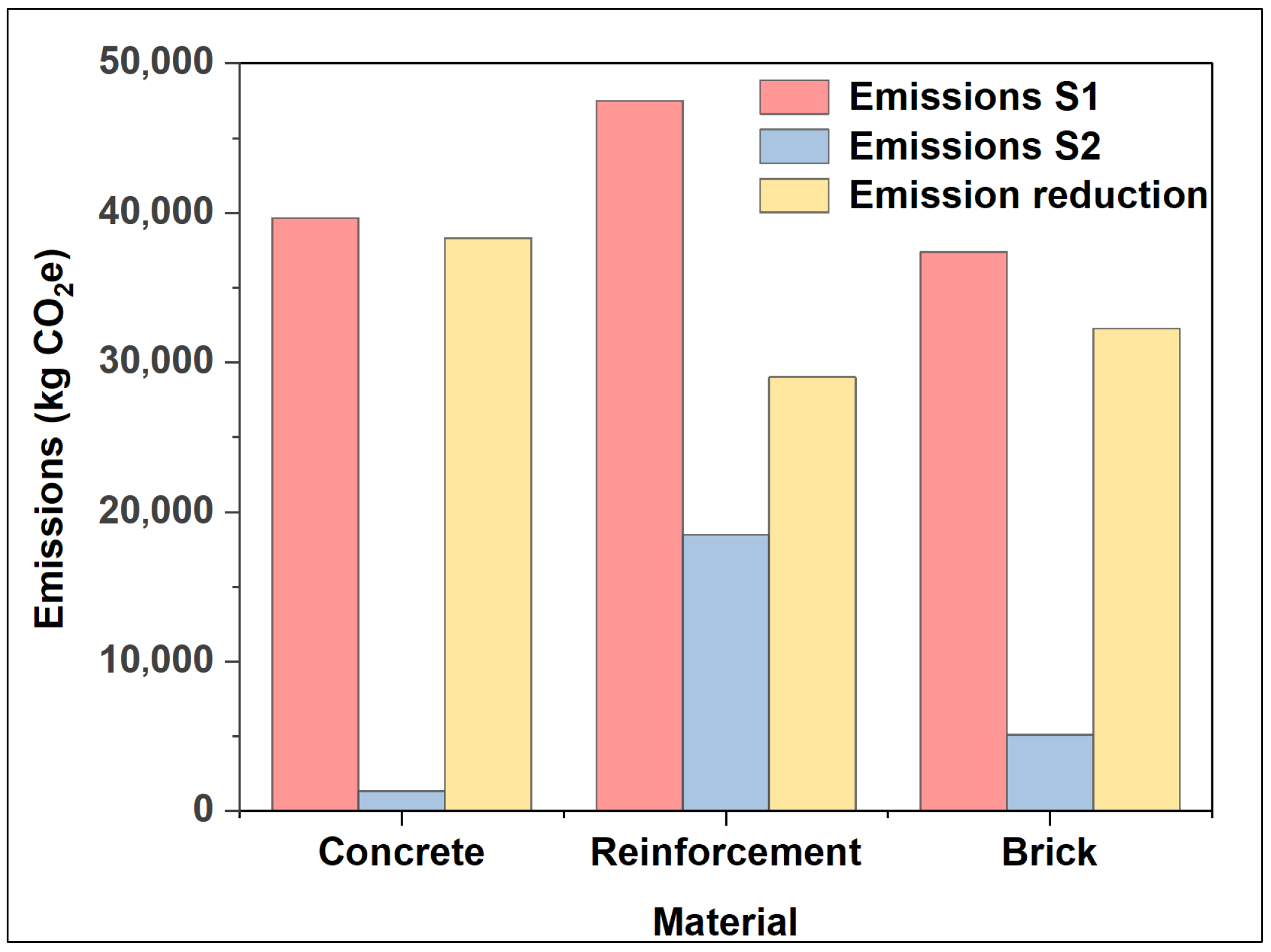
| Concrete | 250 m2 | 39,671.01 | 1149.91 | 97.1 | 8749.70 | 77.9 | 16,349.49 | 58.8 |
| 12,139 m2 | 899,321.63 | 26,067.88 | 97.1 | 198,351.25 | 77.9 | 370,634.63 | 58.8 | |
| Reinforcement | 250 m2 | 47,499.71 | 18,463.82 | 61.1 | 24,271.00 | 48.9 | 30,078.18 | 36.7 |
| 12,139 m2 | 561,686.73 | 218,335.72 | 61.1 | 286,976.44 | 48.9 | 355,617.17 | 36.7 | |
| Brick | 250 m2 | 37,392.91 | 5002.69 | 86.6 | 11,480.73 | 69.3 | 17,958.77 | 52.0 |
| 12,139 m2 | 1,045,820.65 | 139,917.30 | 86.6 | 321,097.97 | 69.3 | 502,278.64 | 52.0 |
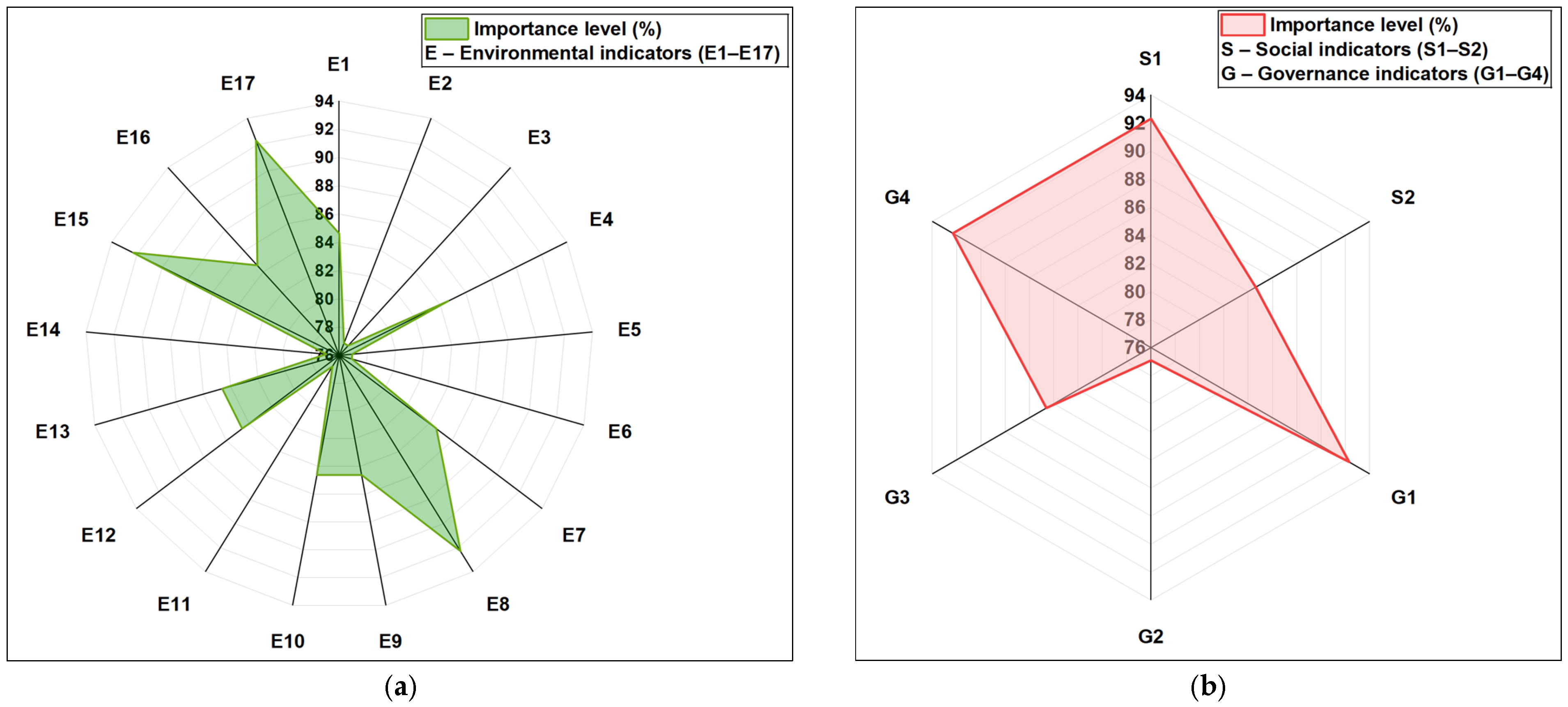
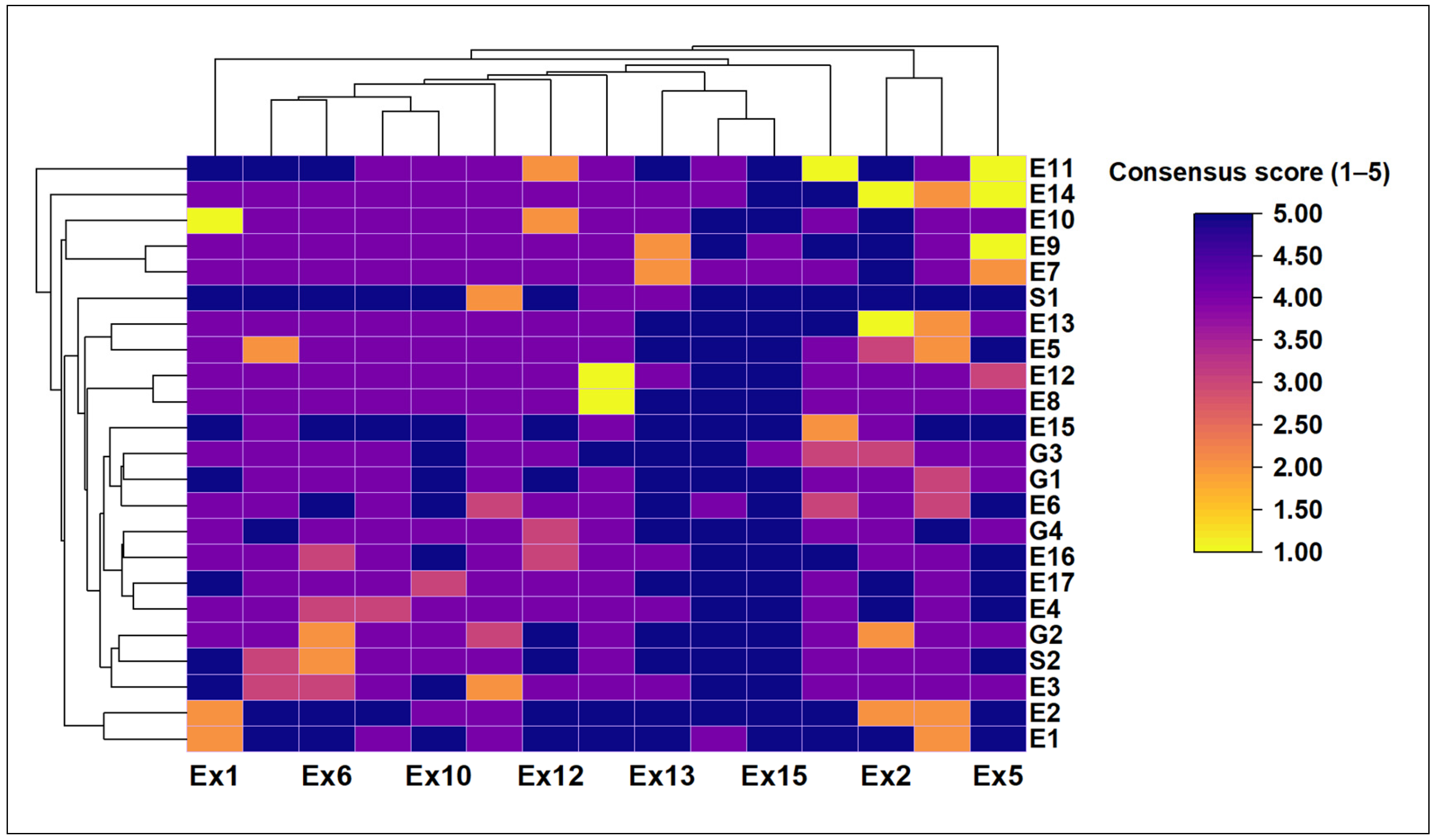
| Pillar | Indicator | Description |
|---|---|---|
| Environmental | E1 | Waste management—construction phase |
| E2 | Waste management—demolition phase | |
| E3 | Environmental impact—materialization phase | |
| E4 | Environmental impact—demolition phase | |
| E5 | Noise pollution—construction phase | |
| E6 | Wastewater generation—materialization phase | |
| E7 | Air quality monitoring—construction phase | |
| E8 | Air quality monitoring—demolition phase | |
| E9 | Wastewater monitoring—construction phase | |
| E10 | Wastewater monitoring—demolition phase | |
| E11 | Electrical energy consumption—demolition phase | |
| E12 | GHG monitoring—demolition phase | |
| E13 | Climate change adaptation—construction phase | |
| E14 | Climate change adaptation—demolition phase | |
| E15 | Dust generation—demolition phase | |
| E16 | Soil and water pollution—demolition phase | |
| E17 | Waste management practice | |
| Social | S1 | Implementation of OSH management practice—demolition phase |
| S2 | Information on hazards, risk assessment and incident reporting is regularly updated—materialization phase | |
| Governance | G1 | Transparency of social strategies |
| G2 | Inclusion of vulnerable groups | |
| G3 | Assessment of environmental and social risks in the supply chain | |
| G4 | Implementation of financial impact strategies for climate change |
| ESG Dimension | Number of Indicators | Average Importance (%) | Weighted Score (%) |
|---|---|---|---|
| Environmental | 17 | 83.5 | 73.0 |
| Social | 2 | 88.5 | 9.1 |
| Governance | 4 | 86.5 | 17.9 |
Disclaimer/Publisher’s Note: The statements, opinions and data contained in all publications are solely those of the individual author(s) and contributor(s) and not of MDPI and/or the editor(s). MDPI and/or the editor(s) disclaim responsibility for any injury to people or property resulting from any ideas, methods, instructions or products referred to in the content. |
© 2026 by the authors. Licensee MDPI, Basel, Switzerland. This article is an open access article distributed under the terms and conditions of the Creative Commons Attribution (CC BY) license.
Share and Cite
Senjak Pejić, M.; Novaković Bežanović, M.; Radović, M.; Peško, I.; Petrović, M. Integrated Machine Learning-Based Material Quantity Estimation and Carbon Footprint Assessment for Circular Construction. Clean Technol. 2026, 8, 71. https://doi.org/10.3390/cleantechnol8030071
Senjak Pejić M, Novaković Bežanović M, Radović M, Peško I, Petrović M. Integrated Machine Learning-Based Material Quantity Estimation and Carbon Footprint Assessment for Circular Construction. Clean Technologies. 2026; 8(3):71. https://doi.org/10.3390/cleantechnol8030071
Chicago/Turabian StyleSenjak Pejić, Milena, Mladenka Novaković Bežanović, Mirna Radović, Igor Peško, and Maja Petrović. 2026. "Integrated Machine Learning-Based Material Quantity Estimation and Carbon Footprint Assessment for Circular Construction" Clean Technologies 8, no. 3: 71. https://doi.org/10.3390/cleantechnol8030071
APA StyleSenjak Pejić, M., Novaković Bežanović, M., Radović, M., Peško, I., & Petrović, M. (2026). Integrated Machine Learning-Based Material Quantity Estimation and Carbon Footprint Assessment for Circular Construction. Clean Technologies, 8(3), 71. https://doi.org/10.3390/cleantechnol8030071