


Abstract
The initial carbon-to-nitrogen (C/N) ratio is a fundamental parameter for aerobic composting, with a generally recommended optimal range of 25:1 to 30:1. However, in practical applications, the optimal C/N ratio often deviates from the recommended value. We attribute this discrepancy to the limitations of traditional stoichiometric methods in assessing the bioavailability of carbon and nitrogen sources. This study investigated how carbon bioavailability governs composting efficiency and product quality. Laboratory-scale aerobic composting experiments were conducted using six types of raw crop straws and two physically pretreated straws, representing a biodegradability gradient. Results demonstrated that carbon bioavailability significantly modulated the composting performance. Substrates rich in labile carbon pool (LCP), such as wheat straw and extruded cassava plant residue, demonstrated superior thermogenesis, humification, and seed germination indices compared to those dominated by recalcitrant carbon pool (RCP), such as untreated cassava plant residue. Principal component analysis confirmed a strong positive correlation between LCP content and key quality indicators. Microbiological analysis revealed that carbon source variations shaped bacterial succession: Bacteroidota abundance correlated positively with LCP, driving rapid initial degradation, whereas Pseudomonadota were more abundant in RCP-rich treatments, suggesting a role in complex polymer breakdown. This study confirmed that carbon bioavailability, rather than the bulk C/N ratio alone, is a critical limiting factor. This finding logically extends to the role of nitrogen bioavailability, suggesting that a “biochemical C/N ratio”—accounting for the lability of both carbon and nitrogen—could be a more accurate predictor of aerobic composting performance.
1. Introduction
Aerobic composting is an eco-friendly biotransformation technology that plays a key role in converting organic-rich waste into stabilized, non-phytotoxic, and nutrient-dense organic fertilizers, thereby promoting resource recovery from agricultural residues, enhancing soil vitality, and advancing sustainable agriculture [1,2]. Among the many parameters governing this process, the initial carbon-to-nitrogen (C/N) ratio is widely recognized as pivotal. Carbon serves mainly as the microbial energy and electron source, while nitrogen provides essential nutrients for biomass synthesis. Accordingly, the C/N ratio directly influences microbial metabolism, dictating the degradation rate of organic matter and the efficiency of nitrogen transformation [3]. A relatively high C/N ratio often indicates nitrogen limitation, potentially restricting microbial growth and slowing organic matter mineralization, whereas a relatively low C/N ratio may reflect nitrogen surplus, which can promote ammonia volatilization and associated N losses. Conventionally, an optimal C/N ratio between 25:1 and 30:1 is thought to supply a balanced mix of energy (carbon) and nutrients (nitrogen) for microorganisms, ensuring an efficient and stable composting process [4]. In practice, however, the optimal C/N ratio for composting diverse agricultural waste frequently deviates from this recommended range.
For instance, cotton stalk, a feedstock rich in recalcitrant components, can be composted to full maturity even with an initial C/N ratio as high as 35.2 [5]. Conversely, for substrates abundant in labile organic matter like food waste, composting can be carried out effectively at a lower initial C/N ratio (e.g., 13.9–19.6). Kumar et al. and Gao et al. demonstrated that when co-composting pig manure with either readily degradable corn stalk or recalcitrant rice husk, the corn stalk mixture exhibited significantly faster temperature elevation, greater organic matter degradation, and superior maturity [6,7]. Our previous meta-analysis further confirmed that optimal C/N ratios vary by manure source: 20–25 is suitable for pig and chicken manure, whereas a higher range of 25–35 is necessary for sheep and cattle manure [8].
This gap between theory and practice arises because the conventional C/N ratio merely reflects the stoichiometry of total carbon and nitrogen, failing to account for their bioavailability. The co-composting of crop straws and animal manure represents a typical agricultural waste treatment system, in which the manure fraction generally supplies sufficient bioavailable nitrogen [9], whereas the carbon pool within the lignocellulosic straw is more complex and heterogeneous. Lignocellulosic biomass comprises a complex mixture of carbon fractions with distinct chemical structures and biodegradability, ranging from labile components (e.g., water-soluble organic carbon, hemicellulose) to recalcitrant ones (e.g., cellulose, lignin) [10]. Microorganisms display varied preferences and degradation kinetics for these carbon forms, which collectively define the carbon source bioavailability. We thus hypothesize that at a given initial C/N ratio, the content and proportion of bioavailable carbon, rather than the total carbon, are the fundamental limiting factors determining the composting start-up speed, process efficiency, and final product quality.
Although research has begun to explore the influence of different carbon sources, most studies have focused either on process optimization via the addition of exogenous labile carbon (e.g., sugars, starches) [11,12] or on comparing a few feedstocks with vastly different properties [13,14]. However, a systematic investigation is needed to elucidate how the intrinsic carbon structure of compositionally similar crop straws governs the entire composting process, including thermal dynamics, physicochemical evolution, humification, and microbial succession.
To address this gap, we established a series of composting systems maintained at a controlled initial C/N ratio of 25:1. These systems utilized a range of carbon sources selected to represent a natural degradability gradient, which comprised six raw crop straws and two physically pretreated residues. This study aimed to (1) evaluate the influence of carbon source biodegradability on composting performance (e.g., thermogenesis and maturation) and product quality (e.g., nutrients, humification, and phytotoxicity); (2) investigate the relationship between key physicochemical dynamics and the transformation of carbon fractions;(3) characterize the successional patterns of the bacterial community as driven by carbon bioavailability. These findings are expected to advance the conceptual understanding of the C/N ratio in composting and provide a scientific framework that transcends this traditional metric for optimizing substrate formulation in practical applications.
2. Materials and Methods
2.1. Composting Feedstocks and Pretreatment
Six types of crop residues were selected as primary substrates for this study. Rapeseed straw (RS), soybean straw (SS), and wheat straw (WS) were procured from an agricultural production base in Lianyungang, Jiangsu Province, China. Tomato stalk (TS), chili stalk (CS), and cassava plant residue (CP) were collected from farmland in Danzhou, Hainan Province, China. To ensure consistent physical properties across all treatments, the collected residues were mechanically shredded into 2–3 cm long fragments. To establish a broader biodegradability gradient, shredded CP was processed through a twin-screw extruder (ZSHSY-15, Weibin Zhongshihuan Machinery Co., Ltd., Xinxiang, Henan, China) at two distinct extrusion ratios (4:1 and 6:1), yielding materials designated ECP1 and ECP2, respectively.
2.2. Composting Procedure
The experiment was conducted in 80 L aerobic composting reactors (VOTO-80, Beijing VOTO Earth-Bio Co., Ltd., Beijing, China), encompassing eight treatments: RS, SS, WS, TS, CS, CP, ECP1, and ECP2. The initial C/N ratio for all treatments was uniformly adjusted to 25:1 using analytical-grade urea as a nitrogen supplement. Taking RS as an example, for a 20 kg raw-material pile (containing 8486 g total TOC and 146 g TN), 419 g urea (equivalent to 193 g nitrogen) was dissolved in water and evenly applied to the pile to ensure uniform distribution. The initial moisture content was adjusted to 50–60%, and each treatment was inoculated at 1% (w/w) with a commercial microbial agent (Zhongnong Lvkang Biotechnology Co., Ltd., Beijing, China). The agent was dominated by Bacillota (56.3%), Actinomycetota (37.03%), and Pseudomonadota (5.24%). Aeration was managed using a combination of forced ventilation and manual turning. The compost piles were turned every 3 d during the thermophilic phase and every 10 d during the cooling and maturation phases.
2.3. Fractionation and Analysis of Bioavailable Carbon
Organic carbon was partitioned into three pools of varying bioavailability—a highly labile carbon pool (LCP1), a moderately labile carbon pool (LCP2), and a recalcitrant carbon pool (RCP)—based on the sequential acid hydrolysis method described by Rovira and Vallejo [15]. Briefly, 1.000 g of dried sample (passed through an 850 μm sieve) was hydrolyzed with 2.5 mol/L H2SO4 at 105 °C for 30 min. The resulting supernatant, collected after centrifugation, constituted the LCP1 fraction. The solid residue was then treated with 13 mol/L H2SO4 for 10 h at room temperature with shaking, followed by dilution and a second hydrolysis at 105 °C for 3 h. The supernatant from this step represented the LCP2 fraction. The RCP content was determined by subtracting LCP1 and LCP2 from the total organic carbon (TOC). The organic carbon content in each fraction was quantified using the potassium dichromate oxidation-ferrous sulfate titration method. The available carbon content (ACC) was defined as the ratio of total labile carbon (LCP1 + LCP2) to TOC, and ACC1 and ACC2 represented the ratios of LCP1 and LCP2 to TOC, respectively.
The cellulose, hemicellulose, and lignin contents were determined using a two-step acid hydrolysis method, following the Laboratory Analytical Procedures of the U.S. National Renewable Energy Laboratory (NREL).
Substrate bioavailability was also assessed via enzymatic saccharification to measure reducing sugar production (RSP). Briefly, 1.000 g of dried sample (passed through an 850 μm sieve) was incubated in 10 mL of Tris-phosphate buffer (pH 5.0) with 15 mg of a composite enzyme cocktail (Cellic® CTec2 and Viscozyme® L, 1:1 w/w, total activity ≈ 15.0 FPU). After enzymatic hydrolysis at 50 °C for 24 h with constant shaking, the reducing sugar yield in the supernatant was quantified using the 3,5-dinitrosalicylic acid (DNS) colorimetric method.
2.4. Sampling and Physicochemical Analysis
Composite samples (approximately 200 g) were collected from five points at a depth of 10–15 cm within each pile on days 1, 3, 9, 21, and 26. After thorough homogenization, each sample was divided into three aliquots: a fresh aliquot was stored at 4 °C for moisture content (MC) and germination index (GI) analyses; a second aliquot was flash-frozen in liquid nitrogen and stored at −80 °C for microbial DNA extraction; and the remainder was air-dried and ground for other physicochemical determinations.
Pile core temperature (30–40 cm depth) and ambient temperature were monitored daily. MC was determined gravimetrically by drying at 105 °C to constant weight. For pH and electrical conductivity (EC), 1:10 (w/v) aqueous extracts were prepared, and the supernatant was analyzed. TOC was measured by the dichromate-external heating method [16] and total nitrogen (TN) was quantified by the Kjahl method after H2SO4-H2O2 digestion [17]. Following HNO3-HClO4 digestion, total phosphorus (TP) was measured by the vanadomolybdate colorimetric method [18] and total potassium (TK) by flame photometry [19].
2.5. Humic Substance Analysis
Humic substance (HS) was extracted and quantified according to Chinese standard NY/T 1867-2010 [20]. Briefly, a 5.00 g air-dried sample was extracted with 100 mL of a 0.1 M NaOH–0.1 M Na4P2O7 solution for 24 h with shaking. The supernatant, collected after centrifugation, constituted the total HS extract. The total HS carbon (HS-C) was determined by quantifying the organic carbon in the residue of a neutralized and evaporated aliquot. To separate fractions, another aliquot was acidified to pH 1.0–1.5 and flocculated at 80 °C. The precipitate, humic acid (HA), was isolated, redissolved in 0.05 M NaOH, and its carbon content (HA-C) was measured. Fulvic acid carbon (FA-C) was calculated by difference (HS-C − HA-C). Humification parameters were calculated as follows: Humification Ratio (HR, %) = (HS-C/TOC) × 100%; and HA/FA Ratio = HA-C/FA-C.
2.6. Germination Index (GI) Assay
Compost phytotoxicity was evaluated by a GI assay using radish (Raphanus sativus L.) seeds. Aqueous compost extracts (1:10 w/v) were applied to 10 seeds on filter paper in a Petri dish, with deionized water as the control. After incubation in darkness at 25 ± 2 °C for 48 h, germination rate (GR) and radicle length (RL) were recorded. GI was calculated as
2.7. Microbial Community Analysis
Total genomic DNA was extracted using the FastDNA® Spin Kit for Soil (MP Biomedicals, Irvine, CA, USA). The V3–V4 hypervariable region of the bacterial 16S rRNA gene was amplified by PCR using primers 338F and 806R. Purified amplicons were sequenced on an Illumina MiSeq platform (Majorbio Bio-pharm Technology Co., Ltd., Shanghai, China). Alpha diversity was estimated using the Ace, Chao1, Shannon, and Simpson indices.
2.8. Data Analysis
All results are expressed as mean ± standard deviation (SD). Statistical analyses were performed using IBM SPSS Statistics 25.0, and data were visualized with Origin 2021. One-way analysis of variance (ANOVA) followed by Tukey’s HSD post hoc test was used to determine significant differences between groups, with the significance level set at p < 0.05. The Kruskal–Wallis H test was employed to analyze differences in microbial alpha diversity indices among the groups.
3. Results and Discussion
3.1. Characterization and Classification of Carbon Bioavailability
While the conventional C/N ratio reflects bulk elemental stoichiometry, it fails to capture the differential microbial availability of distinct carbon forms. This study therefore classified the feedstocks into three biodegradability tiers—high, moderate, and low—based on the distribution of their carbon pools: a highly labile pool (LCP1), a moderately labile pool (LCP2), and a recalcitrant pool (RCP), as determined by chemical fractionation (Table 1) and hierarchical clustering (Figure S1).
Table 1.
Carbon and nitrogen fractions of different crop residues.
RS, SS, and WS were categorized into the high-biodegradability group. Their defining feature was a significantly higher cumulative proportion of labile carbon (LCP1 and LCP2) (Table 1). WS exhibited the highest LCP1 content (129.5 g·kg−1), followed by SS. This high degree of similarity in their carbon architecture was corroborated by the clustering analysis (Figure S1). The abundance of LCP1 suggests these substrates furnish a readily available energy source, promoting rapid microbial proliferation and metabolic activity during the initial composting phase and thereby accelerating the system’s temperature rise.
TS and CS constituted the moderate-biodegradability group. In contrast to the high-biodegradability group, these straws had relatively low LCP1 content (52.2 and 48.8 g·kg−1, respectively) but a higher proportion of LCP2. This was particularly evident in TS, which contained up to 105.0 g·kg−1 of LCP2. This “low LCP1, high LCP2” carbon profile suggests that while these substrates are less potent for fueling the initial temperature surge, their moderately labile carbon can be released more steadily over time, providing a sustained energy source during the mid-to-late composting stages.
Among all tested materials, CP exhibited the most pronounced recalcitrance and was classified as a low biodegradability group. Its RCP content reached 327.1 g·kg−1, a value statistically higher than all other feedstocks (p < 0.05), while its LCP2 content was merely 19.7 g·kg−1. This extensive recalcitrant fraction forms a physicochemical barrier, severely impeding microbial access to and degradation of the internal cellulose and hemicellulose.
Twin-screw extrusion significantly altered the properties of the CP. This pretreatment increased the LCP2 content from 19.7 g·kg−1 in the raw material (CP) to 39.0 g·kg−1 in the processed samples (ECP1 and ECP2). The mechanical shear and thermal effects of extrusion evidently disrupted the complex lignocellulosic matrix, enhancing the bioaccessibility of certain carbon fractions. However, pretreatment also caused a marked decrease in TN content, from 5.8 to 2.4 g·kg−1. It is speculated that high pressure during extrusion disrupted plant cells, releasing intracellular fluid rich in water-soluble nitrogenous compounds (e.g., proteins, amino acids). Despite a liquid-reflux strategy to maximize nutrient retention, some loss of this dissolved nitrogen was unavoidable.
3.2. Dynamics of Key Physicochemical Parameters During Composting
3.2.1. Evolution in pH, Moisture Content, Temperature, and Electrical Conductivity
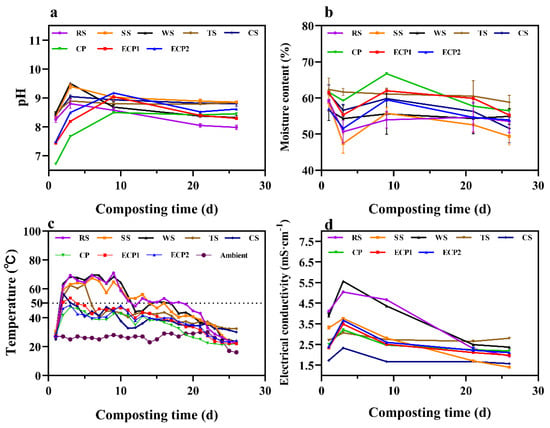
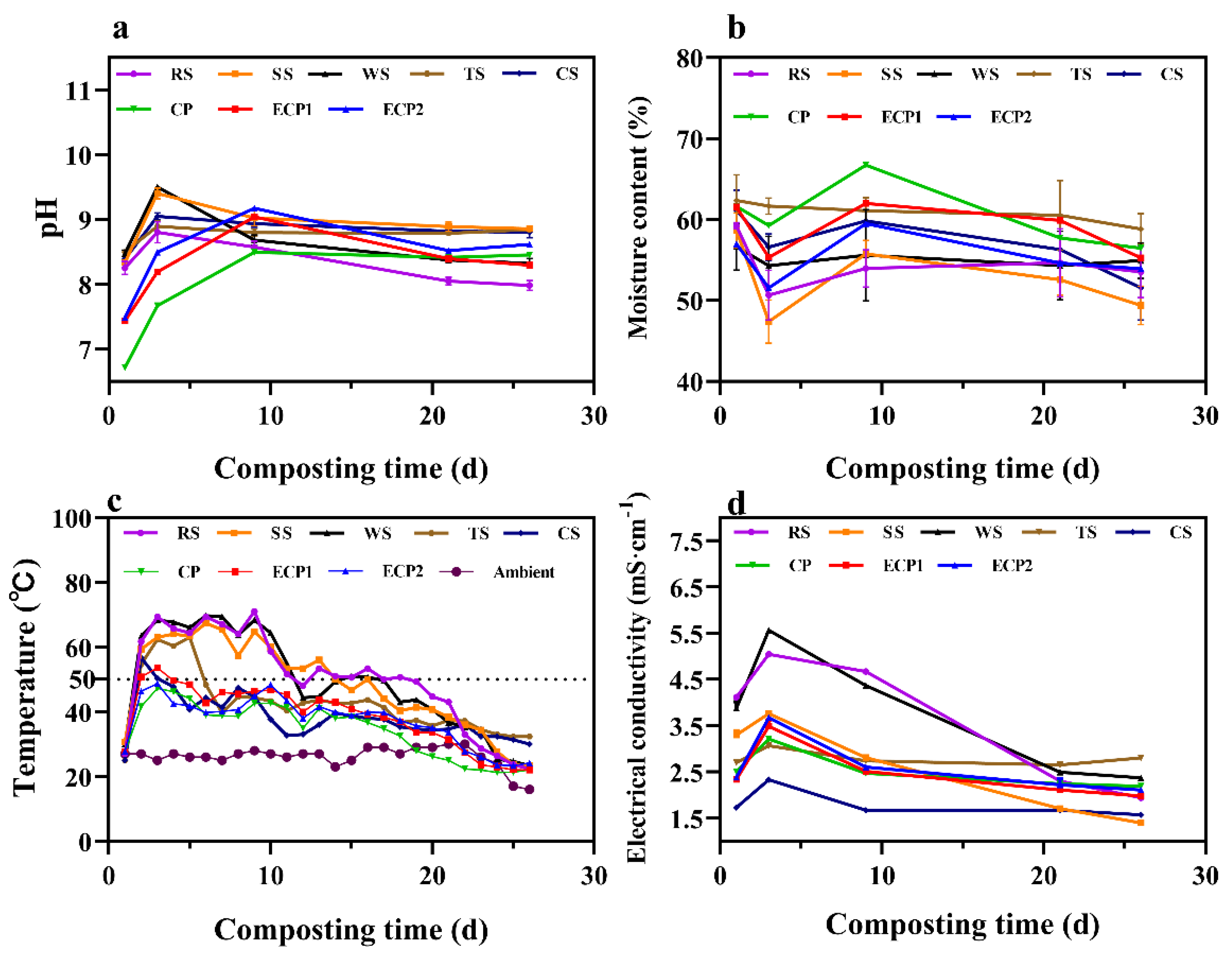
Across all treatments, the compost pH exhibited a characteristic trajectory: a sharp initial rise followed by a gradual decline (Figure 1a). This pattern reflects the shifting balance between the production of alkaline and acidic metabolites. Initially, the rapid decomposition of labile carbon spurred vigorous microbial activity and ammonification, generating large amounts of ammonia (NH3). The dissolution of NH3 into NH4+ drove the pH into a distinctly alkaline range [21]. Subsequently, the pH began to fall, a process driven by three concurrent mechanisms: (1) high temperatures promoted NH3 volatilization, diminishing the alkaline buffering capacity of composting system; (2) as labile carbon was consumed, microbial metabolism shifted toward more recalcitrant components, producing volatile fatty acids (VFAs); (3) during the cooling phase, nitrification resumed, and the H+ generated further neutralized system alkalinity [4]. By the end of composting, the pH in all treatments had stabilized within a mildly alkaline range (7.5 to 9.0), a key indicator of compost maturity.
Figure 1.
Dynamic changes in pH (a), moisture content (b), temperature (c), and electrical conductivity (d) during the composting process (RS, rapeseed straw; SS, soybean straw; WS, wheat straw; TS, tomato stalk; CS, chili stalk; CP, cassava plant residue; ECP, extruded cassava plant residue; The dashed line marks the starting temperature of the high temperature period).
Moisture content (MC), a critical regulator of microbial physiology and enzymatic activity, dropped sharply across all treatments during the initial 4 days (Figure 1b). This rapid water loss was driven by the substantial bio-heat generated from the explosive microbial growth fueled by the mineralization of highly bioavailable carbon [22]. Although water was periodically added to maintain MC within the optimal 45–65% range, the overall trend confirmed a phase of intense evaporative loss, indirectly attesting to the high metabolic activity during the early composting stage.
Temperature serves as a core indicator of both composting efficiency and pathogen inactivation. The thermal profiles varied significantly depending on the feedstock (Figure 1c). The SS and WS treatments achieved the best heating performance, sustaining thermophilic conditions (>50 °C) for over 10 days and reaching peak temperatures near 70 °C. The RS treatment followed, with a 9-day thermophilic phase peaking at 71 °C. In contrast, the thermophilic durations for TS and CS treatments were substantially shorter (4 and 2 days, respectively). Crucially, a significant positive correlation was found between the peak temperature achieved and the initial LCP1 content of the substrate. This finding provides strong evidence that, at a constant C/N ratio, carbon bioavailability is the direct factor controlling the rate and intensity of thermogenesis. For the recalcitrant CP, physical pretreatment had a profound effect. The CP treatment failed to enter a sustained thermophilic phase, indicating severe biodegradation inhibition. The ECP1 treatment, however, rapidly reached thermophilic temperatures by day 2, peaking at 53.6 °C. Interestingly, the more intensively pretreated ECP2 did not outperform ECP1, suggesting that excessive pretreatment may have unintended negative consequences that warrant further investigation.
Electrical conductivity (EC) reflects the concentration of soluble salts and serves as a proxy for organic matter mineralization. All treatments displayed a typical pattern: EC started low, rose to a peak during the most active phase as mineralization released ions, and then declined as these ions were either lost (e.g., ammonia volatilization) or incorporated into humic substance (Figure 1d). Feedstock type significantly influenced EC dynamics. Labile-rich feedstocks (RS, WS, and SS) generated significantly higher peak EC values (up to 5.56 mS·cm−1) than other groups (p < 0.05), indicating that higher carbon bioavailability promotes faster cell wall breakdown and nutrient mineralization. Pretreatment was also impactful; the higher peak EC values in ECP1 and ECP2 treatments compared to CP treatment further confirm that physical disruption enhances substrate bioavailability and accelerates the mineralization process.
3.2.2. Dynamics of Carbon and Nitrogen Fractions
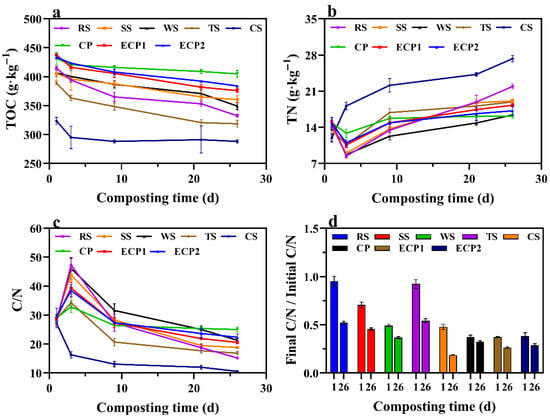
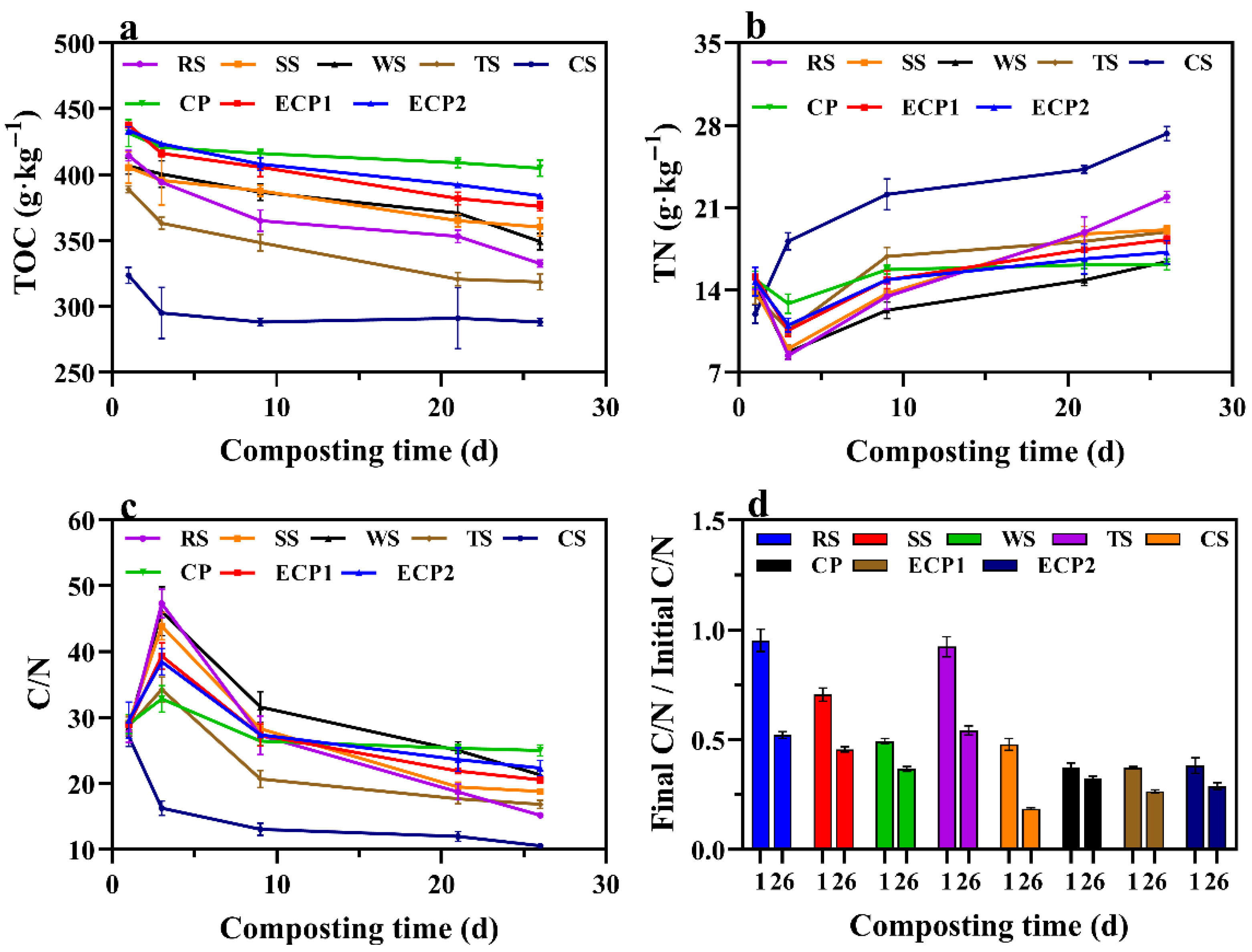
The microbial-mediated degradation of TOC is a central indicator of compost maturity and stability. Across all treatments, TOC content steadily decreased over the composting period, with final degradation rates ranging from 6.2% to 19.8% (Figure 2a). This reduction stems primarily from heterotrophic respiration, which mineralizes complex organic carbon into CO2, and from the assimilation of carbon into microbial biomass and humic precursors [23]. Critically, the rate and extent of TOC degradation varied significantly among treatments, a difference governed principally by the bioavailability of the carbon feedstock. Materials rich in labile carbon (e.g., SS and RS) or those with enhanced structural accessibility via physical pretreatment (i.e., ECP1 and ECP2) exhibited far greater TOC reduction. This confirms that increasing the bioaccessibility of carbon sources is a highly effective strategy to drive microbial metabolism and optimize composting efficiency.
Figure 2.
Dynamic changes in TOC (a), TN (b), C/N ratio (c), and T value (d) during the composting process (TOC, total organic carbon; TN, total nitrogen; T value, the ratio of final to initial C/N; RS, rapeseed straw; SS, soybean straw; WS, wheat straw; TS, tomato stalk; CS, chili stalk; CP, cassava plant residue; ECP, extruded cassava plant residue).
Conversely, the final TN content increased in all treatments, with increments ranging from 16.9% to 128.3% (Figure 2b). This increase is a manifestation of the concentration effect, where the loss of carbon as CO2 reduces the total dry mass, thereby increasing the relative concentration of the remaining nitrogen. The typical TN dynamic involved an initial dip followed by a rise. During the thermophilic phase, intense ammonification converted organic N to NH4+, but the high temperature and pH drove its volatilization as gaseous NH3 [24]. As the system cooled and matured, ammonia volatilization slowed, and nitrification converted the remaining ammonium into more stable nitrate (NO3−), while the concentration effect became the dominant factor influencing the final TN value [25,26].
Nitrogen retention was feedstock-dependent: while RS, SS, and TS treatments followed a typical dynamic (increasing by 46.5%, 33.2%, and 39.4%, respectively), the CS treatment showed a unique and continuous increase in TN throughout the process. For the CP, pretreatment improved nitrogen retention. The TN increases in the ECP1 treatment (20.8%) and ECP2 treatment (16.9%) surpassed that of the untreated CP treatment (10.0%). This suggests that improving carbon bioavailability enhances microbial nitrogen immobilization, leading to a more nitrogen-rich final product.
The C/N ratio, a critical index of compost stabilization. As aerobic fermentation progressed, the final C/N ratio decreased. This trend results from the synergistic effects of carbon loss via mineralization and the relative enrichment of nitrogen due to overall mass loss [27]. A core finding of this study is the significant positive correlation between the rate of C/N ratio decline and the initial labile carbon content. This provides compelling evidence for our central hypothesis: carbon source bioavailability, not just the bulk C/N ratio, dictates composting kinetics. Substrates with low bioavailability (e.g., untreated CP) showed a sluggish C/N decline because the microbial community could not efficiently metabolize the carbon skeleton, despite an “optimal” initial ratio of 25. By the end of the process, all treatments achieved a C/N ratio below 20, satisfying the standard for compost maturity (final C/N ratio < 23) [28].
To better quantify this transformation, the C/N evolution coefficient (T-value), the ratio of the final to initial C/N, was introduced. A T-value below 0.6 is a reliable threshold for full maturity [29]. All treatments ultimately stabilized below this threshold (Figure 2d). Notably, the final T-value for the ECP1 treatment was significantly lower than that of both the CP and ECP2 treatments (p < 0.05). This result further validates our hypothesis that mechanical disruption of lignocellulosic barriers enhances the bioaccessibility of recalcitrant carbon, accelerating the overall reaction kinetics and yielding a more stable and mature final product.
3.2.3. Evaluation of Compost Maturity and Humification
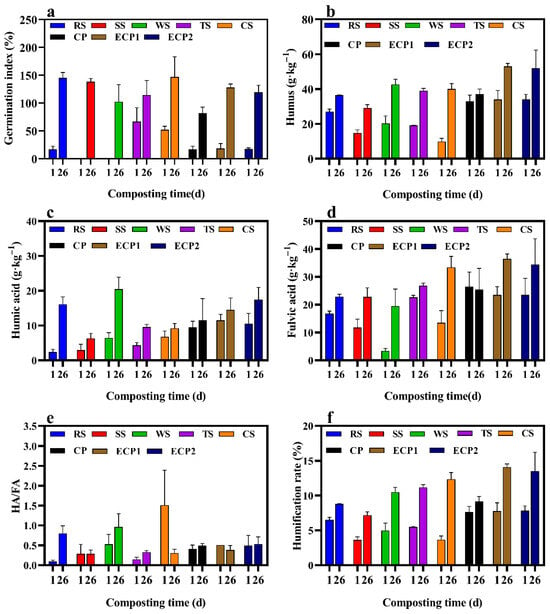
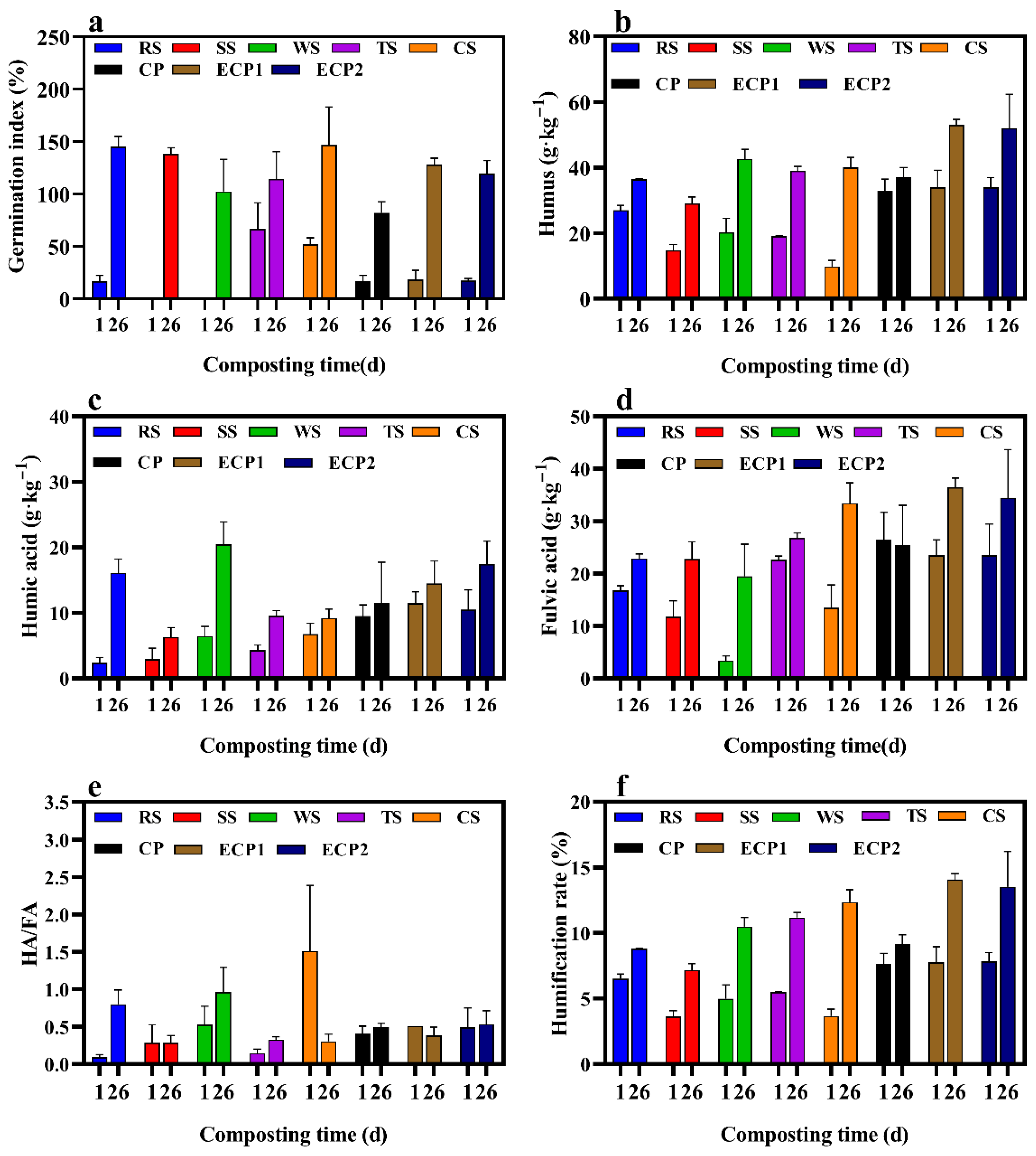
The GI is a key bioassay for compost phytotoxicity and maturity, as residual ammonia, VFAs, and phenolic compounds in immature compost can inhibit seed germination [30]. By the end of the process, the GI values for all composts comfortably exceeded 80%, well above the 70% safety threshold stipulated by Chinese standard for organic fertilizers [17] (Figure 3a). This indicates that all final products were non-phytotoxic and suitable for agricultural use.
Figure 3.
Seed germination index (a), humus (b), humic acid (c), fulvic acid (d), HA/FA ratio (e), and humification index (f) of the final compost products derived from different straw materials (RS, rapeseed straw; SS, soybean straw; WS, wheat straw; TS, tomato stalk; CS, chili stalk; CP, cassava plant residue; ECP, extruded cassava plant residue).
The degree of maturity, however, varied significantly among the feedstocks. Composts derived from RS and CS exhibited exceptional maturity, with GI values of 145% and 147%, respectively. Notably, extrusion pretreatment dramatically improved the maturation of CP. Compared with the untreated CP (GI = 82%), the GI values increased markedly in the pretreated ECP1 and ECP2 treatments, reaching 128% and 119%, respectively. This elevated GI indicates a significant depletion of phytotoxic constituents—such as low-molecular-weight organic acids, free ammonia, excessive soluble salts, and intermediate metabolites like phenols and aldehydes. This confirms that the fermentation process has reached completion, resulting in a biologically stable and mature product. These findings strongly validate our core hypothesis that enhancing carbon bioavailability accelerates the compost maturation process.
The formation and accumulation of HS are central biochemical markers of compost stabilization and maturation, directly influencing the product quality as a fertilizer and soil amendment [31]. As depicted in Figure 3b, the final accumulation of HS was highly dependent on the initial carbon source. WS and CS demonstrated strong humification potential, with final HS contents reaching 42.7 g·kg−1 and 40.0 g·kg−1, representing remarkable increases of 52.5% and 305.7% from their initial levels.
This promotional effect of pretreatment on humification was particularly pronounced for the CP. The untreated CP registered a net HS increase of only 3.9 g·kg−1 (10.8%) over the entire period, indicating that low carbon bioavailability severely constrained microbial metabolism and led to a near-stagnant humification process. In stark contrast, pretreatment dramatically enhanced humification efficiency in the ECP1 and ECP2 treatments, which achieved final HS contents of 53.0 and 52.0 g·kg−1, respectively. This powerfully substantiates our conclusion that increasing the carbon bioaccessibility unlocks the metabolic potential of the microbial community. This accelerated decomposition of complex organics not only fuels microbial growth but crucially releases and generates a large pool of precursors for humus synthesis (e.g., polyphenols, amino sugars).
The dynamics of the HS fractions—humic acid and fulvic acid—provide further insight. Humic acid, the more complex and larger molecular weight fraction, is key to improving soil structure [32]. Its accumulation pattern (Figure 3c) mirrored that of total HS, with the pretreated ECP2 showing a 66.6% increase in HS content, significantly outperforming the untreated CP (21.1% increase). Fulvic acid, the smaller and more soluble fraction, is noted for its high biological activity [33]. While fulvic acid content generally increased (Figure 3d), the CP showed a net loss of fulvic acid in later stages (–3.8%). This suggests that under carbon-limited conditions, microbes may degrade previously formed fulvic acid as a supplemental energy source [34]. In contrast, the pretreated ECP1 and ECP2 achieved significant fulvic acid gains (43.2% and 35.3%), confirming that optimizing carbon bioavailability is critical for the net accumulation of this valuable organic substance.
The humic-to-fulvic acid (HA/FA) ratio and humification ratio are key metrics of compost quality and stability. The HA/FA ratio reflects the degree of HS condensation; a higher ratio implies a more complex, stable structure [35]. Among the final products, compost from WS had the highest HA/FA ratio (0.97), while compost from SS had the lowest (0.29) (Figure 3e). For the CP, although extrusion promoted the absolute accumulation of fulvic acid, the concurrent, significant increase in humic acid meant that the final HA/FA ratios of the ECP treatments (0.38–0.53) were not higher than that of the CP treatment (0.50). This indicates that highly bioavailable carbon promotes the formation of both the simpler fulvic acid and the more complex humic acid fractions. The humification ratio, which quantifies the efficiency of organic matter conversion into HS, showed the highest value in the CS treatment (12.4%) (Figure 3f). Critically, the humification ratio values for the pretreated ECP1 (14.1%) and ECP2 (13.5%) were significantly higher than for the untreated CP (9.1%) (p < 0.05). This finding, from a macro-efficiency perspective, further corroborates our central thesis that enhancing carbon biodegradability is a key driver of the humification process.
3.2.4. Integrated Evaluation via Principal Component Analysis (PCA)
To provide a holistic assessment of the final compost quality, a PCA was performed on eight key physicochemical and humification parameters (GI, HS, HA, FA, HR, HA/FA ratio, TP, TK). The first three principal components (PC1, PC2, and PC3) collectively accounted for 86.0% of the total variance, effectively encapsulating the primary information within the dataset (Table S2). PC1 (45.5% of variance) was positively loaded by TP, HR, and HA/FA ratio, and negatively by HS and FA. It primarily reflects the degree of humification and nutrient profile. PC2 (26.5% of variance) was principally driven by positive loadings from HA and TK, representing a composite factor of compost maturity and potassium content. PC3 (13.9% of variance) correlated most strongly with GI, thus representing the phytotoxicity and biological suitability of the compost.
Using the loading scores, we constructed a composite quality evaluation model to generate a single Composite Quality Score (CQS) for each treatment (Table S2 and Table 2). The resulting CQS ranking was as follows: WS (4.71) > RS (2.93) > CS (0.32) > SS (−0.09) > TS (−0.24) > ECP2 (−1.60) > ECP1 (−2.46) > CP (−3.56) (Table 2). This ranking revealed a direct and significant positive correlation between the final compost quality and the initial bioavailability of the carbon source. For instance, in the high bioavailability group, the WS treatment, which started with the highest ACC (45.0%), achieved the highest CQS. This ample supply of readily available carbon fueled an efficient humification process. Conversely, the CP treatment, with an ACC of only 27.2% and a dominant content of RCP of 72.8%, exhibited the lowest CQS. Its recalcitrant architecture severely inhibited microbial metabolism, thereby limiting both maturation and nutrient conversion efficiency.
Table 2.
Principal component scores, comprehensive scores, and carbon source components of different composting treatments.
Crucially, physical pretreatment directly translated to improved quality scores. Extrusion increased the ACC from 27.2% (CP) to 31.0% (ECP1) and 35.1% (ECP2) and caused RSP to surge from 137.01 to over 548 g·kg−1. This fundamental shift in carbon bioaccessibility was mirrored in the CQS, with scores improving from −3.56 (CP) to −2.46 (ECP1) and −1.60 (ECP2).
These data provide compelling support for our central hypothesis: the bioavailability of the carbon source, rather than its total bulk content, more accurately reflects the actual energy and nutrient accessibility for the microbiome. This finding underscores the importance of regulating carbon source “quality”—specifically its biodegradability—in addition to traditional bulk metrics like the C/N ratio, to optimize the composting process and enhance final product quality. This finding naturally raises a further question regarding the role of nitrogen bioavailability. Consequently, a “biochemical C/N ratio,” one that incorporates the bioavailability of both carbon and nitrogen, would likely serve as a superior predictor of composting outcomes.
3.3. Influence of Carbon Source Biodegradability on Bacterial Community Succession
3.3.1. Bacterial Community Diversity
Alpha diversity metrics were calculated to track the evolution of the microbial community throughout the composting process (Table S3). From the initial to the maturation phase, community richness (Ace, Chao1) and diversity (Shannon) significantly increased (p < 0.05), while the dominance index (Simpson) significantly decreased (p < 0.05). This trajectory clearly indicates that the composting process fostered a more speciose, diverse, and stable microbial community.
To further investigate the temporal features of community structure, the composting period was divided into four key stages: initial (InP), thermophilic (ThP, >50 °C), cooling (CoP, 30–50 °C), and maturation (MaP). A stage-by-stage analysis further clarified this temporal progression (Figure S2). Community richness indices (Ace, Chao1) steadily increased, following the trend MaP > CoP > ThP > InP. This suggests that as labile substrates were depleted, the subsequent breakdown of more complex macromolecules created a wider array of ecological niches, promoting microbial proliferation and a more intricate community network. Community diversity and evenness peaked during the cooling phase, as evidenced by the maximal Shannon and minimal Simpson indices. This peak diversity likely resulted from the synergistic effect of moderate temperatures and a substrate pool rich in both residual carbon and newly synthesized humic precursors, which supported the coexistence of various trophic guilds.
3.3.2. Succession of Bacterial Community Structure
Taxonomic analysis was employed to uncover how carbon bioavailability drives community succession (Figure S3). The compost microbiome was dominated by six phyla—Bacillota, Pseudomonadota, Bacteroidota, Actinomycetota, Patescibacteria, and Chloroflexota—which collectively accounted for over 90% of the total relative abundance. The community began as relatively simple and low in abundance but underwent significant succession as the preferential degradation of bioavailable carbon fractions reshaped the environment.
In response to carbohydrate degradation, the relative abundance of Bacteroidota was positively correlated with the content of available carbon sources. This phylum is renowned for its potent polysaccharide-degrading capabilities, encoding and secreting a variety of Carbohydrate-Active enZymes (CAZymes) that efficiently hydrolyze complex polysaccharides like cellulose and hemicellulose [36].
As labile organics were gradually depleted, the community shifted. The relative abundance of Actinomycetota and Chloroflexota increased significantly. These two phyla are considered key functional groups for the degradation of recalcitrant organics like lignocellulose [37], and their enrichment signifies that the compost has entered a deep humification stage.
Bacillota and Pseudomonadota remained dominant throughout the entire composting process. Members of these phyla are known to participate in critical biogeochemical cycles (e.g., N fixation, P solubilization) and produce valuable metabolites (e.g., siderophores, phytohormones) [38], highlighting their importance for the final agricultural value of the compost.
Notably, a high degree of structural similarity emerged among the final bacterial communities from composts with highly bioavailable carbon sources. This suggests that labile carbon acts as a powerful environmental filter, driving the microbiome toward functional convergent evolution adapted to the specific conditions of the composting process.
3.3.3. Microbial-Environmental Linkages and Keystone Taxa
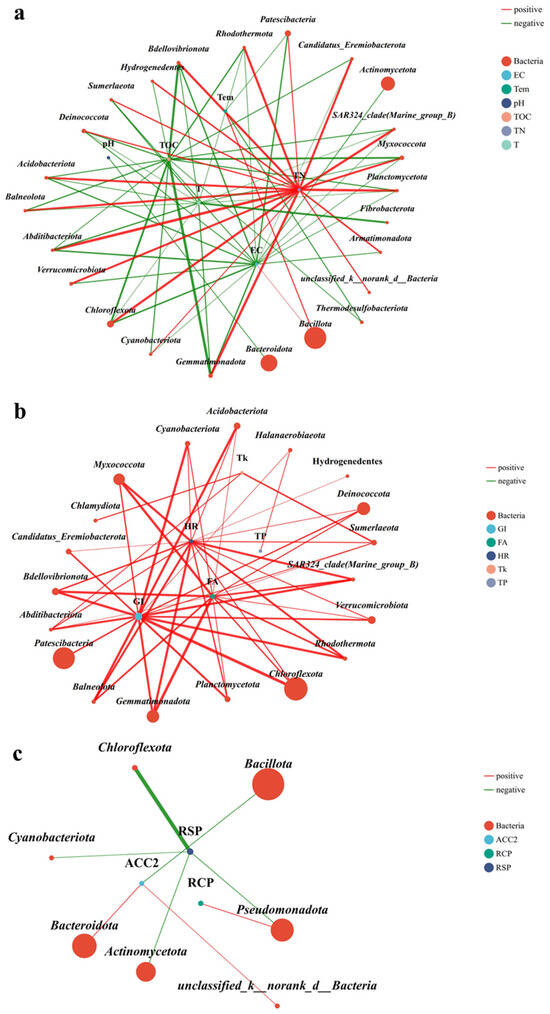
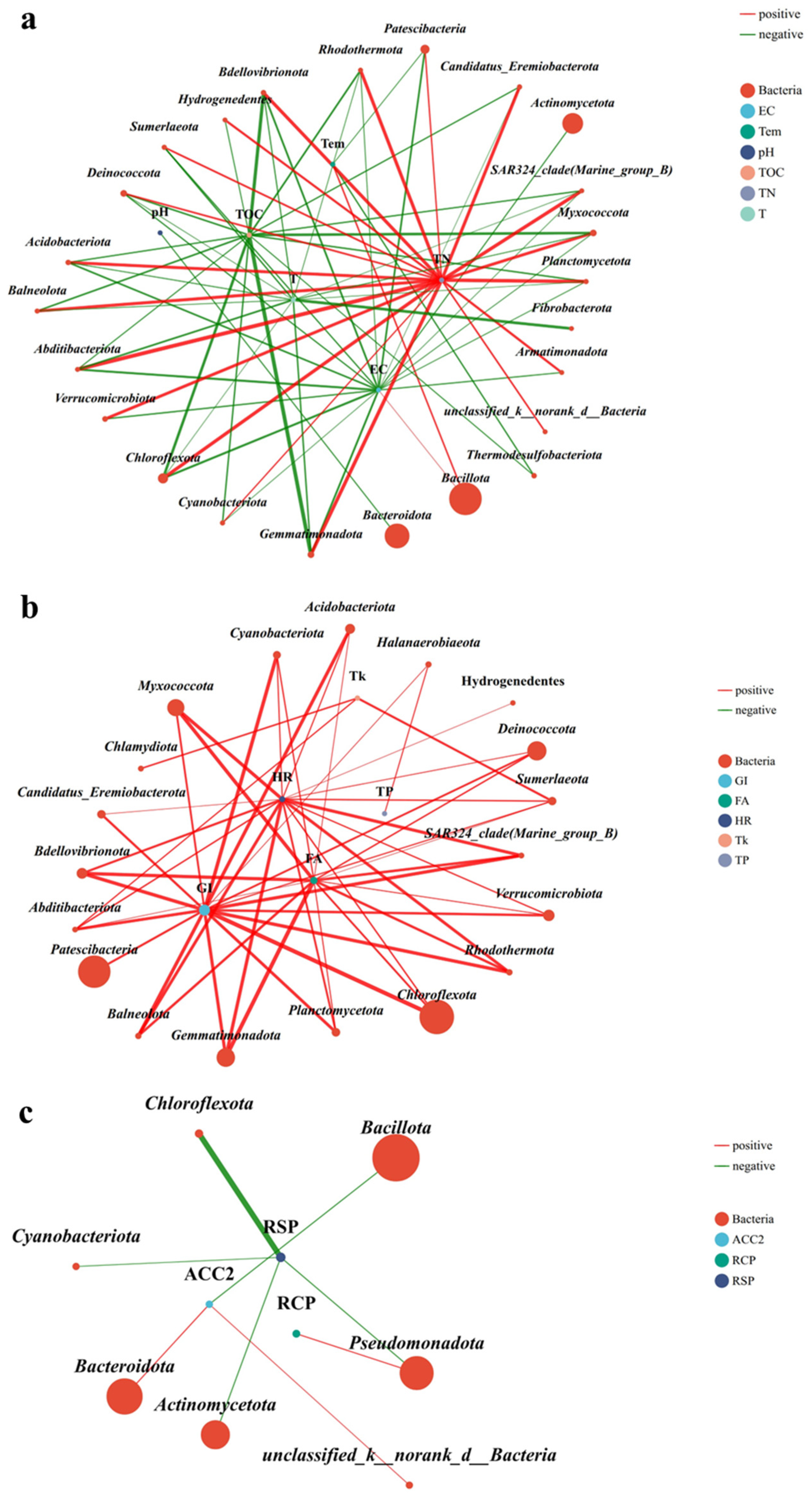
A Spearman correlation network was constructed between the top 50 most abundant microbial taxa at the phylum level and key composting parameters to reveal the topological relationships between the microbial community and environmental factors. To ensure statistical significance, only nodes with significant correlations (p < 0.05) are displayed.
The network linking bacterial communities and physicochemical factors (Figure 4a) shows that the five dominant phyla (lincluding Bacteroidota, Bacillota, Actinomycetota) form the core backbone. Among all nodes, f_Rhizobiaceae and g_Thermobifida exhibited the highest degree centrality (0.8333 and 0.6667, respectively), indicating they are keystone taxa connecting the microbial community and environmental factors. Their significant negative correlations with TOC, temperature, and EC, alongside a positive correlation with TN, strongly implicate them as core functional players during the thermophilic phase, driving organic matter decomposition and nitrogen transformation.
Figure 4.
Bivariate correlation network analysis between dominant bacterial phyla and physicochemical factors (a), maturity indices (b), bioavailable carbon fractions (c). (GI, germination index; FA, fulvic acid; HR, humification ratio; TP, total phosphorus; TK, total potassium; ACC, available carbon content; RCP, content of recalcitrant carbon pool; RSP, enzymatic reducing sugar production).
The network linking bacterial communities and maturity indices (Figure 4b) reveals that p_Sumerlaeota and p_Abditibacteriota are major nodes connecting the various maturity indicators. p_Chloroflexota was positively correlated with GI, FA, and HR, underscoring its potential role in humus synthesis. Furthermore, the strong positive correlation between 13 phyla (including p_Patescibacteria and p_Deinococcota) and GI (p < 0.001) suggests that compost detoxification and maturation is a synergistic process involving multiple microbial groups.
The network linking dominant phyla to carbon source bioavailability (Figure 4c) indicates that the network core comprised p_Bacillota, p_Bacteroidota, and ACC2. The opposing correlations—positive for Bacteroidota and negative for p_Bacillota with ACC2—clearly demonstrate niche differentiation in response to carbon availability. Meanwhile, the positive correlation of p_Pseudomonadota with the RCP and its negative correlation with the RSP provide strong evidence for its specialized function in transforming recalcitrant organic matter.
The accelerated thermophilic phase was attributed to the high carbon bioavailability of the feedstock, which served as an accessible energy reservoir to fuel the surge of copiotrophs (e.g., Bacteroidota). The intense respiration of these functional guilds culminated in rapid heat accumulation. Conversely, carbon-limited environments in recalcitrant treatments inhibited the growth of Bacteroidota, favoring a succession toward oligotrophic Actinomycetota. This shift toward slow-growing polysaccharide degraders resulted in a delayed temperature rise and suboptimal mineralization. Thus, our findings underscore that the evolution of physicochemical indicators in composting is underpinned by the metabolic divergence of microbial communities, as dictated by substrate-specific bioavailability.
3.3.4. Coupling Carbon Bioavailability to Community Structure
To statistically confirm the driving role of carbon bioavailability, a Redundancy Analysis (RDA) was performed. After screening for multicollinearity, three key indices—RCP, ACC2, and RSP—were retained as the explanatory variables. These three indices alone explained a remarkable 99.3% of the total variation in the phylum-level community structure (Figure S4), confirming that they effectively account for the dynamic evolution of the dominant bacterial community.
The analysis further clarified these relationships (Table S4). A filtering effect of carbon fractions was observed. The relative abundance of Bacteroidota was strongly and positively correlated with ACC2 (r = 0.9, p < 0.05), identifying it as a key functional group for utilizing moderately labile carbon in the early composting stages. In contrast, Bacillota abundance was negatively correlated (r = −0.9, p < 0.05), suggesting it preferentially utilizes other carbon forms or becomes dominant later in the process.
Niche differentiation is related to recalcitrant carbon. The positive correlation of Pseudomonadota and Patescibacteria with RCP suggests two possible ecological strategies: either these taxa possess unique metabolic pathways for degrading recalcitrant compounds, or they are tolerant of oligotrophic conditions and are thus passively enriched as more labile carbon is depleted [39,40].
RSP served as an indicator. The negative correlation of Pseudomonadota and Actinomycetota with RSP is logical, as these phyla are known to be more active in the later maturation phase when RSP levels have already been significantly reduced.
In summary, different carbon fractions selectively enrich for microbial taxa with specific metabolic capabilities [41], and carbon bioavailability acts as the key limiting factor and selective pressure driving bacterial community succession. This substrate-driven succession ultimately dictates the efficiency, duration, and final product quality of the composting process.
By integrating these multi-layered analyses, a clearer picture of the substrate-driven community assembly emerges. The RDA results, characterized by an exceptional explanatory power of 99.3%, strongly suggest that carbon bioavailability indices (RCP, ACC2, and RSP) are not merely correlated with, but likely govern, the dynamic evolution of the bacterial community. This is further supported by our network analysis, which identifies keystone taxa whose metabolic niches are precisely synchronized with the transition from labile to recalcitrant carbon pools. Therefore, we propose that carbon bioavailability acts as a fundamental environmental filter, selectively enriching microbial functional guilds and ultimately steering the efficiency and direction of the composting process.
3.4. Conceptual Implications: From Chemical Stoichiometry to Biological Bioavailability
Traditional chemical methods define the optimal C/N ratio primarily based on the bulk contents of TOC and TN. Although this stoichiometric criterion is widely adopted in engineering practice because it is straightforward to measure and apply, it inherently overlooks the microbial accessibility of these elements. In contrast, biological stoichiometry emphasizes the metabolically active fractions that microorganisms genuinely assimilate. However, identifying a single, universal indicator for bioavailability remains challenging, given the diverse substrate preferences and functional capacities of varying microbial communities.
This study confirms that carbon bioavailability—rather than the bulk C/N ratio alone—acts as the primary limiting factor in aerobic composting. This finding logically extends to the nitrogen cycle, suggesting that nitrogen bioavailability may similarly constrain process performance. Accordingly, we propose the adoption of a “biochemical C/N ratio”—a metric that explicitly accounts for the lability of both carbon and nitrogen. We argue that such a ratio provides a more physiologically relevant and reliable predictor of composting dynamics and product maturity than conventional bulk stoichiometry.
To quantify this bioavailability, this study integrated multidimensional metrics, including the distribution of labile and recalcitrant carbon pools, the fiber components (cellulose, hemicellulose, and lignin), and enzymatic reducing sugar production. Nonetheless, a rigorous mathematical framework that integrates these biological indicators to quantitatively predict composting dynamics is not yet available, and developing such a model remains an important direction for future work.
4. Conclusions
Under a fixed initial C/N ratio, carbon source biodegradability is the primary determinant of both composting progression and product maturity. Highly bioavailable carbon fractions significantly accelerated temperature rise, organic matter degradation, and humus synthesis. Consequently, materials featuring enhanced carbon bioavailability, such as extruded cassava residue, yielded a compost quality substantially superior to that derived from feedstocks dominated by recalcitrant carbon. Different carbon bioavailability profiles drove specific bacterial successional pathways, in which the response of functional guilds—such as Bacteroidota—to labile carbon was critical for process efficiency. These findings offer a new perspective on process control, challenging the exclusive reliance on the traditional stoichiometric C/N ratio.
Supplementary Materials
The following supporting information can be downloaded at https://www.mdpi.com/article/10.3390/cleantechnol8020046/s1. Figure S1: Cluster analysis of carbon source bioavailability for different crop residues; Figure S2: Alpha diversity of bacterial communities during composting of straws with high content of bioavailable carbon fractions at different time points; Figure S3: Changes in the relative abundance of bacterial communities at the phylum (a) and genus (b) levels before and after composting of straws with high content of bioavailable carbon fractions; Figure S4: Redundancy analysis (RDA) ordination plot of dominant bacterial phyla and bioavailable carbon fractions; Table S1: Loading matrix of straw compost quality indicators based on principal component analysis; Table S2: Principal component analysis of physicochemical properties and biodegradable carbon source components in different composting treatments; Table S3: Alpha diversity indices of bacterial communities for different treatment groups at the initial (day 1) and final (day 26) stages of composting; Table S4: Correlation analysis between dominant bacterial phyla and available carbon indexes.
Author Contributions
B.S.: Investigation, Data curation, Visualization, Formal analysis, Writing—original draft. X.Z.: Data curation, Visualization, Formal analysis. L.Z.: Formal analysis. Y.Y.: Investigation. D.X.: Investigation. Z.S.: Resources, Writing—review and editing. Y.W.: Project administration, Writing—review and editing. B.A.: Funding acquisition, Project administration, Conceptualization, Resources, Methodology, Formal analysis, Writing—review and editing. All authors have read and agreed to the published version of the manuscript.
Funding
This work was financially supported by the Key Research and Development Project of Hainan Province, China (ZDYF2023XDNY049), the Central Public-interest Scientific Institution Basal Research Fund, China (1630062025019), and the Major Science and Technology Program of Hainan Province, China (ZDKJ2021009).
Data Availability Statement
Data will be made available on request.
Conflicts of Interest
The authors declare no conflicts of interest.
References
- Onwosi, C.O.; Igbokwe, V.C.; Obi, J.N.; Ezeogu, L.I.; Chukwu, M.J. Composting technology in waste stabilization: On the methods, challenges and future prospects. J. Environ. Manag. 2017, 190, 140–157. [Google Scholar] [CrossRef] [Scilit] [PubMed]
- Awasthi, M.K.; Sarsaiya, S.; Wainaina, S.; Rajendran, K.; Kumar, S.; Quan, W.; Duan, Y.; Awasthi, S.K.; Chen, H.; Pandey, A.; et al. A Critical Review of Organic Manure Biorefinery Models toward Sustainable Circular Bioeconomy: Technological Challenges, Advancements, Innovations, and Future Perspectives. Renew. Sustain. Energy Rev. 2019, 111, 115–131. [Google Scholar] [CrossRef] [Scilit]
- Jia, P.; Huang, Y.; Wang, X.; Zhu, Z.; Dou, Y.; Huang, Q.; Zha, S.; Wang, A. Mechanisms of chemical polymers and microbial residues in affecting organic matter stabilization under varying carbon/nitrogen ratios during composting. Chem. Eng. J. 2025, 513, 162879. [Google Scholar] [CrossRef] [Scilit]
- Azim, K.; Soudi, B.; Boukhari, S.; Perissol, C.; Roussos, S.; Thami Alami, I. Composting Parameters and Compost Quality: A Literature Review. Org. Agric. 2018, 8, 141–158. [Google Scholar] [CrossRef] [Scilit]
- Chiarelotto, M.; de Melo, D.C.; dos Santos, M.V.A. Does the initial C/N ratio interfere with the performance of sewage sludge composting and cotton waste? Environ. Technol. 2024, 45, 2673–2683. [Google Scholar] [CrossRef] [Scilit]
- Kumar, M.; Ou, Y.L.; Lin, J.G. Co-composting of green waste and food waste at low C/N ratio. Waste Manag. 2010, 30, 602–609. [Google Scholar] [CrossRef] [Scilit]
- Gao, H.; Zhou, C.; Wang, R.; Li, X. Comparison and evaluation of co-composting corn stalk or rice husk with swine waste in China. Waste Biomass Valoriz. 2015, 6, 699–710. [Google Scholar] [CrossRef] [Scilit]
- Shen, B.; Zheng, L.; Zheng, X.; Yang, Y.; Xiao, D.; Wang, Y.; Sheng, Z.; Ai, B. Insights from meta-analysis on carbon to nitrogen ratios in aerobic composting of agricultural residues. Bioresour. Technol. 2024, 413, 131416. [Google Scholar] [CrossRef] [Scilit]
- Lin, J.; Mao, Y.; Mai, L.; Li, G.; Liu, H.; Peng, S.; Su, J.; Li, G. Accelerating the humification of mushroom waste by regulating nitrogen sources composition: Deciphering mechanism from bioavailability and molecular perspective. Chemosphere 2024, 349, 140816. [Google Scholar] [CrossRef] [Scilit] [PubMed]
- Torres-Climent, A.; Gomis, P.; Martín-Mata, J.; Bustamante, M.A.; Marhuenda-Egea, F.C.; Pérez-Murcia, M.D.; Paredes, C.; Moral, R. Chemical, thermal and spectroscopic methods to assess biodegradation of winery-distillery wastes during composting. PLoS ONE 2015, 10, e0138925. [Google Scholar] [CrossRef] [Scilit] [PubMed]
- Meng, L.; Li, W.; Zhang, S.; Zhang, X.; Zhao, Y.; Chen, L. Improving sewage sludge compost process and quality by carbon sources addition. Sci. Rep. 2021, 11, 1319. [Google Scholar] [CrossRef] [Scilit]
- Xu, P.; Tripathi, P.; Mishra, S.; Shu, L.; Li, X.; Zhao, S.; Verma, S.; Verma, R.; Wu, Y.; Yang, Z. Brown sugar as a carbon source can make agricultural organic waste compost enter the secondary thermophilic stage and promote compost decomposition. Environ. Monit. Assess. 2024, 196, 113. [Google Scholar] [CrossRef] [Scilit]
- Wu, J.; Zhao, Y.; Qi, H.; Wei, Z. Identifying the key factors that affect the formation of humic substance during different materials composting. Bioresour. Technol. 2017, 244, 1193–1196. [Google Scholar] [CrossRef] [Scilit]
- Yin, Z.; Zhang, L.; Li, R. Effects of additives on physical, chemical, and microbiological properties during green waste composting. Bioresour. Technol. 2021, 340, 125719. [Google Scholar] [CrossRef] [Scilit] [PubMed]
- Rovira, P.; Vallejo, V.R. Labile, recalcitrant, and inert organic matter in Mediterranean forest soils. Soil Biol. Biochem. 2007, 39, 202–215. [Google Scholar] [CrossRef] [Scilit]
- GB9834-88; Method for Determination of Soil Organic Matter. Ministry of Agriculture of the Prc: Beijing, China, 1988.
- NY/T525-2021; Organic Fertilizers. Ministry of Agriculture of the Prc: Beijing, China, 2021.
- NY/T2541-2014; Fertilizers-Determination of Phosphorus Content. Ministry of Agriculture of the Prc: Beijing, China, 2014.
- NY/T2540-2014; Fertilizers-Determination of Potassium Content. Ministry of Agriculture of the Prc: Beijing, China, 2014.
- NY/T1867-2010; Fertilizers-Determination of Soil Humus Composition. Ministry of Agriculture of the Prc: Beijing, China, 2010.
- Awasthi, M.K.; Wang, Q.; Ren, X.; Zhao, J.; Huang, H.; Awasthi, S.K.; Lahori, A.H.; Li, R.; Zhang, Z. Role of biochar amendment in mitigation of nitrogen loss and greenhouse gas emission during sewage sludge composting. Bioresour. Technol. 2016, 219, 270–280. [Google Scholar] [CrossRef] [Scilit]
- Li, Y.; Su, Y.; Hu, B.; Ma, C. Insight into effects of initial moisture content on the heat-up of sewage sludge composting during mesophilic phase. Nat. Environ. Pollut. Technol. 2022, 21, 377–383. [Google Scholar] [CrossRef] [Scilit]
- Bernal, M.P.; Alburquerque, J.A.; Moral, R. Composting of animal manures and chemical criteria for compost maturity assessment. A review. Bioresour. Technol. 2009, 100, 5444–5453. [Google Scholar] [CrossRef] [Scilit] [PubMed]
- Hoang, H.G.; Thuy, B.T.P.; Lin, C.; Vo, D.-V.N.; Tran, H.T.; Bahari, M.B.; Le, V.G.; Vu, C.T. The nitrogen cycle and mitigation strategies for nitrogen loss during organic waste composting: A review. Chemosphere 2022, 300, 134514. [Google Scholar] [CrossRef] [Scilit]
- Qiu, Z.; Li, M.; Song, L.; Wang, C.; Yang, S.; Yan, Z.; Wang, Y. Study on nitrogen-retaining microbial agent to reduce nitrogen loss during chicken manure composting and nitrogen transformation mechanism. J. Clean. Prod. 2021, 285, 124813. [Google Scholar] [CrossRef] [Scilit]
- Zhao, L.; Huang, Y.; Ran, X.; Xu, Y.; Chen, Y.; Wu, C.; Tang, J. Nitrogen transformation mechanisms and compost quality assessment in sustainable mesophilic aerobic composting of agricultural waste. Sustainability 2025, 17, 575. [Google Scholar] [CrossRef] [Scilit]
- Tong, B.; Wang, X.; Wang, S.; Ma, L.; Ma, W. Transformation of nitrogen and carbon during composting of manure litter with different methods. Bioresour. Technol. 2019, 293, 122046. [Google Scholar] [CrossRef] [Scilit]
- Ji, L.; Zhang, L.; Liu, Y.; Li, X.; Li, Z. Evaluation of composting parameters, technologies and maturity indexes for aerobic manure composting: A meta-analysis. Sci. Total Environ. 2023, 886, 163929. [Google Scholar] [CrossRef] [Scilit]
- Kong, Y.; Zhang, J.; Zhang, X.; Gao, X.; Yin, J.; Wang, G.; Li, J.; Li, G.; Cui, Z.; Yuan, J. Applicability and limitation of compost maturity evaluation indicators: A review. Chem. Eng. J. 2024, 489, 151386. [Google Scholar] [CrossRef] [Scilit]
- Barral, M.T.; Paradelo, R. A review on the use of phytotoxicity as a compost quality indicator. Dyn. Soil Dyn. Plant 2011, 5, 36–44. [Google Scholar]
- Maffia, A.; Marra, F.; Canino, F.; Battaglia, S.; Mallamaci, C.; Oliva, M.; Muscolo, A. Humic substances from waste-based fertilizers for improved soil fertility. Agronomy 2024, 14, 2657. [Google Scholar] [CrossRef] [Scilit]
- Ampong, K.; Thilakaranthna, M.S.; Gorim, L.Y. Understanding the role of humic acids on crop performance and soil health. Front. Agron. 2022, 4, 848621. [Google Scholar] [CrossRef] [Scilit]
- Ukalska-Jaruga, A.; Debaene, G.; Smreczak, B. Particle and structure characterization of fulvic acids from agricultural soils. J. Soils Sediments 2018, 18, 2833–2843. [Google Scholar] [CrossRef] [Scilit]
- Xue, S.; Yi, X.; Peng, J.; Bak, F.; Zhang, L.; Duan, G.; Liesack, W.; Zhu, Y. Fulvic Acid Enhances Nitrogen Fixation and Retention in Paddy Soils through Microbial-Coupled Carbon and Nitrogen Cycling. Environ. Sci. Technol. 2024, 58, 18777–18787. [Google Scholar] [CrossRef] [Scilit] [PubMed]
- Chefetz, B.; Hatcher, P.G.; Hadar, Y.; Chen, Y. Chemical and biological characterization of organic matter during composting of municipal solid waste. J. Environ. Qual. 1996, 25, 776–785. [Google Scholar] [CrossRef] [Scilit]
- McKee, L.S.; La Rosa, S.L.; Westereng, B.; Eijsink, V.G.; Pope, P.B.; Larsbrink, J. Polysaccharide degradation by the Bacteroidetes: Mechanisms and nomenclature. Environ. Microbiol. Rep. 2021, 13, 559–581. [Google Scholar] [CrossRef] [Scilit] [PubMed]
- Bucci, P.; Cantero, D.; Casas, A.; Marcos, E.; Menalla, E.; Muñoz, R. Hydrothermal pretreatment of brewer’s spent grain: A pathway to sustainable biogas production and waste valorization. Biomass Bioenergy 2026, 204, 108399. [Google Scholar] [CrossRef] [Scilit]
- Koeck, D.E.; Pechtl, A.; Zverlov, V.V.; Schwarz, W.H. Genomics of cellulolytic bacteria. Curr. Opin. Biotechnol. 2014, 29, 171–183. [Google Scholar] [CrossRef] [Scilit]
- Lopez-Gonzalez, J.A.; Suarez-Estrella, F.; Vargas-Garcia, M.C.; Lopez, M.J.; Jurado, M.M.; Moreno, J. Dynamics of bacterial microbiota during lignocellulosic waste composting: Studies upon its structure, functionality and biodiversity. Bioresour. Technol. 2015, 175, 406–416. [Google Scholar] [CrossRef] [Scilit]
- Bohacz, J. Microbial strategies and biochemical activity during lignocellulosic waste composting in relation to the occurring biothermal phases. J. Environ. Manag. 2018, 206, 1052–1062. [Google Scholar] [CrossRef] [Scilit]
- Goldfarb, K.C.; Karaoz, U.; Hanson, C.A.; Santee, C.A.; Bradford, M.A.; Treseder, K.K.; Wallenstein, M.D.; Brodie, E.L. Differential growth responses of soil bacterial taxa to carbon substrates of varying chemical recalcitrance. Front. Microbiol. 2011, 2, 94. [Google Scholar] [CrossRef] [Scilit] [PubMed]

Disclaimer/Publisher’s Note: The statements, opinions and data contained in all publications are solely those of the individual author(s) and contributor(s) and not of MDPI and/or the editor(s). MDPI and/or the editor(s) disclaim responsibility for any injury to people or property resulting from any ideas, methods, instructions or products referred to in the content. |
© 2026 by the authors. Licensee MDPI, Basel, Switzerland. This article is an open access article distributed under the terms and conditions of the Creative Commons Attribution (CC BY) license.