
Microwave Depolymerization of Various Plastic Wastes—Quarter-Scale Testing



Abstract
1. Introduction
1.1. Global Dynamics of Plastic Waste, Limitations of Existing Recycling Strategies
1.2. Physicochemical Principles of Microwave Heating of Polymers
1.3. MD Pathways for Major PM Classes
1.3.1. PE and PP
1.3.2. PS
1.3.3. PET and Polyesters
1.3.4. PVC and Halogenated PM
1.4. Challenges Arising from Heterogeneity in P Waste
1.5. Scale-Up Constraints and Microwave Reactor Engineering
1.6. Motivation and Objectives of the Present Work
2. Materials and Methods
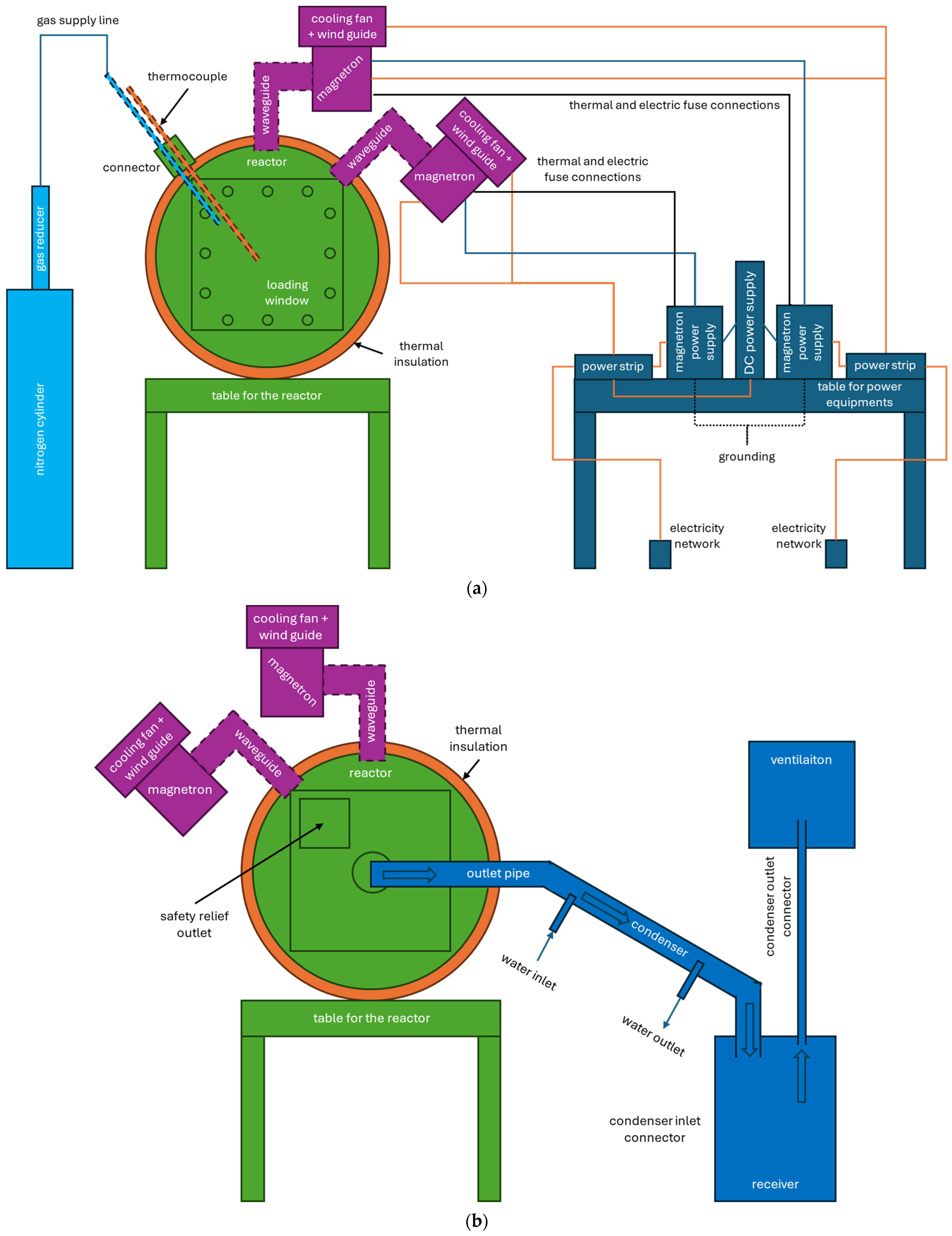
2.1. Reactor Description
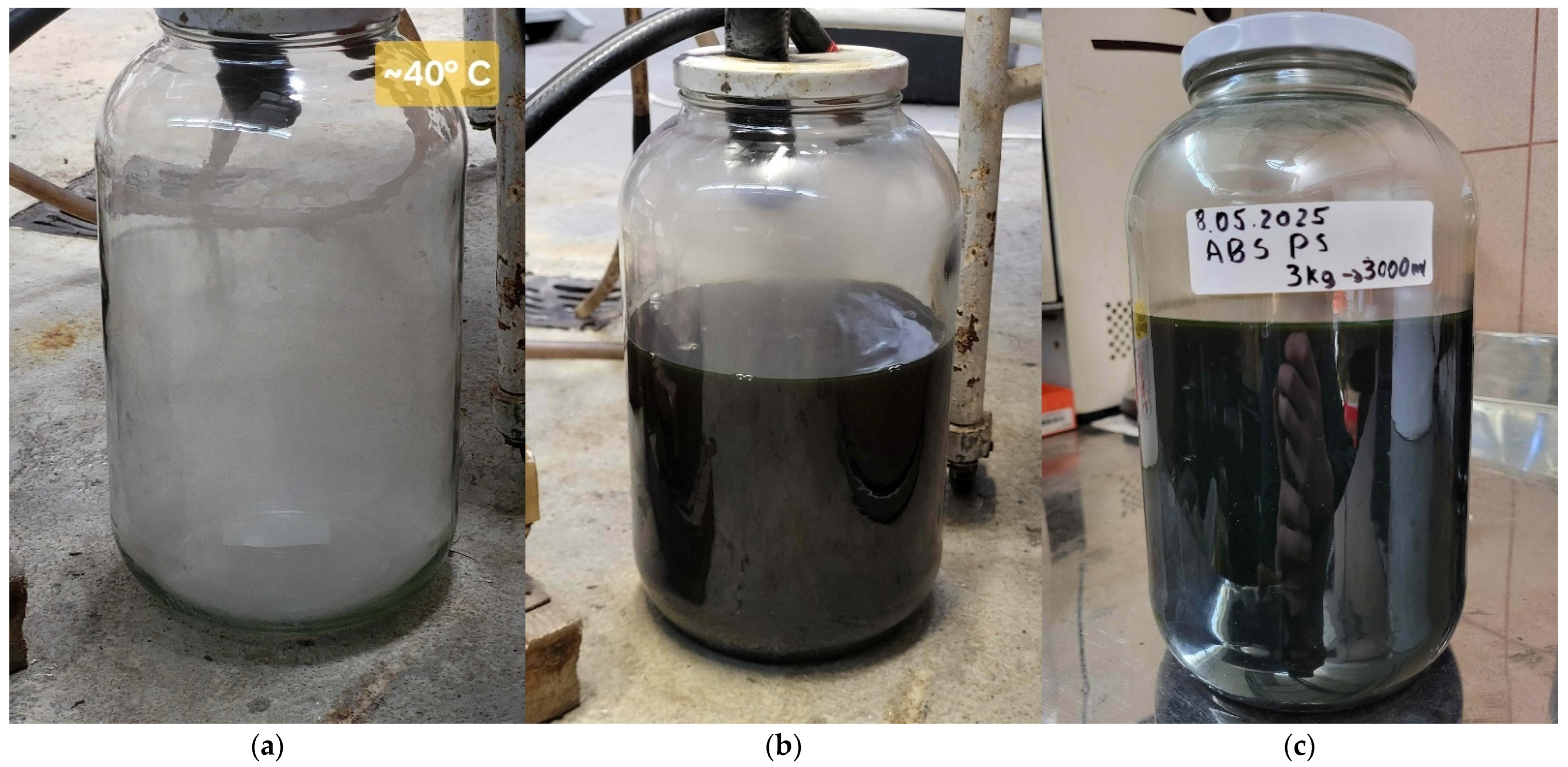
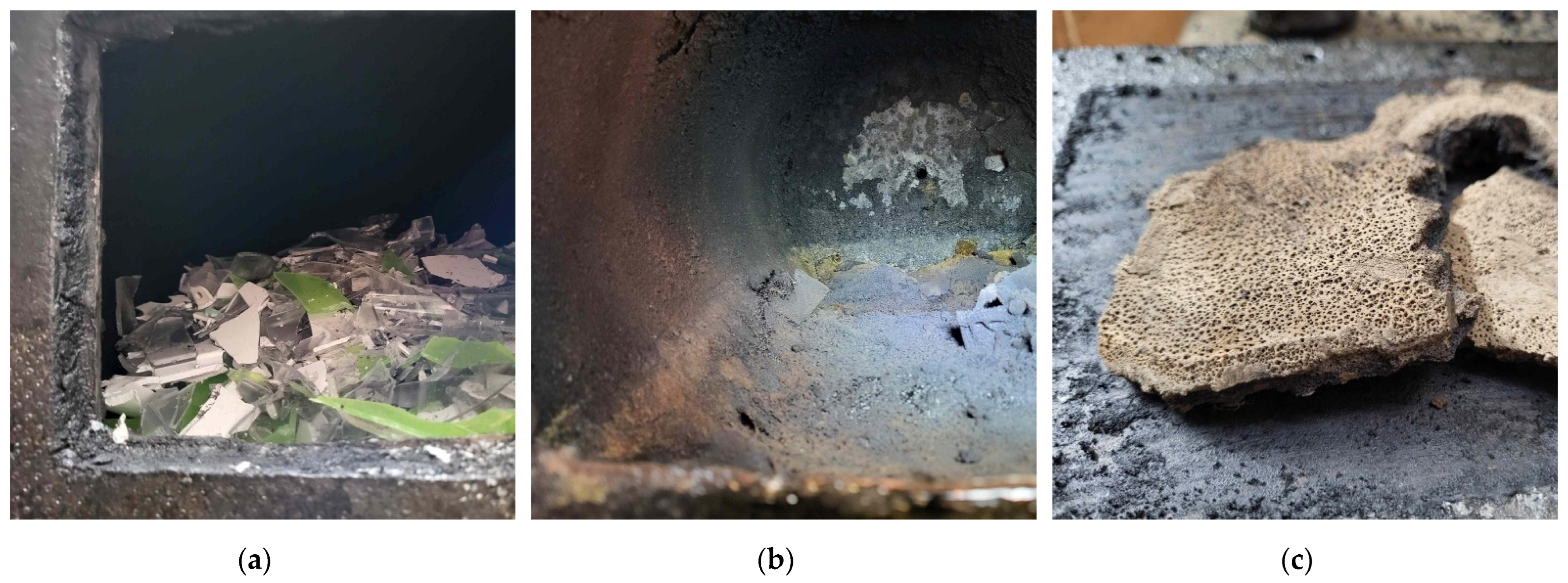
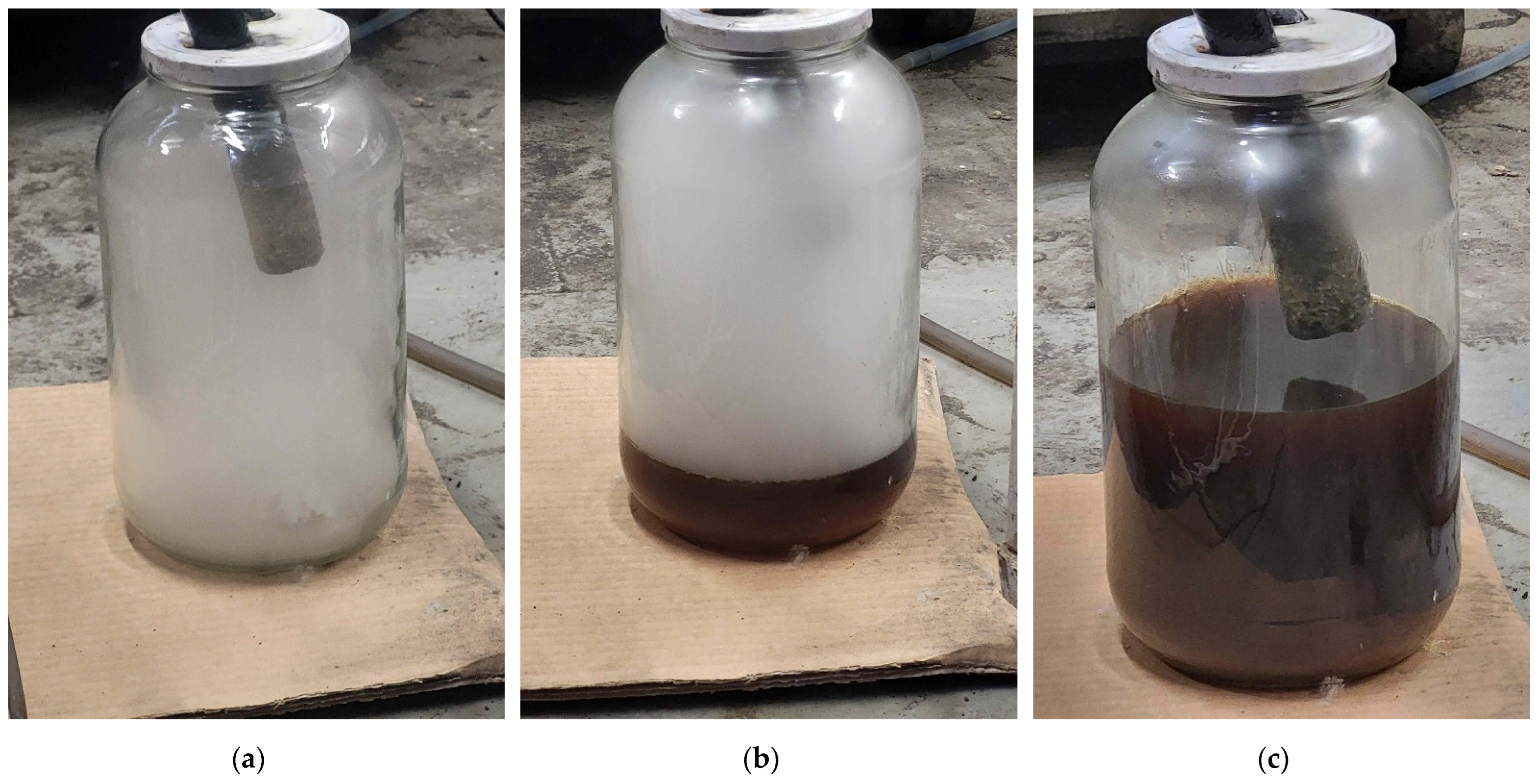
2.2. Experimental Procedure
2.3. Analytical Methods
- Optical System Preparation: Before sample application, the crystal surface was cleaned using a soft, lint-free tissue and a solvent appropriate for the matrix (isopropanol), drying the surface until streaks were completely removed.
- Background Correction: The background spectrum was recorded against air (clean crystal). This procedure was repeated after each measurement series and in the event of changes in ambient conditions (fluctuations in water vapor or CO2 concentration).
- Sample Application: A small amount of oil (a few µL) was applied to the active area of the ATR crystal, ensuring thorough surface coverage and elimination of air bubbles.
- Measurement Procedure: Measurements were performed while maintaining constant parameters (number of scans, resolution, range). For quantitative analysis, a standardized baseline correction procedure was used, along with ATR correction when necessary. Post-measurement procedure: The crystal was cleaned immediately after sample removal to prevent the formation of a permanent residual film.
2.4. Batch Materials
- PS—plastics from refrigerator and freezer drawers, household appliances, etc.;
- PP—office waste bins, lawn mower bins, compact disk cases (but not “jewel cases”);
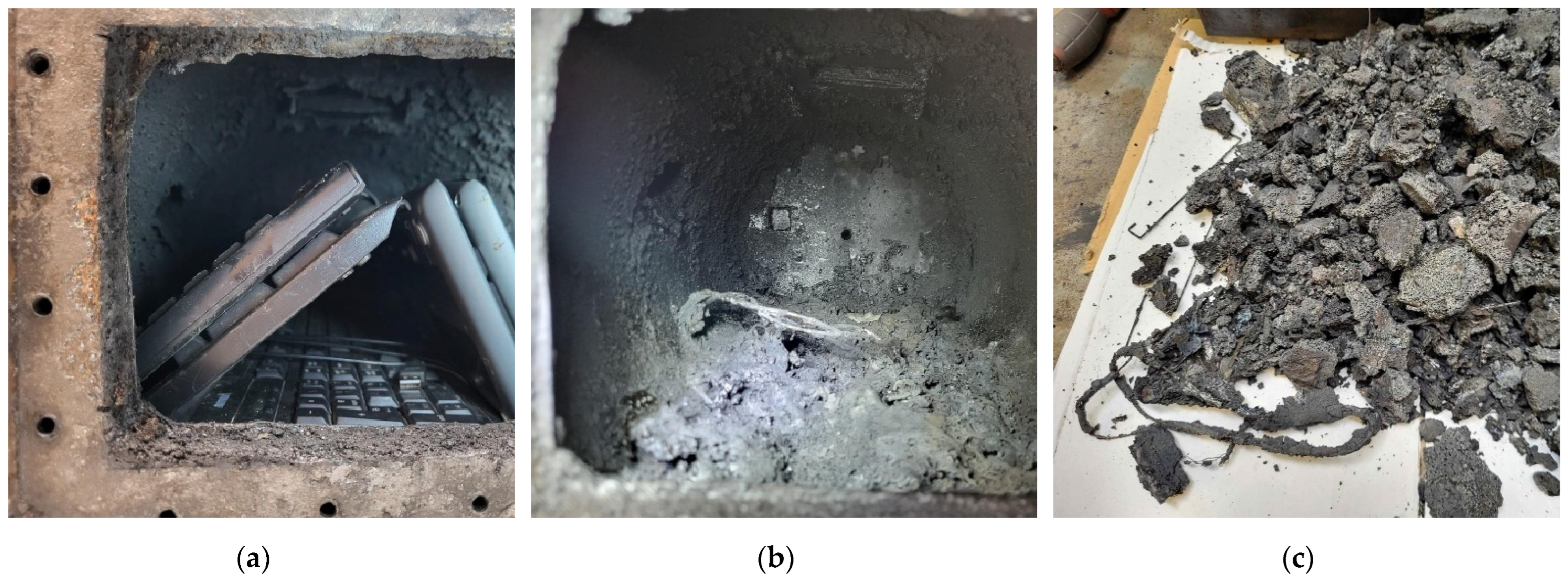
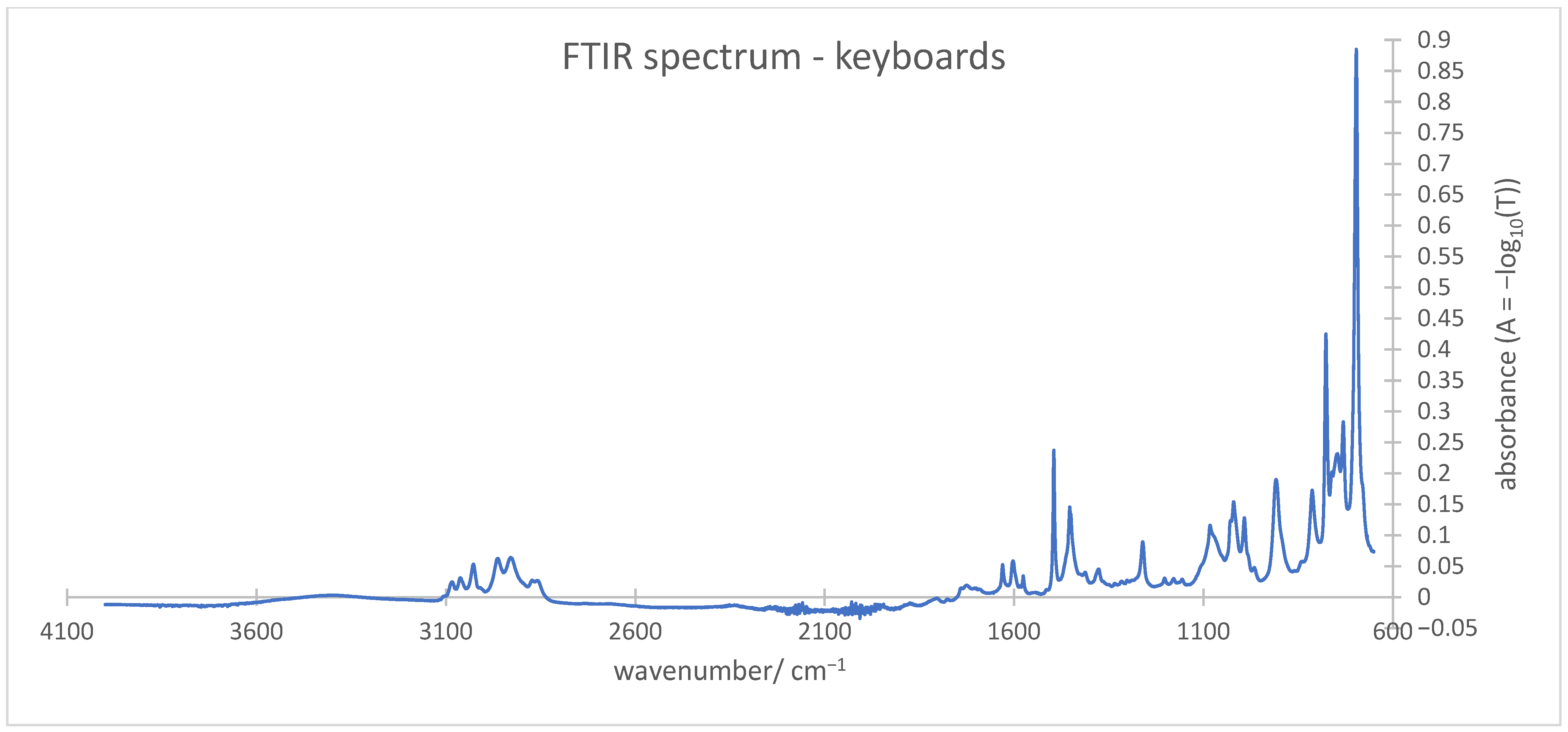
- keyboards—scrapped keyboards with cut wires;
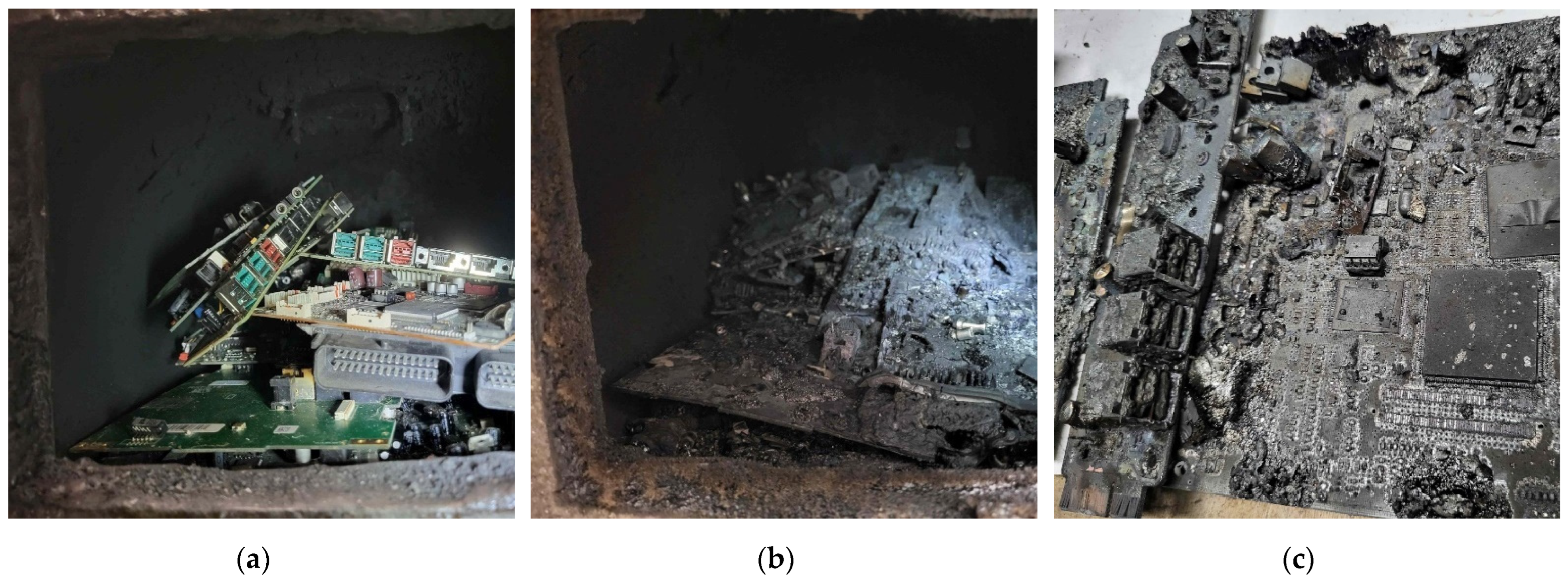
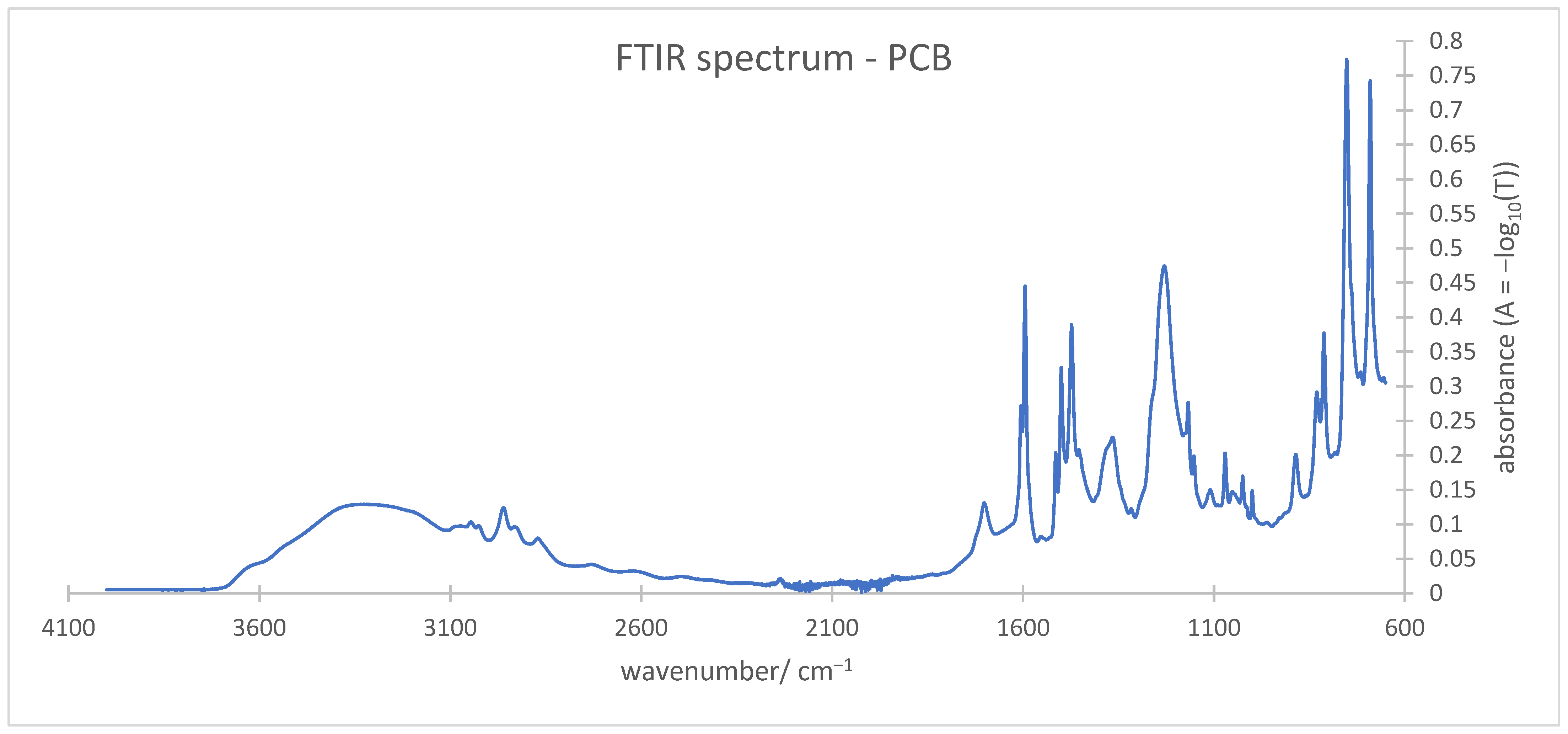
- PCB—class I and II printed circuit boards;
- AiO—rear parts of the AiO computer case (monitor backs), TFT monitors;
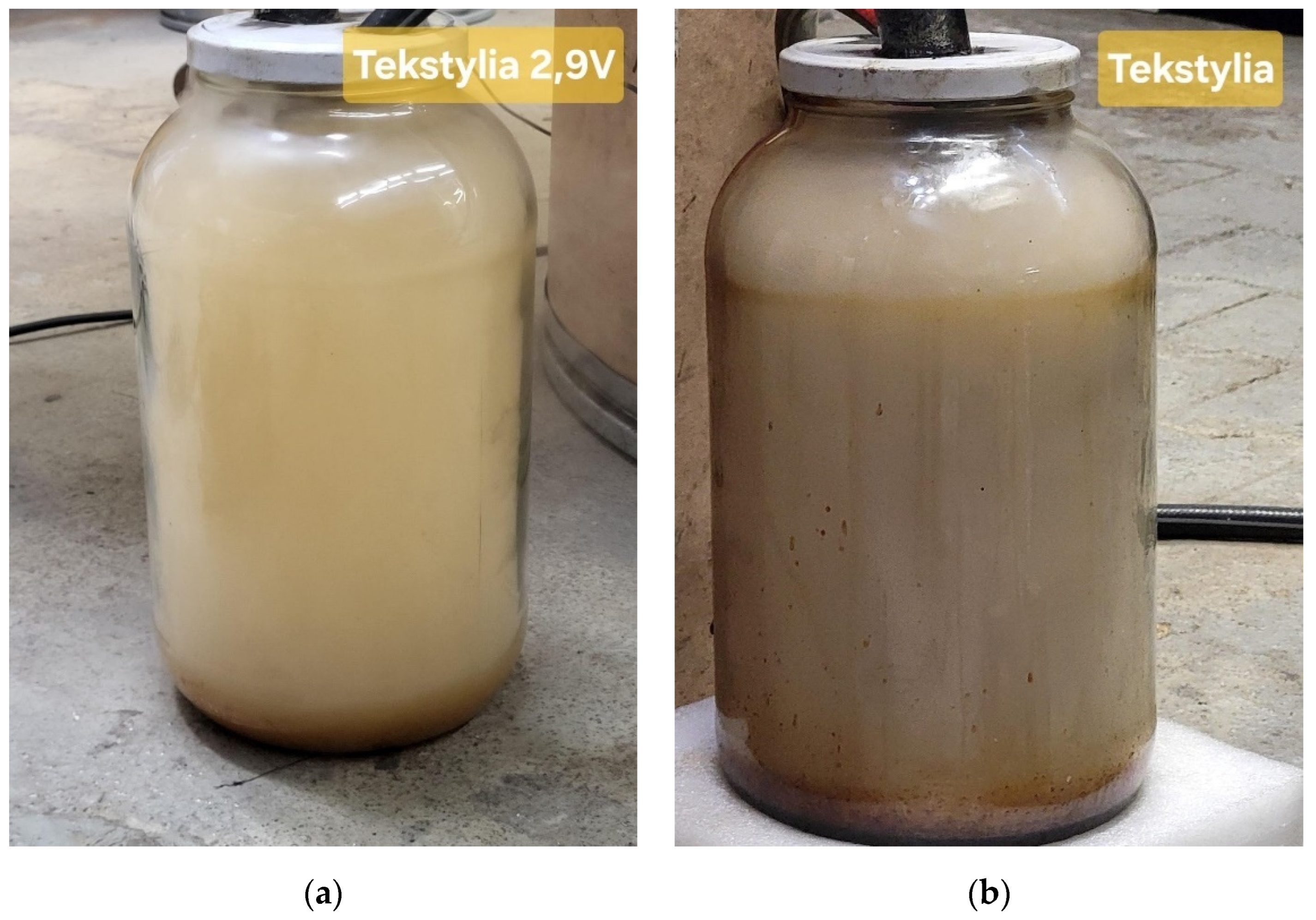
- textile—soiled work clothes (T-shirts, sweatshirts, jackets) and rags;
- ABS—cut television monitor housings;
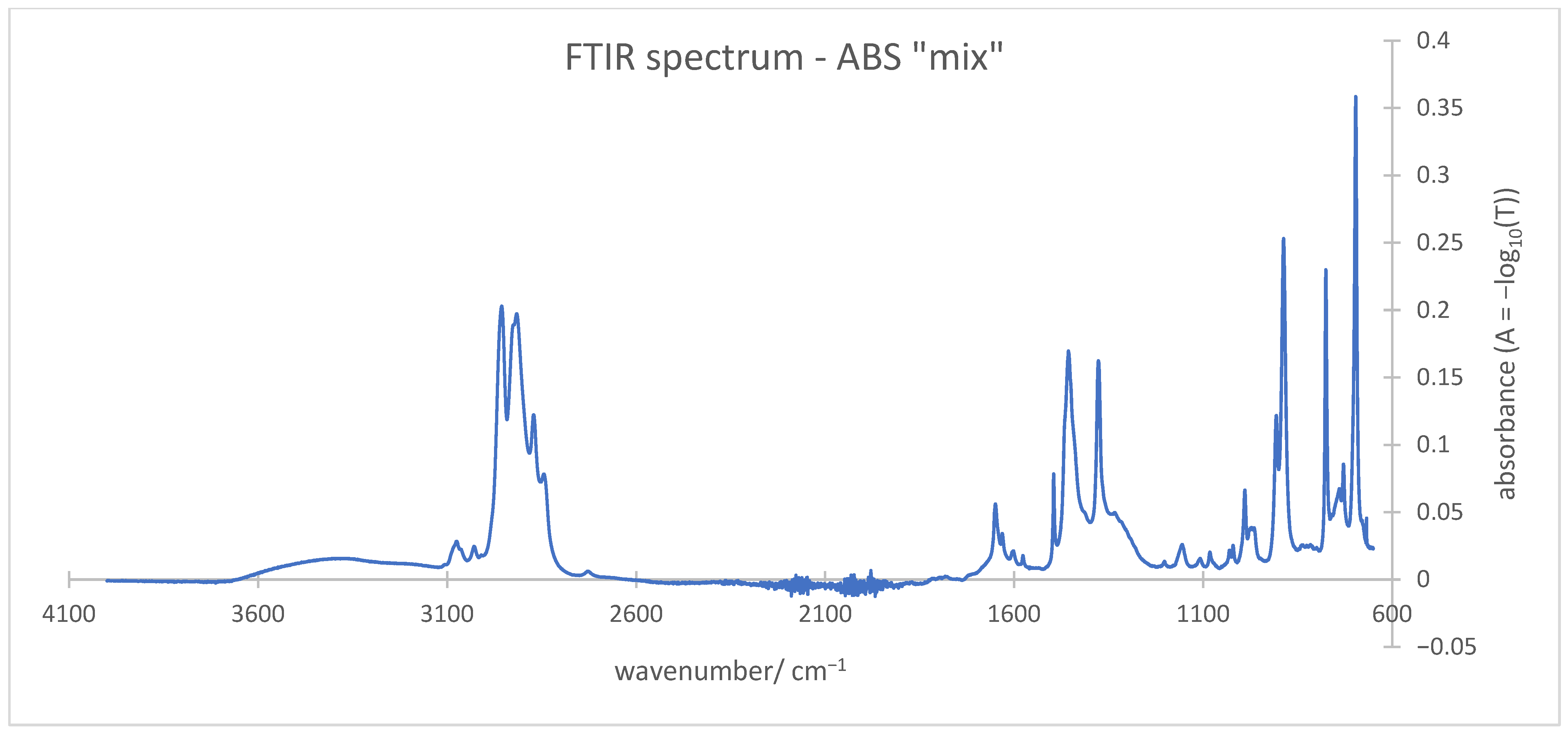
- ABS “mix”—a mixture of various plastics, without prior segregation, mainly: ABS PC, polycarbonates from electronics, washing machine, printer and photocopier components, etc.;
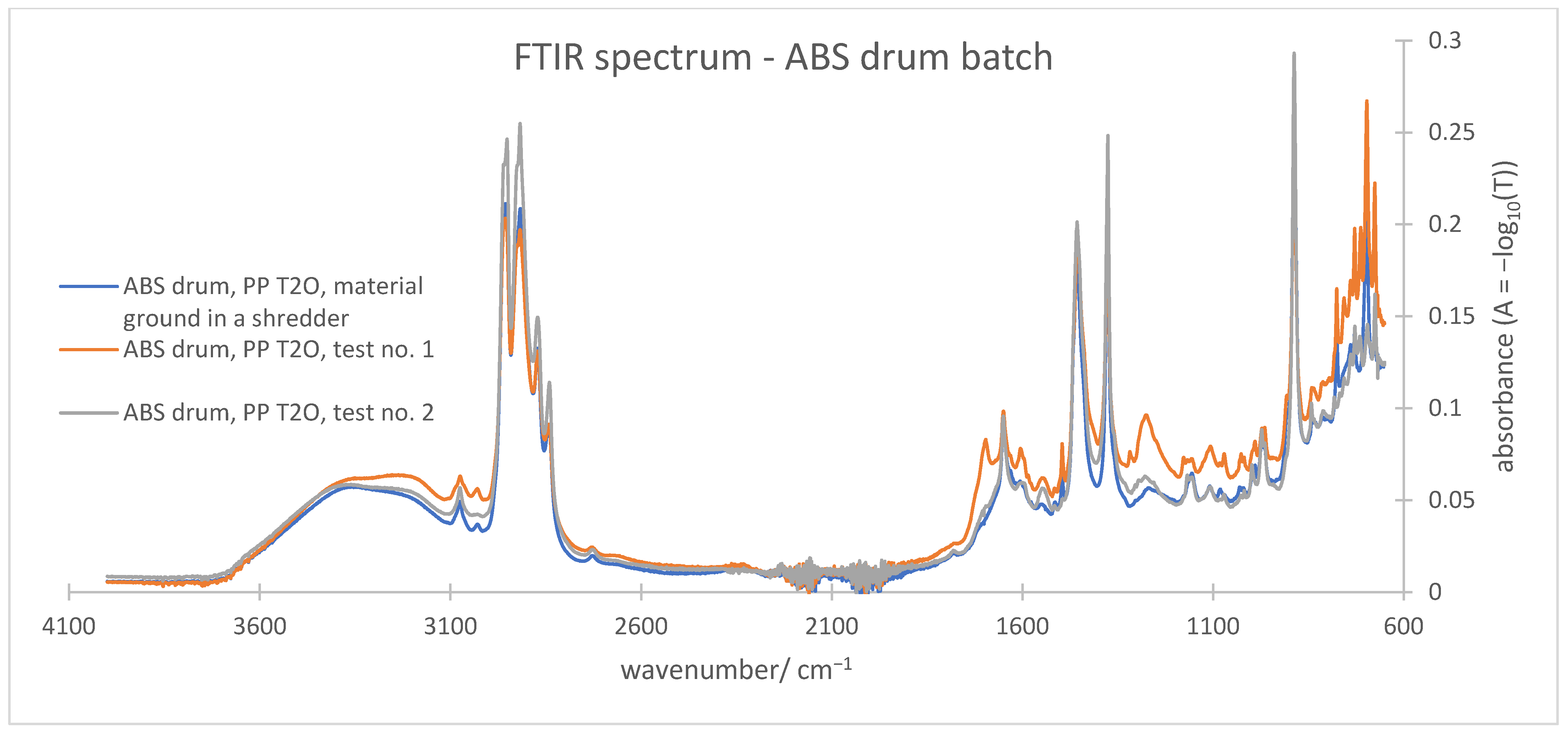
- ABS drum, PP T2O—parts of washing machine drums made of plastic.
3. Results and Discussion
3.1. MD Tests
- the operating voltage of the magnetron(s);
- the measured current and estimated microwave power;
- the maximum T recorded inside the reactor (via the thermocouple positioned in the gas phase).

| Batch | T/Voltage/Power | ||||||||
|---|---|---|---|---|---|---|---|---|---|
| PS | V | 1.5–2.3 | 2.9 | 3.3 | 3.9 | 4.1 | |||
| °C | 20–30 | 30–45 | 50–55 | 65–85 | >200 | ||||
| PP | V | 1.5 | 1.9 | 2.3 | 2.9 | 3.3 | |||
| °C | 20 | 45 | 70 | 80 | 100 | ||||
| keyboards | V | 1.1 | 1.5–1.9 | 2.3 | 2.9 | 3.3 | 3.9 | 4.1 | 4.5 |
| °C | 20 | 25 | 30–35 | 40 | 45–50 | 100–110 | 120–200 | >200 | |
| PCB | V | 1.5 | 2.3 | 2.9 | 3.3 | 3.9 | 4.1 | ||
| °C | 25 | 50 | 85 | 120 | 145 | >200 | |||
| AiO | V | 1.5 | 1.9 | 2.3 | 2.9 | 3.3 | 3.9 | 4.1 | |
| °C | 40 | 60 | 75 | 110 | 120 | 130 | >205 | ||
| textile | V | 1.5 | 1.9 | 2.3 | 2.9 | 3.3 | 3.9 | 4.1 | |
| W | 610 | 800 | 920 | 1110 | 1250 | 1410 | 1550 | ||
| °C | 20 | 25 | 30 | 40 | 60 | 95 | >190 | ||
| ABS drum, PP T2O | V | 1.5 | 1.9 | 2.3 | 2.9 | 3.3 | 3.9 | 4.1 | |
| one magnetron | two magnetrons (2 × 4.1 V) | ||||||||
| °C | 95–100 | 140–145 | 155 | 160 | 170–190 | 180–235 | 245 | 435 | |
| ABS drum, PP T2O, material ground in a shredder | V | 1.1 | 1.5 | 1.9 | 2.3 | 2.9 | 3.3 | 3.9 | 4.1 |
| °C | 20 | 25–40 | 50–75 | 75–95 | 105–120 | 120–140 | 140–170 | >170 | |
| ABS “mix” | V | 1.5 | 1.9 | 2.3 | 2.9 | 3.3 | 3.9 | 4.1 | |
| °C | 45 | 60 | 75 | 95 | 120 | 140–155 | >200 | ||
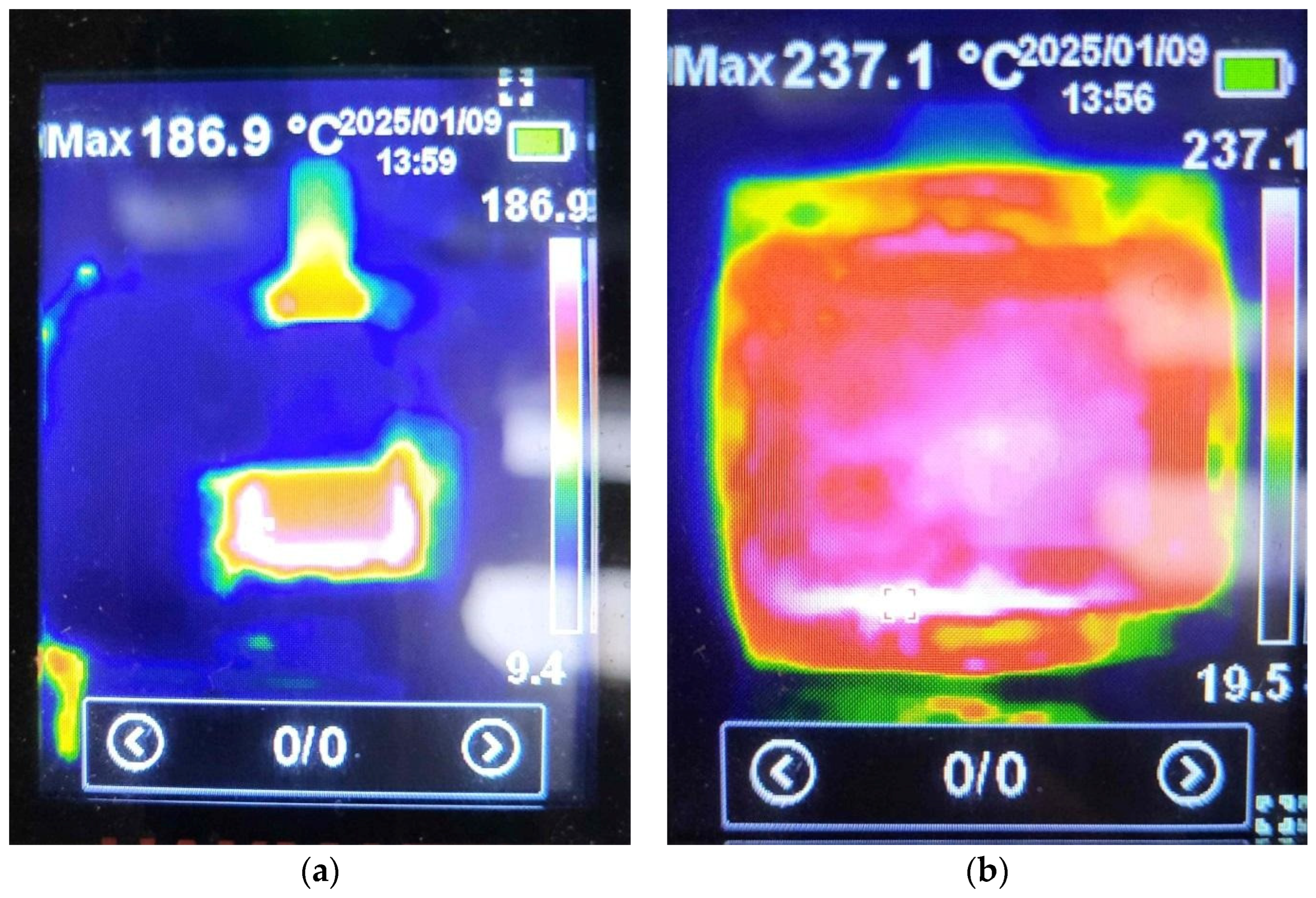
- localized heating near the waveguide entry points results in rapid T rise;
- the thermocouple, which measures gas-phase T, underestimates the true local maxima in the solid phase;
- T gradients play an important role in the initiation of depolymerization reactions.
- a low content of carbonyl groups (e.g., oxidation products);
- contribution of additives (e.g., dispersants) in the formulated oils.
- prominent O-H bands (ca. 3393–3307 cm−1);
- a C=O carbonyl region (ca. 1703–1693 cm−1, additionally ~1733 cm−1).
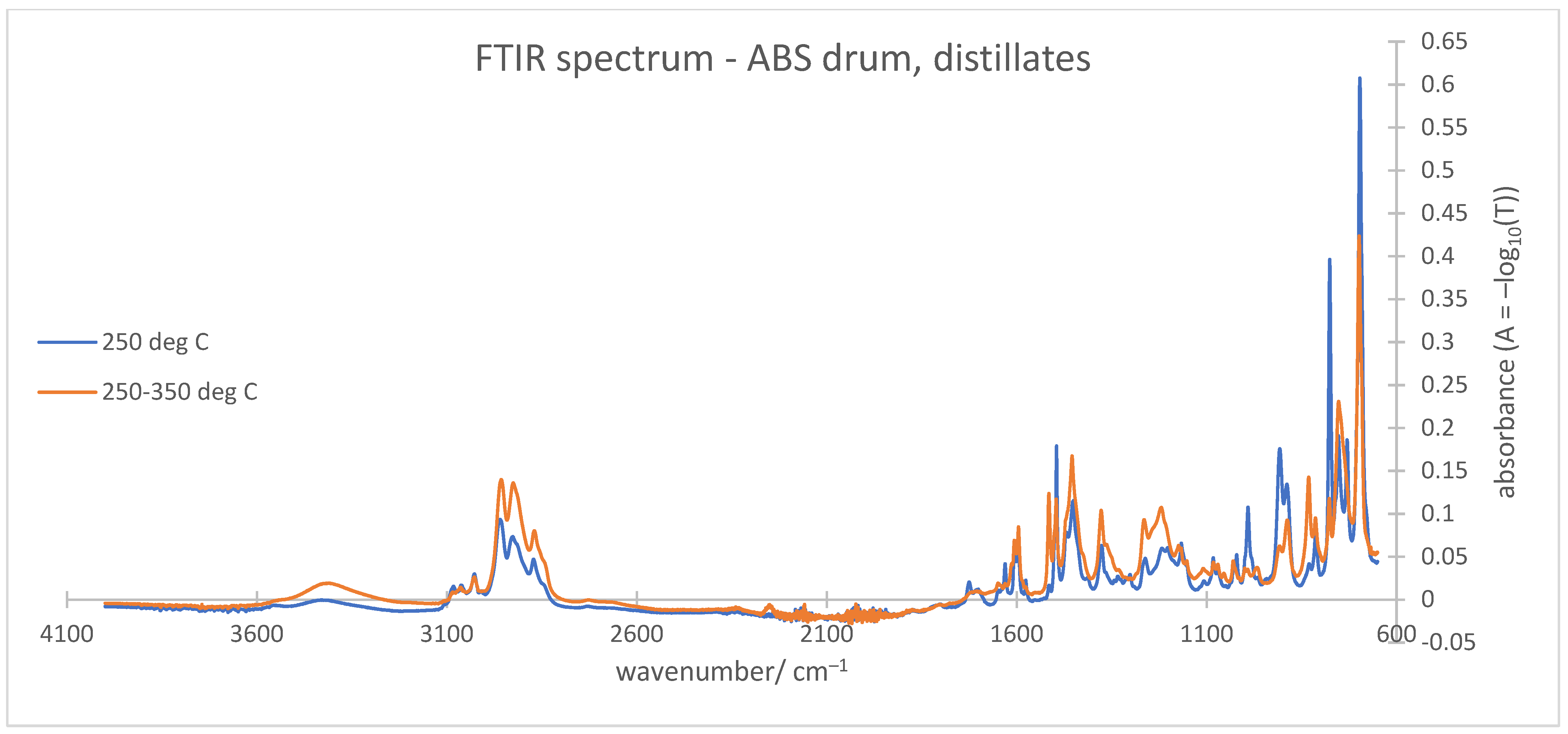
- ABS oils contain a balanced mixture of aliphatic and aromatic bands. Their spectra typically show bands at ~3070 cm−1 and ~1600/1495 cm−1, indicating aromatic segments from styrene-acrylonitrile, combined with aliphatic chains from butadiene or other additives.
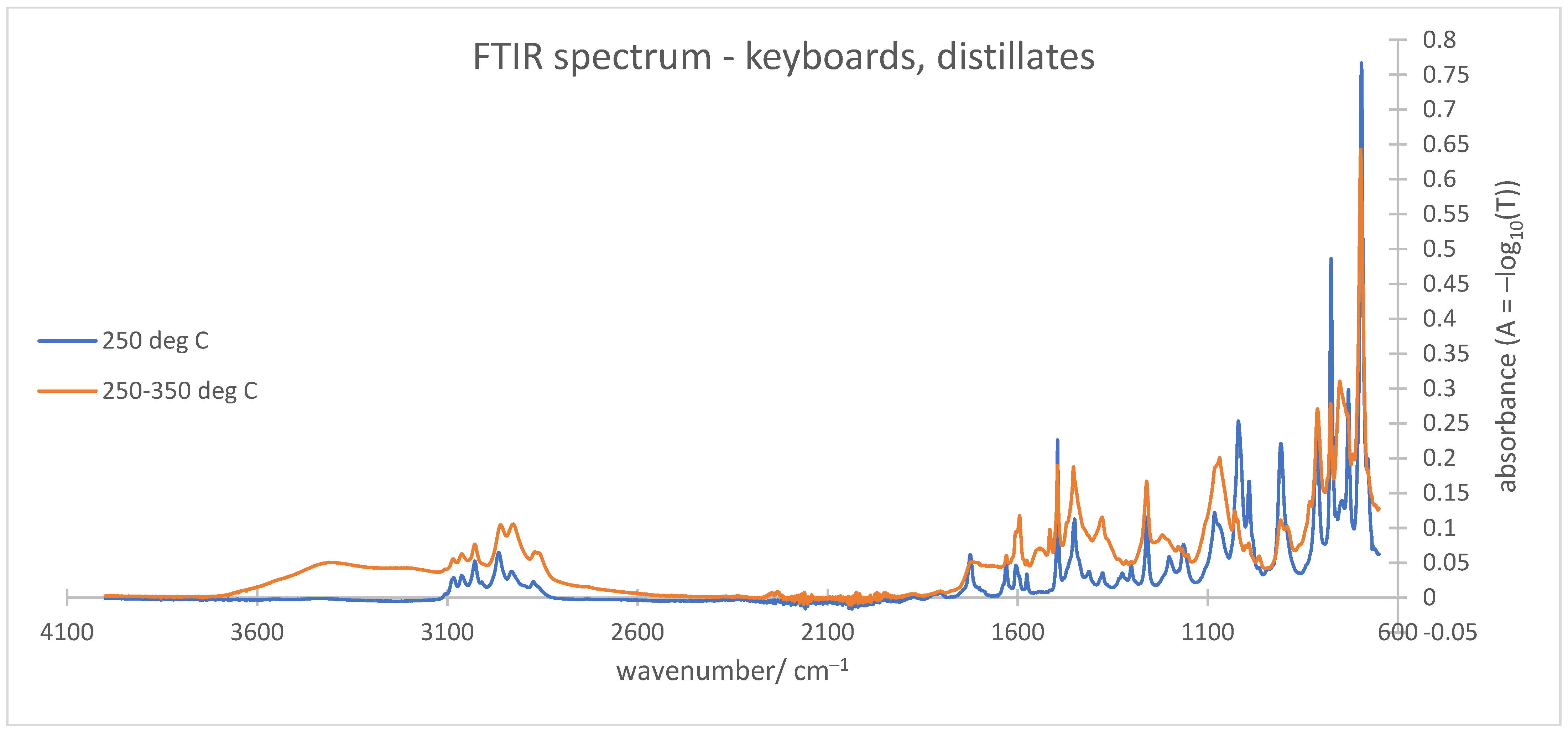
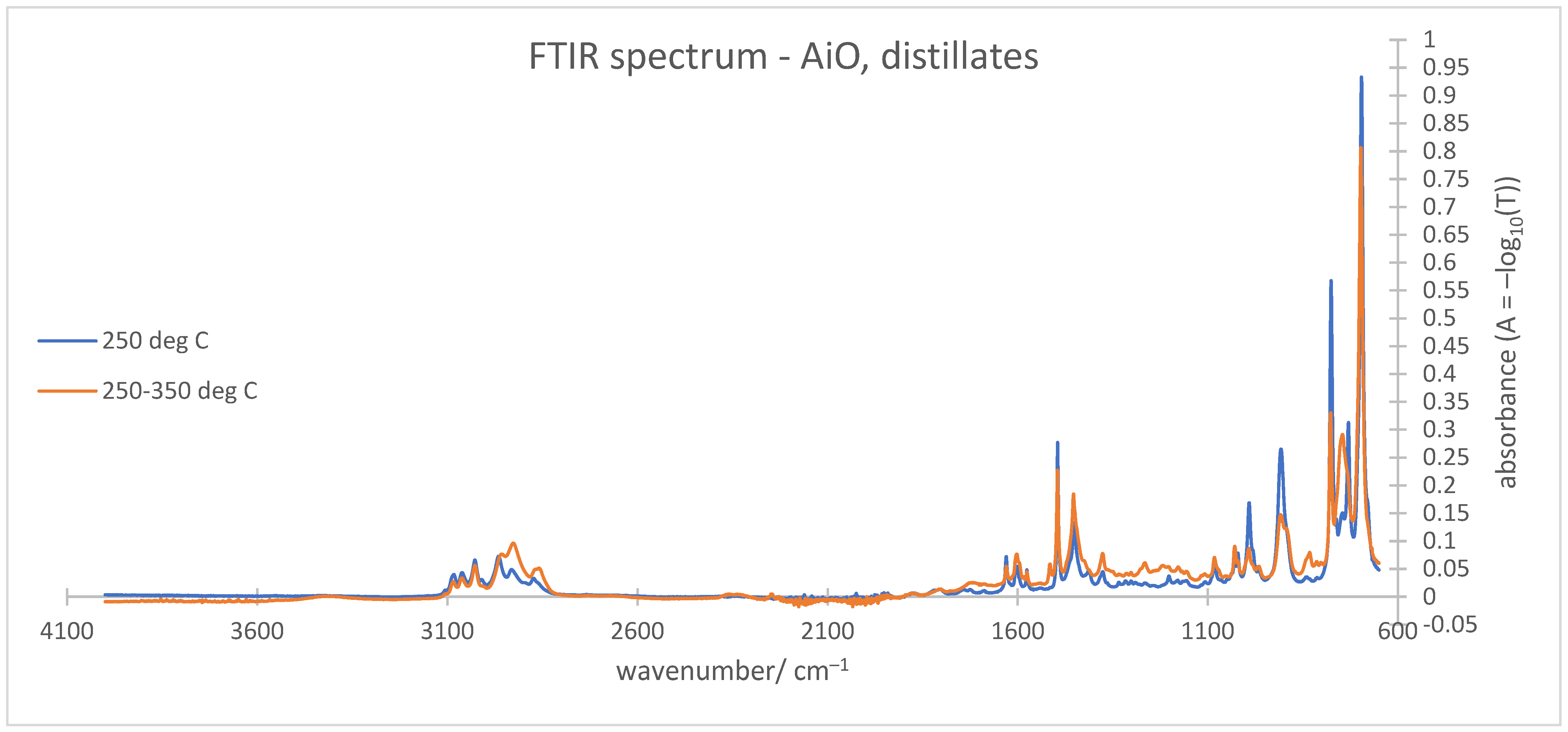
- Keyboard and AiO batches show even stronger aromatic signatures, often with very intense signals around 697 cm−1 and related OOP deformations. This reflects the presence of high aromatic P (e.g., HIPS-like materials or ABS blends with enhanced styrene content).
- PCB oils show mixed character but with a notably strong aromatic contribution. Occasional C=O bands (~1700 cm−1; present but not dominant) indicate partial oxidation or decomposition of resinous components present in PCB laminates.
3.2. Main Fractions Distillation Tests
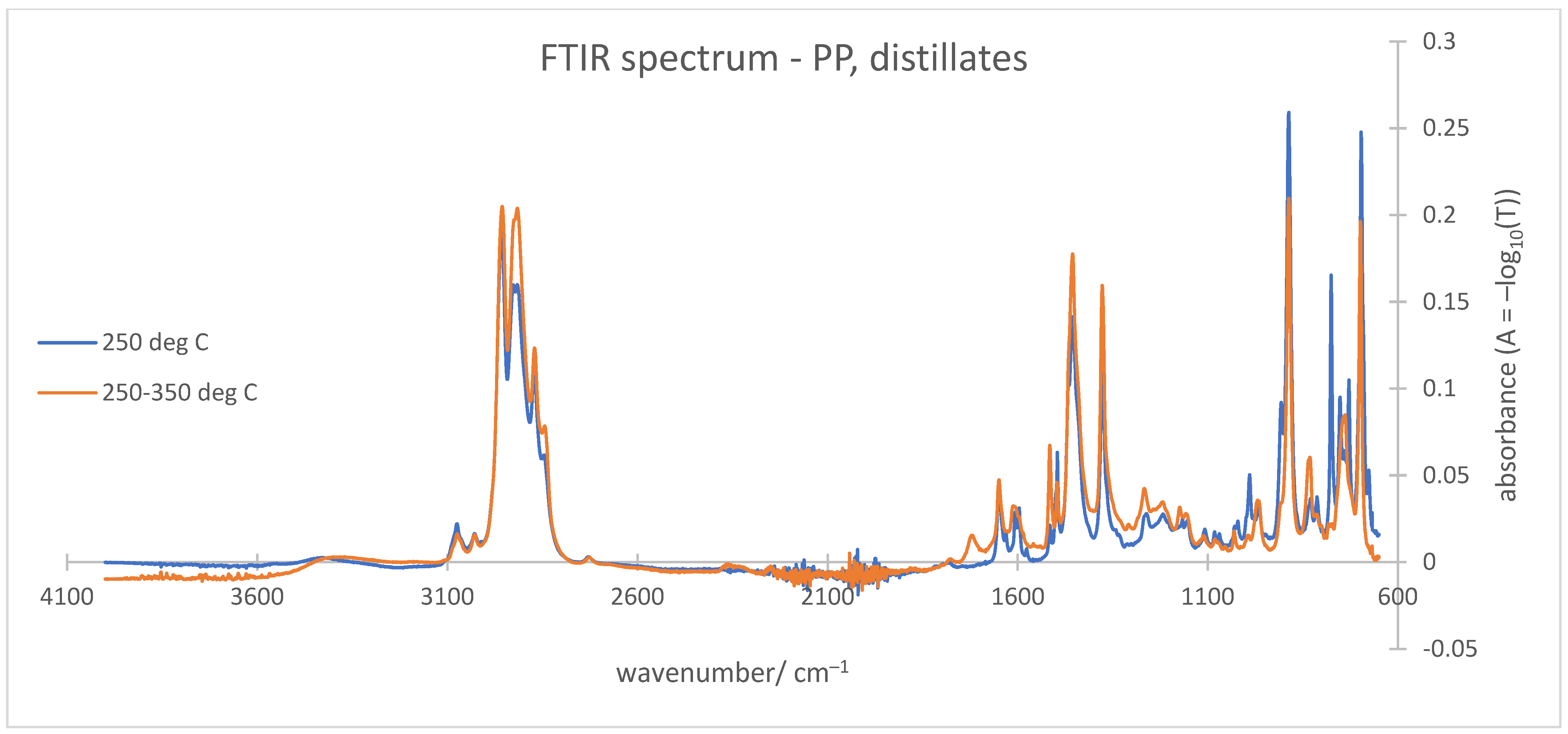
- PP oils produce the highest proportion of low-boiling (<250 °C) distillates, consistent with their aliphatic character and the presence of lighter linear and branched hydrocarbons.
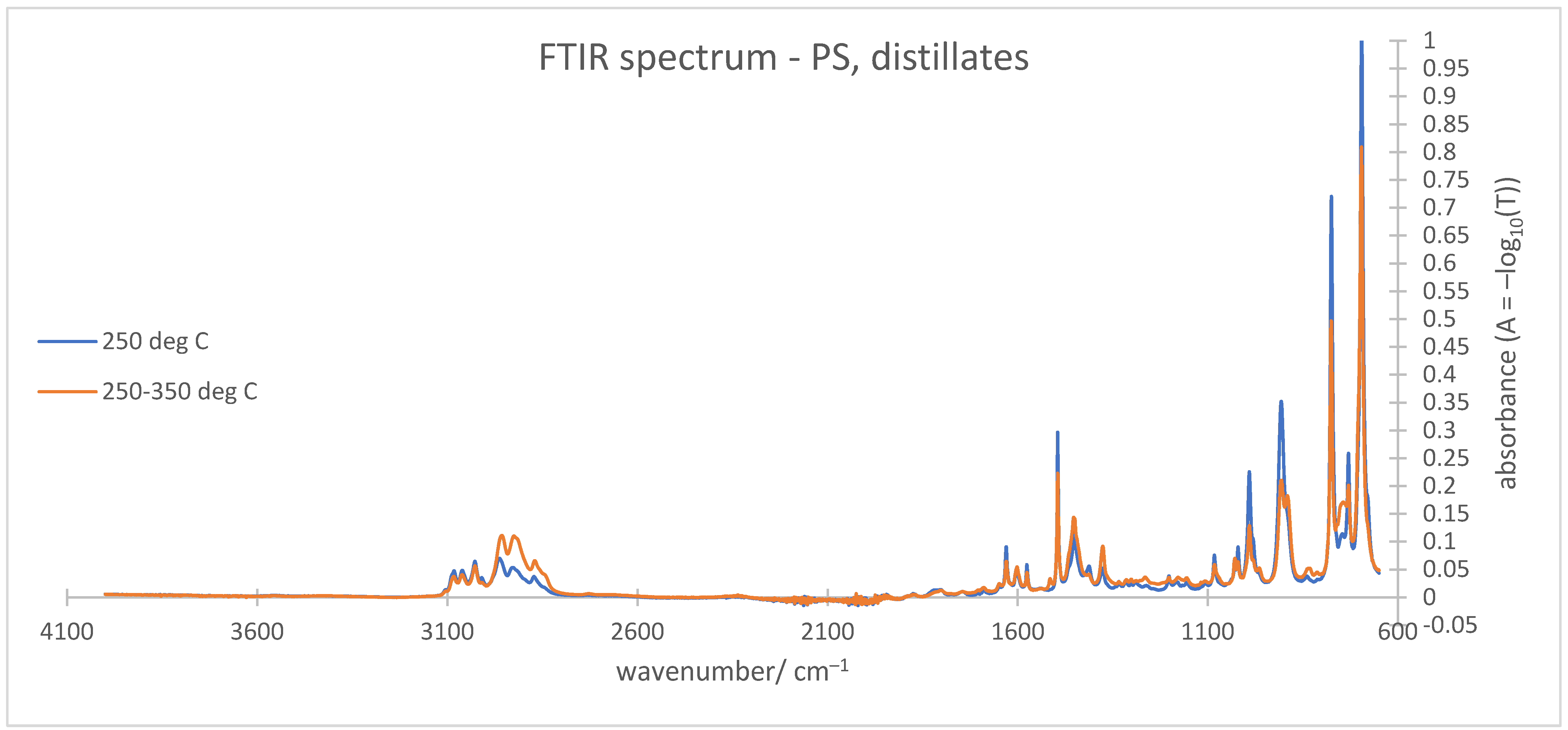
- PS oils show a more balanced distribution but with a distinct shift towards 250–350 °C fractions, reflecting heavier aromatic hydrocarbons and styrene oligomers.
- ABS, keyboards and AiO oils generate significant amounts of high-boiling fractions, often accompanied by dark residues, indicating the presence of aromatic oligomers or decomposition products from P.
3.3. Comparative Interpretation Across Feedstocks
4. Conclusions
Author Contributions
Funding
Data Availability Statement
Acknowledgments
Conflicts of Interest
Abbreviations
| P | plastic(s) |
| MD | microwave assisted depolymerization |
| PM | polymer(s) |
| PE | polyethylene |
| PS | polystyrene |
| PP | polypropylene |
| PET | polyethylene terephthalate |
| LDPE | low-density polyethylene |
| BHET | bis(2-hydroxyethyl) terephthalate |
| PVC | polyvinyl chloride |
| MSW | municipal solid waste |
| PCB | printed circuit board |
| AiO | “all-in-one”, a specific computer in which all the components necessary for operation are located in the monitor housing |
| TFT | type of display found in monitors and laptops screens |
| ABS | acrylonitrile butadiene styrene |
| IR | infrared spectroscopy |
| OOP | out-of-plane |
| σ | standard deviation |
References
- Geyer, R.; Jambeck, J.R.; Law, K.L. Production, use, and fate of all plastics ever made. Sci. Adv. 2017, 3, e1700782. [Google Scholar] [CrossRef] [PubMed]
- López, A.; Marco, I.; Caballero, B.M.; Laresgoiti, M.F.; Adrados, A. Pyrolysis of municipal plastic wastes: Influence of raw material composition. Waste Manag. 2010, 30, 620–627. [Google Scholar] [CrossRef] [PubMed]
- Ragaert, K.; Delva, L.; Van Geem, K. Mechanical and chemical recycling of solid plastic waste. Waste Manag. 2017, 69, 24–58. [Google Scholar] [CrossRef]
- Hopewell, J.; Dvorak, R.; Kosior, E. Plastics recycling: Challenges and opportunities. Philos. Trans. R. Soc. B Biol. Sci. 2009, 364, 2115–2126. [Google Scholar] [CrossRef]
- Singh, R.K.; Ruj, B. Time and temperature depended fuel gas generation from pyrolysis of real world municipal plastic waste. Fuel 2016, 174, 164–171. [Google Scholar] [CrossRef]
- Xu, F.; Wang, B.; Yang, D.; Hao, J.; Qiao, Y.; Tian, Y. Thermal degradation of typical plastics under high heating rate conditions by TG-FTIR: Pyrolysis behaviors and kinetic analysis. Energy Convers. Manag. 2018, 171, 1106–1115. [Google Scholar] [CrossRef]
- Metaxas, A.C.; Meredith, R.J. Industrial Microwave Heating; IET: London, UK, 1983. [Google Scholar]
- Sutton, D.; Kelleher, B.; Ross, J.R.H. Review of Literature on Catalysts for Biomass Gasification. Fuel Process. Technol. 2001, 73, 155–173. [Google Scholar] [CrossRef]
- Chang-yuan, T.; Zhi, L.; Zuo-hua, L.; Jun, D. Microwave-assisted degradation of poly ethylene terephthalate under mild conditions. J. Cent. South Univ. Technol. 2007, 14, 453–457. [Google Scholar]
- Jones, D.A.; Lelyveld, T.P.; Mavrofidis, S.D.; Kingman, S.W.; Miles, N.J. Microwave heating applications in environmental engineering—A review. Resour. Conserv. Recycl. 2002, 34, 75–90. [Google Scholar] [CrossRef]
- Aishwarya, K.N.; Sindhu, N. Microwave Assisted Pyrolysis of Plastic Waste. Procedia Technol. 2016, 25, 990–997. [Google Scholar] [CrossRef]
- Menéndez, J.A.; Arenillas, A.; Fidalgo, B.; Fernández, Y.; Zubizarreta, L.; Calvo, E.G.; Bermúdez, J.M. Microwave heating processes involving carbon materials. Fuel Process. Technol. 2010, 91, 1–8. [Google Scholar] [CrossRef]
- Mortezaeikia, V.; Tavakoli, O. Understanding the kinetics of waste plastic catalytic pyrolysis under microwave irradiation for enhanced resource valorization. Chem. Eng. J. 2024, 500, 157228. [Google Scholar] [CrossRef]
- Menéndez, J.A.; Inguanzo, M.; Pis, J.J. Microwave-induced pyrolysis of sewage sludge. Water Res. 2002, 36, 3261–3264. [Google Scholar] [CrossRef]
- Lam, S.S.; Mahari, W.A.W.; Jusoh, A.; Chong, C.T.; Lee, C.L.; Chase, H.A. Pyrolysis using microwave absorbents as reaction bed: An improved approach to transform used frying oil into biofuel product with desirable properties. J. Clean. Prod. 2017, 147, 263–272. [Google Scholar] [CrossRef]
- Islam, K.M.O.; Ahmad, N.; Ummer, A.C.; Ahmed, U.; Siddiqui, M.N.; Millan, M.; Jameel, A.G.A. Microwave-Assisted pyrolysis of waste plastics: A comprehensive review on process parameters, catalysts, and future prospects. Results Eng. 2025, 26, 105571. [Google Scholar] [CrossRef]
- Zolghadr, A.; Sidhu, N.; Mastalski, I.; Facas, G.; Maduskar, S.; Uppili, S.; Go, T.; Neurock, M.; Dauenhauer, P.J. On the Method of Pulse-Heated Analysis of Solid Reactions (PHASR) for Polyolefin Pyrolysis. ChemSusChem 2020, 14, 4214–4227. [Google Scholar] [CrossRef]
- Russell, A.D.; Antreou, E.I.; Lam, S.S.; Ludlow-Palafox, C.; Chase, H.A. Microwave-assisted pyrolysis of HDPE using an activated carbon bed. RSC Adv. 2012, 2, 6756–6760. [Google Scholar] [CrossRef]
- Felix, M.S.; Hagare, D.; Tahmasebi, A.; Sathasivan, A.; Arora, M. Microwave pyrolysis of polypropylene, and high-density polyethylene, and catalytic gasification of waste coffee pods to hydrogen-rich gas. Waste Manag. 2024, 187, 306–316. [Google Scholar] [CrossRef]
- de Marco, P.; Poletto, M. Microwave assisted pyrolysis of expanded polystyrene waste using carbon black catalyst. Res. Soc. Dev. 2022, 11, e518111134058. [Google Scholar] [CrossRef]
- Rex, P.; Masilamani, I.P.; Miranda, L. Microwave pyrolysis of polystyrene and polypropylene mixtures using different activated carbon from biomass. J. Energy Inst. 2020, 93, 1819–1832. [Google Scholar] [CrossRef]
- Undri, A.; Frediani, M.; Rosi, L.; Frediani, P. Reverse polymerization of waste polystyrene through microwave assisted pyrolysis. J. Anal. Appl. Pyrolysis 2014, 105, 35–42. [Google Scholar] [CrossRef]
- Karkanis, S.F.; Karetsou, N.G.; Achilias, D.S. Efficient Microwave-Assisted Glycolysis of PET Fiber Waste: Optimization, Products Analysis, and BHET Recovery for Sustainable Recycling. ChemistrySelect 2025, 10, e00718. [Google Scholar] [CrossRef]
- Guo, B.; Lopez-Lorenzo, X.; Fang, Y.; Backstrom, E.; Capezza, A.J.; Vanga, S.R.; Furó, I.; Hakkarainen, M.; Syrén, P.O. Fast Depolymerization of PET Bottle Mediated by Microwave Pre-Treatment and An Angineered PETase. ChemSusChem 2023, 16, e202300742. [Google Scholar] [CrossRef]
- Kumar, K.; Yadav, O.; Palla, V.C.S.; Busigari, R.R. Catalytic microwave conversion of LDPE-PET waste: Unravelling the influence of process parameters. Process Saf. Environ. Prot. 2025, 204, 108039. [Google Scholar] [CrossRef]
- Nguyen, P.N.D. Pyrolysis of PVC Medical Plastic Wastes by Microwave Dielectric Heating. Master’s Thesis, De La Salle University, Manila, Philippines, 2006. [Google Scholar]
- Yu, H.; Qu, J.; Liu, Y.; Yun, H.; Li, X.; Zhou, C.; Jin, Y.; Zhang, C.; Dai, J.; Bi, X. Co-pyrolysis of biomass and polyvinyl chloride under microwave irradiation: Distribution of chlorine. Sci. Total Environ. 2022, 806, 150903. [Google Scholar] [CrossRef]
- Stallkamp, C.; Hennig, M.; Volk, R.; Stapf, D.; Schultmann, F. Pyrolysis of mixed engineering plastics: Economic challenges for automotive plastic waste. Waste Manag. 2024, 176, 105–116. [Google Scholar] [CrossRef] [PubMed]
- NETL. Microwave-Assisted Conversion of Plastic to Hydrogen and Carbon. U.S. Patent 2023-0242825 A1, 3 August 2023. [Google Scholar]
- Frediani, P.; Frediani, M. Mixed or contaminated Waste Plastic Recycling through Microwave—Assisted Pyrolysis. In Recent Perspectives in Pyrolysis Research; IntechOpen: London, UK, 2021. [Google Scholar]
- Cabrera, P.A.R.; Perez, A.S.L.; Fajardo, C.A.G. Design of a Semi-Continuous Microwave System for Pretreatment of Microwave-Assisted Pyrolysis Using a Theoretical Method. Inventions 2025, 10, 24. [Google Scholar]
- Yan, L.; Wang, C.; Yin, X. A Review of Methods for Improving Microwave Heating Uniformity. Microwave 2025, 1, 12. [Google Scholar] [CrossRef]
- Siddique, I.J.; Salema, A.A.; Antunes, E.; Vinu, R. Technical challenges in scaling up the microwave technology for biomass processing. Renew. Sustain. Energy Rev. 2022, 153, 111767. [Google Scholar] [CrossRef]
- Zhou, N. Scailing Up Catalytic Microwave-Assisted Pyrolysis for Energy Production from Biomass and Plastic Wastes. Ph.D. Dissertation, University of Minnesota, Minneapolis, MN, USA, 2021. [Google Scholar]
- Adam, M.; Juliano, K.; Robinson, J.; Kingman, S. Developing a Microwave Fluidised Bed Process for Biomass Pyrolysis. In Proceedings of the 15th International Conference on Microwave and High Frequency Heating, Cracow, Poland, 14–17 September 2015. [Google Scholar]
- Rajpurohit, D.S.; Chhibber, R. Design of Multimode Microwave Cavity for Materials Processing. In Proceedings of the 5th International & 26th All India Manufacturing Technology, Design and Research Conference (AIMTDR 2014); Indian Institute of Technology Guwahati: Guwahati, India, 2014; pp. 1–4. [Google Scholar]
- Richter, F.; Rein, G. The Role of Heat Transfer Limitations in Polymer Pyrolysis at the Microscale. Front. Mech. Eng. 2018, 4, 18. [Google Scholar] [CrossRef]
- Buttress, A.; Hargreaves, G.; Ilchev, A.; Monti, T.; Sklavounou, A.; Katrib, J.; Martin-Tanchereau, P.; Unthank, M.; Irvine, D.; Dodds, C. Design and optimization of a microwave reactor for kilo-scale polymer synthesis. Chem. Eng. Sci. X 2019, 2, 100022. [Google Scholar]
- Giordano, V.; Castagnoli, A.; Pecorini, I.; Chiarello, F. Identifying technologies in circular economy paradigm through text mining on scientific literature. PLoS ONE 2024, 19, e0312709. [Google Scholar] [CrossRef]
- Han, J.; Sun, R.; Zeng, X.; Zhang, J.; Xing, R.; Sun, C.; Chen, Y. Rapid Classification and Quantification of Camellia (Camellia oleifera Abel.) Oil Blended with Rapeseed Oil Using FTIR-ATR Spectroscopy. Molecules 2020, 25, 2036. [Google Scholar] [CrossRef]
- Shinde, H.M.; Bewoor, A.K. Evaluating petrol engine oil deterioration through oxidation and nitration parameters by low-cost IR sensor. Appl. Petrochem. Res. 2020, 10, 83–94. [Google Scholar] [CrossRef]
- Shurvell, H.F. Spectra-Structure Correlations Spectra-Structure Correlations in the Mid-and Far-infrared. Handb. Vib. Spectrosc. 2006, 3, 1783–1816. [Google Scholar]
- Guillén, M.D.; Cabo, N. Usefulness of the frequency data of the Fourier transform infrared spectra to evaluate the degree of oxidation of edible oils. J. Agric. Food Chem. 1999, 47, 709–719. [Google Scholar] [CrossRef] [PubMed]
- Wolak, A.; Krasodomski, W.; Zajac, G. FTIR analysis and monitoring of used synthetic oils operated under similar driving conditions. Friction 2020, 8, 995–1006. [Google Scholar] [CrossRef]
- Coates, J. Interpretation of Infrared Spectra, A Practical Approach. In Encyclopedia of Analytical Chemistry; John Wiley & Sons Ltd.: Chichester, UK, 2000. [Google Scholar]


| T, °C | 30 | 120 | 200 | 210 |
| energy consumption, kWh | 0.15 | 0.8 | 3.7 | 4.1 |
| Batch Material | No. of Tests | Total Load Quantity | Total Amount of Main Fraction | Process Conditions | Yield of Main Fraction, ηmf,X | Observations and Comments | ||||
|---|---|---|---|---|---|---|---|---|---|---|
| kg, ±0.001 | mL, ±10 mL | Max. T | Total Duration | Duration Reach the Max. T | mL/kg | |||||
| °C, ±1 deg | min | |||||||||
| PS | 9 | 27.000 (3.000 × 9) | 25,250 | 200 | 185 | ND | 935 | - after 15 min, gas appeared in condenser - after 25 min, main fraction occurred in condenser | ||
| PP | 2 | 6.000 (3.000 × 2) | 4450 | 205 | 190 | 115 | 742 | - after 15 min, gas appeared in condenser - after 20 min, main fraction occurred in condenser - main fraction is inhomogeneous (different fractions, suspension) | ||
| AiO | 1 | 3.000 | 2700 | 210 | 140 | 110 | 900 | - after 10 min, gas appeared in condenser - after 25 min, main fraction occurred in condenser - main fraction is partially clear, with suspension | ||
| ABS drum, PP T2O | 2 | 6.000 | 3420 | 240 | 260 | 170 (70: 150 °C) | 570 | There was a noticeable amount of carbon residue left in the reactor (greasy, loose and dusty). | two magnetrons, with starting power 675 W for each, gradually (in seven moves) increased in power to 1550 W | |
| ABS drum, PP T2O, material ground in a shredder | 1 | 3.000 | 2410 | 215 | 320 | 150 (10: 40 °C) | 803 | - after 10 min (40 °C), gas appeared in condenser - after 195 min, no more gases appear in condenser - after 320 min, no more main fraction occurred in condenser | ||
| ABS “mix” | 1 | 3.000 | 3450 | 235 | 180 | ND | 1150 | |||
| PCB | 1 | 3.000 | negligible | 200 | 140 | 90 | - | - after 10 min, gas appeared in condenser - after 30 min, main fraction occurred - after 65 min, no more gases appear in condenser - after 130 min, no more main fraction occurred in condenser | Residual PCB did not completely disintegrate after the process, but it is brittle. | |
| keyboards | 1 | 4.600 in five charges | 4050 | 185 | 180 | 140 | 880 | - after 10 min, gas appeared in condenser - homogenous main fraction, no suspension | Residues are brittle and dust-free. | |
| textiles no. 1 | 1 | 1.000 | 300 | 185 | 300 | ND | 300 | - intense gases in the initial phase of the process, gradual decrease in gas intensity after approx. 2 hr of the process, - unpleasant odor | After opening the loading window and mixing the residue—spontaneous ignition of the solid residue. | |
| textiles no. 2 | 1 | 2.000 | negligible | 195 | 210 | ND | - | - after 10 min, there was “a blench” from the reactor - after 30 min, gas appeared in condenser - sudden increase in gas intensity in condenser at 50 °C | - after the process was completed, it was necessary to clean the reactor outlet and the gas discharge hose because they were clogged - there was a lot of solidified, sticky material in the condenser | |
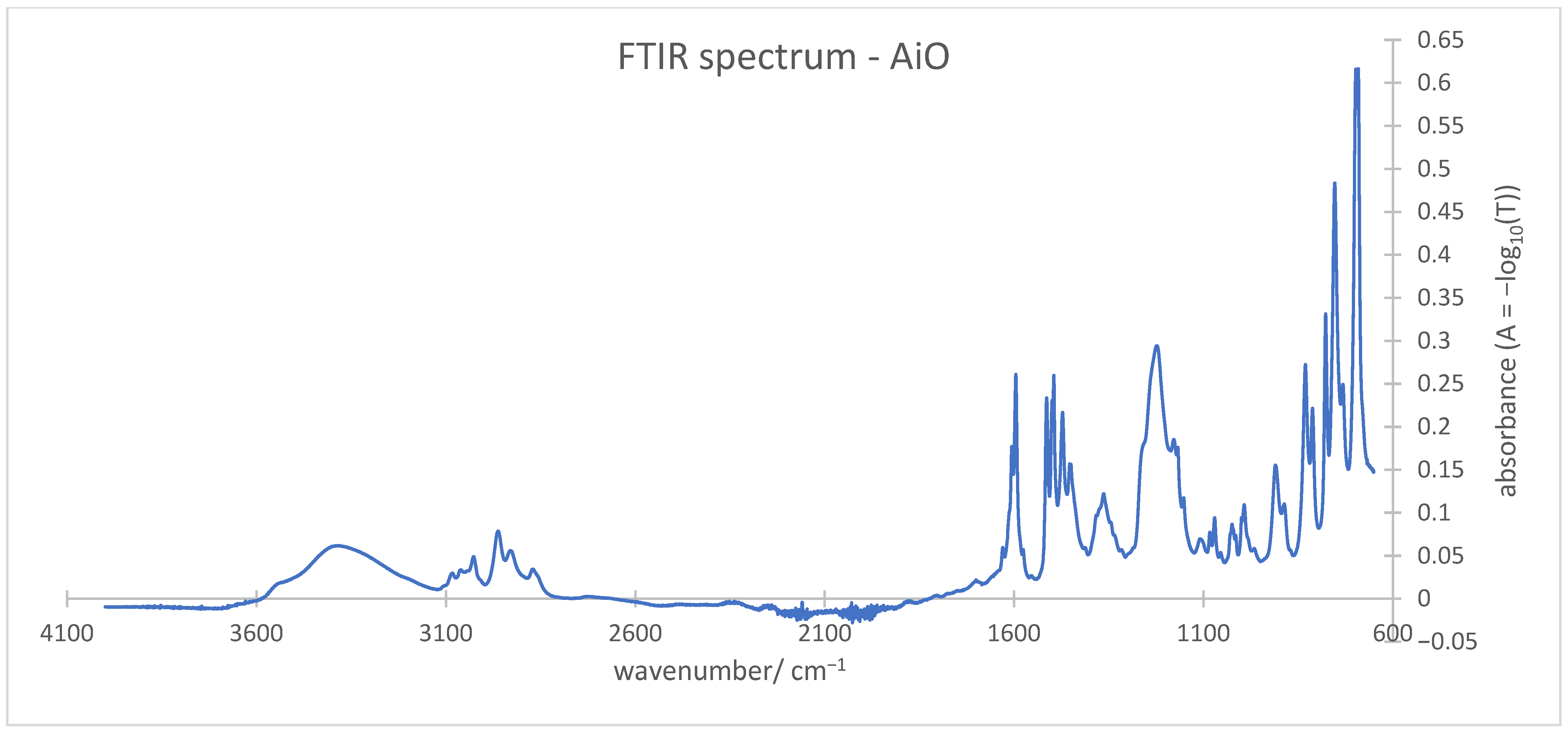
| Position (cm−1) | Intensity (Descriptive) | Assignment (Most Typical) | Interpretive Commentary |
|---|---|---|---|
| ~3358 | medium, wide | O-H stretching (water/alcohols/ hydroperoxides) | A wide band suggests a polar component or trace moisture/ oxidation products; may be weak in pure hydrocarbon oils. |
| 2955, 2916, 2871, 2842 | from medium to very strong | C-H stretching: CH3/CH2 (aliphatic chains) | aliphatic fraction (long chains) typical of many mineral oils |
| ~1649 | medium | C=C stretching (alkenes/aromatics) or H-O-H bend (when water) | In the oil matrix, more often associated with unsaturation/aromaticity than with water (if no other strong water bands are present). |
| 1456, 1377 | strong | CH2 scissoring (~1465), CH3 bending (~1375) | very typical for aliphatic mixtures |
| ~972 | medium | =C-H OOP vibrations (alkenes)/ oxidation components reported in references | The literature on engine oils indicates the usefulness of around 970 cm−1 in the context of changes during oxidation (depending on the system). |
| 887, 775, 728, 697, 676 | from medium to very strong | aromatic C-H OOP (900–690 cm−1); for monosubstitution typically strong bands ~750 and ~700 | The band pattern in the 900–690 cm−1 region is diagnostic for aromatics and substitution type; visible strong components at ~697 and ~775 (and others) support aromatic contribution. |
| Position (cm−1) | Intensity (Descriptive) | Assignment (Most Typical) | Interpretive Commentary |
|---|---|---|---|
| ~3237 (wide) | medium | O-H stretching (water/water/alcohols/hydroperoxides) | Broad and shifted towards lower wavenumbers O-H is sometimes associated with a stronger hydrogen bond (e.g., oxidation products). |
| ~3074 | medium | =C-H stretching (alkenes/aromatics) | confirms an unsaturated (or aromatic) bond |
| 2956 | very strong | ν(C-H) CH3 (asym.) | dominance of the aliphatic fraction |
| 2924 and ~2917 | strong | ν(C-H) CH2 (asym., maximum ~2922–2925) | typical of long hydrocarbon chains |
| 2871 | strong | ν(C-H) CH3 (sym.) | typical for aliphatic mixtures |
| 2842 | medium | ν(C-H) CH2 (sym., ~2850) | confirmation of long chains |
| ~1697 | medium | weak C=O (oxidation) or contribution of ring bands/conjugated systems | In operating oils, the carbonyl region is diagnostic; absorption is visible near 1700 cm−1, which may indicate possible oxidation products. |
| ~1649 | medium | C=C stretching (alkenes/aromatics) | unsaturated (or aromatic) bond |
| ~1605 and ~1495 | medium | aromatic ring vibrations (C=C)/deformations | aromatic bonding |
| 1455 | strong | δ(CH2) scissoring (~1465) | classic aliphatic band |
| 1377 | strong | δ(CH3) bending (~1375) | |
| 1276 | medium | fingerprint area: C-C/C-O, possible addition of additives | |
| 1177, 1107, 1071, 1026 | weak/medium | fingerprint (C-C/C-O; complex vibrations) | Formulated oils may contain additives or aging products. |
| 990–965 | medium | vibrations related to unsaturation (=C-H)/“oil” components | According to the literature, changes in this area may accompany aging (contextual interpretation). |
| 887.5 | very strong | C-H OOP (alkenes/aromatics) | The strong band in the 900–690 cm−1 region is typical for aromatics; details of the pattern confirm the presence of a ring. |
| 775.8; 728.8; 712.8; 696.8; 676 | strong/very strong | C-H OOP (aromatics) and rocking CH2 (~722–730) | The pattern of 900–690 cm−1 is diagnostic for aromatics; at the same time ~722–730 cm−1 is characteristic for long chains (CH2 rocking). |
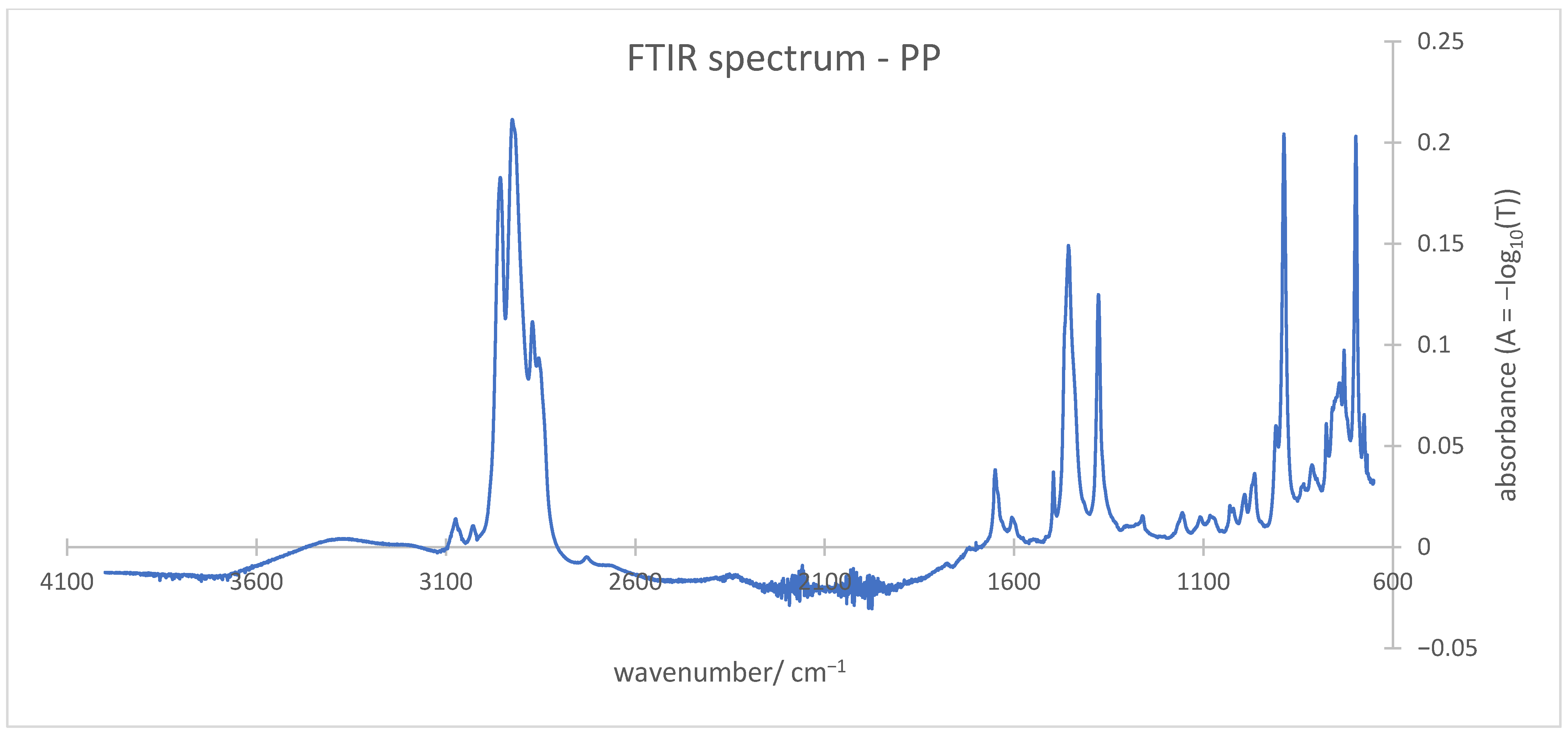
| Position (cm−1) | Intensity (Descriptive) | Assignment (Most Typical) | Interpretive Commentary |
|---|---|---|---|
| 2953; 2917 | very strong | ν(C-H) CH3/CH2 (asym.) | strong aliphatic component (typical of a carbon-hydrogen matrix) |
| 2871 | strong | ν(C-H) CH3/CH2 (sym.) | confirms the presence of -CH2-/-CH3 fragments. |
| 2843 | medium | ν(C-H) (sym., mainly CH2) | band consistent with the presence of aliphatic chains. |
| 1650 | medium | C=C (alkenes/conjugated systems; general) | unsaturation/conjugated band; no specific compound identified |
| 1601 | medium | aromatic ring vibrations (ring modes) | supports the aromatic contribution in the spectrum. |
| 1456; 1444 | strong | δ(CH2)/δ(CH3) (C-H deformations) | characteristic hydrocarbon bands; possible overlap |
| 1424 | medium | C-H deformations (general; mixtures) | auxiliary band, nonspecific |
| 1376 | very strong | δ(CH3) bending (~1375) | clear contribution of methyl groups |
| 1295; 1267; 1230 | medium/weak | fingerprint area (complex vibrations; general assignments) | stripes in the fingerprint area; general interpretation |
| 1171; 1168 | weak/medium | ||
| 998 | medium | ||
| 972 | medium | ||
| 902 | medium | C-H OOP (aromatics/alkenes; general) | supports unsaturated/aromatic input. |
| 888 | very strong | very clear band in the OOP area | |
| 842; 836; 817; 812 | medium | aromatic C-H OOP (substitution dependent) | a set of bands supporting an aromatic interpretation |
| 782; 766; 756; 739 | medium | aromatic C-H OOP | in the aroma diagnostic area |
| 728; 715 | strong | CH2 rocking (~720–730) and/or layering with aromatic OOP | typical range for longer -CH2- sequences; overlapping bands possible |
| 695; 693 | strong | aromatic C-H OOP | strong aromatic contribution in the 900–650 cm−1 region |
| 675; 674 | strong | additional intense bands in the aromatic area | |
| 667 | medium | accompanying band in the diagnostic area |
| Position (cm−1) | Intensity (Descriptive) | Assignment (Most Typical) | Interpretive Commentary |
|---|---|---|---|
| 2956, 2916, ~2871, ~2844 | very strong/strong | C-H stretching CH3/CH2 | aliphatic fraction (hydrocarbon chains), typical of oils |
| ~1649–1650 | medium | C=C stretching (alkenes/aromatics) | In hydrocarbon oils, they are often associated with an unsaturated/aromatic bond (no strong C=O). |
| ~1495 | medium | aromatic ring vibrations/C-H deformations | confirms the presence of an aromatic ingredient |
| 1456, 1377 | strong | δ(CH2) scissoring; δ(CH3) bending | typical “oil” (aliphatic) bands |
| ~990 and ~973–965 | medium/weak | vibrations related to non-saturation (=C-H)/“fingerprint” | auxiliary region; interpretation dependent on matrix and additives |
| ~906 and 887 | strong/very strong | aromatic C-H OOP (900–650) | very clear aromatic signal in the diagnostic region 900–650 cm−1 |
| 775 and ~697 (and ~729/740) | very strong/medium | aromatic C-H OOP; ~722–730 also CH2 rocking | The arrangement of ~690–710 and ~730–770 cm−1 is often observed for an aromatic ring (often also in the context of monosubstitution), and ~722–730 cm−1 is typical for long CH2 chains (rocking). |
| Position (cm−1) | Intensity (Descriptive) | Assignment (Most Typical) | Interpretive Commentary |
|---|---|---|---|
| ~3327 | medium, wide | O-H stretching (water/water/alcohols/hydroperoxides) | Presence of polar components or oxidation products; broad band, consistent with hydrogen bonding. |
| ~2961; ~2957 | medium | ν(C-H) CH3/CH2 (asym.) | Aliphatic bands typical of a hydrocarbon matrix; here less dominant than aromatic ones 900–650 cm−1. |
| ~2871 | medium | ν(C-H) CH3 (sym.) | Typical aliphatic band; supports the aliphatic fraction. |
| ~1702 | medium | C=O (carbonyl region: ketones/acids/aldehydes/esters) | in operating oils, the 1800–1650 cm−1 region is sometimes diagnostic for oxidation; the presence of the band may indicate carbonyl compounds. |
| ~1595 | strong | C=C aromatic ring | aromatic ring |
| ~1500 | strong | C=C/aromatic ring vibrations | Confirms the presence of an aromatic ingredient. |
| ~1473 | medium | δ(CH2)/δ(CH3) (C-H deformations) + possible aromatic overlap | Region susceptible to superposition; general interpretation (aliphatic deformations). |
| ~1365 | medium | δ(CH3) bending (~1375) | typical for the aliphatic fraction |
| ~1168 | weak/medium | fingerprint: C-C/C-O (additives/aging products may also contribute) | The attribution remains cautious; possible contribution of additives or degradation products. |
| ~1071 | weak/medium | fingerprint: C-C/C-O | |
| ~885 | medium/strong | C-H OOP (aromats/alkenes) | confirmation of the presence of aromas |
| ~812 | strong | aromatic C-H OOP (substitution type) | The 900–690 cm−1 region is diagnostic of aromas; a strong band supports the aromatic contribution. |
| ~752 | strong | aromatic C-H OOP | The band pattern at 900–690 cm−1 suggests a significant contribution of aromatic structures. |
| ~722 | weak/medium | CH2 rocking (long sequences -CH2-) | Possible contribution of long chains; in this sample the 900–650 cm−1 region is dominated by aromatics, so assignment requires caution. |
| ~691 | strong | aromatic C-H OOP | strong aromatic bond in the diagnostic area |
| Position (cm−1) | Intensity (Descriptive) | Assignment (Most Typical) | Interpretive Commentary |
|---|---|---|---|
| ~1495 | strong | C=C aromatic ring/aromatic vibrations | indicates a pronounced aromatic bond |
| ~1456 | medium | δ(CH2) scissoring (approx. 1465) + possible aromatic overlay | typical of hydrocarbons; in oils often one of the main deformation bands |
| ~1020 | medium | fingerprint (C-C/C-O; complex vibrations) | “crowded” scope; only general assignment |
| ~908 and ~813 | medium | aromatic C-H OOP (900–690) | supports aromatic interpretation (diagnostic region for aromas) |
| ~776, ~746, ~731 | strong | aromatic C-H OOP | The band arrangement is typical for aromatics; it depends on the type of substitution (should not be assigned to a specific compound). |
| ~722 | medium | CH2 rocking (long -CH2- sequences) and/or overlapping in the aromatic region | The 900–650 cm−1 region is very aromatically intense, so the contribution of “pure” CH2 rocking should be treated with caution. |
| ~696–697 | very strong | aromatic C-H OOP (900–690) | dominant spectral band; strong signal from aromatic bond |
| ~676 | medium | aromatic C-H OOP | additional aromatic component in the diagnostic area |
| Position (cm−1) | Intensity (Descriptive) | Assignment (Most Typical) | Interpretive Commentary |
|---|---|---|---|
| 1596 | strong | C=C aromatic ring (ring stretching) | clear aromatic signal |
| 1514, 1495 | medium/strong | aromatic ring vibrations | confirms the presence of aromatic structures (a set of aromatic bands is often observed in this area) |
| 1452 | medium | δ(CH2)/δ(CH3) + possible aromatic overlap | typical hydrocarbon deformation band; region prone to overlay |
| 1363 | medium | δ(CH3) bending (around ~1375) | confirms the presence of methyl groups |
| 1223 | strong | fingerprint (C-C/C-O; complex vibrations) | “crowded” scope; possible contribution of base/additives/aging products |
| 1178, 1071, 998 | medium/weak | fingerprint (C-C/C-O) | |
| 909, 887 | medium | aromatic C-H OOP (900–690) | enhances the identification of the presence of aromas |
| 831, 812 | strong/medium | aromatic C-H OOP (substitution type) | diagnostic part for aromatics (substitution-dependent pattern; do not assign to a specific compound) |
| 777, 753, 732 | strong/very strong | aromatic C-H OOP | very clear aromatic “signature” in the 900–650 cm−1 region |
| 697, 691 | very strong | dominant spectral bands; typical of aromatic structures | |
| 676 | medium | additional aromatic bond in the diagnostic area |
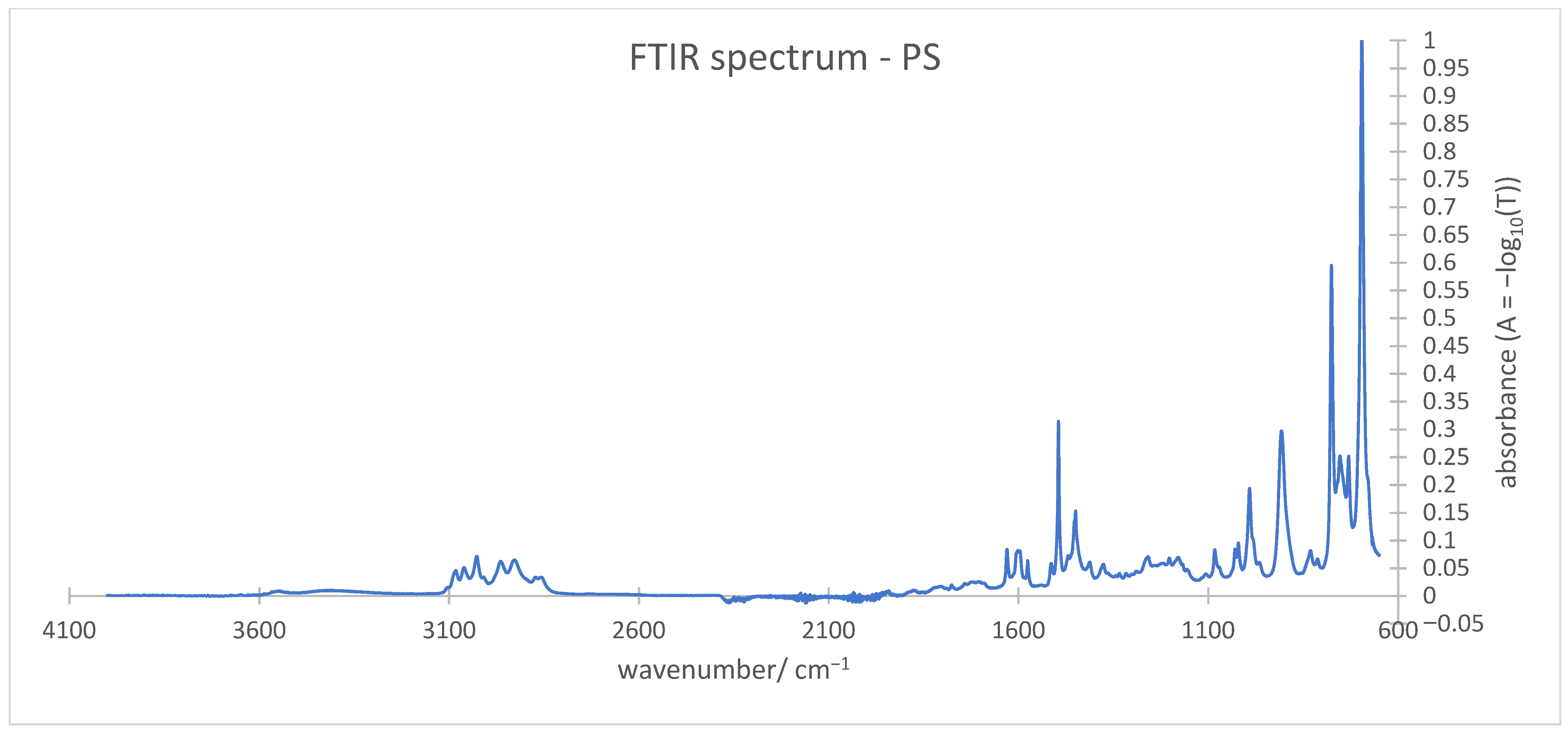
| Position (cm−1) | Intensity (Descriptive) | Assignment (Most Typical) | Interpretive Commentary |
|---|---|---|---|
| ~1495 | medium | aromatic ring vibrations | one of the typical aromatic bands |
| ~908 | medium | aromatic C-H OOP (900–690) | stronger aromatic signal in the diagnostic area |
| ~776 | strong | aromatic C-H OOP | one of the main aromatic bands in the region 900–690 cm−1 |
| ~754; ~731; ~728 | medium | aromatic C-H OOP and possible overlap with CH2 rocking ~722–730 | The region may contain both an aromatic contribution and a contribution of long -CH2- sequences (contextual interpretation). |
| ~696 | very strong | aromatic C-H OOP (900–690) | dominant spectrum band; very clear aromatic “signature” |
| ~682 | medium | aromatic C-H OOP | an additional component in the diagnostic area of aromas |
| Position (cm−1) | Intensity (Descriptive) | Assignment (Most Typical) | Interpretive Commentary |
|---|---|---|---|
| 2956 | very strong | ν(C-H) CH3/CH2 (asym.) | strong aliphatic component typical of a hydrocarbon/oil matrix |
| 2925 | very strong | ν(C-H) CH2 (asym., ~2922–2925) | confirms the presence of numerous -CH2- groups (aliphatic chains) |
| 2872 | strong | ν(C-H) CH3 (sym.) | typical aliphatic band in oils |
| 2855 | medium | ν(C-H) CH2 (sym., ~2850) | supports the presence of long methylene sequences |
| 1456 | strong | δ(CH2) scissoring (~1465) | one of the key deformation bands of the aliphatic fraction |
| 1377 | strong | δ(CH3) bending (~1375) | confirms the presence of methyl groups in the oil matrix |
| 1109; 1077; 1021; 991 | very weak/weak | fingerprint (C-C/C-O) | “crowded” scope; without formulation information, only general assignment |
| 908 | medium | aromatic/alkenyl C-H OOP | The 900–690 cm−1 region is diagnostic for aromas (OOP). |
| 888 | very strong | C-H OOP (aromatics/alkenes) | strong contribution of aromatic structures/unsaturated systems in the diagnostic area |
| 776; 746; 740 | medium | aromatic C-H OOP | a set of OOP strands typical of aromatic structures |
| 728 | strong | CH2 rocking (~720–730) and/or layering with OOP aromatics | In oils, the ~722–730 cm−1 band is sometimes attributed to “CH2 rocking” of long chains; here overlap with aromatic bands of the same area is possible. |
| 698 | very strong | aromatic C-H OOP | one of the dominant signals of the aromatic region 900–690 cm−1 |
| 676 | medium | additional aromatic component in the diagnostic area |
| Position (cm−1) | Intensity (Descriptive) | Assignment (Most Typical) | Interpretive Commentary |
|---|---|---|---|
| ~1733 | medium | C=O (typically esters; generally “carbonyl region”) | The C=O signal indicates a significant contribution of carbonyl compounds (e.g., ester components or oxidation products). |
| ~1703; ~1695 | strong | C=O (carbonyl region 1800–1650 cm−1) | Very pronounced absorption around ~1700 cm−1; in operating oils, the C=O region is sometimes used diagnostically for oxidation, but it may also originate from formulation components (e.g., ester bases). |
| ~1647 | medium | C=C (alkenes/conjugated systems; aromatic contribution possible) | The band may accompany unsaturated components; it can be interpreted together with the region 900–650 cm−1. |
| ~1604; ~1495 | medium | vibrations of the aromatic ring (ring stretching) | supports the presence of an aromatic component |
| ~1458/~1452 | weak/medium | δ(CH2)/δ(CH3) (C-H deformations) | Typical hydrocarbon bands; may overlap with other vibrations in mixtures. |
| ~1267 | strong | fingerprint (often C-O/C-C; in esters also ν(C-O) contribution) | A “crowded” range; with a strong C=O, may be consistent with the presence of ester functions, but may not identify unambiguously. |
| ~1230; ~1177; ~1105; ~1071; ~1020; ~992 | medium/weak | fingerprint (C-O/C-C; complex vibrations) | In formulated oils, fingerprint signals may originate from the base (e.g., ester), additives, or aging products. |
| ~909; ~880; ~824; ~805 | medium | C-H OOP (aromatics/alkenes)—region 900–690 cm−1 | Diagnostic region for aromatic structures; band arrangement supports aromatic/unsaturated contribution. |
| ~778; ~758; ~739; ~732 | medium/strong | aromatic C-H OOP | set of OOP bands typical for aromatics |
| ~715 | strong | CH2 rocking (~720–730) and/or layering with aromatic OOP | In oils, the ~722–730 cm−1 band is sometimes associated with long -CH2- sequences, but in mixtures it may overlap with aromatic OOP. |
| ~699; ~684; ~678 | very strong/strong | aromatic C-H OOP | a very intense “signature” of the aromatic region; in this sample it is one of the dominant features of the spectrum. |
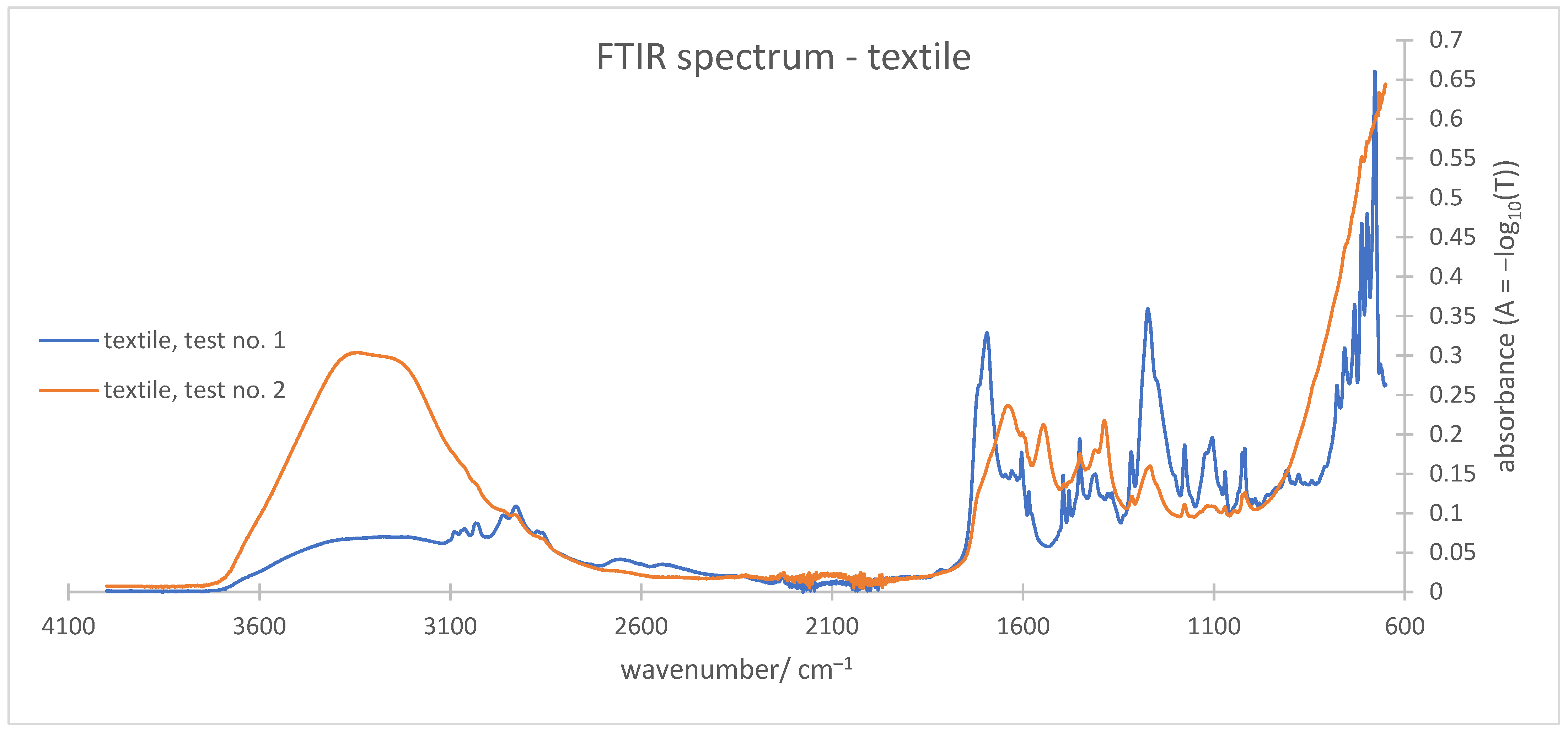
| Position (cm−1) | Intensity (Descriptive) | Assignment (Most Typical) | Interpretive Commentary |
|---|---|---|---|
| ~3393; ~3307 | strong, wide | O-H stretching (water/water/alcohols/hydroperoxides) | A clear share of polar components; in operating oils it may accompany oxidation products (interpretation with caution without a reference sample). |
| ~3067 | medium | =C-H stretching (alkenes/aromatics) | indicates unsaturation or aromatic contribution |
| ~1703; ~1693 | medium | C=O (carbonyl region 1800–1650 cm−1) | Pronounced carbonyl absorption; in oil diagnostics, the C=O region is sometimes associated with oxidation, but similar bands may also originate from formulation components (e.g., ester bases). |
| ~1643 | medium | C=C (alkenes/conjugated systems; aromatic contribution possible) | The band is distinct and should be interpreted together with the strong 900–650 cm−1 region. |
| ~1603; ~1492 | medium | vibrations of the aromatic ring (ring stretching) | supports the presence of aromatic ingredients |
| ~1451 | medium | δ(CH2)/δ(CH3) (C-H deformations) | typical hydrocarbon band; in mixtures possible overlap with other vibrations |
| ~1384 | medium | δ(CH3) bending (~1375). | confirms the presence of methyl groups |
| ~1267 | medium | fingerprint (often C-O/C-C; in esters also ν(C-O) contribution) | A “crowded” range; with CO present, it may be consistent with oxygen functional involvement, but the assignment remains generic. |
| ~902; ~880 | medium | C-H OOP (aromatics/alkenes)—region 900–690 cm−1 | Diagnostic region for aromatics; presence of bands supports “aromatic/unsaturated contribution”. |
| ~824; ~805 | medium/strong | aromatic C-H OOP | Part of the OOP pattern dependent on substitution type; without the library, do not identify a specific compound. |
| ~770; ~751; ~739; ~725; ~715 | strong/very strong | very distinct aromatic “signature” at 900–650 cm−1 | |
| ~715 (±) | very strong | possible stacking: CH2 rocking (~730–720) and OOP aromatic | In oils, the ~722–730 cm−1 band is sometimes associated with long -CH2- sequences (rocking), but in this sample the region is strongly “aromatic”, so the assignment is only cautious. |
| ~693; ~677; ~671 | very strong | aromatic C-H OOP | dominant spectral bands in the diagnostic area of aromas |
| Feedstock/Fraction | Aliphatic Character (C-H 3000–2800; 1450/1375) | Aromatic/Styrenic Character (1605–1495; OOP 900–690) | Oxygenated Character (C=O 1850–1650; O-H 3600–3200) | Key Interpretation Notes |
|---|---|---|---|---|
| PP | high | low/moderate | low | Dominant polyolefin-like hydrocarbon matrix; aromatic OOP features present but secondary/overlapping. |
| ABS oils (drum/mix) | moderate/high | moderate/high | low/moderate | mixed aliphatic–aromatic signature typical of styrenic blends; possible contribution of additives/aging products |
| keyboards | moderate | high | low | strong aromatic OOP system; aliphatic C-H present but less dominant |
| AiO | moderate | high | low | pronounced aromatic fingerprint; weak C=O/O-H contribution |
| PCB | low/moderate | high | low/moderate | Strong aromatic signature; carbonyl/O-H bands suggest polar components; resin/flame-retarded feedstock requires GC-MS/elemental confirmation. |
| PS | low/moderate | very high | low | Most structured aromatic OOP region; FTIR consistent with aromatic-rich products but not compound-specific. |
| textile (no. 1 & 2) | low/moderate | high | high | Clear C=O and O-H together with aromatic OOP; consistent with oxygenated constituents but not uniquely assignable by FTIR. |
| Batch Material from Which the Main Fraction Was Obtained | Test No. | Load Quantity | Distillate | Gas Fractions (Estimated) 1 | Amount of Distillates Per Unit of Main Fraction | Observations and Comments | ||||||||
|---|---|---|---|---|---|---|---|---|---|---|---|---|---|---|
| Obtained at 250 °C | Obtained at 250–350 °C | Total | ||||||||||||
| Quantity | Volume Percent | Quantity | Volume Percent | Quantity | Volume Percent | Quantity | Volume Percent | Distillate Obtained at 250 °C | Distillate Obtained at 250–350 °C | Total | ||||
| mL, ±10 mL | mL, ±10 mL | v/v, % | mL, ±10 mL | v/v, % | mL, ±10 mL | v/v, % | mL, ±10 mL | v/v, % | ml/L, % | |||||
| PS | 1 | 6000 | 3500 | 58.3 | 470 | 7.8 | 3970 | 66.1 | 2030 | 33.9 | 580, 58% | 80, 8% | 660, 66% | - noticeable foaming during distillation in the T range of 135–155 °C - condensation for inside the receiver appears at approx. 180 °C |
| 2 | 6550 | 3800 | 58.0 | 890 | 13.5 | 4690 | 71.5 | 1860 | 28.5 | 580, 58% | 140, 14% | 720, 72% | ||
| 3 | 5200 | 2900 | 55.7 | 1020 | 19.6 | 3920 | 75.3 | 1280 | 24.7 | 560, 56% | 200, 20% | 760, 76% | ||
| 4 | 4500 | 3000 | 66.6 | 650 | 14.4 | 3650 | 81.0 | 850 | 19.0 | 670, 67% | 140, 14% | 810, 81% | ||
| 5 | 3000 | 1900 | 63.3 | 380 | 12.6 | 2280 | 75.9 | 720 | 24.0 | 630, 63% | 130, 13% | 760, 76% | ||
| average and standard deviation | 5050 σ = 1390 | 3020 σ = 730 | 60.4 σ = 4.4 | 680 σ = 270 | 13.6 σ = 4.2 | 3700 σ = 880 | 74.0 σ = 5.5 | 1350 σ = 586 | 26.0 σ = 5.5 | 600, 60% σ = 40 | 140, 14% σ = 40 | 740, 74% σ = 60 | ||
| ABS drum | 1 | 1790 | 900 | 50.3 | 300 | 16.7 | 1200 | 67.0 | 590 | 33.0 | 500, 50% | 170, 17% | 670, 67% | |
| 2 | 1750 | 350 | 20.0 | 310 | 17.7 | 660 | 37.7 | 1090 | 62.3 | 200, 20% | 180, 18% | 380, 38% | ||
| 3 | 1710 | 900 | 52.6 | 400 | 23.4 | 1300 | 76.0 | 410 | 24.0 | 530, 53% | 230, 23% | 760, 76% | ||
| 4 | 1070 | 600 | 56.0 | 210 | 19.6 | 810 | 75.6 | 260 | 24.4 | 560, 56% | 200, 20% | 760, 76% | ||
| 5 | 1120 | 390 | 34.8 | 200 | 17.8 | 590 | 53.0 | 530 | 47.0 | 350, 36% | 180, 18% | 530, 53% | ||
| average and standard deviation | 1490 σ = 360 | 630 σ = 270 | 42.7 σ = 15.1 | 280 σ = 80 | 19.0 σ = 2.7 | 910 σ = 320 | 61.8 σ = 16.5 | 580 σ = 310 | 38.2 σ = 16.5 | 430, 43% σ = 150 | 190, 19% σ = 30 | 620, 62% σ = 160 | ||
| PP | 1 | 2400 | 1150 | 48.0 | 430 | 18.0 | 1580 | 66.0 | 820 | 34.0 | 480, 48% | 180, 18% | 660, 66% | - |
| 2 | 2050 | 800 | 39.0 | 500 | 24.3 | 1300 | 63.4 | 750 | 36.6 | 390, 39% | 240, 24% | 630, 63% | ||
| average | 2230 | 980 | 43.5 | 470 | 21.2 | 1450 | 64.7 | 790 | 35.3 | 430, 43% | 210, 21% | 640, 64% | ||
| keyboards | 1 | 4050 | 2600 | 64.2 | 350 | 8.6 | 2950 | 72.8 | 1100 | 27.2 | 640, 64% | 90, 9% | 730, 73% | - |
| AiO | 1 | 2950 | 1600 | 54.2 | 500 | 16.9 | 2100 | 71.1 | 850 | 28.9 | 540, 54% | 170, 17% | 710, 71% | - |
Disclaimer/Publisher’s Note: The statements, opinions and data contained in all publications are solely those of the individual author(s) and contributor(s) and not of MDPI and/or the editor(s). MDPI and/or the editor(s) disclaim responsibility for any injury to people or property resulting from any ideas, methods, instructions or products referred to in the content. |
© 2026 by the authors. Licensee MDPI, Basel, Switzerland. This article is an open access article distributed under the terms and conditions of the Creative Commons Attribution (CC BY) license.
Share and Cite
Piotrowicz, A.; Kolczyński, J.; Kostrzewa, M.; Kaczmarek, W.; Samojeden, B. Microwave Depolymerization of Various Plastic Wastes—Quarter-Scale Testing. Clean Technol. 2026, 8, 44. https://doi.org/10.3390/cleantechnol8020044
Piotrowicz A, Kolczyński J, Kostrzewa M, Kaczmarek W, Samojeden B. Microwave Depolymerization of Various Plastic Wastes—Quarter-Scale Testing. Clean Technologies. 2026; 8(2):44. https://doi.org/10.3390/cleantechnol8020044
Chicago/Turabian StylePiotrowicz, Andrzej, Janusz Kolczyński, Mirosław Kostrzewa, Wojciech Kaczmarek, and Bogdan Samojeden. 2026. "Microwave Depolymerization of Various Plastic Wastes—Quarter-Scale Testing" Clean Technologies 8, no. 2: 44. https://doi.org/10.3390/cleantechnol8020044
APA StylePiotrowicz, A., Kolczyński, J., Kostrzewa, M., Kaczmarek, W., & Samojeden, B. (2026). Microwave Depolymerization of Various Plastic Wastes—Quarter-Scale Testing. Clean Technologies, 8(2), 44. https://doi.org/10.3390/cleantechnol8020044