
A Comparative Case Study: Cradle-to-Grave LCA for Asphalt Mixtures Containing RAP and WMA

 ,
,  , and
, and
Highlights
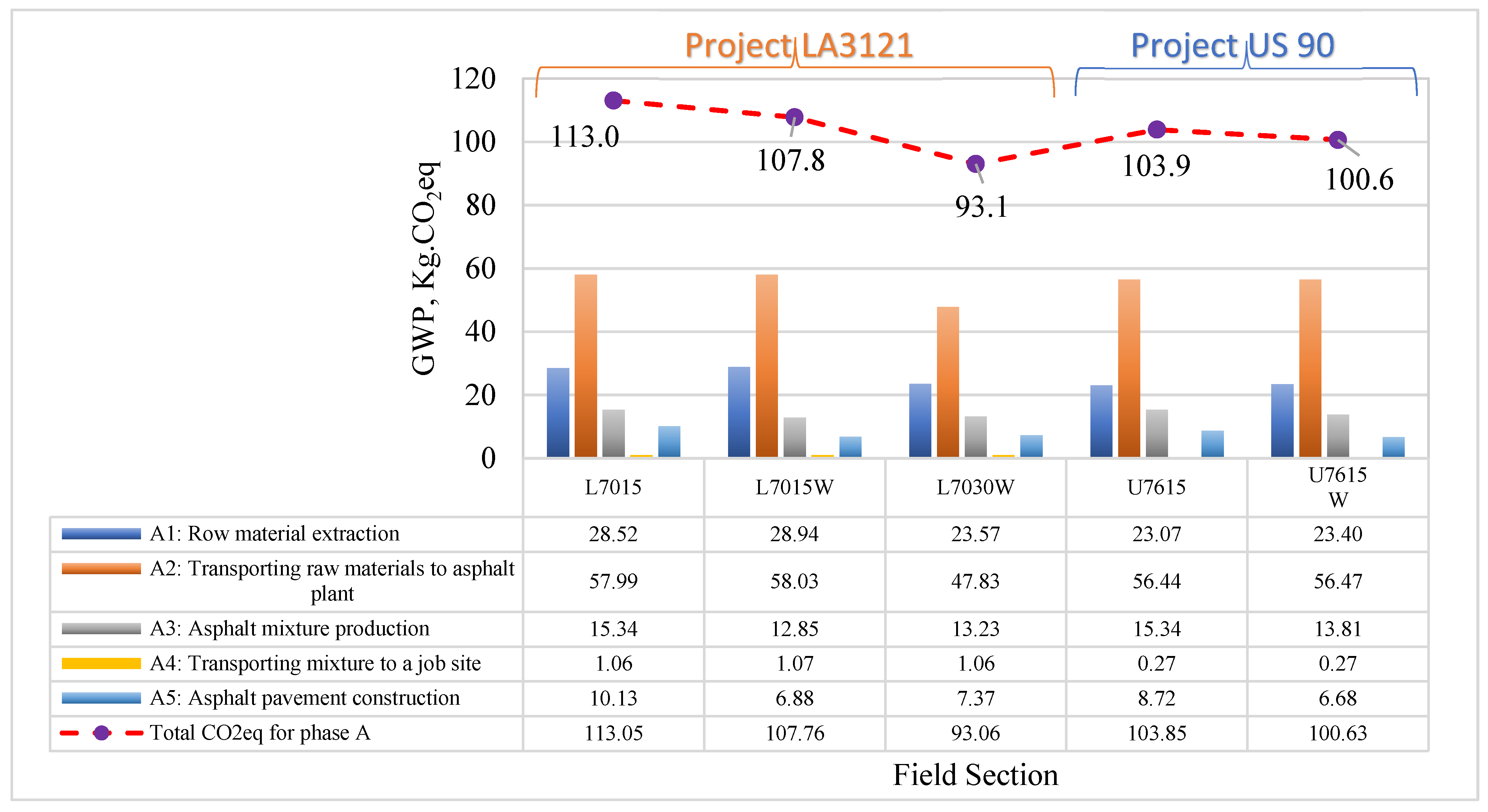
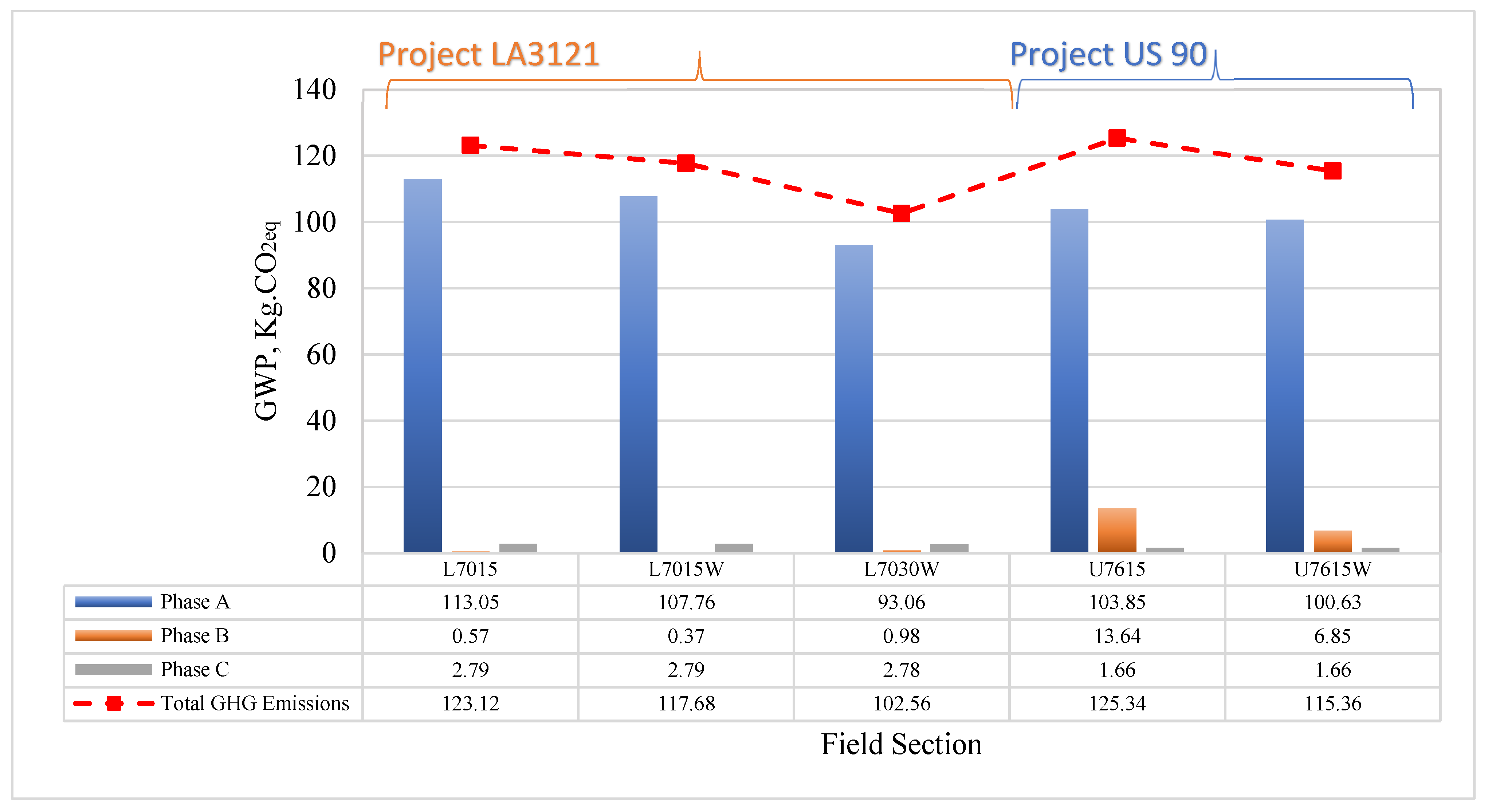
- WMA lowered Phase A (production + construction) GHG emissions by 5% in the evaluated field sections.
- Increasing RAP reduced Phase A GHG emissions by 0.9% per 1% RAP increase (15% → 30% RAP case).
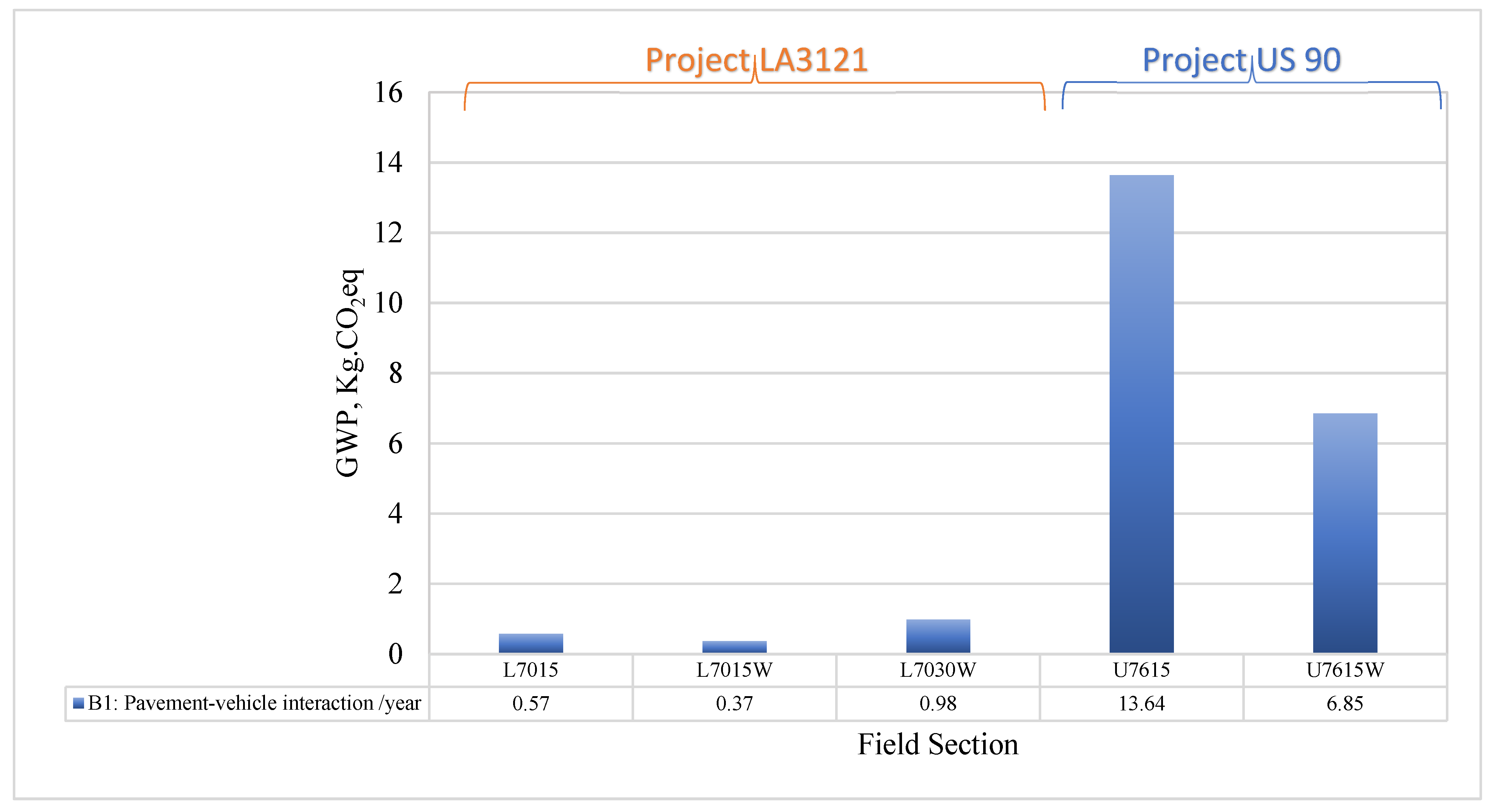
- At high speeds and traffic volumes, use-phase emissions can dominate and offset material/construction savings.
- Combining WMA with high RAP achieved the lowest overall cradle-to-grave GHG.
Abstract
1. Introduction
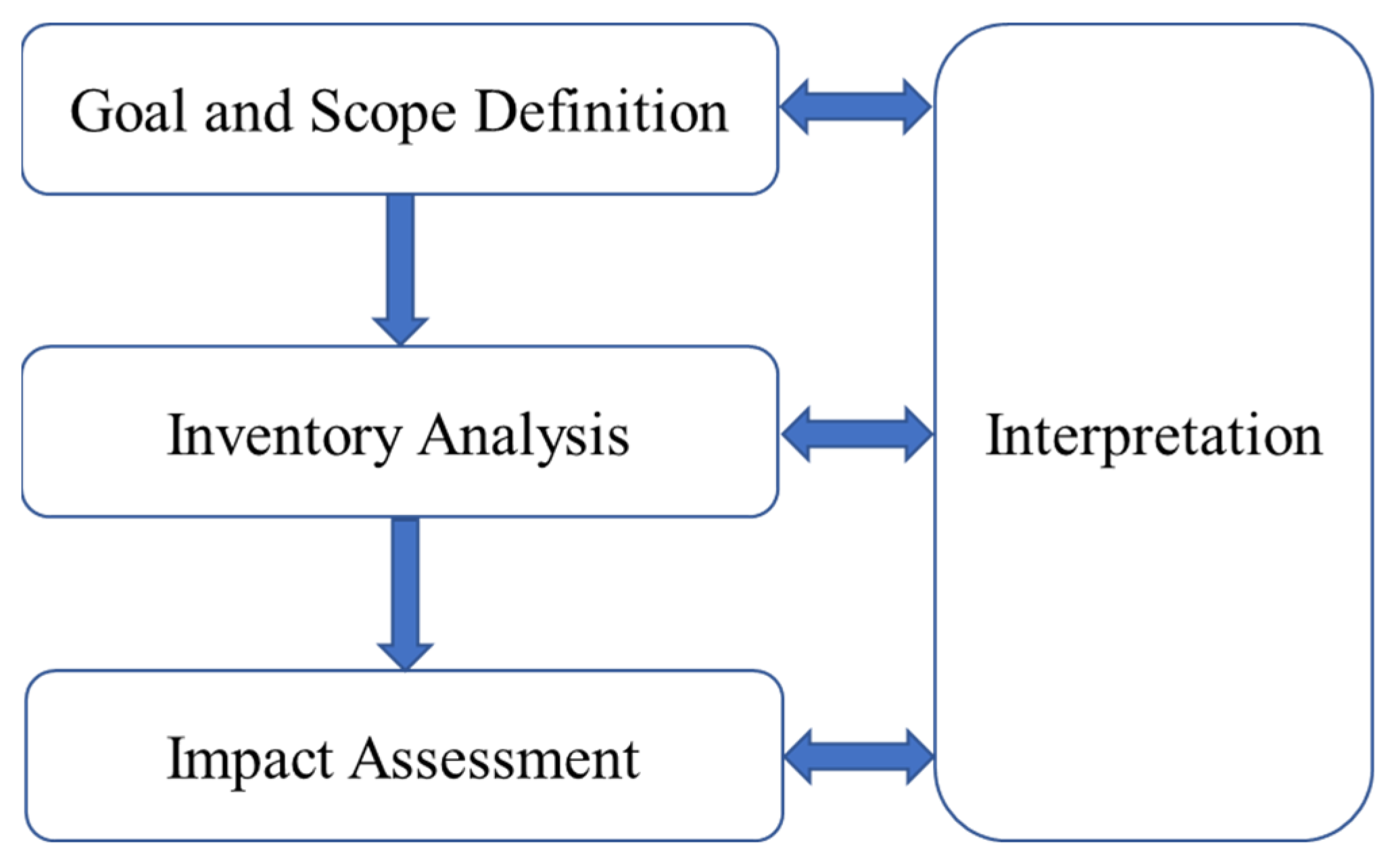
2. Research Methodology
2.1. Step 1: Goal and Scope
- Conduct a cradle-to-grave LCA for asphalt pavement field projects in Louisiana that incorporate RAP and/or WMA;
- Compare the GHG emissions of asphalt mixtures containing RAP/WMA to those of conventional mixtures without RAP or WMA;
- Recommend various scenarios and alternatives for reducing GHG emissions by performing a sensitivity analysis within the LCA.
2.2. Step 2: Data Inventory
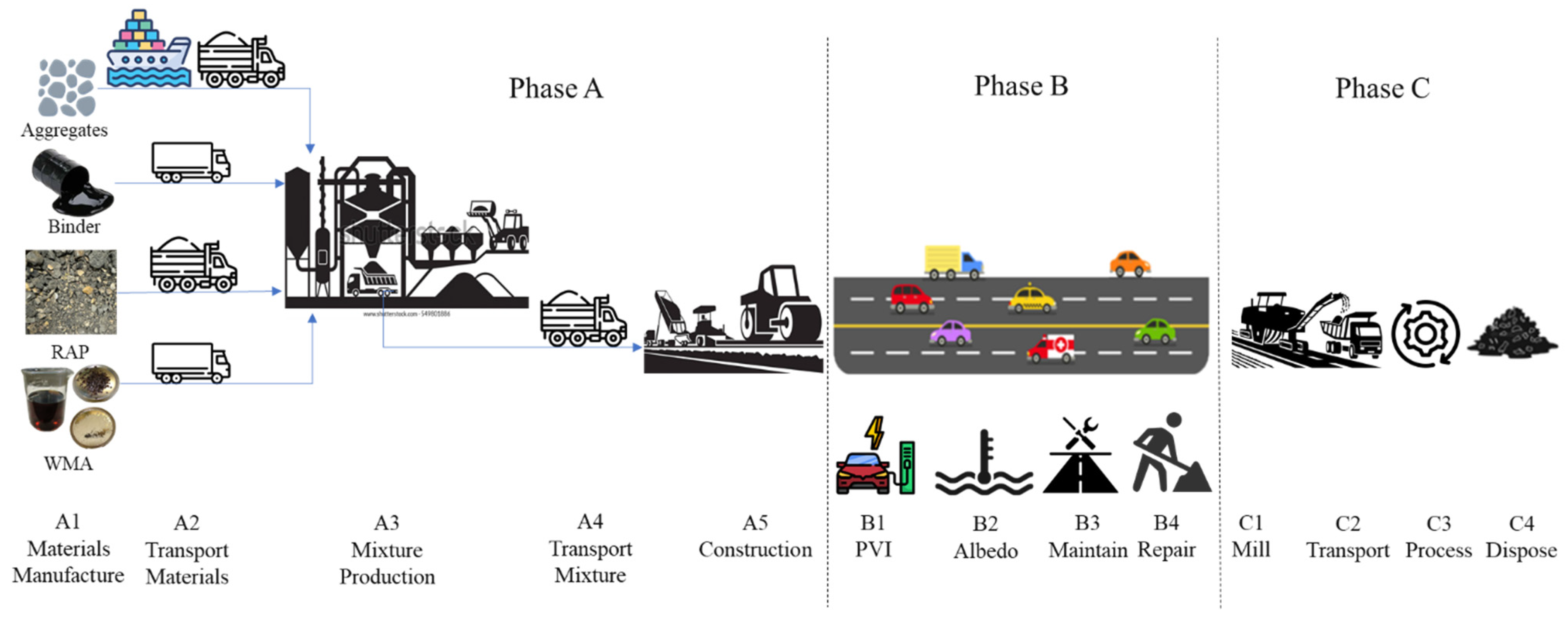
- Phase A: Production and Construction Phase
- Phase A includes 5 subphases:
- A1: raw material manufacture;
- A2: transport of raw material to the asphalt plant;
- A3: asphalt mixture production;
- A4: transport of asphalt mixture to the job site;
- A5: placing and constructing asphalt mixture and mobilizing construction equipment.
2.2.1. WMA Production Emissions
2.2.2. Transportation (Subphases A2 and A4)
2.2.3. Asphalt Plant (Subphase A3)
2.2.4. Asphalt Mixture Fumes
- Phase B: Use Phase
- B1: pavement–vehicle interaction,
- B2: albedo effect,
- B3: maintenance,
- B4: repair works.
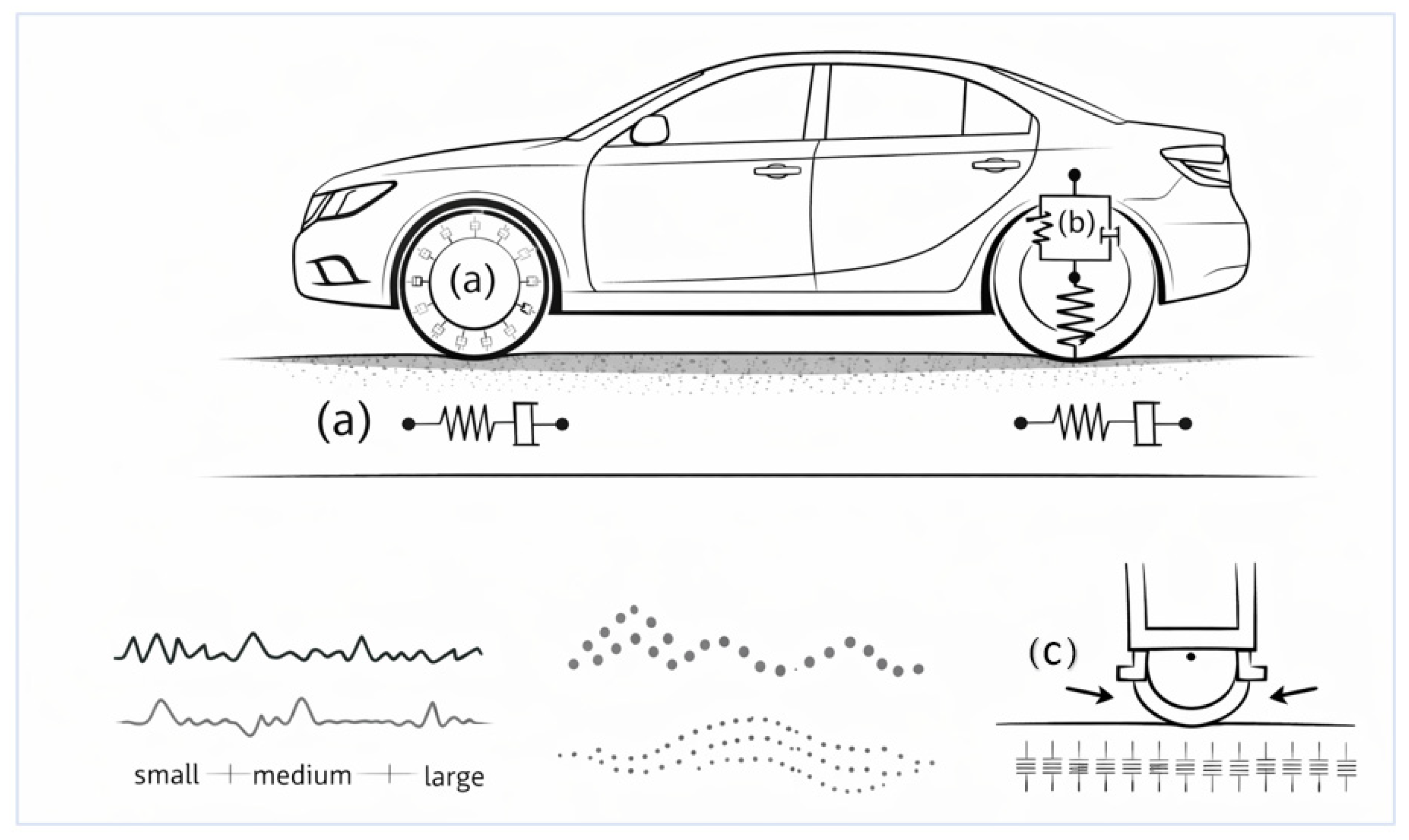
- B1: Pavement–Vehicle Interaction (PVI)
- Surface texture: the unevenness or irregularities present on the pavement surface [43].
- Microtexture (aggregate surface imperfections with wavelength = 0–0.5 mm), responsible for friction.
- Macrotexture (small pavement surface imperfections with wavelength = 0.5–50 mm), responsible for skid resistance.
- Megatexture (large pavement surface imperfections with wavelength = 50–500 mm), causes vibration in the vehicle’s suspension system.
- B2: Albedo Effect
- Phase C: End of Life Phase
- C1: Demolishing/milling
- C2: Transporting milled materials.
- C3: Processing milled materials
2.3. Step 3: Environmental Impact Analysis
2.4. Step 4: Interpretation
3. Conclusions
- Incorporating WMA reduced GHG emissions during production and construction (Phases A3 and A5) by approximately 5%, primarily due to lower asphalt mixing and compaction temperatures that reduced burner fuel consumption.
- WMA also reduced use-phase (Phase B) GHG emissions by up to 50% in certain sections by improving surface smoothness, which lowered pavement–vehicle interaction and excess fuel consumption.
- Increasing RAP content provided substantial material-phase benefits; each 1% increase in RAP content reduced material and construction GHG emissions by approximately 0.9%, mainly by offsetting virgin asphalt binder and aggregate production.
- Higher RAP content was associated with increased surface roughness in specific field sections, which led to increased use-phase GHG emissions due to higher rolling resistance and vehicle energy demand.
- Asphalt mixtures incorporating both WMA and high RAP content achieved the lowest overall cradle-to-grave GHG emissions, demonstrating that combining material and temperature-reduction strategies is more effective than using either approach alone.
Author Contributions
Funding
Data Availability Statement
Acknowledgments
Conflicts of Interest
References
- National Asphalt Pavement Association. NAPA Fast Facts; National Asphalt Pavement Association: Greenbelt, MD, USA, 2020. [Google Scholar]
- Department of Transportation. DOT Report to Congress: Decarbonizing U.S. Transportation; Department of Transportation: Washington, DC, USA, 2024.
- International Energy Agency. Transportation. Available online: https://www.iea.org/energy-system/transport (accessed on 20 January 2025).
- NAPA. Asphalt Pavement Industry Goals for Climate Stewardship: Toward Net Zero Carbon Emissions. Available online: https://www.asphaltpavement.org/climate/industry-goals (accessed on 15 February 2026).
- Environmental Protection Agency. Inventory of U.S. Greenhouse Gas Emissions and Sinks: 1990–2021; 430-F-23-001; U.S. Environmental Protection Agency: Washington, DC, USA, 2023.
- Elnaml, I.; Dylla, H.; Liu, J.; Mohammad, L.N.; Cooper, S.B., III; Cooper, S.B., Jr. Incorporating Environmental Impact Analysis into Louisiana’s Balanced Asphalt Mixture Design. Transp. Res. Rec. 2023, 2679, 1078–1090. [Google Scholar] [CrossRef]
- Abdalla, A.; Faheem, A.F.; Walters, E. Life cycle assessment of eco-friendly asphalt pavement involving multi-recycled materials: A comparative study. J. Clean. Prod. 2022, 362, 132471. [Google Scholar] [CrossRef]
- Prowell, B.; Frank, B.; Osborne, L.; Kriech, T.; West, R. Effects of WMA on Plant Energy and Emissions and Worker Exposures to Respirable Fumes; National Cooperative Highway Research Program (NCHRP): Washington, DC, USA, 2014. [Google Scholar]
- Davidson, J.K.; Pedlow, R. Reducing Paving Emissions Using Warm Mix Technology. In Proceedings of the Annual Conference-Canadian Technical Asphalt Association; Polyscience Publications Inc.: Niles, IL, USA, 2007; p. 39. [Google Scholar]
- Sargand, S.; Nazzal, M.D.; Al-Rawashdeh, A.; Powers, D. Field evaluation of warm-mix asphalt technologies. J. Mater. Civ. Eng. 2012, 24, 1343–1349. [Google Scholar] [CrossRef]
- Elnaml, I.; Mohammad, L.N.; Baumgardner, G.; Cooper, S., III; Cooper, S., Jr. Sustainability of Asphalt Mixtures Containing 50% RAP and Recycling Agents. Recycling 2024, 9, 85. [Google Scholar] [CrossRef]
- Sukhija, M.; Saboo, N.; Pani, A. Economic and environmental aspects of warm mix asphalt mixtures: A comparative analysis. Transp. Res. Part D Transp. Environ. 2022, 109, 103355. [Google Scholar] [CrossRef]
- Calabi-Floody, A.T.; Valdés-Vidal, G.A.; Sanchez-Alonso, E.; Mardones-Parra, L.A. Evaluation of gas emissions, energy consumption and production costs of Warm Mix Asphalt (WMA) involving natural zeolite and Reclaimed Asphalt Pavement (RAP). Sustainability 2020, 12, 6410. [Google Scholar] [CrossRef]
- ISO 14040:2006; Environmental Management–Life Cycle Assessment–Principles and Framework. ISO: Geneva, Switzerland, 2006.
- Fedral Highway Adminastration. LCA Pave: A Tool to Assess Environmental Impacts of Pavement Material and Design Decisions. Available online: https://www.fhwa.dot.gov/pavement/lcatool/ (accessed on 20 June 2025).
- Bare, J.; Young, D.; Qam, S.; Hopton, M.; Chief, S. Tool for the Reduction and Assessment of Chemical and other Environmental Impacts (TRACI); US Environmental Protection Agency: Washington, DC, USA, 2012.
- Martin Marietta. Environmental Product Declaration. 2017. Available online: https://pcr-epd.s3.us-east-2.amazonaws.com/359.EPD_for_Martin_Marietta_EPD_final.pdf (accessed on 20 June 2025).
- Asphalt Institute. Life Cycle Assessment of Asphalt Binder. 2019. Available online: https://www.asphaltinstitute.org/engineering/sustainability/life-cycle-assessment-of-asphalt-binder/ (accessed on 20 June 2025).
- Al-Qadi, I.L.; Yang, R.; Kang, S.; Ozer, H.; Ferrebee, E.; Roesler, J.R.; Salinas, A.; Meijer, J.; Vavrik, W.R.; Gillen, S.L. Scenarios developed for improved sustainability of Illinois Tollway: Life-cycle assessment approach. Transp. Res. Rec. 2015, 2523, 11–18. [Google Scholar] [CrossRef]
- Baumel, C.; Hurburgh, C.; Lee, T. Estimates of Total Fuel Consumption in Transporting Grain from Iowa to Major Grain Countries by Alternatives Modes and Routes. Iowa State University. Available online: https://www.extension.iastate.edu/grain/topics/EstimatesofTotalFuelConsumption.htm (accessed on 20 June 2025).
- USLCI Data by Federal LCA Commons in OpenLCA. Available online: https://www.lcacommons.gov/lca-collaboration/National_Renewable_Energy_Laboratory/USLCI_Database_Public/datasets (accessed on 20 June 2025).
- Prairie Contractors LLC. An Environmental Product Declaration (EPD) for Asphalt Mixtures. 2023. Available online: https://asphaltepd.org/epd/d/BZUVx4/ (accessed on 20 June 2025).
- United States Environmental Protection Agency. Nonroad Technical Reports. Available online: https://www.epa.gov/moves/nonroad-technical-reports#2014b (accessed on 20 June 2025).
- Chariwala, A.; Patel, S.S.; Shaikh, M.M.; Tailor, S.A. A Study on Warm Mix Asphalt Technology on Bituminous Mixesusing Rediset-Wmx. IOSR J. Mech. Civ. Eng. 2016, 13, 15–25. [Google Scholar] [CrossRef]
- Gungat, L.; Hamzah, M.O.; Hasan, M.R.M.; Valentin, J. Warm mix and reclaimed asphalt pavement: A greener road approach. Int. J. Civ. Environ. Eng. 2018, 12, 1107–1112. [Google Scholar]
- Ingevity. Ingevity Net Product Benefits Project Summary—Evotherm M1 Asphalt Additive. 2020. Available online: https://www.ingevity.com/uploads/page-pdfs/Evotherm-Product-Benefits-Study-Summary.pdf (accessed on 20 June 2025).
- U.S. Department of Transportation Fedral Highway Adminstration. Warm Mix Asphalt Technologies and Research. Available online: https://www.fhwa.dot.gov/pavement/asphalt/wma.cfm (accessed on 20 June 2025).
- Hogentogle. Quincy Lab, Inc. 31-350ER Mechanical Convection Oven. Available online: https://www.hogentogler.com/quincy-lab/31-350er-mechanical-convection-oven.asp?gclid=CjwKCAiAm7OMBhAQEiwArvGi3Muc9060o5NKaEQrezhhtm1wlD-2vEul0GTzfnWtSdoCQt_TFHUi7RoCpUUQAvD_BwE (accessed on 20 June 2025).
- Abacus Technology Corporation. Rail vs. Truck Fuel Efficiency: The Relative Fuel Efficiency of Truck Competitive Rail Freight and Truck Operations Compared in a Range of Corridors; US Department of Transportation: Washington, DC, USA, 1991.
- Protopapas, A.; Kruse, C.J.; Olson, L.E. Modal comparison of domestic freight transportation effects on the general public. Transp. Res. Rec. 2013, 2330, 55–62. [Google Scholar]
- Barge Transport Wins on Fuel Efficiency. The Maritime Executive, 29 March 2017.
- U.S. Army Corps of Engineers. Inland Waterway Navigation: Value to the Nation; U.S. Army Corps of Engineers: Washington, DC, USA, 2013. [Google Scholar]
- CSX Transportation, Inc. 2024 Class I Railroad Annual Report R-1; CSX Transportation: Jacksonville, FL, USA, 2024. [Google Scholar]
- Association of American Railroads. Freight Railroads & Climate Change: Reducing Emissions, Enhancing Resiliency; Association of American Railroads: Washington, DC, USA, 2023. [Google Scholar]
- Logistics, R. How Far Can Freight Trains Go on a Gallon of Fuel? Available online: https://www.rsilogistics.com/blog/is-rail-better-for-the-environment-than-trucks/ (accessed on 20 September 2025).
- Minnesota Department of Transportation. PaveCool: Asphalt Pavement Cooling Tool. Available online: https://www.dot.state.mn.us/app/pavecool/ (accessed on 20 June 2025).
- Mohammad, L.; Raghavendra, A.; Medeiros, M., Jr.; Hassan, M.; King, W., Jr. Evaluation of Warm Mix Asphalt Technology in Flexible Pavements; Louisiana Transportation Research Center: Baton Rouge, LA, USA, 2018. [Google Scholar]
- Fluke Corporation. Fluke 975V AirMeter™ with Velocity Probe. Available online: https://www.fluke.com/en-us/product/building-infrastructure/indoor-air-quality-testing/fluke-975v?query=Fluke%20975V%20AirMeter%E2%84%A2%20with%20Velocity%20Probe (accessed on 20 June 2025).
- Khattak, M.J.; Baladi, G.Y. Development of Cost Effective Treatment Performance and Treatment Selection Models. Louisiana Transportation Research Center, Report No. FHWA/LA. 13/518. 2015. Available online: https://www.ltrc.lsu.edu/pdf/2015/FR_518.pdf (accessed on 20 June 2025).
- Akbarian, M. Quantitative Sustainability Assessment of Pavement-Vehicle Interaction: From Bench-Top Experiments to Integrated Road Network Analysis; Massachusetts Institute of Technology: Cambridge, MA, USA, 2015. [Google Scholar]
- Willis, J.R.; Robbins, M.M.; Thompson, M. Effects of Pavement Properties on Vehicular Rolling Resistance: A Literature Review; Report 14-07; National Center for Asphalt Technology: Auburn, AL, USA, 2015. [Google Scholar]
- Chen, S.; Liu, X.; Luo, H.; Yu, J.; Chen, F.; Zhang, Y.; Ma, T.; Huang, X. A state-of-the-art review of asphalt pavement surface texture and its measurement techniques. J. Road Eng. 2022, 2, 156–180. [Google Scholar] [CrossRef]
- Van Dam, T.J.; Harvey, J.; Muench, S.T.; Smith, K.D.; Snyder, M.B.; Al-Qadi, I.L.; Ozer, H.; Meijer, J.; Ram, P.; Roesler, J.R. Towards Sustainable Pavement Systems: A Reference Document; Federal Highway Administration: Washington, DC, USA, 2015.
- Flintsch, G.W.; De León, E.; McGhee, K.K.; AI-Qadi, I.L. Pavement surface macrotexture measurement and applications. Transp. Res. Rec. 2003, 1860, 168–177. [Google Scholar] [CrossRef]
- Sandberg, U.S. Road macro-and megatexture influence on fuel consumption. In Surface Characteristics of Roadways: International Research and Technologies; ASTM International: New York, NY, USA, 1990. [Google Scholar]
- Mack, J.W.; Akbarian, M.; Ulm, F.-J.; Louhghalam, A. Pavement-vehicle interaction research at the mit concrete sustainability hub. In Airfield and Highway Pavements 2017; American Society of Civil Engineers: Reston, VA, USA, 2017; pp. 160–173. [Google Scholar]
- Akbarian, M.; Louhghalam, A.; Ulm, F. Mapping the excess-fuel consumption due to pavement vehicle interaction: A case study of Virginia’s interstate system. In Proceedings of the International Symposium on Pavement LCA, Davis, CA, USA, 14–16 October 2014. [Google Scholar]
- Mulvaney, D. Green Energy: An A-to-Z Guide; SAGE: Thousand Oaks, CA, USA, 2011; Volume 1. [Google Scholar]
- Kaloush, K.E.; Carlson, J.D.; Golden, J.S.; Phelan, P.E. The Thermal and Radiative Characteristics of Concrete Pavements in Mitigating Urban Heat Island Effects; Portland Cement Association: Washington, DC, USA, 2008. [Google Scholar]
- Yu, B.; Lu, Q. Estimation of albedo effect in pavement life cycle assessment. J. Clean. Prod. 2014, 64, 306–309. [Google Scholar] [CrossRef]
- Hand, A.J.; Aschenbrener, T.B. Successful Use of Reclaimed Asphalt Pavement in Asphalt Mixtures; University of Nevada, Reno: Reno, NV, USA, 2021. [Google Scholar]
- Bhat, C.G. Life Cycle Information Models with Parameter Uncertainty Analysis to Facilitate the Use of Life-Cycle Assessment Outcomes in Pavement Design Decision-Making. Ph.D. Dissertation, Michigan Technological University, Houghton, MI, USA, 2020. [Google Scholar]
- ISO 21930; Sustainability in Buildings and Civil Engineering Works, Core Rules for Environmental Product Declarations of Construction Products and Services. ISO: Geneva, Switzerland, 2017.



| Location | RAP, % | WMA Type | * GHG Reduced, % | Notes | ||
|---|---|---|---|---|---|---|
| A1 | A2 | A3 | ||||
| Louisiana | 30 | - | 38 | 29 | 0 | A2: Materials are imported; however, RAP transportation distance was zero; A3: Assumed similar fuel consumption in plant [6]. |
| 50 | - | 51 | 49 | 0 | ||
| Pennsylvania | 15 | - | 15 | 1 | 2 | [7] |
| 30 | - | 26 | 2 | 4 | ||
| 50 | - | 38 | 4 | 7 | ||
| Washington | - | Maxam Foam | - | - | 25 | A3: Uninsulated parallel flow Drum [8]. |
| Michigan | - | Evotherm 3G | - | - | 19 | |
| Montana | - | Evotherm DAT | - | - | 16 | A3: Partially insulated parallel flow Drum [8]. |
| Indiana | - | Gencor Foam | - | - | 11 | A3: Insulated counterflow Drum [8]. |
| - | Evotherm 3G | - | - | 12 | ||
| Ontario | - | Evotherm | - | - | 17 | [9] |
| Ohio | - | Evotherm, 5.3 | - | - | 20 | [10] |
| Similar other studies | [11,12,13] | |||||
| Subphase | Materials/Equipment | Unit | Kg CO2eq/Unit | LCI Data Source–Year Published | Other Properties | Meta-Analysis |
|---|---|---|---|---|---|---|
| A1 | Coarse aggregates | St | 2.06 | Martin Marietta—2017 | EPD 4531 [17] | 77.1% |
| Fine aggregates | St | 4.2 | Martin Marietta—2017 | EPD 952 [17] | 77.1% | |
| Asphalt binder PG 76-22 | St | 694 | Asphalt Institute LCA of asphalt binder—2019 | 3.5% SBS Polymer [18] | 79.7% | |
| Asphalt binder PG 70-22 * | St | 628 | 1.5% SBS Polymer [18] | 79.7% | ||
| RAP | St | 1.26 | Illinois Tollway LCI—2016 | [19] | 74.4% | |
| WMA | Kg | 5.0 | Estimated roughly in Table 4 | N/A | N/A | |
| A2 | Barge (diesel) | St-mile | 0.037 | Iowa State University [20] | N/A | N/A |
| Truck (diesel) | St-mile | 0.2264 | USLCI data by Federal LCA—2000 | [21] | 53.2% | |
| A3 | Asphalt plant | St | 34.86 | Prairie Contractors, LA—2023 | [22] | N/A |
| A4 | Hauling Truck (diesel) | St-mile | 0.2264 | USLCI data by Federal LCA commons in OpenLCA-2000 | [21] | 53.2% |
| A5 | Material Transfer vehicle 175 hp | hr | 29.64 | MOVES2014b—2018 | [23] | 72.1% |
| Paver 175 hp | hr | 41.83 | ||||
| Roller 25 hp | hr | 6.78 | ||||
| Mobilizing MTV | Gallon/mile | 2 | Construction Company—2023 | N/A | N/A | |
| Mobilizing Paver | Gallon/mile | 2 | Construction Company—2023 | N/A | N/A | |
| Mobilizing 3 rollers | Gallon/mile | 3 | Construction Company—2023 | N/A | N/A |
| Route | LA 3121 | US 90 | |||
|---|---|---|---|---|---|
| Section code | L7015 | L7015W | L7030W | U7615 | U7615W |
| Length of the section (miles) social | 1.9 | 1.5 | 0.7 | 0.3 | 0.3 |
| Gmm | 2.467 | 2.460 | 2.460 | 2.501 | 2.501 |
| Field density, % | 93.3 | 93.2 | 93.9 | 94.0 | 94.0 |
| Asphalt mix, Short-ton * | 760 | 758 | 764 | 780 | 780 |
| Virgin asphalt binder ** | PG 70-22 | PG 76-22 | |||
| Virgin AC, % | 4.1 | 4.1 | 3.3 | 3.2 | 3.2 |
| AC—Transport distance, mile | 82.7 | 188 | |||
| SBS—Transport distance, mile | 365 | 366 | |||
| Coarse agg, % | 38 | 38 | 31.3 | 45 | 45 |
| Fine agg, % | 42.9 | 42.9 | 35.4 | 36.8 | 36.8 |
| Agg—barge distance, mile | 658 | 700 | |||
| Agg—truck distance, mile | 81.1 | 51 | |||
| RAP, % | 15 | 15 | 30 | 15 | 15 |
| WMA, % weight to asphalt binder | NA | WMA, 0.5 | WMA, 0.5 | NA | WMA, 0.5 |
| WMA Transport Distance, mile | NA | 173 | 173 | NA | 49 |
| Mix temperature, °C | 163 | 127 | 132 | 163 | 140 |
| Distance to job site, miles | 48.8 | 12.4 | |||
| Roller passes number | 26 | 17 | 17 | 26 | 17 |
| Fumes, average CO2eq mg/m3 | 942 | 859 | 859 | 942 | 859 |
| Mixture time to cool, minutes | 54 | 34 | 38 | 54 | 42 |
| WMA | Item | Item Quantity or % | Unit | CO2eq/Unit | CO2eq | Total CO2eq/Kg |
|---|---|---|---|---|---|---|
| Chemical WMA | Synthetic oil | 0.75 | Kg | 0.1 | 0.075 | 5.0 |
| Wax | 0.15 | Kg | 9.3 | 1.3971 | ||
| Zeolites | 0.1 | Kg | 1.2 | 0.12 | ||
| Electricity for heating (85–115 °C) [24,25] | 8.44 | KWh | 0.4 | 3.376 |
| Mode | Reference | Summery | Percent Reduction (Unloaded/Loaded) | Return Haul Factor-Considered | |
|---|---|---|---|---|---|
| Truck | [29] | 6.2 MPG loaded 7.3 MPG unloaded | 85% | 80% | |
| [30] | 5.5 MPG loaded 7.5 MPG unloaded | 73% | |||
| Barge | General, USA | [31,32] | 675 TMPG—loaded | 40% | 46% |
| [33] | 270 TMPG—unloaded | ||||
| Lower Mississippi River | [29] | 1290 TMPG—loaded southbound 185 TMPG (31.5%)—unloaded northbound | 185 × (100/31.5)/1290 = 46% | ||
| Train | [34] | 528 TMPG loaded 260 TMPG unloaded | 49% | 50% | |
| [35] | 500 TMPG loaded 250 TMPG unloaded | 50% | |||
| [36] | 470 TMPG loaded 235 TMPG unloaded | 50% | |||
| Route | LA 3121 | US 90 | ||||
|---|---|---|---|---|---|---|
| Section Code | L7015 | L7015W | L7030W | U7615 | U7615W | |
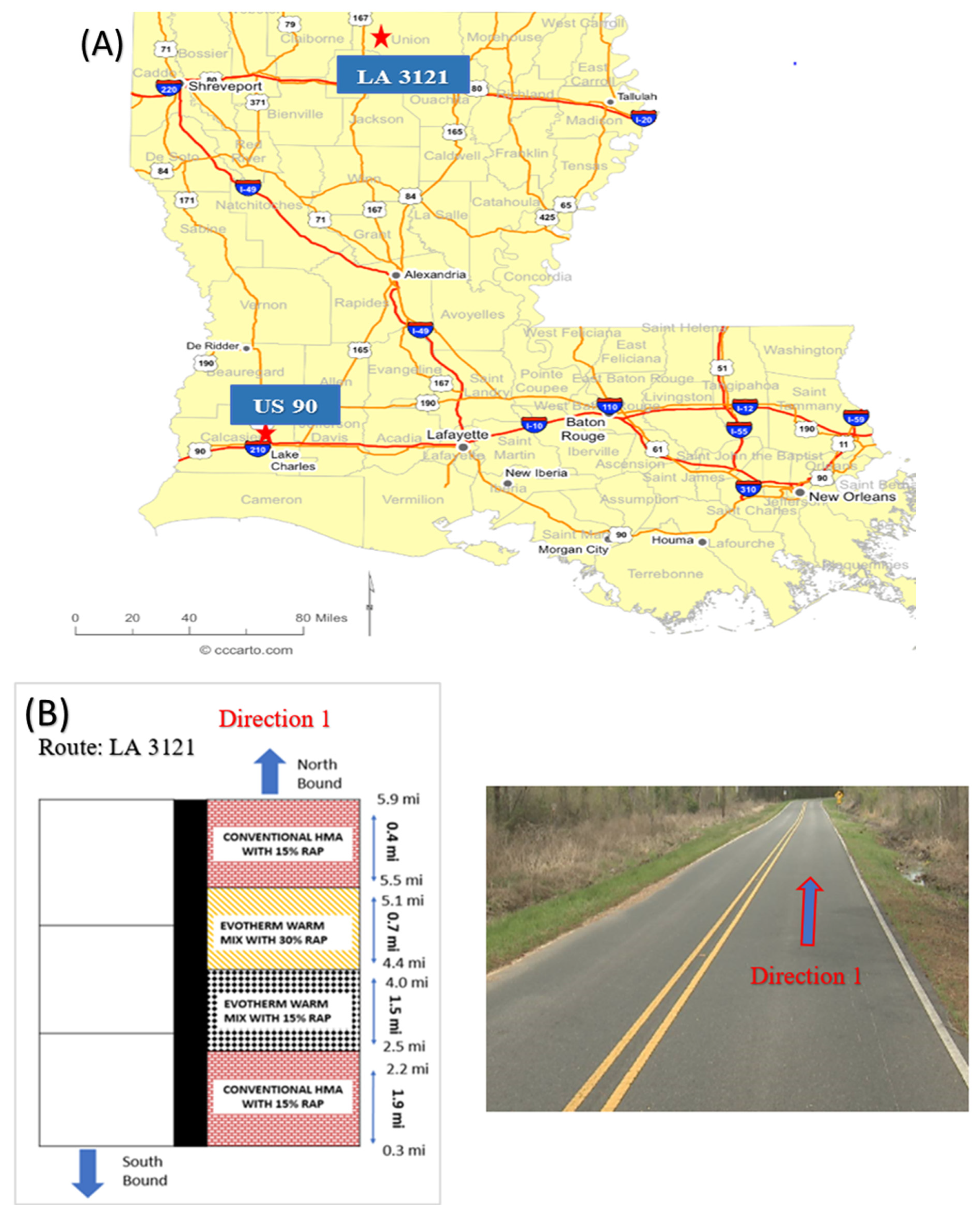
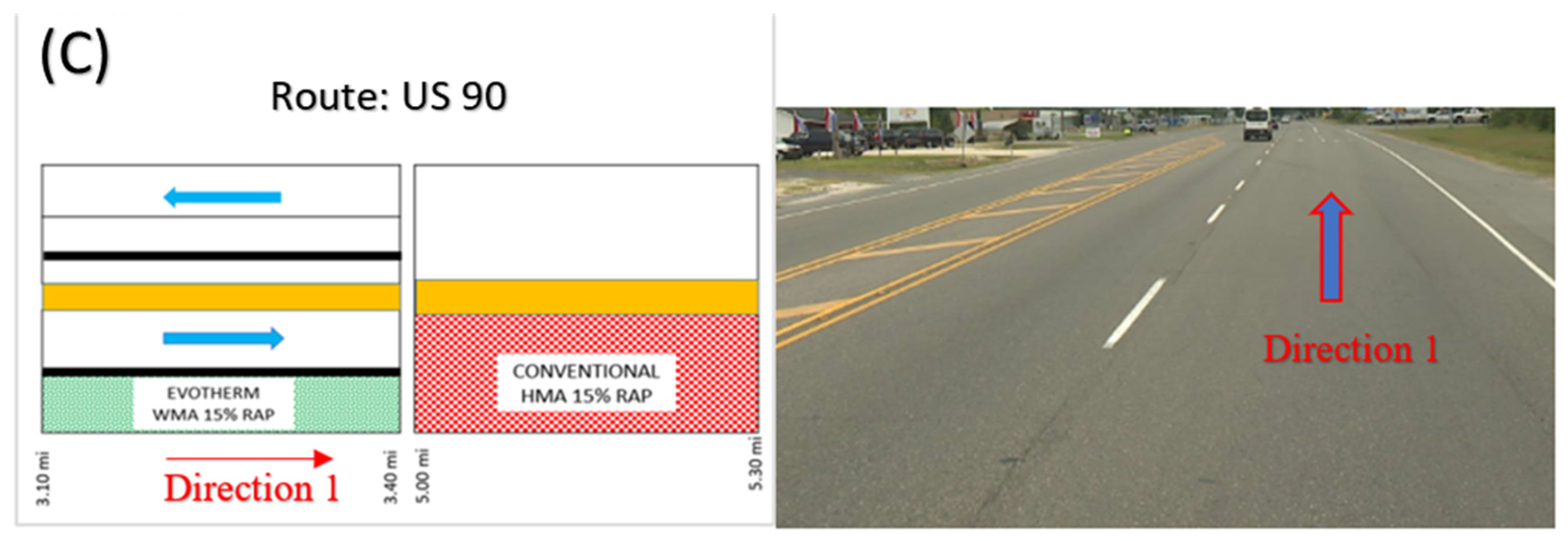
| Construction Year | 2009 | 2012 | ||||
| Traffic Speed, mph | 45 | 65 | ||||
| Traffic Volume, ESALs | 80,000 | 2,800,000 | ||||
| Section Log Miles (from/to) | 0.3/2.2 & 5.5/5.9 | 2.5/4.0 | 4.4/5.1 | 5.0/5.3 | 3.1/3.4 | |
| IRI (in/mile) | 2010 | 81.2 | 77.0 | 76.0 | -- | -- |
| 2012 | 81.5 | 84.7 | 80.0 | -- | -- | |
| 2014 | 92.3 | 91.0 | 114.0 | 46.3 | 56 | |
| 2017 | 96.1 | 91.9 | 123.0 | 50.0 | 63.0 | |
| 2019 | 97.4 | 91.9 | 133.0 | 57.8 | 66.3 | |
| 2021 | 98.3 | 93.7 | 135.1 | 71.4 | 66 | |
| 2023 | 96.8 | 94.1 | 139.1 | 66.4 | 79 | |
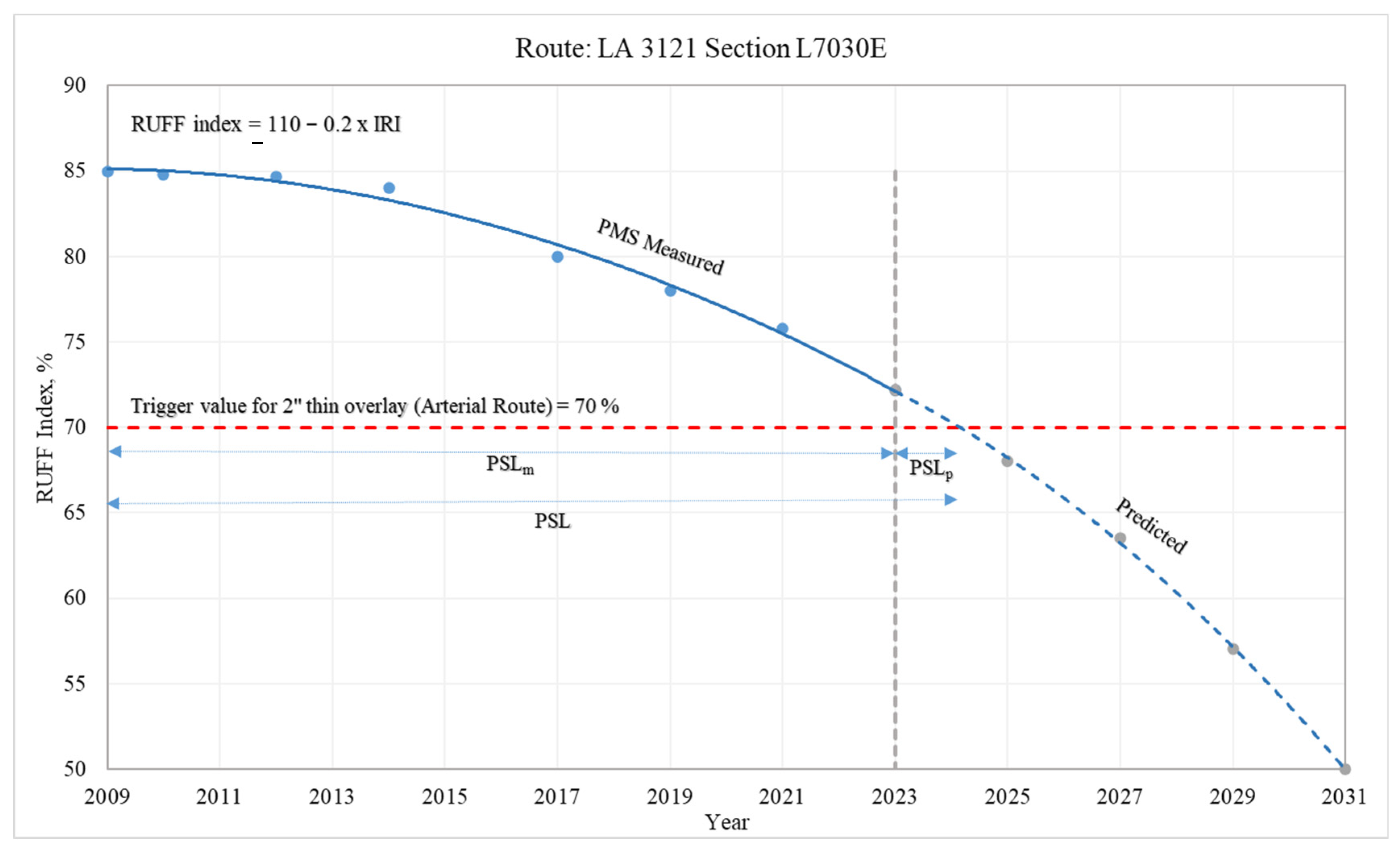
| Pavement Service Life (PSL), years | 20.8 | 20.9 | 17.9 | 19.7 | 19.8 | |
| Subphase | Equipment | Unit | Kg CO2eq/Unit | LCI Data Source—Publish Year | Meta-Analysis |
|---|---|---|---|---|---|
| C1 | Milling machine (Diesel)—300 hp | 13.28 gal/hr | 131 | Federal LCA Commons—2018 [21] | |
| Mobilizing the milling machine | 3 gallon/mile | 30.54 | Contractor company—2023 | N/A | |
| C2 | Hauling truck (diesel) | St-mile | 0.2264 | Federal LCA Commons—2000 | 53.2% [21] |
| C3 | Processing milling materials (RAP) | Ton | 1.225 | [53] | N/A |
| Subphase A1 | Quantity (st) | CO2eq conversion Factor | Kg.CO2eq/st | ||
| Coarse aggregates | 0.380 | 2.06 | 0.78 | ||
| Fine aggregates | 0.429 | 4.20 | 1.80 | ||
| RAP | 0.150 | 1.26 | 0.19 | ||
| Asphalt binder and SBS | 0.041 | 628 | 25.75 | ||
| 28.52 | |||||
| Subphase A2 | Quantity (st) | Distance (mi) | Transportation means | Equivalent CO2eq Factor/st. mile | Kg.CO2eq/st |
| Coarse aggregates | 0.380 | 658 | Barge | 0.0795 | 26.86 |
| 81.1 | Truck | 0.2264 | |||
| Fine aggregates | 0.429 | 658 | Barge | 0.0795 | 30.32 |
| 81.1 | Truck | 0.2264 | |||
| Asphalt binder | 0.041 | 82.7 | Truck | 0.2264 | 0.82 |
| SBS | 0.041 × 0.015 | 365 | Truck | 0.2264 | |
| 57.99 | |||||
| Subphase A3 | Quantity/st | GWP Equivalent Factor | Kg.CO2eq/st | ||
| Burner (MFC) | 276.7 | 0.05 | 13.84 | ||
| Electricity (kWh) | 3.62 | 0.36 | 1.30 | ||
| Fuel (Gallon) | 0.02 | 10.21 | 0.20 | ||
| 15.34 | |||||
| Subphase A4 | Distance (mi) | Quantity (st) | Truk Capacity (st) | Trips | Kg.CO2eq/st |
| Haul trucks (6.5 gph) | 48.8 | 760 | 18 | 43 | 1.06 |
| 1.06 | |||||
| Subphase A5 | Quantity (st) | Kg.CO2eq/st | |||
| MTV (6 hrs, 3.7 gph) | 760 | 0.30 | |||
| Paver (6 hrs, 3.3 mpg) | 760 | 0.27 | |||
| Rollers (4 mpg) | 26 passes | 760 | 0.09 | ||
| Fumes (0.3 m3/s) | 60 min | 760 | Area (m2) = 3.6 × 1609 | 0.00096 Kg.CO2eq/m3 | 7.90 |
| Mobilization (5 mpg) | 48.8 mi | 760 | 6 equipment | 1.57 | |
| 10.13 | |||||
| Phase B1 | Years | Kg.CO2eq/L.M | Expected PSL | Quantity (st) | Kg.CO2eq/st |
| Roughness | 1 | 21.00 [48] | 20.8 | 760 | 0.57 |
| 0.57 | |||||
| Phase B | |||||
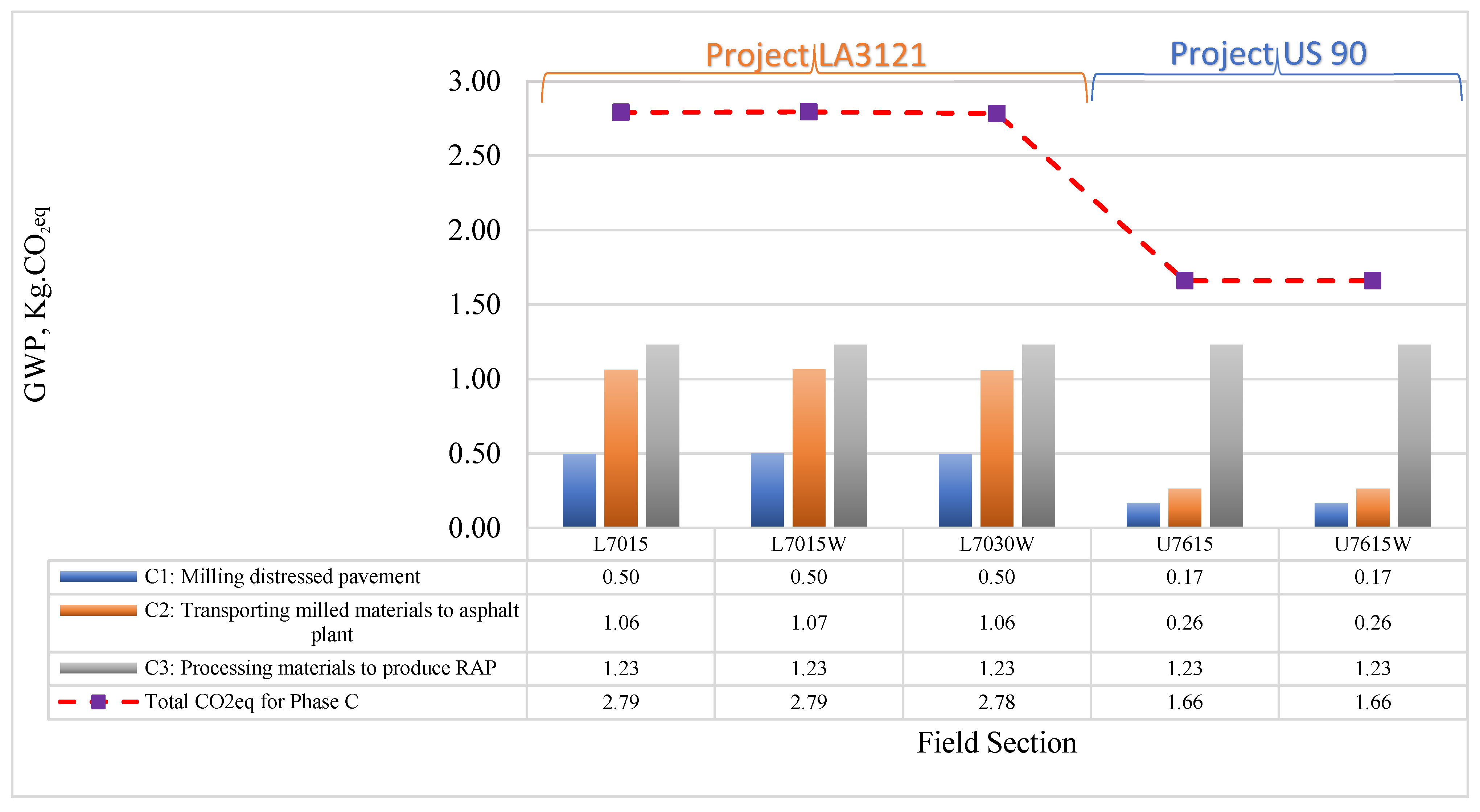
| Subphase C1 | Quantity (st) | Kg.CO2eq/st | |||
| Milling | 13.28 GPH | 2.93 mph | 4.53 gpm | 760 | 0.06 |
| Mobilization | 48.8 miles | 3 gpm | 760 | 0.44 | |
| 0.50 | |||||
| Subphase C2 | |||||
| Haul trucks (6.5 GPH) | 48.8 | 760 | 18 | 43 | 1.06 |
| 1.06 | |||||
| Subphase C3 | |||||
| Processing RAP | 1.23 | ||||
Disclaimer/Publisher’s Note: The statements, opinions and data contained in all publications are solely those of the individual author(s) and contributor(s) and not of MDPI and/or the editor(s). MDPI and/or the editor(s) disclaim responsibility for any injury to people or property resulting from any ideas, methods, instructions or products referred to in the content. |
© 2026 by the authors. Licensee MDPI, Basel, Switzerland. This article is an open access article distributed under the terms and conditions of the Creative Commons Attribution (CC BY) license.
Share and Cite
Elnaml, I.; Mohammad, L.N.; Dylla, H.; Akentuna, M.; Cooper, S., III. A Comparative Case Study: Cradle-to-Grave LCA for Asphalt Mixtures Containing RAP and WMA. Clean Technol. 2026, 8, 36. https://doi.org/10.3390/cleantechnol8020036
Elnaml I, Mohammad LN, Dylla H, Akentuna M, Cooper S III. A Comparative Case Study: Cradle-to-Grave LCA for Asphalt Mixtures Containing RAP and WMA. Clean Technologies. 2026; 8(2):36. https://doi.org/10.3390/cleantechnol8020036
Chicago/Turabian StyleElnaml, Ibrahim, Louay N. Mohammad, Heather Dylla, Moses Akentuna, and Samuel Cooper, III. 2026. "A Comparative Case Study: Cradle-to-Grave LCA for Asphalt Mixtures Containing RAP and WMA" Clean Technologies 8, no. 2: 36. https://doi.org/10.3390/cleantechnol8020036
APA StyleElnaml, I., Mohammad, L. N., Dylla, H., Akentuna, M., & Cooper, S., III. (2026). A Comparative Case Study: Cradle-to-Grave LCA for Asphalt Mixtures Containing RAP and WMA. Clean Technologies, 8(2), 36. https://doi.org/10.3390/cleantechnol8020036