Article

Integrating Coagulation and Flotation via Hydrodynamic Cavitation: The Key Role of Venturi Divergent Angle for Humic Substance Removal


by
Fausto de Souza Pagan
1,
Marcos Vinícius Mateus
1,
Thiago Vinicius Ribeiro Soeira
2,
Mário Sérgio da Luz
1,
Deusmaque Carneiro Ferreira
1,
Rodrigo Moruzzi
3,
André Luiz Andrade Simões
4 and
Julio Cesar de Souza Inácio Gonçalves
1,*
1
Laboratory of Environmental Processes, Institute of Technological and Exact Sciences, Federal University of Triângulo Mineiro, Uberaba 38064-200, MG, Brazil
2
Biological Processes Laboratory, São Carlos School of Engineering, University of São Paulo, 1100 João Dagnone Avenue, São Carlos 13563-120, SP, Brazil
3
Institute of Science and Technology, São Paulo State University (Unesp), São José dos Campos 12245-000, SP, Brazil
4
Environmental Engineering Department, Federal University of Bahia, Salvador 40231-300, BA, Brazil
*
Author to whom correspondence should be addressed.
Clean Technol. 2026, 8(2), 27; https://doi.org/10.3390/cleantechnol8020027
Submission received: 17 December 2025 / Revised: 18 January 2026 / Accepted: 14 February 2026 / Published: 26 February 2026

Abstract

Humic substances (HSs) pose a significant challenge to safe drinking-water production due to their ubiquity, limited removal by conventional methods, and their role in forming toxic disinfection by-products, reinforcing the need for more efficient, energy-favorable, and scalable treatment technologies. This study developed and evaluated a compact hydrodynamic cavitation (HC) system that simultaneously induces coagulation and generates microbubbles for flotation-based HS removal. For the first time, HC is explored as a multifunctional unit capable of integrating rapid mixing, coagulant destabilization, and flotation within a single device. Optimal coagulation conditions were established at pH 5.0 and 9.5 mg L−1 of ferric chloride. Process optimization using a Rotated Central Composite Design demonstrated that inlet pressure, flotation time, and initial HS concentration were the dominant operational factors, enabling the HC system to achieve a maximum removal efficiency of 81.9%. Five Venturi geometries with divergent angles of 4°, 8°, 11°, 14°, and 90° were investigated, with the 8° Venturi exhibiting superior performance due to stable microbubble formation and effective coagulant dispersion, as confirmed by CFD analyses. Comparative tests with a conventional Flotest unit showed that achieving similar efficiencies required at least 30% saturated water. In contrast, the HC system delivered equivalent removal in continuous flow without external air saturation. These findings demonstrate the potential of HC as an integrated coagulation–flotation core and highlight its promise as a compact, energy-efficient, and scalable technology for natural organic matter removal in water treatment.

1. Introduction

Hydrodynamic cavitation (HC) is characterized by the formation, growth, and subsequent implosion of vapor microbubbles (cavities) within a liquid medium. This phenomenon occurs when a sudden pressure drop lowers the local pressure below the fluid’s vapor pressure, allowing vapor-filled cavities to form. In controlled systems, HC is typically induced by forcing the liquid through a geometric constriction such as an orifice plate [1], a partially closed valve [2], a Venturi tube [3], or a vortex diode [4]. As these cavities grow and are transported to regions of higher pressure, they violently collapse, generating localized and extremely intense physicochemical conditions. The implosion of microbubbles gives rise to chemical effects (hydroxyl radical formation and bond cleavage), mechanical effects (high shear stress, turbulence, and microjets), and localized thermal effects. At the point of collapse, extreme conditions may be reached, including pressures of up to 1000 atm and temperatures approaching 10,000 K [4,5,6], making HC a powerful tool for a wide range of applications. Due to these effects, HC has been successfully employed in wastewater treatment [7,8], water disinfection [9], and chemical synthesis [10,11,12], demonstrating its versatility and potential for intensifying conventional processes.
In recent years, considerable attention has been directed toward the synergistic effects obtained by combining HC with oxidative reagents such as ozone, hydrogen peroxide, or Fenton’s reagent [13,14,15,16]. These hybrid processes (HC + oxidants) significantly enhance the degradation of recalcitrant contaminants by exploiting both radical-based oxidation and mechanical disruption, accelerating reaction kinetics and improving treatment efficiency while reducing energy demand [5]. Parallel efforts have focused on optimizing the geometry and operational parameters of HC devices, such as throat diameter, divergent angle, and flow rate, to intensify cavitation activity and improve treatment performance [1,15,17,18,19,20]. Within drinking-water treatment systems, HC has mainly been explored for microbial inactivation, including bacteria [9,21], viruses [22], and microalgae removal [23]. However, its use as a microbubble generator for flotation-based separation remains limited. Studies such as those by Zhou et al. [24] and Ross et al. [25] demonstrated that HC-generated microbubbles can enhance fine particle removal in flotation processes, while the intense turbulence and mixing associated with bubble collapse could also be exploited to improve coagulant dispersion. Despite this potential, no published research has evaluated HC as a single integrated reactor capable of simultaneously promoting coagulation and producing microbubbles for flotation, an integration that could reduce equipment footprint, energy consumption, and system complexity [26].
At the same time, humic substances (HSs) represent one of the most persistent challenges in producing safe drinking water. They are ubiquitous in natural waters [27], constitute up to 90% of dissolved natural organic matter [28], affect aesthetic water-quality parameters [29], and react with chlorine to form carcinogenic and teratogenic organochlorine by-products [30,31]. Given their high prevalence and environmental relevance, efficient, scalable, and energy-favorable HS removal technologies are critically needed. In this context, HC emerges as a promising alternative due to its low chemical demand, high energy efficiency, and rapid kinetics [7]. Therefore, HSs provide a compelling target for investigating new HC-based multifunctional treatment approaches.
In this framework, HSs pose a major environmental challenge not only due to their ubiquity and reactivity but also because conventional treatment methods (e.g., oxidative processes) often fail to remove them efficiently, motivating the development of more advanced techniques [32,33]. HC has recently gained prominence as a process intensification tool capable of generating extreme localized conditions that enhance pollutant degradation and, more importantly for this study, support separation processes such as flotation. However, the possibility of using HC as a multifunctional unit, one that simultaneously intensifies coagulation through turbulence while generating microbubbles for flotation in a single device, remains unexplored. Such integration could fundamentally reshape compact water-treatment technologies.
Several approaches have been investigated for HS removal, including advanced oxidation processes [34,35], electrocoagulation [36], membrane filtration [37], biofiltration [38], coagulation/precipitation [39], ion exchange [40], and adsorption [41]. Nevertheless, many of these techniques suffer from drawbacks such as high operational costs, limited removal efficiency, membrane fouling, or slow kinetics. In this context, HC presents itself as a particularly attractive alternative due to its high energy efficiency, low chemical demand, rapid kinetics, and promising scalability [7].
In this study, we propose a novel HC-based strategy for removing HSs in which the HC device simultaneously promotes coagulation and generates microbubbles for flotation. Ferric chloride was selected as the coagulant because metallic coagulants are known to improve organic matter removal efficiency [42]. Five HC devices were evaluated: four Venturi reactors with divergent angles of 4°, 8°, 11°, and 14°, and a plate orifice configured as a 90° “Venturi”. The divergent angle strongly influences key operational parameters, including pressure recovery, microbubble residence time [19], bubble size distribution, and bubble production rate. Additionally, the effects of pH, initial HS concentration, inlet pressure, and flotation time were systematically investigated. To complement the experimental observations, a computational fluid dynamics (CFD) analysis was conducted to elucidate flow behavior, cavitation zones, and pressure-field variations within the devices, providing deeper insight into the mechanisms governing HC-assisted coagulation and flotation. Therefore, this study provides a systematic framework linking Venturi geometry (via divergent angle) to process efficacy, which not only elucidates optimal design parameters but also demonstrates the potential of a unified HC system to simplify and enhance the treatment of humic-laden waters, offering a tangible advance towards more sustainable and efficient water treatment processes.

2. Materials and Methods

2.1. Materials

The treatment solution used in this study was prepared from sodium humic acid salt supplied by Sigma-Aldrich (St. Louis, MO, USA) (CAS: 68131-04-4). This material was selected because it contains a heterogeneous mixture of humic macromolecules with a broad molecular-weight distribution, providing a suitable surrogate for the natural organic matter commonly found in surface and groundwaters. The use of a standardized commercial source ensures experimental reproducibility, which is essential for evaluating treatment technologies under controlled conditions.
It is important to underscore that the humic acid sodium salt employed in this study (Sigma-Aldrich, CAS: 68131-04-4) is a technical-grade natural material of mined origin, derived from the decomposition of organic matter. This material is widely recognised as a standardised and reproducible surrogate for natural organic matter (NOM) in water treatment evaluations. Rather than representing a single, well-defined low-molecular-weight compound, the reagent comprises a heterogeneous mixture of aromatic polycyclic structures that are loosely associated with polysaccharides, proteins, and simple phenols. It exhibits a characteristically broad molecular-weight distribution, typically ranging from 2 to 500 kDa, with the bulk fraction concentrated between 20 and 50 kDa. The multifaceted and non-polymeric nature of this material has been experimentally confirmed via ESI-QTOF mass spectrometry, which revealed a wide distribution of molecular ions rich in carbon, oxygen, and hydrogen over a broad m/z range, as detailed by Lopes Silva et al. [43]. These findings are fundamentally consistent with the modern supramolecular paradigm consolidated by Sutton and Sposito [44], which defines humic substances as dynamic associations of heterogeneous molecules stabilised by weak interactions, such as hydrogen bonding and hydrophobic forces, rather than true covalent polymers. Consequently, the reagent effectively reproduces the key physicochemical properties—including functional group diversity and aggregation behaviour—that govern coagulation, metal–organic complexation, and separation mechanisms in aquatic systems.
A single 200 L batch of stock solution was prepared to maintain consistent organic load and physicochemical characteristics throughout the study. The initial preparation contained 100 mg L−1 of humic acid, corresponding to a total organic carbon (TOC) concentration of 43.2 mg L−1. This strategy minimized variability across experimental runs and allowed for a direct comparison of the operational conditions assessed.
Ferric chloride hexahydrate (FeCl3·6H2O), analytical grade, was used as the coagulant due to its well-established performance in removing dissolved organic matter and its compatibility with full-scale water treatment operations. Working solutions were obtained through the dilution of accurately measured stock aliquots, enabling precise dosage control. All procedures were conducted with ultrapure water produced by a Milli-Q system to avoid interferences from residual ions or background organic carbon.
Solution pH was adjusted using standardized 1.0 mol L−1 sulfuric acid (H2SO4) and sodium hydroxide (NaOH) solutions, both supplied by Merck. Careful pH control was required because the ionization state of HS and the hydrolysis behavior of ferric chloride are strongly pH-dependent, directly influencing coagulation mechanisms, floc stability, and overall treatment performance.

2.2. Experimental Setup

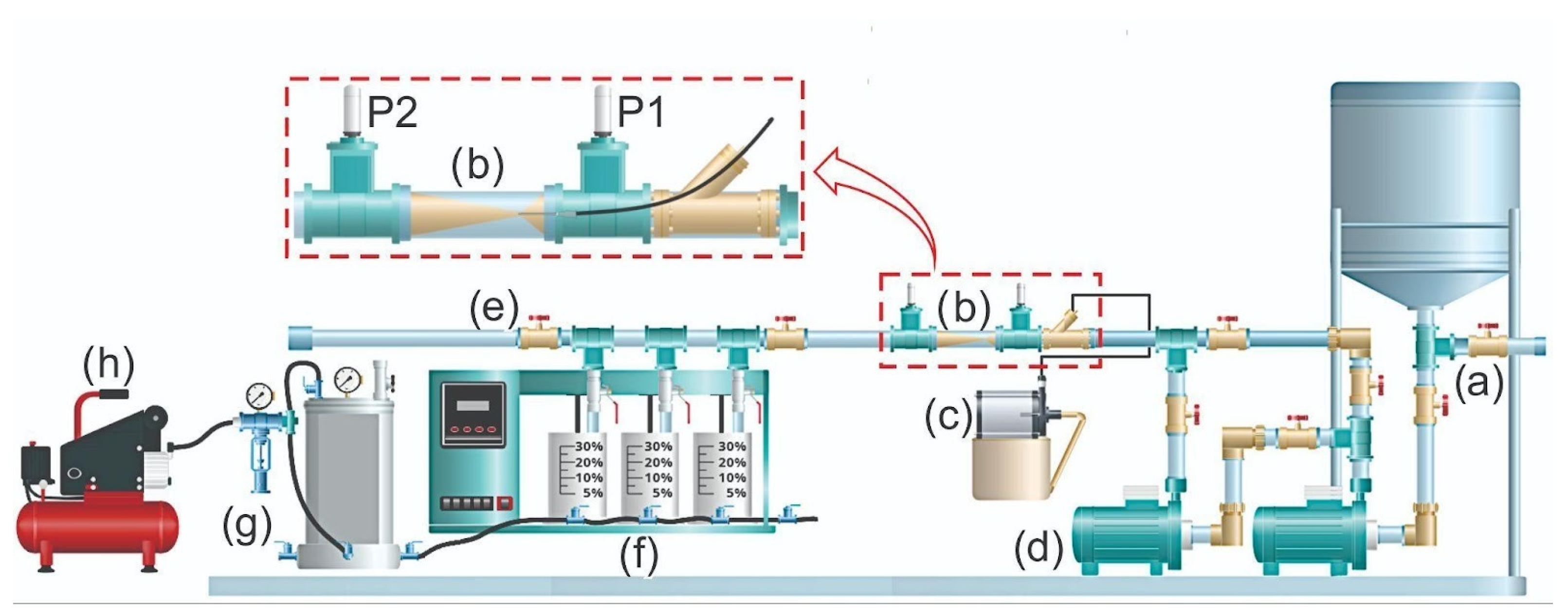
The HC system used in this study (Figure 1) was designed to operate in a continuous-flow, single-pass configuration, avoiding recirculation to ensure that the liquid undergoes cavitation only once before entering the downstream treatment units. This operating mode reflects conditions relevant to scalable water treatment processes, where single-pass operation reduces energy demand and prevents variations in fluid properties that may arise from repeated cavitation cycles.
The experimental setup comprises a PVC reservoir with a working volume of 12 L directly connected to two centrifugal pumps arranged in series. The first pump is a Thebe TH-16 NR model powered by a 1.50 CV WEG motor, delivering a manometric head of 33 mca. The second pump is a KSB Hydrobloc C1000n equipped with a 1.0 CV motor and a manometric head of 26 mca. The hydraulic configuration allows each pump to be operated either independently or jointly, providing precise control of inlet pressure and flow rate supplied to the cavitation device, parameters that strongly influence cavitation intensity and bubble formation. This flexibility was essential for systematically evaluating the hydraulic performance and operating envelope of the HC system.
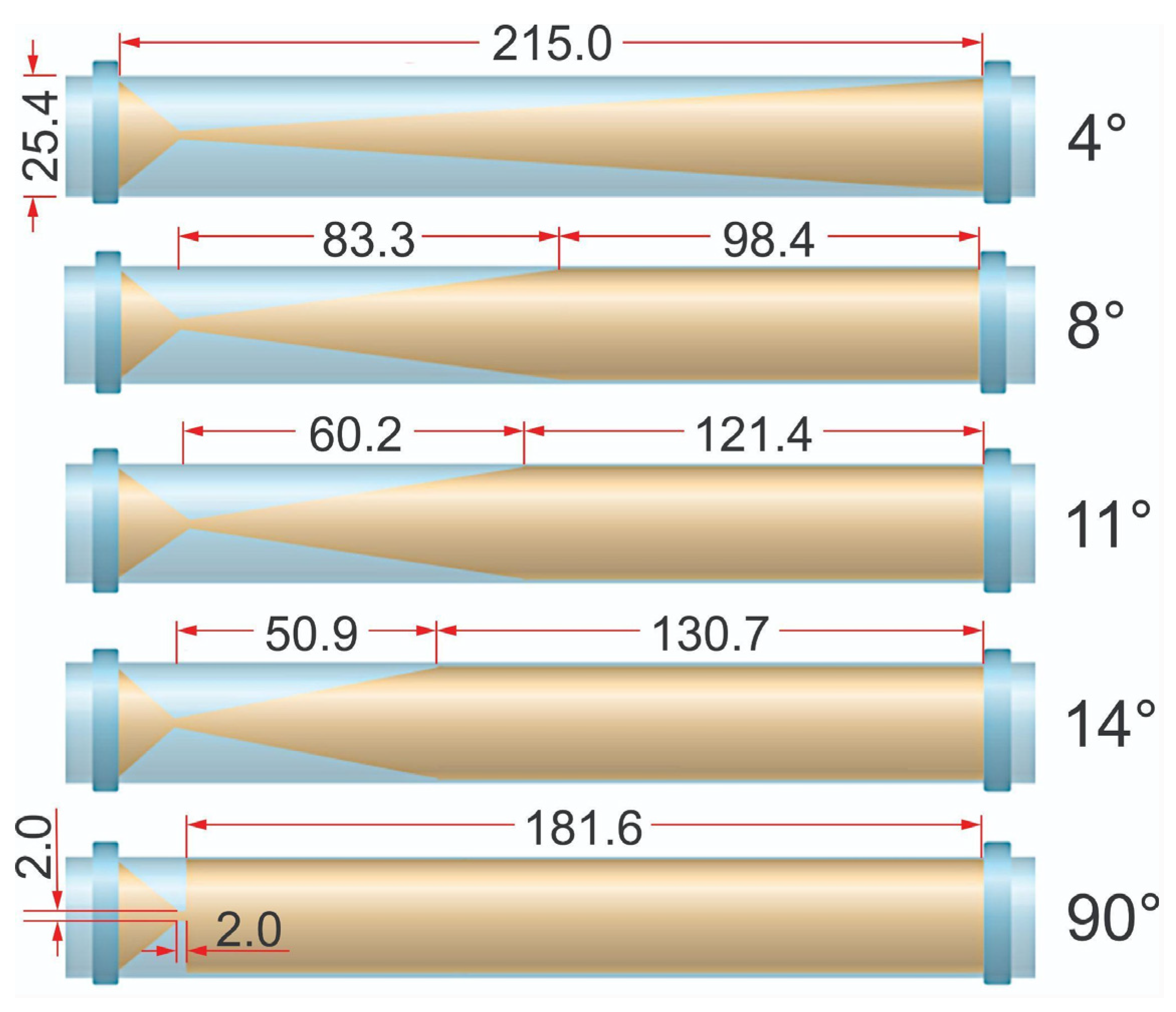
The cavitation devices (Venturi reactors) were fabricated from transparent acrylic material to ensure dimensional accuracy and facilitate visual inspection during operation. Five Venturi geometries were constructed with divergent angles of 4°, 8°, 11°, 14°, and 90° (Figure 2). All devices maintained identical converging angles and a constant throat diameter of 2 mm, ensuring that only the divergent angle influenced pressure recovery behavior, vapor cavity dynamics, and microbubble residence time, thereby enabling a controlled comparison among the devices.
Coagulant injection (FeCl3·6H2O) was performed using a precision dosing pump (brand DDA, model DDA 7.15-16) with a maximum flow capacity of 3.0 L min−1. The coagulant was introduced through a hypodermic needle (internal diameter 0.80 mm) positioned at the Venturi throat, ensuring rapid dispersion under high shear conditions. This approach enhances coagulant–organic matter interactions and promotes the effective destabilization of HS immediately upon entry into the cavitation zone.
The flow exiting the HC device was directed to a bench-scale flotation unit (Flotest), model 218-3LDB (Ethik), consisting of three acrylic vessels (2 L each) equipped with a dissolved-air saturation chamber. The connection between the cavitation device and the flotation unit was made using a PVC hose, and uniform filling of the vessels was achieved using a valve and T-branch assembly. This configuration ensured consistent hydraulic residence times and reproducible flotation conditions.
The saturation chamber was included to provide a comparative reference between conventional dissolved-air flotation (DAF) and the cavitation-induced flotation approach investigated in this study. The chamber consists of an acrylic cylinder (100 mm internal diameter, 320 mm height) mounted on an aluminum structure for stability and sealing. Three valves located at the base regulate the inflow of clarified water, the entry of compressed air, and the discharge of aerated water to the flotation vessels. Air pressurization was supplied using a medium-pressure compressor (50 L, 10 CFM, 2 HP, REX.T CHIAPERINI-26199), allowing for the assessment of flotation performance using traditional DAF microbubbles versus those generated by HC.

2.3. Experimental Procedures

This section describes the experimental procedures adopted to evaluate the performance of the HC system under different hydraulic, operational, and physicochemical conditions. For each experimental run, the HC reservoir was filled with 12 L of a synthetic humic acid solution (100 mg L−1). After filling, the pumps were activated to ensure complete homogenization of the solution, and the first sample was collected at the system outlet, following its passage through the cavitation device and the Flotest jars. During this initial collection step, the coagulant dosing pump was kept turned off. The experiments were carried out under five hydraulic conditions, as summarized in Table 1.
The procedure consisted of five sequential steps. Step 1 focused on establishing the optimal pH and coagulant dosage for subsequent steps, using an 8° Venturi device as representative geometry. The inlet pressure of the cavitation device was held constant at 3.5 bar, an intermediate value within the tested hydraulic range. A matrix of conditions was tested, combining five pH levels (4.0, 4.5, 5.0, 5.5, and 6.0) adjusted with H2SO4/NaOH, and five ferric chloride concentrations (3.0, 6.0, 9.0, 12.0, and 15.0 mg L−1). After the jars were filled, a flotation time of 60 s, corresponding to the interval between jar filling and the initiation of sample collection, was applied before sample collection for total organic carbon (TOC) analysis.
Step 2 focused on optimizing HS removal by varying three operational parameters: HS concentration (x1, mg L−1), inlet pressure in the cavitation device (x2, bar), and flotation time (x3, s). A Rotated Central Composite Design (RCCD) with three factors at two levels was employed to structure the experiments, as performed by [45]. The coded levels used in the design (−α and +α for axial points, −1 and +1 for minimum and maximum levels, and 0 for the central point) are shown in Table 2, while the specific experimental conditions are presented in Table 3.
The pH and ferric chloride concentrations applied in all assays were those established in Step 1. HS removal efficiencies were determined in triplicate, with one measurement obtained from each of the three jars. Response surface modeling and statistical analyses were conducted using Statistica® 10 software.
Step 3 assessed the influence of the divergent angle of the cavitation devices on HS removal efficiency. Parameters such as inlet pressure, HS concentration, and flotation time were kept constant and defined according to the optimized conditions determined in Step 2. To visualize the flow behavior in each device, CFD simulations were conducted in Step 4 using Ansys Fluent (Ansys, 2022). This numerical setup, including mesh strategy, model selection, and solution methods, followed the validated methodology described by Soeira et al. [15]. The geometry was modeled in three dimensions, and the computational domain was discretized using a structured hexahedral mesh with 5.3 million elements, adopting a steady-state, multiphase approach. The mesh sensitivity analysis performed in the present study followed the same methodology and led to similar conclusions to those reported in our previous work (Soeira et al. [15]), where mesh-independent results were systematically demonstrated. For the turbulence closure, the k–ω shear stress transport model was employed due to its accuracy in predicting flow separation and adverse pressure gradients [46]. The formation and collapse of vapor cavities were modeled using the Schnerr–Sauer cavitation model [47], and the pressure–velocity coupling was resolved with the SIMPLEC scheme.
In Step 5, the performance of the integrated HC system (coagulation/flocculation and flotation unit) was compared with the standard bench-scale DAF process (Flotest) to contextualize its efficiency. As shown in Figure 1, the Flotest consists of three acrylic vessels connected in parallel, along with a saturation chamber, operating in batch mode. Each vessel includes two acrylic plates spaced 5 cm apart, with channels in the base to rapidly distribute previously saturated water.
For comparison, the same Gt product (velocity gradient × mixing time) was applied to both systems. In the HC system, the velocity gradient was calculated using the hydraulic data corresponding to optimal HS removal (Step 2) and Equation (1), proposed by Camp and Stein [48]:
G = P / ( μ · V )
where G is the velocity gradient (s−1), P is the power applied to the fluid (N m s−1), μ is the dynamic viscosity of water (Pa s), and V is the volume of the mixing chamber (m3).
The power applied to the fluid was obtained by multiplying the flow rate (m3 s−1) by the pressure drop across the HC device, ΔP (P1 − P2), expressed in Pa. At the optimum point, ΔP was 350,000 Pa. The residence time near the Venturi throat (t = 1.3 × 10⁻² s) was calculated from the ratio between the volume of the mixing chamber (1.0 × 10⁻⁶ m3) and system flow rate (7.7 × 10⁻⁵ m3 s−1). Accordingly, the HC system presented a Gt value of approximately 2000.
In the Flotest, HS removal efficiency was evaluated under four Gt combinations (250 s−1 × 8 s, 500 s−1 × 4 s, 750 s−1 × 2.6 s, and 1000 s−1 × 2 s), all corresponding to values equal to or close to 2000. Each condition was tested using five different percentages of saturated water (5%, 10%, 15%, 20%, and 30%).

2.4. Analytical Method

TOC was quantified using a TOC-5000 APC analyzer (Shimadzu, Kyoto, Japan), operated under the manufacturer’s standard programming. This analysis enabled the assessment of carbon removal efficiency resulting from the flotation of the HS matrix promoted by microbubbles generated either in the HC system or in the Flotest apparatus. The TOC measurements provided a direct indication of the extent of organic matter reduction under each experimental condition, allowing for comparisons between the two mixing–flotation approaches. The removal efficiency was calculated according to Equation (2):
R = 100 × ( C i C f ) / C i
where R is the HS removal efficiency, Ci is the initial TOC concentration, and Cf is the final TOC concentration.

3. Results and Discussion

3.1. Coagulation Diagram

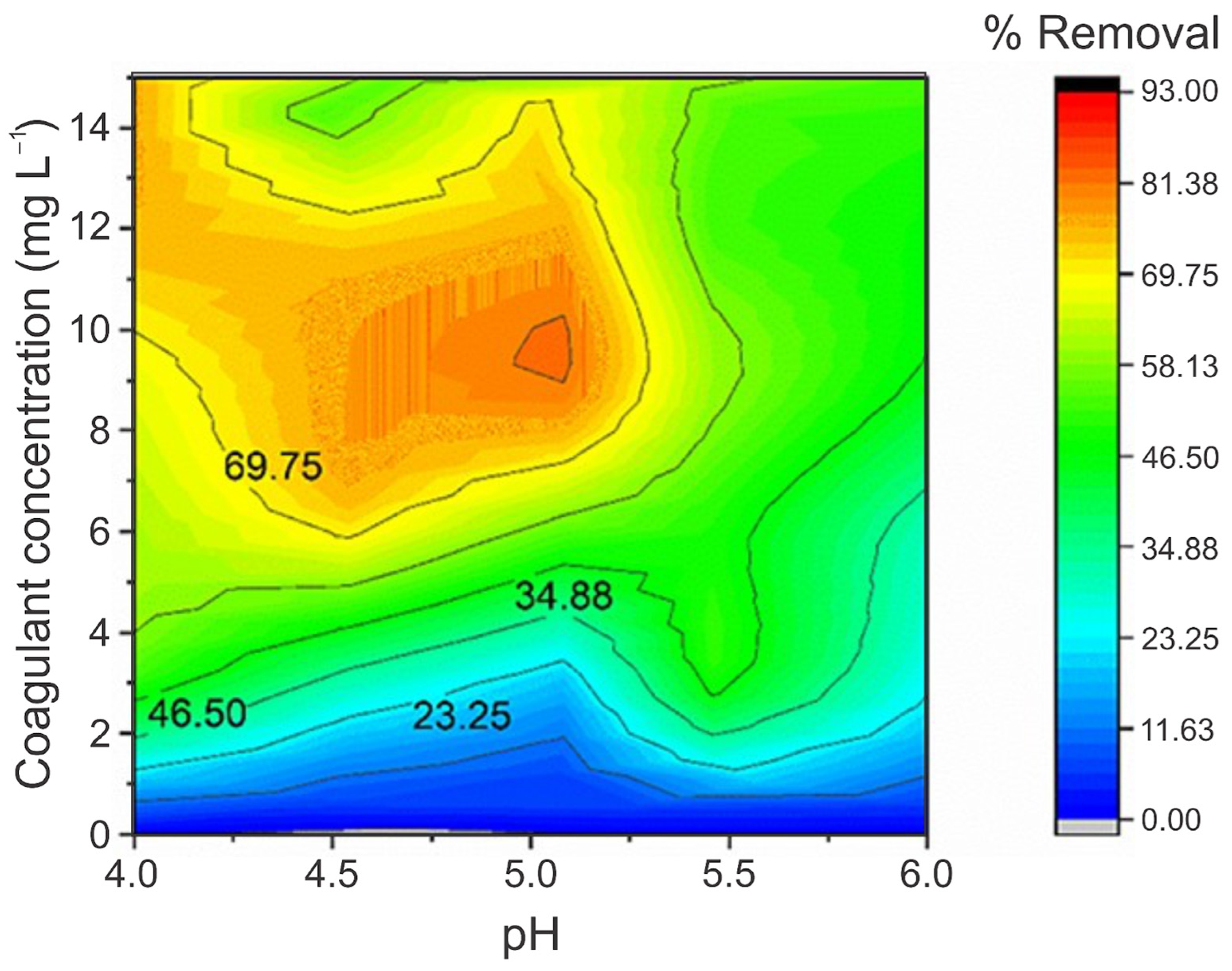
The coagulation diagram in Figure 3 shows the interdependence between ferric chloride concentration and pH on HS removal efficiency. At ferric chloride dosages below 3 mg L−1, removal efficiencies remained less than 23%, indicating insufficient charge neutralization and floc formation under conditions of low coagulant availability. As the coagulant concentration increased, a clear improvement in removal performance was observed, particularly at pH values below 5.25. This trend is consistent with findings reported by De Julio et al. [29] and Di Bernardo et al. [49], who attributed enhanced removal to the greater availability of Fe3+ cations capable of forming hydroxide species that promote coagulation and sweep flocculation mechanisms. These mechanisms are especially relevant for HS, which possess heterogeneous molecular structures and variable surface charges. The extant literature [50,51] consistently emphasizes that ferric chloride performs optimally in acidic environments, typically within the pH range of 4 to 6. At these pH levels, hydrolyzed iron species exhibit strong affinities for negatively charged organic molecules. In this window, ferric ions undergo progressive hydrolysis, generating Fe(OH)2+, Fe(OH)2+, and polymeric complexes that increase colloidal destabilization efficiency. Conversely, at very low pH values (<4), the solubility of Fe3+ rises considerably, reducing the formation of precipitated hydroxides and thus lowering the overall coagulation efficiency. This behavior reinforces the need for precise pH control to maximize coagulant performance in HS-rich matrices.
The maximum removal efficiency observed in this study was 88%, obtained at pH 5.0 with a coagulant concentration of 9.5 mg L−1. The high removal value is directly linked not only to chemical destabilization but also to the hydrodynamic conditions that favored flotation. The process is notably enhanced by the persistence of microbubbles generated by the cavitation device. These microbubbles demonstrated stability during transit through the system, persisting even in regions that were distant from their generation point. The sustained presence of the destabilized HS aggregates, from the cavitation device to the flotation jars, maximizes their interaction with these aggregates.
Two key factors contribute to this remarkable microbubble stability. First, the Venturi device employed in the HC system features an 8° divergent angle that promotes a pressure recovery zone. Its geometry is of sufficient length to prevent microbubble implosion, but is short enough to inhibit excessive bubble growth and coalescence. Consequently, the microbubbles produced exhibited diameters sufficiently small to circumvent instability thresholds while maintaining sufficient size to effectively adhere to flocs and thereby enhance flotation performance. Second, the physicochemical stability of microbubbles is strongly influenced by the zeta potential (ζ) at the gas–liquid interface, which is highly dependent on the medium’s pH [52,53]. According to Takahashi [54], microbubbles in media with pH > 4.5 exhibit negative zeta potentials. Under the optimal conditions identified in this study, this negative ζ leads to the attraction of H+ ions to the bubble interface, establishing an electrical double layer with a positively charged outer region. This configuration provides electrostatic repulsion between microbubbles, preventing their collision and coalescence and thereby extending their lifetime in suspension [54,55,56]. Such stabilization is crucial in flotation-based treatments, as longer-lived microbubbles greatly enhance particle–bubble interactions and the subsequent removal of humic aggregates.
Furthermore, the established operational conditions (pH 5.0 and 9.5 mg L−1 of FeCl3) align with the principles of enhanced coagulation, aiming not only at particle destabilization but also at maximising the interaction between hydrolyzed iron complexes and the soluble fractions of HS to reduce the formation of toxic disinfection by-products. The high removal efficiency at pH 5.0 is also supported by thermodynamic considerations of bubble–particle attachment. At this pH, the reduction in electrostatic repulsion, combined with the increased hydrophobicity of the ferric–humic flocs, lowers the free energy barrier for attachment, significantly enhancing the stability of the bubble–floc aggregates during the flotation process.
It is important to clarify that, unlike hydrodynamic cavitation systems designed for oxidation, the present study operated strictly under a single-pass configuration. Under this condition, the contact time within the Venturi is extremely short, and the generation of hydroxyl radicals or hydrogen peroxide is insufficient to promote organic matter degradation. This was experimentally confirmed by TOC analyses performed before and after cavitation, without coagulant addition, which showed no statistically significant variation. Therefore, oxidative pathways, including Fenton or Fenton-like reactions, are not involved. In this study, hydrodynamic cavitation was employed exclusively to promote intense hydrodynamic mixing and microbubble generation, enabling efficient coagulation–flotation, with humic substance removal occurring solely via physical separation.
Overall, the combined effects of optimized coagulant dosage, controlled pH, and microbubble stability illustrate the synergistic nature of coagulation–flotation processes assisted by HC. These findings reinforce the technological potential of integrating advanced cavitation devices into water treatment systems, particularly for the removal of HS.

3.2. Optimization of a HC System as a Function of Inlet Pressure, Flotation Time, and Initial Humic Acid Concentration

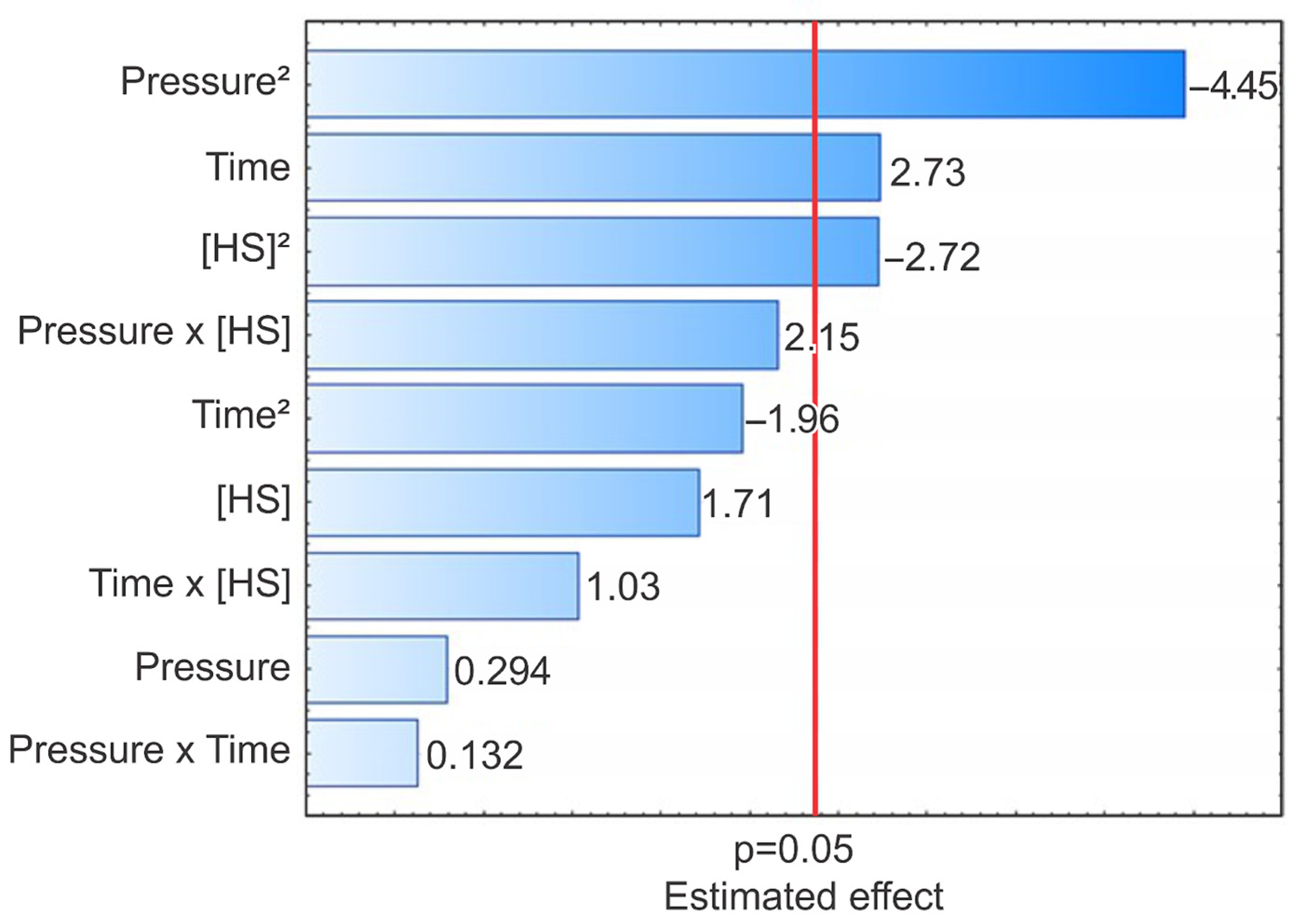
The response-surface design employed in this study, comprising 17 planned experiments (Table 3) and carefully structured to capture the individual and interactive effects of the key operational variables governing the coagulation–flotation process, yielded a robust dataset that enabled system optimization. Analysis of Variance (ANOVA) was performed, yielding an R2 of 0.89 for the mathematical model fit, indicating that 89% of the experimental results were predicted by the model. The Pareto diagram (Figure 4) identifies the statistically significant effects (at a 95% confidence level), with inlet pressure (quadratic), flotation time (linear), and HS concentration (quadratic) as the most influential parameters. The complete ANOVA table is included in the Supplementary Materials.
Building upon these statistical findings, the quadratic influence of inlet pressure warrants particular attention. This behavior aligns with observations reported by Soeira et al. [15] and Machado et al. [3], who documented similar nonlinear effects when applying HC to the removal of melanoidin and bromothymol blue dye, respectively. At the same time, other studies have demonstrated a linear relationship between inlet pressure and contaminant degradation [23,45,57], emphasizing that pressure effects are highly dependent on compound characteristics and on the cavitation regime induced in the reactor.
In the present system, the quadratic effect of inlet pressure resulted from two competing mechanisms. At low pressures, cavitation is incipient, producing insufficient microbubbles and limited turbulence, which restricts coagulant dispersion and interaction with HSs. Under these conditions, both charge neutralization and sweep flocculation processes are weakened. Conversely, elevated pressures can result in the formation of dense cavitation clouds, characterized by intense cavitation and rapid microbubble coalescence [58]. The detachment of substantial gas pockets from the liquid phase as the flow exits the cavitation device is a phenomenon that diminishes flotation performance. This is due to the reduction in the population of stable microbubbles, which are essential for effective HS removal. The interplay between these opposite phenomena elucidates the parabolic trend that has been observed.
A more straightforward behavior was identified for flotation time, which exhibited a linear influence on HS removal. This is consistent with reports by Melo et al. [59], Sloboda et al. [60], and Kan et al. [61]. In the HC system, flotation time corresponds to the predefined sampling interval, and longer durations increase the likelihood of bubble–floc attachment and upward transport. Even flocs with relatively low-rise velocities benefit from extended flotation time, reinforcing its importance as a key operational parameter in flotation-based treatment processes.
Finally, the quadratic influence of HS concentration follows established coagulation principles. At low HS concentrations, coagulant–organic interactions are limited because fewer negatively charged functional groups are available, reducing collision efficiency [62]. Conversely, at higher HS concentrations and fixed coagulant dosage, the amount of Fe3+ becomes insufficient to ensure full destabilization. Inadequate hydrolysis and incomplete iron–organic associations have been demonstrated to impair the initial coagulation step [59], which subsequently weakens flocculation. As shown by De Julio et al. [29], ineffective coagulation leads to the persistence of soluble HS in the treated water, lowering overall removal efficiency.
Altogether, these results highlight the interdependent roles of operational pressure, flotation residence time, and organic load in defining cavitation intensity, chemical destabilization, and hydrodynamic behavior within the system. Understanding these coupled mechanisms is essential for optimizing and scaling technologies that use HC to assist coagulation and flotation for practical water treatment applications.
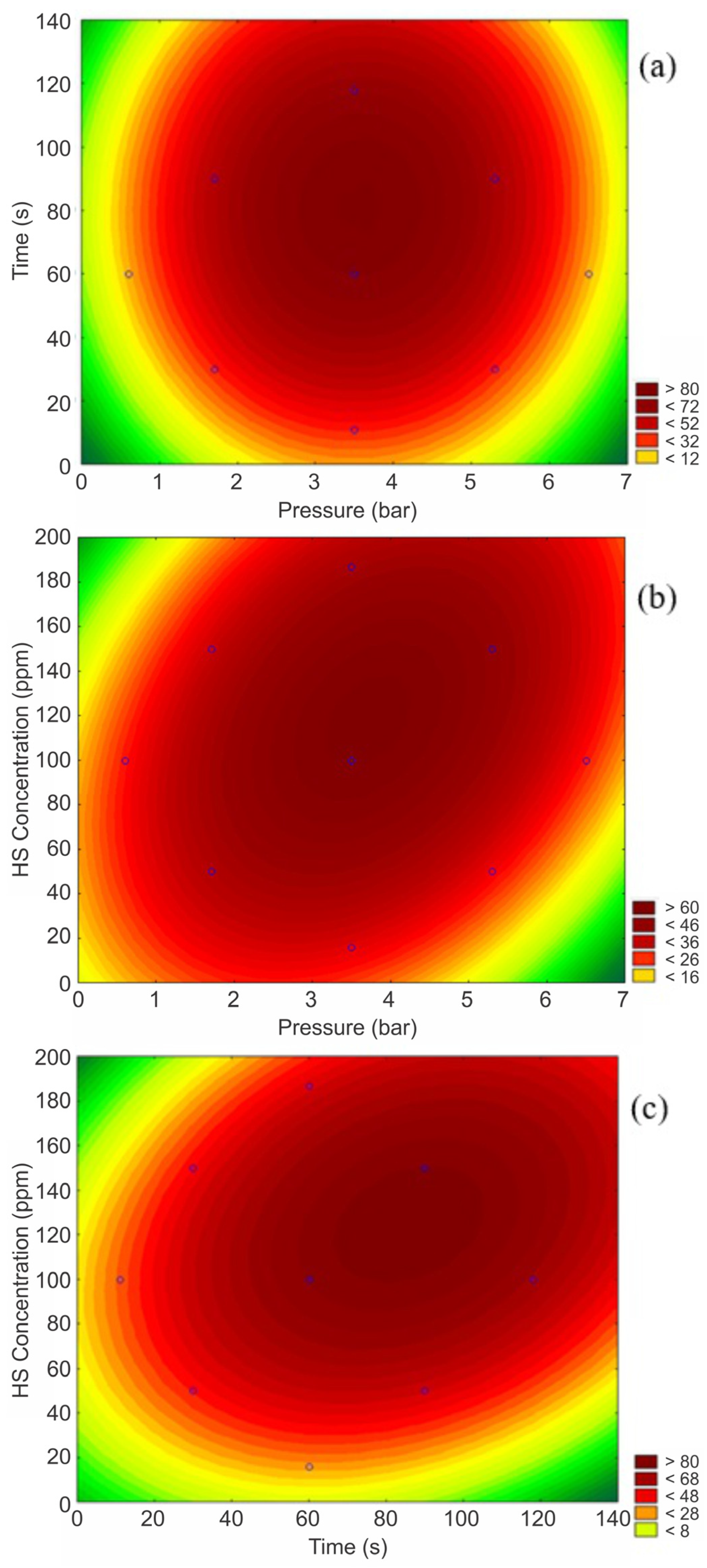
Figure 5 presents the response surface projections for HS removal as a function of the independent variables included in the design. These projections provide a comprehensive visualization of the operational domains in which the combined effects of inlet pressure, flotation time, and initial HS concentration yielded the highest removal efficiencies. In Figure 5a, the maximum predicted response values, corresponding to the highest HS removal percentages, were located within the inlet pressure range of 3.5 to 4.5 bar and flotation times between 60 and 110 s. This region represents the optimal interplay between cavitation intensity, microbubble generation, and the available residence time for effective bubble–floc interactions. A slight decrease in removal was noted at flotation times exceeding the evaluated range. This decline reflects a mathematical extrapolation effect inherent to the response surface modeling, rather than an actual reduction in removal performance. As discussed by Cassettari et al. [63], when model predictions extend beyond the experimental boundary, the fitted polynomial surface may display artificial curvature even when experimental values suggest a plateau. Although predicted removal values appeared slightly elevated beyond the upper limit, the difference was not statistically significant at the 95% confidence level used in the Pareto analysis. Consequently, flotation times beyond the experimental range were not considered preponderant in model formulation, consistent with the methodological guidelines highlighted by Singh & Randhavane [64].
Figure 5b illustrates the response surface projection for inlet pressure and initial HS concentration. The highest removal values were concentrated in the upper-middle portions of both ranges, specifically between 3.5 and 4.2 bar for inlet pressure and between 100 and 140 mg L−1 for HS concentration. This region reflects the balance between adequate iron–organic interactions, favored by moderate HS loads, and sufficient cavitation intensity to generate stable microbubbles capable of enhancing flotation.
Figure 5c presents the response surface projection for HS concentration and flotation time. The combined effects of these variables indicate that maximum removal occurred at higher flotation time intervals (70 to 110 s) and HS concentrations ranging from 100 to 150 mg L−1. These findings reinforce the role of both sufficient organic matter availability for effective coagulation and adequate residence time to allow bubble attachment and buoyant transport.
Based on the interpretation of the response surface projections and their statistical indicators, the optimal operational conditions for maximizing HS removal were achieved. The software determined the critical values to be 3.8 bar (inlet pressure), 87 s (flotation time), and 130 mg L−1 (initial HS concentration). Applying these parameters to the RCCD-derived mathematical model (Equation (3)) predicted a maximum removal efficiency of 83.2%.
HS Removal (%) = −64.0672 + 35.679 (Inlet Pressure) − 7.1194 (Inlet Pressure)2 + 1.1115 (Flotation Time) − 0.0097(Flotation Time)2 + 0.4724(HS) − 0.0053(HS)2 + 0.014
To validate the mathematical model, a triplicate experiment was conducted under optimal conditions. The resulting experimental HS removal was 81.9%, demonstrating strong agreement with the theoretical prediction and a correspondence of 98.5% between the predicted and experimental values. The residual analysis is included in the Supplementary Materials. This high degree of conformity reinforces the robustness and predictive capacity of the proposed model.
Although not all linear, quadratic, and interaction terms were statistically significant at the 95% confidence interval according to the Pareto analysis, the complete mathematical model is presented. This decision ensures that future studies may extend or reinterpret the model across broader operational ranges, especially considering that non-significant effects may still hold physical relevance within the complex dynamics of HC. Thus, the full model contributes both to predictive accuracy within the studied range and to broader process understanding for potential scale-up and further investigation.

3.3. Influence of the Divergent Angle of Cavitation Devices on the Removal Efficiency of Humic Acid

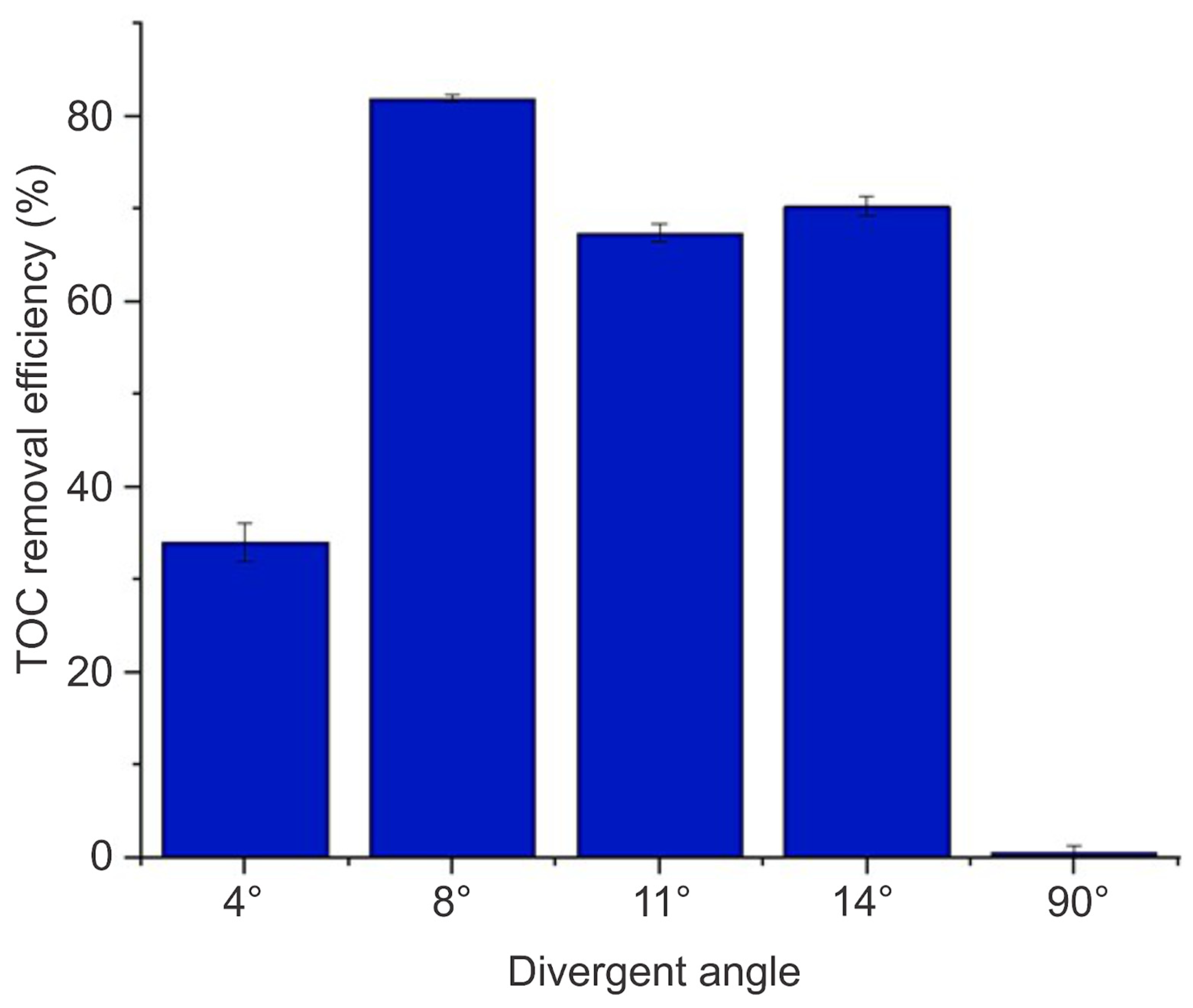
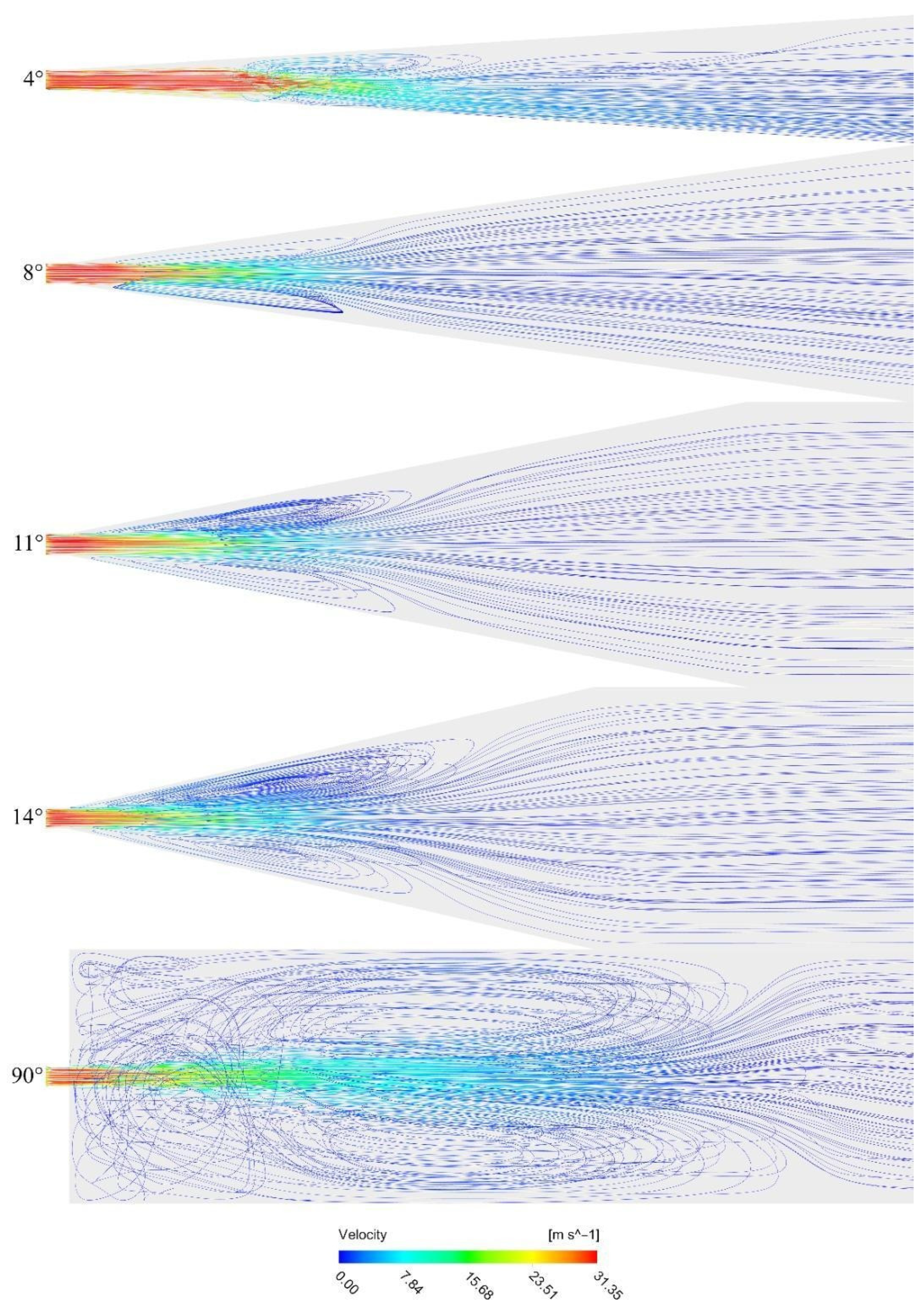
The optimal condition determined in the previous section was subsequently applied to evaluate the influence of the divergent angle of the cavitation devices on HS removal efficiency. Figure 6 presents the removal percentages obtained using five Venturi geometries with divergent angles of 4°, 8°, 11°, 14°, and 90°. The results demonstrate a strong dependence of process performance on device geometry. The 8° Venturi achieved the highest removal efficiency (81.9%), whereas the 90° device exhibited minimal removal (0.61%). Intermediate efficiencies were recorded for the 11° and 14° Venturis (67.4% and 70.3%, respectively), while the 4° Venturi failed to surpass 35% removal. These findings highlight the essential role of divergent angles in determining microbubble generation, stability, and mixing characteristics within the HC system. The poor performance of the 90° Venturi, behaviorally like an orifice plate, is primarily linked to the non-persistence of microbubbles immediately after exiting the throat region. The abrupt pressure recovery characteristic of this geometry causes newly formed microbubbles to implode before being transported downstream, effectively preventing flotation from occurring in the vessels. This behavior aligns with the observations of Cappa et al. [1] and Soeira et al. [15], who reported the limited cavity generation and rapid pressure recovery associated with such sharp-angled devices. Although the 90° Venturi is ineffective for microbubble production, its high turbulence intensity and strong eddy formation (as shown in Figure 7) make it an efficient device for rapid coagulant dispersion.
As the divergent angle increased, hydraulic losses became more pronounced, leading to accelerating pressure recovery and microbubble collapse. These collapse events liberate substantial mechanical energy, promoting turbulence and vortical structures that enhance mixing between coagulant and HS. Ashrafizadeh & Ghassemi [65] discussed how such cavitation-induced vortices are crucial in optimizing coagulant contact efficiency, despite not contributing directly to microbubble-supported flotation. Conversely, the 4° Venturi demonstrated remarkably diminished removal efficiency, attributable to two fundamental constraints. Firstly, the device’s extended pressure recovery zone enables the proliferation of microbubbles as they navigate the device. Bubble overgrowth has been demonstrated to promote coalescence, yielding larger bubbles with reduced flotation efficiency. Secondly, the 4° Venturi does not generate the flow deceleration or turbulence necessary for efficient coagulant–HS mixing. The absence of a robust mixing regime has been demonstrated to reduce particle destabilization and, consequently, flotation performance. The 11° and 14° Venturis exhibited comparable efficiencies and analogous hydrodynamic behavior. The shorter pressure recovery zones, in comparison to the 4°-Venturi configuration, promote the formation and controlled growth of cavities that subsequently detach as microbubbles. The documented evidence of this geometric influence is substantial. Research on Venturi microbubble generators has demonstrated that parameters such as the divergent angle impact bubble size and distribution, with larger angles frequently resulting in smaller bubbles [66]. Specifically, Kuldeep and Saharan [18] demonstrated that cavities formed in Venturis with moderate divergent angles, such as the 11° and 14° Venturis studied here, attain characteristic dimensions on the order of 10−6 m. These micro-sized bubbles offer a favorable balance between surface area, stability, and buoyancy, thereby supporting efficient flotation. The selection of an optimal angle is paramount, as excessive angles have been observed to diminish the average vapor volume fraction, consequently altering cavity dynamics and potentially compromising performance [67].
Overall, HS removal by HC associated with flotation is dependent on two key operational phenomena: (i) the ability of the cavitation device to promote intense and rapid mixing for effective coagulant dispersion, and (ii) the generation of microbubbles that grow to optimal dimensions without excessive coalescence, avoiding the formation of large gas pockets (cavitation clouds) that reduce flotation efficiency.

3.4. Comparison Between the HC System and Flotest

The Flotest experiments, conducted across different G × t combinations and five percentages of water saturated with dissolved air (SW), are summarized in Table 4. As anticipated, removal efficiency increased with higher SW percentages due to the greater number of microbubbles contributing to flotation. However, no single optimal G × t condition emerged. For instance, the 1000 s−1 × 2 s combination produced the highest efficiency for 30% SW (89.8%) but resulted in minimal HS removal (0.7%) at 5% SW. Similar variability occurred across all G × t combinations, underscoring the strong dependence of HS removal efficiency on the available microbubble concentration.
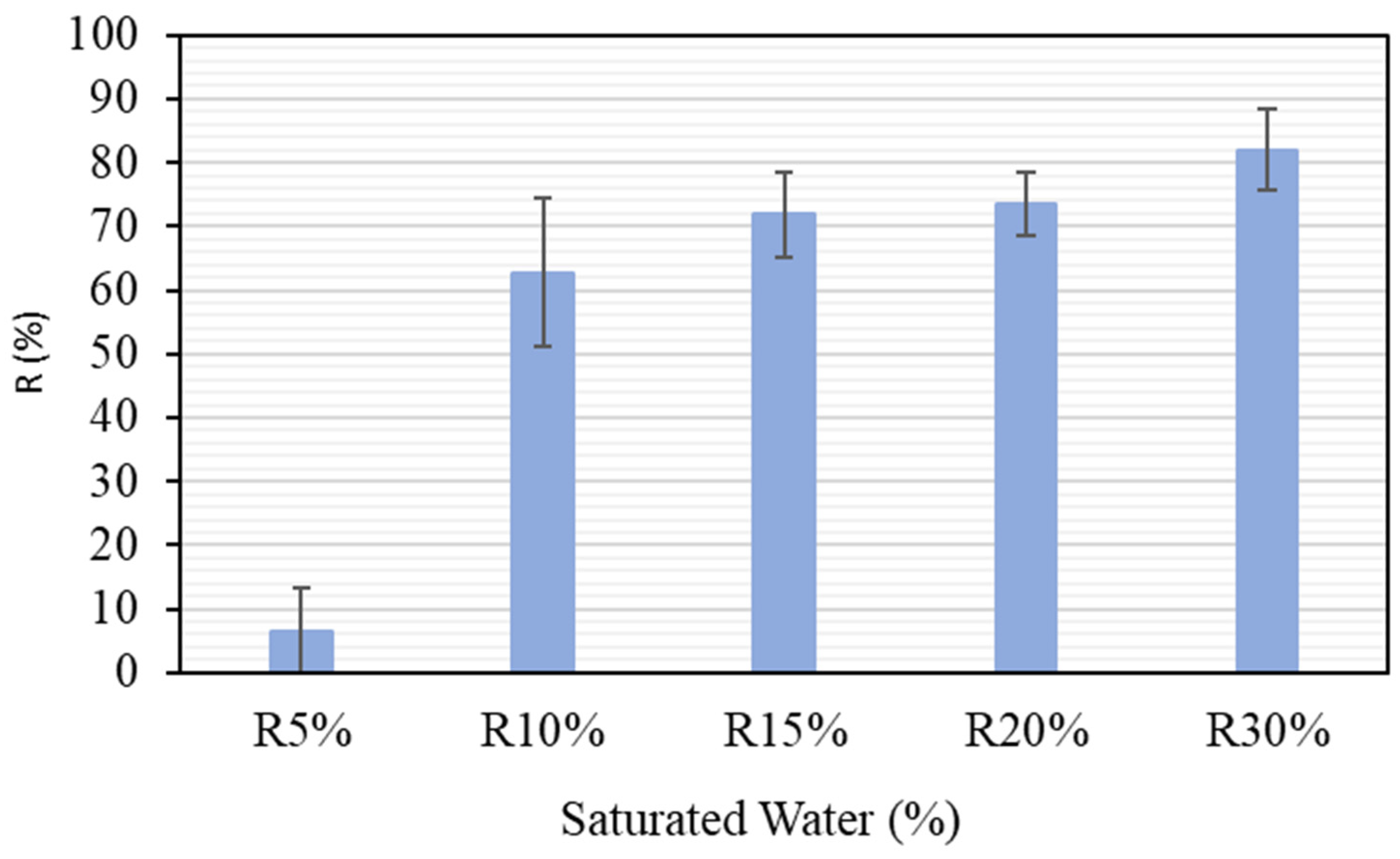
Figure 8 presents HS removal efficiency as a function of SW percentage using the average across all G × t combinations. As previously noted, the optimized HC system achieved 81.9% removal. The Flotest required at least 30% SW to reach the same efficiency, while values below this threshold consistently resulted in efficiencies under 74%. These observations demonstrate high flotation performance when combined with the HC system under optimized conditions.
Beyond flotation efficiency, the HC system offers significant operational advantages. In contrast to Flotest, which relies on external air saturation and batchwise operation, the HC system functions in continuous flow and integrates rapid mixing and microbubble formation within a single reactor. This integration has been demonstrated to substantially simplify system design and reduce operational complexity. As Wang et al. [7] demonstrated, HC systems are also recognized for their high energy efficiency and strong potential for large-scale implementation, thereby reinforcing the technological relevance of the optimized configuration presented in this study.

4. Conclusions

This study demonstrates the feasibility of employing a HC system that integrates coagulation and microbubble generation for the removal of HSs via flotation. Optimal coagulation was achieved at 9.5 mg L−1 of ferric chloride and pH 5.0. Through optimization of the inlet pressure, flotation time, and initial HS concentration, the HC system reached a maximum removal efficiency of 81.9%, a performance comparable to a conventional Flotest system using 30% saturated water. A key finding was the significant influence of the Venturi’s divergent angle on HS removal. The 8° geometry provided the highest efficiency (81.9%), followed by 11° and 14°, while 4° and 90° angles resulted in limited performance. These findings highlight the existence of an optimal geometric window for Venturi design in such synergistic systems. Computational fluid dynamics simulations elucidated the underlying mechanisms, underscoring the pivotal role of divergent angle in governing microbubble formation, mixing intensity, and cavitation stability. Furthermore, the compact nature of the HC reactor suggests high potential for process intensification in existing water treatment plants, offering a scalable alternative to bulky saturation tanks while maintaining high removal standards for natural organic matter. It should be noted that the use of ultrapure water in this study provides a controlled baseline but may overestimate the technology’s efficacy when applied to complex natural or wastewaters. Overall, the continuous-flow HC system proved capable of unifying rapid mixing and microbubble generation in a single reactor, offering operational simplicity, scalability, and potential reductions in energy and chemical consumption. Although a rigorous economic analysis is not possible at the prototype scale, hydrodynamic cavitation (HC) systems are intrinsically less complex than conventional flotation aeration systems. In addition, the single-pass continuous operation reduces residence time and avoids recirculation, making the process faster and potentially more energy- and cost-efficient. These findings reinforce the promise of HC-based flotation as a viable technology for advanced water treatment applications.

Supplementary Materials

The following supporting information can be downloaded at: https://www.mdpi.com/article/10.3390/cleantechnol8020027/s1, Table S1. Two-way ANOVA with five levels each; Figure S1. Residual plot of predicted versus observed values; Figure S2. Residual plot of expected values versus residues.

Author Contributions

Conceptualization, J.C.d.S.I.G. and F.d.S.P.; methodology, F.d.S.P.; software CFD, T.V.R.S. and A.L.A.S.; validation, R.M., M.S.d.L. and D.C.F.; writing—original draft preparation, M.V.M., R.M., F.d.S.P., M.S.d.L. and J.C.d.S.I.G.; formal analysis, F.d.S.P. writing—review and editing, T.V.R.S., D.C.F. and A.L.A.S.; supervision, J.C.d.S.I.G., R.M. and M.S.d.L. All authors have read and agreed to the published version of the manuscript.

Funding

This research was funded by the Conselho Nacional de Desenvolvimento Cientifico e Tecnologico (CNPq) and Fundação de Amparo à Pesquisa do Estado de Minas Gerais (FAPEMIG), Brazil. Julio Cesar de Souza Inacio Goncalves received financial support from the FAPEMIG (Proc.APQ-00656-18).

Data Availability Statement

The dataset generated and analyzed during current study are available from the corresponding author upon request.

Acknowledgments

We thank the Pro-Reitoria de Pesquisa e Pós-Graduação (PROPPG) at Universidade Federal do Triângulo Mineiro (UFTM), Brazil, for the support and assistance, and the Conselho Nacional de Desenvolvimento Científico e Tecnológico (CNPq) and Fundação de Amparo à Pesquisa do Estado de Minas Gerais (FAPEMIG), Brazil.

Conflicts of Interest

The authors declare no conflicts of interest.

Abbreviations

The following abbreviations are used in this manuscript:
ANOVAAnalysis of variance
CFDComputational fluid dynamics
DAFDissolved-air flotation
HCHydrodynamic cavitation
HSsHumic substances
H2SO4Sulfuric acid
NaOHSodium hydroxide
RCCDRotated central composite design
SWSaturated water with dissolved air
TOCTotal organic carbon

References

  1. Cappa, O.A.P.; Soeira, T.V.R.; Simões, A.L.A.; Junior, G.B.L.; Gonçalves, J.C.S.I. Experimental and computational analyses for induced cavitating flows in orifice plates. Braz. J. Chem. Eng. 2020, 37, 89–99. [Google Scholar] [CrossRef]
  2. Li, P.; Song, Y.; Yu, S. Removal of Microcystis aeruginosa using hydrodynamic cavitation: Performance and mechanisms. Water Res. 2014, 62, 241–248. [Google Scholar] [CrossRef]
  3. Machado, P.R.; Soeira, T.V.R.; Pagan, F.S.; Malpass, G.R.P.; Gonçalves, J.C.S.I.; Ferreira, D.C. Synergistic bromothymol blue dye degradation with hydrodynamic cavitation and hydrogen peroxide (HC-H2O2). Rev. Ambient. Água 2020, 15, e2518. [Google Scholar] [CrossRef]
  4. Patil, P.B.; Bhandari, V.M.; Ranade, V.V. Improving efficiency for removal of ammoniacal nitrogen from wastewaters using hydrodynamic cavitation. Ultrason. Sonochem. 2021, 70, 105306. [Google Scholar] [CrossRef]
  5. Fedorov, K.; Dinesh, K.; Sun, X.; Soltani, R.D.C.; Wang, Z.; Sonawane, S.; Boczkaj, G. Synergistic effects of hybrid advanced oxidation processes (AOPs) based on hydrodynamic cavitation phenomenon—A review. Chem. Eng. J. 2022, 432, 134191. [Google Scholar] [CrossRef]
  6. Raut-Jadhav, S.; Saharan, V.K.; Pinjari, D.; Sonawane, S.; Saini, D.; Pandit, A. Synergetic effect of combination of AOP’s (hydrodynamic cavitation and H2O2) on the degradation of neonicotinoid class of insecticide. J. Hazard. Mater. 2013, 261, 139–147. [Google Scholar] [CrossRef] [PubMed]
  7. Wang, B.; Su, H.; Zhang, B. Hydrodynamic cavitation as a promising route for wastewater treatment—A review. Chem. Eng. J. 2021, 412, 128685. [Google Scholar] [CrossRef]
  8. Yi, L.; Li, B.; Sun, Y.; Li, S.; Qi, Q.; Qin, J.; Sun, H.; Wang, X.; Wang, J.; Fang, D. Degradation of norfloxacin in aqueous solution using hydrodynamic cavitation: Optimization of geometric and operation parameters and investigations on mechanism. Sep. Purif. Technol. 2021, 259, 118166. [Google Scholar] [CrossRef]
  9. Sun, X.; Liu, J.; Ji, L.; Wang, G.; Zhao, S.; Yoon, J.Y.; Chen, S. A review on hydrodynamic cavitation disinfection: The current state of knowledge. Sci. Total Environ. 2020, 737, 139606. [Google Scholar] [CrossRef]
  10. Bokhari, A.; Chuah, L.F.; Yusup, S.; Klemeš, J.J.; Akbar, M.M.; Kamil, R.N.M. Cleaner production of rubber seed oil methyl ester using a hydrodynamic cavitation: Optimisation and parametric study. J. Clean. Prod. 2016, 136, 31–41. [Google Scholar] [CrossRef]
  11. Hilares, R.T.; de Almeida, G.F.; Ahmed, M.A.; Antunes, F.A.F.; da Silva, S.S.; Han, J.-I.; dos Santos, J.C. Hydrodynamic cavitation as an efficient pretreatment method for lignocellulosic biomass: A parametric study. Bioresour. Technol. 2017, 235, 301–308. [Google Scholar] [CrossRef] [PubMed]
  12. Rezende, G.B.; Fernandes, D.M.; Ferreira, D.C.; Gonçalves, J.C.S.I. Venturi: Dispositivo de cavitação hidrodinâmica para acelerar a síntese de biodiesel. Eng. Sanit. Ambient. 2021, 26, 105–112. [Google Scholar] [CrossRef]
  13. Agarkoti, C.; Thanekar, P.D.; Gogate, P.R. Cavitation based treatment of industrial wastewater: A critical review focusing on mechanisms, design aspects, operating conditions and application to real effluents. J. Environ. Manag. 2021, 300, 113786. [Google Scholar] [CrossRef]
  14. Gujar, S.K.; Gogate, P.R.; Kanthale, P.; Pandey, R.; Thakre, S.; Agrawal, M. Combined oxidation processes based on ultrasound, hydrodynamic cavitation and chemical oxidants for treatment of real industrial wastewater from cellulosic fiber manufacturing sector. Sep. Purif. Technol. 2021, 257, 117888. [Google Scholar] [CrossRef]
  15. Soeira, T.V.R.; da Luz, M.S.; Osiro, L.; Gonçalves, J.C.S.I. The divergent angle of cavitational devices influences melanoidin degradation. A new look through experimental and computational analysis. J. Water Process Eng. 2023, 53, 103684. [Google Scholar] [CrossRef]
  16. Wang, J.; Chen, H.; Yuan, R.; Wang, F.; Ma, F.; Zhou, B. Intensified degradation of textile wastewater using a novel treatment of hydrodynamic cavitation with the combination of ozone. J. Environ. Chem. Eng. 2020, 8, 103959. [Google Scholar] [CrossRef]
  17. Bashir, T.A.; Soni, A.G.; Mahulkar, A.V.; Pandit, A.B. The CFD driven optimisation of a modified venturi for cavitational activity. Can. J. Chem. Eng. 2011, 89, 1366–1375. [Google Scholar] [CrossRef]
  18. Kuldeep, S.V.K. Computational study of different venturi and orifice type hydrodynamic cavitating devices. J. Hydrodyn. 2016, 28, 293–305. [Google Scholar] [CrossRef]
  19. Simpson, A.; Ranade, V.V. Modelling of hydrodynamic cavitation with orifice: Influence of different orifice designs. Chem. Eng. Res. Des. 2018, 136, 698–711. [Google Scholar] [CrossRef]
  20. Simpson, A.; Ranade, V.V. Flow characteristics of vortex based cavitation devices. AIChE J. 2019, 65, e16675. [Google Scholar] [CrossRef]
  21. Yadav, M.; Sharma, J.; Yadav, R.K.; Gole, V.L. Microbial disinfection of water using hydrodynamic cavitational reactors. J. Water Process Eng. 2021, 41, 102097. [Google Scholar] [CrossRef]
  22. Kosel, J.; Gutiérrez-Aguirre, I.; Rački, N.; Dreo, T.; Ravnikar, M.; Dular, M. Efficient inactivation of MS-2 virus in water by hydrodynamic cavitation. Water Res. 2017, 124, 465–471. [Google Scholar] [CrossRef] [PubMed]
  23. Batista, M.D.; Anhê, A.C.B.M.; Gonçalves, J.C.S.I. Use of Hydrodynamic Cavitation for Algae Removal: Effect on the Inactivation of Microalgae Belonging to Genus Scenedesmus. Water Air Soil Pollut. 2017, 228, 443. [Google Scholar] [CrossRef]
  24. Zhou, S.; Wang, X.; Bu, X.; Wang, M.; An, B.; Shao, H.; Ni, C.; Peng, Y.; Xie, G. A novel flotation technique combining carrier flotation and cavitation bubbles to enhance separation efficiency of ultra-fine particles. Ultrason. Sonochem. 2020, 64, 105005. [Google Scholar] [CrossRef] [PubMed]
  25. Ross, V.; Singh, A.; Pillay, K. Improved flotation of PGM tailings with a high-shear hydrodynamic cavitation device. Miner. Eng. 2019, 137, 133–139. [Google Scholar] [CrossRef]
  26. Ranade, V.V. Modeling of Hydrodynamic Cavitation Reactors: Reflections on Present Status and Path Forward. ACS Eng. Au 2022, 2, 461–476. [Google Scholar] [CrossRef]
  27. Hui, X.; Jiao, R.; Xiao, F.; Wang, D. Enhanced removal for humic-acid (HA) and coagulation process using carbon nanotubes (CNTs)/polyalumium chloride (PACl) composites coagulants. Colloids Surf. A Physicochem. Eng. Asp. 2016, 490, 189–199. [Google Scholar] [CrossRef]
  28. Bolan, N.S.; Adriano, D.C.; Kusnikrishnan, A.; James, T.; McDowell, R.; Senesi, N. Dissolved organic matter: Biogeochemistry, Dynamics and Agroenvironmental Significance in soil. Adv. Agron. 2011, 110, 1–75. [Google Scholar]
  29. De Julio, M.; Neves, E.F.A.; Trofino, J.C.; Di Bernardo, L. Emprego do reagente de fenton como agente coagulante na remoção de substâncias húmicas de água por meio da flotação por ar dissolvido e filtração. Eng. Sanit. Ambient. 2006, 11, 260–268. [Google Scholar] [CrossRef][Green Version]
  30. Du, Q.; Zhang, S.; Song, J.; Zhao, Y.; Yang, F. Activation of porous magnetized biochar by artificial humic acid for effective removal of lead ions. J. Hazard. Mater. 2020, 389, 122115. [Google Scholar] [CrossRef]
  31. Gągol, M.; Przyjazny, A.; Boczkaj, G. Wastewater treatment by means of advanced oxidation processes based on cavitation—A review. Chem. Eng. J. 2018, 338, 599–627. [Google Scholar] [CrossRef]
  32. Silva, L.R.S.; Mateus, M.V.; Rocha, V.C.; Campos, A.; Dos Santos, C.E.D.; Poleto, C.; Begnini, M.L.; Gonçalves, J.C.S.I.; Da Luz, M.S. Humic acid degradation through catalytic ozonization process. Braz. J. Chem. Eng. 2025, 1–11. [Google Scholar] [CrossRef]
  33. Araujo, M.N.; Soeira, T.V.R.; Poleto, C.; Rezende, E.G.F.; Cappa, O.A.P.; Ferreira, D.C.; Rocha, V.C.; Gonçalves, J.C.S.I. Removal of natural organic matter in waters using hydrodynamic cavitation and hydrogen peroxide (HC-H2O2). Rev. Eletronica Em Gest. Educ. E Tecnol. Ambient. 2020, 24, e29. [Google Scholar] [CrossRef]
  34. Asgari, G.; Mohammadi, A.S.; Mortazavi, S.B.; Ramavandi, B. Investigation on the pyrolysis of cow bone as a catalyst for ozone aqueous decomposition: Kinetic approach. J. Anal. Appl. Pyrolysis 2013, 99, 149–154. [Google Scholar] [CrossRef]
  35. Jung, J.-T.; Lee, W.-H.; Kim, J.-O. Photodegradation and permeability of conventional photocatalytic reactor and two different submerged membrane photocatalytic reactors for the removal of humic acid in water. Desalination Water Treat. 2016, 57, 26765–26772. [Google Scholar] [CrossRef]
  36. Rajaei, F.; Taheri, E.; Hadi, S.; Fatehizadeh, A.; Amin, M.M.; Rafei, N.; Fadaei, S.; Aminabhavi, T.M. Enhanced removal of humic acid from aqueous solution by combined alternating current electrocoagulation and sulfate radical. Environ. Pollut. 2021, 277, 116632. [Google Scholar] [CrossRef] [PubMed]
  37. Yusof, M.A.M.; Seman, M.N.A.; Hilal, N. Development of polyamide forward osmosis membrane for humic acid removal. Desalination Water Treat. 2016, 57, 29113–29117. [Google Scholar] [CrossRef]
  38. Seredyńska-Sobecka, B.; Tomaszewska, M.; Morawski, A.W. Removal of humic acids by the ozonation–biofiltration process. Desalination 2006, 198, 265–273. [Google Scholar] [CrossRef]
  39. Jin, P.; Song, J.; Yang, L.; Jin, X.; Wang, X.C. Selective binding behavior of humic acid removal by aluminum coagulation. Environ. Pollut. 2018, 233, 290–298. [Google Scholar] [CrossRef] [PubMed]
  40. Wang, J.N.; Li, A.M.; Zhou, Y.; Xu, L. Study on the influence of humic acid of different molecular weight on basic ion exchange resin’s adsorption capacity. Chin. Chem. Lett. 2009, 20, 1478–1482. [Google Scholar] [CrossRef]
  41. An, C.; Yang, S.; Huang, G.; Zhao, S.; Zhang, P.; Yao, Y. Removal of sulfonated humic acid from aqueous phase by modified coal fly ash waste: Equilibrium and kinetic adsorption studies. Fuel 2016, 165, 264–271. [Google Scholar] [CrossRef]
  42. Song, J.; Jin, P.; Jin, X.; Wang, X.C. Synergistic effects of various in situ hydrolyzed aluminum species for the removal of humic acid. Water Res. 2019, 148, 106–114. [Google Scholar] [CrossRef]
  43. de Souza Lopes Silva, P.; Mateus, M.V.; Ferreira, D.C.; da Luz, M.S.; Araujo Naves, E.A.; Martins, M.M.; Goulart, L.R.; Cunha, L.C.; Goncalves, J.C.S.I. Humic substances reduce the oxygen mass transfer in the air–water interface. AIChE J. 2020, 66, e16971.44. [Google Scholar] [CrossRef]
  44. Sutton, R.; Sposito, G. Molecular structure in soil humic substances: The new view. Environ. Sci. Technol. 2005, 39, 9009–9015. [Google Scholar] [CrossRef]
  45. da Cunha, P.C.R.; Ullmann, G.; Vieira, L.G.M.; Damasceno, J.J.R.; Gonçalves, J.C.S.I. Study of the degradation of sodium dodecyl sulfate surfactant from hydrodynamic cavitation coupled to oxygen injection generated by a low-cost electrolytic cell using solar energy. J. Water Process Eng. 2024, 64, 105562. [Google Scholar] [CrossRef]
  46. Menter, F.R. Two-equation eddy-viscosity turbulence models for engineering applications. AIAA J. 1994, 32, 1598–1605. [Google Scholar] [CrossRef]
  47. Schnerr, G.H.; Sauer, J. Physical and Numerical Modeling of Unsteady Cavitation Dynamics. In Proceedings of the Fourth International Conference on Multiphase, New Orleans, FL, USA, 27 May 2001; pp. 1–12. [Google Scholar]
  48. Camp, T.R.; Stein, P.C. Velocity Gradients and Internal Work in Fluid Motion. J. Boston Soc. Civ. Eng. 1943, 30, 219–237. [Google Scholar]
  49. Luiz, D.B.; Angela, D.B.; Luiz, C.F.P. Ensaios de Tratabilidade de Água e de Resíduos Gerados em Estações de Tratamento de Água; Rima: São Carlos, Brazil, 2002; 237p. [Google Scholar]
  50. Li, M.; Bussonnière, A.; Bronson, M.; Xu, Z.; Liu, Q. Study of Venturi tube geometry on the hydrodynamic cavitation for the generation of microbubbles. Miner. Eng. 2019, 132, 268–274. [Google Scholar] [CrossRef]
  51. Wu, Z.; Yuste-Córdoba, F.J.; Cintas, P.; Wu, Z.; Boffa, L.; Mantegna, S.; Cravotto, G. Effects of ultrasonic and hydrodynamic cavitation on the treatment of cork wastewater by flocculation and Fenton processes. Ultrason. Sonochem. 2018, 40, 3–8. [Google Scholar] [CrossRef] [PubMed]
  52. Lunardi, C.N.; Gomes, A.J.; Rocha, F.S.; De Tommaso, J.; Patience, G.S. Experimental methods in chemical engineering: Zeta potential. Can. J. Chem. Eng. 2021, 99, 627–639. [Google Scholar] [CrossRef]
  53. Mohammadi-Jam, S.; Waters, K.E.; Greenwood, R.W. A review of zeta potential measurements using electroacoustics. Adv. Colloid Interface Sci. 2022, 309, 102778. [Google Scholar] [CrossRef]
  54. Takahashi, M. ζ Potential of Microbubbles in Aqueous Solutions:  Electrical Properties of the Gas−Water Interface. J. Phys. Chem. B 2005, 109, 21858–21864. [Google Scholar] [CrossRef] [PubMed]
  55. Takahashi, M.; Chiba, K.; Li, P. Free-Radical Generation from Collapsing Microbubbles in the Absence of a Dynamic Stimulus. J. Phys. Chem. B 2007, 111, 1343–1347. [Google Scholar] [CrossRef] [PubMed]
  56. Trushin, A.M.; Dmitriev, E.A.; Akimov, V.V. Mechanics of the formation of microbubbles in gas dispersion through the pores of microfiltration membranes. Theor. Found. Chem. Eng. 2011, 45, 26–32. [Google Scholar] [CrossRef]
  57. Mukherjee, A.; Mullick, A.; Vadthya, P.; Moulik, S.; Roy, A. Surfactant degradation using hydrodynamic cavitation based hybrid advanced oxidation technology: A techno economic feasibility study. Chem. Eng. J. 2020, 398, 125599. [Google Scholar] [CrossRef]
  58. Pereira, J.C.R.; Mateus, M.V.; Malpass, G.R.P.; Ferreira, D.C.; da Luz, M.S.; Gonçalves, J.C.S.I. Hybrid technology combining hydrodynamic cavitation and oxidative processes to degrade surfactants from a real effluent. Braz. J. Chem. Eng. 2023, 40, 723–732. [Google Scholar] [CrossRef]
  59. Mello, V.F.B.; Abreu, J.P.G.; Ferreira, J.M.; Jucá, J.F.T.; Motta Sobrinho, M.A. Variables in the process of coagulation / flocculation / settling of leachate of municipal landfills. Rev. Ambient. Água 2012, 7, 88–100. [Google Scholar] [CrossRef][Green Version]
  60. Sloboda, E.; Vieira, E.M.; Dantas, A.D.B.; Di Bernardo, L. The influence of aquatic humic substances characteristics on the coagulation efficiency using ferric chloride. Quím Nova 2009, 32, 976–982. [Google Scholar] [CrossRef]
  61. Kan, C.; Huang, C.; Pan, J.R. Time requirement for rapid-mixing in coagulation. Colloids Surf. A Physicochem. Eng. Asp. 2002, 203, 1–9. [Google Scholar] [CrossRef]
  62. Felici, E.M.; Kuroda, E.K.; Yamashita, F.; da Silva, S.M.C.P. Remoção de carga orgânica recalcitrante de lixiviado de resíduos sólidos urbanos pré-tratado biologicamente por coagulação química-floculação-sedimentação. Eng. Sanit. Ambient. 2013, 18, 177–184. [Google Scholar] [CrossRef][Green Version]
  63. Cassettari, L.; Mosca, R.; Revetria, R.; Rolando, F. Effectiveness and limits of response surface methodology in application to discrete and stochastic simulation of manufacturing plants. Appl. Math. Sci. 2013, 7, 4137–4172. [Google Scholar] [CrossRef]
  64. Singh, S.; Randhavane, S. Hydrodynamic Cavitation: Its optimization and potential application in treatment of Pigment Industry Wastewater. Mater. Today Proc. 2022, 61, 523–529. [Google Scholar] [CrossRef]
  65. Ashrafizadeh, S.M.; Ghassemi, H. Experimental and numerical investigation on the performance of small-sized cavitating venturis. Flow. Meas. Instrum. 2015, 42, 6–15. [Google Scholar] [CrossRef]
  66. Nadumaran, N.; Alias, E.A. Impact of Throat Diameter, Length, and Divergent Angle on Bubble Formation and Flow Characteristics in Venturi Microbubble Generators. Int. J. Automot. Mech. Eng. 2025, 22, 12933–12942. [Google Scholar] [CrossRef]
  67. Tang, P.; Juárez, J.M.; Li, H. Investigation on the Effect of Structural Parameters on Cavitation Characteristics for the Venturi Tube Using the CFD Method. Water 2019, 11, 2194. [Google Scholar] [CrossRef]
Figure 1. Schematic representation of the HC experimental system: (a) Reservoir cleaning valve; (b) Cavitation device; (c) Coagulant dosing pump; (d) Centrifugal pumps; (e) Flotest bypass; (f) Flotest flotation unit; (g) Water aeration chamber; (h) Air compressor. The enlarged view highlights the cavitation system, detailing the configuration of the Venturi device and the pressure measurement points (P1 and P2).
Cleantechnol 08 00027 g001
Figure 2. Description of the Venturi devices and their geometric specifications.
Cleantechnol 08 00027 g002
Figure 3. Coagulation diagram obtained using the HC system equipped with an 8° Venturi device, operating at an inlet pressure of 3.5 bar and an initial HS concentration of 100 mg L−1. The diagram illustrates the combined effects of pH and ferric chloride dosage on HS removal efficiency, highlighting the operational domain where coagulation–flotation performance is maximized.
Cleantechnol 08 00027 g003
Figure 4. Pareto chart depicting the influence and statistical relevance of the key hydrodynamic and chemical parameters investigated in the HS removal.
Cleantechnol 08 00027 g004
Figure 5. Response surface projections for HS removal as a function of the operational variables. (a) Interaction between flotation time and inlet pressure, identifying the region of maximum removal. (b) Interaction between inlet pressure and initial HS concentration, showing the influence of cavitation intensity under different organic loads. (c) Interaction between initial HS concentration and flotation time, illustrating how organic matter availability and residence time affect removal efficiency.
Cleantechnol 08 00027 g005
Figure 6. Efficiency of HS removal for Venturis with divergent angles of 4°, 8°, 11°, 14°, and 90°. The HC system was operated under optimized conditions: 3.8 bar inlet pressure, 87 s flotation time, and 130 mg L−1 initial HS concentration.
Cleantechnol 08 00027 g006
Figure 7. Streamline patterns across the different Venturi geometries under the optimized operating pressure of 3.8 bar. The contrasting flow fields demonstrate how divergent angle governs the intensity and distribution of vortices, shear layers, and recirculation zones—features that directly influence both mixing and microbubble behavior.
Cleantechnol 08 00027 g007
Figure 8. Variation of HS removal efficiency as a function of the percentage of saturated water used in the Flotest system.
Cleantechnol 08 00027 g008
Table 1. Venturi device flow features.
Inlet Pressure (Bar)Flow Rate (L Min−1)Velocity (m s−1)
0.61.26.4
1.72.111.1
3.54.624.4
5.35.730.2
6.56.434.0
Table 2. Data for Independent Variables.
Independent VariablesLevels
(−α)(−1)(0)(+1)(+α)
Inlet pressure (bar)0.61.73.55.36.5
Humic acid (mg L−1)165060150187
Flotation time (s)11306090118
Table 3. Experimental RCCD matrix.
ExperimentInlet Pressure
(Bar)
Humic Acid
(mg L−1)
Flotation Time (s)
011.75030
025.35030
031.715030
045.315030
051.75090
065.35090
071.715090
085.315090
090.66060
106.56060
113.51660
123.518760
133.510011
143.5100118
153.510060
163.510060
173.510060
Table 4. HS removal as a function of saturated water percentage in the Flotest, at different velocity gradients and mixing times.
G (s−1)t (s)Saturated Water (%)HS Removal (%)
25085%13.4
10%54.6
15%75.3
20%75.8
30%78.9
50045%1.0
10%78.1
15%79.3
20%79.5
30%84.2
7502.65%11.2
10%65.3
15%67.0
20%68.4
30%75.2
100025%0.7
10%53.0
15%64.2
20%72.9
30%89.8
Disclaimer/Publisher’s Note: The statements, opinions and data contained in all publications are solely those of the individual author(s) and contributor(s) and not of MDPI and/or the editor(s). MDPI and/or the editor(s) disclaim responsibility for any injury to people or property resulting from any ideas, methods, instructions or products referred to in the content.