Article

Retrofitting of Natural Gas Pipelines for Hydrogen Transport in Canada: A Technical Feasibility Study


1
Department of Civil and Environmental Engineering, University of Waterloo, 200 University Ave W, Waterloo, ON N2L 3G1, Canada
2
The Council of Canadian Academies, Ottawa, ON K2P 2K3, Canada
*
Authors to whom correspondence should be addressed.
Clean Technol. 2026, 8(2), 26; https://doi.org/10.3390/cleantechnol8020026
Submission received: 20 August 2025 / Revised: 21 September 2025 / Accepted: 2 February 2026 / Published: 24 February 2026

Abstract

The global shift towards cleaner energy has accelerated the application of hydrogen as a clean fuel. Retrofitting and reusing existing natural gas (NG) pipeline infrastructure is a cost-effective way to enable bulk deployment of hydrogen. This study investigates the technical feasibility of retrofitting and rehabilitating NG pipelines for hydrogen transport. Material compatibility, especially hydrogen embrittlement, fatigue resistance, and permeability in steel pipes and weld joints, is examined in the analysis. Retrofitting approaches such as internal coatings, flow regulation, and pipeline pressure adjustments are reviewed in the context of current engineering standards. Structural integrity assessments, using established codes, are conducted to evaluate post-retrofit performance and safety. This is a literature-based technical assessment using existing codes and standards, such as CSA Z662 and ASME B31.12, combined with industry case studies and experimental insights to evaluate the readiness of legacy pipelines for hydrogen service. This paper provides a foundational framework for assessing the safe reuse of legacy pipeline systems for pure or blended hydrogen transport. It sets the stage for further techno-economic analysis in future research.

1. Introduction

Hydrogen is making rapid inroads as a key energy source in Canada’s transition to a net-zero economy. A zero-carbon fuel that, when combusted, emits simply water, hydrogen holds massive promise to reduce greenhouse gas (GHG) emissions across sectors like heavy industry, freight transportation, and power generation [1]. With its potential to be produced from a range of low-carbon fuels, e.g., captured carbon natural gas, renewable energy, and nuclear, hydrogen is well aligned with the 2050 net-zero target of Canada and decarbonization ambitions [2]. One of the enablers of mass hydrogen deployment is having a reliable transportation and distribution system in place. In the context of Canada, leveraging the vast amount of pre-existing NG pipeline infrastructure as a cost- and time-effective route to achieve hydrogen deployment at scale [1]. NG pipelines already span much of the country, extending to isolated and industrial regions, rendering additional investment for their application in hydrogen transport unnecessary [2]. Retrofitting them avoids the enormous capital costs and lengthy lead times of building entirely new, purpose-built hydrogen pipelines [2]. However, hydrogen transmission by pipeline presents certain technical challenges. The high diffusivity and low molecular size of hydrogen may lead to permeation and leakage through materials [3]. More critically, hydrogen may induce embrittlement and reduce fatigue resistance in pipeline steels and welds, thereby increasing the risk of failure under cyclic loading and over time [4]. The report addresses the technical feasibility of retrofitting and rehabilitating existing Canadian NG pipelines to carry hydrogen. The report examines major concerns such as steel component permeability, resistance to embrittlement, and material compatibility [5]. Retrofitting solutions, including internal coatings, pressure adjustments, and flow control, are evaluated in the context of Canadian engineering standards [2]. Structural integrity assessments using applicable codes help to determine the safety and durability of pipelines under hydrogen service [6]. This work aims to establish a foundation for the safe reuse of legacy pipelines for hydrogen transmission, supporting future techno-economic and policy evaluations for Canada’s hydrogen economy [1]. It should be noted that detailed economic analysis and environmental impact assessments are beyond the scope of this study but are identified as essential components for future research.

2. Literature Review

The repurposing of NG pipelines for hydrogen transport has been a subject of growing academic and industrial interest, particularly as countries like Canada seek to build a clean hydrogen economy [5]. In Canada, pilot projects such as ATCO’s hydrogen blending initiative in Alberta and Enbridge’s hydrogen blending trials in Ontario demonstrate industry-led efforts to explore the technical and operational feasibility of integrating hydrogen into existing NG infrastructure [1].

2.1. Material Behavior Under Hydrogen Exposure

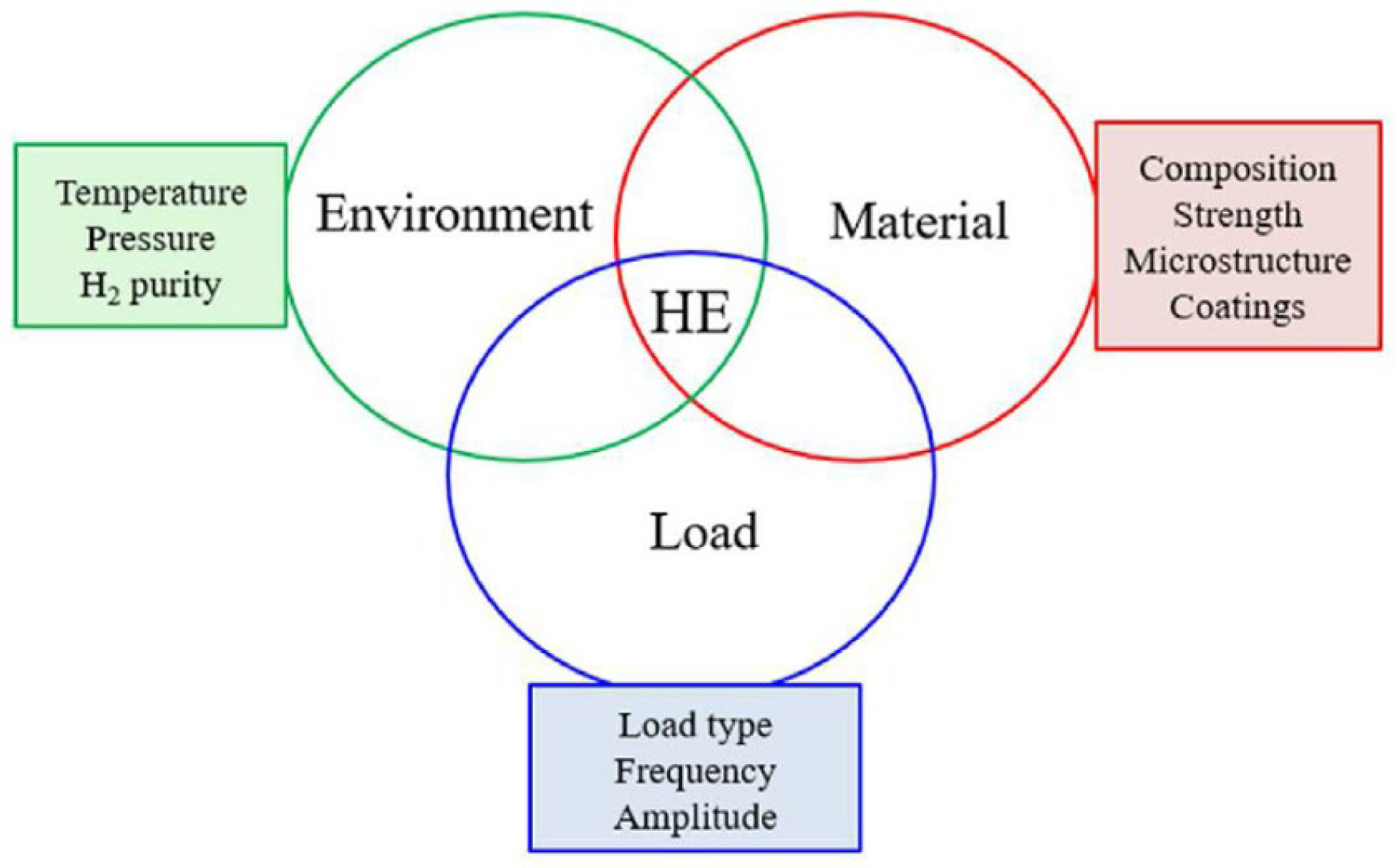
Material Behavior under Hydrogen Exposure Hydrogen exposure significantly impacts the mechanical behavior of pipeline materials, especially carbon steels commonly used in NG transportation pipelines [3]. Hydrogen embrittlement (HE) is the most important problem, and it happens when atomic hydrogen diffuses through the steel matrix to decrease ductility, initiate cracks, and lead to premature failure under stress [6]. It has been established by different research studies that high-strength steels (API X70 and above) are susceptible to HE than lower-strength grades [7]. In Canada, the majority of legacy natural gas pipelines are constructed using API X52 to X70 grade steels, which vary in susceptibility to hydrogen degradation depending on service conditions and material history [3]. In addition to embrittlement, hydrogen reduces fatigue resistance, accelerates the growth rates of cracks, and accelerates aging in weld and heat-affected zones [5]. The extent of hydrogen-induced degradation in pipeline steel depends on the operating environment’s temperature, pressure, and the microstructure of the steel itself [8], as illustrated in Figure 1. Some of these mitigation strategies, such as the use of low-strength material, post-weld heat treatment, or surface coatings, are possibly effective, but constrained by practical or economic considerations [9].
Recent investigations provide more quantitative insight into these effects. For example, the National Institute of Standards and Technology (NIST) studies comparing X52 and X70 steels at hydrogen pressures of 5.5 MPa and 34 MPa observed that at a stress intensity factor range (ΔK) below ~15 MPa·√m, hydrogen notably accelerated fatigue crack growth rates, while at higher ΔK values, the acceleration persisted across different materials and microstructures [11]. In API X70 steels, fatigue crack growth rates increased by up to two orders of magnitude compared to air conditions when ΔK exceeded approximately 7 MPa·√m. These data demonstrate the significant influence of hydrogen pressure, material grade, and microstructure on fatigue behavior and crack propagation [11]. Table 1 summarizes representative fatigue crack growth observations for various pipeline steels under hydrogen exposure.

2.2. Current Retrofitting Practices

Retrofitting solutions for transitioning NG pipelines to hydrogen service typically entail a process of both technical and operational transformation. Common methods include:
  • Internal lining (e.g., epoxy or polymer linings) to reduce hydrogen permeation and provide corrosion protection [3]; however, pure polymers may allow some hydrogen to diffuse, hence additional treatment, e.g., multi-layer coatings or metal barriers, may be necessary in high-pressure hydrogen service.
  • Pipeline pressure controls to reduce the levels of stress and restrict the possibility of embrittlement; Better sealing systems to oppose leakage risks caused by hydrogen’s very small molecular size [3].
  • Fiber-optic or acoustic sensors for real-time monitoring to pre-identify leaks and fatigue cracks in advance [3].
Several European, US, and more recently Canadian pilot projects, including ATCO’s Alberta hydrogen blending trial, have already proven that hydrogen blending into natural gas grids is possible to achieve at conventional levels of up to 20% by volume [1,12]. Nevertheless, retrofitting for carrying pure hydrogen at full capacity is still limited, and more large-scale demonstration projects are required to ensure long-term safety and performance [9]. This is due in part to high retrofitting costs, uncertainty in hydrogen-specific code requirements (e.g., deficiencies in CSA Z662 [13] and ASME B31.12 [14], and the lack of through-material long-term performance data under hydrogen service conditions [1].

2.3. Implications of Hydrogen Concentration and Operating Pressure on Pipeline Integrity

Hydrogen embrittlement (HE) can significantly reduce the fracture resistance of high-strength steels, necessitating pressure derating for maintaining pipeline integrity. Industrial standards, such as ASME B31.12, CSA Z662:23 [13], and ISO/TR 15916 [15] recommend lowering allowable operating pressures in proportion to hydrogen concentration and the susceptibility of the steel grade [5]. This has direct implications for pipeline operations, since natural gas is approximately three times more energy-dense than hydrogen by volume, meaning that 100% hydrogen at constant pressure drop results in 15–20% lower energy transmission capacity and requires higher flow velocities. To maintain the same capacity, pipeline pressure would need to be increased; however, operating pressure must often be decreased to minimize hydrogen-induced steel degradation [16].
Experimental testing of a 100 m, 25 mm nominal diameter steel pipe at constant energy flow rate showed that 30 vol % hydrogen causes a 25% higher pressure drop than in pure natural gas, illustrating the need to take into account pressure limitations when designing network operations [16].
To further illustrate the practical application of these considerations, a numerical case study is presented below.
Numerical Case Study: Impact of Hydrogen Concentration on Allowable Pipeline Pressure.
Consider a 25 mm nominal diameter, 100 m long X52 steel pipeline operating at 10 MPa with natural gas. The same pipeline is proposed to carry a 30 vol% hydrogen blend at the same energy delivery rate. Using published experimental findings and standards guidance:
Energy density adjustment: Hydrogen has approximately one-third the volumetric energy of natural gas. Therefore, at 30% H2, the pressure drop increases by approximately 25% for the same flow rate.
Derating for embrittlement: Based on X52 steel susceptibility and hydrogen concentration, a conservative derating factor of 0.9 is applied to the allowable operating pressure to account for potential hydrogen-induced fracture [14].
Adjusted operating pressure:
Pallowable,H2 = Pnominal × derating factor = 10 MPa × 0.9 = 9 MPa
Outcome: To maintain the same energy delivery, either flow velocity must be increased, or operating pressure increase cautiously, but cannot exceed the derated limit of 9 MPa. This demonstrates how the proposed assessment method combines energy delivery, embrittlement risk, and pressure limits in a practical evaluation.

2.4. Hydrogen Transport Standards and Codes

Existing standards make provisions on various areas of pipeline retrofitting for hydrogen service. For instance, ASME B31.12 makes specific provisions for hydrogen pipeline design, fabrication, and operation, such as material choice, welding procedure, and testing requirements to check the integrity and reliability of pipelines in hydrogen service [17]. The development of hydrogen embrittlement is also addressed and guidelines for prevention against its formation are included, such as the application of higher resistant material against hydrogen-induced cracking and the utilization of heat treatment processes judiciously [18].
Similarly, CSA Z662:23 also has provisions for the use of pipelines for hydrogen or hydrogen blend service and deals with such issues as material specifications, design pressure, and safety factors. However, as a point of departure, the guidelines fall short in a few areas [17,19]. Notably among them is that there are no comprehensive guidelines for retrofitting existing natural gas pipelines for hydrogen service. Included in this is the need for standard methods of evaluation to determine existing infrastructure’s readiness for hydrogen transportation, and processes for adjustments or upgrades needed [19].
Furthermore, the ISO/TR 15916 technical report offers overall safety principles for hydrogen systems but leaves the particulars of retrofitting existing in-place pipelines unaddressed. It identifies safety concerns and hazards associated with using hydrogen but leaves it to specific individual international standards to provide detailed particular standards for specific uses [15,19].
In general, while existing standards provide valuable information on certain aspects of hydrogen pipeline design and operation, there remains a necessity for more comprehensive and standardized approaches to retrofits of existing pipelines for hydrogen service. This includes the formulation of detailed methods of assessment, definition of unambiguous criteria for compatibility of materials, and the formulation of standardized procedures for modifications to enable the safe and efficient transportation of hydrogen [19].

2.5. Limitations of Existing Research

While literature offers a growing body of knowledge on hydrogen transport and retrofitting techniques, several limitations persist.
First, most experimental studies focus on short-term performance in controlled environments that don’t reflect field-scale conditions [5]. Second, failure mechanisms associated with the long term, such as hydrogen-induced fatigue and micro-crack coalescence, are still not well understood, especially in the case of existing pipelines [5]. Third, retrofitting measures are separately tested and not as a system, and therefore, it is difficult to assess their overall performance [5]. Lastly, limited information on the cost-effectiveness and lifecycle performance of retrofitting measures in the Canadian environment and regulatory conditions is available [1]. No publicly reported pure hydrogen retrofit field tests on pipelines have been reported in Canada to date, highlighting a very important research and demonstration need to be fulfilled to verify laboratory findings under real operating conditions [20]. Long-term research must be conducted to facilitate safe and economical deployment of hydrogen infrastructure in Canada, especially through full-scale field trials simulating Canadian operating conditions such as cyclic pressure loading, freeze–thaw temperature cycles, and soil-pipe interactions in various climate zones to validate material performance and retrofit effectiveness over time [3].

3. Material Testing and Compatibility

Natural gas (NG) pipeline retrofitting for hydrogen use is more reliant on the material compatibility of the current pipelines for hydrogen service. It causes issues such as hydrogen embrittlement, an increase in permeability, and a reduction in fatigue resistance [6]. Perception of the interaction of hydrogen with such materials is very important in assessing the structural integrity and long-term performance of reused pipelines [5].
In the case of hydrogen transport, its significantly smaller atomic size and heightened diffusivity, as mentioned in Table 2, allow it to permeate steel microstructures more readily and form crack initiation and propagation, which do not occur under conditions of exposure to methane. Tightly controlled material testing and inspection will therefore need to be carried out in order to guarantee safe and long-term conversion of installed pipelines already in place to hydrogen operation [21].

3.1. Common Materials in Natural Gas Pipelines

Carbon steel high-pressure transmission pipes and polyethylene (PE) low-pressure distribution pipes are used most extensively for NG transmission and distribution systems [8]. API 5L Grade B and Grades X52 to X80 carbon steels are available most commonly because they are cost-effective, strong, and weldable [24]. PE (especially PE100 and PE2708) is widely applied in urban networks due to its impact resistance and corrosion resistance [25]. Recent studies and guidelines suggest that PE pipelines, particularly PE100, exhibit excellent resistance to hydrogen permeation and embrittlement. This makes them suitable for low-pressure hydrogen applications. In contrast, carbon steel pipelines require careful assessment due to their susceptibility to hydrogen embrittlement (HE), especially in higher-strength grades such as X70 and above [5]. As a result, PE pipelines are considered more readily adaptable for hydrogen service. Steel pipelines, on the other hand, may necessitate additional retrofitting measures or material upgrades depending on service conditions. Such measures include the application of internal coatings or linings, replacement of valves and seals with hydrogen-compatible materials, cathodic protection enhancements, and the integration of intelligent monitoring systems as detailed in Section 5 [9,19].

3.2. Impact of Hydrogen on Pipeline Materials

Hydrogen acts specifically on metallic and polymer materials. Hydrogen molecules can interpenetrate the metal lattice, accumulate at microstructural defects, and embrittle carbon steel pipelines [4]. The mechanism of HE decreases ductility and toughness, stimulating crack development and extension by operating stresses [15]. High-strength steels are particularly vulnerable to HE, whereas lower-strength steels can offer more resistance at the cost of pressure capacity [9].
Experimental studies have shown that X52 carbon steel pipelines exposed to 5–10 MPa hydrogen pressure can experience a ~20–30% reduction in fracture toughness compared to air, while X70 steel may see a 35–50% reduction under similar conditions [26].
In the case of polymeric substances like PE, hydrogen does not cause embrittlement but results in another issue: excess permeability. Because hydrogen has a small molecular size, it can diffuse more readily through the walls of PE, causing potential losses and safety problems in closed or highly populated urban environments. However, studies suggest that PE pipes can tolerate low hydrogen blends with minimal structural risk [25].

3.3. Hydrogen Embrittlement, Permeability, and Fatigue Resistance

Hydrogen Embrittlement (HE): HE mechanisms vary based on the steel’s microstructure, stress intensity, and hydrogen pressure [9]. Under sustained loading or cyclic stress, cracks may initiate from inclusion sites or weld defects and propagate rapidly in the presence of hydrogen [24]. Weld zones and heat-affected areas are typically more susceptible than base metal. For example, high-strength steels like X70 have been reported to experience a significant reduction in fracture toughness under 5–10 MPa hydrogen exposure compared to inert gas environments, whereas X52 steels show a smaller but still measurable reduction [7]. This loss of toughness often necessitates lowering the maximum allowable operating pressure (MAOP), effectively reducing transmission efficiency and increasing the frequency of recompression stations [16]. Conversely, lower-strength steels (e.g., X42–X52) offer better resistance to hydrogen-assisted cracking but result in lower MAOP, creating a trade-off between fracture safety and transport capacity [16].
Permeability: Hydrogen permeability is more significant in polymers than in metals [27]. For metallic pipes, permeability is generally low but can be a concern at weld seams or micro-cracked zones. For PE materials, permeability is measurable and dependent on pipe thickness, pressure, and temperature. Thicker-walled PE100 pipes exhibit lower permeation rates compared to older or thinner PE grades [9].
Fatigue Resistance: Hydrogen reduces fatigue limits and enhances crack growth under cyclic loading [4]. Steel crack growth rates when exposed to hydrogen may be 2 to 5 times greater than for methane service, depending on stress range and environment. Fatigue life in the long term for hydrogen service is thus to be appropriately evaluated, especially for high-pressure equipment [7]. Among these mechanisms, hydrogen embrittlement is especially bothersome to high-pressure carbon steel transmission pipes and low-pressure polyethylene distribution mains [3].

3.4. Summary of Relevant Test Data and Standards

Building on the comparative overview presented in Table 3, this section weaves together existing codes and experimental evidence to isolate well-established practice and areas of future research, particularly for retrofitting existing pipelines in Canadian environments. Some key standards are ASME B31.12, ISO 11114-4 [28], and CSA Z662:23, addressing, material compatibility, fracture control, pipeline design, and safety factors [19,25].
ASME B31.12 provides comprehensive guidance on material selection, fracture control, and design pressure for new hydrogen pipelines. ISO 11114-4 complements this by prescribing procedures for determining material compatibility with gaseous hydrogen and assessing susceptibility to hydrogen embrittlement and fatigue crack growth [14,28].
CSA Z662:23, as the primary Canadian pipeline standard, currently includes partial provisions for hydrogen service, with additional addenda under development to address legacy pipeline assessment and retrofit procedures [25]. Despite this framework, several gaps remain critical for Canadian application: the effect of freeze–thaw cycles, cyclic loading performance, and requirements for defect-tolerant weld design and inspection remain insufficiently codified. Standardized retrofit procedures are also lacking, leaving operators to rely on case-by-case engineering assessments [25,29].
Experiments such as those conducted by Sandia National Laboratories, the HyUnder Project, and H2Pipe have shown that low-strength carbon steels (e.g., X52) are acceptable for service in hydrogen under circumstances where pressure restrictions are well managed and weld integrity is ensured. However, complete testing in Canadian environmental conditions—particularly considering the fluctuation in temperature, pressure cycling, and varying weld quality—has been limited. Closing these knowledge gaps will allow for the creation of strong, field-relevant retrofit guidelines that facilitate safe and effective hydrogen infrastructure deployment [19,25].

3.5. Environmental Effects on Hydrogen Embrittlement/Pipeline Integrity

Low temperature, freeze–thaw cycling, and pressure fluctuation each play a central role in enhancing hydrogen embrittlement and reducing pipeline integrity.
Low-temperature steels are more brittle due to the ductile-to-brittle transition, and exposure to hydrogen enhances the size of this effect. For instance, fracture toughness of API X52 pipeline steel was found to decrease significantly when tested in hydrogen-charged state at a temperature of −90 °C compared to room temperature, with cleavage fracture mode dominating [30]. Systematic reviews of structural alloys in general indicate that hydrogen embrittlement is most pronounced in the temperature region of 200–340 K (−73 °C to +67 °C), depending on microstructural and environmental conditions [29]. These findings highlight that pipelines in low-temperature environments are more susceptible to brittle fracture during hydrogen service.
Freeze–thaw cycles also increase degradation by subjecting repeated expansion and contraction ground stresses around buried pipes. These cyclic stresses create microcracks that are also preferential hydrogen trap sites, hence promoting crack initiation and propagation [29]. Fatigue studies support this mechanism, showing that crack growth rates in steel are significantly accelerated in hydrogen environments, highlighting the strong interaction between cyclic loading and hydrogen embrittlement. While freeze–thaw cycling is primarily an environmental factor, its effect on creating cyclic stresses is functionally similar to pressure cycling, magnifying hydrogen-induced damage [31].
Due to the low volumetric energy density of hydrogen, higher compression pressures are normally applied, and this leads to greater hydrogen diffusion and greater embrittlement. Pipeline steels such as X52, X65, and X100 show reduced ductility when tested in hydrogen, with the X100 grade experiencing the most significant losses. While X52 exhibits only minor reductions in elongation, X65 displays pronounced orientation effects in air that are less evident under hydrogen exposure. In general, lower strain rates and higher hydrogen pressures increase the susceptibility of these alloys to embrittlement, highlighting the varying sensitivity of different steel grades to hydrogen environments [32].
Together, these findings demonstrate that pressure cycling, freeze–thawing, and low operating temperatures synergistically enhance increased hydrogen embrittlement, reduced fracture toughness, accelerated fatigue crack growth, and deteriorated long-term pipeline integrity.

4. Failure Probability Assessment

To ensure safe transportation of hydrogen through refurbished natural gas pipes, there is a high demand for risk in hydrogen service [5]. Since hydrogen possesses distinct physicochemical properties from other energy sources, the traditional risk assessment procedures have limited applicability and must be adjusted to accommodate new failure scenarios and uncertainty [1]. There are no available risk models for natural gas pipelines that can account for hydrogen-specialized degradation mechanisms, i.e., hydrogen embrittlement-cracking, increased fatigue crack propagation, and increased permeation rates, particularly in welds and high-stress zones that could lead to abrupt failure under service conditions. The subsequent section outlines principal failure risk assessment procedures, primary influencing factors, and relevant case studies and models [21].

4.1. Methods for Assessing Failure Risk

Several analytical and probabilistic techniques are used to evaluate pipeline failure probability for hydrogen service conditions:
  • Failure Modes and Effects Analysis (FMEA): FMEA is a qualitative technique used in the identification of possible modes of failure, causes, and their effects. FMEA is typically used early in design or retrofitting to find out critical items (e.g., weld seams, valves) and direct mitigation activities [9].
  • Fault Tree Analysis (FTA): FTA represents the logical relationship between part failure and system-level events such as ruptures or leaks. FTA is particularly useful in comprehending how complex interactions (e.g., pressure spikes increasing material flaws) lead to system failure [1].
  • Probabilistic Risk Assessment (PRA): PRA calculates failure probability in terms of statistical distributions of input parameters like material properties, flaw size, and operating loads (e.g., probability of failure) are generally used to predict pipeline safety margins [1,5].
  • Fracture Mechanics-Based Models: These models utilize crack growth equations (e.g., Paris Law) and threshold stress intensity factors to model time-to-failure for cyclic loading with hydrogen-induced flaws [1].
Among these, Probabilistic Risk Assessment (PRA) and fracture mechanics-based models are generally considered to be most credible for hydrogen pipeline use because they can be used to incorporate hydrogen-characteristic degradation mechanisms, such as embrittlement and fatigue crack growth, into quantitative risk estimates, as suggested by current research and industry practice [9].

4.2. Factors Influencing Pipeline Failure in Hydrogen Service

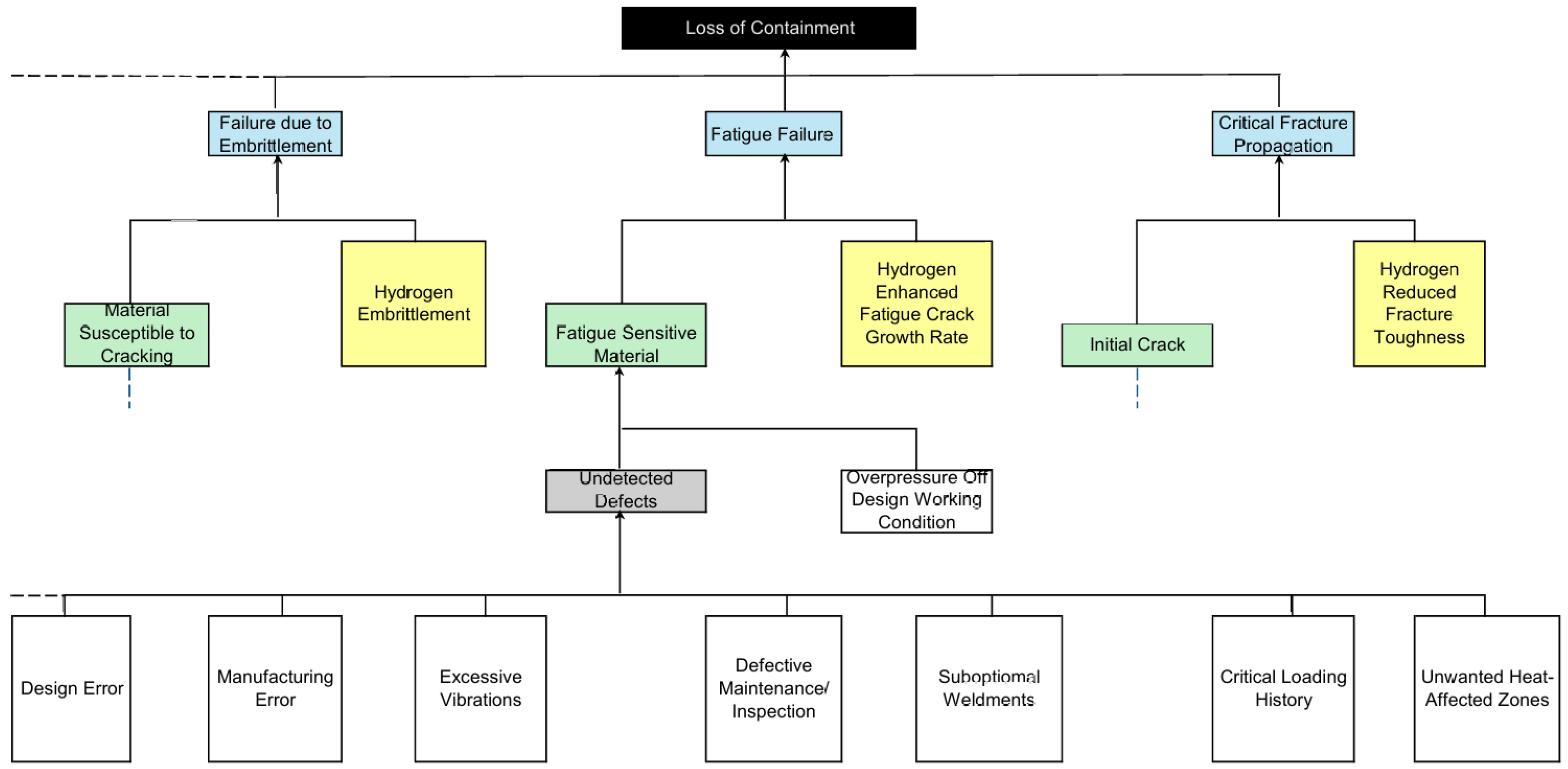
Hydrogen Transport presents a few special factors that increase the likelihood of pipeline degradation and failure. Figure 2 summarizes the main hydrogen-related degradation mechanisms and failure pathways.
  • Hydrogen Embrittlement (HE): As observed above, hydrogen penetration into pipeline steel can decrease toughness and ductility, and increase susceptibility to crack nucleation and growth under service loading [6].
  • Fatigue and Cyclic Pressure Loading: Hydrogen decreases fatigue life, particularly in aging pipelines with pre-existing flaws. Cyclic loading due to pressure oscillations further promotes crack extension [8].
  • Material and Weld Defects: Microscopic imperfections of the base metal, welds, or heat-affected zones are initiation locations for hydrogen-induced cracking [24].
  • Pressure and Temperature Effects: High pressure enhances hydrogen permeation and accelerates embrittlement. Low ambient temperatures, common in many Canadian regions, can further reduce material toughness [33].
  • Fatigue and Cyclic Pressure Loading: Hydrogen decreases fatigue life, particularly in aging pipelines with pre-existing flaws [21].
Of these, HE and pressure cycling loading-induced fatigue are considered the most critical failure mechanisms for retrofitted pipes because the two mechanisms have been established to directly lead to premature cracking and rupture in laboratory tests and field-exposed pipe material. This focus highlights the significance of meticulous selection of material, weld quality control, and pressure fluctuation regulation in retrofitting work [9].
Figure 2. Fault tree illustrates the degradation of mechanisms and initiating events that may lead to loss of containment in hydrogen pipelines. Hydrogen-assisted degradation processes are indicated by yellow boxes [34]. Green boxes represent material or operational conditions contributing to failure susceptibility, while grey boxes denote undesirable initiating events. Vertical dashed lines indicate analogous contributing conditions that may apply similarly across different branches of the fault tree, whereas a horizontal dashed line denotes conceptual linkages within the fault tree rather than direct hierarchical causation.
Cleantechnol 08 00026 g002

4.3. Example Failure Case Studies and Models

While large-scale failure of hydrogen pipelines remains rare due to the limited existing infrastructure, several historical and experimental cases recognize hazards to failure:
  • High-Pressure Pipeline Failures for Hydrogen (Germany, 1980s–1990s): Early hydrogen pilot pipelines experienced cracking in weld interfaces due to unexpected embrittlement phenomena, emphasizing the necessity of stringent weld quality control and material selection [3]. This case emphasized the overriding importance of using hydrogen-compatible welding procedures and post-weld heat treatments to minimize crack initiation risks [19].
  • HySafe Project (EU): During this research project, probabilistic models were created to model rupture events of a pipe for various hydrogen leak and ignition scenarios [34]. The findings stress the importance of leak detection systems and controlled venting in hydrogen transport. The HySafe results highlighted the essential role of advanced leak detection technologies and emergency venting mechanisms to prevent catastrophic failure in hydrogen networks [35].
  • Sandia National Laboratories Models (U.S.): Experimental data at Sandia have been used to validate probabilistic models that are fracture mechanics-based and utilize flaw sizes, and stress conditions to estimate the likelihood of failure in pressurized hydrogen pipelines [19]. Such research supported the incorporation of fracture mechanics-based analysis in retrofit design to forecast crack propagation as well as service life upon exposure to hydrogen.
These investigations indicate that failure risk in hydrogen pipelines is multi-factor and cannot be addressed by using conventional natural gas pipeline design standards. Both probabilistic methods and real-time monitoring with scheduled inspection must be implemented to provide an acceptable level of safety in the retrofitted pipelines [1].

5. Retrofitting Techniques

Selective upgrading is required to maintain material compatibility, structural integrity, and operational safety during the retrofitting of natural gas pipeline systems for hydrogen transportation. Recycling old pipelines is economically and environmentally preferable but requires special engineering countermeasures to handle the unique features of hydrogen’s minute size of molecules, high diffusivity, and embrittlement [24]. This section identifies significant retrofitting techniques that are presently adhered to or contemplated.

5.1. Internal Coatings and Linings

The application of internal lining or coating is one of the most promising methods to prevent hydrogen-related degradation in repurposed natural gas pipelines. Internal coatings reduce hydrogen permeation, mitigate corrosion, and improve flow properties. Epoxy and polymer coatings form an effective barrier between the pipe wall and hydrogen gas, preventing hydrogen diffusion and reducing the risk of embrittlement [27,28]. In areas prone to stress concentration, such as weld joints or bends, metal liners made of stainless steel or nickel alloys may be applied to enhance resistance against hydrogen damage. The success of a coating system depends heavily on its adhesion, temperature resistance, and compatibility with hydrogen at the pipeline’s operating pressure and temperature [27].
In Canada, there have been pilot projects like Alberta Innovates Resilient Pipelines, Resilient Energy, and the work of AmpClad Coating Technologies in the creation of a hydrogen liner. These have demonstrated the field practicality of such coatings to legacy pipeline retrofits. Large-scale testing by C-FER Technologies on behalf of Pipeline Research Council International (PRCI) also verifies the performance of such coatings in hydrogen service conditions [20]. Internationally, Europipe GmbH in Germany had completed successful tests of epoxy-coated pipes under hydrogen pressure of 100 bar with satisfactory adhesion and blister resistance, thereby being ideal to transport hydrogen [19].
However, with the use of internal coatings also come some difficulties. Special coatings require higher material and application costs and can make in-line inspection (ILI) operations more complex, thereby making the identification of defects more difficult. Secondarily, coatings such as metallic barriers or ceramics, while very effective in preventing hydrogen permeation, can be brittle and crack upon exposure to operating stresses [28]. Installation in operating pipelines usually requires downtime, specialized pigging equipment, and experienced operators, contributing to operating costs. Therefore, while internal linings and coatings are integrated with hydrogen pipeline retrofitting, they must be installed with comprehensive inspection and maintenance schemes to ensure long-term safety and performance [1,28].

5.2. Seals, Valves, and Joints Replacement

Gaskets, seals, valves, and mechanical joints are pipeline hardware items most susceptible to hydrogen leakage due to the low molecular weight of the gas and its capability to diffuse through elastomers and small clearances [36].
  • Hydrogen-compatible elastomers (such as fluor elastomers or Polytetrafluoroethylene (PTFE) based ones) must be implemented to replace aging sealing devices that were initially designed for natural gas [37].
  • Regulators and valves must be reevaluated for hydrogen compatibility about tightness, pressure dynamic sealing, and wear resistance [1].
  • Welded connections may require additional inspection or reinforcement because weld areas are generally sites of initiation of hydrogen-induced cracking. Retrofit efforts tend to be aimed at the high-pressure equipment and critical control points where failure would result in significant safety or operational risks [9].
These retrofitting activities are especially important on safety-critical and high-pressure equipment where failure will result in severe safety or operational impacts. Leaks from old seals, joints, or valves, if not renewed, will cause invisible hydrogen leakage, which will result in hazardous safety issues in the form of fire or explosion risks because hydrogen is odorless and colorless, and it burns easily [1]. Also, hydrogen loss reduces the efficiency of transport systems and causes economic losses with potential environmental problems. The above necessitates the replacement or refurbishment of such equipment in a complete pipeline retrofit program to ensure operational safety, reliability, and regulatory compliance in hydrogen service [3].

5.3. Cathodic Protection Upgrades

Cathodic protection (CP) systems provided for methane service may require recalibration or upgrading for hydrogen pipelines. Originally, Hydrogen is non-corrosive, but its reaction with steel surfaces and potential to form hydrogen-induced cracking (HIC) requires active corrosion control [32]. This is due to the form of hydrogen atom on steel surfaces during cathodic reactions can diffuse into the metal lattice, leading to embrittlement and potential crack initiation, especially in welds or stressed regions [38]. Additionally, CP system upgrades in Canadian conditions may differ from those in temperature regions due to the impact of cold soil temperatures on soil resistivity and moisture content, which affect CP effectiveness and current distribution [19].
  • Re-evaluation of CP current density requirements must be reassessed to maintain protection without causing hydrogen evolution on the pipe surface [33].
  • New CP systems can integrate remote monitoring and adaptive control to provide optimum protection across varying soil conditions and pipeline sections [19].
  • CP upgrades are particularly important for aging pipelines with unknown or inconsistent protective coverage [33].
  • Since the safety sensitivity of the hydrogen pipelines is increasing, smart monitoring devices form an integral component of every retrofit scheme. They provide real-time reporting of pipeline condition, leaks, and mechanical integrity [20,33].
  • Strain, temperature, and acoustic signal monitoring systems can detect strain, temperature, and acoustic signals associated with leaks or cracking [33].
  • Hydrogen sensors of the next generation are being engineered and implemented to sense traces of hydrogen at an early point so that prompt and effective action may be initiated [33].
  • With Supervisory Control and Data Acquisition (SCADA), predictive maintenance and remote diagnostics can be achieved [3].
Finally, care should be taken in selecting and applying the retrofitting method, considering factors such as pipe service pressure, environment, material, and age. Successful program retrofitting requires physical reinforcement and improved monitoring and maintenance practices to enable the existing NG infrastructure to be reused efficiently and safely in the new hydrogen economy [38].

5.4. Intelligent Monitoring Systems

As the safety-critical character of hydrogen pipelines increases, intelligent monitoring technology plays a vital role in any retrofit program. These smart systems provide real-time pipeline condition, leak, and mechanical integrity feedback [9].
  • Fiber-optic sensor systems can detect strain, temperature change, and acoustic emission caused by leaks or cracks [1].
  • Special hydrogen sensors are designed and employed to detect small amounts of hydrogen at an early point in time so that action can be taken on time [33].
  • Interface to the SCADA system for remote diagnostics, predictive maintenance, and risk-informed decision-making [3].
Real-world applications of such systems have already been demonstrated. For example, ATCO Group in Canada has successfully employed fiber-optic sensing and SCADA-based monitoring in its hydrogen blending pilot projects, improving leak detection and system reliability [33]. While these technologies offer effective safety and operating benefits, they also have challenges such as costly installation, complications in data processing, and a need for specialist interpretation hardware. Employing smart monitoring not only supports performance-based design philosophies but also enables compliance with future hydrogen safety regulations [33].
In summary, retrofit methods must be selected and applied with care, based on pipe material, age, service pressure, and environmental conditions. An effective retrofitting program entails the combination of physical upgrades and advanced monitoring systems to safely and successfully retrofit existing natural gas infrastructure for hydrogen service. Further, unifying several techniques such as internal coatings, cathodic protection, and intelligent monitoring offers full protection from the various degradation mechanisms involved in hydrogen transportation because, separately no technique can address all the potential hazards [5].

5.5. Upgrading of Existing Pipelines with Control Room Upgradation Only

It is possible in some controlled environments to have other means of reusing existing natural gas pipelines for the transportation of hydrogen without actually modifying the pipeline. Here, the retrofit solution is by enhancing only control and monitoring systems of the pipeline, such as the SCADA system, sensors, and compressor stations [9]. This can only be done after a proper check and confirmation to determine that the materials used in building up the pipeline (i.e., carbon steel grades, weld quality) are sufficient for hydrogen service, i.e., for low- to medium-pressure transportation applications [24]. For example, the UK FutureGrid project by National Gas could demonstrate that 100% hydrogen can be safely transferred via current natural gas pipelines without any physical pipe body alteration, provided that control room systems are designed to allow real-time monitoring of pressure, flow, and purity of hydrogen [19]. Advanced SCADA upgrades allow the operators to detect operating anomalies at an early stage and dynamically adjust pipeline conditions for secure carriage [3].
This technique can prove to be a cost-saving and time-saving project than conventional retrofit techniques of internal linings, seal replacement, or cathodic protection reset. But this method is best suited to demonstration or pilot-scale plants and requires large-scale material characterization to ensure pipeline integrity against hydrogen exposure [22]. It remains less than fully compliant with the regulatory acceptance standards for permanent or major hydrogen transmission pipelines in all jurisdictions, e.g., that of ASME B31.12 or CSA Z662:23, short of physical upgradation [19]. Nevertheless, the method is primarily suitable for pilot or demonstration schemes and requires comprehensive material characterization to ensure pipeline integrity after exposure to hydrogen [29]. The method may not yet be viable for the degree of regulatory approval for permanent or large-diameter hydrogen transmission pipelines in all jurisdictions, such as ASME B31.12 or CSA Z662:23, in the absence of physical upgrades [19].

5.6. Choice of Retrofitting Technique from Defect Evaluation

The choice of the best retrofitting technique for upgrading existing natural gas pipelines to hydrogen service, to a great extent, depends on the type, severity, and distribution of defects identified through inspection and evaluation [20]. A comprehensive pipeline integrity assessment using non-destructive testing (NDT), inline inspection (ILI), and fitness-for-service (FFS) analysis is necessary for classifying pipeline sections according to their rehabilitation needs [22]. Table 4 shows the suitable retrofitting methods for the defects.
Additionally, action selection should further consider the age of the pipeline, grade of steel (e.g., X52 or X80), joint types, and service record, as all these influence susceptibility to hydrogen [38].

6. Structural Analysis After Retrofit

Post-retrofit verification of pipeline structural integrity is mandatory under Canadian standards such as CSA Z662:23, which requires that pipelines intended for hydrogen service be reassessed to ensure fitness for purpose under new operating conditions [19]. Upon retrofitting, the structure of the pipeline must be analyzed in detail to confirm that the retrofitted pipeline can transport hydrogen safely under expected operating conditions. Hydrogen introduces several new degradation mechanisms, life reduction, and embrittlement, for example, that impact the structural integrity of the vintage pipelines [7]. In this paper, techniques utilized in establishing structural performance after retrofitting are investigated, namely stress analysis, fracture mechanics, and adherence to relevant safety codes [33].

6.1. Retrofitted Pipeline Structural Integrity Investigation

Structural integrity analysis is to verify that the retrofitted pipeline will be able to withstand environmental conditions and mechanical stresses throughout its future service life [3]. Of most concerns are:
  • Degradation of materials resulting from exposure to hydrogen, especially in welds, joints, and coating defect regions [38].
  • Condition and age of pipe, i.e., corroded, dented, or otherwise cracked [1].
  • Retrofitting modifications, i.e., new linings or fitted fittings, which alter load carrying and stress concentration location [27].
Structural flaw identification is typically characterized by a flaw associated with empirical information, flaw detection using NDT, and advanced simulation methods. In particular, NDT techniques like ultrasonic testing and magnetic particle inspection are highly crucial in the detection of subsurface anomalies, cracks, or welding defects, in aged or buried pipes where visual inspection is not feasible [9].

6.2. Stress Analysis, Fracture Mechanics, and Pressure Limits

Hydrogen alters mechanical behavior, necessitating refined stress analysis approaches:
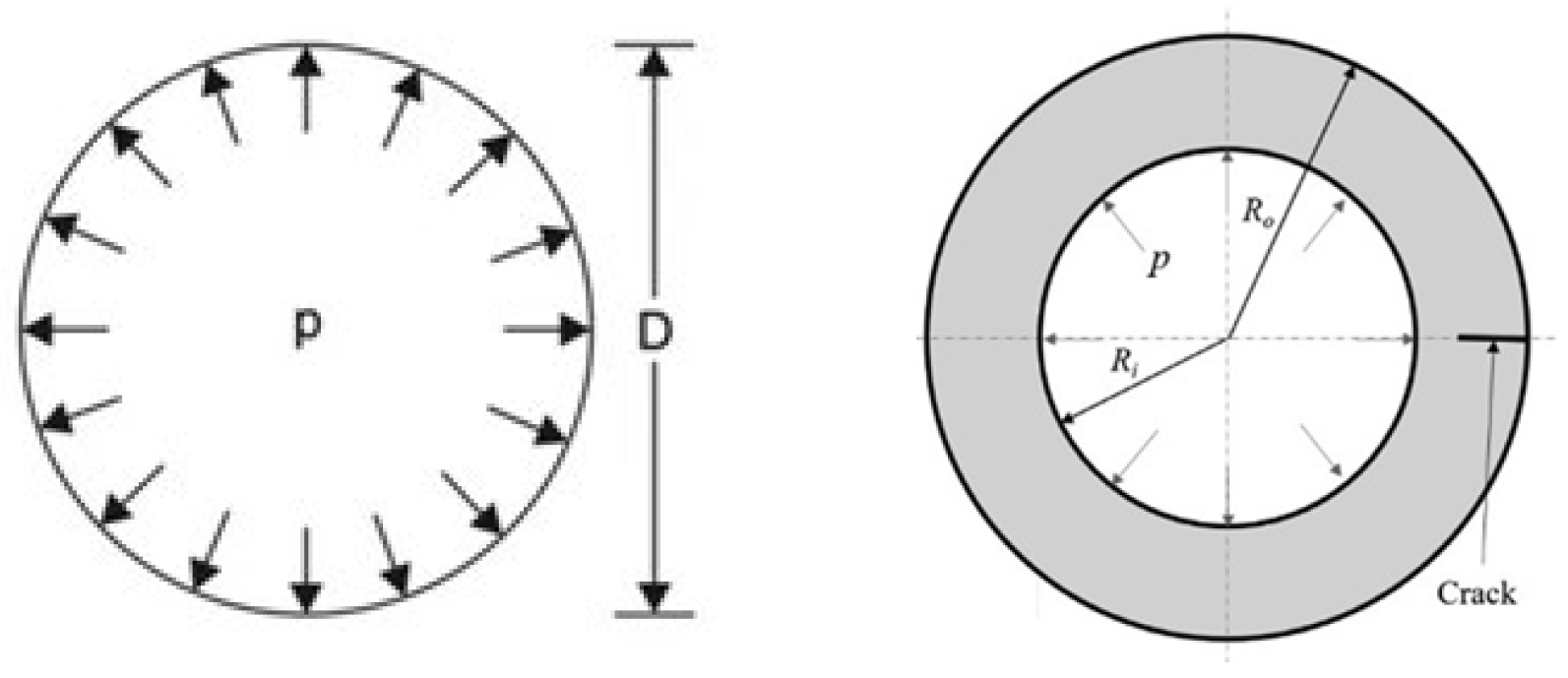
  • Internal pressure stress analysis: To evaluate structural integrity under hydrogen transport conditions, internal pressure stress must be recalculated. For a thin-walled cylindrical pipe, the hoop stress (circumferential stress) and longitudinal stress are determined using Barlow’s Formula [39]. Figure 3 schematically shows the internal pressure loading and crack geometry considered in the stress analysis.
σ h o o p = P · D 2 t
where:
σ h o o p = H o o p   s t r e s s
P = I n t e r n a l   p r e s s u r e
D = P i p e   i n t e r n a l   d i a m e t e r
t = W a l l   t h i c k n e s s
These stress values must then be compared to the reduced yield strength due to hydrogen embrittlement. Safety factors are also adjusted accordingly.
  • Fracture mechanics helps in the estimation of hydrogen-induced flaw propagation using fracture toughness KIC, stress intensity factor KI, and crack growth rate (da/dN). Modified Paris Law expressions incorporating hydrogen effects are often used to simulate fatigue crack growth in steel pipes [1,25].
d a d N = C · K m · f H 2
where:
d a d N = C r a c k   g r o w t h   r a t e   p e r   l o a d   c y c l e
K = R a n g e   o f   s t r e s s   i n t e n s i t y   f a c t o r
C , m = M a t e r i a l   c o n s t a n t s
f H 2 = H y d r o g e n   a c c e l e r a t e   f a c t o r
  • Pressure limit determination requires re-calculation of the maximum allowable operating pressure (MAOP) considering reduced ductility and fatigue strength under the hydrogen effect. MAOP re-calculation is required to preclude sudden and premature failure during service conditions, as hydrogen embrittlement will decrease the pipe’s ability to resist cyclic and operating loads [22].

6.3. Simulation or Analytical Models

Finite Element Analysis (FEA) and other modeling software packages are widely used to simulate the pipeline response under hydrogen service conditions:
  • Commercial finite element packages such as ANSYS, ABAQUS, or COMSOL are usually used for nonlinear stress-strain analysis, initiation, and propagation of cracks [9].
  • Time-dependent models predict long-term effects of degradation, e.g., cyclic pressure loading and embrittlement propagation [8].
  • For buried pipelines, models may also involve soil-pipe interaction and cold climate temperature gradients (e.g., Northern Canada) [33].
These simulations help validate retrofitting designs and assess worst-case scenarios under combined mechanical and environmental loading [8].

6.4. Safety Margins and Standard Conformity

After structural performance assessment, calculated stress level and failure probability results must be compared with specified safety margins and standards applicable in the industry. The relevant codes and guidelines used are:
  • ASME B31.12—Specifies design requirements for piping and pipelines for hydrogen, including pressure design, fracture control, and fatigue life requirements [2,19].
  • CSA Z662:23—Canada’s updated standard specifies requirements for hydrogen service with an emphasis on fracture toughness and acceptance criteria for defects [19].
  • ISO 15156 and ISO 11114-4—Provide material selection and hydrogen compatibility criteria [19].
An operational factor of safety is typically applied to ensure conservative operation, typically 1.25 to 1.5 based on class and location of the pipeline. Compliance confirmation ensures regulatory approval and supports long-term operational reliability [19].
Post-retrofit structural analysis is not a mere inspection process but a crucial component in the design of hydrogen-safe transport. With the combination of stress analysis, fracture mechanics, and simulation software with applicable standards, engineers can safely utilize natural gas pipelines for hydrogen while maintaining system integrity and public safety [9].

7. Environmental Impact Considerations

The transformation to hydrogen as an energy carrier through retrofitting and reuse of natural gas pipes is technical and financial as well as an environmental decision. Recycling legacy infrastructure saves the environmental expense of producing and installing new pipes from scratch, including reduced steel production, digging, and land impact. However, the retrofitting process itself introduces potential environmental risks and trade-offs that must be weighed judiciously [22]. One of the most important environmental advantages of pipeline retrofitting is the significant reduction in lifecycle GHG emissions due to constructing new hydrogen-specific pipelines. New material extraction, fabrication, and transportation activities are minimized by curtailing the corresponding carbon footprint in pipeline deployment [22]. For instance, embodied-carbon assessments show that avoiding new steel manufacture and excavation can reduce project-level emissions significantly, though the exact percentage depends on project boundaries [16].
However, certain retrofitting works, such as the use of internal linings, welding repairs, or specialist coatings, do involve chemicals and materials whose mishandling may have environmental consequences [27]. As an example, epoxy-based linings emit Volatile Organic Compounds (VOCs) in the application or curing processes when applied in situ. Moreover, cathodic protection enhancements involve more electrical consumption and may have effects on soil chemistry over long periods [33].
These environmental effects are indirect and must be addressed in the decision and minimized through best practice, i.e., use containment, low-VOC material specification, and energy-efficient CP system design [9].
A further environmental hazard is the danger of potential hydrogen leaks, which, although not a GHG in and of itself, are an indirect greenhouse gas precursor to the extent that they influence atmospheric ozone and methane cycles [35]. Leak-tight retrofitting by means of high-tech sealing materials and control systems is thus of the utmost importance not only for on-stream safety but also for environmental responsibility [28].
In summary, while retrofitting has an environmental benefit compared to new-build pipelines, the environmental impact assessments (EIA) specific to the retrofit works are recommended in order to have the minimum ecological disruption. Future research must measure future atmospheric consequences of hydrogen loss during transport [35]. In this regard, recent modelling highlights that barrier coatings such as crosslinked poly (vinyl alcohol) can reduce hydrogen ingress into steel by ~44% and delay equilibrium uptake for years, illustrating that material innovations directly shape the environmental and safety profile of retrofit projects [27].

8. Conclusions

This study has examined the technical feasibility of the rehabilitation and retrofitting of existing natural gas pipeline assets for the transmission of hydrogen. From a detailed examination of material compatibility, strength of structure, and retrofitting methodologies, the study finds that legacy pipelines, namely those built from carbon steel and polyethylene, are safely retrofittable, subject to any such focused upgrades and risk mitigation measures being carried out [1,25].
Critical retrofitting measures such as internal linings, component replacement, cathodic protection enhancements, and smart monitoring system integration are the answer to readying pipelines for hydrogen service [28]. Post-retrofit structural analysis in the form of stress analysis, fracture mechanics, and simulation modeling confirms that it is important to remain with current hydrogen transport codes (e.g., ASME B31.12, CSA Z662:23) for guaranteeing pipeline integrity and safe operation [19].
However, there are certain difficulties remaining. The possibility of hydrogen to embrittle, reduce fatigue life, and diffuse through material puts design limitations on hydrogen very different from those of natural gas [4]. Variations in historic records of materials, levels of pipeline deterioration, and needs for region-dependent safety evaluations make large-scale application difficult [22].
As a precursor, this technical assessment should be followed by a detailed techno-economic analysis to determine the cost-effectiveness of retrofitting programs against investment in new infrastructure [3,5,9,22]. Pilot-scale tests under real operating conditions, such as those outlined in the Alberta Hydrogen Roadmap, are required to establish the real-world feasibility of intelligent monitoring systems and retrofitting techniques in the Canadian-specific pipeline environment [3,9,15,20]. This research also provides an essential technical basis to help inform Canadian policymakers on national hydrogen transition plans, so that infrastructure planning decisions can be based on realistic engineering analysis [3,5,9,22].
While this study focuses on the technical feasibility of retrofitting pipelines for hydrogen transport with emphasis on material compatibility and structural integrity, other system-level considerations are also crucial [9,11]. These include the impact of hydrogen blending or pure hydrogen service on energy transport capacity, needs for compression station and metering facility retrofits or replacements and maintaining hydrogen purity at points of delivery for end-use. The impact of natural gas pipeline residual impurities on downstream hydrogen quality is also a factor. These are the key considerations to explore to have a working hydrogen transmission network and provide scope for further studies [9,16].
All these steps will inform national hydrogen plans and enable Canada’s transition to a low-carbon energy economy through safe, affordable hydrogen transportation.

9. Recommendations and Policy Implications

To help bring the practical application of hydrogen transportation to the retrofitting of existing NG pipelines, the following recommendations and policy implications are provided:

9.1. Engineering and Technical Recommendations

To advance the safe retrofitting of existing NG pipelines for hydrogen service, a structured set of engineering and technical recommendations is essential. One foundational step is the standardized material screening of in-service pipelines. This would involve the establishment of a centralized national database that will have pipeline material composition, weld procedure, and mechanical property records. This would make the process of hydrogen compatibility analysis more rational and enable more effective risk assessment during the planning phase of retrofitting [9].
In addition to pipeline integrity, attention should be given also to the general hydrogen transport chain, e.g., compression stations, metering stations, and end-use equipment. Hydrogen’s reduced energy density compared to natural gas calls for re-evaluation of transport capacities and possibly uprating compressors to allow higher volumetric flow rates and minimizing efficiency loss [3]. Metering systems will also have to be recalibrated to the various flow characteristics of hydrogen, and equipment at the end-use level needs to be certified as compatible. Lastly, the impact of ageing pipeline impurities on the quality of hydrogen delivered must be measured because it can impact the efficiency of fuel cells and industrial process demands. Considering these system-level factors will help ensure that retrofitted pipelines supply hydrogen safely, effectively, and to the appropriate purity for downstream users [3,9].
In addition to screening, integrity tests must be conducted mandatorily before pipelines are diverted for hydrogen use. The tests should include baseline inspections by NDT methods, such as ultrasonic or magnetic particle inspection and fracture mechanics analysis. These allow for the determination of hidden flaws, testing material toughness, and the forecasting of failure mechanisms involving HE and fatigue cracking, thereby ensuring a minimum structural integrity level [1,9].
Lastly, there is a need to develop specialized retrofit guidelines tailored to the Canadian pipeline environment. A national appendix or addendum to CSA Z662 needs to be introduced, which would specifically address hydrogen service retrofitting methods. This standard would prescribe best practices for internal linings, reinforcement of welds and joints, upgrading of valves and seals, and the introduction of smart sensing technologies. This report would provide clarity to operators and regulators alike, allowing for technical consistency and safety as Canada moves towards hydrogen infrastructure [19].

9.2. Pilot Programs and Monitoring

To enable the transition to hydrogen infrastructure, field demonstration-scale projects need to be launched in urban and rural areas. These pilot projects would offer valuable proving grounds for retrofitted pipelines in pure and blended hydrogen conditions. Data from these kinds of field demonstrations would not only validate retrofit approaches in real-world conditions but also improve the development of more accurate failure risk models and performance evaluation methodologies for Canadian operating conditions [9].
Alongside these demonstrations, the adoption of intelligent monitoring technologies must be actively encouraged by fiscal incentives or regulatory policy. Advanced sensing technology, distributed acoustic sensing and hydrogen-selective leak detectors, permits real-time diagnostics of the pipeline condition, which enables operators to identify the onset of leakage, accumulation of stress, or material degradation. Integration of such smart monitoring systems in retrofitting work ensures improved safety, enables ease of maintenance planning, and is consistent with performance-based design philosophies for new hydrogen pipeline infrastructure [9,41].

9.3. Policy and Regulatory Support

To further speed up the transition to hydrogen energy, governments would help by encouraging the reuse of current infrastructure through federal and provincial incentives or tax credits to pipeline companies that retrofit their facilities to serve in hydrogen service. The incentives can be coupled with sustainable large-scale goals, such as for infrastructure serving carbon capture, integrating renewables, or low-carbon fuel switching programs [9].
Parallel to this is the requirement for harmonization of safety regulations to facilitate safe and effective hydrogen network development. Canadian pipeline standards such as CSA Z662 and the Occupational Health and Safety Act should be harmonized with global hydrogen transport standards such as ASME B31.12, ISO 16111 [19], and ISO/TS 19880-1 [19]. The harmonization will enable global standards for safety and operation. Long-term infrastructure planning must encourage investment and collaboration for infrastructure development [20].
Moreover, harmonizing Canada’s U.S. and EU hydrogen standards would make cross-border hydrogen transport easier and contribute towards Canada’s enlarged role in the world’s future energy trade. Harmonization of regulations enables jointly shared infrastructure, standard safety practices, and efficient hydrogen market integration [42].

9.4. Research and Development Priorities

To develop long-term reliability of hydrogen-retrofitted infrastructure, hydrogen–fatigue interaction studies should be accorded top priority. Funding should be allocated for investigating the steel and polymer pipelines’ fatigue life under cyclic hydrogen pressure. It encompasses investigating crack initiation and development processes, life with hydrogen-induced degradation, and effects of operating fluctuations. Such studies are essential to develop reliable life-cycle designs and maintenance protocols tailored to hydrogen service conditions [1,8].
Additional study must also be conducted to establish safe and effective hydrogen blending levels in natural gas. The study must identify the maximum safe level of hydrogen that can be transported without compromising pipeline integrity or causing incompatibility with end-use equipment. Such studies would particularly prove valuable in transitional hydrogen blending strategies in currently existing gas grids before there can be a full switch-over to pure hydrogen transport [3,15].
Apart from that, the research would also need to incorporate climatic conditions, for example, the effect of Canada’s low climatic conditions on the performance of hydrogen pipelines. Temperature is key when it comes to influencing ductility of materials, fracture toughness, and hydrogen diffusion rates, thus promoting increased embrittlement and fatigue failure susceptibility. Regionally oriented test protocols and long-term performance evaluations must therefore be employed to ensure the reliability of retrofitting hydrogen pipelines in Canada’s fluctuating climatic regions [8].

Author Contributions

Writing, M.M.K. and Y.C.; supervision, S.A. and S.Y. All authors have read and agreed to the published version of the manuscript.

Funding

This research received no external funding.

Data Availability Statement

Data are available upon request due to restrictions.

Conflicts of Interest

The authors declare no conflicts of interest.

Abbreviations

The following abbreviations are used in this manuscript:
NGNatural Gas
GHGGreenhouse Gas
HEHydrogen Embrittlement
NIST National Institute of Standards and Technology
PEPolyethylene
FMEAFailure Modes and Effects Analysis
FTAFault Tree Analysis
PRAProbabilistic Risk Assessment
PRCIPipeline Research Council International
ILIIn-line inspection
CPCathodic protection
SCADASupervisory Control and Data Acquisition
NDTNon-destructive Testing
FFSFitness-for-service
MAOPMaximum Allowable Operating Pressure
FEAFinite Element Analysis
VOCsVolatile Organic Compounds
EIAEnvironmental impact assessments

References

  1. Erdener, B.C.; Sergi, B.; Guerra, O.J.; Chueca, A.L.; Pambour, K.; Brancucci, C.; Hodge, B.-M. A review of technical and regulatory limits for hydrogen blending in natural gas pipelines. Int. J. Hydrogen Energy 2023, 48, 5595–5617. [Google Scholar] [CrossRef]
  2. Hayden, L.E.; Stalheim, D. ASME B31.12 Hydrogen Piping and Pipeline Code Design Rules and Their Interaction with Pipeline Materials Concerns, Issues and Research. In Proceedings of the ASME 2009 Pressure Vessels and Piping Conference, Prague, Czech Republic, 26–30 July 2009; ASME: New York, NY, USA, 2009; Volume 1: Codes and Standards, pp. 355–361. [Google Scholar] [CrossRef]
  3. Kappes, M.A.; Perez, T. Hydrogen blending in existing natural gas transmission pipelines: A review of hydrogen embrittlement, governing codes, and life prediction methods. Corros. Rev. 2023, 41, 319–347. [Google Scholar] [CrossRef]
  4. Nanninga, N.; Slifka, A.; Levy, Y.; White, C. A review of fatigue crack growth for pipeline steels exposed to hydrogen. J. Res. Natl. Inst. Stand. Technol. 2010, 115, 437. [Google Scholar] [CrossRef]
  5. Hoschke, J.; Chowdhury, F.W.; Venezuela, J.; Atrens, A. A review of hydrogen embrittlement in gas transmission pipeline steels. Corros. Rev. 2023, 41, 277–317. [Google Scholar] [CrossRef]
  6. Ghadiani, H.; Farhat, Z.; Alam, T.; Islam, A. Assessing Hydrogen Embrittlement in Pipeline Steels for Natural Gas-Hydrogen Blends: Implications for Existing Infrastructure. Solids 2024, 5, 375–393. [Google Scholar] [CrossRef]
  7. Shuai, K.; Liu, H.; Li, M.; Yin, S.; Li, B.; Wang, B.; Liu, Q.; Jia, S. Hydrogen Embrittlement Sensitivity of X70 Welded Pipe Under a High-Pressure Pure Hydrogen Environment. Materials 2024, 17, 5818. [Google Scholar] [CrossRef]
  8. Cui, C.; Bortot, P.; Ortolani, M.; Martínez-Pañeda, E. Computational predictions of hydrogen-assisted fatigue crack growth. Int. J. Hydrogen Energy 2024, 72, 315–325. [Google Scholar] [CrossRef]
  9. Somerday, B.P.; Marchi, C.S. Effects of Hydrogen Gas on Steel Vessels and Pipelines. Available online: https://www.osti.gov/servlets/purl/1727338 (accessed on 31 May 2025).
  10. Hydrogen Embrittlement—An Overview|ScienceDirect Topics. Available online: https://www-sciencedirect-com.proxy.lib.uwaterloo.ca/topics/engineering/hydrogen-embrittlement (accessed on 19 September 2025).
  11. Slifka, A.J.; Drexler, E.S.; Amaro, R.L.; Hayden, L.E.; Stalheim, D.G.; Lauria, D.S.; Hrabe, N.W. Fatigue Measurement of Pipeline Steels for the Application of Transporting Gaseous Hydrogen1. J. Press. Vessel Technol. 2017, 140, 011407. [Google Scholar] [CrossRef]
  12. Wattis, Z.E.; Phillips, A.; Jensen, K. Case Study: Quantitative Risk Assessment of Hydrogen Blended Natural Gas for an Existing Distribution Network and End-use Equipment in Fort Saskatchewan, Alberta. 2023. Available online: https://www.h2knowledgecentre.com/content/conference5915 (accessed on 29 July 2025).
  13. CSA Z662:23; Oil and Gas Pipeline Systems. CSA: Toronto, ON, Canada, 2023.
  14. ASME B31.12-2023; Hydrogen Piping and Pipelines. ASME Code for Pressure Piping, B31. ASME: New York, NY, USA, 2023. Available online: https://www.google.com/url?sa=t&source=web&rct=j&opi=89978449&url=https://www.asme.org/getmedia/a31cab72-0492-4942-89a7-00a4eba1ee71/b31-12_2023_toc.pdf&ved=2ahUKEwjkp7eM37mSAxWTT2wGHcuNOk4QFnoECCAQAQ&usg=AOvVaw1gbLXxSVIK5NqUen-eHf4Q (accessed on 15 September 2025).
  15. ISO-TR-15916-2015; Basic Considerations for the Safety of Hydrogen Systems. ISO: Geneva, Switzerland, 2015. Available online: https://cdn.standards.iteh.ai/samples/56546/ea6f718a98c340279b350c7d48c03d80/ISO-TR-15916-2015.pdf (accessed on 8 July 2025).
  16. Topolski, K.; Reznicek, E.; Erdener, B.; Marchi, C.S.; Ronevich, J.; Fring, L.; Simmons, K.; Fernandez, O.; Hodge, B.-M.; Chung, M. Hydrogen Blending into Natural Gas Pipeline Infrastructure: Review of the State of Technology; National Renewable Energy Laboratory (NREL): Golden, CO, USA, 2022. [Google Scholar] [CrossRef]
  17. Assessment of Natural Gas Pipeline Materials for Hydrogen Service. Available online: https://www.csagroup.org/article/research/assessment-of-natural-gas-pipeline-materials-for-hydrogen-service/?srsltid=AfmBOopJ1BQCMKgn33vX_7DWZtHnf2dkPXSsEGinqYq_QGFLP4sYVgVQ (accessed on 11 September 2025).
  18. ASME B31.12 Hydrogen Piping and Pipelines|H2tools|Hydrogen Tools. Available online: https://h2tools.org/fuel-cell-codes-and-standards/asme-b3112-hydrogen-piping-and-pipelines (accessed on 5 January 2025).
  19. Sánchez, M.; Marinova, N.; Silveira, E.; Larrosa, N. Standards and codes for hydrogen in pipeline infrastructure: Testing, qualification, and integrity assessment. J. Pipeline Sci. Eng. 2025, 5, 100296. [Google Scholar] [CrossRef]
  20. CGA-Hydrogen-Blending-Greater-than-5. Available online: https://www.regie-energie.qc.ca/fr/participants/dossiers/R-4165-2021/doc/R-4165-2021-B-0017-DemAmend-Autre-2021_08_13.pdf (accessed on 4 June 2025).
  21. Lobo, R.F.M.; Berardo, F.M.V.; Ribeiro, J.H.F. In-situ monitoring of lowermost amounts of hydrogen desorbed from materials. Int. J. Hydrogen Energy 2010, 35, 11405–11411. [Google Scholar] [CrossRef]
  22. Télessy, K.; Barner, L.; Holz, F. Repurposing natural gas pipelines for hydrogen: Limits and options from a case study in Germany. Int. J. Hydrogen Energy 2024, 80, 821–831. [Google Scholar] [CrossRef]
  23. Standard Temperature and Pressure Effects on Volume. Available online: https://www.ihsenergy.ca/support/documentation_ca/Harmony/content/html_files/reference_material/calculations_and_correlations/std_temp_press_effects_on_vol.htm (accessed on 9 September 2025).
  24. Oh, D.-K.; Kim, S.-G.; Shin, S.-H.; Hwang, B. Hydrogen Embrittlement Behavior of API X70 Linepipe Steel under Ex Situ and In Situ Hydrogen Charging. Materials 2024, 17, 4887. [Google Scholar] [CrossRef] [PubMed]
  25. Li, J.; Yu, B.; Zheng, D.; Yang, Y.; Qiao, J.; Cai, H.; Zhang, Y.; Jiang, X. Numerical and experimental study on hydrogen permeation law of hydrogen-blended natural gas in urban gas polyethylene pipelines. Int. J. Hydrogen Energy 2025, 123, 321–334. [Google Scholar] [CrossRef]
  26. Chowdhury, F.W.; Tapia-Bastidas, C.V.; Hoschke, J.; Venezuela, J.; Atrens, A. A review of influence of hydrogen on fracture toughness and mechanical properties of gas transmission pipeline steels. Int. J. Hydrogen Energy 2025, 102, 181–221. [Google Scholar] [CrossRef]
  27. Lei, Y.; Hosseini, E.; Liu, L.; Scholes, C.A.; Kentish, S.E. Internal polymeric coating materials for preventing pipeline hydrogen embrittlement and a theoretical model of hydrogen diffusion through coated steel. Int. J. Hydrogen Energy 2022, 47, 31409–31419. [Google Scholar] [CrossRef]
  28. ISO-11114-4-2017; Transportable Gas Cylinders—Compatibility of Cylinder and Valve Materials with Gas Contents. ISO: Geneva, Switzerland, 2017. Available online: https://cdn.standards.iteh.ai/samples/64587/2fe13861102c43c6a957e977929c8b56/ISO-11114-4-2017.pdf (accessed on 13 June 2025).
  29. Michler, T.; Schweizer, F.; Wackermann, K. Review on the Influence of Temperature upon Hydrogen Effects in Structural Alloys. Metals 2021, 11, 423. [Google Scholar] [CrossRef]
  30. Kim, J.-Y.; Seo, K.-W.; Kim, Y.-J.; Kim, K.-S. Fracture analysis of hydrogen-embrittled API X52 pipes at low temperature. Int. J. Mech. Sci. 2024, 276, 109374. [Google Scholar] [CrossRef]
  31. Kovács, J.; Lukács, J. Systematic review of factors influencing the integrity of pipeline girth welds exposed to hydrogen. Weld. World 2025, 70, 53–74. [Google Scholar] [CrossRef]
  32. Available online: https://tsapps.nist.gov/publication/get_pdf.cfm?pub_id=907912&utm_source (accessed on 19 September 2025).
  33. Cazenave, P.; Jimenez, K.; Gao, M.; Moneta, A.; Hryciuk, P. Hydrogen Assisted Cracking Driven by Cathodic Protection Operated at near −1200 mV CSE—An Onshore Natural Gas Pipeline Failure. J. Pipeline Sci. Eng. 2021, 1, 100–121. [Google Scholar] [CrossRef]
  34. Giannini, L.; Razavi, N.; Alvaro, A.; Paltrinieri, N. Embrittlement, degradation, and loss prevention of hydrogen pipelines. MRS Bull. 2024, 49, 1. [Google Scholar] [CrossRef]
  35. CORDIS|European Commission. Reducing the Risk of Hydrogen Technologies. Available online: https://cordis.europa.eu/article/id/87470-reducing-the-risk-of-hydrogen-technologies (accessed on 11 June 2025).
  36. Brooks, K. Compatibility of Polymeric Materials Used in the Hydrogen Infrastructure. Available online: https://www.hydrogen.energy.gov/docs/hydrogenprogramlibraries/pdfs/review17/scs026_simmons_2017_o.pdf? (accessed on 18 June 2025).
  37. San Marchi, C.; Somerday, B. Technical Reference for Hydrogen Compatibility of Materials; Sandia National Laboratories (SNL): Albuquerque, NM, USA, 2012. [Google Scholar] [CrossRef]
  38. Shehata, M.F.; El-Shamy, A.M. Hydrogen-based failure in oil and gas pipelines a review. Gas Sci. Eng. 2023, 115, 204994. [Google Scholar] [CrossRef]
  39. Barlow’s Formula—Calculate Internal, Allowable and Bursting Pressure. Available online: https://www.engineeringtoolbox.com/barlow-d_1003.html (accessed on 24 July 2025).
  40. Bartaula, D.; Adeeb, S.; Li, Y. Stochastic filter-based fatigue crack growth prediction for pipelines considering unknown model parameters and measurement uncertainty. J. Pipeline Sci. Eng. 2022, 2, 100044. [Google Scholar] [CrossRef]
  41. Impacts-of-Hydrogen-Blending-on-Gas-Piping-Materials. Available online: https://www.aga.org/wp-content/uploads/2023/08/Impacts-of-Hydrogen-Blending-on-Gas-Piping-Ma_.pdf? (accessed on 18 July 2025).
  42. Natural Resources Canada. Hydrogen Strategy for Canada: Seizing the Opportunities for Hydrogen: A Call to Action; Natural Resources Canada: Ottawa, ON, Canada, 2020; Available online: https://natural-resources.canada.ca/sites/nrcan/files/environment/hydrogen/NRCan_Hydrogen-Strategy-Canada-na-en-v3.pdf (accessed on 28 July 2025).
Figure 1. Factors causing Hydrogen embrittlement [10].
Cleantechnol 08 00026 g001
Figure 3. Schematic illustration of a pressurized pipeline showing internal pressure loading and an external surface crack [40]. Arrows indicate the direction of internal pressure (P). D define the pipe internal diameter, while Ri and Ro represent the inner and outer radii of the pipe wall, respectively. The shaded region indicates the pipe wall material [40].
Cleantechnol 08 00026 g003
Table 1. Hydrogen-Induced Fatigue Crack Growth in X52 and X70 Steels.
Steel GradeHydrogen
Pressure
ΔK Range (MPa·√m)Observed Effect on Fatigue Crack Growth
X525.5 Mpa<15Notable acceleration of FCGR
X5234 MPa<15Notable acceleration of FCGR
X705.5–34 MPa>7FCGR increased by up to 100× vs. air
Table 2. Properties of Hydrogen (H2) and Natural Gas (CH4), Reproduced from [22] under the Creative Commons Attribution (CC BY) license.
ParameterUnitCH4H2
Molecular weightKg/mol0.0160430.002016
Density (1 atm, 15 °C)Kg/m30.6681600.083752
Lower heating value (gravimetric)kWh/kg13.933.3
Lower heating value (volumetric)kWh/m39.32.8
Diffusion coefficient in aircm2/s0.160.61
Flammability limits in airVol%5.3–154.0–75
Minimum energy for ignition in airmJ0.290.02
Note: Density values are expressed at commonly used international standards (1 atm, 15 °C) [23].
Table 3. Comparative Coverage of Hydrogen Standards and Identified Gaps for Legacy Pipelines.
Standard/CodeScopeRecommended ActionCoverage of Legacy Pipeline RetrofittingIdentified Gaps/Research NeedsReference
ASME B31.12 (2023)U.S./InternationalMaterial selection, fracture control, design, fabrication, operation and maintenance, testingNo dedicated retrofit procedureLacks detailed protocols for assessing in-service pipelines[14,25]
CSA Z662:23CanadaHydrogen blend provisions, design parameters, safety factorsNo comprehensive retrofit methodologyNeeds addenda for pure hydrogen, legacy pipe testing in cold climates[13,25]
ISO/TR 15916InternationalSafety principles, hazard identificationNot retrofit-specificAbsence of detailed retrofit guidance in national codes[15]
ISO 11114-4InternationalMaterial compatibility test proceduresNot retrofit-specificDoes not address weld seam embrittlement for older pipelines[25,28]
Table 4. Defects and best retrofitting methods.
Defect TypeDescription/ExamplesRecommended Retrofitting ActionReference
Minor surface defectsSlight corrosion, coating damageApply internal coatings or linings to restore corrosion protection and reduce hydrogen permeation risk[7]
Weld DefectsPorosity, lack of fusion, micro-cracksLocalized weld repair or reinforcement using hydrogen-compatible filler materials; metal liners in critical areas[7]
Severe Corrosion or Wall Thinning>20% wall lossReplacement of the affected pipeline section or internal sleeve installation; reduction of Maximum Allowable Operating Pressure (MAOP) to provide safety margins[7]
Crack-Like DefectsStress corrosion cracking, hydrogen-induced crackingReplacement of the affected pipeline section or significant pressure reduction; complete replacement should be considered in the event of repeated incidents[2]
No Significant DefectsNo IdentifiedDirect utilization with increased control and monitoring systems only (as described in Section 5.5), where confirmation ensures material hydrogen compatibility[5]
Disclaimer/Publisher’s Note: The statements, opinions and data contained in all publications are solely those of the individual author(s) and contributor(s) and not of MDPI and/or the editor(s). MDPI and/or the editor(s) disclaim responsibility for any injury to people or property resulting from any ideas, methods, instructions or products referred to in the content.