
Life Cycle Optimization of Circular Industrial Processes: Advances in By-Product Recovery for Renewable Energy Applications

 ,
,  , ,
, , 

Highlights
- By-product recovery across thermal, biological, chemical/electrochemical, and biotechnological routes is most sustainable when assessed and optimized using integrated LCA-TEA-MCDA frameworks supported by process simulation, digital twins, and AI.
- Across sectors (batteries/e-waste, bioenergy, wastewater, agri-food), recurring life-cycle hotspots consistently emerge around electricity demand, reagent/solvent use, gas handling, and concentrate or effluent management, while hybrid recovery trains (e.g., pyro-hydro-bio) and process integration (heat recovery/recirculation) consistently improve outcomes versus stand-alone routes.
- Scaling circular industrial ecosystems requires harmonized, transparent, and policy-aligned assessment so technology choices remain comparable and decision-ready (e.g., aligning modelling assumptions with EU Environmental Footprint approaches and related rulebooks).
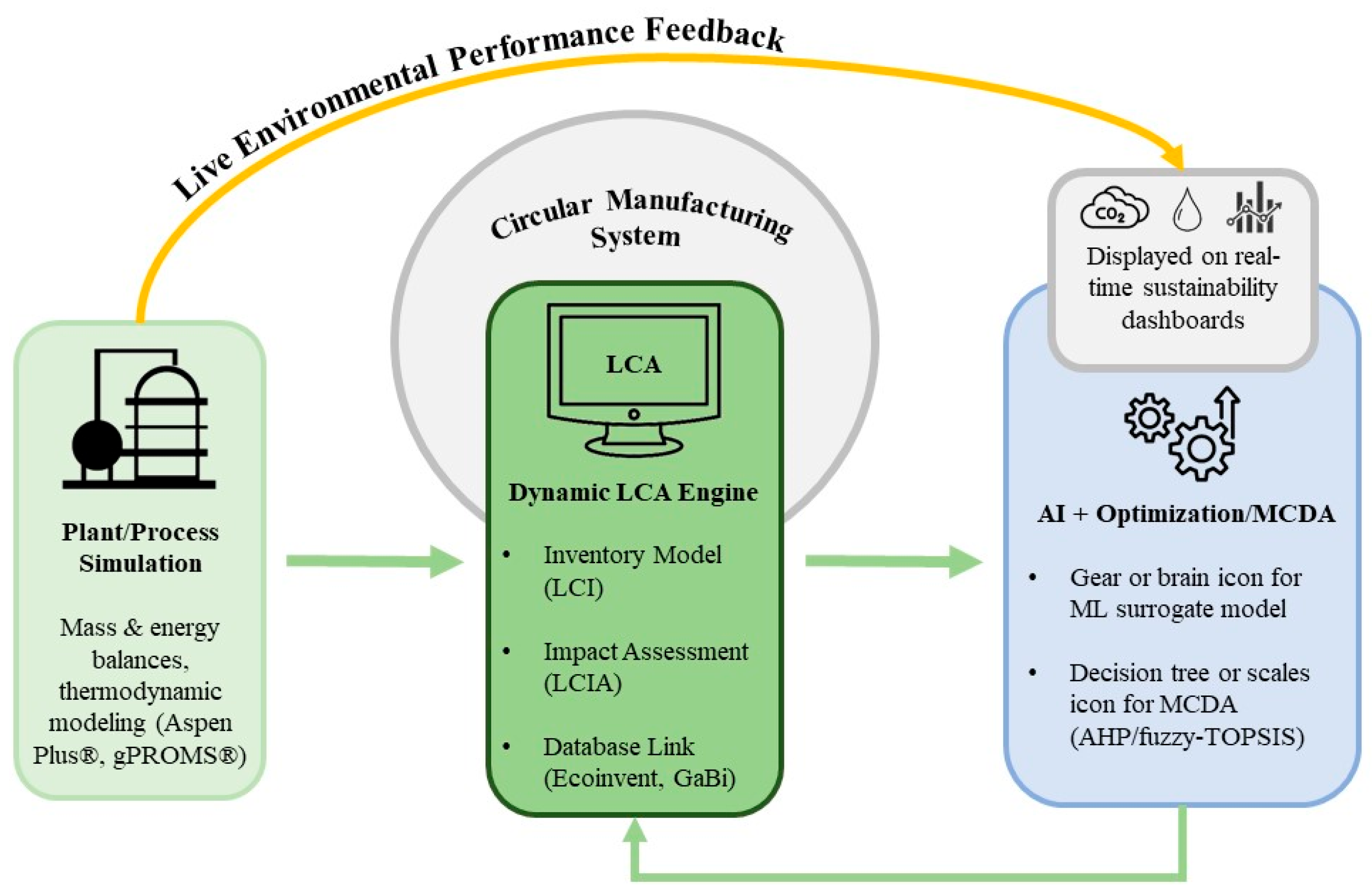
- Embedding digitalized 'live' optimization (DT + dynamic LCA + AI) into plant design/operation can turn sustainability from retrospective reporting into continuous control, enabling lower-impact recovery chains and more resilient supply of secondary resources for renewable-energy value chains.
Abstract
1. Introduction
2. Methodology
2.1. Search Strategy and Boolean Strings
2.2. Screening and Selection
2.3. Methodological Layers
2.4. Gab Analysis
3. Theoretical Foundation for Circular Industrial Optimization
3.1. Circular Economy in Industrial Systems
3.2. Life Cycle Thinking and Assessment Tools
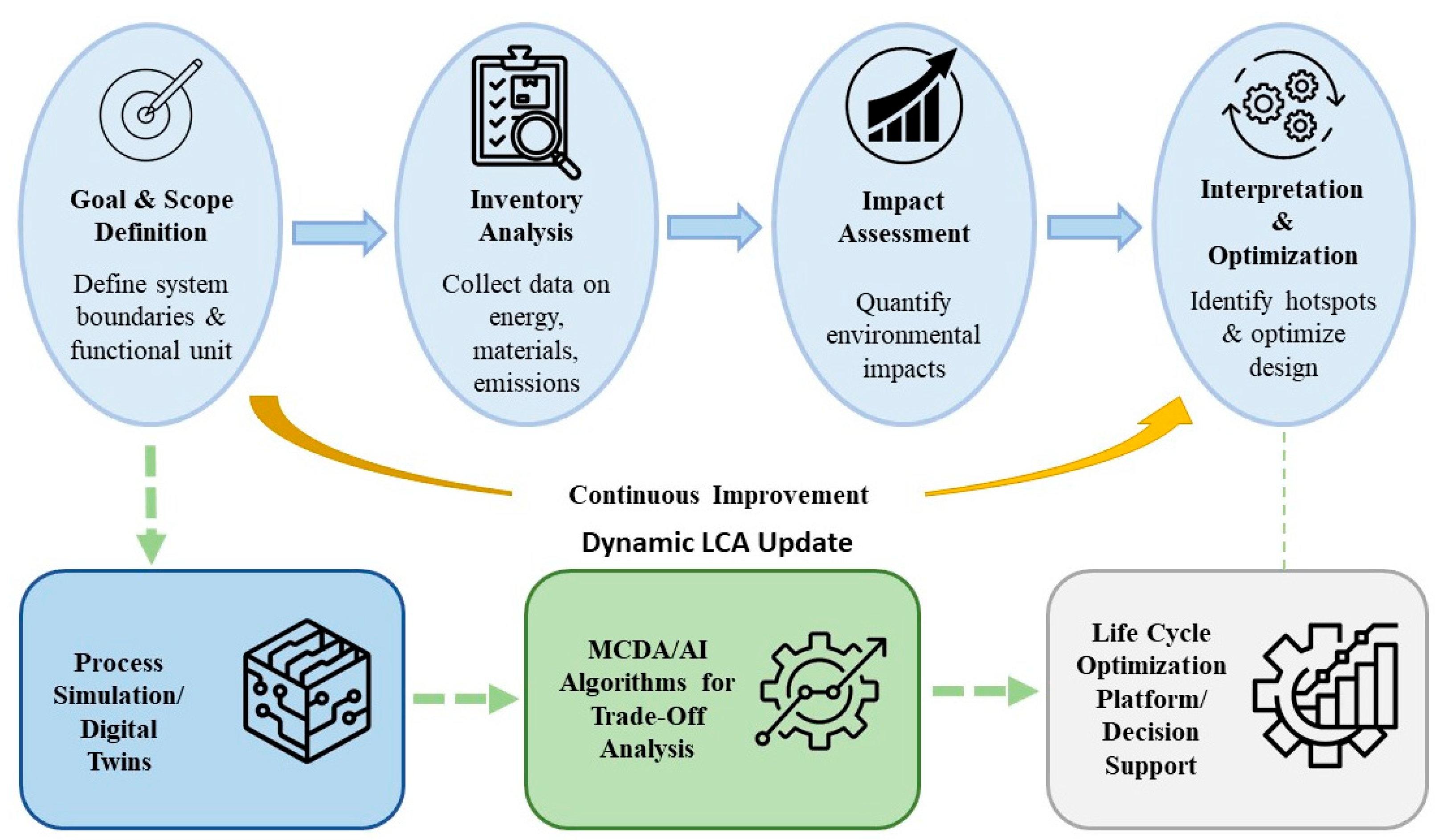
- Goal and scope definition;
- Life cycle inventory analysis;
- Impact assessment;
- Interpretation of results.
- The outcomes guide process optimization, eco-design, and sustainability evaluation in renewable energy systems, industrial processes, and by-product recovery chains [39].
4. By-Product Recovery Technologies in Renewable Energy Systems
4.1. Thermal Processes
4.2. Biological Processes
4.3. Chemical and Electrochemical Processes
4.4. Biotechnological Processes
5. Case Studies and Sectoral Applications
5.1. Battery and E-Waste Recycling
- Hydrometallurgy: Major hotspots include acid and base production (notably H2SO4, NaOH, and Na2CO3) and electricity consumption for drying and solid–liquid separations. Incorporating water reuse and gas-scrubbing systems can lower GHG emissions by 30–40% compared with base scenarios. Simulation-based LCA (EF 3.x) confirms that sulfuric acid use and process emissions dominate impact categories, while outcomes remain highly sensitive to validated reaction kinetics and plant-scale data quality [69].
- Pyrometallurgy: Hotspots are driven by high-temperature utilities and reductant combustion (e.g., coke), resulting in the highest climate burdens among recycling routes. Nevertheless, pyrometallurgical systems achieve robust Co/Ni alloy recovery and lower toxicity indices when effective flue gas cleaning is implemented. Lithium typically partitions to slag or flue dust unless recovered through downstream hydrometallurgical or solvomet steps [69,70].
- Hybrid pyro-hydro systems: Process simulation-based LCAs using the EF 3.x framework show that hybrid configurations mitigate key hotspots by combining throughput efficiency with enhanced lithium recovery, achieving 30–50% lower overall environmental impacts compared with stand-alone pyro routes [69].
- Biotechnological and solvomet routes: Although still pre-commercial, these processes show reduced toxicity and energy intensity. Their environmental performance depends on hotspot control related to nutrient medium reuse, solvent management, and bioreactor energy supply [70].
- Hybrid pyro-hydro-bio configurations enable near-complete recovery of critical metals, achieving compliance with EU Regulation 2023/1542 performance thresholds while significantly reducing energy use and reagent demand through integrated heat and water management [69].
5.2. Bioenergy and Biofuels
- Energy integration and methane slip control: Selecting upgrading and CO2-utilization technologies that minimize CH4 losses (<0.1%) and recover latent heat is critical for climate-neutral operation [83].
5.3. Industrial Wastewater and Sludge Treatment
- Nutrients (P, N). Sidestream P recovery as struvite (MgNH4PO4·6H2O) or brushite is now mainstream in digestate/centrate polishing; complementary N capture relies on ammonia stripping with acid absorption or selective membranes/ion exchange, with performance contingent on pH/temperature control and scaling management [39,40,63]. Circular sludge strategies link these units to biogas lines and fertilizer markets, but LCA benefits hinge on field emission assumptions and credible mineral-fertilizer displacement [40,63].
- Rare/precious metals. Industrial effluents (electroplating, microelectronics, catalysts) enable value recovery via biosorption/ion-exchange beads, solvomet/ionic liquid extractions, and electro-winning. For example, alginate-based sorbents selectively capture rare-earth ions from low-ppm waters, supporting a ‘wastewater-as-ore’ concept, while ionic liquids have been demonstrated for Pt-group separations and as electrolytes for electrowinning [60,92,93].
- Advanced denitrification/metal co-recovery. Emerging autotrophic denitrification processes are increasingly designed for simultaneous nitrogen removal and resource recovery, reducing chemical demand and sludge generation compared to heterotrophic systems [53,94]. Among these, Fe(II)-mediated autotrophic denitrification has demonstrated the ability to couple nitrate reduction with iron bioprecipitation, producing Fe(III) phases that can co-capture phosphate and trace metals [88]. Packed-bed trials confirmed stable operation under high nitrate loads and identified optimal Fe(II)/NO3− ratios for preventing passivation, underscoring its potential for metal- and nutrient-rich industrial effluents [95]. Other redox-driven approaches include sulfur- and hydrogen-based autotrophic denitrification, which achieve complete nitrate removal without organic carbon addition, and simultaneous nitrification-denitrification-phosphorus removal (SNDPR) configurations that integrate P recovery via biological or crystallization routes [96]. Together, these bioprocesses illustrate a shift toward multi-element recovery and energy-efficient nitrogen control, consistent with circular industrial wastewater frameworks.
- Water reuse and ZLD. High-recovery trains membrane bioreactor(MBR)/reverse osmosis (RO)/nanofiltration (NF) + brine concentration via thermal or emerging electro-membrane steps) can achieve near-closed loops; however, ZLD energy use and concentrate valorization are the dominant trade-offs, with rapid innovation around forward osmosis (FO)- or electro-enabled concentration and crystallization [80,93].
- P recovery: Sidestream struvite from anaerobic dewatering liquors reduces scaling and returns marketable fertilizer; benefits improve with magnesium dosing control, CO2-stripping integration, and digestate alkalinity management [97].
- N recovery: Ammonia stripping/acid capture (NH4HSO4/NH4NO3) and membrane contactors provide concentrated fertilizers; pairing with P recovery and heat integration lowers energy per kg-N [98].
- Coupled N removal/Fe recovery: Fe(II)-autotrophic routes provide nitrate removal without organic carbon and enable iron capture as co-product; this is attractive where iron-rich sidestreams exist [94].
- Zero-liquid discharge approaches
- ZLD/MLD. Impact hotspots are steam/electricity for brine concentration and crystallization; integrating FO/electro-deionization, heat recovery, and co-product salt markets reduces GHG and cost intensity [93].
5.4. Agri-Food and Biomass Processing
- Lignin and cellulose fibres. Lignocellulosic residues such as cereal straw, fruit peels, husks, and bagasse are abundant low-cost feedstocks for the recovery of cellulose and lignin fractions. Mechanical, chemical, and enzymatic pulping allows production of dissolving-grade pulp for regenerated fibres, achieving purity levels suitable for textile and composite applications [102]. Plakantonaki et al. [3] demonstrated that agro-waste pulps (e.g., peach, tomato stems) can be used for viscose-type fibre spinning, provided closed-loop solvent recovery and quality control are maintained (TRL 5–6) [3,102].
- Protein recovery and bioplastic precursors. Protein-rich co-products from oilseed cakes, whey, feathers, or bloodmeal can be extracted and transformed into biodegradable plastics and coatings through extrusion, compression, and 3D printing [104]. Álvarez-Castillo et al. [104] reported protein biopolymers as competitive bio-based materials with mechanical properties tunable via blending and crosslinking. Life cycle indicators show up to 50–70% lower GHG intensity versus petroleum plastics, depending on renewable energy integration [37,54].
- Glucans and hemicellulosic sugars. Hydrolytic and microbial conversion of lignocellulosic sidestreams enables production of β-glucans and other polysaccharides for nutraceutical and pharmaceutical markets [105]. Abdeshahlan et al. [105] confirmed glucan recovery via enzymatic hydrolysis of agri-residues under mild pH/temperature, although economic viability remains TRL 4–5.
- Thermochemical valorization. Advanced thermochemical routes (pyrolysis, gasification, hydrothermal liquefaction) convert agri-food residues into bio-oils, syngas, and carbon materials, contributing to energy integration within agri-industrial clusters [56,60]. Berenguer et al. [106] detailed thermochemical valorisation in Portugal, showing that co-processing olive mill and winery wastes with lignocellulosic biomass enhances carbon efficiency and circularity.
- Membrane-based separations. Membrane systems (ultrafiltration (UF)/NF/RO) facilitate gentle recovery of proteins, polyphenols, and antioxidants from agri-food effluents. Integrated membrane trains, combining filtration and pervaporation, achieve high selectivity with reduced chemical demand and can be powered by renewable electricity [107].
- Bio-based construction materials. Fibre-based panels from agri-industrial and textile residues have proven viable as thermal and acoustic insulation materials, demonstrating market readiness and real circular use of regional biofibres [108].
- Adopt mild separations: Membrane and enzymatic extractions preserve bioactivity and lower process emissions [107].
6. Integration with LCA and Optimization Strategies
6.1. Process Modelling and Dynamic Life Cycle Integration
6.2. Multi-Criteria Decision Analysis (MCDA) and Circular Trade-Offs
6.3. Digital Twins, Artificial Intelligence, and Machine Learning
- Blockchain ensures data traceability and material accountability;
- IoT provides high-frequency measurement for inventory updates;
- AI/ML supply surrogate models for process prediction;
6.4. Environmental Optimization and Insights
6.5. Industrial Maturity and Implementation Pathways
7. Policy, Economic, and Environmental Considerations
7.1. Policy Frameworks Enabling Circular Industry
7.2. Techno-Economic and Environmental Assessment
7.3. Environmental and Socio-Economic Performance
- Resource depletion mitigation via closed-loop Co/Ni/Li recovery [70];
7.4. Barriers, Integration Pathways, and Policy Alignment
8. Conclusions
Author Contributions
Funding
Data Availability Statement
Conflicts of Interest
Abbreviations
| AD | Anaerobic digestion |
| AHP | Analytic hierarchy process |
| AI | Artificial intelligence |
| ATJ | Alcohol-to-jet |
| bcm | Billion cubic metres |
| BPT | Break-pressure tank |
| CC BY | Creative commons attribution |
| CCU | Carbon capture and utilization |
| CE | Circular economy |
| CEPRES | JRC exploratory project ‘Circular economy pathway for renewable electricity supply’ |
| CFB-IND | Carbon footprint rules for industrial batteries |
| CFF | Circular footprint formula |
| CH4 | Methane |
| CHP | Combined heat and power |
| CO | Carbon monoxide |
| CO2 | Carbon dioxide |
| CRMA | Critical Raw Materials Act |
| DQR | Data quality rating |
| DES | Deep eutectic solvent |
| DT | Digital twin |
| EF | Environmental footprint |
| eLCC | Environmental life cycle costing |
| feLCC | Full Environmental life cycle costing |
| EU | European union |
| EW | Electrowinning |
| FO | Forward osmosis |
| FT | Fischer-Tropsch |
| FU | Functional unit |
| GTJ | Gas-to-jet |
| H2 | Hydrogen |
| HTC | Hydrothermal carbonization |
| HTG | Hydrothermal gasification |
| HTL | Hydrothermal liquefaction |
| IL | Ionic liquid |
| ILCD | International reference life cycle data system |
| IoT | Internet of things |
| IRR | Internal rate of return |
| ISO | International organization for standardization |
| IX | Ion exchange |
| KPI | Key performance indicator |
| LCA | Life cycle assessment |
| LCT | Life cycle thinking |
| LIB | Lithium-ion battery |
| MAE | Mean absolute error |
| MBR | Membrane bioreactor |
| MEC | Microbial electrolysis cell |
| MED | Multiple-effect distillation |
| MFC | Microbial fuel cell |
| MES | Microbial electrochemical system |
| ML | Machine learning |
| MLD | Minimal liquid discharge |
| MVC | Mechanical vapour compression |
| N2O | Nitrous oxide |
| NF | Nanofiltration |
| NH3 | Ammonia |
| NO3− | Nitrate |
| OFMSW | Organic fraction of municipal solid waste |
| OTJ | Oil-to-jet |
| PAT | Pump-as-turbine |
| PCDD/Fs | Polychlorinated dibenzo-p-dioxins and polychlorinated dibenzofurans |
| PDS | Power-delivery system |
| PRV | Pressure-reducing valve |
| PSA | Pressure swing adsorption |
| PV | Photovoltaic |
| REEs | Rare earth elements |
| RMSE | Root mean square error |
| RO | Reverse osmosis |
| SAF | Sustainable aviation fuel |
| SDT-MP | Sustainable digital twin maturity path |
| SNDPR | Simultaneous nitrification-denitrification-phosphorus removal |
| STJ | Sugar-to-jet |
| SX | Solvent extraction |
| TEA | Techno-economic analysis |
| TOPSIS | Technique for order of preference by similarity to ideal solution |
| TRL | Technology readiness level |
| UF | Ultrafiltration |
| VS | Volatile solids |
| WDS | Water-distribution system |
| WWTP | Wastewater treatment plant |
| ZLD | Zero-liquid discharge |
References
- Geissdoerfer, M.; Savaget, P.; Bocken, N.M.P.; Hultink, E.J. The Circular Economy—A New Sustainability Paradigm? J. Clean. Prod. 2017, 143, 757–768. [Google Scholar] [CrossRef]
- Kirchherr, J.; Reike, D.; Hekkert, M. Conceptualizing the Circular Economy: An Analysis of 114 Definitions. Resour. Conserv. Recycl. 2017, 127, 221–232. [Google Scholar] [CrossRef]
- Plakantonaki, S.; Zacharopoulos, N.; Christopoulos, M.; Kiskira, K.; Markou, G.; Priniotakis, G. Upcycling Industrial Peach Waste to Produce Dissolving Pulp. Environ. Sci. Pollut. Res. 2025, 32, 4636–4655. [Google Scholar] [CrossRef]
- Stahel, W.R. The Circular Economy. Nature 2016, 531, 435–438. [Google Scholar] [CrossRef] [PubMed]
- Klemeš, J.J.; Foley, A.; You, F.; Aviso, K.; Su, R.; Bokhari, A. Sustainable Energy Integration within the Circular Economy. Renew. Sustain. Energy Rev. 2023, 177, 113143. [Google Scholar] [CrossRef]
- Niero, M.; Kalbar, P.P. Coupling Material Circularity Indicators and Life Cycle Based Indicators: A Proposal to Advance the Assessment of Circular Economy Strategies at the Product Level. Resour. Conserv. Recycl. 2019, 140, 305–312. [Google Scholar] [CrossRef]
- Alevizos, V.; Yue, Z.; Edralin, S.; Xu, C.; Gerolimos, N.; Papakostas, G.A. Biomimicry-Inspired Automated Machine Learning Fit-for-Purpose Wastewater Treatment for Sustainable Water Reuse. Water 2025, 17, 1395. [Google Scholar] [CrossRef]
- Pauliuk, S. Critical Appraisal of the Circular Economy Standard BS 8001:2017 and a Dashboard of Quantitative System Indicators for Its Implementation in Organizations. Resour. Conserv. Recycl. 2018, 129, 81–92. [Google Scholar] [CrossRef]
- Antonopoulou, G.; Papadopoulou, K.; Alexandropoulou, M.; Lyberatos, G. Liquid Hot Water Treatment of Woody Biomass at Different Temperatures: The Effect on Composition and Energy Production in the Form of Gaseous Biofuels. Sustain. Chem. Pharm. 2022, 38, 101485. [Google Scholar] [CrossRef]
- Kiskira, K.; Lymperopoulou, T.; Lourentzatos, I.; Tsakanika, L.A.; Pavlopoulos, C.; Papadopoulou, K.; Ochsenkühn, K.M.; Tsopelas, F.; Chatzitheodoridis, E.; Lyberatos, G.; et al. Bioleaching of Scandium from Bauxite Residue Using Fungus Aspergillus niger. Waste Biomass Valorization 2023, 14, 3377–3390. [Google Scholar] [CrossRef]
- Mata-Lima, H.; Silva, D.W.; Nardi, D.C.; Klering, S.A.; de Oliveira, T.C.F.; Morgado-Dias, F. Waste-to-Energy: An Opportunity to Increase Renewable Energy Share and Reduce Ecological Footprint in Small Island Developing States (SIDS). Energies 2021, 14, 7586. [Google Scholar] [CrossRef]
- Kalkanis, K.; Vokas, G.; Kiskira, K.; Psomopoulos, C.S. Investigating the Sustainability of Wind Turbine Recycling: A Case Study—Greece. Mater. Circ. Econ. 2024, 6, 52. [Google Scholar] [CrossRef]
- Psomopoulos, C.S.; Kalkanis, K.; Chatzistamou, E.D.; Kiskira, K.; Ioannidis, G.C. End-of-Life Treatment of Photovoltaic Panels: Expected Volumes up to 2045 in the EU. AIP Conf. Proc. 2022, 2437, 020084. [Google Scholar] [CrossRef]
- Bourtsalas, A.C.; Papadatos, P.E.; Kiskira, K.; Kalkanis, K.; Psomopoulos, C.S. Ecodesign for Industrial Furnaces and Ovens: A Review of the Current Environmental Legislation. Sustainability 2023, 15, 9436. [Google Scholar] [CrossRef]
- Simioni, F.J.; Soares, J.F.; Rosário, J.A.; Sell, L.G.; Bertol, E.; Souza, F.M.P.; Santos Júnior, E.P.; Coelho Junior, L.M. Industrial Symbiosis and Circular Economy Practices Towards Sustainability in Forest-Based Clusters: Case Studies in Southern Brazil. Sustainability 2024, 16, 9258. [Google Scholar] [CrossRef]
- ISO 14040; Environmental Management—Life Cycle Assessment—Principles and Framework, Requirements and Guidelines. International Organization for Standardization: Geneva, Switzerland, 2006.
- Kiskira, K.; Kalkanis, K.; Coelho, F.; Plakantonaki, S.; D’Onofrio, C.; Psomopoulos, C.S.; Priniotakis, G.; Ioannidis, G.C. Life Cycle Assessment of Organic Solar Cells: Structure, Analytical Framework, and Future Product Concepts. Electronics 2025, 14, 2426. [Google Scholar] [CrossRef]
- Luo, Y.; Madarkar, R.; Luo, X.; Ball, P. Leveraging Digital Twins and Dynamic Life Cycle Assessment for Sustainable Manufacturing: A Conceptual Framework. In Proceedings of the 20th Global Conference on Sustainable Manufacturing, Ho Chi Minh City, Vietnam, 9–11 October 2024; Lecture Notes in Mechanical Engineering. Springer: Cham, Switzerland, 2024; pp. 285–293. [Google Scholar] [CrossRef]
- Petri, I.; Amin, A.; Ghoroghi, A.; Hodorog, A.; Rezgui, Y. Digital Twins for Dynamic Life Cycle Assessment in the Built Environment. Sci. Total Environ. 2025, 993, 179930. [Google Scholar] [CrossRef]
- European Commission. The European Green Deal; COM(2019) 640 Final; European Commission: Brussels, Belgium, 2019; Available online: https://eur-lex.europa.eu/legal-content/EN/TXT/?uri=CELEX:52019DC0640 (accessed on 7 August 2025).
- European Commission. Proposal for a Regulation on Critical Raw Materials; COM(2023) 160 Final; European Commission: Brussels, Belgium, 2023; Available online: https://eur-lex.europa.eu/legal-content/EN/TXT/?uri=CELEX:52023PC0160 (accessed on 15 September 2025).
- Levasseur, A.; Lesage, P.; Margni, M.; Samson, R. Considering Time in LCA: Dynamic LCA and Its Application to Global Warming Impact Assessments. Environ. Sci. Technol. 2010, 44, 3169–3174. [Google Scholar] [CrossRef] [PubMed]
- Cucurachi, S.; van der Giesen, C.V.; Guinée, J.B. Ex-ante LCA of Emerging Technologies. Procedia CIRP 2018, 69, 463–468. [Google Scholar] [CrossRef]
- Steubing, B.; de Koning, D.; Haas, A.; Mutel, C.L. The Activity Browser—An open source LCA software building on top of the brightway framework. Softw. Impacts 2020, 3, 100012. [Google Scholar] [CrossRef]
- Romeiko, X.X.; Zhang, X.; Pang, Y.; Gao, F.; Xu, M.; Lin, S.; Babbitt, C. A review of machine learning applications in life cycle assessment studies. Sci. Total Environ. 2024, 912, 168969. [Google Scholar] [CrossRef]
- Kritzinger, W.; Karner, M.; Traar, G.; Henjes, J.; Sihn, W. Digital Twin in manufacturing: A categorical literature review and classification. IFAC-PapersOnLine 2018, 51, 1016–1022. [Google Scholar] [CrossRef]
- Tao, F.; Qi, Q.; Liu, A.; Kusiak, A. Data-driven smart manufacturing. J. Manuf. Syst. 2018, 48, 157–169. [Google Scholar] [CrossRef]
- Geissdoerfer, M.; Pieroni, M.P.; Pigosso, D.C.; Soufani, K. Circular Business Models: A Review. J. Clean. Prod. 2020, 277, 123741. [Google Scholar] [CrossRef]
- Yang, M.; Chen, L.; Wang, J.; Msigwa, G.; Osman, A.I.; Fawzy, S.; Rooney, D.W.; Yap, P.-S. Circular economy strategies for combating climate change and other environmental issues. Environ. Chem. Lett. 2023, 21, 55–80. [Google Scholar] [CrossRef]
- Demartini, M.; Tonelli, F.; Govindan, K. An investigation into modelling approaches for industrial symbiosis: A literature review and research agenda. Clean. Logist. Supply Chain. 2022, 3, 100020. [Google Scholar] [CrossRef]
- Fierro, J.J.; Escudero-Atehortua, A.; Nieto-Londoño, C.; Giraldo, M.; Jouhara, H.; Wrobel, L.C. Evaluation of Waste Heat Recovery Technologies for the Cement Industry. Int. J. Thermofluids 2020, 7, 100040. [Google Scholar] [CrossRef]
- Nami, H.; Arabkoohsar, A.; Anvari-Moghaddam, A. Thermodynamic and Sustainability Analysis of a Municipal Waste-Driven Combined Cooling, Heating and Power (CCHP) Plant. Energy Convers. Manag. 2019, 201, 112158. [Google Scholar] [CrossRef]
- Daneshvar, E.; Wicker, R.J.; Show, P.L.; Bhatnagar, A. Biologically-Mediated Carbon Capture and Utilization by Microalgae towards Sustainable CO2 Biofixation and Biomass Valorization—A Review. Chem. Eng. J. 2022, 427, 130884. [Google Scholar] [CrossRef]
- Abeng, F.E.; Iroha, N.B.; Anadebe, V.C.; Guo, L. The Use of Biomass for the Enhancement of Biogas Production. In Green Chemistry, Its Role in Achieving Sustainable Development Goals; CRC Press: Boca Raton, FL, USA, 2023; Volume 1, pp. 18–54. [Google Scholar] [CrossRef]
- Li, G.; Yao, J. A Review of Algae-Based Carbon Capture, Utilization, and Storage (Algae-Based CCUS). Gases 2024, 4, 468–503. [Google Scholar] [CrossRef]
- Tawonezvi, T.; Nomnqa, M.; Petrik, L.; Bladergroen, B.J. Recovery and Recycling of Valuable Metals from Spent Lithium-Ion Batteries: A Comprehensive Review and Analysis. Energies 2023, 16, 1365. [Google Scholar] [CrossRef]
- Zamagni, A.; Guinée, J.; Heijungs, R.; Masoni, P.; Raggi, A. Lights and shadows in consequential LCA. Int. J. Life Cycle Assess. 2012, 17, 904–918. [Google Scholar] [CrossRef]
- ISO 14044; Environmental Management—Life Cycle Assessment—Requirements and Guidelines. International Organization for Standardization: Geneva, Switzerland, 2006.
- Hauschild, M.Z.; Rosenbaum, R.K.; Olsen, S.I. (Eds.) Life Cycle Assessment: Theory and Practice; Springer International Publishing: Cham, Switzerland, 2018; ISBN 978-3-319-56475-3. [Google Scholar] [CrossRef]
- Opatokun, S.A.; Lopez-Sabiron, A.; Ferreira, G.; Strezov, V. Life Cycle Analysis of Energy Production from Food Waste through Anaerobic Digestion, Pyrolysis and Integrated Energy System. Sustainability 2017, 9, 1804. [Google Scholar] [CrossRef]
- Romero-Perdomo, F.; González-Curbelo, M.Á. Integrating Multi-Criteria Techniques in Life-Cycle Tools for the Circular Bioeconomy Transition of Agri-Food Waste Biomass: A Systematic Review. Sustainability 2023, 15, 5026. [Google Scholar] [CrossRef]
- Sajadieh, S.M.M.; Noh, S.D. A Review of Digital Twin Integration in Circular Manufacturing for Sustainable Industry Transition. Sustainability 2025, 17, 7316. [Google Scholar] [CrossRef]
- European Commission. Regulation (EU) 2023/1542 on Batteries and Waste Batteries—Sustainability and Recovery Targets. Off. J. Eur. Union 2023, L 191, 1–132. Available online: https://eur-lex.europa.eu/eli/reg/2023/1542/oj/eng (accessed on 15 September 2025).
- Ardente, F.; Eynard, U.; Leccisi, E.; Mathieux, F.; Wolf, K. Harmonised Rules for the Calculation of the Carbon Footprint of Photovoltaic Modules in the Context of the EU Ecodesign Directive; JRC141275; Publications Office of the European Union: Luxembourg, 2025; Available online: https://data.europa.eu/doi/10.2760/4062978 (accessed on 15 September 2025).
- Andreasi Bassi, S.; Ardente, F.; Candelaresi, D.; Eynard, U.; Ferronato, N.; Peters, J. Rules for the Calculation of the Carbon Footprint of Industrial Batteries without External Storage (CFB-IND); JRC141282; Publications Office of the European Union: Luxembourg, 2025; Available online: https://data.europa.eu/doi/10.2760/6346639 (accessed on 1 September 2025).
- Foster, G.; Kastanaki, E.; Beauson, J.; Neuwahl, F.; Marschinski, R. Circular Economy Strategies for the EU’s Renewable Electricity Supply; JRC138570; Publications Office of the European Union: Luxembourg, 2025; Available online: https://data.europa.eu/doi/10.2760/5598339 (accessed on 15 September 2025).
- Anna, W.; Federica, A.P.; Leonidas, M.; Pablo, P.M.; Malte, B.; Luis, P.; Peter, E.; Davide, T. Capturing the Potential of the Circular Economy Transition in Energy-Intensive Industries—Summary Report; JRC142938; Publications Office of the European Union: Luxembourg, 2025; Available online: https://data.europa.eu/doi/10.2760/4604362 (accessed on 8 September 2025).
- Yang, X.; Zhang, Y.; Sun, P.; Peng, C. A Review on Renewable Energy: Conversion and Utilization of Biomass. Smart Mol. 2024, 2, e20240019. [Google Scholar] [CrossRef] [PubMed]
- El-Araby, R. Biofuel Production: Exploring Renewable Energy Solutions for a Greener Future. Biotechnol. Biofuels Bioprod. 2024, 17, 129. [Google Scholar] [CrossRef] [PubMed]
- Lytras, G.; Lytras, C.; Mathioudakis, D.; Papadopoulou, K.; Lyberatos, G. Food Waste Valorization Based on Anaerobic Digestion. Waste Biomass Valorization 2021, 12, 1677–1697. [Google Scholar] [CrossRef]
- Ideris, F.; Ong, M.Y.; Milano, J.; Zamri, M.F.M.A.; Nomanbhay, S.; Shamsuddin, A.H.; Mahlia, T.M.I.; Show, P.L. The Potential of Microalgae for Environmental Biotechnology. In Microalgae for Environmental Biotechnology; CRC Press: Boca Raton, FL, USA, 2022; pp. 67–105. [Google Scholar]
- Hatzilyberis, K.; Tsakanika, L.A.; Lymperopoulou, T.; Georgiou, P.; Kiskira, K.; Tsopelas, F.; Ochsenkühn, K.M.; Ochsenkühn-Petropoulou, M. Design of an Advanced Hydrometallurgy Process for the Intensified and Optimized Industrial Recovery of Scandium from Bauxite Residue. Chem. Eng. Process. Process Intensif. 2020, 155, 108015. [Google Scholar] [CrossRef]
- Xiang, L.; Dai, L.; Guo, K.; Wen, Z.; Ci, S.; Li, J. Microbial Electrolysis Cells for Hydrogen Production. Chin. J. Chem. Phys. 2020, 33, 263–284. [Google Scholar] [CrossRef]
- Zhang, X.; Li, X.; Li, R.; Wu, Y. Hydrothermal Carbonization and Liquefaction of Sludge for Harmless and Resource Purposes: A Review. Energy Fuels 2020, 34, 13325–13347. [Google Scholar] [CrossRef]
- Plakantonaki, S.; Stergiou, M.; Panagiotatos, G.; Kiskira, K.; Priniotakis, G. Regenerated Cellulosic Fibers from Agricultural Waste. AIP Conf. Proc. 2022, 2430, 080006. [Google Scholar] [CrossRef]
- Gollakota, A.R.K.; Kishore, N.; Gu, S. A Review on Hydrothermal Liquefaction of Biomass. Renew. Sustain. Energy Rev. 2018, 81, 1378–1392. [Google Scholar] [CrossRef]
- Yakaboylu, O.; Harinck, J.; Smit, K.G.; De Jong, W. Supercritical Water Gasification of Biomass: A Literature and Technology Overview. Energies 2015, 8, 859–894. [Google Scholar] [CrossRef]
- Wang, W.C.; Tao, L. Biojet Fuel Conversion Technologies. Renew. Sustain. Energy Rev. 2016, 53, 801–822. [Google Scholar] [CrossRef]
- Gunerhan, A.; Altuntas, O.; Caliskan, H. Utilization of Renewable and Sustainable Aviation Biofuels from Waste Tyres for Sustainable Aviation Transport Sector. Energy 2023, 276, 127566. [Google Scholar] [CrossRef]
- Barahmand, Z.; Eikeland, M.S. A Scoping Review on Environmental, Economic, and Social Impacts of the Gasification Processes. Environments 2022, 9, 92. [Google Scholar] [CrossRef]
- Elfallah, S.; Benzaouak, A.; Bayssi, O.; Hirt, A.; Mouaky, A.; El Fadili, H.; Rachidi, S.; Lotfi, E.M.; Touach, N.; El Mahi, M. Life Cycle Assessment of Biomass Conversion through Fast Pyrolysis: A Systematic Review on Technical Potential and Drawbacks. Bioresour. Technol. Rep. 2024, 21, 101832. [Google Scholar] [CrossRef]
- Ogunleye, A.; Flora, J.; Berge, N. Life Cycle Assessment of Hydrothermal Carbonization: A Review of Product Valorization Pathways. Agronomy 2024, 14, 243. [Google Scholar] [CrossRef]
- Martín-Sanz-Garrido, C.; Revuelta-Aramburu, M.; Santos-Montes, A.M.; Morales-Polo, C. A Review on Anaerobic Digestate as a Biofertilizer: Characteristics, Production, and Environmental Impacts from a Life Cycle Assessment Perspective. Appl. Sci. 2025, 15, 8635. [Google Scholar] [CrossRef]
- Kostner, M.K.; Zanfei, A.; Alberizzi, J.C.; Renzi, M.; Righetti, M.; Menapace, A. Micro Hydro Power Generation in Water Distribution Networks through the Optimal Pumps-as-Turbines Sizing and Control. Appl. Energy 2023, 345, 121802. [Google Scholar] [CrossRef]
- Bideris-Davos, A.A.; Vovos, P.N. Comprehensive Review for Energy Recovery Technologies Used in Water Distribution Systems Considering Their Performance, Technical Challenges, and Economic Viability. Water 2024, 16, 2129. [Google Scholar] [CrossRef]
- Kiskira, K.; Tsakanika, L.A.; Kritikos, A.; Ntakanas, C.; Chatzitheodoridis, E.; Papadopoulou, K.; Lyberatos, G.; Ochsenkühn-Petropoulou, M. Bioleaching of critical metals from spent lithium cobalt oxide batteries using Acidithiobacillus ferrooxidans. In Proceedings of the 14th International Conference on Instrumental Methods of Analysis: Modern Trends and Applications, Kefalonia, Greece, 14–17 September 2025. [Google Scholar] [CrossRef]
- Yang, Y.; Li, X.; Cheng, Y.; Wang, T.; Li, J.; Zhou, Y. A review on recovery processes of metals from E-waste: A green perspective. Sci. Total Environ. 2022, 859, 160391. [Google Scholar] [CrossRef]
- Awasthi, A.K.; Li, J. Management of electrical and electronic waste: A comparative evaluation of China and India. Renew. Sustain. Energy Rev. 2017, 76, 434–447. [Google Scholar] [CrossRef]
- Perocillo, Y.K.; Pirard, E.; Léonard, A. Process simulation-based LCA: Li-ion battery recycling case study. Int. J. Life Cycle Assess. 2025. [Google Scholar] [CrossRef]
- Zanoletti, A.; Carena, E.; Ferrara, C.; Bontempi, E. A review of lithium-ion battery recycling: Technologies, sustainability, and open issues. Batteries 2024, 10, 38. [Google Scholar] [CrossRef]
- Biswal, B.K.; Balasubramanian, R. Recovery of valuable metals from spent lithium-ion batteries using microbial agents for bioleaching: A review. Front. Microbiol. 2023, 14, 1197081. [Google Scholar] [CrossRef]
- Ghassa, S.; Farzanegan, A.; Gharabaghi, M.; Abdollahi, H. Novel bioleaching of waste lithium-ion batteries by mixed moderate thermophilic microorganisms, using iron scrap as energy source and reducing agent. Hydrometallurgy 2020, 197, 105465. [Google Scholar] [CrossRef]
- Roy, J.J.; Srinivasan, M.; Cao, B. Bioleaching as an eco-friendly approach for metal recovery from spent NMC-based lithium-ion batteries at a high pulp density. ACS Sustain. Chem. Eng. 2021, 9, 3060–3069. [Google Scholar] [CrossRef]
- Biswal, B.K.; Zhang, B.; Tran, P.T.M.; Zhang, J.; Balasubramanian, R. Recycling of spent lithium-ion batteries for a sustainable future: Recent advancements. Chem. Soc. Rev. 2024, 53, 5552–5592. [Google Scholar] [CrossRef] [PubMed]
- Mandl, M.M.; Lerchbammer, R.; Gerold, E. Bioleaching of lithium-ion battery black mass: A comparative study on Gluconobacter oxydans and Acidithiobacillus thiooxidans. Metals 2025, 15, 1112. [Google Scholar] [CrossRef]
- Mishra, S.; Ghosh, S.; van Hullebusch, E.D.; Singh, S.; Das, A.P. A critical review on the recovery of base and critical elements from electronic waste-contaminated streams using microbial biotechnology. Appl. Biochem. Biotechnol. 2023, 195, 7859–7888. [Google Scholar] [CrossRef] [PubMed]
- Ghulam, S.T.; Abushammala, H. Challenges and opportunities in the management of electronic waste and its impact on human health and environment. Sustainability 2023, 15, 1837. [Google Scholar] [CrossRef]
- Kalkanis, K.; Kiskira, K.; Papageorgas, P.; Kaminaris, S.D.; Piromalis, D.; Banis, G.; Mpelesis, D.; Batagiannis, A. Advanced Manufacturing Design of an Emergency Mechanical Ventilator via 3D Printing—Effective Crisis Response. Sustainability 2023, 15, 2857. [Google Scholar] [CrossRef]
- Rezania, S.; Oryani, B.; Nasrollahi, V.R.; Darajeh, N.; Lotfi Ghahroud, M.; Mehranzamir, K. Review on Waste-to-Energy Approaches toward a Circular Economy in Developed and Developing Countries. Processes 2023, 11, 2566. [Google Scholar] [CrossRef]
- Adnan, A.I.; Ong, M.Y.; Nomanbhay, S.; Chew, K.W.; Show, P.L. Technologies for Biogas Upgrading to Biomethane: A Review. Bioengineering 2019, 6, 92. [Google Scholar] [CrossRef]
- Motola, V.; Scarlat, N.; Hurtig, O.; Buffi, M.; Georgakaki, A.; Letout, S.; Mountraki, A.; Salvucci, R.; Schmitz, A. Clean Energy Technology Observatory: Bioenergy in the European Union—2023 Status Report on Technology Development, Trends, Value Chains and Markets; JRC135079; Publications Office of the European Union: Luxembourg, 2023. [Google Scholar] [CrossRef]
- Gas Infrastructure Europe (GIE); European Biogas Association (EBA). European Biomethane Map 2025: Bioenergy and Biomethane Developments in Europe; European Biogas Association: Brussels, Belgium, 2025; Available online: https://www.europeanbiogas.eu/publication/european-biomethane-map-2025/ (accessed on 25 September 2025).
- López, A.F.; Rodríguez, T.L.; Abdolmaleki, S.F.; Martínez, M.G.; Bugallo, P.M.B. From Biogas to Biomethane: An In-Depth Review of Upgrading Technologies That Enhance Sustainability and Reduce Greenhouse Gas Emissions. Appl. Sci. 2024, 14, 2342. [Google Scholar] [CrossRef]
- Olatoyan, O.J.; Kareem, M.A.; Adebanjo, A.U.; Olawale, S.O.A.; Alao, K.T. Potential use of biomass ash as a sustainable alternative for fly ash in concrete production: A review. Hybrid Adv. 2023, 4, 100076. [Google Scholar] [CrossRef]
- Chojnacka, K.; Moustakas, K. Anaerobic Digestate Management for Carbon Neutrality and Fertilizer Use: A Review of Current Practices and Future Opportunities. Biomass Bioenergy 2023, 176, 106991. [Google Scholar] [CrossRef]
- Elsayed, M.; Eraky, M.; Osman, A.I.; Wang, J.; Farghali, M.; Rashwan, A.K.; Yacoub, I.H.; Hanelt, D.; Abomohra, A. Sustainable valorization of waste glycerol into bioethanol and biodiesel through biocircular approaches: A review. Environ. Chem. Lett. 2024, 22, 609–634. [Google Scholar] [CrossRef]
- Kaur, J.; Sarma, A.K.; Jha, M.K.; Gera, P. Valorisation of crude glycerol to value-added products: Perspectives of process technology, economics and environmental issues. Biotechnol. Rep. 2020, 25, e00487. [Google Scholar] [CrossRef]
- Vanapalli, K.R.; Nongdren, L.; Maity, S.K.; Kumar, V. Comparative Life Cycle Assessment of Glycerol Valorization Routes to 1,2- and 1,3-Propanediol Based on Process Modeling. ACS Sustain. Chem. Eng. 2024, 12, 14716–14731. [Google Scholar] [CrossRef]
- Alevizos, V.; Gerolimos, N.; Edralin, S.; Xu, C.; Simasiku, A.; Priniotakis, G.; Papakostas, G.A. Systematic Review on Sustainable Design Thinking through Biomimetic Approach. In Proceedings of the 2025 International Conference on Artificial Intelligence in Information and Communication Systems, Fukuoka, Japan, 18–21 February 2025; IEEE: New York, NY, USA, 2025. [Google Scholar]
- Pintilie, L.; Torres, C.M.; Teodosiu, C.; Castells, F. Urban wastewater reclamation for industrial reuse: An LCA case study. J. Clean. Prod. 2016, 137, 1014–1024. [Google Scholar] [CrossRef]
- Buonocore, E.; Mellino, S.; De Angelis, G.; Liu, G.; Ulgiati, S. Life cycle assessment indicators of urban wastewater and sewage sludge treatment. Ecol. Indic. 2018, 94, 13–23. [Google Scholar] [CrossRef]
- Adeeyo, A.O.; Bello, O.S.; Agboola, O.S.; Adeeyo, R.O.; Oyetade, J.A.; Alabi, M.A.; Edokpayi, J.N.; Makungo, R. Recovery of precious metals from processed wastewater: Conventional techniques nexus advanced and pragmatic alternatives. Water Reuse 2023, 13, 134. [Google Scholar] [CrossRef]
- Liang, Y.; Lin, X.; Kong, X.; Duan, Q.; Wang, P.; Mei, X.; Ma, J. Making Waves: Zero Liquid Discharge for Sustainable Industrial Effluent Management. Water 2021, 13, 2852. [Google Scholar] [CrossRef]
- Kiskira, K.; Papirio, S.; van Hullebusch, E.D.; Esposito, G. Fe(II)-mediated autotrophic denitrification: A new bioprocess for iron bioprecipitation/biorecovery and simultaneous treatment of nitrate-containing wastewaters. Int. Biodeterior. Biodegrad. 2017, 119, 631–648. [Google Scholar] [CrossRef]
- Kiskira, K.; Papirio, S.; Pechaud, Y.; Matassa, S.; van Hullebusch, E.D.; Esposito, G. Evaluation of Fe(II)-Driven Autotrophic Denitrification in Packed-Bed Reactors at Different Nitrate Loading Rates. Process Saf. Environ. Prot. 2020, 142, 317–324. [Google Scholar] [CrossRef]
- He, Q.; Xie, Z.; Tang, M.; Fu, Z.; Ma, J.; Wang, H.; Zhang, W.; Hu, J.; Xu, P. Insights into the Simultaneous Nitrification, Denitrification and Phosphorus Removal Process for In Situ Sludge Reduction and Potential Phosphorus Recovery. Sci. Total Environ. 2021, 801, 149569. [Google Scholar] [CrossRef]
- Cieślik, B.; Konieczka, P. A review of phosphorus recovery methods at various steps of wastewater treatment and sewage sludge management. J. Clean. Prod. 2017, 142, 1728–1740. [Google Scholar] [CrossRef]
- Van der Hoek, J.P.; Duijff, R.; Reinstra, O. Nitrogen Recovery from Wastewater: Possibilities, Competition with Other Resources, and Adaptation Pathways. Sustainability 2018, 10, 4605. [Google Scholar] [CrossRef]
- Taghvaie Nakhjiri, A.; Sanaeepur, H.; Ebadi Amooghin, A.; Shirazi, M.M.A. Recovery of Precious Metals from Industrial Wastewater towards Resource Recovery and Environmental Sustainability: A Critical Review. Desalination 2022, 527, 115510. [Google Scholar] [CrossRef]
- Jahan, N.; Tahmid, M.; Shoronika, A.Z.; Fariha, A.; Roy, H.; Pervez, M.N.; Cai, Y.; Naddeo, V.; Islam, M.S. A Comprehensive Review on the Sustainable Treatment of Textile Wastewater: Zero Liquid Discharge and Resource Recovery Perspectives. Sustainability 2022, 14, 15398. [Google Scholar] [CrossRef]
- Mikucioniene, D.; Mínguez-García, D.; Repon, M.R.; Milašius, R.; Priniotakis, G.; Chronis, I.; Kiskira, K.; Hogeboom, R.; Belda-Anaya, R.; Díaz-García, P. Understanding and Addressing the Water Footprint in the Textile Sector: A Review. AUTEX Res. J. 2024, 24, 20240004. [Google Scholar] [CrossRef]
- Plakantonaki, S.; Kiskira, K.; Zacharopoulos, N.; Belessi, V.; Sfyroera, E.; Priniotakis, G.; Athanasekou, C. Investigating the Routes to Produce Cellulose Fibers from Agro-Waste: An Upcycling Process. ChemEngineering 2024, 8, 112. [Google Scholar] [CrossRef]
- Berenguer, C.V.; Andrade, C.; Pereira, J.A.M.; Perestrelo, R.; Câmara, J.S. Current Challenges in the Sustainable Valorisation of Agri-Food Wastes: A Review. Processes 2023, 11, 20. [Google Scholar] [CrossRef]
- Álvarez-Castillo, E.; Felix, M.; Bengoechea, C.; Guerrero, A. Proteins from Agri-Food Industrial Biowastes or Co-Products and Their Applications as Green Materials. Foods 2021, 10, 981. [Google Scholar] [CrossRef]
- Abdeshahian, P.; Jiménez Ascencio, J.; Philippini, R.R.; Antunes, F.A.F.; de Carvalho, A.S.; Abdeshahian, M.; dos Santos, J.C.; da Silva, S.S. Valorization of Lignocellulosic Biomass and Agri-Food Processing Wastes for Production of Glucan Polymer. Waste Biomass Valorization 2021, 12, 2915–2931. [Google Scholar] [CrossRef]
- Berenguer, C.V.; Perestrelo, R.; Pereira, J.A.M.; Câmara, J.S. Management of Agri-Food Waste Based on Thermochemical Processes towards a Circular Bioeconomy Concept: The Case Study of the Portuguese Industry. Processes 2023, 11, 2870. [Google Scholar] [CrossRef]
- Papaioannou, E.H.; Mazzei, R.; Bazzarelli, F.; Piacentini, E.; Giannakopoulos, V.; Roberts, M.R.; Giorno, L. Agri-Food Industry Waste as Resource of Chemicals: The Role of Membrane Technology in Their Sustainable Recycling. Sustainability 2022, 14, 1483. [Google Scholar] [CrossRef]
- Savio, L.; Pennacchio, R.; Patrucco, A.; Manni, V.; Bosia, D. Natural Fibre Insulation Materials: Use of Textile and Agri-food Waste in a Circular Economy Perspective. Mater. Circ. Econ. 2022, 4, 6. [Google Scholar] [CrossRef]
- Klein, O.; Nier, S.; Tamásy, C. Towards a Circular Bioeconomy? Pathways and Spatialities of Agri-Food Waste Valorisation. Tijdschr. Econ. Soc. Geogr. 2022, 113, 194–210. [Google Scholar] [CrossRef]
- Stillitano, T.; Spada, E.; Iofrida, N.; Falcone, G.; De Luca, A.I. Sustainable Agri-Food Processes and Circular Economy Pathways in a Life Cycle Perspective: State of the Art of Applicative Research. Sustainability 2021, 13, 2472. [Google Scholar] [CrossRef]
- Popowicz, M.; Katzer, N.J.; Kettele, M.; Schöggl, J.-P.; Baumgartner, R.J. Digital Technologies for Life Cycle Assessment: A Review and Integrated Combination Framework. Int. J. Life Cycle Assess. 2025, 30, 405–428. [Google Scholar] [CrossRef]
- Köck, B.; Friedl, A.; Serna Loaiza, S.; Wukovits, W.; Mihalyi-Schneider, B. Automation of Life Cycle Assessment—A Critical Review of Developments in the Field of Life Cycle Inventory Analysis. Sustainability 2023, 15, 5531. [Google Scholar] [CrossRef]
- Heidak, P.; Isbert, A.-M.; Haas, S.; Schmidt, M. Integration of Recent Prospective LCA Developments into Dynamic LCA of Circular Economy Strategies for Wind Turbines. Energies 2025, 18, 2509. [Google Scholar] [CrossRef]
- Ferdous, J.; Bensebaa, F.; Pelletier, N. Integration of LCA, TEA, Process Simulation and Optimization: A Systematic Review of Current Practices and Scope to Propose a Framework for Pulse Processing Pathways. J. Clean. Prod. 2023, 402, 136804. [Google Scholar] [CrossRef]
- Salla, J.V.E.; de Almeida, T.A.; Silva, D.A.L. Integrating Machine Learning with Life Cycle Assessment: A Comprehensive Review and Guide for Predicting Environmental Impacts. Int. J. Life Cycle Assess. 2025. [Google Scholar] [CrossRef]
- Georgescu, L.P.; Fortea, C.; Antohi, V.M.; Balsalobre-Lorente, D.; Zlati, M.L.; Barbuta-Misu, N. Economic, Technological and Environmental Drivers of the Circular Economy in the European Union: A Panel Data Analysis. Environ. Sci. Eur. 2025, 37, 76. [Google Scholar] [CrossRef]
- Baldassarre, B.; Carrara, S. Critical Raw Materials, Circular Economy, Sustainable Development: EU Policy Reflections for Future Research and Innovation. Resour. Conserv. Recycl. 2024, 205, 108060. [Google Scholar] [CrossRef]



| Circular Economy Principle | Industrial Strategy | Example Application in Renewable Energy/Manufacturing | Expected Outcome |
|---|---|---|---|
| Design for reuse and durability | Modular design, material substitution | Reusable components in wind turbines and PV modules [12,13] | Extended product lifetime, reduced raw material use |
| Resource efficiency | Energy integration, process optimization | Heat recovery in bioenergy and cement plants [31,32] | Lower energy demand, improved thermal efficiency |
| Waste valorization | By-product recovery, waste-to-energy conversion | Biomass and sludge conversion to biogas and fertilizers [33,34] | Reduced landfill, renewable energy generation |
| Industrial symbiosis | Cross-sector resource exchange | Utilization of CO2 from bioenergy for algae cultivation [35] | Reduced emissions, new product streams |
| Circular supply chains | Reverse logistics, remanufacturing | Battery recycling and metal recovery [36] | Resource security, reduced dependency on virgin ores |
| Eco-design and regulation | Compliance with EU eco-design directives | Furnaces and ovens designed under CE legislation [14] | Environmental compliance, improved energy ratings |
| Technology Family | Typical Operating Window | Illustrative Example | Main Products/Outcomes | Key References |
|---|---|---|---|---|
| Thermal | Pyrolysis (400–600 °C, O2-free); Gasification (700–900 °C, O2-limited); HTL (280–370 °C, 10–25 MPa) | Hydrothermal liquefaction of microalgae producing biocrude blended into SAF | Biocrude, syngas, char, upgraded liquid fuels | [51] |
| Biological | AD (35–55 °C); Fermentation (30–40 °C); Composting (ambient−60 °C) | Co-digestion of sewage sludge + food waste yielding 0.45–0.52 L CH4 g−1 VS | Biogas (CH4 + CO2), digestate fertilizers, bio-ethanol | [34,40] |
| Chemical/Electrochemical | Acid/base leaching (20–90 °C); Solvent extraction/electrowinning (1–5 V) | Hydrometallurgical recovery of Sc from bauxite residue (≈95% efficiency) | Recovered metals, purified electrolytes | [52] |
| Biotechnological | Ambient−40 °C; pH 2–5; microbial electrolysis 0.8–1.2 V | Bioleaching of rare earth elements; microbial fuel cells for wastewater H2 recovery | Recovered critical metals, bio-H2, electricity | [10,53] |
| Integration Domain | Core Method/Tool | Application Focus | Reported Benefits | TRL Range | Key References |
|---|---|---|---|---|---|
| Process Simulation LCA | Aspen Plus®, gPROMS®, integrated inventory modules | Process design, energy recovery, solvent recirculation | 20–40% GHG reduction via heat integration | 8–9 | [40,61,83,111] |
| MCDA-LCA Coupling | Analytic hierarchy process (AHP), fuzzy-technique for order of preference by similarity to ideal solution (TOPSIS) | Technology ranking, circular trade-off analysis | Transparent multi-criteria prioritization | 7–8 | [41,112] |
| Digital Twin Integration | Sustainable DT Maturity Path (SDT-MP) | Water reuse, manufacturing, energy systems | Up to 30% energy savings, real-time key performance indicator (KPI) feedback | 6–8 | [42,113] |
| Artificial intelligence (AI)/machine learning (ML)-LCA Fusion | ML regression, surrogate models, neural networks | Impact prediction, dynamic inventory estimation | Automated “live” LCA updates, reduced modelling time | 5–7 | [25,114] |
Disclaimer/Publisher’s Note: The statements, opinions and data contained in all publications are solely those of the individual author(s) and contributor(s) and not of MDPI and/or the editor(s). MDPI and/or the editor(s) disclaim responsibility for any injury to people or property resulting from any ideas, methods, instructions or products referred to in the content. |
© 2026 by the authors. Licensee MDPI, Basel, Switzerland. This article is an open access article distributed under the terms and conditions of the Creative Commons Attribution (CC BY) license.
Share and Cite
Kiskira, K.; Plakantonaki, S.; Gerolimos, N.; Kalkanis, K.; Sfyroera, E.; Coelho, F.; Priniotakis, G. Life Cycle Optimization of Circular Industrial Processes: Advances in By-Product Recovery for Renewable Energy Applications. Clean Technol. 2026, 8, 5. https://doi.org/10.3390/cleantechnol8010005
Kiskira K, Plakantonaki S, Gerolimos N, Kalkanis K, Sfyroera E, Coelho F, Priniotakis G. Life Cycle Optimization of Circular Industrial Processes: Advances in By-Product Recovery for Renewable Energy Applications. Clean Technologies. 2026; 8(1):5. https://doi.org/10.3390/cleantechnol8010005
Chicago/Turabian StyleKiskira, Kyriaki, Sofia Plakantonaki, Nikitas Gerolimos, Konstantinos Kalkanis, Emmanouela Sfyroera, Fernando Coelho, and Georgios Priniotakis. 2026. "Life Cycle Optimization of Circular Industrial Processes: Advances in By-Product Recovery for Renewable Energy Applications" Clean Technologies 8, no. 1: 5. https://doi.org/10.3390/cleantechnol8010005
APA StyleKiskira, K., Plakantonaki, S., Gerolimos, N., Kalkanis, K., Sfyroera, E., Coelho, F., & Priniotakis, G. (2026). Life Cycle Optimization of Circular Industrial Processes: Advances in By-Product Recovery for Renewable Energy Applications. Clean Technologies, 8(1), 5. https://doi.org/10.3390/cleantechnol8010005