Article

Liquid Addition Techniques to Enhance Methane Biotrickling Filters at Dairy Barn Concentrations

Department of Chemical and Process Engineering, University of Canterbury, Christchurch 8140, New Zealand
*
Authors to whom correspondence should be addressed.
Clean Technol. 2026, 8(1), 3; https://doi.org/10.3390/cleantechnol8010003
Submission received: 12 November 2025 / Revised: 15 December 2025 / Accepted: 23 December 2025 / Published: 31 December 2025

Abstract

Dilute methane (CH4) emissions from dairy barns (<500 ppm) are a challenging agricultural greenhouse-gas source to abate via biofiltration because its poor solubility makes gas–liquid mass transfer a primary limitation in biotrickling filters (BTFs). Here, we evaluated lab-scale BTFs for treating dairy-relevant CH4 concentrations and tested two enhancement strategies: (1) aerosolised nutrient delivery to improve liquid distribution and (2) reduced liquid addition rates to increase gas–liquid mass-transfer efficiency. Liquid-fed BTFs and aerosol-fed BTFs (ABTFs) packed with scoria or glass beads were compared. Aerosolised nutrients reduced the elimination capacity (EC) compared to biotrickling delivery. Switching from liquid to aerosol decreased an initial EC of ~30 g m−3 h−1 by 35% at 2500 ppm CH4, and the original EC was not recoverable. Slower liquid addition consistently improved CH4 removal for both delivery techniques. In a glass bead ABTF at 2500 ppm CH4, the EC increased from 5.5 to 12.4 g m−3 h−1 when the liquid coalescence rate decreased from 0.79 to 0.006 cm h−1. In a scoria ABTF, a 1.5-fold increase in EC was observed as the rate decreased from 2.36 to 0.15 cm h−1. Below a threshold liquid addition rate in the scoria BTF, the EC dropped ~33%, likely due to uneven wetting or high pH conditions. Therefore, optimising liquid delivery can significantly enhance BTF performance for agricultural CH4 mitigation.

1. Introduction

Climate change due to greenhouse gas (GHG) emissions has become one of the most pressing issues globally [1,2,3]. In Aotearoa-New Zealand (A-NZ), major GHG emissions include methane (CH4, 44.2%), carbon dioxide (CO2, 44.1%), nitrous oxide (N2O, 9.71%), and fluorinated gases (1.99%) on a CO2-equivalence basis [4]. A-NZ is unique in that CH4 represents one of the greatest GHG emission contributors due to its economic reliance on agriculture [2]. Agriculture currently produces 88.4% of A-NZ’s total CH4 emissions [5]. Of this, 71% are attributed to enteric fermentation [6], making the agricultural sector, in particular ruminant animals, a focus for emissions reduction strategies. Modelling carried out by Reisinger [7] showed that A-NZ needs to decrease its biogenic CH4 emissions by 10 to 22% from 2018 levels to have no additional global warming effects.
Currently, there are no viable solutions for treating the dilute CH4 emissions (<500 ppm) emitted directly by ruminants [8,9]. Despite herd reduction being an option, it is uneconomical, as the demand for meat and dairy is predicted to increase by 50% globally by 2050 [10,11]. This has led to a worldwide effort to develop CH4 mitigation techniques to inhibit ruminant methanogenic activity, including novel feed supplements [12], vaccinations [13,14], boluses [15], and selective breeding [16,17]. However, feed supplementation is not currently approved in A-NZ and does not align with the open pasture grazing that is predominantly used [7,9,18,19]; vaccination requires years of development and is unlikely to be available for commercial use before 2030 [7,20], and it is estimated that it will take until 2050 to breed cattle that produce 15% less CH4 from the current baseline [7,17]. Combustion of CH4, commonly used in wastewater treatment settings, is unviable for cattle barn emissions due to low concentrations (<0.05 v/v%), well below the 5 v/v% required for ignition, so it would a require a supplemental fuel source [18,21]. Catalytic oxidation is another option able to treat dilute CH4 [22]; however, it is expensive and requires high temperatures (>400 °C).
CH4 biofiltration using biotrickling filters (BTFs) represents a potentially attractive and sustainable approach for mitigating dilute CH4 emissions from sources such as dairy barns. The major challenge with using BTFs for CH4 removal from dairy barns is the dilute concentrations of CH4 present (<500 ppm) [8,23]. CH4 has poor solubility in water (1.24 mM at 100% CH4 and 1 atm) [1]. The combination of CH4’s poor solubility and dilute concentrations often makes the gas-to-liquid mass transfer the rate-limiting step in its biological degradation [24]. Ferdowsi et al. [25] observed that increased water content in the biofilm layer hinders the mass transfer of contaminants, such as CH4, to the active microbial zone. The delivery of liquid nutrients via small aerosol droplets (~1–10 μm) can potentially create a thin and even liquid layer in BTFs, thereby maximising gas-to-liquid mass transfer and ensuring maximal packing coverage within the BTF bed [26]. De Vela and Gostomski [27] previously reported that aerosol delivery of nutrients along with a high gas recycle rate in a differential biotrickling filter enhanced biofilm distribution and growth. The even distribution of biomass combined with the thin liquid film contributed to an EC up to 38 times greater than typically reported EC values for toluene.
In this study, the feasibility of applying BTFs to mitigate dilute CH4 emissions from dairy barns, with a focus on overcoming mass transfer limitations, was investigated. Two enhancement strategies were explored: (1) the use of aerosolised nutrient delivery to produce a thinner and more uniformly distributed liquid film across the packing material and (2) the reduction of liquid addition rates to minimise excess moisture and improve gas-to-liquid transfer. A series of lab-scale BTFs were operated under varying CH4 concentrations and nutrient delivery modes to evaluate the effects of these strategies on CH4 removal efficiency (RE) and EC. By examining how operational parameters influence mass transfer and microbial activity, this study provides insights into the viability of BTFs as a methane mitigation technology for agricultural settings in A-NZ and globally.

2. Materials and Methods

2.1. Biotrickling Filter Design and Gas Delivery

In total, four custom BTFs were constructed from clear acrylic (52 mm internal diameter (I.D.), 400 mm total height, 260 mm packing height) for this study. The growth of unwanted photoautotrophic microorganisms was prevented by covering the columns and media reservoirs with aluminium foil to block light. A circle of wire mesh (grid size 2 mm by 2 mm) elevated 50 mm from the bottom of the column supported the packing material. Glass beads (5 mm diameter) or scoria were used as the packing material. Scoria was chosen as it is commonly used in biofilters [28,29] due to its low cost and accessibility. The scoria (Daltons, Coarse Scoria, Matamata, New Zealand, 2022) was first crushed with a hydraulic press before being sieved into 2 to 5.6 mm pieces. Each scoria column was packed with 4 to 5.6 mm and 2 to 4 mm pieces (50% each by mass, 185 g each) to a height of 26 cm. Glass beads were used as a comparator to scoria because, although they are also inert and inexpensive, they have a uniform shape and lack internal pores.
All CH4 supplied was ultra-high purity grade (99.99%, Coregas, Auckland, New Zealand). Compressed air was supplied by first passing it through a carbon dioxide (CO2) scrubber (CO2-PG28 Purge Gas Generator, Broomfield, CO, USA) to create a consistent < 40 ppm CO2 dry air stream. The CH4 concentration entering the reactor was controlled by two mass flow controllers (Alicat Scientific, Marana, AZ, USA) to create the desired CH4 concentration in CO2-free air. All BTFs were maintained at 21 (±3) °C. Aerosol nitrate mineral salts (Ar-NMS) were used as the growth medium in all BTFs. Ar-NMS was developed from NMS [30] and V4 medium [31] to provide a full growth medium but prevent Ca and Mg phosphate salts from precipitating on the aerosol transducer. Briefly, Ar-NMS contained the following: 20 mM KNO3, 0.1 mM MgSO4∙7H2O, 0.1 mM CaCl2∙2H2O, 1.6 mM Na2SO4, 20 mM Na2HPO4, 20 mM KH2PO4, 0.2 μM Ce(SO4)2, 0.2 μM La2(SO4)2, 0.039 μM CuSO4∙5H2O, 0.018 μM Na2∙EDTA, 0.017 μM FeSO4∙7H2O, 7.9 nM N(CH2COOH)3, 5.0 nM H3BO3, 4.5 nM ZnSO4∙7H2O, 2.9 nM MnCl2∙4H2O, 2.6 nM CoCl2∙6H2O, 1.36 nM Na2MoO4∙2H2O, 1.2 nM Na2SeO4∙10H2O, 0.8 nM MnSO4∙4H2O, 0.5 nM Fe(NH4)2(SO4)2∙6H2O, 0.3 nM NaWO4∙2H2O, 0.19 nM NiCl2∙6H2O, and 0.17 nM AlCl3∙6H2O. The medium was adjusted to pH 6.8 (±0.1) prior to autoclaving (121 °C, 12 psi, 20 min).
All measurements of inlet and outlet CH4, CO2, N2O, water, and ammonia concentrations were performed using a Gasera One photoacoustic spectrometer equipped with a multiport selection valve (Gasera, Turku, Finland) at a sampling flow rate of 1 L min−1. Hence, a total gas flowrate into each BTF was maintained at ≥1.5 L min−1. Gasera One is a cantilever-enhanced photoacoustic spectroscopy analyser. During operation, modulated infrared radiation passes through a measurement cell (<30 mL), target gases absorb at species-specific wavelengths, and the periodic heating generates pressure waves (the photoacoustic effect). These acoustic waves are detected with an ultra-sensitive micro-electromechanical Systems cantilever “optical microphone,” whose deflection is read interferometrically, enabling very low detection limits and high zero-point stability. Operation of the Gasera One photoacoustic spectrometer was performed with the following parameter settings: target cell pressure, 850 mbar; bypass line flush time, 5 s; measuring cell flush time, 5 s; total number of cell flushes, 7. Sampling was set to continuously cycle through each of the connected channels in the multipoint sampler (n = 8).
The pressure drop across BTF columns was routinely measured using an AZ Instrument Corp. 96315 (Taichung City, Taiwan) datalogging manometer connected to sample ports in either side of the BTF bed. Samples of the effluent Ar-NMS medium were routinely collected and then filtered (0.2-μm) and stored at −20 °C until required for analysis. Nitrate and nitrite concentrations were determined using a microvolume Griess reagent [32] and vanadium(III) chloride assay protocol developed by Laidin et al. [33], modified from García-Robledo et al. [34] and Miranda et al. [35]. This method was selected because it is a well-validated, sensitive, and high-throughput approach that requires only small sample volumes, allowing routine triplicate analysis of the large number of effluent samples generated during long-term BTF operation. Triplicate samples were analysed in clear flat-bottom 96-well plates (Cellstar, Greiner Bio-One, Kremsmünster, Austria) using a Cytation 5 cell-plate reader (BioTek, Winooski, VT, USA) at a wavelength of 540 nm. The pH of the effluent medium was monitored with a ThermoFisher Scientific Eutech Instruments pH510 pH probe (Waltham, MA, USA).
Following each BTF operational parameter change, the system was allowed to reach a new steady state (as determined when the elimination capacity (EC) varied <5% for ≥2 days) before sampling resumed. All EC data points represent the average of ≥90 data points, with the uncertainties representing one standard deviation (unless otherwise specified). A weighted average and uncertainty were used for averages where the individual parameters had differing uncertainties associated with them to account for these differences (e.g., for liquid coalescence rates, nitrate consumption rates etc.). Unless otherwise stated, all statistical analyses (e.g., ANOVA at α = 0.05 and linear regression) were conducted in GraphPad Prism (v10.6.1) using the software’s built-in analysis tools.
The inoculum for all BTFs was sourced from a pre-existing CH4 BTF running at 20,000 ppm inlet CH4 that was originally inoculated using sediment from the cliff exposures of a Canterbury Plains aquifer, Lowcliffe, Aotearoa-New Zealand [36]. The microbial community composition of this BTF is well described [36,37,38]. Approximately 15 g of wet biomass was harvested from this BTF and mixed with 50 mL of Ar-NMS medium. The growth medium/biomass mixture was then poured over each column, and the columns were subsequently inverted to ensure an even distribution of biomass.

2.2. Aerosol Production

The first prototype aerosol chamber was used for the glass bead aerosol BTF (ABTFGB). This chamber was constructed using circular acrylic tubing (175 mm I.D., 4 mm wall thickness, 185 cm height, Figure S1). Subsequently, the aerosol chambers for the scoria BTFs (ABTFSC) were constructed from glass piping (93 mm I.D., 100 mm O.D., 167 mm height, Figure S2). These chambers were modified from the original design to minimise the footprint, incorporate a built-in on/off timer system, and allow easier opening and cleaning. In all chambers, aerosolised nutrients were generated using an ultrasonic aerosol generator (TDK NB-59S-09S, Tokyo, Japan) installed at the base of the chamber, with a liquid level maintained 40 mm above the surface of the piezoelectric membrane [27]. Each aerosol chamber included two 13 mm ports on the top plate—one to supply Ar-NMS medium from the gravity-fed reservoir and one for the aerosol outlet to the column—as well as two 6 mm ports serving as the air inlet and the pressure measurement port located before the bed.
A 10-turn potentiometer (for the original aerosol chamber) and a digital on/off timer (Time-R (Growshop, Christchurch, NZ)) for the original chamber and a DC12 V, 20 A, 1500 W digital display time delay relay module with duty cycling mode for the new chambers) were used to vary the aerosol addition rate to the bed. A potentiometer varied the voltage supplied to the aerosol generator (Electrical 4 U, Christchurch, NZ), which consequently varied the density of the aerosol produced. The timer was used to periodically switch the aerosol generator on/off in a set cycle length, again allowing the amount of aerosol created to be controlled. A computer fan and heat sink were used with aerosol power supply to prevent overheating, as these transducers were not designed for continuous long-term operation.

2.3. Traditional and Aerosol Biotrickling Filter Setup

Five 18-gauge, 1.5” hypodermic needles inserted through a rubber stopper at the top of the column were used to deliver nutrients to the traditional BTF via a peristaltic pump (Huiyu-Pump, YX15-13A head, Beijing, China). Aerosolised sterile water was used to humidify the gas stream into the BTFs to ~100% relative humidity. Both the gas and liquid then passed through the BTF (Figures S3 and S4).
The aerosol BTFs were identical to the traditional BTFs with the exception that Ar-NMS growth medium was supplied to the column as an aerosol rather than via peristaltic flow. This was achieved by adding the Ar-NMS into the aerosol chamber using a gravity-fed reservoir. Spent medium was collected in a water sump underneath the column. Aerosol was removed from the exiting gas stream by bubbling through a 500 mL 0.04% Proclin300 solution (for both aerosol and traditional BTFs) before passing through a cold trap (4 °C, to condense out remaining aerosol) and a high efficiency particulate air, (HEPA) filter (Whatman HEPA-CAP 36, Auckland, NZ) to remove solid salt particles entrained after the cold trap). From here, the gas either entered the exhaust system or was passed through a 0.2 µm filter (Gasera, Turku, Finland) before analysis via the photoacoustic spectrometer. An identical setup was used to measure the inlet gas stream.
Both the traditional and aerosol BTFs were operated in single-pass mode for medium addition to enable a more direct comparison, minimise potential limitations from soluble nutrients (e.g., NO3), and avoid the recycling of dislodged biomass or planktonic cells.

2.4. Inlet Methane Concentration and Liquid Addition Rate Experiments

In total, four BTFs were established: a glass bead ABTF (ABTFGB), a scoria ABTF (ABTFSC), and two identical scoria traditional BTFs (BTFSC1, BTFSC2). To determine the effect of inlet CH4 concentration, concentrations were non-sequentially varied between 90 and 10,000 ppm. Throughout these experiments, a total inlet gas flowrate of 1.5 L min−1 was maintained, resulting in a 22 s empty bed residence time (EBRT) in all BTFs. Liquid coalescence rates (aerosol operation) and liquid addition rates (biotrickling operation) were maintained at 0.32 (±0.04) cm h−1, 0.250 (±0.001) cm h−1, and 0.653 (±0.001) cm h−1 in the ABTFGB, ABTFSC, and BTFSC1, respectively.
Liquid addition/coalescence rates were then varied between 0.009 (±0.009) and 2.67 ± (0.01) cm h−1 in the presence of a constant inlet CH4 concentration of 2500 ppm to investigate whether slower addition of liquid nutrients would increase the EC and RE by minimising excess liquid covering the biofilm. These experiments were performed using reactors BTFSC1, ABTFSC, and ABTFGB. Reactor BTFSC2 was used to repeat the experiments in BTFSC1. Aerosol production rates were manipulated by changing the total gas flowrate to the column and the duty cycle for the aerosol generator while liquid addition rates in the traditional BTFs were varied by adjusting the pump speed. Liquid addition rates were not tested in sequential order to ensure that there were no “run-on” effects from the previous condition (Tables S1–S4). Finally, the scoria columns (BTFSC1, BTFSC2, and ABTFSC) were then switched to operate using the alternative mechanism of liquid addition (i.e., aerosol to biotrickling and vice versa) to ensure that the results were attributable to the liquid addition mechanism and not how the biofilm was originally established.
Several methods were used to investigate the cause of the negative impact of aerosol delivery on reactor performance. Firstly, to ensure that the aerosol delivery of nutrients was not resulting in an accumulation of electrostatic charge within the columns, BTFSC1 and ABTFSC were grounded by threading a 1.6 mm diameter galvanised steel wire through the centre of the bed and fixing the wire to the metal benchtop, which was assumed to be sufficiently large to dissipate the electrostatic charge. Secondly, it was hypothesised that salts within the Ar-NMS growth medium may have partitioned into the aerosol phase and subsequently accumulated on the biofilm surface, hindering mass transfer into the biofilm. To test this, the biofilms in BTFSC1 and ABTFSC were gently disrupted by inverting the packing/biofilm into a 2 L beaker. The packing was then lightly rinsed with 600 mL of Ar-NMS growth medium to remove excess biomass and returned to the column. The presence of inhibitory H2O2 within sumps was also investigated using a Quantofix Peroxide 25 kit (Macherey-Nagel, Düren, Germany) following the manufacturer’s recommended protocol. Finally, to test whether aerosol delivery may have increased the mass transfer of oxygen (O2) to inhibitory concentrations, BTFSC2 was switched to microaerobic operation (2% O2, 0.25% CH4, balance N2). For these experiments, the total gas flowrate was decreased to 0.7 L min−1, which increased the EBRT to 46 s. The photoacoustic spectrometer sampled at 1 L min−1; however, the short sampling time and frequency between measurements (≥23 min) permitted this without any sampling errors.

2.5. Microbial Community Analysis

Biofilm samples were routinely collected during operation for microbial community analysis by harvesting ~15 g of biofilm/packing-material from the top (~10 cm) of the column and mixing it with 30 mL of Ar-NMS. Manual stirring was then used to dislodge the biomass from the packing material, and the suspended biomass was then transferred into 15 mL Falcon tubes and centrifuged at 3214× g for 10 min (4 °C). The resulting biomass pellets were then stored at −80 °C until required for DNA extraction. DNA extractions were performed using the DNeasy UltraClean Microbial Kit (Qiagen, Venlo, The Netherlands) following the manufacturer’s instructions. A NanoDrop One microvolume UV-vis spectrophotometer (Thermo Fisher Scientific, Waltham, MA, USA) was used to assess the quality of extracted DNA via the 260/230 and 260/280 ratios (Thermo Scientific, Waltham, MA, USA, 2019). A Qubit dsDNA High Sensitivity Assay kit (Thermo Fisher Scientific) along with a Qubit 4 Fluorometer (Thermo Fisher Scientific) were used to determine the yield of extracted DNA. Ethanol precipitations were performed if DNA yields were ≤2 ng µL−1 to concentrate samples [39].
The 16S rRNA gene amplicon sequencing targeting the V3–V4 hypervariable region was performed by Massey Genome Services (Massey University, Aotearoa–New Zealand). Amplicon libraries were prepared using a single-step polymerase chain reaction (PCR) protocol with Massey Genome Services’ dual-index PDC primers (16Sf V3: CCTACGGGAGGCAGCAG; 16Sr V4: GGACTACHVGGGTWTCTAAT). Sequencing was conducted on an Illumina MiSeq™ platform using a 2 × 250 bp paired-end run (Illumina, v2 chemistry). Sequence quality was assessed using the Illumina FastQC application, FastQscreen (v0.16.0) [40], and an Illumina PhiX control library. Initial sequence processing was performed with BBduk (BBTools v39.02) to remove sequencing adapters, contaminant sequences, and low-quality bases. Further quality trimming was conducted using the dynamictrim function in SolexaQA++ (v3.1.7.3) at an error probability of 0.01 (Phred score Q20) [41]. An average of 601,269 reads per sample passed quality filtering and were truncated to 240 bp using the filterAndTrim function in DADA2 (v1.30.0) [42] implemented in RStudio (v2022.12.0+353).
On average, 96.3% of denoised forward reads and 95.6% of reverse reads were successfully merged to generate full-length amplicon sequence variants (ASVs). Chimeric sequences were removed using DADA2’s consensus method, accounting for approximately 8% of the final read count. The mean final sequencing depth was 33,092 reads per sample (n = 10), yielding a total of 330,923 high-quality sequences across all samples.
Taxonomic assignment was performed using the DADA2 assignTaxonomy() function, which applies the Ribosomal Database Project (RDP) naïve Bayesian classifier [43]. Classifications were generated using both the SILVA database (v138.1) [44] and the RDP database (release 11.5) [45]. All raw sequencing data have been deposited in the National Center for Biotechnology Information (NCBI) Sequence Read Archive (SRA) under BioProject accession number PRJNA1380756.

3. Results and Discussion

This study explored biotrickling filters (BTFs) to mitigate dilute CH4 emissions from dairy barns, focusing on overcoming gas–liquid mass-transfer constraints. We first characterised baseline performance of aerosol-fed BTFs (ABTFs) with glass-bead (ABTFGB) or scoria packings (ABTFSC) and a traditional scoria-packed BTF (BTFSC1), then evaluated how liquid addition rate and delivery mode influenced CH4 removal. We hypothesised that scoria would outperform glass beads because its higher surface area supports greater biofilm development. Because conventional BTFs can suffer from preferential liquid flow and uneven wetting, which limit mass transfer [46,47], we also tested aerosolised nutrient delivery to form a thinner, more uniformly distributed liquid film on the packing.

3.1. Performance of the Glass Bead Aerosol Biotrickling Filter (ABTFGB)

Elimination capacity (EC) in the ABTFGB was significantly correlated to inlet CH4 concentration (Figure 1a, R2 = 0.919, p-value < 0.05). This was expected due to the mass transfer limitations of CH4 [25], which are exacerbated at dilute concentrations because of the smaller driving force between the gas and the liquid phase. It is important to note that EC and CH4 removal efficiency (RE) capture different aspects of reactor performance. EC is a volumetric mass removal rate (g m−3 h−1) that scales with inlet load (IL), whereas RE is the fractional removal of the inlet CH4 (%). Consequently, high EC values can coincide with relatively low RE when inlet loads are large or EBRT is short. In this context, the EC at an inlet CH4 concentration of 10,000 ppm (34.5 ± 2.4 g m−3 h−1) was comparable to other CH4 BTFs (ECs between 12 and 36 g m−3 h−1) [48,49,50], while the low CH4 RE (3.1% ± 0.2%) at this concentration was attributed to the EBRT of the reactor. However, at inlet CH4 concentrations characteristic of dairy barns (250 to 500 ppm; IL of 27.7 to 55.3 g m−3 h−1), ECs decreased to between 1.4 (±0.2) and 3.4 (±0.8) g m−3 h−1, with REs of 5.1% (±0.6%) to 6.1% (±1.5%). BTFs are not normally operated at such dilute CH4 concentrations, and consequently, reports are limited. However, Fedrizzi et al. [51] reported similar results (maximum EC: 1.05 g m−3 h−1) with an up-flow CH4 BTF at an inlet concentration of 300 ppm (IL 1.05 g m−3 h−1, EBRT 12.6 min), whereas Girard et al. [46] achieved an EC of 14.5 (±0.6) g m−3 h−1 with an inlet CH4 concentration of 430 ppm (IL of 38 ± 1 g m−3 h−1, EBRT 4.2 min).
The CO2 recovery increased from 71% (±7%) at an inlet concentration of 10,000 ppm (IL: 1117.6 g m−3 h−1) to 257% (±164%) at 250 ppm CH4 (IL: 27.6 g m−3 h−1, Figure 1b). A CO2 recovery of 100% indicates the complete oxidation of CH4, with values < 100% expected as a fraction of the carbon from the CH4 that is typically assimilated for growth and maintenance requirements [52,53]. We interpret the >100% CO2 recoveries observed (and associated large uncertainties) as a consequence of the low ECs at dilute CH4 concentrations and unstable performance of the CO2 scrubber. Alternatively, it is also possible that some CO2 was produced via the catabolism of carbon sources by non-methanotrophic heterotrophs within the biofilm [38,50] and/or via the oxidation of internal energy storage compounds (e.g., polyhydroxyalkanoates, glycogen) [46]. However, overall, the CO2 recoveries approximated the 60% to 100% range of values commonly reported [46,48,49,54,55,56].
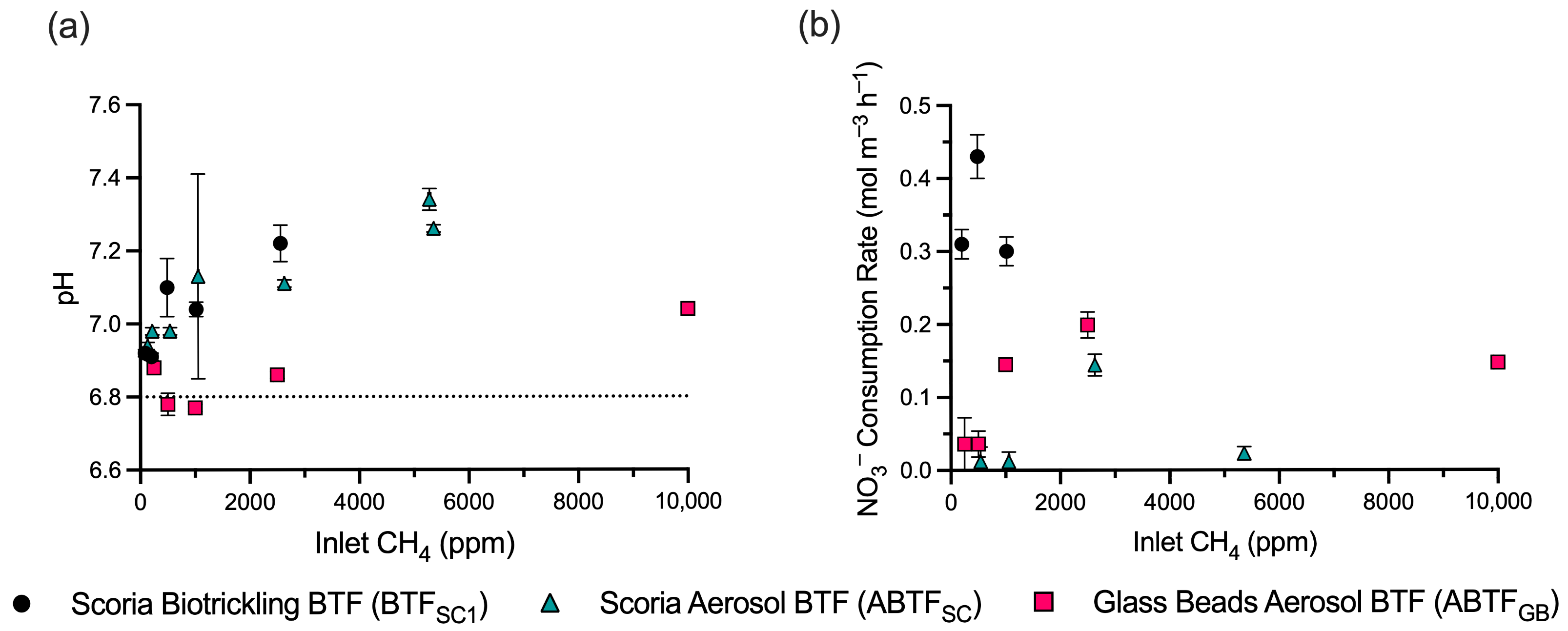
Throughout these initial CH4 inlet concentration experiments, the pressure drop across the ABTFGB had little variation (average 1.2 ± 0.6 cmw), indicating that the biofilm was not growing to excess and restricting gas flow [52,57]. The pH of the spent medium increased with increasing inlet CH4 concentration and EC (Figure 2a).
Under all experimental conditions, between 20% and 75% of the NO3 was consumed, and thus NO3 was always supplied in excess. As the inlet CH4 concentration increased from 250 ppm to 2500 ppm, both the NO3 consumption rate and RE increased proportionally. However, at >2500 ppm CH4, the nitrate RE became approximately constant between 40% (±1%) and 60% (±4%), suggesting a threshold for nitrate removal with inlet CH4 concentration (Figure 2b). Both assimilatory and dissimilatory forms of NO3 reduction consume H+ from the liquid phase. Although increased NO3 consumption can indicate biomass growth [46,58,59], the lack of observed excessive biofilm accumulation or pressure drop variation is suggestive of a predominance of dissimilatory NO3 reduction in the column [36,38].

3.2. Performance of the Aerosol Biotrickling Filter (ABTFSC) and Biotrickling Filter (BTFSC1)

As with the ABTFGB, EC in the two scoria BTFs (ABTFSC and BTFSC1) was significantly correlated with inlet CH4 concentration (Figure 1a, p-value < 0.05). The maximum EC for the scoria aerosol BTF (ABTFSC) was 37.1 (±0.9) g m−3 h−1 (inlet CH4 2590 ppm, IL: 581 g m−3 h−1, Figure 1a). However, between 500 and 100 ppm CH4 (IL: 59.7 to 14.7 g m−3 h−1), the EC decreased to 5.1 (±0.5) and 1.5 (±0.2) g m−3 h−1, respectively. Correspondingly, the CO2 recovery generally ranged between 60% and 91% (Figure 1b), and the pressure drop remained at 0 cmw for the duration of ABTFSC operation.
At ≤1100 ppm CH4, NO3 consumption in the ABTFSC was negligible (0.008 ± 0.009 mol m−3 h−1, Figure 2b), with an average NO3 RE of 3% (±4%). The fastest NO3 consumption rate (0.14 ± 0.02 mol m−3 h−1) was observed at an inlet CH4 concentration of 2600 (±7 ppm). This slowed to 0.023 (±0.009) mol m−3 h−1 at 5400 (±3) ppm CH4. Generally, these NO3 consumption rates are consistent with other BTFs operated across a range of inlet CH4 concentrations [36,46,60].
In BTFSC1, a maximum EC of 31 (±1) g m−3 h−1 was observed at an inlet concentration of 2650 (±5) ppm CH4 (IL: 281.3 ± 0.3 g m−3 h−1, Figure 1a). At <400 ppm CH4, the EC ranged between 4.2 (±0.4) and 1.9 (±0.4) g m−3h−1, and a CO2 recovery between 67% (±19%) and 118% (±40%) was observed (Figure 1b). The NO3 consumption rate was constant at different inlet CH4 concentrations at an average value of 0.34 (±0.08) mol m−3 h−1 (Figure 2b). The NO3 RE was stable at an average value of 76% (±10%). As with ABTFSC, these results are consistent with other similar studies [36,46,60]. Interestingly, at inlet CH4 concentrations ≤ 1050 ppm, the traditional BTFSC1 was observed to consume 23 times more NO3 than the ABTFSC. The pressure drop across the bed remained at 0 cmw at all CH4 concentrations.
For both scoria BTFs, the pH of spent medium increased with increasing inlet CH4 concentrations (Figure 2a). At inlet CH4 concentrations < 1100 ppm (IL: 117 g m−3 h−1), the pH of ABTFSC spent medium did not significantly differ from that of the supplied growth medium (pH 6.8 ± 0.1, p-value > 0.05). The most alkaline pH observed was pH 7.34 (±0.03) at an inlet CH4 concentration of 5000 ppm (IL: 589 g m−3 h−1). Likewise, in BTFSC1, the pH of spent medium was unchanged (pH 6.91 ± 0.01) at ≤200 ppm CH4. The maximum pH of the collected spent media was pH 7.22 (±0.05) at an inlet CH4 concentration of 2560 (±10) ppm.
Importantly, for both ABTFSC and BTFSC1, neither nitrite (lower detection limit = 0.04 µM) nor N2O (lower detection limit = 1 ppb) was detected throughout these experiments, indicating that NO3 was consumed primarily via assimilatory uptake for growth and/or dissimilatory reduction to completion without intermediate build-up. N2O can be produced via partial denitrification in anaerobic zones within CH4 BTFs [61]. As N2O is a very potent GHG [62], its production, even in moderate quantities, could offset the gains made by CH4 removal.

3.3. Comparison of Packing Materials and Liquid Addition Mechanisms

Both scoria BTFs (aerosol (ABTFSC) and biotrickling (BTFSC1)) performed significantly better (51% to 155% improvement) than the glass bead aerosol BTF (ABTFGB) at all CH4 inlet concentrations tested (Figure 1, p-value < 0.001). This result is likely a consequence of the greater surface area for biofilm attachment provided by the scoria. Sun et al. [63] reported similar results with their biofilters containing higher surface area packing materials removing up to 33.4% more CH4 compared to their suspended biomass slurry biofilter. Likewise, Wu et al. [64] reported increased ECs (0.48 to 2.09 g m−3 h−1) via the addition of activated carbon to increase the surface area for methanotroph immobilisation.
Unexpectedly, the delivery of liquid nutrients via aerosol delivery did not improve BTF performance. BTFSC1 consistently exhibited superior performance compared to its aerosol counterparts (ABTFSC, ABTFGB, Figure 1a). For example, at an inlet of 2500 ppm CH4, BTFSC1 displayed an EC of 31 (±1) g m−3 h−1 compared to 15.5 (±0.3) g m−3 h−1 for the ABTFSC and 13 (±2) g m−3h−1 for the ABTFGB. Although preferential flow and uneven wetting are known limitations of biotrickling operation, the resulting non-uniform liquid delivery (e.g., intermittent dripping) may have, in this case, helped maintain thinner liquid films and locally improved gas–liquid mass transfer in the conventional BTF. Often, liquid medium was distributed through only one or two of the five available distribution ports into the column. Therefore, at any given moment, a modest fraction of the bed was receiving very little liquid. This could have increased the overall EC in BTFSC1 due to the presence of a very thin liquid layer on the biofilms in these regions receiving less liquid. Consistently, Anderson and Sapre [65] observed minimal radial dispersion of the liquid from the inlet port over the length of the bed. Likewise, Srivastava et al. [66] observed that an uneven distribution of liquid at the inlet of the bed resulted in a greater liquid maldistribution index across all column length-to-diameter ratios tested. Therefore, the addition of liquid through only one or two of the distribution ports likely resulted in the majority of the packed bed having a thin liquid layer present on the biofilm.
Nitrate (NO3) depletion can reflect either assimilatory uptake for biomass production or dissimilatory reduction via denitrification; however, because our previous BTF studies under comparable operating conditions directly demonstrated dissimilatory nitrate reduction, denitrification is considered the more likely dominant NO3 sink in the present system [36,37,38]. While the EC for BTFSC1 was 0.5 to 3 times higher than the aerosol reactors, it consumed considerably more nitrate than both the aerosol reactors (Figure 2b). For example, at 500 ppm inlet CH4, BTFSC1 had a nitrate consumption rate of 0.43 (±0.03) mol m−3 h−1 compared to 0.01 (±0.02) mol m−3 h−1 and 0.04 (±0.03) mol m−3 h−1 in ABTFSC and ABTFGB, respectively. The larger demand for nitrogen in BTFSC1 may have been supporting biofilm growth or heterotrophic denitrification activities. Previously, a higher EC was associated with the formation of more metabolites from the oxidation of CH4 (e.g., methanol, formate, acetate, acetaldehyde, and formaldehyde) [38], which subsequently facilitated the removal of more nitrogen through denitrification. This may have been enhanced in areas with thicker water layers, where the dissolved oxygen might have been lower, thus enhancing denitrification.

3.4. The Impact of Liquid Addition Rates on CH4 Removal

Following the inlet CH4 concentration experiments, the effect of liquid addition rate on CH4 removal efficiency was examined for both the glass-bead aerosol biotrickling filter (ABTFGB) and the scoria-based systems (ABTFSC and BTFSC1). It was hypothesised that slower liquid coalescence rates would improve elimination capacity (EC) by reducing surface moisture on the biofilm and enhancing gas–liquid mass transfer.
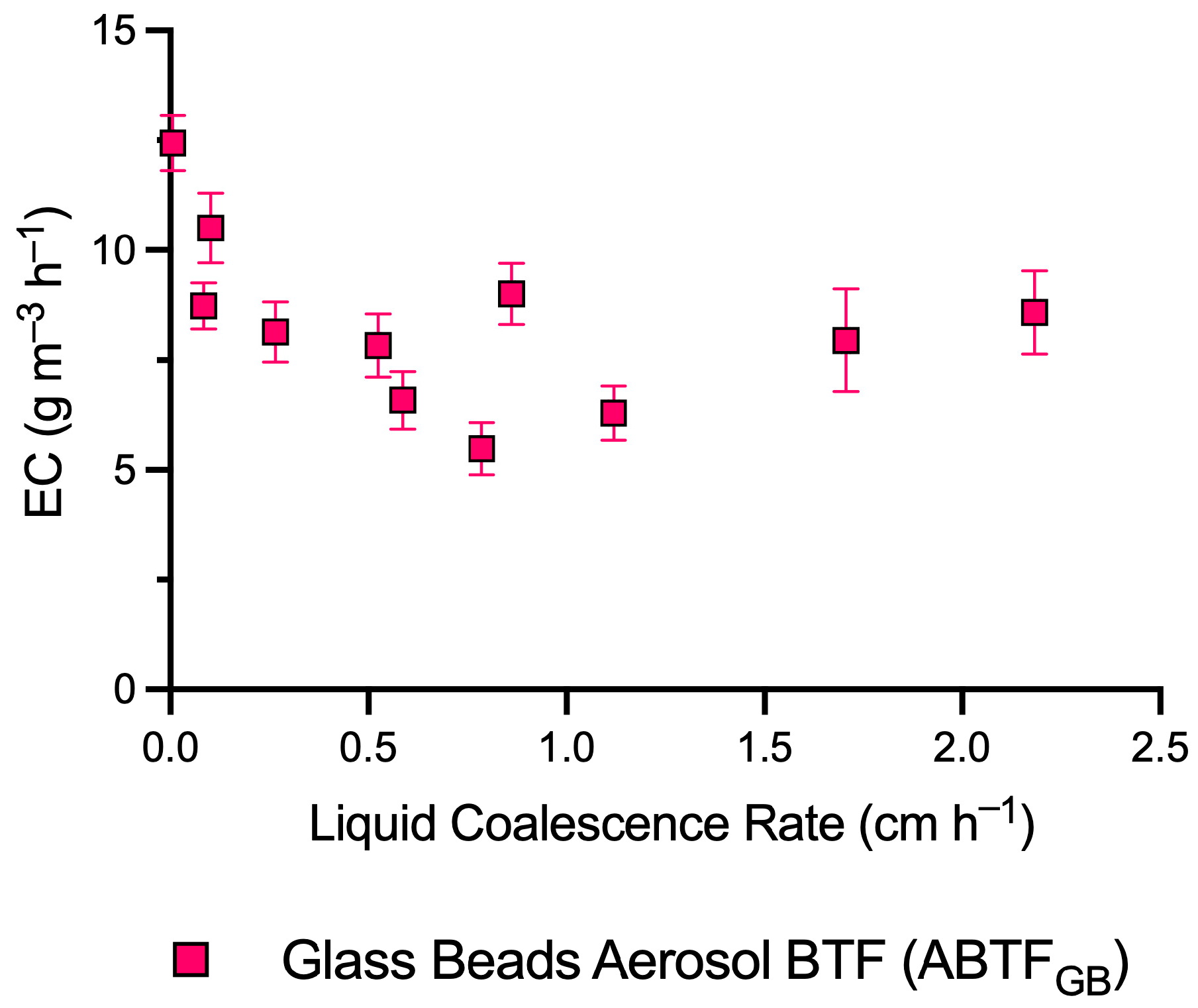
In the ABTFGB, EC displayed a significant 2.3-fold improvement (p-value < 0.001) as the coalescence rate decreased from 0.78 (±0.08) to 0.009 (±0.009) cm h−1, rising to an EC of 12.4 (±0.6) g m−3 h (Figure 3). This trend reflected more efficient CH4 diffusion through a thinner liquid film. At faster rates (>0.7 cm h−1), EC plateaued around 8 g m−3 h−1, indicating mass-transfer limitations. Slower coalescence also corresponded with higher pH (up to pH 7.22 ± 0.01) and greater nitrate (NO3) consumption, with removal efficiency (RE) increasing to 52 (±8%) at ≤0.09 cm h−1 (Figures S5 and S6). At faster rates (≥0.86 cm h−1), NO3 RE fell below 10%, consistent with reduced CH4 oxidation. The maximum nitrate consumption rate (0.14 ± 0.12 mol m−3 h−1) matched values reported in comparable methanotrophic systems [36,46,60].
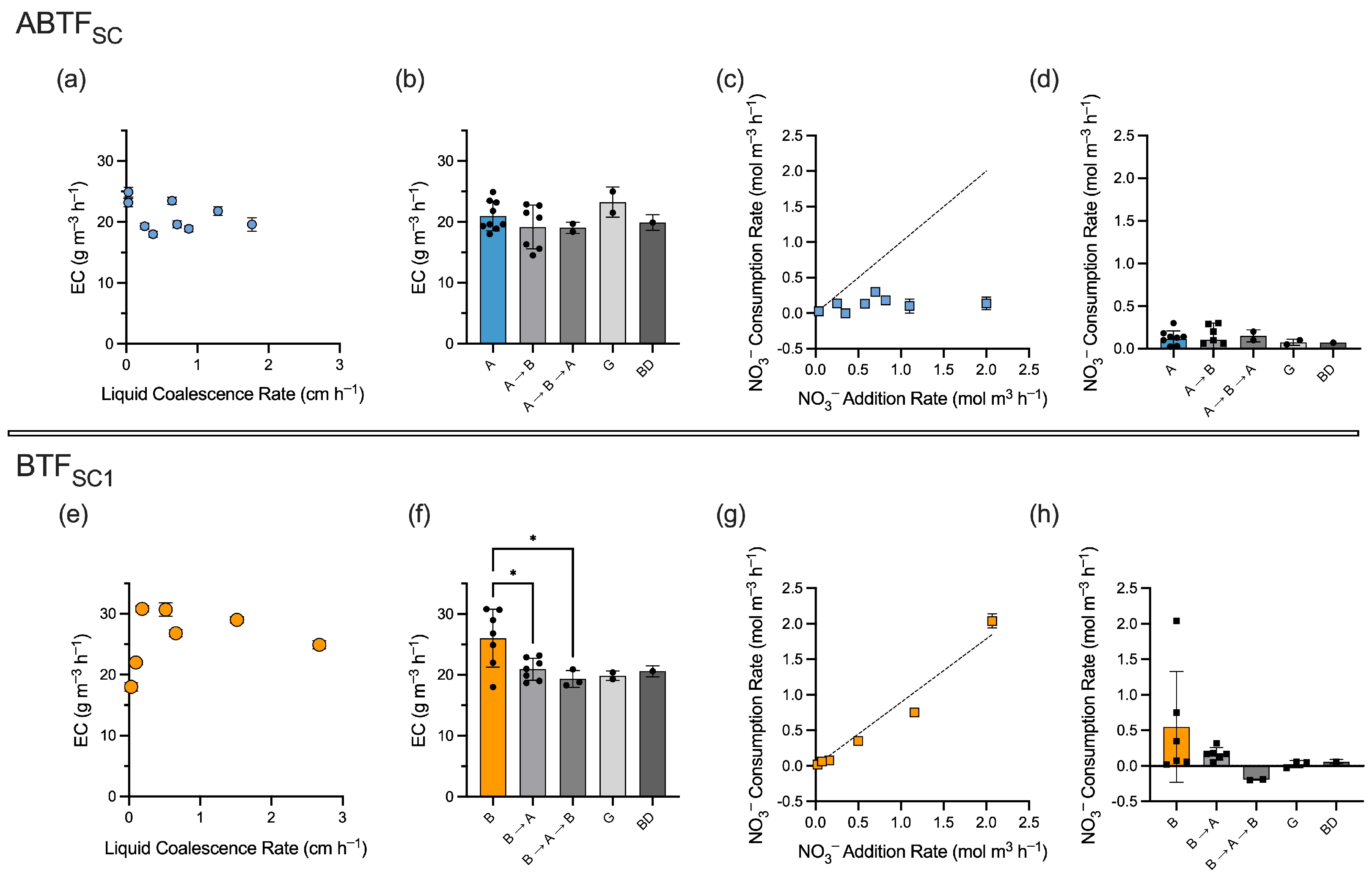
In the scoria reactors, the traditional biotrickling column (BTFSC1) consistently outperformed the aerosol-fed system. EC in BTFSC1 increased with slower addition, peaking at 31 (±1) g m−3 h−1 at 0.184 (±0.005) cm h−1, before declining below this threshold. In ABTFSC, a weaker but significant positive relationship (R2 = 0.12, p-value < 0.05) was observed, with EC rising 1.3-fold (from 20 ± 1 to 24.9 ± 0.8 g m−3 h−1) as the rate decreased from 1.77 to 0.033 cm h−1 (Figure 4).
Therefore, regardless of the liquid delivery mechanism, the role of wetting in controlling EC is supported by its systematic response to liquid coalescence rate. Reducing liquid coalescence rates tended to increase EC (consistent with thinner films and improved gas–liquid transfer), whereas reducing it below a threshold in scoria decreased EC, consistent with discontinuous wetting and/or local pH limitations (Figure 3 and Figure 4). This interpretation aligns with prior BTF studies showing that excessive wetting lowers mass transfer and that optimised, thinner liquid films enhance removal until preferential flow or patchiness develops [46,47,66,67,68,69].
To isolate the role of delivery mode, liquid addition mechanisms were interchanged. When BTFSC1 was switched from biotrickling to aerosol operation, EC dropped by ~26% (p-value < 0.001) and did not recover upon reverting, suggesting irreversible biofilm inhibition. In contrast, converting ABTFSC from aerosol to biotrickling showed no significant change (p ≥ 0.60). Replicate experiments (BTFSC2) confirmed this pattern, indicating that aerosol delivery exerted a lasting detrimental effect on methanotrophic activity.
During biotrickling operation, BTFSC1 achieved near-complete NO3 removal (RE up to 99% ± 5%), whereas aerosol operation reduced consumption by ~46% and stabilised RE around 41% (±2%). In ABTFSC, NO3 uptake remained ≤0.30 (±0.04) mol m−3 h−1, implying minimal microbial growth under aerosol feeding. Slower liquid addition rates elevated both NO3 RE and pH (to pH 8.45), likely reflecting enhanced denitrification. Because methanotrophs perform optimally at pH 6.7–8.1 [70], the more alkaline conditions at very slow rates may have partially inhibited CH4 oxidation in BTFSC1, whereas ABTFSC maintained near-optimal pH.
Several hypotheses were evaluated to explain the irreversible loss of activity during aerosol operation: (1) electrostatic charge accumulation, (2) salt deposition within the biofilm, (3) uneven nutrient distribution, (4) oxygen oversupply causing oxidative stress, (5) H2O2 formation, and (6) microbial community shifts. Grounding the reactors had no effect on EC, excluding electrostatic interference. Mechanical biofilm disruption temporarily reduced EC, but full recovery occurred within nine days, ruling out salt or structural fouling. Microaerobic operation (2% O2) also failed to enhance CH4 oxidation and instead induced N2O formation, consistent with denitrification under low-O2 conditions (Figures S7–S9) [61,71]. Despite reports of catalyst-free H2O2 production in water microdroplets (e.g., aerosols) to potentially inhibitory concentrations [72,73,74,75], no evidence of this reactive oxygen species was detected in BTF spent medium or during abiotic aerosol generation experiments (lower detection limit: 15 μM). Collectively, these results suggest that aerosol exposure caused irreversible physiological or compositional changes within the biofilm, diminishing its CH4 oxidation capacity. Most plausibly, the irreversible EC decline reflects aerosol-induced biofilm destabilisation through intermittently thin and potentially discontinuous wetting that promotes drying and rewetting stress, detachment, and disruption of established micro niches, rather than any single chemical or electrostatic inhibition mechanism [27]. However, the exact cause for this observation requires further investigation.

3.5. Microbial Community Structures in BTFs

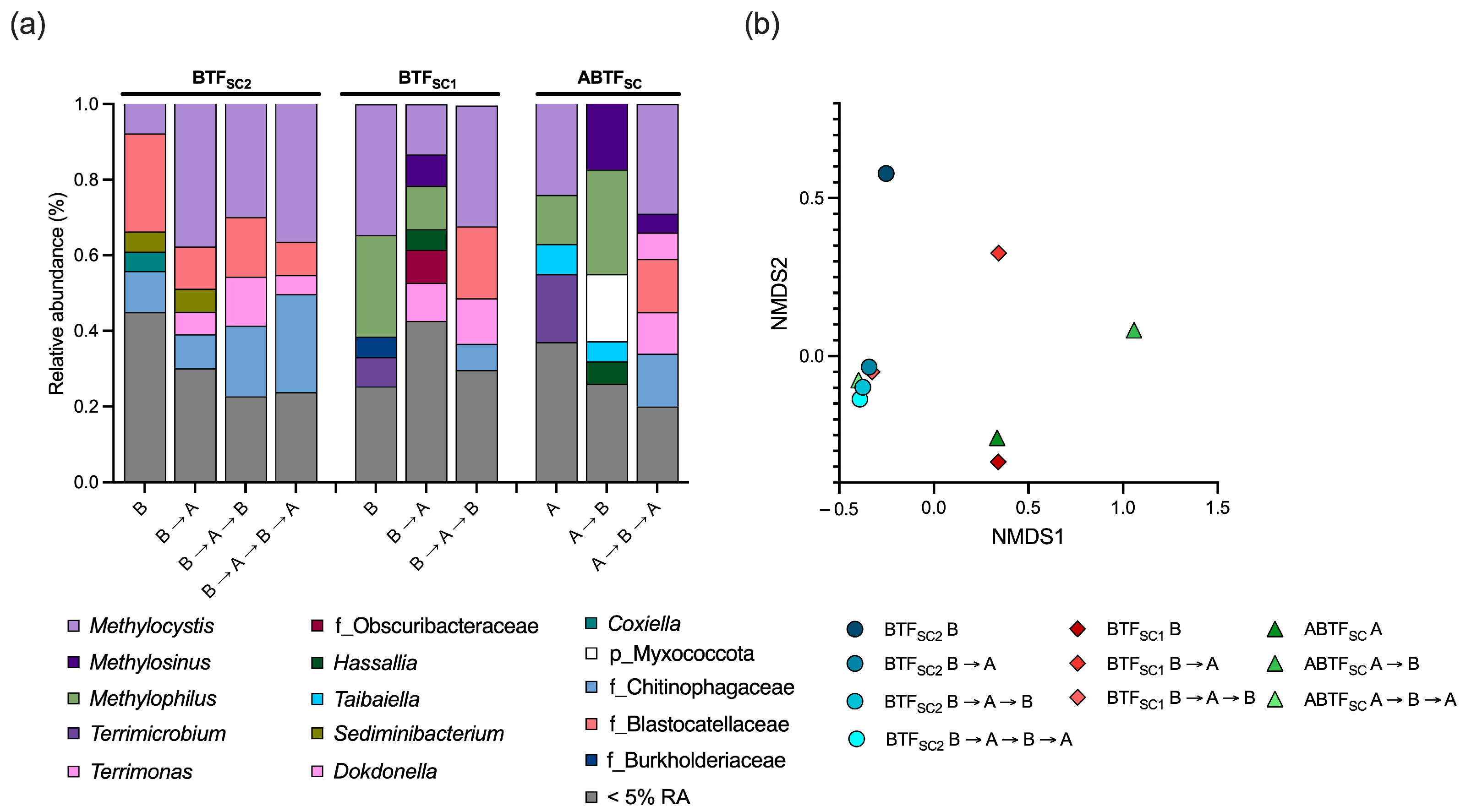
To investigate whether aerosol nutrient delivery altered microbial community composition and contributed to reduced performance, biofilm samples were analysed throughout reactor operation. A distinct shift in microbial structure was observed when the scoria biotrickling filter (BTFSC2) was switched from traditional to aerosol operation (Figure 5). The original biotrickling mode supported the highest elimination capacity (EC: 31 ± 2 g m−3 h−1), whereas aerosol exposure coincided with both a new, stable community and a sustained decrease in EC (~20 g m−3 h−1). A similar pattern occurred in the replicate system (BTFSC1), though the microbial consortia differed between the two reactors even when ECs were comparable. This variability indicates that aerosol delivery can induce long-term community restructuring but that reactor-specific ecological trajectories may also play a role.
Comparable temporal and spatial community shifts have been documented in CH4 biofilters [76,77,78,79,80]. Kim et al. [78], for example, reported microbial succession over 108 days despite stable reactor performance, underscoring that functional stability does not necessarily reflect taxonomic constancy. Similarly, biofilm sampling from only the upper bed, as performed in this study, is likely to have neglected spatial heterogeneity across depth gradients.
Across all reactors, type II methanotrophs dominated, particularly Methylocystis and Methylosinus spp., consistent with previous studies of CH4-oxidising biofilms coupled to denitrification [38]. Methylotrophic genera such as Methylophilus and Methylobacillus were also present; both utilise methanol, while Methylobacillus additionally metabolises methylated amines [81,82]. The relative abundance (RA) of these methylotrophs declined over time (from 26.9% to below detection limits in BTFSC1 and to <0.05% in ABTFSC), suggesting progressive loss of cross-feeding interactions as reactor operation continued.
Low-abundance heterotrophic denitrifiers were also detected, including Pseudoxanthomonas and Hydrogenophaga spp. (RA < 5%), both previously linked to methane oxidation coupled with denitrification [36,38,83]. These taxa likely consumed methanotroph-derived intermediates (e.g., formaldehyde, formate, acetate, and methanol) as electron donors [84]. Other denitrifying groups such as Burkholderia-Caballeronia-Paraburkholderia (5.4% RA in BTFSC1) and Taibaiella spp. (7.9% RA in ABTFSC) were identified, aligning with known partial or complete denitrifiers [85,86,87]. In addition, Terrimonas spp., aerobic heterotrophs capable of nitrogen removal and extracellular-polymeric-substance (EPS) production, were present in all reactors (RA ≥ 4.2%) [88,89,90].
It is possible that aerosol nutrient delivery influenced CH4 degradation indirectly by reshaping the microenvironment in which methanotrophs, methylotrophs, and denitrifiers interact. Compared with biotrickling operation, aerosol feeding produces a thinner, potentially more discontinuous liquid film and less persistent wetting of pore spaces, which can reduce the stability of attached biofilms and alter substrate gradients along the packing [27]. This shift in hydrodynamics may, therefore, decouple trophic interactions (e.g., methylotroph reliance on methanotroph-derived intermediates), with local reductions in CH4 oxidation rates or biofilm continuity consequently diminishing cross-feeding opportunities. In parallel, aerosol operation can increase spatial heterogeneity in oxygen and nitrate delivery, disrupting the partially anoxic micro-niches within mature BTF biofilms that support denitrifying populations. If these niches are intermittently rewetted under aerosol exposure, denitrifiers may be outcompeted by aerobic heterotrophs and methanotrophs, contributing to the observed decline in denitrifying taxa. Overall, these mechanisms are consistent with the persistent community shift and reduced EC under aerosol feeding, suggesting that aerosolisation affected not only mass transfer but also biofilm architecture and coupled aerobic–anaerobic functionality underpinning sustained CH4 removal; however, confirming a causal mechanistic community response to aerosol delivery would require a more rigorously replicated design explicitly coupling microbial dynamics with direct biofilm structural measurements and micro-scale redox profiling.
Overall, the microbial data indicate that although all systems were dominated by canonical methanotrophs, aerosol nutrient delivery caused persistent alterations in community composition that paralleled the observed decline in CH4 oxidation. These results highlight the sensitivity of methanotrophic–denitrifying consortia to hydrodynamic and mass-transfer conditions, reinforcing that microbial community stability is critical for sustaining BTF performance under modified liquid-delivery regimes.

4. Conclusions

This study demonstrated that biotrickling filters (BTFs) can effectively remove CH4 at concentrations typical of dairy barn emissions (<500 ppm). While full biological replication at the column level was constrained by the long operational times and complexity of the experimental matrix, key trends were reproduced across independently operated reactors, and extensive steady-state averaging was used to minimise variability. Throughout operation, elimination capacities (ECs) ranged from 8.6 (±0.4) g m−3 h−1 at 490 ppm CH4 to 1.9 (±0.4) g m−3 h−1 at 90 ppm, confirming the feasibility of treating dilute methane streams biologically. The hypothesis that higher surface-area packing materials enhance CH4 removal was supported, with scoria-packed BTFs consistently outperforming glass bead systems.
Reducing nutrient addition rates, whether via biotrickling or aerosol delivery, improved EC and removal efficiency (RE) by limiting excess moisture and enhancing gas–liquid mass transfer. In the glass bead aerosol BTF (ABTFGB), EC increased 2.3-fold as the liquid coalescence rate was slowed. A similar 1.5-fold improvement was observed in the scoria aerosol system (ABTFSC). However, in the scoria biotrickling filter (BTFSC1), performance peaked at moderate addition rates (0.184 ± 0.005 cm h−1) before declining at slower rates, likely due to uneven wetting or elevated pH.
Unexpectedly, traditional biotrickling nutrient delivery consistently outperformed aerosol feeding. Switching from biotrickling to aerosol operation caused a permanent decline in EC, suggesting irreversible physiological or structural effects on the biofilm. Although several mechanisms were evaluated, including electrostatic charge, salt accumulation, the presence of reactive oxygen species, and oxygen inhibition, the precise cause of this inhibition remains uncertain. Most plausibly, the irreversible EC decline under aerosol feeding reflects biofilm destabilisation caused by intermittently thin and discontinuous wetting, which can induce drying and rewetting stress, promote detachment, and disrupt established micro niches, rather than any single chemical or electrostatic inhibition mechanism.
Collectively, these findings underscore that both packing material selection and liquid delivery strategy critically influence BTF performance for dilute CH4 mitigation. Optimising these parameters could significantly enhance the viability of biofiltration as a sustainable methane control technology for agricultural emissions, while future work should focus on validating these behaviours under field-relevant ventilation and concentration variability to inform robust scale-up and farm-scale deployment.

Supplementary Materials

The following supporting information can be downloaded at https://www.mdpi.com/article/10.3390/cleantechnol8010003/s1. Figure S1. The first aerosol chamber created and used for the glass bead aerosol biotrickling filter. Figure S2. The second iteration of the aerosol production chamber used in all aerosol BTF ex-cluding the glass bead aerosol BTF. Figure S3. The setup of the biotrickling filters. Figure S4. Setup of the aerosol biofilters showing the inlet gas stream (green lines), the inlet gas stream to be measured on the photoacoustic spectrometer (blue lines), and the outlet gas stream (black lines). Figure S5. The pH of the coalesced liquid different liquid coalescence rates in the ABTFGB (glass bead aerosol BTF). Figure S6. The nitrate consumption rate and nitrate removal efficiency at different liquid coales-cence rates and therefore nitrate addition rates in the ABTFGB (glass bead aerosol BTF). Figure S7. (A) The nitrate consumption rate, nitrate removal efficiency, and (B) pH of BTFSC2 operating on aerosol (the scoria BTF established on biotrickling, swapped to aerosol, back to biotrickling, and returned to aerosol again) at 2500 ppm CH4 at 0.7 L∙min−1 operating on atmospheric air, at 2% oxygen, and returned to atmospheric air. Figure S8. The nitrous oxide (N2O) production rate of BTFSC2 operating on aerosol (the scoria BTF established on biotrickling, swapped to aerosol, back to biotrickling, and returned to aerosol again) while operated on atmospheric air (21% oxygen) and on 2% oxygen. Figure S9. The influence of oxygen (O2) on the methane (CH4) elimination capacity (EC) and carbon dioxide (CO2) recovery of the scoria biotrickling filter (BTFSC2) when operating using aerosol delivery. Table S1. The total gas flowrate, potentiometer (POT), and duty cycle for the aerosol generator used to change the liquid coalescence rate in the enriched methanotroph glass bead aerosol BTF (ABTFGB). Table S2. The liquid addition mechanism, duty cycle for the aerosol timer, pump speed, and liquid coalescence rate for BTFSC1 (the scoria BTF established on biotrickling). Table S3. The liquid addition mechanism, duty timer cycle, pump speed, and the liquid coalescence rate for ABTFSC (the scoria BTF established on aerosol). Table S4. The liquid addition mechanism, duty timer cycle, pump speed, and the liquid coalescence rate for BTFSC2 (the scoria BTF established on biotrickling).

Author Contributions

Conceptualisation, C.R.C. and P.A.G.; methodology, A.M.P., C.R.C. and P.A.G.; formal analysis, A.M.P.; resources, C.R.C. and P.A.G.; data curation, A.M.P.; writing—original draft preparation, A.M.P. and C.R.C.; writing—review and editing, A.M.P., C.R.C. and P.A.G.; visualisation, C.R.C. and A.M.P.; supervision, C.R.C. and P.A.G.; funding acquisition, C.R.C. and P.A.G. All authors have read and agreed to the published version of the manuscript.

Funding

This work was partially supported by Ministry of Business, Innovation and Employment Endeavour Fund-Smart Ideas UOCX2303. A PhD scholarship was provided by the University of Canterbury. We also acknowledge the assistance of the technical staff in the Department of Chemical and Process Engineering and School of Physical and Chemical Sciences at the University of Canterbury.

Data Availability Statement

The original contributions presented in this study are included in the article/Supplementary Material. Further inquiries can be directed to the corresponding authors.

Acknowledgments

The authors wish to acknowledge the assistance of the technical staff in the Department of Chemical and Process Engineering and School of Physical and Chemical Sciences at the University of Canterbury.

Conflicts of Interest

The authors declare no conflict of interest.

Abbreviations

The following abbreviations are used in this manuscript:
A-NZAotearoa New Zealand
ABTFAerosol-fed biotrickling filter
ABTFGBGlass-bead aerosol-fed biotrickling filter
ABTFSCScoria aerosol-fed biotrickling filter
Ar-NMSAerosol nitrate mineral salts growth medium
ASVAmplicon sequence variant
BTFBiotrickling filter
BTFSC1Scoria biotrickling filter reactor 1
BTFSC2Scoria biotrickling filter reactor 2 (replicate)
EBRTEmpty bed residence time
ECElimination capacity
EPSExtracellular polymeric substances
GHGGreenhouse gas
RERemoval efficiency
ILInlet load

References

  1. Guerrero-Cruz, S.; Vaksmaa, A.; Horn, M.A.; Niemann, H.; Pijuan, M.; Ho, A. Methanotrophs: Discoveries, Environmental Relevance, and a Perspective on Current and Future Applications. Front. Microbiol. 2021, 12, 678057. [Google Scholar] [CrossRef]
  2. Reisinger, A. The Contribution of Methane Emissions from New Zealand Livestock to Global Warming; New Zealand Agricultural Greenhouse Gas Research Centre (NZAGRC): Palmerston North, New Zealand, 2018. [Google Scholar]
  3. United Nations. Human Security: Building Resilience to Climate Threats (Human Security and Climate Change Policy Brief); United Nations Trust Fund for Human Security, Ed.; United Nations: New York City, NY, USA, 2017. [Google Scholar]
  4. Stats, N.Z. Greenhouse Gas Emissions (Industry and Household): December 2023 Quarter. 2024. Available online: https://www.stats.govt.nz/information-releases/greenhouse-gas-emissions-industry-and-household-december-2023-quarter/ (accessed on 15 June 2024).
  5. Ministry for the Environment. New Zealand’s Greenhouse Gas Inventory 1990–2019; New Zealand Government; Ministry for the Environment: Wellington, New Zealand, 2021.
  6. AgMatters. Reduce Methane Emissions; New Zealand Agricultural Greenhouse Gas Research Centre: Palmerston North, New Zealand, 2020. [Google Scholar]
  7. Reisinger, A.; Clark, H.; Abercrombie, R.; Aspin, M.; Ettema, P.; Harris, M.; Hoggard, A.; Newman, M.; Sneath, G. Future Options to Reduce Biological GHG Emissions on-Farm: Critical Assumptions and National-Scale Impact; New Zealand Agricultural Greenhouse Gas Research Centre: Palmerston North, New Zealand, 2018. [Google Scholar]
  8. Kinsman, R.; Sauer, F.; Jackson, H.; Wolynetz, M. Methane and Carbon Dioxide Emissions from Dairy Cows in Full Lactation Monitored over a Six-Month Period. J. Dairy Sci. 1995, 78, 2760–2766. [Google Scholar] [CrossRef] [PubMed]
  9. Office of the Prime Minister’s Chief Science Advisor. Methane Production by Ruminant Animals: Current and Future Technologies; New Zealand Government: Wellington, New Zealand, 2024.
  10. Buddle, B.M.; Denis, M.; Attwood, G.T.; Altermann, E.; Janssen, P.H.; Ronimus, R.S.; Pinares-Patiño, C.S.; Muetzel, S.; Neil Wedlock, D. Strategies to reduce methane emissions from farmed ruminants grazing on pasture. Vet. J. 2011, 188, 11–17. [Google Scholar] [CrossRef]
  11. Falcon, W.P.; Naylor, R.L.; Shankar, N.D. Rethinking Global Food Demand for 2050. Popul. Dev. Rev. 2022, 48, 921–957. [Google Scholar] [CrossRef]
  12. Black, J.L.; Davison, T.M.; Box, I. Methane Emissions from Ruminants in Australia: Mitigation Potential and Applicability of Mitigation Strategies. Animals 2021, 11, 951. [Google Scholar] [CrossRef] [PubMed]
  13. Baca-González, V.; Asensio-Calavia, P.; González-Acosta, S.; Pérez de la Lastra, J.M.; Morales de la Nuez, A. Are Vaccines the Solution for Methane Emissions from Ruminants? A Systematic Review. Vaccines 2020, 8, 460. [Google Scholar] [CrossRef]
  14. Subharat, S.; Dairu, S.; Zheng, T.; Buddle, B.M.; Kaneko, K.; Hook, S.; Janssen, P.H.; Wedlock, D.N. Vaccination of Sheep with a Methanogen Protein Provides Insight into Levels of Antibody in Saliva Needed to Target Ruminal Methanogens. PLoS ONE 2016, 11, e0159861. [Google Scholar] [CrossRef]
  15. Ruminant Biotech. 2025. Available online: https://ruminantbiotech.com/ (accessed on 1 September 2024).
  16. Wallace, R.J.; Sasson, G.; Garnsworthy, P.C.; Tapio, I.; Gregson, E.; Bani, P.; Huhtanen, P.; Bayat, A.R.; Strozzi, F.; Biscarini, F.; et al. A heritable subset of the core rumen microbiome dictates dairy cow productivity and emissions. Sci. Adv. 2019, 5, eaav8391. [Google Scholar] [CrossRef]
  17. Wannan, O. Capturing Bulls’ Breath Could Help Breed Lower-Methane Cows; Stuff: Morrinsville, New Zealand, 2021. [Google Scholar]
  18. Kinley, R.D.; Martinez-Fernandez, G.; Matthews, M.K.; de Nys, R.; Magnusson, M.; Tomkins, N.W. Mitigating the carbon footprint and improving productivity of ruminant livestock agriculture using a red seaweed. J. Clean. Prod. 2020, 259, 120836. [Google Scholar] [CrossRef]
  19. Roque, B.M.; Venegas, M.; Kinley, R.D.; de Nys, R.; Duarte, T.L.; Yang, X.; Kebreab, E. Red seaweed (Asparagopsis taxiformis) supplementation reduces enteric methane by over 80 percent in beef steers. PLoS ONE 2021, 16, e0247820. [Google Scholar] [CrossRef]
  20. Subharat, S.; Shu, D.; Zheng, T.; Buddle, B.M.; Janssen, P.H.; Luo, D.; Wedlock, D.N. Vaccination of cattle with a methanogen protein produces specific antibodies in the saliva which are stable in the rumen. Vet. Immunol. Immunopathol. 2015, 164, 201–207. [Google Scholar] [CrossRef] [PubMed]
  21. Lide, D. CRC Handbook of Chemistry and Physics (Vol. Internet Version); CRC Press: Boca Raton, FL, USA, 2005. [Google Scholar]
  22. Yan, S.; Yang, L.; Ning, J.; Liu, Y.; Cao, Y.; Liu, F. Catalytic combustion of low-concentration methane over transition metal oxides supported on open cell foams. J. Environ. Chem. Eng. 2025, 13, 115041. [Google Scholar] [CrossRef]
  23. Kuipers, A.; Galama, P.; Spoelstra, S.F.; Wiering, C.J.; Groot Koerkamp, P.W.G. Invited review: Combined mitigation of methane and ammonia emissions from dairy barns through barn design, ventilation and air treatment systems. J. Dairy Sci. 2025, 108, 6565–6586. [Google Scholar] [CrossRef]
  24. Cesário, M.T.; Beverloo, W.A.; Tramper, J.; Beeftink, H.H. Enhancement of gas-liquid mass transfer rate of apolar pollutants in the biological waste gas treatment by a dispersed organic solvent. Enzym. Microb. Technol. 1997, 21, 578–588. [Google Scholar] [CrossRef]
  25. Ferdowsi, M.; Avalos Ramirez, A.; Jones, J.P.; Heitz, M. Elimination of mass transfer and kinetic limited organic pollutants in biofilters: A review. Int. Biodeterior. Biodegrad. 2017, 119, 336–348. [Google Scholar] [CrossRef]
  26. Kooij, S.; Astefanei, A.; Corthals, G.L.; Bonn, D. Size distributions of droplets produced by ultrasonic nebulizers. Sci. Rep. 2019, 9, 6128. [Google Scholar] [CrossRef] [PubMed]
  27. De Vela, R.; Gostomski, P.A. Design and Performance of a Toluene-Degrading Differential Biotrickling Filter as an Alternative Research Tool to Column Reactors. J. Environ. Eng. 2021, 147, 04020159. [Google Scholar] [CrossRef]
  28. Kim, S.; Deshusses, M. Determination of mass transfer coefficients for packing materials used in biofilters and biotrickling filters for air pollution control. 1. Experimental results. Chem. Eng. Sci. 2008, 63, 841–855. [Google Scholar] [CrossRef]
  29. Liu, J.; Yue, P.; Huang, L.; Zhao, M.; Kang, X.; Liu, X. Styrene removal with an acidic biofilter with four packing materials: Performance and fungal bioaerosol emissions. Environ. Res. 2020, 191, 110154. [Google Scholar] [CrossRef]
  30. Dedysh, S.; Dunfield, P. Cultivation of methanotrophs. In Hydrocarbon and Lipid Microbiology Protocols; Springer Protocol Handbooks; Springer: Berlin/Heidelberg, Germany, 2014. [Google Scholar] [CrossRef]
  31. Dunfield, P.; Yuryev, A.; Senin, P.; Smirnova, A.; Stott, M.; Hou, S.; Ly, B.; Saw, J.; Zhou, Z.; Ren, Y.; et al. Methane oxidation by an extremely acidophilic bacterium of the phylum Verrucomicrobia. Nature 2007, 450, 879–882. [Google Scholar] [CrossRef]
  32. Griess, P. Bemerkungen zu der Abhandlung der HH. Weselsky und Benedikt „Ueber einige Azoverbindungen”. Berichte Der Dtsch. Chem. Ges. 1879, 12, 426–428. [Google Scholar] [CrossRef]
  33. Laidin, D.; Gostomski, P.A.; Marshall, A.T.; Carere, C.R. Bio-electrochemical denitrification—The impact of cathode potential, inoculum source and nitrate loading rate. J. Water Process Eng. 2025, 79, 108923. [Google Scholar] [CrossRef]
  34. García-Robledo, E.; Corzo, A.; Papaspyrou, S. A fast and direct spectrophotometric method for the sequential determination of nitrate and nitrite at low concentrations in small volumes. Mar. Chem. 2014, 162, 30–36. [Google Scholar] [CrossRef]
  35. Miranda, K.M.; Espey, M.G.; Wink, D.A. A rapid, simple spectrophotometric method for simultaneous detection of nitrate and nitrite. Nitric Oxide 2001, 5, 62–71. [Google Scholar] [CrossRef]
  36. Wigley, K.; Egbadon, E.; Carere, C.; Weaver, L.; Baronian, K.; Burbery, L.; Dupont, P.; Bury, S.; Gostomski, P. RNA stable isotope probing and high-throughput sequencing to identify active microbial community members in a methane-driven denitrifying biofilm. J. Appl. Microbiol. 2021, 132, 1526–1542. [Google Scholar] [CrossRef]
  37. Egbadon, E.O.; Wigley, K.; Nwoba, S.T.; Carere, C.R.; Weaver, L.; Baronian, K.; Burbery, L.; Gostomski, P.A. Microaerobic methane-driven denitrification in a biotrickle bed—Investigating the active microbial biofilm community composition using RNA-stable isotope probing. Chemosphere 2024, 346, 140528. [Google Scholar] [CrossRef] [PubMed]
  38. Nwoba, S.; Carere, C.; Wigley, K.; Baronian, K.; Weaver, L.; Gostomski, P. Using RNA-Stable isotope probing to investigate methane oxidation metabolites and active microbial communities in methane oxidation coupled to denitrification. Chemosphere 2024, 357, 140528. [Google Scholar] [CrossRef] [PubMed]
  39. Green, M.R.; Sambrook, J. Precipitation of DNA with Ethanol. Cold Spring Harb. Protoc. 2016, 2016, pdb-prot093377. [Google Scholar] [CrossRef] [PubMed]
  40. Wingett, S.W.; Andrews, S. FastQ Screen: A tool for multi-genome mapping and quality control. F1000Research 2018, 7, 1338. [Google Scholar] [CrossRef]
  41. Cox, M.P.; Peterson, D.A.; Biggs, P.J. SolexaQA: At-a-glance quality assessment of Illumina second-generation sequencing data. BMC Bioinform. 2010, 11, 485. [Google Scholar] [CrossRef]
  42. Callahan, B.J.; McMurdie, P.J.; Rosen, M.J.; Han, A.W.; Johnson, A.J.A.; Holmes, S.P. DADA2: Highresolution sample inference from Illumina amplicon data. Nat. Methods 2016, 13, 581–583. [Google Scholar] [CrossRef]
  43. Wang, Q.; Garrity, G.M.; Tiedje, J.M.; Cole, J.R. Naive Bayesian classifier for rapid assignment of rRNA sequences into the new bacterial taxonomy. Appl. Environ. Microbiol. 2007, 73, 5261–5267. [Google Scholar] [CrossRef] [PubMed]
  44. Quast, C.; Pruesse, E.; Yilmaz, P.; Gerken, J.; Schweer, T.; Yarza, P.; Peplies, J.; Glöckner, F.O. The SILVA ribosomal RNA gene database project: Improved data processing and web-based tools. Nucleic Acids Res. 2013, 41, D590–D596. [Google Scholar] [CrossRef]
  45. Cole, J.R.; Wang, Q.; Fish, J.A.; Chai, B.; McGarrell, D.M.; Sun, Y.; Brown, C.T.; Porras-Alfaro, A.; Kuske, C.R.; Tiedje, J.M. Ribosomal Database Project: Data and tools for high throughput rRNA analysis. Nucleic Acids Res. 2014, 42, D633–D642. [Google Scholar] [CrossRef]
  46. Girard, M.; Ramirez, A.A.; Buelna, G.; Heitz, M. Biofiltration of methane at low concentrations representative of the piggery industry—Influence of the methane and nitrogen concentrations. Chem. Eng. J. 2011, 168, 151–158. [Google Scholar] [CrossRef]
  47. Wani, A.H.; Branion, R.M.R.; Lau, A.K. Biofiltration: A promising and cost-effective control technology for Odors, VOCs and air toxics. J. Environ. Sci. Health Part A Environ. Sci. Eng. Toxicol. 1997, 32, 2027–2055. [Google Scholar] [CrossRef]
  48. Hendy, L.; Gunawan, C.; Thomas, T.; Smith, A.; Scott, J.; Rosche, B. Coal-Packed Methane Biofilter for Mitigation of Green House Gas Emissions from Coal Mine Ventilation Air. PLoS ONE 2014, 9, 111–117. [Google Scholar] [CrossRef]
  49. Nikiema, J.; Bibeau, L.; Lavoie, J.; Brzezinski, R.; Vigneux, J.; Heitz, M. Biofiltration of methane: An experimental study. Chem. Eng. J. 2005, 113, 111–117. [Google Scholar] [CrossRef]
  50. Nikiema, J.; Girard, M.; Brzezinski, R.; Heitz, M. Biofiltration of methane using an inorganic filter bed: Influence of inlet load and nitrogen concentration. Can. J. Civ. Eng. 2009, 36, 1903–1910. [Google Scholar] [CrossRef]
  51. Fedrizzi, F.; Cabana, H.; Ndanga, É.; Cabral, A. Biofiltration of methane from cow barns: Effects of climatic conditions and packing bed media acclimatization. Waste Manag. 2018, 78, 669–676. [Google Scholar] [CrossRef] [PubMed]
  52. Bordoloi, A.; Gostomski, P. Fate of degraded pollutants in waste gas biofiltration: An overview of carbon end-points. Biotechnol. Adv. 2019, 37, 579–588. [Google Scholar] [CrossRef]
  53. La, H.; Hettiaratchi, J.; Achari, G.; Dunfield, P. Biofiltration of methane. Bioresour. Technol. 2018, 268, 759–772. [Google Scholar] [CrossRef]
  54. Estrada, J.M.; Lebrero, R.; Quijano, G.; Pérez, R.; Figueroa-González, I.; García-Encina, P.A.; Muñoz, R. Methane abatement in a gas-recycling biotrickling filter: Evaluating innovative operational strategies to overcome mass transfer limitations. Chem. Eng. J. 2014, 253, 385–393. [Google Scholar] [CrossRef]
  55. Ferdowsi, M.; Veillette, M.; Ramirez, A.A.; Jones, J.P.; Heitz, M. Performance Evaluation of a Methane Biofilter Under Steady State, Transient State and Starvation Conditions. Water Air Soil Pollut. 2016, 227, 168. [Google Scholar] [CrossRef]
  56. Park, S.; Lee, C.-H.; Ryu, C.-R.; Sung, K. Biofiltration for Reducing Methane Emissions from Modern Sanitary Landfills at the Low Methane Generation Stage. Water Air Soil Pollut. 2009, 196, 19–27. [Google Scholar] [CrossRef]
  57. Singh, R.; Paul, D.; Jain, R.K. Biofilms: Implications in bioremediation. Trends Microbiol. 2006, 14, 389–397. [Google Scholar] [CrossRef]
  58. Khabiri, B.; Ferdowsi, M.; Buelna, G.; Jones, J.; Heitz, M. Methane biofiltration under different strategies of nutrient solution addition. Atmos. Pollut. Res. 2020, 11, 85–93. [Google Scholar] [CrossRef]
  59. Nikiema, J.; Brzezinski, R.; Heitz, M. Influence of phosphorus, potassium, and copper on methane biofiltration performance. A paper submitted to the Journal of Environmental Engineering and Science. Can. J. Civ. Eng. 2010, 37, 335–345. [Google Scholar] [CrossRef]
  60. López, J.; Porca, E.; Collins, G.; Pérez, R.; Rodríguez-Alija, A.; Muñoz, R.; Quijano, G. Biogasbased denitrification in a biotrickling filter: Influence of nitrate concentration and hydrogen sulfide. Biotechnol. Bioeng. 2017, 114, 665–673. [Google Scholar] [CrossRef] [PubMed]
  61. Melse, R.W.; Hol, J.M.G. Biofiltration of exhaust air from animal houses: Evaluation of removal efficiencies and practical experiences with biobeds at three field sites. Biosyst. Eng. 2017, 159, 59–69. [Google Scholar] [CrossRef]
  62. United States Environmental Protection Agency. Understanding Global Warming Potentials. 2021. Available online: https://www.epa.gov/ghgemissions/understanding-global-warming-potentials (accessed on 16 August 2023).
  63. Sun, M.-T.; Zhao, Y.-Z.; Yang, Z.-M.; Shi, X.-S.; Wang, L.; Dai, M.; Wang, F.; Guo, R.-B. Methane elimination using biofiltration packed with fly ash ceramsite as support material. Front. Bioeng. Biotechnol. 2020, 8, 351. [Google Scholar] [CrossRef] [PubMed]
  64. Wu, Y.-M.; Yang, J.; Fan, X.-L.; Fu, S.-F.; Sun, M.-T.; Guo, R.-B. Elimination of methane in exhaust gas from biogas upgrading process by immobilized methane-oxidizing bacteria. Bioresour. Technol. 2017, 231, 124–128. [Google Scholar] [CrossRef]
  65. Anderson, D.H.; Sapre, A.V. Trickle-bed reactor flow simulation. AIChE J. 1991, 37, 377–382. [Google Scholar] [CrossRef]
  66. Srivastava, A.; Nigam, K.D.P.; Roy, S. Bed structure and its impact on liquid distribution in a trickle bed reactor. AIChE J. 2023, 69, e17649. [Google Scholar] [CrossRef]
  67. Danila, V.; Zagorskis, A.; Januševičius, T. Effects of Water Content and Irrigation of Packing Materials on the Performance of Biofilters and Biotrickling Filters: A Review. Processes 2022, 10, 1304. [Google Scholar] [CrossRef]
  68. Frasi, N.; Rossi, E.; Pecorini, I.; Iannelli, R. Methane Oxidation Efficiency in Biofiltration Systems with Different Moisture Content Treating Diluted Landfill Gas. Energies 2020, 13, 2872. [Google Scholar] [CrossRef]
  69. Wu, L.; Wei, W.; Xu, J.; Chen, X.; Liu, Y.; Peng, L.; Wang, D.; Ni, B.-J. Denitrifying biofilm processes for wastewater treatment: Developments and perspectives. Environ. Sci. Water Res. Technol. 2021, 7, 40–67. [Google Scholar] [CrossRef]
  70. Bender, M.; Conrad, R. Effect of CH4 concentrations and soil conditions on the induction of CH4 oxidation activity. Soil Biol. Biochem. 1995, 27, 1517–1527. [Google Scholar] [CrossRef]
  71. Dumont, É. Impact of the treatment of NH(3) emissions from pig farms on greenhouse gas emissions. Quantitative assessment from the literature data. New Biotechnol. 2018, 46, 31–37. [Google Scholar] [CrossRef] [PubMed]
  72. Asserghine, A.; Baby, A.; N’Diaye, J.; Romo, A.I.B.; Das, S.; Litts, C.A.; Jain, P.K.; Rodríguez-López, J. Dissolved Oxygen Redox as the Source of Hydrogen Peroxide and Hydroxyl Radical in Sonicated Emulsive Water Microdroplets. J. Am. Chem. Soc. 2025, 147, 11851–11858. [Google Scholar] [CrossRef]
  73. Eatoo, M.A.; Mishra, H. Busting the myth of spontaneous formation of H2O2 at the air–water interface: Contributions of the liquid–solid interface and dissolved oxygen exposed. Chem. Sci. 2024, 15, 3093–3103. [Google Scholar] [CrossRef]
  74. Gallo, A., Jr.; Musskopf, N.H.; Liu, X.; Yang, Z.; Petry, J.; Zhang, P.; Thoroddsen, S.; Im, H.; Mishra, H. On the formation of hydrogen peroxide in water microdroplets. Chem. Sci. 2022, 13, 2574–2583. [Google Scholar] [CrossRef]
  75. Lee, J.K.; Walker, K.L.; Han, H.S.; Kang, J.; Prinz, F.B.; Waymouth, R.M.; Nam, H.G.; Zare, R.N. Spontaneous generation of hydrogen peroxide from aqueous microdroplets. Proc. Natl. Acad. Sci. USA 2019, 116, 19294–19298. [Google Scholar] [CrossRef] [PubMed]
  76. Gebert, J.; Stralis-Pavese, N.; Alawi, M.; Bodrossy, L. Analysis of methanotrophic communities in landfill biofilters using diagnostic microarray. Environ. Microbiol. 2008, 10, 1175–1188. [Google Scholar] [CrossRef]
  77. Jia, F.; Chen, J.; Zhao, X.; Liu, C.; Li, Y.; Ma, J.; Yang, A.; Yao, H. Morphological and spatial heterogeneity of microbial communities in pilot-scale autotrophic integrated fixed-film activated sludge system treating coal to ethylene glycol wastewater. Front. Microbiol. 2022, 13, 927650. [Google Scholar] [CrossRef]
  78. Kim, T.; Jeong, S.; Cho, K. Functional rigidity of a methane biofilter during the temporal microbial succession. Appl. Microbiol. Biotechnol. 2014, 98, 3275–3286. [Google Scholar] [CrossRef]
  79. Maestre, J.; Rovira, R.; Álvarez-Hornos, F.; Fortuny, M.; Lafuente, J.; Gamisans, X.; Gabriel, D. Bacterial community analysis of a gas-phase biotrickling filter for biogas mimics desulfurization through the rRNA approach. Chemosphere 2010, 80, 872–880. [Google Scholar] [CrossRef] [PubMed]
  80. Zhang, Y.; Liu, J.; Xing, H.; Li, J. Performance and fungal diversity of bio-trickling filters packed with composite media of polydimethylsiloxane and foam ceramics for hydrophobic VOC removal. Chemosphere 2020, 256, 127093. [Google Scholar] [CrossRef] [PubMed]
  81. Chistoserdova, L.; Lapidus, A.; Han, C.; Goodwin, L.; Saunders, L.; Brettin, T.; Tapia, R.; Gilna, P.; Lucas, S.; Richardson, P.; et al. Genome of Methylobacillus flagellatus, molecular basis for obligate methylotrophy, and polyphyletic origin of methylotrophy. J. Bacteriol. 2007, 189, 4020–4027. [Google Scholar] [CrossRef]
  82. Lin, N.; Tao, Y.; Gao, P.; Xu, Y.; Xing, P. Comparative genomics revealing insights into niche separation of the genus Methylophilus. Microorganisms 2021, 9, 1577. [Google Scholar] [CrossRef]
  83. Liu, J.; Sun, F.; Wang, L.; Ju, X.; Wu, W.; Chen, Y. Molecular characterization of a microbial consortium involved in methane oxidation coupled to denitrification under micro-aerobic conditions. Microb. Biotechnol. 2014, 7, 64–76. [Google Scholar] [CrossRef]
  84. Zhu, J.; Wang, Q.; Yuan, M.; Tan, G.; Sun, F.; Wang, C.; Wu, W.; Lee, P. Microbiology and potential applications of aerobic methane oxidation coupled to denitrification (AME-D) process: A review. Water Res. 2016, 90, 203–215. [Google Scholar] [CrossRef]
  85. Baideme, M.; Long, C.; Chandran, K. Enrichment of a denitratating microbial community through kinetic limitation. Environ. Int. 2022, 161, 107113. [Google Scholar] [CrossRef]
  86. Hetz, S.; Horn, M. Burkholderiaceae are key acetate assimilators during complete denitrification in acidic cryoturbated peat circles of the Arctic Tundra. Front. Microbiol. 2021, 12, 628269. [Google Scholar] [CrossRef] [PubMed]
  87. Zhang, L.; Wang, Y.; Wei, L.; Wang, Y.; Shen, X.; Li, S. Taibaiella smilacinae gen. nov., sp nov., an endophytic member of the family Chitinophagaceae isolated from the stem of Smilacina japonica, and emended description of Flavihumibacter petaseus. Int. J. Syst. Evol. Microbiol. 2013, 63, 3769–3776. [Google Scholar] [CrossRef]
  88. Cui, Z.; Li, R.; Li, F.; Jin, L.; Wu, H.; Cheng, C.; Ma, Y.; Wang, Z.; Wang, Y. Structural characteristics and diversity of the rhizosphere bacterial communities of wild Fritillaria przewalskii Maxim. in the northeastern Tibetan Plateau. Front. Microbiol. 2023, 14, 1070815. [Google Scholar] [CrossRef] [PubMed]
  89. Sheu, S.; Cho, N.; Arun, A.; Chen, W. Terrimonas aquatica sp. nov., isolated from a freshwater spring. Int. J. Syst. Evol. Microbiol. 2010, 60, 2705–2709. [Google Scholar] [CrossRef]
  90. Zhao, Y.; Jiang, B.; Tang, X.; Liu, S. Metagenomic insights into functional traits variation and coupling effects on the anammox community during reactor start-up. Sci. Total Environ. 2019, 687, 50–60. [Google Scholar] [CrossRef] [PubMed]
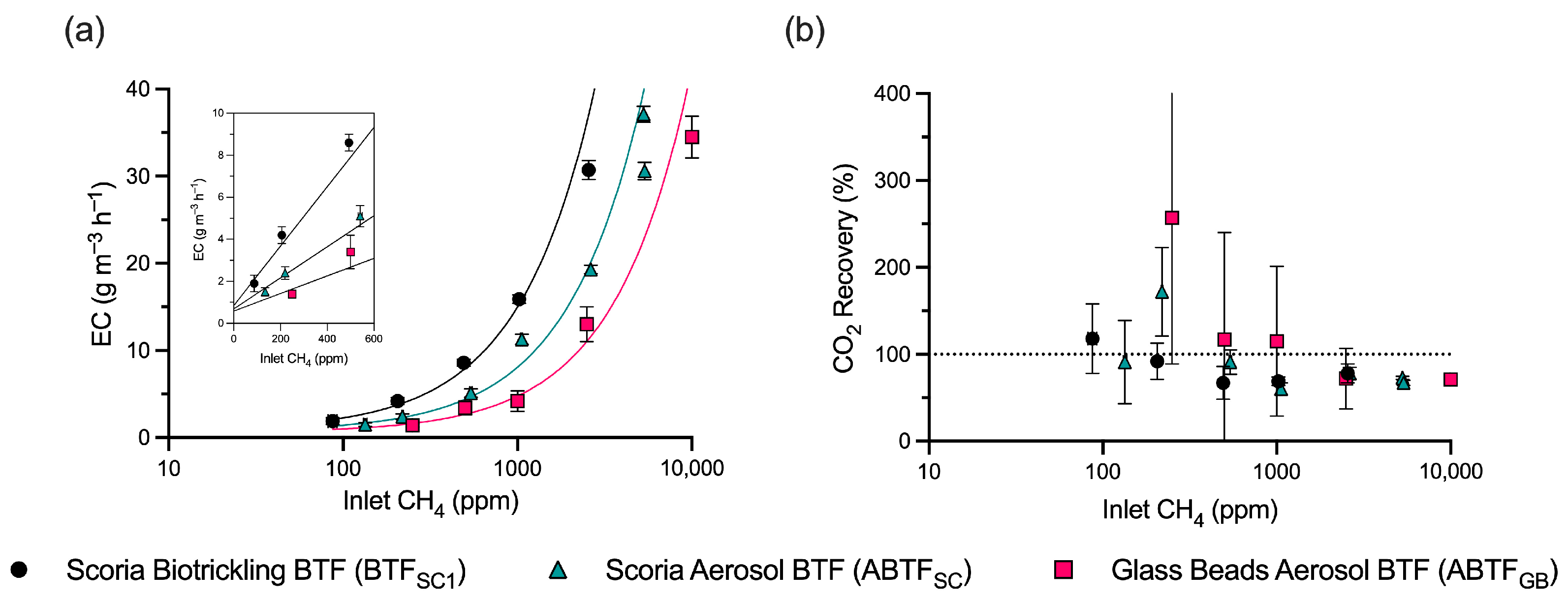
Figure 1. Glass bead and scoria aerosol BTF and traditional BTF performance at various methane concentrations. (a) The EC and (b) the CO2 recovery are plotted against different inlet CH4 concentrations, with an emphasis on concentrations typical of dairy barns (inset panel a). All BTFs were operated at a liquid coalescence rate of 0.4 (±0.2) cm h−1, a total inlet gas flowrate of 1.5 L min−1, and an empty bed residence time of 22 s. Error bars represent one standard deviation of technical replicate measurements (n ≥ 87). Linear regression trendlines were fitted for each reactor type by minimising the relative sum of squared errors, with R2 values of 0.919 (ABTFGB), 0.945 (ABTFSC), and 0.971 (BTFSC1).
Cleantechnol 08 00003 g001
Figure 2. The pH and nitrate utilisation in biotrickling filters (BTF) at various CH4 concentrations. (a) The pH of spent Ar-NMS medium and (b) corresponding NO3 consumption rates for the BTFs are shown. The dashed line represents the pH of inlet Ar-NMS medium (pH 6.8 ± 0.1). The inlet NO3 was 20–26 mM. All BTFs were operated at a liquid coalescence rate of 0.4 (±0.2) cm h−1, a total inlet gas flowrate of 1.5 L min−1, and an EBRT of 22 s. Error bars indicate one standard deviation, of technical replicate measurements, for pH measurements (n ≥ 2) and the weighted average uncertainty derived via partial derivative error propagation for NO3 consumption rates (n ≥ 3).
Cleantechnol 08 00003 g002
Figure 3. The influence of liquid coalescence rate on CH4 removal in a biotrickling filter. The EC at different coalescence rates is shown when operating at an inlet CH4 concentration of 2500 ppm. The total gas flowrate varied between 1.5 to 4 L min−1 (EBRT 22 to 8.3 s). Error bars represent one standard deviation, of technical replicate measurements, for EC values (n ≥ 522) and the weighted average uncertainty through partial derivative error propagation for the liquid addition rates (n ≥ 2).
Cleantechnol 08 00003 g003
Figure 4. CH4 EC and NO3 consumption rates for two BTFs subjected to operational mode changes and biofilm disruption. The scoria aerosol BTF (top, ABTFSC) was initially established using aerosol delivery (A), then switched to biotrickling mode (B), before reversion to aerosol delivery, grounding the biofilm (G), and biofilm disruption (BD). The EC values at (a) different liquid coalescence rates during aerosol operation and (b) following operational mode changes are shown. NO3 consumption rates at (c) different nitrate loading rates associated with different liquid coalescence rates during aerosol operation and (d) following operational mode changes are likewise shown. The scoria BTF (bottom, BTFSC1) was initially grown as a BTF (B) before switching to aerosol delivery (A), reversion to BTF mode, grounding the biofilm (G), and biofilm disruption (BD). The EC values at (e) different liquid coalescence rates during BTF operation and (f) following operational mode changes are shown. NO3 consumption rates at (g) different liquid coalescence rates during BTF operation and (h) following operational mode changes are likewise shown. Both BTFs were operated at an inlet CH4 concentration of 2500 ppm, a total gas flowrate of 1.5 L min−1, and an EBRT of 22 s. Error bars represent one standard deviation, of technical replicate measurements, for EC (n ≥ 89) and the weighted average uncertainty from partial derivative error propagation for coalescence rates (n ≥ 2) and NO3 consumption (n ≥ 3). * denotes a p-value < 0.05 (one-way ANOVA). The dashed lines in panels (c,g) correspond to consumption rates required for 100% NO3 removal.
Cleantechnol 08 00003 g004
Figure 5. Comparison of the microbial communities of the reactors grown up biotrickling (BTFSC1 and BTFSC2) and on aerosol (ABTFSC) during different liquid addition mechanisms over time. (a) The microbial community at the genus level. The Burkholderia-Caballeronia-Paraburkholderia group is referred to as f_Burkholderiaceae in the legend, and (b) the non-metric multidimensional scaling (NMDS) plot with Bray–Curtis dissimilarity distances. Stress value = 0.05. Taxonomy classification was carried out using a pipeline in RStudio with the Silva version 138.1 database. “B” denotes biotrickling operation, and “A” denotes aerosol operation. Inoculum for all reactors was sourced from an active methane oxidising denitrifying biofilm described previously [36].
Cleantechnol 08 00003 g005
Disclaimer/Publisher’s Note: The statements, opinions and data contained in all publications are solely those of the individual author(s) and contributor(s) and not of MDPI and/or the editor(s). MDPI and/or the editor(s) disclaim responsibility for any injury to people or property resulting from any ideas, methods, instructions or products referred to in the content.