
Article

Valorisation of Eggshell Waste for Effective Biosorption of Congo Red Dye from Wastewater

Faculty of Food Technology Osijek, Josip Juraj Strossmayer University of Osijek, Franje Kuhača 18, 31000 Osijek, Croatia
*
Author to whom correspondence should be addressed.
Clean Technol. 2026, 8(1), 2; https://doi.org/10.3390/cleantechnol8010002 (registering DOI)
Submission received: 10 October 2025 / Revised: 8 December 2025 / Accepted: 10 December 2025 / Published: 29 December 2025
(This article belongs to the Special Issue Pollutant Removal from Aqueous Solutions by Adsorptive Biomaterials)

Abstract

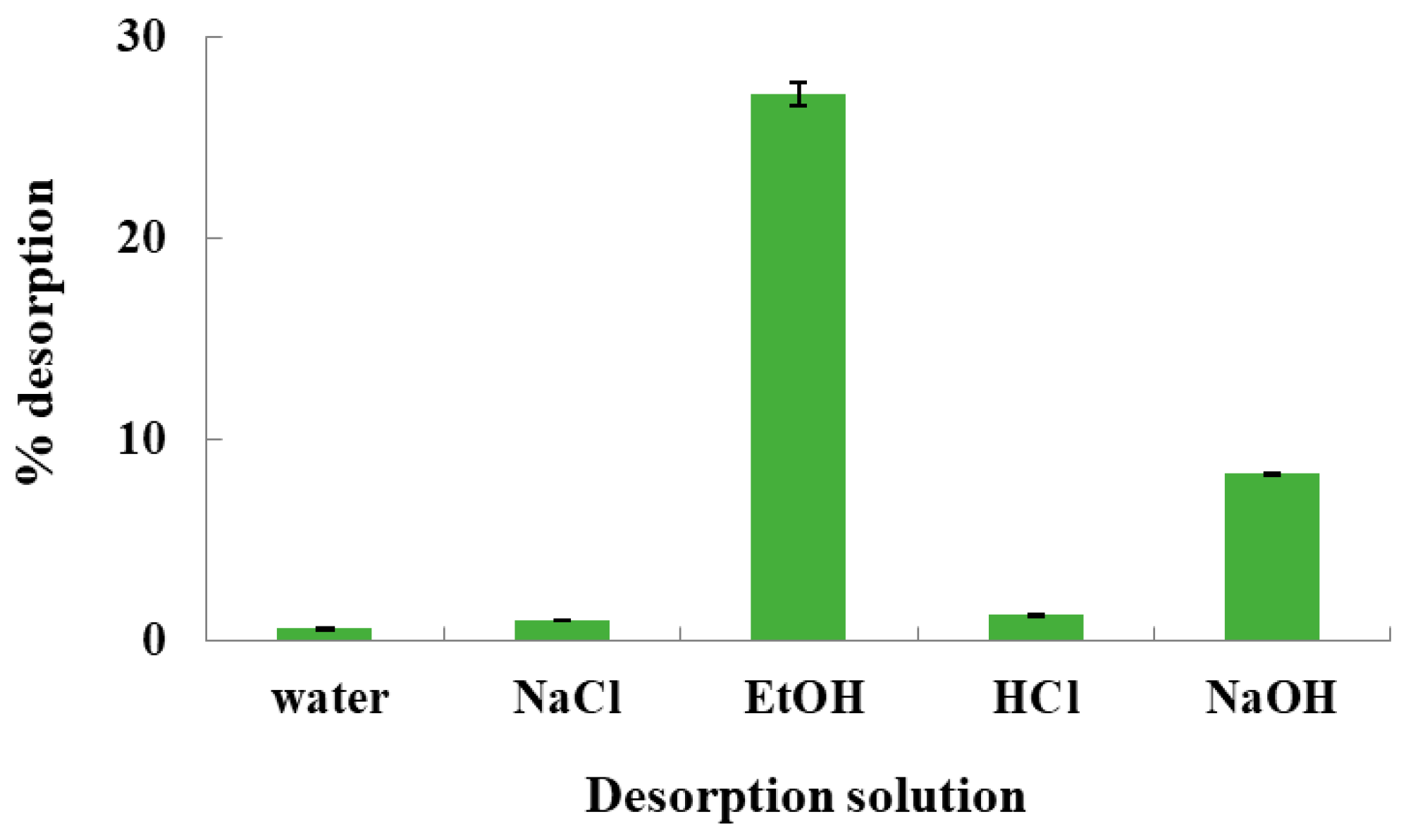
The objective of this study was to valorise eggshell waste (ESW) by investigating its biosorption properties and evaluating its efficiency as a sustainable biosorbent for the removal of the synthetic dye Congo Red (CR) from model CR solutions and synthetic wastewater with the addition of CR. Batch biosorption experiments were conducted to investigate the influence of several factors on the biosorption process, including ESW concentration (1–15 g L−1), contact time (1–360 min), temperature (15, 25, 35, 45 °C) and initial CR concentration (10–100 mg L−1). Desorption experiments were performed using ultrapure water, 0.1 M NaCl, 50% ethanol, 0.1 M HCl, or 0.1 M NaOH as solvents. A higher ESW concentration improved CR removal, but the amount of CR adsorbed on ESW decreased. The dye uptake by ESW was increased with prolonged contact time and temperature increase. When the effect of CR initial concentration was investigated, the results indicated that the process is concentration-dependent and that overall, CR uptake by ESW was higher in synthetic wastewater than in the model dye solution. The biosorption process was better described by the Langmuir isotherm model than by the Freundlich model, indicating monolayer adsorption. Kinetic analysis showed that the pseudo-second-order model provided a better fit than the pseudo-first-order model. Desorption of CR from ESW under the applied experimental conditions was generally low (0.67–27.13%).

1. Introduction

Global egg production increased from approximately 68 million tonnes in 2013 to 76 million tons in 2018 and is projected to reach 90 million tons by 2030 [1,2]. Considering that eggshells constitute 9–12% of the total egg mass, it can be estimated that up to 10 million tons of eggshell waste will be generated annually, requiring proper disposal, which is consistent with Babalola and Wilson [3], who reported that eggshell waste in 2019 was estimated at 8.2 million metric tons. Under EU regulations, eggshells are classified as hazardous waste, particularly when disposed of in landfills [4].
Eggshell waste, which is mainly generated in households, restaurants and egg breaking facilities, can be divided into three structurally distinct sections, each of which has a number of valuable compounds with potential uses. The inner layers, known as adherent egg white and eggshell membranes, each account for approximately 3% of the total mass of eggshell waste. While the adherent egg white is a rich source of egg white proteins, including lysozyme, ovalbumin and ovotransferrin, the membranes are a source of collagen fibres, hyaluronic acid and other important glycosaminoglycans [5]. The remainder of the eggshell waste forms a mineralized shell, which consists of about 94–96% calcium carbonate and is therefore a sustainable source of calcium [6,7]. The other components include the organic matrix as well as magnesium, phosphorus and a variety of trace elements [8]. The literature provides substantial evidence regarding the use of eggshell waste as a versatile and valuable resource. Reported uses include its application as a solid-based catalyst [9], as a biomaterial in medicine and dentistry [10]; as a fertiliser and calcium supplement in human, animal and plant nutrition [9,10] and as a carrier for the immobilisation of enzymes [11,12,13]. Furthermore, several studies have demonstrated that eggshell waste can serve as an effective adsorbent—or, more precisely, a biosorbent, referring to adsorbents of biological origin [14]—for the removal of various pollutants from wastewater, including dyes [15,16,17,18,19,20,21,22,23,24], heavy metals [21,24,25,26,27,28], phenol [29], the pesticide malathion [30], humic acid [31] and pharmaceuticals, such as dexamethasone, febantel, praziquantel, procaine and tylosin [32]. In this context, eggshell waste can be considered an unconventional, low-cost adsorbent/biosorbent, which by definition requires little to no processing, occurs abundantly in nature, or is available year-round in large quantities as a by-product or industrial waste [33]. The criteria for an effective adsorbent/biosorbent include high selectivity, high adsorption capacity, long service life and low-cost. Different adsorbents have different properties such as their active surface area, pore diameter, the quality of the pore distribution and the functional surface group [34].
Synthetic dyes are widely employed across multiple industrial sectors, particularly in textiles, cosmetics, paper, and plastics manufacturing [35]. In the production processes of these industries, coloured wastewater is generated, with dye content reaching 1 to 10% of the total dye used during dyeing [36]. This problem is even more pronounced in the case of textile wastewater, as during the dyeing process, dye losses range from 5 to 50% depending on the type of fabric, and the amount of coloured wastewater produced is estimated at around 200 billion litres annually [37]. This represents the primary pathway through which industrial dyes enter the environment. Due to their complex structure and pronounced resistance to light, microorganisms, and temperature, dyes can persist in the environment for extended periods and pose risks to both aquatic life and human health through bioaccumulation in the food chain [38]. Many synthetic organic dyes used in industry are often overlooked as environmental contaminants because their concentrations in aquatic ecosystems typically range from ng L−1 to μg L−1, leading to their classification as micropollutants or contaminants of emerging concern (CECs) [39,40]. The concentration of dyes in real effluents depends strongly on the wastewater source, particularly the type of production process in which the dyes are used. In the textile industry, for example, dye concentrations in effluents vary with the specific stage of the production process, the type of textile material being dyed, the dye class, the equipment used, and any dilution applied before discharge [41]. Textile effluents constitute a complex mixture of dyes, metals, and other pollutants [41], and typically contain multiple dye classes rather than a single dye type [40]. Reported concentrations in actual textile effluents span a wide range, including 10–50 mg L−1 [42], 100–200 mg L−1 [43], and 10–250 mg L−1 [44]. More frequently, however, studies quantify the colour intensity of dye-containing effluents using ADMI (American Dye Manufacturers Institute) units or the APHA/Hazen (Pt–Co) colour scale [41] instead of reporting actual dye concentrations.
Most European countries have harmonised their legislation with relevant EU directives, which list dyes along with their specific applications in the food, pharmaceutical, textile, and other industries. However, required limit concentrations for specific dyes in wastewater are generally not defined, even though there are strict limits for other wastewater parameters such as COD, BOD, suspended solids, nutrients and specific contaminants (e.g., heavy metals) present in industrial or communal wastewater. The presence of dyes in effluents, as well as their regulation for discharge, is addressed indirectly through limits for general organic pollutants such as COD or TOC, or through wastewater colour expressed in Pt-Co units or AMDI units.
The efficiency of dye removal in conventional biological wastewater treatment systems is low [45,46], necessitating the use of alternative methods, among which adsorption is often the most widely applied.
Congo Red (CR) (synonyms: Congo Red 4B, Cosmos Red, Cotton Red B, Cotton Red C, Direct Red 28, Direct Red R, Direct Red Y) is an anionic synthetic azo dye, with the full chemical name 1-naphthalenesulfonic acid, 3,3′-([1,1′-biphenyl]-4,4′-diyldiazo)bis [4-amino-, disodium salt (molecular weight is 696.68 g mol−1). It is frequently employed as a model compound in adsorption studies due to its structurally complex nature (Figure 1), characterised by two azo groups and multiple aromatic rings.
Azo dyes represent the most extensively utilised class of synthetic organic dyes, and CR is no exception, being used in plastic manufacturing, lumber, printing and the textile industry [47]. However, although CR was once widely applied in the textile industry, its use has been prohibited in many countries owing to its toxic nature; upon metabolic degradation, it can yield aromatic amines, which are recognized human mutagens and carcinogens [48,49].
The aim of this study was to valorise eggshell waste by assessing its biosorptive properties and its efficiency in removing the synthetic dye CR from model dye solutions and synthetic wastewater with the addition of dye. The novelty of this work lies in the specific preparation of the biosorbent, which involved the treatment of the raw waste material with the anionic surfactant sodium dodecyl sulfate (SDS). Additionally, this study addresses a gap in the current literature by investigating the removal efficiency of CR from synthetic wastewater designed to simulate real effluents, as well as assessing the potential for dye desorption from the modified eggshell waste.

2. Materials and Methods

2.1. Eggshell Waste Biosorbent Preparation

Hen eggshell waste was collected from our own households and its physicochemical characteristics (raw eggshell waste) have been comprehensively described in an earlier study [50].
The eggshell waste intended for use as a biosorbent was prepared according to a slightly modified procedure described by Salleh et al. [13]. Rinsing was performed by placing 15 g of eggshell waste in 150 mL of distilled water on an IKA KS 260 basic orbital shaker (IKA-Werke GmbH & Co. KG, Staufen, Germany) and shaking at 250 rpm for 30 min. This procedure was repeated three times, after which the eggshell waste was boiled for 15 min in 0.1% (w/v) sodium dodecyl sulphate (Sigma Aldrich, Barcelona, Spain). Subsequently, the eggshell waste was washed again with distilled water three times for 15 min each, followed by a single 15-min wash with acetone (Kemika, Zagreb, Croatia). The prepared eggshell waste was then dried at 60 °C for 24 h and ground using an IKA WERKE M20 mill (IKA-Werke GmbH & Co. KG, Staufen, Germany) to obtain particles smaller than 0.5 mm. For the biosorption experiments, the ground eggshell waste was classified into fractions of 500–800 µm and 80–500 µm using an analytical sieve shaker (AS 200 basic, Retsch, Haan, Germany). Only the 80–500 µm fraction was used as the biosorbent (hereafter referred to as ESW) for the biosorption experiments to ensure a higher surface area.

2.2. ESW Characterisation

The functional groups present on the ESW surface, relevant to the biosorption process, were characterised by Fourier transform infrared (FTIR) spectroscopy using a Cary 630 FTIR spectrometer with a diamond Attenuated Total Reflectance (ATR) accessory and MicroLab Expert software 1.3 (all Agilent Technologies, Santa Clara, CA, USA). The samples were placed directly on the ATR crystal without further preparation. The spectra were recorded over the wavenumber range of 3950–650 cm−1 at a resolution of 4 cm−1, averaging 32 scans per sample, with background spectra collected and automatically subtracted under identical conditions.
The point of zero charge (pHPZC) of the ESW was determined in accordance with the procedure described by Fiol and Villaescusa [51]. A SevenEasy S20 pH meter equipped with a 3-in-1 pH glass electrode LE410 (all Mettler Toledo, Greifensee, Switzerland) and an integrated temperature probe was used. A three-point calibration using original Mettler-Toledo buffer solutions (Greifensee, Switzerland) (pH 4.01, 7.00, and 10.00) was performed daily, while quality control analyses were conducted using a secondary-source buffer solution. The electrode condition was routinely verified and maintained within acceptable limits (slope 95–105%, offset ±0–15 mV). A mass of 200 mg of ESW was introduced into 40 mL of 0.01 M NaCl solution, previously adjusted to pH values between 2 and 12 by the dropwise addition of HCl (concentrations 0.05–1 mol L−1) or NaOH (concentrations 0.05–1 mol L−1). The suspensions were agitated at 150 rpm for 24 h at 25 °C (Stuart™ SBS40, Cole-Parmer™, Vernon Hills, IL, USA), after which the supernatant was separated and the final pH recorded. The pHPZC was established as the pH corresponding to the intersection of the ΔpH versus pHi plot with the abscissa.

2.3. Model CR Solutions and Synthetic Wastewater Preparation

A fresh 100 mg L−1 stock solution of Congo Red (CR) (Fisher Chemical, Fisher Scientific, Bruxelles, Belgium) was prepared daily in ultrapure water, and working solutions of the desired concentrations were obtained by dilution.
Synthetic wastewater was prepared in ultrapure water by dissolving nutrients and minerals in accordance with OECD 302B guidelines [52]. The synthetic wastewater was composed as follows: 160 mg L−1 peptone (Biolife, Milano, Italy), 110 mg L−1 meat extract (Merck, Darmstadt, Germany), 30 mg L−1 urea (Kemika, Zagreb, Croatia), 28 mg L−1 K2HPO4 (Kemika, Zagreb, Croatia), 7 mg L−1 NaCl (Kemika, Zagreb, Croatia), 4 mg L−1 CaCl2 · 2H2O (Merck, Darmstadt, Germany), 2 mg L−1 MgSO4 · 7H2O (Kemika, Zagreb, Croatia). To prepare synthetic wastewater containing CR, an appropriate amount of CR was added to the synthetic wastewater to achieve a final dye concentration of 10–100 mg L−1.

2.4. Batch Biosorption Experiments

The CR dye removal experiments were carried out using the batch biosorption technique. A defined amount of biosorbent and 50 mL of model CR solution or synthetic wastewater with the addition of CR were introduced into 100 mL Erlenmeyer flasks and placed in shaking waterbath (Stuart™ SBS40, Cole-Parmer™, Vernon Hills, IL, USA) under predetermined conditions (biosorbent concentration, contact time, temperature, initial dye concentration, and agitation speed of 150 rpm). The experimental conditions for each biosorption study are given in Table 1.
Experiments were carried out at native pH, which was monitored but not adjusted during biosorption.
After the biosorption, the flasks were collected and the contents were filtered using Whatman filter paper No. 42 and centrifuged at 6000 rpm for 10 min (IKA mini G, IKA®-Werke GmbH & Co. KG, Staufen, Germany). Following centrifugation, the residual dye concentrations at the end of the biosorption process were determined spectrophotometrically using a Single Beam UV/Vis Spectrophotometer (Camspec M501, Leeds, UK), at a wavelength of 498 nm. A series of seven CR solutions with concentrations of 1, 3, 5, 7, 9, 15 and 20 mg L−1 were prepared in triplicate by diluting the 50 mg L−1 stock solution, and their absorbance measured to construct a calibration curve. Linearity was confirmed with a high correlation coefficient (R2 = 0.9997) over the applied concentration range, described by the regression equation A = 0.0509∙γCR − 0.0075, where A is the absorbance at 498 nm and γCR is the CR concentration (mg L−1). The limits of detection (LODs) and quantification (LOQs) were 0.262 mg L−1 and 0.793 mg L−1, respectively.
The percentage of CR removal and the amount of the adsorbed CR over time t, qt (mg g−1) were calculated using the following equations:
%   C R   r e m o v a l = γ 0 γ t γ 0 · 100 ,
q t = γ 0 γ t m · V ,
where γ0 and γt (mg L−1) are the initial CR concentration and CR concentration at a predetermined contact time, respectively. V (mL) is the volume of the CR solution, and m (g) is the mass of the biosorbent.

2.5. Isotherm and Kinetic Modelling of Batch Biosorption Data

The data of CR biosorption onto ESW at equilibrium were analysed using the Freundlich and Langmuir adsorption isotherm models. The Freundlich isotherm model [53], an empirical model mathematically described by Equation (3), assumes that adsorption occurs on a surface with sites of varying energy and involves both monolayer and multilayer adsorption mechanisms:
q e = K F · γ e 1 / n
where qe is the amount of adsorbate per unit mass of adsorbent at equilibrium (mg g−1), KF is the Freundlich constant (mg g−1·(L·mg−1)1/n), γe is the adsorbate concentration at equilibrium (mg L−1) and 1/n is an empirically derived constant representing the adsorption affinity of the system. The Langmuir isotherm model [54] represented by Equation (4), assumes monolayer adsorption on a surface with uniform energy and a finite number of adsorption sites, with no interactions between the adsorbed molecules:
q e = q m a x · K L · γ e 1 + K L · γ e
where γe is the adsorbate concentration at equilibrium (mg L−1), qe is the amount of adsorbate per unit mass of adsorbent at equilibrium (mg g−1), qmax is the maximum adsorption capacity for monolayer (mg g−1) and KL is Langmuir constant (L mg−1), which indicates the binding affinity between the adsorbent and adsorbate.
The kinetic experimental data for CR biosorption onto ESW were analysed using the pseudo-first-order (PFO) and pseudo-second-order (PSO) kinetic models. The PFO model assumes that the adsorption rate is proportional to the number of available (unoccupied) adsorption sites, while the PSO model assumes that the rate-limiting step governing the adsorption process may involve chemisorption, i.e., chemical interactions [55,56]. The non-linear forms of the PFO and PSO models are presented in Equations (5) and (6), respectively [57,58]:
q t = q e ( 1 e k t )
q t = q e 2 · k 2 · t 1 + q e · k 2 · t
where qt and qe represent the amounts of adsorbate per unit mass of adsorbent at time t and at equilibrium (mg g−1), respectively; k1 and k2 are the PFO and PSO rate constant, which describe the rate of adsorption toward equilibrium.

2.6. Desorption Experiments

Prior to desorption, ESW was saturated with CR by dispersing 500 mg of ESW in 50 mL of a model CR solution with an initial concentration of 100 mg L−1. Biosorption was carried out for 360 min at 25 °C and 150 rpm under native pH conditions. After saturation, the ESW was separated and dried at 40 °C to constant mass. For desorption experiments, 500 mg of CR-saturated ESW was dispersed in 50 mL of solvent (ultrapure water, 0.1 M NaCl, 50% ethanol, 0.1 M HCl, or 0.1 M NaOH) and shaken for 360 min at 25 °C and 150 rpm. The percentage of desorbed CR (D) was calculated using Equation (7):
D = γ D · V D q e · m · 100 %
where γD (mg L−1) is the CR concentration in the solution after desorption, V (mL) is the solution volume, m (mg) is the mass of CR-saturated ESW, and qe (mg g−1) is the equilibrium biosorption capacity of the biosorbent.
Biosorption and desorption experiments were conducted in duplicate with reproducible results.

3. Results and Discussion

3.1. ESW Characterisation

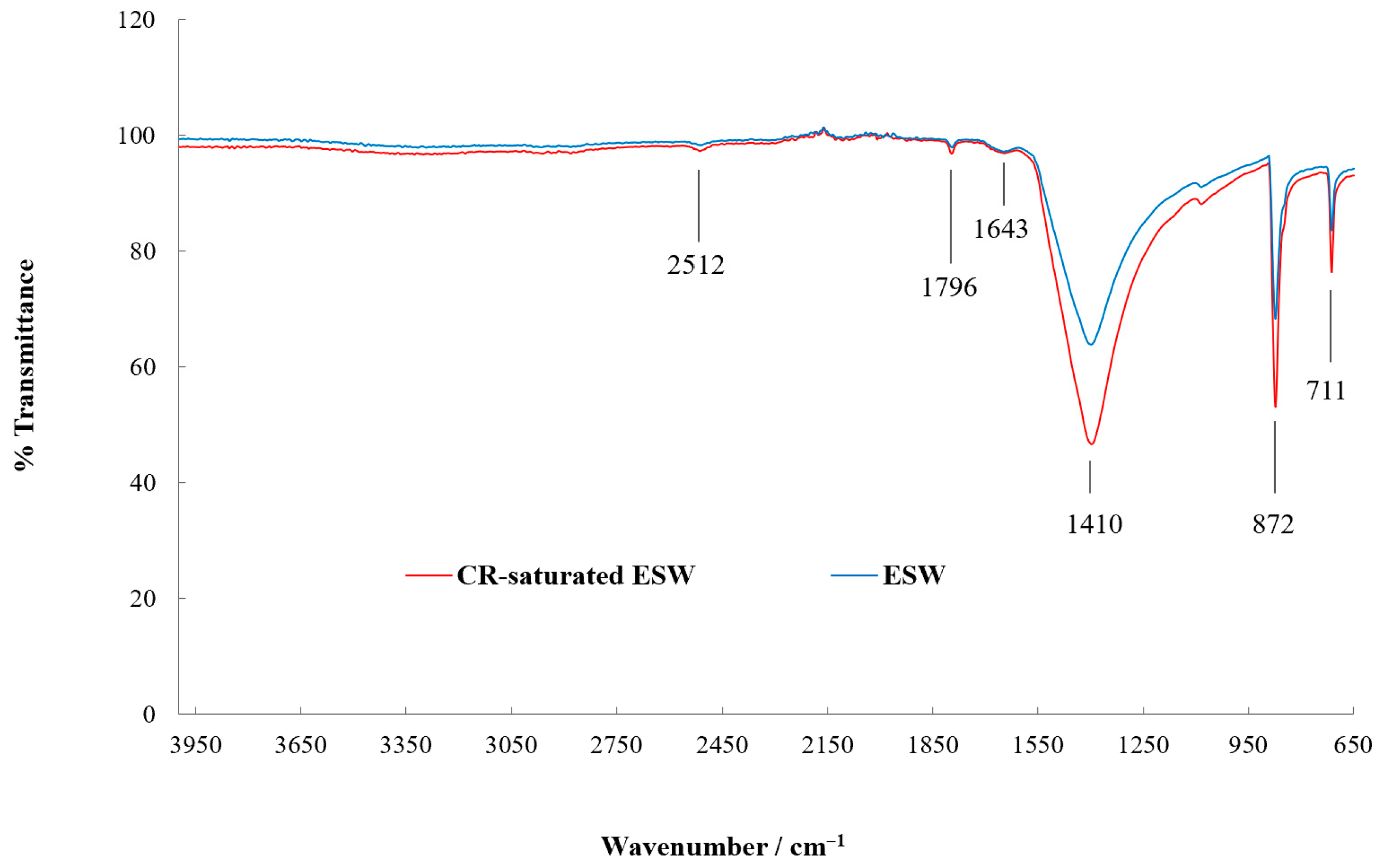
The qualitative biosorption characteristics of ESW were investigated using FTIR spectroscopy by analysing the surface functional groups of pristine and CR-saturated ESW (Figure 2). It is generally understood that surface functional groups play an important role in biosorption, as they provide active sites for adsorbate–biosorbent interactions [59]. In theory, when comparing the FTIR spectra of adsorbent materials before and after saturation with an adsorbate,, observed shifts in peak positions or changes in band intensities indicate that corresponding functional groups are involved in the adsorption process [60]. Figure 2 shows that the FTIR spectra of ESW and CR-saturated ESW are very similar, with overlapping band positions. The biosorbent is not heavily loaded with the adsorbate (i.e., CR), so the contribution of the specific functional groups of CR may be small compared to those of the biosorbent. Furthermore, this may also suggest that no bond cleavage or formation occurred during adsorption [61].
Kalaycı et al. (2025) reported that FTIR spectra of different eggshell species exhibit characteristic bands common to all samples before adsorption, located around 2509, 1796, 1411, 1040, 872 and 712 cm−1, which is consistent with the results obtained in this study. The FTIR spectra of pristine ESW and CR-saturated ESW (Figure 2) show the most distinctive peaks at 1410 and 872 cm−1, both of which can be assigned to deformation vibration bands of CaCO3, with the former typically broader and more intense than the latter [62,63,64]. Additionally, the band observed at 712 cm−1 can also be attributed to out-of-plane and in-plane deformation vibrations of CaCO3 [65]. The low-intensity broad band at 2512 cm−1 can be assigned to hydrogen group stretching, while the low-intensity sharp band at 1796 cm−1 corresponds to carbonyl group stretching, both are characteristic of organic matter [64,66]. A small-intensity band present at 1643 cm−1 can also be associated with carbonyl group stretching. The C=O and ring stretching vibrations in the range of 1690–1600 cm−1 range can be attributed to the stretching vibration of amide I, which, together with the stretching vibration of amide II (C–N vibrations in the 1500–1600 cm−1 range), represents the FTIR fingerprint of proteins [67].
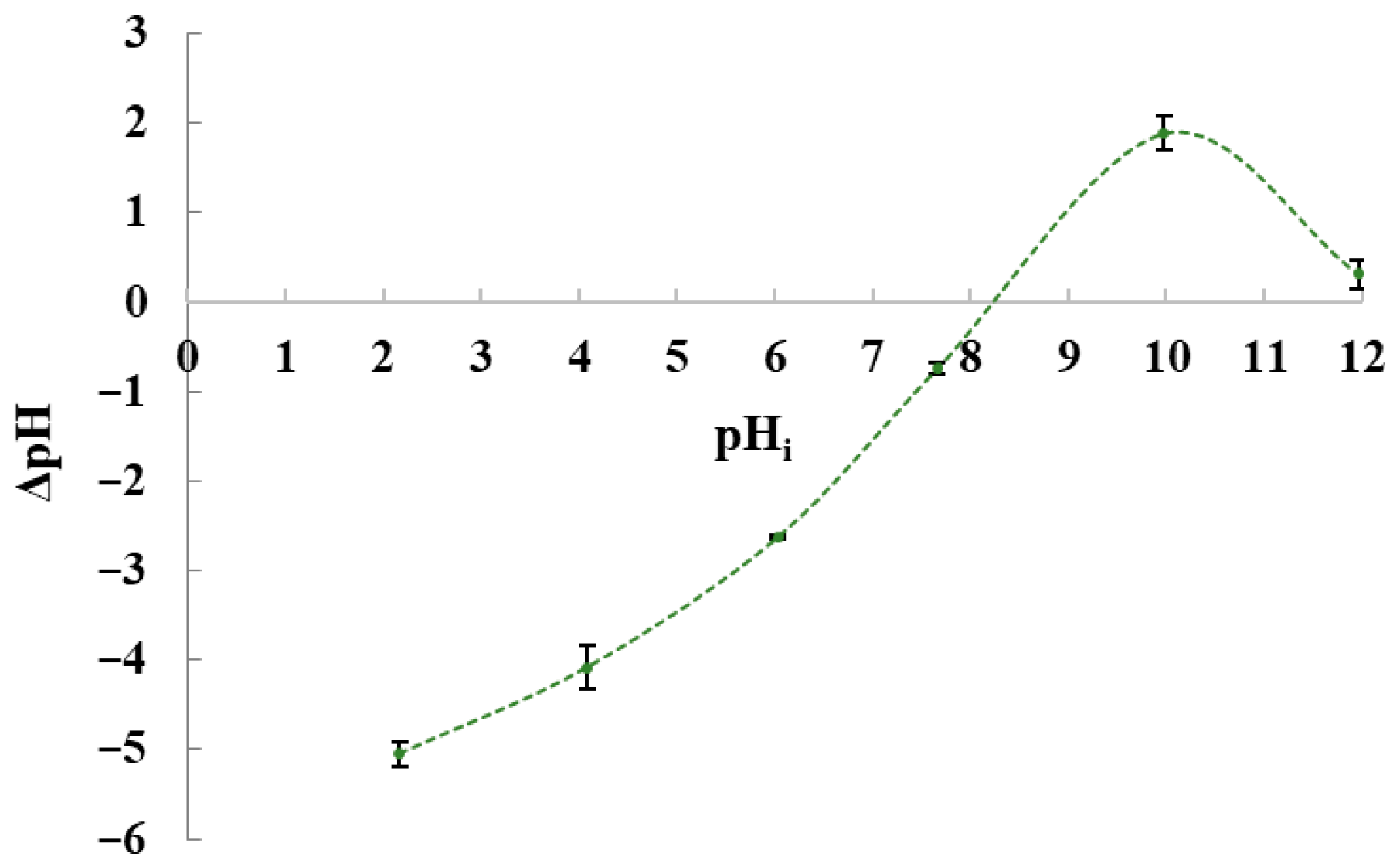
The point of zero charge (pHpzc) of an adsorbent/biosorbent is defined as the pH at which the surface is neutral, i.e., the number of electrostatically positive and negative surface groups is equal. The pHpzc of an adsorbent/biosorbent reflects its electrostatic behaviour: at pH values below the pHpzc the surface is positively charged, favoring the uptake of anionic species, while at pH values above it the surface is negatively charged, promoting uptake of cationic species [51]. The results of the point of zero charge determination for ESW are presented in Figure 3, showing that its pHpzc corresponds to a pH value of 8.2.
At pH values below 8.2, the surface of ESW carries a net positive charge, which favours the biosorption of CR. All experiments were conducted at native pH of the biosorbent/adsorbate system, which ranged between 7 and 8 and was lower than the pHpzc, thereby providing favourable conditions for the uptake of CR. Different pHpzc values have been reported for eggshell in other studies: 4.47 [68], 7 [24] and 9.27 [69].
The functional groups in ESW expected to participate in the biosorption of anionic dyes such as CR include carbonate groups (under conditions where pH < pHpzc), as well as carbonyl groups and C–N vibrational features associated with proteins in the eggshell membrane. At pH values below the pHpzc (i.e., neutral to acidic conditions), the ESW surface becomes positively charged (protonated), allowing electrostatic interactions with the SO3 groups of CR [15,70,71]. In addition to electrostatic interactions, other reported mechanisms related to the functional groups may include hydrogen bonding [71] and ion exchange [63].

3.2. Batch Biosorption Studies in Model Dye Solution and Synthetic Wastewater

The performance of ESW as a biosorbent for CR biosorptive removal from model dye solutions and synthetic wastewater was investigated. Specifically, the effects of biosorbent concentration, contact time, temperature and initial dye concentration on CR removal were examined.
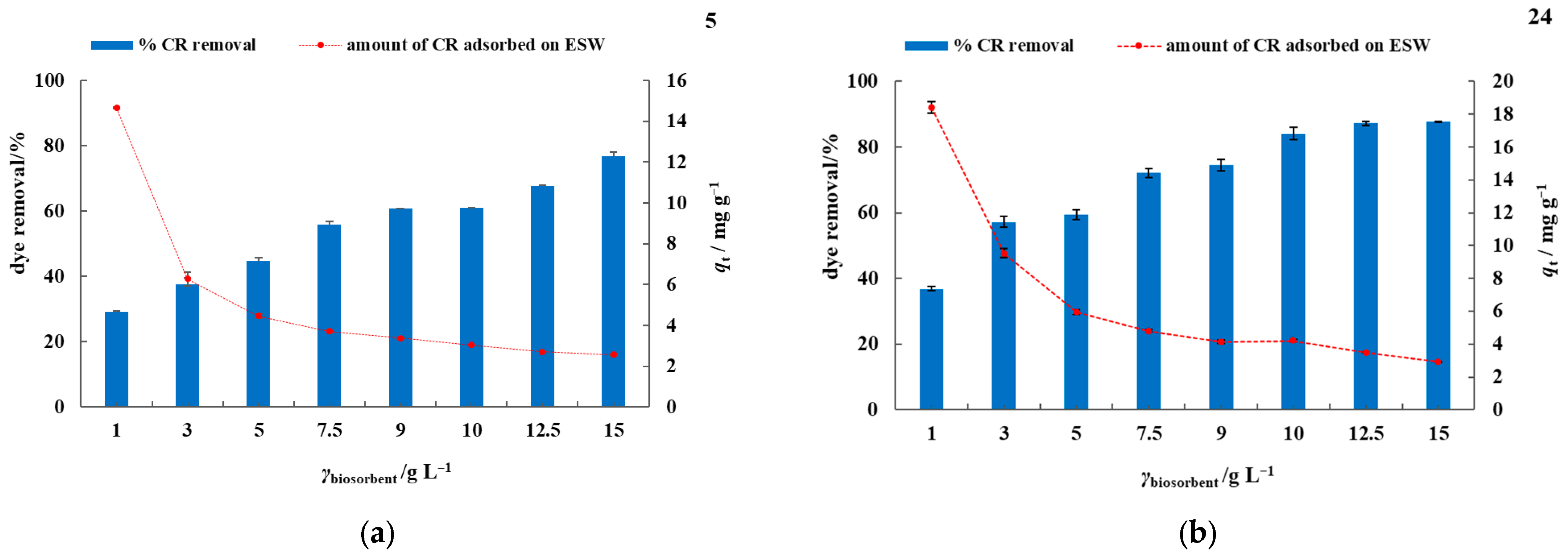
The biosorption process is largely influenced by the biosorbent concentration, as an increase in biosorbent concentration is often followed by an increase in biosorption capacity up to an optimum. This can be attributed, among other factors, to the greater availability of vacant binding sites on the biosorbent surfaces, facilitating more efficient adsorption [72]. Figure 4 illustrates the effect of biosorbent concentration on the amount of CR adsorbed per gram of ESW, as well as on the removal efficiency of CR (expressed as % CR removal) at contact times of 5 h and 24 h (Figure 4a,b).
As shown in Figure 4a,b, an increase in biosorbent concentration resulted in a higher percentage of dye removal in both experiments. For the 5 h experiment, raising the biosorbent concentration from 1 g L−1 to 15 g L−1 increased dye removal from 29.32% to 76.78%. Extending the contact time to 24 h further enhanced the removal efficiency, with the percentage removal rising from 36.86% to 87.72% over the same concentration range. Furthermore, in both experiments, the increase was initially sharp and linear and subsequently reached a plateau, particularly in the 24 h experiment. A similar trend, in which higher biosorbent concentrations enhanced dye removal, was also reported by Parvin et al. [22] and Zulfikar et al. [73] in their study on CR adsorption using eggshell waste, as well as by other authors who used eggshell waste to remove other synthetic dyes such as the anionic dyes Methyl Red [23] and Direct Blue 78 [20] or cationic dye Crystal Violet [19].
However, the opposite trend was observed for the amount of dye adsorbed per gram of biosorbent. In the 5 h experiment, the amount of CR adsorbed decreased with increasing biosorbent concentration from 1 g L−1 to 15 g L−1, dropping from 14.66 to 2.56 mg g−1. A similar pattern was observed after 24 h, with the amount of CR adsorbed decreasing from 18.43 to 2.92 mg g−1. With increasing biosorbent concentration, the total number of available biosorption sites also increases, leading to higher overall dye removal (while the initial CR concentration was kept constant). Consequently, the same amount of CR is distributed over a larger number of binding sites, leaving a portion of the sites unsaturated and reducing the amount of CR adsorbed per unit mass of biosorbent. Similar results were reported for the biosorption of anionic dye Remazol Brilliant Violet-5R onto eggshell waste [71], Based on these results, the optimal biosorbent concentration selected for further experiments (considering both the amount of CR adsorbed per unit mass of ESW and the dye removal efficiency, as well as contact time) was 10 g L−1.
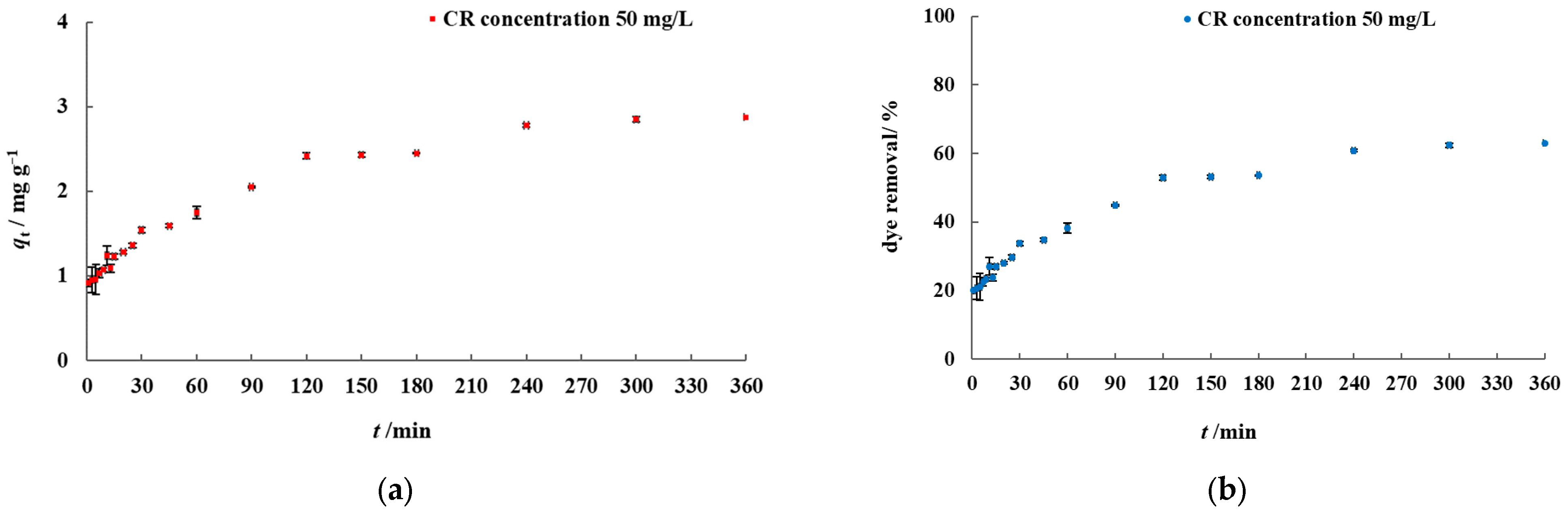
The biosorption process is strongly influenced by contact time, making the determination of its optimal duration crucial for both process optimisation and practical water treatment applications. The results presented in Figure 5 indicate that the removal of CR is characterised by a rapid biosorption phase within the first 60 min. Following this initial stage, CR removal proceeds more slowly until equilibrium is reached at 300 min. This finding is consistent with previous studies that investigated the biosorptive removal of CR using eggshell waste [15,22,74]. The higher CR removal efficiency observed during the initial stages of the biosorption process can be attributed to the greater availability of free binding sites. In the later stages, however, the reduced number of vacant binding sites results in a slower removal rate until equilibrium is achieved [74]. A contact time of 360 min was selected for subsequent experiments to ensure equilibrium was achieved.
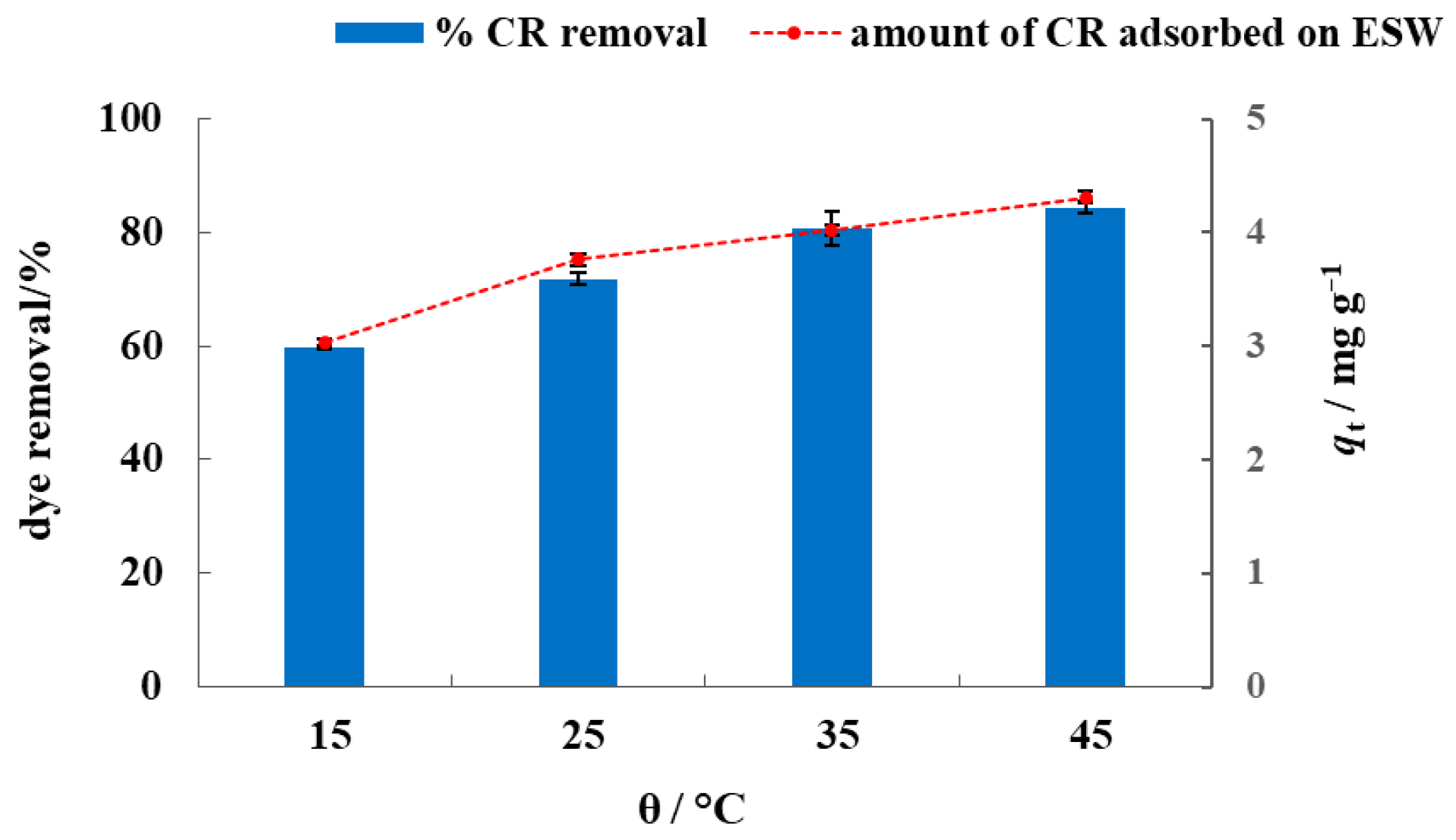
In addition to pollutants such as dyes and other dissolved or suspended substances, coloured wastewater from various industries may also be contaminated by waste heat; thus, the discharge of effluents at elevated temperatures is a likely scenario, making it important to investigate adsorption under these realistic conditions. This is often the case for textile industry effluents, as the dyeing process requires elevated temperatures and the addition of electrolytes to facilitate the migration of dyes to the fibre surface (as the increase in temperature can enhance the mobility of the large dye ions [75]). As shown in Figure 6, dye uptake by ESW increased with temperature increase from 15 to 45 °C, with the amount of CR adsorbed rising from 3.03 to 4.31 mg g−1 and the removal efficiency improving from 59.63 to 84.36%, indicating enhanced biosorption at elevated temperatures and possibly the endothermic nature of the process [75]. Saha et al. [74] also reported an increase in CR uptake by eggshell with rising temperature from 20 to 40 °C. They hypothesised that this effect could be attributed to an enhanced affinity of the biosorption sites for CR, as well as increased mobility of CR molecules, accompanied by a reduction in the retarding forces acting on these molecules. This hypothesis can also be applied to the present study. Similar behaviour has been observed for the uptake of other synthetic dyes by eggshell and other biosorbents [23,75,76,77]. On the other hand, Abdel-Khalek et al. [15], who investigated the adsorption of the synthetic dyes, namely cationic Methylene Blue (MB) and anionic CR onto eggshell, reported that the amount of both dyes adsorbed on the eggshell gradually decreased with increasing temperature. This behaviour was also attributed to the enhanced mobility of dye molecules, which tend to escape from the adsorbent surface into the liquid phase.
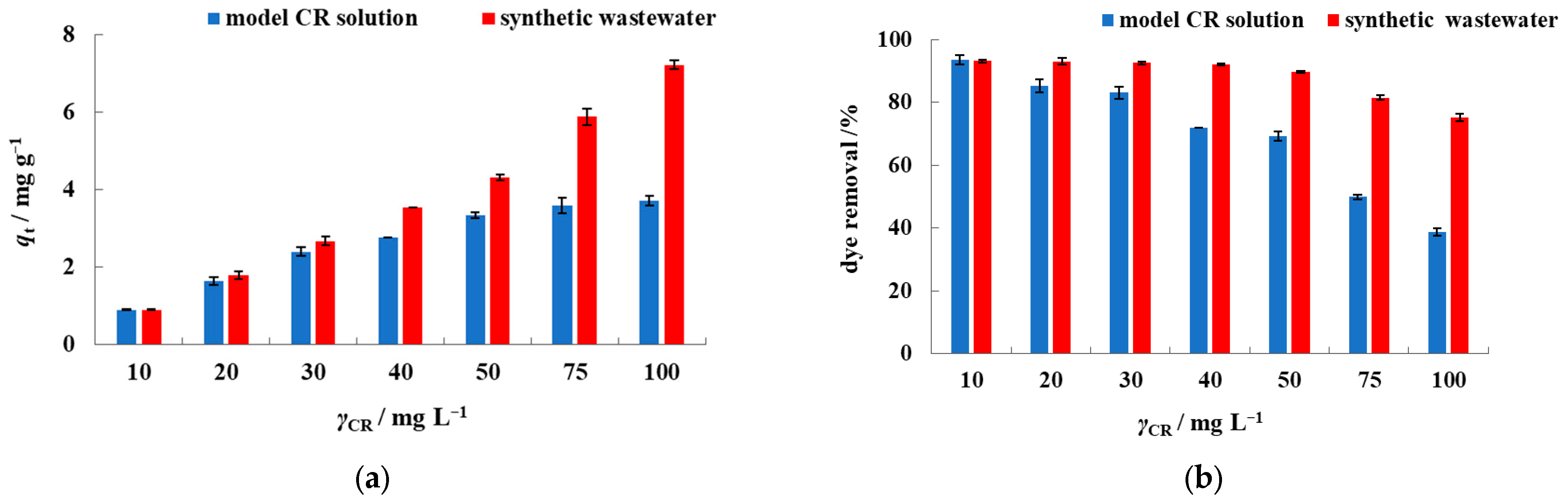
Because model dye solutions do not accurately represent complex real effluents, the effect of increasing the initial CR concentration from 10 to 100 mg L−1 on the amount of CR adsorbed per unit mass of biosorbent and the biosorbent CR removal efficiency (% CR removal) was evaluated using both model dye solutions and synthetic wastewater containing CR. The results are shown in Figure 7.
The results show that increasing the initial dye concentration led to a higher amount of CR adsorbed per unit mass of biosorbent, an effect that was more pronounced in synthetic wastewater (increasing from 0.89 to 7.22 mg g−1) than in model CR solutions (increasing from 0.9 to 3.72 mg g−1). Conversely, the CR removal efficiency (% CR removal) decreased with increasing initial CR concentration, with the effect being more pronounced in model CR solutions (decreasing from 93.6 to 38.7%) than in synthetic wastewater (decreasing from 93.2 to 75.2%). Contributing factors may include the pH-buffering effect of the wastewater, enhanced electrostatic interactions resulting from salts present in the wastewater, or surface conditioning by organic components such as peptone, meat extract, and urea. However, these hypotheses need to be experimentally confirmed before drawing any definitive conclusions.
Overall, the findings from the investigation of the effect of initial CR concentration indicate that the biosorptive removal of CR by ESW is concentration-dependent, which is consistent with the results reported by other authors using ESW-based biosorbents for the removal of synthetic dyes, who also observed an increase in the amount of CR adsorbed on biosorbent and a decrease in CR removal percentage with increasing initial CR concentration [17,18,74].

3.3. Isotherm and Kinetic Modelling of Batch Biosorption Data

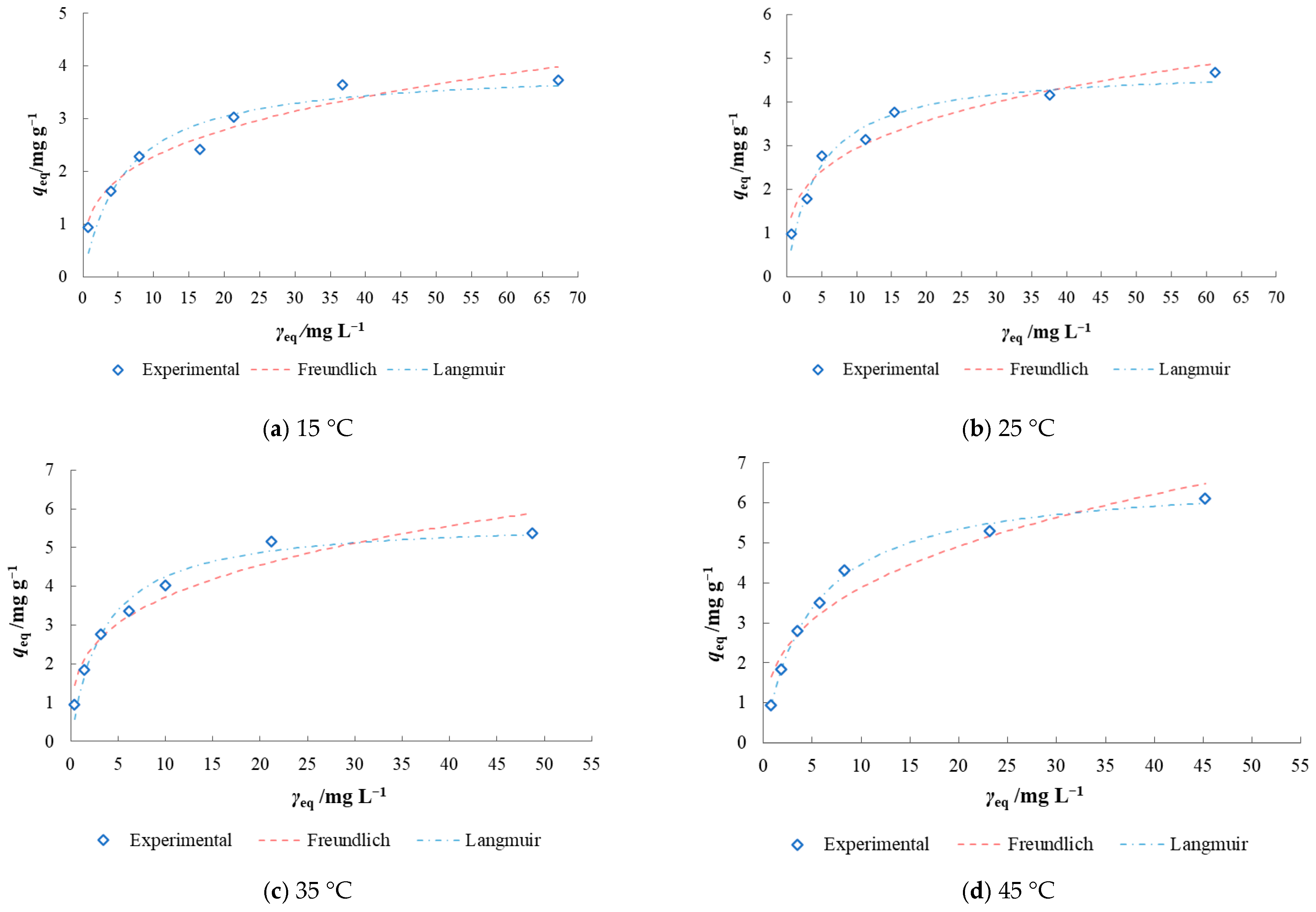
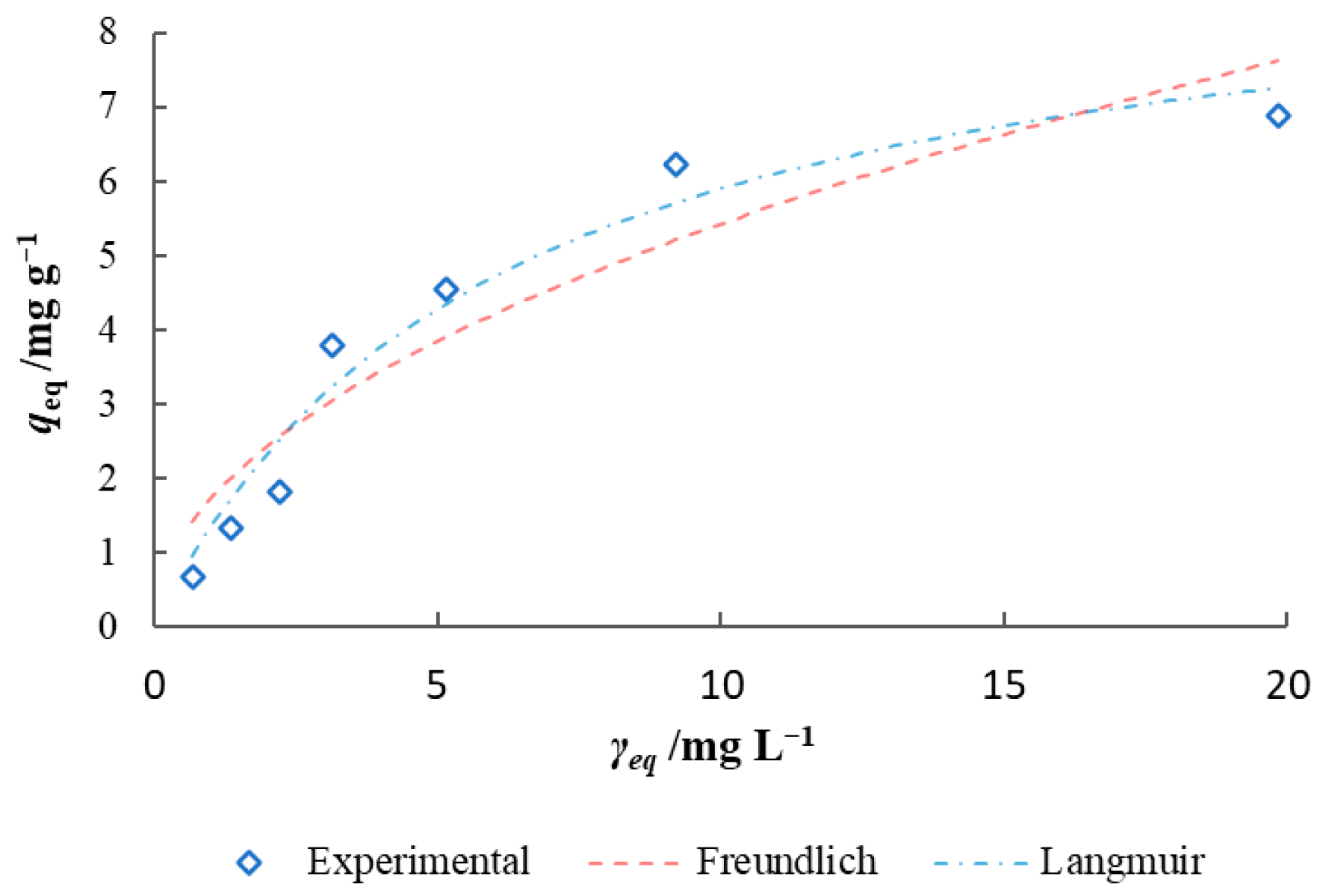
Figure 8 presents the Freundlich and Langmuir isotherms for the biosorption of Congo Red (CR) onto eggshell waste (ESW) from model CR solutions over a range of temperatures, while Figure 9 shows the corresponding isotherms for the biosorption of CR onto ESW from synthetic wastewater containing CR at 25 °C. These figures illustrate the equilibrium relationships between the concentrations of CR in the liquid and solid phases. The isotherms provide insights into the maximum amount of CR adsorbed per unit mass of the biosorbent.
The calculated parameters for all investigated isotherm models are presented in Table 2.
Based on these parameters, it can be concluded that, in the case of the model CR solution, the biosorption process can be satisfactorily interpreted by both the Langmuir and Freundlich models. However, the equilibrium data showed a slightly better fit with the Langmuir model at all investigated temperatures, except at 15 °C. This finding is consistent with the reports of Parvin et al. [22] and Saha et al. [74], who also noted that both models adequately describe the biosorption of CR onto eggshell, although the Langmuir model provides a slightly better fit. Good agreement of the experimental data with the Langmuir model suggests monolayer biosorption of CR onto ESW occurring on uniform (in terms of energy) surface binding sites that are specific and finite in number. Similar trends have been reported for the biosorption of other anionic dyes onto eggshell waste, where both adsorption models were generally applicable, although one typically provided a slightly better fit. For example, the Langmuir model was shown to better describe the adsorption of Methyl Red [23], Reactive Yellow 145 [21], and Direct Black 22 [24], whereas the Freundlich model more accurately captured the biosorption behaviour of Direct Blue 78 [20] and Reactive Red 120 [76]. In contrast, Abdel-Khalek and Abdel Rahman [15] reported that the Freundlich model provided a markedly superior fit for CR adsorption onto eggshell waste, and Al-Nasir and Mohammed [16] similarly found that only the Freundlich model was suitable for describing the biosorption of Methyl Orange.
The equilibrium data for the synthetic wastewater containing CR were much better described by the Langmuir model than by the Freundlich model. The results indicate that the biosorption of CR onto ESW in both the model CR solution and synthetic wastewater systems is a homogeneous process involving monolayer surface coverage, with maximum biosorption capacities at 25 °C of 4.767 mg g−1 and 9.476 mg g−1 for the model CR solution and the synthetic wastewater, respectively.
The parameters of the PFO and PSO kinetic models for the removal of CR by ESW from model dye solution and synthetic wastewater are given in Table 3.
The results indicate that, for the biosorption of CR onto ESW, the PSO model provides a better description of the experimentally obtained data for both the model CR solution and the synthetic wastewater containing CR. A review of the literature further supports these findings, indicating that the PSO model generally provides a better description of the kinetic data than the PFO model for the biosorptive removal of various anionic dyes, including Congo Red, from model dye solutions using eggshell waste [15,20,23,24,70,71,74,76].
The correlation coefficient for the PSO model was higher for the synthetic wastewater (R2 = 0.938) compared to the model CR solution (R2 = 0.803). Furthermore, the qt2 estimated by the model showed closer agreement with the experimentally determined value (qt,exp) for CR biosorption onto ESW in the wastewater system than in the model CR solution.
The good agreement with the PSO model is commonly interpreted in terms of a chemisorption or chemisorption-like mechanism, such as the strong electrostatic attraction already hypothesised for the CR/ESW system in relation to the functional groups involved in the biosorption process.

3.4. Adsorption Capacities of Eggshell Waste and Other Waste-Derived Biological Materials Toward Synthetic Dyes

The maximum adsorption capacity obtained in this study was 6.64 mg g−1 at 45 °C, while at 25 °C the maximum capacity for the model CR solutions was 4.767 mg g−1. When synthetic wastewater spiked with CR was used, the maximum adsorption capacity increased to 9.476 mg g−1. Table 4 provides an overview of reported adsorption capacities of eggshell-waste-derived biosorbents towards Congo Red and other synthetic dyes. Compared with previously published results, the adsorption capacities reported in this work are lower than those reported for CR adsorption onto eggshell-derived sorbents, which range from 49.5 to 153.85 mg g−1 [15,22,31,70,74,78]. However, the capacities obtained in this study are comparable to some of the values reported for eggshell-waste-derived biosorbents applied to other anionic synthetic dyes, such as methyl red [23], methyl orange [16], Direct Blue 78 [20], Remazol Brilliant Violet 5R [71], and Indigo Carmine [18].
Table 5 provides examples of adsorption capacities reported for other waste-derived biological materials used for CR removal. As with eggshell-based biosorbents, these capacities span a wide range, with materials used in their native (unmodified) form generally exhibiting lower adsorption capacities for CR. It is evident from Table 4 and Table 5 that the adsorption capacities of waste-derived biological materials towards CR and other synthetic dyes can vary substantially—even within the same adsorbate–adsorbent system—owing to differences in material properties, preparation methods (e.g., activation/modification methods, particle size) and experimental conditions (e.g., pH, temperature, initial concentration of adsorbate, adsorbent dosage/concentration).

3.5. Desorption Experiments

Regenerating waste-based biosorbents for multiple reuse cycles, along with the potential recovery and reuse of valuable adsorbates, may enhance the economic feasibility and environmental sustainability of biosorption technologies, in line with circular economy principles [87]. Regeneration strategies, influenced by adsorbent type, properties, and adsorbate nature, are classified into decomposition, which mineralizes or detoxifies pollutants, and desorption, which disrupts adsorbate–adsorbent interactions [88]. Desorption methods can be thermal—destructive and suitable when adsorbate recovery is unnecessary—or non-thermal, preserving the adsorbent for multiple reuse cycles. Among non-thermal approaches, chemical regeneration is most common, employing solvents or reagents to remove adsorbed species based on adsorbate concentration and interaction forces [89]. However, the adsorption–chemical regeneration strategy, although often successful under laboratory conditions, may present challenges for real-scale applications due to the need to manage waste desorbate solutions containing concentrated adsorbates when neither solvent recovery (e.g., distillation, membrane separation) nor adsorbate recovery (e.g., precipitation or other specific recovery processes) is feasible or practical. In such cases, the waste desorbate requires further handling to avoid environmental risks, and potential management strategies should include the use of decomposition (degradation) techniques for this waste if possible. Some of these techniques include advanced oxidation processes (AOPs) and other oxidative treatments capable of decomposing oxidisable organic compounds concentrated in the desorbate, as well as photo-assisted oxidation methods or thermal methods [88,90]. Biological treatment may also be an option for biodegradable desorbates, but it is slow and often limited by the toxicity of adsorbates (water pollutants) present in high concentrations [88]. When treatment or recovery is impractical or ineffective, safe disposal of the waste desorbate solutions (or their concentrated residues) remains an option, but is generally the least preferable from environmental and circular economy perspectives.
Zulfikar et al. [73] report that the most commonly used desorbing agents, typically evaluated under laboratory conditions for experimental purposes, include strong acids and bases (e.g., HCl, HNO3, NaOH), chelating agents such as EDTA, salts like CaCl2, and organic solvents such as methanol and ethanol. This is supported by other authors, who also used listed reagents [20,63,76]. These agents are selected for their ability to effectively disrupt the previously mentioned adsorbate–adsorbent interactions.
Figure 10 presents the results of chemical regeneration, i.e., desorption of CR from ESW using various solvents, namely ultrapure water, 0.1 M NaCl, 50% ethanol, 0.1 M HCl and 0.1 M NaOH.
As shown in Figure 10, the desorption of CR from ESW under the applied experimental conditions was generally low, with only 50% ethanol achieving a notable desorption efficiency of 27.13%, suggesting potential for further optimisation of the desorption process. These results indicate a strong interaction between CR and ESW. Murcia Salvador et al. [20] reported a comparable desorption efficiency of 21% when using 0.5 M NaOH as the eluent for the desorption of Direct Blue 78 from an eggshell waste biosorbent. However, during four consecutive adsorption/desorption cycles, the adsorption efficiency progressively decreased, whereas the desorption efficiency increased, ultimately reaching nearly 60%.
Saleh et al. [63] investigated the regeneration of calcined eggshell waste saturated with two direct anionic dyes, Tubantin Brown GGL and Tubantin Red BWS, following biosorption from a mixed dye solution. The dye mixture better simulates real colored effluents, which typically contain more than one dye species. Out of the five tested eluents, 0.5 M NaOH proved the most effective, achieving a desorption efficiency of 32%. Four adsorption and desorption cycles showed that dye adsorption progressively declined (by approximately 45%), while desorption efficiency increased (by more than 45%), likely due to changes occurring on the biosorbent surface. On the other hand, Saratale et al. [76] tested several desorption reagents for regenerating eggshell waste saturated with Reactive Red 120. Only NaOH was effective, achieving a desorption efficiency of 92.4%, while all other eluents showed negligible efficiencies (<10%). Using NaOH, the authors performed five successive adsorption–desorption cycles, during which both dye recovery and desorption efficiency slightly decreased, with a total decline of less than 10%.
All studies demonstrate that eggshell waste can be reused as a biosorbent when an appropriate regenerating agent is used, highlighting the need to identify more suitable eluents capable of achieving higher desorption efficiencies for the CR/ESW adsorbate–biosorbent system. Furthermore, future work should also explore the potential for consecutive use of the ESW through adsorption/desorption experiments.

4. Conclusions

This study explored the valorisation of eggshell waste as a biosorbent (ESW) for the removal of Congo Red (CR) from model dye solutions and synthetic wastewater. Overall, the biosorption process was strongly influenced by increases in ESW concentration, contact time, and temperature, all of which enhanced the CR removal efficiency. The process was dependent on the initial CR concentration in both model dye solutions and synthetic wastewater. In both systems, the biosorption process was more accurately described by the Langmuir isotherm model than by the Freundlich model, indicating monolayer adsorption, with maximum biosorption capacities at 25 °C of 4.767 mg g−1 for the model CR solution and 9.476 mg g−1 for the synthetic wastewater. Although the obtained maximum biosorption capacities were relatively modest compared to those of commercial adsorbents, the results demonstrate the potential of ESW as a low-cost and sustainable biosorbent for CR removal. Kinetic analysis of the data obtained for both systems revealed that the pseudo-second-order model provided the best fit, suggesting a chemisorption-like mechanism. The desorption of CR from ESW under the applied experimental conditions was generally low, ranging from 0.67% to 27.13%, confirming the strong binding of CR molecules to the biosorbent surface. Further studies should focus on enhancing the biosorption capacity of ESW, not only to improve its performance toward CR but also to broaden its applicability to diverse contaminants in complex wastewater matrices. Its performance in column systems simulating real wastewater treatment, as well as its reusability through adsorption–desorption cycles with various solvents, should also be systematically investigated.

Author Contributions

Conceptualization, N.V., M.S. and M.O.; Methodology N.V., M.S. and I.S.; Validation N.V. and S.B.; Formal analysis, M.S., M.O. and H.Š.; Investigation, M.S., M.O. and H.Š.; Resources, N.V., I.S. and S.B.; Data curation, M.S. and M.O.; Writing—original draft preparation, M.S., M.O. and N.V.; Writing—review and editing, all the authors; Supervision, N.V. and I.S.; Project administration, S.B.; Funding acquisition, S.B. All authors have read and agreed to the published version of the manuscript.

Funding

This work has been fully supported by the Croatian Science Foundation under the project IP-2020-02-6878.

Institutional Review Board Statement

Not applicable.

Informed Consent Statement

Not applicable.

Data Availability Statement

Upon request.

Conflicts of Interest

The authors declare no conflicts of interest.

References

  1. Abín, R.; Laca, A.; Laca, A.; Díaz, M. Environmental Assesment of Intensive Egg Production: A Spanish Case Study. J. Clean. Prod. 2018, 179, 160–168. [Google Scholar] [CrossRef]
  2. Mignardi, S.; Archilletti, L.; Medeghini, L.; De Vito, C. Valorization of Eggshell Biowaste for Sustainable Environmental Remediation. Sci. Rep. 2020, 10, 2436. [Google Scholar] [CrossRef] [PubMed]
  3. Babalola, B.M.; Wilson, L.D. Valorization of Eggshell as Renewable Materials for Sustainable Biocomposite Adsorbents—An Overview. J. Compos. Sci. 2024, 8, 414. [Google Scholar] [CrossRef]
  4. Vandeginste, V. Food Waste Eggshell Valorization through Development of New Composites: A Review. Sustain. Mater. Technol. 2021, 29, e00317. [Google Scholar] [CrossRef]
  5. Strelec, I.; Tomičić, K.; Zajec, M.; Ostojčić, M.; Budžaki, S. Eggshell-Waste-Derived Calcium Acetate, Calcium Hydrogen Phosphate and Corresponding Eggshell Membranes. Appl. Sci. 2023, 13, 7372. [Google Scholar] [CrossRef]
  6. Dolińska, B.; Jelińska, M.; Szulc-Musioł, B.; Ryszka, F. Use of Eggshells as a Raw Material for Production of Calcium Preparations. Czech J. Food Sci. 2016, 34, 313–317. [Google Scholar] [CrossRef]
  7. Zhang, H.; Zhang, Z.; Zhao, Y.; Liu, Y. Preparation of Calcium Magnesium Acetate Snow Melting Agent Using Raw Calcium Acetate-Rich Made from Eggshells. Waste Biomass Valoriz. 2020, 11, 6757–6767. [Google Scholar] [CrossRef]
  8. Hincke, M.T.; Nyes, Y.; Gautron, J.; Mann, K.; Rodriguez-Navarro, A.B.; McKee, M.D. The Eggshell: Structure, Composition and Mineralization. Front. Biosci. 2012, 17, 1266–1280. [Google Scholar] [CrossRef]
  9. Faridi, H.; Arabhosseini, A. Application of Eggshell Wastes as Valuable and Utilizable Products: A Review. Res. Agric. Eng. 2018, 64, 104–114. [Google Scholar] [CrossRef]
  10. Waheed, M.; Butt, M.S.; Shehzad, A.; Adzahan, N.M.; Shabbir, M.A.; Rasul Suleria, H.A.; Aadil, R.M. Eggshell Calcium: A Cheap Alternative to Expensive Supplements. Trends Food Sci. Technol. 2019, 91, 219–230. [Google Scholar] [CrossRef]
  11. Chattopadhyay, S.; Sen, R. A Comparative Performance Evaluation of Jute and Eggshell Matrices to Immobilize Pancreatic Lipase. Process Biochem. 2012, 47, 749–757. [Google Scholar] [CrossRef]
  12. Makkar, H.P.S.; Sharma, O.P. Egg Shell as a Carrier for Enzyme Immobilization. Biotechnol. Bioeng. 1983, 25, 595–597. [Google Scholar] [CrossRef] [PubMed]
  13. Salleh, S.; See, Y.S.; Serri, N.A.; Hena, S.; Tajarudin, H.A. Synthesis of Butyl Butyrate in 93% Yield by Thermomyces Lanugonisus Lipase on Waste Eggshells. Environ. Chem. Lett. 2016, 14, 189–194. [Google Scholar] [CrossRef]
  14. Michalak, I.; Chojnacka, K.; Witek-Krowiak, A. State of the Art for the Biosorption Process—A Review. Appl. Biochem. Biotechnol. 2013, 170, 1389–1416. [Google Scholar] [CrossRef]
  15. Abdel-Khalek, M.A.; Abdel Rahman, M.K.; Francis, A.A. Exploring the Adsorption Behavior of Cationic and Anionic Dyes on Industrial Waste Shells of Egg. J. Environ. Chem. Eng. 2017, 5, 319–327. [Google Scholar] [CrossRef]
  16. Al Nasir, H.A.; Mohammed, S.S. Experimental Investigation on Adsorption of Methyl Orange Using Eggshells as Adsorbent Surface. Ibn AL Haitham J. Pure Appl. Sci. 2023, 36, 197–207. [Google Scholar] [CrossRef]
  17. Alalwan, H.A.; Mohammed, M.M.; Sultan, A.J.; Abbas, M.N.; Ibrahim, T.A.; Aljaafari, H.A.S.; Alminshid, A.A. Adsorption of Methyl Green Stain from Aqueous Solutions Using Non-Conventional Adsorbent Media: Isothermal Kinetic and Thermodynamic Studies. Bioresour. Technol. Rep. 2021, 14, 100680. [Google Scholar] [CrossRef]
  18. Hevira, L.; Rahmi, A.; Zein, R.; Zilfa, Z.; Rahmayeni, R. The Fast and of Low-Cost-Adsorbent to the Removal of Cationic and Anionic Dye Using Chicken Eggshell with Its Membrane. Mediterr. J. Chem. 2020, 10, 294–301. [Google Scholar] [CrossRef]
  19. Khadam, S.; Javed, T.; Jilani, M.I. Adsorptive Exclusion of Crystal Violet Dye from Wastewater Using Eggshells: Kinetic and Thermodynamic Study. Desalin. Water Treat. 2022, 268, 99–112. [Google Scholar] [CrossRef]
  20. Murcia-Salvador, A.; Pellicer, J.A.; Rodríguez-López, M.I.; Gómez-López, V.M.; Núñez-Delicado, E.; Gabaldón, J.A. Egg By-Products as a Tool to Remove Direct Blue 78 Dye from Wastewater: Kinetic, Equilibrium Modeling, Thermodynamics and Desorption Properties. Materials 2020, 13, 1262. [Google Scholar] [CrossRef]
  21. Ofudje, E.A.; Sodiya, E.F.; Ibadin, F.H.; Ogundiran, A.A.; Alayande, S.O.; Osideko, O.A. Mechanism of Cu2+ and Reactive Yellow 145 Dye Adsorption onto Eggshell Waste as Low-Cost Adsorbent. Chem. Ecol. 2021, 37, 268–289. [Google Scholar] [CrossRef]
  22. Parvin, S.; Mamun, A.; Rubbi, M.F.; Ruman, M.A.; Rahman, M.M.; Biswas, B.K. Utilization of Egg-Shell, a Locally Available Biowaste Material, for Adsorptive Removal of Congo Red from Aqueous Solution. Aceh Int. J. Sci. Technol. 2020, 9, 63–74. [Google Scholar] [CrossRef]
  23. Rajoriya, S.; Saharan, V.K.; Pundir, A.S.; Nigam, M.; Roy, K. Adsorption of Methyl Red Dye from Aqueous Solution onto Eggshell Waste Material: Kinetics, Isotherms and Thermodynamic Studies. Curr. Res. Green Sustain. Chem. 2021, 4, 100180. [Google Scholar] [CrossRef]
  24. Zonato, R.D.O.; Estevam, B.R.; Perez, I.D.; Aparecida Dos Santos Ribeiro, V.; Boina, R.F. Eggshell as an Adsorbent for Removing Dyes and Metallic Ions in Aqueous Solutions. Clean. Chem. Eng. 2022, 2, 100023. [Google Scholar] [CrossRef]
  25. Abatan, O.G.; Alaba, P.A.; Oni, B.A.; Akpojevwe, K.; Efeovbokhan, V.; Abnisa, F. Performance of Eggshells Powder as an Adsorbent for Adsorption of Hexavalent Chromium and Cadmium from Wastewater. SN Appl. Sci. 2020, 2, 1996. [Google Scholar] [CrossRef]
  26. Al-Ghouti, M.A.; Salih, N.R. Application of Eggshell Wastes for Boron Remediation from Water. J. Mol. Liq. 2018, 256, 599–610. [Google Scholar] [CrossRef]
  27. Chou, M.-Y.; Lee, T.-A.; Lin, Y.-S.; Hsu, S.-Y.; Wang, M.-F.; Li, P.-H.; Huang, P.-H.; Lu, W.-C.; Ho, J.-H. On the Removal Efficiency of Copper Ions in Wastewater Using Calcined Waste Eggshells as Natural Adsorbents. Sci. Rep. 2023, 13, 437. [Google Scholar] [CrossRef]
  28. Elabbas, S.; Mandi, L.; Berrekhis, F.; Pons, M.N.; Leclerc, J.P.; Ouazzani, N. Removal of Cr(III) from Chrome Tanning Wastewater by Adsorption Using Two Natural Carbonaceous Materials: Eggshell and Powdered Marble. J. Environ. Manag. 2016, 166, 589–595. [Google Scholar] [CrossRef]
  29. Daraei, H.; Mittal, A.; Noorisepehr, M.; Daraei, F. Kinetic and Equilibrium Studies of Adsorptive Removal of Phenol onto Eggshell Waste. Environ. Sci. Pollut. Res. 2013, 20, 4603–4611. [Google Scholar] [CrossRef]
  30. Elwakeel, K.Z.; Yousif, A.M. Adsorption of Malathion on Thermally Treated Egg Shell Material. Water Sci. Technol. 2010, 61, 1035–1041. [Google Scholar] [CrossRef]
  31. Zulfikar, M.A.; Novita, E.; Hertadi, R.; Djajanti, S.D. Removal of Humic Acid from Peat Water Using Untreated Powdered Eggshell as a Low Cost Adsorbent. Int. J. Environ. Sci. Technol. 2013, 10, 1357–1366. [Google Scholar] [CrossRef]
  32. Mutavdžić Pavlović, D.; Ćurković, L.; Macan, J.; Žižek, K. Eggshell as a New Biosorbent for the Removal of Pharmaceuticals From Aqueous Solutions. Clean Soil Air Water 2017, 45, 1700082. [Google Scholar] [CrossRef]
  33. Rafatullah, M.; Sulaiman, O.; Hashim, R.; Ahmad, A. Adsorption of Methylene Blue on Low-Cost Adsorbents: A Review. J. Hazard. Mater. 2010, 177, 70–80. [Google Scholar] [CrossRef] [PubMed]
  34. Pourhakkak, P.; Taghizadeh, M.; Taghizadeh, A.; Ghaedi, M. Adsorbent. In Adsorption: Fundamental Processes and Applications; Ghaedi, M., Ed.; Academic Press: New York, NY, USA, 2021; pp. 71–210. [Google Scholar]
  35. Cheng, Z.; Zhang, L.; Guo, X.; Jiang, X.; Li, T. Adsorption Behavior of Direct Red 80 and Congo Red onto Activated Carbon/Surfactant: Process Optimization, Kinetics and Equilibrium. Spectrochim. Acta Part A Mol. Biomol. Spectrosc. 2015, 137, 1126–1143. [Google Scholar] [CrossRef] [PubMed]
  36. Forgacs, E.; Cserháti, T.; Oros, G. Removal of Synthetic Dyes from Wastewaters: A Review. Environ. Int. 2004, 30, 953–971. [Google Scholar] [CrossRef]
  37. Kant, R. Textile Dyeing Industry an Environmental Hazard. Nat. Sci. 2012, 04, 22–26. [Google Scholar] [CrossRef]
  38. Erkurt, E.A.; Ünyayar, A.; Kumbur, H. Decolorization of Synthetic Dyes by White Rot Fungi, Involving Laccase Enzyme in the Process. Process Biochem. 2007, 42, 1429–1435. [Google Scholar] [CrossRef]
  39. Khan, S.; Naushad, M.; Govarthanan, M.; Iqbal, J.; Alfadul, S.M. Emerging Contaminants of High Concern for the Environment: Current Trends and Future Research. Environ. Res. 2022, 207, 112609. [Google Scholar] [CrossRef]
  40. Tkaczyk, A.; Mitrowska, K.; Posyniak, A. Synthetic Organic Dyes as Contaminants of the Aquatic Environment and Their Implications for Ecosystems: A Review. Sci. Total Environ. 2020, 717, 137222. [Google Scholar] [CrossRef]
  41. Yaseen, D.A.; Scholz, M. Textile Dye Wastewater Characteristics and Constituents of Synthetic Effluents: A Critical Review. Int. J. Environ. Sci. Technol. 2019, 16, 1193–1226. [Google Scholar] [CrossRef]
  42. Laing, I.G. The Impact of Effluent Regulations on the Dyeing Industry. Rev. Prog. Color. Relat. Top. 1991, 21, 56–71. [Google Scholar] [CrossRef]
  43. Gähr, F.; Hermanutz, F.; Oppermann, W. Ozonation—an important technique to comply with new german laws for textile wastewater treatment. Water Sci. Technol. 1994, 30, 255–263. [Google Scholar] [CrossRef]
  44. Ghaly, A.; Ananthashankar, R.; Alhattab, M.; Ramakrishnan, V. Production, Characterization and Treatment of Textile Effluents: A Critical Review. Chem. Eng. Process Technol. 2013, 5, 1–18. [Google Scholar] [CrossRef]
  45. Ali, H. Biodegradation of Synthetic Dyes—A Review. Water Air Soil Pollut. 2010, 213, 251–273. [Google Scholar] [CrossRef]
  46. Yesilada, O.; Asma, D.; Cing, S. Decolorization of Textile Dyes by Fungal Pellets. Process Biochem. 2003, 38, 933–938. [Google Scholar] [CrossRef]
  47. Radoor, S.; Karayil, J.; Parameswaranpillai, J.; Siengchin, S. Removal of Anionic Dye Congo Red from Aqueous Environment Using Polyvinyl Alcohol/Sodium Alginate/ZSM-5 Zeolite Membrane. Sci. Rep. 2020, 10, 15452. [Google Scholar] [CrossRef] [PubMed]
  48. Asses, N.; Ayed, L.; Hkiri, N.; Hamdi, M. Congo Red Decolorization and Detoxification by Aspergillus Niger: Removal Mechanisms and Dye Degradation Pathway. BioMed Res. Int. 2018, 2018, 1–9. [Google Scholar] [CrossRef]
  49. Oladoye, P.O.; Bamigboye, M.O.; Ogunbiyi, O.D.; Akano, M.T. Toxicity and Decontamination Strategies of Congo Red Dye. Groundw. Sustain. Dev. 2022, 19, 100844. [Google Scholar] [CrossRef]
  50. Strelec, I.; Ostojčić, M.; Brekalo, M.; Hajra, S.; Kim, H.-J.; Stanojev, J.; Maravić, N.; Budžaki, S. Transformation of Eggshell Waste to Egg White Protein Solution, Calcium Chloride Dihydrate, and Eggshell Membrane Powder. Green Process. Synth. 2023, 12, 20228151. [Google Scholar] [CrossRef]
  51. Fiol, N.; Villaescusa, I. Determination of Sorbent Point Zero Charge: Usefulness in Sorption Studies. Environ. Chem. Lett. 2009, 7, 79–84. [Google Scholar] [CrossRef]
  52. OECD. Test No. 302B: Inherent Biodegradability: Zahn-Wellens/EVPA Tes. In OECD Guidelines for the Testing of Chemicals; Section 3; OECD: Paris, France, 1992; ISBN 978-92-64-07038-7. [Google Scholar]
  53. Freundlich, H.M.F. Over the Adsorption in Solution. J. Phys. Chem. 1906, 57, 385–470. [Google Scholar] [CrossRef]
  54. Langmuir, I. The Adsorption of Gases on Plane Surface of Glass, Mica and Platinum. J. Am. Chem. Soc. 1918, 40, 1361. [Google Scholar] [CrossRef]
  55. Ali, R.M.; Hamad, H.A.; Hussein, M.M.; Malash, G.F. Potential of Using Green Adsorbent of Heavy Metal Removal from Aqueous Solutions: Adsorption Kinetics, Isotherm, Thermodynamic, Mechanism and Economic Analysis. Ecol. Eng. 2016, 91, 317–332. [Google Scholar] [CrossRef]
  56. Pap, S.; Radonić, J.; Trifunović, S.; Adamović, D.; Mihajlović, I.; Vojinović Miloradov, M.; Turk Sekulić, M. Evaluation of the Adsorption Potential of Eco-Friendly Activated Carbon Prepared from Cherry Kernels for the Removal of Pb2+, Cd2+ and Ni2+ from Aqueous Wastes. J. Environ. Manag. 2016, 184, 297–306. [Google Scholar] [CrossRef] [PubMed]
  57. Ho, Y.S.; McKay, G. The Sorption of Lead(II) Ions on Peat. Water Res. 1999, 33, 578–584. [Google Scholar] [CrossRef]
  58. Ho, Y.S. Review of Second-Order Models for Adsorption Systems. J. Hazard. Mater. 2006, 136, 681–689. [Google Scholar] [CrossRef]
  59. Pellenz, L.; De Oliveira, C.R.S.; Da Silva Júnior, A.H.; Da Silva, L.J.S.; Da Silva, L.; Ulson De Souza, A.A.; De Souza, S.M.D.A.G.U.; Borba, F.H.; Da Silva, A. A Comprehensive Guide for Characterization of Adsorbent Materials. Sep. Purif. Technol. 2023, 305, 122435. [Google Scholar] [CrossRef]
  60. Dinh, V.-P.; Huynh, T.-D.-T.; Le, H.M.; Nguyen, V.-D.; Dao, V.-A.; Hung, N.Q.; Tuyen, L.A.; Lee, S.; Yi, J.; Nguyen, T.D.; et al. Insight into the Adsorption Mechanisms of Methylene Blue and Chromium (III) from Aqueous Solution onto Pomelo Fruit Peel. RSC Adv. 2019, 9, 25847–25860. [Google Scholar] [CrossRef]
  61. Li, Z.; Hanafy, H.; Zhang, L.; Sellaoui, L.; Schadeck Netto, M.; Oliveira, M.L.S.; Seliem, M.K.; Luiz Dotto, G.; Bonilla-Petriciolet, A.; Li, Q. Adsorption of Congo Red and Methylene Blue Dyes on an Ashitaba Waste and a Walnut Shell-Based Activated Carbon from Aqueous Solutions: Experiments, Characterization and Physical Interpretations. Chem. Eng. J. 2020, 388, 124263. [Google Scholar] [CrossRef]
  62. Coates, J. Interpretation of Infrared Spectra, A Practical Approach. In Encyclopedia of Analytical Chemistry; Meyers, R.A., Ed.; Wiley: New York, NY, USA, 2000; ISBN 978-0-471-97670-7. [Google Scholar]
  63. Salah, S.B.; Attia, A.; Ben Amar, R.; Heran, M. Eggshell Waste as a Sustainable Adsorbent for Effective Removal of Direct Dyes from Textile Wastewater. ChemistrySelect 2025, 10, e202500149. [Google Scholar] [CrossRef]
  64. Tizo, M.S.; Blanco, L.A.V.; Cagas, A.C.Q.; Dela Cruz, B.R.B.; Encoy, J.C.; Gunting, J.V.; Arazo, R.O.; Mabayo, V.I.F. Efficiency of Calcium Carbonate from Eggshells as an Adsorbent for Cadmium Removal in Aqueous Solution. Sustain. Environ. Res. 2018, 28, 326–332. [Google Scholar] [CrossRef]
  65. Kalaycı, T.; Altuğ, D.T.; Kınaytürk, N.K.; Tunalı, B. Characterization and Potential Usage of Selected Eggshell Species. Sci. Rep. 2025, 15, 6241. [Google Scholar] [CrossRef]
  66. Awogbemi, O.; Inambao, F.; Onuh, E.I. Modification and Characterization of Chicken Eggshell for Possible Catalytic Applications. Heliyon 2020, 6, e05283. [Google Scholar] [CrossRef]
  67. Gong, Y.; Chen, X.; Wu, W. Application of Fourier Transform Infrared (FTIR) Spectroscopy in Sample Preparation: Material Characterization and Mechanism Investigation. Adv. Sample Prep. 2024, 11, 100122. [Google Scholar] [CrossRef]
  68. Praipipat, P.; Ngamsurach, P.; Pratumkaew, K. The Synthesis, Characterizations, and Lead Adsorption Studies of Chicken Eggshell Powder and Chicken Eggshell Powder-Doped Iron (III) Oxide-Hydroxide. Arab. J. Chem. 2023, 16, 104640. [Google Scholar] [CrossRef]
  69. Annane, K.; Lemlikchi, W.; Tingry, S. Efficiency of Eggshell as a Low-Cost Adsorbent for Removal of Cadmium: Kinetic and Isotherm Studies. Biomass Conv. Bioref. 2023, 13, 6163–6174. [Google Scholar] [CrossRef]
  70. Parvin, S.; Biswas, B.K.; Rahman, M.A.; Rahman, M.H.; Anik, M.S.; Uddin, M.R. Study on Adsorption of Congo Red onto Chemically Modified Egg Shell Membrane. Chemosphere 2019, 236, 124326. [Google Scholar] [CrossRef]
  71. Rápó, E.; Aradi, L.E.; Szabó, Á.; Posta, K.; Szép, R.; Tonk, S. Adsorption of Remazol Brilliant Violet-5R Textile Dye from Aqueous Solutions by Using Eggshell Waste Biosorbent. Sci. Rep. 2020, 10, 8385. [Google Scholar] [CrossRef]
  72. Gündüz, F.; Bayrak, B. Biosorption of Malachite Green from an Aqueous Solution Using Pomegranate Peel: Equilibrium Modelling, Kinetic and Thermodynamic Studies. J. Mol. Liq. 2017, 243, 790–798. [Google Scholar] [CrossRef]
  73. Zulfikar, M.A.; Setiyanto, H. Adsorption Of Congo Red From Aqueous Solution Using Powdered Eggshell. Int. J. ChemTech Res. 2013, 5, 1532–1540. [Google Scholar]
  74. Saha, P.D.; Chowdhury, S.; Mondal, M.; Sinha, K. Biosorption of Direct Red 28 (Congo Red) from Aqueous Solutions by Eggshells: Batch and Column Studies. Sep. Sci. Technol. 2012, 47, 112–123. [Google Scholar] [CrossRef]
  75. Jain, R.; Sikarwar, S. Adsorption and Desorption Studies of Congo Red Using Low-Cost Adsorbent: Activated de-Oiled Mustard. Desalin. Water Treat. 2014, 52, 7400–7411. [Google Scholar] [CrossRef]
  76. Saratale, R.G.; Sun, Q.; Munagapati, V.S.; Saratale, G.D.; Park, J.; Kim, D.-S. The Use of Eggshell Membrane for the Treatment of Dye-Containing Wastewater: Batch, Kinetics and Reusability Studies. Chemosphere 2021, 281, 130777. [Google Scholar] [CrossRef]
  77. Tsai, W.-T.; Hsien, K.-J.; Hsu, H.-C.; Lin, C.-M.; Lin, K.-Y.; Chiu, C.-H. Utilization of Ground Eggshell Waste as an Adsorbent for the Removal of Dyes from Aqueous Solution. Bioresour. Technol. 2008, 99, 1623–1629. [Google Scholar] [CrossRef]
  78. Liu, J.; Cheng, X.Z.; Qin, P.; Pan, M.Y. Remove of Congo Red from Wastewater by Adsorption onto Eggshell Membrane. Adv. Mater. Res. 2012, 599, 391–394. [Google Scholar] [CrossRef]
  79. Mondal, N.K.; Kar, S. Potentiality of Banana Peel for Removal of Congo Red Dye from Aqueous Solution: Isotherm, Kinetics and Thermodynamics Studies. Appl. Water Sci. 2018, 8, 157. [Google Scholar] [CrossRef]
  80. Wanyonyi, W.C.; Onyari, J.M.; Shiundu, P.M. Adsorption of Congo Red Dye from Aqueous Solutions Using Roots of Eichhornia Crassipes: Kinetic and Equilibrium Studies. Energy Procedia 2014, 50, 862–869. [Google Scholar] [CrossRef]
  81. Stjepanović, M.; Velić, N.; Galić, A.; Kosović, I.; Jakovljević, T.; Habuda-Stanić, M. From Waste to Biosorbent: Removal of Congo Red from Water by Waste Wood Biomass. Water 2021, 13, 279. [Google Scholar] [CrossRef]
  82. Velić, N.; Stjepanović, M.; Pavlović, S.; Bagherifam, S.; Banković, P.; Jović-Jovičić, N. Modified Lignocellulosic Waste for the Amelioration of Water Quality: Adsorptive Removal of Congo Red and Nitrate Using Modified Poplar Sawdust. Water 2023, 15, 3776. [Google Scholar] [CrossRef]
  83. Adelaja, O.A.; Bankole, A.C.; Oladipo, M.E.; Lene, D.B. Biosorption of Hg(II) Ions, Congo Red and Their Binary Mixture Using Raw and Chemically Activated Mango Leaves. Int. J. Energy Water Res. 2019, 3, 1–12. [Google Scholar] [CrossRef]
  84. Kezerle, A.; Velić, N.; Hasenay, D.; Kovačević, D. Lignocellulosic Materials as Dye Adsorbents: Adsorption of Methylene Blue and Congo Red on Brewers’ Spent Grain. Croat. Chem. Acta 2018, 91, 53–64. [Google Scholar] [CrossRef]
  85. Abdul Rahim, A.R.; Mohsin, H.M.; Chin, K.B.L.; Johari, K.; Saman, N. Promising Low-Cost Adsorbent from Desiccated Coconut Waste for Removal of Congo Red Dye from Aqueous Solution. Water Air Soil Pollut. 2021, 232, 357. [Google Scholar] [CrossRef]
  86. Sudarsan, S.; Murugesan, G.; Varadavenkatesan, T.; Vinayagam, R.; Selvaraj, R. Efficient Adsorptive Removal of Congo Red Dye Using Activated Carbon Derived from Spathodea Campanulata Flowers. Sci. Rep. 2025, 15, 1831. [Google Scholar] [CrossRef] [PubMed]
  87. Gkika, D.A.; Tolkou, A.K.; Poulopoulos, S.G.; Kalavrouziotis, I.K.; Kyzas, G.Z. Cost-Effectiveness of Regenerated Green Materials for Removal of Pharmaceuticals from Wastewater. Waste Manag. 2025, 204, 114952. [Google Scholar] [CrossRef] [PubMed]
  88. Omorogie, M.O.; Babalola, J.O.; Unuabonah, E.I. Regeneration Strategies for Spent Solid Matrices Used in Adsorption of Organic Pollutants from Surface Water: A Critical Review. Desalin. Water Treat. 2016, 57, 518–544. [Google Scholar] [CrossRef]
  89. Alsawy, T.; Rashad, E.; El-Qelish, M.; Mohammed, R.H. A Comprehensive Review on the Chemical Regeneration of Biochar Adsorbent for Sustainable Wastewater Treatment. NPJ Clean Water 2022, 5, 29. [Google Scholar] [CrossRef]
  90. Kim, H.-J.; Lee, U.; Kim, H.-W.; Cho, M.; Lee, J. Zero Discharge of Dyes and Regeneration of a Washing Solution in Membrane-Based Dye Removal by Cold Plasma Treatment. Membranes 2022, 12, 546. [Google Scholar] [CrossRef]
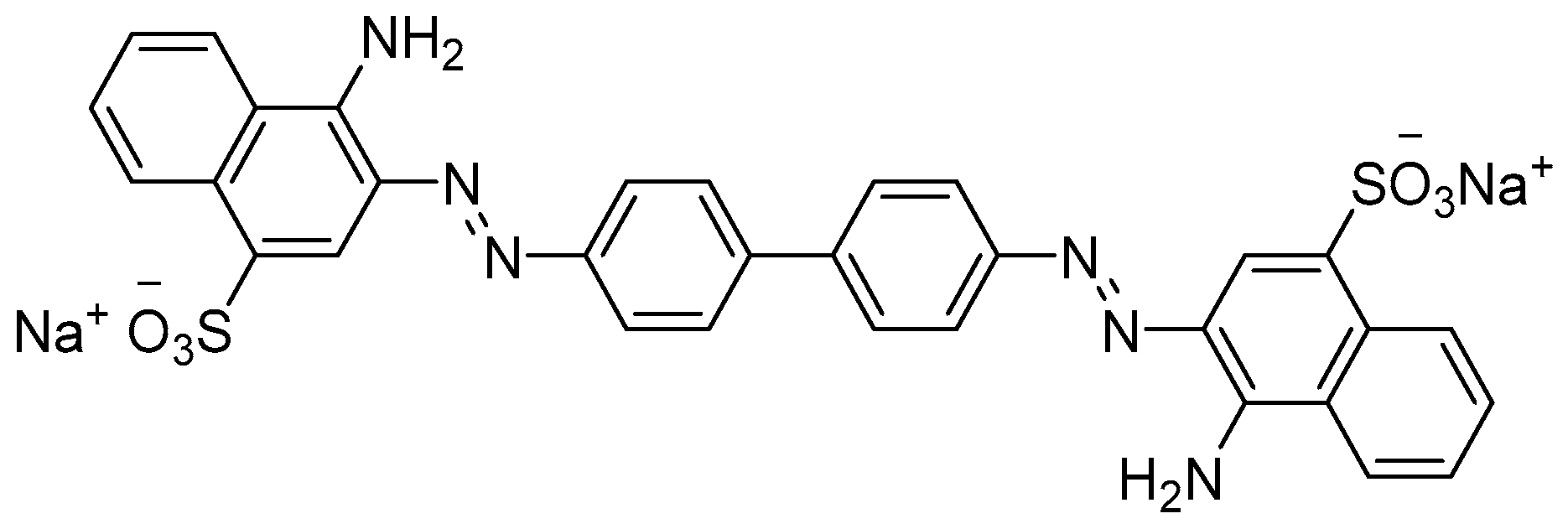
Figure 1. Structural formula of Congo Red.
Cleantechnol 08 00002 g001
Figure 2. FTIR spectra of ESW and CR-saturated ESW.
Cleantechnol 08 00002 g002
Figure 3. Point of zero charge (pHpzc) of ESW.
Cleantechnol 08 00002 g003
Figure 4. Effect of biosorbent concentration on the amount of CR adsorbed per gram of ESW and % removal of CR after 5 h (a) and 24 h (b) (γCR = 50 mg L−1, t = 5 and 24 h, θ = 25 °C, 150 rpm).
Cleantechnol 08 00002 g004
Figure 5. Effect of contact time on the amount of CR adsorbed per gram of ESW (a) and % removal of CR (b) (γCR = 50 mg L−1, γbiosorbent = 10 g L−1, t = 360 min, θ = 25 °C, 150 rpm).
Cleantechnol 08 00002 g005
Figure 6. Effect of temperature on the amount of CR adsorbed per gram of ESW and % removal of CR (γCR = 50 mg L−1, γbiosorbent = 10 g L−1, t = 360 min, 150 rpm).
Cleantechnol 08 00002 g006
Figure 7. Effect of initial dye concentration on the amount of CR adsorbed per gram of ESW (a) and % removal of CR (b) during removal from model solutions and synthetic dye-containing wastewater (γCR = 50 mg L−1, γbiosorbent = 10 g L−1, t = 360 min, θ = 25 °C, 150 rpm).
Cleantechnol 08 00002 g007
Figure 8. The results of experimental biosorption data modelling for CR onto ESW in model dye solution (γCR = 10–100 mg L−1, γbiosorbent = 10 g L−1, t = 360 min, 150 rpm) at different temperatures: (a) 15 °C, (b) 25 °C, (c) 35 °C and (d) 45 °C.
Cleantechnol 08 00002 g008
Figure 9. The results of experimental biosorption data modelling for CR onto ESW in synthetic wastewater (γCR = 10–100 mg L−1, γbiosorbent = 10 g L−1, t = 360 min, θ = 25 °C, 150 rpm).
Cleantechnol 08 00002 g009
Figure 10. Desorption of CR from saturated ESW (saturation conditions: γCR = 100 mg L−1, γbiosorbent = 10 g L−1, t = 360 min, θ = 25 °C, 150 rpm).
Cleantechnol 08 00002 g010
Table 1. The experimental conditions applied for batch biosorption studies of CR removal using ESW.
The Effect of Different
Biosorption Parameters
Biosorbent
Concentration
γ/g L−1
Adsorbate
Concentration
γ/mg L−1
Contact Time
t/min
Temperature
θ/°C
Biosorption in model CR solution
Biosorbent concentration1–1550300, 144025
Contact time10501–36025
Temperature1010–10036015–45
Initial dye concentration1010–10036025
Biosorption in synthetic wastewater with the addition of CR
Contact time10501–36025
Initial dye concentration1010–10036025
Table 2. Isotherm models parameters for the removal of CR from model dye solution and synthetic wastewater using ESW as biosorbent.
Model15 °C25 °C35 °C45 °C25 °C
Model CR SolutionSynthetic Wastewater
qexp/mg g−13.744.685.386.125.62
Freundlich
KF/(mg g−1 (L/mg)1/n)1.1551.5451.9111.7751.733
n3.3983.5793.4512.9422.017
R20.9540.9410.9390.9370.884
RMSE0.2050.2950.3750.4310.764
MSE0.0420.0870.1400.1850.583
SQE0.2950.6110.9831.2974.082
Chi-square0.1080.2720.3430.5301.382
Langmuir
qcal/mg g−13.9474.7675.7146.6399.476
KL/L mg−10.1680.2310.2910.2060.165
R20.9100.9660.9770.9960.958
RMSE0.2870.2240.2290.1050.457
MSE0.0820.0500.0530.0110.209
SQE0.5770.3500.3700.0771.465
Chi-square0.6700.2840.3090.0160.532
Table 3. Parameters of the pseudo-first-order and pseudo-second-order kinetic models for the removal of CR by ESW from model dye solution and synthetic wastewater (γCR = 50 mg L−1, γbiosorbent = 10 g L−1, t = 1–360 min, θ = 25 °C, 150 rpm).
ModelModel CR SolutionSynthetic Wastewater
qt,exp/mg g−13.0333.390
Pseudo-first order model (PFO)
qt1/mg g−12.4893.051
k1/min−10.4010.066
R20.6860.828
RMSE0.3910.266
MSE0.1520.071
SQE3.0490.989
Chi-square9.9360.551
Pseudo-second order model (PSO)
qt2/mg g−12.7653.248
k2/g mg−1 min−10.0190.03
R20.8030.938
RMSE0.3090.159
MSE0.0960.025
SQE1.9130.356
Chi-square5.7060.185
Table 4. Adsorption capacities of eggshell-waste-derived biosorbents toward Congo Red and other synthetic dyes.
Adsorbent
(Preparation)
AdsorbateAdsorption Efficiency/%
Langmuir Adsorption Capacity/mg g−1
Experimental ConditionsReference
Eggshell waste
(H2O, sodium dodecyl sulfate, acetone)
Congo Red
anionic dye
3.95–6.64 mg g−1 (model CR solution)
9.47 mg g−1 (synthetic wastewater)
γdye = 10–100 mg L−1, γbiosorbent = 10 g L−1,
360 min, 15–45 °C
This study
Eggshell WasteCongo Red
anionic dye
49.50 mg g−1γdye = 50–1000 mg L−1, γbiosorbent = 10 g L−1,
120 min, 25 °C
[15]
Eggshell Waste
(H2O)
Congo Red
anionic dye
64.25–69.46 mg g−1γdye = 10–100 mg L−1, γbiosorbent = 3 g L−1,
240 min, 20–40 °C
[74]
Eggshell waste
(H2O, activation with 0.1 M H2SO4)
Congo Red
anionic dye
99.5%
153.85 mg g−1
γbiosorbent = 10 g L−1,
120 min, 25 °C
[22]
Eggshell Waste without membrane
(H2O)
Congo Red
anionic dye
95.25 mg g−1γdye = 20–80 mg L−1, γbiosorbent = 100 g L−1,
20 min, 25 °C
[73]
Eggshell membrane
(modification with HCl/NaOH)
Congo Red
anionic dye
95%
117.65 mg g−1
γdye = 25–500 mg L−1, γbiosorbent = 10 g L−1,
180 min, 20–40 °C
[70]
Eggshell membraneCongo Red
anionic dye
99.17%
112.30 mg g−1
γdye = 25–100 mg L−1, γbiosorbent = 0.1–0.5 g L−1,
30–240 min, 20–40 °C
[79]
Encapsulated eggshell membrane
(polyvinyl alcohol/sodium alginate)
Congo Red
anionic dye
98.86%γdye = 12.63 mg L−1, mbiosorbent = 6.12 g,
12.83 min, pH 2.19
[80]
Eggshell Waste
(H2O)
Methyl Red
anionic dye
1.66 mg g−1γdye = 20–100 mg L−1, γbiosorbent = 26.7 g L−1,
180 min, 25 °C
[23]
Eggshell Waste
(H2O)
Methyl Orange
anionic dye
62.33%
5.58–135.13 mg g−1
γdye = 20–120 mg L−1, mbiosorbent = 0.4 g,
25 min, 20–40 °C
[16]
Eggshell Waste
(H2O)
Direct Blue 78
anionic dye
13 mg g−1γdye = 25–300 mg L−1, γbiosorbent = 12.5 g L−1,
140 min, 29 °C
[20]
Eggshell Waste
(H2O)
Reactive Blue 198
anionic dye
96.41%
0.8 mg g−1
γdye = 0.5–30 mg L−1, γbiosorbent = 20 g L−1,
60 min, 25 °C
[24]
Eggshell Waste
(H2O)
Direct Black 22
anionic dye
96.67%
1.99 mg g−1
γdye = 0.5–30 mg L−1, γbiosorbent = 20 g L−1,
120 min, 25 °C
[24]
Eggshell Waste
(H2O)
Remazol Brilliant Violet-5R
anionic dye
<90%
9.94 mg g−1
γdye = 20–100 mg L−1, γbiosorbent = 15 g L−1,
20 °C
[71]
Eggshell Waste
(H2O, HCl, NaOH)
Reactive Red 120
anionic dye
160.8–191.5 mg g−1γdye = 100–1000 mg L−1, γbiosorbent = 15 g L−1,
25–45 °C
[76]
Eggshell Waste
(H2O, 0.1 M NaOH)
Reactive Yellow 145
anionic dye
84.05%
88.45 mg g−1
γdye = 10–150 mg L−1, mbiosorbent = 0.025 g,
80 min, 45 °C
[21]
Eggshell Waste
(H2O, activation with HNO3)
Indigo Carmine
anionic dye
64.34%
8.04 mg g−1
γdye = 10–50 mg L−1, γbiosorbent = 20 g/L,
15 min
[18]
Eggshell WasteMethylene Blue
cationic dye
94.9 mg g−1γdye = 50–1000 mg L−1, γbiosorbent = 10 g L−1,
105 min, 25 °C
[15]
Eggshell Waste
(H2O)
Methyl Green
cationic dye
69.38%γdye = 1–100 mg L−1, γbiosorbent = 16 g L−1,
120 min, 20–50 °C
[17]
Eggshell Waste
(H2O)
Crystal (Methyl) Violet
cationic dye
25.73 mg g−1γdye = 5–120 mg L−1, mbiosorbent = 0.6 g,
120 min, 10 °C
[19]
Eggshell Waste
(H2O, activation with HNO3)
Methylene Blue
cationic dye
92.34%
11.54 mg g−1
γdye = 10–50 mg L−1, γbiosorbent = 40 g L−1,
30 min
[18]
Table 5. Adsorption capacities of waste-derived biological materials toward Congo Red.
Biosorbent
(Waste-Derived Biological Material)
AdsorbateLangmuir Adsorption Capacity/mg g−1
(CR Concentration Range)
Reference
Eggshell wasteCongo Red4.77 mg g−1
(10–100 mg L−1)
This study
Banana peel1.73 mg g−1
(20–40 mg L−1)
[79]
Roots of Eichhornia Crassipes1.58 mg g−1
(10.45–104.45 mg L−1)
[80]
Poplar sawdust8.00 mg g−1
(10–100 mg L−1)
[81]
Modified poplar sawdust
(through quaternisation)
70.30 mg g−1
(25–250 mg L−1)
[82]
Chemically activated mango leaves21.28 mg g−1
(30–120 mg L−1)
[83]
Brewers’ spent grains19.65 mg g−1
(15–150 mg L−1)
[84]
Activated de-oiled mustard34.73 mg g−1
(6.97–69.97 mg L−1)
[75]
Desiccated coconut waste48.76 mg g−1
(10–50 mg L−1)
[85]
Activated carbon derived
from Spathodea campanulata flowers
59.27 mg g−1
(20–60 mg L−1)
[86]
Disclaimer/Publisher’s Note: The statements, opinions and data contained in all publications are solely those of the individual author(s) and contributor(s) and not of MDPI and/or the editor(s). MDPI and/or the editor(s) disclaim responsibility for any injury to people or property resulting from any ideas, methods, instructions or products referred to in the content.