Article

Arabinoxylans from the Distillers Grains and Solubles Co-Products of Ethanol Production: Extraction, Characterisation and Hydrolysis to Oligosaccharides


by
Mohammad Alyassin
1,
Saffa Izzati Kaderi
1,
Grant M. Campbell
1,*,
Helen Masey O’Neill
2 and
Michael R. Bedford
2
1
Department of Chemical Sciences, School of Applied Sciences, University of Huddersfield, Huddersfield HD1 3DH, UK
2
AB Vista Ltd., Woodstock Court, Blenheim Road, Marlborough SN8 4AN, UK
*
Author to whom correspondence should be addressed.
Clean Technol. 2026, 8(1), 24; https://doi.org/10.3390/cleantechnol8010024
Submission received: 29 October 2025 / Revised: 12 December 2025 / Accepted: 18 December 2025 / Published: 9 February 2026
(This article belongs to the Special Issue Biomass Valorization and Sustainable Biorefineries)

Highlights

What are the main findings?
  • Extraction of arabinoxylans (AX) from the Wet Distillers Grains (WDG) and Solubles can be integrated within ethanol biorefineries to create new products and revenue streams.
  • Arabinoxylan oligosaccharides (AXOS), which have prebiotic functionality for animal feed and human health applications, can also be produced via enzymatic conversion of the water-extractable AX (WEAX) with xylanases.
  • WEAX from the Solubles fraction was more readily extracted than from the WDG fraction, and was a more suitable feedstock for hydrolysis to oligosaccharides.
What are the implications of the main findings?
  • Arabinoxylans co-produced within biorefineries from a range of agricultural and biorefinery wastes could have a global market of > £1 billion per annum, significantly impacting biorefinery economics and enhancing their commercial viability and contributions to sustainability.
  • Extracting AX from Solubles and converting to AXOS is easier than from WDG, and offers a pragmatic route to producing initial AX products from a biorefinery, from which a wider portfolio of products could grow.

Abstract
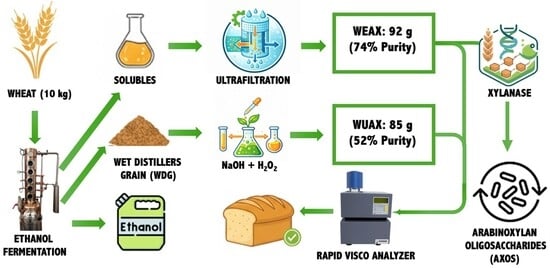
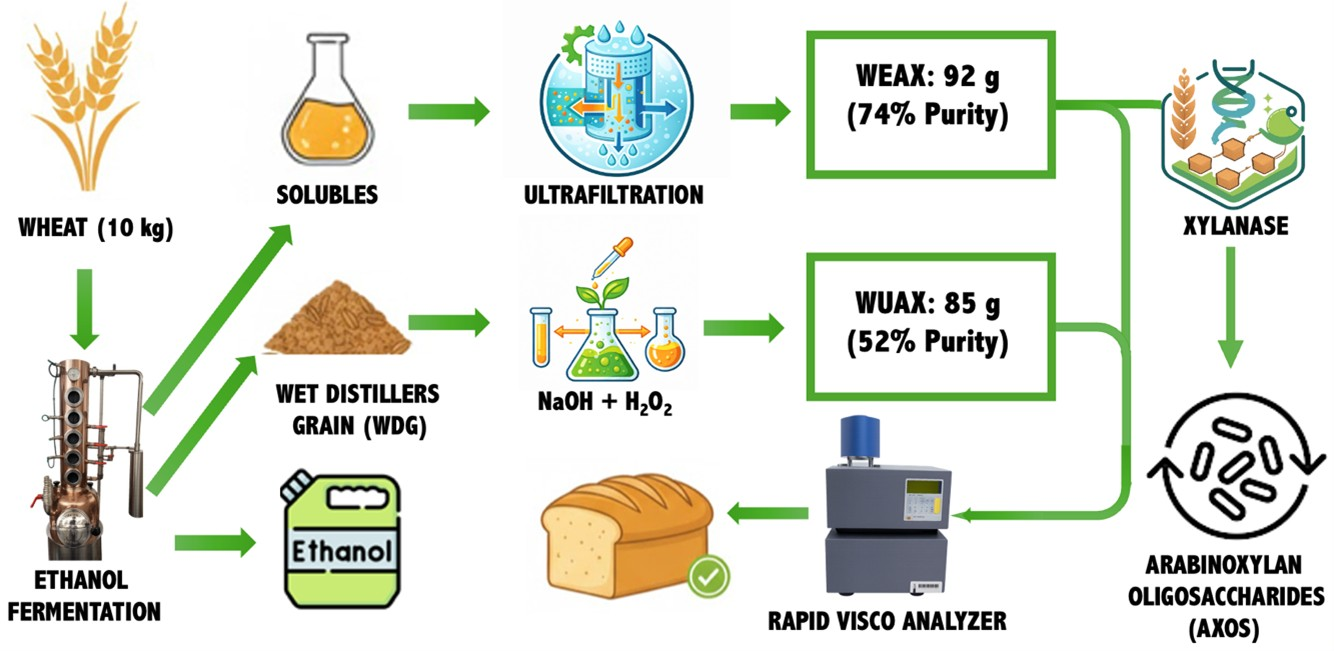
Arabinoxylans (AX) and their oligosaccharides (AXOS) have potential as functional ingredients. The emergence of biorefineries, leading to more Distillers Dried Grains with Solubles (DDGS) entering the animal feed market, encourages commercial production of AX products. Extracting AX from the two components of DDGS offers the opportunity to increase the biorefinery’s product portfolio and reduce costs. This paper explores AX extraction from solubles and wet grain, using a Gunt pilot-scale bioethanol plant to produce the two streams. After fermentation and distillation, solids were separated from the liquid to give Wet Distillers Grain (WDG), from which alkaline hydrogen peroxide extraction of water-unextractable AX (WUAX) was performed. The water-extractable AX (WEAX) was recovered from the solubles by ultrafiltration and ethanol precipitation. Both extracts were tested for suitability for AXOS production and characterised for their functionality. 10 kg of wheat yielded 3.2 litres of ethanol at 90% purity, 85 g of WUAX (51.6% purity, 110 kDa) and 92 g of WEAX (74.2% purity, 70 kDa). Enzymatic conversion of WEAX into oligosaccharides was 53%, whereas WUAX was unsusceptible to enzyme hydrolysis. Both AX fractions showed interactions with starch that could increase the shelf life of bakery products. AX-based products could be produced from a range of agricultural and biorefinery waste or low value streams, with the global market potentially > £1 billion per annum.

Graphical Abstract

1. Introduction

Arabinoxylans (AX) and arabinoxylan oligosaccharides (AXOS) have attracted a great deal of commercial and researcher attention over the last few decades and increasingly in recent years. By February 2025, sciencedirect.com listed more than 40 papers already accepted for publication in 2025 with “arabinoxylan” in the title, abstract or keywords. A survey of these papers reflects the current emphases in arabinoxylan research, which predominantly fall into two categories: effects on health, and performance as functional food or pharmaceutical ingredients. Several are focussed on the effects of AX on the human gut microbiota [1,2,3,4,5], reflecting that AXs are prominent fibre sources in diets and exert prebiotic and other health effects that need to be understood in terms of how the details of AX’s and AXOS’s structures relate to specific physiological responses. Several address AX structure–function relationships, reflecting the increasing interest in AXs as functional food ingredients [6,7], particularly in bread, either at the level of empirical effects on dough behaviour and bread quality [8,9,10] or looking more deeply into interactions at the molecular level between AXs and the major bread dough components (starch, gluten and water) including effects on rheology [8]. Several are review papers [7,11], reflecting the substantial interest in this topic in recent years, and building on other recent reviews driven by the prospect of AXs as commercial ingredients [12,13,14,15,16,17].
Compared with a few years ago, there seem to be fewer recent papers addressing the scientific and engineering challenges needed for commercial production of AXs. Falade et al.’s [11] review “effects of modern extraction techniques on functional and structural properties of cellulose and hemicellulose…fibre”, notes the “burgeoning interest in [Brewer’s Spent Grain]-derived dietary fibres” and identifies three broad clusters of research themes: processes, functional properties and nutritional and dietary applications. Interestingly, most of the references in their summary table of “modern” methods for extracting fibre from BSG are relatively old (pre-2018), reflecting the diminishing of this research theme relative to the more persistently appealing themes of laboratory-based research into health or structure–function relationships. This is also reflected in their conclusion that the “scalability of laboratory-proven methods to industrial applications remains a critical challenge.”
The most likely context for the upscaling of laboratory-proven extraction methods (and associated relations to AX structure and function) is the biorefinery sector, the emergence of which offers opportunities to produce AX products of targeted functionality as novel materials for food, feed and non-food applications. From an economic point of view, the projected market for arabinoxylans as bread ingredients alone is estimated to be around £5 million per annum in the UK initially, rising to an order of magnitude higher as the ingredient portfolio extends to a wider range of bakery and other food products and beyond the UK. (The UK bakery sector uses around 5 million tonnes of flour per year [18]; the usage of AX at a level of 1% would create a market of around 50,000 tonnes per year. At £10 per kg, typical for a functional bakery ingredient, this equates to £500 million. Assuming only 1% market penetration initially, most likely into the bread sector, and limited by the availability of AX suited for use in bread, gives an initial estimate of £5 million pa.) Once the value of AX-based materials is demonstrated and established in the bread market, and also driven by the need to valorise potential AX sources that are currently waste or low value streams, the global market for a wider range of food, feed and non-food uses would be expected to grow in due course to > £1 billion. (Assuming, for the sake of illustration, valorisation of just 1% AX from just 10 million tonnes per annum of the low value fibre streams of wheat, maize, barley, rice and sugarcane harvesting and biorefining (noting that sugarcane bagasse on its own is produced at nearly 300 million dry tonnes/annum [19], while global corn stover production is around a billion tonnes annually) with a value of £10 per kg, =£1 billion. Alternatively, the global DDGS market is currently well over £10 billion [20], with a typical value of £0.2 per kg; extracting just 0.2% as 50× more valuable AX would create a market of >£1 billion from just this source.) These estimates, based on the one hand on the potential of the bakery sector as a major end-use market, and on the other hand on the low value feedstocks from which commercial sources of AXs of varying functionality and end-use could be extracted, demonstrate that a portfolio of AX products could significantly invigorate biorefinery economics.
The challenges for biorefiners are (i) knowing what AX product(s) to produce, either for health benefits or for its benefits as a food ingredient; and then (ii) having identified target product(s), knowing how to produce them in terms of technically feasible and economically viable integrated processes. The challenge is to complete this chain of knowledge from feedstocks through AX extraction processes and the structure of the resulting AXs to the functional properties and end-use applications [15] such that the products are commercially viable for the biorefiner to produce and for end users to exploit. The complexity of AX structures and interactions and the complexity of food systems stand at the heart of these scientific, practical and commercial challenges [21,22,23]. While interest in arabinoxylans is buoyant, there is a steep and collaborative learning curve ahead for the biorefining and food industries to establish how to produce and exploit products of consistent functionality for particular end uses.
Another product of recent attention and interest is arabinoxylan oligosaccharides, which are an emerging category of prebiotics that invigorate the growth and activity of healthy gut bacteria [24,25]. These oligosaccharides have been exploited in animal feed to promote gut health either by in situ production by xylanases [26,27] or by adding XOS to animal feed to stimulate fibre-degradation and utilisation [28,29], with the current market of £60 million projected to grow to £100 million by 2032 [30]. An even more recent development is the identification of XOS- and AXOS-based stimbiotics, which stimulate the fibre-degrading microbiome even at doses too low to contribute a direct prebiotic effect, and hence are even more efficacious and valuable than prebiotics [29,31,32,33].
Following the original techno-economic analysis by Misailidis et al. [34] indicating that AX co-production with ethanol at industrial scale is in principle economically feasible, Martinez-Hernandez et al. [35] and Solomou et al. [15] envisage a range of co-produced AX and AXOS fractions of different molecular weights and structures, suitable for different end uses, with the co-production eliminating the focus on yield of a particular fraction and instead changing the focus to integration of the biorefinery as a whole, including a holistic view of end uses and markets for the portfolio of products. The inspiration and motivation for co-production of AX with ethanol is that some extraction processes use ethanol to precipitate the AX [36], with AX fractions of different molecular weights, structures and properties precipitated at different ethanol concentrations [37,38,39,40,41,42]. This gives rise to the opportunity to integrate and minimise ethanol usage through bioethanol pinch analysis [35,43], thus reducing costs, while also enhancing economic viability through a portfolio of revenue streams.
Within bioethanol and potable alcohol production, the main co-product is Distillers Dried Grains with Solubles (DDGS), which is sold as animal feed and contributes significantly to the economics of alcohol or bioethanol production [44]. DDGS is often called Brewer’s Spent Grains (BSG), but the DDGS terminology highlights that this product is made up of two streams, as the non-fermentable and non-volatile leftovers are separated by filtration to give a liquid fraction called thin stillage or solubles (with around 5% dry matter) and a solids fraction called Wet Distillers Grains (WDG). The solubles are evaporated and added to the WDG, then dried at higher temperatures to produce DDGS [45,46].
Many studies have investigated the AX from DDGS in terms of extraction, characterisation and enzymatic release of XOS from AX, as the DDGS is readily available from bioethanol plants and therefore easy to study [47,48,49,50]. However, the thermal drying might impose structural changes that affect the components of DDGS such as proteins and cell wall polysaccharides [51,52,53,54]. Thus, DDGS in its state as a final dried product from the biorefinery is not an ideal material from which to extract AX for laboratory studies, as the drying is likely to affect the yield and structure of the extracted AX. More crucially, this is not the material that would be dealt with in the biorefinery. A biorefinery aiming to produce AX would not re-wet dried DDGS but rather would extract AX from the wet components prior to their combination and drying. However, these in-process materials are harder to obtain and study.
Therefore, the objective and novelty of the current work was to revisit the extraction of arabinoxylan products from bioethanol intermediate by-products and compare the extractability, properties and functionality of AX recovered from the WDG portion of (what becomes) DDGS and from the solubles fraction, by preparing these fractions in a pilot-scale bioethanol plant. Extracting AX from solubles is an easier proposition; if this fraction proves to have attractive properties for use as intact AX and/or for further processing into AXOS, then this offers a pragmatic route to producing initial AX products from a biorefinery, from which a wider portfolio of products could grow.

2. Materials and Methods

2.1. Pilot-Scale Production of Ethanol, WDG and Solubles

The ethanolic fermentation was carried out using a CE-640 bioethanol production plant supplied by Gunt Technology Ltd. (Hamburg, Germany), which comprises a mash tank, fermentation tank and distiller. The plant is designed to emulate industrial ethanol production for teaching and research purposes. The study is described in more detail in [55]. Initially, 10 kg of wheat double-milled through a 2 mm mesh (Target Feeds Ltd., Shropshire, UK) was suspended in 25 litres of water inside the CE-640 distiller tank and boiled for 3 h to ensure complete hydration of the wheat and gelatinisation of the starch. The temperature was lowered to 90 °C and the suspension manually transferred to the mash tank, where saccharification of the starch was initiated using α-amylase (Schliessmann-VF-, ReKru GmbH, Gräfelfing, Germany) with continuous stirring at 90 °C for one hour followed by 3 h treatment with gluco-amylase (Schliessmann-VF-, ReKru GmbH, Germany) at 55 °C and pH of 4.5. The slurry was cooled to 30 °C and pumped into the fermentation tank, and fermentation initiated by adding yeast Saccharomyces cerevisiae (KORNBRAND PREMIUM, ReKru GmbH, Germany). The fermentation process took place at 28 ± 2 °C over 72 h, with the solution being intermittently stirred. The fermented slurry was pumped into the distiller, where ethanol was recovered over ~4 h. An alcohol content hydrometer was used to measure the purity of the produced ethanol.

2.2. AX Extraction

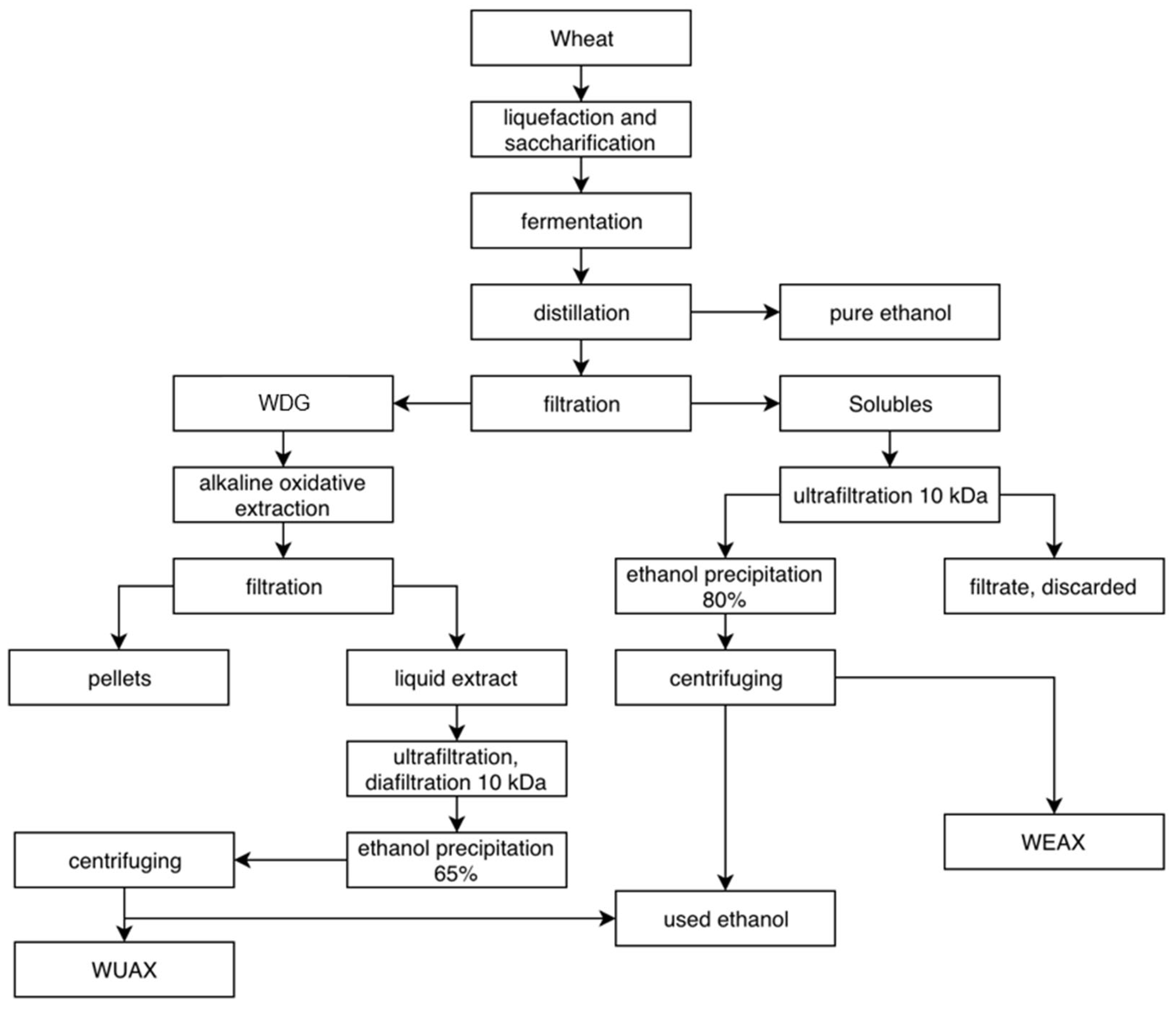
Figure 1 describes the procedures for AX extraction from the solids after bioethanol production. The residual material was allowed to cool to room temperature after distillation, then collected and separated into two fractions by filtration, the solubles and the Wet Distillers Grain, using a Carlson® filter press (Carlson Filtration Limited, Barnoldswick, UK), with a 20 cm × 20 cm EE4.6HF depth filter sheet. Samples of the wheat, WDG and solubles were dried and sent to Englyst Carbohydrate Ltd. (Southampton, UK) for constituent sugar analysis [56], from which arabinoxylan contents were calculated. The extraction method used to extract water-unextractable AX (WUAX, sometimes called alkali-extractable AX, AEAX) from WDG was adapted from [37], in which hydrogen peroxide at high pH releases AX by breaking bonds with lignin and other cell wall components. The WDG was mixed with 20 litres of water inside the CE-640 mash tank and treated with protease from Bacillus licheniformis (P4860) (Sigma Aldrich, Dorset, UK) at 60 °C and pH 8 for four hours to remove proteins. The deproteinated WDG was recovered by filtration, and the filtrate was discarded. The remaining solids were dispersed again in 20 litres of water at 60 °C to extract the WUAX, the pH was raised to 11+ via the addition of sodium hydroxide (Fisher Scientific UK Ltd., Leicestershire, UK) and hydrogen peroxide was gradually added to reach a final concentration of 2%. The dispersion was vigorously stirred, with antifoaming agent Dimeticon SILFAR® SE 4 (Wacker Chemie AG, Munich, Germany) added to mitigate foaming. The extraction was performed over the course of 4 h. At the end of the extraction period, the temperature was lowered to 25 °C and the pH brought to neutral by adding 5 M hydrochloric acid (Fisher Scientific UK Ltd., Leicestershire, UK). The released AX fibres were filtered, and the filtration cake was rinsed with 10 litres of water. The filtrate was concentrated 4 times via ultrafiltration using a high-performance AMI® spiral membrane polyethersulfone with a 10,000 molecular weight cut-off (MWCO), 10 m2 surface area and dimensions of 4″ × 40″ (10 cm × 1 m) (Wateranywhere®, Vista, CA, USA). The concentrated extract was then diafiltered via the addition of 20 litres of fresh water to the solution followed by concentration again to remove the same amount of added water. Ethanolic precipitation at 65% ethanol (achieved by adding 18.6 litres of absolute ethanol (Fisher Scientific UK Ltd., Leicestershire, UK) to the 10 litres of retentate) was performed overnight to separate the WUAX from the extraction medium. The precipitated WUAX was centrifuged using a Beckman centrifuge GS-6S with a swing bucket rotor (4000 rpm for 30 min) and a capacity of 4 × 750 mL (Beckman Coulter Ltd., Amersham, UK), then dried in a 40 °C oven overnight and stored. The ethanol used for precipitation was recovered via distillation.
The solubles fraction from the fermentation leftovers, which was about 50 litres, was ultrafiltered using the same ultrafiltration membrane to exclude the small molecules and retain the water soluble arabinoxylan. It was expected that the solubles AX would comprise smaller molecules that would require a higher ethanol concentration to precipitate; hence ethanolic precipitation at 80% ethanol was used to precipitate water-extractable AX (WEAX) overnight, which was then centrifuged, dried and stored. The ethanol was again recovered by distillation.

2.3. Characterisation of AX Extracts

The WUAX and WEAX were characterised for molecular weight using size exclusion chromatography (SEC-MALLS) comprising a Shimadzu HPLC system (Shimadzu U.K. Ltd., Milton Keynes, UK) with Aquagel-OH 40, 50 and 60 columns (15 μm particle size, 25 cm × 4 mm, Agilent, Oxford, UK) and UV/VIS (Shimadzu U.K. Ltd., Milton Keynes, UK), RI and MALLS detectors (Wyatt Technology Corporation, Santa Barbara, CA, USA). The mobile phase was 50 mM NaNO3 at a flowrate of 1 mL min−1. ReadyCal-kit PEO/PEG calibration standards (Agilent, Cheshire, UK) covering the range 238 Da–1.2 MDa were used for column calibration. For the constituent sugar analysis, a Dionex ICS–3000 HPAEC-PAD (Dionex Corporation, Sunnyvale, CA, USA) was used. Samples were hydrolysed with 2 M trifluoroacetic acid in a pressure tube at 120 °C for two hours. Thereafter, the solution was evaporated under a continuous air flow at 60 °C using a Zymark Turbovap® LV sample concentrating unit (Zymark, Hopkinton, MA, USA). After evaporation (which removes any traces of the acid), the sample was re-solubilised in MilliQ water to be analysed via HPAEC. The AX content was calculated as AX = (Ara + Xyl) × 0.88, where the 0.88 factor accounts for the addition of a water molecule on hydrolysis (arabinose and xylose both have molecular weights of 150 when hydrolysed to monomers; in the AX polymer a water molecule (Mw = 18) is removed, such that the AX weighs 12% (18/150) less than its hydrolysed sugars; 132/150 = 0.88) [57].
To evaluate the recovery of the hydrolysis method, arabinoxylan high purity standards (Megazyme, Bray, Ireland) of molecular weights close the measured sample molecular weights (low viscosity AX ~50 kDa and medium viscosity AX ~300 kDa) were used to spike, hydrolyse and analyse the samples, again by HPAEC.
Kjeldahl analysis was used to measure the total protein in the wheat, solubles, WDG and AX extracts; Turbotherm Rapid Digestion System (Gerhardt® Model TT125) and Kjeldahl VAPODEST® (Vapodest-10) (C. Gerhardt GmbH & Co. KG, Königswinter, Germany) were utilised to determine the total nitrogen, which was converted to a protein content using the conversion factor 5.7 [58]. Ash content was evaluated as the percentage of remaining residues after dry oxidation in a furnace at 575 °C ± 25 °C [59].

2.4. Production of Arabinoxylan Oligosaccharides

The commercial xylanase Econase XT 25 L (160,000 BXU/g), a thermally stable endoxylanase widely used in animal feed formulations and supplied by AB Vista (Marlborough, UK), was chosen to hydrolyse the extracted polysaccharides into oligosaccharides. Samples of AX (1 g) were treated with the enzyme at 50 mL per kg, 50 °C, pH = 5 for 1 and 2 h. At the end of the treatment, pH was neutralised and samples were boiled for 20 min to deactivate the enzyme. To investigate the role of enzyme dosage on the profile of produced XOS, samples of WEAX were treated with Econase at doses of 50 mL per kg, 50 mL per 10 kg, 50 mL per 100 kg and 50 mL per 1000 kg (500×, 50×, 5× and 0.5× the recommended commercial dose) for 2 h. XOS analysis was carried out using HPAEC according to the method described in Alyassin et al. [60], which allows measurement of xylose (X1), xylobiose (X2) etc. up to X6. While the method also allows the separation and quantification of several AXOS molecules, these are by nature more complex and variable; the current work focussed on the just the XOS molecules.

2.5. Effects of AX on Pasting Viscosity Characteristics of Starch

The effects of the extracted WEAX and WUAX on wheat flour pasting properties were studied using a Rapid Visco Analyzer (RVA, PerkinElmer, Springfield, IL, USA), a viscometer that heats, holds and cools the sample while measuring its viscosity as the starch gelatinises, breaks down and thickens. For the control, 3.5 g of wheat flour (12% protein) (Allinson, Peterborough, UK) and 25.0 g of water were added into the RVA aluminium canister. For the AX samples, solutions of the WEAX and WUAX extracts were prepared to equivalent 1% AX concentrations (based on the measured AX concentrations, reported below as 74.2 and 51.6% for the WEAX and WUAX extracts, respectively). Solutions were used (a) to ensure the AX was hydrated before testing in the RVA; and (b) because weighing solutions to deliver the required AX concentration was more accurate than weighing small amounts of extracts. AX solutions were added to deliver AX at levels of 1%, 2%, 3% and 4% of the wheat flour weight; the water contributed by the solution was calculated, and the required water added to give a constant total water of 25 g. The suspensions were run in the RVA instrument according to the standard software method for wheat flour; the mixture was stirred initially at 960 rpm for 10 s to disperse the flour, then stirred thereafter at 160 rpm. The temperature was held at 50 °C for the first minute, then increased to 95 °C at a rate of 12 °C per minute, maintained at 95 °C for 3.5 min, cooled to 50 °C at a rate of 12 °C per minute, then held at 50 °C for 2 min. Each sample was run in triplicate. The system’s software (Thermocline for Windows v.2.4) produced the pasting viscosity parameters (peak viscosity, breakdown, final viscosity, setback and pasting temperature).

3. Results and Discussion

3.1. Yields and Mass Balances Following Ethanolic Fermentation

The processing of 10 kg of milled wheat yielded 3.2 litres of ethanol of 90% purity, 2.10 kg (dry basis, db) of WDG (corresponding to around 8.5 kg (wet basis) at 75% moisture) and around 50 litres of a solubles solution that contained 1.33 kg solids. Thus, the dry solids totalled 3.43 kg or 34.3%, which is about the expected figure for DDGS from industrial processes [61,62].
Table 1 and Table 2 report the AX, protein and ash results for the wheat, WDG and solubles. The total AX in the wheat was 5.30% (db), which translates to 4.64% at 12.5% moisture content, close to what has been reported in the literature [63] and translating into 464 g of total AX in the 10 kg batch. The AX became concentrated following processing to 14.7% in the WDG and 10.0% in the solubles. The total AX in the WDG (2.1 kg × 14.7% = 309 g) and the solubles (1.33 kg × 10% = 133 g) added up to 442 g out of 464 g in the 10 kg wheat, which is a good mass balance that implies 95% of the indigenous AX survived the bioethanol fermentation process, comparable with other findings in literature [54].
The concentrations of protein in the WDG and solubles are around threefold greater than the 12.8% initial protein concentration of the wheat, in line with the expectations of protein being concentrated during bioethanol production [64,65]. However, Table 2 shows that the protein has not only been concentrated, but also that the total amount of protein in the WDG and solubles has become greater than the starting amount of protein in wheat, due to the growth of the fermenting yeast [66].
It is notable that the ash content of the solubles was higher than that of the WDG, which is understandable as the majority of mineral salts will be water soluble. It is also clear that all of the original ash in the wheat was divided between the WDG and the solubles, with an excellent mass balance.

3.2. AX Extraction and Characterisation

Table 3 presents the average molecular weight, AX purity, moisture, protein and ash for both extracts. SEC-MALLS analysis gave average molecular weights of 70 kDa for WEAX and 110 kDa for WUAX. As expected, the water-extractable AX had a smaller average Mw than the water-unextractable but alkali-extractable AX, which agrees with previous findings [67].
Measurement of the polysaccharide content of a sample starts with hydrolysis of the polysaccharides into their constituent monosaccharides, which has always been an imprecise and ambiguous procedure. Acid hydrolysis of polysaccharides entails a balance of three simultaneous actions: (i) separation of the polysaccharide structure into separate chains (breaking of intermolecular bonds), (ii) hydrolysis to monosaccharides (breaking of intramolecular glycosidic bonds) and (iii) monosaccharide dehydration into furfural and other products [68,69,70,71,72]. Acid hydrolyses, by nature, are affected by the sample’s origin, nature, particle size and whether it is pre-processed, which affects how easily the acid penetrates the structure of the sample to react with the components and break the bonds between the sugars and other components, bearing in mind that different glycosidic bonds resist hydrolysis differently [72]. Having produced the constituent monosaccharide sugars, these then have differing susceptibilities to further degradation [56,70]. This variability in the hydrolysis of polysaccharide structures and degradation of released monosaccharides has always been a source of ambiguity in the measurement of the polysaccharide contents of biomass. Attempts to study this hydrolysis by using monosaccharides as standards to calculate how much of the monosaccharide has been degraded have been reported. However, using monosaccharides as a reference ignores the structure of the carbohydrate and hydrolysis of polysaccharides and accounts only for the degradation of the released monosaccharides, not for the uncertainties in the hydrolysis that produced them. According to Willför et al. [73] ‘there is only little sense in calibrating with monosaccharides’, whereas a more realistic approach should also account for the unhydrolysed fibres. For this reason, in the current work, the recovery following hydrolysis was calibrated for each extract using mixtures of AX standards (low viscosity AX ~50 kDa and medium viscosity AX ~300 kDa) that resembled the molecular weights of the extracted AX.
Assuming the above calibration with AX standards yields reasonably accurate estimates of the AX contents of the extracts (and certainly more accurate than calculations with no attempt at this sort of calibration), we concluded that extraction of AX from the WDG yielded 85 g of crude extract (WUAX) at 51.6% purity (wet basis, 14.2% moisture), representing an absolute yield of 44 g or 0.44% from the 10 kg wheat or 2.1% from the 2.1 kg of WDG (db). The solubles yielded 92 g of crude extract (WEAX) at 74.2% purity (wet basis, 8.9% moisture), an absolute yield of 68 g or 0.68% from the 10 kg wheat, or a 5.1% yield from the 1.3 kg of solubles (db). Given that the AX content of the wheat was 4.64% or 464 g, the recovery of 44 + 68 = 112 g corresponds to a 24% recovery of the available AX in the original wheat. Similarly, given that the AX content of the WDG was 2.1 kg × 14.7 = 309 g, the recovery of 44 g represents a yield of 14% of the available AX in the WDG, while the 68 g of the available 1.3 kg × 10% = 130 g represents 52% recovery of the available AX in the solubles. Thus, the recovery of AX from solubles was much more successful than from WDG, as these AX molecules are already (by definition) soluble and not trapped within the bran matrix, as in the WDG.
The lower A:X ratio of 0.49 for the WEAX, compared with 1.18 for the WUAX, as well as a smaller Mw for the WEAX, indicate significant structural differences between the two types of AX, in agreement with the literature [67]. The protein content in the extracted WEAX is lower than that of WUAX (5.8% compared with 9.8%), even though the solubles had a higher protein concentration of 37%. This implies that most of the proteins in the solubles were filtered out by the 10 kDa ultrafiltration membrane during the diafiltration, which suggests the possibility of recovering this protein fraction using a more sophisticated filtration system such as nanofiltration; this fraction is likely to be highly digestible for neonates. A further purification step involving protease might reduce the 5% protein to an even lower level. The WUAX protein content was relatively high at about 10%; further steps would be needed to reduce the protein content within this process. The ash content in the WEAX is much lower than the WUAX, which was expected, as no salt-producing chemicals were used for this novel extraction method, while the diafiltration would significantly help in eliminating salts and minerals.
The compositional analyses account for 80–90% of the material, the residuals being largely cellulose and possibly a small amount of lipid, neither expected to dominate or significantly alter the AX functionality.

3.3. Production of XOS

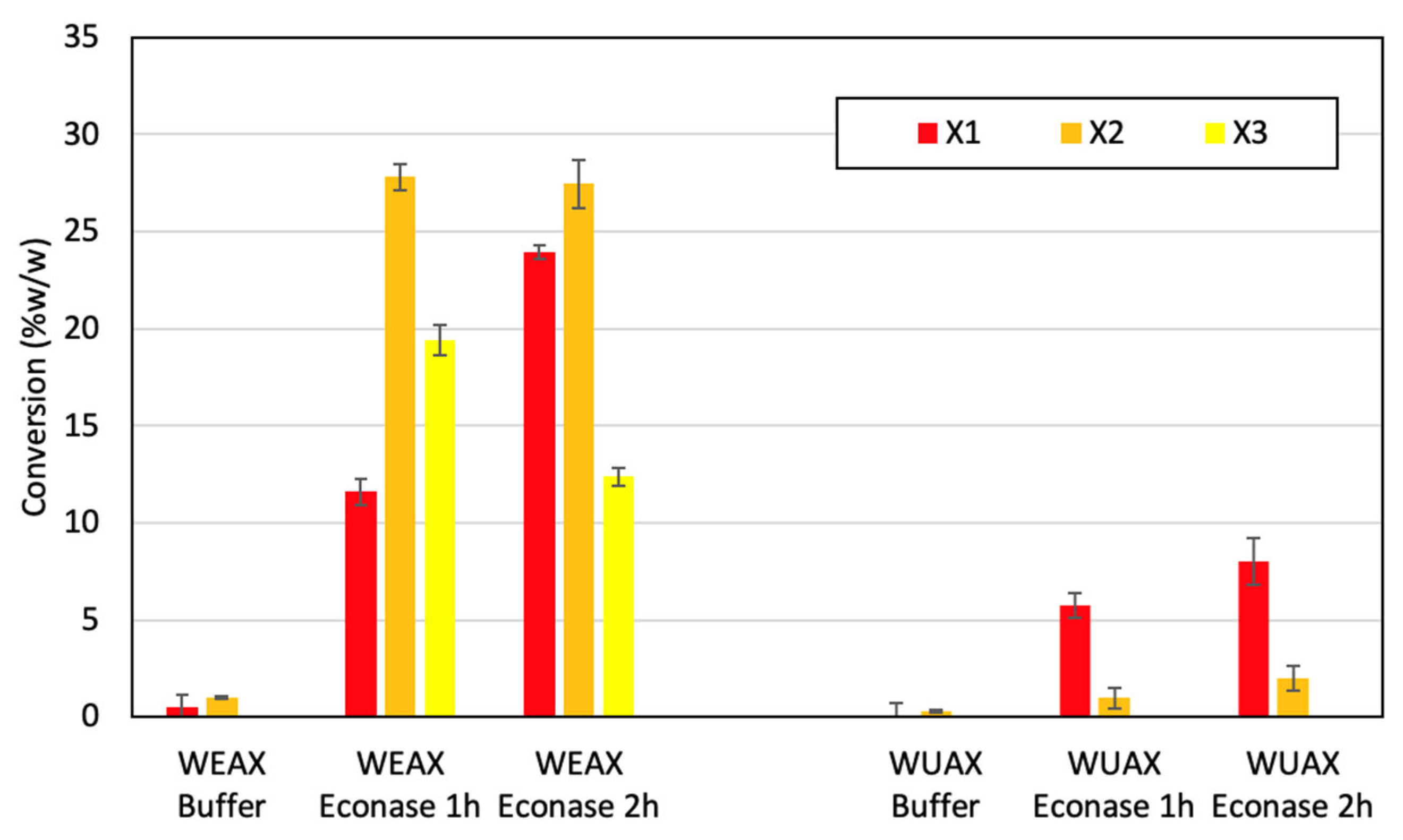
Enzymatic conversion of the extracted AX into oligosaccharides addresses a growing market for these prebiotic and stimbiotic molecules, while increasing the portfolio of co-products and the scope for process integration, and hence the profitability of biorefineries [15,35]. Figure 2 shows the conversion of both extracts after 1 and 2 h of xylanase (Econase) treatment (along with results for WEAX and WUAX incubated in buffer solution, confirming no production of XOS without the enzyme). (Error bars in Figure 2, Figure 3 and Figure 4 are ±1 standard deviation of the mean from triplicates.) Clearly, the WEAX was much more susceptible to enzyme degradation than the WUAX, which produced only small amounts of xylobiose (X2) and considerable amounts of xylose monomer, while WEAX yielded much more X2 and xylotriose (X3). Treatment of WEAX for 1 h resulted in significant conversion to X2 and X3 as well as some xylose monomer (X1). However, there were no larger oligosaccharides (xylotetraose, X4, xylopentaose, X5 or xylohexaose, X6). After 2 h, it appeared that the enzyme had degraded some of the X3 into X2 and X1, which could be indicative of an exoxylanase side activity in what is supposed to be an endoxylanase.
The lower arabinose content in WEAX (A:X ratio of 0.49, compared with 1.18 for the WUAX) indicates that the soluble arabinoxylan has more regions of smoother xylan chains with no side chains to hinder the endoxylanase, which makes this AX more susceptible to enzymatic attack and hence more suitable for XOS production. The lower A:X ratio of WEAX also implies fewer ferulic acid crosslinks and hence less steric hindrance to enzyme activity. After 1 h, 46% of WEAX was converted to small XOS (xylobiose 27% and xylotriose 19%), with 11% converted to the X1 monomer. After 2 h, further hydrolysis of the X3 (and presumably X2, which was unchanged, indicating it was simultaneously produced and further degraded at similar rates) had decreased the total to 39% conversion, but had shifted the balance towards more X1 (24%).
The WUAX showed less susceptibility to the endoxylanase treatment, producing around 6% xylose and as little as 1% xylobiose after 1 h, which doubled after two hours to 12% xylose and 2% xylobiose. Evidently the more complex nature of WUAX, with more arabinose branching, protected the AX chain somewhat against the endoxylanase attack. These results suggest that WUAX would not be the optimal substrate for XOS production, and that it would be more likely to be targeted as an intact AX material that might find use in other applications. The release of some xylose gives further evidence of an exoxylanase side activity that was not prevented by the side chains. This agrees with Dale et al. [74], who found xylose release from the Econase XT used in the current work as well as from two other commercial Econases when applied to six wheat varieties, with the balance of xylose, xylobiose and xylotriose production dependent on the AX content and A:X ratio of the wheat substrate.
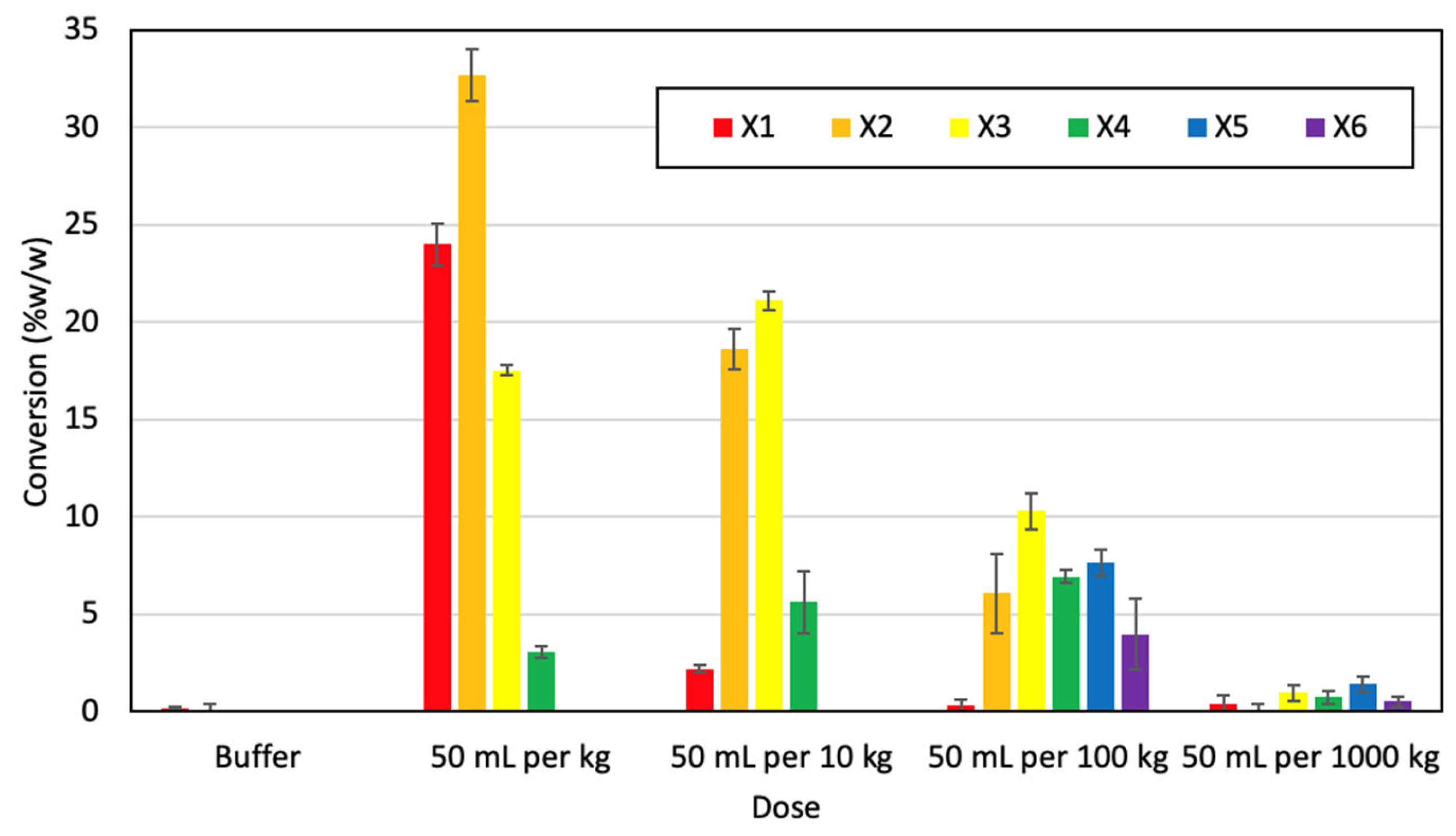
Since WUAX was not susceptible to enzyme activity, the enzyme dosage effect was only studied in WEAX. Figure 3 presents the results of enzymatic treatment of WEAX at doses of 50 mL per kg, 50 mL per 10 kg, 50 mL per 100 kg and 50 mL per 1000 kg (500×, 50×, 5× and 0.5× the recommended commercial dose) for 2 h. Clearly, the liberation of monosaccharides was greater with the higher dose, for which about 23% of the WEAX was released as xylose, whereas the lower doses of the enzyme released as little as 3%. However, the lower doses gave a more balanced range of XOS molecules, with plenty of X4, X5 and X6, while the higher doses degraded these to the smaller X1, X2 and X3. In total, about 53% of WEAX was released as oligosaccharides with the highest dose (500×); however, it mostly comprised smaller XOS; X2 (32%), X3 (17%) and X4 (3%), with around 23% xylose monosaccharide. At lower dosages, the larger xylopentaose (X5) and xylohexaose (X6) were produced and survived further breakdown by the enzyme. These results emphasise the need to study enzyme kinetics in terms of the evolving population balance and to understand the conditions that deliver a desired balance of XOS molecules, dependent on their relative efficacy in different prebiotic and stimbiotic applications (for which clarity is still an emerging topic of research [29]).
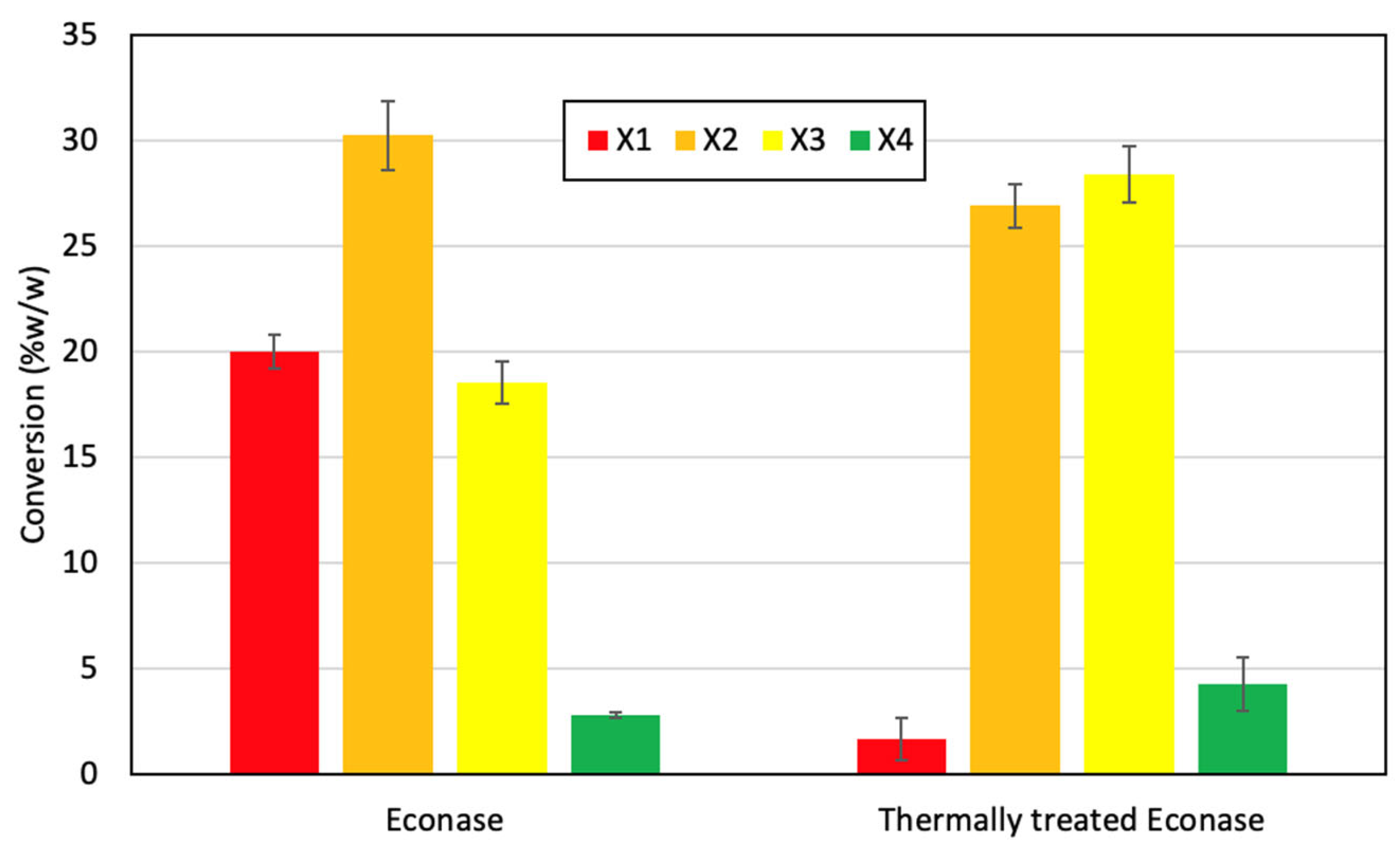
The evidence of exoxylanase activity, leading to unwanted production of xylose, prompted a study in which the thermally stable Econase was heated to 70 °C for 30 min, then applied to the WEAX at a dose of 50 mL per kg for 2 h. Figure 4 shows the effect of the Econase on XOS release with and without the heat treatment, showing that xylose production was dramatically reduced from 20% to 1.5%, while total XOS (X2, X3 and X4) increased from 51% to 59%, with the balance shifted from X2 to X3 and X4. Thus, the thermal treatment was effective in destroying the contaminating exoxylanase activity and eliminating the degradation of X2, X3 and X4 to X1.

3.4. Effect of AX on Pasting Viscosity Characteristics of Flour

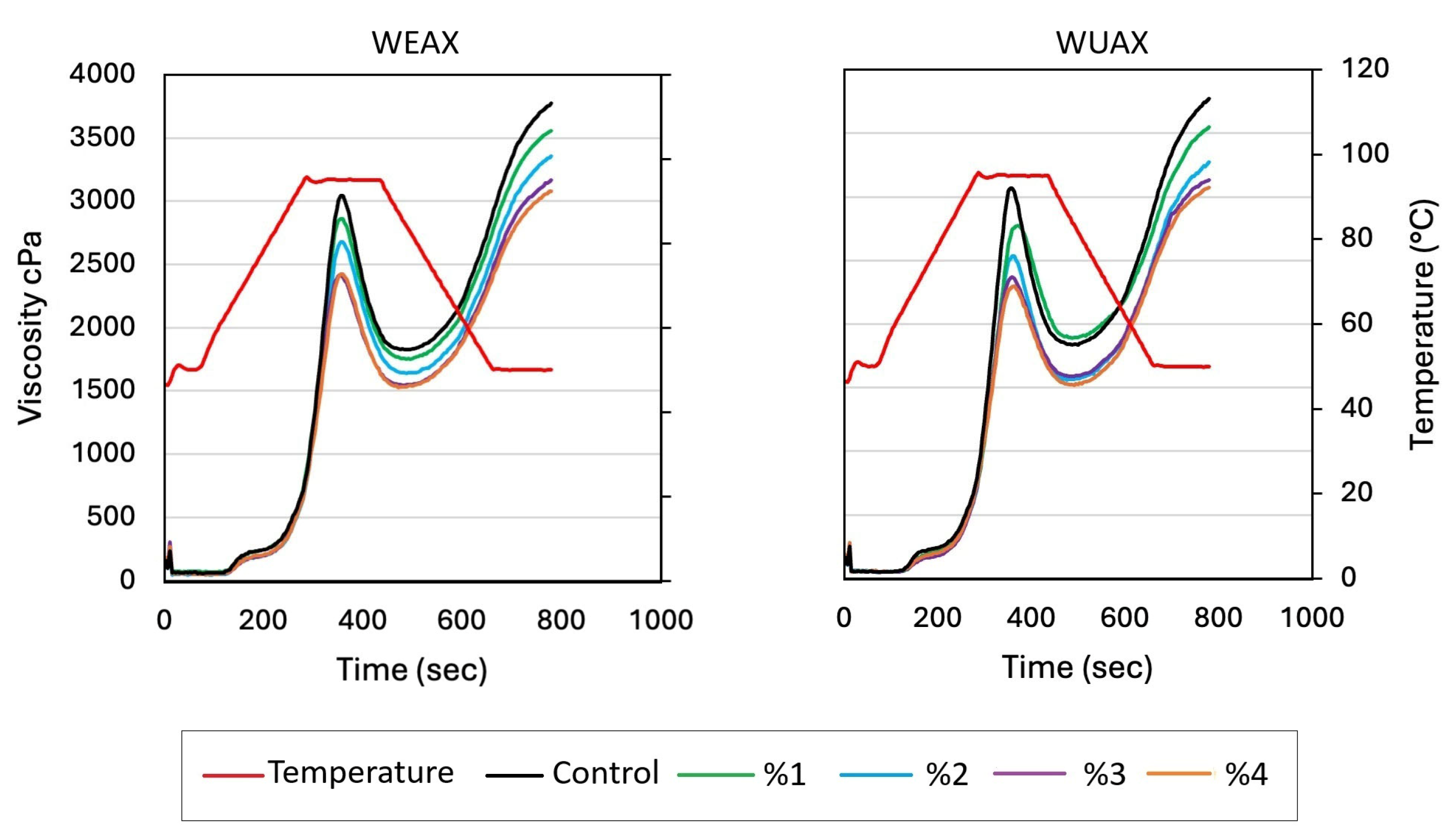
Figure 5 shows the effects of WEAX and WUAX on wheat flour solution viscosity during mixing and heating in the Rapid Visco Analyzer. The addition of AX moved the RVA curves down, indicating that AX decreased the viscosity of the system. This was perhaps unexpected, as AXs are supposed to be highly water-absorbing [74,75,76,77] and might be expected to increase viscosity. This suggests that, separately from its water-absorbing effect, the AX may be interacting with the starch, compromising its network formation and hence reducing its viscosity.
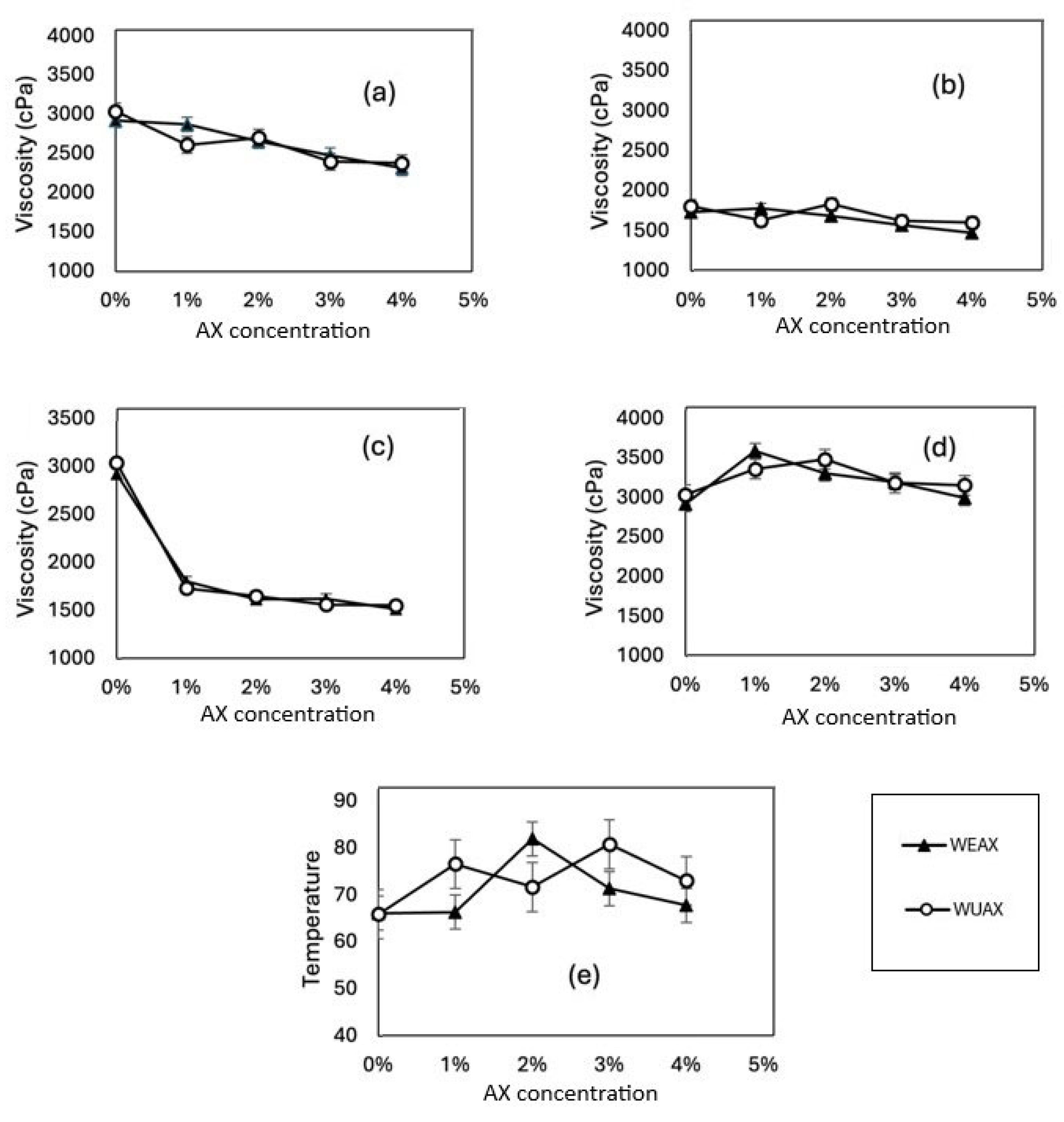
Figure 6 extracts the detailed effects of WEAX and WUAX on the primary test parameters (peak viscosity, holding strength, setback viscosity, final viscosity and pasting temperature). Clearly, both WEAX and WUAX decreased peak viscosity (the maximum viscosity reached during heating) to similar degrees, and more significantly with higher concentrations of AX. This effect of AX has been previously reported in the literature [78]; however, other reports have shown an increase in the peak viscosity upon addition of AX [79]. As noted above, it might be expected that AX addition would increase viscosity, as AXs are frequently reported as having high water absorption, this being part of their attraction in applications such as bread, for example. The contradictory findings in the literature emphasise the importance and value of appreciating the feedstock, extraction and processing methods used for AX production and how these give AXs different functional properties. It is becoming more evident that AX characteristics can deliver a wide range of functions depending on molecular weight and structure, which broadens even more the potential of these polysaccharide fibres in the food industry.
A similar declining trend was also observed during the holding strength phase, which indicates the ability of the starch network to withstand the temperature and shear stress. Both AX extracts appeared to compromise the starch network’s integrity, with higher concentrations of AX producing more breakdown during shear. The same decline is also observed in the setback viscosity, which is the difference between final viscosity and the peak viscosity. Lower setback has been associated with longer shelf life in baked products [80,81], suggesting that AXs could retard staling and increase shelf life.
The effects on holding viscosity, final viscosity and pasting temperature were less clear. Analysis of Variance confirmed significant effects (p < 0.05) of AX concentration on peak viscosity and setback, but no significant differences between the two AXs. The molecular weight and A:X ratio results indicate that WEAX comprises longer but less bulky molecules, while WUAX are larger but shorter and bulkier molecules. These different structures might have been expected to interact differently with starch during gelatinisation and retrogradation, but the RVA system was unable to distinguish differences. The RVA is a system in which water is available in large excess—over seven times the flour weight in the current work. In a bread dough system, in which there is competition between starch, protein and AX for the limited water (typically only 60% of flour weight), the differences between the two AXs might be more evident.
Overall, WEAX extraction from solubles was easier than WUAX extraction from WDG, yielding 52% of the available AX in the solubles, compared with only 14% recovery of the available AX in the WDG. The WEAX had a lower A:X ratio that made it more susceptible to xylanase degradation, and hence a more suitable substrate for the production of oligosaccharides, compared with the WUAX. Both AXs showed evidence of interaction with starch during gelatinisation and retrogradation. The WUAX, being a larger and bulkier molecule with a higher A:X ratio, is likely to be more suitable for extraction as intact AX, rather than as a feedstock for AXOS production. What end uses this particular AX might be suitable for remains a question within the extensive landscape of AX research required to fully understand its feedstock, processing, structure, function and end-use relationships.

4. Conclusions

The current study highlights that extracting AX from the components of DDGS prior to combining and drying is a feasible and potentially quick win in terms of introducing AX-based products and creating markets from which a more diverse and increasingly targeted portfolio of biorefinery co-products could be created. It estimates that in due course, building on early successful products, the global markets for AX-based products are potentially very large, in excess of £1 billion pa, based on considerations of the availability of low value feedstocks that biorefineries are seeking to valorise and the applications and markets for the range of products that could be produced. The sizes of commercial sources and end-use markets for AXs are in this respect well matched. The emergence of biorefineries has given a context in which AX products could be produced, benefitting from integration with ethanol production. However, much work remains to be done to clarify how to extract AXs of controlled and consistent composition, structure and functionality from a range of feedstocks, and how these structures and functions could serve a range of end-use applications in the food, feed and non-food sectors in order to grow both the commercial sources and the markets for new classes of AX products.
In the current work, AX was more readily extracted from the solubles fraction than from the Wet Distillers Grain fraction, using simple and low-cost filtration and ethanolic precipitation, which could easily be retrofitted to existing bioethanol plants. The solubles WEAX was a more suitable feedstock for hydrolysis to oligosaccharides than the WDG WUAX, with the profile of XOS dependent on enzyme dosage and incubation time. Both WEAX and WUAX showed effects on starch behaviour during gelatinisation and retrogradation. This work provides guidance and focus for more detailed studies of these fractions, both to scale up extraction and enhance the purity (as current studies, particularly for functionality as bread ingredients, remain limited by the amounts and purities of material that can be produced), and to update techno-economic analyses based on increasingly clear processes, yields, costs and markets.

Author Contributions

Conceptualization, M.A. and G.M.C.; methodology, M.A. and G.M.C.; validation, G.M.C., H.M.O. and M.R.B.; formal analysis, M.A.; investigation, M.A. and S.I.K.; resources, G.M.C. and M.R.B.; writing—original draft preparation, M.A.; writing—review and editing, G.M.C., H.M.O. and M.R.B.; visualization, M.A.; supervision, G.M.C., H.M.O. and M.R.B.; project administration, G.M.C.; funding acquisition, G.M.C. All authors have read and agreed to the published version of the manuscript.

Funding

M.A. is grateful to the University of Huddersfield for provision of PhD funding that allowed this research to be undertaken.

Data Availability Statement

The original contributions presented in this study are included in the article. Further inquiries can be directed to the corresponding author.

Acknowledgments

Generative AI was not used in any way in preparing this paper.

Conflicts of Interest

Authors Helen Masey O’Neill and Michael R. Bedford were employed by the company AB Vista Ltd. The remaining authors declare that the research was conducted in the absence of any commercial or financial relationships that could be construed as a potential conflict of interest.

Abbreviations

The following abbreviations are used in this manuscript:
AXArabinoxylans
AXOSArabinoxylan oligosaccharides
XOSXylo-oligosaccharides
DDGSDistillers Dried Grains with Solubles
WDGWet Distillers Grain
WEAXWater-extractable arabinoxylan
WUAXWater-unextractable arabinoxylan
RVARapid Visco Analyser
BSGBrewer’s Spent Grain
SEC-MALLSSize exclusion chromatography with multi-angle laser light scattering
HPAEC-PADHigh performance anion exchange chromatography with pulsed amperometric detection
HPLCHigh performance liquid chromatography

References

  1. Guerreiro, C.D.A.; Andrade, L.A.D.; Fernández-Lainez, C.; Fraga, L.N.; López-Velázquez, G.; Marques, T.M.; Prado, S.B.R.; Brummer, R.J.; Nascimento, J.R.O.; Castro-Alves, V. Bioactive Arabinoxylan Oligomers via Colonic Fermentation and Enzymatic Catalysis: Evidence of Interaction with Toll-like Receptors from in Vitro, in Silico and Functional Analysis. Carbohydr. Polym. 2025, 352, 123175. [Google Scholar] [CrossRef] [PubMed]
  2. Zhang, H.; Hou, Y.; Liu, T.; Li, Z.; Luo, S.; Liu, C.; Zhang, G.; Chen, T. Strategic Alteration of Arabinoxylan Feruloylation Enables Selective Shaping of the Human Gut Microbiota. Food Hydrocoll. 2025, 160, 110818. [Google Scholar] [CrossRef]
  3. Huang, Z.; Yang, X.; Liu, M.; Yin, L.; Jia, X. Effect of Glycoside Hydrolase-Mediated Wheat Arabinoxylan Hydrolysate on Gut Microbiota and Metabolite Profiles. Carbohydr. Polym. 2025, 351, 123064. [Google Scholar] [CrossRef] [PubMed]
  4. Naibaho, J.; Setiawan, R.D.; Korzeniowska, M. Biological Properties of Bioactive Compounds from Brewers’ Spent Grain: Current Trends, Challenges, and Perspectives. Curr. Opin. Food Sci. 2025, 62, 101268. [Google Scholar] [CrossRef]
  5. Kruk, M.; Lalowski, P.; Płecha, M.; Ponder, A.; Rudzka, A.; Zielińska, D.; Trząskowska, M. Prebiotic Potential of Spent Brewery Grain—In Vitro Study. Food Chem. 2025, 463, 141254. [Google Scholar] [CrossRef]
  6. Shrivastava, M.; Goyal, A. Unveiling the Structural and Functional Perspectives of a Bifunctional α-l-Arabinofuranosidase/Endo-β-1,4-Xylanase (BoGH43_35) from Bacteroides Ovatus. Arch. Biochem. Biophys. 2025, 764, 110232. [Google Scholar] [CrossRef]
  7. Kulathunga, J.; Islam, S. Wheat Arabinoxylans: Insight into Structure-Function Relationships. Carbohydr. Polym. 2025, 348, 122933. [Google Scholar] [CrossRef]
  8. Rezette, L.; Kansou, K.; Della Valle, G.; Le Gall, S.; Saulnier, L. The Role of Wheat Flour Minor Components in Predicting Water Absorption. Food Chem. 2025, 463, 141232. [Google Scholar] [CrossRef]
  9. Bilal, M.; Li, D.; Xie, C.; Yang, R.; Gu, Z.; Jiang, D.; Xu, X.; Wang, P. Recent Advances of Wheat Bran Arabinoxylan Exploitation as the Functional Dough Additive. Food Chem. 2025, 463, 141146. [Google Scholar] [CrossRef]
  10. Wan, J.; Wei, Y.; Zhang, Y.; Lan, H.; Li, X.; Wang, Y.; Luo, D.; Feng, J.; Bai, Z.; Guo, J. Innovative Use of Wastewater-Extracted Arabinoxylans: Elevating Steamed Bread Texture and Structure. Food Chem. 2025, 466, 142120. [Google Scholar] [CrossRef]
  11. Falade, E.O.; Kouamé, K.J.E.P.; Zhu, Y.; Zheng, Y.; Ye, X. A Review: Examining the Effects of Modern Extraction Techniques on Functional and Structural Properties of Cellulose and Hemicellulose in Brewer’s Spent Grain Dietary Fiber. Carbohydr. Polym. 2025, 348, 122883. [Google Scholar] [CrossRef] [PubMed]
  12. He, H.J.; Qiao, J.; Liu, Y.; Guo, Q.; Ou, X.; Wang, X. Isolation, Structural, Functional, and Bioactive Properties of Cereal Arabinoxylan—A Critical Review. J. Agric. Food Chem. 2021, 69, 15437–15457. [Google Scholar] [CrossRef] [PubMed]
  13. Zannini, E.; Bravo Núñez, Á.; Sahin, A.W.; Arendt, E.K.; Aiello, F.; Carullo, G.; Zannini, E.; Bravo Núñez, Á.; Sahin, A.W.; Arendt, E.K. Arabinoxylans as Functional Food Ingredients: A Review. Foods 2022, 11, 1026. [Google Scholar] [CrossRef] [PubMed]
  14. Pietiäinen, S.; Jimenez-Quero, A.; Moldin, A.; Ström, A.; Katina, K.; Langton, M. Feruloylation and Hydrolysis of Arabinoxylan Extracted from Wheat Bran: Effect on Bread Quality and Shelf-Life. J. Cereal Sci. 2024, 117, 103920. [Google Scholar] [CrossRef]
  15. Solomou, K.; Alyassin, M.; Angelis-Dimakis, A.; Campbell, G.M. Arabinoxylans: A New Class of Food Ingredients Arising from Synergies with Biorefining, and Illustrating the Nature of Biorefinery Engineering. Food Bioprod. Process. 2022, 132, 83–98. [Google Scholar] [CrossRef]
  16. Pang, J.; Zhang, Y.; Song, X.; Tong, X.; Wu, S.; Hu, Y.; Zhong, Y.; Qiao, Y. Molecular Characterization, Rheological Properties, and Prebiotic Properties of Arabinoxylans from Waxy and Sweet Corn Cobs. Cereal Chem. 2024, 101, 493–507. [Google Scholar] [CrossRef]
  17. Pérez-Flores, J.G.; García-Curiel, L.; Pérez-Escalante, E.; Contreras-López, E.; Olloqui, E.J. Arabinoxylans Matrixes as a Potential Material for Drug Delivery Systems Development—A Bibliometric Analysis and Literature Review. Heliyon 2024, 10, e25445. [Google Scholar] [CrossRef]
  18. UK Flour Millers Statistics. Available online: https://www.ukflourmillers.org/statistics (accessed on 19 February 2025).
  19. Statista Global Sugar Cane Production 2023|Statista. Available online: https://www.statista.com/statistics/249604/sugar-cane-production-worldwide/ (accessed on 23 October 2025).
  20. Mordor Intelligence Distiller’s Dried Grains with Solubles (DDGS) Feed Market Analysis|Industry Report, Size & Forecast. Available online: https://www.mordorintelligence.com/industry-reports/ddgs-feed-market (accessed on 23 October 2025).
  21. Liu, K. Particle Size Distribution of Distillers Dried Grains with Solubles (DDGS) and Relationships to Compositional and Color Properties. Bioresour. Technol. 2008, 99, 8421–8428. [Google Scholar] [CrossRef]
  22. Kim, Y.; Mosier, N.S.; Hendrickson, R.; Ezeji, T.; Blaschek, H.; Dien, B.; Cotta, M.; Dale, B.; Ladisch, M.R. Composition of Corn Dry-Grind Ethanol by-Products: DDGS, Wet Cake, and Thin Stillage. Bioresour. Technol. 2008, 99, 5165–5176. [Google Scholar] [CrossRef]
  23. Cromwell, G.L.; Herkelman, K.L.; Stahly, T.S. Physical, Chemical, and Nutritional Characteristics of Distillers Dried Grains with Solubles for Chicks and Pigs. J. Anim. Sci. 1993, 71, 679–686. [Google Scholar] [CrossRef][Green Version]
  24. Immerzeel, P.; Falck, P.; Galbe, M.; Adlercreutz, P.; Nordberg Karlsson, E.; Stålbrand, H. Extraction of Water-Soluble Xylan from Wheat Bran and Utilization of Enzymatically Produced Xylooligosaccharides by Lactobacillus, Bifidobacterium and Weissella Spp. LWT-Food Sci. Technol. 2014, 56, 321–327. [Google Scholar] [CrossRef]
  25. Mendis, M.; Simsek, S. Arabinoxylans and Human Health. Food Hydrocoll. 2014, 42, 239–243. [Google Scholar] [CrossRef]
  26. Broekaert, W.F.; Courtin, C.M.; Verbeke, K.; Van de Wiele, T.; Verstraete, W.; Delcour, J.A. Prebiotic and Other Health-Related Effects of Cereal-Derived Arabinoxylans, Arabinoxylan-Oligosaccharides, and Xylooligosaccharides. Crit. Rev. Food Sci. Nutr. 2011, 51, 178–194. [Google Scholar] [CrossRef] [PubMed]
  27. Van Craeyveld, V.; Swennen, K.; Dornez, E.; Van de Wiele, T.; Marzorati, M.; Verstraete, W.; Delaedt, Y.; Onagbesan, O.; Decuypere, E.; Buyse, J.; et al. Structurally Different Wheat-Derived Arabinoxylooligosaccharides Have Different Prebiotic and Fermentation Properties in Rats. J. Nutr. 2008, 138, 2348–2355. [Google Scholar] [CrossRef]
  28. Šimić, A.; González-Ortiz, G.; Mansbridge, S.C.; Rose, S.P.; Bedford, M.R.; Yovchev, D.; Pirgozliev, V.R. Broiler Chicken Response to Xylanase and Fermentable Xylooligosaccharide Supplementation. Poult. Sci. 2023, 102, 103000. [Google Scholar] [CrossRef]
  29. Davies, C.; González-Ortiz, G.; Rinttilä, T.; Apajalahti, J.; Alyassin, M.; Bedford, M.R. Stimbiotic Supplementation and Xylose-Rich Carbohydrates Modulate Broiler’s Capacity to Ferment Fibre. Front. Microbiol. 2023, 14, 1301727. [Google Scholar] [CrossRef]
  30. Nadi, P. Xylooligosaccharide Market Size, Share, Trends, Forecast|2032. Available online: https://www.marketresearchfuture.com/reports/xylooligosaccharide-market-12084 (accessed on 19 February 2025).
  31. González-Ortiz, G.; dos Santos, T.T.; Bedford, M.R. Evaluation of Xylanase and a Fermentable Xylo-Oligosaccharide on Performance and Ileal Digestibility of Broiler Chickens Fed Energy and Amino Acid Deficient Diets. Anim. Nutr. 2021, 7, 488–495. [Google Scholar] [CrossRef]
  32. Cho, H.M.; González-Ortiz, G.; Melo-Durán, D.; Heo, J.M.; Cordero, G.; Bedford, M.R.; Kim, J.C. Stimbiotic Supplementation Improved Performance and Reduced Inflammatory Response via Stimulating Fiber Fermenting Microbiome in Weaner Pigs Housed in a Poor Sanitary Environment and Fed an Antibiotic-Free Low Zinc Oxide Diet. PLoS ONE 2020, 15, e0240264. [Google Scholar] [CrossRef]
  33. González-Ortiz, G.; Bedford, M.R.; Bach Knudsen, K.-E.; Courtin, C.M.; Classen, H.L. The Value of Fibre: Engaging the Second Brain for Animal Nutrition; Wageningen Academic Publishers: Leiden, The Netherlands, 2019; ISBN 9086863426. [Google Scholar]
  34. Misailidis, N.; Campbell, G.M.; Du, C.; Sadhukhan, J.; Mustafa, M.; Mateos-Salvador, F.; Weightman, R.M. Evaluating the Feasibility of Commercial Arabinoxylan Production in the Context of a Wheat Biorefinery Principally Producing Ethanol: Part 2. Process Simulation and Economic Analysis. Chem. Eng. Res. Des. 2009, 87, 1239–1250. [Google Scholar] [CrossRef]
  35. Martinez-Hernandez, E.; Tibessart, A.; Campbell, G.M. Conceptual Design of Integrated Production of Arabinoxylan Products Using Bioethanol Pinch Analysis. Food Bioprod. Process. 2018, 112, 1–8. [Google Scholar] [CrossRef]
  36. Hollmann, J.; Lindhauer, M. Pilot-Scale Isolation of Glucuronoarabinoxylans from Wheat Bran. Carbohydr. Polym. 2005, 59, 225–230. [Google Scholar] [CrossRef]
  37. Maes, C.; Delcour, J.A. Structural Characterisation of Water-Extractable and Water-Unextractable Arabinoxylans in Wheat Bran. J. Cereal Sci. 2002, 35, 315–326. [Google Scholar] [CrossRef]
  38. Swennen, K.; Courtin, C.M.; Delcour, J.A. Non-Digestible Oligosaccharides with Prebiotic Properties. Crit. Rev. Food Sci. Nutr. 2006, 46, 459–471. [Google Scholar] [CrossRef] [PubMed]
  39. Swennen, K.; Courtin, C.M.; Van Der Bruggen, B.; Vandecasteele, C.; Delcour, J.A. Ultrafiltration and Ethanol Precipitation for Isolation of Arabinoxylooligosaccharides with Different Structures. Carbohydr. Polym. 2005, 62, 283–292. [Google Scholar] [CrossRef]
  40. Peng, F.; Peng, P.; Xu, F.; Sun, R.-C. Fractional Purification and Bioconversion of Hemicelluloses. Biotechnol. Adv. 2012, 30, 879–903. [Google Scholar] [CrossRef]
  41. Peng, F.; Ren, J.L.; Xu, F.; Bian, J.; Peng, P.; Sun, R.C. Fractional Study of Alkali-Soluble Hemicelluloses Obtained by Graded Ethanol Precipitation from Sugar Cane Bagasse. J. Agric. Food Chem. 2010, 58, 1768–1776. [Google Scholar] [CrossRef]
  42. Zhang, Z.; Smith, C.; Li, W. Extraction and Modification Technology of Arabinoxylans from Cereal By-Products: A Critical Review. Food Res. Int. 2014, 65, 423–436. [Google Scholar] [CrossRef]
  43. Martinez-Hernandez, E.; Sadhukhan, J.; Campbell, G.M. Integration of Bioethanol as an In-Process Material in Biorefineries Using Mass Pinch Analysis. Appl. Energy 2013, 104, 517–526. [Google Scholar] [CrossRef]
  44. Klopfenstein, T.J.; Erickson, G.E.; Bremer, V.R. BOARD-INVITED REVIEW: Use of Distillers by-Products in the Beef Cattle Feeding Industry1. J. Anim. Sci. 2008, 86, 1223–1231. [Google Scholar] [CrossRef]
  45. Kingsly, A.R.P.; Ileleji, K.E.; Clementson, C.L.; Garcia, A.; Maier, D.E.; Stroshine, R.L.; Radcliff, S. The Effect of Process Variables during Drying on the Physical and Chemical Characteristics of Corn Dried Distillers Grains with Solubles (DDGS)—Plant Scale Experiments. Bioresour. Technol. 2010, 101, 193–199. [Google Scholar] [CrossRef]
  46. Jensen, H.G.; Björnsson, A.H. By-Products from Ethanol Production—The Forgotten Part of the Equation Possibilities and Challenges; University of Copenhagen: Copenhagen, Denmark, 2012. [Google Scholar]
  47. Coelho, E.; Rocha, M.A.M.; Moreira, A.S.P.; Domingues, M.R.M.; Coimbra, M.A. Revisiting the Structural Features of Arabinoxylans from Brewers’ Spent Grain. Carbohydr. Polym. 2016, 139, 167–176. [Google Scholar] [CrossRef] [PubMed]
  48. Laine, C.; Kemppainen, K.; Kuutti, L.; Varhimo, A.; Asikainen, S.; Grönroos, A.; Määttänen, M.; Buchert, J.; Harlin, A. Extraction of Xylan from Wood Pulp and Brewer’s Spent Grain. Ind. Crops Prod. 2015, 70, 231–237. [Google Scholar] [CrossRef]
  49. Mandalari, G.; Faulds, C.B.; Sancho, A.I.; Saija, A.; Bisignano, G.; LoCurto, R.; Waldron, K.W. Fractionation and Characterisation of Arabinoxylans from Brewers’ Spent Grain and Wheat Bran. J. Cereal Sci. 2005, 42, 205–212. [Google Scholar] [CrossRef]
  50. Chatzifragkou, A.; Charalampopoulos, D. Distiller’s Dried Grains with Solubles (DDGS) and Intermediate Products as Starting Materials in Biorefinery Strategies. In Sustainable Recovery and Reutilization of Cereal Processing By-Products; Woodhead Publishing: Cambridge, UK, 2018; pp. 63–86. [Google Scholar] [CrossRef]
  51. De Vries, S.; Pustjens, A.M.; Kabel, M.A.; Salazar-Villanea, S.; Hendriks, W.H.; Gerrits, W.J.J. Processing Technologies and Cell Wall Degrading Enzymes to Improve Nutritional Value of Dried Distillers Grain with Solubles for Animal Feed: An in Vitro Digestion Study. J. Agric. Food Chem. 2013, 61, 8821–8828. [Google Scholar] [CrossRef]
  52. Schroeder, J.W. NDUS Extension Service; NDSU: Fargo, ND, USA, 2012; pp. 1–8. [Google Scholar]
  53. Pedersen, M.B.; Dalsgaard, S.; Knudsen, K.E.B.; Yu, S.; Lærke, H.N. Compositional Profile and Variation of Distillers Dried Grains with Solubles from Various Origins with Focus on Non-Starch Polysaccharides. Anim. Feed. Sci. Technol. 2014, 197, 130–141. [Google Scholar] [CrossRef]
  54. Kosik, O.; Powers, S.J.; Chatzifragkou, A.; Prabhakumari, P.C.; Charalampopoulos, D.; Hess, L.; Brosnan, J.; Shewry, P.R.; Lovegrove, A. Changes in the Arabinoxylan Fraction of Wheat Grain during Alcohol Production. Food Chem. 2017, 221, 1754–1762. [Google Scholar] [CrossRef]
  55. Alyassin, M. Arabinoxylan Prebiotics Co-Production Within Integrated Biorefineries; University of Huddersfield: Huddersfield, UK, 2019. [Google Scholar]
  56. Englyst, H.N.; Quigley, M.E.; Hudson, G.J.; Cummings, J.H. Determination of Dietary Fibre as Non-Starch Polysaccharides by Gas-Liquid Chromatography. Analyst 1992, 117, 1707–1714. [Google Scholar] [CrossRef]
  57. Cyran, M.; Courtin, C.M.; Delcour, J.A. Structural Features of Arabinoxylans Extracted with Water at Different Temperatures from Two Rye Flours of Diverse Breadmaking Quality. J. Agric. Food Chem. 2003, 51, 4404–4416. [Google Scholar] [CrossRef]
  58. Horwitz, W. Protein in Grains. Method 979.09. In Official Method of Analysis of AOAC International; AOAC: Rockville, MD, USA, 2000; pp. 30–34. [Google Scholar]
  59. Sluiter, A.; Hames, B.; Ruiz, R.; Scarlata, C.; Sluiter, J.; Templeton, D. Determination of Ash in Biomass Laboratory Analytical Procedure (LAP) Issue Date: 7/17/2005; National Renewable Energy Laboratory: Golden, CO, USA, 2008. [Google Scholar]
  60. Alyassin, M.; Campbell, G.M.; Masey O’Neill, H.; Bedford, M.R. Simultaneous Determination of Cereal Monosaccharides, Xylo- and Arabinoxylo-Oligosaccharides and Uronic Acids Using HPAEC-PAD. Food Chem. 2020, 315, 126221. [Google Scholar] [CrossRef]
  61. Murphy, J.D.; Power, N.M. How Can We Improve the Energy Balance of Ethanol Production from Wheat? Fuel 2008, 87, 1799–1806. [Google Scholar] [CrossRef]
  62. Morey, R.V.; Hatfield, D.L.; Sears, R.; Haak, D.; Tiffany, D.G.; Kaliyan, N. Fuel Properties of Biomass Feed Streams at Ethanol Plants. Appl. Eng. Agric. 2009, 25, 57–64. [Google Scholar] [CrossRef]
  63. Barron, C.; Bar-L’Helgouac’h, C.; Champ, M.; Saulnier, L. Arabinoxylan Content and Grain Tissue Distribution Are Good Predictors of the Dietary Fibre Content and Their Nutritional Properties in Wheat Products. Food Chem. 2020, 328, 127111. [Google Scholar] [CrossRef] [PubMed]
  64. Liu, K. Chemical Composition of Distillers Grains, a Review. J. Agric. Food Chem. 2011, 59, 1508–1526. [Google Scholar] [CrossRef] [PubMed]
  65. Jarret, G.; Cozannet, P.; Martinez, J.; Dourmad, J.Y. Effect of Different Quality Wheat Dried Distiller’s Grain Solubles (DDGS) in Pig Diets on Composition of Excreta and Methane Production from Faeces and Slurry. Livest. Sci. 2011, 140, 275–282. [Google Scholar] [CrossRef]
  66. Chatzifragkou, A.; Prabhakumari, P.C.; Kosik, O.; Lovegrove, A.; Shewry, P.R.; Charalampopoulos, D. Extractability and Characteristics of Proteins Deriving from Wheat DDGS. Food Chem. 2016, 198, 12–19. [Google Scholar] [CrossRef]
  67. Saulnier, L.; Guillon, F.; Sado, P.-E.; Chateigner-Boutin, A.L.; Rouau, X. Plant Cell Wall Polysaccharides in Storage Organs: Xylans (Food Applications). Ref. Modul. Chem. Mol. Sci. Chem. Eng. 2013. [Google Scholar] [CrossRef]
  68. Shi, Y.; Yokoyama, T.; Akiyama, T.; Yashiro, M.; Matsumoto, Y. Degradation of Monosaccharides. Bioresources 2012, 7, 4085–4097. [Google Scholar] [CrossRef]
  69. Liu, D.; Tang, W.; Yin, J.Y.; Nie, S.P.; Xie, M.Y. Monosaccharide Composition Analysis of Polysaccharides from Natural Sources: Hydrolysis Condition and Detection Method Development. Food Hydrocoll. 2021, 116, 106641. [Google Scholar] [CrossRef]
  70. Whitfield, M.B.; Chinn, M.S.; Veal, M.W. Improvement of Acid Hydrolysis Procedures for the Composition Analysis of Herbaceous Biomass. Energy Fuels 2016, 30, 8260–8269. [Google Scholar] [CrossRef]
  71. Garcés, D.; Díaz, E.; Ordóñez, S. Aqueous Phase Conversion of Hexoses into 5-Hydroxymethylfurfural and Levulinic Acid in the Presence of Hydrochloric Acid: Mechanism and Kinetics. Ind. Eng. Chem. Res. 2017, 56, 5221–5230. [Google Scholar] [CrossRef]
  72. Nguyen, H.S.H.; Heinonen, J.; Laatikainen, M.; Sainio, T. Evolution of the Molar Mass Distribution of Oat β-Glucan during Acid Catalyzed Hydrolysis in Aqueous Solution. Chem. Eng. J. 2020, 382, 122863. [Google Scholar] [CrossRef]
  73. Willför, S.; Pranovich, A.; Tamminen, T.; Puls, J.; Laine, C.; Suurnäkki, A.; Saake, B.; Uotila, K.; Simolin, H.; Hemming, J.; et al. Carbohydrate Analysis of Plant Materials with Uronic Acid-Containing Polysaccharides-A Comparison between Different Hydrolysis and Subsequent Chromatographic Analytical Techniques. Ind. Crops Prod. 2009, 29, 571–580. [Google Scholar] [CrossRef]
  74. Dale, T.; Bedford, M.R.; King, J.; Tucker, G.A.; Brameld, J.M.; Parr, T. The Effects of Exogenous Fibrolytic Enzymes on the in Vitro Release of Xylooligosaccharides and Monosaccharides Varies across Six Varieties of Wheat. Anim. Feed Sci. Technol. 2023, 295, 115526. [Google Scholar] [CrossRef]
  75. Solomou, K.; Čukelj Mustač, N.; Alyassin, M.; Campbell, G.M. Using the Chopin Mixolab to Model the Effects of Arabinoxylan Ingredients on Breadmaking. Part 2: Predicting the Effects of Combinations of Different Arabinoxylans. Food Bioprod. Process. 2025, 150, 432–451. [Google Scholar] [CrossRef]
  76. Campbell, G.M.; Solomou, K.; O’Byrne, K.J.; Spencer, K.L. Using the Chopin Mixolab to Model the Effects of Arabinoxylan Ingredients on Breadmaking. Part 1: Modelling Combined Effects of AX and Water Adjustment on Mixolab Parameters. Food Bioprod. Process. 2025, 150, 416–431. [Google Scholar] [CrossRef]
  77. Courtin, C.M.; Delcour, J.A. Arabinoxylans and Endoxylanases in Wheat Flour Bread-Making. J. Cereal Sci. 2002, 35, 225–243. [Google Scholar] [CrossRef]
  78. Ayala-Soto, F.E.; Serna-Saldívar, S.O.; Welti-Chanes, J. Effect of Arabinoxylans and Laccase on Batter Rheology and Quality of Yeast-Leavened Gluten-Free Breads. J. Cereal Sci. 2017, 73, 10–17. [Google Scholar] [CrossRef]
  79. Yan, W.; Yin, L.; Zhang, M.; Zhang, M.; Jia, X. Gelatinization, Retrogradation and Gel Properties of Wheat Starch–Wheat Bran Arabinoxylan Complexes. Gels 2021, 7, 200. [Google Scholar] [CrossRef]
  80. Yan, W.; Zhang, M.; Zhang, M.; Yadav, M.P.; Jia, X.; Yin, L. Effect of Wheat Bran Arabinoxylan on the Gelatinization and Long-Term Retrogradation Behavior of Wheat Starch. Carbohydr. Polym. 2022, 291, 119581. [Google Scholar] [CrossRef]
  81. Gudmundsson, M.; Eliasson, A.; Bengtsson, S.; Aman, P. The Effects of Water Soluble Arabinoxylan on Gelatinization and Retrogradation of Starch. Starch-Stärke 1991, 43, 5–10. [Google Scholar]
Figure 1. Production of WDG and solubles and extraction of WEAX and WUAX within the bioethanol production process.
Cleantechnol 08 00024 g001
Figure 2. Percentage conversion WEAX and WUAX after xylanase treatment for one and two hours: X1 is xylose, X2 is xylobiose and X3 is xylotriose, and Buffer is the control without enzyme for 2 h.
Cleantechnol 08 00024 g002
Figure 3. Xylanase treatment of WEAX at a doses of 50 mL per kg, 50 mL per 10 kg, 50 mL per 100 kg and 50 mL per 1000 kg (500×, 50×, 5× and 0.5× the recommended commercial dose) for 2 h.
Cleantechnol 08 00024 g003
Figure 4. XOS production before and after thermal treatment of Econase.
Cleantechnol 08 00024 g004
Figure 5. Effects of WEAX and WUAX on wheat flour RVA viscosity profiles.
Cleantechnol 08 00024 g005
Figure 6. Effects of WEAX and WUAX on RVA (a) peak viscosity, (b) holding strength, (c) setback viscosity, (d) final viscosity and (e) pasting temperature. Open circles: WUAX, closed triangles: WEAX. (Error bars are ±1 standard deviation of the mean, based on a pooled standard deviation).
Cleantechnol 08 00024 g006
Table 1. AX, protein and ash contents of wheat, WDG and solubles.
AX %Protein %Ash %
Wheat (8.75 kg db)5.3 ± 0.012.8 ± 0.11.8 ± 0.01
WDG (2.10 kg db)14.7 ± 0.839.2 ± 0.22.2 ± 0.0
Solubles (1.33 kg db)10.0 ± 0.437.4 ± 0.18.5 ± 0.4
Table 2. Absolute amounts of AX, protein and ash in wheat, WDG and solubles.
AXProteinAsh
Wheat (8.75 kg db)464 g1120 g158 g
WDG (2.10 kg db)309 g 823 g46 g
Solubles (1.33 kg db)133 g497 g113 g
Mass balance95.3%117.9%100.6%
Table 3. Chemical compositions of WEAX and WUAX (wet basis).
WEAXWUAX
Average Mw (kDa)70110
AX purity %74.24 ± 0.1351.62 ± 0.09
A:X ratio0.491.18
Total crude protein %5.8 ± 0.219.8 ± 0.31
Ash %0.72 ± 0.104.54 ± 0.10
Moisture %8.90 ± 0.4914.15 ± 0.47
Disclaimer/Publisher’s Note: The statements, opinions and data contained in all publications are solely those of the individual author(s) and contributor(s) and not of MDPI and/or the editor(s). MDPI and/or the editor(s) disclaim responsibility for any injury to people or property resulting from any ideas, methods, instructions or products referred to in the content.