

Soil Nematode-Mediated Carbon and Energy Fluxes Along a Continental Gradient in Arid Ecosystems

 , , , , , ,
  and
and
Abstract
1. Introduction
2. Materials and Methods
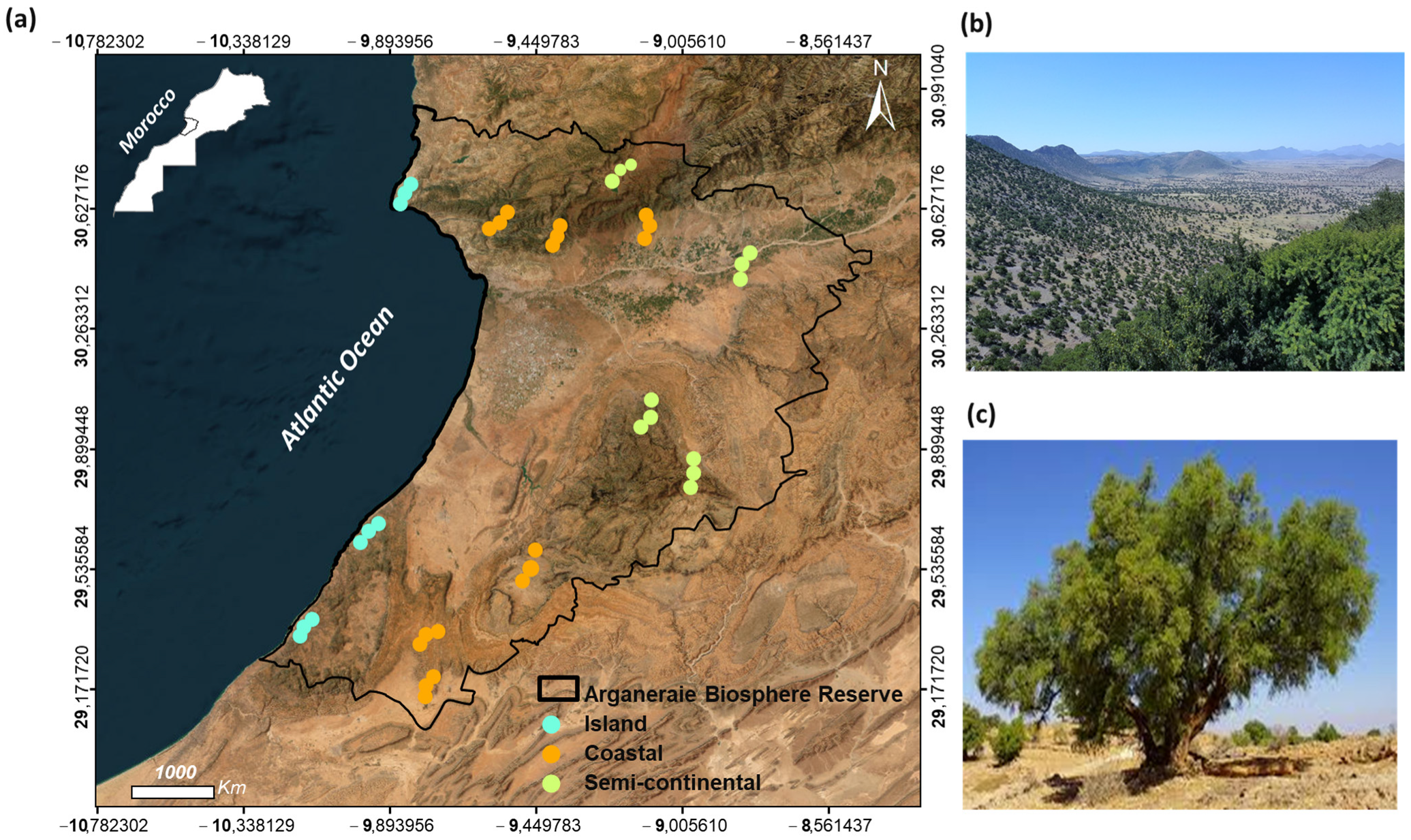
2.1. Site Description and Soil Sampling
2.2. Soil Nematode Community Identification
2.3. Calculation of Nematode Ecological Function Index and Metabolic Footprint
2.4. Statistical Analyses
3. Results
3.1. Diversity, Community Structure, and Trophic Composition of Soil Nematodes Across Climatic Zones
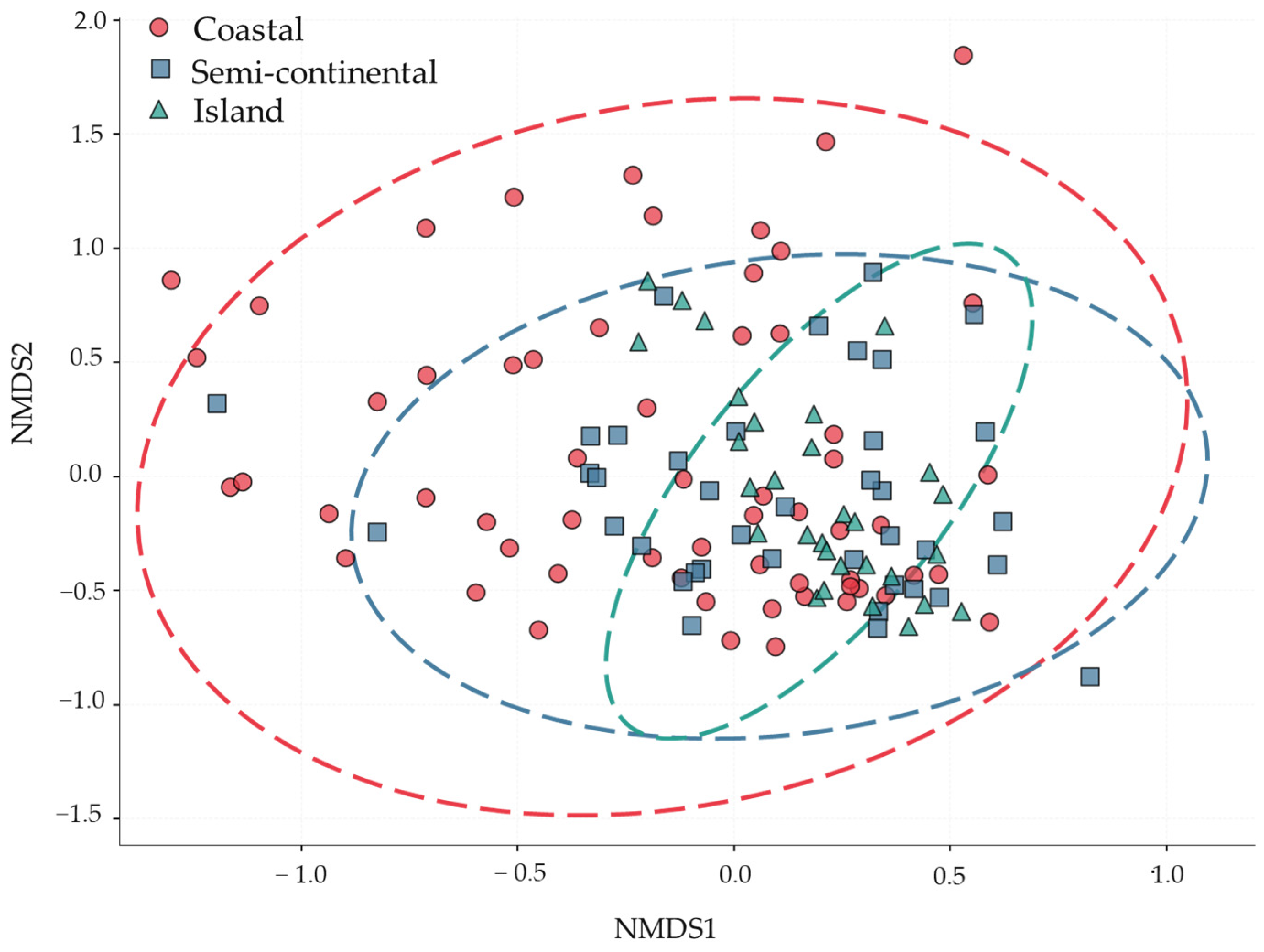
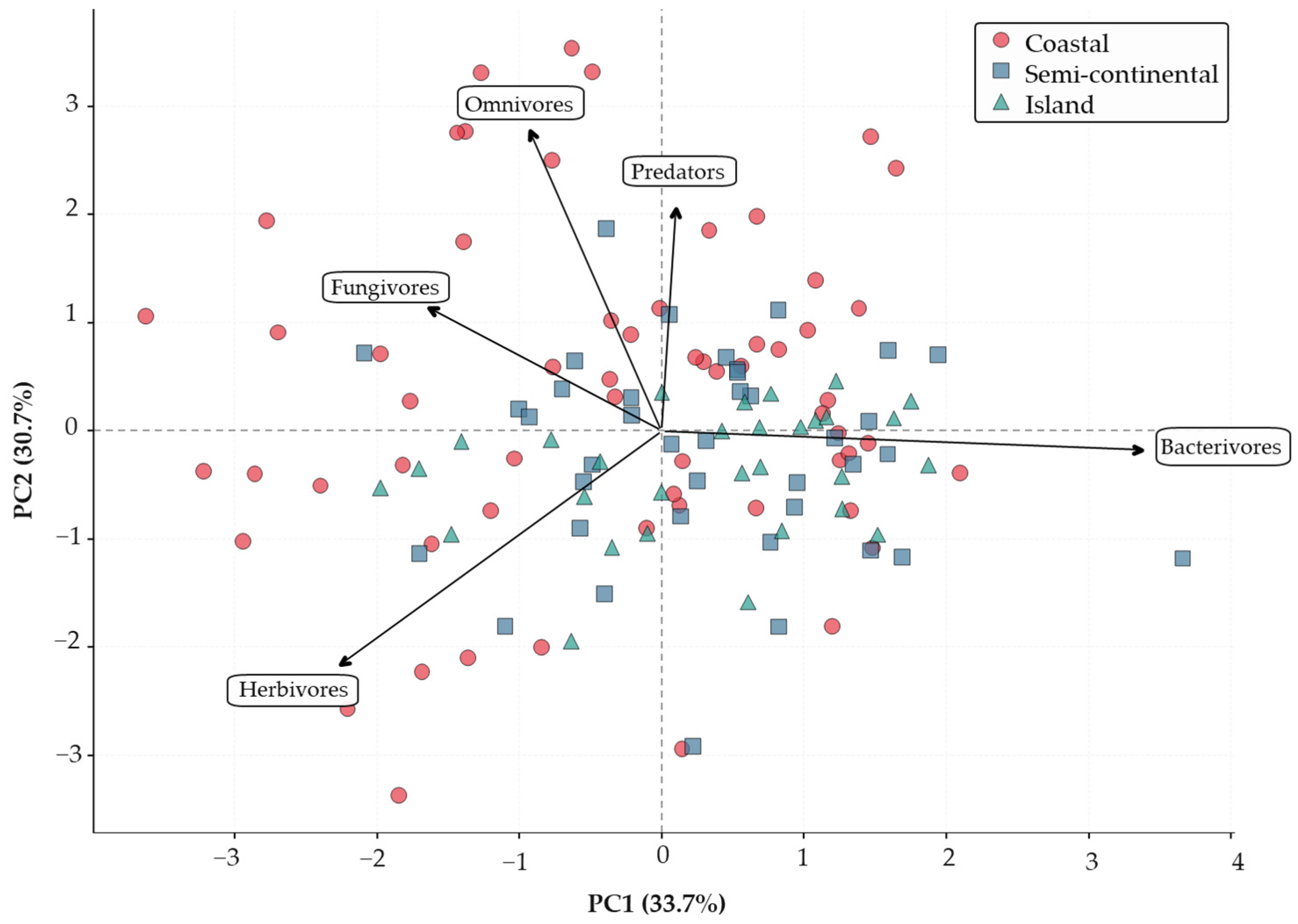
3.2. Multivariate Patterns in Nematode Community Composition and Trophic Structure
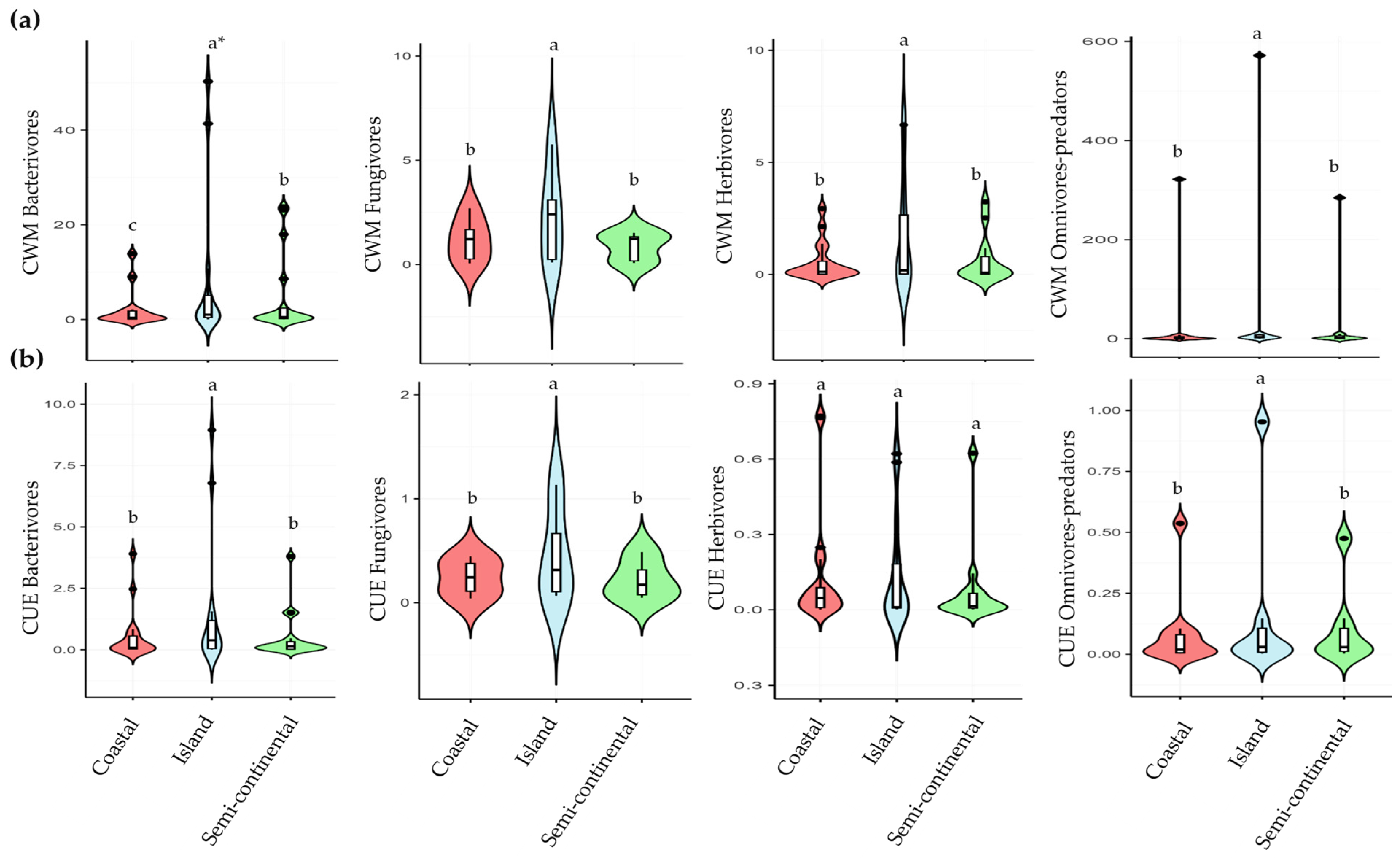
3.3. Relationships Between Body Size and Carbon Use Efficiency Along a Gradient of Continentality
3.4. Response of Nematode Communities to Environmental Drivers and Thermal Stress
4. Discussion
4.1. Diversity, Community Structure, and Trophic Composition of Soil Nematodes Across Climatic Zones
4.2. Multivariate Patterns in Nematode Community Composition and Trophic Structure
4.3. Relationships Between Body Size and Carbon Use Efficiency Along a Gradient of Continentality
4.4. Response of Nematode Communities to Environmental Drivers and Thermal Stress
5. Conclusions
Author Contributions
Funding
Data Availability Statement
Conflicts of Interest
References
- Reed, D.C.; Algar, C.K.; Huber, J.A.; Dick, G.J. Gene-centric approach to integrating environmental genomics and biogeochemical models. Proc. Natl. Acad. Sci. USA 2014, 111, 1879–1884. [Google Scholar] [CrossRef] [PubMed]
- Olsson, P.A.; Hammer, E.C.; Pallon, J.; van Aarle, I.M.; Wallander, H. Elemental composition in vesicles of an arbuscular mycorrhizal fungus, as revealed by PIXE analysis. Fungal Biol. 2011, 115, 643–648. [Google Scholar] [CrossRef] [PubMed]
- Lu, X.; Kelsey, K.C.; Yan, Y.; Sun, J.; Wang, X.; Cheng, G.; Neff, J.C. Effects of grazing on ecosystem structure and function of alpine grasslands in Qinghai–Tibetan Plateau: A synthesis. Ecosphere 2017, 8, e01656. [Google Scholar] [CrossRef]
- Hu, J.; Wu, J.; Ma, M.; Nielsen, U.N.; Wang, J.; Du, G. Nematode communities response to long-term grazing disturbance on Tibetan plateau. Eur. J. Soil Boil. 2015, 69, 24–32. [Google Scholar] [CrossRef]
- Doran, J.W.; Sarrantonio, M.; Liebig, M.A. Soil Health and Sustainability. In Advances in Agronomy; Academic Press, Inc.: San Diego, CA, USA, 1996; Volume 56, pp. 1–54. [Google Scholar]
- Ferris, H.; Bongers, T.; de Goede, R.G.M. A framework for soil food web diagnostics: Extension of the nematode faunal analysis concept. Appl. Soil Ecol. 2001, 18, 13–29. [Google Scholar] [CrossRef]
- Bongers, T.; Ferris, H. Nematode community structure as a bioindicator in environmental monitoring. Trends Ecol. Evol. 1999, 14, 224–228. [Google Scholar] [CrossRef] [PubMed]
- Hugot, J.P.; Baujard, P.; Morand, S. Biodiversity in helminths and nematodes as a field of study: An overview. Nematology 2001, 3, 199–208. [Google Scholar] [CrossRef]
- Andriuzzi, W.S.; Wall, D.H. Responses of belowground communities to large aboveground herbivores: Meta-analysis reveals biome-dependent patterns and critical research gaps. Glob. Change Biol. 2017, 26, 3857–3868. [Google Scholar] [CrossRef] [PubMed]
- Yeates, G.W.; Bongers, T.; de Goede, R.G.M.; Freckman, D.W.; Georgieva, S.S. Feeding habits in soil nematode families and genera—An outline for soil ecologists. J. Nematol. 1993, 25, 315–331. [Google Scholar] [CrossRef] [PubMed]
- Yeates, G.W.; Wardle, D.A.; Watson, R.N. Responses of soil nematode populations to increasing amounts of nitrogen and phosphorus fertilizers in a ryegrass/white clover pasture. Biol. Fertil. Soils 1999, 29, 329–337. [Google Scholar] [CrossRef]
- van den Hoogen, J.; Geisen, S.; Routh, D.; Ferris, H.; Traunspurger, W.; Wardle, D.A.; de Goede, R.G.M.; Adams, B.J.; Ahmad, W.; Andriuzzi, W.S. Soil nematode abundance and functional group composition at a global scale. Nature 2019, 572, 194–198. [Google Scholar] [CrossRef] [PubMed]
- Schlüter, S.; Gil, E.; Doniger, T.; Applebaum, I.; Steinberger, Y. Abundance and community composition of free-living nematodes as a function of soil structure under different vineyard managements. Appl. Soil Ecol. 2022, 170, 104291. [Google Scholar] [CrossRef]
- Trap, J.; Bonkowski, M.; Plassard, C.; Villenave, C.; Blanchart, E. Ecological importance of soil bacterivores for ecosystem functions. Plant Soil 2016, 398, 1–24. [Google Scholar] [CrossRef]
- Li, G.; Liu, T.; Whalen, J.K.; Wei, Z. Nematodes: An overlooked tiny engineer of plant health. Trends Plant Sci. 2024, 29, 52–64. [Google Scholar] [CrossRef] [PubMed]
- Zhu, B.; Whalen, J.K.; Wu, J.; Yang, J.; Mao, X.; Wan, B.; Tian, S.; Hu, F.; Chen, X.; Liu, M. Soil food web structure coordinated by soil omnivores sustains soil multifunctionality in moderate vermicompost amended fields. Soil Biol. Biochem. 2024, 192, 109391. [Google Scholar] [CrossRef]
- Bongers, T. The maturity index: An ecological measure of environmental disturbance based on nematode species composition. Oecologia 1990, 83, 14–19. [Google Scholar] [CrossRef] [PubMed]
- Ferris, H. Form and function: Metabolic footprints of nematodes in the soil food web. Eur. J. Soil Biol. 2010, 46, 97–104. [Google Scholar] [CrossRef]
- Kergunteuil, A.; Campos-Herrera, R.; Sánchez-Moreno, S.; Vittoz, P.; Rasmann, S. The abundance, diversity, and metabolic footprint of soil nematodes is highest in high elevation alpine grasslands. Front. Ecol. Evol. 2016, 4, 84. [Google Scholar] [CrossRef]
- Barnes, A.D.; Jochum, M.; Lefcheck, J.S.; Eisenhauer, N.; Scherber, C.; O’Connor, M.I.; de Ruiter, P.C.; Brose, U. Energy flux: The link between multitrophic biodiversity and ecosystem functioning. Trends Ecol. Evol. 2018, 33, 186–197. [Google Scholar] [CrossRef] [PubMed]
- Oxtoby, L.E.; Budge, S.M.; Iken, K.; O’Brien, D.M.; Wooller, M.J. Feeding ecologies of key bivalve and polychaete species in the Bering Sea as elucidated by fatty acid and compound-specific stable isotope analyses. Mar. Ecol. Prog. Ser. 2016, 557, 161–175. [Google Scholar] [CrossRef]
- Zhou, J.; Luo, Y.; Chen, J. Dilemmas in linking microbial carbon use efficiency with soil organic carbon dynamics. Glob. Change Biol. 2025, 31, e70058. [Google Scholar] [CrossRef]
- Verdú, M.; Bochet, E.; Espigares, T.; Margalef-Marrase, J.; Niclau, J.M.; Yue, Y.; Azorín-Molina, C.; Garcia-Fayos, P. Climate change may affect the signal of plant facilitation in Mediterranean drylands. Oikos 2024, 202, e11217. [Google Scholar] [CrossRef]
- Rongstock, R.; Li, H.; Lehmann, A.; Wulf, A.; Rillig, M.C. Global change factors differ in effect when acting alone and in a multi-factor background. Nat. Commun. 2026, 17, 1–12. [Google Scholar] [CrossRef] [PubMed]
- Delgado-Baquerizo, M.; Reich, P.B.; Trivedi, C.; Eldridge, D.J.; Abades, S.; Alfaro, F.D.; Bastida, F.; Berhe, A.A.; Cutler, N.A.; Gallardo, A. Multiple elements of soil biodiversity drive ecosystem functions across biomes. Nat. Ecol. Evol. 2020, 4, 210–220. [Google Scholar] [CrossRef] [PubMed]
- Crowther, T.W.; van den Hoogen, J.; Wan, J.; Mayes, M.A.; Keiser, A.D.; Mo, L.; Averill, C.; Maynard, D.S. The global soil community and its influence on biogeochemistry. Science 2019, 365, 480–485. [Google Scholar] [CrossRef] [PubMed]
- Thakur, M.P.; Geisen, S. Trophic regulations of the soil microbiome. Trends Microbiol. 2023, 31, 79–89. [Google Scholar] [CrossRef] [PubMed]
- Eisenhauer, N.; Lanoue, A.; Strecker, T.; Scheu, S.; Steinauer, K.; Thakur, M.P.; Mommer, L. Root biomass and exudates link plant diversity to soil microbial biomass and activity. Sci. Rep. 2017, 7, 44641. [Google Scholar] [CrossRef] [PubMed]
- Bakonyi, G.; Nagy, P.; Kovács-Láng, E.; Kovács, E.; Barcza, Z.; Reiczigel, J.; Röpcke, I. Soil nematode community structure as affected by temperature and moisture in a temperate semiarid shrubland. Appl. Soil Ecol. 2007, 37, 31–40. [Google Scholar] [CrossRef]
- Ferris, H.; Sánchez-Moreno, S.; Brennan, E.B. Structure, functions and interguild relationships of the soil nematode assemblage in organic vegetable production. Appl. Soil Ecol. 2012, 61, 16–25. [Google Scholar] [CrossRef]
- Zhang, Z.Y.; Zhang, X.K.; Xu, M.G.; Zhang, S.Q.; Huang, S.M.; Liang, W.J. Responses of soil micro-food web to long-term fertilization in a wheat–maize rotation system. Appl. Soil Ecol. 2016, 98, 56–64. [Google Scholar]
- Zheng, Q.; Hu, Y.; Zhang, S.; Noll, L.; Böckker, H.T.S.; Richter, A. Growth explains microbial carbon use efficiency across soils differing in land use and geology. Soil Biol. Biochem. 2019, 135, 86–93. [Google Scholar] [CrossRef]
- Conesa, H.M.; María-Cervantes, A.; Álvarez-Rogel, J.; González-Alcaraz, M.N. Influence of soil properties on trace element availability and plant accumulation in a Mediterranean salt marsh polluted by mining wastes: Implications for phytomanagement. Sci. Total Environ. 2011, 409, 4470–4479. [Google Scholar] [CrossRef] [PubMed]
- Debrach, J. Essai de classification des climats du Maroc. Bull. ÉCon. Soc. Maroc. 1952, 16, 1–22. [Google Scholar]
- Emberger, L. Une classification biogéographique des climats. Rec. Trav. Lab. Bot. Géol. Zool. Fac. Sci. Univ. Montp. 1955, 7, 3–43. [Google Scholar]
- Aouragh, M.; El Fahime, E.; Boumezzough, A. Étude de la biodiversité floristique dans la réserve de biosphère de l’Arganeraie (Maroc). Bull. Inst. Sci. Rabat 2012, 34, 1–12. [Google Scholar]
- Médail, F.; Quézel, P. Biodiversity hotspots in the Mediterranean Basin: Setting global conservation priorities. Conserv. Biol. 1999, 13, 1510–1513. [Google Scholar] [CrossRef]
- Msanda, F.; El Aboudi, A.; Peltier, J.P. Biodiversité et biogéographie de l’arganeraie marocaine. Cah. Agric. 2005, 14, 357–364. [Google Scholar]
- Peltier, J.P. La Végétation du Bassin Versant de l’oued Sous (Maroc). Ph.D. Thesis, Université de Montpellier, Montpellier, France, 1982. [Google Scholar]
- M’Hirit, O.; Benzyane, M.; Benchekroun, F.; El Yousfi, S.M.; Badaoui, M.E. L’arganier: Un Écosystème Endémique et une Ressource Forestière et Pastorale Remarquable; Mardaga: Bruxelles, Belgium, 1998. [Google Scholar]
- ISO 23611-4:2007; Soil Quality—Sampling of Soil Invertebrates—Part 4: Sampling, Extraction and Identification of Soil Nematodes. International Organization for Standardization: Geneva, Switzerland, 2007.
- Oostenbrink, M. Estimating nematode populations by some selected methods. In Nematology; Sasser, J.N., Jenkins, W.R., Eds.; University of North Carolina Press: Chapel Hill, NC, USA, 1960; pp. 85–102. [Google Scholar]
- Bongers, T. De Nematoden van Nederland; Stichting Uitgeverij Koninklijke Nederlandse Natuurhistorische Vereniging: Utrecht, The Netherlands, 1988. [Google Scholar]
- Mai, W.F.; Mullin, P.G. Plant-Parasitic Nematodes: A Pictorial Key to Genera, 6th ed.; Cornell University Press: Ithaca, NY, USA, 2018. [Google Scholar]
- Nemaplex. Nematode-Plant Expert Information System. Available online: http://nemaplex.ucdavis.edu (accessed on 15 June 2023).
- Shannon, C.E.; Weaver, W. The Mathematical Theory of Communication; University of Illinois Press: Urbana, IL, USA, 1948. [Google Scholar]
- Simpson, E.H. Measurement of diversity. Nature 1949, 163, 688. [Google Scholar] [CrossRef]
- Margalef, R. On certain unifying principles in ecology. Am. Nat. 1963, 97, 357–374. [Google Scholar] [CrossRef] [PubMed]
- Garnier, E.; Lavorel, S.; Ansquer, P.; Castro, H.; Cruz, P.; Dolezal, J.; Eriksson, O.; Freitas, H.; Golodets, C.; Grigulis, K. Assessing the effects of land-use change on plant traits, communities and ecosystem functioning in grasslands: A standardized methodology and lessons from an application to 11 European sites. Ann. Bot. 2007, 93, 597–614. [Google Scholar] [CrossRef] [PubMed]
- Luo, J.M.; Zhang, X.K.; Kou, X.C.; Xie, H.T.; Bao, X.L.; Mahamood, M.; Liang, W.J. Effects of residue mulching amounts on metabolic footprints based on production and respiration of soil nematodes in a long-term no-tillage system. Land Degrad. Dev. 2021, 32, 2383–2392. [Google Scholar] [CrossRef]
- Bhusal, D.R.; Tsiafouli, M.A.; Sgardelis, S.P. Temperature-based bioclimatic parameters can predict nematode metabolic footprints. Oecologia 2015, 179, 187–199. [Google Scholar] [CrossRef] [PubMed]
- Persson, T.; Bååth, E.; Clarholm, M.; Lundkvist, H.; Söderström, B.E.; Sohlenius, B. Trophic Structure, Biomass Dynamics and Carbon Metabolism of Soil Organisms in a Scots Pine Forest. Ecol. Bull. 1980, 32, 419–459. [Google Scholar]
- Persson, T. Influence of Soil Animals on Nitrogen Mineralization in a Northern Scots Pine Forest. In Proceedings of the 8th International Colloquium of Soil Zoology, Louvaine-la Neuve, Belgium, 30 August–2 September 1983. [Google Scholar]
- Atkinson, D. Temperature and organism size—A biological law for ectotherms? Adv. Ecol. Res. 1994, 25, 1–58. [Google Scholar] [CrossRef]
- Barnes, A.D.; Jochum, M.; Mumme, S.; Haneda, N.F.; Farajallah, A.; Widarto, T.H.; Brose, U. Consequences of tropical land use for multitrophic biodi-versity and ecosystem functioning. Nat. Commun. 2014, 5, 5351. [Google Scholar] [CrossRef] [PubMed]
- Cui, S.; Liang, S.; Zhang, X.; Li, Y.; Liang, W.; Sun, L.; Wang, J.; Bezemer, T.M.; Li, Q. Long-term fertilization management affects the C utilization from crop residues by the soil micro-food web. Plant Soil 2018, 429, 335–348. [Google Scholar] [CrossRef]
- de Ruiter, P.C.; Neutel, A.M.; Moore, J.C. Energetics, patterns of interaction strengths, and stability in real ecosystems. Science 1995, 269, 1257–1260. [Google Scholar] [CrossRef] [PubMed]
- Anderson, M.J. A new method for non-parametric multivariate analysis of variance. Austral Ecol. 2001, 26, 32–46. [Google Scholar] [CrossRef]
- Clarke, K.R. Non-parametric multivariate analyses of changes in community structure. Aust. J. Ecol. 1993, 18, 117–143. [Google Scholar] [CrossRef]
- R Core Team. R: A Language and Environment for Statistical Computing; R Foundation for Statistical Computing: Vienna, Austria, 2023. [Google Scholar]
- Oksanen, J.; Simpson, G.L.; Blanchet, F.G.; Kindt, R.; Legendre, P.; Minchin, P.R.; O’Hara, R.B.; Solymos, P.; Stevens, M.H.H.; Szoecs, E. vegan: Community Ecology Package; R package version 2.6-4, 2022. Available online: https://CRAN.R-project.org/package=vegan (accessed on 20 June 2023).
- NINJA. Nematode INdicator Joint Analysis. Available online: https://shiny.wur.nl/ninja/ (accessed on 15 June 2023).
- Bongers, T. The Maturity Index, the evolution of nematode life history traits, adaptive radiation and cp-scaling. Plant Soil 1999, 212, 13–22. [Google Scholar] [CrossRef]
- Wardle, D.A.; Bardgett, R.D.; Klironomos, J.N.; Setälä, H.; van der Putten, W.H.; Wall, D.H. Ecological linkages between aboveground and belowground biota. Science 2004, 304, 1629–1633. [Google Scholar] [CrossRef] [PubMed]
- de Vries, F.T.; Hoffland, E.; van Eekeren, N.; Brussaard, L.; Bloem, J. Fungal/bacterial ratios in grasslands with contrasting nitrogen management. Soil Biol. Biochem. 2012, 50, 1–8. [Google Scholar] [CrossRef]
- Brown, J.H.; Gillooly, J.F.; Allen, A.P.; Savage, V.M.; West, G.B. Toward a metabolic theory of ecology. Ecology 2004, 85, 1771–1789. [Google Scholar] [CrossRef]
- Schimel, J.P.; Bennett, J. Nitrogen mineralization: Challenges of a changing paradigm. Ecology 2007, 88, 591–602. [Google Scholar] [CrossRef]
- Malik, A.A.; Chowdhury, S.; Schlager, V.; Oliver, A.; Puissant, J.; Vazquez, P.G.; Jehmlich, N.; von Bergen, M.; Griffiths, R.I.; Gleixner, G. Soil fungal:bacterial ratios are linked to altered carbon cycling. Front. Microbiol. 2018, 9, 1234. [Google Scholar] [CrossRef] [PubMed]
- Braimi, A.; Benjlil, H.; Alaoui, I.F.; Obidari, T.; Idhmida, A.; Ait Hamza, M.; Mayad, E.H. Environmental factors shaping soil nematode community structure in the Arganeraie biosphere reserve—Insights from arid and semi-arid ecosystems. Pedosphere 2025. [Google Scholar] [CrossRef]


| Island | Coastal | Semi-Continental | |
|---|---|---|---|
| Elevation | 232 | 632 | 808 |
| Mean annual precipitation (mm) | 216 | 120 | 92 |
| Mean annual temperature (°C) | 14 | 17 | 19 |
| Thermal amplitude | <15 °C | 15–25 °C | 25–35 °C |
| Humidity (g/100 g) | 4.33 | 3.16 | 2.3 |
| Soil texture | Slit-Clay | Silt | Silt-sand |
| Trophic Group | Island (n = 30) | Coastal (n = 60) | Semi-Continental (n = 40) | Df | p | |||
|---|---|---|---|---|---|---|---|---|
| Mean | ±SD | Mean | ±SD | Mean | ±SD | |||
| Bacterivores | 213.33 a | 27.95 | 48.33 b | 5.67 | 79.9 b | 8.62 | 34.78 | 5.99 × 10⁻¹⁴ *** |
| Fungivores | 36 a | 5.06 | 13.03 b | 1.87 | 14.32 b | 2.3 | 25.60 | 2.35 × 10⁻⁷ *** |
| Herbivores | 48.4 a | 6.69 | 11.42 b | 1.4 | 20.92 b | 4.08 | 28.56 | 1.08 × 10⁻⁹ *** |
| Omnivores | 12.97 a | 1.6 | 8.22 b | 1.2 | 7.08 b | 1.02 | 6.69 | 0.035 * |
| Predators | 1.77 a | 0.55 | 1.13 ab | 0.27 | 0.55 b | 0.16 | 6.19 | 0.045 * |
| Index | Island (n = 30) | Coastal (n = 60) | Semi-Continental (n = 40) | Df | p | |||
|---|---|---|---|---|---|---|---|---|
| Mean | ±SD | Mean | ±SD | Mean | ±SD | |||
| Abundance | 312.47 a | 189.30 | 82.13 c | 58.25 | 122.77 b | 76.56 | 48.31 | <0.001 *** |
| Richness | 20.63 a | 4.91 | 13.27 b | 4.83 | 15.13 b | 4.55 | 34.55 | <0.001 *** |
| Shannon (H′) | 2.04 a | 0.28 | 1.95 b | 0.40 | 1.96 b | 0.33 | 1.18 | 0.554 ns |
| Simpson (1 − D) | 0.79 a | 0.07 | 0.80 b | 0.09 | 0.79 b | 0.07 | 1.13 | 0.569 ns |
| Evenness (J) | 0.71 b | 0.08 | 0.81 a | 0.10 | 0.77 b | 0.11 | 18.73 | <0.001 *** |
| Maturity Index (MI) | 2.27 a | 0.16 | 2.25 b | 0.14 | 2.25 b | 0.20 | 9.61 | 0.008 ** |
| Plant Parasite Idx (PPI) | 3.00 | 0.32 | 2.62 | 0.96 | 2.84 | 1.15 | 3.99 | 0.136 ns |
| Nematode Channel Ratio (NCR) | 0.85 | 0.07 | 0.78 | 0.16 | 0.84 | 0.14 | 6.72 | 0.035 * |
| Wasilewska Index (WI) | 272.69 b | 292.44 | 119.77 a | 216.46 | 118.05 b | 151.16 | 15.59 | <0.001 *** |
| Basal Index (BI) | 68.32 a | 10.21 | 54.91 b | 19.11 | 66.40 a | 14.47 | 16.83 | <0.001 *** |
| Enrichment Index (EI) | 14.55 | 5.82 | 18.97 | 11.45 | 15.60 | 11.55 | 4.09 | 0.103 ns |
| Structure Index (SI) | 22.78 b | 10.91 | 36.04 a | 22.82 | 23.68 b | 14.70 | 9.84 | 0.007 ** |
Disclaimer/Publisher’s Note: The statements, opinions and data contained in all publications are solely those of the individual author(s) and contributor(s) and not of MDPI and/or the editor(s). MDPI and/or the editor(s) disclaim responsibility for any injury to people or property resulting from any ideas, methods, instructions or products referred to in the content. |
© 2026 by the authors. Licensee MDPI, Basel, Switzerland. This article is an open access article distributed under the terms and conditions of the Creative Commons Attribution (CC BY) license.
Share and Cite
Braimi, A.; Benjlil, H.; Alaoui, I.F.; Obidari, T.; Idhmida, A.; Belmouden, M.; Larbi, S.; Elhadda, E.; Issouktane, H.; Ait Hamza, M.; et al. Soil Nematode-Mediated Carbon and Energy Fluxes Along a Continental Gradient in Arid Ecosystems. Soil Syst. 2026, 10, 73. https://doi.org/10.3390/soilsystems10070073
Braimi A, Benjlil H, Alaoui IF, Obidari T, Idhmida A, Belmouden M, Larbi S, Elhadda E, Issouktane H, Ait Hamza M, et al. Soil Nematode-Mediated Carbon and Energy Fluxes Along a Continental Gradient in Arid Ecosystems. Soil Systems. 2026; 10(7):73. https://doi.org/10.3390/soilsystems10070073
Chicago/Turabian StyleBraimi, Amina, Hinde Benjlil, Ilyass Filali Alaoui, Tayeb Obidari, Amine Idhmida, Mouna Belmouden, Sarhane Larbi, ElMehdi Elhadda, Hajar Issouktane, Mohamed Ait Hamza, and et al. 2026. "Soil Nematode-Mediated Carbon and Energy Fluxes Along a Continental Gradient in Arid Ecosystems" Soil Systems 10, no. 7: 73. https://doi.org/10.3390/soilsystems10070073
APA StyleBraimi, A., Benjlil, H., Alaoui, I. F., Obidari, T., Idhmida, A., Belmouden, M., Larbi, S., Elhadda, E., Issouktane, H., Ait Hamza, M., El Mousadik, A., Msanda, F., Saia, S., & Mayad, E. H. (2026). Soil Nematode-Mediated Carbon and Energy Fluxes Along a Continental Gradient in Arid Ecosystems. Soil Systems, 10(7), 73. https://doi.org/10.3390/soilsystems10070073