1. Introduction
Approximately one-third of the world’s food production comes from irrigated lands, which represent only about one-sixth of the total cropland area [
1]. The growing global population necessitates an expansion of irrigated agriculture to meet future food demands, which in turn will require increased water resources. However, the availability of annually renewable freshwater is already limited and unlikely to expand significantly in the foreseeable future [
2]. While regional variations in freshwater availability may occur due to changes in rainfall patterns linked to climate change, these fluctuations are expected to be minor compared to the rising global demand for water [
2].
Competition for freshwater among various sectors is already a reality in many arid and semi-arid regions, leading to reduced allocations for agriculture [
3]. As a result, the declining availability of high-quality irrigation water, combined with increasing demand from other users, is compelling farmers to consider using saline water sources [
4]. In fact, the world possesses vast reserves of saline water that could serve as a viable water source for irrigation [
2]. However, the use of saline water for agricultural purposes requires the implementation of appropriate crop selection, soil management, and irrigation practices [
5].
Soil salinity always has been and still is a significant threat to global agriculture [
5], and this challenge is becoming increasingly severe with a growing population and the need to intensify land use. Excessive salinity in soils typically arises either from natural processes or from the use of saline water for irrigation. Its effects are particularly pronounced in arid and semi-arid regions, which are marked by limited rainfall, high temperatures, and elevated evapotranspiration rates [
6]. In these areas, poor freshwater management further exacerbates salinity problems [
7]. Numerous studies have emphasized that when saline water is used for irrigation, careful management is essential to minimize salt accumulation in the root zone. In particular, selecting appropriate irrigation systems and techniques that supply only the amount of water required to meet plant evapotranspiration needs can effectively limit salt buildup in the root zone [
8,
9].
Sarwar et Naeem (2025) [
10] demonstrated that an increase in electrical conductivity as a result of increasing soil salinity has adverse effects on soil structural stability, bulk density and permeability, which again hinders plant growth and production [
11]. Furthermore, salinity also affects other major soil degradation phenomena such as soil dispersion, increased soil erosion, and engineering problems [
12].
High soil salinity significantly limits agricultural productivity in many regions worldwide [
13]. Its detrimental impact on most crops is well established, affecting both crop physiology and yield [
14], as well as contributing to progressive soil degradation [
15]. Irrigating with saline water is an established approach to evaluate how crops and cultivars respond to salinity. Salinity acts as a stress factor, affecting crop growth during both the vegetative and reproductive stages. In recent years, increasing attention has been given to biological approaches for managing salinity stress, including the identification of plant mechanisms for salt tolerance as a practical means of alleviating soil stress [
16]. Several studies have shown that water sources traditionally considered unsuitable for irrigation can, under proper management, be used successfully without causing long-term harm to crops or soils. One effective strategy to mitigate the negative effects of salinity on plant growth is the development of genetically engineered crop varieties with high salt tolerance [
17,
18,
19]. However, the high cost and limited availability of irrigation water in semi-arid regions make large-scale irrigation systems impractical [
3]. Consequently, the use of salt-tolerant crop varieties represents a practical and sustainable strategy to enhance crop productivity under saline conditions [
6,
20].
However, the high cost and limited availability of irrigation water in semi-arid regions make large-scale irrigation systems impractical [
3]. Consequently, the use of salt-tolerant crop varieties represents a practical and sustainable strategy to enhance crop productivity under saline conditions [
20]. Understanding how plants adjust their interactions with saline water under varying soil and water conditions is critical to advancing our knowledge of plant resistance to saline environments [
21]. Plant salt tolerance or resistance is generally defined as the plant’s inherent ability to withstand high salt concentrations in the root zone or on its leaves without significant adverse effects. Thus, it is possible to mitigate the harmful effects of salinity, provided that the specific mechanisms of salt tolerance in each cultivated species are well understood. Recent findings by [
17] have shown that crop tolerance to salinity is highly dependent on the developmental stage during which salinization occurs, as well as the ultimate salinity level reached. However, although many studies have investigated crop responses to salinity, there remains a lack of updated and comprehensive criteria regarding crop performance under irrigation with saline water above 4 g/L [
22,
23]. Most of the available crop yield response models, such as those proposed by [
22,
23], remain calibrated for slightly saline or brackish water and do not reflect the broader range of saline conditions encountered today. This limitation is also seen in older national references like CRUESI (1970) [
24], which set a maximum salinity threshold at 3.5 g/L, underscoring the need for updated guidelines based on current agricultural practices and salinity challenges. According to that, we carried out in Tunisia a survey of irrigation water salinity and the yields of main irrigated crops. The survey focused on water salinity over 4 g/L. In this paper, we present results on crops’ response to saline irrigation water and yield functions obtained from the survey.
In contrast to earlier studies that primarily focus on yield reduction under salinity, this work offers a comprehensive evaluation of soil–plant interactions in semi-arid environments by integrating physicochemical soil analyses with crop performance metrics [
14]. By linking the chemical composition of irrigation water, soil salinity dynamics, and plant physiological responses, this study contributes to a deeper mechanistic understanding of how saline irrigation influences crop productivity [
17]. The observed decline in yield and biomass can be explained by the accumulation of Na
+ and Cl
− ions in the rhizosphere, which disrupts the Na
+/K
+ balance, lowers osmotic potential, and restricts nutrient uptake efficiency. This integrative approach offers a conceptual framework that clarifies the combined effects of ionic and osmotic stresses on plant growth and soil functionality in arid and semi-arid agroecosystems, thereby broadening the relevance of the findings to other Mediterranean and dry land contexts.
However, despite the growing body of research on salinity tolerance, there remains a lack of mechanistic understanding of how soil physicochemical changes induced by saline irrigation translate into physiological and agronomic responses across different crop species. Most studies have been descriptive rather than explanatory, focusing on yield losses without fully integrating soil, water, and plant processes in a unified framework. Addressing this gap is crucial for developing predictive tools and management strategies for saline agriculture under water-scarce conditions. By focusing on semi-arid regions of Tunisia, where water scarcity and salinity pressures are increasingly critical, this study provides insights that can inform sustainable saline irrigation practices in similar Mediterranean and dryland agroecosystems worldwide.
Therefore, the main objectives of this study were
- (i)
To assess the impact of saline irrigation water on soil physicochemical properties and crop performance in semi-arid conditions, and
- (ii)
To conceptually examine the mechanistic links between soil salinity dynamics, ionic balance (Na+/K+ ratio), and yield reduction. Although objective (ii) refers to the Na+/K+ ionic balance, this study does not include direct measurements of Na+ and K+ concentrations; therefore, this component is discussed based on known mechanisms of salinity stress rather than experimentally evaluated.
3. Results
In the following section, crop yields will be analyzed in relation to water salinity. Yield functions will be determined, and subsequently, relative yield functions will be calculated.
3.1. Crop Yields and Their Variability in Response to Water Salinity
A wide range of crops was reviewed, including some that are not widely cultivated and for which limited information is available regarding their salt tolerance. These crops include:
Vegetables: pepper, tomato, potato, carrot, onion, cucumber, turnip, melon, watermelon, caraway, garlic, coriander, artichoke, bean, fennel, faba bean, garbanzo (chickpea), zucchini, broad bean, parsley, beet, celery, spinach, pea, chickpea.
Cereals and forage crops: barley, wheat, alfalfa, corn, berseem (Egyptian clover), sorghum, oat, Sudan grass.
Fruit trees: olive, pomegranate, almond, pear, apple, apricot, fig.
Industrial crops: tobacco.
The main crops and their frequency, as well as the characterization of their average yields, are presented in
Table 2. For most crops, the average yields are comparable to national averages observed in Tunisia. However, yield variation remains significant, with coefficients of variation (C.V.) ranging from moderate to high (15% < C.V. < 58%). These disparities are largely attributable to differences in water salinity, as further discussed below.
A closer analysis of the yield data reveals several important patterns:
Pepper and cucumber show the highest yield variability (C.V. = 57.7% and 50.7%, respectively), with yields ranging widely from 3 to 30 T/ha for pepper and from 4 to 60 T/ha for cucumber. This variability likely reflects both salinity sensitivity and differences in irrigation practices or varietal tolerance among farmers.
Tomato, with a C.V. of 33.9%, presents high productivity potential (up to 40 T/ha), though some farmers achieve much lower yields (4 T/ha), again indicating the heterogeneous impact of salinity and associated agronomic factors.
Carrot stands out as the most stable crop, with a low C.V. of 15.1% and high average yields (58.5 T/ha), suggesting strong adaptability to saline conditions in the studied areas or more uniform cultivation practices.
Onion and alfalfa, despite being relatively salt-tolerant, show high yield variability (C.V. = 41.6% and 46.7%, respectively). This suggests that even crops with some tolerance can exhibit inconsistent performance depending on the level of salinity and management.
Barley, though considered salt-tolerant, shows low productivity (average = 2.7 T/ha), with a moderate C.V. of 39.6%. This might indicate that while barley can survive in saline conditions, yield performance remains suboptimal under high salinity stress.
Sorghum, another forage crop, shows both relatively high yields (average = 46.9 T/ha) and moderate variability (C.V. = 26.1%), confirming its robustness under saline irrigation.
Additionally, the number of observations per crop (e.g., 135 for pepper, 68 for tomato) suggests these crops are widely cultivated, and thus central to the livelihoods of farmers in the study area. This underlines the importance of identifying salt-tolerant varieties and improving irrigation water quality or management strategies to stabilize and improve yields.
3.2. Water Quality and Salinity Levels
In Tunisia, water quality assessment is typically based on Total Dissolved Salts (TDS), expressed in grams per liter (g/L). In this study, a more precise parameter electrical conductivity of irrigation water (ECw), was also measured to better characterize the salinity stress on crops (
Table 3). The survey specifically targeted farms irrigating with water having TDS levels exceeding 4 g/L, in order to focus on the effects of salinity. For this reason, the TDS reported varies between 4 and 6 g/L and the ECw between 5 and 8 dS/m.
3.3. Standardization of Water Salinity Data Using the EC–TDS Relationship
To allow consistent comparison of water quality data with both national and international standards, all salinity values in this study were converted and reported as electrical conductivity (ECw). This conversion is essential, as Total Dissolved Solids (TDS) is commonly used in Tunisia, while ECw is more widely adopted in international research and irrigation guidelines. Traditionally, the U.S. Salinity Laboratory Staff (Richards et al., 1954) [
28] proposed a reference conversion formula (Equation (3)):
However, this coefficient is not universal and depends strongly on the ionic composition of the water. In particular, the presence of sulfates, chlorides, and bicarbonates can significantly influence the ratio between TDS and EC.
In Tunisia, the CRUESI (1970) [
24] established empirical relationships for different regions based on local water chemistry, using the general form (Equation (4)):
In most Tunisian applications, this is simplified by assuming b = 1 and adopting an average a = 0.7. However, this simplification does not always hold true, especially when sulfate concentrations are high, which can increase the coefficient significantly. As such, the value of a can realistically vary between 0.5 and 1.1.
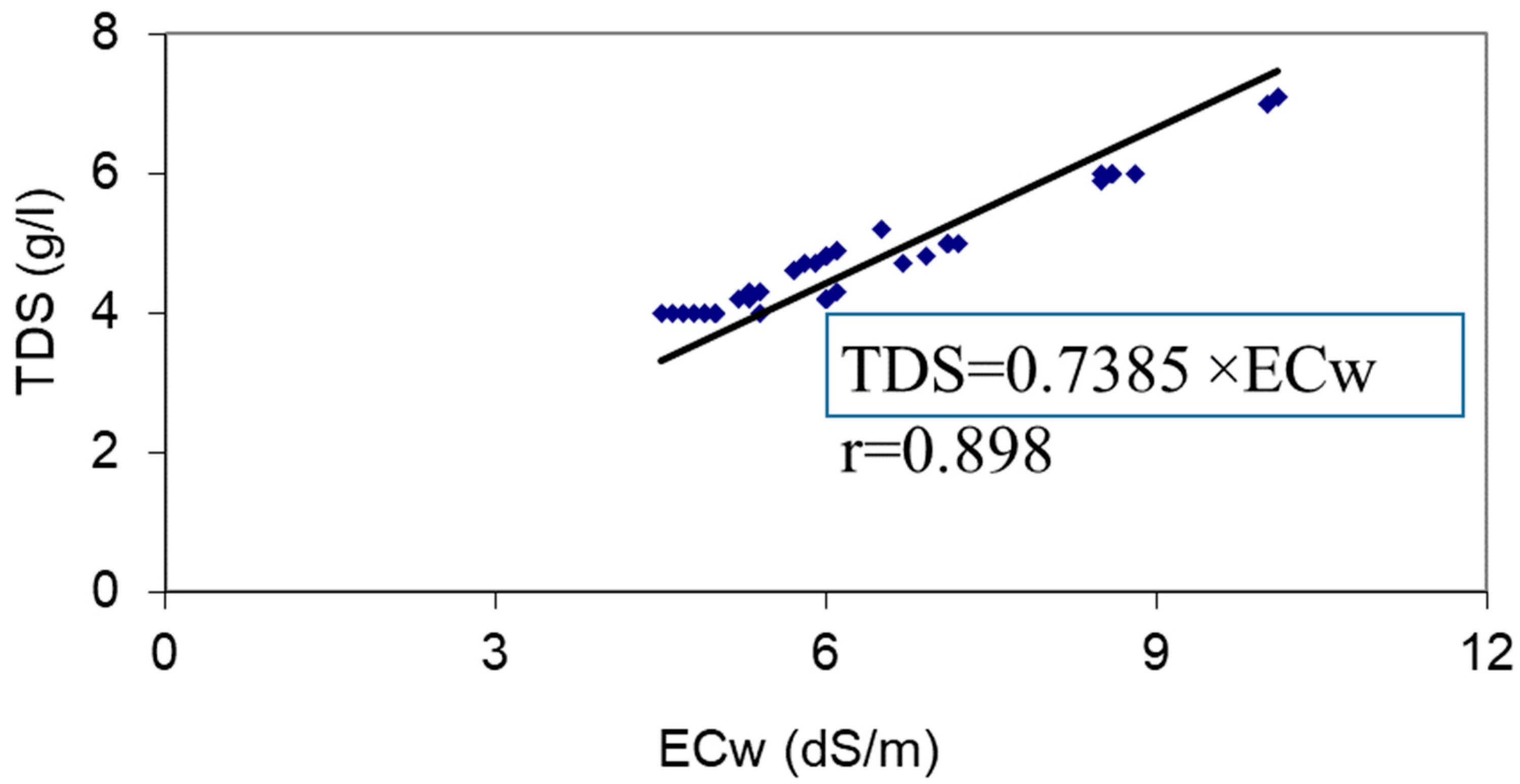
In the present study, a regression analysis between the measured TDS and ECw values for the water samples from farmers’ wells led to the derivation of the following Equation (5):
This strong linear relationship, illustrated in
Figure 1, suggests that the salinity of the sampled waters is relatively consistent in terms of ionic composition across the surveyed farms. The correlation coefficient r = 0.898 indicates a very good fit of the data to a linear model, highlighting that this relationship is specific to the studied waters and not universal, as it depends on the local ionic composition (e.g., sulfates, chlorides, bicarbonates). This equation was subsequently used to convert all TDS data into ECw values for further analysis of salinity impact on crop yields and water suitability assessment. The use of a region-specific conversion factor (0.7385) rather than a universal one (0.64) increases the accuracy of the interpretation and aligns with the localized nature of irrigation challenges in semi-arid regions like Tunisia.
3.4. Water Quality Parameters and Their Suitability for Irrigation in Tunisian Farms
Water samples from six farms located in the regions of Mahdia and Kairouan were analyzed for key parameters influencing their suitability for irrigation: pH, electrical conductivity (ECw), total dissolved solids (TDS), and sodium adsorption ratio (SAR) (
Table 4).
The pH values range from 7.2 to 8.0, indicating that the irrigation waters are slightly to moderately alkaline. This pH range is typical of groundwater in arid and semi-arid regions and is not expected to directly affect crop performance, but it may influence nutrient availability in the soil over time.
The ECw values varied between 6.5 and 9.8 dS/m, confirming that all water sources fall within the high to very high salinity class according to international standards (e.g., FAO classification). The highest EC displayed in
Table 4 was recorded at the Bouchnak farm (9.8 dS/m), suggesting elevated risks of osmotic stress for sensitive crops. In contrast, the Jebali farm presented the lowest EC (6.5 dS/m), though still well above the salinity threshold of 4 dS/m set for this study.
Corresponding TDS values ranged from 6.2 to 7.7 g/L, supporting the EC data and confirming the consistent presence of dissolved salts across the sites. These values are significantly above the commonly accepted threshold for safe irrigation water (typically 2 g/L), indicating that all these farms are dealing with saline irrigation water.
The SAR values range from 6.1 to 10.3, with Bouchnak again presenting the highest SAR (10.3). Elevated SAR indicates a risk of sodicity, which can degrade soil structure by dispersing clay particles, reducing permeability and aeration. Farms with SAR values above 9 should be monitored closely, as long-term use may necessitate soil amendments (e.g., gypsum) to maintain soil health and infiltration rates.
Table 5 summarizes the results of the analysis of crop yield response to irrigation water salinity, highlighting key parameters that quantify the sensitivity of each crop to increasing salinity levels.
The crops most sensitive to salinity, with the largest negative slope values, are
Cucumber (, )
Onion (, )
Alfalfa (, )
These crops experience the greatest loss in yield as irrigation water salinity increases, highlighting the need for careful management or the selection of alternative water sources to minimize productivity losses.
Conversely, the least sensitive crops, exhibiting the smallest negative slopes, are
Carrot (, )
Potato (, )
These crops show smaller reductions in yield under increasing salinity, indicating higher tolerance to saline irrigation and making them more suitable for cultivation in areas with elevated salinity levels.
The correlation coefficients (r) for these crops range from 0.49 to 0.67, indicating a moderate to strong relationship between irrigation water salinity and crop yield. This suggests that while salinity is a key factor influencing crop performance, other factors, including climatic conditions, irrigation management practices, and soil properties, also play a role in determining overall productivity.
The inclusion of the (b) parameter further clarifies the yield loss per unit increase in salinity above the threshold, providing a quantitative measure for estimating crop response under saline conditions.
3.5. Comparison of Observed (CRUESI 1970) [24] and Modeled Maximum Crop Yields Based on Salinity Response Functions
Table 6 presents a comparison of the maximum yields obtained by CRUESI (1970) [
24] and the yields estimated using the yield function for various crops. For pepper, the CRUESI value is 33.5 T/ha, while the estimated value is 43.8 T/ha. Tomato yields show a slight difference, with CRUESI yielding 68.0 T/ha and the estimated yield at 66.7 T/ha. The estimated yield for cucumber is 121 T/ha, but no CRUESI data is available. Potato’s estimated yield is 29 T/ha, compared to the CRUESI yield of 41.5 T/ha. For onion, the estimated yield is 64.1 T/ha, though the CRUESI data is missing. Carrot’s estimated yield is 90.9 T/ha, with no CRUESI data to compare. Alfalfa’s yield function estimate is 138 T/ha, while CRUESI observed a yield of 68.8 T/ha. Barley’s estimated yield is 5.96 T/ha, and sorghum’s estimated yield is 97.7 T/ha, compared to the CRUESI yield of 91.0 T/ha.
3.6. Effect of Increasing Salinity (ECw) on Crop Yields in Tunisia: Yield Reduction Trends and Statistical Significance
The data presented in
Table 7 illustrate the impact of varying levels of ECw (electrical conductivity of irrigation water) on the yields of nine different crops in Tunisia. The ECw levels tested range from 5 to 8 dS/m, and the table shows the average yield for each crop at these levels, along with the standard error (SE) for three replications.
From the data, it is evident that as ECw increases, the yield of all crops tends to decrease. For example, at an ECw of 5 dS/m, tomato yields were the highest with an average of 27 T/ha, but at an ECw of 8 dS/m, the yield significantly dropped to 8 T/ha.
Similarly, pepper yields decreased from 30 T/ha at ECw = 5 to 8.7 T/ha at ECw = 8. Cucumber experienced a notable drop from 56.6 ± 19.09 T/ha at ECw = 5 to just 4.66 ± 17.67 T/ha at ECw = 8.
The decrease in yield with increasing ECw is also noticeable in potato, where yields dropped from 19.33 ± 2.02 T/ha at ECw = 5 to 12.33 ± 2.94 T/ha at ECw = 8. Carrot yields decreased from 60.33 ± 3.41 T/ha to 50 ± 3.88 T/ha, and barley yields reduced from 30.5 ± 5.05 T/ha to 18.66 ± 2.94 T/ha as ECw increased from 5 to 8.
Alfalfa and sorghum also showed a significant reduction in yield with higher salinity levels. Alfalfa yield went from 70 ± 24.39 T/ha at ECw = 5 to 18.66 ± 11.9 T/ha at ECw = 8, while sorghum dropped from 51.66 ± 9.31 T/ha to 21.66 ± 11.9 T/ha. Lastly, onion yield decreased from 16.33 ± 2.23 T/ha at ECw = 5 to 8.66 ± 3.18 T/ha at ECw = 8.
The analysis of variance (ANOVA) indicates that the effect of ECw on crop yield is statistically significant for all crops.
3.7. Effect of Irrigation Water ECw on the Relative Yield of Selected Crops Under Tunisian Conditions
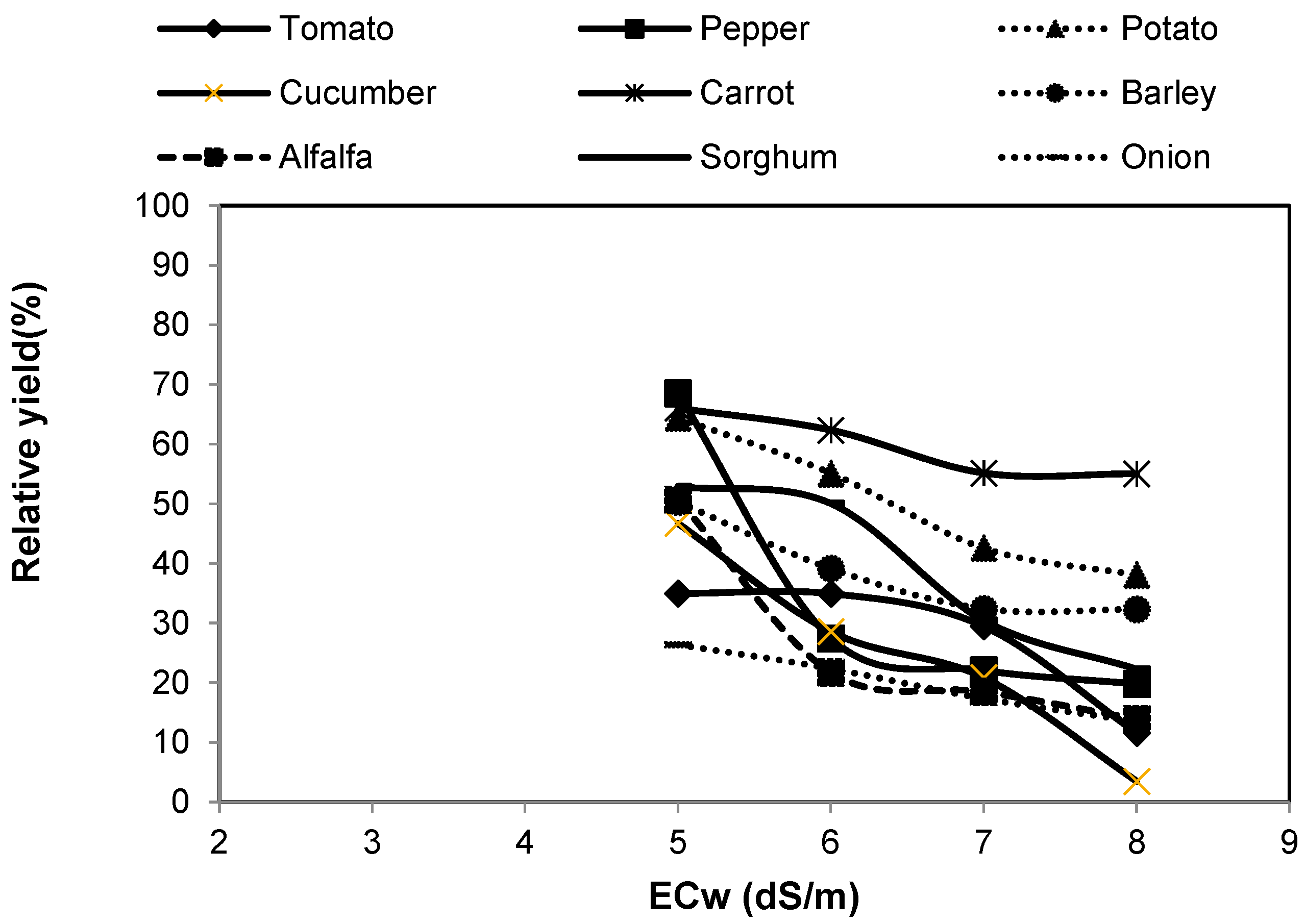
The data in
Table 8 and
Figure 2 present the effect of irrigation water salinity (ECw) on the relative yield percentage of nine crops in Tunisia. The relative yield values are shown for four different ECw treatments (5, 6, 7, and 8 dS/m), and the results include the standard error of the mean (SE) for three replications. The analysis of variance (ANOVA) indicates that the effect of ECw on crop yield is statistically significant for all crops (
p ≤ 0.01).
As indicated in the table (p ≤ 0.01), the differences in crop yields between the ECw levels were statistically significant. Mean comparisons were performed using the Least Significant Difference (LSD) test at p ≤ 0.05, with different letters denoting significant differences.
Potato and cucumber also demonstrate a decline in yield with higher salinity. Potato yield drops from 66.73 ± 6.72% at ECw = 5 to 42.56 ± 10.35% at ECw = 8, while cucumber yield decreases from 46.72 ± 15.42% to 3.49 ± 15.14% in the same ECw range. Barley shows a decrease from 50.34 ± 8.33% at ECw = 5 to 32.32 ± 4.4% at ECw = 8.
Alfalfa and sorghum both have considerable yield losses at higher salinity levels. Alfalfa, which starts at 50.72 ± 17.33% at ECw = 5, drops to 13.89 ± 8.7% at ECw = 8. Sorghum follows a similar trend, from 52.89 ± 9.87% to 22.29 ± 11.75% at ECw = 8.
The ANOVA results confirm that all differences in relative yields between the different ECw treatments are significant (p ≤ 0.01), as indicated by the ** symbol in the table. The LSD (Least Significant Difference) test further supports that the changes in yield are statistically significant at p ≤ 0.05, with different letters indicating significant differences within each crop.
3.8. Multivariate Analysis of Relative Crop Yields Under Salinity Stress in Tunisia: PCA and Heatmap Approach
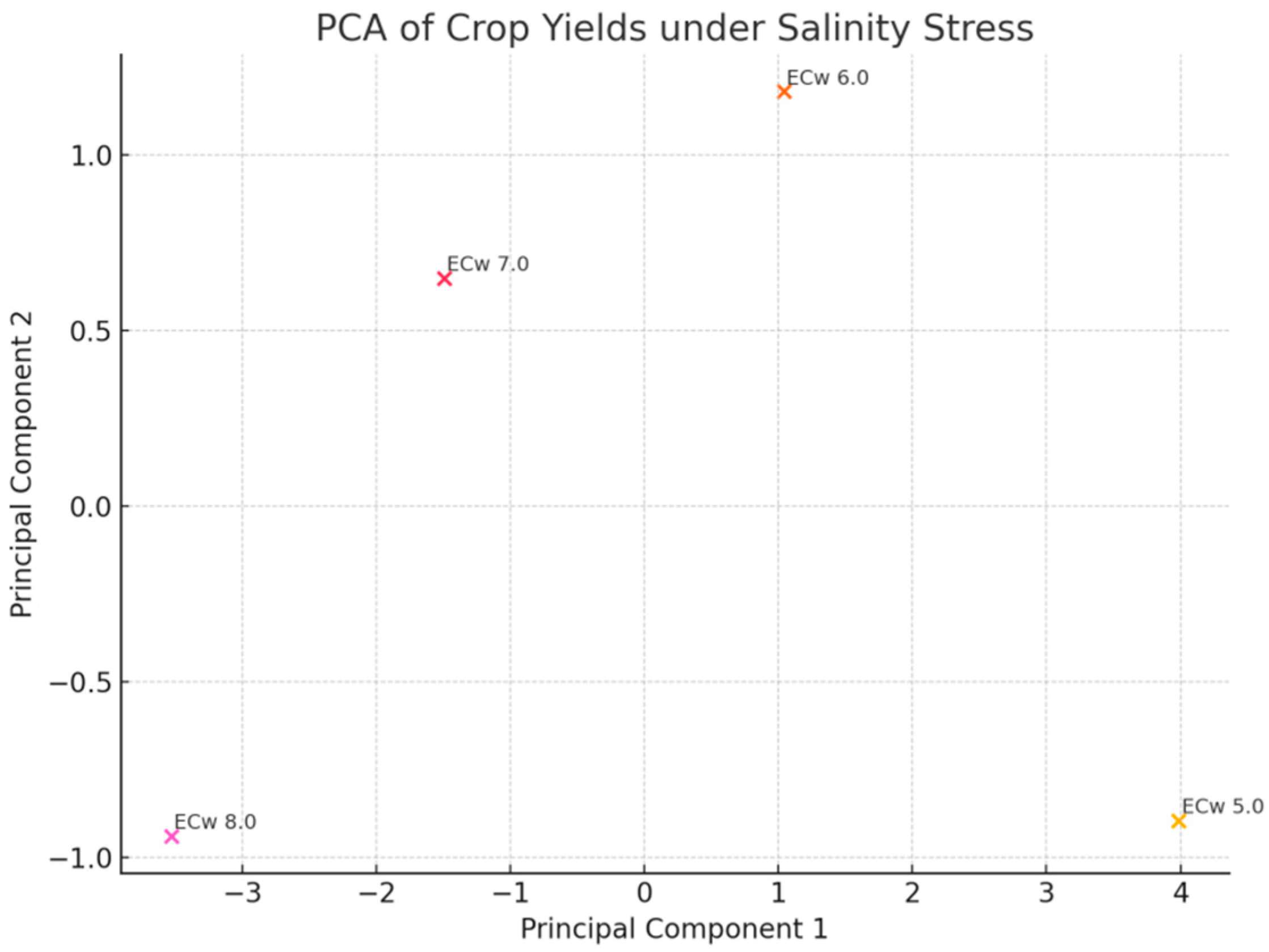
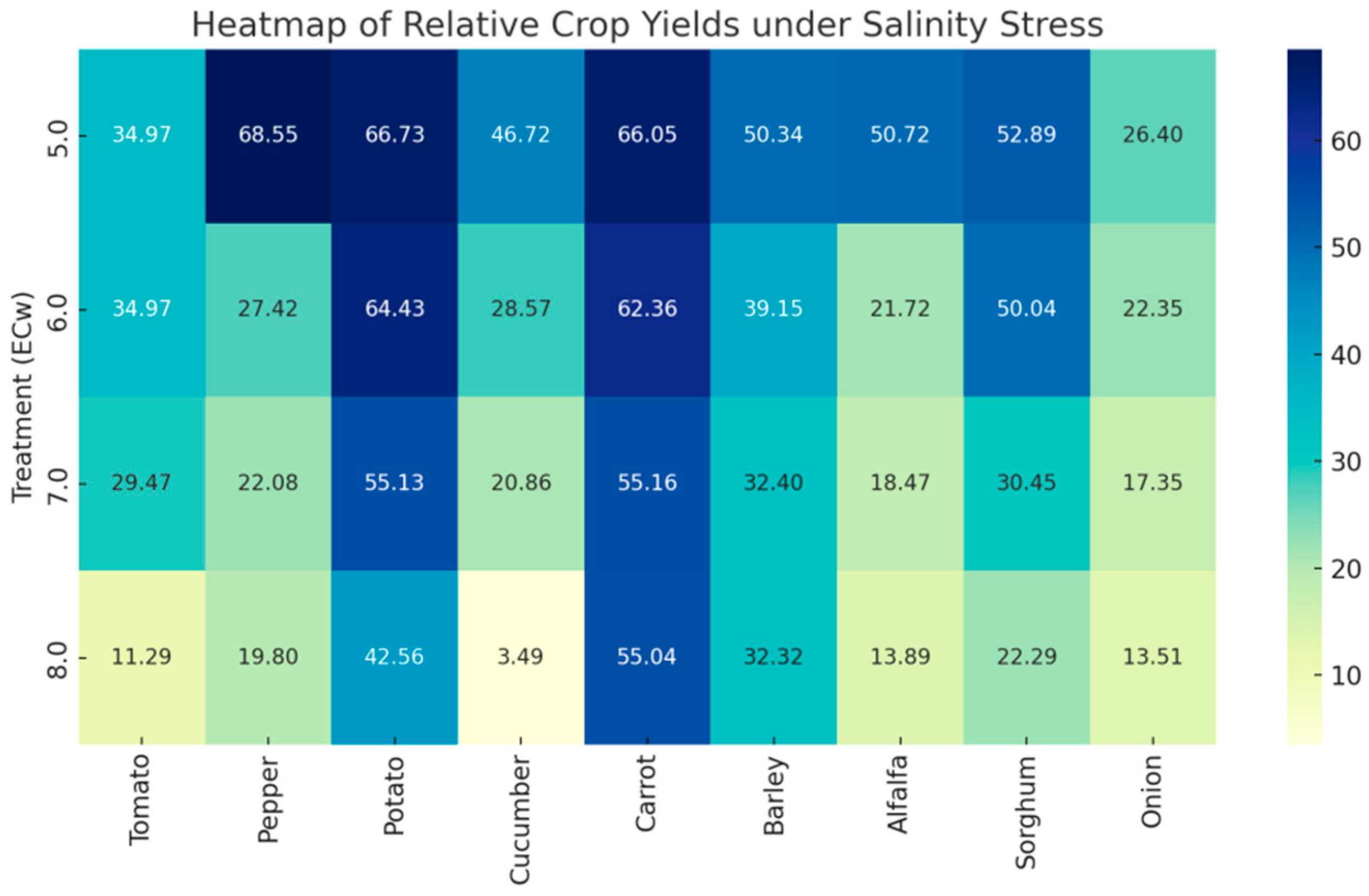
This multivariate analysis focused on the relative yields (%) of nine crops irrigated with water at four increasing salinity levels (ECw: 5 to 8 dS/m). Two statistical tools were applied: a heatmap (
Figure 3) and Principal Component Analysis (PCA) (
Figure 4). The color scale in
Figure 4 represents the relative crop yield (%) under different levels of irrigation water salinity (ECw). Darker colors correspond to higher relative yields, while lighter colors indicate lower yields, allowing a quick visual comparison of crop sensitivity to salinity stress.
The heatmap reveals a general decrease in crop yield as salinity increases. Some crops, such as carrot and potato, maintain relatively high yields even at elevated salinity levels. In contrast, cucumber, tomato, and onion are highly sensitive, with yields dropping below 20% at ECw 8 dS/m. PCA results show that the first two principal components explain 97.6% of the total variance (PC1 = 87.9%, PC2 = 9.7%). This indicates that most of the variability in crop responses to salinity can be visualized in a two-dimensional space. Higher salinity levels (ECw = 7 and 8) are clearly separated, reflecting their distinct effects on crop performance.
3.9. Comparison of Crop Salt Tolerance Classifications: Survey Results vs. Maas (1984) [22]
Table 9 compares the results of the survey with Maas’s (1984) [
22] classifications for the relative salt tolerance of various crops. The comparison highlights differences and similarities in the assessment of crops’ salt tolerance between Maas’ classifications and the survey conducted.
Carrot: Maas (1984) [
22] classifies carrot as “sensitive,” while the survey categorizes it as “tolerant.” This indicates a discrepancy, where the survey suggests that carrot has a higher tolerance to salinity than Maas (1984) [
22] did.
Potato: According to Maas (1984) [
22], potato is “moderately sensitive,” while the survey classifies it as “moderately tolerant.” This shift suggests that in the context of the survey, potato may be more resilient to salinity than originally thought by Maas.
Barley: Maas (1984) [
22] lists barley as “tolerant—moderately tolerant,” while the survey identifies it as “moderately tolerant.” The survey slightly narrows the tolerance range, indicating a less pronounced resistance to salinity.
Sorghum: Both Maas (1984) [
22] and the survey agree that sorghum is “moderately tolerant,” showing consistency between the two assessments.
Tomato, Pepper, Alfalfa, Onion, and Cucumber: For these crops, both Maas (1984) [
22] and the survey classify them as “moderately sensitive” or “moderately sensitive” with no significant difference in classification. This suggests that the salt tolerance of these crops is generally consistent between the two assessments.
4. Discussion
- 1.
Impact of Water Salinity on Crop Performance
The results of this national survey on the use of saline water in agriculture reveal significant insights into crop performance, water quality variability, and the implications for sustainable irrigation practices in semi-arid regions like Tunisia. With the study focusing on irrigation water salinity levels above 4 g/L, the findings are particularly relevant to regions facing freshwater scarcity and increasing reliance on marginal-quality water resources.
The analysis highlights the strong influence of water salinity on crop yields across diverse crop types. Crops like pepper and cucumber showed extreme variability in productivity, with coefficients of variation (C.V.) reaching 57.7% and 50.7%, respectively. These crops, while economically important, appear highly sensitive to salinity stress, likely due to physiological limitations and variable agronomic practices such as inconsistent irrigation schedules, insufficient leaching, or varietal differences [
27]. These findings align with literature that classifies cucumber and pepper as moderately sensitive to salinity [
29,
30]. For example, according to Abu-Romman et al. (2012) [
31], the concentration of 50 mM NaCl generally marks the threshold where negative effects on cucumber growth and physiology become more evident. From 75 mM NaCl onwards, the damage increases more pronouncedly, affecting fruit production and quality [
32].
In contrast, carrot exhibited exceptional yield stability (C.V. = 15.1%) and high average yields (58.5 T/ha), suggesting that certain root vegetables may possess higher intrinsic tolerance or benefit from more uniform field practices [
33]. However, more recent field evidence suggests that local carrot cultivars in Tunisia may exhibit greater resilience, possibly due to long-term adaptation or improved soil and water management strategies [
34]. These results support the need for enhanced genetic and agronomic characterization of indigenous varieties.
The observed yield responses support the widely accepted two-phase model of salinity stress on crops: an initial threshold beyond which yield begins to decline, followed by a linear reduction in yield with increasing salinity levels [
35]. Our data confirmed that barley and potato showed moderate tolerance, with relative yields of 50.03% and 64% at 5 dS/m, dropping to 32.32% and 38.08% at 8 dS/m, respectively. These results are partly in agreement with previous assessments, though some inconsistencies may stem from differences in environmental conditions, irrigation practices, and cultivar sensitivity [
36,
37]. Despite being salt-tolerant, barley showed low average productivity (2.7 T/ha), indicating that tolerance does not always equate to optimal agronomic performance under real field conditions.
For tomato and onion, which were among the most sensitive crops in our study, our findings are consistent with Maas’s (1984) [
22] classification. Tomato yield, for instance, is known to decrease by up to 50% when EC levels reach 7.6 dS/m [
38], and onion yield begins to decline from as low as 1.4 dS/m [
39]. These reductions can be exacerbated under Mediterranean climatic conditions, as high evaporative demand intensifies salt stress [
40]. However, recent studies have shown that strategies like drip irrigation, mulching, precision fertigation, and accurate irrigation scheduling can mitigate salinity effects if salinity levels are managed below critical thresholds [
41].
Among forage crops, sorghum showed strong performance, with an average yield of 46.9 T/ha and relatively low variability (C.V. = 26.1%), confirming its robustness under saline irrigation. This crop could play a crucial role in supporting livestock feed security in salinity-affected zones. Alfalfa, on the other hand, despite its relative tolerance, showed higher variability (C.V. = 46.7%), indicating the need for better varietal selection or improved field management.
Interestingly, crops such as melon, beet, and spinach (if observed in your dataset) also deserve attention. Though data for these crops may be limited, preliminary field observations suggest that certain melon cultivars, particularly those with short growing cycles, may perform moderately well under saline conditions, provided irrigation is well managed and soils have good drainage. Beets, being root crops, tend to accumulate salts in non-edible tissues and thus can maintain acceptable yield levels, although quality parameters like sugar content may be affected. Spinach is generally considered sensitive, but some varieties exhibit osmotic adjustment mechanisms that allow limited tolerance under moderate salinity [
42].
- 2.
Agronomic and Management Implications
These agronomic findings not only deepen our understanding of crop-specific responses to salinity but also point toward the necessity of implementing sustainable management approaches adapted to local conditions. As the literature suggests, salinity tolerance varies not only between species but also between cultivars, and is heavily influenced by agronomic practices, soil properties, and irrigation [
13,
20,
43]. The use of amendments (e.g., gypsum, organic matter), efficient irrigation strategies (e.g., deficit irrigation, drip systems), and the selection or breeding of salt-tolerant varieties are therefore critical for long-term sustainability [
11].
Furthermore, the high number of observations for crops like pepper (n = 135) and tomato (n = 68) underscores their importance to local farming systems and rural economies, particularly in semi-arid Tunisia. The integration of ICT-based decision support tools could further enhance farmers’ capacity to monitor salinity levels and optimize irrigation and fertilization accordingly [
44,
45].
The results highlight the significant variability in salinity tolerance among different crop species. Carrot, potato, and barley show better resilience, maintaining relatively high yields even under high salinity conditions (up to 7 dS/m). On the other hand, cucumber, tomato, and onion experience severe yield reductions from ECw 6 dS/m onward.
These findings are particularly relevant for agriculture in semi-arid and arid regions such as Tunisia, where soil and water salinity pose major constraints. Strategic crop selection based on salinity tolerance can help optimize agricultural productivity under increasing salinity stress [
11].
Furthermore, the combined use heatmap and PCA proved effective in classifying crop responses, offering a useful decision-support tool for farmers, agronomists, and policymakers aiming to promote sustainable water resource management and salinity mitigation strategies. The adoption of such integrated, data-driven management practices, tailored to local crop performance data as presented here, is key to developing adaptive strategies for semi-arid and arid agricultural systems increasingly dependent on saline water resources.
- 3.
Mechanistic Insights and Physiological Considerations
At the mechanistic level, these results can be explained by the close coupling between ionic and osmotic stresses within the soil–plant system. The accumulation of Na+ and Cl− ions in the rhizosphere modifies soil structure and permeability, reducing water availability and nutrient diffusion. This ionic buildup disrupts the Na+/K+ balance in plant tissues, leading to stomatal closure, reduced photosynthetic efficiency, and impaired enzymatic activities. Such physiological imbalances, combined with osmotic constraints that lower root water uptake, result in decreased biomass and yield. The observed interspecific variability thus reflects the distinct ion-exclusion and osmotic adjustment mechanisms of each crop species.
From an agronomic perspective, understanding these soil–plant mechanisms is essential for designing efficient salinity management strategies. Practices such as applying organic amendments or gypsum to improve soil cation exchange capacity, adopting precise drip irrigation to limit salt accumulation, and selecting salt-tolerant varieties are critical steps toward sustainable production. Moreover, integrating ICT (Information and Communication Technology)-based decision support tools in salinity monitoring systems can enable real-time adjustments in irrigation and fertigation. These combined approaches enhance both soil health and crop resilience under saline irrigation, offering scalable solutions for Mediterranean and arid regions.
From an agronomic perspective, the study identifies the threshold of irrigation water salinity beyond which yield losses become significant, thus providing a practical guideline for managing saline water in Tunisian agricultural systems. The findings also suggest that soil amendments such as organic matter or gypsum could mitigate the effects of Na+ accumulation and improve crop resilience. These insights contribute to developing adaptive irrigation strategies for arid regions facing increasing water scarcity and salinity due to climate change.
5. Conclusions
This study demonstrates the significant impact of irrigation water salinity on crop yields in semi-arid regions such as Tunisia, where the use of marginal-quality water is increasingly necessary due to freshwater scarcity.
Crop tolerance to salinity was found to vary widely depending on species, cultivars, and local agronomic conditions. While crops such as carrot, potato, and barley showed a certain degree of resilience, others, including cucumber, pepper, onion, and tomato, experienced considerable yield reductions, particularly at electrical conductivity (EC) levels ranging from 5 to 8 dS/m. The observed variability among crops reflects complex plant–soil–water interactions, where ion toxicity, osmotic stress, and reduced nutrient uptake synergistically limit growth and productivity.
Implications for management: These findings highlight the importance of improving soil structure and microbial activity to enhance plant resilience under saline irrigation. The adoption of appropriate management practices, including cultivar selection, localized irrigation systems, soil amendments, and precise irrigation scheduling, is essential to minimize yield losses and promote sustainable agriculture under saline stress. Selecting salt-tolerant crops remains a key strategy for ensuring food security and resilience in areas affected by increasing salinization.
Recommendations for future research: Further studies should explore long-term effects of salinity on soil health, the combined impact of multiple abiotic stresses, and the potential of innovative irrigation technologies and crop breeding programs to improve tolerance.
Contribution of the study: This work provides a detailed analysis of crop-specific responses to saline irrigation in Tunisia, linking water quality, agronomic practices, and yield variability. It contributes to the development of evidence-based guidelines for sustainable management of saline water in agriculture, addressing the research hypothesis and objectives stated in the introduction.