Article

Effect of the Combination of Biochar and ZnSO4 on Soil Properties and Lettuce Zinc Uptake


1
Department of Geological and Mining Engineering, Mines and Energy School, Universidad Politécnica de Madrid, 28003 Madrid, Spain
2
Department of Chemical and Food Technology, Agronomic, Food and Biosystems Engineering School, Universidad Politécnica de Madrid, 28040 Madrid, Spain
3
School of Engineering, RMIT University, Melbourne 3000, Australia
4
Department of Agricultural Production, Agronomic, Food and Biosystems Engineering School, Universidad Politécnica de Madrid, 28040 Madrid, Spain
*
Authors to whom correspondence should be addressed.
Soil Syst. 2026, 10(3), 42; https://doi.org/10.3390/soilsystems10030042
Submission received: 8 December 2025 / Revised: 13 March 2026 / Accepted: 13 March 2026 / Published: 17 March 2026

Abstract

Micronutrient addition to soil is crucial for improving crop yield. Within the framework of the circular economy, it is necessary to seek more efficient fertilizers. This would reduce fertilizer consumption while serving as a strategy to mitigate the negative effects of climate change. This study proposes the combined use of a traditional source of a Zn fertilizer (ZnSO4) together with wood biochar to improve lettuce (Lactuca sativa L.) crop yield. An experiment was designed in which a dose of 8 mg Zn kg−1 as ZnSO4·7H2O was added to Cambisol soil, mixed with or without biochar (5%), for lettuce growth. Among other soil properties, Zn bioavailability, microbial biomass, and available water were monitored in the soil, while photosynthetic pigments, Zn content, and biomass production were determined in plants. All treatments increased plant biomass production. Biochar treatments (biochar and biochar/ZnSO4) increased fresh biomass by 324%, while ZnSO4 addition resulted in a 158% increase in lettuce yield. This can be due to several factors, such as biochar being a C source, the improvement of soil water content after biochar addition, and the increase in Zn leaf content in all treatments with respect to the control soil. All of these likely had a positive effect on photosynthesis. This is corroborated by the increase in total chlorophyll, chlorophyll, and carotenoids in the treatments with ZnSO4, biochar/ZnSO4, and biochar. The application of biochar alone increased this property by more than 168%, with a positive impact on soil quality. Our research demonstrates that it is possible, in some cases, to prepare fertilizers combining ZnSO4 and biochar, leading to increased plant Zn uptake and improved crop yield.

1. Introduction

Micronutrients are elements, such as B, Cu, Fe or Zn, that are essential for the growth and reproduction of living organisms. Traditionally, agricultural production has been dedicated to improving yields, but this has led to an increase in micronutrient deficits, known as hidden hunger, which refers to Zn and Fe deficiencies in the population [1,2]. Dietary Zn deficiency reaches 17% of the world population and up to 30% in lower- and middle-income countries [2]. Zn is necessary for maintaining life processes and is a crucial micronutrient of various enzyme systems that are key to protein synthesis, energy production, and growth regulation of plants. Zinc participates in metabolic processes, from photosynthesis to chlorophyll synthesis [3]. Zn fertilization reduces the risk of diseases related to micronutrient deficiency (hidden hunger), enhancing agricultural yields [4,5]. The efficiency of a fertilizer is dependent on the stability, activity and solubility of the chemical form in which it is added to the soil [6]. If a soluble Zn2+ salt, i.e., ZnSO4, is added to the soil, the Zn2+ remains available in the soil solution for a brief period, and its availability decreases rapidly due to losses by leaching or to Zn2+ retention in the soil [7]. Soil intrinsic properties, such as pH and the presence of active carbonate, can alter Zn availability. To reduce the loss of Zn2+, different Zn-complex-based fertilizers have been developed. However, research has shown that the use of slowly degrading synthetic chelating agents, i.e., EDTA or diethylenetriamine pentaacetate (DTPA), can cause agro-environmental contamination and toxic effects [8,9,10].
Biochar, depending on raw material and pyrolysis conditions, can have a large specific surface area that, combined with its porosity and cation exchange capacity, can lead to nutrient storage, reducing the migration of water-soluble nutrients. Indeed, the mechanism of biochar adsorption of nutrients can include physical adsorption and electrostatic adsorption, complexation, precipitation, ion exchange, and cation–п interactions [11,12]. Also, biochar can improve soil physical properties, such as water retention or soil structure, reducing greenhouse gas emissions [13]. In this context, there have been attempts to improve the efficiency of Zn release from composite materials. The use of zinc oxide nanoparticles coupled with biochar has been proposed as a slow-release fertilizer [14].
Other researchers have developed a slow-release fertilizer based on biochar coupled with oxide nanoparticles by encapsulating polyvinyl alcohol and starch. However, these fertilizers can be costly and could be toxic to bacteria and soil invertebrates at low doses [15].
Biochar is a porous, carbon-rich material obtained from the pyrolysis of biomass and, due to its stability and porosity, can retain organic compounds and metals on its surface.
Biochar properties depend on the characteristics of the raw material and the preparation conditions. In general, biochar has high cation exchange capacity, great stability, and alkaline pH. Biochar improves physical and chemical soil properties (soil structure stability or water-holding capacity), enhancing plant growth and soil carbon sequestration [16]. Indeed, previous research indicates that biochar also improves water retention, increases nutrient availability, and can help to reduce soil acidity [17]. Additionally, biochar can enhance microbial activity and boost crop yields [18], contributing to more sustainable agricultural practices. Therefore, the simple combination of biochar with Zn salts could be a good option for enhancing crop productivity, improving soil quality, and reducing environmental impacts due to the improvement of the biochar properties. Biochar could enhance the efficiency of direct mineral fertilization by increasing agricultural yield due to reduced nutrient loss, specifically Zn in this case, and improved water resource utilization, thanks to the moisture retention capacity provided by the biochar.
The main objective of this research is to study the combined effect of adding biochar and ZnSO4 to a Zn-deficient sandy loam soil. We hypothesized that ZnSO4 coupled with biochar would reduce Zn loss, increase Zn availability to plants, and improve water-holding capacity, thereby increasing crop production.

2. Materials and Methods

2.1. Soil Selection and Characterization

The soil was sampled from Avelos, Portugal (latitude: 40°56′09.5′′ N, longitude: 7°18′57.7′′ W). A soil sample from the Ap horizon (0–28 cm) was air-dried (24 h) and sieved (<2 mm). Soil pH and electrical conductivity (EC) were measured using a Hamilton pH (model LP238285, KCl 3 M plus glycol electrolyte, Hamilton Instruments, Reno, NV, USA) and electrical conductivity (model COND50, XS Instruments, Giorgio Bormac, Carpi, Italy) electrodes in a ratio of 1:2.5 (soil: water). The oxidizable organic matter (OM) was determined using the Walkley–Black method [19], the available phosphorus (P) by the Olsen method [20], and N by Kjeldahl digestion [21]. Soil texture was determined following the methodology of Boyoucos [22]. The cation exchange capacity (CEC) was determined with the cohex (hexaminecobalt III, 99%, Alfa Aevar, Kandel, Germany) method, according to a standardized protocol (ISO 23470) [23]. In this procedure, the exchangeable K, Ca, Mg and Na were determined in the solution with a PerkinElmer Atomic Absorption Spectrophotometer (model Analyst 400, PerkinElmer, Shelton, CT, USA). Field capacity (FC) and wilting point (WP) were determined as the soil moisture content at 33 kPa (FC) and 1500 kPa (WP), respectively [24]. All analyses were performed in triplicate.
Table 1 shows the main characteristics. The acidic soil (pH 5.2) was classified as a Cambisol, and its main properties were as follows: sand, 70.6%; silt, 25.6%; clay, 3.8%; and EC of 43.0 µS cm−1.

2.2. Biochar Selection and Characterization

Biochar was supplied from Carbon Emergente (Cantabria, Spain) (Table 2). The biochar was prepared from certified Pinus pinaster wood chips. pH, EC (in 4 g L−1 water solution), CEC, and soil water retention were determined following the same procedures as for the soil. Total organic matter (TOM) was measured by the dry combustion method at 540 °C in a muffle furnace (model 12-PR/300, Heron, Madrid, Spain) [19]. Total metal content was determined by acid digestion: 0.5 g of biochar was treated (220 °C, 340 bar) with 10 mL HNO3 (69%, Panreac, Barcelona, Spain) and 5 mL HF (48%, Panreac, Barcelona, Spain) in a microwave oven (model Ethos, Milestone, Sorisole, Italy). Both BET surface area (SBET) and V micro (cm3 g−1) were determined from N2 isotherms obtained using a Porosimetry System Micromeretics (model ASAP 2020, Micromeritics, Norcross, GA, USA).

2.3. Treatments with Biochar and Zinc Sulfate

One dose of 8 mg Zn kg−1 was added to the selected soil using two different treatments: (1) commercial ZnSO4·7H2O (99%, Panreac, Barcelona, Spain) (soil + ZnSO4 treatment) and (2) commercial ZnSO4·7H2O (99%, Panreac, Barcelona, Spain) mixed with biochar (5% in weight) (soil + biochar/ZnSO4 treatment). Results were compared with a control soil and soil treated with biochar at 5% (soil + biochar treatment). Four replicates were used for each treatment.

2.4. Experiments for Lactuca Sativa Growth

The containers were placed in a temperature-controlled incubator (model AGP-360-HR, Radiber, Barcelona, Spain). One lettuce plant (Lactuca sativa L.), grown for 25 days in a peat seedbed, was placed in pots. During the crop development, the soil humidity was maintained at 100% of its water-holding capacity by irrigation with distilled water. The growth of plants was maintained for 35 days at 20 °C with 12 h light/12 h dark cycles. The different treatments were performed in quadruplicate, with the pots randomly distributed within the incubation chamber. After each watering, they were repositioned randomly within the chamber.

2.5. Soil and Biochar Analysis

At the end of the experiment, the soil from each pot was dried and mixed. Different extractants were used to evaluate the availability of Zn in soil. Total Zn content was determined as previously described for biochar. Bioavailable Zn concentration was assessed using two procedures—(1) using diethylenetriaminepentaacetic acid–CaCl2–triethanolamine (DTPA, 99%, Alfa Aevar, Kandel, Germany) [25] and (2) the rhizosphere-based extraction method (low-molecular-weight organic acids, LMWOAs)—as follows: First, 2 g of soil was mixed with 20 mL of a 10 mM mixture of organic acid solution containing acetic, lactic, citric, malic, and formic acids (99%, 85%, 99%, 99%, 98%, Sigma-Aldrich, Burlington, VT, USA) in a molar ratio of 4:2:1:1:1, respectively [26]. Later, mixtures were shaken for 2 h and filtered. The Zn concentration in the extracts was quantified with a PerkinElmer Atomic Absorption Spectrophotometer (model Analyst 400, PerkinElmer, Shelton, CT, USA). Soil pH and EC were measured as noted in Section 2.1 using a ratio of 1:2.5.
Soil microbial biomass C (biomass C) was determined by the chloroform fumigation–extraction method [27]. Two 5 g sets of soil samples were weighed for fumigated and non-fumigated treatments. The fumigated samples were placed in a desiccator containing chloroform (chloroform, 99.8%, Sigma-Aldrich, Burlington, VT, USA) and subjected to vacuum for 30 min to saturate the atmosphere with the reagent. These conditions were maintained for 24 h. Non-fumigated samples were kept under a normal atmosphere. Subsequently, all samples were transferred to plastic containers, where 25 mL of 0.5 M K2SO4 (99%; Panreac, Barcelona, Spain) was added, and the mixtures were shaken for 30 min and filtered. From the resulting extract, 5 mL aliquots were placed in test tubes and evaporated to dryness at 105 °C. Then, 5 mL of 0.1 N K2Cr2O7 (99.9%, Panreac, Barcelona, Spain) and 10 mL of H2SO4 (96%, Panreac, Barcelona, Spain) were added, followed by heating at 105 °C for 90 min. Both fumigated and non-fumigated samples were then titrated using 0.02 M NH4Fe(SO4)2.12H2O (99%; Panreac, Barcelona, Spain), with five drops of orthophenanthroline as an indicator. The microbial biomass C (expressed in milligrams per kilogram of dry soil) was calculated by applying a factor (Kc) of 0.45 to the difference in the C content of the fumigated and unfumigated extracts.

2.6. Plant Analysis

After 35 days, the plants were weighed and washed with distilled water. The number of leaves was counted, and samples of young (youngest fifth leaf) and mature (second and third oldest leaves) lettuce leaves were taken for different analyses of the plant material. Both chlorophyll and carotenoid contents in the fresh mature leaf were determined [28]. Briefly, 0.25 g of fresh leaf was mixed with 50 mL of acetone (80%, Panreac, Química SLU, Barcelona, Spain) in dim light. For correct pigment values, the determination of chlorophylls and total carotenoids in the whole leaf extract was performed immediately after the extract preparation. The measurements were performed with a spectrophotometer (model UV-1203, Shimadzu, Kyoto, Japan) at the following wavelengths (nm): 660, 643 and 470 nm; the content was calculated as follows:
Chlorophyll a = 12.25 A660 − 2.79 A643
Chlorophyll b = 21.5A643 − 5.1 A660
Total Chlorophyll = Chlorophyll a + Chlorophyll b
Carotenoids = (1000 A470 − (1.82Chlorophyll a) − (85.02 Chlorophyll b))/198
Later, the leaves were dried in an oven (Proetisa, Leganés, Madrid) at a constant temperature of 60 °C. Total Zn concentration in leaves was determined by digestion in Teflon vessels using a block system (SPB Probe, PerkinElmer, Waltham, MA, USA). Briefly, 0.5 g of dry matter samples were digested with 10 mL of an acid mixture (5 mL HNO3 (65%), 2 mL HF (48%) and 3 mL H2O). Total Zn root concentrations were determined following the same procedure. After that, the bioaccumulation factor (BAF) was calculated to analyze the plant/soil relationships. BAF is the plant/soil element concentration ratio, which categorizes plants as hyperaccumulator, accumulator and excluder according to BAF values of >10, >1 and <1, respectively [29]. BAF is calculated as follows:
B A F =   C o n c e n t r a t i o n   o f   m e t a l   i n   a e r i a l   p a r t   o r   r o o t s   ( m g k g 1 ) C o n c e n t r a t i o n   o f   m e t a l   i n   s o i l   ( m g k g 1 )

2.7. Statistical Analysis

Each analysis was performed in quadruplicate. The statistical analyses (calculation of means and standard deviations, differences in means) were performed using the SPSS 15.0 package. Differences in means were assessed using an analysis of variance (ANOVA). Means were considered different when p < 0.05 using Tukey’s test.

3. Results

Table 3 shows the main properties of the soil treatments after Lactuca sativa L. growth. The addition of ZnSO4 increased the soil pH slightly (0.4 units) and increased the EC. However, the EC increase was smaller when ZnSO4 was added in combination with biochar.
The addition of biochar to soil did not significantly alter pH or EC. All treatments increased soil microbial biomass in the following order:
Control < Soil + ZnSO4 (+77%) < Soil + Biochar/ZnSO4 (+168%) < Soil + Biochar (+194%).
Biochar addition alone increased microbial biomass by 194%, whereas ZnSO4 led to a 77% increase. Notably, the biochar/ZnSO4 combination did not enhance this property further than biochar alone. The addition of biochar also increased soil cation exchange capacity from 24 cmol kg−1 in the control soil to 32 cmol kg−1 in biochar-amended soil (soil + biochar treatment). In the current experiment, the treatments with biochar (treatments soil + biochar/ZnSO4 and soil + biochar) increased soil water content at 1/3 atm (H1/3), commonly known as field capacity, by 39.8%; the H15, known as wilting point, increased by 68.0%. These changes led to an increase in available water content (AW) (6.5%) after biochar addition, which can have a positive effect on lettuce growth. As expected, both ZnSO4 and biochar/ZnSO4 treatments increased soil total Zn content. Furthermore, both treatments increased the Zn extracted with organic acids and DTPA compared to the control soil (Table 4). Specifically, the ZnSO4 treatment increased Zn extraction by 193% (organic acids) and 353% (DTPA), while the biochar/ZnSO4 treatment resulted in increases of 99% and 255%, respectively. Finally, no significant differences were observed in Zn extracted by organic acids or DTPA between the control and the soil + biochar treatment. Figure 1 shows Zn content in aerial parts and roots. Both ZnSO4 and biochar/ZnSO4 treatments increased Zn content in shoots and roots, which is consistent with the higher Zn bioavailability observed in these treatments.
BAFs (Table 5) were higher than 1, showing that treatments produce an accumulation of Zn in plants; this indicates that lettuce is a Zn accumulator. Indeed, the application of biochar increased the BAFaerial with respect to treatments without biochar.
The treatments soil + ZnSO4, soil + biochar/ZnSO4, and soil + biochar had a positive effect on the content of photosynthetic pigments, increasing total chlorophyll, chlorophyll a, and carotenoids (Table 6) by 34.2%, 49.9% and 59.0%, respectively, while there was no difference in chlorophyll b with respect to the control soil.
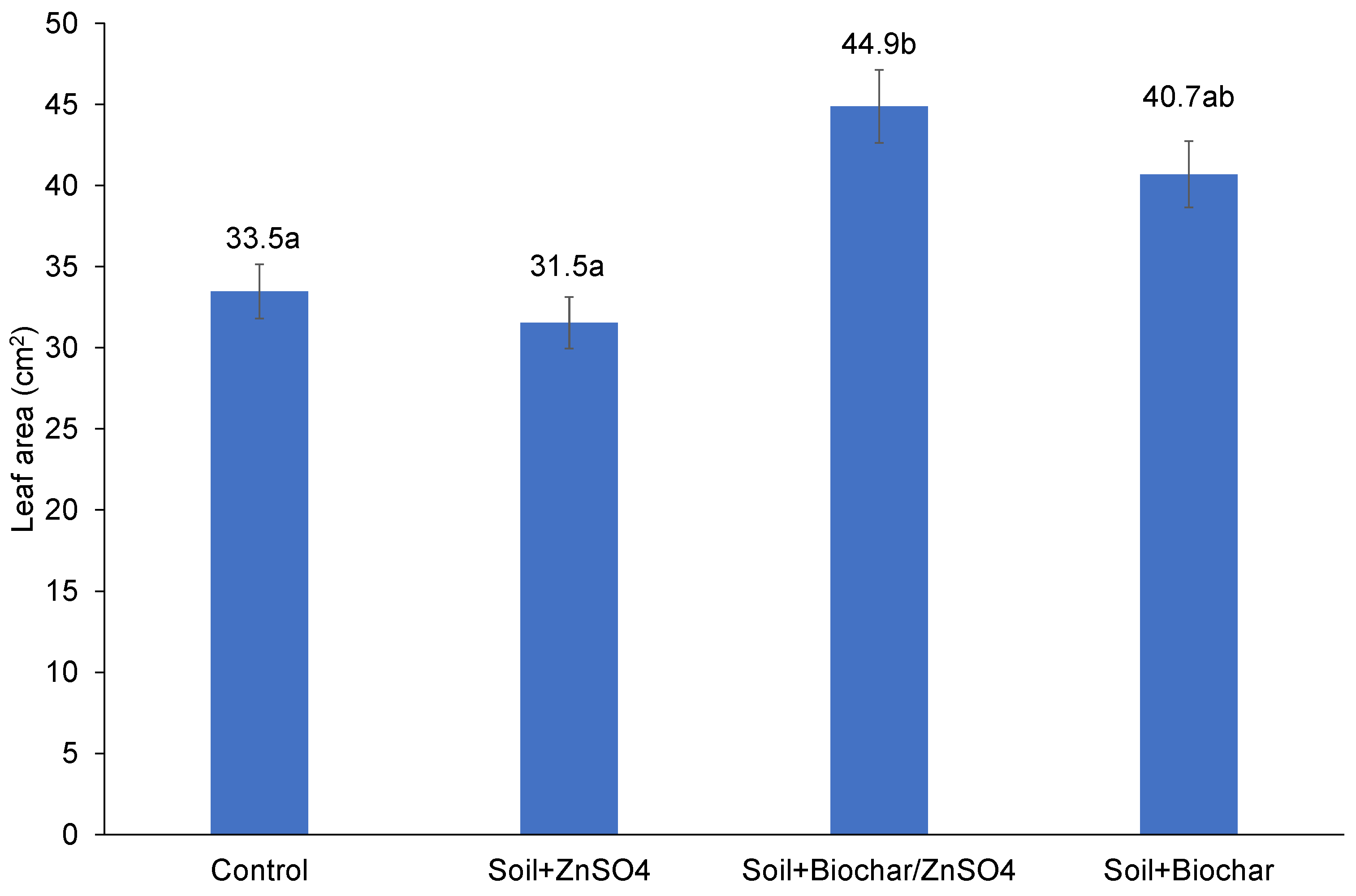
Figure 2 shows the leaf area of lettuce at the end of the experiment. The addition of biochar increased leaf area by 21.5% (ZnSO4 and biochar/ZnSO4 treatments) with respect to treatments without biochar (control soil and ZnSO4 treatment). This can have a positive effect on photosynthesis, as a larger leaf surface area can absorb more sunlight, improving the photosynthesis process.
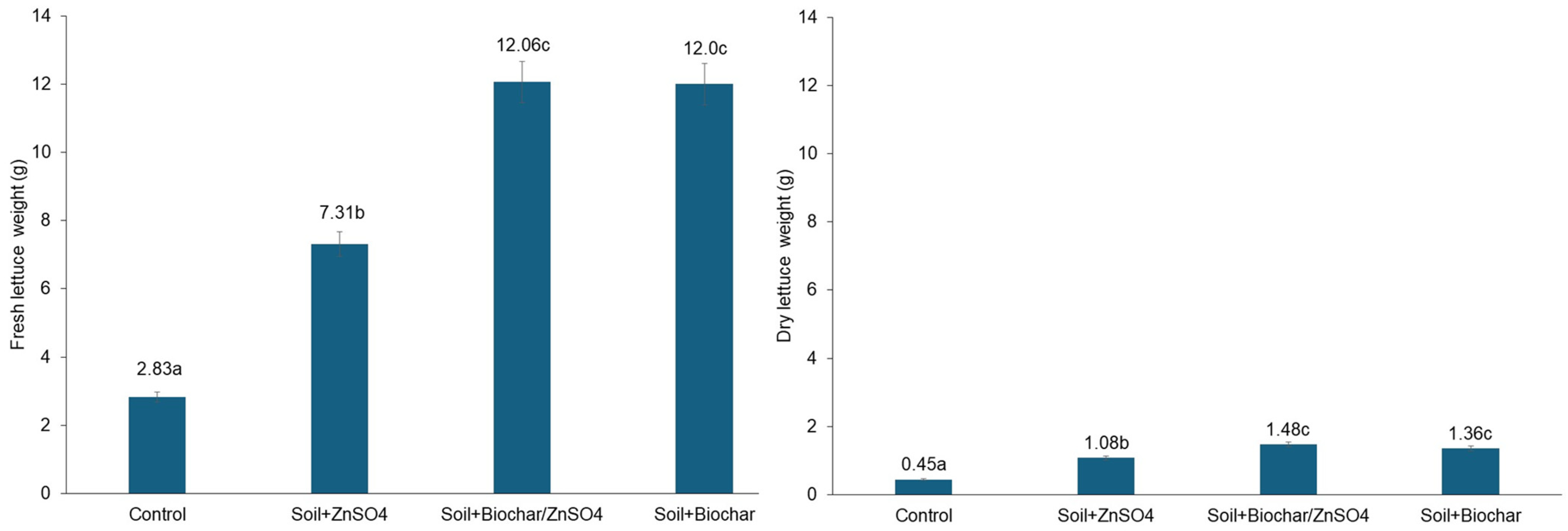
Finally, all treatments increased the production of fresh and dry biomass (Figure 3), as follows:
Control < Soil + ZnSO4 (+158%) < Soil + Biochar/ZnSO4 ~ Soil + Biochar (+324%)
Control < Soil + ZnSO4 (+140%) < Soil + Biochar/ZnSO4 ~ Soil + Biochar (+202%)

4. Discussion

The increase in soil pH after the addition of ZnSO4 is probably due to the hydration of Zn2+ in soil aqueous solution to different ions such as [Zn(H2O)6]2+, while the EC increase is due to its dissociation into Zn2+ and SO42− in aqueous solution, thereby increasing salt concentration. The EC values are low and would not affect lettuce growth. When ZnSO4 is mixed with biochar, the increase in EC is smaller due to ion adsorption on the biochar surface. This may contribute to its lower mobility but also to a lower loss of Zn from the soil after amendment. It is known that biochar can retain plant nutrients through different mechanisms, including sorption, ion exchange driven by electrostatic interactions, complex formation, co-precipitation, and physical sorption [30]. Previous research [31,32] has shown that incorporating NPK fertilizers into biochar porous surfaces minimizes quick nutrient loss, enhancing the efficiency of NPK plant uptake. In fact, biochar-based fertilizer should be considered a slow-release fertilizer [33]. With respect to microbial biomass, Li et al. [34] concluded that the influence of biochar on microbial biomass is dependent on biochar properties, soil characteristics, and environmental conditions, while microbial diversity is conditional on soil characteristics. Liang et al. [35] proposed that black carbon can impact soil microbial communities, potentially leading to increased microbial biomass in black carbon-rich soils. The increase in microbial activity after the addition of ZnSO4 and biochar would indicate that biochar has a positive impact on soil quality. Microbial biomass is a good indicator of soil quality because it is responsive to alterations in soil management [35]. Recently, Bai et al. [36] highlighted that biochar has a great influence on enzyme activities and on the microbial biomass carbon, leading to changes in microbial community diversity. With respect to the increase in CEC, it has been established that biochar addition to soil can increase the number of negatively charged sites available for cation adsorption due to the presence of functional groups such as hydroxyl (OH) and carboxyl (COOH) on the biochar surface. Sandy soil has a reduced water-holding capacity; therefore, the use of biochar has a positive effect on soil water-holding capacity [37].
Although ZnSO4 and biochar/ZnSO4 treatments increased Zn bioavailability (Zn extracted by organic acids and DTPA), this increase was lower for the biochar/ZnSO4 treatment. This may be related to the increase in the effective CEC after biochar addition (Table 3) and does not seem to be related to pH, as there were no significant differences in pH values among the control and biochar-treated groups. The reduction in Zn extracted with organic acids and DTPA has been previously described by Méndez et al. [37] and Beesley and Marmiroli [38], who attributed the reduction in trace metal mobility to sorption mechanisms rather than to pH modifications. This reduction in Zn bioavailability in the soil + biochar/ZnSO4 treatment could be attributed to cation exchange processes, resulting from the increase in soil cation exchange capacity (CEC) compared to the soil + ZnSO4 treatment. In fact, Liang et al. [11] identified ion exchange and cation–π interactions as key mechanisms for nutrient sorption on the biochar surface. This is in agreement with our data since the pH of the control and the soil with biochar/ZnSO4 were similar (Table 3). Also, it was found that, after the addition of eucalyptus wood biochar [39], pH was not the main factor affecting trace metal immobilization. Although Zn bioavailability was reduced, the leaf content of this metal increased after biochar addition. Previous works have shown that biochar can increase the efficiency of plant nutrient uptake. P fertilizer blended with biochar led to higher P uptake in comparison to triple superphosphate fertilizer for corn growth [32]. Huang et al. [40] studied the use of biochar-based molybdenum as a slow-release fertilizer in the growth of Brassica parachinensis. These authors concluded that Mo–biochar supplied Mo during the whole cultivation period of Brassica parachinensis, attributing these effects to the increase in pH (by 1.9 units) and the slow release of Mo from the biochar.
BAFs (Table 5) were higher than 1, indicating that lettuce is a Zn accumulator, similar to other studies [41], which observed that biochar addition can enhance Zn uptake from soil. The increase in photosynthetic pigments is in agreement with previous work [41], which observed increases in total chlorophyll, chlorophyll, and carotenoids in Beta vulgaris below ZnSO4 addition rates of 125 mg kg−1. The positive effect on chlorophyll is due to Zn being a structural and catalytic component of proteins and enzymes and acting as a cofactor for normal development of pigment biosynthesis [42].
Finally, Zn fertilization had a positive effect on lettuce yield when the dose was not at toxic levels. Noticeably, the addition of biochar increased biomass production with respect to treatments without biochar due to positive effects on different soil properties, such as microbial biomass, CEC, and an increase in soil water retention (Table 3). Indeed, photosynthesis is limited by available water; therefore, maintaining adequate soil moisture promotes carbon assimilation and thus increases crop yield [43]. This could be crucial to food production in arid and semiarid areas [44] within a global context of climate change, where the addition of biochar can be considered both a mitigation and an adaptation measure. Tang et al. [44] demonstrated that a 5% biochar application mitigates drought stress in lettuce, improving both water status and fresh biomass production. Also, it is estimated that biochar application has resulted in carbon sequestration of 0.5 to 2 Gt over the past 5 to 10 years [45], making it a key mitigation measure within the global context of climate change.

5. Conclusions

The addition of ZnSO4 and the combination of biochar with ZnSO4 increased both the total Zn content in the soil and its plant bioavailability. Also, the addition of biochar, with or without ZnSO4, led to an increase in soil available water and in the leaf area of lettuce. These factors may positively influence photosynthesis. All treatments increased soil microbial biomass, thereby exerting a positive impact on soil quality and plant biomass production.
The best results with regard to plant biomass production were observed after the addition of biochar, with or without ZnSO4, which increased plant biomass by 324% on a fresh weight basis and 202% on a dry weight basis relative to the control. These results suggest that, for treatments involving biochar, the improvement in crop yield is primarily due to enhanced soil moisture retention capacity rather than Zn supply, given that the highest Zn concentration in the aerial parts was achieved in the soil after the combination of biochar and ZnSO4.
Future research directions should focus on the development of fertilizers combining biochars with the optimal Zn dosages for various crops and soil types, the preparation of fertilizers combining biochars with multiple micronutrients simultaneously, and the investigation of the optimal carbonization temperature for biochars to ensure that micronutrient release aligns with the most critical stages of the crop cycle.

Author Contributions

All authors contributed to the study conception and design. Material preparation, data collection and analysis were performed by A.M., P.A. and G.G. The first draft of the manuscript was written by A.M., J.P.-F. and G.G., and all authors commented on previous versions of the manuscript. All authors have read and agreed to the published version of the manuscript.

Funding

This research was funded by Ministerio de Ciencia, Innovación y Universidades, Agencia, and Fondo Europeo de Desarrollo Regional (Project PID2023-149789OB-I00. MCIU/AEI/10.13039/501100011033/FEDER, UE).

Data Availability Statement

The original contributions presented in this study are included in the article. Further inquiries can be directed to the corresponding authors. The datasets generated during and/or analyzed during the current study are available from the corresponding author on reasonable request.

Conflicts of Interest

The authors have no relevant financial or non-financial interests to disclose.

References

  1. Jalal, A.; Shah, S.; Teixeira, C.M.; Filho, M.; Khan, A.; Shah, T.; Ilyas, M.; Leonel Rosa, P.A. Agro-biofortification of zinc and iron in wheat grains. Rev. Gestão 2020, 72, 227–236. [Google Scholar] [CrossRef]
  2. Stevens, G.; Finucane, M.; Paciorek, G.; Flaxman, S.; White, R.; Donner, A.J.; Ezzati, M. Trends in mild, moderate, and severe stunting and underweight, and progress towards MDG 1 in 141 developing countries: A systematic analysis. Lancet 2012, 380, 824–834. [Google Scholar] [CrossRef] [PubMed]
  3. Mengel, K.; Kosegarten, H.; Kirkby, E.A.; Appel, T. Principles of Plant Nutrition; Springer: Berlin/Heidelberg, Germany, 2021. [Google Scholar] [CrossRef]
  4. Hassan, M.U.; Chattha, M.U.; Ullah, A.; Khan, I.; Qadeer, A.; Aamer, M.; Khan, A.U.; Nadeem, F.; Khan, T.A. Agronomic biofortification to improve productivity and grain Zn concentration of bread wheat. Int. J. Agric. Biol. 2019, 21, 615–620. [Google Scholar] [CrossRef]
  5. Jafari, M.A.A.; Naderidarbaghshahi, M.R.; Soleymani, A.; Nasiri, B.M. Sunflower grain yield and oil content affected by zinc fertilization and genotype in drought stress conditions. J. Trace Elem. Min. 2024, 9, 100169. [Google Scholar] [CrossRef]
  6. Alloway, B.J. Micronutrients and crop production: An Introduction. In Micronutrient Deficiencies in Global Crop Production; Springer: Dordrecht, The Netherlands, 2008; pp. 1–39. [Google Scholar] [CrossRef]
  7. Alloway, B.J. Essentials of medical geology. In Bioavailability of Elements in Soil; Selinus, O., Ed.; Springer: Dordrecht, The Netherlands, 2013; pp. 351–373. [Google Scholar] [CrossRef]
  8. Beltyukova, M.; Kuryntseva, P.; Galitskaya, P.; Selivanovskaya, S.; Brusko, V.; Dimiev, A. Biodegradation rate of EDTA and IDS and their metal complexes. Horticulturae 2023, 9, 623. [Google Scholar] [CrossRef]
  9. Bucheli-Witschel, M.; Egli, T. Environmental fate and microbial degradation of aminopolycarboxylic acids. FEMS Microbiol. Rev. 2021, 25, 69–106. [Google Scholar] [CrossRef] [PubMed]
  10. Pinto, I.S.S.; Neto, I.F.F.; Soares, H.M.V.M. Biodegradable chelating agents for industrial, domestic, and agricultural applications—A review. Environ. Sci. Pollut. Res. 2014, 21, 11893–11906. [Google Scholar] [CrossRef] [PubMed]
  11. Liang, P.; Wang, Y.; Wang, Y.; Tian, F.; Wu, Z. Biochar-based slow-release fertilizers: From nutrient carrier to intelligent regulator in soil-plant systems-a review and perspective. J. Environ. Chem. Eng. 2026, 14, 121720. [Google Scholar] [CrossRef]
  12. Ye, L.; Gao, G.; Li, F.; Sun, Y.; Yang, S.; Qin, Q.; Wang, J.; Bai, N.; Xue, Y.; Sun, L. A comprehensive review on biochar-based materials for the safe utilization and remediation of heavy metal-contaminated agricultural soil and associated mechanisms. J. Environ. Chem. Eng. 2025, 13, 116179. [Google Scholar] [CrossRef]
  13. Beck, D.A.; Johnson, G.R.; Spolek, G.A. Amending greenroof soil with biochar to affect runoff water quantity and quality. Environ. Pollut. 2011, 159, 2111–2118. [Google Scholar] [CrossRef]
  14. Li, M.; Zhao, X.; Cheng, Y.; Wu, M.; Dong, C.; Xiang, H.; Li, Y.; Cai, Y.; Zhang, Z.; Yu, B. Zinc oxide nanoparticles coupled biochar-based slow-release fertilizer for enhanced nutrient efficiency and sustainable agriculture. Ind. Crops Prod. 2025, 232, 121265. [Google Scholar] [CrossRef]
  15. Marcińczyk, M.; Krasucka, P.; Bogusz, A.; Tomczyk, B.; Duan, W.; Pan, B.; Oleszczuk, P. Ecotoxicological characteristics and properties of zinc-modified biochar produced by different methods. Chemosphere 2023, 315, 137690. [Google Scholar] [CrossRef] [PubMed]
  16. Gascó, G.; Paz-Ferreiro, J.; Méndez, A. Thermal analysis of soil amended with sewage sludge and biochar from sewage sludge pyrolysis. J. Therm. Anal. Calorim. 2012, 108, 769–775. [Google Scholar] [CrossRef]
  17. Li, Z.; Pan, Y.; Meng, J.; Zhao, M.; Yao, Z.; Hu, M.; Shan, S.; Chen, H. Plant-derived biochars ameliorate acidity and reshape microbial communities to enhance tea productivity and quality in acidic soils. Appl. Soil Ecol. 2026, 219, 106805. [Google Scholar] [CrossRef]
  18. Lehmann, J.; Rillig, M.C.; Thies, J.; Masiello, C.A.; Hockaday, W.C.; Crowley, D. Biochar effects on soil biota—A review. Soil Biol. Biochem. 2011, 43, 1812–1836. [Google Scholar] [CrossRef]
  19. Nelson, D.W.; Sommers, L.E. Total carbon, organic carbon and organic matter. In Methods of Soil Analysis. Part 3. Chemical Methods; Soil Science Society of America: Madison, WI, USA, 1996; pp. 961–1010. [Google Scholar]
  20. Watanabe, F.S.; Olsen, S.R. Test of an ascorbic acid method for determining phosphorus in water and NaHCO3 extracts from soils. Soil Sci. Soc. Am. Proc. 1965, 29, 677–678. [Google Scholar] [CrossRef]
  21. Bremner, J.M. Nitrogen-Total. In Methods of Soil Analysis. Part 3. Chemical Methods; Bigham, J.M., Ed.; SSSA: Madison, WI, USA, 1996; pp. 1085–1121. [Google Scholar]
  22. Bouyoucos, G.J. Hydrometer method improved for making particle size analyses of soil. Agron. J. 1962, 54, 464–465. [Google Scholar] [CrossRef]
  23. ISO 23470; Determination of Effective Cation Exchange Capacity (CEC) and Exchangeable Cations Using a Hexaminecobalt Trichloride Solution. ISO: Geneva, Switzerland, 2007.
  24. Richards, L.A. Diagnosis and Improvement of Saline and Alkali Soils; Handbook Number 60 USDA; US Department of Agriculture: Washington, DC, USA, 1954. [Google Scholar]
  25. Lindsay, W.L.; Norvell, W.A. Development of a DTPA Soil Test for Zinc, Iron, Manganese, and Copper. Soil Sci. Soc. Am. J. 1978, 42, 421–428. [Google Scholar] [CrossRef]
  26. Feng, M.H.; Shan, X.Q.; Zhang, S.; Wen, B. A comparison of the rhizosphere-based method with DTPA, EDTA, CaCl2, and NaNO3 extraction methods for prediction of bioavailability of metals in soil to barley. Environ. Pollut. 2005, 137, 231–240. [Google Scholar] [CrossRef]
  27. Vance, E.D.; Brookes, P.C.; Jenkinson, D.S. An extraction method for measuring soil microbial biomass C. Soil Biol. Biochem. 1987, 19, 703–707. [Google Scholar] [CrossRef]
  28. Lichtenthaler, H.K. Chlorophylls and carotenoids: Pigments of photosynthetic biomembranes. Methods Enzymol. 1987, 148, 350–382. [Google Scholar]
  29. Ma, L.Q.; Komar, K.M.; Tu, C.; Zhang, W.; Cai, Y.; Kenelly, E.D. A fern that hyper accumulates arsenic. Nature 2001, 409, 579–582. [Google Scholar] [CrossRef] [PubMed]
  30. Li, H.; Dong, X.; da Silva, E.B.; de Oliveira, L.M.; Chen, Y.; Ma, L.Q. Mechanisms of metal sorption by biochars: Biochar characteristics and modifications. Chemosphere 2017, 178, 466–478. [Google Scholar] [CrossRef]
  31. Karim, A.A.; Kumar, M.; Singh, E.; Kumar, A.; Kumar, S.; Ray, A.; Dhal, N.K. Enrichment of primary macronutrients in biochar for sustainable agriculture: A review. Crit. Rev. Environ. Sci. Technol. 2022, 52, 1449–1490. [Google Scholar] [CrossRef]
  32. Rodrigo, P.M.; Varco, J.J.; Arwenyo, B.; Paganucci, M.G.; Abeysinghe, H.P.; Hartley, J.A.; Davis, A.C.; Navarathna, C.M.; Thirumalai, R.V.K.G.; Zhang, X.; et al. Douglas fir biochar enriched with plant nutrients as a controlled release fertilizer. Soil Adv. 2025, 3, 100052. [Google Scholar] [CrossRef]
  33. Zhang, J.; Wu, Q.; Chi, D.; Xia, G.; Arthur, E. Developing more effective phosphorus-loaded iron modified biochar fertilisers for improvement of peanut yield and regulation of soil phosphorus fractions. Soil Till. Res. 2025, 252, 106572. [Google Scholar] [CrossRef]
  34. Li, X.; Wang, T.; Chang, S.X.; Jiang, X.; Song, Y. Biochar increases soil microbial biomass but has variable effects on microbial diversity: A meta-analysis. Sci. Total Environ. 2020, 749, 14159. [Google Scholar] [CrossRef]
  35. Liang, B.; Lehmann, J.; Sohi, S.P.; Thies, J.E.; O’Neill, B.; Trujillo, L.; Gaunt, J.; Solomon, D.; Grossman, J.; Neves, E.G.; et al. Black carbon affects the cycling of non-black carbon in soil. Org. Geochem. 2010, 41, 206–221. [Google Scholar] [CrossRef]
  36. Bai, J.; De Almeida Moreira, B.R.; Bai, Y.; Nadar, C.G.; Feng, Y.; Yadav, S. Assessing biochar’s impact on greenhouse gas emissions, microbial biomass, and enzyme activities in agricultural soils through meta-analysis and machine learning. Sci. Total Environ. 2025, 963, 178541. [Google Scholar] [CrossRef]
  37. Méndez, A.; Gómez, A.; Paz-Ferreiro, J.; Gascó, G. Effects of sewage sludge biochar on plant metal availability after application to a Mediterranean soil. Chemosphere 2012, 89, 1354–1359. [Google Scholar] [CrossRef]
  38. Beesley, L.; Marmiroli, M. The immobilisation and retention of soluble arsenic, cadmium, and zinc by biochar. Environ. Pollut. 2011, 159, 474–480. [Google Scholar] [CrossRef]
  39. Lu, H.; Li, Z.; Fu, S.; Méndez, A.; Gascó, G.; Paz-Ferreiro, J. Can Biochar and Phytoextractors Be Jointly Used for Cadmium Remediation? PLoS ONE 2014, 9, e95218. [Google Scholar] [CrossRef] [PubMed]
  40. Huang, Y.; Chen, Y.; Wen, D.; Zhao, P.; Li, F.; Li, L.; Du, R.; Shi, H.; Deng, T.; Du, Y. Biochar-based molybdenum slow-release fertilizer enhances nitrogen assimilation in Chinese flowering cabbage (Brassica parachinensis). Chemosphere 2022, 303, 134663. [Google Scholar] [CrossRef]
  41. García-Reyes, E.; García-López, J.I.; Flores-Naveda, A.; Ramírez-Barrión, S.N.; Álvarez-Vázquez, P.; Hernández-Juárez, A.; Díaz Barriga-Castro, E. Calcareous soil modified with metallic and organic ZnO nanoparticles limits photosynthetic pigment accumulation and macronutrient uptake in Swiss chard (Beta vulgaris var. cicla). Plant Nano Biol. 2024, 10, 100108. [Google Scholar] [CrossRef]
  42. Balashouri, P. Effect of zinc on germination, growth and pigment content and phytomass of Vigna radiata and Sorghum bicolor. J. Ecobiol. 1995, 7, 109–114. [Google Scholar] [CrossRef]
  43. Yu, J.; Zhang, Y.; Wang, Y.; Luo, X.; Liang, X.; Huang, X.; Zhao, Y.; Zhou, X.; Li, J. Ecosystem photosynthesis depends on increased water availability to enhance carbon assimilation in semiarid desert steppe in northern China. Glob. Ecol. Conserv. 2022, 38, e02202. [Google Scholar] [CrossRef]
  44. Tang, R.; Ashish, R.M.; Rong, W.; Yuan, X.; Bao, Y.; Tan, J. Biochar-amended soils enhance drought resilience in lettuce: Integrating Hyperspectral Imaging (HSI) and CNN-based moisture prediction. J. Agric. Food Res. 2026, 26, 102711. [Google Scholar] [CrossRef]
  45. Singh, S.; Kiran, R.B.; Mohan, S.V. Carbon farming: A circular framework to augment CO2 sinks and to combat climate change. Environ. Sci. Adv. 2024, 3, 522–542. [Google Scholar] [CrossRef]
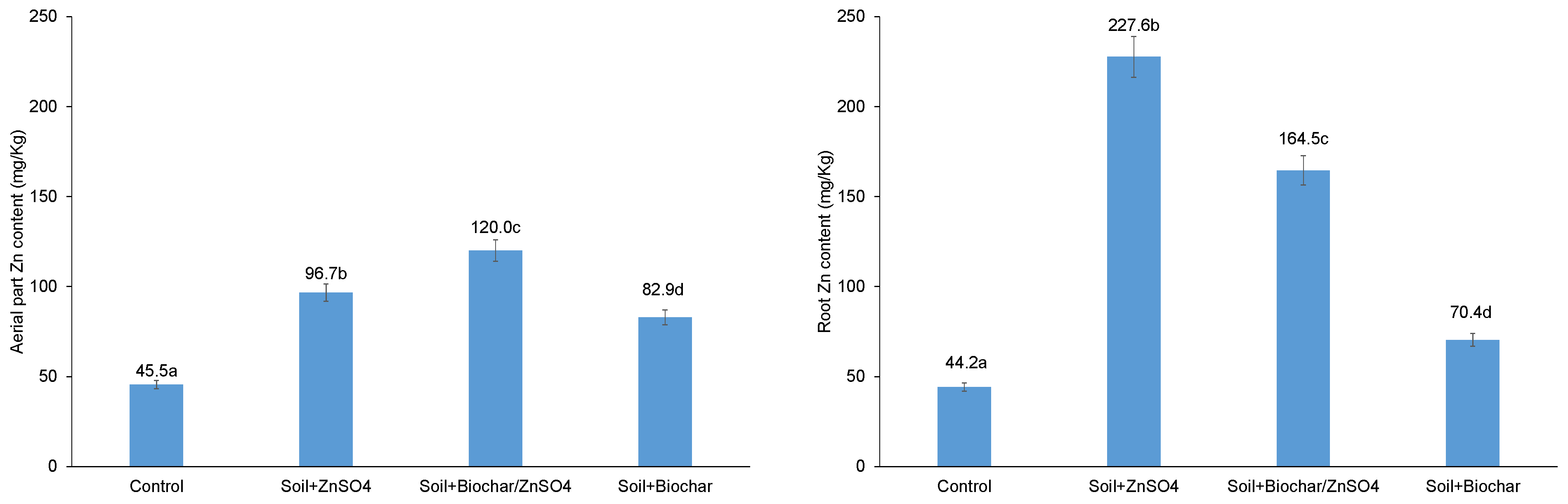
Figure 1. Zn content in aerial part and roots (error bar shows mean ± standard deviation, n = 4). Values followed by the same letter are not significantly different (p > 0.05) using the Tukey test.
Soilsystems 10 00042 g001
Figure 2. Leaf area of lettuce at the end of the experiment (error bar shows mean ± standard deviation, n = 4). Values followed by the same letter are not significantly different (p > 0.05) using the Tukey test.
Soilsystems 10 00042 g002
Figure 3. Biomass production at the end of the experiment (the error bar shows mean ± standard deviation, n = 4). Values followed by the same letter are not significantly different (p > 0.05) using the Tukey test.
Soilsystems 10 00042 g003
Table 1. Main soil properties.
PropertyValue
pH5.2
EC (µS cm−1)43
OM (%)1.2
N (%)0.07
P (mg kg−1)38.8
Ca (mg kg−1)89
Mg (mg kg−1)37
Na (mg kg−1)45
K (mg kg−1)144
Clay content (%)3.8
Sild content (%)25.6
Sand content (%)70.6
TextureSandy loam
EC: electrical conductivity. OM: oxidizable organic matter content.
Table 2. Main properties of selected biochar.
Properties
pH9.2
EC (µS cm−1, 20 °C)42
TOM (%)98.8
SBET (m2 g−1)12.14
t-plot micropore area (m2 g−1)11.61
Zn (mg kg−1)35 ± 1
Ca (mg kg−1)11,989 ± 6
Mg (mg kg−1)1913 ± 49
Na (mg kg−1)2997 ± 52
K (mg kg−1)479 ± 108
Mn (mg kg−1)376 ± 7
Pb (mg kg−1)1.7 ± 0.3
Ni (mg kg−1)10 ± 2
Co (mg kg−1)31 ± 1
Fe (mg kg−1)181 ± 29
Cu (mg kg−1)15 ± 2
Li (mg kg−1)3.6 ± 0.3
H1/3 (%)120
H15 (%)106
AW (%)14
EC: electrical conductivity. TOM: total organic matter. SBET: surface area. H1/3 (%): moisture content at 33 kPa. H15 (%): moisture content at 1500 kPa (WP). AW (%): available water.
Table 3. Main properties of soil treatments after growth of Lactuca sativa L.
Soil TreatmentpHEC
(µS cm−1)
Microbial Biomass
(mg C kg−1)
CEC
(cmolc kg−1)
H1/3
(%)
H15
(%)
AW
(%)
Control5.7 a 153.5 a1.340 a24.0 a13.3 a7.2 a6.1 a
Soil + ZnSO46.1 b89.4 b2.379 b23.2 a13.4 a7.2 a6.2 a
Soil + Biochar5.7 a58.8 a3.949 c32.0 b18.6 b12.1 b6.5 b
Soil + Biochar/ZnSO45.8 a69.4 a3.603 d28.8 b18.7 b12.2 b6.5 b
1 Values in each column followed by the same letter are not significantly different (p > 0.05) using the Tukey test. EC: electrical conductivity. CEC: cation exchange capacity. H1/3 (%): moisture content at 33 kPa. H15 (%): moisture content at 1500 kPa (WP). AW (%): available water.
Table 4. Total Zn and Zn distribution of soil treatments.
Soil TreatmentTotal Zn
(mg kg−1)
Zn (Org. Acids)
(mg kg−1)
Zn (DTPA)
(mg kg−1)
Control39.8 a 13.3 d2.5 d
Soil + ZnSO453.6 b9.6 e11.2 h
Soil + Biochar38.2 a3.3 d3.4 d
Soil + Biochar/ZnSO445.7 c6.6 f8.8 e
1 Values followed by the same letter are not significantly different (p > 0.05) using the Tukey test.
Table 5. Bioaccumulation (BAF) of different treatments.
ControlSoil + ZnSO4Soil + BiocharSoil + Biochar/ZnSO4
BAFroots1.1 a 14.2 d3.6 c1.8 b
BAFaerial1.1 a1.8 b2.6 d2.2 c
1 Values in each row followed by the same letter are not significantly different (p > 0.05) using the Tukey test.
Table 6. Total chlorophyll, chlorophyll a, b, and carotenoid content of lettuces grown with different soil treatments.
Soil TreatmentTotal Chlorophyll
(mg·g−1)
Chlorophyll a
(mg·g−1)
Chlorophyll b
(mg·g−1)
Carotenoids
(mg·g−1)
Control2.78 a 11.59 a1.19 ab0.39 a
Soil + ZnSO43.73 b2.33 b1.40 b0.62 b
Soil + Biochar/ZnSO43.32 ab2.36 b0.95 a0.67 b
Soil + Biochar3.31 ab2.27 b1.04 a0.61 b
1 Values in each column followed by the same letter are not significantly different (p > 0.05) using the Tukey test.
Disclaimer/Publisher’s Note: The statements, opinions and data contained in all publications are solely those of the individual author(s) and contributor(s) and not of MDPI and/or the editor(s). MDPI and/or the editor(s) disclaim responsibility for any injury to people or property resulting from any ideas, methods, instructions or products referred to in the content.