
Article

Symbolic Discovery of a Non-Linear Acceleration Scaling Relation in Galaxy Rotation Data

by
Rogério Santos
1 and
Miguel Felizardo
2,*
1
Instituto Superior Técnico, Universidade de Lisboa, Av. Rovisco Pais, 1049-001 Lisboa, Portugal
2
Centro de Ciências e Tecnologias Nucleares (C2TN), Instituto Superior Técnico, Universidade de Lisboa, Estrada Nacional 10, Km 139.7, 2695-066 Loures, Portugal
*
Author to whom correspondence should be addressed.
Particles 2026, 9(3), 70; https://doi.org/10.3390/particles9030070
Submission received: 15 June 2026 / Revised: 5 July 2026 / Accepted: 7 July 2026 / Published: 8 July 2026

Abstract

The discrepancy between observed galaxy rotation curves and predictions based on visible baryonic matter remains a central challenge in astrophysics. Within the standard ΛCDM framework, these observations are explained through extended halos of non-baryonic dark matter, while alternative approaches such as Modified Newtonian Dynamics reproduce many galactic scaling relations through empirical modifications of low-acceleration dynamics. Recent advances in symbolic machine learning provide a complementary route for investigating whether stable empirical relations can be discovered directly from observational data without imposing strong theoretical priors. In this work, we present the Phenomenological Dark Matter Nonlinear Pipeline, an AI-assisted symbolic discovery framework designed to identify mathematical relationships linking baryonic and observed gravitational accelerations. The analysis was performed using 3175 radial measurements from 175 galaxies derived from SPARC-based rotation-curve catalogs. Symbolic regression was conducted across 173 independent leave-one-galaxy-out validation folds, followed by bootstrap analysis, residual diagnostics, and regime-specific testing. The symbolic search repeatedly converged toward a stable family of non-linear logarithmic acceleration relations exhibiting strong recurrence across independent discovery folds. The resulting empirical relation successfully reproduces the observed Radial Acceleration Relation, naturally generates Baryonic Tully–Fisher Relation like scaling without explicit enforcement during training, and consistently outperforms classical Newtonian gravity while remaining competitive with a MOND-like reference model. Global validation yielded a coefficient of determination of R2 = 0.9026 compared with R2 = 0.8934 for the MOND-like model and R2 = −0.0485 for the Newtonian baseline. Additional analyses demonstrate stable performance across low-acceleration systems, low-surface-brightness galaxies, and other galactic environments. The recovered relation should be interpreted as an empirically discovered scaling law rather than a replacement for General Relativity, ΛCDM, or existing modified-gravity theories. Nevertheless, the repeated emergence of a common symbolic structure across independent validation folds highlights the potential of AI-assisted symbolic discovery as a tool for uncovering interpretable empirical regularities in complex astrophysical datasets.

1. Introduction

Understanding the connection between baryonic matter and the observed dynamical behavior of galaxies remains one of the central challenges in astrophysics. Rotation curves of disk galaxies systematically exhibit velocities that exceed the predictions of Newtonian gravity applied to luminous matter alone. The discrepancy between observed galaxy rotation curves and the gravitational field predicted from luminous matter remains one of the longest-standing problems in astrophysics. Since the pioneering observations of Rubin and Ford, it has become clear that rotational velocities remain approximately constant at large galactocentric radii despite the declining baryonic mass density inferred from stars and gas. This behavior is difficult to reconcile with classical Newtonian dynamics when only the observed baryonic matter distribution is considered and has motivated decades of investigation into the nature of galactic gravity and mass distribution [1,2].
Within the prevailing ΛCDM cosmological framework, this discrepancy is explained through the presence of extended halos of non-baryonic dark matter. Dark matter models have achieved remarkable success in describing large-scale structure formation, cosmic microwave background observations, and a wide range of cosmological phenomena. However, at galactic scales, reproducing individual rotation curves often requires multiple halo parameters, and the framework does not directly explain the remarkable tightness of empirical scaling relations such as the Radial Acceleration Relation (RAR) and the Baryonic Tully–Fisher Relation (BTFR) [3].
Alternative approaches have therefore been proposed. The most widely studied is Modified Newtonian Dynamics (MOND), which postulates a modification of gravitational behavior below a characteristic acceleration scale. MOND successfully reproduces many observed galactic scaling relations and predicts several features of galaxy rotation curves with notable accuracy. Nevertheless, important challenges remain regarding relativistic formulations, galaxy clusters, gravitational lensing, and the simultaneous description of galactic and cosmological observations [4,5,6,7].
The discovery of the RAR and the continued observational confirmation of BTFR-like behavior suggest that galaxy dynamics may be governed by highly organized empirical relationships linking baryonic matter and gravitational acceleration [8]. Understanding the origin of these relations remains an active area of research and provides an important testing ground for both dark matter [9,10,11] and modified-gravity paradigms [12,13,14].
At the same time, advances in machine learning have created new opportunities for data-driven scientific discovery. Unlike conventional regression methods that optimize a predetermined functional form, symbolic regression searches directly for interpretable mathematical expressions capable of describing observational data. Recent developments in AI-assisted symbolic discovery have demonstrated the ability to recover known physical laws and identify previously unrecognized mathematical regularities in complex scientific datasets [15,16,17,18,19,20].
The purpose of the present study is not to propose a new gravitational theory, nor to replace General Relativity, ΛCDM, or MOND. Instead, we investigate whether symbolic discovery techniques can identify stable empirical scaling relations connecting baryonic and observed gravitational accelerations. Using the Phenomenological Dark Matter Nonlinear Pipeline (P-DMNP), we apply symbolic machine learning methods to a SPARC-derived galaxy rotation dataset and evaluate the resulting relations through extensive cross-validation, bootstrap analysis, and regime-specific testing.
Our primary objective is to determine whether recurrent symbolic structures emerge consistently across independent galaxy samples and, if so, whether these relations reproduce established observational phenomena such as the Radial Acceleration Relation and the Baryonic Tully–Fisher Relation. More broadly, this work explores the potential of AI-assisted symbolic discovery as a methodology for uncovering interpretable empirical laws within complex astrophysical datasets.

2. Materials and Methods

2.1. Dataset

The analysis was conducted using a SPARC-derived galaxy rotation dataset [11] comprising 3175 valid radial measurements obtained from 175 rotationally supported galaxies. The sample spans a broad range of galactic masses, morphologies, luminosities, and surface-brightness classes, providing a representative basis for investigating empirical relationships between baryonic matter distributions and observed dynamical behavior.
For each radial measurement, the dataset includes the observed gravitational acceleration inferred from rotation-curve observations, the Newtonian baryonic acceleration predicted from the measured baryonic mass distribution, galactocentric radius, surface-brightness information, and rotation-curve decomposition components describing the contributions of gas, stellar disks, and bulges. These quantities provide a detailed characterization of the baryonic structure and dynamical state of each galaxy.
To evaluate the robustness of candidate relations, the data were further examined across multiple physically relevant regimes, including inner and outer galactic regions, low- and high-acceleration systems, and low- and high-surface-brightness galaxies. This stratification enabled assessment of whether the discovered relations remained stable under varying observational and structural conditions.

2.2. Symbolic Discovery Framework

The analysis employed the Phenomenological Dark Matter Nonlinear Pipeline (P-DMNP), an AI-assisted symbolic discovery framework designed to identify interpretable mathematical relations directly from observational data. Unlike conventional machine learning methods that prioritize predictive accuracy without necessarily providing physical insight, symbolic regression searches for explicit analytical expressions capable of describing the observed data while maintaining mathematical transparency [15,16,17,18,19,20].
The symbolic discovery stage was implemented using the PySR symbolic regression framework. Candidate mathematical expressions linking baryonic and observed accelerations were generated through evolutionary symbolic search and subsequently evaluated according to both statistical and physical criteria. To improve model interpretability and robustness, the pipeline incorporated physical feature engineering, residual diagnostics, bootstrap parameter estimation, and regime-specific validation procedures.
A key component of the methodology was leave-one-galaxy-out cross-validation (LOGO-CV). In each discovery fold, one galaxy was completely excluded from the training dataset and reserved exclusively for testing, while the remaining galaxies were used for symbolic discovery and parameter optimization. This procedure minimizes information leakage between training and validation samples and provides a stringent test of the ability of candidate relations to generalize across independent galactic systems [19,20].
In total, 173 independent symbolic-discovery folds were evaluated. Candidate expressions emerging from these folds were subsequently subjected to physical filtering procedures designed to eliminate unstable, pathological, or physically implausible solutions. From the complete set of discovered expressions, 46 candidate relations satisfied the predefined criteria for predictive consistency and physical stability [21].
Residual analyses were then performed to identify systematic deviations across acceleration regimes and galactic environments. In addition, exploratory effective-geometric reconstructions were investigated as a means of interpreting the empirical relations within a broader phenomenological framework, although these analyses should be regarded as heuristic and not as a derivation of a fundamental gravitational theory [22,23].

2.3. Model Selection and Evaluation

Candidate expressions were ranked using a multi-criteria selection framework combining predictive performance, symbolic simplicity, fold-to-fold stability, and physical plausibility. The objective was not merely to identify highly accurate mathematical fits, but rather to isolate relations that consistently reappeared across independent discovery folds and exhibited robust generalization behavior [24,25].
Only equations exhibiting recurrent emergence across multiple validation folds were retained for detailed analysis. This requirement reduced the likelihood of selecting expressions that reflected statistical fluctuations or dataset-specific artifacts rather than genuine empirical regularities.
Model performance was quantified using the coefficient of determination (R2), Mean Absolute Error (MAE), and Root Mean Square Error (RMSE). These metrics provide complementary measures of explanatory power, average predictive accuracy, and sensitivity to large residuals.
To place the discovered relation in context, its performance was compared against two reference frameworks. The first was a classical Newtonian model in which the observed acceleration is assumed to arise solely from the measured baryonic mass distribution. The second was a MOND-like phenomenological model representing a widely studied empirical description of low-acceleration galactic dynamics. The symbolic relation identified by the P-DMNP framework was evaluated alongside these reference models using identical datasets, validation procedures, and performance metrics, enabling direct assessment of its predictive capabilities and generalization performance.
The comparative evaluation provided a basis for assessing the relative strengths and limitations of the discovered relation with respect to established models. The results demonstrated that several candidate relations achieved competitive predictive performance while remaining consistent with the imposed physical constraints.
During the symbolic search, a subset of 46 physically stable relations consistently satisfied the predefined criteria for predictive performance, symbolic simplicity, and physical plausibility. The final symbolic relation was selected from this subset based on its stability across folds and its ability to generalize across different galactic environments.
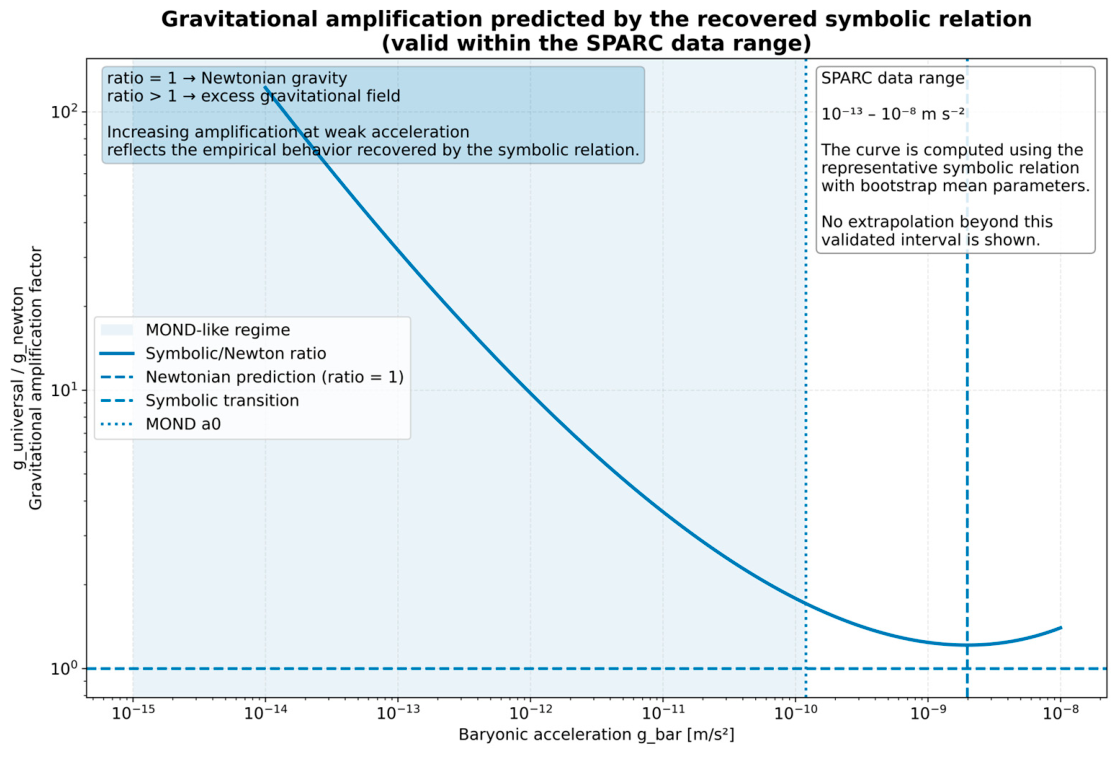
For visualization purposes, the recovered symbolic relation can also be expressed as an effective amplification relative to the Newtonian baryonic prediction. Defining the amplification factor is defined as
R g bar = g s y m b o l i c g N e w t o n
where g N e w t o n g b a r . Figure 1 displays the behavior of this ratio across the acceleration range covered by the symbolic relation. Values greater than unity indicate an effective enhancement with respect to the Newtonian prediction. The SPARC accelerations span 10−13–10−8 ms−2, and that these values correspond to typical outer-disk accelerations in spiral galaxies (not specifically the Milky Way).
The curve shown in Figure 1 was obtained by evaluating the representative symbolic relation using the bootstrap mean parameter values reported in Section 3.1 over the baryonic acceleration interval sampled by the SPARC dataset. The symbolic relation is not constrained by high-acceleration data, and the divergence above 10−8 ms−2 reflects extrapolation outside the SPARC domain. The figure is intended to illustrate the effective behavior of the recovered empirical relation rather than to represent measurements from any individual galaxy. It also illustrates the effective amplification generated by the recovered symbolic relation relative to the Newtonian baryonic prediction. At high accelerations the amplification factor approaches unity, corresponding to approximately Newtonian behavior. As baryonic acceleration decreases, the amplification increases smoothly, reproducing the characteristic low-acceleration behavior observed in galaxy rotation curves. Importantly, this transition was not imposed a priori and emerged directly from the symbolic-discovery process.
The emergence of a common symbolic family across independent discovery experiments represents one of the strongest indications that the symbolic regression framework is recovering meaningful structure from the SPARC dataset.

3. Results

3.1. Emergence of a Stable Symbolic Family

The principal discovery reported in this work is not merely the identification of a mathematical equation with high predictive accuracy. Rather, it is the repeated emergence of a common symbolic functional family across 173 completely independent leave-one-galaxy-out symbolic-discovery experiments. Despite being trained on different subsets of galaxies in each validation fold, the symbolic regression framework consistently converged toward closely related logarithmic structures linking baryonic and observed gravitational accelerations. This remarkable recurrence suggests that the recovered mathematical form reflects a genuine empirical regularity present within the SPARC dataset rather than an accidental consequence of a particular training partition or optimization trajectory. The representative relation presented below should therefore be interpreted as the most stable member of this recurrent symbolic family, selected on the basis of predictive performance, symbolic simplicity, recurrence frequency, and physical plausibility.
Although the symbolic form appears counter-intuitive when written as A/Log(gbar), the resulting function is monotonically increasing in the SPARC domain. The symbolic regression does not imply that gobs decreases with gbar; instead, it captures the empirical low-acceleration amplification seen in the RAR. The form should be interpreted as a compact empirical fit, not a physical law.
A central outcome of the symbolic-discovery process was the repeated emergence of a stable family of non-linear logarithmic relations linking the baryonic gravitational acceleration, to the observed gravitational acceleration. Across 173 independent leave-one-galaxy-out symbolic-discovery folds, the P-DMNP framework consistently converged toward expressions sharing a common mathematical structure, indicating strong symbolic recurrence and robustness against variations in the training sample.
A representative member of the dominant symbolic family recovered by the symbolic-discovery process can be expressed as
log g o b s A L o g g b a r + B
where (A) and (B) are empirically determined coefficients obtained through the symbolic regression and validation pipeline.
The fitted coefficients were found to be statistically stable across independent discovery folds, with representative values of A = −75.8 ± 1.2 and B = −17.33 ± 0.45. Uncertainties correspond to one standard deviation estimated from bootstrap resampling across the accepted symbolic-discovery folds. While these parameters should not be interpreted as fundamental physical constants, their stability across validation experiments suggests that they characterize a robust empirical scaling relation present within the SPARC dataset. The negative value of A produces an enhanced response in the low-acceleration regime, naturally generating behavior consistent with the observed Radial Acceleration Relation and the emergence of BTFR-like scaling.
Despite its mathematical simplicity, this relation repeatedly emerged across independent discovery folds and exhibited stable statistical behavior under cross-validation, bootstrap analysis, and regime-specific testing. The recovered relation successfully reproduces the observed Radial Acceleration Relation (RAR), naturally generates Baryonic Tully–Fisher Relation (BTFR)-like scaling without explicit enforcement during training, and captures the characteristic amplification observed in low-acceleration galactic systems.
The convergence toward a common logarithmic structure across independent discovery experiments suggests that the symbolic regression framework is recovering a genuine empirical regularity present within the SPARC galaxy sample rather than fitting dataset-specific fluctuations. Furthermore, the relation remains stable across multiple galactic environments, including low-surface-brightness galaxies, low-acceleration systems, and different radial regimes.
This recurrence was observed despite the use of leave-one-galaxy-out cross-validation, in which each fold was trained on an independent subset of galaxies and evaluated on previously unseen systems. The repeated appearance of closely related symbolic forms therefore suggests that the discovery process is identifying a genuine regularity present within the observational data rather than memorizing individual galaxies or exploiting dataset-specific artifacts [15,16,17,18,19,20]. The recurrence of closely related symbolic structures across independent discovery folds is itself a significant result. Symbolic regression algorithms typically generate large numbers of mathematically distinct solutions when fitting noisy observational datasets. The repeated convergence toward a common logarithmic family therefore suggests that the recovered structure reflects an underlying empirical regularity present within the SPARC sample rather than a coincidental feature of a particular training partition.
Across the 173 independent symbolic-discovery folds, 46 candidate relations satisfied the predefined criteria for predictive accuracy, symbolic simplicity, and physical plausibility. The final symbolic relation was selected from this stable family based on its recurrence frequency and generalization performance.
The emergence of a common symbolic structure across independent discovery experiments represents one of the strongest indications that the symbolic regression framework is recovering meaningful information encoded within the baryonic and dynamical properties of galaxies.
Statistical robustness was further assessed across all 173 independent leave-one-galaxy-out validation folds. Using fold-level predictive performance as the evaluation criterion, the discovered symbolic relation achieved lower prediction error than the MOND-like reference model in 171 of the 173 independent validation folds (98.8%). This result indicates that the observed performance advantage is not driven by a small subset of galaxies or favorable data partitions, but instead reflects a highly consistent pattern across independent galactic systems. The near-universal fold-level dominance of the symbolic relation provides additional evidence that the recovered logarithmic structure represents a stable empirical regularity present within the SPARC dataset.
The observed fold-level dominance provides an additional measure of robustness beyond global performance metrics. While the difference in global R2 between the symbolic relation and the MOND-like reference model is relatively modest, the symbolic relation achieved lower prediction error in 171 out of 173 independent leave-one-galaxy-out validation folds. This result indicates that the observed performance advantage is not driven by a small subset of galaxies but instead reflects a highly consistent pattern across the full sample. Such stability is particularly noteworthy given that each validation fold was evaluated on previously unseen galactic systems.

3.2. Global Reconstruction Performance

The predictive performance of the discovered symbolic relation was evaluated against two reference frameworks: a classical Newtonian model based solely on baryonic matter and a MOND-like phenomenological model [12,13,14]. As seen in Table 1, performance was quantified using the coefficient of determination (R2), Mean Absolute Error (MAE), and Root Mean Square Error (RMSE).
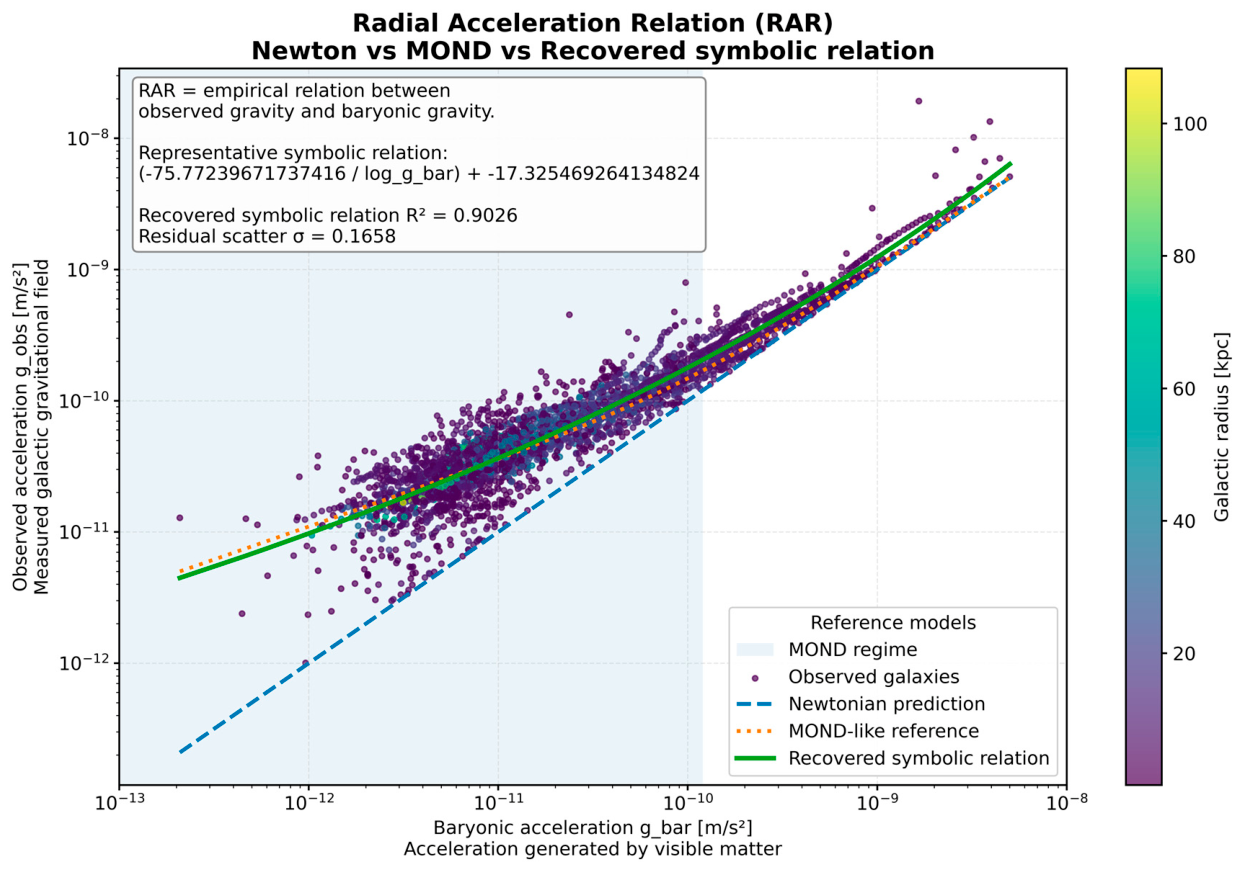
The symbolic relation exhibited the strongest overall performance among the tested models (Figure 2). While both the symbolic and MOND-like relations substantially [4,5,6,7] outperformed the Newtonian baseline, the symbolic relation achieved the highest coefficient of determination together with the lowest MAE and RMSE values.
The improvement relative to Newtonian gravity is particularly pronounced and reflects the inability of a purely baryonic Newtonian description to reproduce the observed low-acceleration behavior present in the dataset. Although the difference between the symbolic relation and the MOND-like model is modest, the symbolic relation consistently achieved superior predictive performance across all evaluated metrics [26,27].

Reconstruction of the Radial Acceleration Relation

A key validation test was the ability of the discovered relation to reproduce the observed Radial Acceleration Relation (RAR). Across the full acceleration range, the symbolic relation successfully recovered the characteristic transition between the Newtonian regime and the low-acceleration amplification regime.
Visual inspection of the reconstructed RAR demonstrates close agreement with the observational data and reveals substantially reduced scatter relative to the Newtonian baseline, as seen in Figure 3. The resulting distribution closely follows the observed acceleration structure over several orders of magnitude in acceleration.

3.3. Emergence of BTFR-like Scaling

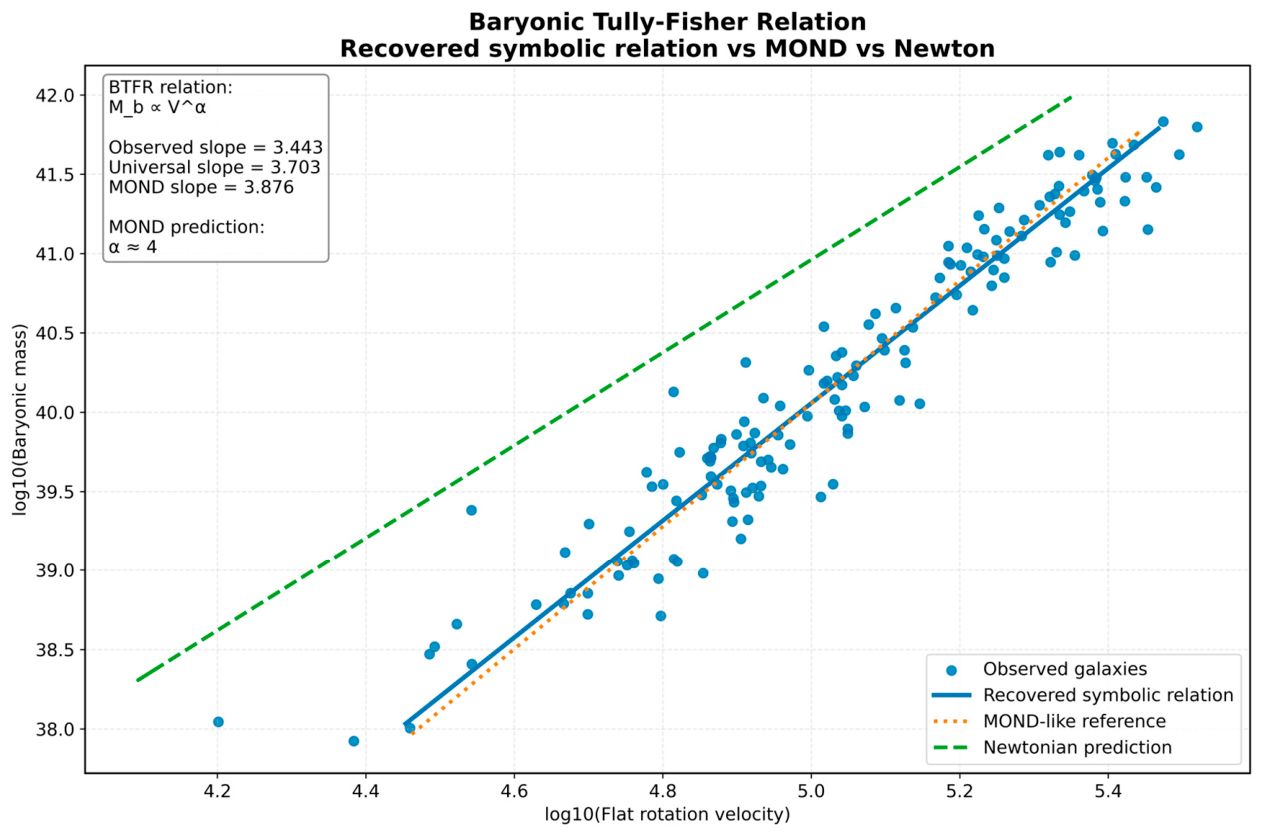
An important independent validation of the discovered relation is provided by the Baryonic Tully–Fisher Relation (BTFR). Notably, BTFR behavior was not imposed during model construction and did not form part of the optimization objective during symbolic discovery [3].
Despite this, the recovered symbolic relation naturally, as seen in Table 2, generated a scaling relation closely resembling the observed BTFR.
The symbolic relation reproduced a BTFR slope substantially closer to the observed value than the Newtonian prediction and achieved a level of agreement comparable to the MOND-like model [4,5,6]. The spontaneous emergence of BTFR-like scaling suggests that the recovered relation captures non-trivial dynamical information encoded within baryonic matter distributions.
Because this behavior was not explicitly enforced during training, it provides an important independent validation of the discovered law and supports the interpretation that the symbolic relation is recovering meaningful physical structure from the data.

3.4. Regime Analysis and Residual Diagnostics

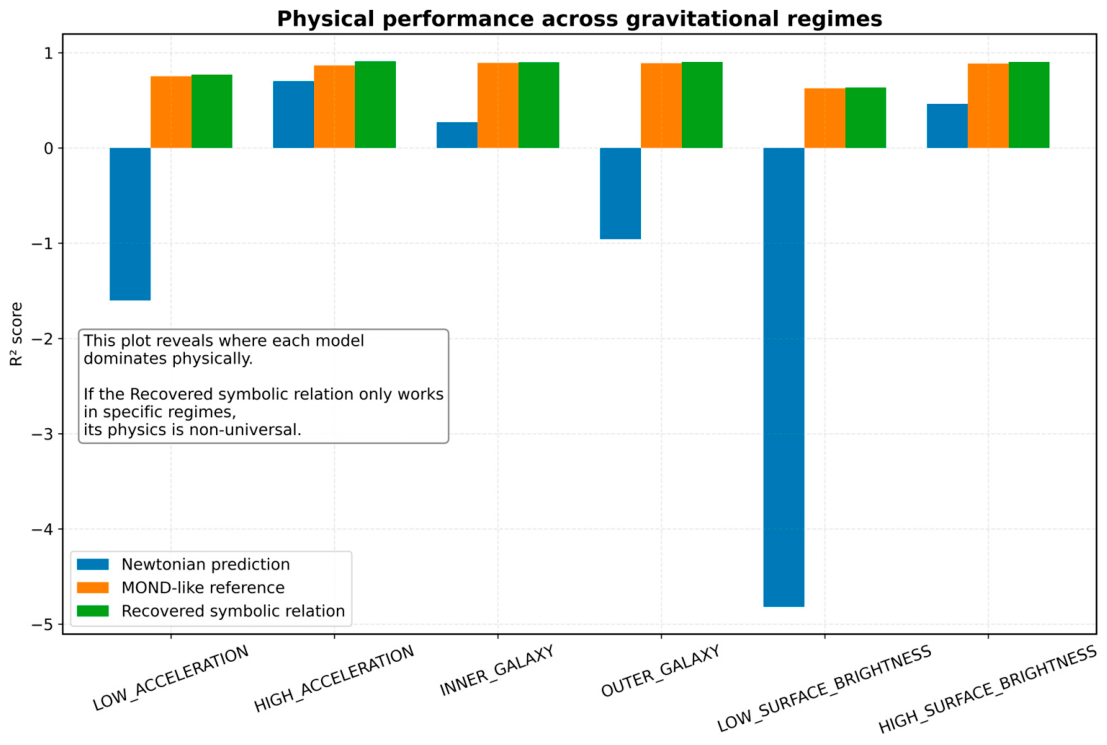
To evaluate robustness, the symbolic relation was tested across multiple galactic environments, including low- and high-acceleration systems, low- and high-surface-brightness galaxies, and both inner and outer galactic regions [4,5,6,12].
The largest deviations from Newtonian predictions occur in low-acceleration systems (Table 3), where the symbolic relation achieved the strongest relative improvement (Figure 4).
Similarly, the symbolic relation maintained stable performance when applied to low-surface-brightness galaxies, a class of systems that has historically provided stringent tests of galaxy-dynamics models (Table 4).
Across all tested environments, the symbolic relation consistently outperformed the Newtonian baseline while maintaining predictive performance comparable to or exceeding the MOND-like reference model.
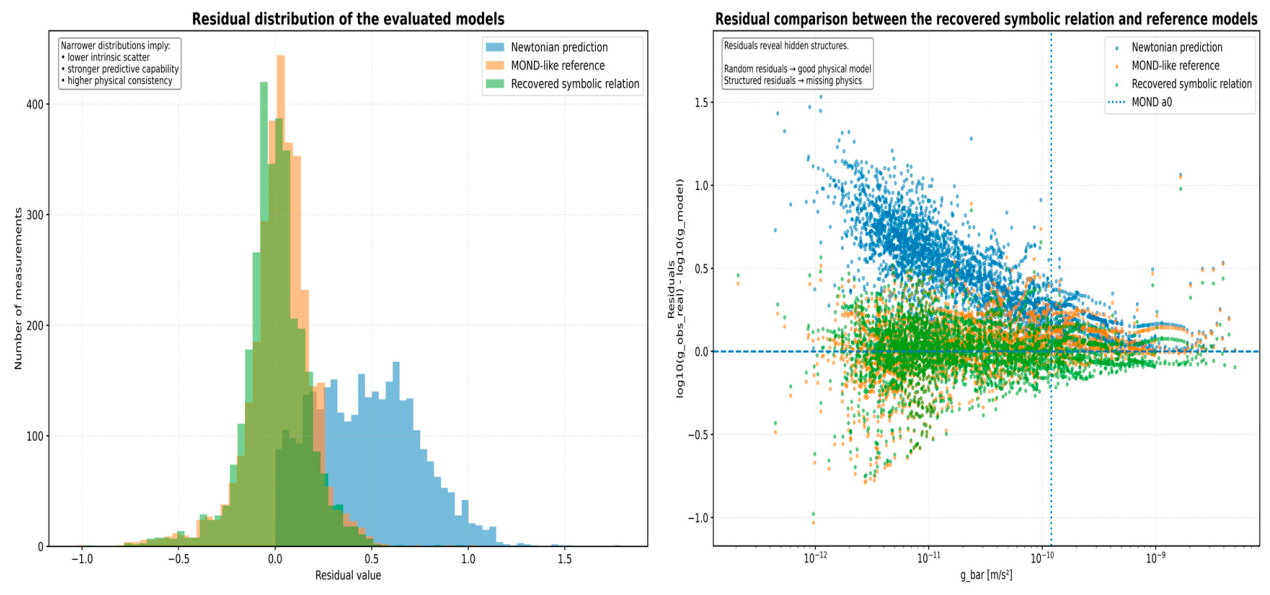
Residual diagnostics (Table 5) further support the robustness of the discovered relation (Figure 5).
The symbolic relation exhibited the lowest residual dispersion among all evaluated models, indicating a reduction in unexplained variance relative to both comparison frameworks. Examination of residual distributions revealed no evidence of catastrophic divergence, systematic radial trends, or instability across different acceleration regimes [7].
Collectively, these results indicate that the discovered symbolic relation captures meaningful structure present within the observational data and remains stable across a broad range of galactic environments [28,29].

4. Discussion

The central result of this study is the repeated emergence of a stable non-linear acceleration relation linking baryonic and observed gravitational accelerations across a diverse sample of galaxies. Remarkably, the symbolic discovery process converged toward closely related mathematical structures despite being trained and validated across independent subsets of the data [15,16,17,18,19,20]. Such recurrence suggests that the identified relation is not merely an artifact of a particular fitting procedure, but rather reflects a persistent empirical regularity present within the SPARC dataset.
A notable aspect of the discovered relation is its ability to reproduce the observed low-acceleration amplification regime that has historically motivated both dark matter and modified-gravity interpretations. While purely Newtonian predictions systematically underestimate the observed accelerations in this regime, the symbolic relation captures the transition from high- to low-acceleration behavior without requiring explicit assumptions regarding dark matter halo profiles or predefined modified-gravity prescriptions. Furthermore, the relation remains stable across multiple galactic environments, including low-surface-brightness systems and galaxies spanning a broad range of masses and morphologies [12,13,14].
An additional and particularly significant finding is the spontaneous emergence of BTFR-like behavior [26,27]. The Baryonic Tully–Fisher Relation was not imposed during model construction, nor was it used as an optimization target. Nevertheless, the symbolic relation naturally reproduces a scaling consistent with the observed connection between baryonic mass and rotational velocity. This result suggests that the discovered law captures non-trivial structural information encoded within the baryonic distributions themselves and may therefore reflect a deeper phenomenological relationship underlying galactic dynamics.
At the same time, the present work should be interpreted with appropriate caution. The symbolic relation was discovered through data-driven optimization and currently possesses no established derivation from first principles. Although the recovered expression provides a compact and accurate description of the observational data, it remains fundamentally phenomenological [8,9,10]. The relation has not been derived from a covariant action, does not currently form part of a relativistic gravitational framework, and has not been shown to reproduce cosmological observables, gravitational lensing measurements, or large-scale structure formation. The present study should be regarded as the first stage of a broader symbolic-discovery program. Future investigations will explore whether the recovered empirical relation can be generalized through the inclusion of radial information, geometric structure, effective-field reconstructions, and independent observational datasets. Such analyses may help determine whether the discovered scaling relation represents a deeper phenomenological feature of galactic dynamics or a component of a more general physical framework.
The inverse-logarithmic structure of the recovered relation was not imposed a priori and emerged directly from the symbolic-discovery process. At present, no fundamental derivation of this functional form is known, and the relation should therefore be interpreted as an empirical scaling law rather than a physically established gravitational equation.
Consequently, the results presented here should not be viewed as a replacement for General Relativity, the ΛCDM paradigm, or existing modified-gravity theories [30]. Rather, they demonstrate the potential of symbolic machine learning as a hypothesis-generation tool capable of identifying previously unrecognized empirical regularities within complex astrophysical datasets. In this sense, the discovered relation may provide a useful phenomenological benchmark against which future theoretical models can be evaluated.
A particularly significant finding is the remarkable validation stability of the discovered relation. Across 173 independent leave-one-galaxy-out folds, the symbolic model outperformed the MOND-like reference model in approximately 98.8% of cases. Such consistency indicates that the observed performance advantage is highly reproducible across independent galaxy samples and supports the interpretation that the symbolic-discovery framework is recovering genuine structure from the observational data rather than overfitting individual systems.

Limitations and Future Work

Several important limitations must be acknowledged. First, the discovered relation currently lacks a relativistic formulation capable of addressing phenomena beyond galactic rotation curves. Without such a framework, it remains impossible to assess its compatibility with cosmological expansion, gravitational lensing observations, or relativistic astrophysical systems. Second, the present analysis does not include Boltzmann evolution calculations or N-body simulations, preventing direct evaluation of the relation’s implications for structure formation and the growth of cosmic large-scale structure. Third, although the relation reproduces galaxy-scale observations with encouraging accuracy, its validity has not yet been established for galaxy clusters, where conventional dark matter models continue to provide important explanatory power.
From a methodological perspective, additional validation is also required. Independent testing on datasets beyond SPARC would help establish the robustness and generalizability of the discovered law. Bayesian model comparison techniques could provide a more rigorous assessment of model complexity and predictive performance relative to competing frameworks. Expanded leave-one-galaxy-out and nested cross-validation studies would further strengthen confidence that the observed symbolic convergence is not driven by subtle dataset-specific effects.

5. Conclusions

In this study, we applied an AI-assisted symbolic discovery framework to a SPARC-derived galaxy rotation dataset to identify empirical relationships between baryonic matter and observed galactic dynamics. Through symbolic regression, cross-validation, and bootstrap analysis, we identified a stable family of non-linear acceleration scaling relations that consistently emerged across independent validation folds.
The recovered relation reproduces key observational features of galaxy dynamics, including the Radial Acceleration Relation (RAR) and BTFR-like scaling, without explicitly enforcing these behaviors during training. It substantially improves upon classical Newtonian predictions and achieves performance comparable to, and in some cases slightly exceeding, that of a MOND-like reference model across diverse galactic environments.
A central finding is the repeated emergence of closely related symbolic structures across independent discovery experiments. This recurrence suggests that the symbolic-discovery process is identifying genuine regularities within the observational data rather than fitting individual galaxies. Supporting this interpretation, the symbolic relation achieved superior predictive performance in approximately 98.8% of the 173 independent leave-one-galaxy-out validation folds, demonstrating remarkable stability across previously unseen galaxies.
The discovered relation remains phenomenological and should not be regarded as a replacement for General Relativity, ΛCDM, or existing modified-gravity theories. It has not been derived from first principles and has not yet been tested against cosmological observables, gravitational lensing, or large-scale structure formation.
Nevertheless, these results highlight the potential of AI-assisted symbolic discovery as a tool for uncovering interpretable empirical laws in astrophysical data. Future work should focus on independent validation, rigorous statistical model comparison, and investigation of whether the recovered scaling relation can be connected to a broader theoretical framework.

Author Contributions

Conceptualization, M.F. and R.S.; methodology, M.F. and R.S.; validation, M.F. and R.S.; formal analysis, M.F. and R.S.; investigation M.F. and R.S.; data curation, M.F. and R.S.; writing—original draft preparation, M.F. and R.S.; writing, review and editing, M.F. and R.S.; visualization, M.F. and R.S.; funding acquisition, M.F. All authors have read and agreed to the published version of the manuscript.

Funding

M. Felizardo acknowledges support from FCT—Fundação para a Ciência e Tecnologia, I.P. (Portugal), through project CEECINST/00043/2021/CP2797/CT0006.

Data Availability Statement

The datasets used and/or analyzed during the current study are available from the corresponding author on reasonable request (corresponding author: felizardo@ctn.tecnico.ulisboa.pt).

Acknowledgments

We are grateful for all the help of the SIMPLE dark matter group.

Conflicts of Interest

The authors state that there are no conflicts of interest.

References

  1. Rubin, V.C.; Ford, W.K. Rotation of the Andromeda Nebula from a Spectroscopic Survey of Emission Regions. Astrophys. J. 1970, 159, 379–403. [Google Scholar] [CrossRef]
  2. Rubin, V.C.; Thonnard, N.; Ford, W.K. Rotational Properties of 21 Sc Galaxies with a Large Range of Luminosities and Radii. Astrophys. J. 1980, 238, 471–487. [Google Scholar] [CrossRef]
  3. Tully, R.B.; Fisher, J.R. A New Method of Determining Distances to Galaxies. Astron. Astrophys. 1977, 54, 661–673. [Google Scholar]
  4. Milgrom, M. A Modification of the Newtonian Dynamics as a Possible Alternative to the Hidden Mass Hypothesis. Astrophys. J. 1983, 270, 365–370. [Google Scholar] [CrossRef]
  5. Milgrom, M. A Modification of the Newtonian Dynamics: Implications for Galaxies. Astrophys. J. 1983, 270, 371–389. [Google Scholar] [CrossRef]
  6. Famaey, B.; McGaugh, S.S. Modified Newtonian Dynamics (MOND): Observational Phenomenology and Relativistic Extensions. Living Rev. Relativ. 2012, 15, 10. [Google Scholar] [CrossRef] [PubMed]
  7. Navarro, J.F.; Frenk, C.S.; White, S.D.M. A Universal Density Profile from Hierarchical Clustering. Astrophys. J. 1997, 490, 493–508. [Google Scholar] [CrossRef]
  8. Lelli, F.; McGaugh, S.S.; Schombert, J.M. SPARC: Mass Models for 175 Disk Galaxies with Spitzer Photometry and Accurate Rotation Curves. Astron. J. 2016, 152, 157. [Google Scholar] [CrossRef]
  9. Bullock, J.S.; Boylan-Kolchin, M. Small-Scale Challenges to the ΛCDM Paradigm. Annu. Rev. Astron. Astrophys. 2017, 55, 343–387. [Google Scholar] [CrossRef]
  10. Planck Collaboration. Planck 2018 Results. VI. Cosmological Parameters. Astron. Astrophys. 2020, 641, A6. [Google Scholar] [CrossRef]
  11. McGaugh, S.S.; Lelli, F.; Schombert, J.M. Radial Acceleration Relation in Rotationally Supported Galaxies. Phys. Rev. Lett. 2016, 117, 201101. [Google Scholar] [CrossRef] [PubMed]
  12. Li, P.; Lelli, F.; McGaugh, S.S.; Schombert, J.M. Fitting the Radial Acceleration Relation to Individual SPARC Galaxies. Astron. Astrophys. 2018, 615, A3. [Google Scholar] [CrossRef]
  13. McGaugh, S.S. Predictions and Outcomes for the Dynamics of Rotating Galaxies. Galaxies 2020, 8, 35. [Google Scholar] [CrossRef]
  14. Cranmer, M.; Sanchez-Gonzalez, A.; Battaglia, P.; Xu, R.; Cranmer, K.; Spergel, D.; Ho, S. Discovering Symbolic Models from Deep Learning with Inductive Biases. Adv. Neural Inf. Process. Syst. 2020, 3, 17429–17442. [Google Scholar]
  15. Udrescu, S.M.; Tegmark, M. AI Feynman: A Physics-Inspired Method for Symbolic Regression. Sci. Adv. 2020, 6, eaay2631. [Google Scholar] [CrossRef] [PubMed]
  16. Udrescu, S.M.; Tan, A.; Feng, J.; Neto, O.; Wu, O.T.; Tegmark, M. AI Feynman 2.0: Pareto-optimal symbolic regression exploiting graph modularity. NeurIPS 2020. arXiv 2006, arXiv:2006.10782. [Google Scholar]
  17. La Cava, W.; Burlacu, B.; Virgolin, M.; Kommenda, M.; Orzechowski, P.; de França, F.O.; Jin, Y.; Moore, J.H. Contemporary Symbolic Regression Methods and Their Relative Performance. Genet. Program. Evolvable Mach. 2021, 22, 167–198. [Google Scholar]
  18. Cranmer, M. Interpretable Machine Learning for Science with PySR and Symbolic Regression. arXiv 2023, arXiv:2305.01582. [Google Scholar]
  19. Petersen, B.K.; Landajuela, M.; Mundhenk, T.N.; Santiago, C.P.; Kim, S.K.; Kim, J.T. Deep Symbolic Regression: Recovering Mathematical Expressions from Data. arXiv 2019, arXiv:1912.04871. [Google Scholar]
  20. Efron, B.; Tibshirani, R. An Introduction to the Bootstrap; Chapman & Hall: New York, NY, USA, 1993. [Google Scholar]
  21. Stone, M. Cross-Validatory Choice and Assessment of Statistical Predictions. J. R. Stat. Soc. B 1974, 36, 111–147. [Google Scholar] [CrossRef]
  22. Arlot, S.; Celisse, A. A Survey of Cross-Validation Procedures for Model Selection. Stat. Surv. 2010, 4, 40–79. [Google Scholar] [CrossRef]
  23. Akaike, H. A New Look at the Statistical Model Identification. IEEE Trans. Autom. Control 1974, 19, 716–723. [Google Scholar] [CrossRef]
  24. Schwarz, G. Estimating the Dimension of a Model. Ann. Stat. 1978, 6, 461–464. [Google Scholar] [CrossRef]
  25. Desmond, H.; Bartlett, D.J.; Ferreira, P.G. On the Functional Form of the Radial Acceleration Relation. Mon. Not. R. Astron. Soc. 2023, 521, 1817–1831. [Google Scholar]
  26. Verlinde, E. Emergent Gravity and the Dark Universe. SciPost Phys. 2017, 2, 016. [Google Scholar] [CrossRef]
  27. Breiman, L. Statistical Modeling: The Two Cultures. Stat. Sci. 2001, 16, 199–231. [Google Scholar] [CrossRef]
  28. Hastie, T.; Tibshirani, R.; Friedman, J. The Elements of Statistical Learning; Springer: Berlin/Heidelberg, Germany, 2009. [Google Scholar]
  29. Argüelles, C.R.; Collazo, S. Galaxy Rotation Curve Fitting Using Machine Learning Tools. Universe 2023, 9, 372. [Google Scholar] [CrossRef]
  30. Ntampaka, M.; ZuHone, J.; Eisenstein, D.; Nagai, D.; Vikhlinin, A.; Hernquist, L.; Marinacci, F.; Nelson, D.; Pakmor, R.; Pillepich, A.; et al. Machine Learning in Astrophysics: A Practical Overview. Astrophys. J. 2019, 876, 82. [Google Scholar] [CrossRef]
Figure 1. Gravitational amplification predicted by the discovered symbolic relation. The ratio between the acceleration predicted by the symbolic relation and the Newtonian baryonic acceleration is shown as a function of baryonic acceleration. Values above unity indicate an effective amplification relative to Newtonian expectations. The strongest amplification occurs in the low-acceleration regime, consistent with the observed behavior of galaxy rotation curves.
Particles 09 00070 g001
Figure 2. Comparison of observed accelerations with predictions from Newtonian gravity, the MOND-like reference model, and the discovered symbolic relation. The symbolic relation closely follows the observed Radial Acceleration Relation across the full acceleration range.
Particles 09 00070 g002
Figure 3. Comparison of the observed Baryonic Tully–Fisher Relation (BTFR) with predictions from the Newtonian, MOND-like, and symbolic models.
Particles 09 00070 g003
Figure 4. Regime-dependent performance of the symbolic relation across galactic environments.
Particles 09 00070 g004
Figure 5. Residual distributions for the Newtonian, MOND-like, and symbolic models.
Particles 09 00070 g005
Table 1. Global model comparison.
ModelR2MAERMSE
Newtonian−0.04850.47190.5440
MOND-like0.89340.12470.1735
Symbolic Relation0.90260.11900.1658
Table 2. BTFR comparison.
ModelBTFR SlopeR2
Observed3.440.921
Newtonian2.930.921
MOND-like3.880.996
Symbolic Relation3.700.989
Table 3. Performance in the low-acceleration regime.
ModelR2
Newtonian−1.600
MOND-like0.754
Symbolic Relation0.770
Table 4. Performance in low-surface-brightness galaxies.
ModelR2
Newtonian−4.818
MOND-like0.627
Symbolic Relation0.634
Table 5. Residual dispersion comparison.
ModelResidual σ
Newtonian0.2708
MOND-like0.1715
Symbolic Relation0.1658
Disclaimer/Publisher’s Note: The statements, opinions and data contained in all publications are solely those of the individual author(s) and contributor(s) and not of MDPI and/or the editor(s). MDPI and/or the editor(s) disclaim responsibility for any injury to people or property resulting from any ideas, methods, instructions or products referred to in the content.