


Abstract
NUSES is a planned space mission aiming to test new observational and technological approaches related to the study of low-energy cosmic rays, gamma rays, and high-energy astrophysical neutrinos. Two scientific payloads will be hosted onboard the NUSES space mission: Terzina and Zirè. Terzina will be an optical telescope readout by SiPM arrays for the detection and study of Cerenkov light emitted by Extensive Air Showers (EASs) generated by high-energy cosmic rays and neutrinos in the atmosphere. Zirè will focus on the detection of protons and electrons up to a few hundred MeV and 0.1–30 MeV photons and will include the Low-Energy Module (LEM). The LEM will be a particle spectrometer devoted to the observation of fluxes of low-energy electrons in the 0.1–7-MeV range and protons in the 3–50 MeV range in low Earth orbit (LEO) followed by the hosting platform. The detection of Particle Bursts (PBs) in this physics channel of interest could provide insights into understanding complex phenomena such as possible correlations between seismic events or volcanic activity with the collective motion of particles in the plasma populating Van Allen belts. With its compact size and limited acceptance, the LEM will allow the exploration of hostile environments such as the South Atlantic Anomaly (SAA) and the inner Van Allen belt, in which the anticipated electron fluxes are on the order of to electrons per square centimeter per steradian per second. Concerning the vast literature on space-based particle spectrometers, the innovative aspect of the LEM resides in its compactness, within cm3, and in its “active collimation” approach to dealing with the problem of multiple scattering at these low energies. In this work, the geometry of the detector, its detection concept, its operation modes, and the hardware adopted will be presented. Some preliminary results from a Monte Carlo simulation (Geant4) will be shown.
1. Introduction
The NUSES space mission is designed to explore cosmic rays, gamma rays, and astrophysical neutrinos through innovative detection concepts. The satellite will follow a Sun-synchronous low Earth orbit (LEO) at an altitude of approximately 550 km and an inclination of 97.75°, with a nominal duration of at least three years. The hosting platform will be the New Italian Micro BUS (NIMBUS) provided by Thales Alenia Space Italy (TAS-I). The NUSES space mission [1,2,3,4,5] will host two main experiments: Terzina [6,7] and Zirè [8,9].The first will act as a pathfinder for future space-based missions aiming to observe Ultra-High-Energy Cosmic Rays (UHECRs) and neutrinos through indirect Cherenkov emission from the atmosphere, in particular from “below-the-limb” geometries. Its main objectives include assessing the feasibility of such measurements from the orbit, performing a detailed background characterization in the relevant observational conditions, and providing in-orbit testing and space qualification of new detector technologies.
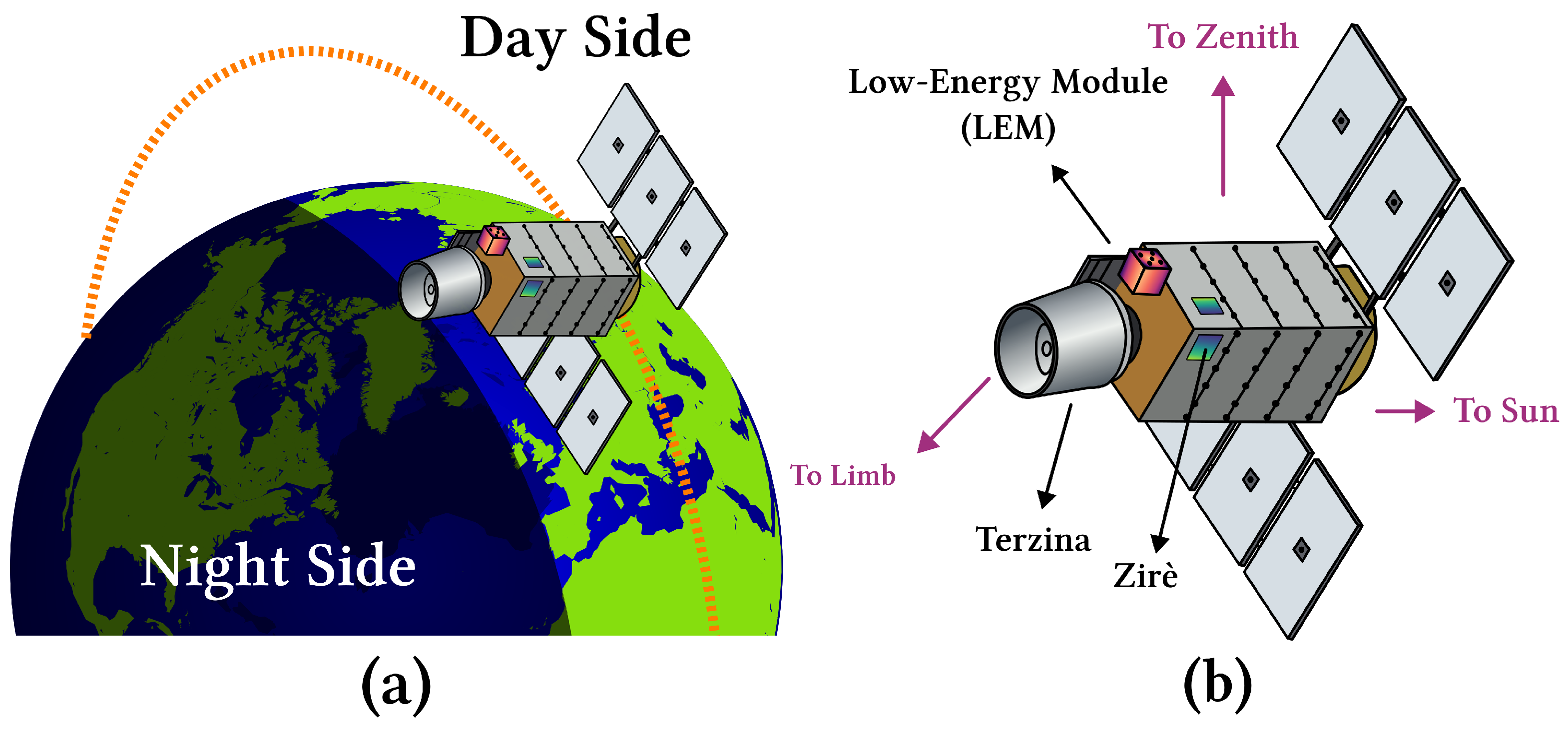
Zirè, on the other hand, will monitor fluxes of charged particles in the low-energy range below 300 MeV/n and photons up to a few MeVs. Within the Zirè payload, the Low-Energy Module (LEM) has been developed as a compact particle spectrometer that extends the observation capabilities of Zirè toward lower energies. The LEM is designed to measure electrons with kinetic energies of 0.1–7 MeV and protons with energies of 3–50 MeV [10,11]. Unlike traditional passive collimators, the LEM employs an innovative active collimation approach to overcome the challenges associated with low-energy particle interactions. In Figure 1, a schematic view of the satellite orbital configuration is shown, together with the payload orientations with respect to the zenith, the Sun, and the Earth limb. The positioning of all payloads is also indicated.
Figure 1.
(a) The satellite orbit around the Earth is illustrated, highlighting the day–night transition. A Sun-synchronous orbit enables observations of both the illuminated and dark hemispheres during each orbital revolution. (b) Schematic representation of the satellite payload configuration, which includes the LEM, Zirè, and Terzina instruments. The main viewing directions of each detector are indicated: the LEM points towards the zenith, Terzina towards the limb, and Zirè towards the nadir. This arrangement allows the simultaneous monitoring of distinct atmospheric and magnetospheric regions.
In this work, we present the detection concept, design, and experimental validation of the Low-Energy Module (LEM), a compact particle spectrometer developed for the NUSES space mission. Particular emphasis is placed on the hardware implementation, data acquisition strategies, and preliminary performance assessment through Monte Carlo simulations and proton beam measurements.
2. Physics Objectives of the Zirè and LEM Payloads
The Zirè instrument is a particle detector designed to validate innovative technologies for the observation of -rays and charged particles, including electrons, protons, and light nuclei, over an energy interval extending from a few MeV up to several hundred MeV. Its main scientific targets are the measurement of the energy spectra of p, , and light nuclei in low Earth orbit (LEO). In addition, the capability to detect photons up to a few tens of MeV will allow investigations of astrophysical sources such as Gamma-Ray Bursts (GRBs), among the most energetic events known in the universe [12,13]. Beyond this, Zirè will monitor the precipitation of trapped particles from the Van Allen belts (VABs), with the aim of probing anomalies possibly correlated with tectonic activity, including earthquakes and volcanic eruptions [14].
The Low-Energy Module (LEM) complements Ziré as a compact () sub-detector placed on the upper panel of the NUSES satellite. Its role is to provide event-by-event particle identification (PID) in the low-energy domain, down to sub-MeV electrons and MeV protons. A central objective of the LEM is to test the Magnetospheric–Ionospheric–Lithospheric Coupling (MILC) framework. Phenomena such as geomagnetic and solar storms, thunderstorms, human-induced electromagnetic activity, and seismic events are all capable of perturbing the radiation belt environment and releasing trapped particles. Measuring the flux of these particles will contribute to refining MILC models. Indeed, statistical analyses reported in [15,16,17,18] point to a correlation between episodes of particle precipitation and strong seismic events, underlining the need for accurate monitoring of electron fluxes in the 0.1–7 MeV range.
Another key science case is the systematic monitoring of solar activity, including Solar Flares (SFs) and Coronal Mass Ejections (CMEs), especially during the peak of the 11-year solar cycle [19]. By following variations in the magnetospheric environment, the LEM will support space weather studies and shed light on the mechanisms of particle acceleration involved in such events. Finally, the detector is designed to operate reliably even within high-radiation regions such as the South Atlantic Anomaly (SAA), enabling the study of local particle composition and isotopic ratios of hydrogen and helium and the possible identification of heavier nuclei.
3. Low-Energy Module Detector Concept and Design
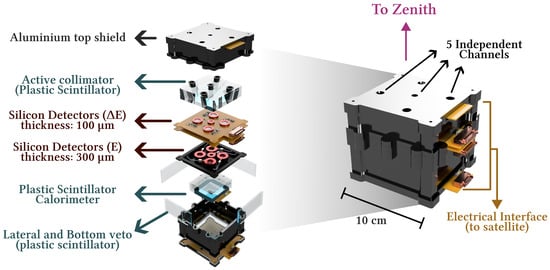
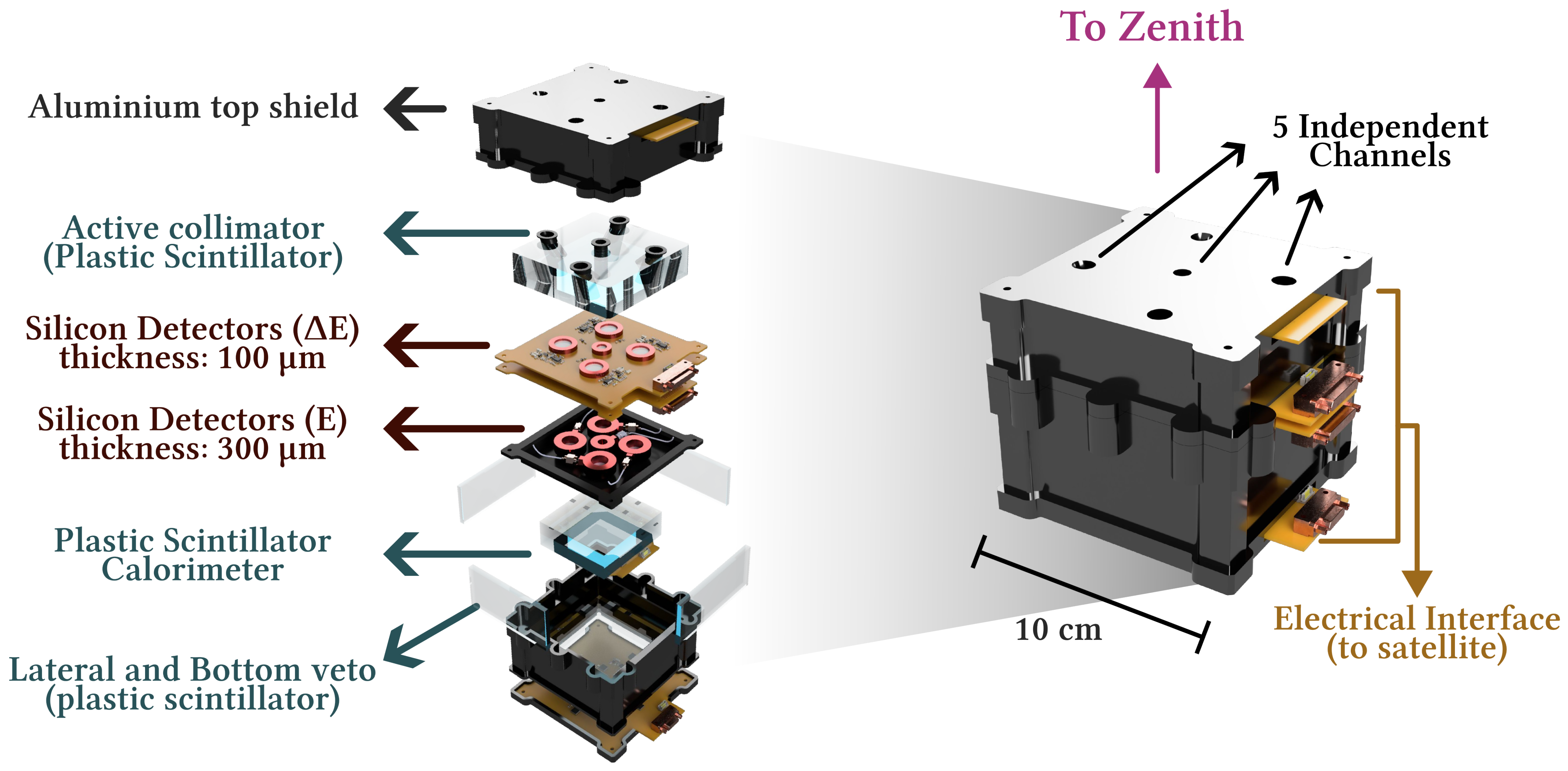
The Low-Energy Module (LEM) is a compact spectrometer designed to measure the direction, energy, and composition of low-energy charged particles with event-level resolution. Its architecture is illustrated in Figure 2.
Figure 2.
Exploded view of the LEM detector. From top to bottom: Aluminum top shield; active collimator made of a 1 cm thick, hole-drilled plastic scintillator for vetoing off-axis particles; first silicon detector layer () with five 100 µm thick surface-barrier detectors; second silicon detector layer (E) with five 300 µm thick PIPS detectors; 2 cm thick plastic scintillator calorimeter; and the lateral and bottom veto system formed by additional plastic scintillator plates. The fully assembled detector is a compact cube, hosting five independent channels pointing towards the zenith. The lower section contains the electrical interface (to the satellite), providing the connection to the spacecraft bus. The combination of active collimation, silicon telescopes, and scintillator calorimetry enables event-by-event identification of electrons down to 0.1 MeV and protons down to 3 MeV.
The reconstruction of the particle incidence direction is achieved through active collimation. A 1 cm thick plastic scintillator plate, perforated with an array of holes, defines the accepted angular range. Particles impinging from outside these apertures generate a veto signal in the scintillator and are rejected. This technique allows the instrument to suppress off-axis background while retaining well-defined acceptance for particles within the geometrical field of view.
Once collimated, particles traverse a sequence of silicon and scintillator detectors that enable both energy measurement and particle identification. The core of the spectrometer consists of five independent –E telescopes. Each telescope is aligned with one collimator channel and is formed by a 100 m thick silicon surface-barrier detector (manufactured by Ametek/ORTEC) followed by a 300 m thick Passivated Implanted Planar Silicon (PIPS) silicon sensor. These two layers implement the classical –E technique: the thin layer samples the initial energy loss, while the thicker detector records the residual energy. The correlation between these two deposits provides a powerful discriminator between electrons, protons, and light nuclei.
To extend the dynamic range towards higher energies, a 2 cm thick plastic scintillator calorimeter is placed downstream of the silicon stack. This stage ensures full absorption of particles with kinetic energies above the stopping power of silicon, allowing a complete reconstruction of the incident energy. The combined signal from , E, and calorimeter stages thus enables reliable event-by-event particle identification across the LEM energy range.
The detector cube (10 × 10 × 10 cm3) is surrounded by lateral and bottom scintillator panels that act as veto counters, enforcing full containment of selected events. The entire assembly is enclosed in a 7 mm aluminium shield with apertures aligned to the collimator, reducing spurious counts in high-radiation environments such as the South Atlantic Anomaly. In the non-relativistic regime, the total kinetic energy can be approximated as , while the energy deposited in the thin layer scales as , where Z is the particle charge and v its velocity. The product is therefore nearly independent of velocity and provides a useful proxy for inferring both the charge and mass of the particle. Although this approximation breaks down for relativistic electrons, their low mass ensures a clear separation in the particle identification (PID) parameter space.
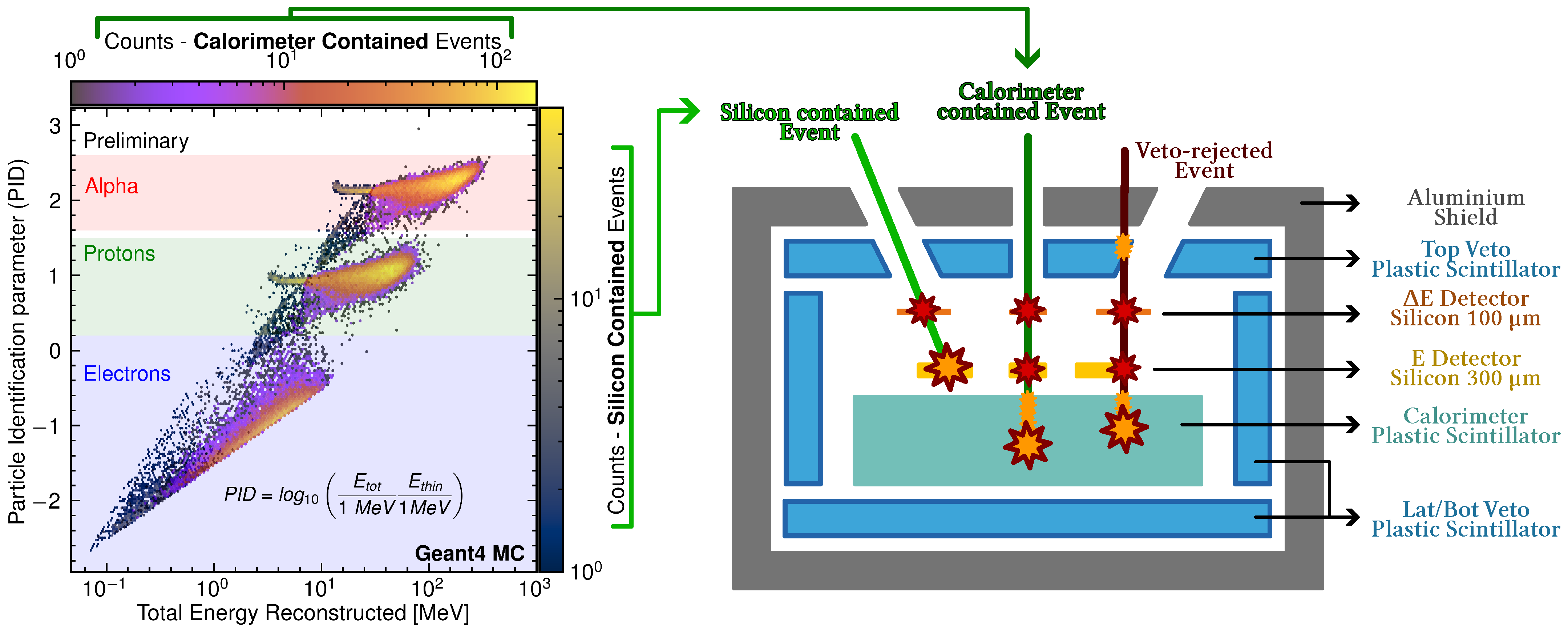
Figure 3 illustrates the distribution of the PID parameter, defined as
where is the energy deposited in the 100 m silicon detector and the reconstructed total energy of the event, as obtained from Geant4 simulations.
Figure 3.
(Left): Particle identification (PID) distribution obtained from a Geant4 Monte Carlo simulation. The PID parameter is defined as , where is the energy deposited in the 100 µm silicon layer and is the reconstructed total energy of the event. Electrons, protons, and alpha particles cluster in well-separated bands across the PID–energy plane, allowing event-by-event discrimination. The color scale encodes the event density in logarithmic counts. (Right): Schematic representation of the LEM detection concept. Depending on their energy, particles may (i) stop within the two silicon layers, producing a silicon-contained event; (ii) cross the silicon and deposit their residual energy in the plastic scintillator calorimeter, yielding a calorimeter-contained event; or (iii) enter from outside the acceptance, in which case they trigger the top or lateral veto scintillators and are rejected. The combination of –E telescopes with active collimation and veto layers ensures efficient selection of well-reconstructed events and reliable particle identification over the LEM energy range.
Depending on their kinetic energy, particles may follow three different topologies: (i) silicon-contained events, where the particle stops within the two silicon layers; (ii) calorimeter-contained events, where the particle crosses the silicon stack and releases its residual energy in the plastic scintillator calorimeter; and (iii) veto-rejected events, where particles enter from outside the geometrical acceptance and are rejected by the top or lateral veto scintillators. The left panel of Figure 3 shows the two main classes of accepted events (silicon- and calorimeter-contained) in separate two-dimensional histograms, each encoded with a distinct colormap. The right panel depicts the corresponding trigger patterns as recognized by the onboard firmware, demonstrating how the classification logic is implemented in hardware.
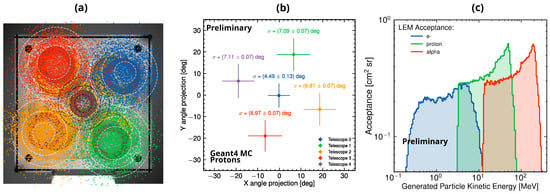
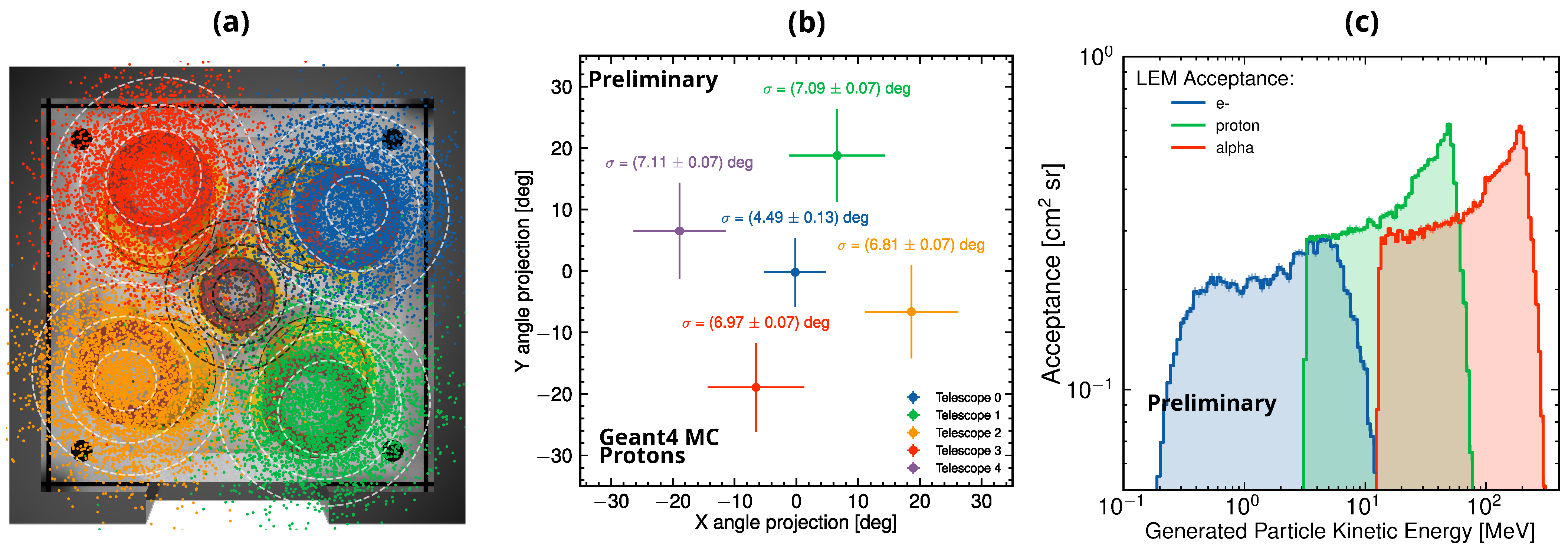
In this configuration, as shown in Figure 4, the LEM achieves angular resolutions of approximately 7° for protons and 15° for electrons. The poorer resolution observed for electrons is mainly due to multiple scattering at the edges of the aluminium structure located above the active collimator. Figure 4 panel (c) shows the LEM geometrical and energy-dependent acceptance for isotropic fluxes derived from Geant4 simulations. In the Geant4 simulations, particles were generated isotropically from a planar surface of fixed area. Accepted events are those that deposit energy in the sensitive detectors without activating the lateral or bottom vetoes. The acceptance for isotropic fluxes describes the detector’s effective sensitivity to an isotropic particle population. It is computed as the ratio between the number of simulated events that meet the trigger conditions and the total number of generated events, scaled by the ideal geometrical factor of the planar source (, where A denotes the generation surface area) [20].
Figure 4.
(a) Pictorial representation of the reconstructed proton directions from Geant4 simulations, projected onto the X–Y plane. Each color corresponds to one of the five –E telescopes in the LEM. The circular patterns reflect the geometrical acceptance defined by the drilled active collimator layer. (b) Mean reconstructed angle and angular resolution () for each telescope. (c) Energy-dependent acceptance of the LEM for isotropic fluxes, evaluated at the Monte Carlo truth level as a function of the Generated Particle Kinetic Energy for different particle species (electrons, protons, and particles). The acceptance was estimated through Geant4 simulations in which particles were isotropically generated from a planar surface of fixed area. It is computed as the ratio between the number of events entering the geometrical field of view and the total number of generated events, multiplied by the ideal gathering power of the planar source (, where A is the generation surface area).
The LEM reaches energy detection thresholds as low as 0.1 MeV for electrons and 3 MeV for protons. The combined use of active collimation, silicon –E telescopes, and plastic scintillator calorimetry within a compact 10 × 10 × 10 cm3 volume provides a versatile platform for precise flux and composition measurements in low Earth orbit.
4. Readout Architecture
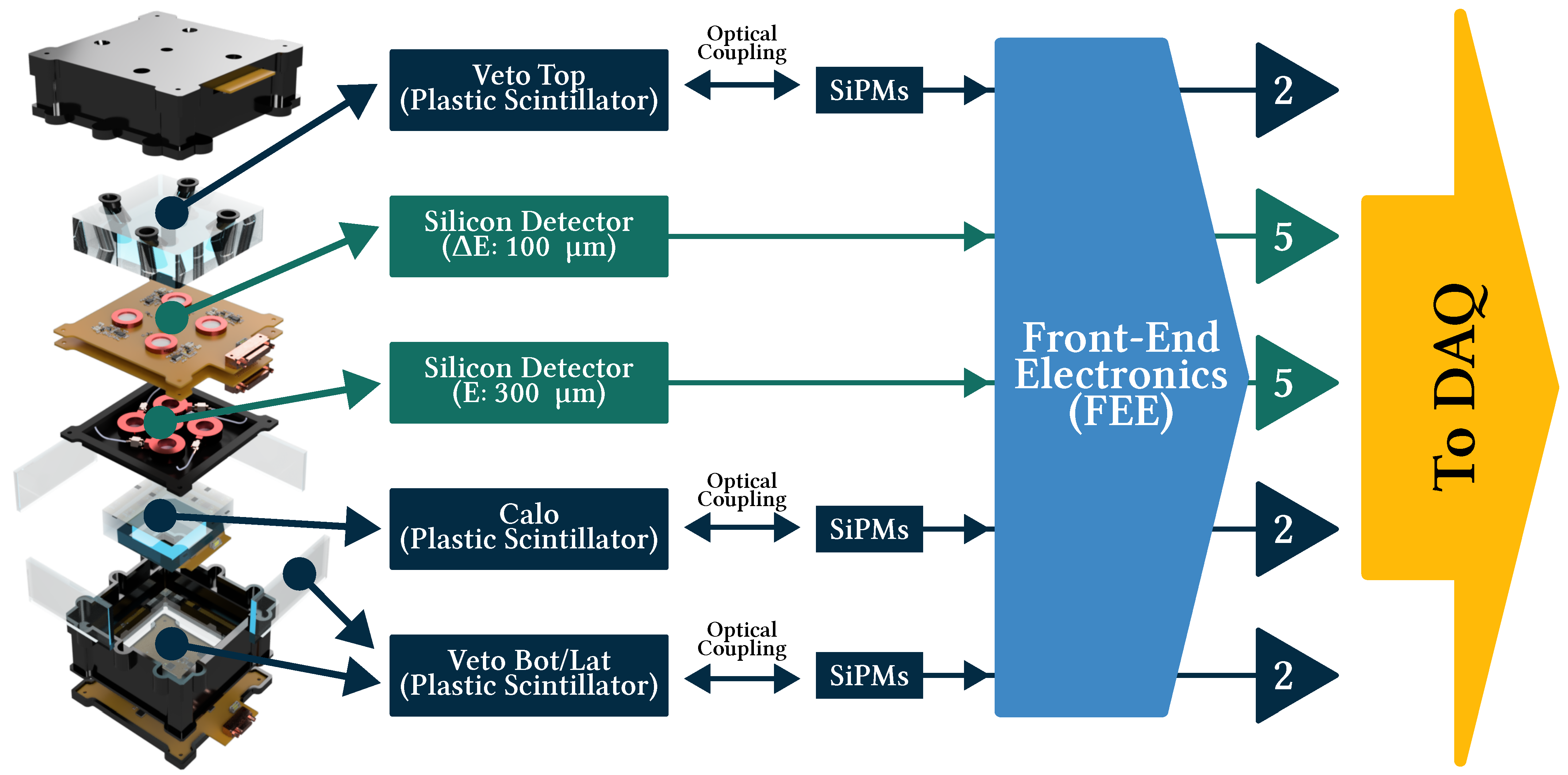
The LEM comprises 16 independent analog channels, originating from a combination of silicon detectors and plastic scintillators (Figure 5). The five thin detectors (100 m) and the five thicker E detectors (300 m PIPS) form the core of the spectrometer, while the plastic scintillators (active collimator, inner calorimeter, and bottom/lateral veto) provide containment and background rejection. Each sub-detector is interfaced to the front-end electronics (FEE) through dedicated amplification and shaping stages, optimized for its specific signal characteristics.
Figure 5.
Block diagram of the Low-Energy Module (LEM) readout chain. Each of the five independent channels comprises a 100 µm silicon detector () followed by a 300 µm PIPS detector (E), aligned with the active plastic-scintillator collimator. A 2 cm thick plastic scintillator calorimeter and top, lateral, and bottom veto scintillators provide containment and background rejection. The FEE (front-end electronics) includes charge-sensitive preamplifiers for the silicon detectors, amplification stages for the SiPMs, and shaping circuits (shapers). The shaped analog signals from all channels are passed to (or further interfaced with) the central DAQ, which handles trigger logic and event selection. The system is designed to support event-by-event particle identification across a broad dynamic range.
The silicon detectors consist of one central 100 m Ametek R-017-050-100 sensor with a 50 mm2 active area and four lateral Ametek R-019-150-100 sensors with a 150 mm2 area. The thick E layer is composed of one central 300 m Mirion PD50-11-300RM (50 mm2) and four lateral Mirion PD150-13-300RM devices (150 mm2). In total, the ten silicon detectors deliver ten channels (five and five E), each coupled directly to a charge-sensitive preamplifier (CSA) and an analog shaper hosted on custom boards. Each silicon preamplifier board integrates a dedicated thermometer for temperature monitoring.
Each plastic scintillator (active collimator, calorimeter, and bottom/lateral veto) is read out by six Hamamatsu S14160-6050HS SiPMs (6 × 6 mm2). The six SiPMs are arranged into two independent groups of three, connected in parallel. The signal from each group is summed and amplified on a local preamplifier board, yielding two shaped analog outputs per scintillator. This architecture provides redundancy and modularity: for example, the top veto with six SiPMs is read out as two independent channels, each corresponding to one group of three sensors. The same scheme is applied to the calorimeter and to the bottom/lateral veto for a total of six channels. Each SiPM board hosts two thermometers, placed close to the sensor groups, to guarantee stable gain calibration in orbit. The cabling scheme is designed for compactness and low noise, ensuring efficient signal routing from the detector front-end to the DAQ boards housed within the satellite tray.
5. Firmware and Data Acquisition
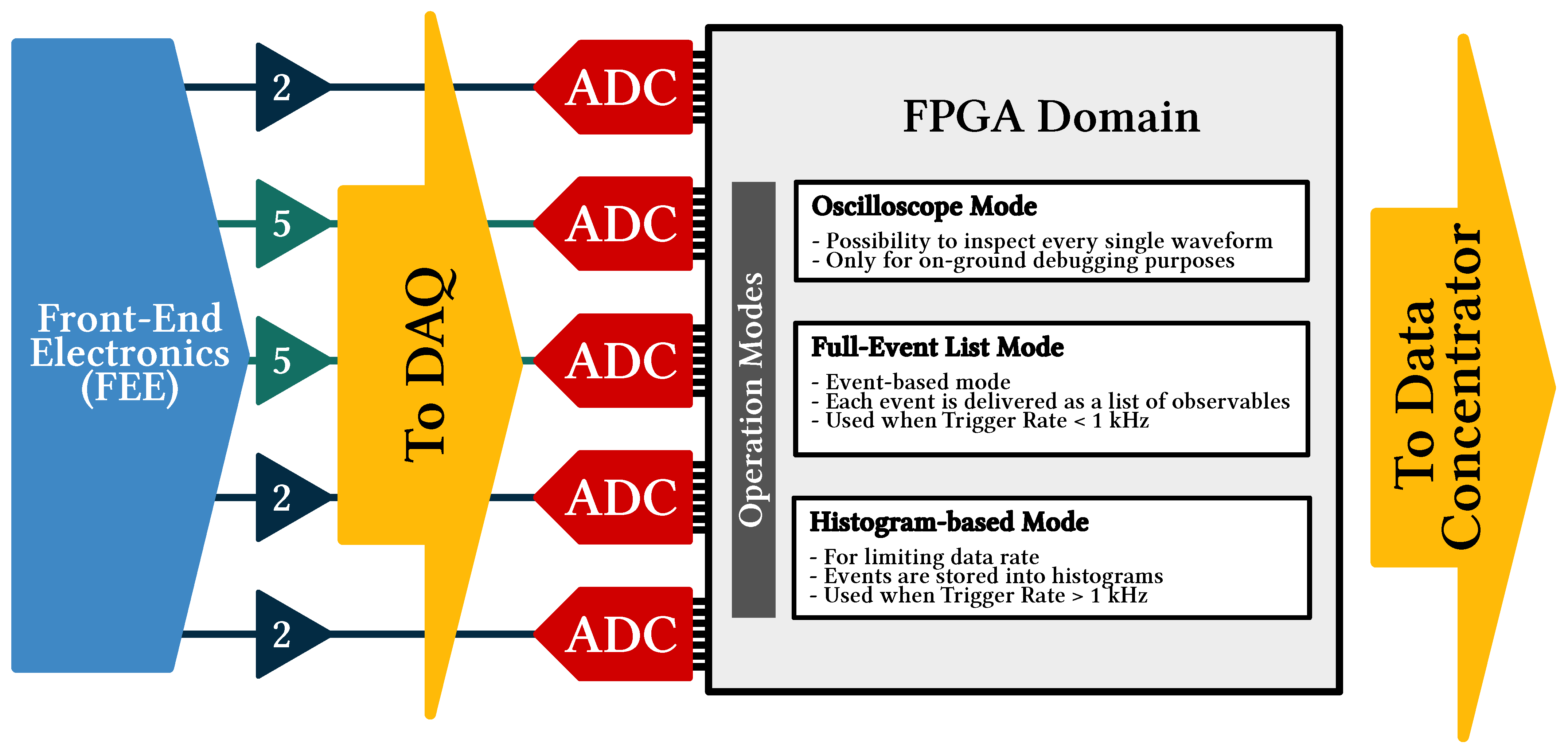
The signals from the 16 analog channels of the LEM are digitized by a Texas Instruments ADS52J90, a 16-channel, 12-bit, 100 MSPS ADC with LVDS outputs, and processed in the digital domain of a Xilinx Artix-7 FPGA, which hosts all firmware modules for signal processing, triggering, and data management (Figure 6). This architecture ensures compactness, power efficiency, and in-flight reconfigurability, allowing the instrument to adapt to varying orbital conditions and particle fluxes.
Figure 6.
Firmware and data acquisition chain of the Low-Energy Module (LEM). The analog signals from the 16 readout channels (5 , 5 E, 2 from the calorimeter, 2 from the veto top, and 2 from the veto bottom) are routed from the FEE to the DAQ board, manufactured by Nuclear Instruments s.r.l., where they are digitized by 100 Msps, 12-bit ADCs. The digital stream is processed in the FPGA domain, implemented with a Xilinx Artix-7, which performs trigger logic and event selection. Three operational modes are available: (i) oscilloscope mode, for on-ground waveform inspection; (ii) full-event list mode, used below a ∼1 kHz trigger rate; and (iii) histogram-based mode, activated above ∼1 kHz to limit telemetry by onboard accumulation of energy–PID histograms. Processed data are finally delivered to the data concentrator of the NUSES payload.
The trigger logic is based on coincidences between silicon detectors and plastic scintillators, which allow valid particle events to be identified and classified into physics-driven categories (refer to Figure 3). Each event is assigned to one of several classes, such as silicon-contained, calorimeter-contained, or background-like topologies, with the possibility of applying configurable prescaling factors. This enables efficient selection of scientifically good events while rejecting spurious triggers.
All digitized signals are processed by a digital chain that includes trapezoidal shaping filters for energy reconstruction, baseline restoration, pulse height and timing extraction, and quality flagging for pile-up or saturation. This real-time processing maximizes energy resolution while ensuring stable operation in orbit. Dedicated diagnostic modules continuously monitor rates, voltages, and temperatures, while a timestamp generator with 20 ns precision ensures accurate temporal tagging of events. The firmware also integrates programmable bias control for the SiPMs and slow-control interfaces for configuration and health monitoring.
Depending on the event rate, the system can operate in different acquisition modes. In list mode, used when the trigger rate is below ∼1 kHz (about 85% of the orbit), each accepted event is recorded with full observables, including amplitude, energy estimator, timing, and diagnostic flags. This mode provides high-resolution data suitable for calibration, cross-checks, and detailed scientific analysis. When the trigger rate exceeds ∼1 kHz, typically within the South Atlantic Anomaly, the firmware switches to histogram mode, in which energy spectra and particle identification distributions are accumulated onboard. This strategy reduces the data volume by more than an order of magnitude, while preserving the essential physical observables required for flux and composition studies. For ground testing, an oscilloscope mode is also available, providing raw waveform readout for debugging and validation of the analogue chain.
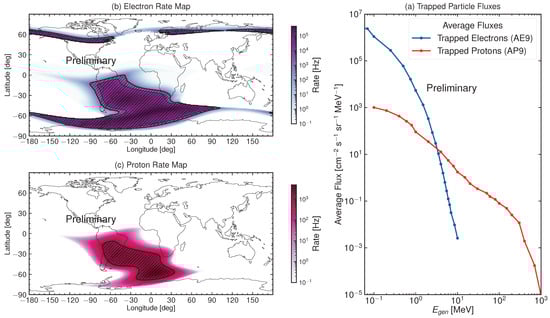
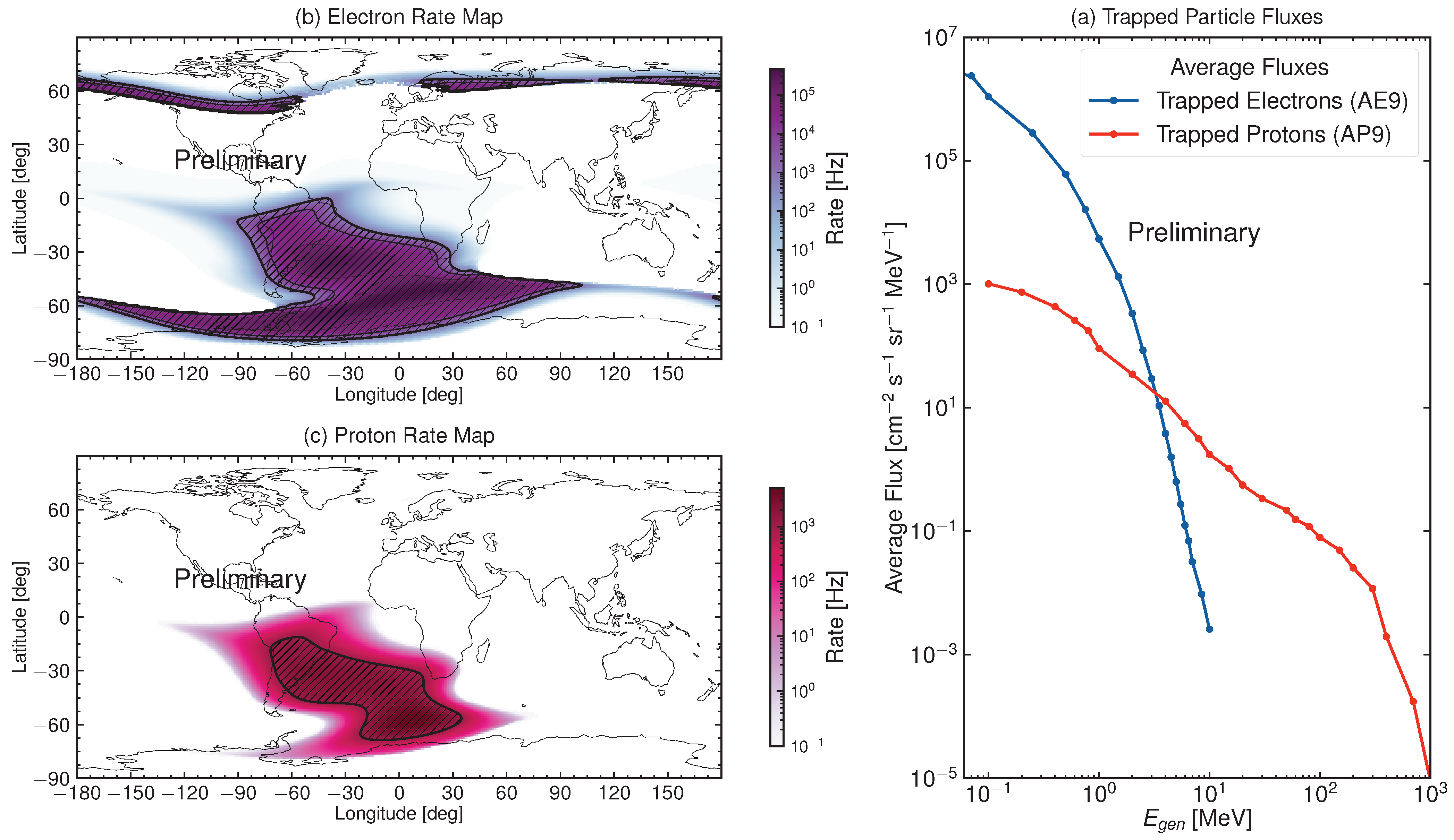
Figure 7 illustrates the expected event rates for the LEM throughout the NUSES orbit, as derived from AE9/AP9 trapped-particle models. Panel (a) shows the orbit-averaged differential fluxes of trapped protons and electrons as a function of energy. These spectra are obtained by integrating the AE9/AP9 model outputs over latitude and longitude, weighting each geographic bin by the residence time of the spacecraft. The resulting averaged fluxes represent the primary input for estimating the expected event rates.
Figure 7.
Trapped-particle environment along the planned low Earth orbit (LEO) of the NUSES satellite. The trajectory has been propagated with Keplerian elements, including J2 perturbations, and analyzed using the IRENE interface to the AE9/AP9 models. Panel (a) reports the orbit-averaged differential fluxes of trapped electrons and protons as a function of kinetic energy, obtained from AE9 and AP9, respectively. The averaging procedure accounts for the residence time of the spacecraft in each geographic bin, thus providing realistic exposure-weighted fluxes to be used as inputs for rate calculations. Panels (b,c) present the corresponding trigger rate maps for electrons and protons, obtained by folding the AE9/AP9 fluxes with the LEM detector geometric factor and integrating over the instrument acceptance. Hatched regions indicate geographic areas where the estimated rate exceeds 1 kHz. In these conditions—dominated by the South Atlantic Anomaly—the LEM firmware is designed to switch from event-by-event readout to histogram-based acquisition, thereby enabling onboard data compression and mitigating telemetry overload.
Panels (b) and (c) present the corresponding geographical maps of trigger rate for electrons and protons, respectively. These rates are obtained by folding the energy-dependent differential fluxes with the acceptance of the LEM (Figure 4)—approximately 0.2 cm2 sr for electrons (200 keV–7 MeV) and 0.3 cm2 sr for protons (3–60 MeV)—and integrating over the relevant energy ranges. Only events satisfying the trigger conditions and not vetoed by the lateral or bottom scintillators are included. Regions where the expected rate exceeds 1 kHz, primarily within the South Atlantic Anomaly, are highlighted with hatching. In these conditions, the instrument automatically switches from event-by-event to histogram acquisition mode, allowing onboard data compression and ensuring continuity of scientific measurements without telemetry saturation.
All acquisition parameters—including trigger thresholds, coincidence rules, filter constants, and acquisition mode configuration—are fully tunable and can be updated in orbit via telecommands. Processed data are formatted by the Scientific Data Packet Transmitter and transferred to the satellite data concentrator through a high-speed QSPI interface. In this way, the LEM firmware transforms raw analog signals into physics-ready data products in real time, with the flexibility and adaptability required for long-term operations in low Earth orbit.
6. Energy Digitization Strategy
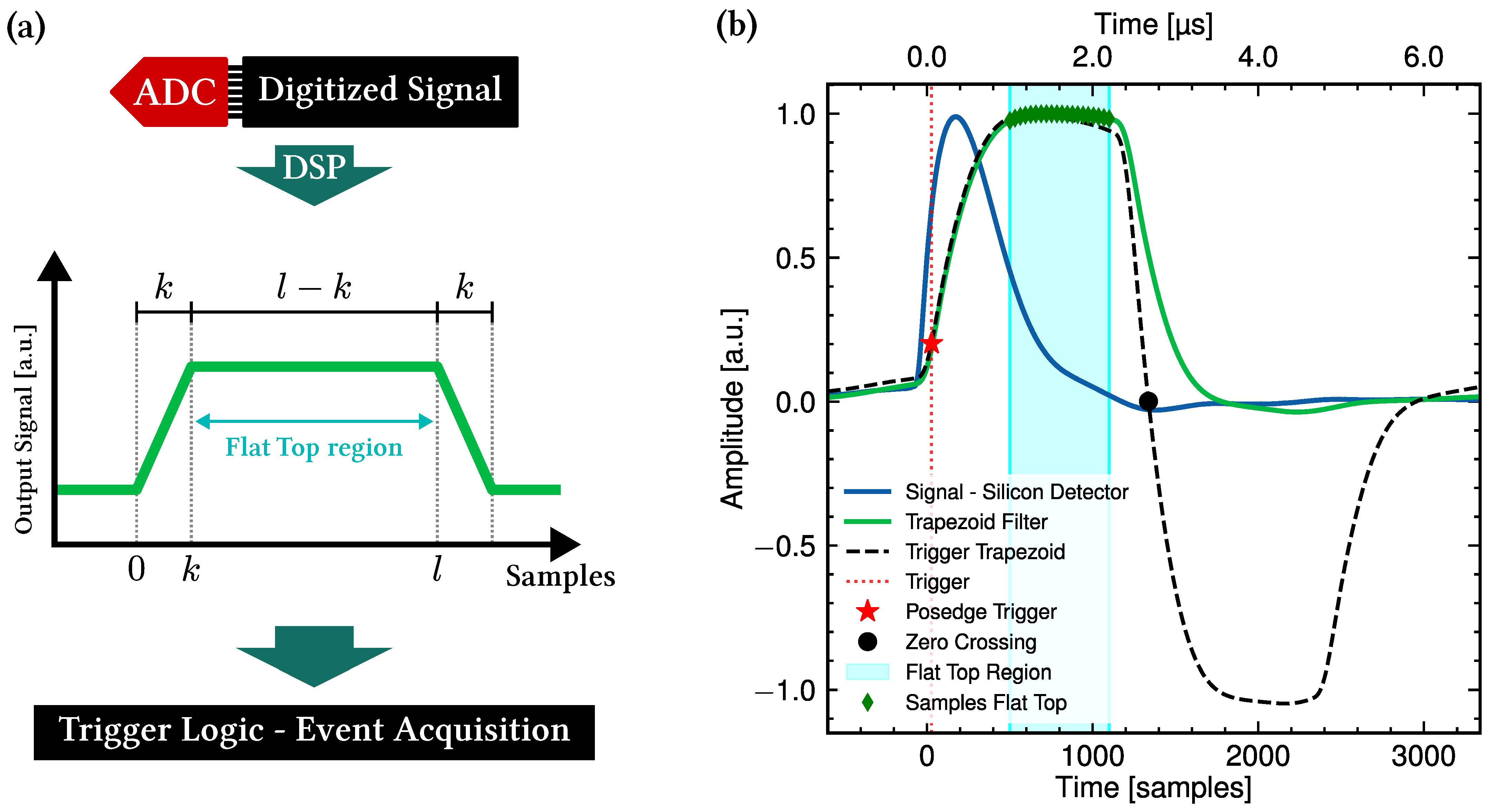
After digitization by the ADCs, each channel undergoes a digital shaping before energy reconstruction. The first step of this processing chain is a trapezoidal filter, which converts the exponentially decaying preamplifier signal into a waveform with a flat-top region whose height is proportional to the total collected charge and therefore to the deposited energy. This shaping algorithm follows the digital deconvolution and moving-window principle introduced by Jordanov and Knoll [21,22] and is implemented in the firmware for all detector channels.
The filter response is characterized by three main parameters. The parameter k defines the rise time of the trapezoid, corresponding to the number of samples from the onset of the preamplifier pulse to the beginning of the flat-top region. The parameter l specifies the end of the flat-top, such that the nominal duration of the plateau is samples. A third parameter controls the pole-zero cancellation, compensating for the decay constant of the exponential preamplifier response. Its tuning is essential to achieve a flat baseline on the top of the trapezoid, ensuring optimal energy estimation.
In realistic conditions, the preamplifier signals are not perfectly exponential and may exhibit slightly rounded edges at the transitions between the rise, flat, and fall regions. For this reason, before sampling the energy, the firmware discards a few samples at the beginning and end of the flat-top and averages only the central portion, which guaranties that the measured region is truly flat. This average defines the pulse height estimator used as input for the subsequent energy reconstruction, whether stored in the event list or accumulated in histograms, depending on the active acquisition mode.
An experimental example of the filter response obtained with a 300 m thick Mirion PIPS silicon detector is shown in Figure 8. The same shaping procedure is executed in the flight firmware, where all filter parameters can be reprogrammed by telecommand, allowing in-orbit optimization during calibration and beam test campaigns of the Flight Model.
Figure 8.
(a) Conceptual illustration of the trapezoid filter applied to digitized preamplifier signals. The shaping algorithm follows the digital deconvolution and moving-window scheme originally introduced by Jordanov and Knoll [21,22]. The filter parameters are defined in terms of discrete samples: k denotes the number of samples from the onset of the fast-rising exponential preamplifier pulse up to the beginning of the flat-top region; l corresponds to the sample at which the flat-top ends. The nominal flat-top duration is therefore samples. In practice, owing to the non-ideal exponential response of silicon detectors, the usable flat-top is shorter, and only the central portion is sampled. Margins are excluded at the beginning and end of the flat-top to suppress residual slope and fluctuations. The sampled values are averaged to estimate the deposited energy. In parallel with the trapezoidal shaping, the firmware generates a fast bipolar trigger signal that provides precise timing for the trigger pattern management, implemented in dedicated FPGA state-machine logic. (b) Experimental example obtained with a 300 m thick silicon detector (PIPS type, manufactured by Mirion), coupled to a charge-sensitive preamplifier by AGE Scientific s.r.l. and digitized with a CAEN DT5730 digitizer. The trapezoid parameters were optimized for this specific detector. The flight firmware allows for in-orbit reprogramming of the filter parameters, which will be tuned during dedicated test-beam campaigns of the flight model.
7. Experimental Hardware Characterization
A dedicated proton-beam campaign was performed at the Trento Protontherapy Center (TPC) [23] to characterize the response of the detector front-end electronics and to verify the linearity of the charge-to-energy conversion chain. The TPC facility is equipped with a research-dedicated beam line capable of delivering proton beams in the energy range 70–228 MeV with variable flux.
The beam characteristics at the isocenter are well-defined: the spot size ranges from mm and mm at 70 MeV down to mm and mm at 228 MeV, with spatial asymmetry below 3% across the full energy range. The beam energy spread, expressed as a percentage of the mean beam energy, ranges between 0.7% at the lowest energy and 0.3% at the highest energies. Energy programming is achieved through an Energy Selection System (ESS) downstream of the cyclotron, and the actual beam energy at the isocenter has been verified through range measurements, showing excellent agreement with nominal values, with discrepancies below 2 MeV across the full energy range. The proton flux at the isocenter can be tuned between and particles per second depending on the beam energy and the cyclotron extraction current, providing a broad dynamic range.
For the present measurements, the 300 m thick Mirion PIPS silicon detector was positioned at the isocenter (1.25 m from the beam exit window) using the facility’s adjustable-height positioning table. Alignment was performed using the laser alignment system permanently installed in the experimental cave, ensuring that the detector active area was centered with respect to the beam axis. Given the narrow beam spot size (a few millimeters sigma) and the detector dimensions (50 mm2 active area for the central sensor), the positioning accuracy provided by the laser system was sufficient to guarantee uniform illumination of the detector.
An additional passive absorber consisting of approximately 1 cm thick lead with a diameter of about 1 cm was placed in front of the silicon sensor. Despite this additional material, the highly collimated nature of the beam ensured that the majority of protons remained within the acceptance of the detector after traversing the absorber.
The beam energy was varied across a range of well-defined kinetic values, and for each setting the deposited energy distribution was reconstructed from the integrated charge of the digitized waveforms. Data acquisitions were performed at low beam intensity, typically in the range – particles per second, to avoid pile-up effects and to ensure clean single-particle events suitable for calibration and validation purposes.
The test was carried out using a 300 m thick Mirion PIPS silicon detector coupled to the AGE Scientific charge-sensitive preamplifier, with signals digitized by a CAEN DT5730 digitizer.
Experimental data were compared with a dedicated Geant4 simulation of the setup, including the silicon detector and the incident proton beam. The adopted physics list was QGSP_BIC_HP, in which the default electromagnetic package was replaced by G4EmStandardPhysics_option4 to provide an accurate modeling of electromagnetic interactions at low energies. To ensure a precise calculation of the energy deposits within the detector materials, range cuts of 1 µm were applied.
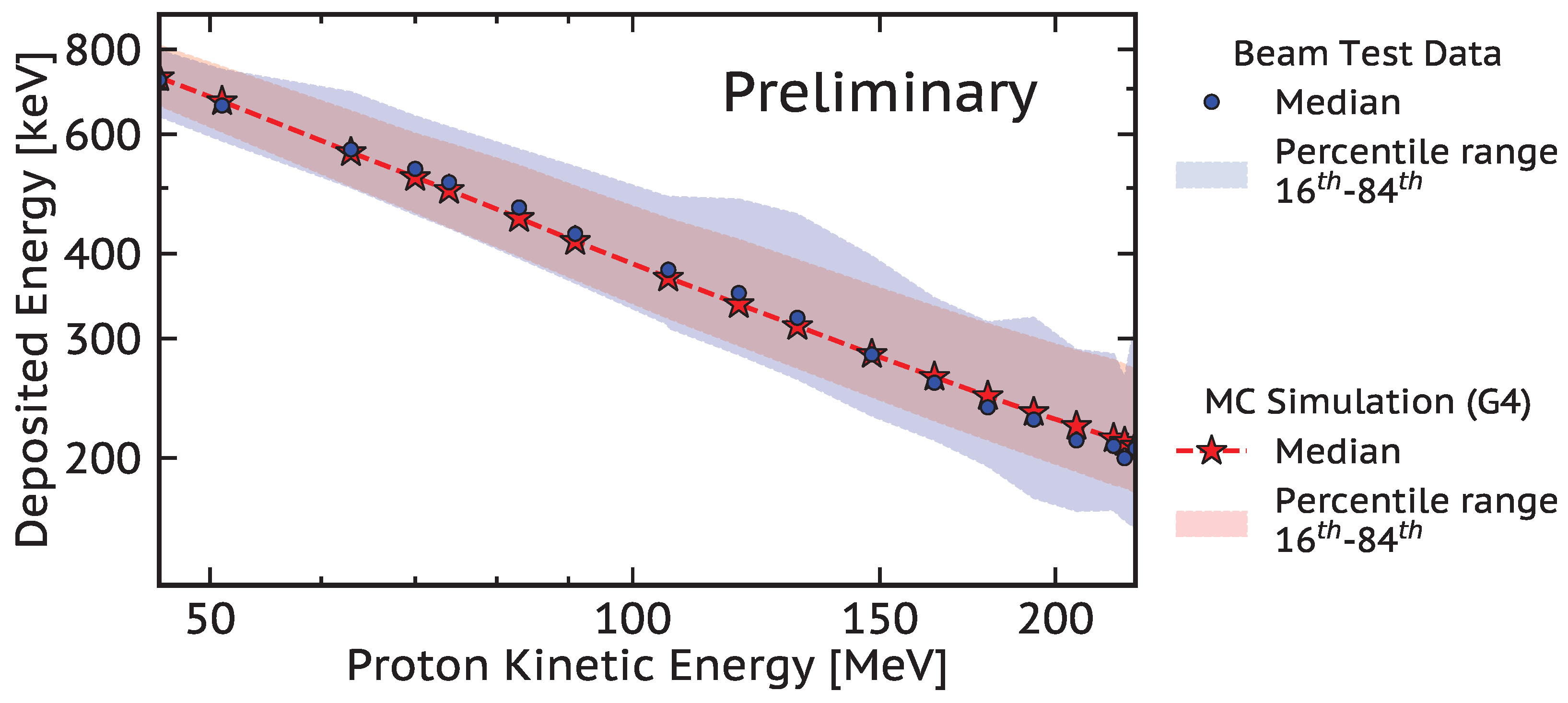
Figure 9 presents the median deposited energy as a function of the incident kinetic energy. The blue markers correspond to the median of the experimental distributions, while the hatched blue bands indicate the 16th–84th percentile interval. The red stars represent the medians from Geant4 simulations, with the red hatched regions showing the corresponding percentile ranges. The experimental energy scale was recalibrated prior to comparison. The good agreement between experimental data and Monte Carlo predictions confirms the expected linear response of the FEE and validates the proportionality between deposited energy and collected charge in the detector.
Figure 9.
Deposited energy of protons measured at the Trento Protontherapy Center as a function of their kinetic energy. The blue markers represent the median of the experimental distributions obtained with a 300 m thick Mirion PIPS silicon detector, coupled to a charge-sensitive preamplifier manufactured by AGE Scientific s.r.l. and digitized with a CAEN DT5730. The amplitude of the signal has been computed preliminarily with a charge integration of the signal. The hatched blue band denotes the interval between the 16th and 84th percentiles of the measured distributions. The red stars correspond to the median deposited energy extracted from Monte Carlo simulations performed with Geant4, while the red hatched band shows the corresponding 16th–84th percentile range. The experimental energy scale was recalibrated prior to comparison. Although the measurements are preliminary and require further data analysis, an excellent agreement between the experimental results and the Monte Carlo predictions is already observed.
It is important to note that the data acquisition system used in this test is not representative of the flight electronics. The purpose of this beam test was specifically to characterize the silicon sensor response and to validate the front-end amplification chain. A comprehensive end-to-end characterization of the full acquisition system, including the flight-representative firmware and digital signal processing, will be performed in future beam campaigns once the Engineering Qualification Model (EQM) of the instrument becomes available. At that stage, we will be able to address questions related to the performance of the acquisition system at higher particle rates and to assess pile-up effects under conditions representative of the in-orbit environment, particularly within the South Atlantic Anomaly.
8. Conclusions and Outlook
In this work we have presented the Low-Energy Module (LEM) and its scientific objectives within the broader framework of the NUSES space mission. The detection concept and the associated hardware have been described, highlighting the capability of the instrument to perform accurate event-based particle identification. Expected performance was assessed through Monte Carlo simulations, while first experimental tests validated the functionality of the front-end electronics and data acquisition system. In particular, the FEE for charge-sensitive amplification of the Mirion 300 µm PIPS silicon detector exhibited a linear response consistent with Monte Carlo expectations.
Different acquisition strategies have been discussed, including the event-by-event list mode and the histogram-based mode, which together ensure continuous scientific measurements even in high-radiation environments without saturating telemetry bandwidth.
The LEM, a compact spectrometer designed for the Zirè payload, is currently progressing through the Manufacturing Assembly Integration and Testing (MAIT) phase, during which all subsystems will be integrated and validated. The electronics boards of the Engineering Qualification Model have been produced and will be tested in the coming months. With its compact design and innovative active collimation technique, the LEM will enable precise measurements of the energy, direction, and composition of low-energy charged particles, reaching thresholds down to 0.1 MeV for electrons and 3 MeV for protons. The characterization of the silicon sensors has been completed, and the selected devices will be used in the forthcoming flight model.
Author Contributions
Conceptualization, R.N. and F.N.; methodology, R.N., D.S., A.A., L.F., L.P., G.F., D.B. and A.D.G.; software, R.N., D.S., L.F. and A.A.; validation, R.N., F.N., D.S. and A.D.G.; formal analysis, R.N. and D.S.; investigation, R.N., A.A., D.B., A.D.G., L.F., G.F., F.N., L.P., G.P., D.S. and E.V.; resources, F.N., A.A., L.F., G.F., L.P., E.V., A.D.G. and D.B.; data curation, R.N. and D.S.; writing—original draft preparation, R.N.; writing—review and editing, R.N., F.N. and D.S.; visualization, R.N. and D.S.; supervision, F.N. and A.D.G.; project administration, A.D.G.; funding acquisition, F.N. and A.D.G. All authors have read and agreed to the published version of the manuscript.
Funding
This work is supported by the Italian Government (CIPE n. 20/2019), by the Italian Ministry of Economic Development (MISE reg. CC n. 769/2020), and by the European Union NextGenerationEU under the MUR National Innovation Ecosystem grant ECS00000041-VITALITY-CUP D13C21000430001. This study was also carried out in collaboration with the Ministry of University and Research, MUR, under contract n. 2024-5-E.0-CUP n. I53D24000060005.
Data Availability Statement
Data sharing is not applicable to this article.
Conflicts of Interest
Authors Andrea Abba and Luigi Ferrentino were employed by the company Nuclear Instruments s.r.l.; Author Domenico Borrelli was employed by the company Sophia High Tech; Authors Giovanni Franchi and Lorenzo Perillo were employed by the company Age Scientific s.r.l. The remaining authors declare that the research was conducted in the absence of any commercial or financial relationships that could be construed as a potential conflict of interest.
Abbreviations
The following abbreviations are used in this manuscript:
| ADC | Analog-to-Digital Converter |
| AE9/AP9 | Aerospace Environment models for trapped Electrons (AE9) and Protons (AP9) |
| ASIC | Application-Specific Integrated Circuit |
| CSA | Charge-Sensitive Amplifier |
| DAQ | Data Acquisition |
| E | Residual Energy Detector (second silicon layer) |
| EQM | Engineering Qualification Model |
| FEE | Front-End Electronics |
| FPGA | Field-Programmable Gate Array |
| FWHM | Full Width at Half Maximum |
| LEM | Low-Energy Module |
| LEO | Low Earth Orbit |
| MAIT | Manufacturing, Assembly, Integration, and Testing |
| MC | Monte Carlo |
| MILC | Magnetospheric–Ionospheric–Lithospheric Coupling |
| NUSES | Neutrino and Seismic Electromagnetic Signals (space mission) |
| PID | Particle Identification |
| PIPS | Passivated Implanted Planar Silicon |
| PMT | Photomultiplier Tube |
| QE | Quantum Efficiency |
| SiPM | Silicon Photomultiplier |
| SAA | South Atlantic Anomaly |
| SF | Solar Flare |
| Si | Silicon |
| TPC | Trento Protontherapy Center |
| VAB | Van Allen Belt |
| Energy Loss Detector (first silicon layer) |
References
- Santo, M.D.; Giovanni, A.D.; Collaboration, N. The NUSES space mission. In Proceedings of the 27th European Cosmic Ray Symposium (ECRS)—Future Measurements, Instrumentation and Methods, Nijmegen, The Netherlands, 25–29 July 2023; SISSA: Trieste, Italy, 2023; Volume 423. [Google Scholar] [CrossRef] [Scilit]
- Di Giovanni, A.; Di Santo, M. The NUSES space mission. In Proceedings of the 41st International Conference on High Energy Physics, Bologna, Italy, 6–13 July 2022; p. 354. [Google Scholar]
- Di Giovanni, A. The NUSES Space Mission: Advancing Observations and Technology. PoS 2023, 449, 63. [Google Scholar] [CrossRef] [Scilit]
- De Mitri, I.; Di Santo, M.; on behalf of the NUSES collaboration. The NUSES space mission. J. Phys. Conf. Ser. 2023, 2429, 012007. [Google Scholar] [CrossRef] [Scilit]
- Aloisio, R.; Altomare, A.; Barbato, B.; Battiston, B.; Bertania, B.; Bissaldi, B.; Boncioli, B.; Burmistrov, B.; Cagnoli, C.; Casolino, C.; et al. The NUSES space mission. PoS 2024, 441, 121. [Google Scholar] [CrossRef] [Scilit]
- Montaruli, T. The Terzina payload on board the NUSES space mission. arXiv 2025, arXiv:2509.23451. [Google Scholar] [CrossRef] [Scilit]
- Burmistrov, L.; Davarpanah, S.; Heller, M.; Montaruli, T.; Trimarelli, C.; Aloisio, R.; Barbato, F.C.T.; Mitri, I.D.; Giovanni, A.D.; Fontanella, G. Performance and radiation damage mitigation strategy for silicon photomultipliers on LEO space missions. J. Cosmol. Astropart. Phys. 2025, 2025, 073. [Google Scholar] [CrossRef] [Scilit]
- Savina, P.; Smirnov, A. The Ziré experiment on board of the NUSES mission. In Proceedings of the 9th Roma International Conference on Astroparticle Physics, Roma, Italy, 23–27 September 2024; EDP Sciences: Les Ulis, France, 2025; Volume 319, p. 12009. [Google Scholar]
- Aloisio, R.; Altomare, A.; Barbato, B.; Battiston, B.; Bertania, B.; Bissaldi, B.; Boncioli, B.; Burmistrov, B.; Cagnoli, C.; Casolino, C.; et al. The Zire experiment on board the NUSES space mission. PoS 2023, 444, 139. [Google Scholar] [CrossRef] [Scilit]
- Nicolaidis, R.; Nozzoli, F.; Pepponi, G.; Collaboration, N. A Compact Particle Detector for Space-Based Applications: Development of a Low-Energy Module (LEM) for the NUSES Space Mission. Instruments 2023, 7, 40. [Google Scholar] [CrossRef] [Scilit]
- Nicolaidis, R.; Nozzoli, F.; Pepponi, G.; Bellutti, P.; Demenev, E.; Follega, F.M.; Iuppa, R.; Vilona, V. Characterizing Low-Energy Charged Particles in the Magnetosphere with the LEM CubeSat Spectrometer Project: Detector Concept and Hardware Characterisation. Universe 2023, 9, 331. [Google Scholar] [CrossRef] [Scilit]
- Fishman, G.J.; Meegan, C.A. Gamma-ray bursts. Annu. Rev. Astron. Astrophys. 1995, 33, 415–458. [Google Scholar] [CrossRef]
- Piran, T. The physics of gamma-ray bursts. Rev. Mod. Phys. 2004, 76, 1143–1210. [Google Scholar] [CrossRef] [Scilit]
- D’Angelo, G.; Piersanti, M.; Battiston, R.; Bertello, I.; Carbone, V.; Cicone, A.; Diego, P.; Papini, E.; Parmentier, A.; Picozza, P.; et al. Haiti Earthquake (Mw 7.2): Magnetospheric–Ionospheric–Lithospheric Coupling during and after the Main Shock on 14 August 2021. Remote Sens. 2022, 14, 5340. [Google Scholar] [CrossRef] [Scilit]
- Battiston, R.; Vitale, V. First evidence for correlations between electron fluxes measured by NOAA-POES satellites and large seismic events. Nucl. Phys. B Proc. Suppl. 2013, 243–244, 249–257. [Google Scholar] [CrossRef] [Scilit]
- Fidani, C. Particle precipitation prior to large earthquakes of both the Sumatra and Philippine Regions: A statistical analysis. J. Asian Earth Sci. 2015, 114, 384–392. [Google Scholar] [CrossRef] [Scilit]
- Wang, L.; Zhang, Z.; Zhima, Z.; Shen, X.; Chu, W.; Yan, R.; Guo, F.; Zhou, N.; Chen, H.; Wei, D. Statistical analysis of high–energy particle perturbations in the radiation belts related to strong earthquakes based on the CSES observations. Remote Sens. 2023, 15, 5030. [Google Scholar] [CrossRef] [Scilit]
- Sgrigna, V.; Carota, L.; Conti, L.; Corsi, M.; Galper, A.; Koldashov, S.; Murashov, A.; Picozza, P.; Scrimaglio, R.; Stagni, L. Correlations between earthquakes and anomalous particle bursts from SAMPEX/PET satellite observations. J. Atmos.-Sol.-Terr. Phys. 2005, 67, 1448–1462. [Google Scholar] [CrossRef] [Scilit]
- Kahler, S. Solar flares and coronal mass ejections. Annu. Rev. Astron. Astrophys. 1992, 30, 113–141. [Google Scholar] [CrossRef]
- Sullivan, J. Geometric factor and directional response of single and multi-element particle telescopes. Nucl. Instruments Methods 1971, 95, 5–11. [Google Scholar] [CrossRef] [Scilit]
- Jordanov, V.T.; Knoll, G.F. Digital synthesis of pulse shapes in real time for high resolution radiation spectroscopy. Nucl. Instruments Methods Phys. Res. Sect. A Accel. Spectrometers Detect. Assoc. Equip. 1994, 345, 337–345. [Google Scholar] [CrossRef] [Scilit]
- Jordanov, V.T.; Knoll, G.F.; Huber, A.C.; Pantazis, J.A. Digital techniques for real-time pulse shaping in radiation measurements. Nucl. Instruments Methods Phys. Res. Sect. A Accel. Spectrometers Detect. Assoc. Equip. 1994, 353, 261–264. [Google Scholar] [CrossRef] [Scilit]
- Tommasino, F.; Rovituso, M.; Fabiano, S.; Piffer, S.; Manea, C.; Lorentini, S.; Lanzone, S.; Wang, Z.; Pasini, M.; Burger, W.; et al. Proton beam characterization in the experimental room of the Trento Proton Therapy facility. Nucl. Instruments Methods Phys. Res. Sect. A Accel. Spectrometers Detect. Assoc. Equip. 2017, 869, 15–20. [Google Scholar] [CrossRef] [Scilit]






Disclaimer/Publisher’s Note: The statements, opinions and data contained in all publications are solely those of the individual author(s) and contributor(s) and not of MDPI and/or the editor(s). MDPI and/or the editor(s) disclaim responsibility for any injury to people or property resulting from any ideas, methods, instructions or products referred to in the content. |
© 2025 by the authors. Licensee MDPI, Basel, Switzerland. This article is an open access article distributed under the terms and conditions of the Creative Commons Attribution (CC BY) license (https://creativecommons.org/licenses/by/4.0/).