All articles published by MDPI are made immediately available worldwide under an open access license. No special
permission is required to reuse all or part of the article published by MDPI, including figures and tables. For
articles published under an open access Creative Common CC BY license, any part of the article may be reused without
permission provided that the original article is clearly cited. For more information, please refer to
https://www.mdpi.com/openaccess.
Feature papers represent the most advanced research with significant potential for high impact in the field. A Feature
Paper should be a substantial original Article that involves several techniques or approaches, provides an outlook for
future research directions and describes possible research applications.
Feature papers are submitted upon individual invitation or recommendation by the scientific editors and must receive
positive feedback from the reviewers.
Editor’s Choice articles are based on recommendations by the scientific editors of MDPI journals from around the world.
Editors select a small number of articles recently published in the journal that they believe will be particularly
interesting to readers, or important in the respective research area. The aim is to provide a snapshot of some of the
most exciting work published in the various research areas of the journal.
Research and Development Department, Institute of Plasmas Turbulence and Magnetic Fields (IPTM), 50 Yongdam-ro, Sangdang-gu, Cheongju 28717, Republic of Korea
†
Current address: 234-1 Sangdo-ro, Dongjak-gu, Seoul 06964, Republic of Korea.
We investigate the and effects in a rotating spherical plasma system relevant to astrophysical contexts. In particular, we focus on how kinetic and magnetic (current) helicities influence the magnetic diffusivity . These coefficients were modeled using three complementary theoretical approaches. Direct numerical simulation (DNS) data (large-scale magnetic field , turbulent velocity , and turbulent magnetic field ) were then used to obtain the actual values of , , , and . Using these coefficients, we reconstructed and compared it with the DNS results. In the kinematic regime, where remains weak, all models agree well with DNS. In the nonlinear regime, however, the field reconstructed with alone deviates from DNS and grows without bound. Incorporating the turbulent magnetic diffusion term suppresses this unphysical growth and restores consistency. Specifically, saturates at approximately 0.23 in the nonlinear regime. The reconstructed using saturates at ∼0.3. When is used, varies from about 0.3 to 0.23. These results indicate that kinetic helicity reduces (or provides a negative contribution), thereby amplifying , whereas turbulent current helicity, together with turbulent magnetic and kinetic energies, enhances , thus suppressing in the nonlinear regime. In this respect, the new form of differs from the conventional one, which acts solely to diffuse the magnetic field.
Rotating plasma structures—such as stars, accretion disks, and similar systems—exhibit distinctive physical properties, including buoyancy and Coriolis forces. These effects give rise to kinetic helicity, defined as , where denotes the fluid velocity. Kinetic helicity, in turn, produces the conserved magnetic helicity , where . These pseudo-scalars, together with the kinetic and magnetic energies, contribute to the - and -effects that govern the evolution of magnetic fields in helical plasmas.
A well-known nearby example of a magnetic field in a rotating spherical plasma system is the solar magnetic field. The Sun’s 22-year magnetic cycle, known as the Hale cycle, involves the strengthening, weakening, and reversal of its magnetic field, thereby revealing its internal dynamical processes and contributing to its long-term stability. The magnetic variations in such a rotating system can be interpreted in terms of the - and -effects. These tensors not only provide a linear framework for modeling magnetic-field evolution but also serve as useful theoretical tools for analyzing the interaction between magnetic fields and plasma [1]. Several models have been proposed to evaluate these quantities, either analytically or numerically. The -effect is known to amplify the large-scale magnetic field and to determine the polarity of magnetic helicity: . It also couples the toroidal magnetic flux, Btor, with the poloidal magnetic flux, Bpol, resulting in their periodic evolution [2,3,4,5]. In contrast, the -effect is conventionally regarded as diffusing large-scale magnetic fields, although its influence extends beyond simple magnetic dissipation [6,7,8,9,10,11].
The first conceptual model of the -effect was proposed by [12]. In this model, buoyancy lifts the toroidal magnetic flux, Btor, while the Coriolis force twists the rising magnetic tube by an angle of approximately via the -effect, producing a rotated magnetic loop and thereby generating poloidal magnetic flux, Bpol. The twisted angle is expressed as , where is the angular velocity, H is the vertical displacement, and v is the rise speed. Subsequently, the differential rotation (the -effect) or large-scale shear converts Bpol back into Btor, thereby completing the dynamo cycle.
However, strictly speaking, the -effect in Parker’s model was developed through a combination of semi-empirical reasoning and theoretical considerations to explain the observed phenomena. Consequently, the terminology and notation employed in these models are not entirely consistent with those of modern dynamo theory. More rigorous theoretical frameworks—such as mean-field theory (MFT), the eddy-damped quasi-normal Markovian (EDQNM) approximation, and the direct interaction approximation (DIA)—have been employed to compute these coefficients [2,3,4,13,14]. These theories generally relate to the residual helicity, , where and denote the turbulent velocity and magnetic fields, respectively. Likewise, these models associate with the turbulent energies, (MFT, DIA, EDQNM) or (DIA, EDQNM; see Equations (9.159) and (9.183) in [14] and Equation (3.7) in [13] for details).
Plasma is composed of numerous oppositely charged particles, yet it maintains overall electrical neutrality. Consequently, the -effect remains relatively weak until the magnetic field becomes sufficiently strong. In contrast, the -diffusion effect may act as a dominant mechanism in place of the electromagnetic -effect, particularly when is reduced or negative by kinetic helicity. Lanotte et al. [15] proposed turbulent negative magnetic diffusivity as a viable mechanism for driving large-scale dynamos, especially in systems with strong helicity where – correlations dominate. Furthermore, Rogachevskii et al. [6] introduced a turbulent magnetic diffusion coefficient, , derived via path integrals, and found that magnetic diffusivity qualitatively decreases in the presence of kinetic helicity. From a numerical perspective, the Test-Field Method (TFM) has been developed to extract the and coefficients from simulation data [7,16], where the -effect is reduced by kinetic helicity. Experimentally, negative magnetic diffusivity has been observed in liquid sodium experiments [17,18].
On the other hand, there have been ongoing efforts to incorporate the and coefficients into solar magnetic field modeling. These efforts primarily aim to reproduce the observed spatial structure and periodicity of the solar magnetic field using and coefficients extracted from direct numerical simulations (DNS). Simard et al. [19] obtained the tensor based on the numerical method introduced by Racine et al. [20] and the theoretical framework from Moffatt [3], using the relation . However, since Racine et al. [20] neglected the tensor, Simard et al. [19] employed a simplified form of to represent turbulent diffusivity. They then adopted representative parameter values, such as , , and . Their approach can be compared with that of Jouve et al. [21], who used a small trial-and-error value of to ensure numerical stability while reproducing the large-scale features of the solar magnetic field.
In our previous study, we presented a method to determine and that are not confined to the Sun. In [8], we plotted the time profiles of and , and confirmed that becomes negative, unlike in conventional dynamo models. In [10], we derived an expression for , obtained its profile, and compared it with that of ; the two were found to agree in the kinematic regime. This indicates that kinetic helicity reduces the effect compared to the conventional dynamo model term, . Using these coefficients, the large-scale magnetic field was reconstructed and, as expected, it matched the DNS results only in the kinematic regime. In [11], was tested in an environment with an increasing magnetic Reynolds number (), and again, agreement with was observed only in the kinematic regime, whereas the magnetic field diverged in the nonlinear regime. Hence, we derived a more complete form of that incorporates turbulent magnetic effects, namely [22]. This more comprehensive term successfully reconstructs over the entire range. In this paper, we revisit and apply it to reproduce in both the southern and northern hemispheres of an astrophysical rotating plasma system. The inclusion of turbulent magnetic energy and current helicity effectively enhances the effect and suppresses the divergence of in the nonlinear regime.
2. Numerical Approach
2.1. Basic Magnetohydrodynamic Equations
The dynamo process can be described by a set of nonlinear magnetohydrodynamic (MHD) equations that govern the dynamics of the electrically conducting magnetized plasma within the plasma systems.
(, U, B, and ) indicate the density, velocity field, magnetic field, and Lagrangian time derivative in order. And & are kinematic viscosity and magnetic diffusivity respectively).
These equations encapsulate the interactions between plasma flow, magnetic fields, and thermodynamic processes, providing a framework for understanding the generation and evolution of the density, velocity, and magnetic fields. The dynamo mechanism functions through the combined effects of differential rotation, convective motions, turbulent effects, diffusion, and forcing sources , leading to the amplification of magnetic fields. This forcing source refers to internal and external energy sources such as tidal forces, buoyancy, Coriolis force, electromagnetic force, and gravity, and it can be defined differently depending on the context. However, in this paper, it is used specifically to represent the supply of kinetic helicity generated by buoyancy and the Coriolis force. These foundational equations are commonly applied in direct numerical simulations (DNS) or theoretical analyses.
Particularly when the fields in the system exhibit helicity, , the magnetic induction Equation (3) is modified (rederived) to include and coefficients, alongside the large-scale magnetic field and plasma velocity ( disappears without helicity.).
For an isotropic and homogeneous system, can be removed by applying a Galilean transformation. However, in the presence of shear, the mean flow cannot be transformed out. For a rotating spherical system, it is more convenient to express Equation (5) in curvilinear coordinates [14,23]:
where , , and . This equation is not a semi-empirical one based on assumptions, but can be directly derived through a standard coordinate transformation process from Cartesian to spherical coordinates [24]. The relative strength of the effect and differential rotation classifies dynamos into , –, and – types, with the helicity dynamo being essentially an dynamo.
The large-scale magnetic field (or ) cannot be sustained without the presence of or , both of which implicitly incorporate the effects of the external forcing source . The poloidal and toroidal components of the magnetic field are coupled through the effect, while both components are influenced by -induced diffusion. The gradient arises from the rotation of the spherical system, whereas the and coefficients originate from turbulent (helical) plasma motions and magnetic fields. Since the sign of helicity is opposite in the Northern and Southern Hemispheres, it is essential to examine how the and effects vary across hemispheres and to verify whether the resulting magnetic field amplification aligns with theoretical predictions.
2.2. Numerical Method
We used the PENCIL CODE to perform our numerical simulations. This code solves Equations (1)–(3) within a periodic cube of size , discretized into a grid of points. All quantities are expressed in non-dimensional form, following the normalization convention commonly used in the Pencil Code. The fundamental scales of length , velocity , and density are chosen, and the corresponding time unit is defined as . This convention does not imply that time is measured from velocity, but rather ensures dimensional consistency of the MHD equations after non-dimensionalization. In practice, one specifies the characteristic velocity (e.g., convective or Alfvénic speed) and the physical domain size to define the actual time scale. Besides, in the code, is basically normalized by the sound speed, , the magnetic permeability is , and the density is set to be 1. We used these values without changing them.
Practically, if the physical size and the representative velocity of an astrophysical system are and , respectively (e.g., photosphere in the Sun), then the corresponding length scale is . With , the time scale becomes , so that the physical time can be recovered from the code time by . The magnetic field unit is defined as , where in code units (the physical value can be restored when converting to SI units), and can be chosen according to the astrophysical system, giving . It’s worth noting that the plasma system is weakly compressible, meaning .
The system is forced with , i.e., producing kinetic helicity, which is attached to Equation (2). (Kinetic helicity is generated by buoyancy and Coriolis forces, but the detailed physical processes cannot be directly incorporated into an MHD code.) However, since such motions ultimately produce kinetic helicity, it is sufficient to add a forcing function to the MHD equations that can supply it.). N is a normalization factor, is the forcing magnitude, and represents the forcing wave number. At each time step, the code randomly selects one of 20 vectors from the set. is defined as , where is
The wavenumber ‘k’ is defined as . A value of corresponds to the large-scale regime, while refers to the wavenumber in the small (turbulent) scale regime. The parameter generates a fully right- () or left-handed () helical field, described by . The choice of represents right-handed polarization, corresponding to the southern hemisphere, while represents left-handed polarization for the northern hemisphere. Here, denotes an arbitrary unit vector. We applied fully helical kinetic energy () at . And we used and . Note that Reynolds’ rule is not applied to this energy source: . Notably, an initial seed magnetic field of was introduced into the system. However, the influence of this seed field diminishes rapidly due to the presence of the forcing function and the lack of memory in the turbulent flow. Using the DNS data obtained here and the and models, we will first determine the values of each coefficient and then use Equation (5) to reconstruct , which will be compared with the large-scale magnetic field from the DNS.
2.3. Numerical Results
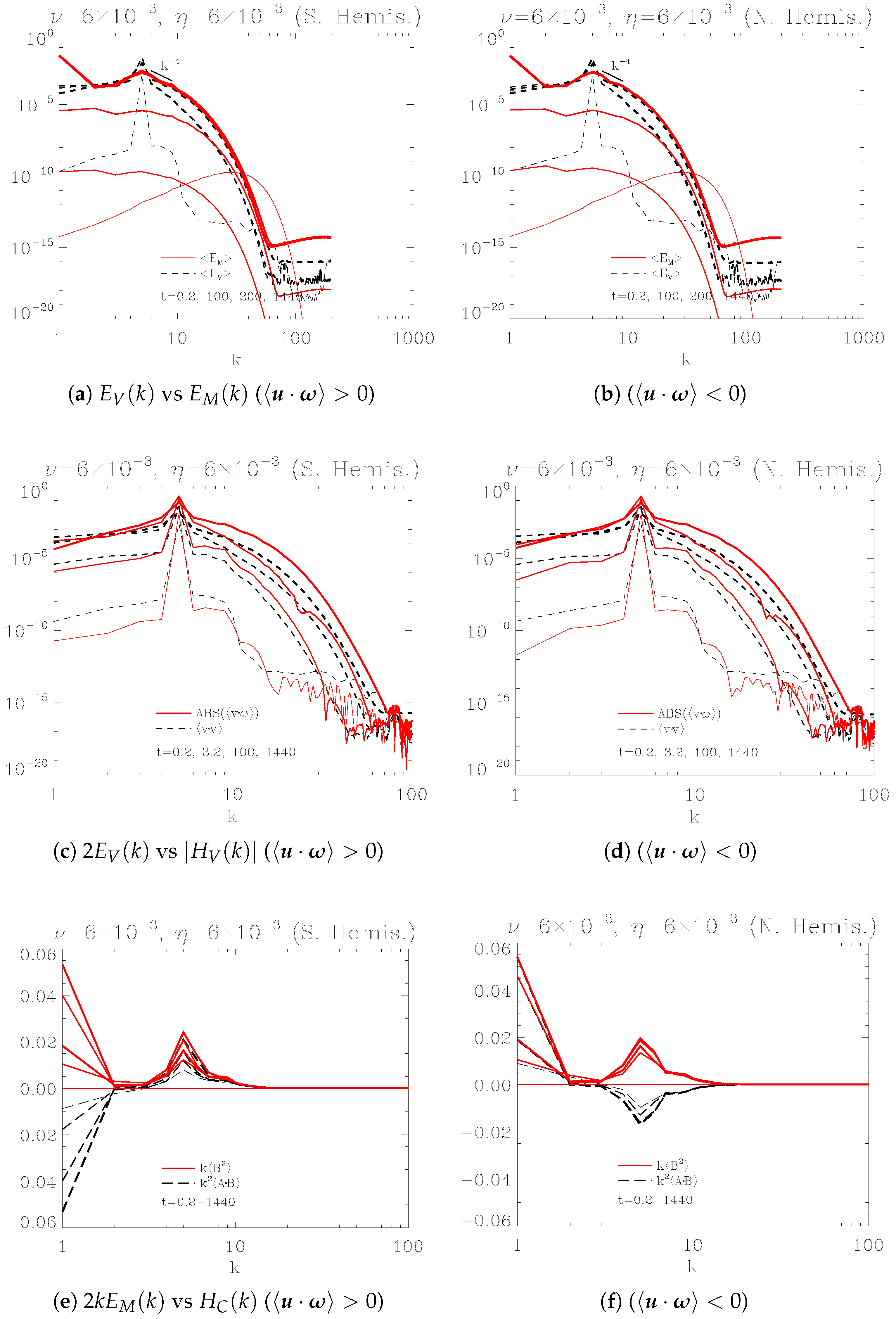
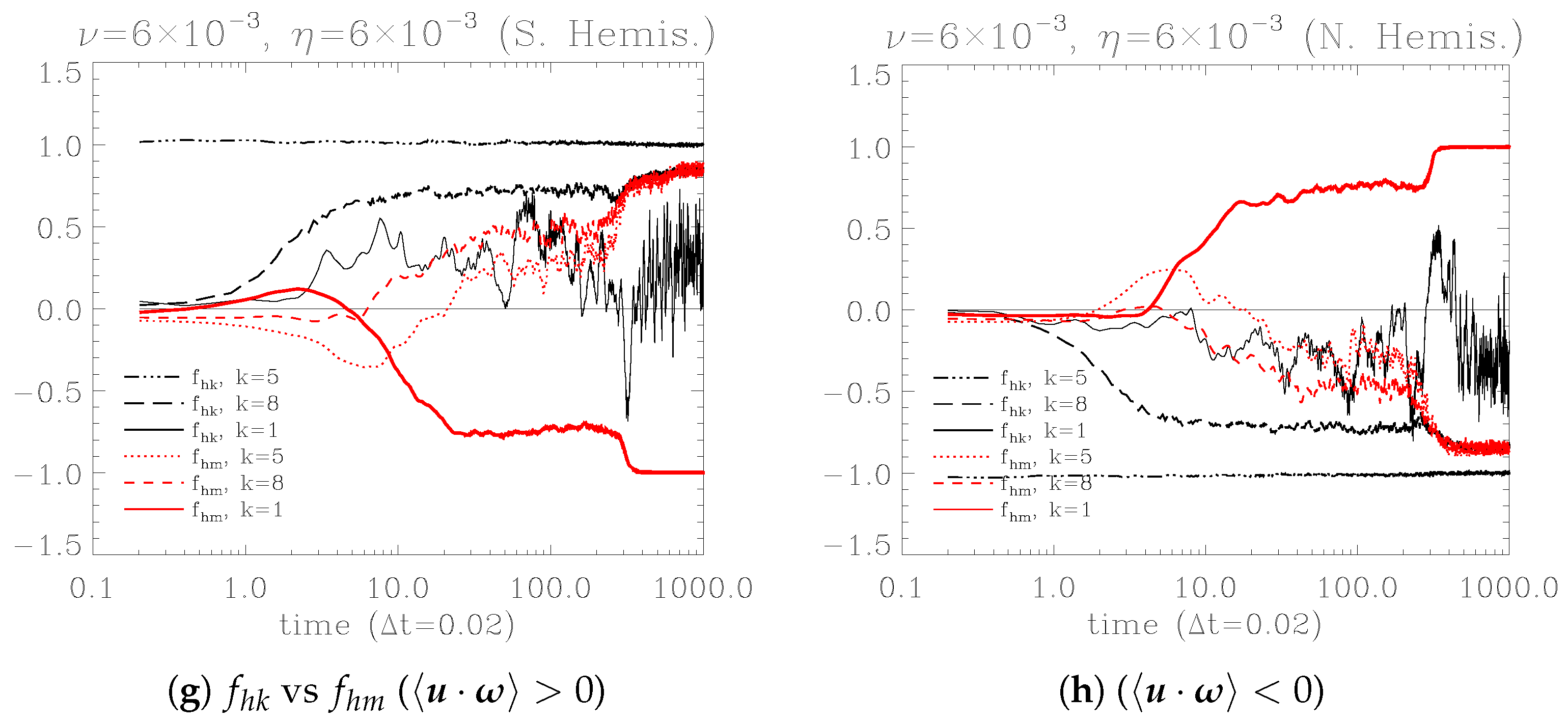
Figure 1 shows the temporally evolving energy, helicity, and helicity ratios in a kinetically driven rotating plasma system. The left panel depicts the southern hemisphere, which generates positive (right-handed) kinetic helicity, while the right panel depicts the northern hemisphere, which generates negative (left-handed) kinetic helicity.
Figure 1a,b depict the magnetic energy spectrum (red solid line) and kinetic energy spectrum (black dashed line) in Fourier space at times and 1440. As observed, the energy spectra for the southern and northern hemispheres match precisely. Both panels illustrate that the kinetic energy at the forcing scale is converted into magnetic energy , which is subsequently inverse cascaded to the large scale . At this scale, is significantly low, indicating an insufficient inverse cascade of kinetic energy. Additionally, each energy spectrum decreases more steeply than the Kolmogorov scale , implying that the kinetic energy from the forcing scale does not fully cascade down to smaller plasma eddy regions, a limitation arising from the low magnetic Reynolds number .
In Figure 1c,d, the kinetic helicity and kinetic energy spectra over time are illustrated, with kinetic helicity represented by the red solid line and kinetic energy by the black dashed line. While both Hemispheres exhibit similar trends, there is a clear difference in the sign of kinetic helicity. In Figure 1c, which represents the southern hemisphere, the kinetic helicity is positive, whereas in Figure 1d, corresponding to the northern hemisphere, it is negative. Therefore, their absolute values are used for their comparison. Moreover, there is a notable difference between the kinetic energy and kinetic helicity spectra, particularly in their direction of migration. In both hemispheres, for wave numbers (small-scale regime), the kinetic helicity exceeds the kinetic energy. However, as (large-scale regime), the kinetic energy becomes dominant. Such an unbalanced distribution of and is closely related to the and effects. An excess of and a deficiency of in small-scale regimes are more favorable for enhancing these and effects.
Figure 1e,f compare the current helicity with the magnetic energy multiplied by the wave number across the entire Fourier space. In Figure 1e, which represents the Southern Hemisphere, the signs of and are opposite in the large-scale region where , while they are the same on other scales. This results from the positive kinetic helicity generated by buoyancy and the leftward-deflecting Coriolis force in the Southern Hemisphere. Conversely, Figure 1f shows the opposite behavior in the Northern Hemisphere.
Figure 1g,h display the kinetic helicity ratio (black) and the magnetic helicity ratio (red) for . In the Southern Hemisphere, at the forcing scale, where , is , and in other regions maintains somewhat positive values. On the other hand, converges to when , with values in other small-scale regions converging to positive values. The opposite phenomenon occurs in the Northern Hemisphere, as shown in the right panel. The raw data in Figure 1a–f are used to compute and , and s in Figure 1g,h are employed to reproduce with the and coefficients.
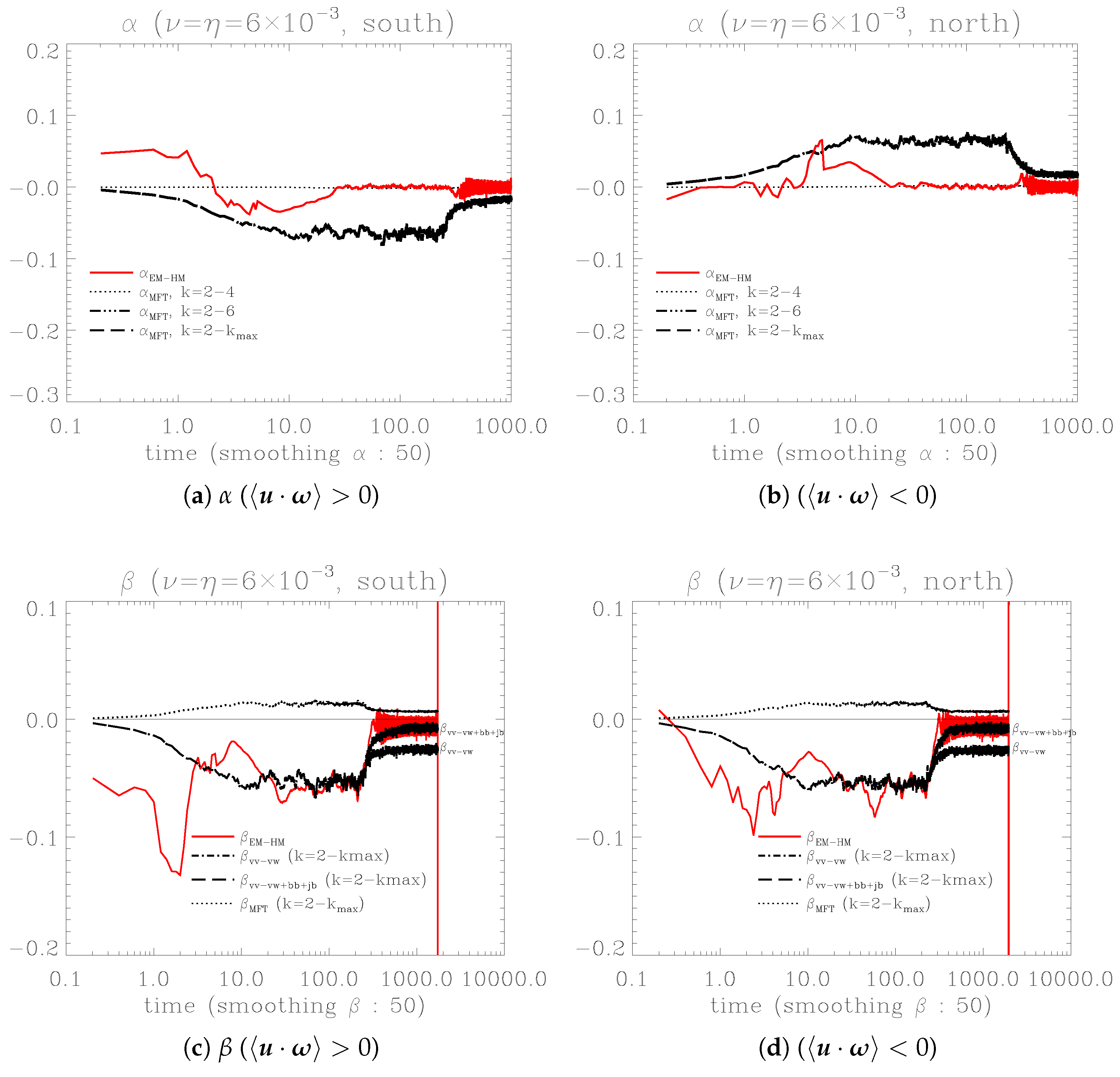
Figure 2a,b compare the coefficients obtained using large-scale magnetic data Equation (13) with the coefficients Equation (A1) approximated using small-scale kinetic and magnetic data (the formulae for and , Equations (13) and (14) produce reliable results, but when the large-scale magnetic field becomes fully helical, i.e., when and the logarithmic function diverges, it can lead to unphysical outcomes. Therefore, we artificially used .). As Figure 2a indicates, when the plasma system is driven with positive kinetic helicity, the effect decreases from positive to negative and then converges to 0. Conversely, when the system is driven with negative kinetic helicity, as shown in Figure 2b, the effect maintains a positive value before converging to 0. The MFT method requires integrating residual helicity over time, given by . We calculated values across cases of , , and . In both hemispheres, is obtained for , and there is no difference in between and , indicating that the forcing scale primarily determines .
and exhibit qualitatively similar evolution. However, compared to , converges to zero more rapidly and begins to oscillate around zero in the nonlinear regime (). In contrast, maintains the value determined by the kinetic helicity until entering the nonlinear regime, where it converges toward zero but still retains a non-negligible value. This indicates that the kinetic helicity supplied by the external forcing source exceeds the current helicity. The discrepancy also suggests that the higher-order terms neglected in the derivation of may contribute to the quenching of the effect, thereby limiting its role in magnetic field amplification. Moreover, the evolving profiles of indicate that the effect is relatively weak in the dynamo process. This is reasonable for an electrically neutral plasma system composed of numerous charged particles. The influence of electromagnetic forces—specifically, the effect—is inevitably somewhat limited, and the collective behavior of clustered particles exhibits strong fluid-like characteristics, such as diffusion, from a statistical perspective. This is also consistent with the fact that the phase difference between the magnetic fields and in the actual Sun is . As begins to decrease, starts to arise, and vice versa. In the presence of a strong effect, the interaction between the two fields is restricted to either in-phase (zero-mode) or anti-phase (-mode) coupling [25].
Figure 2c,d illustrate the magnetic diffusion, or effect. Here, we compare , obtained from large-scale magnetic data Equation (14); or , Equation (A2), derived from plasma turbulent kinetic energy; and , calculated using plasma turbulent kinetic energy and kinetic helicity Equation (16). The coefficient maintains a negative value before converging to zero. Since the effect is always accompanied by the Laplacian operator, i.e., , the negative contributes to the diffusion of the magnetic field toward larger scales and the amplification of the magnetic field strength. Similar effects are observed for in both the Northern and Southern Hemispheres. Meanwhile, remains positive, yielding a negative effect in conjunction with the Laplacian, which ultimately serves to decrease magnetic field energy. This result accounts for the leading term, without considering the helical component of plasma kinetic energy. By contrast, , which incorporates both kinetic energy and kinetic helicity, aligns closely with , suggesting that the kinetic helicity effect in the plasma plays a crucial role in the actual magnetic diffusion. Clearly, kinetic helicity reduces the effect. However, the discrepancy observed in the region where the magnetic field undergoes significant amplification (∼250) implies that should incorporate magnetic effects. (dashed line) includes the effects of turbulent magnetic energy and current helicity. The results show that coincides with in the whole range. The reduced by kinetic helicity is enhanced by turbulent magnetic effects.
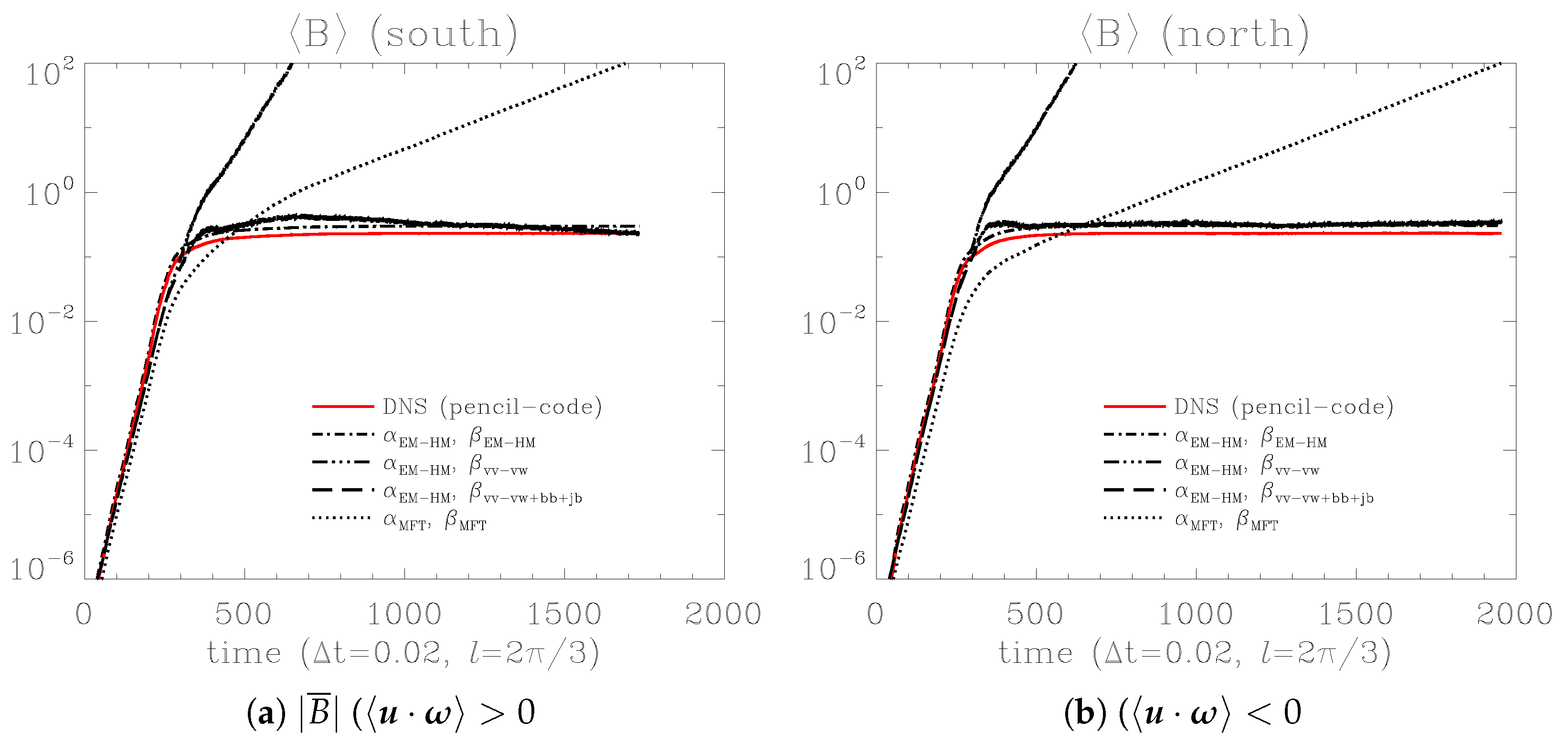
Figure 3a,b display the large-scale magnetic fields reproduced using four different combinations of coefficients: (, ), (, ), (, ), and (, ). These results are compared against the direct numerical simulation (DNS) results to assess the accuracy and efficacy of each coefficient pairing. These results are consistent with Figure 2a,b. In the kinematic regime, all models except (, ) accurately reproduce the DNS magnetic field, while after t∼250, generates a diverging magnetic field. When the effects of are included, converges to zero, and the magnetic field saturates.
To reproduce the magnetic field, we used an IDL script as follows.
B[0] = sqrt(2.0*spec_mag(1, 0)) % k=1 for large scale
Here, the time interval ∼0.2 and the correlation length are used. The corresponding wavenumber of this correlation length is , which represents the average wavenumber between the large scale () and the energy injection scale (). For the turbulent regime, we considered the range –.
The sign in front of is positive (‘+’) for the Northern Hemisphere (left-handed kinetic helicity, Figure 1f,h, ) and negative (‘−’) for the Southern Hemisphere (right-handed kinetic helicity, Figure 1e,g, ). Among the configurations, ( & ) yields the most accurate results, while the classical MFT method shows the lowest accuracy. This trend is consistent with the results observed in Figure 4. Meanwhile, ( & ) provides relatively accurate results in the kinematic regime. However, as the magnetic field grows, deviates larger than the actual value. This unconstrained growth implies the existence of additional mechanisms that quench the effect.
3. Theoretical Framework
3.1. Overview of Magnetic Evolution Driven by Kinetic Helicity in a Rotating System
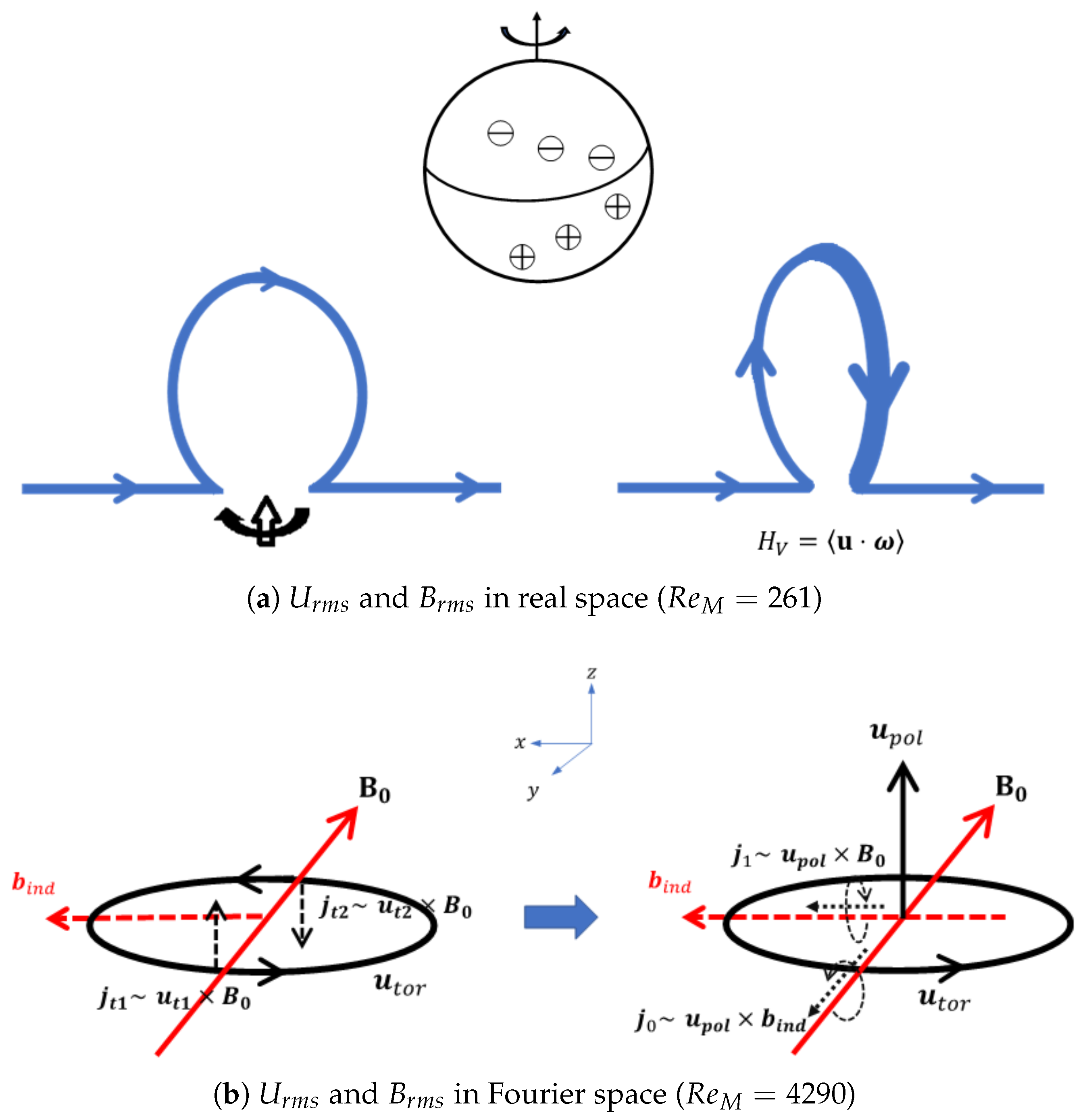
Figure 4a shows the kinetic helicity generated in a rotating plasma sphere. In rotating plasma systems, numerous tube-shaped plasma flux structures or kinetic eddies exist. The plasma inside the tube is pushed outward due to the balance between magnetic pressure and thermal pressure, making it relatively lighter than the surrounding medium and causing it to rise toward the solar surface. During this process, a portion of the plasma eddy stretches, reducing its density further and increasing its buoyancy, which leads to the deformation of the tube structure. At this stage, the Coriolis force causes the circular loop to rotate in a clockwise direction, generating right-handed kinetic helicity in the Southern Hemisphere. Conversely, in the Northern Hemisphere, left-handed kinetic helicity is generated. This kinetic helicity interacts with the magnetic field, inducing new magnetic fields (right handed polarity), as illustrated in Figure 4b. In stars including the Sun, dynamo action is thought to be concentrated near the tachocline, the boundary between the radiative zone and the convection zone, where strong shear amplifies the magnetic field.
In Figure 4b, the left panel illustrates a circular structure of a plasma turbulence eddy through which a magnetic field, , permeates, influencing both the eddy’s structure and energy distribution. Plasma motions, labeled and , interact with to produce current densities, and . According to Ampère’s law, these current densities induce a magnetic field, , creating magnetic diffusion through the relationship . This process of magnetic field induction occurs continuously, ultimately leading to the weakening of the original magnetic field. These sequential processes explain the magnetic diffusion effect due to plasma turbulence fluctuations . This is the turbulent magnetic diffusion in small scale dynamo.
However, if there is buoyancy, an additional poloidal velocity appears. This component interacts with to generate a current density along , which in turn induces a toroidal magnetic field (dotted circle). (acting as a poloidal field) and form left-handed magnetic helicity, ( effect). Simultaneously, can interact with to produce another current density, , with and forming right-handed magnetic helicity, . This sequence of processes indicates that the process presumes the preceding magnetic diffusion .
In this figure, , , and are depicted as intersecting at the same point. However, while and intersect each other, and can be separated. Statistically, becomes greater than . This left handed can be interpreted as the magnetic helicity generated by right handed kinetic helicity and cascaded inversely to larger scales. In contrast, right handed can be understood as the magnetic helicity produced to conserve the total magnetic helicity within the system. This reasoning aligns with the theoretical prediction that kinetic helicity generates magnetic helicity of opposite polarity, which is then amplified and transferred to larger scales, while magnetic helicity of the same polarity is generated in the small-scale regime.
For example, we may wonder what the magnetic helicities in the Sun actually are. Pipin et al. [26] showed that the global (large-scale) magnetic helicity is positive in the northern hemisphere and negative in the southern hemisphere. They used two different data sets: one from SOHO and the other from SOLIS. They also emphasized that the opposite signs—i.e., negative (positive) magnetic helicity in the northern (southern) hemisphere—are typically associated with active regions, such as sunspots [27]. In fact, the global-scale magnetic field is comparable in size to the solar hemisphere itself. According to their observations, the magnetic helicity polarity in each hemisphere appears to change over time.
3.2. Derivation of and Coefficients
There have been numerous theoretical attempts to derive the and coefficients. Among them, the important ones are included in the Appendix A and Appendix B, while here we primarily present our model.
From Equation (5), we constructed the coupled equations for and as follows:
For the large scale field with , magnetic helicity and current helicity coincide: (Magnetic helicity is defined as the inner product of an axial vector and a polar vector to be a pseudoscalar. is also considered as a pseudoscalar while and are normal scalars.).
Substituting this result into Equations (9) and (10) confirms equality between the left and right sides. The coefficients and can be obtained by multiplying Equation (9) by 2 and then performing simple algebraic operations with Equation (10). With and on the right-hand side, Equations (13) and (14) are derived, which provides an intuitive understanding of how and can be extracted from the raw data. Note that and are functions of large-scale or mean magnetic data expressed in differential form rather than integral form.
If we apply a reflection symmetry, does not change sign, but does. Then, the denominator and numerator in Equation (13) are reversed, leading to a change in the sign of ; that is, it behaves as a pseudoscalar. In contrast, in Equation (14) remains unchanged under reflection and thus is a scalar. For reference, helicities such as , , and represent interactions between an axial vector and a polar vector. Moreover, the electromagnetic field tensor combines the electric field (a polar vector) and the magnetic field (an axial vector) into a single relativistically consistent object. Their different transformation properties are properly handled by the antisymmetric tensor structure. It is fundamentally incorrect to reject the validity of an equation or a physical quantity merely because it involves combinations of vectors and scalars of different transformation properties.
3.3. Derivation of Using Turbulent Kinetic and Magnetic Data
With Equations (13) and (14), the profiles of and can be determined exactly. However, this indirect approach does not explain the physical mechanisms by which these effects are formed. In this section, we derive a more general again using the function iterative approach, with a more detailed statistical identity relation.
Conventionally, is found with
The eddy turnover time can be set as 1 under the assumption that the two eddies and are correlated over one eddy turnover time. Therefore, assuming the spatial correlation length ‘l’ for and to be and replacing the second-order velocity moment with kinetic energy is overly simplified.
In our previous work [10], we derived an expression for the coefficient that includes both turbulent kinetic energy and kinetic helicity, using a more general second-order moment identity that accounts for helicity effects. (When applying the MHD equations through differentiation and integration, the original spatial information is not fully preserved. In turbulence, one generally employs the two-point correlation function, which statistically connects single-point scalars such as energy and helicity to a displacement ℓ).
This expression accurately reproduces the results when the magnetic field is weak. However, it has a limitation in the nonlinear regime where the magnetic field becomes strong, as it fails to capture the quenching effect adequately (see Figure 2c). Therefore, needs to be derived in a more general form,
We have used the identity of a second order moment for magnetic field with current helicity :
The electromotive force, , is formally a polar vector. The term is an axial vector, since it is the cross product of two polar vectors. The current helicity is a pseudoscalar, and is a scalar. The finally complete form of the coefficient can be expressed as
As shown by , a reduced due to definite positive leads to the amplification of . In contrast, definite positive increases , resulting in the decay or suppression of .
4. Summary
We calculated the and effects generated by kinetic helicity, which has opposite signs in the southern and northern hemispheres of a rotating astrophysical plasma system. The large-scale magnetic field reconstructed using the coefficients and showed excellent agreement with the results from direct numerical simulations (DNS). In Figure 3a,b, Comparing this theoretical model with the DNS results for the Southern Hemisphere (Figure 4a) and the Northern Hemisphere (Figure 4b), we found almost no difference in the kinematic regime, and a relative error of less than 30% in the nonlinear regime.
reproduced a consistent magnetic field in the kinematic regime but gave unreliable results in the nonlinear regime, showing the limitations of conventional estimates based solely on the velocity field. In Figure 2c,d, and agree well in the kinematic regime, but they introduce a slight difference in the nonlinear regime. These differences, in turn, explain the diverging magnetic field observed in Figure 3a,b.
We introduced additional turbulent correlation terms involving the magnetic field and current density, namely , and incorporated them to construct an improved coefficient, . This enhanced coefficient more accurately reproduced the stable and physically realistic structure of the magnetic field. Clearly, and agree well even in the nonlinear regime shown in Figure 2c,d. When compared with the DNS results in Figure 3a,b, they also produce results that show excellent agreement across the entire domain. A brief comparison of each method is summarized in Table 1.
In a rotating body, the leftward Coriolis force in the southern hemisphere generates positive kinetic helicity, which in turn produces negative magnetic (current) helicity at large scales and positive magnetic (current) helicity at small scales. In contrast, in the northern hemisphere, the Coriolis force and helicities have opposite polarity. Consequently, the effect is consistent with the polarity of the large-scale magnetic (current) helicity, whereas the effect is independent of direction. In practice, it is the reduced effect that amplifies the large-scale magnetic field, and in the nonlinear regime, it is enhanced by the turbulent magnetic energy and current helicity, ultimately converging toward zero. The change in the polarity of kinetic helicity based on the direction of the Coriolis force, and the resulting formation of magnetic helicity and magnetic field amplification mechanism, are illustrated in Figure 4a,b. These considerations suggest that magnetic-field amplification in a plasma composed of many charged particles is governed not solely by Maxwell’s laws, but by the combined effects of diffusive transport arising from the fluid’s statistical behavior and Maxwellian dynamics. In addition, while the Coriolis force does not influence the strength of the induced magnetic field, it does determine the polarity of the resulting helicity. These describe fundamental principles generally applicable to rotating celestial plasma bodies.
Funding
This research received no funding.
Data Availability Statement
The original contributions presented in this study are included in the article. Further inquiries can be directed to the corresponding author.
Acknowledgments
The author acknowledges the support from IPTM and is grateful for the journal’s publishing policy, which facilitates open access to this work.
Conflicts of Interest
The authors declare no conflicts of interest. The funders had no role in the design of the study; in the collection, analyses, or interpretation of data; in the writing of the manuscript; or in the decision to publish the results.
Appendix A. Theoretical Derivation of α & β
Several attempts have been made to calculate these coefficients using various dynamo theories such as MFT, EDQNM, and DIA. Despite these efforts, only approximations of the and coefficients are available. These theories suggest that is related to residual helicity, , while is linked to turbulent energy, such as or . Conventionally, has been understood as a generator of magnetic fields, whereas , in combination with molecular resistivity , was thought to simply diffuse them. The theoretical expressions for and are outlined below.
Compared to MFD, the electromotive force (EMF) is characterized by the coefficients , , and , where represents cross helicity . Additionally, consists of contributions from both turbulent kinetic energy and magnetic energy. It should be noted that the dependence of on magnetic energy cannot be derived through the function recursion approach.
The relaxation time is given by , which converges to a constant over time: . The eddy damping operator is determined experimentally. Note that the coefficients and have a factor of , which stems from the quasi-normalization process that reduces fourth-order moments to second-order ones.
Appendix B. Temporal Evolution of the Magnetic Field in a Rotating Spherical System
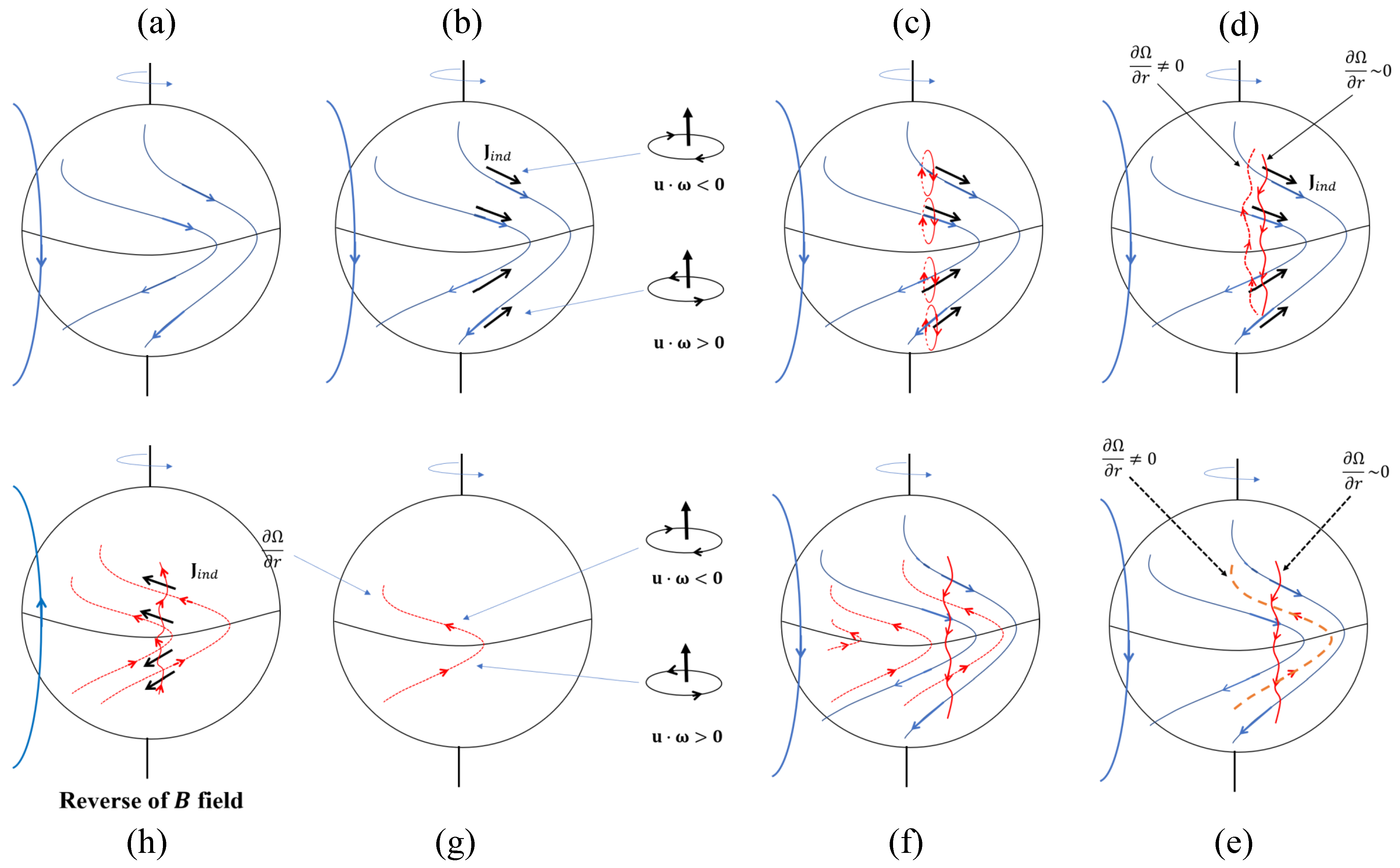
In Figure A1a, we assume that , flowing from north to south, is distorted by the sphere’s differential rotation. This rotation then leads to the formation of (), which becomes most concentrated near the equator. Due to the Coriolis force and buoyancy in the rotating celestial body, left-handed (negative) kinetic helicity ( is generated in the northern hemisphere, while right-handed (positive) kinetic helicity forms in the southern hemisphere. In the numerical code, a series of these turbulent kinetic motions is included in the forcing term in the momentum equation. Other convective motions are represented by the large-scale velocity field .
Figure A1.
Evolution of magnetic fields in the northern and southern hemisphere. Figures (a)→(b)→(c)→(d)→(e)→(f) illustrate the amplification of the magnetic field in the early stage, while figures (f)→(g)→(h) indicate the onset of amplification of the reversed magnetic field after an apparent quiescent phase. Black arrows represent the current density, and the vertically oriented red circles denote the poloidal magnetic fields generated by the current density. Note the directions of kinetic helicity and current density in each hemisphere.
Figure A1.
Evolution of magnetic fields in the northern and southern hemisphere. Figures (a)→(b)→(c)→(d)→(e)→(f) illustrate the amplification of the magnetic field in the early stage, while figures (f)→(g)→(h) indicate the onset of amplification of the reversed magnetic field after an apparent quiescent phase. Black arrows represent the current density, and the vertically oriented red circles denote the poloidal magnetic fields generated by the current density. Note the directions of kinetic helicity and current density in each hemisphere.
As Figure A1b shows, in the northern hemisphere, induced by left-handed kinetic helicity is in the same direction as the magnetic flux. On the contrary, is induced in the opposite direction in the southern hemisphere. Due to the opposite direction of in both hemispheres, the current densities in the northern and southern hemispheres flow from west to east. We will discuss the generation of aligned with due to kinetic helicity.
Figure A1c illustrates that these current densities, in turn, induce new magnetic fields encircling , as described by Maxwell theory (), not by Parker’s model. As a result, and generate right-handed magnetic helicity in the northern hemisphere and left-handed magnetic helicity in the southern hemisphere( effect). The fields reconnect to form the poloidal field ().
In Figure A1d–f, these small poloidal fields combine to form a large-scale that flows from the northern pole to the southern pole (). However, the large-scale formed beneath flows in the opposite direction, i.e., from south to north (). This forms a new toroidal field () through differential rotation ( effect). flows in the opposite direction to the original . Meanwhile, the strongest near the solar surface has fewer or virtually no factors for further amplification compared to which is still strengthened by differential rotation. Note that the polarity of is opposite to that of .
As strengthens, the plasma density within the magnetic flux tube decreases, making it lighter and causing it to rise to the surface. There, it reconnects with the existing magnetic flux , canceling out the magnetic fields. The amplified, oppositely directed magnetic flux beneath the surface continues to rise, eventually reaching the surface and exhibiting reversed polarity. In the new cycle depicted in Figure A1h, the current densities in both hemispheres flow from east to west, driven by the polarities of kinetic helicity. This process repeats every 11 years, accounting for the polarity reversal of the solar surface magnetic flux and the brief disappearance of magnetic fields between them. Nonetheless, in the southern (northern) hemisphere is always left (right) handed, regardless of the reversal of the magnetic field.
References
Brown, M.; Canfield, R.; Field, G.; Kulsrud, R.; Pevtsov, A.; Rosner, R.; Seehafer, N. Magnetic helicity in space and laboratory plasmas: Editorial summary. Geophys. Monogr. Ser.1999, 111, 301–304. [Google Scholar] [CrossRef]
Steenbeck, M.; Krause, F. Erklärung stellarer und planetarer Magnetfelder durch einen turbulenzbedingten Dynamomechanismus. Z. Naturforschung Teil A1966, 21, 1285. [Google Scholar] [CrossRef]
Moffatt, H.K. Magnetic Field Generation in Electrically Conducting Fluids; Cambridge University Press: Cambridge, UK, 1978; 353p. [Google Scholar]
Krause, F.; Rädler, K. Mean-Field Magnetohydrodynamics and Dynamo Theory; Pergamon Press, Ltd.: Oxford, UK, 1980; 271p. [Google Scholar]
Brandenburg, A.; Subramanian, K. Astrophysical magnetic fields and nonlinear dynamo theory. Phys. Rep.2005, 417, 1–209. [Google Scholar] [CrossRef]
Rogachevskii, I.; Kleeorin, N.; Brandenburg, A. Theory of the Kinetic Helicity Effect on Turbulent Diffusion of Magnetic and Scalar Fields. Astrophys. J.2025, 985, 18. [Google Scholar] [CrossRef]
Brandenburg, A.; Käpylä, P.J.; Rogachevskii, I.; Yokoi, N. Helicity Effect on Turbulent Passive and Active Scalar Diffusivities. Astrophys. J.2025, 984, 88. [Google Scholar] [CrossRef]
Park, K. Negative Magnetic Diffusivity β Replacing the α Effect in the Helical Dynamo. Astrophys. J.2020, 898, 112. [Google Scholar] [CrossRef]
Park, K.; Cheoun, M.K.; Kim, C.B. Turbulent Magnetic Diffusivity β Effect in a Magnetically Forced System. Astrophys. J.2023, 944, 2. [Google Scholar] [CrossRef]
Park, K. Effect of turbulent kinetic helicity on diffusive β effect for large scale dynamo. Phys. Rev. D2025, 111, 023021. [Google Scholar] [CrossRef]
Park, K. α Effect and Magnetic Diffusivity β in Helical Plasma Under Turbulence Growth. Universe2025, 11, 203. [Google Scholar] [CrossRef]
Pouquet, A.; Frisch, U.; Leorat, J. Strong MHD helical turbulence and the nonlinear dynamo effect. J. Fluid Mech.1976, 77, 321–354. [Google Scholar] [CrossRef]
Yoshizawa, A. Hydrodynamic and Magnetohydrodynamic Turbulent Flows; Springer: Berlin/Heidelberg, Germany, 2011. [Google Scholar]
Lanotte, A.; Noullez, A.; Vergassola, M.; Wirth, A. Large-scale dynamo produced by negative magnetic eddy diffusivities. Geophys. Astrophys. Fluid Dyn.1999, 91, 131–146. [Google Scholar] [CrossRef]
Schrinner, M.; Rädler, K.H.; Schmitt, D.; Rheinhardt, M.; Christensen, U. Mean-field view on rotating magnetoconvection and a geodynamo model. Astron. Nachrichten2005, 326, 245–249. [Google Scholar] [CrossRef]
Cabanes, S.; Schaeffer, N.; Nataf, H.C. Turbulence Reduces Magnetic Diffusivity in a Liquid Sodium Experiment. Phys. Rev. Lett.2014, 113, 184501. [Google Scholar] [CrossRef] [PubMed]
Giesecke, A.; Stefani, F.; Gerbeth, G. Magnetic material in mean-field dynamos driven by small scale helical flows. New J. Phys.2014, 16, 073034. [Google Scholar] [CrossRef]
Simard, C.; Charbonneau, P.; Bouchat, A. Magnetohydrodynamic Simulation-driven Kinematic Mean Field Model of the Solar Cycle. Astrophys. J.2013, 768, 16. [Google Scholar] [CrossRef]
Racine, É.; Charbonneau, P.; Ghizaru, M.; Bouchat, A.; Smolarkiewicz, P.K. On the Mode of Dynamo Action in a Global Large-eddy Simulation of Solar Convection. Astrophys. J.2011, 735, 46. [Google Scholar] [CrossRef]
Jouve, L.; Brun, A.S.; Arlt, R.; Brandenburg, A.; Dikpati, M.; Bonanno, A.; Käpylä, P.J.; Moss, D.; Rempel, M.; Gilman, P.; et al. A solar mean field dynamo benchmark. Astron. Astrophys.2008, 483, 949–960. [Google Scholar] [CrossRef]
Park, K. Effects of Turbulent Magnetic Energy and Current Helicity on Magnetic Diffusivity in Dynamos. Institute of Plasmas Turbulence and Magnetic Fields (ITPM), 50 Yongdam-ro, Sangdang-gu, Cheongju, Republic of Korea. 2025; under review. [Google Scholar]
Charbonneau, P. Solar Dynamo Theory. Annu. Rev. Astron. Astrophys.2014, 52, 251–290. [Google Scholar] [CrossRef]
Arfken, G.B.; Weber, H.J. Mathematical Methods for Physicists, 6th ed.; Elsevier: Amsterdam, The Netherlands; Boston, MA, USA, 2005. [Google Scholar]
Goldstein, H.; Poole, C.; Safko, J. Classical Mechanics, 3rd ed.; Addison Wesley: Newyork, NY, USA, 2001. [Google Scholar]
Pipin, V.V.; Pevtsov, A.A. Magnetic helicity of the global field in solar cycles 23 and 24. Astrophys. J.2014, 789, 21. [Google Scholar] [CrossRef]
Zhang, H.; Sakurai, T.; Pevtsov, A.; Gao, Y.; Xu, H.; Sokoloff, D.D.; Kuzanyan, K. A new dynamo pattern revealed by solar helical magnetic fields. Mon. Not. R. Astron. Soc. Lett.2010, 402, L30–L33. [Google Scholar] [CrossRef]
Park, K.; Blackman, E.G. Comparison between turbulent helical dynamo simulations and a non-linear three-scale theory. Mon. Not. R. Astron. Soc.2012, 419, 913–924. [Google Scholar] [CrossRef]
Frisch, U.; Pouquet, A.; Leorat, J.; Mazure, A. Possibility of an inverse cascade of magnetic helicity in magnetohydrodynamic turbulence. J. Fluid Mech.1975, 68, 769–778. [Google Scholar] [CrossRef]
Figure 1.
Left panel: southern hemisphere (positive kinetic helicity), right panel: northern hemisphere (negative kinetic helicity).
Figure 1.
Left panel: southern hemisphere (positive kinetic helicity), right panel: northern hemisphere (negative kinetic helicity).
Figure 2.
(a,b) reflects its dependence on the sign of externally provided kinetic helicity. (c,d) Unlike , the coefficient does not change its sign in response to the sign of kinetic helicity. exhibits significant fluctuations after , but its time average effectively converges to zero. In contrast, () remains positive, while and stay negative.
Figure 2.
(a,b) reflects its dependence on the sign of externally provided kinetic helicity. (c,d) Unlike , the coefficient does not change its sign in response to the sign of kinetic helicity. exhibits significant fluctuations after , but its time average effectively converges to zero. In contrast, () remains positive, while and stay negative.
Figure 3.
(a,b) Large-scale magnetic field reconstructed using different combinations of and . The correlation length corresponds to (south) (north), which is the midpoint between the large scale () and the forcing scale ().
Figure 3.
(a,b) Large-scale magnetic field reconstructed using different combinations of and . The correlation length corresponds to (south) (north), which is the midpoint between the large scale () and the forcing scale ().
Figure 4.
(a) Right handed kinetic helicity in southern hemisphere. The plasma flux, buoyed toward the surface, is twisted clockwise by the Coriolis force, generating right-handed kinetic helicity. (b) Left panel: nonhelical kinetic structure and seed magnetic field . Right panel: right handed kinetic helicity and . Negative and positive are generated (southern hemisphere).
Figure 4.
(a) Right handed kinetic helicity in southern hemisphere. The plasma flux, buoyed toward the surface, is twisted clockwise by the Coriolis force, generating right-handed kinetic helicity. (b) Left panel: nonhelical kinetic structure and seed magnetic field . Right panel: right handed kinetic helicity and . Negative and positive are generated (southern hemisphere).
Table 1.
Comparison of Methods for Calculating and and Their Impact on . The accuracy varies slightly depending on the numerical method used to evaluate the theoretical formula (Euler forward difference, RK, or exponential).
Table 1.
Comparison of Methods for Calculating and and Their Impact on . The accuracy varies slightly depending on the numerical method used to evaluate the theoretical formula (Euler forward difference, RK, or exponential).
Method
Data Used
Calculation Method
Accuracy of
&
v and b
integral
inaccurate
&
differentiation
accurate in the whole range
&
v and
integral and differentiation
accurate for weak
&
v, b, and
integral and differentiation
accurate in the whole range
Disclaimer/Publisher’s Note: The statements, opinions and data contained in all publications are solely those of the individual author(s) and contributor(s) and not of MDPI and/or the editor(s). MDPI and/or the editor(s) disclaim responsibility for any injury to people or property resulting from any ideas, methods, instructions or products referred to in the content.
Park, K.
Magnetic Field Amplification and Reconstruction in Rotating Astrophysical Plasmas: Verifying the Roles of α and β in Dynamo Action. Particles2025, 8, 98.
https://doi.org/10.3390/particles8040098
AMA Style
Park K.
Magnetic Field Amplification and Reconstruction in Rotating Astrophysical Plasmas: Verifying the Roles of α and β in Dynamo Action. Particles. 2025; 8(4):98.
https://doi.org/10.3390/particles8040098
Chicago/Turabian Style
Park, Kiwan.
2025. "Magnetic Field Amplification and Reconstruction in Rotating Astrophysical Plasmas: Verifying the Roles of α and β in Dynamo Action" Particles 8, no. 4: 98.
https://doi.org/10.3390/particles8040098
APA Style
Park, K.
(2025). Magnetic Field Amplification and Reconstruction in Rotating Astrophysical Plasmas: Verifying the Roles of α and β in Dynamo Action. Particles, 8(4), 98.
https://doi.org/10.3390/particles8040098
Article Metrics
No
No
Article Access Statistics
For more information on the journal statistics, click here.
Multiple requests from the same IP address are counted as one view.
Park, K.
Magnetic Field Amplification and Reconstruction in Rotating Astrophysical Plasmas: Verifying the Roles of α and β in Dynamo Action. Particles2025, 8, 98.
https://doi.org/10.3390/particles8040098
AMA Style
Park K.
Magnetic Field Amplification and Reconstruction in Rotating Astrophysical Plasmas: Verifying the Roles of α and β in Dynamo Action. Particles. 2025; 8(4):98.
https://doi.org/10.3390/particles8040098
Chicago/Turabian Style
Park, Kiwan.
2025. "Magnetic Field Amplification and Reconstruction in Rotating Astrophysical Plasmas: Verifying the Roles of α and β in Dynamo Action" Particles 8, no. 4: 98.
https://doi.org/10.3390/particles8040098
APA Style
Park, K.
(2025). Magnetic Field Amplification and Reconstruction in Rotating Astrophysical Plasmas: Verifying the Roles of α and β in Dynamo Action. Particles, 8(4), 98.
https://doi.org/10.3390/particles8040098