Abstract
This study employs Monte Carlo (MC) models and thermal-statistical analysis to investigate the production mechanisms of strange (, ) and multi-strange (, ) hadrons in high-multiplicity proton–proton collisions. Through systematic comparisons with experimental data, we evaluate the predictive power of EPOS, PYTHIA8, QGSJETII04, and Sibyll2.3d. EPOS, with its hydrodynamic evolution, successfully reproduces low- and yields in high-multiplicity classes (MC1–MC3), mirroring quark-gluon plasma (QGP) thermalization effects. PYTHIA8’s rope hadronization partially mitigates mid- multi-strange baryon suppression but underestimates and yields due to the absence of explicit medium dynamics. QGSJETII04, tailored for cosmic-ray showers, overpredicts soft yields from excessive soft Pomeron contributions and lacks multi-strange hadron predictions due to enforced decays. Sibyll2.3d’s forward-phase bias limits its accuracy at midrapidity. No model fully captures and production, though EPOS remains the closest. Complementary Tsallis distribution analysis reveals a distinct mass-dependent hierarchy in the extracted effective temperature () and non-extensivity parameter (q). As multiplicity decreases, rises while q declines—a trend amplified for heavier particles. This suggests faster equilibration of heavier particles compared to lighter species. The interplay of these findings underscores the necessity of incorporating QGP-like medium effects and refined strangeness enhancement mechanisms in MC models to describe small-system collectivity.
1. Introduction
The discovery of the Quark-Gluon Plasma (QGP)—a state of deconfined quarks and gluons—emerged from ultra-relativistic heavy-ion collisions, where energy densities surpass those in neutron stars and temperatures exceed times the Sun’s core. Such extreme conditions dissolve hadrons into their primordial constituents, offering a unique window into the early universe. A hallmark of QGP formation is the enhanced production of strange hadrons, which arises from prolific strange quark generation in the deconfined medium. Historically, QGP signatures were attributed solely to heavy-ion collisions, with proton–proton () collisions serving as a reference for non-QGP dynamics. However, recent observations of collective behavior and strangeness enhancement in high-multiplicity events challenge this paradigm, suggesting the transient creation of QGP-like droplets even in small collision systems [1,2].
Multi-strange baryons (, ) and mesons (, ) are particularly sensitive to the energy density and lifetime of the created medium. Their production mechanisms, however, remain enigmatic in high-multiplicity collisions. Unlike light quarks (u, d), strange quarks (s) are absent in the initial colliding protons and must be generated dynamically via gluon splitting, flavor excitation, or thermal processes. At low momentum transfer, non-perturbative effects dominate, and conventional string fragmentation models struggle to reproduce observed strangeness yields. These models inherently suppress s-quark production relative to lighter flavors, necessitating empirical tuning in Monte Carlo (MC) generators. Precision measurements of strange hadrons thus provide critical constraints to disentangle the interplay of initial-state effects, hadronization mechanisms, and potential medium modifications.
This work investigates the production of , , , and in high-multiplicity collisions using EPOS, PYTHIA8, QGSJETII04, and Sibyll2.3d, benchmarked against ALICE data [1]. Beyond QGP diagnostics, our findings hold broader implications for cosmic-ray physics. Strange hadrons play a pivotal role in extended air showers: their decay chains (e.g., , , ) populate showers with muons and neutrinos, shaping energy deposition and composition studies. A deeper understanding of their production mechanisms therefore bridges collider physics and astroparticle phenomena, refining models of high-energy interactions in both terrestrial and cosmic environments.
2. Method and Models
This study examines the transverse momentum () spectra of strange (, , ) and multi-strange (, , , ) hadrons produced in high-multiplicity proton–proton () collisions at TeV, as measured by the ALICE experiment [1]. The analysis spans 10 multiplicity classes (MC1–MC10), ordered from highest to lowest activity. We adopt a dual methodology:
- 1
- Monte Carlo (MC) Event Generators: These simulate collisions using EPOS_LHC [3], PYTHIA8.309 [4], QGSJETII-04 [5], and Sibyll2.3d [6]. These models, interfaced via the CRMC package [7], are benchmarked against ALICE data under identical kinematic and multiplicity conditions.
- 2
- Tsallis Statistical Analysis: This fits the experimental spectra to extract thermodynamic parameters (, q), probing the system’s equilibration and collective dynamics.
Simulations in the current study include one million minimum-bias events per model. Primary particles—defined as those not originating from weak decays—are categorized into multiplicity classes following ALICE’s criteria [1]. A short description of the MC models used in the current study is as follows:
PYTHIA8 [8] employs perturbative QCD (pQCD) [9] with multiparton interactions (MPI), color reconnection (CR), and rope hadronization to simulate small collision systems [10]. While lacking explicit thermalization, its CR mechanism generates flow-like correlations [11], and rope hadronization enhances strangeness production via collective string overlaps [12]. This makes PYTHIA8 adept at reproducing macroscopic observables in collisions, albeit with limitations in multi-strange baryon yields.
EPOS [13] combines parton-based Gribov–Regge theory for initial-state dynamics with hydrodynamic evolution of the quark-gluon medium. Unlike PYTHIA8, EPOS explicitly incorporates thermalization, enabling realistic modeling of collective effects and low- hadron yields. Its hybrid approach bridges initial-state fluctuations, viscous hydrodynamics, and hadronic rescattering, making it particularly suited for QGP-like signatures in high-multiplicity events.
QGSJETII-04: Based on the Quark-Gluon String model [14] and Gribov’s Reggeon field theory [15], QGSJETII-04 emphasizes soft Pomeron exchanges to describe hadronic and cosmic-ray interactions [16,17]. Enhanced Pomeron diagrams account for non-linear saturation effects at high energies [18], but its enforced decay chains omit multi-strange hadrons as final-state particles, limiting applicability to and analyses.
Sibyll2.3d: Optimized for cosmic-ray air showers, Sibyll2.3d [6,19] integrates the dual parton model (DPM) [20] and minijet formalism [21] to simulate forward-phase particle production. Hadronization follows Lund string fragmentation [22,23], akin to PYTHIA. However, its midrapidity accuracy is constrained by a forward-biased design, prioritizing energy flow relevant to extensive air showers [24] over detailed strangeness dynamics.
Tsallis Statistical Approach: To quantify non-equilibrium effects in the produced medium, the Tsallis distribution [25,26] is fitted to the spectra. The functional form
incorporates transverse mass (), effective temperature (), and non-extensivity parameter (q). Here, corresponds to the Boltzmann–Gibbs equilibrium, while signals deviations due to long-range correlations or incomplete thermalization. The distribution’s flexibility—spanning exponential () to power-law () behavior—provides insights into freeze-out conditions and production mechanisms [27,28,29,30,31,32].
3. Results and Discussion
In this section, we present the analyses of the transverse momentum () distributions of both strange and multi-strange hadrons across various multiplicity classes, denoted as MC1 to MC10. These classes are organized based on decreasing multiplicity levels produced in collisions at 7 TeV. The measurements were taken at midrapidity 0.5, using the ALICE detector at the LHC [1].
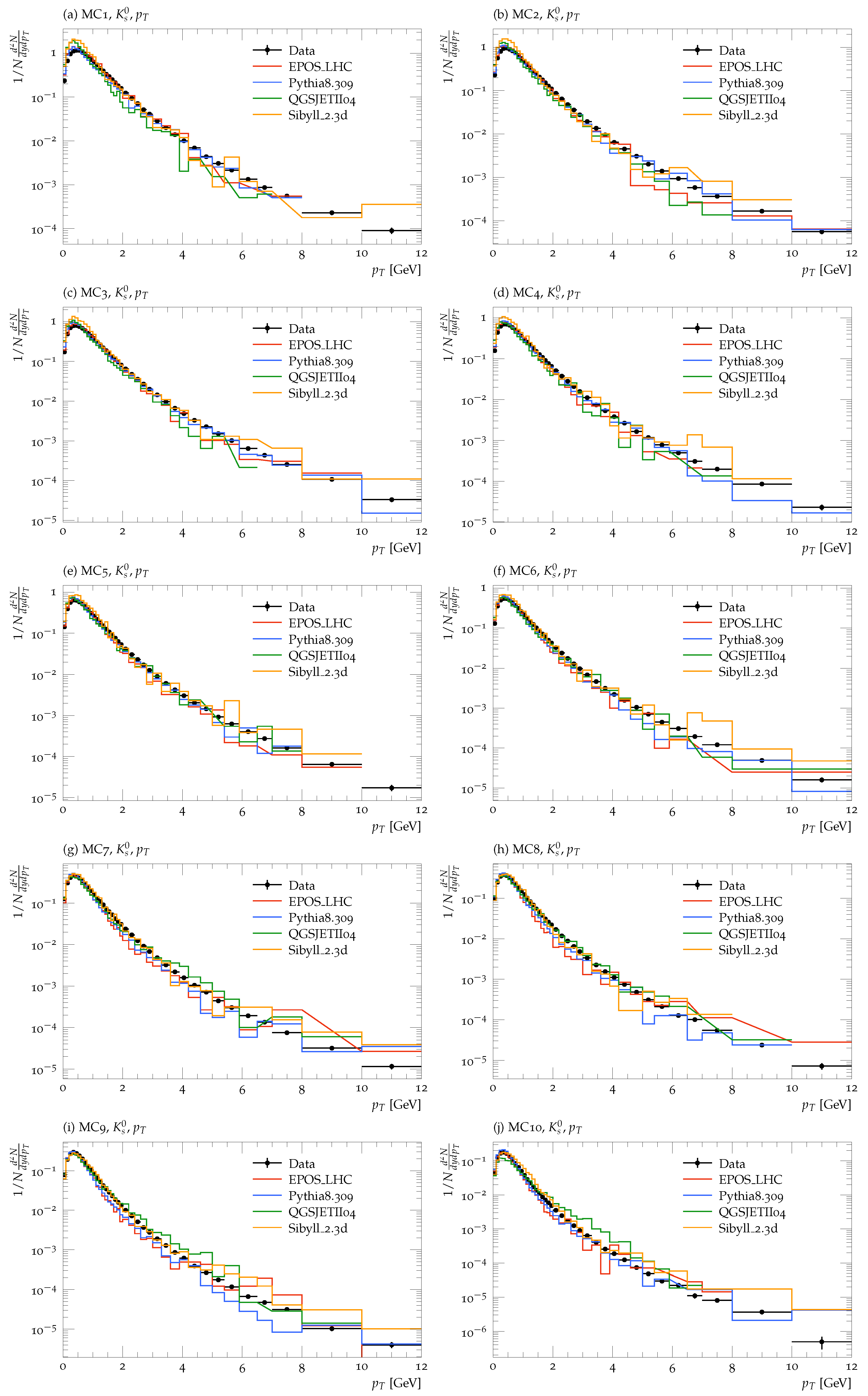
Figure 1 presents the transverse momentum () spectra of mesons in collisions at TeV across 10 multiplicity classes (MC1–MC10, descending multiplicities). Predictions from EPOS-LHC (hydrodynamic framework), PYTHIA8.309 (rope hadronization), QGSJETII-04 (soft Pomeron-dominated), and Sibyll2.3d (forward-phase optimized) are compared to ALICE data [1]. Key trends emerge:
Figure 1.
A comparative assessment between the simulated outcomes against experimental data, sourced from [1], of production presented in 10 distinct multiplicity classes. The simulations were conducted using EPOS_LHC, Pythia8.309, QGSJETII04, and Sibyll_2.3d models at 7 TeV collisions.
1. High-Multiplicity Classes (MC1–MC3): (a) EPOS-LHC reproduces yields up to GeV/c (Figure 1a–c), due to its hydrodynamic bulk evolution to model collective strangeness enhancement. However, it underestimates yields at GeV/c due to missing jet–medium interactions. (b) PYTHIA8 aligns with data at mid- ( GeV/c) via rope hadronization, which enhances s-quark production through overlapping color strings. It fails at low ( GeV/c), where thermalization dominates. (c) QGSJETII-04 overpredicts yields at GeV/c (Figure 1a) due to excessive soft Pomeron contributions but underpredicts at higher as semi-hard processes dominate. (d) Sibyll2.3d oscillates around data, reflecting its Lund string fragmentation’s inability to resolve midrapidity collectivity.
2. Mid-Multiplicity Classes (MC4–MC7): (a) EPOS-LHC gradually loses accuracy as multiplicity decreases, underpredicting GeV/c (Figure 1d–g), signaling reduced hydrodynamic collectivity. (b) PYTHIA8 and QGSJETII-04 converge at –3 GeV/c (Figure 1d,e), where rope hadronization and soft Pomerons partially compensate for missing medium effects. (c) Sibyll2.3d increasingly overpredicts high- ( GeV/c) yields (Figure 1f,g), a relic of its minijet model tuned for cosmic-ray forward physics.
3. Low-Multiplicity Classes (MC8–MC10): (a) EPOS-LHC and PYTHIA8 systematically underestimate yields (Figure 1h–j), as sparse systems lack the density required for hydrodynamic/collective effects. (b) QGSJETII-04 and Sibyll2.3d overpredict across , reflecting their focus on perturbative/minijet processes irrelevant to low-multiplicity kinematics.
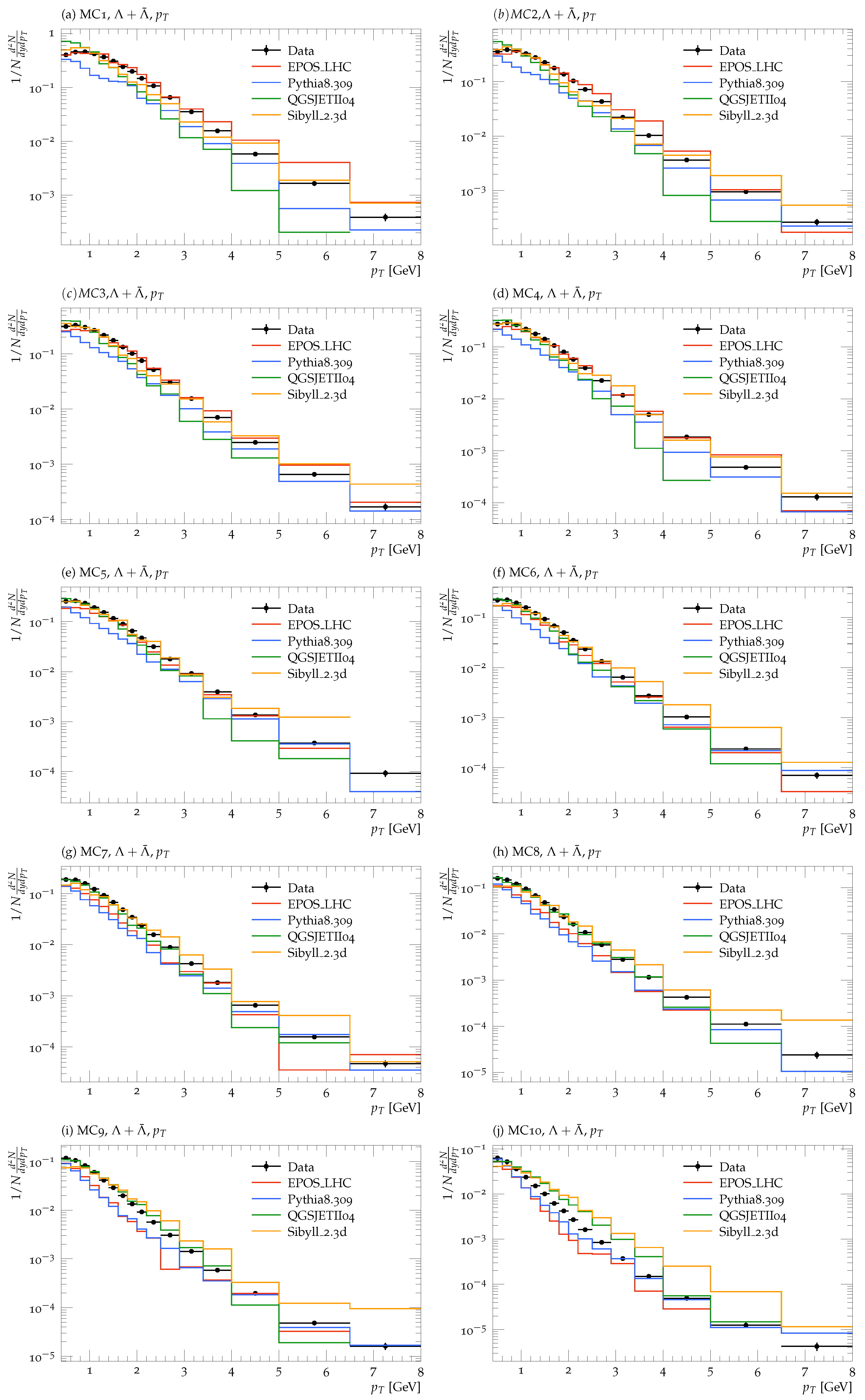
Figure 2 displays the transverse momentum () spectra of baryons in collisions at TeV across 10 multiplicity classes (MC1–MC10). Predictions from EPOS-LHC (hydrodynamics), PYTHIA8.309 (rope hadronization), QGSJETII-04 (soft Pomeron-dominated), and Sibyll2.3d (forward-optimized) are contrasted with ALICE data [1]. Key observations include the following:
Figure 2.
Comparison of the simulated results for + in 10 different multiplicity classes produced by EPOS_LHC, Pythia8.309, QGSJETII04, and Sibyll_2.3d with the experimental data [1] in collisions at 7 TeV.
1. High-Multiplicity Classes (MC1–MC3, Figure 2a–c): (a) EPOS-LHC accurately predicts yields at GeV/c in MC1–MC3, attributed to hydrodynamic bulk evolution mimicking partial thermalization of strange quarks. The model overestimates yields at GeV/c, reflecting its lack of in-medium energy loss for high- partons. (b) PYTHIA8 underpredicts yields across all , a consequence of its rope hadronization mechanism favoring meson over baryon production while the missing gluon splitting () suppression exacerbates the deficit at GeV/c. (c) QGSJETII-04 overpredicts yields at GeV/c due to excessive soft Pomeron contributions in the Quark-Gluon String model. The model fails at GeV/c, where semi-hard processes dominate but are inadequately modeled. (d) Sibyll2.3d underpredicts at GeV/c due to its Lund string fragmentation underestimating baryon formation in dense systems. It overpredicts at GeV/c, a relic of its minijet model tuned for forward-phase cosmic-ray showers.
2. Mid-Multiplicity Classes (MC4–MC7, Figure 2d–g): (a) EPOS-LHC agreement deteriorates progressively from MC4 to MC7, with underpredictions at GeV/c. This reflects diminishing hydrodynamic collectivity as system density decreases, eroding its ability to thermalize strange quarks. (b) PYTHIA8 systematically underestimates yields across all , highlighting its inability to model baryon transport in sparse systems. The rope hadronization mechanism, effective for mesons, fails to enhance baryon production in mid-multiplicity regimes. (c) QGSJETII-04 predictions oscillate between overestimation at GeV/c (soft Pomeron dominance) and underestimation at higher (missing semi-hard processes). (d) Sibyll2.3d overpredicts yields at GeV/c (e.g., MC6–MC7 in Figure 2f,g), a consequence of its forward-phase Lund string fragmentation misrepresenting midrapidity baryon dynamics.
3. Low-Multiplicity Classes (MC8–MC10): (a) MC8 (Figure 2h): Sibyll2.3d shows improved agreement with data up to GeV/c, likely due to reduced system density aligning with its minijet-dominated hadronization. However, it overpredicts at higher , where its lack of in-medium suppression becomes apparent. EPOS-LHC and PYTHIA8 continue to underpredict, as sparse systems lack the energy density required for hydrodynamic collectivity (EPOS) or efficient baryon transport via ropes (PYTHIA). (b) MC9–MC10 (Figure 2i,j): QGSJETII-04 and Sibyll2.3d reproduce yields at GeV/c but overpredict at GeV/c. This bifurcation arises from their reliance on soft Pomerons (QGSJET) or forward-optimized minijets (Sibyll), which become unphysical in low-density regimes. EPOS-LHC and PYTHIA8 persistently underestimate yields, underscoring their dependence on collective or string-mediated effects absent in peripheral collisions.
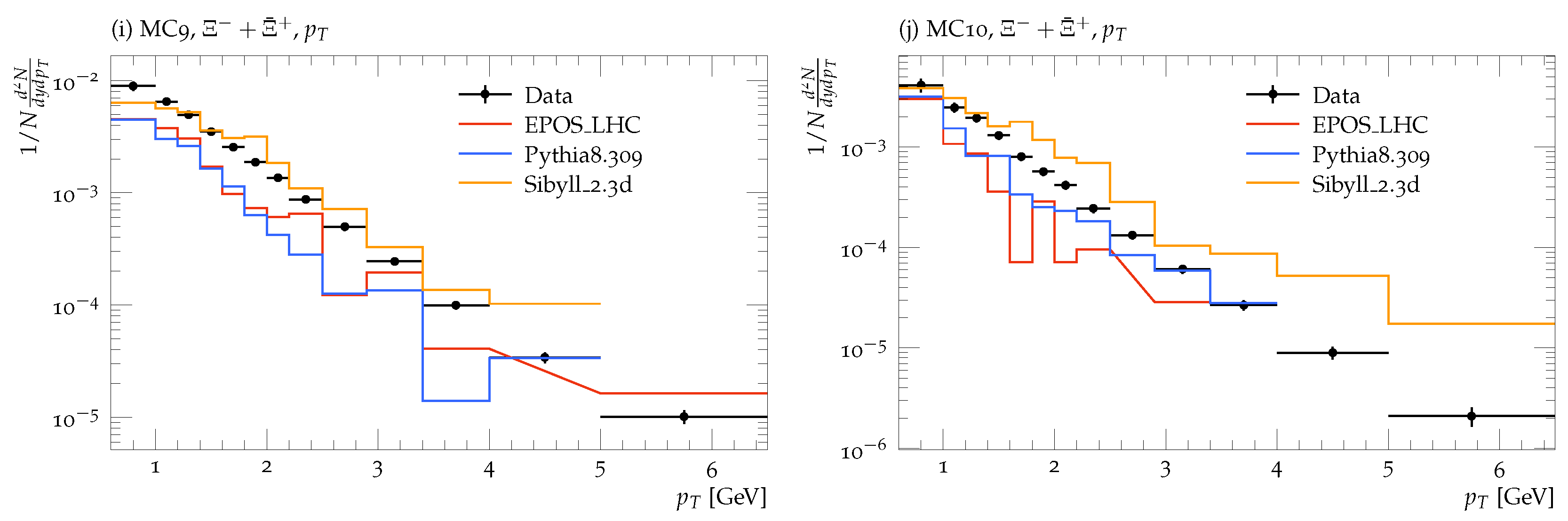
Figure 3 illustrates the transverse momentum () spectra of baryons in collisions at TeV across 10 multiplicity classes (MC1–MC10, descending multiplicity). Predictions from EPOS-LHC, PYTHIA8.309, and Sibyll2.3d are compared to ALICE data [1], while QGSJETII-04 is excluded due to its forced decay mechanism, which precludes direct detection [33,34]. Key observations include the following: 1. High-Multiplicity Classes (MC1–MC3): (a) EPOS-LHC (Figure 3a–c) slightly overpredicts yields across in MC1–MC2, likely due to overestimated initial-state strangeness saturation in its Parton-Based Gribov–Regge framework. The model matches data in MC3 (Figure 3c), suggesting improved thermalization balance in moderate density systems. (b) PYTHIA8 (Figure 3a–c) fails to reproduce spectra across all , as its rope hadronization mechanism inadequately enhances multi-strange baryon production despite increased string overlap. (c) Sibyll2.3d (Figure 3a–c) accurately predicts low- ( GeV/c) yields via Lund string fragmentation but underpredicts high- due to missing gluon splitting () suppression.

Figure 3.
Comparison of the simulated results for + in 10 different multiplicity classes produced by EPOS_LHC, Pythia8.309, and Sibyll_2.3d with the experimental data [1] in collisions at 7 TeV.
2. Mid-Multiplicity Classes (MC4–MC7): (a) EPOS-LHC (Figure 3d–g) achieves very good agreement with data in MC4–MC6, where hydrodynamic collectivity and initial-state strangeness balance. It underpredicts in MC7 as thermalization diminishes. (b) PYTHIA8 (Figure 3d–g) discrepancy reduces with decreasing multiplicity (MC4–MC7), as sparse systems minimize rope hadronization’s baryon suppression. However, systematic underestimation persists. (c) Sibyll2.3d (Figure 3d–g) transitional behavior underpredicts high- in MC4–MC6 but begins overpredicting in MC7, reflecting its minijet model’s growing dominance in low-density regimes.
3. Low-Multiplicity Classes (MC8–MC10): (a) EPOS-LHC (Figure 3h–j) underpredicts yields, signaling the absence of hydrodynamic collectivity in sparse systems. (b) PYTHIA8 (Figure 3h–j) remains ineffective, with no significant improvement despite reduced multiplicity, highlighting fundamental limitations in baryon transport modeling. (c) Sibyll2.3d (Figure 3h–j) overpredicts yields at GeV/c, as its forward-phase string fragmentation becomes unphysical in low-density midrapidity collisions.
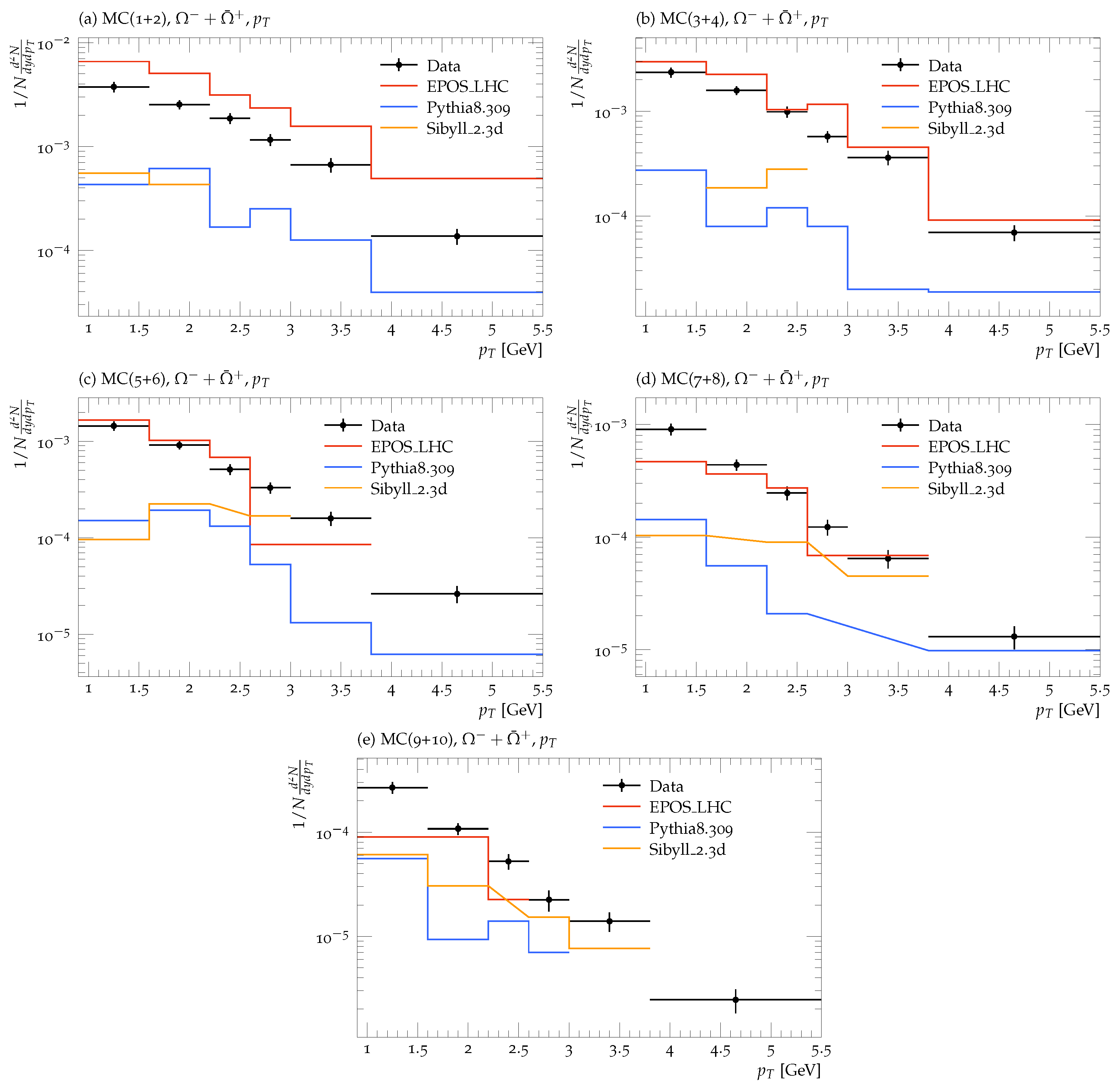
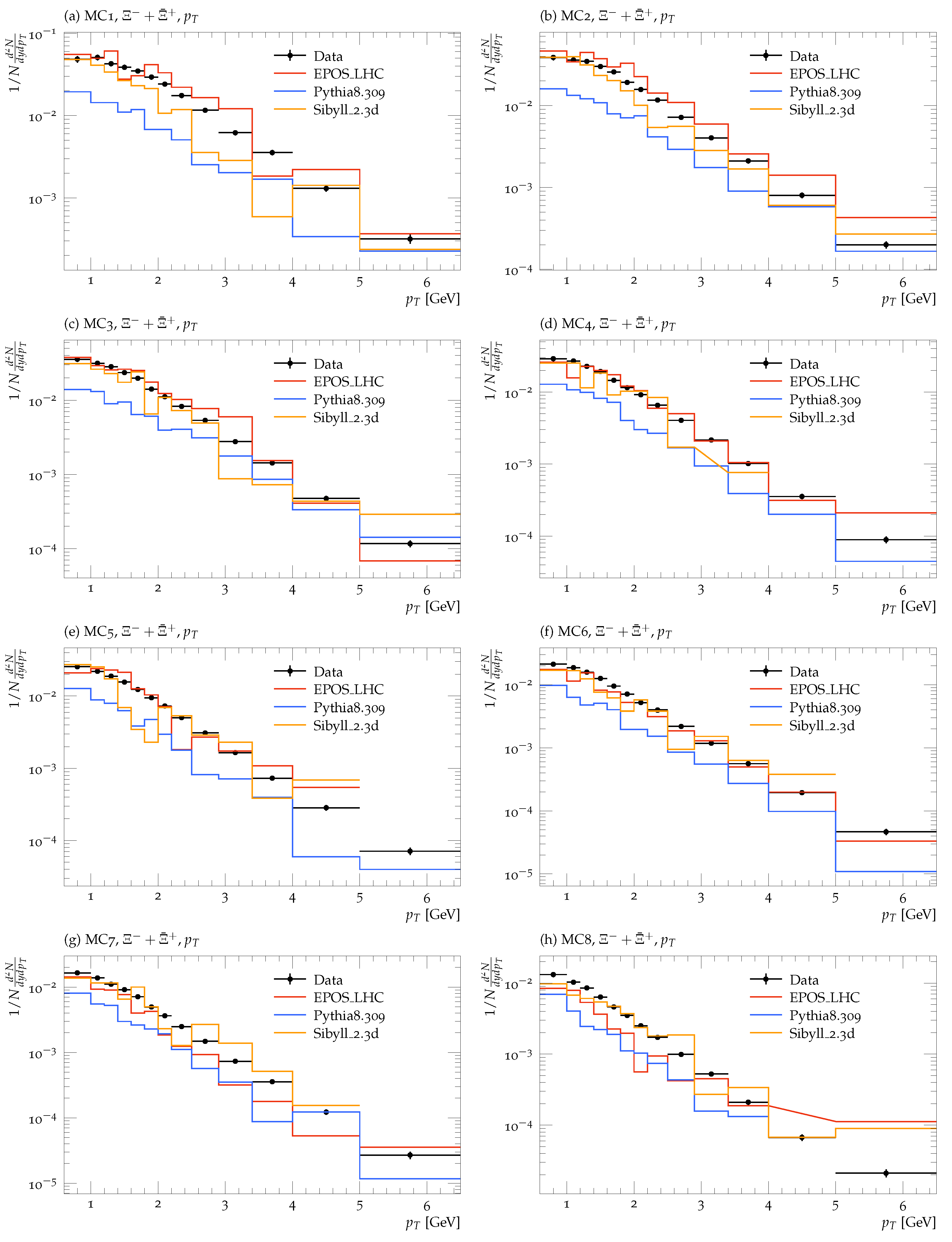
Figure 4 presents the transverse momentum () spectra of baryons in collisions at TeV across five merged multiplicity classes (MC1–MC5, descending multiplicities). Predictions from EPOS-LHC, PYTHIA8.309, and Sibyll2.3d are compared to ALICE data [1]. QGSJETII-04 is excluded due to its forced decay mechanism, which precludes direct detection [33,34]. Key findings include the following:
Figure 4.
Comparison of simulated yields with ALICE experimental data [1] in high-multiplicity collisions at TeV. Due to the low production rates, adjacent multiplicity classes are merged, reducing the total analyzed classes from 10 to 5. Predictions from EPOS_LHC, PYTHIA8.309, and Sibyll2.3d are overlaid on the data to assess model accuracy in reproducing multi-strange baryon dynamics.
1. High-Multiplicity Classes (MC1–MC2): (a) EPOS-LHC (Figure 4a,b) overpredicts yields across the entire range in MC1, reflecting overestimated initial-state strangeness saturation in its Parton-Based Gribov–Regge framework. The overprediction diminishes in MC2 but persists at high , suggesting partial thermalization corrections in moderately dense systems. (b) PYTHIA8 (Figure 4a,b) fails completely across all , underscoring its inability to model multi-strange baryon production, even with rope hadronization. (c) Sibyll2.3d (Figure 4a,b) has no meaningful agreement, as its forward-phase Lund string fragmentation and minijet model are ill-suited for midrapidity multi-strange baryon dynamics.
2. Mid-Multiplicity Class (MC3): (a) EPOS-LHC (Figure 4c) matches data at GeV/c but underpredicts at higher , signaling a transition from hydrodynamic bulk behavior to unquenched high- partons. (b) PYTHIA8 and Sibyll2.3d (Figure 4c) remain incapable of reproducing yields, highlighting systemic flaws in baryon transport (PYTHIA) and midrapidity modeling (Sibyll).
3. Low-Multiplicity Classes (MC4–MC5): (a) EPOS-LHC (Figure 4d,e) underpredicts yields at GeV/c in MC4, reflecting the absence of collective effects, but aligns better at high due to residual hard-process contributions. The model fails entirely in MC5, where sparse systems erase both thermal and perturbative advantages. (c) PYTHIA8 and Sibyll2.3d (Figure 4d,e) have no improvement, with PYTHIA’s baryon suppression and Sibyll’s forward-phase bias rendering predictions unphysical.
The spectra starkly expose model limitations in handling multi-strange baryons. EPOS-LHC’s hydrodynamic framework offers limited success in moderate multiplicities but fails in extremes, while PYTHIA/Sibyll remain fundamentally inadequate. These results emphasize the need for enhanced strangeness-tuned mechanisms in MC models to probe QGP-like collectivity in small systems.
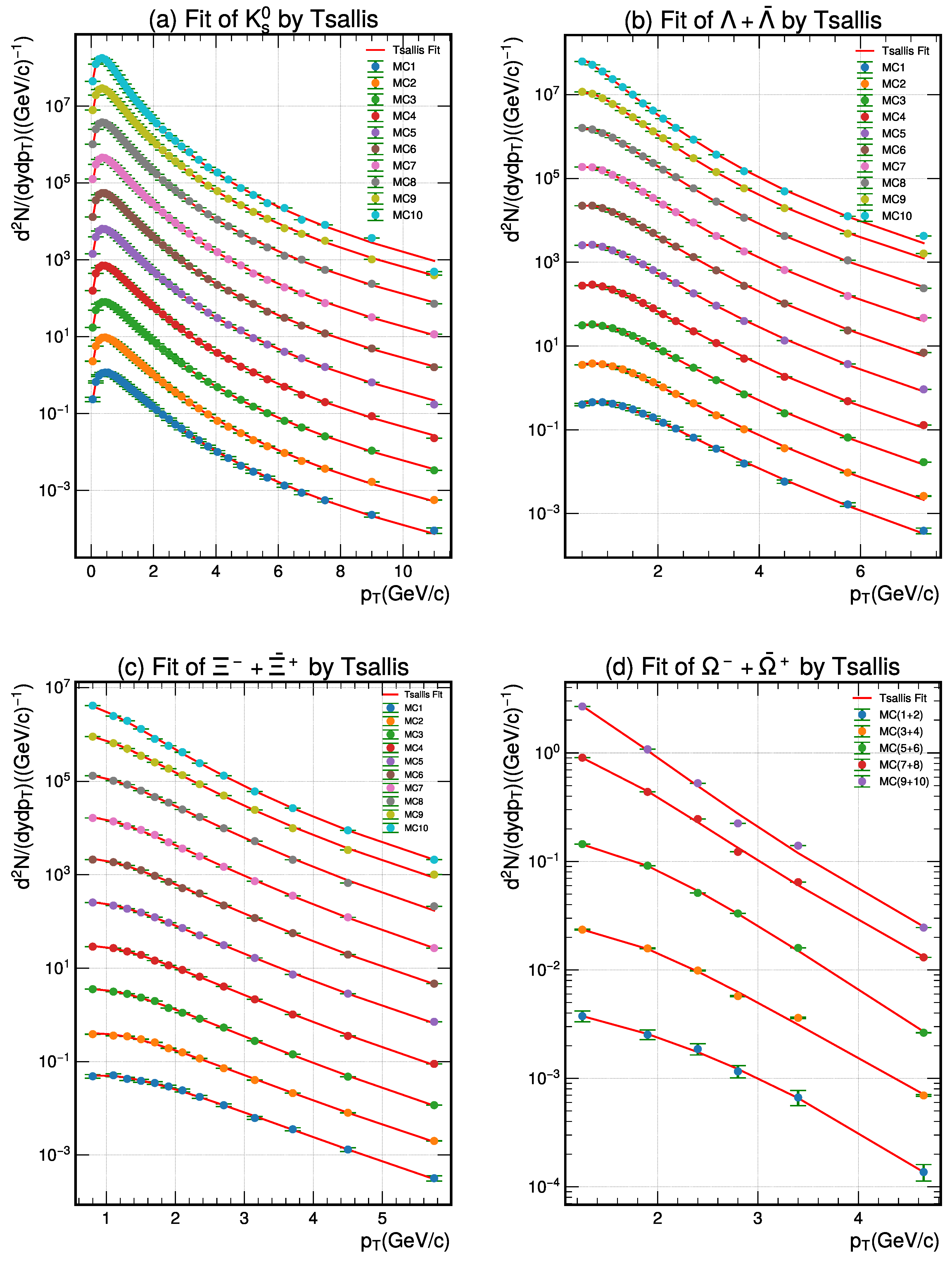
Figure 5 demonstrates the successful application of the Tsallis distribution to the transverse momentum () spectra of , , , and in collisions at TeV, consolidating all multiplicity classes for each particle. The close alignment between fitted curves (lines) and experimental data (colored markers) validates the Tsallis framework’s ability to capture the interplay between thermal and non-equilibrium dynamics. Key insights from the extracted parameters () include the following:
Figure 5.
The results of the fitting process applied to the experimental data using the Tsallis model through equation are shown here. The colored markers represent the distribution of experimental data across various multiplicity classes, while the curves are used to show the fitted results obtained through the Tsallis function. The curves demonstrate a good fit of the function to the data.
1. Multiplicity Dependence of and q: (a) decreases monotonically from high (MC1) to low (MC10) multiplicity classes for all particles (Table 1). For , drops from 152.17 (MC1) to 70.22 MeV (MC10), signaling a transition from a hot, dense system to a cooler, fragmented state. This reflects diminishing collective effects and thermalization as multiplicity decreases, consistent with hydrodynamic models like EPOS-LHC, which loses predictive power in sparse systems. (b) q increases with multiplicity class (e.g., rises from 1.1406 to 1.1466), indicating growing deviations from the Boltzmann–Gibbs equilibrium. The higher q at low multiplicities correlates with non-thermal processes.
Table 1.
The table shows the freezeout parameters derived from fitting the experimental data [1] for , , , and in collisions at 7 TeV using the Tsallis distribution function presented in equation.
2. Mass Hierarchy in Tsallis Parameters: Heavier particles (, ) exhibit higher than lighter ones (, ) at all multiplicities. For example, MeV in MC1+2 vs. MeV. is inspired by the collective effects and kinetic freeze-out temperature, so one cannot regard it as the real temperature. Therefore, vs. mass behavior or mass hierarchy of should certainly not be taken as evidence of earlier emission of heavier particles compared to lighter ones. Heavier particles have smaller q values (e.g., vs. in mid-multiplicities), suggesting faster equilibration due to stronger interactions in denser media.
3. Connection to Model-Specific Physics: High in MC1–MC3 aligns with the EPOS-LHC hydrodynamic bulk evolution, which thermalizes strangeness. Declining in MC4–MC10 mirrors the loss of collectivity. Universally higher q values (e.g., across classes) reflect PYTHIA8 non-equilibrium rope hadronization mechanism, which suppresses equilibration. Poor fits for (high q, erratic ) underscore Sibyll2.3d unsuitability for midrapidity multi-strange baryon dynamics.
4. Implications for QGP-Like Behavior: The rise of q with decreasing multiplicity suggests that high-multiplicity collisions exhibit QGP-like collective effects, while low-multiplicity systems are dominated by non-thermal fragmentation. When QGP is produced, it occupies smaller spatial dimensions and higher density and hence has stronger collective or hydrodynamic behaviour, which continuously reduces as the QGP expands with the evolution of time. This means that the system (QGP) is closer to local thermal equilibrium initially and then moves away from thermalization as the system expands. As stated earlier, initially, the system has a very high density; the constituents are close enough and interact frequently, which keeps them in local thermal equilibrium. However, due to expansion, the particles slightly disperse, i.e., the system losses its collectivity, and frequent interactions among constituents cease, which leads the system to be out of the equilibration. The high multiplicity events usually come from the collisions where the deposited energy in the collision zone is maximum, which results in the production of highly collective and hydrodynamic system with smaller q. Contrarily, the lower multiplicity events resulted from the collisions where the deposited energy at the collision point is comparatively low, producing a comparatively less collective and, hence, less thermalized system with higher q.
The Tsallis parameters provide a thermodynamic “fingerprint” of the system’s evolution. These results underscore the need for models to unify collective and perturbative dynamics to fully describe strangeness enhancement across collision systems.
4. Summary and Conclusions
In this study, we systematically investigated the production dynamics of strange and multi-strange hadrons (, , , and ) in high-multiplicity collisions at TeV using a suite of Monte Carlo models (EPOS-LHC, PYTHIA8, QGSJETII-04, Sibyll2.3d) and the Tsallis statistical framework. Key findings include the following:
- Model Performance: EPOS-LHC emerged as the most effective model for high-multiplicity collisions (MC1–MC3), accurately reproducing low- and yields through hydrodynamic collectivity. However, its inability to incorporate jet–medium interactions led to an underestimation of multi-strange baryons (, ) at high . PYTHIA8 partially bridged collectivity at mid- via rope hadronization but universally suppressed multi-strange baryons due to inadequate baryon transport mechanisms. QGSJETII-04 and Sibyll2.3d, optimized for cosmic-ray showers, failed to describe midrapidity strangeness enhancement. QGSJETII-04’s forced decay mechanism excluded and entirely, while Sibyll2.3d’s forward-phase bias distorted baryon spectra.
- Tsallis Thermodynamic Insights: The effective temperature () exhibited a mass-dependent hierarchy (). decreased with multiplicity, signaling the transition from a thermalized QGP-like state (high multiplicity) to a fragmented, non-equilibrium system (low multiplicity). The non-extensivity (q) increased with decreasing multiplicity, reflecting growing deviations from thermal equilibrium. Smaller q values for heavier particles (, ) suggested faster equilibration in dense media, while lighter particles (, ) retained stronger non-equilibrium signatures.
- QGP-like Signatures: The observed mass scaling of and the multiplicity dependence of q align with heavy-ion collision trends, supporting the existence of collective, QGP-like effects in high-multiplicity systems. However, the failure of models like PYTHIA8 and Sibyll2.3d to replicate these trends underscores their lack of mechanisms to describe strangeness-enhanced, thermalized matter.
Conclusions
High-multiplicity collisions exhibit QGP-like strangeness dynamics, best captured by EPOS-LHC’s hydrodynamic framework. Current event generators lack unified descriptions of collective and perturbative processes. PYTHIA8’s poor baryon transport and QGSJET/Sibyll’s cosmic-ray biases render them inadequate for LHC midrapidity physics. Enhancing Monte Carlo models with explicit medium effects (e.g., in-medium hadronization and gluon-splitting suppression) and improved baryon transport mechanisms is critical for probing QGP formation in small systems.
Author Contributions
Conceptualization, M.A. and M.W. (Muhammad Waqas); methodology, M.A. and M.W. (Maryam Waqar); software, M.Waqar and H.I.A.; validation, H.I.A. and T.S.; formal analysis, M.A. and H.I.A.; investigation, M.W. (Maryam Waqar); resources, M.W. (Muhammad Waqas); data curation, T.S.; writing—original draft preparation, H.I.A. and M.W. (Maryam Waqar); writing—review and editing, H.I.A. and M.A.; visualization, T.S.; supervision, M.A.; project administration, M.W. (Muhammad Waqas); funding acquisition, H.I.A. and T.S. All authors have read and agreed to the published version of the manuscript.
Funding
This research was funded by Princess Nourah bint Abdulrahman University Researchers Supporting Project number (PNURSP2025R106), Princess Nourah bint Abdulrahman University, Riyadh, Saudi Arabia and Northern Border University, Saudi Arabia through project number NBU-CRP-2025-2225.
Data Availability Statement
The data utilized in this research is included within the manuscript and/or appropriately cited at appropriate places.
Acknowledgments
This research was supported by Princess Nourah bint Abdulrahman University Researchers Supporting Project number (PNURSP2025R106), Princess Nourah bint Abdulrahman University, Riyadh, Saudi Arabia. Furthermore, the authors extend their appreciation to Northern Border University, Saudi Arabia, for supporting this work through project number NBU-CRP-2025-2225.
Conflicts of Interest
The authors declare no conflicts of interest.
References
- ALICE Collaboration. Enhanced production of multi-strange hadrons in high-multiplicity proton–proton collisions. Nat. Phys. 2017, 13, 535–539. [Google Scholar] [CrossRef]
- Dragos, V.; Forthe CMS Collaboration. Ridge correlation structure in high-multiplicity pp collisions with CMS. J. Phys. G Nucl. Part. Phys. 2011, 38, 124051. [Google Scholar] [CrossRef]
- Pierog, T.; Karpenko, I.; Katzy, J.M.; Yatsenko, E.; Werner, K. EPOS LHC: Test of collective hadronization with data measured at the CERN Large Hadron Collider. Phys. Rev. C 2015, 92, 034906. [Google Scholar] [CrossRef]
- Sjöstrand, T.; Ask, S.; Christiansen, J.R.; Corke, R. An Introduction to PYTHIA 8.2. Comput. Phys. Commun. 2015, 191, 159. [Google Scholar]
- Dedenko, L.G.; Lukyashin, A.V.; Roganova, T.M.; Fedorova, G.F. Testing of the EPOS LHC, QGSJET01, QGSJETII03 and QGSJETII-04 hadronic interaction models via help of the atmospheric vertical muon spectra. J. Phys. Conf. Ser. 2017, 934, 012017. [Google Scholar] [CrossRef]
- Engel, R.; Riehn, F.; Fedynitch, A.; Gaisser, T.K.; Stanev, T. The hadronic interaction model Sibyll – past, present and future. EPJ Web Conf. 2017, 145, 08001. [Google Scholar]
- Ulrich, R.; Pierog, T.; Baus, C. Cosmic Ray Monte Carlo Package, CRMC (2.0.1). Zenodo 2021. [Google Scholar] [CrossRef]
- Sjostrand, T.; Mrenna, S.; Skands, P. Pythia 6.4 physics and manual. J. High Energy Phys. 2006, 5, 026. [Google Scholar]
- Skands, P. Introduction to QCD. arXiv 2012, arXiv:1207.2389. [Google Scholar]
- Alrebdi, H.I.; Ajaz, M.; Waqas, M.; Ahmad, M.A.; Maryam; Quraishi, A.M.; Baker, J.H.; Jagnandan, S.; Jagnandan, A. Comparative analysis of charged particle distributions in pp collisions at s = 0.9TeV using Monte Carlo models and fitting functions. Chin. J. Phys. 2024, 89, 1669–1677. [Google Scholar]
- Ortiz Velasquez, A.; Christiansen, P.; Flores, E.C.; Cervantes, I.M.; Paic, G. Color re-connection and flow like patterns in pp collisions. Phys. Rev. Lett. 2013, 111, 042001. [Google Scholar]
- Nayak, R.; Pal, S.; Dash, S. Effect of rope hadronization on strangeness enhancement in pp collisions at LHC energies. Phys. Rev. D 2019, 100, 074023. [Google Scholar]
- Werner, K.; Guiot, B.; Karpenko, I.; Pierog, T. Analyzing radial flow features in p-Pb and P-P collisions at several TeV by studying identified-particle production with the event generator EPOS3. Phys. Rev. C 2024, 89, 064903. [Google Scholar]
- Kaidalov, A.B.; Ter-Martirosian, K.A. Pomeron as quark-gluon strings and multiple hadron production at SPS-Collider energies. Phys. Lett. B 1982, 117, 247. [Google Scholar] [CrossRef]
- Gribov, V.N. A Reggeon Diagram Technique. Sov. Phys. JETP 1968, 26, 414. [Google Scholar]
- Kalmykov, N.N.; Ostapchenko, S.S.; Pavlov, A.I. Quark-gluon-string model and EAS simulation problems at ultra-high energies. Nucl. Phys. Proc. Suppl. B 1997, 52, 17. [Google Scholar]
- Gribov, V.N. Glauber corrections and the interaction between high-energy hadrons and nuclei. Sov. Phys. JETP 1969, 29, 483. [Google Scholar]
- Kancheli, O. Inelastic interactions of fast hadrons with nuclei. JETP Lett. 1973, 18, 465–469. [Google Scholar]
- Ahn, E.-J.; Engel, R.; Gaisser, T.K.; Lipari, P.; Stanev, T. Cosmic ray interaction event generator SIBYLL 2.1. Phys. Rev. D 2009, 80, 094003. [Google Scholar] [CrossRef]
- Capella, A.; Sukhatme, U.; Tan, C.I.; Tran Thanh Van, J. Dual parton model. Phys. Rep. 1994, 236, 225–329. [Google Scholar]
- Gaisser, T.K.; Halzen, F. Soft Hard Scattering in the TeV Range. Phys. Rev. Lett. 1985, 54, 1754. [Google Scholar]
- Bengtsson, H.U.; Sjostrand, T. The Lund Monte Carlo for hadronic processes-PYTHIA version 4.8. Comp. Phys. Commun. 1987, 46, 43. [Google Scholar]
- Sjostrand, T. Status of Fragmentation Models. Int. J. Mod. Phys. A 1988, 3, 751. [Google Scholar]
- Ostapchenko, S. Contemporary models of high energy interactions: Present status and perspectives. J. Phys. G Nucl. Part. Phys. 2003, 29, 831. [Google Scholar]
- Tsallis, C. Possible generalization of Boltzmann-Gibbs statistics. J. Stat. Phys. 1988, 52, 479. [Google Scholar]
- Tsallis, C. Nonadditive entropy: The concept and its use. Eur. Phys. J. A 2009, 40, 257. [Google Scholar]
- Olimov, K.K.; Liu, F.-H.; Musaev, K.A.; Shodmonov, M.Z. Multiplicity Dependencies of Midrapidity Transverse Momentum Distributions of Identified Charged Particles in Proton-Proton Collisions at (s)1/2 = 7 TeV at the LHC. Universe 2022, 8, 174. [Google Scholar] [CrossRef]
- Ajaz, M.; Waqas, M.; Li, L.-L.; Haj Ismail, A.A.K.; Tabassam, U.; Suleymanov, M. Bulk properties of the medium in comparison with models’ predictions in pp collisions at 13 TeV. Eur. Phys. J. Plus 2022, 137, 592. [Google Scholar] [CrossRef]
- Badshah, M.; Waqas, M.; Khubrani, A.M.; Ajaz, M. Systematic analysis of the pp collisions at LHC energies with Tsallis function. EPL 2023, 141, 64002. [Google Scholar]
- Ajaz, M.; Haj Ismail, A.; Waqas, M.; Suleymanov, M.; Abdelkadir, A.; Suleymanov, R. Pseudorapidity dependence of the bulk properties of hadronic medium in pp collisions at 7 TeV. Sci. Rep. 2022, 12, 8142. [Google Scholar] [CrossRef]
- Nath Patra, R.; Mohanty, B.; Nayak, T.K. Centrality, transverse momentum and collision energy dependence of the Tsallis parameters in relativistic heavy-ion collisions. Eur. Phys. J. Plus 2021, 136, 702. [Google Scholar] [CrossRef]
- Ajaz, M.; Haj Ismail, A.; Ahmed, A.; Wazir, Z.; Shehzadi, R.; Younis, H.; Khan, G.; Khan, R.; Ali, S.; Waqas, M.; et al. Centrality dependence of PT distributions and nuclear modification factor of charged particles in Pb–Pb interactions at SNN = 2.76 TeV. Results Phys. 2021, 30, 104790. [Google Scholar] [CrossRef]
- Calcagni, L.; Canal, C.G.; Sciutto, S.J.; Tarutina, T. LHC updated hadronic interaction packages analyzed up to cosmic-ray energies. Phys. Rev. D 2018, 98, 083003. [Google Scholar]
- Ajaz, M.; Ashraf, M.U.; Waqas, M.; Yasin, Z.; Khubrani, A.M.; Hassan, S.; Haj Ismail, A.; Li, L.L. Model studies of V0 production ratios in pp collisions at = 0.2, 0.9, and 7 TeV. Eur. Phys. J. Plus 2023, 138, 14. [Google Scholar] [CrossRef]
Disclaimer/Publisher’s Note: The statements, opinions and data contained in all publications are solely those of the individual author(s) and contributor(s) and not of MDPI and/or the editor(s). MDPI and/or the editor(s) disclaim responsibility for any injury to people or property resulting from any ideas, methods, instructions or products referred to in the content. |
© 2025 by the authors. Licensee MDPI, Basel, Switzerland. This article is an open access article distributed under the terms and conditions of the Creative Commons Attribution (CC BY) license (https://creativecommons.org/licenses/by/4.0/).