


Abstract
Brake-induced steering wheel shimmy is a critical nonlinear dynamic phenomenon that severely compromises vehicle handling stability and driving safety. While clearances in steering mechanism kinematic pairs are widely recognized as a primary cause of shimmy instability, the coupling effect of multiple concurrent clearances remains poorly characterized, particularly under transient braking conditions. In this work, a 5-degree-of-freedom non-autonomous dynamic model of brake-induced shimmy is developed using Lagrange’s equations. The model comprehensively incorporates the non-smooth contact behavior of multiple clearance joints, transient braking axle load transfer, and the longitudinal–lateral coupling nonlinearity of tires. The nonlinear dynamic evolution of the system is investigated through phase portraits, Poincaré sections, and continuous wavelet transform analysis. Numerical results demonstrate that multi-clearance coupling increases the peak shimmy angle by more than 40% compared to the single-clearance case. As the clearance magnitude increases from 0.05 mm to 0.40 mm, the system undergoes a transition from stable periodic motion to high-dimensional chaos, accompanied by a 67% reduction in vibration energy concentration at the 0.4 mm clearance level. This study elucidates the nonlinear mechanism underlying clearance-induced brake shimmy, providing a robust theoretical foundation for steering system parameter optimization and shimmy mitigation strategies.
1. Introduction
Vehicle handling stability is a core attribute of road vehicle active safety. Steering shimmy is a typical nonlinear dynamic phenomenon in chassis systems. It is readily induced in specific speed ranges or under high-intensity braking. It generates high-frequency alternating loads in the steering transmission mechanism. It accelerates the fatigue wear of tires, steering ball joints and other key components. It causes severe lateral vehicle instability under extreme working conditions. It directly deteriorates vehicle handling stability and active safety [1,2]. Brake-induced shimmy is classified into forced vibration and self-excited vibration [3]. Non-smooth clearance-induced vibrations have become one of the most critical sources of chassis dynamic instability, manifesting as limit-cycle oscillations, bifurcation phenomena and even chaotic motions under specific operating conditions. Accurate measurement and characterization of these nonlinear vibrations are essential for understanding their generation mechanism and developing effective suppression measures [4].
Forced vibration is induced by braking torque fluctuation or force imbalance [5,6]. Its corresponding vibration mechanism has been relatively fully elucidated. Self-excited vibration requires no external periodic excitation source [7]. Brake-induced vibration is a major form of chassis vibration, which can be broadly classified into two categories according to vibration frequency and generation mechanism: brake judder and brake-induced shimmy [8]. It converts vehicle travel kinetic energy into system vibration excitation energy. It can be induced even with an ideally balanced braking torque. Transient braking axle load transfer reshapes self-excited oscillation energy transfer [9]. It causes unpredictable shifts in system dynamic bifurcation boundaries. Steering shimmy has strong sensitivity to wheel unbalance excitation [10]. This further aggravates the shimmy response uncontrollability under braking. Kinematic pair clearance is a non-negligible non-smooth constraint factor. Clearance grows with vehicle service mileage and component wear [11,12]. It is identified as a core inducement of steering shimmy instability. Patil et al. clarified clearance’s influence on vehicle nonlinear dynamic behavior [13]. They confirmed clearance as a core source of vehicle vibration instability. Clearance greatly widens the critical speed range for shimmy occurrence [14,15]. It induces system parameter sensitivity variation and catastrophic instability. Hertz contact theory is widely used to describe clearance non-smooth contact. Domestic scholars have studied clearance steering and brake shimmy coupling. Wei et al. systematically revealed the vehicle brake shimmy nonlinear mechanism [16,17]. Active control methods, including active front steering (AFS) and active suspension systems, can adaptively adjust control forces according to real-time vibration signals, achieving better suppression performance. Yoshida and Hori [18] proposed a classic active steering control strategy that significantly improved vehicle handling stability. Chen investigated the clearance steering system’s nonlinear dynamic characteristics [19,20]. Smith [21] first proposed the concept of the inerter, which revolutionized the design of mechanical vibration suppression systems. Zhou and Wei established a dual-clearance vehicle shimmy system model [22]. They analyzed the system’s nonlinear dynamic behavior and Hopf bifurcation characteristics. Kassa focused on steering systems with contact and friction [23]. They revealed the clearance contact nonlinearity’s action mechanism on system dynamics.
Most current shimmy studies focus on single clearance or steady driving conditions. A systematic study on multi-clearance and braking parameter coupling is lacking [24,25]. The multi-clearance and braking coupling influence mechanism is not fully clarified. This restricts the development of in-service vehicle shimmy suppression technology. This study investigates multi-clearance coupling’s influence on brake shimmy. A 5-degree-of-freedom non-autonomous dynamic model is established. The model is based on mass-produced vehicle full-vehicle and chassis parameters. Hertz contact theory describes multi-clearance non-smooth contact force [26]. A nonlinear tire model characterizes braking tire dynamic evolution [27,28].
The remaining part of this paper is organized as follows: Details the system dynamic model establishment process and includes steering trapezoid kinematics and clearance contact state definition. Introduces the contact force model and the nonlinear tire model and also presents the system dynamic equations’ numerical solution method. Analyzes the system’s nonlinear response under different working conditions and identifies the critical bifurcation threshold of the shimmy system. Discusses the multi-clearance and braking coupling influence mechanism and also verifies the accuracy and effectiveness of the proposed model. Summarizes the main conclusions and prospects for future research.
2. Dynamic Analysis Model of Automotive Shimmy
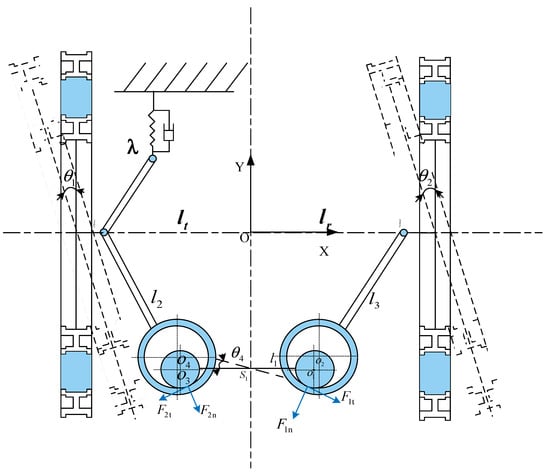
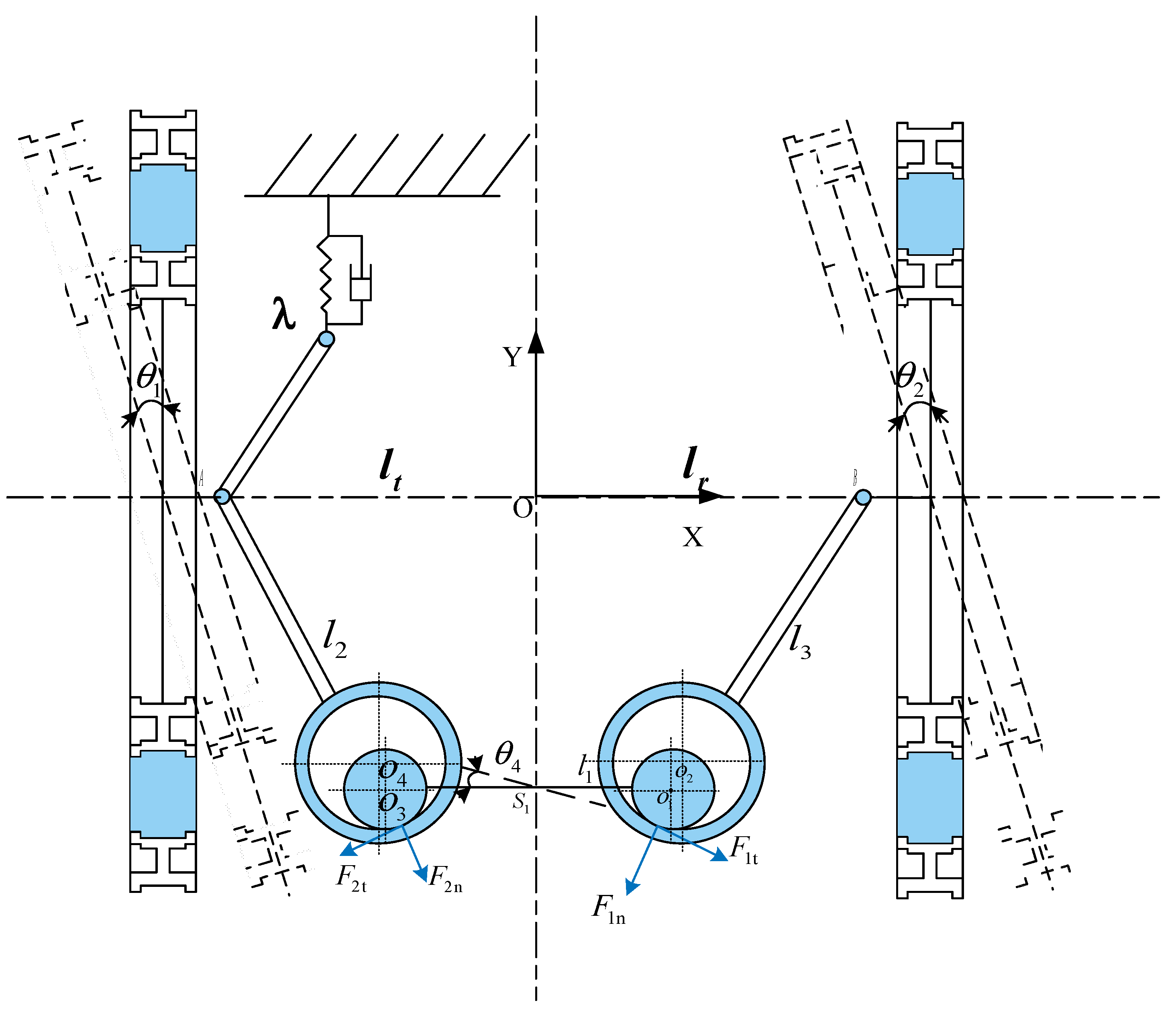
The structure of the shimmy system, considering two kinematic pair clearances between the tie rod and the left and right trapezoidal arms in the steering transmission mechanism, is illustrated in Figure 1. This shimmy system contains a total of 5 degrees of freedom (5-DOF), with the generalized coordinate defined as q = [r1; r2; n; t; λ], where is the swing angle of the left front wheel around the kingpin, is the swing angle of the right front wheel around the kingpin, is the roll angle of the front axle around the longitudinal axis, is the yaw angle of the tie rod, and λ is the vertical displacement of the suspension.
Figure 1.
Schematic diagrams of automotive shimmy clearance.
2.1. Model Assumptions and Scope of Application
To ensure the physical consistency of the dynamic model and the interpretability of numerical results, this section explicitly clarifies the core modeling assumptions and the valid scope of application of the proposed 5-DOF brake-induced shimmy system. All assumptions are rigorously justified in accordance with the research objectives and engineering practice of vehicle steering system dynamics. This study systematically incorporates two critical clearance joints located at the connections between the steering tie rod and the left and right steering trapezoidal arms, which have been identified as the dominant sources of clearance-induced brake shimmy in the existing literature and engineering practice.
2.1.1. Applicable Vehicle Type
The proposed dynamic model is parameterized for front-wheel-drive (FWD) compact passenger cars with a curb weight ranging from 1200 kg to 1500 kg. All geometric and inertial parameters of the steering and suspension systems are derived from the typical chassis configurations of mass-produced vehicles in this category, ensuring the engineering relevance of the simulation results.
2.1.2. Valid Operating Conditions
The model is strictly applicable to the following operating conditions, which cover the majority of daily driving scenarios where brake-induced shimmy occurs:
Pavement condition: Dry asphalt pavement with a friction coefficient of 0.7–0.9.
Braking condition: Moderate braking with deceleration ranging from 0.3 g to 0.8 g (excluding emergency braking with deceleration exceeding 0.9 g).
Speed range: Initial vehicle speed of 20–120 km/h.
Driving condition: Straight-line braking with a steering wheel angle not exceeding 5° (excluding cornering braking conditions).
2.1.3. Model Limitations
In addition to the geometric simplifications noted earlier, the most significant limitation of this study is the absence of direct experimental validation for the proposed multi-clearance coupling dynamic model. While the simulated shimmy evolution laws, amplitude variation trends, and bifurcation characteristics exhibit good qualitative consistency with published experimental results in the literature, the quantitative thresholds—such as the critical clearance value for the onset of chaos—have not been calibrated against physical test data. Consequently, the numerical results should be interpreted as revealing the fundamental nonlinear mechanism rather than providing exact quantitative predictions for specific vehicle configurations.
2.2. Mathematical Description of Kinematics and Contact Mechanics for Kinematic Pairs with Clearances
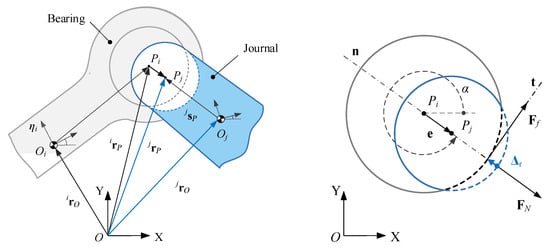
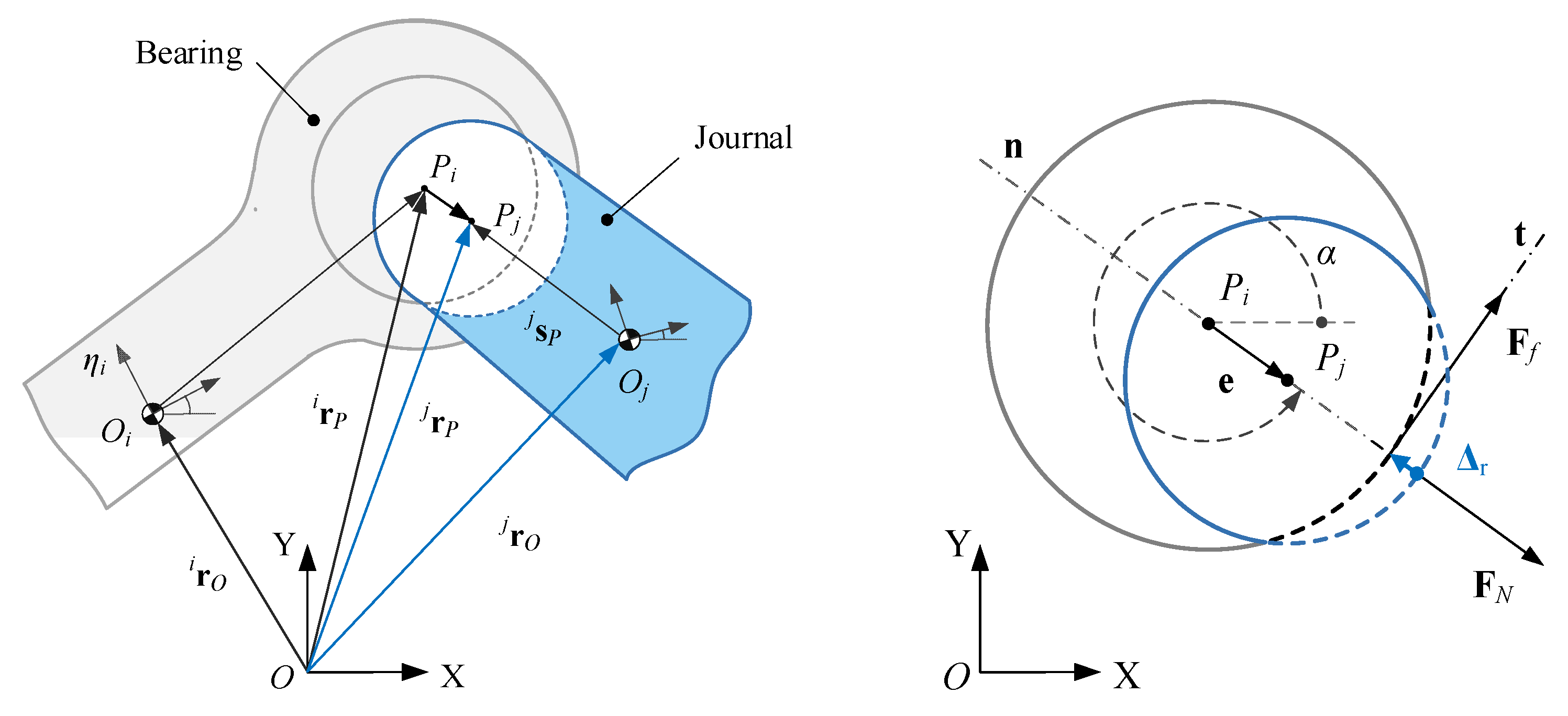
To accurately clarify the complex kinematic mapping relationship inside the steering transmission system, the kinematic pair clearances between the left and right steering trapezoidal arms and the tie rod are amplified in this paper, with its structure shown in Figure 2. The displacement of each component during the steering process must satisfy the following kinematic relationships:
Figure 2.
Schematic diagrams of joint clearance.
A reference coordinate system Oxy fixed to the front axle is established, and the closed-loop vector constraint of the steering trapezoid is given as follows:
CA + AO4 + O4O3 + O3O2 + O2O1 + O1B + BC = 0
The known number vector is CA, AO4, O3O2, O1B, BC. Unknown is O4O3, O2O1. To describe the contact behavior at the clearance joints, the relative position vector r between the pin and bushing centers is first defined. Based on this vector, the unit normal and tangential vectors at the contact interface are derived as follows:
The relative displacement vector between the center of the pin Op and the center of the bushing Ob at the clearance is defined as follows:
Its modulus is the normal penetration depth, where the superscripts L and R denote the left and right clearance joints, respectively.
The magnitude of this relative displacement is used to calculate the normal penetration depth δn, which quantifies the elastic deformation during contact. The initial radial clearance c is defined as the difference between the bushing inner radius Rb and the pin outer radius Rp:
The relative velocity between the pin and bushing centers is derived by differentiating the relative displacement vector with respect to time. This velocity is decomposed into normal and tangential components using the unit vectors defined:
The position vector of the centroid of the left steering knuckle is derived based on the position of the kingpin center and the geometric parameters of the knuckle:
To accurately characterize the dynamic behavior of kinematic pairs with clearances in the steering system, the Hertz contact theory is adopted to establish its mechanical model. This model [29] fully incorporates key physical effects of the clearance contact surface, including normal stiffness, damping dissipation and surface friction, and accurately simulates the entire process of contact, separation and collision of the clearance pairs during motion through preset contact state criteria.
It can be seen from Figure 1 and Figure 2 that θ2 and θ4 represent the centers of the right pin and the right bushing at the clearance, respectively. Based on the Hertzian contact theory, damping functions and Newton’s laws, the equivalent spring force and equivalent damping force of the mechanism with clearances are derived and described. There are two contact states for the kinematic pairs with clearances: (1) when there is no contact between the pin and the bushing, the resultant force acting on the kinematic pair is zero; (2) when contact or collision occurs, the contact force consists of a normal force and a tangential force, denoted as (FN, Ff). The derivation of the contact state criterion is given as follows:
The normal penetration at the contact points of the left and right kinematic pairs with clearances is expressed as:
where r is the kinematic pair clearance. Accordingly, the contact state judgment conditions are obtained as follows:
If δt < 0 and δr < 0, both the left and right clearance kinematic pairs are in the free state;
If δt > 0 and δr < 0, the left clearance kinematic pair is in the contact state and the right one is in the free state;
If δt < 0 and δr ≥ 0, the left clearance kinematic pair is in the free state and the right one is in the contact state;
If δt ≥ 0 and δr ≥ 0, both the left and right clearance kinematic pairs are in the contact state.
Further derivation is performed on the force relationship between components. Combined with the above description of motion states and considering friction, elasticity and damping on the contact surfaces of kinematic pair elements, the total normal contact force at the clearance joint (including both elastic contact force and impact damping force) is derived based on the Lankarani–Nikravesh contact model:
where K is the contact stiffness, δn is the normal penetration depth at the contact point, cr is the coefficient of restitution, is the instantaneous normal relative velocity. The Hertzian contact stiffness K is determined by the material properties and geometric dimensions of the contacting surfaces, defined as:
where E* is the equivalent elastic modulus of the contact pair, and Rp, Rb are the radius of curvature of the pin and bushing contact surfaces, respectively.
For two contacting materials with different elastic properties, the equivalent elastic modulus E* is calculated by the general formula:
The equivalent radius of curvature R of the contact surfaces is given by:
Considering sliding motion on the contact surface, the tangential friction force at the kinematic pair is expressed as:
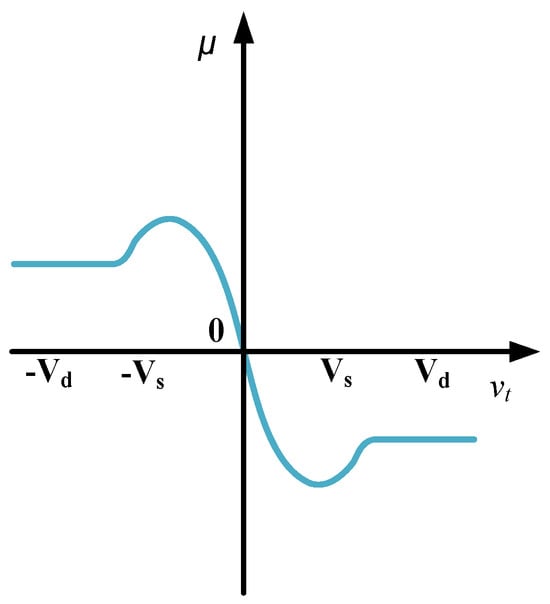
where μ is the coulomb friction coefficient, vtl is the tangential relative velocity, and ct is the tangential viscous damping coefficient, the friction model is presented by Figure 3.
Figure 3.
The relationship between tangential velocity and friction coefficient.
To accurately characterize energy dissipation during contact-impact events, the Lankarani–Nikravesh damping model is adopted. This model is widely accepted in non-smooth multibody system dynamics for its good physical consistency and numerical stability. The total normal contact force, including both elastic and damping components, is expressed as:
where Cn is the normal damping coefficient, and δ is the normal relative velocity at the contact point. The normal damping coefficient Cn is calculated based on the coefficient of restitution e and the contact stiffness K:
where δ is the initial impact velocity. In this study, the coefficient of restitution e = 0.8 is adopted, which is a typical value for metal-to-metal contact with lubrication in automotive steering mechanisms. Substituting K = 4.02 × 10⁶ N/m e = 0.8 into Equation (14) yields the normal damping coefficient for the contact process. For the typical impact velocities encountered in steering shimmy (0.01–0.1 m/s), the normal damping coefficient is approximately 4.02 × 10⁵ Ns/m, which is used in the numerical simulations.
The kinematic pair is expressed by the Coulomb friction model as: where μ is the friction coefficient, sgn is the sign function, Ct is the tangential damping coefficient, is the tangential velocity at the left contact point, and is the tangential velocity at the right contact point.
The components of the left and right contact forces in the X- and Y-directions are respectively: where φl and φr are the contact angles, determined by:
Based on the above force analysis, the moments exerted by the clearance kinematic pairs on the left and right steering knuckles can be derived as:
where rp is the radius of the pin, and αl, αr are the left and right base angles of the steering trapezoid, respectively. Define the generalized coordinate: the lateral displacement X of the tie rod is chosen as the current generalized coordinate. Extract the energy terms associated with X:
2.3. Nonlinear Tire Model
To accurately characterize the tire force characteristics under combined longitudinal braking and lateral steering conditions, a nonlinear tire model based on the Pacejka Magic Formula is adopted in this study. The model provides a unified mathematical expression for longitudinal force, lateral force, and aligning torque, and explicitly realizes the longitudinal–lateral coupling effect under braking.
The core mathematical formulation of the tire model is expressed as follows:
where Fx is the longitudinal braking force, Fy is the lateral cornering force, Mz is the self-aligning torque, κ is the longitudinal slip ratio, α is the sideslip angle, and B, C, D, and E are shape coefficients identified from tire test data.
Under braking conditions, the longitudinal–lateral coupling is implemented using the combined slip modulus.
which ensures that the tire force outputs are consistently reduced under simultaneous longitudinal and lateral excitation, reflecting the real force saturation characteristic during braking.
2.4. Dynamic Equations of the Shimmy System
Based on Lagrange’s equations and the force model of clearance kinematic pairs, the dynamic equations of the shimmy system are established (Appendix A). The kinetic energy V and potential energy of the system T are given by:
Substitute the kinetic energy and potential energy into the Lagrange equation:
where qi is the generalized coordinates and Qi is the generalized forces, respectively. The dynamic equations for each degree of freedom of the shimmy system can be obtained as follows:
All parameters used in the numerical simulations are listed in Table 1.
Table 1.
Parameter value of vehicle system vibration.
3. Results and Discussion
Numerical simulations are carried out on the established dynamic model of the shimmy system. The dynamic equations are solved by the 4th-order Runge–Kutta method to analyze the dynamic response characteristics of the steering wheel shimmy during braking. The influences of parameters such as axial load transfer, initial vehicle speed, kinematic pair clearance, and wheelbase on the transient response of the system are investigated.
3.1. Time Step Convergence and Computational Efficiency Verification
The selection of an appropriate integration time step is critical for non-smooth systems, as an excessively large step will lead to numerical oscillation and inaccurate capture of contact-impact events, while an excessively small step will significantly increase computational cost without appreciable improvement in accuracy. To determine the optimal time step, a systematic grid convergence analysis was performed by comparing simulation results under three different time steps: h1 = 1 × 10⁴, h2 = 5 × 10⁴, h2 = 1 × 10⁵.
Key Output Parameters and Extraction Methods
Three representative parameters that comprehensively characterize the system’s dynamic response are selected for convergence analysis, with their extraction methods clearly defined as follows:
- Peak left front wheel shimmy angle: The maximum absolute value of the left front wheel swing angle over the entire 10 s simulation period, which reflects the amplitude of the shimmy response.
- Dominant frequency of shimmy response: The frequency corresponding to the highest peak in the power spectral density of the shimmy angle signal, obtained via Fast Fourier Transform with a Hanning window and 50% overlap, which characterizes the frequency domain behavior of the system.
- Maximum normal contact force at the clearance joint: The maximum absolute value of the normal contact force at the left clearance joint, which represents the intensity of the contact-impact events in the non-smooth system.
Detailed Relative Error Calculation
The relative error ε between the solution with time step hi and the reference solution is calculated using the formula:
where Xi is the value of the output parameter obtained with time step hi, and Xref is the corresponding reference value obtained with h3 = 1 × 10⁵.
Convergence Order Verification
To further validate the numerical consistency of the RK4 method, the convergence order p was calculated using the Richardson extrapolation formula:
where ε1 and ε2 are the relative errors corresponding to time steps h1 and h2, respectively.
The computational efficiency was evaluated by comparing the total CPU time required to simulate a 10 s braking process on the same computing platform. The results show that the simulation with h1 takes 32 s, h2 takes 87 s, and h3 takes 135 s.
To ensure the generality of the conclusion, the convergence analysis was repeated under four typical working conditions (clearance = 0.05 mm, 0.1 mm, 0.2 mm, 0.4 mm; initial speed = 40 km/h, 55 km/h, 75 km/h, 100 km/h). In all cases, the time step h1 = 1 × 10⁴ achieved a relative error of less than 1% while maintaining acceptable computational efficiency.
Based on the above comprehensive analysis, the time step h1 = 1 × 10⁴ is selected as the optimal integration step for all subsequent simulations. This time step provides a good balance between numerical accuracy and computational efficiency and is sufficient to accurately capture the high-frequency contact-impact events in the clearance joints.
3.2. Comparative Analysis of Steering Wheel Shimmy Response
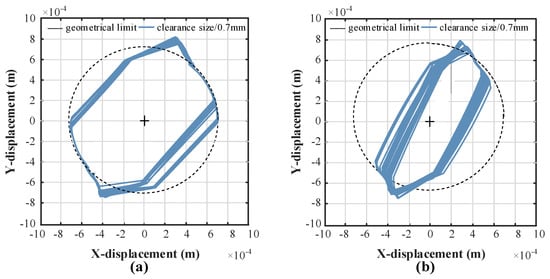
The phase-plane topological trajectories of the relative displacement between the pin and bushing in the steering shimmy system under the fully coupled dual-clearance condition are presented in Figure 4, where Figure 4a,b correspond to the displacement phase trajectories of the kinematic pairs at the left and right front wheels, respectively [30,31]. Numerical simulations are performed with an equivalent normal contact stiffness of 4 × 10⁶ N/m and a fixed clearance magnitude of 0.07 mm, while consistent vehicle parameters, initial driving speed and boundary conditions are maintained across all test cases. The morphology of these trajectories is directly governed by the two motion states of the clearance joint. Free unconstrained motion of the pin inside the bushing is observed when the center trajectory of the pin falls within the clearance boundary circle, while contact-impact with a certain normal penetration between the pin and the bushing wall is induced once the trajectory exceeds the boundary circle.
Figure 4.
Trajectory diagrams of the kinematic pair at a clearance magnitude of 0.07 mm: (a) trajectory of the kinematic pair for the left front wheel; (b) trajectory of the kinematic pair for the right front wheel.
The bending characteristics and boundary-fitting behavior of the trajectories are directly correlated with the occurrence of impact shocks. The trajectory of the left front wheel clearance joint exhibits a regular, symmetric, closed limit cycle structure with a sharp boundary and negligible diffusion, with contact-impact occurring only periodically at the clearance boundary. This indicates that the motion of the left front wheel clearance joint is dominated by stable, single-periodic reciprocating motion.
In contrast, the trajectory of the right front wheel exhibits significant overlap and bandwidth expansion, accompanied by more pronounced boundary diffusion and longer intervals between contact-impact events. This feature reflects the asynchronous motion of the left and right clearance joints under dual-clearance coupling and results in increased randomness and stronger nonlinear characteristics in the collision behavior at the right front wheel. Both wheel trajectories exhibit distinct anisotropic characteristics: the displacement amplitude along the X-axis is significantly larger than that along the Y-axis, and the overall trajectory extends predominantly along the X-axis. This demonstrates that the relative motion and contact-impact of the clearance joints are primarily concentrated in the main transmission direction of the steering system, consistent with the X-axis-dominated force transfer characteristics of steering mechanisms. Frequent alternation between free motion and impact collision in the clearance joints induces high acceleration responses, regardless of the specific clearance configuration.
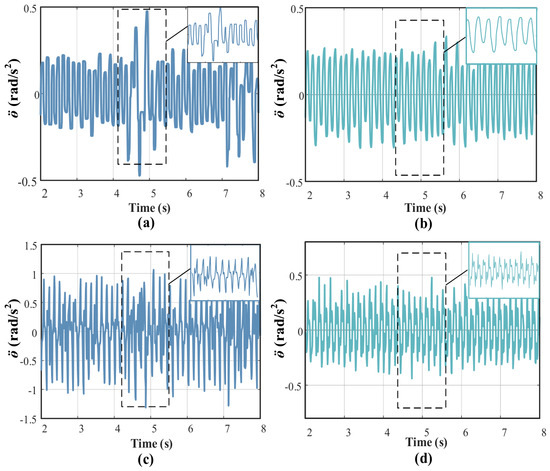
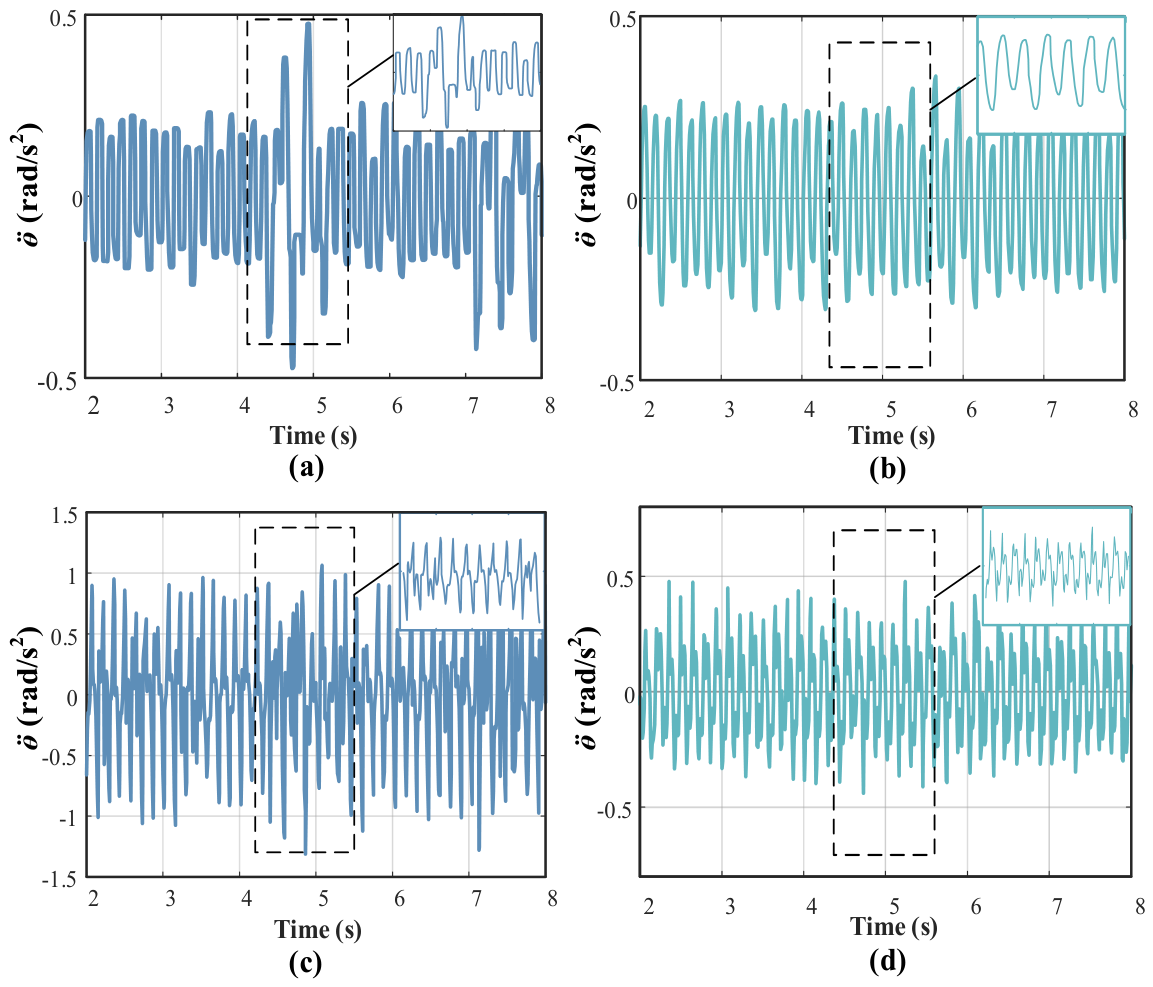
This high dynamic response intensifies the dynamic load between the mating surfaces of clearance joints, accelerates fatigue wear of key components, and shortens the service life of these joints. The response differences between the left and right wheels and across different motion directions also provide targeted guidance for wear control and clearance optimization design of steering systems. Figure 5 presents the time–history curves of angular acceleration under the two aforementioned conditions, confirming that significant acceleration responses occur under both multiple-clearance and single-clearance conditions.
Figure 5.
Comparisons of angular acceleration time history: (a) right front wheel under dual-clearance coupling condition; (b) right front wheel under single-clearance condition; (c) left front wheel under dual-clearance coupling condition; (d) left front wheel under single-clearance condition.
Additionally, a dominant offset of shimmy motion toward the X-axis is observed, consistent with the steering behavior of actual vehicles. Under the single-clearance condition, the angular accelerations of both left and right front wheels exhibit regular periodic oscillations with stable amplitudes and no abrupt transient mutations. This response characteristic indicates that the single-clearance constraint effectively limits the amplification effect of clearance nonlinearity and maintains the system’s stable response within the periodic attractor, providing a theoretical basis for the clearance optimization design of vehicle steering systems.
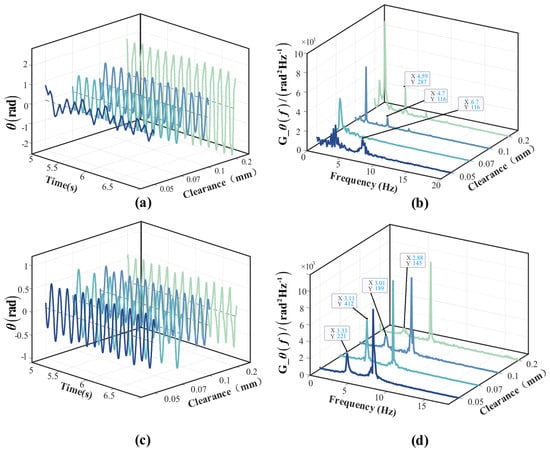
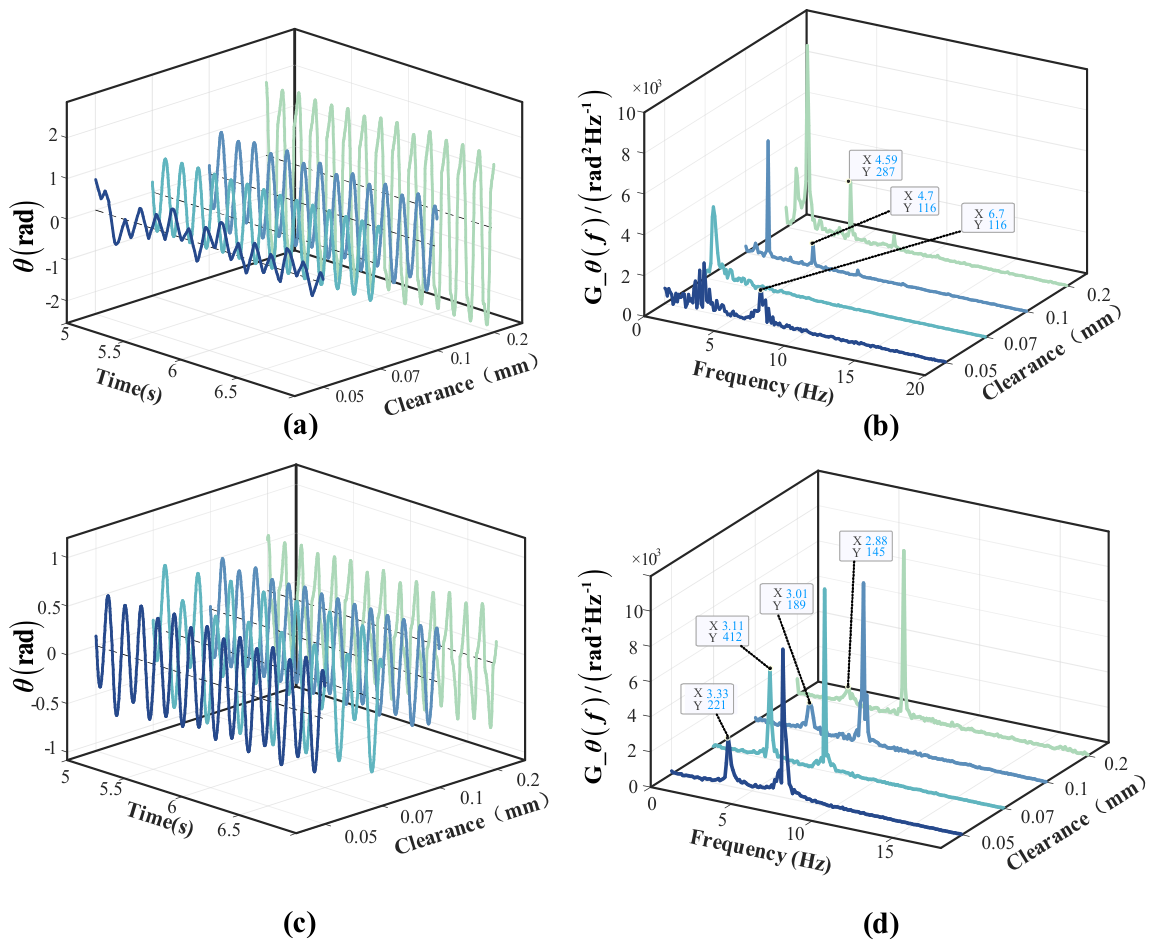
In terms of amplitude response, Figure 6 shows that the vertical displacement of the left front wheel increases by approximately 300% as the clearance magnitude rises from 0.05 mm to 0.2 mm, while the angular displacement of the right front wheel increases by only about 140% under identical operating conditions. A distinct contrast is observed between the continuous amplitude amplification of the left front wheel and the spontaneous amplitude attenuation of the right front wheel in the later stage of vibration. In terms of frequency domain characteristics, the power spectral density (PSD) of the left front wheel forms a clear, sharp resonance peak at the main frequency of 6.9 Hz, accompanied by distinct harmonic components. This reflects the strong periodicity and high energy concentration of the vibration response.
Figure 6.
Analysis of vibration characteristics of left and right wheels with different clearance sizes under a single clearance condition; (a) represents the left rotation property, (b) corresponds to the FFT, (c) denotes the right rotation property, and (d) corresponds to the FFT.
In contrast, while the right front wheel exhibits a higher total energy level, its frequency spectrum shows significant dispersion characteristics: no clear dominant frequency is observed, and vibration energy is distributed across multiple broadband harmonic components.
In terms of nonlinear sensitivity, the left front wheel exhibits a distinct dynamic bifurcation at a clearance of 0.07 mm: its time-domain waveform transitions abruptly from regular oscillation to modulated beat vibration, and its frequency spectrum transforms sharply from broadband distribution to narrowband dominance. In comparison, the right front wheel shows a relatively gradual response with no distinct bifurcation threshold.
This indicates that the response of the rotational degree of freedom to clearance excitation is dominated by modal coupling and spectral broadening, rather than single-mode resonance amplification. The clearance nonlinear effect manifests as high-intensity continuous resonance amplification in the vertical vibration of the left front wheel, and as energy dispersion and self-attenuation in the rotational vibration of the right front wheel. Accordingly, the left front wheel is identified as the key control target for clearance-sensitive design of steering systems.
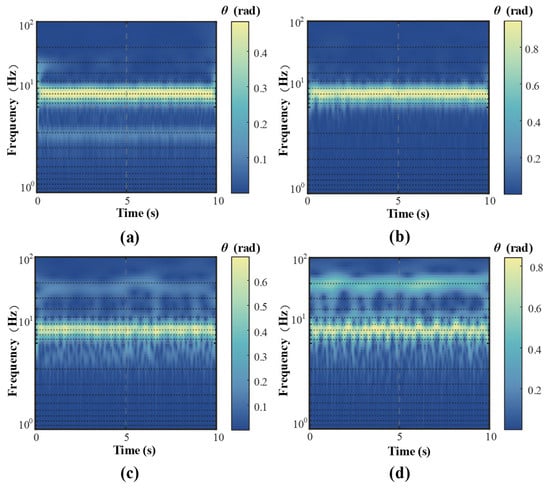
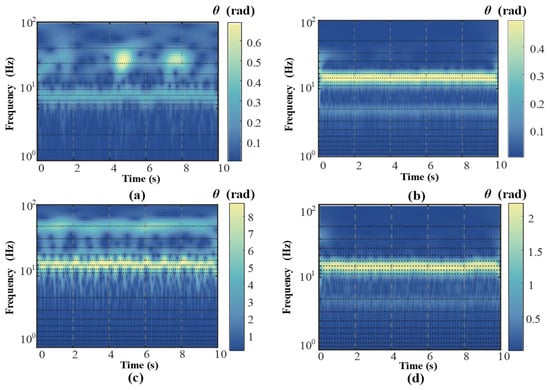
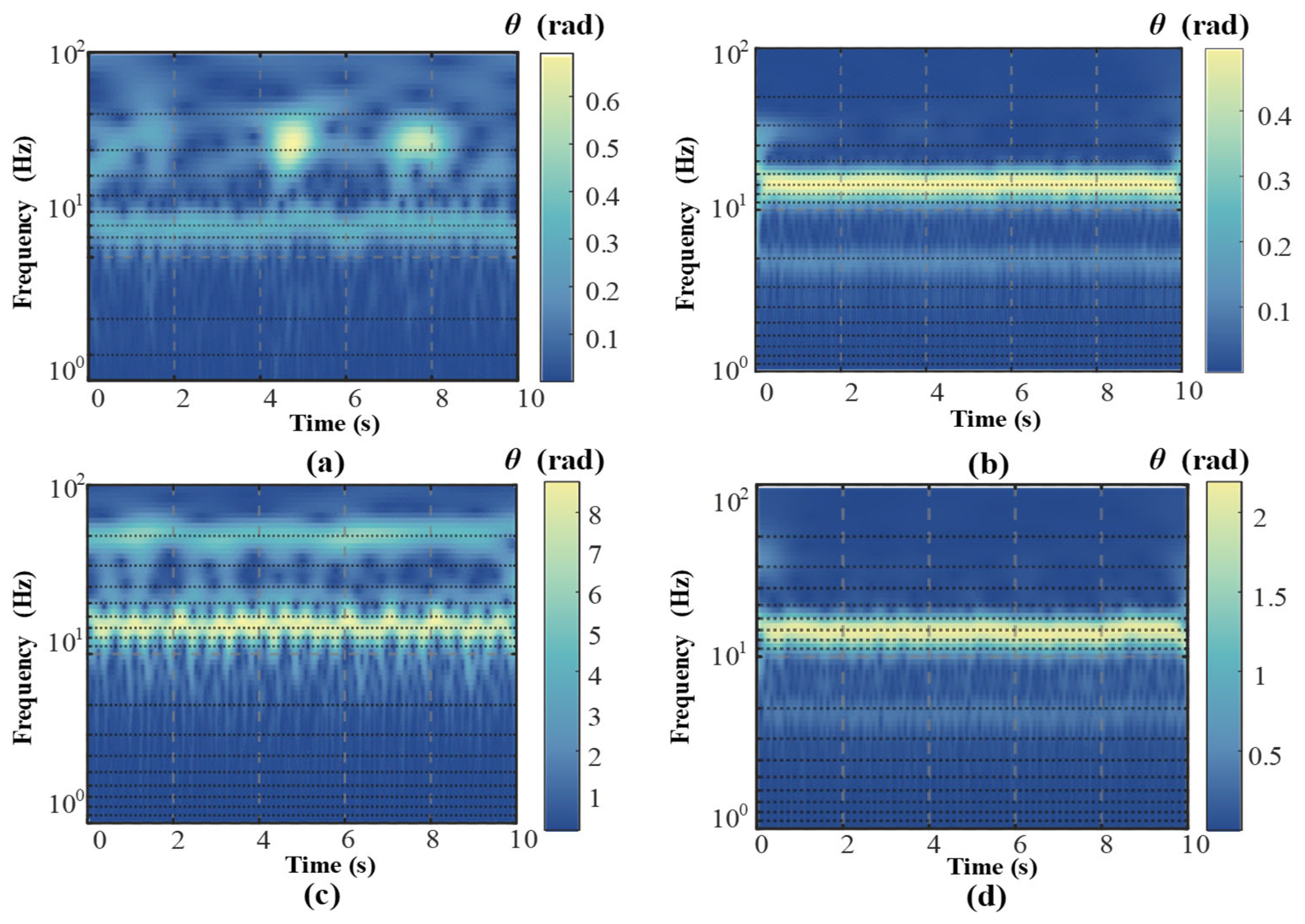
As presented in Figure 7, at 0.05 mm clearance, the vibration energy is highly concentrated at the dominant frequency with regular narrowband distribution, corresponding to stable periodic motion of the system. The 0.07 mm clearance is identified as the critical bifurcation threshold, where high-order harmonic components emerge and energy begins to disperse, marking the system’s transition from quasi-periodic motion to chaotic motion. As clearance rises to 0.1 mm and 0.2 mm, the vibration energy spreads significantly to a wide frequency band, with a sharp reduction in dominant frequency energy concentration and continuous broadband spectrum formation, verifying that the system has evolved into a chaotic state. This analysis accurately captures the clearance-induced nonlinear bifurcation characteristics of the shimmy system and provides a quantitative basis for the identification of nonlinear shimmy features.
Figure 7.
Time-frequency spectra of the steering wheel shimmy angle response at an initial braking speed of 55 km/h: (a) time-frequency spectrum of c = 0.05 mm; (b) time-frequency spectrum of c = 0.07 mm; (c) time-frequency spectrum of c = 0.1 mm; and (d) time-frequency spectrum of c = 0.2 mm.
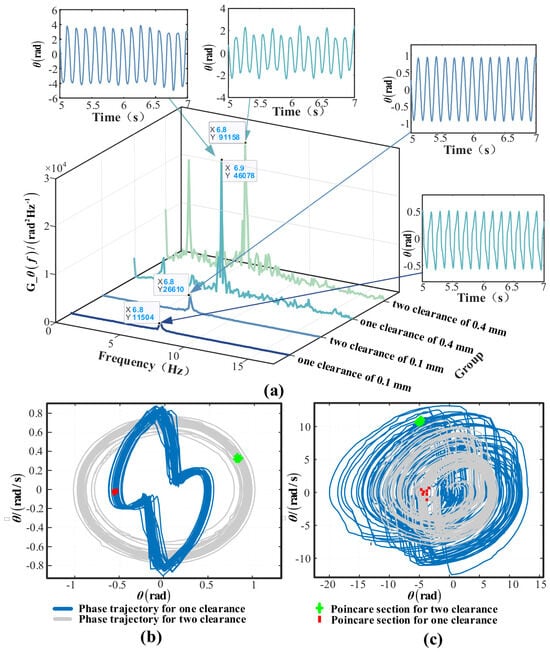
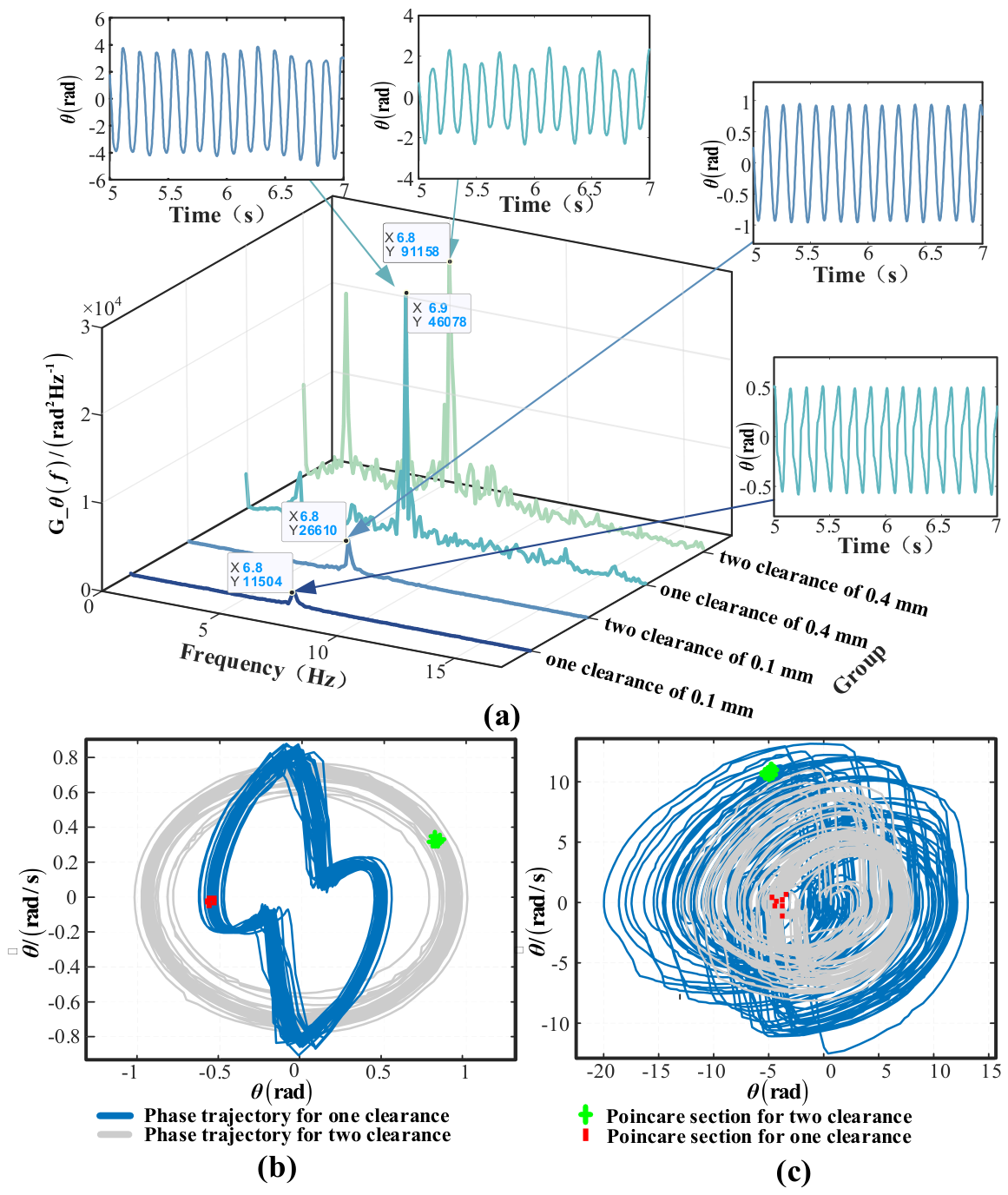
As presented in Figure 8, regular periodic fluctuations with small amplitudes, near-sinusoidal waveforms and good repeatability are exhibited by the time–history curves of the left front wheel shimmy angular displacement under both single-clearance and dual-clearance conditions at a kinematic pair clearance of 0.1 mm. The corresponding power spectral density (PSD) analysis shows that the vibration energy is highly concentrated around 6.90 Hz, forming a single significant narrowband peak with almost no obvious harmonic components or broadband noise. It is demonstrated that the system response is dominated by stable periodic motion with a single dominant frequency.
Figure 8.
Dynamic response characteristics of the steering shimmy system under different kinematic pair clearance conditions: (a) three-dimensional comparison of power spectral density (PSD) and the corresponding time–history curves of front wheel swing angle under single-clearance and dual-clearance coupling conditions with clearance magnitudes of 0.1 mm and 0.4 mm; (b) phase portraits and Poincaré section mapping points under single-clearance and dual-clearance coupling conditions at a clearance of 0.1 mm; and (c) phase portraits and Poincaré section mapping points under single-clearance and dual-clearance coupling conditions at a clearance of 0.4 mm.
A significant qualitative change in the dynamic behavior of the system is observed when the clearance magnitude is increased to 0.4 mm. As shown in the time-domain response, the shimmy amplitude is significantly increased, and the waveform evolves from regular periodicity to a highly irregular form with obvious distortion, flat-top characteristics and a broadened oscillation envelope, indicating a significant enhancement of nonlinear effects. The original single narrowband peak in the PSD is replaced by multiple harmonic components accompanied by continuous spectrum components. The energy distribution tends to be scattered and is no longer highly concentrated at 6.90 Hz, with a significantly enriched frequency component. The system undergoes a fundamental transformation from single-frequency dominant response to complex multi-frequency dynamic behavior [32,33].
Phase space analysis further reveals this evolution process. Under the single-clearance condition, the phase trajectory evolves from a simple closed limit cycle to a multi-nested or expanded closed-loop structure with overlapping trajectories. The number of points on the Poincaré section increases from a small set of discrete points to a larger discrete point set, indicating that the system has entered high-order periodic motion via period-doubling bifurcation.
In contrast, under the dual-clearance coupling condition, the phase trajectory takes on a highly complex non-closed winding shape with irregular morphology and wide spatial coverage, accompanied by significant structural degradation. The Poincaré section forms a dense point cloud with distinct fractal characteristics, strongly indicating that the system response has evolved into quasi-periodic or chaotic motion.
These results clearly demonstrate the profound impact of clearance magnitude and coupling configuration on the nonlinear dynamic behavior of the brake-induced shimmy system. As the clearance increases from 0.1 mm to 0.4 mm, the system follows a typical transition path from stable period-1 motion to high-order periodic motion and eventually to a chaotic state via period-doubling bifurcation. This transition manifests consistently across three complementary domains.
Stronger nonlinearity and irregularity are exhibited under the dual-clearance coupling condition than the single-clearance condition at the same clearance magnitude. This is mainly attributed to the frequent contact–collision–separation sequence caused by bilateral clearances, as well as the resulting impact energy injection and modal interaction, which lead to sharp amplification of shimmy amplitude, severe distortion of time-domain waveforms, and continuous broadening of the oscillation envelope. The dual-clearance condition induces more significant degradation of phase trajectory and Poincaré section characteristics, more prominent complexity of frequency components, and a pronounced shift in the system stability boundary [34].
In general, as a key non-smooth nonlinear constraint factor, the increase in kinematic pair clearance magnitude and the coupling of multiple clearances significantly drive the reduction in system dynamic stability. The system response is prompted to gradually transition from a regular periodic motion to a quasi-periodic or chaotic state, accompanied by a rapid surge of vibration energy and enhanced unpredictability of the response. This poses an important potential threat to vehicle handling stability and driving safety, especially under braking conditions, and provides a clear dynamic mechanism basis for the subsequent design of clearance-targeted vibration suppression measures.
3.3. Influence of Vehicle Speed on Shimmy
This study identifies a significant coupling effect of clearance joints on brake-induced shimmy characteristics. The presence of clearance joints in the steering system significantly reduces the stability of the shimmy system and increases the complexity of the vibration response. Compared with the single-clearance condition, the coupling effect of multiple clearance joints results in larger swing angle amplitudes and higher peak angular velocities and makes the system more prone to exhibiting quasi-periodic or chaotic motion characteristics.
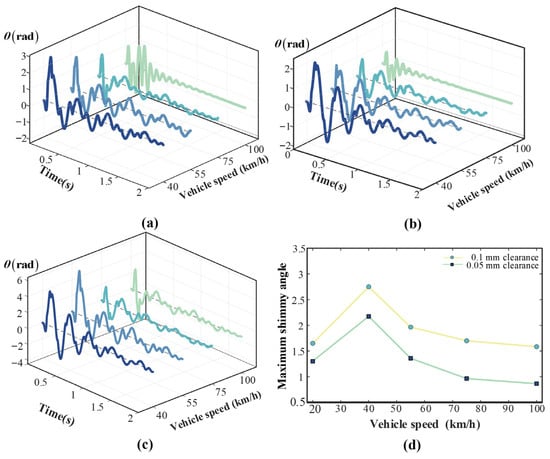
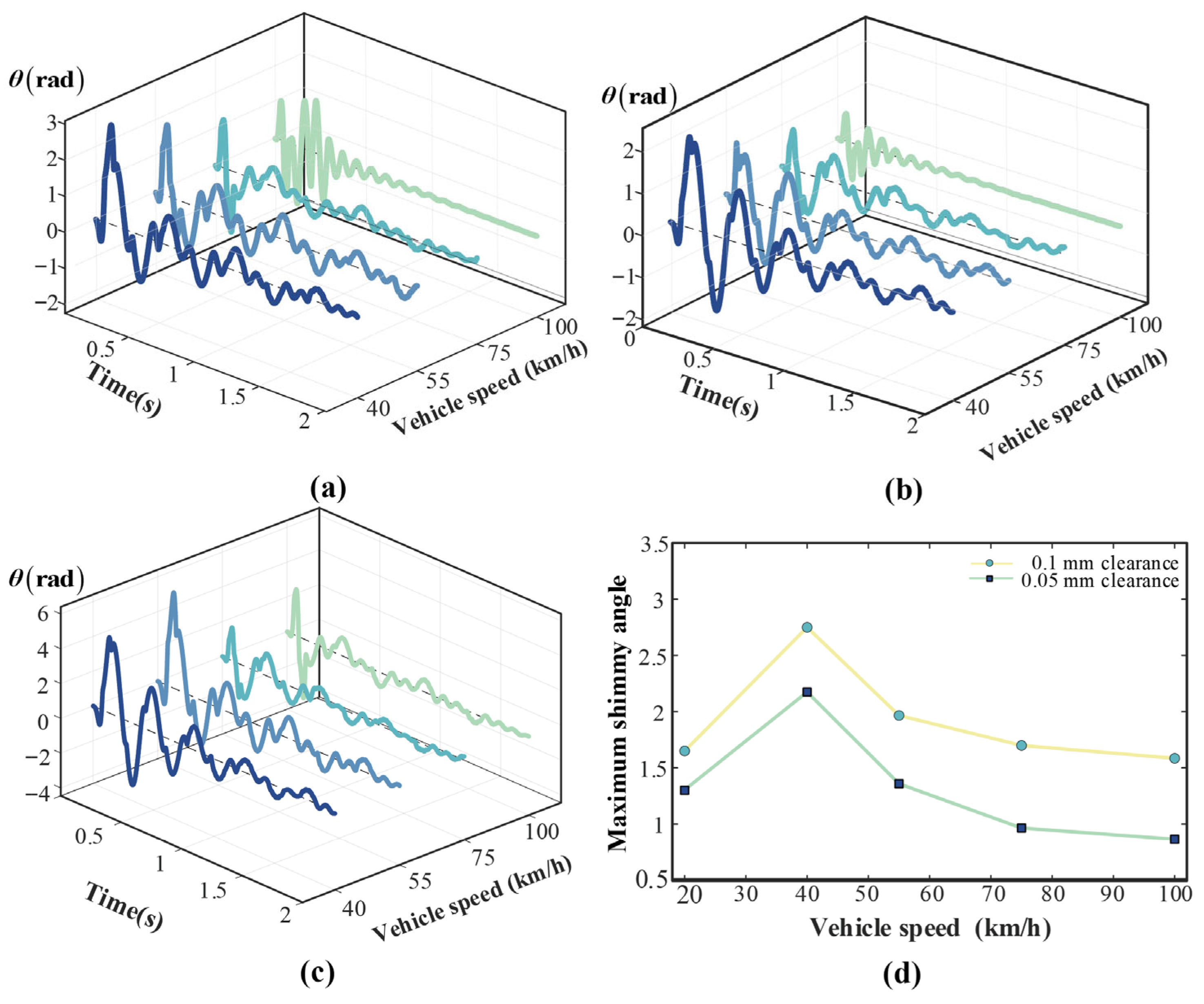
The transient behavior of brake-induced shimmy is influenced by both structural and operating parameters of the vehicle system. In this work, the transient response duration and peak transient angle are used to investigate the influence of different parameters on shimmy response, identify key parameters affecting system transient behavior, and summarize measures for shimmy suppression and handling stability improvement. Figure 7 presents the transient time–history curves of the left front wheel shimmy angle at initial vehicle speeds of 100 km/h, 75 km/h, 55 km/h, and 40 km/h for a clearance of 0.1 mm. Initial vehicle speed is found to have a significant effect on the dynamic response peak and oscillation attenuation characteristics of the system.
At high tested speeds, shimmy vibration exhibits a gradual decay trend after the initial peak induced by braking excitation, and eventually stabilizes. The system vibration response shows more complex dynamic behavior in the medium speed range. Notably, at an initial speed of 40 km/h, the shimmy response intensifies significantly in the initial stage and then attenuates gradually, exhibiting the largest transient response peak and the longest oscillation duration among the four tested conditions. Comparative analysis confirms that reducing the clearance magnitude decreases shimmy amplitude and accelerates vibration attenuation at specific vehicle speeds (Figure 9).
Figure 9.
At different vehicle speeds, (a,b) time series plots of 0.1 mm and 0.05 mm, (c) the curve of maximum angle of rotation of left wheel with initial speed (d) histogram.
The variation law of the maximum left front wheel shimmy angle with initial vehicle speed is further quantified. Non-monotonic variation in the system transient response peak is observed, which presents a nonlinear characteristic of first increasing and then decreasing with the rise in vehicle speed. The most severe vibration is induced at middle speed, and the influence of clearance is weakened as the vehicle speed increases beyond this range. Accordingly, it is confirmed that the penetration loss induced by clearance can be effectively suppressed by adjusting the vehicle speed. In addition, under all tested vehicle speeds, the maximum shimmy angle at the clearance of 0.1 mm is consistently higher than that at 0.05 mm, which further verifies that the braking shimmy amplitude is aggravated by the increase in kinematic pair clearance magnitude.
3.4. Time-Frequency Energy Evolution and Bifurcation Characteristics
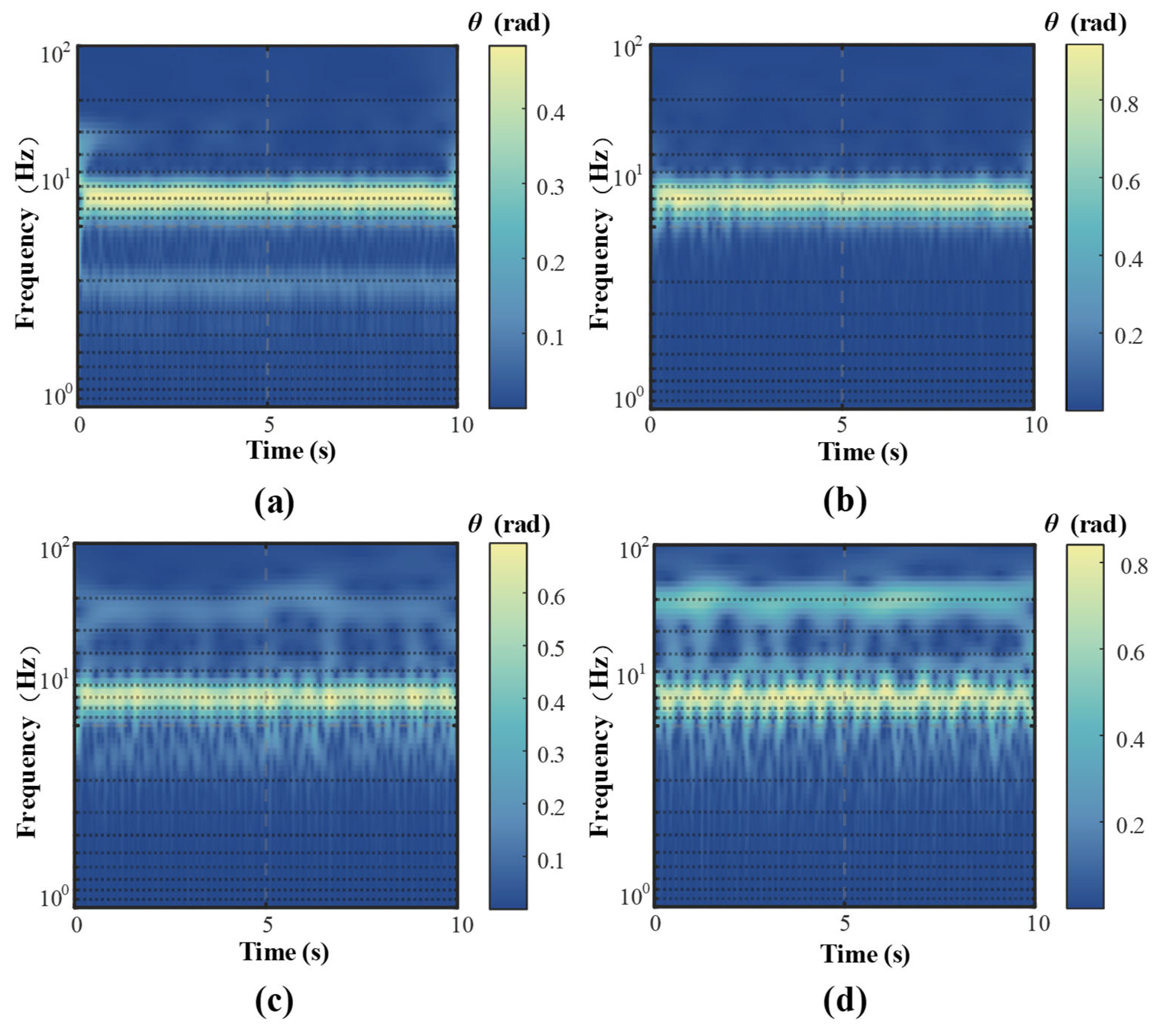
Inherent time-domain limitations are presented by the traditional Fourier transform when dealing with transient non-stationary impulse signals induced by random clearance collisions. Accordingly, the continuous wavelet transform algorithm with excellent time-frequency localization characterization capability is adopted in this study. The nonlinear frequency modulation behavior during the evolution of the shimmy system from regular quasi-periodic motion to global chaos is accurately captured via the energy redistribution characteristics of the CWT time-frequency spectrum. The CWT time-frequency spectra of the steering wheel shimmy angle response corresponding to four clearance magnitudes (0.07 mm, 0.10 mm, 0.20 mm, 0.40 mm) at an initial braking speed of 55 km/h are presented in Figure 10. At a small clearance of 0.07 mm, a regular strip-like distribution structure is presented by the time-frequency spectrum, with significant periodic repeatability of time-frequency energy distribution and weak high-order harmonic components, which indicates that the system is in the quasi-periodic motion region. The dynamic behavior of the system is not dominated by the clearance-induced nonlinear restoring force at this stage, relatively stable vibration amplitude and frequency with high energy concentration are maintained, and the system is kept within the periodic window.
Figure 10.
Time-frequency spectrum characteristics of different gap sizes cwt under two gap conditions: (a) c = 0.07 mm; (b) c = 0.1 mm; (c) c = 0.4 mm; (d) c = 0.2 mm.
Significant distortion of the time-frequency topological structure is observed as the clearance increases to 0.10 mm. Frequency modulation in the range of 8–14 Hz is exhibited by the main energy band, with periodic bending of the energy ridge, which reveals the coupling effect of parametric excitation and forced excitation. Meanwhile, sub-harmonic response components are observed in the 1–3 Hz low-frequency band, with intermittent burst characteristics presented by their time-frequency energy clusters, which are induced by the clearance-related collision-separation dynamic behavior. A dispersed trend of energy distribution is presented, and a 32.7% increase in time-frequency entropy is detected, which indicates that the system has entered the critical state of transition from quasi-periodic motion to chaotic motion, where drastic recombination of frequency components can be induced by small parameter disturbances.
As the clearance is further expanded to 0.4 mm, a highly irregular fragmented energy distribution is presented by the time-frequency spectrum, and the main energy clusters wander randomly in the 5–20 Hz wide frequency band without an obvious periodic structure. A 67% decrease in energy concentration and a 0.85 bit increase in time-frequency entropy are detected, showing typical characteristics of deterministic chaos. Strong nonlinear coupling between the tire longitudinal–lateral composite working condition and clearance impact is observed at the peak moment of braking axle load transfer (t ≈ 0.8 s). This wide-frequency energy spreading is attributed to the time-varying nonlinearity and hysteresis characteristics of the system stiffness matrix under large clearance, by which the shimmy system is driven to a globally unstable chaotic attractor.
From the perspective of the dynamic mechanism, system stability is degraded by the clearance coupling effect through two paths. First, the impulse excitation generated instantaneously by clearance collisions is manifested as wide-frequency energy injection in the time-frequency domain, by which the suppressed sub-modes are activated. Second, dynamic changes in tire vertical force are induced by braking axle load transfer, by which the cornering stiffness and self-aligning torque are altered, and time-varying parametric excitation is formed. The system hovers on the edge of the unstable region under the coupling of the two effects, and the energy cluster transition phenomenon in the CWT time-frequency spectrum is confirmed as direct evidence of the synergistic effect between parametric resonance and collision impact. A positive correlation between the energy aggregation degree in the 15–18 Hz frequency band of the time-frequency spectrum and braking intensity is observed, which indicates that the high-frequency components of clearance collisions are amplified by axle load transfer [35].
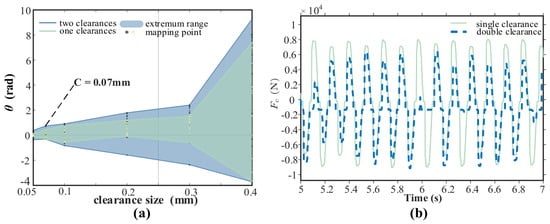
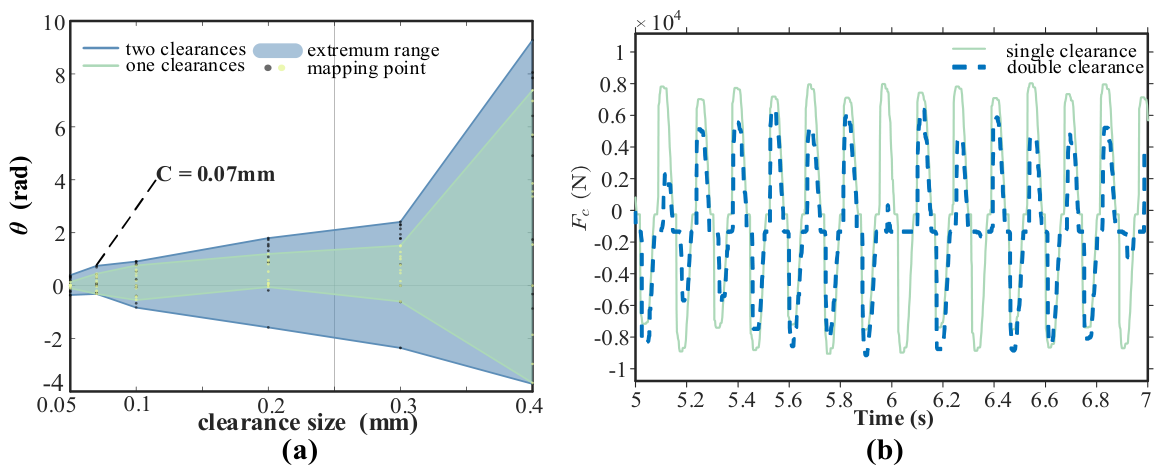
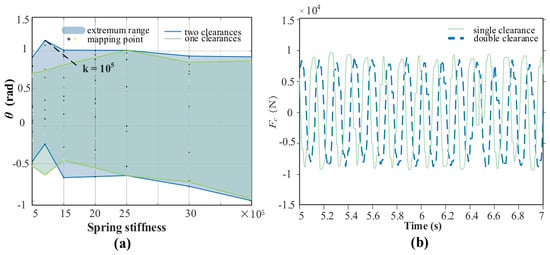
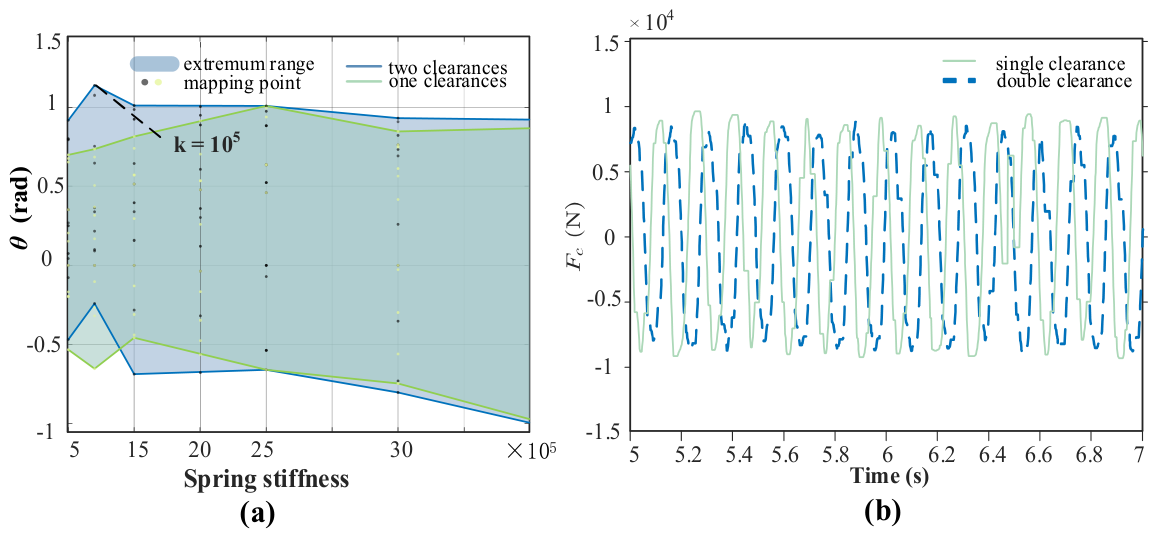
The time–history comparison of the X-direction contact force of the steering knuckle clearance pair is presented in Figure 11. where the single-clearance condition is represented by the blue solid line, and the dual-clearance coupling condition is represented by the red dashed line. Highly regular periodic oscillation characteristics with an approximately harmonic waveform and stable amplitude are exhibited by the single-clearance system, which indicates that the system is in a stable period-1 motion state, and predictable regularity is presented by its contact-separation conversion process. In contrast, significant nonlinear dynamic distortion with obvious flat-top waveform distortion is observed under the dual-clearance condition. This essential difference in dynamic behavior is attributed to the dynamic coupling effect between multiple clearance pairs. Frequent and random alternation between the free-flight mode and impact mode of the left and right trapezoidal arm clearance pairs is observed in the dual-clearance system. Severe fluctuation characteristics of the contact force are induced by momentum exchange and vibration energy transfer between the bilateral clearance pairs. The contact force peak is significantly amplified by the second harmonic superposition caused by multibody contact, and an irregular distribution is presented by the contact duration.
Figure 11.
Nonlinear dynamic response of the steering shimmy system with kinematic pair clearances: (a) bifurcation diagram of angle amplitude of single and double gaps in different gaps. (b) X-direction contact force.
This study adopts a nonlinear steering shimmy model with multi-clearance kinematic pairs. Hertz contact theory describes the non-smooth contact characteristics of clearance joints. Numerical simulation analyzes stiffness and clearance coupling effects on system response. Steering shimmy amplitude rises first, then falls with increasing spring stiffness. The dual-clearance condition yields a larger shimmy response than the single-clearance condition. Multi-clearance coupling amplifies contact force fluctuation and impact load. This coupling effect significantly deteriorates the steering system’s dynamic stability.
3.5. Effect of Kinematic Pair Clearance on Contact Force Characteristicsi
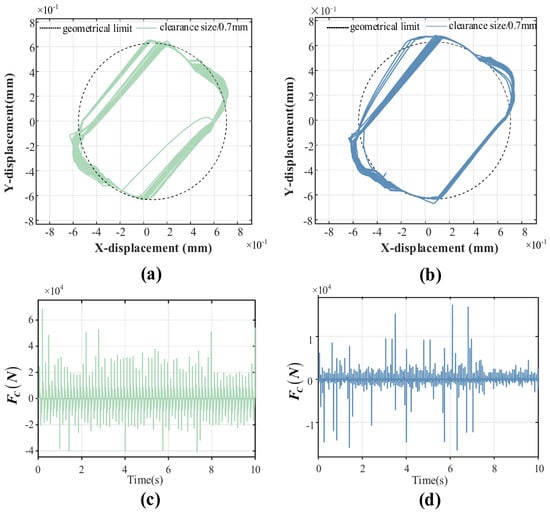
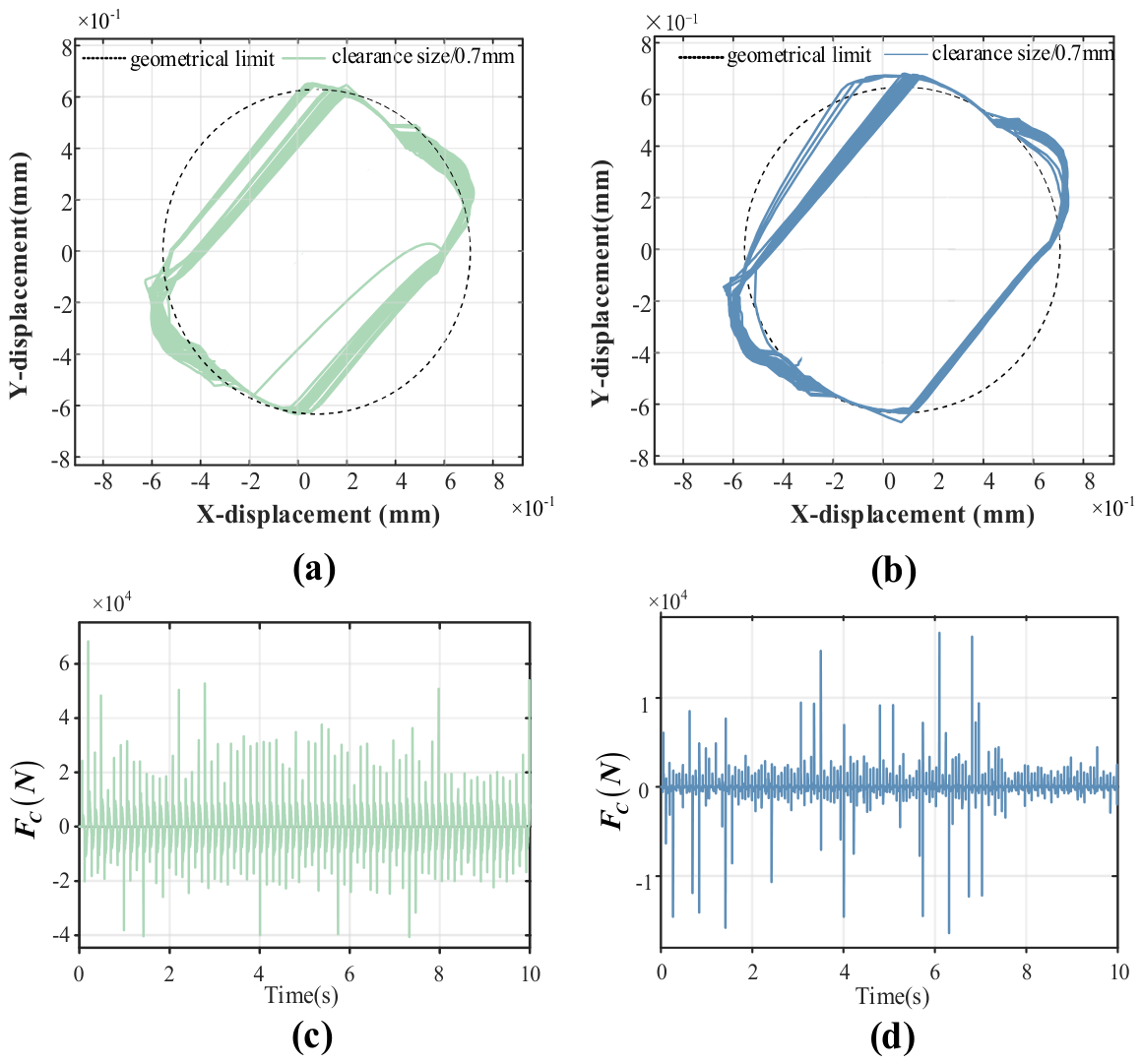
Non-uniform distribution of elastic penetration depth in orthogonal space is induced by the directionally biased motion trend of the steering system during the shimmy process. The anisotropic characteristics of contact force in clearance pairs are decoupled and analyzed to further investigate this physical phenomenon. The time–history curves of contact-impact force in the X-direction (main transmission direction) and Y-direction (lateral direction) are presented in Figure 12c and Figure 12d, respectively.
Figure 12.
The time course of contact force in different directions (a) is the x-direction, (b) is the y-direction, and (c) is the time-history curves of contact-impact force in the X-direction and (d) is Y-direction are presented.
Extremely significant dynamic heterogeneity is exhibited by force transmission in the two orthogonal directions. High-intensity nonlinear broadband oscillation is presented by the X-direction contact force, with its transient normal force peak reaching the order of ±6 × 10⁴ N, and the time history is densely covered with high-frequency impact burrs induced by high-energy collisions. In contrast, a cliff-like attenuation is observed in the amplitude of the Y-direction contact force, and a gentle quasi-harmonic fluctuation is presented by its time-domain waveform. The mechanical essence of the spatial asymmetric distribution of impact impulse is revealed by this remarkable dynamic direction dependence, which also provides conclusive micro-dynamic evidence for the engineering phenomenon that the X-direction wear rate of the steering knuckle in in-service vehicles is significantly higher than that in the Y-direction.
From the perspective of global system stability, a highly regular limit cycle topological form is presented by the two-dimensional displacement phase-plane trajectory corresponding to Figure 13. The phase trajectory forms a closed elliptical-like ring band in the X-Y displacement plane with clear and non-dispersive boundaries, which conclusively verifies that the system under this specific parameter matching is in an autonomous period-1 motion mode. A perfect global dynamic balance between mechanical energy input and energy dissipation dominated by hysteretic damping and Coulomb friction in the complex multibody contact-separation process is deeply reflected by the uniform and symmetric distribution of phase trajectory density in different quadrants, which provides an intuitive geometric explanation for the energy maintenance mechanism of nonlinear self-excited oscillation.
Figure 13.
Nonlinear dynamic response of the steering shimmy system with kinematic pair clearances: (a) bifurcation diagram of steering shimmy angle varying with spring stiffness, comparing the system response under single-clearance and dual-clearance conditions; (b) time–history curves of X-direction contact force under the spring stiffness of 3 × 10⁵ N/m for single-clearance and dual-clearance working conditions.
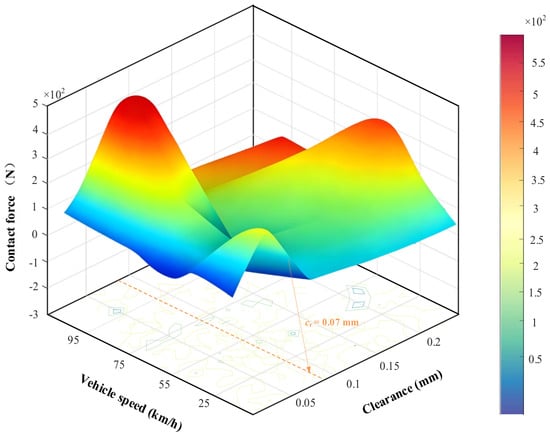
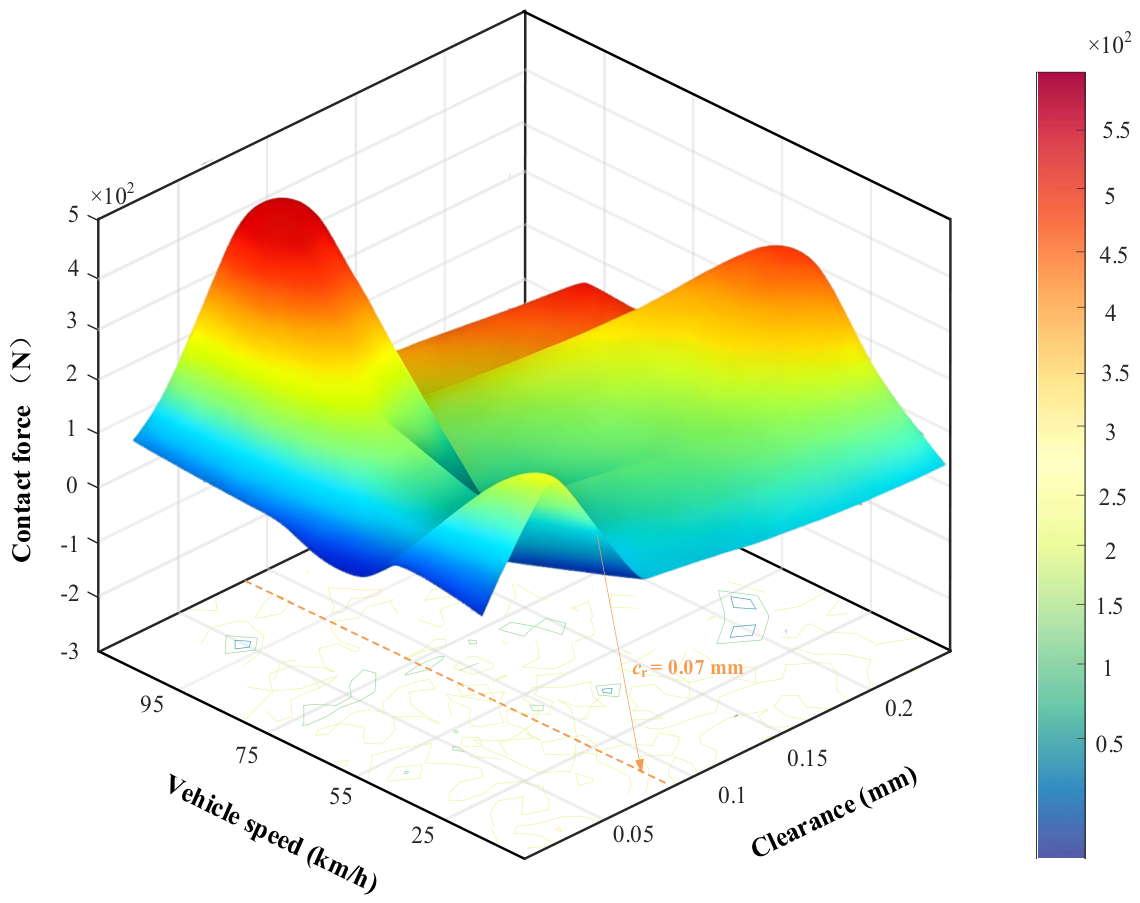
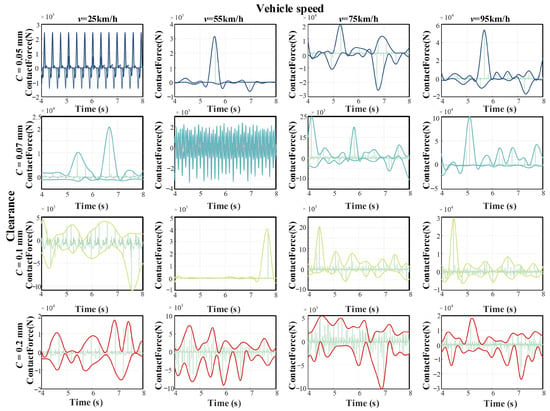
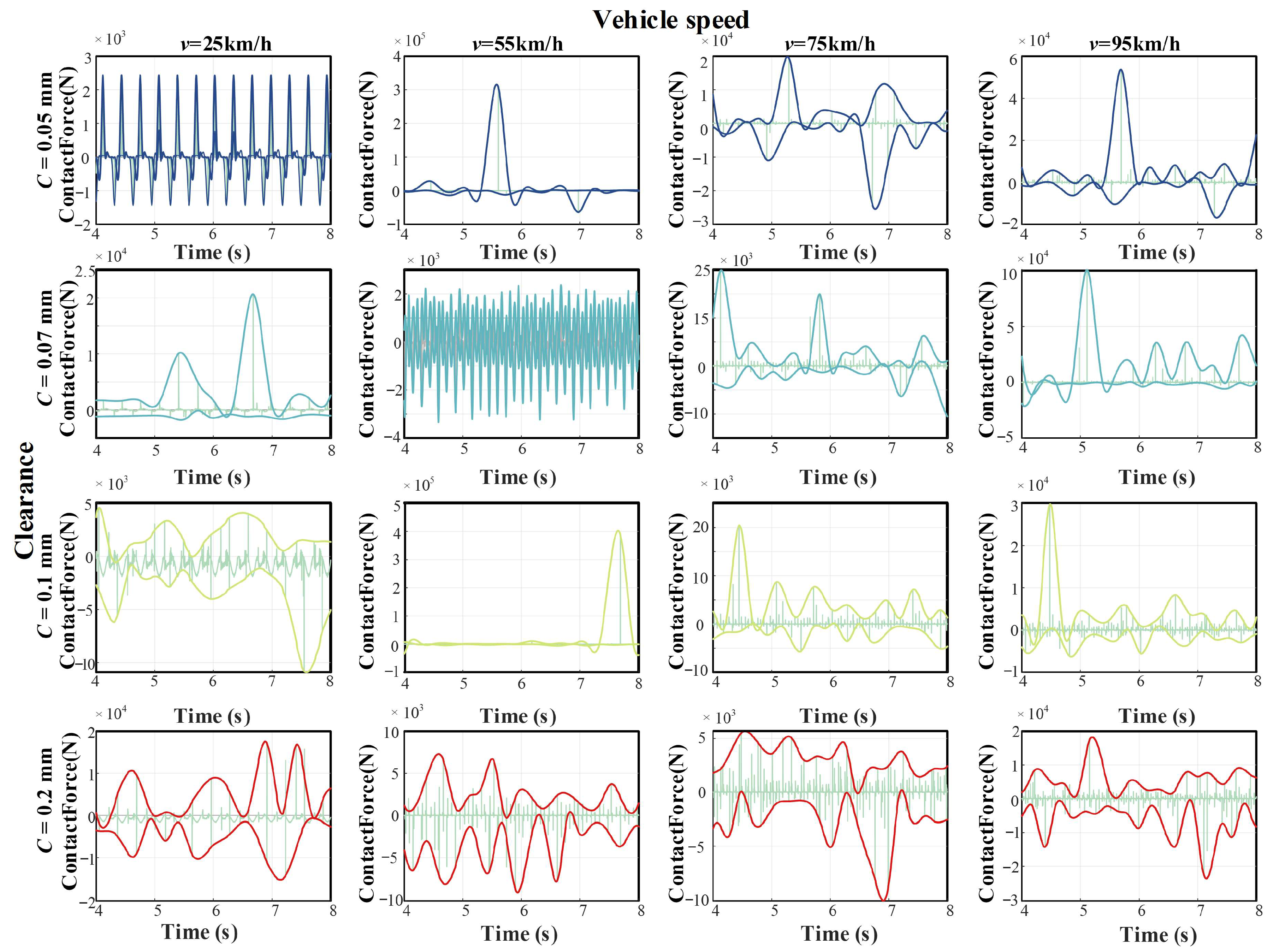
As shown in Figure 12. At 0.05 mm clearance, the contact force shows regular periodic impact with low amplitude, and the waveform maintains stable periodicity across all tested speeds with only slight peak growth as vehicle speed increases. At 0.07 mm clearance, obvious distortion appears in the time-domain waveform, dense high-frequency impact burrs cover the contact force time history, the peak amplitude rises by an order of magnitude at 55 km/h, and this clearance value forms a clear critical threshold for response mutation. As clearance expands to 0.1 mm, strong asymmetric impact characteristics emerge, the contact force peak continues to increase significantly, and waveform differences between different speeds are greatly enlarged. At 0.2 mm clearance, the contact force presents large-amplitude low-frequency oscillation superimposed with high-frequency impact components, and the peak value reaches 1 × 10⁴ N magnitude, dozens of times higher than that under small clearance conditions. The 3D response surface reveals the nonlinear coupling effect between clearance and vehicle speed, the contact force peak shows non-monotonic variation with rising vehicle speed, the most significant amplification occurs in the 55 km/h to 75 km/h medium speed range, and the synergistic effect of large clearance and medium-high speed induces the severest impact response.
Strong nonlinear sensitivity of contact force to clearance magnitude and vehicle speed is verified, clearance increase significantly elevates contact force impact amplitude and alters system motion state from periodic motion to chaotic motion, the 0.07 mm clearance is confirmed as the critical threshold for system dynamic bifurcation, non-monotonic speed-dependent amplification of contact force is identified with the medium speed range defined as the core concern for clearance-induced wear control, and the coupling effect of clearance and vehicle speed produces synergistic amplification of impact load, which is confirmed as the core inducement of fatigue wear in steering transmission mechanisms.
The 3D response surface quantifies the peak contact force. Figure 14 which is fully consistent with the evolution trend of the time–history curves. It is verified that contact force presents strong nonlinear sensitivity to both clearance magnitude and vehicle speed. The 0.07 mm clearance is confirmed as the critical bifurcation threshold, and the medium vehicle speed range shows the most significant impact load amplification. The coupling effect of clearance and vehicle speed synergistically aggravates the impact response of the steering kinematic pair (Figure 15).
Figure 14.
Contact force response characteristics of the steering kinematic pair clearance under different operating conditions: 3D response surface of contact force peak varying with kinematic pair clearance magnitude and initial vehicle speed.
Figure 15.
Time–history curves of contact force for the steering kinematic pair clearance under braking conditions. Rows correspond to clearance magnitudes of 0.05 mm, 0.07 mm, 0.1 mm and 0.2 mm from top to bottom, and columns correspond to initial braking vehicle speeds of 25 km/h, 55 km/h, 75 km/h and 95 km/h from left to right.
4. Conclusions
This study systematically investigates the nonlinear evolution mechanism of brake-induced steering shimmy under the coupling effect of multiple clearance joints in the steering system, to address the chassis handling instability caused by clearance wear in service vehicles. A 5-degree-of-freedom non-autonomous shimmy dynamic model is developed using Lagrange’s equations, which comprehensively incorporates the non-smooth contact characteristics of dual clearances between tie rods and trapezoidal arms, transient braking axle load transfer, and tire longitudinal–lateral coupling nonlinearity. The nonlinear dynamic responses of the system are analyzed through phase portraits, Poincaré sections, and continuous wavelet transform. The core conclusions are summarized as follows:
- Multi-clearance coupling is a critical factor aggravating brake-induced shimmy. Compared with the single-clearance condition, dual-clearance coupling increases the peak shimmy angle by more than 40%, amplifies contact force fluctuations by an order of magnitude, and significantly lowers the system stability boundary. The frequent alternation of contact, impact, and separation between bilateral clearance joints induces modal interaction and energy transfer, which drives the system into chaotic motion at smaller clearance magnitudes.
- The system exhibits a typical nonlinear bifurcation evolution path with increasing clearance joint magnitude. As clearance increases from 0.05 mm to 0.40 mm, the system transitions sequentially from stable period-1 motion to high-order periodic motion, quasi-periodic motion, and finally high-dimensional chaotic motion. A clearance of 0.07 mm is identified as the critical bifurcation threshold. At 0.4 mm clearance, vibration energy concentration decreases by 67%, exhibiting typical deterministic chaos characteristics.
- Vehicle speed has a non-monotonic effect on shimmy response, with a significant synergistic amplification effect between clearance and speed. The most severe shimmy occurs in the medium speed range of 40–75 km/h, while shimmy amplitude decreases gradually at both low and high speeds. Under all tested speed conditions, shimmy response intensity increases monotonically with increasing clearance magnitude.
- Significant response heterogeneity exists in the shimmy system. The left front wheel shows higher sensitivity to clearance excitation and is the key control target for steering system clearance optimization. Clearance contact force exhibits strong dynamic anisotropy: impact loads in the X-direction (steering transmission direction) are dozens of times higher than those in the Y-direction, which explains the engineering phenomenon that the wear rate of steering knuckles in the X-direction is significantly higher.
- Systematic engineering design guidelines and maintenance strategies are proposed for clearance-induced brake shimmy suppression, providing direct technical support for the design, manufacturing, and in-service maintenance of automotive steering systems. The manufacturing clearance of revolute joints between the steering tie rod and left/right trapezoidal arms should be strictly controlled within 0.07 mm (the critical bifurcation threshold identified in this study), and components should be replaced promptly when wear clearance exceeds 0.1 mm. The comprehensive stiffness of the steering transmission system should be matched in the range of 3.5–4.5 × 10⁶ N/m, which effectively suppresses clearance-induced shimmy amplification while maintaining good steering feel. The steering damping coefficient is recommended to be 4–6 N·s/m, with 5 N·s/m identified as the optimal value for compact passenger cars, balancing vibration attenuation performance and steering maneuverability. A hierarchical maintenance mechanism is suggested: inspect steering clearances every 30,000 km for vehicles with mileage less than 60,000 km and every 15,000 km for those exceeding 60,000 km; conduct immediate special inspection when steering wheel shimmy amplitude exceeds 0.2° under braking at 55 km/h; and lubricate clearance joints every 15,000 km to delay clearance growth.
This study elucidates the underlying failure mechanism of clearance-induced brake shimmy, providing a robust theoretical foundation for clearance matching design, wear early warning, and vibration suppression of vehicle steering systems.
5. Future Work
The primary future research direction is to develop a dedicated physical test bench for steering systems with adjustable kinematic pair clearances. This will allow us to conduct systematic experimental measurements of brake-induced shimmy under different clearance combinations, braking intensities and vehicle speeds, and quantitatively calibrate and validate the proposed dynamic model.
Author Contributions
Conceptualization, methodology, software, validation, formal analysis, and investigation, G.L. and X.W.; supervision and project administration, Q.Y., M.W., W.L. and H.W. All authors have read and agreed to the published version of the manuscript.
Funding
This research was funded by the National Natural Science Foundation of China, grant number 52405140.
Data Availability Statement
The data are available on request from the author.
Acknowledgments
The authors would like to sincerely thank Xuze Wu, the corresponding author, for his comprehensive academic guidance, rigorous supervision and constructive revisions throughout the whole research process. The authors also acknowledge the dedicated contributions Qinyun Ye, Wen Liu and Muyang Wu in dynamic model establishment, numerical simulation and experimental data analysis.
Conflicts of Interest
The authors declare no conflicts of interest. Qingyun Ye is an employee of Ningbo Ruyijoint Stock Co., Ltd., The paper reflects the views of the scientists and not the company.
Abbreviations
The following abbreviations are used in this manuscript:
| FFT | Fast Fourier Transform |
| PSD | Power Spectral Density |
| DOF | Degree(s) of Freedom |
Appendix A. Symbolic Representation of Data and Formulas
| Nomenclature | |
| Coordinates of the left and right kingpin centers | |
| Coordinate of the Shaft center | |
| Magnitude of the kinematic joint clearance | |
| Normal penetration depth at the left and right joints | |
| Length of left and right trapezoidal walls | |
| Crossbar length | |
| Base angle of left/right steering trapezoid | |
| Angle of steering angler of left front wheel around main pin | |
| Angle of camber of right front wheel around main pin | |
| Lateral yaw angle of front axle about longitudinal axis | |
| Transverse swing angle of tie rod | |
| X-directional displacement of the centroid of the crossbar | |
| Displacement of the centroid of the crossbar along the y-axis | |
| Yaw angle | |
| Rotating inertia of wheel | |
| Front axle moment of inertia | |
| Rotating inertia of crossbar | |
| Mass of crossbar | |
| The moment of inertia of a vehicle about the z-axis | |
| Wheel steering stiffness | |
| Stiffness of transverse bar | |
| Wheel steering damping | |
| Transverse bar damping | |
| Normal damping | |
| Tangential velocity of the left contact point | |
| Friction factor, friction coefficient | |
| Tangential velocity at the right contact point | |
| Suspension vertical jump spring | |
| Steering wheel track | |
| Wheel camber | |
| Distance from the steering knuckle center of mass to the main pin | |
| Inner radius of bearing sleeve | |
| Outer radius of pin shaft | |
| contact stiffness | |
| equivalent elastic modulus | |
References
- Yu, J.; Nutwell, B.; Brickner, B. Analysis of Vehicle Chassis Transmissibility of Steering Shimmy and Brake Judder: System Modeling and Validation; SAE Technical Paper 2007-01-2341; SAE: St. Charles, IL, USA, 2007. [Google Scholar] [CrossRef] [Scilit]
- Herisanu, N.; Marinca, V. Analytical Study of Nonlinear Vibration in a Rub-Impact Jeffcott Rotor. Energies 2021, 14, 8298. [Google Scholar] [CrossRef] [Scilit]
- Lu, H. On the non-linear dynamics of vehicle shimmy coupled with handling motions: Modelling, bifurcation analysis, and validations. J. Vib. Control 2023, 29, 3435–3450. [Google Scholar] [CrossRef] [Scilit]
- Gingarasu, M.; Genea, D.; Mereuta, E. Finite Element Analysis of an Automotive Steering System Considering Spherical Joint Clearance. Vibration 2025, 8, 80. [Google Scholar] [CrossRef] [Scilit]
- Hu, C.; Lu, J.W. Dynamic influence of steering damper on vehicle shimmy system. Mach. Des. Manuf. 2023, 2023, 69–73. [Google Scholar] [CrossRef]
- Kazemi, H.; Du, X. A Method to Detect and Isolate Brake Rotor Thickness Variation and Corrosion. Int. J. Progn. Health Manag. 2023, 14, 3377. [Google Scholar] [CrossRef] [Scilit]
- Kim, M.; Jeong, H.; Yoo, W. Sensitivity Analysis of Chassis System to Improve Shimmy and Brake Judder Vibration on Steering Wheel; SAE Technical Paper 960734; SAE: Detroit, MI, USA, 1996. [Google Scholar] [CrossRef] [Scilit]
- Day, A.J. Brake judder: A review. Proc. Inst. Mech. Eng. Part D J. Automob. Eng. 2004, 218, 1135–1153. [Google Scholar]
- Li, S.; Lin, Y. Modeling and analysis of vehicle shimmy with consideration of the coupling effects of vehicle body. Shock Vib. 2019, 2019, 3707416. [Google Scholar] [CrossRef] [Scilit]
- Hryciów, Z. Assessment of the effect of passenger car wheel unbalance on driving comfort. Arch. Automot. Eng. Arch. Motoryz. 2021, 91, 53–68. [Google Scholar] [CrossRef] [Scilit]
- Lu, J.W.; Gu, J.; Liu, M.J. Modeling of the vehicle shimmy system with consideration of clearance of the steering linkage mechanism. Meccanica 2010, 45, 53–61. [Google Scholar] [CrossRef] [Scilit]
- Hua, X.; Zheng, J.; Li, H.; Huang, J.; Lou, M.; Feng, X.; Xiong, H.; Wu, W. A Review of Automobile Brake-by-Wire Control Technology. Processes 2023, 11, 994. [Google Scholar] [CrossRef] [Scilit]
- Zhang, H.; Qiao, J.; Zhang, X. Nonlinear Dynamics Analysis of Disc Brake Frictional Vibration. Appl. Sci. 2022, 12, 12104. [Google Scholar] [CrossRef] [Scilit]
- Wei, H.; Lu, J.; Ye, S.; Lu, H. Bifurcation analysis of vehicle shimmy system exposed to road roughness excitation. J. Vib. Control 2022, 28, 1045–1056. [Google Scholar] [CrossRef] [Scilit]
- Liu, J.; Hua, Y.; Zhou, Z.; Pan, Y. Research on Braking Force Distribution Strategy for Race Cars Based on PID Algorithm. World Electr. Veh. J. 2025, 16, 653. [Google Scholar] [CrossRef] [Scilit]
- Lu, J.; Xu, Y.; Hu, C.; Vakakis, A.F.; Bergman, L.A. 5-DOF dynamic model of vehicle shimmy system with clearance at universal joint in steering handling mechanism. Shock Vib. 2013, 20, 951–961. [Google Scholar] [CrossRef]
- Li, X.; Yang, Y.; Bennett, I.; Mba, D. Condition Monitoring of Rotating Machines under Time-Varying Conditions Based on Adaptive Canonical Variate Analysis. Mech. Syst. Signal Process. 2019, 131, 348–363. [Google Scholar] [CrossRef] [Scilit]
- Basic, D.; Ramsden, V.S.; Muttik, P.K. Harmonic filtering of high-power 12-pulse rectifier loads with a selective hybrid filter system. IEEE Trans. Ind. Electron. 2001, 48, 1118–1127. [Google Scholar] [CrossRef]
- Gurumoorthy, S.; Bhumireddy, Y.; Bourgeau, A.; Bhimchand, N. Mathematical Formulation and Analysis of Brake Judder; SAE Technical Paper 2023-01-0148; SAE: Detroit, MI, USA, 2023. [Google Scholar] [CrossRef] [Scilit]
- Smith, M.C. Synthesis of mechanical networks: The inerter. IEEE Trans. Autom. Control 2002, 47, 1648–1662. [Google Scholar] [CrossRef] [Scilit]
- Chen, Z. Research on Nonlinear Dynamic Characteristics of Steering System with Clearance Under Complex Working Conditions. Master’s Thesis, Chongqing Jiaotong University, Chongqing, China, 2021. [Google Scholar]
- Wei, H.; Lu, J.; Lu, H.; Shi, L.; Wu, B.; Jiang, P. Hopf bifurcation and energy transfer of automobile shimmy system with consideration of road roughness excitation. Veh. Syst. Dyn. 2022, 60, 454–469. [Google Scholar] [CrossRef] [Scilit]
- Wei, H.; Xu, Y.; Wang, X.; Li, L. Nonlinear shimmy and dynamic bifurcation in vehicle system with driver steering input. Proc. Inst. Mech. Eng. Part D J. Automob. Eng. 2025, 239, 1406–1416. [Google Scholar] [CrossRef] [Scilit]
- Wang, Y.; Xu, B.; Meng, H. Enhanced vehicle shimmy performance using inerter-based suppression mechanism. Commun. Nonlinear Sci. Numer. Simul. 2024, 130, 107800. [Google Scholar] [CrossRef] [Scilit]
- Takács, D.; Orosz, G.; Stépán, G. Delay effects in shimmy dynamics of wheels with stretched string-like tyres. Eur. J. Mech. A/Solids 2009, 28, 516–525. [Google Scholar] [CrossRef] [Scilit]
- Yang, C.; Ding, L.; Tang, D.; Gao, H.; Niu, L.; Lan, Q.; Li, C.; Deng, Z. Improved Terzaghi-Theory-Based Interaction Modeling of Rotary Robotic Locomotors with Granular Substrates. Mech. Mach. Theory 2020, 152, 103901. [Google Scholar] [CrossRef] [Scilit]
- Mi, T.; Stépán, G.; Takács, D.; Chen, N. Vehicle shimmy modeling with Pacejka’s magic formula and the delayed tire model. J. Comput. Nonlinear Dyn. 2020, 15, 031003. [Google Scholar] [CrossRef] [Scilit]
- Megahed, S.M.; Haroun, A.F. Analysis of the dynamic behavioral performance of mechanical systems with multi–clearance joints. J. Comput. Nonlinear Dyn. 2012, 7, 011002. [Google Scholar] [CrossRef] [Scilit]
- Wu, X.; Li, G.; Sun, Y.; Wang, H.; Chen, Y. Theoretical and experimental exploration on the chattering control for the planar mechanism with clearance joint: Using an asymmetrically constrained vibro-impact absorber. Mech. Mach. Theory 2025, 215, 106171. [Google Scholar] [CrossRef] [Scilit]
- Jiang, Y.; Feng, G.; Liu, P.; Li, Y.; Ding, J.; Jiang, B. Evaluation of Joint Clearance Effects on the Shimmy of Nose Landing Gear. Aerospace 2023, 10, 722. [Google Scholar] [CrossRef] [Scilit]
- Feng, G.; Jiang, B.; Jiang, Y. Effect of Multi-Joint Clearance Coupling on Shimmy Characteristics of Aircraft Nose Landing Gear. Aerospace 2023, 10, 911. [Google Scholar] [CrossRef] [Scilit]
- Wei, D.; Wang, Y.; Jiang, T.; Zheng, S.; Zhao, W.; Pan, Z. Chaos Vibration of Pinion and Rack Steering Trapezoidal Mechanism Containing Two Clearances. Mech. Syst. Signal Process. 2017, 92, 146–155. [Google Scholar] [CrossRef] [Scilit]
- Jia, Y.; Meng, K.; Jiang, S.; Kang, J. Wear Prediction and Chaos Identification of Rigid Flexible Multi-Link Mechanism with Clearance Considering Wear Effects. Lubricants 2025, 13, 130. [Google Scholar] [CrossRef] [Scilit]
- Liu, G.; Dou, X.; Wang, W.; Sun, C.; Dou, Y.; Buhari, A. Dynamics and nonlinear response of multibody system considering thermal deformation of clearance joints. Results Eng. 2025, 64, 103813. [Google Scholar] [CrossRef] [Scilit]
- Bai, Z.; Ning, Z.; Zhou, J. Study on Wear Characteristics of Revolute Clearance Joints in Mechanical Systems. Micromachines 2022, 13, 1018. [Google Scholar] [CrossRef] [Scilit]

Disclaimer/Publisher’s Note: The statements, opinions and data contained in all publications are solely those of the individual author(s) and contributor(s) and not of MDPI and/or the editor(s). MDPI and/or the editor(s) disclaim responsibility for any injury to people or property resulting from any ideas, methods, instructions or products referred to in the content. |
© 2026 by the authors. Licensee MDPI, Basel, Switzerland. This article is an open access article distributed under the terms and conditions of the Creative Commons Attribution (CC BY) license.