Article

The Influence of Boundary Conditions on Trapped Modes in Semi-Infinite Elastic Waveguides †

by
Marcus Dykes
1,
Julius Kaplunov
1,2 and
Danila Prikazchikov
1,3,*
1
School of Computer Science and Mathematics, Keele University, Keele ST5 5BG, UK
2
Department of Continuum Mechanics, RWTH Aachen University, Eilfschornsteinstr. 18, 52062 Aachen, Germany
3
Department of Mechanics and Mathematics, Al-Farabi Kazakh National University, Almaty 050040, Kazakhstan
*
Author to whom correspondence should be addressed.
This paper is dedicated to memory of Prof G.B. Muravskii (1933–2021).
Vibration 2026, 9(1), 18; https://doi.org/10.3390/vibration9010018
Submission received: 8 February 2026 / Revised: 17 February 2026 / Accepted: 2 March 2026 / Published: 10 March 2026

Abstract

This work investigates trapped modes induced by localized inhomogeneities in semi-infinite elastic waveguides in the form of a point mass or a meta-spring attached to the edge. Explicit relations linking the parameters of the meta-spring and the mass are presented with a string or beam resting on a Winkler foundation. Asymptotic expansions are derived to describe the limiting behavior of the obtained solutions, including small- and large-mass regimes. Special emphasis is placed on the less-studied trapped modes in an elastically supported beam, providing new insights into the peculiarities of wave localization phenomena, e.g., the analysis of the associated frequency equation.

1. Introduction

Trapped modes in inhomogeneous waveguides have been studied extensively in the context of the simplest configuration, namely, of an elastic string resting on a Winkler foundation with an attached point mass. An explicit solution to this kind of problem was obtained in [1] for torsional vibrations of rod, where the transient motion of a mass and viscosity of the foundation were also taken into consideration. For an elastic string, a similar trapped mode was reported in [2]. Subsequently, a range of generalizations incorporating effects such as nonlinearity, transient phenomena, and time-varying physical parameters, were developed [3,4,5,6].
It is worth noting that the dynamic model described above, despite its apparent simplicity, arises in a variety of important engineering applications. In particular, the one-dimensional string equation may be interpreted as the leading order long-wave, low-frequency approximation of the dynamic response of a pre-stressed elastic layer [7], see also [8] for a related formulation involving a membrane. At the same time, the widely used Winkler foundation model can be derived rigorously from the equations of linear elasticity using an asymptotic approach, see, e.g., [9,10].
It is also remarkable that a trapped mode was observed numerically within a more sophisticated framework, namely for an Euler–Bernoulli beam supported by a Winkler foundation, subjected to a moving mass, see [11]. However, the trapped mode was not the primary focus of that study, and its findings have not been widely disseminated in international literature. A more recent paper [12] also investigates trapped modes in a related problem.
Recent technological developments, particularly in the design of meta-materials, have significantly broadened the class of inhomogeneities supporting trapped modes in elastic waveguides, see [13,14,15,16,17]. In particular, a meta-spring exhibiting a negative effective stiffness [18,19,20,21] may play the role of a counterpart of an attached mass.
In this paper, we compare the peculiarities of trapped modes in an elastically supported string or beam for these inhomogeneities. Appropriate boundary conditions are imposed at the edge of the considered semi-infinite waveguides. For each case, the relations between the parameters of the attached point masses and meta-springs are studied. Limiting regimes corresponding to small and large masses, as well as stiff and soft springs, are analyzed. For the beam case, explicit approximate formulae for the trapped mode frequencies are derived.

2. Materials and Methods

Statement of the Problem

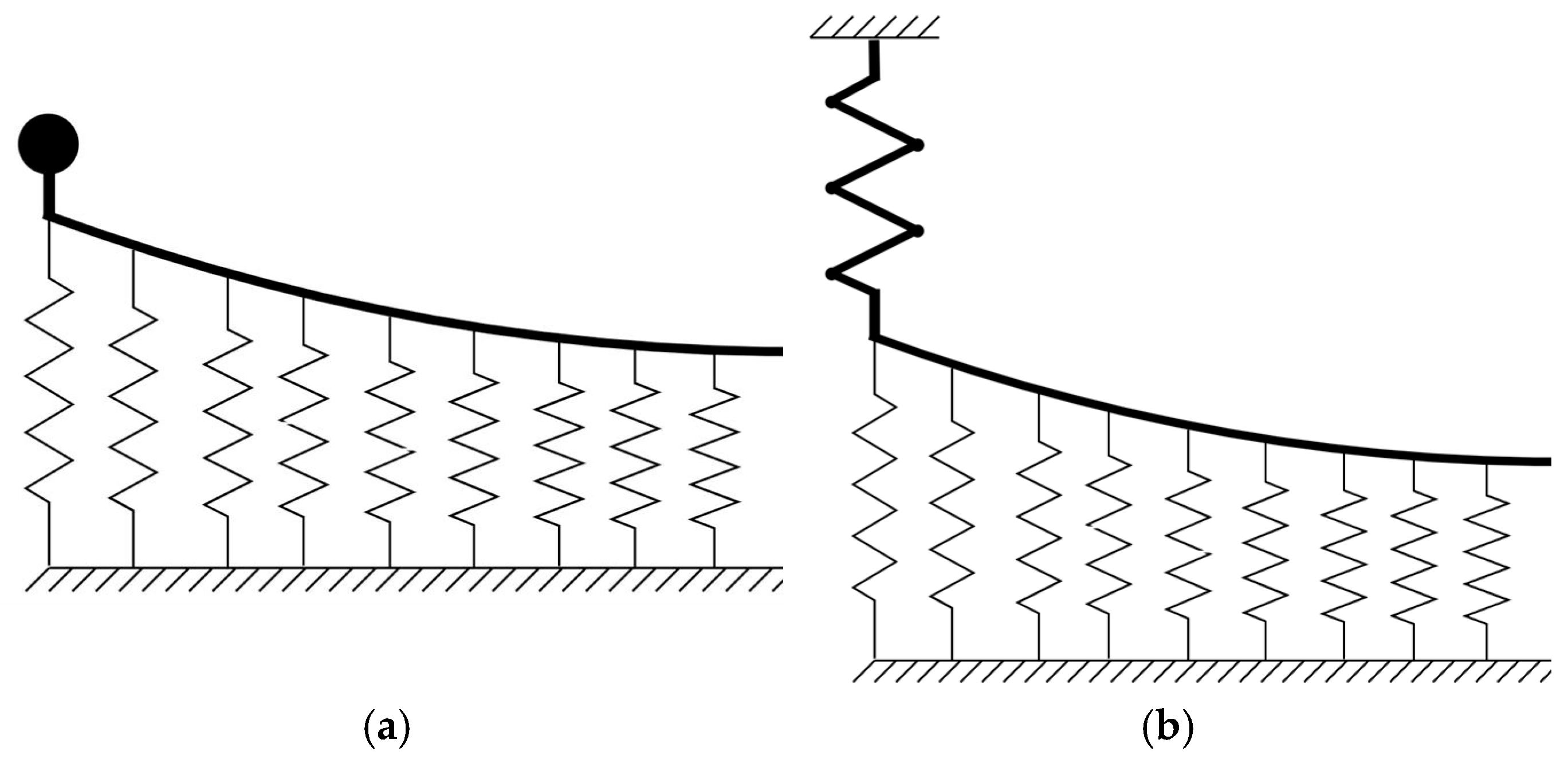
Consider a semi-infinite elastic wave guide ( x   0) on a Winkler foundation, with two options of the boundary conditions, involving a point mass M or a spring of stiffness δ , attached to its edge, see Figure 1a,b, respectively. In this case, we allow spring to have negative stiffness, which may be achieved using modern metamaterial technology [20].
In the simplest case of the wave guide as an elastic string, the equation of time-harmonic motion in absence of external loading is given by, e.g., see [22],
T d 2 u d x 2 + m ω 2 k u = 0 ,
where T is the distributed tension per unit length, ω is circular frequency, u = u x is the transverse displacement of the string, m is the distributed mass per unit length, and k is the Winkler foundation stiffness; here and below, the factor e i ω t is omitted for brevity. The boundary condition at x   =   0   is of the form:
T d u d x + β u = 0 ,
where in the case of the attached point mass, the coefficient β   =   M ω 2 , whereas in the case of an attached spring   β   =   δ . Notably, for a regular spring, we have δ > 0 , whereas for the so-called “meta-spring” δ < 0 . For the latter, the spring reaction has the opposite direction, in comparison with the traditional one. This can be achieved using modern metamaterial designs, see a reference paper [20] for more details. Additionally, we impose the decay condition, i.e.,   u   0 as x .
In the more elaborated case of an Euler–Bernoulli beam on a Winkler foundation, the equation of time-harmonic motion is written as, e.g., see [23] and references therein.
E I d 4 u d x 4 + k m ω 2 u = 0 ,
where E is the Young’s modulus, I is the second moment of area, and, as previously,   u   =   u x e i ω t is the transverse displacement, with k and m   standing for the Winkler stiffness and the distributed mass, respectively. It is worth noting that this equation is a low-frequency approximation of bending vibrations of a thin elastic layer, resting on a Winkler foundation, valid over a broad parametric range [24].
The associated boundary conditions at the end x   =   0 are given by:
d 2 u d x 2 = 0 ,               E I d 3 u d x 3 β u = 0 ,
whereas, as above, there are two options: (a)   β =   M ω 2 and (b)   β =   δ , associated with the attached mass or spring, respectively. These boundary conditions correspond to an inhomogeneity transmitting the transverse force to the beam edge, similar to condition (2) for a string. At the same time, the considered inhomogeneity is assumed not to induce the reaction in the form of a bending moment, as indicated by the first condition in (4). As above, exponential decay at infinity is required.
The aim of this contribution is to clarify the effect of boundary conditions on the potential emergence of trapped vibration modes, i.e., eigensolutions localized near the edge, e.g., see [2,25]. In particular, the relation of the latter for attached masses and springs is a key focus.

3. Semi-Infinite String

3.1. String with Attached Mass

Let us introduce the dimensionless coordinate ξ and frequency Ω via:
x   =   ξ T k ,               ω = ω 0 Ω ,
where ω 0   =   k / m . Then, Equation (1) may be rewritten as follows:
d 2 u d ξ 2 + Ω 2 1 u = 0 ,
with the associated boundary condition (2) at x   =   0 taking the form:
d u d ξ + r m Ω 2 u = 0 ,             r m = M m k T .
The dimensionless cut-off frequency for the considered waveguide is Ω = 1 . Therefore, the sought for eigenvalue belongs to the interval Ω < 1 .
The unit-amplitude decaying solution of (6) is given by:
u = e 1 Ω 2   ξ ,
with condition (7) dictating:
r m Ω 2   =   1   Ω 2 ,
from which:
Ω 2   =   1 + 4 r m 2 1   2 r m 2 < 1 .
This is a well-expected result, identifying a trapped mode, similar to that for an elastically supported infinite string, e.g., see [2].
As r m     0 , i.e., for a relatively small mass M m T k , we have from (10):
Ω 2     1     r m 2 .  
For the other limit of a large mass M m T k , when r m   , the asymptotic expansion of (10) gives:
Ω 2       r m 1 + 1 2 r m 2 .
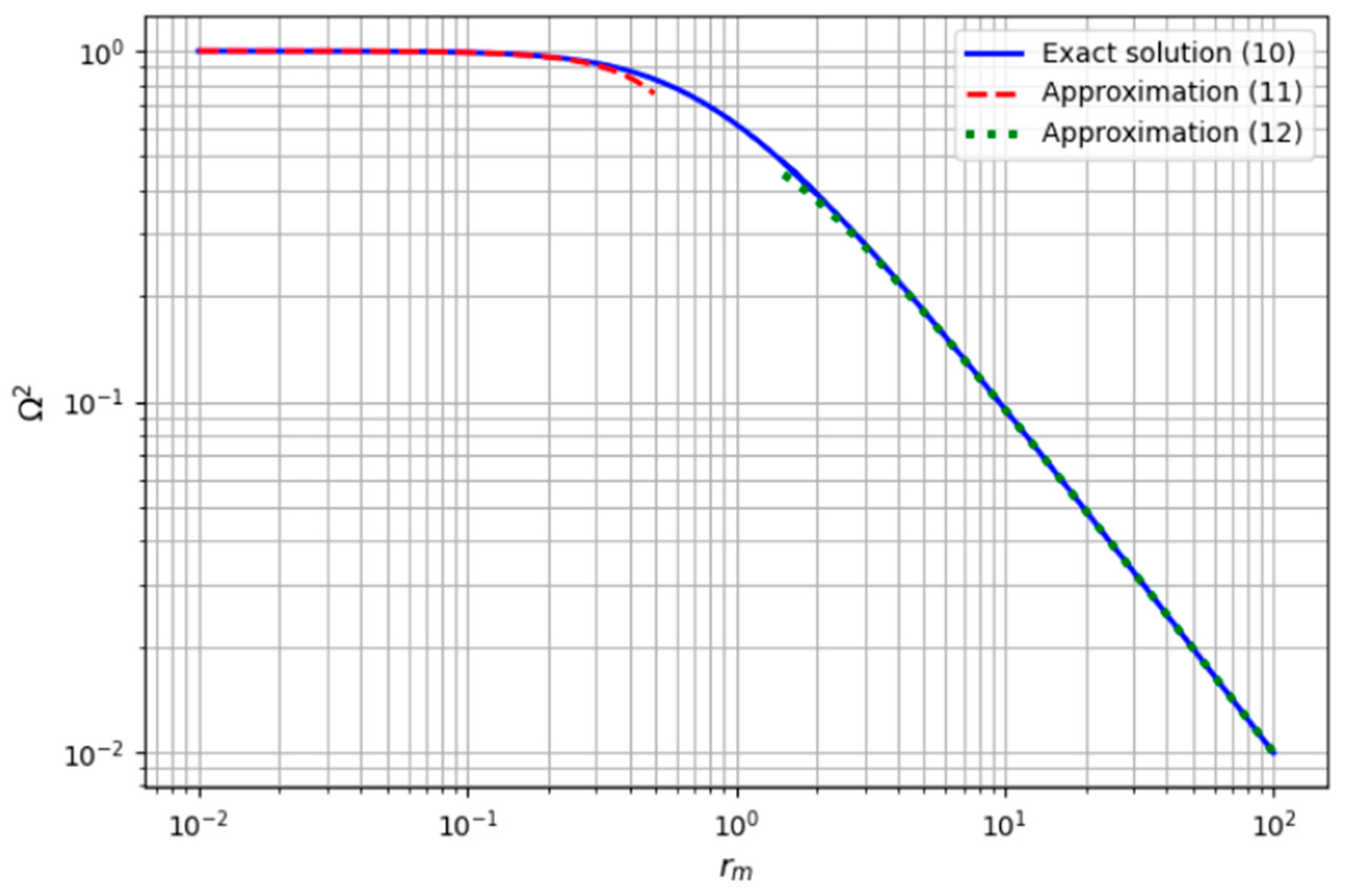
Figure 2 demonstrates the exact solution (10), along with its approximations (11) and (12), depicting the relation (10) in a solid blue curve, with approximations (11) and (12) shown by dashed red and dotted green lines, respectively. As might be observed, the presented approximations (11) and (12) cover a wide range of the r m     values, except for a relatively narrow intermediate range. Moreover, the explicit Formula (10) is already well-suited for calculating the trapped mode frequency.

3.2. String with Attached Spring

For an attached spring, the boundary condition at the edge x   =   0   takes the form:
d u d ξ + r k u = 0 ,             r k = δ k k T .
In this case, a trapped mode is only possible for a meta-spring, for which δ < 0 . On substituting the solution (8) into (13), we have:
Ω 2   =   1 r k 2 .
The frequency Equations (10) and (14) may imply the relation between the parameters r k and r m in the form:
r k   =   1 1 + 4 r m 2 1 2 r m 2 .
This formula presents a robust mechanism to express the dimensionless stiffness of a meta-spring through the scaled point mass parameter, resulting in the same trapped mode frequency, without evaluating the latter.
At r m     0 , we have from (15):
r k r m r m 3 ,             δ     k m M ,
whereas at r m   , it implies:
r k   =   1   1 2 r m + 1 8 r m 2 ,             δ     k T .
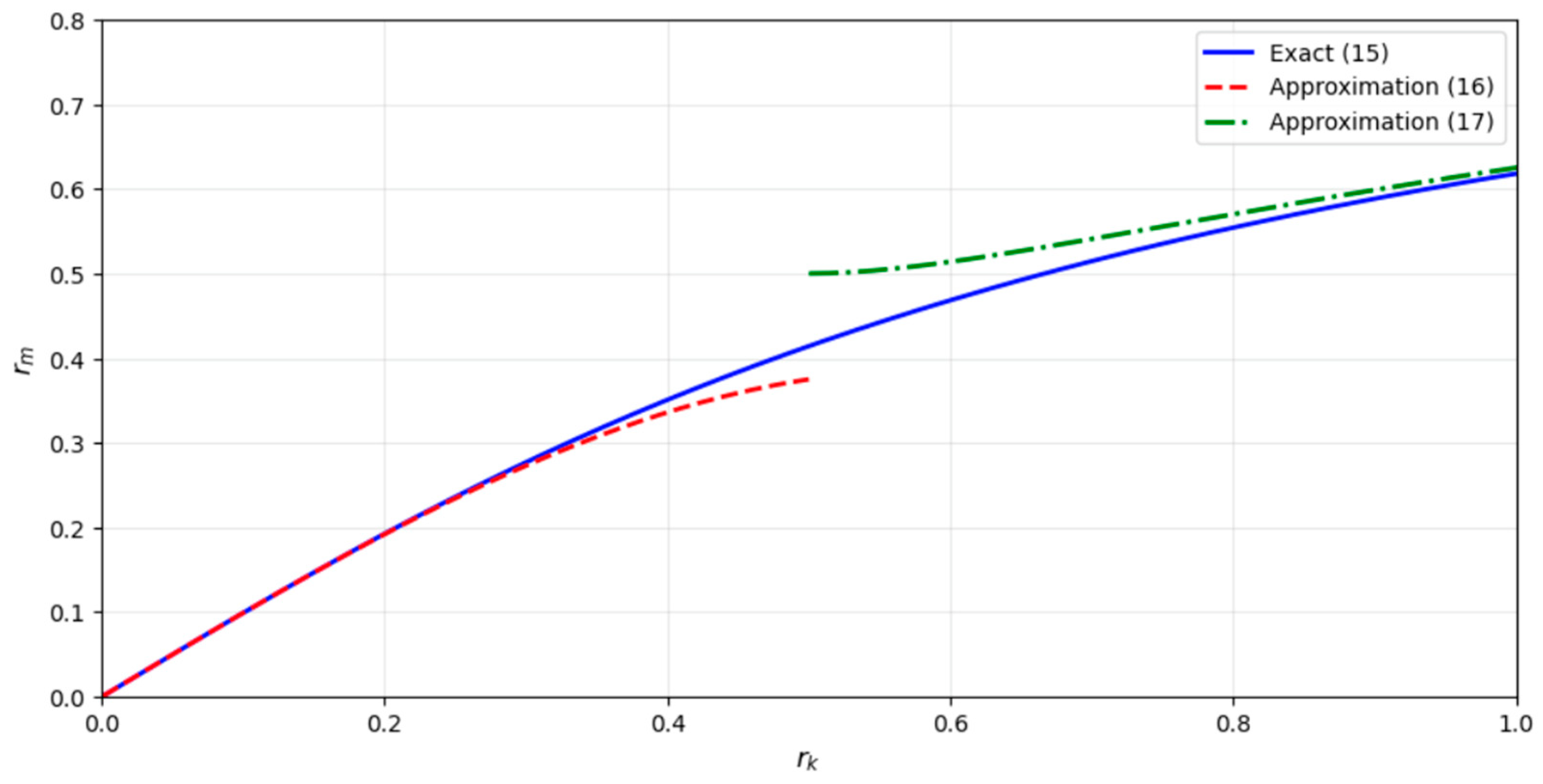
The exact relation (15) together with approximations (16) and (17) are shown in Figure 3.
This figure demonstrates that the analyzed relation (15) is well approximated by the simplified formulae (16) and (17) outside the relatively narrow intermediate range around the value. The figure also shows the tendency towards the large mass limit r k = 1 , dictated by (17).

4. Semi-Infinite Beam

4.1. Beam with Attached Mass

Let us define the dimensionless coordinate ξ by:
x =   E I k 4   ξ ,    
with the dimensionless frequency Ω introduced in (5). Then, Equation (3) becomes:
d 4 u d ξ 4 + 1 Ω 2 u = 0 .
Thus, the dimensionless cut-off frequency for a beam is Ω = 1 , coinciding with that for a string. The decaying solution of (19), satisfying the first condition (4), corresponding to precluded bending moment at the edge ξ = 0 , up to an arbitrary constant factor, may be written as follows:
u ξ =   e p ξ cos p ξ ,
where p   =   1 Ω 2 4 4 . Then, the second condition in (4) is re-cast as follows:
d 3 u d ξ 3 1 2 s m Ω 2 u   =   0 ,   s m   =   M m 4 k E I 4   ,
resulting in:
1 Ω 2 3 4 = s m Ω 2 .
Inspection of the latter gives:
Ω 2   1 s m 4 3 ,
at s m   0 , and:
Ω 2   1 s m ,
at s m   . In addition, a two-point Pade approximant, e.g., see [26] and references therein, can be constructed, accounting for both limits. It takes the form:
Ω 2 =   1 + s m 4 3 1 + s m 4 3 + s m 7 3 .
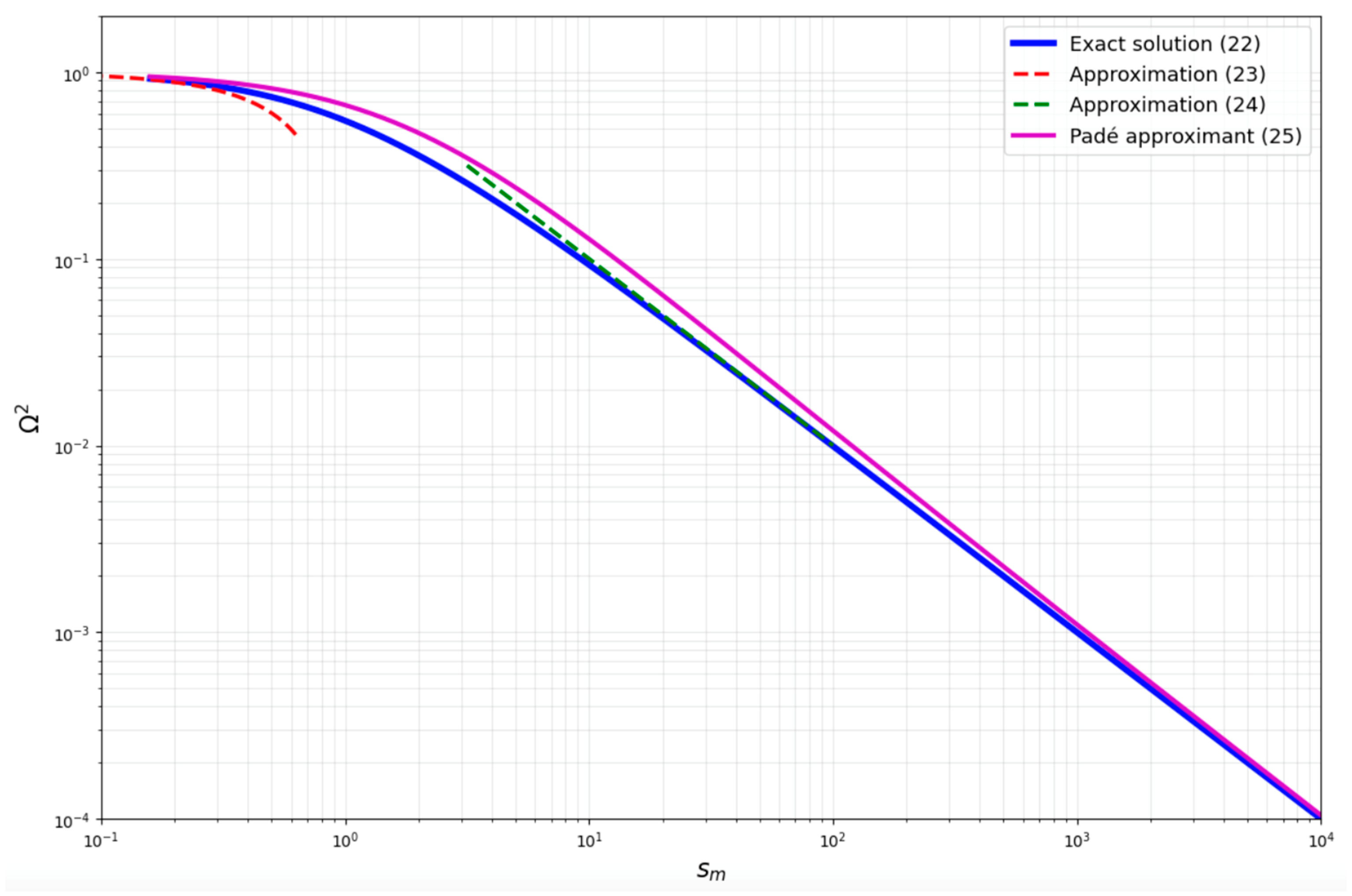
A similar two-point approximation might be readily obtained for a string. However, it hardly makes sense due to an explicit expression for the trapped mode frequency (10), in contrast to the implicit Equation (22). The solution of the latter, along with the associated approximations (23), (24), and (25), is shown in Figure 4. This Figure clearly shows that both the Pade approximant and local approximations have their own advantages. In particular, the Pade approximant is robust enough (see Table 1) across the full range of parameter s m , whereas the approximations in the small and large masses are more accurate within their ranges of validity.
As can be seen from this table, the error of the Pade approximation reaches its maximum near s m   = 1 , after which, the accuracy improves monotonically. The error peak occurs because the approximation (23) accounts for small s m   is already not valid, whereas the regime of large s m     described by approximation (24) has not yet been reached.

4.2. Beam with Attached Spring

In this case, the second boundary condition in (4) becomes:
d 3 u d ξ 3   s k 2 u   = 0 ,                     s k   =   δ k 4 k E I 4 .
Now, on substituting (20) into (26), it may be readily deduced that:
s k   =   1 Ω 2 3 4 ,
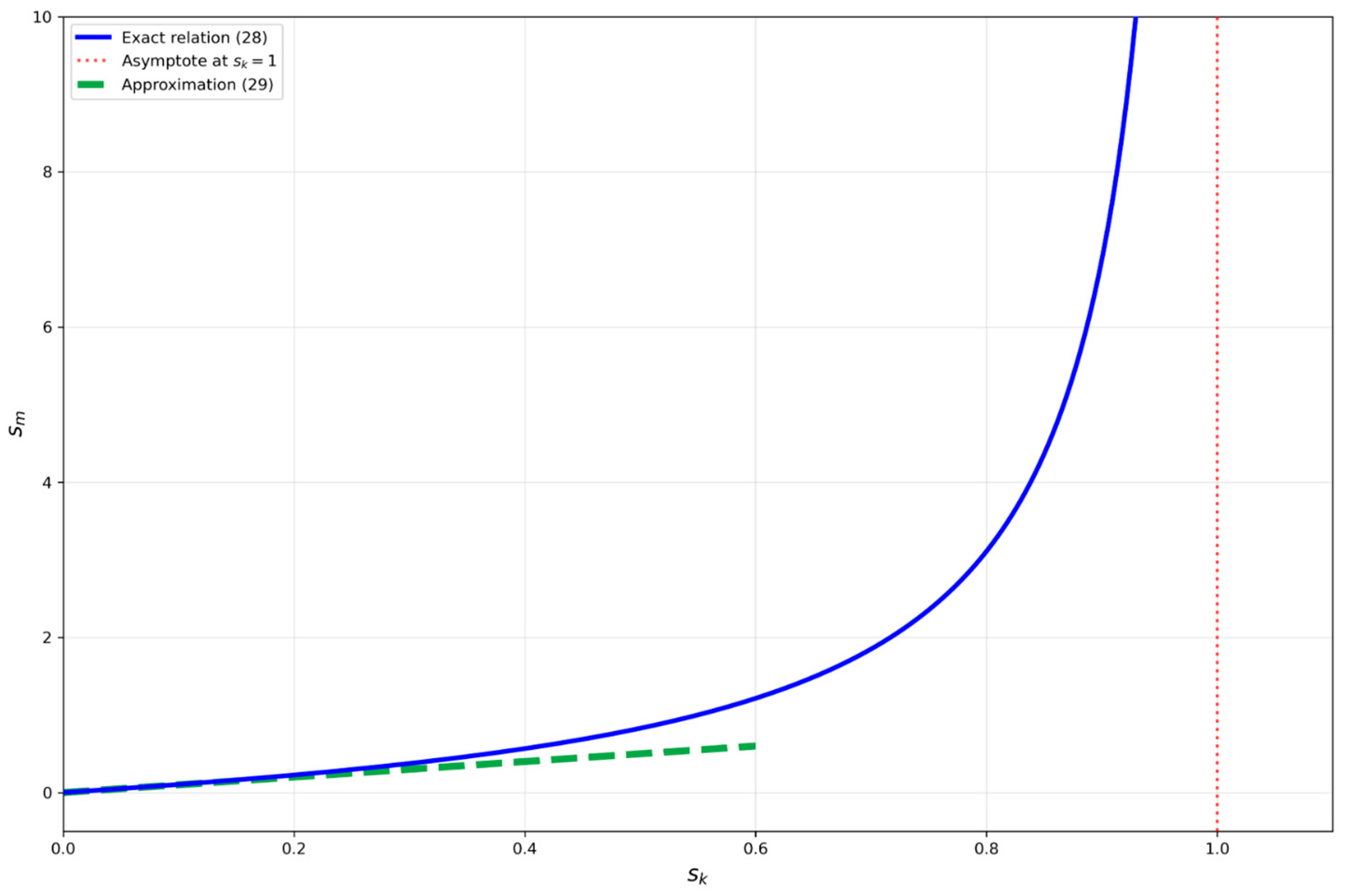
hence, 0 < s k   < 1 . The comparison of (22) and (27) implies the relation between s k   and s m in the form:
s m =   s k 1 s k 4 3 ,
necessitating that for small stiffness and mass:
s m s k   ,     δ = M m k .
The relation (28) and its rough approximation (29) are presented in Figure 5.
This Figure mirrors a similar illustration for a string, see Figure 3. The straightforward linear approximation (29), depicted by a dashed green line, appears to be highly efficient in the small mass limit. At the same time, formula (28) determines a vertical asymptote at s k = 1 in the large mass limit, plotted by a dotted red line.

5. Conclusions

The presented analysis establishes the important links between the trapped modes originating from inhomogeneities in the form of point masses and meta-springs. Robust formulae relating to the parameters characterizing the meta-spring and the mass are derived both for a string and a beam resting on a Winkler foundation. Simple explicit approximations are obtained to describe the limiting behavior of the obtained solutions. Numerical illustrations for scaled eigenfrequencies and inter-parametric relations are plotted using standard symbolic software.
The investigation of more sophisticated trapped modes on an elastically supported beam appears to be of particular interest, offering novel insights into localization phenomena, including the asymptotic expansions corresponding to small- and large-mass scenarios, together with the associated Padé approximant. It is also worth noting that the adopted classical model fails near the associated cut-off frequency and needs to be replaced by a more sophisticated formulation, see [24,27]. As a result, the outcomes for small masses for which the trapped mode frequency is close to the cut-off, see formula (23), could be further developed.
The consideration above may be extended to several important engineering applications, including moving inertial loads, as well as foundations possessing time-dependent and nonlinear properties, as well as size effects, e.g., see [28]. At the same time, a broader range of metamaterial designs can be investigated. Finally, an asymptotic approach developed for a beam under vertical inertial load can be generalized to loads transmitting rotational inertia.

Author Contributions

Conceptualization, J.K. and D.P.; methodology, J.K.; software, M.D.; validation, M.D. and D.P.; formal analysis, D.P.; investigation, M.D.; writing—original draft preparation, M.D.; writing—review and editing, D.P. and J.K.; visualization, M.D.; supervision, J.K. All authors have read and agreed to the published version of the manuscript.

Funding

This research received no external funding.

Data Availability Statement

No new data were created or analyzed in this study. Data sharing is not applicable to this article.

Conflicts of Interest

The authors declare no conflicts of interest.

Nomenclature

NotationQuantityUnits
mMass densitykg/m
TTensionN/m
kStiffness of the foundationN/m2
ω Angular frequency1/s
uTransverse displacementm
xLongitudinal coordinatem
MPoint masskg
δ Spring stiffnessN/m2
EYoung modulusN/m2
ISecond moment of inertiam4
ξ Dimensionless coordinate
Ω Dimensionless frequency
r m   Scaled mass (string)
r k Scaled spring stiffness (string)
s m   Scaled mass (beam)
s k Scaled spring stiffness (beam)

References

  1. Kaplunov, Y.D. The torsional oscillations of a rod on a deformable foundation under the action of a moving inertial load. Izv. Akad. Nauk. SSSR MTT (Mech. Solids) 1986, 6, 174–177. [Google Scholar]
  2. Kaplunov, J.D.; Sorokin, S.V. A simple example of a trapped mode in an unbounded waveguide. J. Acoust. Soc. Am. 1995, 97, 3898–3899. [Google Scholar] [CrossRef]
  3. Gavrilov, S.N.; Indeitsev, D.A. The evolution of a trapped mode of oscillations in a “string on an elastic foundation-moving inertial inclusion” system. J. Appl. Math. Mech. 2002, 66, 825–833. [Google Scholar] [CrossRef]
  4. Gavrilov, S.N.; Shishkina, E.V.; Mochalova, Y.A. Non-stationary localized oscillations of an infinite string, with time-varying tension, lying on the Winkler foundation with a point elastic inhomogeneity. Nonlinear Dyn. 2019, 95, 2995–3004. [Google Scholar] [CrossRef]
  5. Abramian, A.K.; Vakulenko, S.A.; van Horssen, W.T.; Jikhareva, A. The effect of small internal and dashpot damping on a trapped mode of a semi-infinite string. J. Sound Vib. 2025, 595, 118749. [Google Scholar] [CrossRef]
  6. Kaplunov, J.; Nolde, E. An example of a quasi-trapped mode in a weakly non-linear elastic waveguide. Comptes Rendus Méc. 2008, 336, 553–558. [Google Scholar]
  7. Kaplunov, J.D.; Nolde, E.V.; Rogerson, G.A. A low-frequency model for dynamic motion in pre-stressed incompressible elastic structures. Proc. R. Soc. London Ser. A Math. Phys. Eng. Sci. 2000, 456, 2589–2610. [Google Scholar] [CrossRef]
  8. Pichugin, A.V.; Rogerson, G.A. An asymptotic membrane-like theory for long-wave motion in a pre-stressed elastic plate. Proc. R. Soc. London Ser. A Math. Phys. Eng. Sci. 2002, 458, 1447–1468. [Google Scholar] [CrossRef]
  9. Aghalovyan, L.A. Asymptotic Theory of Anisotropic Plates and Shells; World Scientific: Singapore, 2015. [Google Scholar]
  10. Kaplunov, J.; Prikazchikov, D.; Sultanova, L. Justification and refinement of Winkler–Fuss hypothesis. Z. Angew. Math. Phys. 2018, 69, 80. [Google Scholar] [CrossRef]
  11. Muravskii, G.B. Oscillations of a load moving along an infinite beam resting on a Winkler foundation. In Engineering Problems of Civil Mechanics; Tsurkov, I.S., Ed.; Moscow Institute of Civil Engineering: Moscow, Russia, 1980; pp. 48–61. [Google Scholar]
  12. Shishkina, E.V.; Gavrilov, S.N.; Mochalova, Y.A. Non-stationary localized oscillations of an infinite Bernoulli-Euler beam lying on the Winkler foundation with a point elastic inhomogeneity of time-varying stiffness. J. Sound Vib. 2019, 440, 174–185. [Google Scholar] [CrossRef]
  13. Zhang, J.; MacDonald, K.F.; Zheludev, N.I. Near-infrared trapped mode magnetic resonance in an all-dielectric metamaterial. Opt. Express 2013, 21, 26721–26728. [Google Scholar] [CrossRef]
  14. Fedotov, V.A.; Rose, M.; Prosvirnin, S.L.; Papasimakis, N.; Zheludev, N.I. Sharp trapped-mode resonances in planar metamaterials with a broken structural symmetry. Phys. Rev. Lett. 2007, 99, 147401. [Google Scholar] [CrossRef] [PubMed]
  15. Hu, H.; Ji, D.; Zeng, X.; Liu, K.; Gan, Q. Rainbow trapping in hyperbolic metamaterial waveguide. Sci. Rep. 2013, 3, 1249. [Google Scholar] [CrossRef] [PubMed]
  16. Davies, B.; Chaplain, G.J.; Starkey, T.A.; Craster, R.V. Graded quasiperiodic metamaterials perform fractal rainbow trapping. Phys. Rev. Lett. 2023, 131, 177001. [Google Scholar] [CrossRef]
  17. Jiménez, N.; Romero-García, V.; Pagneux, V.; Groby, J.P. Rainbow-trapping absorbers: Broadband, perfect and asymmetric sound absorption by subwavelength panels for transmission problems. Sci. Rep. 2017, 7, 13595. [Google Scholar] [CrossRef]
  18. Lakes, R.S.; Lee, T.; Bersie, A.; Wang, Y.C. Extreme damping in composite materials with negative-stiffness inclusions. Nature 2001, 410, 565–567. [Google Scholar] [CrossRef]
  19. Hewage, T.; Alderson, K.; Alderson, A.; Scarpa, F. Double-negative mechanical metamaterials displaying simultaneous negative stiffness and negative Poisson’s ratio properties. Adv. Mater. 2016, 28, 10323–10332. [Google Scholar] [PubMed]
  20. Tan, X.; Cao, B.; Liu, X.; Zhu, S.; Chen, S.; Kadic, M.; Wang, B. Negative stiffness mechanical metamaterials: A review. Smart Mater. Struct. 2025, 34, 013001. [Google Scholar]
  21. Dykes, M.; Kaplunov, J.; Prikazchikov, D. The Effect of the Boundary Conditions on Free Vibrations of a String Resting on a Winkler Foundation. In Current Developments in Solid Mechanics and Their Applications; Altenbach, H., Ed.; Springer: Cham, Switzerland, 2025; pp. 119–128. [Google Scholar]
  22. Graff, K.F. Wave Motion in Elastic Solids; Clarendon: Oxford, UK, 1975. [Google Scholar]
  23. Lamprea-Pineda, A.C.; Connolly, D.P.; Hussein, M.F. Beams on elastic foundations–A review of railway applications and solutions. Transp. Geotech. 2022, 33, 100696. [Google Scholar] [CrossRef]
  24. Erbaş, B.; Kaplunov, J.; Nobili, A.; Kılıç, G. Dispersion of elastic waves in a layer interacting with a Winkler foundation. J. Acoust. Soc. Am. 2018, 144, 2918–2925. [Google Scholar] [CrossRef]
  25. Pagneux, V. Trapped modes and edge resonances in acoustics and elasticity. In Dynamic Localization Phenomena in Elasticity, Acoustics and Electromagnetism; Craster, R.V., Kaplunov, J., Eds.; Springer: Vienna, Austria, 2013; pp. 181–223. [Google Scholar]
  26. Andrianov, I.V.; Manevitch, L.I. Asymptotology: Ideas, Methods, and Applications; Kluwer Academic Publishers: Dordrecht, The Netherlands, 2002. [Google Scholar]
  27. Erbaş, B.; Kaplunov, J.; Kiliç, G. Asymptotic analysis of 3D dynamic equations in linear elasticity for a thin layer resting on a Winkler foundation. IMA J. Appl. Math. 2022, 87, 707–721. [Google Scholar] [CrossRef]
  28. Tang, Y.; Bian, P.; Qing, H. Buckling and free vibration analyses of functionally graded Timoshenko nanobeams resting on elastic foundation. Int. J. Dyn. Control 2025, 13, 113. [Google Scholar] [CrossRef]
Figure 1. Schematic of waveguides on the Winkler foundation with (a) attached point mass; (b) attached meta-spring.
Vibration 09 00018 g001
Figure 2. Dimensionless squared eigenfrequency Ω 2 of a string with attached mass vs. the scaled parameter r m   .
Vibration 09 00018 g002
Figure 3. Relation between the scaled problem parameters r k and r m .
Vibration 09 00018 g003
Figure 4. Dimensionless squared eigenfrequency Ω 2 of a beam with attached mass vs. the scaled parameter s m   .
Vibration 09 00018 g004
Figure 5. Relation between the scaled problem parameters s k and s m .
Vibration 09 00018 g005
Table 1. Comparison of frequencies provided by the Pade approximant (25) and exact solution (22).
s m Exact Solution (22)Approximation (25)Error, %
0.010.99785173420.9999785020.21
0.10.9562705160.9955838874.11
0.20.8985816130.9794869269.00
10.5497004780.66666666721.28
50.1733835970.1826006025.32
100.0929448380.0947289961.92
500.0197037100.0197121930.043
Disclaimer/Publisher’s Note: The statements, opinions and data contained in all publications are solely those of the individual author(s) and contributor(s) and not of MDPI and/or the editor(s). MDPI and/or the editor(s) disclaim responsibility for any injury to people or property resulting from any ideas, methods, instructions or products referred to in the content.