Article

Semi-Analytical Modeling and Free Vibration Analysis of Joined Conical–Cylindrical Shells with Axially Stepped Thickness


1
School of Naval Architecture & Ocean Engineering, Jiangsu University of Science and Technology, Zhenjiang 212001, China
2
College of Shipbuilding Engineering, Harbin Engineering University, Harbin 150001, China
*
Author to whom correspondence should be addressed.
Vibration 2026, 9(1), 13; https://doi.org/10.3390/vibration9010013
Submission received: 5 January 2026 / Revised: 30 January 2026 / Accepted: 12 February 2026 / Published: 13 February 2026

Abstract

This study develops a semi-analytical method for free vibration analysis of joined conical–cylindrical shell with axially stepped thickness. The computational framework is built through the domain decomposition method, artificial spring technology and shear deformation shell theory. Kinematic admissible functions are constructed via superposition of Chebyshev orthogonal polynomials and trigonometric series. Subsequently, the Rayleigh–Ritz method is employed to solve for the system’s characteristic frequencies. The accuracy of the method is further verified by the excellent agreement between the current results and those from published studies and finite element simulations. Ultimately, the influence of boundary conditions, structural parameters and stepped thickness distribution on the free vibration characteristics of conical–cylindrical shells are systematically discussed. These findings reveal the critical methodological constraints in free vibration modeling of stepped thickness shell systems, thereby advancing vibration design optimization for the stepped thickness structures.

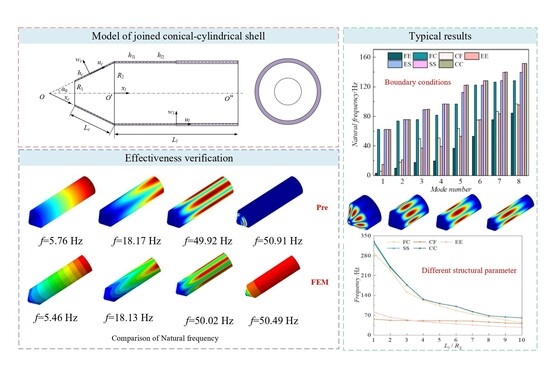
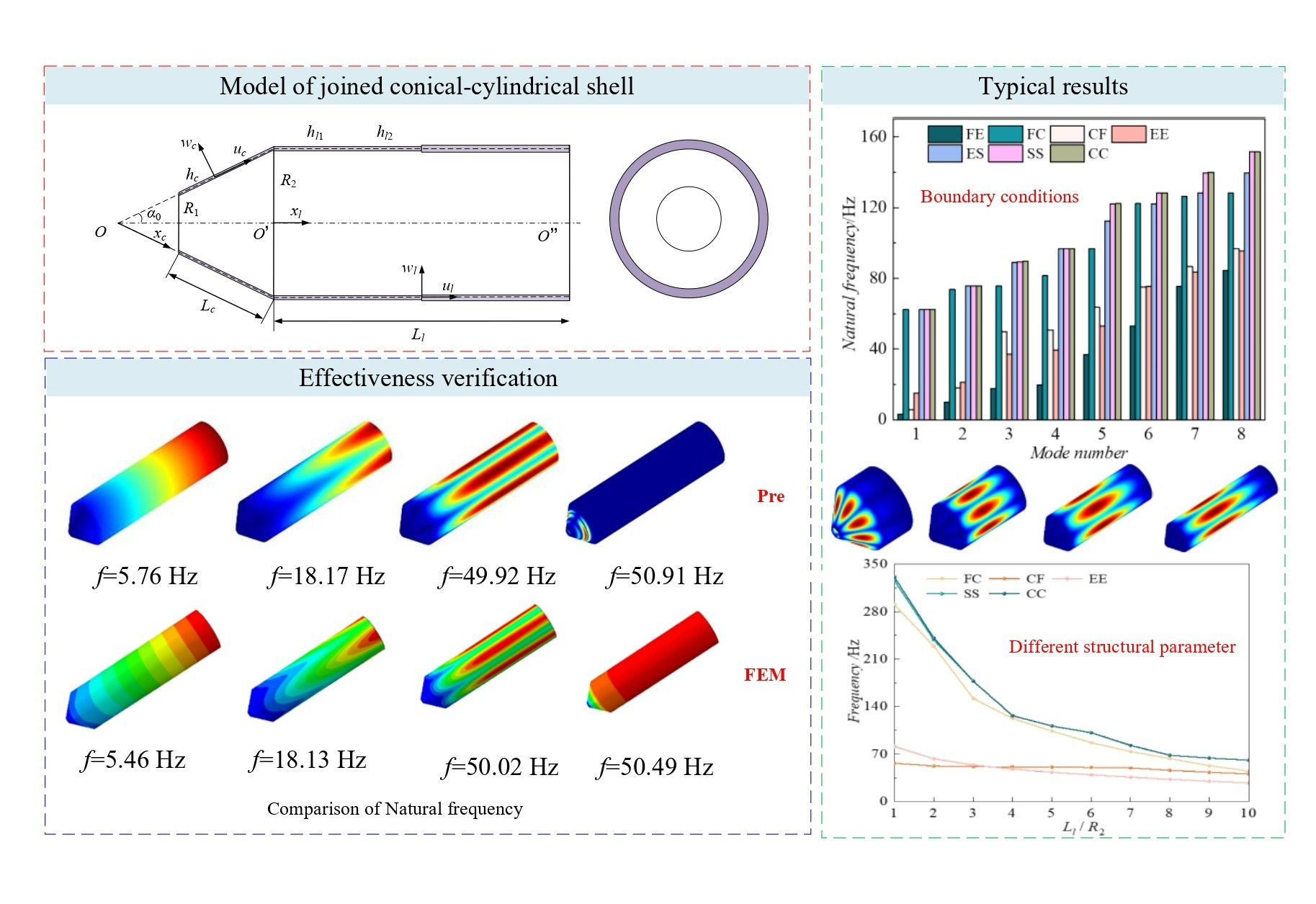
Graphical Abstract

1. Introduction

As a typical engineering component, the joined conical–cylindrical shell structure is widely used in aircraft, rocket, underwater vehicle and other fields. The study of its free vibration characteristics is crucial for the stability and safety of the structure. In actual engineering, the thickness of most areas of the structure is not uniform due to the differences in the bearing area and equipment layout. Therefore, conducting the research on the free vibration of stepped thickness conical–cylindrical shells, can provide guidance for the engineering application of these structures.
In recent years, many researchers have done a lot of research on the vibration analysis of joined shells and developed some new methods. In the field of general exact solutions involving equations of motion, Caresta and Kessissoglou [1] used wave and power series solutions to describe the displacements of cylindrical–conical shells. The dynamic stiffness method (DSM) is a strong-form analytical method based on the exact solution of the motion equations. Tian et al. [2] studied the influence of constraint conditions and geometric parameters on the dynamic behavior of combined conical–cylindrical shells by employing the dynamic stiffness method. Zhang et al. [3] used the dynamic stiffness method to investigate the dynamic behaviors of the conical-ribbed cylindrical-conical shell with general boundary condition, the accuracy and stability of the method were verified by comparing the numerical results with the FEM and experimental tests. Hu et al. [4] developed a dynamic stiffness method for free vibration analysis of rotating cross-ply laminated conical–cylindrical-conical shells, the effects of rotational speed, geometric shape and boundary conditions on the structure were explored. Guo et al. [5] developed a linear expression method (LEM) for efficient vibration analysis of composite conical–cylindrical-spherical shells, demonstrating superior computational speed and convergence over FEM. Wu et al. [6] proposed an impedance synthesis method for dynamic analysis of laminated conical–cylindrical shells. Based on the first-order shear deformation theory, Lee [7] established a Chebyshev-Fourier spectral method for free vibration analysis of joined conical–cylindrical structures. Sarkheil and Foumani [8] conducted a dynamic analysis of rotationally cylindrical-conical shell systems using a power series method, and analyzed the effects of rotational speed and geometry on wave frequencies. Motazedian et al. [9] conducted the research on the free vibration problem of conical-spherical panels and shells using FSDT and a 2D-Generalized Differential Quadrature (2D-GDQ) method. Bagheri et al. [10] investigated free vibration of moderately thick conical–cylindrical-conical shells with various boundary conditions using the GDQ method. Pang et al. [11] applied a precise integration transfer matrix method (PITMM) based on Flügge theory to analyze the free vibration of coupled conical–cylindrical shells, and the effects of boundary conditions, thickness, and semi-vertex angle were investigated. Many methods are based on the Rayleigh’s energy theory, such as the modified Fourier-Ritz method [12,13], Jacobi-Ritz method [14,15,16], Haar wavelet discretization method (HWDM) [17,18] and spectral-Tchebyshev method [19,20].
From the above, most of the above research objects are uniform thickness structures; however, many structures are of variable thickness in practical engineering. Kim et al. [21,22] presented a unified Haar wavelet discretization method (HWDM) for dynamic analysis of variable-thickness laminated rotation shells, and annular plates under arbitrary boundary conditions. Zheng et al. [23,24] established a unified Rayleigh–Ritz method for analyzing vibration of conical shells and cylindrical shells with variable thickness, it efficiently evaluates thickness and boundary effects using Fourier series expansions. Gao et al. [25,26] conducted the research on the free and forced vibration characteristics of stepped thickness rotation shells under general boundary restraints by using the Rayleigh–Ritz method. Wang et al. [27] investigated the free vibration of cylindrical shells with variable thickness under arbitrary boundaries using a Fourier-series Rayleigh–Ritz approach. Bochkarev and Matveenko [28] developed an integrated numerical approach to analyze natural vibrations of variable-thickness cylindrical shells filled with fluid. El-Kaabazi and Kennedy [29] established the dynamic stiffness equation of varying thickness cylindrical shells based on the Donnell, Timoshenko, and Flügge theories. Xie et al. [30] presented an analytical method for vibration analysis of stepped conical shells under general boundary conditions using Flügge theory and power series. Kang [31] proposed a 3D Ritz method to analyze the free vibration of variable-thickness joined conical–cylindrical shells using elasticity theory, comparing results with 2D shell theories. Singh et al. [32] presented a new analytical approach for calculating the dynamic behaviors of isotropic and FGM cylindrical shells with mid-length cracks using the Donnell–Mushtari–Vlasov (DMV) theory. Li et al. [33] applied a meshfree method to investigate vibro-acoustic behavior of variable-thickness composite laminated shells in fluid, and analyzed how thickness, loading, and boundaries influence sound radiation, supporting preliminary underwater structural design.
By systematically reviewing the research progress on the dynamic characteristics of various structures, scholars conducted a great deal of research on the vibration characteristics of joined shells. However, there are relatively few studies on the distribution law of stepped thickness (such as the number and position of the stepped thickness), in order to improve the engineering application requirements, research on the free vibration of stepped thickness structures remains limited and requires further investigation. Addressing this knowledge gap, this study proposes a semi-analytical method for analyzing the free vibration characteristics of joined structure based on Chebyshev orthogonal polynomials-Ritz method. By integrating the domain decomposition approach with the artificial spring technique, the mathematical model for the joined conical–cylindrical shell with axially stepped thickness is formulated, while the energy formulation is derived based on the first-order shear deformation theory (FSDT). The proposed approach can flexibly simulate various boundary conditions and ensure the continuity conditions by adjusting the artificial springs stiffness parameters. The natural frequencies and mode shapes of the structure are then determined using the Rayleigh–Ritz method. On this basis, the influence of boundary conditions, structural parameters and stepped thickness distribution on the dynamic characteristics of conical–cylindrical shells are systematically discussed, so as to provide support for dynamic analysis and vibration control of stepped thickness structures.

2. Theoretical Formulations

2.1. Mathematical Model

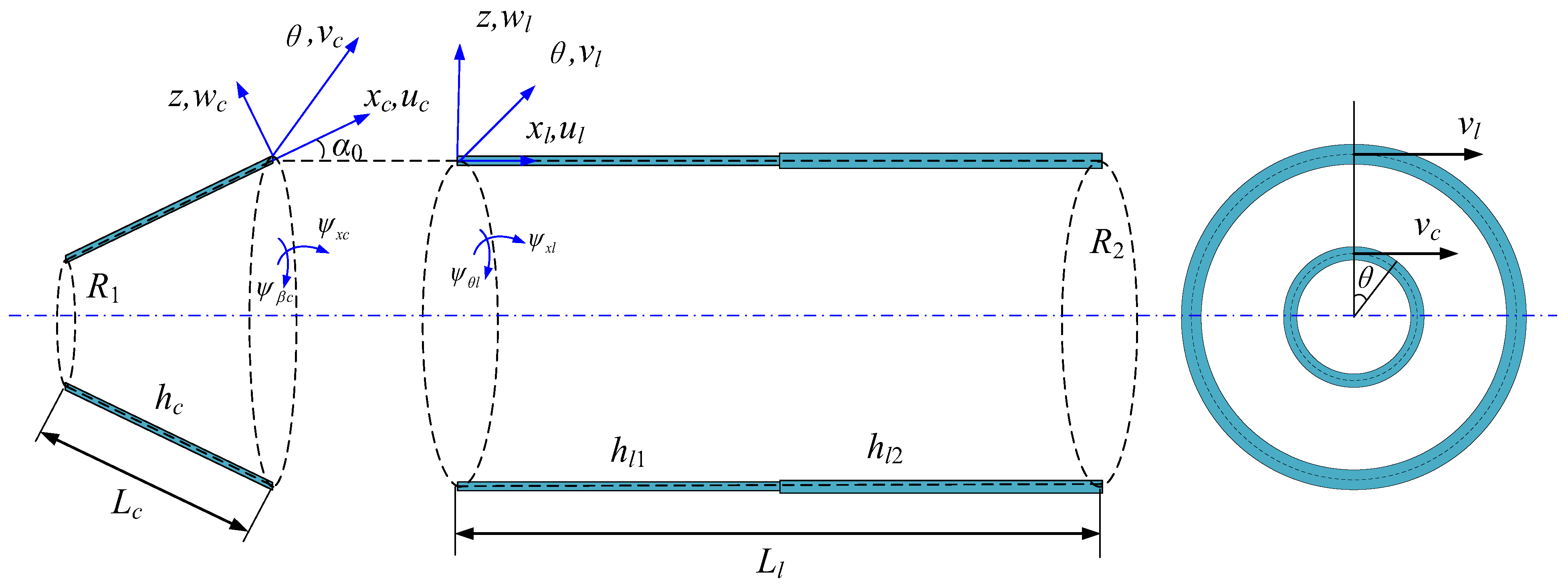
Figure 1 displays the computational model of joined conical–cylindrical shell with axially stepped thickness, the assembly is composed of two substructures. Both substructures are analyzed using the cylindrical coordinate system (x, θ, z), with x, θ and z, respectively, represent the axial direction, circumferential direction, and normal direction. The displacements of the corresponding substructure in these directions are denoted by uc, vc, wc and ul, vl, wl, where subscripts c and l, respectively, represent the conical shell and stepped cylindrical shell. For the uniform conical shell, the conical shell is defined as length Lc, constant thickness hc, end radius R1 and R2, and semi-vertex angle α0. For the cylindrical shell with axially stepped thickness, the stepped cylindrical shell is characterized by length Ll, radius R2, and stepped thickness hli.
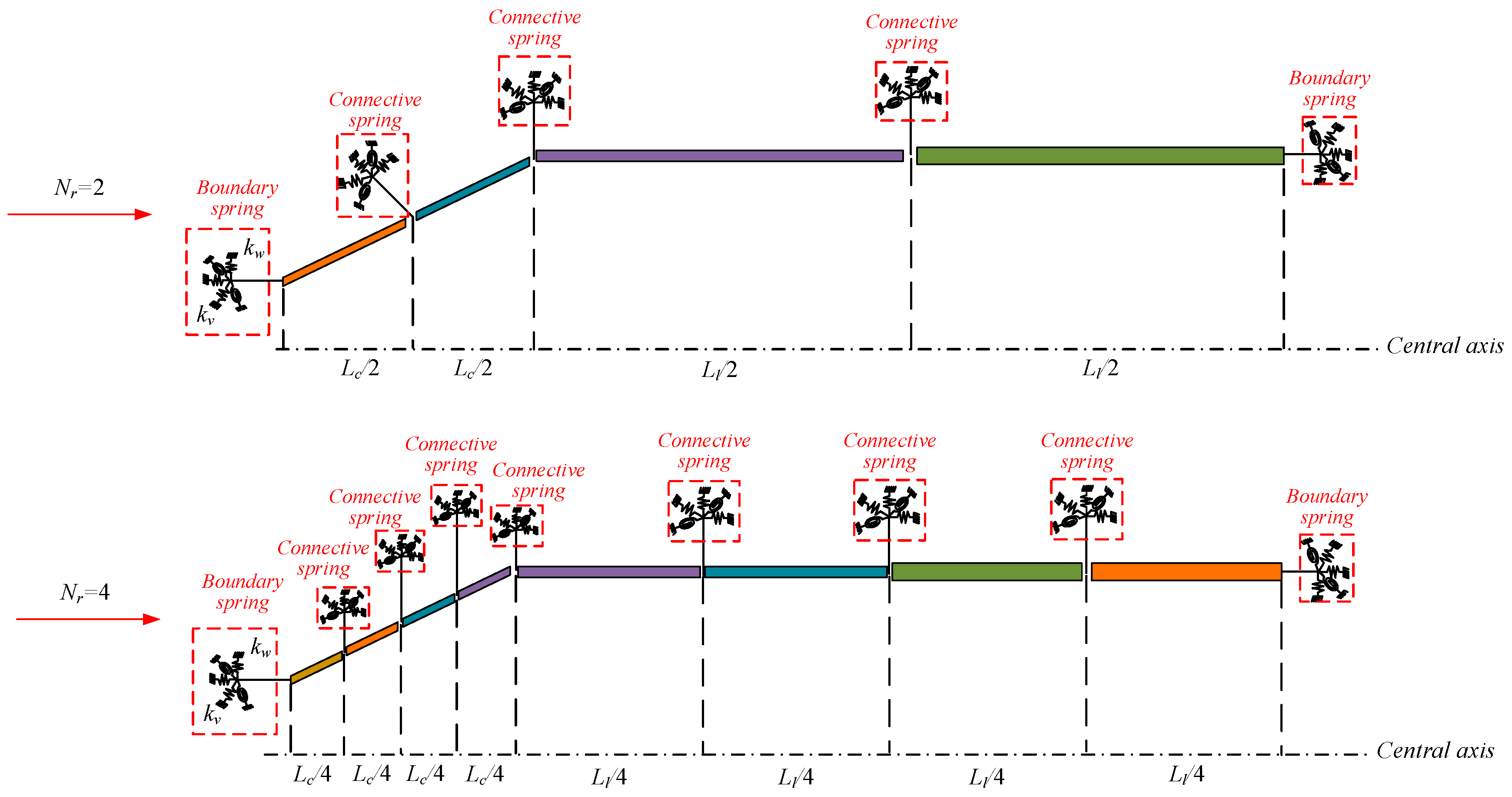
According to the domain decomposition method (DDM), the hybrid shell is discretized into Nr segments along the axil direction, as shown in Figure 2. The boundary conditions are imposed by elastic springs at both ends, and the adjacent segments are interconnected by artificial connective springs to ensure the strong coupling relationship.

2.2. Energy Functional and Solution Procedure

In this study, the energy functional is formulated according to the FSDT [34,35], and the displacement kinematics for the i th structural section are written in the following mathematical form:
U i ( x , θ , z , t ) = u 0 i ( x , θ , t ) + z Ψ x i ( x , θ , t )
V i ( x , θ , z , t ) = v 0 i ( x , θ , t ) + z Ψ θ i ( x , θ , t )
W i ( x , θ , z , t ) = w 0 i ( x , θ , t )
among them, u0, v0 and w0 are the meridional, circumferential and through-the-thickness displacements, respectively, and a subscript 0 indicating the characteristics of the mid-surface. Ψ x and Ψ θ are the angular displacement about θ- and x-axis.
The strain components [10,36] on the mid-surface of the joined conical–cylindrical shell structure are expressed as:
ε x i = ε x 0 , i + z χ x 0 , i ,   ε θ i = ε θ 0 , i + z χ θ 0 , i
γ x θ i = γ x θ 0 , i + z χ x θ 0 , i ,   γ θ z i = γ θ z 0 , i ,   γ x z i = γ x z 0 , i
where ε x i , ε θ i , γ x θ i , γ θ z i , γ x z i signify membrane strains, χ x i , χ θ i , χ x θ i are the curvature changes in the shell.
ε x 0 , i = 1 A u 0 i x + v 0 i A B A θ + w 0 i R x ,   ε θ 0 , i = 1 B v 0 i θ + u 0 i A B B x + w 0 i R θ
γ x θ 0 , i = 1 A v 0 i x + 1 B u 0 i θ ,   γ x z 0 , i = Ψ x i u 0 i R x + 1 A w 0 i x ,   γ θ z 0 , i = Ψ θ i v 0 i R θ + 1 B w 0 i θ
χ x i = 1 A Ψ x i x + Ψ θ i A B A θ ,   χ θ i = 1 B Ψ θ i θ + Ψ x i A B B x ,   χ x θ i = 1 A Ψ θ i x + 1 B Ψ x i θ
Regarding conical shell structures: Rx = ∞, Rθ = xctanα0, A = 1, B = xcsinα0; Regarding cylindrical shell with varying thickness: Rx = ∞, Rθ = R2, A = 1, B = R2.
The stress components of the joined conical–cylindrical shell configuration are given by [37]:
σ x i σ θ i τ x θ i τ θ z i τ x z i = Q 11 Q 12 0 0 0 Q 12 Q 22 0 0 0 0 0 Q 66 0 0 0 0 0 Q 66 0 0 0 0 0 Q 66 ε x i ε θ i γ x θ i γ θ z i γ x z i
where σ x i , σ θ i , τ x θ i , τ θ z i and τ x z i signify normal stresses and shear stresses. Qij (i, j = 1, 2, 6) are the elastic constants:
Q 11 = Q 22 = E 1 μ 2 ,   Q 12 = μ E 1 μ 2 ,   Q 66 = E 2 [ 1 + μ ]
where E and μ denote the elastic modulus and Poisson’s ratio, respectively. The expressions for forces and moments can be reformulated as:
N x i N θ i N x θ i = h / 2 h / 2 σ x i σ θ i τ x θ i d z ,   M x i M θ i M x θ i = h / 2 h / 2 σ x i σ θ i τ x θ i z d z ,   Q x z i Q θ z i = h / 2 h / 2 κ ¯ τ x z i τ θ z i d z
By inserting Equation (9) into Equation (11), we derive:
N x i N θ i N x θ i M x i M θ i M x θ i = A 11 A 12 0 0 0 0 A 12 A 22 0 0 0 0 0 0 A 66 0 0 0 0 0 0 D 11 D 12 0 0 0 0 D 12 D 22 0 0 0 0 0 0 D 66 ε x 0 , i ε θ 0 , i γ x θ 0 , i χ x i χ θ i χ x θ i
Q α z i Q β z i = κ ¯ A 66 0 0 A 66 γ α z 0 , i γ β z 0 , i
where Nx, Nθ, N, Mx, Mθ, M, Qxz and Qθz, respectively, represent the in-plane force resultants, moment resultants, and transverse shear force resultants. κ ¯ = 5/6 signifies the shear correction factor in this analysis [38]. The extensional stiffness Aij (i, j = 1, 2, 6) and Dij (i, j = 1, 2, 6) are defined as follows:
( A i j , D i j ) = h / 2 h / 2 Q i j ( 1 , z 2 ) d z
The strain energy formulation is expressed as follows:
U V i = 1 2 V N x i ε x 0 , i + N θ i ε θ 0 , i + N x θ i γ x θ 0 , i + M x i χ x i + M θ i χ θ i + M x θ i χ x θ i + Q x z i γ x z 0 , i + Q y z i γ θ z 0 , i d V
For convenience, the strain energy expression is divided into two components: U V i = U S i + U B i , where U S i and U B i indicate Stretching and Bending energy expressions. Combining Equations (6)–(8), (12) and (13) with Equation (15) yields:
U S i = 1 2 S A 11 1 A u 0 i x + v 0 i A B A θ + w 0 i R x 2 + A 22 1 B v 0 i θ + u 0 i A B B x + w 0 i R θ 2 + κ ¯ A 66 Ψ x i u 0 i R x + 1 A w 0 i x 2 + A 66 1 A v 0 i x + 1 B u 0 i θ 2 + 2 A 12 1 A u 0 i x + v 0 i A B A θ + w 0 i R x 1 B v 0 i θ + u 0 i A B B x + w 0 i R θ + κ ¯ A 66 Ψ θ i v 0 i R θ + 1 B w 0 i θ 2 d S
U B i = 1 2 S D 11 1 A Ψ x i x + Ψ θ i A B A θ 2 + D 22 1 B Ψ θ i θ + Ψ x i A B B x 2 + 2 D 12 1 A Ψ x i x + Ψ θ i A B A θ 1 B Ψ θ i θ + Ψ x i A B B x + D 66 1 A Ψ θ i x + 1 B Ψ x i θ 2 d S
As shown in Figure 2, the boundary conditions are imposed by five sets of elastic springs (ku, kv, kw, and kx, kθ) at both ends, it is consistent with the variables in the FSDT. By adjusting the spring stiffness value, various boundary conditions can be flexibly simulated. The structural boundary potential energy Ub is expressed as [39]:
U b = 1 2 h / 2 h / 2 0 2 π k u , L u 0 2 + k v , L v 0 2 + k w , L w 0 2 + k x , L Ψ x 2 + k θ , L Ψ θ 2 x = 0 + k u , R u 0 2 + k v , R v 0 2 + k w , R w 0 2 + k x , R Ψ x 2 + k θ , R Ψ θ 2 x = L α B d θ d z
where boundary spring locations are specified using L (left) and R (right) subscripts.
The inter-substructure connective spring’s potential energy is given by:
U c = 1 2 h / 2 h / 2 0 2 π k u , c l u l u c cos α 0 w c sin α 0 2 + k v , c l v l v c 2 + k w , c l w l w c cos α 0 + u c sin α 0 2 + k x , c l Ψ x l Ψ x c 2 + k θ , c l Ψ θ l Ψ θ c 2 B d θ d z
where the subscripts cl indicates the cone-cylinder coupling spring.
For adjacent segments, the connective spring’s potential energy is formulated as:
U s i = 1 2 h / 2 h / 2 0 2 π k u u 0 i u 0 i + 1 2 + k v v 0 i v 0 i + 1 2 + k w w 0 i w 0 i + 1 2 + k x Ψ x i Ψ x i + 1 2 + k θ Ψ θ i Ψ θ i + 1 2 i , i + 1 R d θ d z
The structure’s total potential energy becomes:
U B S = U b + U c + i = 1 N r 1 U s i
Regarding the i th segment, its kinetic energy expression reads:
T i = 1 2 V ρ u i t 2 + v i t 2 + w i t 2 1 + z R d V = 1 2 0 l 0 2 π I 1 u 0 i t 2 + v 0 i t 2 + w 0 i t 2 + I 3 Ψ x i t 2 + Ψ θ i t 2 + 2 I 2 u 0 i t Ψ x i t + v 0 i t Ψ θ i t d S
where
I 1 , I 2 , I 3 = h / 2 h / 2 ρ 1 + z R 1 ,   z ,   z 2 d z
Following the multi-segment partitioning approach, axial displacement functions are represented using Chebyshev orthogonal polynomials, while circumferential displacements employ trigonometric series. Properties of the recursive relations for Chebyshev polynomial generation are as follows [40]:
P 0 ( ϕ ) = 1
P 1 ( ϕ ) = 2 ϕ
P i ( ϕ ) = 2 ϕ P i 1 ( ϕ ) P i 2 ( ϕ )         i 2
The displacement field combines Chebyshev polynomials and trigonometric series expressed as:
u 0 = m = 0 M n = 0 N P m ( x ) A m cos ( n θ ) + B m sin ( n θ ) e i ω t
v 0 = m = 0 M n = 0 N P m ( x ) C m sin ( n θ ) + D m cos ( n θ ) e i ω t
w 0 = m = 0 M n = 0 N P m ( x ) E m cos ( n θ ) + F m sin ( n θ ) e i ω t
Ψ x = m = 0 M n = 0 N P m ( x ) G m cos ( n θ ) + H m sin ( n θ ) e i ω t
Ψ θ = m = 0 M n = 0 N P m ( x ) I m sin ( n θ ) + J m cos ( n θ ) e i ω t
where A m , B m , C m , D m , E m , F m , G m , H m , I m and J m denote the expansion coefficients, M represents polynomial truncation order, n indicates circumferential wavenumber of the mode shape, and N stands for total wavenumber.
The complete Lagrangian formulation for the joined conical–cylindrical shell system:
L = 1 N r 1 T i U V i U B S
The unknown coefficients are determined through variational minimization of the Lagrangian energy functional following Rayleigh–Ritz procedure:
L ϑ = 0 ,             ϑ = A m , B m , C m , D m , E m , F m , G m , H m , I m , J m
The eigenfrequency and vibration modes of the coupled system can be governed by the following characteristic equation:
K ω 2 M Q = 0
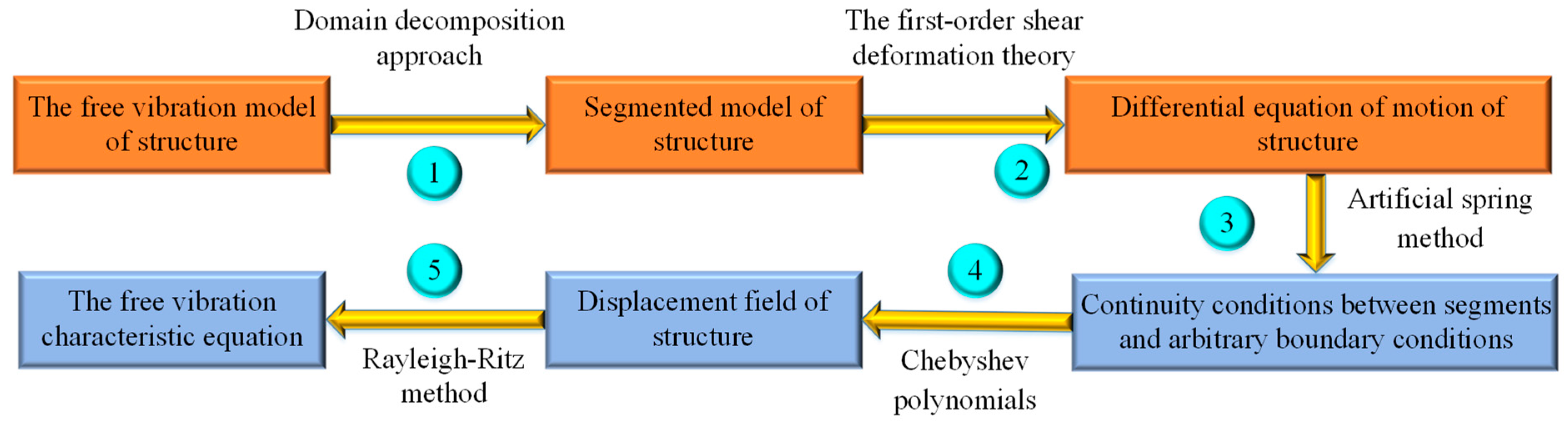
The system matrices are defined as: K (stiffness), M (mass), and Q (coefficients). Figure 3 illustrates the flowchart of current method.

3. Model Verification and Discussion

3.1. Convergence Study and Method Validation

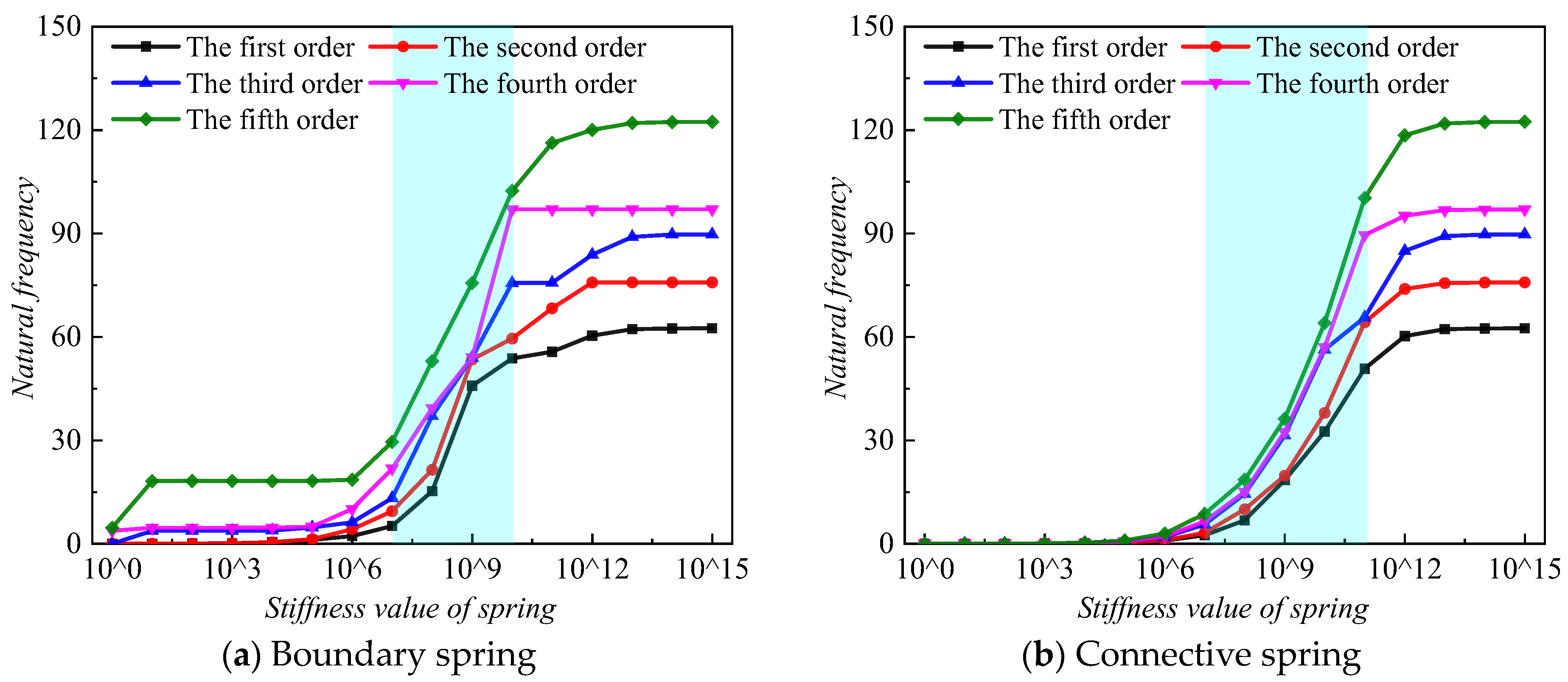
In this study, the connection between different segments of the stepped thickness joined conical–cylindrical structure and the simulation of the boundary conditions at both ends are realized by artificial springs. Figure 4 shows the natural frequencies of conical–cylindrical shells under different boundary and connective spring stiffness. The results show that in the range of spring stiffness from 100 to 1015, the boundary condition changes from free state to clamped constraint state. It can be observed that the free boundary condition can be obtained by setting the stiffness value to zero, and the clamped boundary condition can be obtained by selecting the stiffness value in the range of 1013–1015. As the spring value increases from 107 to 1010, the natural frequency increases rapidly, the elastic boundary condition can be obtained, the light-blue area in the figure is the elastic boundary.
Therefore, the spring stiffness values in each state are shown in Table 1 [41,42]. The clamped, free, elastic and simply supported boundary of the spring are defined by the initial letters C, F, E and S, respectively. The stiffness value of the connective spring is set to 1015 to ensure the strong coupling effect between the sections. The boundary conditions of the joined structure integrate the sequential boundary conditions of the two substructures. For example, the CF boundary condition represents the clamped constraint at the end of the conical shell and the free boundary condition at the end of the cylindrical shell.
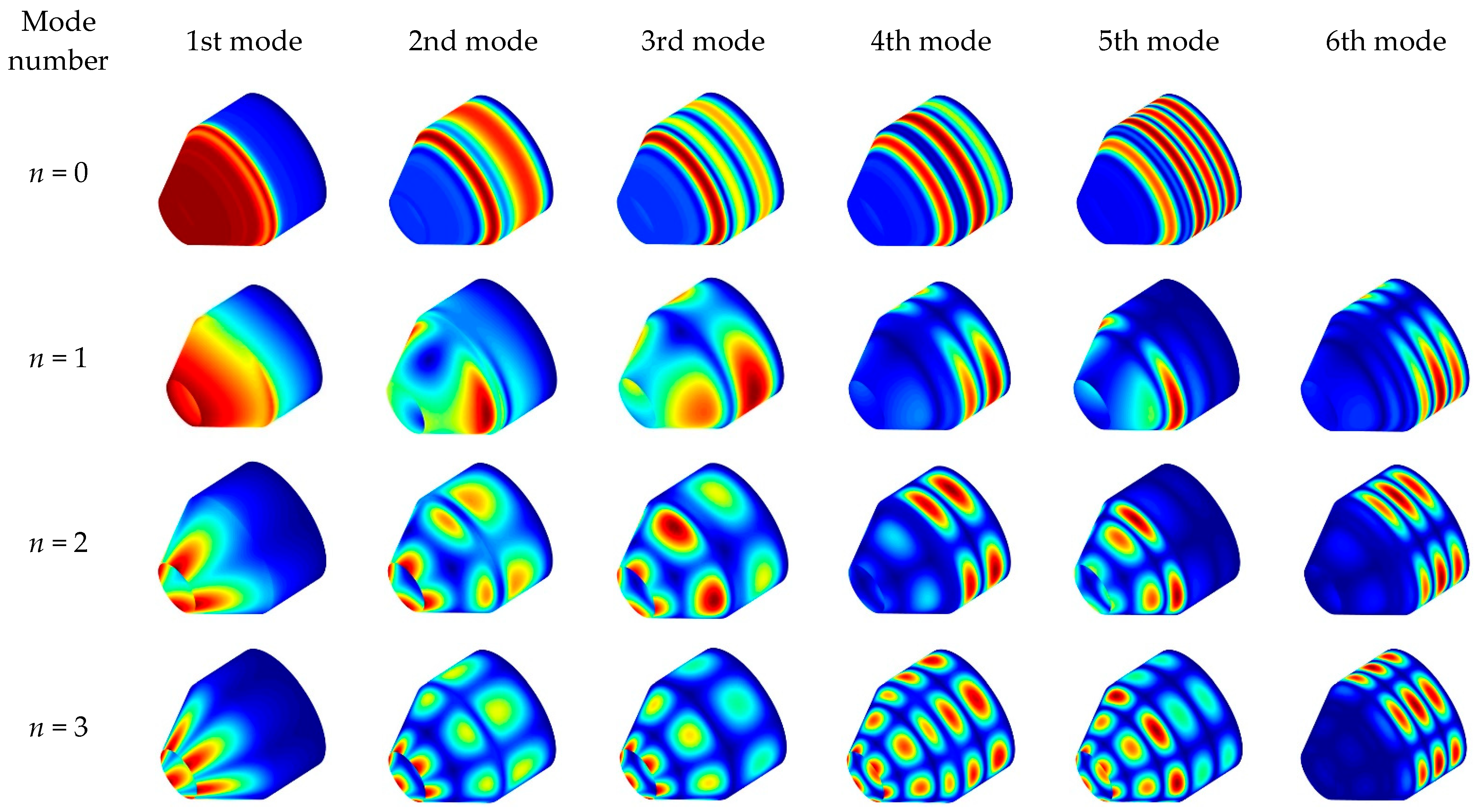
Due to the employment of domain decomposition method and Chebyshev polynomials, the convergence analysis of the parameters related to the segment number Nr and the polynomial truncated number M is carried out in Table 2. As the segment number and the polynomial truncated number gradually increase, the eigenfrequencies of the uniform thickness joined conical–cylindrical shell structure converges rapidly, and the convergent result can be obtained when truncated coefficients reach Nr = 4 and M = 8; therefore, the convergence parameters in the subsequent research can be determined. In addition, Table 2 shows the results of the existing literature and the FEM results under the same structural parameters, more description of the FEM model can be seen in Reference [2]. Figure 5 displays the corresponding mode for the uniform thickness joined conical–cylindrical shells with FC boundary condition. It can be found that the calculation results of the current method are in good agreement with those obtained from the literature and FEM.
Further comparison with existing experimental results are shown in Ref. [43]. In the literature, bolts were used for simulation, it is difficult to fully satisfy ideal boundary conditions (such as clamped boundary condition) in the experiment, as shown in Table 3, and the theoretical calculation results have a significant error compared to the experimental results, reaching up to 26%. However, under ideal boundary conditions, the current results are in good agreement with the literature results, with an error of less than 1%.
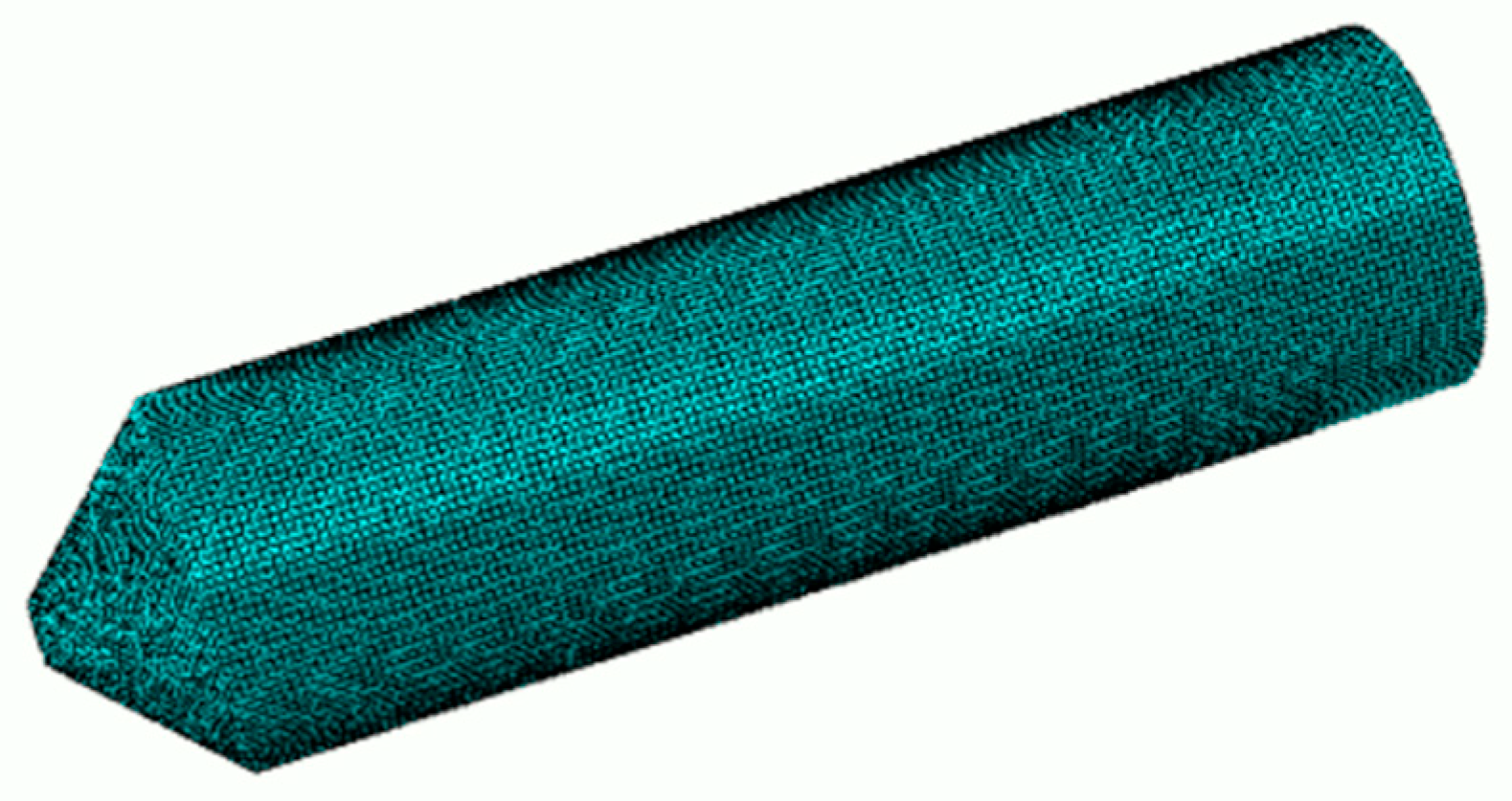
The following is the free vibration verification of the stepped thickness structure, unless otherwise specified, the structural parameters used in this study are as follows: α0 = 45°, R1 = 0.1 m, R2 = 0.6 m, hc = hl1 = 0.005 m, Ll = 4 m, hl1/hl2/hl3/hl4 = 1:1:2:2, E = 210 GPa, ν = 0.3 and ρ = 7850 kg/m3. The FE model is displayed in Figure 6, the mesh size of the FE model is set as 0.03 m, which contains 19,522 nodes, 70 linear triangular elements of type S3, 19,452 linear quadrilateral elements of type S4R.
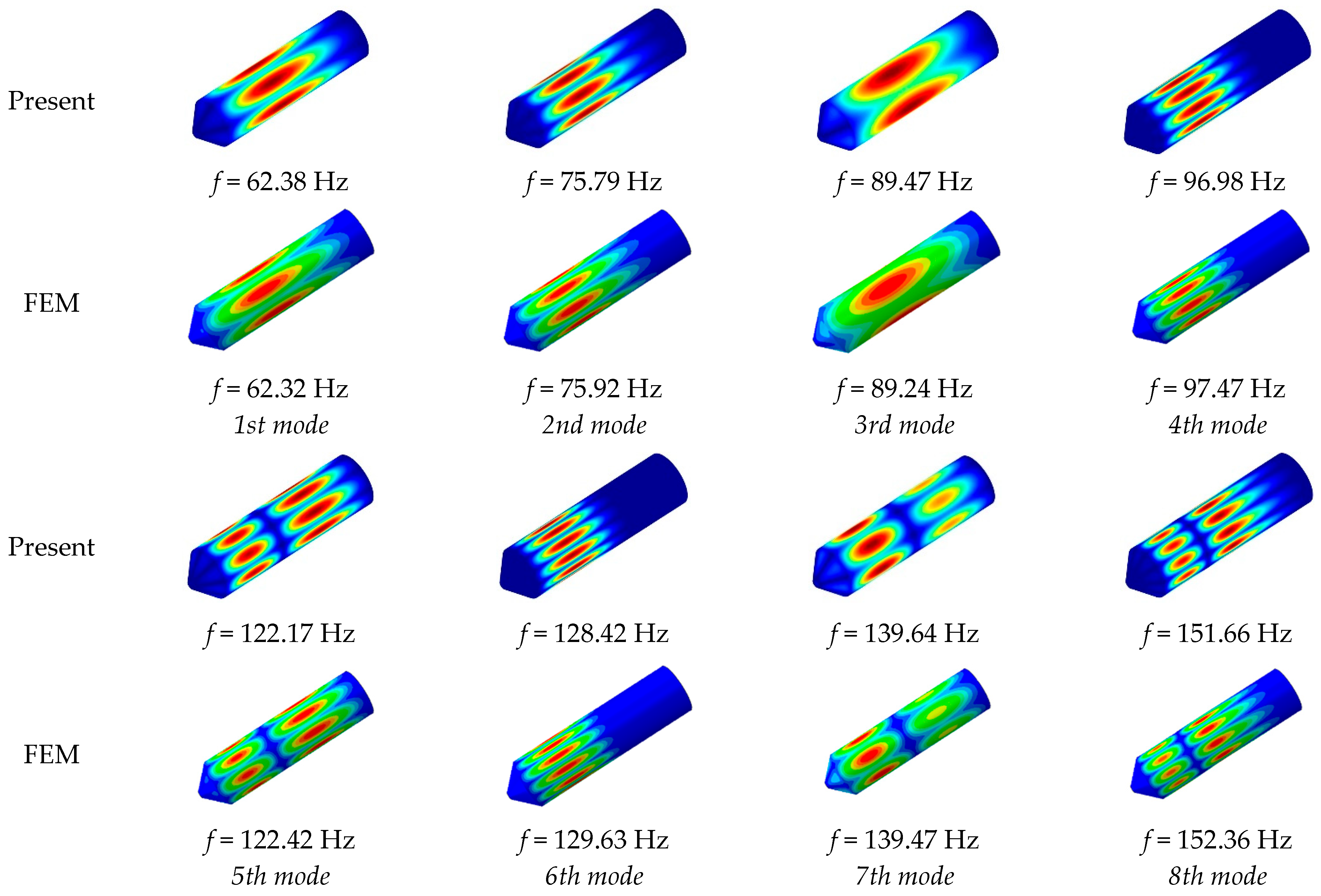
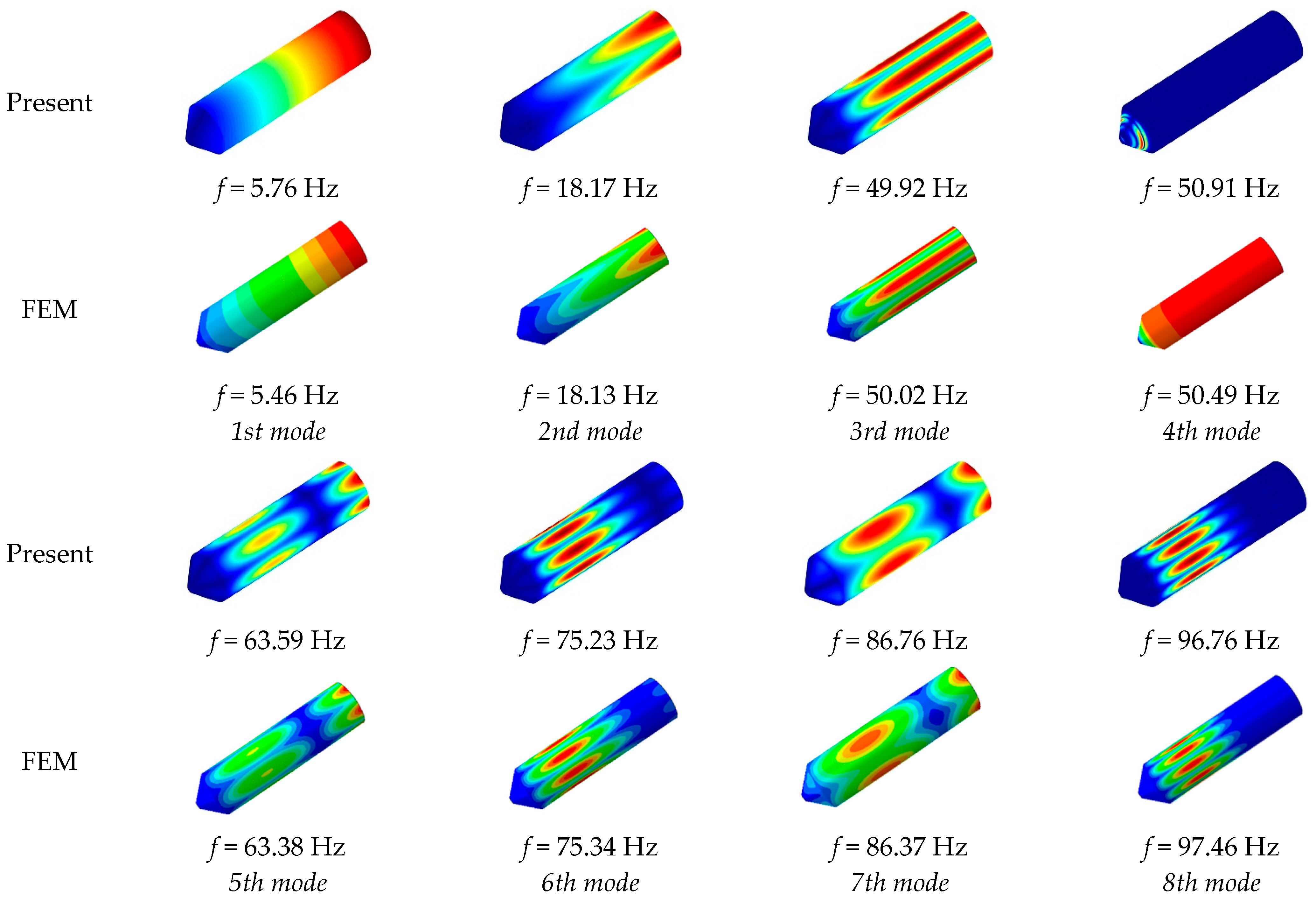
Figure 7 and Figure 8 present the comparison of the eigenfrequency and vibration mode of the first eight orders of the stepped joined structure between current method and FEM. It can be seen that the eigenfrequencies and vibration modes of each order maintain a high degree of consistency compared with the FEM, verifying the effectiveness of the current approach.

3.2. The Influence of Boundary Conditions

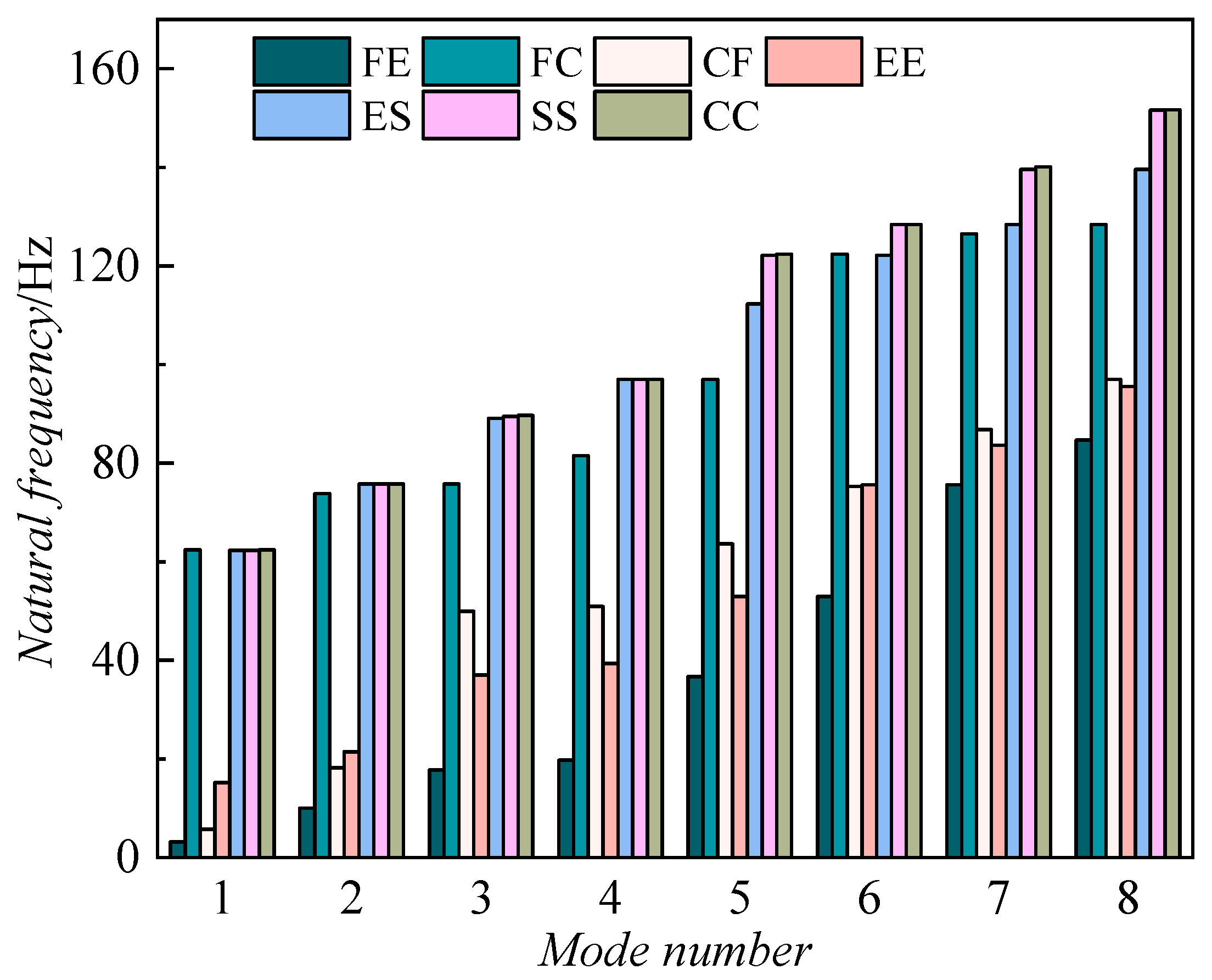
Figure 7 and Figure 8 demonstrate a pronounced sensitivity for the free vibration characteristics of the joined conical–cylindrical shell under different boundary condition, which emphasizes the key role of boundary interaction in controlling the energy transfer mechanism in multi-segment shell components. Consequently, a systematic investigation for the impacts of different boundary conditions on the free vibration behaviors of the joined structure is conducted in Figure 9.
Parametric analysis reveals that the coupled system exhibits a progressive increase in eigenfrequency corresponding to the intensification of boundary conditions. Due to the different opening radii at both ends of the structure, the boundary constraint is stronger on the side with a larger radius, the natural frequency of the structure is higher. For example, the natural frequency of the structure under the FC boundary is higher than that under the CF boundary, mainly because the FC boundary represents the free boundary condition at the end of the conical shell and the clamped constraint at the end of the cylindrical shell. Another notable phenomenon is that when the boundary conditions on the cone side remain unchanged, the natural frequency of the joined structure will increase rapidly due to the strengthening of the boundary conditions of the cylindrical side, such as FE boundary condition to FC boundary condition, indicating that the constraint effect on the side with larger end size is more significant. The negligible variation observed in the natural frequencies between SS and CC boundary conditions reveals that rotation spring effects minimally influence the global stiffness.
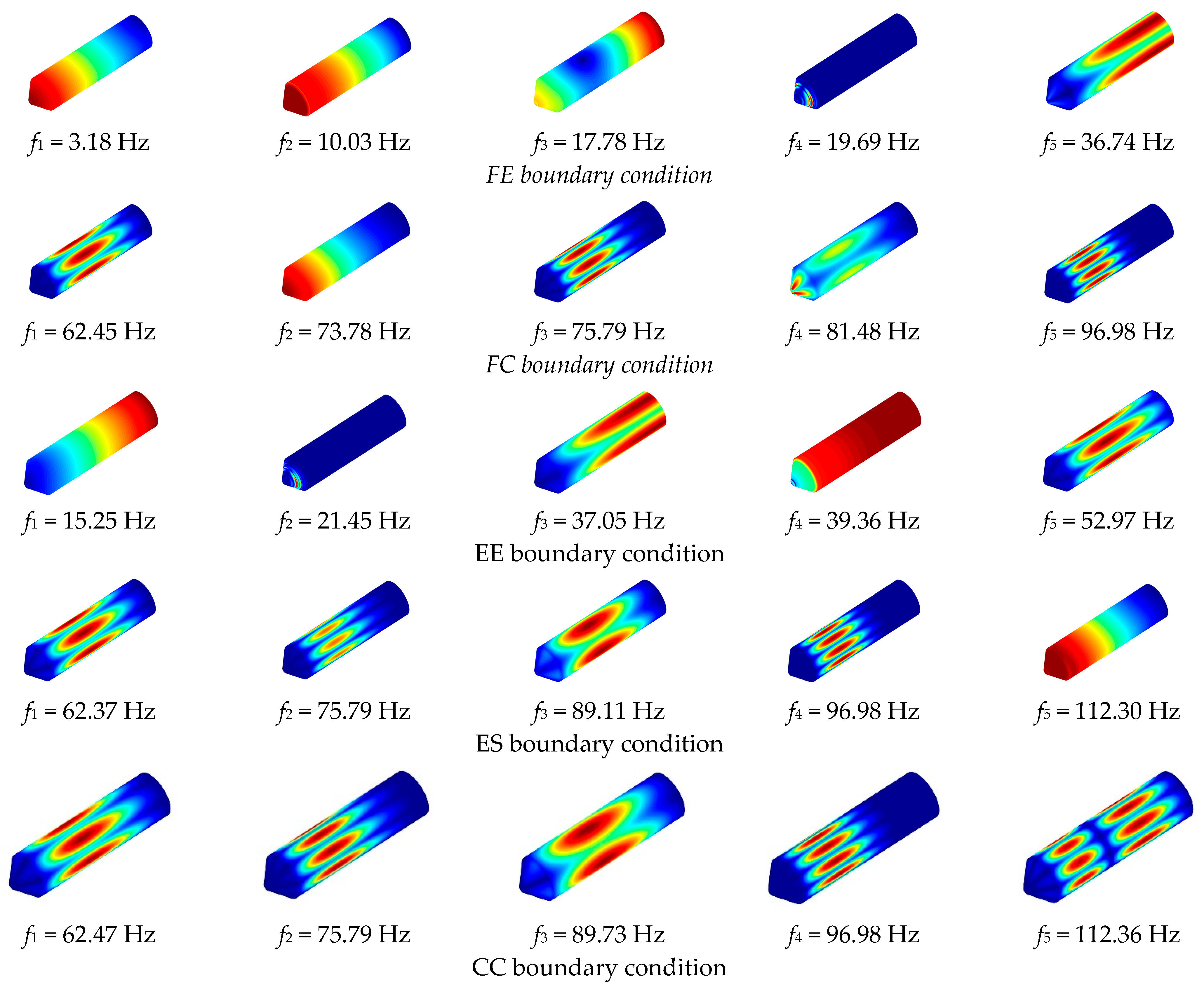
The first five vibration modes of joined conical–cylindrical shells calculated by current method with different boundary conditions are illustrated in Figure 10. The structural vibration modes under different boundary conditions are obviously different, which further shows that the boundary conditions have a great influence on the free vibration of the structure. From an engineering application viewpoint, the structural stiffness can be enhanced by strengthening the boundary restraints.

3.3. The Influence of Typical Structural Parameters

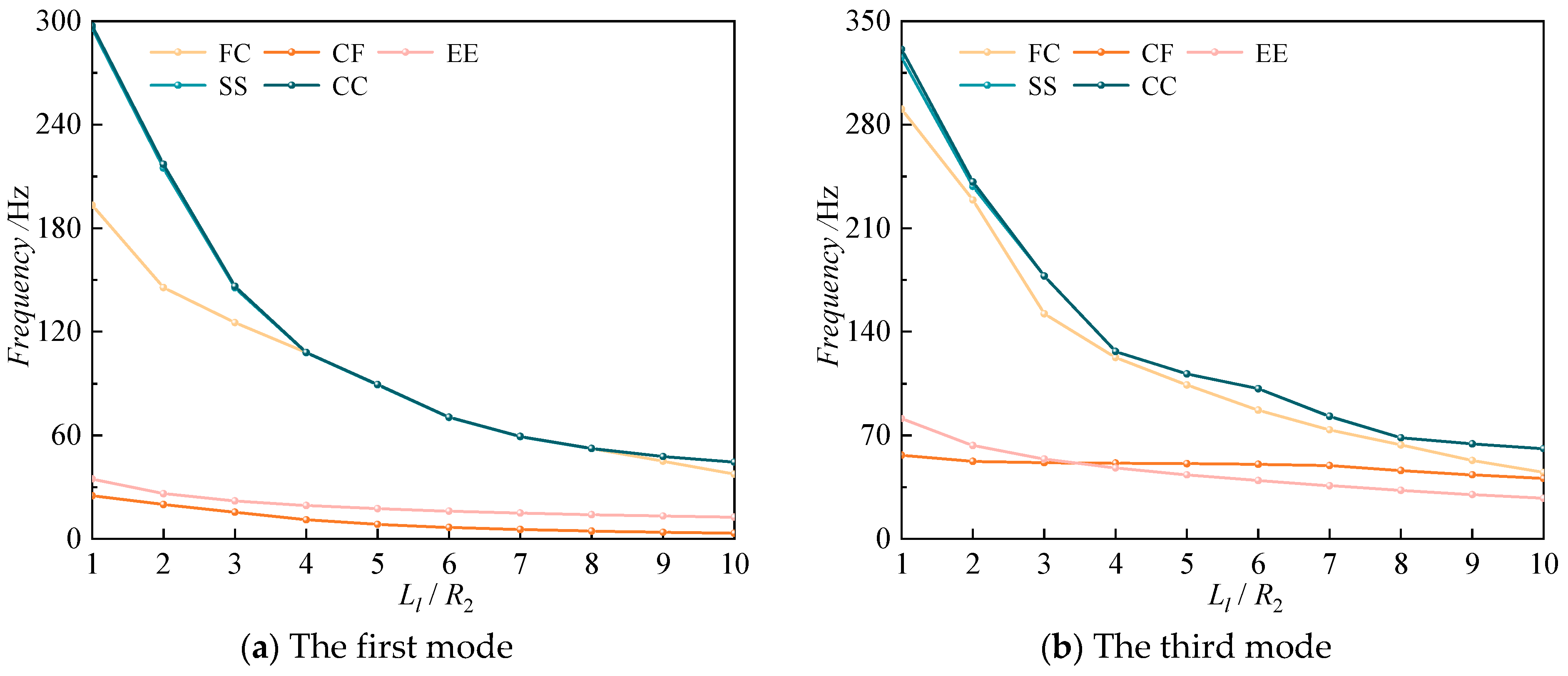
The dimensional ratio (Ll/R2) between cylindrical length and circumferential radius is a critical geometric parameter affecting free vibration characteristics. As depicted in Figure 11, both the first mode and third mode exhibit monotonic reduction with the increase in Ll/R2 ratios, revealing an inverse proportionality relationship between natural frequencies and structural aspect ratio. The attenuation trend of natural frequency gradually slows down with the further increase in Ll/R2 ratios. The main reason is that as the proportion of the axial length of the structure increases, the overall stiffness decreases; however, the stiffness reduction effect will gradually decrease. The comparative analysis also shows that the attenuation rate under the SS, CC and FC boundary conditions is significantly higher than that under the CF and EE boundary conditions, which further indicates that the constraint conditions of the cylindrical end have a more significant effect on the overall stiffness matrix of the system.
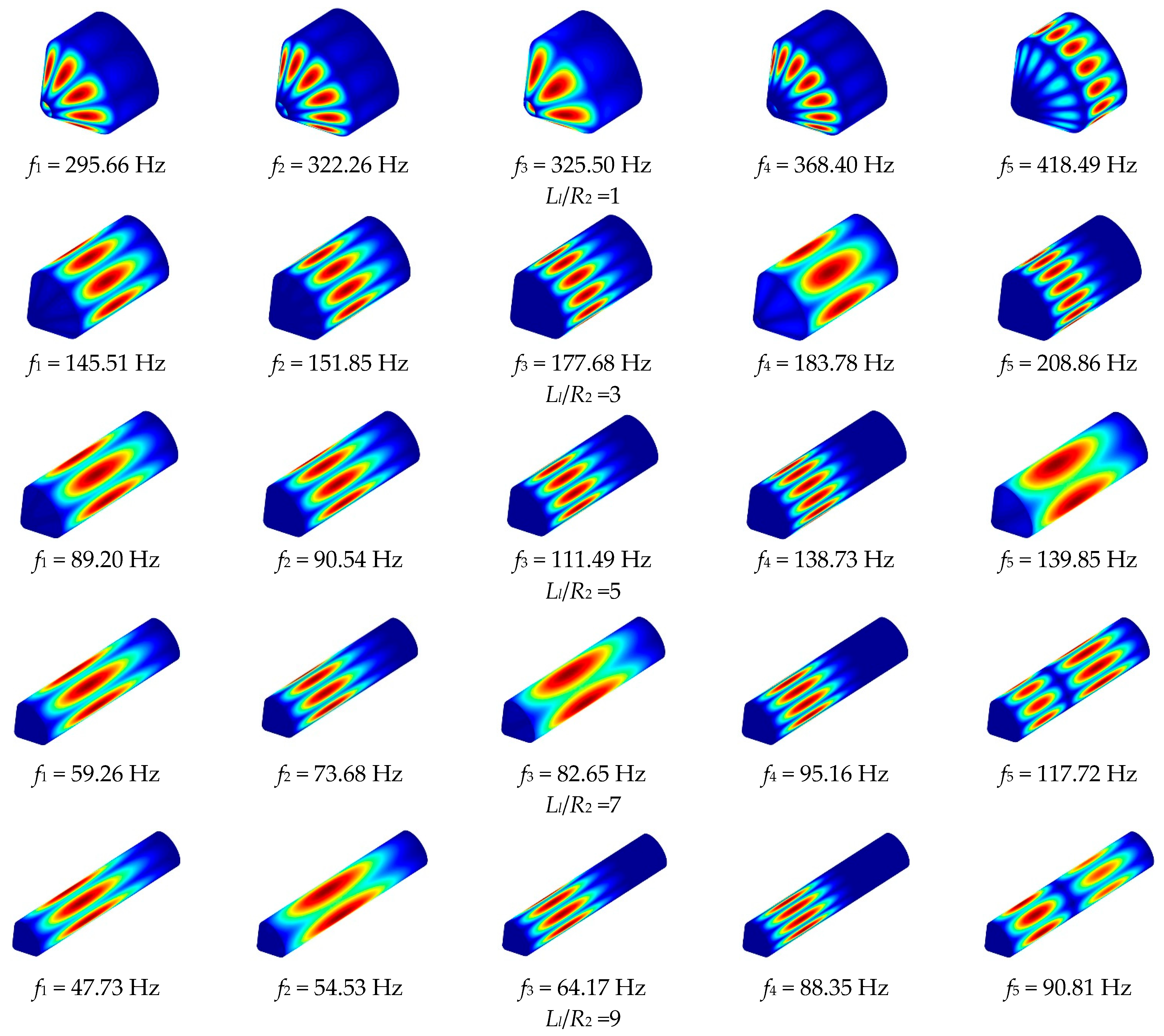
The first five vibration modes of joined conical–cylindrical shells with different Ll/R2 under SS boundary condition are illustrated in Figure 12. The conical section presents a dominant vibration mode when Ll/R2 = 1, with the increase in the Ll/R2 ratio, the main vibration mode of the system is cylindrical side offset, indicating that the free vibration modes mainly appear in the area where the overall stiffness of the structure is weak.
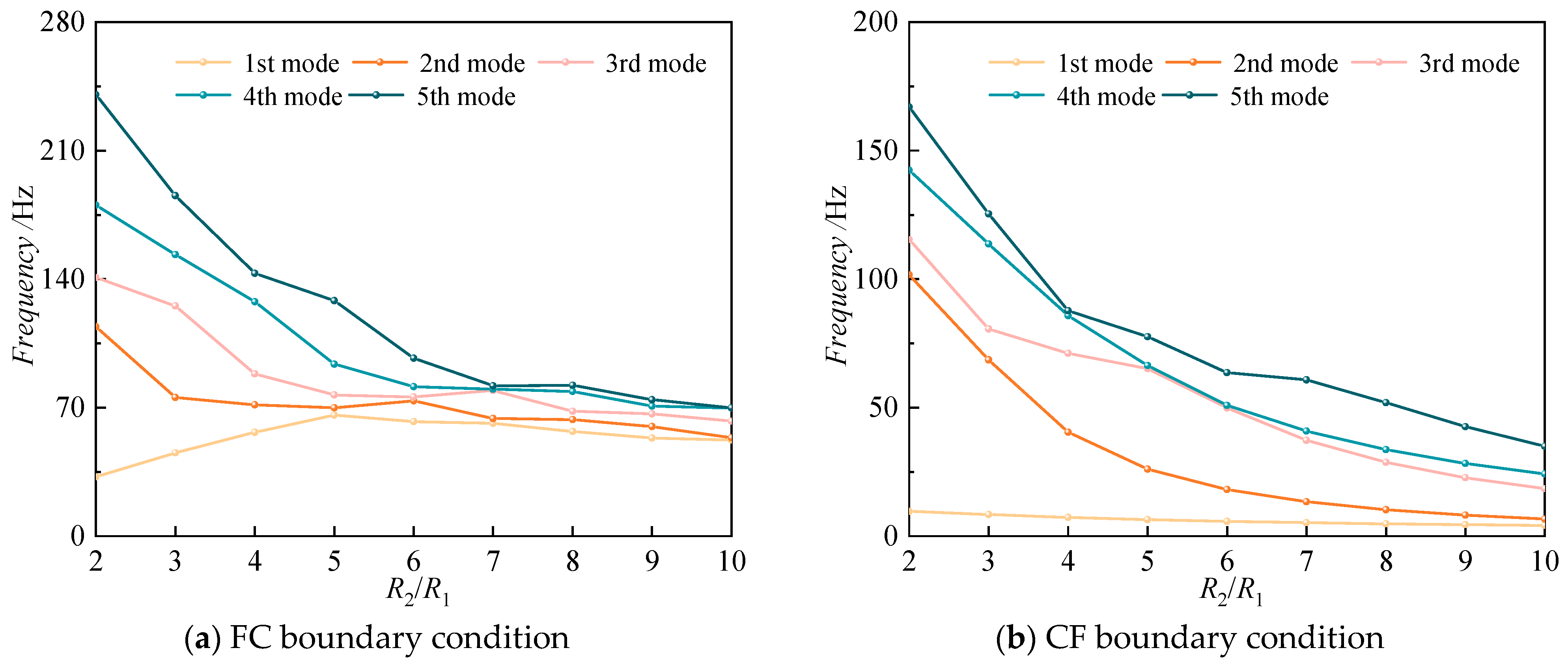
Keeping the radius of the conical shell unchanged, Figure 13 illustrates the variations in the natural frequency of the structure with different radius ratio R2/R1. Taking typical boundary conditions with different constraints at both ends of the structure (FC boundary condition and CF boundary condition). The results show that the natural frequency gradually decreases and tends to converge with the increase in the radius ratio R2/R1. The main reason is that as the radius ratio increases, the stiffness of the cylindrical shell gradually decreases, and the natural frequency dominated by the circumferential vibration mode of the cylindrical shell also decreases.
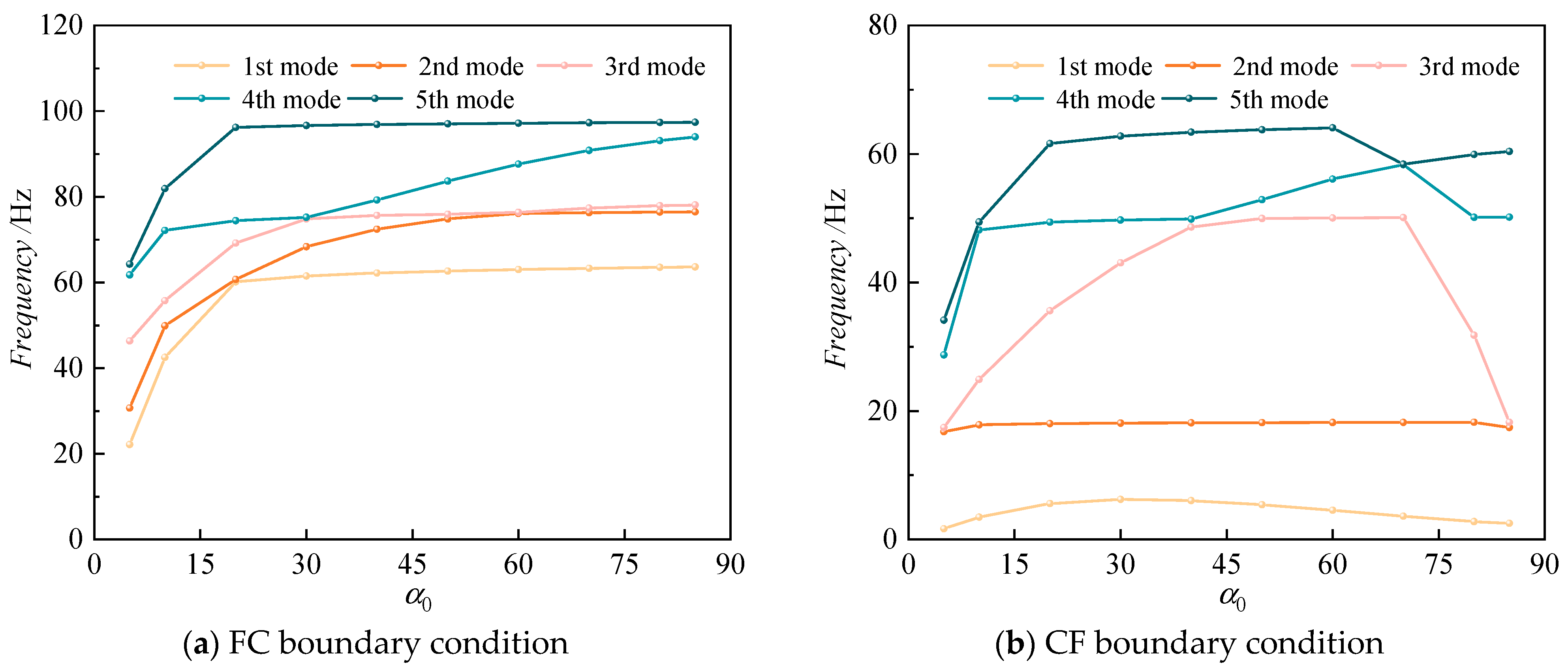
Figure 14 displays the variation law of the first five natural frequencies of joined conical–cylindrical shells with different conical shell semi-vertex angle α0. The natural frequencies first increase and then tend to stabilize with the semi-vertex angle gradually increasing under FC boundary condition. This is mainly because the decrease in the conical shell semi-vertex angle α0 means the lengthening of the conical shell, and the structural vibration mode is dominated by the conical shell at this time. When the conical shell semi-vertex angle increases to the limiting value, then the structural vibration mode is dominated by the cylindrical shell, and the change in the natural frequency is relatively small. Under the CF boundary condition, the first five natural frequencies of the system show a trend of increasing first, then stabilizing, and finally decreasing as the semi-vertex angle increases. The natural frequencies of the joined structure become sensitive due to the combined influence of the semi-vertex angle of the conical shell and the boundary conditions at this time.
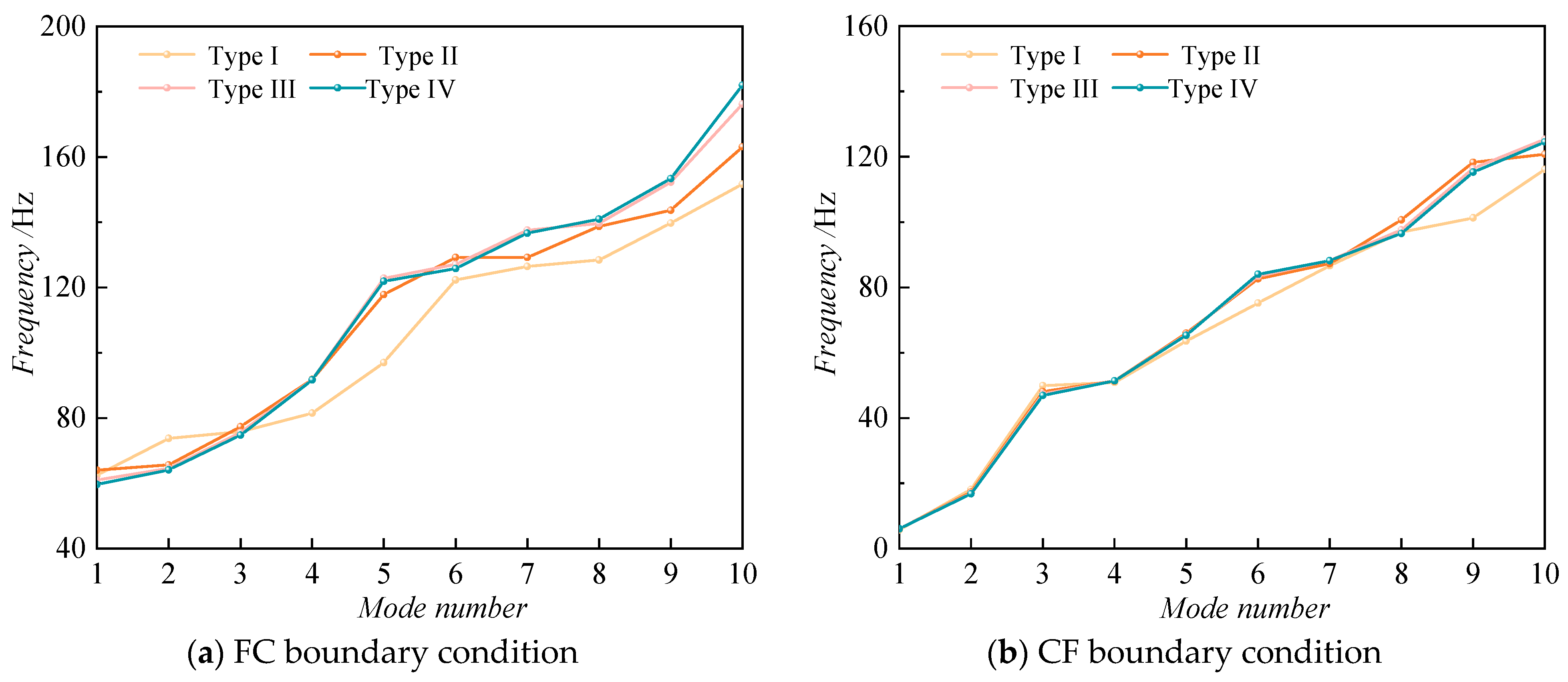
In order to explore the influence of the stepped thickness distribution on the free vibration characteristics of the structure, the schematic diagram of the structure with different number of stepped thickness distribution is given in Figure 15. The length of the same thickness of the structure is the same in this study, and only the stepped thickness distribution is changed.
Figure 16 delineates the influence of different stepped thickness distribution on the free vibration characteristics of the structure under FC and CF boundary conditions. The results show that the change in thickness distribution leads to significant stiffness differences. Specifically, for the structure with the same thickness, the change in the thickness distribution will lead to the cross-variation in the natural frequency, which highlights the important influence of the step thickness distribution on the free vibration behavior of the structure. The above research indicates that the strategic thickness distribution design can effectively change the vibration behavior of the structure for vibration control in practical engineering applications.
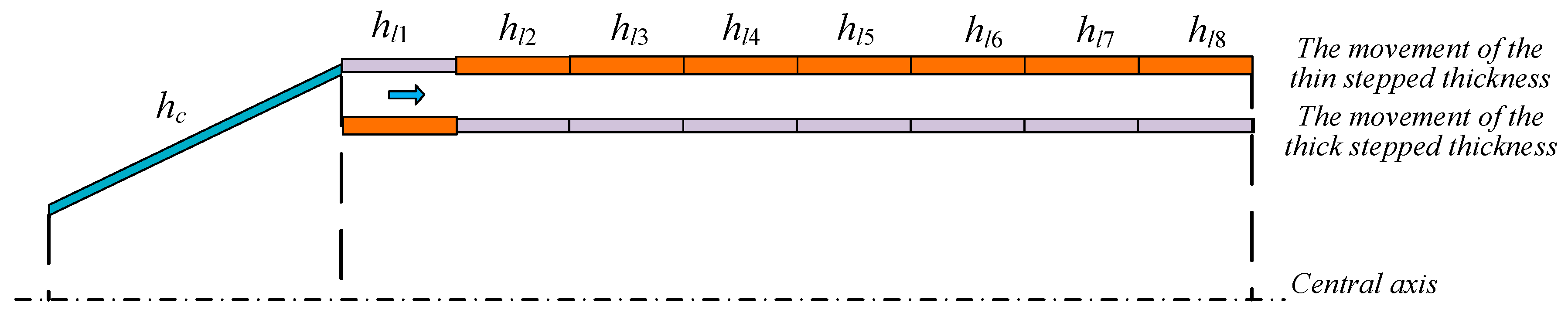
In order to further explore the influence of stepped thickness on the free vibration of joined structure, the cylindrical shell is divided into 8 equal segments along the axial direction. As exhibited in Figure 17, the thickness value of a single segment is adjusted in turn, and the thickness parameters of the remaining sections are fixed. It mainly includes two special cases: in one case, the thickness of a single segment is only half that of the remaining segments, and in the other case, its thickness is twice that of the remaining segments.
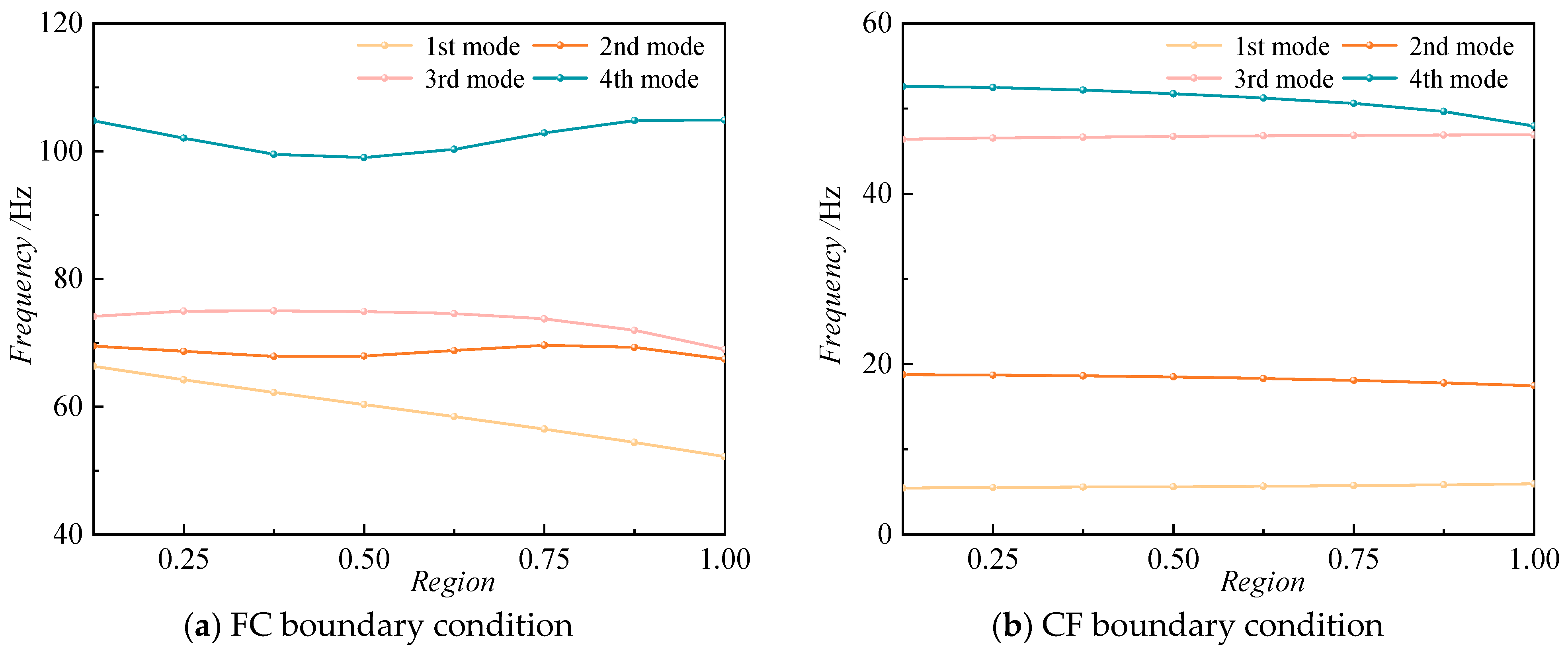
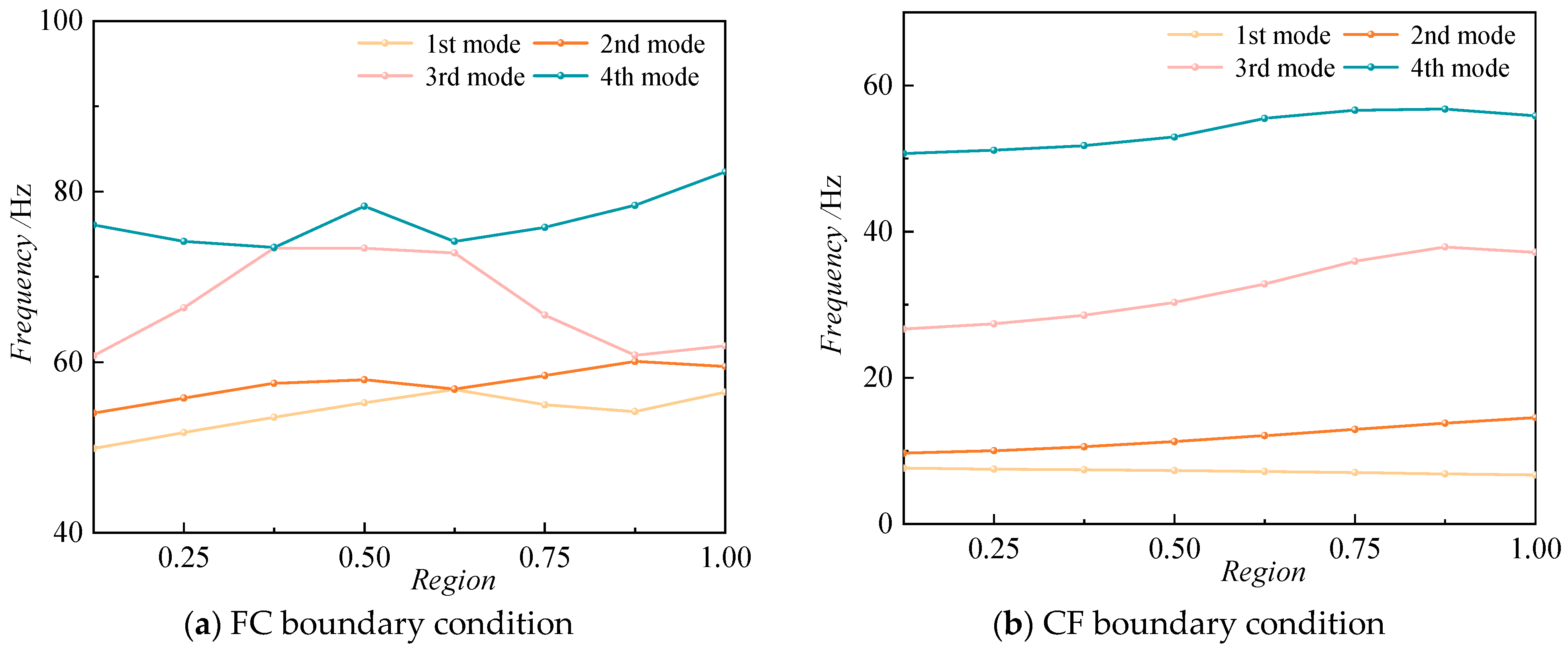
Figure 18 and Figure 19 display the free vibration characteristics of joined conical–cylindrical shells with the movement of the stepped thickness. It can be seen that when the thin stepped thickness section moves along the axial direction of the cylindrical shell, the natural frequency of the structure shows a slight downward trend. When the thick stepped thickness section moves along the axial direction of the cylindrical shell, the natural frequency of the structure shows a slight upward trend, while the fourth-order natural frequency is more sensitive to the change in thickness. The above research further reveals that the thickness distribution is an effective means of adjusting the natural frequency.

4. Conclusions

In this study, the free vibration characteristics of joined conical–cylindrical shells with axially stepped thickness are investigated. The convergence and effectiveness of the current method are enhanced by introducing the first-order shear deformation theory, domain decomposition method and artificial spring technique, and the free vibration behavior of these structures is evaluated by employing Ritz method. The accuracy and reliability of the numerical model are verified by comparing the published literature and FEM, the effects of boundary conditions, structural parameters and stepped thickness distribution on the free vibration characteristics of the structures are systematically discussed, which provides key insights for vibration control of stepped structures such as underwater vehicles and rockets. The main conclusions are as follows:
(1)
The enhancement of the boundary conditions leads to an increase in the natural frequency of the structure, the constraint effect on the side with larger end size is more significant, and the contribution of the rotating spring to the overall stiffness of the system is not significant.
(2)
The natural frequency of the joined structure is inversely proportional to the two structural parameters (the length to radius ratio and the radius ratio at both ends). In addition, the influence of conical shell semi-vertex angle on free vibration shows obvious boundary condition dependence.
(3)
The stepped thickness distribution has a significant effect on the natural frequency of the joined structure. The natural frequency can be adjusted by combining different structural design and thickness distribution in practical engineering.

Author Contributions

Writing—original draft, L.L.; validation and formal analysis, Z.Z.; validation and data curation, T.L.; methodology, software and funding acquisition, C.G.; visualization and supervision, J.Z. All authors have read and agreed to the published version of the manuscript.

Funding

National Natural Science Foundation of China (52401368).

Data Availability Statement

The original contributions presented in the study are included in the article, further inquiries can be directed to the corresponding author.

Acknowledgments

We gratefully acknowledge the Jiangsu University of Science and Technology and the Harbin Engineering University for providing the necessary equipment for this study.

Conflicts of Interest

The authors declare that there is no conflicts of interest regarding the publication of this paper.

References

  1. Caresta, M.; Kessissoglou, N.J. Free vibrational characteristics of isotropic coupled cylindrical–conical shells. J. Sound Vib. 2010, 329, 733–751. [Google Scholar] [CrossRef]
  2. Tian, L.H.; Ye, T.G.; Jin, G.Y. Vibration analysis of combined conical-cylindrical shells based on the dynamic stiffness method. Thin-Walled Struct. 2021, 159, 107260. [Google Scholar] [CrossRef]
  3. Zhang, C.; Jin, G.; Wang, Z.; Sun, Y. Dynamic stiffness formulation and vibration analysis of coupled conical-ribbed cylindrical-conical shell structure with general boundary condition. Ocean Eng. 2021, 234, 109294. [Google Scholar] [CrossRef]
  4. Hu, S.; Wang, Q.; Zhong, R.; Peng, Q.; Qin, B. A dynamic stiffness formulation for the vibration analysis of rotating cross-ply laminated coupled conical–cylindrical–conical shells. Thin-Walled Struct. 2023, 182, 110230. [Google Scholar] [CrossRef]
  5. Guo, W.; Hong, X.; Luo, W.; Yang, J.; Li, T.; Zhu, X. Vibration analysis of conical–cylindrical–spherical shells by a novel linear expression method. Compos. Struct. 2024, 334, 117879. [Google Scholar] [CrossRef]
  6. Wu, J.H.; Sun, Y.D.; Duan, Y. Exact solutions for free and forced vibrations of cross-ply composite laminated combined conical-cylindrical shells with arbitrary boundary conditions. Ocean Eng. 2023, 285, 115371. [Google Scholar] [CrossRef]
  7. Lee, J. Free vibration analysis of joined conical-cylindrical shells by matched Fourier-Chebyshev collocation method. J. Mech. Sci. Technol. 2018, 32, 4601–4612. [Google Scholar] [CrossRef]
  8. Sarkheil, S.; Foumani, M.S. Free vibrational characteristics of rotating joined cylindrical-conical shells. Thin-Walled Struct. 2016, 107, 657–670. [Google Scholar] [CrossRef]
  9. Motazedian, N.; Jafari, A.A.; Montaseri, M.A. Free Vibration of Joined Spherical-Conical Panel and Shells Using the 2D-GDQ Method. Int. J. Struct. Stab. Dyn. 2025, 25, 2550182. [Google Scholar] [CrossRef]
  10. Bagheri, H.; Kiani, Y.; Eslami, M. Free vibration of joined conical–cylindrical–conical shells. Acta Mech. 2018, 229, 2751–2764. [Google Scholar] [CrossRef]
  11. Pang, F.; Wu, C.; Song, H.; Li, H. The free vibration characteristics of isotropic coupled conical-cylindrical shells based on the precise integration transfer matrix method. Curved Layer. Struct. 2017, 4, 272–287. [Google Scholar] [CrossRef]
  12. Ma, X.; Jin, G.; Xiong, Y.; Liu, Z. Free and forced vibration analysis of coupled conical–cylindrical shells with arbitrary boundary conditions. Int. J. Mech. Sci. 2014, 88, 122–137. [Google Scholar] [CrossRef]
  13. Su, Z.; Jin, G. Vibration analysis of coupled conical-cylindrical-spherical shells using a Fourier spectral element method. J. Acoust. Soc. Am. 2016, 140, 3925–3940. [Google Scholar] [CrossRef] [PubMed]
  14. Li, H.; Pang, F.Z.; Miao, X.; Gao, S.; Liu, F. A semi analytical method for free vibration analysis of composite laminated cylindrical and spherical shells with complex boundary conditions. Thin-Walled Struct. 2019, 136, 200–220. [Google Scholar] [CrossRef]
  15. Pang, F.; Li, H.; Chen, H.; Shan, Y. Free vibration analysis of combined composite laminated cylindrical and spherical shells with arbitrary boundary conditions. Mech. Adv. Mater. Struct. 2021, 28, 182–199. [Google Scholar] [CrossRef]
  16. Choe, K.; Tang, J.Y.; Shui, C.J.; Wang, A.L.; Wang, Q.S. Free vibration analysis of coupled functionally graded (FG) doubly-curved revolution shell structures with general boundary conditions. Compos. Struct. 2018, 194, 413–432. [Google Scholar] [CrossRef]
  17. Xie, X.; Jin, G.Y.; Li, W.Y.; Liu, Z.G. A numerical solution for vibration analysis of composite laminated conical, cylindrical shell and annular plate structures. Compos. Struct. 2014, 111, 20–30. [Google Scholar] [CrossRef]
  18. Kim, K.; Kwak, S.; Choe, K.; Han, W.; Ri, Y.; Ri, K. Application of Haar wavelet method for free vibration of laminated composite conical-cylindrical coupled shells with elastic boundary condition. Phys. Scr. 2021, 96, 035223. [Google Scholar] [CrossRef]
  19. Qu, Y.G.; Chen, Y.; Long, X.H.; Hua, H.X.; Meng, G. A variational method for free vibration analysis of joined cylindrical-conical shells. J. Vib. Control 2013, 19, 2319–2334. [Google Scholar] [CrossRef]
  20. Guo, C.C.; Liu, T.; Bin, Q.; Wang, Q.S.; Wang, A.L. Free vibration analysis of coupled structures of laminated composite conical, cylindrical and spherical shells based on the spectral-Tchebychev technique. Compos. Struct. 2022, 281, 114965. [Google Scholar] [CrossRef]
  21. Kim, J.; Kim, K.; Kim, K.; Hong, K.R.Y.; Paek, C. Free Vibration Analysis of Cross-Ply Laminated Conical Shell, Cylindrical Shell, and Annular Plate with Variable Thickness Using the Haar Wavelet Discretization Method. Shock. Vib. 2022, 2022, 689–714. [Google Scholar] [CrossRef]
  22. Kim, K.; Kumchol, R.; Kwak, S.; Ri, M.; Choe, K. Free Vibration Analysis of Laminated Composite Spherical Shell with Variable Thickness and Different Boundary Conditions. J. Vib. Eng. Technol. 2022, 10, 689–714. [Google Scholar] [CrossRef]
  23. Zheng, D.Y. Vibration characteristic analysis of thin-walled conical shells with arbitrary thickness variation and general boundary condition. Thin-Walled Struct. 2025, 212, 113160. [Google Scholar] [CrossRef]
  24. Zheng, D.Y.; Du, J.T.; Liu, Y. Vibration characteristics analysis of an elastically restrained cylindrical shell with arbitrary thickness variation. Thin-Walled Struct. 2021, 165, 107930. [Google Scholar] [CrossRef]
  25. Gao, C.; Pang, F.; Li, H.; Wang, X. Forced Vibration Analysis of Uniform and Stepped Circular Cylindrical Shells with General Boundary Conditions. Int. J. Struct. Stab. Dyn. 2022, 22, 2250126. [Google Scholar] [CrossRef]
  26. Zheng, J.J.; Gao, C.; Pang, F.Z.; Tang, Y.; Zhao, Z.; Li, H.C.; Du, Y. Free and Forced Vibration Analysis of Uniform and Stepped Conical Shell Based on Jacobi-Ritz Time Domain Semi-Analytical Method. Int. J. Struct. Stab. Dyn. 2025, 25, 2550180. [Google Scholar] [CrossRef]
  27. Wang, P.; Wang, Y.; Jia, X.Y.; Chang, Y.F.; Gu, Y. Improved Fourier Series-Ritz Method for Free Vibration Analysis of Hard Coating Damping Thin-Walled Cylindrical Shells with Thickness Variation Under Arbitrary Boundary Conditions. J. Vib. Eng. Technol. 2024, 12, 1171–1189. [Google Scholar] [CrossRef]
  28. Bochkarev, S.A.; Matveenko, V.P. Free Vibration Analysis of a Cylindrical Shell of Variable Thickness Partially Filled with Fluid. Proc. Steklov Inst. Math. 2023, 321, S20–S32. [Google Scholar] [CrossRef]
  29. El-Kaabazi, N.; Kennedy, D. Calculation of natural frequencies and vibration modes of variable thickness cylindrical shells using the Wittrick–Williams algorithm. Comput. Struct. 2012, 104, 4–12. [Google Scholar] [CrossRef]
  30. Xie, K.; Chen, M.X.; Li, Z.H. An analytic method for free and forced vibration analysis of stepped conical shells with arbitrary boundary conditions. Thin-Walled Struct. 2017, 111, 126–137. [Google Scholar] [CrossRef]
  31. Kang, J.H. Three-dimensional vibration analysis of joined thick conical—Cylindrical shells of revolution with variable thickness. J. Sound Vib. 2012, 331, 4187–4198. [Google Scholar] [CrossRef]
  32. Singh, R.; Gupta, A.; Jain, N.K. Free vibration analysis of cracked isotropic and FGM cylindrical shells with axially varying thickness: An analytical approach. Thin-Walled Struct. 2025, 214, 113344. [Google Scholar] [CrossRef]
  33. Li, Z.; Wang, Q.S.; Zhong, R.; Qin, B.; Shao, W. A meshfree approach for vibro-acoustic analysis of combined composite laminated shells with variable thickness. Eng. Anal. Bound. Elem. 2024, 160, 28–44. [Google Scholar] [CrossRef]
  34. Ye, T.; Jin, G.; Su, Z.; Chen, Y. A modified Fourier solution for vibration analysis of moderately thick laminated plates with general boundary restraints and internal line supports. Int. J. Mech. Sci. 2014, 80, 29–46. [Google Scholar] [CrossRef]
  35. Nguyen, V.-L.; Limkatanyu, S.; Thai, H.-T.; Rungamornrat, J. Simple first-order shear deformation theory for free vibration of FGP-GPLRC spherical shell segments. Mech. Adv. Mater. Struct. 2024, 31, 6944–6961. [Google Scholar] [CrossRef]
  36. Bagheri, H.; Kiani, Y.; Eslami, M.R. Free vibration of conical shells with intermediate ring support. Aerosp. Sci. Technol. 2017, 69, 321–332. [Google Scholar] [CrossRef]
  37. Daneshmand, F.; Rafiei, M.; Mohebpour, S.R.; Heshmati, M. Stress and strain-inertia gradient elasticity in free vibration analysis of single walled carbon nanotubes with first order shear deformation shell theory. Appl. Math. Model. 2013, 37, 7983–8003. [Google Scholar] [CrossRef]
  38. Zhao, X.; Lee, Y.Y.; Liew, K.M. Thermoelastic and vibration analysis of functionally graded cylindrical shells. Int. J. Mech. Sci. 2009, 51, 694–707. [Google Scholar] [CrossRef]
  39. Shi, D.; Liu, T.; Wang, Q.; Lan, Q. Vibration analysis of arbitrary straight-sided quadrilateral plates using a simple first-order shear deformation theory. Results Phys. 2018, 11, 201–211. [Google Scholar] [CrossRef]
  40. Zhang, Y.; Song, H.; Yu, X.G.; Yang, J. Modeling and analysis of forced vibration of the thin-walled cylindrical shell with arbitrary multi-ring hard coating under elastic constraint. Thin-Walled Struct. 2022, 173, 109037. [Google Scholar] [CrossRef]
  41. Wang, Q.; Shi, D.; Pang, F.; e Ahad, F. Benchmark solution for free vibration of thick open cylindrical shells on Pasternak foundation with general boundary conditions. Meccanica 2017, 52, 457–482. [Google Scholar] [CrossRef]
  42. Qin, B.; Zhong, R.; Wang, Q.; Zhao, X. A Jacobi-Ritz approach for FGP beams with arbitrary boundary conditions based on higher-order shear deformation theory. Compos. Struct. 2020, 247, 112435. [Google Scholar] [CrossRef]
  43. Sun, Y.H.; Song, Z.G. A method for dynamic analysis and design of joined conical-cylindrical shells based on the model condensation. Appl. Math. Model. 2023, 119, 354–372. [Google Scholar] [CrossRef]
Figure 1. Calculation model of joined conical–cylindrical shell with axially stepped thickness.
Vibration 09 00013 g001
Figure 2. Schematic diagram of structure segmentation and connection.
Vibration 09 00013 g002
Figure 3. The flowchart of current method.
Vibration 09 00013 g003
Figure 4. Frequency parameters of conical–cylindrical shell with different spring parameters.
Vibration 09 00013 g004
Figure 5. The corresponding mode for the uniform thickness joined conical–cylindrical shells with FC boundary condition.
Vibration 09 00013 g005
Figure 6. FE model of the structure.
Vibration 09 00013 g006
Figure 7. Comparison of the first eight modes of joined conical–cylindrical shells with stepped thickness with FEM under SS boundary condition.
Vibration 09 00013 g007
Figure 8. Comparison of the first eight modes of joined conical–cylindrical shells with stepped thickness with FEM under CF boundary condition.
Vibration 09 00013 g008
Figure 9. Vibration characteristics of joined conical–cylindrical shells under different boundary conditions.
Vibration 09 00013 g009
Figure 10. The first five modes of joined conical–cylindrical shells with different boundaries.
Vibration 09 00013 g010
Figure 11. Vibration characteristics of joined conical–cylindrical shells with different Ll/R2.
Vibration 09 00013 g011
Figure 12. The first five modes of joined conical–cylindrical shells with different Ll/R2 under SS boundary condition.
Vibration 09 00013 g012
Figure 13. Vibration characteristics of joined conical–cylindrical shells with different R2/R1.
Vibration 09 00013 g013
Figure 14. Vibration characteristics of joined conical–cylindrical shells with different conical shell semi-vertex angle.
Vibration 09 00013 g014
Figure 15. Schematic diagram of the structure with different stepped thickness distribution.
Vibration 09 00013 g015
Figure 16. Vibration characteristics of the structure with different stepped thickness distribution.
Vibration 09 00013 g016
Figure 17. Schematic diagram of a single stepped thickness movement.
Vibration 09 00013 g017
Figure 18. Natural frequencies of joined conical–cylindrical shells with varying thickness with the movement of the thin step thickness.
Vibration 09 00013 g018
Figure 19. Natural frequencies of joined conical–cylindrical shells with varying thickness with the movement of the thick step thickness.
Vibration 09 00013 g019
Table 1. The spring stiffness values of the general edge conditions.
Boundary Conditionsku (N/m)kv (N/m)kw (N/m)kx (Nm/rad)kθ (Nm/rad)
F00000
E108108108108108
S10151015101500
C10151015101510151015
Table 2. Results for uniform thickness joined conical–cylindrical shells with different convergence parameters.
nModal NumberNr × M
= 2 × 2
Nr × M
= 2 × 4
Nr × M
= 3 × 4
Nr × M
= 3 × 6
Nr × M
= 4 × 6
Nr × M
= 4 × 8
ANSYS 2025 [2]Tian et al. [2] Ma et al. [12]
010.61590.5723 0.5404 0.5035 0.5030 0.5030 0.5026 0.5175 0.5039
21.22060.9343 0.9324 0.9308 0.9308 0.9308 0.9301 0.9301 0.9309
31.56450.9634 0.9602 0.9562 0.9561 0.9561 0.9543 0.9553 0.9531
41.64180.9976 0.9794 0.9714 0.9714 0.9713 0.9694 0.9712 0.9695
51.84321.1063 1.0326 1.0116 1.0114 1.0114 1.0078 1.0114 1.0091
110.3245 0.2998 0.2971 0.2929 0.2928 0.2927 0.2958 0.2957 0.2929
20.9307 0.7191 0.6763 0.6354 0.6350 0.6350 0.6455 0.6457 0.6358
31.0835 0.8124 0.8117 0.8114 0.8114 0.8114 0.8112 0.8109 0.8112
41.5645 0.9435 0.9335 0.9313 0.9313 0.9313 0.9300 0.9311 0.9309
51.5747 0.9634 0.9602 0.9519 0.9518 0.9518 0.9503 0.9495 0.9485
61.8432 1.0823 1.0101 0.9916 0.9916 0.9916 0.9881 0.9923 0.9915
210.1416 0.1022 0.1015 0.1001 0.1000 0.1000 0.0998 0.1005 0.0999
20.6159 0.5523 0.5275 0.5025 0.5021 0.5021 0.5050 0.5059 0.5026
31.0835 0.7191 0.6968 0.6911 0.6911 0.6911 0.6909 0.6919 0.6911
41.3881 0.8759 0.8628 0.8588 0.8588 0.8588 0.8577 0.8594 0.8586
51.5645 0.9343 0.9324 0.9155 0.9154 0.9154 0.9140 0.9137 0.9064
61.7783 0.9730 0.9648 0.9562 0.9561 0.9561 0.9570 0.9599 0.9605
310.1416 0.0889 0.0882 0.0877 0.0876 0.0876 0.0874 0.0866 0.0876
20.6159 0.4287 0.4089 0.3914 0.3911 0.3911 0.3909 0.3927 0.3915
30.8680 0.5723 0.5404 0.5143 0.5143 0.5143 0.5143 0.5140 0.5144
41.3881 0.7951 0.7697 0.7529 0.7528 0.7528 0.7521 0.7531 0.7509
51.4502 0.8124 0.8046 0.7963 0.7962 0.7962 0.7955 0.7959 0.7921
61.7101 0.9435 0.9327 0.9189 0.9189 0.9189 0.9164 0.9195 0.9196
Table 3. Experimental and theoretical natural frequencies of joined conical–cylindrical shells.
Mode
Number
ExperimentSimulation of Ideal Boundary ConditionsError 1 (%)Error 2 (%)
fexp [43]fC-B method [43]fpre|fpre − fexp|/fpre|fpre − fC-B method|/fpre
f1439.29 590.70 594.31 26.08 0.61
f2941.85 950.41 956.39 1.52 0.63
f31126.02 1298.33 1294.42 13.01 0.30
f41479.59 1451.76 1448.36 2.16 0.23
f51807.89 1785.32 1783.59 1.36 0.10
Disclaimer/Publisher’s Note: The statements, opinions and data contained in all publications are solely those of the individual author(s) and contributor(s) and not of MDPI and/or the editor(s). MDPI and/or the editor(s) disclaim responsibility for any injury to people or property resulting from any ideas, methods, instructions or products referred to in the content.