1. Introduction
Wildfire extent and intensity are predicted to increase under future climate scenarios, placing growing pressure on existing fire management approaches [
1]. These challenges are compounded in wildland–urban interface (WUI) environments, where expanding human development intersects with fire-prone vegetation [
2]. Decades of reports, inquiries, and research into Australian fire disasters, including the post-Black Summer 2020 NSW Bushfire Inquiry, have identified the need for enhanced preparedness and mitigation to strengthen disaster risk reduction [
3,
4,
5]. The Australian Productivity Commission notes the considerable cost-benefit of proactive investments, but the ongoing emphasis on reactive measures [
6]. As the potential for fire disasters in the WUI increases, complementary options to proactively mitigate fire are needed to enhance preparedness.
Green firebreaks (GFBs) are a proactive option that uses strategically placed low-flammability vegetation to reduce fire spread rates and fireline intensity; however, they could be compromised under extreme conditions [
7]. Under climatic heating and drying trends, vegetation near homes is becoming more flammable. Few studies have identified irrigation as a fire mitigation strategy; however, it has been considered for GFBs [
8]. Research on GFBs and proactive water management, such as irrigation for wildfire mitigation, is limited in the fire management literature.
While GFBs preserve vegetation but alter fuel availability, conventional firebreaks clear fuels, have ecological trade-offs, and are not considered effective under changing fire conditions, in which drought and high winds transport embers further [
9]. There have been simulations of how broad-leaf forests in Europe and China can provide fuel breaks [
10,
11] and how GFBs in Australia can mitigate fire [
12,
13]. These are supported by Beaver research in America, which is associated with slowing or stopping fire [
14]. In southeast Queensland, rainforests in Lamington National Park have resisted fire along topographical moisture boundaries, as observed in the lack of fire scarring in moist gullies. These causal links between vegetation, moisture, and fire mitigation support further investigation. The iGFB approach could reuse urban water and actively manage vegetation in urban and wildland areas to mitigate fire; however, its potential needs to be assessed.
Methods for predicting fire behaviour have evolved with increasingly detailed software programs [
8], and more vegetation options have supported model design. Contemporary models estimate fire-behaviour metrics such as rate of spread and fireline intensity from environmental and fuel inputs, including vegetation and weather [
15]. Field-based testing of landscape-scale mitigation strategies is often costly, risky, or impractical, and modelling provides a way to assess how changes in vegetation structure and moisture influence fire behaviour under defined conditions.
Fire-behaviour models are designed to support fire management decision-making, and as they allow key design variables to be manipulated, they can be used to test new approaches. CSIRO Spark has been used to explore landscape-scale modelling of GFBs in Australia as a fire management strategy [
12,
13]. CSIRO AMICUS is a mathematical model better suited to this comparative analysis because it is simpler to adapt and compare inputs, including vegetation and moisture, and provides numerical outputs for fire spread rates and fireline intensity [
16,
17]. This makes it a useful platform for initial and illustrative testing of proof-of-concept fire mitigation scenarios in WUI landscapes; however, it is a tool to justify, not replace, empirical field research.
The application of modelling to test nature-based fire mitigation interventions such as GFBs and irrigated vegetation systems remains limited. A review of GFBs noted the potential for irrigation [
8], and the present study builds on this concept by evaluating whether irrigation can influence fire behaviour under varying fire weather conditions. Specifically, it provides an initial illustration of the hypothesis that iGFBs reduce fire spread rates and fireline intensity relative to non-irrigated vegetation systems.
The CSIRO AMICUS Vesta Mk2 modelling platform was used to compare fire behaviour across contrasting dry and wet eucalypt vegetation and moisture scenarios under defined fire-weather conditions. The models were based on more extreme fire-weather and drought conditions as worst-case scenarios, which are becoming more likely due to climate change [
18]. Simulation scenarios were developed to compare (i) dry eucalypt vegetation under severe drought conditions as the control, (ii) non-irrigated green firebreaks under drought conditions, and (iii) irrigated green firebreaks receiving 1 and 2 mm m
−2 day
−1 of water (control, GFB, and iGFB). These scenarios were evaluated across a gradient of fire-weather conditions to assess differences in fire spread rates and fireline intensity. This study presents an initial region-specific proof of concept for iGFBs and assesses whether further applied research is warranted.
4. Discussion
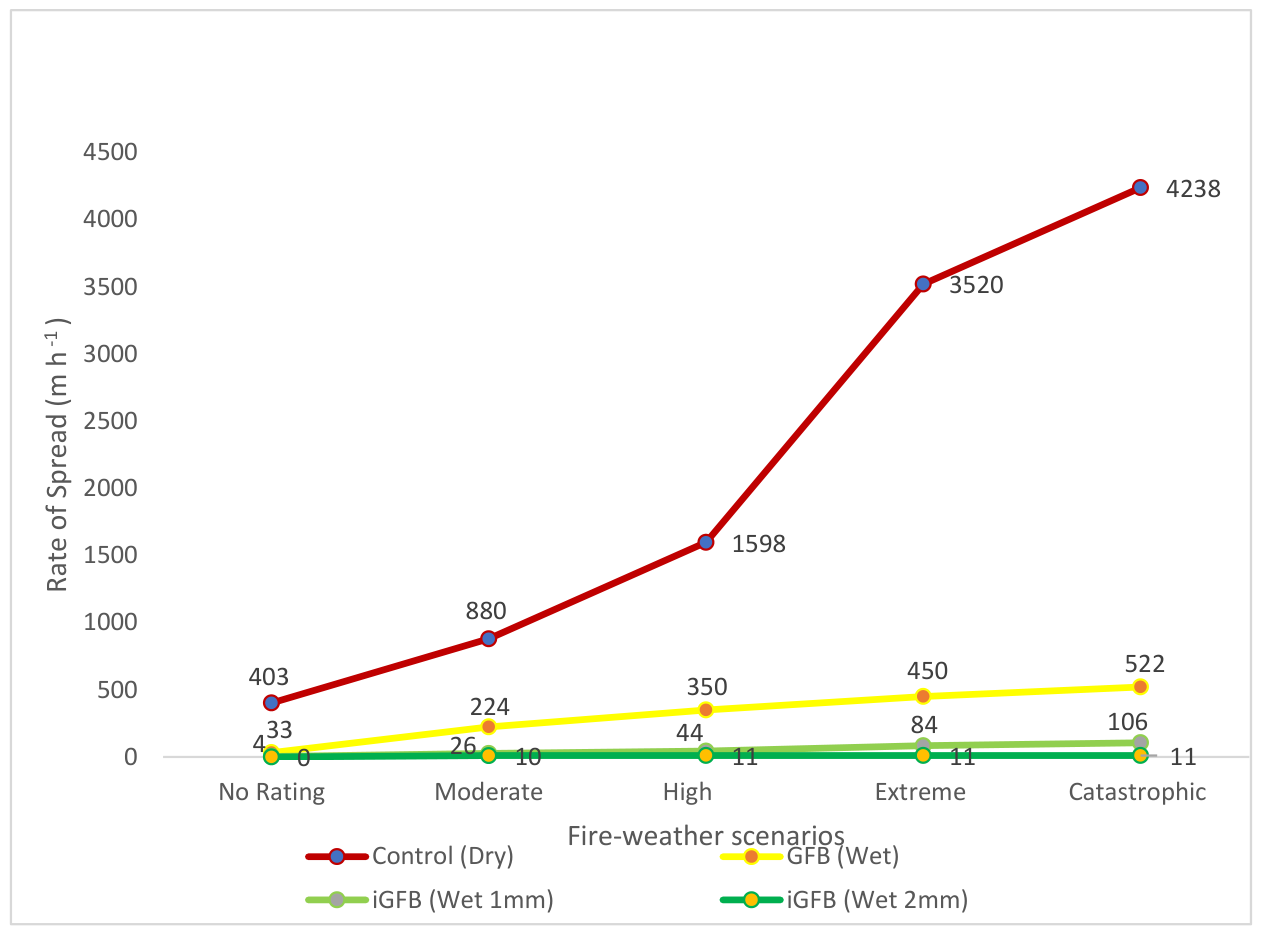
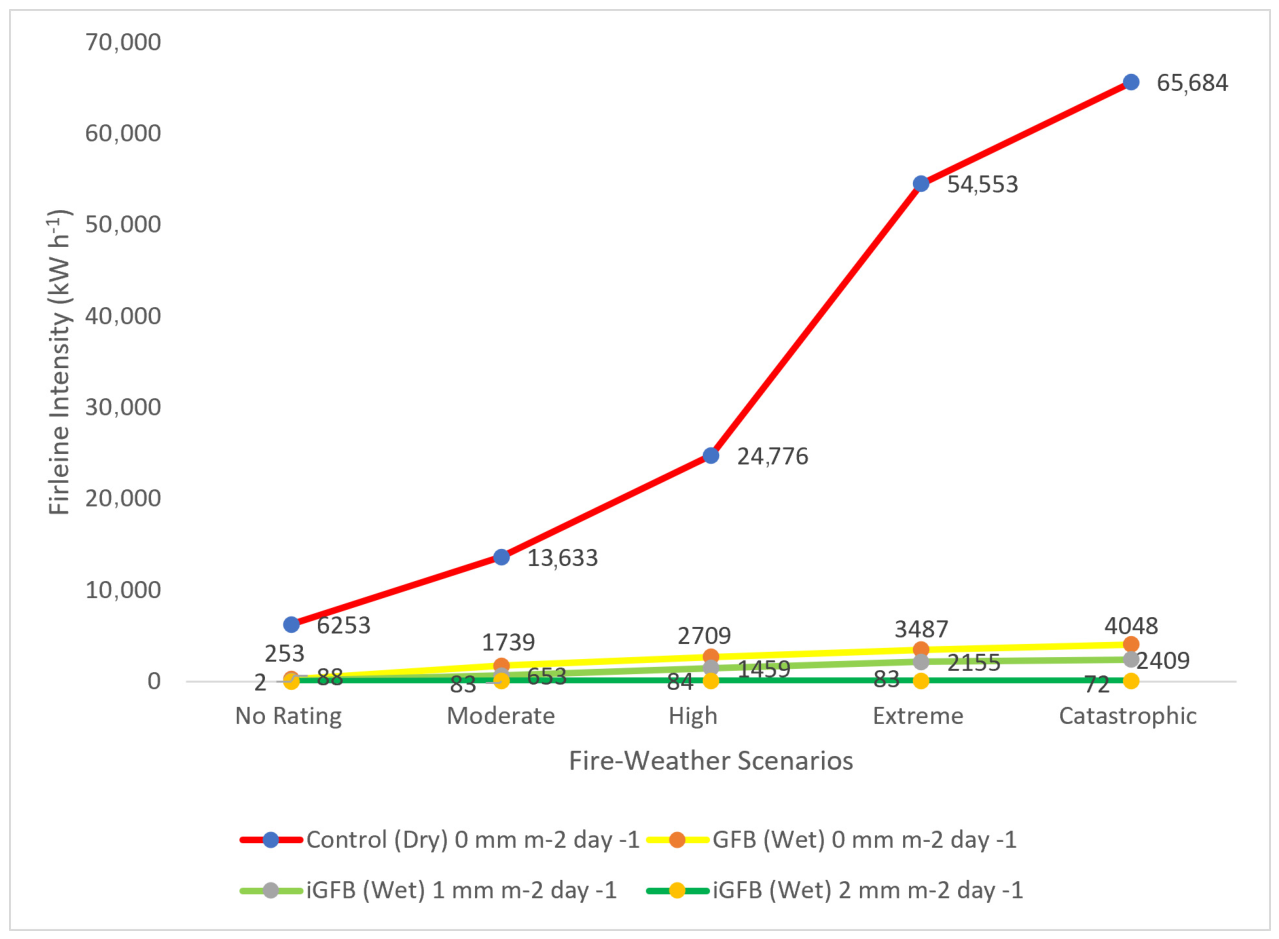
This study used control, GFB, and iGFB scenarios to test whether irrigation could reduce modeled fire spread rate and fireline intensity under increasingly severe fire-weather conditions. Across the tested scenarios, the dry eucalypt control consistently produced the highest predicted rate of spread and fireline intensity, while the irrigated scenarios produced the lowest values. Even if iGFBs are effective at mitigating fire, it is important that households within the interface practice fire-risk reduction by using fire-resistant building materials and removing fuels close to the home, as most homes are lost to embers, although some could still penetrate under extreme conditions.
The control scenarios were intentionally configured to represent severe drought conditions and therefore indicate the types of behavior that may occur when low fuel moisture combines with worsening fire weather. Notably, even in the absence of elevated fire-weather conditions, the control scenarios produced fireline intensities above the indicative suppression threshold. This result reinforces concern about the influence of drought on fire behavior, even before additional fire-weather escalation is considered. In this respect, the results are consistent with research following the Black Summer fires, which identified drought and fire weather as stronger drivers of large fires than fuel alone [
75].
The non-irrigated GFB scenario performed better than the dry eucalypt control across the tested fire-weather classes, indicating that vegetation change alone may reduce predicted fire behavior relative to drought-affected dry eucalypt conditions. However, the non-irrigated GFB scenario exceeded the suppression threshold under catastrophic conditions. These findings suggest that the advantages of GFBs without irrigation are most evident under mild-to-moderate fire-weather conditions and are far superior to those of the dry eucalypt control, while also reinforcing concerns that such systems may lose effectiveness as vegetation dries under increasingly extreme conditions [
7,
8], especially when winds are not buffered.
By contrast, the irrigated scenarios exhibited benefits in fire spread and fireline intensity across all fire-weather scenarios, with greater benefits under more irrigation. Irrigating at 1 mm m−2 day−1 provides the greatest benefits when fire weather is absent; however, all these scenarios remained below Phase 3 and within suppression thresholds, reaching a maximum of 2409 kW m−1 as fire weather became catastrophic. The 2 mm m−2 day−1 scenarios transitioned to Phase 2 only under extreme and catastrophic fire weather, but the peak fireline intensity of 561 kW m−1 remains well within the suppression threshold. These findings suggest that irrigation may strengthen green firebreak function by maintaining lower fire behavior under severe drought and fire-weather conditions. In practical terms, lower spread rates and lower fireline intensities may increase the time available for warning, preparation, evacuation, or suppression.
AMICUS has provided a useful initial testing platform; however, several caveats or limitations are important to note, such as simplified design, proxy vegetation, and software adaptation. While this model provides an initial snapshot, validation would be strengthened through comparison with longer-duration real-fire behavior in dry and wet eucalypt systems; this is especially important as models assume homogeneity of fuels, whereas in practice, site characteristics alter fuels, moisture, and microclimate. Future research would benefit most from validation using empirical field data, where non-irrigated and irrigated plots across diverse locations would enable direct measurements and increase confidence. This research is intended as a justification for field testing.
The AMICUS Vesta Mk2 fire spread model is mathematical, facilitates comparison, and is described as performing better than earlier models [
30]; however, errors may overpredict spread rates [
10]. While conservative prediction is generally preferable to underestimation in fire management contexts, this uncertainty still affects the interpretation of the absolute values generated by the model. The dry eucalypt control scenarios were classified by AMICUS as having
good model quality; the wet eucalypt design scenarios were classified only as
fair, which represents parameters just outside design tolerances; they were not classified as ‘poor’, which is well outside the design tolerances [
31]. In the AMICUS scenario results, it notes that the wet eucalypt is an adaptation of the dry eucalypt model and, as such, does not have ideal input boundaries. The
fair status is not a rejection of the data; it is a conditional flag, noting the need for further research, which is in part why the scenarios have been run [
29].
An anomaly was noted in the rate of spread results; at 2 mm m
−2 day
−1 irrigation, the rate of spread stabilized at moderate and higher fire weather (11 m h
−1) and then declined as the fire weather became extreme (10 m h
−1) and catastrophic (9 m h
−1). Given the small magnitude of this change, it did not alter the overall treatment pattern, but it may reflect a known trend toward reduced model performance at low spread rates or behavior near the limits of the model’s valid operating range [
16,
28]. This does not invalidate the comparison, but it does indicate lower confidence in the underlying validation of the design-side simulations.
Cross-model comparisons with alternative fire-behavior software would help to identify the consistency, strengths, and weaknesses of modeling approaches. This would be further enhanced through model comparisons with field data to cross-check modeled irrigation effects. Furthermore, sensitivity was measured through one-at-a-time parameter variation, and when comparing model and field data, this could be strengthened through multi-parameter approaches.
Together, these limitations highlight the need for future empirical testing to strengthen the validity of AMICUS; however, as a simplified and illustrative design, this model-based analysis identified the potential effects of vegetation and irrigation on fire behavior in a single case-study WUI landscape in southeast Queensland. The results should therefore be interpreted as conceptual rather than prescriptive but do justify the need for further empirical testing of the iGFB approach.
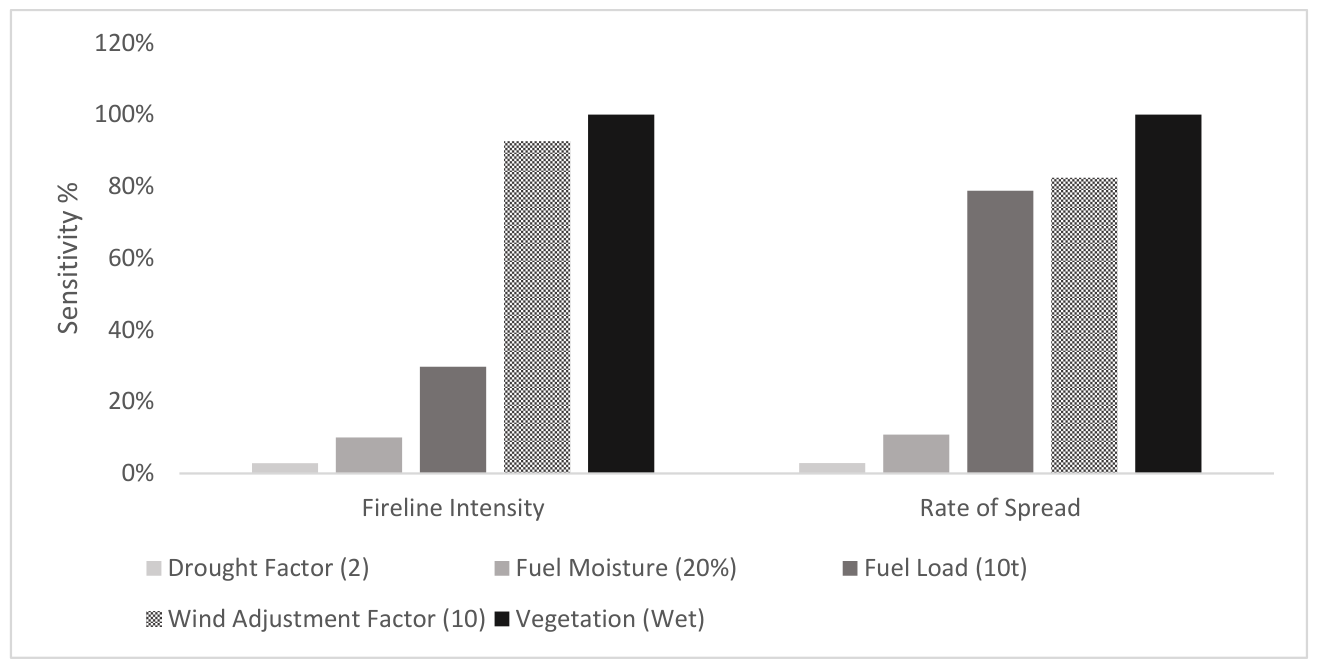
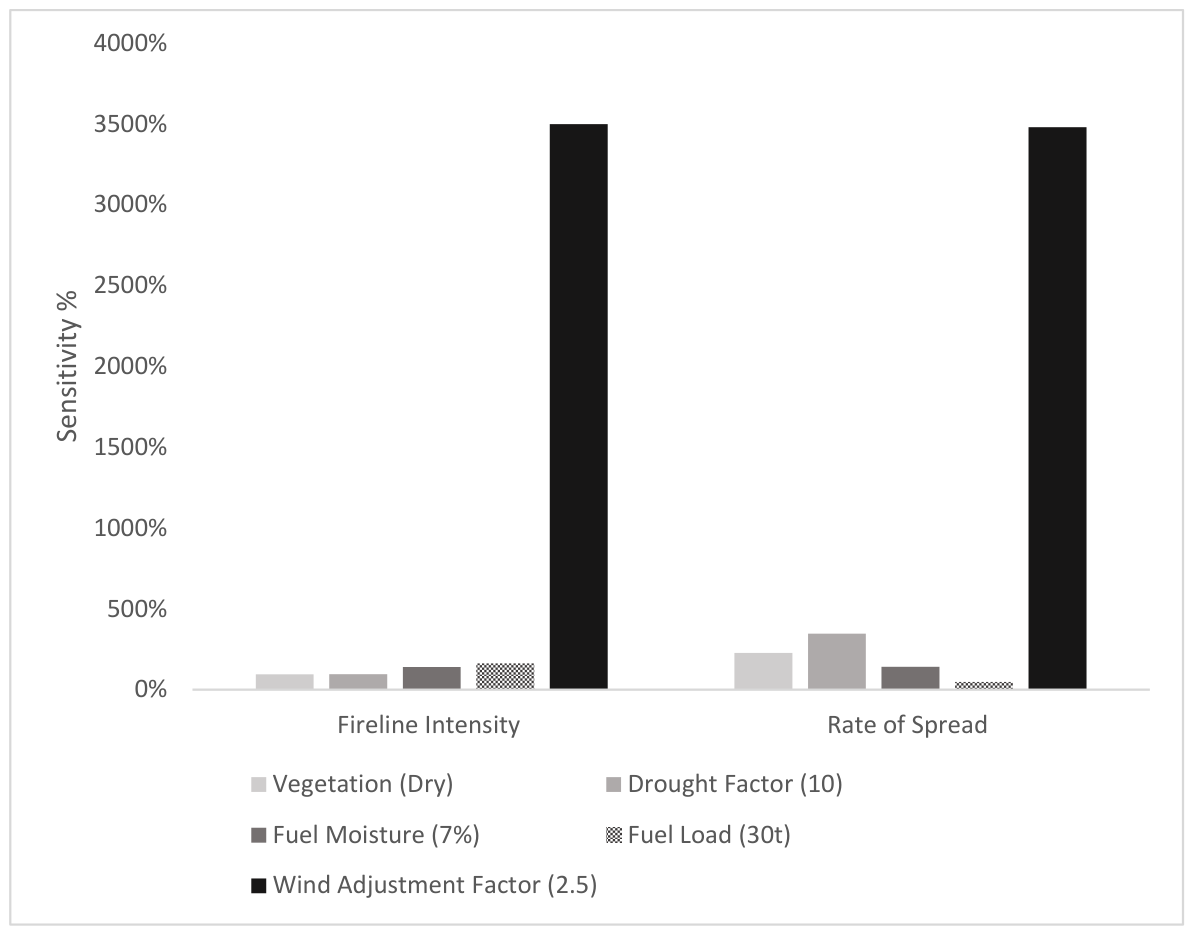
The sensitivity analysis reinforced consideration of drought and fire weather, as the AMICUS model is driven more by environmental factors such as moisture, wind, and vegetation than by fuel load. Although vegetation is a less dynamic variable, the model shows that changes in moisture and wind can dramatically alter fire behavior. At the same time, the sensitivity analysis suggested that although absolute values varied with parameter changes, the overall advantage of the iGFB scenarios was generally maintained across the tested range. This strengthens the interpretation that the effect of irrigation in the model was not solely an artefact of a single parameter setting.
More broadly, the present findings highlight both the usefulness and the limits of existing fire-behavior models when applied to novel, water-based mitigation concepts. The iGFB design intentionally manipulates vegetation and moisture, but these variables are not parameterized for this purpose within AMICUS, and the design scenarios rely on less-validated wet eucalypt proxy inputs. Further work is therefore needed to test whether the same patterns emerge under alternative modeling frameworks, broader parameter sets, and, ultimately, field-based investigation.
AMICUS provides a snapshot of the initial fire behavior rather than the full temporal complexity of a long-duration wildfire. The persistence and cascading nature of major wildfire events mean that the longer-term performance of irrigated green firebreaks cannot be inferred from the present modeling exercise alone [
76,
77]. Further research is therefore warranted on the feasibility, implementation, and trade-offs of irrigated green firebreaks, including issues such as vegetation selection, irrigation design, water sourcing, and longer-term system performance under real-world WUI conditions.
5. Conclusions
This study used a simplified modeling framework to provide preliminary consideration of how vegetation type and irrigation influenced predicted fire spread and fireline intensity in a wildland-urban interface (WUI) case study in Noosa, southeast Queensland, Australia. The results of this research showed that the control produced the highest fire behavior, as seen through fire spread rates and fireline intensity, while the iGFB design produced the lowest, supporting irrigation as a potential tool to strengthen GFBs.
More research is required to validate this preliminary and illustrative proof-of-concept, as it is based on a single modeling framework (AMICUS), has a simplified design (parameters), and uses adapted inputs (proxy vegetation and irrigation). The results support the iGFB concept, but caution is needed, and empirical validation through field data is required, especially regarding wind considerations.
These findings are important in a climate change context, as they suggest that irrigation may reduce fire behavior under increasingly severe fire-weather conditions. The sensitivity analysis confirmed the relative potential advantage of the iGFB design under these parameters. In this way, iGFBs may complement fire management in the WUI, especially compared to non-irrigated vegetation.
The iGFB approach should not be considered a stand-alone solution suitable for all settings or capable of stopping all fires; rather, it should be viewed as having site-specific potential within broader integrated fire management strategies. The iGFB design could have multiple values and will ultimately be dictated by the desired purpose and site characteristics; however, this research illustrates potential to complement existing fire management.
The principal contribution of this paper is the testing of irrigated green firebreaks as a proactive fire-mitigation concept within a region-specific modeling framework that is responsive to climatic heating and drying trends. On that basis, this study supports the case for further applied research to assess the feasibility, performance, and limitations of iGFBs under real-world conditions.