
Coal Spontaneous Oxidation Mechanism of Low-Molecular Compounds: Pentanol
Abstract
1. Introduction
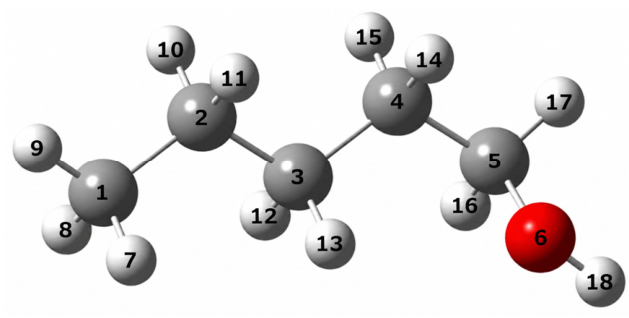
2. Geometric Configuration of Pentanol in LMCs
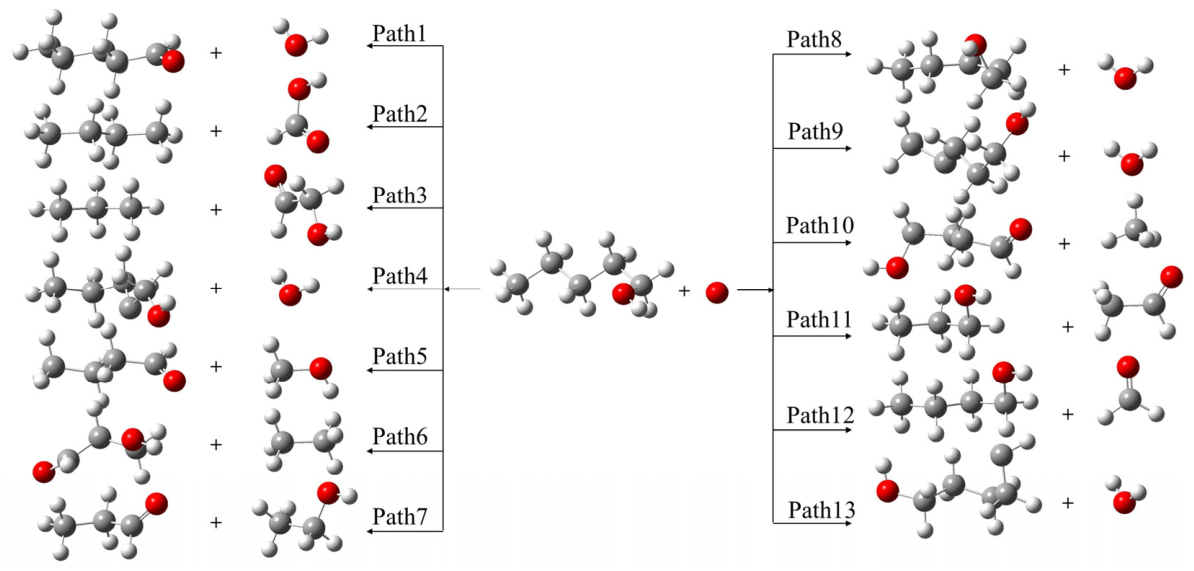
3. Active Site and Chemical Reactions That React with Oxygen in Pentanol Molecule
4. Calculations of Reactions in Pentanol in Coal
4.1. Analysis of Geometrical Configurations and Chemical Reaction Processes of Each Stationary Point
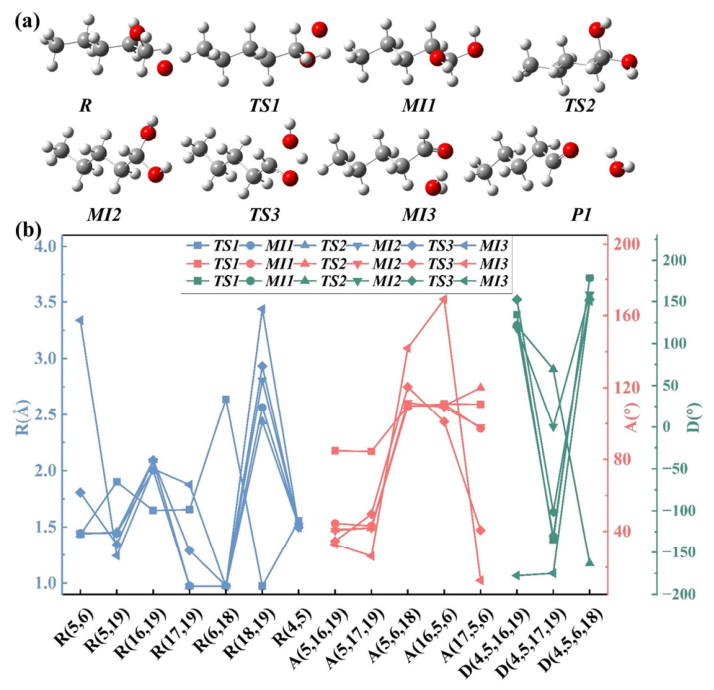
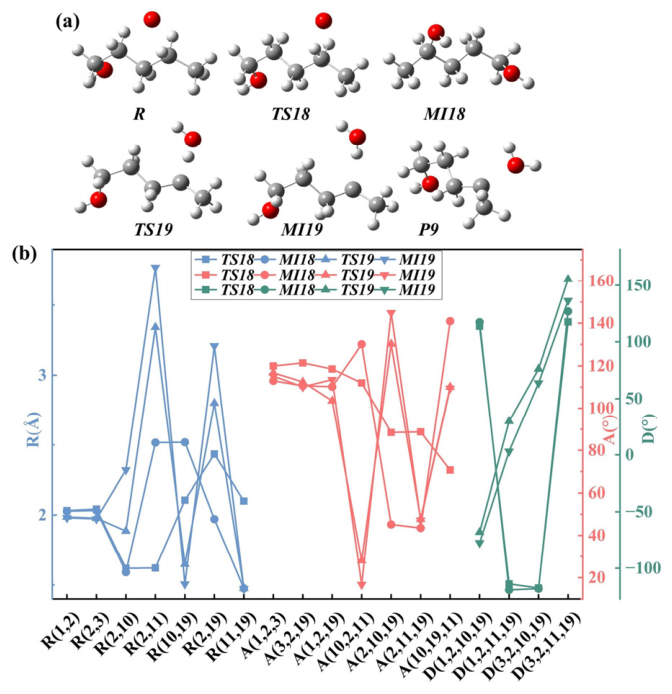
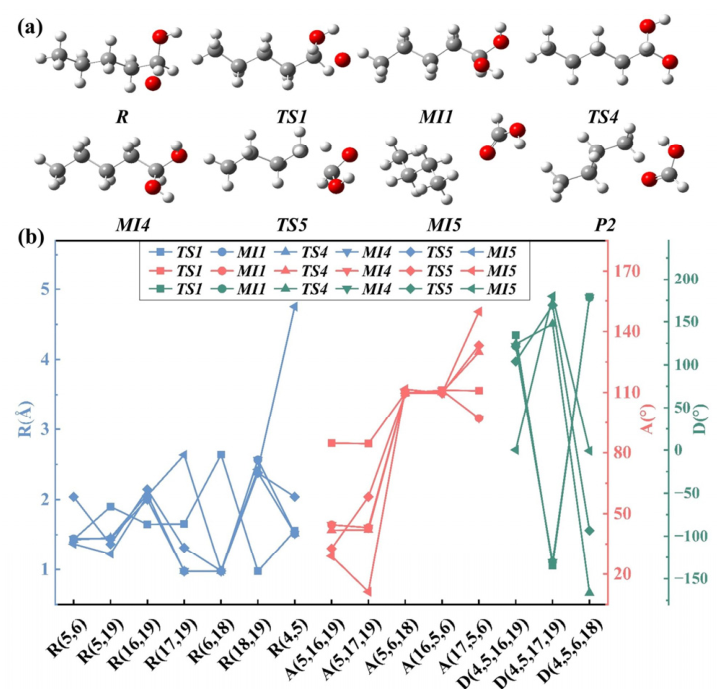
4.1.1. Geometric Configurations and Chemical Reactions of Path 1
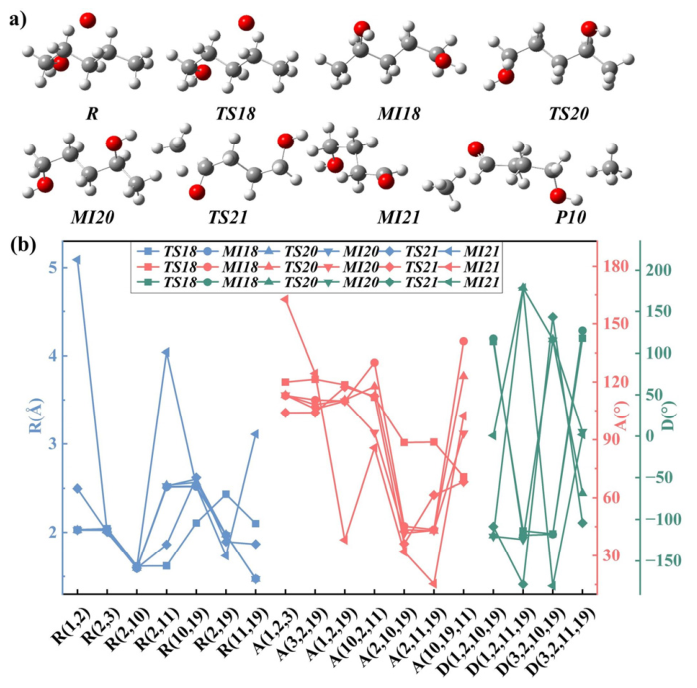
4.1.2. Geometric Configurations and Chemical Reactions of Path 2
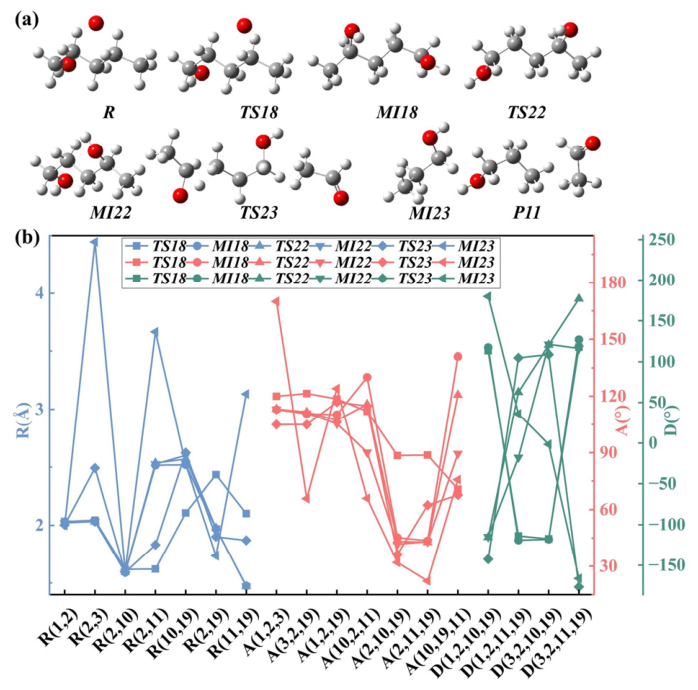
4.1.3. Geometric Configurations and Chemical Reactions of Path 3
4.1.4. Geometric Configurations and Chemical Reactions of Path 4
4.1.5. Geometric Configurations and Chemical Reactions of Path 5
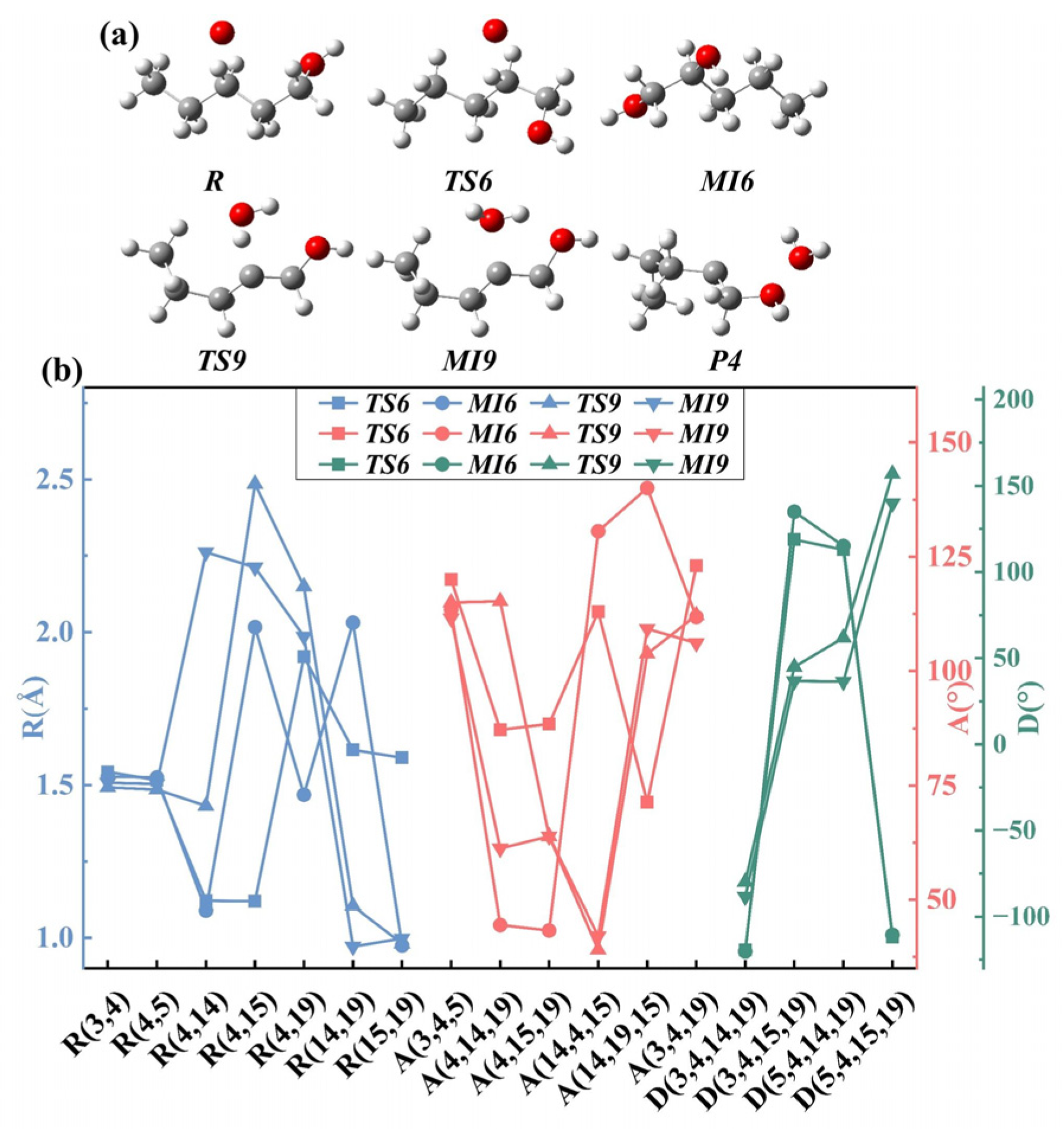
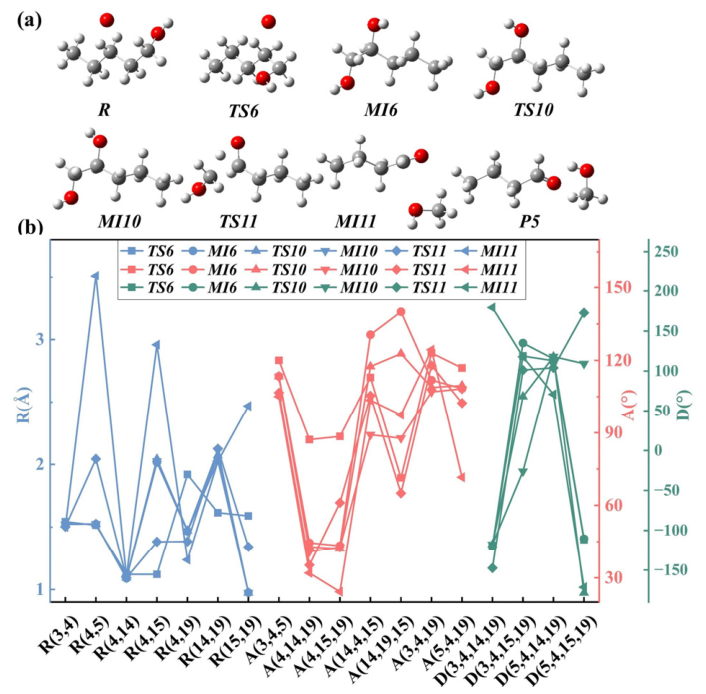
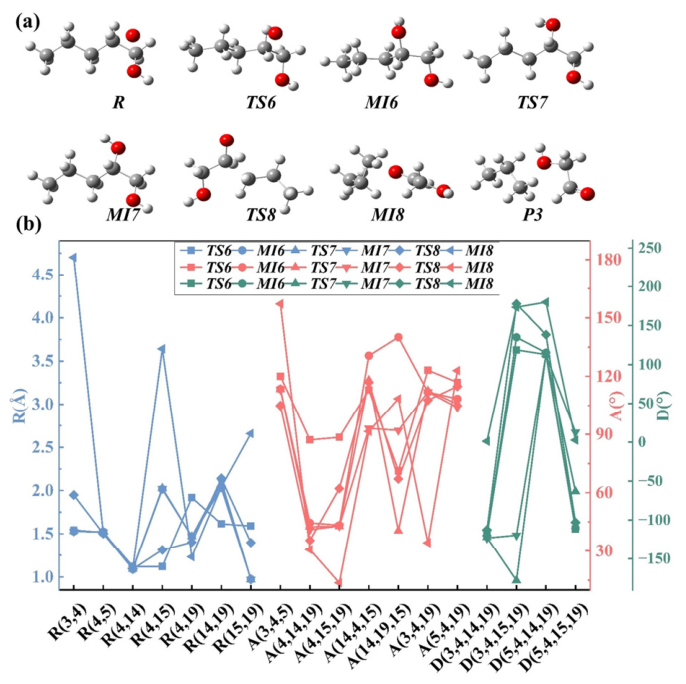
4.1.6. Geometric Configurations and Chemical Reactions of Path 6
4.1.7. Geometric Configurations and Chemical Reactions of Path 7
4.1.8. Geometric Configurations and Chemical Reactions of Path 8
4.1.9. Geometric Configurations and Chemical Reactions of Path 9
4.1.10. Geometric Configurations and Chemical Reactions of Path 10
4.1.11. Geometric Configurations and Chemical Reactions of Path 11
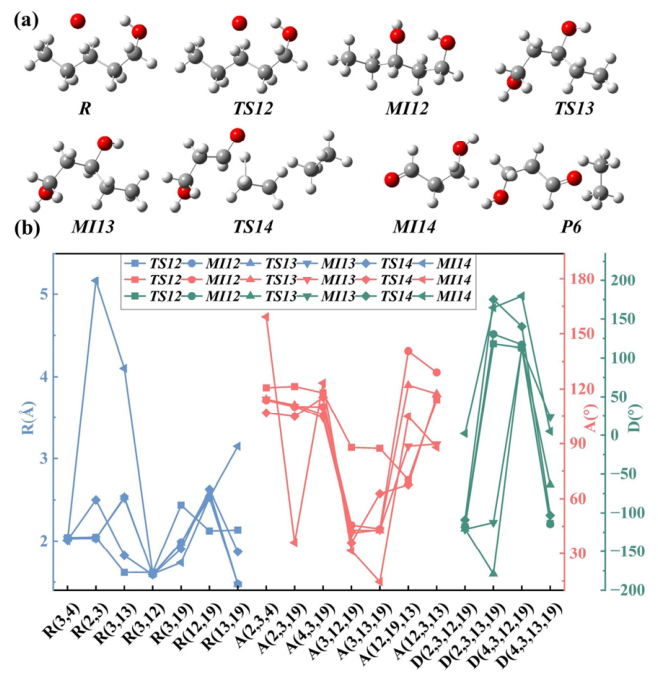
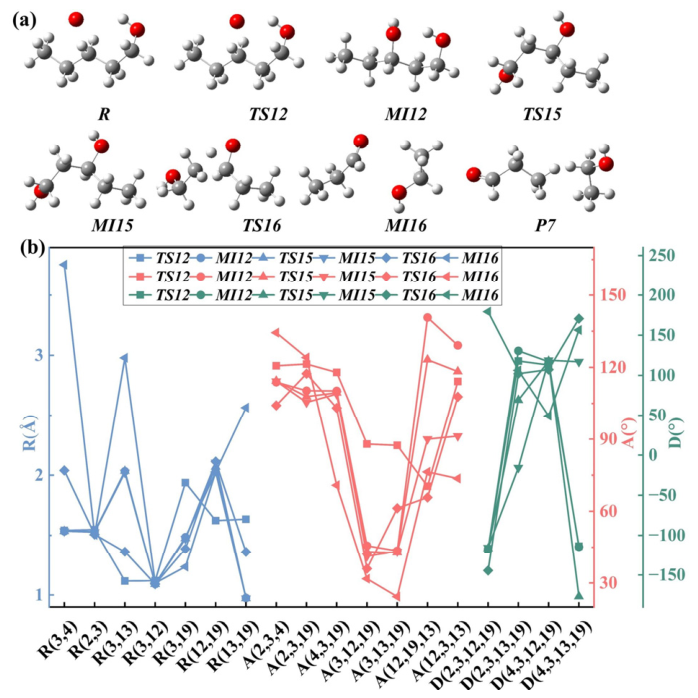
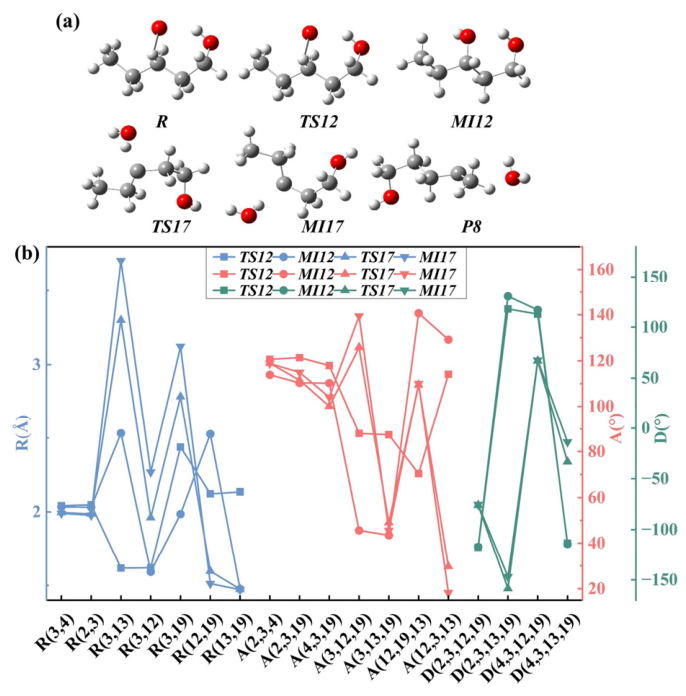
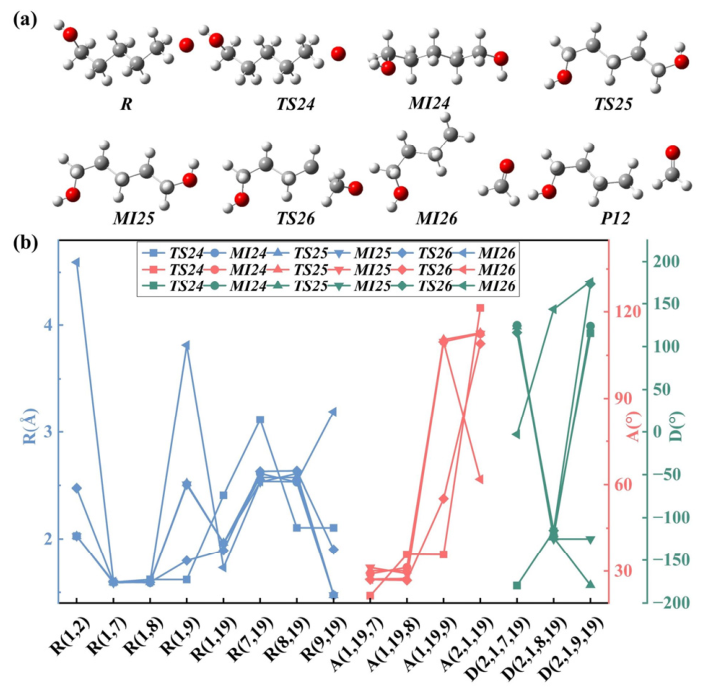
4.1.12. Geometric Configurations and Chemical Reactions of Path 12
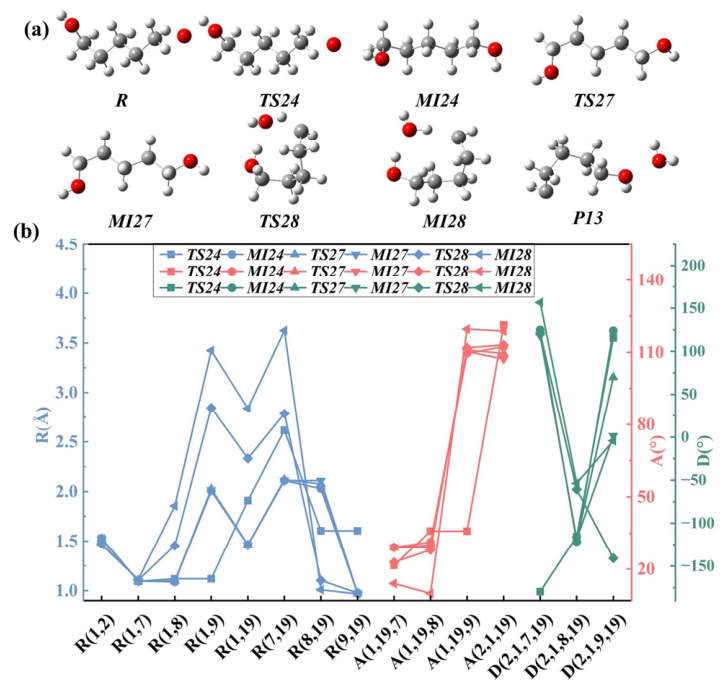
4.1.13. Geometric Configurations and Chemical Reactions of Path 13
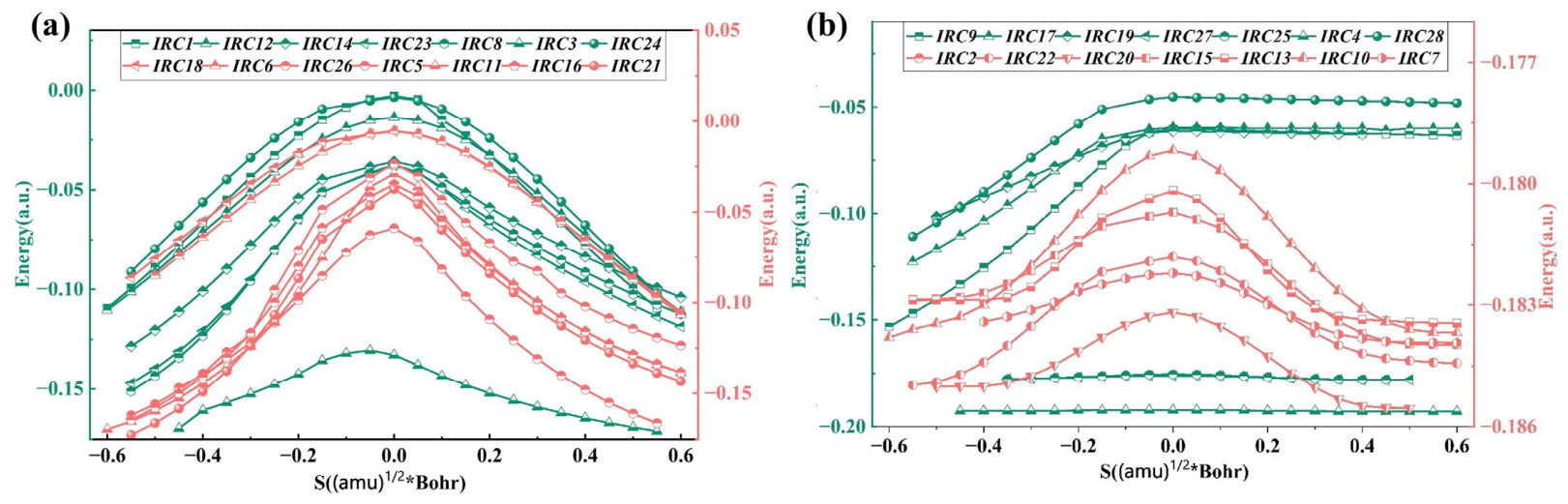
4.2. IRC Reaction Path Analysis
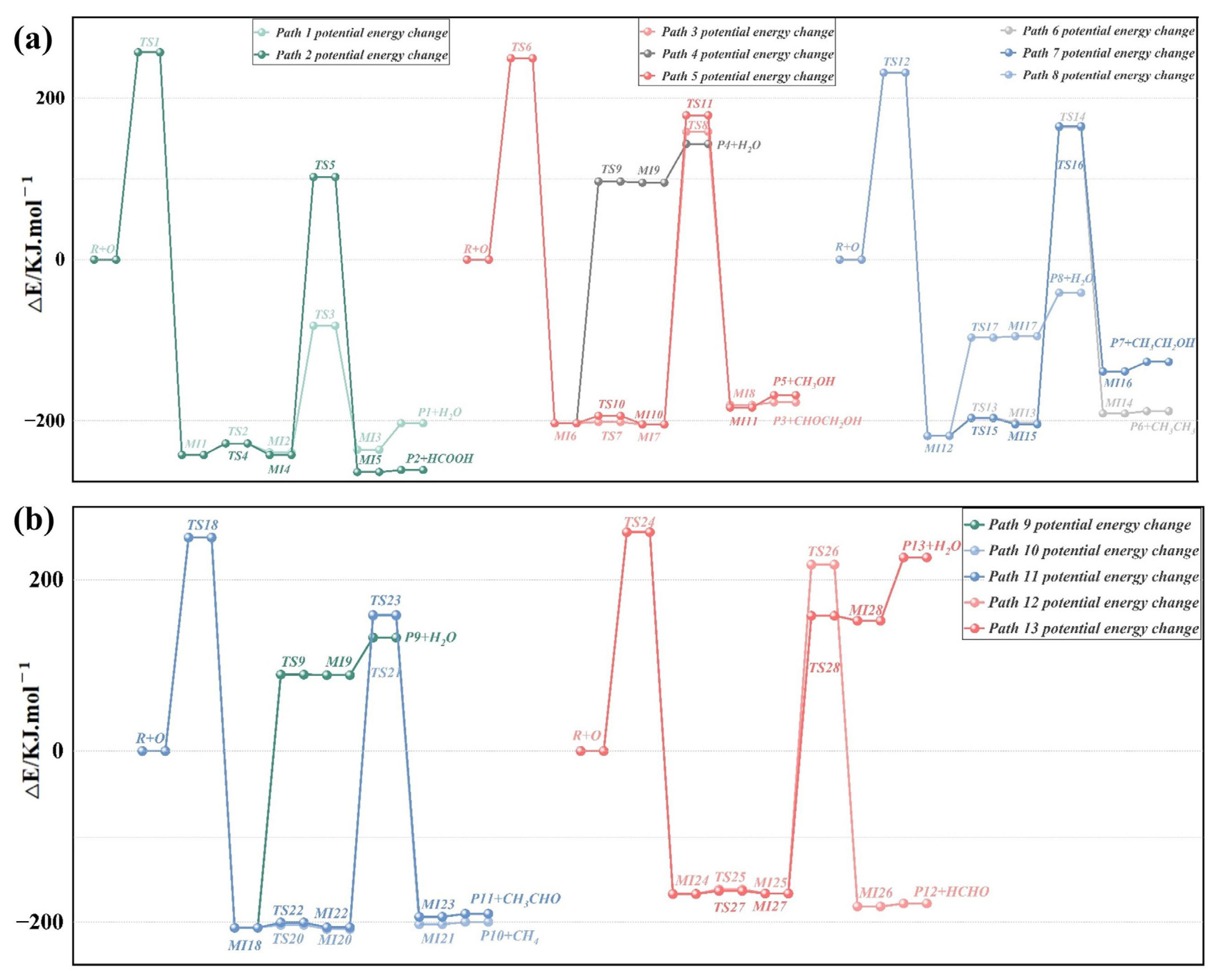
4.3. Calculation of Reaction Barriers
5. Conclusions
- (1)
- The interaction between oxygen and pentanol molecules in coal spontaneous combustion can be described by the following thirteen reaction pathways:
- (2)
- The active sites of pentanol in coal are from C1 to C5, with rate-controlling transition states TS1–TS28.
- (3)
- The reactivity order of the reaction paths is Path1 > Path9 > Path4 > Path8 > Path13 > Path2 > Path3 > Path11 > Path10 > Path6 > Path7 > Path5 > Path12. The dominant reaction in coal spontaneous combustion involves oxygen atoms attacking the -CH2OH group of pentanol, yielding CH3CH2CH2CH2CHO and H2O as the major products.
Author Contributions
Funding
Institutional Review Board Statement
Informed Consent Statement
Data Availability Statement
Conflicts of Interest
References
- Deng, J.; Li, X.; Wang, K.; Wang, W.; Yan, J.; Tang, Z.; Kang, F.; Ren, S. Research progress and prospect of mine fire intelligent monitoring and early warning technology in recent 20 years. Coal Sci. Technol. 2024, 52, 154–177. [Google Scholar]
- Anghelescu, L.; Diaconu, B.M. Advances in Detection and Monitoring of Coal Spontaneous Combustion: Techniques, Challenges, and Future Directions. Fire 2024, 7, 354. [Google Scholar] [CrossRef]
- Oliveira, M.L.; Pinto, D.; Tutikian, B.F.; da Boit, K.; Saikia, B.K.; Silva, L.F. Pollution from uncontrolled coal fires: Continuous gaseous emissions and nanoparticles from coal mines. J. Clean. Prod. 2019, 215, 1140–1148. [Google Scholar] [CrossRef]
- Zhai, Y.; Yang, Y.; Wu, L.; Liu, S.; Peng, L.; Li, L.; Yang, W.; Lei, J.; Sun, Z. Mechanisms and parameter optimization of nitrogen injection for controlling coal spontaneous combustion–gas coupling disaster in the goaf of ultra-long working faces. Appl. Therm. Eng. 2026, 294, 130532. [Google Scholar] [CrossRef]
- Li, L.; Ren, T.; Zhong, X.; Wang, J. Study of ambient temperature oxidation in low metamorphic coal and the oxidation mechanism. Energy 2022, 252, 124039. [Google Scholar] [CrossRef]
- Carroll, M.; Gao, C.X.; Campbell, T.C.; Smith, C.L.; Dimitriadis, C.; Berger, E.; Maybery, D.; Ikin, J.; Abramson, M.J.; Sim, M.R.; et al. Impacts of coal mine fire-related PM2.5 on the utilisation of ambulance and hospital services for mental health conditions. Atmos. Pollut. Res. 2022, 13, 101415. [Google Scholar] [CrossRef]
- Song, Z.; Kuenzer, C. Coal fires in China over the last decade: A comprehensive review. Int. J. Coal Geol. 2014, 133, 72–99. [Google Scholar] [CrossRef]
- Taraba, B.; Maršálek, R. Self-heating risk of coals and metal powders: A comparison. Fire 2024, 7, 378. [Google Scholar] [CrossRef]
- Danish, E.; Onder, M. Application of Fuzzy Logic for Predicting of Mine Fire in Underground Coal Mine. Saf. Health Work 2020, 11, 322–334. [Google Scholar] [CrossRef]
- Wang, H.; Dlugogorski, B.Z.; Kennedy, E.M. Theoretical analysis of reaction regimes in low-temperature oxidation of coal. Fuel 1999, 78, 1073–1081. [Google Scholar] [CrossRef]
- Jones, R.; Townend, D. Mechanism of the oxidation of coal. Nature 1945, 155, 424–425. [Google Scholar] [CrossRef]
- Onifade, M.; Genc, B. A review of research on spontaneous combustion of coal. Int. J. Min. Sci. Technol. 2020, 30, 303–311. [Google Scholar] [CrossRef]
- Huang, J.; Tan, B.; Gao, L.; Shao, Z.; Wang, H.; Chen, Z. A multi-channel reaction model study of critical primary and secondary active groups in the low-temperature oxidation process of coal. Energy 2023, 283, 129032. [Google Scholar] [CrossRef]
- Yoshiie, R.; Onda, M.; Ueki, Y.; Naruse, I. Oxygen chemisorption and low-temperature oxidation behaviors of sub-bituminous coal. J. Therm. Sci. Technol. 2019, 14, JTST0005. [Google Scholar] [CrossRef]
- Chen, X.; Liu, X.; Yao, Y.; Zhao, Z. Evolution law of active groups and reaction path analysis during low-temperature oxidation of coal. J. Min. Sci. Technol. 2024, 9, 998–1006. [Google Scholar]
- Zhang, Y.; Shu, P.; Deng, J.; Duan, Z.; Li, L.; Zhang, L. Analysis of oxidation pathways for characteristic groups in coal spontaneous combustion. Energy 2022, 254, 124211. [Google Scholar] [CrossRef]
- Qin, X.; Yang, T.; Liu, Z.; Liu, Q. Molecular structure, bond cleavage and their relation of four low-rank coals. Fuel Process Technol. 2022, 236, 107391. [Google Scholar] [CrossRef]
- Gao, Z.H.; Deng, C.; Wang, Y. Advanced chain-reaction modeling of coal autoxidation: Functional group mobility via quantum chemistry. Fuel 2026, 403, 136158. [Google Scholar] [CrossRef]
- Huo, Y.; Zhu, H.; He, X.; Fang, S.; Wang, W. Quantum chemistry calculation study on chain reaction mechanisms and thermodynamic characteristics of coal spontaneous combustion at low temperatures. ACS Omega 2021, 6, 30841–30855. [Google Scholar] [CrossRef]
- Zhu, H.; Huo, Y.; Fang, S.; He, X.; Wang, W.; Zhang, Y. Quantum chemical calculation of original aldehyde groups reaction mechanism in coal spontaneous combustion. Energy Fuels 2020, 34, 14671–14682. [Google Scholar] [CrossRef]
- Zhu, H.; Huo, Y.; Wang, W.; He, X.; Fang, S.; Zhang, Y. Quantum chemical calculation of reaction characteristics of hydroxyl at different positions during coal spontaneous combustion. Process Saf. Environ. Prot. 2021, 148, 624–635. [Google Scholar] [CrossRef]
- Wang, X.; Deng, H.; Deng, C.; Cui, C.; Shan, Y.; Song, Z. Study on the spontaneous combustion and oxidation mechanism of low molecular ketone compounds in coal. Fuel 2022, 321, 124022. [Google Scholar] [CrossRef]
- Cui, C.; Deng, H.; Deng, C.; Wang, X.; Shan, Y.; Song, Z. Study on the effect of low molecular hydrocarbon compounds on coal spontaneous combustion. Fuel 2022, 318, 123193. [Google Scholar] [CrossRef]
- Given, P.H.; Marzec, A.; Barton, W.A.; Lynch, L.J.; Gerstein, B.C. The concept of a mobile or molecular phase within the macromolecular network of coals: A debate. Fuel 1986, 65, 155–163. [Google Scholar] [CrossRef]
- Yan, L.; Wang, W.; Liu, Y.; Wang, M.; Li, F.; Bao, W. The roles of low molecular compounds on the light aromatics formation during different rank coal pyrolysis. J. Energy Inst. 2022, 100, 129–136. [Google Scholar] [CrossRef]
- Ramírez-Morales, D.; Masís-Mora, M.; Montiel-Mora, J.R.; Cambronero-Heinrichs, J.C.; Pérez-Rojas, G.; Tormo-Budowski, R.; Méndez-Rivera, M.; Briceño-Guevara, S.; Gutiérrez-Quirós, J.A.; Arias-Mora, V.; et al. Multi-residue analysis of pharmaceuticals in water samples by liquid chromatography-mass spectrometry: Quality assessment and application to the risk assessment of urban-influenced surface waters in a metropolitan area of Central America. Process Saf. Environ. Prot. 2021, 153, 289–300. [Google Scholar] [CrossRef]





| Number | Atomic Relation | Bond Length (Å) | Number | Atomic Relation | Bond Length (Å) |
|---|---|---|---|---|---|
| R1 | R (1,7) | 1.09 | R10 | R (3,4) | 1.54 |
| R2 | R (1,8) | 1.09 | R11 | R (4,14) | 1.09 |
| R3 | R (1,9) | 1.09 | R12 | R (4,15) | 1.10 |
| R4 | R (1,2) | 1.54 | R13 | R (4,5) | 1.52 |
| R5 | R (2,10) | 1.10 | R14 | R (5,16) | 1.10 |
| R6 | R (2,11) | 1.10 | R15 | R (5,17) | 1.10 |
| R7 | R (2,3) | 1.54 | R16 | R (5,6) | 1.46 |
| R8 | R (3,12) | 1.10 | R17 | R (6,18) | 0.97 |
| R9 | R (3,13) | 1.09 |
| Number | Atomic Relation | Bond Angle (°) | Number | Atomic Relation | Bond Angle (°) |
|---|---|---|---|---|---|
| A1 | A (7,1,9) | 107.6 | A17 | A (12,3,4) | 109.2 |
| A2 | A (7,1,2) | 107.8 | A18 | A (13,3,4) | 111.0 |
| A3 | A (8,1,9) | 111.0 | A19 | A (3,4,14) | 107.7 |
| A4 | A (8,1,2) | 107.7 | A20 | A (3,4,15) | 111.1 |
| A5 | A (9,1,2) | 111.1 | A21 | A (3,4,5) | 111.4 |
| A6 | A (1,2,10) | 111.4 | A22 | A (14,4,15) | 109.4 |
| A7 | A (1,2,11) | 109.4 | A23 | A (14,4,5) | 109.4 |
| A8 | A (1,2,3) | 109.4 | A24 | A (15,4,5) | 113.1 |
| A9 | A (10,2,11) | 113.1 | A25 | A (4,5,16) | 106.2 |
| A10 | A (10,2,3) | 106.2 | A26 | A (4,5,17) | 109.4 |
| A11 | A (11,2,3) | 109.4 | A27 | A (4,5,6) | 109.0 |
| A12 | A (2,3,12) | 109.0 | A28 | A (16,5,17) | 109.2 |
| A13 | A (2,3,13) | 109.2 | A29 | A (16,5,6) | 109.8 |
| A14 | A (2,3,4) | 109.8 | A30 | A (17,5,6) | 113.2 |
| A15 | A (12,3,13) | 113.2 | A31 | A (5,6,18) | 106.6 |
| A16 | A (7,1,9) | 106.6 |
| Number | Atomic Relation | Dihedral Angle (°) | Number | Atomic Relation | Dihedral Angle (°) |
|---|---|---|---|---|---|
| D1 | D (7,1,2,10) | −178.6 | D21 | D (2,3,4,5) | 177.2 |
| D2 | D (7,1,2,11) | −62.6 | D22 | D (12,3,4,14) | 177.9 |
| D3 | D (7,1,2,3) | 59.2 | D23 | D (12,3,4,15) | 60.6 |
| D4 | D (8,1,2,10) | 61.7 | D24 | D (12,3,4,5) | −60.9 |
| D5 | D (8,1,2,11) | 177.7 | D25 | D (13,3,4,14) | −66.3 |
| D6 | D (8,1,2,3) | −60.5 | D26 | D (13,3,4,15) | 176.5 |
| D7 | D (9,1,2,10) | −58.4 | D27 | D (13,3,4,5) | 55.0 |
| D8 | D (9,1,2,11) | 57.6 | D28 | D (3,4,5,16) | 56.2 |
| D9 | D (9,1,2,3) | 179.3 | D29 | D (3,4,5,17) | 175.9 |
| D10 | D (1,2,3,12) | 57.7 | D30 | D (3,4,5,6) | −64.1 |
| D11 | D (1,2,3,13) | −58.8 | D31 | D (14,4,5,16) | 178.4 |
| D12 | D (1,2,3,4) | 179.6 | D32 | D (14,4,5,17) | −62.0 |
| D13 | D (10,2,3,12) | −64.6 | D33 | D (14,4,5,6) | 58.0 |
| D14 | D (10,2,3,13) | 178.9 | D34 | D (15,4,5,16) | −66.1 |
| D15 | D (10,2,3,4) | 57.3 | D35 | D (15,4,5,17) | 53.5 |
| D16 | D (11,2,3,12) | 179.7 | D36 | D (15,4,5,6) | 173.5 |
| D17 | D (11,2,3,13) | 63.2 | D37 | D (4,5,6,18) | 176.7 |
| D18 | D (11,2,3,4) | −58.5 | D38 | D (16,5,6,18) | 56.4 |
| D19 | D (2,3,4,14) | 56.0 | D39 | D (17,5,6,18) | −63.4 |
| D20 | D (2,3,4,15) | −61.2 |
| Atom | HOMO | C1 | C2 | C3 | C4 | C5 |
|---|---|---|---|---|---|---|
| Charge density (Hartree) | −0.25 | −0.52 | −0.34 | −0.31 | −0.35 | −0.09 |
| Symbol | Formula | Symbol | Formula |
|---|---|---|---|
| R/TS1 | CH3CH2CH2CH2CH2OH | TS15/MI15 | CH3CH2CH(OH)CH2CH2OH |
| MI1/TS2/MI2 | CH3CH2CH2CH(OH)CH2OH | TS16/MI16/P7 | CH3CH2CHO |
| TS3/MI3/P1 | CH3CH2CH2CH2CHO | TS17/MI17/P8 | CH3CH2C:CH2CH2OH |
| MI3/P1 | CH3CH2CH2CH2CHO | TS18 | CH3CH2CH2CH2CH2OH |
| TS4/MI4 | CH3CH2CH2CH2CH(OH)2 | MI18 | CH3CH(OH)CH2CH2CH2OH |
| TS5/MI5/P2 | CH3CH2CH2CH3 | TS19/MI19/P9 | CH3C:CH2CH2CH2OH |
| TS6 | CH3CH2CH2C:CH2OH | TS20/MI20 | CH3CH(OH)CH2CH2CH2OH |
| MI6/TS7/MI7 | CH3CH2CH2CH(OH)CH2OH | TS21/MI21/P10 | CHOCH2CH2CH2OH |
| TS8/P3 | CH3CH2CH3 | TS22/MI22 | CH3CH(OH)CH2CH2CH2OH |
| TS9/MI9/P4 | CH3CH2CH2C:CH2OH | TS23/MI23/P11 | CH3CH2CH2OH |
| TS10/MI6/MI10 | CH2(OH)CH2OH | TS24 | CH3CH2CH2CH2CH2OH |
| TS11/MI11/P5 | CH3CH2CH2CH3 | MI24/TS25/MI25 | CH2(OH)CH2CH2CH2CH2OH |
| TS12 | CH3CH2CH2CH2CH2OH | TS26/MI26/P12 | CH3CH2CH2CH2OH |
| MI12/TS13/MI13 | CH3CH2CH(OH)CH2CH2OH | TS27/MI27 | CH2(OH)CH2CH2CH2CH2OH |
| TS14/MI14/P6 | CHOCH2CH2OH | TS28/MI28/P13 | HC:CH2CH2CH2CH2OH |
| MI14/P6 | CH(OH)CH2CH2OH |
Disclaimer/Publisher’s Note: The statements, opinions and data contained in all publications are solely those of the individual author(s) and contributor(s) and not of MDPI and/or the editor(s). MDPI and/or the editor(s) disclaim responsibility for any injury to people or property resulting from any ideas, methods, instructions or products referred to in the content. |
© 2026 by the authors. Licensee MDPI, Basel, Switzerland. This article is an open access article distributed under the terms and conditions of the Creative Commons Attribution (CC BY) license.
Share and Cite
Yang, T.; Wang, X.; Deng, W.; Liu, S.; Deng, H.; Shan, Y. Coal Spontaneous Oxidation Mechanism of Low-Molecular Compounds: Pentanol. Fire 2026, 9, 253. https://doi.org/10.3390/fire9060253
Yang T, Wang X, Deng W, Liu S, Deng H, Shan Y. Coal Spontaneous Oxidation Mechanism of Low-Molecular Compounds: Pentanol. Fire. 2026; 9(6):253. https://doi.org/10.3390/fire9060253
Chicago/Turabian StyleYang, Tianyi, Xiaobo Wang, Wenhao Deng, Sichen Liu, Hanzhong Deng, and Yafei Shan. 2026. "Coal Spontaneous Oxidation Mechanism of Low-Molecular Compounds: Pentanol" Fire 9, no. 6: 253. https://doi.org/10.3390/fire9060253
APA StyleYang, T., Wang, X., Deng, W., Liu, S., Deng, H., & Shan, Y. (2026). Coal Spontaneous Oxidation Mechanism of Low-Molecular Compounds: Pentanol. Fire, 9(6), 253. https://doi.org/10.3390/fire9060253