Article

Experimental Investigation on Liquid Film Dynamics and Fire Suppression Performance of Free Water Jets Impinging on Insulated Vertical Façades

1
School of Chemical Engineering and Technology, Tianjin University, Tianjin 300072, China
2
Tianjin Fire Science and Technology Research Institute of MEM, Tianjin 300201, China
3
Faculty of Urban Construction and Ecological Technology, Shanghai Institute of Technology, Shanghai 201418, China
*
Author to whom correspondence should be addressed.
Fire 2026, 9(6), 252; https://doi.org/10.3390/fire9060252 (registering DOI)
Submission received: 1 April 2026 / Revised: 31 May 2026 / Accepted: 10 June 2026 / Published: 12 June 2026

Abstract

To improve the efficiency of jet-based fire suppression for high-rise building façade fires, this study experimentally investigates the liquid film formation characteristics and fire suppression behavior of water jets impinging on insulated vertical surfaces. The effects of operating pressure (flow rate), nozzle-to-wall distance, and jet inclination angle on liquid film spreading morphology, wetted area, and effective water supply rate are systematically analyzed. The results show that increasing the flow rate significantly enlarges the wetted area, while reducing the effective water supply rate. As the nozzle-to-wall distance increases, the liquid film gradually develops a “top-wide and bottom-narrow” morphology. Although increasing the jet inclination angle decreases the wetted area, it enhances the continuity and stability of wall-adhering liquid film flow, thereby improving cooling efficiency near the flame root region. During the fire suppression experiments, low-flow-rate jets exhibit insufficient suppression stability, whereas high-flow-rate horizontal jets are capable of suppressing the flame to a residual burning state near the bottom of the façade. Further increasing the jet inclination angle enables complete flame extinguishment. This study reveals the relationship between jet parameters, liquid film behavior, and fire suppression performance, providing experimental evidence for the optimization of jet-based façade fire suppression strategies.

1. Introduction

Rapid fire propagation along the facade of high-rise buildings, often driven by combustible exterior materials, wind conditions, and building geometry, not only increases the difficulty of fire suppression but also raises the risk of secondary fires in adjacent floors or interior spaces. Recent high-rise curtain-wall fire incidents, such as the “11·15” teacher apartment fire in Shanghai in 2010 and the “11·26” Tai Po fire in Hong Kong in 2025, underscore that external wall fire safety remains a critical challenge in building fire protection. GB 55037-2022 [1] imposes strict classification requirements on the combustion performance of external thermal insulation materials for civil buildings: Class A (non-combustible) materials are required for assembly occupancies and buildings housing such occupancies; for residential buildings with a height greater than 100 m using non-cavity external wall insulation systems; for other civil buildings with a height greater than 50 m using non-cavity external wall insulation systems; and for buildings with a height greater than 24 m using cavity external wall insulation systems. However, a large number of older high-rise residential structures with aging envelopes cannot be feasibly upgraded to meet current standards [2]. Furthermore, even non-combustible materials may experience performance degradation over long-term exposure to thermal cycling, weathering, and environmental erosion, thereby increasing the potential risk of vertical flame propagation [3,4]. In this context, improving the early-stage control capability of facade fires has become an urgent priority. While water-jet suppression is a common fire-fighting tactic, its effectiveness in inhibiting facade fires depends on multiple factors including impact angle, flow rate, and distance, which still lack systematic experimental and theoretical investigation. Therefore, elucidating the underlying flame-suppression mechanisms under water-jet interaction carries considerable engineering significance and scientific relevance for optimizing the design of fire suppression systems in high-rise buildings and enhancing the efficiency of emergency response to facade fires.
Vertical facade fire spread and its suppression process exhibit unique characteristics. The fire spread mechanisms on high-rise building facades are complex due to cavity structures, material combustion behavior, and thermal-flow coupling effects, making them a critical focus in fire safety research. The combustion and flame spread of thermoplastic materials are governed by their distinct melting and pyrolysis mechanisms. The flame front can generally be divided into the pyrolysis zone, preheating zone, and unburned zone, while material thickness, inclination, and facade configuration (e.g., sidewalls, curtain walls) significantly influence flame spread behavior [5]. The “chimney effect” markedly accelerates fire development [6], and there exists a critical cavity width range (13–50 mm) within which vertical flame spread is most intense. Additionally, molten drips may form secondary ignition sources. Studies on the fire behavior of modern facade materials have revealed their inherently high fire hazards [7,8,9,10].
In recent years, research on facade fire protection has primarily focused on water-based suppression systems, emphasizing the effectiveness and parameter optimization of techniques such as water sprinklers, water curtains, water film, and water mist. Li et al. [11] and Zhao et al. [12] revealed through simulations the significant influence of spray angle and flow rate on temperature distribution and flame spread time in high-rise and recessed building facades, noting that appropriate parameter combinations enable cost-effective fire control. Li et al. [13] specifically studied the differential cooling effects of spray angle at various heights on facades. Du et al. [14] experimentally demonstrated the fire suppression effectiveness of water mist on vertical surfaces, emphasizing the critical roles of nozzle horizontal distance, spray angle, and spray orientation in determining suppression performance. Large-scale comparative tests by Meraner et al. [15] showed that external sprinkler systems can form a continuous water curtain to effectively suppress vertical flame spread, while high-pressure water mist systems achieve similar effects with significantly lower water consumption. Recent research by Li et al. [16] further supports the cooling and fire suppression effectiveness of water film in recessed facades. Regarding suppression mechanisms, studies generally agree that water-based systems achieve fire inhibition through multiple synergistic modes, including evaporative cooling of the fuel surface, steam-induced oxygen displacement, and attenuation of radiative heat flux. Novozhilov et al. [17] provided an early heat and mass transfer analysis of spray extinguishment of solid fires. Zhou et al. [18] evaluated the clean extinguishing performance of water mist under mechanical ventilation. Research by Węgrzyński et al. [19] confirmed that wetting protection from standard sprinklers can effectively maintain the integrity of glass curtain walls. Kraus-Namroży [20] et al. emphasized the influence of swirl nozzle atomization characteristics on fire suppression effectiveness. Additionally, Zhou et al.’s [21] numerical study on fire spread and suppression in ultra-high voltage valve halls offers insights into fire behavior in vertical spaces. However, existing research still pays insufficient attention to “water jet” systems which is an active firefighting method with high momentum and penetration capability particularly regarding the transient thermal response mechanism of burning facades under strong jet impingement. This lack of mechanistic understanding hinders the refined design, performance optimization, and engineering application of jet technology in complex facade fire scenarios.
This study establishes an experimental platform to investigate jet flow suppression of vertical wall fire spread. A series of experiments were conducted to systematically examine the effects of jet flow rate, nozzle inclination angle, and nozzle-to-wall distance on the post-impingement behavior, protected area, and water utilization efficiency. Furthermore, experiments on the suppression of vertical wall fire spread were carried out to analyze the influence of nozzle inclination angle and jet flow rate on flame morphology, flame height, and temperature distribution. The findings provide a scientific basis for developing effective fire suppression strategies against vertical wall fires.

2. Materials and Methods

2.1. Experimental Apparatus

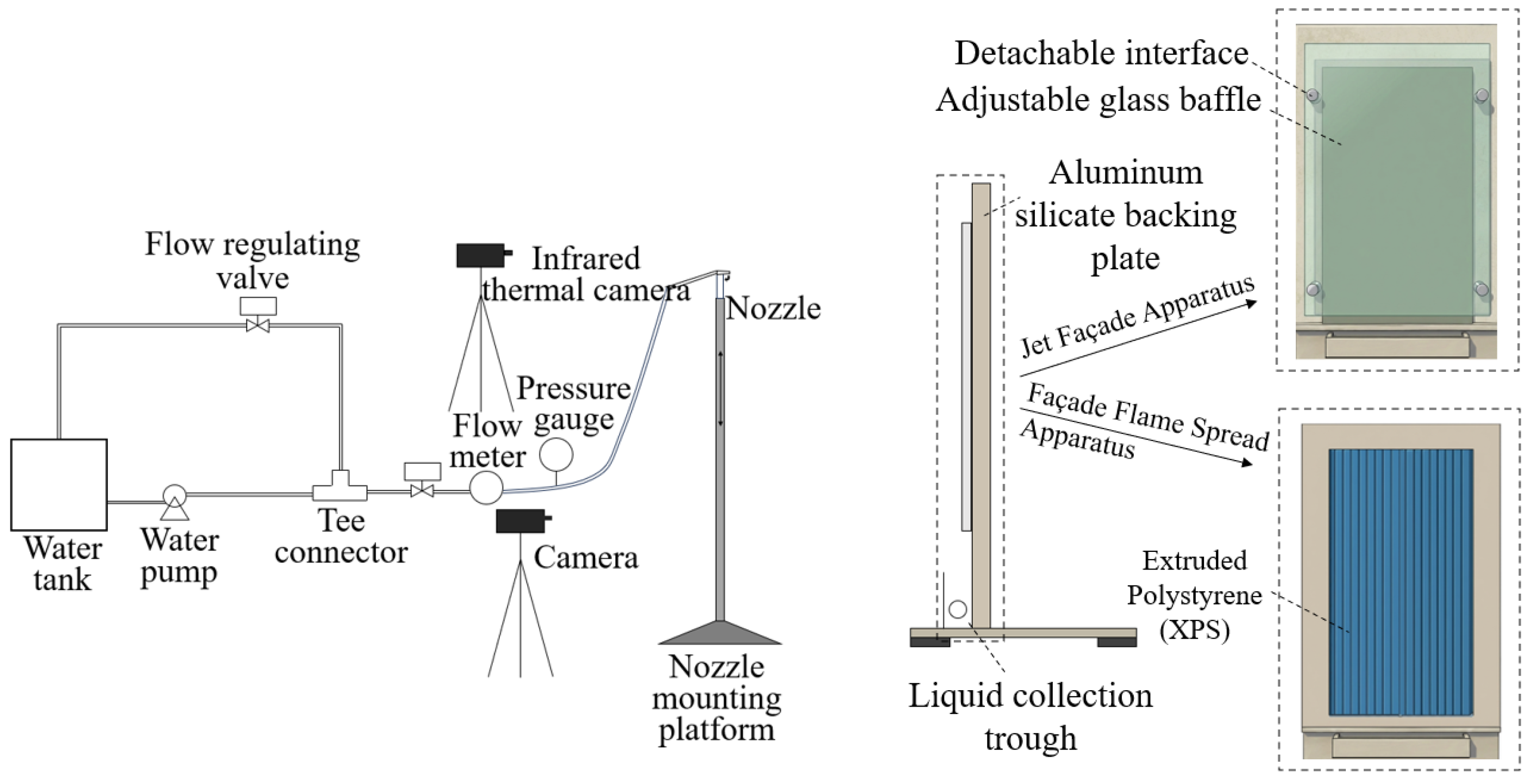
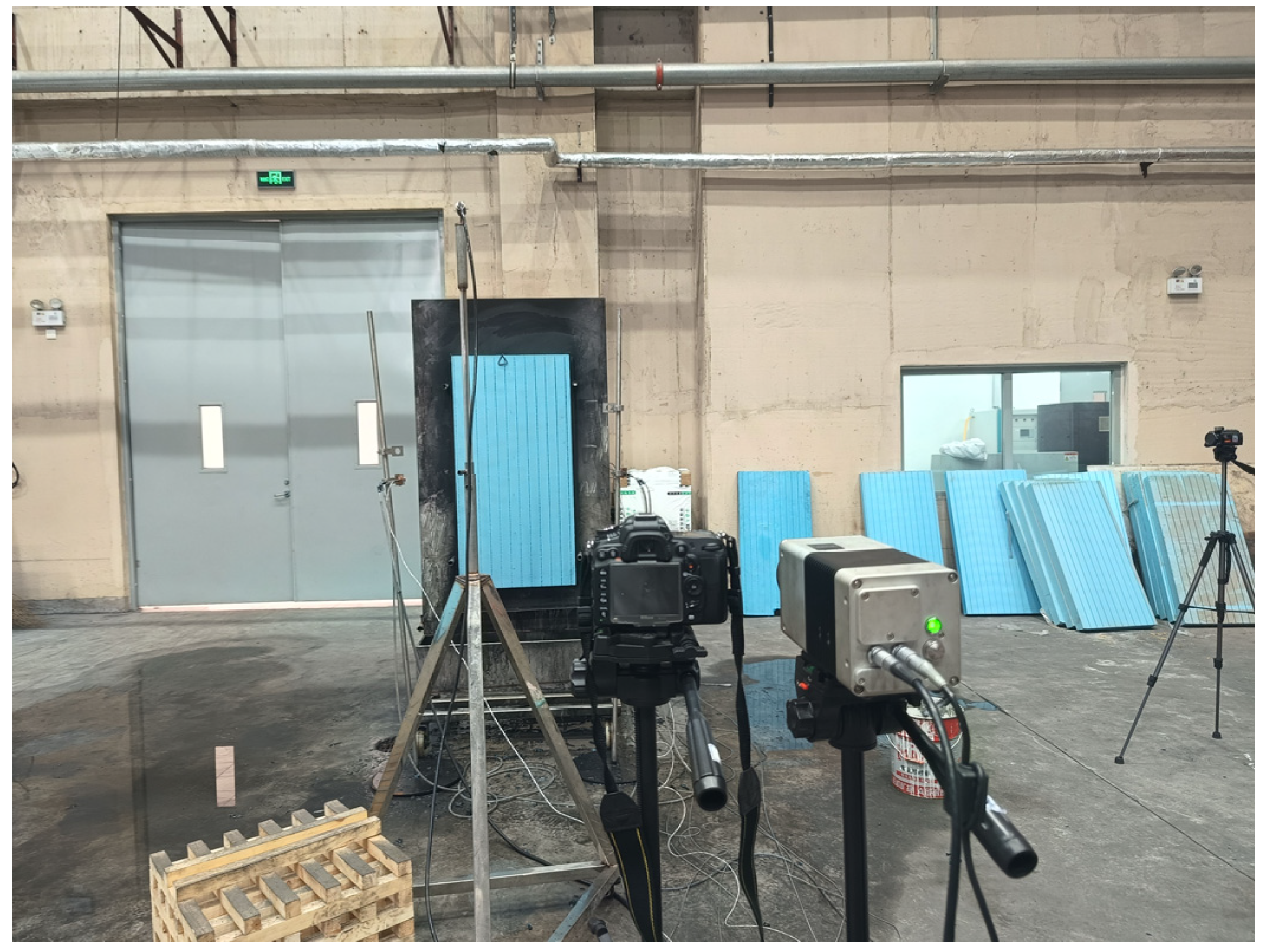
To conduct an experimental study on vertical jet fire suppression and investigate the effects of different flow rates, nozzle-to-wall distances, and nozzle inclination angles on the actual characteristics of water impingement on a vertical wall and the resulting fire extinguishing performance in preparation for subsequent fire suppression performance testing, a platform for vertical fire spread and jet suppression testing was designed and constructed. The setup consists of three main systems: a vertical fire spread apparatus, a water jet system, and a data acquisition system. Figure 1 shows the schematic diagram of the experimental apparatus, and Figure 2 shows a photograph of the actual experimental setup.
The vertical fire spread apparatus consists of an aluminum silicate backing plate, a liquid collection trough, and an ignition system. A detachable interface is provided in front of the aluminum silicate backing plate, which can be used to install adjustable glass baffles for jet characterization tests or to place Extruded Polystyrene (XPS) facade material for fire spread experiments. The water jet system includes a water tank, a pump, a flow regulating valve, a tee connector, a flow meter, a pressure gauge, piping, a straight nozzle with a diameter of 1.6 mm, and a nozzle fixation device, enabling stable control of the jet parameters. The data acquisition system integrates temperature, pressure, and flow rate sensors. The temperature field is measured using an InfraTec ImageIR 8355 research-grade cooled mid-wave infrared thermal camera (Dresden, Germany) at a frame rate of 1 fps. Pressure and flow rate are monitored by a 0–4 MPa (class 1.6) pressure gauge (Wanda, Tianjin, China) and a turbine flow meter (Wanda, Tianjin, China), respectively, and the signals are recorded by a Toprie TP1000 multi-channel temperature recorder (TOPRIE, Shenzhen, China) with a sampling interval of 1 s. The imaging system uses a DV camera (Sony, Tokyo, Japan) to record the flame spread and fire suppression processes at 25 fps.
The present study consists of two parts, jet impingement experiments on a vertical surface and façade fire suppression experiments. The two sets of experiments share the same jet apparatus, but the investigated jet parameter ranges are different. The detailed operating conditions are shown in Table 1 and Table 2, respectively. In the jet impingement experiments on the vertical surface, the target plate was a fire-resistant glass panel. The investigated operating pressure range and the corresponding flow rate range are 0.10–0.31 MPa and 1.18–1.89 L/min, respectively. Water flows through the pipeline and is discharged from the nozzle. The nozzle inclination angle is adjusted by changing the nozzle orientation, and the nozzle inclination angle can be rotated from 0° (horizontal) to −90° (vertically downward). The investigated nozzle inclination angle range is 2.86–14.03°. The dynamic process of the jet impinging on the non-combustible vertical surface is captured by an infrared thermal camera. During the experiment, a collection trough is placed 3 cm away from the plate surface to collect the liquid flowing down into the trough after passing over the plate surface. In addition, the nozzle-to-wall distance covers a range of 1.5–3.5 m. To verify the influence of jet flow rate and nozzle inclination angle on suppressing vertical wall fire spread, experiments of jet impingement on a burning vertical XPS board are also conducted. In real fire scenarios, the hot gas flow and radiation generated by XPS combustion significantly weaken the jet suppression effect, requiring higher momentum; therefore, the pressure is extended to 1.77 MPa (4.31 L/min), and this extrapolation is validated by the fire suppression experiments. The selected nozzle inclination angles include 0° and 30°. The 30° case is used to examine the effect of a large inclination angle combined with a high flow rate on fire suppression performance. After the experiment started, the jet flow rate was adjusted to the target value and the nozzle inclination angle was set to the target angle. The nozzle is turned on, and a shield is placed in front of the nozzle to ensure a stable jet flow before ignition without affecting the wall fire. Ignition is carried out at the center of the bottom edge of the XPS sample. After the flame spreads to the top of the board, the shield in front of the nozzle is removed, allowing the jet to act on the target area. The entire process from ignition to fire suppression is recorded by a video camera. It should be noted that the fire suppression medium used in this study is water. Table 3 [22] lists the physical properties of the experimental medium. The glass plate experiments are mainly used to reveal the fundamental effects of jet parameters on wetted area and effective water supply rate. Moreover, previous studies show that under high flow-rate conditions, the wetted area is primarily governed by jet momentum and is not sensitive to the wall surface material [23]. Based on these findings, the XPS fire suppression experiments are then conducted to directly examine the actual fire suppression behavior and effectiveness. Each set of experiments is repeated at least three times.
To eliminate the influence of differences in the jet impingement location on the vertical surface under different operating conditions on the measurement results, this study adopted a standardized method for defining the image analysis region. Specifically, on the captured liquid film images, an edge detection algorithm was first applied to automatically identify the highest point of the connected liquid film domain, which was then used as the reference to locate the top edge of the liquid film. Subsequently, a rectangular region of interest (ROI) with a fixed size of 50 cm × 60 cm was automatically cropped via program code. The positioning rule was as follows: the upper boundary of the ROI was aligned with the automatically identified top edge, and the main body of the liquid film was centered horizontally within the ROI. Through this treatment, regardless of variations in jet conditions, the liquid film analysis for all cases was constrained within the same spatial scale and relative positional range, avoiding errors caused by subjective judgment. The infrared images were processed using custom Python scripts. The development environment was Visual Studio Code (v1.123).

2.2. XPS Combustion

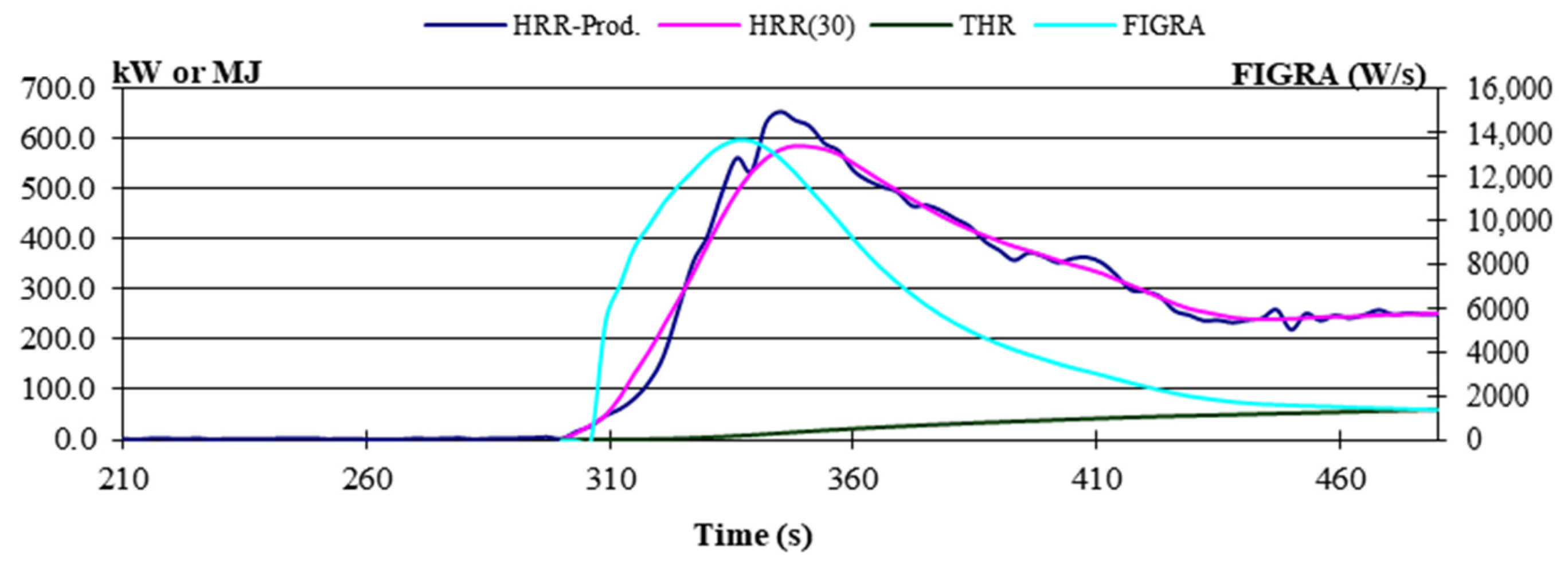
To analyze the combustion characteristics and patterns of the experimental material, XPS insulation boards with a thickness of 8 cm were selected. The combustion performance of the insulation material was tested in accordance with the single burning item (SBI) method specified in the Chinese national standard GB/T 20284-2006 [24]. The test results are presented in Table 4 and Figure 3.
The measurements showed that the fire growth rate indices (FIGRA(0.2) and FIGRA(0.4)) both reached 13,636.7 W/s at 336 s. These parameters represent the maximum value of the ratio of the heat release rate to time after the total heat release attains 0.2 MJ and 0.4 MJ, respectively. THR(600) and TSP(600) within 600 s after ignition were 139.3 MJ and 4770.6 m2, respectively. The SMOGRA, defined as the maximum ratio of smoke production rate to time, was 1528.1 m2/s2 at 324 s. HRR-Prod. and HRR(30) denote the total heat release rate of the specimen and the heat release rate with the 30 kW burner contribution subtracted, respectively. As shown in the HRR(30) curve, the peak heat release rate of 583.3 kW was reached at 348 s. Based on the test results, the material is classified as Class E (flammable) according to its combustion parameters. The smoke production rating is Class S3, and the flaming droplets/particles rating is Class d2.

2.3. Jet Breakup

The fundamental reason for the streamwise evolution of jet structure lies in the development of instabilities within the free shear layer and the continuous intensification of air entrainment. The shear layer formed between the high-speed jet and the quiescent ambient becomes unstable under the action of velocity gradients, inducing vortex structures and continuously entraining the surrounding gas, which causes the jet to expand in the transverse direction and leads to a progressive broadening of the axial velocity distribution in the transverse direction. During the free-jet stage without external forces, the overall axial momentum flux is approximately conserved; however, momentum is redistributed between the jet and the entrained fluid, resulting in a gradual decay of the mean axial velocity with downstream distance, accompanied by a corresponding increase in volumetric flow rate. As the instability further intensifies, the continuous liquid column undergoes breakup and progressively atomizes, forming a two-phase flow structure dominated by droplets. Jet breakup can be divided into primary breakup and secondary breakup: primary breakup achieves the initial discretization of the liquid, while secondary breakup completes the refinement and stabilization of droplet size [25]. The jet breakup length is defined as the axial distance from the nozzle exit to the location of primary breakup. Based on previous studies, Sallam [26] proposed a generally applicable empirical correlation for the breakup length of turbulent round liquid jets, expressed as Equations (1)–(3):
L c d = 5 W e 1 2 W e < 300 ,   R e < 5000
L c d = 2.1 W e 1 2 600 < W e < 3000
L c d = 11 ( ρ l / ρ g ) 1 2 3000 < W e
According to this equation, the breakup length ( L c ) under each operating condition is calculated, as summarized in Table 5.
Based on the relationship between jet breakup length and flow parameters, liquid jet breakup mechanisms are commonly classified into the dripping regime, the Rayleigh breakup regime, the first wind-induced breakup regime, the second wind-induced breakup regime, and the atomization regime. The transitions among these regimes are primarily governed by dimensionless parameters such as the Reynolds number (Re) and the Weber number (We). Accordingly, jet breakup regimes are categorized based on the magnitudes of We and Re, and the specific classification criteria are listed in Table 6 [27,28,29]. The relevant equations are given as follows:
W e g = ρ g u 2 d σ
W e l = ρ l u 2 d σ
R e = ρ l u d μ l
O h = μ l ρ l σ d = W e l 0.5 R e
The values of the gas Weber number ( W e g ), liquid Weber number ( W e l ), R e , and Ohnesorge number ( O h ) under different operating pressure conditions are calculated, and the results are listed in Table 7. According to jet breakup theory, when the inertial force of the surrounding gas reaches approximately 10% of the liquid surface tension, the jet enters the first wind-induced breakup regime. Under this condition, the influence of the ambient gas can no longer be neglected, and axisymmetric disturbances on the surface of the liquid column remain observable. As a result, the droplet size exhibits pronounced nonuniformity, with a broadened droplet size distribution.

3. Results

When the water jet impinges on a vertical wall, the liquid spreads along the surface to form a non-uniform water film. Part of the water droplets rebound and splash away, while the remaining portion flows downward along the wall, forming either a continuous or an intermittent liquid film. The regions covered by the water film can effectively cool the wall surface and block thermal radiation, thereby suppressing flame spread. To investigate the dynamic behavior of the jet on a vertical wall, the area of the liquid film formed after jet impingement is defined as S, and the amount of water collected in the tank is defined as Qr. The ratio of Qr to the actual discharged water volume is defined as the effective water supply rate (ε). The jet performance is evaluated using S and ε.

3.1. Phenomenon Analysis

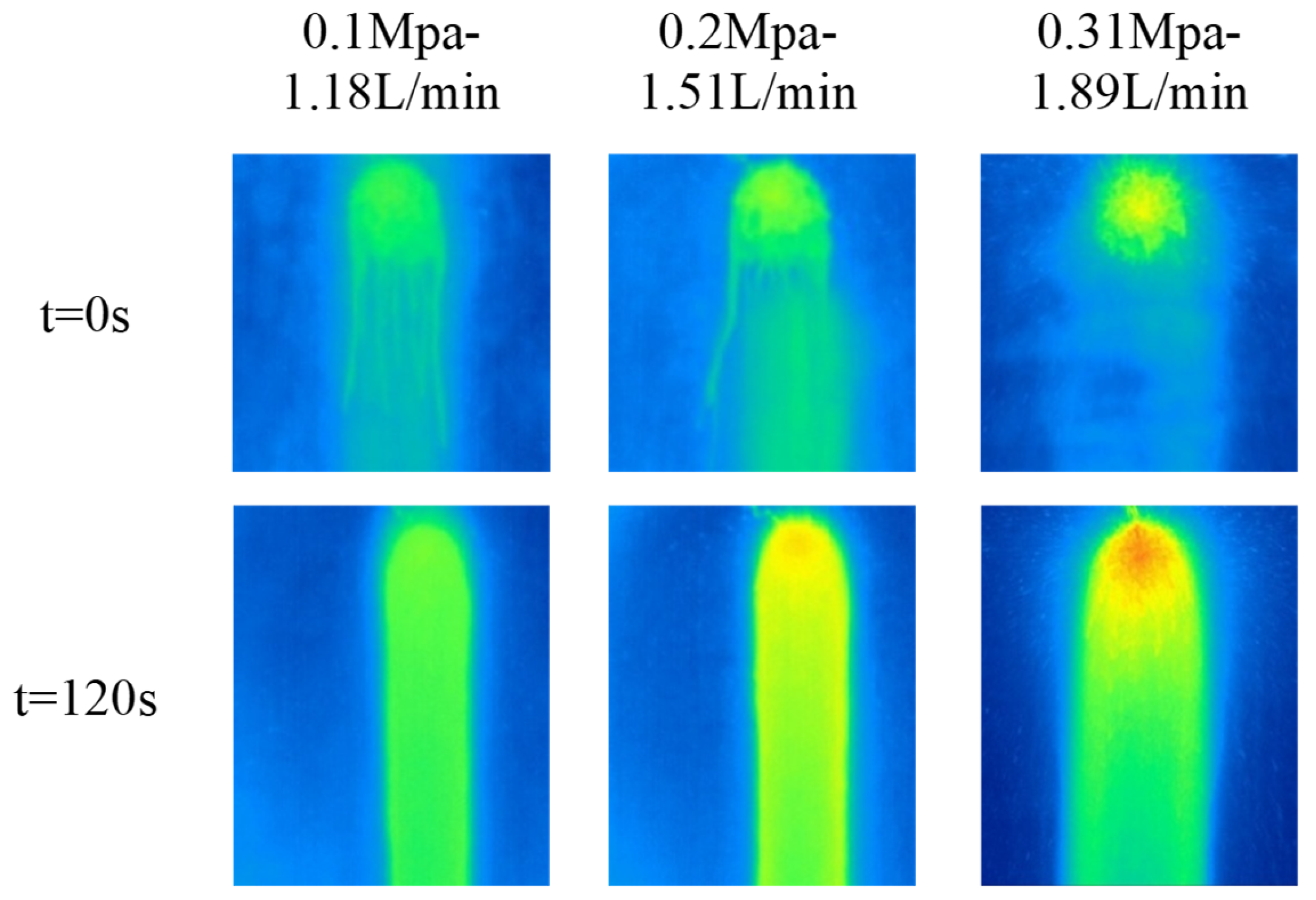
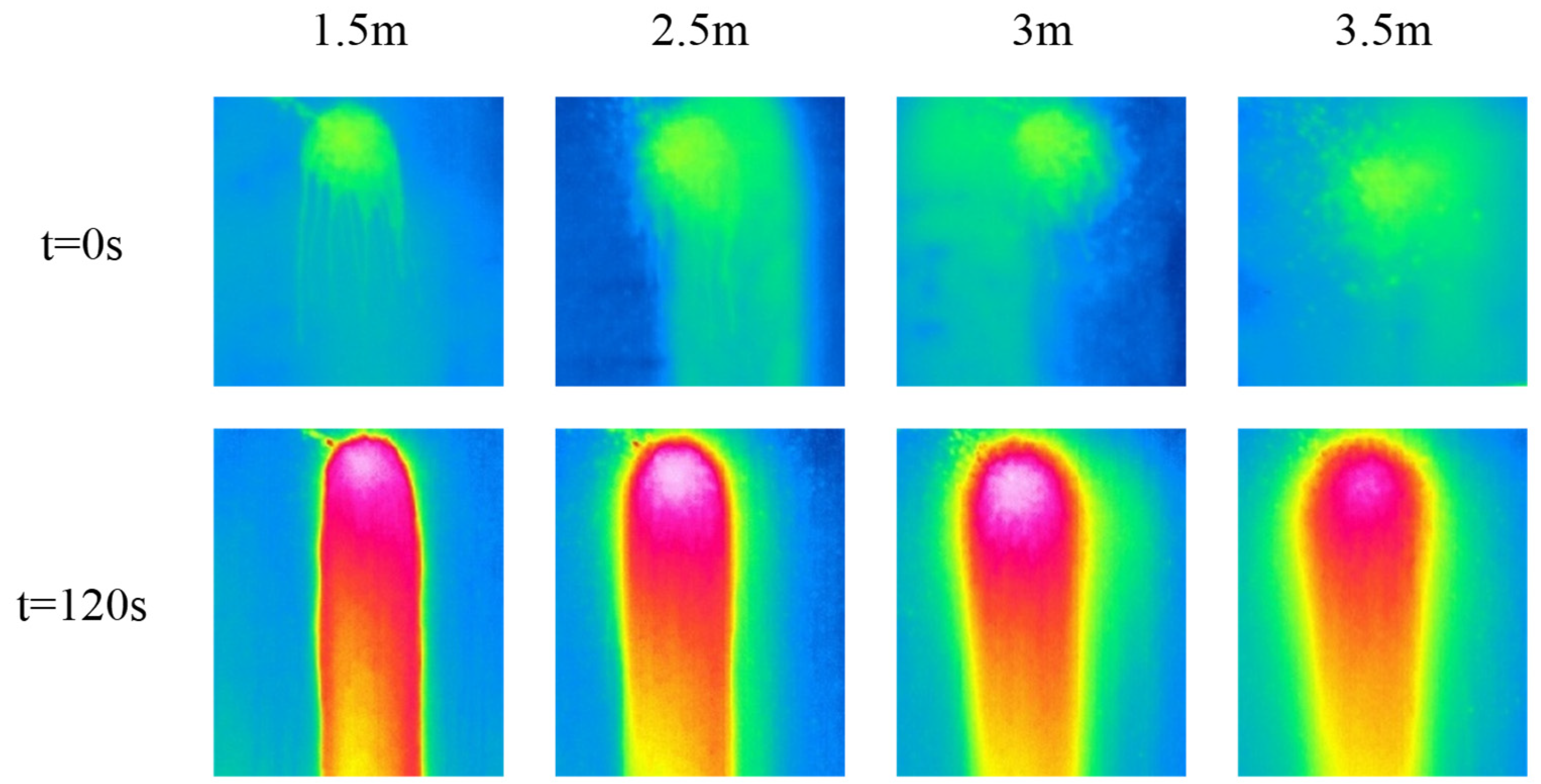
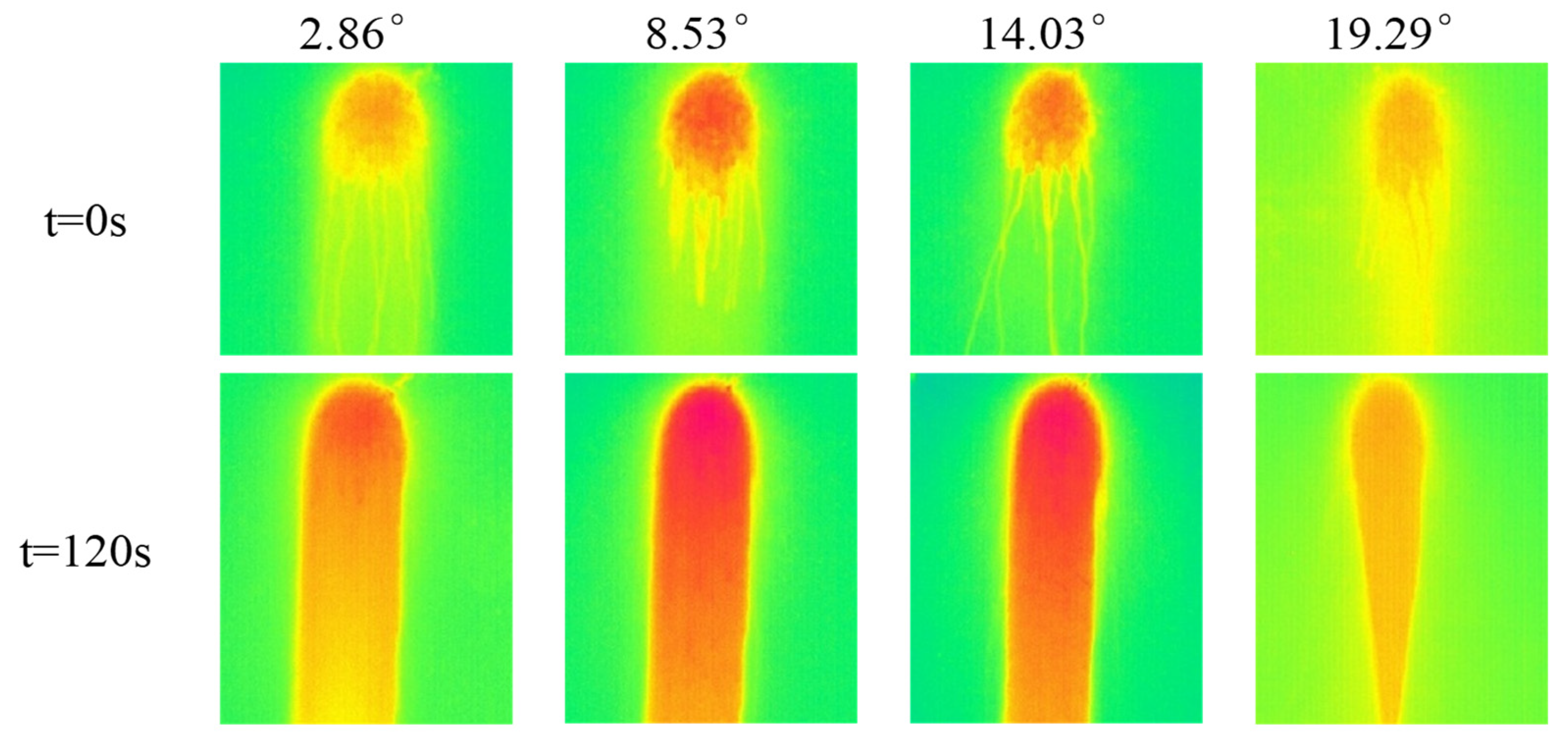
In this study, infrared thermography was employed to systematically investigate the dynamic formation and evolution of the liquid film during water jet impingement on a vertical wall. Particular emphasis was placed on the effects of key parameters, including operating pressure (flow rate), nozzle-to-wall distance, and nozzle inclination angle, on liquid film morphology. In the experiments, the nozzle-to-wall distance ranged from 1.5 m to 3.5 m, which was far greater than the calculated jet breakup length. Therefore, the jet had already undergone breakup before impingement, and the impingement process on the vertical wall corresponded to droplet impingement. Figure 4 shows the temporal evolution of the liquid film under different operating pressures (flow rates) at a nozzle-to-wall distance of 2.0 m, a nozzle height of 1.7 m, and a nozzle inclination angle of 0°. At t = 0   s , the infrared image corresponding to a jet flow rate of 1.89 L/min exhibits a more discrete liquid film structure compared with the other two flow conditions, displaying pronounced droplet-dominated characteristics. This behavior can be attributed to the fact that a higher jet flow rate results in a higher jet velocity and smaller droplet sizes [30]. At t = 120   s , it is observed that the liquid film area increases significantly with increasing operating pressure and flow rate, because a higher jet flow rate leads to a higher impingement velocity and greater initial spreading kinetic energy on the wall, thereby producing a larger spreading area. Figure 5 illustrates the temporal evolution of the liquid film under different nozzle-to-wall distances at an operating pressure of 0.31 MPa, a jet flow rate of 1.89 L/min, a nozzle height of 1.7 m, and a nozzle inclination angle of 0°, indicating that the nozzle-to-wall distance has a pronounced influence on liquid film formation. At t = 0   s , the wetted region on the vertical wall is mainly composed of a large number of fragmented droplets. For shorter nozzle-to-wall distances, droplets in the central wetted region exhibit a relatively concentrated distribution, whereas with increasing nozzle-to-wall distance, the resulting liquid film shows more evident droplet breakup and dispersion, indicating that the jet dispersion intensity is significantly enhanced after a longer free-flight distance in air. At t = 120   s , it can be clearly observed that increasing nozzle-to-wall distance enhances the instability of the jet at the impingement point, causing jet oscillation. As a result, the infrared images show a widening trend of the liquid film; however, due to the greater attenuation of jet energy at longer distances, the liquid film width in the lower part of the wall decreases, resulting in an “upper-wide and lower-narrow” morphology. It should be noted that gravity is always present, from the free jet stage to liquid film spreading, and causes the liquid film to flow down the wall. At short nozzle-to-wall distances, the jet momentum is high and the radial spreading capability is strong; the liquid film spreads fully in all directions, so the downward flow induced by gravity has little effect on the overall width. At long distances, the jet already undergoes significant breakup and dispersion in the free jet stage and reaches the wall as a dispersed droplet cloud; consequently, the initial wetted region is wide. However, due to severe momentum attenuation, most droplets lack sufficient kinetic energy upon impingement to continue flowing downward along the wall, and only part of the liquid forms a thin film that extends downward. As a result, the wetted width contracts significantly in the lower part, exhibiting a “top-wide and bottom-narrow” morphology. Figure 6 presents the variation in liquid film morphology with nozzle inclination angle at a nozzle-to-wall distance of 2 m, an operating pressure of 0.30 MPa, and a jet flow rate of 1.828 L/min. Taking the horizontal jet as an example, the liquid film exhibits a mottled, “wet-spot” pattern at the initial stage of formation, characterized by discontinuity and non-uniformity, with multiple streak-like tails appearing in the lower region. With continuous water supply, at t = 120   s , the discrete droplet impingement of the horizontal jet gradually evolves into a macroscopically continuous and dynamic liquid film. However, as the nozzle inclination angle increases, the liquid film on the wall surface becomes progressively narrower. This is because, when the nozzle-to-wall distance at the outlet remains unchanged, increasing the nozzle inclination angle effectively increases the actual jet travel distance. With increasing angle, greater jet energy dissipation occurs before impingement, leading to enhanced jet breakup, reduced flow velocity, and consequently a smaller spreading area on the wall. When the nozzle inclination angle is further increased, for example to 19.29°, the bottom of the liquid film is observed to become increasingly narrow. This behavior is attributed to further dissipation of jet energy, and the variation in nozzle inclination angle leads to a redistribution of radial momentum within the liquid film; as a result, a liquid film with a relatively uniform width from top to bottom, as observed at smaller nozzle inclination angles, cannot be formed.

3.2. Effect of Jet Flow Rate

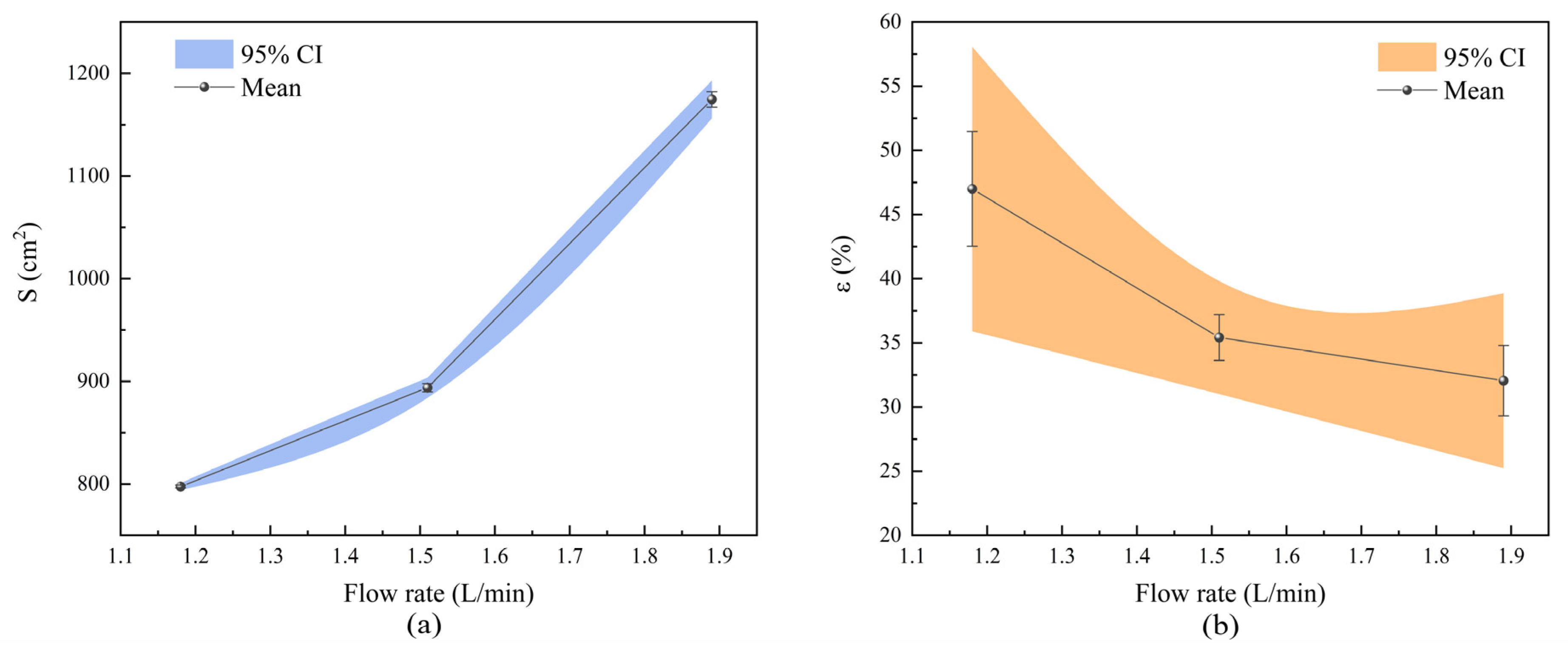
The effect of jet flow rate on the wetted area and effective water supply rate is shown in Figure 7. With the increase in jet flow rate, the wetted area and the effective water supply rate exhibit completely opposite trends: the wetted area increases monotonically with increasing jet flow rate, whereas the effective water supply rate shows a gradual decreasing tendency. From the perspective of the wetted area, the wetted region on the vertical surface exhibits a continuous expansion over the entire range of experimental flow rates. In the experiments, when the nozzle outlet cross-sectional area remains constant, an increase in jet flow rate directly leads to a higher outlet velocity, thereby resulting in a larger jet momentum. During jet impingement on the vertical wall, the enhanced jet momentum significantly intensifies the radial spreading of the liquid in the impingement region, strengthens the wall-parallel flow, and improves the capability of the liquid to spread outward along the surface. Consequently, the advancing capability of the wetting front is markedly enhanced, which promotes the continuous expansion of the wetted area on the vertical surface. However, it should be noted that although the increase in jet kinetic energy is favorable for liquid film spreading and wetted area enlargement, it simultaneously leads to additional breakup of the liquid film at the impingement point and more severe droplet splashing [30]. Under higher flow-rate conditions, the intensified interaction between the jet and the wall makes the liquid more prone to breakup, rebound, and splashing, causing part of the injected water to detach from the wall in the form of secondary droplets or thin liquid sheets and disperse into the surrounding air rather than remaining attached to the wall to form a stable liquid film. This detached portion of water is difficult to effectively collect and contributes little to sustained wall cooling or water utilization; therefore, despite the continuous increase in wetted area with increasing jet flow rate, the effective water supply rate decreases accordingly, leading to a pronounced divergence between the trends of wetted area and effective water supply rate.

3.3. Effect of Nozzle-to-Wall Distance

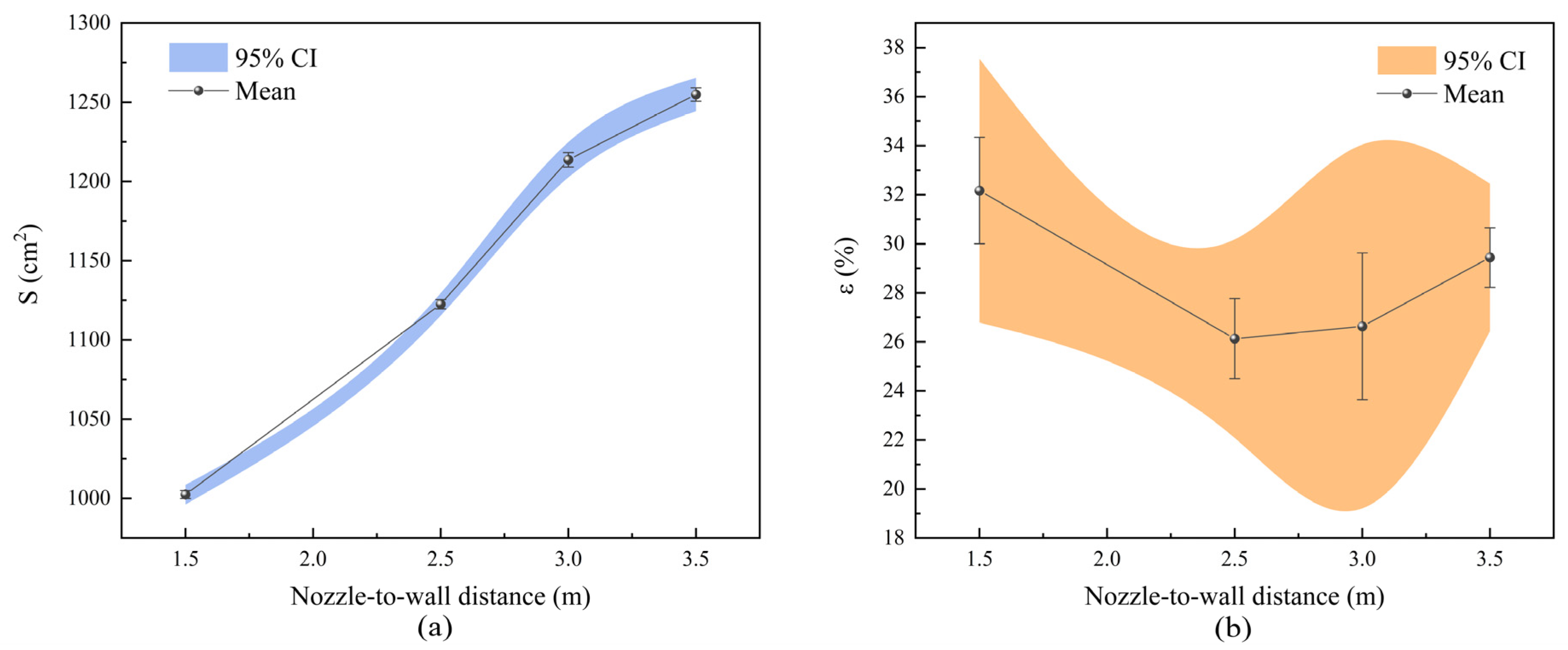
The effect of nozzle-to-wall distance on the wetted area and effective water supply rate is shown in Figure 8. As the nozzle-to-wall distance increases, the wetted area on the vertical surface shows an overall continuously increasing trend, whereas the effective water supply rate exhibits a non-monotonic variation characterized by an initial decrease followed by a subsequent recovery. Under short jet-distance conditions, namely when the nozzle-to-wall distance is 1.5 m, the jet travels a relatively short distance in air and is therefore subjected to limited aerodynamic drag and shear-induced disturbances. Although the impingement region is relatively concentrated and the resulting wetted area remains at a comparatively low level, most of the impinging water forms a semi-continuous liquid film along the wall and flows downward stably under the action of gravity, where it can be effectively collected by the water tank; consequently, the effective water supply rate remains high, and water losses due to splashing and rebound are relatively small. When the nozzle-to-wall distance increases from 1.5 m to 2.5 m, the free-jet region is significantly extended, and the cumulative effects of aerodynamic drag, turbulent fluctuations, and shear-layer instabilities become increasingly pronounced, causing substantial jet breakup and dispersion before the jet reaches the wall, with part of the liquid detaching from the jet core in the form of droplets or fine mist. Under these conditions, the jet impinging on the wall exhibits a highly dispersed structure, which is more prone to inducing intense splashing and rebound at the moment of impact, resulting in a large fraction of water being ejected from the wall as secondary droplets and dispersed into the surrounding air, thereby making effective interception and collection difficult and leading to a continuous decrease in the effective water supply rate with increasing nozzle-to-wall distance. When the nozzle-to-wall distance is further increased to 3.0 m and beyond, a partial recovery of the effective water supply rate is observed, indicating a change in the dominant jet–wall interaction mechanism; although the overall jet momentum is markedly reduced due to aerodynamic attenuation and the local impact intensity is weakened under long-distance conditions, the highly dispersed liquid contacts the wall over a larger spatial extent, significantly expanding the jet coverage on the vertical surface and further promoting the increase in wetted area, while the reduced liquid kinetic energy alleviates the impact force on the wall, suppresses splashing and rebound to some extent, and allows part of the liquid to reattach to the surface and flow downward in the form of an attached flow or thin liquid film that can be effectively collected, thereby contributing to the recovery of the effective water supply rate; in addition, at larger nozzle-to-wall distances, gravitational settling of droplets becomes more pronounced, lowering the effective impingement location and facilitating an increase in the amount of water entering the collection tank, which may also represent an important contributing factor to the observed recovery of the effective water supply rate.

3.4. Effect of Nozzle Inclination Angle

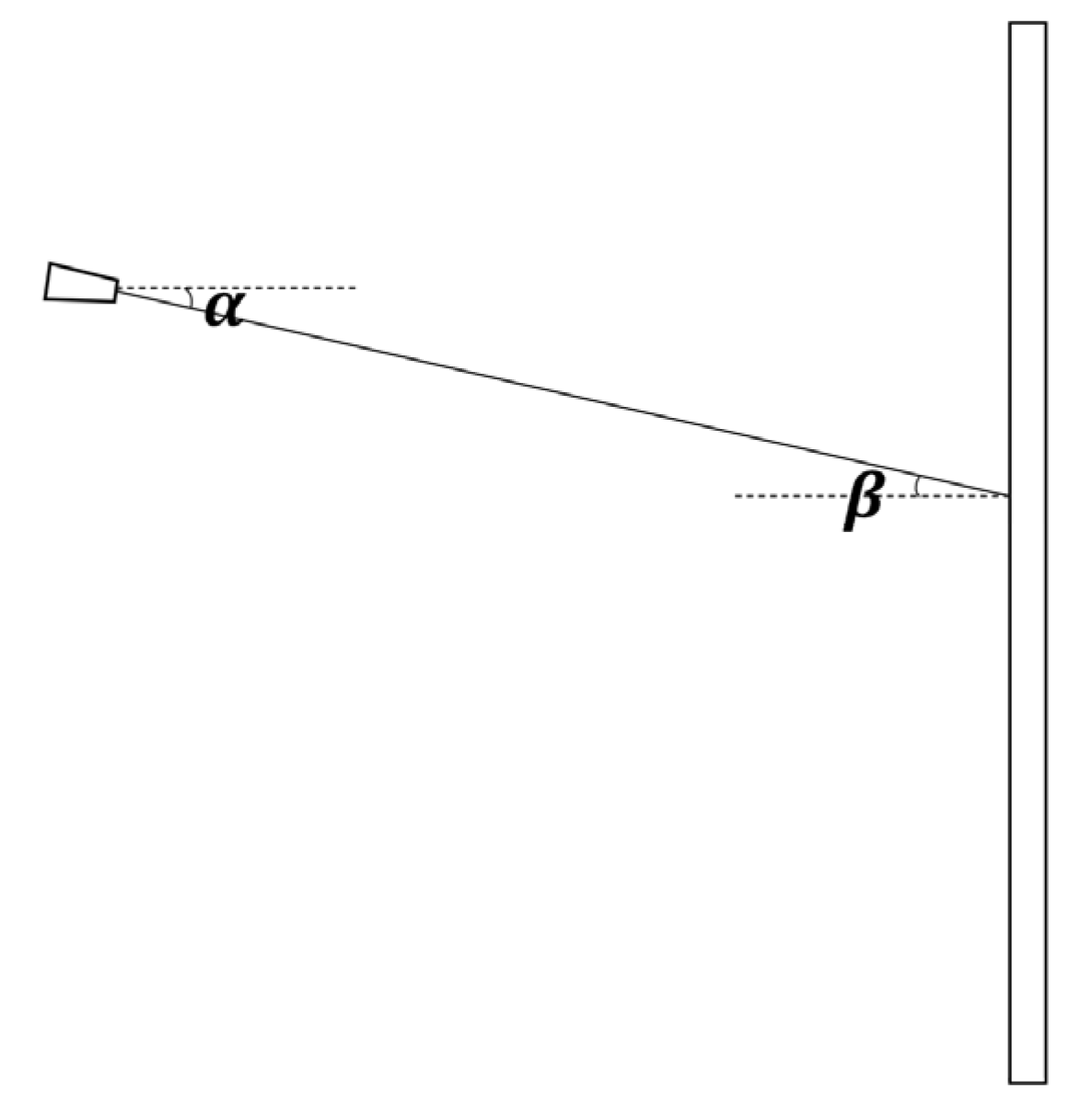
The angle between the jet direction upon reaching the vertical surface and the surface normal is defined as β. Only when the nozzle-to-wall distance is sufficiently short, the jet velocity is relatively high, and deflection effects can be neglected can β be approximately considered equal to α, as shown in Figure 9. In the experiments, due to the relatively long propagation distance, the jet undergoes significant momentum dissipation and redistribution during its free-jet development. This results in a slight deviation of the effective impingement direction at the wall, thereby influencing the subsequent spreading behavior of the liquid film.
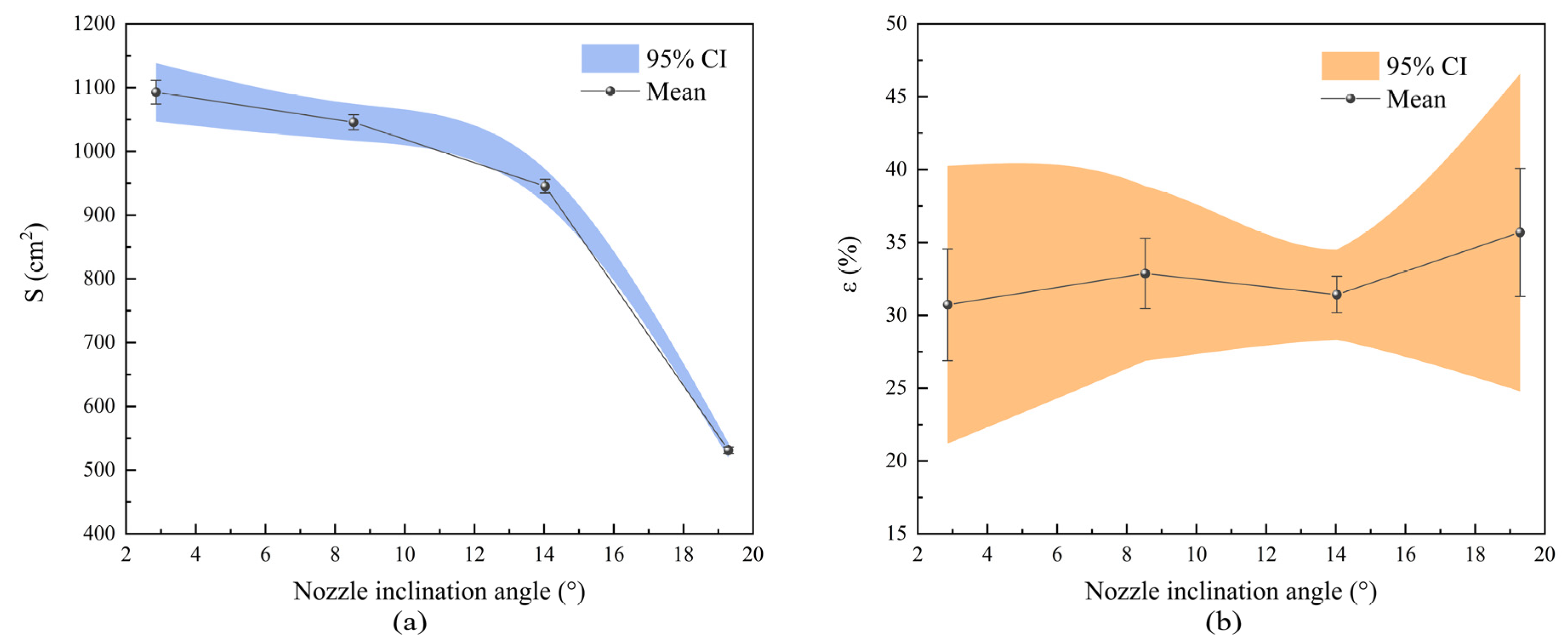
The effects of nozzle inclination angle on the wetted area and effective water supply rate are shown in Figure 10. Overall, with increasing nozzle inclination angle α, the wetted area exhibits a continuous decreasing trend, while the effective water supply rate shows an overall increasing tendency. From a dynamical perspective, when the jet reaches the vertical surface, its velocity can be decomposed into a normal component perpendicular to the surface and a tangential component parallel to the surface. When the jet direction is close to the surface normal, the normal component dominates, and the jet impinges on the surface in an approximately frontal manner; as the nozzle inclination angle increases, the corresponding β at the surface also increases, the normal component gradually weakens, and the tangential component directed downward along the surface is significantly enhanced. The monotonic decrease in liquid film area with increasing inclination angle is attributed to the continuous reduction in the normal impingement component, which weakens the radial spreading capability of the jet on the surface, while the increased tangential velocity causes the liquid to flow downward along the wall more rapidly, further limiting the expansion of the wetted area. In the small inclination angle range (2.86–8.53°), when the jet impinges on the surface approximately along the surface normal, the normal velocity component is large and the local impingement pressure is high; severe deformation occurs at the moment of impact, resulting in intense radial splashing, with part of the water re-entering the air in the form of rebound or atomized droplets, while the remaining portion spreads outward along the surface as a thin liquid film. As the inclination angle increases slightly, the normal component decreases, splashing is reduced, and more water adheres to the surface and is collected in the collection trough, leading to an increase in the effective water supply rate. As the nozzle inclination angle further increases into the intermediate angle range (8.53–14.03°), a stage-wise decrease in the effective water supply rate is observed. In this range, the normal component of the jet has already weakened significantly, while the tangential component is still insufficient to establish a continuous wall-attached flow structure, thereby affecting the residence of the liquid film on the surface. Meanwhile, the combination of splashing and oblique rebound induced by jet impingement becomes relatively unfavorable, amplifying water loss and resulting in a temporary reduction in the effective water supply rate. When the nozzle inclination angle is further increased into the large-angle range (approximately 14.03–19.29°), the effective water supply rate increases again. At this stage, the influence of the tangential component on the liquid motion along the surface is significantly enhanced; splashing is reduced and its direction is more likely to be oriented toward the collection trough below, thereby increasing the effective water supply rate. At the same time, to ensure jet impingement on the surface, the spray height increases slightly with increasing inclination angle, which in turn causes a slight increase in the nozzle-to-wall distance and intensifies jet dispersion and momentum attenuation in air. Consequently, violent splashing near the impingement point is suppressed, and the liquid more readily forms a thicker and continuous downward-flowing film along the surface. Although the coverage area is limited, the water amount per unit area increases, and the continuity and stability of the liquid film are more favorable for maintaining sustained cooling or fire suppression performance.

4. Analysis of Vertical Fire Spread Characteristics and Flame Height Under Jet Impingement

4.1. Morphological Analysis of Vertical Fire Spread Suppression Under Jet Impingement

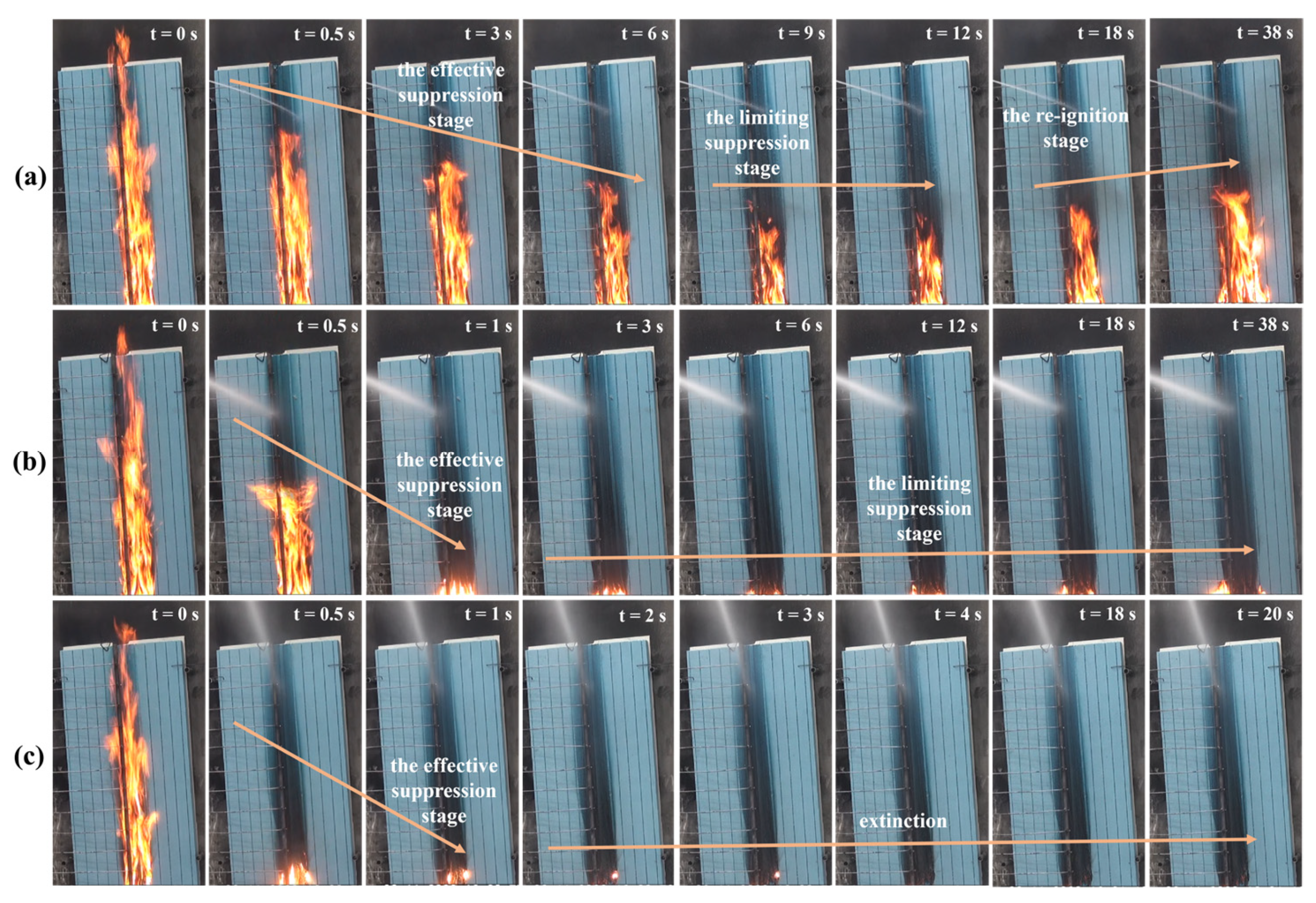
To investigate the effects of different jet parameters on the suppression of vertical wall fires, a study was conducted on the influence of jet flow rate and nozzle inclination angle on the fire spread characteristics over vertical XPS panels. Figure 11a,b respectively present the dynamic processes of fire spread under two distinct flow conditions: an operating pressure of 0.31 MPa corresponding to a flow rate of 1.82 L/min, and an operating pressure of 1.77 MPa corresponding to a flow rate of 4.31 L/min. Flame behavior under these different flow rates was systematically observed. If the flame continues to burn and exhibits reignition after water application, it indicates that the applied flow rate is insufficient to suppress the combustion of XPS. Conversely, if the flame is extinguished following jet impingement, it demonstrates that the flow rate effectively inhibits fire propagation.
The moment when the flame spread reaches the top of the material is defined as time zero. As shown in Figure 11a, when a relatively low-flow jet is applied to the vertical surface, the flame evolution can be divided into three distinct stages: the effective suppression stage (0–6 s), the limiting suppression stage (6–18 s), and the re-ignition stage (beyond 18 s). During the effective suppression stage, a significant reduction in the flame area is observed. This phenomenon is closely related to the hydrodynamic behavior of the jet impinging on the vertical wall. After the jet impacts the wall, a liquid film spreads and splashes into the impingement zone. Some of the liquid forms secondary droplet clusters that splash outward. These droplets evaporate through convective heat transfer, absorbing heat from the flame and diluting the combustible gases, which provides initial suppression of the local fire. The remaining liquid forms a continuous water film that flows downward along the surface. This film blocks the material from receiving thermal radiation and convective heat from the flame, significantly reducing the pyrolysis rate of the material and inhibiting upward flame propagation. However, for the liquid film formed by a low-flow jet, as time progresses, the flame area decreases to a critical value but does not continue to decrease, entering the limiting suppression stage. At this point, due to the relatively limited flow rate, the liquid film covers a small area. The water film continuously evaporates under the heat feedback from the flame, reaching a dynamic equilibrium between the film coverage and the evaporation rate. As a result, the coverage area cannot expand further, and the flame stabilizes at a residual scale. Subsequently, under continued burning conditions, the surrounding combustible materials undergo enhanced pyrolysis due to sustained heating, leading to a gradual increase in the heat release rate. When the heat release rate exceeds the suppression limit imposed by the cooling and inerting effects of the water film, the system enters the re-ignition stage, and the flame area begins to expand again. When the jet flow rate is increased to 4.31 L/min, the fire suppression effectiveness is significantly improved. As shown in Figure 11b, within 3 s of jet application, effective suppression of the flame is achieved, and the flame area quickly recedes to the vicinity of the ignition point. At this higher flow rate, the droplet splash effect generated by the jet impinging on the wall becomes more pronounced. The water film flows faster and covers a larger area, greatly enhancing surface cooling and thermal isolation. Under these conditions, the flame is suppressed during the limiting suppression stage, with no observable re-ignition within the experimental observation period.
To further investigate the suppression effect of nozzle inclination angle on facade fires, we extended the nozzle inclination angle to 30° under the high flow-rate condition (4.31 L/min). This angle exceeds the cold-test range of 2.86–14.03°, and we used it as an independent validation case to observe fire suppression behavior. As discussed in Section 3.4, given the high momentum, the deflection effect is limited; therefore, the actual incidence angle β corresponding to the 30° jet is approximately equal to 30°, but this does not affect the qualitative conclusions. Figure 11 presents the suppression phenomena of vertical wall fire spread under different nozzle inclination angles at an operating pressure of 1.77 MPa and a corresponding flow rate of 4.31 L/min. Figure 11b,c correspond to nozzle inclination angles of 0° (horizontal jet) and 30° (inclined jet), respectively. The experimental results indicate that increasing the nozzle inclination angle can significantly enhance fire suppression effectiveness. Compared with the horizontal jet, the 30° inclined jet leads to a more pronounced reduction in flame area within 0.5 s after jet application. By 4 s, the limiting suppression stage observed for the horizontal jet does not occur; instead, the flame directly enters a stage of continuous decay until complete extinction. It can be seen that although the total wetted area of the liquid film decreases as the nozzle inclination angle increases, this does not necessarily mean that the fire suppression performance becomes worse. For facade fires, the flame spreads vertically, so the longitudinal distribution of the liquid film is more critical than the total area. Increasing the nozzle inclination angle concentrates the liquid film more effectively near the flame root and along the downward flow path, resulting in a higher effective water supply rate and thus significantly improving fire suppression performance. Therefore, the relationship between wetted area and fire suppression effectiveness is not simply positive; the spatial distribution of the liquid film must also be considered.

4.2. Flame Height

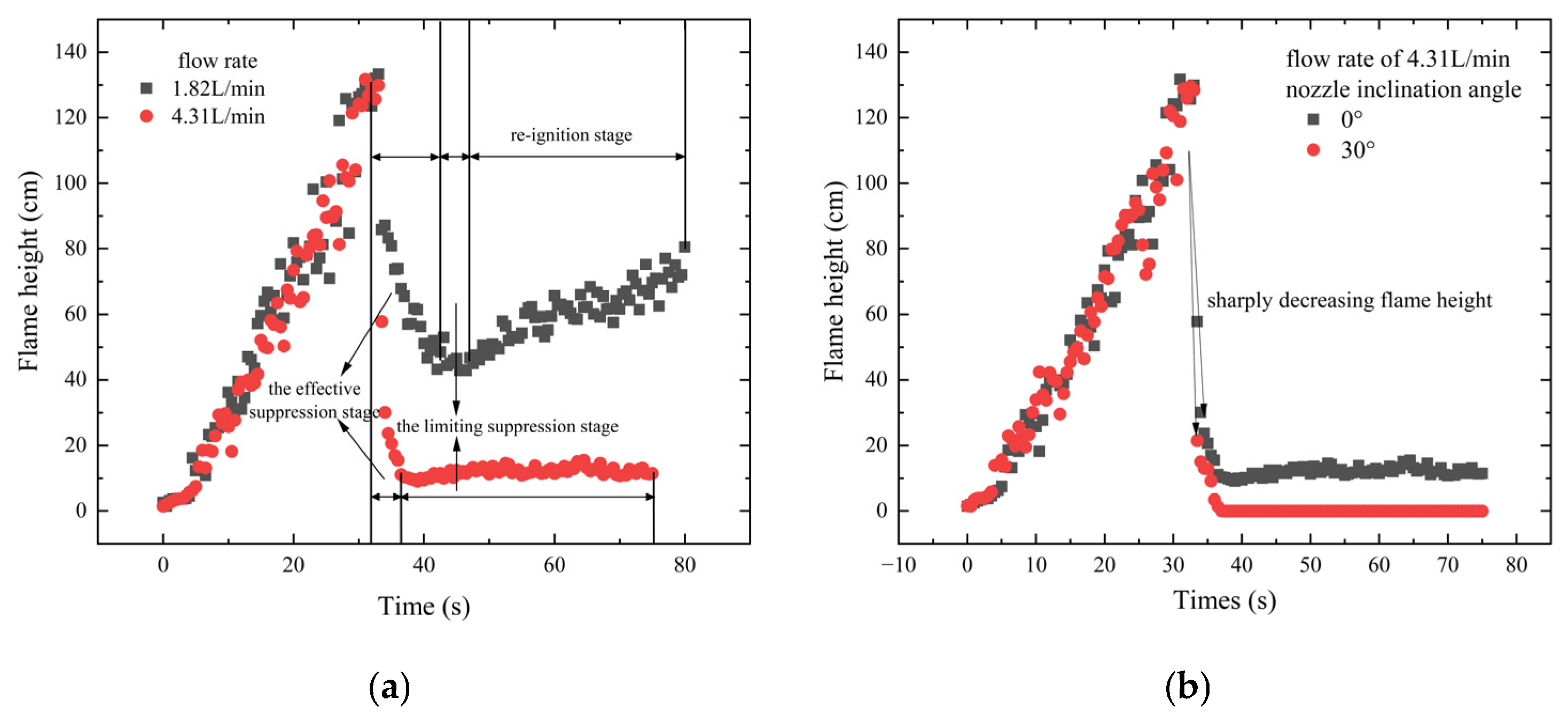
Flame height is one of the key parameters reflecting the combustion state of the flame. It is defined as the vertical distance from the base of the flame to its tip. Figure 12a presents the temporal evolution of the flame height under two jet flow rate conditions, namely 1.82 L/min and 4.31 L/min.
After ignition, the flame height exhibits an approximately linear increasing trend. When the flame height reaches its maximum value, jet-based fire suppression is initiated; however, the evolution of flame height differs under different jet flow rates. At a relatively low flow rate, the flame height decreases rapidly, as the impinging water jet instantaneously removes a large amount of heat, strongly suppressing the pyrolysis process at the fuel surface and leading to a sharp reduction in the supply of combustible gases required to sustain the flame. Subsequently, the flame height no longer changes significantly, indicating that a balance has been reached between water cooling and flame heating. At this stage, an incomplete water film is formed on the panel surface: radiative and convective heat feedback from the flame tends to heat the fuel surface to maintain pyrolysis, while the water continuously removes heat through evaporation and heat transfer, resulting in a dynamic equilibrium between the two processes. However, due to the limitation of the flow rate, the water formed under low-flow conditions cannot fully cover or penetrate all fuel regions. The flame therefore stabilizes over the heated regions that are still capable of generating sufficient combustible gases, and the cooling area cannot be further expanded. As the surrounding fuel continues to be heated and ignited, the flame height increases again, indicating re-ignition of the surface fuel. To disrupt this temporary balance between heat transfer and jet-induced cooling, it is necessary to adjust the water flow rate or the spraying strategy. Figure 12a shows the real-time evolution of flame height after increasing the jet flow rate. With the higher flow rate, the flame height rapidly decreases to a lower level. The high-flow jet provides a larger impingement area, greater water momentum, and stronger impact force, which not only enhances the physical disturbance of the flame base and the hot gas layer, but also forms a thicker, more stable, or more rapidly renewed water film that enables sustained evaporative cooling, thereby further reducing the flame height. Under this flow condition, small residual flames remain near the bottom of the fuel and complete extinction is not achieved; however, due to the weak intensity of the residual flame, no re-ignition is observed within the experimental duration, although over a longer time scale, this residual flame may potentially ignite surrounding combustible materials and lead to re-ignition.
Figure 12b presents the real-time evolution of flame height under different nozzle inclination angles (0° and 30°) at a flow rate of 4.31 L/min. After the flame height reaches the top of the fuel, the water jet is initiated. The flame height then decreases rapidly. Compared with the 0° jet, the flame height under the 30° jet decreases at a faster rate, and the flame is ultimately extinguished. This behavior can be explained by the hydrodynamic characteristics of the jet impinging on the vertical wall. As the nozzle inclination angle increases, the wall-attached flow formed after jet impingement exhibits a higher downward velocity, leading to the formation of a thinner and more easily spreading water film on the wall surface, which enhances the coverage and cooling of high-temperature regions. Meanwhile, for the larger nozzle inclination angle, the jet is already in the breakup regime at the impingement point and disintegrates into droplets, resulting in a wider spreading water film on the wall. This increases the protected area of the wall surface and delays or interrupts the flame spread path along the vertical wall.

5. Discussion

Based on the above results, some suggestions can be made for optimizing facade fire suppression strategies. The hot gases and thermal radiation in a real fire weaken the suppression effect of the water jet, so a sufficiently high flow rate is needed to overcome this influence. Relying solely on a low flow rate tends to lead to re-ignition, while a high-flow-rate horizontal jet may not achieve complete extinction either, the nozzle inclination angle also plays a key role. In the present experiments, for a given nozzle diameter and angle, the actual impingement trajectory of the jet on the vertical surface depends on its momentum, which is directly related to the flow rate [23]. When the flow rate is low, the initial momentum of the jet is low, and it is more easily affected by air drag and gravitational deflection during free-jet stage [31], consequently, the jet may fail to reach the intended wall region, or even miss the wall entirely, especially at a large inclination angle where the free-jet distance increases. For the same flow rate, compared with a horizontal jet, an inclined jet is more effective in transferring liquid momentum downstream along the wall [32], promoting a continuous liquid film under the combined action of gravity and inertia, thus enhancing cooling coverage of the flame root and better interrupting the upward flame spread path. Although the nozzle-to-wall distance was not varied in the fire suppression tests, the results of the jet impingement experiments on the vertical surface indicate that an intermediate distance can balance coverage area and water supply efficiency, too short a distance results in a smaller wetted area on the facade, and too long a distance causes excessive jet breakup and water loss. Future work should further investigate the effect of nozzle-to-wall distance on actual fire suppression performance by conducting facade fire experiments with varying distances.
Based on these experimental observations, it can be inferred that a high-flow-rate inclined jet may achieve rapid flame knockdown and complete extinction, and that reducing the flow rate afterwards could help maintain cooling with lower water consumption. This staged strategy balances suppression effectiveness and water utilization efficiency, although its effectiveness remains to be validated by specially designed variable-flow-rate fire suppression experiments.

6. Conclusions

In this study, an experimental system has been employed to reveal the characteristics of liquid film formation and evolution during the impingement of free water jets on insulated vertical surfaces, and to clarify the key control mechanisms of jet parameters on fire suppression behavior. The main conclusions are summarized as follows.
(1)
Jet flow rate, nozzle-to-wall distance, and nozzle inclination angle jointly regulate the spreading morphology, wetted area, and effective water supply rate of the liquid film. Specifically, increasing the jet flow rate significantly enlarges the wetted area but leads to a reduction in the effective water supply rate; increasing the nozzle-to-wall distance causes the liquid film morphology to evolve from a continuous distribution to a non-uniform “top-wide and bottom-narrow” structure, with the wetted area exhibiting an increasing trend as the distance increases; increasing the nozzle inclination angle promotes longitudinal contraction of the liquid film and results in a stage-wise decrease in the effective water supply rate within an intermediate angle range, reflecting the dynamic transition between wall attachment and splashing mechanisms of the jet on the vertical surface.
(2)
Jet-based fire suppression effectiveness exhibits pronounced sensitivity to variations in jet parameters, particularly manifested in differences in the flame suppression process and its stability under different flow rate and nozzle inclination angle conditions. The results show that low-flow-rate jets suppress vertical wall fires through a typical three-stage process of “effective suppression stage-limiting suppression stage-re-ignition stage” characterized by limited liquid film coverage and insufficient suppression stability. For high-flow-rate jets, the fire suppression effect varies with the nozzle inclination angle. A horizontal jet forms a broader wetted area and provides sustained liquid film replenishment, achieving strong flame suppression during the limiting suppression stage; however, small residual flames remain near the bottom of the façade, and complete extinction is not achieved. In contrast, an inclined jet further enhances the wall-adhering flow of the liquid film along the vertical surface, strengthens suppression of the flame root and propagation path, and ultimately achieves complete flame extinguishment.

Author Contributions

Conceptualization, C.J. and Q.W.; Methodology, C.J. and Q.W.; Validation, C.J. and Q.W.; Formal analysis, Q.W. and P.W.; Investigation, C.J.; Resources, C.J.; Data curation, Q.W. and J.L.; Writing—original draft preparation, C.J.; Writing—review and editing, P.W. and J.L.; Supervision, C.J. All authors have read and agreed to the published version of the manuscript.

Funding

This research was funded by Tianjin Science and Technology Planning Project (Grant No. 24JCZDJC00010, 24JCZDJC00080) and Tianjin Natural Science Foundation (Grant No. 23JCYBJC00370).

Institutional Review Board Statement

Not applicable.

Informed Consent Statement

Not applicable.

Data Availability Statement

The data that support the findings of this study are available from the corresponding author upon reasonable request.

Conflicts of Interest

The authors declare no conflicts of interest.

References

  1. GB 55037-2022; General Code for Fire Protection of Buildings and Constructions. China Planning Press: Beijing, China, 2022. (In Chinese)
  2. Çetintaş, K.F. FIRE-DSM: A multi-criteria fire risk evaluation and decision support model for building facades. J. Build. Eng. 2025, 113, 114095. [Google Scholar] [CrossRef]
  3. Sudol, E.; Piekarczuk, A.; Kozikowska, E.; Mazurek, A. Resistance of External Thermal Insulation Systems with Fire Barriers to Long-Lasting Weathering. Materials 2024, 17, 3113. [Google Scholar] [CrossRef] [PubMed]
  4. Parracha, J.L.; Borsoi, G.; Flores-Colen, I.; Veiga, R.; Nunes, L. Impact of natural and artificial ageing on the properties of multilayer external wall thermal insulation systems. Constr. Build. Mater. 2022, 317, 125834. [Google Scholar] [CrossRef]
  5. Chen, Y.; Feng, Q.; Nie, Y.; Zhang, J.; Yang, L. A Review of Combustion and Flame Spread over Thermoplastic Materials: Research Advances and Prospects. Fire 2023, 6, 125. [Google Scholar] [CrossRef]
  6. Sharma, A.; Mishra, K.B. Experimental investigations on the influence of ‘chimney-effect’ on fire response of rainscreen façades in high-rise buildings. J. Build. Eng. 2021, 44, 103257. [Google Scholar] [CrossRef]
  7. Park, K.-W.; Jeon, E.-G.; Jeong, J.-J.; Kim, M.-J.; Kim, D.-W. Analysis of the Fire Behavior of Building-Integrated Photovoltaics (BIPV) as Façade Materials. Appl. Sci. 2025, 15, 12807. [Google Scholar] [CrossRef]
  8. McKenna, S.T.; Jones, N.; Peck, G.; Dickens, K.; Pawelec, W.; Oradei, S.; Harris, S.; Stec, A.A.; Hull, T.R. Fire behaviour of modern façade materials—Understanding the Grenfell Tower fire. J. Hazard. Mater. 2019, 368, 115–123. [Google Scholar] [CrossRef]
  9. Hasnat, M.R.; Hassan, M.K.; Saha, S. Fire Behaviour and Thermal Characterisation of Different Types of Non-combustible Cladding Panels Used in High-Rise Buildings. Fire Technol. 2026, 62, 31. [Google Scholar] [CrossRef]
  10. Nazrun, T.; Hassan, M.K.; Hasnat, M.R.; Hossain, M.D.; Saha, S. Improving fire performance of solid aluminium of composite cladding panels incorporating intumescent coatings. Prog. Org. Coat. 2025, 201, 109142. [Google Scholar] [CrossRef]
  11. Li, Y.; Li, X.; Zhao, H.; Tang, X.; Zhao, Y. Numerical study on suppression of fire spread over concave building façades by water curtains. J. Saf. Environ. 2024, 24, 2206–2212. (In Chinese) [Google Scholar] [CrossRef]
  12. Zhao, H.; Qian, C. Suppression effect of water sprinklers on fire spread over high-rise building façades. J. North China Univ. Sci. Technol. 2019, 41, 60–67. (In Chinese) [Google Scholar] [CrossRef]
  13. Li, Y.; Zhao, H.; Liang, L. Effect of sprinkler angle on suppression of fire spread over building façades. J. Taiyuan Univ. Sci. Technol. 2022, 43, 467–471. (In Chinese) [Google Scholar]
  14. Du, W.; Chen, J. Experimental study on extinguishment of vertical façade fires using water mist. Fire Saf. Sci. 2013, 22, 65–69. (In Chinese) [Google Scholar] [CrossRef]
  15. Meraner, C.; Skilbred, E.S.; Arsava, K.S. Experimental Investigation of Water-Based Fire Suppression Systems on External Façade Fires. Fire Technol. 2024, 60, 3629–3648. [Google Scholar] [CrossRef]
  16. Li, Y.; Li, J.; Zhang, C.; Zhao, H.; Zeng, Y.; Chen, Y.; Li, X. Experimental study on fire suppression by water film on the exterior facade of concave structures. J. Thermoplast. Compos. Mater. 2025, 38, 4599–4617. [Google Scholar] [CrossRef]
  17. Novozhilov, V.; Moghtaderi, B.; Kent, J.H.; Fletcher, D.F. Solid fire extinguishment by a water spray. Fire Saf. J. 1999, 32, 119–135. [Google Scholar] [CrossRef]
  18. Zhou, Y.; Bu, R.; Zhang, X.; Fan, C.; Gong, J. Performance evaluation of water mist fire suppression: A clean and sustainable fire-fighting technique in mechanically-ventilated place. J. Clean. Prod. 2019, 209, 1319–1331. [Google Scholar] [CrossRef]
  19. Węgrzyński, W.; Antosiewicz, P.; Burdzy, T.; Tofiło, P.; Papis, B.K. Experimental investigation into fire behaviour of glazed façades with pendant type sprinklers. Fire Saf. J. 2020, 115, 103159. [Google Scholar] [CrossRef]
  20. Kraus-Namrozy, N.; Brzezinska, D. Effectiveness of Swirl Water Mist Nozzles for Fire Suppression. Int. J. Environ. Res. Public Health 2022, 19, 16328. [Google Scholar] [CrossRef]
  21. Zhou, T.; Wu, C.; Liu, M.; Chen, B.; Wang, X. Numerical study on the fire propagation and suppression of valve hall for UHV converter station. Case Stud. Therm. Eng. 2024, 55, 104128. [Google Scholar] [CrossRef]
  22. Zhao, Y.; Xu, M.; Zhang, X.; Kong, S. Dynamic process of single water, water with additives and ethanol droplet impinging on high-temperature quartz glass surface. Exp. Therm. Fluid Sci. 2023, 141, 110784. [Google Scholar] [CrossRef]
  23. Wang, T.; Faria, D.; Stevens, L.J.; Tan, J.S.C.; Davidson, J.F.; Wilson, D.I. Flow patterns and draining films created by horizontal and inclined coherent water jets impinging on vertical walls. Chem. Eng. Sci. 2013, 102, 585–601. [Google Scholar] [CrossRef]
  24. GB/T 20284-2006; Single Burning Item Test for Building Materials and Products. Standards Press of China: Beijing, China, 2006. (In Chinese)
  25. Dumouchel, C. On the experimental investigation on primary atomization of liquid streams. Exp. Fluids 2008, 45, 371–422. [Google Scholar] [CrossRef]
  26. Sallam, K.A.; Dai, Z.; Faeth, G.M. Liquid breakup at the surface of turbulent round liquid jets in still gases. Int. J. Multiph. Flow 2002, 28, 427–449. [Google Scholar] [CrossRef]
  27. Ranz, W.E. On Sprays and Spraying; a Survey of Spray Technology for Research and Development Engineers; Pennsylvania State University: University Park, PA, USA, 1956. [Google Scholar]
  28. Sterling, A.M.; Sleicher, C.A. The instability of capillary jets. J. Fluid Mech. 1975, 68, 477–495. [Google Scholar] [CrossRef]
  29. Miesse, C.C. Correlation of Experimental Data on the Disintegration of Liquid Jets. Ind. Eng. Chem. Res. 1955, 47, 1690–1701. [Google Scholar] [CrossRef]
  30. Xu, X.; Zhao, T.; Shi, Z.; Li, W.; Lin, Q.; Liu, H.; Wang, F. Surface wave and splashing of liquid film by oblique water jet impinging on a vertical plate. Exp. Therm. Fluid Sci. 2024, 151, 111089. [Google Scholar] [CrossRef]
  31. Grant, G.; Brenton, J.; Drysdale, D. Fire suppression by water sprays. Prog. Energy Combust. Sci. 2000, 26, 79–130. [Google Scholar] [CrossRef]
  32. Hu, B.; Lin, Q.; Li, T.; Li, W.; Liu, H.; Wang, F. Flow behavior and heat transfer characteristics of liquid film on vertical hot surface by inclined jet impingement. Int. J. Heat Mass Transf. 2025, 236, 126387. [Google Scholar] [CrossRef]
Figure 1. Schematic of the experimental setup.
Fire 09 00252 g001
Figure 2. Photograph of the experimental setup.
Fire 09 00252 g002
Figure 3. HRR and FIGRA data of XPS.
Fire 09 00252 g003
Figure 4. Infrared thermography images showing the temporal evolution of the liquid film under different operating pressures (jet flow rates).
Fire 09 00252 g004
Figure 5. Infrared thermography images showing the temporal evolution of the liquid film under different nozzle-to-wall distances.
Fire 09 00252 g005
Figure 6. Infrared thermography images showing the temporal evolution of the liquid film under different nozzle inclination angles.
Fire 09 00252 g006
Figure 7. Effect of jet flow rate on wetted area and effective water supply rate. (a) Wetted area; (b) Effective water supply rate.
Fire 09 00252 g007
Figure 8. Effect of nozzle-to-wall distance on wetted area and effective water supply rate. (a) Wetted area; (b) Effective water supply rate.
Fire 09 00252 g008
Figure 9. Schematic of nozzle inclination angle and jet incidence angle.
Fire 09 00252 g009
Figure 10. Effect of nozzle inclination angle on wetted area and effective water supply rate. (a) Wetted area; (b) Effective water supply rate.
Fire 09 00252 g010
Figure 11. Experimental phenomena: (a) operating pressure of 0.31 MPa, jet flow rate of 1.82 L/min, horizontal jet; (b) operating pressure of 1.77 MPa, jet flow rate of 4.31 L/min, horizontal jet; (c) operating pressure of 1.77 MPa, jet flow rate of 4.31 L/min, nozzle inclination angle of 30.
Fire 09 00252 g011
Figure 12. Temporal evolution of flame height under different jet conditions: (a) comparison of different jet flow rates (horizontal jet); (b) comparison of different nozzle inclination angles at 4.31 L/min.
Fire 09 00252 g012
Table 1. Experimental conditions for jet impingement on a vertical surface.
Operating Pressure/MPaFlow Rate/(L/min)Nozzle Inclination Angle/°Nozzle-to-Wall Distance/m
0.1, 0.2, 0.311.18, 1.51, 1.8902
0.311.8901.5, 2, 2.5, 3, 3.5
0.31.8282.86, 8.53, 14.03, 19.292
Table 2. Statistical table of jet parameters for façade fire suppression experiments.
Operating Pressure/MPaFlow Rate/(L/min)Nozzle Inclination Angle/°Nozzle-to-Wall Distance/m
0.31, 1.771.82, 4.3102
1.774.31302
Table 3. Physical properties of the experimental medium at 25 °C.
ParametersNumerical Value
Jet flow water viscosity coefficient (mPa·s)1.19
Water density of jet flow (kg/m3)987
Surface tension coefficient of jet flow water (mN/m)72.85
Air density (kg/m3)1.205
Table 4. Combustion performance test results of the insulation material.
Classification Results
Fire growth rate index (FIGRA(0.2))13,636.7 W/s at 336 s
FIGRA(0.4)13,636.7 W/s at 336 s
Total heat release (THR(600))139.3 MJ
Smoke growth rate index (SMOGRA)1528.1 m2/s2 at 324 s
Total smoke production (TSP(600))4770.6 m2
Potential classification
ClassE
Smoke productionS3
Flaming droplets/particlesd2
Table 5. L c under different operating conditions.
Operating Pressure/MPaJet Flow Rate/(L/min)Breakup Length ( L c ) /m
0.11.180.1533
0.21.510.5037
0.31.8280.5037
0.311.890.5037
Table 6. Range of jet breakup parameters.
Disintegration RegimeComment
Dripping regime W e l < 8
Rayleigh regime W e l > 8 ,   W e g < 4   or   1.2 + 3.41 O h 0.9
First wind-induced regime 1.2 + 3.41 O h 0.9 < W e g < 13
Second wind-induced regime 13 < W e g < 40.3
Atomization regime W e g > 40.3
Note: W e g = gas Weber number, W e l   = liquid Weber number, R e = Reynolds number, O h = Ohnesorge number.
Table 7. W e g , W e l , R e and O h under different operating conditions.
Operating Pressure/MPaJet Flow Rate/(L/min) W e g W e l R e O h 1.2 + 3.41 O h 0.9
0.11.182.5208213,0050.00351.2211
0.21.514.1338716,5880.00351.2211
0.31.8286.1500820,1710.00351.2211
0.311.896.5534320,8350.00351.2211
Disclaimer/Publisher’s Note: The statements, opinions and data contained in all publications are solely those of the individual author(s) and contributor(s) and not of MDPI and/or the editor(s). MDPI and/or the editor(s) disclaim responsibility for any injury to people or property resulting from any ideas, methods, instructions or products referred to in the content.