
How Information Source and User Attributes Affect Use of Fire Management Information

 and
and
Abstract
1. Introduction
2. Materials and Methods
2.1. A Conceptual Value of Information Model
- b [x (si)] = benefit when information source i is used (per unit of land managed);
- b0 (x0) = benefit when information source i is not used (per unit of land managed);
- xi (si) = decision made or action taken when information source i is used;
- xi0 = decision made or action taken when information source i is not used;
- si = information sources used to make decision i;A = land area supervised or managed;
- ci = cost of using information to make decision (or take action) I; may include costs of delay;
- k = a measure of the manager’s knowledge or technical capacity;
- ρ = the manager’s job or role within the fire management system;
- α = the agency that the manager works for;
- δ = the dispatch center where the manager is assigned.
+ Σ λi (ti − ti (si))
2.2. Random Utility Model of Information Use
− {bi0 [ki, ρi, ai, xn (sj0), zj] + [ε (eij) − ε (eij0)]} > 0
- α = a regression constant term;
- k = [0, 1] dummy variables for age, education, and experience categories that affect the benefits and costs of using a given information source;
- a = [0, 1] dummy variables denoting the agency the fire manager works for;
- r = [0, 1] dummy variables for denoting different jobs or roles in the fire management system a fire manager may have;
- δ = [0, 1] dummy variables denoting the dispatch center where a fire manager operates;
- n = the total number of decisions a fire manager makes;
- z = [0, 1] dummy variables denoting attributes of information sources that may affect their use;
- d = a dummy variable that equals zero if the choice of using or not using an information source is made before the fire season and equals one if the choice is made during the fire season;
- dz = interaction terms between the fire season variable d and information source variable z.
2.3. Survey Methods and Data
2.4. Variable Description
- Hiring or extending fire crew personnel;
- Allocating personnel, tanker planes, or equipment;
- Requesting additional resources (severity requests);
- Making prescribed fire or wildland fire use decisions;
- Public awareness and issuing public notices;
- Briefing administrators, congressional staff, etc.;
- Other decisions.
- Pcorrect = the proportion of correct predictions;
- Pmode = proportion of observations with the mode (most common) response.
3. Results
3.1. Effects on Probabilities of Information Source Use
3.2. Hypothesis Tests of Variable Groups
3.3. Robustness Checks
4. Discussion
4.1. Study Limitations
4.2. Directions for Future Research
5. Conclusions
Author Contributions
Funding
Institutional Review Board Statement
Informed Consent Statement
Data Availability Statement
Conflicts of Interest
Abbreviations
| ACR2 | Adjusted Count R-Squared |
| AIC | Akaike Information Criterion |
| ADEQ | Arizona Department of Environmental Quality |
| AZ | Arizona |
| BIC | Bayes Information Criterion |
| CPC | Climate Prediction Center |
| DSTs | Decision Support Tools |
| EDDI | The Evaporative Demand Drought Index |
| ENSO | El Niño Southern Oscillation |
| HIPAA | Health Insurance Portability and Accountability Act |
| IFTDSS | Interagency Fuel Treatment Decision Support System) |
| IRI | Int. Research Inst. for Climate & Society, Columbia Univ. |
| IRWIN | Integrated Reporting of Wildland-Fire Information |
| NICC | National Interagency Coordination Center |
| NIDIS | National Integrated Drought Information System |
| NIFC | National Interagency Fire Center |
| NM | New Mexico |
| NOAA | National Oceanographic and Atmospheric Administration |
| NWS | National Weather Service |
| OR | Odds Ratio |
| SME | Subject Matter Expert |
| SWCC | Southwest Coordination Center |
| USFS | US Forest Service |
| WFDSS | Wildland Fire Decision Support System |
References
- Thomas, D.; Butry, D.; Gilbert, S.; Webb, D.; Fung, J. The Costs and Losses of Wildfires; National Institute of Standards and Technology Special Publication; National Institute of Standards and Technology: Gaithersburg, MD, USA, 2017; Volume 1215.
- Rapp, C.; Rabung, E.; Wilson, R.; Toman, E. Wildfire decision support tools: An exploratory study of use in the United States. Int. J. Wildland Fire 2020, 29, 581–594. [Google Scholar] [CrossRef] [Scilit]
- Noble, P.; Paveglio, T.B. Exploring adoption of the wildland fire decision support system: End user perspectives. J. For. 2020, 118, 154–171. [Google Scholar] [CrossRef] [Scilit]
- Fillmore, S.D.; Paveglio, T.B. Use of the wildland fire decision support system (WFDSS) for full suppression and managed fires within the Southwestern Region of the U.S. Forest Service. Int. J. Wildland Fire 2023, 32, 622–635. [Google Scholar] [CrossRef] [Scilit]
- Colavito, M.M. The human dimensions of spatial, pre-wildfire planning decision support systems: A review of barriers, facilitators, and recommendations. Forests 2021, 12, 483. [Google Scholar] [CrossRef] [Scilit]
- Colavito, M.M. Utilising scientific information to support resilient forest and fire management. Int. J. Wildland Fire 2017, 26, 375–383. [Google Scholar] [CrossRef] [Scilit]
- Beeton, T.A.; Aldworth, T.; Colavito, M.M.; Von Hedemann, N.; Huayhuaca, C.A.; Caggiano, M.D. The diffusion of risk management assistance for wildland fire management in the United States. Fire 2025, 8, 478. [Google Scholar] [CrossRef] [Scilit]
- Hunter, M.E.; Colavito, M.M.; Wright, V. The use of science in wildland fire management: A review of barriers and facilitators. Curr. For. Rep. 2020, 6, 354–367. [Google Scholar] [CrossRef] [Scilit]
- Loomis, J.B. Four models for determining environmental quality effects on recreational demand and regional economics. Ecol. Econ. 1995, 12, 55–65. [Google Scholar] [CrossRef] [Scilit]
- Massey, D.M.; Newbold, S.C.; Gentner, B. Valuing water quality changes using a bioeconomic model of a coastal recreational fishery. J. Environ. Econ. Manag. 2006, 52, 482–500. [Google Scholar] [CrossRef] [Scilit]
- Peterson, G.L.; Dwyer, J.F.; Darragh, A.J. A behavioral urban recreation site choice model. Leis. Sci. 1983, 6, 61–81. [Google Scholar] [CrossRef] [Scilit]
- Sherry, J.; Neale, T.; McGee, T.K.; Sharpe, M. Rethinking the maps: A case study of knowledge incorporation in Canadian wildfire risk management and planning. J. Environ. Manag. 2019, 15, 494–502. [Google Scholar] [CrossRef] [Scilit]
- Schultz, C.A.; Miller, L.F.; Greiner, S.M.; Kooistra, C. A qualitative study on the US Forest Service’s risk management assistance efforts to improve wildfire decision-making. Forests 2021, 12, 344. [Google Scholar] [CrossRef] [Scilit]
- Just, D.R.; Wolf, S.A.; Zilberman, D. Effect of information formats on information services: Analysis of four selected agricultural commodities in the USA. Agric. Econ. 2006, 35, 289–301. [Google Scholar] [CrossRef] [Scilit]
- Just, D.R.; Wolf, S.A.; Wu, S.; Zilberman, D. Consumption of economic information in agriculture. Am. J. Agric. Econ. 2002, 84, 39–52. [Google Scholar] [CrossRef] [Scilit]
- Wolf, S.; Just, D.; Zilberman, D. Between data and decisions: The organization of agricultural economic information systems. Res. Policy 2001, 30, 121–141. [Google Scholar] [CrossRef] [Scilit]
- Parker, D.D.; Zilberman, D. The use of information services: The case of CIMIS. Agribusiness 1996, 12, 209–218. [Google Scholar] [CrossRef]
- Stewart, T.R. Forecast value: Descriptive decision studies. In Economic Value of Weather and Climate Forecasts; Katz, R.W., Murphy, A.H., Eds.; Cambridge University Press: Cambridge, UK, 1997; pp. 147–181. [Google Scholar]
- Wilks, D.S. Forecast value: Prescriptive decision studies. In Economic Value of Weather and Climate Forecasts; Katz, R.W., Murphy, A.H., Eds.; Cambridge University Press: Cambridge, UK, 1997; pp. 109–145. [Google Scholar]
- Johnson, S.R.; Holt, M.T. Value of weather information. In Economic Value of Weather and Climate Forecasts; Katz, R.W., Murphy, A.H., Eds.; Cambridge University Press: Cambridge, UK, 1997; pp. 75–107. [Google Scholar]
- Freebairn, J.W.; Zillman, J. Economic benefits of meteorological services. Meteor. Appl. 2002, 9, 33–44. [Google Scholar] [CrossRef] [Scilit]
- Frisvold, G.B.; Deva, S. Farm size, irrigation practices, and conservation program participation in the US Southwest. Irrig. Drain. 2012, 61, 569–582. [Google Scholar] [CrossRef] [Scilit]
- Frisvold, G.B.; Murugesan, A. Use of weather information for agricultural decision making. Weather Clim. Soc. 2013, 5, 55–69. [Google Scholar] [CrossRef] [Scilit]
- Simon, B.; Crowley, C.; Franco, F. The costs and costs avoided from wildfire fire management—A conceptual framework for a value of information analysis. Front. Environ. Sci. 2022, 10, 804958. [Google Scholar] [CrossRef] [Scilit]
- Frisvold, G.B.; Zhang, N.; Crimmins, M.A.; Ferguson, D.; Maxwell, C. Demand for information for wildland fire management. Atmosphere 2024, 15, 1364. [Google Scholar] [CrossRef] [Scilit]
- Ferguson, D.; Frisvold, G.B.; Maxwell, C.; Crimmins, M.A. How are weather and climate products and decision support systems used in wildland fire decision-making in the US southwest? Weather Clim. Soc. 2024, 16, 789–802. [Google Scholar] [CrossRef] [Scilit]
- Raiffa, H.; Schlaifer, R. Applied Statistical Decision Theory; John Wiley & Sons: New York, NY, USA, 2000. [Google Scholar]
- Hirshleifer, J.; Riley, J.G. The Analytics of Uncertainty and Information; Cambridge University Press: Cambridge, MA, USA, 1992. [Google Scholar]
- McFadden, D. Conditional logit analysis of qualitative choice behavior. In Frontiers in Econometrics; Zarembka, P., Ed.; Academic Press: New York, NY, USA, 1974; pp. 105–114. [Google Scholar]
- Phaneuf, D.J.; Smith, V.K. Recreation demand models. In Handbook of Environmental Economics; North-Holland: Amsterdam, The Netherlands, 2005; Volume 2, pp. 671–761. [Google Scholar]
- Stigler, G.J. The economics of information. J. Pol. Econ. 1961, 69, 213–225. [Google Scholar] [CrossRef] [Scilit]
- Becker, G.S. A theory of the allocation of time. Econ. J. 1965, 75, 493–517. [Google Scholar] [CrossRef] [Scilit]
- Domencich, T.; McFadden, D. Urban Travel Demand: Behavioral Analysis; North-Holland Publishing: New York, NY, USA, 1975. [Google Scholar]
- Kaoru, Y.; Smith, V.K.; Liu, J.L. Using random utility models to estimate the recreational value of estuarine resources. Am. J. Agric. Econ. 1995, 77, 141–151. [Google Scholar] [CrossRef] [Scilit]
- Prestemon, J.P.; Donovan, G.H. Forecasting resource-allocation decisions under climate uncertainty: Fire suppression with assessment of net benefits of research. Am. J. Agric. Econ. 2008, 90, 1118–1129. [Google Scholar] [CrossRef] [Scilit]
- Hope, E.S.; McKenney, D.W.; Johnston, L.M.; Johnston, J.M. A cost-benefit analysis of WildFireSat, a wildfire monitoring satellite mission for Canada. PLoS ONE 2024, 19, e0302699. [Google Scholar] [CrossRef] [Scilit] [PubMed]
- Burlig, F.; Jina, A.; Kelley, E.M.; Lane, G.V.; Sahai, H. Long-Range Forecasts as Climate Adaptation: Experimental Evidence from Developing-Country Agriculture; NBER Working Papers 32173; National Bureau of Economic Research: Cambridge, MA, USA, 2024. [Google Scholar]
- Artikov, I.; Hoffman, S.J.; Lynne, G.D.; Zillig, L.M.; Hu, Q.; Tomkins, A.J.; Hubbard, K.G.; Hayes, M.J.; Waltman, W. Understanding the influence of climate forecasts on farmer decisions as planned behavior. J. Appl. Meteorol. Climatol. 2006, 45, 1202–1214. [Google Scholar] [CrossRef] [Scilit]
- Wilson, R.S.; Winter, P.L.; Maguire, L.A.; Ascher, T. Managing wildfire events: Risk-based decision making among a group of federal fire managers. Risk Anal. 2011, 31, 805–818. [Google Scholar] [CrossRef] [Scilit]
- Calkin, D.E.; Venn, T.; Wibbenmeyer, M.; Thompson, M.P. Estimating US federal wildland fire managers’ preferences toward competing strategic suppression objectives. Int. J. Wildland Fire 2013, 22, 212–222. [Google Scholar] [CrossRef] [Scilit]
- Christensen, B.R. Technological advances in rural and wildland fire management as determined using organisational knowledge. N. Z. J. For. 2015, 60, 29–32. [Google Scholar]
- Ryan, C.; Cerveny, L. Wildland Fire Science for Management: Federal Fire Manager Information Needs, Sources, and Uses. West. J. Appl. For. 2011, 26, 126–132. [Google Scholar] [CrossRef] [Scilit]
- Draugalis, J.R.; Plaza, C.M. Best practices for survey research reports revisited: Implications of target population, probability sampling, and response rate. Am. J. Pharm. Educ. 2009, 73, 142. [Google Scholar] [CrossRef] [Scilit] [PubMed]
- Krejcie, R.V.; Morgan, D.W. Determining sample size for research activities. Educ. Psychol. Meas. 1970, 30, 607–610. [Google Scholar] [CrossRef] [Scilit]
- Verma, J.P.; Verma, P. Determining Sample Size and Power in Research Studies; Springer: Singapore, 2020. [Google Scholar]
- Cameron, A.C.; Miller, D.L. A practitioner’s guide to cluster-robust inference. J. Hum. Res. 2015, 50, 317–372. [Google Scholar] [CrossRef] [Scilit]
- Wooldridge, J.M. Econometric Analysis of Cross Section and Panel Data, 2nd ed.; MIT Press: Cambridge, MA, USA, 2010. [Google Scholar]
- Rogers, W.H. Regression standard errors in clustered samples. Stata Tech. Bull. 1993, 13, 19–23. [Google Scholar]
- UCLA: Statistical Consulting Group. FAQ: How Do I Interpret Odds Ratios in Logistic Regression? 2023. Available online: https://stats.oarc.ucla.edu/other/mult-pkg/faq/general/faq-how-do-i-interpret-odds-ratios-in-logistic-regression/ (accessed on 6 February 2026).
- National Weather Service. Eyes on the Sky: A Day in the Life of an Incident Meteorologist (IMET) on the Front Lines of a Wildfire. News Around NOAA National Program. Available online: https://www.weather.gov/news/imet-article (accessed on 20 May 2026).
- Williams, R. Using the margins command to estimate and interpret adjusted predictions and marginal effects. Stata J. 2012, 12, 308–331. [Google Scholar] [CrossRef] [Scilit]
- Sfougaris, A. Review of state-of-the-art decision support systems (DSSs) for prevention and suppression of forest fires. J. For. Res. 2024, 28, 1107–1117. [Google Scholar]
- Vásquez, F.; Cravero, A.; Castro, M.; Acevedo, P. Decision support system development of wildland fire: A systematic mapping. Forests 2021, 12, 943. [Google Scholar] [CrossRef] [Scilit]
- Calkin, D.E.; Thompson, M.P.; Finney, M.A.; Hyde, K.D. A real-time risk assessment tool supporting wildland fire decision-making. J. For. 2011, 109, 274–280. [Google Scholar]
- Drews, F.A.; Siebeneck, L.; Cova, T. Information search and decision making in computer-based wildfire simulations. J. Cogn. Eng. Decis. Mak. 2015, 9, 229–240. [Google Scholar] [CrossRef] [Scilit]
- Calkin, D.E.; O’Connor, C.D.; Thompson, M.P.; Stratton, R.D. Strategic wildfire response decision support and the risk management assistance program. Forests 2021, 12, 1407. [Google Scholar] [CrossRef] [Scilit]
- Rapp, C.E.; Courtney, K.L.; Franz, S.T.; Colavito, M.M.; Aldworth, T.L.; Cheng, A.S. Wildfire decision support tools: Barriers, facilitators, and future directions for effectiveness. Fire Ecol. 2026; in press. [CrossRef] [Scilit]
- Fillmore, S.D.; McCaffrey, S.; Bean, R.; Evans, A.M.; Iniguez, J.; Thode, A.; Smith, A.M.; Thompson, M.P. Factors influencing wildfire management decisions after the 2009 US federal policy update. Int. J. Wildland Fire 2024, 33, WF23129. [Google Scholar] [CrossRef] [Scilit]
- O’Mara, T.; Meador, A.S.; Colavito, M.; Waltz, A.; Barton, E. Navigating the evolving landscape of wildfire management: A systematic review of decision support tools. Trees For. People 2024, 16, 100575. [Google Scholar] [CrossRef] [Scilit]
- Crimmins, M.A.; Maxwell, C.; Ferguson, D.B.; Frisvold, G.B. Burn period: A use-inspired metric to track wildfire risk across Arizona and New Mexico in the Southwest United States. J. Appl. Meteorol. Climatol. 2024, 63, 1559–1568. [Google Scholar] [CrossRef] [Scilit]



| Agency | Total Population | Sample Population | Sub-Sample Population |
|---|---|---|---|
| Forest Service | 49.5% | 47.6% | 45.1% |
| Bureau of Land Management | 15.9% | 13.1% | 14.3% |
| Bureau of Indian Affairs | 12.2% | 10.7% | 12.6% |
| ADFFM | 7.8% | 9.7% | 10.9% |
| National Park Service | 5.0% | 5.3% | 5.7% |
| NM Forestry Division | 2.9% | 3.9% | 2.9% |
| NOAA | 1.5% | 2.4% | 1.7% |
| ADEQ | 0.6% | 1.5% | 1.7% |
| Other | 4.6% | 5.9% | 5.1% |
| Critical Value of Chi2 test | 15.51 | 15.51 | |
| Chi2 statistic (eight degrees of freedom) | 7.90 | 6.99 | |
| p-value | 0.44 | 0.54 |
| Variable | Proportion a | Variable | Proportion |
|---|---|---|---|
| Data/information source used | 0.441 | Work/environmental contexts | |
| Age variables | During fire season | 0.500 | |
| Age (<30) | 0.006 | Total decisions (mean) | 4.223 |
| Age (30–39) | 0.171 | Total decisions (standard dev.) | 1.796 |
| Age (40–49) b | 0.451 | Total decisions [min., max.] | [1, 7] |
| Age (50–59) | 0.269 | Data/information source type | |
| Age (≥60) | 0.103 | General website/data portal b | 0.152 |
| Experience variables | Drought | 0.182 | |
| Experience (<5 years) | 0.029 | ENSO | 0.091 |
| Experience (5–9 years) | 0.057 | Other outlook/forecast | 0.152 |
| Experience (10–14 years) | 0.109 | Fire decision support tool (DST) | 0.121 |
| Experience (15–19 years) | 0.177 | Other fire information source | 0.303 |
| Experience (20–29 years) b | 0.486 | Agency | |
| Experience (≥30 years) | 0.143 | Forest Service b | 0.451 |
| Education variables | Bureau of Land Management | 0.143 | |
| High school graduate | 0.069 | Bureau of Indian Affairs | 0.126 |
| Some college b | 0.337 | National Park Service | 0.057 |
| College degree | 0.451 | AZ Dept. of Forestry & Fire Mgmt. | 0.109 |
| Master’s/professional degree | 0.126 | NM Forestry Division | 0.029 |
| Doctoral degree | 0.017 | Other Agency | 0.051 |
| Self-reported job/role | NOAA | 0.017 | |
| Administrator b | 0.034 | AZ Dept. of Env. Quality | 0.017 |
| Fire Manager (fuels and fire) | 0.417 | Dispatch Center variables | |
| Fire Manager (suppression) | 0.274 | AZ—Dispatch Center (DC) c | 0.109 |
| Other job | 0.274 | AZ—Flagstaff (DC) | 0.080 |
| Researcher-defined job type | AZ—Phoenix DC | 0.063 | |
| Modeler b | 0.114 | AZ—Prescott DC | 0.046 |
| Implementation | 0.366 | AZ—Springerville DC | 0.063 |
| Environmental Specialist | 0.040 | AZ—Tucson DC | 0.091 |
| Aviation | 0.097 | AZ—Williams DC | 0.011 |
| Logistics | 0.131 | NM—Alamogordo DC | 0.086 |
| Field Operations | 0.177 | NM—Albuquerque DC | 0.074 |
| Higher-Level Decision Maker | 0.074 | NM—Santa Fe DC | 0.091 |
| NM—Silver City DC | 0.097 | ||
| NM—Taos DC | 0.046 | ||
| Other DC | 0.023 | ||
| Southwest Coordination Center b | 0.120 |
| Job Category | Description | Job Examples |
|---|---|---|
| Modelers | Subject matter experts (SMEs) who contribute to a framework of integrated spatial fire modeling and fire science application. Human components of the modeling system. More indirect communication (via the system). | Fire Planner; Fire Prevention Specialist, Fire Ecologist |
| Implementation | Interface between high-level decision makers and the field where most decisions are made. (Incident Commanders are delegated to this role re: specific incidents.) | Fire Management Officer |
| (Fire) Environmental Specialists | SMEs who provide targeted fire environment expertise that may contribute to the larger “modeling system” but may also stand alone for certain decision purposes. Includes direct, targeted communication to decision makers. | Air Quality Forecaster; Smoke Management; Fire Weather Program Manager |
| Aviation | Strategic and tactical management of fire management’s “air force”. | Helicopter Coordinator; Aviation Operations Specialist |
| Logistics/ Dispatch Support | Work as part of the National Coordination System (NCS) to mobilize incident resources, both in preparation for and response to wildland fire; 80% reactive (i.e., decisions already made). | Dispatcher |
| Field Operators | The “boots on the ground.” Those who implement wildland fire management in the wildlands themselves. All mandatory early retirement job classes. | Fuels Specialist; Crew Coordinator |
| Higher-Level Decision Makers | “Line officer” or top of the decision chain in an agency or bureau. They are typically not experts in fire management, so information understanding is different—but the stakes are higher. Could be district, forest, state, or regional level. | Regional Fire Management Officer; Fire Management Coordinator |
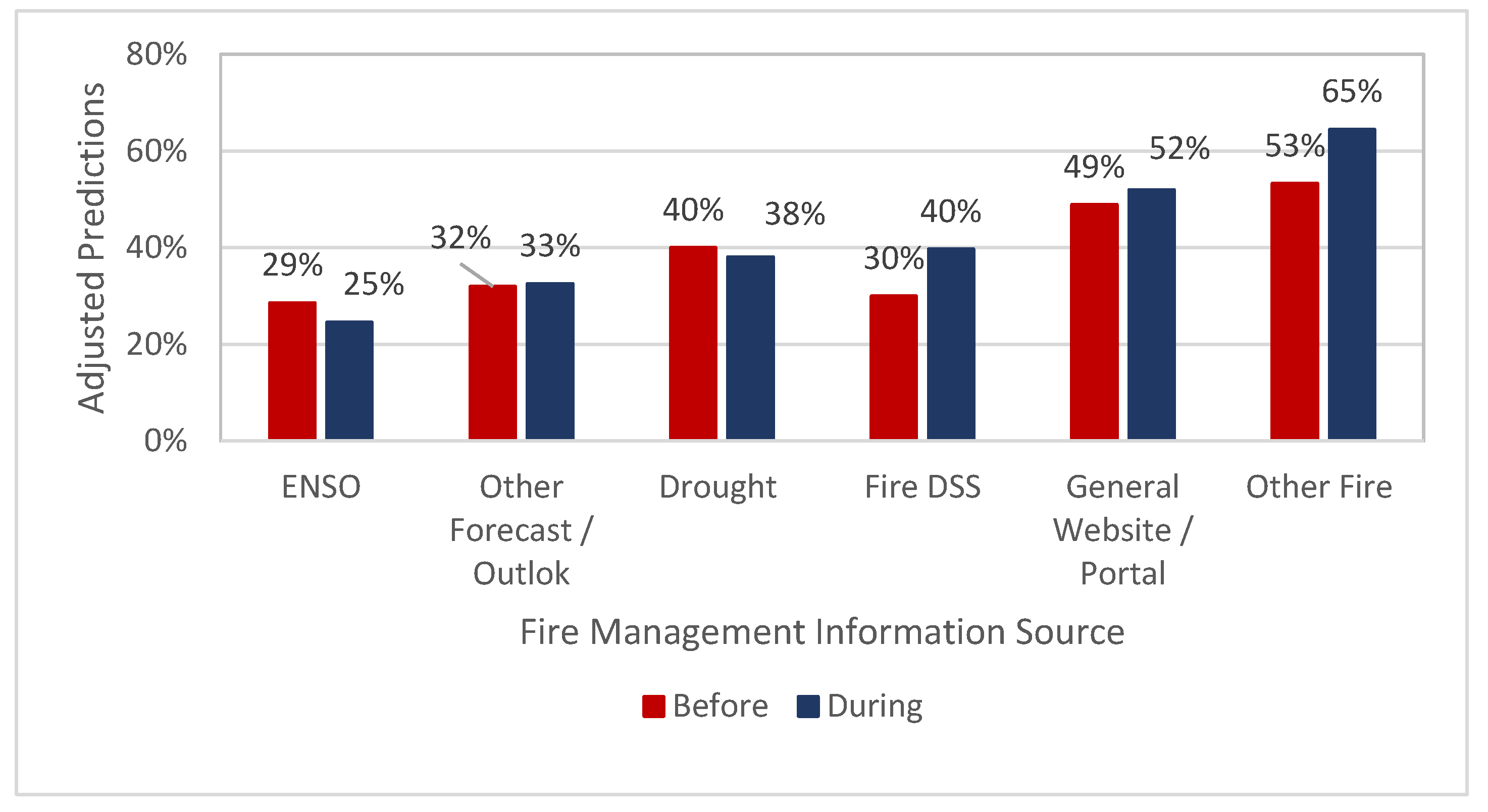
| Information Source | % Using Source | |
| General Websites/Portals | Before | During |
| Climate Prediction Center (CPC), National Weather Service | 77 | 78 |
| IRI (Int. Research Inst. for Climate & Society, Columbia Univ.) | 5 | 4 |
| Western Regional Climate Center | 38 | 38 |
| The Weather Channel|weather.com | 36 | 42 |
| National Weather Service | 90 | 97 |
| Average | 49 | 52 |
| Decision Support Tools (DSTs) | ||
| Interagency Fuel Treatment Decision Support System (IFTDSS) | 26 | 28 |
| Integrated Reporting of Wildland-Fire Information (IRWIN) | 30 | 42 |
| LANDFIRE—Landscape Fire & Resource Mgmt. Planning Tools | 18 | 18 |
| Wildland Fire Decision Support System (WFDSS) | 46 | 71 |
| Average | 30 | 40 |
| Drought | ||
| National Drought Mitigation Center | 39 | 35 |
| NIDIS (Drought.GOV) | 26 | 24 |
| US Drought Portal|US Climate Resiliency Toolkit | 28 | 23 |
| U.S Seasonal Drought Outlook | 75 | 70 |
| NOAA Evaporative Demand Drought Index (EDDI) | 11 | 13 |
| US Drought Monitor | 61 | 63 |
| Average | 40 | 38 |
| ENSO | ||
| NWS El Niño/La Niña Information|NWS | 49 | 40 |
| CPC El Niño/Southern Oscillation (ENSO) Diagnostic Discussion | 30 | 24 |
| IRI ENSO Forecast | 10 | 7 |
| Average | 29 | 24 |
| Fire-Specific | ||
| National Interagency Fire Center (NIFC) | Predictive Services | 77 | 83 |
| Department of the Interior of Wildland Fire | 26 | 27 |
| US Geological Survey Fire Danger Forecast | 42 | 49 |
| Southwest Coord. Center (SWCC)|SW Fire Potential Outlooks | 83 | 91 |
| National Significant Wildland Fire Potential Outlook (NIFC) | 75 | 80 |
| USFS Wildland Fire Assess. System Nat. Fuel Moisture Database | 46 | 51 |
| Wildfires Near Me | 17 | 27 |
| Incident Management Situation Report (NICC) | 61 | 81 |
| Fire Weather Briefing Page|NWS | 61 | 79 |
| InciWeb: the Incident Information System | 47 | 75 |
| Average | 53 | 65 |
| Other Outlooks/Forecasts | ||
| CPC Seasonal Temperature and Precipitation Outlooks | 61 | 63 |
| CPC Soil Moisture Outlooks | 18 | 17 |
| CLIMAS Southwest Climate Outlook | 31 | 33 |
| NWS Quantitative Precip. Forecasts Weather Pred. Center | 38 | 42 |
| IRI Seasonal Climate Forecasts | 11 | 9 |
| Average | 32 | 33 |
| Number of observations = 11,550; adjusted count R2 = 0.204 | |||
| Percent correctly predicted = 64.9% | |||
| Regression Variables | Odds Ratio | Std. Error | p-Value |
| During fire season | 1.142 | 0.063 | 0.017 |
| Total decisions | 1.161 | 0.045 | 0.000 |
| Drought | 0.679 | 0.058 | 0.000 |
| During X Drought | 0.804 | 0.053 | 0.001 |
| ENSO | 0.394 | 0.048 | 0.000 |
| During X ENSO | 0.705 | 0.058 | 0.000 |
| Other outlook/forecasts | 0.468 | 0.040 | 0.000 |
| During X Other outlook/forecasts | 0.906 | 0.055 | 0.104 |
| Fire decision support tool (DST) | 0.424 | 0.049 | 0.000 |
| During X Fire DST | 1.385 | 0.113 | 0.000 |
| Other fire information source | 1.208 | 0.096 | 0.017 |
| During X Other fire information source | 1.441 | 0.079 | 0.000 |
| Bureau of Land Management | 0.886 | 0.164 | 0.515 |
| Bureau of Indian Affairs | 1.374 | 0.288 | 0.129 |
| National Park Service | 0.768 | 0.196 | 0.302 |
| AZ Dept. of Forestry & Fire Mgmt. | 0.524 | 0.159 | 0.033 |
| NM Forestry Division | 1.612 | 0.631 | 0.222 |
| Other agency | 1.147 | 0.176 | 0.371 |
| NOAA | 3.037 | 1.288 | 0.009 |
| AZ Dept. of Env. Quality | 1.832 | 0.887 | 0.211 |
| Age (<30) | 5.725 | 3.280 | 0.002 |
| Age (30–39) | 1.162 | 0.218 | 0.424 |
| Age (50–59) | 0.989 | 0.157 | 0.946 |
| Age (≥60) | 1.161 | 0.302 | 0.567 |
| Experience (<5 years) | 0.771 | 0.327 | 0.540 |
| Experience (5–9 years) | 1.016 | 0.311 | 0.958 |
| Experience (10–14 years) | 0.947 | 0.189 | 0.785 |
| Experience (15–19 years) | 1.342 | 0.206 | 0.055 |
| Experience (>30 years) | 1.240 | 0.220 | 0.226 |
| High school graduate | 0.549 | 0.151 | 0.029 |
| College degree | 0.793 | 0.100 | 0.065 |
| Masters/professional degree | 0.956 | 0.186 | 0.815 |
| Doctoral degree | 0.828 | 0.326 | 0.631 |
| AZ—Flagstaff Dispatch Center (DC) | 0.621 | 0.178 | 0.096 |
| AZ—Phoenix DC | 0.500 | 0.135 | 0.010 |
| AZ—Prescott DC | 1.134 | 0.301 | 0.635 |
| AZ—Springerville DC | 1.022 | 0.346 | 0.948 |
| AZ—Tucson DC | 0.461 | 0.127 | 0.005 |
| AZ—Williams DC | 0.457 | 0.125 | 0.004 |
| NM—Alamogordo DC | 0.669 | 0.190 | 0.157 |
| NM—Albuquerque DC | 1.213 | 0.345 | 0.498 |
| NM—Santa Fe DC | 0.954 | 0.232 | 0.846 |
| NM—Silver City DC | 0.703 | 0.183 | 0.175 |
| NM—Taos DC | 0.456 | 0.132 | 0.007 |
| Other DC | 0.234 | 0.093 | 0.000 |
| Fire Manager (fuels and fire) | 1.854 | 0.479 | 0.017 |
| Fire Manager (suppression) | 2.131 | 0.613 | 0.009 |
| Other job | 1.844 | 0.459 | 0.014 |
| Implementation | 0.705 | 0.140 | 0.078 |
| Environmental Specialist | 0.605 | 0.228 | 0.183 |
| Aviation | 0.727 | 0.210 | 0.271 |
| Logistics | 0.827 | 0.179 | 0.380 |
| Field Operations | 0.802 | 0.177 | 0.319 |
| Higher-Level Decision Maker | 0.811 | 0.201 | 0.396 |
| Constant | 0.486 | 0.165 | 0.000 |
| Null Joint Hypothesis (Wald Test) | p-Value | Hypothesis Test Result (p = 0.05) |
|---|---|---|
| No season–information source type interaction effects | 0.0000 | Rejected |
| No education effects | 0.1293 | Failed to reject |
| No age effects | 0.0491 | Rejected |
| No experience effects | 0.1910 | Failed to reject |
| No dispatch center effects | 0.0000 | Rejected |
| No agency effects | 0.0010 | Rejected |
| No self-reported job/role effects | 0.0543 | Rejected at 6% level Failed to reject at 5% level |
| No researcher-defined job type effects | 0.7062 | Rejected |
| Full Model | Restricted Model | |
|---|---|---|
| Akaike Information Criterion (AIC) | 1.27 | 1.28 |
| Bayesian information criterion (BIC) | −92,542.13 | −92,777.11 |
| Percent correctly predicted | 64.9 | 64.3 |
| Adjusted count R2 | 0.20 | 0.19 |
| Likelihood ratio test results | ||
| Log likelihood function | −7198.00 | −7287.23 |
| Chi2 test statistic (20 df) | 178.46 | |
| Likelihood ratio test: reject null hypothesis (restricted model) p < 0.0001 | ||
Disclaimer/Publisher’s Note: The statements, opinions and data contained in all publications are solely those of the individual author(s) and contributor(s) and not of MDPI and/or the editor(s). MDPI and/or the editor(s) disclaim responsibility for any injury to people or property resulting from any ideas, methods, instructions or products referred to in the content. |
© 2026 by the authors. Licensee MDPI, Basel, Switzerland. This article is an open access article distributed under the terms and conditions of the Creative Commons Attribution (CC BY) license.
Share and Cite
Frisvold, G.B.; Zhang, N.; Maxwell, C.; Crimmins, M.A.; Ferguson, D.B. How Information Source and User Attributes Affect Use of Fire Management Information. Fire 2026, 9, 228. https://doi.org/10.3390/fire9060228
Frisvold GB, Zhang N, Maxwell C, Crimmins MA, Ferguson DB. How Information Source and User Attributes Affect Use of Fire Management Information. Fire. 2026; 9(6):228. https://doi.org/10.3390/fire9060228
Chicago/Turabian StyleFrisvold, George B., Ning Zhang, Charles Maxwell, Michael A. Crimmins, and Daniel B. Ferguson. 2026. "How Information Source and User Attributes Affect Use of Fire Management Information" Fire 9, no. 6: 228. https://doi.org/10.3390/fire9060228
APA StyleFrisvold, G. B., Zhang, N., Maxwell, C., Crimmins, M. A., & Ferguson, D. B. (2026). How Information Source and User Attributes Affect Use of Fire Management Information. Fire, 9(6), 228. https://doi.org/10.3390/fire9060228