
Experimental Results on Natural Gas and Liquefied Petroleum Gas Lean Burning in a Diesel Engine Retrofitted for Spark Ignition

 , and
, and
Abstract
1. Introduction and Literature Overview
2. Engine Prototype and Fuels Properties
3. Methodology of Research and Experimental Setup
4. Results and Discussion
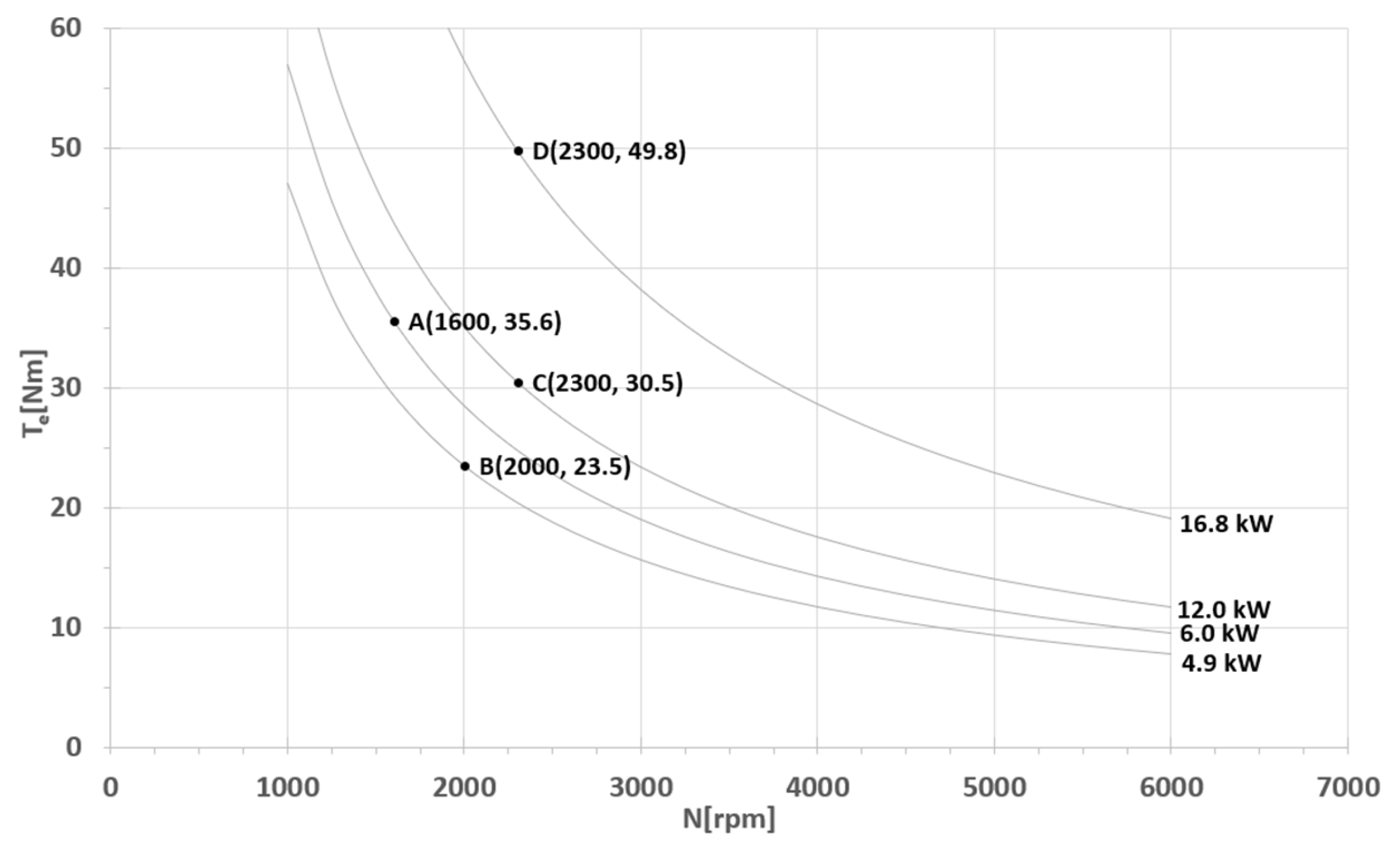
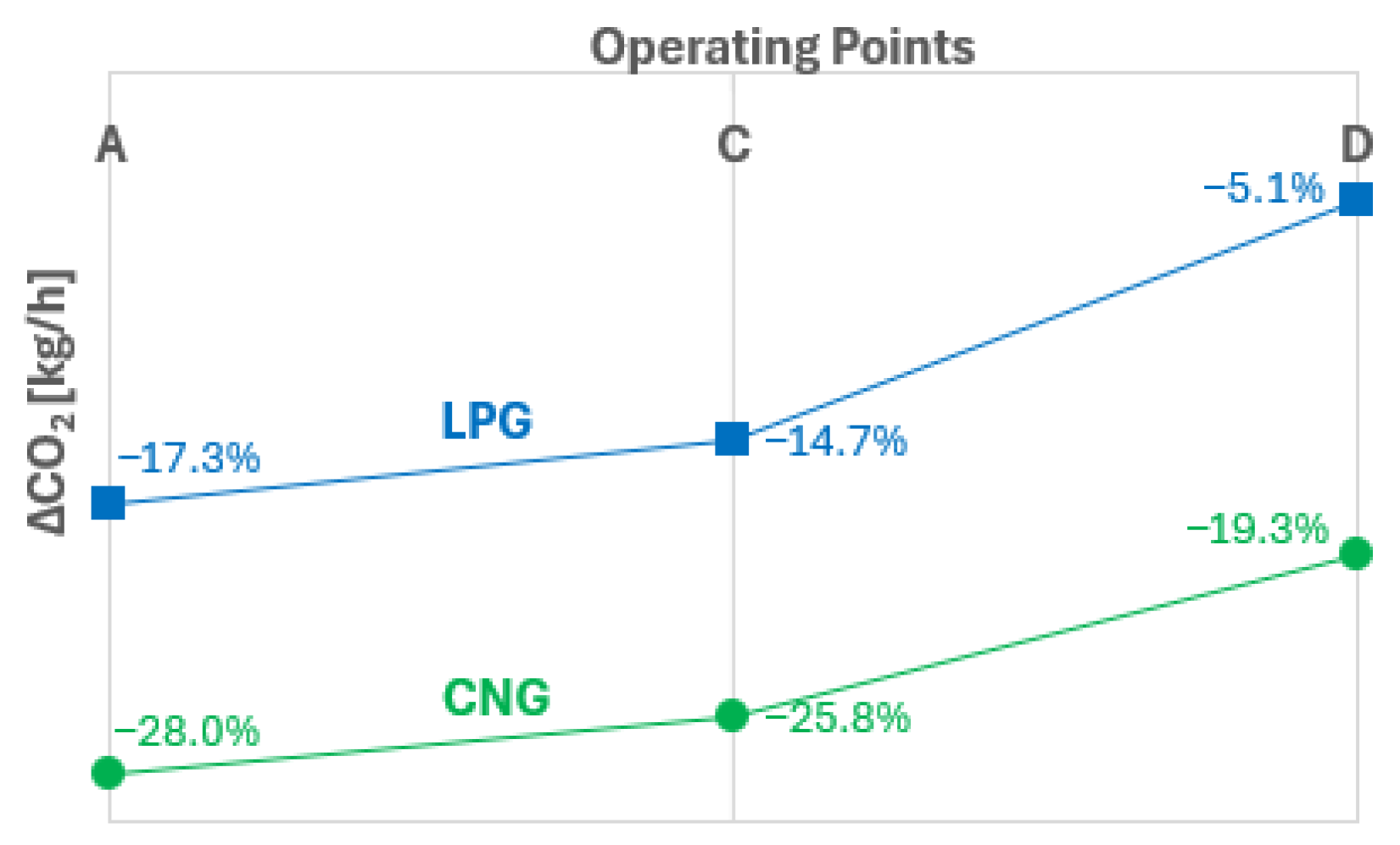
- CO2 reduction was achieved through lean operation with respect to the commercial gasoline engine (Figure 13); consequently, thanks to this figure, the perspective is changed—e.g., a 28% reduction when operating with CNG is quite notable (a reminder is considered useful: in the datasheet of the commercial gasoline engine, data are provided only for points A, C and D; point B was added to the testing matrix simply because it corresponds to an operation sometimes addressed in ETB research; hence, the possibility of comparison with other researchers increases).
- It was considered useful to quantify CO2 emissions in [g/km], knowing the limitations related to European regulation no. 83 [77]: starting with 1 January 2025, for the average of the fleet sold, penalties (95 euros for each gram of CO2 exceeded and for each registered car) began to be applied if the limit value of 94 g CO2/km, obtained during the homologation on World-wide Harmonized Light-duty Testing cycle (WLTC), is exceeded. Therefore, if point B is assimilated with the steady movement of a mid-class car at a velocity of 54 km/h, then the emission of 3 kg CO2/h, obtained in the case of using CNG and an excess air coefficient of 1.24, corresponds to a value of 55.5 g CO2/km, 2.8 g less than the situation of operating with a stoichiometric air-NG mixture and 10.7 g less than operating with a stoichiometric air-LPG mixture.
5. Summary and Conclusions
- Energy performance
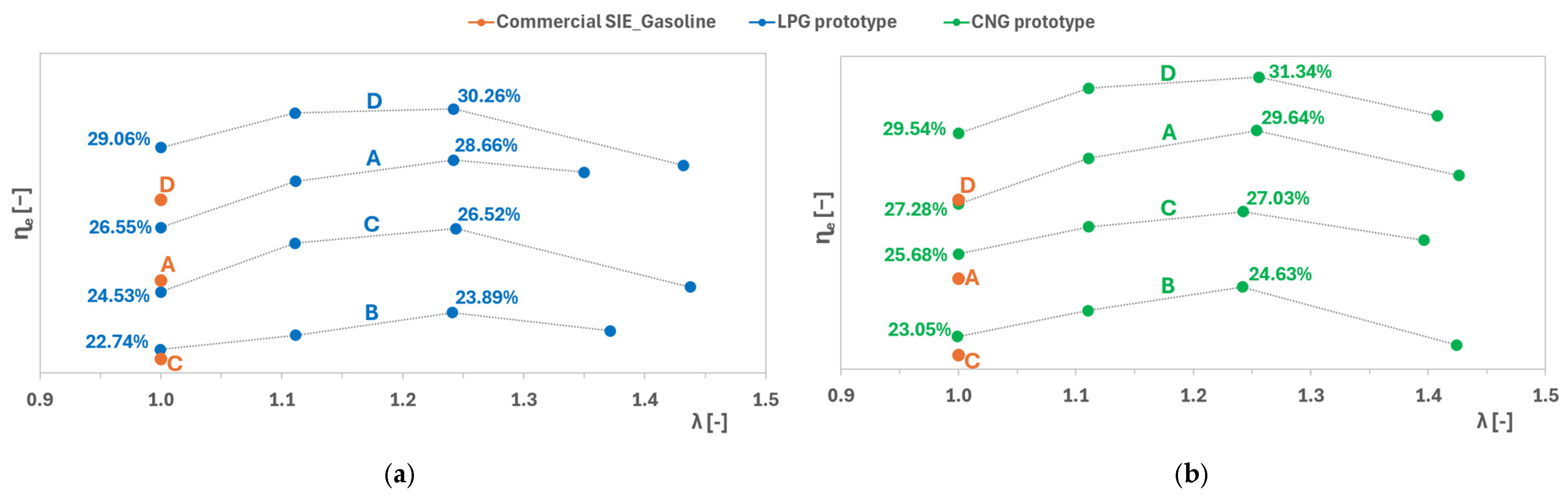
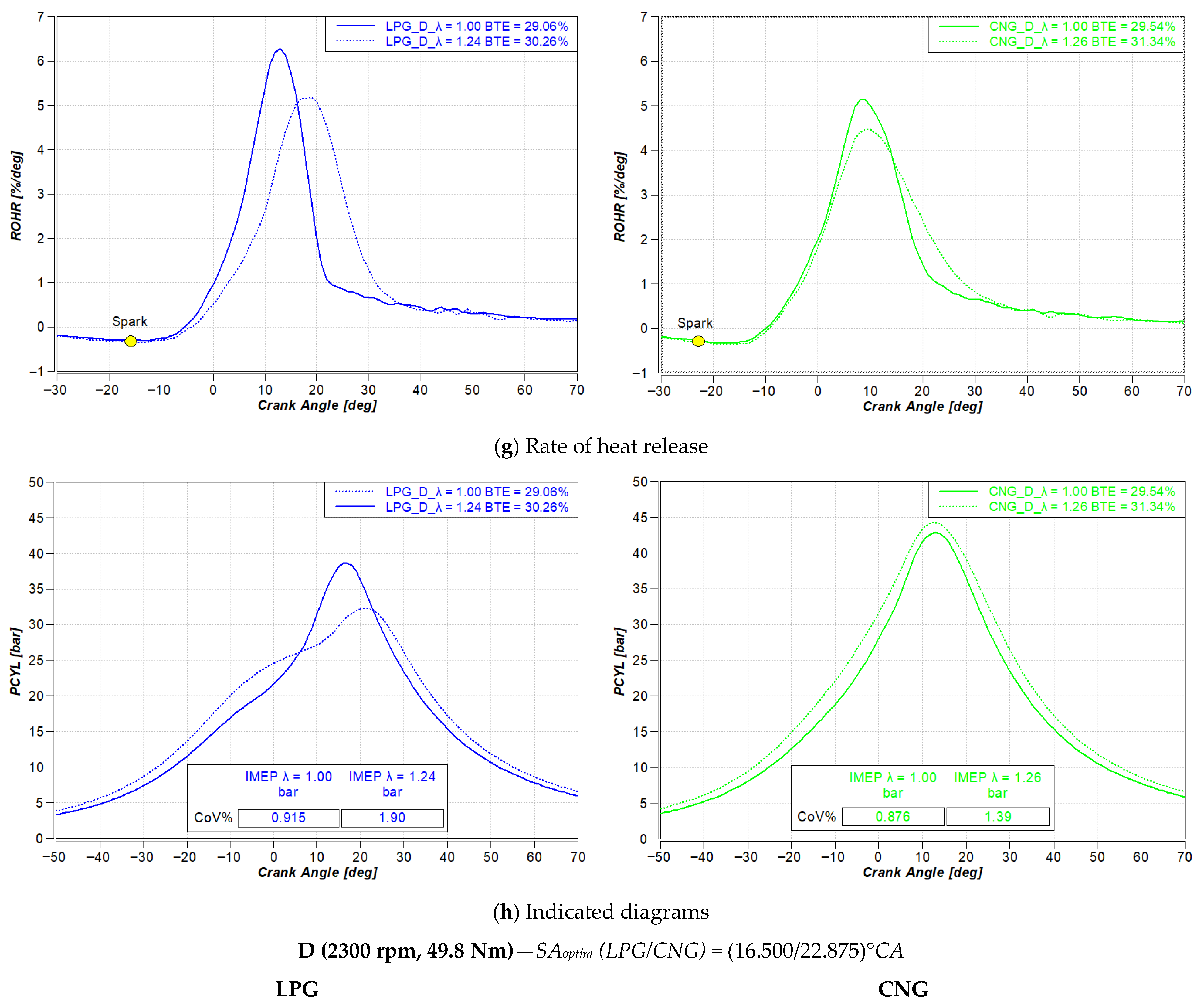
- There was a greater gain in BTE when operating with CNG lean mixtures, between 3 and 5 percentage points, which corresponds to a relative improvement of (14.3–20.4)%.
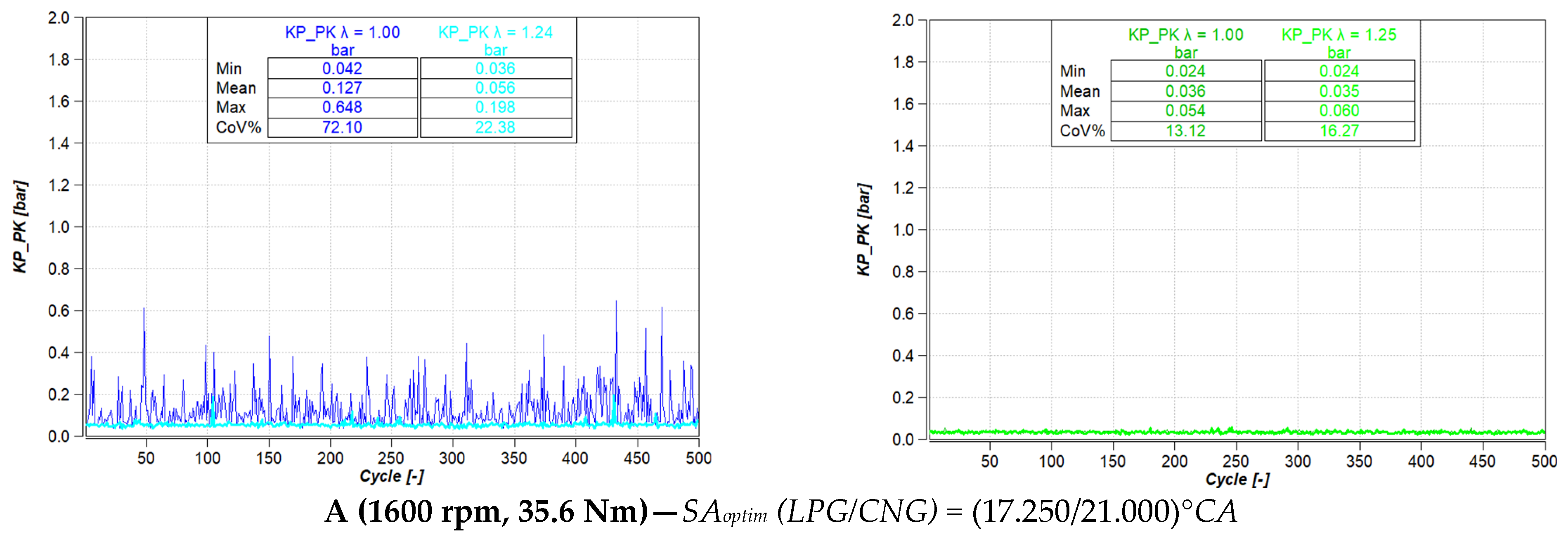
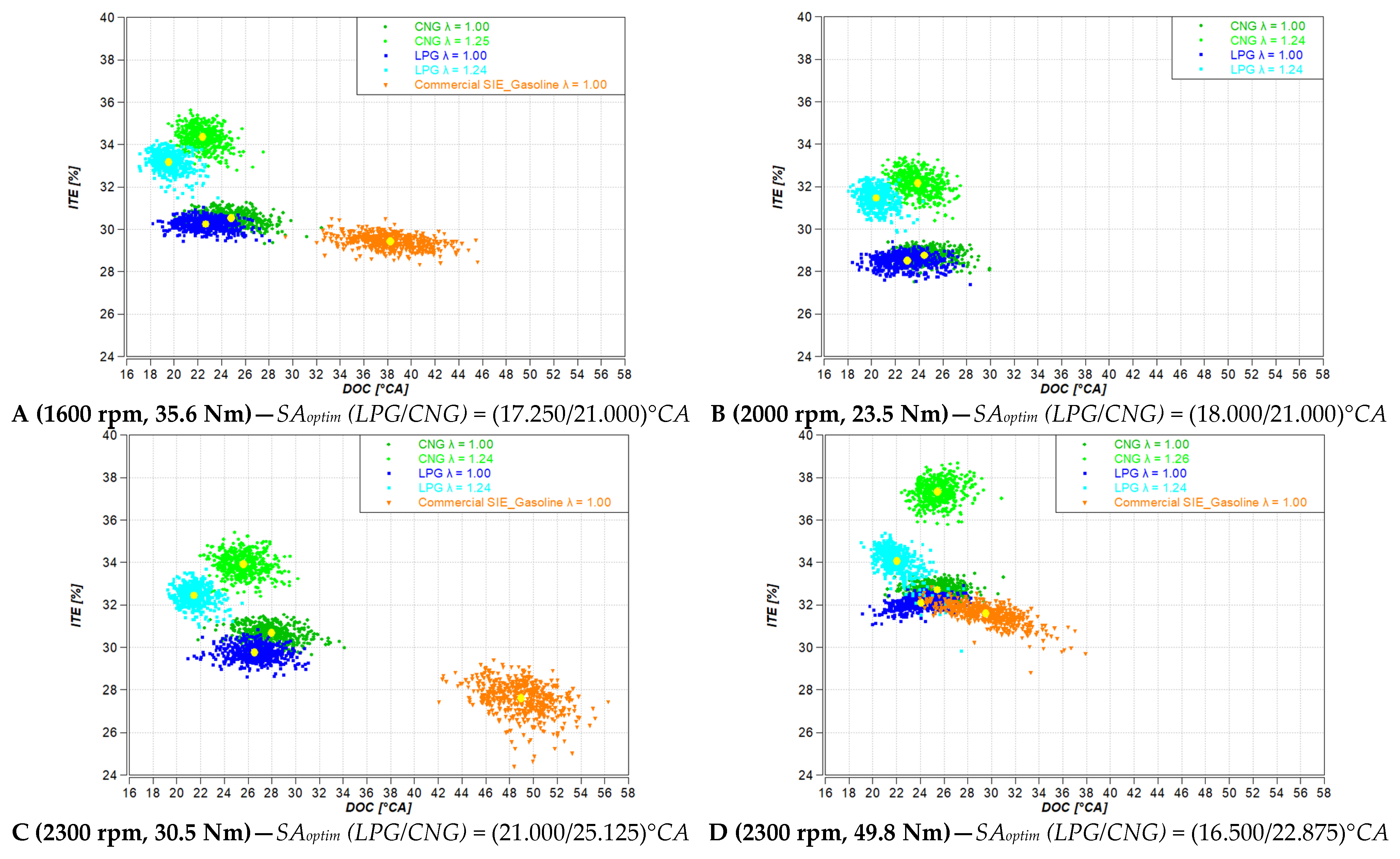
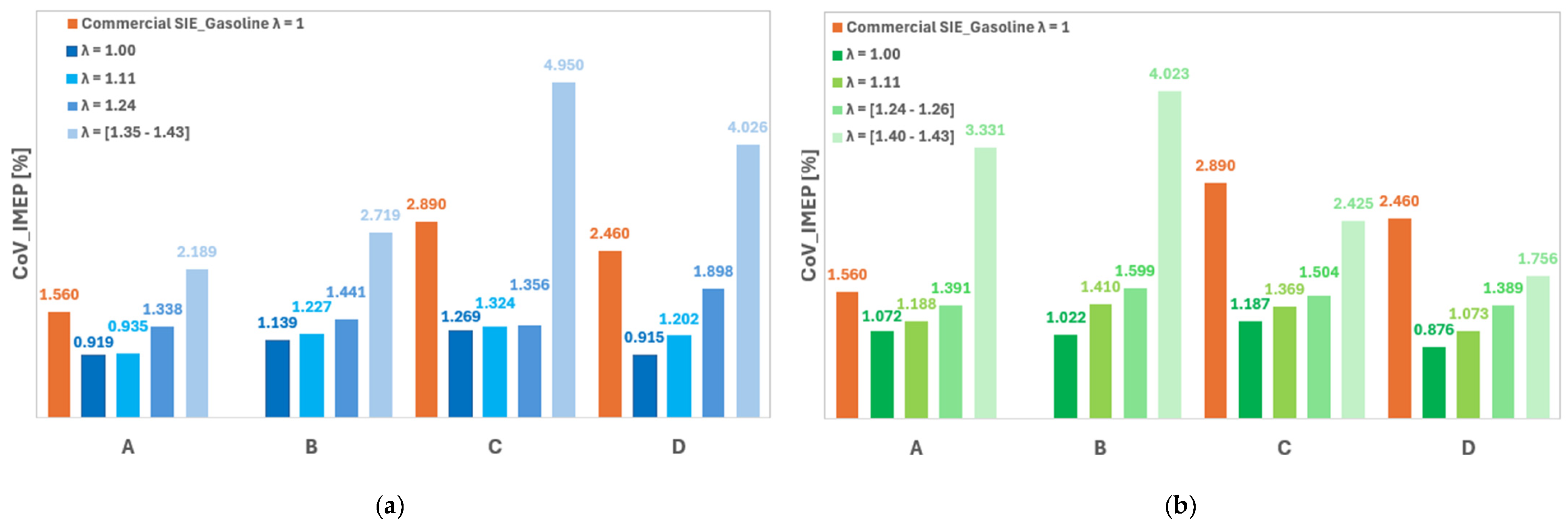
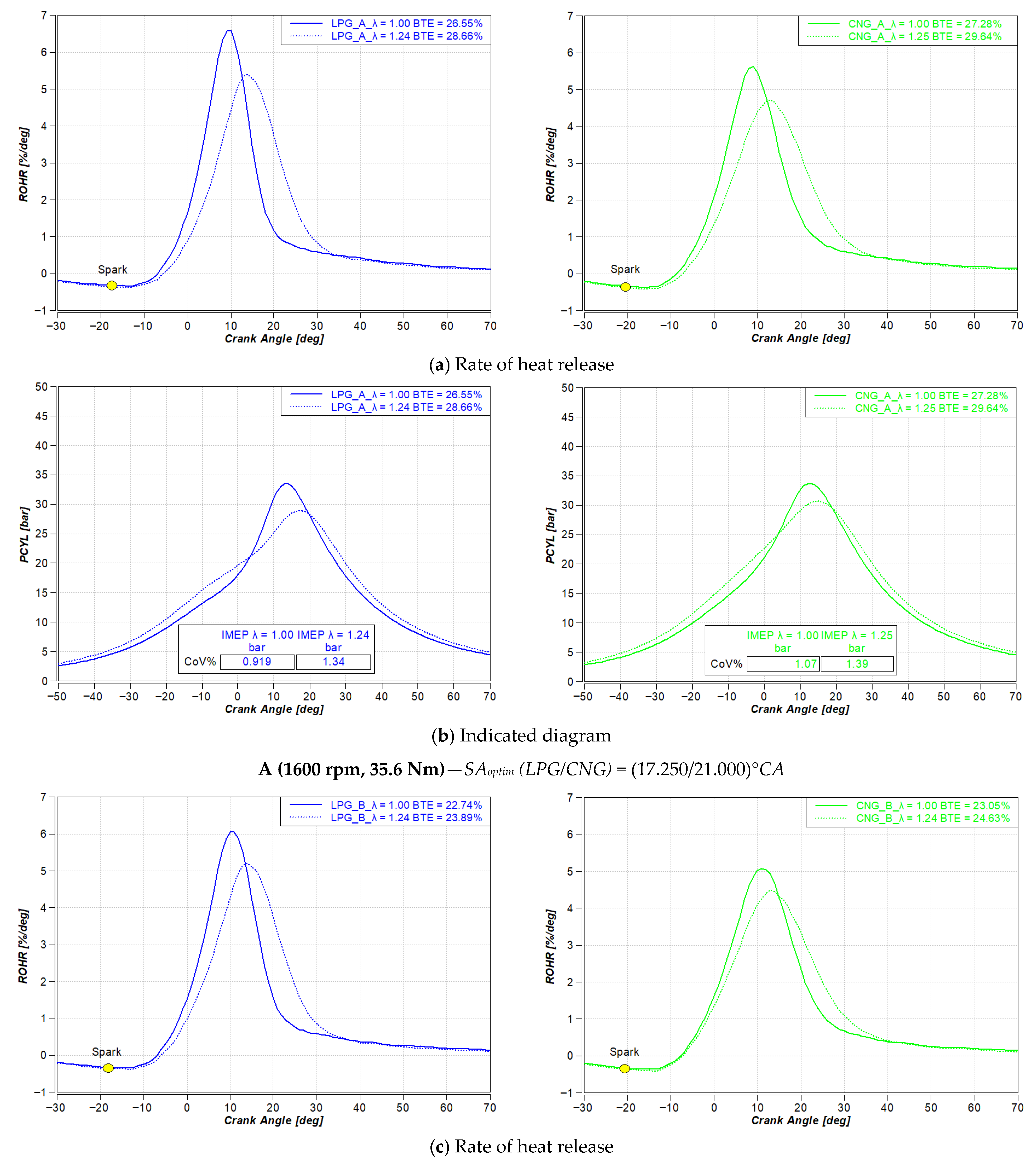
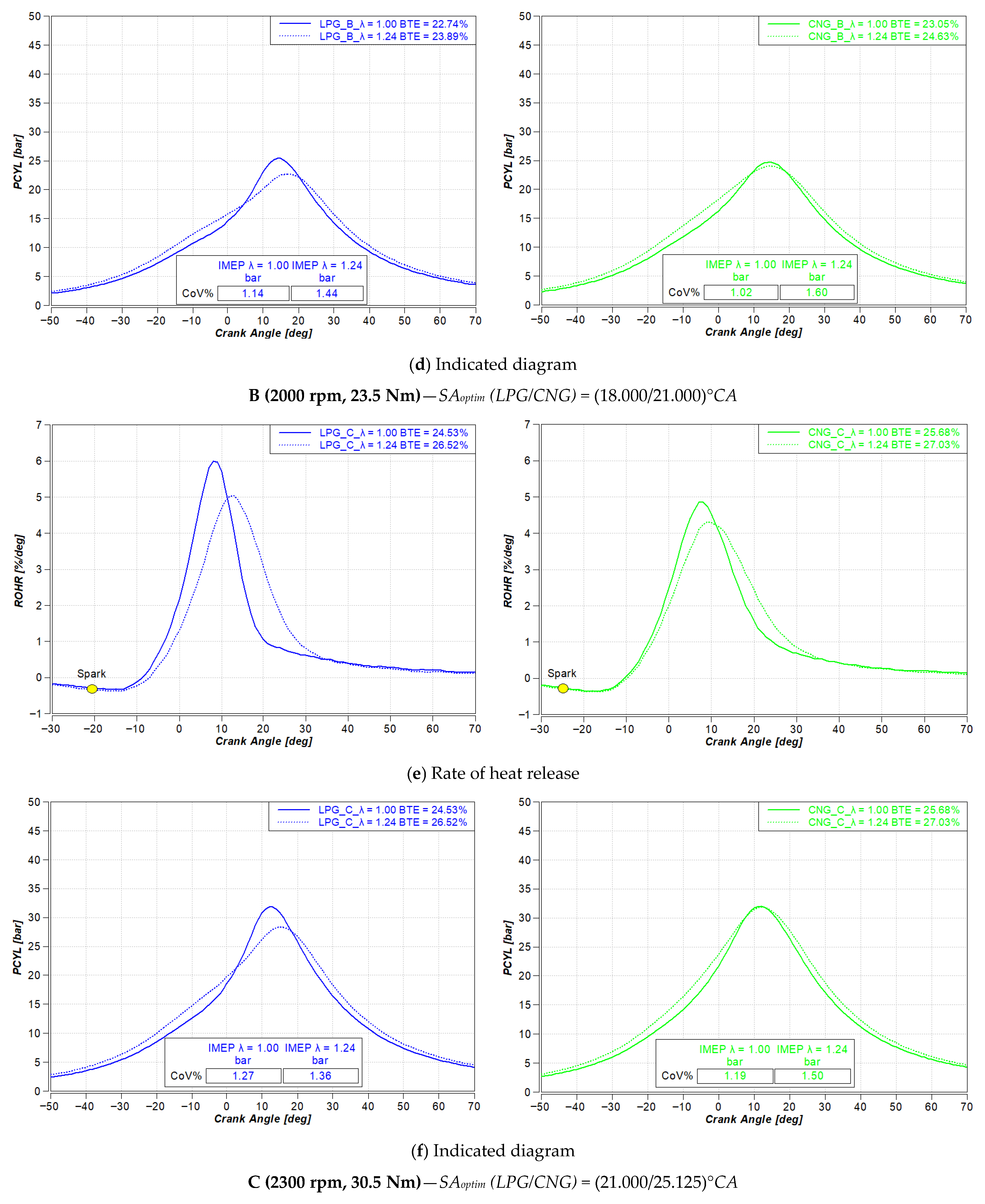
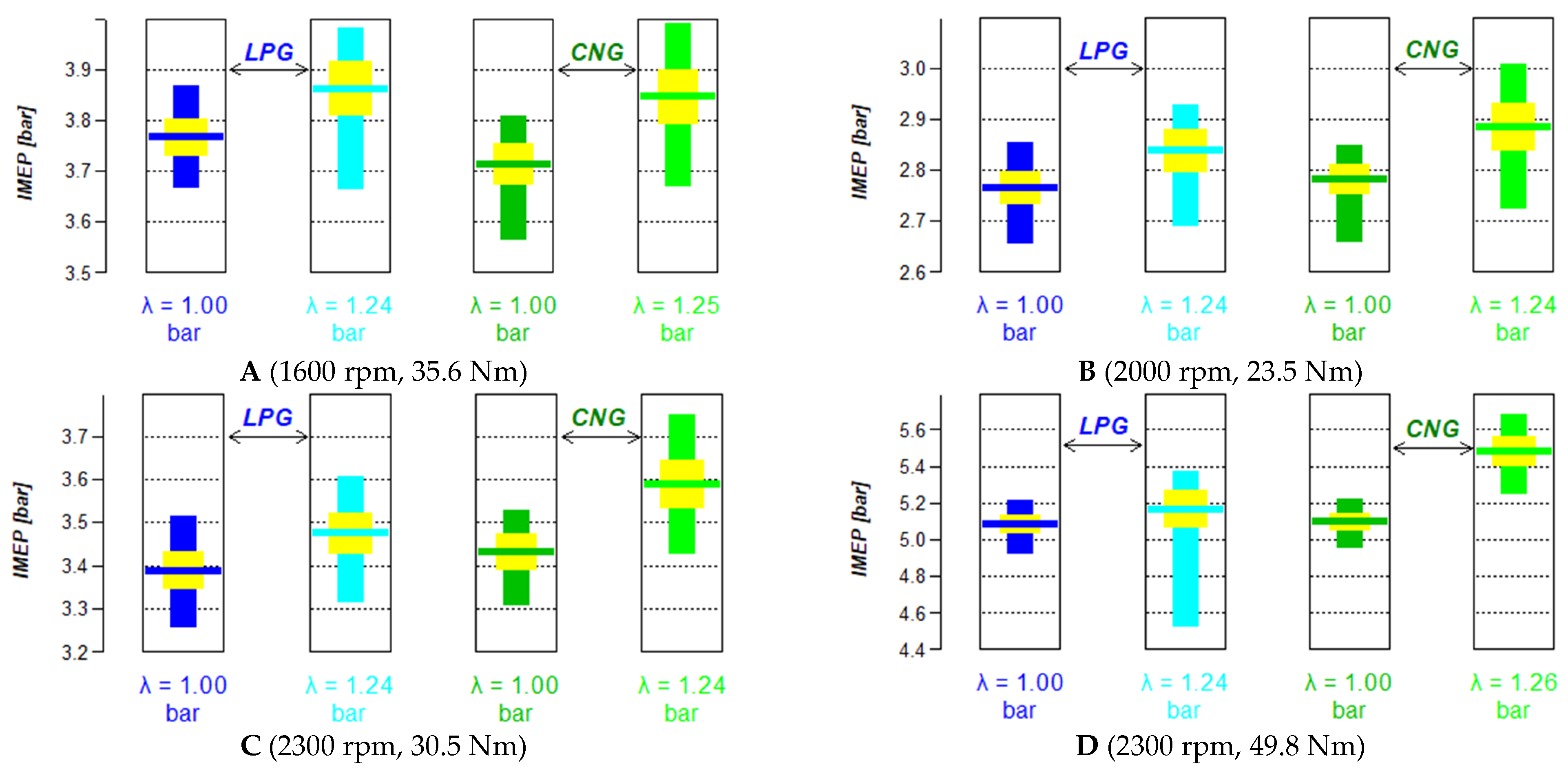
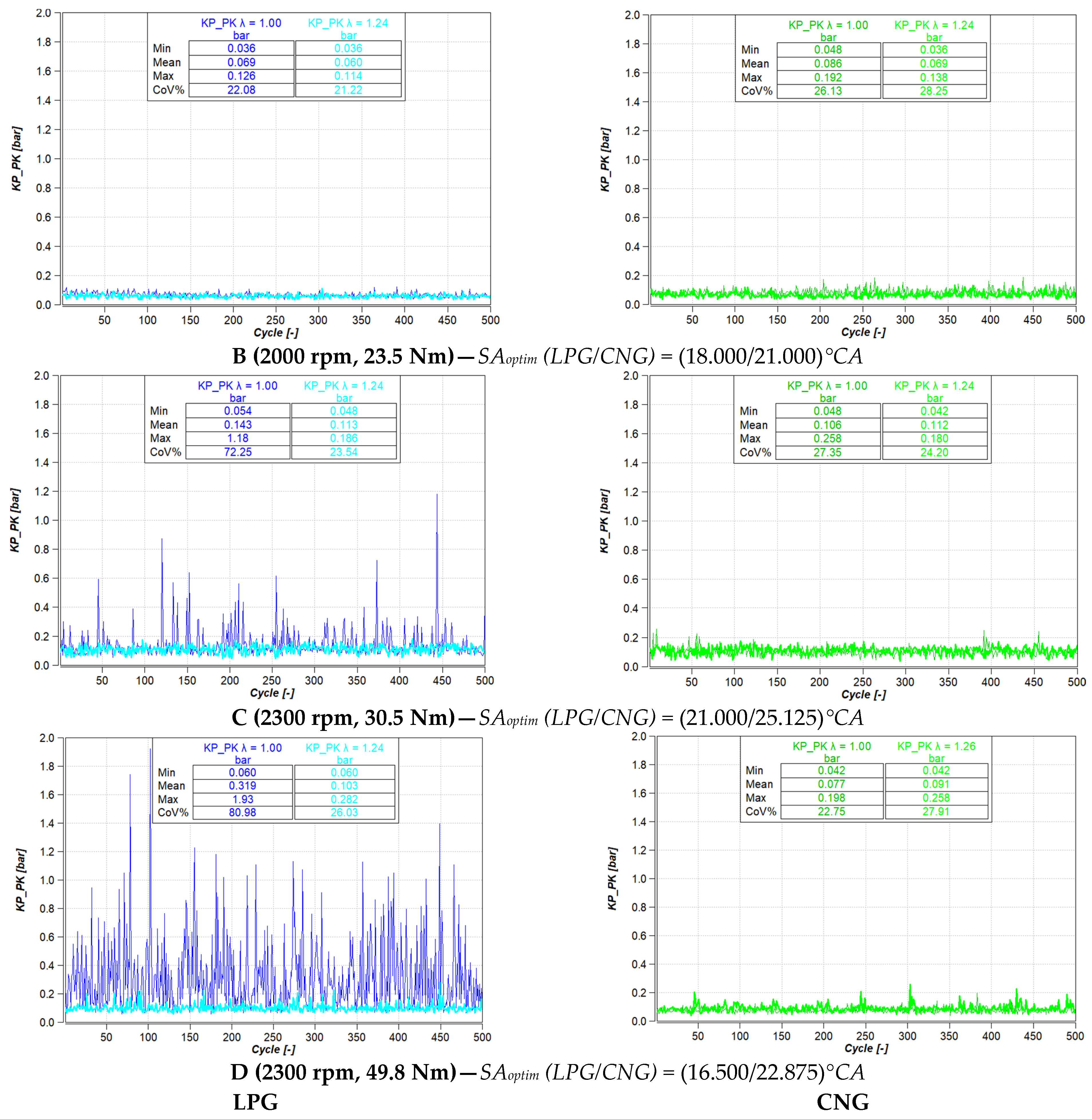
- There was a slightly lower IMEP variability with LPG than with CNG; however, both were below the values of the baseline stoichiometric commercial gasoline engine (e.g., more than halved in the case of point C for LPG).
- Environmental performance
- GHG-related CO2 was clearly decreased with the gaseous fuels, e.g., between a (19.3 and 28.0)% reduction for CNG lean mixtures, the highest drop being recorded at point A.
- CO emission was also reduced significantly with lean burning: between (70.9 and 79.4)% for LPG and (78.8 and 85.6)% for CNG, the highest cuts being recorded at point D for both fuels.
- Despite the prototype engine’s higher compression ratio, lower NOx emissions were observed with gaseous fuel lean burning, e.g., a maximum 33.6% fall for point A in the case of CNG.
- As for the PN, because there is no data available for the baseline commercial gasoline SI engine, the comparison made between the two gaseous fuels displayed a clear improvement for the CNG case, between a (21.1 and 80.6)% reduction, the highest difference being recorded at point D.
- The absence of unburnt methane measurement constitutes a limitation of our research, given the GWP associated with methane.
Author Contributions
Funding
Data Availability Statement
Acknowledgments
Conflicts of Interest
Abbreviations
| Acronyms | |
| BMEP | Brake Mean Effective Pressure |
| BTE | Brake Thermal Efficiency |
| CA | Crank Angle |
| CI | Compression Ignition (Engine) |
| CNG | Compressed Natural Gas |
| CO | Carbon Oxide |
| CO2 | Carbon Dioxide |
| CoV | Coefficient of Variability |
| CR | Compression Ratio |
| DoC | Duration of Combustion |
| DoI | Duration of Injection |
| EATS | Exhasut Aftertreatment System |
| ECU | Engine Control Unit |
| EGT | Exhaust Gas Temperature |
| EN | European Standard (norm) |
| EoC | End of Combustion |
| ETB | Engine Test Bed |
| EU | European Union |
| FID | Detector Flame Ionization |
| GC | Gas Chromatograph/Chromatography |
| GCU | Gas Control Unit |
| GHG | Greenhouse Gas |
| HDV | High-Duty Vehicles |
| IAT | Intake Air Temperature |
| IMEP | Indicated Mean Effective Pressure |
| ISO | International Standardization Organization |
| ITE | Indicated Thermal Efficiency |
| LPG | Liquified Petroleum Gas |
| MAF | Mass Air Flow |
| MAP | Manifold Absolute Pressure |
| MFF | Mass Fuel Flow |
| MBT | Maximum Brake Torque |
| LDV | Light-Duty Vehicles |
| MAP | Manifold Absolute Intake Pressure |
| MBFx | Mass Burnt Fraction (x = 5, 50, 90) |
| NDIR | Non-Dispersive Infrared |
| NDUV | Non-Dispersive Ultraviolet |
| NG | Natural Gas |
| NOx | Nitrogen Oxides |
| NTC | Normal Technical Condition |
| ON | Octane Number |
| PC | Passenger Car |
| PEMS | Portable Emission Measurement System |
| PFI | Port-Fuel Injection |
| PM | Particulate Matter |
| PN | Particulate Number |
| PTG | Power-to-Gas (Methane) |
| RON | Research Octane Number |
| SA | Spark Advance |
| SI | Spark Ignition (Engine) |
| SoC | Start of Combustion |
| RoHR | Rate of Heat Release |
| TDC | Top Dead Center |
| THC | Total (Unburnt) Hydrocarbons |
| TWC | Three-Way Catalyst |
| UHC | Unburnt Hydrocarbons |
| VNT | Variable Nozzle (Geometry) Turbine |
| Mathematical notations and Greek letters | |
| α [°CA] | Crank angle |
| Δ [%] | Relative difference |
| λ [-] | Air-excess coefficient (the inverse of the equivalence ratio) |
| γ [-] | Specific heat ratio |
| ɳe [-] | Brake thermal efficiency or effective efficiency |
| ɳv [-] | Volumetric filling efficiency |
| kp_pk [bar] | Knock pressure peak |
| pcyl [bar] | In-cylinder pressure |
| Pe [kW] | Effective engine power |
| Te [Nm] | Effective engine torque |
| Tcyl_max [K] | Maximum in-cylinder temperature |
References
- Worldometer. Natural Gas Production by Country 2025. Available online: https://www.worldometers.info/gas/gas-production-by-country/ (accessed on 23 November 2025).
- Chala, G.T.; Aziz, A.R.A.; Hagos, F.Y. Natural Gas Engine Technologies: Challenges and Energy Sustainability Issue. Energies 2018, 11, 2934. [Google Scholar] [CrossRef] [Scilit]
- Khan, M.I.; Yasmin, T.; Shakoor, A. Technical overview of compressed natural gas (CNG) as a transportation fuel. Renew. Sustain. Energy Rev. 2015, 51, 785–797. [Google Scholar] [CrossRef] [Scilit]
- Kontses, A.; Triantafyllopoulos, G.; Ntziachristos, L.; Samaras, Z. Particle number (PN) emissions from gasoline, diesel, LPG, CNG and hybrid-electric light-duty vehicles under real-world driving conditions. Atmos. Environ. 2020, 222, 117126. [Google Scholar] [CrossRef] [Scilit]
- Duc, K.N.; Duy, V.N.; Hoang-Dinh, L.; Viet, T.N.; Le-Anh, T. Performance and emission characteristics of a port fuel injected, spark ignition engine fueled by compressed natural gas. Sustain. Energy Technol. Assess. 2019, 31, 383–389. [Google Scholar] [CrossRef] [Scilit]
- Kim, J.K.; Lee, W.J.; Ahn, E.; Choi, J.H. Experimental and numerical studies on performance investigation of a diesel engine converted to run on LPG. Energy Convers. Manag. 2024, 321, 119091. [Google Scholar] [CrossRef] [Scilit]
- Tilagone, R.; Venturi, S.S.; Monnier, G.G. Natural gas—An environmentally friendly fuel for urban vehicles: The smart demonstrator approach. Oil Gas Sci. Technol. 2005, 61, 155–164. [Google Scholar] [CrossRef] [Scilit]
- Bouter, A.; Melgar, J.; Ternel, C. Etude ACV de Véhicules Roulant au GNV et bioGNV; IFP Energies Nouvelles: Paris, France, 2019. [Google Scholar]
- Kelly, M. LPG and the Global Energy Transition, Neuilly-Sur-Seine. 2015. Available online: https://www.worldliquidgas.org/wp-content/uploads/2015/05/LPG-and-the-Global-Energy-Transition.pdf (accessed on 23 November 2025).
- Hendriksen, R.G.; Vermeulen, P.; Rijkeboer, R.J.; Bremmers, R.C.; Smokers, D.A.C.M.; Winkel, R.T.M. Evaluation of the Environmental Impact of Modem Passenger Cars on Petrol, Diesel, Automotive LPG, CNG; 2003. Available online: https://www.tno.nl/media/6377/annual-report-2003-04-or-vm-025-1-hvdb.pdf (accessed on 13 December 2025).
- Lott, P.; Casapu, M.; Grunwaldt, J.D.; Deutschmann, O. A review on exhaust gas after-treatment of lean-burn natural gas engines—From fundamentals to application. Appl. Catal. B Environ. 2024, 340, 123241. [Google Scholar] [CrossRef] [Scilit]
- Westerhoff, M. Natural gas A chance to be grabbed. MTZ Worldw. 2016, 77, 8–13. [Google Scholar] [CrossRef] [Scilit]
- Khan, M.I.; Yasmeen, T.; Khan, M.I.; Farooq, M.; Wakeel, M. Research progress in the development of natural gas as fuel for road vehicles: A bibliographic review (1991–2016). Renew. Sustain. Energy Rev. 2016, 66, 702–741. [Google Scholar] [CrossRef] [Scilit]
- Khan, M.I.; Yasmin, T.; Shakoor, A. International experience with compressed natural gas (CNG) as environmental friendly fuel. Energy Syst. 2015, 6, 507–531. [Google Scholar] [CrossRef] [Scilit]
- Prussi, M.; Padella, M.; Conton, M.; Postma, E.D.; Lonza, L. Review of technologies for biomethane production and assessment of Eu transport share in 2030. J. Clean. Prod. 2019, 222, 565–572. [Google Scholar] [CrossRef] [Scilit] [PubMed]
- Alamia, A.; Magnusson, I.; Johnsson, F.; Thunman, H. Well-to-wheel analysis of bio-methane via gasification, in heavy duty engines within the transport sector of the European Union. Appl. Energy 2016, 170, 445–454. [Google Scholar] [CrossRef] [Scilit]
- Tratzi, P.; Torre, M.; Paolini, V.; Tomassetti, L.; Montiroli, C.; Manzo, E.; Petracchini, F. Liquefied biomethane for heavy-duty transport in Italy: A well-to-wheels approach. Transp. Res. Part D Transp. Environ. 2022, 107, 103288. [Google Scholar] [CrossRef] [Scilit]
- de Jong, P.; Torres, E.A.; de Melo, S.A.B.V.; Mendes-Santana, D.; Pontes, K.V. Socio-economic and environmental aspects of bio-LPG and bio-dimethyl ether (Bio-DME) production and usage in developing countries: The case of Brazil. Clean. Circ. Bioecon. 2023, 6, 100055. [Google Scholar] [CrossRef] [Scilit]
- Johnson, E. Process technologies and projects for BiOLPG. Energies 2019, 12, 250. [Google Scholar] [CrossRef] [Scilit]
- Blanco, H.; Nijs, W.; Ruf, J.; Faaij, A. Potential of Power-to-Methane in the EU energy transition to a low carbon system using cost optimization. Appl. Energy 2018, 232, 323–340. [Google Scholar] [CrossRef] [Scilit]
- Pintér, G. The development of global power-to-methane potentials between 2000 and 2020: A comparative overview of international projects. Appl. Energy 2024, 353, 122094. [Google Scholar] [CrossRef] [Scilit]
- Directive (EU) 2023/2413 of the European Parliament as Regards the Promotion of Energy from Renewable Sources. 2023. Available online: https://eur-lex.europa.eu/eli/dir/2023/2413/oj/eng (accessed on 5 January 2026).
- Ziyaei, S.; Siti, K.M.; Lappas, P. A Review of Ultra-Lean and Stratified Charged Combustion in Natural Gas Spark Ignition Engines. SAE Int. J. Engines 2023, 16, 883–922. [Google Scholar] [CrossRef] [Scilit]
- Kahangamage, U.; Chen, Y.; Leung, C.W.; Ngai, T.Y. Experimental Study of Lean-burning Limits of Hydrogen-enriched LPG Intended for Domestic Use. J. Energy Power Technol. 2022, 4, 16. [Google Scholar] [CrossRef] [Scilit]
- Korakianitis, T.; Namasivayam, A.M.; Crookes, R.J. Natural-gas fueled spark-ignition (SI) and compression-ignition (CI) engine performance and emissions. Prog. Energy Combust. Sci. 2011, 37, 89–112. [Google Scholar] [CrossRef] [Scilit]
- Soltic, P.; Hilfiker, T.; Hutter, R.; Hanggi, S. Experimental comparison of efficiency and emission levels of four-cylinder lean-burn passenger car-sized CNG engines with different ignition concepts. Combust. Engines 2018, 176, 27–35. [Google Scholar] [CrossRef] [Scilit] [PubMed]
- Liu, J.; Dumitrescu, C.E. Optical analysis of flame inception and propagation in a lean-burn natural-gas spark-ignition engine with a bowl-in-piston geometry. Int. J. Engine Res. 2020, 21, 1584–1596. [Google Scholar] [CrossRef] [Scilit]
- Banji, T.I.; Arney, G.; Patterson, M.; Olsen, D.B. Reduction of Methane Emissions from Natural Gas Integral Compressor Engines through Fuel Injection Control. Sustainability 2024, 16, 5943. [Google Scholar] [CrossRef] [Scilit]
- Hall, J.; Hibberd, B.; Streng, S.; Bassett, M. Compressed-natural-gas optimised downsized demonstrator engine. Proc. Inst. Mech. Eng. Part D J. Automob. Eng. 2018, 232, 75–89. [Google Scholar] [CrossRef] [Scilit]
- Shamekhi, A.H.; Khatibzadeh, N.; Shamekhi, A. A comprehensive comparative investigation of compressed natural gas as an alternative fuel in a bi-fuel spark ignition engine. Iran. J. Chem. Chem. Eng. 2008, 27, 73–83. [Google Scholar]
- Shamekhi, A.; Khatibzadeh, N.; Shamekhi, A.H. Performance and emissions characteristics investigation of a bi-fuel SI engine fuelled by CNG and gasoline. In Proceedings of the ASME 2006 Internal Combustion Engine Division Spring Technical Conference, Aachen, Germany, 7–10 May 2006. [Google Scholar]
- Aslam, M.U.; Masjuki, H.H.; Kalam, M.A.; Abdesselam, H.; Mahlia, T.M.I.; Amalina, M.A. An experimental investigation of CNG as an alternative fuel for a retrofitted gasoline vehicle. Fuel 2006, 85, 717–724. [Google Scholar] [CrossRef] [Scilit]
- Husted, H.L.; Karl, D.G.; Schilling, D.S.; Weber, C. Direct Injection of CNG for Driving Performance with Low CO2. In Proceedings of the 23rd Aachen Colloquium Automobile and Engine Technology, Aachen, Germany, 6–8 October 2014; pp. 829–850. [Google Scholar]
- Mendl, G.; Hoffmann, O.; Mangold, R.; Rosenberger, S.; Pfalzgraf, J.; Langa, Z.; Czuczor, B. Der neue Audi 2.0l g-tron–ein weiterer Schritt für die nachhaltige Mobilität der Zukunft/The New Audi 2.0l g-tron–Another Step for the Sustainable Mobility of the Future. In 38. Internationales Wiener Motorensymposium 27.–28. April 2017; VDI Verlag, Düsseldorf: Düsseldorf, Germany, 2017; pp. II–127–II–147. [Google Scholar] [CrossRef] [Scilit]
- Warth, M.; Streng, S.; Wieske, P.; Mohr, U.; Hall, J. Monovalenter Erdgasbetrieb und Downsizing für niedrigste CO2 Emissionen/Monovalent Natural Gas Combustion and Downsizing for Lowest CO2 Emissions. In 37. Internationales Wiener Motorensymposium 28.–29. April 2016; VDI Verlag, Düsseldorf: Düsseldorf, Germany, 2016; pp. II–34–II–52. [Google Scholar] [CrossRef] [Scilit]
- Popa, R.; Berquez, J.; Clenci, A.; Iorga-Siman, V.; Niculae, M.; Niculescu, R. Sustainable road mobility with methane gas. Preliminary results of a monovalent spark ignition engine fueled with methane. In Proceedings of the FISITA 2021 World Congress, Prague, Czech Republic, 13–17 September 2021; Available online: https://www.fisita.org/diary/fisita-world-congress-2021 (accessed on 6 April 2026).
- Popa, R.; Clenci, A.; Chiriac, R.; Niculescu, R.; Iorga-Simăn, V. Experimental and Numerical Investigation on the Effects of Using Natural Gas in a Monovalent Spark Ignition Engine. AIP Conf. Proc. 2024, 3129, 050004. [Google Scholar] [CrossRef] [Scilit]
- Popa, R.M.; Clenci, A.; Berquez, J.; Niculescu, R. Environmental Sustainability Benefits of Natural Gas and Liquefied Petroleum Gas in a Diesel Engine Retrofitted for Spark Ignition Operation. Sustainability 2026, 18, 2273. [Google Scholar] [CrossRef] [Scilit]
- United States Environmental Protection Agency (EPA). Notice of Violation on Clean Air Act to VW (18 September 2015), (2015) 6. Available online: https://www.epa.gov/sites/default/files/2015-10/documents/vw-nov-caa-09-18-15.pdf (accessed on 24 November 2025).
- Semin, R.; Bakar, R.A.; Ismail, A.R. Green Engines Development Using Compressed Natural Gas as an Alternative Fuel: A Review. Am. J. Environ. Sci. 2009, 5, 371–381. [Google Scholar] [CrossRef] [Scilit]
- Barnstedt, K.; Ratzberger, R.; Grabner, P.; Eichlseder, H. Thermodynamic investigation of different natural gas combustion processes on the basis of a heavy-duty engine. Int. J. Engine Res. 2016, 17, 28–34. [Google Scholar] [CrossRef] [Scilit]
- Aktas, F. Spark ignition timing effects on a converted diesel engine using natural gas: A numerical study. Proc. Inst. Mech. Eng. Part D J. Automob. Eng. 2022, 236, 1949–1963. [Google Scholar] [CrossRef] [Scilit]
- Aktas, F.; Karyeyen, S. Colorless distributed combustion (CDC) effects on a converted spark-ignition natural gas engine. Fuel 2022, 317, 123521. [Google Scholar] [CrossRef] [Scilit]
- Huang, H.; Xing, K.; Lin, T.; Guo, X.; Wang, Y. Evaluating potential of increasing flow intensity and reducing crevice volume to improve thermal efficiency and hydrocarbon emission in spark-ignition natural gas engines. Fuel 2024, 373, 132286. [Google Scholar] [CrossRef] [Scilit]
- Riccardi, M.; De Bellis, V.; Sforza, L.; Beatrice, C.; Bozza, F.; Mirzaeian, M. Advanced turbulence and combustion modeling for the study of a swirl-assisted natural gas spark-ignition heavy-duty engine. Int. J. Engine Res. 2023, 24, 3400–3416. [Google Scholar] [CrossRef] [Scilit]
- Van Roekel, C.A.; Montgomery, D.T.; Singh, J.; Olsen, D.B. Evaluating dedicated exhaust gas recirculation on a stoichiometric industrial natural gas engine. Int. J. Engine Res. 2021, 22, 491–502. [Google Scholar] [CrossRef] [Scilit]
- Liu, J.; Dumitrescu, C.E. Flame development analysis in a diesel optical engine converted to spark ignition natural gas operation. Appl. Energy 2018, 230, 1205–1217. [Google Scholar] [CrossRef] [Scilit]
- Varma, P.S.; Mittal, M. Investigations with bowl-in-piston (CI type) and flat-piston (SI type) geometries to study the engine characteristics of a CI engine retrofitted for SI operation with CNG fuel. Energy Convers. Manag. 2024, 301, 118083. [Google Scholar] [CrossRef] [Scilit]
- Liu, J.; Dumitrescu, C.E. Single and double Wiebe function combustion model for a heavy-duty diesel engine retrofitted to natural-gas spark-ignition. Appl. Energy 2019, 248, 95–103. [Google Scholar] [CrossRef] [Scilit]
- Liu, J.; Dumitrescu, C.E. Combustion partitioning inside a natural gas spark ignition engine with a bowl-in-piston geometry. Energy Convers. Manag. 2019, 183, 73–83. [Google Scholar] [CrossRef] [Scilit]
- Liu, J.; Dumitrescu, C.E. 3D CFD simulation of a CI engine converted to SI natural gas operation using the G-equation. Fuel 2018, 232, 833–844. [Google Scholar] [CrossRef] [Scilit]
- Fosudo, T.; Kar, T.; Windom, B.; Olsen, D. Low-carbon fuels for spark-ignited engines: A comparative study of compressed natural gas and liquefied petroleum gas on a CFR engine with exhaust gas recirculation. Fuel 2024, 360, 130456. [Google Scholar] [CrossRef] [Scilit]
- ISO6974-6. Natural Gas. Determination of Composition with Defined Uncertainty by Gas Chromatography Determination of Hydrogen, Helium, Oxygen, Nitrogen, Carbon Dioxide and C1 to C8 Hydrocarbons Using Three Capillary Columns. Available online: https://www.en-standard.eu/bs-en-iso-6974-6-2008-natural-gas-determination-of-composition-with-defined-uncertainty-by-gas-chromatography-determination-of-hydrogen-helium-oxygen-nitrogen-carbon-dioxide-and-c1-to-c8-hydrocarbons-using-three-capillary-columns/?gad_source=1&gad_campaignid=21517220826&gclid=CjwKCAjw-dfOBhAjEiwAq0RwI0Kdhm1Nnm_SaNn_aagRPR1edOqcgMCrrAnE86xrgNibqKRTavRxnRoCYMIQAvD_BwE (accessed on 6 April 2026).
- EN27941. Methods of Test for Petroleum and Its Products. Commercial Propane and Butane. Analysis by Gas Chromatography. Available online: https://www.en-standard.eu/bs-en-27941-1994-methods-of-test-for-petroleum-and-its-products-commercial-propane-and-butane-analysis-by-gas-chromatography/?gad_source=1&gad_campaignid=21517221747&gclid=CjwKCAjw-dfOBhAjEiwAq0RwI8ZfjfCSQZf_pukLkQC59M5YLValIMcZloJIguS5uZ-UdcsKQE4dlhoChE0QAvD_BwE (accessed on 6 April 2026).
- Heywood, J. Internal Combustion Engine Fundamentals; McGraw-Hill: NewYork, NY, USA, 1988. [Google Scholar]
- Erdemir, D.; Dincer, I. A perspective on the use of ammonia as a clean fuel: Challenges and solutions. Int. J. Energy Res. 2021, 45, 4827–4834. [Google Scholar] [CrossRef] [Scilit]
- Kamboj, S.K.; Karimi, M.N. A Study of Spark Ignition Engine Fueled with Methanol and Ethanol Fuel Blends with Iso-Octane. Int. J. Therm. Environ. Eng. 2014, 8, 25–31. [Google Scholar] [CrossRef] [Scilit]
- Agarwal, A.K.; Ateeq, B.; Gupta, T.; Singh, A.P.; Pandey, S.K.; Sharma, N.; Agarwal, R.A.; Gupta, N.K.; Sharma, H.; Jain, A.; et al. Toxicity and mutagenicity of exhaust from compressed natural gas: Could this be a clean solution for megacities with mixed-traffic conditions? Environ. Pollut. 2018, 239, 499–511. [Google Scholar] [CrossRef] [Scilit]
- Amirante, R.; Distaso, E.; Tamburrano, P.; Reitz, R.D. Laminar flame speed correlations for methane, ethane, propane and their mixtures, and natural gas and gasoline for spark-ignition engine simulations. Int. J. Engine Res. 2017, 18, 951–970. [Google Scholar] [CrossRef] [Scilit]
- Chauhan, B.S.; Cho, H.-M. A Study on Experiment of CNG as a Clean Fuel for Automobiles in Korea. J. Korean Soc. Atmos. Environ. 2010, 26, 469–474. [Google Scholar] [CrossRef] [Scilit]
- Cheng, Q.; Kaario, O.; Ahmad, Z.; Vuorinen, V.; Larmi, M. Effect of pilot fuel properties on engine performance and combustion stability in a tri-fuel engine powered by premixed methane-hydrogen and diesel pilot. Int. J. Hydrogen Energy 2021, 46, 37469–37486. [Google Scholar] [CrossRef] [Scilit]
- Kobayashi, H.; Hayakawa, A.; Somarathne, K.D.K.A.; Okafor, E.C. Science and technology of ammonia combustion. Proc. Combust. Inst. 2019, 37, 109–133. [Google Scholar] [CrossRef] [Scilit]
- Fabiś, P.; Flekiewicz, B. Influence of LPG and DME composition on spark ignition engine performance. Energies 2021, 14, 5583. [Google Scholar] [CrossRef] [Scilit]
- Chuahy, F.D.F.; Splitter, D. Piston geometry and stroke optimization for high efficiency propane spark ignition engines. Appl. Therm. Eng. 2024, 244, 122708. [Google Scholar] [CrossRef] [Scilit]
- Morganti, K.J.; Foong, T.M.; Brear, M.J.; Da Silva, G.; Yang, Y.; Dryer, F.L. The Research and Motor octane numbers of Liquefied Petroleum Gas (LPG) Kai. Fuel 2013, 108, 797–811. [Google Scholar] [CrossRef] [Scilit]
- Lee, S.; Oh, S.; Choi, Y.; Kang, K. Effect of n-Butane and propane on performance and emission characteristics of an SI engine operated with DME-blended LPG fuel. Fuel 2011, 90, 1674–1680. [Google Scholar] [CrossRef] [Scilit]
- Baek, S.; Lee, S.; Shin, M.; Lee, J.; Lee, K. Analysis of combustion and exhaust characteristics according to changes in the propane content of LPG. Energy 2022, 239, 122297. [Google Scholar] [CrossRef] [Scilit]
- Zhang, Q.; Qian, X.; Chen, Y.; Li, M.; Wu, D.; Yuan, M.; Wang, D. Effect of DME addition on flame dynamics of LPG/DME blended fuel in tail space of closed pipeline. Energy 2020, 202, 117746. [Google Scholar] [CrossRef] [Scilit]
- Chen, Z.; Ai, Y.; Qin, T.; Luo, F. Quantitative evaluation of n-butane concentration on knock severity of a natural gas heavy-duty SI engine. Energy 2019, 189, 116244. [Google Scholar] [CrossRef] [Scilit]
- Apostolescu, N.; Sfinteanu, D. Automobilul cu Combustibili Neconventionali (Automobiles with Unconventional Fuels); Editura Tehnica: Bucharest, Romania, 1989. [Google Scholar]
- Ozdor, N.; Dulger, M.; Sher, E. Cyclic Variability in Spark Ignition Engines A Literature Survey. J. Engines 1994, 103, 1514–1552. [Google Scholar] [CrossRef] [Scilit]
- Beccari, S.; Pipitone, E. A New Simple Function for Combustion and Cyclic Variation Modeling in Supercharged Spark Ignition Engines. Energies 2022, 15, 3796. [Google Scholar] [CrossRef] [Scilit]
- Kosmadakis, G.M.; Rakopoulos, C.D. A fast CFD-based methodology for determining the cyclic variability and its effects on performance and emissions of spark-ignition engines. Energies 2019, 12, 4131. [Google Scholar] [CrossRef] [Scilit]
- Lee, K.; Yoon, M.; Sunwoo, M. A study on pegging methods for noisy cylinder pressure signal. Control Eng. Pr. 2008, 16, 922–929. [Google Scholar] [CrossRef] [Scilit]
- AVL List GmbH. Engine Indicating; User handbook; AVL List GmbH: Graz, Austria, 2002. [Google Scholar]
- Molina, S.; Ruiz, S.; Gomez-Soriano, J.; Olcina-Girona, M. Impact of hydrogen substitution for stable lean operation on spark ignition engines fueled by compressed natural gas. Results Eng. 2023, 17, 100799. [Google Scholar] [CrossRef] [Scilit]
- Penalties for Excess Emissions. 2019. Available online: https://climate.ec.europa.eu/eu-action/transport-decarbonisation/road-transport/cars-and-vans_en#penalties-for-excess-emissions (accessed on 16 January 2026).
- Clenci, A.; Cioc, B.; Julien, B.; Victor, I.-S.; Stoica, R.; Niculescu, R. Results on the Use of an Original Burner for Reducing the Three-Way Catalyst Light-Off Time. Inventions 2024, 9, 112. [Google Scholar] [CrossRef] [Scilit]
- Clenci, A.; Berquez, J.; Stoica, R.; Niculescu, R.; Cioc, B.; Zaharia, C.; Iorga-Simăn, V. Experimental investigation of the effect of an afterburner on the light-off performance of an exhaust after-treatment system. Energy Rep. 2022, 8, 406–418. [Google Scholar] [CrossRef] [Scilit]


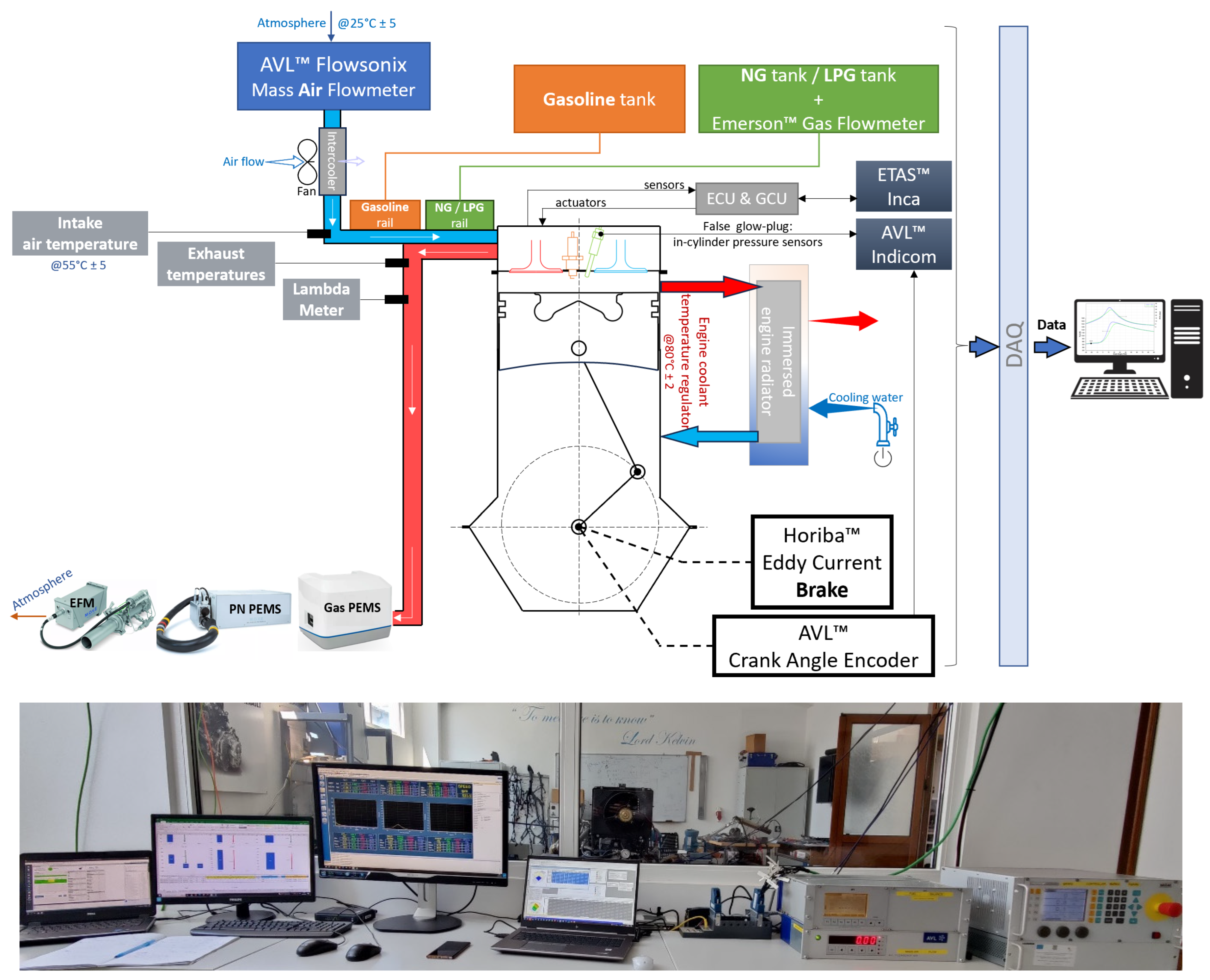







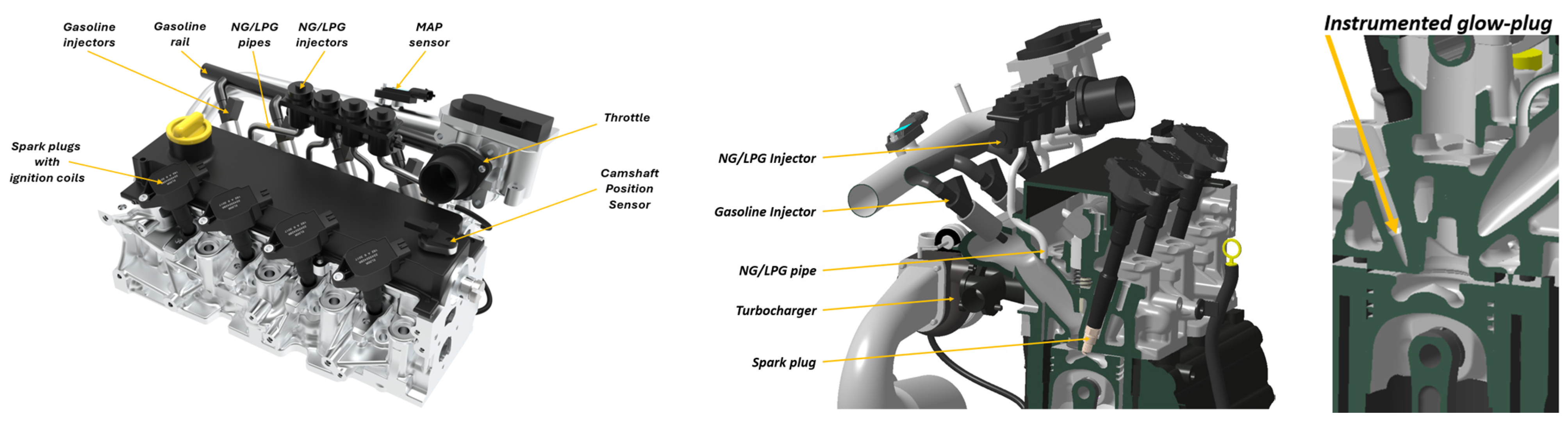
| Displacement [cm3] | 1461 |
| Bore [mm] | 76 |
| Stroke [mm] | 80.5 |
| Connecting rod length [mm] | 133.5 |
| Number of cylinders [-] | 4 |
| Compression ratio, CR [-] | 18.25 |
| Number of valves/cylinder [-] | 2 |
| Intake and exhaust manifold positioning | On the same side of the cylinder head |
| Combustion chamber | Bowl-in “omega” type |
| Injection type | Port-fuel injection (PFI) |
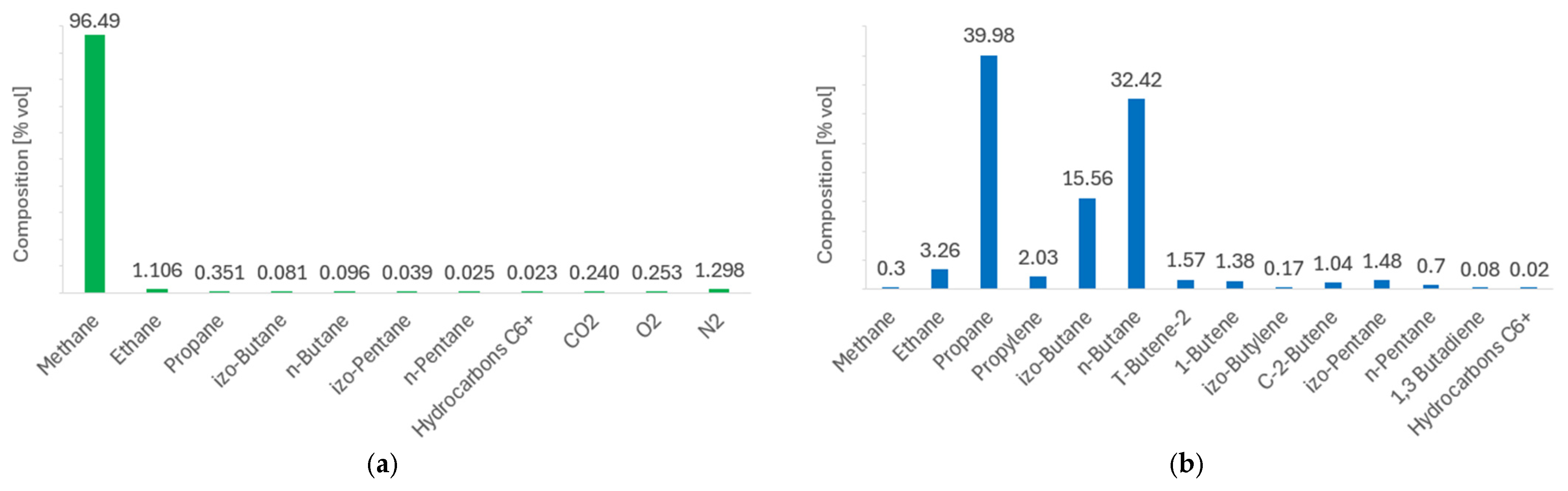
| Fuel | Methane i CH4 | NG ii | Propane iii C3H8 | Butane iv C4H10 | LPG v | |
|---|---|---|---|---|---|---|
| Properties | ||||||
| Research octane number, RON [-] | (122–130) [61,63] | 120 | (110–112) [64,65] | 92 [66,67] | 105 | |
| Autoignition temperature, [°C] | 585 [61] | 540 [58,60] | 450 [62] | 490 [68] | 470 [56] | |
| Lower heating value, [MJ/kg] | 50.0 [61] | 47.5 [58,60] | 46.4 [62] | 45.7 [66,67] | 46.1 [60,63] | |
| Laminar flame velocity *, [cm/s] | 39.0 | 41.0 | 42.0 | 41.1 [69] | - | |
| Diffusion coefficient in air@25 °C, [cm2/s] | 0.16 [61,70] | - | 0.10 [70] | - | - | |
| Stoichiometric air [kg air/kg fuel] ** | 17.17 | 16.73 | 15.61 | 15.39 | 15.41 | |
| Minimal ignition energy in air [mJ] | 0.3 [41,61] | - | 0.305 [70] | - | - | |
| Air-excess coefficient: flammability limits (rich–lean) | 0.70–2.10 [23,24] | - | 0.40–1.95 [23,24] | 0.34–1.86 [68] | - | |
| A(1600 rpm, 35.6 Nm) | B(2000 rpm, 23.5 Nm) | C(2300 rpm, 30.5 Nm) | D(2300 rpm, 49.8 Nm) | |||||||||||
|---|---|---|---|---|---|---|---|---|---|---|---|---|---|---|
| L P G | λ | λ = 1.00 | λ = 1.24 | Δ [%] | λ = 1.00 | λ = 1.24 | Δ [%] | λ = 1.00 | λ = 1.24 | Δ [%] | λ = 1.00 | λ = 1.24 | Δ [%] | |
| Emissions | ||||||||||||||
| CO2 [kg/h] | 3.61 | 3.53 | −2.23 | 3.57 | 3.40 | −4.82 | 5.06 | 4.86 | −3.88 | 7.43 | 7.22 | −2.83 | ||
| CO [kg/h] | 0.190 | 0.040 | −76.1 | 0.170 | 0.050 | −72.5 | 0.270 | 0.070 | −74.4 | 0.350 | 0.080 | −76.6 | ||
| NOx [kg/h] | 0.086 | 0.067 | −21.6 | 0.069 | 0.043 | −38.1 | 0.121 | 0.077 | −36.3 | 0.176 | 0.119 | −32.1 | ||
| PN [#1014/h] | 4.11 | 3.54 | −13.8 | 3.31 | 1.11 | −66.4 | 9.49 | 4.06 | −57.2 | 3.45 | 3.50 | 1.60 | ||
| C N G | λ | λ = 1.00 | λ = 1.25 | Δ [%] | λ = 1.00 | λ = 1.24 | Δ [%] | λ = 1.00 | λ = 1.24 | Δ [%] | λ = 1.00 | λ = 1.26 | Δ [%] | |
| Emissions | ||||||||||||||
| CO2 [kg/h] | 3.21 | 3.07 | −4.55 | 3.15 | 3.00 | −4.79 | 4.49 | 4.23 | −5.70 | 6.36 | 6.14 | −3.58 | ||
| CO [kg/h] | 0.130 | 0.030 | −74.6 | 0.130 | 0.030 | −73.4 | 0.210 | 0.050 | −78.3 | 0.400 | 0.060 | −85.8 | ||
| NOx [kg/h] | 0.079 | 0.047 | −52.1 | 0.056 | 0.029 | −48.8 | 0.108 | 0.066 | −38.4 | 0.157 | 0.118 | −24.3 | ||
| PN [#1014/h] | 2.96 | 2.17 | −26.9 | 3.06 | 1.86 | −39.3 | 6.51 | 3.21 | −50.8 | 4.18 | 0.678 | −83.8 | ||
Disclaimer/Publisher’s Note: The statements, opinions and data contained in all publications are solely those of the individual author(s) and contributor(s) and not of MDPI and/or the editor(s). MDPI and/or the editor(s) disclaim responsibility for any injury to people or property resulting from any ideas, methods, instructions or products referred to in the content. |
© 2026 by the authors. Licensee MDPI, Basel, Switzerland. This article is an open access article distributed under the terms and conditions of the Creative Commons Attribution (CC BY) license.
Share and Cite
Popa, R.M.; Clenci, A.; Berquez, J.; Niculescu, R.; Magheru, C. Experimental Results on Natural Gas and Liquefied Petroleum Gas Lean Burning in a Diesel Engine Retrofitted for Spark Ignition. Fire 2026, 9, 165. https://doi.org/10.3390/fire9040165
Popa RM, Clenci A, Berquez J, Niculescu R, Magheru C. Experimental Results on Natural Gas and Liquefied Petroleum Gas Lean Burning in a Diesel Engine Retrofitted for Spark Ignition. Fire. 2026; 9(4):165. https://doi.org/10.3390/fire9040165
Chicago/Turabian StylePopa, Robert Marian, Adrian Clenci, Julien Berquez, Rodica Niculescu, and Cătălin Magheru. 2026. "Experimental Results on Natural Gas and Liquefied Petroleum Gas Lean Burning in a Diesel Engine Retrofitted for Spark Ignition" Fire 9, no. 4: 165. https://doi.org/10.3390/fire9040165
APA StylePopa, R. M., Clenci, A., Berquez, J., Niculescu, R., & Magheru, C. (2026). Experimental Results on Natural Gas and Liquefied Petroleum Gas Lean Burning in a Diesel Engine Retrofitted for Spark Ignition. Fire, 9(4), 165. https://doi.org/10.3390/fire9040165