5.1.1. Analysis of Uniform Random Tasks
- (1)
Analysis of Computation Time
The results indicate that the proposed method maintains stable computational times across a wide range of problem scales, avoiding the exponential growth characteristic of exact optimization solvers. Their performance is expected, as both rely on spatial partitioning with linear complexity.
In comparison to these approaches, the proposed method maintains stable and competitive computation times across all 12 scenarios, with a maximum of only 10.32 s for the largest instance. This stability is a direct result of its core architecture: the linear complexity of the edge-side line clustering algorithm effectively avoids the exponential growth typical of exact optimization methods. The key insight from
Table 2, therefore, is that the proposed method achieves its optimization objectives without sacrificing computational efficiency. This is made possible by its two-stage architecture—fast edge clustering followed by lightweight cloud refinement—which ensures that the overall planning time remains within acceptable bounds even for large-scale operations.
The practical value of this efficiency is best understood within the context of real-world deployment. Notably, in high task-to-UAV ratio scenarios, e.g., Scenario 8, the proposed method completes planning within 10.32 s. This is well within the practically acceptable window for real-time deployment in emergency response, where re-planning intervals are typically 5–10 min (we set at 5 min; see 5.4 for detail).
In conclusion, the combination of stable computational efficiency makes the proposed method highly suitable for deployment on resource-constrained edge devices. It enables frequent and responsive replanning without system overload, while still benefiting from cloud-based global optimization when connectivity permits.
- (2)
Analysis of Total Cost
Table 3 presents the total travel distance, which reflects the overall energy consumption of the mission. Compared with the baseline methods, the proposed method achieves total distances generally comparable to the best-performing approaches, and even outperforms them in Scenarios 9–11. This indicates that the competitive task transfer mechanism effectively reduces overall resource consumption by optimizing insertion costs at the individual task level.
The greedy-based method consistently yields the highest total distances, particularly in Scenarios 4 and 8, due to its myopic allocation that produces locally optimal but globally inefficient assignments. Importantly, this high total distance does not translate into improved load balancing; as shown in
Table 4, the greedy method also exhibits the worst makespan, making it inferior for both metrics.
While K-means clustering excels when tasks form compact, isolated groups, and Voronoi diagrams offer fast spatial partitioning, both methods exhibit rigidity in the face of linear or irregular fronts.
A deliberate feature of the proposed method is observed in Scenarios 5–8, where its total distance is slightly higher (by 2–3%) than those of Voronoi and K-means. For instance, in Scenario 6, the proposed method yields 824.43 compared to 805.72 (Voronoi) and 815.47 (K-means). This modest increase stems from the cooperative task transfer mechanism, which prioritizes load balancing over absolute distance minimization by moving tasks from overloaded to underloaded UAVs—even when those tasks are spatially closer to their original assignee. The resulting trade-off is quantified by the efficiency ratio: the percentage reduction in makespan per 1% increase in total distance. In Scenario 12, a 1.53% distance increase relative to K-means yields a 14.4% makespan reduction (ratio 9.4:1); against Voronoi, a 0.60% increase achieves a 6.9% makespan reduction (ratio 11.5:1). In Scenario 8, a 1.27% distance increase relative to K-means results in a 10.5% makespan reduction relative to Voronoi (ratio 8.3:1). These high ratios demonstrate that the cooperative–competitive mechanism efficiently converts marginal additional flight distance into substantial gains in mission timeliness. This design philosophy—prioritizing makespan over absolute distance—is strategically well-suited to emergency response, where faster situational awareness directly supports critical decision-making.
- (3)
Analysis of Max UAV Cost
Table 4 presents the makespan—the maximum flight distance among all UAVs—which serves as the primary optimization objective of this study, as it directly determines the time required to complete the full surveillance mission. The results demonstrate that the proposed method achieves the lowest makespan in 10 out of 12 scenarios and remains within 1% of the optimal value in the remaining two, confirming its effectiveness in balancing workloads across the UAV swarm.
The greedy-based method consistently yields the highest makespan, with particularly large gaps in high task-to-UAV ratio scenarios (e.g., Scenario 8 and 12). This is attributed to its myopic allocation, which frequently overloads one or two UAVs. The Voronoi-based and K-means-based methods perform reasonably well in many scenarios, but their makespan values are still notably higher than those of the proposed method. For instance, in Scenario 8, the proposed method reduces makespan by 10.4% compared to Voronoi and by 0.5% compared to K-means; in Scenario 12 (90 tasks, five UAVs), the improvements reach 6.9% and 14.4%, respectively. These gaps arise because Voronoi diagrams produce rigid spatial partitions that may assign disproportionately large areas to some UAVs, while K-means clustering, although more flexible, lacks any cross-cluster load-balancing mechanism.
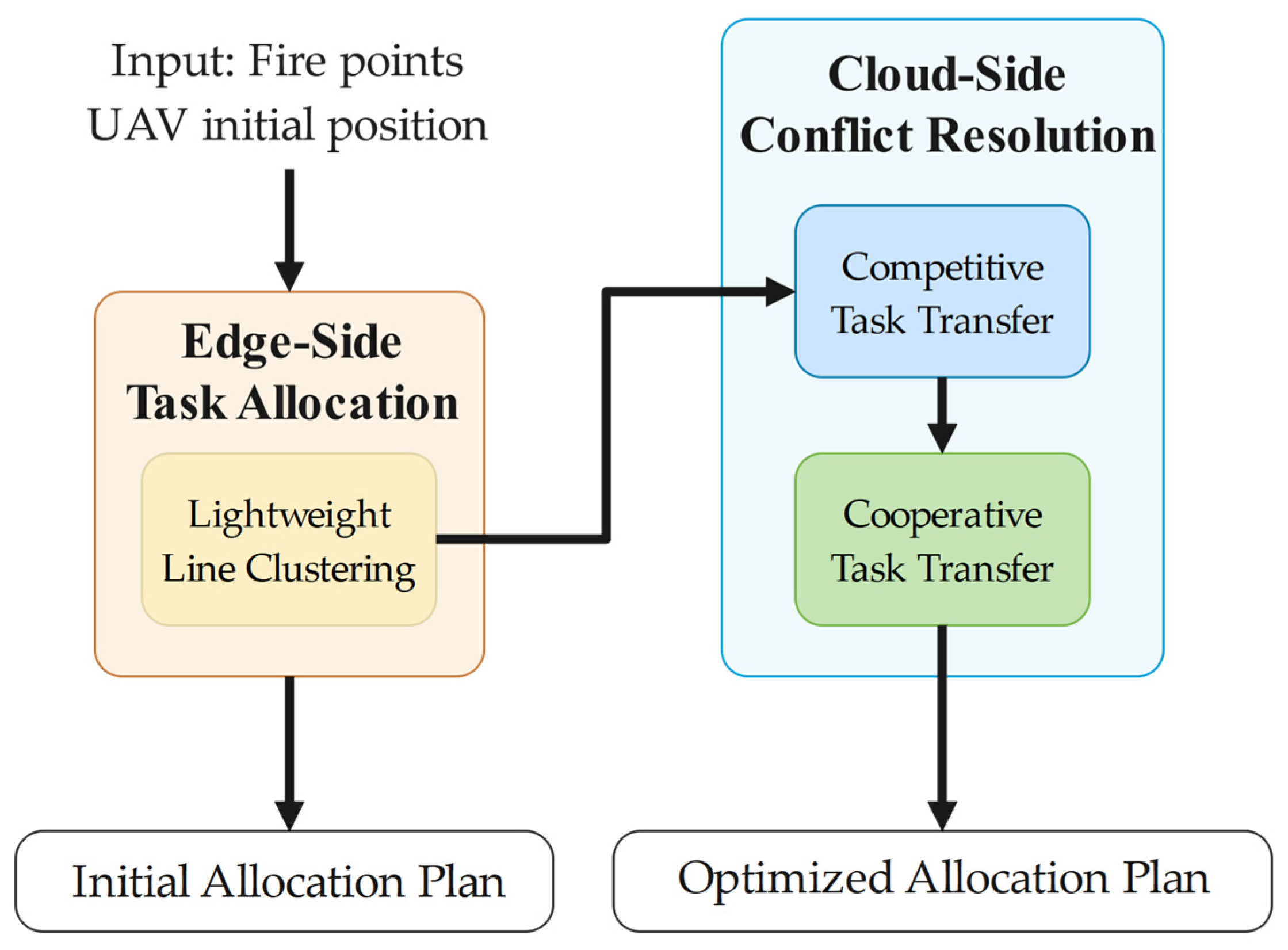
The superiority of the proposed method stems from two integrated design features. First, the edge-side line clustering heuristic groups tasks along directional axes, producing an initial allocation that is already better aligned with the sequential nature of UAV travel. Second, the cloud-side cooperative–competitive mechanism actively transfers tasks from overloaded to underloaded UAVs; the cooperative phase (Algorithm 3) explicitly targets makespan minimization by incentivizing transfers that reduce the peak load, even at the cost of a slight increase in total travel distance (as documented in
Table 3). The efficiency of this trade-off has been quantified: a modest 1–3% increase in total distance yields makespan reductions of 10–15%, with efficiency ratios exceeding 8:1 in several scenarios. Such ratios confirm that the method’s prioritization of makespan over absolute distance is both deliberate and advantageous.
In summary, the makespan results validate that the proposed cloud–edge collaborative framework successfully achieves its primary design goal: minimizing the makespan through balanced task allocation. By combining a geometry-aware initial partition with a global load-balancing refinement, the method consistently outperforms existing approaches, particularly as problem scale increases—a critical advantage for large-scale forest fire monitoring.
5.1.2. Analysis of Robustness Evaluation
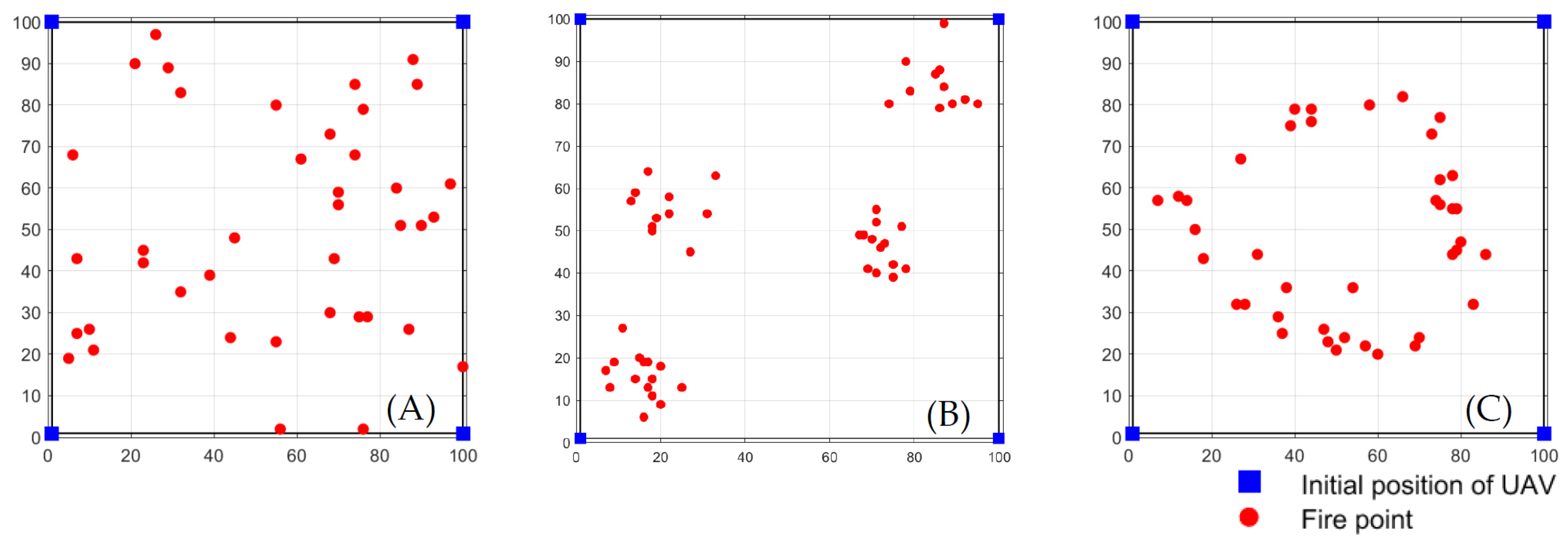
The robustness experiments reveal how the spatial structure of fire points influences the relative performance of the four algorithms. The key observation is that the advantage of the proposed method is most pronounced under the linear and clustered distribution, and shrinks under uniform random. This trend can be explained by the design philosophy of each algorithm and the nature of the task allocation problem.
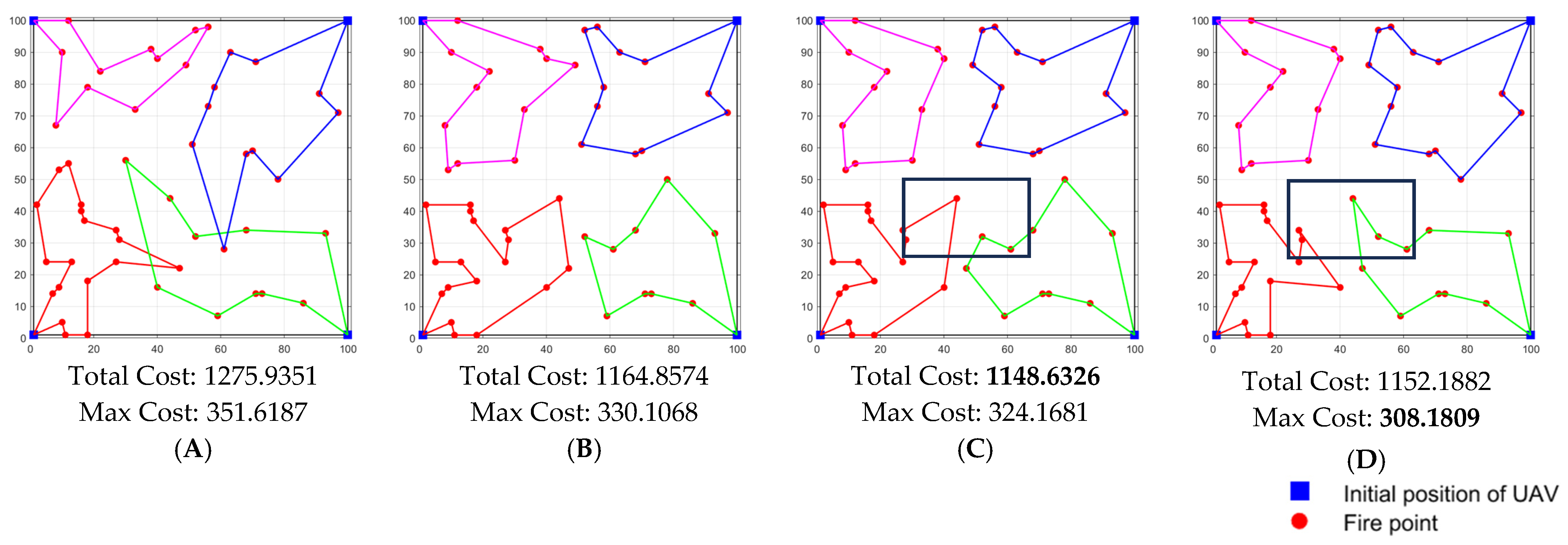
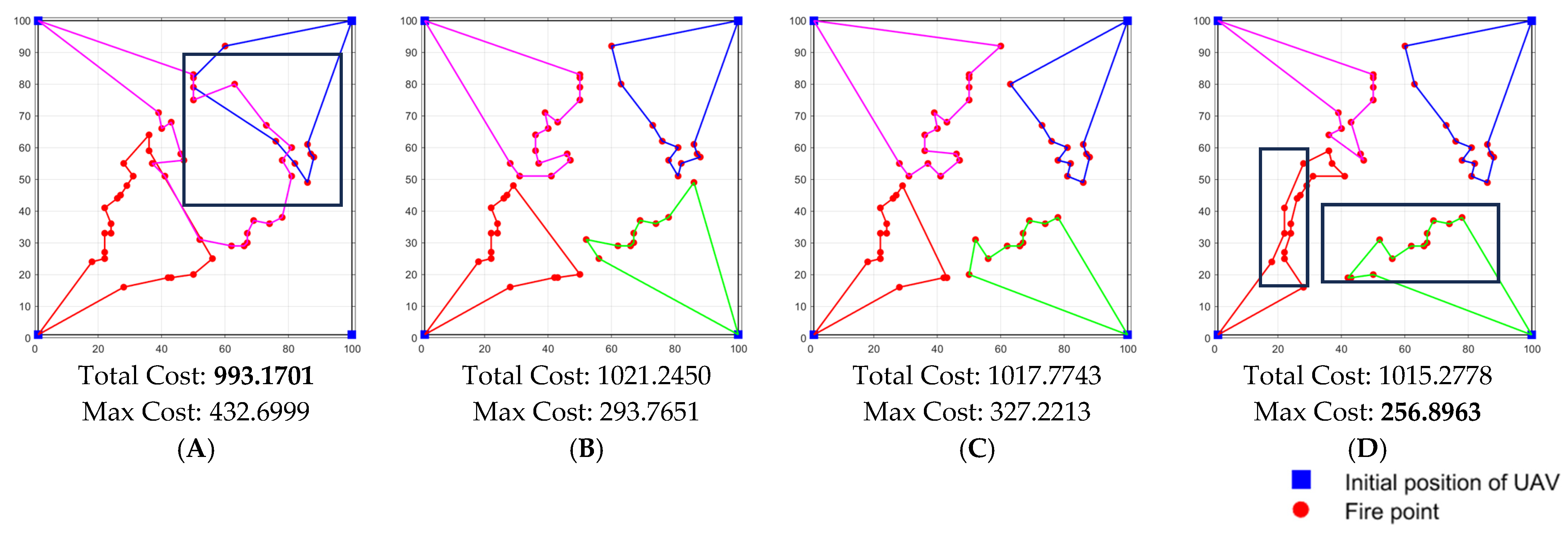
When tasks are scattered uniformly at random (as shown in
Figure 7), all three benchmark methods perform similarly to each other, with the proposed method holding a slight advantage, whereas the greedy method suffers severely because its myopic allocation consistently overloads one UAV. The performance gap between the proposed method and the second-best method (K-means) is smaller under uniform random distribution than under linear or clustered distributions. This is because the line clustering heuristic no longer matches the actual point distribution; its linear segments become arbitrary, and the algorithm essentially falls back to a centroid-based partition comparable to K-means. Nevertheless, the cooperative transfer phase still manages to reduce the maximum load compare to the second-best method (
Figure 7C,D).
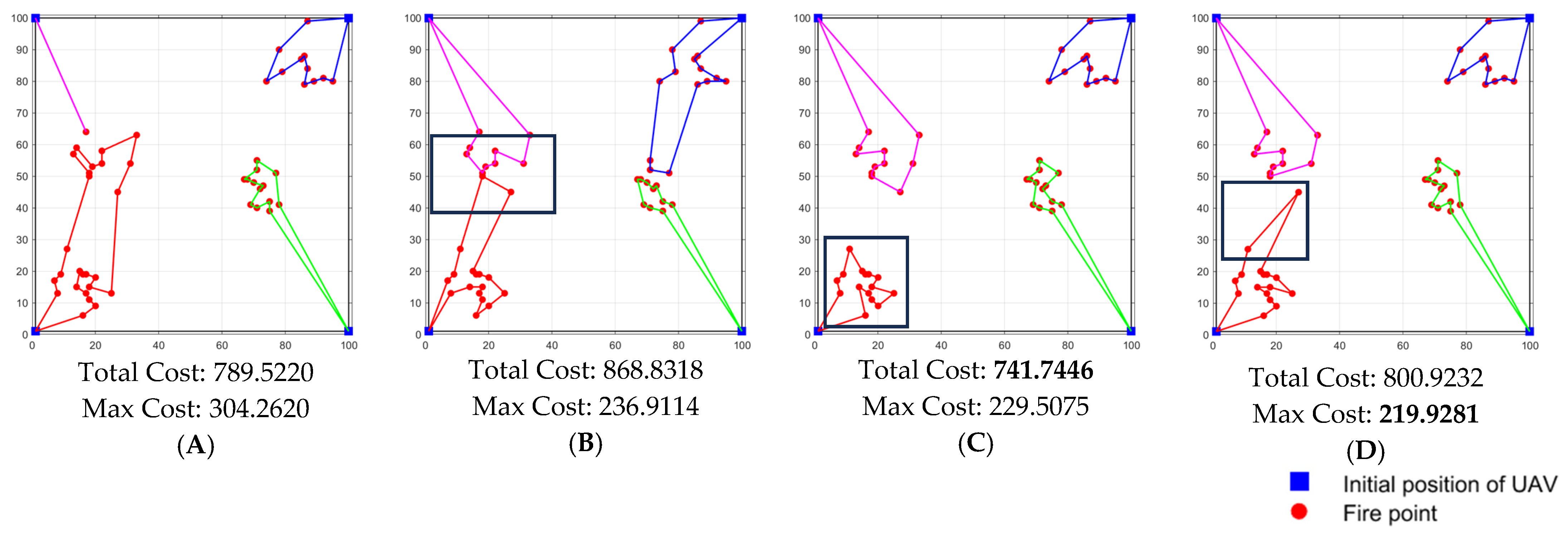
Under the clustered distribution, the task points naturally form several compact groups, a structure for which the K-means-based method is particularly well suited. As shown in
Figure 8C, K-means achieves its best relative performance. The proposed method attains a comparable makespan while also ensuring balanced workloads across UAVs (
Figure 8C,D). Although its total distance is higher due to cross-cluster task transfers that reduce peak load, this trade-off aligns with the primary objective of makespan minimization. In contrast, the Voronoi-based method, while capable of achieving some degree of load balancing in moderately scattered scenarios, pays a higher price than the proposed method (
Figure 8B,D), indicating that its rigid spatial partitioning is less adaptable to cluster geometries. Notably, under the clustered distribution, the proposed method does not artificially split clusters to achieve perfect balance; instead, it maintains natural groupings while only transferring boundary tasks to reduce peak load. This behavior, visualized in
Figure 8D, demonstrates that the algorithm does not enforce “averaging” at the expense of spatial coherence—a property that aligns with the need for preserving task context in priority-aware extensions. A legitimate concern regarding makespan minimization is that it might “average out” responses, delaying attention to the most dangerous fire sectors. Our experimental results alleviate this concern to some extent.
Under the linear generation modes (as shown in
Figure 9), which mimics a continuous fire front, the proposed method reduces the makespan by 38.4% compared to the greedy-based method and by about 5–6% compared to Voronoi and K-means. This substantial gain stems from two factors. First, the edge-side line clustering heuristic explicitly models the expected path shape by iteratively fitting line segments, thereby grouping tasks that lie along the same direction. In contrast, the greedy model relies on point-to-point distances and ignores the sequential nature of UAV travel; it tends to create clusters that are spatially compact but may force UAVs to crisscross the fire line (
Figure 9A). Second, line clustering effectively captures the edge of the fire front and generates well-structured routes (
Figure 9D). Finally, the cloud-side cooperative–competitive mechanism further refines the allocation by transferring tasks between UAVs to balance the loads, a step that the static clustering methods lack. The result is not only a lower makespan but also more coherent, non-intersecting routes that follow the fire front—a desirable property for real-world monitoring where crossing paths would waste energy and complicate coordination.
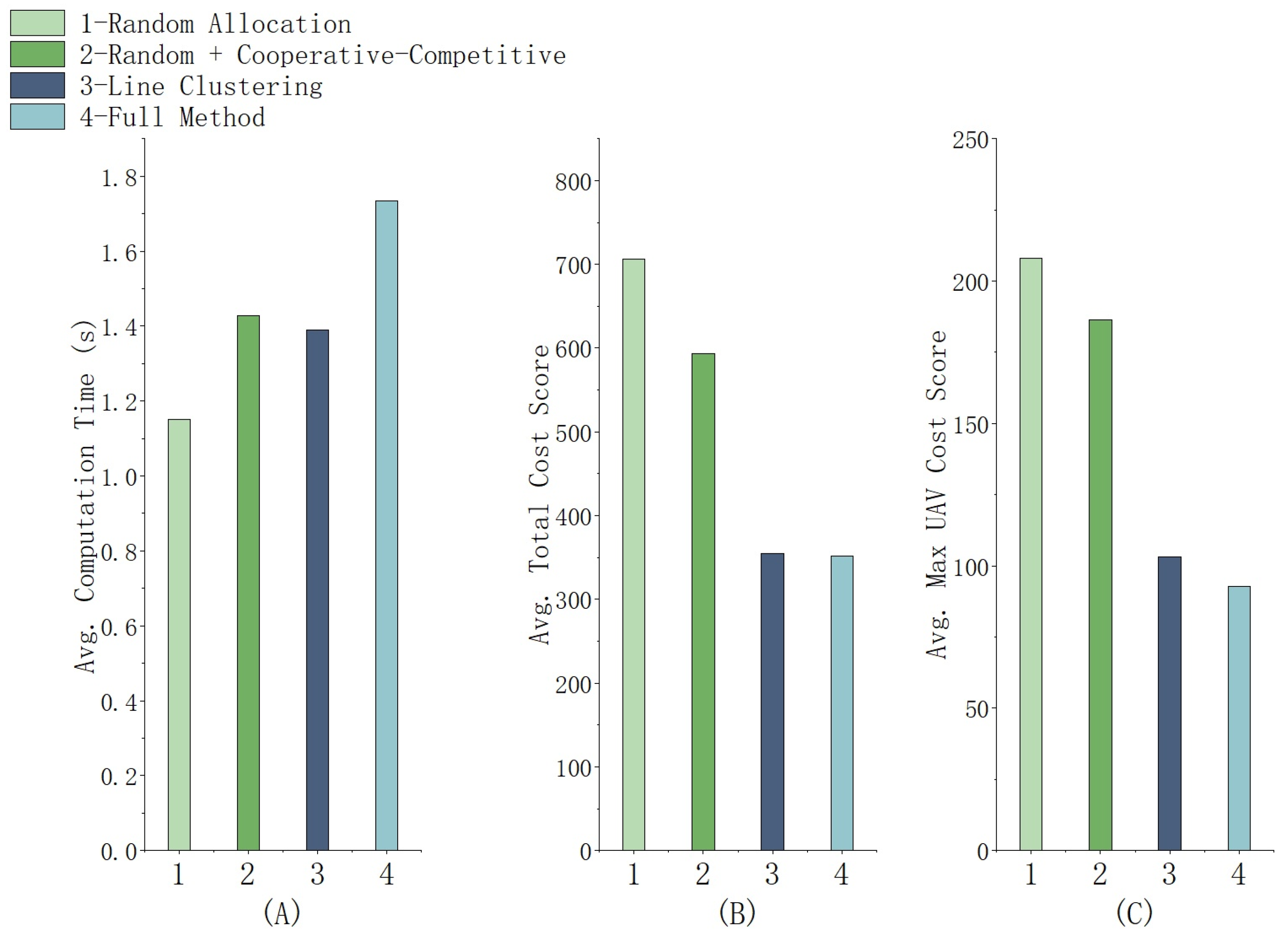
Based on the results of the random task experiments and the robustness analysis, the proposed method performs effectively under the line clustering assumption and maintains algorithmic robustness across other task distribution patterns. Its ability to adapt to diverse fire front geometries while preserving load balance and computational efficiency is particularly noteworthy.