
Article

Thermal Dehydration of Hydrated Salts Under Vapor-Restricted Conditions and Its Role in Modeling Gypsum-Based Systems During Fire Exposure

by
Maximilian Pache
*,
Michaela D. Detsi
,
Ioannis D. Mandilaras
,
Dimos A. Kontogeorgos
and
Maria A. Founti
Laboratory of Heterogeneous Mixtures and Combustion Systems, School of Mechanical Engineering, National Technical University of Athens, Heroon Polytechniou 9, Zografou Campus, 15780 Athens, Greece
*
Author to whom correspondence should be addressed.
Fire 2026, 9(4), 159; https://doi.org/10.3390/fire9040159
Submission received: 5 March 2026 / Revised: 7 April 2026 / Accepted: 8 April 2026 / Published: 9 April 2026

Abstract

Gypsum-based fire protection relies on thermally activated dehydration, where chemically bound water is released and evaporated, thereby providing an endothermic heat sink that delays heat penetration through assemblies. In parallel, inorganic hydrated salts are increasingly used as flame-retardant additives in gypsum-based systems to enhance heat absorption over specific temperature ranges. Fire simulation tools and performance-based fire engineering approaches require reliable kinetic data and reaction enthalpies that can be implemented as coupled thermal–chemical source terms. However, additive-specific kinetic datasets remain limited, particularly under restricted vapor exchange conditions representative of porous construction materials. This work investigates the thermal decomposition behavior and dehydration kinetics of Aluminum Trihydrate (Al(OH)3, ATH), Magnesium Hydroxide (Mg(OH)2, MDH), Calcium Aluminate Sulfate (3CaO·Al2O3·3CaSO4·32H2O, CAS), and Magnesium Sulfate Heptahydrate (MgSO4·7H2O, ESM) with emphasis on vapor-restricted conditions representative of confined porous systems. Differential scanning calorimetry (DSC) experiments were conducted at three heating rates (2, 10, and 20 K/min for MDH, CAS and ESM and 20, 40 and 60 K/min for GB-ATH) up to 600 °C using pinhole crucibles to simulate autogenous vapor pressure. The thermal analysis indicates that ATH and MDH exhibit predominantly single-step dehydration behavior, while ESM shows a complex multi-step mechanism. Although CAS presents a single dominant thermal peak in the DSC signal, the isoconversional analysis reveals a multi-stage reaction behavior, demonstrating that peak-based interpretation alone may be insufficient for such systems. Kinetic parameters were determined using both model-free (Starink) and model-fitting approaches in accordance with the recommendations of the Kinetics Committee of the International Confederation for Thermal Analysis and Calorimetry (ICTAC). All reactions were consistently described using the Avrami–Erofeev model as an effective phenomenological representation of the conversion behavior. The extracted kinetic triplets were validated through numerical simulations, showing good agreement with experimental conversion and reaction rate data. The resulting kinetic parameters and dehydration enthalpies provide a physically consistent dataset for the description of dehydration processes under restricted vapor exchange. These results support the development of thermochemical models for gypsum-based systems; however, their transferability to full-scale assemblies remains subject to validation under coupled heat- and mass-transfer conditions.

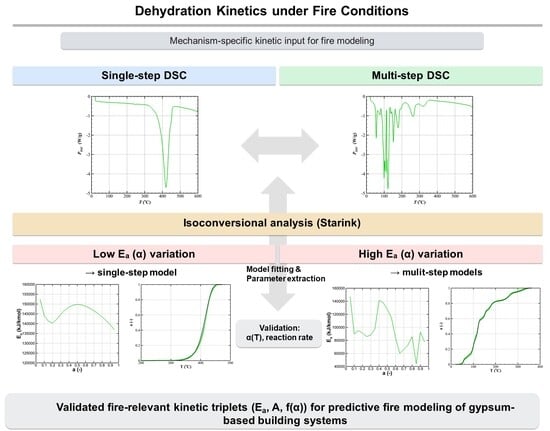
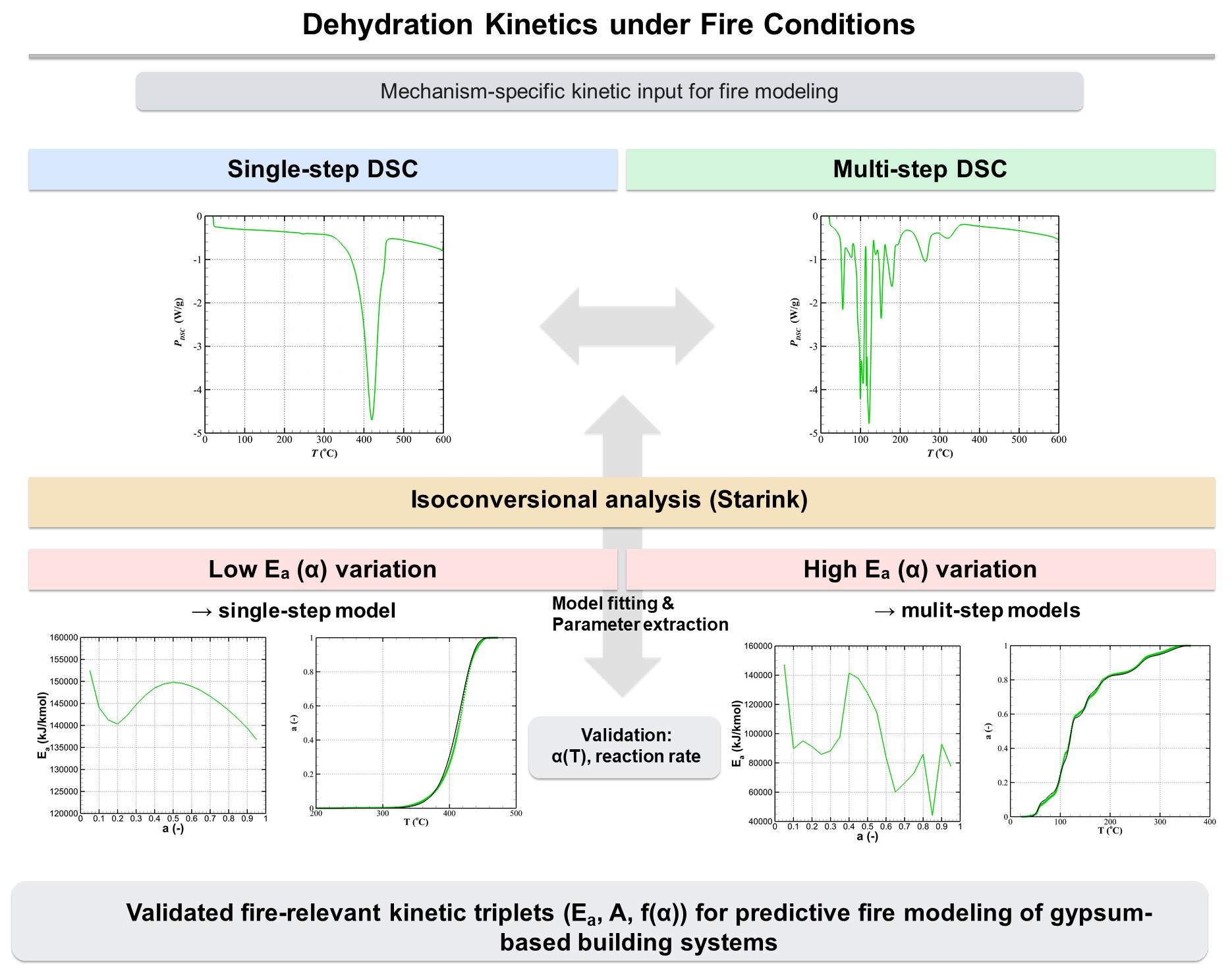
Graphical Abstract

1. Introduction

Gypsum boards are widely recognized for their ability to withstand high temperatures, primarily due to a thermally activated dehydration mechanism. When heated, chemically bound water is released from their crystal structure and evaporates, absorbing substantial amounts of heat and delaying the progression of fire through building components. The role of dehydration and coupled moisture transport in gypsum board thermal behavior has been demonstrated in experimental and modeling studies, including effects on effective heat capacity and thermal response under fire exposure conditions [1,2,3,4,5,6].
In recent years, inorganic hydrated salts have gained attention as thermally active or flame-retardant additives in material systems relevant to fire protection. Compounds such as Aluminum Trihydrate (Al(OH)3, ATH), Magnesium Hydroxide (Mg(OH)2, MDH), Calcium Aluminate Sulfate (3CaO × Al2O3 × 3CaSO4 × 32H2O, CAS), and Magnesium Sulfate Heptahydrate (MgSO4 × 7H2O, ESM) exhibit similar endothermic dehydration behavior, contributing significantly to thermal inertia during fire exposure [7,8,9,10,11].
While the thermal performance of gypsum has been extensively investigated, the dehydration kinetics and thermochemical behavior of these salt additives remain less well characterized, especially when they are incorporated inside gypsum boards. Understanding their behavior is essential for accurate modeling in fire safety simulations, particularly as direct experimental data at elevated temperatures are often difficult and expensive to obtain [2,5,6].
The objective of this work is to quantify dehydration enthalpies and to derive kinetic triplets for ATH, MDH, CAS, and ESM under controlled DSC conditions with restricted vapor exchange, intended to approximate the confined vapor environment relevant to porous gypsum systems. The study provides a dataset of additive-specific dehydration kinetics derived using both isoconversional analysis and model fitting in accordance with guidance issued by the Kinetics Committee of the International Confederation for Thermal Analysis and Calorimetry (ICTAC) [12]. The resulting parameters are positioned as effective modeling inputs for coupled thermochemical fire models, with applicability to gypsum-based assemblies to be evaluated within coupled heat- and mass-transfer frameworks.
In particular, this work focuses on the influence of vapor-restricted conditions on effective kinetic parameters, which remain insufficiently characterized for porous construction materials.
Despite extensive studies on the thermal dehydration of aluminum- and magnesium-based hydroxides, most investigations have been conducted under conditions of unrestricted vapor exchange, which do not adequately represent confined porous systems such as gypsum-based materials under fire exposure.
In such systems, vapor transport is limited by the surrounding matrix, which can significantly influence the apparent reaction kinetics and the evolution of thermochemical processes.
However, the effect of restricted vapor exchange on the derived kinetic parameters and their applicability in predictive heat-transfer models has not yet been systematically investigated.
Therefore, this study examines the dehydration behavior of ATH, MDH, CAS, and ESM under controlled vapor-restricted conditions using a pinhole crucible configuration.
Accordingly, the present study seeks to derive kinetic parameters that are more representative of confined systems and to evaluate their suitability for use in microstructure-informed reactive porous media models for fire-exposed gypsum-based materials. In conventional open-system thermal analysis, the continuous removal of released water vapor can lead to kinetic parameters that do not reflect the conditions in confined porous materials, as discussed in the context of solid-state reaction kinetics [12] and in studies highlighting the influence of water vapor pressure on hydrate stability and transformation pathways [10,13]. As a result, activation energies and reaction pathways reported in the literature may differ from those relevant to gypsum-based systems.

2. Thermochemistry of the Investigated Hydrated Salts

2.1. Aluminum Trihydrate (ATH)

ATH is a crystalline form of aluminum hydroxide that begins to decompose thermally above 200 °C, releasing water and yielding aluminum oxide (Al2O3) as the solid residue [14,15]. Depending on specific conditions, this dehydration process is described in the literature either as a single-step [14,15,16] or multi-step reaction [17,18], typically occurring within the temperature range of 200 °C to 350 °C (see Equation (1)), where ΔHdh−ATH denotes the enthalpy of dehydration.
Al OH 3 s + H dh ATH 1 / 2 Al 2 O 3 s + 3 / 2 H 2 O g ,

2.2. Magnesium Hydroxide (MDH)

In contrast, MDH undergoes thermal dehydration at higher temperatures—between 350 °C and 550 °C—producing magnesium oxide (MgO) and water vapor. The transformation is generally regarded as a single-step reaction [7,8,19], characterized by a distinct endothermic peak and a well-defined enthalpy change, denoted ΔHdh−MDH (see Equation (2)).
Mg OH 2 s + H dh MDH MgO s + H 2 O g ,

2.3. Calcium Aluminate Sulfate (CAS, Ettringite Related)

CAS, an ettringite-related compound, has been studied extensively in the context of cement hydration, where it is known for its delayed expansion phenomena. However, its thermal behavior under fire conditions remains less well documented [11,20]. CAS dehydrates over a broad temperature range, roughly 30 °C to 300 °C [21], releasing water vapor and leaving behind calcium sulfoaluminate (CaO × Al2O3 × 3CaSO4) as the primary residue (see Equation (3)), where ΔHdh−CAS is the energy absorbed during the reaction.
3 CaO × Al 2 O 3 × 3 CaSO 4 × 32 H 2 O + H dh CAS 3 CaO × Al 2 O 3 × 3 CaSO 4 s + 32 H 2 O g ,
Research has shown that the dehydration of ettringite and related phases—sometimes collectively termed “meta-ettringite”—proceeds through multiple intermediates. For example, Rubinaite et al. observed that calcium monosulfoaluminate can rehydrate into ettringite at water vapor pressures exceeding 0.753 p/p0, emphasizing the role of ambient humidity on phase stability and transformation kinetics [9]. Here, p/p0 denotes the ratio between the actual water vapor pressure and the saturation vapor pressure at the same temperature, corresponding to the relative humidity. Based on the earlier work of Šatava and Vepŕek, Chen [11] summarizes a three-stage dehydration pathway for these systems, extending up to ~232 °C (Equation (4)).
C 6 A S ¯ H 32 s     C 4 A S ¯ H 32 s monosulfate + 2 C S ¯ H 0.5 + 19 H   ,   111   <   T   <   190   ° C
C 4 A S ¯ H 12 s     C 3 A S ¯ H 6 s + C S ¯ s + 6 H   ,   190   <   T   <   280   ° C
3 C 3 A S ¯ H 6 s     C 4 A 3 H 3 s + 5 CH s + 10 H   ,   T   >   280   ° C
ESM displays a particularly complex thermal dehydration pathway. Dehydration occurs between 50 °C and 300 °C and proceeds through several intermediate hydrates before forming anhydrous magnesium sulfate (MgSO4) [10,22]. The individual dehydration steps involve the sequential loss of water molecules, and the reaction behavior is strongly influenced by the internal water vapor pressure developed within and around the sample [10,13]. The associated enthalpy change for the overall dehydration process is denoted as ΔHdh−ESM (Equation (5)).
MgSO 4   × 7 H 2 O s +   H dh ESM     MgSO 4 s + 7 H 2 O g ,

3. Solid-State Kinetics

Solid-state chemical kinetics examines how various factors influence the rate at which reactions proceed, offering key insights into underlying mechanisms and transition states [23]. For reversible reactions involving a solid reactant and a gaseous product—typically represented as (Asolid ⇔ Bsolid + Cgas)—the transformation rate is commonly governed by three core variables: the temperature-dependent rate constant k(T), the conversion-dependent reaction model f(α), and the pressure function h(P), which accounts for the influence of gas-phase species on the reaction environment (see Equation (6)) [12].
d α d t = k T f α h P ,
In solid-state reactions that produce gaseous products, the influence of gas-phase pressure on reaction kinetics becomes particularly relevant. The ICTAC Kinetics Committee has provided guidance on this matter, noting that under typical experimental conditions—such as those in DSC or Thermogravimetric Analysis (TGA) crucibles—direct measurement of partial pressures is often impractical or impossible [12]. As a result, the pressure-dependent term h(P) from the general rate expression (Equation (6)) is frequently omitted, and its effect is instead implicitly absorbed into the temperature-dependent rate constant k(T).
Under such assumptions, the reaction rate can be described by a modified Arrhenius-type equation (Equation (7)), where A denotes the pre-exponential factor (in s−1), Ea the activation energy (in J mol−1), Rg the universal gas constant (in J mol−1 K−1), f(α) the kinetic model, and α the conversion fraction, which progresses from 0 (unreacted) to one (fully reacted). When pressure effects are significant but unmeasured, the extracted kinetic parameters A and Ea should be interpreted as effective values that inherently reflect the closed or semi-closed nature of the experimental system.
d α d t = k T f α = A e E a R g T f α ,
The functional form of the reaction model f(α)—which governs how the reaction rate evolves with conversion—can generally be grouped into three kinetic profiles [12]:
  • Accelerating models, in which the reaction rate increases steadily and peaks toward the end of the transformation;
  • Decelerating models, where the rate is initially high and gradually declines;
  • Sigmoidal (autocatalytic) models, which exhibit an S-shaped rate curve, characterized by an initial acceleration followed by deceleration.
These classifications, especially relevant under isothermal conditions, are derived from the shapes of the α(t) curves (with t denoting time) or, in non-isothermal experiments, from the corresponding α(T) or /dT profiles, where temperature replaces time via the heating rate. They correspond to various mechanistic interpretations, often implemented through kinetic models such as the power-law, nth-order, diffusion-controlled, or nucleation-and-growth frameworks—including the Avrami–Erofeev model [12,23,24]. Specifically:
  • Nucleation models assume the reaction initiates at discrete sites and propagates via the growth of product phases;
  • Geometrical contraction models describe transformations where the reaction front moves inward from the particle surface;
  • Diffusion models reflect rate control by mass transport of species;
  • Reaction-order models apply the classical kinetics of homogeneous systems to solid-state processes.
According to the framework established by the ICTAC Kinetics Committee [12,24], the overall rate of a multi-step solid-state reaction can be described as a weighted sum of individual reactions, as expressed in Equation (8). Here, NR denotes the total number of reaction steps, while wr and αr represent the normalized weight fraction ( w r   =   1 ) and the conversion degree of each individual process, respectively.
  d α d t = r = 1 N R w r d α r dt ,
To capture the underlying reaction dynamics, each step can be characterized by its own kinetic triplet: Ea, A, and f(α) [2,12,25]. While idealized systems may follow a single kinetic pathway, most real-world solid-state reactions—especially those involving hydrated salts or composite materials—require multiple kinetic triplets to adequately reflect overlapping or sequential thermal events [2,12].
Experimental determination of these kinetic parameters relies on thermal analysis techniques, such as DSC, TGA, or DTA, which generate both integral and differential signal data [2,12]. The fidelity of the derived kinetic values is closely tied to data quality and noise levels, though numerical methods allow transformation between data formats to suit either integral or differential evaluation strategies [12].
Approaches to kinetic analysis fall broadly into two categories: model-free (isoconversional) and model-fitting. Model-free methods, such as the Starink approach, estimate activation energy directly as a function of the conversion degree, without presuming a specific reaction mechanism. This makes them particularly suited for complex systems with multiple, overlapping transformations—such as those observed in coal pyrolysis or salt hydrates [26,27].
In contrast, model-fitting techniques compare experimental data to predefined kinetic models, yielding all three elements of the kinetic triplet. While this method can produce excellent agreement with data, it may lead to ambiguous or model-dependent parameter estimates, especially when only single heating rate experiments are available. As highlighted by Kontogeorgos [2], different models may fit the same dataset equally well, leading to potential misinterpretations of underlying reaction mechanisms.
In the present study, both model-free and model-fitting methods are employed to determine the kinetic triplets for the investigated salts, following the methodological standards and best practices outlined by the ICTAC Committee [12].

4. Materials and Methods

4.1. DSC Experiments and Baseline Processing: Specimens, Heating Rates, and Replication

To investigate the dehydration kinetics of the selected inorganic salts, DSC was employed under controlled laboratory conditions.
All measurements followed the experimental protocol described by Kontogeorgos [2] and were performed using a Stare SW 8.10 Mettler Toledo DSC(Mettler Toledo, Greifensee, Switzerland) system with a temperature accuracy of ±2%. Samples were heated in an inert nitrogen atmosphere with a flow rate of 100 mL/min, using sealed 40 µL aluminum crucibles. The temperature range extended up to 600 °C, and the instrument was calibrated at two reference points—156.6 °C (indium) and 419.6 °C (zinc)—to determine sensitivity and ensure consistent baseline stability [2].
Prior to each experiment, a baseline measurement was recorded using an empty crucible under identical conditions. This baseline was subtracted from the sample data to eliminate instrumental artifacts. Tangential integration baselines were applied to define the thermal event intervals relevant to each reaction.
To simulate autogenous vapor pressure conditions during dehydration, all samples were measured in pinhole-lid crucibles (1 mm diameter), thereby restricting vapor exchange with the surroundings. This configuration allows the buildup of internally generated water vapor, which is known to influence the dehydration pathway and reaction kinetics of calcium sulfate dihydrate, including the occurrence of one- or two-step mechanisms depending on the prevailing vapor partial pressure [2,5]. Although water vapor pressure was not directly monitored, its influence is implicitly reflected in the calculated kinetic parameters (A and Ea), in accordance with ICTAC recommendations for closed-system approximations [12,28].
Each salt was analyzed at three different linear heating rates (see Table 1), in line with ICTAC guidelines for kinetic evaluation [12]. The temperature program ranged from 25 °C to 600 °C. For ATH, due to handling limitations of the pure material, a gypsum board containing 5 wt.% ATH was used. This approach was necessary because ATH was not available in a stable, free-flowing crystalline powder form suitable for direct DSC measurement, but rather in a form that required stabilization within a matrix. A 10 cm × 10 cm section of the board was sampled, crushed, and ground into powder.
In contrast, the other salts (MDH, CAS, ESM) were available as crystalline powders and were therefore analyzed directly in their as-received form.
Sample masses and heating rates for each run are listed in Table 1. Mass variations across runs remained within ±5%, which is acceptable for kinetic computations under ICTAC methodology [12].
Each DSC condition was repeated three times. The observed reproducibility error was within acceptable instrument limits and did not exceed 7.2%.

4.2. Kinetic Analysis Tools and Procedures

To determine the chemical kinetics of the investigated solid-state dehydration reactions (Equations (1)–(5)), the in-house-developed ChemKin Toolbox (kinetic analysis software, V1) was employed, following the kinetic analysis framework previously established for gypsum dehydration reactions, including model-free and model-fitting approaches for the determination of the kinetic triplet [2,5]. This software suite, created at the Laboratory of Heterogeneous Mixtures & Combustion Systems at the National Technical University of Athens, enables extraction of kinetic parameters from DSC and TGA data in accordance with the recommendations of the ICTAC Kinetics Committee [12]. The toolbox supports the resolution of up to eight consecutive or overlapping reaction steps per material.

5. Results

5.1. Thermal Dehydration Behavior

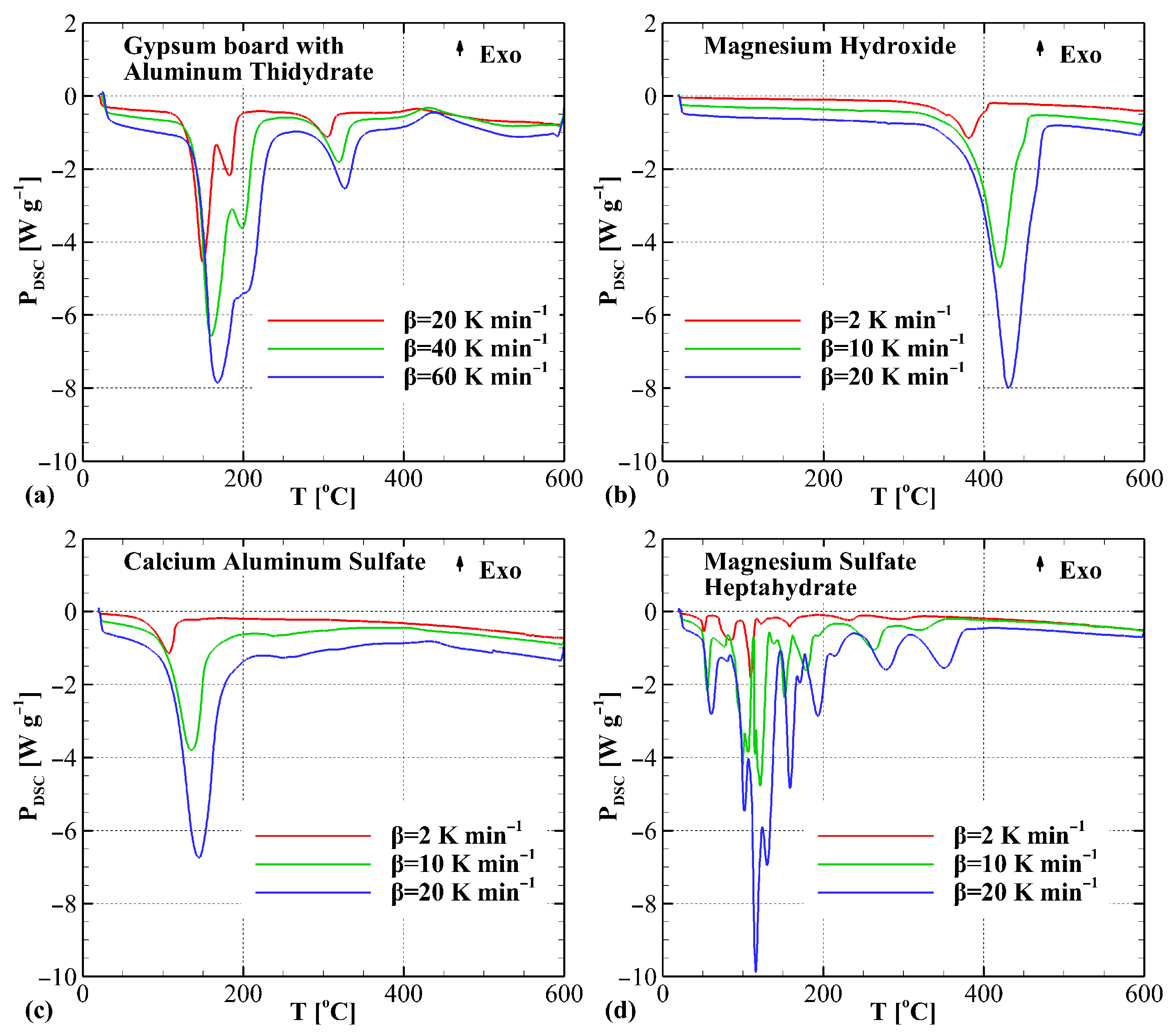
Figure 1 presents the DSC results obtained for four test materials: a gypsum board containing 5 wt.% ATH (Figure 1a), and the pure compounds MDH (Figure 1b), CAS (Figure 1c), and ESM (Figure 1d). Across all specimens, the DSC curves exhibit comparable shapes at different heating rates, with the expected shift of peak temperatures toward higher values as the heating rate increases. It should be noted that ATH was tested within a gypsum matrix, whereas the other salts were analyzed as pure powders, which may influence direct comparability.
More fundamentally, it is well established that the incorporation of additives alters the microstructure of gypsum-based materials. Consequently, a direct comparison between pure gypsum and gypsum-containing additives is not physically meaningful, as the presence of additives inherently modifies the material structure and associated transport properties. For this reason, a pure gypsum reference was not included, and the present study instead focuses on the effective behavior of each system under the given conditions.
To ensure the reliability of the measurements, each experiment was performed three times, and the reported results represent the average of the three runs. Minor variations between replicates—primarily due to slight differences in sample mass (see Table 1) or in the selection of the integration range for thermal events—were observed but remained within acceptable limits. These deviations had no discernible impact on the subsequent kinetic evaluation.
In the DSC profile of the gypsum board containing 5 wt.% ATH (Figure 1a), the characteristic two-step dehydration of calcium sulfate dihydrate (CaSO4 × 2H2O) is evident below 250 °C. In this sequence, the material initially loses approximately 75% of its hydration water, forming calcium sulfate hemihydrate (CaSO4 × 0.5H2O, bassanite), followed by further dehydration to the soluble anhydrite III (CaSO4) phase. This two-stage process has been well documented and was confirmed here through peak deconvolution, which enabled the resolution of overlapping thermal events. The first transition follows a two-dimensional nucleation-and-growth mechanism, while the second is governed by a three-dimensional pathway, consistent with previous kinetic analyses [29].
Additionally, a minor exothermic signal near 420 °C was observed, corresponding to the irreversible transformation of anhydrite III into the more stable anhydrite II (CaSO4) phase via structural reorganization (hexagonal to orthorhombic).
Notably, the present measurements revealed a previously unreported high-temperature endothermic peak between 300 °C and 350 °C. This distinct signal is attributed to the dehydration of ATH and represents a new observation within gypsum board systems. Based on its thermal profile and sharpness, this process is likely governed by a single-step mechanism, as described in Equation (1).
The DSC curve of pure MDH, shown in Figure 1b, exhibits a single pronounced endothermic peak in the range of 380 °C to 420 °C, with the exact position depending on the applied heating rate. This thermal event corresponds to the dehydration of MDH and is characteristic of a single-step reaction mechanism, as defined in Equation (2).
A comparable thermal signature is observed in the case of CAS (Figure 1c). The DSC curve reveals a single endothermic peak between 100 °C and 150 °C, again shifting with the heating rate. This behavior may suggest an apparent single-step dehydration process based on the DSC signal alone; however, as shown in the subsequent kinetic analysis, the reaction is in fact composed of multiple overlapping steps.
These results confirm that all three materials—MDH, ATH, and CAS—exhibit clearly defined apparent single-step thermal dehydration processes under the studied conditions, supporting their classification as single-step dehydration systems within their respective temperature domains.
The DSC results for ESM, shown in Figure 1d, reveal a sequence of multiple endothermic peaks, indicating a complex multi-step dehydration mechanism. These thermal events are attributed to the stepwise release of water molecules and the formation of intermediate metastable hydrates during the decomposition process [10]. This behavior is strongly influenced by local water vapor pressure within the sample environment. Rubinaite et al. [9] demonstrated that the stability and transformation pathways of similar hydrates—such as calcium monosulfoaluminate—are highly sensitive to ambient p/p0 conditions. Their work showed that varying vapor pressures can shift the dominant reaction products between gypsum, hemihydrate, and ettringite, underscoring the critical role of moisture in phase evolution.
Based on the observed DSC profiles, CAS and ESM dehydrate primarily in the low-temperature range of 100 °C to 250 °C, while ATH and MDH exhibit thermal activity at elevated temperatures between 250 °C and 450 °C. Accordingly, CAS and ESM can be categorized as low-temperature dehydrating salts, whereas ATH and MDH fall into the high-temperature class.
For all investigated materials, the characteristic thermal events shift to higher temperatures with increasing heating rate. This behavior is expected for non-isothermal measurements and results from kinetic lag. At higher heating rates, less time is available for the reaction to proceed at lower temperatures, so a higher sample temperature is required to reach the same extent of conversion or maximum reaction rate. The observed peak shift therefore reflects the dynamic interaction between heating program and reaction kinetics rather than a change in the intrinsic decomposition pathway.
Table 2 summarizes the measured mass loss (Δm) and the corresponding thermal effects recorded during the DSC experiments. The reported Δm values reflect the total weight reduction in each sample between ambient temperature and 600 °C. The table also lists the energy quantities associated with three distinct processes. The deviations for the energies ΔH are ±2% and for the masses Δm are ±0.01 g, according to datasheet of the apparatus:
  • ΔHGB: Heat absorbed during the two-step dehydration of gypsum boards;
  • ΔHR: Exothermic reorganization from anhydrite III to anhydrite II;
  • ΔHadd: Heat absorbed due to the dehydration of the added salts ATH, MDH, CAS, and ESM.
The average energy values for the additives are as follows:
  • ΔHATH = 982.67 ± 73.63 kJ/kg;
  • ΔHMDH = 1090.20 ± 35.11 kJ/kg;
  • ΔHCAS = 718.29 ± 29.24 kJ/kg;
  • ΔHESM = 1110.30 ± 27.58 kJ/kg.
These values are in excellent agreement with data from the literature for the respective materials [14,15,17]; [7,8,19]; [30,31]; [21,32], confirming the accuracy of the present measurements. Notably, ATH, MDH, and ESM exhibit significantly higher enthalpies of dehydration compared to CAS. This suggests that these three salts provide a greater heat-sink capacity and may therefore be more effective as flame-retardant additives in gypsum-based systems.

5.2. Kinetic Parameters

5.2.1. Conversion Curves and Model Selection

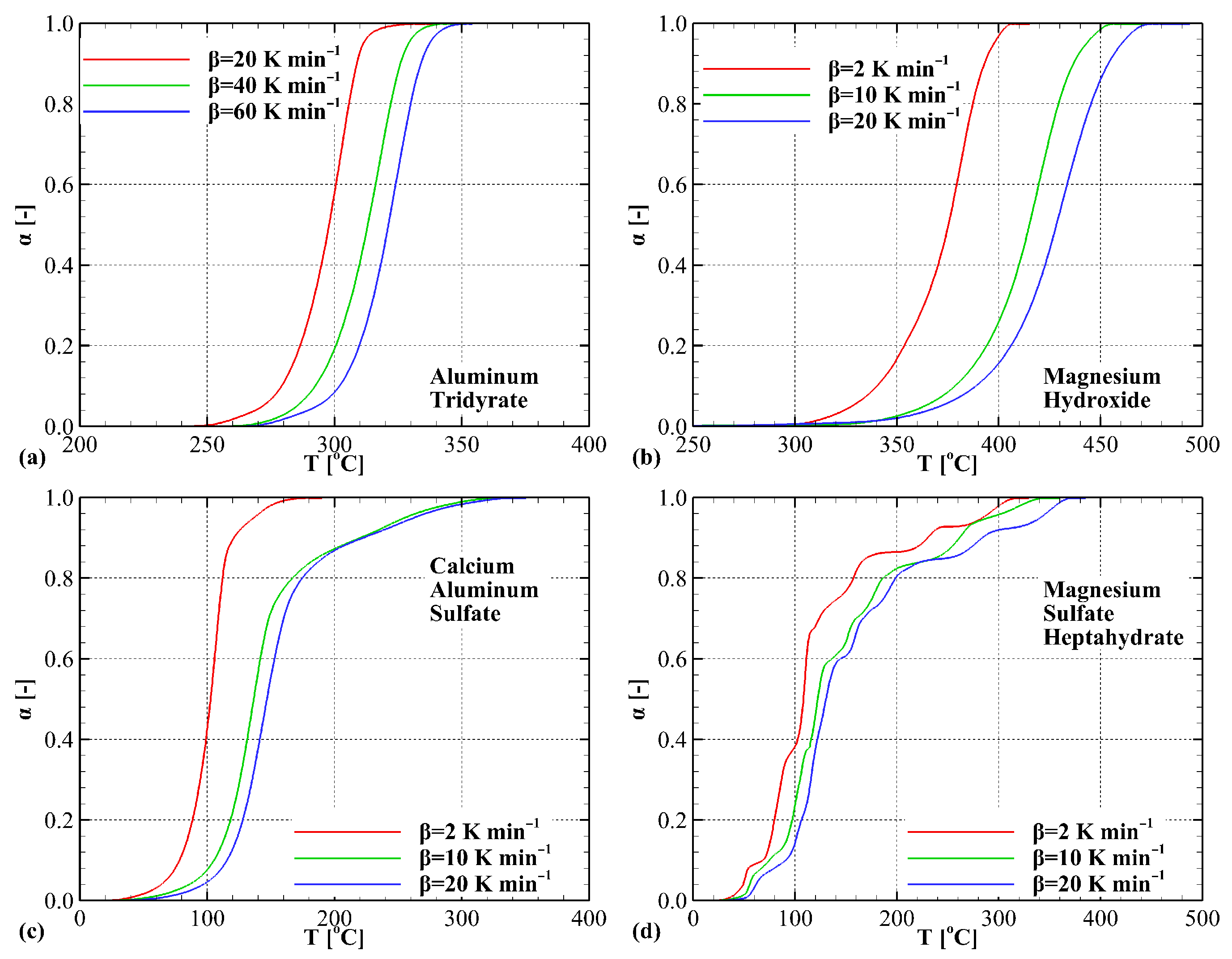
Figure 2 shows the α-curves for ATH (Figure 2a), MDH (Figure 2b), CAS (Figure 2c), and ESM (Figure 2d). As shown, the dehydration reactions of ATH, MDH, and CAS exhibit sigmoidal α(T) curves, indicative of single-step processes. In contrast, the curve for ESM displays multiple slope changes over the conversion range, suggesting the presence of several overlapping steps. This observation aligns with earlier reports on the multi-step nature of ESM dehydration [10].
Such complex reaction profiles benefit from kinetic deconvolution techniques, which allow for the separation of overlapping thermal events into individual steps with distinct kinetic descriptors [27]. The α(T) data served as the foundation for the kinetic parameter estimation in the subsequent modeling phase.
The choice of the Avrami–Erofeev model was guided not merely by statistical fit quality but by the sigmoidal nature of the α(T) curves observed for ATH, MDH, and CAS (see Figure 2). Such curve profiles are characteristic of nucleation-and-growth mechanisms and are well aligned with the classification schemes recommended by the ICTAC Kinetics Committee [12,28] and previously employed by Kontogeorgos [2].
In the present work, the Avrami–Erofeev function is used primarily as an effective phenomenological description of the measured conversion behavior. Although the sigmoidal shape of the α(T) curves is consistent with nucleation-and-growth-type kinetics, the selected model should not be interpreted as proof of a unique underlying mechanism. In this context, the Avrami exponent n is commonly associated with nucleation-and-growth characteristics, reflecting factors such as dimensionality and nucleation rate. However, under non-isothermal conditions and in complex multi-step systems, n should be regarded as an effective fitting parameter rather than a direct descriptor of a specific microscopic mechanism. Rather, it provides a physically plausible and mathematically robust representation of the reaction progress under the applied non-isothermal conditions and restricted vapor exchange.
To validate this mechanistic assumption, a non-linear multi-step fitting procedure was applied using the ChemKin Toolbox. The software evaluates competing kinetic models—such as Avrami–Erofeev, diffusion-controlled, and nth-order reaction schemes—and selects the most appropriate one for each reaction step. This approach allows not only for parameter estimation but also for informed model discrimination based on both physical interpretability and numerical performance.

5.2.2. Evaluation of Activation Energy

To extract the kinetic parameters of the dehydration reactions, both model-free and model-fitting approaches were applied to the experimental data presented in Figure 2. All calculations were conducted using the ChemKin Toolbox in accordance with ICTAC Kinetics Committee guidelines [12]. Among the model-free methods, isoconversional techniques such as those proposed by Boswell, Tang, and Starink have proven effective in handling multi-step processes with overlapping reaction events [27], including complex systems like coal pyrolysis [26].
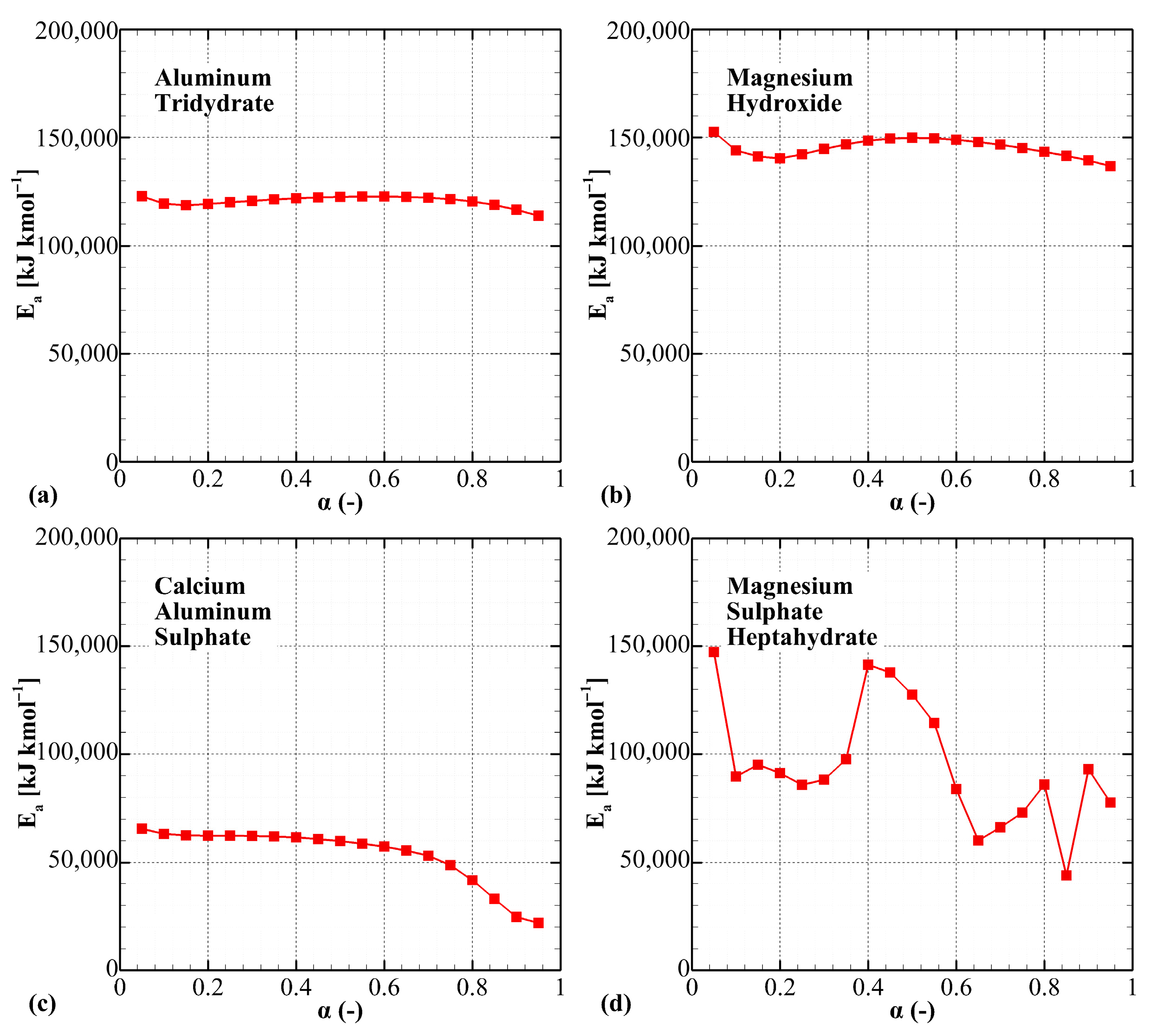
In this study, the integral isoconversional method of Starink [33] was employed to calculate the activation energy (Ea) as a function of the conversion fraction (α) over the range 0.05 ≤ α ≤ 0.95, using a step size of Δα = 0.05. The results are summarized in Figure 3 for all four materials.
For ATH (Figure 3a) and MDH (Figure 3b), the Ea values remain relatively stable across the full conversion range, indicating that both reactions can be considered single-step processes. This interpretation is supported by previous findings for gypsum-based systems [29] and further confirmed by the narrow spread between minimum and maximum Ea values: 7.45% for ATH and 10.80% for MDH, well within the 20–30% threshold defined for single-step mechanisms [12].
In contrast, the dehydration of CAS and ESM shows a pronounced dependence of Ea on α (Figure 3c,d), with variations of 81.62% and 108.98% relative to the respective mean values. These findings provide strong evidence for a multi-step mechanism in both cases.
Particularly in the case of CAS, the isoconversional analysis reveals complexities that are not apparent from the DSC curves alone. The gradual release of water and the likely formation of intermediate metastable hydrates—driven by changes in autogenous vapor pressure—highlight the limitations of relying solely on thermal peak analysis. These multi-stage characteristics are further illustrated in the mechanistic scheme of Equation (9).
3 CaO × Al 2 O 3 × 3 CaSO 4 × 32 H 2 O + H dh CAS 3 CaO × Al 2 O 3 × 3 CaSO 4 × H 2 O s + 32 x H 2 O g ,
This apparent discrepancy between the DSC signal and the isoconversional evaluation should be made explicit. Although CAS exhibits only one dominant thermal peak in the DSC curves, this does not imply a single-step reaction pathway. Overlapping dehydration events, limited peak separation, and the formation of intermediate hydrate states can produce a single broad calorimetric signal while still resulting in conversion-dependent activation energies. The Starink analysis therefore indicates that the apparent single peak represents a superposition of multiple kinetically distinct processes rather than a truly elementary one-step reaction.
The derived kinetic parameters therefore represent effective values under the applied experimental conditions.

5.2.3. Multi-Step Fitting and Model Validation

Based on the non-linear model-fitting approach [12], kinetic parameters for all five dehydration reactions (Equations (1)–(5)) were derived from the experimental DSC data. The results are summarized in Table 3, which provides the kinetic parameters for all identified reaction steps. Although the Avrami–Erofeev model is consistently selected for all identified reaction steps, the variation in activation energy, pre-exponential factor, and Avrami exponent n reflects differences in the effective reaction behavior across the individual dehydration stages. This indicates that the model serves as a flexible mathematical representation of distinct kinetic regimes rather than implying identical underlying mechanisms. For ATH and MDH, the single-step character is reflected in the presence of one dominant reaction with a weight factor close to unity and relatively stable activation energies. In contrast, the multi-step nature of CAS and ESM is evident from the distribution of weight factors across several sub-reactions, indicating that the overall dehydration process is composed of multiple kinetically distinct stages with different activation energies and reaction rates. For ATH and MDH, the model-fitting analysis confirmed a single-step reaction mechanism, best described by the Avrami–Erofeev model. This is consistent with the observed sigmoidal α(T) profiles. In the present work, however, the Avrami–Erofeev function is used primarily as an effective phenomenological description of the measured conversion behavior. Although the curve shape is compatible with nucleation-and-growth-type kinetics, the selected model should not be interpreted as proof of a unique underlying mechanism. Rather, it provides a physically plausible and mathematically robust representation of the reaction progress under the applied non-isothermal conditions and restricted vapor exchange.
In contrast, the dehydration of CAS and ESM required multi-step modeling. CAS was best represented by a three-stage mechanism, while ESM involved eight distinct reaction steps. This indicates that the apparent overall dehydration response of both sulfate-based systems is composed of several kinetically distinct sub-processes. The fitted sub-reactions are consistent with sequential water release, the formation of intermediate metastable hydrates, and structural rearrangements influenced by the buildup of water vapor pressure within the crucible during heating.
The variation in activation energies and pre-exponential factors between the individual sub-reactions reflects changes in the rate-controlling mechanisms during dehydration. Early-stage reactions are typically associated with the release of loosely bound water, while later stages correspond to more stable hydrate phases and structural rearrangements within the solid matrix. This progression is consistent with the observed dependence of the apparent activation energy on the conversion degree and supports the interpretation of dehydration as a sequence of overlapping processes rather than a single elementary reaction.
Similar behavior has been reported by Rubinaite et al. [9], who identified humidity-dependent intermediates such as hemicarbonate and calcium sulfoaluminate 14-hydrate during the carbonation of related materials. Their results underline the critical role of ambient vapor pressure in phase stability and transformation kinetics.
As noted above, all individual reaction steps identified in the multi-stage modeling of CAS and ESM were best described by the Avrami–Erofeev model. This result indicates that the model provides a consistent mathematical description of the measured conversion behavior across the fitted sub-reactions. However, the repeated selection of the same functional form should not be taken as direct evidence that all steps are governed by the same microscopic mechanism. Instead, it suggests that the Avrami–Erofeev expression is sufficiently flexible to represent the effective kinetics of the individual dehydration stages under the present experimental conditions.
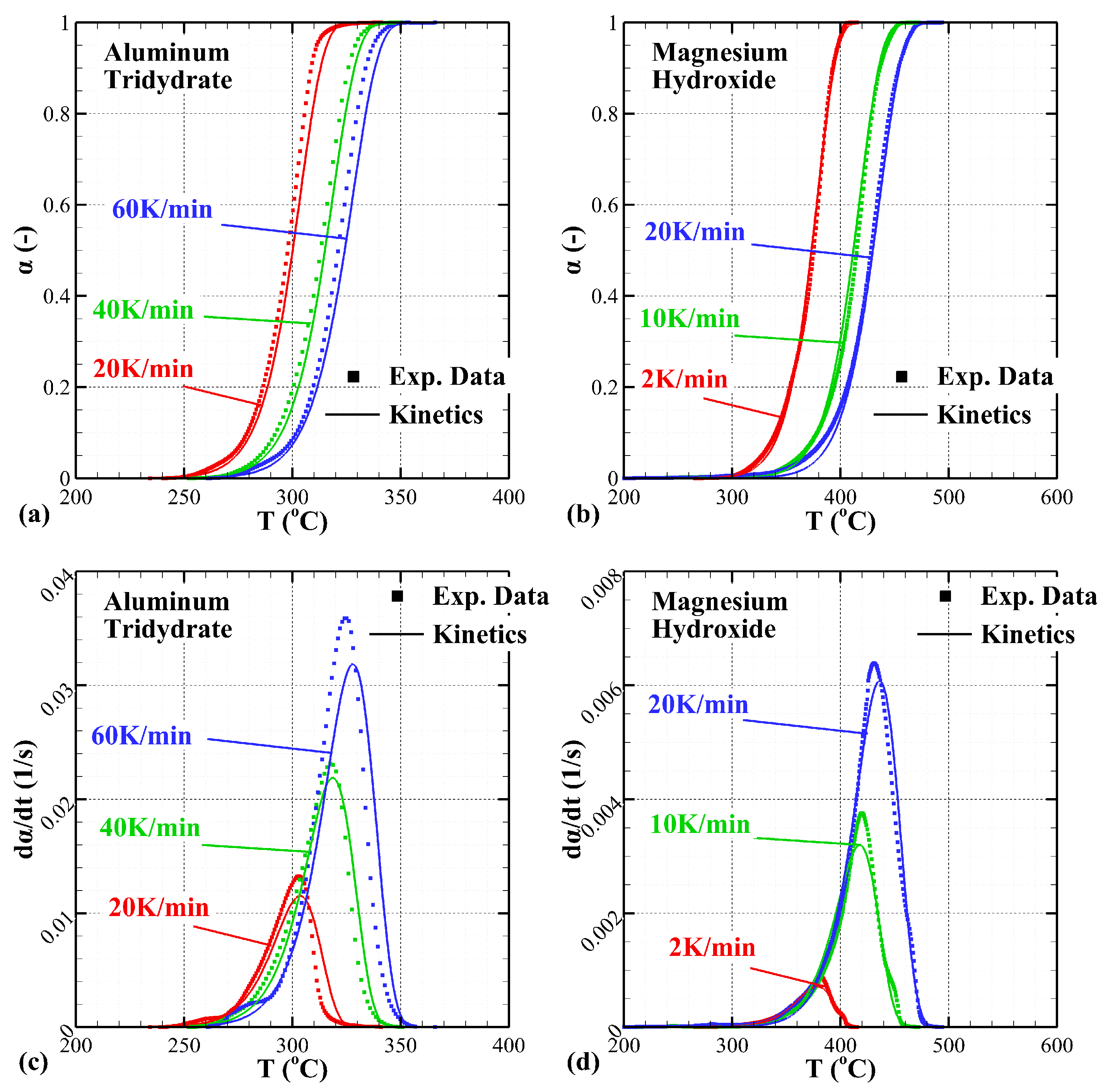
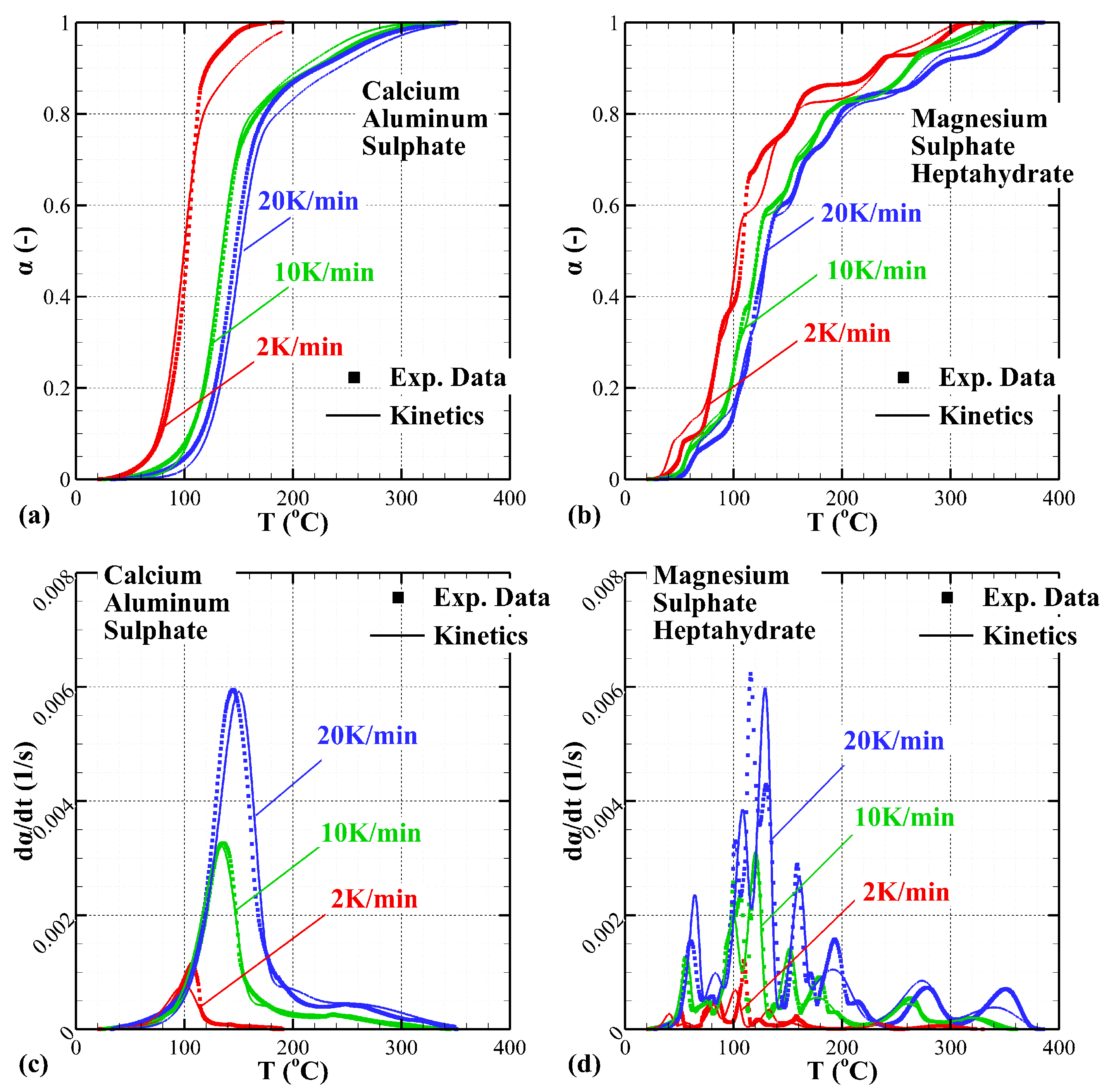
Figure 4 and Figure 5 present a comparison between the predicted conversion fraction α(T) (Figure 4a,b and Figure 5a,b) and the reaction rate /dt (Figure 4c,d and Figure 5c,d) for ATH, MDH, CAS, and ESM, using the kinetic parameters derived from the model-fitting procedure. The numerical predictions reproduce the experimental DSC data closely across all heating rates, demonstrating that the extracted parameter sets provide an accurate representation of the measured dehydration behavior. At the same time, minor local deviations remain visible in specific conversion ranges, which is expected given the simplified effective-model description of complex multi-step reactions.
The best agreement is observed for ATH, MDH, and CAS, while minor deviations in the ESM results can be attributed to (a) the definition of temperature intervals for α(T) computation, (b) the choice of α-ranges assigned to specific sub-reactions during kinetic decomposition, and (c) limitations in the numerical optimization algorithm.
Overall, the consistency between simulated and measured data confirms both the reliability and physical relevance of the determined kinetic triplets. The quality of fit for both α(T) and /dt complies with the benchmark criteria set by the ICTAC Kinetics Committee [12,28] and reflects the methodological rigor described by Kontogeorgos [2].

6. Discussion

6.1. Kinetic Implications

The thermal dehydration behavior of hydrated salts plays a fundamental role in the fire performance of gypsum-based systems, as the release of chemically bound water governs both the endothermic heat absorption and the evolution of water vapor during fire exposure.
This work investigates the kinetic characteristics of several hydrated salts using differential scanning calorimetry and model-based kinetic analysis. The results reveal clear differences in the dehydration mechanisms of the investigated materials, which have direct implications for their behavior under elevated temperatures. A key contribution of this study is the characterization of dehydration kinetics under vapor-restricted conditions, which differ from conventional open-system measurements. This distinction is particularly relevant for porous construction materials, where vapor transport is inherently limited and can significantly influence apparent reaction kinetics.
The analyzed hydroxide-based systems, particularly MDH and GB-ATH, exhibited dehydration behavior that can be reasonably approximated by a single dominant reaction step within the investigated temperature range. The relatively stable activation energy profiles obtained for these materials indicate that their dehydration is largely controlled by a single kinetic mechanism. Such behavior is consistent with Avrami–Erofeev-type reaction models and supports their use as effective kinetic representations of the measured dehydration process. However, this agreement should not be interpreted as proof of a unique underlying mechanism, but rather as a robust phenomenological description of the observed kinetics.
In contrast, the investigated sulfate-based systems, including CAS and ESM, showed clear evidence of multi-step dehydration behavior. In the case of CAS, this is particularly important because the DSC curves alone suggest one dominant thermal event, whereas the conversion-dependent activation energy demonstrates that multiple kinetically distinct processes are superimposed. This apparent contradiction can be explained by overlapping dehydration reactions and limited calorimetric resolution, which may mask intermediate transitions and produce a single broad peak in the DSC signal.
For both CAS and ESM, the variation in the activation energy with conversion is consistent with sequential dehydration steps involving hydrates of different thermodynamic stabilities. In particular, the strong dependence of activation energy on conversion reflects progressive changes in the rate-controlling mechanism, including the release of loosely bound water at early stages and more stable hydrate decomposition at higher temperatures. These observations highlight the complexity of dehydration processes in multi-hydrated mineral systems and underline the limitations of simplified single-step kinetic descriptions.
The kinetic analysis further demonstrates that assuming a constant activation energy is insufficient for describing complex hydrated systems. Instead, conversion-dependent kinetics provide a more realistic representation of reaction pathways in multi-step dehydration processes. In particular, the conversion-dependent activation energy profiles obtained for CAS and ESM indicate that the reaction pathway evolves during the dehydration process. This behavior reflects structural rearrangements within the crystal lattice and changes in the rate-controlling mechanism as dehydration progresses. Consequently, kinetic models that account for variable activation energies provide a more realistic description of the dehydration process and allow a better representation of the experimental conversion curves.
The Avrami–Erofeev model, selected across all materials, provides insight into the effective nucleation-and-growth characteristics of the reactions. The exponent n may suggest nucleation-controlled behavior with varying effective dimensionality; however, in the present work, the model is interpreted as a phenomenological representation rather than a direct mechanistic descriptor.
Overall, these findings demonstrate that vapor-restricted conditions can significantly influence effective kinetic parameters, emphasizing the need to account for boundary conditions when modeling dehydration in porous materials.

6.2. Fire Engineering Interpretation of the Results

From a fire engineering perspective, the dehydration of hydrated salts is relevant because it directly influences the thermal protection capacity of gypsum-based systems. During fire exposure, the release of chemically bound water acts as an effective heat sink and contributes to delaying temperature rise within the material. The kinetics of the dehydration reaction therefore determine both the rate of water release and the duration of the endothermic heat absorption process. Materials exhibiting well-defined dehydration steps with predictable kinetic behavior may therefore provide more reliable thermal buffering effects in fire scenarios. Conversely, complex multi-step dehydration processes may lead to broader temperature ranges over which water release occurs, potentially influencing the thermal response of gypsum products during prolonged fire exposure.
The results support a fire-engineering-relevant classification of additive behavior with respect to temperature range. CAS and ESM contribute primarily at lower temperatures, while ATH and MDH provide endothermic buffering at higher temperatures. This staged behavior is particularly relevant for gypsum-based assemblies, where base gypsum dehydration dominates at lower temperatures, and additives can extend or redistribute the heat absorption capacity. However, this interpretation should be understood as a material-level assessment derived under DSC conditions and not as a direct prediction of assembly-scale fire performance.
The enthalpy ranking indicates that ATH, MDH, and ESM provide larger endothermic capacity per unit mass than CAS in the tested conditions. In practical applications, this suggests that additive selection can be tailored to target specific temperature ranges, depending on the desired fire performance characteristics.
In a gypsum-based composite, this may support additive selection strategies targeting either early-stage dehydration buffering (ESM, CAS) or higher-temperature buffering (ATH, MDH), subject to compatibility, durability, and mechanical constraints. At the same time, the thermal benefit at assembly scale will also depend on the spatial distribution of the additive, the surrounding gypsum matrix, and coupled heat- and mass-transfer effects.
The kinetic triplets derived here are intended to serve as effective source-term inputs for coupled heat-transfer and dehydration models, while acknowledging that transferability from powder systems to composite materials depends on microstructure and transport conditions. The constant heating rates applied in DSC experiments differ from the thermal exposure conditions in cone calorimeter tests and real fire scenarios, where heat input is governed by external heat flux and evolving boundary conditions, resulting in non-linear and spatially varying temperature histories. However, they provide controlled and reproducible data for extracting intrinsic kinetic parameters, which can then be implemented in models with realistic boundary conditions.
In this context, DSC-based kinetic characterization represents an essential prerequisite for full-scale fire simulation, as it provides the reaction parameters required for physically consistent model implementation.
Accordingly, the applied heating rates (2–60 K/min) represent controlled laboratory conditions for consistent kinetic evaluation rather than direct fire exposure. The derived kinetic parameters should therefore be interpreted as effective values, whose relevance to fire scenarios is established through their implementation in coupled heat- and mass-transfer models with realistic boundary conditions. Within this framework, cone calorimeter conditions can be represented through appropriate thermal boundary definitions, enabling indirect comparison between DSC-derived kinetics and fire-representative scenarios. A proposed workflow for implementing these kinetics in fire simulations of gypsum-based assemblies is as follows:
  • Select the material layer model (1D wall model, finite element heat-transfer model, or coupled CFD boundary material model).
  • Assign thermal properties and, where appropriate, their temperature dependence.
  • Implement dehydration steps using the kinetic triplets in Table 3 and dehydration enthalpies in Table 2. For CAS and ESM, implement the multi-step structure with weights wr.
  • Validate the implementation by reproducing non-isothermal DSC conversion curves under the same heating rates; then, run the intended fire exposure history (standard fire curve or parametric fire).
  • Perform sensitivity checks on step weighting and on the effective nature of the kinetics when transferring from DSC boundary conditions to porous assembly environments.
This workflow supports performance-based assessment where dehydration heat sinks and staged water release influence predicted temperatures at interfaces and on protected structural members, consistent with established gypsum board modeling approaches [1,2,6]. Nevertheless, the present workflow should be interpreted as a modeling pathway rather than as proof of direct transferability, because assembly-scale behavior also depends on structural configuration, vapor transport, and boundary conditions that are not resolved in the present DSC-based analysis.

6.3. Practical Limitations and Transferability

The findings of this study provide useful material-level insights for the development of improved thermal decomposition models for gypsum-based materials and other mineral systems used in fire protection applications. Accurate kinetic parameters are important for numerical simulations of thermal response under fire conditions. However, the present results should be interpreted as effective kinetic data derived under controlled DSC conditions with restricted vapor exchange, and not as directly transferable parameters for all fire-exposed gypsum-based assemblies.
The kinetic parameters should be interpreted as effective values derived under restricted vapor exchange in pinhole crucibles. In real gypsum boards, local vapor pressure and transport pathways depend on pore structure, cracking, paper facings, layer interfaces and thermal boundary conditions. Consequently, the parameters are best used within models that can accommodate effective kinetics and are validated at the assembly scale when possible. For ATH, the use of a gypsum board containing 5 wt.% ATH implies that extracted kinetics represent the additive response within the gypsum matrix rather than that of the pure material. The comparison with the reference gypsum board indicates that the observed ATH-related thermal effects are superimposed on the intrinsic dehydration behavior of the matrix and may therefore be influenced by interactions with the surrounding material.
Future studies should investigate the dehydration behavior of these systems under conditions that more closely resemble realistic fire exposure, including larger-scale specimens, transient thermal gradients, and coupled heat- and mass-transfer conditions. In addition, the interaction between dehydration, vapor transport, and pore structure evolution should be examined in order to assess how the present effective kinetics change when transferred from DSC boundary conditions to gypsum-based assemblies. The integration of the derived kinetic parameters into coupled thermochemical fire models should therefore be accompanied by dedicated validation against intermediate- and full-scale experiments.

7. Conclusions

This study investigated the dehydration kinetics of selected inorganic salts—ATH, MDH, CAS, and ESM—under elevated temperature conditions using DSC. Measurements were performed at different heating rates up to 600 °C using pinhole crucibles to simulate autogenous water vapor pressure.
The DSC results revealed that ATH and MDH exhibit predominantly single-step dehydration behavior, whereas ESM undergoes a complex multi-step dehydration process. CAS exhibited a single dominant thermal peak in the DSC signal, but the kinetic analysis indicated a multi-step reaction pathway. Among the examined salts, ATH, MDH, and ESM demonstrated higher energy absorption per unit mass compared to CAS, suggesting their greater potential as flame-retardant additives.
To resolve overlapping thermal events and support kinetic interpretation, peak deconvolution techniques (e.g., Fraser–Suzuki function) were employed. Kinetic parameters were extracted using both model-free and model-fitting approaches. The activation energy profiles indicated that ATH and MDH follow single-step mechanisms, while CAS and ESM involve multiple steps—despite the initial impression from DSC alone suggesting otherwise for CAS.
All reactions—both single- and multi-step—were consistently modeled using the Avrami–Erofeev framework, which reflects nucleation-and-growth mechanisms. This is in agreement with the literature and supported by prior findings on hydrate decomposition pathways. The use of empirical models such as the Sesták–Berggren equation in future work may provide further flexibility in capturing overlapping reaction mechanisms.
Finally, model predictions for conversion fraction and reaction rates, based on the extracted kinetic parameters (Table 3), matched the experimental DSC data with high accuracy. These results support the reliability of the derived kinetic triplets as effective input data for the description of dehydration processes under restricted vapor exchange. Their application to fire modeling and material performance assessment is promising but requires further validation in coupled heat- and mass-transfer simulations at larger scales. The findings also align with earlier studies emphasizing the critical influence of water vapor pressure on phase stability and transformation rates.
Beyond material-level characterization, the present results contribute to the development of more physically consistent thermochemical models for gypsum-based systems exposed to fire. The derived kinetic parameters and validated numerical predictions provide inputs for performance-based fire engineering models, thereby supporting improved assessment of material behavior during fire exposure and, ultimately, safer building design. By connecting experimental thermal analysis with predictive modeling approaches, the paper aligns with current efforts to understand how fire dynamics interact with construction materials, infrastructure resilience, and community safety within the built environment. Such predictive capabilities are critical for modern fire engineering approaches that rely on physics-based assessment rather than prescriptive testing alone. Overall, the study demonstrates that accounting for vapor-restricted conditions is important for developing reliable kinetic models of hydrated salts in porous fire protection materials.

Author Contributions

Conceptualization, M.P., D.A.K. and M.A.F.; methodology, M.P.; validation, M.P. and D.A.K.; formal analysis, M.P.; investigation, M.P., M.D.D. and I.D.M.; data curation, M.P.; writing—original draft preparation, M.P.; writing—review and editing, M.P., D.A.K. and M.A.F.; visualization, M.P.; supervision, D.A.K. and M.A.F.; project administration, M.A.F. All authors have read and agreed to the published version of the manuscript.

Funding

This research received no external funding.

Institutional Review Board Statement

Not applicable.

Informed Consent Statement

Not applicable.

Data Availability Statement

The data presented in this study are available on request from the corresponding author.

Acknowledgments

The authors gratefully acknowledge Knauf Gips KG for providing the gypsum-based materials used in this study. The authors used a generative AI tool (Chat GPT 5.4) solely for limited language assistance during manuscript revision (grammar, wording, and stylistic polishing). No generative AI tool was used to generate, modify, analyze, or interpret experimental data, figures, tables, equations, references, or scientific conclusions.

Conflicts of Interest

The authors declare no conflicts of interest.

Abbreviations

The following abbreviations are used in this manuscript:
ATHAluminum Trihydrate (Al(OH)3)
ESMMagnesium Sulfate Heptahydrate (MgSO4 × 7H2O)
CASCalcium Aluminate Sulfate (3CaO × Al2O3 × 3CaSO4 × 32H2O)
MDHMagnesium Hydroxide (Mg(OH)2)
ICTACInternational Confederation for Thermal Analysis and Calorimetry
kreaction rate constant
Lventhalpy of evaporation, 22.6 × 10⁶ J kg−1
NRnumber of reactions
Ppressure
Rguniversal gas constant, 8.314 J mol−1 K−1
ttime
Ttemperature
wweight factor
Eaactivation energy, J mol−1
Apre-exponential factor, s−1
βheating rate, K min−1
Greek symbols
αconversion fraction
ΔHenthalpy of reaction
Subscripts
dhdehydration
rreaction index
Special Symbols
dtotal derivative

References

  1. Mehaffey, J.R.; Cuerrier, P.; Carisse, G. A Model for Predicting Heat Transfer through Gypsum-Board/Wood-Stud Walls Exposed to Fire. Fire Mater. 1994, 18, 297–305. [Google Scholar] [CrossRef]
  2. Kontogeorgos, D.A.; Founti, M.A. Gypsum Board Reaction Kinetics at Elevated Temperatures. Thermochim. Acta 2012, 529, 6–13. [Google Scholar] [CrossRef]
  3. Ghazi Wakili, K.; Hugi, E. Four Types of Gypsum Plaster Boards and Their Thermophysical Properties under Fire Condition. J. Fire Sci. 2009, 27, 27–43. [Google Scholar] [CrossRef]
  4. Zehfuß, J.; Sander, L. Gypsum Plasterboards under Natural Fire—Experimental Investigations of Thermal Properties. Civ. Eng. Des. 2021, 3, 62–72. [Google Scholar] [CrossRef]
  5. Kontogeorgos, D.; Mandilaras, I.; Founti, M. Scrutinizing Gypsum Board Thermal Performance at Dehydration Temperatures. J. Fire Sci. 2011, 29, 111–130. [Google Scholar] [CrossRef]
  6. Hasnain, M.; Sezer, H.; Kozhumal, S. Predicting Thermal Response of Gypsum Board under Various Heat Flux Configurations: A Three-Dimensional Mathematical Model. Int. J. Therm. Sci. 2026, 221, 110457. [Google Scholar] [CrossRef]
  7. Han, X.C.; Xu, H.J.; Hua, W.S. Decomposition Performance and Kinetics Analysis of Magnesium Hydroxide Regulated with C/N/Ti/Si Additives for Thermochemical Heat Storage. Appl. Energy 2023, 344, 121322. [Google Scholar] [CrossRef]
  8. Slimani, H.; Ait Ousaleh, H.; El Harrak, A.; Linder, M.; Faik, A. Doping Effects on Magnesium Hydroxide: Enhancing Dehydration and Hydration Performance for Thermochemical Energy Storage Applications. Chem. Eng. J. 2024, 488, 151048. [Google Scholar] [CrossRef]
  9. Rubinaite, D.; Dambrauskas, T.; Baltakys, K.; Siauciunas, R. Influence of Water Vapour Pressure on the Carbonation Process of Calcium Monosulfoaluminate 12-Hydrate. J. Therm. Anal. Calorim. 2024, 150, 861–872. [Google Scholar] [CrossRef]
  10. Chen, J.; Ma, H.; Ding, Y. MgSO4·7H2O for Thermochemical Energy Storage: Dehydration and Hydration Kinetics and Cyclability. Energy Storage Sci. Technol. 2024, 13, 4259–4271. [Google Scholar] [CrossRef]
  11. Chen, B.; Kuznik, F.; Horgnies, M.; Johannes, K.; Morin, V.; Gengembre, E. Physicochemical Properties of Ettringite/Meta-Ettringite for Thermal Energy Storage: Review. Sol. Energy Mater. Sol. Cells 2019, 193, 320–334. [Google Scholar] [CrossRef]
  12. Vyazovkin, S.; Burnham, A.K.; Criado, J.M.; Pérez-Maqueda, L.A.; Popescu, C.; Sbirrazzuoli, N. ICTAC Kinetics Committee Recommendations for Performing Kinetic Computations on Thermal Analysis Data. Thermochim. Acta 2011, 520, 1–19. [Google Scholar] [CrossRef]
  13. Zambotti, A.; Valentini, F.; Lodi, E.; Pegoretti, A.; Tyrpekl, V.; Kohúteková, S.; Sorarù, G.D.; Kloda, M.; Biesuz, M. Thermochemical Heat Storage Performances of Magnesium Sulphate Confined in Polymer-Derived SiOC Aerogels. J. Alloys Compd. 2022, 895, 162592. [Google Scholar] [CrossRef]
  14. Elbasuney, S. Novel Multi-Component Flame Retardant System Based on Nanoscopic Aluminium-Trihydroxide (ATH). Powder Technol. 2017, 305, 538–545. [Google Scholar] [CrossRef]
  15. Duquesne, S.; Fontaine, G.; Cérin-Delaval, O.; Gardelle, B.; Tricot, G.; Bourbigot, S. Study of the Thermal Degradation of an Aluminium Phosphinate–Aluminium Trihydrate Combination. Thermochim. Acta 2013, 551, 175–183. [Google Scholar] [CrossRef]
  16. Hull, T.R.; Witkowski, A.; Hollingbery, L. Fire Retardant Action of Mineral Fillers. Polym. Degrad. Stab. 2011, 96, 1462–1469. [Google Scholar] [CrossRef]
  17. Girardin, B.; Fontaine, G.; Duquesne, S.; Försth, M.; Bourbigot, S. Measurement of Kinetics and Thermodynamics of the Thermal Degradation for Flame Retarded Materials: Application to EVA/ATH/NC. J. Anal. Appl. Pyrolysis 2017, 124, 130–148. [Google Scholar] [CrossRef]
  18. Dzidziguri, E.; Vasilev, A.; Ozherelkov, D.; Pelevin, I.; Zotov, B.; Fedorenko, L.V.; Gromov, A. Thermal Decomposition of Chemically Precipitated Nanopowder of Aluminum Hydroxide. Phys. Chem. Mater. Treat. 2022, 5, 39–46. [Google Scholar] [CrossRef]
  19. Miller, N.; Coffey, P.; Badenhorst, H.; Martin, P. The Effect of the Salt Precursor on the Particle Morphology and Thermal Properties of Magnesium Hydroxide for Thermochemical Energy Storage. J. Energy Storage 2021, 44, 103335. [Google Scholar] [CrossRef]
  20. Ings, J.B.; Brown, P.W. An Evaluation of Hydrated Calcium Aluminate Compounds as Energy Storage Media; National Institute of Standards and Technology (NIST): Washington, DC, USA, 1982. [Google Scholar] [CrossRef]
  21. N’Tsoukpoe, K.E.; Schmidt, T.; Rammelberg, H.U.; Watts, B.A.; Ruck, W.K.L. A Systematic Multi-Step Screening of Numerous Salt Hydrates for Low Temperature Thermochemical Energy Storage. Appl. Energy 2014, 124, 1–16. [Google Scholar] [CrossRef]
  22. Phadnis, A.B.; Deshpande, V.V. On the Dehydration of MgSO4·7H2O. Thermochim. Acta 1981, 43, 249–250. [Google Scholar] [CrossRef]
  23. Vyazovkin, S.; Dollimore, D. Linear and Nonlinear Procedures in Isoconversional Computations of the Activation Energy of Nonisothermal Reactions in Solids. J. Chem. Inf. Comput. Sci. 1996, 36, 42–45. [Google Scholar] [CrossRef]
  24. Brown, M.E.; Maciejewski, M.; Vyazovkin, S.; Nomen, R.; Sempere, J.; Burnham, A.; Opfermann, J.; Strey, R.; Anderson, H.L.; Kemmler, A.; et al. Computational Aspects of Kinetic Analysis: Part A: The ICTAC Kinetics Project-Data, Methods and Results. Thermochim. Acta 2000, 355, 125–143. [Google Scholar] [CrossRef]
  25. Braga, R.; Melo, D.; Aquino, F.; Freitas, J.; Melo, M.; Barros, J.; Fontes, M. Characterization and Comparative Study of Pyrolysis Kinetics of the Rice Husk and the Elephant Grass. J. Therm. Anal. Calorim. 2014, 115, 1915–1920. [Google Scholar] [CrossRef]
  26. Dubey, G.; Vairakannu, P.; Tiwari, P. TGA-Based Kinetic Parameters and Laboratory-Scale Pyrolysis of Northeastern Indian Coals. J. Therm. Anal. Calorim. 2025, 150, 6145–6162. [Google Scholar] [CrossRef]
  27. Sindhu, N.V.; Muraleedharan, K. Kinetic Study of the Multistep Thermal Behaviour of Barium Titanyl Oxalate Prepared via Chemical Precipitation Method. J. Therm. Anal. Calorim. 2018, 136, 1295–1306. [Google Scholar] [CrossRef]
  28. Koga, N.; Šesták, J.; Šimon, P. Some Fundamental and Historical Aspects of Phenomenological Kinetics in the Solid State Studied by Thermal Analysis. In Thermal Analysis of Micro, Nano- and Non-Crystalline Materials: Transformation, Crystallization, Kinetics and Thermodynamics; Springer: Berlin/Heidelberg, Germany, 2013; pp. 1–28. [Google Scholar] [CrossRef]
  29. El Hazzat, M.; Sifou, A.; Arsalane, S.; El Hamidi, A. Novel Approach to Thermal Degradation Kinetics of Gypsum: Application of Peak Deconvolution and Model-Free Isoconversional Method. J. Therm. Anal. Calorim. 2019, 140, 657–671. [Google Scholar] [CrossRef]
  30. Chen, B.; Johannes, K.; Horgnies, M.; Morin, V.; Kuznik, F. Characterization of an Ettringite-Based Thermochemical Energy Storage Material in an Open-Mode Reactor. J. Energy Storage 2021, 33, 102159. [Google Scholar] [CrossRef]
  31. Chen, B.; Johannes, K.; Ratel, L.; Horgnies, M.; Morin, V.; Kuznik, F. Investigation on Ettringite as a Low-Cost High-Density Thermochemical Heat Storage Material: Thermodynamics and Kinetics. Sol. Energy Mater. Sol. Cells 2021, 221, 110877. [Google Scholar] [CrossRef]
  32. Palacios, A.; Navarro, M.E.; Barreneche, C.; Ding, Y. Experimental Validation of Thermochemical Water-Sorption Materials for Thermal Energy Storage: Building Application. Sustain. Mater. Technol. 2023, 38, e00702. [Google Scholar] [CrossRef]
  33. Starink, M.J. The Determination of Activation Energy from Linear Heating Rate Experiments: A Comparison of the Accuracy of Isoconversion Methods. Thermochim. Acta 2003, 404, 163–176. [Google Scholar] [CrossRef]
Figure 1. DSC curves as a function of sample temperature for (a) GB-ATH, (b) MDH, (c) CAS, and (d) ESM at different heating rates.
Fire 09 00159 g001
Figure 2. Conversion fraction of dehydration of (a) ATH, (b) MDH, (c) CAS and (d) ESM at different heating rates, as a function of sample temperature.
Fire 09 00159 g002
Figure 3. Activation energy of dehydration of (a) ATH, (b) MDH, (c) CAS and (d) ESM as a function of the conversion fraction.
Fire 09 00159 g003
Figure 4. Comparison between the predictions (lines) and the experimental data (symbols) for different heating rates for (a) the conversion fraction of ATH, (b) the conversion fraction of MDH, (c) the reaction rate of ATH and (d) the reaction rate of MDH.
Fire 09 00159 g004
Figure 5. Comparison between the predictions (lines) and the experimental data (symbols) for different heating rates for (a) the conversion fraction of CAS, (b) the conversion fraction of ESM, (c) the reaction rate of CAS and (d) the reaction rate of ESM.
Fire 09 00159 g005
Table 1. Experimental conditions for the DSC measurements, including applied heating rates (β), sample masses (m), and replicate runs for each investigated material.
Sampleβ
(K min−1)
m
(mg)
2013.89
GB-ATH 14013.59
6013.62
214.87
MDH1014.69
2014.19
210.52
CAS1010.22
2010.24
214.37
ESM1012.51
2014.20
1 GB-ATH stands for the gypsum board sample containing 5% of ATH.
Table 2. Mass loss and energy absorbed/produced for each DSC measurement and specimen.
Sampleβ
(K min−1)
Δm 2
(mg)
Δm 2
(%)
ΔH 3
(kJ kg−1)
ΔH 4
(kJ kg−1)
ΔH 5
(kJ kg−1)
202.5418.29−377.56−48.459.15
GB-ATH 1402.5818.98−386.00−50.5513.92
602.5518.72−381.05−48.4014.10
24.1327.77 −1077.38
MDH103.9827.09 −1100.32
203.7726.57 −1092.89
24.2340.21 −729.52
CAS104.1340.41 −713.28
204.1240.23 −712.06
27.3451.08 −1120.84
ESM106.3450.68 −1103.95
207.2250.85 −1106.10
1 GB-ATH stands for the gypsum board sample containing 5% of ATH. 2 Δm stands for the total mass loss of the examined samples (mass sample at 600 °C). 3 ΔH stands for the energy absorbed due to the two-step dehydration process of gypsum boards. 4 ΔH stands for the energy absorbed due to the dehydration of the examined additives, i.e., ATH, MDH, CAS and ESM. 5 ΔH stands for the energy produced due to the crystal reorganization reaction of gypsum boards.
Table 3. Kinetic parameters for the dehydration reactions of ATH, MDH, CAS, and ESM obtained from the model-fitting procedure. For CAS and ESM, the listed parameters represent individual sub-reactions of the corresponding multi-step dehydration process.
MaterialReaction IDWeight Factor (−)Ea (J mol−1)A (s−1)n
ATHI1.000120,583.020.1286 × 10102.00
MDHI1.000142,500.000.3681 × 1091.35
I0.20035,078.660.1660 × 1021.00
CASII0.10045,736.300.1607 × 1041.25
III0.70053,064.640.4624 × 1051.60
I0.08080,000.000.7339 × 10112.50
II0.05079,500.000.1296 × 10111.80
III0.16091,000.000.8074 × 10112.20
IV0.28098,800.000.1765 × 10122.20
ESMV0.100112,000.000.7879 × 10122.40
VI0.15575,000.000.3877 × 1071.20
VII0.105117,000.000.2489 × 10101.25
VIII0.070108,000.000.1862 × 1081.20
Disclaimer/Publisher’s Note: The statements, opinions and data contained in all publications are solely those of the individual author(s) and contributor(s) and not of MDPI and/or the editor(s). MDPI and/or the editor(s) disclaim responsibility for any injury to people or property resulting from any ideas, methods, instructions or products referred to in the content.