Article

Satellite-Constrained Estimation of Emissions from Crop Residue Open Burning in Guangxi, Southern China (2017–2023)

1
Agricultural Science and Technology Information Research Institute, Guangxi Academy of Agricultural Sciences, Nanning 530007, China
2
Ecological Environment Monitoring Center of Guangxi Province, Nanning 530025, China
3
Guangxi Key Laboratory of Emerging Contaminants Monitoring, Early Warning and Environmental Health Risk Assessment, Nanning 545000, China
4
School of Geography and Remote Sensing, Guangzhou University, Guangzhou 510006, China
*
Author to whom correspondence should be addressed.
These authors contributed equally to this work.
Fire 2026, 9(3), 132; https://doi.org/10.3390/fire9030132
Submission received: 15 January 2026 / Revised: 6 March 2026 / Accepted: 18 March 2026 / Published: 20 March 2026

Abstract

Crop residue open burning is a major source of atmospheric pollutants that degrade regional air quality, enhance climate forcing, and threaten public health through emissions of particulate matter, greenhouse gases, and toxic species. In southern China, satellite-based emission estimates are often underestimated because frequent cloud cover and limited spatiotemporal resolution hinder the detection of agricultural fires. In this study, crop residue open burning emissions in Guangxi province from 2017 to 2023 were quantified using a statistical approach. The open burning proportion (OBP) was updated on an annual basis using the Visible Infrared Imaging Radiometer Suite (VIIRS) 375 m active fire product (VNP14IMG), and recently reported emission factors (EFS) were adopted to enhance estimation accuracy. Annual emissions of pollutants were then spatially distributed to 0.05° × 0.05° grid cells based on satellite-detected fire counts and land cover information. The results indicated the total emissions of black carbon (BC), organic carbon (OC), sulfur dioxide (SO2), nitric oxide (NOX), carbon monoxide (CO), carbon dioxide (CO2), fine particles (PM2.5), coarse particles (PM10), ammonia (NH3), methane (CH4) and non-methane volatile organic compound (NMVOC) in Guangxi province during 2017–2023 were 58.90, 230.48, 37.90, 213.95, 4234.41, 108,775.48, 583.09, 667.70, 46.36, 322.74 and 710.20 Gg, respectively. Sugarcane residue burning was identified as the dominant contributor, accounting for 41.26–64.38% of total emissions, followed by rice (20.66–43.06%), corn (5.11–17.25%), and cassava (4.33–6.45%). Emissions exhibited clear interannual variability, declining from 2017 to 2020 under strict control measures and increasing again from 2021 to 2023 as enforcement weakened. Incorporating annually updated VIIRS-derived OBPS into the statistical inventory improves the temporal representation and reliability of multi-year emission estimates for agricultural burning.

1. Introduction

Open burning of crop residues is the predominant type of biomass burning in China, typically occurring before sowing and after harvest. Unlike coal combustion, domestic heating, and most industrial activities, which are relatively continuous throughout the year, crop residue open burning is highly seasonal and concentrated within short time periods. As a result, large-scale biomass combustion in a short period leads to a sharp increase in pollutant emissions [1,2]. As a country with a long-standing agricultural tradition, China burns approximately 100 million tons of crop residues annually, releasing significant quantities of gaseous and particulate pollutants into the atmosphere [3,4,5]. These emissions have substantial effects on regional air quality, exacerbate global climate change, and pose severe risks to human health, including respiratory and cardiovascular diseases [6,7,8,9]. Previous research indicates that between 2003 and 2015, crop residue open burning was the dominant source of biomass burning emissions in central and eastern China, accounting for 84–96% of total emissions. This contribution has steadily increased, directly intensifying regional air pollution [10,11,12].
In recent years, strict anti-burning policies have reduced crop residue open burning. However, research indicates that emissions from this practice remain a significant source of air pollution in China, especially during harvest seasons [13,14,15,16]. During the harvest season, pollutant emissions from crop residue open burning in the North China Plain are approximately twice those from other anthropogenic sources. Under high-humidity meteorological conditions, emissions from crop residue open burning are more likely to trigger severe and persistent haze episodes in the region [17,18]. Three major regional air pollution events that occurred in the Beijing–Tianjin–Hebei region in October 2014 were all closely associated with crop residue open burning activities [19]. In Hubei province, peak nitric oxide (NOX) emissions observed during October and from January to April between 2014 and 2016 were linked to post-harvest residue burning in autumn and crop residue open burning prior to spring planting [20]. Therefore, establishing accurate and timely emission inventories for crop residue open burning is crucial for effective air quality control and policy development. Current emission estimation studies mainly rely on two methodological frameworks: satellite-based remote sensing approaches and statistical-based approaches. Remote sensing methods generally derive emissions by first estimating the dry matter burned (DMB) from satellite-observed burned area (BA) or fire radiative power (FRP), and subsequently applying appropriate emission factors (EFS). Wu et al. constructed an open biomass burning emission inventory for central and eastern China during 2003–2015 using MODIS BA data [12]. Nevertheless, the relatively coarse spatial resolution of BA products (around 500 m) limits their ability to capture small and fragmented agricultural fires, which produces a consistent underestimation of crop residue burning emissions. Compared with BA-based products, satellite active fire datasets have a greater capacity to detect small-scale fires and provide direct FRP information, and have therefore been widely adopted in emission estimation studies. Zhang et al. developed an agricultural burning emission inventory for eastern China by integrating FRP observations from the VIIRS and Himawari-8 sensors for 2012–2015 [21]. At the global scale, several FRP-based multi-satellite fusion products have also been developed, such as Global Fire Assimilation System (GFAS), Fire Energetics and Emissions Research (FEER), and Quick Fire Emissions Dataset (QFED). These datasets integrate FRP from multiple satellites to provide near-real-time or regularly updated global biomass burning emissions, and are widely used in atmospheric modeling studies [22,23,24,25]. However, FRP measurements from polar-orbiting satellites are constrained by fixed overpass times and cloud-free conditions, which can result in missed detections of agricultural fires and introduce considerable uncertainties into emission estimates [21,26,27]. Alternatively, statistical-based approaches estimate emissions using comprehensive activity data, including crop production, grain-to-straw ratios, combustion efficiencies, and the open burning proportion (OBP). Using this framework, Li et al. established a long-term (1990–2013) inventory of crop residue burning in China using government data and localized emission factors [28]. In a statistical-based approach, accurately quantifying OBP is particularly critical for reliable emission estimation [29]. However, OBP is predominantly derived from field surveys, which are labor-intensive and costly, making it challenging to update in a timely manner.
Guangxi province is a major agricultural region in southern China where large quantities of residues from sugarcane, rice, corn, and cassava are often burned in fields after harvest, generating substantial atmospheric emissions [30]. Previous studies have attempted to quantify these emissions. Pan et al. produced emissions estimates for 2017–2021 using FRP from a multi-satellite fire-fusion product [31], but in cloud-prone southern China, and where agricultural fires are often small, satellite-only approaches can substantially undercount burning events [32,33]. Liu et al. produced a statistical estimate for Guangxi in 2019 [34]; however, their sugarcane OBP relied on field surveys with uncertain sample sizes and methodologies. Luo et al. estimated emissions for 2011–2020 using crop production, grain-to-straw ratios and a fixed OBP [35]; using a constant OBP can introduce large errors under recent strict no-burn policies. To address these limitations, this study employs the VIIRS 375 m active fire product to update OBP on an annual basis and builds an activity-based emission inventory for Guangxi covering 2017–2023. In contrast to previous studies that used fixed OBP values, the annually updated OBP applied here captures interannual variability driven by policy enforcement and changes in agricultural practices, thereby better representing actual burning dynamics and reducing uncertainties associated with constant assumptions. We quantify eleven pollutants: black carbon (BC), organic carbon (OC), sulfur dioxide (SO2), nitric oxide (NOX), carbon monoxide (CO), carbon dioxide (CO2), fine particles (PM2.5, particles with an aerodynamic diameter ≤ 2.5 μm), coarse particles (PM10, particles with an aerodynamic diameter ≤ 10 μm), ammonia (NH3), methane (CH4), and non-methane volatile organic compound (NMVOC). Annual emissions were allocated to 0.05° × 0.05° grid cells using VIIRS fire observations and land cover data. The resulting high-resolution inventory improves the spatial and temporal representation of agricultural burning emissions and provides useful support for air quality research and management of crop residue open burning.

2. Materials and Methods

2.1. Study Area

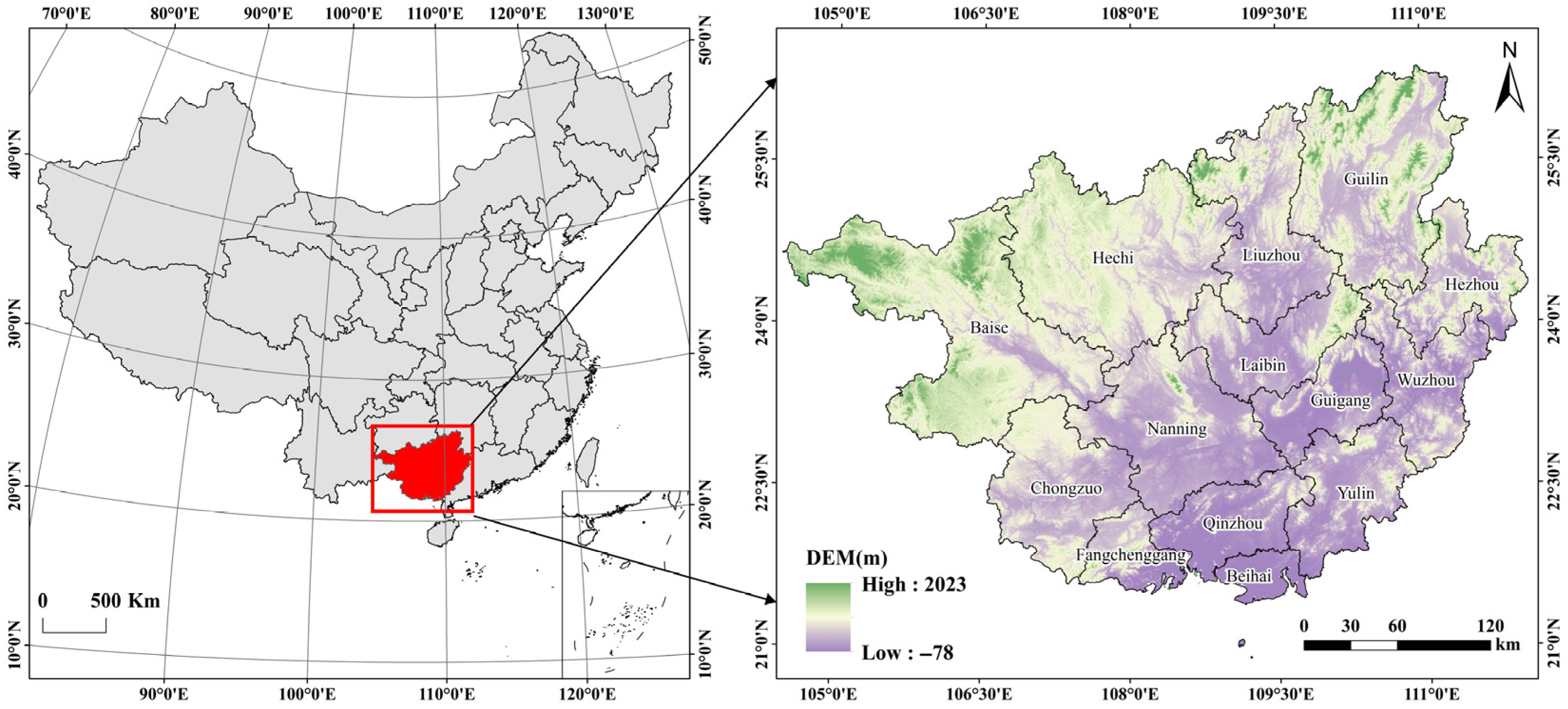
Guangxi province, situated in southern China between approximately 20–27° N and 104–113° E, was chosen as the study area. The region consists of 14 prefecture-level cities, with Nanning as the capital. Figure 1 shows that elevations are generally higher in the northwest and decrease toward the southeast. In 2023, the province recorded a total grain-sown area of 42.52 million acres and a grain output of 13.95 million tons, both rising steadily over four consecutive years. As China’s largest sugarcane-producing area, Guangxi maintains over 11 million acres of sugarcane cultivation, representing about 60% of the national total. The province’s substantial agricultural output indicates a significant potential for emissions from crop residue open burning, emphasizing the importance of precise emission estimates for air quality management.

2.2. Methods for Estimating Emissions from Crop Residue Open Burning

Open burning emissions of crop residues were calculated as the product of emission factors and the total amount of crop residues burned in the field, as expressed by the following equation:
E p = 10 3 × A × E F p
where p denotes the pollutant type; E represents the total emission of each pollutant (ton); A is the mass of crop residues burned in the field (ton); and EF is the corresponding emission factor (g/kg).

2.2.1. Estimation of In-Field Crop Residue Burning

This study focused on sugarcane, rice, corn, and cassava, which dominate crop residue open burning in Guangxi and together accounted for over 98% of total crop production (excluding fruit crops) during 2017–2023, with sugarcane contributing 82%, rice 11.44%, corn 3.09%, and cassava 1.86%. These figures can be verified using official statistical data (https://gxsj.tjj.gxzf.gov.cn:18090/pub/easyquery/easyquery.htm?cn=A0202, accessed on 2 March 2026). Although minor crops may contribute to open burning, their limited production makes a substantial impact on total provincial emissions unlikely, while including a broader range of crops in future studies would enhance inventory completeness. As a result, the selected crops adequately represent regional burning activities and support robust emission estimation. The amount of crop residue burned in the field was estimated with the following formula:
A = P × N × R × η
where A denotes the mass of crop residues burned in-field (ton); P represents crop production (ton); N is the crop-specific grain-to-straw ratio; R refers to the open burning proportion (OBP) of residues; and η indicates the combustion efficiency of each crop.
City-scale crop production statistics were sourced from the Guangxi Statistical Yearbook covering the period 2018 to 2024. This study collected crop production data from 14 cities in Guangxi province, where the main crops include sugarcane, rice, corn, and cassava. The grain-to-straw ratio refers to the ratio of crop residue yield to economic yield and is an important indicator of crop production efficiency. The combustion efficiencies of crop residues depend on burning methods and environmental conditions and are also influenced by crop type and local burning practices. Values for grain-to-straw ratios and combustion efficiencies were collected through an extensive review of published studies and are presented in Table 1. In selecting grain-to-straw ratios, priority was given to the most up-to-date measurements derived from field experiments conducted within Guangxi province for each crop type. When such data were unavailable, corresponding values reported in domestic studies were used instead. OBP is typically derived from field investigations, which are time-consuming and costly, resulting in limited data availability. Consequently, some previous studies have applied fixed OBP values across multiple years. However, OBP is expected to vary interannually in response to changes in air pollution control policies and the level of local socioeconomic development. Therefore, assuming a constant OBP over extended periods may introduce substantial uncertainty into emission estimates.
In previous studies, similar approaches have been widely used to derive baseline OBP values from survey data and adjust them in subsequent years using satellite-based methods [36]. Accordingly, this study constrains annual OBP values with VIIRS active-fire observations to improve the reliability of the emission inventory. The year 2017 was adopted as the reference year, with OBP values for subsequent years adjusted relative to the 2017 baseline. In the reference year, the open burning proportions for sugarcane, rice, corn, and cassava residues were 32.9%, 28.6%, 31.9%, and 31.7%, respectively, based on field questionnaire surveys reported by Peng et al. and Li et al. [37,38]. OBP values for the remaining years were calculated following Equation (3) and are summarized in Table 2.
R y = F C y F C B S × R B S
where y refers to the specific year; Ry represents the OBP of crop residues in year y; FCy denotes the number of cropland fire detections in year y; and FCBS and RBS indicate the fire count and OBP in the base year, respectively.
Table 1. Parameters for calculating in-field crop residue burning.
CropGrain-to-Straw RatioCombustion Efficiency
Sugarcane0.3 a0.68 a
Rice1.17 b0.93 d
Corn1.2 c0.92 d
Cassava1.41 e0.68 c
References: a Zhou et al. [1]. b Zeng et al. [39]. c Peng et al. [37]. d Zhang et al. [40]. e Li et al. [41].
Table 2. Updated proportion of crop residue open burning.
YearFire CountSugarcaneRiceCornCassava
2017214432.90%28.60%31.90%31.70%
2018181227.81%24.17%26.96%26.79%
2019218433.51%29.13%32.50%32.29%
2020250838.49%33.46%37.32%37.08%
2021423665.00%56.51%63.03%62.63%
2022315748.44%42.11%46.97%46.68%
2023299145.90%39.90%44.50%44.22%

2.2.2. Emission Factors

The pollutant emission factors (EFS) from crop residue burning are strongly influenced by residue properties such as moisture content and bulk density and are essential for emission estimation. However, accurately determining EFS through direct measurements remains challenging. Field measurements are constrained by uncontrollable burning conditions and rapid smoke dispersion, which complicate sampling and limit temporal and spatial representativeness. In contrast, laboratory experiments provide controlled combustion conditions, more complete smoke collection, and higher measurement precision, making them more suitable for emission inventory development and modeling applications. Due to these practical limitations and the scarcity of systematic field measurements in China, most studies adopt laboratory-measured EFS or rely on literature-derived values. In this study, EFS for each crop type were compiled primarily from laboratory-based measurements and published literature for Guangxi and nearby regions. When domestic data were unavailable, values from international studies were used. The EFS applied in this study are summarized in Table 3.

2.3. Method for Spatial Allocation

Under the combined effects of natural factors and human activities, crop residue open burning varies markedly across space and time. To construct emission inventories with fine scale, many studies have allocated overall emissions to grid cells using proxies such as cultivated land area or satellite-derived fire counts. However, even in areas with extensive cropland, strict enforcement of crop burning bans means that a larger land area does not always correspond to higher residue burning. This suggests that relying solely on cultivated land as a spatial proxy may lead to considerable uncertainty. Fire counts detected by satellites, which reflect the annual spatial distribution of crop residue open burning, are therefore widely used as a more reliable alternative for emissions allocation. Nevertheless, current active fire products may suffer from omission errors due to limitations in satellite spatial and temporal resolution as well as the effects of cloud cover and other adverse weather conditions.
Accordingly, to reduce the uncertainty associated with relying on a single spatial proxy, this study combined cultivated land area and satellite-detected fire counts to allocate emissions [5]. Cultivated land area represents the potential distribution of crop residues, while fire counts reflect the actual occurrence of open burning events in a given year. Considering the respective advantages and limitations of these two indicators, and drawing on previous studies, equal weights of 50% were assigned to each factor for spatial allocation [5,28,47]. Pollutant emissions were then distributed to 0.05° × 0.05° grid cells using a geographic information system (GIS) based approach, as expressed in the following equation:
E g . p = 50 % · FC g FC c · E c . p + 50 % · CA g CA c · E c . p
where g represents individual grid cells; c denotes cities; p refers to pollutant types; E is the pollutant emissions in each city or grid (ton); FC is the number of fire occurrences in each city or grid; and CA is the cultivated land area within each city or grid.
Cultivated land data were obtained from the GlobeLand30 land cover product, derived from Landsat and the China Environmental Disaster Alleviation Satellite (HJ-1) imagery, with a spatial resolution of 30 m (https://www.webmap.cn/commres.do?method=globeIndex, accessed on 27 December 2025). Although cultivated land area and distribution may experience gradual changes over time due to urban expansion or agricultural adjustment, statistical reports indicate that cropland extent in Guangxi remained relatively stable during 2017–2023, with no abrupt structural shifts. Therefore, the 2020 cultivated land map was used for allocating emissions from 2017 to 2023. The VIIRS 375 m active fire product (VNP14IMG) was used to extract crop fire point information (https://ladsweb.modaps.eosdis.nasa.gov/search, accessed on 27 December 2025). The extraction procedure consisted of the following steps: (1) selecting high-confidence thermal anomaly pixels based on the “fire mask” quality flag in the VIIRS active fire dataset, following the official guidance (https://lpdaac.usgs.gov/products/vnp14v002/, accessed on 2 March 2026), pixels with a fire mask value greater than 8 were retained, while those with lower values were discarded; (2) overlaying land cover data to assign land use classification codes to each fire point, with cultivated land coded as 10 (https:/www.webmap.cn/commres.do?method=globeDetails&type=brief, accessed on 2 March 2026), fire points located on cultivated land were identified as agricultural fires, and the total counts were calculated statistically; (3) using high-resolution remote sensing imagery to remove noise and misclassified fire points caused by land use classification errors, including points located in forests, industrial areas, buildings, water bodies, grasslands, and bare land.

2.4. Method for Temporal Allocation

Crop residue open burning is largely determined by crop species, growth stages, and relevant policies, resulting in distinct seasonal variations. To account for this temporal variability, monthly emissions of pollutants were distributed using VIIRS satellite-detected fire counts. Variations in combustion intensity among individual fires and potential omission errors in certain months, due to cloud cover or short-duration burning events, may introduce uncertainty into the temporal distribution. However, because the purpose of the temporal allocation is to represent seasonal variability rather than to quantify emissions at the individual fire level, the influence of intensity differences is expected to be limited. Therefore, the overall seasonal trends are unlikely to be substantially affected. The following equation illustrates the distribution method:
E m · p = FC m FC y · E y · p
where m represents the month; y is the year; p is the pollutant type; E denotes the emissions of each pollutant in a given month or year (ton); FC is the number of fire counts for that month or year.

2.5. Method for Uncertainty Analysis

The primary contributors to uncertainty in the developed emission inventory are the activity data and emission factors. Crop yield information, sourced from the Guangxi Provincial Statistical Yearbook, is considered highly reliable. In contrast, the combustion efficiency of crop residue burning varies with crop type and burning practices, and the scarcity of measurement studies in Guangxi adds uncertainty to the estimates. Emission factors are influenced by residue moisture and combustion conditions, but these effects were not explicitly considered due to limited observational data, which may affect the estimates. Additional uncertainty arises from grain-to-straw ratios and the proportion of residues burned in the field.
The uncertainty of the emission inventory was evaluated using the Monte Carlo approach. This stochastic method relies on random sampling to analyze the frequency distributions of uncertain parameters over many iterations, thereby providing probabilistic estimates of their variability.
To further evaluate the accuracy of the emission inventory, the correlation between monthly PM2.5 emissions and observed PM2.5 concentrations was analyzed for the period 2017–2023. PM2.5 concentration data were obtained from the national air quality monitoring network established and managed by the China National Environmental Monitoring Center. This network comprises approximately 1500 monitoring stations nationwide and provides hourly measurements of major air pollutants. Within Guangxi province, data from 56 monitoring stations were used in this study (https://air.cnemc.cn:18007/, accessed on 27 December 2025). Monitoring stations measure six pollutants, including SO2, nitrogen dioxide (NO2), PM10, PM2.5, CO, and ozone (NO3). In China, two main approaches are applied, namely filter-based gravimetric sampling and continuous automatic monitoring. For gaseous pollutants, continuous monitoring generally relies on optical and chemical methods that generate physical signals corresponding to specific substances in air samples, which are then converted into concentration values. For particulate matter, continuous measurements are mainly based on beta attenuation and tapered element oscillating microbalance techniques, and laser scattering particle spectrometry is also used to determine PM10 and PM2.5 concentrations.

3. Results

3.1. Emissions from Crop Residue Open Burning

Table 4 presents the total emissions from crop residue open burning in Guangxi for the period 2017–2023. The summed emissions of BC, OC, SO2, NOX, CO, CO2, PM2.5, PM10, NH3, CH4 and NMVOC were 58.90, 230.48, 37.90, 213.95, 4234.41, 108,775.48, 583.09, 667.70, 46.36, 322.74 and 710.20 Gg, respectively. Emissions were largest in Chongzu, Nanning and Laibin, reflecting extensive cultivated area and abundant sugarcane residues, whereas Fangchenggang, Wuzhou and Hezhou showed comparatively low emissions.
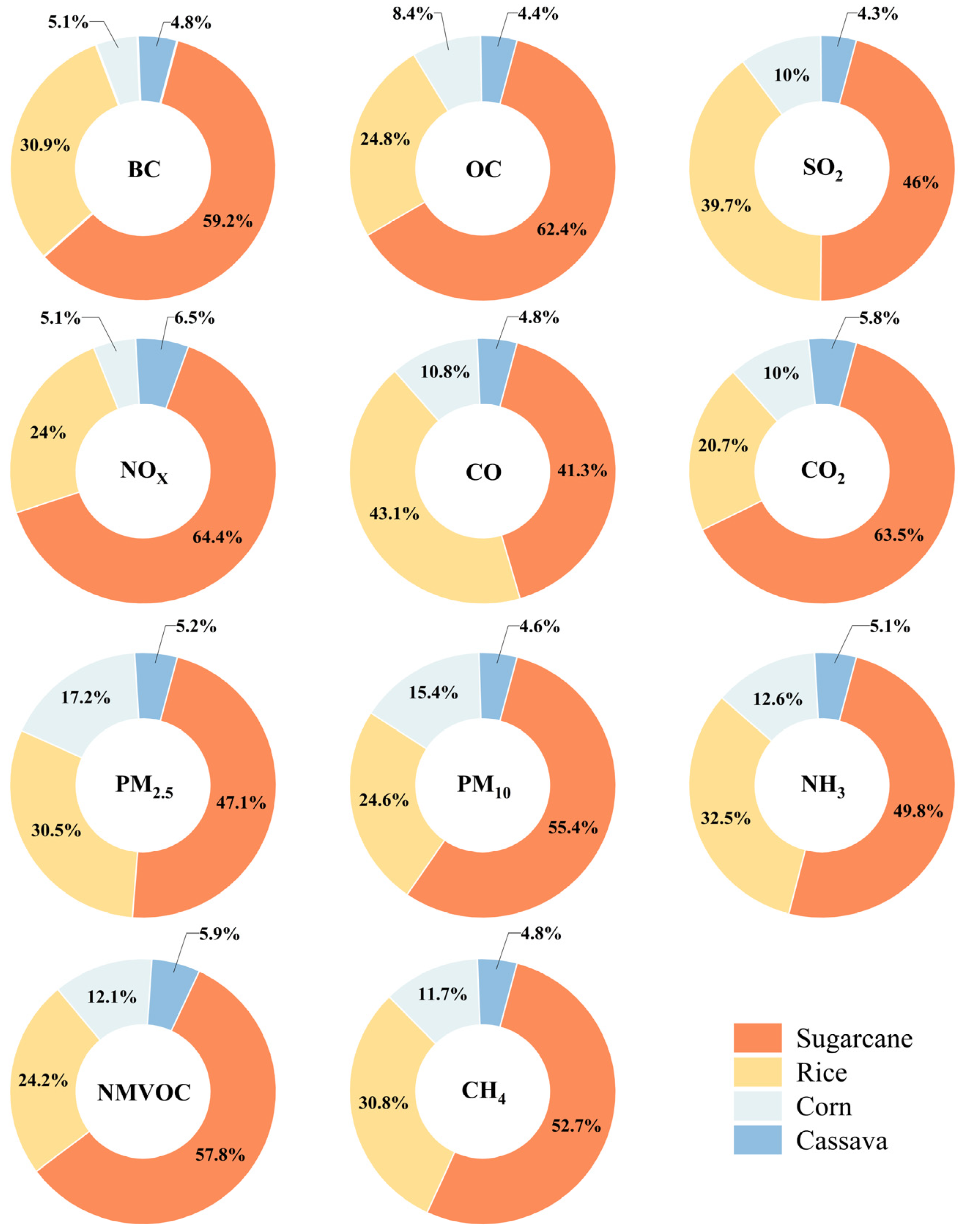
Figure 2 illustrates the proportionate contributions of various crop types to overall emissions in Guangxi during 2017–2023. Sugarcane dominated the emissions, followed by rice, corn, and cassava, contributing 41.26–64.38%, 20.66–43.06%, 5.11–17.25%, and 4.33–6.45%, respectively. The dominance of sugarcane is mainly due to its much higher production (51,277.72 Gg), about 7.1, 26.9, and 44.3 times that of rice, corn, and cassava, respectively, resulting in the largest amount of residue available for burning. In addition to crop yield, differences in emission factors among crop species also influenced their relative contributions. For instance, cassava accounted for approximately 6.5% of NOX emissions, about 1.3 times higher than that of corn, primarily due to its slightly larger NOX emission factor.
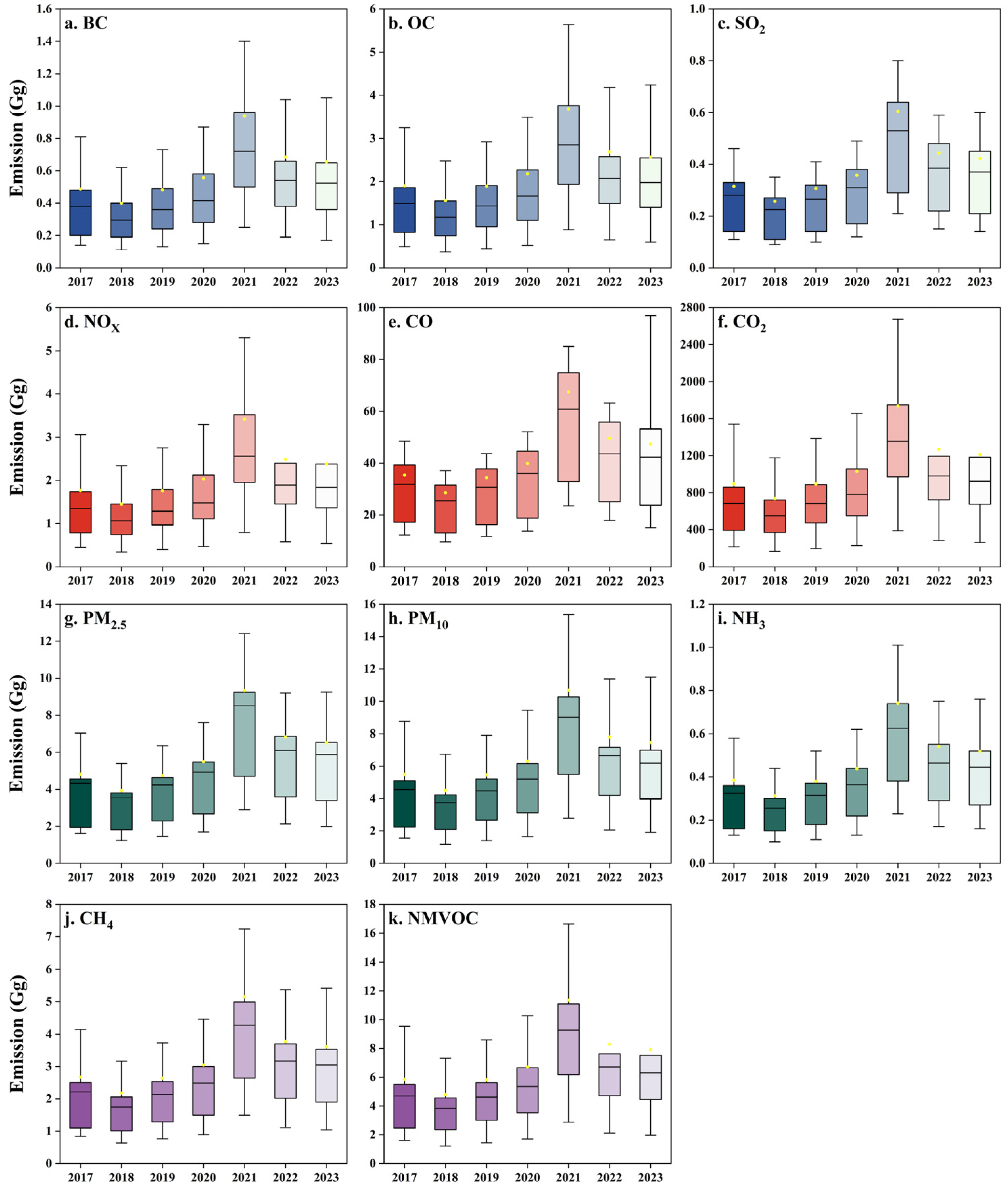
During 2017–2023, emissions of all pollutants from crop residue open burning followed a similar pattern, generally rising before declining (Figure 3). Following the implementation of strict control measures in 2017, emissions remained relatively low, reaching their lowest point in 2018 at around 9.45% of total emissions for each pollutant. A significant rebound occurred in 2021, with emissions increasing by 68–70% compared to 2020. This rise was likely driven by both meteorological and policy factors. Warmer temperatures and lower precipitation in January and February 2021 created favorable conditions for open burning. Meanwhile, 2020 was the final year of a major air pollution control campaign in Guangxi, during which strict straw burning bans were enforced. The accumulation of unburned residues during this period may have led to intensified burning activities at the beginning of 2021 [48,49,50]. In 2022, strengthened control policies gradually reduced emissions, which amounted to approximately 73.11% of the 2021 total.

3.2. Spatial Distribution of Emissions

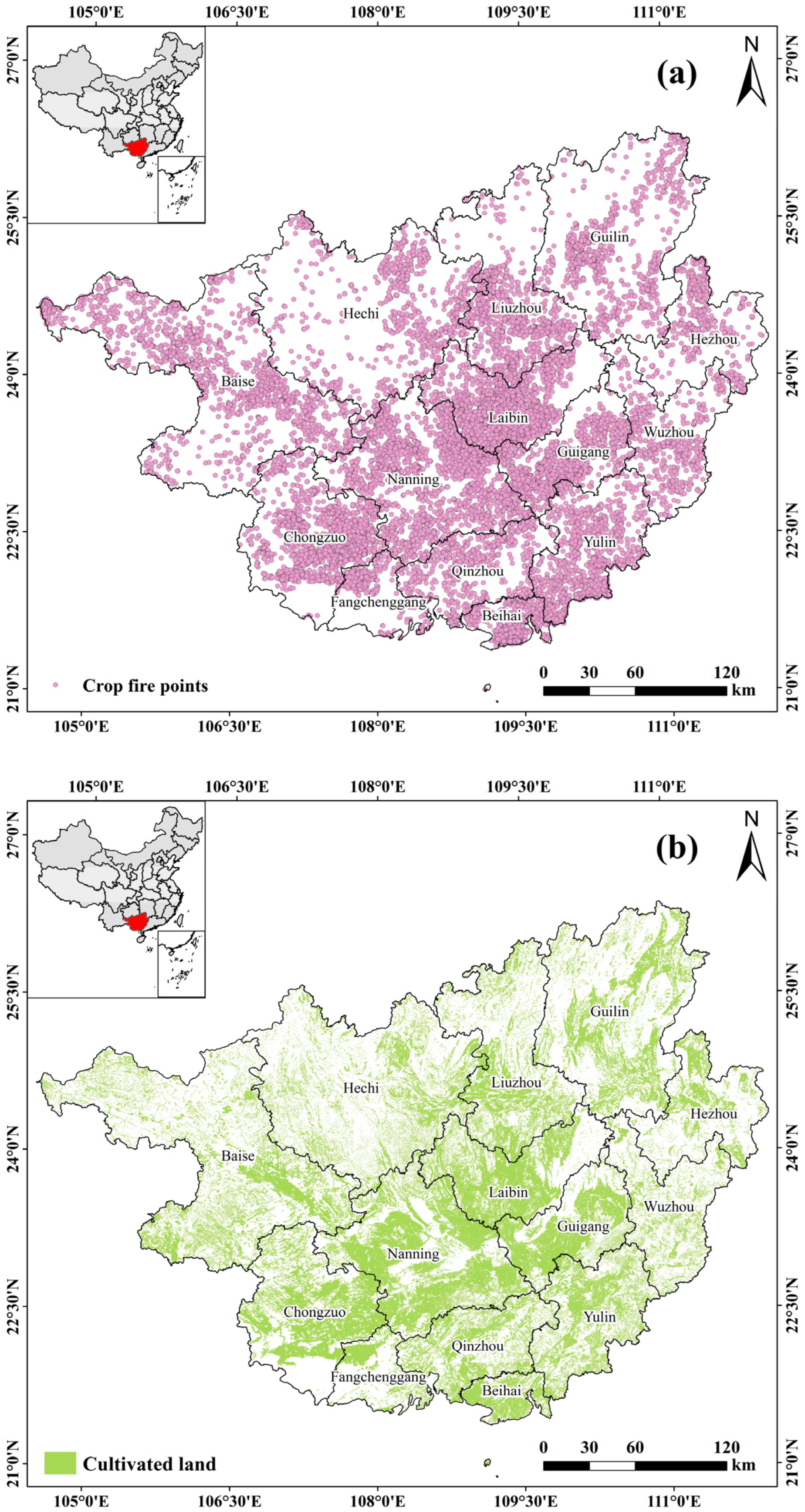
Figure 4 presents VIIRS-detected crop fire locations across Guangxi for 2017–2023 alongside the cultivated land distribution for 2020. Fire points were mainly concentrated in central and western Guangxi, where cultivated land is extensive. At the city level, Nanning, Laibin, Chongzuo, and Baise had the largest number of fire points, with 2825, 2366, 2136, and 2041 points, representing 14.84%, 12.43%, 11.22%, and 10.72% of the total, respectively, indicating that these cities were the main hotspots of crop residue open burning in the province.
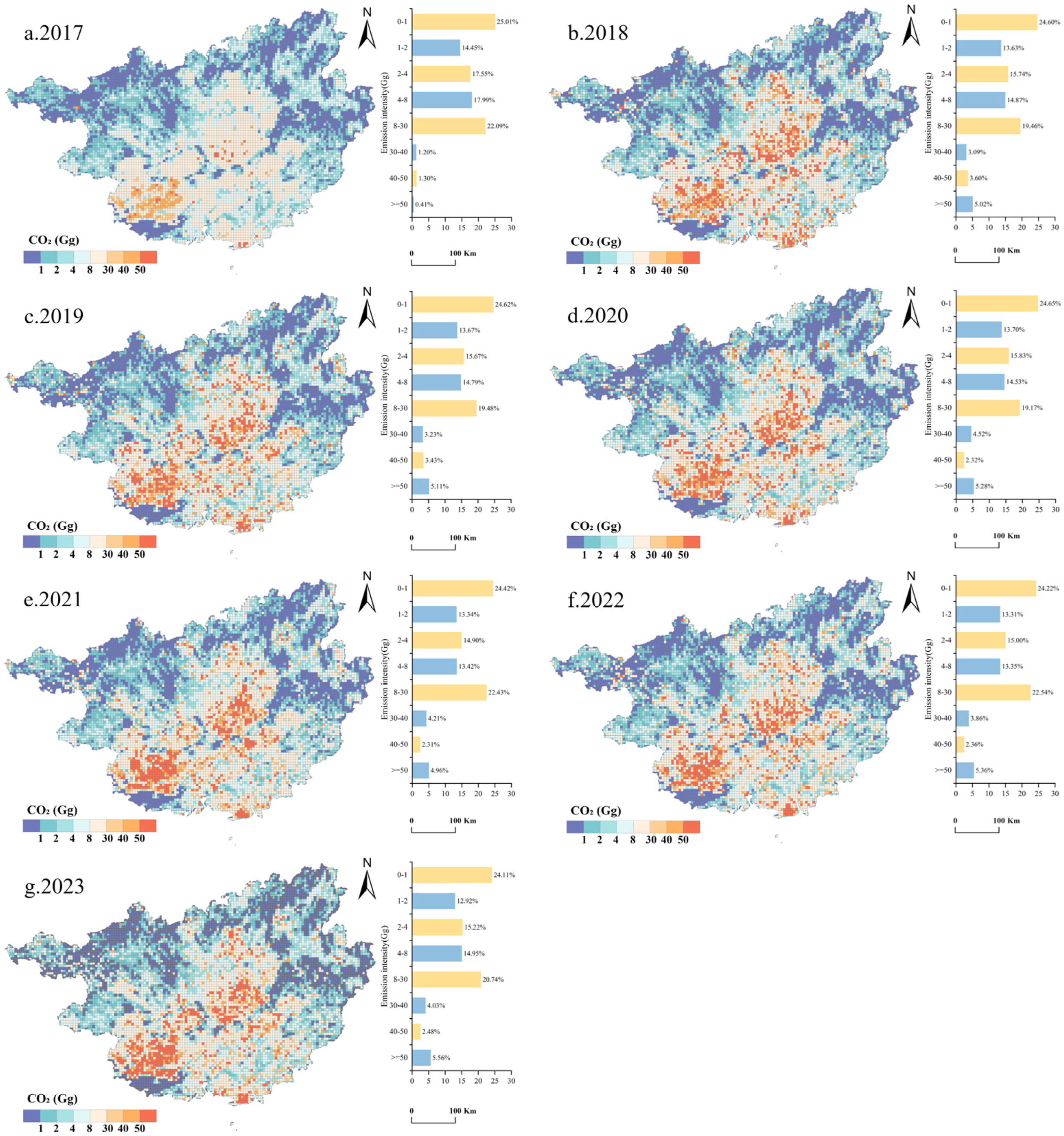
To examine the spatial patterns and yearly variations of pollutants in Guangxi during 2017–2023, CO2 emissions were mapped at a 0.05° × 0.05° grid resolution as an example, as presented in Figure 5. The highest CO2 emissions occurred in central and western Guangxi, including Nanning, Laibin, and Chongzuo, where cultivated land and crop yields are high. Since 2017, stricter government controls on crop residue open burning have led to a gradual decline in CO2 emissions, reaching a minimum of 10,290.28 Gg in 2018. Despite lower emissions in 2018, concentrations remained clustered in central and western Guangxi, especially in Nanning, Laibin, and Chongzuo, indicating the need for continued control. In areas like Wuzhou and Hezhou, where sugarcane cultivation is limited, pollutant emissions remained consistently low. CO2 emissions reached a maximum of 24,337.24 Gg in 2021, 2.37 times higher than in 2018, accounting for 22.37% of the total. During this peak year, most grid cells in central and western Guangxi exhibited emission intensities ranging from 0–1 Gg or 8–30 Gg, while several hotspot grids exceeded 50 Gg. In 2022 and 2023, emissions in most grids declined, but a significant number of grids still showed emission intensities between 8 and 30 Gg. This suggests that despite strict control measures, some scattered crop residue burning still occurs. Hence, authorities should promote comprehensive straw utilization instead of relying only on the enforcement of burning bans.

3.3. Temporal Variation of Emissions

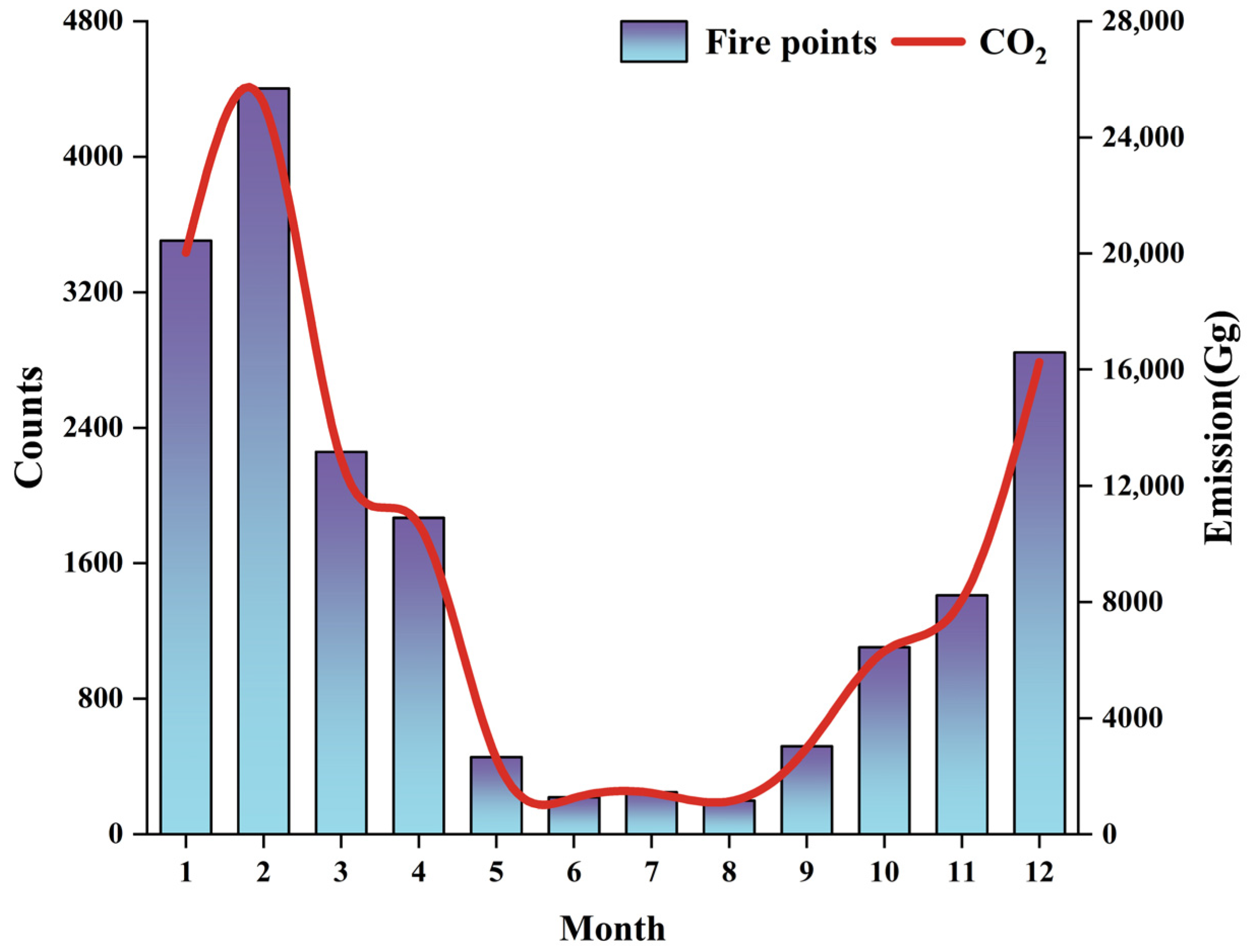
To examine the spatiotemporal variation of crop residue open burning, monthly CO2 emissions and fire counts were analyzed as examples (Figure 6). Figure 6 shows a clear seasonal pattern in both monthly fire counts and CO2 emissions. Agricultural burning was concentrated in January and February, totaling 7909 fires (41.56% of all detections), with a peak in February of 4404 fires (23.14%). Although December recorded fewer fire points than January and February, its activity remained notable and warrants attention.
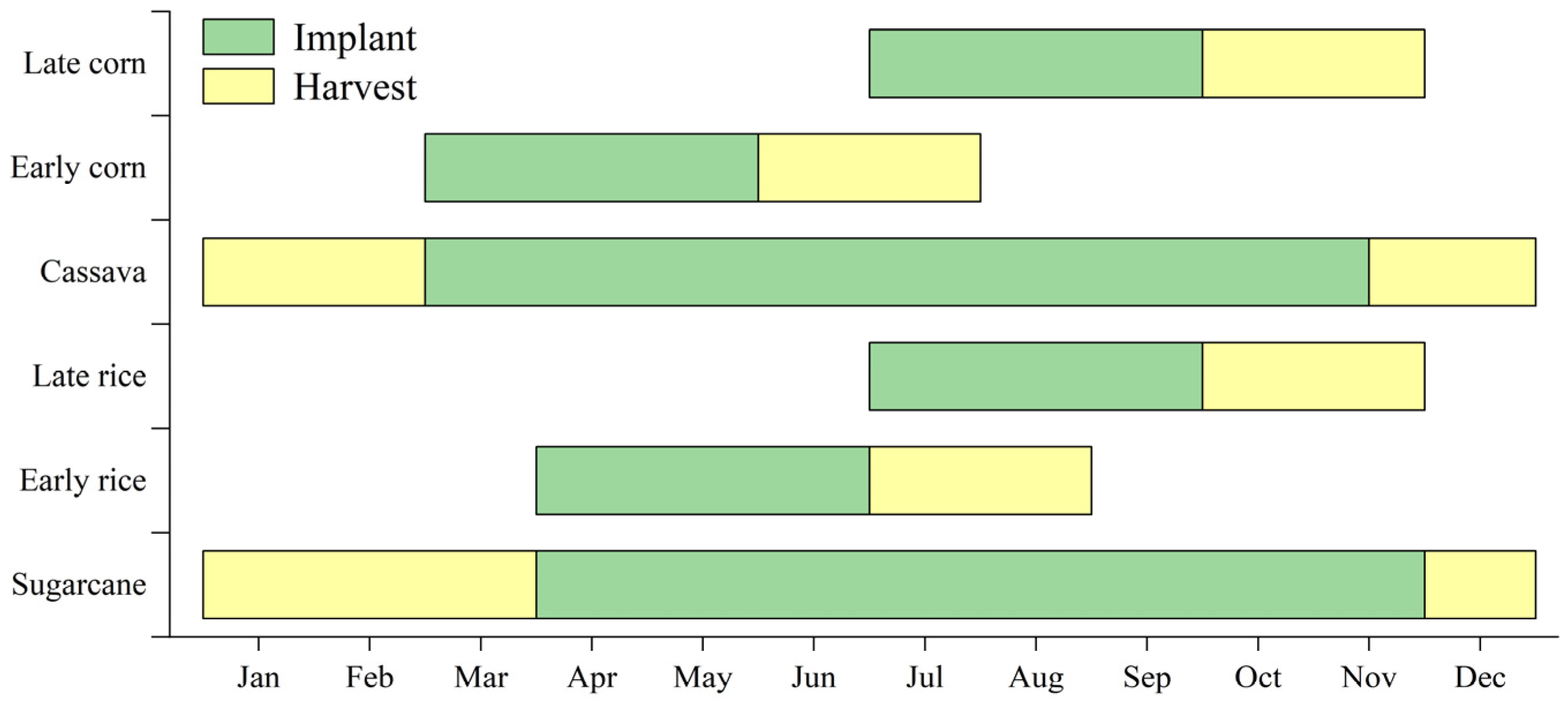
The monthly pattern of CO2 emissions mirrored that of the fire points, with the highest emissions occurring in January and February at 20,032.42 Gg and 25,170.55 Gg, representing 18.42% and 23.14% of the total, respectively. This peak coincides with the sugarcane crushing season (Figure 7). During harvest, large amounts of straw and warm, dry conditions in Guangxi promote burning. Farmers often burn leftover straw in winter to prepare for the next planting season, causing fire points to peak in January and February. Meteorological data show that in winter 2021, higher temperatures, lower rainfall, and widespread drought created favorable conditions for burning, making February the peak month for crop residue fires in the past seven years. In recent years, Guangxi province has tightened restrictions on crop residue burning in the autumn harvest season, prompting some farmers to shift burning activities to winter to evade these stricter controls.

3.4. Comparison with Previous Studies

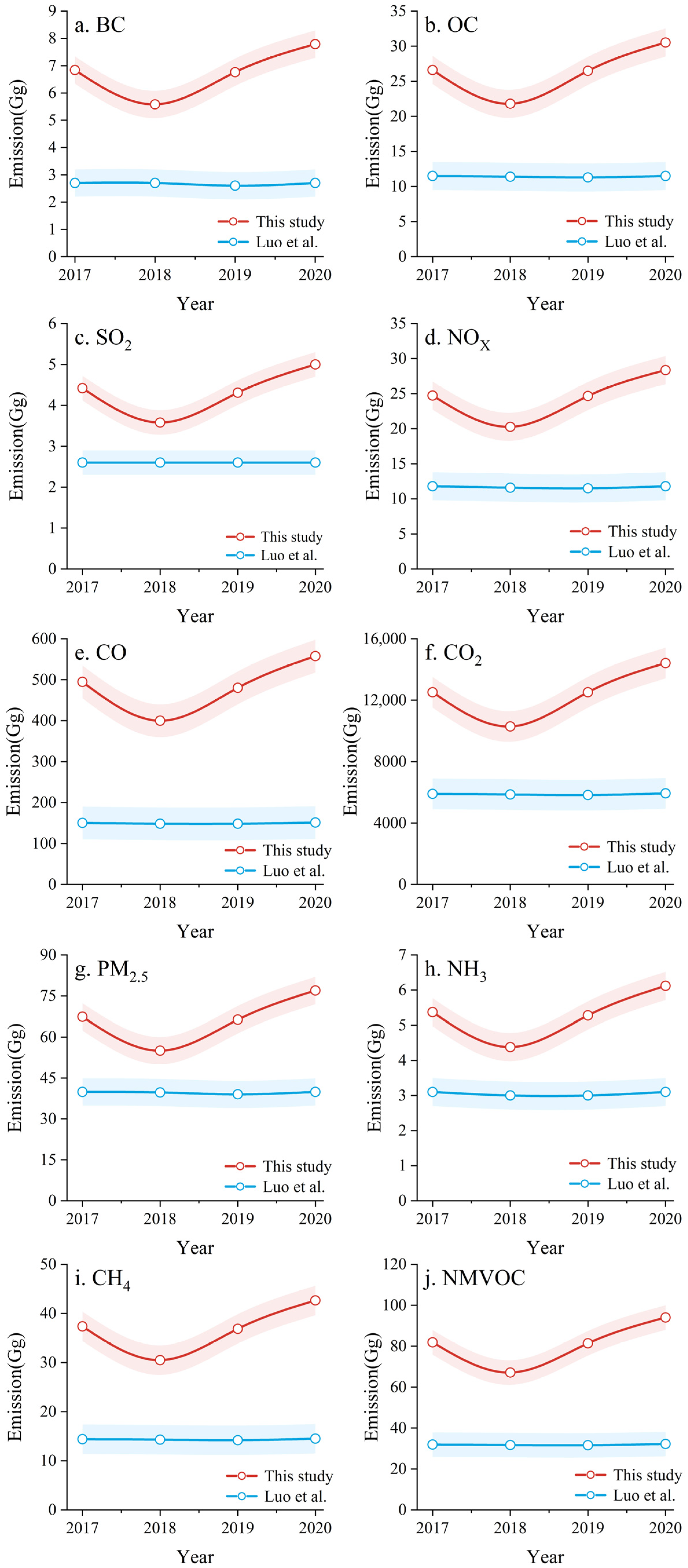
Crop residue burning is rapid and spatially scattered, limiting traditional surveys. To assess inventory accuracy, we compared Guangxi estimates with previous regional studies and quantified uncertainties using Monte Carlo simulations, revealing substantial discrepancies (Figure 8, Table 5). In comparison with the pollutant emission estimates reported by Luo et al. (Figure 8), including BC, OC, SO2, NOX, CO, CO2, PM2.5, NH3, CH4, and NMVOC [35]. The pollutant emissions reported by Luo et al. were lower than those in this study, primarily due to differences in the EFS and OBP used. In this study, EFS values for different crops were generally higher than the uniform EFS applied to all crops in Luo et al. Additionally, Luo et al. used a fixed OBP of 28% for all crop types across multiple years, whereas this study applied annually updated OBP values based on VIIRS fire counts, ranging from 24.17% to 65.00%, which better reflects actual conditions. Consequently, emissions in Luo et al. remained relatively stable from 2017 to 2020, whereas our estimates show clear interannual variability. Updating OBP annually allows the inventory to better reflect changes in burning activity, particularly under strict straw burning control policies in Guangxi province. Crop yield is also an important influencing factor. This study includes cassava as a crop, while Luo et al.’s study focuses on legumes and oilseeds. From 2017 to 2020, the total yield of legumes and oilseeds was 3389.3 Gg, while cassava yielded 6747.6 Gg. As a result, the crop yield in Luo et al.’s study was 49.77% lower than in this study, leading to correspondingly lower pollutant emissions. In addition, the selected grain-to-straw ratio for sugarcane, the highest-yielding crop, also affected the results. Luo et al. used a value of 0.1, whereas this study adopted a more reliable value of 0.3 based on local experimental data.
In addition to open burning, crop residues are also used as household fuel in rural areas. According to Zhang et al., crop residues used for household combustion accounted for about 40.7% to 68.8% of total residue burning emissions in China in 2017. In Guangxi, household burning produced approximately 5000 Gg of CO2, whereas open burning in the same year generated 12,518.09 Gg of CO2 in this study [5]. This comparison suggests that emissions from household biomass combustion have declined with the wider adoption of clean energy in rural areas. However, Guangxi still produces large amounts of crop residues, especially sugarcane straw, much of which is disposed of through field burning after harvest. Compared with those of Pan et al., the emissions estimated in this study were substantially higher [31]. The main reason for these differences is the use of different emission inventory methods. Pan et al. estimated pollutant emissions based on MODIS FRP data. However, because of persistent cloud cover and the small scale of agricultural fires in Guangxi, satellite-based estimates likely underestimate actual emissions. As a result, the emissions estimated by Pan et al. are lower than those in this study. Most of our estimates were lower than those reported by Liu et al. [34], mainly due to differences in sugarcane OBP and grain-to-straw ratios. In 2019, Liu et al. applied sugarcane open burning proportions of 25–80%, significantly higher than the estimates adopted in this study. In addition, Liu et al. set the grain-to-straw ratio of sugarcane at 0.501 in their study, while in this study, a more reliable value of 0.3 was used, based on local experimental data. The emissions of BC, OC, SO2, NOX, CO, CO2, PM2.5, PM10, NH3, CH4, and NMVOC in 2017 in this study were comparable to the results of those in Zhang et al. [5], with differences of 26.90%, 24.81%, −13.12%, 31.26%, −4.11%, 15.65%, 16.88%, 11.53%, 25.51%, 9.02% and 16.94%, respectively. These differences mainly resulted from the use of more accurate EFS and the annual updating of OBP with VIIRS active fire data in this study. The estimated emissions were generally consistent with Yin et al. [15], with deviations of −18.80% to 54.51%. Yin et al. employed MODIS FRP data to quantify emissions from biomass open burning, but polar-orbiting satellite active fire products can only detect agricultural fires under cloud-free conditions during overpasses. This limitation suggests that the method could introduce uncertainty into the emissions inventory, primarily due to omissions of agricultural fires in Guangxi. Moreover, the CO2 emissions in this study differed considerably from those reported by Pan et al. [51]. These differences were primarily due to variations in the EFS and the grain-to-straw ratio of sugarcane. The CO2 EF for sugarcane used by Pan et al. was 1440.25 g/kg, while this study employed a value of 1584 g/kg. Furthermore, Pan et al. set the grain-to-straw ratio of sugarcane at 0.1, whereas this study used a more reliable value of 0.3.
The relatively large magnitude of CO2 emissions mainly reflects its much higher emission factor under biomass combustion, consistent with established combustion characteristics and previous inventory studies. During 2017–2023, cumulative CO2 emissions from crop residue open burning in Guangxi reached 108,775.48 Gg, with 24,337.24 Gg in 2021. In comparison, total anthropogenic CO2 emissions from all sectors in Guangxi in 2021 were approximately 390,150 Gg [52], indicating that crop residue open burning contributed about 6% of the provincial total. Thus, although the absolute CO2 emissions are considerable, their contribution to overall regional CO2 emissions remains relatively limited. International comparisons show that CO2 emissions from crop residue burning in Guangxi in 2020 (14,419 Gg) were lower than those reported for India (33,834 Gg). However, PM2.5 emissions in Guangxi in 2017 (67.37 Gg) exceeded the estimate for the United States (32.8 Gg). These differences reflect variations in residue management practices, mechanization levels, and regulatory enforcement, while also indicating that emission levels in Guangxi are considerable even at the provincial scale [53,54]. The emission estimates varied notably depending on the method and data source used. By using more precise and reliable parameters, this study provides an improved emission inventory that can better inform environmental research and guide policies for managing crop residue open burning in Guangxi province.

3.5. Comparison with PM2.5 Concentrations from National Monitoring Stations

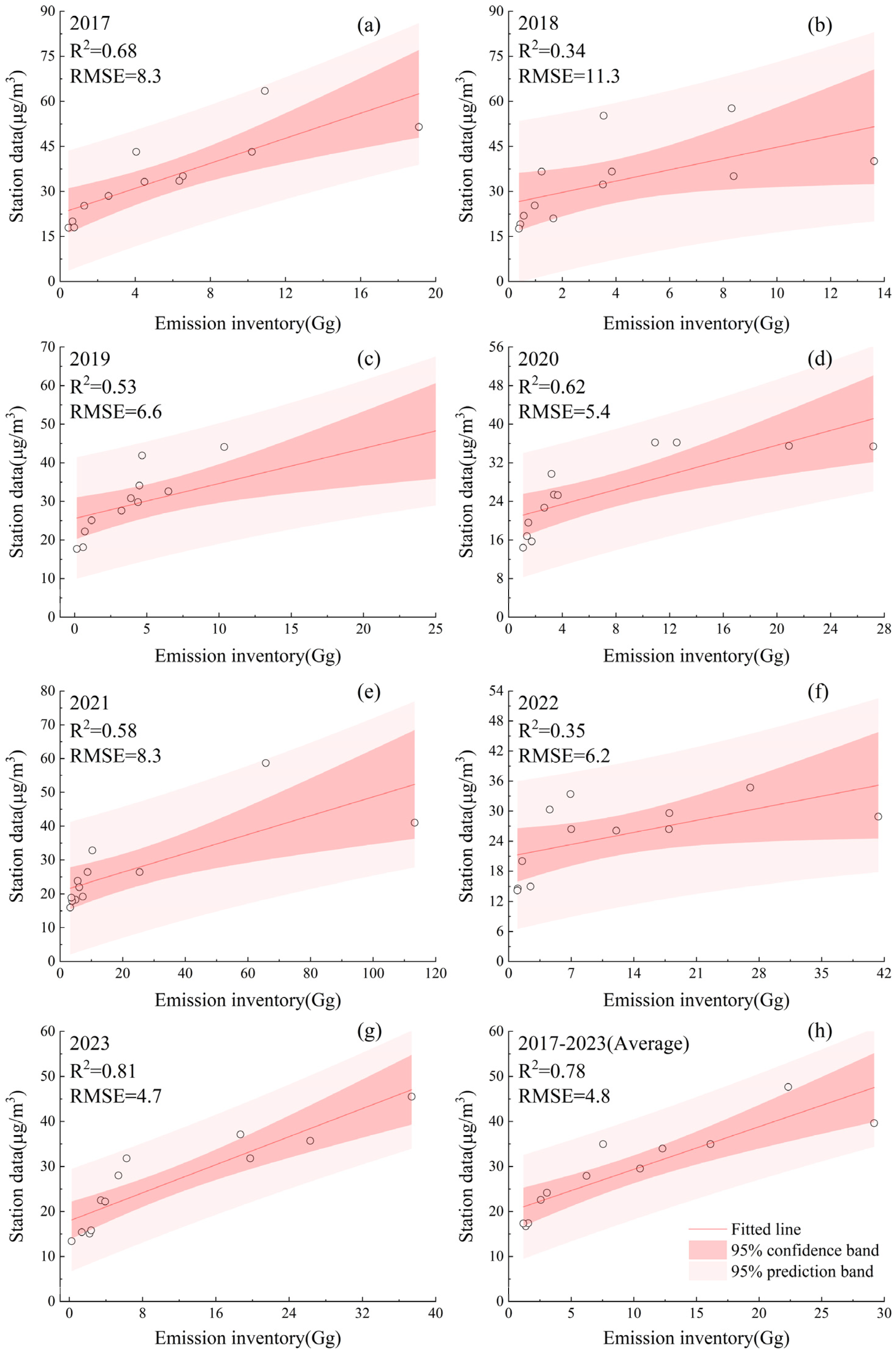
The accuracy of the emission inventory was evaluated by comparing PM2.5 emissions with station-observed PM2.5 concentrations. The correlation between monthly average emissions and measured concentrations from 2017 to 2023 is presented in Figure 9.
The annual average showed a strong correlation between PM2.5 emissions and concentrations, corresponding to a coefficient of determination (R2) value of 0.78. The annual R2 values between the two variables from 2017 to 2023 were 0.68, 0.34, 0.53, 0.62, 0.58, 0.35, and 0.81, respectively. The results indicate that, except for 2018 and 2022 when the R2 values were relatively low, the R2 values for all other years exceeded 0.5, with the value in 2023 exceeding 0.8. In 2018, strict control policies reduced crop residue burning to its lowest level, resulting in a weaker correlation between estimated PM2.5 emissions and observed PM2.5 concentrations. In 2022, although many fire points were detected, they were more evenly distributed throughout the year, with fewer events during the winter harvest season, which also reduced the correlation. In addition to crop residue open burning, anthropogenic sources such as industrial activities and transportation are also major contributors to the station data. Although the correlation between PM2.5 emissions and concentrations at monitoring stations is high, it is somewhat constrained by human activities. To more accurately isolate the contribution of crop residue open burning, advanced methods such as receptor-based source apportionment, isotopic analysis, or chemical transport modeling with sector-specific emissions are required, as these approaches can better distinguish burning emissions from other anthropogenic sources. The findings indicate that the estimated PM2.5 emissions are reasonable and provide additional confidence in the reliability of the constructed emission inventory.

3.6. Analysis of Uncertainty

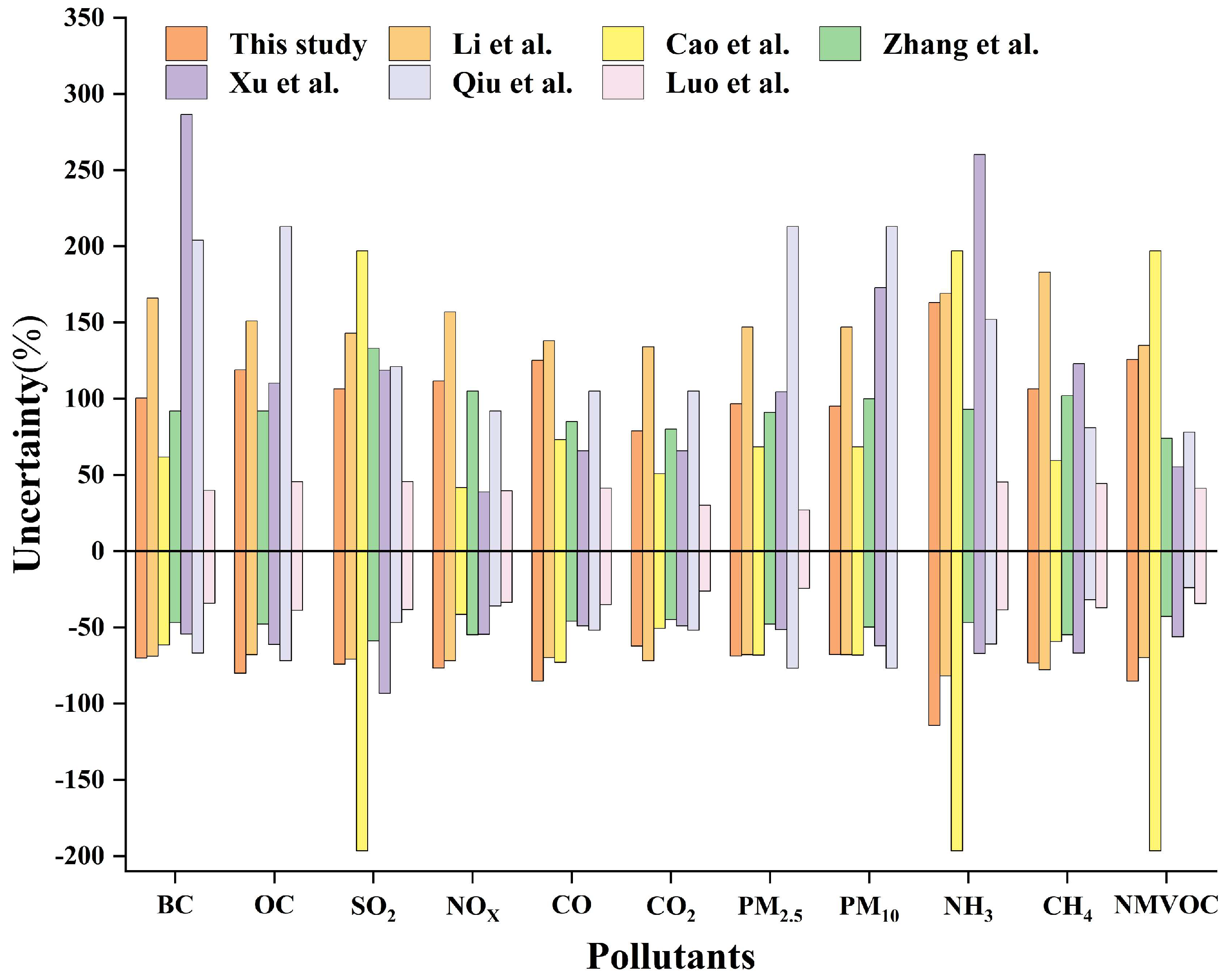
Monte Carlo simulations have been widely applied in previous studies to assess uncertainties in emissions from crop residue burning. In this study, the 2017 emission inventory was selected for uncertainty analysis using the Monte Carlo method to facilitate comparison with other studies conducted during the same period. The main sources of uncertainty were EFS and activity data. Consistent with prior research, normal distributions were assumed for EFS and activity data [46,55]. Official statistical records were used for crop production and grain-to-straw ratios, and their uncertainties were represented by coefficients of variation (CV) of 5% and 10%, respectively. The uncertainty of OBP was characterized by a CV of 30%, as commonly adopted in earlier studies. Details of the CVS for combustion efficiency and EFS for different crops and pollutants are listed in Table 6. The selected CV values were determined with reference to both regional agricultural characteristics and established practices in previous studies. Although they may not fully capture all local variability, they provide a reasonable representation of agricultural conditions in Guangxi. Using these CVS, a Monte Carlo simulation with 100,000 iterations and a 95% confidence interval (CI) was performed. The 2017 emission uncertainties across different pollutants are summarized below: BC (−70.27~100.42%), OC (−80.23~118.91%), SO2 (−74.34~106.48%), NOX (−76.87~111.72%), CO (−85.47~125.24%), CO2 (−62.38~78.90%), PM2.5 (−68.95~96.71%), PM10 (−67.98~95.11%), NH3 (−114.45~163.07%), CH4 (−73.62~106.44%), and NMVOC (−85.47~125.69%). The uncertainties of the emission inventory in this study were compared with those reported in previous research (Figure 10). These results indicate that the emission inventory has relatively low uncertainty, largely due to the use of parameters that better reflect regional burning conditions. In particular, the annually updated OBP improves the realism of the estimates. It is important to recognize that overall uncertainty is largely affected by the choice of EFS and activity data.

4. Discussion

A statistical approach was adopted to estimate emissions from crop residue open burning in Guangxi province on a 0.05° × 0.05° grid for 2017–2023. The inventory accuracy was enhanced by annually updating the OBP using VIIRS 375 m active fire data and selecting reliable EFS from comprehensive literature sources.
However, some limitations persist and should be addressed in future work. Due to the limited availability of locally measured emission factors in Guangxi, recently published experimental values were adopted. However, the physical and chemical characteristics of crop residues, including moisture content, carbon composition, ash content, and combustion efficiency, vary with climate, soil conditions, and agricultural practices. Such variability may affect pollutant formation processes and introduce deviations into emission estimates. To reduce potential bias, region-specific or China-based emission factors were selected whenever possible, and their associated uncertainties were incorporated into the Monte Carlo framework to quantify their influence on the inventory results. Uncertainty is also associated with the estimation of the open burning proportion. Many previous studies have applied fixed OBP values over multiple years. However, OBP can vary annually in response to changes in air pollution control policies and local socioeconomic conditions. Assuming a constant OBP over long periods may thus introduce considerable uncertainty. In this study, annual OBP values were constrained using VIIRS active fire observations, yet potential errors may stem from assumptions in the 2017 baseline and from satellite detection limitations such as cloud interference and the omission of small or short-duration fires. The baseline OBP was derived from field-based questionnaire surveys conducted in Guangxi, ensuring regional representativeness rather than relying on national averages. A coefficient of variation of 30% was assigned to OBP within the Monte Carlo analysis to evaluate its contribution to total uncertainty. Spatial allocation introduces an additional source of uncertainty. Owing to the absence of annually updated land cover datasets, the 2020 cultivated land map was applied to distribute emissions from 2017 to 2023. Although cropland patterns may shift gradually because of urban expansion or agricultural restructuring, statistical data indicate that overall cropland extent in Guangxi remained relatively stable during the study period. Furthermore, cultivated land contributed only half of the spatial allocation weight, while the remaining half was determined by annually detected VIIRS fire counts that reflect actual burning locations. This integrated approach reduces potential bias associated with static land cover assumptions.
In addition, this study focuses on eleven primary pollutants emitted from crop residue open burning and does not explicitly quantify secondary pollutants such as ozone (O3) and secondary aerosols, which also contribute to regional air quality deterioration. Incorporating these secondary processes would provide a more comprehensive assessment of the environmental impacts of agricultural burning and should be addressed in future research. Regarding validation, the inventory’s reliability was mainly assessed through correlation analysis between estimated PM2.5 emissions and observed PM2.5 concentrations, together with uncertainty analysis. While the significant correlations suggest that the inventory captures temporal variability, ambient PM2.5 levels are also affected by other anthropogenic sources, meteorological conditions, and secondary formation processes, and therefore cannot directly validate absolute emission magnitudes. More rigorous evaluation through source apportionment or atmospheric chemical transport modeling would strengthen the assessment. In addition, comparisons with independent datasets, such as atmospheric inversion products or other satellite-derived emission estimates, were not conducted and should be considered in future studies to enhance robustness.
To further enhance the reliability and comprehensiveness of the inventory, future studies should incorporate field-based measurements of local emission factors and combustion characteristics in Guangxi, as well as updated land cover products and higher-resolution fire detection data. In addition, integrating atmospheric chemical transport modeling, source apportionment analysis, and independent datasets such as atmospheric inversion or satellite-derived emission products would provide a more rigorous evaluation of emission magnitudes and secondary impacts. Despite these limitations, the inventory combines region-specific activity data and literature-based emission factors, with OBP values constrained by VIIRS fire observations. Using a statistical framework, it provides a regionally representative and transparent estimate with reasonable generalizability.

5. Conclusions

In short, this study established a pollutant emission inventory for crop residue open burning in Guangxi, covering 2017–2023, based on activity statistics and selected EFS, offering long-term data to inform policies for managing open burning. The total emissions of BC, OC, SO2, NOX, CO, CO2, PM2.5, PM10, NH3, CH4, and NMVOC from crop residue open burning were 58.90, 230.48, 37.90, 213.95, 4234.41, 108,775.48, 583.09, 667.70, 46.36, 322.74 and 710.20 Gg, respectively. Among all crop residues, sugarcane was the primary source of open burning emissions, followed by rice, corn, and cassava, with contribution ranges of 41.26–64.38%, 20.66–43.06%, 5.11–17.25%, and 4.33–6.45%. Pollutant emissions showed pronounced annual fluctuations, declining sharply from 2017 to 2020 under strict control measures, but rebounding notably between 2021 and 2023 due to uneven enforcement. Spatially, emissions were highest in central and western Guangxi, particularly in Nanning, Laibin, and Chongzuo, where agricultural activity is intensive. Temporally, emissions peaked during the winter harvest season.
Crop residue open burning remains a major source of biomass-related air pollution in Guangxi province, significantly affecting regional air quality. Estimating emissions from these activities is crucial for understanding local biomass burning characteristics and addressing the urgent need for effective pollution control measures and accurate air quality modeling. Therefore, this study provides important insights and a valuable foundation for guiding environmental management and policy development in the region.

Author Contributions

Conceptualization, X.H. and D.Y.; methodology, X.H. and D.Y.; software, D.Y.; validation, C.L., Y.Y., G.X., Z.Q., R.P. and Y.X.; formal analysis, C.L.; investigation, X.H.; resources, Q.H.; data curation, D.Y.; writing—original draft preparation, X.H. and D.Y.; writing—review and editing, X.H. and D.Y.; visualization, X.H.; supervision, Q.H.; project administration, D.Y.; funding acquisition, Q.H. and Y.Y. All authors have read and agreed to the published version of the manuscript.

Funding

This research was funded by the National Key Research and Development Program of China (Grant No. 2024YFD1400600), Guangxi Science and Technology Major Program (Grant No. AA22036002), Guangxi Key Research and Development Program (Grant No. FN2504240015 and Grant No. AB24153001) and Guangxi Science and Technology Program (Grant No. AB24010074).

Institutional Review Board Statement

Not applicable.

Informed Consent Statement

Not applicable.

Data Availability Statement

The original contributions presented in the study are included in the article, further inquiries can be directed to the corresponding author.

Conflicts of Interest

The authors declare no conflicts of interest.

References

  1. Zhou, Y.; Xing, X.; Lang, J.; Chen, D.; Cheng, S.; Wei, L.; Wei, X.; Liu, C. A comprehensive biomass burning emission inventory with high spatial and temporal resolution in China. Atmos. Chem. Phys. 2017, 17, 2839–2864. [Google Scholar] [CrossRef]
  2. Xu, Y.; Huang, Z.; Jia, G.; Fan, M.; Cheng, L.; Chen, L.; Shao, M.; Zheng, J. Regional discrepancies in spatiotemporal variations and driving forces of open crop residue burning emissions in China. Sci. Total Environ. 2019, 671, 536–547. [Google Scholar] [CrossRef] [PubMed]
  3. Kabange, N.; Kwon, Y.; Lee, S.; Kang, J.; Cha, J.; Park, H.; Dzorkpe, G.D.; Shin, D.; Oh, K.-W.; Lee, J.-H. Mitigating greenhouse gas emissions from crop production and management practices, and livestock: A review. Sustainability 2023, 15, 15889. [Google Scholar] [CrossRef]
  4. Akshaya, V.; Akila, I.; Murali, R.; Raajasubramanian, D.; Kuppan, N.; Srinivasan, S. Rice straw biomass and agricultural residues as strategic bioenergy: Effects on the environment and economy path with new directions. Energy Environ. Sustain. 2023, 1, 139–164. [Google Scholar]
  5. Zhang, X.; Lu, Y.; Wang, Q.; Qian, X. A high-resolution inventory of air pollutant emissions from crop residue burning in China. Atmos. Chem. Phys. Discuss. 2018, 213, 207–214. [Google Scholar] [CrossRef]
  6. Liu, Y.; Zhao, H.; Zhao, G.; Zhang, X.; Xiu, A. Carbonaceous gas and aerosol emissions from biomass burning in China from 2012 to 2021. J. Clean. Prod. 2022, 36, 132–199. [Google Scholar] [CrossRef]
  7. Shi, J.; Ji, Y.; Xu, W.; Shen, R.; Ma, J.; Zhao, Y.; Zhou, X.; Ma, Y.; Feng, Y. China Open Biomass Burning Emissions Inventory (COBBEI) from 2020 to 2023: Multi-Satellite Fusion via FRP-Based Filtering Rules. Earth Syst. Sci. Data Discuss. 2025, 1, 1–30. [Google Scholar]
  8. Chen, J.; Li, C.; Ristovski, Z.; Milic, A.; Gu, Y.; Islam, M.S.; Wang, S.; Hao, J.; Zhang, H.; He, C.; et al. A review of biomass burning: Emissions and impacts on air quality, health and climate in China. Sci. Total Environ. 2017, 579, 1000–1034. [Google Scholar] [CrossRef]
  9. Chanana, I.; Sharma, A.; Kumar, P.; Kumar, L.; Kulshreshtha, S.; Kumar, S.; Patel, S. Combustion and stubble burning: A major concern for the environment and human health. Fire 2023, 6, 79. [Google Scholar] [CrossRef]
  10. Li, C.; Hu, Y.; Zhang, F.; Chen, J.; Ma, Z.; Ye, X.; Yang, X.; Wang, L.; Tang, X.; Zhang, R.; et al. Multi-pollutant emissions from the burning of major agricultural residues in China and the related health-economic effects. Atmos. Chem. Phys. 2017, 17, 4957–4988. [Google Scholar] [CrossRef]
  11. Qiu, X.; Duan, L.; Chai, F.; Wang, S.; Yu, Q.; Wang, S. Deriving high-resolution emission inventory of open biomass burning in China based on satellite observations. Environ. Sci. Technol. 2016, 50, 11779–11786. [Google Scholar] [CrossRef] [PubMed]
  12. Wu, J.; Kong, S.; Wu, F.; Cheng, Y.; Zheng, S.; Yan, Q.; Zheng, H.; Yang, G.; Zheng, M.; Liu, D.; et al. Estimating the open biomass burning emissions in central and eastern China from 2003 to 2015 based on satellite observation. Atmos. Chem. Phys. 2018, 18, 11623–11646. [Google Scholar] [CrossRef]
  13. Yang, Y.; Liu, X.; Qu, Y.; An, J.L.; Jiang, R.; Zhang, Y.; Sun, Y.; Wu, Z.; Zhang, F.; Xu, W.; et al. Characteristics and formation mechanism of continuous hazes in China: A case study during the autumn of 2014 in the North China Plain. Atmos. Chem. Phys. 2015, 15, 8165–8178. [Google Scholar] [CrossRef]
  14. Zhang, L.; Liu, Y.; Hao, L. Contributions of open crop straw burning emissions to PM2.5 concentrations in China. Environ. Res. Lett. 2016, 11, 014014. [Google Scholar] [CrossRef]
  15. Yin, S.; Wang, X.; Xiao, Y.; Tani, H.; Zhong, G.; Sun, Z. Study on spatial distribution of crop residue burning and PM2.5 change in China. Environ. Pollut. 2017, 220, 204–221. [Google Scholar] [CrossRef]
  16. Xia, L.; Ren, C.; Li, S.; Yang, W.; Yang, Y.; Li, J.; Fan, W.; Liu, R. Spatiotemporal Characteristics of Carbon Emissions in the Pearl River Basin, China: From the Perspective of Land Use and Biomass Burning. Land Degrad. Dev. 2025, 36, 5876–5898. [Google Scholar] [CrossRef]
  17. Stavrakou, T.; Müller, J.-F.; Bauwens, M.; De Smedt, I.; Van Roozendael, M.; Guenther, A.; Wild, M.; Xia, X. Substantial Underestimation of Post-Harvest Burning Emissions in the North China Plain Revealed by Multi-Species Space Observations. Sci. Rep. 2016, 6, 32307. [Google Scholar] [CrossRef]
  18. Wang, L.; Xin, J.; Li, X.; Wang, Y. The Variability of Biomass Burning and Its Influence on Regional Aerosol Properties during the Wheat Harvest Season in North China. Atmos. Res. 2015, 157, 153–163. [Google Scholar] [CrossRef]
  19. Jin, X. Study on the Variation Characteristics of Open Straw Burning and Its Impact on Air Quality in North and Northeast China. Ph.D. Thesis, University of Chinese Academy of Sciences, Beijing, China, 2017. (In Chinese) [Google Scholar]
  20. Shen, Y.; Jiang, C.; Chan, K.L.; Wang, Z.; Su, D.; Wang, T.; Zhang, Y. Estimation of Field-Level NOx Emissions from Crop Residue Burning Using Remote Sensing Data: A Case Study in Hubei, China. Remote Sens. 2021, 13, 404. [Google Scholar] [CrossRef]
  21. Zhang, T.; de Jong, M.C.; Wooster, M.J.; Xu, W.; Wang, L. Trends in eastern China agricultural fire emissions derived from a combination of geostationary (Himawari) and polar (VIIRS) orbiter fire radiative power products. Atmos. Chem. Phys. 2020, 20, 10687–10705. [Google Scholar] [CrossRef]
  22. Pereira, G.; Siqueira, R.; Rosário, N.; Longo, K.; Freitas, S.; Cardozo, F.; Johannes, W.; Wooster, M. Assessment of fire emission inventories during the South American Biomass Burning Analysis (SAMBBA) experiment. Atmos. Chem. Phys. 2016, 16, 6961–6975. [Google Scholar] [CrossRef]
  23. Jin, Y.; Huang, H.; Liu, J.; Liu, Y.; Chen, X.; Chen, Y.; Li, L.; Fan, Q. Three-Dimensional Biomass Burning Emission Inventory for Southeast and East Asia Based on Multi-Source Data Fusion and Machine Learning. Earth Syst. Sci. Data Discuss. 2025, 1, 1–42. [Google Scholar]
  24. Darmenov, A.; da Silva, A. The Quick Fire Emissions Dataset (QFED): Documentation of Versions 2.1, 2.2 and 2.4; Technical Report Series on Global Modeling and Data Assimilation; NASA Goddard Space Flight Center: Greenbelt, MD, USA, 2015; Volume 38.
  25. Pan, X.; Ichoku, C.; Chin, M.; Bian, H.; Darmenov, A.; Colarco, P.; Ellison, L.; Kucsera, T.; da Silva, A.; Wang, J.; et al. Six Global Biomass Burning Emission Datasets: Intercomparison and Application in One Global Aerosol Model. Atmos. Chem. Phys. 2020, 20, 969–994. [Google Scholar] [CrossRef]
  26. Chen, J.; Li, R.; Tao, M.; Wang, L.; Lin, C.; Wang, J.; Wang, L.; Wang, W.; Chen, L. Overview of the performance of satellite fire products in China: Uncertainties and challenges. Atmos. Environ. 2022, 268, 118838. [Google Scholar] [CrossRef]
  27. Fu, Y.; Gao, H.; Liao, H.; Tian, X. Spatiotemporal Variations and Uncertainty in Crop Residue Burning Emissions over North China Plain: Implication for Atmospheric CO2 Simulation. Remote Sens. 2021, 13, 3880. [Google Scholar] [CrossRef]
  28. Li, J.; Li, Y.; Bo, Y.; Xie, S. High-resolution historical emission inventories of crop residue burning in fields in China for the period 1990–2013. Atmos. Environ. 2016, 138, 152–161. [Google Scholar] [CrossRef]
  29. Zhou, Y.; Zhang, Y.; Zhao, B.; Lang, J.; Xia, X.; Chen, D.; Cheng, S. Estimating air pollutant emissions from crop residue open burning through a calculation of open burning proportion based on satellite-derived fire radiative energy. Environ. Pollut. 2021, 286, 117477. [Google Scholar] [CrossRef]
  30. Li, X.; Wang, S.; Duan, L.; Hao, J.; Li, C.; Chen, Y.; Yang, L. Particulate and trace gas emissions from open burning of wheat straw and corn stover in China. Environ. Sci. Technol. 2007, 41, 6052–6058. [Google Scholar] [CrossRef]
  31. Pan, R.; Huang, Y.; He, L.; Pan, Q.; Yan, W.; Liu, Y.; Yao, T. Evaluation of Emissions from Open Crop residue burning in Guangxi (2017–2021) Based on Fire radiative Energy Data. Environ. Monit. China 2023, 39, 227–235. (In Chinese) [Google Scholar]
  32. Liu, H.; Zhu, W.; Yi, S.; Li, W.; Chen, L.; Bai, L. Climatic analysis of the cloud over china. Acta Meteorol. Sin. 2003, 4, 466–473. (In Chinese) [Google Scholar]
  33. Ying, L.; Shen, Z.; Yang, M.; Piao, S. Wildfire Detection Probability of MODIS Fire Products under the Constraint of Environmental Factors: A Study Based on Confirmed Ground Wildfire Records. Remote Sens. 2019, 11, 3031. [Google Scholar] [CrossRef]
  34. Liu, H.; Mo, Z.; Qing, W. Emission inventory and thesoatio-temporal of pollutant from open field straw burning in Guangxi. Environ. Pollut. Control 2022, 44, 631–638. (In Chinese) [Google Scholar]
  35. Luo, Y. Study on Pollution Characteristics and Emission Estimation of Biomass Burning Sources in Guangxi Province. Master’s Thesis, Guangxi University, Nanning, China, June 2022. (In Chinese) [Google Scholar]
  36. Xu, Y. Study on Evolution Characteristics and Dynamic Estimations of Open Biomass Burning Emissions, in China. Doctoral Dissertation, South China University of Technology, Guangzhou, China, June 2020. (In Chinese) [Google Scholar]
  37. Peng, L.; Zhang, Q.; Yao, Z.; Mauzerall, D.; Kang, S.; Du, Z.; Zheng, Y.; Xue, T.; He, K. Underreported coal in statistics: A survey-based solid fuel consumption and emission inventory for the rural residential sector in China. Appl. Energy 2019, 235, 1169–1182. [Google Scholar] [CrossRef]
  38. Li, S.; Wang, S.; Wu, Q.; Zhang, Y.; Ouyang, D.; Zheng, H.; Han, L.; Qiu, X. Emission trends of air pollutants and CO2 in China from 2005 to 2021. Earth Syst. Sci. Data 2023, 15, 2279–2294. [Google Scholar] [CrossRef]
  39. Zeng, J.; Cui, K.; Huang, J.; He, F.; Peng, S. Responses of Physio-Biochemical Properties to N-Fertilizer Application and Its Relationship with Nitrogen Use Efficiency in Rice. Acta Agron. Sin. 2007, 33, 1168–1176. (In Chinese) [Google Scholar]
  40. Zhang, H.; Ye, X.; Cheng, T.; Chen, J.; Yang, X.; Wang, L.; Zhang, R. A laboratory study of agricultural crop residue combustion in China: Emission factors and emission inventory. Atmos. Environ. 2008, 42, 8432–8441. [Google Scholar] [CrossRef]
  41. Li, H.; Cao, Y.; Wang, X.; Ge, X.; Li, B.; Jin, C. Evaluation on the production of food crop straw in China from 2006 to 2014. BioEnergy Res. 2017, 10, 949–957. [Google Scholar] [CrossRef]
  42. Akagi, S.K.; Yokelson, R.J.; Wiedinmyer, C.; Alvarado, M.J.; Reid, J.S.; Karl, T.; Crounse, J.D.; Wennberg, P.O. Emission factors for open and domestic biomass burning for use in atmospheric models. Atmos. Chem. Phys. 2011, 11, 4039–4072. [Google Scholar] [CrossRef]
  43. Cao, G.; Zhang, X.; Gong, S.; Zheng, F. Investigation on emission factors of particulate matter and gaseous pollutants from crop residue burning. J. Environ. Sci. 2008, 20, 50–55. [Google Scholar] [CrossRef]
  44. Zhang, Y.; Shao, M.; Lin, Y.; Luan, S.; Mao, N.; Chen, W.; Wang, M. Emission inventory of carbonaceous pollutants from biomass burning in the Pearl River Delta Region, China. Atmos. Environ. 2013, 76, 189–199. [Google Scholar] [CrossRef]
  45. EPD: Guide for Compiling Atmospheric Pollutant Emission Inventory for Biomass Burning, Environmental Protection Department. 2014. Available online: https://www.mee.gov.cn/gkml/hbb/bgg/201501/t20150107_293955.htm (accessed on 26 June 2022). (In Chinese)
  46. Streets, D.; Yarber, K.; Woo, J.; Carmichael, G. Biomass burning in Asia: Annual and seasonal estimates and atmospheric emissions. Glob. Biogeochem. Cycles 2003, 17, 10997. [Google Scholar] [CrossRef]
  47. Gao, R.; Jiang, W.; Gao, W.; Sun, S. Emission inventory of crop residue open burning and its high-resolution spatial distribution in 2014 for Shandong province, China. Atmos. Pollut. Res. 2017, 8, 545–554. [Google Scholar] [CrossRef]
  48. Department of Ecology and Environment of Guangxi Zhuang Autonomous Region. Interim Measures for the Management of Straw Burning Prohibition in Guangxi Zhuang Autonomous Region; Department of Ecology and Environment of Guangxi Zhuang Autonomous Region: Nanning, China, 2020. Available online: http://sthjt.gxzf.gov.cn/zfxxgk/zfxxgkgl/fdzdgknr/zcwj/gfxwj/W020240702414791673234.pdf (accessed on 2 March 2026). (In Chinese)
  49. Department of Ecology and Environment of Guangxi Zhuang Autonomous Region. Guangxi Zhuang Autonomous Region 2020 Air Pollution Prevention and Control Action Plan; Department of Ecology and Environment of Guangxi Zhuang Autonomous Region: Nanning, China, 2020. Available online: http://sthjt.gxzf.gov.cn/zfxxgk/zfxxgkgl/fdzdgknr/zcwj/gfxwj/t18633225.shtml (accessed on 2 March 2026). (In Chinese)
  50. He, X.; Huang, Q.; Yang, D.; Yang, Y.; Xie, G.; Yang, S.; Liang, C.; Qin, Z. Spatiotemporal Analysis of Open Biomass Burning in Guangxi Province, China, from 2012 to 2023 Based on VIIRS. Fire 2024, 7, 370. [Google Scholar] [CrossRef]
  51. Pan, Q.; Pan, R.; Xie, Y.; He, L.; Huang, N. Analysis of Carbon Emission Characteristics of Open-air Straw Burning in Guangxi. Environ. Sci. Surv. 2024, 43, 25–29. (In Chinese) [Google Scholar]
  52. Huang, W.; Gao, C.; Wu, B.; Chen, T.; Yang, T.; Zhang, B. Development Path of Guangxi to Reach the Carbon Emission Peak Based on STIRPAT Model. Environ. Sci. 2025, 46, 682–695. (In Chinese) [Google Scholar]
  53. Cariappa, A.A.; Konath, N.C.; Sapkota, T.B.; Krishna, V.V. Evaluating the potential and eligibility of conservation agriculture practices for carbon credits. Sci. Rep. 2024, 14, 9193. [Google Scholar] [CrossRef]
  54. United States Environmental Protection Agency (U.S. EPA). 2017 National Emissions Inventory (NEI) Data; U.S. EPA: Washington, DC, USA, 2021. Available online: https://www.epa.gov/air-emissions-inventories/2017-national-emissions-inventory-nei-data (accessed on 3 March 2026).
  55. Zhao, Y.; Nielsen, C.P.; Lei, Y.; McElroy, M.B.; Hao, J. Quantifying the uncertainties of a bottom-up emission inventory of anthropogenic atmospheric pollutants in China. Atmos. Chem. Phys. 2011, 11, 2295–2308. [Google Scholar] [CrossRef]
Figure 1. Elevation and geographical distribution of Guangxi province.
Fire 09 00132 g001
Figure 2. Contributions of different crop residues to emissions in Guangxi from 2017 to 2023.
Fire 09 00132 g002
Figure 3. Annual crop residue burning open emissions during 2017–2023.
Fire 09 00132 g003
Figure 4. (a) Crop fire point distribution in Guangxi during 2017–2023; (b) Spatial distribution of cultivated land in Guangxi in 2020.
Fire 09 00132 g004
Figure 5. Spatial distribution of CO2 emissions in Guangxi during 2017–2023.
Fire 09 00132 g005
Figure 6. Monthly variation of fire points and CO2 emissions in Guangxi during 2017–2023.
Fire 09 00132 g006
Figure 7. Major crop planting and harvesting periods in Guangxi.
Fire 09 00132 g007
Figure 8. Comparison with the results of Luo et al. [35].
Fire 09 00132 g008
Figure 9. Comparison of monthly PM2.5 emissions and observed PM2.5 concentrations during 2017–2023: (a) 2017; (b) 2018; (c) 2019; (d) 2020; (e) 2021; (f) 2022; (g) 2023; (h) Average for 2017−2023.
Fire 09 00132 g009
Figure 10. Comparison of emission uncertainties among different studies: Li et al. [28], Cao et al. [43], Zhang et al. [5], Xu et al. [2], Qiu et al. [11], Luo et al. [35].
Fire 09 00132 g010
Table 3. Emission factors of crop residue open burning (g/kg).
PollutantSugarcaneRiceCornCassava
BC0.8 c0.64 i0.35 d0.64 i
OC3.3 g2.01 b2.25 b2.3 c
SO20.4 c0.53 h0.44 d0.37 i
NOX3.16 g1.81 f1.28 f3.11 a
CO40.08 e64.2 f53 d47 h
CO21584 c791.3 f1261.5 f1445 j
PM2.56.3 c6.26 a11.7 d6.79 g
PM108.49 h5.78 g11.95 h6.93 g
NH30.53 h0.53 h0.68 d0.53 h
CH43.9 g3.5 j4.4 d3.5 j
NMVOC9.42 c6.05 c10 c9.42 c
References: a Akagi et al. [42]. b Cao et al. [43]. c Li et al. [28]. d Li et al. [30]. e Zhang et al. [44]. f Zhang et al. [40]. g Zhou et al. [1]. h EPD [45]. i Streets et al. [46]. j Li et al. [38].
Table 4. Crop residue open burning emission inventory in Guangxi during 2017–2023 (Gg).
CityBCOCSO2NOXCOCO2PM2.5PM10NH3CH4NMVOC
Nanning8.7134.545.7031.64638.3316,380.8990.02102.547.0448.89107.72
Liuzhou4.2216.482.5515.39277.827656.1637.6545.013.1021.9248.56
Guilin2.9210.112.468.77296.164350.1933.9532.642.6617.5632.85
Wuzhou1.444.841.134.66137.682180.4115.3314.741.248.1815.93
Beihai2.158.411.288.43143.394188.7320.4123.761.6411.4426.71
Fangchenggang1.757.100.986.71103.503396.7615.4319.321.269.0321.00
Qinzhou3.4412.822.2912.37263.326052.7133.5636.792.7118.6540.23
Guigang3.9414.352.8513.47334.736619.0641.1142.943.2822.2045.78
Yulin3.6812.822.8011.93332.665702.5338.1238.273.0820.6640.61
Baise2.7912.052.149.88245.745878.3739.3342.652.7818.8441.18
Hezhou1.153.950.943.57113.471741.6412.9912.531.036.7812.95
Hechi3.0412.732.1711.01245.686187.5838.0142.122.7819.0442.12
Laibin6.5126.193.7024.64392.7212,430.2957.2571.134.6833.5477.18
Chongzuo13.1654.096.9151.48709.2126,010.16109.93143.269.0866.01157.38
Total58.90230.4837.90213.954234.41108,775.48583.09667.7046.36322.74710.20
Table 5. Comparison of emissions among previous studies across different years (Gg).
ReferenceYearBCOCSO2NOXCOCO2PM2.5PM10NH3CH4NMVOC
This study2017–2021 (average)8.02 31.39 5.15 29.16 575.38 14,816.95 79.25 90.82 6.30 43.90 96.67
Pan et al. [31]2017–2021 (average)--1.67.8129.1-22.122.61.7-27.7
This study20196.7626.494.3124.66480.1612,519.6166.3276.335.2836.8681.42
Liu et al. [34]201919.238.2910.8051.15807.41-145.44148.399.64-158.58
This study20176.8426.64.4224.73494.6712,518.0967.3776.865.3737.3781.87
Zhang et al. [5]201752051751510,559566843468
This study20176.8426.64.4224.73494.6712,518.0967.3776.865.3737.3781.87
Yin et al. [15]2003–2017 (average)3.631.62.716.5410.18021.154.457.66.217-
This study20229.637.576.2134.81694.5617,722.195.6109.217.5952.78115.94
Pan et al. [51]2022----314.67227---14.4-
Table 6. Parameters used to estimate uncertainty.
ParameterDistributionCoefficients of Variation
SugarcaneRiceCornCassava
Activity dataCrop productionnormal5%
Grain-to-straw ratio10%
Combustion efficiency14.38%2.34%0.95%14.47%
Open burning proportion30%
EFSBC26.41%19.33%30.15%33.68%
OC41.29%41.39%34.04%31.53%
SO223.22%43.56%32.79%26.08%
NOX35.75%35.00%36.03%28.82%
CO42.05%52.11%41.96%27.04%
CO29.51%21.45%16.39%4.47%
PM2.527.30%36.05%23.06%14.56%
PM1019.67%30.22%25.67%21.69%
NH357.60%59.78%54.19%65.19%
CH434.42%47.54%14.80%26.40%
NMVOC43.90%58.82%35.21%26.03%
Disclaimer/Publisher’s Note: The statements, opinions and data contained in all publications are solely those of the individual author(s) and contributor(s) and not of MDPI and/or the editor(s). MDPI and/or the editor(s) disclaim responsibility for any injury to people or property resulting from any ideas, methods, instructions or products referred to in the content.