Article

Stones as Fire Refugia for Ground-Dwelling Macroinvertebrates: Management Implications in Mediterranean Forestry


by
João R. L. Puga
1,*,
Jan J. Keizer
2,
Francisco Moreira
3 and
Nelson J. C. Abrantes
4
1
CESAM—Centre for Environmental and Marine Studies, Department of Environment and Planning, University of Aveiro, 3810-193 Aveiro, Portugal
2
GEOBIOTEC—Geobiosciences, Geoengineering and Geotechnologies, Department of Environment and Planning, University of Aveiro, 3810-193 Aveiro, Portugal
3
CIBIO-InBIO—Research Centre in Biodiversity and Genetic Resources, University of Porto, 4485-661 Vairão, Portugal
4
CESAM—Centre for Environmental and Marine Studies, Department of Biology, University of Aveiro, 3810-193 Aveiro, Portugal
*
Author to whom correspondence should be addressed.
Fire 2026, 9(3), 105; https://doi.org/10.3390/fire9030105
Submission received: 14 January 2026 / Revised: 17 February 2026 / Accepted: 25 February 2026 / Published: 26 February 2026

Abstract

Fire refugia are critical for post-disturbance recovery, yet microhabitats such as stones remain understudied despite their ubiquity and thermal persistence. This study tested whether the depth- and area-dependent refugial capacity of stones previously demonstrated in Mediterranean oak forests also operates in intensively managed plantations and how forest type and management modulate this capacity. Immediate wildfire effects (1–8 days post-fire) on ground-dwelling macroinvertebrates were quantified under 660 stones across burnt and unburnt native maritime pine and exotic eucalypt plantations following a medium- to high-severity wildfire. Stones acted as thermal refugia in both plantation types, with burial depths greater than 5 cm and surface areas greater than 500 cm2 predicting survival. Despite severe impacts (richness declined by 56% in pine and 63% in eucalypt; overall mortality exceeding 50%), diverse taxa persisted under stones, particularly ground spiders, ants, centipedes, rock bristletails, and harvestmen, while plant-associated and moisture-dependent groups suffered the highest losses. Native pine supported a higher abundance and richness per stone than exotic eucalypt in both burnt and unburnt conditions, reflecting management-driven differences in stone size, depth, and availability. These findings show that retaining sufficiently large, deeply buried stones during plantation establishment can enhance post-fire biodiversity recovery in increasingly fire-prone production landscapes.

1. Introduction

Forest plantations are commonly associated with intensive land management that enhances production at the expense of biodiversity, especially when involving tree species requiring periodic silvicultural maintenance or short-rotation regimes [1,2]. Plantation forests have lower biodiversity levels than mixed natural forests and provide fewer ecosystem services linked to biodiversity [3]. Non-native plantations exhibit even more pronounced reductions in biodiversity [1,4,5,6]. The Mediterranean Basin, one of the world’s most fire-affected regions annually [7,8], is experiencing intensifying human pressure on forests. Climatic changes, inappropriate land management policies, and extensive monoculture plantations of highly fire-prone species are driving increases in fire frequency [9,10] and a progressive alteration of fire regimes in several regions of the world [11].
Wildfires are a crucial natural phenomenon in many regions, contributing to the renewal of vegetation, the return of nutrients to the soil, and the stimulation of the life cycles of fire-dependent species [12]. However, when areas are repeatedly affected and combined with other anthropogenic factors, wildfires cause extensive direct and indirect effects on the environment and biodiversity, including soil erosion and degradation, alterations to the hydrological regime, water contamination, plant and animal mortality, and habitat alterations [13,14,15].
Soil fauna studies primarily focus on the medium- to long-term effects of fire on the overall community or specific groups but rarely examine microhabitats, especially those that existed before and persist after a fire event. Burnt trees and logs can prevent the death of saproxylic beetles in less severe fires [16], but information related to other microhabitat-promoting structures is scarce [17,18], particularly in more severe fires. Several studies have shown that burn depth determines patterns of survival, colonization, and regrowth of plants and invertebrates [19,20], while other studies have found that invertebrates may survive fire events by burrowing in the soil, escaping to patches that are less burnt, and occupying refuges [20,21,22,23]; however, very few experiments were able to add more information about the processes behind this post-fire survival. Research reports that taxa related to vegetation and litter, specialist taxa, and niche-specific taxa are the most affected [24,25]. Regional ecosystem characteristics, particularly the type of forest associated with it and its management, appear to be the factors most relevant to the short- to long-term fire effects at the physical and chemical levels, as well as to the responses of most invertebrate groups to fire worldwide [26,27]. Despite accumulating evidence on fire effects on animal populations, current knowledge remains inadequate to mitigate the global intensification of wildfire regimes or to effectively reduce their ecological impacts [28,29,30].
Post-fire ecosystem recovery depends critically on biological legacies such as organisms, structures, and patterns that persist through disturbance and facilitate recolonization [31]. Fire refugia, defined as landscape features that remain unburnt or minimally affected during a fire [32], enable in situ survival and provide physical sources for recovery. While fire refugia research has focused extensively on organic structures, such as coarse woody debris [16], unburnt vegetation patches [33], and topographic features [34], inorganic microhabitats, like stones, have received minimal attention despite their thermal persistence through even high-severity fires and their ubiquity in many fire-prone ecosystems. Recent work in native Mediterranean oak forests has provided the first evidence that stones serve as immediate fire refugia for ground-dwelling macroinvertebrates, with survival strongly correlated with burial depth (greater than 5 cm) and stone surface area (greater than 500 cm2), consistent with thermal-buffering mechanisms [35]. However, whether this refugial capacity extends to intensively managed plantation forests, where site preparation practices often alter stone availability and distribution and where vegetation structure differs significantly from that of natural stands, remains unexplored.
In Portugal, forest plantations have expanded substantially, first with native maritime pine (Pinus pinaster) and more recently with exotic blue gum eucalypt (Eucalyptus globulus). These plantations progressively replaced former agricultural and grazing areas with native-dominated vegetation. Since the 1960s, eucalyptus has begun to replace pine due to the higher short-term profitability of the pulp and paper industry [36,37] and now constitutes one of the most extensive forested habitats in the country [38]. Following the devastating 2017 wildfires, public concern intensified regarding the dominance of fire-prone plantations and their impacts on biodiversity, public health, and forestry economics [39]. These two plantation types differ substantially in their management history and intensity. Maritime pine, while native, undergoes periodic thinning and understory clearing. In contrast, eucalypt, an exotic species, typically experiences more intensive site preparation, including terracing and, frequently, stone removal to facilitate mechanized operations. Whether these management differences affect the refugial capacity of remaining stones and, consequently, post-fire biodiversity persistence has immediate implications for conservation policy across plantation forests in the Mediterranean and other emerging fire-prone regions where fire frequency is intensifying.
For millennia, transforming natural land into agricultural land has been a priority for humans in Europe [40]. Removing stones from the soil was, and still is, part of the process to accomplish this [41]. The stones were then used for constructing houses or rural walls or were accumulated in marginal zones, leaving most of those areas with a low stone cover. In the late nineteenth century, following numerous changes in forestry, government policies shifted again, favoring the plantation of maritime pine across the country. Consequently, most rural areas and mountain slopes in the study area were transformed into pine plantations as a strategy to develop the wood and resin industries [1]. With the expansion of pulp production initiated in the 1960s, the area occupied by eucalypt plantations increased [1], leading to the adoption of more erosion-inducing management practices [2]. The recurrent use of linear terraces in eucalypt plantations to facilitate seasonal management, planting, cutting, and wood collection [42], combined with increasingly shorter rotation periods [2], typically removes or fragments larger stones, leading to a high prevalence of smaller stones, which are now the main ground cover. Despite evidence that stones can function as fire refugia in natural Mediterranean oak forests [35], it remains unclear whether this mechanism persists under the altered structure and management of plantation forests.
In this study, we investigated the immediate effects of a medium-to-high severity wildfire on ground-dwelling macroinvertebrate communities sheltering under stones in two dominant plantation forestry types in Portugal (maritime pine and blue gum eucalypt). Building on findings from native oak forests [35], we tested four hypotheses: (H1) stones safeguard macroinvertebrate communities through thermal buffering in both native pine and exotic eucalypt plantations, despite differences in management history and vegetation structure; (H2) stone burial depth and surface area predict survival rates comparably across forest types, supporting a common thermal-buffering mechanism in Mediterranean fire regimes; (H3) native pine plantations support higher invertebrate abundance and richness than exotic eucalypt plantations in both burnt and unburnt conditions, reflecting differences in stone size, depth, and availability resulting from management practices; and (H4) fire causes directional changes in functional trait composition, with ground-dwelling taxa showing higher survival than plant-associated taxa.

2. Materials and Methods

2.1. Study Area

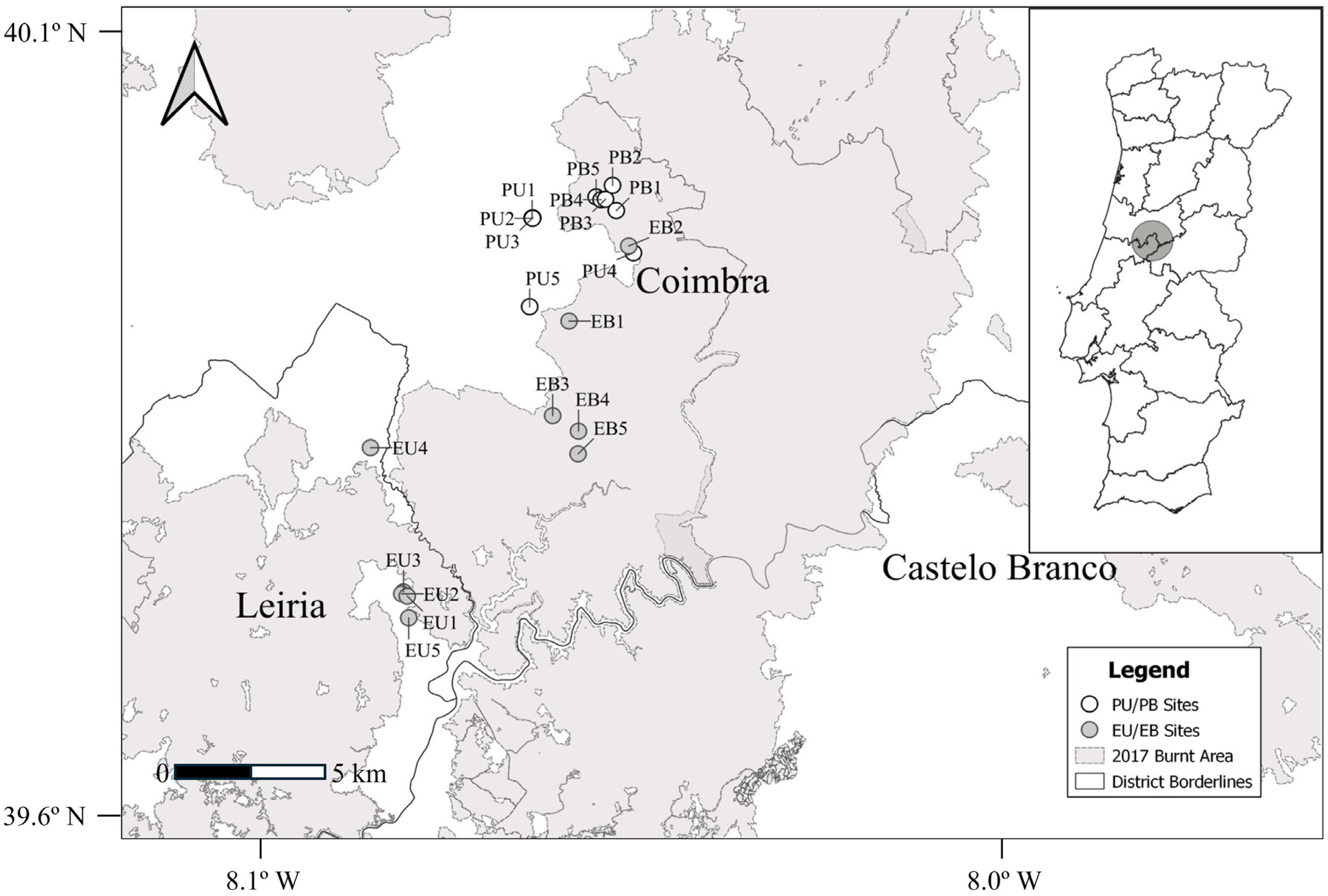
The study area is located between Pedrogão Grande and Castanheira de Pêra (Leiria District, Central Portugal), within and in the vicinity of a recently burnt area affected by a large high-severity wildfire that burnt 45,000 ha at the end of June 2017 (Figure 1) [39].
According to the Köeppen–Geiger climate classification system, the area is described as Csa (hot-summer Mediterranean climate) and Csb (warm-summer Mediterranean climate) [43]. It has an average annual temperature of 14.9 °C [44] and an average rainfall of 1010 mm [45]. The overall altitude ranges from 500 to 800 m, and the soils are primarily schist, with some areas dominated by granite and quartz. The native climax vegetation that characterizes this region consists of cork oak (Quercus suber), strawberry tree (Arbutus unedo), and black oak (Quercus pyrenaica), with a native understory of Pterospartum, Cistus, Erica, and Ulex shrubs [46].
This region of Portugal is now dominated by extensive plantations of maritime pine (Pinus pinaster) and blue gum eucalypt (Eucalyptus globulus), reflecting the expansion of the paper pulp production and logging industries, as well as the decline of the once-dominant native forest. In recent decades, eucalypt plantations have begun to replace pine plantations and are now the most common type of forest in the area [38].

2.2. Sampling Design

The study was conducted from 26 June to 13 July (burnt areas between 26 June and 3 July; unburnt areas between 4 and 13 July), immediately after the fires that devastated the region between 17 and 24 June 2017 (Figure 1). For each type of forest plantation, five sites were selected in the burnt area and five in the unburnt area. All sites were similar within each group regarding tree age (between 20 and 40 years for pines; 8 to 12 years for eucalypt), orientation (S-SW for all sites), land and forest management (pine sites were all plantations; eucalypt sites were all linear terrace plantations), altitude (between 600 and 800 m for all sites), and soil characteristics (schist for all sites).
Fire severity in burnt sites was assessed using the protocol developed by Parsons et al. [47], which was later confirmed by official sources. The severity was classified as medium to high, based on complete canopy consumption, elimination of the litter layer, and the presence of white ash [39]. Unburnt sites were selected immediately adjacent to the fire perimeter (<1–3 km distance) to maximize pre-fire ecological similarity while ensuring they remained completely unaffected by the wildfire.
Each site was divided into three linear transects of 50 m, each with 11 points spaced 5 m apart. The largest stone (larger than 50 cm2) nearest to each point was identified. A total of 330 stones were sampled for each stand type, 165 in the unburnt area and 165 in the burnt area, and the width, length, and depth into the soil of each stone were measured. Rolling and non-removable stones were excluded from the in situ selection.
To avoid biases associated with lithological variability, all sites were located on schist substrates, and surface stones used for sampling were derived from these parent materials, thereby minimizing variation in stone composition.
Soil cover surrounding the sampled stones was mostly litter in unburnt pine sites and stones in unburnt eucalypt sites. In both plantations’ burnt sites, soil cover was mostly stones and bare soil.

2.3. Invertebrate Sampling and Identification

At each site, all living macroinvertebrates under each stone were sampled using aspiration (with a pooter) and hand collection. Additionally, in the burnt area, all dead specimens were also collected. All the specimens were preserved in ethanol.
Only macrofauna (greater than 2 mm) were included in the analysis, with live and dead animals recorded and stored separately at burnt sites. This size threshold was selected to standardize detection and handling efficiency across sites and to minimize misidentification of very small or damaged specimens, but it may underrepresent the smallest-bodied individuals and early instars of some taxa.
Specimens were identified to the family level due to time constraints associated with processing the large number of specimens and because studies have shown that community-level responses to disturbance can be reliably inferred at this taxonomic level. Ants were identified to the genus level, as the Portuguese fauna is represented by a reduced number of subfamilies [48,49,50,51,52]. Land snails were identified at the order level because shell degradation from burnt samples during handling rendered finer taxonomic resolution impractical. Within each taxon, distinct morphospecies were differentiated and recorded as separate taxa in the dataset. For each stone, the number of individuals per morphospecies was counted, and these individual-based counts were used to obtain abundance and richness indices.
A different methodology was used for ant and termite nests: one-minute aspiration per stone for smaller taxa and hand collection for larger taxa, with nest-related data analyzed separately to quantify the total number of nests found in each plantation type.
The temporal sampling window was deliberately constrained to minimize the potential for colonization of burnt sites from external sources. Given the fire’s spatial extent, the limited dispersal capacity of ground-dwelling macroinvertebrates [53], and the complete collection protocol, we can confidently attribute living specimens in burnt sites to in situ survival rather than post-fire immigration. This temporal specificity allows unambiguous interpretation of fire-induced mortality versus survival patterns.

2.4. Data Analysis

Indices of abundance (n), taxa richness (s), Shannon–Weiner diversity index (H’), and Pielou equitability index (J’) were calculated for each sampled stone and used to compare the data distribution between burnt and unburnt areas for each plantation type, using live individuals only. Live and dead animals were always analyzed separately at burnt sites, and these datasets were not pooled at any stage, as no dead individuals were found at unburnt sites. Given the hierarchical sampling design, in which stones were sampled within transects and sites, and sites were allocated to each forest type versus burnt/unburnt status combination, these stone-level indices were used to characterize microhabitat-scale responses to fire and forest type. Differences in abundance, richness, diversity, and equitability between burnt and unburnt sites (for live animals) were tested for statistical significance using the non-parametric Kruskal–Wallis test. In the presence of significant differences, the contrasts between individual treatments were tested for statistical significance using the post hoc Mann–Whitney test. When the Kruskal–Wallis test was rejected, Dunn’s post hoc test was used. As most datasets did not meet the assumptions of analysis of variance (ANOVA) for normality and homoscedasticity, nonparametric tests were employed based on the results of the Shapiro–Wilk and Levene tests.
For each forest type, sample-based species rarefaction (Mao’s tau) was used to assess burnt and unburnt sites and estimate overall richness as a function of the number of samples [54].
Non-metric multidimensional scaling (NMDS) was used to analyze variation in community composition under stones across the ten study sites (unburnt and burnt) of each forest type, using site-level assemblages constructed by combining live-animal data from all stones within each site and using Euclidean distance as the measure of dissimilarity. In addition to NDMS, differences in community composition between burnt and unburnt sites for each forest type were tested for statistical significance using analysis of similarities (ANOSIM) with Euclidean distance as the similarity index and with 9999 permutations, treating sites as the unit of replication.
For the evaluation of the effects of fire on community function, each taxon was classified according to diet/feeding behavior and habitat preferences. Based on the existing literature [23,25,48,49,50,51,52,54,55,56,57,58,59,60,61,62,63,64], feeding habits were divided into four categories (predator, omnivore, herbivore, and detritivore) and habitat associations into three categories (ground dwellers, underground dwellers, and plant dwellers). For taxa with contrasting diets, each morphospecies or genus was classified according to its predominant feeding in forest litter. Taxa for which diet information was ambiguous or unavailable were omitted from the functional guild analyses but retained in all community-structure metrics. Distribution frequencies of richness and total abundance of live specimens in the unburnt and burnt areas were then calculated. Chi-square (χ2) tests were used to verify whether the distribution of feeding habits and habitat association of the ground-dwelling invertebrate community differed between the burnt and unburnt sites of each forest type. In these cases, a post hoc analysis was performed using adjusted residuals, and a corrected Bonferroni p-value was used to identify which groups differed significantly across feeding classes and dominant habitat associations. All trait-based analyses were performed on live individuals only, comparing burnt and unburnt sites within each forest type.
Spearman’s rank correlation coefficient was used to quantify and test the relationship between abundance and richness with stone depth and stone area. Stone depth and surface area classes followed thresholds previously established for stone fire refugia in Mediterranean oak forests located in the same region [35].
Regarding soil cover, a comparison of stone cover (%) surrounding sampled stones between pine and eucalypt sites in burnt and unburnt conditions was performed using Mann–Whitney tests.
Taxon-specific mortality rates and changes in ant nest numbers are reported descriptively as percentage reductions and presence/absence patterns and were not subjected to additional hypothesis testing.
All statistical analyses were performed using PAST, version 3.19 [65].

3. Results

3.1. Fire Effects on Community Structure and Diversity

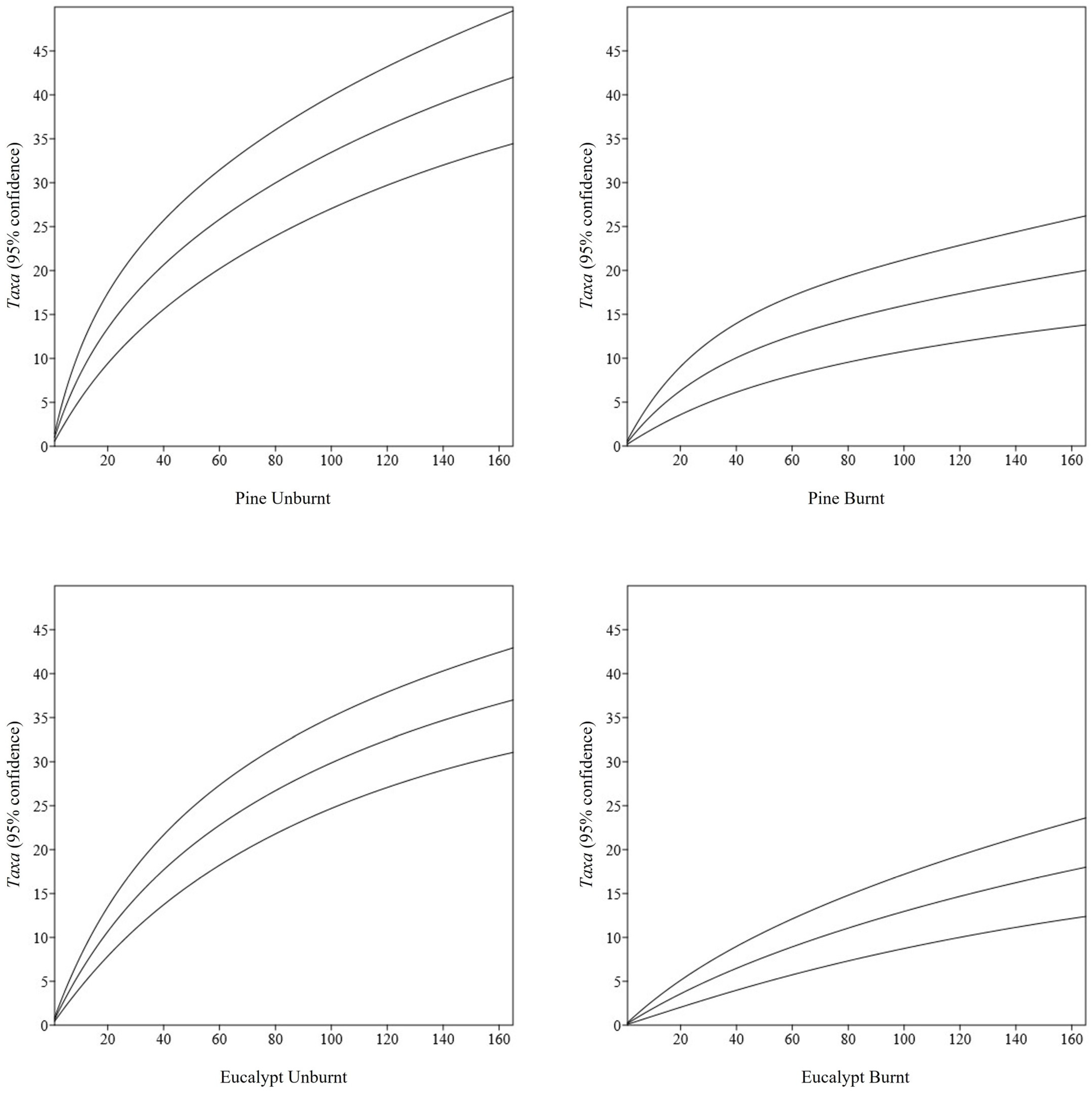
Rarefaction analysis shows a reduction by more than half of the taxa in burnt areas compared to unburnt areas for both forest types (Figure 2); in pine stands, there was a decrease from 39 to 17, and in eucalypt stands, from 38 to 14.
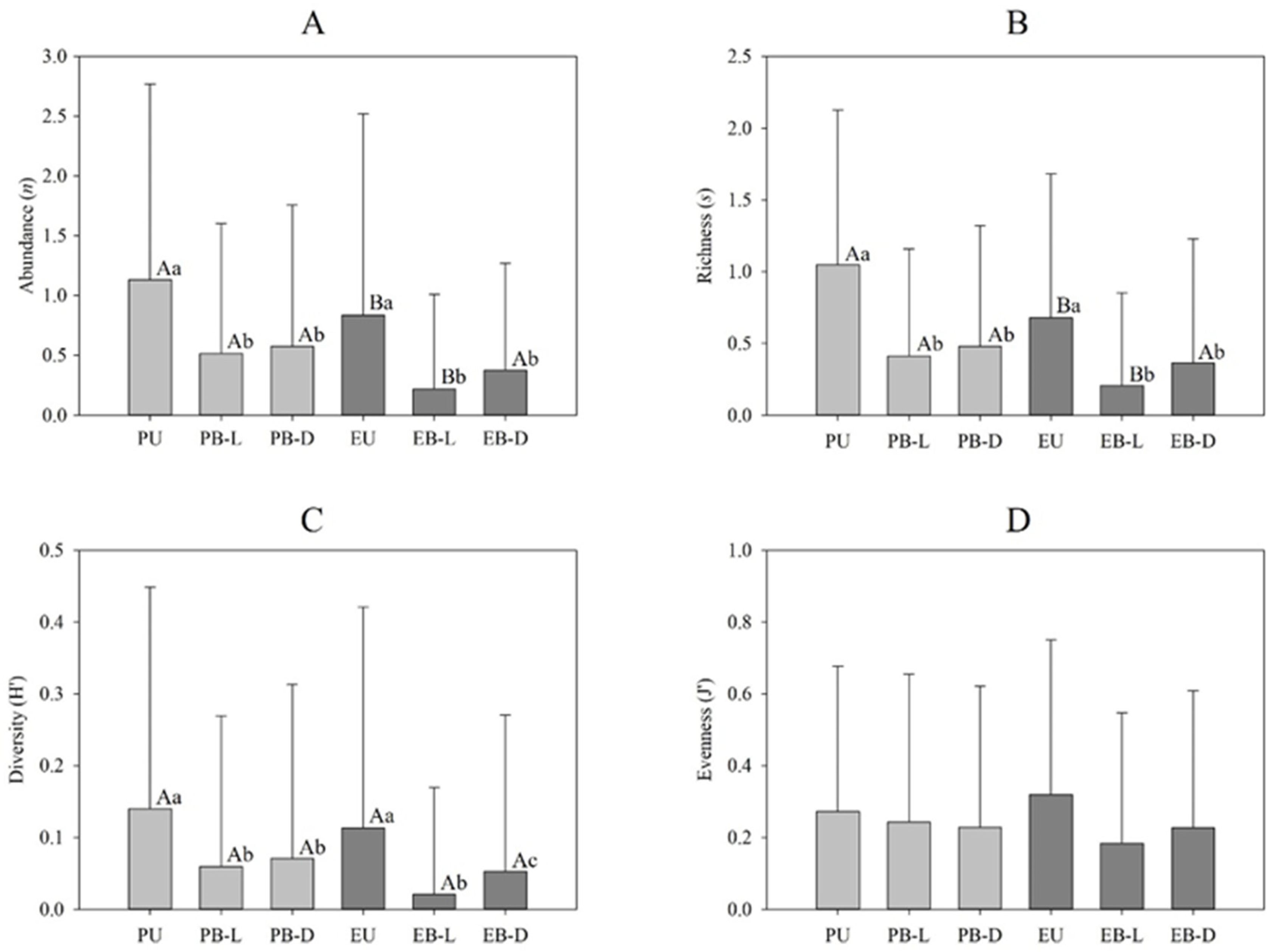
At the stone scale, burnt pine plantations showed lower abundance (H(2) = 28.550, p < 0.001), richness (H(2) = 54.845, p < 0.001), and diversity (H2 = 10.554, p < 0.005) than unburnt pine plantations, while evenness did not differ (Figure 3). Burnt eucalypt plantations also had lower abundance (H(2) = 29.328, p < 0.001), richness (H(2) = 35.732, p < 0.001), and diversity (H(2) = 15.105, p < 0.001) than unburnt eucalypt plantations, with no difference in evenness (Figure 3). Between pine and eucalypt plantations, abundance and richness differed between unburnt pine and eucalypt plantations (H(2) = 9.747; p < 0.001; H(2) = 15.577; p < 0.001) and between their burnt areas (H(2) = 16.757; p < 0.001; H(2) = 12.364; p < 0.001) (Figure 3).
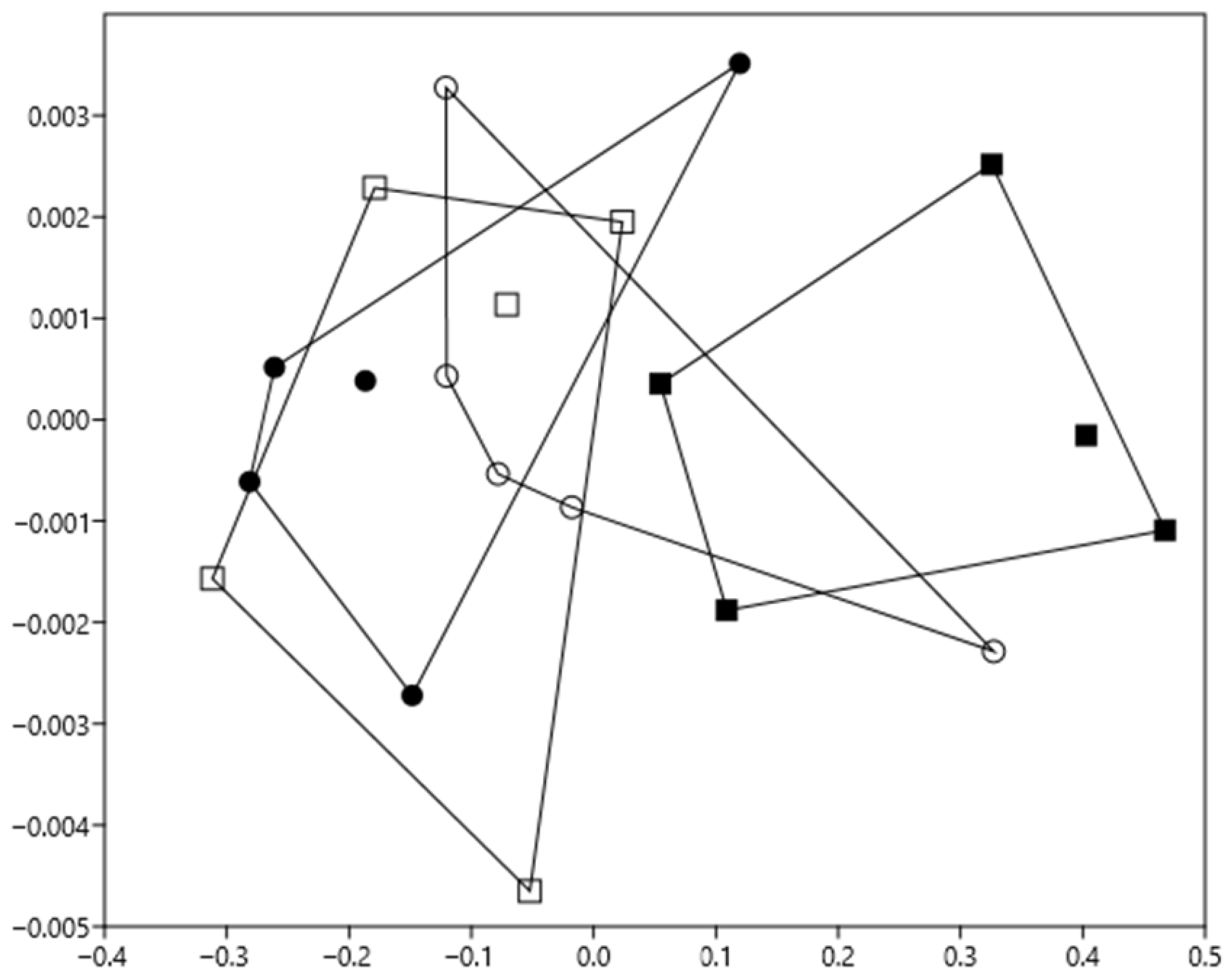
At the site level, NMDS separated unburnt from burnt sites for both plantation types and indicated similar composition within each area (Figure 4). ANOSIM indicated low among-site dissimilarity but significant differences between burnt and unburnt pine plantations (N = 10; R = 0.0658; p < 0.0001), burnt and unburnt eucalypt plantations (N = 10; R = 0.0459; p < 0.0001), and between pine and eucalypt plantations in both unburnt (N = 10; R = 0.027; p < 0.001) and burnt (N = 10; R = 0.02072; p < 0.001) areas.
In pine plantations, 2752 specimens associated with stones were recorded, comprising 38 taxa. Of these taxa, 20 occurred only in the unburnt area and 2 only in the burnt area. In total, 2503 individuals were found in the unburnt area and 249 in the burnt area. Of the 249 individuals in the burnt area, 154 were alive (including 68 ants in nests), and 95 were dead under the stones.
In eucalypt plantations, 1599 specimens associated with stones were recorded, comprising 37 taxa. Of these taxa, 23 occurred only in the unburnt area and 3 only in the burnt area. In total, 1181 individuals were found in the unburnt area and 418 in the burnt area. Of the 418 individuals in the burnt area, 330 were alive, and 88 were dead under the stones.
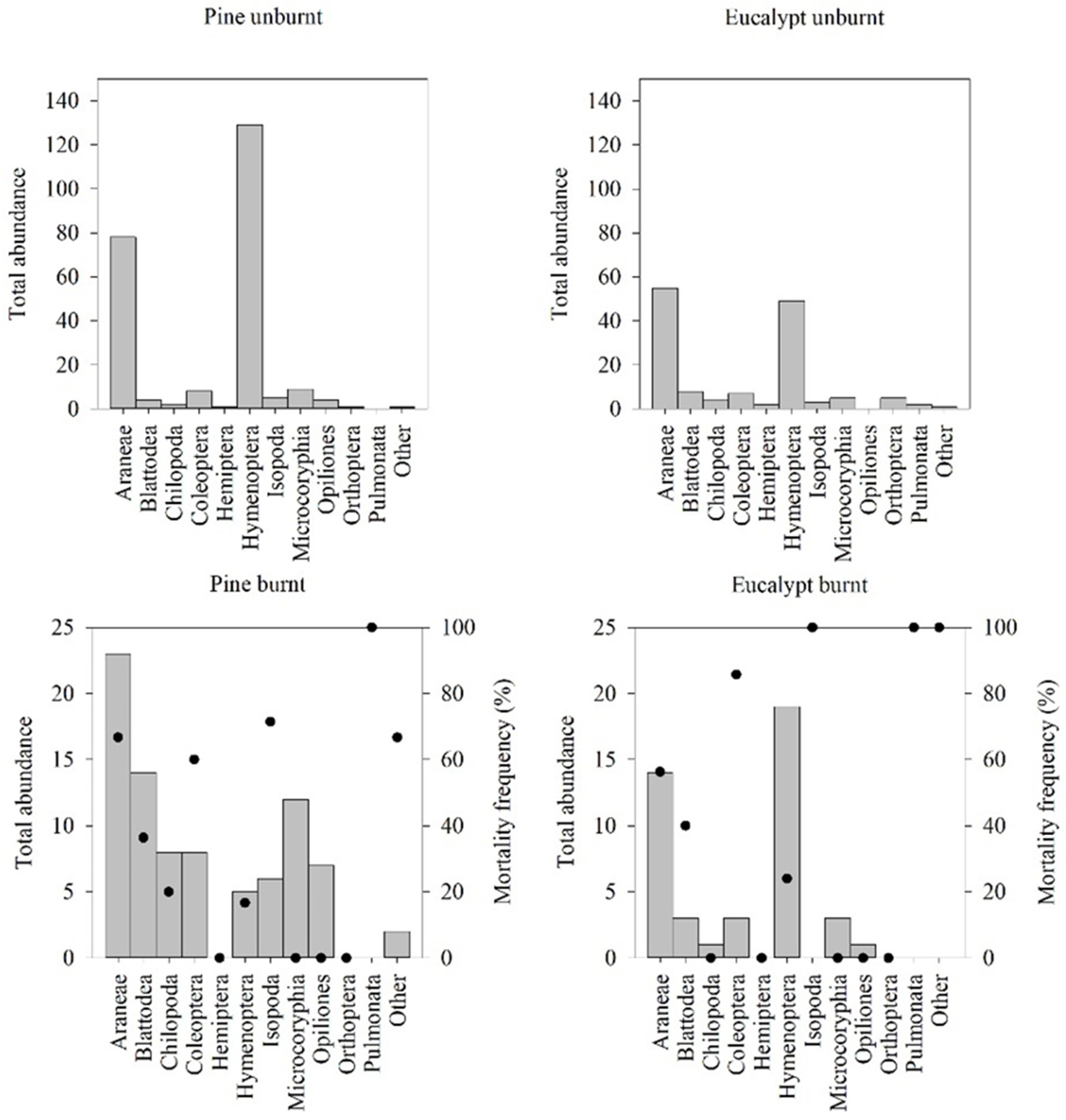
In unburnt pine plantations, the community under stones was dominated by spiders (Araneae) and ants (Hymenoptera), together with other ground-dwelling litter-associated taxa such as rock bristletails (Meinertellidae), woodlice (Isopoda), beetles (Coleoptera), cockroaches (Blattodea), and harvestmen (Opiliones) (Figure 5). After the fire, the same main groups were present, but ant genera declined from 7 to 1, and no live Hemiptera, Orthoptera, Pseudoscorpionida, or Pulmonata were recorded in burnt pine plantations (Figure 5).
In unburnt eucalypt plantations, spiders, ants, cockroaches, beetles, and rock bristletails also formed most of the macroinvertebrate community under stones (Figure 5). In burnt eucalypt plantations, these taxa remained, whereas several other groups present in unburnt sites, including true bugs (Hemiptera), woodlice, crickets (Orthoptera), land snails (Pulmonata), and earwigs (Dermaptera), were absent after the fire (Figure 5).
Across both plantation types, the main taxa present in unburnt areas were represented in the burnt areas, but the overall abundance declined to about half or less, and diversity decreased at the family level (Figure 5). Mortality was highest among beetles, woodlice, land snails, and some plant-associated taxa, whereas cockroaches, centipedes (Chilopoda), rock bristletails, harvestmen, and ground spiders were less affected (Figure 5).
Ant nests were more abundant and diverse than termite nests in both plantation types. In unburnt pine plantations, 29 ant nests from seven genera were recorded. In burnt pine plantations, only one ant nest was found. In unburnt eucalypt plantations, 14 ant nests from four genera were recorded. In burnt eucalypt plantations, ant nests decreased by 79%, but most genera remained. Plagiolepis sp. was dominant in both unburnt plantation types and was absent from both burnt areas. Three termite (Rhinotermitidae) nests were also found, with one in each unburnt plantation type and one in the burnt eucalypt area.

3.2. Immediate Post-Fire Effects on Community Traits

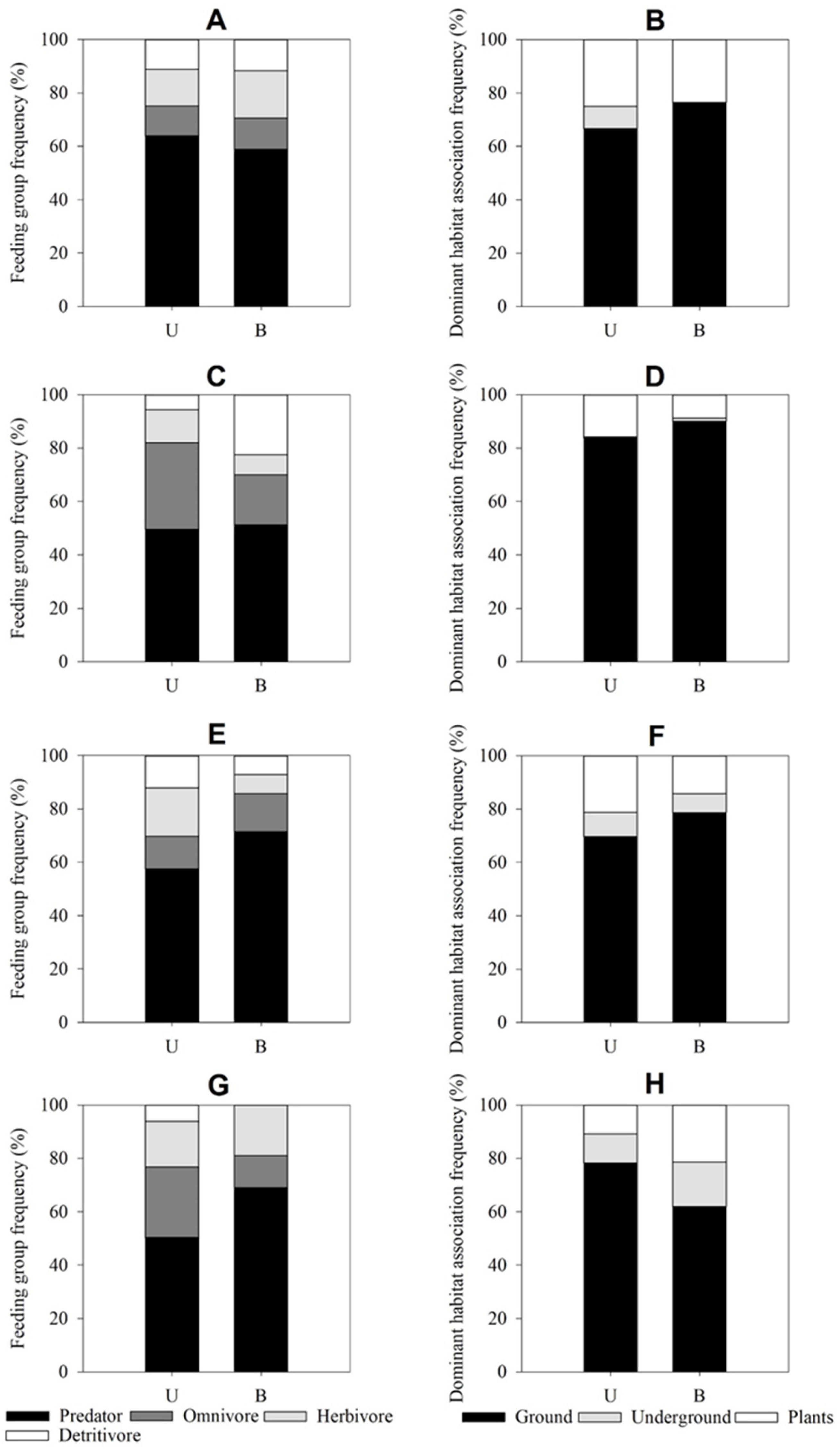
Wildfire altered feeding behavior and habitat associations in burnt pine and eucalypt plantations, but there were no significant differences in the number of taxa or total abundance (Figure 6). Detritivore abundance differed significantly between unburnt and burnt pine areas (X24 = 21.713; p < 0.001).
In pine plantations, the distribution of feeding habits by number of taxa was similar in unburnt and burnt areas (Figure 6). In burnt pine plantations, underground taxa were absent, and the frequency of ground-dwelling taxa increased (Figure 6). Omnivore and herbivore abundance decreased, predator frequency was unchanged, and detritivore abundance increased (Figure 6). Plant-associated specimens decreased, ground dwellers increased, and underground-associated individuals were low in burnt pine plantations (Figure 6).
In burnt eucalypt plantations, predators and omnivores increased, whereas herbivores and detritivores decreased (Figure 6). Ground-dwelling taxa increased, while underground dwellers and plant-associated taxa decreased (Figure 6). Considering abundance, predators and herbivores increased in unburnt compared to burnt eucalypt areas, while omnivores and detritivores decreased (Figure 6). For habitat association based on abundance, ground dwellers decreased, while underground dwellers and plant dwellers increased (Figure 6).

3.3. The Role of Stone Depth and Stone Surface Area

In pine plantations, the stone surface area ranged from 50 to 1960 cm2 and depth from 0.5 to 24 cm. In unburnt pine sites, stones had an average area of 248 cm2 and an average depth of 4.6 cm, and in burnt sites, these values were 343 cm2 and 4.9 cm, respectively.
In eucalypt plantations, the stone area ranged from 50 to 1943 cm2 and depth from 0.5 to 29 cm. In unburnt eucalypt sites, stones had a mean area of 489 cm2 and a mean depth of 5.7 cm, and in burnt sites, they were 267 cm2 and 4.4 cm, respectively.
The stone surface cover differed between plantation types. In unburnt sites, stone cover was greater in eucalypt than in pine plantations (median 45% vs. 5%; Mann–Whitney U = 2336.0 ,   p < 0.001 ). In burnt sites, eucalypt plantations maintained higher stone cover than pine (median 80% vs. 50%; U = 5605.5 , p < 0.001 ).
For each forest type, the macroinvertebrate occupancy rate under stones differed between unburnt and burnt areas. At unburnt pine sites, 55% of the stones sampled had at least one individual beneath them. In burnt pine sites, 50% of the stones had specimens, but only 17% had living animals. In the unburnt pine area, 45% of the stones without individuals were less than 500 cm2, whereas in the burnt area, among the total 50% of stones without individuals, the equivalent value was 90%. Of the 45% of stones without arthropods found in the unburnt pine area, 66% were buried deeper than 5 cm in the ground, while in the burnt pine area, that value reached 75%. In the unburnt pine area, significant differences were found between sampled stones with zero individuals and stones with at least one individual (X26 = 18.857; p < 0.001) in stones less than 5 cm deep and less than 500 cm2 in area; more than 5 cm deep and more than 500 cm2 in area. In the burnt pine area, significant differences between sampled stones with zero individuals and stones with at least one individual (X26 = 16.185; p < 0.001) were found regarding stones of less than 500 cm2 and less than 5 cm depth.
At the unburnt eucalypt sites, 36% of the sampled stones had at least one individual underneath. At burnt eucalypt sites, individuals were found under 32% of the stones; however, only 11% of those stones contained animals alive at the time of burning. In the unburnt eucalypt area, among the 64% of stones without individuals, 69% were less than 500 cm2, whereas in the burnt area, among the 68% of stones without individuals, the equivalent value was 92%. Of the 64% of stones without arthropods found in the unburnt eucalypt area, 54% were buried deeper than 5 cm, whereas in the burnt eucalypt area, these values were 69% and 66%, respectively. Neither in the unburnt nor burnt eucalypt areas were significant differences found regarding stone depth, stone area, or the presence or absence of individuals living under stones.
In unburnt sites of both plantation types, stone depth was positively correlated with abundance (rs pine = 0.777, N = 165; rs eucalypt = 0.860, N = 165; p < 0.05) and richness (rs pine = 0.987, N = 165; rs eucalypt = 0.830, N = 165; p < 0.05), but only in the unburnt sites of both plantation types (Table S1).

4. Discussion

This study demonstrates that stones function as immediate fire refugia for ground-dwelling macroinvertebrates in both native and exotic plantation forests, extending previous observations in natural Mediterranean oak forests [35] to intensively managed production systems. Using the same depth and area thresholds previously defined for oak forests, the consistency of the depth–area survival threshold (>5 cm burial, >500 cm2 surface area) across all three forest types in the same region supports thermal buffering by sufficiently large, deeply buried stones as a common refugial mechanism that increases the probability of invertebrate survival in Mediterranean fire regimes. However, the magnitude of biodiversity impacts from the wildfire varied substantially, with native forests showing higher richness and abundance per stone before and after the wildfire than plantations [35]. These differences reveal that forest type and management history interfere with refugial capacity not by altering the thermal buffering mechanism itself but by shaping the pre-fire communities that stones can protect and the physical characteristics of the stones available as refugia (Figure 2 and Figure 3). Because stone-level responses were measured within sites, some similarity among stones within a site is expected, but the strong, consistent depth–area–occupancy patterns across all sites and forest types indicate that these microhabitat effects are robust. Nevertheless, refugial function under stones is partial. Even where depth and area thresholds are met, some individuals and taxa still die during high-severity burns. These patterns indicate that stones primarily reduce, rather than eliminate, fire-related mortality risk.
Macroinvertebrate biodiversity associated with stones in pine and eucalypt plantations is similar and is composed of ground-dwelling species that use stones as nesting sites and hunting and foraging grounds (Figure 3 and Figure 5). From these, spiders (Araneae) and ants (Hymenoptera) are the dominant taxa. The most abundant groups of ground-dwelling macroinvertebrates are ground spiders (e.g., Agelenidae, Dysderidae, Gnaphosidae, and Lycosidae), rock bristletails (Meinertellidae), cockroaches (Ectobiidae), harvestmen (Phalangiidae), and ants (Aphaenogaster sp., Camponotus sp., Formica sp., and Plagiolepis sp.) (Figure 5). This community structure mirrors that observed in oak forests, where spiders, ants, and isopods dominated the stone-associated fauna [35], demonstrating compositional consistency across the management gradient from natural forests to intensive plantations in the same region. Several other taxa, more commonly associated with vegetation, are also found under stones, such as snout and bark beetles (e.g., Curculionidae and Scolytidae), true bugs (e.g., Anthocaridae and Reduviidae), and some spider families (e.g., Araneidae, Mimetidae, and Thomisidae), as are taxa with underground habits, such as centipedes (Geophilidae) and termites (Rhinotermitidae) (Figure 5). Despite the diversity found in unburnt pine and eucalypt plantations, ground dwellers are the primary components of the macroinvertebrate community immediately after a wildfire, forming the core community associated with stones in both types of plantations. In a non-fire scenario, eucalypt plantations exhibit lower abundance, richness, and diversity per stone than pine plantations, which tend to promote less balanced communities (Figure 3). These differences can be attributed to the type of forest itself, specifically whether it is native or non-native, as well as variations in land management practices used for each type of plantation.
At a functional level, predators dominate the stone-associated community in unburnt pine and eucalypt plantations (Figure 6), particularly ground spiders and ants, with centipedes (Chilopoda) and harvestmen (Opiliones) also being stone-associated predators but less abundant. This functional dominance by predators is consistent with oak forests, where predators comprised the most abundant feeding guild [35], suggesting that predatory ground-dwelling taxa commonly use stones. The second most abundant feeding behavior is that of omnivores, from which cockroaches (Blattodea) and ants are the more common taxa (Figure 6). Herbivores and detritivores are less abundant and have lower diversity, probably because most taxa within these two groups are associated with plants and litter, seeking stones as temporary refuges rather than for feeding (Figure 6). While litter availability can be high, plant diversity and abundance are low in unburnt plantation areas, reducing herbivore and detritivore abundance and diversity (Figure 6). After the wildfire, diet and habitat associations changed in abundance and family richness at the burnt sites of both plantations (Figure 6). Overall, the relative abundance of predators increased, driven by lower mortality among ground spiders, centipedes, and harvestmen, but their richness decreased (Figure 6). In oak forests, predator abundance also declined, while other feeding guilds experienced greater losses [35]. This pattern is consistent with the observed relative increase in predators in plantations, suggesting that ground-dwelling predators are more fire-resilient across forest types. The frequency of all other feeding strategies tends to show a decrease in abundance and richness, except for detritivores in burnt pine sites, which increase due to low mortality among rock bristletails (Microcoryphia) (Figure 6). Changes in habitat association are related to plant-associated taxa, whose abundance and richness are reduced due to high mortality rates.
The wildfire caused high mortality among the ground-dwelling macroinvertebrate community, but the extent of mortality varied among taxonomic groups, with centipedes, rock bristletails, and harvestmen being the least affected (Figure 5). The few studies on the effects of fire on centipedes indicate that these animals can survive fires in deeper soil layers, with changes in their composition [21], as observed in this study. In both plantations, the abundance and richness of centipedes varied little between unburnt and burnt sites. For rock bristletails, information regarding fire effects is scarce, but the results show that they were the least affected by the wildfire in both plantations (Figure 5). This may be due to aestivation or avoidance behaviors, as suggested for different taxa in other studies [66,67]. More recently, Brantley [68] added information related to the effects of wildfires on harvestmen, concluding that, like several ground spiders, the fire effects were less severe, and differences in their populations were more closely related to distinct habitat characteristics than to the wildfire. High mortality rates among spiders and ants were identified, and for the latter, a significant reduction in the number of nests was observed in both pine and eucalyptus-burnt areas (Figure 5). For these two groups, the mortality rate was high, but the abundance of alive individuals in both plantations’ burnt areas remained higher than in the rest of the ground-dwelling macroinvertebrate groups (Figure 5). The few studies focusing on short-term fire effects also observed a decrease in spider and ant abundance and richness [20,22]. In contrast, in this study, the mortality rate and loss of spider diversity were higher among plant-associated spiders but lower in ground-dwelling spiders, with the latter constituting the majority of the spider fauna that survived the wildfire. Authors such as Pryke and Samways [69] and Yekwayo et al. [70] have suggested that spider survival may be related to the presence of potential refuges, such as rocks and plants, which has been shown to be true in this study. Similarly, in oak forests, ground-dwelling spider families exhibited higher survival rates than vegetation-associated families, suggesting that stone refugia preferentially protect taxa already ecologically dependent on stones, rather than those seeking emergency shelter [35]. However, among spiders, behavior also appears to be a significant mortality factor, as it favors taxa that use stones as hunting grounds and refuge areas. For spiders that use stones as their nesting grounds, it is a cause of higher mortality. In the burnt pine sites, cell spider (Dysderidae) mortality was very high, and it appears to be related to behavior, as most of the mature individuals died in their nests with their brood. While detailed behavioral information in fire-prone forests is scarce, a recent study indicates that Dysderidae species build silk retreats and nests under stones and other ground-level objects, favoring site-attached, ground-dwelling habits [71]. The mortality among wandering ants and the abrupt reduction in all ant nests of the respective ant genus were also high in both plantations. Vasconcelos et al. [72] conducted a meta-analysis of the effects of fire on ants worldwide, identifying strong negative effects of wildfires on ant diversity. Ant assemblages depend on vegetation complexity and the magnitude of fire-associated changes in vegetation structure. In this study, the wildfire was severe, destroying all vegetation and litter on both plantations’ burnt sites, where biomass loads were high, and at the same time exposing stones to high temperatures for longer periods, resulting in higher mortality. For Plagiolepis sp., the high mortality observed also appears to be related to its behavior, as it was the most abundant in unburnt areas of the plantations and absent in the burnt areas of both plantations. In oak forests, Plagiolepis sp. nests were also absent from burnt areas, despite being the most abundant genus at unburnt sites [35], suggesting that this genus exhibits consistent fire vulnerability across forest types, potentially reflecting nesting preferences or colony behavior that limit fire survival [73]. Results such as those observed in this study, regarding cell spiders and ants like Plagiolepis sp., highlight wildfire’s ability to alter the ground-dwelling macroinvertebrate community, even if only temporarily, and are particularly relevant in areas subject to repeated wildfires, where they can lead to permanent biodiversity loss. Apart from behavior, other traits, such as slow locomotion, humidity dependence, and larger body size, also contributed to mortality in the ground-dwelling macroinvertebrate community, as reported in other studies [21,67]. The orders Pulmonata and Isopoda were the most affected in both burnt areas, as they depend on specific air humidity intervals to survive [74,75], which can rapidly become intolerable during a wildfire. These two orders also experienced mortality rates of 80–100% in oak forests [35], indicating that physiological constraints can outweigh any potential protective effect of stones, regardless of forest type. Taxa such as Pulmonata and Diplopoda also exhibit slow locomotion, which reduces the success of escape movements to safer areas. Kiss and Magnin [76] describe a drastic reduction in abundance and richness in land snails as a direct fire effect shortly after the fire, while Sgardelis et al. [74] observe an after-fire decrease in Diplopoda abundance that remained for at least two years. Body size appears to influence the ease with which each specimen can protect itself under stones, in the innermost and potentially safer zone, from the direct effects of fire, as observed in the mortality of Coleoptera, which primarily affected larger specimens from the Carabidae, Scarabidae, and Tenebrionidae families. Wikars and Schimmel [20] and Moretti et al. [67] also identified negative effects on both beetle abundance and richness, particularly in response to high-severity fires [77]. Contrary to several studies that observed immediate post-fire colonization by pyrophilous species of beetles [78], particularly in pine stands [79], at the time of sampling, no evidence of it was found in the macroinvertebrate community associated with stones, which shows that pyrophilous species are not related to the stone-associated community and probably come from adjacent unburnt areas. Associated with body size and mortality, smaller-sized individuals, regardless of the taxon, may have been entirely consumed by fire, leading to an underestimate of fire-related deaths among some ground-dwelling macroinvertebrates associated with stones. Most of the larger dead specimens collected had visible burn marks, but many of their physical traits were lost, particularly the most fragile ones. This study’s limitations can partially explain the reduced number of smaller specimens with visible burn marks across taxa. The survivability and permanence of several taxa identified in this study in burnt areas immediately after the wildfire suggest that post-fire recolonization is influenced by communities such as those associated with stones that live and shelter in natural structures, as implied in previous studies [23,80,81].
As previously mentioned, the stone surface area and depth are crucial factors for biodiversity, with strong positive correlations with abundance and richness, particularly for stone depth. The systematic decline in stone size from natural oak forests, observed in Puga et al. [35], and from pine to eucalypt plantations, corresponds with the gradient in management intensity, suggesting that anthropogenic disturbance progressively reduces the refugial capacity of landscapes by altering stone characteristics. Several studies have shown that fire effects can be negligible from depths of 5 cm [60] to 40 cm [14,35,82,83], a finding also confirmed in this study. Large, deeply buried stones had higher abundance and richness, providing greater protection from fire and lowering mortality rates. Considering the management history of each forest type, these results are particularly relevant. Pine plantations have fewer stones available, but their stones are larger and more deeply buried, which reflects a less frequently disturbed ecosystem than eucalypt plantations, where the opposite occurs. This difference in stone availability is due to today’s heavily mechanized management methods and practices, which, apart from several other adverse effects, reduce stone size and alter their depth, promoting soil displacement and increasing the availability of smaller stones [84,85]. However, this greater availability of smaller, less-buried stones does not promote biodiversity, and the comparison of the number of unoccupied stones across plantation types reinforces this idea. This reveals that stones must meet specific criteria to be colonized by the ground-dwelling macroinvertebrate community, with surface area and depth among those criteria. Consequently, stone cover in Mediterranean plantation landscapes now acts as a coarse indicator of past soil disturbance. Areas with high cover of small surface stones typically reflect intensive mechanical preparation, whereas lower stone cover often corresponds to less disturbed soils. Although stone cover itself is not a direct fire driver, it is a visible outcome of land management practices that physically alter the substrate and, in doing so, shape the availability, size, and depth of potential fire refugia. When combined with recurrent wildfires, these alterations can exacerbate community-level impacts by reducing biological legacies and modifying ecosystem dynamics [31,86,87], reinforcing the importance of integrating stone management into conservation-oriented plantation planning.
This study reinforces the value of stones for the survival of several taxa during fire events, highlighting their role as refuges. This information is significant because limited data on invertebrate diversity and ecology, particularly their responses to fire, hinder the ability to make evidence-informed decisions about post-fire land restoration [30], especially in highly modified and periodically managed ecosystems such as forest plantations. The information presented in this study is also relevant to stakeholders concerned with conservation purposes, as it shows distinct biodiversity values between native and non-native plantations in both current and post-fire scenarios. Several practical recommendations for stone management in fire-prone plantations should be considered by stakeholders. Since stones deeper than 5 cm and larger than 500 cm2 consistently supported higher abundance and taxa richness and were associated with lower mortality under high-severity fire, site preparation and thinning operations should retain large stones and avoid systematic removal or fragmentation of deeply buried stones, as these provide the most effective refugia. Intensive mechanized practices that displace soil and increase the proportion of small surface stones (e.g., repeated terracing or deep ripping) should be restricted, since they reduce the availability of large, thermally buffered refuges. During plantation establishment or replanting, areas with a higher density of large stones could be maintained as micro-refugia strips where stone removal is avoided, preserving biological legacies that enhance immediate post-fire survival.
Additionally, from a conservation perspective, the results presented in this study raise important questions about how recolonization unfolds at the fine spatial scale of microhabitats in repeatedly burnt landscapes. In this context, individuals and colonies surviving under stones constitute critical biological legacies that can quickly initiate recolonization from within burnt areas, sustaining pre-fire population lineages and community structure. By acting as local source populations, they can potentially reduce the likelihood that post-fire succession is redirected by early colonization from disturbance-tolerant or non-native taxa and lower the risk of long-term biodiversity loss in fire-prone ecosystems.
Several important matters related to this study still require further research and clarification in follow-up studies, particularly questions regarding soil and stone properties, fire behavior, and taxa-specific responses. Future research topics should move from correlative patterns to mechanistic understanding, combining stone-associated biodiversity surveys with field measurements of fire behavior and sub-stone microclimate (e.g., fireline intensity, flame residence time, and temperature profiles at different depths and stone sizes), allowing depth and area thresholds to be further tested and refined as explicit predictive parameters in models of fire survival. This approach is also recommended in ecosystems with low or absent stone availability to test whether different structures (e.g., logs, rock crevices, and macropores) can perform a homologous function in their native ground-dwelling macroinvertebrate communities.

5. Conclusions

This study demonstrates that stones serve as fire refugia for ground-dwelling macroinvertebrates across Mediterranean forest types, ranging from native forests to intensively managed exotic plantations, through a thermal buffering mechanism governed by stone depth and surface area. The magnitude of biodiversity protected by this mechanism varies with management intensity, suggesting native forests support richer communities than native plantations, which in turn support richer communities than exotic plantations. This gradient likely reflects not only differences in pre-fire community composition but also how management practices alter stone characteristics, limiting their refugial capacity.
Three findings have direct management implications for plantation forestry in fire-prone regions. First, stones enable in situ survival of functionally critical taxa immediately after fire, providing local sources for recolonization rather than requiring immigration from distant unburnt areas. Second, stone characteristics are directly linked to community abundance and richness, as larger, deeper stones support more individuals and taxa. These same characteristics can also help predict survival during fires. Third, intensive management practices that reduce stone size or alter burial depth reduce refugial capacity and post-fire biodiversity persistence.
As fire regimes intensify in some regions of the world, transforming previously fire-excluded areas into fire-prone landscapes, retaining and protecting inorganic thermal refugia, such as stones, during plantation establishment represents a low-cost, implementable strategy to enhance post-fire biodiversity recovery. Future research should examine whether other inorganic structures (e.g., rock crevices, macropores) provide comparable refugial functions in ecosystems where stones are scarce or absent and quantify the long-term population-level consequences of immediate post-fire survival for ecosystem recovery trajectories.

Supplementary Materials

The following supporting information can be downloaded at: https://www.mdpi.com/article/10.3390/fire9030105/s1.

Author Contributions

Conceptualization, methodology, formal analysis, investigation, data curation, writing—original draft preparation, visualization, J.R.L.P.; validation, N.J.C.A.; resources, J.J.K. and N.J.C.A.; writing—review and editing, J.R.L.P., J.J.K., F.M. and N.J.C.A.; supervision, J.J.K., F.M. and N.J.C.A.; project administration, J.J.K. and N.J.C.A.; funding acquisition, J.J.K. and N.J.C.A. All authors have read and agreed to the published version of the manuscript.

Funding

This research was funded by CESAM through FCT/MCTES national funds (UID/AMB/50017/2019). This study was further supported by the project RECARE—Preventing and Remediating degradation of soils in Europe through Land Care (EU grant agreement: 603498) funded by the European Commission FP7 Programme. João R. L. Puga was the recipient of an individual PhD grant (SFRH/BD/121406/2016).

Data Availability Statement

All data generated or analyzed in this study are included in this article. Additional information or access to the derived datasets is available from the corresponding author upon reasonable request.

Acknowledgments

The authors thank their colleagues from the University of Aveiro, Ana Luísa Caetano, Bruna Oliveira, Cláudia Fernandes, Tiago Silva, and Martinho Martins for their collaboration in the fieldwork.

Conflicts of Interest

The authors declare no conflicts of interest.

References

  1. Silva, J.S. Árvores e Florestas de Portugal: Pinhais e Eucaliptais—A Floresta Cultivada; Tipografia Peres: Benavente, Portugal, 2007. [Google Scholar]
  2. Chaudhary, A.; Burivalova, Z.; Koh, L.P.; Hellweg, S. Impact of forest management on species richness: Global meta-analysis and economic trade-offs. Sci. Rep. 2016, 6, 23954. [Google Scholar] [CrossRef]
  3. Brockerhoff, E.G.; Jactel, H.; Parrotta, J.A.; Ferraz, S.F.B. Role of eucalypt and other planted forests in biodiversity conservation and the provision of biodiversity-related ecosystem services. For. Ecol. Manag. 2013, 301, 43–50. [Google Scholar] [CrossRef]
  4. Zhan, A.; Rainho, A.; Rodrigues, L.; Palmeirim, J.M. Low macro-arthropod abundance in exotic Eucalyptus plantations in the Mediterranean. Appl. Ecol. Environ. Res. 2009, 7, 297–301. [Google Scholar] [CrossRef]
  5. Calviño-Cancela, M.; Rubido-Bará, M.; van Etten, E.J.B. Do eucalypt plantations provide habitat for native forest biodiversity? For. Ecol. Manag. 2012, 270, 153–162. [Google Scholar] [CrossRef]
  6. Wang, X.; Hua, F.; Wang, L.; Wilcove, D.S.; Yu, D.W. The biodiversity benefit of native forests and mixed-species plantations over monoculture plantations. Divers. Distrib. 2019, 25, 1721–1735. [Google Scholar] [CrossRef]
  7. Doerr, S.H.; Santín, C. Wildfire: A Burning Issue for Insurers; Lloyd’s of London: London, UK, 2013. [Google Scholar]
  8. Rego, F.C.; Silva, J.S. Wildfires and landscape dynamics in Portugal: A regional assessment and global implications. In Forest Landscapes and Global Change: Challenges for Research and Management; Azevedo, J., Ed.; Springer: New York, NY, USA, 2014; pp. 51–73. [Google Scholar]
  9. Flannigan, M.; Cantin, A.S.; de Groot, W.J.; Wotton, M.; Newbery, A.; Gowman, L.M. Global wildland fire season severity in the 21st century. For. Ecol. Manag. 2013, 294, 54–61. [Google Scholar] [CrossRef]
  10. San-Miguel-Ayanz, J.; Durrant, T.; Boca, R.; Libertà, G.; Branco, A.; Rigo, D.; Ferrari, D.; Maianti, P.; Vivancos, T.A.; Costa, H.; et al. Forest Fires in Europe, Middle East and North Africa 2017; EUR 29318 EN; Publications Office of the European Union: Luxembourg, 2018. [Google Scholar]
  11. Fréjaville, T.; Curt, T. Seasonal changes in the human alteration of fire regimes beyond the climate forcing. Environ. Res. Lett. 2017, 12, 035006. [Google Scholar] [CrossRef]
  12. Pausas, J.G.; Llovet, J.; Rodrigo, A.; Vallejo, R. Are wildfires a disaster in the Mediterranean basin? A review. Int. J. Wildland Fire 2008, 17, 713–723. [Google Scholar] [CrossRef]
  13. Certini, C. Effects of fire on properties of forest soils: A review. Oecologia 2005, 143, 1–10. [Google Scholar] [CrossRef]
  14. Moreira, F.; Catry, F.X.; Silva, J.S.; Rego, F. Ecologia do Fogo e Gestão de Áreas Ardidas; ISA Press: Lisbon, Portugal, 2010. [Google Scholar]
  15. Belcher, C.M. Fire Phenomena and the Earth System: An Interdisciplinary Guide to Fire Science; John Wiley & Sons: Chichester, UK, 2013. [Google Scholar]
  16. Ulyshen, M.D.; Horn, S.; Barnes, B.; Gandhi, K.J.K. Impacts of prescribed fire on saproxylic beetles in loblolly pine logs. Insect Conserv. Divers. 2010, 3, 247–251. [Google Scholar] [CrossRef]
  17. Abbott, I.; De la Maitre, D. Monitoring the impact of climate change on biodiversity: The challenge of megadiverse Mediterranean climate ecosystems. Austral Ecol. 2010, 35, 406–422. [Google Scholar] [CrossRef]
  18. Ross, C.E.; Barton, P.S.; McIntyre, S.; Cunningham, S.A.; Manning, A.D. Fine-scale drivers of beetle diversity are affected by vegetation context and agricultural history. Austral Ecol. 2017, 42, 831–843. [Google Scholar] [CrossRef]
  19. Schimmel, J.; Granström, A. Fire severity and vegetation response in the boreal Swedish forest. Ecology 1996, 77, 1436–1450. [Google Scholar] [CrossRef]
  20. Wikars, L.; Schimmel, J. Immediate effects of fire severity on soil invertebrates in cut and uncut pine forests. For. Ecol. Manag. 2001, 141, 189–200. [Google Scholar] [CrossRef]
  21. Trucchi, E.; Pitzalis, M.; Zapparoli, M.; Bologna, M.A. Short-term effects of canopy and surface fire on centipede (Chilopoda) communities in a semi natural Mediterranean forest. Entomol. Fenn. 2009, 20, 129–138. [Google Scholar] [CrossRef][Green Version]
  22. Verble-Pearson, R.M.; Yanoviak, S.P. Effects of fire intensity on litter invertebrate communities in Ozark oak forests. Am. Midl. Nat. 2014, 172, 14–24. [Google Scholar] [CrossRef]
  23. Zaitsev, A.S.; Gongalsky, K.B.; Persson, T.; Bengtsson, J. Connectivity of litter islands remaining after a fire and unburnt forest determines the recovery of soil fauna. Appl. Soil Ecol. 2014, 83, 101–108. [Google Scholar] [CrossRef]
  24. Vogel, J.A.; Koford, R.R.; Debinski, D.M. Direct and indirect responses of tallgrass prairie butterflies to prescribed burning. J. Insect Conserv. 2010, 14, 663–677. [Google Scholar] [CrossRef]
  25. Kim, T.N.; Holt, R.D. The direct and indirect effects of fire on the assembly of insect herbivore communities: Examples from the Florida scrub habitat. Oecologia 2012, 168, 997–1012. [Google Scholar] [CrossRef]
  26. Barbéro, M.; Bonin, G.; Loisel, R.; Quézel, P. Changes and disturbances of forest ecosystems caused by human activities in the western part of the Mediterranean basin. Vegetatio 1990, 87, 151–173. [Google Scholar] [CrossRef]
  27. Kiss, L.; Magnin, F.; Torre, F. The role of landscape history and persistent biogeographical patterns in shaping the response of Mediterranean land snail communities to recent fire disturbances. J. Biogeogr. 2004, 31, 145–157. [Google Scholar] [CrossRef]
  28. Swengel, A.B. A literature review of insect responses to fire, compared to other conservation managements of open habitat. Biodivers. Conserv. 2001, 10, 1141–1169. [Google Scholar] [CrossRef]
  29. Doblas-Miranda, E.; Sánchez-Piñero, F.; González-Megías, A. Different structuring factors but connected dynamics shape litter and belowground soil macrofaunal food webs. Soil Biol. Biochem. 2009, 41, 2543–2550. [Google Scholar] [CrossRef]
  30. Saunders, M.E.; Barton, P.S.; Bickerstaff, J.R.M.; Frost, L.; Latty, T.; Lessard, B.D.; Lowe, E.C.; Rodriguez, J.; White, T.E.; Umbers, K.D.L. Limited understanding of bushfire impacts on Australian invertebrates. Insect Conserv. Divers. 2021, 14, 285–293. [Google Scholar] [CrossRef]
  31. Lindenmayer, D.B.; Noss, R.F. Salvage logging, ecosystem processes, and biodiversity conservation. Conserv. Biol. 2006, 20, 949–958. [Google Scholar] [CrossRef]
  32. Meddens, A.; Kolden, C.; Lutz, A.; Smith, A.; Cansler, C.; Abatzoglou, J.; Meigs, G.; Downing, W.; Krawchuk, M. Fire refugia: What are they, and why do they matter for global change? Bioscience 2018, 68, 944–954. [Google Scholar] [CrossRef]
  33. Robinson, N.; Leonard, S.; Ritchie, E.; Bassett, M.; Chia, E.; Buckingham, S.; Gibb, H.; Bennett, A.; Clarke, M. Refuges for fauna in fire-prone landscapes: Their ecological function and importance. J. Appl. Ecol. 2013, 50, 1321–1329. [Google Scholar] [CrossRef]
  34. Krawchuk, M.A.; Haire, S.L.; Coop, J.; Parisien, M.; Whitman, E.; Chong, G.; Miller, C. Topographic and fire weather controls of fire refugia in forested ecosystems of northwestern North America. Ecosphere 2016, 7, e01632. [Google Scholar] [CrossRef]
  35. Puga, J.R.L.; Moreira, F.; Keizer, J.J.; Abrantes, N.J.C. Immediate impacts of wildfires on ground-dwelling macroinvertebrate communities under stones in Mediterranean oak forests. Environ. Manag. 2024, 74, 684–698. [Google Scholar] [CrossRef] [PubMed]
  36. Mendes, A.; Feliciano, D.; Tavares, M.; Dias, R. The Portuguese Forests; Portuguese Catholic University: Porto, Portugal, 2004. [Google Scholar]
  37. Collins, R.D.; Neufville, R.; Claro, J.; Oliveira, T.; Pacheco, A.B. Forest fire management to avoid unintended consequences: A case study of Portugal using system dynamics. J. Environ. Manag. 2013, 130, 1–9. [Google Scholar] [CrossRef]
  38. Oliveira, T.M.; Guiomar, N.; Baptista, F.O.; Pereira, J.M.C.; Claro, J. Is Portugal’s forest transition going up in smoke? Land Use Policy 2017, 66, 214–226. [Google Scholar] [CrossRef]
  39. Comissão Técnica Independente. Análise e Apuramento dos Factos Relativos aos Incêndios que Ocorreram em Pedrogão Grande, Castanheira de Pera, Ansião, Alvaiázere, Figueiró dos Vinhos, Arganil, Góis, Penela, Pampilhosa da Serra, Oleiros e Sertã, entre 17 e 24 de Junho de 2017; Assembleia da República: Lisbon, Portugal, 2017. [Google Scholar]
  40. Williams, M. A new look at global forest histories of land clearing. Annu. Rev. Environ. Resour. 2008, 33, 345–367. [Google Scholar] [CrossRef]
  41. Saini, G.R.; Grant, W.J. Long-term effects of intensive cultivation on soil quality in the potato-growing areas of New Brunswick (Canada) and Maine (U.S.A.). Can. J. Soil Sci. 1980, 60, 421–428. [Google Scholar] [CrossRef]
  42. Alves, A.M.; Pereira, J.S.; Silva, J.M.N. O Eucaliptal em Portugal: Impactes Ambientais e Investigação Científica; ISA Press: Lisbon, Portugal, 2007. [Google Scholar]
  43. Kottek, M.; Grieser, J.; Beck, C.; Rudolf, B.; Rubel, F. World map of the Köppen–Geiger climate classification updated. Meteorol. Z 2006, 15, 259–263. [Google Scholar] [CrossRef] [PubMed]
  44. IPMA, I.P. Média Temperatura Média do ar Anual, Normal 1971–2000. Available online: https://snig.dgterritorio.gov.pt/rndg/srv/por/catalog.search#/search?anysnig=temperatura%20anual&fast=index (accessed on 15 July 2017).
  45. IPMA, I.P. Precipitação Total Anual, Normal 1971–2000. Available online: https://snig.dgterritorio.gov.pt/rndg/srv/por/catalog.search#/search?anysnig=precipita%C3%A7%C3%A3o%20anual&fast=index (accessed on 15 July 2017).
  46. Costa, J.C.; Aguiar, C.; Capelo, J.H.; Lousã, M.; Neto, C. Biogeografia de Portugal Continental. Quercetea 1998, 5–56. [Google Scholar]
  47. Parsons, A.; Robichaud, P.R.; Lewis, S.A.; Napper, C.; Clark, J.T. Field Guide for Mapping Post-Fire Soil Burn Severity; Gen. Tech. Rep. RMRS-GTR-243; U.S. Department of Agriculture, Forest Service, Rocky Mountain Research Station: Fort Collins, CO, USA, 2010. [Google Scholar]
  48. Harde, K.W.; Severa, F. Guía de Campo de los Coleópteros de Europa; Ediciones Omega: Barcelona, Spain, 1984. [Google Scholar]
  49. Goulet, H.; Huber, J.T. Hymenoptera of the World: An Identification Guide to Families; Canada Communication Group Publishing: Ottawa, ON, Canada, 1993. [Google Scholar]
  50. Roberts, M.J. Spiders of Britain & Northern Europe; HarperCollins: London, UK, 1995. [Google Scholar]
  51. Barrientos, J.A. Bases Para un Curso Práctico de Entomología; Imprensa Juvenil, S.A.: Barcelona, Spain, 1998. [Google Scholar]
  52. Czechowski, W.; Radchenko, A.; Czechowska, W. The Ants (Hymenoptera, Formicidae) of Poland; Studio 1: Warsaw, Poland, 2002. [Google Scholar]
  53. Perry, K.I.; Wallin, K.; John, W.; Herms, D. Characterizing movement of ground-dwelling arthropods with a novel mark-capture method using fluorescent powder. J. Insect Behav. 2017, 30, 32–47. [Google Scholar] [CrossRef]
  54. Colwell, R.K.; Mao, C.X.; Chang, J. Interpolating, extrapolating, and comparing incidence-based species accumulation curves. Ecology 2004, 85, 2717–2727. [Google Scholar] [CrossRef]
  55. Buddle, C.M.; Spence, J.R.; Langor, D.W. Succession of boreal forest spider assemblages following wildfire and harvesting. Ecography 2000, 23, 424–436. [Google Scholar] [CrossRef]
  56. Collet, N. Short and long-term effects of prescribed fires in autumn and spring on surface-active arthropods in dry sclerophyll eucalypt forests of Victoria. For. Ecol. Manag. 2003, 182, 117–138. [Google Scholar] [CrossRef]
  57. Moretti, M.; Duelli, P.; Obrist, M.K. Biodiversity and resilience of arthropod communities after fire disturbance in temperate forests. Oecologia 2006, 149, 312–327. [Google Scholar] [CrossRef]
  58. Andersen, A.L.; Penman, T.D.; Debas, N.; Houadria, M. Ant community responses to experimental fire and logging in a eucalypt forest of south-eastern Australia. For. Ecol. Manag. 2009, 258, 188–197. [Google Scholar] [CrossRef]
  59. Gongalsky, K.B.; Malmström, A.; Zaitsev, A.S.; Shakhab, S.V.; Bengtsson, J.; Persson, T. Do burnt areas recover from inside? An experiment with soil fauna in a heterogeneous landscape. Appl. Soil Ecol. 2012, 59, 73–86. [Google Scholar] [CrossRef]
  60. New, T. Insects, Fire and Conservation; Springer: New York, NY, USA, 2014. [Google Scholar]
  61. Lissner, J. Spiders, Denmark (Private Collection of Jørgen Lissner); Natural History Museum of Denmar: Copenhagen, Denmark, 2024. [Google Scholar] [CrossRef]
  62. Barton, P.S.; Evans, M.J.; Foster, C.N.; Cunningham, S.A.; Manning, A.D. Environmental and spatial drivers of spider diversity at contrasting microhabitats. Austral Ecol. 2017, 42, 700–710. [Google Scholar] [CrossRef]
  63. Nentwig, W.; Blick, T.; Bosmans, R.; Gloor, D.; Hänggi, A.; Kropf, C. Spiders of Europe. Version February 2021. Available online: https://www.araneae.nmbe.ch (accessed on 16 October 2021).
  64. Oger, P. Les Araignées de Belgique et de France. Available online: https://arachno.piwigo.com/ (accessed on 24 May 2017).
  65. Hammer, Ø.; Harper, D.A.T.; Ryan, P.D. PAST: Paleontological Statistics software package for education and data analysis. Palaeontol. Electron. 2001, 4, 9. [Google Scholar]
  66. Lewis, J.G.E. The Biology of Centipedes; Cambridge University Press: Cambridge, UK, 1981. [Google Scholar]
  67. Moretti, M.; Legg, C.J. Combining plant and animal traits to assess community functional responses to disturbance. Ecography 2009, 32, 299–309. [Google Scholar] [CrossRef]
  68. Brantley, S.L. Responses of ground-dwelling spider (Arachnida: Araneae) communities to wildfire in three habitats in northern New Mexico, USA, with notes on mites and harvestmen (Arachnida: Acari, Opiliones). Diversity 2020, 12, 396. [Google Scholar] [CrossRef]
  69. Pryke, J.S.; Samways, M.J. Importance of using many taxa and having adequate controls for monitoring impacts of fire for arthropod conservation. J. Insect Conserv. 2012, 16, 177–185. [Google Scholar] [CrossRef]
  70. Yekwayo, I.; Pryke, J.S.; Gaigher, R.; Samways, M.J. Wandering spiders recover more slowly than web-building spiders after fire. Oecologia 2019, 191, 231–240. [Google Scholar] [CrossRef]
  71. Szymański, D.M.; Szymański, D.; Szymański, H.M. The first record of Dysdera crocata C. l. Koch, 1838 (Araneae: Dysderidae) in Poland. Fragm. Faun. 2022, 65, 161–164. [Google Scholar] [CrossRef]
  72. Vasconcelos, H.; Maravalhas, J.; Cornelissen, T. Effects of fire disturbance on ant abundance and diversity: A global meta-analysis. Biodivers. Conserv. 2017, 26, 177–188. [Google Scholar] [CrossRef]
  73. Trontti, K.; Aron, S.; Sundström, L. Inbreeding and kinship in the ant Plagiolepis pygmaea. Mol. Biol. 2005, 14, 2007–2015. [Google Scholar]
  74. Sgardelis, S.P.; Pantis, J.D.; Argyropoulou, M.D.; Stamou, G.P. Effect of fire on soil macroinvertebrates in a Mediterranean phryganic ecosystem. Int. J. Wildland Fire 1995, 5, 113–121. [Google Scholar] [CrossRef]
  75. Moreno-Rueda, G.; Ruiz-Ruiz, A.; Collantes-Martín, E.; Arrébola, J.R. Relative importance of humidity and temperature on microhabitat use by land snails in arid versus humid environments. In Arid Environments and Wind Erosion; Fernández-Bernal, A., De la Rosa, M.A., Eds.; Nova Science Publishers: New York, NY, USA, 2009; pp. 331–343. [Google Scholar]
  76. Kiss, L.; Magnin, F. High resilience of Mediterranean land snail communities to wildfires. Biodivers. Conserv. 2006, 15, 2925–2944. [Google Scholar] [CrossRef]
  77. Saint-Germain, M.; Larrivée, M.; Drapeau, P.; Fahrig, L.; Buddle, C.M. Short-term response of ground beetles (Coleoptera: Carabidae) to fire and logging in a spruce-dominated boreal landscape. For. Ecol. Manag. 2005, 212, 118–126. [Google Scholar] [CrossRef]
  78. Sasal, Y.; Raffaele, E.; Farji-Brener, A.G. Succession of ground-dwelling beetle assemblages after fire in three habitat types in the Andean forest of NW Patagonia, Argentina. J. Insect Physiol. 2010, 10, 37. [Google Scholar] [CrossRef]
  79. Fredriksson, E.; Pettersson, R.M.; Naalisvaara, J.; Löfroth, T. Wildfire yields a distinct turnover of the beetle community in a semi-natural pine forest in northern Sweden. Ecol. Process. 2020, 9, 44. [Google Scholar] [CrossRef]
  80. Yekwayo, I.; Pryke, J.S.; Roets, F.; Samways, M.J. Surrounding vegetation matters for arthropods of small, natural patches of indigenous forest. Insect Conserv. Divers. 2016, 9, 224–235. [Google Scholar] [CrossRef]
  81. Swart, R.C.; Pryke, J.S.; Roets, F. Arthropod assemblages deep in natural forests show different responses to surrounding land use. Biodivers. Conserv. 2018, 27, 583–606. [Google Scholar] [CrossRef]
  82. DeBano, L.F. The role of fire and soil heating on water repellency in wildland environments: A review. J. Hydrol. 2000, 231–232, 195–206. [Google Scholar] [CrossRef]
  83. Caut, S.; Jowers, M.J.; Arnan, X.; Pearce-Duvet, J.; Rodrigo, A.; Cerca, X.; Boulay, R.R. The effects of fire in ant trophic assemblage and sex allocation. Ecol. Evol. 2013, 4, 35–49. [Google Scholar] [CrossRef] [PubMed]
  84. National Council for Air and Stream Improvement, Inc. (NCASI). Effects of Heavy Equipment on Physical Properties of Soils and on Long-Term Productivity: A Review of Literature and Current Research; Technical Bulletin No. 887; NCASI: Cary, NC, USA, 2004. [Google Scholar]
  85. Cambi, M.; Certini, G.; Neri, F.; Marchi, E. The impact of heavy traffic on forest soils: A review. For. Ecol. Manag. 2015, 338, 124–138. [Google Scholar] [CrossRef]
  86. Foster, D.R.; Orwig, D.A. Preemptive and salvage harvesting of New England forests: When doing nothing is a viable alternative. Conserv. Biol. 2006, 20, 959–970. [Google Scholar] [CrossRef] [PubMed]
  87. Perry, K.I.; Herms, D.A. Dynamic responses of ground-dwelling invertebrate communities to disturbance in ecosystems. Insects 2019, 10, 61. [Google Scholar] [CrossRef] [PubMed]
Figure 1. Location of the study area and sampling sites. U1, U2, U3, U4, and U5 show pine (P) and eucalypt (E) unburnt sites. B1, B2, B3, B4, and B5 show pine (P) and eucalypt (E) burnt sites.
Fire 09 00105 g001
Figure 2. Sample-based rarefaction for each type of forest (pine and eucalypt) in the unburnt and burnt areas. n = 165; upper and lower rarefaction curves represent the 95% confidence intervals.
Fire 09 00105 g002
Figure 3. Average abundance (A), richness (B), diversity (C), and evenness (D) found under each stone in unburnt (U) and burnt (B) pine (P) and eucalypt (E) plantation areas. In the burnt areas, live (B-L) and dead (B-D) specimens were analyzed separately. Horizontal lines represent the standard deviation. Distinct letters indicate significant differences (p < 0.05): capital letters—between plantations; lowercase letters—within each plantation. Stone is the sample unit (n = 165).
Fire 09 00105 g003
Figure 4. Non-metric multidimensional scaling (NMDS) plot for unburnt (white) and burnt (black) pine (dots) and eucalypt (squares) stand sites regarding abundance, richness, diversity, and evenness. The horizontal and vertical axes represent the first and second NMDS dimensions (NMDS1 and NMDS2), respectively. Stress = 0.01.
Fire 09 00105 g004
Figure 5. Total number of living specimens per taxon found in pine and eucalypt unburnt and burnt areas (order level; other taxa include Dermaptera, Lepidoptera, and Pseudoscorpionida). Black dots indicate the mortality frequency in each taxon observed in pine and eucalyptus burnt areas.
Fire 09 00105 g005
Figure 6. Influence on ground-dwelling macroinvertebrate community functional feeding behavior and dominant habitat distribution frequency per abundance (AD) and per richness (EH) in unburnt (U) and burnt (B) pine (A,B,E,F) and eucalypt (C,D,G,H) stands.
Fire 09 00105 g006
Disclaimer/Publisher’s Note: The statements, opinions and data contained in all publications are solely those of the individual author(s) and contributor(s) and not of MDPI and/or the editor(s). MDPI and/or the editor(s) disclaim responsibility for any injury to people or property resulting from any ideas, methods, instructions or products referred to in the content.