
Review

Wind and Slope Effects on Wildland Fire Spread: A Review of Experimental, Empirical, Mathematical, and Physics-Based Models


Department of Mechanical and Product Design Engineering, Swinburne University of Technology, Hawthorn, VIC 3122, Australia
*
Author to whom correspondence should be addressed.
Fire 2026, 9(3), 100; https://doi.org/10.3390/fire9030100
Submission received: 19 January 2026 / Revised: 11 February 2026 / Accepted: 24 February 2026 / Published: 25 February 2026

Abstract

Wildland fire behaviour is strongly governed by the coupled effects of wind and terrain slope, yet the literature remains fragmented across experimental, empirical, mathematical, and physics-based modelling traditions. A systematic scoping review with narrative synthesis was performed (Web of Science, Scopus, and Google Scholar plus citation chaining), screening studies for explicit wind–slope treatment with reported forcings and outcomes. Across more than 150 studies, slope benches, wind tunnels, trenches/canyons, and field burns show that upslope–wind alignment promotes flame attachment and a shift from radiation-led to convection-led preheating (often near 20–30° slopes and moderate winds), whereas opposing or downslope forcing lifts flames and suppresses spread; confined geometries can trigger eruptive acceleration. Mathematical analogues and empirical models provide fast predictions using compact wind/slope modifiers and enable scenario and burn-probability mapping but typically prescribe coupling and miss regime transitions. Physics-based LES/CFD and coupled atmosphere–fire systems resolve terrain–flow feedback sand can yield reduced-order laws suitable for embedding into operational tools, albeit at higher computational cost and with validation gaps. Benchmarks are consolidated, approaches are compared using a common rubric (fidelity, validation, applicability, cost, and operational utility), and priorities are identified for cross-scale datasets, firebrand transport in complex terrain, and real-time coupled prediction.

1. Introduction

Wildland and forest fires, often termed wildfires or bushfires are uncontrolled combustions of vegetative fuels (forests, shrublands, grasslands, woodlands). They emerge from the interplay of fuel properties, meteorological conditions (wind, humidity, temperature), and topography (slope, aspect). Physically, they are coupled thermo-chemical and atmospheric processes driven by natural or human ignitions, with behaviour shaped by how wind and terrain modulate heat transfer and flame dynamics [1]. Wildfire behaviour is fundamentally controlled by the interaction of meteorological forces (primarily wind), topography (especially slope), and fuel properties. Among these, wind and slope are consistently identified as the most influential physical drivers determining the rate of spread (ROS), flame geometry, fireline intensity, and energy release of wildland fires [2,3]. Their combined effects determine whether a fire remains a low-intensity surface burn or develops into a rapidly advancing crown or plume-dominated event. Wind is the dominant short-term control on wildfire behaviour because it directly influences flame tilt, oxygen supply, convective heat transfer, and ember transport [4,5]. When ambient wind velocity increases, the flame tilts toward the unburnt fuel, shortening the distance for radiative and convective heat transfer, which results in faster ignition and higher ROS [6,7]. Strong winds also supply oxygen to the combustion zone, increasing flame temperature and fireline intensity, while the removal of combustion products enhances burning efficiency [8,9]. Topographic slope plays an equally critical role because it changes the geometry between flame and unburnt fuel and modifies the buoyancy-driven flow that sustains flame attachment [10,11]. On uphill slopes, the buoyant plume rises along the terrain surface, effectively aligning the flame with the unburnt vegetation above. This reduces the convective heat-transfer distance, increases pre-heating and radiation view factor, and thereby accelerates ignition of fuels higher up the slope [8,11,12].
Conversely, downslope fires experience a lifting of the flame away from the surface, resulting in weaker pre-heating and lower ROS [13]. The net effect is a consistent increase in HRR and ROS with a positive slope angle, observed in both experimental and simulation studies [14]. In steep terrain, this can be further amplified by chimney effects in gullies and saddles, where terrain channelling accelerates convective flows and creates “blow-up” conditions [11,12]. The combined influence of wind and terrain slope on wildfire behaviour is nonlinear, meaning the resulting fire intensity and spread rate are not simply the sum of their individual effects. Instead, these two drivers interact dynamically, creating complex feedback loops among flame geometry, heat transfer, aerodynamic flow, and fuel ignition processes [8,11,12].
Wind–slope coupling in wildland fires has been investigated through three complementary traditions: experiments, empirical/analogue modelling, and physics-based simulation [9,15,16,17]. Early experimental study of wind–slope effects began in the mid-20th century [18] and linked rate of spread to fuel moisture, wind, and slope in pine-needle beds, establishing the template for controlled wind–slope investigations. Experimental studies—ranging from benchtop burners and tilting/sloping wind tunnels to controlled field burns—create reproducible conditions to isolate mechanisms, quantify key variables, and generate datasets for model development and validation [19,20,21]. Experimental investigation is essential because it clarifies causal mechanisms by demonstrating how wind alignment and slope angle govern flame attachment, convective preheating, and spread rates; provides quantitative calibration and validation targets for empirical and mathematical analogue models; (iii) supply benchmark boundary conditions and diagnostics (HRR, flame geometry, near-surface flow) for physics-based simulations; and (iv) reveal regime shifts in canyons/trenches and sensitivities to fuel continuity and moisture that are difficult to infer from theory or modelling alone.
Mathematical analogue models conceptualise wildfire spread through geometric or probabilistic abstractions rather than by solving the governing equations of combustion and fluid dynamics [17]. Historically, the approach coalesced in the early 1990s [22] with elliptical-perimeter and Huygens formulations that built on Rothermel (1972)’s rate-of-spread relation [23]. Typically, a one-dimensional empirical rate-of-spread (ROS) relation is inputted and the perimeter is advanced in two dimensions using front-tracking schemes such as Huygens wavelets [22,24,25] or level-set formulations [25,26], as well as cellular-automata and graph/network formulations [27,28,29]. Operational systems including FARSITE and Prometheus implement this paradigm by embedding Rothermel-type ROS within terrain-aware, GIS-driven simulations [23,30], typically assuming elliptical head-fire growth and incorporating wind and slope via local directional and magnitude modifiers to the ROS. We cover analogue models in this review because they are computationally efficient, widely used in operations, and provide a practical bridge between empirical formulas and physics-based simulation; they also serve as baselines and initial/validation states for more detailed models. These approaches are computationally efficient and accommodate heterogeneous fuels and barriers, and they facilitate rapid scenario exploration and ensemble forecasting; however, wind and slope influences enter as prescribed local modifiers rather than emerging from coupled flow–flame dynamics, which can limit the capture of regime transitions and feedbacks unless these are parameterised in advance [31].
Terminology and scope. In this review, we distinguish (i) local spread-velocity models (rate-of-spread, ROS, closures that compute the local spread speed and direction from wind, slope, fuels and moisture) from (ii) spread simulators/algorithms (numerical schemes that propagate a fire perimeter in space and time). Many widely used two-dimensional systems (e.g., cellular automata, Huygens/ellipse methods, minimum-travel-time graph methods, and level-set solvers) are primarily spread algorithms that require an external ROS closure (e.g., Rothermel-type or Balbi-type relations) to provide the local propagation velocity [23,32]. In contrast, fully physics-based CFD fire models (e.g., WFDS/FDS-family and FIRETEC-class solvers) resolve coupled flow, combustion and heat transfer such that spread arises from the simulated physics rather than being imposed through an ROS closure [33,34]. For clarity, our classification is therefore organised by how wind, slope, and their coupling enter the prediction—as prescribed modifiers in a ROS closure, as inputs to a kinematic spread algorithm, or as emergent outcomes of coupled CFD/LES fire–atmosphere physics.
Empirical fire-spread models predict behaviour from statistical relationships fitted to observations, typically expressing (ROS) as a function of wind speed, fuel properties, and fuel moisture [16,35]. Semi-empirical models add a small amount of physics, typically an energy-balance framework. and then determine the remaining coefficients by calibration against from experiments or field measurements [36]. Historically, empirical and semi-empirical fire-spread modelling crystallised with McArthur’s fire-danger metres in the 1960s, which related wind and curing to grassfire rate of spread for operational use [37], and with Rothermel’s surface fire model, which combined an idealised heat balance with parameters fitted to laboratory burns [23]. These formulations remain central: BehavePlus implements Rothermel-style ROS for incident analysis [35], while FARSITE and FlamMap propagate those ROS across terrain to project perimeters and intensity [30,38]. Methodologically, these models assume quasi-steady spread under specified conditions and incorporate wind and slope via simple adjustment factors or look-up tables; contemporary variants retain this structure while updating coefficients or adding fuel-type modules [16,39]. Their advantages are parsimony, speed and broad applicability for planning and real-time decision support. Principal limitations arise from domain of fit: performance degrades outside the calibration envelope (e.g., steep slopes, extreme winds, discontinuous fuels); dynamic fire–atmosphere feedbacks are absent; and regime shifts (e.g., channelling, eruptive spread, mass spotting) cannot emerge without ad hoc parameterisation [40]. In practice, empirical and semi-empirical models provide baseline estimates and serve as calibration/validation references for analogue and physics-based simulators [16].
Physics-based wildland-fire models solve the governing conservation equations for mass, momentum, energy, and species—typically with LES/CFD combustion and radiation—to represent fire–atmosphere coupling, plume dynamics, and terrain effects mechanistically [9]. Historically, the approach emerged with the first coupled atmosphere–fire solvers in the mid-1990s [41], followed in the early 2000s by fully 3-D combustion-resolving systems such as FIRETEC [34], and the FDS/WFDS family for structure/WUI and porous-fuel combustion, respectively [33,42]. Modern systems such as WRF-Fire/SFIRE embed two-way coupling within a numerical weather model so wind and slope effects arise from the resolved flow rather than prescribed corrections [43,44]. This capability enables regime transitions (plume- to wind-driven), canyon/channelling and slope-induced acceleration, crown-fire initiation, spotting, and detailed flame–terrain interaction, with field campaigns like FireFlux used for evaluation [45,46]. Strengths include mechanistic fidelity, hypothesis testing, and benchmark datasets for cross-scale validation; limitations include high computational cost, sensitivity to fuel and boundary uncertainties, and incomplete validation across extremes, which currently constrain routine operations [47]. The review proceeds in four parts: first, Experimental Approaches, synthesising evidence from benchtop burners, tilting or sloping wind tunnels, and controlled field burns to isolate wind and slope mechanisms and to consolidate benchmark datasets for model evaluation; second, mathematical analogue models, examining front-tracking, level-set, cellular automata, and graph or network formulations that propagate perimeters over complex terrain using prescribed wind and slope effects; third, Empirical and quasi-empirical models, comparing data-driven and lightly physics-informed rate-of-spread relations, their calibration ranges, and their operational use; and fourth, physics-based modelling, appraising coupled CFD and LES frameworks that resolve flow, flame, and terrain interactions and regime transitions. Each strand is evaluated using common wind and slope benchmarks, namely, mechanistic fidelity, strength of validation evidence, domain of applicability, computational cost, and suitability for operational decision support, to identify convergences, limits, and priorities for future work. We use the reported transition from radiation-led to convection-led preheating under wind–slope forcing—often coincident with flame attachment and enhanced upslope/along-slope flow—as the organising principle, because it delineates regimes where spread becomes strongly nonlinear and where modelling assumptions (e.g., separable wind/slope corrections versus coupled physics) diverge in validity.

2. Methods for Review

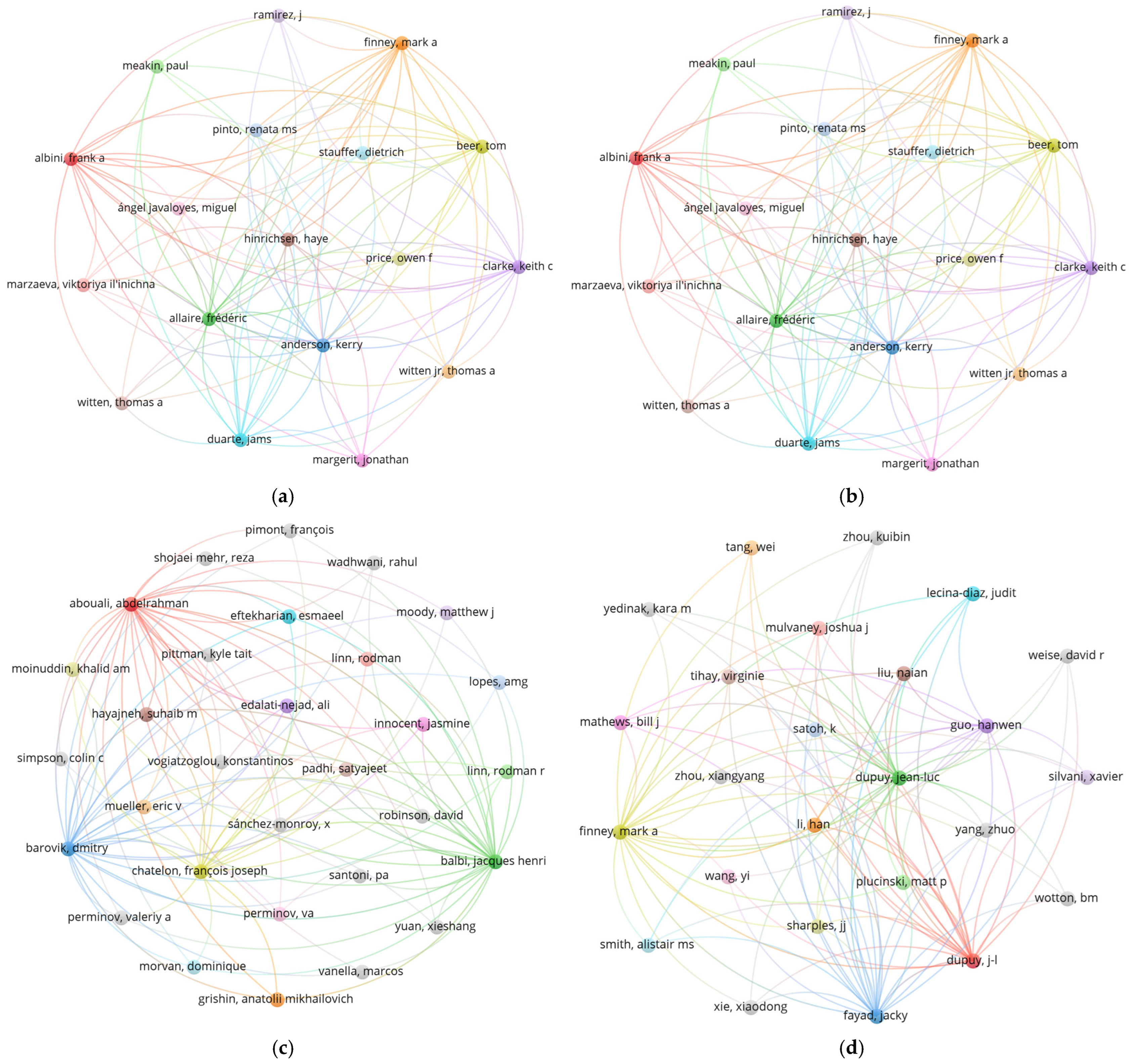
We conducted a systematic scoping review with narrative synthesis to map and compare how wind and terrain slope jointly influence wildland-fire behaviour across experiments, analogue/empirical models, and physics-based CFD/coupled atmosphere–fire simulators as illustrated in Figure 1 (Co-authorship network visualisation based on bibliographic data for each presented model). A protocol-driven search of Web of Science, Scopus, and Google Scholar was complemented by hand-searching of key journals and backward/forward citation chasing. Queries combined wildfire/bushfire terms with wind, slope/topography, rate of spread (ROS), and modelling families. Titles/abstracts were screened for explicit wind–slope treatment, and full texts were included if they (i) analysed vegetative fuels; (ii) reported original data, modelling, or formal cross-comparisons relevant to wind–slope effects; and (iii) specified forcings (e.g., wind speed, slope angle/aspect, ignition geometry) and outcomes (e.g., ROS, HRR, heat-flux partitioning, flame geometry). Exclusions covered WUI structure-only burns, commentary without new analysis, remote-sensing work lacking wind–slope attribution, and studies where topographic effects were indeterminate. We extracted standardised fields from experiments (fuel/configuration, wind, slope, diagnostics), analogue/empirical models (formulation, wind/slope modifiers, calibration ranges, validation sets), and physics-based models (solver/coupling, mesh, fuels/radiation/combustion options, validation targets). Quality appraisal followed a five-lens rubric—mechanistic fidelity, validation strength, domain of applicability, computational cost/throughput, and operational suitability, supporting transparent cross-method comparison. Evidence was synthesised narratively by method family with quantitative cross-plots where feasible (e.g., ROS versus slope and wind), and convergence/divergence highlighted to identify benchmarks and gaps.

3. Experimental Approaches

Wildland-fire experiments—from early slope tables to wind tunnels, trench (canyon) benches, and field plots—show that wind speed (U) and slope angle (θ) jointly reshape heating modes, flame geometry, and rate of spread (ROS). At gentle slopes, radiative preheating is often dominant; at steeper slopes, flame attachment and fire-induced upslope flow can shift behaviour toward stronger convective preheating and faster ROS. Wind tunnels and forced-draft facilities confirm robust U–ROS scaling in realistic fuels, while slope benches isolate how θ reorganises near-surface flow and heat-transfer partitioning.
Several themes included in this chapter extend beyond “wind-only” or “slope-only” tests but are essential to interpreting wind–slope effects in operational settings. Discontinuous-fuel experiments are included because wind and slope govern ignition success, gap-crossing, and regime transitions (no-spread/contact/spotting), which are key outcomes of wind-driven convection and slope-driven attachment. Eruptive, downslope, and multi-fire configurations are included because confinement, geometry, and interacting fronts alter entrainment, attachment, and heat-flux partitioning, producing rapid accelerations and nonlinear ROS responses that cannot be inferred reliably from isolated fronts. Measurement/diagnostic studies are included because conclusions about “wind effect” or “slope effect” depend on how ROS, flame geometry, and radiative/convective fluxes are quantified; these studies define what constitutes a robust benchmark for model evaluation.
Because each experimental platform isolates a distinct control, scale, or failure mode, we organise this section into six subsections that form a mechanistic progression and a set of modelling benchmarks. These subsections map onto (i) slope-dominated behaviour (Section 3.1 and part of Section 3.4), (ii) wind-dominated behaviour (Section 3.2 and Section 3.3), (iii) coupled wind–slope effects, including confinement and interaction-driven nonlinearity (Section 3.4 and Section 3.5), and (iv) field evidence and measurement benchmarks (Section 3.6). Although many laboratory campaigns vary wind and slope separately to enable clear attribution, we synthesise the coupled regime by linking the controlled datasets to studies that treat wind–slope interactions explicitly and by identifying where non-additive responses are expected.

3.1. Laboratory Benches: Slope-Only and Wind–Slope Without Tunnels

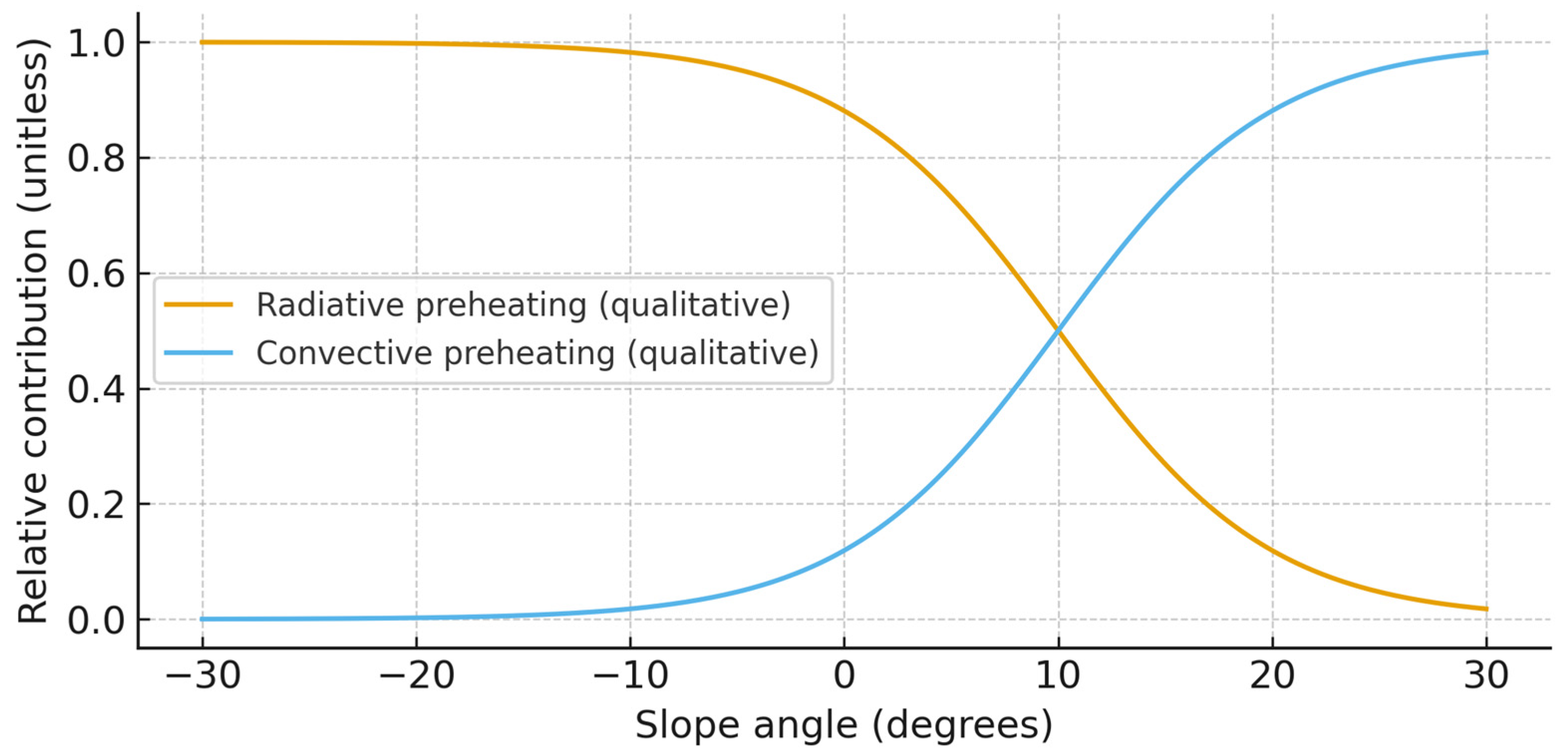
Bench studies that remove imposed wind isolate how slope angles alone reshape heating mode, flame geometry, and rate of spread. Across classic and modern work, a consistent picture emerges. In pine-litter beds, upslope spread accelerates and becomes increasingly three-dimensional as slope and loading rise, whereas level and downslope cases are steadier and can show a shallow minimum at gentle negative slopes. Ref. [48] used time-of-arrival and balance-based mass-loss in Pinus pinaster and Pinus halepensis litters over −30° to +30°, finding a minimum ROS around −15° to −20°, a sharp rise from 0° to modest positive slopes, and the practical need for longer beds at steep upslope because flame and ember zones lengthen and steady conditions break down; species differences were linked to packing and ventilation. On the 10 m by 4 m DESIRE inclinable bench, ref. [49] separated preheating pathways under still air with paired infrared (IR) thermography, thermocouples, and heat-flux gauges in Pinus halepensis beds (depth approximately 4 cm; load approximately 1 kg/m2; surface-area-to-volume ratio of the fuel particles (SA/V, 1/m) high for fine needles): radiation dominates from 0° to 20°, yet a near-front convective term approximately one third of net at 20° already appears; the rate-of-spread jump from 20° to 30° (approximately 2.5 times) is explained by a marked rise in convective heating while the radiant term plateaus; far ahead of the front, convection cools at 0° and 20°, but near-front convection flips to heating at 30°, consistent with slope-induced flame reorientation. Using the same platform with excelsior fuel 7 m by 3 m; load approximately 0.4 kg/m2; (SA/V) approximately 4730 1/m; density approximately 780 kg/m3. Ref. [50] showed the head planform shifting from U-shaped to pointed V as slope increases; flank whirls appear and convection dominates at 30°, with net heating extending 1–2 m ahead due to flame tilt and hot-gas flow. Large straight-head experiments by [51] (up to 32°) demonstrated that ROS and MLR increase with slope even as flaming-consumption efficiency drops markedly (to approximately 0.1 by 32°); when three-dimensional hot-gas impingement is suppressed, the measured total heat flux during preheating can be lower than the radiant flux, indicating natural convective cooling in front of the head at gentle to moderate slopes; an energy-balance model that explicitly includes this cooling reproduces steep-slope trends better than common operational formulations. Finally, ref. [52] added sidewalls to suppress lateral entrainment and varied bed width from 0.50 to 1.25 m on a 6.5 m by 3.2 m bench, showing that width amplifies slope effects: at 30°, forward upslope flow from the combustion zone produces strong convective preheating and the convective-heating distance expands from approximately 7 cm at 20° to greater than 130 cm at 30° for the 1.25 m bed; rate of spread and flame length scale upward with width. Figure 2 embeds the same evidence in one conceptual trajectory tailored to still-air slope benches: radiation-led preheating at gentle slopes; a mixed zone with measurable near-front convection around 20° on DESIRE; and convection-dominated heating beyond approximately 30° accompanied by V-planform, flank whirls, and longer preheating distances, especially when width increases confinement as in [52].

3.2. Wind Tunnels and Controlled Airflow

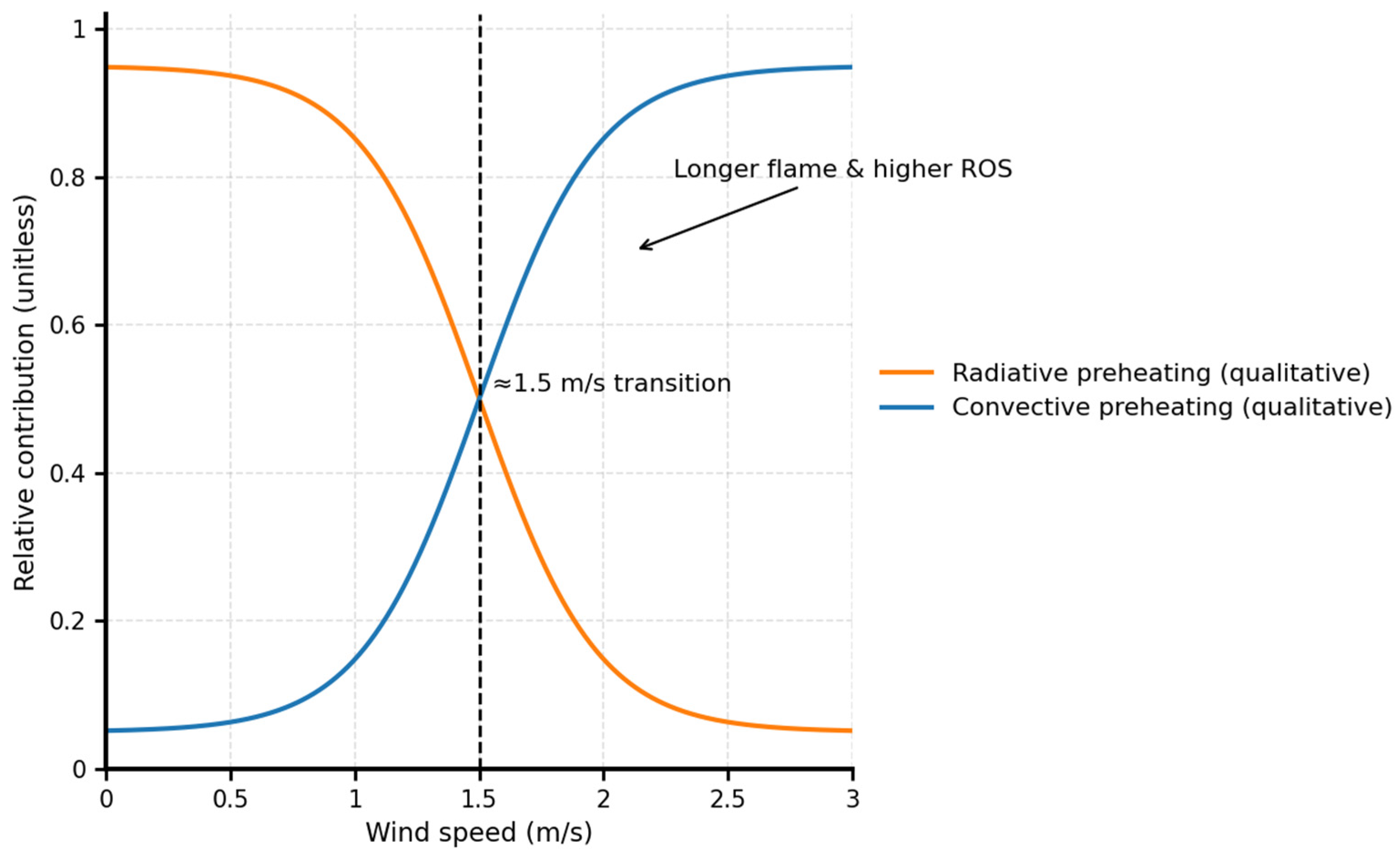
Wind tunnels and forced-draft benches quantify how aerodynamic forcing modifies flame geometry, heat-transfer partitioning, and spread thresholds in heterogeneous fuels and in discontinuous beds relevant to firefighting operations. Across the best-controlled campaigns, wind increases the forward rate of spread, shifts preheating from radiation-led to convection-led above moderate speeds and activates gap-crossing by direct contact or spotting depending on wind and geometry. Figure 3 embeds the central mechanism and illustrates the transition from radiation-led to convection-led preheating near approximately 1.5 m/s, with higher wind producing greater flame tilt, longer flames, and higher rate of spread, consistent with the forced-draft scaling where 0–3.0 m/s wind and 0.2–0.8 kg/m2 loads yielded nonlinear increases in flame length and rate of spread and showed convection dominating above approximately 1.5 m/s [53].
In the CSIRO Pyrotron, a randomised-block design with eucalypt and pine litter at 1.0, 2.5, and 4.0 m/s showed large, fuel-specific increases in spread with wind: mean rate of spread for eucalypt rose from 33.6 to 187.4 m/h, while pine rose from 155.7 to 575.4 m/h. A linear mixed-effects model on log rate of spread detected significant main effects of fuel type and airspeed, a significant interaction, and a moisture effect; critically, the residual variance of 0.0245 implied a 3.1 percent coefficient of variation, demonstrating that heterogeneous, operational fuels can yield repeatable tunnel results suitable for power analysis and cross-facility comparison [54]. Wind–discontinuity coupling was systematised in an open-topped tunnel where pine-needle beds were separated by controlled firebreaks and wind was varied from 0 to 3.0 m/s. Three regimes emerged: no ignition, direct-contact ignition, and spot-fire ignition. At ≤1.0 m/s, gaps did not light on fire; 1.5–2.5 m/s enabled contact ignition for narrow breaks; at 3.0 m/s, burning particles crossed the gap and produced spot fires. Ignition required a ≥253 °C fuel temperature and ≥43 kW/m2 combined heat flux. Rate of spread increased almost linearly with wind, and the proportionality between required firebreak width and fireline intensity was approximately 0.64, notably larger than the classical 0.36 reported by Wilson, implying stronger convective preheating under moderate winds [55]. A complementary forced-draft bench explored wind–fuel-load scaling (0–3.0 m/s; 0.2–0.8 kg/m2). Flame angle decreased with wind and was relatively insensitive to load; in contrast, flame length and rate of spread increased nonlinearly with both wind and load, with rate of spread at 3.0 m/s and 0.8 kg/m2 approaching an order of magnitude above still air. Convective heating dominated above approximately 1.5 m/s. The authors proposed empirical correlations for flame length and rate of spread as explicit functions of wind and load and introduced a radiation model that accounts for curved firelines, improving prediction relative to flat-front assumptions [53]. Errain-aware wind effects were examined by coupling laboratory benches and numerical flow–fire models. Experiments on a “triangular mountain” showed that with 2.0 m/s wind, upslope dependence along the windward face was modest, whereas lee-side propagation decreased sharply with increasing negative slope because of a recirculation vortex. At approximately −30° lee slope, the spread was about one quarter of the flat-ground value. At 4.0 m/s, firebrands crossed the valley and ignited the next ridge; simulations reproduced the valley vortex and a heated jet impinging on the downwind ridge, highlighting brand transport and ridge-top jetting as ridge-to-ridge drivers under stronger wind [56]. Separate burner-based tunnel work resolved forward convective heating using calibrated total heat flux and radiative sensors and high-speed imaging. Heat-flux patterns and flame attachment were organised by the local Richardson number (competition between buoyancy and wind momentum): an attached regime exhibited higher, slowly varying flux and a lifted regime showed steeper downstream decay. A transition occurred when the Richardson number approached unity; pulsation frequency scaled with the Froude number and non-dimensional heat release, providing transferable descriptors for intermittency, which governs fine-fuel ignition under wind [57]. Finally, lateral “fire channelling” on lee slopes was demonstrated in a combustion tunnel with a triangular hill: under 0–4 m/s reference winds, lateral rate of spread near the crest reached up to about four times the no-wind, no-slope baseline, while near-base lateral spread remained close to baseline. Two-dimensional coupled flow–heat simulations captured a lee-slope rotor and a turbulent-kinetic-energy maximum at separation collocated with the onset of lateral acceleration, formalising the rotor-driven mechanism for rapid across-slope growth in rugged terrain [58].

3.3. Discontinuous Fuels and Marginal Spread

Discontinuous fuels expose the conditions under which a flame transitions from isolated ignition to sustained propagation. On a 1.2 by 4.8 m tilting platform with rod-mounted excelsior elements arranged on a rectangular grid (cross-bed spacing 15 cm, longitudinal gaps adjustable in 5 cm increments; surface area to volume ratio approximately 7590 1/m), sustained spread occurred only when direct flame contact bridged the gap to the next element; radiation alone did not maintain spread near threshold [1]. Beds were assembled at depths of 30, 60, and 120 cm at constant linear loading (97 g per metre of bed depth; bulk density 5.489 kg/m3) and burned in a conditioned chamber (approximately 27 °C, 80 percent relative humidity). A full flame line was lit along the short edge; the slope was increased stepwise until the flame advanced the bed length, and outcomes were classified as successful, marginal, or unsuccessful with at least three replicates per setting (more near threshold). Thermal infrared imaging at 120 Hz was thresholded at 550 °C to map the probability of flame presence across the gap. Across 112 burns (with 84 near-threshold runs used for regressions), three consistent signatures emerged: first, direct flame contact across gaps was necessary for ignition of the next element; second, the flame sheet widened with height as eddies amplified, increasing horizontal excursions; and third, deeper beds and steeper upslopes effectively increased the upstream flame depth and reduced the horizontal gap that must be crossed, both of which favoured sustained spread. To analyse thresholds, Finney et al. [59] defined slope-adjusted effective depth (physical depth plus the upslope component of the gap) and slope-adjusted effective spacing (the downslope horizontal component of the gap), and plotted regression lines that separated spread from no-spread regimes (as in Figure 6 of Finney et al. [59]).
A complementary bench–model study linked flame geometry, turbulence onset, and convective heat transfer in deep, discontinuous beds [60]. A diagnostic buoyancy-driven laminar-flame model reproduced the curved combustion interface and was compared against infrared-imaged flames from excelsior-rod beds with fuel heights of 30, 60, and 120 cm. Experiments showed that once depth exceeded approximately 0.7 m, flames developed non-steady lateral excursions and greater horizontal extension, consistent with a transition to turbulence. In this regime, convective impingement provided the heat transfer required to ignite the next elements. A Grashof-number analysis indicated that natural-convection flames become turbulent at characteristic lengths at or above approximately 0.70 m, matching the observations.
Operationally focused miniature shrub arrays clarified ignition-to-spread thresholds under light wind [61]. Using clipped Allocasuarina nana foliage arranged in paired cages (footprint 35 by 26 cm), 366 ignitions tested the effects of litter presence, live-fuel moisture, shrub-layer density, wind (calibrated fan approximately 0.28 m/s on and 0.03 m/s off), and dead-fuel continuity beneath crowns. Sustained spread was defined as horizontal propagation in the shrub layer to at least one perimeter (17.5 cm from the ignition point). Stepwise logistic regression and classification trees consistently ranked litter presence as the strongest positive control, followed by lower live-fuel moisture, greater shrub density, wind presence, and dead-fuel continuity; an interaction between live-fuel moisture and shrub density indicated that density mattered less as live fuels became wetter. Preferred models for the base series (no dead fuel) included litter, live-fuel moisture, shrub density, wind, and their interaction (Nagelkerke R2 approximately 0.73, ROC approximately 0.95). The full dataset, which added dead-fuel continuity and crown-base height, retained high skill (R2 approximately 0.72 to 0.74, ROC approximately 0.97). Practically, shrub arrays without litter required higher shrub density because heat transfer had to occur within the shrub layer, whereas with litter, many sustained cases relied on vertical coupling from the surface flame, reducing the density needed for spread.

3.4. Eruptive, Downslope, and Multi-Fire Effects

In this section, we synthesise evidence that complex slope geometry governs wildfire acceleration through three coupled mechanisms: confined-slope eruption, in which crossing an attachment window pivots preheating from radiation-led to convection-dominated and expands the convective influence distance from centimetres to metres; downslope re-intensification, where the rate of spread shows a non-monotonic response and strengthens again at steep negative slopes under radiation-dominated preheating; and multi-fire interaction on slopes, where spacing and layout govern merging regimes that reshape flame geometry and spread potential.
Eruptive behaviour arises when slope-induced flame tilt combines with lateral confinement to produce flame attachment, strong forward hot-gas flow, and a rapid pivot from radiation-led to convection-led preheating. Using a 6 m × 1 m inclined trench with pine-needle beds at a 0–40° slope and trench aspect ratio (wall height divided by trench width) 0.1–0.4, Xie et al. demonstrated that once the slope reached approximately 25–30° and the aspect ratio was at least 0.2, steady low-rate-of-spread fire transitioned abruptly to a rapid-spread phase characteristic of eruption [62].
The transition coincided with flame attachment; sharp increases in rate of spread, mass-loss rate, and flame depth; and a near parity of radiative and convective heat fluxes (approximately 11.3 versus 11.8 kW/m2), while fuel-consumption efficiency decreased nearly linearly with slope. Building on this, Liu et al. used a 6.5 m × 3.2 m inclinable bench in a trench geometry to quantify the coupled flow and heat-transfer fields across 0–40° slope and 0.1–0.4 aspect ratios [63].
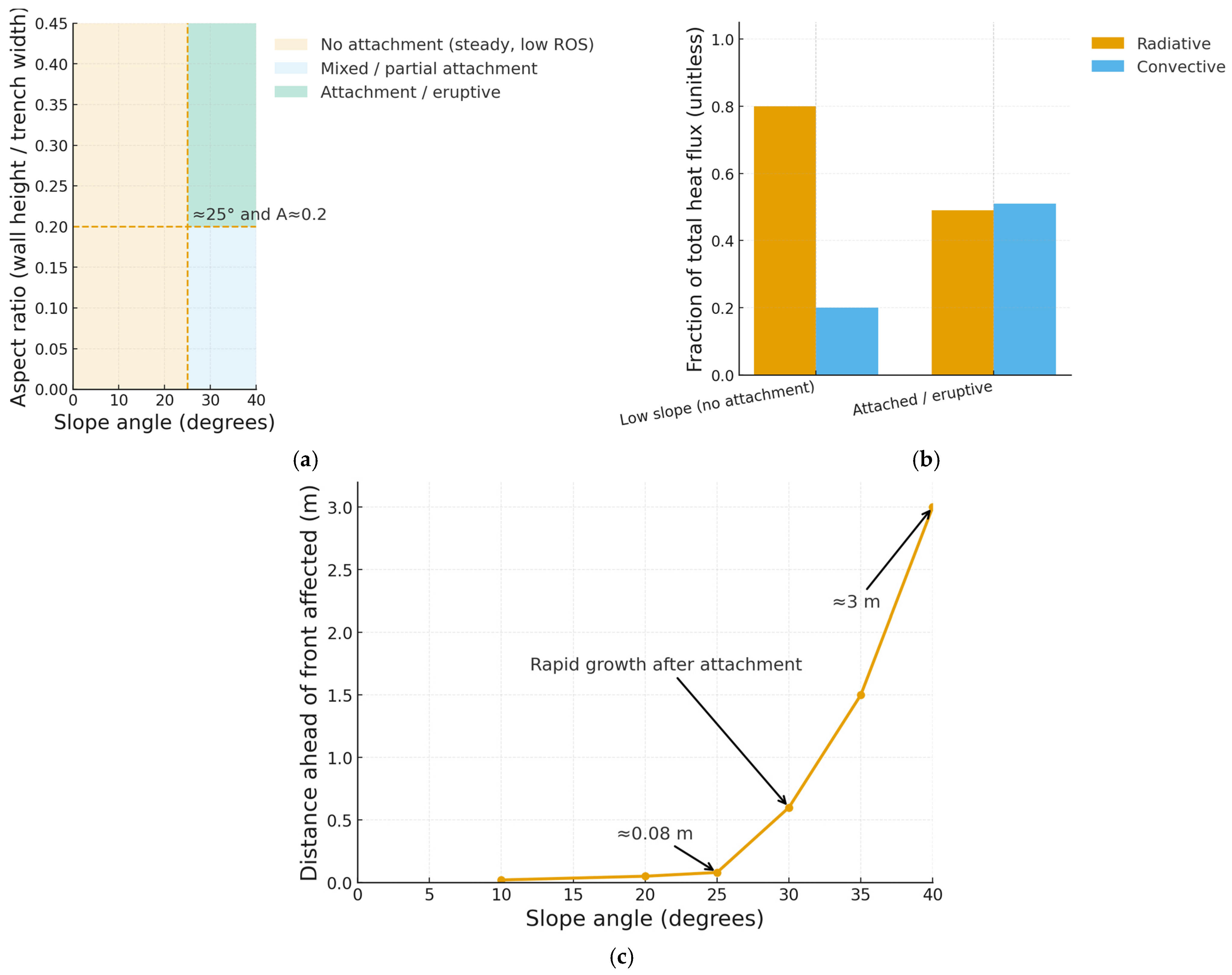
When the slope exceeded approximately 26–30°, flame attachment triggered a feedback loop in which convective heating surpassed radiation, the influence distance of hot gases expanded from about 8 cm at 25° to nearly 3 m at 40°, and the rate of spread accelerated rapidly. Their measurements linked the onset to critical flame depth (order 60 cm) and fireline intensity (order 300 W per metre), offering a mechanistic and experimentally validated criterion for eruption in canyon-like terrain. Complementary bench experiments with a 1.6 m × 0.4 m × 0.2 m trench and 5–10 percent fuel-moisture pine needles, coupled to Fire Dynamics Simulator with Lagrangian Particle and Boundary Fuel models, mapped how slope angle and sidewall inclination govern attachment and heat partitioning [64]. A slope threshold near 15–20 degrees marked the onset of acceleration: below this, propagation was quasi-steady with a rate of spread of less than 0.025 m/s and radiation-dominated fluxes (less than 2.5 kW/m2). Above 20 degrees, convective flux contributed 60–75 percent of the total, flame tilt decreased from approximately 70 degrees to 25 degrees relative to the surface, and fully attached flames formed for vertical sidewalls with a slope of at least 25 degrees, doubling the rate of spread. The joint picture is that confinement plus slope forces attachment, extends the convective preheating zone far ahead of the front, and creates positive feedback between induced flow and combustion intensity that explains eruptive acceleration in gullies and canyons. Figure 4a shows the attachment window as a function of slope and aspect ratio, Figure 4b presents the shift in heat-flux partition from radiation-dominated to convection-dominated at attachment, and Figure 4c illustrates the rapid growth of convective influence distance with slope—from about 0.08 m at 25 degrees to about 3 m at 40 degrees—which precipitates eruption.
Controlled bench experiments show that downslope spread is not uniformly weaker and that interactions between nearby fires on slopes are strongly geometry-dependent. In Pinus needle beds tested at 0, −10, −20, and −30 degrees and at 0.4 and 0.8 kg/m2 areal loads, the rate of spread displayed a non-monotonic dependence on slope: it decreased from level to −20 degrees and then increased again at −30 degrees. Reconstructed combustion interfaces from paired thermocouples remained approximately perpendicular to the fuel bed across all slopes and loads. Radiative measurements showed that radiant heat flux at −30 degrees exceeded that at 0 degrees, which the authors attributed to higher flame emissivity under steep downslope conditions. A quasi-physical heat-transfer model that combined flame radiation, combustion-zone radiation, and convective exchange indicated that radiation dominates preheating, which sustains downslope spread, and that combustion-zone radiation is non-negligible near the flame. Collectively, these results establish that steep negative slopes can re-intensify spread via radiative mechanisms, challenging monotonic weakening assumptions in some operational models [65]. Multi-fire interaction on slopes was examined with dual propane burners on an inclinable apparatus spanning 0–40 degrees, systematically varying spacing, heat-release rate, and layout (side-by-side versus tandem). Interactions fell into three regimes—consistent, intermittent, and independent—as a function of normalised spacing. In the side-by-side configuration, greater slope and larger spacing reduced merging probability owing to enhanced entrainment and slope-induced flow separation. In the tandem configuration, slope promoted merging because upslope convection increased downstream flame attachment. The study also proposed a semi-empirical correlation for zero-spacing flame height as a function of heat-release rate and slope angle, together with an effective wind-speed model that captures coupling between fire-induced slope winds and buoyant plume dynamics. Collectively, the results show how slope controls multi-source flame geometry and merging regimes, with direct implications for clustered wildland fires and urban fire spread [66]. The studies collectively show that downslope spread is non-monotonic—with re-intensification at steep negative slopes driven primarily by radiation—and that fire–fire interactions are slope-dependent, organising into spacing- and layout-controlled merging regimes that reshape flame attachment, geometry, and spread potential.

3.5. Field Plots and Landscape Burns

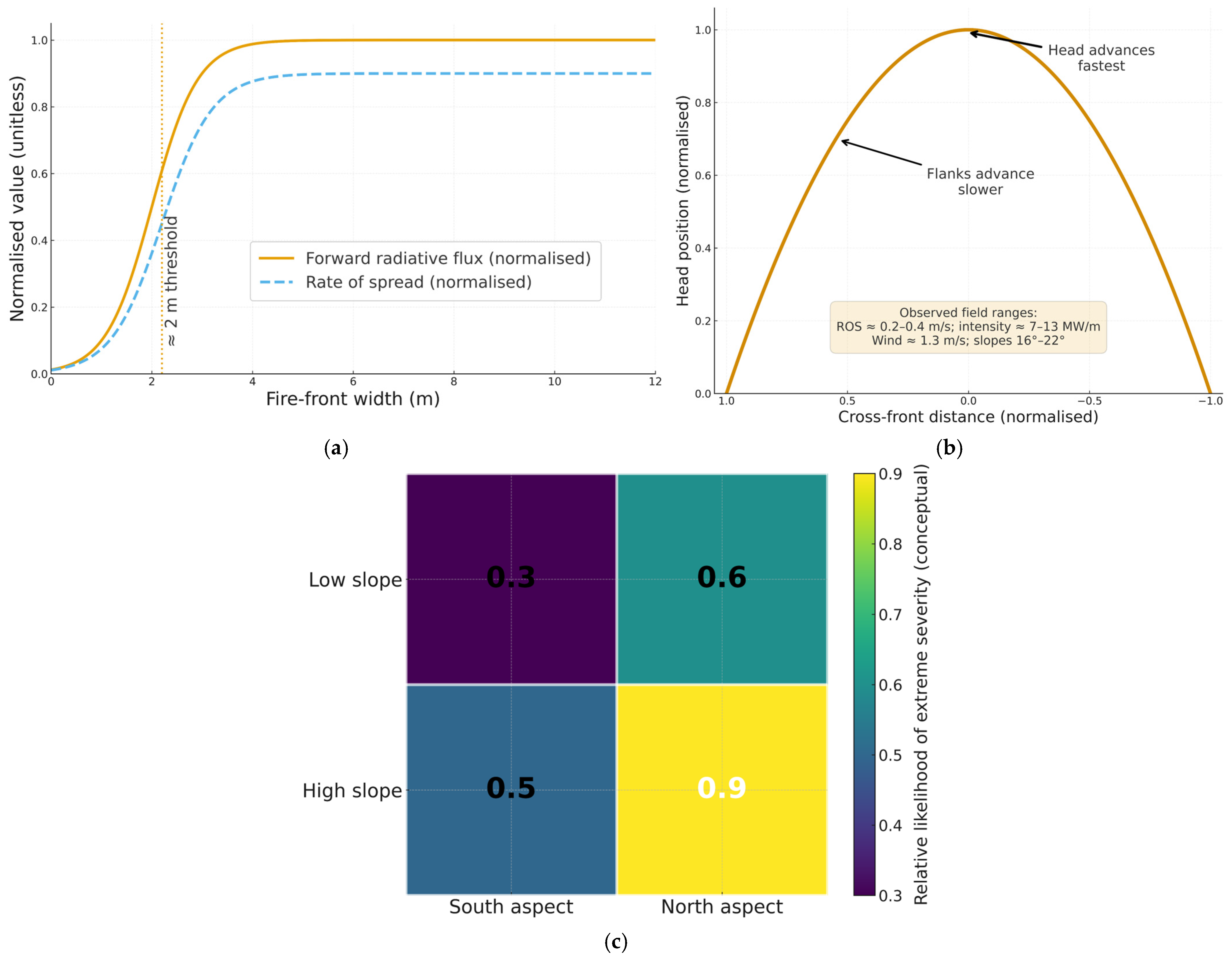
Field evidence complements bench-scale mechanics by revealing how fire-front geometry, terrain, fuels, and wind co-determine spread and severity at operational scales. In a pine plantation under low wind, Wotton et al. [67] varied fire-front width from 0.5 to 10 m and measured rate of spread and forward heat flux using a fixed radiometer 0.5 m ahead of the head fire. Flames were small (about 0.2–0.6 m), and the spread regime was radiation-led. Both measured radiation and rate of spread plateaued once front width exceeded about 2 m, implying that edge effects dominate only for very narrow fronts and diminish rapidly with width; hence, analyses of wind or slope sensitivity should control for front width to avoid confounding [1]. Figure 5a illustrates this field-scale width effect by showing a rapid rise and early plateau in both forward radiative flux and rate of spread as width increases beyond about 2 m, emphasising that additional width confers little incremental spread under low-intensity, radiation-dominated conditions [67].
In high-intensity shrubland burns on 16° and 22° slopes under moderate wind (about 1.3 m/s), ref. [68] integrated drone imagery, heat-flux sensors, and GNSS with the FireStar3D model to quantify rate of spread, fireline intensity, flame geometry, and thermal exposure. Observed rates of spread were 0.2–0.4 m/s, with fireline intensities of 7–13 MW/m, classifying the events as extreme surface fires that are difficult to control even in apparently benign winds. The advancing head adopted a parabolic planform, with the head outpacing flanks due to lateral entrainment and upslope convection; 3D simulations reproduced these features and reduced overestimation of rate of spread by more than 20 percent relative to 2D modelling by capturing finite fireline and cross-flow penetration effects. Recorded total heat fluxes exceeded 50 kW/m2, indicating radiative dominance at high intensity while still reflecting strong convective–radiative coupling on slopes [2]. Figure 5b depicts the parabolic head and faster head-flank contrast derived from drone tracks, alongside a schematic of the 3D flow penetration that FireStar3D resolves, explaining improved agreement with observations [68].
At the landscape scale, ref. [69] examined 15 wildfires in Pinus halepensis using Landsat difference Normalized Burn Ratios with firefighter reports, meteorology, and terrain. Across fires, less arid climates and steeper slopes were associated with a higher proportion of extreme severity, consistent with greater crown biomass and continuity and with enhanced upslope preheating. Within individual fires, north-facing aspects and higher slopes most frequently exhibited extreme severity; crown biomass was a strong positive predictor, and interactions showed that northern aspects with high biomass or high biomass with higher water availability disproportionately shifted pixels into the extreme class. An “alignment of factors” metric (wind aligned with upslope on slopes greater than six degrees) was significant in many fires but did not produce a uniform signal, suggesting that wind dominance can overwhelm local alignment in wind-driven episodes, whereas fuel structure and slope geometry dominate in plume- or terrain-driven cases. These patterns provide an observational baseline for validating spread and severity models and for prioritising fuel treatments on ridges, north-facing slopes, and biomass-rich stands [3]. Figure 5c summarises the severity hot-spot predictors—slope, aspect, and biomass—with a conceptual matrix showing when alignment augments or is eclipsed by wind dominance [69].

3.6. Measurement/Diagnostic Considerations

Reliable diagnosis of wind–slope coupling hinges on how we measure flame energy, heat transfer, and spread—both the strength of eruptive transitions and the systematic biases. First, canopy structure can hide energy from overhead sensors. In a climate-controlled experiment that interposed ponderosa pine branches between a steady radiant source and a nadir infrared radiometer, the apparent fire radiative power (FRP) declined nearly linearly as canopy cover increased from roughly zero to ninety percent, with no difference between live and desiccated branches—implicating pure line-of-sight occlusion. The implication is direct: above-canopy FRP and its time-integrated counterpart (FRE) understate emitted energy, biomass consumption, and apparent intensity in proportion to canopy density; canopy-aware corrections using lidar or leaf-area index should precede model–data comparisons or cross-fuel intercomparisons [70]. Second, for mapping burn severity, dose matters more than peak. Field burns in semi-arid savannahs showed that fire duration and the time integral of temperature correlated strongly with biomass consumed and nitrogen volatilised, whereas peak temperature and fireline intensity were weaker predictors. Post-fire reflectance displayed a bowl-shaped relationship with duration—darker for short-duration, low-severity fires and brighter for long-duration, high-severity white-ash surfaces—and simple visible-to-short-wave infrared ratios outperformed the Normalised Burn Ratio. These findings motivate severity metrics grounded in fire duration and heat dose, and they caution against uniform post-fire albedo assumptions [71]. Near-threshold spread studies double as diagnostics because they expose which measurements control the success or failure of propagation. Live chaparral experiments on an inclinable, elevated bed systematically varied wind, slope, fuel moisture, and packing. Logistic models identified wind speed, slope percent, fuel loading, fuel moisture, and relative humidity as dominant predictors of success, correctly classifying most burns; a companion large-eddy simulation reproduced observed outcomes and illuminated ventilation, convective preheating, and moisture sinks as the physical pathways governing marginal spread [72]. On a large inclinable bench with pine-needle beds, a 109-fire dataset quantified the interplay of slope and active fireline width: upslope fires at 20 to 30 degrees evolved from straight to pointed heads, quasi-periodic flank vortices appeared at 30 degrees, and rate of spread rose sharply with width, with standard operational formulations under-predicting the steep-slope, wide-front cases. Normalising measurement height by an effective flame height unified temperature profiles, and a power-law relation linked body-flame length to fireline intensity—useful targets for model calibration. Sidewalls that blocked lateral entrainment converted pointed heads into straight, fully attached flames and greatly increased spread, isolating entrainment as a key control [73]. Using a one-megawatt calorimetric apparatus at a 20-degree slope, paired total and radiant gauges were used to partition heat flux: the convective fraction decreased from approximately three-quarters to about three-fifths as areal load increased from 0.6 to 1.2 kg/m2, while the radiative fraction increased accordingly; a solid-flame view-factor analysis further separated radiation into a flame contribution of approximately 14–24% and an ember contribution of approximately 12–15%. Because the V-shaped head continually lengthened the front, the heat-release rate did not settle into a steady plateau, providing a stringent transient benchmark for physics-based models [74]. Ignition geometry is itself diagnostic: line, point, and “jump-fire” configurations on the slope produced distinct kinematic signatures in rate of spread, fire-line angle, and residence time that were explained by changes in the centreline radiation field; these signatures define clear validation targets for models that must couple slope-driven attachment with geometry-driven radiant focusing [75]. Finally, when seven spread models were bench-tested against 240 live chaparral fires, wind emerged as the dominant control on spread success, with slope retained as an independent positive predictor of rate of spread; physics-based models consistently matched observations within a factor of two, whereas empirical dead-fuel formulations required ad hoc moisture adjustments and still struggled in moist, dense shrub regimes. This comparison underscores the value of diagnostic datasets that jointly vary wind, slope, and live-fuel properties [76].
Table 1 consolidates all experimental evidence used in this review, spanning still-air slope benches, wind-tunnel and forced-draft facilities, discontinuous-fuel thresholds, trench and canyon (eruptive) configurations, downslope and multi-fire interactions, field plots and landscape burns, and measurement/diagnostic studies, so readers can compare settings, manipulated variables, and important outcomes at a glance, and trace each finding to its modelling or operational implication.

4. Mathematical Analogue Model

Mathematical analogue models idealise wildfire spread as a geometric or probabilistic process on a grid or network. They are computationally light and excel at representing heterogeneity and barriers, but the physics of wind–slope coupling enters only through the local speed or directional bias, not as an emergent flow–flame interaction. Accordingly, the algorithmic family (CA, Huygens/ellipse, level-set, graph/MTT) should be read as a perimeter-propagation method, while the ROS relation embedded within it determines the local wind–slope sensitivity [43,77].

4.1. Cellular Automata and Morphology Analogues (Percolation, Directed Percolation, and DLA)

Cellular automata offer a rule-based, lattice framework for wildfire spread in which local transition rules incorporate wind, slope, and fuel effects to advance the flaming front. Related morphology analogues—percolation, directed percolation, and diffusion-limited aggregation—help interpret spread thresholds, anisotropic elongation, and fingering and perimeter roughness near connectivity limits. This combined section first reviews operational cellular-automaton fire-spread models and then places them within these analogue frameworks to clarify what can be reproduced with simple rules and where additional physics or calibrated direction-dependent spread rates are needed for quantitative prediction.
Operational cellular automata are presented as one of the earliest operational formulations that advance wildfire fronts on a lattice using transparent local rules that encode wind through rotated neighbour weights, slope through upslope bias, fuel ageing and depletion, ignition migration toward active fronts, and a simple spotting trigger tied to local intensity; calibrated against a thermal infrared time series from the NASA ER-2 Daedalus Thematic Mapper Scanner with 26 overpasses at 25 m resolution and a digital elevation model for slope and aspect, this approach reproduces crenulated, lobed perimeters and yields ensemble burn-probability maps suitable for decision support, while openly acknowledging limits such as uniform wind forcing, conduction-only heating, and sensor saturation at high temperatures [27]. Quantitatively, ensembles of 100 realisations under fixed conditions predict more than 50 percent of actually burned pixels with 77.9 percent success, and approximately 37.5 percent correctness when any non-zero probability is counted; when environmental inputs are randomised, pixel-level accuracy for the “likely to burn” class reaches 82.5 percent, the final scar exhibits a perimeter fractal dimension of approximately 1.13 based on a medial-axis analysis of the evolving flaming zone, and the cellular-automaton perimeter surpasses a single best-fit ellipse after roughly one hour—together supporting the interpretation that fractal-like edge dynamics are intrinsic to free-burning spread rather than artefacts of smooth kinematic fits [27]. Duarte frames ignition and spread as a local-rule cellular automaton whose behaviour ranges from extinction to sustained propagation depending on fuel connectivity and wind bias, thereby demonstrating—in the windless limit—that the rules reduce to undirected site or bond percolation in which sustained advance occurs only when a connected burnable cluster exceeds a critical occupation level, and—with wind—that anisotropic transition probabilities elevate downwind and upslope advancement while suppressing upwind and downslope ones, mapping to directed percolation with elongated head-fire shapes and faster downwind progress but without explicit heat-flux physics; the study delineates phase transitions between extinction and self-sustained spread, identifies lattice artefacts such as grid imprinting and spurious diagonal preferences arising from neighbourhood and update choices, and concludes that while cellular-automaton and percolation-inspired rules are efficient for exploring connectivity, thresholds, and morphology in heterogeneous fuels under wind, quantitative rate-of-spread, and credible wind–slope coupling require additional physics or empirically calibrated directional speeds, motivating later adoption of kinematic eikonal and minimum-travel-time graph methods for prediction [78].
Percolation as a baseline analogue is tested explicitly by Beer, who asks whether wildfire advance can be represented on a lattice such that spread occurs only when a connected cluster of burnable sites spans the domain above a critical occupation probability; in this site or bond percolation framing, fuels are abstracted to occupied or vacant cells, ignition is applied at a boundary, and spread is equivalent to the existence of a continuous occupied path [79]. This formulation cleanly isolates what percolation captures and what it does not: it reproduces threshold behaviour—below the critical occupation probability, spread dies out; above it, a spanning cluster sustains growth—and it yields rough, fractal-like perimeters whose cluster statistics resemble some wildfire scars near marginal connectivity, as expected from percolation theory [79,80]. However, Beer shows that pure, isotropic percolation fails quantitatively once realistic heat transfer governs advance: near- and far-neighbour heating by convection and radiation introduces directional bias, memory, and time-dependent feedbacks that static percolation lacks, so measured critical conditions, growth rates, and anisotropy in laboratory and field burns diverge from percolation predictions even when the perimeter appearance is similar [79]. Adding a simple wind bias improves qualitative realism but still lacks a thermodynamic scale—there is no flame attachment, no accumulation of heat flux across gaps, and no mechanistic spotting—so percolation remains a qualitative analogue of connectivity rather than a predictive rate-of-spread model. The practical implication is clear: use percolation to understand thresholds, morphology, and lightweight “what-if” connectivity, but do not use it to estimate rate of spread or wind–slope interactions without augmenting it with biassed transition rules or heat-flux terms; this limitation helped push the field toward reaction–diffusion or eikonal fronts and minimum-travel-time graph approaches where physics enters through directional speed functions [79].
Directed percolation with anisotropy is a nonequilibrium spreading process with a privileged propagation direction and an absorbing state, making it the appropriate universality class for biassed advance such as downwind or upslope fire spread. In this framework, activity (burning) either proliferates or dies out depending on a control parameter that balances local activation against deactivation; if deactivation prevails, the system falls irreversibly into an inactive absorbing configuration, whereas if activation dominates, it approaches a stationary active phase with scale-invariant spatiotemporal correlations at the transition. Interpreting the directed axis as time yields a dynamic picture: local binary states update stochastically from one time layer to the next, and critical behaviour is characterised by universal exponents distinct from isotropic percolation because anisotropy breaks rotational symmetry (i.e., spatial and temporal correlations scale differently). Practically, this means biassed connectivity produces elongated, head-fire-like clusters and absorbing-state transitions that map well to wind- or slope-forced spread, while also explaining why directed-percolation thresholds and exponents differ from those of isotropic percolation. Within cellular-automaton implementations, the same physics is captured by probabilistic local rules and can be recast as a reaction–diffusion scheme with spontaneous extinction, diffusion, offspring production, and coagulation, all evolving toward or away from the absorbing state as bias and connectivity vary. This CA view clarifies how neighbourhood choice and update schemes influence artefacts, while the directed-percolation perspective provides the scaling language for phase identification and finite-size analysis in biassed spread models [78,81].
Diffusion-limited aggregation (DLA) as tip-driven growth is presented as a morphological analogue in which random walkers adhere upon first contact with a growing cluster, producing tip-enhanced branching, fjords, and fractal perimeters; anisotropic and multi-seed variants connect naturally to wind- or slope-biassed fingering and to multiple ignitions. DLA rationalises why wildfire perimeters exhibit fingered protrusions and voids under strong directional forcing or heterogeneous fuels and supplies compact fractal diagnostics for comparing simulations and observations. However, because DLA lacks energy transport, plume–terrain interaction, and mechanistic ember dynamics, its role is diagnostic and illustrative rather than predictive of spread rates or regime transitions; it is best paired with cellular automata for rapid screening and with kinematic or minimum-travel-time graph models when calibrated directional rates are required for forecasting [82,83,84].

4.2. Network/Graph Models and Stochastic Spotting

Network and graph formulations recast fire growth as movement over a spatial network, with edges carrying travel times derived from directional rate-of-spread; this “minimum-travel-time” perspective—introduced for wildland fires by [77]—suppresses wavelet artefacts, parallelises for large landscapes, and provides a stable substrate for probabilistic forecasting when physics enters through per-cell speeds [77]. When nonlocal ember transport is important, graph models are naturally extended with stochastic long-range links to represent spotting, so contiguous spread and jump processes can be handled within one framework.
A complementary long-horizon strategy uses climatology to construct “probable extent” without resolving each day’s synoptic evolution. In ref. [85], daily directional spread probabilities are derived from decades of weather and standard fire-behaviour relations; multiplying by a persistence probability tied to seasonal fuel dryness and accumulating cell-wise yields multi-week probability envelopes that align with the distribution of perimeters from many deterministic runs, while computing from 10 to approximately 100 times faster. The same study shows a realistic reach in complex parkscapes (for example, Wood Buffalo National Park), together with systematic tendencies to overstate very large, rare outcomes and to understate smaller, common ones—an artefact of most-probable-path assumptions and simplified initial burning conditions [85].
Because nonlocal transport governs extreme growth, operational models also require a defensible upper bound on spotting reach. Rather than full computational fluid dynamics, ref. [86] decomposes the process into measurable sub-models—flame geometry and tilt for fireline intensity, buoyant plume rise, a canopy wind profile with height, and a burning-rate law for cylindrical char fragments—and then advances a firebrand trajectory analytically from plume exit to canopy re-entry. Under high flames and strong winds, kilometre-scale spotting emerges as physically plausible, with results consistent with published observations at an orders-of-magnitude-lower cost than CFD; scope limits are explicit (flat terrain unless GIS tracking is added, conifer canopies rather than bark-shedding eucalypts, no ignition probability or spot counts) [86].
At incident to multi-week horizons, ensembles built atop fast two-dimensional perimeter advancement show that future-weather uncertainty dominates planning accuracy. In an operational framework, ref. [87] simulates daily energy-release trends and sample wind speeds and directions from historical joint distributions (injecting short-range forecasts when available), and runs hundreds to thousands of realisations over mapped fuels and topography. Pre-computed surface and crown spread, intensity, and spotting-reach tables enable practical runtimes; verification against 91 U.S. fires (2007–2009) shows consistent correspondence between observed perimeters and ensemble probability envelopes, a tendency for the ensemble mean area to exceed observations while the maximum extent is often underestimated, and steadily improving precision with larger ensembles [87]. The same principle—forecast what is probable, not a single perimeter—appears in independent front-tracking workflows. Using ForeFire, ref. [88] assigns probability distributions to wind speed and direction, dead-fuel moisture, fuel-model parameters, ignition location and time, and simulation end time; propagates uncertainty via hundreds of Monte Carlo runs; and evaluates burn-probability maps with Brier scores, reliability and sharpness diagrams, and a rank histogram adapted to binary burned/not-burned events. Performance is fair in some cases and weaker in others, with dominant errors traced to wind forecast quality and uncertainty about the fire end time used for verification; critically, the system remains computationally feasible at the scale of hundreds to thousands of CPU cores [88]. In a landscape-scale incident (Tavira, Portugal), ref. [89] shows that a 100-member FARSITE ensemble—built by perturbing hourly wind, daily relative humidity, ignition location, and rate-of-spread adjustments—produces burn-probability and time-of-arrival maps that better anticipate where and when the fire is likely to arrive than single deterministic runs, particularly during the most active growth period; re-initialisation with moderate-resolution satellite detections does not consistently improve forecasts because of pixel geolocation and sub-pixel front errors [89]. Earlier, ref. [90] demonstrated the value of injecting both random minute-scale variability and systematic forecast bias into a deterministic, eight-point, cell-based simulator (Canadian FBP System) and aggregating many runs; case studies showed clearer communication of confidence and risk than any single realisation and highlighted how intra-hour variability can materially change hourly rate-of-spread projections.
Because uncalibrated ensembles often overstate burn probability and spread too widely, a compact a posteriori correction can materially improve reliability. Ref. [91] compares each simulated burned surface to the observed one using a Wasserstein-distance pseudo-likelihood that penalises area and spatial mismatch, then samples the posterior of uncertain inputs with Metropolis–Hastings accelerated by a Gaussian-process surrogate. Calibrated ensembles exhibit lower Brier scores, sharper forecasts, and better reliability by selecting a slightly lower rate of spread and a tighter wind-direction spread, all without changing the base simulator [91]. Decision triggers for evacuation can be posed on the same network substrate as a probabilistic arrival problem. In ref. [92], each cell stores the time needed for fire to reach a specified exposure if ignition occurred at that cell; these times are evolved with a minimum-travel-time solver under time-reversed weather and wrapped in an ensemble that perturbs inputs at each weather step. Applied to the 2017 Tubbs Fire, probabilistic buffers revealed medium-to-high-impact probabilities along flanks that deterministic buffers underplayed, directly informing resource pre-positioning and evacuation timing.
Complementing these simulation-based approaches, empirical network-style risk engines learn spread likelihoods from historical pathways. In the Sydney region, ref. [93] fit a binomial spread model to past fires and mapped, for any asset, the probability of fire arrival as a function of distance, ignition density, proportion of forest, time since fire, and fire-weather indices; implemented as the WildfireRisk package (version 0.1.15), the workflow also recomputes probabilities under hypothetical fuel treatments to prioritise blocks that most reduce asset-weighted risk. The method is fast and transparent, though weather is represented coarsely and fuels are simplified.

4.3. Reaction–Diffusion and Eikonal/Level-Set Fronts

Reaction–diffusion and eikonal/level-set formulations treat wildfire spread as the evolution of a front whose motion is governed locally by ignition thermochemistry and heat transport (reaction–diffusion) or, in the geometric limit, by a direction-dependent speed field (eikonal/level-set). These approaches are valuable because they make explicit what physics is retained (e.g., heat release, diffusion, advection, radiation) and what is abstracted into a front speed, thereby clarifying when a full reactive-flow treatment is required and when a kinematic propagation law suffices.
A fully coupled canopy-fire model demonstrates the power—and the computational cost—of an explicitly thermochemical treatment. Marzaeva analyse running crown-fire propagation across fire breaks and hardwood barriers using a height-integrated, Reynolds-averaged reactive-flow model for a porous, two-phase canopy, with turbulence, pyrolysis, gas-phase combustion, radiation, and interphase exchange solved by control-volume discretisation with operator splitting [94]. The model produces time-resolved velocity, temperature, oxygen, and volatile-fuel fields and is exercised systematically across wind speeds of approximately 7–11 m/s, canopy moisture, and barrier width and placement. The results are operationally interpretable: minimum break or barrier widths that prevent bridging as functions of wind and moisture; and process diagnostics showing that drier fuels and stronger winds extend the thermal and pyrolytic footprint far enough to re-ignite beyond narrower gaps, whereas wider gaps or wetter canopies collapse the heat budget and halt advances. In short, the study offers a transparent, physics-grounded explanation for barrier efficacy and converts it into design curves that can inform proactive fuel-break planning and tactical “will-it-hold” assessments under forecast conditions [94].
Bridging geometric ellipse models and partial differential equation theory, Margerit provides a rigorous derivation that places Richards-type elliptical growth inside a Hamilton–Jacobi framework and then within classical reaction–diffusion limits [95]. Margerit rewrites Richards’ elliptical law as a variational wavefront problem in which the forest is represented by three local states (unburnt, burning, burnt) and the fireline is treated as a propagating front. Solving the associated Hamilton–Jacobi equation reproduces the elliptical solution exactly, showing that the familiar ellipse is a geometric solution of an eikonal-type front equation rather than an ad hoc construction. The work then posits that the front coincides with an ignition-temperature isotherm and derives companion hyperbolic and parabolic reaction–diffusion forms in which reaction terms supply heat and diffusion/advection transport it; under stated assumptions, the reaction–diffusion system collapses back to the elliptical wave solution. This clarifies that the “physics” enters primarily through the chosen ignition isotherm and the specification of local directional speeds. The scope is thereby delineated: heterogeneity and barriers can be accommodated through spatially varying coefficients, but feedbacks such as nonlocal radiation, turbulence–flame coupling, and slope-induced attachment lie outside the geometric analogue [95].
Extending the geometric front to jointly capture wind and slope within one anisotropic law, Ángel Javaloyes and co-authors introduce a kinematic framework that computes fronts either as solutions of ordinary differential “geodesic” equations or, equivalently, as solutions of a partial differential orthogonality system that generalises Richards’ ellipse [96]. Inputs are a terrain surface, an initial ignition curve, and direction-dependent speed parameters; outputs are front trajectories and burned sets computed in real time. The authors show wind-dominated versus slope-dominated patterns, robust removal of crossovers (cut points), and flexibility to handle time-varying winds, heterogeneous fuels, and complex topography; validation is mathematical and constructive (reductions to known cases, convexity and causality conditions, and worked computations) rather than calibration to laboratory or field burns [96]. The innovation is practical: the model removes the restrictive purely elliptical assumption, separates wind and slope cleanly within one front law, and remains fast enough for operational use cases where a calibrated directional-speed field is available [96].
Table 2 presents a consolidated map of mathematical analogue models used in this review. For each study, the table states what the model is, what goes in, what comes out, what it is best used for, and the most important caveats for interpretation.

5. Empirical and Quasi-Empirical Models

Empirical and quasi-empirical models estimate head-fire rate of spread from a small set of measurable drivers—typically open wind speed, dead fine-fuel moisture, simple structural descriptors, and a slope adjustment—providing fast, fuel-class-specific predictors for planning, training, and incident operations [97,98]. This parsimony supports operational use, but treating wind and slope as independent can miss coupled behaviours such as flame attachment, V-shaped head-fire geometry, and eruptive transitions. Transparent toolchains that expose inputs, intermediate calculations, and validity bounds help users apply these relations appropriately and recognise when conditions approach known limits.

5.1. Empirical Models (Canonical Empirical ROS Models: Rothermel, McArthur, FBP, and CSIRO)

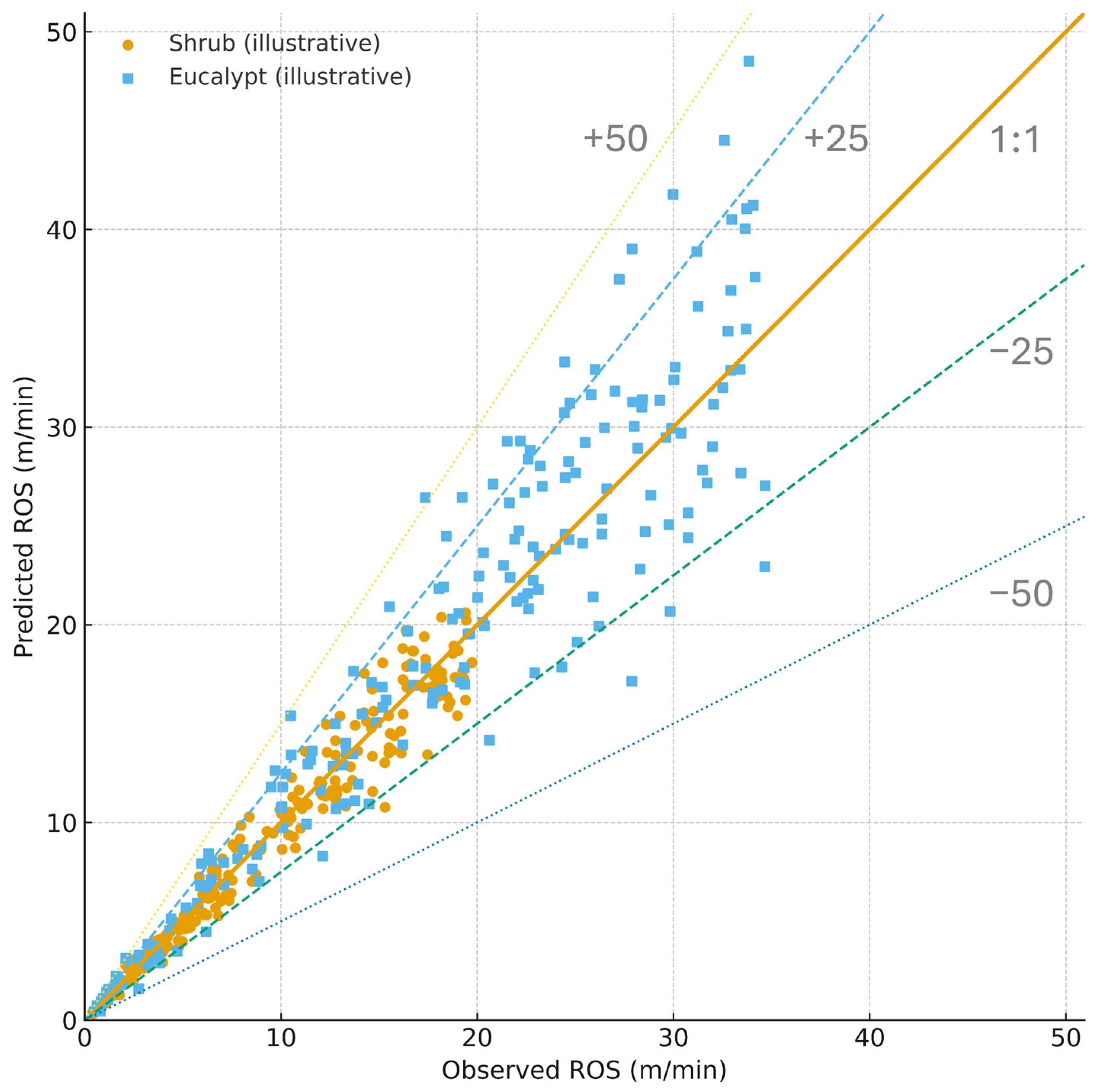
The canonical families—Rothermel-based surface-fire relations, McArthur’s forest and grass metres, the Canadian Fire Behaviour Prediction (FBP) System, and CSIRO’s fuel-type models—encode wind, moisture, structure, and slope in compact forms that have been vetted through wide operational use [97,98]. Across these families, wind and dead fine-fuel moisture consistently dominate variability in rate of spread, with simple structure descriptors sharpening predictions within a given fuel complex; slope effects are usually incorporated as a standard adjustment rather than a learned interaction, which aids portability but can miss coupled wind–slope regimes under severe conditions [98]. Figure 6 Evaluation-style observed versus predicted rate of spread (ROS) schematic (illustrative). Scatter points differentiate shrub and eucalypt cases and are plotted against 1:1, ±25%, and ±50% reference bands, mirroring evaluation diagnostics commonly reported for empirical ROS models. Values are expressed in m/min and are intended as a schematic visual aid rather than a dataset-specific calibration.
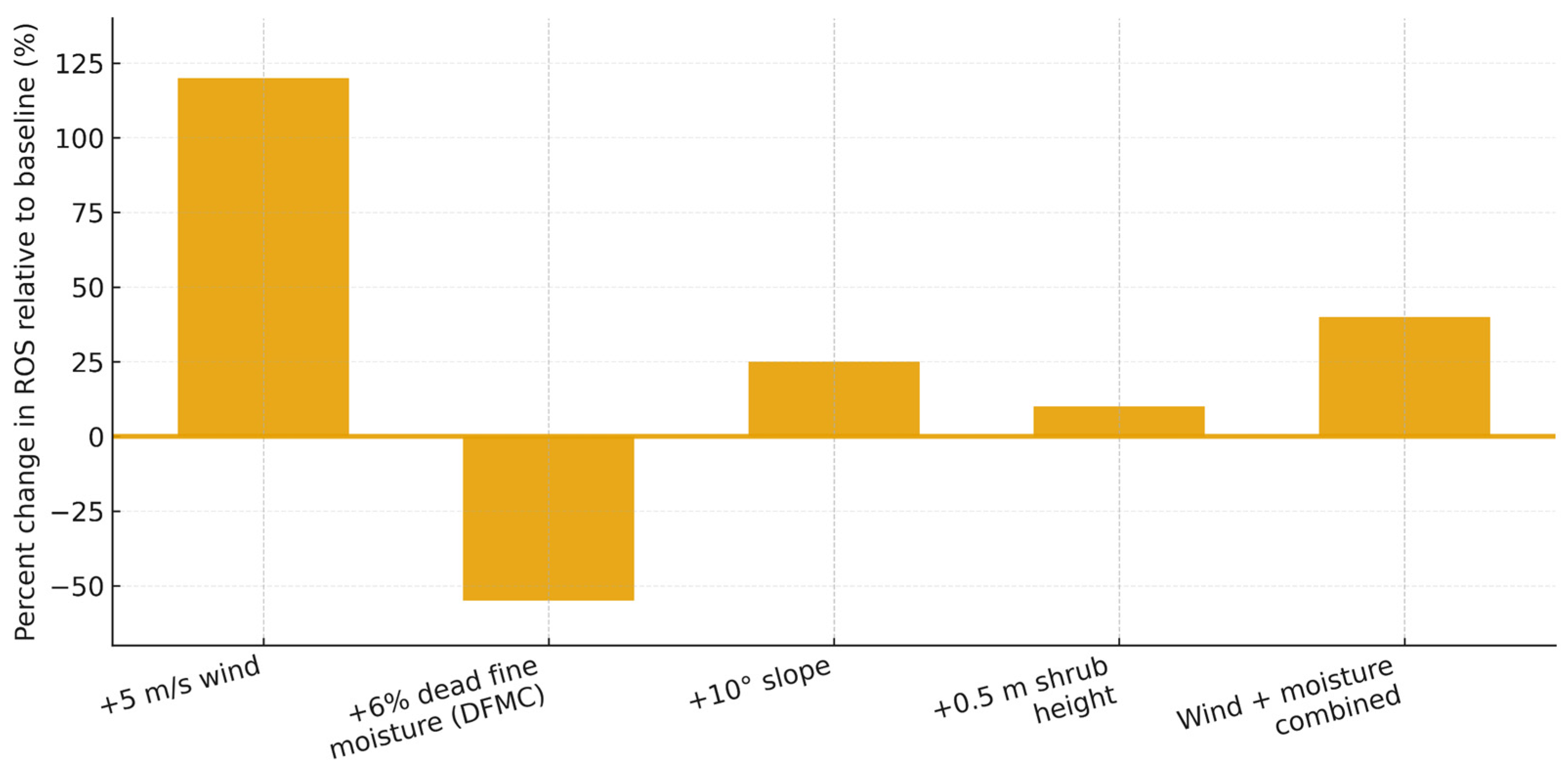
A portable shrubland formulation developed from a multi-region database spanning Australia, New Zealand, Europe, and South Africa identifies two-metre wind speed and dead fine-fuel moisture as primary controls, with parsimonious structure metrics—vegetation height with or without live moisture, or bulk density—improving fit. The authors provide a 10-metre wind expression via a reduction factor, report mean absolute errors of approximately 3.5–9.1 m/min on independent evaluations, and introduce two practical corrections: an elevated dead-fuel moisture model and an ignition-line-length adjustment for short line ignitions. Stated limits include the omission of explicit slope terms, practical difficulty of bulk-density measurement, and under-prediction at very high spread in the height-only variant [99]. In a complementary Portuguese shrubland dataset, rate of spread is represented as a calibrated baseline multiplied by an exponential wind amplification at two metres, an exponential damping with elevated dead-fuel moisture, and a vegetation-height factor raised to a fitted power; calibration on level terrain and generalisation to an independent set support use from prescribed-burn to moderate wildfire conditions, while sparse data above approximately 6 m/min and the lack of slope terms set clear bounds [100]. Figure 7 summarises the sensitivity of empirical rate of spread to single-factor and combined perturbations around a baseline input set (schematic, illustrative). Bars report the percentage change in predicted ROS relative to baseline for a 5 m/s increase in wind speed, a 6% increase in dead fine-fuel moisture, a positive slope of 10 degrees, a 0.5 m increase in shrub height, and a combined wind–moisture case. The horizontal line at zero, rendered in the same colour as the bars, marks no change in ROS. The schematic highlights the dominant amplification from wind, the strong damping from additional dead-fuel moisture, and secondary contributions from slope and structural height.
For dry eucalypt forests, a modern forward model reconciles low- to extreme-intensity behaviour by combining Project Vesta experiments with large-sample wildfire observations and by structuring prediction into phase-dependent modules that represent surface or near-surface spread, understorey effects associated with bark, and high-intensity regimes where short-range spotting influences advance. The framework embeds wind at two or ten metres with a reduction factor, fine dead-fuel moisture through alternative functions, structure scores and height, a drought-factor proxy for long-term dryness, and slope. The percentage error in development is typically one-third to one-half, and on wildfire evaluations, error decreases as rate of spread increases, often below approximately 30 percent once spread is moderate to high [101]. Closely related eucalypt work derives potential head-fire rate of spread and flame height specifically for established line ignitions using 10-metre wind, dead fine-fuel moisture, near-surface fuel height, and fuel-hazard metrics; defensible use is codified; for example, early over-prediction is expected for point ignitions until head width exceeds approximately 120 m, averaging over at least 30 min is recommended for comparisons, and reliability diminishes at short time scales or in topographic wind hotspots. The same study documents ignition-geometry effects with operational consequences: longer line ignitions spread faster, and transient coalescence can temporarily increase spread by up to approximately two and one-half times before relaxing toward quasi-steady behaviour [102]. From an operational-systems perspective, BehavePlus assembles the canonical empirical and quasi-empirical relations—most prominently the Rothermel surface-spread model with wind and slope adjustments—into transparent worksheets that support sensitivity analysis and scenario exploration for planning, training, and research. Strengths include breadth, clarity, and traceability of assumptions; limitations include point-based uniformity, maintenance complexity, and the need for stronger spatial integration so users apply equations within valid domains, particularly under extremes [97]. Field deployment has been strengthened by a mobile application that packages the same relations in an offline, GIS-aware workflow and reproduces BehavePlus outputs without significant discrepancy across 1272 random input combinations for rate of spread, flame length, crown activity, and scorch height, while enabling rapid “what-if” exploration of wind, moisture, slope, and canopy effects [103].
Within the Australian landscape of models, a definitive technical review standardises 22 operational head-fire formulations across fuel types. Beyond cataloguing equations, inputs, development datasets, bounds of applicability, and behaviour, it recommends best-practice models for near-term use and identifies others for retirement based on bias, instability under extremes, or mismatch to fuel complexes. This guidance reduces misuse and clarifies expectations when conditions approach the limits of validity [98]. In semi-arid mallee-heath shrublands, an empirically derived framework links logistic regressions for sustainability of spread and probability of active crowning with separate nonlinear regressions for surface and crown rate of spread and a calibrated flame-height relation. Across sixty-one large experimental burns with independent checks, sustained spread is primarily moisture-limited, with wind acting secondarily; active crowning is chiefly wind-driven; and both surface and crown rates increase roughly linearly with wind while decaying exponentially with fuel moisture. A blended rate near the crowning threshold improves robustness under marginal conditions, with correct classification of approximately 75–79 percent for go/no-go and crowning and mean absolute percentage errors of approximately 53–58 percent for rate of spread [104].
Wind and dead fine-fuel moisture consistently explain most variability in head-fire rate of spread, while simple structural metrics (for example, vegetation height or bulk density) improve fit within a given fuel complex. Slope is usually represented through a standard adjustment rather than a learned interaction, a choice that supports portability across fuel types but can miss coupled wind–slope behaviours under severe conditions. Operational progress has come from explicitly accounting for ignition geometry and phase transitions, adopting modular model architectures that permit targeted updates to moisture and drought-factor sub-functions, developing portable shrubland formulations with documented error characteristics and practical corrections, and deploying transparent toolchains that preserve traceability while enabling rapid, incident-relevant sensitivity analysis.

5.2. Quasi-Empirical Models

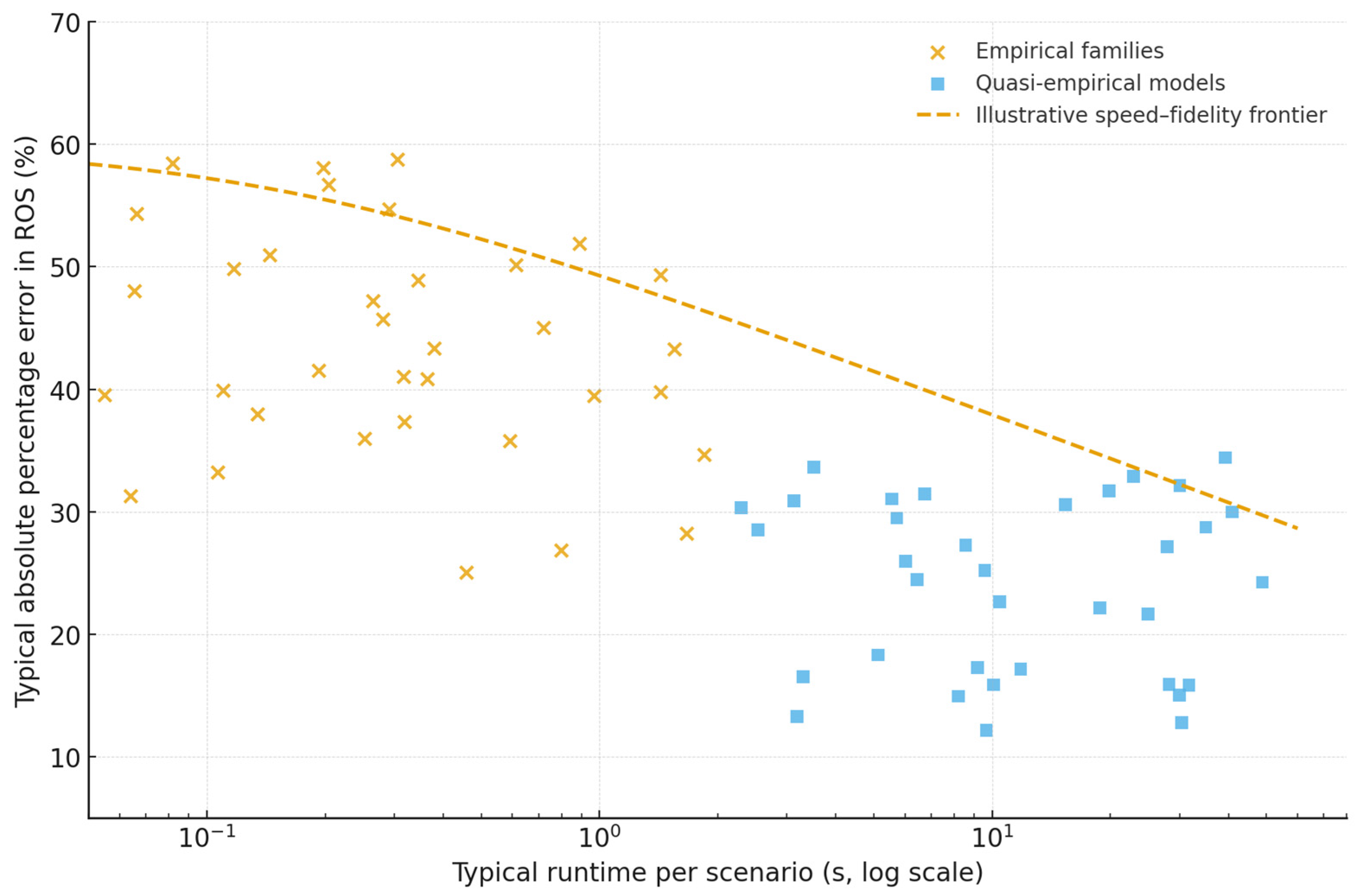
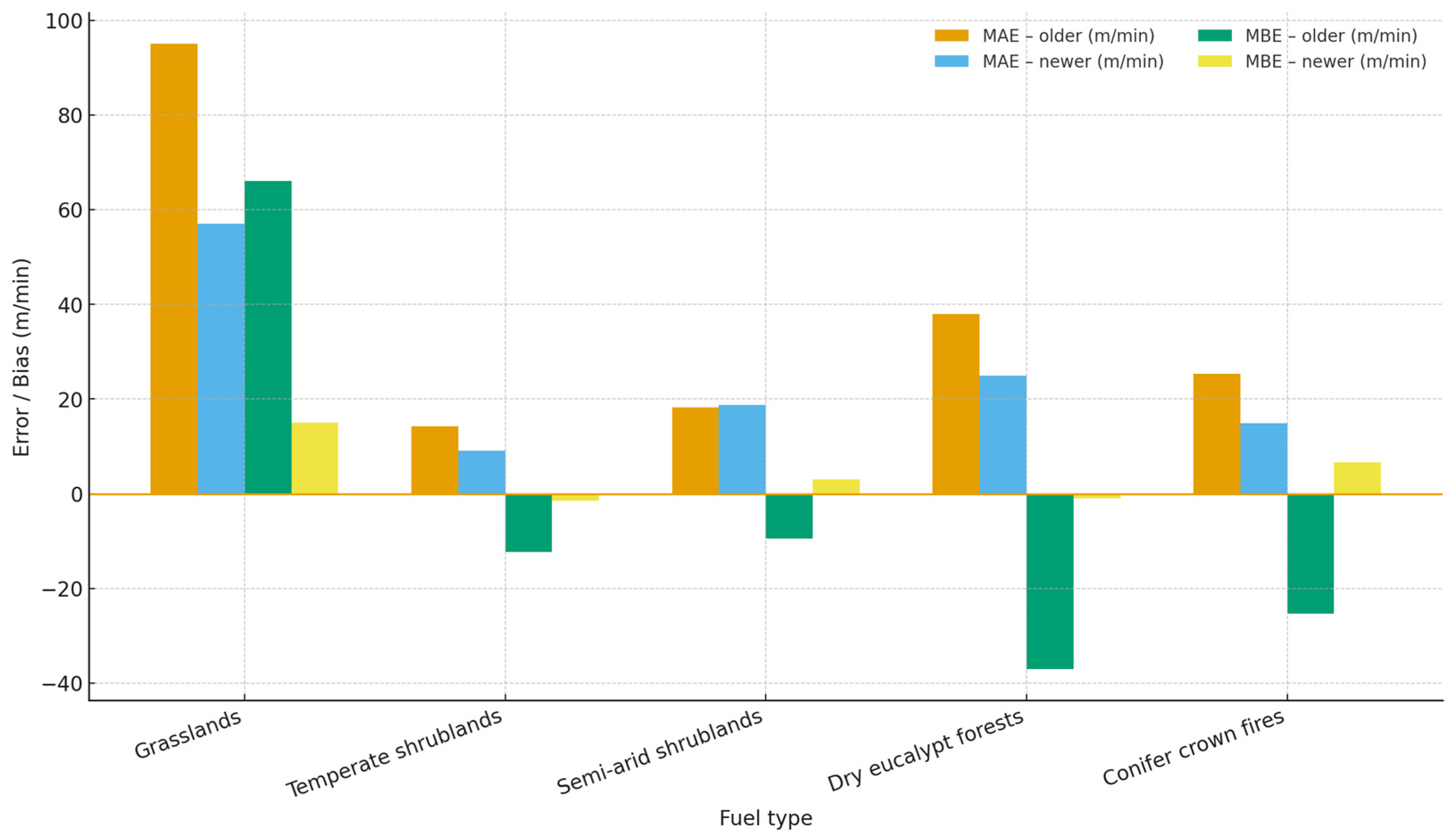
Quasi-empirical models are fast, operational fire-spread predictors that sit between purely empirical rate-of-spread (ROS) relations and physics-based simulators, retaining data-driven parsimony while introducing limited structure (e.g., surrogate modelling, data assimilation, or minimal fuel-element physics). They preserve the transparency and speed of data-driven prediction but add light structure—either by learning compact surrogates of complex simulators, assimilating sparse observations to recalibrate forward runs in real time, or embedding minimal geometry and heat-transfer rules at the fuel-element scale. The aim is operational leverage: predictions that are fast, interpretable, and straightforward to tune, while remaining consistent with dominant drivers such as wind, dead fine-fuel moisture, and basic structure metrics. As shown in Figure 8, quasi-empirical models occupy an intermediate region on a speed–fidelity spectrum: they require more runtime than canonical empirical families but typically achieve lower absolute percentage error in rate of spread, reflecting the added structure from surrogates, data assimilation, or minimal fuel-element physics.
A representative surrogate approach maps initial meteorological conditions directly to fire growth, foregoing repeated ensemble runs. Trained against thousands of five-hour Spark simulations across nine Tasmanian bioregions, a reduced functional form captured the time evolution of burned area using only temperature, relative humidity, and wind speed, after a one-at-a-time sensitivity screen ranked their influence (relative humidity strongest, wind second, temperature weakest). Calibrated by nonlinear least squares with hold-out validation, the all-Tasmania model achieved correlations near 0.90 to simulator outputs, while bioregion-specific surrogates often exceeded 0.98. Documented limits include overestimation under extreme inputs, omission of shape metrics, and unmodelled parameter interactions in complex terrain [105]. For incident triage and rapid risk screening, this design offers a defensible first pass before committing resources to slower, high-fidelity workflows.
Real-time calibration layers push the same philosophy into operations by correcting forward simulations with verified observations. An arrival-time assimilation method embedded in Wildfire Analyst estimates fuel-specific multiplicative adjustments to rate of spread by solving a single, non-recursive least-squares problem against firefighter-validated arrival times at control points. Demonstrations on two Catalonia wildfires reduced timing errors materially and aligned simulated perimeters with observed progression on operational time scales, while retaining the speed and interpretability of Rothermel-based engines driven by dynamic winds (e.g., WindNinja) and hourly weather updates [106]. In practice, this produces a transparent, lightweight bias-correction that quantifies uncertainty and improves confidence without sacrificing runtime. At the fuel-element scale, a semi-empirical “ignition-zone” framework resolves spread as element-to-element ignition governed by flame–fuel overlap. Single-leaf ignition, growth and decay measurements are scaled to field conditions using standard convective heat-transfer relations (for example, Reynolds–Prandtl–Nusselt closures) and simple flame-merging rules; group flame height, tilt and merging are then calibrated and validated in an open-roof wind tunnel for shrub fuels (manzanita). The model captures convective dominance, moisture and geometry effects, and sensitivity to three-dimensional arrangement that bulk-bed formulations miss, while remaining computationally light enough for rapid exploration and potential embedding as a sub-model in operational tools [107]. Methodologically, it exemplifies quasi-empirical design: minimal physics to enforce realism, parameters anchored in laboratory evidence, and outputs tuned to field-scale behaviour.
A vetted operational heuristic states that forward rate of spread is approximately one tenth of the 10 m open wind speed when both are expressed in the same units. Tested across temperate shrublands, Australian dry eucalypt forest, and North American conifer forest, the rule performs best under dry fuels and strong winds, giving mean relative errors below 50 percent with low bias. It is not intended for grasslands, tends to over-predict in moist or weak-wind conditions, and does not encode slope, but it provides a transparent first approximation when inputs or tooling are constrained [108]. The next subsections address wind–slope parameterisations and performance against independent observations.

5.2.1. Wind and Slope Parameterisations: Forms and Interaction Caveats

Operational ROS tools typically encode wind and slope through compact parameterisations that trade physical completeness for speed and portability. Four issues recur: how the wind effect scales across fuels, whether any upper “cap” on wind response is defensible, how wind and slope should be combined (scalar versus vector rules), and how complex-terrain winds should be diagnosed and downscaled for use as inputs. This subsection synthesises representative solutions and caveats in that order.
A cross-fuel wind factor was proposed to address the lack of a general, field-tested function that can multiply a no-wind ROS baseline. The factor depends on wind speed, combustion rate in still air, and flame extension above the fuel bed. Fitted to 216 laboratory burns and stress-tested against approximately 461 independent laboratory and field cases, it shows good overall agreement and clear physical interpretability: shallow beds with taller flames above the fuel exhibit stronger wind amplification, whereas tall, live-rich fuels show a muted response. The formulation assumes separability between the no-wind and wind components and recommends practical corrections such as accounting for ignition-line length when comparing against external datasets, yielding a portable multiplier that pairs with many baseline ROS relations [109]
Re-examining whether a hard wind-speed limit should be imposed, a first-principles derivation and sensitivity analysis demonstrate that enforcing a cap embedded in the classic surface-fire model can spuriously suppress predicted spread in both low- and high-intensity scenarios. Using BehavePlus experiments across standard fuel models and curing levels, and drawing on historical wildfire evidence, the study shows that the apparent “spread decay at very high wind” is better explained by partial curing and fuel mosaics than by a physical limit. The operational guidance is explicit: do not impose either the original or a revised cap in spread calculations; only in the rare case where a computed ROS exceeds the effective mid-flame wind should the output be limited at that wind to avoid unphysical results. This improves robustness of Rothermel-based systems under severe wind [110].
How to combine wind and slope remains a major source of divergence among models. A formal review contrasts scalar multipliers with vector combinations, clarifies coordinate conventions, distinguishes base from wind-induced ROS, and sets out how spread vectors are constructed. The unified notation reveals where popular formulations differ in directional response and magnitude as wind and slope vary, and it highlights limits of point-functional assumptions when transverse convection or dynamic coupling is important [111]. Complementing this theory, laboratory work on a 30-degree inclined Pinus pinaster needle bed derives closed-form expressions for the deflection angle and the normalised speed when wind and slope are not aligned. The experiments reveal multiple “standard spread directions” along evolving perimeters, demonstrating when purely additive or aligned rules fail and motivating direction-aware parameterisations [112].
For rapid decision-making when inputs or tooling are constrained, a vetted heuristic states that forward ROS is approximately one tenth of the open wind at 10 metres when both are expressed in the same units. Evaluated across temperate shrublands, Australian dry eucalypt forest, and North American conifer forest, the rule performs best under dry fuels and strong winds, with mean relative errors below 50 percent and low bias. It is not intended for grasslands, tends to over-predict under moist or weak-wind conditions, and does not encode slope, but it offers a transparent first approximation that aligns with published error bounds [108].
Because parameterisations depend on the quality of wind inputs in complex terrain, recent observational work compares a traditional stationary decomposition against a time-varying-mean treatment for high-frequency (10 hertz) mountain-top winds. Adopting a time-varying mean substantially reduces the apparent prevalence of nonstationarity and changes derived turbulence intensities, gust factors, and integral length scales. The analysis also documents multimodal wind-direction structure, shows that gust factors depend jointly on wind speed and turbulence intensity, and finds unexpectedly large vertical scales in speed-up corridors—evidence that site-specific diagnostics are required for downscaling winds used in spread prediction systems [113].
Two classic, mass-consistent wind analyses provide practical pathways to generate terrain-modified wind fields that honour continuity and topographic constraints, thereby supplying better boundary conditions to ROS models. One formulates separate synoptic and local-flow regimes and demonstrates computations over varied orography, delineating speed-up zones, sheltering, and directional channelling relevant to hazard planning [114]. The other adjusts a first-guess wind to sparse station observations by minimising a variational cost subject to continuity and terrain-boundary constraints, with an option to downscale to near-surface winds using surface-layer similarity. Case studies show reduced bias and error relative to unadjusted analyses, especially for ridge speed-up, valley channelling, and stagnation zones, while acknowledging limitations under strong thermally driven circulations or when observations are too sparse [115]. Taken together, these contributions delineate a consistent workflow: diagnose realistic terrain-modified winds; apply wind and slope parameterisations that avoid artificial caps and respect directionality; and, where time is limited, deploy a clearly bounded heuristic. The central caveat is that scalar wind factors and slope adjustments remain approximations; where wind–slope coupling, transverse convection, or complex gust structures dominate, vector-aware formulations and site-specific wind diagnostics provide measurable gains in fidelity.

5.2.2. Performance Against Independent Observations

Recent meta-evaluation shows that successive operational rate-of-spread (ROS) formulations have improved accuracy across multiple fuel types when tested against independent datasets. Using wildfire and prescribed-burn observations, newer Australian models reduce absolute error relative to their predecessors by approximately 56% in dry eucalypt forest, 68% in grasslands, and 70% for conifer crown fire—while reversing long-standing under-prediction biases. As shown in Figure 9, performance is reported using two standard diagnostics computed on matched cases: mean absolute error (MAE), the average magnitude of error in the same units as ROS (for example, m/min), where lower is better; and mean bias error (MBE), the signed average error indicating systematic under-prediction (negative) or over-prediction (positive), where values closer to zero are better. For each fuel type, OLD and NEW bars are shown side-by-side for MAE and MBE. Reading the chart, improvement is visible where the NEW MAE bar is lower than OLD, and bias correction is visible where the NEW MBE bar lies closer to zero (even if the sign flips). These patterns align with the headline percentage reductions and indicate where residual stress remains, particularly near or beyond model development ranges and during periods of extreme dryness or complex wind–fuel interactions. The same analysis identifies regimes where performance remains stressed, notably beyond development ranges and under extreme dryness or complex wind–fuel interactions. Strategically, this establishes a transparent baseline for evidence-based revision and sets community expectations for open validation prior to field adoption [116].
Under real incident workflows, uncertainty in the weather driver is a dominant limiter of predictive skill. Paired simulations with observed versus forecast conditions in Victoria, Australia, show that biases in wind speed and temperature typically inflate burned area, whereas errors in wind direction most strongly reduce spatial overlap between forecast-driven and observation-driven perimeters. Crucially, under the highest fire-danger categories, forecast-driven runs tend to underpredict burned area—an operationally hazardous tendency when community risk peaks. These patterns are consistent across forest and grassland fuels and across two simulators with different sub-models, indicating that the effect is intrinsic to input uncertainty rather than tool specific. Practical implications include pairing simulators with on-ground intelligence and spot forecasts, preferring ensemble weather members to express uncertainty, and being cautious with single deterministic forecasts at high fire danger [117].
For fast-moving events in very dry fine fuels with strong winds, a transparent heuristic—forward ROS is approximately one-tenth of the open wind at 10 m when both are expressed in the same units—performs comparably to contemporary empirical models within its validated regime. Tested on Southern Australian wildfire reconstructions and the BONFIRE global database, the rule achieves a mean absolute error near 1.75 km/h overall, improves markedly for faster fires (for example, ROS greater than 2.0 km/h: mean absolute error approximately 1.04 km/h and mean absolute percentage error approximately 22%), and exhibits declining percentage error as spread rate increases. It overpredicts under moist or weak-wind conditions, is not intended for grasslands, and does not encode slope, but it provides a defensible first approximation for warnings and early planning when full modelling or ensembles are impractical [118]. Table 3 presents a consolidated overview of the empirical and quasi-empirical models used in this review.

6. Physical and Quasi Physical Models

This section examines models that retain key transport and heat-transfer mechanisms while remaining computationally tractable for analysis and, in some cases, faster-than-real-time prediction. Unlike purely empirical relations, these approaches represent processes such as convective entrainment, radiative preheating, fuel drying and pyrolysis, and wind–plume interaction, but they avoid the full expense of large, fully coupled atmosphere–fire simulations. We organise the evidence by dominant wind influences in idealised and field settings, highlighting what each study contributes to an operational or benchmarking workflow, and where scope limits remain.

6.1. Wind Influence

This subsection synthesises wind-only effects on wildland-fire behaviour across three modelling classes, ordered by increasing physical fidelity: quasi-physical models (simplified physics with parameterised combustion and heat-transfer processes), reduced-order coupled wind–fire models (simplified atmosphere–fire coupling designed for fast prediction), and high-fidelity CFD/LES/RANS studies (full-physics flow solvers at shrub, canopy, and landscape scales). The emphasis is on what each study introduced, how wind was represented or measured, the computational implementation where relevant (e.g., software, grids, boundary conditions), how validation was performed, and the principal results and innovations.
A quasi-physical convective–radiative rate-of-spread framework was advanced from laboratory to field-scale shrubland by retaining the energy-balance structure (separate radiative and convective contributions) and re-parameterising for outdoor fuels: explicit live-fuel effects via dead-to-total leaf-area ratios, lateral heat losses via an effective ignition-line length, and modified drag and wind attenuation within the flame zone [119]. Wind was treated as measured ambient wind from the validation burns; the methodology comprised calibration on a Turkish maquis set (n = 25), sensitivity analysis, and strict external validation on more than 100 independent shrubland experiments across New Zealand, Australia, Spain, Portugal, and South Africa, reporting low deviation and near-zero bias relative to an earlier Balbi variant and a generic shrubland ROS model [32,119]. The software is an algebraic ROS implementation (no CFD grid), enabling faster-than-real-time predictions suitable for operational simulators and future atmosphere coupling; the innovation was the first comprehensive field-scale Balbi extension with explicit live-fuel and lateral-loss terms plus multi-region validation [119]. For quasi-physical (convective–radiative framework): use once to anchor the underlying energy-balance formulation that Chatelon extends [120].
At neighbourhood scales, a reduced-order coupled system linked a mass-consistent diagnostic wind solver (QES-Winds), a kinematic plume-rise and plume-merging scheme, and a level-set fire front driven by a quasi-physical Balbi-type ROS, iterating two-way coupling so that fire heat fluxes perturb three-dimensional winds, which then feed back on spread [121]. Winds were modelled diagnostically on a three-dimensional mesh and adjusted by plume-induced velocities with mass consistency; boundary conditions were ambient flow plus plume superposition. Validation included a benchmark large-eddy plume case and FireFlux II tower observations, with domain-integrated buoyancy flux reproduced within approximately 17 percent of LES and rate of spread within approximately 10 percent of observations, at costs orders of magnitude lower than full-physics CFD; the innovation was a tractable, two-way wind–fire coupler that resolves wind channelling, plume-induced inflow, and multi-plume fronts for complex local terrain [121].
A full-physics CFD–LES study of clustered chamise shrubs used a porous-medium crown representation with Arrhenius solid-phase chemistry and discrete-ordinates radiation to examine how wind and spacing control flame interaction and burnout time [122]. Wind was a uniform approach flow; the methodology swept winds of about 1–2 m/s and non-dimensional spacing s/D from 0 to 1, with validation against isolated-shrub baselines and previously reported laboratory agreement. Results demonstrated a U-shaped dependence of downwind-shrub burnout time on spacing because radiative preheating strengthens as spacing narrows while oxygen supply weakens; intermediate spacing minimises burnout time. Wind reorganised within-crown propagation from backing-like to heading-like with shrub size and speed; the innovation was a mechanistic map identifying the spacing regime that minimises burnout time [122].
A full-physics multiphase CFD analysis of Mediterranean shrubs, with and without an over-storey, reconstructed visible flame via a radiation heat-loss isosurface to extract flame length, height, and tilt, and interpreted regimes through a Froude-number lens [123]. Wind was a forced boundary layer; validation referenced correlations for line fires and porous-burner flames. Key results were a non-monotonic tilt versus Froude number with a practical critical regime around six, taller flames at lower winds that more readily contact canopy bases, and shorter flames at higher winds with intensified downwind heating; the innovation was a radiation-based flame contour directly comparable to field metrics [123]. Using HIGRAD/FIRETEC (full-physics CFD), a canopy-treatment campaign resolved how thinning and clumping alter winds and fire intensity across a 200 m wide strip, with a neutral boundary layer of about 8 m/s at 12 m height and 2 m grids over a 640 m × 320 m domain [124]. Hour-averaged turbulent wind fields were computed first and then used to drive fire runs with a long upwind line ignition; intensity decreased within the strip and recovered downwind while the rate of spread changed little; lower cover tilted plumes more horizontally, raising downwind near-surface temperatures; management implications followed that thinning alone does not guarantee slower spread [124]. A HIGRAD/FIRETEC sensitivity study examined inputs of measured field winds from the International Crown Fire Modeling Experiment and showed that ignition–gust phase synchronisation and temporal averaging can shift predicted mean spread by tens of percent; the authors recommended matching gust, ignition, and transit time scales and avoiding excessive averaging [125]. A WFDS field-scale evaluation in a pitch-pine stand tested whether LiDAR-derived canopy heterogeneity and synthetic-eddy inflow materially alter spread; with a measured within-canopy wind near 3.9 m/s, simulated mean ROS remained within observed ranges and largely insensitive to those input details under a strong plume, while near-flame temperatures, upwind flow reversals ahead of the front, and post-passage acceleration were reproduced; far-field radiation was under-predicted [126].
Mechanisms by which fires modify the wind itself were quantified using FireFOAM LES with eddy-dissipation combustion and finite-volume DOM radiation; a diagnostic module decomposed acceleration into pressure-gradient, gravitational, and viscous terms [127]. Wind was a power-law inlet at 6 m/s; validation reproduced canonical buoyant-plume and boundary-layer crossflow datasets. A negative longitudinal pressure gradient and density depression over the heated core generated a velocity bulge whose height increased and magnitude decreased with downstream distance, with enhancements on the order of tens of percentage points at moderate downstream stations [127].
Crown-fire regime modelling under wind included a finite-difference Grishin-type solver that mapped propagation versus extinction as functions of canopy bulk density, moisture, and wind, with turbulence represented by effective diffusivities and wind prescribed [128]. Foundational ignition physics treated crown ignition as a gas-phase phenomenon triggered by canopy preheating/drying and volatile build-up under weak background wind, establishing threshold variables for transition [129]. Building on this, two-temperature RANS canopies advanced flow and reactions with operator splitting to simulate sequences from surface heating to self-sustained crown spread and later coupled the reactive canopy to an atmospheric boundary layer, reporting wind-accelerated initiation and emissions alongside dynamics [130,131].
Benchmarks and interaction cases under wind included a WFDS/FDS programme that achieved grid-converged single-tree burns (Douglas-fir) at 50 mm resolution with agreement to experiments, then simulated an idealised 66-tree plantation with an inlet following a one-seventh power law at 3 m/s; boundaries were lateral free-slip, constant-pressure top/outlet; ignition was a short line pulse after turbulence spin-up; a supported crown front advanced at a rate comparable to the surface flame beneath, supporting energy coupling [132]. Complementary FDS 6.7.8 LES reproduced parallel fireline interaction and merger over a straw bed; uniform inlet winds 0–5 m/s and synthetic-eddy inflow (10% intensity) were used; a non-monotonic ROS–wind curve with a minimum around 1–3 m/s was quantified, governed by pyrogenic inflow at zero wind and enhanced convection at higher wind [133]. Table 4 presents a compact comparison of purpose, wind treatment, validation, core results, and implementation details.

6.2. Slope Influence

This subsection synthesises the experimental- and simulation-based literature that isolates slope-only controls on wildland-fire behaviour, emphasising why each study was conducted, what model or system was introduced, how slope was represented and measured, which software (or solver) enabled the work, the methodological choices (grids, domains, ignition, reaction models), validation strategy, the principal results, and the specific innovations or “firsts” that advanced understanding of upslope fire dynamics [134].
An experiment-informed WFDS/LES benchmark quantified slope-only spread over 0–45° (no imposed wind), specifically to separate numerical-model choices from physical mechanisms, ref. [134] undertook a tightly controlled, experiment-informed CFD appraisal to determine how upslope terrain from 0 to 45 degrees (no imposed wind) alters laboratory-scale spread and flame geometry using the WFDS platform; the study was motivated by the need to separate numerical-model choices from physical mechanisms so that slope dependence could be robustly attributed to flow and heat-transfer physics rather than artefacts of discretisation or fuel representation. The authors configured centimetre-scale meshes (approximately 1–2 cm), domain heights large enough to capture entire flames (about 1.7–6 m), and an ignition that replicated the USFS bench nichrome-wire line (hot particles at 800 °C for six seconds). Vegetation was treated as thermally thin with three-stage degradation (drying, pyrolysis, char oxidation); the gas phase was solved with LES, combustion was described by the eddy-dissipation concept, and radiation handled with a finite-volume approach. To control computational expenses, they exploited a vertical symmetry-plane; to control model behaviour, they introduced a bounded pyrolysis mass-loss rate calibrated at 31 degrees and investigated sensitivity to the drag shape factor of fuel elements. Validation compared device-based diagnostics (rate of spread, flame base, tilt angle) to the USFS bench experiments and included reprocessing light-sensor data to match the numerical device method; the simulations reproduced the nonlinear ROS–slope curve, the U-to-V front-shape transition, and increasing tilt with slope while tending to over-predict ROS at small slopes. Physically salient outcomes include a critical region near approximately 22 degrees in which the base-flow pattern changes—downslope entrainment ahead of the front weakens and is replaced by upslope inflow—after which convective preheating becomes comparable to, and then exceeds, radiation (by roughly 31–45 degrees), explaining the abrupt ROS rise at steep slopes. The study’s innovation was therefore methodological and mechanistic: an experiment-calibrated WFDS appraisal that documents how choices (symmetry plane, grid spacing, drag formulation, bounded pyrolysis) affect fidelity and that pinpoints the slope ranges where convection overtakes radiation as the dominant preheating pathway [134].
In ref. [135], early 2-D physics-based CFD of sloped needle beds (0–30°) provided replicable solver and calibration guidance for upslope acceleration; ref. [135] addressed upslope spread from a complementary perspective by developing an early, two-dimensional physics-based CFD model coupling a thin “equivalent” solid fuel layer to a gaseous diffusion-flame solver; their motivation was to mechanistically reproduce classical tilting and rapid upslope acceleration in a tractable CFD configuration and to provide solver recipes that practitioners could replicate. The model used a detailed experimental input for Pinus pinaster needle beds (oven-dry load 0.4 kg/m2, moisture 1–3%, surface-to-volume ratio 4550 m−1, particle density 680 kg/m3) burned on a 1.70 m × 0.59 m tilting table and solved the gas phase on a 2.0 m × 1.2 m domain using an initial uniform 0.01 m mesh (later adapted to non-uniform spacing to reduce cost) with 0.1 s time steps. Chemistry was treated in the fast-reaction (flame-sheet) limit via a mixture-fraction approach, and radiation from flame to bed was represented by a calibrated radiant-sheet view-factor plus a constant radiation fraction (set to 0.7) feeding the gas energy budget. To capture buoyant tilting they employed a constant turbulent viscosity (tuned to be about seven times laminar, equivalent turbulent Prandtl/Schmidt ≈ 0.7), chosen so the model reproduced observed flame tilt values (70–80° at 10° bed inclination). Validation comprised comparison of predicted ROS at 0°, 10°, 20° and 30° with laboratory ranges; the model reproduced the canonical upslope acceleration (for example, a 1 m run at 30° taking an order of magnitude less time than at 0°) and showed increasing flame height, depth, length, and lean as slope increased. Santoni and Balbi’s work is important historically because it provided one of the earliest CFD solver set-ups and calibration strategies that explicitly embedded slope into the coupled flame–fuel problem (radiation fraction and viscosity tuning, domain/mesh/time-step guidance) and because it made clear the practical limitations of 2-D idealisation, simplified radiation, and constant eddy viscosity while nevertheless reproducing the core slope effects in a computationally efficient manner [135].
Ref. [136] is a parametric-uncertainty study of a quasi-physical heat-balance slope model (0–32°), quantifying how uncertain flame/ignition inputs propagate into ROS errors. Ref. [136] approached slope influence through a parametric-uncertainty lens using an upslope physical fire-spread model based on a heat-transfer balance to a control volume ahead of a linear flame; the study was motivated by the recognition that many inputs commonly treated as constants (ignition temperature, flame temperature, emissivity, flame length and pulsation, and fuel-consumption efficiency) are uncertain and that this uncertainty can materially change predicted ROS across slopes. The authors varied ignition temperatures (typical choices 561–600 K), mean flame temperature (993–1143 K at about a 1083 K baseline), emissivity (0.16 or 0.28), and flame length (±10–20%) and quantified how these perturbations propagate into ROS errors for slopes from 0 to 32 degrees. Key findings are that ROS sensitivity to these inputs is largest at low slopes but remains non-negligible at high slopes (for example, ±25% of deviations at a slope of zero shrink but persist up to 32°), that emissivity errors systematically under- or over-predict ROS unless tied to flame size rather than fuel type alone, that flame pulsation amplifies ROS uncertainty with increasing slope, and that fuel-consumption efficiency declines strongly with slope (near unity at flat, down to about 0.11 at 32°) so that ROS is highly sensitive to small changes around the efficiency baseline. Yuan et al. also showed that, to reproduce laboratory ROS at steep slopes, the convective cooling coefficient must exceed typical natural-convection values by factors of approximately two to five—consistent with the emergent dominance of flame-induced inflow near the front. The study’s practical contribution is concrete guidance on which parameters must be measured carefully or modelled dynamically (ignition threshold, flame temperature, emissivity scaling with flame size, and fuel-consumption efficiency), and a warning against treating fluctuating flame properties as static averages in slope-sensitive models [136].
This body of work shows that upslope acceleration is intrinsically nonlinear: centimetre-scale, experiment-calibrated CFD reproduces a critical reorganisation of base flow near ≈ 22°, after which convective preheating rapidly outpaces radiation (convection dominant by roughly 31–45°), yielding the canonical U-to-V front transition and abrupt ROS increases [136]. Early two-dimensional reactive-flow CFD supplied reproducible solver recipes and calibration levers (radiation fraction, eddy viscosity, mesh/time-step choices) that explain much of the laboratory behaviour at low cost [134]. Parametric uncertainty analysis demonstrates that steep-slope predictions are highly sensitive to ignition threshold, flame temperature, emissivity scaling, flame pulsation, and fuel-consumption efficiency, implying these quantities must be measured or modelled dynamically rather than treated as fixed constants [135]. Table 5 summarises methods, validation, and key findings.

6.3. Wind and Slope Influences

This subsection reviews studies that explicitly consider combined wind and slope effects, placing emphasis on what each work set out to achieve, which model or system it introduced, how wind and slope were represented and diagnosed, which software or solver enabled the experiments, the key methodological choices (mesh, domain, ignition, turbulence/combustion closures, boundary conditions), how validation was established, the principal results, and the study’s principal innovations and limitations. The narrative progresses from compact, mechanistic, faster-than-real-time models that unify wind and slope, through multi-fidelity and fully coupled CFD–atmosphere frameworks that resolve two-way feedbacks, to coordinated laboratory–CFD experiments and model intercomparisons that expose non-local terrain effects and operational consequences.
Balbi and colleagues developed a compact, radiation-based algebraic rate-of-spread law that unifies wind and slope influences into a single mechanistic formulation, and demonstrated its practical value by embedding it within an asynchronous, event-driven front tracker [32]. The model was derived under 10 explicit assumptions (for example, triangular mean flame, radiation-dominated preheating in moderate wind, and low-Mach isobaric gas) and synthesises mass, momentum, energy, and radiation balances into closed forms for rate of spread, flame tilt, height, and depth. Wind and slope enter the formulation through a compact flame-tilt relation and modified preheating terms; only three fuel-dependent parameters are required and two universal constants are supplied, so the model is computationally trivial compared with CFD while retaining mechanistic interpretability. Validation comprised benchmarking against multiple wind–slope tunnel datasets and two landscape fires (including the Lançon case), producing errors typically below 10 percent and runtimes suitable for operational coupling. The principal innovations are (i) the radiation-based closure that reproduces wind acceleration on slopes, (ii) a unifying flame-tilt relation that collapses wind and slope effects, and (iii) the efficient front-tracking implementation that permits complex terrain and variable wind fields without CFD expense [32].
Multi-fidelity and LES-driven approaches demonstrate how resolving terrain-modified winds improves spread predictions across model fidelities. Reference [137] implemented a cut-cell immersed boundary method to embed triangulated topography within a rectilinear LES grid and coupled the resolved winds to three fire-spread representations (Lagrangian particle, boundary-fuel semi-porous layer, and a level-set kinematic front). Their methodology emphasised the trade-off between fidelity and cost: particle/boundary models capture head/back/flank regimes on grids up to about 10 m, whereas the level-set option provides operationally fast spread on coarser grids (≥10 m) while still reading LES winds. The LES, CC-IBM, and open convective inflow/outflow formulation stabilise ABL winds over steep topography and avoid body-fitted meshes, allowing comparisons across spread schemes on the same wind field; validation included flat-terrain experiments and a demonstration against an observed wildfire footprint. The key outcome is straightforward: resolving terrain-modified winds with LES materially improves spread prediction, and CC-IBM facilitates LES over complex slopes without the meshing overhead of body-fitted grids [137].
Foundational coupled frameworks underpin much of the wind–slope literature reviewed here. FIRETEC [138] established a physics-based, two-way coupled atmosphere–fire approach in which terrain-modified winds and fire-induced buoyancy interact to shape spread and perimeter evolution; its key contribution is demonstrating that wind–slope interactions can be non-additive and strongly dependent on terrain position, ignition geometry, and fuel structure—effects that are difficult to infer from point-functional ROS laws. WFDS [33,45] provided a complementary CFD pathway that resolves fire-driven flow, heat transfer, and combustion dynamics on terrain while enabling controlled sensitivity studies and systematic validation against laboratory and field datasets; WFDS-based work has been particularly useful for isolating regime transitions (e.g., buoyancy- versus wind-dominated spread, and slope-driven acceleration) and for quantifying how mesh/physics choices influence predicted coupling.
Fully coupled CFD–atmosphere studies demonstrate non-local terrain modification of winds and fuel-dependent responses. Ref. [138] used HIGRAD/FIRETEC to compare identical fuel scenarios on flat and idealised hills, showing that identical local slopes can produce different rate-of-spread and perimeter geometries depending on the position along a hill (for example, upslope ventilation together with buoyant entrainment produces strong head narrowing and acceleration in grass but different timing and crest slowdowns in chaparral and pine). Their domain (640 × 320 × ≈900 m with ≈2 m horizontal spacing and near-ground ≈1.5 m vertical spacing), controlled 100 m line ignition and range of diagnostics (front position, 50% consumption and 500 K isotherm contours) illustrate how two-way coupling yields self-determining spread and exposes non-local topographic influences useful for operational forecasting [138]. Similarly, Refs. [139,140] used FIRETEC to show that slope and wind interact with ignition width and terrain family (hill, ridge, canyon) to produce regime-dependent head acceleration and lateral growth; these studies highlight that slope effects are not additive with wind and that ignition geometry, fuel structure and hill position control whether a fire accelerates or stalls near crests [139,140].
Coordinated laboratory–CFD experiments and diagnostic RANS/LES studies reveal mechanistic wind–slope signatures and lateral modes important for ridge and WUI risk. Ref. [141] combined wind-tunnel burns with scaled RANS OpenFOAM simulations to interpret complex ridgeline behaviour, discovering lateral-spread modes (windward down-ridge enlargement above ~25° and leeward up-ridge “fire-channelling” driven by lee-eddies) that manifest as non-monotonic NDROS spikes tied to local along-ridge velocity components; validation used wall-pressure taps and laser-sheet/wool-tuft flow visualisation to link observed ROS patterns to CFD wind anomalies. OpenFOAM LES studies by [127] extended term-resolved acceleration diagnostics to slope, quantifying how upslope amplifies near-surface pressure deficits and Coanda-type plume attachment that increase local wind enhancement by roughly two percent per positive degree under fixed heat release, while downslope weakens attachment and reduces near-ground velocities—trends that can be ported to spread models as slope-dependent wind corrections [127,142]. Laboratory-CFD coordination thus provides robust mechanistic bridges linking plume attachment, pressure gradients and terrain-modified winds to the observed acceleration/attenuation of spread on slopes and ridges.
Fast, interpretable physical and operationally oriented reduced models show how to embed combined wind–slope physics in real-time systems. Ref. [143] introduced an interpretable, height-averaged energy-balance model that computes an effective in-canopy wind from a matched law-of-the-wall profile and represents slope through a buoyancy-derived effective upslope velocity; implemented on uniform or adaptive grids (typical runs 500 × 500 m with 0.5 m spacing), the framework reproduces canonical dependencies—ROS decreasing with bulk density, exponential damping with moisture, quadratic wind dependence and upslope amplifications—and runs orders of magnitude faster than CFD while offering parameters that map to measurable vegetation properties [32,143]. Together, the compact algebraic law of [32] and the reduced finite-difference framework of [143] provide two complementary pathways to embed wind–slope physics in operational systems: event-driven front tracking versus interpretable, height-averaged PDE discretisations that permit real-time evaluation.
Applications that probe applied interventions and WUI risk use coupled solvers to quantify treatment effects and downslope risk reversal. Ref. [144] used FIRETEC–HIGRAD to evaluate cable-tethered cut-to-length thinning on steep terrain, showing increased sub-canopy wind penetration (a slope jet) but reduced heat release per unit area; rate-of-spread responses were mixed, illustrating trade-offs between reduced intensity and increased wind exposure that must be paired with surface-fuel management for desired outcomes. Ref. [145] used FireFOAM LES to quantify wind–downslope influences on WUI facades, revealing a downslope risk reversal that depends on wind magnitude (at 6 m/s downslope reduced loads, at 12 m/s downslope increased loads) with direct implications for facade standard assumptions. These studies demonstrate how fully coupled solvers can provide mechanistic, spatially explicit guidance on treatment outcomes and structural risk under combined wind–slope forcing [144,145].
Fast operational tools and hybrid approaches trade detail for speed but retain mechanistic corrections. Ref. [146] demonstrated a two-way coupling between a Navier–Stokes wind solver and a semi-empirical surface spread law, showing that two-way feedback can slow spread relative to static winds because plume-induced in-draft opposes head motion; their update strategies and mesh-spacing guidance (≈50–100 m for wind mesh) provide pragmatic pathways for regional applications where full CFD is infeasible. Ref. [147] further show that fast diagnostic wind solvers (QUIC-URB coupled to QUIC-Fire) can reproduce the qualitative head-shape and upslope acceleration trends seen in FIRETEC, though they require crest-separation and wake parameterisations to match crest-region dynamics quantitatively. The net message is that hybrid systems—LES/coupled solvers for wind, with level-set or kinematic fronts for spread—offer practical multi-scale solutions, where the wind solver supplies physically consistent terrain-modified winds and the spread solver supplies operational speed [146,147].
Systematic parameter and regime mapping work identifies thresholds and practical prediction cues. WRF–Fire LES experiments by [148] map lee-slope lateral spread thresholds, showing that oblique approach flows or moderate angles (10–20°) reduce thresholds for lateral surges, while excessively strong winds suppress vortex attachment; in WRF–Fire, the fireline is typically advanced using a kinematic level-set propagation scheme driven by an embedded ROS closure (commonly Rothermel-type), rather than by combustion-resolving CFD physics [43,77]. Field-scale WFDS work by ref. [149] clarifies the low-wind, buoyancy-dominated regime in grass (exponential-like ROS growth with slope, pyrolysis width doubling per ~10°), supplying direct comparisons to operational empirical slope corrections. Recent plantation and pasture LES studies (for example, ref. [150] provides reproducible convergence recipes and compact normalised intensity (HRR) or ROS penalties for negative/backward winds and varying tree heights; these coefficients are promising for embedding in semi-empirical tools but require further heterogeneity testing before broad adoption.
In our recent study [14], we developed the framework that anchors this final synthesis. Building on rigorous single-tree convergence checks and plantation-scale sensitivity, ref. [14] presents a reproducible, slope-aware large-eddy simulation workflow and a compact reduced-order law for normalised heat release that is explicitly designed for empirical embedding. Its contribution begins with meticulous validation: a single 5 m Douglas-fir case is used to identify a converged mesh (best fit near Δ ≈ 50 mm) and to quantify mass-loss and heat-release errors against published experiments; these single-tree checks then constrain a plantation campaign that spans two tree heights (≈2 m and ≈5 m) with scaled spacing, three inflow speeds (3, 6 and 12 m/s) and slopes from −30° to +30°. Numerics and diagnostics are reported in reproducible detail (chosen grid spacing, domain extent, one-seventh power-law ABL inflow, ignition depth/time, HRR time series), and the study demonstrates grid convergence for the plantation problem at Δ ≈ 0.20 m. The central modelling advance is an empirical–physics bridge: ref. [14] extracts a remarkably compact slope law for normalised heat release—HRR divided by HRR at 0°—that collapses to an almost linear function of tan(theta) with very high correlation (r > 0.98), and it reports separate slope coefficients for the two tree-height classes (≈1.43 for the ≈2 m set and ≈1.16 for the ≈5 m set). Because these coefficients are obtained from validated LES runs and reported alongside the mesh/ABL/ignition recipe, they are directly usable to augment operational semi-empirical tools (for example, as multiplicative HRR corrections or as inputs to intensity-based crown-ignition criteria). The paper is explicit about limits, including regular plantation geometry, uniform fuel/moisture, no ember/spotting physics, and HRR-centric outputs (ROS not fitted directly), and the authors recommend follow-up tests in heterogeneous stands and conversion of the HRR law into ROS correlations before wide adoption. Table 6 provides a structured comparison of the reviewed studies, outlining model category, research objective, representation of wind and slope effects, validation strategy and computational platform, and key findings.

7. Conclusions

This review synthesised more than 150 studies spanning experimental, mathematical analogue, empirical, and physics-based modelling traditions to clarify how wind and terrain slope jointly shape wildland fire behaviour. Across all approaches, wind and slope emerge as the most influential physical drivers of rate of spread, flame geometry, fireline intensity, and energy release, yet their combined effects remain nonlinear and regime-dependent.
Experimental evidence from laboratory benches, wind tunnels, and field campaigns consistently demonstrates that upslope alignment and increasing wind favour flame attachment and convective preheating, whereas downslope or opposing winds lift flames and suppress spread. Critical transitions occur near the 20–30° slope where convective heating overtakes radiation, and in confined geometries (aspect ratios > 0.2), where eruptive acceleration is triggered. Wind-tunnel studies confirm transition to convection-dominated preheating near 1.5 m/s and expose gap-crossing thresholds governing firebreak effectiveness. These experiments provide quantitative benchmarks—ROS versus slope and wind curves, heat-flux partitions, flame geometry correlations, and regime-transition thresholds—that anchor model development and validation.
Mathematical analogue models offer computational efficiency through cellular automata, network/graph formulations, and eikonal fronts. They accommodate heterogeneous fuels and barriers, facilitate rapid scenario exploration and ensemble forecasting, and excel at probabilistic burn-probability mapping. However, wind and slope influences enter as prescribed local modifiers rather than emerging from coupled flow-flame dynamics, limiting capture of regime transitions and feedbacks unless explicitly parameterized.
Empirical and quasi-empirical models predict head-fire rate of spread from measurable drivers—wind speed, dead fine-fuel moisture, structure descriptors, and slope adjustments—delivering fast, fuel-class-specific estimates. Recent meta-evaluations show material accuracy improvements (56–70% error reductions in newer Australian models), though performance remains stressed beyond development ranges and under extreme conditions. Slope is typically incorporated through standard multiplicative adjustments rather than learned interactions, missing coupled behaviours such as flame attachment and eruptive transitions. Quasi-empirical approaches add light structure through surrogates, data-assimilation corrections, and fuel-element frameworks, improving fidelity while preserving operational speed.
Physics-based models—LES, RANS CFD, and coupled atmosphere–fire systems—resolve governing conservation equations to mechanistically represent flow–flame–terrain interactions and regime transitions. Experimental-calibrated studies identify critical slope thresholds (~22°) where convection-dominated preheating begins, reproduce non-monotonic downslope behaviour, and quantify how terrain-modified winds materially affect spread predictions. Fully coupled systems (FIRETEC, WRF-Fire, WFDS) reveal non-local topographic effects and fuel-dependent responses, while coordinated laboratory-CFD campaigns expose lateral fire-channelling modes and pressure-gradient mechanisms. Compact reduced-order laws (e.g., normalised HRR ∝ tan(θ)) derived from validated LES offer practical bridges for embedding physics into operational tools. Principal limitations include high computational cost, sensitivity to fuel and boundary uncertainties, and incomplete validation across extremes.
Convergences and persistent gaps are evident. All methods confirm nonlinear wind-slope interaction, radiation-to-convection transitions (20–30° slope, ~1.5 m/s wind), and flame attachment as the dominant acceleration mechanism. Critical gaps remain: (i) cross-scale validation datasets jointly measuring flame geometry, heat fluxes, spread rates, and atmospheric conditions; (ii) unified eruptive-fire criteria portable across fuel types; (iii) firebrand transport over complex terrain beyond simplified trajectory models; (iv) operationally tractable two-way coupling achieving sub-hour runtimes for regional domains; and (v) dynamic treatment of live-fuel moisture and structural heterogeneity beyond static lookups.
Operational implications are direct. Ensemble approaches built on fast analogue or empirical cores provide defensible burn-probability maps when domains of validity are respected and forecasts updated with observations. Real-time data assimilation can materially reduce errors. Physics-based systems offer mechanistic fidelity for extreme-fire assessment and fuel-treatment planning but require high-performance computing and expert interpretation. Transparent empirical tools remain essential for training and rapid exploration.
Machine learning and deep learning offer a complementary pathway to address several of the above bottlenecks, particularly where coupled wind–slope behaviour, heterogeneous fuels, and observation streams create strongly nonlinear responses. ML/DL methods are increasingly used to (i) emulate expensive physics-based simulators as fast surrogates, (ii) fuse remote sensing, weather, and fuel indicators for near-real-time state estimation, and (iii) calibrate or correct ROS closures and spread algorithms under changing conditions. The most promising direction is hybrid modelling—physics-guided or physics-informed learning, ML-based subgrid/closure parameterisations inside physical solvers, and ML-assisted data assimilation—provided that generalisation, interpretability, and uncertainty quantification are treated explicitly and that training is anchored to benchmark datasets spanning coupled wind–slope regimes.
Future research priorities include: (i) coordinated multi-scale experimental campaigns with open-access archival; (ii) standardised benchmark problems for eruptive fires, wind-slope coupling, and spotting; (iii) reduced-order surrogates enabling real-time ensemble forecasting while preserving regime transitions; (iv) data-assimilation frameworks with uncertainty quantification; (v) unified fuel characterisation beyond lookup tables; (vi) hybrid architectures coupling fast wind solvers with level-set fronts and reduced-order corrections; and (vii) community model intercomparison projects to quantify structural uncertainty and identify limiting processes; and (viii) benchmarked ML/DL and hybrid physics–ML workflows evaluated on shared coupled wind–slope datasets, with reproducible reporting of uncertainty and out-of-domain performance.

Funding

This research received no external funding.

Data Availability Statement

The original contributions presented in this study are included in the article. Further inquiries can be directed to the corresponding author.

Conflicts of Interest

The authors declare no conflicts of interest.

References

  1. Speer, K.; Goodrick, S. Wildland Fire Dynamics: Fire Effects and Behavior from a Fluid Dynamics Perspective; Cambridge University Press: Cambridge, UK, 2022. [Google Scholar]
  2. Finney, M.A.; McAllister, S.S.; Forthofer, J.M.; Grumstrup, T.P. Wildland Fire Behaviour: Dynamics, Principles and Processes; CSIRO Publishing: Clayton, Australia, 2021. [Google Scholar]
  3. Shao, Y. Physics and Modelling of Wind Erosion; Springer: Dordrecht, The Netherlands, 2008. [Google Scholar]
  4. Albini, F. Response of free-burning fires to nonsteady wind. Combust. Sci. Technol. 1982, 29, 225–241. [Google Scholar] [CrossRef]
  5. Finney, M.A.; Cohen, J.D.; Forthofer, J.M.; McAllister, S.S.; Gollner, M.J.; Gorham, D.J.; Saito, K.; Akafuah, N.K.; Adam, B.A.; English, J.D. Role of buoyant flame dynamics in wildfire spread. Proc. Natl. Acad. Sci. USA 2015, 112, 9833–9838. [Google Scholar] [CrossRef]
  6. GM, B. Combustion of forest fuels. In Forest Fire: Control and Use; McGraw-Hill: Columbus, OH, USA, 1959; pp. 61–89. [Google Scholar]
  7. Cheney, N.; Gould, J. Fire growth and acceleration. Int. J. Wildland Fire 1997, 7, 1–5. [Google Scholar] [CrossRef]
  8. Catchpole, E.; Catchpole, W.; Rothermel, R. Fire behavior experiments in mixed fuel complexes. Int. J. Wildland Fire 1993, 3, 45–57. [Google Scholar] [CrossRef]
  9. Sullivan, A.L. Wildland surface fire spread modelling, 1990–2007. 1: Physical and quasi-physical models. Int. J. Wildland Fire 2009, 18, 349–368. [Google Scholar] [CrossRef]
  10. Anderson, H.E. Heat Transfer and Fire Spread; Res. Pap. INT-RP-69; US Department of Agriculture, Forest Service, Intermountain Forest and Range Experiment Station: Ogden, UT, USA, 1969; Volume 69, 20p.
  11. Morvan, D. Physical phenomena and length scales governing the behaviour of wildfires: A case for physical modelling. Fire Technol. 2011, 47, 437–460. [Google Scholar] [CrossRef]
  12. Sharples, J.J. An overview of mountain meteorological effects relevant to fire behaviour and bushfire risk. Int. J. Wildland Fire 2009, 18, 737–754. [Google Scholar] [CrossRef]
  13. Mell, W.; Maranghides, A.; McDermott, R.; Manzello, S.L. Numerical simulation and experiments of burning douglas fir trees. Combust. Flame 2009, 156, 2023–2041. [Google Scholar] [CrossRef]
  14. Hayajneh, S.M.; Naser, J. Wind and Slope Influence on Wildland Fire Spread, a Numerical Study. Fire 2025, 8, 217. [Google Scholar] [CrossRef]
  15. Cardoso, E.; Viegas, D.X.; Lopes, A.G. A Systematic Review of Models for Fire Spread in Wildfires by Spotting. Fire 2025, 8, 392. [Google Scholar] [CrossRef]
  16. Sullivan, A.L. Wildland surface fire spread modelling, 1990–2007. 2: Empirical and quasi-empirical models. Int. J. Wildland Fire 2009, 18, 369–386. [Google Scholar] [CrossRef]
  17. Sullivan, A.L. Wildland surface fire spread modelling, 1990–2007. 3: Simulation and mathematical analogue models. Int. J. Wildland Fire 2009, 18, 387–403. [Google Scholar] [CrossRef]
  18. Fons, W.L. Analysis of Fire Spread in Light Forest Fuels. J. Agric. Res. 1946, 72, 93. [Google Scholar]
  19. Fan, J.; Chen, B.; Guo, Y.; Bu, C.; Gao, J.; Dou, X.; Hu, H.; Sun, L.; Hu, T. Experimental study on the evolution of canyon fire spread behavior under different terrains and the critical conditions for eruptive fire. Int. J. Wildland Fire 2025, 34, WF24134. [Google Scholar] [CrossRef]
  20. Xie, X.; Liu, N.; Raposo, J.R.; Viegas, D.X.; Yuan, X.; Tu, R. An experimental and analytical investigation of canyon fire spread. Combust. Flame 2020, 212, 367–376. [Google Scholar] [CrossRef]
  21. Morandini, F.; Silvani, X. Experimental investigation of the physical mechanisms governing the spread of wildfires. Int. J. Wildland Fire 2010, 19, 570–582. [Google Scholar] [CrossRef]
  22. Richards, G.D. An elliptical growth model of forest fire fronts and its numerical solution. Int. J. Numer. Methods Eng. 1990, 30, 1163–1179. [Google Scholar] [CrossRef]
  23. Rothermel, R.C. A Mathematical Model for Predicting Fire Spread in Wildland Fuels; Intermountain Forest & Range Experiment Station, Forest Service, US Department of Agriculture: Ogden, UT, USA, 1972; Volume 115.
  24. Berest, Y.Y.; Veselov, A.P. Huygens’ principle and integrability. Russ. Math. Surv. 1994, 49, 5. [Google Scholar] [CrossRef]
  25. Knight, I.; Coleman, J. A fire perimeter expansion algorithm-based on Huygens wavelet propagation. Int. J. Wildland Fire 1993, 3, 73–84. [Google Scholar] [CrossRef]
  26. Mallet, V.; Keyes, D.E.; Fendell, F. Modeling wildland fire propagation with level set methods. Comput. Math. Appl. 2009, 57, 1089–1101. [Google Scholar] [CrossRef]
  27. Clarke, K.C.; Brass, J.A.; Riggan, P.J. A cellular automaton model of wildfire propagation and extinction. Photogramm. Eng. Remote Sens. 1994, 60, 1355–1367. [Google Scholar]
  28. Karafyllidis, I.; Thanailakis, A. A model for predicting forest fire spreading using cellular automata. Ecol. Model. 1997, 99, 87–97. [Google Scholar] [CrossRef]
  29. Jiang, W.; Wang, F.; Su, G.; Li, X.; Wang, G.; Zheng, X.; Wang, T.; Meng, Q. Modeling wildfire spread with an irregular graph network. Fire 2022, 5, 185. [Google Scholar] [CrossRef]
  30. Finney, M.A. FARSITE, Fire Area Simulator—Model Development and Evaluation; US Department of Agriculture, Forest Service, Rocky Mountain Research Station: Fort Collins, CO, USA, 1998.
  31. Morvan, D.; Accary, G.; Meradji, S.; Frangieh, N. Fifty years of progress in wildland fire modelling: From empirical to fully physical CFD models. Comptes Rendus. Mécanique 2022, 350, 107–115. [Google Scholar] [CrossRef]
  32. Balbi, J.H.; Morandini, F.; Silvani, X.; Filippi, J.B.; Rinieri, F. A physical model for wildland fires. Combust. Flame 2009, 156, 2217–2230. [Google Scholar] [CrossRef]
  33. Mell, W.; McNamara, D.; Maranghides, A.; McDermott, R.; Forney, G.; Hoffman, C.; Ginder, M. Computer modelling of wildland-urban interface fires. Fire Mater. 2011, 36, 1–12. [Google Scholar]
  34. Linn, R.; Reisner, J.; Colman, J.J.; Winterkamp, J. Studying wildfire behavior using FIRETEC. Int. J. Wildland Fire 2002, 11, 233–246. [Google Scholar] [CrossRef]
  35. Andrews, P.L. The Rothermel Surface Fire Spread Model and Associated Developments: A Comprehensive Explanation; Gen. Tech. Rep. RMRS-GTR-371; US Department of Agriculture, Forest Service, Rocky Mountain Research Station: Fort Collins, CO, USA, 2018; Volume 371, 121p.
  36. Zhang, Y.; Tian, L. Examining and Reforming the Rothermel Surface Fire Spread Model under No-Wind and Zero-Slope Conditions for the Karst Ecosystems. Forests 2023, 14, 1088. [Google Scholar] [CrossRef]
  37. McArthur, A. Weather and Grassland Fire Behaviour Forestry and Timber Bureau Leaflet No. 100; Department of National Development: Canberra, Australia, 1966. [Google Scholar]
  38. Finney, M.A. An overview of FlamMap fire modeling capabilities. In Fuels Management-How to Measure Success: Conference Proceedings, Portland, OR, USA, 28–30 March 2006; Andrews, P.L., Butler, B.W., Eds.; Proceedings RMRS-P-41; US Department of Agriculture, Forest Service, Rocky Mountain Research Station: Fort Collins, CO, USA, 2006; pp. 213–220. [Google Scholar]
  39. Innocent, J.; Sutherland, D.; Khan, N.; Moinuddin, K. Physics-based simulations of grassfire propagation on sloped terrain at field scale: Motivations, model reliability, rate of spread and fire intensity. Int. J. Wildland Fire 2023, 32, 496–512. [Google Scholar] [CrossRef]
  40. Filkov, A.I.; Duff, T.J.; Penman, T.D. Improving Fire Behaviour Data Obtained from Wildfires. Forests 2018, 9, 81. [Google Scholar] [CrossRef]
  41. Clark, T.L.; Jenkins, M.A.; Coen, J.; Packham, D. A coupled atmosphere fire model: Convective feedback on fire-line dynamics. J. Appl. Meteorol. Climatol. 1996, 35, 875–901. [Google Scholar] [CrossRef]
  42. McGrattan, K.; Hostikka, S.; McDermott, R.; Floyd, J.; Weinschenk, C.; Overholt, K. Fire dynamics simulator user’s guide. NIST Spec. Publ. 2013, 1019, 1–339. [Google Scholar]
  43. Mandel, J.; Beezley, J.D.; Kochanski, A.K. Coupled atmosphere-wildland fire modeling with WRF-Fire version 3.3. Geosci. Model Dev. Discuss. 2011, 4, 497–545. [Google Scholar]
  44. Coen, J.L.; Cameron, M.; Michalakes, J.; Patton, E.G.; Riggan, P.J.; Yedinak, K.M. WRF-Fire: Coupled weather–wildland fire modeling with the weather research and forecasting model. J. Appl. Meteorol. Climatol. 2013, 52, 16–38. [Google Scholar] [CrossRef]
  45. Mueller, E.; Mell, W.; Simeoni, A. Large eddy simulation of forest canopy flow for wildland fire modeling. Can. J. For. Res. 2014, 44, 1534–1544. [Google Scholar] [CrossRef]
  46. Kochanski, A.K.; Jenkins, M.A.; Mandel, J.; Beezley, J.D.; Clements, C.B.; Krueger, S. Evaluation of WRF-SFIRE performance with field observations from the FireFlux experiment. Geosci. Model Dev. 2013, 6, 1109–1126. [Google Scholar] [CrossRef]
  47. Mallia, D.V.; Kochanski, A.K.; Kelly, K.E.; Whitaker, R.; Xing, W.; Mitchell, L.E.; Jacques, A.; Farguell, A.; Mandel, J.; Gaillardon, P.E. Evaluating wildfire smoke transport within a coupled fire-atmosphere model using a high-density observation network for an episodic smoke event along Utah’s Wasatch Front. J. Geophys. Res. Atmos. 2020, 125, e2020JD032712. [Google Scholar] [CrossRef]
  48. Dupuy, J.-L. Slope and fuel load effects on fire behavior: Laboratory experiments in pine needles fuel beds. Int. J. Wildland Fire 1995, 5, 153–164. [Google Scholar] [CrossRef]
  49. Dupuy, J.-L.; Maréchal, J. Slope effect on laboratory fire spread: Contribution of radiation and convection to fuel bed preheating. Int. J. Wildland Fire 2011, 20, 289–307. [Google Scholar] [CrossRef]
  50. Silvani, X.; Morandini, F.; Dupuy, J.-L. Effects of slope on fire spread observed through video images and multiple-point thermal measurements. Exp. Therm. Fluid Sci. 2012, 41, 99–111. [Google Scholar] [CrossRef]
  51. Liu, N.; Chen, H.; Xie, X.; Zhang, L.; Yao, B.; Zhu, J.; Shan, Y. Effect of slope on spread of a linear flame front over a pine needle fuel bed: Experiments and modelling. Int. J. Wildland Fire 2014, 23, 1087–1096. [Google Scholar] [CrossRef]
  52. Li, H.; Liu, N.; Xie, X.; Zhang, L.; Yuan, X.; He, Q.; Viegas, D.X. Effect of fuel bed width on upslope fire spread: An experimental study. Fire Technol. 2021, 57, 1063–1076. [Google Scholar] [CrossRef]
  53. Guo, H.; Xiang, D.; Zhang, P.; Gao, Y.; Zhang, Y.; Kong, L. Effects of wind on heat transfer and spread of different fire lines across a pine needle fuel bed. Combust. Sci. Technol. 2025, 197, 782–802. [Google Scholar] [CrossRef]
  54. Mulvaney, J.J.; Sullivan, A.L.; Cary, G.J.; Bishop, G.R. Repeatability of free-burning fire experiments using heterogeneous forest fuel beds in a combustion wind tunnel. Int. J. Wildland Fire 2016, 25, 445–455. [Google Scholar] [CrossRef]
  55. Guo, H.; Yang, Z.; Ye, Z.; Xiang, D.; Gao, Y.; Zhang, Y. Experimental Analysis on the Behaviors of a Laboratory Surface Fire Spreading across a Firebreak with Different Winds. Forests 2023, 14, 2455. [Google Scholar] [CrossRef]
  56. Satoh, K.; Yang, K. Forest fire propagation in inclined terrains. In ASME International Mechanical Engineering Congress and Exposition; American Society of Mechanical Engineers: New York, NY, USA, 2001. [Google Scholar]
  57. Tang, W. Forward Heating in Wind-Driven Flames. Ph.D. Thesis, University of Maryland, College Park, MD, USA, 2017. [Google Scholar]
  58. Sharples, J.; Viegas, D.; McRae, R.; Raposo, J.; Farinha, H. Lateral bushfire propagation driven by the interaction of wind, terrain and fire. In Proceedings of the 19th International Congress on Modelling and Simulation, Perth, Australia, 12–16 December 2011. [Google Scholar]
  59. Finney, M.A.; Cohen, J.D.; Grenfell, I.C.; Yedinak, K.M. An examination of fire spread thresholds in discontinuous fuel bedsA. Int. J. Wildland Fire 2010, 19, 163–170. [Google Scholar] [CrossRef]
  60. Yedinak, K.M.; Cohen, J.D.; Forthofer, J.M.; Finney, M.A. An examination of flame shape related to convection heat transfer in deep-fuel beds. Int. J. Wildland Fire 2010, 19, 171–178. [Google Scholar] [CrossRef]
  61. Plucinski, M.P.; Anderson, W.R.; Bradstock, R.A.; Gill, A.M. The initiation of fire spread in shrubland fuels recreated in the laboratory. Int. J. Wildland Fire 2010, 19, 512–520. [Google Scholar] [CrossRef]
  62. Xie, X.; Liu, N.; Lei, J.; Shan, Y.; Zhang, L.; Chen, H.; Yuan, X.; Li, H. Upslope fire spread over a pine needle fuel bed in a trench associated with eruptive fire. Proc. Combust. Inst. 2017, 36, 3037–3044. [Google Scholar] [CrossRef]
  63. Liu, N.; Yuan, X.; Xie, X.; Lei, J.; Gao, W.; Chen, H.; Zhang, L.; Li, H.; He, Q.; Korobeinichev, O. An experimental study on mechanism of eruptive fire. Combust. Sci. Technol. 2023, 195, 3168–3180. [Google Scholar] [CrossRef]
  64. Wang, Y.; Huang, R. Experimental and numerical study of the trench fire spread rule over a sloped uniform fuel bed: Rate of fire spread, flame morphology, and heat flux. Fire 2023, 6, 469. [Google Scholar] [CrossRef]
  65. Yang, Z.; Zhang, H.; Zhang, L.; Chen, H. Experimental study on downslope fire spread over a pine needle fuel bed. Fire Technol. 2018, 54, 1487–1503. [Google Scholar] [CrossRef]
  66. Zhou, K.; Zhang, L.; Huang, M.; Zhou, M.; Wang, C. Experimental study on flame interaction and geometrical features of two identical fires on a slope. Fire Saf. J. 2021, 126, 103463. [Google Scholar] [CrossRef]
  67. Wotton, B.; McAlpine, R.; Hobbs, M. The effect of fire front width on surface fire behaviour. Int. J. Wildland Fire 1999, 9, 247–253. [Google Scholar] [CrossRef]
  68. Fayad, J.; Morandini, F.; Accary, G.; Chatelon, F.-J.; Wandon, C.; Burglin, A.; Rossi, L.; Marcelli, T.; Cancellieri, D.; Cancellieri, V. A study of two high intensity fires across corsican shrubland. Atmosphere 2023, 14, 473. [Google Scholar] [CrossRef]
  69. Lecina-Diaz, J.; Alvarez, A.; Retana, J. Extreme fire severity patterns in topographic, convective and wind-driven historical wildfires of Mediterranean pine forests. PLoS ONE 2014, 9, e85127. [Google Scholar] [CrossRef] [PubMed]
  70. Mathews, B.J.; Strand, E.K.; Smith, A.M.; Hudak, A.T.; Dickinson, B.; Kremens, R.L. Laboratory experiments to estimate interception of infrared radiation by tree canopies. Int. J. Wildland Fire 2016, 25, 1009–1014. [Google Scholar] [CrossRef]
  71. Smith, A.M.; Wooster, M.J.; Drake, N.A.; Dipotso, F.M.; Falkowski, M.J.; Hudak, A.T. Testing the potential of multi-spectral remote sensing for retrospectively estimating fire severity in African Savannahs. Remote Sens. Environ. 2005, 97, 92–115. [Google Scholar] [CrossRef]
  72. Zhou, X.; Weise, D.; Mahalingam, S. Experimental measurements and numerical modeling of marginal burning in live chaparral fuel beds. Proc. Combust. Inst. 2005, 30, 2287–2294. [Google Scholar] [CrossRef]
  73. Dupuy, J.-L.; Maréchal, J.; Portier, D.; Valette, J.-C. The effects of slope and fuel bed width on laboratory fire behaviour. Int. J. Wildland Fire 2011, 20, 272–288. [Google Scholar] [CrossRef]
  74. Tihay, V.; Morandini, F.; Santoni, P.-A.; Perez-Ramirez, Y.; Barboni, T. Combustion of forest litters under slope conditions: Burning rate, heat release rate, convective and radiant fractions for different loads. Combust. Flame 2014, 161, 3237–3248. [Google Scholar] [CrossRef]
  75. Xie, X.; Liu, N.; Viegas, D.X.; Raposo, J.R. Experimental research on upslope fire and jump fire. Fire Saf. Sci. 2014, 11, 1430–1442. [Google Scholar] [CrossRef]
  76. Weise, D.R.; Koo, E.; Zhou, X.; Mahalingam, S.; Morandini, F.; Balbi, J.-H. Fire spread in chaparral–a comparison of laboratory data and model predictions in burning live fuels. Int. J. Wildland Fire 2016, 25, 980–994. [Google Scholar] [CrossRef]
  77. Finney, M.A. Fire growth using minimum travel time methods. Can. J. For. Res. 2002, 32, 1420–1424. [Google Scholar] [CrossRef]
  78. Duarte, J. Bushfire automata and their phase transitions. Int. J. Mod. Phys. C 1997, 8, 171–189. [Google Scholar] [CrossRef]
  79. Beer, T. Percolation theory and fire spread. Combust. Sci. Technol. 1990, 72, 297–304. [Google Scholar] [CrossRef]
  80. Stauffer, D.; Aharony, A. Introduction to Percolation Theory; Taylor & Francis: Abingdon, UK, 2018. [Google Scholar]
  81. Hinrichsen, H. Non-equilibrium critical phenomena and phase transitions into absorbing states. Adv. Phys. 2000, 49, 815–958. [Google Scholar] [CrossRef]
  82. Witten, T.A., Jr.; Sander, L.M. Diffusion-limited aggregation, a kinetic critical phenomenon. Phys. Rev. Lett. 1981, 47, 1400. [Google Scholar] [CrossRef]
  83. Witten, T.A.; Sander, L.M. Diffusion-limited aggregation. Phys. Rev. B 1983, 27, 5686. [Google Scholar] [CrossRef]
  84. Meakin, P. Diffusion-controlled cluster formation in two, three, and four dimensions. Phys. Rev. A 1983, 27, 604. [Google Scholar] [CrossRef]
  85. Anderson, K. A climatologically based long-range fire growth model. Int. J. Wildland Fire 2010, 19, 879–894. [Google Scholar] [CrossRef]
  86. Albini, F.A.; Alexander, M.E.; Cruz, M.G. A mathematical model for predicting the maximum potential spotting distance from a crown fire. Int. J. Wildland Fire 2012, 21, 609–627. [Google Scholar] [CrossRef]
  87. Finney, M.A.; Grenfell, I.C.; McHugh, C.W.; Seli, R.C.; Trethewey, D.; Stratton, R.D.; Brittain, S. A method for ensemble wildland fire simulation. Environ. Model. Assess. 2011, 16, 153–167. [Google Scholar] [CrossRef]
  88. Allaire, F.; Filippi, J.-B.; Mallet, V. Generation and evaluation of an ensemble of wildland fire simulations. Int. J. Wildland Fire 2020, 29, 160–173. [Google Scholar] [CrossRef]
  89. Pinto, R.M.; Benali, A.; Sá, A.C.; Fernandes, P.M.; Soares, P.M.; Cardoso, R.M.; Trigo, R.M.; Pereira, J.M. Probabilistic fire spread forecast as a management tool in an operational setting. SpringerPlus 2016, 5, 1205. [Google Scholar] [CrossRef]
  90. Anderson, K.; Flannigan, M.; Reuter, G. Using Ensemble Techniques in Fire Growth Modelling. In Proceedings of the Sixth Symposium on Fire and Forest Meteorology (Joint Sixth Symposium on Fire and Forest Meteorology/Interior West Fire Council Conference), Canmore, AB, Canada, 24–27 October 2005; Paper 2.4. pp. 1–6. Available online: https://ams.confex.com/ams/pdfpapers/97551.pdf (accessed on 23 February 2026).
  91. Allaire, F.; Mallet, V.; Filippi, J.-B. Novel method for a posteriori uncertainty quantification in wildland fire spread simulation. Appl. Math. Model. 2021, 90, 527–546. [Google Scholar] [CrossRef]
  92. Ramirez, J.; Monedero, S.; Silva, C.; Cardil, A. Stochastic decision trigger modelling to assess the probability of wildland fire impact. Sci. Total Environ. 2019, 694, 133505. [Google Scholar] [CrossRef]
  93. Price, O.F.; Bedward, M. Using a statistical model of past wildfire spread to quantify and map the likelihood of fire reaching assets and prioritise fuel treatments. Int. J. Wildland Fire 2019, 29, 401–413. [Google Scholar] [CrossRef]
  94. Marzaeva, V.I.i. Mathematical modeling of canopy forest fire spread in the presence of fire breaks and barriers. Tech. Phys. 2019, 64, 1073–1081. [Google Scholar] [CrossRef]
  95. Margerit, J. Modélisation et Simulations Numériques de la Propagation de Feux de Forêts. Ph.D. Thesis, Institut National Polytechnique de Lorraine-INPL, Nancy, France, 1998. [Google Scholar]
  96. Ángel Javaloyes, M.; Pendás-Recondo, E.; Sánchez, M. A general model for wildfire propagation with wind and slope. SIAM J. Appl. Algebra Geom. 2023, 7, 414–439. [Google Scholar] [CrossRef]
  97. Andrews, P.L. Current status and future needs of the BehavePlus Fire Modeling System. Int. J. Wildland Fire 2013, 23, 21–33. [Google Scholar] [CrossRef]
  98. Cruz, M.G.; Gould, J.S.; Alexander, M.E.; Sullivan, A.L.; McCaw, W.L.; Matthews, S. Empirical-based models for predicting head-fire rate of spread in Australian fuel types. Aust. For. 2015, 78, 118–158. [Google Scholar] [CrossRef]
  99. Anderson, W.R.; Cruz, M.G.; Fernandes, P.M.; McCaw, L.; Vega, J.A.; Bradstock, R.A.; Fogarty, L.; Gould, J.; McCarthy, G.; Marsden-Smedley, J.B. A generic, empirical-based model for predicting rate of fire spread in shrublands. Int. J. Wildland Fire 2015, 24, 443–460. [Google Scholar] [CrossRef]
  100. Fernandes, P.A.M. Fire spread prediction in shrub fuels in Portugal. For. Ecol. Manag. 2001, 144, 67–74. [Google Scholar] [CrossRef]
  101. Cruz, M.G.; Cheney, N.P.; Gould, J.S.; McCaw, W.L.; Kilinc, M.; Sullivan, A.L. An empirical-based model for predicting the forward spread rate of wildfires in eucalypt forests. Int. J. Wildland Fire 2021, 31, 81–95. [Google Scholar] [CrossRef]
  102. Cheney, N.P.; Gould, J.S.; McCaw, W.L.; Anderson, W.R. Predicting fire behaviour in dry eucalypt forest in southern Australia. For. Ecol. Manag. 2012, 280, 120–131. [Google Scholar] [CrossRef]
  103. Monedero, S.; Ramirez, J.; Cardil, A. Predicting fire spread and behaviour on the fireline. Wildfire analyst pocket: A mobile app for wildland fire prediction. Ecol. Model. 2019, 392, 103–107. [Google Scholar] [CrossRef]
  104. Cruz, M.G.; McCaw, W.L.; Anderson, W.R.; Gould, J.S. Fire behaviour modelling in semi-arid mallee-heath shrublands of southern Australia. Environ. Model. Softw. 2013, 40, 21–34. [Google Scholar] [CrossRef]
  105. Kc, U.; Aryal, J.; Hilton, J.; Garg, S. A surrogate model for rapidly assessing the size of a wildfire over time. Fire 2021, 4, 20. [Google Scholar] [CrossRef]
  106. Cardil, A.; Monedero, S.; Silva, C.A.; Ramirez, J. Adjusting the rate of spread of fire simulations in real-time. Ecol. Model. 2019, 395, 39–44. [Google Scholar] [CrossRef]
  107. Prince, D.; Shen, C.; Fletcher, T. Semi-empirical model for fire spread in shrubs with spatially-defined fuel elements and flames. Fire Technol. 2017, 53, 1439–1469. [Google Scholar] [CrossRef]
  108. Cruz, M.G.; Alexander, M.E. The 10% wind speed rule of thumb for estimating a wildfire’s forward rate of spread in forests and shrublands. Ann. For. Sci. 2019, 76, 44. [Google Scholar] [CrossRef]
  109. Rossa, C.G.; Fernandes, P.M. An empirical model for the effect of wind on fire spread rate. Fire 2018, 1, 31. [Google Scholar] [CrossRef]
  110. Andrews, P.L.; Cruz, M.G.; Rothermel, R.C. Examination of the wind speed limit function in the Rothermel surface fire spread model. Int. J. Wildland Fire 2013, 22, 959–969. [Google Scholar] [CrossRef]
  111. Sharples, J.J. Review of formal methodologies for wind–slope correction of wildfire rate of spread. Int. J. Wildland Fire 2008, 17, 179–193. [Google Scholar] [CrossRef]
  112. Viegas, D.X. Slope and wind effects on fire propagation. Int. J. Wildland Fire 2004, 13, 143–156. [Google Scholar] [CrossRef]
  113. Nabil, M.; Guo, F.; Li, H.; Long, Q. Mathematical Analysis of the Wind Field Characteristics at a Towering Peak Protruding out of a Steep Mountainside. Mathematics 2024, 12, 1535. [Google Scholar] [CrossRef]
  114. Freeman, B.; Taft, J. Mathematical Modeling of Topographic Effects of Wind Energy Systems; Battelle Pacific Northwest Labs.: Richland, WA, USA, 1976. [Google Scholar]
  115. Ryan, B.C. A mathematical model for diagnosis and prediction of surface winds in mountainous terrain. J. Appl. Meteorol. Climatol. 1977, 16, 571–584. [Google Scholar] [CrossRef]
  116. Cruz, M.G.; Alexander, M.E.; Sullivan, A.L.; Gould, J.S.; Kilinc, M. Assessing improvements in models used to operationally predict wildland fire rate of spread. Environ. Model. Softw. 2018, 105, 54–63. [Google Scholar] [CrossRef]
  117. Penman, T.D.; Ababei, D.A.; Cawson, J.G.; Cirulis, B.A.; Duff, T.J.; Swedosh, W.; Hilton, J.E. Effect of weather forecast errors on fire growth model projections. Int. J. Wildland Fire 2020, 29, 983–994. [Google Scholar] [CrossRef]
  118. Cruz, M.G.; Alexander, M.E.; Fernandes, P.M.; Kilinc, M.; Sil, Â. Evaluating the 10% wind speed rule of thumb for estimating a wildfire’s forward rate of spread against an extensive independent set of observations. Environ. Model. Softw. 2020, 133, 104818. [Google Scholar] [CrossRef]
  119. Chatelon, F.J.; Balbi, J.H.; Cruz, M.G.; Morvan, D.; Rossi, J.L.; Awad, C.; Frangieh, N.; Fayad, J.; Marcelli, T. Extension of the Balbi fire spread model to include the field scale conditions of shrubland fires. Int. J. Wildland Fire 2022, 31, 176–192. [Google Scholar] [CrossRef]
  120. Balbi, J.H.; Chatelon, F.J.; Morvan, D.; Rossi, J.L.; Marcelli, T.; Morandini, F. A convective–radiative propagation model for wildland fires. Int. J. Wildland Fire 2020, 29, 723–738. [Google Scholar] [CrossRef]
  121. Moody, M.J.; Gibbs, J.A.; Krueger, S.; Mallia, D.; Pardyjak, E.R.; Kochanski, A.K.; Bailey, B.N.; Stoll, R. QES-Fire: A dynamically coupled fast-response wildfire model. Int. J. Wildland Fire 2022, 31, 306–325. [Google Scholar] [CrossRef]
  122. Padhi, S.; Shotorban, B.; Mahalingam, S. A computational study of the interactions of three adjacent burning shrubs subjected to wind. Fire Saf. J. 2017, 91, 749–757. [Google Scholar] [CrossRef]
  123. Morvan, D. A numerical study of flame geometry and potential for crown fire initiation for a wildfire propagating through shrub fuel. Int. J. Wildland Fire 2007, 16, 511–518. [Google Scholar] [CrossRef]
  124. Pimont, F.; Dupuy, J.-L.; Linn, R.R.; Dupont, S. Impacts of tree canopy structure on wind flows and fire propagation simulated with FIRETEC. Ann. For. Sci. 2011, 68, 523–530. [Google Scholar] [CrossRef]
  125. Linn, R.; Anderson, K.; Winterkamp, J.; Brooks, A.; Wotton, M.; Dupuy, J.-L.; Pimont, F.; Edminster, C. Incorporating field wind data into FIRETEC simulations of the International Crown Fire Modeling Experiment (ICFME): Preliminary lessons learned. Can. J. For. Res. 2012, 42, 879–898. [Google Scholar] [CrossRef]
  126. Mueller, E.V.; Skowronski, N.S.; Clark, K.L.; Gallagher, M.R.; Mell, W.E.; Simeoni, A.; Hadden, R.M. Detailed physical modeling of wildland fire dynamics at field scale-An experimentally informed evaluation. Fire Saf. J. 2021, 120, 103051. [Google Scholar] [CrossRef]
  127. Eftekharian, E.; He, Y.; Kwok, K.C.; Ong, R.H.; Yuan, J. Investigation of fire-driven cross-wind velocity enhancement. Int. J. Therm. Sci. 2019, 141, 84–95. [Google Scholar] [CrossRef]
  128. Barovik, D.; Taranchuk, V. Mathematical modelling of running crown forest fires. Math. Model. Anal. 2010, 15, 161–174. [Google Scholar] [CrossRef][Green Version]
  129. Grishin, A.M.; Perminov, V.A. Mathematical modeling of the ignition of tree crowns. Combust. Explos. Shock Waves 1998, 34, 378–386. [Google Scholar] [CrossRef]
  130. Perminov, V. Mathematical simulation of the origination and propagation of crown fires in averaged formulation. Tech. Phys. 2015, 60, 180–187. [Google Scholar] [CrossRef]
  131. Perminov, V.A. Mathematical modelling of wildland fires initiation and spread using a coupled atmosphere-forest fire setting. Chem. Eng. Trans. 2018, 70, 1747–1752. [Google Scholar]
  132. Moinuddin, K.A.; Sutherland, D. Modelling of tree fires and fires transitioning from the forest floor to the canopy with a physics-based model. Math. Comput. Simul. 2020, 175, 81–95. [Google Scholar] [CrossRef]
  133. Wadhwani, R.; Sutherland, D.; Moinuddin, K.; Huang, X. Numerical simulation of two parallel merging wildfires. Int. J. Wildland Fire 2023, 32, 1726–1740. [Google Scholar] [CrossRef]
  134. Santoni, P.; Balbi, J. Modelling of two-dimensional flame spread across a sloping fuel bed. Fire Saf. J. 1998, 31, 201–225. [Google Scholar] [CrossRef]
  135. Yuan, X.; Liu, N.; Xie, X.; Viegas, D.X. Physical model of wildland fire spread: Parametric uncertainty analysis. Combust. Flame 2020, 217, 285–293. [Google Scholar] [CrossRef]
  136. Sánchez-Monroy, X.; Mell, W.; Torres-Arenas, J.; Butler, B. Fire spread upslope: Numerical simulation of laboratory experiments. Fire Saf. J. 2019, 108, 102844. [Google Scholar] [CrossRef]
  137. Vanella, M.; McGrattan, K.; McDermott, R.; Forney, G.; Mell, W.; Gissi, E.; Fiorucci, P. A multi-fidelity framework for wildland fire behavior simulations over complex terrain. Atmosphere 2021, 12, 273. [Google Scholar] [CrossRef]
  138. Linn, R.R.; Winterkamp, J.L.; Weise, D.R.; Edminster, C. A numerical study of slope and fuel structure effects on coupled wildfire behaviour. Int. J. Wildland Fire 2010, 19, 179–201. [Google Scholar] [CrossRef]
  139. Pimont, F.; Dupuy, J.-L.; Linn, R.R. Coupled slope and wind effects on fire spread with influences of fire size: A numerical study using FIRETEC. Int. J. Wildland Fire 2012, 21, 828–842. [Google Scholar] [CrossRef]
  140. Linn, R.; Winterkamp, J.; Edminster, C.; Colman, J.J.; Smith, W.S. Coupled influences of topography and wind on wildland fire behaviour. Int. J. Wildland Fire 2007, 16, 183–195. [Google Scholar] [CrossRef]
  141. Abouali, A.; Viegas, D.X.; Raposo, J.R. Analysis of the wind flow and fire spread dynamics over a sloped–ridgeline hill. Combust. Flame 2021, 234, 111724. [Google Scholar] [CrossRef]
  142. Eftekharian, E.; Rashidi, M.; Ghodrat, M.; He, Y.; Kwok, K.C. LES simulation of terrain slope effects on wind enhancement by a point source fire. Case Stud. Therm. Eng. 2020, 18, 100588. [Google Scholar] [CrossRef]
  143. Vogiatzoglou, K.; Papadimitriou, C.; Ampountolas, K.; Chatzimanolakis, M.; Koumoutsakos, P.; Bontozoglou, V. An interpretable wildfire spreading model for real-time predictions. J. Comput. Sci. 2024, 83, 102435. [Google Scholar] [CrossRef]
  144. Pittman, K.T. Simulating Cut to Length Forest Treatment Effects on Fire Behavior over Steep Slopes. Master’s Thesis, Colorado State University, Fort Collins, CO, USA, 2023. [Google Scholar]
  145. Edalati-nejad, A.; Ghodrat, M.; Sharples, J.J. On the interaction of wind, fire intensity and downslope terrain with implications for building standards in wildfire-prone areas. Int. J. Wildland Fire 2023, 32, 1619–1632. [Google Scholar] [CrossRef]
  146. Lopes, A.; Ribeiro, L.; Viegas, D.; Raposo, J. Effect of two-way coupling on the calculation of forest fire spread: Model development. Int. J. Wildland Fire 2017, 26, 829–843. [Google Scholar] [CrossRef]
  147. Robinson, D.; Brambilla, S.; Oliveto, J.; Brown, M.J.; Atchley, A.; Linn, R.R. The effect of terrain-influenced winds on fire spread in QUIC-Fire. Environ. Model. Softw. 2023, 167, 105727. [Google Scholar] [CrossRef]
  148. Simpson, C.C.; Sharples, J.J.; Evans, J.P. Sensitivity of atypical lateral fire spread to wind and slope. Geophys. Res. Lett. 2016, 43, 1744–1751. [Google Scholar] [CrossRef]
  149. Innocent, J.; Sutherland, D.; Moinuddin, K. Field-scale physical modelling of grassfire propagation on sloped terrain under low-speed driving wind. Fire 2023, 6, 406. [Google Scholar] [CrossRef]
  150. Shojaei Mehr, R.; Mohammadian Bishe, E.; Farhanieh, B.; Afshin, H. Numerical Investigation of the Combined Effect of Terrain Slope and Wind Velocity on Fire Spread Rate in Natural Pastures. Modelling 2025, 6, 15. [Google Scholar] [CrossRef]
Figure 1. Co-authorship network visualisation generated by the authors from bibliographic records compiled for this review across four model families: (a) analogue, (b) empirical models, (c) physics-based, and (d) experiments. The underlying records were collected from peer-reviewed studies indexed in major scholarly databases (e.g., Google Scholar and Elsevier/ScienceDirect); network links represent co-authorship relations derived from the publication metadata (see Section 2 for the search and screening protocol).
Fire 09 00100 g001
Figure 2. Conceptual (qualitative) curve showing the reported transition in dominant preheating mechanism with increasing slope under still-air conditions. Radiative preheating dominates at gentle slopes (≤20°), a mixed regime emerges near ~20°, and convective preheating becomes dominant at steeper slopes (≥30°), often associated with V-planform development and longer preheating distances. Wider fuel beds strengthen confinement and can extend the convection-influenced zone, consistent with laboratory bench-scale experiments reported in refs. [49,52].
Fire 09 00100 g002
Figure 3. Conceptual (qualitative) curves illustrating the transition in dominant preheating mechanisms with increasing wind speed. The relative contributions of radiative and convective preheating vary with wind speed, with a mixed regime at intermediate velocities and a crossover occurring at approximately 1.5 m/s [53].
Fire 09 00100 g003
Figure 4. Eruptive transition in confined-slope fires: (a) attachment window, (b) heat-flux partition, and (c) convective influence distance, based on conceptual mechanisms reported by refs. [62,63].
Fire 09 00100 g004
Figure 5. Field and landscape evidence of wind–slope coupling: (a) forward radiative flux and ROS plateau as head-fire width increases (beyond ~2 m) [67], (b) parabolic head shape from drone tracks and FireStar3D 3D flow-penetration schematic [68], (c) severity hot-spot predictors (slope, aspect, crown biomass) and wind–upslope alignment concept [69].
Fire 09 00100 g005
Figure 6. Observed versus predicted rate of spread across empirical model families (schematic, illustrative), reflecting common evaluation plots reported in the literature (e.g., [98]). This figure is not generated from a single model run or dataset; it summarises typical patterns described in the cited studies.
Fire 09 00100 g006
Figure 7. Schematic sensitivity of empirical rate of spread to wind, fuel moisture, slope, and fuel-structure metrics (schematic, illustrative), consistent with the dependence reported in representative empirical formulations (e.g., [100]). Illustrative only; not a single-model recalculation.
Fire 09 00100 g007
Figure 8. Speed–fidelity landscape for empirical versus quasi-empirical models (schematic, illustrative). Points indicate typical runtime ranges per scenario (log scale) and indicative absolute percentage error in rate of spread as reported across the reviewed studies; the dashed curve sketches a notional frontier in which structure generally trades computation for improved fidelity. Not derived from a single dataset; values are indicative across sources.
Fire 09 00100 g008
Figure 9. Comparison of error magnitude and bias for OLD versus NEW operational rate-of-spread models by fuel type using independent wildfire and prescribed-burn observations, as reported in [116]. Metrics follow the source study (MAE for magnitude and MBE for bias) and are interpreted within the applicability bounds stated therein.
Fire 09 00100 g009
Table 1. Summary of studies across experimental platforms.
StudySetting (Fuel,
Geometry)
Key VariablesHeadline FindingImplication/Diagnostic Note
[48]Slope bench; Pinus litterSlope −30–+30°, loadMinimum ROS at gentle negative slope; rapid upslope acceleration; species differences via packing/ventilationBaseline ROS–slope curves for model validation; ventilation matters
[49]DESIRE bench; P. halepensisSlope 0–30°, heat-flux partitionRadiation dominates 0–20°; jump in ROS to 30° from rising convectionIdentifies radiation-to-convection transition scale near front
[50]DESIRE bench; excelsiorSlope 0–30°, fluxes, videoPlanform shifts from U to V; whirls at 30°; convection dominates at steep slopeGeometric signature for steep-slope regime change
[51]Large bench; pine needlesSlope 0–32°, tilt, fluxROS and mass-loss rise with slope; natural convection cools ahead for gentle–moderate slopesCooling-aware energy balance improves steep-slope predictions
[52]Tiltable bench with sidewallsSlope 0–30°, width 0.5–1.25 mWidth amplifies slope effect; convective zone extends at 30°Dimensionless ROS correlation linking slope and width
[54]CSIRO Pyrotron; eucalypt & pine litterAirspeed 1.0–4.0 m/sVery low residual variance; strong U–ROS scalingHeterogeneous natural fuels are repeatable in tunnels
[55]Open tunnel + firebreak; pine needlesWind 0–3 m/s; gap 10–35 cmRegimes: no-cross, contact, spotting; ignition thresholds identifiedPredictive thresholds for firebreak design under wind
[53]Forced-draft bench; pine needlesWind 0–3 m/s; loads 0.2–0.8 kg/m2Flame length and ROS rise nonlinearly; convection dominates above ~1.5 m/sScaling laws for wind–fuel interaction; tilt controls preheating
[56]Bench + fan; leaf beds; ridgesWind ≈ 2–4 m/s; slope; terrainLee vortices limit lee-slope spread; brands enable ridge-to-ridge spreadTerrain-flow coupling guides suppression on downwind ridges
[57]Wind-tunnel burner lineWind ≈ 0.5–2.5 m/sHeat-flux map vs. Richardson number; attachment vs. liftSensor-based map for convective vs. radiative preheating
[58]Tunnel hill model; strawWind 0–4 m/s; hill; layoutLee-slope “fire channelling” causes rapid lateral spreadInclude lee-rotor dynamics for flank forecasts
[59]Discontinuous excelsior elementsDepth, gap, slopeNear threshold, direct flame contact across gaps requiredThresholds framed by effective depth and effective spacing
[60]Deep excelsior bedsDepth 0.3–1.2 mAbove ~0.7 m, turbulence causes lateral excursionsTurbulent convective contact enables gap crossing
[61]Mini shrub arraysLitter, live FMC, density, windLitter strongest control; wind and dead-fuel continuity matterPractical predictors for prescribed-burn sustainability
[62]Inclined trench; pine needlesSlope 0–40°, aspect ratio 0.1–0.4Flame attachment triggers abrupt ROS acceleration; heat-partition parity at onsetMechanism for eruptive transitions in confined slopes
[63]Large trench bench; pine needlesSlope 0–40°, aspect ratio 0.1–0.4After attachment, convective heating exceeds radiation; influence distance grows to metresQuantitative eruption criterion linking flame depth and intensity
[64]Bench trench + CFD (FDS)Slope 0–30°, wall 45–90°Transition near 15–20°; vertical walls and ≥25° produce attached flames and doubled ROSDual validation; limits of current CFD at high slope
[65]Downslope bench; pine needlesSlopes 0, −10, −20, −30°; loadsNon-monotonic downslope ROS; radiation dominates; interface perpendicular to bedDownslope re-intensification at steep negative slopes
[66]Dual burners on slopeSlope 0–40°; spacing; layoutThree regimes by spacing; slope reduces merging side-by-side, promotes tandemEffective wind-speed and flame-height correlations
[67]Pine plantation plotsFront width 0.5–10 mROS and forward radiation plateau beyond ≈ 2 m widthControl for width to avoid edge-effect confounding
[68]Mountain shrubland burnsSlopes 16–22°; wind ≈ 1.3 m/sROS 0.2–0.4 m/s; 7–13 MW/m; parabolic heads; 3D model validated3D resolves finite-line effects; extreme surface-fire metrics
[69]15 landscape fires; remote sensingSlope, aspect, biomass, climateExtreme severity linked to slope, north aspect, biomass; wind can override alignmentTargets for treatments: ridges, north aspects, biomass-rich stands
[70]Radiant source + canopy; nadir IRCanopy cover; FRPNear-linear FRP loss with canopy cover; live vs. dead branches similarApply canopy-aware FRP/FRE corrections
[71]Savannah plots; GER-3700Duration, dose vs. reflectanceDuration and thermal dose track biomass and N loss; VNIR–SWIR ratios beat NBRUse dose-based severity metrics
[72]Live chaparral; inclinable bed + LESSlope, wind, moisture, packingWind, slope, load, moisture control marginal spread; LES diagnoses pathwaysNear-threshold predictors and physics for validation
[73]DESIRE bench; width × slopeWidth, slope; temperatures; vorticesWide fronts at steep slopes accelerate; sidewalls prove entrainmentUnified normalisations; steep-slope under-prediction shown
[74]LSHR calorimetry; 20° slopeLoad; time-resolved heat partitionConvective share decreases with load; flame versus ember radiation separatedTransient HRR and partition benchmarks
[75]Line, point, jump fires on slopeGeometry, ROS, angles, residenceGeometry drives centreline radiation and ROS signaturesModel validation must capture geometry–radiation coupling
[76]240 live chaparral fires; model testsWind, slope, LFMC, densityPhysics-based models outperform empirical; wind dominates success; slope accelerates ROSChoose physics-based models for live, slope-sensitive fuels
Table 2. Summary of studies across mathematical analogue models.
StudySetting (Fuel,
Geometry)
Key VariablesHeadline FindingImplication/
Diagnostic Note
Wind/Slope Coverage
[27]Gridded fuels; DEM slope/aspect; thermal IR calibration (25 m; 26 overpasses)Rotated wind weights; upslope bias; fuel ageing; ignition migration; spotting triggerOperational CA reproduces crenulated perimeters and produces ensemble burn-probability mapsFast and transparent rules; limited physics (uniform wind; no full heat flux)Wind: Explicit; Slope: Explicit
[78]Lattice CA; generic fuels; base case without explicit topographyIgnition probability; neighbourhood; anisotropic wind biasPhase transition from extinction to sustained spread; maps to undirected and directed percolationGood for thresholds/anisotropy; beware lattice artefacts; not quantitative ROS without physicsWind: Indirect (bias); Slope: Indirect (could be bias)
[79]Abstract lattice percolation; boundary-ignited domainOccupation probability; spanning clusterSpread only above a critical occupation probability; rough, fractal-like edgesConnectivity analogue; qualitative morphology onlyWind: No; Slope: No
[80]Percolation/fractal theory referenceScaling relations; cluster statisticsProvides statistical foundation for morphology metricsUsed to benchmark fractal measures; not a fire modelWind: No; Slope: No
[81]Directed-percolation universality; absorbing-state transitionsActivation/deactivation balance; directional biasExplains biassed elongation and critical scaling distinct from isotropic percolationScaling lens for CA; needs mapping to fire variablesWind: Indirect (bias); Slope: Indirect (bias)
[82]DLA on lattice/plane; multi-seed optionsRandom-walk adherence; anisotropyTip-driven branching (fingers, fjords) and fractal perimetersExplains fingered fronts; diagnostic morphology, not ROS predictorWind: Indirect (anisotropic walkers); Slope: Indirect
[83]DLA developmentsAs aboveConsolidates DLA mechanisms and morphologyMorphology toolkit; not fire-specificWind: Indirect; Slope: Indirect
[84]Aggregation phenomena reviewAs aboveContextualises aggregation/fractal growthBackground for perimeter roughness analysisWind: Indirect; Slope: Indirect
[77]Graph on fuels/topography; directional ROS per cellCellwise travel time (inverse ROS); ignition timeMinimum-travel-time yields stable time-of-arrival isochronesOperational backbone; physics via calibrated speedsWind: Explicit (via ROS); Slope: Explicit (via ROS/topography)
[85]Large landscapes; climatology-driven networkDirectional spread probability; seasonal persistenceMulti-week probable extent at very low compute costSeasonal planning; most-probable-path biasWind: Explicit; Slope: Indirect/implicit via ROS if included
[86]Crown fire in conifers; flat terrain unless GIS-linkedFlame tilt/intensity; plume rise; canopy wind; brand size/burn rateAnalytical upper bound for maximum spotting distance (kilometre-scale possible)Fast, measurable upper bounds; complements graph linksWind: Explicit; Slope: No
[87]Mapped fuels/topography; US 2007–2009 (91 fires)ERC sequences; wind distributions; MTT perimeter solverEnsemble burn probability and arrival day verified against observationsLong-duration incident support; large ensembles improve precisionWind: Explicit; Slope: Explicit (via ROS/topography)
[88]ForeFire on Mediterranean cases (Corsica)Uncertain wind/moisture/fuel params/ignition/end time; ~500-member runsProbabilistic maps with Brier, reliability, sharpness, rank histogramReproducible scoring; performance driven by wind and end-time uncertaintyWind: Explicit; Slope: Explicit (via ROS)
[89]Active incident (Tavira, Portugal) with FARSITE100-member ensembles perturbing wind, RH, ignition, ROS adjustmentsBurn-probability and time-of-arrival layers outperform single runsIncident-ready workflows; satellite re-initialisation often of limited utility at moderate spatial resolutionWind: Explicit; Slope: Explicit (via ROS/topography)
[90]Cell-based simulator (Canadian FBP); case studies incl. Wood BuffaloRandom minute-scale variability; systematic biasProbabilistic perimeters communicate confidence better than single runsModel-agnostic ensemble template; highlights intra-hour variabilityWind: Explicit; Slope: Indirect (via base model)
[91]Post-processing calibration for any front-trackerWasserstein pseudo-likelihood; GP-accelerated MCMCSharper, better-calibrated burn probabilities (lower Brier)Drop-in correction; per-incident tuningWind: Explicit (inputs tuned); Slope: Indirect (through ROS parameters)
[92]Exposure-centric inverse travel-time on MTT; Tubbs Fire (2017)Ensemble winds/moisture; fuels/topographyArrival probability/time windows for evacuation and resource triggersAligns triggers with forecast uncertaintyWind: Explicit; Slope: Explicit (via ROS/topography)
[93]Sydney region; empirical pathways modelDistance; ignition density; forest proportion; time since fire; FWIAsset-reach probability and treatment leverage (WildfireRisk)Fast, objective prioritisationWind: Indirect (via FWI); Slope: Indirect (if included as covariate)
[94]Porous two-phase canopy; barriers/breaks; winds ≈ 7–11 m/sMoisture; wind; barrier width/position; reactive-flow parametersMinimum break widths; thermo-flow diagnostics for bridging vs. stallPhysics-explicit barrier design; heavy computationWind: Explicit; Slope: No
[95]Geometric fronts on heterogeneous media; ellipse/eikonal linkageDirectional speed field; ignition isotherm; spatial coefficientsRichards’ ellipse recovered from Hamilton–Jacobi and reaction–diffusion formsRigorous PDE foundation; clarifies what geometric fronts encodeWind: Indirect (via anisotropic speeds); Slope: Indirect
[96]Anisotropic front on terrain; wind and slope unifiedDirection-dependent speed parameters; terrain; ignition curveReal-time fronts; crossover removal; wind- vs. slope-dominated regimesOperationally fast; unified wind + slope lawWind: Explicit; Slope: Explicit
Table 3. Summary of empirical and quasi-empirical models.
StudyModel Name/
Category (Empirical or Quasi-Empirical)
Purpose/Model TypeCore InputsDataset/SettingKey ResultsLimits/Notes
[97]BehavePlus (Rothermel-family calculators)—EmpiricalOperational system/ROS calculator (Rothermel-family)Wind; slope; dead/live fuel moisture; fuel model; canopy parametersCross-fuel operational tool for planning/training/researchTransparent worksheets; broad adoption; supports sensitivity explorationPoint-based uniformity; maintenance complexity; needs stronger spatial integration
[98]Australian head-fire ROS models (22-model review)—EmpiricalTechnical review/model intercomparisonWind; dead/live moisture; structure metrics; slopeMulti-fuel, Australia (grass, shrub, eucalypt, pine)Identifies best-practice vs. retire; standardises equations/inputs/boundsClarifies validity limits; guidance for operational use under extremes
[99]Portable shrubland ROS model—EmpiricalEmpirical shrubland ROS (portable)U2/U10; dead fine-fuel moisture; vegetation height or bulk densityAU/NZ/EU/SA; level terrain; development n ≈ 79 + independent evaluationsMAE ≈ 3.5–9.1 m/min; elevated dead-fuel moisture model; ignition-line-length correctionSlope excluded; bulk density hard to measure; under-predicts very fast spread in height-only form
[100]Portuguese shrubland ROS law—EmpiricalEmpirical shrubland ROS lawU2; elevated dead FMC; shrub heightPortuguese shrublands; level terrain; 29 burns + independent setExponential wind boost; exponential moisture damping; structure exponent improves fitSparse data for ROS >≈ 6 m/min; slope not modelled
[101]Project Vesta modular eucalypt ROS—EmpiricalModular eucalypt ROS (phase-dependent)U2/U10; dead FMC; structure scores/height; drought factor; slopeProject Vesta experiments + wildfire evaluationDevelopment errors ≈ one-third to one-half; wildfire error <≈ 30% at moderate-to-high ROS; modular sub-functionsImproved at higher ROS; allows targeted updates (moisture, dryness)
[102]Eucalypt potential head-fire ROS + flame height—EmpiricalEmpirical ROS + flame height (line ignitions)U10; dead FMC; near-surface fuel height; fuel-hazard metricsExperimental burns (fuel ages 2–22 years) + graded wildfiresUsage bounds codified; ignition-width effects; transient coalescence can boost spread up to ≈2.5×Early point ignitions over-predicted; reduced reliability at short time scales/topographic hotspots
[103]Wildfire Analyst Pocket (canonical sub-models)—EmpiricalMobile operational app implementing canonical sub-modelsRothermel ROS; Byram intensity; Van Wagner crown transition; wind adjustment; fuel modelsField-ready, offline GIS; U.S. data servicesMatches BehavePlus across 1272 random input combinations; rapid “what-if” sensitivityAssumes uniform fuels; requires trained users
[104]Mallee–heath fire behaviour system—EmpiricalIntegrated system: go/no-go, crowning probability, surface/crown ROS, flame heightU2/U10; dead FMC; overstorey cover/height; structure descriptors61 large experimental burns + independent prescribed/wildfire checksSustained spread moisture-limited; crowning wind-driven; near-linear wind response; exponential moisture damping; blended ROS near threshold; correct classification ≈ 75–79%; MAPE ≈ 53–58%Errors inflate with heterogeneity/structural surrogates; guidance on wind-height choice and ignition-line length
[105]Spark surrogate meta-model (meteo → fire growth)—Quasi-empiricalSurrogate (meta-)model mapping initial meteorology to fire growthTemperature; relative humidity; wind speedSpark simulator outputs; 9 Tasmanian bioregions; thousands of five-hour runsAll-Tasmania correlation ≈ 0.90; bioregion models often >0.98; RH strongest, wind second, temperature weakestOverestimation under extremes; shape omitted; limited interaction modelling
[106]Wildfire Analyst arrival-time data assimilation—Quasi-empiricalArrival-time data assimilation for real-time ROS adjustmentVerified arrival times at control points; dynamic winds; hourly weatherTwo Catalonia wildfires (Castell d’Aro; Sant Llorenç Savall)Material reduction in timing error; improved perimeter alignment; preserves Rothermel-engine speed/transparencyTrade-off realism vs. fit; fuel-specific adjustment factors; depends on observation quality
[107]Fuel-element “ignition-zone” model—Quasi-empiricalFuel-element “ignition-zone” semi-empirical modelConvective heat-transfer closures; flame–fuel overlap; flame-merging rulesOpen-roof wind tunnel (manzanita); calibrated then validatedCaptures convective dominance; moisture/geometry effects; sensitivity to 3-D arrangement; computationally lightBulk-bed generalisation requires care; parameterisation from lab to field
[108]Operational wind-only heuristic—EmpiricalOperational heuristic (wind-only)U10 open wind (same units as ROS)118 high-intensity wildfire observations; multiple fuel types (non-grass)Mean relative errors < 50% with low bias under dry fuels/strong winds; transparent first approximationNot for grasslands; over-predicts in moist/weak-wind; no slope dependence
[113]Terrain-modified wind diagnostics (TVM processing)—EmpiricalField diagnostics of terrain-modified wind; stationary vs. time-varying-mean (TVM) processingField diagnostics of terrain-modified wind; stationary vs. time-varying-mean (TVM) processingField diagnostics of terrain-modified wind; stationary vs. time-varying-mean (TVM) processingField diagnostics of terrain-modified wind; stationary vs. time-varying-mean (TVM) processingField diagnostics of terrain-modified wind; stationary vs. time-varying-mean (TVM) processing
[114]Mass-consistent diagnostic wind model (terrain-following)—EmpiricalMass-consistent/diagnostic wind model for complex terrain (terrain-following adjustment)Mass-consistent/diagnostic wind model for complex terrain (terrain-following adjustment)Mass-consistent/diagnostic wind model for complex terrain (terrain-following adjustment)Mass-consistent/diagnostic wind model for complex terrain (terrain-following adjustment)Mass-consistent/diagnostic wind model for complex terrain (terrain-following adjustment)
[115]Mass-consistent terrain-following wind analysis/prediction—EmpiricalMass-consistent, terrain-following wind analysis and short-range prediction for mountainsFirst-guess wind; station observations; terrain; optional surface-layer similarity for near-surface scalingMountainous case studies; verification against independent observationsReduces bias and error vs. unadjusted analyses; improves depiction of ridge speed-up, valley channelling, and stagnation zones; computationally efficient inputs for fire-spread, plume, and planning workflowsPerformance degrades under strong thermal circulations or sparse observations; diagnostic framework rather than fully prognostic model
[109]General wind-effect factor (portable multiplier)—EmpiricalGeneral wind-effect factor usable across fuelsWind speed; still-air combustion rate; flame extension above fuel bed216 laboratory burns (fit) +≈ 461 independent lab/field testsGood overall agreement; interpretable scaling; portable multiplier for baseline ROSAssumes separability of no-wind and wind components; ignition-line length matters
[97]Rothermel wind-speed limit revision—EmpiricalRe-derivation and testing of wind-speed limit in RothermelMid-flame wind (from U10 via adjustment); reaction intensityClassic and modern grassfire datasets; BehavePlus sensitivityHard wind cap causes under-prediction; recommend no cap except to avoid unphysical mid-flame exceedanceImproves robustness under severe wind; guidance for operational tools (BehavePlus, FlamMap, FARSITE, FSPro)
[111]Wind–slope composition methods (review)—EmpiricalFormal review of wind–slope composition methodsScalar multipliers vs. vector combinations; coordinate conventionsSynthesis across McArthur; Rothermel/Albini; Finney; othersUnifies notation; shows where directional responses and growth rates divergeHighlights limits of point-functional premises under coupling/transverse convection
[112]Vector wind–slope composition framework—Quasi-empiricalVector composition framework for non-aligned wind and slopeRatio and relative angle of wind- vs. slope-induced componentsLab: 30° inclined Pinus pinaster needle bed; varied windClosed-form deflection and normalised speed; multiple “standard spread directions” observedLaboratory scale; uniform beds; preliminary dataset
[116]OLD vs. NEW operational ROS models (meta-evaluation)—EmpiricalMeta-evaluation of OLD vs. NEW operational ROS modelsMatched cases; compute MAE and MBE across fuelsIndependent wildfire/prescribed-burn datasets; Australian fuelsNEW reduces MAE vs. OLD: dry eucalypt ≈ 56%, grasslands ≈ 68%, conifer crown ≈ 70%; reverses under-prediction biasResidual stress beyond development ranges; extremes and complex wind–fuel interactions
[117]Forecast uncertainty propagation (PHOENIX RapidFire & Spark)—Quasi-empiricalPropagation of forecast uncertainty into spread simulatorsObserved vs. forecast weather; wind speed/direction; temperature; RHVictoria, Australia; thousands of random ignitions; PHOENIX RapidFire and SparkWind speed/temperature biases inflate area; wind-direction errors reduce spatial overlap; under-prediction at highest FFDIPrefer ensembles; pair with on-ground intelligence; caution with single deterministic runs
[118]Ten-percent wind rule—EmpiricalBenchmarking the 10-percent wind rule against observationsU10 and ROS in same units; constrained to high-wind/low-moisture casesSouthern Australian reconstructions + BONFIRE global databaseOverall MAE ≈ 1.75 km/h; for ROS > 2.0 km/h, MAE ≈ 1.04 km/h and MAPE ≈ 22%; percentage error declines with speedOver-predicts for slow runs; not for grasslands; no slope term
Table 4. Wind-only studies: compact comparison of purpose, wind treatment, validation, core results, and implementation details.
StudyModel/Category
(Physical and
Quasi Physical)
Purpose/InnovationInfluence (Wind
or Slope)
Validation
& Software
Key Results
[119]Analytical Balbi-family shrubland ROS (field-scale extension)—Quasi-physicalField-scale, faster-than-real-time shrubland ROS; first field-scale Balbi extension with explicit live-fuel and lateral-loss terms; operational integration.Wind-only: re-parameterised drag/attenuation within flame zone; captures quasi-linear wind response and moisture damping.External validation on >100 independent shrubland burns; compared to Balbi and generic ROS; analytical implementation (no CFD/no mesh).Low deviation and near-zero bias; suitable for operational simulators; highlights limits in slow spreads and regional fuel heterogeneity.
[120]Convective–radiative energy-balance ROS framework—Quasi-physicalProvide convective–radiative ROS energy-balance foundation underpinning later field extensions.Wind enters radiative/convective partitions; explains wind-tilt and convection-dominance regimes.Demonstrations reported in the source paper; analytical framework (no mesh).Energy-balance ROS captures first-order wind effects and informs parameterisations for field-scale models.
[121]QES-Fire/QES-Winds—Reduced-order coupled wind–fireFast two-way microscale wind–fire coupling bridging point-functional and full CFD approaches.Wind-only coupling: mass-consistent wind solver + plume merging; fire fluxes alter local winds and ROS.Validated vs. atmospheric LES plume and FireFlux II towers; research code: QES-Fire/QES-Winds.Buoyancy flux ≈ 17% of LES; ROS ≈ 10% of observations; enables neighbourhood-scale feedbacks at low cost.
[122]In-house LES + DOM radiation—Physical (CFD/LES)Mechanistic study of cluster interactions and spacing effects on burnout and flame behaviour.Wind-only: uniform approach flow; non-dimensional spacing s/D controls radiative vs. ventilative balance.Isolated-shrub baselines vs. laboratory data; LES with dynamic Smagorinsky; DOM radiation.U-shaped burnout time vs. spacing; intermediate spacing minimises burnout; wind reorganises within-crown spread modes.
[123]Custom multiphase CFD (RNG k–ε) + soot radiation—Physical (CFD/RANS)Quantify wind control of flame geometry and crown-ignition thresholds using radiation-defined flame contours.Wind-only: forced boundary layer; Froude-number regimes explain tilt and canopy contact risk.Trend validation vs. line-fire and porous-burner correlations; custom CFD with RNG k–ε and soot radiation.Non-monotonic tilt vs. Froude; lower winds can increase canopy-contact risk; surface fuel reduction limits transition.
[124]HI-GRAD/FIRETEC—Physical (coupled atmosphere–fire)Assess canopy thinning/clumping effects on winds, intensity and spread over treatment strips.Wind-only: prescribed neutral ABL (~8 m/s at 12 m); canopy-induced channelling and heterogeneity effects.Scenario analysis (ANOVA); HI-GRAD/FIRETEC; domain ~640 × 320 m; grid ~2 m.Thinning reduces intensity inside strip but ROS changes little; clump size increases heterogeneity and downwind heating.
[125]HI-GRAD/FIRETEC—Physical (coupled atmosphere–fire)Establish wind-ingest best practices for coupled models; quantify timing/averaging impacts.Wind-only: tower winds extrapolated and blended; gust-phase sensitivity crucial.ICFME plot comparisons; HI-GRAD/FIRETEC; domain ~400 × 400 m; Δ ≈ 2 m.Ignition–gust phase and temporal averaging can change mean ROS by tens of percent; multiple towers recommended.
[126]WFDS—Physical (CFD/LES)Evaluate which input details (LiDAR canopy, turbulence) meaningfully affect field-scale CFD predictions.Wind-only: measured canopy-height wind (~3.9 m/s); synthetic-eddy inflow tested.Measured transect comparisons; WFDS; domain ~390 × 288 × 121.5 m; refined 0.5 m cells.Mean ROS within observed range and relatively insensitive to added detail under strong plume; local heating features reproduced; far-field radiation underpredicted.
[127]FireFOAM (OpenFOAM) + fvDOM—Physical (CFD)Term-resolved decomposition of acceleration to explain fire-driven wind enhancement.Wind-only crossflow with varying HRR; also examined slope in later work.Validated vs. McCaffrey plume and Hirano–Kinoshita boundary-layer flame; FireFOAM (OpenFOAM) + fvDOM.Negative streamwise pressure gradient across heated core accelerates flow, producing downstream velocity bulge; enhancements up to ~40%.
[128]Grishin-type crown-fire solver (finite difference)—Quasi-physical/reduced-orderMap regime boundaries for propagation vs. extinction in wind-driven crowns.Wind-only: prescribed horizontal wind; canopy bulk density and moisture interplay.Consistency/verification checks reported; custom finite-difference solver.Stronger wind and drier canopies sustain spread; high moisture or low density suppress spread; provides regime maps.
[129]Axisymmetric reactive-flow crown-ignition model—Quasi-physicalFoundational model of surface-to-crown transition via gas-phase ignition mechanics.Primarily buoyancy-dominated; background wind assumed small relative to plume.Qualitative laboratory agreement reported; axisymmetric finite-difference reactive-flow solver.Stages of crown ignition identified: plume formation, canopy preheating, volatile build-up, gas ignition at crown base.
[130,131]Two-temperature multiphase RANS canopy-spread model (custom code)—Physical (CFD/RANS)Two-temperature multiphase RANS for canopy spread; later ABL coupling with emissions accounting.Prescribed ABL profiles; later work adds two-way canopy–ABL interaction.Numerical verification and qualitative checks reported; custom RANS operator-splitting implementation.Wind accelerates initiation and spread; emissions linked to advective removal of pyrolysates; enables perimeter forecasting and emissions estimates.
[132]WFDS/FDS—Physical (CFD/LES)Provide grid/domain best practices and reproducible LES recipes for single-tree and plantation crown transition.Wind-only: inlet one-seventh power law (3 m/s at 2 m); domain and mesh sensitivity.Validated against single-tree experiments; convergence tests (Kolmogorov–Smirnov); WFDS/FDS domain/mesh study.Grid-converged single-tree burns achieved; plantation crown transition reproducible; crown front co-moves with surface flame.
[133]FDS 6.7.8—Physical (CFD/LES)Validate FDS for parallel fireline interaction and quantify wind/spacing effects against tunnel experiments.Uniform inlet winds 0–5 m/s with synthetic-eddy turbulence; spacing controls merger timing.Replicated Ribeiro wind-tunnel experiments; grid convergence (Δ down to 0.0125 m); FDS 6.7.8 + DOM; synthetic-eddy method.Non-monotonic ROS–wind response (minimum ~1–3 m/s); pyrogenic inflow dominates at zero wind; higher winds accelerate merging.
Table 5. Slope-only studies: compact comparison of purpose, wind treatment, validation, core results, and implementation details.
StudyModel/Category (Physical and Quasi Physical)Purpose/InnovationInfluence (Wind
or Slope)
Validation
& Software
Key Results
[136]WFDS—Physical (CFD/LES)Experiment-calibrated CFD to separate numerical choices from physical mechanisms for upslope spread; identifies critical slope where convection overtakes radiation.Slope-only: upslope 0–45° (no imposed wind); examines radiation vs. convection dominance and U-to-V front-shape transition.WFDS; centimetre-scale grids (~1–2 cm); device-based ROS and flame diagnostics compared to USFS bench experiments; symmetry-plane cost reduction.Reproduces nonlinear ROS–slope curve and U → V transition; identifies ~22° critical region where base flow reorganises and convection becomes dominant by ~31–45°.
[134]Custom 2-D finite-volume CFD (SIMPLEC)—Physical (CFD)Early mechanistic CFD embedding slope into coupled flame–fuel problem for Pinus pinaster needles; provides solver recipes and calibration strategies.Slope-only: tilting table tests (0–30°); shows buoyancy-driven tilt and rapid upslope acceleration.Custom 2-D finite-volume solver with SIMPLEC; 0.01 m initial mesh, 0.1 s time steps; validated ROS against lab runs at 0°, 10°, 20°, 30°.Captures canonical upslope acceleration (order-of-magnitude faster runs at 30° vs. 0°); radiation plus buoyant recirculation dominate preheating in their setup.
[135]Control-volume heat-balance ROS model—Quasi-physical (analytical)Quantify how input uncertainties (ignition temperature, flame temperature, emissivity, flame length/pulsation, fuel-consumption efficiency) propagate to ROS across 0–32° slopes.Slope-only sensitivity study applied to control-volume heat-transfer ROS models (0–32°).Analytical/control-volume heat-balance model; systematic parameter sweeps and pulsation experiments; compared to lab trends where relevant.ROS highly sensitive to ignition threshold and fuel-consumption efficiency; emissivity and flame pulsation amplify ROS errors with slope; convective cooling must exceed natural convection by ~2–5× at steep slopes.
Table 6. Wind and slope studies: compact comparison of purpose, wind treatment, slope treatment, validation, core results, and implementation details.
StudyModel/Category (Physical and Quasi Physical)Purpose/InnovationInfluence (Wind
or Slope)
Validation & SoftwareKey Results
[32]Algebraic ROS law + asynchronous front tracker—Quasi-physical/reduced-orderCompact algebraic ROS law unifying wind and slope; embedded in an asynchronous front tracker.Wind and slope unified through a flame-tilt relation and modified preheating terms; radiation-dominated framework.Multiple wind-tunnel datasets + Lançon landscape fire; algebraic implementation (no CFD grid).Errors typically <10%; runtime suitable for operational coupling; unifying flame-tilt relation collapses wind and slope effects.
[137]WFDS with cut-cell immersed boundary (CC-IBM) + multi-fidelity spread schemes—Physical (CFD/LES)Cut-cell immersed boundary method for triangulated topography in LES; multi-fidelity spread options.Wind: LES-resolved terrain-modified ABL flows; Slope: triangulated terrain via CC-IBM; three spread schemes tested.Flat-terrain experiments + observed wildfire footprint; WFDS with CC-IBM + Lagrangian particle/boundary-fuel/level-set.Resolving terrain-modified winds materially improves spread; CC-IBM avoids body-fitted mesh overhead; trade-off fidelity vs. cost quantified.
[138]HI-GRAD/FIRETEC—Physical (coupled atmosphere–fire)Non-local topographic effects; identical local slopes yield different ROS depending on hill position.Wind: two-way coupled ABL; Slope: idealised hills vs. flat; domain ~640 × 320 × ~900 m, ~2 m horizontal, ~1.5 m vertical.Grass, chaparral, pine scenarios; HI-GRAD/FIRETEC; diagnostics: front position, 50% consumption, 500 K isotherm.Upslope ventilation + buoyant entrainment produce fuel-dependent head narrowing/acceleration; crest slowdowns vary by fuel.
[139]FIRETEC—Physical (coupled atmosphere–fire)Slope–wind interaction with ignition width and terrain family (hill, ridge, canyon); regime-dependent acceleration.Wind: two-way coupled; Slope: idealised terrain families; ignition geometry effects.Parametric scenarios; FIRETEC.Slope effects non-additive with wind; ignition geometry + fuel structure + hill position control acceleration vs. stall near crests.
[140]HI-GRAD/FIRETEC—Physical (coupled atmosphere–fire)Coupled topography–wind influence on spread; early demonstration of non-additive effects.Wind: two-way coupled ABL; Slope: idealised hills.Scenario-based; HI-GRAD/FIRETEC.Wind and slope interactions govern head acceleration; terrain position matters.
[141]Wind-tunnel experiments + OpenFOAM RANS—Physical (CFD/RANS + experiments)Coordinated wind-tunnel + scaled RANS to interpret ridge-line lateral modes.Wind: tunnel wind + OpenFOAM RANS; Slope: scaled ridge models; lateral spread modes quantified.Wall-pressure taps, laser-sheet/wool-tuft flow visualisation; OpenFOAM RANS.Lateral modes: windward down-ridge enlargement >~25°; leeward up-ridge “fire-channelling” via lee-eddies; non-monotonic NDROS spikes.
[127,142]FireFOAM (OpenFOAM) + fvDOM—Physical (CFD/LES)Term-resolved acceleration diagnostics extended to slope; quantify pressure-deficit and Coanda attachment.Wind: crossflow at varying HRR; Slope: upslope/downslope sensitivity.Validated vs. McCaffrey plume and Hirano–Kinoshita boundary-layer flame; FireFOAM (OpenFOAM).Upslope amplifies pressure deficit + Coanda attachment (~2%/deg positive slope); downslope weakens; slope-dependent wind corrections portable to spread models.
[143]Height-averaged energy-balance model—Quasi-physical/reduced-orderInterpretable height-averaged energy-balance model; effective in-canopy wind + buoyancy-derived upslope velocity.Wind: law-of-the-wall profile → effective in-canopy wind; Slope: buoyancy-derived effective upslope velocity.Canonical dependencies reproduced; typical 500 × 500 m domain, 0.5 m spacing (as reported).ROS ∝ bulk density−1, exponential moisture damping, quadratic wind, upslope amplification; orders faster than CFD; parameters map to measurable properties.
[144]HI-GRAD/FIRETEC—Physical (coupled atmosphere–fire)Cable-tethered thinning effects on steep terrain; treatment trade-offs.Wind: FIRETEC-coupled ABL; Slope: steep terrain scenarios.FIRETEC–HI-GRAD; treatment scenarios.Increased sub-canopy wind (slope jet) but reduced HRR/area; mixed ROS responses highlight wind-exposure vs. intensity trade-offs.
[145]FireFOAM (OpenFOAM)—Physical (CFD/LES)Wind–downslope WUI facade risk reversal.Wind: 6 vs. 12 m/s; Slope: downslope influences on facades.FireFOAM LES; WUI facade scenarios.Downslope risk reversal depends on wind magnitude (6 m/s: reduced loads; 12 m/s: increased loads); direct implications for standards.
[146]Two-way NS wind solver + semi-empirical ROS—Reduced-order coupled wind–fireTwo-way Navier–Stokes wind solver + semi-empirical ROS; fast operational coupling.Wind: Navier–Stokes solver two-way coupled; Slope: semi-empirical surface law; ~50–100 m wind mesh.Pragmatic case studies (as reported).Two-way feedback can slow spread (plume indraft opposes head); update strategies for regional applications.
[147]QUIC-URB diagnostic wind + QUIC-Fire—Reduced-order coupled wind–fireFast diagnostic wind (QUIC-URB) + QUIC-Fire; reproduce FIRETEC qualitative trends.Wind: QUIC-URB diagnostic solver; Slope: coupled to QUIC-Fire kinematic front.Compared against FIRETEC (qualitative).Qualitative head-shape and upslope trends reproduced; crest parameterisations needed for quantitative match.
[148]WRF-Fire LES—Physical (coupled atmosphere–fire/LES)WRF-Fire LES: lee-slope lateral threshold mapping.Wind: oblique approach flows; Slope: 10–20° moderate angles.Parametric threshold mapping; WRF-Fire.Oblique/moderate angles reduce lateral-surge thresholds; excessive wind suppresses vortex attachment.
[149]WFDS field-scale grass simulations—Physical (CFD/LES)WFDS field-scale: low-wind buoyancy regime in grass.Wind: low-wind buoyancy-dominated; Slope: 0–30° grassland.Field-scale grass burns; WFDS.Exponential-like ROS growth with slope; pyrolysis width doubles per ~10°; comparisons to operational slope corrections.
[150]Plantation/pasture LES (platform unspecified)—Physical (CFD/LES)Plantation/pasture LES: convergence recipes + normalised intensity/ROS coefficients.Wind: inlet profiles; Slope: negative/backward winds; varying tree heights.Convergence studies; LES (platform unspecified).Normalised HRR/ROS penalties for negative winds quantified; coefficients promising for semi-empirical embedding.
[14]Slope-aware LES workflow (WFDS implied) + reduced-order HRR law—Physical (CFD/LES) + reduced-orderReproducible slope-aware LES workflow; compact reduced-order HRR law for empirical embedding.Wind: 3, 6, 12 m/s one-seventh power-law ABL; Slope: −30° to +30°; Δ ≈ 0.20 m converged plantation.Single Douglas-fir validation (Δ ≈ 50 mm) + 2 m & 5 m plantation sweeps; WFDS implied.Normalised HRR ∝ tan(θ) (r > 0.98); slope coefficients ~1.43 (2 m trees), ~1.16 (5 m trees); reproducible mesh/ABL/ignition recipe for operational use.
Disclaimer/Publisher’s Note: The statements, opinions and data contained in all publications are solely those of the individual author(s) and contributor(s) and not of MDPI and/or the editor(s). MDPI and/or the editor(s) disclaim responsibility for any injury to people or property resulting from any ideas, methods, instructions or products referred to in the content.