
A Review of Fire and Explosion Hazards in Sustainable Lithium-Ion Battery Recycling Industries


Abstract
1. Introduction
- Separation: Dismantling and isolating the various battery components.
- Refining: Purifying the recovered metallic and non-metallic materials.
- Re-synthesis: Manufacturing new battery parts by incorporating the refined materials.
2. Li-Ion Battery and Its Degradation
2.1. Li-Ion Battery Structure and Material Properties
2.2. Degradation of Li-Ion Battery
- Loss of lithium inventory (LLI): This involves the irreversible consumption of lithium ions through processes such as lithium plating, dendrite formation, and the growth of the SEI.
- Anode active material loss: Degradation at the negative electrode is driven by particle cracking, delamination leading to a loss of electrical contact, and the passivation of active sites by resistive surface layers.
- Cathode active material loss: At the positive electrode, degradation results from particle cracking, loss of electrical connection, and structural changes that reduce the material’s capacity to intercalate lithium.
3. Recycling Technologies and Routes
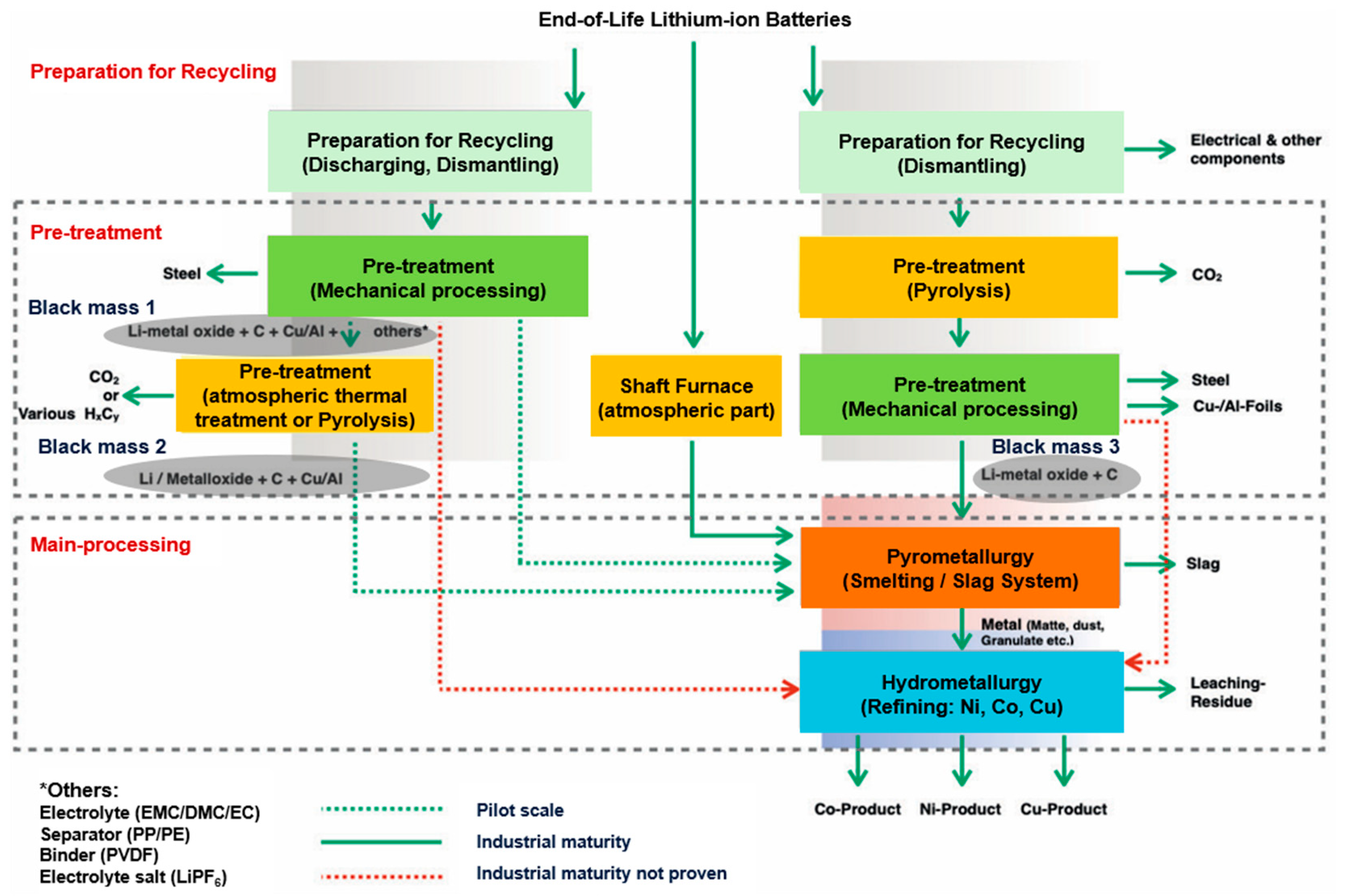
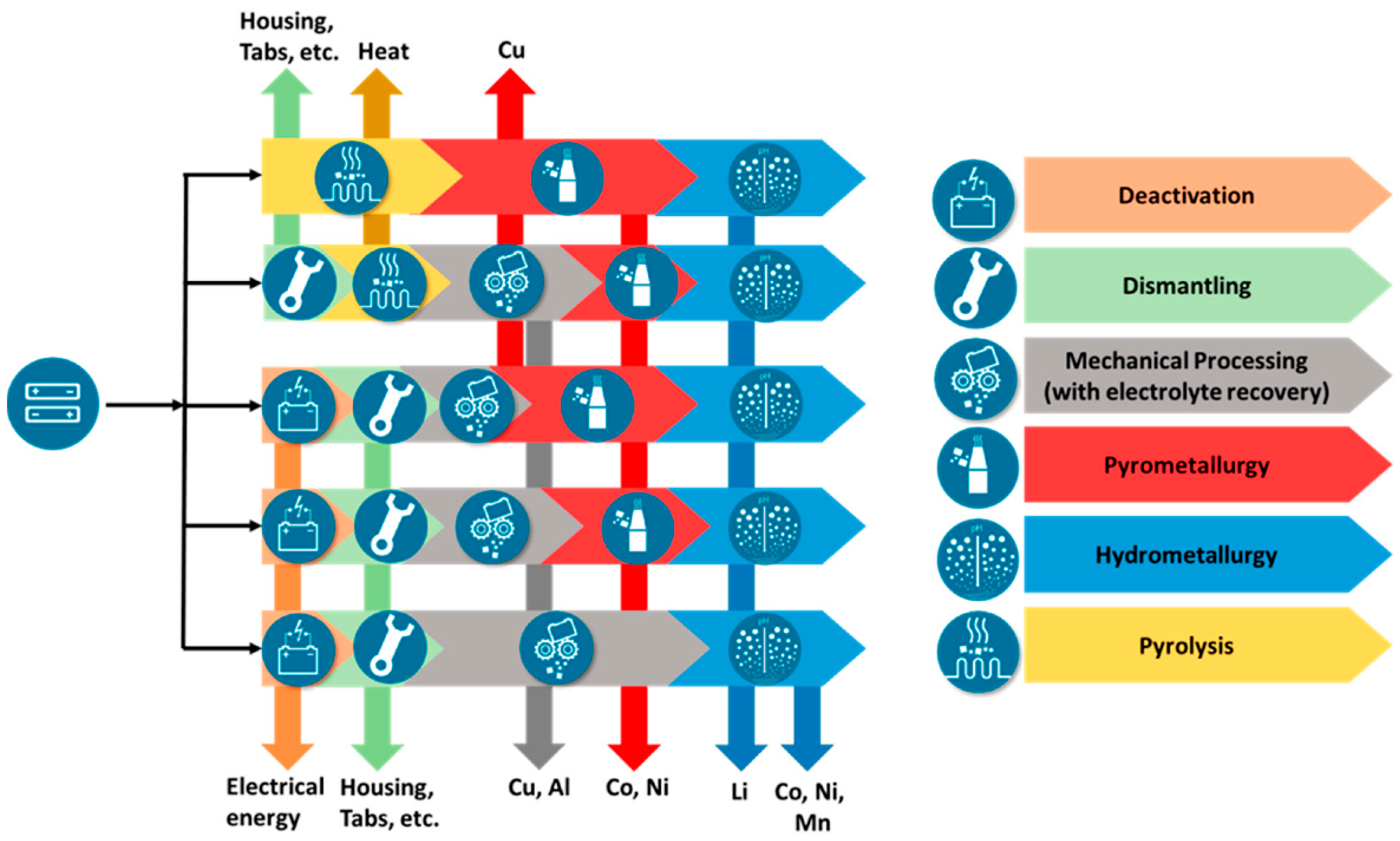
- Optional preparation before recycling: This initial step involves sorting batteries by chemistry, size, and type. It may also include disassembly, deactivation (discharging), and the separation of active cathode material from current collector foils to prepare them for the primary recycling stages.
- Multi-step pretreatment in dedicated plants: This stage, often performed by specialized companies, involves processes such as discharging, crushing, grinding, and various physical separation techniques designed to prepare the battery materials for subsequent processing.
- Multi-step main processing in non-dedicated plants: Pretreated battery materials undergo further processing—which may include hydrometallurgy, pyrometallurgy, or direct recycling—to extract the valuable materials.
- Final refinement and repurposing: The recovered materials are refined to a clean and usable state, suitable for manufacturing new battery products or for use in other related industries.
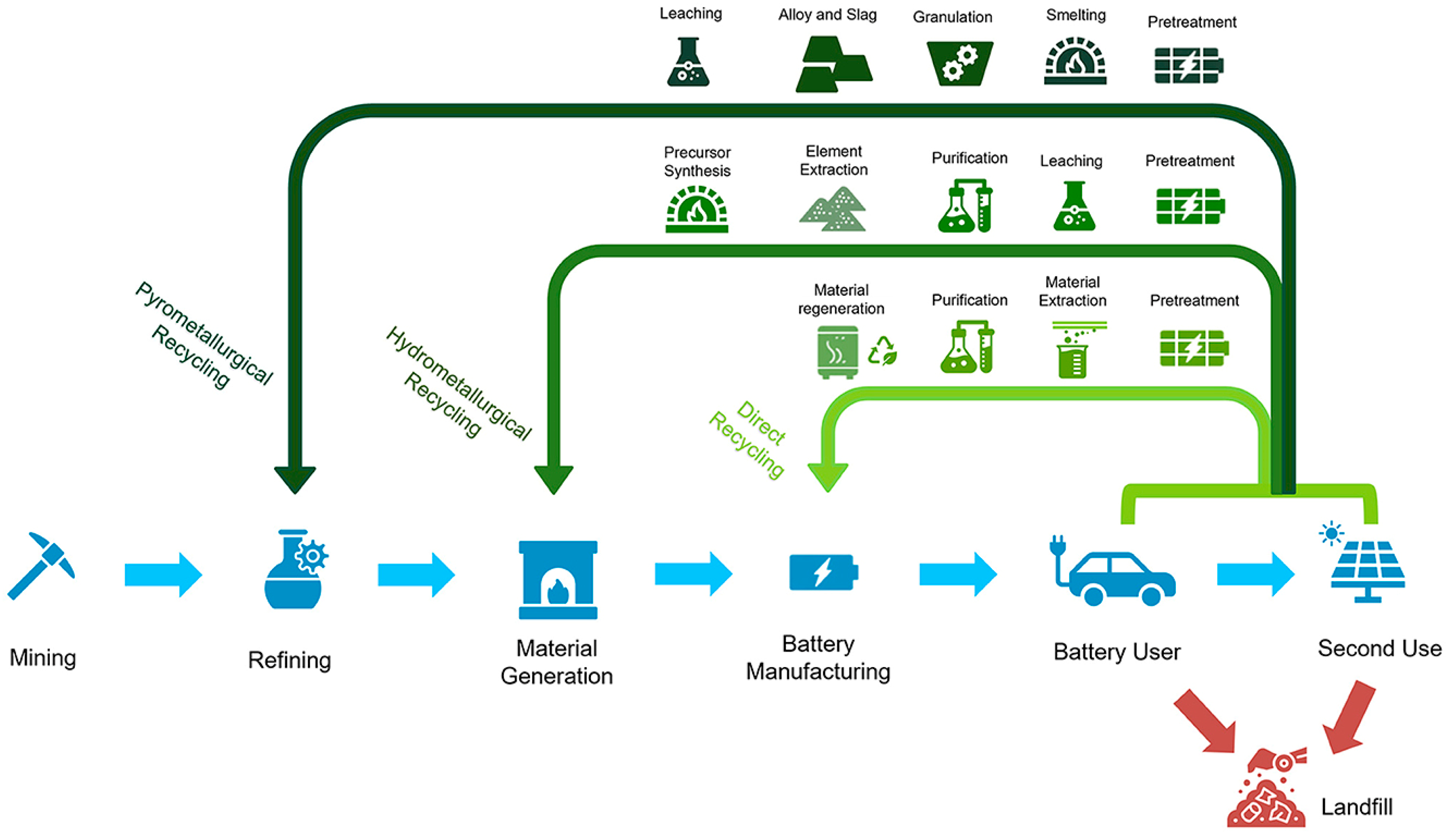
- Pyrometallurgical processes operate at high temperatures to smelt batteries, effectively recovering metals such as cobalt, nickel, and copper as alloys. However, this method often results in the loss of lithium to the slag—a challenge that researchers are currently addressing.
- Hydrometallurgical processes utilize a chemical approach, employing acids or basic leachants to selectively dissolve battery components. This is followed by purification steps, such as solvent extraction or precipitation, to isolate and recover specific metals for reuse.
- Direct recycling is an emerging technology focused on the recovery and reuse of cathode materials with minimal structural processing. This method is considered the most ecologically favorable due to its lower energy consumption and reduced generation of waste products.
3.1. Recycling Technologies and Operations
- Electrical Discharge: The energy stored in the battery is reduced via a controlled electrical discharge, sometimes followed by short-circuiting, to ensure safety for subsequent handling.
- Chemical Treatment (Saltwater Immersion): Immersion in a saline solution facilitates an electrochemical discharge that consumes residual charge and minimizes fire hazards.
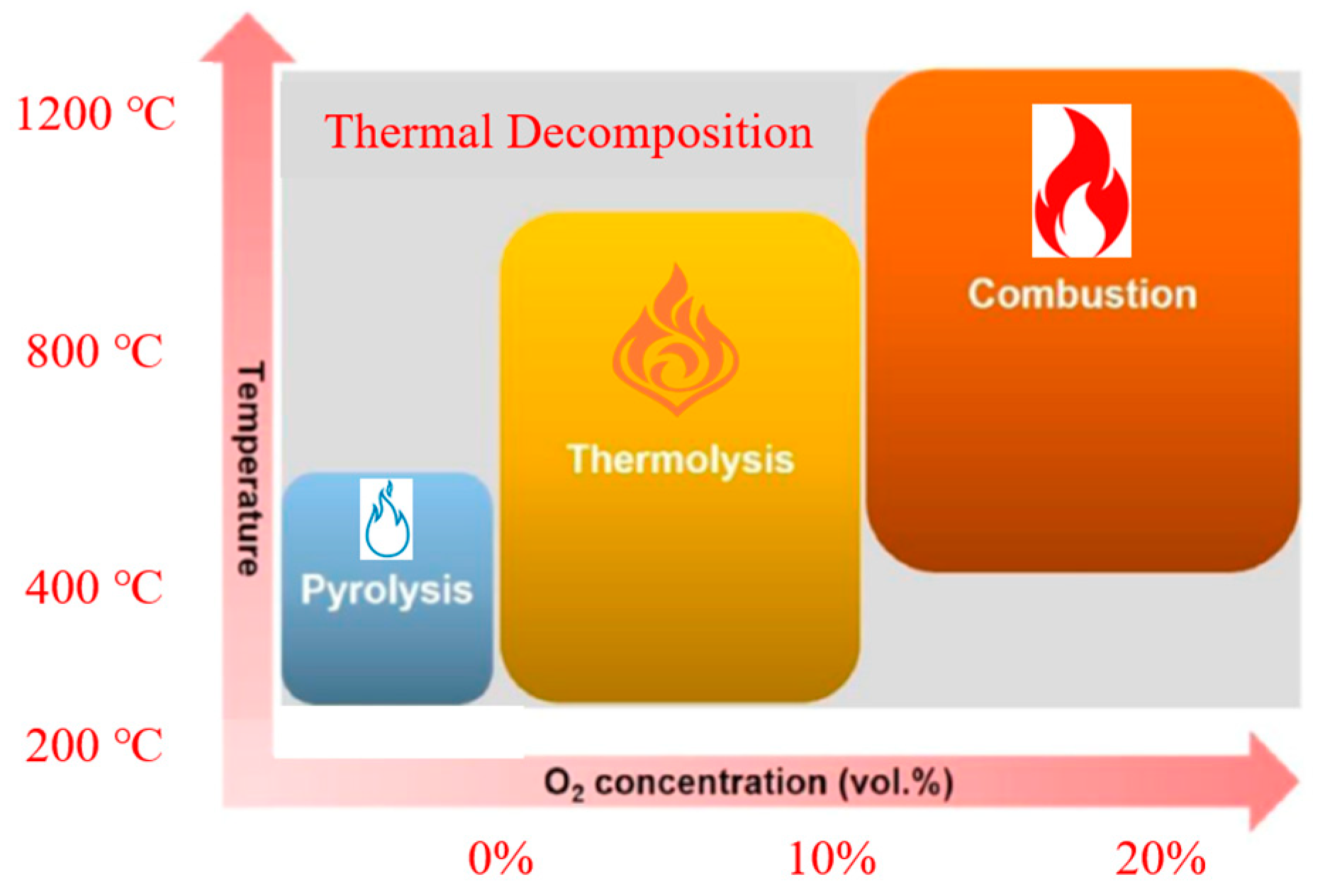
- Thermal Treatment: Heating the battery systems to temperatures exceeding 200 °C (e.g., via pyrolysis) can also achieve deactivation by neutralizing the reactive components.
3.2. Pretreatment
- Enhanced safety: It facilitates the safe, controlled deactivation of battery cells, eliminating the risk of thermal runaway, fires, and explosions during handling, logistics, and subsequent processing stages like shredding [50].
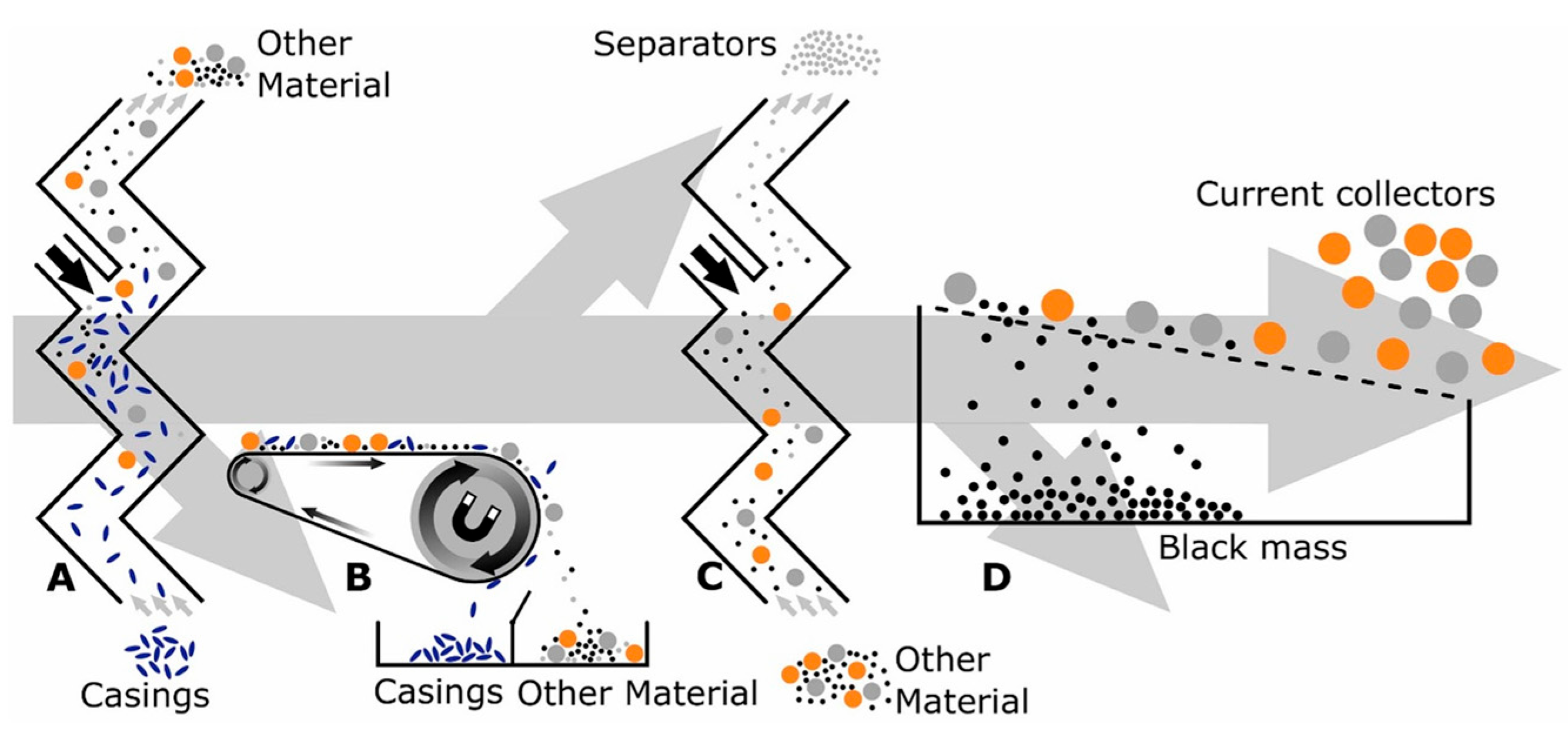
- Improved mechanical separation: By removing organic compounds—particularly polyvinylidene fluoride (PVDF) binders—the process improves the delamination of current collector foils. This enhances the recovery of high-purity copper and aluminum while increasing the yield of the valuable black mass during mechanical sorting [53,54].
- Volatile halogen removal: The process removes volatile halogens, such as fluorine, in the off-gas. This facilitates the targeted neutralization of hazardous HF and simplifies downstream recycling steps.
- Off-gas management: The process generates flammable and toxic gases requiring specialized scrubbing and combustion systems.
- Particulate matter: Pyrolysis creates a dry and fine product that can easily become airborne, complicating material handling.
- Temperature control: Precise regulation is critical because exceeding the melting point of aluminum (660 °C) can lead to reactor clogging and localized thermite reactions fueled by the inherent oxygen in cathode materials.
- Downstream limitation: It prevents the physical separation of cathode from anode materials, which limits the potential for direct recycling.
3.3. Primary Treatment
- Pre-heating zone (<300 °C): This upper zone evaporates electrolytes safely, mitigating the risk of explosions.
- Pyrolysis zone (700 °C): In the middle zone, plastics are pyrolyzed. The energy released from this process helps maintain the furnace temperature and reduces the overall energy consumption of the subsequent smelting phase.
- Smelting and reduction zone (1200–1450 °C): In the bottom zone, smelting and reduction reactions occur, yielding a metal alloy rich in copper, cobalt, nickel, and iron. Simultaneously, a slag containing lithium, aluminum, silicon, calcium, and some iron is formed [60].
4. Recycling Process Products and Hazards
- Gaseous and vapor hazards: The generation of toxic or flammable gases and vapors poses significant risks during processing stages such as shredding or drying.
- Fire hazards: Flammable components within LIBs and exothermic side reactions—exacerbated by thermal runaway—can lead to fires if not strictly controlled.
- Explosion hazards: Flammable gases or reactive solid chemicals can create explosion risks throughout the recycling process if not safely contained and handled in enclosed environments.
- Toxic and corrosive liquid hazards: Side reactions during processing can produce hazardous liquid chemicals, such as corrosive agents, necessitating careful containment and management.
4.1. End-of-Life Li-Ion Battery Hazards
4.1.1. Thermal Runaway Hazards
- Contributing factors: Aging leads to multiple degradation modes, such as capacity fade, structural damage to the casing that can lead to electrolyte leakage, electrode deformation, and the thickening or instability of the Solid Electrolyte Interphase (SEI).
- Impact on thermal stability: These factors collectively reduce the battery’s thermal stability and lower the onset temperature of exothermic reactions, thereby increasing the risk of thermal runaway.
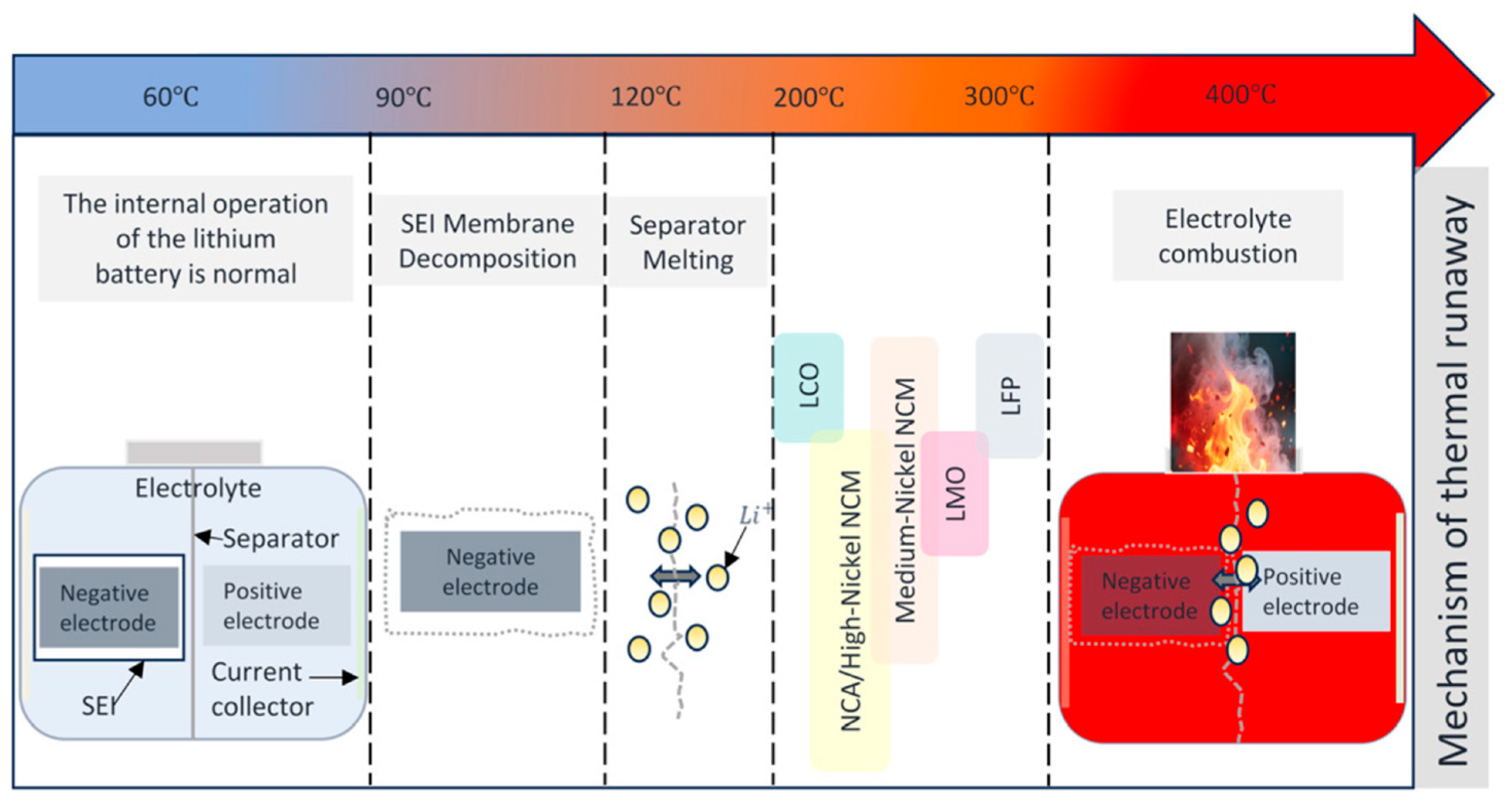
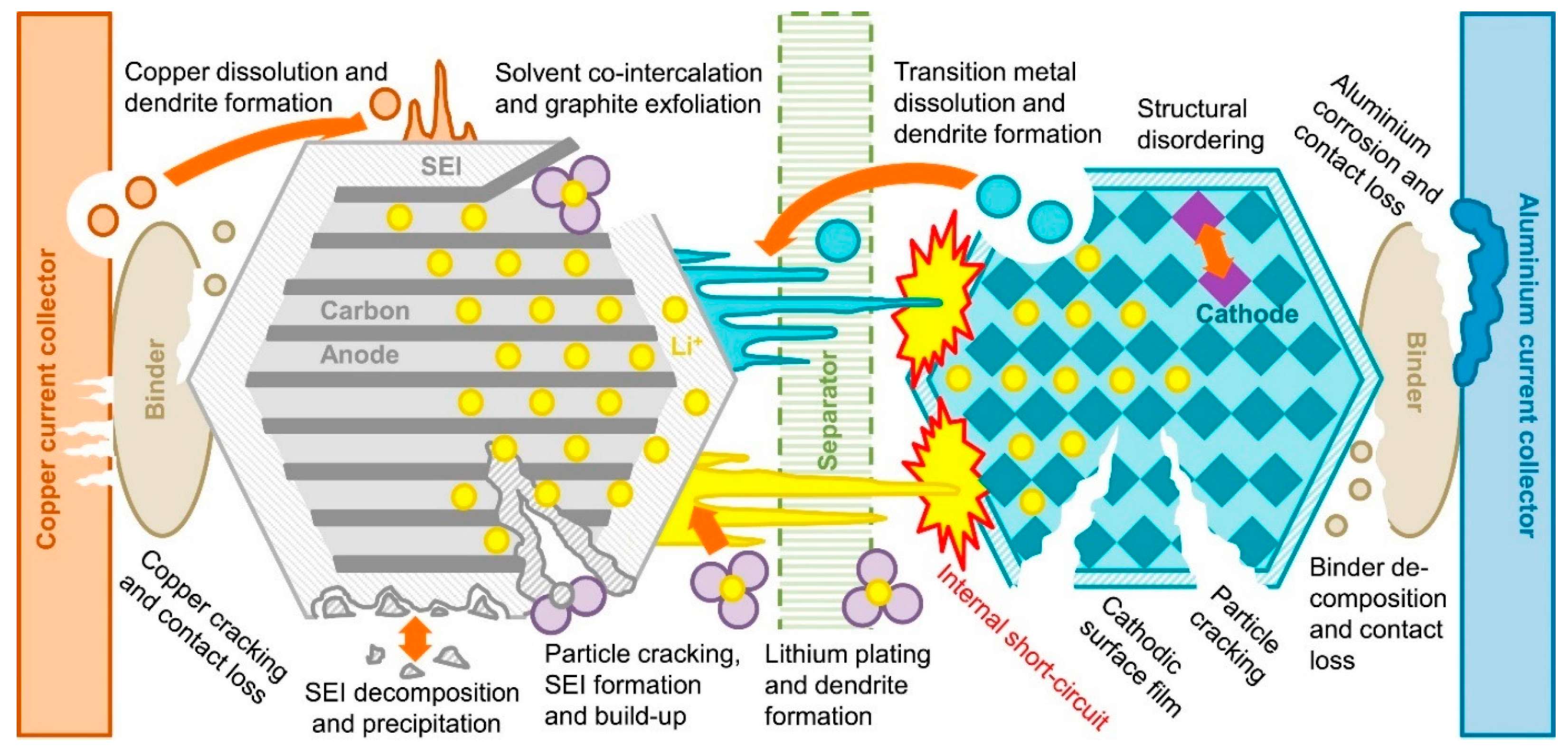
- Thermal runaway mechanism: Thermal runaway is an internal chain reaction where the heat generated by exothermic processes—such as SEI decomposition and cathode oxygen release—outpaces the battery’s ability to dissipate it, as illustrated in Figure 10 [64]. Once the internal temperature exceeds a critical threshold, it triggers a self-sustaining feedback loop of escalating temperature and pressure that can ultimately lead to cell rupture, combustion, or explosion [7,65,66].
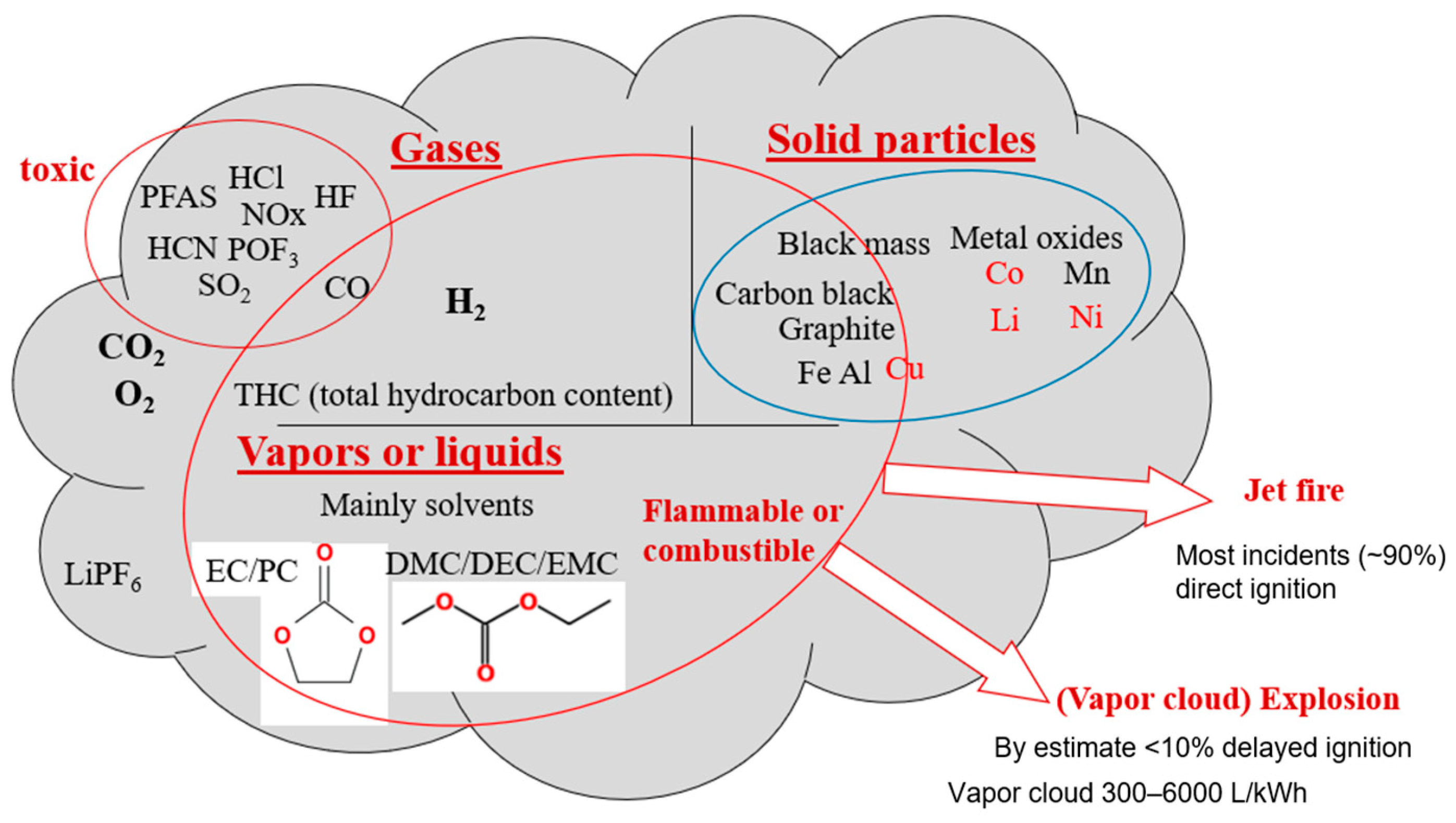
- High SOC/Oxygen-rich conditions: At a high SOC and sufficient oxygen present, this vapor often ignites immediately, resulting in high-intensity jet fires.
- Low SOC/oxygen-limited conditions: In environments with a low SOC or inadequate oxygen (e.g., when vapor displaces air or fire suppressant are deployed), immediate ignition may not occur. Instead, the accumulation of the vapor can lead to: flash fire (a sudden ignition, especially in a confined space) or vapor cloud explosion (a more catastrophic scenario that occurs if the accumulated gas mixture reaches its explosive limit in highly confined areas) [70,71].
4.1.2. Pretreatment Hazards
4.1.3. Fires and Explosions
4.1.4. Emissions and Pollutions
4.2. Black Mass Hazards
4.3. Toxic and Corrosive Chemical Hazards
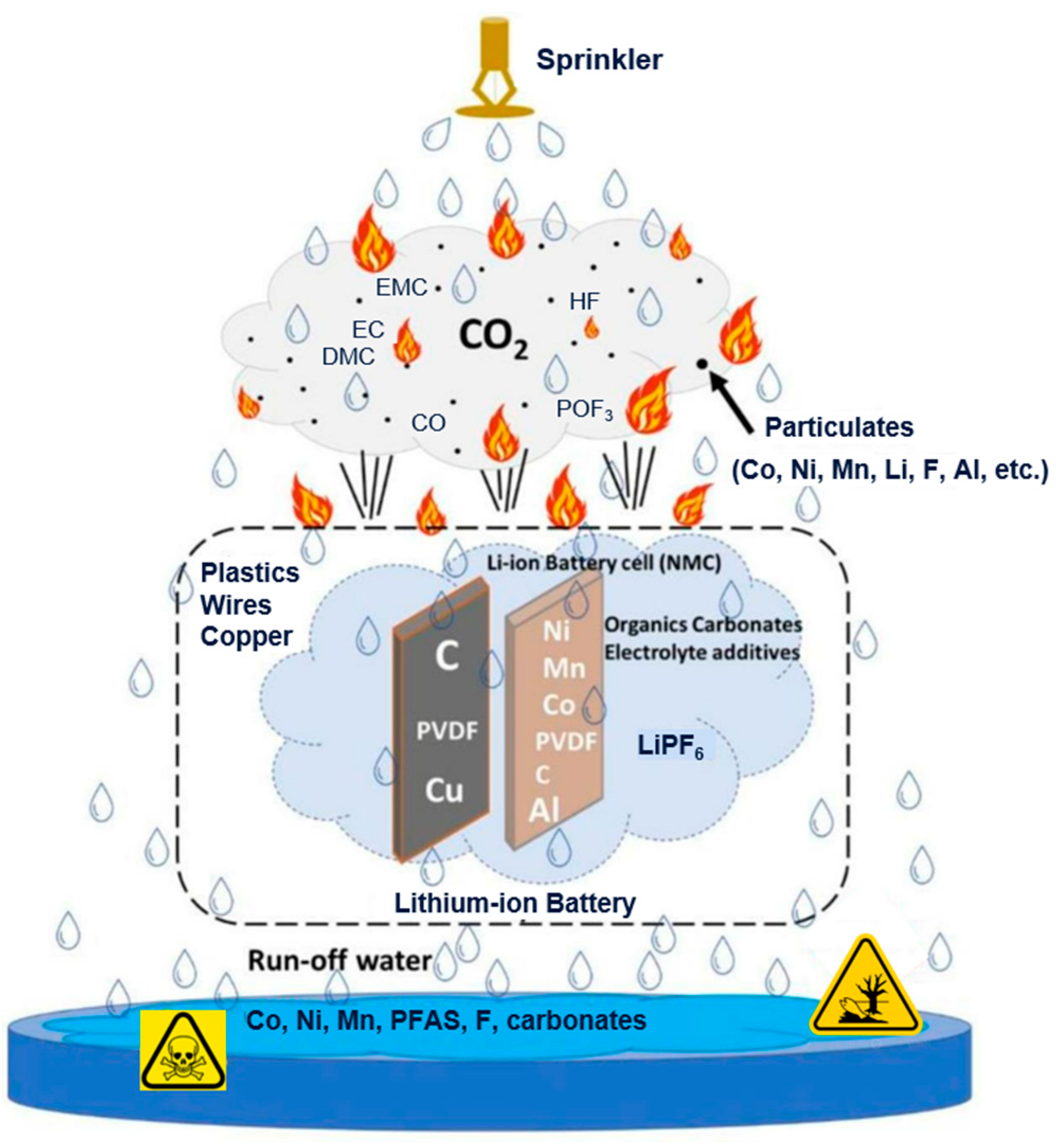
- Electrolyte hazards: Exposure of LiPF6 to water/moisture forms highly corrosive HF, which can cause respiratory necrosis at concentrations over 3 ppm, along with other toxic fluorides like PF5 and POF3.
- Organic and heavy metal risks: High temperatures can break down organic solvents (EC, DMC) into carcinogenic compounds like formaldehyde and acetaldehyde, as well as highly toxic substances like dioxins during pyrolysis. Cathode materials contain carcinogenic nickel compounds (International Agency for Research on Cancer, IARC Class 1), and prolonged inhalation of anode graphite can cause pneumoconiosis. Cobalt and copper also act as significant metal contaminants.
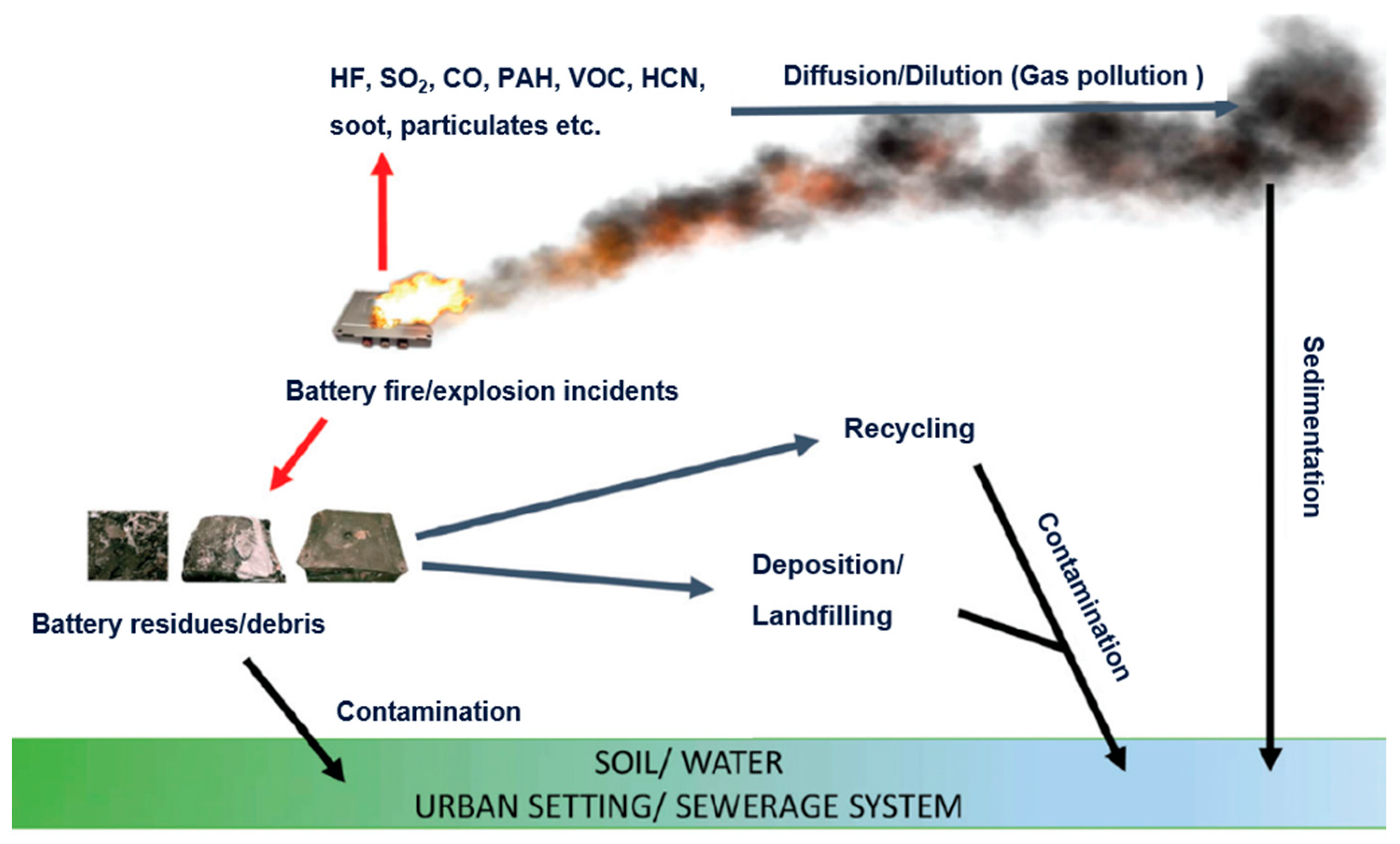
- Sources of pollution: These pollutants can be released during crushing, sorting, high-temperature pretreatment, and thermal runaway incidents.
- Electrolyte decomposition: Salts such as LiPF6, LiBF4, LiClO4, and LiAsF6 can react with water or acid to generate toxic gases such as HF and phosphorus pentafluoride (PF5), contributing to fluorine and arsenic pollution.
- Organic solvent degradation: VOCs like EC and DMC can thermally cleave at high temperatures to form formaldehyde, acetaldehyde, and other corrosive substances.
- Heavy metal and acid corrosion: Electrode materials contain corrosive heavy metals. Furthermore, the strong acids (e.g., H2SO4, HCl) used in hydrometallurgy to dissolve cathode metals produce highly acidic wastewater (pH < 1) containing heavy metal ions (Ni2+, Co2+), which corrodes pipelines and leads to soil acidification.
- Ammonia-related corrosion: During ammonia leaching and copper removal, the decomposition of ammonium persulfate additives produces ammonium sulfate, which releases ammonia gas (NH3) at high temperatures. This NH3 can then react with HF to form ammonium fluoride, a compound known to accelerate the pitting corrosion of metal equipment [98].
5. Recommendations for Future Studies
5.1. Warehousing Storage Safety
5.1.1. Comprehensive Risk Assessment
- Understanding degradation mechanisms and failure modes in EOL batteries: Research is required to better characterized the long-term degradation effects on diverse battery chemistries (e.g., LFP, NMC, NCA) and their subsequent impact on fire risk. This includes investigating the probability and severity of thermal runaway in batteries with varying SOH, cycling histories, and physical damage.
- Developing standardized risk assessment methods: Establishing consistent protocols for testing and evaluating the fire and explosion hazards associated with different types and conditions of EOL batteries would facilitate more accurate risk categorization during warehousing [99]. Integrating Artificial Intelligence (AI) with advanced diagnostic tools, such as electrochemical impedance spectroscopy (EIS), could enable rapid SOH screening, allowing for standardized packaging, labeling, and segregated storage based on risk profiles.
- Investigating the impact of deep discharge on safety: Research should focus on how prolonged deep discharge affects the stability of LIBs and whether it heightens the risk of thermal runaway during storage or subsequent handling, specifically by varying C-rate, SOH, and environmental conditions, etc.
- Advancing AI-integrated EIS for rapid screening: Developing AI-driven EIS technology would allow for the rapid classification of EOL-LIBs into specific categories: “low-risk” (SOH > 60%), “medium-risk” (30% < SOH < 60%), and “high-risk” (SOH < 30%), facilitating safer logistical management.
- Studying the combined effects of SOC and storage duration: It is critical to investigate the synergistic effects of State of Charge (SOC, 0–100%) and storage duration (e.g., 1–12 months) on the probability of TR across different cathode chemistries.
5.1.2. Advanced Detection and Monitoring Systems
- Tailored detection systems for diverse EOL battery chemistries: It is essential to develop specialized sensors capable of monitoring a wide range of early-warning indicators for thermal runaway in EOL batteries with diverse degradation profiles. This includes high-sensitivity gas and vapor analysis for specific off-gas compounds (e.g., H2, CO, and VOCs) that serve as chemical fingerprints for failure in different battery chemistries [100].
- Non-destructive inspection techniques for internal defects: Future research should focus on advancing Non-Destructive Testing (NDT) methods—such as ultrasonic scanning or X-ray CT—to identify internal structural defects or electrode delamination that may not be visible externally but pose significant fire risks.
- Advanced thermal monitoring and predictive analytics: Sophisticated thermal imaging combined with predictive algorithms can identify subtle temperature anomalies that precede thermal runaway in degraded cells. By integrating AI and Machine Learning, these subtle patterns can be analyzed to provide earlier and more accurate warnings. Furthermore, digital twin platforms should be established to enable 7/24 real-time monitoring of LIBs within warehousing and recycling facilities.
5.1.3. Optimized Fire Suppression and Mitigation Techniques
- Adapting suppression systems for the unique challenges of EOL battery fires: Research is required to optimize fire suppression systems—such as high-expansion foam and specialized water-mist additives—to effectively control and extinguish fires involving EOL batteries. These systems must account for the increased flammability of degraded components and the high potential for re-ignition (stranded energy).
- Containment and isolation of EOL batteries: Further investigation is needed into the effectiveness of specialized fire-resistant storage containers (e.g., modular metal bins [101] instead of traditional cardboard packaging), racking systems, and compartmentation designs to prevent fire propagation. Moreover, studies should evaluate the feasibility and timing of emergency extraction using automated guided vehicles (AGVs) or automated forklifts to transfer compromised containers to safe zones, potentially integrate with liquid nitrogen (LN2) system.
- Safe venting and off-gas management: Research should focus on technologies for the safe management of flammable and toxic off-gases released during EOL battery failure. This includes developing explosion-venting strategies and specialized scrubbing channels to minimize the risk of gas-mixture explosions and personnel exposure [102].
- Emergency transfer and cooling: Explore the integration of liquid nitrogen immersion/cooling systems with automated transport for the rapid emergency isolation of burning EOL-LIB storage containers.
- Advanced container design: Develop specialized fire-resistant metal storage units featuring built-in pressure-relief venting and gas-capture channels to direct toxic emissions toward localized or centralized scrubbers.
5.1.4. Safety Management and Regulatory Framework for Collection, Logistics and Storage
- Standardized safety guidelines and training: Research and collaborative efforts are needed to establish comprehensive guidelines and certification programs for personnel involved in the handling, sorting, and storage of EOL batteries. These programs must specifically address the heightened risks associated with degraded and damaged states [103].
- Regulations and best practices for safe warehousing: It is essential to establish clear regulatory frameworks and industry best practices for EOL battery warehousing. This includes defining maximum storage limits, minimum separation distances, specialized ventilation requirements, and robust emergency response plans (ERPs) [99].
- Storage duration and environmental conditions: Research is needed to determine optimal storage conditions (temperature, humidity, ventilation) and maximum safe storage durations for various types of EOL battery chemistries. Furthermore, the risks associated with the co-storage of EOL-LIBs and black mass must be rigorously evaluated to prevent cross-contamination and synergistic fire hazards.
5.1.5. Improved Recycling and Disposal Pathways
- Safer recycling pathways: Further research should focus on alternative or optimized recycling technologies—such as vacuum shredding, cryogenic processing, or inert-atmosphere comminution—that minimize fire and explosion risks during the processing of EOL batteries.
- Transport of damaged, defective, or inherently unstable (DDR) batteries: Solutions must be developed for the safe logistics of batteries deemed Damaged, Defective, or Recalled (DDR). This includes investigating specialized containment vessels and real-time monitoring sensors to mitigate risks during transit to recycling or disposal facilities [104].
5.2. Recycling and Handling Process Safety
5.2.1. Safe Collection, Sorting, and Pretreatment
- Consumer education and infrastructure: Research is needed to assess the effectiveness of public education campaigns on safe battery disposal and to optimize collection systems that prevent LIBs from entering the general waste stream. This includes exploring the impact of legislation and incentives—such as mandatory labeling with chemistry and SOH indicators—to encourage proper recycling and reduce landfill fires.
- Automated sorting and identification: Advanced robotic and AI-powered systems should be developed to automatically sort batteries by type and chemistry, minimizing manual handling and reducing the risk of accidental damage.
- Advanced deactivation methods: Research into techniques for safely discharging batteries to a near-zero SOC (e.g., 2%) is essential to reduce TR risks during downstream processing [106]. For damaged or unstable batteries, specialized treatments—such as immersion in non-flammable dielectric fluids or the use of chemical deactivation agents—should be prioritized to eliminate short-circuit risks [107].
5.2.2. Advanced Detection and Early Warning Systems
- Real-time multi-sensor monitoring: Integrating thermal imaging, gas detection, and acoustic emission sensors can identify potential thermal runaway events at their incipient stages.
- Predictive modeling: Developing models that analyze sensor data and battery characteristics to forecast TR likelihood can enable preemptive safety measures [100].
- Remote sensing: Investigating technologies such as hyperspectral imaging or drone-mounted thermal cameras can facilitate the detection of overheating batteries in large-scale storage facilities.
5.2.3. Safe Dismantling and Material Separation
- Stress-minimizing processes: Research should focus on parameters that reduce mechanical and thermal stress during dismantling, such as cryogenic embrittlement or solvent-based separation in controlled environments.
- Safe intermediate handling: Specialized protocols are required for the handling and storage of black mass to mitigate the risk of self-heating or dust explosions during downstream processing [108].
- Design for recycling: Investigating how cell format and module configuration influence recycling safety can lead to the development of more “recycling-friendly” next-generation batteries [9].
5.2.4. Data Collection, Analysis, and Standardization
- Standardized incident reporting: Establishing standardized protocols for collecting and reporting data on battery-related incidents in recycling facilities is essential to gain a better understanding of the causes, trends, and effectiveness of current safety measures [109].
- Collaboration and knowledge sharing: Fostering collaboration among researchers, industry stakeholders, and regulatory bodies to share research findings and best practices is critical to addressing battery recycling safety challenges globally. For instance, if producers and EV manufacturers were to share comprehensive lifecycle data—specifically from the Battery Management System (BMS)—it would significantly aid recyclers in selecting the optimal recycling path and assist academic partners in conducting fundamental research.
6. Conclusions
Funding
Institutional Review Board Statement
Data Availability Statement
Acknowledgments
Conflicts of Interest
Abbreviations
| BESS | Battery energy storage system |
| BP | Boiling point |
| CMR | Critical mineral recovery |
| DEC | Diethyl carbonate |
| DMC | Dimethyl carbonate |
| EC | Ethylene carbonate |
| EIS | Electrochemical impedance spectroscopy |
| EMC | Ethyl methyl carbonate |
| EOL | End-of-life |
| EV | Electric vehicle |
| HF | Hydrofluoric acid |
| ICE | Internal combustion engine |
| LCA | Lifecycle assessment |
| LCO | Lithium cobalt oxide |
| LFL/UFL | Lower/upper flammability limit |
| LFP | Lithium iron phosphate |
| LIB | Lithium-ion battery |
| LLI | Loss of lithium inventory |
| LMO | Lithium manganese oxide |
| LOC | Limiting oxygen concentration |
| NMC | Nickel manganese cobalt |
| OCV | Open circuit voltage |
| PC | Propylene carbonate |
| PFAS | Per- and polyfluoroalkyl substances |
| PPE | Personal protective equipment |
| PVDF | Polyvinylidene fluoride |
| SEI | Solid electrolyte interface |
| HSE | Health, Safety and Environment |
| SOC | States of charge |
| SOH | State of health |
| TR | Thermal runaway |
| VOC | Volatile organic compounds |
References
- Electric Vehicle Batteries, Global EV Outlook 2025 (IEA). Available online: https://www.iea.org/reports/global-ev-outlook-2025/electric-vehicle-batteries (accessed on 13 July 2025).
- Peters, J.F. Best practices for life cycle assessment of batteries. Nat. Sustain. 2023, 6, 614–616. [Google Scholar] [CrossRef]
- Harper, G.; Sommerville, R.; Kendrick, E.; Driscoll, L.; Slater, P.; Stolkin, R.; Walton, A.; Christensen, P.; Heidrich, O.; Lambert, S.; et al. Recycling lithium-ion batteries from electric vehicles. Nature 2019, 575, 75–86. [Google Scholar] [CrossRef]
- Wu, D.; Wang, X.; Hack, J.; Segers, T.; Norman, F. Smouldering fire and explosion hazards of black mass in the lithium-ion battery recycling industry. J. Loss Prev. Process Ind. 2025, 99, 105817. [Google Scholar] [CrossRef]
- Sojka, R.; Pan, Q.; Billmann, L. Comparative Study of Li-Ion Battery Recycling Processes; ACCUREC Recycling GmbH: Krefeld, Germany, 2020. [Google Scholar]
- Dai, Y.; Panahi, A. Thermal runaway process in lithium-ion batteries: A review. Next Energy 2025, 6, 100186. [Google Scholar] [CrossRef]
- Haregewoin, A.M.; Wotango, A.S.; Hwang, B.-J. Electrolyte additives for lithium-ion battery electrodes: Progress and perspectives. Energy Environ. Sci. 2016, 9, 1955–1988. [Google Scholar] [CrossRef]
- Wang, Q.; Jiang, L.; Yu, Y.; Sun, J. Progress of enhancing the safety of lithium-ion battery from the electrolyte aspect. Nano Energy 2018, 55, 93–114. [Google Scholar] [CrossRef]
- Harper, G.D.J.; Kendrick, E.; Anderson, P.A.; Mrozik, W.; Christensen, P.; Lambert, S.; Greenwood, D.; Das, P.K.; Ahmeid, M.; Milojevic, Z.; et al. Roadmap for a sustainable circular economy in lithium-ion and future battery technologies. J. Phys. Energy 2023, 25, 021501. [Google Scholar] [CrossRef]
- Ojanen, S.; Lundström, M.; Santasalo-Aarnio, A.; Serna-Guerrero, R. Challenging the concept of electrochemical discharge using salt solutions for lithium-ion batteries recycling. Waste Manag. 2018, 76, 242–249. [Google Scholar] [CrossRef]
- Feng, X.; Ouyang, M.; Liu, X.; Lu, L.; Xia, Y.; He, X. Thermal runaway mechanism of lithium-ion battery for electric vehicles: A review. Energy Storage Mater. 2018, 10, 246–267. [Google Scholar] [CrossRef]
- Birkl, C.R.; Roberts, M.R.; McTurk, E.; Bruce, P.G.; Howey, D.A. Degradation diagnostics for lithium-ion cells. J. Power Sources 2017, 341, 373–386. [Google Scholar] [CrossRef]
- Broussely, M.; Biensan, P.; Bonhomme, F.; Blanchard, P.; Herreyre, S.; Nechev, K.; Staniewicz, R. Main aging mechanisms in Li ion batteries. J. Power Sources 2005, 146, 90–96. [Google Scholar] [CrossRef]
- Matsuda, T.; Ando, K.; Myojin, M.; Matsumoto, M.; Sanada, T.; Takao, N.; Imai, H.; Imamura, D. Investigation of the influence of temperature on the degradation mechanism of commercial nickel manganese cobalt oxide-type lithium-ion cells during long-term cycle tests. J. Energy Storage 2019, 21, 665–671. [Google Scholar] [CrossRef]
- Atalay, S.; Sheikh, M.; Mariani, A.; Merla, Y.; Bower, E.; Widanage, W.D. Theory of battery ageing in a lithium-ion battery: Capacity fade, nonlinear ageing and lifetime prediction. J. Power Sources 2020, 478, 229026. [Google Scholar] [CrossRef]
- Remmlinger, J.; Buchholz, M.; Meiler, M.; Bernreuter, P.; Dietmayer, K. State-of health monitoring of lithium-ion batteries in electric vehicles by on-board internal resistance estimation. J. Power Sources 2011, 196, 5357–5363. [Google Scholar] [CrossRef]
- Liu, Y.; Liu, C.; Liu, Y.; Sun, F.; Qiao, J.; Xu, T. Review on degradation mechanism and health state estimation methods of lithium-ion batteries. J. Traffic Transp. Eng. 2023, 10, 578–610. [Google Scholar] [CrossRef]
- Gregory, L. Plett, Recursive approximate weighted total least squares estimation of battery cell total capacity. J. Power Sources 2011, 196, 2319–2331. [Google Scholar]
- Sommerville, R.; Shaw-Stewart, J.; Goodship, V.; Rowson, N.; Kendrick, E. A review of physical processes used in the safe recycling of lithium-ion batteries. Sustain. Mater. Technol. 2020, 25, e00197. [Google Scholar] [CrossRef]
- Song, D.; Yu, J.; Wang, M.; Tan, Q.; Liu, K.; Li, J. Advancing recycling of spent lithium-ion batteries: From green chemistry to circular economy. Energy Storage Mater. 2023, 61, 102870. [Google Scholar] [CrossRef]
- Fan, E.; Li, L.; Wang, Z.; Huang, Y.; Yao, Y.; Chen, R.; Wu, F. Sustainable recycling technology for Li-Ion batteries and beyond: Challenges and future prospects. Chem. Rev. 2020, 120, 7020–7063. [Google Scholar] [CrossRef]
- Van Hoof, G.; Robertz, B.; Verrecht, B. Towards sustainable battery recycling: A carbon footprint comparison between pyrometallurgical and hydrometallurgical battery recycling flowsheets. Metals 2023, 13, 1915. [Google Scholar] [CrossRef]
- Gachot, G.; Grugeon, S.; Armand, M.; Pilard, S.; Guenot, P.; Tarascon, J.-M.; Laruelle, S. Deciphering the multi-step degradation mechanisms of carbonate-based electrolyte in Li batteries. J. Power Sources 2008, 178, 409–421. [Google Scholar] [CrossRef]
- Barbosa de Mattos, D.F.; Duda, S.; Petranikova, M. Recycling of lithium iron phosphate (LiFePO4) batteries from the end product quality perspective. Batteries 2025, 11, 33. [Google Scholar] [CrossRef]
- Doose, S.; Mayer, J.; Michalowski, P.; Kwade, A. Challenges in ecofriendly battery recycling and closed material cycles: A perspective on future lithium battery generations. Metals 2021, 11, 291. [Google Scholar] [CrossRef]
- Doerffel, D.; Sharkh, S. A critical review of using the Peukert equation for determining the remaining capacity of lead-acid and lithium-ion batteries. J. Power Sources 2006, 155, 395–400. [Google Scholar] [CrossRef]
- Kwon, O.; Sohn, I. Fundamental thermokinetic study of a sustainable lithium-ion battery pyrometallurgical recycling process. Resour. Conserv. Recycl. 2020, 158, 104809. [Google Scholar] [CrossRef]
- Shaw-Stewart, J.; Alvarez-Reguera, A.; Greszta, A.; Marco, J.; Masood, M.; Sommerville, R.; Kendrick, E. Aqueous solution discharge of cylindrical lithium-ion cells. Sustain. Mater. Technol. 2019, 22, e00110. [Google Scholar] [CrossRef]
- Diaz, L.B.; He, X.; Hu, Z.; Restuccia, F.; Marinescu, M.; Barreras, J.V.; Patel, Y.; Offer, G.; Rein, G. Meta-review of fire safety of lithium-ion batteries: Industry challenges and research contributions. J. Electrochem. Soc. 2020, 167, 090559. [Google Scholar] [CrossRef]
- Gaines, L.; Richa, K.; Spangenberger, J. Key issues for Li-ion battery recycling. MRS Energy Sustain. 2018, 5, 1557. [Google Scholar] [CrossRef]
- Jiang, H.; Emmett, R.K.; Roberts, M.E. Thermally induced deactivation of lithium-ion batteries using temperature-responsive interfaces. Ionics 2019, 25, 2453–2457. [Google Scholar] [CrossRef]
- Larsson, F.; Mellander, B.-E. Abuse by external heating, overcharge and short circuiting of commercial lithium-ion battery cells. J. Electrochem. Soc. 2014, 161, A1611. [Google Scholar] [CrossRef]
- Shu, J.; Shui, M.; Xu, D.; Wang, D.; Ren, Y.; Gao, S. A comparative study of overdischarge behaviors of cathode materials for lithium-ion batteries. J. Solid State Electrochem. 2012, 16, 819–824. [Google Scholar] [CrossRef]
- Or, T.; Gourley, S.W.D.; Kaliyappan, K.; Yu, A.; Chen, Z. Recycling of mixed cathode lithium-ion batteries for electric vehicles: Current status and future outlook. Carbon Energy 2020, 2, 6–43. [Google Scholar] [CrossRef]
- Nembhard, N.S. Safe, Sustainable Discharge of Electric Vehicle Batteries as a Pre-Treatment Step to Crushing in the Recycling Process. Master’s Thesis, KTH Royal Institute of Technology, Stockholm, Sweden, 2019. [Google Scholar]
- He, Y.; Yuan, X.; Zhang, G.; Wang, H.; Zhang, T.; Xie, W.; Li, L. A critical review of current technologies for the liberation of electrode materials from foils in the recycling process of spent lithium-ion batteries. Sci. Total Environ. 2021, 766, 142382. [Google Scholar] [CrossRef]
- Georgi-Maschler, T.; Friedrich, B.; Weyhe, R.; Heegn, H.; Rutz, M. Development of a recycling process for Li-ion batteries. J. Power Sources 2012, 207, 173–182. [Google Scholar] [CrossRef]
- Grandjean, T.R.B.; Groenewald, J.; Marco, J. The experimental evaluation of lithium-ion batteries after flash cryogenic freezing. J. Energy Storage 2019, 21, 202–215. [Google Scholar] [CrossRef]
- Li, H.; Gao, J.; Zhang, S. Effect of overdischarge on swelling and recharge performance of lithium-ion cells. Chin. J. Chem. 2008, 26, 286. [Google Scholar] [CrossRef]
- Yu, D.; Huang, Z.; Makuza, B.; Guo, X.; Tian, Q. Pretreatment options for the recycling of spent lithium-ion batteries: A comprehensive review. Miner. Eng. 2021, 173, 107218. [Google Scholar] [CrossRef]
- Diekmann, J.; Kwade, A. Recycling of Lithium-Ion Batteries: The LithoRec Way; Springer: Cham, Switzerland, 2018. [Google Scholar]
- Dorella, G.; Mansur, M.B. A study of the separation of cobalt from spent Li-ion battery residues. J. Power Sources 2007, 170, 210–215. [Google Scholar] [CrossRef]
- Thompson, D.L.; Hartley, J.M.; Lambert, S.M.; Shiref, M.; Harper, G.D.J.; Kendrick, E.; Anderson, P.; Ryder, K.S.; Gaines, L.; Abbott, A.P. The importance of design in lithium-ion battery recycling—A critical review. Green. Chem. 2020, 22, 7585–7603. [Google Scholar] [CrossRef]
- Wegener, K.; Chen, W.H.; Dietrich, F.; Dröder, K.; Kara, S. Robot assisted disassembly for the recycling of electric vehicle batteries. Procedia CIRP 2015, 29, 716–721. [Google Scholar] [CrossRef]
- Meshram, P.; Mishra, A.; Abhilash; Sahu, R. Environmental impact of spent lithium-ion batteries and green recycling perspectives by organic acids—A review. Chemosphere 2020, 242, 125291. [Google Scholar] [CrossRef]
- Velázquez-Martínez, O.; Valio, J.; Santasalo-Aarnio, A.; Reuter, M.; Serna-Guerrero, R. A critical review of lithium-ion battery recycling processes from a circular economy perspective. Batteries 2019, 5, 68. [Google Scholar] [CrossRef]
- Rastegarpanah, A.; Ahmeid, M.; Marturi, N.; Attidekou, P.S.; Musbahu, M.; Ner, R.; Lambert, S.; Stolkin, R. Towards robotizing the processes of testing lithium-ion batteries. J. Syst. Control Eng. 2021, 235, 1309–1325. [Google Scholar] [CrossRef]
- Liu, C.; Lin, J.; Cao, H.; Zhang, Y.; Sun, Z. Recycling of spent lithium-ion batteries in view of lithium recovery: A critical review. J. Clean. Prod. 2019, 228, 801–813. [Google Scholar] [CrossRef]
- Brückner, L.; Frank, J.; Elwert, T. Industrial recycling of lithium-ion batteries—A critical review of metallurgical process routes. Metals 2020, 10, 1107. [Google Scholar] [CrossRef]
- Schwich, L.; Schubert, T.; Friedrich, B. Early-stage recovery of lithium from tailored thermal conditioned black mass part i: Mobilizing lithium via supercritical CO2-carbonation. Metals 2021, 11, 177. [Google Scholar] [CrossRef]
- Diaz, F.; Wang, Y.; Weyhe, R.; Friedrich, B. Gas generation measurement and evaluation during mechanical processing and thermal treatment of spent Li-ion batteries. Waste Manag. 2019, 84, 102–111. [Google Scholar] [CrossRef]
- Lombardo, G.; Ebin, B.; Steenari, B.-M.; Alemrajabi, M.; Karlsson, I.; Petranikova, M. Comparison of the effects of incineration, vacuum pyrolysis and dynamic pyrolysis on the composition of NMC-lithium battery cathode-material production scraps and separation of the current collector. Resour. Conserv. Recycl. 2021, 164, 105142. [Google Scholar] [CrossRef]
- Pinegar, H.; Smith, Y.R. Recycling of end-of-life lithium-ion batteries, Part II: Laboratory-scale research developments in mechanical, thermal, and leaching treatments. J. Sustain. Metall. 2020, 6, 142–160. [Google Scholar] [CrossRef]
- Zhang, G.; Du, Z.; He, Y.; Wang, H.; Xie, W.; Zhang, T. A sustainable process for the recovery of anode and cathode materials derived from spent lithium-ion batteries. Sustainability 2019, 11, 2363. [Google Scholar] [CrossRef]
- Vieceli, N.; Casasola, R.; Lombardo, G.; Ebin, B.; Petranikova, M. Hydrometallurgical recycling of EV lithium-ion batteries: Effects of incineration on the leaching efficiency of metals using sulfuric acid. Waste Manag. 2021, 125, 192–203. [Google Scholar] [CrossRef]
- Lombardo, G.; Ebin, B.S.M.R.; Foreman, J.; Steenari, B.-M.; Petranikova, M. Chemical transformations in Li-ion battery electrode materials by carbothermic reduction ACS Sustain. Chem. Eng. 2019, 7, 13668–13679. [Google Scholar]
- Li, J.; Wang, G.; Xu, Z. Environmentally-friendly oxygen-free roasting/wet magnetic separation technology for in situ recycling cobalt, lithium carbonate and graphite from spent LiCoO2/graphite lithium batteries. J. Hazard. Mater. 2016, 302, 97–104. [Google Scholar] [CrossRef]
- Kim, S.; Bang, J.; Yoo, J.; Shin, Y.; Bae, J.; Jeong, J.; Kim, K.; Dong, P.; Kwon, K. A comprehensive review on the pretreatment process in lithium-ion battery recycling. J. Clean. Prod. 2021, 294, 126329. [Google Scholar] [CrossRef]
- Huang, B.; Pan, Z.; Su, X.; An, L. Recycling of lithium-ion batteries: Recent advances and perspectives. J. Power Sources 2018, 399, 274–286. [Google Scholar] [CrossRef]
- Mohr, M.; Weil, M.; Peters, J.; Wang, Z. Recycling of Lithium-ion Batteries. In Encyclopedia of Electrochemistry: Batteries; Wiley-VCH: Weinheim, Germany, 2020. [Google Scholar]
- Chen, X.; Chen, Y.; Zhou, T.; Liu, D.; Hu, H.; Fan, S. Hydrometallurgical recovery of metal values from sulfuric acid leaching liquor of spent lithium-ion batteries. Waste Manag. 2015, 38, 349–356. [Google Scholar] [CrossRef]
- Néstor Antuñano, Analysis of the Major Recycling Processes in the Battery Industry. Available online: https://cicenergigune.com/en/blog/major-recycling-processes-battery-industry (accessed on 13 July 2025).
- Zheng, P.; Young, D.; Yang, T.; Xiao, Y.; Li, Z. Powering battery sustainability: A review of the recent progress and evolving challenges in recycling lithium-ion batteries. Front. Sustain. Resour. Manag. 2023, 2, 1127001. [Google Scholar] [CrossRef]
- Yang, Y.; Gao, Y.; Miao, Y.; Liang, Y.; Ren, X. Research Progress on the Influence of Cathode Materials on Thermal Runaway Behavior of Lithium-Ion Batteries. Batteries 2025, 11, 373. [Google Scholar] [CrossRef]
- Wang, Q.; Mao, B.; Stoliarov, S.I.; Sun, J. A review of lithium ion battery failure mechanisms and fire prevention strategies. Prog. Energy Combust. Sci. 2019, 73, 95–131. [Google Scholar] [CrossRef]
- Feng, X.; Ren, D.; He, X.; Ouyang, M. Mitigating thermal runaway of lithium-ion batteries. Joule 2020, 4, 743–770. [Google Scholar] [CrossRef]
- Kaliaperumal, M.; Dharanendrakumar, M.S.; Prasanna, S.; Abhishek, K.V.; Chidambaram, R.K.; Adams, S.; Zaghib, K.; Reddy, M.V. Cause and mitigation of lithium-ion battery failure—A review. Materials 2021, 14, 5676. [Google Scholar] [CrossRef]
- Zhao, L.; Watanabe, I.; Doi, T.; Okada, S.; Yamaki, J. TG-MS analysis of solid electrolyte interphase (SEI) on graphite negative-electrode in lithium-ion batteries. J. Power Sources 2006, 161, 1275–1280. [Google Scholar] [CrossRef]
- Wang, Q.; Sun, J.; Chen, X.; Chu, G.; Chen, C. Effects of solvents and salt on the thermal stability of charged LiCoO2. Mater. Res. Bull. 2009, 44, 543–548. [Google Scholar] [CrossRef]
- Hu, X.; Mousa, E.; Ånnhagen, L.; Musavi, Z.; Alemrajabi, M.; Hall, B.; Ye, G. Complex gas formation during combined mechanical and thermal treatments of spent lithium-ion-battery cells. J. Hazard. Mater. 2022, 431, 128541. [Google Scholar] [CrossRef]
- Mrozik, W.; Ali Rajaeifar, M.; Heidrich, O.; Christensen, P. Environmental impacts, pollution sources and pathways of spent lithium-ion batteries. Energy Environ. Sci. 2021, 14, 6099. [Google Scholar] [CrossRef]
- Willstrand, O.; Pushp, M.; Andersson, P.; Brandell, D. Impact of different Li-ion cell test conditions on thermal runaway characteristics and gas release measurements. J. Energy Storage 2023, 68, 107785. [Google Scholar] [CrossRef]
- Li, W.; Xue, Y.; Feng, X.; Liu, J.; Zhang, F.; Rao, S.; Zhang, T.; Gao, Z.; Du, Z.; Ni, C.; et al. Enhancing understanding of particle emissions from lithium-ion traction batteries during thermal runaway: An overview and challenges. eTransportation 2024, 22, 100354. [Google Scholar] [CrossRef]
- Wang, Y.; Song, Z.; Wang, H.; Li, H.; Zhang, Y.; Li, C.; Zhang, X.; Feng, X.; Lu, L.; Ouyang, M. Experimental research on flammability characteristics and ignition conditions of hybrid mixture emissions venting from a large format thermal failure lithium-ion battery. J. Energy Storage 2023, 59, 106466. [Google Scholar] [CrossRef]
- Wu, D.; Zhao, P.; Spitzer, S.; Krietsch, A.; Amyotte, P.; Krause, U. A review on hybrid mixture explosions: Safety parameters, explosion regimes and criteria, flame characteristics. J. Loss Prev. Process Ind. 2023, 82, 104969. [Google Scholar] [CrossRef]
- Makuza, B.; Yu, D.; Huang, Z.; Tian, Q.; Guo, X. Dry Grinding—Carbonated Ultrasound-Assisted Water Leaching of Carbothermally Reduced Lithium-Ion Battery Black Mass Towards Enhanced Selective Extraction of Lithium and Recovery of High-Value Metals. Resour. Conserv. Recycl. 2021, 174, 105784. [Google Scholar] [CrossRef]
- Huang, H.; Liu, C.; Sun, Z. Transformation and migration mechanism of fluorine-containing pollutants in the pyrolysis process of spent lithium-ion battery. J. Hazard. Mater. 2022, 435, 128974. [Google Scholar] [CrossRef]
- Larsson, F.; Andersson, P.; Blomqvist, P.; Mellander, B. Toxic fluoride gas emissions from lithi-um-ion battery fires. Sci. Rep. 2017, 7, 10018. [Google Scholar] [CrossRef] [PubMed]
- Li, A.; Cui, Y.; Wang, G.; He, X.; Guo, Z.; Wang, J.; Mao, Y. Pyrolysis pretreatment for recycling spent LiFePO4 batteries in argon gas: Kinetic behaviors and reaction mechanism. J. Environ. Chem. Eng. 2025, 13, 117019. [Google Scholar] [CrossRef]
- Xie, W.; Zhang, L. Experimental study on thermal runaway and venting gas explosion hazards in prismatic lithium-ion batteries at different states of charge. Process Saf. Environ. Prot. 2025, 198, 107118. [Google Scholar] [CrossRef]
- Worldwide Lithium-Ion Battery Incident Reporting in Recent Year. Available online: https://www.ul.com/insights/lithium-ion-battery-incident-reporting (accessed on 20 July 2025).
- Chen, Y.; Zhang, L.; Zhang, Y.; Zhou, Y.; Zhang, Z.; Lin, S.; Wei, W.; Huang, X. Underground fires induced by disposed Li-ion battery in peatland and landfill. Process Saf. Environ. Prot. 2025, 199, 107235. [Google Scholar] [CrossRef]
- Stec, A.A.; Dickens, K.; Barnes, J.L.J.; Bedford, C. Environmental contamination following the Grenfell Tower fire. Chemosphere 2019, 226, 576–586. [Google Scholar] [CrossRef]
- Bordes, A.; Papin, A.; Marlair, G.; Claude, T.; El-Masri, A.; Durussel, T.; Bertrand, J.-P.; Truchot, B.; Lecocq, A. Assessment of run-off waters resulting from lithium-ion battery fire-fighting operations. Batteries 2024, 10, 118. [Google Scholar] [CrossRef]
- Why Were Thousands of Fish Just Found Dead in Missouri? Available online: https://101theeagle.com/missouri-fish-dead-battery-factory-explosion/ (accessed on 20 July 2025).
- Huang, H.; Liu, C.; Sun, Z. In-situ pyrolysis based on alkaline medium removes fluorine-containing contaminants from spent lithium-ion batteries. J. Hazard. Mater. 2023, 457, 131782. [Google Scholar] [CrossRef]
- Bologna, A.J.; Vincent, R.C.; Kallistova, A.; Mayer, J.A.; Wright, M.A.; Cruz, C.R.D.; Zhang, R.; Seeler, F.; Schierle-Arndt, K.; Seshadri, R. Pyrolyzed “black mass” feedstocks and their synthetic proxies relevant to Li-Ion battery recycling. ACS Omega 2025, 10, 25546–25554. [Google Scholar] [CrossRef]
- Wu, D.; Schmidt, M.; Berghmans, J. Spontaneous ignition behavior of coal dust accumulations: A comparison of extrapolation methods from lab-scale to industrial-scale. Proc. Combust. Inst. 2019, 37, 4181–4191. [Google Scholar] [CrossRef]
- VDI 2263-1; Dust Fires and Dust Explosions—Hazards—Assessment—Safety Measures—Safety-Related Parameters of Bulk Goods. Verein Deutscher Ingenieure: Düsseldorf, Germany, 2022.
- Huang, C.; Lipatnikov, A.; Lövström, C.; Smajovic, N.; Andersson, L.; Ismail, A. Experimental investigation of dust explosions with a focus on black mass in battery recycling. J. Loss Prev. Process Ind. 2025, 94, 105526. [Google Scholar] [CrossRef]
- Cai, J.; Liang, Y.; Jia, R.; Amyotte, P.; Chen, Y.; Yuan, C. Investigating the explosion hazard of hydrogen produced by activated aluminum in a modified Hartmann tube. Int. J. Hydrogen Energy 2022, 47, 15933–15941. [Google Scholar] [CrossRef]
- Akiyama, T.; Hirai, Y.; Ishikawa, N. Combustion synthesis of aluminum nitride from dross. Mater. Trans. 2001, 42, 460–463. [Google Scholar] [CrossRef][Green Version]
- Lv, H.; Zhao, H.; Zuo, Z.; Li, R.; Liu, F. A thermodynamic and kinetic study of catalyzed hydrolysis of aluminum nitride in secondary aluminum dross. J. Mater. Res. Technol. 2020, 9, 9735–9745. [Google Scholar] [CrossRef]
- Sun, J.; Li, J.; Zhou, T.; Yang, K.; Wei, S.; Tang, N.; Dang, N.; Li, H.; Qiu, X.; Chen, L. Toxicity, a serious concern of thermal runaway from commercial Li-ion battery. Nano Energy 2016, 27, 313–319. [Google Scholar] [CrossRef]
- Chen, Y.; Kang, Y.; Zhao, Y.; Wang, L.; Liu, J.; Li, Y.; Liang, Z.; He, X.; Li, X.; Tavajohi, N.; et al. A review of lithium-ion battery safety concerns: The issues, strategies, and testing standards. J. Energy Chem. 2021, 59, 83–99. [Google Scholar] [CrossRef]
- Xiao, J.; Wang, J.; Hong, J.; Xu, Z. Unveiling and identifying the overlooked fluoride hazard derived from spent lithium-ion battery recovery. J. Hazard. Mater. 2025, 496, 139545. [Google Scholar] [CrossRef]
- Wang, Z.; Buser, A.M.; Cousins, I.T.; Demattio, S.; Drost, W.; Johansson, O.; Ohno, K.; Patlewicz, G.; Richard, A.M.; Walker, G.W.; et al. A new OECD definition for per- and polyfluoroalkyl substances. Environ. Sci. Technol. 2021, 55, 15575–15578. [Google Scholar] [CrossRef]
- Willstrand, O.; Quant, M.; Hynynen, J. Contaminations from lithium-ion battery fires—Per- and Polyfluoroalkyl Substances (PFAS) in soot. Fire Technol. 2025, 61, 2889–2899. [Google Scholar] [CrossRef]
- Chen, Z.; Yildizbasi, A.; Wang, Y.; Sarkis, J. Safety concerns for the management of End-of-life lithium-ion batteries. Glob. Challenges 2022, 6, 2200049. [Google Scholar] [CrossRef]
- Fire Detection and Suppression Technologies for Battery Energy Storage. Available online: https://eticaag.com/category/safety/ (accessed on 23 July 2025).
- Lithium-Ion Battery Storage and Transportation Solutions. Available online: https://www.criticalrisksolution.com/lithium-ion-battery-storage (accessed on 23 July 2025).
- Wang, P.; Liu, L.; Xu, C.; Wang, Y.; Huang, H.; Huang, J.; Zhang, M.; Jiang, F.; Feng, X.; Ouyang, M. Experimental study on the venting and diffusion patterns of flammable gases during thermal runaway in LiFePO4 battery packs for energy storage stations. J. Power Sources 2025, 645, 237200. [Google Scholar] [CrossRef]
- OSHA Battery Storage Requirements. Available online: https://batteriesinc.net/osha-battery-storage-requirements/ (accessed on 23 July 2025).
- Damaged Lithium-Ion Batteries: Storing, Handling & Shipping. Available online: https://www.newpig.com/expertadvice/how-to-care-for-defective-lithium-ion-batteries/ (accessed on 23 July 2025).
- Missouri Fire Highlights Unique Dangers of Battery Recycling. Available online: https://www.nfpa.org/news-blogs-and-articles/blogs/2024/11/01/missouri-battery-plant-fire (accessed on 23 July 2025).
- Wang, H.; Qu, G.; Yang, J.; Zhou, S.; Li, B.; Wei, Y. An effective and cleaner discharge method of spent lithium batteries. J. Energy Storage 2022, 54, 105383. [Google Scholar] [CrossRef]
- Mikita, R.; Suzumura, A.; Kondo, H. Battery deactivation with redox shuttles for safe and efficient recycling. Sci. Rep. 2024, 14, 3448. [Google Scholar] [CrossRef] [PubMed]
- Kim, S.; Park, J. Risk assessment and management strategies for secondary battery-based electrical and electronic products: Insights into safety and recycling challenges. J. Mater. Cycles Waste Manag. 2025, 27, 3252–3265. [Google Scholar] [CrossRef]
- Terazono, A.; Oguchi, M.; Akiyama, H.; Tomozawa, H.; Hagiwara, T.; Nakayama, J. Ignition and fire-related incidents caused by lithium-ion batteries in waste treatment facilities in Japan and countermeasures. Resour. Conserv. Recycl. 2024, 202, 107398. [Google Scholar] [CrossRef]







| Component | Chemical Formula | Flash Point/Boiling Point, °C at 1 atm | LFL/UFL, vol. % in Air |
|---|---|---|---|
| Ethylene carbonate (EC) | C3H4O3 | 143/238 | 3.6/16.1 |
| Diethyl carbonate (DEC) | C5H10O3 | 33/126 | 1.4/11.7 |
| Dimethyl Carbonate (DMC) | C3H6O3 | 18/90 | 4.2/12.9 |
| Ethyl Methyl Carbonate (EMC) | C4H8O3 | 23/109 | 3.6/16.1 |
| Propylene carbonate (PC) | C4H6O3 | 123/242 | 1.7/21 |
| Battery Type (Cathode Material) | Energy Density (Wh/kg) | Typical Application | Reference |
|---|---|---|---|
| LCO (Lithium Cobalt Oxide) | 150–250 | Portable electronics | [8] |
| LFP (Lithium Iron Phosphate) | 100–175 | EVs, BESSs | [4] |
| NCM111 (LiNi1/3Co1/3Mn1/3O2) | 140–180 | EVs, consumer electronics | [9] |
| NCM523 (LiNi0.5Co0.2Mn0.3O2) | 160–200 | EVs, BESSs | [10] |
| NCM622 (LiNi0.6Co0.2Mn0.2O2) | 180–220 | Mid-to-high-end EVs | [3] |
| NCM811 (LiNi0.8Co0.1Mn0.1O2) | 200–260 | High-performance EVs | [3] |
| NCA (LiNi0.8Co0.15Al0.05O2) | 220–280 | Premium EVs | [11] |
| Approach | Advantages | Disadvantages | Consequences |
|---|---|---|---|
| Short-circuiting | Fast discharge speed, no aqueous pollution | Unsafe, venting of toxic smokes | Rapid temperature increase may cause damage to battery components and loss of electrode material [32,33] |
| Graphite discharge | Fast discharge speed, no aqueous pollution | Unsafe, potential dust pollution, unstable discharge speed | |
| Salt solution discharge | Cheap, easy to obtain | Low discharge speed, potential hydrogen emission | LIB corrosion is a major practical concern for aqueous discharge, as it can lead to incomplete discharge or leakage of internal battery components. Metallic pollutions can leach into the solution, contaminating the material being recovered [10,34]. |
| Acidic and alkaline discharge | Fast and stable discharge | Potential solution pollution, potential hydrogen emission | |
| Electrical discharge | Eliminates toxic gas emission, energy conservation | Low efficiency, potential safety risks especially for defected batteries or batteries with low SOH | Deep-discharging leads to the irreversible, solid-state amorphization of the active cathode’s crystal structure, resulting in its destruction. Furthermore, the subsequent voltage rise can cause copper to precipitate within the cell, contaminating downstream products [35]. |
| Thermal deactivation | Safe destruction, eliminates the potential generation of toxic gases | Requirements of high-temperature and accurate process condition controlling | Despite thermal decomposition not altering the metallic constituents, the presence of decomposition products renders the recovered electrolyte in the condenser system largely unsuitable for reuse. This process also causes a fractional loss of graphite and lithium, which constitutes a waste of resources [36,37]. |
| Cryogenic freezing | Large handling capacity, safe and environmentally friendly | High cost and equipment requirements | There have been no reported negative impacts from the cryogenic cooling of LIBs for which the SOH has not been determined. This cooling procedure is implemented to guarantee safe transport, after which the LIBs are later repurposed [38]. |
| Technology Type | Advantages | Disadvantages |
|---|---|---|
| Hydrometallurgy | 1. High purity: Higher active material purity improves battery performance/lifespan 2. Wide applications: Compatible with various battery chemistries 3. Valuable metal recovery: Reduces mining demand for cobalt, nickel, and lithium | 1. High cost: Requires more steps and energy 2. Environmental concerns: Generates more waste/emissions 3. Safety risks: Involves hazardous acids/chemicals if mishandled |
| Pyrometallurgy | 1. High metal recovery rate: Recovers high percentages of cobalt, nickel, and lithium 2. Lower cost: Fewer steps and less equipment needed 3. Reduced hazardous waste: High-temperature process breaks down dangerous materials | 1. Limited applications: Only suits specific chemistries; some metals may be lost 2. Environmental concerns: Emits greenhouse gases/other pollutants 3. Safety risks: High temperatures risk explosions/fires |
| Direct Recycling | 1. Cost-effective: Fewer steps and lower energy use 2. Environmentally friendly: Less waste and emissions 3. Resource conservation: Reuses battery active materials for reparation | 1. Limited applications: Only for specific chemistries; requires high-purity active materials 2. Capacity degradation: Reduces overall battery performance 3. Safety risks: Risk of thermal runaway/fire if batteries/materials are mishandled/contaminated |
| Recycling Technology | Fire Risk | Explosion Risk | Key Hazard Sources | Mitigation Measures |
|---|---|---|---|---|
| Pyrometallurgy | High | Medium | High-temperature electrolyte decomposition, toxic gas release (HF, POF3) | Inert atmosphere smelting, off-gas scrubbing systems |
| Hydrometallurgy | Medium | Low | Acid-leaching corrosion, heavy metal contamination | Sealed reaction vessels, waste acid neutralization |
| Direct Recycling | Low | Low | Residual charge in electrodes, binder decomposition | Precision discharging, low-temperature pretreatment |
| Mechanical Pretreatment | High | High | Shredding-induced short circuit, black mass dust clouds | Anoxic shredding, dust concentration monitoring |
| Thermal Pretreatment | Medium | Medium | Electrolyte volatilization, SEI layer breakdown | Temperature control (<660 °C), gas collection systems |
| SOC | Specific Gas Production (L/Ah) | Mass Loss | Thermal Runaway Onset Temperature | Maximum Temperature |
|---|---|---|---|---|
| 25% | 0.35 | 18% | ~185 °C | ~425 °C |
| 50% | 0.71 | 43% | ~179 °C | ~515 °C |
| 75% | 1.38–1.44 | 68–71% | ~162–170 °C | ~508–571 °C |
| 100% | 2.10–2.17 | 75–78% | ~148–150 °C | ~612–614 °C |
| ~130% (Overcharge) | 2.57–2.64 | 77% | ~80–104 °C | ~641 °C |
| Major LIBESS Incidents Place | Date | Case Study and Comments |
|---|---|---|
| Ningxiang, Hunan, China | 7 January 2021 | Residual charge (12 V) in NCM811 battery packs combined with aluminum powder exposure → exothermic reaction (ΔT > 800 °C/min). Casualties: 1 fatality, 20 injuries. Economic loss: ¥6.05 million. |
| Dongguan, Guangdong, China | 3 March 2022 | Spontaneous ignition occurred in lithium battery storage area, destroying shelving systems. Undetermined ignition source in battery storage area. Damage: Complete destruction of recycling zone and shelving systems. |
| Lanzhou, Gansu, China | 13 June 2022 | Approximately 200 metric tons of retired batteries self-ignited, resulting in complete warehouse collapse. Undetermined cause affecting approximately 200 metric tons of EOL lithium batteries. Consequence: Total warehouse structural failure. |
| Leiyang, Hunan, China | 18 October 2023 | Tool-induced short circuit during disassembly caused localized fire. Mechanical damage during disassembly → internal short circuit. Affected area: 300 m2. No personnel injuries reported. |
| Zhumadian, Henan, China | 28 January 2024 | Sudden blaze in processing workshop affecting 400 m2 area. Burn area: 400 m2 within recycling plant premises. |
| Toulouse, Occitanie, France | 18 February 2024 | Ignition in 900 t lithium battery warehousing storage generated dense smoke for hours. Undetermined ignition source. |
| Hwaseong, South Korea | 24 June 2024 | Undetected defective cells caused chain reaction in 35,000-cell inventory, killing 23 workers. QC failure in NCA cell production → undetected internal defects → chain reaction in 35,000-cell inventory. Casualties: 23 fatalities (including 18 trapped in basement). Property damage: $120 million USD. |
| Haidian, Beijing, China | 11 September 2024 | Spent e-bike battery module spontaneously combusted in storage room. Thermal runaway in retired e-bike battery module. Damage limited to storage compartment. |
| Shijingshan, Beijing, China | 6 October 2024 | Charging failure in retired e-tricycle battery led to dwelling fire. Thermal initiation in retired e-tricycle battery pack. Structure: Single-family dwelling total loss. |
| Fredericktown, Missouri, USA | 30 October 2024 | Huge fire with several explosions, destroying facility and contaminating waterways. No injuries and fatalities, but 20,000 m2 plant was destroyed. Environmental impact: 12,000 aquatic fatalities in adjacent watershed. |
| Derbyshire, UK | 3 April 2025 | Compactor crushed Li-ion cells, triggering major fire with toxic emissions. Mechanical compression of LCO pouch cells → thermal runaway propagation. Losses: £2.3 million facility damage, 72 h airborne toxin advisory. |
| Kilwinning, UK | 10 April 2025 | A massive fire with blaze at Fenix Battery Recycling plant reported the second explosion at the site within a year. No reported casualties, and the property loss is unknown. |
| Girona, Spain | 28 April 2025 | Processing operation caused sudden explosion, resulting in 1 fatality and 1 critical injury. Undetermined initiation sequence. Casualties: 1 fatality, 1 critical injury. |
| Hưng Yên, Vietnam | 17 June 2025 | Manual battery pack disassembly led to electrolyte leak and explosion, killing 5 workers. Manual separation of NMC532 battery packs → electrolyte leakage (1.2 L/pack) → internal short circuit. Casualties: 5 fatalities, 2 critical burns. Infrastructure: Complete workshop collapse. |
| Madrid, Spain | 4 July 2025 | Fire with explosions during high-temperature processing forced evacuation of 60,000 residents. High-temperature electrolyte decomposition → HF emission. Injuries: 2 minor cases. |
| Kaohsiung, Taiwan, China | 14 July 2025 | Overheating during high-nickel battery charging caused explosion injuring 16. Thermal runaway during formation charging (high-nickel NMC cells). |
| Shangyu, Zhejiang, China | 15 July 2025 | Fire broke out in EOL battery processing area with no casualties. Undetermined cause in EOL battery handling area. |
Disclaimer/Publisher’s Note: The statements, opinions and data contained in all publications are solely those of the individual author(s) and contributor(s) and not of MDPI and/or the editor(s). MDPI and/or the editor(s) disclaim responsibility for any injury to people or property resulting from any ideas, methods, instructions or products referred to in the content. |
© 2026 by the author. Licensee MDPI, Basel, Switzerland. This article is an open access article distributed under the terms and conditions of the Creative Commons Attribution (CC BY) license.
Share and Cite
Wu, D. A Review of Fire and Explosion Hazards in Sustainable Lithium-Ion Battery Recycling Industries. Fire 2026, 9, 76. https://doi.org/10.3390/fire9020076
Wu D. A Review of Fire and Explosion Hazards in Sustainable Lithium-Ion Battery Recycling Industries. Fire. 2026; 9(2):76. https://doi.org/10.3390/fire9020076
Chicago/Turabian StyleWu, Dejian. 2026. "A Review of Fire and Explosion Hazards in Sustainable Lithium-Ion Battery Recycling Industries" Fire 9, no. 2: 76. https://doi.org/10.3390/fire9020076
APA StyleWu, D. (2026). A Review of Fire and Explosion Hazards in Sustainable Lithium-Ion Battery Recycling Industries. Fire, 9(2), 76. https://doi.org/10.3390/fire9020076