


Abstract
Fuel reduction, through various methods, is commonly used in fire prevention, but its effect on mitigating the flammability of the treated vegetation is rarely studied. This work aimed, therefore, to assess, at the laboratory scale, how flammability changed from untreated to treated vegetation, which would give an initial estimate of the efficiency of these treatments implemented in southeastern France, as in other countries. The methods studied were mechanical shredding and prescribed burning for woody plants as well as mechanical (with or without residues left) and manual mowing (with residues) for roadside grasses. We investigated their effects, comparing the treated vegetation’s flammability to that of a control during laboratory burnings, and testing both ignition capacity and flame front propagation. Mechanical shredding, and especially prescribed burning, led to a decrease in the treated vegetation flammability mainly due to the reduction in fuel load. Surprisingly, mechanical mowing resulted in an overall increase in flammability in contrast to manual mowing. The structure of the treated grass, which was more conducive to fire after mechanical mowing, mainly explained this difference. This study provided new insights on the effectiveness of fuel treatment methods, highlighting a more significant effect on flammability mitigation with prescribed burning at the laboratory scale. Moreover, the inability of mechanical mowing to decrease treated grass flammability should be accounted for. These laboratory results, mostly in line with those of similar previous studies, have to be combined with data obtained at a larger scale in the field to confirm or refute the tendencies highlighted in the current work.
1. Introduction
Forest fires are a major risk in Mediterranean areas [1] due to their relatively dry weather conditions and highly fire-prone vegetation [2]. In addition, urban development and the encroachment of housing and related networks into forested areas are leading to an increase in the Wildland–Urban Interface (WUI) and Wildland–Network Interface (WNI) areas [3,4]. The fire risk in these areas is high given the presence of many stakes (goods and people) and the high potential ignition sources due to the proximity between the high population density and large amounts of fuel [5,6,7]. Firefighting is therefore more complicated to implement, with dispersal of the firefighting means (prioritization of the areas to be defended) and a consequent reduction in their effectiveness. All these issues highlight the need to strengthen fire prevention in order to increase our resilience to fire [6].
Globally, one of the main measures to prevent fire risk is to reduce the amount and continuity of vegetation, for instance, by creating fuel breaks, aiming to mitigate ignitability but also both fire spread and intensity [8,9,10]. These fuel breaks also serve as safe zones for firefighters and prevent the fire from moving from one forest massif to another, for example, or towards an urban area. Along with vegetation management in forested lands, one of the pillars of France’s fire prevention policy is the mandatory brush-clearing implemented in the different geographical districts of the south of France, where the fire risk is high [11]. This regulation concerns people living at the WUI (i.e., houses located less than 200 m from wildland areas) that have to reduce fuel load and continuities within a 50 m radius around their home, as well as 10 m on either side of the access road. Public institutions also have to secure other areas at risk in the same way, such as communication networks (roads, railways, and power lines) at the WNI.
There are various methods used for fuel reduction worldwide [12], some using machines for mechanical shredding or mowing (also operated manually using hand-operated machines), fire in a controlled way, as in prescribed burning (e.g., [13]), or livestock in pastoral activities. These different methods have their own specificities in terms of targeted vegetation, terrain, and type of interface (WUI or WNI), but they can sometimes be used in the same area, alternating over time. These methods of fuel treatment were often studied from an ecological and environmental point of view, for example, by examining their effects on vegetation and its regrowth (e.g., [14,15]), on the impact on the soil and carbon emissions [16], etc. Regarding the effect on vegetation flammability after treatment, studies carried out mostly in the United States mainly concerned mechanical shredding or mastication, checking the effect of treatment residues on flammability, how these shredded residues evolve, whether treatment intensity had an impact on flammability, etc. (e.g., [17,18]). The effect of prescribed burning is also discussed, for example, regarding its impact on the rate of spread, flame height, or the duration of the effect of the treatment (e.g., [13]). Fewer studies, mostly in Spain, focused on the impact of fuel reduction on flammability, particularly in southern Europe [19,20,21]. When this was the case, these studies focused more on the effect of a given type of vegetation (e.g., Ulex europaeus) [20,22].
With the ongoing climate change and changes in firefighting capacity, which is more and more overwhelmed [6], increasingly larger surface areas are becoming vulnerable to fire events that are expected to be more frequent and intense (e.g., [23,24,25]). It is therefore crucial that fire prevention be strengthened, and checking whether the fuel treatment methods applied in areas at risk are effective or not is something that should be investigated to be better prepared for the future [26]. In this work, to tackle this issue, we wanted to examine, in laboratory conditions, if fire behaviour was mitigated after the treatments usually implemented in forested lands and along roadsides of southeastern France, where regulation applies. Therefore, the objectives of this study were i) to investigate how sampled vegetation and site conditions could affect vegetation flammability, and ii) to assess the effect of the most common methods of grass and woody understorey treatment on the treated vegetation’s flammability.
2. Materials and Methods
2.1. Study Area and Fuel Sampling
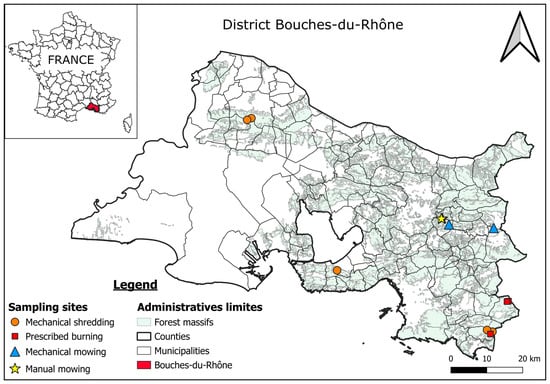
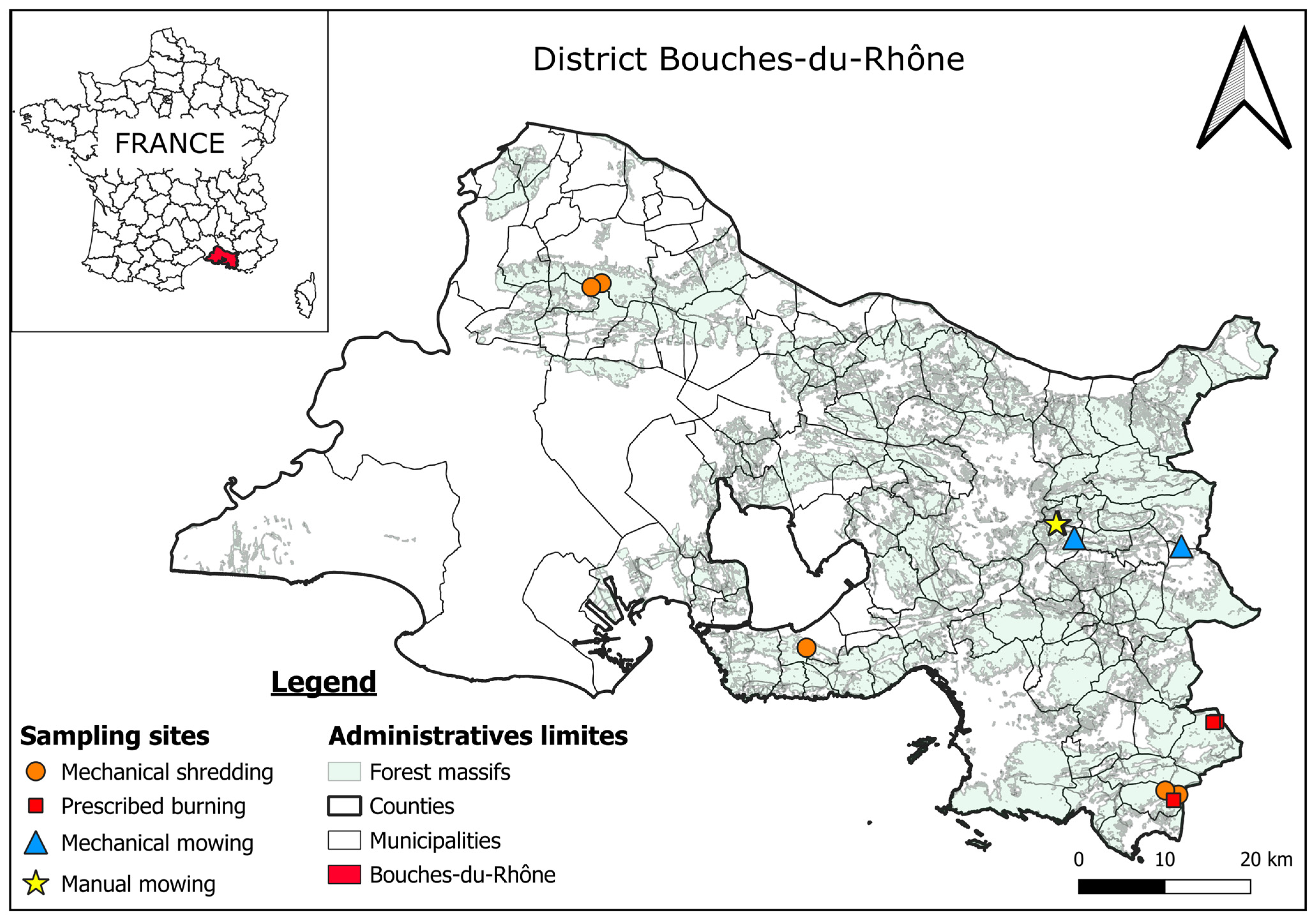
The four methods of fuel treatment selected in this work were among the most frequently used in southeastern France [27]. Two of these methods targeted woody vegetation (in this case, Quercus coccifera shrubland growing under Pinus halepensis stands) in forested lands, prescribed burning (PB) and mechanical shredding (MS), which consists of using machines equipped with hammer mills to shred and crush vegetation into finer pieces. For roadside grass treatment, we took into account manual mowing with a string weeder (SW) (on grass composed of 95% Oloptum miliaceum mixed with Dactilis glomerata) and mechanical mowing using a tractor equipped with a roadside mower (on grass composed of 100% Bromus erectus). The former can be implemented in both WUIs and WNIs, while the latter is only used along roadsides. Mowing results in the production of residues that are left in situ, but we also tested a modality without residues for the mechanical mowing method for comparison (MMR vs. MMwR). The goal of the study was not to compare treatments with each other, but to compare treated vegetation to a control, so the possible difference in vegetation composition between treatments was not an issue. The samples were collected during summer in 2023 and 2024 in four forested lands or along roadsides in the district of Bouches-du-Rhône (southeastern France; Figure 1; Table A1 and Table A2). In this district, a fuel treatment policy has been implemented since 1985 and was reinforced in 2001. This study area is characterized by a Mediterranean climate, with hot and dry summers (500 to 700 mm of annual rainfall; https://meteo.data.gouv.fr/ accessed on 30 January 2026), often windy, and is mainly covered by shrublands as well as by more or less dense forest stands (dominated by Aleppo pine (Pinus halepensis)), highly conducive to fire. The district is also densely populated, with a large proportion of its population living at the WUI. The WUI surface area represents less than 30% of that of the district but is affected by ~50% of the fire ignitions, while communications networks altogether are responsible for more than 80% of the ignitions [5].
Figure 1.
Map of the sampling sites according to fuel treatments in the Bouches-du-Rhône district, southeastern France (BD TOPO® IGN 2022).
The sampling sites were selected to be as homogeneous as possible in environmental conditions to limit inter-site variability (Table 1 and Table 2). The sites selected for PB and MS were all located along tracks used for fire prevention in the forested lands, which have always been regularly treated since the implementation of the regulation on fuel reduction in 2001. These areas are treated cyclically every three years, either by mechanical shredding (P. Lamine, deputy forest manager, Conseil Départemental des Bouches du Rhône, personal communication) or by prescribed burning (V. Pastor, head of Prevention and Anticipation Department of the Forest Fire Group, Service Départemental d’Incendie et de Secours des Bouches du Rhône, personal communication). The control samples were systematically collected in an untreated area adjacent to the treated tracks to maintain similar conditions but far enough away, approximately 10 metres, to avoid the side effects of treatments. Regarding grass treatment, due to the rapid growth of herbaceous plants, the roadsides are usually mowed twice a year, in spring and autumn, in the study area (P. Lamine, deputy forest manager, Conseil Départemental des Bouches du Rhône, personal communication).
Table 1.
Site, environmental, and sample covariables suggested to have an effect on the treated woody vegetation’s flammability.
Table 2.
Site, environmental, and sample covariables suggested to have an effect on the treated roadside grass’ flammability.
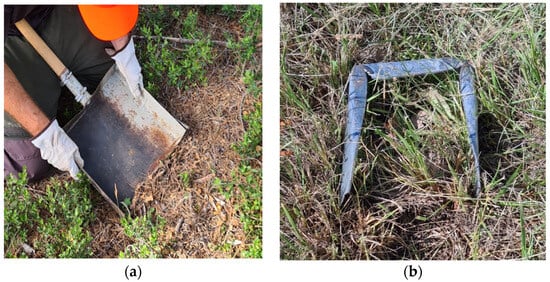
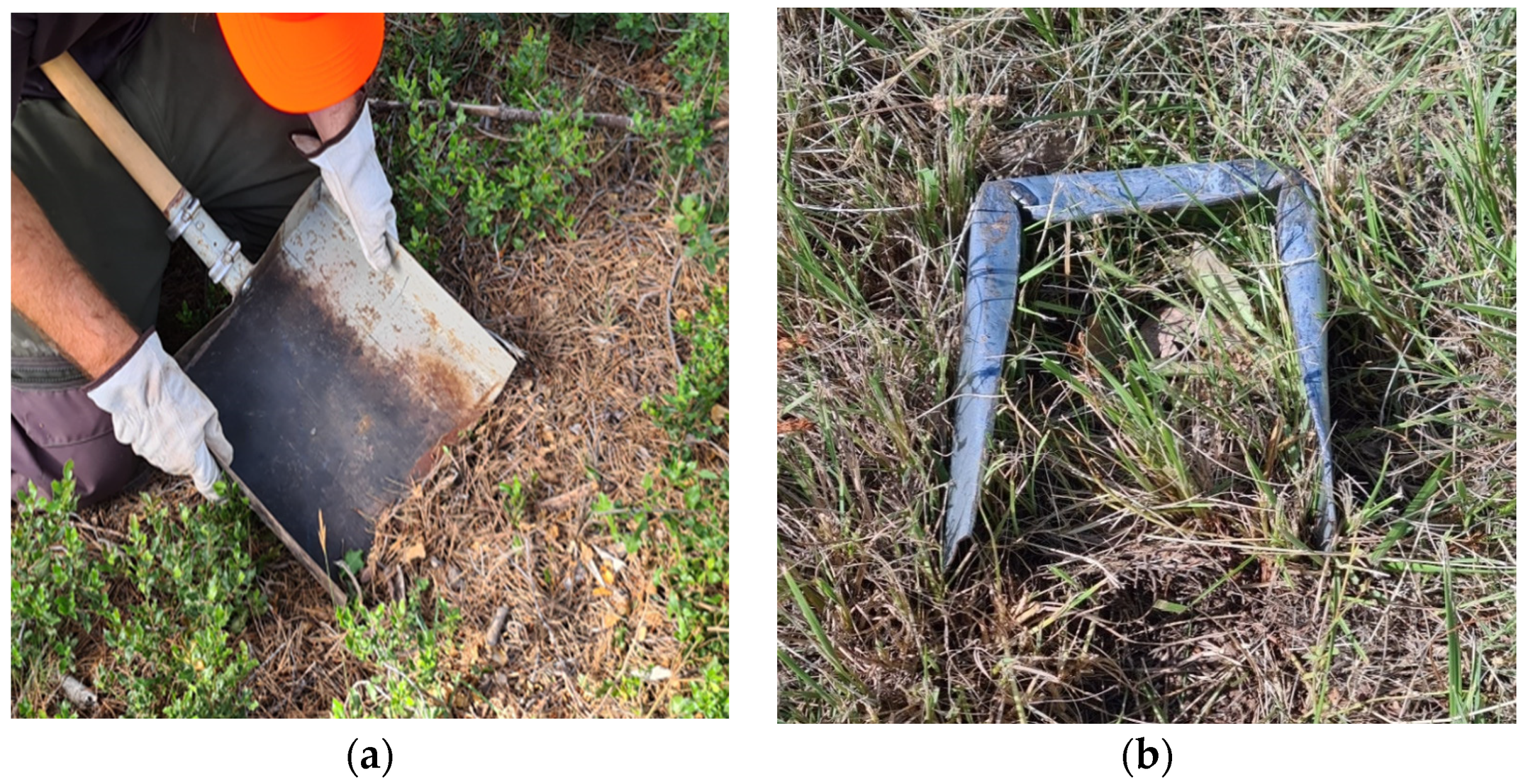
On average, woody vegetation was sampled one and a half years after treatment (ranging from 6 months to 2.5 years depending on the site, in order to cover the variability in time intervals since treatment and to take into account the short-term variability of the vegetation regrowth), while roadside grasses were collected two months after mowing (corresponding to the time elapsed between the season of treatment and the following summer). Sampling the vegetation in summer allowed us to study the effect of the treatments on vegetation flammability in the critical condition of increased vulnerability to fire (i.e., fire season). The sampling method used varied according to the type of vegetation considered (grass or woody vegetation) (Figure 2). For the kermes oak shrubland treated by PB and MS, an aluminium tray (30 × 25 cm) was used as a template to determine the area of vegetation to be collected (Figure 2a). The vegetation shoots were then cut close to the ground and set aside while the litter was removed with a large flat shovel, keeping the litter structure as undisturbed as possible. Samples were brought back to the laboratory just after collection. They were stored in a climatic chamber set at 20 °C and 60% relative humidity to avoid an excessive loss of water content before the burning of the vegetation the next day. Just before the burning, the shoots were replanted in the litter, respecting the vegetation structure before sampling. The same protocol was applied to the control vegetation (same template used and same surface area sampled), the only difference being the taller shrub stems, as the control vegetation was untreated. For roadside grass (treated by SW, MMR, and MMwR), we used a metal template (18 × 20 cm) to delimit each vegetation sample (Figure 2b) that was extracted with a 20 cm-wide trowel, using a protocol derived from that in [28]. With the roadside grass samples having a smaller surface area than that of the woody vegetation samples, they were easier and quicker to collect and transport (also for safety reasons, given the proximity of the collection site to the road). Furthermore, this sample size was more than sufficient for acquiring our flammability data.
Figure 2.
Different sampling protocols depending on the type of vegetation, (a) for woody vegetation, using a metallic large flat shovel, and (b) the metal template used to delimit the grass samples.
Once collected, the samples were directly burned back in the lab as the moisture content decreased very quickly, even if the samples were kept in a climatic chamber.
After each sampling session, usually three samples were systematically set aside to measure the characteristics of the vegetation sampled that could affect flammability (Table 1 and Table 2) (i.e., the ‘sample’ effect): the fuel moisture content (FMC, in %, weighing at least 5 g of leaves before and after drying at 60 °C for 48 h, i.e., until achieving a constant weight according to previous studies, e.g., [28]); the vegetation bulk density (BD = vegetation weight/vegetation volume, in kg·m−3); the proportion of particles smaller than 2 mm, mostly needles (which are the most flammable); the litter depth (cm); the vegetation height (cm); and the height of dead fuel at the basis of the mown grass (cm). All of these covariables can have a direct effect on flammability, as they characterize the fuel available to burn. Moreover, other parameters were recorded to take into account a possible ‘site’ effect (Table A1 and Table A2), such as the forested land (i.e., the site by itself), altitude (m), exposure, average precipitation over the last three months (mm), average temperature over the last 30 days (°C), the sampling date, and the time interval since treatment (Table 1 and Table 2). These covariables can have an indirect effect on flammability because they can affect the vegetation characteristics.
2.2. Laboratory Experiments
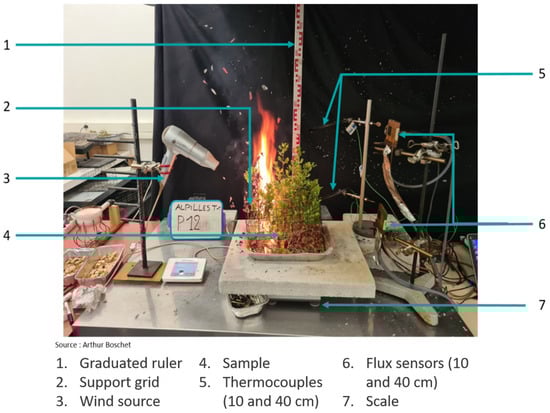
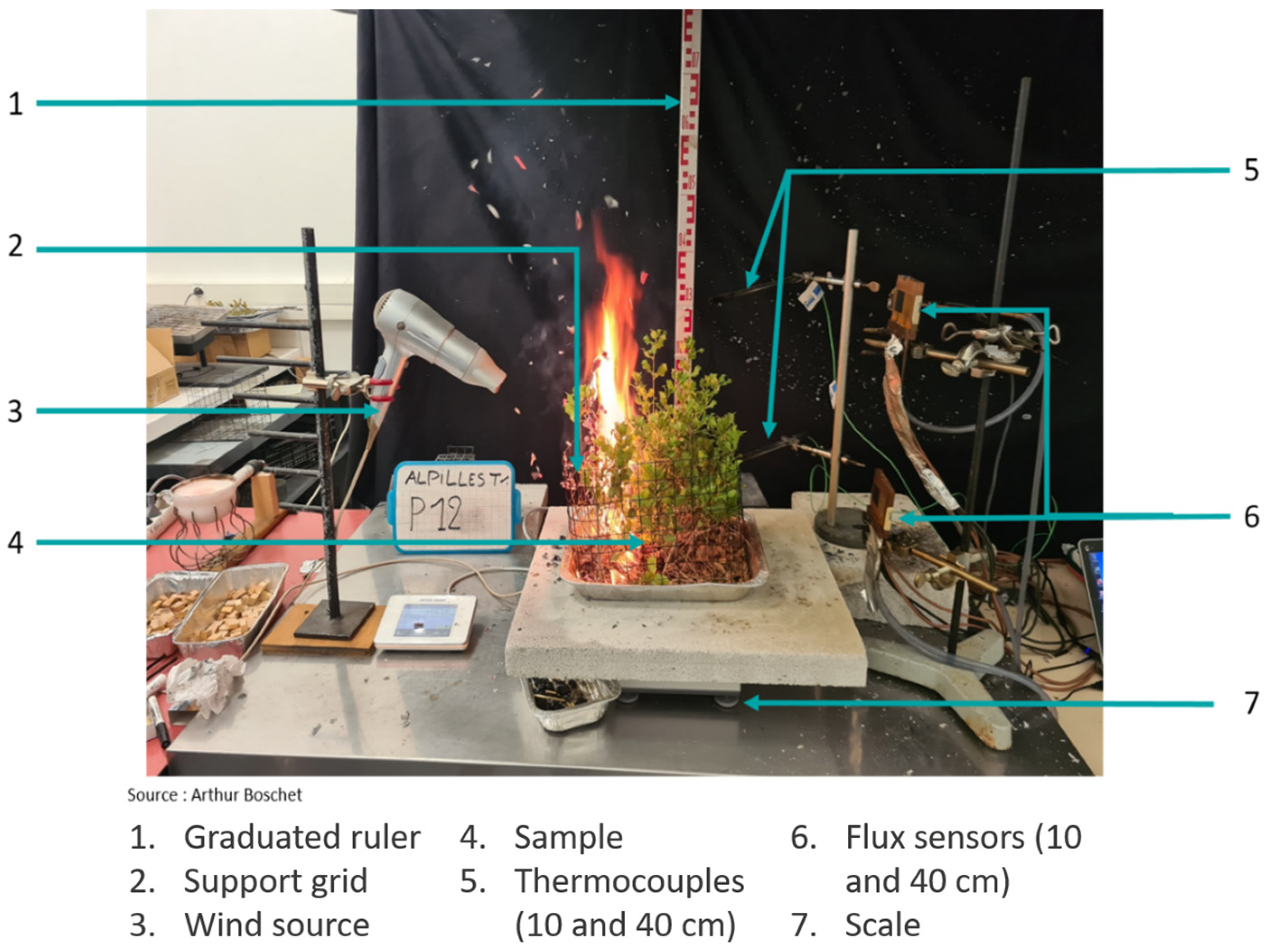
The set-up of the experimental bench and the burning protocols were derived from those used in previous studies [19,20,21,22,29,30,31] (Figure 3). Our burning bench was composed of a weighing scale (Model XSR10002S, Mettler Toledo GmbH lm Langacher 44 8606 Greifensee Switzerland) supporting a plate made of cellular concrete onto which the samples were put for recording the mass loss; two flux sensors (located at 20 cm from the sample) and two type K 0.25 mm (Chromel/Alumel) thermocouples (located above the centre of the sample), were both positioned at 10 and 40 cm high and linked to a data logger (ALEMO 2590 Ahlborn, Ahlborn Messund Regelungstechnik GmbH) for recording the variation in heat flux and temperature over time. An airflow source (fan) was placed at 70 cm and inclined at 45° from the sample (only used when testing ignitability), and a camera, located at 1.10 m in front of the burning bench, was used to film the burning experiments. Finally, a graduated ruler was located behind the sample to allow for measuring flame height.
Figure 3.
Fire bench composed of various devices and an airflow source (fan).
During the burning experiments, different flammability variables, related to the four flammability components described by [32,33], were recorded (Table 3 and Table 4):
Table 3.
Flammability variables recorded during the ignition protocol according to fuel treatment.
Table 4.
Flammability variables recorded during the flame front propagation protocol according to the fuel treatment.
- (i)
- Ignitability was assessed through e ignition frequency (in %, number of successful ignitions/total number of tests*100) and time-to-ignition (in s, time elapsed before flaming after the ignition source was placed on the fuel).
- (ii)
- Sustainability was assessed through flaming duration (in s, time between ignition and end of flame).
- (iii)
- Combustibility was assessed through flame spread (number of sides of the sample reached by the flame), maximum flame height (in cm), maximum temperature at 10 and 40 cm (in °C), total heat fluxes received at 10 and 40 cm (in W·m−2), rate of spread (in m·s−1), and flame front intensity (in kW·m−1). This latter variable was calculated with the Byram equation, FFI = M × HC × ROS, where M is the consumed biomass (kg·m−2), ROS is the rate of spread (m·s−1), and HC is the low heat of combustion (kJ.kg−1), using heat of combustion coefficients of 19,253 kJ.kg−1 for Quercus coccifera and 18,707 kJ.kg−1 for Bromus erectus [34,35] and Oloptum miliaceum (based on an approximation of the value for Bromus).
- (iv)
- Consumability was assessed through the proportion of burned biomass (in %), which is the weight of vegetation consumed as a percentage of the total biomass available for burning.
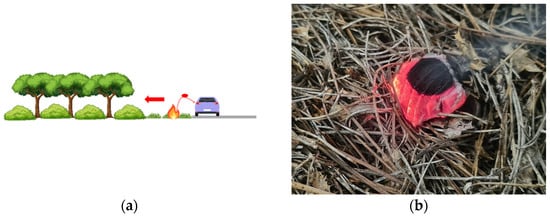
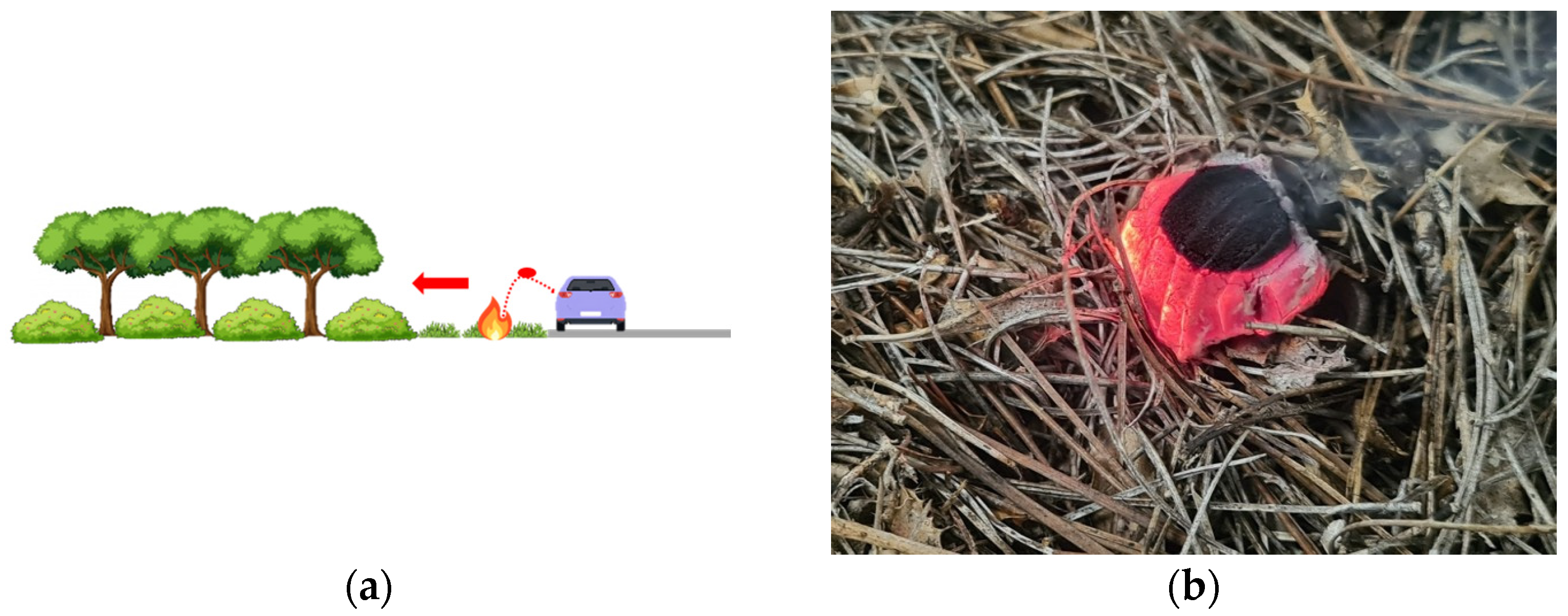
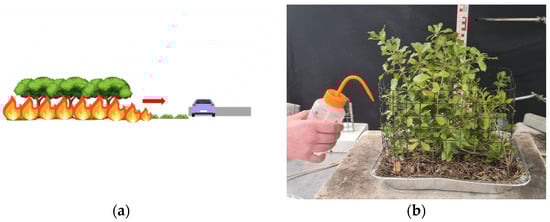
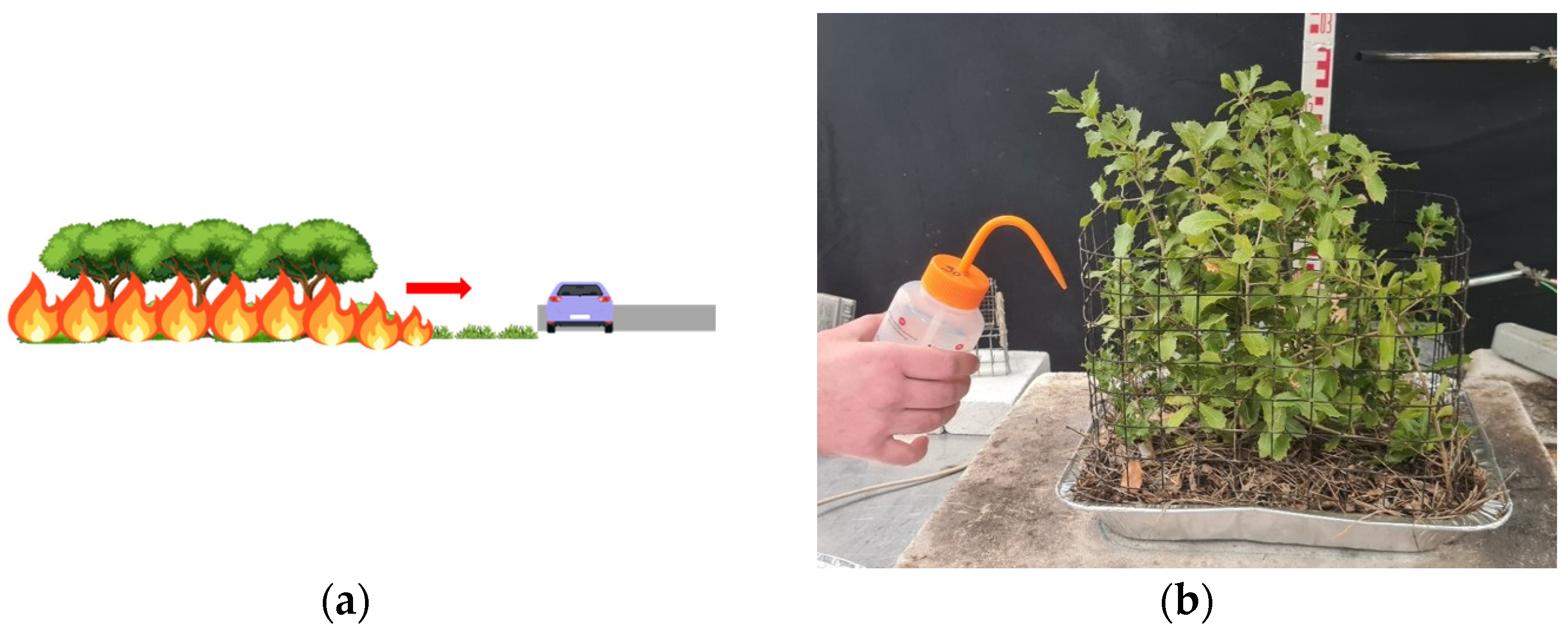
Two different types of ignition sources were used in the burning experiments, depending on the phase of the fire behaviour studied (Figure 4): (i) ignition and (ii) flame front propagation. The aim of the ignition protocol was to simulate ignition by a cigarette butt thrown on the roadside in windy conditions (it is worth noting that this protocol could also simulate the ignition by a firebrand during a spot fire) (Figure 4a). In this case, the ignition point source used was a glowing firebrand (2 × 2 × 1 cm cube of Pinus sylvestris) (Figure 4b) heated with a 500 W epiradiator (at a constant temperature of 415 °C and emitting a constant 7.5 W cm−2 radiation; Epiradiator Standard NF P 92–509–1985) and then placed in the centre of the sample (according to the protocol already used in previous studies [19,20,21,22,29,31]). This type of experiment required an airflow (9.8 ± 0.1 km.h−1) throughout the test [19,28,29,36]. During the burning experiments, the longest side of the sample was positioned in the airflow direction to weaken a possible bias due to the rectangular shape of the sample. This experiment was reproduced up to two times per sample when ignition did not occur within three minutes after the firebrand landed on the vegetation. After two unsuccessful tests, ignition was noted as « 0 ». In the second protocol, we wanted to study the initial phase of the flame front propagation in the sampled vegetation, simulating a fire front coming from the forest and reaching the treated area on the roadside (or at the WUI) (Figure 5a). As the ignition source, we used a calibrated alcohol line laid across the width of the tray and lit with a match in order to trigger 100% ignition. Indeed, we did not investigate the ignition capacity in this second protocol [36] (Figure 5b). The main difference with the previous protocol was that no airflow was involved and the ignition was triggered voluntarily.
Figure 4.
The ignition protocol (a) Schematisation of the simulated ignition by a cigarette butt thrown from a car on the roadside (the arrow indicates the direction of fire spread). (b) Picture of a glowing firebrand used as ignition source during ignition tests.
Figure 5.
The propagation protocol (a) Schematisation of the simulated fire front coming from the forest and reaching the treated area on the roadside (the arrow indicates the direction of fire spread). (b) Picture of the calibrated alcohol line laid across the width of the tray used to trigger ignition.
For mechanical shredding and prescribed burning, the burning of control samples (untreated vegetation) according to the propagation protocol had to be carried out outdoors due to the considerable height of the vegetation samples (~1 m). The burning bench was very similar to the one used in the laboratory, except for the addition of a thermocouple and a flux sensor at a 1 m height and a holding grid more suited to large samples (Figure A1). To ensure 100% ignition, we used a calibrated amount of excelsior instead of the alcohol line, as the latter did not release enough energy to ignite these large samples. It was essential to ensure the environmental conditions were as close as possible to those in the laboratory. Therefore, all combustion tests (in the laboratory or outdoors), the ambient temperature, and the relative humidity were measured before each test as context variables, since they can affect flammability and reflect differences between laboratory and outdoor conditions. They were used as covariables in the analyses. Experiments according to the ignition protocol were not performed on the control samples, as preliminary tests showed that ignition was not possible using a glowing firebrand in untreated Quercus coccifera samples. This was mostly because the air flow provided by the fan could not reach the firebrand placed at the basis of the shrub stems, which acted as a barrier to airflow. We used the data from these tests (labelled as « unpublished data ») for the statistical analyses.
2.3. Data Analysis
First, we verified the possible influence of the lab, sample, and site covariables on the different flammability variables by performing a multiple linear regression model (or a GLM following a Poisson’s distribution for flame spread) using the « lm » function (or « glm » function when needed) in the R (RStudio 2025.09.0+387) package 4.4.1 « stats ». The best model was selected using a stepwise approach based on the Akaike Information Criterion (AIC) (the stepAIC function of the R package « MASS »). This analysis allowed us to take into account all of the significant laboratory, environmental, and sampled vegetation characteristics. When the covariables presented a significant effect on a given flammability variable, we extracted the residuals of the selected models that were used as a corrected measure of the variable in order to control for covariable effects and to be able to test the effect of the treatment without any other interaction in the following analyses [6,37,38].
Then, the treatment effect on flammability (comparing the treated vegetation and control) was tested by performing a one-way analysis of variance (ANOVA), using the corrected variable when necessary (see above). A Fisher LSD test was used to check for significant differences. We assumed that the treatment effect was significant when p ≤ 0.05. Some variables needed to be log-transformed or square-root transformed to meet the one-way ANOVA assumption of normality and homoscedasticity, and when this criterion was not met, a Kruskal–Wallis test was performed (Table A5). The statistical software used for the analyses was Statgraphics ®centurion 19–X64 (StatPoint 228 Technologies, Inc., Warrenton, VA, USA).
3. Results
3.1. Effect of Covariables on Flammability
For prescribed burning (PB), four sample covariables (fuel moisture content, vegetation bulk density, litter depth, and the proportion of needles) as well as five site covariables (forested land, exposure, sampling date, average temperature over the last 30 days, and precipitation over the last three months) were regularly selected as significantly affecting some flammability variables (see Table A5). Litter depth was the most recurrent covariable, influencing eight variables out of ten, while the other covariables affected from two (for fuel moisture content and bulk density) to five (for average temperature over the last 30 days and sampling date) flammability variables. Some, such as maximum temperature, total heat flux at 10 cm, and flame front intensity, tended to be more environment-dependent variables, whereas others, such as consumed biomass, seemed to be more sample-dependent. It should be noted that flame spread was not affected by any covariables and altitude had no effect on any flammability variables. Regarding the laboratory conditions (lab covariables), ambient temperature had an effect on half of the variables, while relative humidity was less impactful (three variables affected).
For mechanical shredding (MS), four sample covariables (fuel moisture content, bulk density, litter depth, and proportion of needles) and six site covariables (forested land, exposure, altitude, sampling date, precipitation, and temperature) were regularly selected as significantly affecting some flammability variables (see Table A5). Fuel moisture content, litter depth, exposure, and average temperature over the last 30 days had a significant and recurring effect on flammability, affecting 8 to 10 variables. Other site covariables (exposure, altitude, and sampling date) only affected five to six variables. Finally, the rest of the sample covariables (bulk density and proportion of needles), but also the average amount of precipitation, affected only a few variables (one and two, respectively). Variables such as flaming duration were the most sample-dependent, whereas others, such as flame height and total heat flux at 10 cm, were more environment-dependent. Regarding the lab covariables, relative humidity affected only one flammability variable compared with three affected by ambient temperature.
Concerning fuel treatments implemented on roadside grasses (MMR, MMwR, and SW), the same covariables were having an effect on flammability for all fuel treatments: three sample covariables (bulk density, fuel moisture content, and height of dead fuel) and only one site covariable (precipitation) were regularly selected as significantly affecting a variable number of flammability variables (see Table A4). It should be noted that average temperature over the last 30 days (except for MMR, for which only one variable was affected) and sampling date did not affect any covariables, and that flame spread was not affected by any covariables. For mechanical mowing with residuals (MMR), most covariables (fuel moisture content, bulk density, ambient temperature, and relative humidity) affected maximum temperature at 40 cm and consumed biomass (with the addition of height of dead fuel), making these variables the most sample-dependent. Concerning mechanical mowing without residues (MMwR), flame height and maximum temperature measured at 40 cm were related to precipitation as well as to bulk density and height of dead fuel, and also ambient temperature. Finally, concerning manual mowing with a string weeder (SW), both total heat fluxes at 10 cm and 40 cm were affected by precipitation and fuel moisture content, with the addition of both ambient temperature and relative humidity, at 40 cm only. Rate of spread was only related to sample covariables such as fuel moisture content, height of dead fuel, and bulk density.
The site, lab, and sample covariables measured therefore had varying degrees of impact on the different flammability variables recorded for each treatment on woody vegetation or on roadside grasses. Once these covariables were identified, we used the residuals of the regression models as a corrected measure of the different flammability variables in the following analyses in order to only highlight the effect of the treatment.
3.2. Effect of Woody Vegetation Treatments on Flammability
For the ignition protocol (Table 3), the values of ignition frequency were low for both MS and PB (5 and 1%, respectively), close to the 0% ignition of the control (unpublished data of a preliminary work). For the few samples that ignited, time-to-ignition was quite long (143 s for MS and 159 s for PB), with a high variation (114%) between the samples for PB (Table 3). The absence of ignition for the control, and therefore of time-to-ignition, did not allow for an analysis of this variable and a determination of the most important covariates. Regarding the data obtained with the propagation protocol (Table 4), for both MS and PB, the values for most variables obtained in the treated samples were lower or of the same magnitude as those for the control. The variation among samples was globally high (variation coefficient >30%), regardless of the treatment (Table 4).
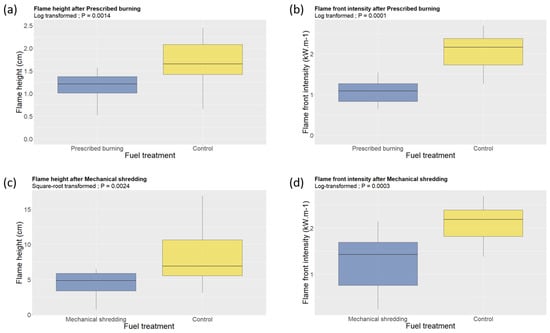
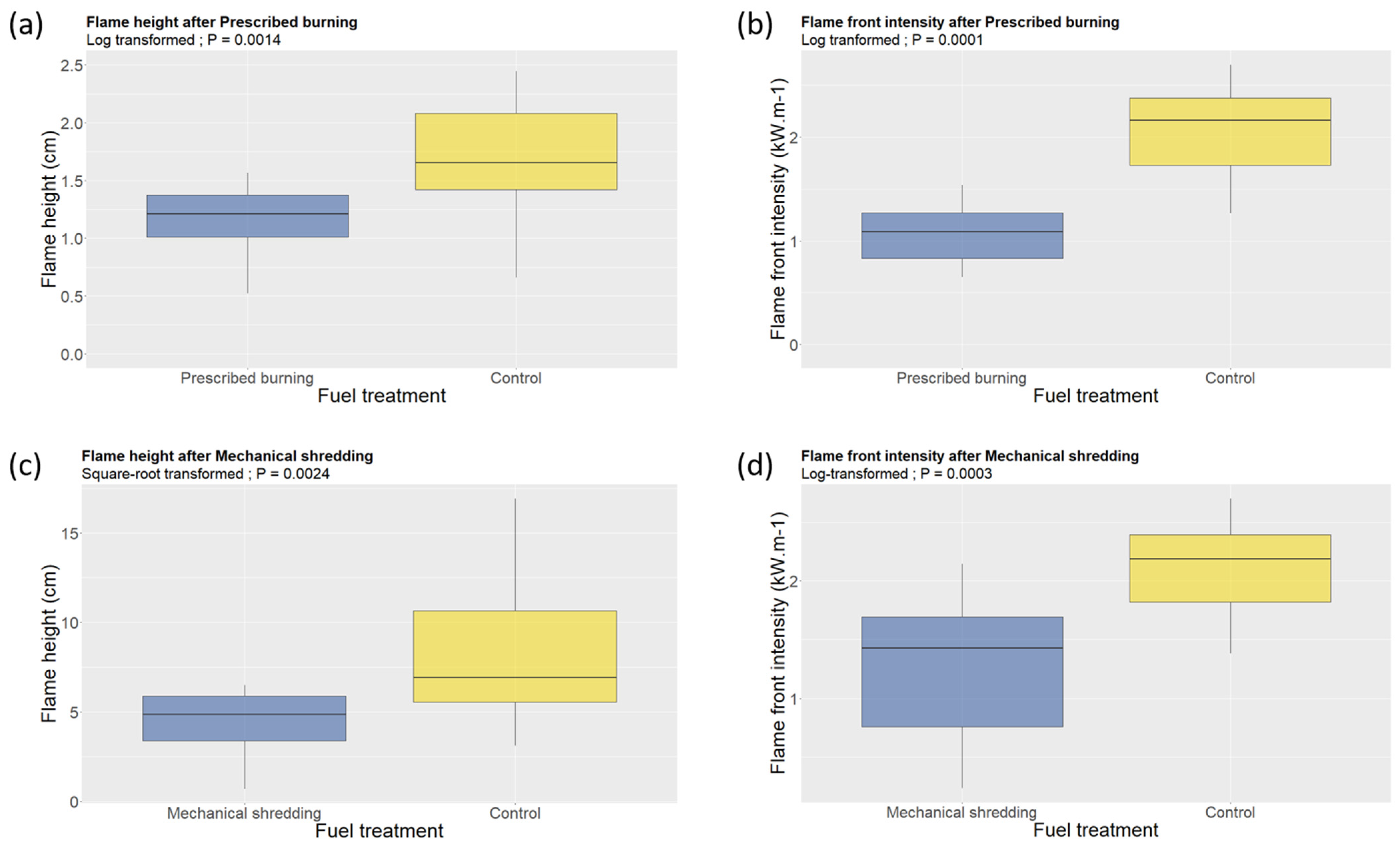
The results of the ANOVAs showed that both PB and MS significantly reduced flame height (PB: F = 12.60, p = 0.0014; MS: F = 11.34, p = 0.0024) (Figure 6a), maximum temperature at 40 cm (PB: F = 4.49, p = 0.0409; MS: F = 5.72, p = 0.0219), total heat flux received at 10 cm (PB: F = 14.94, p = 0.0005; MS: F = 14.98, p = 0.0005) and 40 cm (PB: F = 39.61, p < 0.0001; MS: F = 28.65, p < 0.0001), and flame front intensity (PB: F = 31.81, p < 0.0001; MS: F = 16.77, p = 0.0003) (Figure 6b). PB also significantly reduced maximum temperature at 10 cm (F = 4.57, p = 0.0390) and rate of spread (F = 5.16, p = 0.0320), while MS did not affect these variables (Figure 6c). Conversely, MS significantly reduced the temperature at 40 cm (F = 5.72, p = 0.0219) (Figure 6d). The remaining flammability variables (ignition frequency, flame duration, flame spread, and consumed biomass for both fuel treatments, as well as the maximum temperature at 10 cm and rate of spread for MS only) were not affected by the fuel treatment (p > 0.05).
Figure 6.
Boxplots illustrating the effects of prescribed burning (a,b) and mechanical shredding (c,d) on flame height and flame front intensity.
3.3. Effect of Roadside Grass Treatments on Flammability
Focusing first on the ignition protocol (Table 3), ignition frequency was high for mechanical mowing, with or without residues left (37 and 65%, respectively), compared to the control (1.6%), but time-to-ignition was longer in the treated samples (73 s for the samples with residues and 77 s for those without) than in the control (33 s). In contrast, ignition was unsuccessful in the samples treated with manual mowing. For both types of mowing, the values of ignition frequency for the controls were either very low (mechanical) or equal to zero (manual) (Table 3). A thorough analysis of the ignition time was not possible given the absence or low frequency of ignition in the control, as too little data was available. Regarding the data obtained with the propagation protocol (Table 4), most variables related to combustibility (flame spread, temperatures, heat fluxes, rate of spread, and flame front intensity) presented values higher than those for the control. The opposite was observed for the samples treated with manual mowing (Table 4).
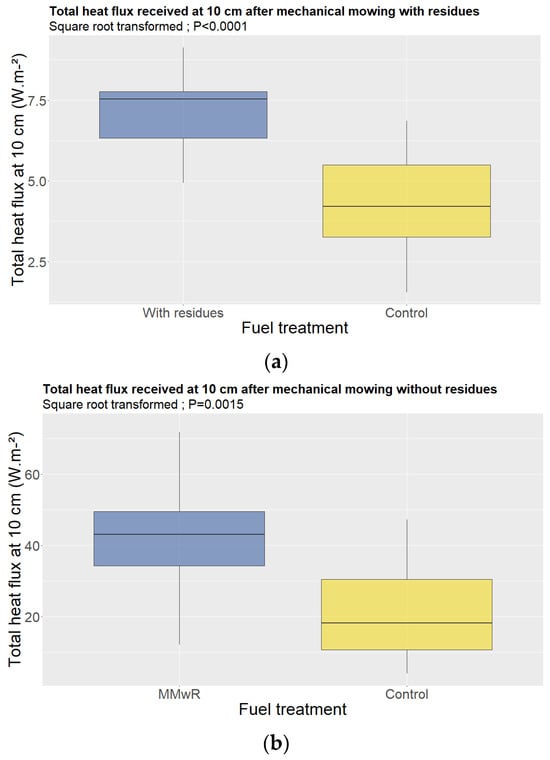
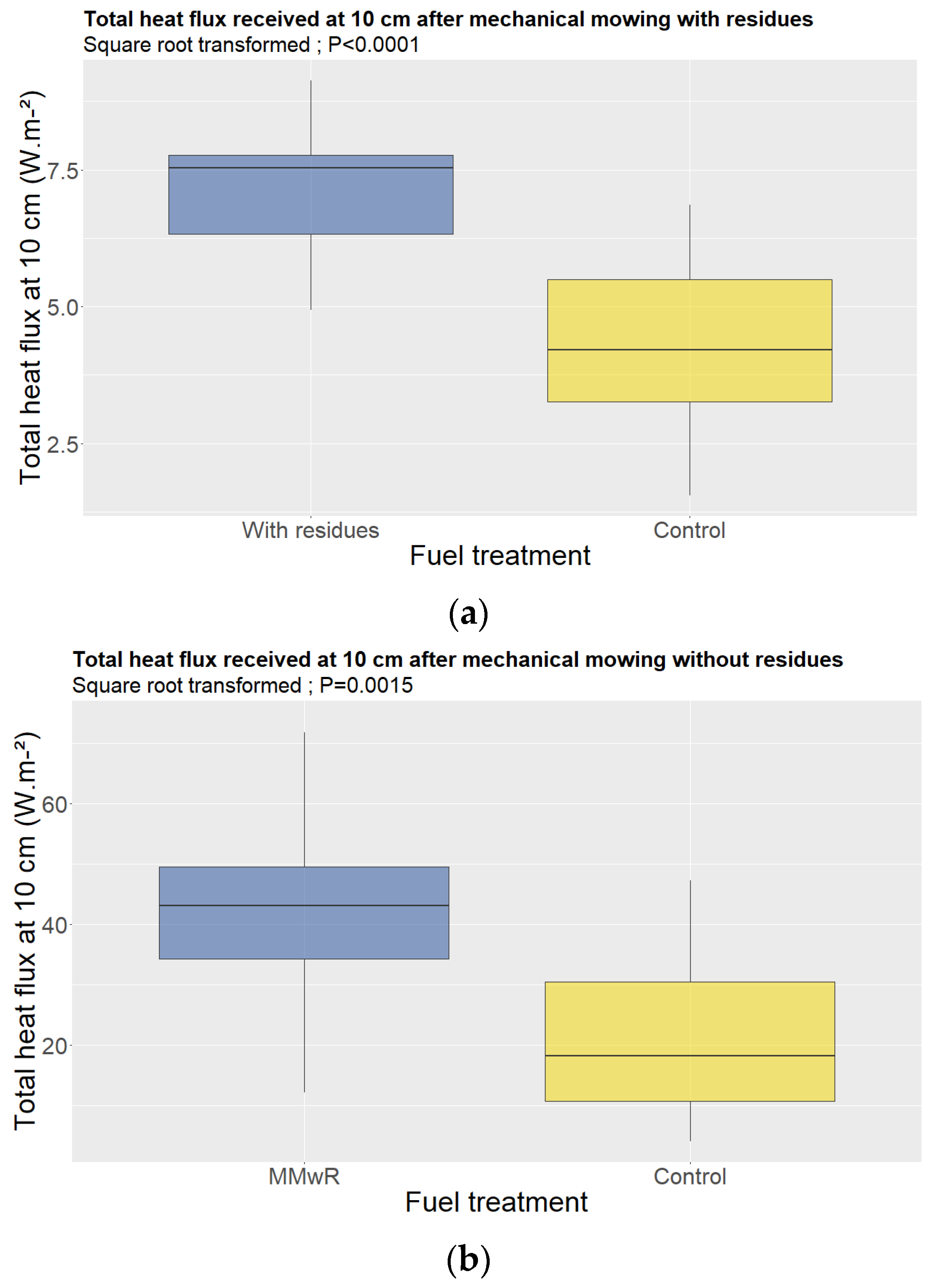
For mechanical mowing with residues (MMR), there were significantly more successful ignitions in the treated vegetation than in the control (37.5% vs. 1.6%, respectively; KW = 24.40, p < 0.0001). MMR also significantly increased flame height (F = 8.46, p = 0.0075), maximum temperature measured at 10 cm (F = 11.29, p = 0.0021), total heat flux received at 10 cm (F = 23.21, p < 0.0001), and flame front intensity (F = 24.82, p < 0.0001 (Figure 7a). The other variables (time to ignition, flame duration, flame spread, maximum temperature at 40 cm, rate of spread, and consumed biomass) were not affected by the treatment (p > 0.05).
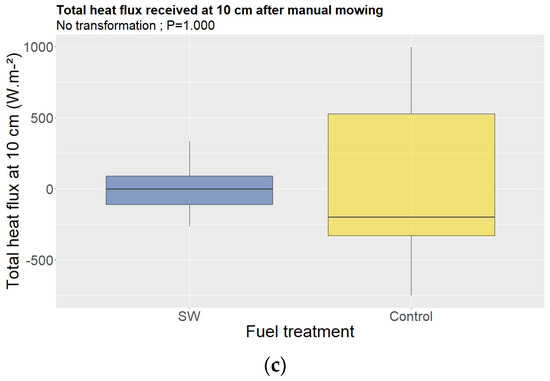
Figure 7.
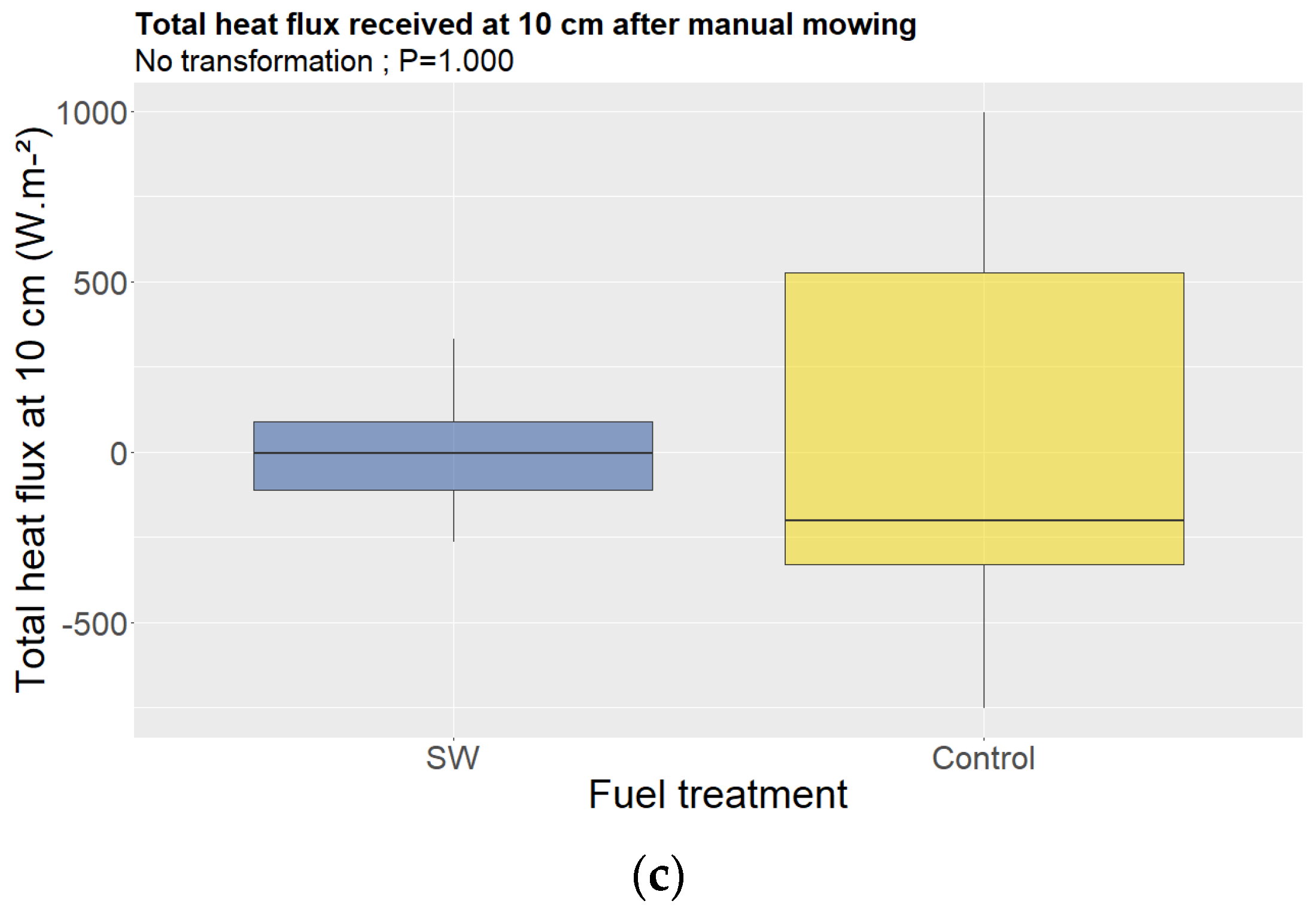
Boxplots illustrating the effect of mechanical mowing with residues (a), without residues (b), and manual mowing (c) on the total heat flux at 10 cm.
Regarding mechanical mowing without residues (MMwR), once again, ignition frequency was significantly higher in the treated vegetation than in the control (67.5% against 1.6%, respectively; KW = 49.0268, p < 0.0001), along with flame spread (KW = 8.31061, p = 0.004), maximum temperature at 10 cm (F = 4.78, p = 0.0393), total heat flux received at 10 cm (F = 12.56, p = 0.0015), and rate of spread (F = 12.98, p = 0.0014). In contrast, consumed biomass was significantly reduced (F = 5.44, p = 0.026). The treatment did not affect the other variables (time-to-ignition, flame duration, flame height, maximum temperature at 40 cm, and flame front intensity; p > 0.05) (Figure 7b).
For manual mowing with a string weeder (SW), ignition frequency, time-to-ignition along with flame height, maximum temperature at 40 cm, total heat flux received at 10 cm, rate of spread, flame front intensity, and consumed biomass were not affected by this treatment when compared to the control (p > 0.05). However, SW significantly reduced flame spread (KW = 5.62, p = 0.017) and total heat flux received at 40 cm (F = 6.01, p = 0.0230), but significantly increased maximum temperature recorded at 10 cm (F = 7.59, p = 0.0099) (Figure 7c).
4. Discussion
The aim of the present study was to assess, at laboratory scale, the effectiveness of the most common methods of fuel treatment implemented in southeastern France in reducing the treated vegetation’s flammability. Flammability studies on fuel treatment are mainly produced in the US and Australia (e.g., [13,17,18]), and only a few studies have investigated vegetation flammability after treatment [19,22] within a South European context. However, most focused on the treatment effects on the vegetation itself (e.g., [14,15]).
4.1. Influence of Covariables on Flammability
Fuel flammability depends, in part, on different environmental conditions and on the vegetation. Fuel moisture content (FMC) is an important covariable affecting flammability for both woody vegetation [29,37,38,39,40] and grass [29,41]. In our work, it was, indeed, one of the most important covariables (affecting most variables) acting on the flammability of the vegetation treated by MS in contrast to the other treatments (PB, MMR, MMwR, and SW). Regarding the roadside grass treatments, the results agreed with [36,42], who found that FMC may only have a secondary effect on flammability (apart from ignitability).
For PB and MS, litter depth also affected most of the flammability variables recorded during the experiments, which indicates its importance in terms of flammability, litter being an important part ofvegetation flammability study [28,43]. Site exposure and average temperature over the last 30 days also heavily influenced the flammability of the vegetation treated by MS, suggesting that differences in conditions and vegetation regrowth specific to each forested land could affect post-treatment vegetation flammability.
Regarding fuel treatments on roadside grasses, different covariates affected flammability depending of the fuel treatment considered. For MMR, the main covariables were vegetation bulk density, which is already known to be a key driver of grass flammability [20,22,29,44], as well as the lab covariables: ambient temperature and relative humidity. MMwR and SW were mainly affected by precipitation, with the addition of the FMC for SW. It has been shown that FMC often plays an important role in grass flammability [29,42,45]. On the other hand, precipitation directly influences FMC [46] and directly affects the freshness of roadside grasses. The other covariables affected fewer flammability variables and even none to one (date and temperature over the last 30 days). Laboratory variables still have an effect on flammability, illustrating the sensitivity of herbaceous vegetation once harvested.
4.2. Effect of Fuel Treatment on Woody Vegetation Flammability
Concerning PB and MS, the treated vegetation flammability was overall successfully reduced. Both treatments did not affect ignitability, since no difference was observed between the treated samples and the control for ignition frequency and time-to-ignition, despite the airflow, agreeing with previous studies [20,21]. The lack of ignition measured in the samples treated by PB could be partly due to the reduction in ground fuels and fuelbed depth during the treatment implementation, as observed in [47]. For the samples treated by MS, this poor ignition was probably due to the presence of coarser residues that are more difficult to ignite, but this result should be taken with caution, as the probability of ignition (and fire behaviour in general) in shredded areas is not yet well understood, with sometimes conflicting results found regarding the effect of these residues [9,48,49,50].
Sustainability was not affected by fuel treatments, as flame duration remained similar in the treated vegetation and the control. In contrast, some studies have found that the transformation of the vegetation and the increase in surface fuel load after mastication could promote long flaming and smouldering durations [9]. In addition, the vast majority of the fuel available in our samples burned consistently for each fuel treatment method, showing that the treatment methods had no effect on consumability. However, this was not the case for combustibility, which was heavily affected by the fuel treatment, since almost all flammability variables related to this component were reduced after both PB and MS.
One of the effects of the fuel treatment is a reduction in vegetation height and in litter depth, which has been found to be positively correlated with flame height [17,21,30,51]. Prescribed burning generally significantly reduced surface fuels, both litter and aboveground vegetation (e.g., [52,53]), therefore reducing flammability. When we collected our samples, the treated vegetation had had time to regrow a little bit (as a minimum of six months elapsed since the treatment), but the litter layer remained thin in our PB-treated areas, preventing the flames from becoming too high. For MS, some studies also showed that flame height values were lower in areas that had been shredded [9,54,55,56]. In addition, previous works highlighted that flame propagation and temperatures were also affected by litter depth [17,30]. This relation between litter depth and flame temperature was clearly observed in our result, since PB had the thinnest litter depth and had a significantly lower temperature at our two measured heights.
MS was also effective in reducing maximum flame temperature, but only at 40 cm. The lack of effect on temperature at 10 cm should be due to the presence of coarser shredded residues that could burn at higher temperatures, and since they were located on the ground, only the thermocouple located at 10 cm recorded the increase in temperature. Despite no variation in flame spread, the thin litter layer in the samples treated by PB slowed down the rate of spread in the treated vegetation, which was not the case for the MS-treated samples. The authors of [21] suggested that the wind was an important factor affecting rate of spread; however, we could not verify this result, as our propagation tests did not use a wind source.
The other goal of fuel treatment is to reduce the fuel load available for the fire [57,58], which plays a key role in flux emissions [59,60] and fire intensity [61,62,63]. Indeed, after both PB and MS, the lower fuel load entailed a decrease in the heat released during combustion and in flame front intensity. As explained earlier, MS and PB reduced flame height in the vegetation treated, yet this variable is also related to the amount of heat emitted by the flames and, by extension, to flame front intensity [64,65]. Therefore, lower flame height in the samples treated by PB and MS was an early indicator of lower total heat flux and flame front intensity, as observed in our results.
4.3. Effect of Fuel Treatment on Roadside Grass Flammability
Concerning the fuel treatments used on roadside grass, the effects on flammability tended to be variable according to the method. Surprisingly, mechanical mowing with (MMR) or without residues (MMwR) overall increased the flammability (which was not the effect intended after treatment), in contrast to manual mowing with a string weeder (SW). Testing the sample ignitability using a glowing firebrand as ignition source, we observed higher ignition frequency for MMR and MMwR compared to the control. This higher ignition frequency obtained in the samples treated by mechanical mowing with residues could be explained by the fact that MMR residues tend to form a dry, flat, dense mat not impeding air flow, allowing the firebrand to have a large contact surface area with this dry vegetation, therefore making it highly suitable for ignition. This was also the case when removing the residues (MMwR), which made available the litter (mostly composed of dead grass leaves) naturally present at the basis of the grass stems, which is also very dry in summer. Together with the mowed grass stems, the litter also forms a homogeneous fuel stratum, providing a large contact surface area between the firebrand and the vegetation, as was the case when the residues were left (MMR). In contrast, no ignition was observed in samples treated by manual mowing with a string weeder (SW). Indeed, with this method, the pieces of mowed vegetation (whole or parts of grass stems or leaves) were scattered on the ground with different orientations and with little continuity (as opposed to the dense mat obtained with mechanical mowing). Therefore, when the firebrand fell on these residues, the insufficient contact surface area between them did not produce enough heat transfer, preventing ignition. Ignition also rarely occurred in untreated roadside grasses, as the firebrand (a cigarette butt, for example) was trapped between the grass stems before reaching the ground, which strongly hindered the contact surface area with the vegetation and therefore the heat transfer, as well as the air flow [36]. Our results confirmed that the vegetation structure therefore plays an important role in flammability, according to previous studies [42,66].
Similar to ignitability, combustibility greatly varied depending on the method applied, with MMR and MMwR mostly enhancing this flammability component in contrast to SW. Flames better spread in the vegetation treated by MMwR due to the dry fuel continuity, whereas in MMR, flame spread was similar to that of the control, due to higher vegetation bulk density. For SW, the structure of the scattered residues made it more difficult for the flames to spread. Flame height was higher in the samples treated by MMR since more fuel, with higher bulk density, was concentrated on the ground.
The relationships between flame height and fuel amount and density have already been highlighted by [29]. However, it should be mentioned that [67] showed that higher bulk density can lower flame height, but increase flame duration in an open litter bed. This concentration of fuel at ground level also induced an increase in the maximum temperature recorded at 10 cm for all fuel treatments. Moreover, this allowed for an increase in total heat flux received at 10 cm for MMR and MMwR in contrast to SW, for which this variable was similar to that of the control and lower than that at 40 cm.
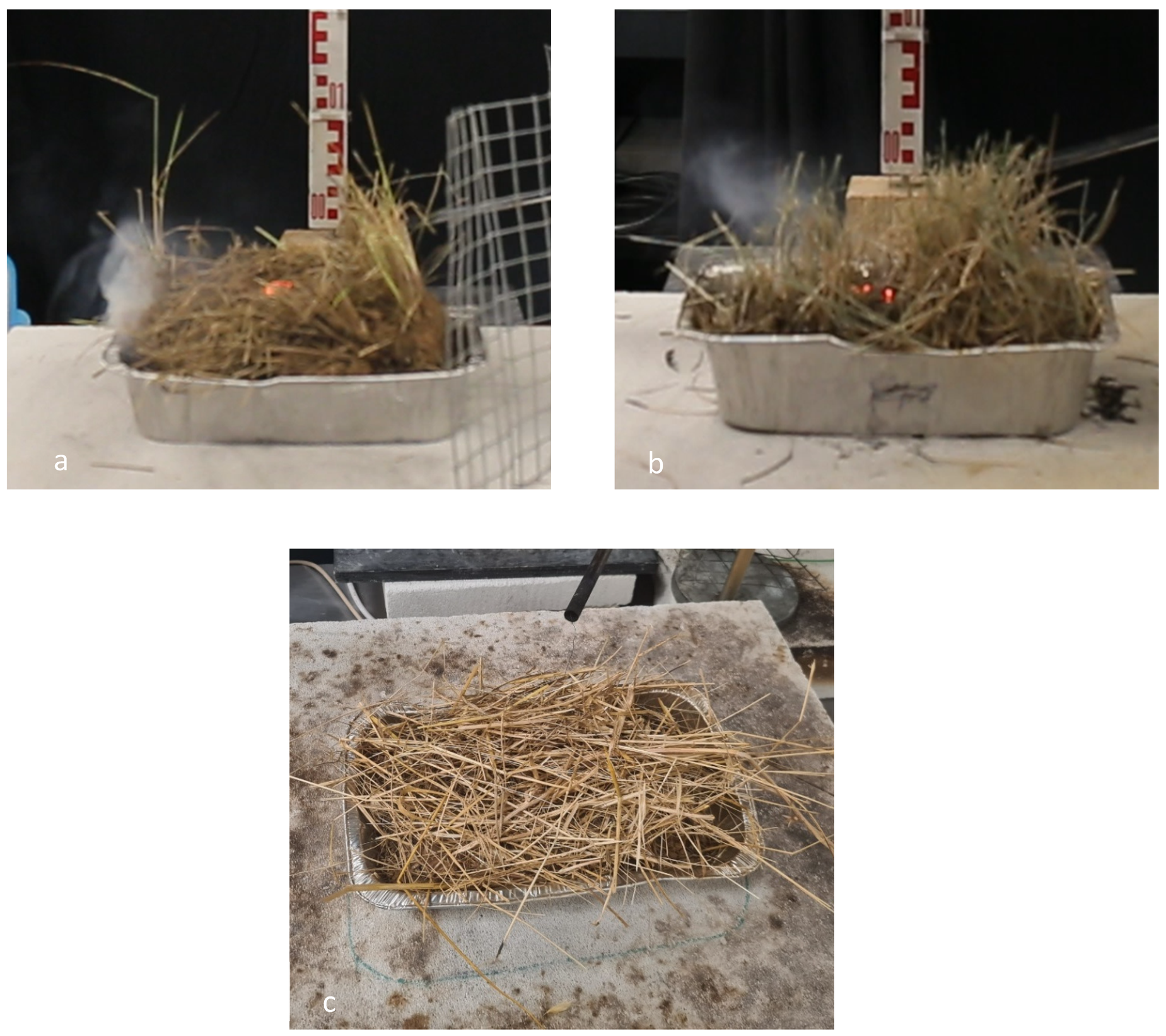
These different methods of grass treatment led to differences in vegetation continuity, explaining the difference of the results obtained for the rate of spread, flame front intensity, and consumed biomass (Figure A2). The strong vegetation continuity created by the residues left in situ for MMR led to a higher flame front intensity. In the case of MMwR, vegetation continuity was also important, but the lower biomass available after this treatment led to quicker rate of spread. Curt et al. [36], having conducted relatively similar experiments on mowed grass without residues, also observed rapid propagation. No significant changes in rate of spread, flame front intensity, and consumed biomass were observed after SW. In fact, the structure of the residues on the ground can be considered similar to that of the herbaceous grasses still standing (poor fuel continuity and contact surface area), which explains this lack of difference. This reminds us of the importance of the vegetation structure and possible airflow speed, if any. Flame front intensity depends on rate of spread and consumed biomass, both varying differently depending on the treatment applied. For MMR, there was no change in rate of spread or in consumed biomass, and higher flame front intensity was mainly due to the vegetation structure. On the other hand, MMwR samples presented faster rate of spread but lower consumed biomass. These two variables seem to compensate each other sufficiently to obtain a flame front intensity that does not differ from the control.
4.4. Comparison of Flammability Results with Those of Previous Comparable Studies
We compared our results to those obtained during burning experiments performed either on a fire bench or a wind tunnel with comparable ignition sources to be in conditions as similar as possible to those of the current study. This drastically limited the number of possible comparisons, especially regarding grass fuel. We did not take into account the studies using apparatuses such as epiradiators, cone calorimeters, and thermogravimetric analysis, mostly because the fuel sample size and load were too small compared to those in our work, which could cause too much bias. Most studies we used aimed to assess the flammability of treated vegetation in different countries, with vegetation and treatment methods possibly differing from ours. Unfortunately, only some flammability variables studied were the same as the ones we recorded in our experiments, which further limited the comparisons (Table 5).
Table 5.
Description of burning protocols and flammability data obtained in the current and previous studies.
Regarding the woody fuel, the low ignition frequencies obtained in the current work (between 1 and 5%, depending on the method) were close to those recorded on Ulex europaeus by [22] one year after treatment (10%), while [20] found 33% ignition at this time. The differences observed between these studies could be explained by the different types of vegetation studied (Ulex europaeus vs. Quercus coccifera in our study). However, in both studies, an increase in ignition frequency was observed when the vegetation was mature and when only the residues were tested ([19]), with ignition frequency reaching around 55%. The study [36], using the same protocol of ignition source and airflow, observed 40% ignition frequency in recently treated Q. coccifera samples. This higher ignition frequency could be due to the lower height of the stems, allowing for better aeration than in our study. However, the ignition frequency of the control samples was higher in this latter study (20%) than in ours (0%); this could also be due to the height of the vegetation, which was taller in our study (92 vs. 30 cm), hindering the ignition process. In our study, the ignition delays in the samples treated by MS were similar to those recorded by [19] (143 and 115 s, respectively), but much longer than in [21] (12 s). This could be explained by the difference in the sample composition (only crushed residues in [19] but regenerated vegetation and litter in [21], as in our study). The mean value we obtained for PB was similar to that recorded in [22] (128 s), despite the different species studied (U. europaeus), but was much higher than those in previous works (between 10 and 17 s; [20,21]), which could be due to the ignition source (glowing firebrand vs. flaming firebrand and cotton strip soaked in alcohol). Indeed, the glowing firebrand took longer to provoke sample ignition because of its lower calorific value.
Regarding MS, the mean value of flame duration we recorded (162 s) was of the same order as those of [19,21] (162 vs. 202 and 181 s), but was much higher than those recorded by [36] on Q. coccifera samples (17 s) despite the same burning protocol, mainly because the flame propagation rapidly stopped. The results in [9,18] were also much lower (18 and 14 s), which could be due to the ignition source (flat paraffin-soaked wick) that could have provoked a quick burning compared to a glowing or flaming firebrand. The flaming duration we recorded on samples treated by PB was longer than 1 s, as in [20,21], but was much longer than that in [23] (17 s), despite similar burning conditions and vegetation as those in [20]. It is worth noting that, in this case, the value given in [22] was the result of only one successful ignition (out of 10). The flame spread recorded in our samples treated by MS was of the same order as that in [19] (2.4 vs. 2.1), while it was higher than that presented in [36], working on the same species and using the same experimental protocol (2.4–2.7 vs. 1, respectively). In the latter work, the lack of biomass due to the more recent treatment could explain the poor propagation, especially as the spread obtained in the control was high in both studies (3 and 4). For MS, our values of flame height were in line with those in [21,31] (81 cm and 85 to 90 cm, respectively), but a bit higher than those obtained in [9,18] (72 cm and 55 cm, respectively). In the latter works, samples were composed only of two-year-old masticated residues, in contrast to our study, in which the samples were composed of less coarse shredded residues and mostly of shrub regrowth. For PB, the value we obtained (80.8 cm) was lower than that recorded in [31] (120 cm), but higher than in [21] (47.8 cm). Marino et al. [21,31] studied a different type of vegetation, mainly regenerated shrubs of a mixed heathland, but the difference in methodology between these studies was the sample size, which was larger in [31], explaining the taller flames. The maximum temperatures we recorded at 10 and 40 cm in samples treated by PB (respectively, 783 °C and 512 °C) were close to those measured at 25 (800 °C) and 50 cm (approximately 550 °C) in [31]. A different trend was obtained with the samples treated by MS, with Marino et al. [31] having recorded 560 °C at 25 cm and 350 °C at 50 cm, while we measured 663 °C at 10 cm and 567 °C at 40 cm in our study. This difference could be due to the composition of the samples treated, resulting from different times-since-treatment. Regarding the flame rate of spread, the values were much lower (by a factor of four) in our study, regardless of the treatment method, than those measured in [21]. The flame front intensities we recorded were lower than those reported by [31] (PB: 87.3 vs. 206.7 kW m−1, respectively, and MS: 112.7 vs. 153 kW m−1, respectively). This difference could be once again due to the different vegetation type and bulk density (Quercus coccifera vs the denser shrubs of mixed heathland), since flame front intensity varies from one vegetation type to another. However, our results were more in line with those obtained in [18] (85.3 kW m−1) despite the difference in the fuel sampled. Regarding the consumed biomass, the values we measured in samples treated by MS (67%) were lower than those obtained by [9,18] in masticated residues (96 and 89%), but higher than the results in [19] obtained for crushed residues (43%). This could be due to the ignition source, the glowing firebrand being less calorific than the alcohol line or the paraffin-soaked wick, and therefore more able to generate a more powerful flame front.
Regarding the grass, in the same experimental conditions, Curt et al. [36] also showed that the mowed grass Avena fatua (without residues left) ignited more easily than the control, with 50% ignition, which is close to our ignition frequencies (65%, when the residues are left in situ). Their controls also presented very low ignition frequencies (<10%). In contrast, the moister Carex sp. (still without residues), also studied by [36], was difficult to ignite when mowed or not (20 and 0%, respectively). Working on untreated cured grass (FMC 7%), Ganteaume et al. [29] observed an ignition frequency higher than 90% on average, these higher values being explained mainly by the lower moisture content of the samples. The ignition was the most delayed for the moistest grass species (95 s), and the shortest time-to-ignition was obtained for the driest species (12 s) ([36]), while our results in the same conditions were intermediate (77.8 s), due to moisture contents ranging from 21 to 34%. Regardless of the work, ignition delays were the shortest in the controls, including in the untreated grass of [29] (<3 s). Results concerning flame duration were comparable between our study and that of [36] for the mowed samples. The control values were, however, lower in this latter study (15 s), with the species presenting the lowest moisture content, and the highest values were recorded in [29] (86 s), in which the samples were larger, and in our study regarding Oloptum samples (82 s). The results obtained in our work and in [36] were comparable regarding flame propagation, highlighting a decrease from mowed samples to the control (except regarding Oloptum samples, in our study). The flame height values we measured (75.7 cm for untreated Bromus samples and 104.2 cm for untreated Oloptum samples) were in the same range as those in [29] (75.6 cm, on average).
4.5. Study Limitations
Given the diversity of protocols used to assess plant flammability in laboratory conditions and the lack of standardization among studies, we chose to base our experiments on existing works in which a sound methodology has already been proven [28,29,30,31,37]. However, as often mentioned, results of laboratory burnings should be considered carefully, as species flammability in the field could also be influenced by environmental conditions [39,68]. Another point is that there are very few laboratory experiments regarding treated vegetation’s flammability, making comparisons more difficult. Despite this, our work can help to improve our knowledge of the effects of fuel properties on flammability and allows highlighting trends in flammability.
Regardless of the method of treatment, the sample surface area remained modest and only allowed us to study the initial phase of fire propagation, and for a shorter period than in a wildland fire. However, it allows for the assessment of the treatment method’s effectiveness in mitigating flammability in laboratory conditions. Our results need to be supplemented, for example, by experiments at a larger scale in the field or using fire behaviour modelling.
5. Conclusions
This study provides new insights into forest and roadside vegetation management for fire prevention by assessing post-treatment vegetation flammability in laboratory conditions, according to the most common methods for fuel reduction used in the French Mediterranean region. However, it also raises questions about their effectiveness under real conditions, particularly for mowing, should these results be confirmed by experiments at larger scale.
Most importantly, our results indicated that, after both prescribed burning and mechanical shredding, the flammability of treated samples was successfully mitigated due to the reduction of several key fuel factors impacting flammability, such as the fuel height, litter depth, and fuel load available to burn. However, it should be noted that, in the context of laboratory experiments, prescribed burning seemed to be the most effective fuel treatment, reducing more flammability variables than mechanical shredding.
Fuel treatments for roadside grasses varied in their effects depending on the method considered. Mechanical mowing with residues left in situ, which is the usual grass treatment, entailed the opposite effect to what was expected, increasing the overall flammability of the treated vegetation. The laboratory-tested alternative of residue removal led to the same conclusion. Conversely, manual mowing with a string weeder effectively reduced flammability, mainly because of a different residue structure that was less conducive to fire. Given the unexpected results obtained in the grass mowing modality, additional work will have to be carried out, for example, at larger scale or transposed to the field, in order to confirm or challenge the results obtained in the current study. This would enable better decision-making for fuel management.
Our woody vegetation sampling took into account a range of periods comprised within the three-year delay separating two treatment episodes, and further work will deal with the effect of the time-since-treatment on the flammability of the treated vegetation in order to pinpoint at what time the treatment loses its effectiveness (i.e., when the flammability stops being mitigated). This work will allow us to verify if the current three-year delay, as required by law (fuel reduction regulations), allows for flammability reduction or if it should be shortened, especially in the case of faster-than-expected vegetation regrowth.
Author Contributions
Conceptualization, A.G.; methodology, A.B.; software, A.B.; validation, A.B. and A.G.; formal analysis, A.B.; investigation, A.B.; resources, A.B.; data curation, A.B.; writing—original draft preparation, A.B.; writing—review and editing, A.B. and A.G.; visualization, A.B. and A.G.; supervision, A.G.; project administration, A.G.; funding acquisition, A.G. All authors have read and agreed to the published version of the manuscript.
Funding
This work was part of the GECOVI programme and was supported by the AFORCE mixed technology network (RMT AFORCE) and ADEME (the French agency for ecological transition).
Data Availability Statement
Data for this manuscript will be accessible at the Dryad Digital Repository.
Acknowledgments
The authors thank the Conseil Départemental des Bouches-d-Rhône, the National Forestry Office (ONF), the Bouches-du-Rhône fire and rescue service (SDIS 13), and the Alpilles Natural Regional Park that helped gather information on the treated areas of the Bouches-du-Rhône district. They also thank the INRAE technical team, Mathieu Audouard, Andy Dieudonné, Alexis Doghman, Jean-Michel Lopez, and Christian Travaglini, for their help in the field and in the lab, and the Aubagne and Meyrargues fire brigades for hosting our outdoor burnings.
Conflicts of Interest
The authors declare that they have no known competing financial interests or personal relationships that could have appeared to influence the work reported in this paper.
Appendix A
Table A1.
Characteristics of the sampling sites for each woody vegetation fuel treatment.
Table A2.
Characteristics of the sampling sites for each roadside grass fuel treatment.
Table A3.
Site and sample covariables affecting each flammability variable recorded for mechanical shredding and prescribed burning.
Table A4.
Site and sample covariables affecting each flammability variable recorded for mechanical mowing with or without residues and manual mowing using a string weeder.
Table A5.
Transformation needed for each flammability variable to meet the one-way ANOVA assumption of normality and homoscedasticity.
Figure A1.
Adapted outdoor fire bench for burning control vegetation according to the flame front propagation protocol.
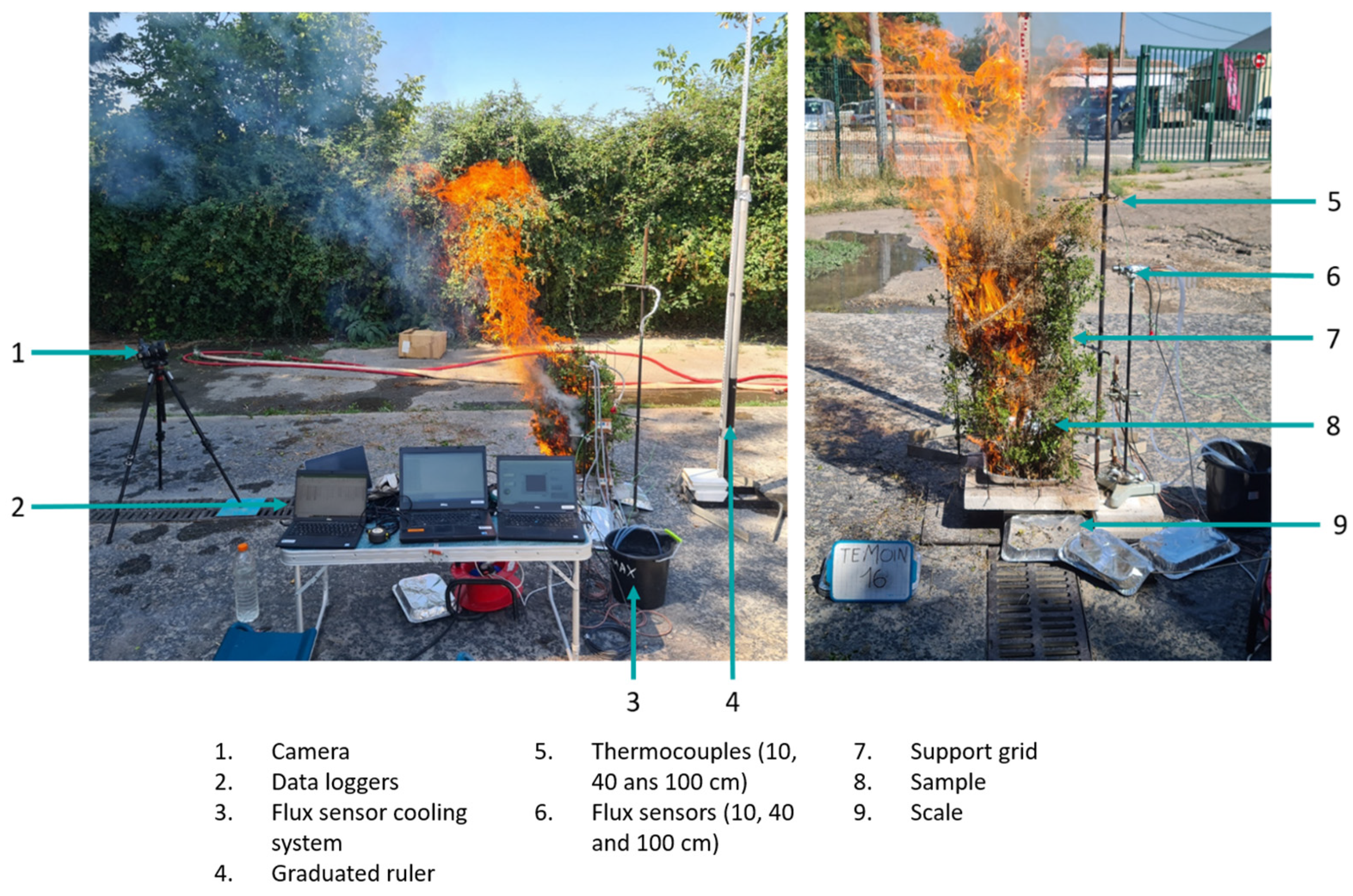
Figure A2.
Roadside grass structure according to the type of fuel treatment applied: (a). mechanical mowing with residues, (b). mechanical mowing without residues, and (c). manual mowing with a string weeder.
References
- Oom, D.; De Rigo, D.; Pfeiffer, H.; Branco, A.; Ferrari, D.; Grecchi, R. Pan-European Wildfire Risk Assessment, EUR; Publications Office of the European Union: Luxembourg, 2022. [Google Scholar] [CrossRef]
- Reyes, O.; Casal, M.; Rego, F.C. Resprouting Ability of Six Atlantic Shrub Species. Folia Geobot. 2009, 44, 19–29. [Google Scholar] [CrossRef] [Scilit]
- Johnston, L.; Blanchi, R.; Jappiot, M. Wildland-Urban Interface. In Encyclopedia of Wildfires and Wildland-Urban Interface (WUI) Fires; Manzello, S.L., Ed.; Springer: Cham, Switzerland, 2019; pp. 1–13. [Google Scholar] [CrossRef] [Scilit]
- Bento-Gonçalves, A.; Vieira, A. Wildfires in the wildland-urban interface: Key concepts and evaluation methodologies. Sci. Total Environ. 2020, 707, 135592. [Google Scholar] [CrossRef] [Scilit]
- Chappaz, F.; Ganteaume, A. Role of land-cover and WUI types on spatio-temporal dynamics of fires in the French Mediterranean area. Risk Anal. 2022, 43, 1032–1057. [Google Scholar] [CrossRef] [Scilit]
- Ganteaume, A.; Barbero, R.; Jappiot, M.; Maillé, E. Understanding future changes to fires in southern Europe and their impacts on the wildland-urban interface. J. Saf. Sci. Resil. 2021, 2, 20–29. [Google Scholar] [CrossRef] [Scilit]
- Ganteaume, A.; Guillaume, B.; Girardin, B.; Guerra, F. CFD modelling of WUI fire behaviour in historical fire cases according to different fuel management scenarios. Int. J. Wildland Fire 2023, 32, 363–379. [Google Scholar] [CrossRef] [Scilit]
- Agee, J.K.; Skinner, C.N. Basic principles of forest fuel reduction treatments. For. Ecol. Manag. 2005, 211, 83–96. [Google Scholar] [CrossRef] [Scilit]
- Kreye, J.K.; Varner, J.M.; Knapp, E.E. Effects of particle fracturing and moisture content on fire behaviour in masticated fuelbeds burned in a laboratory. Int. J. Wildland Fire 2011, 20, 308–317. [Google Scholar] [CrossRef] [Scilit]
- Collins, L.; Trouvé, R.; Baker, P.J.; Cirulus, B.; Nitschke, C.R.; Nolan, R.H.; Smith, L.; Penman, T.D. Fuel reduction burning reduces wildfire severity during extreme fire events in south-eastern Australia. J. Environ. Manag. 2023, 343, 118171. [Google Scholar] [CrossRef] [Scilit]
- Code Forestier Français, Section 3: Débroussaillement (Articles L131-10 à L131-16-1) (2025). Available online: https://www.legifrance.gouv.fr/codes/section_lc/LEGITEXT000025244092/LEGISCTA000025245889/ (accessed on 3 September 2025).
- Rigolot, E.; Fernandes, P.; Rego, F. Managing Wildfire Risk: Prevention, Suppression. A Contribution of the Science-Policy Dialogue; European Forest Institute: Joensuu, Finland, 2009. [Google Scholar]
- Duff, T.J.; Cawson, J.G.; Penman, T.D. Prescribed Burning. In Encyclopedia of Wildfires and Wildland-Urban Interface (WUI) Fires; Manzello, S., Ed.; Springer: Cham, Switzerland, 2018. [Google Scholar] [CrossRef] [Scilit]
- Baeza, M.J.; Vallejo, V.R. Vegetation recovery after fuel management in Mediterranean shrublands. Appl. Veg. Sci. 2008, 11, 151–158. [Google Scholar] [CrossRef] [Scilit]
- Fernández, C.; Vega, J.A.; Fonturbel, T. Shrub resprouting response after fuel reduction treatments: Comparison of prescribed burning, clearing and mastication. J. Environ. Manag. 2013, 117, 235–241. [Google Scholar] [CrossRef] [Scilit]
- Volkova, L.; Bi, H.; Hilton, J.; Weston, C.J. Impact of mechanical thinning on forest carbon, fuel hazard and simulated fire behaviour in Eucalyptus delegatensis forest of south-eastern Australia. For. Ecol. Manag. 2017, 405, 92–100. [Google Scholar] [CrossRef] [Scilit]
- Kreye, J.K.; Kobziar, L.N. The effect of mastication on surface fire behaviour, fuels consumption and tree mortality in pine flatwoods of Florida, USA. Int. J. Wildland Fire 2015, 24, 573–579. [Google Scholar] [CrossRef] [Scilit]
- Kreye, J.K.; Varner, J.M.; Kane, J.M.; Knapp, E.E.; Reed, W. The impact of aging on laboratory fire behaviour in masticated shrub fuelbeds of California and Oregon, USA. Int. J. Wildland Fire 2016, 25, 1002–1008. [Google Scholar] [CrossRef] [Scilit]
- Marino, E.; Madrigal, J.; Guijarro, M.; Hernando, C.; Díez, C.; Fernández, C. Flammability descriptors of fine dead fuels resulting from two mechanical treatments in shrubland: A comparative laboratory study. Int. J. Wildland Fire 2010, 19, 314–324. [Google Scholar] [CrossRef] [Scilit]
- Marino, E.; Guijarro, M.; Hernando, C.; Madrigal, J.; Díez, C. Fire hazard after prescribed burning in a gorse shrubland: Implications for fuel management. J. Environ. Manag. 2011, 92, 1003–1011. [Google Scholar] [CrossRef] [Scilit]
- Marino, E.; Hernando, C.; Madrigal, J.; Díez, C.; Guijarro, M. Fuel management effectiveness in a mixed heathland: A comparison of the effect of different treatment types on fire initiation risk. Int. J. Wildland Fire 2012, 21, 969–979. [Google Scholar] [CrossRef] [Scilit]
- Madrigal, J.; Marino, E.; Guijarro, M.; Hernando, C.; Díez, C. Evaluation of the flammability of gorse (Ulex europaeus L.) managed by prescribed burning. Ann. For. Sci. 2012, 69, 387–397. [Google Scholar] [CrossRef] [Scilit]
- Moriondo, M.; Good, P.; Durao, R.; Bindi, M.; Giannakopoulos, C.; Corte-Real, J. Potential impact of climate change on fire risk in the Mediterranean area. Clim. Res. 2006, 31, 85–95. [Google Scholar] [CrossRef] [Scilit]
- Lindner, M.; Maroschek, M.; Netherer, S.; Kremer, A.; Barbati, A.; Garcia-Gonzalo, J.; Seidl, R.; Delzon, S.; Corona, P.; Kolström, M.; et al. Climate change impacts, adaptive capacity, and vulnerability of European forest ecosystems. For. Ecol. Manag. 2010, 259, 698–709. [Google Scholar] [CrossRef] [Scilit]
- Varela, V.; Vlachogiannis, D.; Sfetsos, A.; Karozis, S.; Politi, N.; Giroud, F. Projection of Forest Fire Danger due to Climate Change in the French Mediterranean Region. Sustainability 2019, 11, 4284. [Google Scholar] [CrossRef] [Scilit]
- Duane, A.; Aquilué, N.; Canelles, Q.; Morán-Ordoñez, A.; De Cáceres, M.; Brotons, L. Adapting prescribed burns to future climate change in Mediterranean landscapes. Sci. Total Environ. 2019, 677, 68–83. [Google Scholar] [CrossRef] [Scilit] [PubMed]
- Ganteaume, A.; Boschet, A.; Cailleret, M. Gestion du Combustible pour la Prévention des Incendies de Forêt. État des Connaissances Scientifiques et Techniques, Implications pour la Gestion DFCI; RMT Aforce; INRAE et Cardère éditeur: Avignon, France, 2025; 58p, ISBN 978-2-37649-043-2. Available online: https://www.reseau-aforce.fr/sites/reseau-aforce/files/2025-11/Ges-PIF_PIF-int%20-%20Guide%20VF-compressed.pdf (accessed on 15 June 2025).
- Ganteaume, A.; Jappiot, M.; Lampin, C. Assessing the flammability of surface fuels beneath ornamental vegetation in wildland–urban interfaces in Provence (south-eastern France). Int. J. Wildland Fire 2013, 22, 333–342. [Google Scholar] [CrossRef] [Scilit]
- Ganteaume, A.; Lampin-Maillet, C.; Guijarro, M.; Hernando, C.; Jappiot, M.; Fonturbel, T.; Pérez-Gorostiaga, P.; Vega, J.A. Spot fires: Fuel bed flammability and capability of firebrands to ignite fuel beds. Int. J. Wildland Fire 2009, 18, 951–969. [Google Scholar] [CrossRef] [Scilit]
- Ganteaume, A.; Marielle, J.; Corinne, L.-M.; Thomas, C.; Laurent, B. Effects of vegetation type and fire regime on flammability of undisturbed litter in Southeastern France. For. Ecol. Manag. 2011, 261, 2223–2231. [Google Scholar] [CrossRef] [Scilit]
- Marino, E.; Hernando, C.; Madrigal, J.; Guijarro, M. Short-term effect of fuel treatments on fire behaviour in a mixed heathland: A comparative assessment in an outdoor wind tunnel. Int. J. Wildland Fire 2014, 23, 1097–1107. [Google Scholar] [CrossRef] [Scilit]
- Anderson, H.E. Forest fuel ignitibility. Fire Technol. 1970, 6, 312–319. [Google Scholar] [CrossRef] [Scilit]
- Martin, R.E.; Gordon, D.A.; Gutierrez, M.A.; Lee, D.S.; Molina-Terrén, D.M.; Schroeder, R.A.; Sapsis, D.B.; Stephens, S.L. Assessing the flammability of domestic and wildland vegetation. In Proceedings of the Conference: 12th Conference on Fire and Forest Meteorology 1994, Jekyll Island, GA, USA, 26–28 October 1993; pp. 26–28. [Google Scholar] [CrossRef] [Scilit]
- Dimitrakopoulos, A.P. A statistical classification of Mediterranean species based on their flammability components. Int. J. Wildland Fire 2001, 10, 113–118. [Google Scholar] [CrossRef] [Scilit]
- Waliszewska, B.; Grzelak, M.; Gaweł, E.; Spek-Dźwigała, A.; Sieradzka, A.; Czekała, W. Chemical Characteristics of Selected Grass Species from Polish Meadows and Their Potential Utilization for Energy Generation Purposes. Energies 2021, 14, 1669. [Google Scholar] [CrossRef] [Scilit]
- Curt, T.; Ganteaume, A.; Alleaume, S.; Borgniet, L.; Chandioux, O.; Jappiot, M.; Martin, W. Vegetation flammability and ignition potential at road-forest interfaces (southern France). In Proceedings of the 4th International Wildland Fire Conference, Sevilla, Spain, 14–17 May 2007; pp. 14–18. [Google Scholar]
- Terrei, L.; Lamorlette, A.; Ganteaume, A. Modelling the fire propagation from the fuel bed to the lower canopy of ornamental species used in wildland–urban interfaces. Int. J. Wildland Fire 2019, 28, 113. [Google Scholar] [CrossRef] [Scilit]
- Pausas, J.G.; Alessio, G.A.; Moreira, B.; Segarra Moragues, J.G. Secondary compounds enhance flammability in a Mediterranean plant. Oecologia 2016, 180, 103–110. [Google Scholar] [CrossRef] [Scilit] [PubMed]
- Anderson, S.A.J.; Anderson, W.R. Ignition and fire spread thresholds in gorse (Ulex europaeus). Int. J. Wildland Fire 2010, 19, 589–598. [Google Scholar] [CrossRef] [Scilit]
- White, R.H.; Zipperer, W.C. Testing and classification of individual plants for fire behaviour: Plant selection for the wildland—Urban interface. Int. J. Wildland Fire 2010, 19, 213–227. [Google Scholar] [CrossRef] [Scilit]
- Guijarro, M.; Hernando, C.; Díez, C.; Martínez, E.; Madrigal, J.; Cabaret, C.L.; Blanc, L.; Colin, P.Y.; Pérez-Gorostiaga, P.; Vega, J.A.; et al. Flammability of some fuel beds common in the South-European ecosystems. In Proceedings of the IV International Conference on Forest Fire Research and Wildland Fire Safety Summit, Luso Coimbra, Portugal, 18–23 November 2002; pp. 152–161. [Google Scholar]
- Simpson, K.J.; Ripley, B.S.; Christin, P.; Belcher, C.M.; Lehmann, C.E.R.; Thomas, G.H.; Osborne, C.P. Determinants of flammability in savanna grass species. J. Ecol. 2016, 104, 138–148. [Google Scholar] [CrossRef] [Scilit]
- Ganteaume, A.; Jappiot, M.; Curt, T.; Lampin, C.; Borngiet, L. Flammability of litter sampled according to two different methods: Comparison of results in laboratory experiments. Int. J. Wildland Fire 2014, 23, 1061–1075. [Google Scholar] [CrossRef] [Scilit]
- Hoffmann, W.A.; Jaconis, S.Y.; Mckinley, K.L.; Geiger, E.L.; Gotsch, S.G.; Franco, A.C. Fuels or microclimate? Understanding the drivers of fire feedbacks at savanna–forest boundaries. Austral Ecol. 2012, 37, 634–643. [Google Scholar] [CrossRef] [Scilit]
- Moinuddin k Khan, N.; Sutherland, D. Numerical study on effect of relative humidity (and fuel moisture) on modes of grassfire propagation. Fire Saf. J. 2021, 125, 103422. [Google Scholar] [CrossRef] [Scilit]
- Dennison, P.E.; Moritz, M.A. Critical live fuel moisture in chaparral ecosystems: A threshold for fire activity and its relationship to antecedent precipitation. Int. J. Wildland Fire 2009, 18, 1021–1027. [Google Scholar] [CrossRef] [Scilit]
- Peterson, D.W.; Harrod, R.J.; Dobson, E.K.; Ohlson, P.L.; Pawlikowski, N.C.; Ireland, K.B.; Otmmar, R.D. Mechanical mastication and prescribed burning reduce forest fuels and alter stand structure in dry coniferous forests. For. Ecol. Manag. 2025, 593, 122909. [Google Scholar] [CrossRef] [Scilit]
- Kreye, J.K. Efficacy and Ecological Effects of Mechanical Fuel Treatment in Pine Flatwoods Ecosystems of Florida, USA. Ph.D. Dissertation, University of Florida, Gainesville, FL, USA, 2012; p. 185. [Google Scholar]
- Kreye, J.K.; Kobziar, L.N.; Zipperer, W.C. Effects of fuel load and moisture content on fire behaviour and heating in masticated litter-dominated fuels. Int. J. Wildland Fire 2013, 22, 440–445. [Google Scholar] [CrossRef] [Scilit]
- Cawson, J.G.; Pickering, B.; Penman, T.D.; Filkov, A. Quantifying the effect of mastication on flaming and smoulde-ring durations in eucalypt forests and woodlands under laboratory conditions. Int. J. Wildland Fire 2021, 30, 611–624. [Google Scholar] [CrossRef] [Scilit]
- Ormeño, E.; Céspedes, B.; Sánchez, I.A.; Velasco-García, A.; Moreno, J.M.; Fernández, C.; Baldy, V. The relationship between terpenes and flammability of leaf litter. For. Ecol. Manag. 2009, 257, 471–482. [Google Scholar] [CrossRef] [Scilit]
- Stephens, S.L.; Moghaddas, J.J. Experimental fuel treatment impacts on forest structure, potential fire behavior, and predicted tree mortality in a California mixed conifer forest. For. Ecol. Manag. 2005, 215, 21–36. [Google Scholar] [CrossRef] [Scilit]
- Vaillant, N.M.; Fites-Kaufman, J.A.; Stephens, S.L. Effectiveness of prescribed fire as a fuel treatment in californian coniferous forests. Int. J. Wildland Fire 2009, 18, 165–175. [Google Scholar] [CrossRef] [Scilit]
- Battaglia, M.A.; Rocca, M.E.; Rhoades, C.C.; Ryan, M.G. Surface fuel loadings within mulching treatments in Colora-do coniferous forests. For. Ecol. Manag. 2010, 260, 1557–1566. [Google Scholar] [CrossRef] [Scilit]
- Grant, M.A.; Duff, T.J.; Penman, T.D.; Pickering, B.J.; Cawson, J.G. Mechanical mastication reduces fuel structure and modelled fire behaviour in Australian shrub encroached ecosystems. Forests 2021, 12, 812. [Google Scholar] [CrossRef] [Scilit]
- Kreye, J.K.; Kobziar, L.N.; Camp, J.M. Immediate and short-term response of understory fuels following mechanical mastication in a pine flatwoods site of Florida, USA. For. Ecol. Manag. 2015, 313, 340–354. [Google Scholar] [CrossRef] [Scilit]
- Franco, M.; Kelly, C.K. The interspecific mass–density relationship and plant geometry. Proc. Natl. Acad. Sci. USA 1998, 95, 7830–7835. [Google Scholar] [CrossRef] [Scilit]
- Proulx, R. On the general relationship between plant height and aboveground biomass of vegetation stands in contrasted ecosystems. PLoS ONE 2021, 16, e0252080. [Google Scholar] [CrossRef] [Scilit]
- Luke, R.H.; McArthur, A.G. ‘Bushfires in Australia’; Forestry and Timber Bureau & CSIRO. Division of Forest Research: Canberra, Australia; Australian Government Publishing Service: Canberra, Australia, 1978. [Google Scholar]
- Hadden, R.M. Heat Release Rate. In Encyclopedia of Wildfires and Wildland-Urban Interface (WUI) Fires; Manzello, S.L., Ed.; Springer: Berlin/Heidelberg, Germany, 2020; pp. 603–610. [Google Scholar] [CrossRef] [Scilit]
- McArthur, A.G.; Cheney, N.P. The Characterization of Fires in Relation to Ecological Studies. Fire Ecol. 2015, 11, 3–9. [Google Scholar] [CrossRef] [Scilit]
- Alexander, M.E.; Cruz, M.G. Fireline Intensity. In Encyclopedia of Wildfires and Wildland-Urban Interface (WUI) Fires; Manzello, S.L., Ed.; Springer: Berlin/Heidelberg, Germany, 2020. [Google Scholar] [CrossRef] [Scilit]
- Rossi, J.L.; Chatelon, F.J.; Marcelli, T. Fire Intensity. In Encyclopedia of Wildfires and Wildland-Urban Interface (WUI) Fires; Manzello, S.L., Ed.; Springer: Cham, Switzerland, 2020. [Google Scholar] [CrossRef] [Scilit]
- McArthur, A.G. Fire Behaviour in Eucalypt Forests: Forestry and Timber Bureau Leaflet 107; Forestry and Timber Bureau: Canberra, Australia, 1967. [Google Scholar]
- Alexander, M.E.; Cruz, M.G. Interdependencies between flame length and fireline intensity in predicting crown fire initiation and crown scorch height. Int. J. Wildland Fire 2017, 21, 95–113. [Google Scholar] [CrossRef] [Scilit]
- Martin, T. Photosynthetic and Evolutionary Determinants of the Response of Selected C3 and C4 (NADP-ME) Grasses to Fire. MSc Thesis, Rhodes University, Grahamstown, South Africa, 2010. [Google Scholar]
- Prior, L.D.; Murphy, B.P.; Williamson, G.J.; Cochrane, M.A.; Jolly, W.M.; Bowman, D.M.J.S. Does inherent flammability of grass and litter fuels contribute to continental patterns of landscape fire activity? J. Biogeogr. 2017, 44, 1225–1238. [Google Scholar] [CrossRef] [Scilit]
- Fernandes, P.M.; Cruz, M.G. Plant Flammability Experiments Offer Limited Insight into Vegetation–Fire Dynamics Interactions. New Phytol. 2012, 194, 606–609. [Google Scholar] [CrossRef] [Scilit] [PubMed]

Disclaimer/Publisher’s Note: The statements, opinions and data contained in all publications are solely those of the individual author(s) and contributor(s) and not of MDPI and/or the editor(s). MDPI and/or the editor(s) disclaim responsibility for any injury to people or property resulting from any ideas, methods, instructions or products referred to in the content. |
© 2026 by the authors. Licensee MDPI, Basel, Switzerland. This article is an open access article distributed under the terms and conditions of the Creative Commons Attribution (CC BY) license.