
Article

Research on Fire Performance Evaluation of Fire Protection Renovation for Existing Public Buildings Based on Bayesian Network
1
School of Emergency Management and Safety Engineering, China University of Mining and Technology (Beijing), Beijing 100083, China
2
China Academy of Building Research Co., Ltd., Beijing 100013, China
3
CABR Fire Technology Co., Ltd., Beijing 100013, China
*
Author to whom correspondence should be addressed.
Submission received: 3 December 2025 / Revised: 22 January 2026 / Accepted: 24 January 2026 / Published: 27 January 2026
(This article belongs to the Special Issue Fire and Explosion Safety with Risk Assessment and Early Warning)

Abstract

To improve the fire safety performance of fire protection renovation projects for existing public buildings, this paper systematically sorts out and analyzes relevant research studies, accident reports, and fire protection renovation codes and guidelines. It constructs a fire performance evaluation system for such projects, including 4 first-level indicators—”Building Characteristics”, “Building Fire Protection and Rescue”, “Fire Facilities and Equipment”, and “Heating, Ventilation, Air Conditioning (HVAC) and Electrical Systems”—and 19 second-level indicators such as “Building Usage Function”. The subjective–objective combined weighting method of Analytic Hierarchy Process (AHP)-CRITIC is adopted to determine the weights of indicators at all levels. Four high-weight second-level indicators are selected as core remediation objects: average fire load density, floor layout, automatic fire alarm and linkage control system, and electrical systems. Meanwhile, the evaluation system is converted into a Bayesian Network model, with an empirical verification analysis carried out on a shopping mall in Chaoyang District, Beijing, as a case study. Results show that the approach of combining partial codes with the rectification of high-weight indicators can reduce the fire occurrence probability of the mall from 78%, before renovation, to 24%. Therefore, the constructed evaluation system and Bayesian Network model can realize the accurate quantification of fire risks, provide scientific and feasible technical schemes for the fire protection renovation of existing public buildings, and lay a foundation for enriching and improving fire protection assessment theories.

1. Introduction

Since the reform and opening-up, China’s urbanization process has continued to deepen, and the construction field has achieved leapfrog development. Up to now, the total area of existing buildings in China has reached 60 billion square meters, of which public buildings account for as high as 21% [1]. With the continuous growth of the volume of public buildings, the incidence of fire accidents has also shown an upward trend year by year. Due to the characteristics of high personnel density and complex functions, public buildings are prone to causing heavy casualties and property losses once a fire breaks out. For example, the major fire accident that occurred in Beijing Fengtai Changfeng Hospital in October 2023 resulted in 29 deaths, 42 injuries, and direct economic losses of 38.3182 million yuan. Such accidents fully highlight the urgency of improving the fire safety level of existing public buildings, and fire protection renovation has become a key task to ensure public safety.
In the field of fire protection renovation of existing public buildings, relevant research at home and abroad mainly focuses on two directions: standard specification formulation and performance evaluation methods. Foreign research in this field started early and has formed a relatively complete standard system. The International Code Council (ICC) issued the International Building Code (IBC) in 2003 [2], which clarified the safety, fire protection, and energy-saving requirements for new buildings and launched the International Existing Building Code (IEBC) in 2006 [3], incorporating fire protection-related requirements into the core content. At present, European and American countries such as the United States generally adopt this code, and its core concept is to prioritize the functional activation and reuse of existing buildings on the premise of ensuring a moderate improvement in safety performance. In recent years, aiming at the particularity and actual needs of existing building renovation, China has gradually constructed a fire protection design system centered on “safety first, adapting to local conditions”, providing important basis for the advancement of projects.
However, most of the existing standards and specifications adopt the method of moderately reducing requirements to adapt to renovation projects, making it difficult to intuitively quantify the improvement effect of fire safety after renovation. To this end, some scholars have attempted to carry out relevant research through fire risk evaluation methods, equivalent substitution methods, benchmark building comparison methods, etc.: Mingbiao Xu [4], Shiguang Sun [5], E. Galea [6], X.J. Du [7], Yingmei Jin [8], etc., evaluated the fire safety after renovation by constructing a fire risk evaluation index system; Xiyang Feng et al. [9] proposed that computer technology has been effectively applied in the fire safety management of existing buildings, and the automatic management of building fire prevention can be achieved by virtue of this technology. However, the above studies have not fully considered the impact of fire protection renovation difficulty on the improvement effect of fire safety performance. In addition, scholars such as A. W. Rzaij [10] and J. Jiang [11] proposed performance compensation methods for problems that cannot be rectified in the building system, but such methods failed to quantify the extent of performance improvement, and the scientificity and pertinence of compensation schemes were insufficient.
In view of the deficiencies in existing research, this paper constructs a fire performance evaluation system for existing public buildings by sorting out fire accident cases and relevant studies, combined with current national standards and local design guidelines; adopts the subjective–objective combined weighting method of AHP (subjective weighting) and CRITIC method (objective weighting) to determine indicator weights and screen core performance compensation objects; finally establishes a Bayesian Network evaluation model to quantitatively evaluate the building fire safety performance before and after renovation (according to standard specifications and performance compensation measures). The purpose is to provide scientific performance evaluation methods and compensation schemes for the fire protection renovation of existing public buildings, provide reference for relevant engineering practice, and enrich the fire protection assessment theory system.

2. Fire Performance Evaluation System for Existing Public Buildings

2.1. Establishment of Fire Performance Evaluation Index System

The establishment of an evaluation index system is the foundation of fire performance evaluation. By sorting out relevant studies, analyzing fire risk factors through more than 100 fire accident cases of public buildings, combining current national standards such as Code for Fire Protection Design of Buildings (GB50016) [12] and local fire protection design guidelines for existing building renovation such as Technical Guidelines for Fire Protection Design of Existing Building Renovation Projects in Beijing (2023 Edition) [13], and sorting out the actual existing problems involved in the renovation of existing public buildings, the key and difficult points of building renovation are summarized from four aspects: “Building Characteristics”, “Building Fire Protection and Rescue”, “Fire Facilities and Equipment”, and “HVAC and Electrical Systems”:
Building Characteristics are mainly determined by building usage function, building height, building occupancy density, average fire load density, and building fire resistance rating, which are the basis for building qualification. When the building usage performance changes, the fire risk also changes significantly.
Building Fire Protection and Rescue: Building fire protection mainly refers to the active fire protection system of the building, including the overall floor plan layout, floor layout, safe evacuation and fire elevators, internal building decoration, and fire protection structures. The main problems include insufficient fire separation distance, expanded fire compartment area, inappropriate location of equipment rooms, and insufficient net width of evacuation stairs. For fire rescue, the main difficulties in fire protection renovation include the absence of fire lanes and fire rescue sites.
Fire Facilities and Equipment mainly refer to the passive fire protection system of the building, including automatic fire alarm and linkage control system, fire water supply system and other fire extinguishing systems, fire hydrant system and fire extinguisher configuration, automatic sprinkler system and other automatic fire extinguishing systems, smoke control and exhaust system, and fire emergency broadcasting and fire-specific telephone system. The main problems include insufficient capacity of fire water pools, insufficient effective area of natural smoke exhaust windows, and difficulty in placing fans in fan rooms.
HVAC and Electrical Systems mainly refer to heating, ventilation and air conditioning, and electrical systems. The main problem is that it is difficult to match the power supply and distribution system forms and control methods of fire emergency lighting and evacuation indication lamps in renovated areas and non-renovated areas.
The fire performance evaluation index system for existing public building renovation is shown in Figure 1, and the evaluation content of each indicator is shown in Table 1.
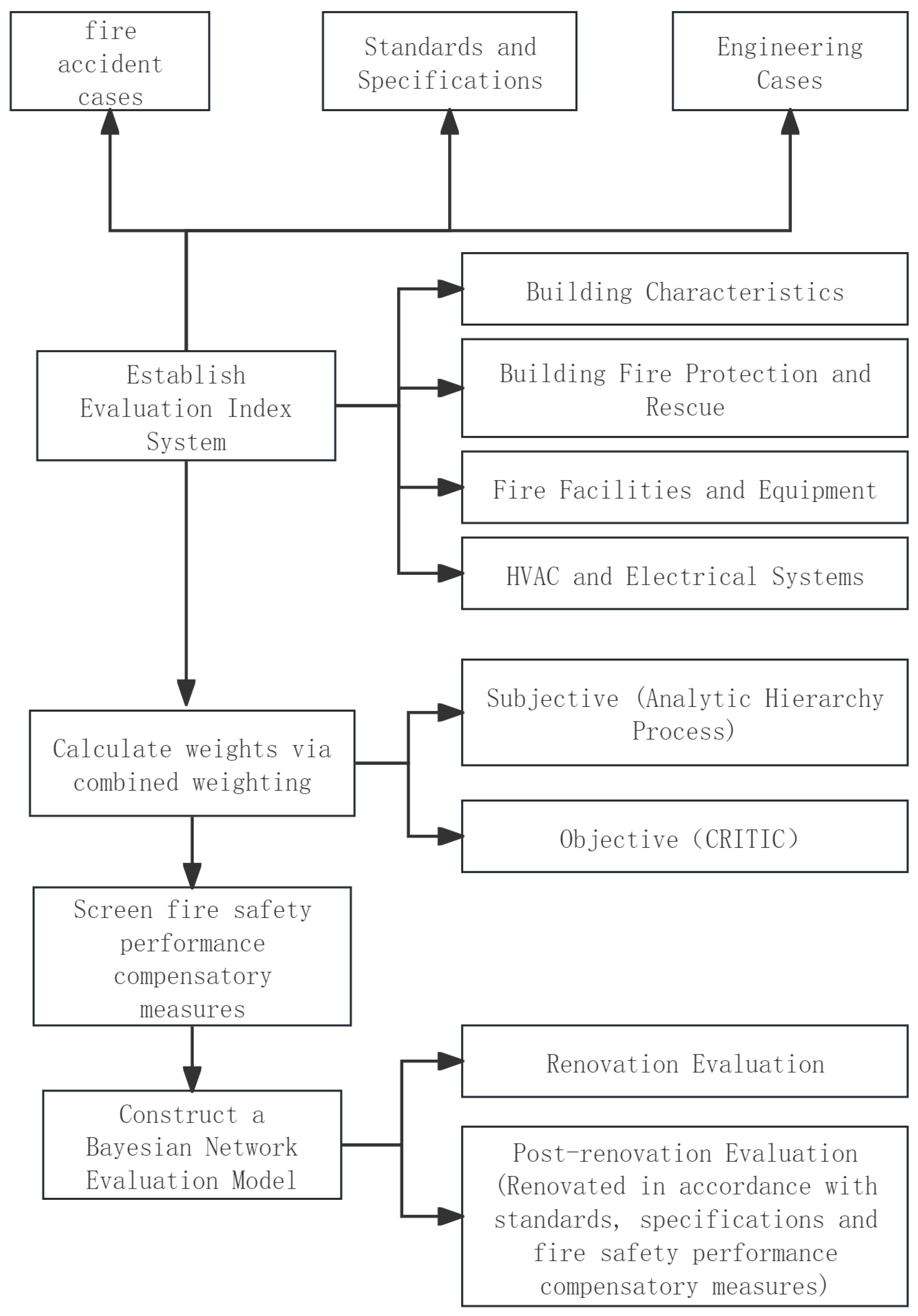
Based on the evaluation indicators in Table 1, a fire performance evaluation model for existing public building renovation is established, which mainly includes three parts: indicator system establishment, weight calculation, and Bayesian Network model construction, as shown in Figure 2.

2.2. Weight Calculation of Evaluation Index System

The Analytic Hierarchy Process (AHP) is a decision-making method that decomposes decision-related elements into levels such as goals, criteria, and schemes, and conducts qualitative and quantitative analysis on this basis [14]. Through AHP, weights can be assigned to indicators at different levels. First, a judgment matrix needs to be constructed. A questionnaire survey was conducted to invite seven experts in the field of fire safety with on-site practical experience to score the influence of each indicator on the upper-level indicator, so as to construct the judgment matrix P = p i j n × n . Among them, p i j represents the ratio of the influence of indicator x i to indicator x j on the fire protection capacity of existing buildings, and n is the order of the judgment matrix. Then, the subjective weight is calculated: multiply the elements of each row in the P matrix, and take the n -th root to obtain
v i ¯ = i = 1 n p i j n   ( i , j = 1 , 2 , n )
After normalization, the subjective weight ϕ i is obtained:
ϕ i = v i ¯ / i = 1 n v i ¯
The indicator weights obtained by AHP have strong subjectivity [15]. Combining with the objective weighting method, which assigns weights by analyzing the relationships between data, can increase the objectivity of the weights. This paper selects the CRITIC method [16], which is a weight calculation method based on indicator correlation. Its core idea is to use two indicators: contrast intensity and conflict. Contrast intensity is represented by the standard deviation; the larger the standard deviation of the data, the greater the fluctuation, and the higher the weight. Conflict is represented by the correlation coefficient; the larger the correlation coefficient between indicators, the smaller the conflict, and thus the lower the weight.
The calculation of objective weight α i is shown in Formula (3), where i is the standard deviation calculated for each indicator, and   γ i is the correlation coefficient between indicator i and indicator j :
α i = j i = 1 m ( 1 γ i j ) j = 1 m j i = 1 m ( 1 γ i j )
Combine the subjective weight ϕ i and objective weight i to obtain the comprehensive weight μ i [17]:
μ i = ϕ i α i i = 1 n ϕ i α i
Through the above weight calculation method, important indicators can be selected from the first-level indicators, so as to determine the fire performance compensation measures for the important indicators.

3. Construction of Bayesian Network

3.1. Bayesian Network Modeling and Conversion

As a core technical tool in the fields of risk analysis, risk evaluation, and risk decision-making, Bayesian Network has shown significant advantages and strong effectiveness in dealing with various uncertain problems [18]. Since the model was formally proposed and gradually improved, it has been widely used in the field of fire risk assessment due to its ability to accurately describe complex uncertain relationships. Therefore, this paper adopts Bayesian Network as the evaluation method for existing public buildings before and after renovation.
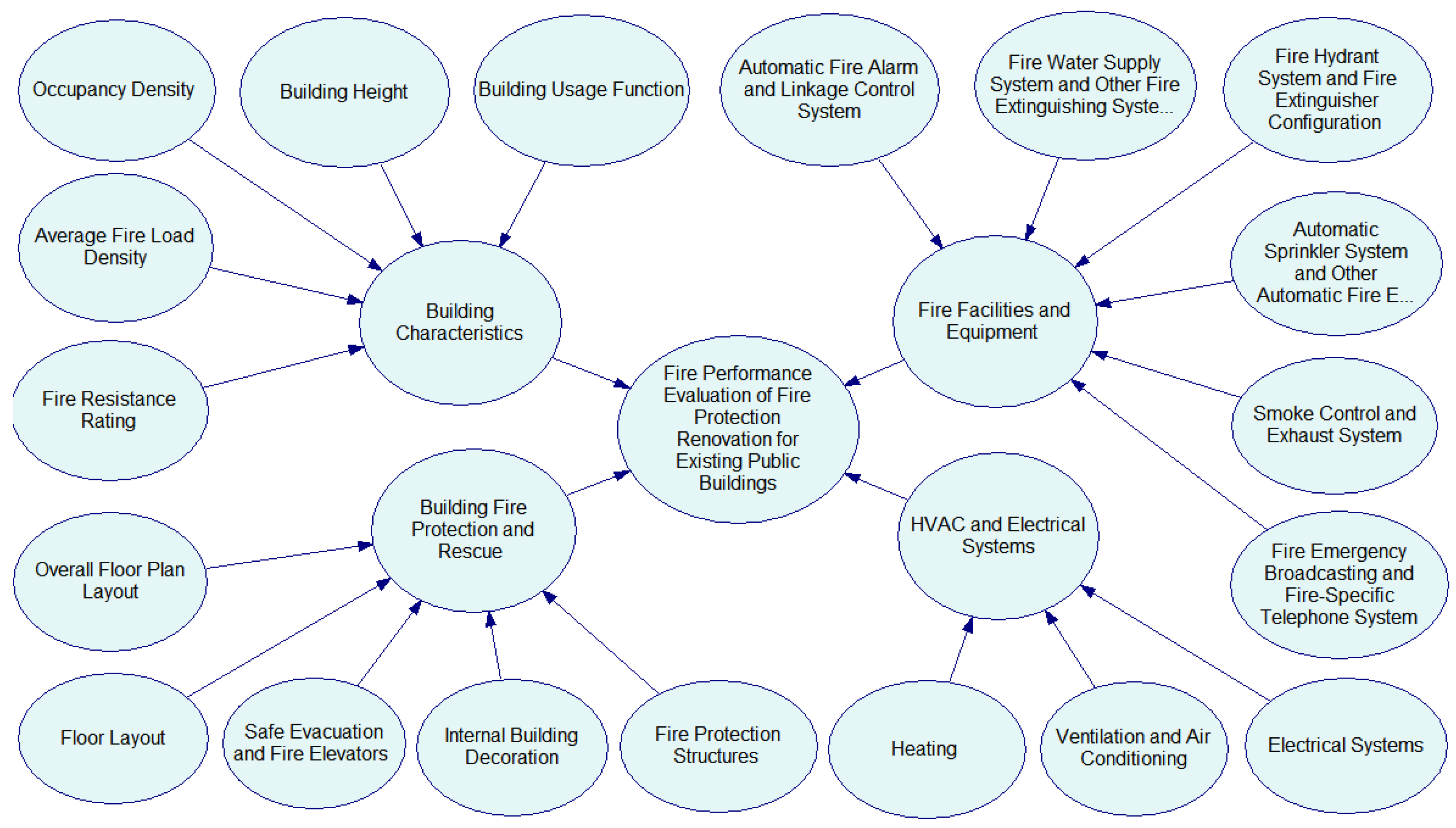
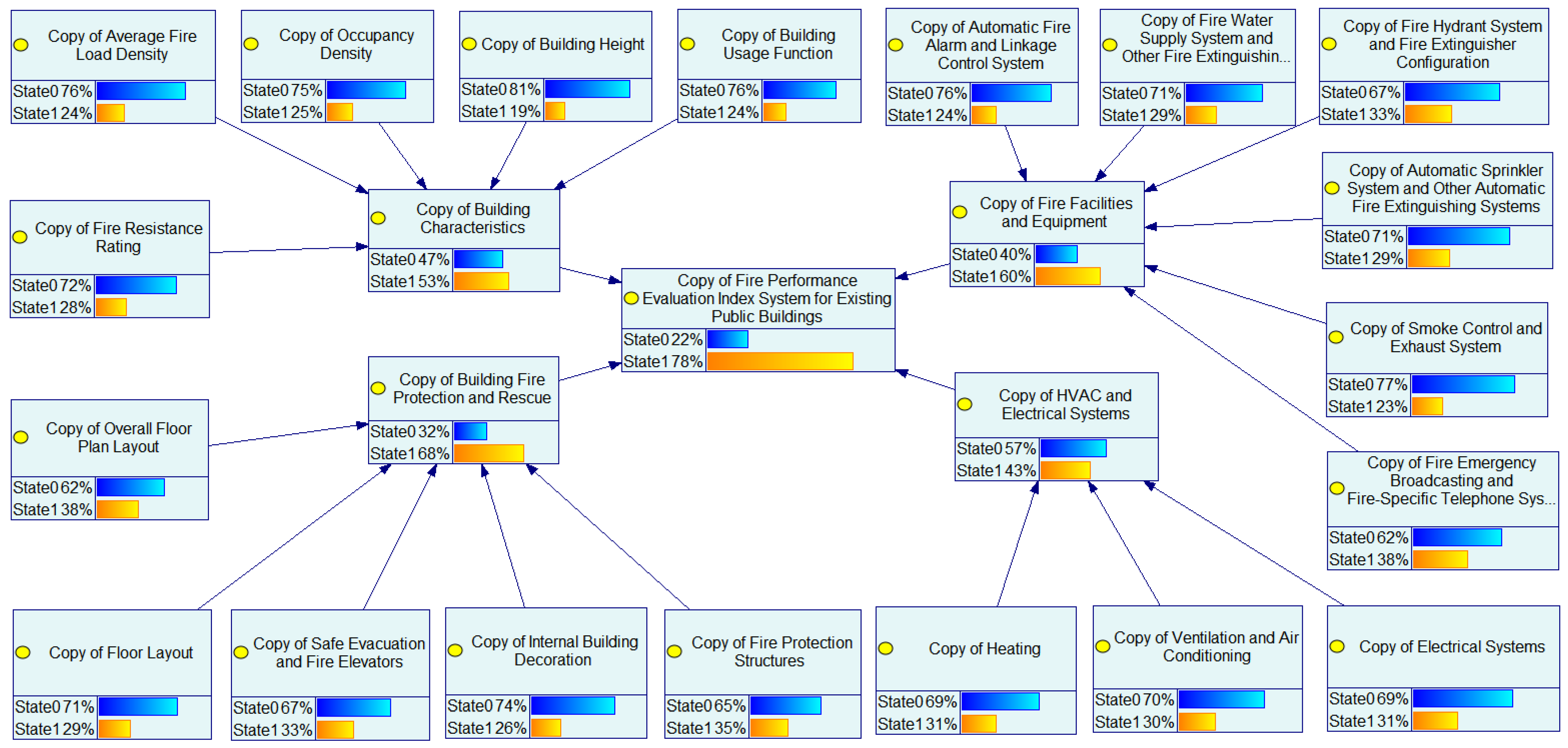
To conduct evaluation using Bayesian Network, it is necessary to convert the fire performance evaluation system for existing public building renovation into a Bayesian Network, where each indicator of the evaluation system is represented by a node in the Bayesian Network, and the relationships between each indicator are connected by directed arcs, as shown in Figure 3.

3.2. Determination of Node Risk Probability

This paper adopts the method of the questionnaire survey to require relevant experts to anonymously evaluate the evidence nodes, and finally obtains relatively objective and fair evaluation results. What we obtain is only the fuzzy language of each expert, which cannot specifically measure each evaluation indicator. Therefore, it is necessary to defuzzify the experts’ language and convert the linguistic descriptions into specific values. Seven natural language variables—”very high, high, relatively high, medium, relatively low, low, very low”—are used to measure the risk level of fire caused by the fire performance evaluation indicators of existing public building renovation. Triangular fuzzy numbers are corresponding to natural language variables, and the specific corresponding relationship is shown in Table 2 [19].
The method of triangular fuzzy numbers is used to defuzzify the experts’ evaluation language. The lower limit, middle possible value, and upper limit are the basic components of fuzzy numbers. Assuming A ˜ is the fuzzy set of fire performance evaluation of existing public building renovation, a and b are the upper and lower limits of the triangular fuzzy number, and k is the middle value.
Then, the triangular fuzzy number A ˜ can be expressed as (a, k, b), and its membership function is as follows [20]:
A ˜ ( x ) = 0 x < a   or   x > b x a k a a x b b x b k k x b
Among them, k a , b k ; a and b represent the degree of fuzziness. The larger the gap between a and b , the greater the degree of fuzziness.
After obtaining the triangular fuzzy numbers, it is necessary to remove some abnormal data and defuzzify to calculate the probability information of each evidence node. It is mainly divided into three steps: ① averaging; ② defuzzification; and ③ normalization. Through the above calculation steps, the probability of fire risk in the current state of existing public buildings can be calculated.

4. Case Application

A shopping mall located in Chaoyang District, Beijing, has a building height of 20 m and a total construction area of 82,325.25 m2, including 41,642.85 m2 underground and 40,682.4 m2 above ground. The overall structure is a steel frame structure with a fire resistance rating of Grade I. Each floor of the building is equipped with conventional fire protection systems and facilities (automatic sprinkler system, automatic fire alarm system, fire hydrant system, fire extinguishers, etc.), and a circular fire lane is set around it.

4.1. Calculation of Evaluation Indicator Weights

This paper invites seven experts to conduct on-site surveys and distribute expert scoring forms. According to the expert scores, AHP and CRITIC method are used to calculate subjective weights and objective weights, respectively, and the comprehensive weights are obtained, as summarized in Table 3. The smaller the comprehensive weight value, the smaller the impact of the indicator on the fire performance evaluation of the building, and vice versa.
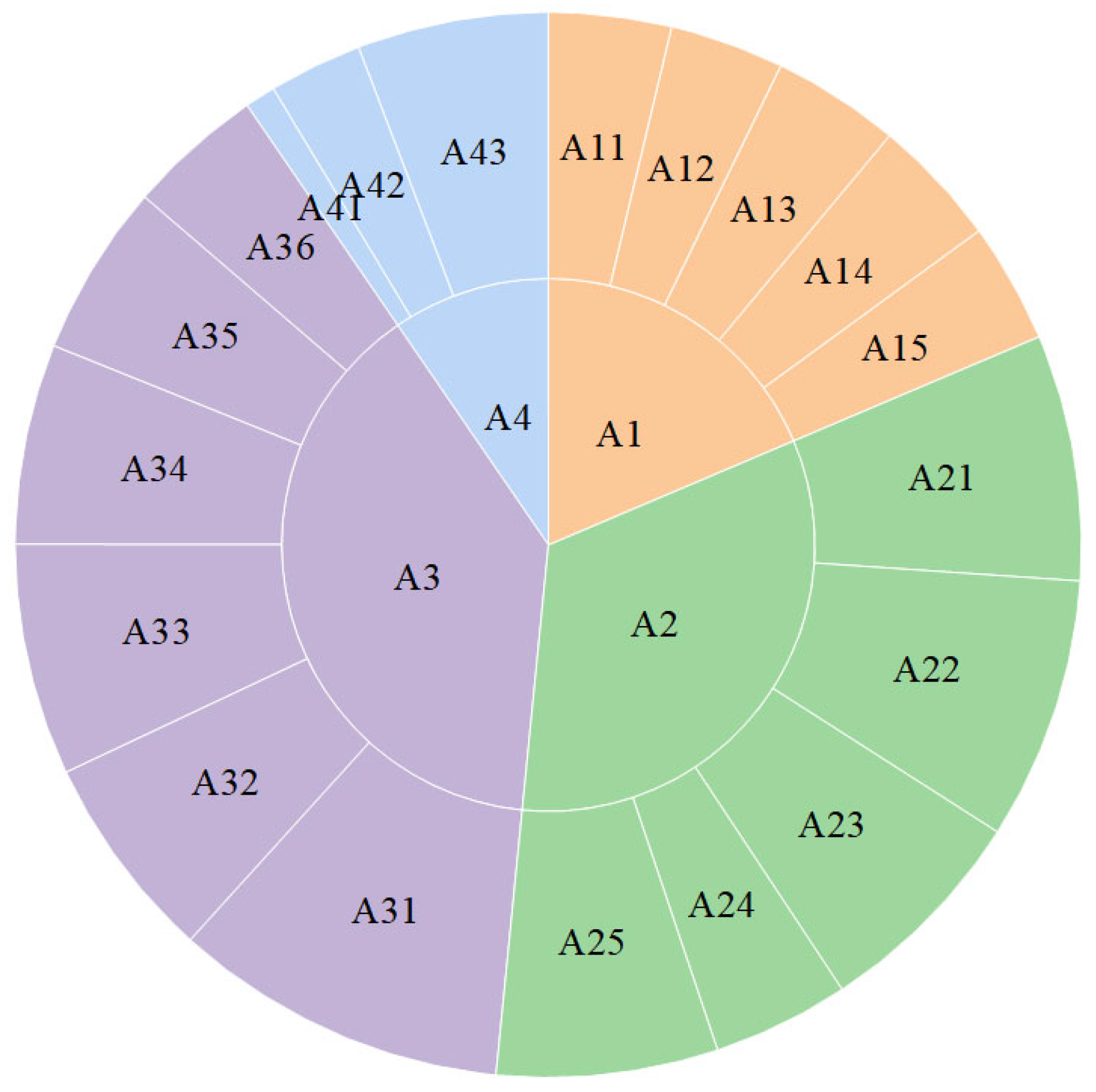
The comprehensive weight of each second-level indicator can be obtained by multiplying the combined weight of the second-level indicator by the weight of its corresponding first-level indicator, so as to compare the importance of each second-level indicator. The weight proportion of each second-level indicator is shown in Figure 4.
It can be seen from the table that among the first-level indicators, Fire Facilities and Equipment (A3) has the highest weight. Among the second-level indicators under this item, the Automatic Fire Alarm and Linkage Control System (A31) has the highest weight. Fire protection facilities belong to passive fire protection technology, and their effectiveness is crucial for timely fire extinguishing after a building catches fire. Usually, new fire protection facilities or new technologies are added for fire performance compensation. Considering the feasibility, economy, and safety of the measures, in terms of strengthening fire facilities and equipment, priority should be given to the analysis of compensation measures from the perspective of the automatic fire alarm and linkage control system, followed by Building Fire Protection and Rescue (A2), among which Floor Layout (A22) has the largest weight proportion. Building fire protection is an active fire protection technology. For new buildings, they must be designed in strict accordance with standard specifications to ensure the inherent safety of the building. In the renovation of existing public buildings, priority should be given to strengthening the floor layout, and performance compensation can be carried out by setting fire protection units and strengthening fire separation; the next is Building Characteristics (A1). The building’s usage function, building height, occupancy density, and fire load density have a significant impact on the occurrence of building fires and the safety of personnel evacuation. Among these indicators, the Average Fire Load Density (A14) has the largest weight proportion. Therefore, when considering fire performance compensation measures, priority can be given to strengthening measures to reduce the fire load density; finally, HVAC and Electrical Systems (A4). According to fire accident statistics, electrical fires are one of the main causes of fires. Among this indicator, Electrical Systems (A43) has the highest weight. Therefore, measures such as installing electrical fire monitoring systems and selecting wires and cables with higher combustion performance grades can be considered to reduce the occurrence of fires.
Through the analysis of indicator weights, a method based on indicator importance is proposed for selecting strengthening measures for existing public buildings that cannot be fully rectified in accordance with current standards. The principle of existing building renovation is to minimize demolition and reconstruction on the premise of ensuring safety, so as to reduce renovation costs. If all indicators are strengthened, it will bring greater renovation difficulty and cost. By sorting out the indicator weights, priority can be given according to the weight size.

4.2. Calculation of Fire Performance Evaluation

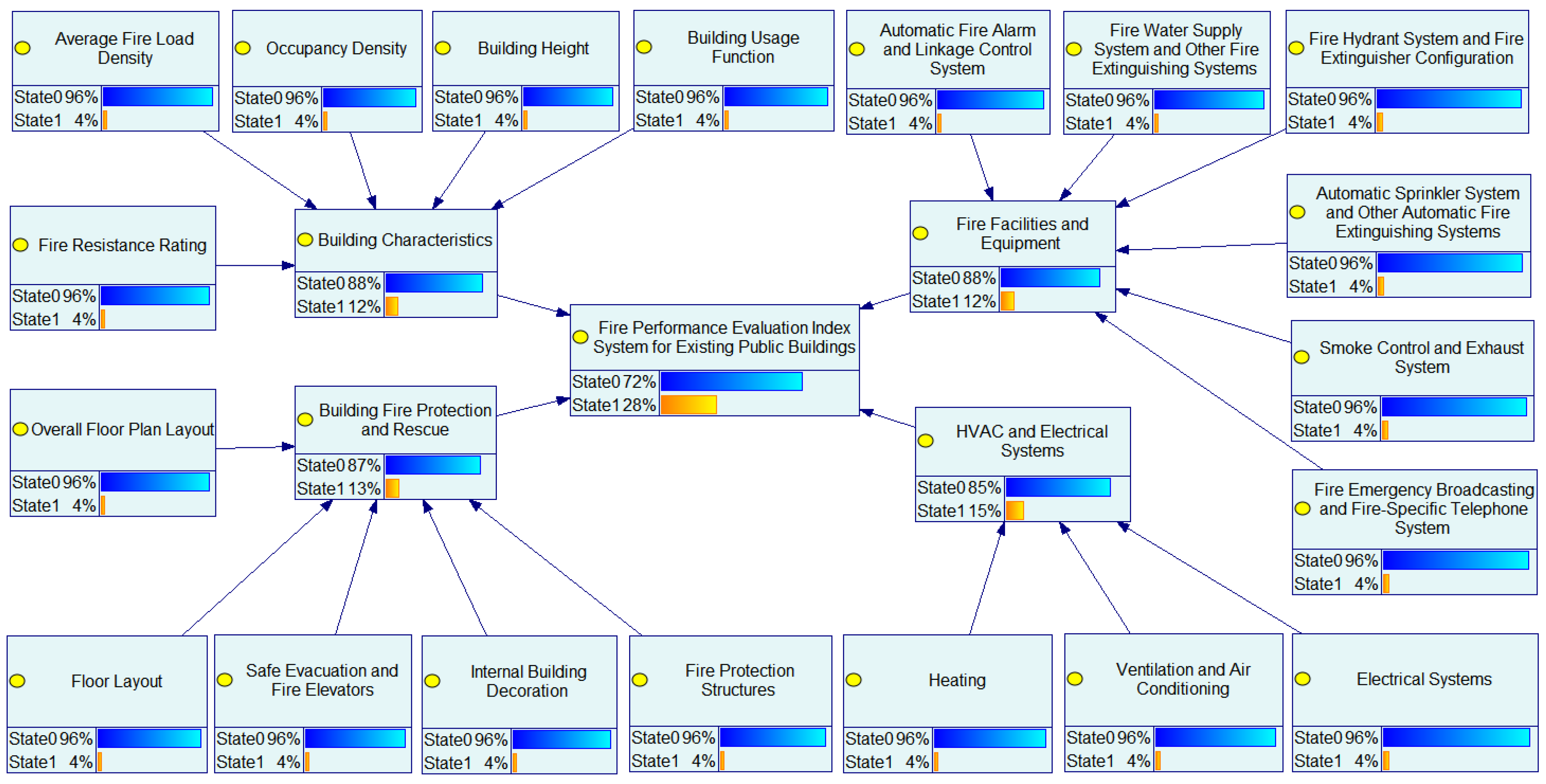
According to the fire performance evaluation indicator system determined in Section 1 and the analysis of corresponding indicators, seven experts with on-site work experience are invited to evaluate each parent node of the building before renovation. According to the one-to-one correspondence between triangular fuzzy numbers and evaluation grades described above, the triangular fuzzy numbers are corresponding to the experts’ evaluations, and the evaluations are averaged to obtain the mean value of triangular fuzzy numbers of the occurrence probability of parent nodes in the entire Bayesian Network. The triangular fuzzy numbers of parent nodes are normalized to obtain the prior probabilities of parent nodes in the entire Bayesian Network. Taking nodes A11-A15 (Building Characteristics) as an example, this paper shows the results of expert scoring data processing for these indicators, as shown in Table 4. Calculate the probability that the child node will also occur when the parent node occurs alone, and the calculation method can refer to the calculation of the prior probability of the parent node described above. Input the obtained conditional probabilities of child nodes into the Bayesian Network structure of GeNIe 3.0 software, and then use the software to perform corresponding reasoning calculations. Finally, the probability of fire occurrence in this building before renovation is obtained (a high probability of fire occurrence indicates poor fire performance of the building), as shown in Figure 5.
To more accurately evaluate the probability of fire occurrence in this building before renovation, the fire occurrence probability grades of the building are divided according to expert opinions and relevant data, as shown in Table 5:
The probability of fire occurrence in this building before renovation is 78%, the fire risk probability grade is Grade IV, and the fire performance grade is relatively low. According to the process, this building needs to carry out fire protection renovation in accordance with the current standards and the fire performance compensation measures of the selected important indicators. After analysis, the renovated result data is input into GeNIe software, and the probability of fire occurrence is 24%, as shown in Figure 6. It can be concluded that after renovation in accordance with current specifications and fire performance compensation measures, the fire risk probability grade is reduced from Grade IV to Grade I, and the building’s fire performance grade is improved from relatively low to high.
It can be seen that for existing public buildings that cannot be fully rectified in accordance with the current standards, after renovation with reference to current standards and fire performance compensation measures, the building’s fire performance grade is significantly improved. At the same time, when carrying out fire protection renovation of existing public buildings, fire performance compensation measures can be determined more scientifically and reasonably according to the building’s own current conditions, renovation difficulty, renovation cost, and other factors, combined with the importance of indicator weights. This can achieve the goal of saving renovation time and cost on the premise of meeting fire safety requirements.

5. Conclusions

By sorting out more than 100 fire accident cases of public buildings to identify key disaster-causing factors, connecting current national standards and local fire protection design guidelines for existing building renovation, focusing on renovation difficulties such as insufficient fire separation distance and aging fire protection facilities, an initial evaluation system including 19 second-level indicators is refined from 4 first-level indicators, “Building Characteristics”, “Building Fire Protection and Rescue”, “Fire Facilities and Equipment”, and “HVAC and Electrical Systems”, constructing a comprehensive and targeted fire performance evaluation index system. The AHP-CRITIC subjective–objective combined weighting method is adopted to integrate expert experience and objective indicator weights, and finally, four high-impact indicators are selected as core compensation objects: average fire load density (A14), floor layout (A22), automatic fire alarm and linkage control system (A31), and electrical systems (A43), providing precise targets for fire performance optimization.
Based on the constructed evaluation index system, indicators at all levels are mapped to Bayesian network nodes, and a topological structure is constructed according to the logical subordinate relationship of indicators, establishing a dynamic and quantitative Bayesian Network evaluation model. Seven experts with on-site practical experience are invited to anonymously evaluate the second-level indicators using 7-level risk grades. Data processing is completed through the triangular fuzzy number method to determine the prior probabilities and conditional probabilities of nodes. Model construction is realized with the help of GeNIe software, enabling the dynamic and quantitative evaluation of the fire performance of existing public buildings before and after renovation and providing an efficient tool for accurate fire risk analysis.
Taking a shopping mall in Chaoyang District, Beijing, as the research object, the Bayesian Network model is applied for evaluation. The results show that the probability of fire occurrence in the building before renovation is 78%, and the fire performance grade is “relatively low”. Based on the indicator weight ranking and core compensation objects, a renovation plan of “prioritizing compensation for core indicators” is formulated. After renovation, the probability of fire occurrence is reduced to 24%, and the fire performance grade is improved to “high”. The research results not only provide a complete technical path for the fire protection renovation of existing public buildings, put forward practical fire protection renovation strategies through case verification, and provide support for engineering practice, but also realize the balance between safety guarantee and economy, which has important practical significance for improving fire protection assessment theories and guiding engineering practice.

Author Contributions

Writing—original draft, X.Z.; Writing—review & editing, F.Y.; Data curation, J.L.; Validation, K.L.; Methodology, Y.Z. All authors have read and agreed to the published version of the manuscript.

Funding

This research was funded by National Key R&D Program of China grant number 2024YFC3810605.

Data Availability Statement

The authors confirm that the data supporting the findings of this study are available within the article.

Conflicts of Interest

Xinxin Zhou, Feng Yan, Jinhan Lu and Yufei Zhao are employed by China Academy of Building Research Co., Ltd. and CABR Fire Technology Co., Ltd. The authors declare no conflict of interest.

References

  1. Ni, P. Research on Construction Cost Control of Existing Public Building Renovation. Master’s Thesis, North China University of Technology, Beijing, China, 2023. [Google Scholar]
  2. International Code Council. International Building Code—2021; International Code Council: Washington, DC, USA, 2021. [Google Scholar]
  3. International Code Council. International Existing Building Code; International Code Council: Washington, DC, USA, 2006. [Google Scholar]
  4. Xu, M.; Peng, D. Research on the fire safety assessment of high building with intuitionistic fuzzy TOPSIS method. Int. J. Knowl.-Based Intell. Eng. Syst. 2022, 25, 405–411. [Google Scholar] [CrossRef]
  5. Sun, S.; Gura, D.; Dong, B. Fire safety assessment models based on machine learning methods for the coal industry. Chemom. Intell. Lab. Syst. 2022, 231, 104693. [Google Scholar] [CrossRef]
  6. Galea, E.; Wang, Z.; Jia, F.; Lawrence, P.J.; Ewer, J. Fire safety assessment of Open Wide Gangway underground trains in tunnels using coupled fire and evacuation simulation. Fire Mater. 2017, 41, 716–737. [Google Scholar] [CrossRef]
  7. Du, X.J. Research on Fire Safety Risk Evaluation of Existing Public Buildings After Renovation. Fire World 2023, 9, 73–77. [Google Scholar] [CrossRef]
  8. Jin, Y.; Hong, S.; Kwon, H. An evaluation of fire safety for very deep station considering the operation of emergency equipments. J. Korean Soc. Urban Railw. 2019, 7, 119–131. [Google Scholar] [CrossRef]
  9. Feng, X.; Liu, F. Research on Computer Realization of Building Fire Safety Assessment. J. Phys. Conf. Ser. 2021, 1992, 032076. [Google Scholar] [CrossRef]
  10. Rzaij, W.A.; Al-Obaidi, B.H.K. Evaluation of a fire safety risk prediction model for an existing building. J. Mech. Behav. Mater. 2022, 31, 64–70. [Google Scholar] [CrossRef]
  11. Jiang, J.; Chen, L.; Jiang, S.; Li, G.-Q.; Usmani, A. Fire safety assessment of super tall buildings: A case study on Shanghai Tower. Case Stud. Fire Saf. 2015, 4, 28–38. [Google Scholar] [CrossRef]
  12. GB50016; Code for Fire Protection Design of Buildings. Ministry of Housing and Urban-Rural Development of the People’s Republic of China: Beijing, China, 2018.
  13. Technical Guidelines for Fire Protection Design of Existing Building Renovation Pro-jects in Beijing (2023 Edition); Beijing Municipal Commission of Planning and Natural Resources: Beijing, China, 2023.
  14. Wang, Y.; Hou, L.; Li, M.; Zheng, R. A Novel Fire Risk Assessment Approach for Large-Scale Commercial and High-Rise Buildings Based on Fuzzy Analytic Hierarchy Process (FAHP) and Coupling Revision. Int. J. Environ. Res. Public Health 2021, 18, 7187. [Google Scholar] [CrossRef] [PubMed]
  15. Alfalah, G.; Al-Shalwi, M.; Elshaboury, N.; Al-Sakkaf, A.; Alshamrani, O.; Qassim, A. Development of Fire Safety Assessment Model for Buildings Using Analytic Hierarchy Process. Appl. Sci. 2023, 13, 7740. [Google Scholar] [CrossRef]
  16. Krishnan, A.R.; Kasim, M.M.; Hamid, R.; Ghazali, M.F. A Modified CRITIC Method to Estimate the Objective Weights of Decision Criteria. Symmetry 2021, 13, 973. [Google Scholar] [CrossRef]
  17. Li, C.; Lu, Y.F.; Chen, C.; Xu, Z.X.; Yang, R. Analysis of Emergency Rescue Characteristics and Rescue Capability Evaluation of Urban Gas Pipeline Network Accidents. J. Tsinghua Univ. (Sci. Technol. Ed.) 2023, 63, 1537–1547. [Google Scholar] [CrossRef]
  18. Taylor, M.; Fielding, J.; Reilly, D.; Kwasnica, V. A Bayesian analysis of domestic fire response and fire injury. Fire Saf. J. 2024, 150, 104266. [Google Scholar] [CrossRef]
  19. Xu, M.; Peng, D. Fire Safety Assessment of High-Rise Buildings Based on Fuzzy Theory and Radial Basis Function Neural Network. Ingénierie Systèmes d’Information 2020, 25, 267–274. [Google Scholar] [CrossRef]
  20. Zhao, Y.; Luan, T.; Li, X.; Wang, K.; Shi, S. Application of Bayesian optimization-based cloud model in fire risk assessment of distributed photovoltaic power plants. Energy Sources Part A Recovery Util. Environ. Eff. 2025, 47, 2551874. [Google Scholar] [CrossRef]
Figure 1. Fire performance evaluation index system for existing public buildings.
Fire 09 00058 g001
Figure 2. Fire performance evaluation process for renovation of existing public buildings.
Fire 09 00058 g002
Figure 3. Bayesian Network structure for fire performance evaluation of renovation of a certain existing public building.
Fire 09 00058 g003
Figure 4. Weight values and proportions of each indicator.
Fire 09 00058 g004
Figure 5. Fire occurrence probability before building renovation.
Fire 09 00058 g005
Figure 6. Fire occurrence probability after rectification based on specifications and fire performance compensation measures.
Fire 09 00058 g006
Table 1. Evaluation content of indicators at all levels.
First-Level IndicatorsSecond-Level IndicatorsEvaluation Content
Building Characteristics (A1)Building Usage Function (A11)Civil buildings, workshops, warehouses, civil air defense projects, automobile (repair) garages and parking lots, gas stations (including gasoline, LPG, and hydrogen), new energy buildings.
Building Height (A12)Super high-rise, Class I high-rise, Class II high-rise, multi-story, single-story.
Occupancy Density (A13)Occupancy density.
Average Fire Load Density (A14)Average fire load density.
Fire Resistance Rating (A15)Grade I, Grade II, Grade III, Grade IV, below Grade IV.
Building Fire Protection and Rescue (A2)Overall Floor Plan Layout (A21)Fire separation distance and fire lane.
Floor Layout (A22)Fire compartments, smoke control zones, layout of building functional places, and equipment rooms.
Safe Evacuation and Fire Elevators (A23)Safety exits, evacuation doors, evacuation distance, evacuation stairs, evacuation corridors, sunken squares, fire elevators, and antechambers.
Internal Building Decoration (A24)Ceiling decoration, wall decoration, and other decorative finishes.
Fire Protection Structures (A25)Firewalls, building components and shafts, fire doors, windows and rolling shutters, overpasses and corridors, building insulation and exterior wall decoration.
Fire Facilities and Equipment (A3)Automatic Fire Alarm and Linkage Control System (A31)Fire alarm controllers, fire detectors, manual alarm buttons, fire alarm devices, and fire linkage control devices.
Fire Water Supply System and Other Fire Extinguishing Systems (A32)Fire water pools, fire water tanks, fire pressure stabilizing pumps and air pressure tanks, fire pumps and fire pump rooms, and fire pump adapters.
Fire Hydrant System and Fire Extinguisher Configuration (A33)Indoor fire hydrant cabinets, outdoor fire hydrants, fire pipe networks, valves, valve wells, and fire extinguishers.
Automatic Sprinkler System and Other Automatic Fire Extinguishing Systems (A34)Alarm valve groups, water flow indicators, sprinklers, end water test devices, pipe networks, valves, and filtering devices, etc.
Smoke Control and Exhaust System (A35)Smoke prevention facilities and smoke exhaust systems.
Fire Emergency Broadcasting and Fire-Specific Telephone System (A36)Fire emergency broadcasting system and fire-specific telephone system.
HVAC and Electrical Systems (A4)Heating (A41)Heating equipment and methods, thermal insulation materials of heating systems.
Ventilation and Air Conditioning (A42)Fans, pipes and fire dampers, dust removal equipment, air ducts, flexible joints, thermal insulation materials, humidification materials, sound absorption materials and their adhesives (combustion performance), and ventilation facilities of boiler rooms.
Electrical Systems (A43)Fire power supply, fire power distribution, electrical equipment, electrical circuits, electrical devices, fire emergency lighting, and evacuation indication signs.
Table 2. Corresponding relationship between natural language variables and triangular fuzzy numbers.
Risk LevelTriangular Fuzzy NumberProbability Range
Very High(0.9, 1.0, 1.0)>99%
High(0.7, 0.9, 1.0)90%~99%
Relatively High(0.5, 0.7, 0.9)66%~90%
Medium(0.3, 0.5, 0.7)33%~66%
Relatively Low(0.1, 0.3, 0.5)10%~33%
Low(0.0, 0.1, 0.3)1%~10%
Very Low(0.0, 0.0, 0.1)<1%
Table 3. Summary of weights of evaluation indicators.
First-Level IndicatorsSubjective WeightObjective WeightCombined WeightSecond-Level IndicatorsSubjective WeightObjective WeightCombined Weight
A10.18180.25280.1861A110.20000.20000.2000
A120.20000.18600.1860
A130.20000.20810.2081
A140.20000.21010.2101
A150.20000.19580.1958
A20.36360.22380.3295A210.20550.22170.2266
A220.21720.22420.2422
A230.21180.19150.2018
A240.13910.18180.1258
A250.22640.18080.2036
A30.36360.26400.3887A310.24990.17260.2610
A320.15000.17770.1613
A330.15730.19020.1811
A340.19990.12910.1562
A350.14290.15570.1347
A360.10000.17470.1057
A40.09100.25940.0956A410.10000.32840.0977
A420.30000.33180.2960
A430.60000.33980.6063
Table 4. Expert scoring and processing results of Building Characteristics (A11–A15).
Expert Scoring\IndicatorsA11A12A13A14A15
Expert 1(0.0, 0.1, 0.3)(0.0, 0.1, 0.3)(0.0, 0.0, 0.1)(0.1, 0.3, 0.5)(0.0, 0.1, 0.3)
Expert 2(0.0, 0.1, 0.3)(0.1, 0.3, 0.5)(0.1, 0.3, 0.5)(0.0, 0.1, 0.3)(0.0, 0.1, 0.3)
Expert 3(0.0, 0.1, 0.3)(0.1, 0.3, 0.5)(0.1, 0.3, 0.5)(0.0, 0.1, 0.3)(0.1, 0.3, 0.5)
Expert 4(0.1, 0.3, 0.5)(0.0, 0.1, 0.3)(0.3, 0.5, 0.7)(0.0, 0.1, 0.3)(0.3, 0.5, 0.7)
Expert 5(0.1, 0.3, 0.5)(0.1, 0.3, 0.5)(0.1, 0.3, 0.5)(0.1, 0.3, 0.5)(0.1, 0.3, 0.5)
Expert 6(0.3, 0.5, 0.7)(0.0, 0.0, 0.1)(0.0, 0.1, 0.3)(0.0, 0.1, 0.3)(0.1, 0.3, 0.5)
Expert 7(0.1, 0.3, 0.5)(0.0, 0.0, 0.1)(0.0, 0.1, 0.3)(0.0, 0.1, 0.3)(0.3, 0.5, 0.7)
Defuzzification0.250.170.240.160.30
Normalization0.220.150.210.140.27
Table 5. Fire risk probability grade classification table for a certain shopping mall.
Fire Risk Probability GradeIIIIIIIVV
Fire Performance GradeHighRelatively HighMediumRelatively LowLow
Occurrence Probability≤0.250.25~0.450.45~0.650.65~0.85≥0.85
Disclaimer/Publisher’s Note: The statements, opinions and data contained in all publications are solely those of the individual author(s) and contributor(s) and not of MDPI and/or the editor(s). MDPI and/or the editor(s) disclaim responsibility for any injury to people or property resulting from any ideas, methods, instructions or products referred to in the content.