Article

Towards Near-Real-Time Estimation of Live Fuel Moisture Content from Sentinel-2 for Fire Management in Northern Thailand


by
Chakrit Chotamonsak
1,2,*,
Duangnapha Lapyai
3 and
Punnathorn Thanadolmethaphorn
4
1
Department of Geography, Faculty of Social Sciences, Chiang Mai University, Chiang Mai 50200, Thailand
2
Environmental Science Research Center, Faculty of Science, Chiang Mai University, Chiang Mai 50200, Thailand
3
Office of Research Administration, Chiang Mai University, Chiang Mai 50200, Thailand
4
Office of Strategy Management, Office of University, Chiang Mai University, Chiang Mai 50200, Thailand
*
Author to whom correspondence should be addressed.
Fire 2025, 8(12), 475; https://doi.org/10.3390/fire8120475
Submission received: 15 October 2025 / Revised: 9 December 2025 / Accepted: 11 December 2025 / Published: 11 December 2025
(This article belongs to the Section Fire Science Models, Remote Sensing, and Data)

Abstract

Wildfires are a recurring dry-season hazard in northern Thailand, contributing to severe air pollution and trans-boundary haze. However, the region lacks the ground-based measurements necessary for monitoring Live Fuel Moisture Content (LFMC), a key variable influencing vegetation flammability. This study presents a preliminary framework for near-real-time (NRT) LFMC estimation using Sentinel-2 multispectral imagery. The system integrates normalized vegetation and moisture-related indices, including the Normalized Difference Vegetation Index (NDVI), the Normalized Difference Infrared Index (NDII), and the Moisture Stress Index (MSI) with an NDVI-derived evapotranspiration fraction (ETf) within a heuristic modeling approach. The workflow includes cloud and shadow masking, weekly to biweekly compositing, and pixel-wise normalization to address the persistent cloud cover and heterogeneous land surfaces. Although currently unvalidated, the LFMC estimates capture the relative spatial and temporal variations in vegetation moisture across northern Thailand during the 2024 dry season (January–April). Evergreen forests maintained higher moisture levels, whereas deciduous forests and agricultural landscapes exhibited pronounced drying from January to March. Short-lag responses to rainfall suggest modest moisture recovery following precipitation, although the relationship is influenced by additional climatic and ecological factors not represented in the heuristic model. LFMC-derived moisture classes reflect broad seasonal dryness patterns but should not be interpreted as direct fire danger indicators. This study demonstrates the feasibility of generating regional LFMC indicators in a data-scarce tropical environment and outlines a clear pathway for future calibration and validation, including field sampling, statistical optimization, and benchmarking against global LFMC products. Until validated, the proposed NRT LFMC estimation product should be used to assess relative vegetation dryness and to support the refinement and development of future operational fire management tools, including early warnings, burn-permit regulation, and resource allocation.

1. Introduction

Wildfires are recurrent hazards in tropical highland regions, shaping ecosystems, degrading air quality, and posing serious risks to human health and livelihoods [1,2,3]. In northern Thailand, fire activity typically peaks during the dry season (January–April) [4,5], coinciding with prolonged dry conditions, accumulated fine fuels, and predominantly anthropogenic ignitions [6]. Although human activities initiate most ignitions, the severity, extent, and persistence of fire spread [7] are strongly influenced by vegetation moisture conditions, including both dead and live fuel [8]. These fires significantly increase atmospheric PM2.5 concentrations, leading to hazardous air quality across Thailand, Laos, and Myanmar [9,10]. Although most ignitions are anthropogenic, the likelihood of ignition and subsequent fire spread is strongly influenced by vegetation fuel moisture.
The fuel moisture content (FMC) governs the flammability of both live and dead fuels. In northern Southeast Asia, the abundance of fine fuels and the observed relevance of NDVI as a proxy for fuel amount suggest that live-fuel dynamics and associated fine-fuel accumulation play an important role in conditioning ignition probability [8]. Consistent with this view, live fuel moisture content (LFMC) has increasingly been used to predict ignition probability from satellite observations (e.g., Jurdao et al. 2012 [11]). LFMC, the ratio of water mass to dry biomass in living vegetation [12,13], is a key indicator of vegetation physiological status, drought stress, and potential fire behavior. Despite its relevance, LFMC studies in mainland Southeast Asia remain limited [14], and the region is largely absent from global LFMC reference datasets: Globe_LFMC2.0 [13]. Existing LFMC models, many of which have been developed and validated in Mediterranean, North American, or Australian ecosystems [13], may not be directly applicable to Southeast Asia because of differences in species composition, monsoon-driven seasonality, forest structure, and mosaic forest–agriculture landscapes. These regional distinctions underscore the need for approaches tailored specifically to the ecosystems in Northern Thailand.
Traditional LFMC estimation through destructive sampling provides accurate measurements [13], but is labor-intensive, spatially restricted, and impractical for continuous monitoring across extensive and cloud-prone landscapes. Remote sensing offers a scalable alternative [15], particularly with Sentinel-2 imagery [16], which provides multispectral observations [17] in the red, near-infrared (NIR), and shortwave-infrared (SWIR) regions that are sensitive to vegetation vigor and canopy water absorption. Spectral indices, such as the Normalized Difference Vegetation Index (NDVI) [18], Normalized Difference Infrared Index (NDII) [19,20], and Moisture Stress Index (MSI) [21], have been widely used as proxies for vegetation water status [20]. However, their performance in the heterogeneous landscapes, frequent cloud cover, and rapid seasonal transitions of mainland Southeast Asia [22] has not been comprehensively assessed. Operational LFMC monitoring in northern Thailand remains challenging because of (1) persistent cloud cover during transitional seasons [14], (2) heterogeneous terrain and mixed land use [23], and (3) the absence of ground-based LFMC data for calibration and validation [22]. These limitations highlight the importance of developing transparent, lightweight, and adaptable methodologies that can produce near-real-time (NRT) indicators while explicitly acknowledging the associated uncertainties.
This study introduces a prototype NRT LFMC estimation framework for northern Thailand using Sentinel-2 satellite imagery. The approach integrates multiple spectral indices [16] and an NDVI-derived evapotranspiration fraction (ETf) [24] into a heuristic formulation (model) designed to characterize the relative spatial and temporal variations in vegetation moisture [25]. As the model has not yet been calibrated or validated, its outputs should be interpreted as preliminary indicators intended to demonstrate workflow feasibility and identify considerations for future development. The objectives of this study are to: (1) develop an automated workflow for generating spatially explicit LFMC indicators from Sentinel-2 imagery in near-real time; (2) demonstrate LFMC estimated patterns during the 2024 dry season; (3) examine the relationships between LFMC and seasonal rainfall variability to explore climatic controls on vegetation moisture; and (4) identify limitations and outline pathways for calibration, validation, and future operational integration. Overall, this study provides an initial step toward region-specific LFMC estimation in northern Thailand and establishes a foundation for future validation, refinement, and operational applications in fire management contexts [26].

2. Materials and Methods

2.1. Study Area

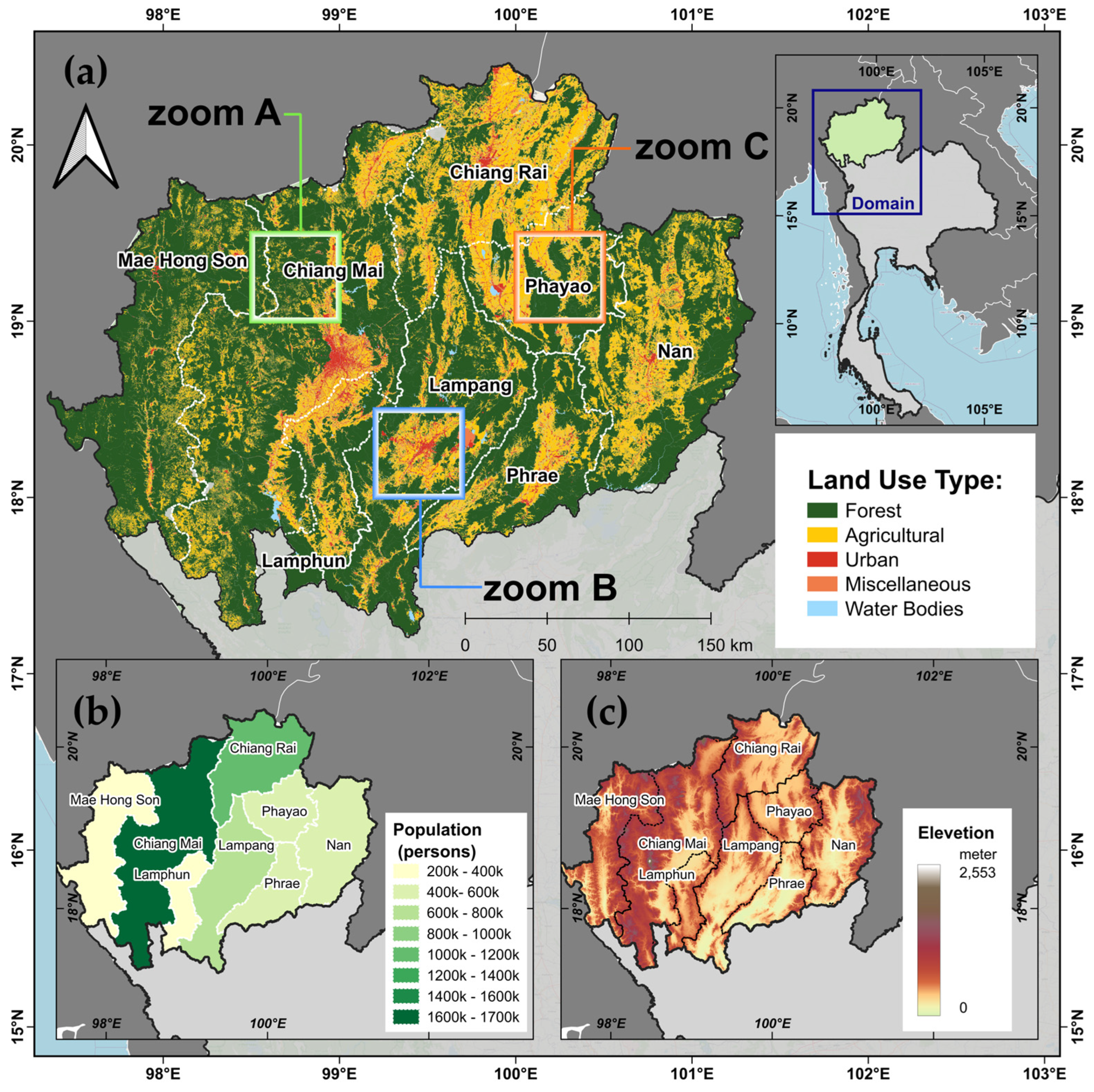
The study domain spanned 97°–102° E and 17°–21° N, encompassing the northern region of Thailand (Figure 1). This region is characterized by complex mountainous terrain, deeply incised forested catchments, and densely populated agricultural basins, such as the Chiang Mai–Lamphun valley [22]. The climate is governed by the Southeast Asian monsoon system, producing a distinct wet season (May–October) and dry season (November–April) that strongly influences vegetation moisture regimes [27].
Fire activity in northern Thailand typically peaks during January–April, when vegetation moisture reaches its annual minimum [28] and drought-related stress is widespread across deciduous and agricultural landscapes [29]. Most ignitions are anthropogenic, often related to agricultural residue burning, forest foraging, and accidental fires, and are therefore spatially concentrated in lowland and mid-elevation zones [22,30]. Persistent cloud cover during transitional monsoons (November–December and April–May) also affects the temporal availability of cloud-free optical satellite data, posing limitations for remote-sensing-based monitoring [31].

2.2. Data and Preprocessing

Sentinel-2 MultiSpectral Instrument (MSI) Level-2A surface reflectance products were used as the primary satellite data source, accessed via the Copernicus Open Access Hub using the Sentinel Hub API [32]. These Level-2A products provide atmospherically corrected bottom-of-atmosphere (BOA) reflectance at a spatial resolution of 10–20 m, making them well-suited for vegetation monitoring in the heterogeneous tropical landscapes of Northern Thailand. For LFMC estimation, three spectral bands were utilized: the red band (Red: Band 04), near-infrared band (NIR; Band 8), and shortwave infrared band (SWIR; Band 11). To maintain adequate revisit frequency under frequent regional cloud cover, we applied a maximum cloud cover threshold (MAXCC = 0.6) at the scene level. Pixel-level cloud, shadow, cirrus, and snow masking were conducted using the Sentinel-2 Scene Classification Layer (SCL) [33]. This mask removes atmospheric contamination and ensures spatial consistency of the data.
Preprocessing operations were either performed directly within the Sentinel Hub environment to minimize local computational demand or executed locally in the downloaded directory, as needed. The area of interest (AOI) was defined by a bounding box spanning 97°–101.5° E and 17°–21° N, corresponding to the northern region of Thailand. For demonstration purposes, imagery was requested on boundary cover 720 × 720 pixels (~210,000 km2) and georeferenced to WGS84 (EPSG:4326). The analysis period spanned 1 January to 30 April 2024, representing the dry season in northern Southeast Asia; however, the system configuration is readily adaptable for weekly to biweekly near-real-time (NRT) operational use throughout the year. A maximum cloud cover threshold (MAXCC) of 0.6 was adopted for Sentinel-2 image selection to ensure sufficient data availability under persistently cloudy conditions typical of Southeast Asia’s tropical climate. Although relatively high, this threshold represents a practical balance between the spatial and temporal continuity. Residual clouds and shadows were subsequently minimized through per-pixel Scene Classification (SCL) masking and weekly to biweekly temporal compositing, thereby maintaining the reliability of the LFMC estimation. The proportion of Sentinel-2 scenes excluded by the MAXCC threshold was not quantified in this study, as the focus was on demonstrating the heuristic LFMC estimation workflow; future work will explicitly assess the data-availability impacts of cloud-related filtering.
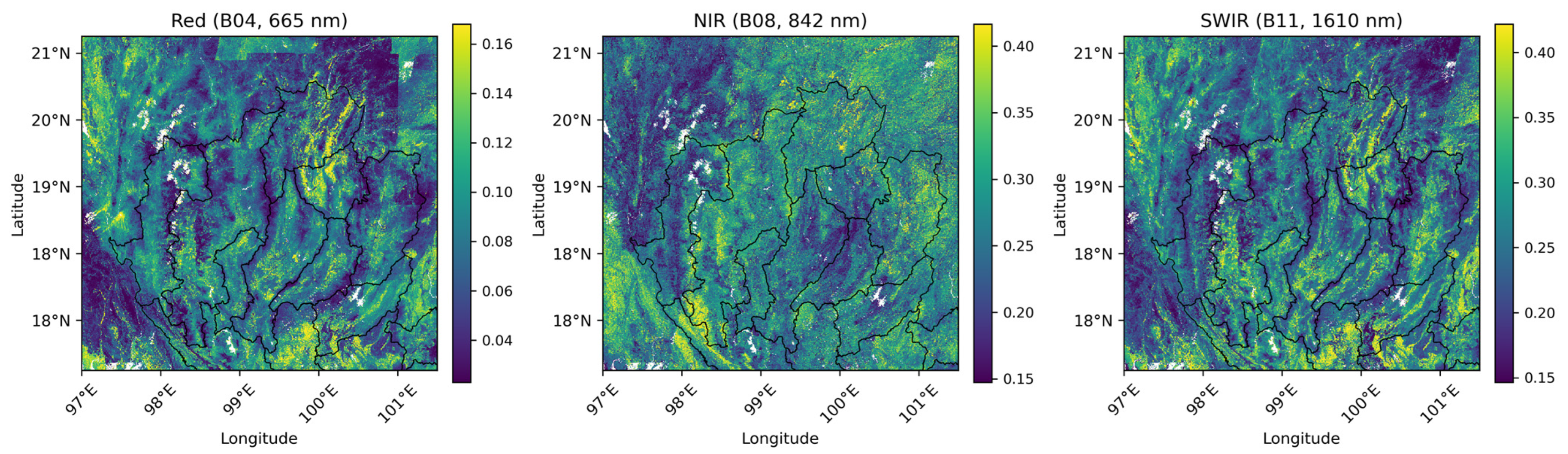
LFMC estimation relied on the three Sentinel-2 MSI bands (Figure 2, Table 1), which together captured complementary aspects of the vegetation condition. The red band (B04) is sensitive to chlorophyll absorption and underpins greenness indices such as the NDVI. The near-infrared band (B08) responds to vegetation structure and leaf scattering, serving as a proxy for canopy vigor, whereas the shortwave infrared band (B11) is highly sensitive to leaf and canopy water content, making it particularly valuable for estimating fuel moisture content. Detailed specifications of Sentinel-2 MSI bands are provided in the Sentinel-2 user handbook (https://sentinels.copernicus.eu/documents/247904/685211/Sentinel-2_User_Handbook (accessed on 23 May 2025)). All bands were atmospherically corrected at Level-2A, ensuring BOA reflectance consistency across space and time for the study area. From these inputs, three spectral indices—the NDVI, NDII, and MSI—were derived to represent vegetation vigor, canopy water status, and soil background effects. Together, these indices form the foundation of the heuristic LFMC model implemented in this study (Equations (1)–(10)).

2.3. Vegetation-Related Spectral Indices

Three spectral indices were selected based on their established sensitivity to vegetation vigor, canopy water content, and moisture stress. These indices have been widely applied in LFMC-related and drought-monitoring studies across diverse ecosystems [18,19,20,21,34,35,36].

2.3.1. NDVI—Normalized Difference Vegetation Index

The NDVI is defined as:
N D V I = B 08 B 04 B 08 + B 04
NDVI reflects vegetation greenness, canopy structure, and photosynthetic activity. Higher NDVI values generally indicate denser or healthier vegetation with greater leaf area.

2.3.2. NDII—Normalized Difference Infrared Index

The NDII is computed as:
N D I I = B 08 B 11 B 08 + B 11
NDII is sensitive to leaf and canopy water content due to the strong absorption of liquid water in the SWIR band [37]. Decreases in NDII have been associated with vegetation stress, reduced turgor, and declining LFMC estimated.

2.3.3. MSI—Moisture Stress Index

The MSI is defined as:
M S I = B 11 B 08
Higher MSI values indicate increased canopy moisture stress or reduced water content [38]. MSI complements NDVI and NDII by providing additional sensitivity to water-absorption features in the SWIR region.
These indices serve as the primary inputs for the heuristic LFMC estimation framework described in Section 2.6.

2.4. Index Normalization

To enable meaningful integration of the three spectral indices into a unified LFMC estimation framework, each index was normalized to a common scale. A piecewise linear normalization approach was adopted to preserve relative variability while constraining values to the interval between 0 (low moisture or vigor) and 1 (high moisture or vigor) [39]. Thresholds were selected based on regional reflectance characteristics and published applications of these indices in LFMC and drought monitoring studies [18,19,20,40].

2.4.1. NDVI Normalization

NDVI values were normalized using lower and upper bounds commonly observed in tropical forest–agriculture mosaics. Values below 0.2 typically indicate bare soil or degraded vegetation, whereas values above 0.8 correspond to dense canopy cover [18].
N D V I n = 0 , if   N D V I < 0.2 N D V I 0.2 0.6 , if   0.2 N D V I 0.8 1 , if   N D V I > 0.8
The interval [0.2, 0.8] represents typical vegetation reflectance and is linearly scaled to the range 0–1.

2.4.2. NDII Normalization

NDII was normalized using thresholds representing the expected range of canopy water content in regional vegetation types [19,20]. Higher NDII values imply greater foliage water content.
N D I I n = 0 , if   N D I I < N D I I m i n N D I I N D I I m i n N D I I m a x N D I I m i n , if   N D I I m i n N D I I N D I I m a x 1 , if   N D I I > N D I I m a x
where N D I I m i n and N D I I m i n were derived from the empirical distribution of Sentinel-2 observations within the study area.

2.4.3. MSI Normalization

MSI was inverted and normalized [21] so that larger normalized values correspond to higher moisture (consistent with N D V I n and N D I I n ) The selected interval represents the range of moisture stress typically observed during the dry season.
The resulting normalized indices provide consistent, dimensionless inputs for the heuristic LFMC model described in Section 2.6.
The MSI normalization was performed as follows:
M S I n = 0 , if   M S I < M S I m i n M S I M S I m i n M S I m a x M S I m i n , M S I m i n M S I M S I m a x 1 , if   M S I > M S I m a x
This transformed variable provides a moisture-aligned interpretation comparable to N D V I n and N D I I n .

2.4.4. Soil Moisture (SM) Proxy Normalization

A composite soil moisture proxy was derived from the normalized N D I I and M S I indices [34,35,36]. These two indicators reflect complementary aspects of canopy water content and short-term moisture stress, and were combined into a simple averaged form:
S M n = 0.5 N D I I n + 0.5 M S I n
This proxy should be interpreted as a spectral approximation of vegetation moisture status rather than a direct measure of soil moisture.
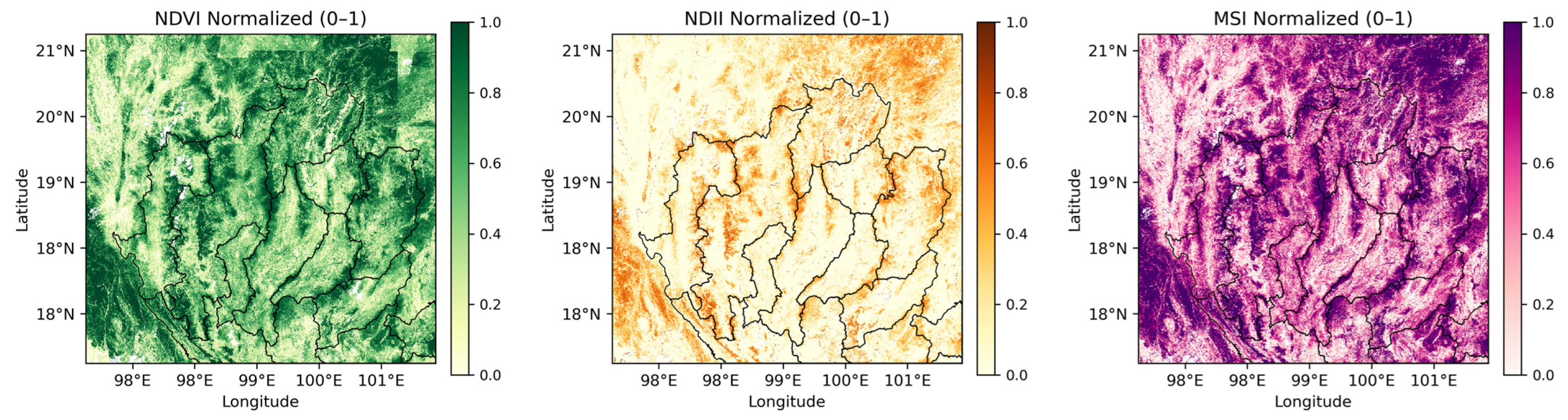
Before LFMC estimation, these indices were analyzed to evaluate their spatial patterns and sensitivity across land cover types. The NDVI, NDII, and MSI capture canopy greenness, vegetation water content, and relative moisture stress, respectively. Distinct spatial gradients were observed across the study area, with higher NDVI and NDII values in forested uplands and lower values in cultivated valleys, whereas the MSI exhibited the opposite trend, indicating stronger moisture stress in the croplands and degraded landscapes. To mitigate saturation effects and ensure cross-ecosystem comparability, all indices were normalized to a 0–1 range (Figure 3), yielding NDVIn, NDIIn, and MSIn. These normalized indices provide a consistent foundation for integration into the heuristic LFMC model, ensuring a balanced representation of the vegetation condition and canopy moisture status.

2.5. Evapotranspiration Fraction (ETf)

The evapotranspiration fraction (ETf) was incorporated into the LFMC estimation framework as an indicator of short-term vegetation water-use dynamics. ETf represents the proportion of potential evapotranspiration realized under prevailing vegetation and atmospheric conditions, making it responsive to changes in plant water availability and moisture stress [41]. In optical remote sensing, ETf is commonly approximated from vegetation indices using trapezoidal or linear relationships, where higher vegetation vigor—typically inferred from NDVI—corresponds to greater evaporative capacity and reduced moisture stress [24]. This proxy has been applied in drought monitoring, crop-water-use assessments, and evapotranspiration modeling because of its ability to reflect rapid adjustments in canopy water use. Its inclusion here provides information complementary to NDVI, NDII, and MSI [18,19,20,21] by capturing short-term variations in vegetation water use that may not be fully represented by spectral moisture indices alone. Such responsiveness is particularly relevant in northern Thailand’s dry season, when vegetation often undergoes rapid moisture depletion driven by high evaporative demand and limited soil-water availability [42,43].
In this study, ETf was estimated from NDVI using a normalized, clipped linear transformation to ensure consistency with the other indices used in the heuristic LFMC formulation. The initial ETf estimate was computed as
E T f = 0 , if   1.25 NDVI n < 0 , 1.25 NDVI n , if   0 1.25 NDVI n 1 , 1 , if   1.25 NDVI n > 1 .
and then centered to produce a deviation term:
E T c = E T f 0.5

2.6. Conceptual Formulation of the Heuristic LFMC Model

In this study, a heuristic framework was developed to estimate LFMC by combining multiple spectral indicators that represent different dimensions of vegetation water status. This approach was designed to provide a practical, near-real-time approximation of moisture variability in northern Thailand, where the absence of in situ LFMC measurements limits the use of fully calibrated or physically based models [13]. Rather than aiming to produce absolute LFMC values, the model focuses on capturing the relative spatial and temporal differences in vegetation moisture across the landscape.
The formulation builds on the conceptual foundations established in previous multi-index LFMC studies, in which greenness-, water-, and stress-sensitive indices have been shown to correlate with vegetation moisture under a range of environmental conditions [44]. Four indices were selected for integration: NDVI, NDII, MSI, and ETf, respectively. Each index contributes a distinct ecological signal relevant to the LFMC interpretation. NDVI provides information on canopy vigor and leaf area, both of which influence the overall moisture-holding capacity. The NDII, derived from the SWIR–NIR contrast, is sensitive to foliage water content and leaf turgor. The MSI captures moisture stress through SWIR absorption patterns, which intensify as vegetation dries. ETf, approximated from NDVI, reflects short-term vegetation water-use behavior and responds rapidly to changes in evaporative demand.
Because field data were not available to calibrate or optimize the weighting of these indicators, the model used a set of preliminary (conceptual), non-calibrated coefficients informed by LFMC-related literature and exploratory analysis of reflectance patterns specific to the region [25]. These coefficients were intended as placeholders until empirical LFMC observations became available. Accordingly, the resulting LFMC values should be interpreted as relative indicators rather than as biophysically validated estimates.

Structure of the Heuristic Model

The functional form of the model is presented to ensure its transparency and reproducibility. The coefficients and structural assumptions shown there will require refinement in future work once field campaigns and statistical calibrations are conducted. The heuristic model integrates the four normalized indices into a weighted additive equation. The formulation includes an intercept term representing a lower-bound moisture level characteristic of severely dry tropical vegetation [45], onto which individual index contributions are added or subtracted based on their expected relationship with the LFMC estimation.
The equation used in this study is as follows:
L F M C = 35 + ( 80 × N D V I n ) + 50 × S M n + 20 × E T f 0.5 ,
where:
N D V I n is the normalized vegetation greenness proxy (0–1);
S M n is the normalized soil/canopy moisture proxy, defined as
( 0.5 × N D I I n + 0.5 × M S I n )
E T f is the NDVI-based evapotranspiration fraction (0–1).
This structure reflects the assumption that higher values of NDVI, NDII, and ETf values are associated with higher vegetation moisture, whereas strong moisture stress (low M S I n ) reduces overall LFMC. The model serves as a preliminary prototype whose coefficients approximate relative sensitivities reported in prior work, but full calibration will require in situ LFMC measurements from representative vegetation types in northern Thailand.
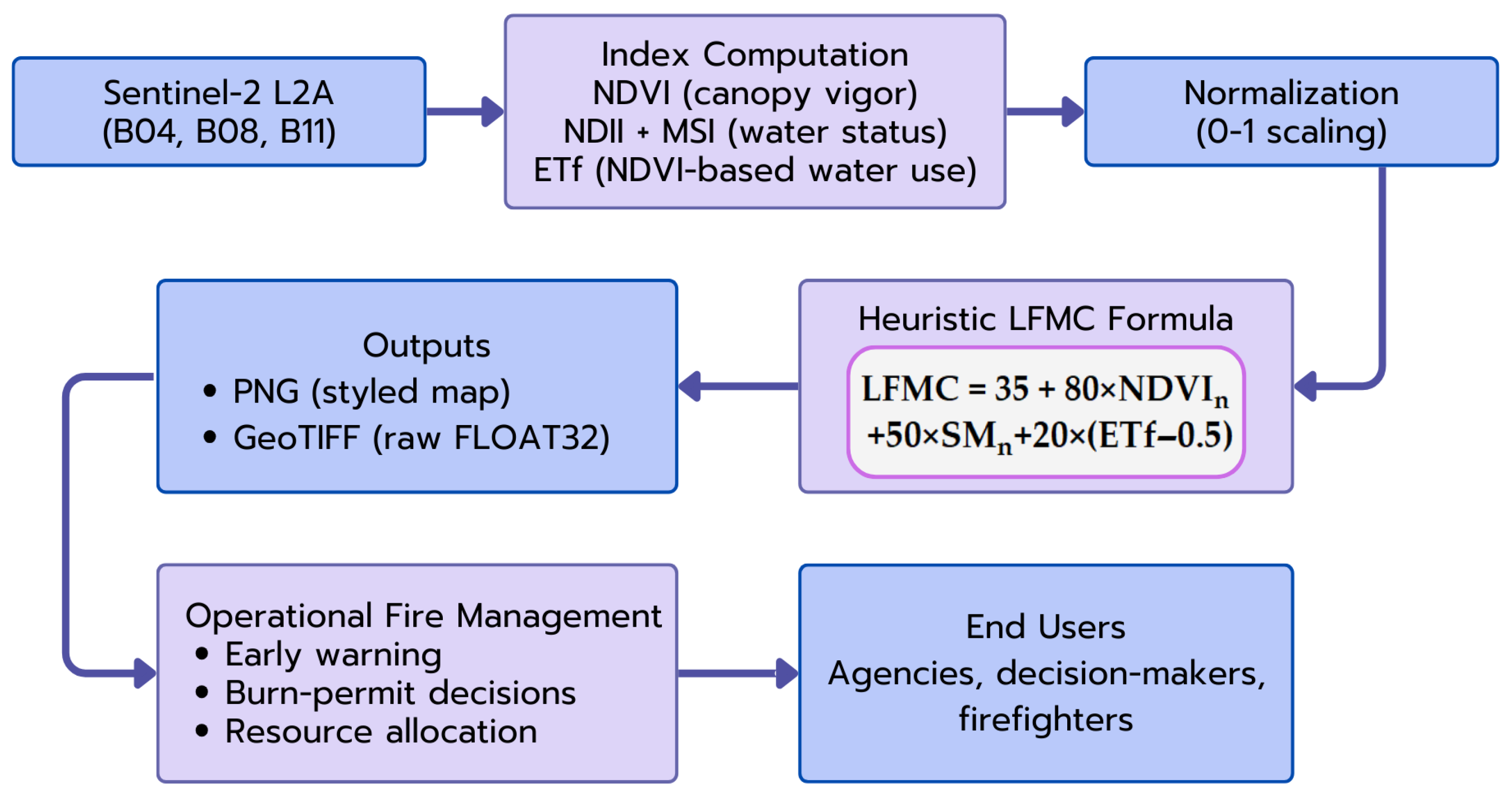
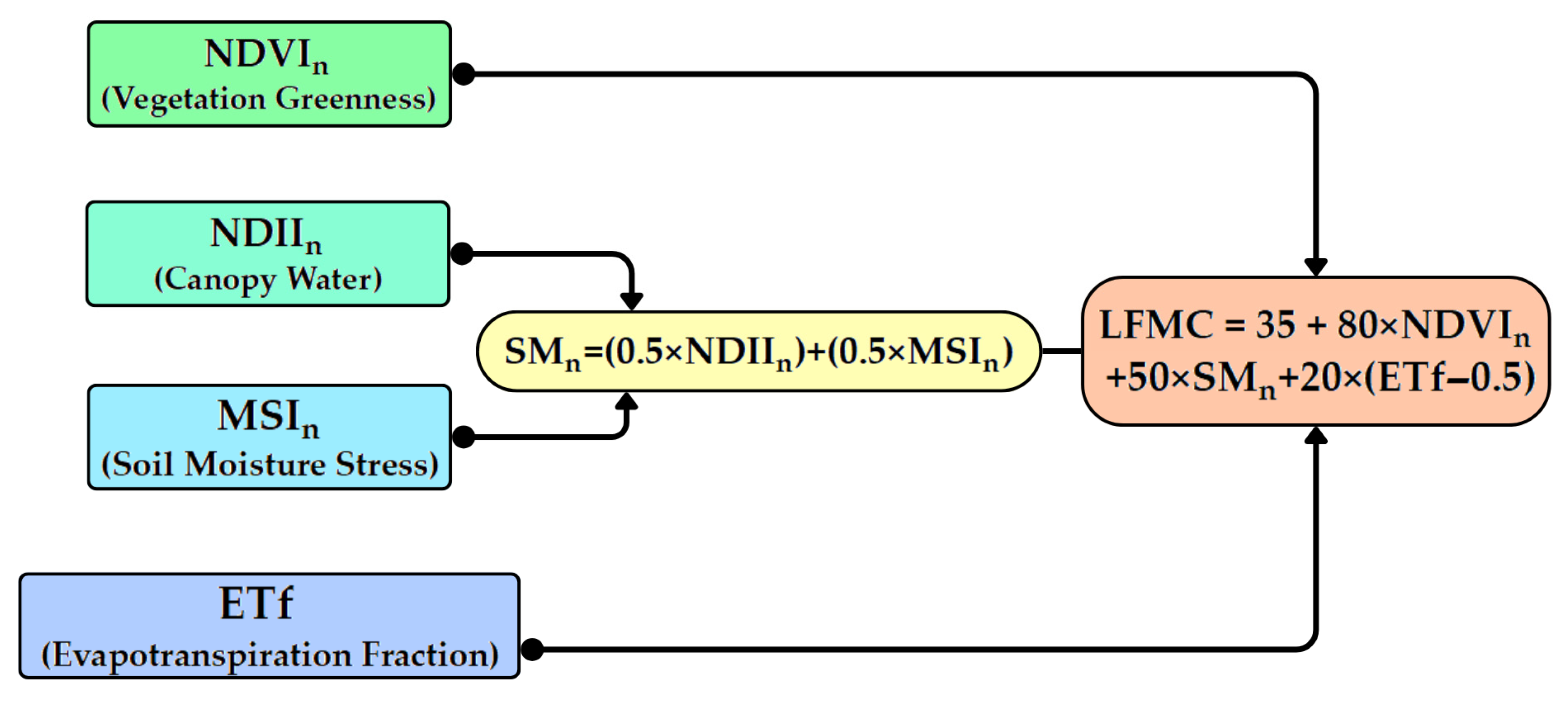
As illustrated in Figure 4, the heuristic LFMC model integrates multiple spectral indicators—vegetation greenness, canopy water content, moisture-stress proxies, and evapotranspiration dynamics—into a single additive formulation. NDVI contributes information on canopy vigor, NDII and MSI capture complementary aspects of foliage water content and moisture stress, and ETf represents short-term vegetation water-use responses. Together, these indices provide a multifaceted approximation of vegetation moisture conditions. Although the model supports near-real-time generation of LFMC estimates from Sentinel-2 imagery, the formulation remains preliminary and unvalidated, and the resulting values should be interpreted as indicators of relative moisture variability rather than as an operational fire-risk metric. A full, reproducible Python version 3.13 processing script, including index computation, masking, normalization, and LFMC estimation, is provided as a Supplementary Material via a public GitHub repository.

2.7. Preliminary LFMC-Based Moisture Classification

To support interpretation of the heuristic LFMC estimates, the study applies a preliminary moisture-based classification scheme that groups LFMC values into broad dryness categories. These classes are intended to provide a qualitative overview of vegetation moisture conditions rather than quantitative indicators of fire danger, as no calibration data currently exist for northern Thailand [46]. The thresholds were therefore adapted from general LFMC–flammability relationships documented in previous studies across Mediterranean and North American ecosystems, where reductions in LFMC have been associated with increased vegetation dryness and fire susceptibility [47]. Given ecological and climatic differences, these ranges should be considered provisional until region-specific LFMC measurements become available.
The five moisture classes used in this study are as follows:
  • >140% (Moist): vegetation with high canopy water content and minimal dryness.
  • 120–140% (Moderate moist): vegetation retaining substantial moisture under early-dry-season or post-rainfall conditions.
  • 100–120% (Moderate dry): transitional moisture levels typical of drying deciduous forests.
  • 80–100% (Dry): vegetation experiencing substantial dryness and elevated moisture stress.
  • <80% (Extreme dry): pronounced vegetation desiccation indicative of peak dry-season conditions.
These classes (Table 2) provide a simplified representation of seasonal LFMC estimated variability but should not be interpreted as operational fire-danger thresholds. Fire behavior in northern Thailand is strongly influenced by factors such as wind speed, topography, fuel continuity [48], and human ignitions [49], all of which lie outside the scope of the current heuristic model. As such, the classification serves primarily as a contextual tool for visualizing relative dryness patterns and for guiding future calibration and fire-behavior studies.

2.8. Validation and Planned Validation Pathway

Although the LFMC estimates produced in this study should be interpreted as preliminary and uncalibrated, several indirect validation steps were conducted to assess their ecological validity. First, the LFMC time series was compared with weekly GPM IMERG precipitation data [50] to examine short-lag moisture responses and the timing of post-rainfall recovery. Second, the temporal co-variation between LFMC and MODIS active-fire detections (MOD14/MYD14) [51] was evaluated to determine whether seasonal declines in LFMC were associated with periods of heightened fire activity. Third, the spatial correspondence between monthly LFMC patterns and burned-area footprints derived from MODIS MCD64A1 [52] was examined, providing an additional qualitative indicator of the spatial relevance of the LFMC estimates.
However, these indirect comparisons cannot substitute for true biophysical validation. Accordingly, a structured validation program will be implemented in the future phases of this study. The central component will be a coordinated destructive LFMC sampling campaign across representative vegetation types, including mixed deciduous forests, evergreen forests, plantation systems, and agricultural landscapes, spanning elevational and phenological gradients. These field measurements constitute the primary ground-truth dataset required for parameter calibration, coefficient optimization, and quantitative model accuracy assessment.
Model refinement will further involve a comparative evaluation with external LFMC products and satellite-derived LFMC proxies, enabling a cross-scale comparison of seasonal behavior and identification of structural biases. Sensitivity testing and optimization of the weighting coefficients will be performed to improve the physical realism and stability of the heuristic formulation.
Finally, the transferability of the model to broader mainland Southeast Asian ecosystems was investigated by assessing whether regional differences in species composition, canopy structure, and monsoon-driven climatic regimes require recalibration or structural modification. Together, these planned activities provide a coherent and systematic pathway for advancing the present heuristic prototype into a calibrated, scientifically validated, and regionally robust LFMC monitoring system.

3. Results

3.1. Spatial Patterns of LFMC Estimation

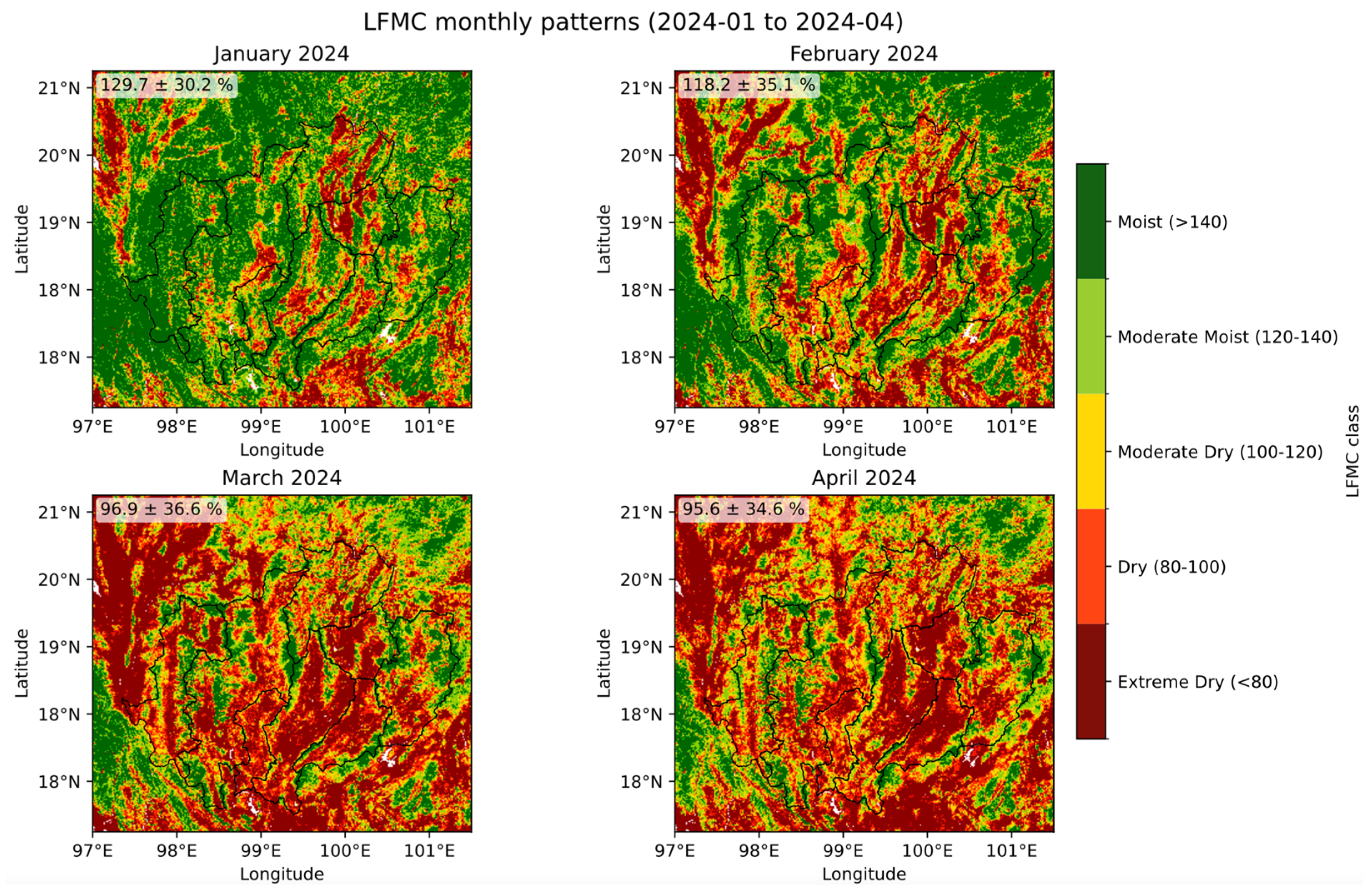
Spatial patterns of estimated LFMC across northern Thailand during the 2024 dry season (Figure 5) exhibited pronounced gradients associated with elevation, vegetation type, and seasonal drying. Higher LFMC estimation values were consistently observed in the mountainous evergreen and mixed evergreen–deciduous forests of the western and northern highlands, where cooler temperatures and higher ambient humidity support sustained canopy moisture. In contrast, extensive areas of mixed deciduous forest, degraded forest edges, and upland agricultural land in the central and eastern parts of the region showed markedly lower LFMC values throughout the peak dry season.
In early January, the LFMC remained moderate to high across much of the region, particularly in areas that experienced residual soil moisture from late monsoon rainfall. By February and March, a progressive decline in LFMC was evident, with large contiguous zones of low LFMC emerging across the Chiang Mai–Lamphun Basin, eastern Chiang Rai, and Nan Province. These spatial patterns are consistent with known fire hotspots and biomass-burning activity documented in prior years [48], although the LFMC estimates should be interpreted as indicative of relative moisture status rather than absolute flammability.
High-elevation evergreen areas exhibited comparatively slower drying rates and retained higher LFMC estimation values in March, likely reflecting both cooler microclimates and increased canopy water-storage capacity. Conversely, deciduous forests, which undergo partial canopy shedding during the dry season, exhibited more rapid declines in LFMC, producing extensive low-moisture zones that coincide with areas of frequent anthropogenic burning in the dry season. The spatial heterogeneity of the LFMC during the season highlights the influence of vegetation composition, terrain, and land use on moisture availability. These patterns provide a basis for understanding broad-scale moisture dynamics; however, the lack of field-based LFMC measurements means that the results represent relative variability rather than calibrated biophysical LFMC values.
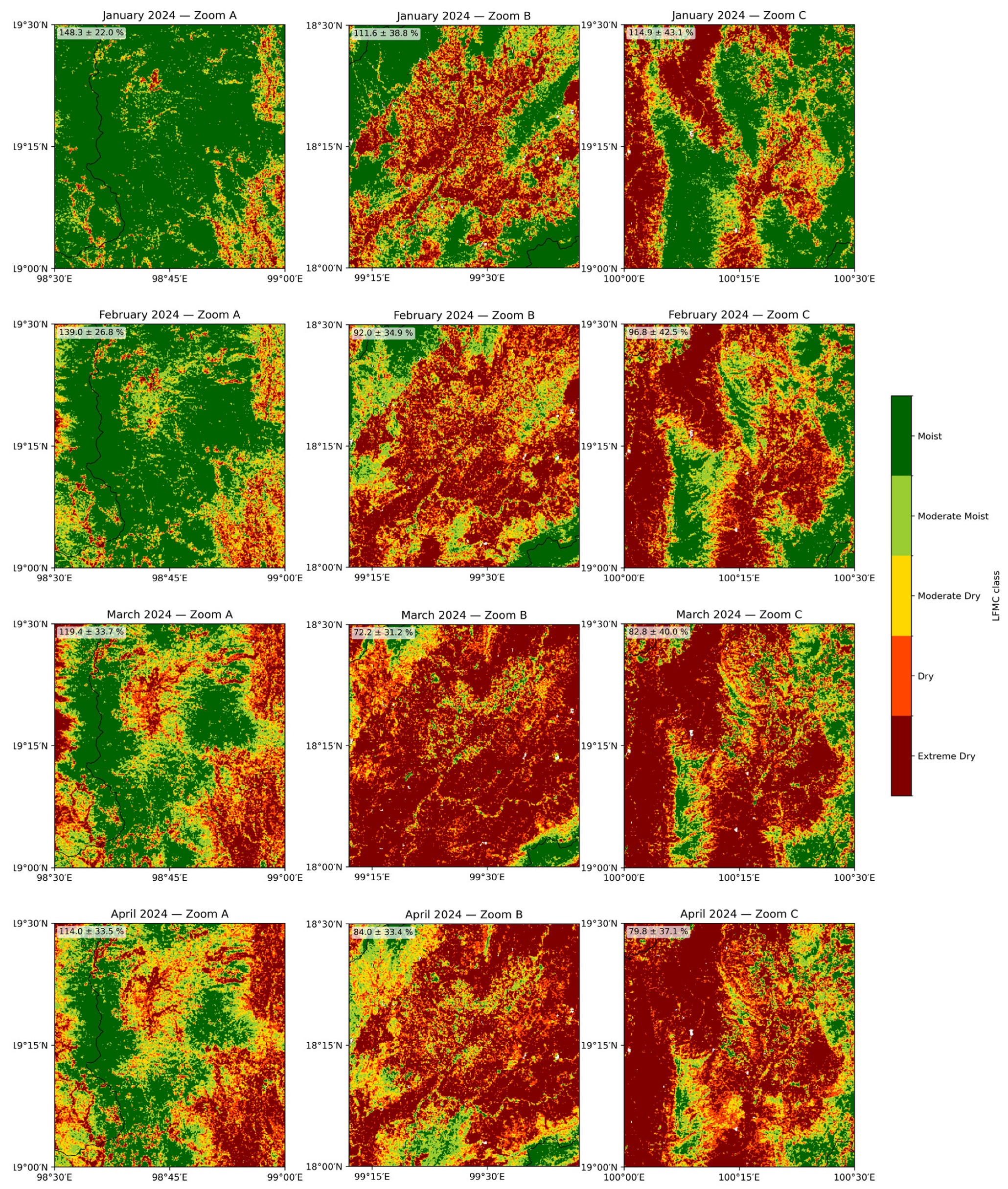
In addition to the domain-wide maps, the spatial zooms in Figure 6 illustrate how the estimated LFMC varied across contrasting landscapes during the 2024 dry season. These finer-scale patterns highlight the ability of the workflow to resolve local heterogeneity in vegetation moisture, which may not be visible in the coarser regional summaries. In the left column, the evergreen forests consistently exhibited higher estimated LFMC values throughout the dry season, reflecting the combined influence of cooler temperatures, denser canopies, and higher soil moisture retention at elevated terrain. Even in March and April, when widespread drying was observed across the region, most areas within Zoom A remained above approximately 100%, although localized pockets of lower moisture appeared along lower-elevation fringes.
The central column shows agricultural valleys that maintained substantially lower LFMC values throughout the season. Many cropland areas had already dropped below 100% in January, and by March and April, large portions had declined to some of the lowest values observed in the study area. These patterns correspond to the characteristics of cultivated landscapes, where sparse canopy cover, post-harvest residue, and intensive land use reduce overall vegetation and soil moisture storage.
The right column depicts a mixed landscape of forests, secondary vegetation, and agricultural fields, producing high spatial variability in the estimated LFMC. Evergreen patches retained relatively high moisture, whereas adjacent croplands and disturbed areas frequently declined to much lower LFMC levels by March and April. This spatial juxtaposition underscores the strong influence of land cover gradients on local moisture dynamics, particularly during peak dry season conditions. These observations collectively demonstrate that the heuristic LFMC estimation workflow can capture localized variations in vegetation moisture, although the values represent relative rather than calibrated LFMC estimates.

3.2. Distribution and Summary Statistics

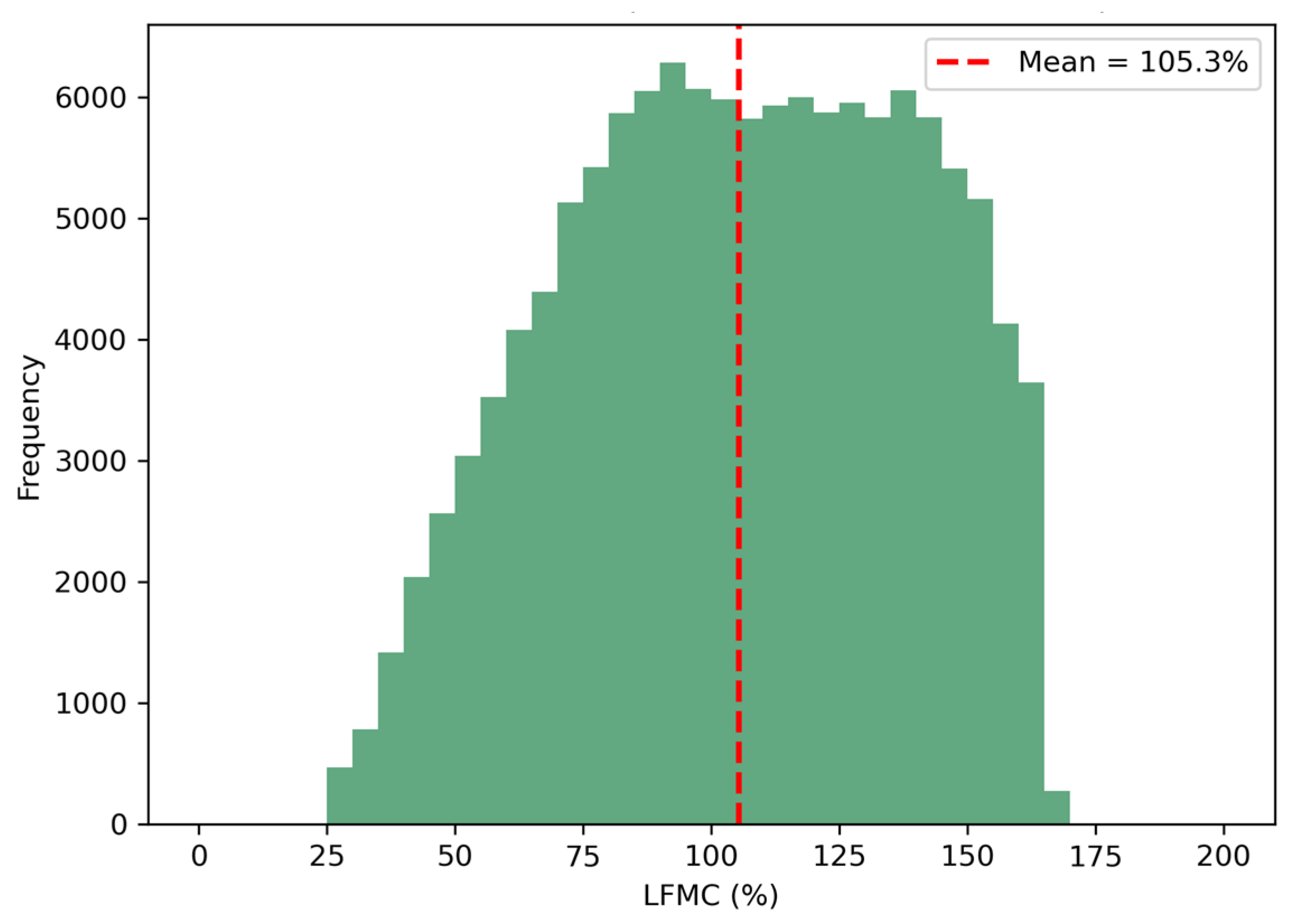
The histogram of the LFMC values for the study domain during the dry period (January–April 2024) illustrates the overall distribution of relative vegetation moisture conditions (Figure 7). Most pixels were concentrated between approximately 80% and 140%, indicating that much of the region maintained moderate to high relative moisture levels during the observation period. The distribution also showed a substantial spread, with values ranging from approximately 65% in the driest lowland agricultural areas to more than 160% in dense evergreen forests. The mean estimated LFMC was 105.3% (red dashed line), slightly above the distribution center, reflecting the predominance of upland evergreen forests that typically retain higher moisture levels.
The extended lower tail of the histogram highlights areas with comparatively low estimated LFMC values, particularly in agricultural valleys and degraded foothill forests, where the values frequently dropped below 100%. The distribution also suggests a quasi-bimodal tendency, with one concentration around 110–120% corresponding to moisture-rich forested areas and another around 80–90% associated with cultivated and mixed-use zones. These dual peaks underscore the strong landscape heterogeneity of the region, where moist, high-elevation forests coexist with drier agricultural and disturbed landscapes.
Overall, the histogram demonstrates that although large portions of the region retain relatively high estimated LFMC values, sizeable areas experience substantially lower moisture conditions during the late dry season. These patterns highlight the spatial variability of vegetation dryness but should be interpreted as relative moisture indicators, not calibrated measures of LFMC or fire susceptibility.

3.3. Temporal Dynamics and Precipitation Relationship

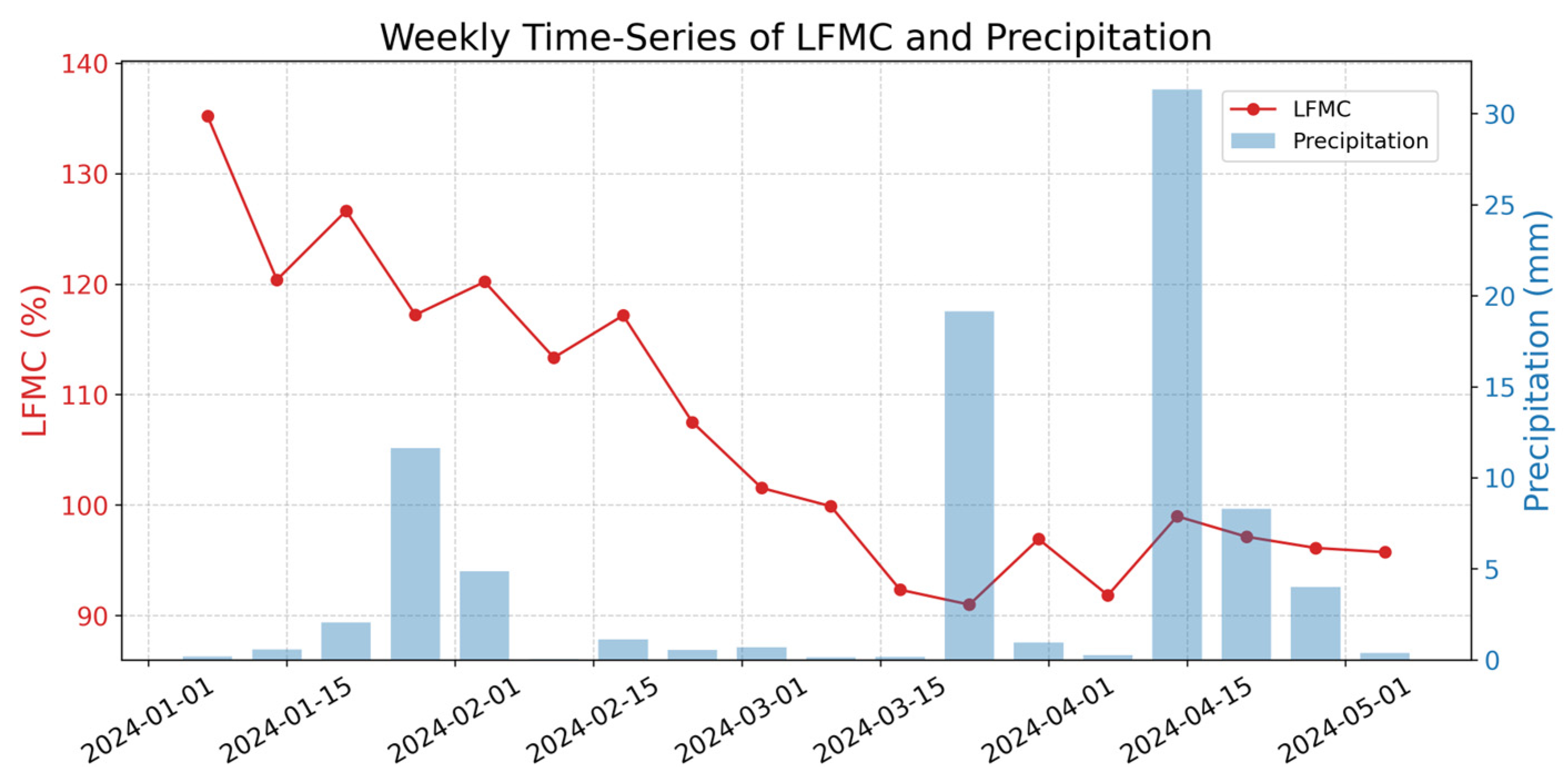
The temporal evolution of the domain-mean LFMC estimation from January to April 2024 (Figure 8) reflects the progressive drying typical of the pre-monsoon season in northern Thailand. The mean estimated LFMC values exceeded 135% in early January, which was consistent with residual soil and canopy moisture carried over from the wet season. A steady decline followed in the succeeding months, with values decreasing to approximately 95% by mid-April. This seasonal trajectory corresponds to the regional climatology of decreasing rainfall and increasing evaporative demand during the late dry season. Rainfall events intermittently moderated this downward trend. Short precipitation episodes in January and February produced brief periods of stabilization and slowed the rate of decline in the LFMC estimation. A more substantial rainfall event in late March generated a modest rebound of approximately 5–10%, whereas the largest event in early April produced a temporary increase that was not sustained. In each case, the estimated LFMC values subsequently resumed a seasonal downward progression. These temporal patterns illustrate the sensitivity of the heuristic LFMC estimates to short-term precipitation inputs, while also reflecting the dominance of broader seasonal drying processes in the study area. Although these results provide insight into relative moisture variability, they represent preliminary, unvalidated estimates and should be interpreted conservatively without inferring quantitative relationships between rainfall and vegetation moisture.
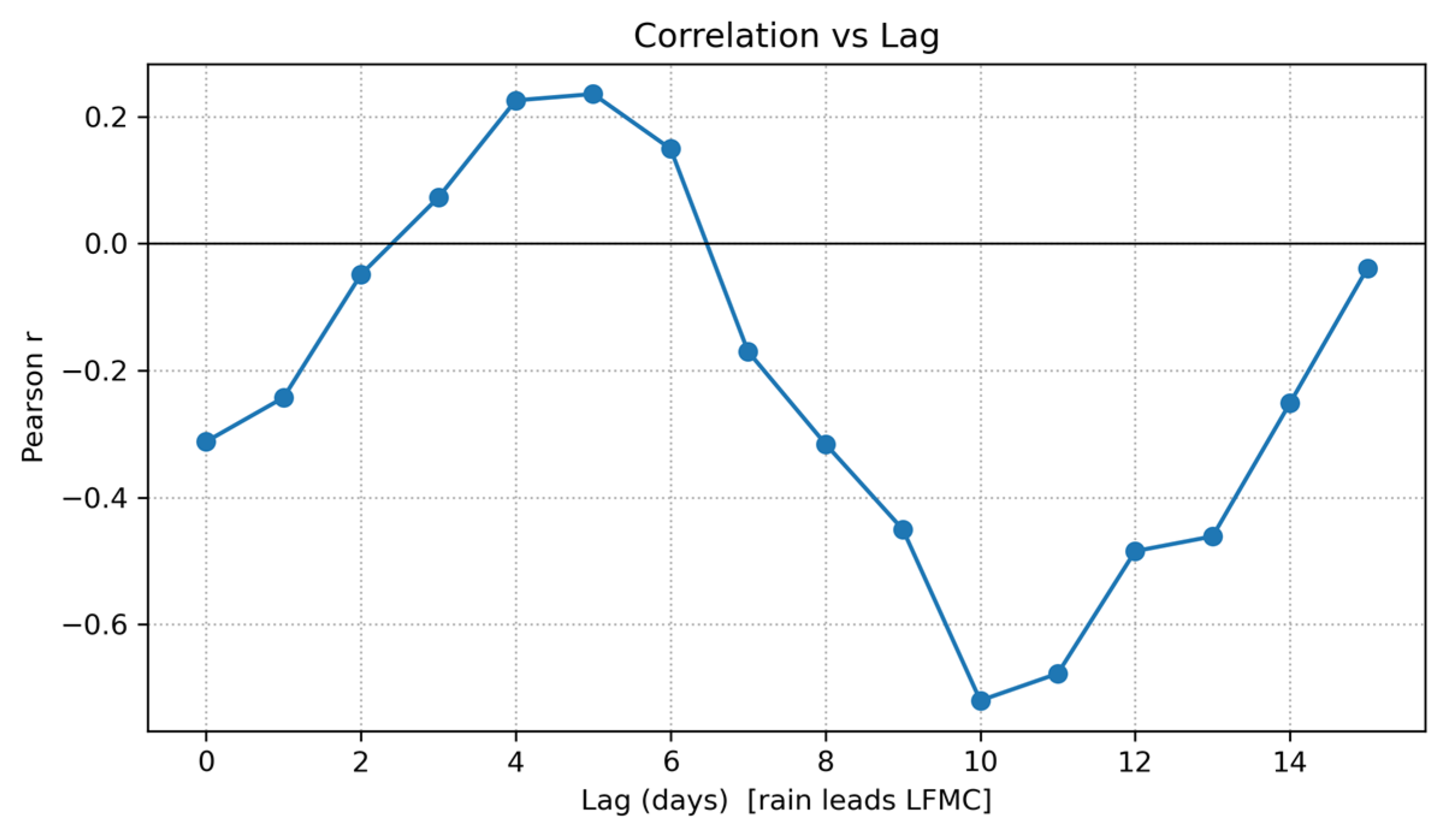
The sensitivity of the estimated LFMC to rainfall timing was further examined using a lagged correlation analysis (Figure 9). A moderate positive correlation was observed at short lags of approximately 4–6 days following rainfall, indicating that vegetation and surface moisture respond relatively quickly to precipitation. This short lag behavior is consistent with the rapid rehydration of foliage and replenishment of near-surface soil moisture after rainfall. However, after approximately one week, the relationship shifted toward negative correlations, particularly at lags of 7–10 days. This pattern suggests that once precipitation ceases, moisture levels tend to decline rapidly under the influence of evaporative demand and limited soil water availability during the late dry season. At longer lags (>12 days), the correlation signals weakened, reflecting the dominance of broader seasonal drying processes over the effects of individual rainfall events. These results illustrate that although short rainfall episodes can temporarily increase relative vegetation moisture, their influence is transient, and the estimated LFMC generally reverts to the seasonal drying trajectory within approximately a week. Because the LFMC estimates in this study are preliminary and unvalidated, the correlation patterns should be interpreted as qualitative indicators of moisture–rainfall linkage rather than quantitative measures of ecosystem response.
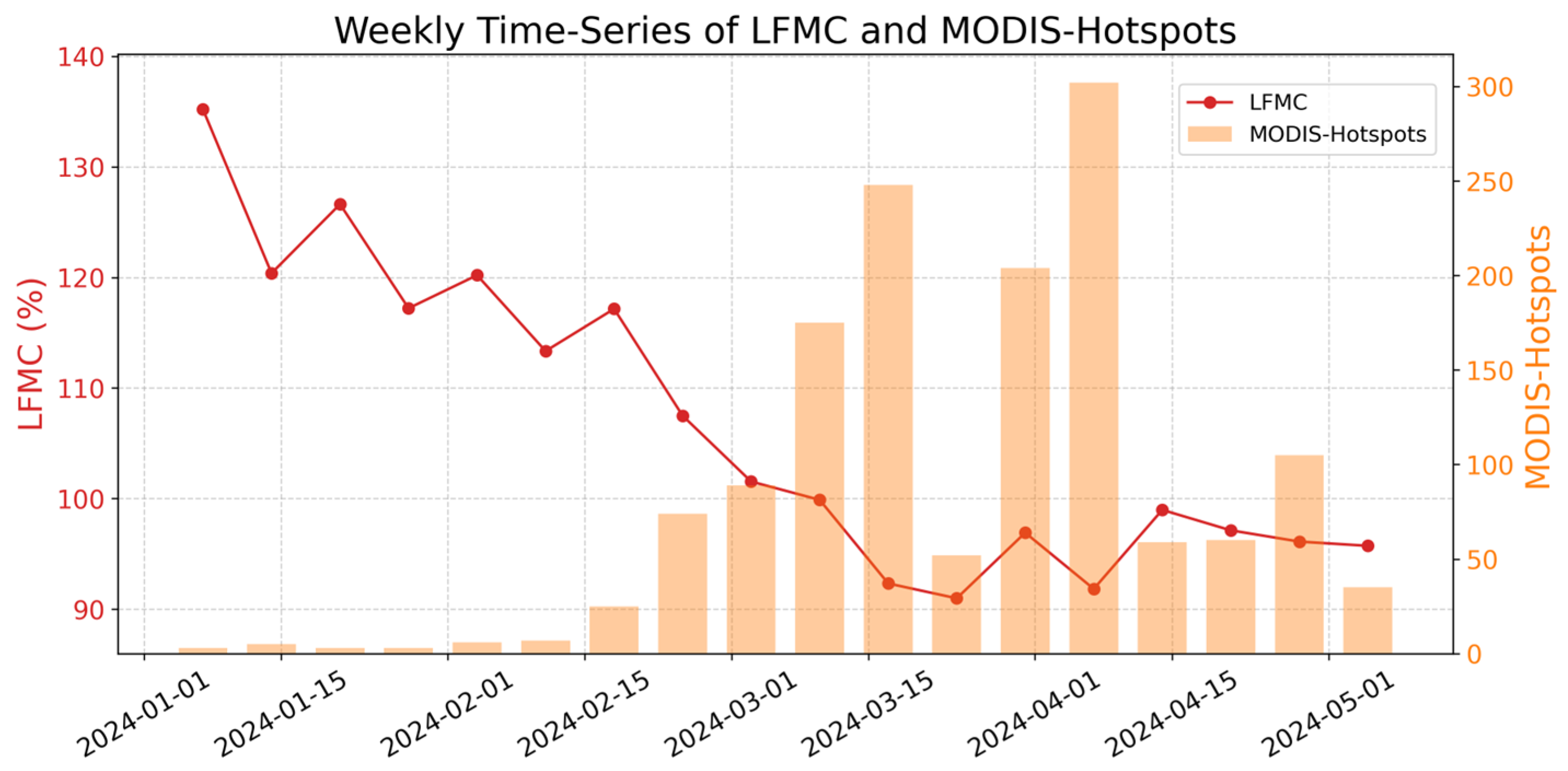
The weekly time series of domain-mean LFMC estimation and MODIS active fire hotspot [51] counts from January to April 2024 illustrated a clear seasonal transition toward progressively drier vegetation conditions (Figure 10). The estimated LFMC values were highest in early January and exhibited a consistent downward trajectory through late March, reaching values below 95 during the peak of the dry season. This declining pattern aligns with the region’s typical dry-season climatology, which is characterized by limited rainfall and increasing evaporative demand. Hotspot activity remained negligible during the early part of the season, coinciding with relatively high estimated LFMC values. Beginning in mid-February, hotspot detections increased as the estimated LFMC continued to decline, with the highest hotspot counts occurring between late March and early April. During this interval, the LFMC reached its lowest values in the series, reflecting widespread vegetation drying across the domain. Short-lived increases in the estimated LFMC were observed in early April, suggesting localized moisture recovery following isolated rainfall events. However, these temporary increases did not correspond to immediate reductions in hotspot counts, likely due to ongoing agricultural burning and persistent atmospheric dryness during this period. Despite these nuances, the overall temporal pattern showed an inverse seasonal relationship between drying vegetation and increased hotspot activity in northern Thailand.
The results indicate that the heuristic LFMC estimates capture broad seasonal drying and periods of limited moisture recovery, whereas the MODIS hotspot time series reflects the timing and intensity of regional fire activity. Because the estimated LFMC values remain unvalidated, these patterns should be interpreted as indicators of relative moisture variability rather than direct predictors of ignition probability or fire behavior in the study area.
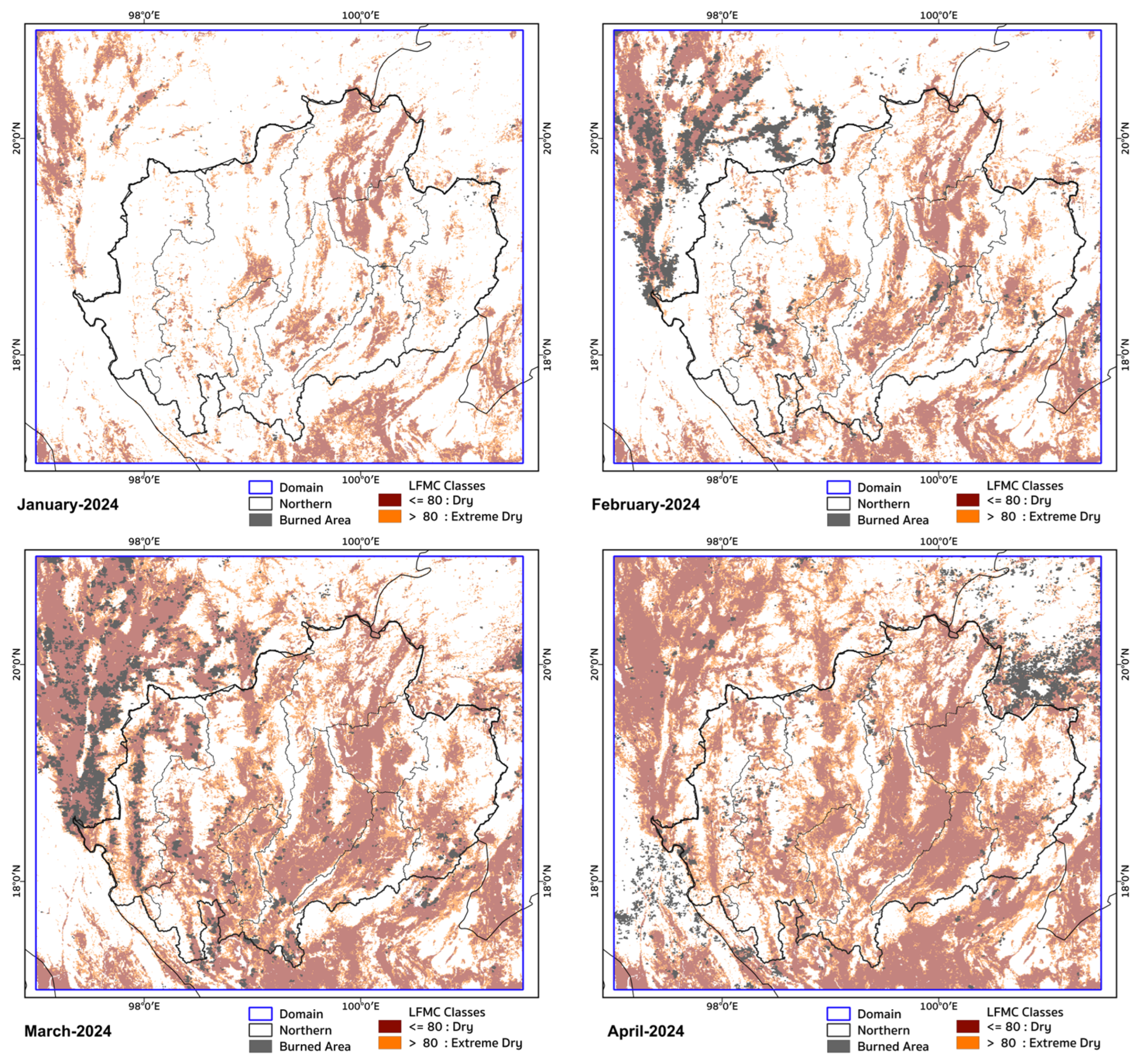
The monthly estimated LFMC and MODIS burned-area maps (Figure 11) revealed a consistent seasonal transition from relatively moist conditions in January to widespread vegetation dryness and expanded fire-affected regions by March and April, respectively. Although LFMC estimates remain unvalidated, the spatial patterns show internally coherent gradients, with pronounced drying in mixed deciduous forests and lowland agricultural zones and comparatively higher moisture retention in evergreen highlands. Burned areas began to intensify in February and expanded substantially in March, particularly across the western highlands, which concurrently exhibited some of the largest declines in LFMC estimation. The pattern correlation coefficients (PCC) provide a quantitative summary of these co-evolving spatial patterns.
The correlations between LFMC and burned area (Table 3) were weak in January (0.36–0.31), reflecting both limited burning and generally high moisture levels. In February, PCC values increased (0.62–0.58), corresponding to emerging areas of reduced LFMC alongside the onset of widespread burning. The highest correlations occurred in March (0.74–0.72), coinciding with the lowest LFMC estimation values and peak fire extent. The drop in PCC during April (0.48) likely reflects the combined influence of late-season rainfall, patchy moisture recoveries, and anthropogenic ignition patterns that are not strictly moisture constrained. These correlations should not be interpreted as evidence of a mechanistic LFMC–fire relationship, but rather as seasonal co-patterning between two independently derived datasets. The high March correlations arise primarily because both estimated LFMC and burned area reflect pronounced dry-season progression rather than because LFMC estimation is a validated predictor of fire occurrences. Given that ignitions in northern Thailand are largely anthropogenic and LFMC estimates remain uncalibrated, the PCC values must be viewed cautiously and cannot be used to infer fire danger thresholds or model performance in this region. Overall, the results illustrate that the heuristic LFMC estimates reproduce broad-scale seasonal drying patterns that spatially coincide with increased burned-area occurrence. However, the strength and interpretation of these patterns remain limited without field-based LFMC measurements, coefficient calibration, and rigorous evaluation.

3.4. LFMC-Derived Moisture Classes

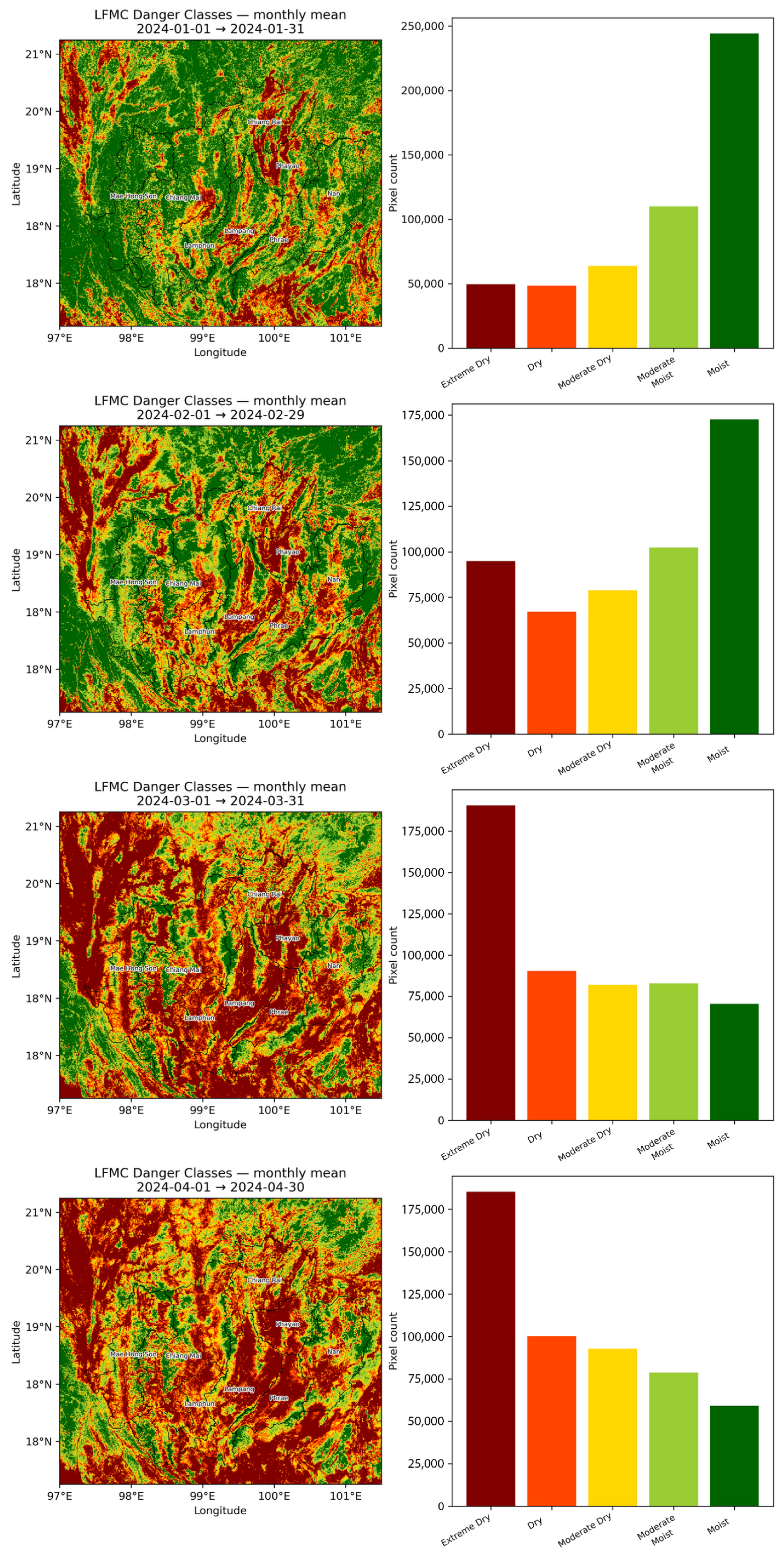
Heuristic thresholds were applied to convert the continuous LFMC estimates into five moisture-based classes, representing the relative gradients of vegetation dryness. These classes—moist (>140%), moderate moist (120–140%), moderate dry (100–120%), dry (80–100%), and extreme dry (<80%)—were used to summarize broad spatial patterns of drying across the study domain. Because the thresholds are not calibrated for Southeast Asia, they serve only as interpretive groupings and should not be considered as operational indicators of flammability or fire danger. Figure 12 illustrates the spatial distribution of these moisture classes and their corresponding pixel counts for each month. In January 2024, the landscape was dominated by moderate moisture and moist classes, especially in evergreen forests and high-elevation terrain. Conversely, portions of agricultural valleys and disturbed lowland areas already exhibited lower moisture levels, appearing in the dry and extreme dry classes. By February, seasonal drying became more pronounced, with the expansion of the dry and moderate dry classes across agricultural and mixed-use regions. The moist class decreased in extent, reflecting the transition to typical late dry season conditions. Approximately one-third of the domain shifted into the moderate dry class, highlighting the regional onset of widespread moisture depletion in the dry class. In March, the extreme dry class increased substantially, reflecting the peak of seasonal dryness. Large areas of deciduous forests and intensively cultivated valleys exhibited some of the lowest LFMC estimation values during the study period. Evergreen forests at higher elevations remained in the moist to moderately dry classes, although some ridge areas also showed signs of reduced moisture. By April, the distribution remained dominated by the dry and extremely dry classes, despite sporadic early season rainfall. Localized increases in moisture were visible in isolated areas, but the broader landscape continued to reflect the cumulative effects of sustained dry season conditions. Overall, these moisture classes provide a simplified depiction of the relative vegetation dryness and seasonal transitions. Because the model and thresholds are preliminary and unvalidated, the classes should be interpreted conservatively and used only for exploratory analysis rather than for operational decision-making.
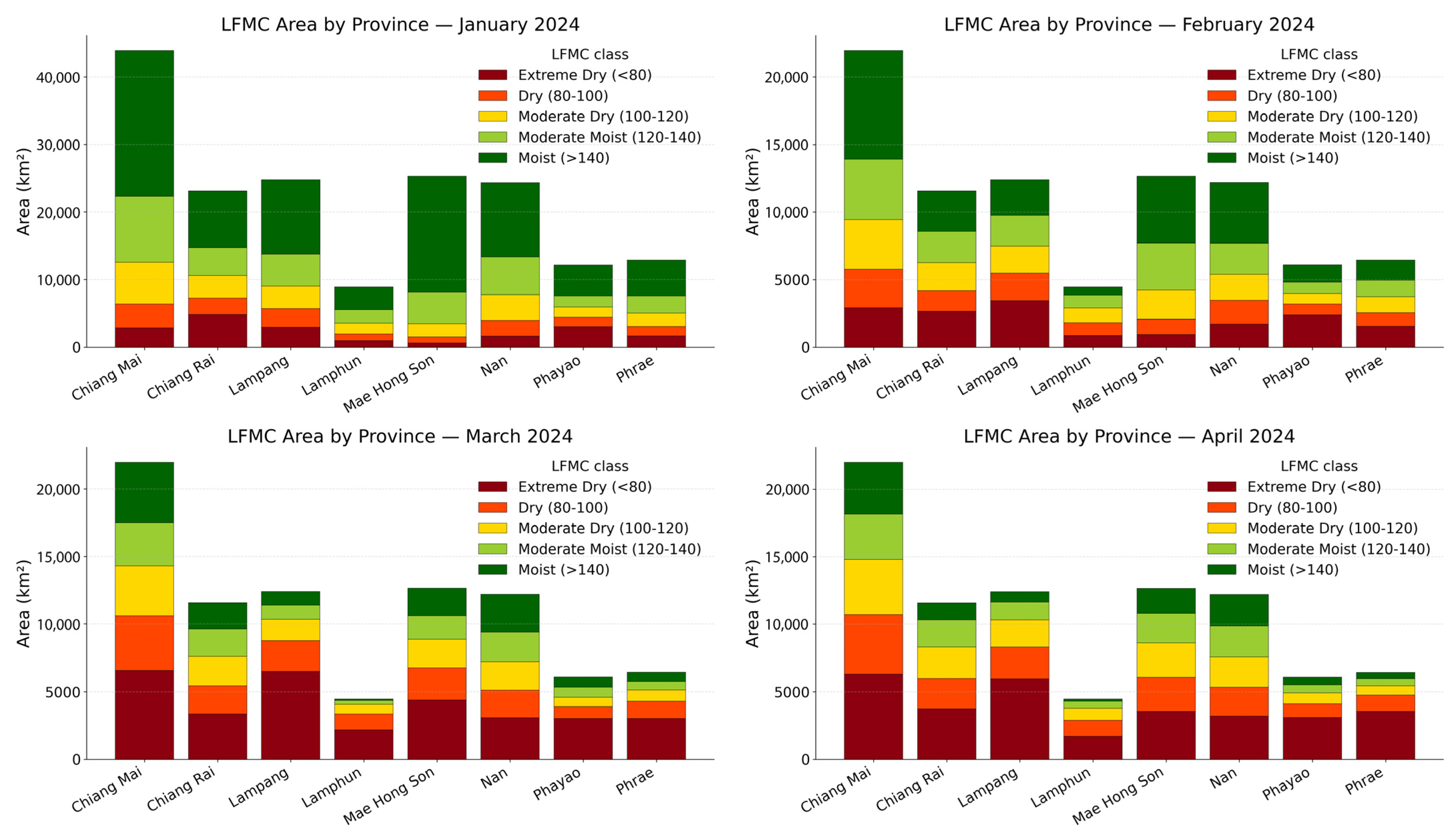
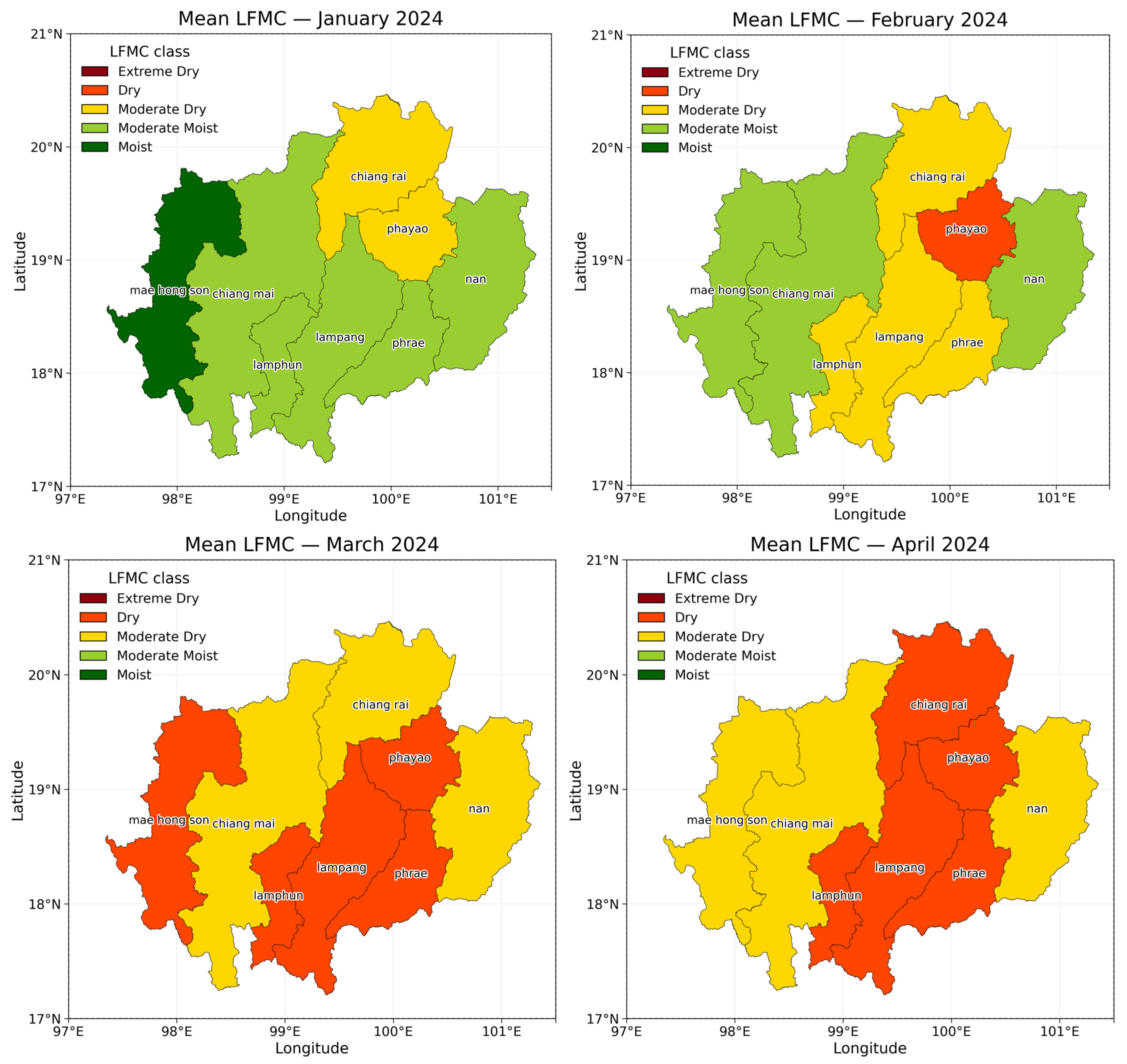
Figure 13 presents provincial-level summaries of the LFMC-derived moisture classes across northern Thailand from January to April 2024, illustrating the seasonal progression of relative vegetation dryness. In January, most provinces—particularly Mae Hong Son, Chiang Mai, Lamphun, Lampang, Phrae, and Nan—were dominated by the moderate moist and moist classes (>120%). These patterns correspond to residual soil moisture and the influence of evergreen and mixed forest cover during the wet season. By February, spatial contrasts began to emerge in the data. Phayao showed a notable shift toward lower moisture classes, especially in cultivated and valley landscapes, whereas provinces such as Chiang Rai, Lamphun, Lampang, and Phrae displayed mixed conditions, with moist forest zones coexisting with agricultural pockets that exhibited comparatively lower LFMC values.
Seasonal drying intensified in March, during which the dry and extremely dry classes expanded substantially across several provinces. This transition was most apparent in Chiang Rai, Lampang, Lamphun, Phrae, and Phayao, where many lowland agricultural and deciduous forest areas recorded some of the lowest LFMC estimation values observed during the study period. In contrast, the higher-elevation evergreen regions, particularly in Mae Hong Son and parts of Chiang Mai, retained relatively higher moisture levels. By April, much of the region remained within the lower moisture classes despite scattered early season rainfall, indicating the cumulative effect of sustained pre-monsoon dryness. Although localized increases were visible in some upland areas, the overall provincial pattern continued to reflect the seasonal decline in vegetation moisture typical of northern Thailand’s late dry season. These provincial classifications provide a broad overview of spatial moisture variability and seasonal transitions; however, the thresholds applied are heuristic and un-validated. Consequently, the classes should be interpreted as indicators of relative vegetation dryness rather than as operational assessments of landscape conditions.
Figure 14 summarizes the distribution of the LFMC-derived moisture classes for each province over the four-month dry season. The stacked bar plots illustrate both the seasonal drying trajectory and spatial differences in relative vegetation moisture across northern Thailand. In January 2024, most provinces were dominated by the moderate moist (120–140%) and moist (>140%) classes, which together accounted for roughly two-thirds of the regional area. Chiang Mai, Mae Hong Son, and Nan exhibited the highest proportions of these moisture-rich classes, consistent with the prevalence of evergreen and mixed forest cover and residual water availability from the monsoon. Provinces such as Chiang Rai and Lampang displayed more heterogeneous conditions, where moist forested areas coexisted with agricultural and lowland zones containing lower LFMC values than the other provinces. By February, seasonal drying had advanced, with increases in the moderate dry (100–120%) and dry (80–100%) classes in several provinces. Moisture declines were most evident in low-elevation agricultural valleys and mixed-use landscapes, whereas high-elevation areas in Chiang Mai and Mae Hong Son retained comparatively higher moisture levels.
March represented the period of the strongest seasonal dryness. The dry and extreme dry (<80%) classes expanded across much of the region, particularly in Chiang Rai, Lampang, Lamphun, Phrae, and Phayao, where 45–55% of the provincial areas shifted into the lowest moisture classes. Higher-elevation evergreen forests in Mae Hong Son and parts of Chiang Mai continued to exhibit relatively higher estimated LFMC values, reflecting their greater moisture retention capacity during the late dry season. In April, although isolated rainfall occurred, most provinces remained within the lower moisture classes. Chiang Mai showed the largest areal extent of the extreme dry class, whereas Mae Hong Son and Nan retained a greater proportion of moist and moderate dry classes due to their extensive forest cover. Provinces such as Lamphun, Phayao, and Phrae experienced the most substantial moisture reductions, with more than 40% of their areas remaining in the dry and extreme dry classes. Overall, the provincial summaries highlighted the pronounced spatial variability and progressive depletion of vegetation moisture during the pre-monsoon period. These moisture classes are based on preliminary heuristic thresholds and should be interpreted as indicators of relative dryness rather than calibrated measures of vegetation stress or ecological conditions.

3.5. Planned Toward Implementation

The planned implementation pathway for the LFMC estimation workflow, illustrated in Figure 15, outlines how the system can evolve into a routine near-real-time operation once the model is validated. The workflow begins with the automated retrieval of Sentinel-2 Level-2A surface reflectance imagery (bands B04, B08, and B11) using the Sentinel Hub API. User-defined parameters, such as temporal range, cloud cover thresholds, and spatial resolution, govern scene selection. At the core of the processing chain, an evalscript performs an on-the-fly computation of NDVI, NDII, MSI, and ETf, followed by the normalization and evaluation of the heuristic LFMC estimation formulation. The system generates two forms of output: (i) styled PNG maps that provide rapid visual interpretation and (ii) GeoTIFF rasters containing raw FLOAT32 values with full spatial metadata. These GeoTIFF products are stored with compressed tiling for efficient handling and are suitable for downstream quantitative analyses, including calibration and validation. Optional quality control routines can parse metadata and extract regional statistics, enabling lightweight verification when persistent cloud cover or missing scenes occur.
The modular design supports automated execution through cron-based scheduling or containerized deployments, making the workflow amenable to integration with geospatial servers and fire information dashboards. Once validated, LFMC estimates can be linked with additional contextual layers, such as weather forecasts, hotspot detections, or fuel maps, to support applications such as situational awareness, early season dryness monitoring, and administrative processes related to burn-permit management. At present, however, the estimated LFMC outputs should be interpreted solely as qualitative indicators of relative vegetation dryness, pending the calibration and threshold development described in Section 2.8. The long-term goal is to transition the workflow from a research prototype into a regionally reliable LFMC monitoring component within broader fire management and early warning systems.

4. Discussion

4.1. Comparison with Prior Studies

The heuristic LFMC estimation framework developed in this study builds upon earlier research demonstrating that multispectral indices—such as the NDVI, NDII, MSI, and other SWIR- and NIR-derived indicators—capture important aspects of canopy greenness, foliage water content, and moisture stress across diverse ecosystems [18,19,20,21,35,36,42,43]. Prior studies in the Mediterranean, Australia, and North America have successfully linked satellite-based LFMC estimates to field measurements and fire activity [53]; however, these results rely on extensive destructive sampling datasets that are not yet available in northern Thailand. Consequently, operational thresholds or empirical relationships established in other regions cannot be directly applied to tropical monsoon ecosystems without local calibration [54]. Within this context, our approach represents a preliminary adaptation of multi-index LFMC estimation to Southeast Asian landscapes using Sentinel-2 imagery. The estimated patterns, which reflect regional climatology and vegetation phenology, are broadly consistent with moisture dynamics documented in other optical-based LFMC studies [12,15,55,56,57,58]. Nevertheless, because the current formulation lacks empirical calibration, the estimates should be interpreted strictly as relative indicators of moisture variability rather than as biophysical LFMC values. These findings demonstrate the conceptual feasibility of using satellite-based indices for LFMC monitoring in data-limited regions, while underscoring the need for future field validation.

4.2. Potential Utility in a Non-Operational Context

Although LFMC-based information has been incorporated into operational fire-danger systems elsewhere, such applications depend on long-term validation, species-specific moisture–flammability relationships, and robust empirical thresholds. These foundational datasets are currently unavailable in northern Thailand. Accordingly, the outputs presented here should be regarded as exploratory and non-operational, intended to support situational awareness, comparative moisture mapping, and research analyses of seasonal vegetation dryness, rather than real-time decision-making. The dual-format outputs, PNG visualizations and GeoTIFF rasters, illustrate how LFMC-related information could interface with decision-support platforms once empirical thresholds and confidence intervals are established. However, meaningful operational use at this stage requires substantial additional work, including calibration, uncertainty quantification, and cooperation with regional agencies.

4.3. Pathway Toward Calibration and Validation

Advancing the LFMC estimation framework toward quantitative and operational use will require systematic validation steps outlined in Section 2.8. The foremost is the establishment of coordinated destructive LFMC sampling across representative vegetation types in northern Thailand. Measurements collected throughout the dry season will provide the ground-truth dataset necessary to calibrate model coefficients, assess species-specific moisture responses, and evaluate how well spectral indices represent true foliar moisture dynamics. A complementary comparison with external LFMC products, such as Globe-LFMC and other satellite-derived estimates, will help characterize model behavior across broader spatial and temporal gradients. Although differences in retrieval methodology may limit direct comparison, such datasets can reveal structural discrepancies and inform the refinement of the heuristic formulation. These future validation activities are essential for improving the accuracy and ecological relevance of the LFMC estimates. Region-specific thresholds, uncertainty ranges, and operational interpretations for tropical monsoon ecosystems can only be established after systematic calibration, sensitivity testing, and empirical validation.

4.4. Uncertainty and Limitations

Several factors contribute to the uncertainty in the present LFMC estimates. Cloud cover remains a persistent challenge in monsoon-affected regions, and although temporal mosaicking reduces data gaps, it does not eliminate them. Methodologically, the heuristic model assumes linear contributions of NDVI, NDII, MSI, and ETf; however, real-world vegetation water dynamics are nonlinear and species dependent. Because field-based LFMC observations are currently unavailable, the weighting coefficients and moisture-class thresholds remain provisional and should be interpreted as relative dryness groupings rather than physiologically calibrated thresholds. Relying solely on Sentinel-2 imagery limits temporal frequency, and fixed coefficients may introduce systematic bias across contrasting land-cover types. Integrating meteorological datasets, soil moisture indices, SAR backscatter, and thermal information could reduce some of these limitations; however, full improvement depends on the availability of field validation data.

4.5. Future Research Directions

Future studies should prioritize destructive LFMC sampling campaigns to establish empirical LFMC–spectral relationships and support coefficient calibration. Incorporating meteorological variables (e.g., precipitation, vapor pressure deficit, temperature, and soil moisture) will improve the interpretation of short-term moisture fluctuations. Multi-sensor fusion, particularly with Sentinel-1 SAR, thermal infrared data, or high-frequency platforms, offers a promising avenue for mitigating cloud-related data loss and enhancing temporal consistency. Additionally, uncertainty quantification through sensitivity analysis, error propagation assessment, and model stability testing will be critical for transparent scientific communication and eventual operational deployment of the model.

4.6. Pathway Toward Potential Integration

The workflow presented here demonstrates how LFMC estimation could eventually be incorporated into regional fire management systems once calibration and validation are achieved. Automated data retrieval, spectral index computation, and LFMC proxy generation illustrate the feasibility of a streamlined near-real-time monitoring pipeline. However, the current output should not be used as an operational indicator. Effective integration will require the collaborative development of thresholds, interpretation guidelines, training resources, and decision protocols tailored to the vegetation characteristics and institutional context of northern Thailand. With adequate empirical calibration, stakeholder engagement, and alignment with local fire management practices, the heuristic LFMC estimation framework has the potential to evolve from a research prototype into a regionally applicable monitoring component supporting early warning and preparedness strategies.

5. Conclusions

This study developed a preliminary framework for the near-real-time estimation of Live Fuel Moisture Content (LFMC) in northern Thailand using Sentinel-2 multispectral imagery. The heuristic integration of NDVI, NDII, MSI, and an NDVI-derived evapotranspiration fraction produced spatially explicit estimates of relative vegetation moisture, highlighting clear seasonal drying patterns during the 2024 dry season. The results effectively captured broad gradients between evergreen forests and lowland agricultural areas; however, the estimates remain unvalidated owing to the absence of field-based LFMC measurements in the region. Accordingly, the outputs should be interpreted as indicators of relative moisture variability, rather than calibrated biophysical LFMC values. Operational applications will require destructive LFMC sampling across representative vegetation types, followed by coefficient calibration, uncertainty assessment, and evaluation against external LFMC datasets. The integration of meteorological variables (e.g., GPM IMERG precipitation, soil-moisture models) and multi-sensor fusion (e.g., Sentinel-1 SAR and thermal infrared data) represents an additional priority for improving robustness and sensitivity assessments to characterize the robustness of the heuristic formulation. Overall, this study provides a transparent and reproducible starting point for estimating LFMC in a data-limited tropical monsoon environment. Once empirical validation becomes available, the framework may serve as the basis for developing a regionally reliable LFMC monitoring component to support fire management and early warning systems.

Supplementary Materials

A full, reproducible Python processing script, including index computation, masking, normalization, and LFMC estimation, is provided as a supplementary material via a public GitHub repository: https://github.com/chakrit23/s2-nrt-lfmc-estimation (14 October 2025).

Author Contributions

Conceptualization, C.C. and D.L.; methodology, C.C. and D.L.; software, C.C. and D.L.; validation, C.C., D.L., and P.T.; formal analysis, C.C. and D.L.; investigation, C.C.; resources, C.C.; data curation, C.C.; writing—original draft preparation, C.C. and D.L.; writing—review and editing, C.C., D.L. and P.T.; visualization, C.C. and D.L.; project administration, C.C.; funding acquisition, C.C. All authors have read and agreed to the published version of the manuscript.

Funding

This research was supported by the research project “Strengthening the FireD System to Improve Biomass Fuel Management Efficiency”, funded by the National Research Council of Thailand (NRCT), grant number N25A680014, with partial support from Chiang Mai University (CMU).

Data Availability Statement

All data generated or analyzed in this study are included in this article. Additional information or access to the derived datasets is available from the corresponding author upon reasonable request.

Acknowledgments

The authors gratefully acknowledge the collaborating institutions involved in the FireD platform development and field coordination. The authors also thank the Sentinel Hub and Global Precipitation Measurement (GPM) program for providing satellite data and related services that supported this research. During the preparation of this manuscript, the authors used ChatGPT (GPT-5, OpenAI, 2025) to refine academic writing and enhance readability. The authors have thoroughly reviewed, verified, and edited all AI-assisted outputs and take full responsibility for the final content of the article.

Conflicts of Interest

The authors declare no conflicts of interest.

References

  1. Xiao, C.; Feng, Z.; Li, P. Active Fires Show an Increasing Elevation Trend in the Tropical Highlands. Glob. Change Biol. 2022, 28, 2790–2803. [Google Scholar] [CrossRef] [PubMed]
  2. Taufik, M.; Torfs, P.J.J.F.; Uijlenhoet, R.; Jones, P.D.; Murdiyarso, D.; Van Lanen, H.A.J. Amplification of Wildfire Area Burnt by Hydrological Drought in the Humid Tropics. Nat. Clim. Change 2017, 7, 428–431. [Google Scholar] [CrossRef]
  3. He, Q.; Jiang, Z.; Wang, M.; Liu, K. Landslide and Wildfire Susceptibility Assessment in Southeast Asia Using Ensemble Machine Learning Methods. Remote Sens. 2021, 13, 1572. [Google Scholar] [CrossRef]
  4. Sukkhum, S.; Lim, A.; Ingviya, T.; Saelim, R. Seasonal Patterns and Trends of Air Pollution in the Upper Northern Thailand from 2004 to 2018. Aerosol Air Qual. Res. 2022, 22, 210318. [Google Scholar] [CrossRef]
  5. Evrard, O.; Mostafanezhad, M. Becoming a Crisis: Shifting Narratives of Seasonal Air Pollution in Northern Thailand (1996–2019). Southeast Asian Stud. 2023, 12, 333–361. [Google Scholar] [CrossRef]
  6. Chart-asa, C. Spatial-Temporal Patterns of MODIS Active Fire/Hotspots in Chiang Rai, Upper Northern Thailand and the Greater Mekong Subregion Countries During 2003–2015. Appl. Environ. Res. 2021, 43, 121–131. [Google Scholar] [CrossRef]
  7. Chernkhunthod, C.; Hioki, Y. Floristic Composition and Forest Structure in Different Fire Frequency of Mixed Deciduous Forest, Doi Suthep-Pui National Park, Northern Thailand. J. Jpn. Soc. Reveg. Technol. 2020, 46, 202–217. [Google Scholar] [CrossRef]
  8. Chen, B.; Jin, Y. Spatial Patterns and Drivers for Wildfire Ignitions in California. Environ. Res. Lett. 2022, 17, 055004. [Google Scholar] [CrossRef]
  9. Inlaung, K.; Chotamonsak, C.; Surapipith, V.; Macatangay, R. Relationship of Fire Hotspot, PM2.5 Concentrations, and Surrounding Areas in Upper Northern Thailand: A Case Study of Haze Season in 2019. J. King Mongkut’s Univ. Technol. North Bangk. 2022, 33, 588–602. [Google Scholar] [CrossRef]
  10. Tial, M.K.S.; Amin, M.; Putri, R.M.; Hata, M.; Furuuchi, M.; Phairuang, W. Size Fractionated Ambient Particles down to Nanoparticles (PM0.1) during a Haze Episode in Myanmar. In Proceedings of the IOP Conference Series: Earth and Environmental Science, Phnom Penh, Cambodia, 5 June 2023; Volume 1199. [Google Scholar]
  11. Jurdao, S.; Chuvieco, E.; Arevalillo, J.M. Modelling Fire Ignition Probability Fromsatellite Estimates of Live Fuel Moisture Content. Fire Ecol. 2012, 8, 77–97. [Google Scholar] [CrossRef]
  12. Rao, K.; Williams, A.P.; Flefil, J.F.; Konings, A.G. SAR-Enhanced Mapping of Live Fuel Moisture Content. Remote Sens. Environ. 2020, 245, 111797. [Google Scholar] [CrossRef]
  13. Yebra, M.; Scortechini, G.; Badi, A.; Beget, M.E.; Boer, M.M.; Bradstock, R.; Chuvieco, E.; Danson, F.M.; Dennison, P.; Resco de Dios, V.; et al. Globe-LFMC, a Global Plant Water Status Database for Vegetation Ecophysiology and Wildfire Applications. Sci. Data 2019, 6, 155. [Google Scholar] [CrossRef]
  14. Vadrevu, K.P.; Ohara, T.; Justice, C. Land-Atmospheric Research Applications in South and Southeast Asia; Springer: Cham, Switzerland, 2018. [Google Scholar]
  15. Yebra, M.; Dennison, P.E.; Chuvieco, E.; Riaño, D.; Zylstra, P.; Hunt, E.R.; Danson, F.M.; Qi, Y.; Jurdao, S. A Global Review of Remote Sensing of Live Fuel Moisture Content for Fire Danger Assessment: Moving towards Operational Products. Remote Sens. Environ. 2013, 136, 455–468. [Google Scholar] [CrossRef]
  16. Marino, E.; Yebra, M.; Guillén-Climent, M.; Algeet, N.; Tomé, J.L.; Madrigal, J.; Guijarro, M.; Hernando, C. Investigating Live Fuel Moisture Content Estimation in Fire-Prone Shrubland from Remote Sensing Using Empirical Modelling and RTM Simulations. Remote Sens. 2020, 12, 2251. [Google Scholar] [CrossRef]
  17. Drusch, M.; Del Bello, U.; Carlier, S.; Colin, O.; Fernandez, V.; Gascon, F.; Hoersch, B.; Isola, C.; Laberinti, P.; Martimort, P.; et al. Sentinel-2: ESA’s Optical High-Resolution Mission for GMES Operational Services. Remote Sens. Environ. 2012, 120, 25–36. [Google Scholar] [CrossRef]
  18. Huang, C.; Zhang, C.; He, Y.; Liu, Q.; Li, H.; Su, F.; Liu, G.; Bridhikitti, A. Land Cover Mapping in Cloud-Prone Tropical Areas Using Sentinel-2 Data: Integrating Spectral Features with Ndvi Temporal Dynamics. Remote Sens. 2020, 12, 1163. [Google Scholar] [CrossRef]
  19. Yilmaz, M.T.; Hunt, E.R.; Goins, L.D.; Ustin, S.L.; Vanderbilt, V.C.; Jackson, T.J. Vegetation Water Content during SMEX04 from Ground Data and Landsat 5 Thematic Mapper Imagery. Remote Sens. Environ. 2008, 112, 350–362. [Google Scholar] [CrossRef]
  20. García-Haro, F.J.; Campos-Taberner, M.; Moreno, Á.; Tagesson, H.T.; Camacho, F.; Martínez, B.; Sánchez, S.; Piles, M.; Camps-Valls, G.; Yebra, M.; et al. A Global Canopy Water Content Product from AVHRR/Metop. ISPRS J. Photogramm. Remote Sens. 2020, 162, 77–93. [Google Scholar] [CrossRef]
  21. Dotzler, S.; Hill, J.; Buddenbaum, H.; Stoffels, J. The Potential of EnMAP and Sentinel-2 Data for Detecting Drought Stress Phenomena in Deciduous Forest Communities. Remote Sens. 2015, 7, 14227–14258. [Google Scholar] [CrossRef]
  22. The World Bank. World Bank Developing Fire Risk Mapping and Management Systems: Thailand Country Report; The World Bank: Washington, DC, USA, 2024. [Google Scholar]
  23. Fox, J.; Vogler, J.B. Land-Use and Land-Cover Change in Montane Mainland Southeast Asia. Environ. Manag. 2005, 36, 394–403. [Google Scholar] [CrossRef]
  24. Fisher, J.B.; Tu, K.P.; Baldocchi, D.D. Global Estimates of the Land-Atmosphere Water Flux Based on Monthly AVHRR and ISLSCP-II Data, Validated at 16 FLUXNET Sites. Remote Sens. Environ. 2008, 112, 901–919. [Google Scholar] [CrossRef]
  25. Chuvieco, E.; Cocero, D.; Riaño, D.; Martin, P.; Martínez-Vega, J.; De La Riva, J.; Pérez, F. Combining NDVI and Surface Temperature for the Estimation of Live Fuel Moisture Content in Forest Fire Danger Rating. In Proceedings of the Remote Sensing of Environment, New York, NY, USA, 30 September 2004; Volume 92. [Google Scholar]
  26. Mazzeo, G.; De Santis, F.; Falconieri, A.; Filizzola, C.; Lacava, T.; Lanorte, A.; Marchese, F.; Nolè, G.; Pergola, N.; Pietrapertosa, C.; et al. Integrated Satellite System for Fire Detection and Prioritization. Remote Sens. 2022, 14, 335. [Google Scholar] [CrossRef]
  27. Bridhikitti, A. Multi-Decadal Trends and Oscillations of Southeast Asian Monsoon Rainfall in Northern Thailand. Songklanakarin J. Sci. Technol. 2019, 41, 74–80. [Google Scholar] [CrossRef]
  28. Talukdar, N.R.; Ahmad, F.; Goparaju, L.; Choudhury, P.; Qayum, A.; Rizvi, J. Forest Fire in Thailand: Spatio-Temporal Distribution and Future Risk Assessment. Nat. Hazards Res. 2024, 4, 87–96. [Google Scholar] [CrossRef]
  29. Yuttaphan, A.; Chuenchooklin, S.; Baimoung, S. Characteristics of Meteorological Drought Indices in the Northern of Thailand. GMSARN Int. J. 2023, 17, 347–354. [Google Scholar]
  30. Phairuang, W.; Hata, M.; Furuuchi, M. Influence of Agricultural Activities, Forest Fires and Agro-Industries on Air Quality in Thailand. J. Environ. Sci. 2017, 52, 85–97. [Google Scholar] [CrossRef]
  31. Li, P.; Feng, Z.; Xiao, C. Acquisition Probability Differences in Cloud Coverage of the Available Landsat Observations over Mainland Southeast Asia from 1986 to 2015. Int. J. Digit. Earth 2018, 11, 437–450. [Google Scholar] [CrossRef]
  32. Planet Labs Company Sentinel Hub. Available online: https://www.sentinel-hub.com (accessed on 25 August 2025).
  33. Louis, J.; Debaecker, V.; Pflug, B.; Main-Knorn, M.; Bieniarz, J.; Mueller-Wilm, U.; Cadau, E.; Gascon, F. Sentinel-2 SEN2COR: L2A Processor for Users. In Proceedings of the European Space Agency, (Special Publication) ESA SP, Valencia, Spain, 23–25 May 2016; Volume SP-740. [Google Scholar]
  34. Welikhe, P.; Quansah, J.E.; Fall, S.; McElhenney, W. Estimation of Soil Moisture Percentage Using LANDSAT-Based Moisture Stress Index. J. Remote Sens. GIS 2017, 6, 1–5. Available online: https://www.researchgate.net/profile/Joseph-Essamuah-Quansah/publication/318496601_Estimation_of_Soil_Moisture_Percentage_Using_LANDSAT-based_Moisture_Stress_Index/links/5972b22c458515e26dfd9f1b/Estimation-of-Soil-Moisture-Percentage-Using-LANDSAT-based-Moisture-Stress-Index.pdf (accessed on 12 October 2025). [CrossRef]
  35. Elhag, M.; Bahrawi, J.A. Soil Salinity Mapping and Hydrological Drought Indices Assessment in Arid Environments Based on Remote Sensing Techniques. Geosci. Instrum. Methods Data Syst. 2017, 6, 149–158. [Google Scholar] [CrossRef]
  36. Zhu, X.; Li, Q.; Guo, C. Evaluation of the Monitoring Capability of Various Vegetation Indices and Mainstream Satellite Band Settings for Grassland Drought. Ecol. Inform. 2024, 82, 102717. [Google Scholar] [CrossRef]
  37. Le, T.S.; Dell, B.; Harper, R. Remote-Sensed Evidence of Fire Alleviating Forest Canopy Water Stress Under a Drying Climate. Remote Sens. 2025, 17, 1979. [Google Scholar] [CrossRef]
  38. Fares, S.; Bajocco, S.; Salvati, L.; Camarretta, N.; Dupuy, J.L.; Xanthopoulos, G.; Guijarro, M.; Madrigal, J.; Hernando, C.; Corona, P. Characterizing Potential Wildland Fire Fuel in Live Vegetation in the Mediterranean Region. Ann. For. Sci. 2017, 74, 1. [Google Scholar] [CrossRef]
  39. Chowdhury, E.H.; Hassan, Q.K. Development of a New Daily-Scale Forest Fire Danger Forecasting System Using Remote Sensing Data. Remote Sens. 2015, 7, 2431–2448. [Google Scholar] [CrossRef]
  40. Benali, A.; Baldassarre, G.; Loureiro, C.; Briquemont, F.; Fernandes, P.M.; Rossa, C.; Figueira, R. A Near-Real-Time Operational Live Fuel Moisture Content (LFMC) Product to Support Decision-Making at the National Level. Fire 2025, 8, 178. [Google Scholar] [CrossRef]
  41. Glenn, E.P.; Nagler, P.L.; Huete, A.R. Vegetation Index Methods for Estimating Evapotranspiration by Remote Sensing. Surv. Geophys. 2010, 31, 531–555. [Google Scholar] [CrossRef]
  42. Joiner, J.; Yoshida, Y.; Anderson, M.; Holmes, T.; Hain, C.; Reichle, R.; Koster, R.; Middleton, E.; Zeng, F.W. Global Relationships among Traditional Reflectance Vegetation Indices (NDVI and NDII), Evapotranspiration (ET), and Soil Moisture Variability on Weekly Timescales. Remote Sens. Environ. 2018, 219, 339–352. [Google Scholar] [CrossRef] [PubMed]
  43. Huang, X.; Liang, S.; Ziegler, A.D.; Zeng, Z. Decoupling Vegetation and Soil-Moisture Interaction in Evapotranspiration Interannual Variability. iScience 2025, 28, 113008. [Google Scholar] [CrossRef]
  44. Ceccato, P.; Flasse, S.; Tarantola, S.; Jacquemoud, S.; Grégoire, J.M. Detecting Vegetation Leaf Water Content Using Reflectance in the Optical Domain. Remote Sens. Environ. 2001, 77, 22–33. [Google Scholar] [CrossRef]
  45. Yebra, M.; Chuvieco, E.; Riaño, D. Estimation of Live Fuel Moisture Content from MODIS Images for Fire Risk Assessment. Agric. For. Meteorol. 2008, 148, 523–536. [Google Scholar] [CrossRef]
  46. Yebra, M.; Scortechini, G.; Adeline, K.; Aktepe, N.; Almoustafa, T.; Bar-Massada, A.; Beget, M.E.; Boer, M.; Bradstock, R.; Brown, T.; et al. Globe-LFMC 2.0, an Enhanced and Updated Dataset for Live Fuel Moisture Content Research. Sci. Data 2024, 11, 332. [Google Scholar] [CrossRef]
  47. Santos, F.L.M.; Rodrigues, G.; Potes, M.; Couto, F.T.; Costa, M.J.; Dias, S.; Monteiro, M.J.; Ribeiro, N.d.A.; Salgado, R. Moisture Content Vegetation Seasonal Variability Based on a Multiscale Remote Sensing Approach. Remote Sens. 2024, 16, 4434. [Google Scholar] [CrossRef]
  48. Nuthammachot, N.; Stratoulias, D. Multi-Criteria Decision Analysis for Forest Fire Risk Assessment by Coupling AHP and GIS: Method and Case Study. Environ. Dev. Sustain. 2021, 23, 17443–17458. [Google Scholar] [CrossRef]
  49. Prapatigul, P.; Sreshthaputra, S. Causes and Solution of Forest and Agricultural Burning in Northern, Thailand. Int. J. Agric. Technol. 2022, 18, 1715–1726. [Google Scholar]
  50. Huffman, G.J.; Stocker, E.F.; Bolvin, D.T.; Nelkin, E.J.; Tan, J. GPM IMERG Final Precipitation L3 Half Hourly 0.1° × 0.1° V07. Greenbelt, MD, Goddard Earth Sciences Data and Information Services Center (GES DISC). 2019. Available online: https://gpm1.gesdisc.eosdis.nasa.gov/data/GPM_L3/GPM_3IMERGDF.07/ (accessed on 31 May 2025).
  51. NASA. FIRMS Fire Information for Resource Management System—Active Fire Data. Available online: https://firms.modaps.eosdis.nasa.gov/download/ (accessed on 20 July 2025).
  52. Giglio, L.; Justice, C.; Boschetti, L.; Roy, D. MCD64A1 MODIS/Terra+Aqua Burned Area Monthly L3 Global 500m SIN Grid V006; NASA Land Processes Distributed Active Archive Center: Greenbelt, MD, USA, 2015. [Google Scholar]
  53. Chuvieco, E.; González, I.; Verdú, F.; Aguado, I.; Yebra, M. Prediction of Fire Occurrence from Live Fuel Moisture Content Measurements in a Mediterranean Ecosystem. Int. J. Wildland Fire 2009, 18, 430–441. [Google Scholar] [CrossRef]
  54. Riaño, D.; Vaughan, P.; Chuvieco, E.; Zarco-Tejada, P.J.; Ustin, S.L. Estimation of Fuel Moisture Content by Inversion of Radiative Transfer Models to Simulate Equivalent Water Thickness and Dry Matter Content: Analysis at Leaf and Canopy Level. IEEE Trans. Geosci. Remote Sens. 2005, 43, 819–826. [Google Scholar] [CrossRef]
  55. Drucker, J.R.; Farguell, A.; Clements, C.B.; Kochanski, A.K. A Live Fuel Moisture Climatology in California. Front. For. Glob. Change 2023, 6, 1203536. [Google Scholar] [CrossRef]
  56. Costa-Saura, J.M.; Balaguer-Beser, Á.; Ruiz, L.A.; Pardo-Pascual, J.E.; Soriano-Sancho, J.L. Empirical Models for Spatio-Temporal Live Fuel Moisture Content Estimation in Mixed Mediterranean Vegetation Areas Using Sentinel-2 Indices and Meteorological Data. Remote Sens. 2021, 13, 3726. [Google Scholar] [CrossRef]
  57. Luo, K.; Quan, X.; He, B.; Yebra, M. Effects of Live Fuel Moisture Content on Wildfire Occurrence in Fire-Prone Regions over Southwest China. Forests 2019, 10, 887. [Google Scholar] [CrossRef]
  58. Tanase, M.A.; Nova, J.P.G.; Marino, E.; Aponte, C.; Tomé, J.L.; Yáñez, L.; Madrigal, J.; Guijarro, M.; Hernando, C. Characterizing Live Fuel Moisture Content from Active and Passive Sensors in a Mediterranean Environment. Forests 2022, 13, 1846. [Google Scholar] [CrossRef]
Figure 1. Study area in northern Thailand showing the analysis domain (97.0–101.5° E, 17.0–21.0° N). Maps illustrate (a) land-use/land-cover distribution, (b) population density, and (c) topographic elevation. Insets highlight spatial zones used for LFMC estimation pattern assessment across contrasting landscape types: green (zoom A) for hill evergreen forest, blue (zoom B) for agricultural valley systems, and orange (zoom C) for mixed forest–agriculture mosaics.
Fire 08 00475 g001
Figure 2. The Sentinel-2 spectral bands used for the LFMC estimation included red (B04, 665 nm), near-infrared (B08, 842 nm), and shortwave infrared (B11, 1610 nm).
Fire 08 00475 g002
Figure 3. Spatial patterns of vegetation and water content indices from Sentinel-2 normalized indices (NDVIn, NDIIn, and MSIn).
Fire 08 00475 g003
Figure 4. Heuristic LFMC formulation integrating normalized NDVI, NDII, MSI, and ETf. The model combines vegetation greenness, canopy water content, moisture-stress proxies, and evapotranspiration dynamics into a single additive equation designed to estimate relative variations in live fuel moisture. The formulation reflects a conceptual, unvalidated framework intended for exploratory LFMC mapping in data-scarce regions.
Fire 08 00475 g004
Figure 5. Spatial patterns of LFMC in northern Thailand from January to April 2024.
Fire 08 00475 g005
Figure 6. Spatial zooms illustrating relative LFMC estimation patterns across different landscapes in northern Thailand during the 2024 dry season. The maps highlight fine-scale variations in vegetation moisture across evergreen forests (Zoom A: left column), agricultural valleys (Zoom B: middle column), and mixed land-cover mosaics (Zoom C: right column). These spatial differences reflect contrasting land-cover characteristics, phenological behavior, and moisture-retention capacities, and they illustrate the ability of the heuristic framework to capture localized patterns of relative vegetation dryness.
Fire 08 00475 g006
Figure 7. Distribution of LFMC values across the study domain during the dry period (January–April 2024), illustrating domain-wide heterogeneity and bimodal clustering of relative vegetation moisture conditions.
Fire 08 00475 g007
Figure 8. Weekly time series of domain-mean LFMC and GPM IMERG precipitation from January to April 2024, illustrating seasonal drying and short-term moisture responses to precipitation events.
Fire 08 00475 g008
Figure 9. Lagged correlation between weekly precipitation accumulation and domain-mean LFMC estimation, illustrating short-term moisture responses to rainfall and the subsequent return to seasonal drying conditions.
Fire 08 00475 g009
Figure 10. Weekly time series of domain-mean LFMC estimation and MODIS hotspots from January to April 2024, illustrating seasonal drying and short-term moisture responses to fire hotspots.
Fire 08 00475 g010
Figure 11. Monthly spatial distribution of relative LFMC estimates and MODIS burned area for January–April 2024.
Fire 08 00475 g011
Figure 12. Monthly LFMC-derived moisture classes based on heuristic thresholds, illustrating spatial and temporal patterns of relative vegetation dryness across the study area.
Fire 08 00475 g012
Figure 13. Provincial-level LFMC-derived moisture classes in northern Thailand from January to April 2024, showing seasonal changes in relative vegetation dryness based on heuristic thresholds.
Fire 08 00475 g013
Figure 14. Monthly provincial distribution of LFMC-derived moisture classes from January to April 2024, illustrating spatial differences and seasonal transitions in relative vegetation dryness.
Fire 08 00475 g014
Figure 15. Workflow for near-real-time estimation of LFMC from Sentinel-2 imagery, illustrating input data retrieval, on-the-fly index computation using a Sentinel Hub evalscript, generation of dual outputs (styled PNG and GeoTIFF), and the associated pathways toward validation and potential future operational integration.
Fire 08 00475 g015
Table 1. Sentinel-2 bands and indices used for LFMC estimation, including spectral definitions, physical interpretations, and applications in the heuristic model.
Band/IndexFormula/WavelengthPurposeUsage in LFMC Model
B04 (Red)665 nmChlorophyll absorption, vegetation greennessNDVI
B08 (NIR)842 nmCanopy structure, vegetation vigorNDVI, NDII, MSI
B11 (SWIR)1610 nmVegetation and soil water contentNDII, MSI
NDVI(B08 − B04)/(B08 + B04)Canopy greennessDirect proxy for LFMC
NDII(B08 − B11)/(B08 + B11)Vegetation water statusSoil moisture proxy
MSIB11/B08Moisture stress indexSoil moisture proxy
Table 2. Preliminary LFMC moisture classes and heuristic thresholds used to summarize relative vegetation dryness. These values are not calibrated for Southeast Asia and should not be interpreted as operational fire-danger thresholds.
ClassLFMC Range (%)Interpretation
Extreme Dry<80Very low moisture
Dry80–100Substantial dryness
Moderate Dry100–120Transitional moisture
Moderate Moist120–140Moderately high moisture
Moist>140High vegetation moisture
Table 3. Pattern correlation coefficients (PCC) between monthly spatial patterns of relative LFMC and burned area for the full study domain and northern Thailand, January–April 2024.
Time PeriodBoundaryPattern Correlation
JanuaryDomain study0.36
Northern Thailand0.31
FebruaryDomain study0.62
Northern Thailand0.58
MarchDomain study0.74
Northern Thailand0.72
AprilDomain study0.48
Northern Thailand0.48
Disclaimer/Publisher’s Note: The statements, opinions and data contained in all publications are solely those of the individual author(s) and contributor(s) and not of MDPI and/or the editor(s). MDPI and/or the editor(s) disclaim responsibility for any injury to people or property resulting from any ideas, methods, instructions or products referred to in the content.