Article

Optimizing Piezoelectric and Ferroelectric Properties in BCZT Ceramics via Nd/Mn Co-Doping and Sintering Engineering

1
School of Materials Science and Engineering, Jiangsu Collaborative Innovation Center of Photovoltaic Science and Engineering, National Experimental Demonstration Center for Materials Science and Engineering, Changzhou University, Changzhou 213164, China
2
Longcheng Laboratory of Intelligent Manufacturing, Changzhou 213164, China
3
Mitai Technology (Changzhou) Co., Ltd., Changzhou 213164, China
4
School of Mechanical Engineering, Yangzhou University, Yangzhou 225127, China
*
Authors to whom correspondence should be addressed.
Ceramics 2026, 9(6), 62; https://doi.org/10.3390/ceramics9060062 (registering DOI)
Submission received: 5 May 2026 / Revised: 16 June 2026 / Accepted: 19 June 2026 / Published: 22 June 2026
(This article belongs to the Special Issue Advances in Electronic Ceramics, 2nd Edition)

Abstract

Lead-free [(Ba0.85Ca0.15)1−1.5xNdx][(Zr0.1Ti0.9)0.995Mn0.005]O3 (x mol% Nd/Mn BCZT, x = 0.05, 0.1, 0.5, 1 mol%) ceramics were prepared by the traditional solid-state reaction method, in which the synergistic effects of sintering temperature and Nd/Mn co-doping on the phase structure, microstructural evolution, and electrical properties were systematically investigated. All ceramics exhibit a pure perovskite structure, with the tetragonal (P4mm) phase dominating at room temperature as confirmed by the X-ray diffraction Rietveld refinement. The sintering temperature (1475–1520 °C) is found to be the primary factor governing densification and grain growth, with the relative density peaking at 91.7% for the x = 0.5 mol% sample sintered at 1505 °C. Within this optimized processing window, increasing the Nd content induces a gradual migration of the Curie temperature (TC) toward lower temperatures, accompanied by enhanced relaxor behavior. A highlight of this work is the strategic balance between piezoelectric activity and mechanical quality factor through a “donor–acceptor” co-doping mechanism. Specifically, for the x = 0.5 mol% ceramics, an exceptionally high mechanical quality factor (Qm = 424.5) is achieved for samples sintered at 1490 °C, which is proposed to be associated with the temperature-modulated formation of M n T i V O defect dipoles, while a peak inverse piezoelectric coefficient d 33 * of 685.1 pm/V is maintained at a sintering temperature of 1520 °C.

1. Introduction

Lead zirconate titanate Pb(Zr,Ti)O3 (PZT)-based ceramics have long dominated the market for electronic devices and advanced manufacturing due to their superior piezoelectric properties [1]. However, with the increasing requirements for global sustainable development and environmental regulations such as Restriction of Hazardous Substances (RoHS), the research and development of high-performance lead-free piezoelectric materials has become an inevitable trend [2,3]. Among various candidates, (Ba0.85Ca0.15)(Zr0.1Ti0.9)O3 (BCZT) lead-free ceramic has emerged as a prominent alternative to substitute PZT because this composition [4], typically located at the polymorphic phase boundary (PPB), exhibits ultra-high piezoelectric constants (d33 = 620 pC/N) [5,6,7,8].
Nevertheless, pure BCZT ceramics face limitations such as low mechanical quality factor (Qm), poor thermal stability, and a narrow sintering temperature range, which restrict their applications in complex environments. To overcome these challenges, researchers have employed various modification strategies, among which ion doping is recognized as one of the most simple and efficient methods to improve electrical properties by tailoring defect structures and macroscopic performance [9,10,11].
Zheng et al. prepared Mn-doped BCZT ceramics via a sol–gel method, where the formation of M n T i V O defect dipoles induced antiferroelectric-like polarization–electric field (P-E) loops and inhibited grain growth, yielding the recoverable energy density of 0.18 J/cm3 and dielectric constant εr = 3021 at Mn ion = 4% [12]. Yong et al. enhanced the relaxor behavior and dielectric diffuseness of BCZT through Nd-doping, in which A-site [ 4 N d B a + V T i ] defect clusters and polar nanoregions (PNRs) effectively reduced the Curie temperature (TC) and achieved a stable, frequency-dispersive dielectric response [13].
Rare-earth elements (e.g., Nd) acting as A-site donors can induce a “softening” effect to enhance piezoelectric activity through the donor doping effect [13]. Conversely, transition metals (e.g., Mn) acting as B-site acceptors are widely reported to facilitate the establishment of defect dipoles, which are theoretically expected to pin domain walls, thereby significantly improving the Qm value [14]. It is worth noting that the valence states and site occupations of transition metal dopants such as manganese in the BaTiO3-based lattices are highly complicated and strongly dependent on the sintering conditions. Similarly, as discussed in the Mn-doped PLZT relaxor ceramics reported by Dimza et al. [15], manganese ions often exhibit mixed valence states (e.g., Mn2+ and Mn3+), where the formation of oxygen vacancies paired with Mn2+/Mn3+ as dipoles alters the relaxation behavior. Vinita et al. demonstrated that Mn doping at the Ti site leads to prominent lattice deformations and defect states, where the faulty oxygen concentrations and localized charge states modify the macro-performance [16]. Therefore, a comprehensive understanding of the multi-valence evolution of manganese is essential for clarifying the defect structures in the co-doped BCZT system.
Due to the abundance and superior physical properties of rare-earth elements, rare-earth doping has become a prominent method for modifying the performance of BCZT ceramics. However, while appropriate doping levels can shift the TC temperature and enhance properties, excessive single-ion concentrations often result in the degradation of electrical performance [17]. Dual-ion co-doping offers a strategic solution to mitigate these adverse effects through synergistic regulation.
Yang et al. demonstrated that Dy/Tb co-doping built an internal electric field via the formation of defect dipoles, which interacted with the domain structure to pin domain wall motion. This mechanism stabilized polarization and significantly improved the piezoelectric constant (d33 = 306 pC/N) and strain properties [18]. Additionally, Liu et al. employed Sr/Sn co-doping to optimize the PPB composition, refining the grain morphology and improving grain size distribution through synergistic ionic regulation [10]. Beyond these strategies, enhanced piezoelectric performance has been realized in BCZT-based ceramics. For instance, a peak d33 of 284 pC/N was achieved by Tian et al. through Nd/Y co-doping in Ba0.90Ca0.10Ti0.96Zr0.04O3. This approach improved the piezoelectricity and remnant polarization performance [19].
Sintering temperature is another critical factor determining the microstructure and final performance of ceramics. To further enhance the comprehensive properties of BCZT ceramics, researchers have continuously optimized sintering processes and compositional designs. Dhifallah et al. significantly increased the relative density from 93% to 97% and promoted grain growth, with the average grain size increasing from 8.98 μm to 18.44 μm by raising the sintering temperature from 1350 °C to 1500 °C. Consequently, they achieved a superior piezoelectric constant (d33 = 455 pC/N) and an electromechanical coupling coefficient (Kp = 48%) for samples sintered at 1450 °C [20].
Kumari et al. utilized Cu2+/Bi3+ co-doping to induce liquid-phase sintering, which drastically reduced the sintering temperature of BCZT-based ceramics from 1500 °C to 1050 °C. While maintaining a high relative density (>95%), this approach successfully increased the Curie temperature to 112 °C, effectively achieving synergistic optimization of low-temperature sintering and improving thermal stability [21].
In contrast, Yang et al. demonstrated that optimizing the sintering temperature (up to 1515 °C) provided a sufficient driving force to promote grain boundary diffusion and pore elimination. This approach is essential for facilitating the incorporation of rare-earth ions into the lattice and achieving maximum densification, particularly for samples with low doping content [18].
Particularly for the Nd/Mn co-doped system, the valence state of Mn ions and their liquid-phase behavior at grain boundaries are highly sensitive to sintering temperature. Therefore, exploring the optimal sintering range to balance grain growth and defect concentration is of paramount importance.
In this work, a co-doping strategy with a fixed Mn content (0.5 mol%) and varying Nd doping amounts (0.05–1 mol%) was proposed to systematically investigate the effects of Mn/Nd co-doping and high sintering temperatures (1475–1520 °C) on the phase structure, micromorphology, and electrical properties of BCZT ceramics [22,23,24]. This study aims to elucidate the synergistic regulation mechanism of “donor–acceptor” complex defects on domain wall motion and reveal the structure–property relationship between grain evolution and densification behavior under high-temperature sintering. The high mechanical quality factor (Qm = 424.5) accompanied by large inverse piezoelectric coefficient ( d 33 * = 685.1 pm/V) obtained in this work provides a scientific basis for designing novel lead-free piezoelectric ceramics that possess both high piezoelectric constants and high mechanical quality factors.

2. Experimental Procedure

Lead-free piezoelectric ceramics with the chemical formula [(Ba0.85Ca0.15)1−1.5xNdx][(Zr0.1Ti0.9)0.995Mn0.005]O3 (x mol% Nd/Mn BCZT, x = 0.05, 0.1, 0.5, 1 mol%; with fixed y = 0.005 Mn) were synthesized via a conventional solid-state reaction method. High-purity BaCO3 (99%), CaCO3 (99%), ZrO2 (99%), TiO2 (99.99%) (purchased from Sinopharm Chemical Reagent Co., Ltd., Shanghai, China) Nd2O3 (99%), and MnO2 (99.95%) (purchased from Shanghai Aladdin Biochemical Technology Co., Ltd., Shanghai, China) were selected as starting materials. All raw powders were first dried at 120 °C for 6 h to remove adsorbed moisture and then weighed strictly according to the stoichiometric ratio. The mixed powders were ball-milled for homogeneity and subsequently calcined at 1200 °C for 4 h in an air atmosphere. The calcined powders were re-milled, sieved, granulated with an appropriate amount of polyvinyl alcohol (PVA, 8 wt%) solution as a binder, and pressed into disk-shaped green pellets with a diameter of 12 mm and a thickness of approximately 1 mm. After burning out the binder at 550 °C for 2 h, the green pellets were sintered in the temperature range of 1475–1520 °C for 3 h. To suppress the possible volatilization of volatile elements during sintering, the samples were covered with sacrificial powder of the same composition. Finally, the sintered ceramics were polished on both sides, coated with silver paste, and fired at 650 °C for 30 min to form Ag electrodes for subsequent electrical measurements.
The phase structure of polished x mol% Nd/Mn BCZT ceramics was analyzed using an X-ray diffractometer (XRD, Rigaku D/max-2500/PC, Rigaku Corp., Tokyo, Japan) with a scanning range (2θ) of 10°–90°, a step size of 0.02°, and a scanning speed of 4°/min. The untreated natural surface microstructure of ceramics was observed by scanning electron microscopy (SEM, JSM-IT100, JEOL Ltd., Tokyo, Japan).
Regarding electrical properties, the temperature-dependent dielectric constant and dielectric loss were obtained using a temperature-controlled dielectric measurement system (Parulab HDMS-1000, Wuhan Partulab Technology Co. Ltd., Wuhan, China). Ferroelectric polarization loops (P-E) and field-induced strain curves (S-E) were measured using a ferroelectric analyzer (Radiant Precision Premier LC II, Radiant Technologies, Inc., Albuquerque, NM, USA) under an electric field of 20 kV/cm at frequencies of 1 Hz and 10 Hz, respectively. Prior to piezoelectric measurements, the samples were subjected to alternating current poling (ACP) at 1 Hz with a peak electric field of 20 kV/cm for 10 cycles (totaling 10 s) at room temperature [25]. Finally, the piezoelectric constant (d33), electromechanical coupling factor (Kp), and mechanical quality factor (Qm) were determined using a quasi-static d33 meter (ZJ-6A, Institute of Acoustics, Chinese Academy of Sciences, Beijing, China) and a precision impedance analyzer (TH2826 LCR, Changzhou Tonghui Electronic Co. Ltd., Changzhou, China), respectively. For statistical validity, at least 3–5 independent samples were fabricated and tested for each experimental condition to confirm data reproducibility, and the standard deviations were included for the piezoelectric properties.

3. Results and Discussion

3.1. XRD Phase Structure Analysis

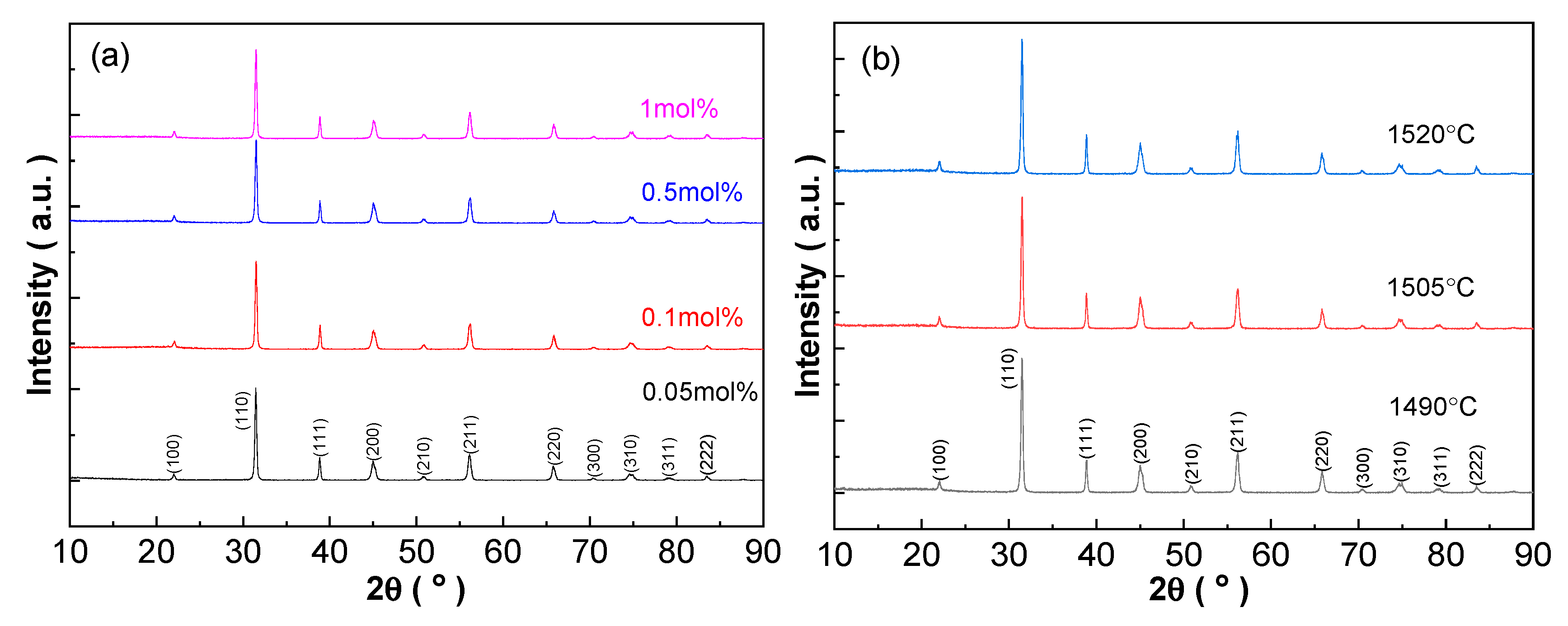
The phase structure of x mol% Nd/Mn BCZT ceramics was systematically investigated via X-ray diffraction. Figure 1a and Figure S1 illustrate the XRD patterns of all x mol% Nd/Mn BCZT ceramics prepared at various sintering temperatures. All ceramics exhibit a pure perovskite phase, and the continuous shift of the (200) diffraction peak toward higher 2θ angles directly indicates the successful incorporation of Nd3+ and manganese ions into the BCZT lattice according to Bragg’s law. Specifically, Figure 1b verifies that the composition 0.5 mol% Nd/Mn BCZT also maintains a pure perovskite phase across different sintering temperatures (1490–1520 °C), further confirming the phase stability. The high 2θ-angle diffraction peaks, such as (220), (310), etc., present obvious broadening or splitting phenomena, proving tetragonal phase dominated structure characteristics in the BCZT systems induced by Nd/Mn co-doping.
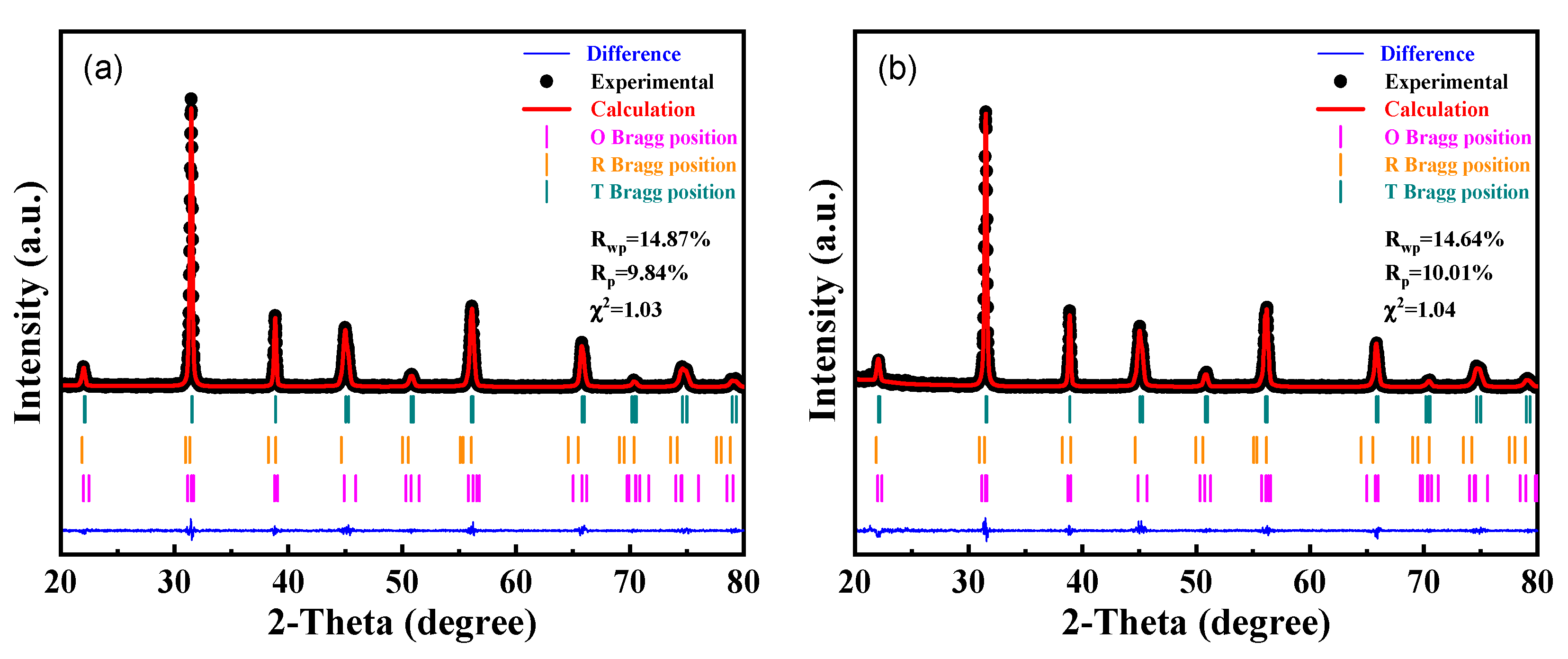
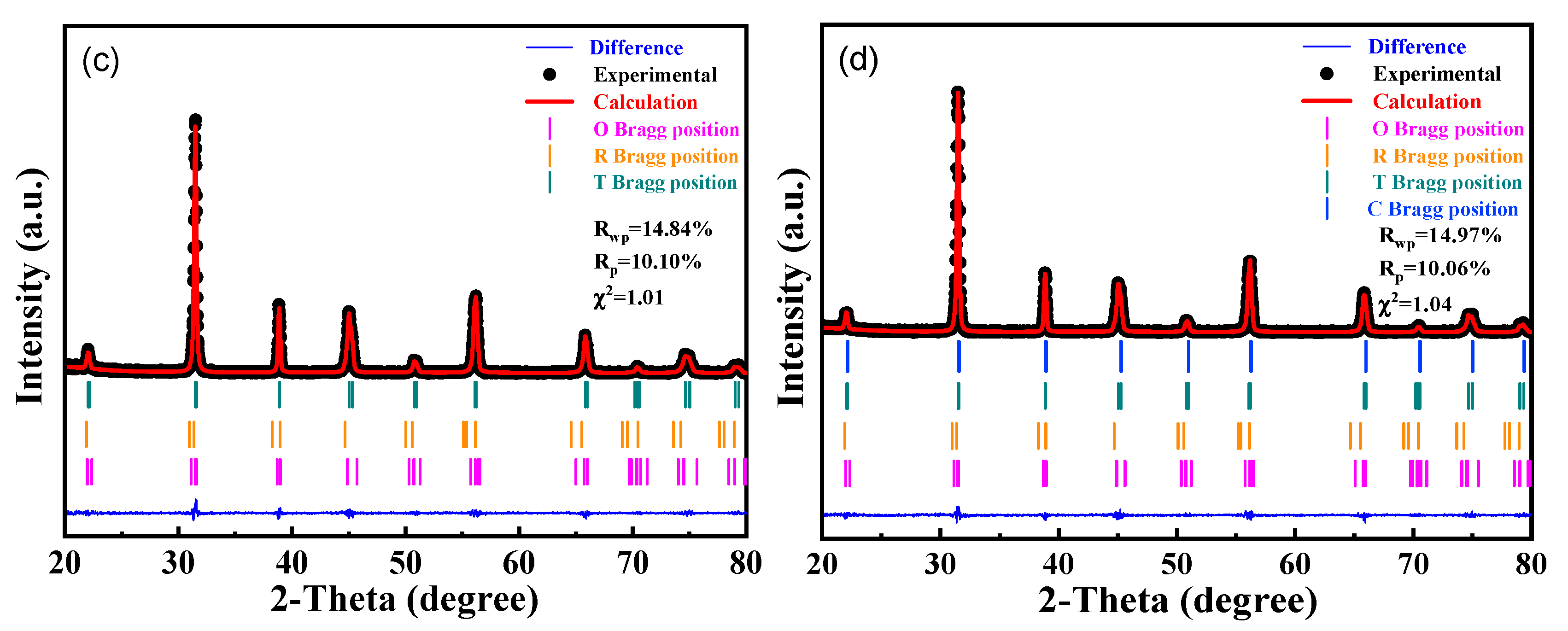
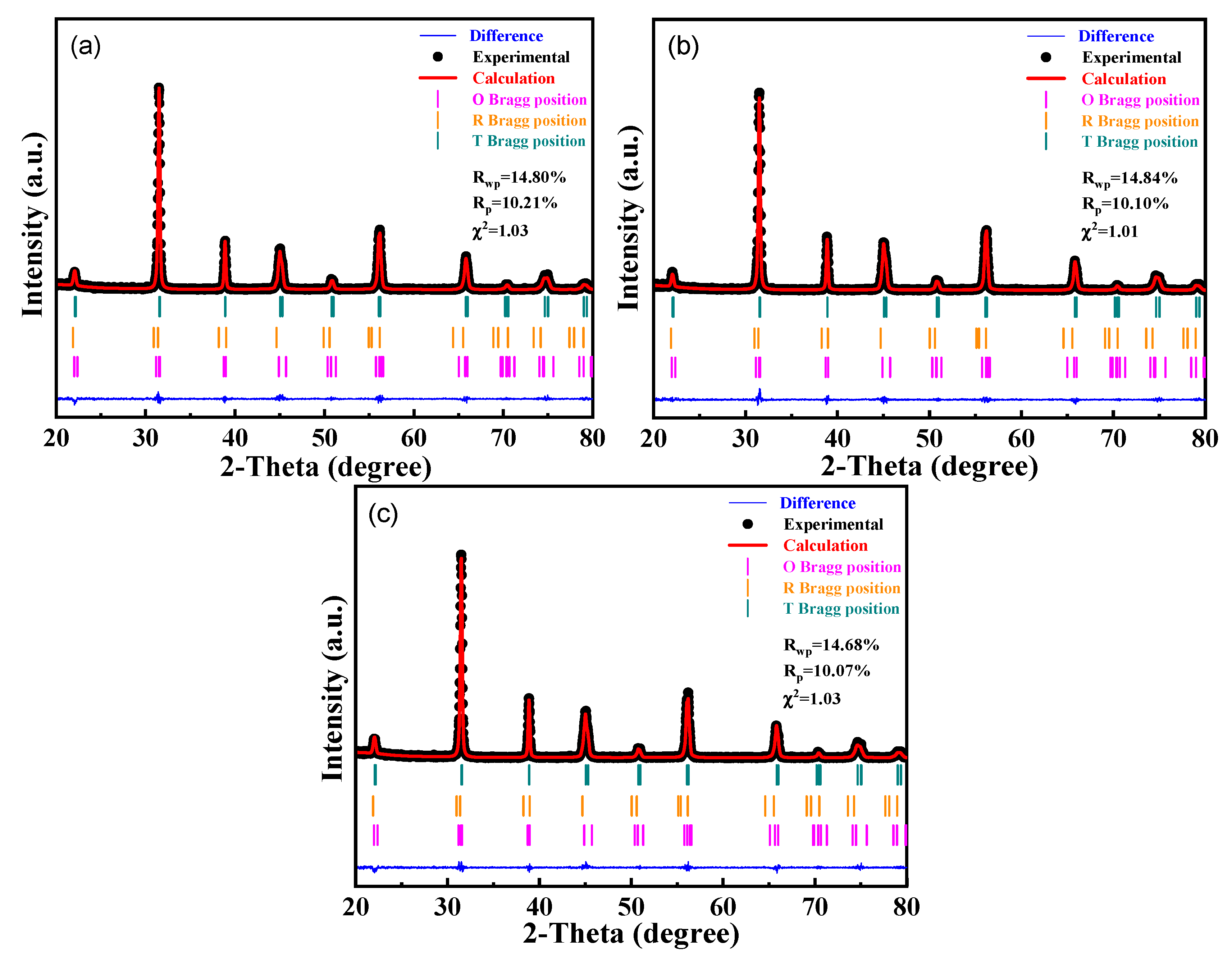
Based on the Rietveld refinement, the best results indicate the coexistence of three structures (rhombohedral, orthorhombic, and tetragonal) in Figure 2. It is revealed that both chemical composition (x mol% Nd) and sintering temperature jointly influence the phase evolution, as evidenced by Figure 3 and Table 1 for the x = 0.5 mol% sample, where the composition shows a more pronounced impact on modulating the phase proportions. As the sintering temperature varies from 1490 °C to 1520 °C for the x = 0.5 mol% sample, the proportion of tetragonal phase (P4mm) exhibits a slight fluctuation (ranging from 71.0% to 76.7%) rather than a simple linear dependence, which might be associated with the complex grain growth behavior under different sintering conditions. This subtle, non-monotonic phase evolution reflects a combined effect of dopant concentration and sintering profiles, laying the structural foundation for the macro-electrical properties.
Building on this temperature-stabilized lattice, the influence of Nd concentration is further examined. A detailed inspection of the (200) diffraction reflection reveals a systematic shift toward higher 2θ angles with increasing the Nd doping content [26]. According to Bragg’s law, this shift correlates with the contraction of unit cell volume from 64.6 Å3 (x = 0.05) to 64.41 Å3 (x = 1.0). Notably, the reduction in cell volume slows down and reaches a plateau when x > 0.1, which may suggest a near-saturation of Nd3+ incorporation at the B-site within the host lattice as at higher doping levels smaller Nd3+ ions (1.27 Å3) are substituted for larger Ba2+ (r = 1.61 Å) and Ca2+ (r = 1.34 Å) ions at the A-site of the perovskite structure with a coordination number of 12 [18]. This substitution effect is theoretically supported by the Goldschmidt tolerance factor (t), calculated as follows:
t = r A + r O 2 ( r B + r O )
which decreases slightly from 1.0415 to 1.0405 as x increases, yet remains above unity to substantiate the stabilization of tetragonal symmetry [27].
To theoretically explore the potential chemical environment and vacancy evolution during the high-temperature sintering process, the underlying defect chemistry mechanisms for the Nd/Mn co-doped BCZT ceramics can be formulated using the Kröger–Vink notation [28]. The incorporation of dopants and the concomitant volatilization of A-site elements can be described by the following reactions:
2 N d 2 O 3 4 B C Z T 4 N d B a / C a + V T i / Z r + 3 T i T i × / Z r Z r × + 6 O O ×
M n O 2 B C Z T M n T i / Z r + 1 2 O 2 + V O + O O ×   o r   2 M n O 2 B C Z T 2 M n T i / Z r + 1 2 O 2 + V O + 3 O O ×
B a B a × + O O × B a + 1 2 O 2 + V B a + V O
C a C a × + O O × C a + 1 2 O 2 + V C a + V O
where Mn and O atoms originate from MnO2. It should be explicitly acknowledged that the valence states and site occupations of manganese dopants in the BCZT-based lattices are highly complex and strongly sensitive to high-temperature sintering conditions. As reported in the Mn-doped PLZT by Dimza et al. and in the Mn-doped BaTiO3 by Vinita et al., complicated defect states can be formed due to mixed-valence coexistence (such as Mn2+ and Mn3+), lattice deformations and varying oxygen vacancy concentrations [15,16]. Driven by thermodynamic reduction during high-temperature air sintering, a transition from the initial Mn4+ to lower valence states (Mn3+/Mn2+) is expected. These lower-valence species substitute for B-site hosts to act as acceptor dopants ( M n T i and M n T i ), which are charge-compensated by oxygen vacancies ( V O ), as simplified in Equation (3).
Based on the well-established defect chemistry, the synergistic effects of these reactions are proposed to modulate the concentration of V O and the subsequent formation of M n T i / M n T i V O defect dipoles [29,30]. These dipoles are theoretically suggested to be instrumental in generating the internal bias field that pins domain walls, directly contributing to the enhanced mechanical quality factor (Qm) and the stabilization of tetragonal symmetry which is highly consistent with the following Rietveld refinement. Notably, the peak Qm obtained in this work (424.5, discussed in Section 3.4) is a preliminary comparison to the reported modified BCZT systems, such as CuO-doped ceramics (Qm  ~ 400) [31] and the ceramics reported by Li et al. (Qm  ~ 140) [32], highlighting the high efficiency of our Nd/Mn co-doping strategy.
To provide a deeper quantitative understanding of these structural variations, the detailed GSAS Rietveld refinement profiles for different Nd concentrations at their respective selected sintering temperatures (with 1505 °C chosen as the representative baseline for systematic comparison) are presented in Figure 2, and the results for the x = 0.5 mol% samples sintered at different temperatures are shown in Figure 3. The fitting residual values (Rwp < 15%, Rp ≈ 10%, and ꭓ2 ≈ 1.0) reflect acceptable mathematical convergence of the refined structural models. Detailed structural parameters, including space groups and phase proportions, are summarized in Table 1 [20].
For samples with x ≤ 0.5 mol%, the Rietveld refinement results reveal a coexistence of three phases, i.e., orthorhombic (Amm2), rhombohedral (R3m), and tetragonal (P4mm). For instance, at the sintering temperature of 1505 °C, the x = 0.05 mol% sample consists of 73.5% tetragonal, 19.7% orthorhombic, and 6.8% rhombohedral phases. As the Nd content increases to x = 1 mol%, a cubic phase (Pm3m) with a content of 14.8% emerges, accompanied by a reduction in the rhombohedral phase to 1.9%. This transition to a paraelectric cubic phase suggests that excessive Nd3+ doping stabilizes cubic symmetry at room temperature, leading to a decrease in long-range ferroelectric order and subsequent decline in d33 and Kp [19].
The influence of sintering temperature on the phase evolution of x = 0.5 mol% Nd/Mn BCZT ceramics is also evident as shown in Figure 3 and Table 1. As the sintering temperature rises from 1490 °C to 1520 °C, the proportion of tetragonal phase increases from 72.1% to 76.7%, while the rhombohedral phase decreases from 4.6% to 2.6%. This temperature-dependent phase regulation, particularly the optimization of the tetragonal phase content, is critical for achieving high mechanical quality factor (Qm) and piezoelectric constant (d33) in the BCZT system. The multi-phase coexistence near the PPB region remains the dominant structural feature, facilitating easy domain switching [14], which is expected to play a crucial role in modulating the subsequent electrical properties.

3.2. SEM Morphology and Grain Size Distribution

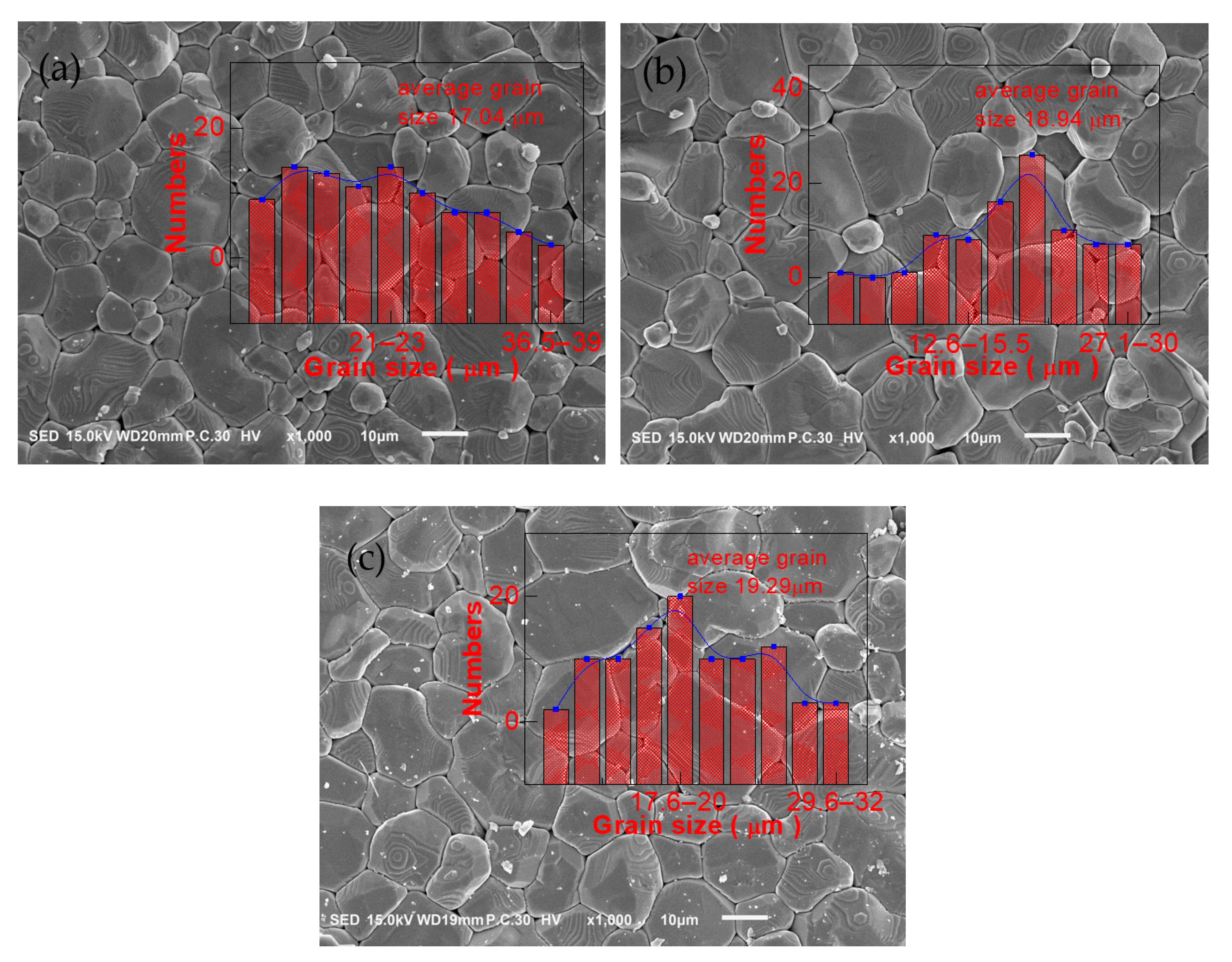
The microstructural evolution and densification behavior of ceramics are fundamentally dictated by the sintering temperature. As elucidated in Figure 4a–c for the representative x = 0.5 mol% sample, increasing the sintering temperature from 1490 °C to 1505 °C provides a greater driving force for grain boundary diffusion and pore elimination [33]. Consequently, the average grain size (AGS) increases from 17.04 μm to 18.94 μm, and further to 19.29 μm (1520 °C), and the relative density reaches a peak value of 91.7% (Table S1). This establishes 1505 °C as the respective selected sintering temperature, ensuring a dense structural basis for piezoelectric applications, whereas an excessive high sintering temperature (1520 °C) leads to relative density degradation due to element volatilization [34]. Although this relative density leaves room for further densification, the residual porosity inevitably induces a localized pore-dilution effect on the bulk ferroelectric matrix and acts as a stress concentration center, which primarily accounts for the decreased d33 (284.2 pC/N, discussed in Section 3.4) compared to the pristine pure BCZT (d33  ~ 620 pC/N) [5]. This shift in the densification sintering temperature with varying composition x is closely associated with the concentration-dependent solute drag effect and localized grain boundary diffusion during the sintering process.
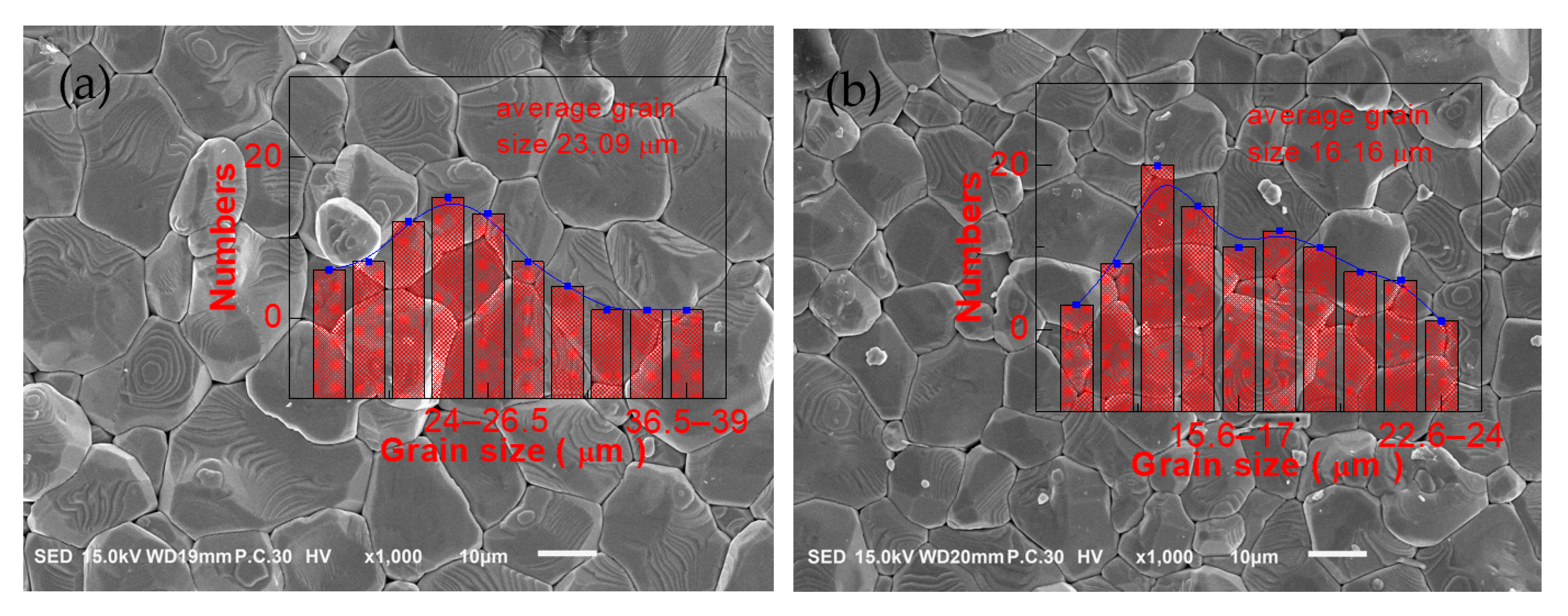
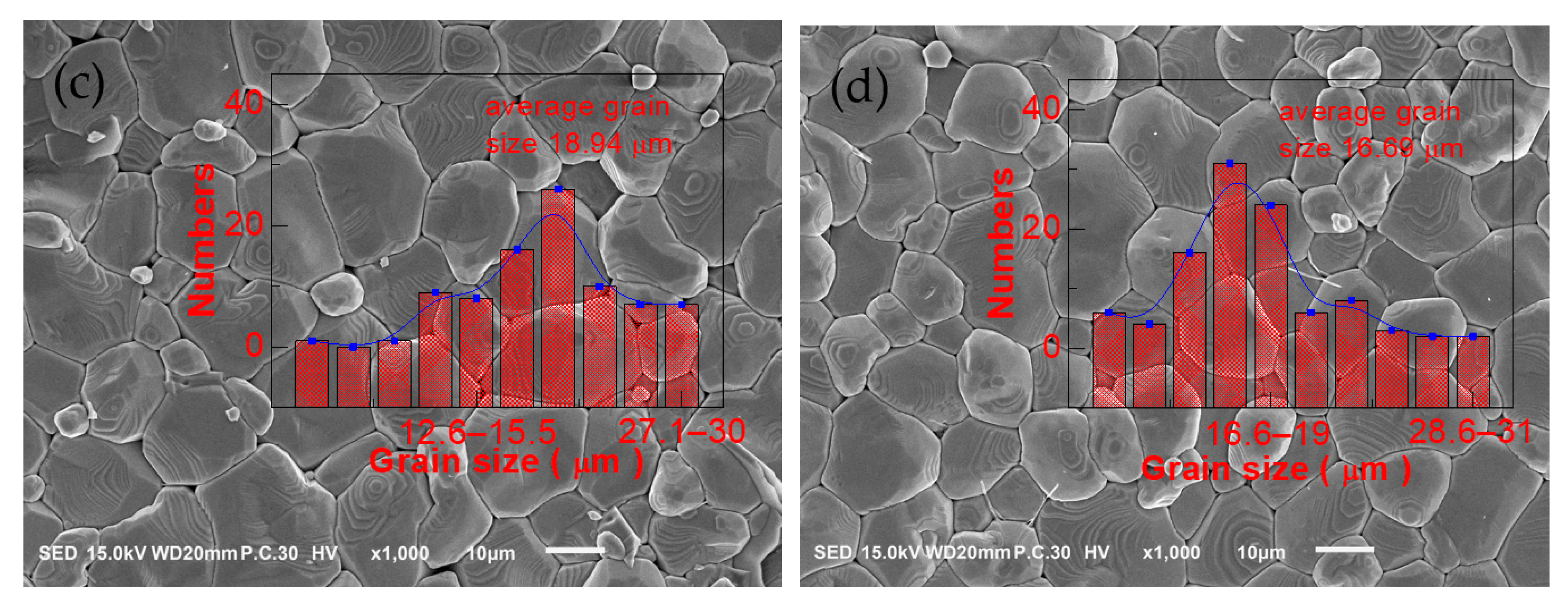
Building on the densification framework established at the respective selected sintering temperature, the influence of Nd concentration on the grain morphology is further examined, where at least 100 grains for each sample are randomly analyzed via Nano Measurer software 1.2 (Figure 5a–d). In all samples, grains are well-grown and clear grain boundaries are observed without significant porosity. However, with the increase in Nd content from x = 0.05 to 1.0 mol%, the AGS exhibits a systematic decrease from 23.09 μm to 16.69 μm. This grain refinement suggests that the Nd3+ ions exert a “solute drag” effect at the grain boundaries, which increases the diffusion activation energy and effectively inhibits grain growth during the sintering process [35].
Most grains present atypical polyhedron morphology with nearly rounded edges, reflecting that both solid-state sintering and liquid-phase sintering mechanisms take effects in the densification of Nd/Mn BCZT ceramics. Moreover, the average grain size increases significantly with the limited increase in sintering temperature, being closely related to the effect of liquid-phase sintering. At higher sintering temperatures, the presence of a partial liquid phase can effectively facilitate the mass transport and diffusion processes, thereby promoting grain boundary mobility and the subsequent grain growth. The complex hydrographic stripes on the grain surface may be related to the underlying domain structures, which often indicate a highly fragmented domain configuration composed of nano-domains or PNRs according to the previous literature [18].
In summary, the microstructural state, including both densification behavior and grain growth, is a highly coupled result overlapping the joint influences of sintering temperature and dopant composition. The optimization of sintering profile promotes the structural densification and uniform grain development, which is essential for optimizing the subsequent piezoelectric constants (d33) and mechanical quality factors (Qm) [19].

3.3. Dielectric Properties and Relaxation Behavior

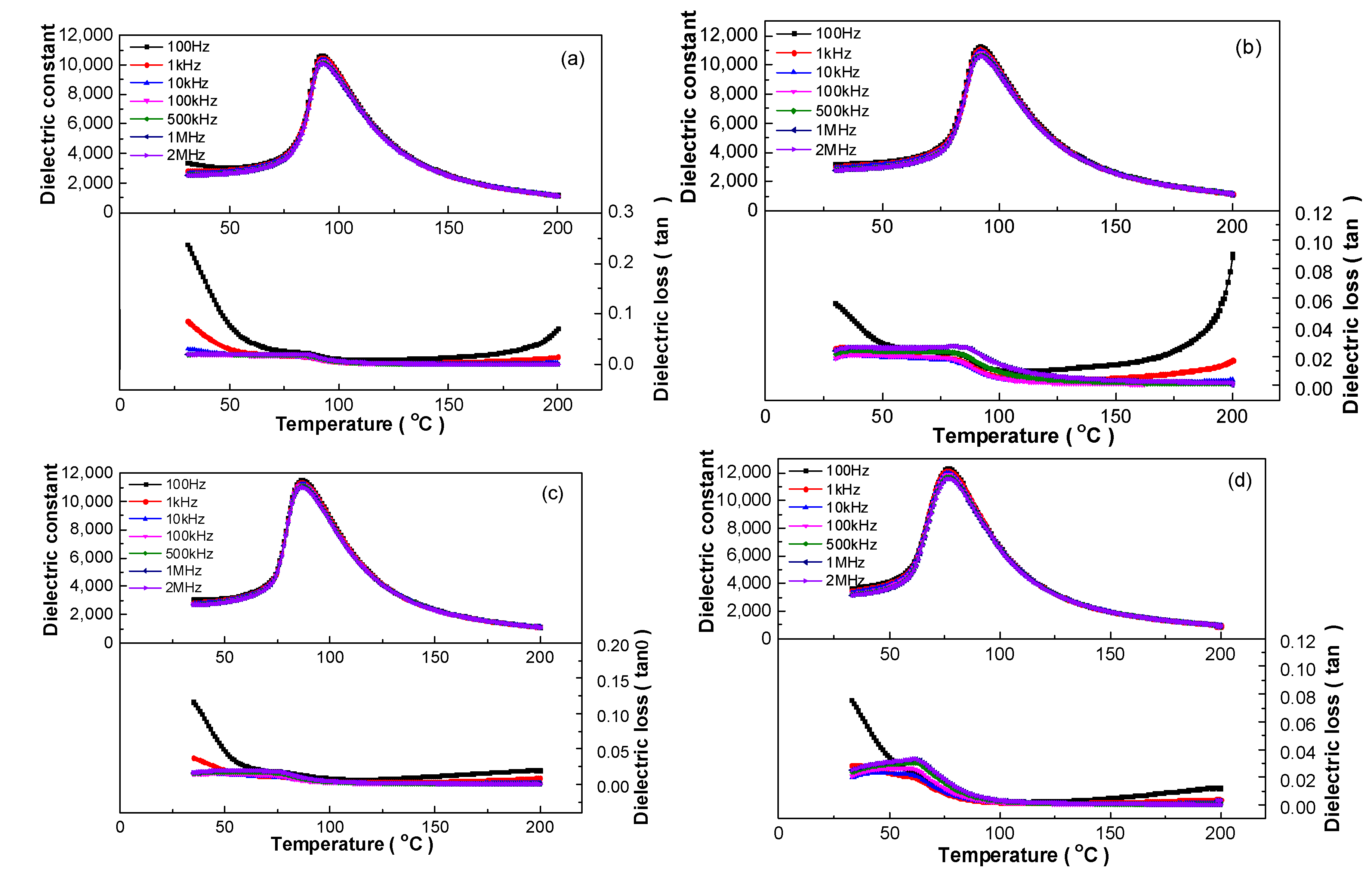
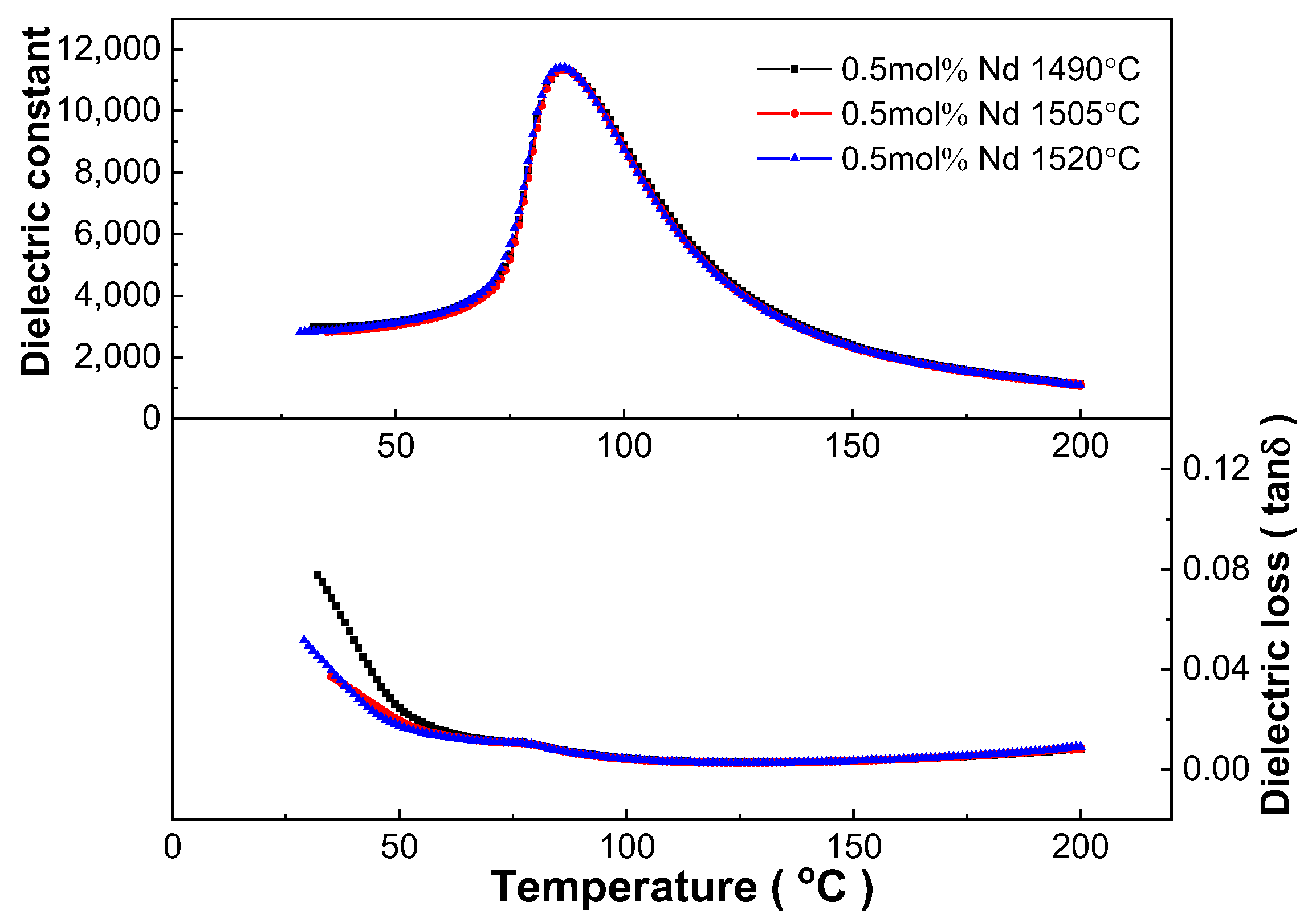
The sintering regime exerts a primary influence on the densification kinetics and grain growth, which serve as the foundation for optimizing the overall electrical performance, mainly the piezoelectric and electromechanical properties, such as d33, Kp and Qm in this work. As a result of such optimization, the dielectric properties of representative samples prepared at their respective selected sintering temperatures are systematically evaluated in Figure 6. The dielectric properties are highly dependent on grain size and internal stress. It is worth noting that the dielectric constant maximum (εm) value remains highly stable and nearly identical across the three sintering temperatures. Such nearly overlapping peak dielectric response with negligible fluctuations demonstrates that the sintering temperatures within this regime exert no pronounced impact on εm and facilitate a fully developed polarization contribution. Although an excessively high sintering temperature (1520 °C) induces element volatilization and extra porosity, its impact on the peak dielectric response remains negligible, as clearly shown in Figure S2 for all compositions sintered at different temperatures. Furthermore, the comprehensive evolution of temperature- and frequency-dependent dielectric properties for all x mol% Nd/Mn BCZT ceramics (x = 0.05–1.0 mol%) across various sintering temperatures is systematically detailed in Figures S2–S6. These supplementary results thoroughly corroborate the regulatory mechanism of the sintering regime on the dielectric responses across all compositions. Once this respective selected processing window is established, the role of chemical composition in shifting the dielectric peaks can be analyzed.
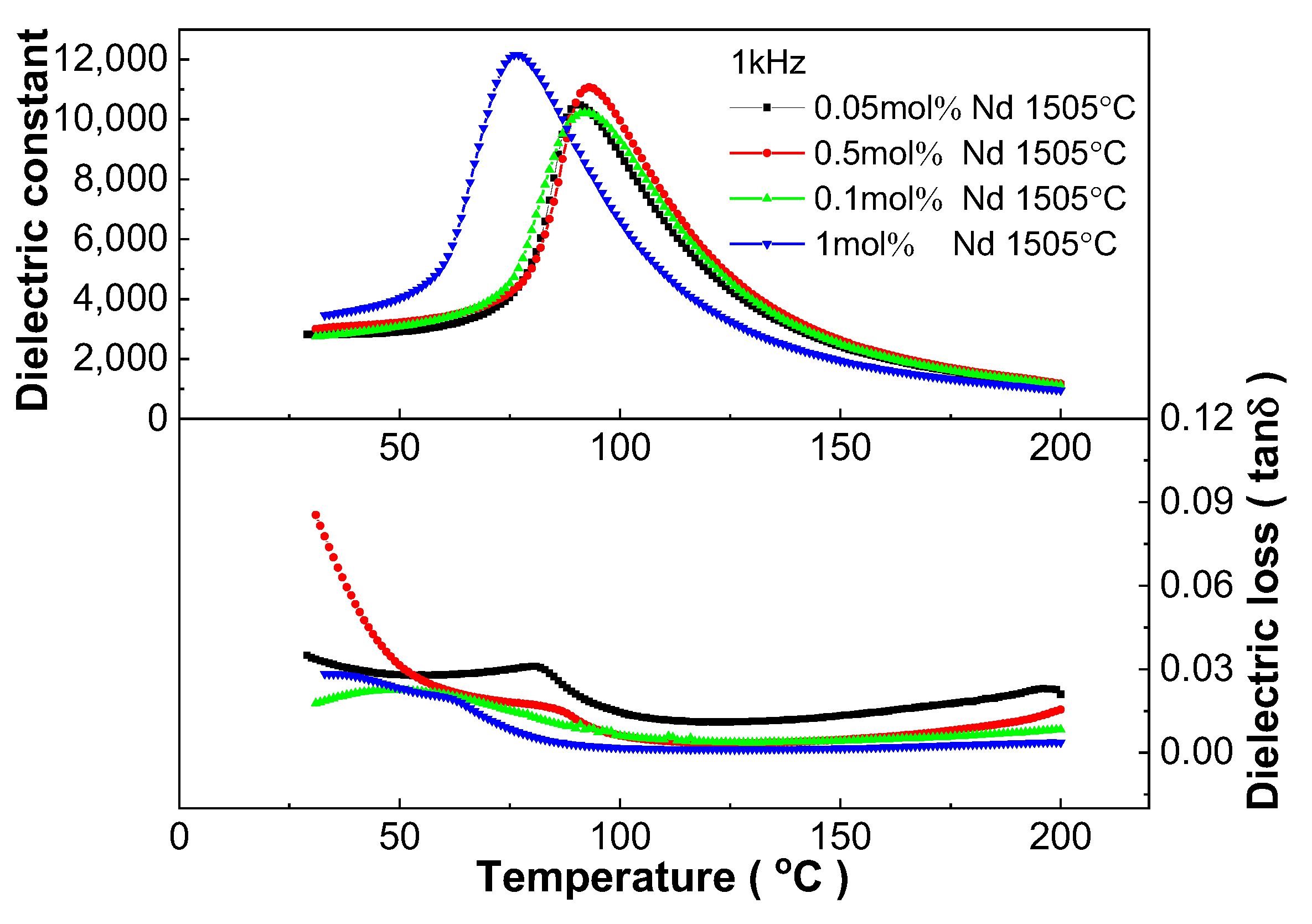
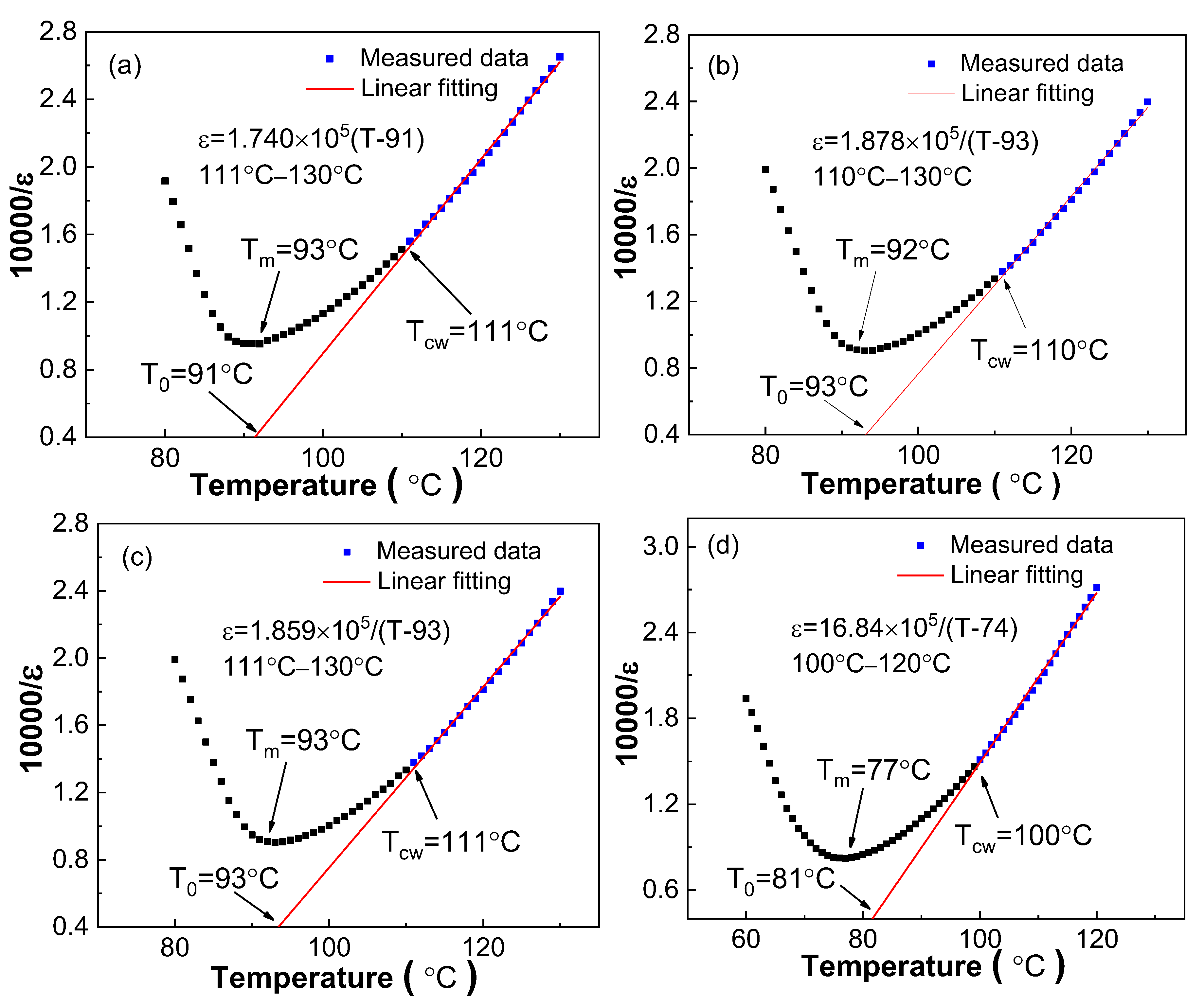
As illustrated in Figure 7, the temperature dependence of εr and dielectric loss (tanδ) for all compositions, prepared at their respective selected sintering temperatures, reveals the impact of chemical substitution. With the increase in Nd content from x = 0.05 to 1.0 mol%, the TC temperature demonstrates a gradual decrease from 93 °C (x = 0.05 mol%) to 77 °C (x = 1 mol%). This migration, accompanied by the broadening of the dielectric peak, is a hallmark of a diffuse phase transition, which can be primarily attributed to the structural distortion and the formation of defect dipoles that disrupt the long-range ferroelectric order [36]. Crucially, the enhanced εm at x = 0.5 mol% reflects the donor doping effect, which effectively boosts the peak dielectric response. Furthermore, as depicted in Figure 8, the temperature dependence of dielectric properties for the x = 0.5 mol% composition remains remarkably stable across various sintering temperatures.
The temperature- and frequency-dependent tanδ curves, presented in Figure 6 and Figures S3–S6, reveal that all ceramics exhibit low loss values (<0.05) near room temperature, indicating high resistivity and suppressed leakage conduction. However, an abnormal upsurge in tanδ occurs once the temperature exceeds TC, becoming increasingly pronounced at elevated temperatures and low frequencies [37]. Specifically, at 100 Hz, this phenomenon is prominent for the x = 0.05 mol% sample (Figure S3) and the x = 0.1 mol% sample (Figure 6, Figure S4). Furthermore, as clearly illustrated in Figures S3–S6, loss tangent values at low frequencies (e.g., 100 Hz) are significantly higher than those at high frequencies (e.g., 1 MHz) in the high-temperature region, revealing substantial frequency dispersion of tanδ at T > TC. According to defect chemistry analysis, the incorporation of donor (Nd3+) and acceptor (Mn4+) ions can generate space charges and point defects (e.g., oxygen vacancies) to maintain charge neutrality. While the defect dipoles (like M n T i V O ) generally stabilize domains, free charge carriers (like hole carriers) are thermally excited at high temperatures. The enhanced low-frequency tanδ tail observed in Figures S3–S6 confirms that these excited carriers increase the conductivity and transition relaxation losses, which become the dominant mechanisms for the anomalous rise in high-temperature dielectric loss, distinct from the intrinsic relaxation loss near TC [38].
To quantitatively decipher the phase transition characteristics, the dielectric data above TC is first analyzed using the Curie–Weiss law:
1 ε = C T T 0
where C is the Curie–Weiss constant and T0 is the Curie–Weiss temperature [39]. As shown in the plots of 1/εr as a function of temperature (T) (Figure 9), the constant C for all samples is found to be on the order of 105, signifying a displacement-type mechanism. Furthermore, the relaxor nature is evidenced by the deviation temperature Δ T m = T c w T m across all compositions:
Δ T m = T c w T m
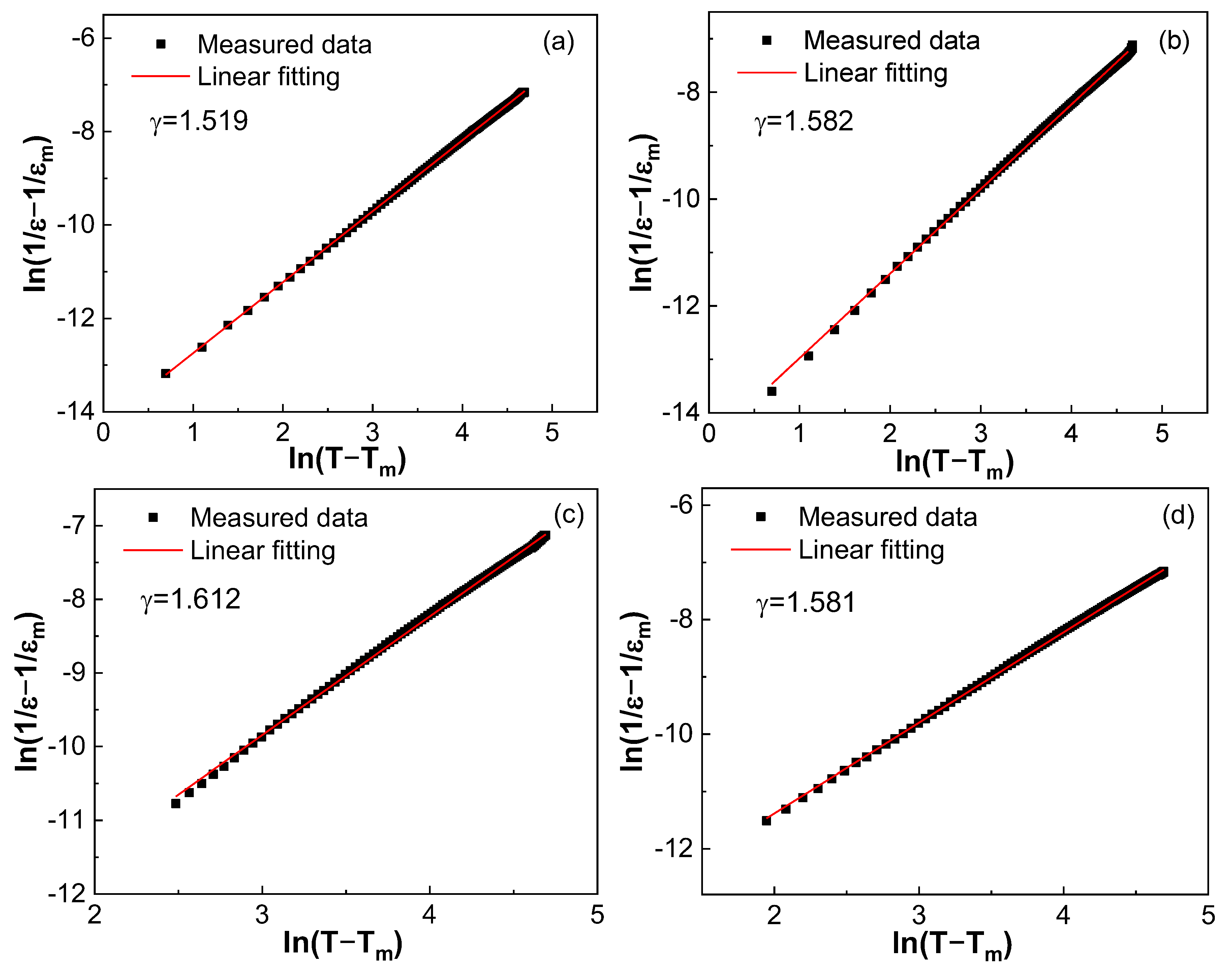
Tcw is the temperature below which the dielectric response begins to deviate from the Curie–Weiss law [40]. To further investigate the degree of relaxor characteristics induced by Nd doping, the exponential law (also known as the modified Curie–Weiss law) is applied:
1 ε 1 ε m = T T m γ C
where γ is the dispersion index [39]. As illustrated in Figure 10, the calculated γ values are all larger than 1.5, initially showing a tendency to increase with Nd doping [41] but exhibiting a slight decline when the Nd amount reaches x = 1.0. This confirms that the introduction of Nd/Mn co-dopants creates local random electric fields, which break long-range correlation and lead to the formation of PNRs, being responsible for the relaxor behavior [42]. Concurrently, considering the overall evaluation of this section, it should be explicitly summarized that the dielectric and relaxor properties remain highly similar for the x = 0.05, 0.1, and 0.5 samples, whereas a noticeable change occurs at x = 1.0. Furthermore, within the investigated thermal processing window, the direct effect of sintering temperature on these macro-dielectric profiles is not visible.

3.4. Ferroelectric and Piezoelectric Properties

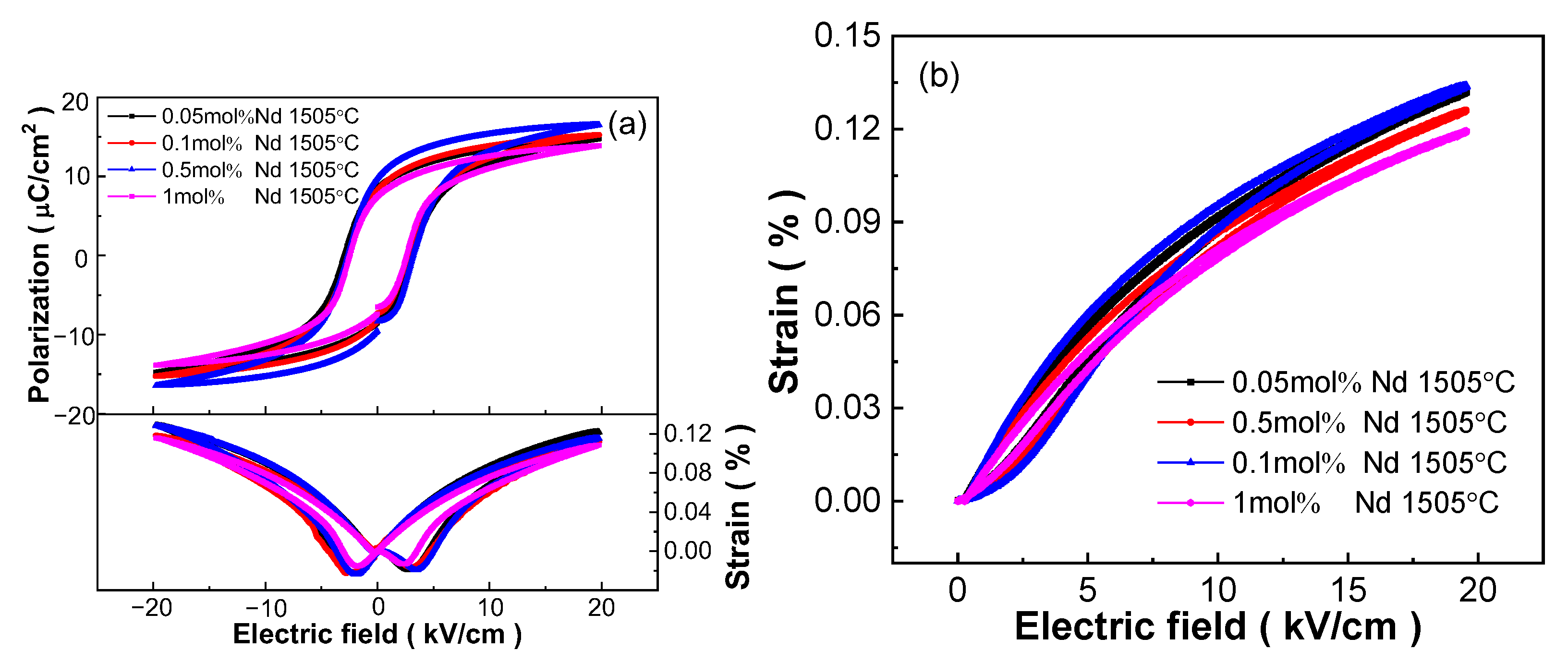
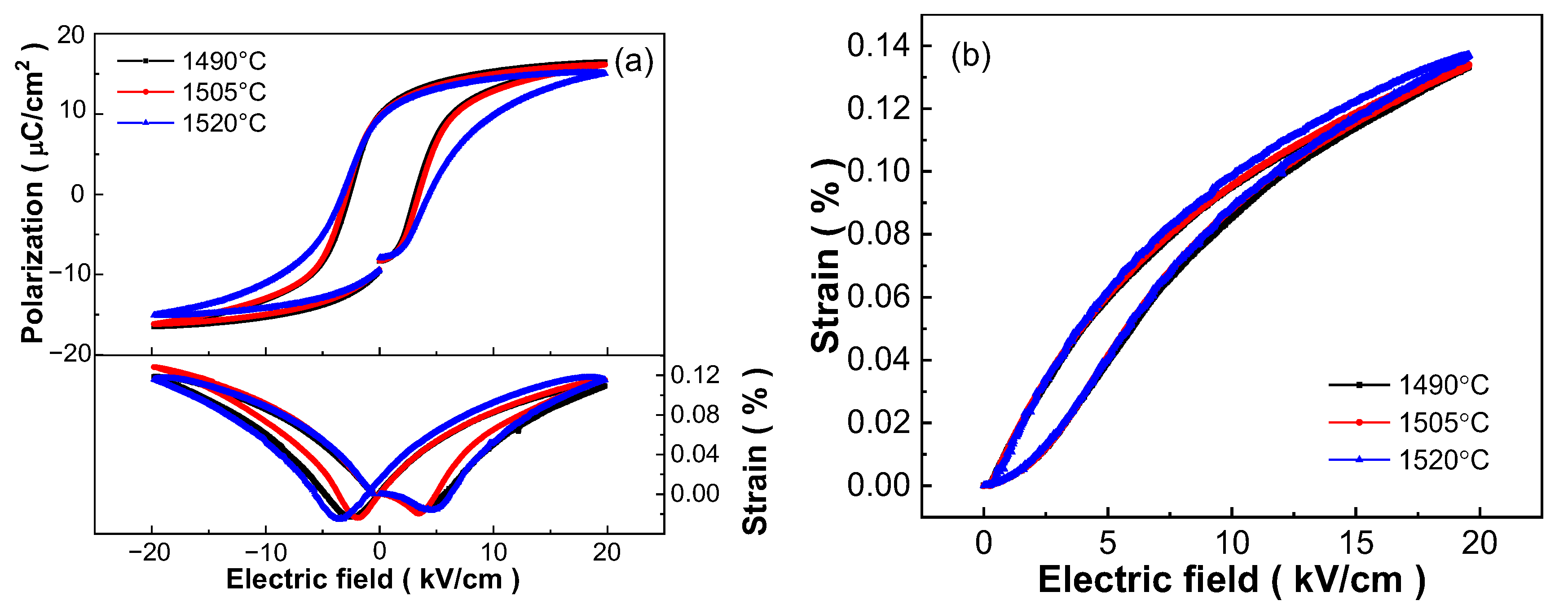
Within the optimized sintering windows, the ferroelectric and piezoelectric performance are systematically evaluated. Figure 11 and Figure 12 illustrate the bipolar electric field-dependent polarization (P-E) hysteresis loops and field-induced strain (S-E) curves. Under an applied electric field of 20 kV/cm, all samples exhibit well-saturated P-E loops and classic “butterfly”-shaped S-E curves, confirming the preservation of their robust ferroelectric nature.
The ferroelectric response is significantly modulated by the Nd doping concentration (x) once the thermal history is fixed. At a low Nd content (x = 0.05 mol%), the 0.05 mol% Nd/Mn BCZT ceramic exhibits a high Pr of 9.42 μC/cm2. This is consistent with the “softening” effect, where Nd3+ ions induce cation vacancies that facilitate domain wall motion. Notably, Figure S7 reveals that the remnant polarization (Pr) and bipolar strain are significantly modulated by Nd concentration and sintering temperature, with the x = 0.5 mol% sample sintered at 1505 °C exhibiting a remnant polarization (Pr) of 8.13 μC/cm2 and a moderate bipolar strain (S) of 0.128% as shown in Figure 11, respectively. It should be noted that while the strain value represents an intermediate level among the composition, this thermal profile yields a desirable comprehensive balance between ferroelectric and piezoelectric behaviors.
However, as the Nd concentration increases toward x = 1.0 mol%, both Pr and the overall strain tend to decrease, dropping to Pr = 7.42 μC/cm2 and S = 0.115%. This degradation at higher doping levels is attributed to the increased internal stress and the emergence of the paraelectric cubic phase (as confirmed in the XRD analysis), which disrupts long-range ferroelectric order [43]. Quantitative parameters, including remnant polarization (Pr) and coercive field (Ec), are extracted to reveal the subsequent influence of chemical substitution shown in Table S2.
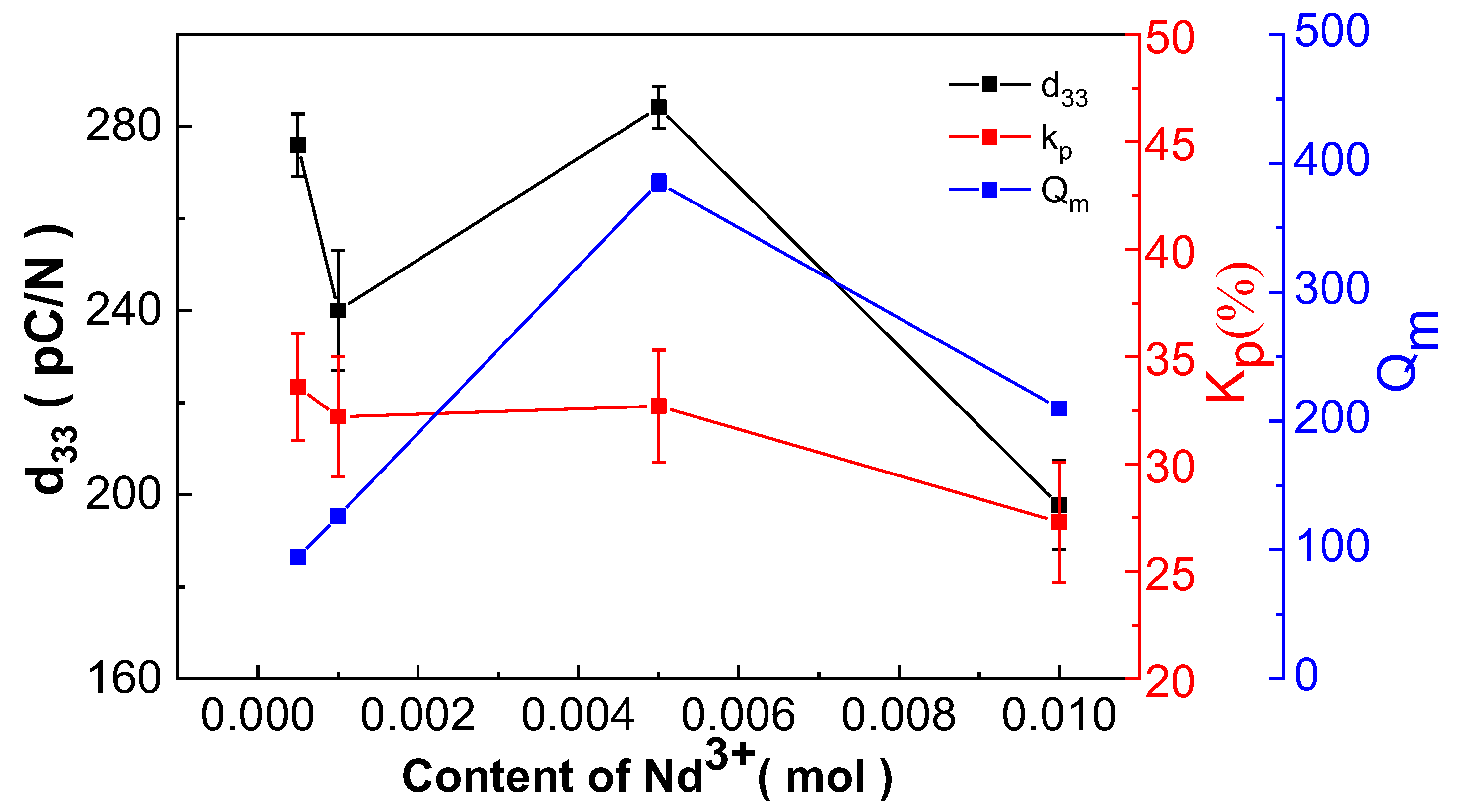
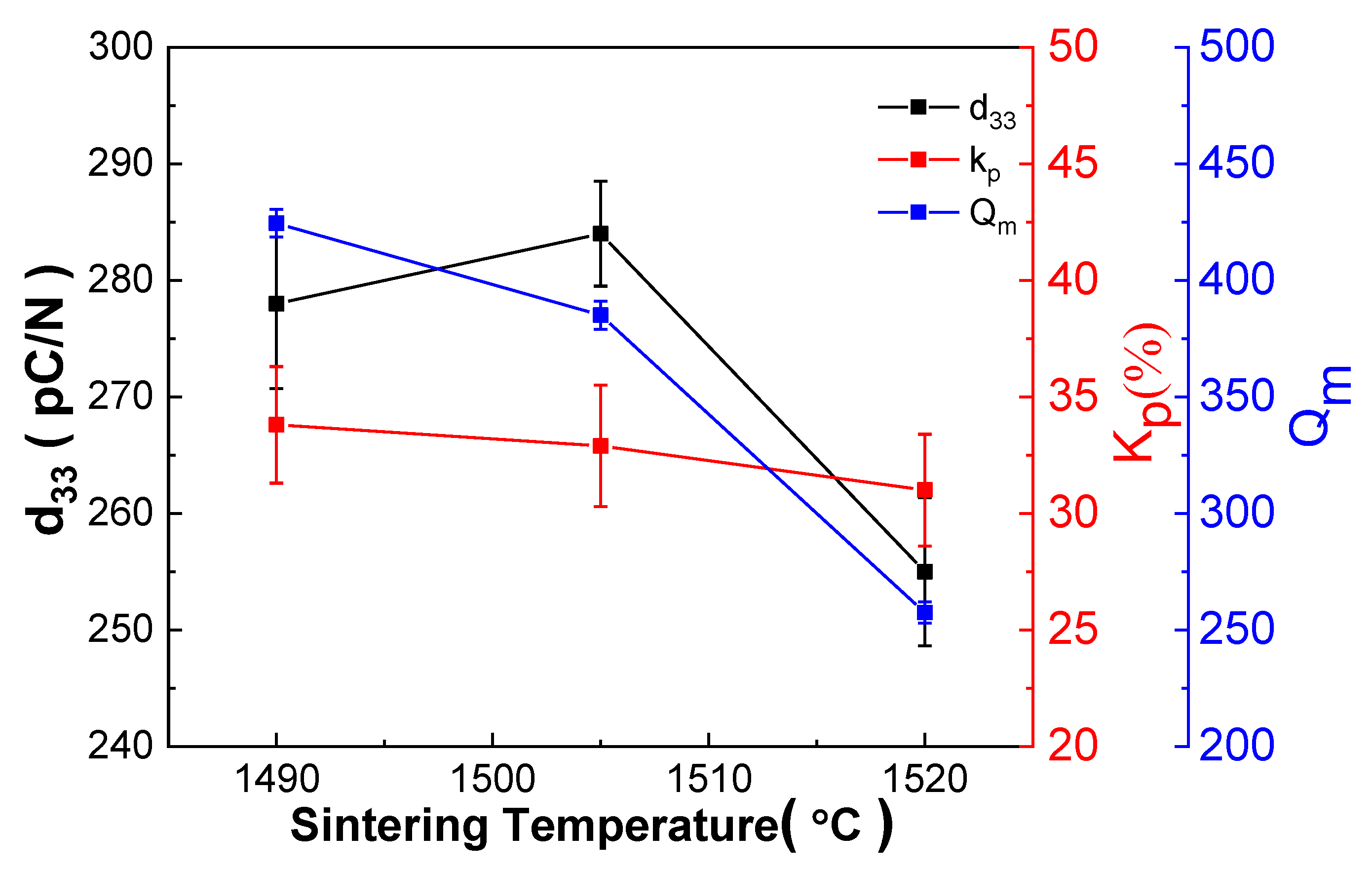
The measured values of electromechanical coupling factor (Kp), mechanical quality factor (Qm), and piezoelectric coefficient (d33) of x mol% Nd/Mn BCZT ceramics sintered at different temperatures are presented in Table S2 with their respective standard deviations to ensure data reproducibility. The d33 and Qm values demonstrate a primary dependence on the sintering engineering. Obviously, the sintering processing profile does not simultaneously maximize every single parameter (such as density, Qm, or strain); instead, it acts as a critical optimization tool to achieve a multi-property trade-off via tailoring defect structures and domain wall dynamics [14,44,45]. The piezoelectric resonance curves of x mol% Nd/Mn BCZT ceramics are shown in Figures S8 and S9. The phase angle θ of these samples approaches 90°, indicating high piezoelectricity which is consistent with the d33 and Kp test results. As depicted in Figure 13, the x = 0.5 mol% Nd/Mn BCZT ceramic sintered at 1490 °C achieves an exceptionally high Qm of 424.5, accompanied by a Kp of 33.8% and d33 of 278 pC/N. Furthermore, as illustrated in Figure 14, the piezoelectric properties exhibit a strong dependence on the Nd3+ doping concentration. Prepared at this selected temperature baseline, the x = 0.5 mol% sample exhibits a prominent d33 of 284.2 pC/N and a high Qm of 392.8. This unified sintering regime is served as a standardized baseline in Figure 14 to compare the composition-dependent properties. This enhancement serves as direct evidence of temperature-triggered acceptor “hardening” [26]. At this specific sintering temperature, Mn ions promote the formation of oxygen vacancies ( V O ), which combine to form defect dipoles ( M n T i V O ). These dipoles generate a localized internal bias field that pins the domain walls, reducing energy dissipation [46]. As the sintering temperature rises further to 1520 °C, although Qm slightly decreases to 259.9 due to the potential reduction in dipole stability, the inverse piezoelectric coefficient ( d 33 * ) reaches its maximum value of 685.1 pm/V, indicating a transition from a “hardened” state to a “high-response” state driven by sintering kinetics [47].

4. Conclusions

In this work, [(Ba0.85Ca0.15)1−1.5xNdx][(Zr0.1Ti0.9)0.995Mn0.005]O3 lead-free ceramics were successfully synthesized, and the synergistic effects of sintering temperature and “donor–acceptor” co-doping on their multi-scale structures and electrical properties were systematically elucidated. The sintering temperature is identified as the primary factor in modulating the densification process and phase regulation, with the x = 0.5 mol% sample achieving maximum densification (relative density of 91.7%) at the respective selected sintering temperature of 1505 °C. Within this established processing framework, all ceramics exhibit a stable perovskite structure with a predominant tetragonal (P4mm) symmetry, while excessive Nd doping (x = 1 mol%) promotes the emergence of a paraelectric cubic phase. The introduction of Nd3+ ions induces a displacement-type phase transition and enhances relaxor-like characteristics through the formation of PNRs. Most importantly, by precisely controlling the sintering-induced defect state, the x = 0.5 mol% composition sintered at 1490 °C demonstrates a remarkable breakthrough in mechanical quality factor (Qm = 424.5), which is highly consistent with the proposed domain-wall pinning effect by M n T i / M n T i V O defect dipoles. Concurrently, the sample maintains superior piezoelectric activity ( d 33 * = 685.1 pm/V) sintered at 1520 °C. These findings validate that the strategic regulation of sintering conditions combined with Nd/Mn co-doping provides a high-performance solution for lead-free piezoelectric applications.

Supplementary Materials

The following supporting information can be downloaded at: https://www.mdpi.com/article/10.3390/ceramics9060062/s1, Figure S1: XRD patterns of x mol% Nd/Mn BCZT ceramics prepared at different sintering temperatures; Figure S2: Dielectric performance-temperature relationship of x mol% Nd/Mn BCZT ceramics prepared at different sintering temperatures at 1 kHz; Figure S3: Effects of frequency on dielectric properties of 0.05 mol% Nd/Mn BCZT ceramics prepared at different sintering temperatures; Figure S4: Effects of frequency on dielectric properties of 0.1 mol% Nd/Mn BCZT ceramics prepared at different sintering temperatures; Figure S5: Effects of frequency on dielectric properties of 0.5 mol% Nd/Mn BCZT ceramics prepared at different sintering temperatures; Figure S6: Effects of frequency on dielectric properties of 1 mol% Nd/Mn BCZT ceramics prepared at different sintering temperatures; Figure S7: P-E hysteresis loops and S-E curves of x mol% Nd/Mn BCZT ceramics prepared at different sintering temperatures; Figure S8: Impedance and phase angle of x mol% Nd/Mn BCZT ceramics prepared at respective selected sintering temperatures (x = 0.05 mol%, 0.1 mol%, 0.5 mol%, 1 mol%); Figure S9: Impedance and phase angle of the 0.5 mol% Nd/Mn BCZT ceramics sintered at different temperatures; Table S1: Cell volume and density of x mol% Nd/Mn BCZT ceramics sintered at different temperatures; Table S2: Pr, Ec, d 33 * , Kp, Qm and d33 of x mol% Nd/Mn BCZT ceramics prepared at different sintering temperatures.

Author Contributions

Conceptualization, B.F.; Supervision, B.F. and J.D.; Formal analysis, W.H., S.S., B.F. and X.L.; Investigation, W.H., B.F. and S.Z.; Data curation, W.H., S.S. and B.F.; Writing-original draft, W.H.; Writing-review & editing, B.F.; Funding acquisition, B.F., S.Z. and X.L.; Project administration, B.F. and J.D. All authors have read and agreed to the published version of the manuscript.

Funding

This research received no external funding.

Data Availability Statement

All data that support the findings of this study are included within the article and Supporting Information, or available from the corresponding author upon request.

Acknowledgments

This work was supported by the Top-notch Academic Programs Project of Jiangsu Higher Education Institutions and the Priority Academic Program Development of Jiangsu Higher Education Institutions for financial support.

Conflicts of Interest

Author Shaohua Su was employed by the company Mitai Technology (Changzhou) Co., Ltd. The authors declare that the research was conducted in the absence of any commercial or financial relationships that could be construed as a potential conflict of interest.

References

  1. Liu, K.; Xia, Y.; Zhang, Q.; Du, Y.; Shi, Y.; Joshi, S.; Yan, C.; Wu, Y.; Huang, S.; Sun, H. Effect of the slurry composition on the piezoelectric properties of PZT ceramics fabricated via materials extrusion 3D printing. Ceram. Int. 2023, 49, 20024–20033. [Google Scholar] [CrossRef]
  2. Shrout, T.R.; Zhang, S.J. Lead-free piezoelectric ceramics: Alternatives for PZT? J. Electroceramics 2007, 19, 113–126. [Google Scholar] [CrossRef]
  3. Aksel, E.; Jones, J.L. Advances in lead-free piezoelectric materials for sensors and actuators. Sensors 2010, 10, 1935–1954. [Google Scholar] [CrossRef] [PubMed]
  4. Coondoo, I.; Pullar, R.C.; Miranda, G. Multifunctional lead-free piezoelectric (Ba,Ca)(Zr,Ti)O3 compounds: From energy harvesting to electrocaloric cooling and energy storage applications. Mater. Res. Bull. 2024, 179, 112924. [Google Scholar] [CrossRef]
  5. Liu, W.; Ren, X. Large Piezoelectric effect in Pb-free ceramics. Phys. Rev. Lett. 2009, 103, 257602. [Google Scholar] [CrossRef] [PubMed]
  6. Zhang, Y.; Sun, H.; Chen, W. A brief review of Ba(Ti0.8Zr0.2)O3-(Ba0.7Ca0.3)TiO3 based lead-free piezoelectric ceramics: Past, present and future perspectives. J. Phys. Chem. Solids 2018, 114, 207–219. [Google Scholar] [CrossRef]
  7. Xue, D.; Zhou, Y.; Bao, H.; Gao, J.; Zhou, C.; Ren, X. Large piezoelectric effect in Pb-free Ba(Ti,Sn)O3−x(Ba,Ca)TiO3 ceramics. Appl. Phys. Lett. 2011, 99, 122901. [Google Scholar] [CrossRef]
  8. Liu, W.; Zheng, T.; Zhou, Z.; Ding, Y.; Qin, Y.; Fu, Z.; Ruan, X.; Gao, Z.; Lv, X.; Wu, J. Ultrahigh piezoelectricity and temperature stability in piezoceramics by synergistic design. Nat. Commun. 2025, 16, 1527. [Google Scholar] [CrossRef] [PubMed]
  9. Jaiban, P.; Theethuan, T.; Khumtrong, S.; Lokakaew, S.; Watcharapasorn, A. The effects of donor (Nb5+) and acceptor (Cu2+, Zn2+, Mn2+, Mg2+) doping at B-site on crystal structure, microstructure, and electrical properties of (Ba0.85Ca0.15)Zr0.1Ti0.9O3 ceramics. J. Alloys Compd. 2022, 899, 162909. [Google Scholar] [CrossRef]
  10. Liu, X.; Chen, Z.; Fang, B.; Ding, J.; Zhao, X.; Xu, H.; Luo, H. Enhancing piezoelectric properties of BCZT ceramics by Sr and Sn co-doping. J. Alloys Compd. 2015, 640, 128–133. [Google Scholar] [CrossRef]
  11. Yang, P.; Zhao, L.; Shi, S.; Zheng, H.; Yu, S. Effects of multiple sintering additives on crystal structure, morphology and tunable mechanisms of BCZT ceramics. J. Mater. Sci. 2024, 59, 14482–14493. [Google Scholar] [CrossRef]
  12. Zheng, Y.P.; Shi, Y.C.; Ren, Z.Y.; Zhang, B.H.; Feng, J.; Li, H.N.; Dang, S.T.; Yang, F.; Shang, J.; Yin, S.Q.; et al. Preparation and electrical properties of Ba0.85Ca0.15Zr0.1Ti0.9O3 ceramics by the doping of Mn ions. Phys. B Condens. Matter 2022, 643, 414140. [Google Scholar] [CrossRef]
  13. Yong, P.; Shihua, D.; Wenju, N.; Qin, X.; Xiaoliang, W. Dielectric properties and relaxor behavior of Nd doping BCZT ceramics. Ferroelectrics 2013, 450, 21–27. [Google Scholar] [CrossRef]
  14. Wang, G.; Ren, P.; Qi, X.; Li, K.; Bian, L.; Wang, X.; Zhang, P.; Guo, C.; Zhuo, F. Tailoring combined “soft” and “hard” piezoelectric properties in MnO2-doped (Ba,Ca)(Zr,Sn,Ti)O3 piezoceramics via N2 annealing. J. Eur. Ceram. Soc. 2025, 45, 117363. [Google Scholar] [CrossRef]
  15. Dimza, V.; Popov, A.I.; Lāce, L.; Kundzins, M.; Kundzins, K.; Antonova, M.; Livins, M. Effects of Mn doping on dielectric properties of ferroelectric relaxor PLZT ceramics. Curr. Appl. Phys. 2017, 17, 169–173. [Google Scholar] [CrossRef]
  16. Vinita, V.S.; Jeyakumar, S.C.; Kannan, P.S.; Dhas, S.S.J.; Biju, C.S.; Ahmed, K.S.; Almansour, A.I. Structural, morphological, optical and magnetic investigations of Mn-doped BaTiO3 nanostructures for spintronic applications. J. Electron. Mater. 2024, 53, 4466–4476. [Google Scholar] [CrossRef]
  17. Ma, P.; Wang, J.; He, Y.; Duan, X. Dielectric and Ferroelectric Performances of Y, Mn co-doped barium calcium zirconate titanate based lead-free piezoceramics. J. Mater. Eng. Perform. 2024, 33, 14329–14334. [Google Scholar] [CrossRef]
  18. Yang, X.; Fang, B.; Zhang, S.; Lu, X.; Ding, J. Effects of Dy/Tb co-doping on microstructure and electrical properties of (Ba0.85Ca0.15)(Zr0.1Ti0.9)O3 lead-free ceramics. ECS J. Solid State Sci. Technol. 2025, 14, 043004. [Google Scholar] [CrossRef]
  19. Tian, Y.; Ma, M.; Li, S.; Dong, J.; Ji, X.; Wu, H.; Wang, J.; Jing, Q. Piezoelectricity and thermophysical properties of Ba0.90Ca0.10Ti0.96Zr0.04O3 ceramics modified with amphoteric Nd3+ and Y3+ dopants. Materials 2023, 16, 2369. [Google Scholar] [CrossRef] [PubMed]
  20. Dhifallah, N.; Hentati, M.A.; Khemakhem, H. Orthorhombic–tetragonal phase coexistence and enhanced piezoelectric properties at room temperature in Zn and Ta modified (Ba0.95Ca0.05)(Zr0.05Ti0.95)O3 ceramics through the synergistic effect of lattice distortion. RSC Adv. 2024, 14, 27042–27059. [Google Scholar] [CrossRef] [PubMed]
  21. Kumari, S.; Kumar, A.; Kumar, V.; Aggarwal, S.; Goyal, P.K.; Gaur, A.; Arya, A.; Kumar, A. Enhanced curie temperature with a significant reduction in sintering temperature for Cu2+/Bi3+ co-doped BCZT lead-free ceramics. Mater. Sci. Eng. B 2023, 293, 116500. [Google Scholar] [CrossRef]
  22. Wang, G.; Yang, Y.; Zhou, Z.; Ren, X.; Ji, Y. High mechanical quality factor and high piezoelectric coefficient achieved via acceptor-modified invisible boundary. J. Eur. Ceram. Soc. 2025, 45, 117100. [Google Scholar] [CrossRef]
  23. Mureddu, M.; Bartolomé, J.F.; Lopez-Esteban, S.; Dore, M.; Enzo, S.; García, Á.; Garroni, S.; Pardo, L. Solid state processing of BCZT piezoceramics using ultra low synthesis and sintering temperatures. Materials 2023, 16, 945. [Google Scholar] [CrossRef] [PubMed]
  24. Paulik, A.M.; Mihaljević, A.; Batra, K.; Rostas, A.M.; Erdem, E.; Koruza, J. Acceptor-doping of lead-free (Ba0.82Ca0.18)(Zr0.08Ti0.92)O3 with Fe induces piezoelectric hardening. Mater. Adv. 2026, 7, 3191–3203. [Google Scholar] [CrossRef] [PubMed]
  25. Wang, W.; Chen, Z.; Zhou, Z.; Li, Y.; Liang, R. Enhancing electromechanical properties of PZT-based piezoelectric ceramics by high-temperature poling for high-power applications. ACS Appl. Mater. Interfaces 2023, 15, 15636–15645. [Google Scholar] [CrossRef] [PubMed]
  26. Kandula, K.R.; Asthana, S.; Raavi, S.S.K. Multifunctional Nd3+ substituted Na0.5Bi0.5TiO3 as lead-free ceramics with enhanced luminescence, ferroelectric and energy harvesting properties. RSC Adv. 2018, 8, 15282–15289. [Google Scholar] [CrossRef] [PubMed]
  27. Liu, C.; Liu, X.; Wang, D.; Chen, Z.; Fang, B.; Ding, J.; Zhao, X.; Xu, H.; Luo, H. Improving piezoelectric property of BaTiO3–CaTiO3–BaZrO3 lead-free ceramics by doping. Ceram. Int. 2014, 40, 9881–9887. [Google Scholar] [CrossRef]
  28. Kröger, F.A.; Vink, H.J. Relations between the concentrations of imperfections in crystalline solids. In Solid State Physics; Elsevier: Amsterdam, The Netherlands, 1956; Volume 3, pp. 307–435. [Google Scholar] [CrossRef]
  29. Tian, Y.; Ma, M.; Liu, C.; Sheng, D.; Ji, X.; Hu, X.; Wang, J.; Jing, Q. Influence of oxygen vacancies and electrical properties in Ba0.92Ca0.08Zr0.05Ti0.95O3 ceramics through the co-doping of La3+ and Tm3+ ions. Mater. Today Commun. 2025, 43, 111645. [Google Scholar] [CrossRef]
  30. Makhare, S.B.; Dhotre, A.V.; Birajdar, C.T.; Dindore, U.B.; Tarale, A.N. Investigation of structural, morphological, ferroelectric and dielectric properties of Zn2+ substituted BaTiO3 ceramics synthesized by hydroxy co-precipitation method. J. Mater. Sci. Mater. Electron. 2026, 37, 80. [Google Scholar] [CrossRef]
  31. Chen, T.; Zhang, T.; Wang, G.; Zhou, J.; Zhang, J.; Liu, Y. Effect of CuO on the microstructure and electrical properties of Ba0.85Ca0.15Ti0.90Zr0.10O3 piezoceramics. J. Mater. Sci. 2012, 47, 4612–4619. [Google Scholar] [CrossRef]
  32. Li, W.; Xu, Z.; Chu, R.; Fu, P.; Zang, G. High piezoelectric d33 coefficient of lead-free (Ba0.93Ca0.07)(Ti0.95Zr0.05)O3 ceramics sintered at optimal temperature. Mater. Sci. Eng. B 2011, 176, 65–67. [Google Scholar] [CrossRef]
  33. Yang, X.; Fang, B.; Zhang, S.; Lu, X.; Ding, J. Reducing sintering temperature while optimizing electrical properties of BCZT-based lead-free ceramics by adding MnO2 as sintering aid. Materials 2025, 18, 1888. [Google Scholar] [CrossRef] [PubMed]
  34. Bai, Y.; Matousek, A.; Tofel, P.; Bijalwan, V.; Nan, B.; Hughes, H.; Button, T.W. (Ba,Ca)(Zr,Ti)O3 lead-free piezoelectric ceramics—The critical role of processing on properties. J. Eur. Ceram. Soc. 2015, 35, 3445–3456. [Google Scholar] [CrossRef]
  35. Bijalwan, V.; Hughes, H.; Pooladvand, H.; Tofel, P.; Nan, B.; Holcman, V.; Bai, Y.; Button, T.W. The effect of sintering temperature on the microstructure and functional properties of BCZT-xCeO2 lead free ceramics. Mater. Res. Bull. 2019, 114, 121–129. [Google Scholar] [CrossRef]
  36. Gao, P.; Wang, H.; Liu, C.; Zhang, R.; Geng, W.; Sun, Z.; Tian, Y.; Zhang, X. The enhanced optical transmittance and piezoelectric response in (Ba,Ca)(Zr,Ti)O3-based ceramics. Ceram. Int. 2025, 51, 51486–51494. [Google Scholar] [CrossRef]
  37. Kar, K.; Chandrasekhar, M.; Rao, L.; Harshavardhan, V.; Kumar, P. Effect of MnO2 addition on structure, electrical and optical properties of Ba(Fe0.5Nb0.5)O3 ceramics. Process. Appl. Ceram. 2024, 18, 323–329. [Google Scholar] [CrossRef]
  38. Zhang, Y.; Li, J.; Chai, X.; Wang, X.; Li, Y.; Yao, X. Enhanced electrical properties, color-tunable up-conversion luminescence, and temperature sensing behaviour in Er-doped Bi3Ti1.5W0.5O9 multifunctional ferroelectric ceramics. J. Appl. Phys. 2017, 121, 124102. [Google Scholar] [CrossRef]
  39. Li, J.H.; Shi, X.N.; Zhang, Y.H.; Li, J.Y.; Shao, D.H.; Liang, T.K.; Wang, S.Q.; Yang, Z.Y.; Chen, Y.; Wang, Y.F.; et al. Effect of LMT doping on microstructure and electrical properties of BCZT ceramics. Ceram. Int. 2025, 51, 12577–12586. [Google Scholar] [CrossRef]
  40. Tian, Y.; Cao, L.; Zhang, Y.; Jing, Y.; Ji, X.; Gong, Y.; Sun, S.; Jing, Q. Defect dipole-induced high piezoelectric response and low activation energy of amphoteric Yb3+ and Dy3+ co-doped 0.5BaTi0.8Zr0.2O3-0.5Ba0.7Ca0.3TiO3 lead-free ceramics. Ceram. Int. 2020, 46, 10040–10047. [Google Scholar] [CrossRef]
  41. Nanda, S.; Sahoo, S.; Badapanda, T.; Sumit; Potluri, T.; Arockiarajan, A.; Satish, B.; Rout, S.K.; Tripathy, S.N. Understanding of structural, dielectric, ferroelectric, piezoelectric, and conduction performance of cerium modified (Ba0.85Ca0.15)(Zr0.1Ti0.9)O3 ceramics. Ceram. Int. 2025, 51, 11241–11254. [Google Scholar] [CrossRef]
  42. Liu, Y.; Pu, Y.; Sun, Z. Enhanced relaxor ferroelectric behavior of BCZT lead-free ceramics prepared by hydrothermal method. Mater. Lett. 2014, 137, 128–131. [Google Scholar] [CrossRef]
  43. Xu, J.; Jiang, W.; Xiong, W.; Li, H.; Zhao, T.; Zheng, H.; Shan, K.; Meng, W.; Zhou, F.; Wan, L. Synergistic enhancement of dielectric, piezoelectric, and ferroelectric properties in (Ba0.95Ca0.05)(Ti0.92Sn0.08)O3 ceramics via sintering temperature optimization and surface treatment. Mater. Sci. Eng. B 2026, 323, 118757. [Google Scholar] [CrossRef]
  44. Nguyen, T.N.; Thong, H.-C.; Zhu, Z.-X.; Nie, J.-K.; Liu, Y.-X.; Xu, Z.; Soon, P.-S.; Gong, W.; Wang, K. Hardening effect in lead-free piezoelectric ceramics. J. Mater. Res. 2021, 36, 996–1014. [Google Scholar] [CrossRef]
  45. Su, Y.; Wang, Q.; Huan, Y.; Wang, J.; Sun, W.; Li, Y.; Wei, T.; Cheng, Z. Concurrently enhanced piezoelectric performance and curie temperature in stressed lead-free Ba0.85Ca0.15Ti0.9Zr0.1O3 ceramics. Nat. Commun. 2025, 16, 4049. [Google Scholar] [CrossRef] [PubMed]
  46. Gallegos-Melgar, A.; Mayen, J.; Hernandez-Hernandez, M. Effect of Mn addition on the mechanical properties and ferroelectric behavior of Bi0.5Na0.5TiO3 and 94(Bi0.5Na0.5TiO3)–6(BaTiO3) ceramics. Materials 2026, 19, 1092. [Google Scholar] [CrossRef] [PubMed]
  47. Alkathy, M.S.; Kassim, H.A.; Gatasheh, M.K.; Goud, J.P.; Eiras, J.A. Achieving superior energy storage performance in barium titanate ceramics via a rare earth co-doping strategy. Ceram. -Silikáty 2024, 68, 505–515. [Google Scholar] [CrossRef]
Figure 1. (a) XRD patterns of x mol% Nd/Mn BCZT ceramics prepared at the respective selected sintering temperatures; (b) XRD patterns of the composition 0.5 mol% Nd/Mn BCZT sintered at different sintering temperatures.
Ceramics 09 00062 g001
Figure 2. XRD Rietveld refinement results of x mol% Nd/Mn BCZT ceramics prepared at the respective selected sintering temperatures. (a) x = 0.05 mol%; (b) x = 0.1 mol%; (c) x = 0.5 mol%; (d) x = 1 mol%.
Ceramics 09 00062 g002aCeramics 09 00062 g002b
Figure 3. XRD Rietveld refinement results of 0.5 mol% Nd/Mn BCZT ceramics sintered at different temperatures. (a) 1490 °C; (b) 1505 °C; (c) 1520 °C.
Ceramics 09 00062 g003
Figure 4. SEM images of 0.5 mol% Nd/Mn BCZT ceramics sintered at different temperatures. (a) 1490 °C; (b) 1505 °C; (c) 1520 °C.
Ceramics 09 00062 g004
Figure 5. SEM images of x mol% Nd/Mn BCZT ceramics with different Nd doping amounts at respective selected sintering temperatures. (a) x = 0.05 mol%; (b) x = 0.1 mol%; (c) x = 0.5 mol%; (d) x = 1 mol %.
Ceramics 09 00062 g005aCeramics 09 00062 g005b
Figure 6. Effect of frequency on dielectric property–temperature relationship of x mol% Nd/Mn BCZT ceramics at respective selected sintering temperatures. (a) x = 0.05; (b) x = 0.1; (c) x = 0.5; (d) x = 1.
Ceramics 09 00062 g006
Figure 7. Dielectric performance–temperature relationship at 1 kHz of x mol% Nd/Mn BCZT ceramics prepared at respective selected sintering temperatures (x = 0.05 mol%, 0.1 mol%, 0.5 mol%, 1 mol%).
Ceramics 09 00062 g007
Figure 8. Temperature dependence of dielectric properties at 1 kHz for 0.5 mol% Nd/Mn BCZT ceramics sintered at different temperatures (1490 °C, 1505 °C, 1520 °C).
Ceramics 09 00062 g008
Figure 9. Curie–Weiss law fitting at 1 kHz of x mol% Nd/Mn BCZT ceramics at respective selected sintering temperatures. (a) x = 0.05; (b) x = 0.1; (c) x = 0.5; (d) x = 1.
Ceramics 09 00062 g009
Figure 10. Exponential law fitting at 1 kHz of x mol% Nd/Mn BCZT ceramics at respective selected sintering temperatures. (a) x = 0.05 mol%; (b) x = 0.1 mol%; (c) x = 0.5 mol%; (d) x = 1 mol%.
Ceramics 09 00062 g010
Figure 11. (a) P-E hysteresis loops and bipolar S-E curves; (b) unipolar strain curves of x mol% Nd/Mn BCZT ceramics at respective selected sintering temperatures. x = 0.05 mol%, 0.1 mol%, 0.5 mol%, 1 mol%.
Ceramics 09 00062 g011
Figure 12. Ferroelectric and strain properties of the 0.5 mol% Nd/Mn BCZT ceramics sintered at different temperatures. (a) P-E hysteresis loops and bipolar S-E curves; (b) unipolar strain curves.
Ceramics 09 00062 g012
Figure 13. Piezoelectric properties d33, Kp and Qm of 0.5 mol% Nd/Mn BCZT ceramics sintered at different temperatures.
Ceramics 09 00062 g013
Figure 14. d33, kp, and Qm of x mol% Nd/Mn BCZT ceramics at respective selected sintering temperatures. x = 0.05 mol%, 0.1 mol%, 0.5 mol%, 1 mol%.
Ceramics 09 00062 g014
Table 1. Structural parameters of x mol% Nd/Mn BCZT ceramics obtained from Rietveld refinement.
Composition
(Sintering Temperature)
Space GroupPhase (%)a (Å)b (Å)c (Å)α = β = γ (°)
x = 0.05 (1505 °C)Amm219.73.95225.68535.744590
R3m6.84.06214.06214.062190.656
P4mm73.54.00834.00834.028290
x = 0.1 (1505 °C)Amm221.13.97385.68615.744290
R3m13.24.06224.06224.062290.787
P4mm65.74.00714.00714.026690
x = 0.5 (1490 °C)Amm223.23.97445.68715.741690
R3m4.64.06514.06514.065190.864
P4mm72.14.00694.00694.026190
x = 0.5 (1505 °C)Amm222.33.97295.68715.744590
R3m6.74.06134.06134.061390.772
P4mm714.00664.00664.026990
x = 0.5 (1520 °C)Amm220.73.97215.69115.739990
R3m2.64.05984.05984.059890.723
P4mm76.74.00634.00634.026790
x = 1 (1505 °C)Amm218.13.98035.68545.739390
R3m1.94.05724.05724.057290.668
P4mm65.24.00824.00824.026490
Pm3m14.84.00814.00814.008190
Disclaimer/Publisher’s Note: The statements, opinions and data contained in all publications are solely those of the individual author(s) and contributor(s) and not of MDPI and/or the editor(s). MDPI and/or the editor(s) disclaim responsibility for any injury to people or property resulting from any ideas, methods, instructions or products referred to in the content.