Article

The Effect of Doping Modification on the Piezoelectric Properties of Ba1−xCaxZr0.1Ti0.9−ySny Lead-Free Piezoelectric Ceramics

1
School of Materials and Architectural Engineering, Guizhou Normal University, Guiyang 550025, China
2
Light-Weight Materials Engineering Research Center of the Education Department of Guizhou, Guiyang 550025, China
3
College of Big Data and Information Engineering, Guizhou University, Guiyang 550025, China
4
School of Materials and Metallurgy, Guizhou University, Guiyang 550025, China
5
Key Laboratory of Advanced functional Materials, Kaili University, Kaili 556011, China
*
Authors to whom correspondence should be addressed.
Ceramics 2026, 9(6), 56; https://doi.org/10.3390/ceramics9060056 (registering DOI)
Submission received: 15 April 2026 / Revised: 18 May 2026 / Accepted: 25 May 2026 / Published: 29 May 2026
(This article belongs to the Special Issue Advances in Electronic Ceramics, 2nd Edition)

Abstract

Lead-free piezoelectric ceramics have attracted substantial attention in environmental protection and energy storage applications due to their excellent performance. In this study, the Ba1−xCaxZr0.1Ti0.9−ySnyO3(BCZTS) lead-free piezoelectric ceramic system was synthesized. The effects of doping ratios of Ca and Sn, as well as sintering temperature, were systematically investigated on the phase structure, microstructure, and piezoelectric properties of BCZTS ceramics. The results showed that the Ba0.88Ca0.12Zr0.1Ti0.81Sn0.09 ceramics synthesized with a Ca doping content of x = 12 mol% and a Sn doping content of y = 9 mol % had a homogeneous phase structure with an Orthorhombic–Tetragonal (O-T) morphotropic phase boundary (MPB) and uniform grain size. At a sintering temperature of 1300 °C, the ceramics achieved optimal piezoelectric performance, with a piezoelectric coefficient d33 = 319 pC/N. These lead-free piezoelectric ceramics have superior properties compared to conventional lead-based piezoelectric ceramics in the local market, providing a novel and feasible way to replace lead-based ones in civilian applications.

1. Introduction

At present, piezoelectric ceramic materials are extensively studied as information-functional ceramic materials, and exhibit characteristics such as piezoelectricity, dielectricity, ferroelectricity, and elastic strain [1,2,3,4,5]. Currently, the annual market size of the piezoelectric ceramics industry reaches several hundred billion US dollars. Among these materials, lead-based ceramics, especially lead zirconate titanate (PZT) and its derivatives, are still the most widely used piezoelectric materials [6,7]. Due to their superior piezoelectric properties, they hold over 90% of the piezoelectric materials’ market share [8,9,10]. However, the presence of volatile lead components in PZT ceramics during their preparation, utilization, and disposal presents substantial risks to both human health and environmental safety [11,12,13,14]. Consequently, major countries and regions globally, including the European Union, the United States, Japan, and China, have introduced relevant laws and regulations that prohibit or restrict the future use of lead-based piezoelectric materials [15,16]. In response to the stricter domestic and international environmental protection requirements, the exploration of alternative materials for lead-based piezoelectric ceramics has become a popular research topic [17,18,19,20].
Barium calcium zirconate titanate (BCZT)-based lead-free piezoelectric ceramics show outstanding piezoelectric properties comparable to those of lead-based PZT piezoelectric ceramics [21,22,23,24]. They are widely applied in various electronic components, such as sensors, actuators, ultrasonic transducers, and filters [25]. Although both domestic and international scholars have extensively research on lead-free BCZT-based piezoelectric ceramics in the early stages [26,27,28], numerous pressing issues still need urgent attention and solutions. As the simplest and most direct method for enhancing the piezoelectric properties of BCZT-based lead-free ceramics, doping modification has garnered considerable attention from researchers and has experienced rapid advancement [29,30,31,32,33].
Building on the previous work of this research group on fabricating BCZT-based lead-free piezoelectric ceramics [34,35,36], this project designed the Ba1−xCaxZr0.1Ti0.9−ySnyO3 system. We investigated the impacts of modulating the contents of Ca and doped Sn in the BCZT-based system on the piezoelectric properties of BCZT-based lead-free piezoelectric ceramics. This approach aims to broaden the application fields of BCZT-based lead-free piezoelectric ceramics, implement environmental protection, and promote the development of the lead-free piezoelectric ceramics industry based on practical considerations [37].

2. Experimental Procedures

Lead-free piezoelectric ceramics with compositions of Ba1−xCaxZr0.1Ti0.9−ySny (x = 0, 4, 8, 12, 16, 20 mol%; y = 0, 3, 6, 9, 12, 15 mol%) were prepared by the conventional solid-state synthesis method. The raw materials in this study were barium carbonate (BaCO3, 99.8%, Aladdin(Shanghai Aladdin Biochemical Technology Co., Ltd., Shanghai, China)), calcium carbonate (CaCO3, 99.5%, Aladdin), titanium dioxide (TiO2, 99%, Aladdin), zirconium dioxide (ZrO2, 99.99%, Aladdin), tin (III) oxide (Sn2O3, 99.99%, Aladdin), paraffin wax (binder), and anhydrous ethanol.
The powders were precisely weighed according to the stoichiometric ratio and ball-milled in an alcohol medium for 12 h. Subsequently, the mixture was calcined in air at 1100 °C for 2 h. The calcined powders were ball-milled again for 12 h; subsequently, the obtained powder was mixed with paraffin wax (PW) as a binder. After thorough mixing, granulation and sieving, granulated powder with good flowability and homogeneity was obtained, which was then pressed into samples under pressure of 5 MPa. The samples were placed in a tube sintering furnace, heated to 600 °C at a rate of 4 °C/min, and held for 1 h to complete binder removal, followed by high-temperature sintering at 1300–1380 °C for 5 h. Both sides of the sintered samples were coated with silver paste to facilitate poling. Finally, the piezoelectric properties were characterized. To satisfy the requirements for electrical property characterization, the ceramic samples were mechanically ground and polished. Silver electrodes were applied to both surfaces, and the samples were poled in silicone oil for 30 min prior to the electrical performance measurements.
The phase structure of the prepared samples was characterized by X-ray diffraction (XRD) with Cu-Ka radiation (XPERTPRO, PANAlytical Co., Almelo, The Netherlands) in the 2 h range of 10–80°. The microstructure of ceramic samples was observed by scanning electron microscopy (SEM) (JSM-5900, Japan Electronics Corporation, Tokyo, Japan). The quasistatic d33 m (SINOCERA, Yangzhou, China) was used to measure the piezoelectric coefficient (d33). Ferroelectric hysteresis loops (P-E) were measured using a ferroelectric test system (RT66A, Radiant Technologies Inc., Albuquerque, NM, USA). The temperature-dependent dielectric spectra were tested by a dielectric temperature spectrum analyzer (1200HTDE-LTC, Changsha Sanqi Electronic Technology Co., Ltd., Changsha, China).

3. Results and Discussion

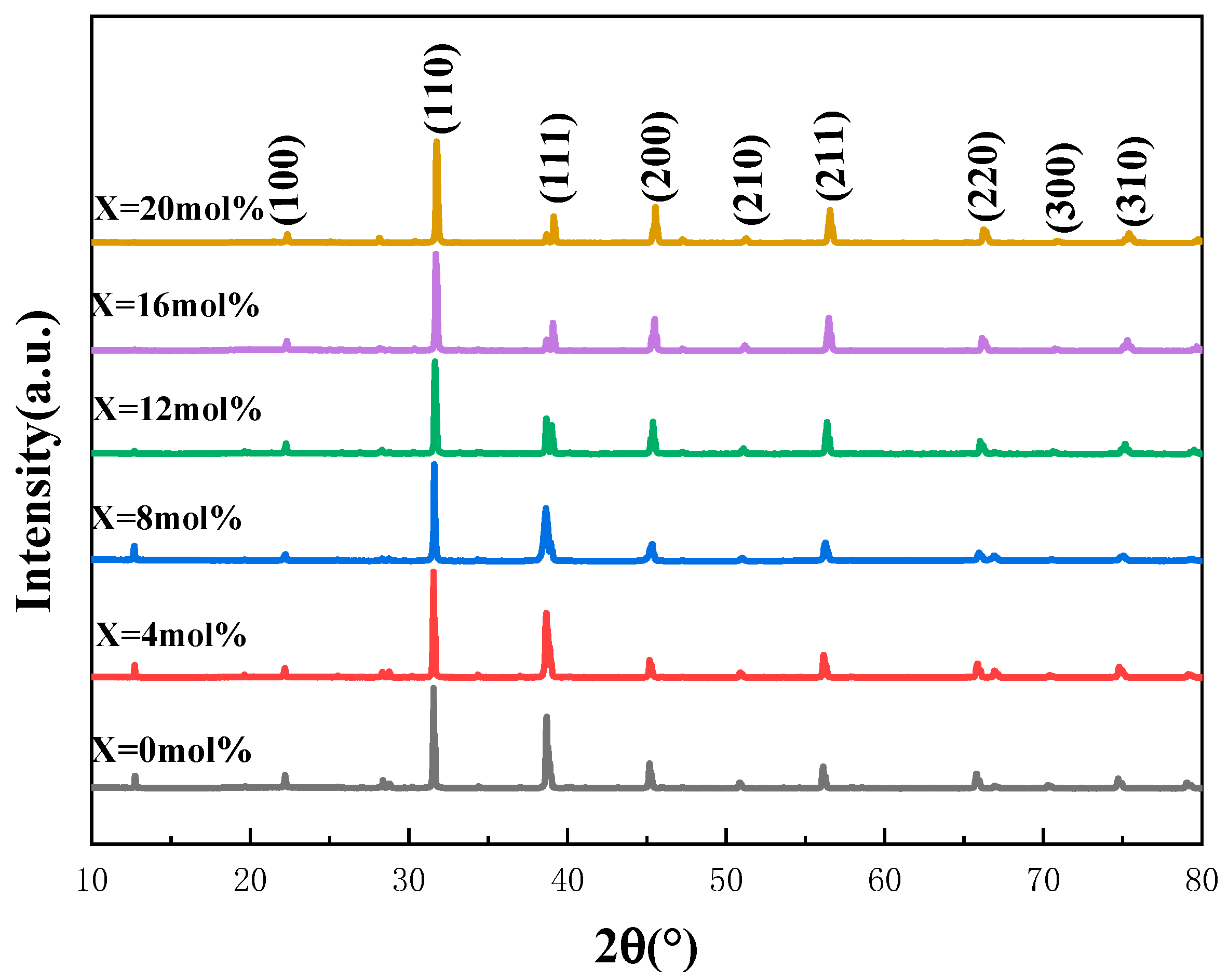
Figure 1 shows the X-ray diffraction (XRD) patterns of Ba1−xCaxZrTiSn lead-free piezoelectric ceramics sintered at 1300 °C with different CaCO3 doping concentrations (0, 4, 8, 12, 16, 20 mol%). The results demonstrate that Ca2+ ions are fully incorporated into the BCZTS lattice structure, forming a single ABO3-type perovskite solid solution. Figure 1 presents that the diffraction peaks of the ceramic samples shift slightly to higher angles as Ca2+ doping content increases. According to Bragg’s law (2d sinθ = nλ), the increase in the diffraction angle 2θ indicates a reduction in interplanar spacing (d). Based on the atomic tolerance factor principle, ions with a radius r(Rn+) < 0.087 nm tend to dope at the B-site, while those with r(Rn+) > 0.094 nm occupy the A-site. In the Ba1−xCaxZrTiSn ABO3-type perovskite structure, the ionic radius of Ca2+ (0.106 nm) exceeds 0.094 nm, which confirms that Ca2+ acts as an A-site dopant. Considering the similar ionic radii (Ca2+: 0.106 nm; Ba2+: 0.138 nm) and identical valence states, Ca2+ substitutes for Ba2+ at the A-site, leading to a slight shrinkage of the unit cell.
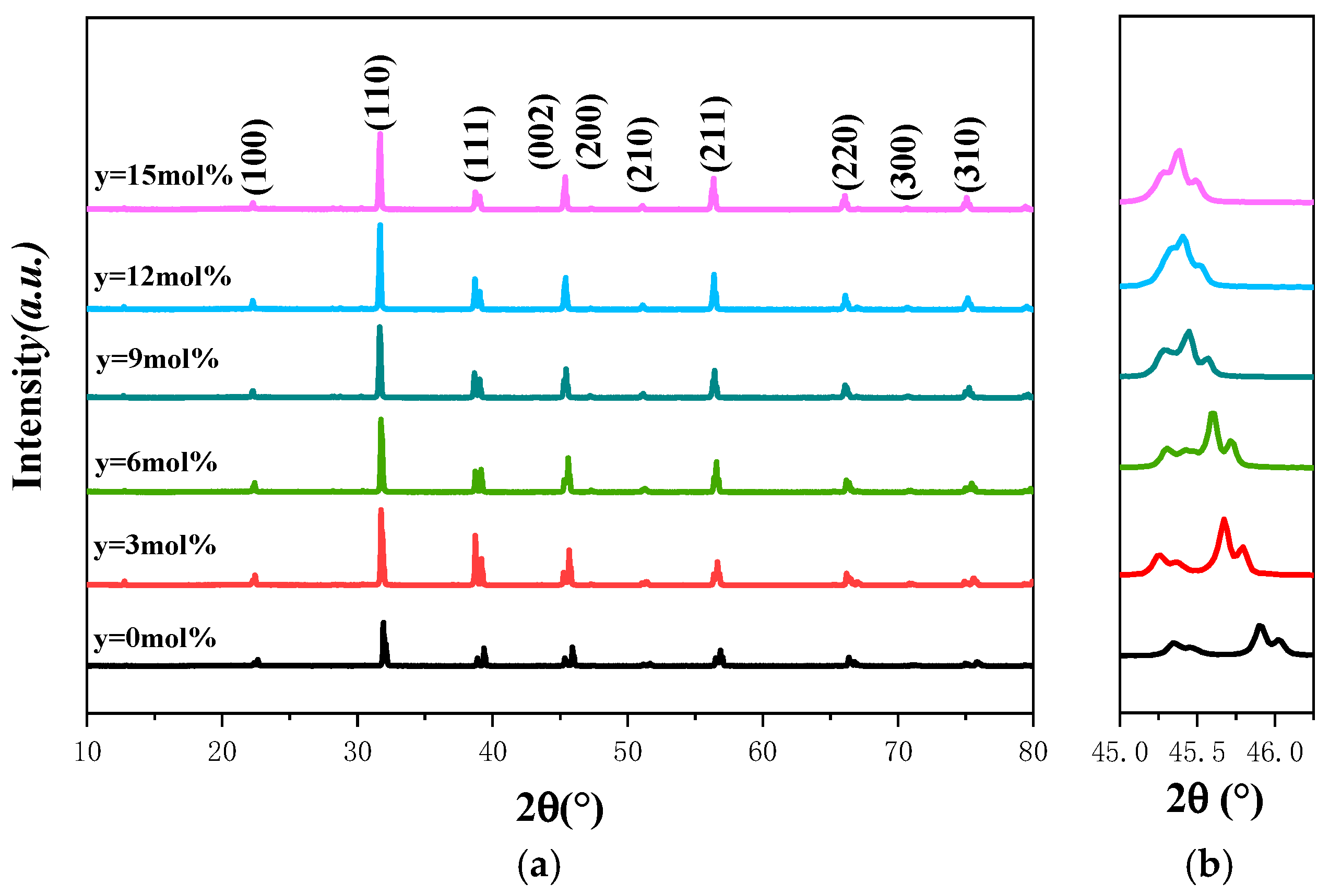
Figure 2a,b presents the XRD patterns of BaCaZr0.1Ti0.9−ySny lead-free piezoelectric ceramics doped with different Sn contents (0, 3, 6, 9, 12, 15 mol%) and prepared by the conventional solid-state reaction method at 1350 °C. To further analyze the evolution of the crystalline phase, Figure 2b shows a magnified view of the diffraction patterns within the 2θ range of 45–46°.
As clearly observed in Figure 2a, all BaCaZr0.1Ti0.9−ySny ceramic samples exhibit a pure perovskite structure, and no diffraction peaks of secondary phases are detected. This suggests that doped Sn ions are well-incorporated into the BCZTS lattice to form solid solutions without changing the primary crystalline structure. In Figure 2b, as the Sn content increases, the diffraction peaks gradually shift to lower angles, which reflects lattice expansion. This peak shift is attributed to the difference in ionic radii of B-site ions. The ionic radius of Sn4+ (0.069 nm) is larger than that of Ti4+ (0.060 nm). The increased substitution of Sn4+ leads to changes in lattice parameters, causing the characteristic diffraction peaks to shift to lower angles. Moreover, Figure 2b reveals a trend of diffraction peaks transitioning from splitting to merging with increasing Sn content. Based on standard crystalline phase data, the crystal structure is tetragonal (T) when the Sn doping is below 6 mol% and changes to orthorhombic (O) when the Sn content exceeds 9 mol%. This indicates that the phase structure of BaCaZr0.1Ti0.9−ySny ceramics is highly sensitive to Sn doping, leading to the coexistence of multiple phases. Notably, when the Sn doping level reaches 9 mol%, an Orthorhombic–Tetragonal (O–T) morphotropic phase boundary (MPB) is formed in the ceramics. This suggests that the phase boundary in these materials can be effectively tuned by introducing Sn dopants. This is significant because it is well-known that the presence of an MPB can significantly enhance the piezoelectric performance of ceramics.
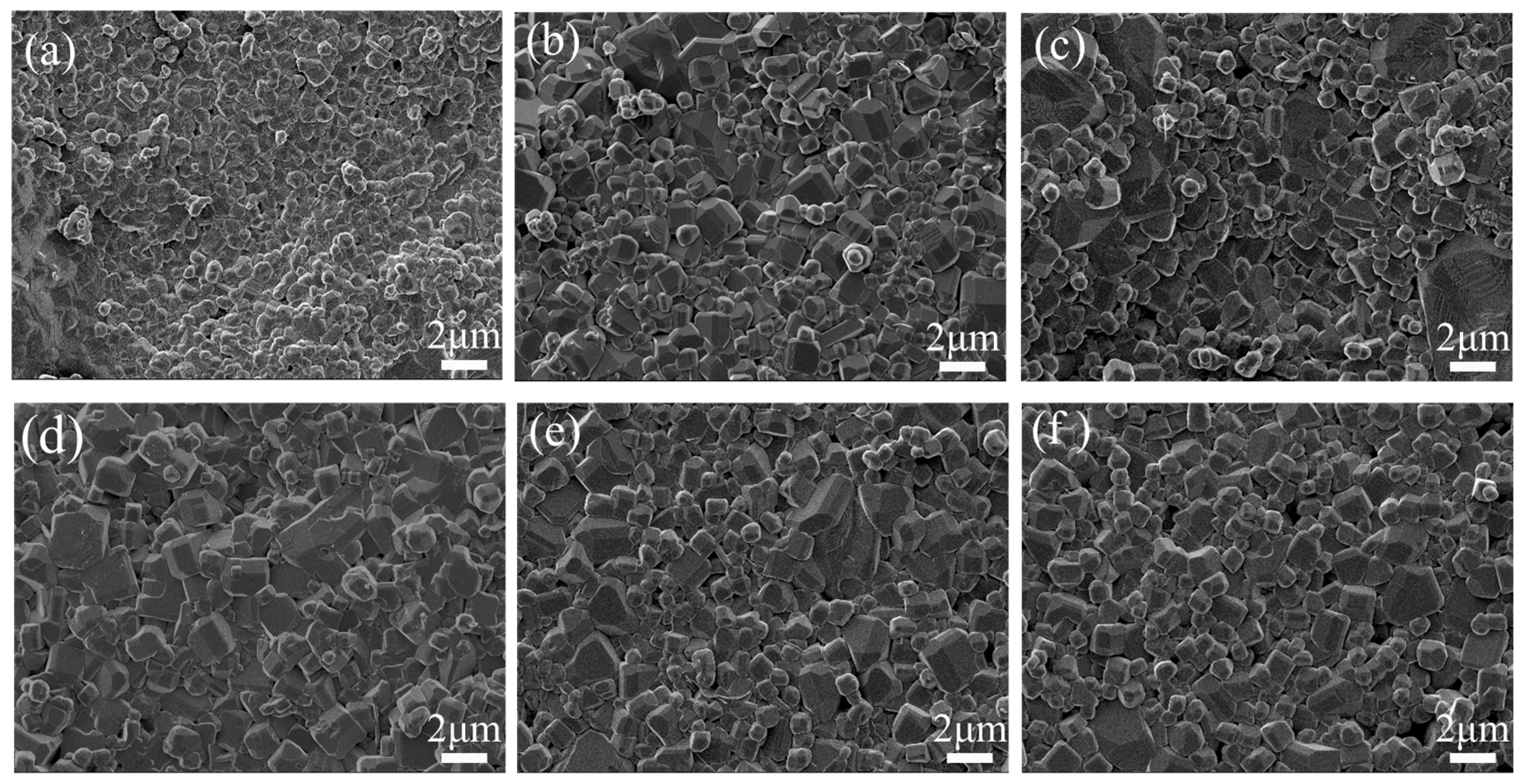
Figure 3a–f present the SEM micrographs of Ba1−xCaxZrTiSn lead-free piezoelectric ceramics with different Ca contents, prepared by conventional solid-state sintering. SEM results indicate that as the Ca content increases, the grain size gradually decreases, indicating grain refinement. When the Ca doping amount is x = 0.12, the grain size is the most uniform, indicating promoted grain growth in the ceramics. SEM images also show that the pore density in the ceramic samples first decreases and then increases as the Ca content rises. Notably, the sample exhibits the highest density at x = 0.12, and density directly affects the piezoelectric properties of ceramic materials. These observations suggest that variations in Ca content directly influence grain growth through Ca doping, which reduces the lattice parameters of Ba1−xCaxZrTiSn ceramics and lowers the nucleation energy. However, excessive Ca doping increases lattice distortion in Ba1−xCaxZrTiSn, leading to higher nucleation energy and hindered nucleation/grain growth. Therefore, 12 mol% Ca doping is optimal for enhancing the density of these ceramics.
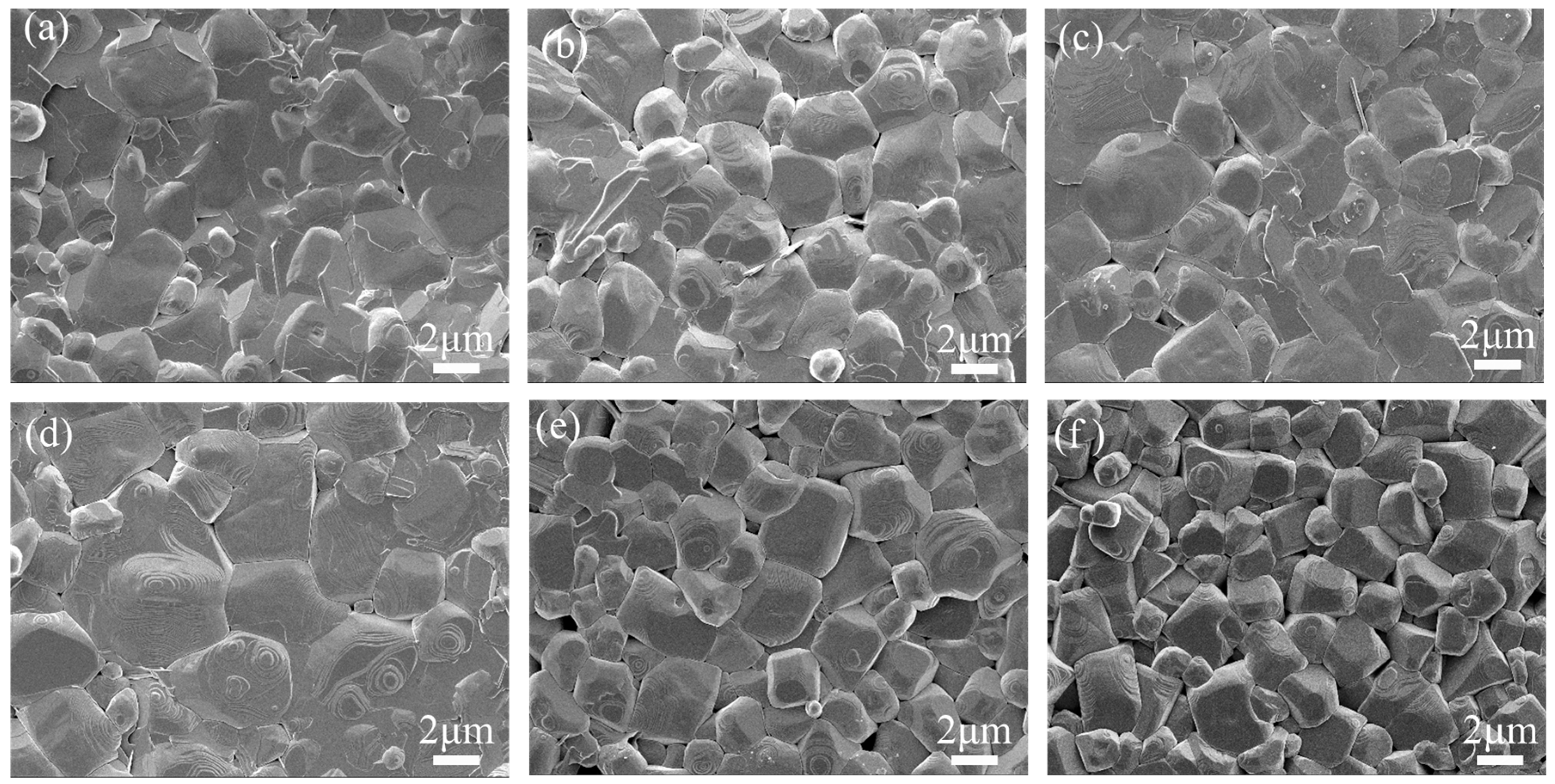
Figure 4a–f display the SEM micrographs of BaCaZr0.1Ti0.9−ySny lead-free piezoelectric ceramics with different Sn doping contents, prepared by conventional solid-state sintering. The images show that all ceramic samples with varying Sn contents exhibit microstructures with clear grain boundaries and relatively dense packing. Notably, there is a weak correlation between the grain size of the lead-free piezoelectric ceramics and Sn doping levels. At the same sintering temperature, the grain size decreases slightly as the Sn content increases. This indicates that moderate Sn doping promotes densification during conventional solid-state sintering and reduces the formation of coarse grains. Additionally, pore distribution analysis reveals that the ceramic exhibits the highest density at 9 mol% Sn doping. Combining this with the XRD analysis results of BaCaZr0.1Ti0.9−ySny samples, the optimal Sn doping ratio is determined to be 9 mol%.
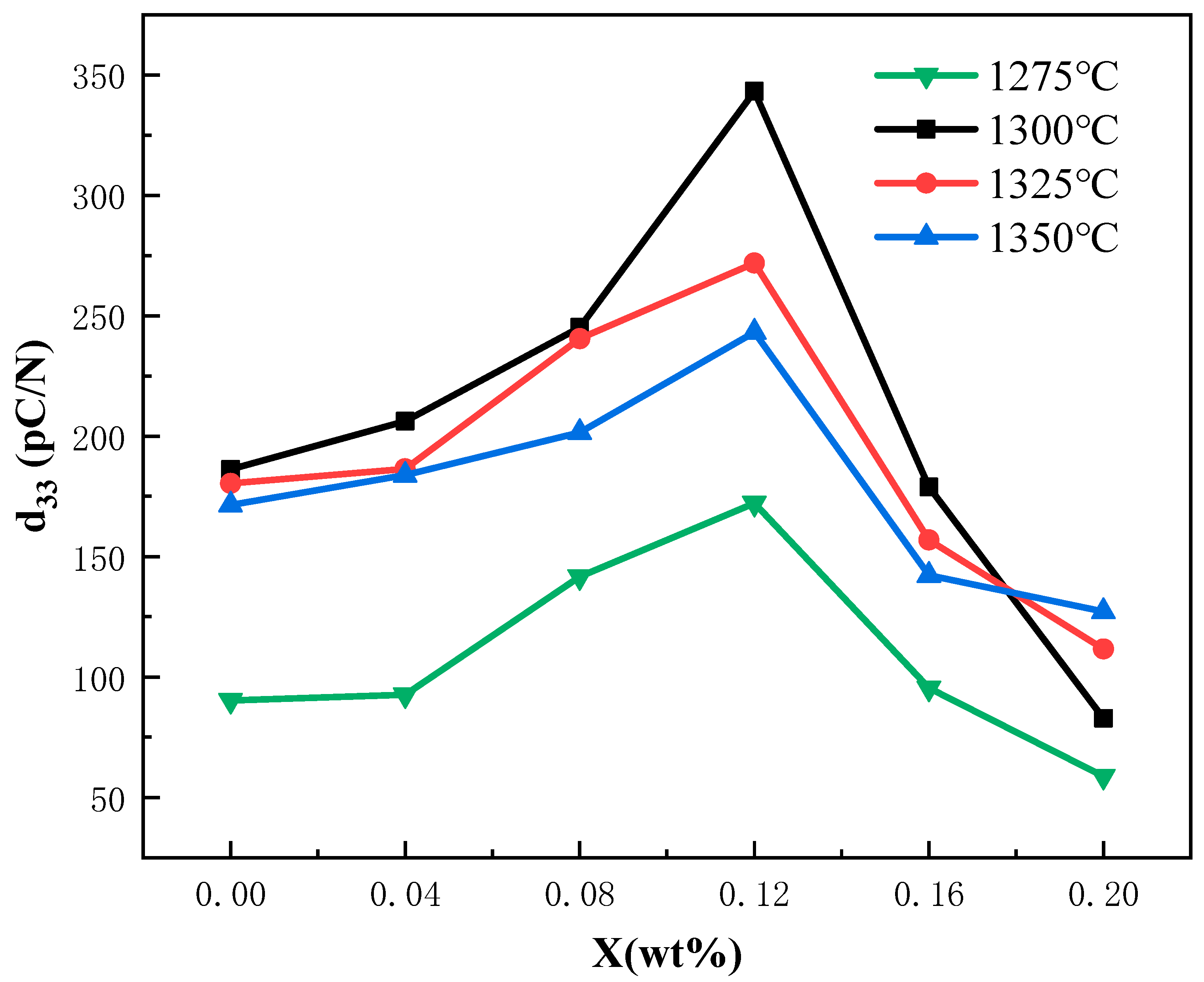
Figure 5 shows the piezoelectric property (d33) results of Ba0.88Ca0.12Zr0.1Ti0.81Sn0.09 ceramics sintered at different temperatures. The data indicate that the d33 value varies in a non-monotonic trend with increased sintering temperature. Higher temperatures enhance the ceramic densification, thereby improving piezoelectric performance. However, excessively high temperatures lead to uneven grain growth, which deteriorates piezoelectric properties due to the increased microstructural heterogeneity [38]. Separately, at a fixed sintering temperature, as the Ca content increases, the piezoelectric constant d33 of the ceramic samples also exhibits a non-monotonic trend. It reaches a peak of d33 = 319 pC/N when the Ca content is x = 12 mol% and the sintering temperature is T = 1300 °C.
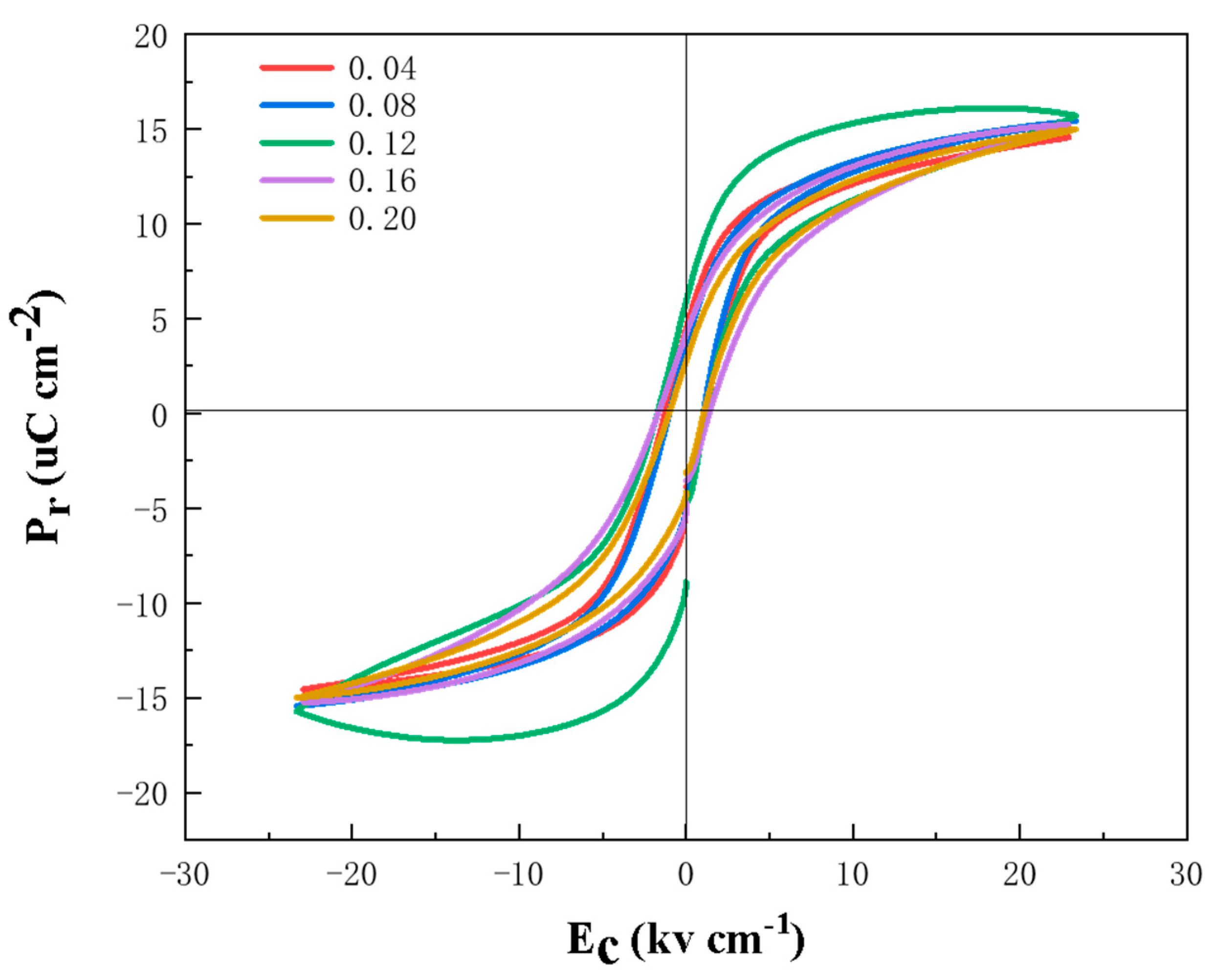
Figure 6 displays the polarization-electric field (P-E) hysteresis loops of the Ba1−xCaxZr0.1Ti0.81Sn0.09 ceramics measured at room temperature. The remanent polarization (Pr) and coercive field (EC) exhibit a systematic evolution with varying compositions, with the optimal x = 0.12 and y = 0.09 delivering the maximum Pr and moderate EC. This significant enhancement in polarization is primarily attributed to the formation of the Orthorhombic–Tetragonal (O-T). The coexistence of multiple phases significantly flattens the polarization anisotropy energy profile, thereby facilitating easier ferroelectric domain switching under an external electric field. Additionally, the octahedral expansion induced by Sn4+ substitution provides a larger displacement space for the central cations, further contributing to the enhanced spontaneous polarization. Apart from the phase structure, appropriate co-doping promotes grain growth and reduces grain boundary density, which weakens the domain wall pinning effect and enables sufficient polarization reversal, thus achieving a high Pr.
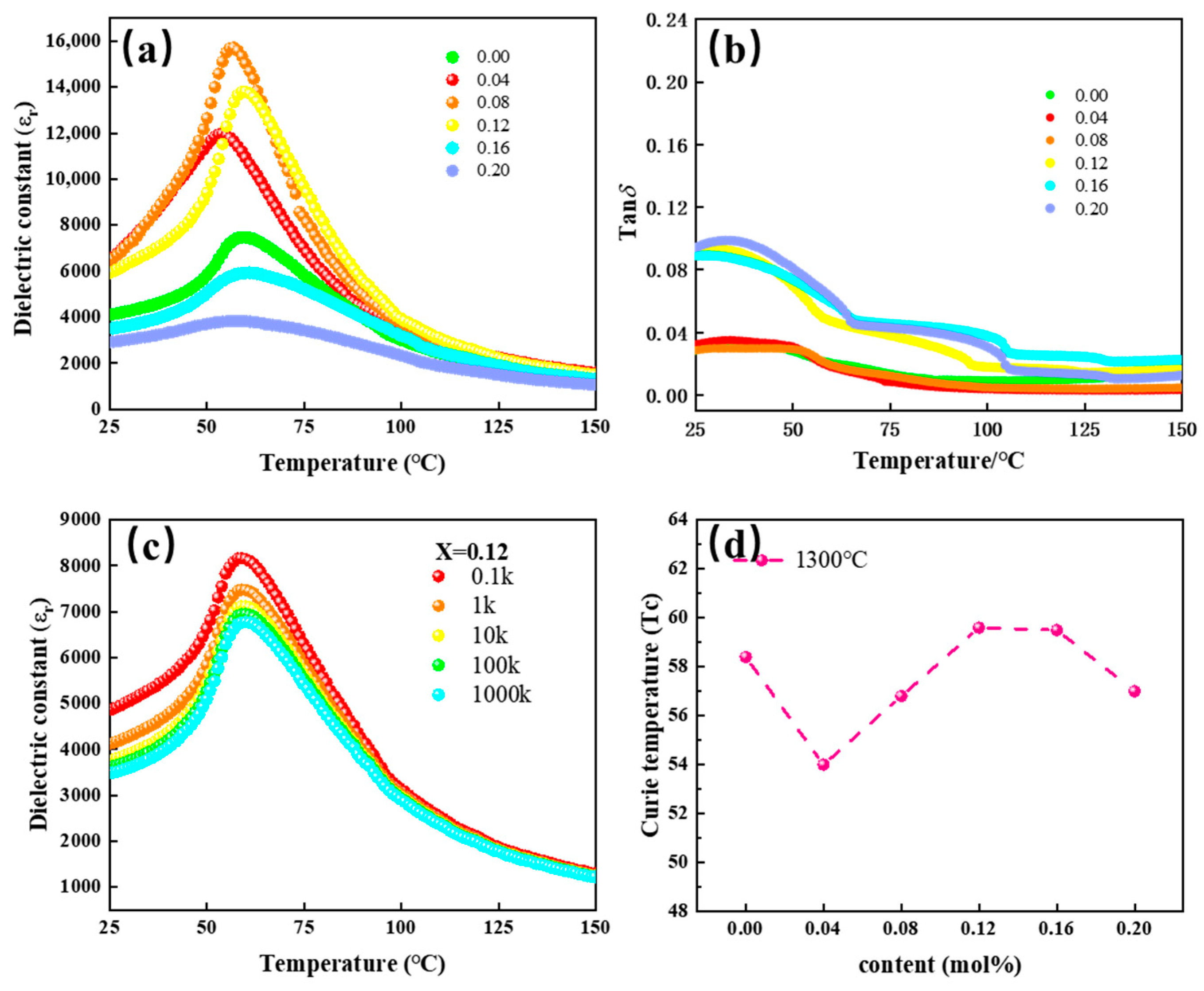
Figure 7 shows the dielectric performances of the Ba1−xCaxZr0.1Ti0.81Sn0.09 ceramic sintered at 1300 °C. As shown in Figure 7a, all samples exhibit a characteristic dielectric peak, corresponding to the Curie temperature. As the Ca doping content increases, the maximum dielectric constant of the samples first rises and then falls. The x = 0.08 composition exhibits the highest dielectric peak. The ceramic sample of x = 0.12 composition lies within the morphotropic phase boundary region. The coexistence of multiple phases induces a phase transition diffusion effect, leading to a broadening of the dielectric peak and a reduction in the dielectric constant at the Curie point. Figure 7b shows that the dielectric loss at room temperature is below 0.04 for x ≤ 0.08, indicating excellent loss performance. Dielectric measurements at varying frequencies were conducted using the optimal composition of x = 0.12 in Figure 7c. The results show that an increase in frequency slightly reduces the dielectric peak. The system exhibits a slight dispersion phase transition. As shown in Figure 7d, the Curie temperature exhibits a trend of first decreasing, then increasing, and finally decreasing again with increasing Ca doping. The Curie temperature (Tc) reaches a peak at x = 0.12. This evolution of dielectric properties is consistent with the trends observed in the samples of SEM, ferroelectric and piezoelectric properties.
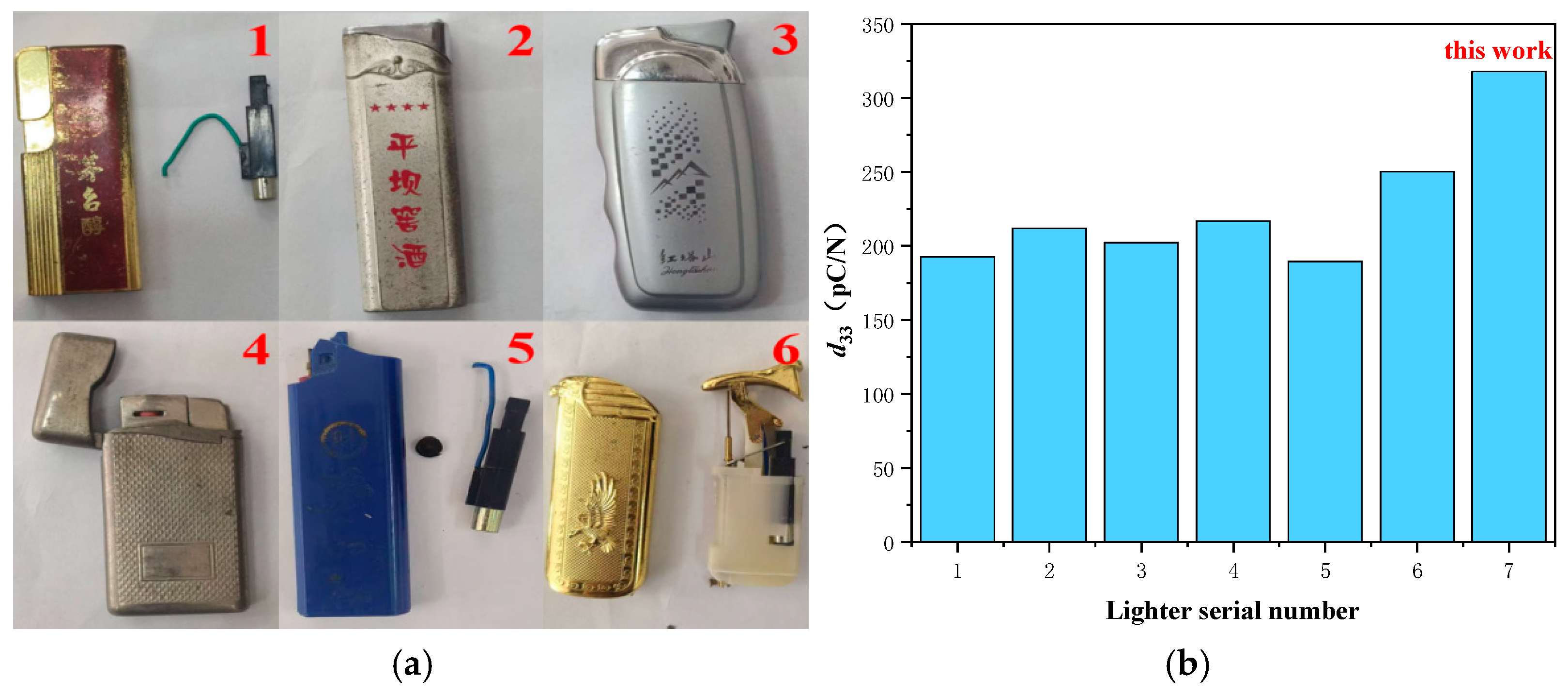
By analyzing Ba1−xCaxZr0.1Ti0.9−ySnyO3 samples, the optimal doping ratio and sintering conditions for this system were determined. Subsequently, the piezoelectric performance was compared with commercially available lead-based piezoelectric ceramic samples. Figure 8a shows samples of common lighters available in the local market, and Figure 8b their piezoelectric constant. Among them, the sample 7 represents the piezoelectric constant of Ba0.88Ca0.12Zr0.1Ti0.81Sn0.09 piezoelectric ceramic prepared in our laboratory. A comparison reveals that samples from a market-available lighter only have the highest piezoelectric constant, d33 = 309 pC/N, and the other samples are below 300 pC/N. The ceramic sample prepared in this project has a piezoelectric constant of d33 = 319 pC/N, outperforming all common lighter samples in the market.

4. Conclusions

In this study, Ca2+ and Sn4+ were employed as doping ions to construct the Ba1−xCaxZr0.1Ti0.9−ySny lead-free piezoelectric ceramic system. The effects of the doping concentrations of Ca/Sn and the sintering temperature on the phase structure, microstructure, and piezoelectric properties of BCZTS ceramics were investigated. The research indicated that when the Ca doping concentration was x = 12 mol% and the Sn doping concentration was y = 9 mol%, the fabricated Ba0.88Ca0.12Zr0.1Ti0.81Sn0.09 piezoelectric ceramic had a single-phase perovskite with coexistence of orthorhombic and tetragonal phases, and an O-T morphotropic phase boundary formed in the crystalline phase. Under these conditions, the ceramic grain size was relatively uniform. When sintered at 1300 °C, the ceramics in this system exhibited the optimal piezoelectric performance, achieving d33 = 319 pC/N. And the ceramic system showed excellent dielectric properties and Curie temperature. All samples’ P-E hysteresis loops exhibit a high saturation and symmetry.
The Ba0.88Ca0.12Zr0.1Ti0.81Sn0.09 ceramic exhibited superior piezoelectricity (d33 = 319 pC/N) than conventional lead-based ceramics. This demonstrates the potential of BCZTS ceramics as lead-free alternatives for civilian applications (e.g., piezoelectric igniters), which can expand the practical use of these lead-free materials.

Author Contributions

Conceptualization, A.X., F.Z. and Q.L.; Methodology, A.X., F.Z., Y.L. (Yang Li) and Z.C.; Validation, Z.Y., S.L. and Z.C.; Formal analysis, Z.Y., S.L., Y.L. (Yang Liao) and H.G.; Data curation, Z.Y., S.L., Y.L. (Yang Liao) and H.G.; Writing–original draft, Z.Y.; Writing–review & editing, A.X. and Q.L.; Supervision, F.Z. and Q.L.; Project administration, A.X., Y.L. (Yang Li) and Z.C.; Funding acquisition, A.X. All authors have read and agreed to the published version of the manuscript.

Funding

This work is financially supported by the Guizhou Provincial Basic Research Program (Natural Science) (No. QKHJC-ZK-2023-266), Science and Technology Basic Research Projects of Qiandongnan State of Guizhou Province (Grant No. J [2021] No. 14), Natural Science Project of Education Department of Guizhou Province (No. [2022]045).

Data Availability Statement

The original contributions presented in this study are included in the article material. Further in-quiries can be directed to the corresponding authors.

Conflicts of Interest

The authors declare no conflict of interest.

References

  1. Xi, K.B.; Wang, H.Y.; Huang, S.C.; Zheng, M.P.; Shi, X.M.; Zhu, M.K.; Hou, Y.D. Thermally stable piezoelectric properties of lead-free ceramics featuring polar topological domains. Acta Mater. 2025, 294, 121152. [Google Scholar] [CrossRef]
  2. Xie, Y.N.; Xing, J.; Tan, Z.; Xie, L.X.; Cheng, Y.; Wu, X.J.; Han, R.L.; Chen, Q.; Zhu, J.G. High mechanical quality factor and piezoelectricity in potassium sodium niobate ceramics. Ceram. Int. 2022, 48, 6565–6573. [Google Scholar] [CrossRef]
  3. Zate, T.T.; Abdurahmanoglu, C.; Esposito, V.; Haugen, A.B. Textured Lead-Free Piezoelectric Ceramics: A Review of Template Effects. Materials 2025, 18, 477. [Google Scholar] [CrossRef] [PubMed]
  4. He, X.; Chen, C.; Wang, L.; Gong, Y.Y.; Dun, R.M.; Zhang, F.Q.; Wu, Y.Q.; Zeng, H.R.; Li, Y.X.; Yi, Z.G. Giant electromechanical response in layered ferroelectrics enabled by asymmetric ferroelastic switching. Mater. Today 2022, 58, 48–56. [Google Scholar] [CrossRef]
  5. He, R.C.; Guo, H.T.; Yao, Z.K.; Wang, F.P.; Sun, Q.; Li, X.; Song, X.Q.; Zhou, R.S.; Xiao, Q.Q.; Zhang, L.; et al. Negligible-hysteresis piezoceramic achieved by multiphase assisting and domain configuration manipulating. J. Adv. Ceram. 2025, 14, 9221160. [Google Scholar] [CrossRef]
  6. Shrout, T.R.; Zhang, S.J. Lead-free piezoelectric ceramics: Alternatives for PZT? J. Electroceramics 2007, 19, 113–126. [Google Scholar] [CrossRef]
  7. Dixit, P.; Seth, S.; Rawal, B.; Kumar, B.P.; Panda, H.S. Freeze casting of lamellar-structured porous lead-free (Na0.52K0.48)(Nb0.95Sb0.05)O3 piezoceramic with remarkable enhancement in piezoelectric voltage constant and hydrostatic figure of merit. J. Mater. Sci. Mater. Electron. 2021, 32, 5393–5403. [Google Scholar] [CrossRef]
  8. Ponomarev, S.G.; Smirnov, A.V.; Reznichenko, A.V.; Vasin, A.A.; Tarasovskii, V.P.; Shlyapin, A.D.; Solov’ev, I.S. Vibrocompaction of lead-free piezoceramic material based on solid solutions of potassium and sodium niobates. Glass Ceram. 2020, 76, 346–350. [Google Scholar] [CrossRef]
  9. Zeng, F.F.; Yao, Z.K.; Zhang, Q.S.; Peng, P.; He, R.C.; Guo, H.T.; Song, X.Q.; Xie, Q.; Xiao, Q.Q.; Fan, G.F.; et al. Enhanced electric field-induced strain performance in 0–3 composite ceramics by strain and polarization coupling. J. Eur. Ceram. Soc. 2024, 44, 7018–7024. [Google Scholar] [CrossRef]
  10. Difeo, M.; Osinaga, S.; Febbo, M.; Machado, S.P.; Castro, M.; Ramajo, L. Influence of the (Bi0.5Na0.5)TiO3-BaTiO3 lead-free piezoceramic geometries on the power generation of energy harvesting devices. Ceram. Int. 2021, 47, 10696–10704. [Google Scholar] [CrossRef]
  11. Linardos, S.; Zhang, Q.; Alcock, J.R. Preparation of sub-micron PZT particles with the sol–gel technique. J. Eur. Ceram. Soc. 2006, 26, 117–123. [Google Scholar] [CrossRef]
  12. Kim, S.W.; Lee, H.C. Development of PZN-PMN-PZT piezoelectric ceramics with high d33 and Qm values. Materials 2022, 15, 7070. [Google Scholar] [CrossRef]
  13. Okayasu, M.; Shimazu, I. Electric Power Generation of PZT Piezoelectric Ceramics Using Both Direct and Inverse Piezoelectric Effects. J. Electron. Mater. 2025, 54, 5143–5150. [Google Scholar] [CrossRef]
  14. Takpara, R.; Duquennoy, M.; Courtois, M.; Jenot, F.; Rguiti, M. Optimization of PZT ceramic IDT sensors for health monitoring of structures. Ultrasonics 2017, 79, 96–104. [Google Scholar] [CrossRef]
  15. Ibn-Mohammed, T.; Acquaye, S.C.L.; Wang, D.; Taylor, S.; Genovese, A. Integrated hybrid life cycle assessment and supply chain environmental profile evaluations of lead-based (lead zirconate titanate) versus lead-free (potassium sodium niobate) piezoelectric ceramics. Energy Environ. Sci. 2016, 9, 3495–3520. [Google Scholar] [CrossRef]
  16. Zeng, F.F.; Zhang, Q.S.; Zhang, S.D.; Sun, Q.; Guo, H.T.; Xiao, Q.Q.; Xie, Q.; Zhang, L.; Fan, G.F.; Qu, Y.P.; et al. Enhanced energy-storage performances and thermal stability in BNT–LST-based ceramics by tuning domain configuration and bandgap. Rare Met. 2025, 44, 3313–3323. [Google Scholar] [CrossRef]
  17. Chitra, K.; Singh, C. Enhanced electrical activity induced by high-energy milling in lead-free BCST piezoceramics. Mater. Lett. 2019, 256, 126664. [Google Scholar] [CrossRef]
  18. Taghaddos, E.; Charalambous, H.; Tsakalakos, T.; Safari, A. Electromechanical properties of flash sintered BNT-based piezoelectric ceramic. J. Eur. Ceram. Soc. 2019, 39, 2882–2888. [Google Scholar] [CrossRef]
  19. Zeng, F.F.; Yao, Z.K.; Zhang, Q.S.; Peng, P.; Feng, X.; He, R.C.; Zhou, R.S.; Guo, H.T.; Xie, Q.; Fan, G.F.; et al. Low hysteresis in composites ceramics achieved by building polarization field and restoring force. Mater. Des. 2024, 248, 113458. [Google Scholar] [CrossRef]
  20. Ataei, M.H.; Hassanzadeh-Tabrizi, S.A.; Rafiei, M.; Monshi, A. Design development of (Ba1−xCax)(Ti1−ySny)O3 lead-free piezo ceramic by two manufacturing methods of CSS and SPS, promising for delamination damage detection. J. Alloys Compd. 2019, 795, 197–206. [Google Scholar] [CrossRef]
  21. Arzensek, M.; Tos, U.; Drnovsek, S.; Dragomir, M.; Ursic, H.; Otonicar, M.; Jankauskas, P.; Svirskas, S.; Rojac, T. Origins of the large piezoelectric response of samarium-doped lead magnesium niobate–lead titanate ceramics. Sci. Adv. 2024, 10, eadp0895. [Google Scholar] [CrossRef]
  22. Sivan, V.; Jose, A.E.; Vince, J.; Singh, R.P.; Abraham, A.R.; Augustine, P. Enhanced dielectric, ferroelectric and piezoelectric properties of lead-free (Ba(1−x)Ca(x)(Zr0.1Ti0.9)O3 ceramics with Ca2+ addition. Ceram. Int. 2025, 51, 44062–44070. [Google Scholar] [CrossRef]
  23. Tian, Y.S.; Ma, M.Y.; Liu, C.Y.; Sheng, D.X.; Ji, X.; Hu, X.J.; Wang, J.S.; Jing, Q.S. Influence of oxygen vacancies and electrical properties in Ba0.92Ca0.08Zr0.05Ti0.95O3 ceramics through the co-doping of La3+ and Tm3+ ions. Mater. Today Commun. 2025, 43, 111645. [Google Scholar] [CrossRef]
  24. Li, Q.T.; Zhang, Q.W.; Cai, W.; Zhou, C.; Gao, R.L.; Chen, G.; Deng, X.L.; Wang, Z.H.; Fu, C.L. Enhanced ferroelectric and piezoelectric responses of (Ba0.85Ca0.15)(Zr0.1Ti0.9)O3 ceramics by Tm3+ amphoteric substitution. Mater. Chem. Phys. 2020, 252, 123242. [Google Scholar] [CrossRef]
  25. Verma, R.; Chauhan, A.; Batoo, K.M.; Jasrotia, R.; Sharma, A.; Kumar, R.; Hadi, M.; Raslan, E.H.; Labis, J.P.; Imran, A. Modulation of dielectric, ferroelectric, and piezoelectric properties of lead-free BCZT ceramics by doping. ECS J. Solid State Sci. Technol. 2021, 10, 073004. [Google Scholar] [CrossRef]
  26. Li, S.B.; Zhang, L.M.; Wang, C.B.; Ji, X.; Shen, Q. Structural, dielectric and ferroelectric properties of lead-free Ba0.85Ca0.15Zr0.1Ti0.9O3 ceramics prepared by plasma activated sintering. Ceram. Int. 2016, 42, 18585–18591. [Google Scholar] [CrossRef]
  27. Lu, Y.; Karaki, T.; Fujii, T. Preparation of morphology-controlled plate-like sodium niobate particles by hydrothermal synthesis. J. Am. Ceram. Soc. 2015, 98, 1668–1672. [Google Scholar] [CrossRef]
  28. Liu, W.F.; Wang, J.G.; Ke, X.Q.; Li, S.T. Large piezoelectric performance of Sn doped BaTiO3 ceramics deviating from quadruple point. J. Alloys Compd. 2017, 712, 1–6. [Google Scholar] [CrossRef]
  29. Shi, S.F.; Hashimoto, H.; Sekino, T. Enhancing piezoelectric properties of Ba0.88Ca0.12Zr0.12Ti0.88O3 lead-free ceramics by doping Co ions. Ceram. Int. 2021, 47, 3272–3278. [Google Scholar] [CrossRef]
  30. Wang, X.W.; Zhang, B.H.; Li, Y.Y.; Shi, Y.C.; Sun, L.Y.; Feng, G.; Li, C.L.; Liang, Y.F.; Zheng, Y.P.; Shang, S.Y.; et al. Structure, dielectric, and ferroelectric properties of Ba0.85Ca0.15Zr0.1Ti0.9O3 ceramics sintered at various temperatures. J. Mater. Sci. Mater. Electron. 2020, 31, 4732–4742. [Google Scholar] [CrossRef]
  31. Du, J.; Qiu, L.; Yang, C.; Zheng, H.; Zhu, K.; Wang, L. Structure and electrical properties in CuO-modified BCZT lead-free piezoelectric ceramics. J. Electroceramics 2022, 49, 125–134. [Google Scholar] [CrossRef]
  32. Belkhadir, S.; Khardazi, S.; Mezzane, D.; Pushkarova, I.; Lukyanchuk, I.; El Marssi, M. Effect of Sn on the energy storage performance and electric conduction mechanisms of BCZT ceramic. Mater. Today Proc. 2022, 51, 2005–2014. [Google Scholar] [CrossRef]
  33. Kathait, G.S.; Maini, S. Dielectric, piezoelectric and energy storage properties of Ca, Zr and Sn doped (Ba1−xCax)(Ti0.85+xZr0.02Sn0.13−x)O3 lead-free ceramics at MPB for 0.05 ≤ x ≤ 0.09. Mater. Sci. Eng. B 2024, 301, 117139. [Google Scholar] [CrossRef]
  34. An, X.; Zeng, F.F.; Wang, Y.Y.; Liu, Q.B.; Wang, X.J.; Peng, S.Q.; Mou, F.H. A comparative study of microstructure and electrical properties of lead-free (1−x)(Ba0.85Ca0.15)(Zr0.09Ti0.91) O3xTa + Li2CO3 ceramics compounded by microwave and conventional sintering techniques. J. Mater. Sci. Mater. Electron. 2020, 31, 8291–8296. [Google Scholar]
  35. An, X.; Liu, Q.B.; Yang, H.P.; Wang, Y.Y.; Peng, S.Q.; Mou, F.H. Rhombohedral-orthorhombic-tetragonal multiphases coexist in (Ba0.85Ca0.15)(Ti0.9Zr0.08Sn0.02) O3-SrTiO3 piezoelectric ceramics prepared by microwave sintering techniques. J. Mater. Sci. Mater. Electron. 2020, 31, 19388–19395. [Google Scholar]
  36. An, X.; Luo, S.X.; Zeng, F.F.; Yang, Z.Y.; Li, Y.; Chu, Z.Y.; Tang, X.N.; Liu, Q.B.; Qu, Y.P. Superior comprehensive electrical properties in the <001> textured Ba0.85Ca0.15Zr0.09Ti0.91O3 lead-free piezoelectric ceramics. Rare Met. 2025, 44, 7797–7808. [Google Scholar]
  37. Liu, W.; Zheng, T.; Zhou, Z.; Ding, Y.; Qin, Y.; Fu, Z.; Ruan, X.; Gao, Z.; Lv, X.; Wu, J. Ultrahigh piezoelectricity and temperature stability in piezoceramics by synergistic design. Nat. Commun. 2025, 16, 1527. [Google Scholar] [CrossRef]
  38. Vendrell, X.; Rubio-Marco Campo, F.; Mestres, L.; Garcia, J.E. Stress release-induced piezoresponse in lead-free piezoceramics with high-symmetry morphotropic phase boundary. Appl. Phys. Lett. 2025, 126, 042903. [Google Scholar] [CrossRef]
Figure 1. X-ray diffraction pattern of Ba1−xCaxZrTiSn ceramics.
Ceramics 09 00056 g001
Figure 2. (a) XRD pattern of BaCaZr0.1Ti0.9−ySny lead-free piezoelectric ceramic samples; (b) local magnification of 2θ = 45°~46°.
Ceramics 09 00056 g002
Figure 3. SEM morphology of Ba1−xCaxZrTiSn ceramics. (Ca content of (af): 0, 4, 8, 12, 16, 20 mol%).
Ceramics 09 00056 g003
Figure 4. SEM morphology of BaCaZr0.1Ti0.9−ySny ceramics (Sn content of (af): 0, 3, 6, 9, 12, 15 mol%).
Ceramics 09 00056 g004
Figure 5. Piezoelectric constants of Ba1−xCaxZr0.1Ti0.81Sn0.09 ceramics at different sintering temperatures.
Ceramics 09 00056 g005
Figure 6. The P–E loops for Ba1−xCaxZr0.1Ti0.81Sn0.09 ceramics at room temperature at 10 Hz.
Ceramics 09 00056 g006
Figure 7. (a,b) εr and tanδ of Ba1−xCaxZr0.1Ti0.81Sn0.09 ceramic compositions measured at 1 kHz; (c) effect of frequency on the dielectric constant of Ba0.88Ca0.12Zr0.1Ti0.81Sn0.09 piezoelectric ceramics; (d) Curie temperature of different doping content.
Ceramics 09 00056 g007
Figure 8. (a,b) Comparison of common lighter samples in the market with BaCaZrTiSn ceramic.
Ceramics 09 00056 g008
Disclaimer/Publisher’s Note: The statements, opinions and data contained in all publications are solely those of the individual author(s) and contributor(s) and not of MDPI and/or the editor(s). MDPI and/or the editor(s) disclaim responsibility for any injury to people or property resulting from any ideas, methods, instructions or products referred to in the content.