Article

Synthesis of RE3+ (RE = Ho, Tb, Pr)-Doped Alumina Ceramic Coatings by Plasma Electrolytic Oxidation of Aluminum: Investigation of Photocatalytic Performance


by
Stevan Stojadinović
1,2,*,
Darwin Augusto Torres-Ceron
3,4,
Sebastian Amaya-Roncancio
5 and
Nenad Radić
6
1
Faculty of Physics, University of Belgrade, Studentski trg 12-16, 11000 Belgrade, Serbia
2
Faculty of Forestry, University of Belgrade, Kneza Višeslava 1, 11000 Belgrade, Serbia
3
Plasma Physics Laboratory, Universidad Nacional de Colombia Sede Manizales, Manizales 170003, Colombia
4
Departamento de Física y Química, Universidad Nacional de Colombia Sede Manizales, Manizales 170003, Colombia
5
Grupo de Simulación de Materiales, Escuela de Física, Universidad Pedagógica y Tecnológica de Colombia, Tunja 150003, Colombia
6
Department of Catalysis and Chemical Engineering, IChTM—National Institute of the Republic of Serbia, University of Belgrade, Njegoševa 12, 11000 Belgrade, Serbia
*
Author to whom correspondence should be addressed.
Ceramics 2026, 9(4), 42; https://doi.org/10.3390/ceramics9040042
Submission received: 22 March 2026 / Revised: 10 April 2026 / Accepted: 18 April 2026 / Published: 21 April 2026

Abstract

Porous, crystalline gamma-Al2O3 coatings with a thickness of (6 ± 0.5) μm and a uniform distribution of rare earth (RE) dopants are synthesized by plasma electrolytic oxidation of aluminum at a current density of 150 mA/cm2 in a boric acid and borax (BB) solution containing added RE oxide particles (Ho2O3, Tb4O7, and Pr6O11) at concentrations of 1, 2, and 4 g/L. The concentration of RE oxide particles in the BB solution determines the amount of RE elements incorporated into the coatings but does not significantly affect their surface morphology, crystal structure, or light absorption properties. The coatings exhibit high absorption in the middle/near-ultraviolet region, characteristic of Al2O3. Typical 4f-4f transitions of Ho3+, Tb3+, and Pr3+ are observed in the photoluminescence spectra. Photocatalytic evaluations using methyl orange degradation under simulated solar irradiation show that RE doping significantly enhances photocatalytic efficiency. Peak degradation efficiencies are achieved at a concentration of 4 g/L for all RE oxides. After 8 h of irradiation, maximum degradation reaches 88%, 92%, and 85% with pseudo-first-order rate constants (kapp) of about 0.274 h−1, 0.339 h−1, and 0.232 h−1 for coatings synthesized in BB with 4 g/L Ho2O3, Tb4O7, or Pr6O11, respectively. In comparison, the pristine Al2O3 coating achieves only about 50% degradation (kapp ≈ 0.087 h−1). Photoluminescence indicates that RE3+ ions serve as effective charge-carrier traps, suppressing electron–hole pair recombination. RE-doped Al2O3 coatings demonstrate exceptional structural stability and reusability over six cycles, highlighting their potential for sustainable wastewater remediation.

1. Introduction

The effects of organic pollutants from industrial discharge and domestic effluents on the environment are now a major global concern [1]. Metal oxide photocatalysis is among the most advanced remediation techniques, using sunlight to mineralize organic pollutants into harmless byproducts [2,3]. Metal oxides demonstrate photocatalytic efficacy in the mineralization of organic pollutants, a performance supported by the synergistic combination of their thermodynamic stability, tunable electronic band structures, and optimized charge-carrier dynamics. Additionally, their inherent resistance to photocorrosion and broad spectral absorption profiles enable sustained catalytic turnover under diverse irradiation conditions [4]. While TiO2 and ZnO remain the benchmark photocatalysts due to their superior quantum yields, research has expanded to a diverse range of alternative oxides, including WO3, ZrO2, Nb2O5, Fe2O3, Al2O3, CuO, Ta2O5, etc. [5]. Among these metal oxides, Al2O3 (alumina) is a versatile ceramic known for its robust physicochemical properties, such as high hardness, refractory stability (melting point about 2072 °C), and strong chemical inertness [6]. Its high dielectric strength and volume resistivity make it an excellent electronic insulator, while its wide optical transparency from ultraviolet (UV) to near-infrared (NIR) is complemented by a high refractive index [7]. As a result, Al2O3 is a key material in structural, microelectronic, and biomedical engineering. Despite these advantages, Al2O3 is traditionally excluded from primary photocatalytic applications due to its wide electronic band gap (7 eV to 9 eV) [8]. This large gap restricts photon absorption to the deep-UV range, effectively rendering the material inactive under the visible light spectrum, which comprises the majority of solar radiation. Furthermore, its insulating nature results in negligible charge-carrier density and high recombination rates compared to transition-metal oxide semiconductors such as TiO2 or ZnO. However, the material’s high specific surface area, tailored surface acidity or basicity, and thermal durability make it an exceptional catalytic support [9,10,11]. By integrating Al2O3 into heterostructured composite systems, researchers can leverage its structural stability to enhance the dispersion and photocatalytic efficiency of narrower-gap semiconductors.
In recent years, the plasma electrolytic oxidation (PEO) process has emerged as a highly effective electrochemical surface treatment for fabricating immobilized photocatalysts [12,13,14]. This technique applies a high-voltage potential to a metallic substrate submerged in an aqueous electrolyte, exceeding the dielectric breakdown threshold [15,16,17]. The resulting localized micro-discharges promote the growth of a robust, highly porous, ceramic-like oxide layer. The intrinsic porosity of the PEO layer greatly increases the specific surface area, providing a high density of active sites for the adsorption and subsequent degradation of organic pollutants. The extreme localized temperatures and pressures generated by the micro-discharges facilitate the formation of highly crystalline oxide phases. These crystalline structures generally exhibit superior photocatalytic efficiency compared to amorphous forms. Unlike suspended powder systems, PEO coatings offer exceptional interfacial adhesion to the substrate, eliminating the energy-intensive post-treatment filtration steps required to recover powdered catalysts from aqueous media.
Al2O3 coatings synthesized by PEO on aluminum substrates possess an inherent, though baseline, level of photocatalytic activity (PA), typically demonstrated by the oxidative degradation of organic pollutants [18]. However, to achieve higher photocatalytic efficiency, functionalization of the Al2O3 matrix with extrinsic semiconductors is required. Conventional enhancement strategies involve the direct incorporation of semiconductor nanoparticles such as ZnO [19], TiO2 [20,21], WO3 [22], Co3O4 [22], MnO2 [23], or CuO [23] from the electrolyte into the developing Al2O3 matrix, which modifies the electronic band structure of the composite coating and induces a shift in the optical absorption edge. By narrowing the effective bandgap, this shift extends the spectral response from the UV into the visible light region, substantially increasing the utilization of the solar spectrum. Furthermore, these incorporated particles function as charge separation mediators, providing alternative pathways for photo-generated species and facilitating the spatial separation of electron–hole pairs.
This research investigated the synthesis of rare earth (RE) ion-doped Al2O3 coatings by PEO on aluminum substrates. The process used an electrolyte enriched with RE oxide particles to modify the coating matrix. The primary focus was to evaluate the photocatalytic efficacy of these coatings in degrading methyl orange (MO).
MO is a recalcitrant synthetic anionic azo dye frequently detected in industrial effluents [24]. Its high water solubility facilitates accumulation in aquatic ecosystems, while its complex chemical structure, characterized by stable azo bonds (–N=N–), makes it resistant to conventional biological and chemical remediation. Given the potential environmental toxicity of MO, developing highly efficient degradation methods is critical. This study contributes to the ongoing development of sustainable and economically viable photocatalytic systems for advanced wastewater treatment.
RE ions have become one of the key dopants for enhancing the performance of photocatalytic systems, especially in environmental remediation [25,26,27]. Their impact on the physicochemical properties of host materials is mainly due to their unique electronic configurations, with partially filled 4f orbitals. Incorporating RE ions into a semiconductor lattice leads to several important improvements in the photocatalytic process. RE doping introduces intra-band states that reduce the band gap energy (Eg) of the host material and extend the optical absorption threshold from the UV into the visible light spectrum, increasing solar energy utilization. RE ions act as localized trapping sites for photo-generated electrons or holes. By separating the charge carriers, these ions suppress the recombination of electron–hole pairs, extending carrier lifetimes and increasing the likelihood of interfacial redox reactions. In addition to electronic modification, RE doping can change the surface morphology, enhancing the chemisorption of organic pollutants and ensuring that target contaminants remain close to the reactive oxygen species (ROS) generated at the surface.
The existing literature reveals a notable gap in the investigation of photocatalytic performance in RE ion-doped Al2O3 systems. To date, research has been predominantly limited to our recent findings, which demonstrate that incorporating Eu2+ and Ce3+ ions into Al2O3 coatings during PEO of aluminum significantly enhances PA compared to undoped Al2O3 [28]. These doped coatings, synthesized by PEO in electrolytes containing Eu2O3 and CeO2 precursors, represent a novel advancement in optimizing the functional properties of Al2O3-based photocatalysts.
In this study, RE-doped Al2O3 coatings were synthesized using an environmentally friendly PEO process by suspending RE oxide particles (Ho2O3, Tb4O7, and Pr6O11) in a borax-boric acid electrolyte. RE3+ ions (Ho3+, Tb3+, and Pr3+) were incorporated into the Al2O3 matrix. This work systematically evaluates how RE3+ dopant concentration affects the photocatalytic performance of the resulting coatings. This approach provides a robust framework for engineering light-responsive functionalities on aluminum substrates, enabling their application in environmental remediation.

2. Materials and Methods

High-purity aluminum rectangular samples (25 mm × 10 mm × 0.125 mm, 99.999%, Alfa Aesar) were used as the starting material for the PEO process. Substrate preparation included ultrasonic degreasing in acetone, followed by drying with a warm air stream. The samples were then masked with a chemically resistant insulating resin, leaving a defined active surface area of 15 mm × 10 mm exposed to the electrolyte. The PEO process was carried out in a double-walled glass electrolytic cell specifically designed for continuous water cooling and thermal stability. The electrode geometry featured a tubular stainless-steel cathode positioned concentrically around the aluminum anode samples, which were placed at the center of the cell to ensure a uniform electric field distribution [29]. PEO was performed using a direct current source (Consort EV261) at a working current density of 150 mA/cm2 for 10 min. The electrolyte solution was prepared by adding RE oxide particles (Ho2O3, Tb4O7, and Pr6O11, 99.9% purity, Pangea International, primary particle size < 80 nm, granularity < 300 nm) at concentrations of 1 g/L, 2 g/L, and 4 g/L to a boric acid and borax water solution (BB, 0.1 M H3BO3 and 0.05 M Na2B4O7·10H2O). A continuously agitated magnetic stirrer at 250 rpm was used to mix the electrolyte in the cell, ensuring even distribution of the RE oxide particles. The electrolyte temperature was maintained at (15 ± 1) °C. After PEO treatment, samples were rinsed with distilled water to remove residual electrolyte components and prevent their accumulation during drying.
The surface morphology and elemental composition of the synthesized coatings were characterized using a scanning electron microscope (SEM, JEOL 840A, Tokyo, Japan) integrated with an energy dispersive X-ray spectroscopy (EDS, Oxford INCA, Abingdon, UK) system. Structural phase analysis was performed using X-ray diffraction (XRD; Rigaku Ultima IV, Tokyo, Japan) in a Bragg–Brentano configuration. The system used Ni-filtered Cu Kα radiation (λ = 1.54178 Å) operated at 40 kV and 40 mA. To determine the crystalline phases, diffraction patterns were recorded over a 2θ range of 15° to 75°, with a scanning step of 0.050° and an acquisition rate of 2°/min.
The absorption profiles of the synthesized PEO coatings were characterized using diffuse reflectance spectroscopy (DRS). Measurements were performed with a UV-Vis spectrophotometer (Shimadzu UV-3600, Tokyo, Japan) equipped with an internal integrating sphere assembly. Barium sulfate (BaSO4) served as the reference standard to establish the reflectance baseline.
Room-temperature photoluminescence (PL) emission spectra were recorded using a spectrofluorometer (Horiba Jobin Yvon Fluorolog FL3–22, Edison, NJ, USA). Excitation was provided by a 450 W xenon arc lamp, with the incident wavelength range from 250 nm to 600 nm, isolated by a double-grating monochromator. The resulting emission was resolved through a secondary double-grating monochromator over a spectral range of 350 nm to 750 nm. Signal detection was performed using a Hamamatsu 928 P side-on photomultiplier tube. The obtained emission spectra were corrected for the measuring system’s spectral response and the xenon lamp’s spectral distribution.
The photocatalytic performance of the synthesized coatings was evaluated by degrading MO under simulated solar irradiation. An aqueous solution (8 mg/L, 10 cm−3) was introduced into a double-walled glass reactor maintained at 20 °C using a circulating water-cooling system [30]. Each sample (1.5 × 1 cm2) was placed on a perforated holder 5 mm above the reactor base to ensure consistent magnetic stirring of the solution. To isolate the photocatalytic effect, control experiments were conducted for 8 h under both dark conditions (to assess adsorption) and irradiation without a catalyst (to assess photolysis). Both processes resulted in negligible changes in MO concentration. Before light exposure, the system was equilibrated in the dark for 1 h to achieve adsorption–desorption equilibrium on the catalyst surface.
The photocatalytic reactions were initiated using a 300 W OSRAM ULTRA-VITALUX UV-A lamp (OSRAM GmbH, Munich, Germany), which provided simulated sunlight at the sample surface from a distance of 25 cm. The concentration of MO was monitored at regular intervals of 2 h using a UV-Vis spectrophotometer (Thermo Electron Nicolet Evolution 500, Thermo Fisher Scientific, Altrincham, UK) at the maximum absorption wavelength of 464 nm. Photocatalytic efficiency was calculated using the formula: (CoC)/Co (%), where Co is the initial MO concentration and C is the MO concentration after irradiation.
The role of ROS in the photocatalytic degradation of MO was elucidated through in situ quenching experiments. To identify the primary oxidative species, selective scavengers were added to the reaction matrix at a controlled concentration of 1·10–4 M relative to the initial concentration of MO. Specifically, oxalic acid was used as a scavenger for photogenerated holes (h+), p-benzoquinone served as the quenching agent for superoxide radical anions (O2−), and tert-butanol was used to sequester hydroxyl radicals (OH). Except for the inclusion of quenching agents, all parameters remained consistent with established photocatalytic protocols.
The cyclic stability and reusability of the synthesized coatings were evaluated over six consecutive photocatalytic degradation cycles of MO. These experiments were conducted on the most photoactive sample. To maintain consistency between trials, specimens were thoroughly rinsed with deionized water and air-dried after each cycle.

3. Results and Discussion

3.1. Morphology, Chemical, and Phase Composition of RE-Doped Al2O3 Coatings

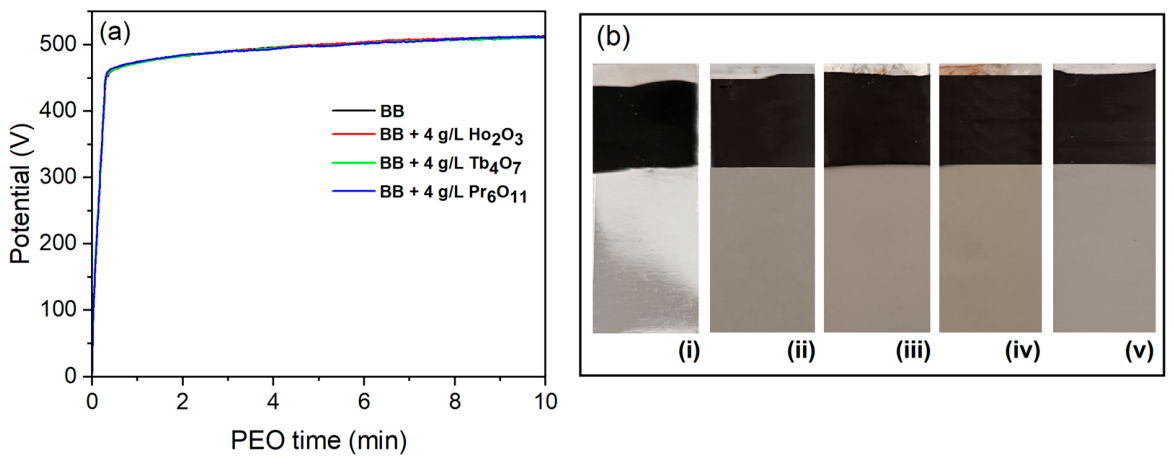
Figure 1a shows the galvanostatic potential–time transients during the PEO of aluminum in BB and in composite electrolytes containing 4 g/L Ho2O3, Tb4O7, and Pr6O11 particles. Particle inclusion had a negligible effect on the potential–time behavior. The process begins with a highly linear potential increase accompanied by vigorous gas evolution, corresponding to the growth of a compact, amorphous Al2O3 barrier layer typical of conventional anodizing [31]. During this initial stage, the total current density is dominated by the ionic component, which typically exceeds the electronic current density by two to three orders of magnitude. As the anodic film thickens, electrons are injected into the oxide conduction band. Accelerated by the intense electric field, these charge carriers trigger impact ionization, resulting in electron avalanches [32]. The onset of the PEO process occurs when this avalanche electronic current reaches a critical threshold at the dielectric breakdown potential, where the electric field strength exceeds the dielectric strength of the passive film. This transition is marked by a deviation from linearity in the potential–time curve and is physically manifested by the appearance of distributed micro-discharges across the substrate surface. As a result, the electronic current density becomes the primary contributor to the total current density. The final stage is characterized by stabilization of the anodic potential (around 500 V). In this steady-state regime, the electronic current density remains dominant, sustaining the plasma state necessary for the synthesis of complex ceramic coatings.
To evaluate the quality of the coatings, Figure 1b shows photos of the aluminum samples before and after the formation of the PEO coatings synthesized in BB and in BB with the addition of 4 g/L Ho2O3, Tb4O7, and Pr6O11 particles. As shown in the photos, the untreated aluminum has a typical metallic, reflective surface. After PEO treatment, the samples display a uniform, matte ceramic appearance confirming the macroscopic uniformity and successful formation of the coatings without visible defects or peeling.
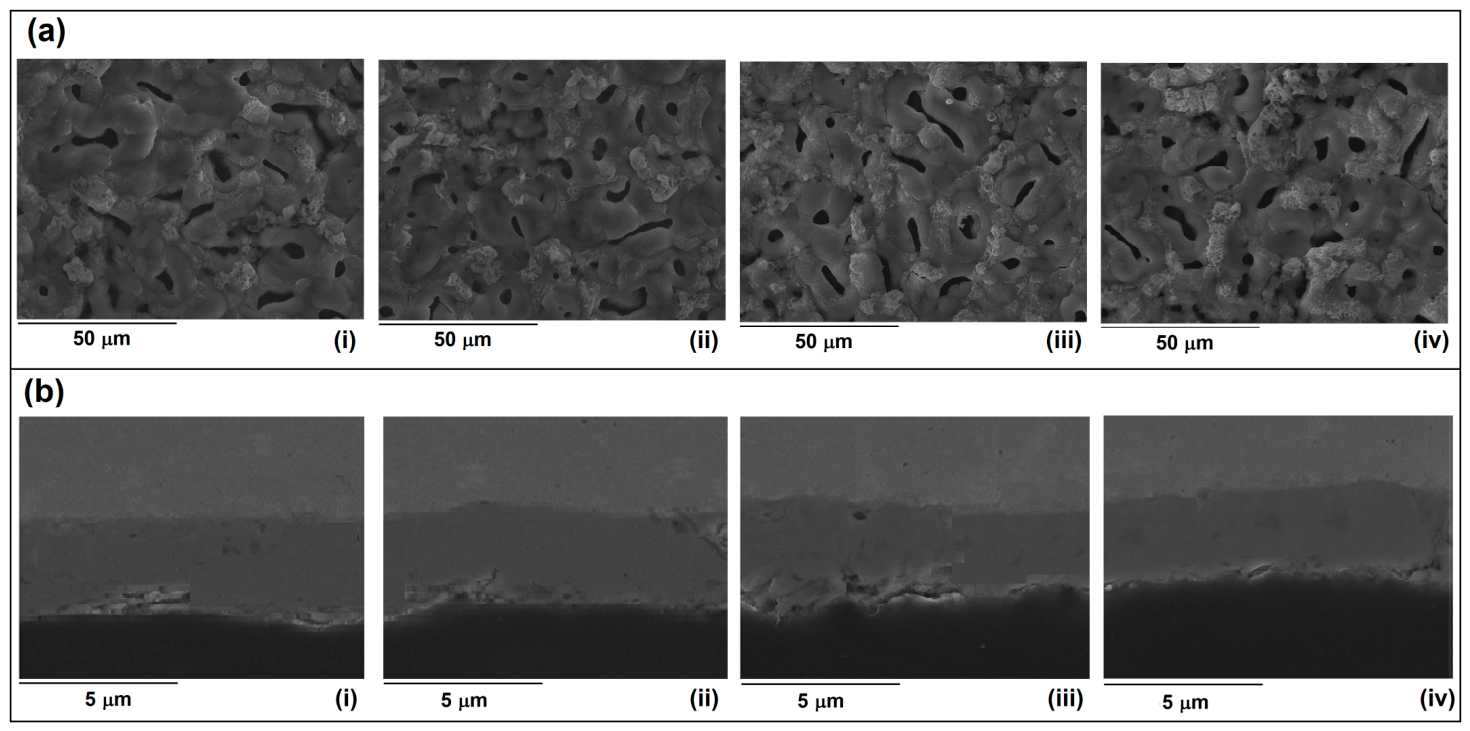
Characteristic SEM micrographs of the coatings synthesized in BB and in BB with the addition of 4 g/L Ho2O3, Tb4O7, and Pr6O11 particles are presented in Figure 2. All surfaces demonstrate the morphological characteristics of PEO coatings on aluminum substrates processed in BB [22,23]. During PEO, high-energy micro-discharges generate intense localized heat that melts both the substrate and the dielectric oxide layer. This thermal surge coincides with anodic reactions that evolve oxygen gas, which becomes trapped as expanding bubbles within the molten phase. Driven by high-pressure gradients, the mixture of molten material and gas is propelled through micro-arc channels toward the electrolyte, where it rapidly quenches and solidifies upon contact. This process creates a distinct microstructure characterized by solidified melt regions and a network of micropores left by evacuated gas bubbles, effectively determining the coating’s final morphology. A 10-min processing duration produced uniformly dense layers with a mean thickness of (6 ± 0.5) μm. Notably, the addition of these RE oxide particles into the BB does not cause significant modifications to the fundamental surface topography and thickness.
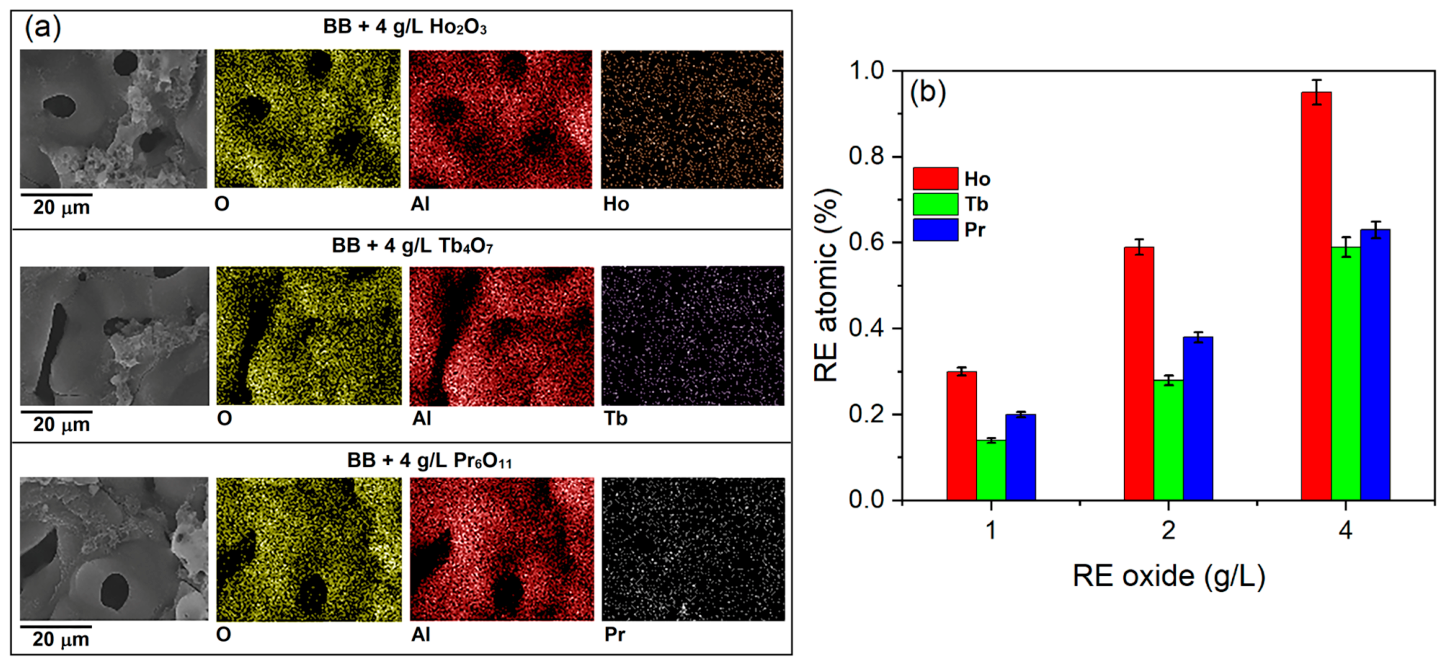
EDS elemental mapping of coatings synthesized in a BB with the addition of 4 g/L Ho2O3, Tb4O7, or Pr6O11 particles (Figure 3a) revealed a uniform spatial distribution of Al, O, and the respective RE elements throughout the composite layer, confirming successful incorporation of RE particles without significant agglomeration. Quantitative analysis of three independent samples and four distinct spatial locations per concentration (Figure 3b) showed that the levels of Ho, Tb, and Pr increased proportionally with the concentration of Ho2O3, Tb4O7, or Pr6O11 particles in the BB. The low standard deviations, represented by error bars, further underscore the high spatial uniformity of the elements.
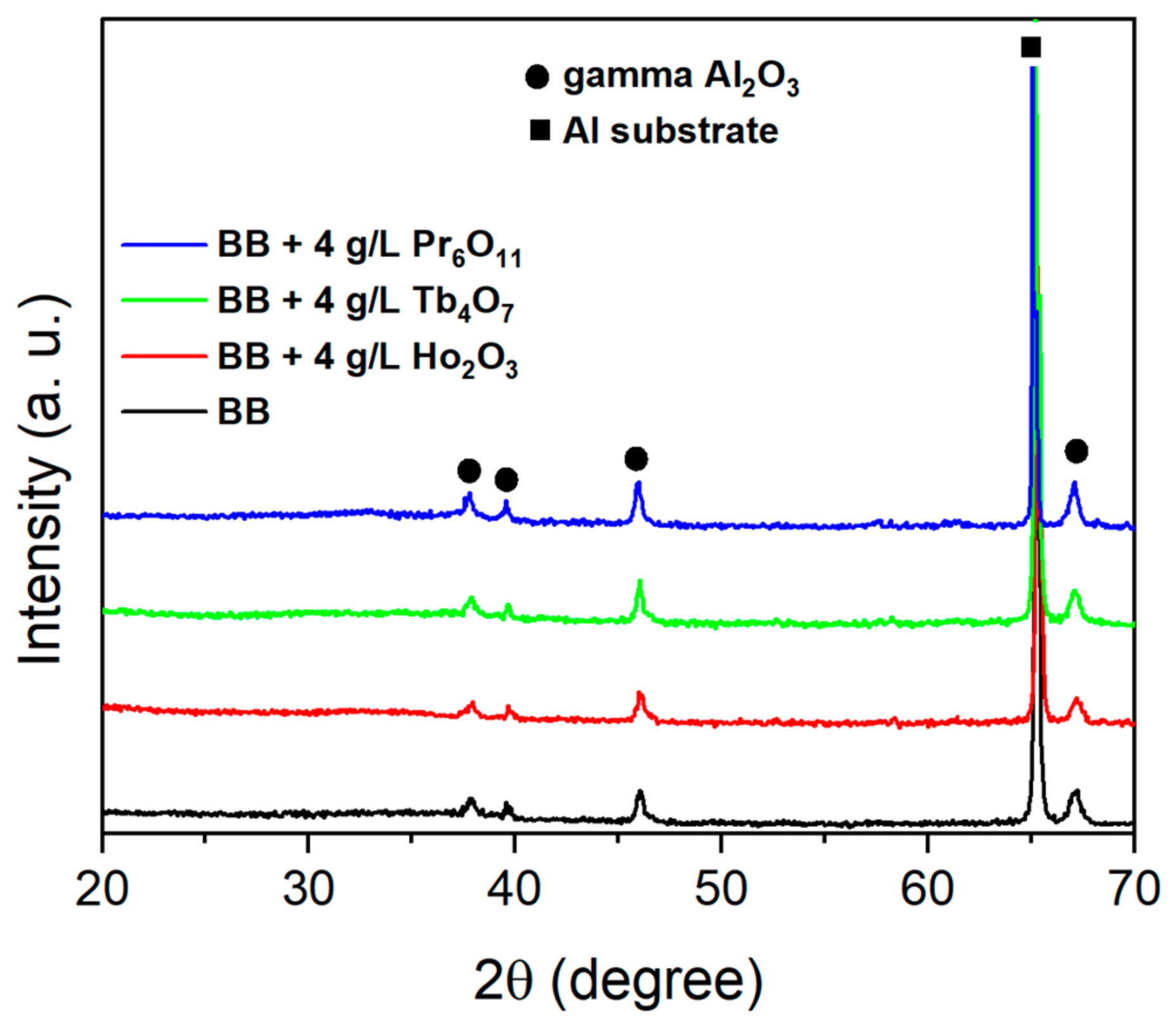
Figure 4 shows the XRD patterns of coatings synthesized in the BB, both without and with 4 g/L Ho2O3, Tb4O7, or Pr6O11 particles. The observed diffraction peaks correspond primarily to the gamma-Al2O3 phase (ICCD card no.: 00-10-0425), a metastable phase whose formation is kinetically favored by the rapid quenching of molten alumina as it exits micro-discharge channels and contacts the cool electrolyte during the PEO process [33]. While Al peaks are detected from the underlying substrate, no discrete reflections for Ho, Tb, or Pr species are visible. This suggests that these RE species are present in concentrations below the XRD detection limit. Given the large mismatch in ionic radii between the massive RE ions and the small Al3+ host site, it is highly likely that they do not substitute directly into the gamma-Al2O3 lattice. Instead, they are expected to exist as highly dispersed species or to be localized at the grain boundaries and defect sites of the host matrix.

3.2. Photocatalytic Efficient of RE-Doped Al2O3 Coatings

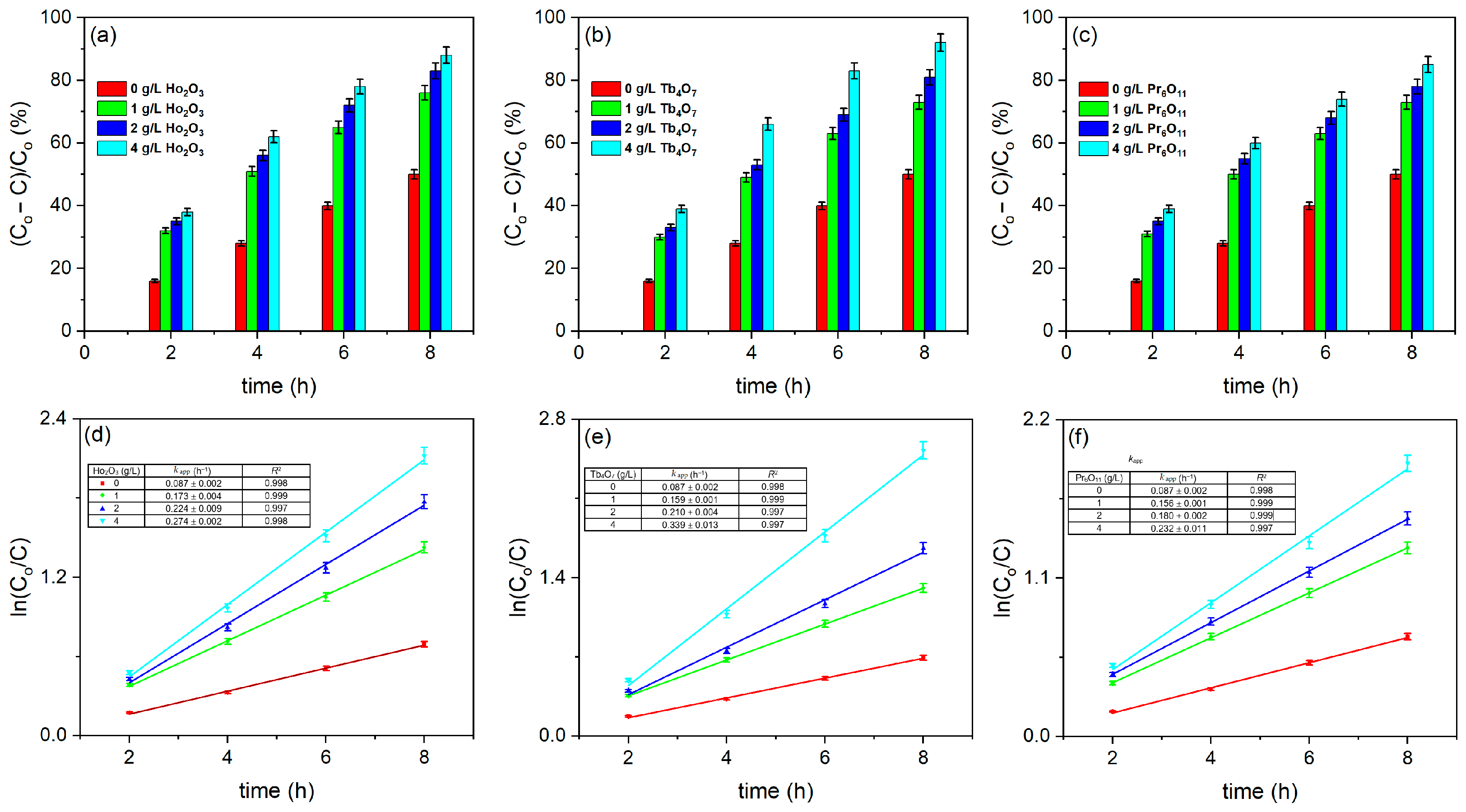
The photocatalytic performance in MO degradation of pure and RE-doped Al2O3 coatings synthesized by PEO in BB with varying concentrations of Ho2O3, Tb4O7, and Pr6O11 particles is shown in Figure 5. To ensure statistical reliability, the reported photocatalytic efficiency values represent the arithmetic mean of five independently prepared samples for each dopant concentration. The experimental data indicate that incorporating RE ions significantly enhances the photocatalytic efficiency of the Al2O3 matrix. While the pristine Al2O3 coatings exhibited a photocatalytic efficiency of approximately 50% after 8 h of irradiation, the RE-doped variants demonstrated superior degradation kinetics. The peak degradation efficiencies were consistently observed at a concentration of 4 g/L for all RE oxides. After the 8-h irradiation period, the maximum degradation reached 88%, 92%, and 85% for coatings synthesized in BB with the addition of 4 g/L Ho2O3, Tb4O7, or Pr6O11, respectively.
The photocatalytic degradation kinetics of MO were modeled using the linearized Langmuir-Hinshelwood expression for pseudo-first-order reactions:
l n C o C = k a p p t
where kapp is the apparent pseudo-first-order rate constant. The kapp values and their corresponding linear correlation coefficients (R2) were obtained from the slopes of the ln(Co/C) versus irradiation time plots (Figure 5d–f). The results show that the composite coatings synthesized in BB with the addition of 4 g/L Ho2O3, Tb4O7, or Pr6O11 achieved kapp values of about 0.274 h−1, 0.339 h−1, and 0.232 h−1, respectively. These values indicate a significant increase in photocatalytic efficiency compared to the pure Al2O3 coating, which had a much lower kapp value of approximately 0.087 h−1 demonstrating that the incorporation of RE effectively accelerates the degradation kinetics.
Since SEM and XRD analyses confirmed that the PEO coatings exhibit uniform morphology, thickness, and phase composition across all samples, the observed disparities in photocatalytic performance are attributed to the incorporation of RE ions into the Al2O3 matrix. The degree of doping is governed by the concentration of Ho2O3, Tb4O7, and Pr6O11 particles in BB. The resulting enhancement in photocatalytic efficiency is likely driven by modulation of charge-carrier recombination kinetics or sensitization of the wide-bandgap Al2O3 host to the visible light spectrum.
PL spectroscopy is an essential diagnostic tool for characterizing and optimizing photocatalytic materials [34,35]. While photocatalysis drives chemical transformations and PL involves radiative relaxation, both are competitive pathways originating from the same initial electronic excitation. Therefore, the efficiency of both processes depends on the underlying spatiotemporal dynamics of photo-excited charge carriers. PL emission occurs when a photo-excited electron recombines radiatively with a hole, emitting a photon. In semiconductor diagnostics, high PL intensity corresponds to increased electron–hole recombination rates, indicating that charge carriers are lost to photon emission rather than participating in chemical reactions. Suppressed PL intensity reflects improved charge separation efficiency. When radiative recombination is inhibited, it often indicates that carriers successfully migrate to the catalyst surface for redox reactions. Analytically, PL intensity serves as an indirect proxy for photocatalytic potential. Because radiative recombination and surface-mediated redox reactions are mutually exclusive decay channels, a reduced PL signal is often a hallmark of high-performance photocatalysts, indicating that charge carriers remain available to drive chemical reactions.
RE ions are essential components in high-performance optical materials due to their unique PL profiles [36]. These characteristics, including narrow-band emission and prolonged excited-state lifetimes, arise from their distinctive electronic configurations, specifically the partially filled 4f subshells. Luminescence in RE-doped systems is primarily governed by two distinct electronic mechanisms: 4f ⟶ 4f and 4f ⟶ 5d transitions [37,38]. In most trivalent RE3+ ions, radiative relaxation occurs via intra-configurational 4f transitions. Because these 4f orbitals are spatially shielded by the filled 5s2 and 5p6 outer shells, they remain largely insulated from the external crystalline electric field. As a result, these transitions produce sharp, atomic-like emission spectra with peak positions that show minimal dependence on the host lattice. In contrast, certain RE ions exhibit inter-configurational 4f ⟶ 5d transitions. Unlike the 4f electrons, the 5d orbitals are parity-allowed and spatially exposed, making the resulting luminescence highly sensitive to the local coordination environment and site symmetry.
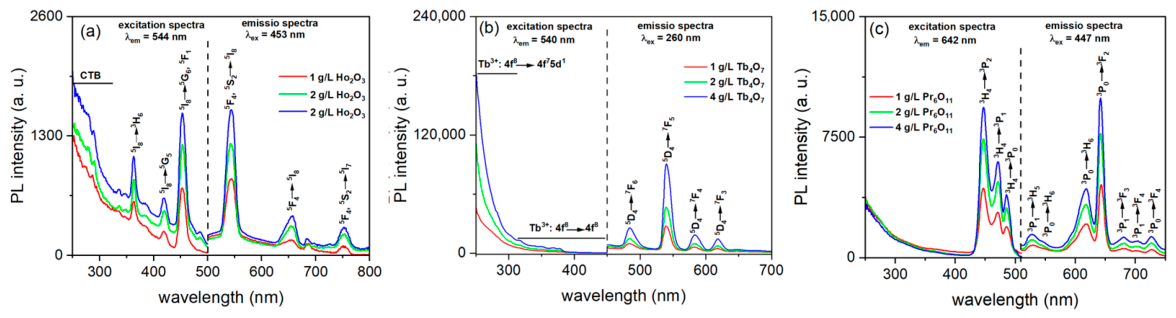
The PL excitation and emission spectra of RE-doped Al2O3 coatings synthesized by PEO in BB with varying concentrations of Ho2O3, Tb4O7, and Pr6O11 particles are shown in Figure 6. Under 453 nm excitation (Figure 6a), three emission bands are observed in the Ho-doped Al2O3 coatings. The strongest green PL emission band between 525 and 560 nm is attributed to the 5F4, 5S25I8 transitions of Ho3+. The other two red bands, with significantly lower PL intensity, correspond to the Ho3+ transitions 5F55I8 (between 620 nm and 670 nm) and 5F4, 5S25I7 (between 735 nm and 780 nm) [39]. The PL excitation spectra monitored at 544 nm, the wavelength of the most intense peak in the PL emission spectra, reveal two primary features. A broad band spanning 250 nm to 325 nm originates from the O 2p ⟶ Ho 4f charge transfer process [40]. A series of sharp, characteristic peaks between 325 nm and 500 nm result from the direct excitation of Ho3+ ions from the 5I8 ground state to higher energy levels within the 4f manifold. Among these transitions, the 5I85G6, 5F1 transitions, with a maximum at 453 nm, show the highest intensity, identifying them as the optimal excitation channel for the observed green luminescence. PL bands in both the excitation and emission spectra increase with the rising concentration of Ho2O3 particles in the BB.
The PL emission and excitation spectra of Tb-doped Al2O3 coatings are shown in Figure 6b. The PL emission spectra excited at 260 nm feature several major emission bands, attributed to the typical 4f ⟶ 4f transitions of Tb3+ ions from the excited level 5D4 to the lower levels 7FJ (J = 3, 4, 5, and 6) [41]. Among these transitions, the green emission corresponding to 5D47F5 at 540 nm is the most dominant. The excitation PL spectra of Tb-doped Al2O3 coatings monitored at 540 nm consist of a broad band in the range from 250 nm to 300 nm, originating from the spin-allowed 4f8 ⟶ 4f75d1 transition of Tb3+ ions, and several small PL bands in the spectral range 300–450 nm corresponding to 4f ⟶ 4f transitions of Tb3+ ions [41]. The PL intensity of Tb3+ bands in both the excitation and emission spectra showed a positive correlation with the increasing concentration of Tb4O7 particles in the BB.
Figure 6c shows the PL emission spectra excited at 447 nm (3H43P2 transition of Pr3+) and the corresponding PL excitation spectra monitored at 642 nm (3P03F2 transition of Pr3+) for the Pr-doped Al2O3 coatings. The PL emission spectra, recorded in the 500–750 nm range, display characteristic bands originating from the 4f-4f intra-configurational transitions of Pr3+ [42]. These signals result from the relaxation of the 3P0 and 3P1 excited states to the lower-lying 3HJ (J = 4, 5, 6) and 3FJ (J = 2, 3, 4) manifolds. Notably, the red emission centered at 642 nm (3P03F2) is the dominant transition in the spectra. The PL excitation spectra show three distinct bands attributed to direct electronic excitation from the 3H4 ground state to the 3PJ (J = 0, 1, 2) upper states. A positive correlation was observed between the Pr-doping concentration and the PL response. The PL intensity of the Pr3+ bands increases proportionally with the concentration of Pr6O11 particles in the BB, confirming the successful integration of Pr ions into the Al2O3 matrix.
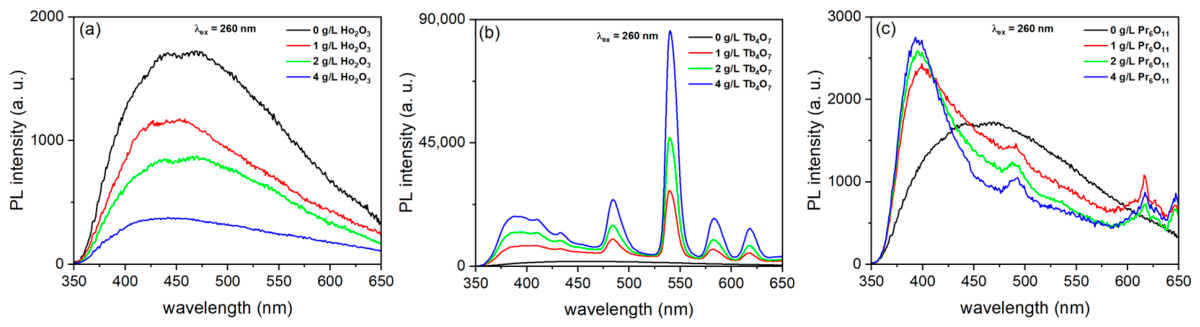
The PL measurements presented in Figure 6 confirm that RE3+ is the predominant oxidation state for RE ions incorporated into the Al2O3 matrix. To elucidate the influence of these trivalent dopants on the photocatalytic efficacy of the Al2O3 coatings, it is necessary to assess their impact on the radiative transitions of the host lattice. Al2O3 coatings synthesized in BB exhibit the most intense PL under excitation at 260 nm [28]. Figure 7 shows the PL emission spectra, excited at 260 nm, for RE-doped Al2O3 coatings synthesized by PEO in BB, with varying concentrations of Ho2O3, Tb4O7, and Pr6O11 particles. The PL emission spectrum of pure Al2O3 coating is characterized by broad bands in the visible region, attributed to the presence of F+ and F centers [43]. Incorporation of Ho3+ ions induce pronounced quenching of these intrinsic Al2O3 PL bands (Figure 7a). A systematic, concentration-dependent attenuation of the PL emission intensity is observed, suggesting that Ho3+ centers act as efficient non-radiative recombination centers or charge-carrier traps. By establishing competitive charge-transfer pathways, these dopants facilitate the spatial separation of photo-generated electron–hole pairs, thereby suppressing radiative recombination and diminishing the cumulative PL yield. A similar trend is observed in Pr3+-doped Al2O3 coatings. The spectra reveal a high-intensity band between 350 nm and 450 nm, corresponding to the 5d-4f transitions of Pr3+, and multiple lower-intensity bands associated with characteristic 4f-4f transitions [44]. As the concentration of incorporated Pr3+ increases, the intrinsic Al2O3 PL emission is suppressed, while the specific Pr3+ transition bands increase slightly in intensity. These findings indicate that Pr3+ ions similarly inhibit the radiative recombination of the host matrix, effectively modulating the electronic environment of the Al2O3 bands. Tb3+ ions exhibit intense PL that spectrally overlaps with the intrinsic emission of Al2O3. This complicates direct deconvolution of the host PL response, but the consistent behavior of Ho3+ and Pr3+ suggests that Tb3+ has a similar effect on charge carrier dynamics.
The distinct splitting and intensity of the RE3+ emission bands (Figure 6) serve as an internal probe of the local crystal field within the PEO-grown Al2O3 matrix. The high sensitivity of the 4f-5d transitions in Tb3+ and Pr3+ to their coordination environment indicates that the RE ions occupy sites that effectively facilitate electronic interaction with the host lattice, thereby optimizing the charge-trapping process necessary for enhanced photocatalysis.
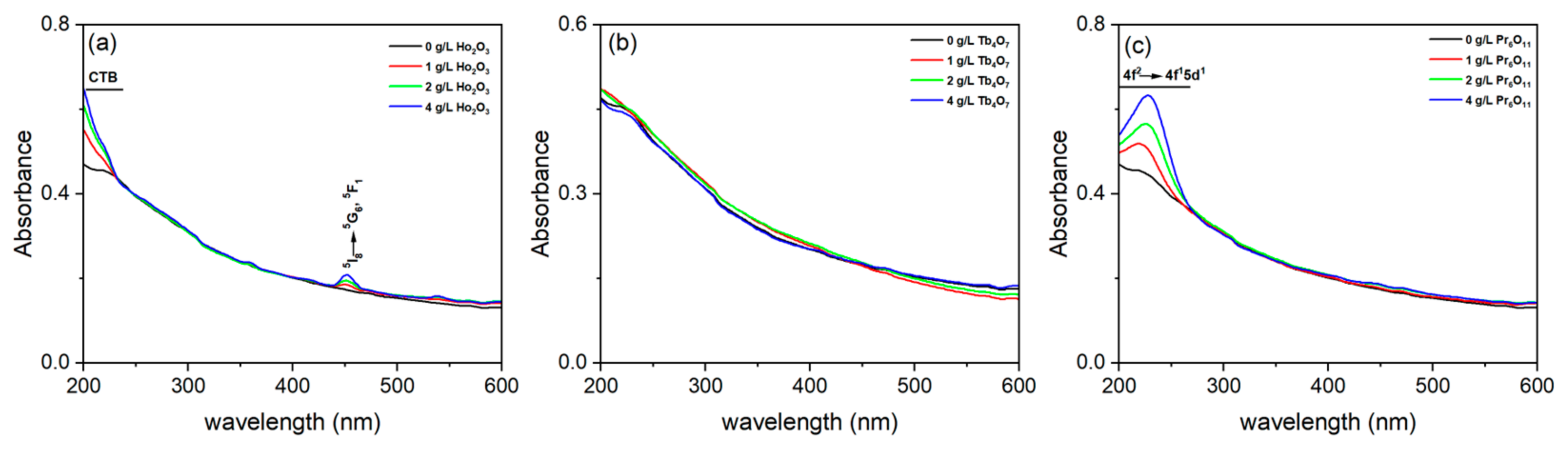
The DRS results, which illustrate the optical absorption characteristics of the synthesized coatings, are shown in Figure 8. The absorption profile is mainly determined by the wide band gap of the Al2O3 matrix, resulting in dominant, broad absorption features in the mid-ultraviolet spectral region [28]. Depending on its crystalline phase, pure Al2O3 has a broad band gap that typically ranges from 7.0 eV to 8.8 eV [8]. In contrast, PEO-synthesized Al2O3 coatings in BB electrolyte exhibit a significantly smaller optical band gap of approximately 4.6 eV [28]. Defect-induced electronic states (DS) in the forbidden energy region are responsible for this notable decrease compared to the stoichiometric standard [45]. The presence of oxygen vacancies, interstitial aluminum ions, and high-density grain boundaries introduces intermediate energy levels between the valence and conduction bands, enabling lower-energy electronic transitions.
The incorporation of Ho3+ dopants causes subtle changes in these optical properties (Figure 8a). Specifically, a distinct, low-intensity absorption band appears at approximately 452 nm, attributed to the 5I85G6, 5F1 electronic transitions within the Ho3+ ions. Additionally, the increased absorption observed between 200 nm and 250 nm is assigned to the electronic transition from the O2− (2p) orbitals to the Ho3+ (4f) orbitals (charge transfer band—CTB) [46]. While the incorporation of Tb3+ ions into the Al2O3 matrix causes negligible changes to the host’s absorption profile (Figure 8b), the incorporation of Pr3+ dopants induces a prominent absorption band in the 200–270 nm spectral range (Figure 8c). This feature is attributed to the parity-allowed 4f2 ⟶ 4f15d1 electronic transitions of Pr3+ ions.
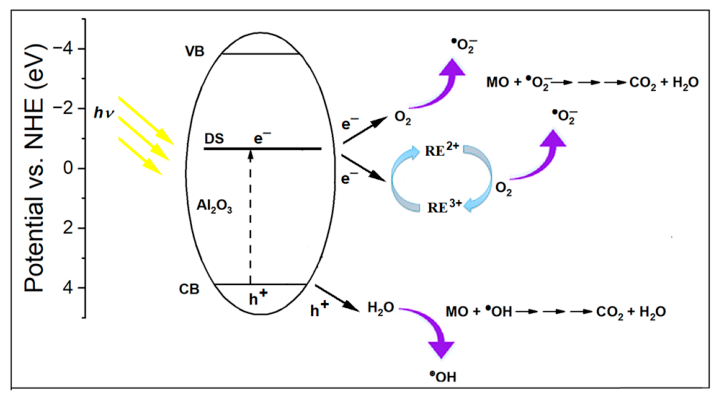
Based on the preceding results, it can be inferred that the primary role of incorporated RE3+ ions in the Al2O3 matrix is to inhibit the recombination of photo-generated electron–hole pairs. This is supported by the observation that adding RE oxide particles to the BB produces no discernible impact on the morphology, crystal structure, or visible-light absorption properties of the coatings. A proposed mechanism for the improved photocatalytic performance of RE-doped Al2O3 coatings in MO degradation is detailed below and illustrated schematically in Figure 9. Upon excitation by ultraviolet radiation, the Al2O3 coatings generate electrons (e) and holes (h+). Photo-generated electrons from the Al2O3 are effectively sequestered by the partially filled 4f orbitals of the RE ions (RE3+ + e ⟶ RE2+) [47]. This confinement mitigates the rapid recombination of electron–hole pairs, a primary kinetic bottleneck in photocatalysis. Adsorbed oxygen molecules subsequently scavenge these trapped electrons to form superoxide radicals O2 (RE2+ + O2 ⟶ RE3+ + O2). Concurrently, holes from the Al2O3 valence band react with adsorbed water or hydroxide ions to produce hydroxyl radicals OH (h+ + H2O ⟶ H+ + OH; h+ + OHOH). These ROS are the primary agents for the oxidative degradation of organic pollutants. Furthermore, the incorporation of RE ions induces structural defects, specifically oxygen vacancies. These vacancies facilitate electron transfer between the reactants and the photocatalyst and are intrinsically linked to the active sites in heterogeneous photocatalytic reactions [48]. Oxygen species (O2 and OH) can be adsorbed at these vacancy sites and converted into OH and O2, further accelerating the photocatalytic degradation process [48].
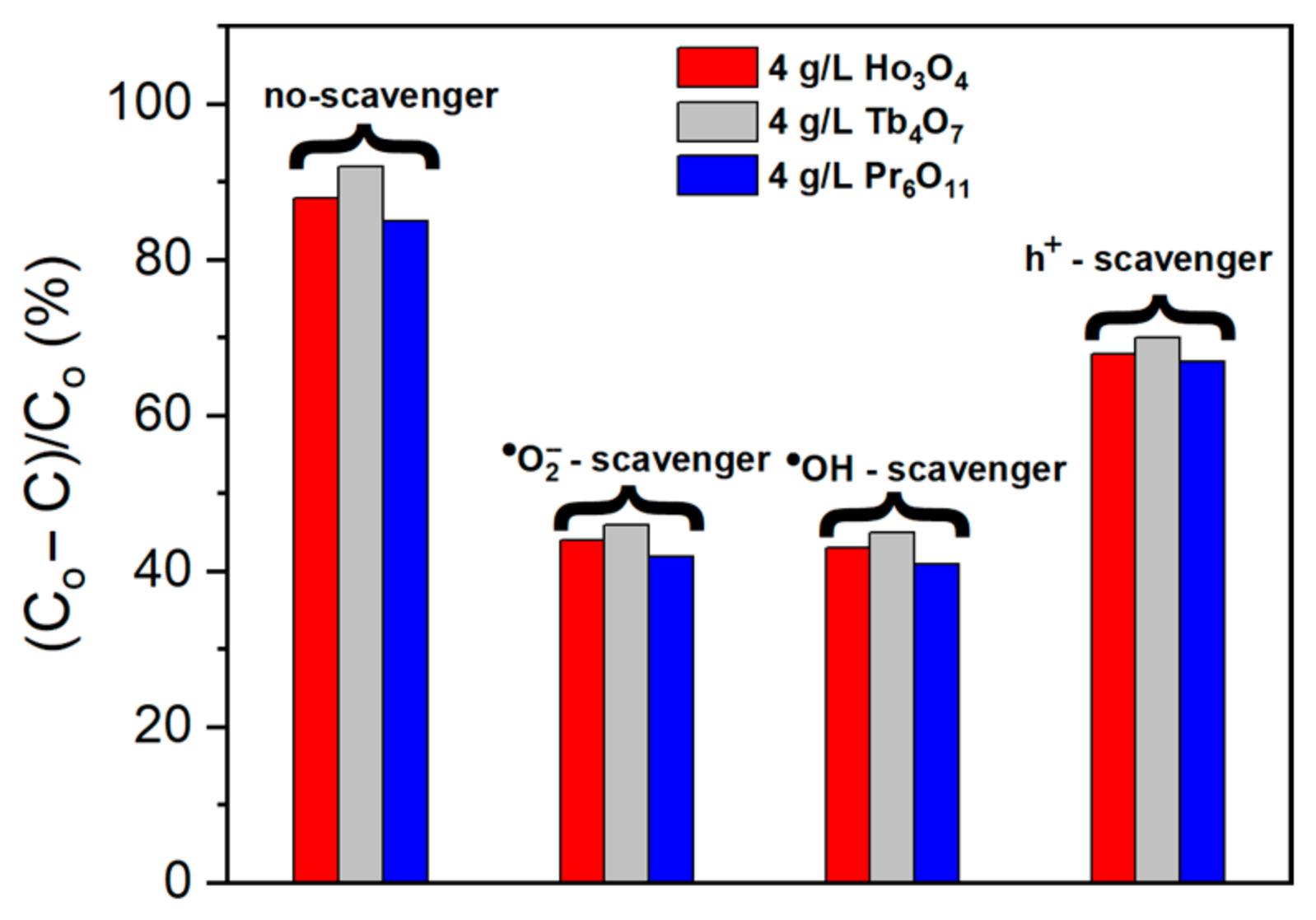
To clarify the role of ROS in MO photo-degradation, in situ radical scavenging experiments were conducted. The observed inhibitory effects indicate that OH and O2 radicals are the primary ROS responsible for the degradation process (Figure 10). These highly potent, non-selective oxidants promote the oxidative cleavage of the MO molecular framework, ultimately leading to complete mineralization into benign end products.
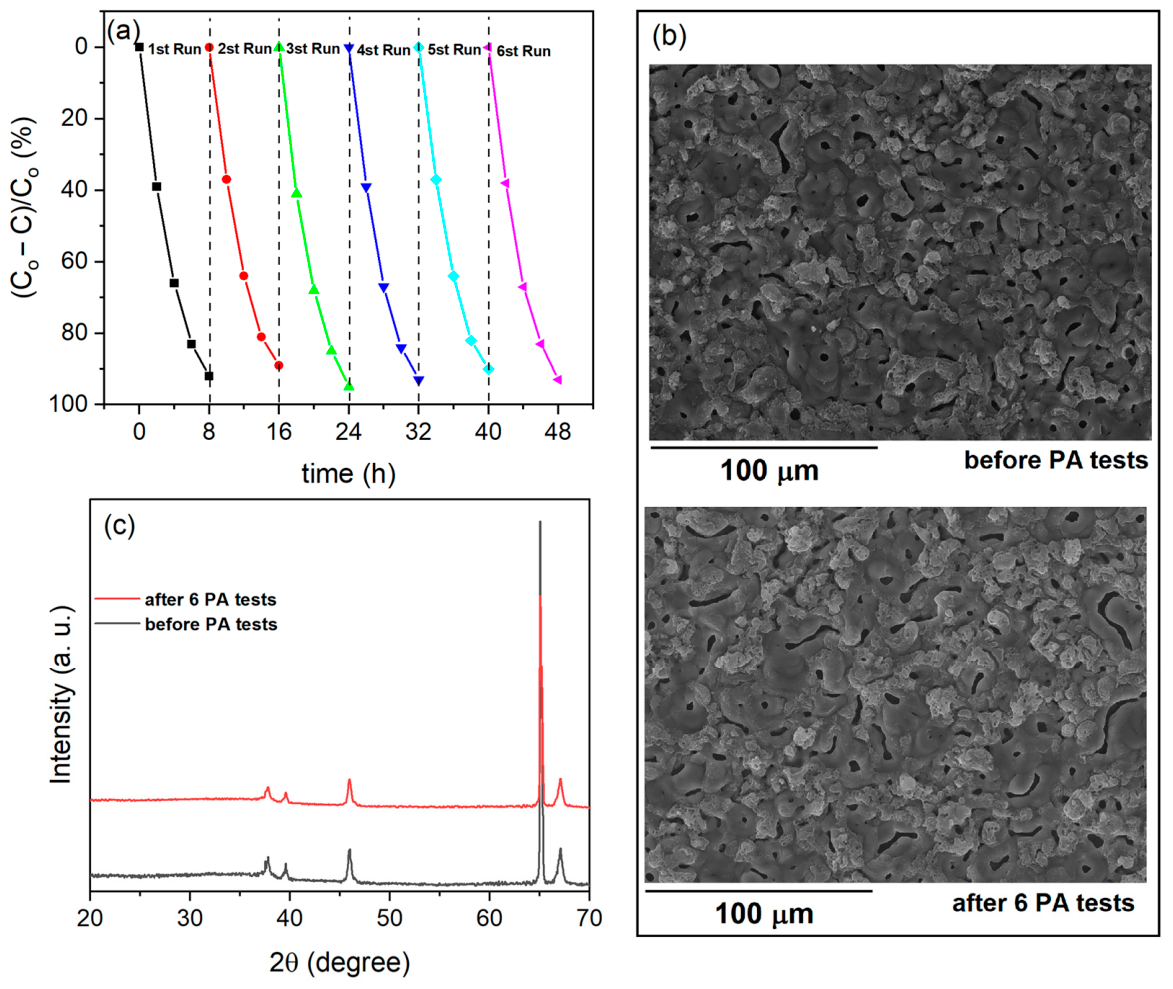
The choice between suspended and immobilized photocatalysts involves a trade-off between interfacial kinetics and engineering feasibility. Suspended powders provide superior surface area and higher initial reaction rates but are hindered by particle aggregation, limited light penetration due to turbidity, and high energy costs for post-treatment separation. Additionally, loose nanoparticles present significant inhalation and environmental toxicity risks. In contrast, immobilized catalysts, though sometimes limited by mass transfer, eliminate the need for complex recovery steps, enable continuous-flow processing, and reduce bioavailability hazards, making them more suitable for industrial-scale environmental remediation. A key factor in the industrial viability of immobilized photocatalysts is their physicochemical stability, which determines both operational lifespan and overall cost-effectiveness. To assess the long-term performance of RE-doped Al2O3 photocatalysts, the recyclability of the most efficient coating synthesized in BB with the addition of 4 g/L Tb4O7 particles was tested over six consecutive degradation cycles. As shown in Figure 11a, the PA demonstrated remarkable stability throughout the experiment. Post-experimental analysis showed no structural breakdown (Figure 11b), and the crystalline structure remained unchanged (Figure 11c).

4. Conclusions

This study demonstrated the synthesis of rare earth (RE) doped gamma-Al2O3 coatings on aluminum substrates using a one-step plasma electrolytic oxidation (PEO) process. After adding Ho2O3, Tb4O7, and Pr6O11 particles to a borax and boric acid electrolyte, the following conclusions were drawn:
  • The PEO process produced porous, crystalline coatings dominated by the gamma-Al2O3 phase. Although the concentration of RE dopants increased proportionally with their concentration in the electrolyte, the fundamental surface morphology and crystal structure of the alumina matrix remained unchanged, ensuring consistent physical properties across all samples.
  • The incorporation of RE3+ ions significantly improved the degradation efficiency of methyl orange (MO) under simulated solar irradiation. The optimal concentration for all RE oxides was 4 g/L. At this level, Tb-doped coatings achieved the highest degradation efficiency (92%), followed by Ho-doped (88%) and Pr-doped (85%) coatings, all substantially outperforming undoped Al2O3 (~50%).
  • Photoluminescence spectroscopy confirmed that RE3+ ions (Ho3+, Tb3+, and Pr3+) were successfully incorporated into the lattice. The observed quenching of the intrinsic Al2O3 emission bands indicates that these RE ions act as effective charge-carrier traps. This mechanism suppresses the radiative recombination of photo-generated electron–hole pairs, thereby increasing the availability of charge carriers for redox reactions.
  • Radical scavenging experiments identified OH and O2 radicals as the primary reactive oxygen species (ROS) responsible for the mineralization of MO. The RE dopants facilitate the formation of these ROS by sequestering electrons and promoting the creation of structural defects such as oxygen vacancies.
  • The RE-doped Al2O3 coatings exhibited exceptional mechanical and chemical stability, maintaining high photocatalytic activity over six consecutive cycles without structural degradation or phase changes.
In summary, RE doping via PEO transforms wide-bandgap Al2O3 coatings into a high-performance, reusable, and stable photocatalyst. This approach provides a promising and environmentally friendly solution for advanced remediation of recalcitrant organic pollutants in industrial wastewater.

Author Contributions

Conceptualization, S.S. and N.R.; methodology, S.S.; validation, S.S., D.A.T.-C., S.A.-R. and N.R.; formal analysis, S.S.; investigation, S.S., D.A.T.-C., S.A.-R. and N.R.; writing—original draft preparation, S.S., D.A.T.-C., S.A.-R. and N.R.; writing—review and editing, S.S.; visualization, D.A.T.-C., S.A.-R. and N.R.; supervision, S.S.; project administration, S.S. and N.R.; funding acquisition, S.S. All authors have read and agreed to the published version of the manuscript.

Funding

This research was funded by the Ministry of Science, Innovation, and Technological Development of the Republic of Serbia (Grants 451-03-34/2026-03/200162 and 451-03-136/2025-03/200026) and the Science Fund of the Republic of Serbia, grant number 7309 ZEOCOAT.

Data Availability Statement

The data presented in this study are available on request from the corresponding author.

Conflicts of Interest

The authors declare no conflicts of interest.

References

  1. Mishra, R.K.; Mentha, S.S.; Misra, Y.; Dwivedi, N. Emerging pollutants of severe environmental concern in water and wastewater: A comprehensive review on current developments and future research. Water-Energy Nexus 2023, 6, 74–95. [Google Scholar] [CrossRef]
  2. Danish, M.S.S.; Estrella, L.L.; Alemaida, I.M.A.; Lisin, A.; Moiseev, N.; Ahmadi, M.; Nazari, M.; Wali, M.; Zaheb, H.; Senjyu, T. Photocatalytic applications of metal oxides for sustainable environmental remediation. Metals 2021, 11, 80. [Google Scholar] [CrossRef]
  3. Miad, A.A.; Saikat, S.P.; Alam, M.K.; Hossain, M.S.; Bahadur, N.M.; Ahmed, S. Metal oxide-based photocatalysts for the efficient degradation of organic pollutants for a sustainable environment: A review. Nanoscale Adv. 2024, 6, 4781–4803. [Google Scholar] [CrossRef] [PubMed]
  4. Krishnan, A.; Swarnalal, A.; Das, D.; Krishnan, M.; Saji, V.S.; Shibli, S.M.A. A review on transition metal oxides based photocatalysts for degradation of synthetic organic pollutants. J. Environ. Sci. 2024, 39, 389–417. [Google Scholar] [CrossRef]
  5. Shukla, S.; Pandey, H.; Singh, P.; Tiwari, A.K.; Baranwal, V.; Pandey, A.C. Synergistic impact of photocatalyst and dopants on pharmaceutical-polluted waste water treatment: A review. Environ. Pollut. Bioavailab. 2021, 33, 347–364. [Google Scholar] [CrossRef]
  6. Abyzov, A.M. Aluminium oxide and alumina ceramics (review). Part 1. Properties of Al2O3 and commercial production of dispersed Al2O3. Refract. Ind. Ceram. 2019, 60, 24–32. [Google Scholar] [CrossRef]
  7. Houska, J.; Blazek, J.; Rezek, J.; Proksova, S. Overview of optical properties of Al2O3 films prepared by various techniques. Thin Solid Films 2012, 520, 5405–5408. [Google Scholar] [CrossRef]
  8. Filatova, E.O.; Konashuk, A.S. Interpretation of the changing the band gap of Al2O3 depending on its crystalline form: Connection with different local symmetries. J. Phys. Chem. 2015, 119, 20755–20761. [Google Scholar] [CrossRef]
  9. Anucha, C.B.; Bacaksiz, E.; Stathopoulos, V.N.; Pandis, P.K.; Argirusis, C.; Andreouli, C.-D.; Tatoudi, Z.; Altin, I. Preparation and characterization of supported molybdenum doped TiO2 on Al2O3 ceramic substrate for the photocatalytic degradation of ibuprofen (IBU) under UV irradiation. Catalysts 2022, 12, 562. [Google Scholar] [CrossRef]
  10. He, X.; Jin, T.; Wang, M.; Huang, A.; Li, L. Fabrication and characterization of hierarchically macroporous Al2O3 ceramic supported ZnO/ZnS photocatalyst. Ceram. Int. 2025, 51, 1247–1258. [Google Scholar] [CrossRef]
  11. Li, M.; Li, D.; Zhang, Z.; Ji, C.; Zhou, S.; Guo, W.; Zhao, C.; Liu, F.; Han, F. Study on the performance and mechanism of degradation of toluene with non-thermal plasmas synergized supported TiO2/γ-Al2O3 catalyst. J. Environ. Chem. Eng. 2021, 9, 105529. [Google Scholar] [CrossRef]
  12. Karbasi, M.; Chaharmahali, E.N.R.; Hosseini, R.; Giannakis, S.; Bahramian, H.; Kaseem, M.; Fattah-alhosseini, A. A review on plasma electrolytic oxidation coatings for organic pollutant degradation: How to prepare them and what to expect of them? J. Environ. Chem. Eng. 2023, 11, 110027. [Google Scholar] [CrossRef]
  13. Samadi, P.; Witonska, I.A. Plasma electrolytic oxidation layers as alternative supports for metallic catalysts used in oxidation reaction for environmental application. Catal. Commun. 2023, 181, 106722. [Google Scholar] [CrossRef]
  14. Saji, V.S. Plasma electrolytic oxidation (PEO) layers grown on metals and alloys as supported photocatalysts. Next Energy 2025, 8, 100259. [Google Scholar] [CrossRef]
  15. Kaseem, M.; Fatimah, S.; Nashrah, N.; Ko, Y.G. Recent progress in surface modification of metals coated by plasma electrolytic oxidation: Principle, structure, and performance. Prog. Mater. Sci. 2021, 117, 100735. [Google Scholar] [CrossRef]
  16. Sikdar, S.; Menezes, P.V.; Maccione, R.; Jacob, T.; Menezes, P.L. Plasma electrolytic oxidation (PEO) process-processing, properties, and applications. Nanomaterials 2021, 11, 1375. [Google Scholar] [CrossRef]
  17. Clyne, T.W.; Troughton, S.C. A review of recent work on discharge characteristics during plasma electrolytic oxidation of various metals. Int. Mater. Rev. 2019, 64, 127–162. [Google Scholar] [CrossRef]
  18. Fattah-alhosseini, A.; Chaharmahali, R.; Alizad, S.; Babaei, K.; Stojadinović, S. A review on the revealed improved photocatalytic activity of PEO coatings applied on Al alloys. Nano-Struct. Nano-Objects 2024, 39, 101233. [Google Scholar] [CrossRef]
  19. Stojadinović, S.; Tadić, N.; Radić, N.; Stojadinović, B.; Grbić, B.; Vasilić, R. Synthesis and characterization of Al2O3/ZnO coatings formed by plasma electrolytic oxidation. Surf. Coat. Technol. 2015, 276, 573–579. [Google Scholar] [CrossRef]
  20. Tadić, N.; Stojadinović, S.; Radić, N.; Grbić, B.; Vasilić, R. Characterization and photocatalytic properties of tungsten doped TiO2 coatings on aluminum obtained by plasma electrolytic oxidation. Surf. Coat. Technol. 2016, 305, 192–199. [Google Scholar] [CrossRef]
  21. Pezzato, L.; Colusso, E.; Cerchier, P.; Settimi, A.G.; Brunelli, K. Production and characterization of photocatalytic PEO coatings containing TiO2 powders recovered from wastes. Coatings 2023, 13, 411. [Google Scholar] [CrossRef]
  22. Stojadinović, S.; Pjević, D.; Rajić, V.; Radić, N. Impact of WO3 or Co3O4 particles incorporation on the structural and photocatalytic properties of plasma electrolytically oxidized Al2O3 coatings on aluminum. Mater. Sci. Semicond. Process. 2026, 206, 110447. [Google Scholar] [CrossRef]
  23. Stojadinović, S.; Pjević, D.; Rajić, V.; Radić, N. The effect of in-situ incorporation of CuO and MnO2 particles into Al2O3 coatings by plasma electrolytic oxidation of aluminum on their photocatalytic performance. Appl. Surf. Sci. 2026, 720, 165354. [Google Scholar] [CrossRef]
  24. Hanafi, M.F.; Sapawe, N. A review on the water problem associate with organic pollutants derived from phenol, methyl orange, and remazol brilliant blue dyes. Mater. Today Proc. 2020, 31, A141–A150. [Google Scholar] [CrossRef]
  25. Zheng, A.L.T.; Sinin, A.E.; Jin, W.T.; Feng, K.L.; Boonyuen, S.; Chung, E.L.T.; Lease, J.; Andou, Y. Rare earth elements for enhancing photocatalysis in pollutant degradation and water treatment. Int. J. Environ. Sci. Technol. 2025, 22, 7247–7270. [Google Scholar] [CrossRef]
  26. Palariya, D.; Mehtab, S.; Aziz, M.; Zaidi, M.G.H. Exploring rare earth element doped nanocomposites as promising photocatalysts for dyes degradation in water. Water Air Soil Pollut. 2024, 235, 286. [Google Scholar] [CrossRef]
  27. An, J.; Qu, Y. The multiple roles of rare earth elements in the field of photocatalysis. Inorg. Chem. Front. 2024, 11, 11–28. [Google Scholar] [CrossRef]
  28. Stojadinović, S.; Radić, N. Photocatalytic activity of Al2O3:Eu2+ and Al2O3:Ce3+ coatings formed by plasma electrolytic oxidation of aluminum. J. Phys. Chem. Solids 2025, 203, 112709. [Google Scholar] [CrossRef]
  29. Ćirić, A.; Stojadinović, S. Photoluminescence of ZrO2:Gd3+ and ZrO2:Dy3+ coatings formed by the plasma electrolytic oxidation. J. Alloys Compd. 2020, 832, 154907. [Google Scholar] [CrossRef]
  30. Stojadinović, S.; Radić, N.; Perković, M. Highly efficient ZrO2 photocatalysts in the presence of UV radiation synthesized in a very short time by plasma electrolytic oxidation of zirconium. Opt. Mater. 2023, 146, 114608. [Google Scholar] [CrossRef]
  31. Diggle, J.W.; Downie, T.C.; Goulding, C.W. Anodic oxide films on aluminum. Chem. Rev. 1969, 69, 365–405. [Google Scholar] [CrossRef]
  32. Albella, J.M.; Montero, I.; Martinez-Duart, J.M. A theory of avalanche breakdown during anodic oxidation. Electrochim. Acta 1987, 32, 255–258. [Google Scholar] [CrossRef]
  33. McPherson, R. Formation of metastable phases in flame- and plasma-prepared alumina. J. Mater. Sci. 1973, 8, 851–858. [Google Scholar] [CrossRef]
  34. Li, Q.; Anpo, M.; Wang, X. Application of photoluminescence spectroscopy to elucidate photocatalytic reactions at the molecular level. Res. Chem. Intermed. 2020, 46, 4325–4344. [Google Scholar] [CrossRef]
  35. Liqiang, J.; Yichun, Q.; Baiqi, W.; Shudan, L.; Baojiang, J.; Libin, Y.; Wei, F.; Honggang, F.; Jiazhong, S. Review of photoluminescence performance of nano-sized semiconductor materials and its relationships with photocatalytic activity. Sol. Energy Mater. Sol. Cells 2006, 90, 1773–1787. [Google Scholar] [CrossRef]
  36. Kiran, R.; Kamath, N.; Sayyed, M.I.; Almuqrin, A.H.; Kamath, S.D. A review of recent developments in rare earth-doped nanophosphors for emerging technological applications. RSC Adv. 2025, 15, 20040–20060. [Google Scholar] [CrossRef]
  37. Gupta, I.; Singh, S.; Bhagwan, S.; Singh, D. Rare earth (RE) doped phosphors and their emerging applications: A review. Ceram. Int. 2021, 47, 19282–19303. [Google Scholar] [CrossRef]
  38. Qin, X.; Liu, X.; Huang, W.; Bettinelli, M.; Liu, X. Lanthanide-activated phosphors based on 4f-5d optical transitions: Theoretical and experimental aspects. Chem. Rev. 2017, 117, 4488–4527. [Google Scholar] [CrossRef]
  39. Madhu, A.; Alqarni, A.S.; Kesavulu, C.R.; Uthayakumar, T.; Yaduvanshi, N.; Angadi, B.; Jeffery, A.A.; Srinatha, N. Evaluation of structural and spectroscopic properties of Ho3+-doped Li2O-Al2O3-ZnO-B2O3 glasses. J. Alloys Compd. 2025, 1043, 284276. [Google Scholar] [CrossRef]
  40. You, J.; Ma, L.; Qu, Y.; Li, R.; Liu, X.; Guo, R. UC/DC luminescence of Ho3+ doped pyrochlore structured La2(1–x)Yb2xTiO5 phosphor synthesized by sol-gel method. J. Rare Earths 2016, 34, 235–239. [Google Scholar] [CrossRef]
  41. Kostyukov, A.I.; Snytnikov, V.N.; Rakhmanova, M.I.; Kostyukova, N.Y.; Snytnikov, V.N. Luminescent properties of Al2O3:Tb3+ nanoparticles obtained by cw CO2 laser vaporization. Opt. Mater. 2020, 110, 110508. [Google Scholar] [CrossRef]
  42. Ren, H.; Huang, L.; Cheng, Z.; Huang, B.; Hao, Y.; Xiong, G.; Zhu, Z.; Zhang, H.; Xu, S.; Deng, W. The effect of Pr3+ concentration on the microstructure, luminescence and scintillation properties of Pr:LuAG single crystals. J. Alloys Compd. 2024, 971, 172768. [Google Scholar] [CrossRef]
  43. Stojadinovic, S.; Vasilic, R.; Nedic, Z.; Kasalica, B.; Belca, I.; Zekovic, L. Photoluminescent properties of barrier anodic oxide films on aluminum. Thin Solid Films 2011, 519, 3516–3521. [Google Scholar] [CrossRef]
  44. Kitagawa, Y.; Nakamura, H.; Shinozaki, K. Concentration quenching behavior of Stokes and upconversion luminescence for Pr3+-doped Y3Al5O12. J. Mater. Chem. C 2024, 12, 18865–18876. [Google Scholar] [CrossRef]
  45. Nettar, C.B.; Bhowmik, R.N.; Sinha, A.K. A comparative study of the lattice structure, optical band gap, electrical conductivity and polarization at different stages of the heat treatment of chemical routed Al(OH)3. Ceram. Int. 2022, 28, 10677–10687. [Google Scholar] [CrossRef]
  46. Singh, V.; Bhat, A.A.; Kadam, A.R.; Saravanakumar, S.; Tripathi, P.K.; Dhoble, S.J.; Joo, J.B. Optimal doping of Ho3+ in CaTiO3 perovskite for enhanced photoluminescence and sustainable green emission. J. Electron. Mater. 2024, 53, 6384–6394. [Google Scholar] [CrossRef]
  47. Radha, E.; Komaraiah, D.; Sayanna, R.; Sivakumar, J. Photoluminescence and photocatalytic activity of rare earth ions doped anatase TiO2 thin films. J. Lumin. 2022, 244, 118727. [Google Scholar] [CrossRef]
  48. Hao, L.; Huang, H.; Zhang, Y.; Ma, T. Oxygen vacant semiconductor photocatalysts. Adv. Funct. Mater. 2021, 31, 2100919. [Google Scholar] [CrossRef]
Figure 1. (a) Potential–time curves during PEO in BB and in BB with the addition of Ho2O3, Tb4O7, and Pr6O11; (b) Photos of: (i) the aluminum sample, and the samples after the formation of the PEO coatings in: (ii) BB; (iii) BB + 4 g/L Ho2O3; (iv) BB + 4 g/L Tb4O7; (v) BB + 4 g/L Pr6O11.
Ceramics 09 00042 g001
Figure 2. (a) Top view; (b) cross-section; SEM micrographs of coatings synthesized in: (i) BB; (ii) BE + 4 g/L Ho2O3; (iii) BB + 4 g/L Tb4O7; (iv) BB + 4 g/L Pr6O11.
Ceramics 09 00042 g002
Figure 3. (a) EDS maps of coatings synthesized in BB with the addition of RE oxide particles at a concentration of 4 g/L; (b) Ho, Tb, and Pr content in coatings formed in BB with addition Ho2O3, Tb4O7, or Pr6O11 particles at different concentrations.
Ceramics 09 00042 g003
Figure 4. XRD patterns of coatings synthesized in BB and in BB with the addition of RE oxide particles at a concentration of 4 g/L.
Ceramics 09 00042 g004
Figure 5. Photocatalytic efficiency of coatings synthesized in BB with the addition of: (a) Ho2O3; (b) Tb4O7; (c) Pr6O11; at different concentrations. First-order kinetic plots of coatings synthesized in BB with the addition of: (d) Ho2O3; (e) Tb4O7; (f) Pr6O11; at different concentrations.
Ceramics 09 00042 g005
Figure 6. PL emission and excitation spectra of coatings synthesized in BB with the addition of: (a) Ho2O3; (b) Tb4O7; (c) Pr6O11; at different concentrations.
Ceramics 09 00042 g006
Figure 7. PL emission excited at 260 nm of coatings synthesized in BB with the addition of: (a) Ho2O3; (b) Tb4O7; (c) Pr6O11; at different concentrations.
Ceramics 09 00042 g007
Figure 8. DRS spectra of coatings synthesized in BB with the addition of: (a) Ho2O3; (b) Tb4O7; (c) Pr6O11; at different concentrations.
Ceramics 09 00042 g008
Figure 9. Schematic illustration of the photocatalytic mechanism of RE-doped Al2O3 coatings.
Ceramics 09 00042 g009
Figure 10. PA in the presence of scavengers for coatings synthesized in BB with the addition of 4 g/L Ho2O3, Tb4O7, and Pr6O11.
Ceramics 09 00042 g010
Figure 11. (a) MO photo-degradation recycling experiment of coatings synthesized in BE + 4 g/L Tb2O7 particles. Structural integrity of coatings over six consecutive MO degradation cycles: (b) SEM micrographs; (c) XRD patterns.
Ceramics 09 00042 g011
Disclaimer/Publisher’s Note: The statements, opinions and data contained in all publications are solely those of the individual author(s) and contributor(s) and not of MDPI and/or the editor(s). MDPI and/or the editor(s) disclaim responsibility for any injury to people or property resulting from any ideas, methods, instructions or products referred to in the content.