Article

Impact of Wind Speed Variations on Frequency Control in Grid-Forming PMSG-Based Wind Turbines

by
Masood Mottaghizadeh
1,
Shayan Soltani
1,
Innocent Kamwa
1,
Abbas Rabiee
1,* and
Seyed Masoud Mohseni-Bonab
1,2
1
Department of Electrical Engineering and Computer Engineering, Université Laval, Quebec City, QC G1V 0A6, Canada
2
Digitalization and Cybersecurity, Hydro-Quebec Research Institute, Varennes, QC J3X 1S1, Canada
*
Author to whom correspondence should be addressed.
Appl. Syst. Innov. 2026, 9(5), 94; https://doi.org/10.3390/asi9050094
Submission received: 30 March 2026 / Revised: 27 April 2026 / Accepted: 28 April 2026 / Published: 30 April 2026

Abstract

With the fast penetration of renewable energy resources (RERs) in modern power grids, system inertia is gradually decreasing, whereby threatening frequency stability. Grid-forming (GFM) permanent magnet synchronous generator (PMSG) wind turbines have emerged as a promising solution for supporting and maintaining power system stability. Nevertheless, many studies neglect the inherent intermittency and limited power capability of RERs. As a result, the dynamic interactions between machine-side and grid-side converters are often neglected, and the DC link is commonly modeled as either an ideal voltage source or a controlled current source, which may lead to inaccurate representations of system dynamics. As a solution, this paper investigates the influence of RER intermittency and power constraints on DC-link dynamics and their impact on the frequency support performance of GFM PMSGs. First, the overall system is configured using back-to-back voltage source converters, and the system’s dynamic equations are presented. Afterwards, the impact of wind speed variations is thoroughly discussed, alongside a critical examination of the requirements specified in IEEE Standard 2800-2022. Furthermore, a supervisory curtailment strategy is proposed to ensure overall system stability under severe load disturbances when the PMSG is unable to supply the required power. Finally, detailed case studies are conducted to: (1) assess the influence of variable wind speed and DC-link voltage control on the dynamic response of PMSGs, and (2) compare the performance of the accurate DC-link dynamic model with conventional idealized and simplified models.

1. Introduction

Permanent magnet synchronous generator (PMSG) wind turbines are extensively deployed in modern power systems owing to their high efficiency and superior dynamic performance [1]. Connected to the grid through full-scale back-to-back converters, they are classified as inverter-based resources (IBRs) and typically operate in grid-following (GFL) mode with maximum power point tracking (MPPT). However, due to the decoupling of the rotor from the grid by the power electronic interface, PMSG-based wind turbines do not inherently contribute to frequency support. As their penetration in power systems continues to increase, the overall system inertia is progressively reduced, thereby posing significant challenges to frequency stability [2,3].
As a treatment, grid-forming (GFM) inverters are recognized as indispensable, as they emulate synchronous generator (SG) behavior to provide autonomous voltage and frequency support. Unlike GFLs, Type-IV GFM wind turbines can establish a stable ac voltage at the point of common coupling (PCC) and provide grid-support services via cascaded outer power and inner voltage–current control loops [4]. While GFM control is well established for battery energy storage systems (BESSs) [5,6], its application to PMSGs is more challenging due to complex electromechanical dynamics and the limited energy source. This arises because, unlike BESSs, which are supplied by nearly ideal DC sources, PMSGs feature strong coupling between the machine- and grid-side converters (MSCs/GSCs), mediated by the aerodynamic and mechanical systems. Moreover, wind turbines are connected to the DC side of IBRs and are inherently subject to the intermittent nature of wind speed, which can significantly influence the dynamics of the DC link. In addition, the active power output of wind turbines is constrained by the available aerodynamic power and therefore cannot be considered unlimited. As such, managing the interaction between the converters, while ensuring proper DC-link dynamics, is critical for the stability of GFM PMSGs [7].
The majority of existing studies adopt simplified representations of PMSGs by neglecting machine-side and DC-link dynamics and instead modeling the DC side as an ideal voltage source [8,9,10], which can lead to inaccurate assessments of frequency behavior. Such simplifications implicitly assume an infinite, instantaneous energy supply on the DC side, thereby disregarding the physical constraints imposed by the DC-link capacitor, the dynamic interactions between the MSC and GSC, and the inherent intermittency of the primary energy source. In [11], an H∞-based control framework is proposed to achieve robust and optimal converter control; however, it relies on the assumption of an ideal DC voltage source, thus neglecting DC-side dynamics. Similarly, the hybrid angle control strategy introduced in [12] ensures global stability for GFMs, yet it does not address the limitations associated with the DC side. Furthermore, the optimal multivariable control approach presented in [13] assumes an unconstrained DC-side current source, effectively implying that renewable energy resources (RERs) can supply unlimited power, which is not physically realistic. Consequently, such idealized modeling frameworks fail to capture critical transient phenomena, including DC-link voltage fluctuations, energy imbalances between converters, and saturation effects under large disturbances. This omission may lead to overly optimistic predictions of frequency-support performance, such as an enhanced frequency nadir and accelerated recovery, that may not be attainable in practical power systems.
The second category of studies seeks to simplify DC-link dynamics by representing the DC side as a controlled current source. Under this approach, the DC-link voltage is no longer assumed to be ideal and may vary in response to grid-side disturbances. In [14], a nonlinear model predictive control strategy is proposed to provide fast frequency support while modeling the DC-link dynamics using a controlled current source. Similarly, the sliding mode control approaches presented in [15,16] ensure the stability of reduced-order GFM models in the presence of both DC- and AC-side current limitations. Furthermore, refs. [14,15,16,17] examine the effects of power flow limitations from RERs on the DC side of inverters. Although these studies relax the assumption of an ideal DC-link and allow the DC voltage to be influenced by grid-side events, they generally presume the widespread availability of sufficient primary energy. Consequently, as in idealized DC-link representations, the intrinsic dynamics of the DC side and the detailed interactions among converters are often neglected. This level of abstraction fails to capture the inherent coupling among the turbine’s mechanical input, the MSC, and the GSC, which collectively govern the system’s internal energy exchange. Moreover, wind speed variations are typically assumed to have negligible influence on DC-link dynamics, thereby further simplifying the modeling framework. In practical PMSG-based configurations, however, fluctuations in wind speed directly affect the electromagnetic torque, rotor speed, and, consequently, the power injected into the DC link, leading to dynamic variations in DC-link voltage. If not properly regulated, these variations may induce instability, constrain the available power support, and degrade the overall frequency response. In addition, neglecting the finite energy storage capability of the DC-link capacitor overlooks critical transient energy-buffering effects, particularly during large disturbances, when temporary power imbalances arise between the MSC and GSC.
The third category adopts a detailed and comprehensive modeling framework, in which both the MSC and the GSC are represented using high-fidelity dynamic models. Notably, the majority of existing studies on PMSGs have been developed within the context of GFL operation [18,19], where phase-locked loops (PLLs) are employed for synchronization and frequency support. However, such approaches are not well suited to modern low-inertia power systems with high penetration of GFM IBRs, as they cannot inherently guarantee stability under these conditions. In contrast, refs. [20,21] employ detailed representations of the MSC and GSC to assess system performance under both constant and time-varying wind speed conditions in GFM PMSG configurations. Despite this advancement, these studies do not explicitly account for DC–AC coupling effects, nor do they adequately address the limited power capability of RERs or the restoration of the DC-link voltage following load disturbances. In [22], an active power–frequency decoupled control strategy is proposed, enabling simultaneous GFM operation and MPPT, while unifying power synchronization and DC-link matching control within a common framework that exhibits equivalent small-signal and impedance characteristics. Nevertheless, critical challenges remain unresolved, particularly concerning the ability of such approaches to maintain the DC-link voltage at its nominal level and to ensure its stability under severe load variations, to accurately capture DC–AC coupling dynamics, as well as to provide stable operation over a wide range of operating conditions, including varying wind speeds and loading levels. Therefore, a comprehensive investigation that explicitly accounts for the coupled effects of source dynamics, DC-link regulation, and grid-side GFM control is still lacking in the existing literature.
In recent years, IEEE Standard 2800-2022 [23] has established performance requirements for IBRs to ensure their stable and reliable integration into power systems, with particular emphasis on active power–frequency response capabilities. Specifically, the standard mandates that IBRs provide primary frequency response and fast frequency support to mitigate frequency deviations and enhance system stability during disturbances. However, these requirements are predominantly defined at the grid interface level and implicitly assume the availability of sufficient, readily dispatchable energy for injection. Consequently, the internal dynamics of IBRs, particularly the behavior of the DC-link voltage, the finite energy buffering capability of the DC-link capacitor, and the inherent intermittency of RERs, are not explicitly incorporated into the standard framework. This limitation becomes increasingly critical in GFM PMSG-based wind turbine systems, wherein the DC link serves as a key intermediary for balancing power between the MSC and the GSC. Neglecting these dynamics may lead to an incomplete assessment of the frequency support capability and stability margins of such systems under realistic operating conditions.
Motivated by the aforementioned research gap, this work develops a comprehensive control framework for PMSGs that explicitly accounts for detailed MSC and GSC modeling and inner–outer loop interactions to facilitate effective frequency regulation over a wide operating range while respecting turbine dynamics. A large-signal model is employed to analyze GFM PMSGs, demonstrating that conventional models with ideal DC sources overestimate frequency response. The main contributions of this paper are summarized as follows.
  • A detailed electromagnetic transient (EMT) model of a virtual synchronous generator (VSG)-controlled PMSGs is developed. The proposed model incorporates the nonlinear dynamics of the DC link, the MSC, and the GSC, as well as their interactions.
  • The adverse effect of wind speed variability on the frequency response characteristics of GFM PMSGs is systematically and quantitatively investigated across a wide range of operating conditions. In addition, a critical evaluation of IEEE Standard 2800-2022 is conducted, explicitly identifying its limitations in capturing the frequency-support capabilities of PMSG-based GFMs in realistic scenarios involving intermittent primary energy and DC-link constraints.
  • A novel supervisory curtailment control mechanism is proposed to ensure stable operation under severe load disturbances by explicitly accounting for DC-link energy limitations and converter interactions. The proposed approach eliminates the need for additional BESS or grid-frequency estimation mechanisms (e.g., PLLs), while effectively preserving DC-link voltage stability and maintaining reliable GFM operation under large disturbances.
  • Extensive high-fidelity simulations are performed to evaluate the PMSG controller under constant and variable wind speeds, step load changes, and DC-link limitations. The results demonstrate the importance of employing a detailed PMSG model rather than conventional idealized or simplified models, which may substantially overestimate the dynamic performance and frequency-support capability of GFMs under realistic grid conditions.
The remainder of this paper is organized as follows. Section 2 presents the detailed structure of GFM PMSGs. Further discussion on the impact of wind speed variations, along with an analysis of PMSGs in the IEEE Standard 2800-2022, is provided in Section 3. Simulation results are presented in Section 4, and the paper is concluded in Section 5.

2. Structure of GFM PMSGs

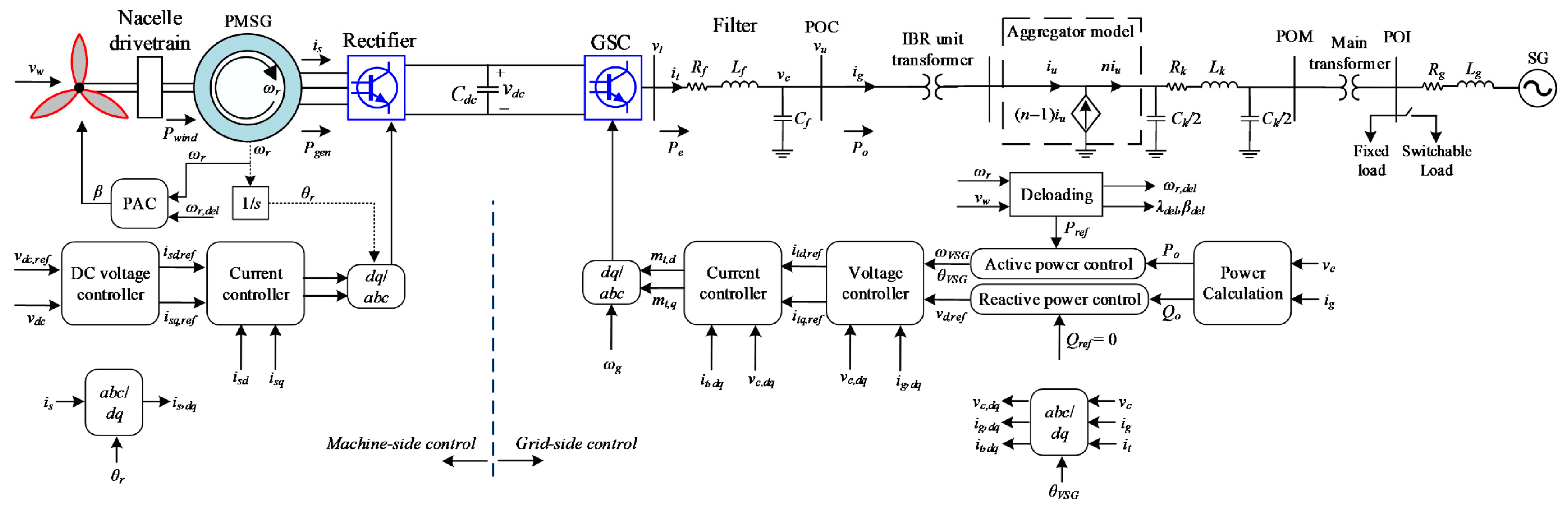
This section presents the overall configuration of GFM PMSGs, as shown in Figure 1. The wind turbine is connected to the point of connection (POC) through a back-to-back converter consisting of a MSC, a DC-link capacitor Cdc, a GSC, and an output filter composed of resistance R f , inductance L f , and capacitance C f . The turbine model includes three-phase blades, a single-mass drivetrain, and a PMSG with pitch-angle control (PAC). The wind speed vw and rotor speed ωr are used to generate the GSC power reference Pref through a deloading strategy, and the generator output power is denoted by Pgen. The DC-link voltage vdc is regulated by the MSC with stator current feedback is, whereas the GFM capability is provided by the GSC. The POC is connected to an IBR unit transformer to step up the voltage level, followed by an aggregator model that represents the aggregated behavior of IBRs and enhances the equivalent capacity. This aggregated network is modeled using a π-equivalent transmission line with impedance elements R k , L k , and C k . Subsequently, a main transformer connects the wind generation system to a SG, representing the bulk power grid, through a tie-line modeled by resistance R g and inductance L g . The overall structure and control scheme of GFM PMSGs are detailed hereunder.

2.1. Wind Turbine Model

A wind turbine generator converts wind energy into mechanical power Pwind, which can be expressed as [24,25],
P wind   = 0.5 π ρ R 2 v w 3 C P λ ,   β ,
where ρ is air density, R signifies the blade radius, λ represents the tip speed ratio (TSR), β is the pitch angle, and C P signifies the wind power utilization coefficient, which is a nonlinear function of λ and β . The power coefficient C P can be written as [19,25]
C P = 0.5176 116 λ i 0.4 β 5 e 21 λ i + 0.0068 λ ,
where
1 λ i = 1 λ + 0.08 β 0.035 β 3 + 1 ,
The TSR can be expressed as λ   =   ω r R v w , with ω r representing the rotor speed in rad/s. Equation (1) indicates that, for a given C P , the power extracted from the wind turbine increases cubically with the wind speed. Conversely, at a specific wind speed, power output can be regulated by adjusting C P , as shown in Equation (2). This adjustment depends on the rotor speed ω r and the blade pitch angle β . Therefore, controlling the generator rotor speed and blade pitch angle is essential to achieve either maximum power extraction or reduced loading. The mechanical torque applied to the turbine, Twind, is determined from the extracted power and is given by T wind   =   P wind ω r . For the sake of brevity, the detailed derivation of Equations (1)–(3) is not presented herein; interested readers are referred to [25,26] for a comprehensive exposition.

2.2. Pitch Angle Control

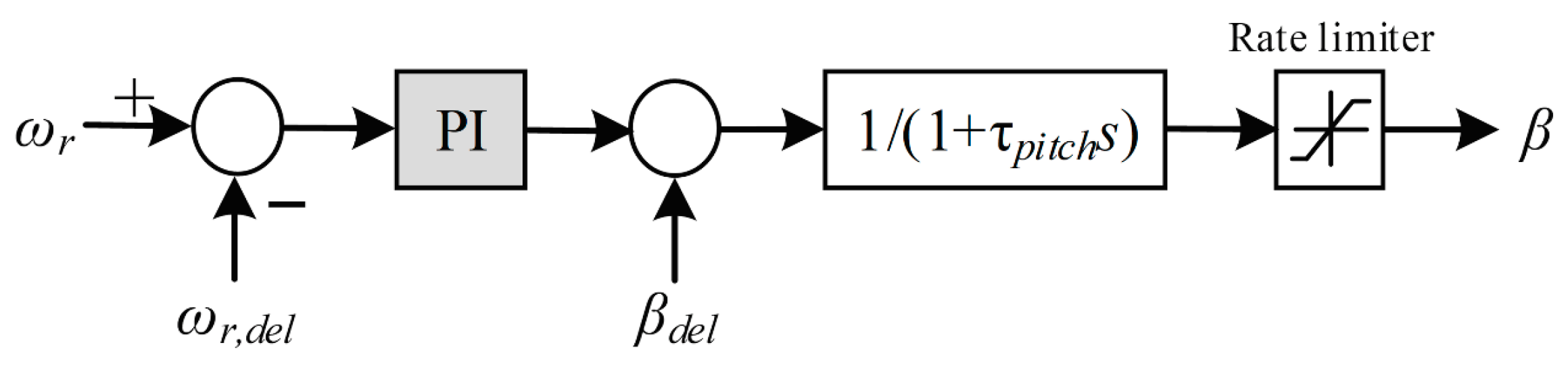
The PAC is implemented within wind turbines to regulate the generator rotor speed toward a specified reference value. In GFLs, this reference typically corresponds to the nominal rotor speed to optimize power extraction. However, since this work investigates the frequency-support capabilities of GFM wind turbines, the rotor speed reference is intentionally set above its nominal value to store additional kinetic energy in the rotating mass, which can subsequently be released to support system frequency after disturbances. The PAC modulates the aerodynamic power of the blades to the desired rotor speed. Achieving this aim, a PI controller is employed to regulate the PMSG rotor speed, ω r , toward the deloaded reference value, ωr,del. The block diagram of the PAC is shown in Figure 2, where τ pitch represents the time constant of the pitch actuator. Note that the deloading strategy will be detailed in Section 2.5.

2.3. Machine-Side Control

In GFM PMSGs, the primary function of the MSC is to regulate the DC-link voltage while maintaining the d-axis current at zero [27]. The MSC control adopts a cascaded-loop structure comprising a fast inner loop dedicated to stator current regulation and a comparatively slower outer loop responsible for DC-link voltage regulation. In what follows, the MSC control is formulated mathematically as a system of differential-algebraic equations.

2.3.1. PMSG and Drivetrain Models

The PMSG is controlled in the dq rotating reference frame, with the d-axis aligned along the rotor magnetic flux linkage ψf. The electrical dynamics of a single-pole surface-mounted PMSG in terms of stator voltage and current are given as follows [27],
v sd = R s i sd L q ω r i sq + L d d i sd dt v sq = R s i sq + L d ω r i sd + L q d i sq dt + ψ f ω r ,
where v sdq i sdq are the dq components of stator terminal voltages (currents), respectively; R s is the stator resistance; and L dq represents the dq components of the stator self-inductances.
The PMSG mechanical dynamics are modeled assuming a direct-drive configuration with a single-mass drivetrain. Accordingly, the generator rotor speed and the wind turbine driving torque are governed by the swing equation, as below [28],
J s d ω r dt = T wind T gen D s ω r ,
where J s denotes the combined mechanical inertia of the PMSG and the wind turbine; D s represents the mechanical friction coefficient accounting for rotational losses; T gen corresponds to the electromagnetic torque generated by the machine; and T wind is the mechanical torque provided by the wind turbine.

2.3.2. Inner Current Controller

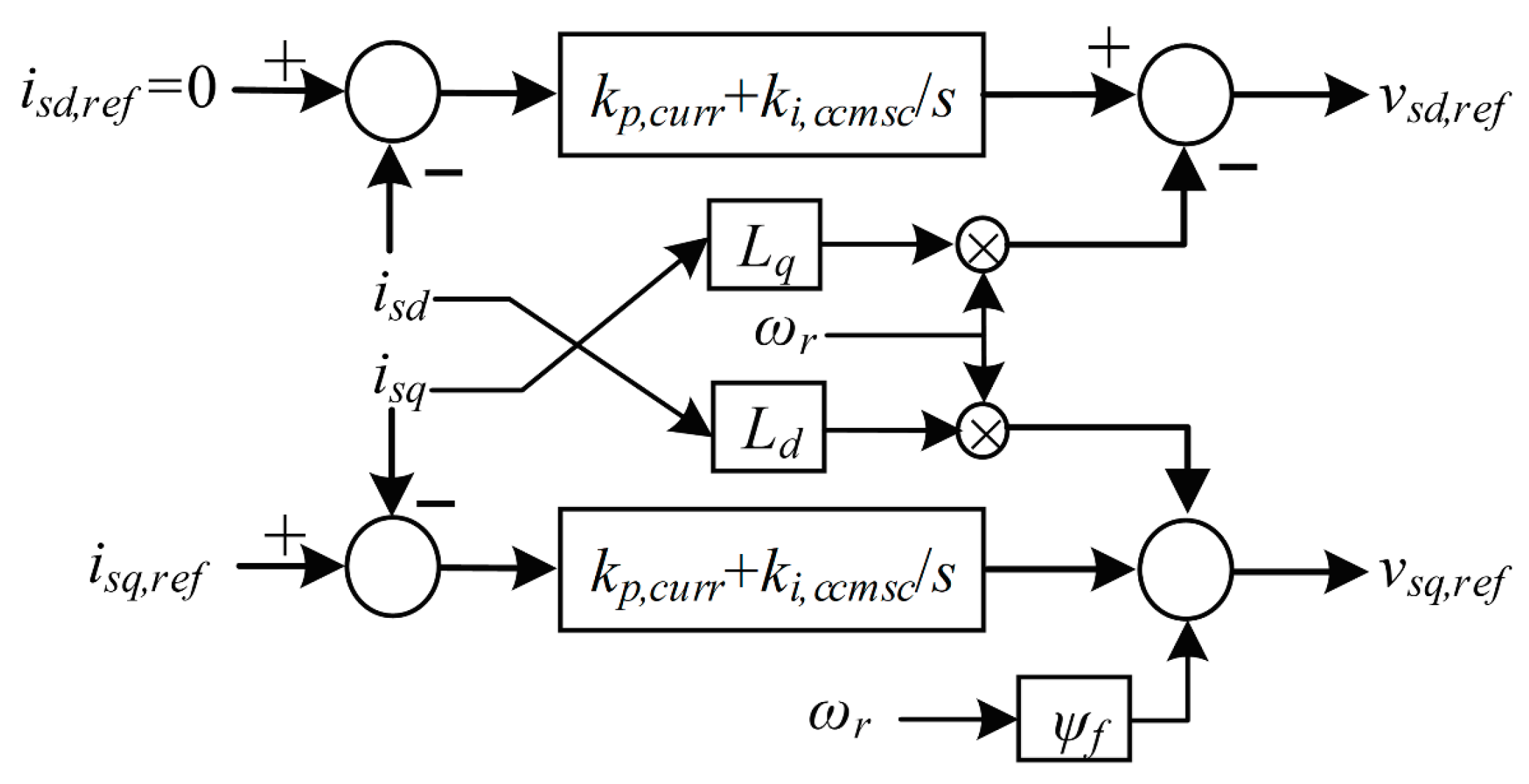
The inner current control loop of the MSC is implemented as described by Equation (6) and illustrated in Figure 3. The q-axis reference current, i sq , ref , derived from the outer control loop, is compared with the measured q-axis current of the stator. Likewise, the d-axis current of the stator is compared with its corresponding reference value, which is set to zero (i.e., i sd , ref = 0 ). According to the control configuration shown in Figure 3, the dynamic behavior of the inner current control loop can be expressed as [29],
v sd , ref = k p , curr + k i , curr s i sd , ref i sd L q ω r i sq v sq , ref = k p , curr + k i , curr s i sq , ref i sq + ψ f ω r + L d ω r i sd ,
By choosing the PI controller parameters as τ cc , msc   =   L dq / k p , curr   =   R s / k i , curr , the machine-side current loop achieves exact pole-zero cancellation. As a result, assuming negligible measurement and switching delays, the inner current controller is simplified to two decoupled first-order transfer functions, each characterized by the time constant of τ cc , msc .

2.3.3. Outer DC-Link Voltage Controller

The DC-link dynamics are taken into account to ensure power balance between the power injected into and extracted from the capacitor. By enforcing power balance at the DC link and assuming negligible converter losses, the DC-link dynamics can be written as [21,24,30]:
Δ P C = P gen S WT P e S WT = d dt 1 2 C dc V dcN 2 S WT v dc 2 = C dc V dcN 2 S WT v dc d v dc dt ,
where Δ P C refers to the electrostatic power stored or released by Cdc; P gen is the power flowing from the MSC to Cdc; P e is the power flowing from Cdc to the GSC; v dc represents the DC-link voltage; V dcN denotes the nominal DC voltage; S WT is the rated power of the wind turbine. Equation (7) shows that generator power oscillations from wind shear and tower shadow induce a power imbalance in the DC-link capacitor, resulting in DC voltage fluctuations. The DC-link voltage consequently varies to charge or discharge energy, thereby smoothing the power delivered to the grid.
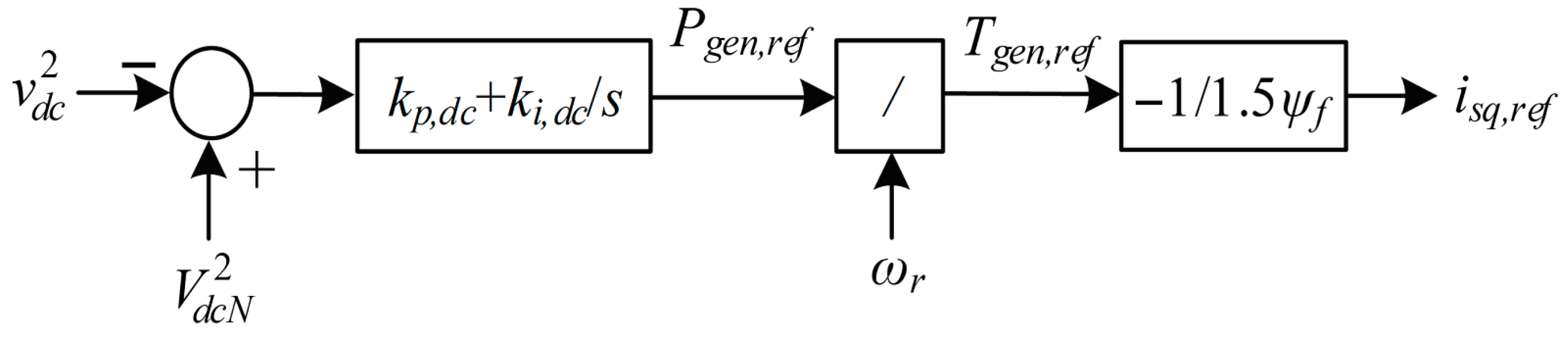
The schematic representation of the DC-link voltage control loop is shown in Figure 4. In this control structure, the squared DC-link voltage, v dc 2 , is employed to form the error signal, which is subsequently processed by a PI controller to generate the MSC power reference Pgen,ref, from which the corresponding electrical torque reference Tgen,ref is derived. The PMSG electromagnetic torque in the dq frame is given by [31],
T gen = 1.5 ψ f i sq ,
Accordingly, the stator q-axis reference current is calculated as i s q , ref = T gen , ref / 1.5 ψ f , through which the DC-link voltage controller drives the inner current controller and maintains power balance between the generator and the grid, whereby preserving DC voltage stability. Note that a negative sign is used for the PMSG to reflect the generator operating convention in the MATLAB/Simulink environment.

2.4. Grid-Side Control

While the MSC regulates the DC-link voltage, the GSC uses power-based synchronization to provide GFM services. Unlike GFLs, which track the grid voltage and frequency, the GSC in GFMs autonomously establishes its output voltage magnitude, phase, and frequency, thereby ensuring stable grid operation even in the absence of SGs. The cascaded control structure, similar to that of a GFM BESS, consists of an outer power control loop and inner voltage and current control loops. At the primary level, the power control loop regulates the power output; however, unlike GFM BESSs, the active power reference in GFM PMSGs is determined by the MSC through a deloading strategy. The grid-side control loops are described in the following subsections.

2.4.1. Filtering Dynamics and Inner Controllers

As illustrated in Figure 1, the GSC is connected to the grid through an RLC filter and a unit transformer. The dynamic equations of the filter inductance and capacitance are derived using Kirchhoff’s voltage and current laws (KVL and KCL). Hence, one obtains [27,30],
L f d i td dt = v td v cd R f i td + L f ω VSG i tq ,
L f d i tq dt = v tq + v cq R f i tq L f ω VSG i td ,
L tr 1 d i gd dt = v cd v ud R tr 1 i gd + L tr 1 ω VSG i gq ,
L tr 1 d i gq dt =   v cq + v uq R tr 1 i gq L tr 1 ω VSG i gd ,
C f d v cd dt = i td i gd + C f ω VSG v cq ,
C f d v cq dt = i tq i gq C f ω VSG v cd ,
where L tr 1 and R tr 1 represent the inductance and resistance of the IBR unit transformer, respectively; i tdq , i gdq , and v cdq denote the GSC output currents before the filter, the currents after the filter, and the voltage across the filter capacitor, respectively; and ω VSG is the angular frequency obtained from the GSC primary control loop. The voltages and currents shown in Figure 1 are transformed into their dq components using the phase angle θ VSG provided by the active power control loop.
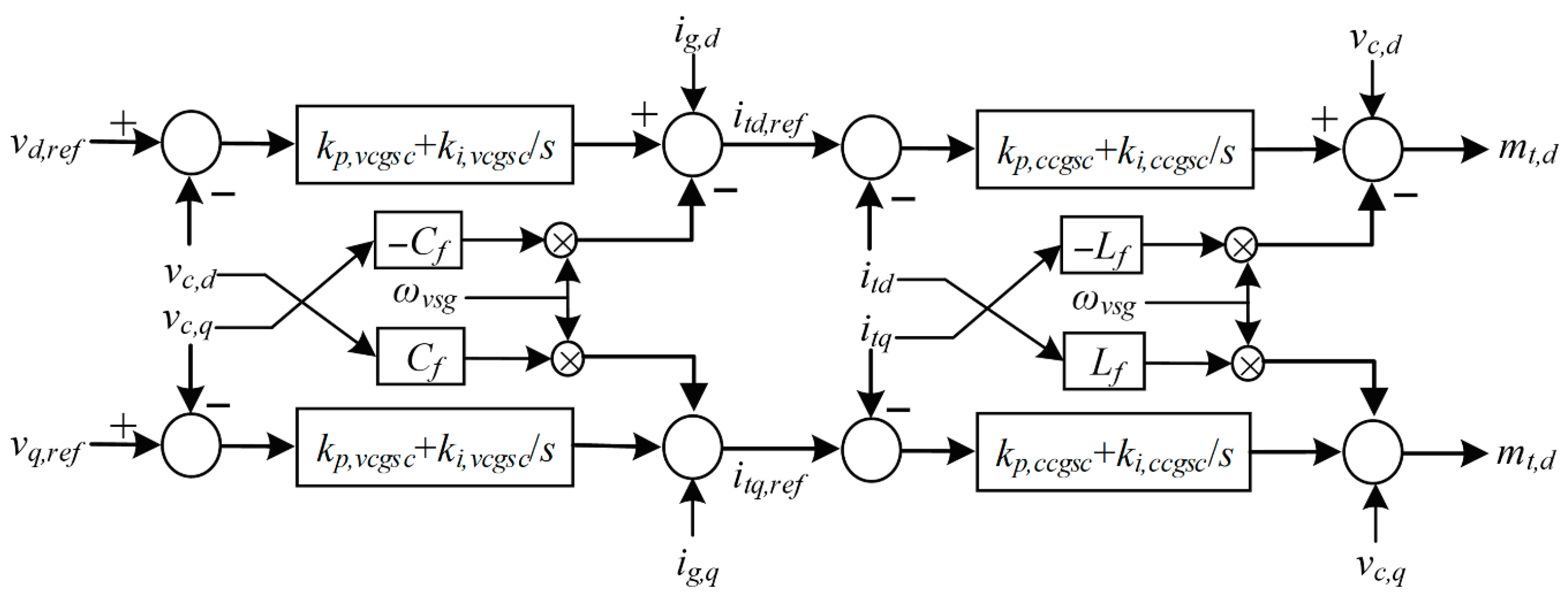
Standard PI controllers are employed in the inner voltage and current control loops. The current control loop is designed based on the dynamic behavior of the inverter filter inductor, as described in Equation (9). It generates the modulation voltage reference for the PWM generator, and its dynamic equations can be expressed as follows [32]:
m t , d = k p , ccgsc + k i , ccgsc s i td , ref i td + v cd L f ω VSG i tq m t , q = k p , ccgsc + k i , ccgsc s i tq , ref i td + v cq + L f ω VSG i td ,
where k p , ccgsc and k i , ccgsc are the proportional and integral gains of the PI controller, respectively. As stated in [32], it is common practice to place the zero of the PI controller so that it cancels the pole associated with the filter inductor. Doing so, the current control can be approximated by two decoupled first-order transfer functions with a time constant of τ cc , g sc , such that τ cc , g sc = L f k p , ccgsc = R f k i , ccgsc .
Furthermore, the voltage control loop is designed based on the dynamics of the inverter filter capacitor, as described in Equation (9). The voltage controller generates the current reference signals for the inner current control loop; hence, the dq-axis components of the terminal current references are obtained as follows [32]:
i td , ref     = k p , vcgsc + k i , vcgsc s v d , ref v c , d + i g , d C f ω VSG v c , q i tq , ref     = k p , vcgsc + k i , vcgsc s v q , ref v c , q + i g , q + C f ω VSG v c , q ,
where k p , vcgsc and k i , vcgsc are the proportional and integral gains of the PI controller, respectively. The most widely adopted approach for tuning the voltage controller is the symmetrical optimum criterion, which aims to maximize the phase margin of the loop gain at the crossover frequency. As discussed in [32], this method achieves the maximum phase margin of the voltage control loop when the PI controller gains are selected as k p , vcgsc = C f ω m and k i , vcgsc = τ cc , g sc C f ω m 3 , where ω m is a design parameter proportional to the bandwidth of the voltage control loop. The inner voltage and current control loops of the GSC are shown in Figure 5.

2.4.2. Power Control Loop and Swing Equation

As illustrated in Figure 1, the outer control loop of the GSC employs active and reactive power control loops to regulate the angular frequency and the voltage magnitude. Toward this end, the power injected into the grid is first calculated as follows:
P o = 1.5 v cd i gd + v cq i gq ,
Q o = 1.5 v cd i gq + v cq i gd ,
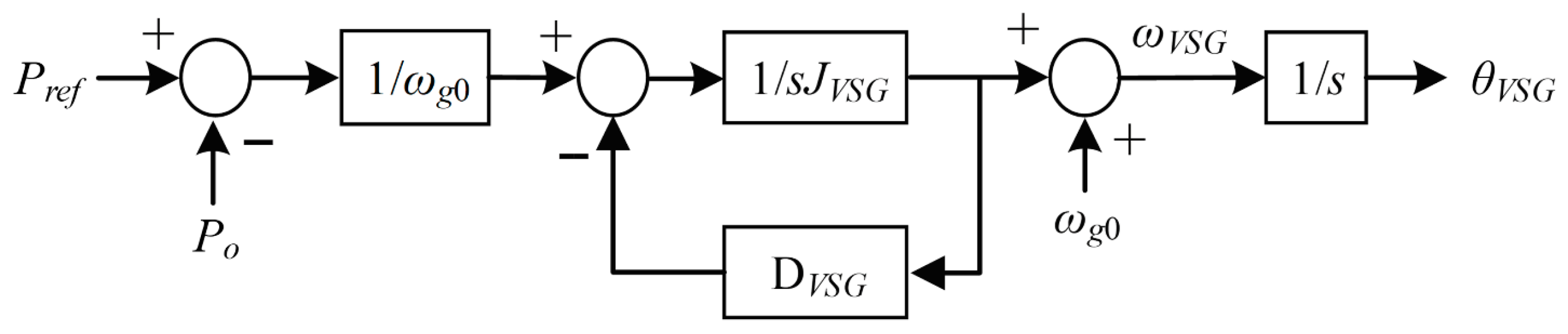
The phase control, which governs active power regulation, adjusts the inverter terminal voltage phase angle according to the difference between the active power reference P ref derived from the deloading strategy and the measured GSC active power P o . In parallel, the voltage amplitude control regulates the converter output voltage magnitude based on the difference between the reactive power reference Q ref and the measured reactive power Q o . These controllers provide the reference signals required for the inner control loops. In the present work, a VSG model is adopted in the active power control loop to achieve frequency self-synchronization based on the swing equation. This approach emulates the inertial and damping characteristics of SGs and can be expressed as follows [33]:
J VSG d ω VSG dt = 1 ω g 0 P ref P o + D VSG ω VSG ω g 0 ,
θ VSG = ω VSG ω g dt ,
where J VSG and D VSG denote the virtual moment of inertia and damping coefficient of the VSG, respectively; ω VSG represents the VSG angular frequency; ω g 0 is the nominal grid angular frequency, while ω g denotes the actual grid angular frequency; and θ VSG is the VSG phase angle. The VSG active power–frequency control is illustrated in Figure 6.

2.5. Deloading Strategy for Frequency Control Provision

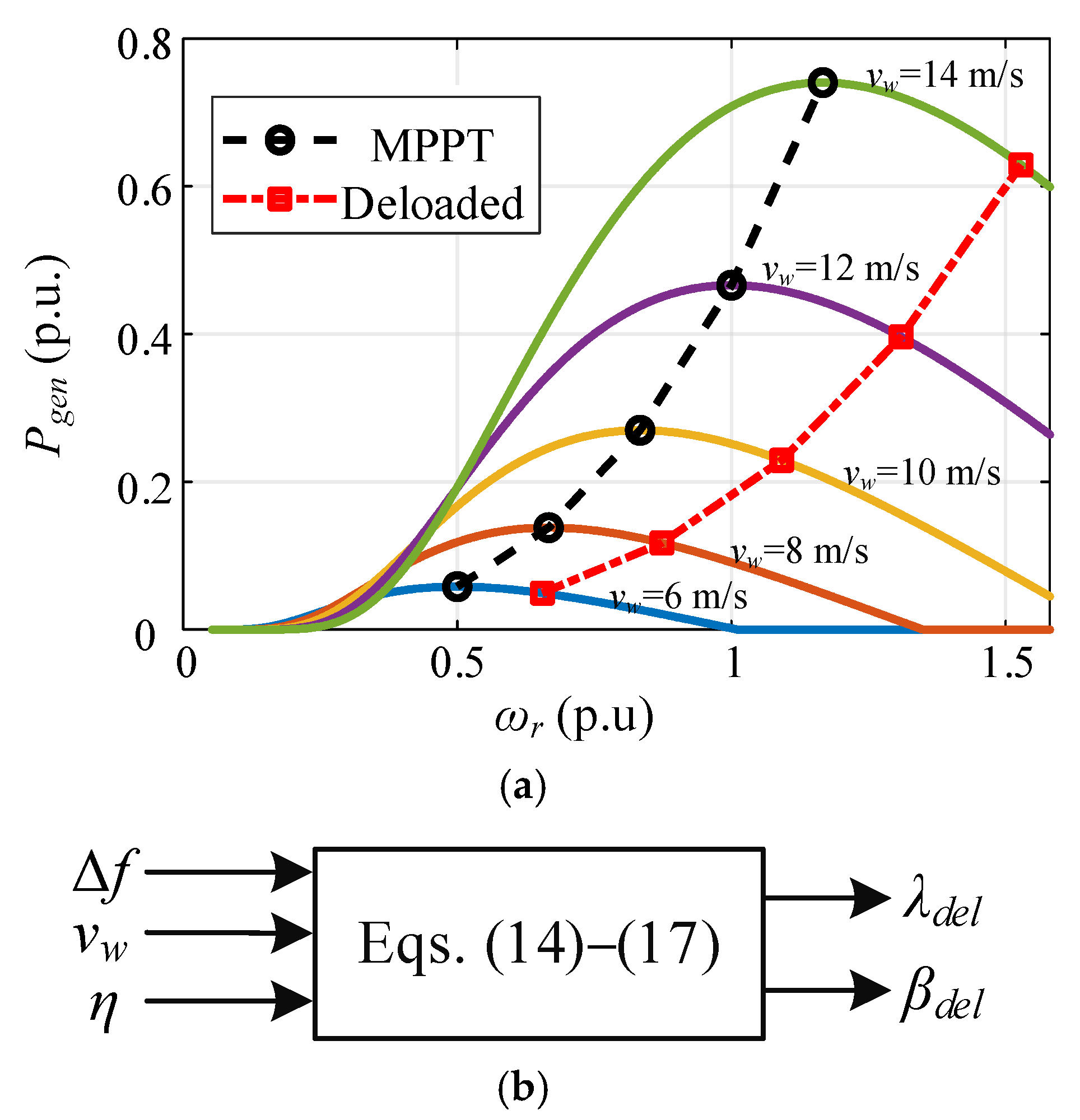
Unlike GFLs, which operate at MPPT to extract maximum wind power, GFM PMSGs operate below the maximum power point to maintain reserve power for grid-support functions, such as inertia emulation and frequency control, that require sufficient headroom for upward and downward regulation. Since the mechanical power captured from the wind depends on both rotor speed and blade pitch angle, wind power curtailment can be realized by adjusting either variable. However, these two approaches differ markedly in their effect on the turbine’s energy storage capability. Increasing the rotor speed beyond its optimal MPPT value allows part of the available wind power to be stored as kinetic energy in the rotating mass since the captured power is not fully delivered to the grid. Later, this stored kinetic energy can be harnessed to stabilize the grid frequency subsequent to a disturbance. Figure 7a illustrates the typical P gen ω r characteristics of a wind turbine, with the deloading operating trajectory located to the right of the MPPT curve.
In contrast, pitch control does not exploit the turbine’s inherent kinetic energy and primarily enables downward regulation by reducing aerodynamic power capture through increased blade pitch angle, thereby limiting its ability to provide fast and sustained frequency support. Therefore, rotor speed control is prioritized for curtailment to enhance grid-support capability, which is employed in this work as well. To implement the deloading strategy, inspired by [20], a curtailment parameter η     0 ,   1 is introduced. To strengthen the coupling between the MSC and the GSC and enhance the frequency support capability of PMSGs under deloaded operation, the turbine operating point is adjusted using a deloaded TSR. To this end, the steady-state deloaded operating point is first defined as follows,
λ del , 0 =   λ opt   1 + η ,
where λ del , 0 denotes the steady-state TSR. During frequency disturbances, the deloaded TSR at time slot k is dynamically adjusted according to the frequency deviation as
λ del ( k ) = min λ del k 1 ,   λ del , 0 + K f Δ f ( k ) ,
where 0 < K f 1 is the frequency-support gain and Δ f ( k )   =   f VSG ( k ) f g ( k ) denotes the system frequency deviation. Following a load increase, the λ del is reduced to enable increased power extraction from the PMSG. According to the aforementioned formulation, λ del is not permitted to return toward its pre-disturbance value even if the frequency deviation diminishes. Instead, at each time instant, the updated value of λ del is compared with its previously applied value, and the smaller of the two is selected. Consequently, the turbine operating point is prevented from reverting to its pre-disturbance condition, thereby allowing the PMSG to sustain a higher level of active power injection to accommodate the increased load demand.
Subsequently, inspired by [17], the curtailed power reference is defined as follows,
P ref = 0.5 ρ π R 5 C pdel ω r 3 λ del 3 v w v w nom η P nom v w > v w nom ,
where C p , del : = η C p , max , and v w nom signifies the nominal wind speed. If λ del v w / R ω r max , the rotor speed reference is set as ω r del   =   λ del v w / R and the pitch angle is maintained at β del   =   0 . Otherwise, when λ del v w / R   >   ω r max , the rotor speed reference is limited to ω r del   =   ω r max , and the pitch angle β del is determined from the following condition,
C P R ω r max v w ,   β del = η C P λ opt ,   0 ,
Equations (14)–(17) are used to calculate corresponding values of λ del and β del , as illustrated in Figure 7b.
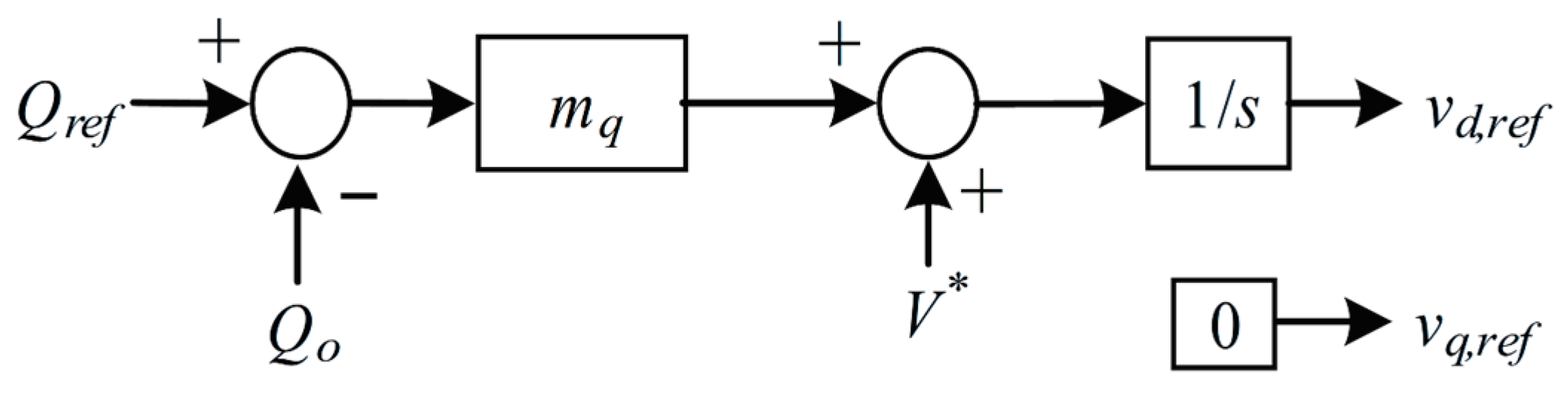
Reactive power regulation is carried out at the primary control level by adjusting the d-axis voltage reference of the GSC, while the q-axis voltage reference is maintained at zero. A Q-V droop controller is incorporated into the reactive power control loop to emulate the inherent reactive power–voltage characteristic of SGs. Specifically, the reactive power error is processed through a droop gain m q to generate the reference value of the PCC voltage v d , ref . The Q-V droop control law can be expressed as [29]
v d , ref = V * + m q Q ref Q o ,
where Q ref and V * denote the reference value of reactive power and the nominal voltage, respectively. Figure 8 shows the schematic block diagram of the reactive power control loop.

2.6. Supervisory Curtailment Control Framework for Managing Large Load Connections

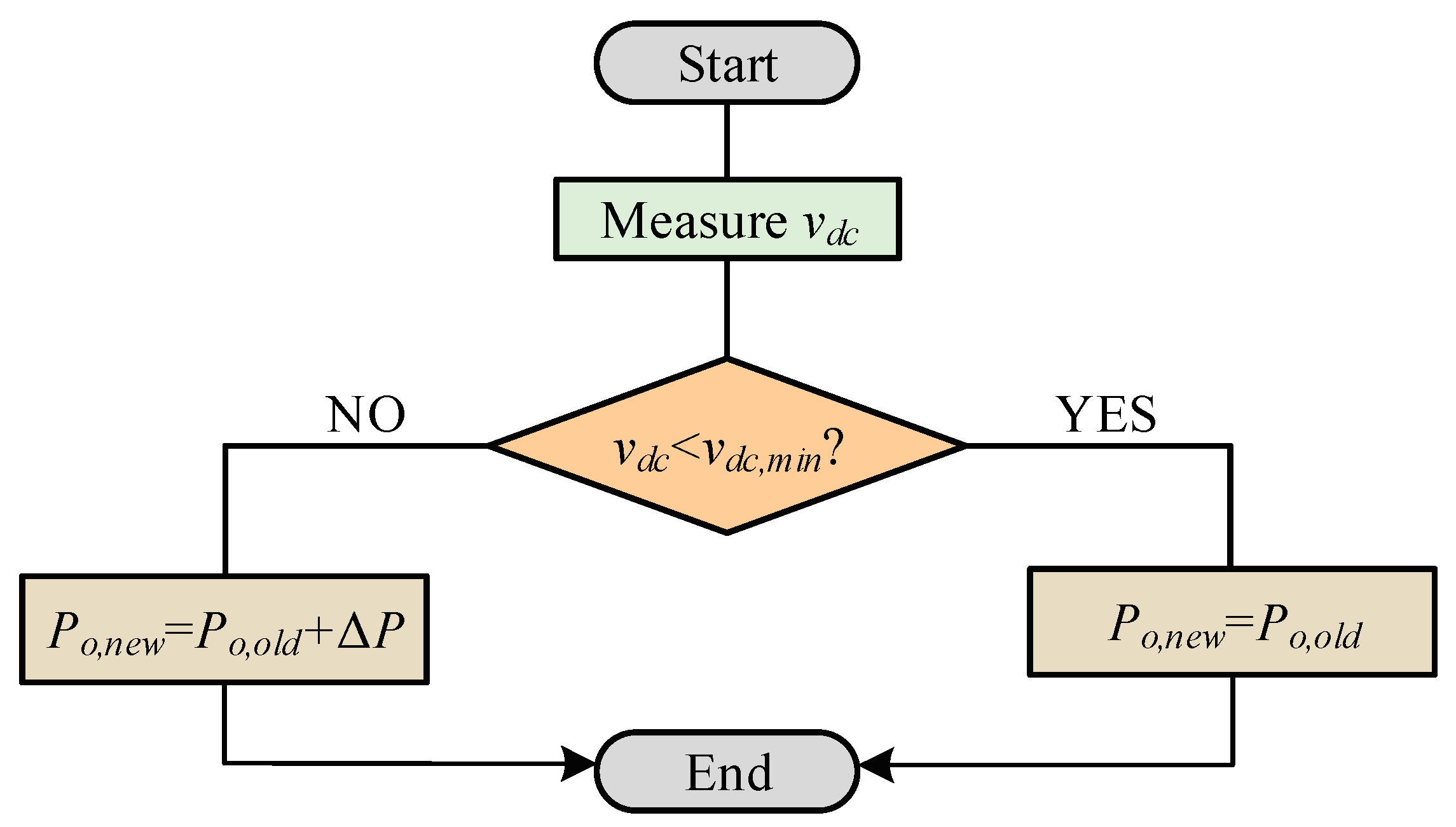
To preserve PMSG stability under severe load disturbances, a supervisory curtailment control strategy is incorporated into the control framework. This mechanism is formulated using threshold-driven decision logic defined with respect to the DC-link voltage. The DC-link voltage v dc is continuously monitored and compared against a predefined minimum threshold v dc , min . Under normal operating conditions, as well as during moderate load variations, the condition v dc     v dc , min is satisfied, and no supervisory intervention is required. In this regime, the GSC accurately tracks the active power reference dictated by the deloading strategy, thereby enabling the PMSG to effectively participate in power balancing and frequency support while maintaining DC-link voltage stability.
However, in the event of a severe load disturbance, a substantial power imbalance arises between generation and demand. Under such conditions, both the electrostatic energy stored in the DC-link capacitor and the kinetic energy associated with the rotating mass are mobilized to compensate for the imbalance. Owing to the comparatively slower inertial response of the PMSG mechanical subsystem, the rotor cannot supply the required compensating power instantaneously. Consequently, the DC-link capacitor initially supplies most of the deficit by rapidly discharging its stored electrostatic energy, leading to a significant deviation of the DC-link voltage from its nominal value. In critical cases, the DC-link voltage may fall below the permissible threshold v d c , min . Upon detection of the condition v dc < v dc , min , the supervisory controller is activated. In this operating mode, the GSC’s active power output is constrained to its pre-disturbance value to prevent further depletion of the DC-link energy and prioritize the restoration of the DC-link voltage. The additional power demand is subsequently supplied by the main grid. This control action effectively mitigates excessive DC-link voltage deviations, ensures stable energy exchange between the MSC and the GSC, and enhances the system’s overall stability during transient conditions. In the absence of the supervisory control mechanism, the DC-link voltage may rapidly decline, ultimately leading to PMSG instability.
Conversely, if the DC voltage does not fall below v dc , min , the additional power demand can be directly supplied by the PMSG without activating the supervisory curtailment mechanism. In this case, the system operates under normal control conditions, allowing the PMSG to participate in power balancing while preserving DC-link voltage stability. The flowchart of the supervisory control framework is shown in Figure 9.
The selection of key parameters in the supervisory controller is governed by stability and protection considerations. The DC-link voltage threshold v dc , min is determined to ensure that a sufficient level of electrostatic energy is retained within the DC-link capacitor, thereby preventing instability and potential converter malfunction. A lower threshold enhances the frequency support capability; however, it increases the risk of DC-link voltage collapse. Conversely, a higher threshold improves system robustness but may limit the available frequency support. Furthermore, the sampling interval of the supervisory controller is selected to achieve an appropriate balance between responsiveness and control stability. A shorter sampling interval enables a more rapid response to disturbances but may induce undesirable control chattering, whereas a longer interval enhances robustness at the expense of delayed corrective action. Consequently, these parameters can be tuned to the prevailing operating conditions and the desired trade-offs among performance, stability, and robustness.

3. Further Discussion

3.1. Impact of Wind Speed Variations on PMSG Dynamics

In this section, we aim to examine the impact of wind speed variations on the DC-link dynamics of PMSGs and study how these dynamics propagate to the frequency response of the interconnected power system. Unlike conventional SGs, in which the kinetic energy stored in the rotating mass inherently buffers mechanical disturbances, PMSG-based wind turbines are fully decoupled from the grid through full-scale back-to-back power electronic converters. In such systems, the dc link serves as the primary energy buffer between the MSC and the GSC, mediating power imbalances between these two stages. Consequently, wind speed variations are initially manifested in the dc-link voltage dynamics, then propagate to the grid-side power injection, and ultimately influence the system frequency response.
As expressed in Equation (1), the aerodynamic power captured by a wind turbine depends on wind speed. Owing to the cubic dependence on wind speed, even minor fluctuations can lead to significant changes in the extracted power and, consequently, in the electromagnetic power generated by the PMSG. These variations modify the GSC’s reference power Pref, as determined by the deloading strategy. Since the GSC regulates the grid voltage and frequency by controlling the injected active power, fluctuations in Pref can cause variations in the GSC output power, creating a temporary imbalance between the mechanical power extracted from the wind and the electrical power delivered to the grid. This imbalance is temporarily absorbed by the DC-link capacitor, which acts as an intermediate energy storage element between the MSC and the GSC. As a result, wind speed disturbances are reflected as deviations in the DC-link voltage dynamics, whose magnitude and temporal characteristics depend on the DC-link capacitance Cdc, the control bandwidths of the MSC and GSC, and the adopted power control strategy.
From the DC-link capacitance standpoint, larger capacitance provides greater energy storage, smoothing out voltage fluctuations and reducing the impact of short-term wind-speed disturbances. It effectively slows the rate of change in the DC-link voltage. In contrast, a smaller capacitance offers less buffering, whereby making the DC-link voltage more sensitive to power mismatches. This can lead to larger voltage deviations and may even trigger protective actions if fluctuations become too severe. The main trade-off is that larger capacitors enhance stability at the expense of increased cost, size, and weight.
The control bandwidth of each converter determines how quickly it can respond to changes in power demand or voltage deviations. The MSC adjusts generator torque and electrical power output to regulate the dc-link voltage to its nominal value and provides mechanical power from the wind, while the GSC controls the power injected into the grid. Higher bandwidth allows the converters to respond faster to disturbances, reducing the amplitude and duration of DC-link voltage fluctuations. Conversely, lower bandwidth results in slower responses, leading to larger or prolonged voltage deviations when wind speed changes. However, excessively high bandwidth can cause control interactions or instability, while too low a bandwidth makes the system sluggish in responding to disturbances.
The power control strategy implemented in the GSC governs how the converter regulates grid power flow and responds to variations in the reference power Pref. Fast or aggressive control strategies enable the GSC to rapidly adjust the injected active power in response to changes in Pref, whereupon reducing the duration of the power imbalance between the mechanical power supplied by the wind turbine and the electrical power delivered to the grid. As a result, the DC-link capacitor absorbs less energy, and the magnitude of DC-link voltage deviations is reduced. Conversely, slower or more conservative control strategies prevent the converter from instantaneously tracking rapid variations in the mechanical power input. In such circumstances, the resulting transient power imbalance must be absorbed by the DC-link capacitor, leading to larger DC-link voltage excursions during transient events. These voltage deviations may subsequently propagate to fluctuations in grid-side power injection and, consequently, influence the frequency response of the interconnected power system.
Accordingly, coordinated co-design of the DC-link voltage control and active power–frequency control mechanisms is pivotal to ensuring appropriate frequency-support capability under realistic wind variability. This coordinated framework is developed and implemented in MATLAB in the present work.

3.2. Analysis of Frequency Response Requirements of the IEEE Standard 2800-2022 for GFM PMSGs

The IEEE Standard 2800-2022 sets capability requirements for IBRs integrated into transmission systems [23], with particular emphasis on frequency control and the active power–frequency response of controllers in the continuous operating region. Within IEEE Standard 2800-2022, active power–frequency response requirements are divided into two distinct types: (a) primary frequency response and (b) fast frequency response. Primary frequency response constitutes a fundamental requirement for the real-time balancing of generation and load in interconnected ac power systems. Fast frequency response, in contrast, involves injecting active power during the arresting phase of a frequency excursion to improve the frequency nadir and/or reduce the initial rate of change of frequency. The IEEE Standard 2800-2022 specifies requirements for primary and fast frequency response, with a focus on the GSC. While these requirements are well-studied in the literature (e.g., [34,35]), explicit guidelines for DC-link dynamics remain limited, even though the system is expected to exhibit sufficient damping.
As stated previously, in PMSGs, the MSC regulates the DC-link voltage, which is directly affected by wind speed variations. Severe fluctuations can significantly alter the energy stored in the DC-link capacitor, causing voltage deviations. To ensure proper ac voltage generation at the GSC output, the DC-link voltage must remain within a predefined operating range. If wind speed drops sharply or power demand increases, the voltage may fall below the minimum permissible value, potentially compromising system stability. Conversely, during load reduction or rapid increases in wind speed, the voltage can rise excessively, necessitating constraints to protect the power electronics. However, these critical dynamic interactions and operational constraints associated with DC-link voltage regulation under transient conditions are not explicitly addressed in the IEEE Standard 2800. Consequently, the absence of detailed provisions for DC-link voltage management in realistic, highly variable operating scenarios underscores the need for advanced control strategies to ensure reliable, resilient system performance beyond the scope of existing standardization frameworks. Section 4 presents high-fidelity simulations showing that neglecting DC-link dynamics can lead to inaccurate system responses and jeopardize overall stability.

4. Simulation Cases

The impact of DC-link dynamics on the frequency support capability of PMSG-based GFMs is thoroughly investigated in this section through time-domain simulations. To this end, the PMSG configuration illustrated in Figure 1 is implemented in MATLAB/Simulink 2023a. The detailed specifications of the PMSG and the associated full-scale converter are given in Appendix A (Table A1). It is worth mentioning that the parameters of the GSC are adopted from [36,37], whereas the tuning of the MSC control parameters is carried out through an iterative trial-and-error procedure. In this context, the sensitivity of the DC-link voltage control loop with respect to its PI controller parameters will be examined later. Three case studies are conducted to evaluate system performance, including: (1) constant wind speed; (2) variable wind speed; and (3) comparative assessment of ideal, simplified, and accurate DC-link dynamic representations. Lastly, some discussions are provided based on our findings.

4.1. Step Wind Condition

This section evaluates the performance of GFM PMSGs under step wind conditions. In this regard, the following scenario is considered:
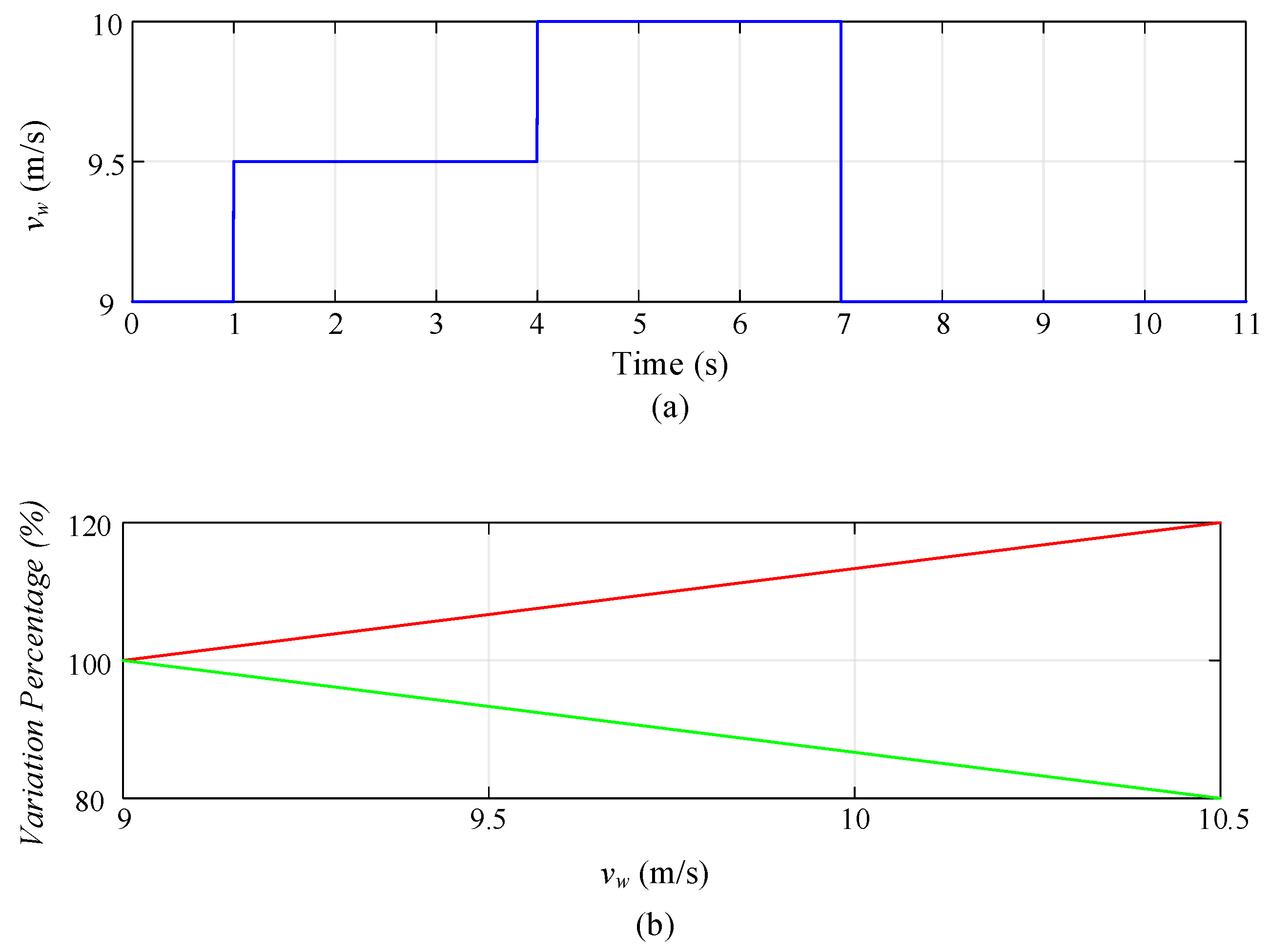
  • At t = 0 s, the simulation is initialized under a constant wind speed of 9 m/s.
  • At t = 1 s, the wind speed is increased to 9.5 m/s.
  • At t = 4 s, the wind speed is increased to 10 m/s.
  • At t = 7 s, the wind speed is reduced to 9 m/s.
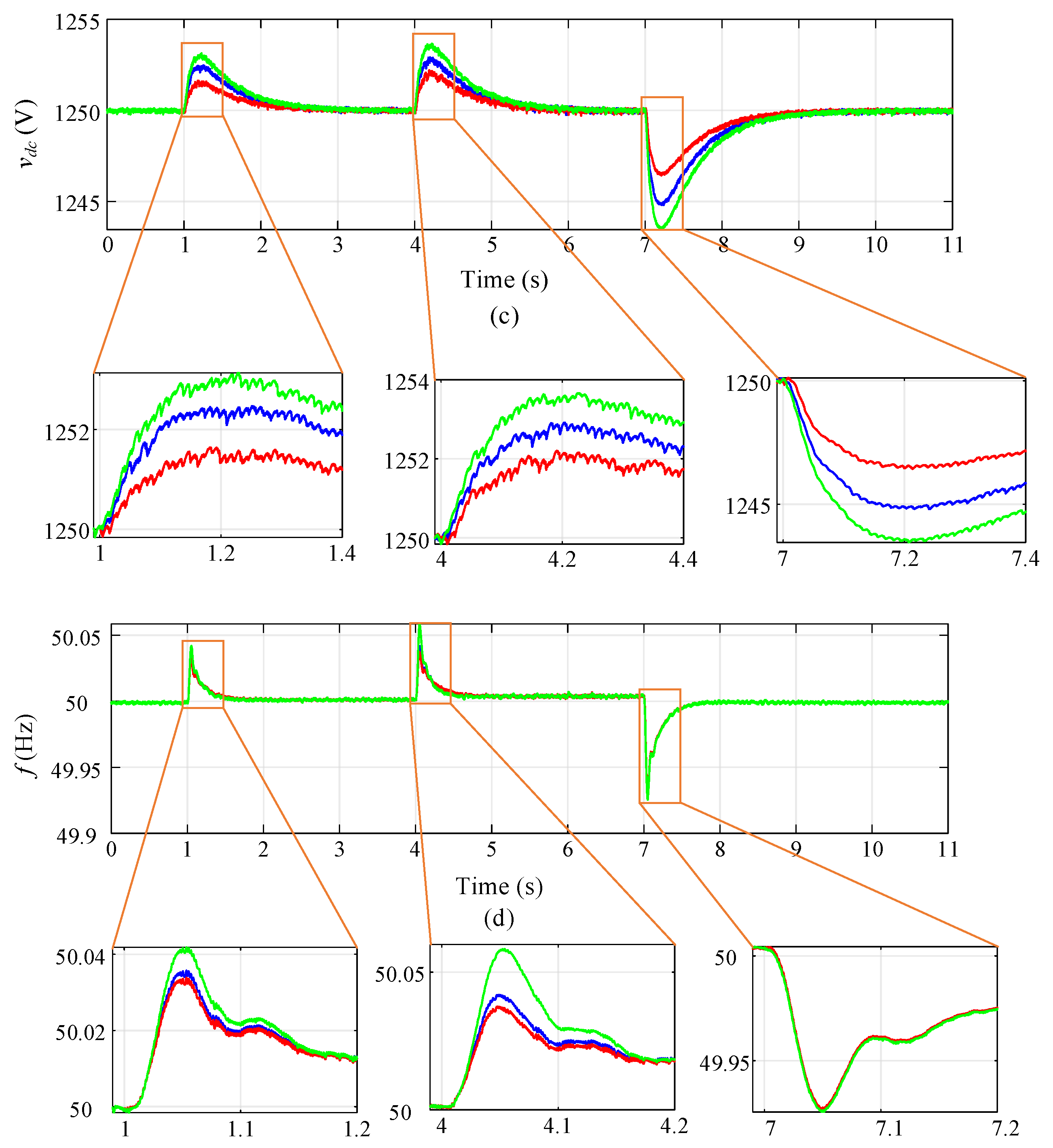
Moreover, to assess the sensitivity of the controller performance to PI parameters, three distinct cases are considered by varying the proportional and integral gains of the DC-link voltage controller, as follows:
Case (1) kp,dc = 30, ki,dc = 60;
Case (2) kp,dc = 50, ki,dc = 60;
Case (3) kp,dc = 50, ki,dc = 120.
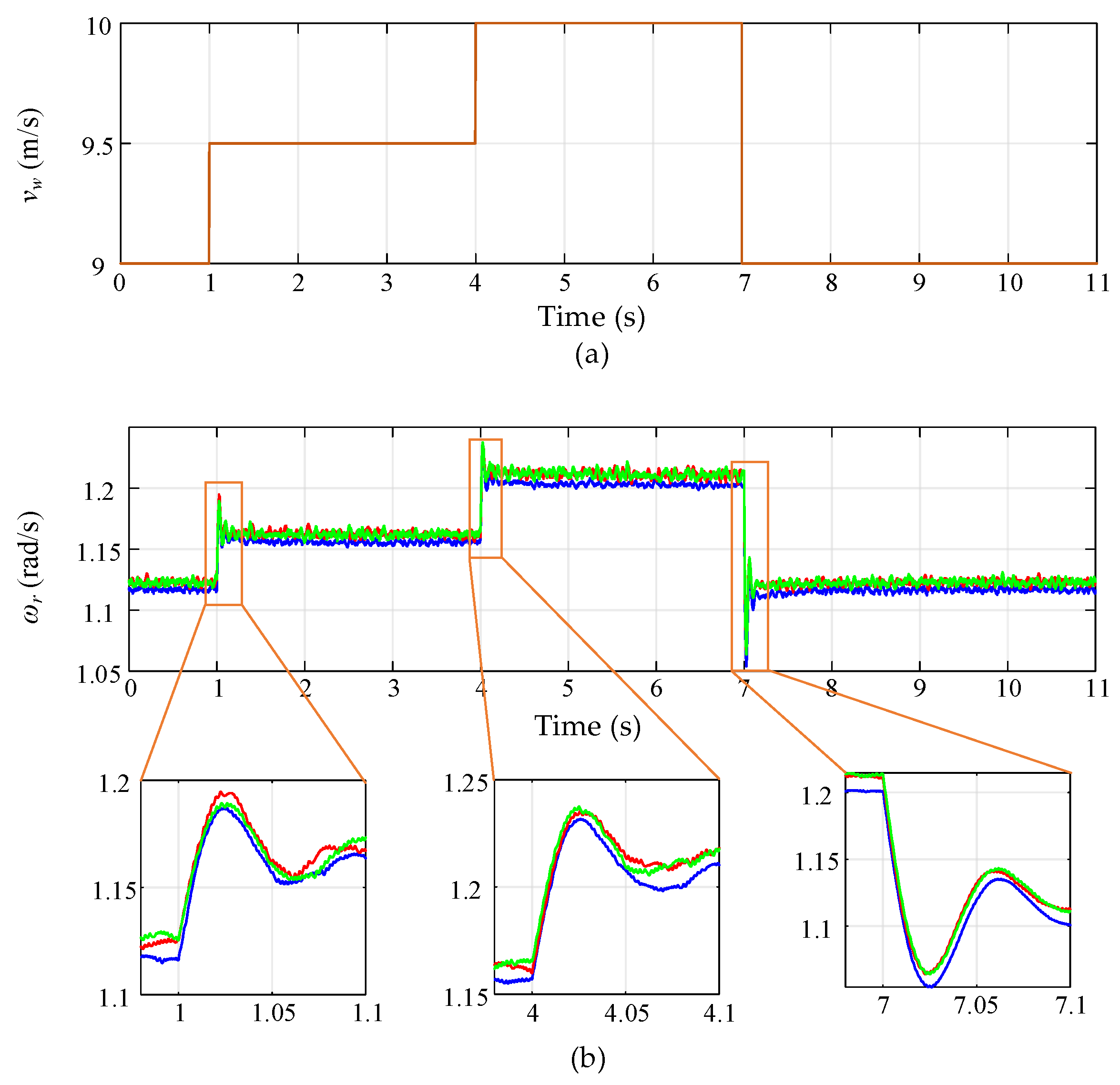
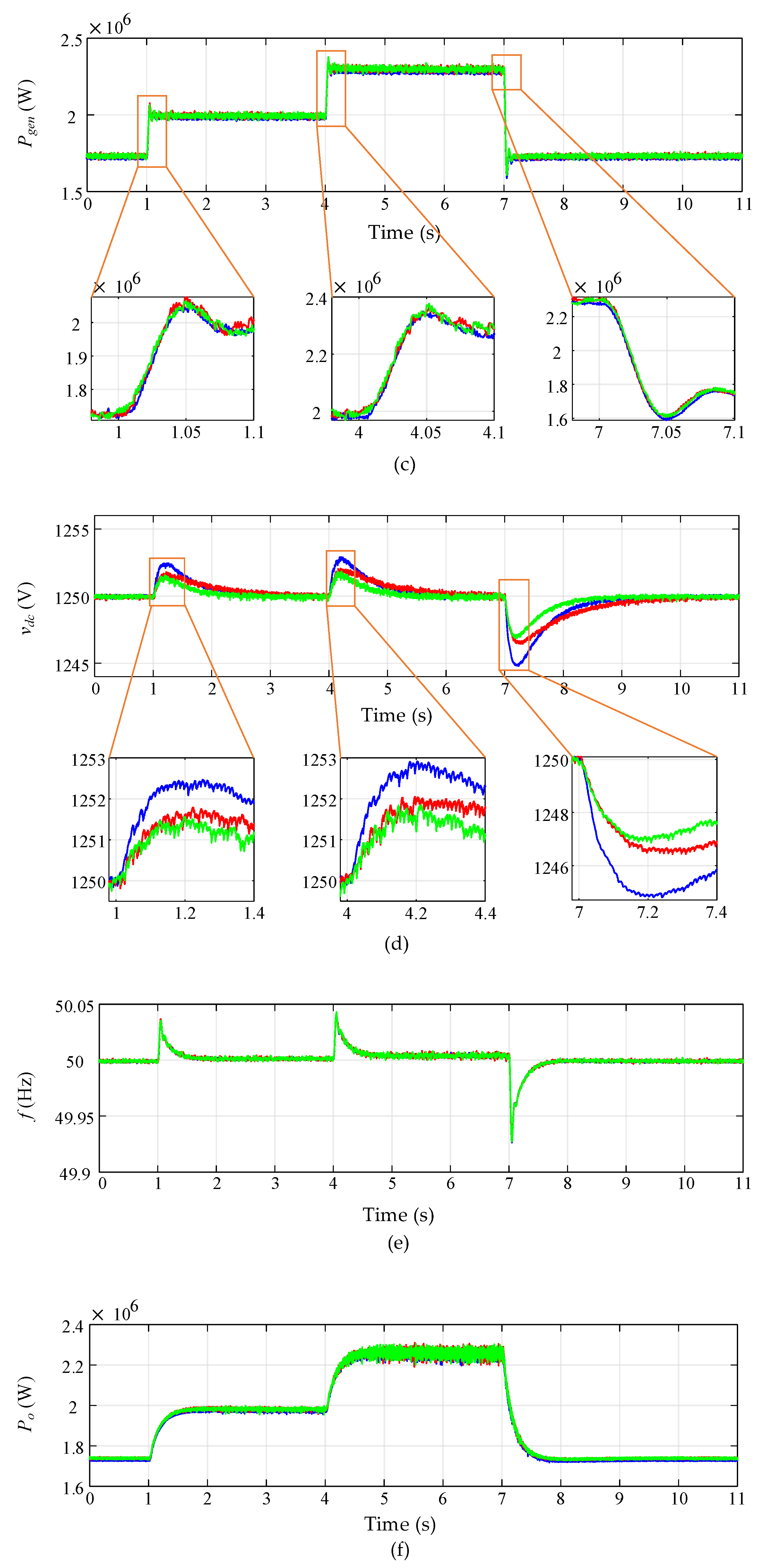
The simulation results for the three cases are presented in Figure 10, with the step wind speed profile illustrated in Figure 10a. The simulation is initialized at t = 0 s with a constant wind speed of 9 m/s. Under this condition, the DC-link voltage is regulated at 1250 V, the rotor speed is 1.12 rad/s, the PMSG generated power is 1.76 MW, the GSC frequency is maintained at 50 Hz, and the GSC active power is 1.74 MW.
At t = 1 s, the wind speed is abruptly increased to 9.5 m/s. Thereafter, the rotor speed rises and settles at about 1.16 rad/s after minor oscillations (Figure 10b). This increase raises the aerodynamic power and the generated PMSG power to approximately 1.98 MW (Figure 10c). As shown in Figure 10d, the DC-link voltage exhibits a slight overshoot; however, due to the DC-link voltage controller, the voltage is promptly restored to its nominal value after a brief transient. As the wind speed increases, the generated power also increases, leading to a higher active power reference P ref . Consequently, the GSC active power increases and reaches 1.96 MW, as shown in Figure 10f. The increase in P ref results in a temporary frequency overshoot, after which the frequency gradually returns to its nominal value of 50 Hz.
At t = 4 s, the wind speed increased to 10 m/s, causing the rotor speed to increase and settle at approximately 1.22 rad/s (Figure 10b). Consequently, the PMSG power increased to about 2.23 MW (Figure 10c). Although this sudden reduction in mechanical input induces a transient deviation in the DC-link voltage, the controller quickly restores it to the nominal value of 1250 V for all three cases (Figure 10d). Similarly, an increase in wind speed leads to higher generated power, which raises the active power reference. As a result, the GSC active power increases and reaches 2.23 MW, as shown in Figure 10e. By increasing the active power reference of the GSC, a transient frequency overshoot is observed, as illustrated in Figure 10f.
When the wind speed decreases from 10 m/s to 9 m/s at t = 7 s, the aerodynamic power is reduced to 1.76 MW, as shown in Figure 10c. Consequently, the rotor speed decreases and settles to 1.12 rad/s, as illustrated in Figure 10b. Under this situation, the DC-link voltage, depicted in Figure 10d, experiences a transient undershoot before recovering to its nominal value. Due to the reduction in aerodynamic power, the active power reference is correspondingly decreased. Therefore, the GSC active power is reduced to the initial value of 1.74 MW. The system frequency exhibits a transient undershoot, as shown in Figure 10e and Figure 10f, respectively.
From a control parameter perspective, Case 3 in Figure 10, with larger kp and ki values, exhibits the best dynamic performance, with reduced overshoot and settling time. For instance, Figure 10d shows that the maximum overshoot during wind speed increase at t = 1 is 1.5 V in Case 3, compared with 1.8 V and 2.4 V in Cases 1 and 2, respectively. During the wind speed decrease at t = 7 s, the undershoot in Case 3 (3 V) is also lower than in Cases 1 and 2 (5 V and 3.5 V, respectively). These results indicate that appropriate tuning of the DC-link voltage control parameters enhances the transient performance of the DC-link voltage, while exerting negligible impact on GSC outputs, e.g., frequency and active power.
This case study demonstrates that step changes in wind speed induce transient deviations in the dynamic behavior of PMSGs. Simulation results confirm that the DC-link voltage controller successfully maintains stable and smooth voltage regulation under such disturbances. However, its impact on frequency control performance, particularly during large load connection events, warrants further investigation, which will be discussed in Section 4.6.5.

4.2. Impact of Grid Strength (SCR) on GFM PMSG Performance

In contrast to GFL inverters, which synchronize with and follow the main grid’s voltage magnitude and frequency via a PLL, GFM inverters actively set the AC voltage magnitude and frequency at their terminals. Due to this operational characteristic, GFM inverters are typically deployed in weak-grid environments or low-inertia systems where voltage and frequency support are required. In strongly interconnected grids, where the grid stiffness is significantly high, both the main grid and the GFM unit may simultaneously attempt to regulate voltage and frequency. This may intensify dynamic interactions between the two sources and, if proper coordination mechanisms are not implemented, introduce stability concerns. To further investigate the impact of grid strength on the performance of the GFM PMSG, two additional cases are included in this section, namely SCR   =   1 and SCR   =   4 , in addition to the original base case of SCR   =   1.5 . The same scenario described in Section 4.1 is considered here to evaluate step changes in wind conditions. The simulation results are presented in Figure 11.
The results indicate that variations in SCR have a relatively limited impact on the DC-link voltage dynamics (as illustrated in Figure 11b), since the DC-link voltage is primarily regulated by the MSC and is largely governed by the internal power balance between the generator and the GSC. Although slight variations in DC-link oscillations can be observed due to changes in power transfer capability, the overall DC-link behavior remains relatively consistent across different SCR values.
However, the impact of SCR is more evident in the GSC’s frequency response, as shown in Figure 11c. It can be observed that increasing the SCR reduces the frequency response settling time due to stronger voltage support and improved power transfer capability of the grid. A stronger grid provides higher voltage stiffness and reduces the transient power imbalance experienced by the GFM unit, thereby accelerating frequency recovery.
In contrast, increasing the SCR results in a larger steady-state deviation in the GSC frequency, whereas such deviations are less noticeable under lower SCR conditions ( SCR   =   1 and SCR   =   1.5 ). This behavior can be attributed to the stronger interaction between the GFM unit and the external grid under high-SCR conditions, where both sources participate more actively in frequency regulation.
Furthermore, although the GSC frequency overshoot varies with different SCR values, the differences remain relatively small. The simulation results show that the frequency overshoot corresponding to the base case of SCR   =   1.5 is lower than those observed in both SCR   =   1 and SCR   =   4 . Under very low SCR conditions ( SCR   =   1 ), weaker voltage support leads to slower damping and larger transient oscillations. Conversely, under high SCR conditions ( SCR   =   4 ), the stronger grid interaction may result in more aggressive power exchange dynamics. Therefore, the intermediate case ( SCR   =   1.5 ) provides a favorable balance between grid support and dynamic stability.

4.3. Impact of Wide Wind Speed Variations on GFM PMSG Performance

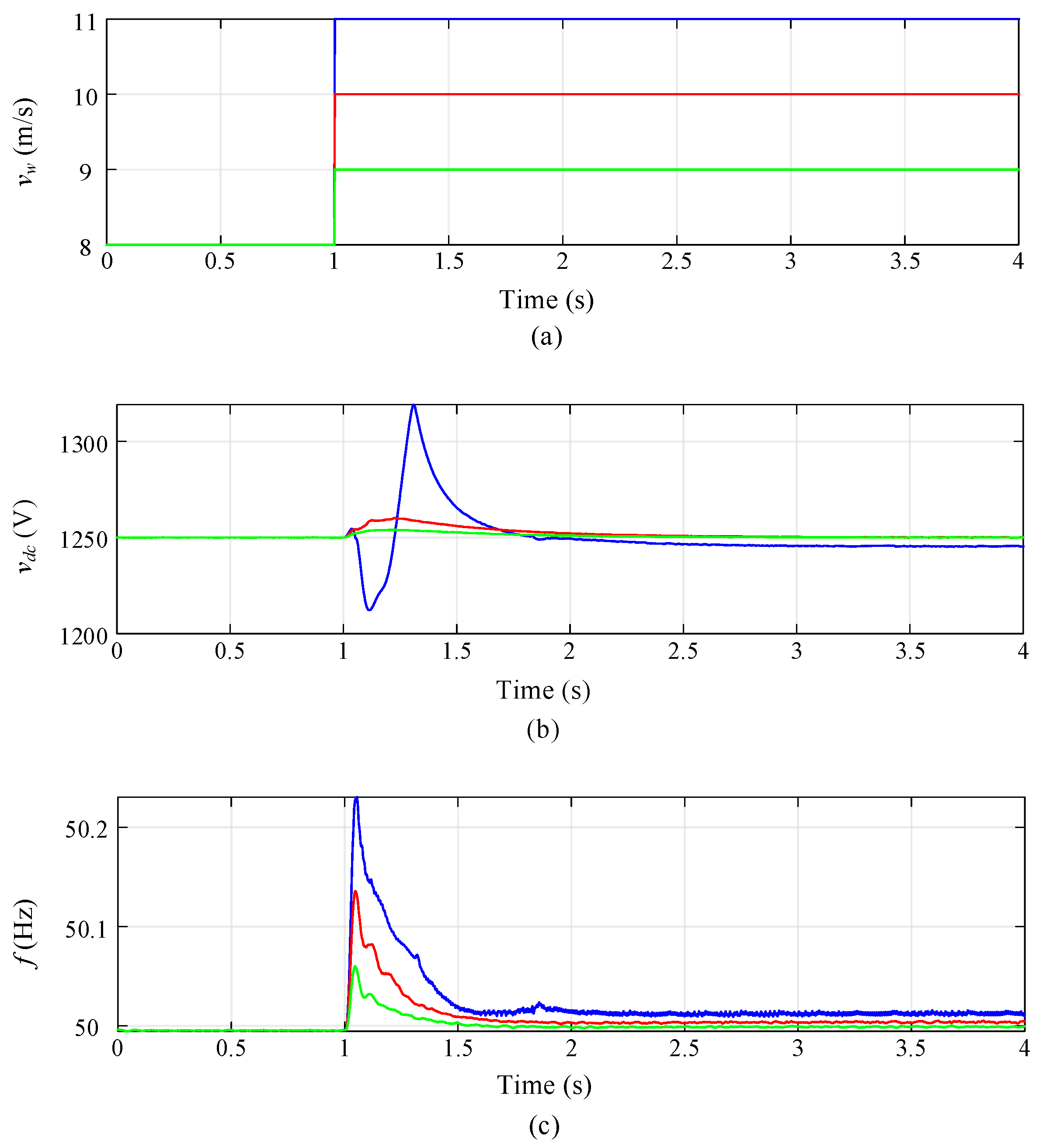
To evaluate the dynamic performance of the proposed GFM PMSG over a broader operating range, additional analyses are conducted under both low- and high-wind speed conditions. First, wind speed variations are quantified through a series of case studies involving step changes from 8 m/s to 9 m/s, 10 m/s, and 11 m/s. These scenarios are deliberately designed to assess the impact of increasing wind speed on the PMSG’s dynamic behavior. The corresponding results are presented in Figure 12, which illustrates the dynamic responses of the wind speed, the DC-link voltage, and the GSC frequency.
The overshoot and undershoot of the DC-link voltage and GSC frequency are tabulated in Table 1.
These results demonstrate that greater wind-speed variations induce more pronounced power imbalances between the MSC and the GSC, which are temporarily compensated by the DC-link capacitor. Consequently, this leads to larger excursions in the DC-link voltage and increased frequency deviations. As evidenced in Figure 12 and Table 1, increasing the magnitude of the wind-speed step results in higher overshoot levels in both the DC-link voltage and the system frequency.
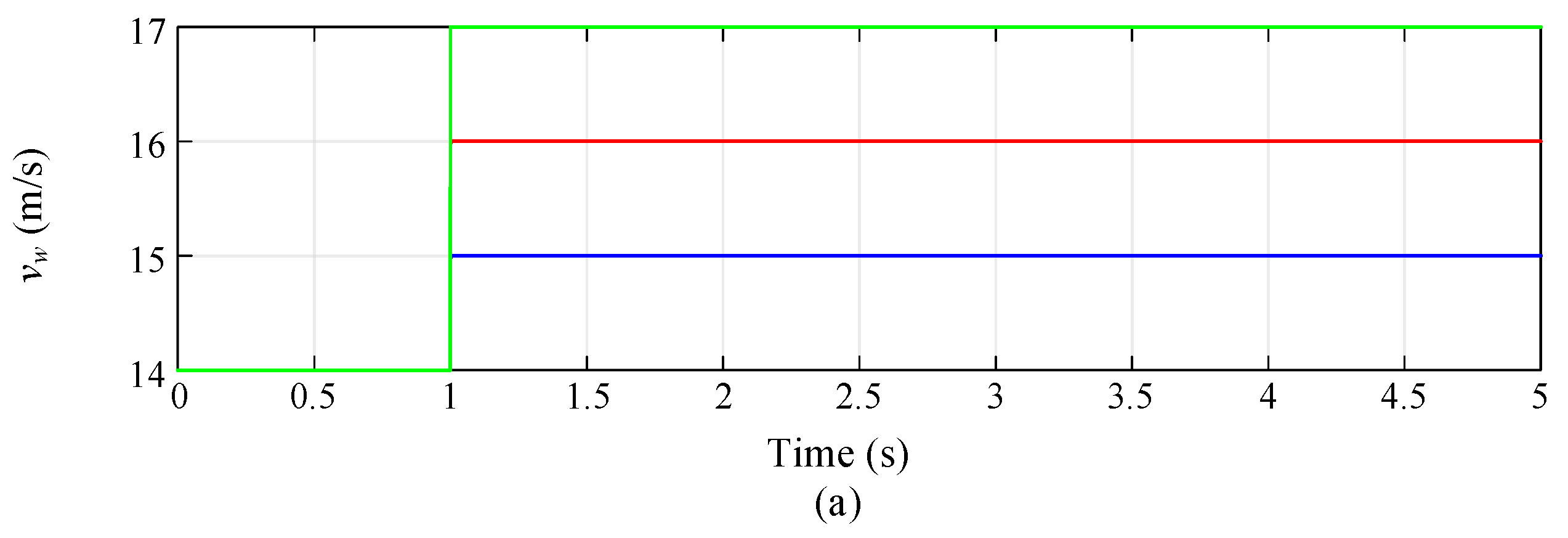
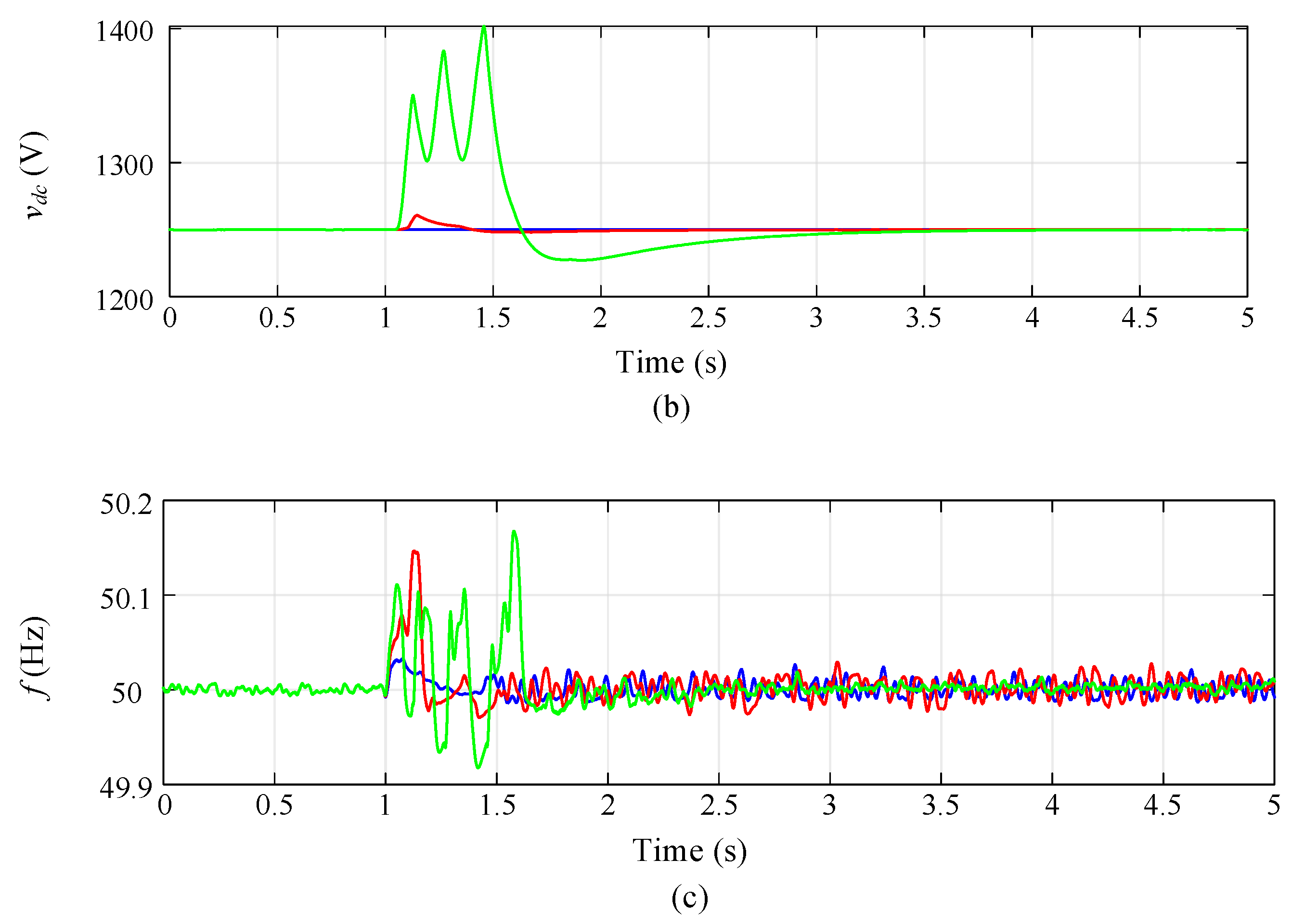
In the following, the effect of high wind speeds on the dynamic performance of the GFM PMSG is evaluated. Toward this end, three cases are considered, namely wind speed variations from 14 m/s → 15 m/s, 14 m/s → 16 m/s, and 14 m/s → 17 m/s. The corresponding simulation results are presented in Figure 13.
Similar to the low-wind condition, it can be observed that as wind speed increases, the aerodynamic power captured by the turbine rises significantly, leading to a higher mechanical input to the generator. This results in a temporary power imbalance between the MSC and the GSC, as the GSC cannot instantly transfer the increased power to the grid. Consequently, excess energy accumulates in the DC-link capacitor, causing a noticeable overshoot in the DC-link voltage. At the same time, the increased power injection leads to a corresponding overshoot in the system frequency due to the GFM control action.
The magnitude of these overshoots increases as the wind speed variation increases. In particular, larger step increases in wind speed result in more severe DC-link voltage excursions and higher-frequency deviations, reflecting a stronger transient energy imbalance within the system. The quantitative values of the DC-link voltage and frequency overshoots for the considered scenarios are summarized in Table 2.
Furthermore, under higher wind-speed conditions, the dynamic interaction among the MSC, DC-link, and GSC becomes more significant. The increased energy input intensifies stress on the DC-link capacitor and may lead to longer settling times and increased oscillatory behavior, especially when the GSC’s power transfer capability is limited. This highlights the importance of accurately modeling DC-link dynamics when analyzing high-wind scenarios.
The overshoot and undershoot of the DC-link voltage and frequency are tabulated in Table 2.
These case studies broaden the operational range investigated in the manuscript and demonstrate that the proposed framework remains applicable across low, medium, and high wind speed conditions.

4.4. Impact of Gain-Scheduled Control

In most existing studies, controller parameters are typically assumed to remain fixed over a wide operating range for PMSG wind turbines. However, under varying wind conditions, such fixed-parameter designs may not provide optimal dynamic performance, particularly when the available aerodynamic power and operating point change significantly. As a result, inappropriate controller tuning may lead to increased overshoot, longer settling times, or undesired oscillatory behavior.
To further investigate this aspect, gain scheduling is implemented in this section for both the PI controllers of the MSC and GSC, as well as the outer-loop VSG controller under varying wind conditions. The objective is to evaluate whether adaptive tuning of controller parameters can improve the transient performance of the proposed GFM PMSG under changing wind conditions.
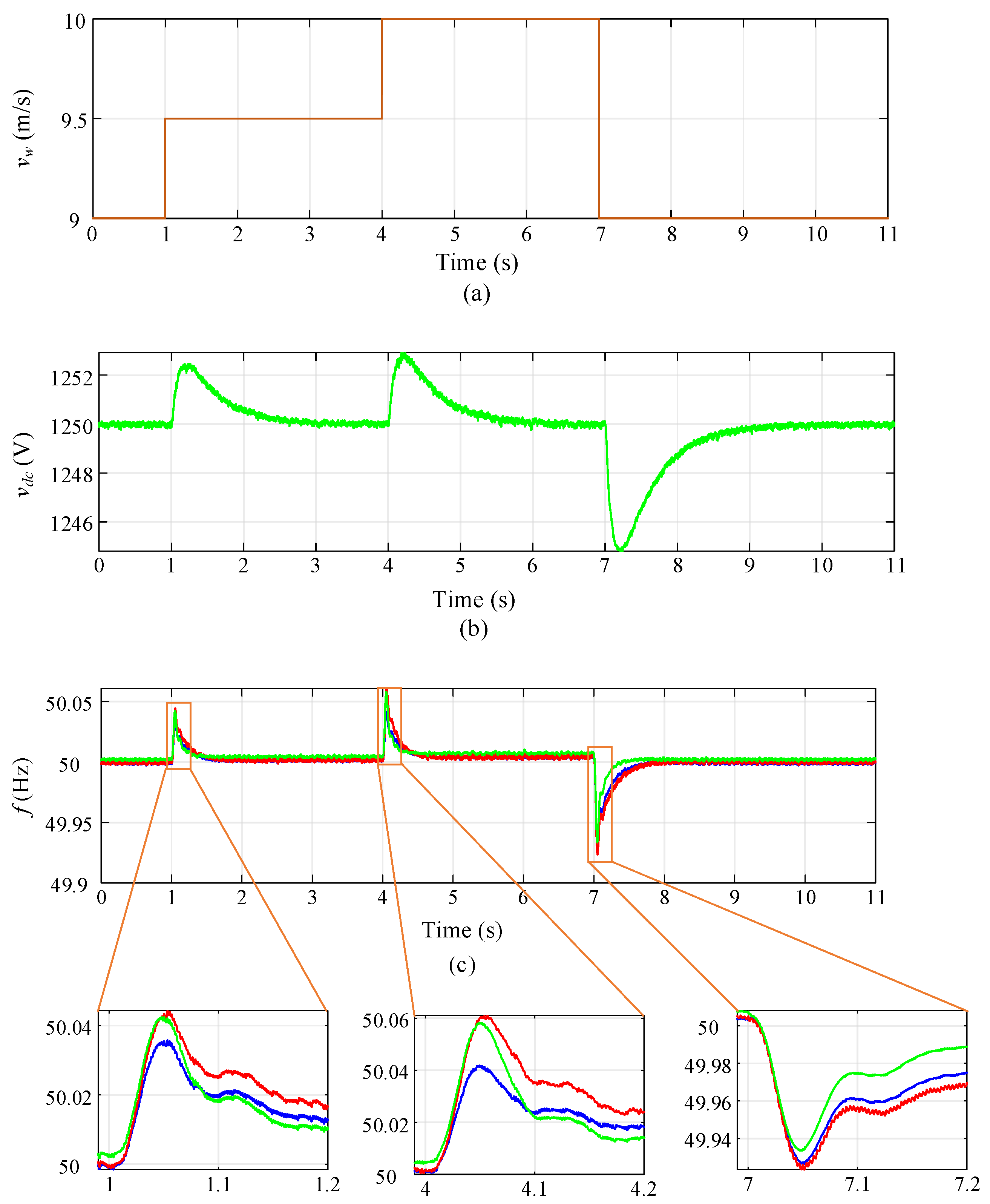
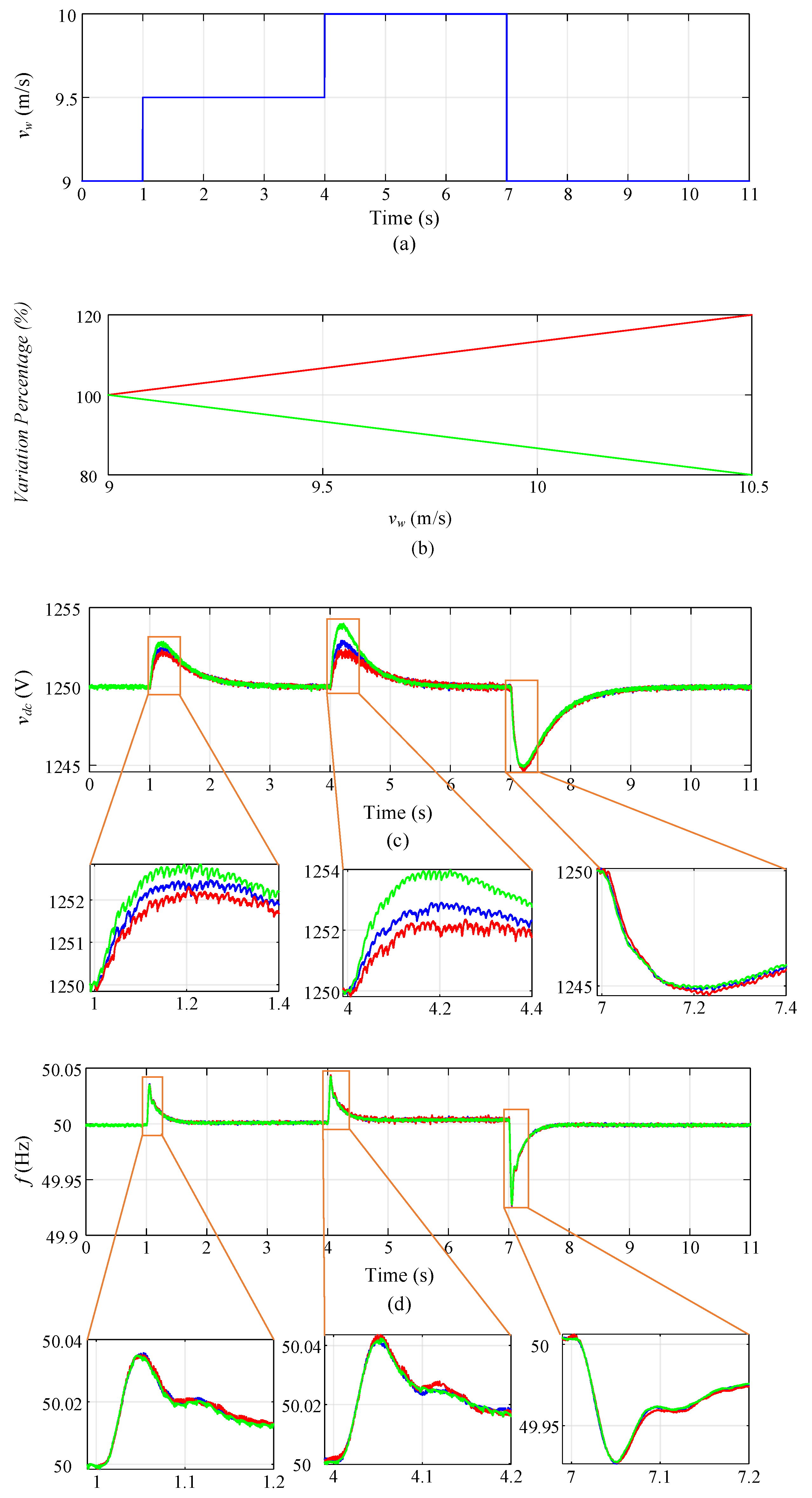
For the PI controllers of the MSC and GSC, two gain-scheduling strategies are considered. In the first scenario, the proportional and integral gains are increased as wind speed rises to provide a faster dynamic response under higher-power operating conditions. In the second scenario, PI gains are decreased as the wind speed increases to reduce aggressive control actions and mitigate oscillatory behavior. The simulation results under step wind changes are shown in Figure 14. The corresponding gain scheduling profiles are illustrated in Figure 14b. In this study, it is assumed that the controller parameters vary by ±20% depending on the wind speed.
The simulation results indicate that increasing the PI controller gains as wind speed increases improves the DC-link voltage response by reducing voltage overshoot and slightly decreasing settling time. However, this improvement is achieved at the expense of slightly increased oscillatory behavior. Conversely, decreasing the controller gains as the wind speed increases results in a larger DC-link voltage overshoot and longer settling time, while reducing oscillations.
For instance, as shown in Figure 14c, at t   =   1   s , when the wind speed increases from 9 m/s to 9.5 m/s, the DC-link voltage overshoot is approximately 1252.1 V when the PI controller gains are increased with wind speed. In contrast, the corresponding overshoot increases to approximately 1253 V when the PI controller gains are decreased with increasing wind speed. The base case, in which the PI controller parameters remain constant under wind speed variations, lies between these two cases, with an overshoot of approximately 1252.3 V.
However, variations in PI controller parameters have a relatively limited impact on the GSC frequency response, as illustrated in Figure 14d. This is primarily because the frequency dynamics are governed primarily by the outer-loop GFM controller and the energy exchange among the wind turbine, DC-link, and grid, whereas the inner-loop PI controllers mainly influence converter current regulation and DC-link voltage dynamics.
The results demonstrate that gain scheduling of PI controller parameters can slightly improve transient performance under varying wind conditions. Nevertheless, the improvements remain relatively marginal, and the fundamental conclusions of this paper regarding DC-link dynamics, renewable intermittency, and energy limitations remain unchanged.
In addition, gain scheduling is implemented for the VSG controller parameters, including the virtual inertia and damping coefficients. Two scenarios are investigated: (i) increasing the VSG parameters as the wind speed increases, and (ii) decreasing the VSG parameters as the wind speed increases. The corresponding simulation results are presented in Figure 15, and the gain scheduling profiles are illustrated in Figure 15b.
It can be observed that increasing the VSG parameters (i.e., virtual inertia and damping coefficients) as the wind speed increases improves the DC-link voltage response by reducing both the overshoot and undershoot of the DC-link voltage. In contrast, decreasing the VSG parameters as wind speed increases results in larger DC-link voltage overshoots and undershoots. This behavior can be attributed to the fact that larger virtual inertia and damping coefficients provide a smoother active power response of the GSC, thereby reducing the sudden power imbalance between the MSC and the GSC. Consequently, the energy exchanged through the DC-link capacitor becomes smoother, leading to improved DC-link voltage regulation. For instance, at t   =   1   s , when the wind speed increases from 9 m/s to 9.5 m/s, the DC-link voltage overshoot is approximately 1251.8 V when the VSG parameters are increased with wind speed. In contrast, the corresponding overshoot increases to approximately 1253 V when the VSG parameters are decreased as the wind speed increases. The base case, in which the VSG parameters remain fixed under varying wind conditions, exhibits a DC-link voltage overshoot of approximately 1252.3 V, which lies between these two cases.
Unlike the gain scheduling of the PI controller parameters, which has a relatively limited impact on the GSC frequency response, scheduling VSG parameters affects both the DC-link voltage dynamics and the frequency behavior. This is because the VSG controller directly governs the outer-loop frequency regulation dynamics and determines how the converter emulates SG behavior. Therefore, modifications to the virtual inertia and damping coefficients directly affect the frequency response characteristics of the GFM system.
Similarly, varying the VSG parameters with respect to wind speed also affects the GSC frequency’s dynamic performance. It can be observed that increasing the VSG parameters reduces both the frequency overshoot and undershoot under wind speed variations. Conversely, decreasing the VSG parameters results in larger frequency deviations. This behavior occurs because higher virtual inertia slows the rate of change of frequency, while increased damping suppresses oscillatory behavior. For example, at t   =   1   s , the frequency overshoot is approximately 50.0237 Hz when the VSG parameters are increased with increasing wind speed, whereas the corresponding overshoot exceeds 50.04 Hz when the VSG parameters are decreased as the wind speed increases. The base case, where the VSG parameters remain fixed, lies between these two scenarios and exhibits a frequency overshoot of approximately 50.0238 Hz.
The results demonstrate that gain scheduling of VSG parameters has a more pronounced impact on both DC-link voltage dynamics and frequency performance compared to PI controller gain scheduling. Nevertheless, while gain scheduling improves transient performance, the fundamental conclusions of this paper regarding DC-link dynamics and renewable energy limitations remain unchanged.

4.5. Time-Varying Wind Speed

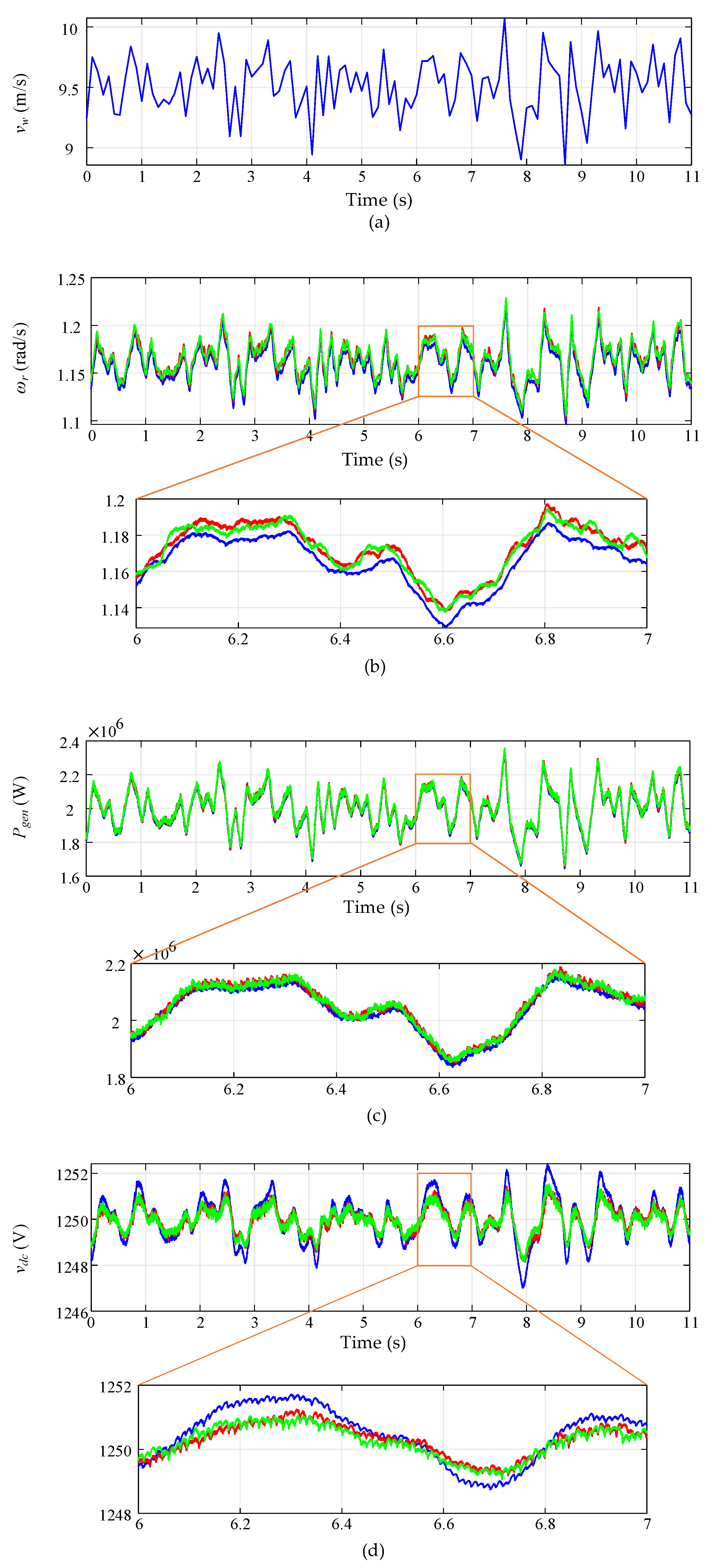
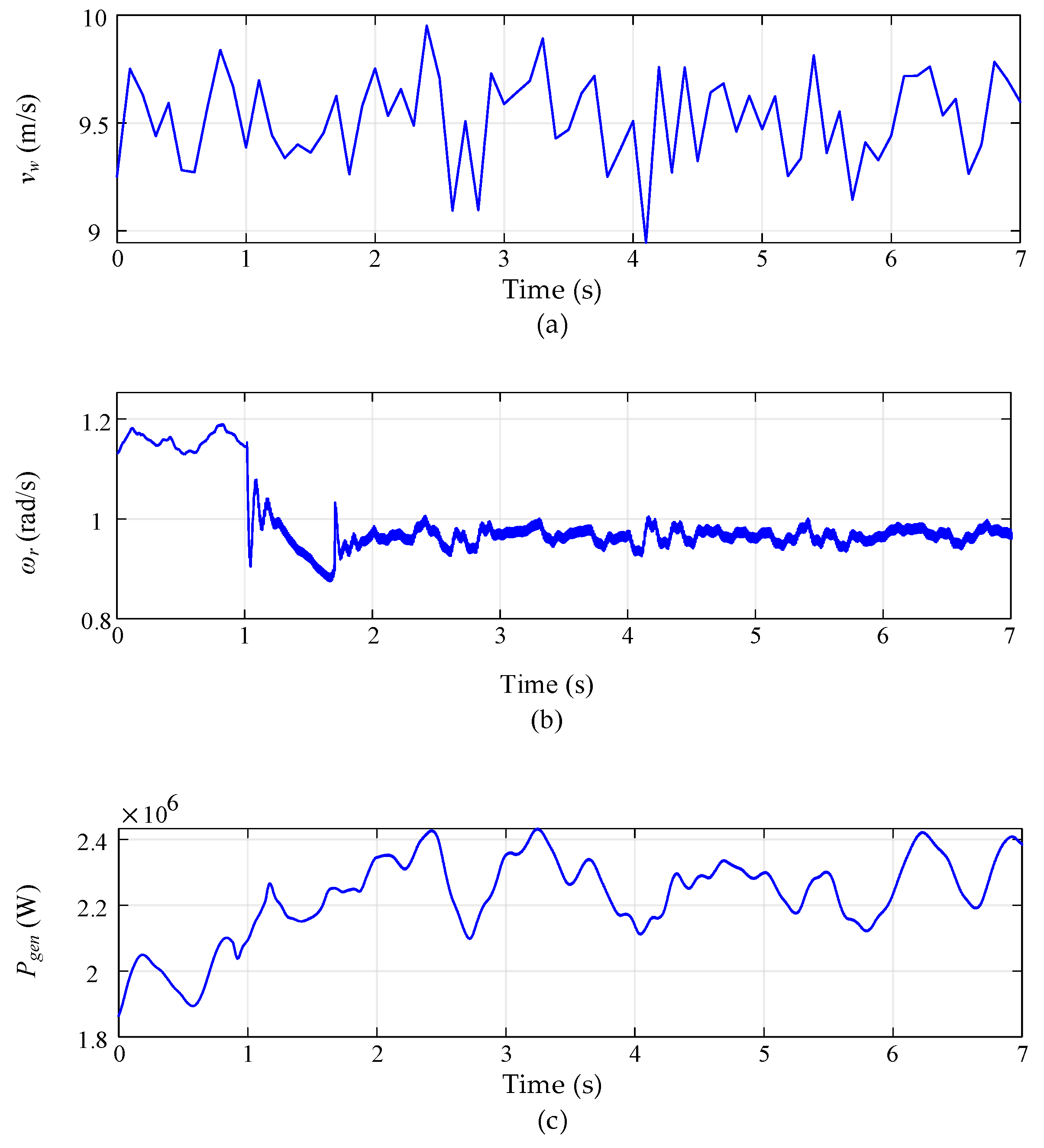
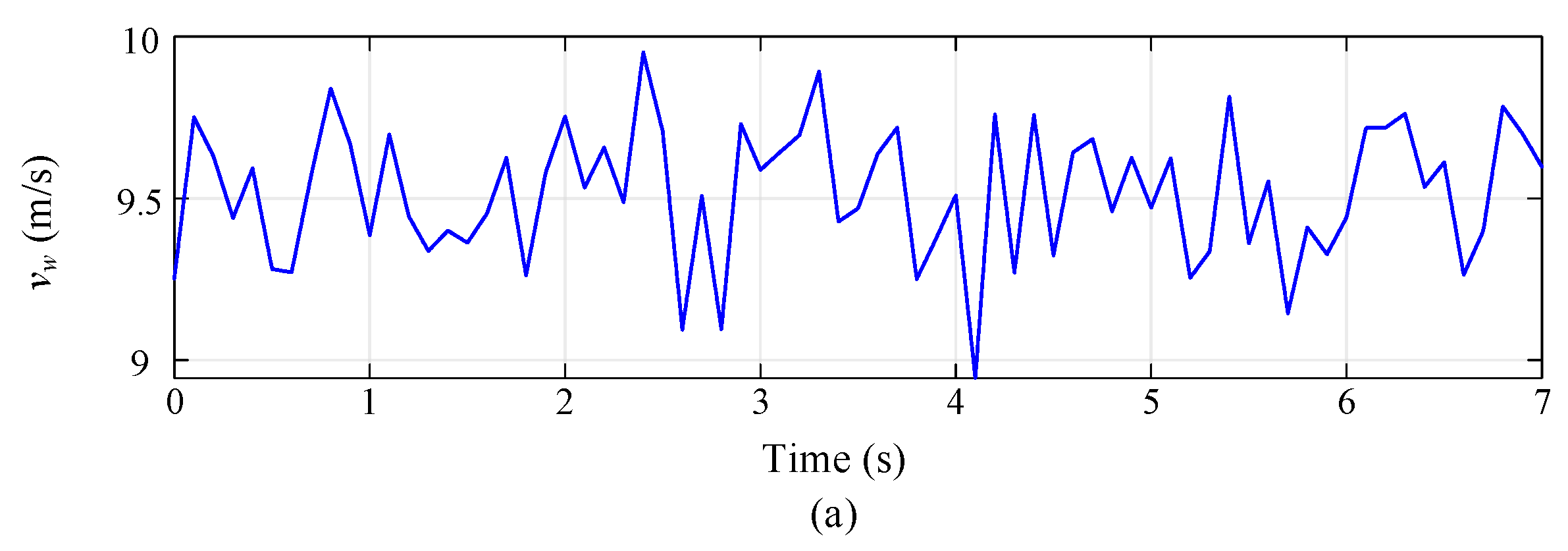
This section evaluates the GFM PMSG performance under a stochastic wind profile. The wind speed is modeled as a Gaussian random process with mean μ   =   9.5   m / s and standard deviation σ   =   0.05   m / s , i.e., v w N ( 9.5 ,   0.05 2 ) , sampled at 0.01 s intervals and shown in Figure 16a. The performance is analyzed using three sets of DC-link voltage PI control parameters, as below.
Case (1) kp,dc = 30, ki,dc = 60;
Case (2) kp,dc = 50, ki,dc = 60;
Case (3) kp,dc = 50, ki,dc = 120.
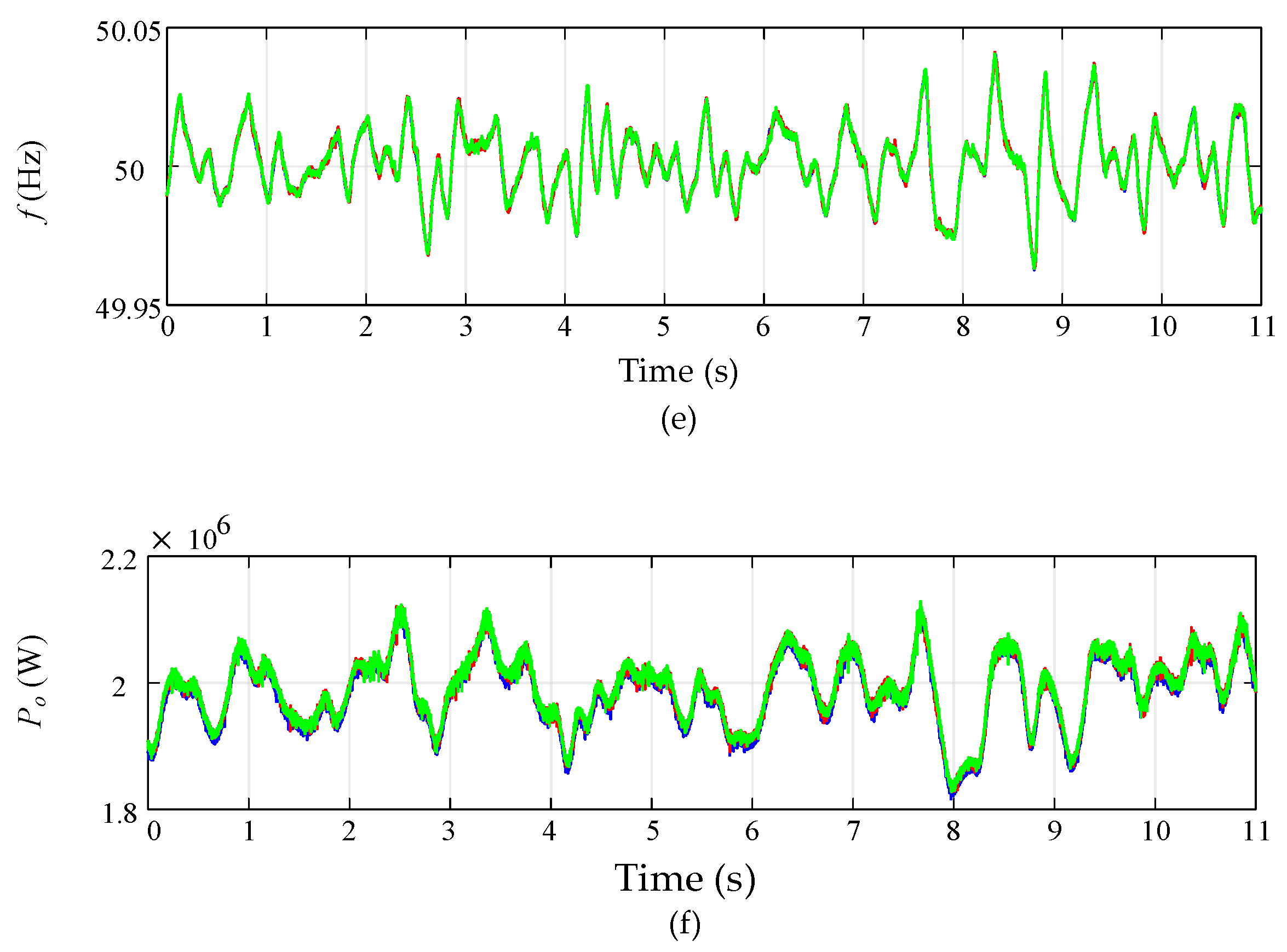
Under this test condition, the responses of the rotor speed, PMSG active power, DC-link voltage, GSC frequency, and GSC output power are monitored for all three cases, as illustrated in Figure 16b–f, respectively. As observed from the rotor speed profile in Figure 16b, fluctuations arise due to the continuous variations in wind speed. A closer examination of the enlarged figure in Figure 16b indicates that Case 1 exhibits comparatively inferior dynamic performance, with larger overshoot and undershoot than the other cases. From the comparative evaluation, it is evident that Case 3 demonstrates superior dynamic behavior, characterized by reduced overshoot and undershoot. The active power of the PMSG is illustrated in Figure 16c. As shown, wind speed variations directly influence the generated power, leading to noticeable oscillations of approximately ±10%. Although the controller effectively mitigates these fluctuations, they cannot be neglected and should be explicitly considered in dynamic performance analyses, contrary to the assumptions in IEEE Standard 2800-2022.
As illustrated in Figure 16d, the controller is capable of maintaining the DC-link voltage within an admissible boundary of ±2 V despite rapid and substantial variations in wind speed. Since the parameters of the PI controller directly influence the regulation of the DC-link voltage, the enlarged section of Figure 16d reveals that increasing the proportional and integral gains of the controller reduces both overshoot and undershoot, thereby enhancing the dynamic performance of the DC-link voltage regulation. Furthermore, wind speed variations induce significant fluctuations in the GSC frequency response, as illustrated in Figure 16e. Although these oscillations remain within the ±0.05 Hz boundary, they should not be disregarded. On the other hand, the figure indicates negligible sensitivity to variations in the PI controller parameters of the DC-link voltage control across Cases 1–3. Figure 16f presents the active power response of the GSC. It indicates that the variations in all considered cases remain within the limit of 10%. A closer examination reveals that wind speed fluctuations exert a significant influence on the injected active power. This study highlights that wind speed fluctuations negatively affect GFM performance and must be considered in IBR frequency control.

4.6. Effect of DC-Link Dynamics on Frequency Control Under Time-Varying Wind Speed

This section examines the effect of DC-link dynamics on the frequency response of IBRs. In this context, three principal approaches for modeling DC-link dynamics are considered and compared: (1) ideal, (2) simplified, and (3) comprehensive (accurate).
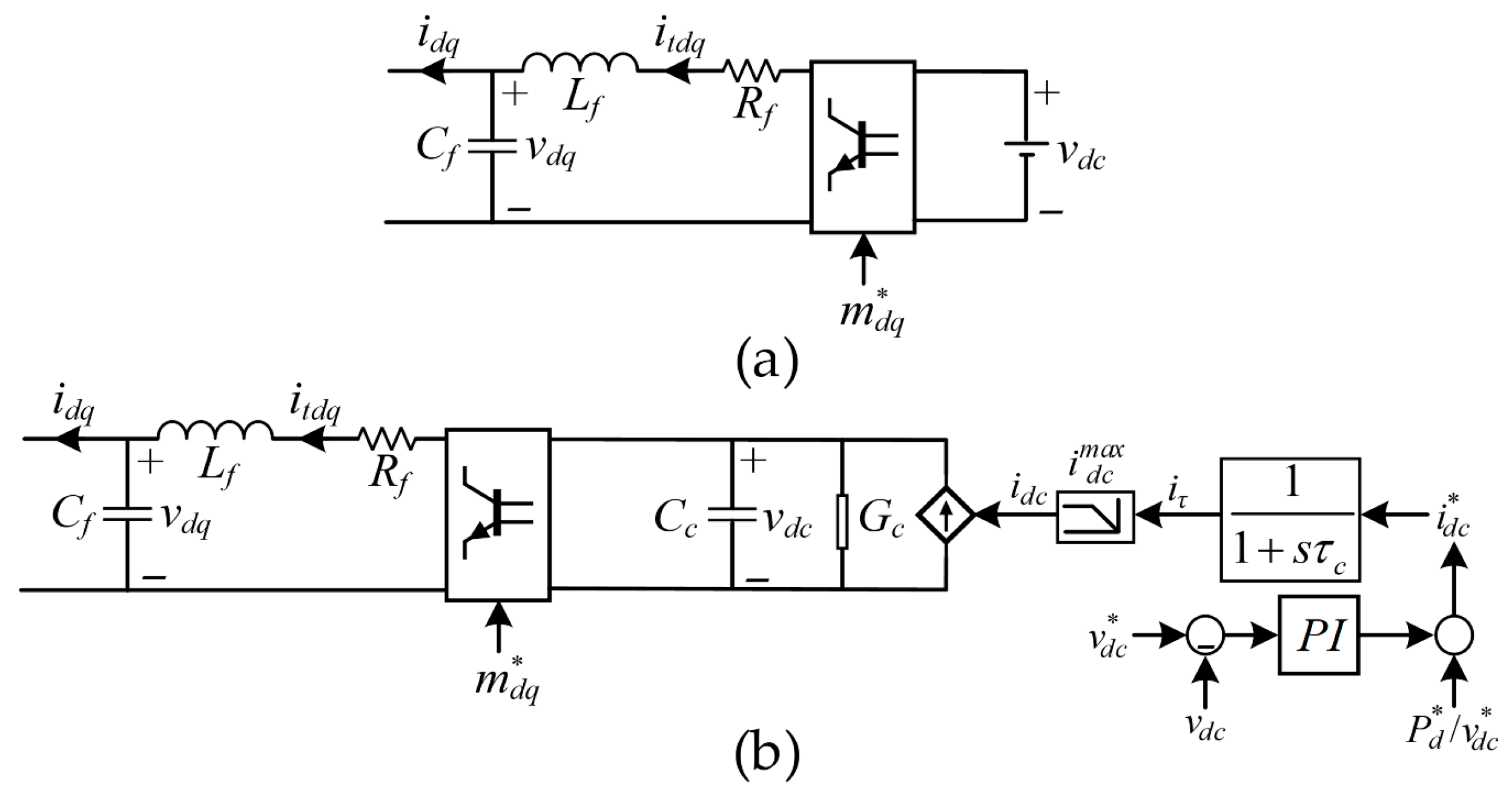
In the ideal modeling approach, the DC side is represented by an ideal DC voltage source capable of supplying unlimited energy, with its voltage assumed to remain constant and unaffected by operating conditions or environmental variations. A large portion of the literature adopts this assumption and neglects the influence of DC-link dynamics on the frequency response (e.g., [38,39]). Although this approach provides a convenient representation for control design and system-level studies, it cannot accurately capture the physical limitations and dynamic interactions associated with practical IBRs. The ideal DC link is shown in Figure 17a.
In the simplified modeling approach, the DC side is typically represented by a controlled current source. In contrast to the ideal approach, the DC-link voltage is no longer perfectly constant and can be affected by variations in the IBR’s output power. However, the DC-link voltage reference is assumed to remain fixed, neglecting that it may vary with environmental conditions and the intermittent nature of RERs. In this modeling approach, it is assumed that the DC link can supply a substantial amount of power. Nevertheless, this representation cannot simultaneously and accurately capture both the intermittent nature and the limited power availability of RERs. The schematic representation of the simplified approach is shown in Figure 17b. This modeling framework has been employed in the literature (e.g., [14,16]) for the analysis and design of fast frequency response strategies. A detailed explanation is provided in [17].
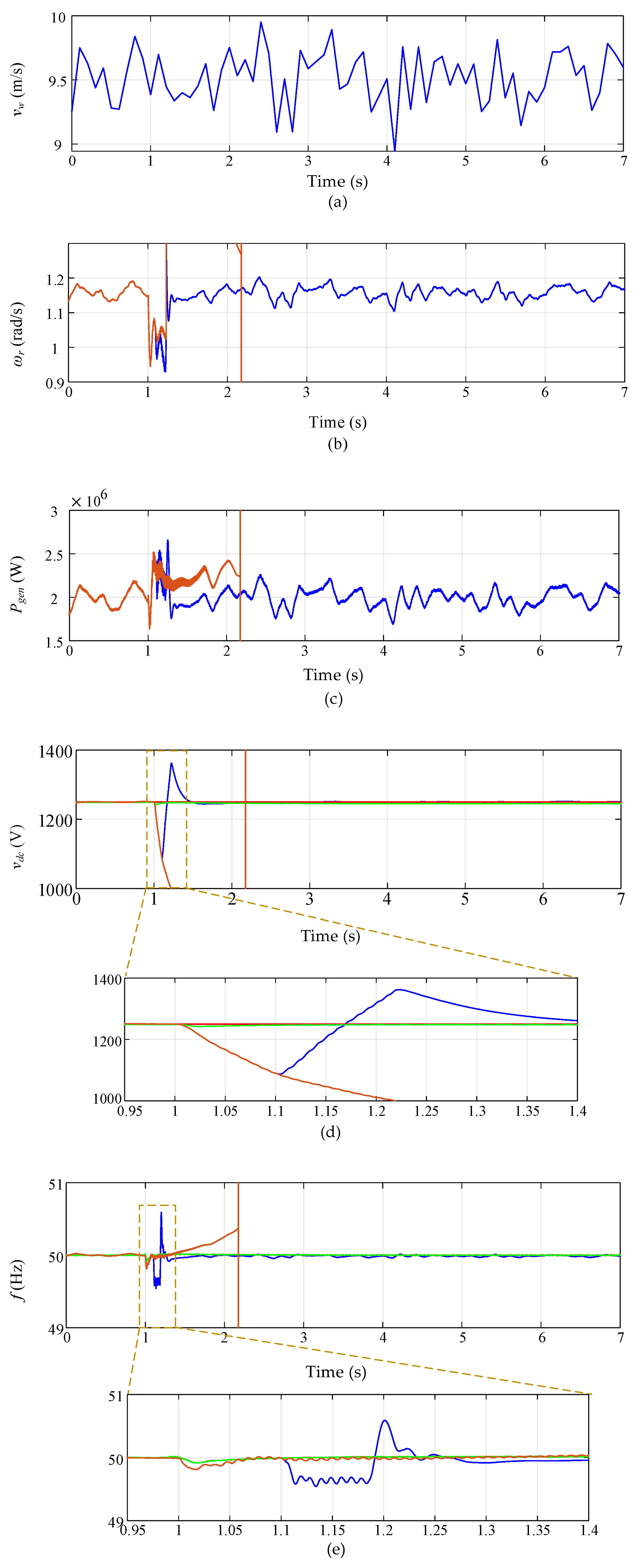
The comprehensive (accurate) modeling approach has already been discussed in detail in this paper. To clearly distinguish the characteristics and implications of these three modeling approaches, two case studies involving moderate and severe load disturbances under variable wind speed conditions are presented in this section. To fairly compare the three approaches, it is assumed that the GSC’s active power reference in the ideal and simplified models is increased by an amount equal to the additional connected load. The PI controller parameters for DC-link voltage control are set to kp,dc = 30, ki,dc = 60, and v dc , min is set to 1150 V. The supervisory control sampling interval is set to 0.1 s. Note that these parameters are not universally fixed and may be defined in accordance with the specific characteristics of the PMSG and its associated control framework, as well as extended to other PMSG configurations exhibiting similar dynamic features.

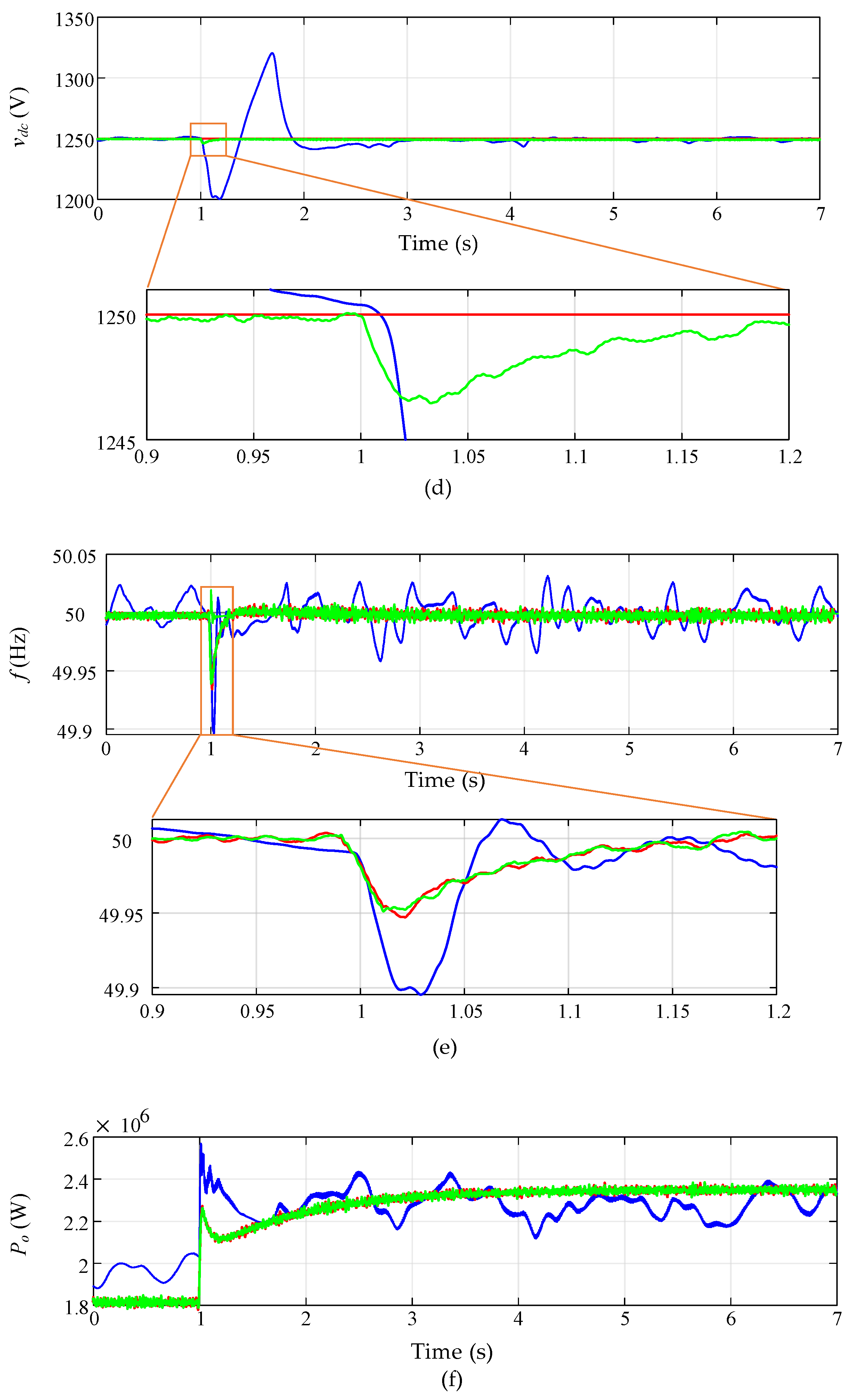
4.6.1. GFM Performance Under a Moderate Load Change

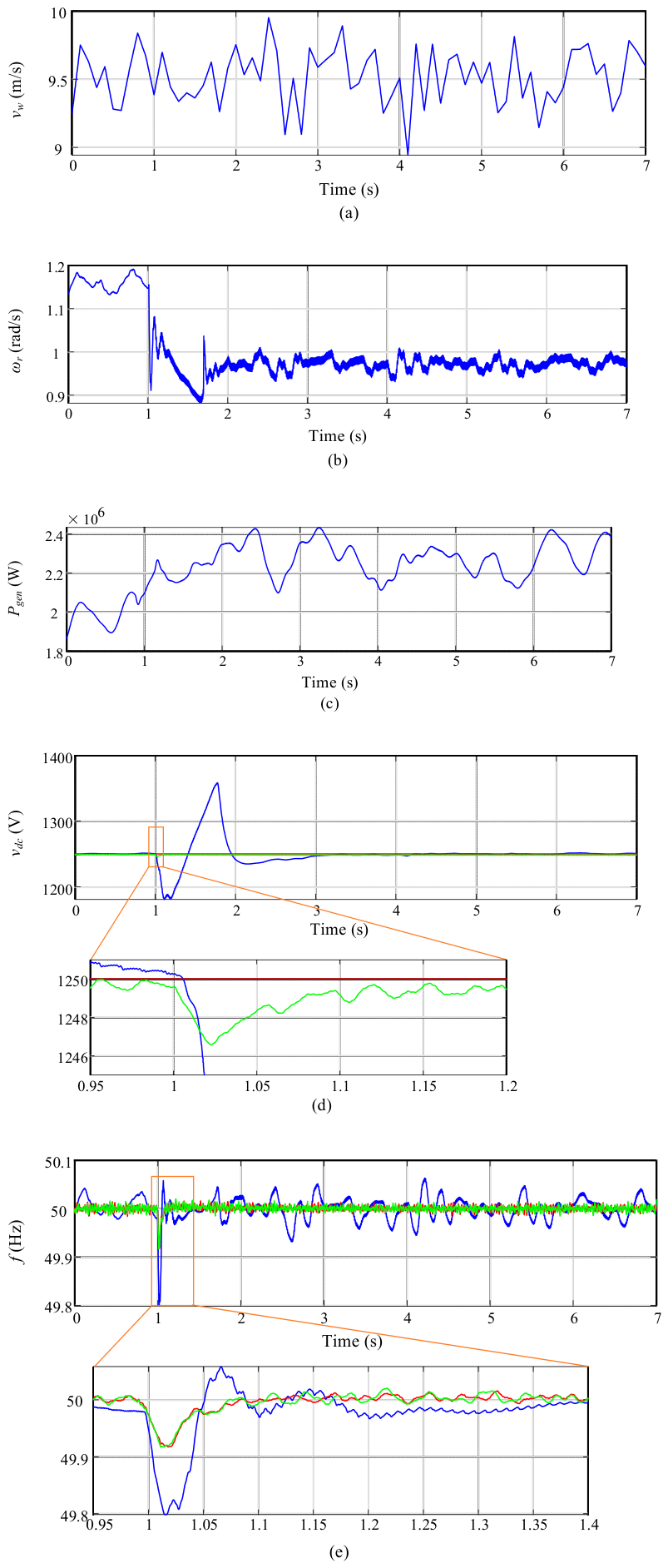
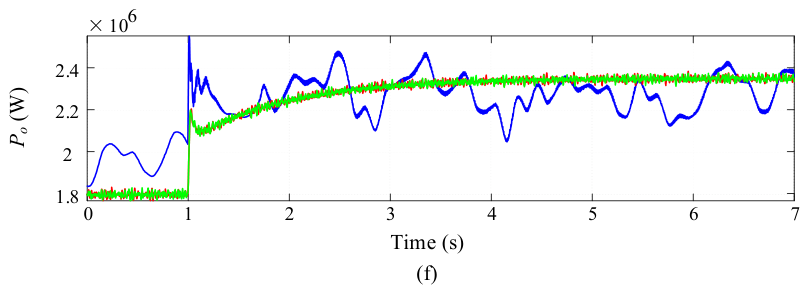
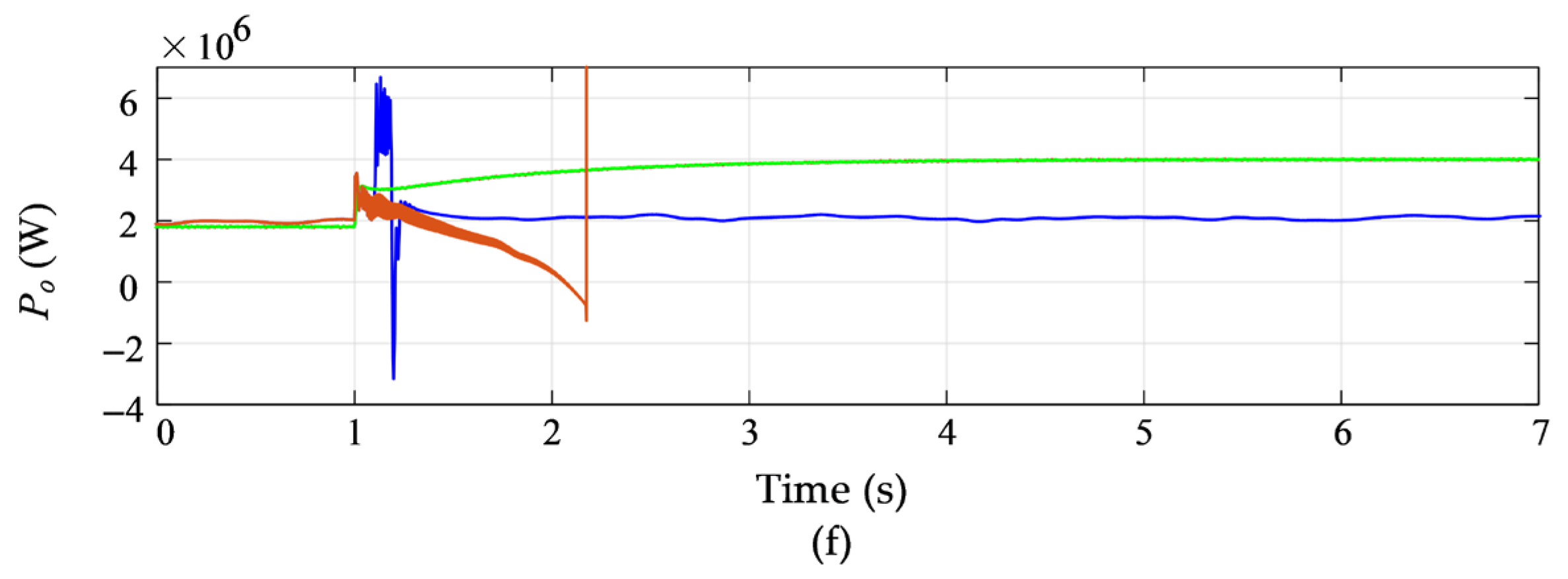
In this scenario, the impact of intermittent wind speed variations on the dynamic performance of the PMSG is examined under a moderate step load disturbance. To this end, an additional load of 5.0 MW is connected at POI (Figure 1) at t   =   1   s . The corresponding simulation results for the three DC-link dynamic modeling approaches are illustrated in Figure 18. Figure 18a depicts the stochastic wind speed variations. Prior to load connection, the system operates in steady state, with the DC-link voltage regulated at its nominal value of 1250 V and the GSC frequency maintained at 50 Hz. The rotor speed and the PMSG power in the comprehensive model exhibit minor variations attributable to wind variability, as illustrated in Figure 18b and Figure 18c, respectively. The GSC power, shown in Figure 18f, supplies approximately 1.9 MW active power.
At t = 1   s , the connection of the additional load produces a sudden increase in electrical power demand, as illustrated in Figure 18f. Following the load connection, and as a consequence of the adopted deloading strategy, the rotor speed shown in Figure 18b reduces, reflecting the increased electrical power delivered by the generator to support the additional demand. After the transient period, the rotor speed settles at a new operating point of approximately 0.98 rad/s. The active power output of the PMSG is depicted in Figure 18c. It can be observed that, due to the implementation of the deloading strategy for frequency support and the coupling between the MSC and the GSC, the PMSG active power increases to meet the additional load demand.
Figure 18d illustrates the DC-link voltage response. At t = 1   s , a pronounced voltage undershoot occurs as a consequence of the sudden increase in electrical power demand and the temporary energy imbalance between the MSC and the GSC. The initial reduction in the DC-link voltage reflects the release of electrostatic energy stored in the DC-link capacitor. The results demonstrate that, for both simplified and comprehensive approaches, the DC-link voltage controller effectively regulates the DC-link voltage and restores it to its nominal value within a short settling time, i.e., less than 1.5 s. In contrast, the DC-link voltage remains constant throughout the entire simulation interval under the ideal modeling approach. A comparative analysis reveals that a noticeable voltage undershoot occurs immediately following the disturbance in the comprehensive DC-link model, which accurately captures the detailed energy exchange between the MSC and GSC. The minimum DC-link voltage decreases to approximately 1200 V in the comprehensive model, whereas it reaches about 1246.5 V in the simplified model. Hence, neither the ideal model nor the simplified model can accurately represent the DC-link voltage dynamics.
The corresponding frequency responses are presented in Figure 18e. Following the load connection, the system frequency experiences a transient dip due to the sudden increase in power demand. The GFM control subsequently compensates for the resulting power imbalance and restores the frequency to its nominal value by using the deloading strategy and the PMSG’s available reserve power. Although the frequency is successfully restored to 50 Hz across all three approaches, the ideal and simplified models fail to accurately reproduce the comprehensive model’s dynamic behavior. In particular, the comprehensive model exhibits a frequency nadir of approximately 49.90 Hz, whereas the ideal and simplified models reach a frequency nadir of approximately 49.94 Hz. These results indicate that simplified DC-link representations are insufficient to accurately capture the frequency dynamics of detailed DC-link energy interactions.
Figure 18f illustrates the active power responses of the PMSG. Following the load connection, the kinetic energy stored in the rotating mass and the electrostatic energy stored in the DC-link capacitor are released, increasing the GSC active power to meet the additional demand. The results indicate that both the ideal and simplified models achieve satisfactory performance in supplying the increased load, exhibiting minimal oscillations. In contrast, the comprehensive model exhibits pronounced oscillatory behavior, resulting in a larger transient response. Consequently, while the ideal and simplified models yield smoother responses, they provide a less realistic representation of system dynamics compared to the comprehensive DC-link model.

4.6.2. Performance of PMSG Control Under a Voltage Sag Condition

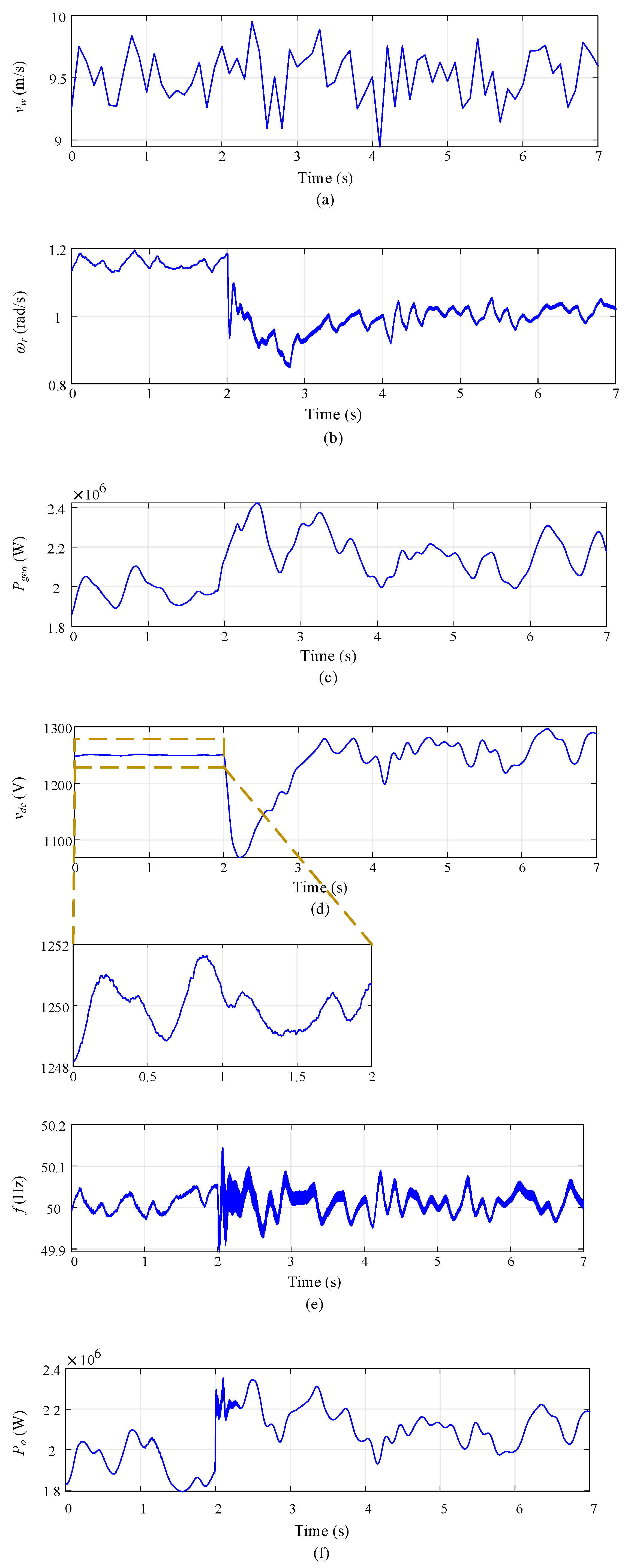
In power systems, IBRs are required to operate under low-voltage conditions. To evaluate the performance of the GFM PMSG under such disturbances, a voltage sag scenario is considered in this section. Specifically, a voltage sag of 0.9 p.u. is applied at the POI at t   =   1   s , followed by a step load increase of 5 MW at t   =   2   s . To implement the voltage sag, the exciter reference of the SG is reduced from 1 p.u. to 0.9 p.u. at t   =   1   s . The corresponding simulation results are shown in Figure 19. It should be noted that supervisory control is intentionally deactivated in this case to clearly observe the system’s inherent response under low-voltage conditions.
As shown in Figure 19, when the grid voltage drops abruptly from 1 p.u. to 0.9 p.u., the rotor speed, PMSG output power, DC-link voltage, GSC frequency, and GSC active power all exhibit noticeable undershoots and are reduced due to diminished power-transfer capability. The voltage sag directly limits the GSC’s ability to deliver active power to the grid, resulting in a temporary mismatch between the mechanical input power and the electrical output power.
When the step load is applied at t   =   2   s , the overall dynamic behavior remains qualitatively similar to that presented in Section 4.1 (with nominal voltage conditions). However, several key differences are observed under low-voltage conditions. In particular, the GSC output active power is reduced, as shown in Figure 19f, due to the limited voltage magnitude at the point of interconnection, which constrains the maximum transferable active power. Furthermore, the oscillations in the GSC frequency are intensified, as illustrated in Figure 19e. Although the frequency nadir remains at approximately 49.9 Hz, the frequency overshoot increases significantly, exceeding 50.12 Hz. In contrast, under nominal voltage conditions (1 p.u.), the corresponding overshoot is limited to approximately 50.02 Hz (see Figure 18e).
Due to the reduced active power transfer capability, the PMSG’s power output decreases, as shown in Figure 19c. Consequently, the imbalance between the mechanical input power and the electrical output power leads to an increase in rotor speed compared to the nominal voltage case, as illustrated in Figure 19b. This behavior reflects the temporary accumulation of excess energy in the mechanical system.
At the same time, the DC-link voltage exhibits more pronounced oscillations under voltage sag. The reduced power transfer capability of the GSC results in a temporary accumulation of energy in the DC-link capacitor, leading to increased voltage fluctuations. In addition, due to current limitations and the requirement to support the grid voltage, the converter injects reactive power during the sag. This further constrains the active power delivery capability, thereby exacerbating the power imbalance between the MSC and the GSC.
This case study demonstrates that the GFM PMSG remains stable throughout the disturbance, highlighting the proposed control strategy’s capability to maintain operation under low-voltage conditions. However, the results also indicate that voltage sag conditions lead to increased oscillations, reduced active power transfer, and degraded frequency performance, underscoring the importance of accounting for low-voltage scenarios in the design and analysis of GFM systems.

4.6.3. Dynamic Performance of the Droop-Controlled GFM PMSG

GFM controls include various approaches, such as droop control, VSG, matching control, and dispatchable virtual oscillator control (dVOC) [36]. To further analyze the impact of the outer control loop of the GSC on the performance of the GFM PMSG, a droop-controlled GFM under time-varying wind speed and a step load change at t   =   1   s is considered. The corresponding simulation results are shown in Figure 20.
The dynamic performance of the droop-controlled GFM PMSG is generally similar to that of the VSG-controlled GFM PMSG presented in Section 4.1 in terms of overall system behavior. However, noticeable differences arise in the transient response, particularly in frequency regulation and power oscillations. Specifically, in the droop-controlled GFM, the frequency response exhibits a lower nadir compared to the VSG-based approach. This is primarily due to the absence of virtual inertia in droop control, leading to a faster but more aggressive response to disturbances. As a result, the system experiences a larger initial frequency deviation before stabilizing, as illustrated in Figure 20e.
Quantitatively, for the droop-controlled GFM, the frequency nadir obtained with the comprehensive model is approximately 49.80 Hz, whereas the simplified and ideal models yield a nadir of approximately 49.90 Hz. In contrast, for the VSG-controlled GFM, the frequency nadir using the comprehensive model is approximately 49.90 Hz, whereas the ideal and simplified models yield a higher nadir of 49.95 Hz. This improvement in frequency response for the VSG-based approach can be attributed to the presence of virtual inertia, which effectively slows down the rate of change of frequency and mitigates the depth of the frequency dip.
Furthermore, the oscillations in the GSC output active power are more pronounced in the droop-controlled GFM PMSG compared to the VSG-controlled case, as shown in Figure 20f. This behavior can be explained by the reduced damping characteristics of droop control. Since droop control directly links frequency deviations to power injection without incorporating inertial or damping emulation, it tends to produce sharper and less damped transient responses. In contrast, the VSG control introduces both virtual inertia and damping, thereby smoothing the power exchange between the DC-link and the grid and reducing oscillatory behavior.

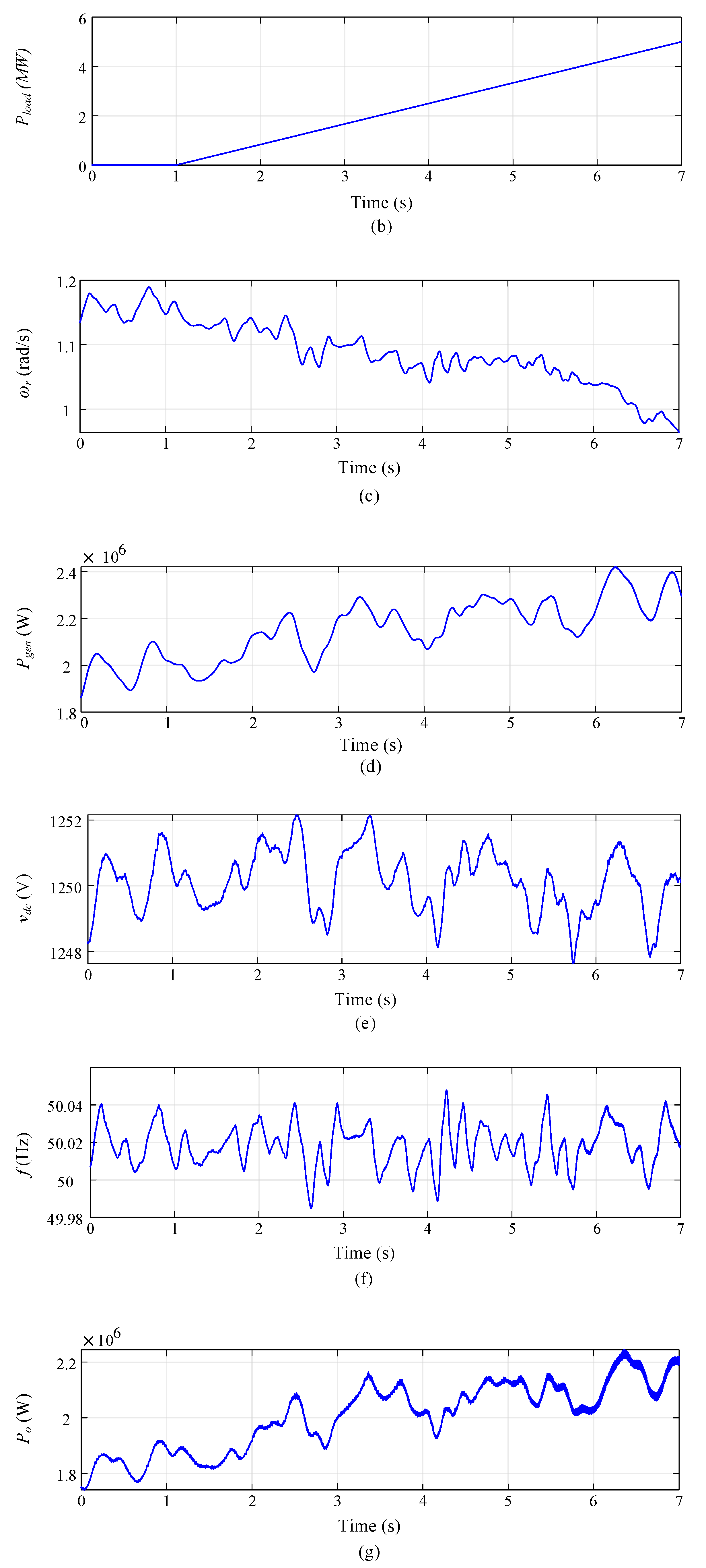
4.6.4. Dynamic Performance of the GFM PMSG Under a Ramp Load Condition

In real-world applications, load variations typically occur gradually rather than as instantaneous step changes. To better reflect practical operating conditions, a ramp load variation is considered in this section, in which the load increases linearly to 5 MW over 6 s. The corresponding simulation results are presented in Figure 21. The time-varying wind speed is shown in Figure 21a, and the ramp load profile is presented in Figure 21b.
The results demonstrate that, compared to the step-change scenario, the ramp input leads to a significantly smoother power imbalance between the MSC and the GSC. As a result, the DC-link voltage exhibits reduced fluctuations, and the frequency response shows milder deviations, as illustrated in Figure 21d and Figure 21e, respectively. In particular, no DC-link voltage undershoot is observed in this case, indicating that the controller is able to effectively regulate the dc-link voltage under gradual load variations.
Furthermore, as shown in Figure 21b, the rotor speed decreases gradually and stabilizes at approximately 0.98 rad/s, indicating controlled extraction of kinetic energy from the turbine. This smooth deceleration leads to a corresponding increase in the PMSG’s output power, which reaches approximately 2.3 MW, as shown in Figure 21c. The absence of abrupt dynamic transitions highlights improved coordination between the MSC and GSC under ramp-loading conditions.

4.6.5. Performance of Supervisory Control Under a Severe Step Load Change

In this case, the performance of the GFM PMSG is evaluated under a severe step load disturbance. This scenario is identical to Section 4.1, except that a step load increase of 15 MW is applied at the POI of Figure 1 at t = 1   s . The supervisory controller’s time step is set to 0.1 s; that is, the operating condition is evaluated every 0.1 s. The simulation results are illustrated in Figure 22. According to the GSC active power response, the power demand rises sharply within a few milliseconds subsequent to the load connection at t = 1   s and exceeds 2.6 MW, as shown in Figure 22f. Consequently, the rotor speed of the PMSG decreases from approximately 1.18 rad/s to below 0.95 rad/s, as shown in Figure 22b. Simultaneously, the generated active power increases due to the activation of the deloading strategy, which provides additional reserve power for frequency support, as shown in Figure 22c.
Under this disturbance, the DC-link voltage, depicted in Figure 22d, exhibits a pronounced undershoot when the comprehensive approach is employed, falling below the minimum permissible voltage of 1150 V at t   =   1.07 s. Under this condition, supervisory curtailment control must be activated to reduce the demand. Since the supervisory controller operates with a sampling interval of 0.1 s, the corrective action is applied at the next sampling instant, i.e., t   =   1.10 s, and the GSC power is curtailed. As a result, the GSC output active power remains at its pre-disturbance level, as illustrated in Figure 22f. The GSC active power is deliberately maintained unchanged, thereby allowing a portion of the generator’s output to be redirected to recharge the DC-link capacitor. This serves to preserve the DC-link voltage stability and to facilitate its restoration to the reference value. Furthermore, Figure 22d indicates that by curtailing the output power, the DC-link voltage is recovered to its nominal value within 0.4 s. In contrast, Figure 22d shows that the DC-link voltage remains constant throughout the entire simulation interval under the ideal DC-link modeling approach, whereas the simplified approach exhibits a transient undershoot followed by a gradual restoration to the nominal value by the DC-link voltage controller.
Figure 22e shows that immediately after the load connection, the system frequency exhibits a transient undershoot. The frequency nadir obtained using the ideal and simplified DC-link modeling approaches is approximately 49.9 Hz, whereas the comprehensive DC-link dynamic model yields a significantly lower nadir of 49.53 Hz. As illustrated in Figure 22f, both the ideal and simplified models allow the GSC active power to increase sufficiently to supply the additional load demand and support frequency regulation.
To further demonstrate the effectiveness of the proposed supervisory strategy, the system performance in the absence of supervisory control under severe load disturbances is also analyzed. The results indicate that without activation of the supervisory mechanism at t = 1.1 s, a substantial amount of electrostatic energy is depleted from the DC-link capacitor, leading to a significant voltage drop, as shown in Figure 22d. Consequently, the system fails to maintain stable operation, resulting in unstable behavior of the GFM unit. In contrast, in the comprehensive model, once supervisory control is activated and load demand is curtailed, the operating condition is intentionally maintained unchanged to preserve PMSG stability and GSC frequency stability. This case study demonstrates the effective performance of supervisory curtailment control in maintaining GFM stability under severe load disturbances.

4.7. Discussion

4.7.1. Impact of Controller Parameters on DC-Link Voltage Regulation

The findings indicate that the PI controller parameters predominantly influence the dynamic behavior of the DC-link voltage. By appropriately selecting the proportional and integral gains, the DC-link voltage response can be effectively regulated to achieve desirable dynamic performance. In particular, the results demonstrate that increasing the proportional and integral gains reduces both overshoot and undershoot and shortens the settling time. Therefore, careful and accurate tuning of the controller parameters is essential to ensure satisfactory DC-link voltage regulation.

4.7.2. Comparison of Different DC-Side Modeling Approaches

Although IEEE Standard 2800-2022 establishes requirements for active power–frequency response at the point of interconnection, it does not explicitly incorporate the internal dynamics of IBRs, particularly the behavior of the DC-link voltage. In power systems with high penetration of renewable energy, this omission becomes increasingly significant, as the DC link functions as the principal energy buffer regulating the exchange of power between the primary energy source and the grid. Furthermore, the standard implicitly assumes the availability of sufficient and continuously accessible primary energy, an assumption that may not be valid for renewable resources, such as wind turbines, operating under inherently variable and uncertain environmental conditions. The findings indicate that although the control schemes associated with the ideal and simplified DC-link representations are relatively straightforward, they cannot accurately capture the dynamic behavior predicted by the comprehensive DC-link model. Although the overall qualitative behavior appears similar across the three approaches, noticeable discrepancies arise in the transient responses, particularly in the DC-link voltage dynamics, frequency nadir, and active power exchange during and following disturbances. These differences highlight that idealized, simplified DC-link models tend to underestimate the coupling between the MSC and GSC and, consequently, fail to provide an accurate representation of the transient energy balance. The discrepancy becomes more pronounced when the GFM experiences a large load connection. As a result, these simplified approaches may lead to an inaccurate assessment of frequency support capability and DC-link voltage regulation performance in PMSGs. Therefore, the comprehensive model should be considered to obtain a more realistic and reliable evaluation of PMSG dynamic performance. In this context, the absence of detailed DC-link modeling considerations in IEEE Standard 2800-2022 may limit its applicability in realistic, high-IBR scenarios. This limitation is expected to become increasingly significant as IBR penetration rises, potentially affecting the accuracy of system stability assessments.

5. Conclusions

This paper presents a systematic large-signal EMT modeling framework for GFM Type-IV wind turbines, addressing the intricate dynamic couplings between the machine-side and grid-side subsystems to enable effective frequency-support capability. The central principle of the proposed control strategy is the simultaneous utilization of the electrostatic energy stored in the DC-link capacitor and the rotor’s rotational kinetic energy. Both the MSC and the GSC are modeled in detail to accurately capture their dynamic interactions. In addition, a supervisory curtailment strategy is implemented to preserve GFM stability under severe load disturbances. Comprehensive case studies (including constant and time-varying wind-speed scenarios, as well as moderate and severe load changes) are conducted to evaluate the control framework’s performance. The simulation results demonstrate that: (1) the selection of DC-link voltage control parameters influences the dynamic performance of wind turbine generators, in contrast to battery energy systems that typically operate with a stable DC voltage source; and (2) employing conventional idealized or simplified DC-link dynamics results in inaccurate system responses, including discrepancies in key dynamic metrics (e.g., frequency nadir) and an overestimation of the power support capability.
Several key considerations are identified to enhance the accuracy and effectiveness of frequency response in IBRs. First, it is essential to explicitly incorporate DC-link voltage dynamics and associated operational constraints into grid code requirements, as these factors critically influence the energy exchange process. Second, frequency response specifications should adequately account for the inherent intermittency and limited availability of primary energy for RERs. Third, coordinated control strategies between MSCs and GSCs should be developed to ensure stable and efficient power transfer under dynamic operating conditions. Finally, the adoption of adaptive or predictive control frameworks is recommended to accommodate rapid variations in system conditions, particularly under fluctuating wind profiles. These considerations are fundamental to ensuring the reliable and resilient operation of GFM IBRs.
Future work will focus on developing advanced control strategies for GFM PMSGs, including robust and adaptive frameworks, such as robust model predictive control, to address uncertainties in wind and grid conditions. Moreover, data-driven and artificial intelligence-based approaches, including physics-informed neural networks and reinforcement learning, will be investigated to enhance dynamic performance. Also, the coordinated operation of multiple IBRs (e.g., wind, photovoltaic, and battery storage) will be examined to ensure stable power sharing and synchronization, detailed fault-ride-through studies under severe fault conditions, and effective interaction between GFM and GFL units in hybrid power systems.

Author Contributions

Conceptualization, M.M. and S.S.; methodology, M.M. and S.S.; software, M.M.; validation, A.R. and I.K.; formal analysis, A.R., I.K. and S.M.M.-B.; investigation, M.M. and S.S.; resources, I.K.; data curation, M.M. and S.S.; writing—original draft preparation, M.M. and S.S.; writing—review and editing, A.R., I.K. and S.M.M.-B.; visualization, M.M. and S.S.; supervision, A.R., I.K. and S.M.M.-B.; project administration, I.K.; funding acquisition, I.K. All authors have read and agreed to the published version of the manuscript.

Funding

This work was supported by the Canada National Sciences and Engineering Research Council through Laval University. Grant number: RGPIN-2025-04642.

Data Availability Statement

The original contributions of this study are fully contained within the article; any further inquiries may be directed to the corresponding author.

Conflicts of Interest

The authors declare no conflicts of interest.

Abbreviations

The following abbreviations are used throughout this manuscript.
RERRenewable Energy Resources
IBRInverter-Based Resources
GFLGrid-Following
GFMGrid-Forming
PMSGPermanent Magnet Synchronous Generator
BESSBattery Energy Storage Systems
SGSynchronous Generator
MPPTMaximum Power Point Tracking
PCCPoint of Common Coupling
MSCMachine-Side Converter
GSCGrid-Side Converter
EMTElectromagnetic Transient
VSGVirtual Synchronous Generator
POCPoint of Connection
PACPitch-Angle Control
TSRTip Speed Ratio
KVLKirchhoff’s Voltage Laws
KCLKirchhoff’s Current Laws

Appendix A

Table A1. Parameter table of GFM PMSG wind turbines based on VSG control.
DescriptionValue
PMSG
Rated active power (SWT)5 MW
Stator rated voltage575 V
Rated rotor flux linkage ( ψ f )11.48 Wb
Number of pole pairs75
Stator resistance (Rs)2.48 mΩ
Stator leakage inductance (Ld, Lq)4 mH, 4 mH
Rated DC bus voltage (vdc)1250 V
DC bus capacitor (Cdc)1000 µF
Rated radius (R)11.487 m
Rated wind speed (vw,nom)11.1 m/s
Optimal tip speed ratio ( λ opt )7
Total virtual inertia (Js)35,000 kg.m2
Damping factor (Ds)0.01 N.m.s/rad
PAC
τ pitch 3 s
Proportional gain1
Integral gain10
MSC Control
Current PI control parameters (kp,ccmsc, ki,ccmsc)3.9, 38
GSC Control
Current PI control parameters (kp,ccgsc, ki,ccgsc)0.1425, 15
Voltage PI control parameters (kp,vcgsc, ki,vcgsc)14.25, 1500
Virtual inertia (JVSG)1.29 kg.m2
Damping factor (DVSG)10 N.m.s/rad
Filter
Resistance (Rf)0.01 Ω
Inductance (Lf)95 µH
Capacitance (Cf)0.001 F
IBR Unit Transformer
Rated capacity7 MVA
ConnectionDyn
Primary/secondary voltage690 V/33 kV
Aggregator and π Transmission Line
n10
Impedance (Rk, Lk, CK)60.7 mΩ, 0.63 mH, 18.57 µF
Main Transformer
Rated capacity70 MVA
ConnectionDyn
Primary/secondary voltage33 kV/230 kV
Grid
Rated voltage230 kV
Angular frequency (ωg0)2π50 rad/s
Tie line (Rg, Lg)1.48 Ω, 0.033 H
Deloading Strategy
Deloading factor (η)10%
Frequency-support gain (Kf)0.1

References

  1. Li, G.; Han, R.; Liu, B.; Li, Z. Small-Signal Stability Analysis and Optimization of Grid-Forming Permanent-Magnet Synchronous-Generator Wind Turbines. Energies 2024, 17, 4560. [Google Scholar] [CrossRef]
  2. Chatterjee, S.; Kastha, D. A new multilevel converter configuration for medium-voltage open-winding PMSG-based wind energy conversion systems. IEEE J. Emerg. Sel. Top. Ind. Electron. 2023, 5, 39–49. [Google Scholar] [CrossRef]
  3. Stanchev, P.; Hinov, N. Smart Grids and Sustainability in the Age of PMSG-Dominated Renewable Energy Generation. Energies 2026, 19, 772. [Google Scholar] [CrossRef]
  4. Cheng, S.; Lin, B.; Tian, Z.; Gu, C. Calculation Method and Characteristic Analysis of Short-Circuit Current for Grid-Forming VSGs Under Symmetrical Faults. Energies 2026, 19, 1220. [Google Scholar] [CrossRef]
  5. Kamajaya, S.; Caire, R.; Buire, J.; Wild, J.; Bacha, S. Seamless Transition of Advanced Microgrids—Toward the UPS Limits of VSC Interfaces. Energies 2026, 19, 1168. [Google Scholar] [CrossRef]
  6. Su, K.; Xie, X.; Gong, Z.; Liu, H.; Sun, D.; Wang, Y. Fast frequency response analysis for grid-following and grid-forming controlled bess considering voltage coupling effect. IEEE Trans. Power Deliv. 2025, 40, 2412–2425. [Google Scholar] [CrossRef]
  7. Huang, G.; Wei, J.; Cheng, X.; Huang, S.; Li, C.; Huang, S.; Wen, Y.; Liu, W. Hierarchical Grid-Interactive Power Performance Enhancement Method for D-PMSG-Based Virtual Synchronous Wind Turbines. IEEE Trans. Sustain. Energy 2025, 16, 2669–2683. [Google Scholar] [CrossRef]
  8. Vafamand, N.; Salehi, D.; Soltani, S.; Rabiee, A.; Kamwa, I.; Asemani, M.H. Design of Dynamic Virtual Power Plants based on Model Predictive Controller. In Proceedings of the 2025 IEEE International Conference on Environment and Electrical Engineering and 2025 IEEE Industrial and Commercial Power Systems Europe (EEEIC/I&CPS Europe); IEEE: New York, NY, USA, 2025; pp. 1–6. [Google Scholar]
  9. Guzman, G.; Madrigal, M.; Melgoza-Vázquez, E. Grid-Forming Inverters for Frequency Support in Power Grids. Electricity 2025, 6, 65. [Google Scholar] [CrossRef]
  10. Liu, Z.; Shan, Y. Microgrid Frequency Regulation Based on Precise Matching Between Power Commands and Load Consumption Using Shallow Neural Networks. Appl. Syst. Innov. 2025, 8, 67. [Google Scholar] [CrossRef]
  11. Huang, L.; Xin, H.; Dörfler, F. H∞-control of grid-connected converters: Design, objectives and decentralized stability certificates. IEEE Trans. Smart Grid 2020, 11, 3805–3816. [Google Scholar] [CrossRef]
  12. Tayyebi, A.; Anta, A.; Dörfler, F. Hybrid angle control and almost global stability of grid-forming power converters. arXiv 2020, arXiv:2008.07661. [Google Scholar] [CrossRef]
  13. Chen, M.; Zhou, D.; Tayyebi, A.; Prieto-Araujo, E.; Dörfler, F.; Blaabjerg, F. Generalized multivariable grid-forming control design for power converters. IEEE Trans. Smart Grid 2022, 13, 2873–2885. [Google Scholar] [CrossRef]
  14. Samanta, S.; Lagoa, C.; Chaudhuri, N.R. Nonlinear Model Predictive Control for Droop-Based Grid Forming Converters Providing Fast Frequency Support. IEEE Trans. Power Deliv. 2023, 39, 790–800. [Google Scholar] [CrossRef]
  15. Samanta, S.; Chaudhuri, N.R.; Lagoa, C. Quantifiable frequency support from grid-forming converters with dc-side current limits in grids with synchronous generators. In Proceedings of the 2021 60th IEEE Conference on Decision and Control (CDC); IEEE: New York, NY, USA, 2021; pp. 5681–5688. [Google Scholar]
  16. Samanta, S.; Chaudhuri, N.R.; Lagoa, C.M. Fast frequency support from grid-forming converters under DC-and AC-side current limits. IEEE Trans. Power Syst. 2022, 38, 3528–3542. [Google Scholar] [CrossRef]
  17. Tayyebi, A.; Groß, D.; Anta, A.; Kupzog, F.; Dörfler, F. Frequency stability of synchronous machines and grid-forming power converters. IEEE J. Emerg. Sel. Top. Power Electron. 2020, 8, 1004–1018. [Google Scholar] [CrossRef]
  18. He, J.; Huang, L.; Wu, D.; Zhu, C.; Xin, H. Frequency support from PMSG-based wind turbines with reduced DC-link voltage fluctuations. CES Trans. Electr. Mach. Syst. 2018, 2, 296–302. [Google Scholar] [CrossRef]
  19. Jiang, Q.; Zeng, X.; Li, B.; Wang, S.; Liu, T.; Chen, Z.; Wang, T.; Zhang, M. Time-sharing frequency coordinated control strategy for PMSG-based wind turbine. IEEE J. Emerg. Sel. Top. Circuits Syst. 2022, 12, 268–278. [Google Scholar] [CrossRef]
  20. Lyu, X.; Groß, D. Grid forming fast frequency response for PMSG-based wind turbines. IEEE Trans. Sustain. Energy 2023, 15, 23–38. [Google Scholar] [CrossRef]
  21. Trinh, D.-T.; Wu, Y.-K.; Pham, M.-H. Adaptive frequency control strategy for PMSG-based wind turbines with improved rotor speed recovery. IEEE Access 2024, 12, 63853–63864. [Google Scholar] [CrossRef]
  22. Luo, X.; Ji, H.; Zhang, S.; Luo, J.; Xiao, D. Active Power-Frequency Decoupled Control of Grid-Forming PMSGs without Sacrificing MPPT: Grid-Synchronization and Loop Damping Analysis. IEEE J. Emerg. Sel. Top. Power Electron. 2026. [Google Scholar] [CrossRef]
  23. IEEE 2800–2022; IEEE Standard for Interconnection and Interoperability of Inverter-Based Resources (IBRs) Interconnecting with Associated Transmission Electric Power Systems. IEEE: New York, NY, USA, 2022.
  24. Li, Y.; Xu, Z.; Wong, K.P. Advanced control strategies of PMSG-based wind turbines for system inertia support. IEEE Trans. Power Syst. 2016, 32, 3027–3037. [Google Scholar] [CrossRef]
  25. Heier, S. Grid Integration of Wind Energy: Onshore and Offshore Conversion Systems; John Wiley & Sons: Hoboken, NJ, USA, 2014. [Google Scholar]
  26. Manwell, J.F.; McGowan, J.G.; Rogers, A.L. Wind Energy Explained: Theory, Design and Application; John Wiley & Sons: Hoboken, NJ, USA, 2010. [Google Scholar]
  27. Udawatte, H.E.; Ravanji, M.H.; Bahrani, B. Comprehensive Design, Modeling and Analysis of Grid-Forming Type IV Wind Turbine Generators using State-Space Methods. IEEE Access 2025, 13, 91089–91112. [Google Scholar] [CrossRef]
  28. Ramasamy, T.; Abdul Basheer, A.; Tak, M.-H.; Joo, Y.-H.; Lee, S.-R. An effective dc-link voltage control strategy for grid-connected PMVG-based wind energy conversion system. Energies 2022, 15, 2931. [Google Scholar] [CrossRef]
  29. Deng, Z.; Wang, H.; Qin, Y.; Yang, R.; Cai, X. Enhanced inertia response control of grid-forming PMSG-based wind turbines considering safe operation boundary. Prot. Control Mod. Power Syst. 2025, 10, 56–67. [Google Scholar] [CrossRef]
  30. Trinh, D.-T.; Wu, Y.-K.; Pham, M.-H. A Novel Optimized Parameter Tuning Algorithm for Wind Turbine Grid-Forming Control to Mitigate Power Oscillations. IEEE Trans. Sustain. Energy 2025, 17, 321–337. [Google Scholar] [CrossRef]
  31. Liu, S.; Cirstea, R.G.; Wu, H.; Bosma, T.; Wang, X. Comparative evaluation of converter control impact on torsional dynamics of type-IV grid-forming wind turbines. IEEE Trans. Sustain. Energy 2024, 15, 2803–2814. [Google Scholar] [CrossRef]
  32. Ravanji, M.H.; Rathnayake, D.B.; Mansour, M.Z.; Bahrani, B. Impact of voltage-loop feedforward terms on the stability of grid-forming inverters and remedial actions. IEEE Trans. Energy Convers. 2023, 38, 1554–1565. [Google Scholar] [CrossRef]
  33. Meng, Q.; Ren, Y.; Liu, H. Frequency stability analysis of grid-forming PMSG based on virtual synchronous control. IEEE Access 2024, 12, 84134–84148. [Google Scholar] [CrossRef]
  34. Ramasubramanian, D.; Wang, W.; Baker, W.; Huque, M.A.; Boemer, J.C.; Auba, R.H.; Howard, D.; Marasini, G. Preliminary Gap Analysis of Existing IEEE 1547 and IEEE 2800 Standards Towards GFM Technology; National Renewable Energy Laboratory (NREL): Golden, CO, USA, 2024.
  35. Bhowmik, B.; Acquah, M.A.; Kim, S.-Y. Hybrid compatible grid forming inverters with coordinated regulation for low inertia and mixed generation grids. Sci. Rep. 2025, 15, 29996. [Google Scholar] [CrossRef]
  36. Mohammed, N.; Udawatte, H.; Zhou, W.; Hill, D.J.; Bahrani, B. Grid-forming inverters: A comparative study of different control strategies in frequency and time domains. IEEE Open J. Ind. Electron. Soc. 2024, 5, 185–214. [Google Scholar] [CrossRef]
  37. Kelada, F.; Buire, J.; Hadjsaid, N. Comparative study of decentralized grid-forming converter controls for inverter-based microgrids. In Proceedings of the 2023 IEEE Power & Energy Society General Meeting (PESGM); IEEE: New York, NY, USA, 2023; pp. 1–5. [Google Scholar]
  38. Zhang, W.; Wang, Z.; Peng, Y.; Wu, J.; Li, Q.; Yi, H.; Yang, Z.; Li, L.; Zhuo, F. Frequency deadband control of grid-forming energy storage inverter in primary frequency regulation. J. Mod. Power Syst. Clean Energy 2025, 13, 167–178. [Google Scholar] [CrossRef]
  39. Niu, X.; Qu, Y.; Lin, P.; Cui, C.; Sahani, M.; Zhang, C.; Panda, S.K. A tight grid-forming control framework for grid-connected inverters under large grid frequency drops with wide range of scr and x/r. IEEE Trans. Power Electron. 2025, 41, 8242–8255. [Google Scholar] [CrossRef]
Figure 1. Structure of a Type-IV GFM wind turbine.
Asi 09 00094 g001
Figure 2. Pitch control mechanism of GFM PMSGs.
Asi 09 00094 g002
Figure 3. MSC current control.
Asi 09 00094 g003
Figure 4. DC-link voltage control of the MSC.
Asi 09 00094 g004
Figure 5. Inner voltage and current control loops of the GSC.
Asi 09 00094 g005
Figure 6. VSG active power–frequency control.
Asi 09 00094 g006
Figure 7. Deloading mechanism: (a) Wind turbine power-speed characteristics and the deloading curve, (b) computation of the curtailed operating point ( β del ,   λ del ).
Asi 09 00094 g007
Figure 8. Reactive power–voltage control.
Asi 09 00094 g008
Figure 9. Supervisory control flowchart.
Asi 09 00094 g009
Figure 10. Results for step wind conditions under three different control parameters (Case 1 shown by the blue line, Case 2 shown by the red line, Case 3 shown by the green line): (a) wind speed, (b) mechanical rotor speed, (c) active power of PMSG, (d) DC-link voltage, (e) GSC frequency, (f) GSC active power.
Asi 09 00094 g010aAsi 09 00094 g010b
Figure 11. Evaluation of various SCRs (SCR = 1 highlighted by the red color, SCR = 1.5 highlighted by the blue color, and SCR = 4 highlighted by the green color): (a) wind speed, (b) DC-link voltage, (c) frequency.
Asi 09 00094 g011
Figure 12. Impact of step wind changes on PMSG performance under a low-wind condition: (a) wind speed, (b) DC-link voltage, (c) frequency (8 m/s → 9 m/s by the green line; 8 m/s → 10 m/s by the red line; and 8 m/s → 11 m/s by the blue line).
Asi 09 00094 g012
Figure 13. Impact of step wind changes on PMSG performance under a high-wind condition: (a) wind speed, (b) DC-link voltage, (c) frequency (8 m/s → 9 m/s by the green line; 8 m/s → 10 m/s by the red line; and 8 m/s → 11 m/s by the blue line).
Asi 09 00094 g013aAsi 09 00094 g013b
Figure 14. Dynamic performance of the GFM PMSG under increasing and decreasing gain-scheduling strategies for PI controllers: (a) wind speed, (b) gain-scheduled profile, (c) DC-link voltage, (d) frequency (increasing controller gains represented by the red line, decreasing controller gains represented by the green line, and the base case represented by the blue line).
Asi 09 00094 g014
Figure 15. Dynamic performance of the GFM PMSG under increasing and decreasing gain-scheduling strategies for VSG parameters: (a) wind speed, (b) gain-scheduled profile, (c) DC-link voltage, (d) frequency (increasing controller gains represented by the red line, decreasing controller gains represented by the green line, and the base case represented by the blue line).
Asi 09 00094 g015aAsi 09 00094 g015b
Figure 16. Results for the variable wind speed condition under three different control parameters (Case 1 shown by the blue line, Case 2 shown by the red line, Case 3 shown by the green line): (a) wind speed, (b) mechanical rotor speed, (c) active power of PMSG, (d) DC-link voltage, (e) GSC frequency, (f) GSC active power.
Asi 09 00094 g016aAsi 09 00094 g016b
Figure 17. DC-link dynamic representations: (a) ideal model, (b) simplified model [14].
Asi 09 00094 g017
Figure 18. GFM performance under a moderate load change (comprehensive model by the blue line, ideal model by the red line, simplified model by the green line): (a) wind speed, (b) mechanical rotor speed, (c) active power of PMSG, (d) DC-link voltage, (e) GSC frequency, (f) GSC active power.
Asi 09 00094 g018aAsi 09 00094 g018b
Figure 19. Performance evaluation under the voltage sag condition: (a) wind speed, (b) mechanical rotor speed, (c) active power of PMSG, (d) DC-link voltage, (e) GSC frequency, (f) GSC active power.
Asi 09 00094 g019
Figure 20. Performance of a droop-controlled PMSG (comprehensive model by the blue line, ideal model by the red line, simplified model by the green line): (a) wind speed, (b) mechanical rotor speed, (c) active power of PMSG, (d) DC-link voltage, (e) GSC frequency, (f) GSC active power.
Asi 09 00094 g020aAsi 09 00094 g020b
Figure 21. Dynamic performance of the GFM PMSG under a ramp load condition: (a) wind speed, (b) load profile, (c) mechanical rotor speed, (d) active power of PMSG, (e) DC-link voltage, (f) GSC frequency, (g) GSC active power.
Asi 09 00094 g021aAsi 09 00094 g021b
Figure 22. Results for supervisory control performance (comprehensive model with the supervisory control by the blue line, comprehensive model without the supervisory control by the brown line, ideal model by the red line, simplified model by the green line): (a) wind speed, (b) mechanical rotor speed, (c) active power of PMSG, (d) DC-link voltage, (e) GSC frequency, (f) GSC active power.
Asi 09 00094 g022aAsi 09 00094 g022b
Table 1. Dynamic Performance of Wind Speed Changes under a Low-Wind Condition.
OutputDynamic Performance Index
8 m/s → 9 m/s 8 m/s → 10 m/s8 m/s → 11 m/s
OvershootUndershootOvershootUndershootOvershootUndershoot
DC-Link Voltage1253.90 V---1260 V---1316.67 V1212.31 V
GSC Frequency50.05 Hz---50.14 Hz----50.23 Hz----
Table 2. Dynamic Performance of Wind Speed Changes under a High-Wind Condition.
OutputDynamic Performance Index (Overshoot)
14 m/s → 15 m/s 14 m/s → 16 m/s14 m/s → 17 m/s
DC-Link Voltage1250.60 V1260 V1400 V
GSC Frequency50.03 Hz50.14 Hz50.16 Hz
Disclaimer/Publisher’s Note: The statements, opinions and data contained in all publications are solely those of the individual author(s) and contributor(s) and not of MDPI and/or the editor(s). MDPI and/or the editor(s) disclaim responsibility for any injury to people or property resulting from any ideas, methods, instructions or products referred to in the content.