
Agentic AI for Price-Only 15 min SDAC Market Diagnostics in Central and Eastern Europe




Abstract
1. Introduction
- (a)
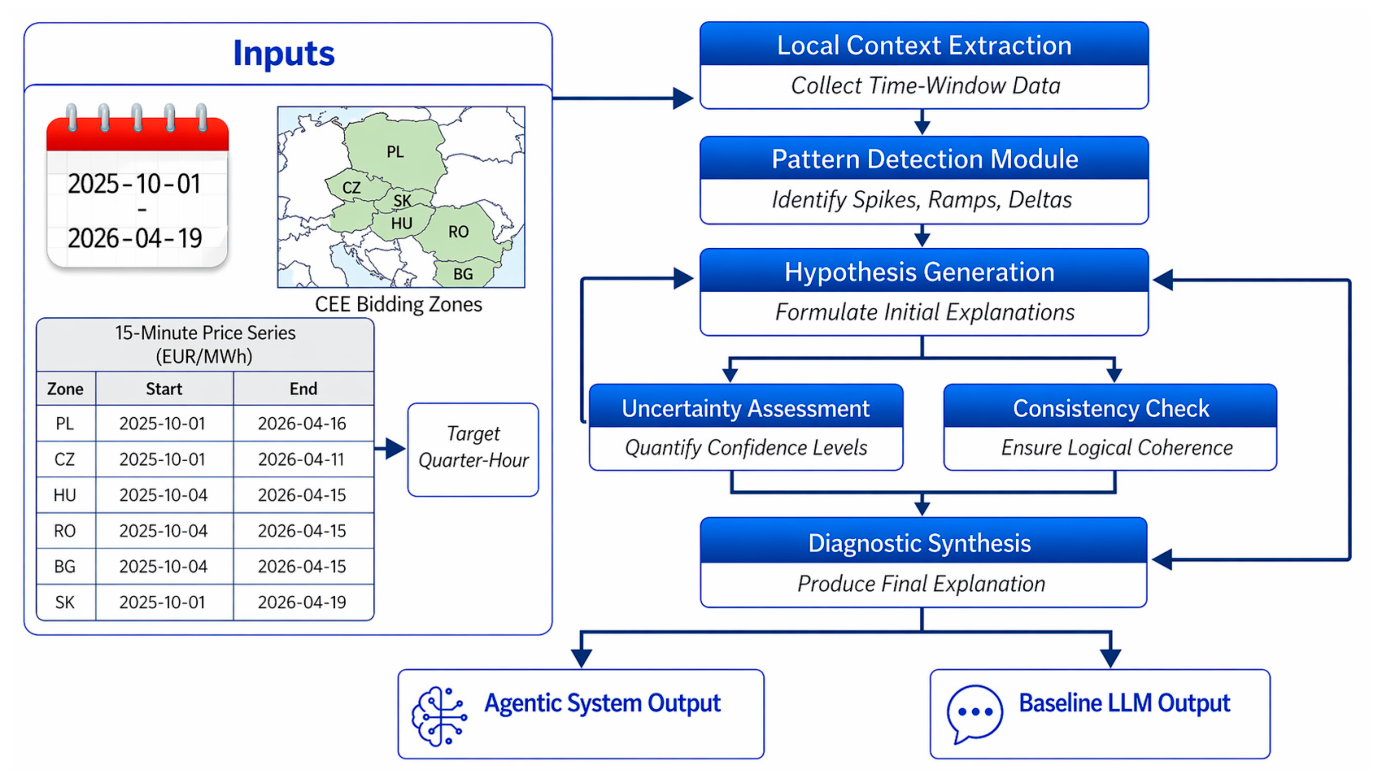
- First, we define a reproducible evaluation setup for 15 min day-ahead diagnostic QA, including a structured case format and a protocol for paired comparisons between non-agentic baselines and an agentic workflow.
- (b)
- Second, we propose an agentic design tailored to price-only diagnostic explanation over structured time series, emphasising mechanism-aware reasoning and evidence extraction.
- (c)
- Third, we provide a comparison focused on European Union member states, highlighting how agentic workflows affect reliability and evidence quality when only bounded price-window evidence is available.
2. Literature Review
2.1. LLMs for Energy and Electricity Markets: Applications, Numeric Grounding, and Time-Series Reasoning
2.2. Agentic Workflows and Tool-Augmented LLM Systems
2.3. Structural Decomposition, Schema-Grounded Evidence Extraction and Verification
2.4. Cross-Domain Agentic AI for Financial Market Diagnostics and Time-Series Analysis
2.5. Evaluating Reliability-Evidence Focus, Stability, and Unsupported Claims
3. Methodology
3.1. Case Construction Using ENTSO-E Day-Ahead Prices
3.2. Systems Under Comparison
3.2.1. Baseline Monolithic LLM
3.2.2. Baseline Fixed-Tool LLM
3.2.3. Baseline Statistical Diagnostic System
3.2.4. Agentic Workflow Mapping
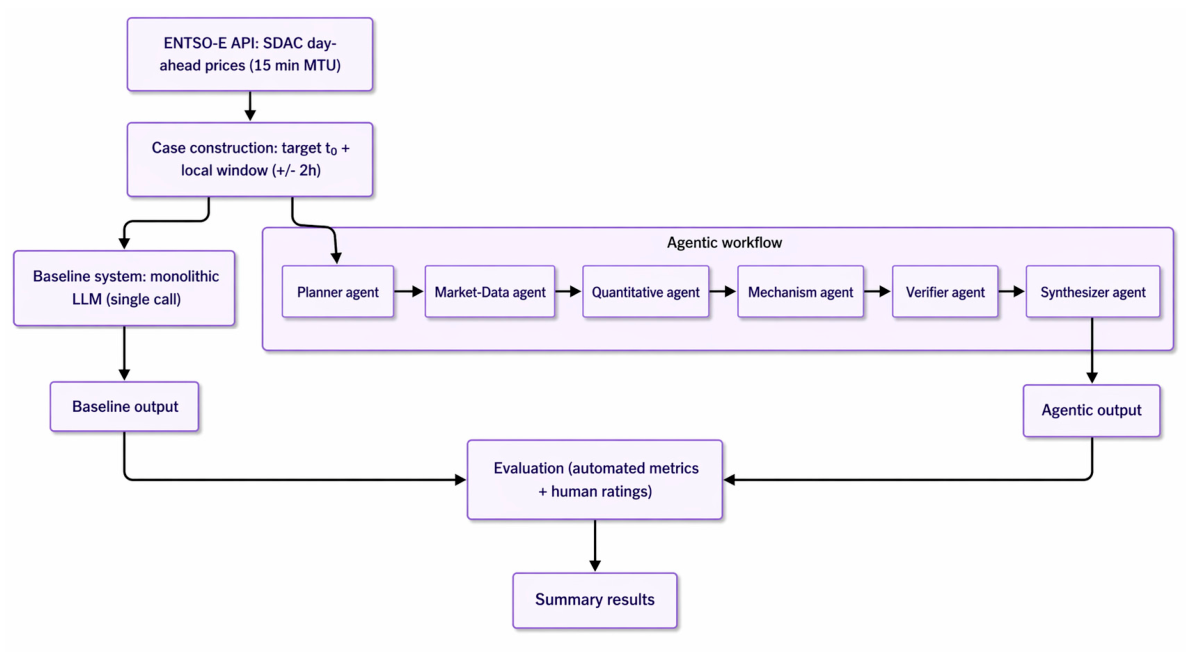
- Planner Agent () represents the first layer of our architecture. Its role is to interpret the query and produce a task plan that specifies what evidence is required and which intermediate computations should be performed. Concretely, understands the user’s intent (e.g., spike explanation versus ramping explanation), identifies the target interval , and defines constraints.
- Market-Data Agent () standardises data ordering, computes derived columns, and provides a structured representation used by later stages to ground the explanation by transforming the raw local price into a deterministic feature table , including the discrete quarter-hour change .
- Quantitative Analysis Agent () aims to make the results less dependent on the LLM’s free-form arithmetic. Thus, performs lightweight quantitative checks by identifying the largest within a target neighbourhood, ranking candidate intervals by magnitude and generating summary statistics.
- Mechanism Agent () assesses the credibility of the current draft diagnosis and detected patterns under the market mechanism context and the resolution of analysis (15 min MTUs) and outputs plausibility checks, candidate mechanisms, and warnings based only on the provided inputs. In particular, enforces constraints such as (i) avoiding causal statements that require missing exogenous signals and (ii) ensuring that the narrative remains anchored to the specified target interval rather than drifting to unrelated periods.
- Verifier Agent () forces justifications for statements. In this way, the agent performs a verification over intermediate claims and planned conclusions, explicitly flagging (i) unsupported assertions, (ii) missing inputs that would be required to justify a stronger claim, and (iii) inconsistencies between stated drivers and the computed feature table.
- Synthesizer Agent () generates the final answer in a strict JSON schema. The synthesis is constrained to preserve the constructed evidence lines (time stamps and numeric deltas). The narrative components (drivers, uncertainty, summary) are phrased to reflect the available information.
3.2.5. Component Ablations Against the Full Agentic Workflow
3.2.6. Implementation Details
3.3. Automated Evaluation
3.3.1. Time-Stamp Coverage
3.3.2. Delta-Format Coverage
3.3.3. Target-Neighbourhood Focus
3.3.4. Calibration
3.3.5. Unsupported Exogenous Assertions
3.3.6. Reliability Score
3.3.7. Reliability Score Without Calibration
3.3.8. Genericity
3.3.9. Actionability
3.4. Human Evaluation
3.5. Statistical Analysis
3.6. Validation of Results
4. Results and Discussion
4.1. Case Set and Evaluation Coverage
4.2. Performance on Automatic Reliability Metrics
4.3. Unsupported Causal Claims vs. “Hypothesis-Style” Mentions
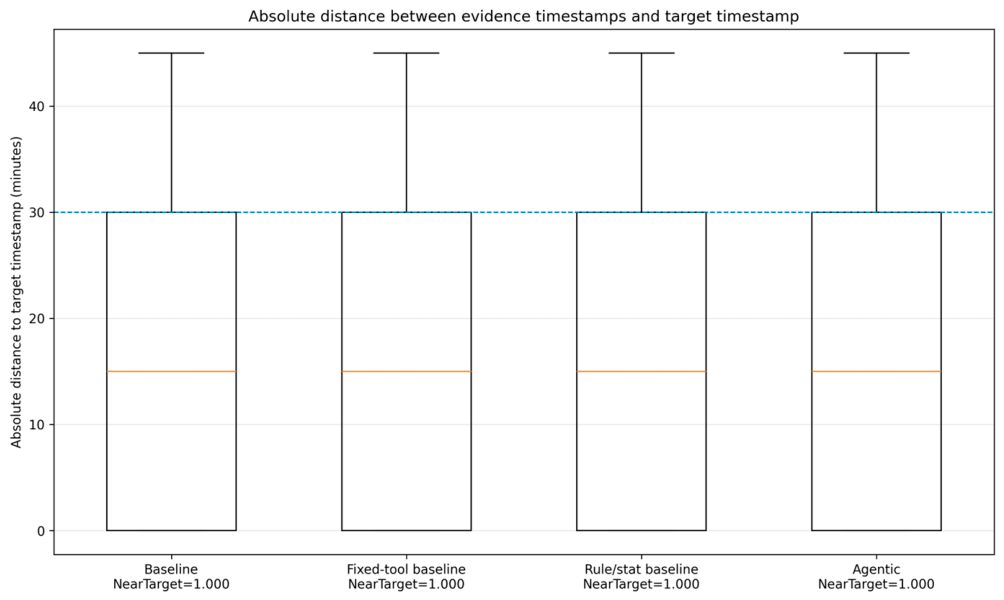
4.4. Target-Neighbourhood Grounding–Ceiling Effect
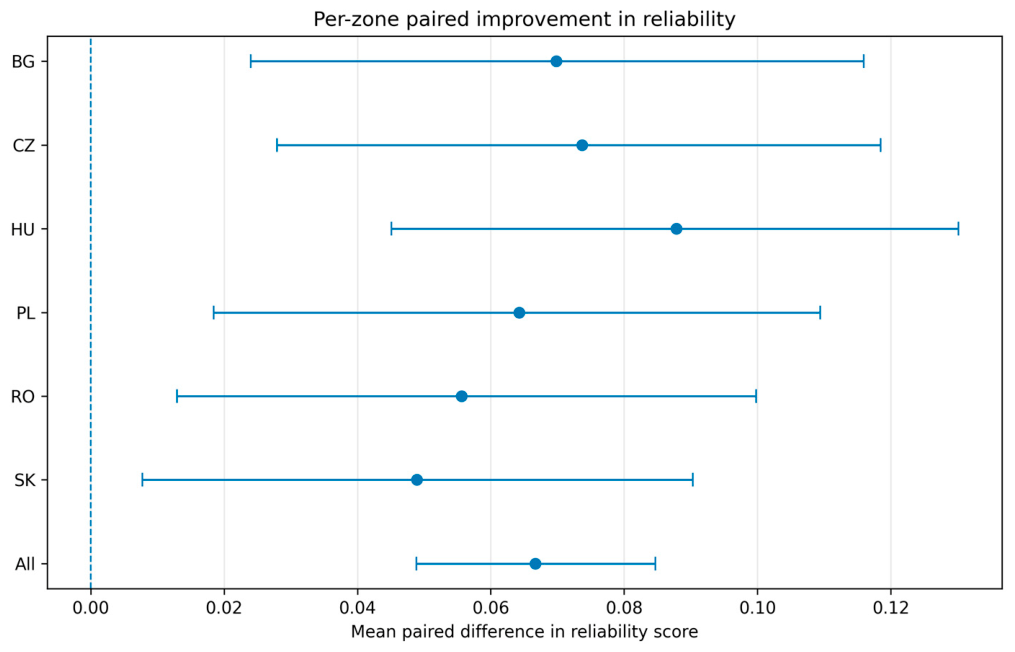
4.5. Heterogeneity Across Bidding Zones
4.6. Ablation Study: Component Contributions Against the Full Agentic Workflow
4.7. Efficiency and Cost Analysis
4.8. Human Evaluation
4.9. Validation and Robustness Across All Metrics
5. Conclusions
Author Contributions
Funding
Institutional Review Board Statement
Informed Consent Statement
Data Availability Statement
Acknowledgments
Conflicts of Interest
Appendix A. Agent Prompts
Appendix A.1. Planner Agent Prompt
Appendix A.2. Market-Data Agent Prompt
Appendix A.3. Mechanism Agent Prompt
Appendix A.4. Verifier Agent Prompt
Appendix A.5. Synthesizer Agent Prompt
References
- Mentens, L.; Peremans, H.; Springael, J.; Nimmegeers, P. Flexibility in short-term electricity markets for renewable integration and uncertainty mitigation: A comprehensive review. Smart Energy 2025, 18, 100183. [Google Scholar] [CrossRef]
- Kiesel, R.; Paraschiv, F. Econometric analysis of 15-minute intraday electricity prices. Energy Econ. 2017, 64, 77–90. [Google Scholar] [CrossRef]
- Parisio, L.; Bosco, B. Electricity prices and cross-border trade: Volume and strategy effects. Energy Econ. 2008, 30, 1760–1775. [Google Scholar] [CrossRef][Green Version]
- Handler, A.; Larsen, K.R.; Hackathorn, R. Large language models present new questions for decision support. Int. J. Inf. Manag. 2024, 79, 102811. [Google Scholar] [CrossRef]
- Wang, B.; Zhou, Y.; Ge, L.; Kung, S.-Y. Large-model-based smart agent for time series anomaly detection in power systems. Expert Syst. Appl. 2026, 296, 128917. [Google Scholar] [CrossRef]
- Dokas, I.M. From hallucinations to hazards: Benchmarking LLMs for hazard analysis in safety-critical systems. Saf. Sci. 2026, 194, 107056. [Google Scholar] [CrossRef]
- Märkle-Huß, J.; Feuerriegel, S.; Neumann, D. Contract durations in the electricity market: Causal impact of 15 min trading on the EPEX SPOT market. Energy Econ. 2018, 69, 367–378. [Google Scholar] [CrossRef]
- Cramer, E.; Witthaut, D.; Mitsos, A.; Dahmen, M. Multivariate probabilistic forecasting of intraday electricity prices using normalizing flows. Appl. Energy 2023, 346, 121370. [Google Scholar] [CrossRef]
- Keles, D.; Dehler-Holland, J.; Densing, M.; Panos, E.; Hack, F. Cross-border effects in interconnected electricity markets—An analysis of the Swiss electricity prices. Energy Econ. 2020, 90, 104802. [Google Scholar] [CrossRef]
- Fan, Z.; Ghaddar, B.; Wang, X.; Xing, L.; Zhang, Y.; Zhou, Z. Artificial intelligence for optimization: Unleashing the potential of parameter generation, model formulation, and solution methods. Eur. J. Oper. Res. 2025, 332, 1–30. [Google Scholar] [CrossRef]
- Ndum, Z.N.; Tao, J.; Ford, J.; Liu, Y. Automating Monte Carlo simulations in nuclear engineering with domain knowledge-embedded large language model agents. Energy AI 2025, 21, 100555. [Google Scholar] [CrossRef]
- Heistrene, L.; Machlev, R.; Perl, M.; Belikov, J.; Baimel, D.; Levy, K.; Mannor, S.; Levron, Y. Explainability-based Trust Algorithm for electricity price forecasting models. Energy AI 2023, 14, 100259. [Google Scholar] [CrossRef]
- Zhang, C.; Zhang, J.; Lu, J.; Zhao, Y. Large Language Models Meet Energy Systems: Opportunities, Challenges, and Future Perspectives. Appl. Energy 2026, 403, 127076. [Google Scholar] [CrossRef]
- Madani, S.; Tavasoli, A.; Khoshtarash Astaneh, Z.; Pineau, P.-O. Large Language Models Integration in Smart Grids. Energy Rep. 2025, 14, 1562–1577. [Google Scholar] [CrossRef]
- Ziel, F.; Steinert, R. Electricity price forecasting using sale and purchase curves: The X-Model. Energy Econ. 2016, 59, 435–454. [Google Scholar] [CrossRef]
- Fridgen, G.; Michaelis, A.; Rinck, M.; Schöpf, M.; Weibelzahl, M. The search for the perfect match: Aligning power-trading products to the energy transition. Energy Policy 2020, 144, 111523. [Google Scholar] [CrossRef]
- Lavrinovics, E.; Biswas, R.; Bjerva, J.; Hose, K. Knowledge Graphs, Large Language Models, and Hallucinations: An NLP Perspective. J. Web Semant. 2025, 85, 100844. [Google Scholar] [CrossRef]
- Majumder, S.; Dong, L.; Doudi, F.; Cai, Y.; Tian, C.; Kalathil, D.; Ding, K.; Thatte, A.A.; Li, N.; Xie, L. Exploring the capabilities and limitations of large language models in the electric energy sector. Joule 2024, 8, 1544–1549. [Google Scholar] [CrossRef]
- Li, Y.; Ji, M.; Chen, J.; Wei, X.; Gu, X.; Tang, J. A large language model-based building operation and maintenance information query. Energy Build. 2025, 334, 115515. [Google Scholar] [CrossRef]
- Gan, A.; Yu, H.; Zhang, K.; Liu, Q.; Yan, W.; Huang, Z.; Tong, S.; Hu, G. Retrieval Augmented Generation Evaluation in the Era of Large Language Models: A Comprehensive Survey. arXiv 2025, arXiv:2504.14891. [Google Scholar] [CrossRef]
- Zhang, L.; Fu, X.; Li, Y.; Chen, J. Large language model-based agent Schema and library for automated building energy analysis and modeling. Autom. Constr. 2025, 176, 106244. [Google Scholar] [CrossRef]
- Ni, B.; Cai, X.; Shen, Z.; Meng, Z.; Zhao, J.; Cheng, Y.; Gui, X. Intelli-Dispatch-SQL: An LLM-based agent for reliable Text-to-SQL in power dispatching. Energy AI 2025, 22, 100591. [Google Scholar] [CrossRef]
- Zhang, L.; Ford, V.; Chen, Z.; Chen, J. Automatic building energy model development and debugging using large language models agentic workflow. Energy Build. 2025, 327, 115116. [Google Scholar] [CrossRef]
- Sapkota, R.; Roumeliotis, K.I.; Karkee, M. AI Agents vs. Agentic AI: A Conceptual taxonomy, applications and challenges. Inf. Fusion 2026, 126, 103599. [Google Scholar] [CrossRef]
- Chen, B.; Zhang, Z.; Langrené, N.; Zhu, S. Unleashing the potential of prompt engineering for large language models. Patterns 2025, 6, 101260. [Google Scholar] [CrossRef]
- Xie, T.; Wan, Y.; Zhou, Y.; Huang, W.; Liu, Y.; Linghu, Q.; Wang, S.; Kit, C.; Grazian, C.; Zhang, W.; et al. Creation of a structured solar cell material dataset and performance prediction using large language models. Patterns 2024, 5, 100955. [Google Scholar] [CrossRef] [PubMed]
- Rashkin, H.; Nikolaev, V.; Lamm, M.; Aroyo, L.; Collins, M.; Das, D.; Petrov, S.; Tomar, G.S.; Turc, I.; Reitter, D. Measuring Attribution in Natural Language Generation Models. arXiv 2021, arXiv:2112.12870. [Google Scholar]
- Theissler, A.; Spinnato, F.; Schlegel, U.; Guidotti, R. Explainable AI for Time Series Classification: A Review, Taxonomy and Research Directions. IEEE Access 2022, 10, 100700–100724. [Google Scholar] [CrossRef]
- Park, T. Enhancing Anomaly Detection in Financial Markets with an LLM-based Multi-Agent Framework. arXiv 2024, arXiv:2403.19735. [Google Scholar] [CrossRef]
- Li, X.; Zeng, Y.; Xing, X.; Xu, J.; Xu, X. QuantAgents: Towards Multi-agent Financial System via Simulated Trading. arXiv 2025, arXiv:2510.04643. [Google Scholar] [CrossRef]
- Buster, G.; Pinchuk, P.; Barrons, J.; McKeever, R.; Levine, A.; Lopez, A. Supporting energy policy research with large language models: A case study in wind energy siting ordinances. Energy AI 2024, 18, 100431. [Google Scholar] [CrossRef]
- Jiang, G.; Ma, Z.; Zhang, L.; Chen, J. Prompt engineering to inform large language model in automated building energy modeling. Energy 2025, 316, 134548. [Google Scholar] [CrossRef]
- Zouhar, V.; Cui, P.; Sachan, M. How to Select Datapoints for Efficient Human Evaluation of NLG Models? arXiv 2025, arXiv:2501.18251. [Google Scholar] [CrossRef]
- Zhang, L.; Chen, Z. Opportunities of applying Large Language Models in building energy sector. Renew. Sustain. Energy Rev. 2025, 214, 115558. [Google Scholar] [CrossRef]
- Antonesi, G.; Cioara, T.; Anghel, I.; Michalakopoulos, V.; Sarmas, E.; Toderean, L. A systematic review of transformers and large language models in the energy sector: Towards agentic digital twins. Appl. Energy 2025, 401, 126670. [Google Scholar] [CrossRef]
- Kath, C.; Ziel, F. The value of forecasts: Quantifying the economic gains of accurate quarter-hourly electricity price forecasts. Energy Econ. 2018, 76, 411–423. [Google Scholar] [CrossRef]
- ENTSO-E. ENTSO-E Transparency Platform Web API Endpoint. Available online: https://transparency.entsoe.eu/ (accessed on 1 February 2026).



| Ref | Objective | Methods | Brief Findings | Generative Models |
|---|---|---|---|---|
| [11] | Automate Monte Carlo nuclear simulations (FLUKA workflow) | Domain-embedded LLM agents, RAG, GUI integration | Reduced error resolution time from days to <1 min; high accuracy (<0.001% uncertainty) | LLM agents + RAG |
| [13] | Review LLM applications in energy systems | Literature review of 22 LLM types and enhancement techniques | Identifies 13 LLM roles; highlights opportunities and challenges | GPT, LLaMA, ChatGLM, etc. |
| [14] | Review LLM applications in power systems | Analysis of 30 real-world applications | LLMs enhance grid ops, markets, security; reliability challenges | LLMs |
| [17] | Mitigate hallucinations in LLMs using knowledge graphs | KG integration with LLMs; evaluation benchmarks | KGs enhance reliability but open challenges remain | LLM + knowledge graph |
| [21] | Standardise LLM agents in building energy sector | JSON-based agent schema + open-source library | Enables reproducible and shareable LLM agents | LLM agents |
| [22] | Improve Text-to-SQL for power dispatching | Agent-based LLM framework with intent recognition + SQL validation | Significant gains in execution accuracy; robust across LLMs | LLM agents |
| [23] | Automate building energy modelling (BEM) | Multi-agent LLM planning workflow | Outperforms naive prompting and manual modelling in accuracy and efficiency | LLM agent workflow |
| [24] | Differentiate AI agents vs. agentic AI | Conceptual taxonomy and comparative framework | Agentic AI enables dynamic decomposition, autonomy, collaboration | LLM-based agentic systems |
| [32] | Auto-building energy modelling via prompt engineering | Prompt engineering (few-shot, CoT strategies) | Effective ABEM without fine-tuning; compact LLMs viable | LLM (prompt-based) |
| [34] | Review LLM applications in building energy | Literature review + survey | LLMs enhance control, automation, compliance; challenges remain | LLMs |
| [35] | Review transformers and LLMs in energy; propose agentic digital twin | Review + conceptual framework | Introduces agentic digital twin integrating FMs | LLMs, foundation models |
| Zone | Total Cases | Spike Cases | Ramp Cases | Target Time Range (UTC) |
|---|---|---|---|---|
| Bulgaria | 60 | 30 | 30 | 2025-10-04 to 2026-04-15 |
| Czechia | 60 | 30 | 30 | 2025-10-01 to 2026-04-11 |
| Hungary | 60 | 30 | 30 | 2025-10-04 to 2026-04-15 |
| Poland | 60 | 30 | 30 | 2025-10-01 to 2026-04-16 |
| Romania | 60 | 30 | 30 | 2025-10-04 to 2026-04-15 |
| Slovakia | 60 | 30 | 30 | 2025-10-01 to 2026-04-19 |
| All | 360 | 180 | 180 | 2025-10-01 to 2026-04-19 |
| Comparison | Reliability | Calibration | Unsupported Exogenous Assertions | Exogenous Mentions | Target-Neighbourhood | Reliability (No Calibration) | Genericity | Actionability |
|---|---|---|---|---|---|---|---|---|
| Agentic—Monolithic LLM | +0.067 [+0.049, +0.085] | +0.500 [+0.447, +0.553] | +1.022 [+0.831, +1.214] | +29.592 [+29.111, +30.086] | +0.000 [+0.000, +0.000] | −0.083 [−0.094, −0.073] | −0.219 [−0.272, −0.169] | +0.778 [+0.733, +0.822] |
| Agentic—Fixed-Tool LLM | −0.092 [−0.099, −0.085] | +0.000 [+0.000, +0.000] | +1.358 [+1.222, +1.506] | +24.339 [+23.908, +24.770] | +0.000 [+0.000, +0.000] | −0.092 [−0.099, −0.085] | +0.047 [+0.028, +0.069] | +0.000 [+0.000, +0.000] |
| Agentic—Statistical | −0.109 [−0.114, −0.103] | +0.000 [+0.000, +0.000] | +1.625 [+1.508, +1.756] | +24.628 [+24.192, +25.058] | +0.000 [+0.000, +0.000] | −0.109 [−0.114, −0.103] | +0.047 [+0.028, +0.069] | +0.000 [+0.000, +0.000] |
| Zone | N | Reliability | Calibration | Unsupported Exogenous Assertions | Exogenous Mentions | Target-Neighbourhood |
|---|---|---|---|---|---|---|
| Bulgaria | 60 | +0.070 [+0.024, +0.116] | +0.500 [+0.367, +0.633] | +0.950 [+0.550, +1.300] | +30.633 [+29.717, +31.583] | +0.000 [+0.000, +0.000] |
| Czechia | 60 | +0.074 [+0.028, +0.118] | +0.550 [+0.433, +0.667] | +1.083 [+0.617, +1.567] | +29.033 [+27.767, +30.367] | +0.000 [+0.000, +0.000] |
| Hungary | 60 | +0.088 [+0.045, +0.130] | +0.583 [+0.450, +0.700] | +1.200 [+0.600, +1.833] | +29.433 [+28.217, +30.617] | +0.000 [+0.000, +0.000] |
| Poland | 60 | +0.064 [+0.018, +0.109] | +0.450 [+0.317, +0.583] | +0.767 [+0.267, +1.283] | +29.117 [+27.900, +30.300] | +0.000 [+0.000, +0.000] |
| Romania | 60 | +0.056 [+0.013, +0.100] | +0.517 [+0.400, +0.650] | +1.300 [+0.866, +1.733] | +30.183 [+29.033, +31.367] | +0.000 [+0.000, +0.000] |
| Slovakia | 60 | +0.049 [+0.008, +0.090] | +0.400 [+0.267, +0.533] | +0.833 [+0.483, +1.167] | +29.150 [+28.050, +30.217] | +0.000 [+0.000, +0.000] |
| All | 360 | +0.067 [+0.049, +0.085] | +0.500 [+0.447, +0.553] | +1.022 [+0.831, +1.214] | +29.592 [+29.111, +30.086] | +0.000 [+0.000, +0.000] |
| Comparison | Reliability | Calibration | Unsupported Exogenous Assertions | Exogenous Mentions | Target-Neighbourhood | Reliability (No Calibration) | Genericity | Actionability |
|---|---|---|---|---|---|---|---|---|
| Full agentic—no market data | +0.631 [+0.627, +0.634] | +0.000 [+0.000, +0.000] | +1.189 [+1.078, +1.317] | +11.497 [+10.892, +12.056] | +1.000 [+1.000, +1.000] | +0.931 [+0.927, +0.934] | +0.047 [+0.028, +0.069] | +0.000 [+0.000, +0.000] |
| Full agentic—no planner | −0.003 [−0.006, +0.001] | +0.000 [+0.000, +0.000] | +0.033 [−0.133, +0.197] | −0.167 [−0.803, +0.475] | +0.000 [+0.000, +0.000] | −0.003 [−0.006, +0.001] | +0.006 [−0.025, +0.036] | +0.000 [+0.000, +0.000] |
| Full agentic—no verifier | −0.006 [−0.009, −0.003] | +0.000 [+0.000, +0.000] | +0.217 [+0.108, +0.342] | +13.081 [+12.631, +13.517] | +0.000 [+0.000, +0.000] | −0.006 [−0.009, −0.003] | +0.042 [+0.019, +0.067] | +0.000 [+0.000, +0.000] |
| Method | Wall Time (s) | Active LLM Time (s) | Workflow Overhead (s) | Total Tokens | Estimated Cost (USD) |
|---|---|---|---|---|---|
| Agentic | 12.201 | 12.182 | 0.019 | 9063.350 | 0.002 |
| Agentic—no market data | 7.021 | 7.021 | 0.001 | 3671.989 | 0.001 |
| Agentic—no planner | 9.966 | 9.948 | 0.018 | 8235.067 | 0.002 |
| Agentic—no verifier | 6.509 | 6.492 | 0.018 | 3932.997 | 0.001 |
| Baseline | 2.135 | 2.127 | 0.008 | 1305.942 | <0.001 |
| Baseline fixed tool | 2.038 | 2.009 | 0.029 | 1765.295 | <0.001 |
| Baseline statistical | 0.030 | 0.000 | 0.000 | 0.000 | 0.000 |
| Metric | Agentic (Mean, 95% CI) | Baseline (Mean, 95% CI) | Agentic—Baseline (95% CI) | |
|---|---|---|---|---|
| Overall (1–5) | 3.77 [3.63, 3.90] | 3.02 [2.83, 3.21] | 0.74 [0.52, 0.97] | 0.66 |
| Helpfulness (1–5) | 3.93 [3.78, 4.09] | 2.88 [2.72, 3.02] | 1.06 [0.86, 1.26] | 0.61 |
| Correctness (1–5) | 3.93 [3.84, 4.02] | 2.99 [2.80, 3.17] | 0.94 [0.76, 1.14] | 0.67 |
| Clarity (1–5) | 3.70 [3.61, 3.78] | 3.21 [2.98, 3.43] | 0.49 [0.24, 0.74] | 0.43 |
| Pairwise preference (win rate) | 65.5% [52.2%, 77.8%] | 6.7% [2.2%, 13.3%] | 58.8% [41.1%, 75.6%] | 0.48 |
| Metric | Monolithic Baseline Mean | Agentic Mean | (95% CI) | |
|---|---|---|---|---|
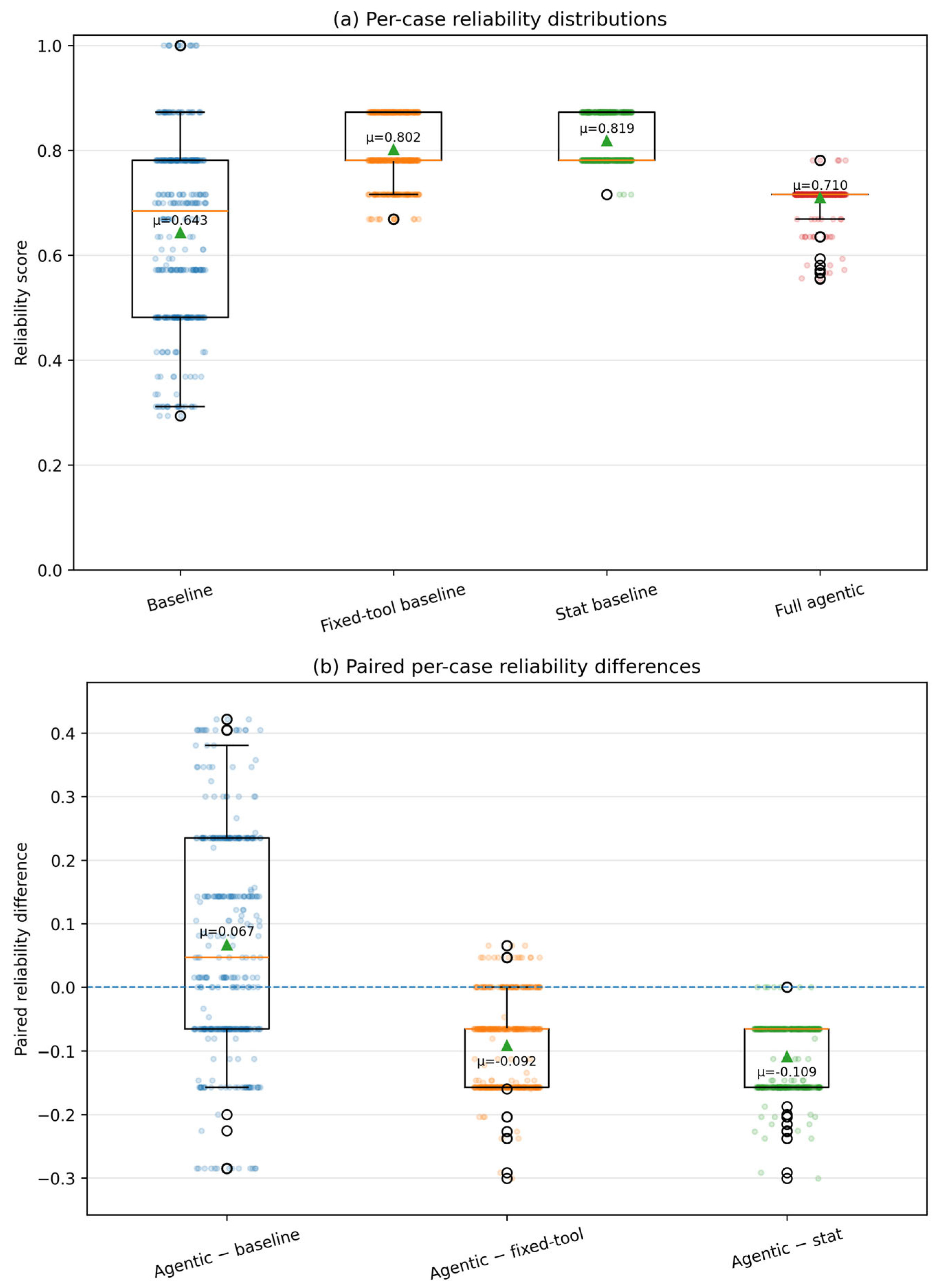
| Reliability score | +0.643 | +0.710 | +0.067 [+0.049, +0.085] | 0.385 |
| Price-only disclaimer presence (calibration) | +0.500 | +1.000 | +0.500 [+0.447, +0.553] | 0.999 |
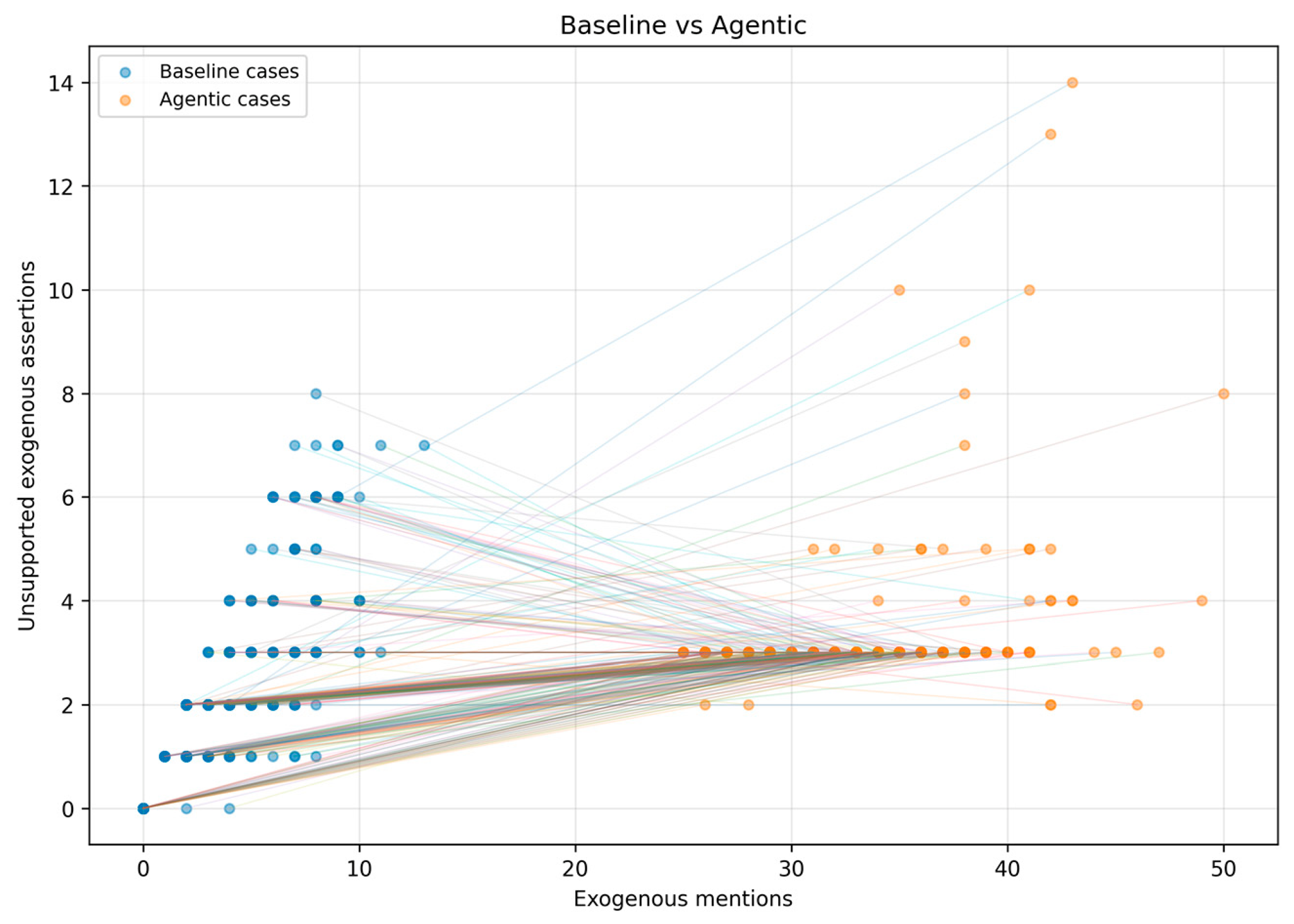
| Unsupported exogenous assertions | +2.194 | +3.217 | +1.022 [+0.831, +1.214] | 0.548 |
| Exogenous mentions | +3.628 | +33.219 | +29.592 [+29.111, +30.086] | 6.418 |
| Target-neighbourhood focus | +1.000 | +1.000 | 0.000 [0.000, 0.000] | 0.000 |
Disclaimer/Publisher’s Note: The statements, opinions and data contained in all publications are solely those of the individual author(s) and contributor(s) and not of MDPI and/or the editor(s). MDPI and/or the editor(s) disclaim responsibility for any injury to people or property resulting from any ideas, methods, instructions or products referred to in the content. |
© 2026 by the authors. Published by MDPI on behalf of the International Institute of Knowledge Innovation and Invention. Licensee MDPI, Basel, Switzerland. This article is an open access article distributed under the terms and conditions of the Creative Commons Attribution (CC BY) license.
Share and Cite
Ali, Ș.; Oprea, S.-V.; Bâra, A. Agentic AI for Price-Only 15 min SDAC Market Diagnostics in Central and Eastern Europe. Appl. Syst. Innov. 2026, 9, 93. https://doi.org/10.3390/asi9050093
Ali Ș, Oprea S-V, Bâra A. Agentic AI for Price-Only 15 min SDAC Market Diagnostics in Central and Eastern Europe. Applied System Innovation. 2026; 9(5):93. https://doi.org/10.3390/asi9050093
Chicago/Turabian StyleAli, Șener, Simona-Vasilica Oprea, and Adela Bâra. 2026. "Agentic AI for Price-Only 15 min SDAC Market Diagnostics in Central and Eastern Europe" Applied System Innovation 9, no. 5: 93. https://doi.org/10.3390/asi9050093
APA StyleAli, Ș., Oprea, S.-V., & Bâra, A. (2026). Agentic AI for Price-Only 15 min SDAC Market Diagnostics in Central and Eastern Europe. Applied System Innovation, 9(5), 93. https://doi.org/10.3390/asi9050093