
An AI-Driven Decision Support System for Sustainable Smart Clothing Design Based on Flexible Material Properties and Environmental Metrics


Abstract
1. Introduction
2. Methods and Materials
2.1. Selection of Flexibility Indicators and Collection and Processing of Environmental Indicators
2.2. Intelligent Clothing Assistance System Construction Method
2.3. Design of Data Processing Module Based on MDGCN Modeling
2.4. Prototype Implementation and Real-World Validation Protocol
3. Results
3.1. MDGCN Model Performance Validation
3.2. Performance Evaluation of the Proposed AI-Driven Decision Support System
3.3. System Application Case: Heart Rate Monitoring Sports T-Shirt
4. Discussion
4.1. Positioning Within Wearable AI and Mersivity
4.2. Practical Applicability, Limitations, and Future Extensions
5. Conclusions
Author Contributions
Funding
Institutional Review Board Statement
Informed Consent Statement
Data Availability Statement
Conflicts of Interest
References
- Shin, S.Y.; Jo, G.; Wang, G. A novel method for fashion clothing image classification based on deep learning. J. Inf. Commun. Technol. 2023, 22, 127–148. [Google Scholar] [CrossRef]
- Haruna, A.A.; Muhammad, L.J.; Abubakar, M. Novel thermal-aware green scheduling in grid environment. Artif. Intell. Appl. 2022, 1, 244–251. [Google Scholar] [CrossRef]
- Zhang, Y.; He, K.; Song, R. Image multi-feature fusion for clothing style classification. IEEE Access 2023, 11, 107843–107854. [Google Scholar] [CrossRef]
- Islam, T.; Miron, A.; Liu, X.; Li, Y. StyleVTON: A multi-pose virtual try-on with identity and clothing detail preservation. Neurocomputing 2024, 594, 127887. [Google Scholar] [CrossRef]
- Xia, T.; Zhang, J. Clothing classification using transfer learning with squeeze and excitation block. Multimed. Tools Appl. 2023, 82, 2839–2856. [Google Scholar] [CrossRef]
- Zhou, Z.; Liu, M.; Deng, W. Clothing image classification with DenseNet201 network and optimized regularized random vector functional link. J. Nat. Fibers 2023, 20, 2190188. [Google Scholar] [CrossRef]
- Longo, F.; Padovano, A.; Cimmino, B.; Pinto, P. Towards a mass customization in the fashion industry: An evolutionary decision aid model for apparel product platform design and optimization. Comput. Ind. Eng. 2021, 162, 107742. [Google Scholar] [CrossRef]
- Mann, S.; Cooper, M.; Ferren, B.; Coughlin, T.M.; Frankston, B. Mersivity: Wearable artificial intelligence and spatial extended reality for humanity and earth. IEEE Consum. Electron. Mag. 2026, 15, 4–8. [Google Scholar] [CrossRef]
- Park, S.; Jayaraman, S. Smart textiles: Wearable electronic systems. MRS Bull. 2003, 28, 585–591. [Google Scholar] [CrossRef]
- Billinghurst, M.; Starner, T. Wearable devices: New ways to manage information. Computer 2002, 32, 57–64. [Google Scholar] [CrossRef]
- Anhalt, J.; Smailagic, A.; Siewiorek, D.P. Toward context-aware computing: Experiences and lessons. IEEE Intell. Syst. 2001, 16, 38–46. [Google Scholar] [CrossRef]
- Ozer, O.F.; Ozun, O.; Tuzel, C.O. Vision-based single-stroke character recognition for wearable computing. IEEE Intell. Syst. 2001, 16, 33–37. [Google Scholar] [CrossRef]
- Dong, M.; Zhou, D.; Ma, J. Towards intelligent design: A self-driven framework for collocated clothing synthesis leveraging fashion styles and textures. In Proceedings of the IEEE International Conference on Acoustics, Speech and Signal Processing (ICASSP), Seoul, Republic of Korea, 14–19 April 2024; IEEE: Piscataway, NJ, USA, 2024; pp. 3725–3729. [Google Scholar] [CrossRef]
- Yu, D.; Zhao, P. Research on network clothing design system based on artificial intelligence. Procedia Comput. Sci. 2024, 247, 27–35. [Google Scholar] [CrossRef]
- Choi, W.; Jang, S.; Kim, H.Y. Developing an AI-based automated fashion design system: Reflecting the work process of fashion designers. Fash. Text. 2023, 10, 39. [Google Scholar] [CrossRef]
- Mu, X.; Zhang, H.; Shi, J. Fashion intelligence in the Metaverse: Promise and future prospects. Artif. Intell. Rev. 2024, 57, 67. [Google Scholar] [CrossRef]
- Jing, W.; Yin, Y.; Luo, W. Outdoor clothing choice for different populations in cold regions: A clothing choice prediction model based on machine learning. Energy Build. 2023, 289, 113069. [Google Scholar] [CrossRef]
- Forster, P.; Storelvmo, T.; Armour, K.; Collins, W.; Dufresne, J.-L.; Frame, D.J.; Lunt, D.J.; Mauritsen, T.; Palmer, M.D.; Watanabe, M.; et al. The Earth’s Energy Budget, Climate Feedbacks and Climate Sensitivity. In Climate Change 2021—The Physical Science Basis: Working Group I Contribution to the Sixth Assessment Report of the Intergovernmental Panel on Climate Change; Masson-Delmotte, V., Zhai, P., Pirani, A., Connors, S.L., Péan, C., Berger, S., Caud, N., Chen, Y., Goldfarb, L., Gomis, M.I., et al., Eds.; Cambridge University Press: Cambridge, UK, 2021; pp. 923–1054. [Google Scholar] [CrossRef]
- ISO 14021:2016; Environmental Labels and Declarations—Self-Declared Environmental Claims (Type II Environmental Labelling). International Organization for Standardization: Geneva, Switzerland, 2016.
- Lee, D.; Kang, H.; Lee, I.K. ClothCombo: Modeling inter-cloth interaction for draping multi-layered clothes. ACM Trans. Graph. 2023, 42, 1–13. [Google Scholar] [CrossRef]
- Huang, B.; Lu, Q.; Huang, S. Multi-modal clothing recommendation model based on large model and VAE enhancement. In Proceedings of the 7th Artificial Intelligence and Cloud Computing Conference; Association for Computing Machinery: New York, NY, USA, 2024; pp. 379–385. [Google Scholar] [CrossRef]
- Ma, W.; Guan, Z.; Wang, X. YOLO-FL: A target detection algorithm for reflective clothing wearing inspection. Displays 2023, 80, 102561. [Google Scholar] [CrossRef]
- Ariessaputra, S.; Vidiasari, V.H.; Al Sasongko, S.M. Classification of Lombok Songket and Sasambo Batik motifs using the convolution neural network (CNN) algorithm. JOIV Int. J. Inform. Vis. 2024, 8, 38–44. [Google Scholar] [CrossRef]
- Zhu, S.; Liu, X. The Ecodesign Transformation of Smart Clothing: Towards a Systemic and Coupled Social–Ecological–Technological System Perspective. Sustainability 2025, 17, 2102. [Google Scholar] [CrossRef]
- Su, X.; Duan, J.; Ren, J. Personalized clothing recommendation fusing the 4-season color system and users’ biological characteristics. Multimed. Tools Appl. 2024, 83, 12597–12625. [Google Scholar] [CrossRef]
- Choi, E.J.; Yun, J.Y.; Choi, Y.J. Impact of thermal control by real-time PMV using estimated occupants personal factors of metabolic rate and clothing insulation. Energy Build. 2024, 307, 113976. [Google Scholar] [CrossRef]
- Aparicio-Ruiz, P.; Barbadilla-Martín, E.; Guadix, J. Predicting the clothing insulation through machine learning algorithms: A comparative analysis and a practical approach. Build. Simul. 2024, 17, 839–855. [Google Scholar] [CrossRef]
- Bhatlawande, S.; Borse, R.; Solanke, A. A smart clothing approach for augmenting mobility of visually impaired people. IEEE Access 2024, 12, 24659–24671. [Google Scholar] [CrossRef]
- Choi, E.J.; Choi, Y.J.; Kim, N.H. Seasonal effects of thermal comfort control considering real-time clothing insulation with vision-based model. Build. Environ. 2023, 235, 110255. [Google Scholar] [CrossRef]
- Wu, J.; Huang, Y.; Gao, M. A two-stream hybrid convolution-transformer network architecture for clothing-change person re-identification. IEEE Trans. Multimed. 2024, 26, 5326–5339. [Google Scholar] [CrossRef]
- Glogar, M.; Petrak, S.; Mahnić Naglić, M. Digital technologies in the sustainable design and development of textiles and clothing: A literature review. Sustainability 2025, 17, 1371. [Google Scholar] [CrossRef]
- Liu, X.; Li, J.; Lu, G. Robust and automatic clothing reconstruction based on a single RGB image. Comput. Graph. 2022, 110, 98–110. [Google Scholar] [CrossRef]
- Wang, F.; Kyoung, K.J. Leather defect detection method in clothing design based on TDENet. IEEE Access 2023, 11, 104890–104904. [Google Scholar] [CrossRef]
- Zhou, D.; Zhang, H.; Ma, J.; Shi, J. BC-GAN: A generative adversarial network for synthesizing a batch of collocated clothing. IEEE Trans. Circuits Syst. Video Technol. 2024, 34, 3245–3259. [Google Scholar] [CrossRef]
- ASTM D412-16(2021); Standard Test Methods for Vulcanized Rubber and Thermoplastic Elastomers—Tension. ASTM International: West Conshohocken, PA, USA, 2021.
- ISO 37:2017; Rubber, Vulcanized or Thermoplastic—Determination of Tensile Stress-Strain Properties. International Organization for Standardization: Geneva, Switzerland, 2017.
- Pang, Z.; Zhao, L.; Wang, C. Clothing-invariant contrastive learning for unsupervised person re-identification. Neural Netw. 2024, 178, 106477. [Google Scholar] [CrossRef] [PubMed]
- Mengistu, A.T.; Dieste, M.; Panizzolo, R.; Biazzo, S. Sustainable product design factors: A comprehensive analysis. J. Clean. Prod. 2024, 463, 142260. [Google Scholar] [CrossRef]
- Dulal, M.; Afroj, S.; Karim, N. Sustainable eco-design approach for next-generation wearable e-textiles. J. Clean. Prod. 2025, 504, 145404. [Google Scholar] [CrossRef]






| Component | Specification | Parameter | Value | Unit |
|---|---|---|---|---|
| CPU | Intel Core i7-9700K @ 3.60 GHz | Number of Layers | 5 | layers |
| GPU | NVIDIA GeForce RTX 2080 Ti | Hidden Units in LSTM | 256 | units |
| RAM | 32 GB DDR4-3000 MHz | Hidden Units in GCN | 128 | units |
| Storage | 1 TB NVMe SSD | Learning Rate | 0.001 | / |
| Operating System | Windows 10 Pro 64-bit | Batch Size | 32 | samples |
| Development Tools | Python 3.8, TensorFlow 2.3, PyTorch 1.7 | Epochs | 100 | epochs |
| Power Supply | 750 W 80+ Gold Certified PSU | Dropout Rate | 0.5 | dimensionless |
| / | / | Attention Heads | 8 | heads |
| / | / | Memory Size | 64 | entries |
| / | / | Graph Convolution Filters | 3 × 3 | pixels |
| / | / | Activation Function | ReLU | / |
| / | / | Optimizer | Adam | / |
| / | / | Loss Function | Mean Squared Error | / |
| / | / | Early Stopping | Yes | / |
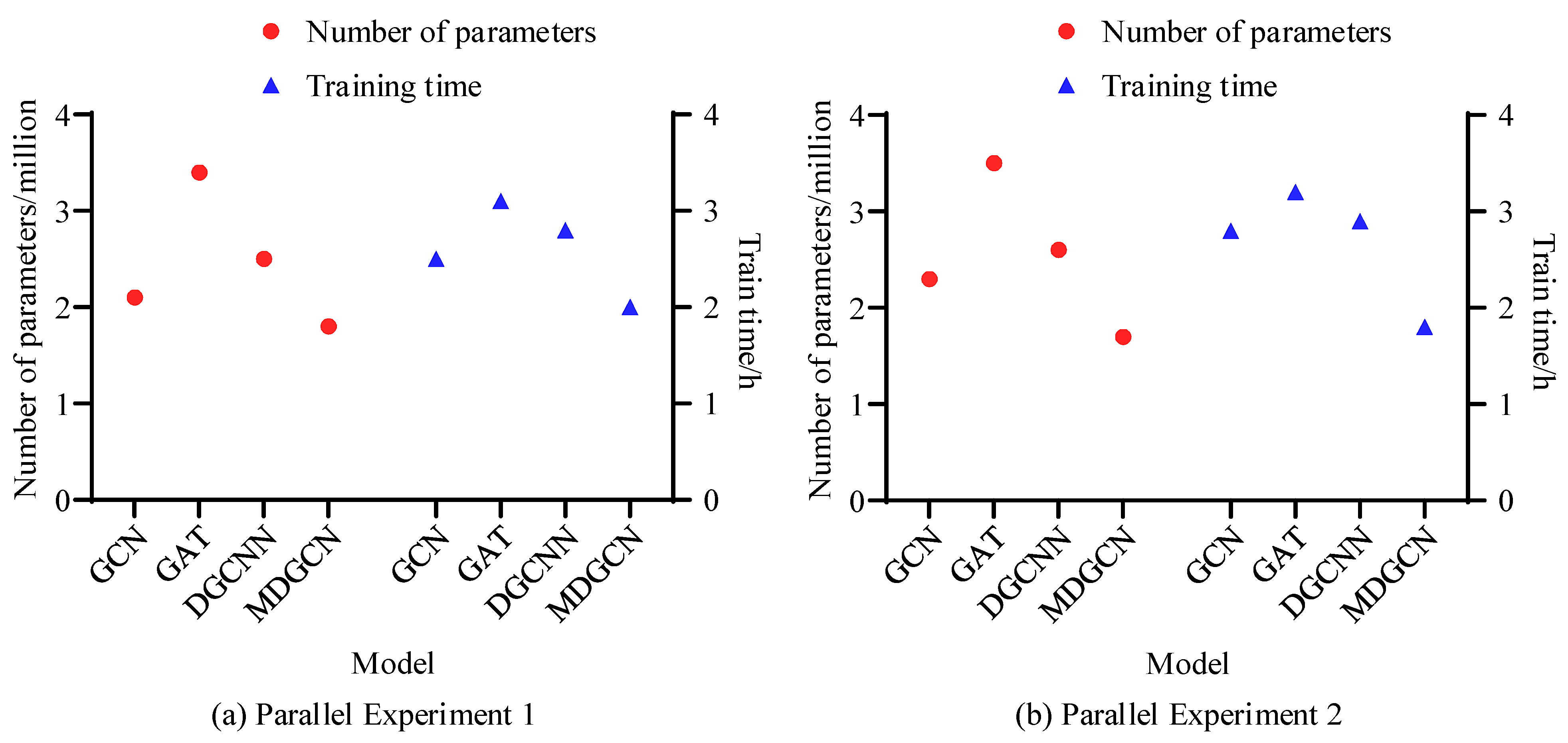
| Dataset | Model | MAE | MSE |
|---|---|---|---|
| WTMPD | GCN | 0.123 | 0.172 |
| GAT | 0.115 | 0.153 | |
| DGCNN | 0.129 | 0.185 | |
| MDGCN | 0.105 | 0.135 | |
| EIAD | GCN | 0.135 | 0.182 |
| GAT | 0.115 | 0.145 | |
| DGCNN | 0.125 | 0.173 | |
| MDGCN | 0.103 | 0.131 |
| Experimental Setup | Accuracy | Recall | F1-Score |
|---|---|---|---|
| Without attention module | 0.941 | 0.894 | 0.912 |
| No dynamic graph structure | 0.931 | 0.915 | 0.924 |
| Without multi-scale features | 0.942 | 0.905 | 0.925 |
| Without external memory network | 0.953 | 0.917 | 0.935 |
| MDGCN | 0.964 | 0.923 | 0.943 |
| Item | Description |
|---|---|
| Deployment duration | 4 weeks |
| Deployment site | Clothing design studio |
| Participants | 12 designers |
| Evaluated schemes | 87 smart clothing design schemes |
| System form | Web-based prototype |
| Front end | React |
| Back end | Flask |
| Model deployment | PyTorch 1.7 |
| Input format | Excel/CSV flexible material data |
| Output | Environmental impact assessment report and material recommendation |
| Evaluation metrics | Task completion time, material selection accuracy, response time, resource utilization, designer-perceived usefulness |
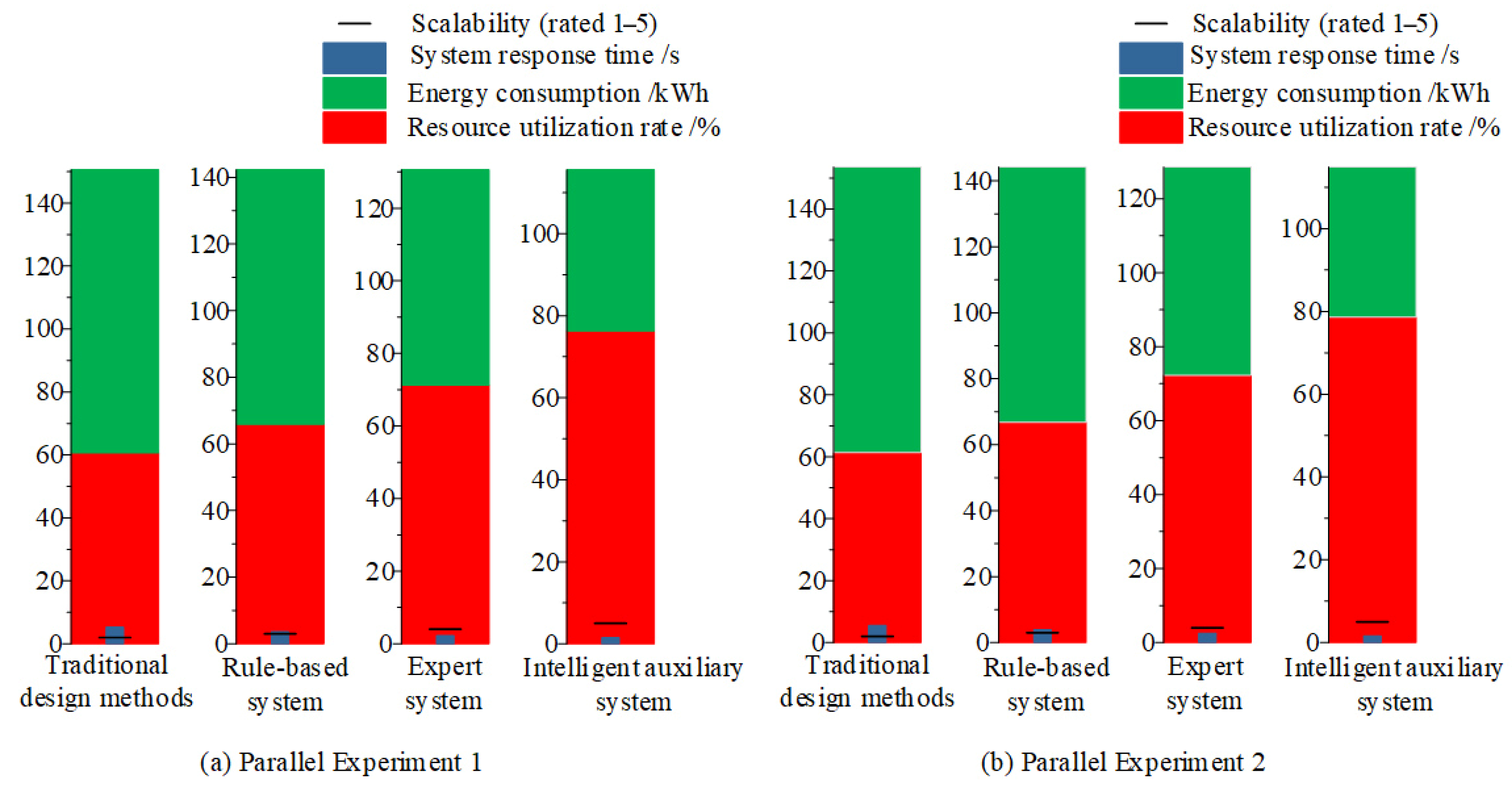
| Method | Resource Utilization (%) | Energy Consumption (kWh) | System Response Time (s) | Scalability (1–5 Points) |
|---|---|---|---|---|
| Traditional design methods | 42.3 | 245.6 | 5.3 | 2 |
| Rule-based systems | 56.8 | 198.4 | 3.6 | 3 |
| Expert systems | 68.2 | 162.7 | 2.3 | 4 |
| Proposed decision support system | 77.45 | 115.25 | 1.56 | 5 |
Disclaimer/Publisher’s Note: The statements, opinions and data contained in all publications are solely those of the individual author(s) and contributor(s) and not of MDPI and/or the editor(s). MDPI and/or the editor(s) disclaim responsibility for any injury to people or property resulting from any ideas, methods, instructions or products referred to in the content. |
© 2026 by the authors. Published by MDPI on behalf of the International Institute of Knowledge Innovation and Invention. Licensee MDPI, Basel, Switzerland. This article is an open access article distributed under the terms and conditions of the Creative Commons Attribution (CC BY) license.
Share and Cite
Zheng, F.; Lu, Y.; Lee, J.; Liu, H.; Wang, D.; Kim, M. An AI-Driven Decision Support System for Sustainable Smart Clothing Design Based on Flexible Material Properties and Environmental Metrics. Appl. Syst. Innov. 2026, 9, 104. https://doi.org/10.3390/asi9050104
Zheng F, Lu Y, Lee J, Liu H, Wang D, Kim M. An AI-Driven Decision Support System for Sustainable Smart Clothing Design Based on Flexible Material Properties and Environmental Metrics. Applied System Innovation. 2026; 9(5):104. https://doi.org/10.3390/asi9050104
Chicago/Turabian StyleZheng, Fang, Yanping Lu, Junghee Lee, Hongyan Liu, Dandan Wang, and Myun Kim. 2026. "An AI-Driven Decision Support System for Sustainable Smart Clothing Design Based on Flexible Material Properties and Environmental Metrics" Applied System Innovation 9, no. 5: 104. https://doi.org/10.3390/asi9050104
APA StyleZheng, F., Lu, Y., Lee, J., Liu, H., Wang, D., & Kim, M. (2026). An AI-Driven Decision Support System for Sustainable Smart Clothing Design Based on Flexible Material Properties and Environmental Metrics. Applied System Innovation, 9(5), 104. https://doi.org/10.3390/asi9050104