
SMART-CROWD: A System Architecture for Intelligent Assessment of Crowdsourcing Maturity in Urban Mobility Governance



Abstract
1. Introduction
2. Crowdsourcing in the Context of Open Innovation and Systemic Changes
3. Challenges of Modern Urban Mobility Systems
4. Methodology
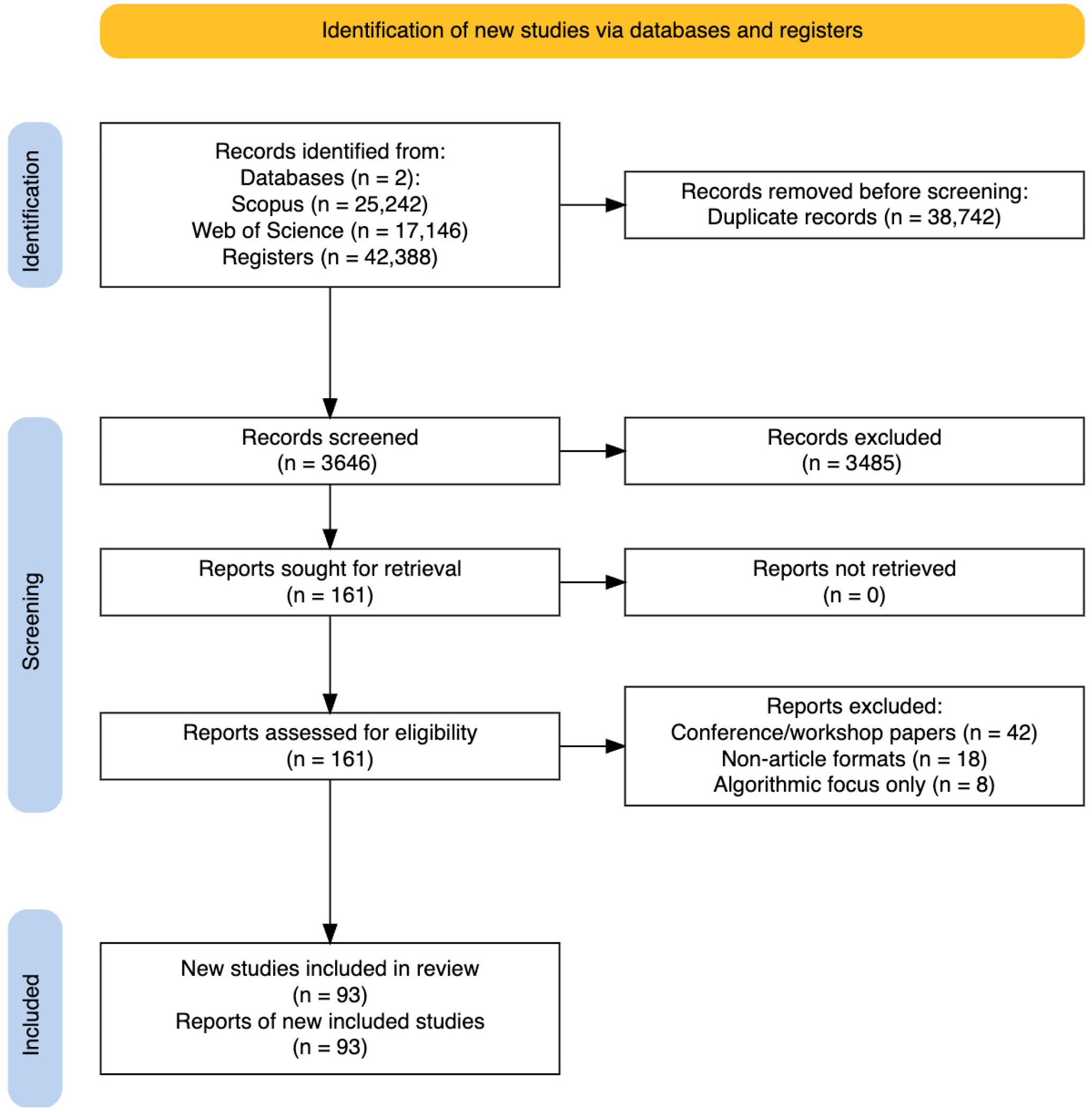
- Broad identification stage
- Scopus: ((((ALL(mobility)) OR ALL(transport)) AND ALL(crowdsourcing)) OR ALL(crowdsourc*))
- Web of Science: TS=((((mobility) OR (transport)) AND (crowdsourcing)) OR (crowdsourc*))
- Refinement stage
- Scopus: (((((ALL(mobility)) OR ALL(transport)) AND ALL(crowdsourcing)) OR ALL(crowdsourc*)) AND ALL(framework))
- Web of Science: TS=(((((mobility) OR (transport)) AND (crowdsourcing)) OR (crowdsourc*)) AND (framework))
- Final focused stage
- Scopus: TITLE-ABS-KEY(mobility) AND (TITLE-ABS-KEY(crowdsourcing) OR TITLE-ABS-KEY(crowdsourc*)) AND TITLE-ABS-KEY(framework)
- Web of Science: TS=(mobility AND (crowdsourcing OR crowdsourc*) AND framework)
- (1)
- Framework description, including objective, methods, input data, outcomes, and innovation;
- (2)
- Framework typology, distinguishing implementation, evaluation, and descriptive frameworks;
- (3)
- Relevance to mobility, understood in relation to traffic management, logistics, parking, and broader urban mobility functions.
5. Results: Crowdsourcing in Mobility Frameworks Analysis
5.1. Framework Description Analysis
5.1.1. Framework Objectives
5.1.2. Framework Methodologies
5.1.3. Utilized Input Data
5.1.4. Achieved Outcomes
5.1.5. Framework Innovativeness
5.2. Framework Typology
5.2.1. Implementation Frameworks
5.2.2. Evaluation Frameworks
5.2.3. Descriptive Frameworks
5.3. Relevance to Urban Mobility Domains
5.3.1. Traffic Management and Congestion Control
5.3.2. Parking Management
5.3.3. Logistics and Delivery Services
5.3.4. Public Transport Analysis and Planning
5.3.5. Ride-Hailing and Shared Mobility Services
5.3.6. Mapping, Navigation, and Location Services
5.3.7. Urban Planning and Public Engagement
5.3.8. Other Applications with Indirect Mobility Relevance
5.4. Critical Gaps in Frameworks
- Limited scope of external knowledge integration beyond data collection;
- Challenges in building trust and facilitating data sharing with external stakeholders;
- Insufficient interoperability and standardization for cross-organizational collaboration;
- Sustainability of engagement for continuous co-creation;
- Limited “opening up” of internal processes and platforms.
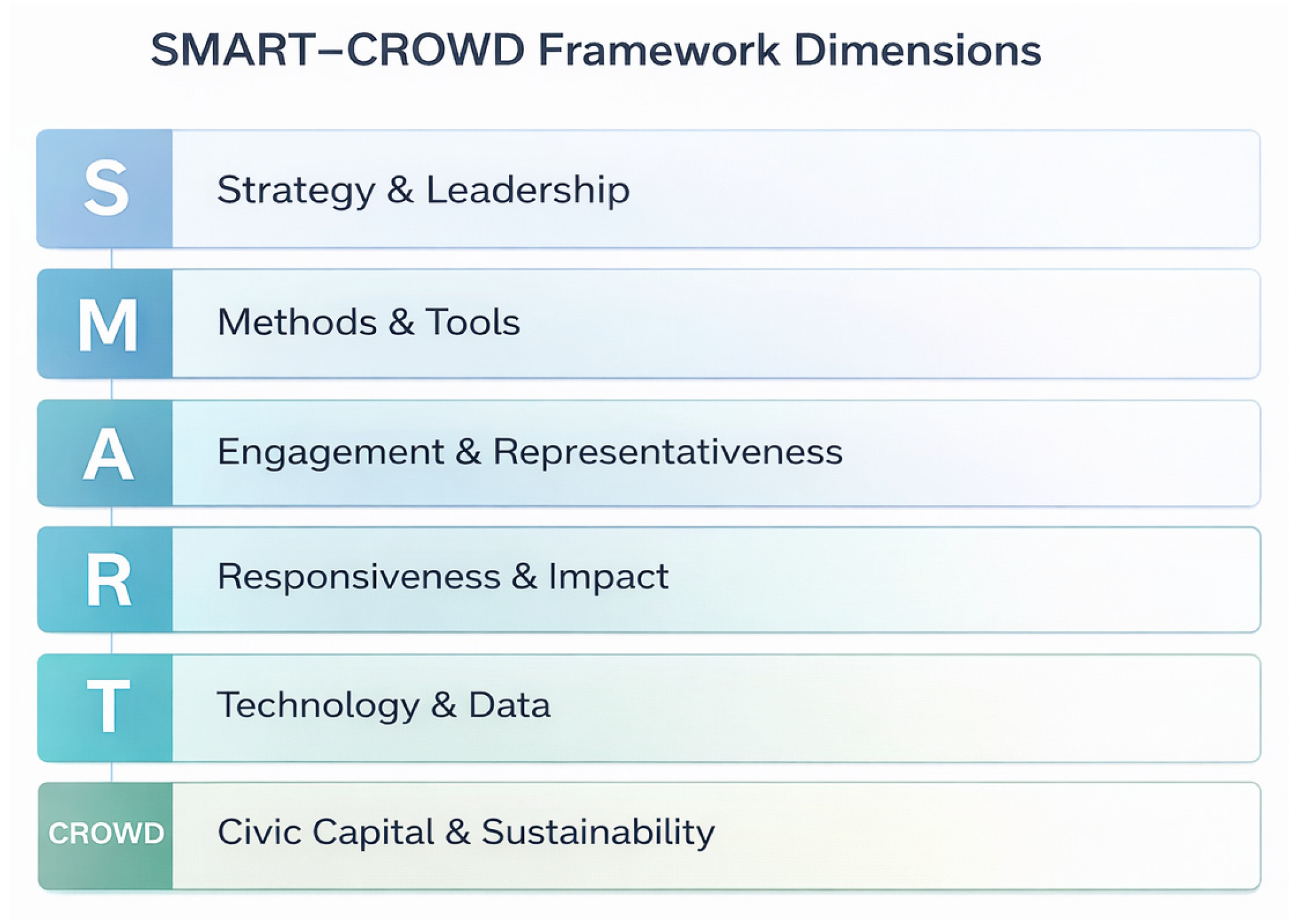
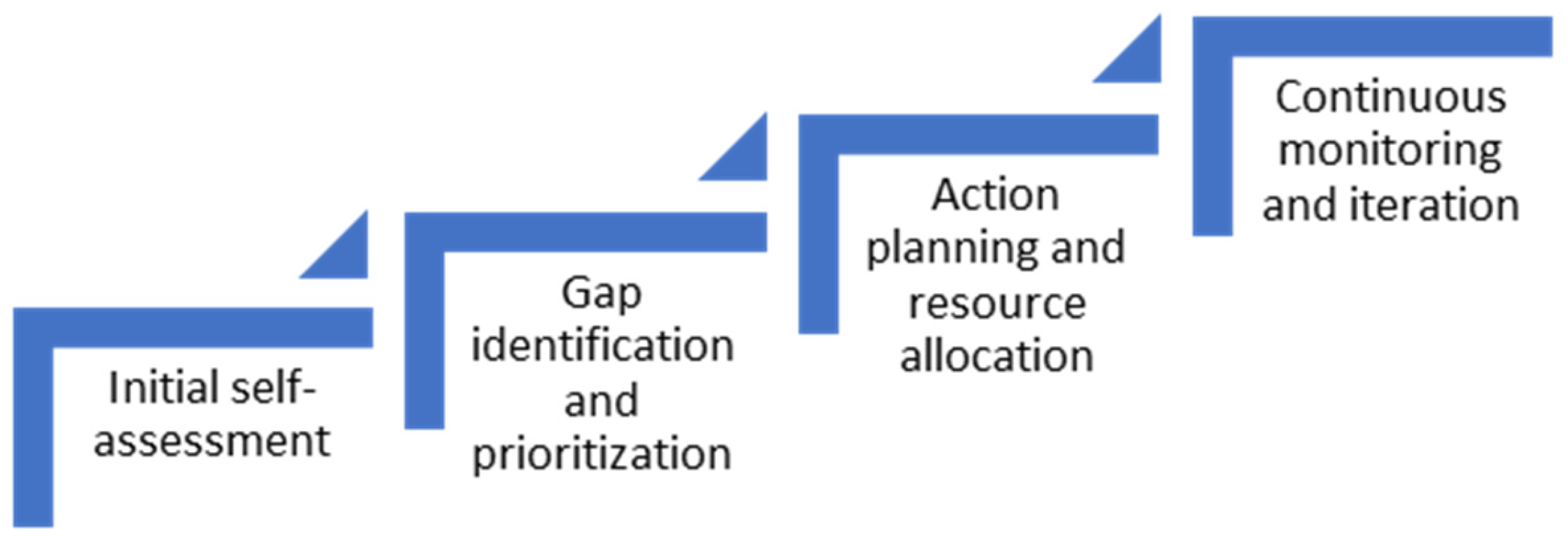
6. SMART-CROWD Framework: Comprehensive Methodology for Evaluating Crowdsourcing in Urban Mobility
- (1st) Strategy & Leadership (S): This assesses the extent to which crowdsourcing is embedded in the city’s strategic vision and governance structures. It emphasizes whether open innovation has been institutionalized as a guiding principle, recognizing the crowd not merely as data providers but as active contributors to policy and service innovation. A key marker of maturity is the presence of a formal open innovation strategy, distinct from general digitalization plans, supported by policies that foster transparency, trust, and accountability in the integration of citizen-generated knowledge into decision-making.
- (2nd) Methods & Tools (M): This examines the diversity and openness of tools used by the city to engage external stakeholders. It considers whether platforms enable not only data submission but also bidirectional exchange, allowing contributors to interact with, iterate on, or improve proposed ideas. More mature cities tend to adopt interoperable systems that integrate with third-party platforms and support modular innovation through external input. The presence of co-creation environments such as innovation labs, online design platforms, or challenge-driven hackathons indicates stronger alignment with open innovation principles.
- (3rd) Engagement & Representativeness (A): This reflects the participatory logic of open innovation by emphasizing the inclusion of diverse and representative social groups rather than relying solely on institutional actors or already well-represented participants. This dimension captures the extent to which cities engage a broad cross-section of society, particularly underrepresented groups, and facilitate sustained, long-term participation. Because open innovation also depends on cross-sector collaboration, higher maturity is associated with the active involvement of academic institutions, civil society organizations, and private sector actors in ideation and testing phases.
- (4th) Responsiveness & Impact (R): This measures the city’s ability to transform crowdsourced input into tangible outcomes and institutional change. It includes mechanisms for transparent communication with contributors, feedback loops that explain how ideas were used or why they were not, and metrics that track not only outputs (e.g., number of responses) but innovation outcomes, such as prototypes developed, services improved, or partnerships initiated. A higher level of maturity in this dimension is reflected in treating citizen participation as a meaningful governance resource rather than only as a consultative mechanism.
- (5th) Technology & Data (T): This evaluates whether a city’s technical infrastructure supports openness through use of open data standards, APIs, and publication of anonymized datasets. Crucially, this dimension also assesses data quality assurance and bias mitigation mechanisms. It examines whether cities implement protocols to reconcile crowdsourced inputs with authoritative data sources (e.g., IoT sensors, official statistics) and whether they employ statistical methods to detect and correct demographic or geographic sampling biases. More mature systems are expected to provide confidence scores for data points and to report data quality metrics more transparently, so that technological sophistication extends beyond collection to include reliability and representativeness.
- (6th) Civic Capital & Sustainability (CROWD): This examines whether crowdsourcing initiatives build social trust, support sustainability transitions, and encourage responsible innovation. Cities are assessed on their engagement with NGOs and grassroots actors, alignment with SDGs, and ethical practices in the use of AI and data. Higher levels of maturity in this dimension are associated with stronger engagement with NGOs and grassroots actors, clearer alignment with the SDGs, and more explicit attention to ethical practices in the use of AI and data. In more advanced cases, cities may also support local open innovation ecosystems through incubators, living labs, public–private partnerships, and other forms of collaborative experimentation.
- Strategy & Leadership (S) addresses the lack of formal open innovation strategies that go beyond generic digitalization plans;
- Methods & Tools (M) and Technology & Data (T) respond to the limited interoperability and closed internal systems that hinder cross-organizational collaboration;
- Engagement & Representativeness (A) addresses the insufficient inclusion of underrepresented groups and the narrow demographic base of most crowdsourcing initiatives;
- Responsiveness & Impact (R) addresses the weak feedback mechanisms and absence of clear pathways from citizen input to institutional change;
- Civic Capital & Sustainability (CROWD) responds to gaps related to long-term engagement, ethical considerations, and alignment with broader societal goals such as equity and sustainability.
- Initial: Lack of formal processes or sporadic, unplanned activities.
- Developing: Recognition of the need, fragmented actions, lack of coherent strategy.
- Defined: Existing processes and strategies but requiring optimization and broader implementation.
- Managed: Processes are well-defined, monitored, and regularly optimized.
- Optimizing: Continuous improvement, innovativeness, proactive approach, and industry leadership.
- —Weight assigned to indicator j, ∈<0;1>.
- —Score for indicator ∈<1;5>.
- n—Total number of indicators within the given dimension.
- Formal assessment of strategic openness through dedicated indicators and scoring;
- Stronger attention to shared responsibility and distributed ownership of innovation processes;
- Metrics extending beyond participation rates to capture value creation and co-created impact;
- Tools and processes supporting both external knowledge inflows and internal knowledge outflows;
- An institutionalization perspective consistent with city-as-a-platform thinking, where the municipality acts as an enabler of wider innovation ecosystems rather than the sole originator of change.
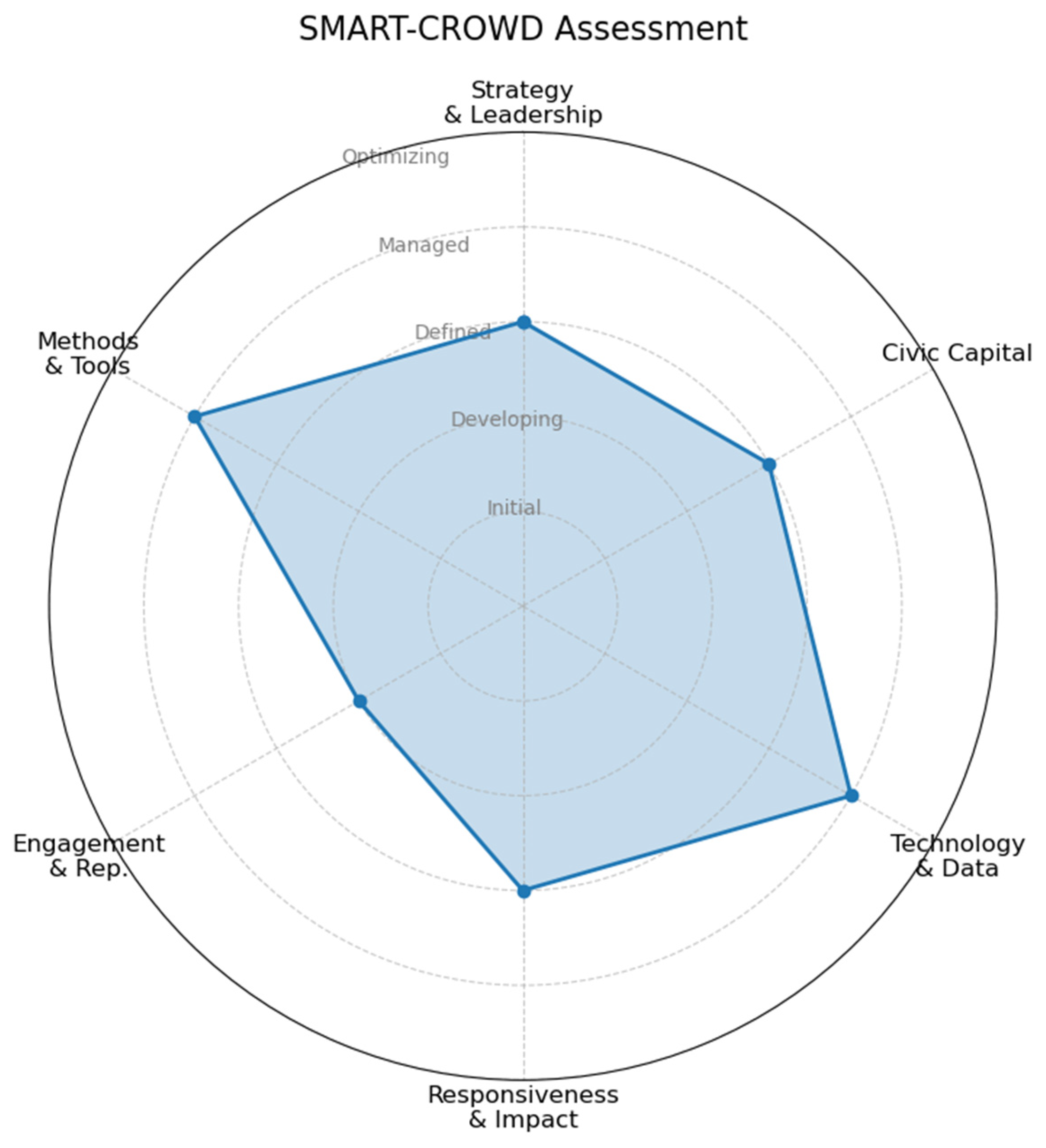
7. Illustrative Worked Example: City Maturity Assessment
8. Discussion
8.1. The Framework’s Contribution to Open Innovation Development
8.2. Distinctive Features Relative to Previously Analyzed Frameworks
- (1)
- Broader analytical scope: While individual frameworks in the literature address specific areas, for example WiFi tracking [54,55], package delivery [31], or objectivity analysis [65], relatively few provide an integrated, multi-dimensional assessment across strategy, methods, engagement, impact, technology, and civic capital. In this respect, SMART-CROWD brings these dimensions together within a single assessment structure.
- (2)
- Stronger integration of open innovation considerations: Many previously analyzed frameworks, including those using crowdsourcing, treated it primarily as a data collection mechanism. By contrast, SMART-CROWD incorporates open innovation more explicitly into its assessment logic, including the role of external ideas, actors, and collaborative processes in urban mobility governance.
- (3)
- Diagnostic and operational potential: Unlike purely descriptive or analytical approaches, SMART-CROWD is structured in a way that may support diagnostic use. Its maturity scale and detailed indicators can help cities identify weaker areas and consider more targeted improvements, although the practical robustness of this application still requires broader empirical testing.
- (4)
- Attention to socio-technical aspects: Many existing frameworks focus primarily on technical dimensions. SMART-CROWD, while including technological issues, also gives substantial attention to socio-technical factors such as trust, inclusivity, and long-term citizen engagement, recognizing that these human dimensions are important for real-world implementation and impact [71].
8.3. Limitations
9. Conclusions
Supplementary Materials
Author Contributions
Funding
Data Availability Statement
Conflicts of Interest
References
- Tonne, C.; Adair, L.; Adlakha, D.; Anguelovski, I.; Belesova, K.; Berger, M.; Brelsford, C.; Dadvand, P.; Dimitrova, A.; Giles-Corti, B.; et al. Defining Pathways to Healthy Sustainable Urban Development. Environ. Int. 2021, 146, 106236. [Google Scholar] [CrossRef] [PubMed]
- Turoń, K. Sustainable Urban Mobility Transitions—From Policy Uncertainty to the CalmMobility Paradigm. Smart Cities 2025, 8, 164. [Google Scholar] [CrossRef]
- Chesbrough, H. Open Innovation: The New Imperative for Creating and Profiting from Technology; Harvard Business School Press: Boston, MA, USA, 2011. [Google Scholar]
- Chesbrough, H. (Ed.) Open Innovation: Researching a New Paradigm; Oxford University Press: Oxford, UK, 2008. [Google Scholar]
- Liu, H.K. Crowdsourcing Government: Lessons from Multiple Disciplines. Public Adm. Rev. 2017, 77, 656–667. [Google Scholar] [CrossRef]
- Seltzer, E.; Mahmoudi, D. Citizen Participation, Open Innovation, and Crowdsourcing: Challenges and Opportunities for Planning. J. Plan. Lit. 2013, 28, 3–18. [Google Scholar] [CrossRef]
- Szell, M. Crowdsourced Quantification and Visualization of Urban Mobility Space Inequality. Urban Plan. 2018, 3, 1–20. [Google Scholar] [CrossRef]
- Cricelli, L.; Grimaldi, M.; Vermicelli, S. Crowdsourcing and Open Innovation: A Systematic Literature Review, an Integrated Framework and a Research Agenda. Rev. Manag. Sci. 2022, 16, 1269–1310. [Google Scholar] [CrossRef]
- Mishra, P.; Singh, G. Internet of Vehicles for Sustainable Smart Cities: Opportunities, Issues, and Challenges. Smart Cities 2025, 8, 93. [Google Scholar] [CrossRef]
- Donthu, N.; Kumar, S.; Mukherjee, D.; Pandey, N.; Lim, W.M. How to conduct a bibliometric analysis: An overview and guidelines. J. Bus. Res. 2021, 133, 285–296. [Google Scholar] [CrossRef]
- Chesbrough, H.; Crowther, A.K. Beyond high tech: Early adopters of open innovation in other industries. R&D Manag. 2006, 36, 229–236. [Google Scholar] [CrossRef]
- Radziwon, A.; Bogers, M. Open Innovation in SMEs: Exploring Inter-Organizational Relationships in an Ecosystem. Technol. Forecast. Soc. Change 2019, 146, 573–587. [Google Scholar] [CrossRef]
- Vignieri, V. Crowdsourcing as a Mode of Open Innovation: Exploring Drivers of Success of a Multisided Platform through System Dynamics Modelling. Syst. Res. Behav. Sci. 2021, 38, 108–124. [Google Scholar] [CrossRef]
- Nevo, D.; Kotlarsky, J. Crowdsourcing as a Strategic IS Sourcing Phenomenon: Critical Review and Insights for Future Research. J. Strateg. Inf. Syst. 2020, 29, 101593. [Google Scholar] [CrossRef]
- Quoc Viet Hung, N.; Tam, N.T.; Tran, L.N.; Aberer, K. An Evaluation of Aggregation Techniques in Crowdsourcing. In Web Information Systems Engineering–WISE; Springer: Berlin/Heidelberg, Germany, 2013. [Google Scholar]
- Zhao, Z. Idea Crowdsourcing for Innovation: Fundamentals and Recommendations. SSRN J. 2019, 3, 1–16. [Google Scholar] [CrossRef]
- Cassiman, B.; Valentini, G. Open Innovation: Are Inbound and Outbound Knowledge Flows Really Complementary? Strateg. Manag. J. 2016, 37, 1034–1046. [Google Scholar] [CrossRef]
- Sesabo, Y.; Kato, M.; Chao, E.J. Coupled Open Innovation and Dynamic Capabilities: Their Effect on Low-Tech Micro and Small Firms’ Innovation. Small Bus. Int. Rev. 2023, 7, e613. [Google Scholar] [CrossRef]
- Yun, J.J.; Jeong, E.; Kim, S.; Ahn, H.; Kim, K.; Hahm, S.D.; Park, K. Collective Intelligence: The Creative Way from Knowledge to Open Innovation. Sci. Technol. Soc. 2021, 26, 201–222. [Google Scholar] [CrossRef]
- Scoones, I.; Stirling, A.; Abrol, D.; Atela, J.; Charli-Joseph, L.; Eakin, H.; Ely, A.; Olsson, P.; Pereira, L.; Priya, R.; et al. Transformations to sustainability: Combining structural, systemic and enabling approaches. Curr. Opin. Environ. Sustain. 2020, 42, 65–75. [Google Scholar] [CrossRef]
- Ghezzi, A.; Gabelloni, D.; Martini, A.; Natalicchio, A. Crowdsourcing: A Review and Suggestions for Future Research. Int. J. Manag. Rev. 2018, 20, 343–363. [Google Scholar] [CrossRef]
- Elerman, O. The Effect of Crowdsourcing on Citizen Participation: Case Studies of Ankara Metropolitan Municipality and Istanbul Metropolitan Municipality. 2023. Available online: https://www.google.com/url?sa=t&source=web&rct=j&opi=89978449&url=https://open.metu.edu.tr/bitstream/handle/11511/104513/10553861.pdf&ved=2ahUKEwj43arZgPSNAxXbExAIHWnfBd8QFnoECBIQAQ&usg=AOvVaw36EMJsyXVlVyTYquZ8Jp2_ (accessed on 20 September 2025).
- Nabatchi, T.; Sancino, A.; Sicilia, M. Varieties of Participation in Public Services: The Who, When, and What of Coproduction. Public Adm. Rev. 2017, 77, 766–776. [Google Scholar] [CrossRef]
- Zarbakhshnia, N.; Ma, Z. Critical Success Factors for the Adoption of AVs in Sustainable Urban Transportation. Transp. Policy 2024, 156, 62–76. [Google Scholar] [CrossRef]
- Jacques, E.D.A.; Júnior, A.N.; De Paris, S.; Francescatto, M.B.; Nunes, R.F.B. Smart City Actions Integrated into Urban Planning: Management of Urban Environments by Thematic Areas. Appl. Sci. 2024, 14, 3351. [Google Scholar] [CrossRef]
- Chen, T.; Ramon Gil-Garcia, J.; Gasco-Hernandez, M. Understanding Social Sustainability for Smart Cities: The Importance of Inclusion, Equity, and Citizen Participation as Both Inputs and Long-Term Outcomes. J. Smart Cities Soc. 2022, 1, 135–148. [Google Scholar] [CrossRef]
- Zhan, J.; Wu, H.; Cheng, P.; Zheng, L.; Chen, L.; Zhang, C.J.; Lin, X.; Zhang, W. TrendSharing: A Framework to Discover and Follow the Trends for Shared Mobility Services. In Proceedings of the 2024 IEEE 40th International Conference on Data Engineering (ICDE); IEEE: Utrecht, The Netherlands, 2024; pp. 4370–4382. [Google Scholar] [CrossRef]
- Ogunkan, D.V.; Ogunkan, S.K. Exploring Big Data Applications in Sustainable Urban Infrastructure: A Review. Urban Gov. 2025, 5, 54–68. [Google Scholar] [CrossRef]
- Buttazzoni, A.; Veenhof, M.; Minaker, L. Smart City and High-Tech Urban Interventions Targeting Human Health: An Equity-Focused Systematic Review. Int. J. Environ. Res. Public Health 2020, 17, 2325. [Google Scholar] [CrossRef] [PubMed]
- Ferster, C.; Fischer, J.; Manaugh, K.; Nelson, T.; Winters, M. Using OpenStreetMap to Inventory Bicycle Infrastructure: A Comparison with Open Data from Cities. Int. J. Sustain. Transp. 2020, 14, 64–73. [Google Scholar] [CrossRef]
- Chen, C.; Yang, S.; Wang, Y.; Guo, B.; Zhang, D. CrowdExpress: A Probabilistic Framework for On-Time Crowdsourced Package Deliveries. IEEE Trans. Big Data 2022, 8, 827–842. [Google Scholar] [CrossRef]
- Kougias, C.; Papadakaki, M. Rethinking the ‘Smart City’: From Technology-Led Visions to Citizen-Centered Governance—Barriers and Pathways in Digital Urban Initiatives. J. Urban Aff. 2025, 1–24. [Google Scholar] [CrossRef]
- Shao, J.; Min, B. Sustainable Development Strategies for Smart Cities: Review and Development Framework. Cities 2025, 158, 105663. [Google Scholar] [CrossRef]
- Almirall, E.; Lee, M.; Majchrzak, A. Open Innovation Requires Integrated Competition-Community Ecosystems: Lessons Learned from Civic Open Innovation. Bus. Horiz. 2014, 57, 391–400. [Google Scholar] [CrossRef]
- Brabham, D.C. Crowdsourcing the Public Participation Process for Planning Projects. Plan. Theory 2009, 8, 242–262. [Google Scholar] [CrossRef]
- Tyler, T.R. Psychological perspectives on legitimacy and legitimation. Annu. Rev. Psychol. 2006, 57, 375–400. [Google Scholar] [CrossRef] [PubMed]
- Nienaber, A.-M.I.; Woodcock, A.; Liotopoulos, F.K. Sharing Data–Not with Us! Distrust as Decisive Obstacle for Public Authorities to Benefit from Sharing Economy. Front. Psychol. 2021, 11, 576070. [Google Scholar] [CrossRef] [PubMed]
- Transport for London. Travel in London Report 13. Available online: https://content.tfl.gov.uk/travel-in-london-report-13.pdf (accessed on 20 September 2025).
- Liu, Z.; Li, Z.; Zhang, Y.; Mutukumira, A.N.; Feng, Y.; Cui, Y.; Wang, S.; Wang, J.; Wang, S. Comparing Business, Innovation, and Platform Ecosystems: A Systematic Review of the Literature. Biomimetics 2024, 9, 216. [Google Scholar] [CrossRef] [PubMed]
- Yu, Y.; Yao, Y.; Liu, Z.; An, Z.; Chen, B.; Chen, L.; Chen, R. A Bi-LSTM Approach for Modelling Movement Uncertainty of Crowdsourced Human Trajectories under Complex Urban Environments. Int. J. Appl. Earth Obs. Geoinf. 2023, 122, 103412. [Google Scholar] [CrossRef]
- Osborne, S.P.; Radnor, Z.; Strokosch, K. Co-Production and the Co-Creation of Value in Public Services: A suitable case for treatment? Public Manag. Rev. 2016, 18, 639–653. [Google Scholar] [CrossRef]
- Keinz, P.; Hienerth, C.; Gemünden, H.G.; Killen, C.P.; Sicotte, H. Special Issue: Managing Open and User Innovation by Projects: Sensing, Seizing and Transforming. Int. J. Proj. Manag. 2021, 39, 97–101. [Google Scholar] [CrossRef]
- Tranfield, D.; Denyer, D.; Smart, P. Towards a Methodology for Developing Evidence-Informed Management Knowledge by Means of Systematic Review. Br. J. Manag. 2003, 14, 207–222. [Google Scholar] [CrossRef]
- Pittaway, L.; Robertson, M.; Munir, K.; Denyer, D.; Neely, A. Networking and Innovation: A Systematic Review of the Evidence. Int. J. Manag. Rev. 2004, 5–6, 137–168. [Google Scholar] [CrossRef]
- Haddaway, N.R.; Page, M.J.; Pritchard, C.C.; McGuinness, L.A. PRISMA2020: An R package and Shiny app for producing PRISMA 2020-compliant flow diagrams, with interactivity for optimised digital transparency and Open Synthesis. Campbell Syst. Rev. 2022, 18, e1230. [Google Scholar] [CrossRef]
- Mas-Tur, A.; Kraus, S.; Brandtner, M.; Ewert, R.; Kürsten, W. Advances in Management Research: A Bibliometric Overview of the Review of Managerial Science. Rev. Manag. Sci 2020, 14, 933–958. [Google Scholar] [CrossRef]
- Aria, M.; Cuccurullo, C. An R-tool for comprehensive science mapping analysis. J. Informetr. 2017, 11, 959–975. [Google Scholar] [CrossRef]
- Thomas, J.; Harden, A. Methods for the Thematic Synthesis of Qualitative Research in Systematic Reviews. BMC Med. Res. Methodol. 2008, 8, 45. [Google Scholar] [CrossRef] [PubMed]
- Bordogna, G.; Capelli, S.; Ciriello, D.E.; Psaila, G. A Cross-Analysis Framework for Multi-Source Volunteered, Crowdsourced, and Authoritative Geographic Information: The Case Study of Volunteered Personal Traces Analysis against Transport Network Data. Geo-Spat. Inf. Sci. 2018, 21, 257–271. [Google Scholar] [CrossRef]
- Li, Y.; Sun, S.; Amirghasemi, M.; Alsinglawi, B.; Perez, P.; Moran, B. Can Computational Linguistics Be Used for Wi-Fi-Based Tracking System? IEEE Sens. J. 2025, 25, 23392–23404. [Google Scholar] [CrossRef]
- Spanidis, P.; Dimokas, N.; Panou, M.; Christainas, G.; Salamanis, A.; Kehagias, D. An Innovative Mobile Application for Booking Parking Spots. In Smart Energy for Smart Transport; Nathanail, E.G., Gavanas, N., Adamos, G., Eds.; Lecture Notes in Intelligent Transportation and Infrastructure; Springer Nature: Cham, Switzerland, 2023; pp. 348–359. [Google Scholar] [CrossRef]
- Mondal, M.A.; Rehena, Z. An IoT-Based Congestion Control Framework for Intelligent Traffic Management System. In Advances in Artificial Intelligence and Data Engineering; Chiplunkar, N.N., Fukao, T., Eds.; Advances in Intelligent Systems and Computing; Springer Nature: Singapore, 2021; Volume 1133, pp. 1287–1297. [Google Scholar] [CrossRef]
- Guo, S.; Qian, X.; Dasgupta, S.; Rahman, M.; Jones, S. Sensing and Monitoring of Urban Roadway Traffic State with Large-Scale Ride-Sourcing Vehicles. In The Rise of Smart Cities; Elsevier: Amsterdam, The Netherlands, 2022; pp. 551–582. [Google Scholar] [CrossRef]
- Li, C.; Gong, S.; Wang, X.; Wang, L.; Jiang, Q.; Okamura, K. Secure and Efficient Content Distribution in Crowdsourced Vehicular Content-Centric Networking. IEEE Access 2018, 6, 5727–5739. [Google Scholar] [CrossRef]
- Li, C.; Wang, X.; Gong, S.; Wang, Z.-H.; Jiang, Q. Performance Analysis for Content Distribution in Crowdsourced Content-Centric Mobile Networking. In Quality, Reliability, Security and Robustness in Heterogeneous Systems; Wang, L., Qiu, T., Zhao, W., Eds.; Lecture Notes of the Institute for Computer Sciences, Social Informatics and Telecommunications Engineering; Springer International Publishing: Cham, Switzerland, 2018; Volume 234, pp. 131–141. [Google Scholar] [CrossRef]
- Ghaderi, H.; Tsai, P.-W.; Zhang, L.; Moayedikia, A. An Integrated Crowdshipping Framework for Green Last Mile Delivery. Sustain. Cities Soc. 2022, 78, 103552. [Google Scholar] [CrossRef]
- Lv, C.; Zhang, L.; Li, X.-Y. Personalized Differentially Private Online Minimum Bipartite Matching in Spatial Crowdsourcing. In Proceedings of the 2022 8th International Conference on Big Data Computing and Communications (BigCom); IEEE: Xiamen, China, 2022; pp. 134–143. [Google Scholar] [CrossRef]
- Qiu, C.; Yadav, S.; Ji, Y.; Squicciarini, A.; Dantu, R.; Zhao, J.; Xu, C.-Z. Fine-Grained Geo-Obfuscation to Protect Workers’ Location Privacy in Time-Sensitive Spatial Crowdsourcing. EDBT 2024, 373–385. [Google Scholar] [CrossRef]
- Akram, J.; Anaissi, A.; Sidana, S.; Kumar, D.; Jhaveri, R.H. Leveraging Blockchain-as-a-Certificate Authority for Authentication in 6G-Enabled Spatial Crowdsourcing Drone Services. In Proceedings of the 2024 IEEE 100th Vehicular Technology Conference (VTC2024-Fall); IEEE: Washington, DC, USA, 2024; pp. 1–5. [Google Scholar] [CrossRef]
- Kim, C.; Cho, S.; Sunwoo, M.; Resende, P.; Bradai, B.; Jo, K. Updating Point Cloud Layer of High Definition (HD) Map Based on Crowd-Sourcing of Multiple Vehicles Installed LiDAR. IEEE Access 2021, 9, 8028–8046. [Google Scholar] [CrossRef]
- Mansour, A.; Ye, J.; Li, Y.; Luo, H.; Wang, J.; Weng, D.; Chen, W. Everywhere: A Framework for Ubiquitous Indoor Localization. IEEE Internet Things J. 2023, 10, 5095–5113. [Google Scholar] [CrossRef]
- Sdoukopoulos, A.; Gavanas, N.; Pitsiava-Latinopoulou, M. Evaluating the Quality of Public Spaces Using Crowdsourcing Data: The Case of the Metropolitan Area of Thessaloniki. In Smart Energy for Smart Transport; Nathanail, E.G., Gavanas, N., Adamos, G., Eds.; Lecture Notes in Intelligent Transportation and Infrastructure; Springer Nature: Cham, Switzerland, 2023; pp. 556–568. [Google Scholar] [CrossRef]
- Lu, Q.-L.; Mahajan, V.; Lyu, C.; Antoniou, C. Analyzing the Impact of Fare-Free Public Transport Policies on Crowding Patterns at Stations Using Crowdsensing Data. Transp. Res. Part A Policy Pract. 2024, 179, 103944. [Google Scholar] [CrossRef]
- Genitsaris, E.; Stamelou, A.; Nalmpantis, D.; Naniopoulos, A. A Criteria-Based Evaluation Framework for Assessing Public Transport Related Concepts Resulted from Collective Intelligence Approaches. In Data Analytics: Paving the Way to Sustainable Urban Mobility; Nathanail, E.G., Karakikes, I.D., Eds.; Advances in Intelligent Systems and Computing; Springer International Publishing: Cham, Switzerland, 2019; Volume 879, pp. 529–537. [Google Scholar] [CrossRef]
- El Alaoui El Abdallaoui, H.; El Fazziki, A.; Ennaji, F.Z.; Sadgal, M. A Gamification and Objectivity Based Approach to Improve Users Motivation in Mobile Crowd Sensing. In Model and Data Engineering; Abdelwahed, E.H., Bellatreche, L., Golfarelli, M., Méry, D., Ordonez, C., Eds.; Lecture Notes in Computer Science; Springer International Publishing: Cham, Switzerland, 2018; Volume 11163, pp. 153–167. [Google Scholar] [CrossRef]
- Gao, Q.; Zhou, F.; Yang, X.; Liu, G. When Friendship Meets Sequential Human Check-Ins: Inferring Social Circles with Variational Mobility. Neurocomputing 2023, 518, 174–189. [Google Scholar] [CrossRef]
- Rao, B.; Zhang, X.; Zhu, T.; You, Y.; Li, Y.; Duan, J.; Zhou, Z.; Chen, X. Can You Do Both? Balancing Order Serving and Crowdsensing for Ride-Hailing Vehicles. In Proceedings of the 2024 IEEE/ACM 32nd International Symposium on Quality of Service (IWQoS); IEEE: Guangzhou, China, 2024; pp. 1–6. [Google Scholar] [CrossRef]
- Muhammad, A.R.; Aguiar, A.; Mendes-Moreira, J. Transportation Mode Detection from GPS Data: A Data Science Benchmark Study. In Proceedings of the 2021 IEEE International Intelligent Transportation Systems Conference (ITSC); IEEE: Indianapolis, IN, USA, 2021; pp. 3726–3731. [Google Scholar] [CrossRef]
- Li, L.; Yu, H.; Kunc, M. The Impact of Forum Content on Data Science Open Innovation Performance: A System Dynamics-Based Causal Machine Learning Approach. Technol. Forecast. Soc. Change 2024, 198, 122936. [Google Scholar] [CrossRef]
- Ma, Q.; Gao, L.; Liu, Y.-F.; Huang, J. Incentivizing Wi-Fi Network Crowdsourcing: A Contract Theoretic Approach. IEEE/ACM Trans. Netw. 2018, 26, 1035–1048. [Google Scholar] [CrossRef]
- Michalitsi-Psarrou, A.; Papageorgiou, I.L.; Ntanos, C.; Psarras, J. Agent-Based Simulation to Measure the Effectiveness of Citizen Sensing Applications—The Case of Missing Children. Appl. Sci. 2021, 11, 6530. [Google Scholar] [CrossRef]
- Chandra, S.; Naik, R.T.; Jimenez, J. A Framework for Smart Freight Mobility with Crowdsourcing. Transp. Res. Procedia 2020, 48, 494–502. [Google Scholar] [CrossRef]
- Laoudias, C.; Zeinalipour-Yazti, D.; Panayiotou, C.G. Crowdsourced Indoor Localization for Diverse Devices through Radiomap Fusion. In Proceedings of the International Conference on Indoor Positioning and Indoor Navigation; IEEE: Montbeliard, France, 2013; pp. 1–7. [Google Scholar] [CrossRef]
- Panta, F.J.; Péninou, A.; Sèdes, F. An Approach for CCTV Contents Filtering Based on Contextual Enrichment via Spatial and Temporal Metadata. In Proceedings of the MoMM2019: 17th International Conference on Advances in Mobile Computing & Multimedia, Munich, Germany, 2–4 December 2019; pp. 195–199. Available online: https://hal.science/hal-03621680v1/document (accessed on 20 September 2025).
- Hu, D.; Chen, J.; Zhou, H.; Yu, K.; Qian, B.; Xu, W. Leveraging Blockchain for Multi-Operator Access Sharing Management in Internet of Vehicles. IEEE Trans. Veh. Technol. 2022, 71, 2774–2787. [Google Scholar] [CrossRef]
- Bocher, E.; Petit, G.; Picaut, J.; Fortin, N.; Guillaume, G. Collaborative Noise Data Collected from Smartphones. Data Brief 2017, 14, 498–503. [Google Scholar] [CrossRef]
- Kantarci, B.; Mouftah, H.T. Mobility-Aware Trustworthy Crowdsourcing in Cloud-Centric Internet of Things. In Proceedings of the 2014 IEEE Symposium on Computers and Communications (ISCC); IEEE: Funchal, Portugal, 2014; pp. 1–6. [Google Scholar] [CrossRef]
- Anik, M.A.H.; Sadeek, S.N.; Hossain, M.; Kabir, S. A Framework for Involving the Young Generation in Transportation Planning Using Social Media and Crowd Sourcing. Transp. Policy 2020, 97, 1–18. [Google Scholar] [CrossRef]
- De Vita, C.G.; Mellone, G.; Casolaro, A.; Orsini, M.G.; Luis Gonzalez-Compean, J.; Ciaramella, A. Federated Learning and Crowdsourced Weather Data: Practice and Experience. In Proceedings of the 2024 IEEE 20th International Conference on e-Science (e-Science); IEEE: Osaka, Japan, 2024; pp. 1–9. [Google Scholar] [CrossRef]
- Bimbao, P.J.A.; Ou, S.J. #bikeparking Now: Bike Parking Patterns in the Landscape with Instagram Crowdsourced Data. In Proceedings of the 2021 4th International Conference on Education Technology Management; ACM: Tokyo, Japan, 2021; pp. 291–296. [Google Scholar] [CrossRef]
- Yin, B.; Lu, J. A Cost-Efficient Framework for Crowdsourced Data Collection in Vehicular Networks. IEEE Internet Things J. 2021, 8, 13567–13581. [Google Scholar] [CrossRef]
- To, H.; Asghari, M.; Deng, D.; Shahabi, C. SCAWG: A Toolbox for Generating Synthetic Workload for Spatial Crowdsourcing. In Proceedings of the 2016 IEEE International Conference on Pervasive Computing and Communication Workshops (PerCom Workshops); IEEE: Sydney, Australia, 2016; pp. 1–6. [Google Scholar] [CrossRef]
- Dias, M.B. Map-Aided Indoor Navigation. In Indoor Wayfinding and Navigation; Karimi, H.A., Ed.; CRC Press: Boca Raton, FL, USA, 2015; pp. 122–155. [Google Scholar] [CrossRef]
- Christainas, G.; Kehagias, D.; Salamanis, A.; Spanidis, P.; Kyrkoy, M.; Tzovaras, D. A Crowdsourcing Framework for Reporting Available Parking Spots in Urban Areas. In Smart Energy for Smart Transport; Nathanail, E.G., Gavanas, N., Adamos, G., Eds.; Lecture Notes in Intelligent Transportation and Infrastructure; Springer Nature Switzerland: Cham, Switzerland, 2023; pp. 323–334. [Google Scholar] [CrossRef]
- Fonteles, A.S.; Bouveret, S.; Gensel, J. Towards Matching Improvement between Spatio-Temporal Tasks and Workers in Mobile Crowdsourcing Market Systems. In Proceedings of the Third ACM SIGSPATIAL International Workshop on Mobile Geographic Information Systems; ACM: Dallas, TX, USA, 2014; pp. 43–50. [Google Scholar] [CrossRef]
- Pimpinella, A.; Repossi, M.; Redondi, A.E.C. Unsatisfied Today, Satisfied Tomorrow: A Simulation Framework for Performance Evaluation of Crowdsourcing-Based Network Monitoring. Comput. Commun. 2022, 182, 184–197. [Google Scholar] [CrossRef]
- Petraki, V.; Ziakopoulos, A.; Oikonomou, M.G.; Roussou, S.; Yannis, G. Bicycle Traffic Analysis Before and After Mobility Interventions Using Crowdsourced Data. In Transport Transitions: Advancing Sustainable and Inclusive Mobility; McNally, C., Carroll, P., Martinez-Pastor, B., Ghosh, B., Efthymiou, M., Valantasis-Kanellos, N., Eds.; Lecture Notes in Mobility; Springer Nature: Cham, Switzerland, 2025; pp. 376–381. [Google Scholar] [CrossRef]
- Klumpp, M. Crowdsourcing in Logistics: An Evaluation Scheme. In Dynamics in Logistics; Freitag, M., Kotzab, H., Pannek, J., Eds.; Lecture Notes in Logistics; Springer International Publishing: Cham, Switzerland, 2017; pp. 401–411. [Google Scholar] [CrossRef]
- Wang, L.; Yang, D.; Han, X.; Zhang, D.; Ma, X. Mobile Crowdsourcing Task Allocation with Differential-and-Distortion Geo-Obfuscation. IEEE Trans. Dependable Secur. Comput. 2021, 18, 967–981. [Google Scholar] [CrossRef]
- Wang, X.; Lin, X.; Li, M. Aggregate Modeling and Equilibrium Analysis of the Crowdsourcing Market for Autonomous Vehicles. Transp. Res. Part C Emerg. Technol. 2021, 132, 103362. [Google Scholar] [CrossRef]
- Wang, Z.; Wu, J.; Wu, Y.; Deng, S.; Huang, H. Predictive Location Aware Online Admission and Selection Control in Participatory Sensing. IEEE Trans. Ind. Inf. 2019, 15, 4494–4505. [Google Scholar] [CrossRef]
- Ji, W.; Han, K.; Liu, T. Trip-Based Mobile Sensor Deployment for Drive-by Sensing with Bus Fleets. Transp. Res. Part C Emerg. Technol. 2023, 157, 104404. [Google Scholar] [CrossRef]
- Tarrías, A.; Moreno, A.A.; Pareja, F.J.; Baena, E.; Fortes, S.; Barco, R. Toward Zero-Touch Cellular Networks via Next-Generation Crowdsourcing. IEEE Access 2024, 12, 167489–167497. [Google Scholar] [CrossRef]
- Phuttharak, J.; Loke, S.W. A Review of Mobile Crowdsourcing Architectures and Challenges: Toward Crowd-Empowered Internet-of-Things. IEEE Access 2019, 7, 304–324. [Google Scholar] [CrossRef]
- Da Silva, M.; Viterbo, J.; Bernardini, F.; Maciel, C. Identifying Privacy Functional Requirements for Crowdsourcing Applications in Smart Cities. In Proceedings of the 2018 IEEE International Conference on Intelligence and Security Informatics (ISI); IEEE: Miami, FL, USA, 2018; pp. 106–111. [Google Scholar] [CrossRef]
- Feng, W.; Yan, Z.; Zhang, H.; Zeng, K.; Xiao, Y.; Hou, Y.T. A Survey on Security, Privacy, and Trust in Mobile Crowdsourcing. IEEE Internet Things J. 2018, 5, 2971–2992. [Google Scholar] [CrossRef]
- Morocho, V.; Munoz, S.; Chica Carmona, J.; Flores Juca, E. Waze for Cities: An Effective Alternative for Traffic Study. In Proceedings of the 2024 IEEE ANDESCON; IEEE: Cusco, Peru, 2024; pp. 1–6. [Google Scholar] [CrossRef]
- Steiger, E.; Ellersiek, T.; Zipf, A. Explorative Public Transport Flow Analysis from Uncertain Social Media Data. In Proceedings of the 3rd ACM SIGSPATIAL International Workshop on Crowdsourced and Volunteered Geographic Information; ACM: Dallas, TX, USA, 2014; pp. 1–7. [Google Scholar] [CrossRef]
- Jin, Q.; Li, B.; Cheng, Y.; Zhao, X. Real-Time Multi-Platform Route Planning in Ridesharing. Expert Syst. Appl. 2024, 255, 124819. [Google Scholar] [CrossRef]
- Wu, Z.; Zhang, C.J.; Yin, H.; Meng, R.; Zheng, L.; Zhu, H.; Liu, W. DRLPG: Reinforced Opponent-Aware Order Pricing for Hub Mobility Services. IEEE Trans. Knowl. Data Eng. 2025, 37, 3298–3311. [Google Scholar] [CrossRef]
- Bai, S.; Jiao, J. From Shared Micro-Mobility to Shared Responsibility: Using Crowdsourcing to Understand Dockless Vehicle Violations in Austin, Texas. J. Urban Aff. 2022, 44, 1341–1353. [Google Scholar] [CrossRef]
- Brendel, A.B.; Lichtenberg, S.; Morana, S.; Prinz, C.; Hillmann, B.M. Designing a Crowd-Based Relocation System—The Case of Car-Sharing. Sustainability 2022, 14, 7090. [Google Scholar] [CrossRef]
- Vela, B.; Cavero, J.M.; Caceres, P.; Sierra, A.; Cuesta, C.E. Defining a NoSQL Document Database of Accessible Transport Routes. In Proceedings of the 2017 IEEE International Conference on Internet of Things (iThings) and IEEE Green Computing and Communications (GreenCom) and IEEE Cyber, Physical and Social Computing (CPSCom) and IEEE Smart Data (SmartData); IEEE: Exeter, UK, 2017; pp. 1125–1129. [Google Scholar] [CrossRef]
- Bakogiannis, E.; Siti, M.; Kyriakidis, C.; Christodoulopoulou, G.; Vassi, A. Tools and Technologies for Enhancing Public Engagement in Sustainable Urban Mobility Planning—The Case of Rethymno, Crete. In Mediterranean Cities and Island Communities; Stratigea, A., Kavroudakis, D., Eds.; Progress in IS; Springer International Publishing: Cham, Switzerland, 2019; pp. 237–255. [Google Scholar] [CrossRef]
- Galpern, P.; Ladle, A.; Alaniz Uribe, F.; Sandalack, B.; Doyle-Baker, P. Assessing Urban Connectivity Using Volunteered Mobile Phone GPS Locations. Appl. Geogr. 2018, 93, 37–46. [Google Scholar] [CrossRef]
- Papageorgiou, G.; Demetriou, D.; Tsappi, E.; Maimaris, A. Analyzing the Requirements for Smart Pedestrian Applications: Findings from Nicosia, Cyprus. Smart Cities 2024, 7, 1950–1970. [Google Scholar] [CrossRef]
- Ertz, O.; Fischer, A.; Ghorbel, H.; Hüsser, O.; Sandoz, R.; Scius-Bertrand, A. Citizen participation & digital tools to improve pedestrian mobility in cities. Int. Arch. Photogramm. Remote Sens. Spatial Inf. Sci. 2021, 46, 29–34. [Google Scholar] [CrossRef]
- Quarati, A.; Clematis, A.; Roverelli, L.; Zereik, G.; D’Agostino, D.; Mosca, G.; Masnata, M. Integrating Heterogeneous Weather-Sensors Data into a Smart-City App. In Proceedings of the 2017 International Conference on High Performance Computing & Simulation (HPCS); IEEE: Genoa, Italy, 2017; pp. 152–159. [Google Scholar] [CrossRef]
- Suh, E.S.; De Weck, O.L. Modeling Prize-based Open Design Challenges: General Framework and FANG-1 Case Study. Syst. Eng. 2018, 21, 295–306. [Google Scholar] [CrossRef]
- Tian, F.; Huang, L. Market-Based Incentive Mechanism Design for Crowdsourcing. In Proceedings of the 2018 IEEE International Conference on Communications (ICC); IEEE: Kansas City, MO, USA, 2018; pp. 1–6. [Google Scholar] [CrossRef]
- Toole, J.L.; Colak, S.; Sturt, B.; Alexander, L.P.; Evsukoff, A.; González, M.C. The Path Most Traveled: Travel Demand Estimation Using Big Data Resources. Transp. Res. Part C Emerg. Technol. 2015, 58, 162–177. [Google Scholar] [CrossRef]
- Lakhani, K.R.; Panetta, J.A. The Principles of Distributed Innovation. Innovations: Technology, Governance, Globalization Summer, Vol. 2, No. 3, 2007, The Berkman Center for Internet and Society Research Paper No. 2007-7. Available online: https://papers.ssrn.com/sol3/papers.cfm?abstract_id=1021034 (accessed on 20 September 2025).
- Von Hippel, E. Democratizing Innovation; The MIT Press: Cambridge, MA, USA, 2005. [Google Scholar] [CrossRef]
- Nam, T.; Pardo, T.A. Conceptualizing Smart City with Dimensions of Technology, People, and Institutions. In Proceedings of the 12th Annual International Digital Government Research Conference: Digital Government Innovation in Challenging Times; ACM: College Park, MD, USA, 2011; pp. 282–291. [Google Scholar] [CrossRef]
- Adner, R. Ecosystem as Structure: An Actionable Construct for Strategy. J. Manag. 2017, 43, 39–58. [Google Scholar] [CrossRef]
- Aman, J.J.C.; Smith-Colin, J. Application of Crowdsourced Data to Infer User Satisfaction with Mobility as a Service (MaaS). Transp. Res. Interdiscip. Perspect. 2022, 15, 100672. [Google Scholar] [CrossRef]
- Andersson, M.; Svensk, P.-O.; Peterson, A.; Barkman, J. Collaborative Traffic Management in Sweden. Available online: https://fudinfo.trafikverket.se/fudinfoexternwebb/Publikationer/Publikationer_004501_004600/Publikation_004520/Collaborative%20Traffic%20Management%20in%20Sweden%20-%20Roadmap.pdf (accessed on 20 September 2025).
- Aroyo, L.; Dumitrache, A.; Inel, O.; Szlávik, Z.; Timmermans, B.; Welty, C. Crowdsourcing Inclusivity: Dealing with Diversity of Opinions, Perspectives and Ambiguity in Annotated Data. In Companion Proceedings of the 2019 World Wide Web Conference; ACM: San Francisco, CA, USA, 2019; pp. 1294–1295. [Google Scholar] [CrossRef]
- Baldwin, C.Y.; Woodard, C.J. The Architecture of Platforms: A Unified View. SSRN J. 2008, 9, 1–31. [Google Scholar] [CrossRef]
- Camps-Aragó, P.; Temmerman, L.; Vanobberghen, W.; Delaere, S. Encouraging the Sustainable Adoption of Autonomous Vehicles for Public Transport in Belgium: Citizen Acceptance, Business Models, and Policy Aspects. Sustainability 2022, 14, 921. [Google Scholar] [CrossRef]
- Diop, E.B.; Chenal, J.; Tekouabou, S.C.K.; Azmi, R. Crowdsourcing Public Engagement for Urban Planning in the Global South: Methods, Challenges and Suggestions for Future Research. Sustainability 2022, 14, 11461. [Google Scholar] [CrossRef]
- Garikapati, D.; Shetiya, S.S. Autonomous Vehicles: Evolution of Artificial Intelligence and the Current Industry Landscape. Big Data Cogn. Comput. 2024, 8, 42. [Google Scholar] [CrossRef]
- Guittard, C.; Schenk, E.; Burger-Helmchen, T. Crowdsourcing and the Evolution of a Business Ecosystem. In Advances in Crowdsourcing; Garrigos-Simon, F.J., Gil-Pechuán, I., Estelles-Miguel, S., Eds.; Springer International Publishing: Cham, Switzerland, 2015; pp. 49–62. [Google Scholar] [CrossRef]
- Han, J. Open Innovation in a Smart City Context: The Case of Sejong Smart City Initiative. Eur. J. Innov. Manag. 2025, 28, 1740–1762. [Google Scholar] [CrossRef]
- Inder, S. Crowdsourcing, Insurance and Analytics: The Trio of Insurance Future. In Big Data: A Game Changer for Insurance Industry; Sood, K., Dhanaraj, R.K., Balusamy, B., Grima, S., Uma Maheshwari, R., Eds.; Emerald Publishing Limited: Leeds, UK, 2022; pp. 101–115. [Google Scholar] [CrossRef]
- Lin, L.; Wang, X.; He, H.; Du, Y.; Wang, R.; Xu, L. Optimizing Expertise Management in Crowdsourcing Contests: The Impact of Information Structures on Open Innovation Efficiency. Fundam. Res. 2024, in press. [Google Scholar] [CrossRef]
- Majchrzak, A.; Malhotra, A. Towards an information systems perspective and research agenda on crowdsourcing for innovation. J. Strateg. Inf. Syst. 2013, 22, 257–268. [Google Scholar] [CrossRef]
- Mobasheri, A.; Deister, J.; Dieterich, H. Wheelmap: The Wheelchair Accessibility Crowdsourcing Platform. Open Geospat. Data Softw. Stand. 2017, 2, 27. [Google Scholar] [CrossRef]
- Peffers, K.; Tuunanen, T.; Rothenberger, M.A.; Chatterjee, S. A design science research methodology for information systems research. J. Manag. Inf. Syst. 2007, 24, 45–77. [Google Scholar] [CrossRef]
- Pohlisch, J. Internal Open Innovation—Lessons Learned from Internal Crowdsourcing at SAP. Sustainability 2020, 12, 4245. [Google Scholar] [CrossRef]
- Saad, O.A.; Etman, A.A.; Abdel-Malek, M.A.; Azab, M. A Proactive Crowdsourcing Framework for Fake Base Station Detection and Avoidance. In Proceedings of the 2025 IEEE 15th Annual Computing and Communication Workshop and Conference (CCWC); IEEE: Las Vegas, NV, USA, 2025; pp. 00814–00820. [Google Scholar] [CrossRef]
- Song, C.; Yang, J.; Wang, Z.; Li, R.; Pang, X.; Chen, Y. CityEL: A Web-Based Platform to Support City-Scale Building Energy Efficiency Based on AutoBPS. Sustain. Cities Soc. 2025, 120, 106147. [Google Scholar] [CrossRef]
- Sun, S.; Gu, B.; Tang, F. Cross-Category Innovation Strategy and Evolution of Digital Platform Ecosystems: A Technology-Driven Perspective. Sustainability 2025, 17, 5113. [Google Scholar] [CrossRef]
- Taeihagh, A. Crowdsourcing: A New Tool for Policy-Making? Policy Sci. 2017, 50, 629–647. [Google Scholar] [CrossRef]
- Teece, D.J. Explicating dynamic capabilities: The nature and microfoundations of (sustainable) enterprise performance. Strateg. Manag. J. 2007, 28, 1319–1350. [Google Scholar] [CrossRef]
- Thejaswini, M.; Bong Jun Choi, M.T.; Choi, B.J. Mobility Prediction Based Scheduling for Large Scale Mobile Crowdsourcing Data Collection. In Proceedings of the 2019 IEEE Globecom Workshops (GC Wkshps); IEEE: Waikoloa, HI, USA, 2019; pp. 1–6. [Google Scholar] [CrossRef]
- Kubik, A. The Use of Artificial Intelligence in the Assessment of User Routes in Shared Mobility Systems in Smart Cities. Smart Cities 2023, 6, 1858–1878. [Google Scholar] [CrossRef]
- Yun, J.J.; Zhao, X.; Jung, K.; Yigitcanlar, T. The Culture for Open Innovation Dynamics. Sustainability 2020, 12, 5076. [Google Scholar] [CrossRef]
- Yun, J.J.; Yang, J.; Park, K. Open Innovation to Business Model: New Perspective to Connect between Technology and Market. Sci. Technol. Soc. 2016, 21, 324–348. [Google Scholar] [CrossRef]
- Waze. Available online: https://www.sciencedirect.com/topics/engineering/waze#recommended-publications (accessed on 20 September 2025).
- Zupic, I.; Čater, T. Bibliometric Methods in Management and Organization. Organ. Res. Methods 2015, 18, 429–472. [Google Scholar] [CrossRef]



| Exclusion Reason | Number of Records | Example |
|---|---|---|
| Conference proceedings or workshop papers | 42 | Indexed publications related to crowdsourcing and mobility but published in edited volumes or conference proceedings rather than peer-reviewed journals |
| Non-article formats or insufficient article-level detail | 18 | Editorials, commentaries, notes, brief communications, or records lacking sufficient detail for comparative framework analysis |
| Algorithmic optimization without framework contribution | 8 | Studies focused solely on prediction, routing, or optimization performance without conceptual, evaluative, or architectural framework development |
| Authors | Article Title | Framework Objective | Framework Methods | Input Data | Outcomes | Distinctive Contribution |
|---|---|---|---|---|---|---|
| [49] | A cross-analysis framework for multi-source volunteered, crowdsourced, and authoritative geographic information: The case study of volunteered personal traces analysis against transport network data | To propose J-CO-QL, a declarative language for querying and manipulating geo-tagged JSON objects from diverse sources (VGI, crowdsourcing, authoritative data). | Development of J-CO-QL, a declarative query language; focus on cross-analysis. | Geo-tagged JSON objects, Volunteered Geographic Information (VGI), crowdsourced data, authoritative geographic information, personal traces, transport network data. | Enhanced capability for integrated querying and manipulation of heterogeneous geospatial data, facilitating comprehensive analysis. | Introduction of a dedicated declarative language (J-CO-QL) for seamless integration and querying of multi-source, geo-tagged data, addressing data heterogeneity challenges. |
| [50] | Can Computational Linguistic Be Used For WiFi Based Tracking System? | To examine the feasibility of CCG as an alternative to HMM in WiFi-based tracking, aiming for high room-level matching accuracy. | Computational Linguistic (CCG), Hidden Markov Models (HMM) for comparison. | WiFi signal data for tracking. | High room-level matching accuracy achieved (87.5% room level matching accuracy), demonstrating CCG’s feasibility as an alternative and consistent good localization accuracy. | Investigating Computational Linguistic (CCG) as a novel approach for WiFi-based tracking, offering an alternative to traditional HMMs and capturing longer dependencies. |
| [51] | An Innovative Mobile Application for Booking Parking Spots | To introduce a crowdsourced mobile application for reporting and allocating available parking spots, with reliability assessment and visualization. | Mobile application development, crowdsourcing mechanism, probabilistic algorithm for credibility evaluation, visualization (coloring schemes). | Crowdsourced reports of available parking spots. | Facilitates reporting and allocation of free parking spots in real-time, improving urban parking management. Includes reliability assessment and visualization. | Development of a mobile application specifically for crowdsourced parking spot reporting and allocation, integrating reliability assessment and real-time distribution. |
| … | … | … | … | … | … | … |
| Dimension | Indicator Code | Indicator Name |
|---|---|---|
| S: Strategy & Leadership | S.1 | Formal Open Innovation Strategy |
| S.2 | Strategy for Building Trust & Transparency | |
| S.3 | Dedicated Budget for Co-Creation | |
| S.4 | Governance Model for External Collaboration | |
| S.5 | Success Metrics & KPIs for Open Innovation | |
| M: Methods & Tools | M.1 | Bidirectional Communication Platforms |
| M.2 | Co-Creation & Problem-Solving Platforms | |
| M.3 | Interoperability with Third-Party Tools | |
| M.4 | Modular Innovation Architecture | |
| M.5 | Tools for Idea Aggregation & Filtering | |
| A: Engagement & Representativeness | A.1 | Representativeness Monitoring |
| A.2 | Targeted Outreach to Underrepresented Groups | |
| A.3 | Cross-Sector Collaboration Mechanisms | |
| A.4 | Long-Term Engagement Strategies | |
| A.5 | Inclusive Participation Mechanisms (Analog + Digital) | |
| R: Responsiveness & Impact | R.1 | Feedback Loop Transparency |
| R.2 | Mechanisms for Explaining Decision-Making | |
| R.3 | Tracking of Idea Implementation Progress | |
| R.4 | Innovation Outcome Metrics | |
| R.5 | Celebration & Documentation of Co-Created Successes | |
| T: Technology & Data | T.1 | Open Data Publication Standards |
| T.2 | API Availability & Documentation | |
| T.3 | Data Quality Assurance Mechanisms | |
| T.4 | Bias Detection & Mitigation Protocols | |
| T.5 | Shared Innovation Tools (Algorithm Repos, Simulation) | |
| CROWD: Civic Capital & Sustainability | C.1 | Partnership Frameworks with NGOs/Community Organizations |
| C.2 | Alignment with SDGs & Sustainability Metrics | |
| C.3 | Ethical Frameworks for AI & Data Use | |
| C.4 | Local Innovation Ecosystem Development | |
| C.5 | Community Organizations’ Ability to Initiate Projects |
| Dimension | Indicator | Score 1 | Score 2 | Score 3 | Score 4 | Score 5 | Evidence Source |
|---|---|---|---|---|---|---|---|
| (Initial) | (Developing) | (Defined) | (Managed) | (Optimizing) | |||
| S: Strategy | S.2 Strategy for Building Trust & Transparency | No privacy policy or data protection measures for crowdsourced data. | General data privacy policy exists but lacks specific provisions for crowdsourcing; no public reporting on data use. | Dedicated transparency policy for crowdsourcing; annual public report on data use and impact; basic opt-out mechanisms. | Comprehensive transparency framework: quarterly impact reports, independent ethics oversight, clear data lineage documentation. | Real-time public data registry; bias audit results published; community co-design of transparency protocols; documented trust metrics improvement. | Privacy policies, public reports, ethics documentation, audit results, trust surveys. |
| A: Engagement | A.1 Representativeness Monitoring | No demographic data collected; participation limited to self-selected, digitally connected users. | Basic demographic data collected but participation skews >70% toward young, educated groups; no targeted outreach. | Systematic comparison with census data; targeted outreach to ≥2 underrepresented groups; participation diversity within ±25% of population. | Dedicated channels for underserved groups; participation diversity within ±15%; documented influence of diverse groups on decisions. | Co-designed engagement protocols with community organizations; participation demographics within ±5% of census; longitudinal tracking of inclusion impact. | Participation analytics, census tables, outreach logs, demographic reports, co-design documentation. |
| T: Technology | T.3 Data Quality Assurance Mechanisms | No validation of crowdsourced data; raw data used without verification. | Basic automated checks (format validation, duplicate removal); manual review for critical data only. | Triangulation with ≥1 authoritative data source; documented accuracy rate ≥80%; basic bias detection protocols. | Advanced QA system: multi-source triangulation, ML-based anomaly detection, confidence scores for each data point, and public data quality dashboard. | Self-improving QA: community validation panels, adaptive bias correction, documented accuracy ≥95%, external audit of data quality processes. | Data quality reports, validation protocols, bias audit results, accuracy metrics, community feedback. |
| R: Responsiveness | R.1 Feedback Loop Transparency | No mechanism to inform participants about how input was used; “black box” decision-making. | Standardized automated responses acknowledging receipt; annual summary of general trends and actions taken. | Personalized responses with explanation of how specific input was used; public dashboard showing idea status. | Two-way feedback: real-time tracking of contribution journey, detailed justifications for rejected ideas, celebration of co-created successes. | Collaborative refinement loops: participants co-evaluate outcomes; transparent decision algorithms; documented trust and retention improvements. | Feedback logs, public dashboards, participant surveys, implementation reports. |
| Score | 1 Initial | 2 Developing | 3 Defined | 4 Managed | 5 Optimizing | |
|---|---|---|---|---|---|---|
| Dimension | ||||||
| S: Strategy & Leadership | No crowdsourcing initiatives; no formal strategy or governance | Ad hoc crowdsourcing projects without integration into strategic vision | General digital strategy mentions citizen engagement but lacks open innovation principles | Dedicated open innovation framework with clear governance model, resource allocation, and success metrics | Continuously updated open innovation strategy that positions the city as industry leader with measurable societal and innovation outcomes | |
| M: Methods & Tools | No tools for crowdsourcing; traditional one-way communication channels only | Basic digital tools for data collection only, with no bidirectional capabilities | Some platforms enabling limited interaction but not integrated into cohesive ecosystem | Well-designed interoperable systems supporting multi-directional exchanges and cross-platform integration | Advanced co-creation environments with modular innovation architecture, enabling external actors to build upon city resources | |
| A: Engagement & Representativeness | No systematic engagement: participation limited to digitally connected citizens | Basic attempts to reach diverse audiences through multiple channels but no representative sampling | Some efforts to reach underrepresented groups but without systematic inclusion strategies | Dedicated inclusion strategy with targeted outreach, representativeness monitoring, and active engagement of underrepresented communities | Proactive engagement of all citizen groups with specialized channels, systematic tracking of participation diversity, and documented influence on decisions | |
| R: Responsiveness & Impact | No mechanisms to inform participants about how input was used | Basic automated notifications with minimal information on subsequent actions | Standardized template responses explain general processes but lack specific impact details | Personalized responses with clear explanation of specific input’s impact; visible implementation of selected ideas | Two-way feedback loops with collaborative refinement of ideas; visible tracking of implementation progress and celebration of co-created successes | |
| T: Technology & Data | No publicly available mobility datasets; closed systems with no external access | Limited datasets published in non-machine-readable formats with minimal metadata | Basic datasets in standard formats (CSV, GeoJSON) but limited coverage and infrequent updates | Comprehensive, machine-readable datasets with complete metadata, regular updates, and clear licensing terms | Automated data publication with interlinked datasets, semantic descriptions, active developer community, and documented external innovations | |
| CROWD: Civic Capital & Sustainability | No collaboration with NGOs or community organizations; no sustainability indicators | Occasional consultations with established organizations but no partnership framework | Regular meetings with selected NGOs but limited shared resources or co-decision making | Formal partnership agreements with defined roles, shared resources, joint decision-making processes, and regular evaluation | Long-term strategic partnerships with shared vision, distributed leadership, resource pooling, and community organizations initiating projects independently | |
| Dimension | Score (1–5) | Justification |
|---|---|---|
| S: Strategy & Leadership | 3 | City M has recognized the value of crowdsourcing in mobility management but lacks a formal open innovation strategy that explicitly connects these efforts to broader urban governance. While digital transformation initiatives exist, they are often siloed within specific departments without integrated leadership across mobility planning, public engagement, and technology governance. The city has begun developing policies around data privacy and citizen engagement but has not yet institutionalized open innovation as a guiding principle across its mobility planning processes. |
| M: Methods & Tools | 4 | The city excels in deploying diverse technological tools for mobility data collection and analysis, including real-time traffic monitoring platforms, participatory mapping applications, and multi-channel feedback systems. It has implemented several co-creation environments such as innovation labs and hackathons focused on mobility challenges. However, these tools often operate in isolation without standardization or interoperability between departments and external stakeholders, limiting their collective impact and scalability. |
| A: Engagement & Representativeness | 2 | Despite advanced technological infrastructure, City M struggles with inclusive participation. Most crowdsourcing initiatives attract digitally connected, tech-savvy residents while underrepresented groups (elderly populations, non-English speakers, lower-income communities) have limited engagement opportunities. The city has recognized this gap but has not yet developed systematic strategies or dedicated resources to ensure representative participation across its diverse population. Cross-sector collaboration exists with academic institutions but remains limited with community organizations and civil society groups. |
| R: Responsiveness & Impact | 3 | City M has established basic mechanisms for collecting citizen feedback but lacks transparent systems for explaining how this inputs influence decision-making processes. While the city can effectively monitor and visualize crowdsourced data, it has not developed robust frameworks for translating this information into tangible outcomes, policy changes, or service improvements. Performance metrics focus primarily on quantitative outputs (number of participants, data points collected) rather than innovation outcomes such as new services developed, partnerships initiated, or systemic improvements implemented. |
| T: Technology & Data | 4 | The city demonstrates advanced capabilities in data collection, processing, and visualization, with comprehensive IoT infrastructure and sophisticated analytics platforms. It publishes significant datasets through open data portals and has begun implementing APIs for third-party developers. However, these efforts remain primarily focused on transparency rather than active enablement of external innovation. While data quality and processing capabilities are strong, the city has limited shared tools, algorithm repositories, or simulation environments that would allow external stakeholders to build directly on city-generated data and technologies. |
| CROWD: Civic Capital & Sustainability | 3 | City M has established partnerships with academic institutions and some private sector organizations for mobility innovation and has begun aligning certain initiatives with sustainability goals. However, engagement with grassroots organizations and community groups remains limited, and ethical frameworks for AI and data use are still emerging rather than fully institutionalized. The city has invested in some innovation infrastructure (incubators, living labs) but these efforts lack coordination and systematic connection to broader urban governance structures, limiting their long-term sustainability and impact. |
| Dimension/Diagnostic Gap | Current Score | Priority Intervention | Indicative Timeline | Expected Direction of Improvement |
|---|---|---|---|---|
| Social Inclusiveness—limited participation from underrepresented groups | 2 | Introduce targeted outreach measures for underrepresented communities and strengthen community-based participation channels | Short to medium term | Improved inclusiveness and broader representation in participation processes |
| Demographic Representativeness—participant structure does not sufficiently reflect population diversity | 2 | Diversify recruitment and engagement mechanisms to reach groups that are less visible in digital participation ecosystems | Medium term | Better alignment between participation profiles and the broader urban population |
| Transparency and Feedback—weak feedback loops between contributors and city institutions | 2 | Establish structured feedback mechanisms and communicate how citizen contributions influence decisions and interventions | Short term | Greater transparency, stronger responsiveness, and improved contributor trust |
| Sustained Civic Engagement—low continuity of participation over time | 2 | Develop retention-oriented engagement practices, including recurring communication and long-term participant support | Medium term | Stronger repeat engagement and more stable civic participation over time |
| Institutional Support for Open Innovation—limited formal anchoring of crowdsourcing in governance structures | 2 | Integrate open innovation more explicitly into mobility governance through dedicated coordination, planning, and resource allocation | Medium to long term | Stronger institutional embedding of crowdsourcing within mobility governance |
| Accessibility and Inclusion Channels—excessive reliance on digital-only participation pathways | 2 | Expand accessible and non-digital participation channels for residents facing digital, linguistic, or social barriers | Medium term | Greater accessibility and more equitable participation opportunities |
| Ethics and Data Governance—insufficient visibility of ethical safeguards and accountability mechanisms | 2 | Introduce clearer ethical oversight, data governance rules, and public communication on responsible data use | Medium term | Improved accountability, legitimacy, and public confidence in participatory data use |
Disclaimer/Publisher’s Note: The statements, opinions and data contained in all publications are solely those of the individual author(s) and contributor(s) and not of MDPI and/or the editor(s). MDPI and/or the editor(s) disclaim responsibility for any injury to people or property resulting from any ideas, methods, instructions or products referred to in the content. |
© 2026 by the authors. Published by MDPI on behalf of the International Institute of Knowledge Innovation and Invention. Licensee MDPI, Basel, Switzerland. This article is an open access article distributed under the terms and conditions of the Creative Commons Attribution (CC BY) license.
Share and Cite
Turoń, K.; Kubik, A. SMART-CROWD: A System Architecture for Intelligent Assessment of Crowdsourcing Maturity in Urban Mobility Governance. Appl. Syst. Innov. 2026, 9, 77. https://doi.org/10.3390/asi9040077
Turoń K, Kubik A. SMART-CROWD: A System Architecture for Intelligent Assessment of Crowdsourcing Maturity in Urban Mobility Governance. Applied System Innovation. 2026; 9(4):77. https://doi.org/10.3390/asi9040077
Chicago/Turabian StyleTuroń, Katarzyna, and Andrzej Kubik. 2026. "SMART-CROWD: A System Architecture for Intelligent Assessment of Crowdsourcing Maturity in Urban Mobility Governance" Applied System Innovation 9, no. 4: 77. https://doi.org/10.3390/asi9040077
APA StyleTuroń, K., & Kubik, A. (2026). SMART-CROWD: A System Architecture for Intelligent Assessment of Crowdsourcing Maturity in Urban Mobility Governance. Applied System Innovation, 9(4), 77. https://doi.org/10.3390/asi9040077